

Submitted:
11 February 2025
Posted:
11 February 2025
You are already at the latest version
Abstract
Verticillium wilt caused by the soil-borne fungus Verticillium dahliae causes severe losses to a broad range of economically important crops worldwide. Chemical disease management is ineffective; thus, alternative control strategies are needed. Olive-producing countries face the challenge of managing olive mill wastewaters (OMW) in an environmentally friendly and agronomically beneficial manner. The proper use of OMW supported by scientific research has been proposed as a valuable mean for successful disease management. In this respect, we tested whether soil application of raw OMW can protect vegetable crops against V. dahliae and investigated the potential disease suppressive mechanisms. OMW inhibited significantly fungal growth, sporulation, hyphae width, conidial and microsclerotial germination in-vitro, and these effects were dose-depended. Moreover, the addition of OMW in the soil provided sufficient protection of eggplant and tomato against V. dahliae in-planta. The high OMW-conferred protection of eggplant was gradually decreased, possibly due to the decreased phenolic content in OMW over time. Bioassays with sterilized soil substrate and OMW, along with isolated microbial strains revealed that soil- and OMW- originated microbes had no role in disease suppression. Moreover, split-root set ups suggested a non-systemic OMW-induced resistance mechanism. Root-drench application of OMW in eggplant and tomato plants did not cause significant alterations in the structure of the plant microbiome that could be associated with disease suppressiveness.
Keywords:
bioassays
; disease suppression
; microbiome
; protection
; verticillium wilt
1. Introduction
Verticillium wilt caused by the soil-borne fungus Verticillium dahliae Kleb. is among the most devastating plant diseases affecting more than 350 plant species worldwide [1]. The disease causes severe losses to several economically important crops including vegetables, fruits, ornamentals, oilseed crops, fiber crops and woody perennials, and is also capable of invading several weeds [2]. Due to its broad host range and capacity to survive for up to fifteen years in the soil forming resistant structures named ‘microsclerotia’ and benefiting from the lack of effective fungicides, V. dahliae is especially difficult to manage [3]. Therefore, management strategies are focused on preventive measures such as solarization of heavily infested soils, the use of resistant/tolerant genotypes, attempts for biological control practices including the use of compost soil amendments or direct application of microorganisms with proven protective activity against the pathogen, or combinations of the above.
On the other hand, agricultural-oriented countries produce massive quantities of agro-industrial by-products and face the challenge of managing such materials in an environmentally friendly and agronomically efficient manner. This is the case for the significant amounts of olive mill wastewater (OMW) that are generated annually during the olive oil extraction process in major olive-producing countries [4]. OMW constitutes a serious environmental problem in the Mediterranean regions that account for approximately 95% of the world olive oil production due to its high organic load, phytotoxicity and antimicrobial effects. Amongst other agro-industrial by-products, OMW has been proposed to be used in beneficial ways as biofertilizers in several crops or biological protectants against a broad range of soil-borne and aerial pathogens [4].
In the last two decades OMW has been verified as a valuable source of resistance for plants against numerous pathogens. In respect of verticillium wilt, several studies demonstrated the suppressive effect of OMW-derived composts, extracts or microorganisms against V. dahliae in-vitro and in vegetable crops in-planta [5,6,7,8,9]. Phenolic substances are among the abiotic factors that have been found to contribute to the suppressive activity of OMW-associated compost amendments and extracts against V. dahliae [5,7,9], whereas the biological nature of the disease suppressive mechanism has also been addressed by isolating and screening certain microbial strains [8]. However, the potential suppressive effect of raw OMW material against verticillium wilt in-planta has not been investigated previously.
Land spreading of OMW is an alternative management practice in several Mediterranean countries that have introduced specific legislation, having several beneficial effects in crops when applied in proper dosage and timing [4,10]. OMW application in soil induces changes in soil physical and chemical properties with cascading effects on the structure of the soil bacterial communities [10,11]. Moreover, OMW is a microbial-rich material containing many distinct groups of microorganisms including numerous bacterial, yeast and fungal genera [12,13,14]. Despite the microbial nature of OMW and the observed alterations in the structure of soil bacterial communities upon OMW application, little is known regarding the effects of OMW land application on the plant microbiome of treated plants and particularly on its role in disease suppression. Therefore, the main objectives of the present study were to: i) evaluate the suppressive effect of raw OMW against verticillium wilt in vegetable crops, ii) investigate the disease suppressive mechanisms and iii) study the potential effect of OMW on the eukaryotic and prokaryotic plant microbiome in OMW-treated plants in respect to disease suppression.
2. Results
2.1. Chemical properties of OMW
The effects of heat-sterilization of OMW at the beginning of the experiments (July 2019) on moisture, chemical composition in terms of plant macro- and micro- nutrients and total phenolic content are shown in Supplementary Table S1. Only slight differences were observed for moisture and most of the macro- and micro-nutrients, whereas total phenolic content was significantly decreased in the heat-sterilized OMW sample in July 2019. Furthermore, total phenols content in non-sterilized OMW in October 2020 was significantly lower than that measured in non-sterilized and sterilized OMW in July 2019, indicating a pattern of decreasing phenolic load in OMW over time.
2.2. Effects of various concentrations of OMW on V. dahliae in-vitro
Apart from microsclerotial area, all the rest fungal parameters of V. dahliae were affected significantly by OMW, mostly when OMW was incorporated at higher concentrations in PDA cultures (i.e. 0.50%, 1.00% and 5.00%) (Table 1, Figure 1). Interestingly, V. dahliae growth rate, sporulation, hyphae width and microsclerotia germination in PDA supplemented with 5.00% OMW were decreased by 36.20%, 77.90%, 38.21% and 84.09%, respectively, compared to control (0.00% OMW), whereas conidial germination was eliminated. In addition, OMW concentration was negatively correlated with growth rate (df = 46, r = -0.465, P ≤ 0.001), sporulation (df = 46, r = -0.388, P ≤ 0.01), spore germination (df = 46, r = -0.899, P ≤ 0.001) and microsclerotium germination (df = 46, r = -0.533, P ≤ 0.001), whereas no significant correlation was identified between OMW content and hyphae width (df = 46, r = -0.185, P = 0.210) or microsclerotial area (df = 46, r = 0.007, P = 0.962).
2.3. Suppression of verticillium wilt of eggplant in experiment I
Verticillium wilt symptoms on eggplant in experiment Ι (set up in November 2019) started 12 days post inoculation (dpi) in plants treated with high V. dahliae inoculum density (V.d. high). Disease severity progressed rapidly over time in V.d. high-treated plants reaching finally 68.49% at 30 dpi (Supplementary Figure S1). Plants treated with high inoculum density, previously treated with TRIANUM-P (V.d. high+TRIANUM-P) as well as those inoculated with low inoculum density (V.d. low) showed less prominent symptoms and slower disease development over time, reaching final disease severity values 33.45% and 34.25%, respectively (Table 2, Supplementary Figure S1). Plants treated with OMW, inoculated with either high (V.d. high+OMW) or low (V.d. low+OMW) inoculum density showed very slow disease progress and values of disease severity never exceeded 4.06% or 1.90%, respectively, over the whole assessment period.
All the disease parameters in OMW-treated plants inoculated with high V. dahliae inoculum density were significantly lower compared to the respective non-OMW-treated ones. This was also the case for most of the parameters in OMW-treated plants inoculated with low inoculum density (Table 2). In addition, disease incidence, final disease severity and relative AUDPC values in V.d. high+OMW-treated plants were significantly lower than V.d. high+TRIANUM-P-treated plants. Moreover, V.d. high+OMW-treated plants developed significantly higher fresh weight compared to the V.d. high-treated ones. All the above indicate a strong protective activity of OMW against the pathogen in-planta, which superiors even the commercial fungicide TRIANUM-P.
Interestingly, increased fungal growth was observed onto the soil surface in the OMW-treated pots with white-green Trichoderma-like colonies being evident visually after one week post OMW application (data not shown); whereas such colonies were not developed in controls (water-treated pots). Five fungal strains isolated from the OMW-treated soil substrate (designated as KX1, KX2, KX3, KX6 and KX7) and one isolated from vessels of an asymptomatic V. dahliae-inoculated eggplant that had received OMW treatment (designated as KF8) in the experiment I, were evaluated for their protective activity against the pathogen in-planta in the following experiment.
2.4. Suppression of verticillium wilt of eggplant in experiment II
Likewise, verticillium wilt symptoms on eggplant in experiment ΙI (set up in April 2020) progressed rapidly in most treatments but this was not the case for OMW-treated plants (Supplementary Figure S2). In particular, disease severity in OMW-treated plants (treatments V.d. high+OMW, V.d. high_Steril. Soil+OMW and V.d. low+OMW) was significantly lower compared to their respective controls (V.d. high and V.d. low) at 18, 25 and 32 dpi. Contrarywise, disease severity in plants treated with individual microbial strains or mix of them (V.d. high+KX1, V.d. high+KX2, V.d. high+KX3, V.d. high+KX6, V.d. high+KX7, V.d. high+KF8 or V.d. high+MIXED) did not differ significantly compared to controls. V.d. high+TRIANUM-P-treated plants showed an intermediate disease progress over time with significant lower disease severity than controls at 18 dpi, however, disease severity increased steadily at 25 and 32 dpi reaching non-significant values compared to control (Supplementary Figure S2).
Overall, all disease parameters in OMW-treated plants were significantly lower and these plants developed significantly higher height and fresh weight than controls, indicating a strong protective activity of OMW against V. dahliae (Table 3). Interestingly, re-isolations performed from OMW-treated plants inoculated with V. dahliae revealed several fungi (mostly Trichoderma-like strains) emerging either solely from a xylem chip or simultaneously with V. dahliae from the same chip. Such fungal contaminants were not observed in re-isolations performed from positive control plants (V.d. high- and V.d. low- treated), indicating a differential texture of endophytic fungal inhabitants in OMW-treated plants.
TRIANUM-P-treated plants differed significantly over controls in terms of relative AUDPC and qPCR only, whereas did not differ significantly in plant growth parameters, suggesting a lesser efficient protective activity of the commercial bio-fungicide TRIANUM-P against the pathogen. The equal protective activity of OMW applied in either non-sterilized (V.d. high+OMW) or sterilized soil substrate (V.d. high_Steril. Soil+OMW) along with the ineffective protection of plants by individual soil-originated microbial strains and their mixture, indicates an unlikely association of soil microbiome with disease suppressive mechanism in-planta.
2.5. Suppression of verticillium wilt of tomato in experiment III
Verticillium wilt symptoms on tomato in experiment IIΙ (set up in June 2020) started at 11 dpi in both OMW-treated plants and controls inoculated with V. dahliae, however the latter plant group developed a comparatively rapid disease progress over time. Disease severity in OMW-treated plants was significantly lower compared to the non-treated controls in all observation time points (Supplementary Figure S3). Moreover, all the evaluated disease parameters (apart from mortality) in OMW-treated plants were significantly lower than those in the non-treated ones, while fresh weight of OMW-treated plants was significantly increased (Table 4). Interestingly, the significantly lower values of V. dahliae isolation ratio and qPCR quantification in OMW-treated plants compared to controls suggest the decreased vascular colonization by the pathogen due to OMW application.
2.6. Suppression of verticillium wilt of eggplant in experiment IV
Verticillium wilt symptoms on eggplant in experiment IV (set up in July 2020) progressed rapidly in positive control plants (V.d.), whereas the differentially treated plants (V.d.+OMW, V.d.+Steril. OMW, V.d./- and V.d./OMW) exhibited slower disease progress. Disease severity in plants treated with sterilized and non-sterilized OMW (V.d.+Steril. OMW and V.d.+OMW, respectively) was significantly lower than in their controls (V.d.) in the single-pot set ups, with such difference being noticed not earlier than 18 dpi (Supplementary Figure S4). However, none of the estimated disease parameters indicated significant difference between plants treated with sterilized and non-sterilized OMW (Table 5, Supplementary Figure S4), suggesting that disease suppression is not related with the OMW-originated microbiome. Furthermore, the non-significant disease parameters between V.d./- and V.d./OMW- treated plants in the split-root set ups indicate that disease suppressive mechanism is not related with systemic OMW-induced resistance events.
2.7. Suppression of verticillium wilt of eggplant in experiment V
In contrast to the previous experiments, verticillium wilt symptoms on eggplant in experiment V (set up in September 2020) were progressed rapidly in both OMW-treated and non-treated plants that inoculated with V. dahliae. None of the evaluated disease (apart from relative AUDPC) and plant growth parameters showed statistically significant values between V.d.- and V.d.+OMW- treated plants (Table 6), indicating a lower suppressive efficiency of OMW against V. dahliae in experiment V, compared to the previous experiments. A significant difference between disease severity in V.d.- and V.d.+OMW- treated plants was observed at 15 and 18 dpi only, whereas no difference occurred at the rest observation time points (Figure 2).
2.8. Suppressive effect of OMW against V. dahliae over time
Data of disease severity on eggplants inoculated with high V. dahliae inoculum density (20 ml of 5 × 10⁶ conidia ml-1 suspension per plant) and treated with OMW (V.d.+OMW) or not (V.d.) across the different experiments (I, II, IV and V) conducted under the same conditions (it terms of plant host, fungal isolate, inoculum density, incubation conditions etc.) but at different time periods. The results are plotted together in figure 2 and revealed that the suppressive effect of OMW is gradually decreased with time (Figure 3). In particular, OMW treatment in November 2019 (experiment I) eliminated verticillium wilt symptoms on eggplant, the disease progress was practically zero and the final disease severity did not exceed 4.06% at 30 dpi. Disease severity in OMW-treated plants was significantly lower compared to positive controls from 14 to 30 dpi. In April 2020 (experiment II) disease symptoms in OMW-treated plants progressed slowly reaching final disease severity 32.91% at 32 dpi and their disease severity was significantly lower than compared to controls from 18 to 32 dpi. In July 2020 (experiment IV) OMW-treated plants showed a comparatively increased disease progress in relation to the previous experiments reaching finally 56.78%, and their disease severity values were significantly lower than in controls from 18 to 32 dpi. Finally, in September 2020 (experiment V) disease progress in OMW-treated plants was further increased reaching 70.16% at 32 dpi, while significant differences in disease severity between V.d+OMW-treated and V.d.-treated plants were not observed at most evaluation time points (Figures 2,3). Interestingly, V. dahliae isolation ratio values in V.d.+OMW-treated plants were 0.10, 0.37, 0.48 and 0.86 in experiments I, II, IV and V, respectively (Tables 2,3,5,6), suggesting that the gradual loss of OMW protective activity resulted in increased vascular colonization of plants by the pathogen over time.
2.9. Analysis of the bacterial microbial diversity of the tomato and eggplant plants
A total of 449.930 and 448.651 sequence read pairs were obtained from amplicon sequencing from the eggplant and tomato samples, respectively. After quality control 359.600 and 350.924 high quality amplicon sequences for tomato and eggplant samples were obtained respectively and they were used in the downstream analysis. Good’s coverage index verified that our sequencing effort provides adequate coverage of the microbial diversity (Supplementary Table S2).
Firstly, we looked into the composition of the bacterial community in both tomato and eggplant plants of the study. In the case of both tomato and eggplant plants, approximately 50-60% of the relatively more abundant ASVs in all three treatments of the present study were classified in the genus of Pseudomonas (the most dominant), Microbacterium and Methylobacterium-Methylorubrum (Figure 4a,b). It is noteworthy that the genus Craurococcus-Caldovatus and Ramlibacter were observed in high abundance (almost 25%) only in the tomato plants treated with V. dahliae (Figure 4a). In contrast to tomato plants, in the eggplant plants, dominant taxa like Flexivirga and Paenibacillus were observed only in the control eggplant samples and not in the other treatments where V. dahliae was applied, while Nitrobacter ASVs seems to be in low relative abundance only in the plants where V. dahliae was applied (Figure 4b).
Analysis of the β-diversity of bacteria showed that the samples were grouped according to the type of treatment employed into three groups: a) the control plants (Control), b) the plants treated with V. dahliae (Vd) and c) the plants treated with V. dahliae and OMW (Vd_OMW) (Figure 4c,d). Despite their grouping, the bacterial communities in these three groups did not significantly differ (P > 0.05) in both plant species.
We further explored the impact of the different treatments on the α-diversity of bacteria in the tomato and eggplant plants. Significant differences between treatments were only evident in the tomato plants for the inverse Simpson index where the control samples carried significantly higher values compared to the V. dahliae treated samples (Supplementary Table S3, Supplementary Figure S5A). On the contrary we did not observe any statistically significant effects of the different treatments in the alpha-diversity of bacteria in the eggplant samples (Supplementary Table S3, Supplementary Figure S5b).
Finally, we looked for any specific patterns in the bacterial community showing clear association with the treatments employed. We identified ASV0020 belonging to the genus Flexivigra that showed significantly higher abundance in the tomato plants in the control treatment compared with the V. dahliae treated samples (Supplementary Figure S6a), whereas no such patterns were evident in the eggplant samples.
2.10. Analysis of the fungal microbial diversity of the tomato and eggplant plants
After amplicon sequencing a total of 429.382 and 384.565 sequence read pairs were obtained from the eggplant and tomato samples, respectively. Quality control reduced the number of sequences that were eventually used in the analysis by 13.2% for both tomato and eggplant plants. Good’s coverage index verified that our sequencing effort provides adequate coverage of the fungal diversity (Supplementary Table S4).
The phylogenetic composition of the fungal community in tomato plants varied greatly according to the treatment employed. Hence, a highly diverse community was evident in the control samples (not inoculated with V. dahliae) where the most dominant ASVs were associated with the genera Apiotrichum, Alternaria and Verticillium in the tomato plants (Figure 5a) and Apiotrichum, Aureobasidium, Fusarium and Simplicilium in the eggplant (Figure 5b). In contrast, the fungal community in the V. dahliae-inoculated samples in both plant species was dominated by ASVs assigned to the genus Verticillium (ca. 90% in tomato and 35-45% in the eggplant) (Figure 5a,b).
Analysis of the β-diversity of the fungal community in the tomato plants suggested a significant effect (P < 0.05) of the different treatments (explaining 43.2% of the derived variance) with samples from the different treatments forming three distinct groups based on the three different treatments (Figure 5c): a) control plants, b) plants treated with V. dahliae (Vd) and c) plants treated with V. dahliae and OMW (Vd_OMW). This was not replicated in the eggplant plants where the control plants formed a distinct cluster which statistically differed from the samples of the other two treatments (Vd and Vd_OMW) that formed a separate cluster (Figure 5d).
Regarding the effects of the treatments on the α-diversity of fungi we noted significant effects only in the tomato plants (Supplementary Figure S7, Supplementary Table S5). Specifically, we observed significant values of Observed, Shannon and Pielou Evenness in the control samples compared to the samples treated with V. dahliae regardless of the further application of OMW or not.
Analysis of the differential abundance of fungal ASVs among the different treatments identified four ASVs belonging to Apiotrichum (ASV0003), Exobasidium (ASV00123), Alternaria (ASV0028) that were positively associated with the control tomato plants (Supplementary Figure S6b). On the other hand in the eggplant samples we identified five differentially abundant ASVs belonging to the genera Candidata, Simplicillium, and Cladosporium that were positively associated with the control samples, and two ASVs belonging to Verticillium and Nadsonia, being positively associated with plants that have been inoculated with V. dahliae (Supplementary Figure S6c).
3. Discussion
Verticillium wilt caused by V. dahliae constitutes a serious threat for a broad range of economically important crops worldwide, since no effective chemical control is available. Therefore, alternative control strategies are intensively investigated. On the other hand, olive-producing countries face the challenge of managing olive mill waste (OMW) in an environmentally friendly and agronomically beneficial manner. Scientifically guided application of OMW to land has been proposed as a feasible way to successfully manage olive-derived wastes and plant diseases [4,10]. Herein, we tested whether soil application of raw OMW can protect vegetable crops against V. dahliae and investigated the potential disease suppressive mechanisms.
Apart from microsclerotial area, OMW reduced or nullified all fungal parameters evaluated, indicating a significant antifungal activity of OMW against V. dahliae in-vitro. Correlation analyses revealed that the effects of OMW on growth rate, sporulation, spore germination and microsclerotium germination were dose-depended. Such fungicidal activity of raw OMW, processed OMW (e.g. hydroxytyrosol-rich OMW, composted olive waste extracts) and individual components that are contained in OMW (e.g. the phenolic compounds oleuropein and hydroxytyrosol) against V. dahliae has been shown in several studies [5,9,15,16,17,18]. However, in all the above studies, in-vitro inhibitory effects were assessed only on mycelial growth and/or conidial germination of V. dahliae. In the present study, several microbial parameters were affected with inhibition of microsclerotium germination being the most important. Microsclerotia constitute the primary inoculum structures in soil which germinate and infect host plants in nature [1]. Therefore, inhibition of microsclerotia germination due to OMW application in soil, could lead to decreased disease incidence and thus, effective disease management in the field.
Root-drench application of OMW provided significant protection of eggplant and tomato against V. dahliae in-planta. Likewise, reduction of verticillium wilt symptom severity in horticultural crops and cotton by applying olive derivatives (like OMW composts, hydroxytyrosol-rich OMW and OMW-originating microorganisms) has also been reported [6,7,8,9,18,19]. However, the suppressive effect of raw OMW material against verticillium wilt in-planta has never been shown previously. The aspect of direct application of raw OMW in the regions of origin is an important matter since high regional scattering of olive mills in several countries like Greece could make the re-use of OMW completely unaffordable due to increased transportation and processing costs [20].
Τhe high OMW-conferred protection of eggplant in November 2019 gradually decreased in the following experiments conducted with the same OMW material, possibly due to the decreased phenolic content in OMW over time. Indeed, total phenols content in non-sterilized OMW at the end (October 2020) was significantly lower than the one measured at the beginning (July 2019) of the experiments. Feki et al. [21] also reported a remarkable decrease in concentrations of several phenolic compounds occurring in OMW after 5 months of storage whereas hydroxytyrosol was the only compound that increased significantly in the above meantime. A positive association between the total phenols content in composts and their suppressive effect against verticillium wilt in eggplant was also demonstrated by Markakis et al. [7].
Interestingly, re-isolations performed from OMW-treated plants inoculated with V. dahliae revealed several fungi (mostly Trichoderma-like strains) emerging from xylem chips solely or simultaneously with V. dahliae. Such fungal contaminants were not observed in V. dahliae-inoculated plants that had not been treated with OMW, indicating a differential texture of cultivable endophytic fungal inhabitants in OMW-treated plants compared to the non-treated ones. Although alterations in the structure of soil microbiome consequential of OMW application have been shown in the past [10,11,22], alterations in cultivable plant microbiome have never been reported previously.
Based on microbiome analysis, no significant differences were revealed among treatments that could be associated with disease suppressiveness. Some notable differences were identified between non-inoculated and V. dahliae-inoculated plants, irrespective of the treatment with OMW. This is the case of the bacterial ASV0020 belonging to the genus Flexivigra that was identified at significantly higher abundance in the control tomato plants compared to their V. dahliae-inoculated counterparts, suggesting a decreasing abundance pattern upon V. dahliae infection. Indeed, Snelders et al. [23] showed that V. dahliae secrets plant natriuretic peptide-like effectors that reduce the abundance of species of Actinobacteria (including Flexivigra), which otherwise reduces pathogen invasion. Likewise, fungal ASVs representing Apiotrichum (ASV0003), Exobasidium (ASV00123) and Alternaria (ASV0028) were found at higher abundance in control tomato plants compared to the V. dahliae-inoculated ones, suggesting a similar decreasing pattern as that mentioned above. In the case of eggplant, the abundance of the genera Candidata (ASV00030), Simplicillium (ASV00005) and Cladosporium (ASV00036) was significantly higher in the control plants, whereas Nadsonia (ASV00077) and Verticillium (ASV00002) were comparatively higher in plants that have been inoculated with V. dahliae. The fungal genera Alternaria, Cladosporium and Simplicillium have been associated with plant welfare and have been pointed out either as potential biocontrol/plant growth promoting agents or as indicators of the asymptomatic status in plants [24,25,26]. Differential abundance analysis along with fungal re-isolation and qPCR revealed a significantly lower V. dahliae colonization in OMW-treated eggplants inoculated with the fungus compared to the non-treated ones. The observed lower fungal colonization was associated with decreased symptom severity.
Bioassays with sterilized OMW and/or soil suggest an unlikely association of soil- and OMW-originated microbiome with disease suppressive mechanism, since heat sterilization did not affect the protective activity of OMW in-planta. This hypothesis is strengthened by the fact that the microbial strains isolated from OMW-treated soil and from asymptomatic OMW-treated plants, could not provide sufficient protection of plants in pathogenicity assays. Contrarywise, other studies demonstrated that heat sterilization of olive derivatives resulted in complete or partial loss of their suppressive activity against V. dahliae, pointing out the microbial nature of their disease suppressive mechanism [8,17]. Moreover, in contrast to studies that speculate the induction of defense response mechanism in the plant upon OMW application [4,9], the non-significant protection of plants in split-root set ups presented here, indicates a non-systemic OMW-induced resistance mechanism in plants.
In view of all the above, data of the present study suggest that root-drench application of raw OMW can be an efficient practice to protect vegetable crops against V. dahliae and a sustainable way to manage OMW in olive-producing countries that have enacted specific legislation. It is evident that further study under field and controlled conditions is needed to optimize the beneficial effect of OMW and minimize the potential environmental risk, in order to utilize this valuable resource in modern cropping systems. Future research should address the suppressive activity of OMWs against certain plant pathogens in respect to their composition, the olive mill system (two- and three-phase), the processed fruit (maturity, variety) and operating conditions. One step forward would be to elucidate the disease suppressive mechanism and develop feasible delivery and application systems adapted to the crops of interest. The proper use of OMW (in terms of application method, dosage and timing) should be supported by scientific research focusing on the single-field level, considering the soil properties, cultivated species and phytopathological issues existing in individual fields.
4. Materials and Methods
4.1. Determination of mineral nutrients and phenolic content in olive mill wastewater
Olive mill wastewater (OMW) was collected from a three-phase olive mill in the region of Tympaki, Heraklion, Greece, in spring 2019 and kept in an airtight plastic container at room temperature throughout the experiments.
Two samples of about 200 ml from each OMW treatment (sterilized by autoclaving at 121 °C for 30 min and non-sterilized OMW) that were used in the experiment were dried at 105 °C to constant weight, with weight measurements before and after drying used for calculation of the moisture percentage. A subsample of 0.1 g of the dried material was used to colorimetrically determine total N, after wet digestion [27]. Another subsample of 1 g was dried to ash at 550 °C and then solubilised with 5 ml of 20% HCl and diluted to 25 ml. The solution was then dispersed into 2 vessels, each one used for determination of the following: a) Total concentration of P, K, Ca, Mg, Fe, Zn, Mn and Cu, using a dual view ICP-OES (Optima 8300, Perkin Elmer, USA). b) Total B concentration, after addition of an azomethin-H/EDTA reagent and colorimetric determination at 410 nm, using a visual spectrum photometer (PhotoLab 6100, WTW, Germany). Results of macronutrients were expressed as a percentage (%) of OMW fresh weight whereas micronutrients were expressed as ppm of OMW fresh weight.
Total phenols were recovered by non-sterilized and sterilized OMW samples according to a previous method [7]. Each sample of sterile or non-sterile OMW (2g) was mixed thoroughly with 40 ml of water in a falcon tube at 220 rpm for 12 hours in a shaking device. The mixture was then centrifuged at 3500 rpm for 10 min and the resulted aqueous phase was filtered directly in a 50 ml-volumetric flask, which was subsequently filled to volume with water. This procedure was repeated four times. Total phenol content of each diluted filtrate was determined twice according to a method described by Markakis et al. [28]. In brief, an aliquot (1 ml) of the diluted phenol extract, 10 ml of an aqueous solution of Folin–Ciocalteau reagent (10% v/v) and 9 mL of an aqueous solution of sodium carbonate (7.5 % w/v) were successively added to a screw-cup glass vial. The mixture was shaken well and remained in a dark place for 2 hours. The absorbance was then measured at 765 nm, using a U-2900 Hitachi spectrophotometer (Tokyo, Japan). Each sample was measured thrice and total phenolic content expressed in terms of gallic acid equivalent (g of gallic acid/L of OMW).
4.2. In-vitro evaluation of olive mill wastewater against V. dahliae
The mycelial growth of V. dahliae was examined by transferring PDA agar discs of actively-growing mycelium (5 mm in diameter) into the center of new 92-mm-diameter PDA plates (one disc per plate) containing either pure PDA (designated as V. d. + 0.00% OMW) or PDA supplemented with 0.01, 0.05, 0.1, 0.25, 0.50, 1.00 or 5.00 % (vol/vol) sterilized OMW (V. d. + 0.01% OMW, V. d. + 0.05% OMW, V. d. + 0.1% OMW, V. d. + 0.25% OMW, V. d. + 0.5% OMW, V. d. + 1.00% OMW or V. d. + 5.00% OMW, respectively). Plates were incubated at 24 °C in the dark and the colonies’ diameter was measured at 3, 7, 10 and 14 days post inoculation (dpi). The growth rate of V. dahliae in different treatments was expressed in mm/day. At the end of the bioassays (14 dpi) the underside of the plates was scanned using a Samsung Xpress SL-M2875ND Laser Multifunction Printer at 1200 dots per inch and microsclerotial (black-pigmented) area on each plate image was determined manually using the image processing software ImageJ 1.46r (National Institutes of Health, USA). Then, the number of spores was estimated by transferring a 5-mm-diameter disc taken from the periphery of each culture into a 1.5 ml Eppendorf tube with 1 ml of sterilized distilled water, and vortexed vigorously for 30 seconds. The number of spores was measured with the use of a haematocytometer under a light microscope and expressed as the number of spores per 5-mm-diameter disc. Moreover, actively growing mycelia from cultures’ periphery were prepared and microscopic observations (30 readings per culture) were carried out to estimate hyphae width. Three replicated plates per OMW concentration were prepared and the overall experiment repeated twice (six replicated plates per OMW concentration in total).
To evaluate the effect of OMW on spore germination, conidial suspension was prepared as described previously for estimation of spores number, and the concentration was adjusted to 1 spore μl-1. Eighteen 1-μl-volume drops were deposited onto PDA medium supplemented with OMW at the abovementioned concentrations (18 drops per plate). Plates were incubated at 24 ˚C in the dark for 3 days. Spore germination was assessed visually and estimated as percentage of the emerging colonies. Likewise, to evaluate the effect of OMW on microsclerotium germination, microsclerotial suspension was prepared according to Markakis et al. [7]. In brief, microsclerotia were prepared by growing V. dahliae in sucrose sodium nitrate (SSN) liquid cultures in an orbital incubator for 3 weeks. Then, microsclerotia were centrifuged at 3.000 × g for 10 min at room temperature to remove growth medium and air dried into a laminar flow cabinet aseptically. Microsclerotia were resuspended in sterilized distilled water and their concentration was adjusted to 0.5 microslcerotia μl-1. Eighteen 2-μl-volume drops were deposited onto PDA medium (18 drops per plate) supplemented with OMW at the abovementioned concentrations. Plates were incubated at 24 ˚C in the dark for 2 days. Microsclerotia were examined under a light microscope and microsclerotium germination was estimated as percentage of the germinated microsclerotia. A microsclerotium was considered germinated when the germ tube was ≥ than the microsclerotium diameter. Three replicated plates per OMW concentration were prepared and the overall experiment repeated twice (six replicated plates per OMW concentration in total).
4.3. Plant material
Plant material consisted of eggplant (cv Black Beauty) and tomato (hybrid Belladonna F1) seedlings at the one-true-leaf stage. Both genotypes are susceptible to V. dahliae [29]. To prepare seedlings, germinated seeds were sown in vermiculite and when reaching the cotyledon stage seedlings were transplanted in 100 ml-capacity pots containing non-sterilized or heat-sterilized (autoclaved twice at 121°C for one h) soil substrate (HuminSubstrat, Klasmann-3 Deilmann GmbH, Germany).
4.4. Optimal dosage of OMW application
Eggplant and tomato plants grown in 100 ml-capacity pots were root-drenched with 0%, 5%, 10%, 25% or 50% (vol/vol) aqueous OMW solution (20 ml of each OMW solution per plant) and phytotoxicity was determined by assessing symptoms (i.e., leaf chlorosis, yellowing and wilting) and plant growth (plant height and fresh weight) (data not shown). It was revealed that 5% OMW did not cause phytotoxicity and thus, considered to be the optimal dosage for the following experiments.
4.5. OMW, fungal strains and V. dahliae preparation for pathogenicity assays
Non-sterilized and heat sterilized (autoclaved at 121 °C for 30 min) OMW as well as five fungal strains isolated from the disease suppressive soil substrate (designated as KX1, KX2, KX3, KX6 and KX7) and one (KF8) isolated from an asymptomatic V. dahliae-inoculated eggplant in the experiment I, were evaluated in in-planta bioassays. The six fungal strains and the highly virulent V. dahliae isolate 999-1 with proven pathogenicity on eggplant and tomato were prepared according to Markakis et al. [29]. In brief, conidia were produced by growing each fungus in potato dextrose broth (PDB) at 160 rpm and 24 ˚C in the dark for 5 days. Then, conidia were harvested by filtration through three layers of cheesecloth and the suspensions centrifuged at 3.000 × g for 10 min. Verticillium dahliae spores were re-suspended in sterilized distilled water and their concentration was adjusted to 5 × 10⁶ conidia ml-1 or 2 × 10⁶ conidia ml-1 for high or low inoculum density, respectively, whereas spores of the rest fungal strains were adjusted to 1 × 10⁷ conidia ml-1.
4.6. In-planta bioassays
Plants at the one-true-leaf stage, grown in 100 ml-capacity pots containing non-sterilized or heat-sterilized soil substrate (designated as ‘Steril. Soil’) were root-drenched with 20 ml of 5% non-sterilized OMW each (designated as ‘OMW’) or with sterilized OMW (designated as ‘Steril. OMW’), or with 20 ml of 1 × 10⁷ conidia ml-1 suspension of each fungal strain individually (designated as ‘KX1’, ‘KX2’, ‘KX3’, ‘KX6’, ‘KX7’ or ‘KF8’) or mixed (‘MIXED’). The commercial biofungicide TRIANUM-P (Koppert B.V. Hellas) was applied at the appropriate dosage according to manufacturer’s instruction (20 ml of 3 × 10⁷ cfu ml-1 per plant) and served as a V. dahliae-suppressive reference treatment in the present study (designated as ‘TRIANUM-P’). Plants that served as negative controls (no OMW/no fungal strain/no TRINANUM-P, designated as ‘Control-’) and those that served as positive controls (no OMW/no fungal strain/no TRIANUM-P/plus V. dahliae, designated as ‘V.d.’), were treated with 20 ml of water. One week later, plants (at the second-true-leaf stage) were inoculated with V. dahliae by drenching the soil substrate in each pot with 20 ml of high (5 × 10⁶ conidia ml-1 suspension) (designated as ‘V.d. high’) or low (2 × 10⁶ conidia ml-1 suspension) (designated as ‘V.d. low’) inoculum density of V. dahliae. Plants that served as negative controls (Control-) were treated with 20 ml of water. Plants were maintained under controlled conditions at 23 ± 2 ˚C with a 12-h light and dark cycle.
To evaluate the suppressive effect of OMW against V. dahliae in-planta and investigate the potential disease suppressive mechanisms, five independent experiments (experiments Ι, ΙΙ, III, IV and V) were conducted. In experiment Ι, bioassays with eggplant were set up in November 2019 and the following six treatments were applied: Control-, V.d. high,V.d. low, V.d. high+OMW, V.d. low+OMW and V.d. high+TRIANUM-P. In experiment ΙΙ, bioassays with eggplant were set up in April 2020, and fourteen treatments were conducted: Control-, V.d. high, V.d. low, V.d. high+OMW, V.d. high_Steril. soil+OMW, V.d. low+OMW, V.d. high+KX1, V.d. high+KX2, V.d. high+KX3, V.d. high+KX6, V.d. high+KX7, V.d. high+KF8, V.d. high+MIXED and V.d. high+TRIANUM-P. In experiment III, bioassays with tomato were set up in June 2020, and three treatments were included: Control-, V.d., V.d.+OMW), with V. dahliae to be applied at the high inoculum density only (thereafter designated as V.d.). In experiment IV, bioassays with eggplant were set up in July 2020, and six treatments were applied: Control-, V.d., V.d.+OMW, V.d.+Steril.OMW, V.d./-, V.d./OMW). In this experiment, apart from the typical single-pot set ups (treatments: Control-, V.d., V.d.+OMW and V.d.+Steril.OMW), split-root set ups were also conducted according to Markakis et al. [30], to investigate direct and/or indirect effect of OMW on V. dahliae in-planta. In the split-root set ups, V. dahliae was applied to one side of the split-root system while the other side received water (treatment V.d./-) or the pathogen was applied to one side of the split-root system and the other side received OMW (treatment V.d./OMW). Finally, in experiment V, bioassays with eggplant were set up in September 2020, including three treatments: Control-, V.d. and V.d.+OMW.
Within each experiment, each treatment consisted of seven plants and each experiment was replicated three times (21 plants per treatment and experiment in total).
4.7. Disease assessment
Verticillium wilt symptoms on eggplant were recorded at 2-, 3-, 4- or 7-day intervals from 8 to 35 days post inoculation with V. dahliae (dpi) in different experiments. Bioassays were evaluated by estimating disease severity, disease incidence, mortality, and relative area under disease progress curve (RAUDPC). Disease parameters were recorded according to Markakis et al. [7]. In brief, disease severity at each observation was calculated from the number of wilting leaves, as a percentage of total number of leaves of each plant. Disease ratings were plotted over time to generate disease progress curves. Subsequently the area under disease progress curve (AUDPC) was calculated by the trapezoidal integration method [31]. Disease was expressed as a percentage of the maximum possible area with reference to the maximum value potential reached over the whole period of each experiment and is referred to as relative AUDPC (RAUDPC). Disease incidence was estimated as the percentage of infected plants. Only plants with a final disease severity of ≥20% were considered infected, in order to discriminate between V. dahliae-associated disease symptoms and other weak symptoms occasionally observed. Mortality was estimated as the percentage of dead plants.
4.8. Plant growth
Growth parameters were evaluated at the end of bioassays (at 30, 32, 35, 32 and 32 dpi for experiments Ι, II, III, IV and V, respectively). To estimate the effect of the above-mentioned treatments on plant growth, all plants were clipped off at the soil surface level and their height, fresh weight and number of leaves were measured.
4.9. Isolation of fungal strains from disease suppressive soil and asymptomatic plants
Isolation of the fungal strains (encoded as KX1, KX2, KX3, KX6 and KX7) from disease suppressive soil (treatment V.d. high+OMW in experiment I) was performed either directly by detaching the emerging fungal fructifications that developed on soil surface and streaking them on APDA, or by macerating 100 g of soil in 300 ml sterilized distilled water, shaking at 100 rpm at 25 °C for 45 min and preparing 10-fold dilution series. In the latter case, 200 μl of each series were plated in APDA and incubated at 25 °C in the dark for 2 days. The plant-originated strain (code KF8) was isolated during pathogen re-isolation performed from an asymptomatic OMW-treated eggplant artificially infested with V. dahliae. Isolated fungal strains were sub-cultured onto new PDA plates to obtain pure fungal colonies and stored at 4°C until use.
4.10. Verticillium dahliae re-isolation
To verify the presence of the applied V. dahliae strain in plant tissues, the leaves of plants that had been cut above the soil level previously were removed and their stems were surface-disinfected by spraying with 95% ethyl alcohol and passing them quickly through a flame, thrice. For each plant, 3 xylem chips taken from different sites along the stem (base, middle and upper part of the stem) were aseptically placed onto acidified potato dextrose agar (PDA) after the removal of the phloem. Plates were then incubated at 24 ˚C in the dark for 14 days. The emerging fungi that grew out of tissue excisions were examined visually and under a light microscope and identified as V. dahliae according to their morphological characteristics [1]. Pathogen isolation ratio was expressed as the frequency of positive V. dahliae isolations of each plant.
4.11. DNA extraction
To quantify V. dahliae DNA in vascular tissues of eggplant (treatments: Control-, V.d. high and V.d. high+OMW in experiment II) and tomato plants (treatments: Control-, V.d. and V.d.+OMW in experiment III), the stems of 21 plants per treatment and experiment were destructively sampled (seven composite samples consisting of 3 pooled stems each) by cutting to 2-3 mm long pieces after the removal of the phloem, and stored at -20 °C. Plant tissues were freeze-dried and ground to a fine powder by using an autoclaved mortar and pestle, in the presence of liquid nitrogen. Total DNA was isolated according to the Cetyltetramethyl ammonium bromide (CTAB) method [32] with slight modifications. Briefly, 100 mg of plant tissue were homogenized with the use of a mortar and pestle in the presence of liquid nitrogen. Tissue powder was transferred in a 1.5 ml Eppendorf tube and 500 μl of 2X CTAB extraction buffer (100mMTris-HCl, 20mM EDTA, 1.4M NaCl, 2% CTAB, 0.5% v/v β-mecraproethanol) were added and homogenized. The samples were incubated at 65 °C for 45 min with periodical vortexing and centrifuged at 10.000 rpm for 10 min. The supernatant (~250 μl) was transferred to new tubes and equal amounts (~250 μl) of phenol:chloroform:isoamyl alcohol (25:24:1) were added and mixed by vortexing. Samples were centrifuged at 13.000 rpm for 15 min. The aqueous phase (~200 μl) was transferred into a new tube, equal amount of chilled isopropanol was added, followed by quick and gentle inversion, and incubated at -20°C overnight. The DNA pellet was precipitated at 13000 rpm for 20 min, washed with 500 μl of 70% ethanol and precipitated at 13.000 rpm for 5 min. The DNA pellet was then suspended in 40μl of Tris-HCL (10 mM, pH=8). Then, 2 μl RNAse A (5 mg ml-1) were added followed by incubation at 50°C for 15 min. Purity and quantity of DNA were determined using a Q5000 UV-Vis Spectrophotometer (Quawell, San Jose, CA, USA). Final DNA concentration of each isolate was adjusted to 20 ng ml-1 and stored at -20 °C until use.
4.12. Verticillium dahliae qPCR quantification
Real-time quantitative PCR (qPCR) assays were conducted for detection and quantification of V. dahliae DNA in plant tissues. The V. dahliae ITS region was amplified with the use of primers ITS1-F (5′-CCGCCGGTCCATCAGTCTCTCTGTTTATAC-3′) and ITS2-R (5′-CGCCTGCGGGACTCCGATGCGAGCTGTAAC-3′) [33]. The actin gene was used as an internal standard to normalize small differences in total DNA template amounts. The amplification of actin gene was performed with the primer pair SolACT-F (5′-TTCCGTTGCCCAGAGGTCCT-3′) και SolACT-R (5′- TCGCCCTTTGAAATCCACATC-3′) [34]. All qPCR assays were carried out in a QuantStudio 3 Real-Time PCR System (ThermoFisher, Waltham, USA) by using the PowerUp™ SYBR® Green Master Mix kit (ThermoFisher, Waltham, USA). The qPCR performance included an initial denaturation at 95 °C for 3 min; followed by 40 cycles of 30 sec of denaturation at 95 °C, 30 sec of annealing at 60 °C, and 30 sec of extension at 72 °C; and a final extension step at 60 °C for 1 min. The relative DNA quantity of V. dahliae was determined by using the 2-ΔΔCT method [35]. The real time qPCR reactions were performed in duplicate, and the absence of nonspecific products and primer dimers was confirmed by the analysis of melting curves. For data analysis, average threshold cycle (Ct) values were calculated for each gene of interest on the basis of seven independent biological samples (seven composite samples consisting of 3 pooled plants each).
4.13. Statistics
Analysis of variance (ANOVA) was employed to determine the effects of replication (1, 2 or 3), treatment (Control-, V.d. high, V.d. low, V.d. high+OMW, V.d. low+OMW and V.d. high+TRIANUM-P in experiment I, Control-, V.d. high, V.d. low, V.d. high+OMW, V.d. high_Steril. soil+OMW, V.d. low+OMW, V.d. high+KX1, V.d. high+KX2, V.d. high+KX3, V.d. high+KX6, V.d. high+KX7, V.d. high+KF8, V.d. high+MIXED, V.d. high+TRIANUM-P in experiment II, Control-, V.d. and V.d.+OMW in experiment III, Control-, V.d., V.d.+OMW, V.d.+Steril.OMW, V.d./-, V.d./OMW in experiment IV, and Control-, V.d. and V.d.+OMW in experiment V), and their interaction on disease incidence (DI), final disease severity (FDS), mortality (M), relative area under disease progress curve (Relative AUDPC), isolation ratio (IR) and V. dahliae DNA quantity (qPCR), and on leaf number (L), plant height (H) and plant fresh weight (FW) (Supplementary Table S6). Prior to ANOVA, homogeneity of variance across treatments was evaluated and an arcsine transformation was applied to normalize variance. When a significant F test was obtained for treatments (P ≤ 0.05), the data were subjected to means separation by Tukey’s honestly significant difference test. Morphological and physiological characteristics of V. dahliae in in-vitro assays were also analysed by Tukey’s test (P ≤ 0.05). Moreover, standard errors of means were calculated. Association among different fungal parameters (growth rate, sporulation, hyphae width, microslerotial area, spore germination, microsclerotium germination) and OMW content in PDA plates was checked by determining the Pearson’s r correlation coefficients (P ≤ 0.05).
4.14. Analysis of the microbial community composition of the eggplant and tomato plants
Apart from V. dahliae qPCR quantification, DNA samples extracted from eggplant (experiment II) and tomato (experiment III) plants, were employed for microbiome analysis. DNA quality was then assessed via electrophoresis on 0.8 % agarose gels, while the DNA concentration was determined via fluorometer measurement with Qubit v.2 Bacterial and fungal community changes in the plants were tracked using multiplex amplicon sequencing, following our internal protocol [36]. Sequencing was performed by Admera Health (South Plainfield, NJ, USA) on an Illumina NovaSeq platform (San Diego, CA, USA), employing the SP sequencing kit to generate 250 bp paired-end reads. The V4 region of the bacterial 16S rRNA gene was amplified with primers 515f–806r [37]], and the ITS2 region of fungi was amplified using primers fITS7–ITS4 [38]. Thermal cycling conditions and primer details are provided in Supplementary Table S7.
After the acquisition of the NGS sequencing data, a pre-analysis of the sequences was performed by de-multiplexing the samples using the Flexbar program, version 3.0.3 [39]. Quality control and chimera identification of the sequences was then conducted, followed by error correction in the DNA sequences and assembly of the sequencing inserts from the two reads of each insert to form amplicon sequence variants (ASVs) using the dada2 package [40] in R software version 4.2.2 (R Core Team, 2020).
Phylogenetic classification was carried out by comparing each ASV with reference sequences from databases. In this case, the Silva SSU v138 database [41] formatted for dada2 was used for bacterial ASV classification, and the Unite version 9 database [42] was used for fungal ASVs. Using the phyloseq v1.38.0 package in R, which allows the creation of objects containing a range of information such as the ASV read count table, DNA sequences of the ASVs (via the Biostrings v2.62.0 package), the taxonomic classification table, and the experimental design information for the samples [43], data management was performed during the subsequent statistical analysis.
In this data analysis, we initially calculted alpha- and beta-diversity indices like Shannon, incerse Simpson, Observed Richeness, Pielou, Low abundance, and the Good’s coverage index for the prokaryotic and fungal communities in tomato and eggplant plants using the phyloseq v1.38.0 package and the entropart v1.6.10 package [44]. Between samples statistical differences were determined via ANOVA or its non-parametric counterpart, the Kruskal-Wallis test, using the agricolae v1.3.5 package [45].
Further the effects of the different treatments on the beta-diversity of the plant bacterial and fungal communities was carried out via Canonical Correspondence Analysis (CCA) [46] or Redundancy Analysis (RDA) [47], depending on the range of values on the first axis of Detrended Correspondence Analysis (DCA) [48], and Permutational Analysis of Variance (PERMANOVA) [49] using the Adonis version 0.0.1 package [50].
Supplementary Materials
The following supporting information can be downloaded at the website of this paper posted on Preprints.org. Figure S1: Verticillium wilt disease severity on eggplant mock inoculated (control-) or inoculated with 20 ml of high (5 × 10⁶ conidia ml-1) or low (2 × 10⁶ conidia ml-1) inoculum density of Verticillium dahliae, treated with olive mill wastewater (OMW) or TRIANUM-P or non treated at 12, 14, 16, 19, 23, 26, 28 and 30 days post inoculation (experiment I).; Figure S2: Verticillium wilt disease severity on eggplant mock inoculated (control-) or inoculated with 20 ml of high (5 × 10⁶ conidia ml-1) or low (2 × 10⁶ conidia ml-1) inoculum density of Verticillium dahliae, treated with olive mill wastewater (OMW), separated or mixed microbial strains (KX1, KX2, KX3, KX6, KX7, KF8 or MIXED), TRIANUM-P or non-treated controls at 11, 18, 25, and 32 days post inoculation (experiment II). Plants transplanted in sterilized soil and treated with OMW were also inoculated with high inoculum density (V.d. high_Steril. soil+OMW).; Figure S3: Verticillium wilt disease severity on tomato mock inoculated (control-) or inoculated with 20 ml of high (5 × 10⁶ conidia ml-1) inoculum density of Verticillium dahliae, treated with olive mill wastewater (OMW) or non treated at 11, 14, 18, 21, 25, 28, 32 and 35 days post inoculation (experiment III).; Figure S4: Verticillium wilt disease severity index on eggplant mock inoculated (control-) or inoculated with 20 ml of high (5 × 10⁶ conidia ml-1) inoculum density of Verticillium dahliae, treated with sterilized or non-sterilized olive mill wastewater (OMW) and on eggplant in a split-root set-up with the half of the split-root system being inoculated with the fungus and the other half with water (V.d./-) or the half of the split-root system being inoculated with the fungus and the other half being treated with olive mill wastewater (V.d./OMW), at 8, 11, 14, 18, 21, 25, 28 and 32 days post inoculation (experiment IV). Figure S5: Temporal patterns of the α-diversity indices of the bacterial communities in the tomato (a) and eggplant (b) plants of the study.; Figure S6: Heatmap showing the dominant differentially abundant ASVs of the bacteria community in the tomato plants (a), and the fungal community in the tomato (b) and eggplant (d) plants of the study.; Figure S7: Temporal patterns of the α-diversity indices of the fungal communities in the tomato (a) and eggplant (b) plants of the study.; Table S1: Chemical analysis of non-sterilized and heat-sterilized olive mill wastewater (OMW) used in the study at the beginning (July 2019) and the end (October 2020) of the experiments.; Table S2: The sequence numbers per sample for the bacteria, obtained and remaining from the various quality control steps, and the successful coverage of the sample by the resulting high-quality sequences.; Table S3: Per-sample α-diversity indices for the bacterial microbial communities for both plants of the study.; Table S4: The sequence numbers per sample for the fungi, obtained and remaining from the various quality control steps, and the successful coverage of the sample by the resulting high-quality sequences.; Table S5: Per-sample α-diversity indices for the fungal microbial communities for both plants of the study.; Table S6: Analysis of variance (ANOVA) for disease and plant growth parameters on eggplant and tomato plants artificially inoculated with Verticillium dahliae and treated with various applications, in five different experiments (Ι, II, III, IV and V).; Table S7: Primers, sequences and thermocycling conditions used to amplify the 16S rRNA and ITS2 genes for bacteria and fungi, respectively.
Author Contributions
Conceptualization, E.A.M; methodology, E.A.M. and D.G.K.; validation, S.K.S., A.C., P.A.K. and A.A.P.; formal analysis, S.K.S., P.A.K., E.A.M., D.G.K., G.P. and G.S.K..; investigation, S.K.S., A.C., P.A.K., A.A.P., G.S.K. and G.P.; resources, E.A.M.; data curation, E.A.M., S.K.S., P.A.K. and D.G.K.; writing—original draft preparation, E.A.M.; writing—review and editing, E.A.M., S.K.S., P.A.K., D.G.K., G.P. and D.E.G.; visualization, E.A.M. and D.G.K.; supervision, E.A.M. and D.G.K.; project administration, E.A.M. All authors have read and agreed to the published version of the manuscript.
Funding
This research received no external funding.
Data Availability Statement
The data that support the findings of the present study are available by the authors upon reasonable request.
Acknowledgments
Authors acknowledge Mr. Konstantinos Stathorakis for providing the olive mill wastewater material.
Conflicts of Interest
The authors declare no conflicts of interest.
Abbreviations
The following abbreviations are used in this manuscript:
| OMW | Olive Mill Wastewater |
| GR | Growth Rate |
| MA | Microsclerotial Area |
| SG | Spore Germination |
| MG | Microsclerotium Germination |
| ASV | Amplicon Sequence Variants |
| NGS | Next Generation Sequencing |
| CCA | Canonical Correspondence Analysis |
| RDA | Redundancy Analysis |
| DCA | Detrended Correspondence Analysis |
| PERMANOVA | Permutational Analysis of Variance |
References
- Pegg, G.F.; Brady, B.L. Verticillium Wilts; CABI Publishing: Wallingford, Oxfordshire, 2002. [Google Scholar]
- Fradin, E.F.; Thomma, B.P.H.J. Physiology and molecular aspects of Verticillium wilt diseases caused by V. dahliae and V. albo-atrum. Mol. Plant Pathol. 2006, 7, 71–86. [Google Scholar] [CrossRef] [PubMed]
- Agrios, G. Plant pathology, 5th ed.; Elsevier Academic Press: New York, 2005; pp. 539–540. [Google Scholar]
- El-Abbassi, A.; Saadaoui, N.; Kiai, H.; Raiti, J.; Hafidi, A. Potential applications of olive mill wastewater as biopesticide for crops protection. Sci. Total Environ. 2017, 576, 10–21. [Google Scholar] [CrossRef]
- Alfano, G.; Lustrato, G.; Lima, G.; Vitullo, D.; Ranalli, G. Characterization of composted olive mill wastes to predict potential plant disease suppressiveness. Biol. Control 2011, 58, 199–207. [Google Scholar] [CrossRef]
- Markakis, E.A.; Tjamos, S.E.; Chatzipavlidis, I.; Antoniou, P.P.; Paplomatas, E.J. Evaluation of compost amendments for control of vascular wilt diseases. J. Phytopathol. 2008, 156, 622–627. [Google Scholar] [CrossRef]
- Markakis, E.A.; Fountoulakis, M.S.; Daskalakis, G.C.; Kokkinis, M.; Ligoxigakis, E.K. The suppressive effect of compost amendments on Fusarium oxysporum f.sp. radicis-cucumerinum in cucumber and Verticillium dahliae in eggplant. Crop Prot. 2016, 79, 70–79. [Google Scholar] [CrossRef]
- Papasotiriou, F.G.; Varypatakis, K.G.; Christofi, N.; Tjamos, S.E.; Paplomatas, E.J. Olive mill wastes: A source of resistance for plants against Verticillium dahliae and a reservoir of biocontrol agents. Biol. Control 2013, 67, 51–60. [Google Scholar] [CrossRef]
- Yangui, T.; Sayadi, S.; Gargoubi, A.; Dhouib, A. Fungicidal effect of hydroxytyrosol-rich preparations from olive mill wastewater against Verticillium dahliae. Crop Prot. 2010, 29, 1208–1213. [Google Scholar] [CrossRef]
- Karpouzas, D.G.; Ntougias, S.; Iskidou, E.; Rousidou, C.; Papadopoulou, K.K.; Zervakis, G.I.; Ehaliotis, C. Olive mill wastewater affects the structure of soil bacterial communities. Appl. Soil Ecol. 2010, 45, 101–111. [Google Scholar] [CrossRef]
- Regni, L.; Pezzolla, D.; Ciancaleoni, S.; Marozzi, G.; Albertini, E.; Gigliotti, G.; Proietti, P. Long-term effects of amendment with olive mill wastewater on soil chemical properties, microbial community, and olive tree vegetative and productive activities. Agron. 2021, 11, 2562. [Google Scholar] [CrossRef]
- Ben-Sassi, A.; Ouazzani, N.; Walker, G.M.; Ibnsouda, S.; El-Mzibri, M.; Boussaid, A. Detoxification of olive mill wastewaters by Moroccan yeast isolates. Biodegradation 2008, 19, 337–346. [Google Scholar] [CrossRef]
- Bleve, G.; Lezzi, C.; Chiriatti, M.A.; D' Ostuni, I.; Tristezza, M.; Venere, D.D.; Sergio, L.; Mita, G.; Grieco, F. Selection of non-conventional yeasts and their use in immobilized form for the bioremediation of olive oil mill wastewaters. Bioresour. Technol. 2011, 102, 982–989. [Google Scholar] [CrossRef] [PubMed]
- Ntougias, S.; Bourtzis, K.; Tsiamis, G. Themicrobiology of olive mill wastes. Biomed. Res. Int. 2013, 1–16. [Google Scholar] [CrossRef] [PubMed]
- Baidez, A.G.; Gomez, P.; Del Rio, J.A.; Ortuno, A. Dysfunctionality of the xylem in Olea europaea L. plants associated with the infection process by Verticillium dahliae Kleb. role of phenolic compounds in plant defense mechanism. J. Agric. Food Chem. 2007, 55, 3373–3377. [Google Scholar] [CrossRef] [PubMed]
- Drais, M.I.; Pannucci, E.; Caracciolo, R.; Bernini, R.; Romani, A.; Santi, L.; Varvaro, L. Antifungal activity of hydroxytyrosol enriched extracts from olive mill waste against Verticillium dahliae, the cause of Verticillium wilt of olive. Phytopathol. Mediterr. 2021, 60, 139–147. [Google Scholar] [CrossRef]
- Jarboui, R.; Azab, S.M.; Bilel, H.; Moustafa, M.N.S. Antifungal effect of fresh and stored olive mill wastewater and its ethyl acetate extract against plant pathogenic fungi. Plant Protect. Sci. 2024, 60, 65–79. [Google Scholar] [CrossRef]
- Yangui, T.; Dhouib, A.; Rhouma, A.; Sayadi, S. Potential of hydroxytyrosol-rich composition from olive mill wastewater as a natural disinfectant and its effect on seeds vigour response. Food Chem. 2009, 117, 1–8. [Google Scholar] [CrossRef]
- Aviles, M.; Borrero, C. Identifying characteristics of verticillium wilt suppressiveness in olive mill composts. Plant Dis 2017, 101, 1568–1577. [Google Scholar] [CrossRef]
- Leontopoulos, S.; Skenderidis, P.; Vagelas, K.I. Potential use of polyphenolic compounds obtained from olive mill waste waters on plant pathogens and plant parasitic nematodes. In Plant Defence: Biological Control, 2nd ed.; Merillon, J.M., Ramawat, K.G., Eds.; Springer Nature: Switzerland AG, 2020; Volume 22, pp. 137–177. [Google Scholar]
- Feki, M.; Allouche, N.; Bouaziz, M.; Gargoubi, A.; Sayadi, S. Effect of storage of olive mill wastewaters on hydroxytyrosol concentration. Eur. J. Lipid Sci. Technol. 2006, 108, 1021–1027. [Google Scholar] [CrossRef]
- Tardioli, S.; Bànnè, E.T.G.; Santori, F. Species-specific selection on soil fungal population after olive mill waste-water treatment. Chemosphere 1997, 34, 2329–2336. [Google Scholar] [CrossRef] [PubMed]
- Snelders, N.C.; Boshoven, J.C.; Song, Y.; Schmitz, N.; Fiorin, G.L.; Rovenich, H.; Van den Berg, G.C.M.; Torres, D.E.; Petti, G.C.; Prockl, Z.; Faino, L.; Seidl, M.F.; Thomma, B.P.H.J. A highly polymorphic effector protein promotes fungal virulence through suppression of plant-associated Actinobacteria. New Phytol. 2023, 237, 944–58. [Google Scholar] [CrossRef]
- Bekris, F.; Vasileiadis, S.; Papadopoulou, E.; Samaras, A.; Testempasis, S.; Gkizi, D.; Tavlaki, G.; Tzima, A.; Paplomatas, E.; Markakis, E.A.; Karaoglanidis, G.; Papadopoulou, K.K.; Karpouzas, G.D. Grapevine wood microbiome analysis identifies key fungal pathogens and potential interactions with the bacterial community implicated in grapevine trunk disease appearance. Environ. microbiome 2021, 16, 1–17. [Google Scholar] [CrossRef] [PubMed]
- Si, B.; Wang, H.; Bai, J.; Zhang, Y.; Cao, Y. Evaluating the Utility of Simplicillium lanosoniveum, a Hyperparasitic Fungus of Puccinia graminis f. sp. tritici, as a Biological Control Agent against Wheat Stem Rust. Pathogens 2022, 12, 22. [Google Scholar] [CrossRef]
- Yang, N.; Zhang, W.; Wang, D.; Cao, D.; Cao, Y.; He, W.; Lin, Z.; Chen, X.; Ye, G.; Chen, Z.; Chen, J.; Wei, X. A novel endophytic fungus strain of Cladosporium: its identification, genomic analysis, and effects on plant growth. Front. Microbiol. 2023, 14, 1287582. [Google Scholar] [CrossRef] [PubMed]
- Gaines, T.P.; Mitchell, G.A. Chemical methods for soil and plant analysis; Agronomy handbook no. 1; University of Georgia, Coastal Plain Experiment Station, 1979; pp. 18–21. [Google Scholar]
- Markakis, E.A.; Roditakis, E.N.; Kalantzakis, G.S.; Chatzaki, A.; Soultatos, S.K.; Stavrakaki, M.; Tavlaki, G.I.; Koubouris, G.C.; Bagkis, N.; Goumas, D.E. Characterization of fungi associated with olive fruit rot and olive oil degradation in Crete, southern Greece. Plant Dis. 2021, 105, 3623–3635. [Google Scholar] [CrossRef] [PubMed]
- Markakis, E.A.; Ligoxigakis, E.K.; Avramidou, E.V.; Tzanidakis, N. Survival, persistence and infection efficiency of Verticillium dahliae passed through the digestive system of sheep. Plant Dis. 2014, 98, 1235–1240. [Google Scholar] [CrossRef] [PubMed]
- Markakis, E.A.; Krasagakis, N.; Tzortzakakis, E.A.; Tsaniklidis, G.; Lagogianni, C.S.; Ligoxigakis, E.K.; Pardavella, I.V.; Goumas, D.E. Investigation of interactions between Meloidogyne javanica and three soil-borne fungi against susceptible plant hosts. J. Phytopathol. 2021, 169, 98–111. [Google Scholar] [CrossRef]
- Campbell, C.L.; Madden, L.V. Introduction to plant disease epidemiology; Wiley-InterscienceWiley: New York, 1990. [Google Scholar]
- Murray, M. G.; Thompson, W. F. Rapid isolation of high molecular weight plant DNA. Nucleic Acids Res. 1980, 8, 4321–4326. [Google Scholar] [CrossRef] [PubMed]
- Markakis, E.A.; Tjamos, S.E.; Antoniou, P.P.; Paplomatas, E.J.; Tjamos, E.C. Phenolic responses of resistant and susceptible olive cultivars induced by defoliating and nondefoliating Verticillium dahliae pathotypes. Plant Dis. 2010, 94, 1156–1162. [Google Scholar] [CrossRef]
- Chen, A.; Hu, J.; Sun, S.; Xu, G. Conservation and divergence of both phosphate- and mycorrhiza-regulated physiological responses and expression patterns of phosphate transporters in solanaceous species. New Phytol. 2007, 173, 817–831. [Google Scholar] [CrossRef]
- Livak, K. J.; Schmittgen, T. D. Analysis of Relative Gene Expression Data Using Real-Time Quantitative PCR and the 2-ΔΔCT Method. Methods 2001, 25, 402–408. [Google Scholar] [CrossRef]
- Vasileiadis, S.; Puglisi, E.; Papadopoulou, E.S.; Pertile, G.; Suciu, N.; Pappolla, R.A.; Tourna, M.; Karas, P.A.; Papadimitriou, F.; Kasiotakis, A.; Ipsilanti, N.; Ferrarini, A.; Sułowicz, S.; Fornasier, F.; Menkissoglu-Spiroudi, U.; Nicol, G.W.; Trevisan, M.; Karpouzas, D. G. Blame it on the metabolite: 3,5-dichloraniline rather than the parent compound is responsible for decreasing diversity and function of soil microorganisms. Appl. Environ. Microbiol. 2018, 84, e01536–01518. [Google Scholar] [CrossRef]
- Walters, W.; Hyde, E.R.; Berg-Lyons, D.; Ackermann, G.; Humphrey, G.; Parada, A.; Gilbert, J.A.; Jansson, J.K.; Caporaso, J.G.; Fuhrman, J.A.; Apprill, A.; Knight, R. Improved Bacterial 16S rRNA Gene (V4 and V4-5) and Fungal Internal Transcribed Spacer Marker Gene Primers for Microbial Community Surveys. mSystems 2016, 1, e00009-15. [Google Scholar] [CrossRef]
- Ihrmark, K.; Bödeker, I.T.M.; Cruz-Martinez, K.; Friberg, H.; Kubartova, A.; Schenck, J.; Strid, Y.; Stenlid, J.; Brandström-Durling, M.; Clemmensen, K.E.; Lindahl, B.D. New primers to amplify the fungal ITS2 region – evaluation by 454-sequencing of artificial and natural communities. FEMS Microbiol. Ecol. 2012, 82, 666–677. [Google Scholar] [CrossRef] [PubMed]
- Dodt, M.; Roehr, J.T.; Ahmed, R.; Dieterich, C. FLEXBAR—Flexible Barcode and Adapter Processing for Next-Generation Sequencing Platforms. Biol. 2012, 1, 895–905. [Google Scholar] [CrossRef]
- Callahan, B.J.; McMurdie, P.J.; Rosen, M.J.; Han, A.W.; Johnson, A.J.A.; Holmes, S.P. DADA2: High resolution sample inference from Illumina amplicon data. Nat. Methods 2016, 13, 581–583. [Google Scholar] [CrossRef]
- Mclaren, M.R. Silva SSU Taxonomic Training Data Formatted for DADA2 (Silva Version 138). 2020. Available online: https://zenodo.org/record/3986799 (accessed on 18 October 2024).
- Abarenkov, K.; Zirk, A.; Piirmann, T.; Pöhönen; R.; Ivanov; F.; Nilsson; R.H.; Kõljalg; U. 2020. UNITE general FASTA release for Fungi.
- McMurdie, P.J.; Holmes, S. Phyloseq: AnR Package for reproducible interactive analysis and graphics of microbiome census data. PLoS ONE 2013, 8, e61217. [Google Scholar] [CrossRef]
- Marcon, E.; Hérault, B. Entropart: An R Package to Measure and Partition Diversity. J. Stat. Softw. 2015, 67, 1–26. [Google Scholar] [CrossRef]
- De Mendiburu, F.; Agricolae: Statistical Procedures for Agricultural Research. R Package Version 1.3-5 2021. Available online: https://cran.r-project.org/web/packages/agricolae/index.html (accessed on 18 October 2024).
- Ter Braak, C.J.F.; Verdonschot, P.F.M. Canonical correspondence analysis and related multivariate methods in aquatic ecology. Aquat. Sci. 1995, 57, 255–289. [Google Scholar] [CrossRef]
- Israels, A.Z. Redundancy analysis for qualitative variables. Psychometrika 1984, 49, 331–346. [Google Scholar] [CrossRef]
- Lepš, J.; Šmilauer, P. Multivariate Analysis of Ecological Data using CANOCO; Cambridge University Press: Cambridge, 2003. [Google Scholar]
- Anderson, M.J. Permutational Multivariate Analysis of Variance (PERMANOVA). In Wiley StatsRef: Statistics Reference Online; 2017; pp. 1–15. [Google Scholar]
- Arbizu, P.M. 2020. pairwiseAdonis. Available online: https://github.com/pmartinezarbizu/pairwiseAdonis (accessed on 18 October 2024).
Figure 1.
Effect of sterilized olive mill wastewater (OMW) added at various concentrations (0.00%, 0.50%, 1.00% and 5.00%) in PDA, on fungal parameters (GR: growth rate; MA: microsclerotial area; SG: spore germination; MG: microsclerotium germination) of Verticillium dahliae. Yellow lines on the underside of PDA cultures indicates the border of the microsclerotial area among the different treatments in-vitro.
Figure 1.
Effect of sterilized olive mill wastewater (OMW) added at various concentrations (0.00%, 0.50%, 1.00% and 5.00%) in PDA, on fungal parameters (GR: growth rate; MA: microsclerotial area; SG: spore germination; MG: microsclerotium germination) of Verticillium dahliae. Yellow lines on the underside of PDA cultures indicates the border of the microsclerotial area among the different treatments in-vitro.
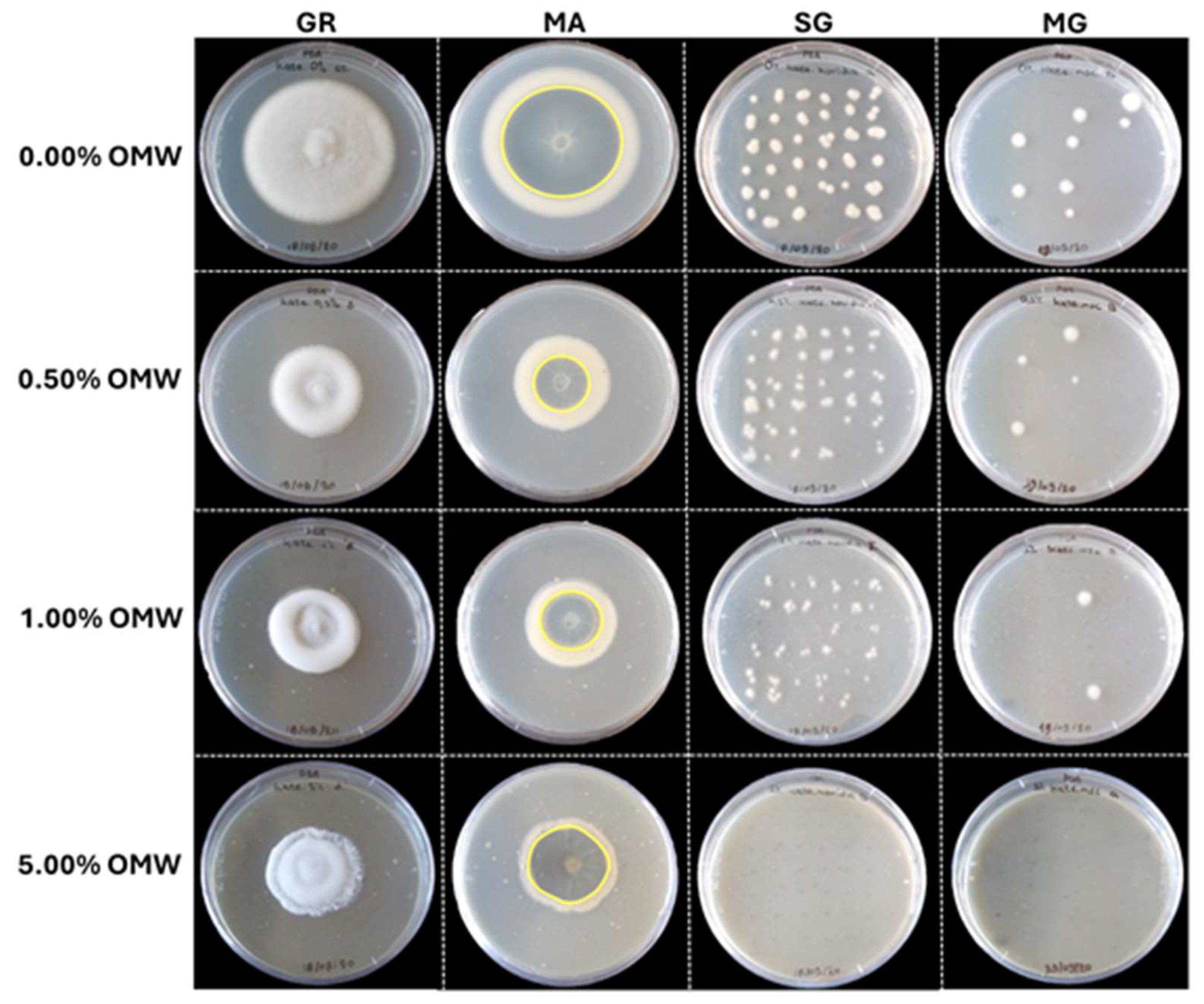
Figure 2.
Verticillium wilt disease severity on eggplant mock inoculated (control-) or inoculated with 20 ml of high (5 × 10⁶ conidia ml-1) inoculum density of Verticillium dahliae, treated with olive mill wastewater (OMW) or non treated, in different experiments (I, II, IV and V) that conducted at different periods under the same controlled conditions. Each marker represents the mean of 21 plants. Within each experiment, markers followed by the same letter at each observation time point are not significantly different according to Tukey’s HSD test at P ≤ 0.05. Vertical bars indicate standard errors.
Figure 2.
Verticillium wilt disease severity on eggplant mock inoculated (control-) or inoculated with 20 ml of high (5 × 10⁶ conidia ml-1) inoculum density of Verticillium dahliae, treated with olive mill wastewater (OMW) or non treated, in different experiments (I, II, IV and V) that conducted at different periods under the same controlled conditions. Each marker represents the mean of 21 plants. Within each experiment, markers followed by the same letter at each observation time point are not significantly different according to Tukey’s HSD test at P ≤ 0.05. Vertical bars indicate standard errors.
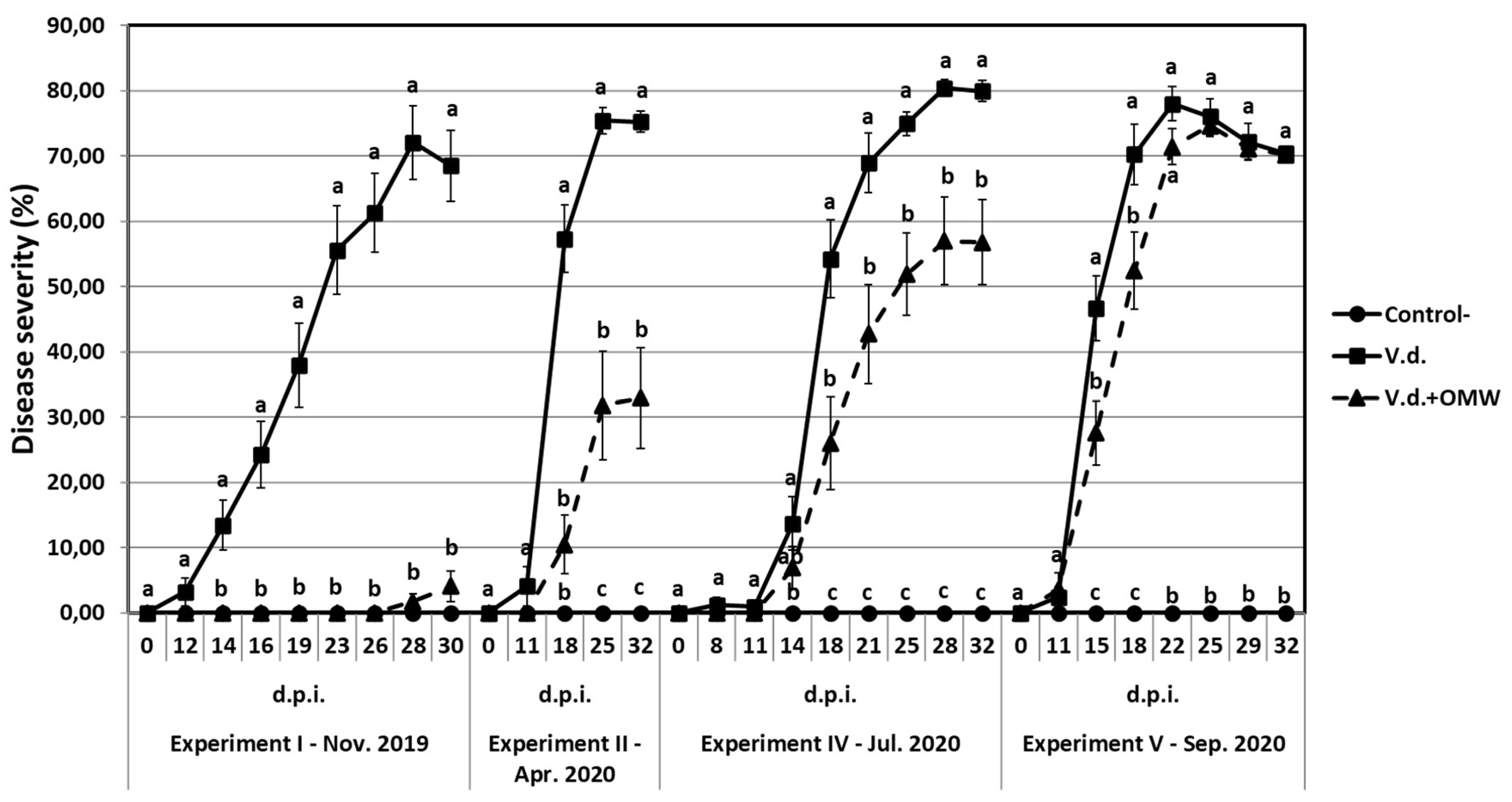
Figure 3.
Disease symptoms on eggplants inoculated with Verticillium dahliae, previously treated with olive mill wastewater (V.d.+OMW) or not (V.d.), in different experiments (I, II, IV and V) that conducted at different time periods (November 2019, April 2020, July 2020 and September 2020) under the same conditions.
Figure 3.
Disease symptoms on eggplants inoculated with Verticillium dahliae, previously treated with olive mill wastewater (V.d.+OMW) or not (V.d.), in different experiments (I, II, IV and V) that conducted at different time periods (November 2019, April 2020, July 2020 and September 2020) under the same conditions.
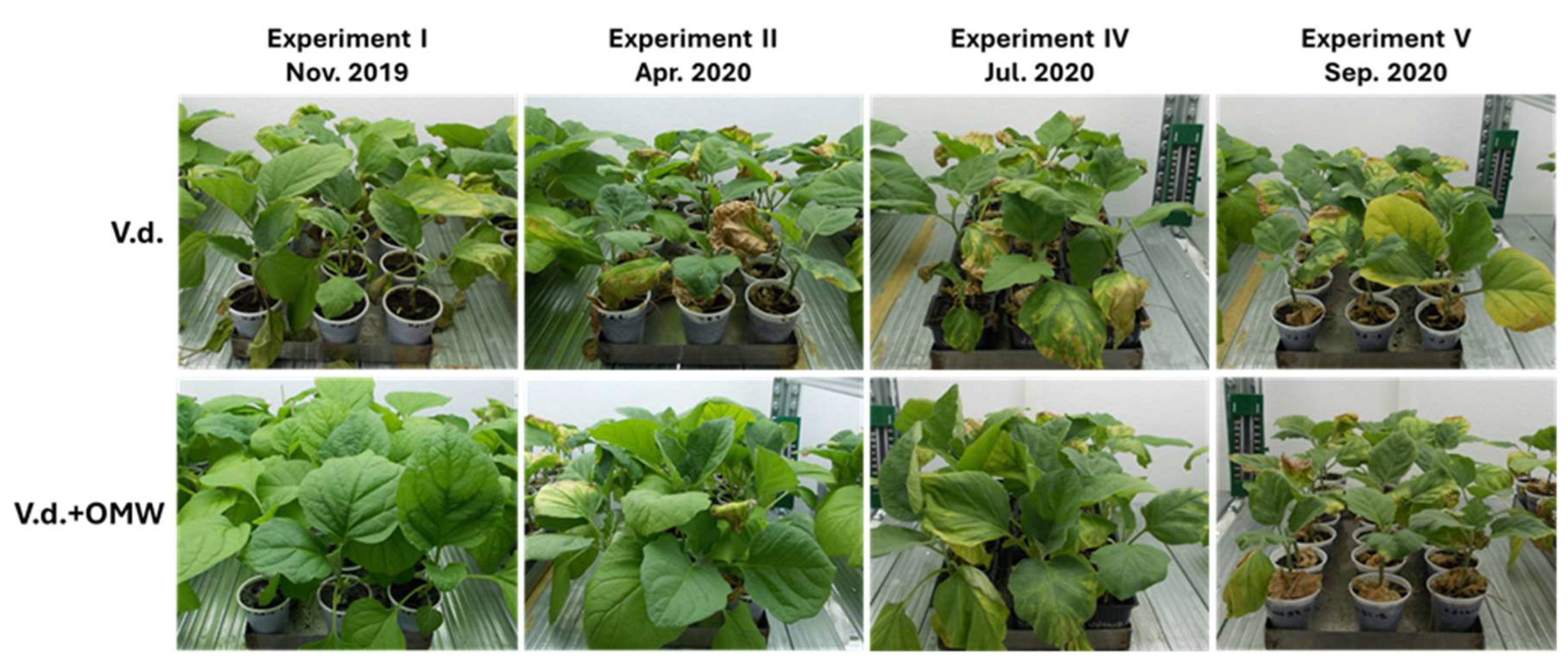
Figure 4.
Stacked bar plots showing the relative abundance of the most dominant members of the bacterial community phylogenetically assigned to the genus levels in the tomato (a) and eggplant (b) plants, along with Redundancy analysis (RDA) and Canonical correspondence analysis (CCA) ordination plots of the bacterial community in tomato (c) and eggplant (d) plants, respectively. The relative abundance was calculated with the 200 most dominant ASVs in the dataset. Ellipses are denoting the grouping of the samples according to the treatment. Model parameters, variance and significance levels are provided in the panel above the graphs.
Figure 4.
Stacked bar plots showing the relative abundance of the most dominant members of the bacterial community phylogenetically assigned to the genus levels in the tomato (a) and eggplant (b) plants, along with Redundancy analysis (RDA) and Canonical correspondence analysis (CCA) ordination plots of the bacterial community in tomato (c) and eggplant (d) plants, respectively. The relative abundance was calculated with the 200 most dominant ASVs in the dataset. Ellipses are denoting the grouping of the samples according to the treatment. Model parameters, variance and significance levels are provided in the panel above the graphs.
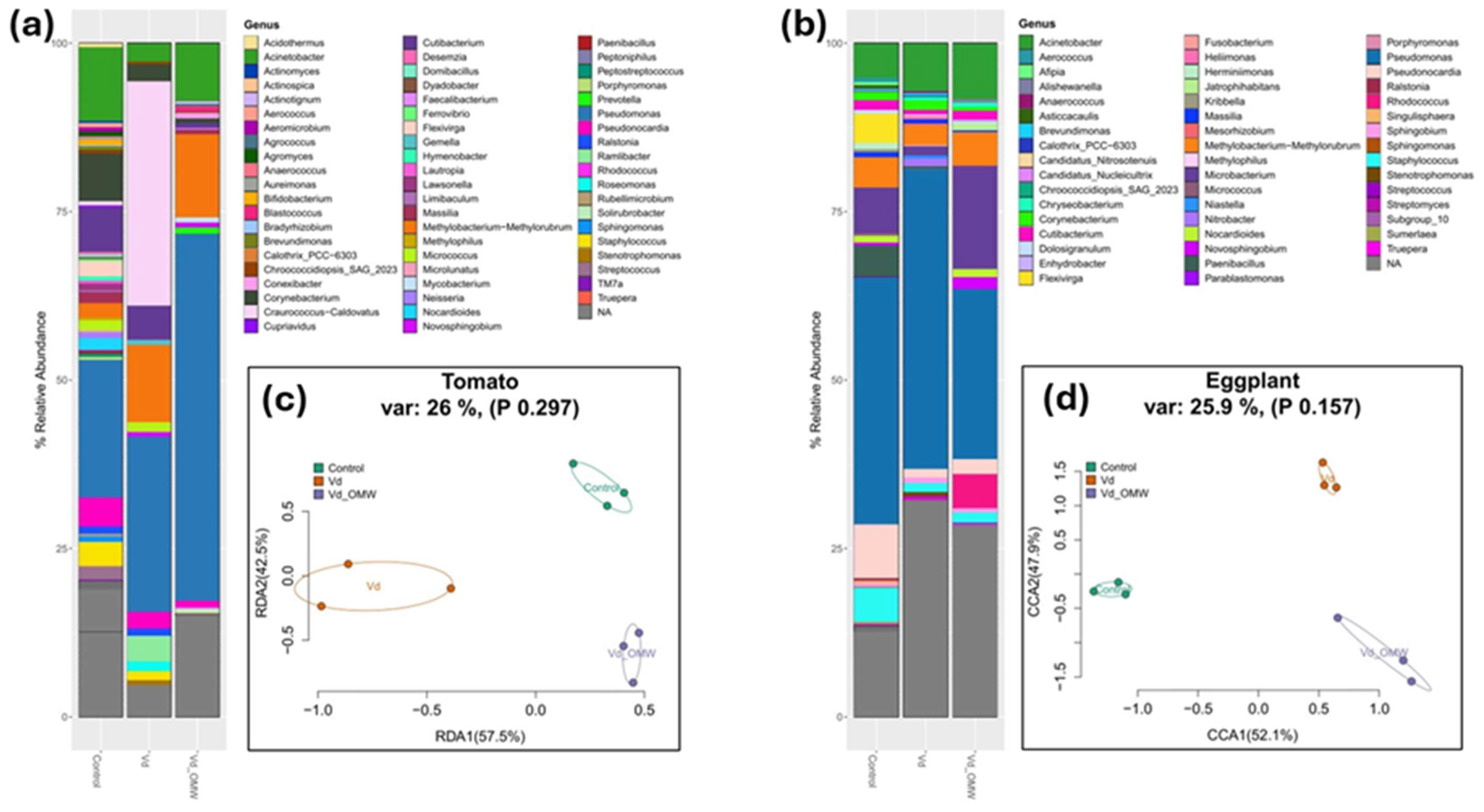
Figure 5.
Stacked bar plots showing the relative abundance of the most dominant members of the fungal community phylogenetically assigned to the genus levels in the tomato (a) and eggplant (b) plants, along with Redundancy analysis (RDA) and Canonical correspondence analysis (CCA) ordination plots of the fungal community in tomato (c) and eggplant (d) plants, respectively. The relative abundance was calculated with the 200 most dominant ASVs in the dataset. Ellipses are denoting the grouping of the samples according to the treatment. Model parameters, variance and significance levels are provided in the panel above the graphs.
Figure 5.
Stacked bar plots showing the relative abundance of the most dominant members of the fungal community phylogenetically assigned to the genus levels in the tomato (a) and eggplant (b) plants, along with Redundancy analysis (RDA) and Canonical correspondence analysis (CCA) ordination plots of the fungal community in tomato (c) and eggplant (d) plants, respectively. The relative abundance was calculated with the 200 most dominant ASVs in the dataset. Ellipses are denoting the grouping of the samples according to the treatment. Model parameters, variance and significance levels are provided in the panel above the graphs.
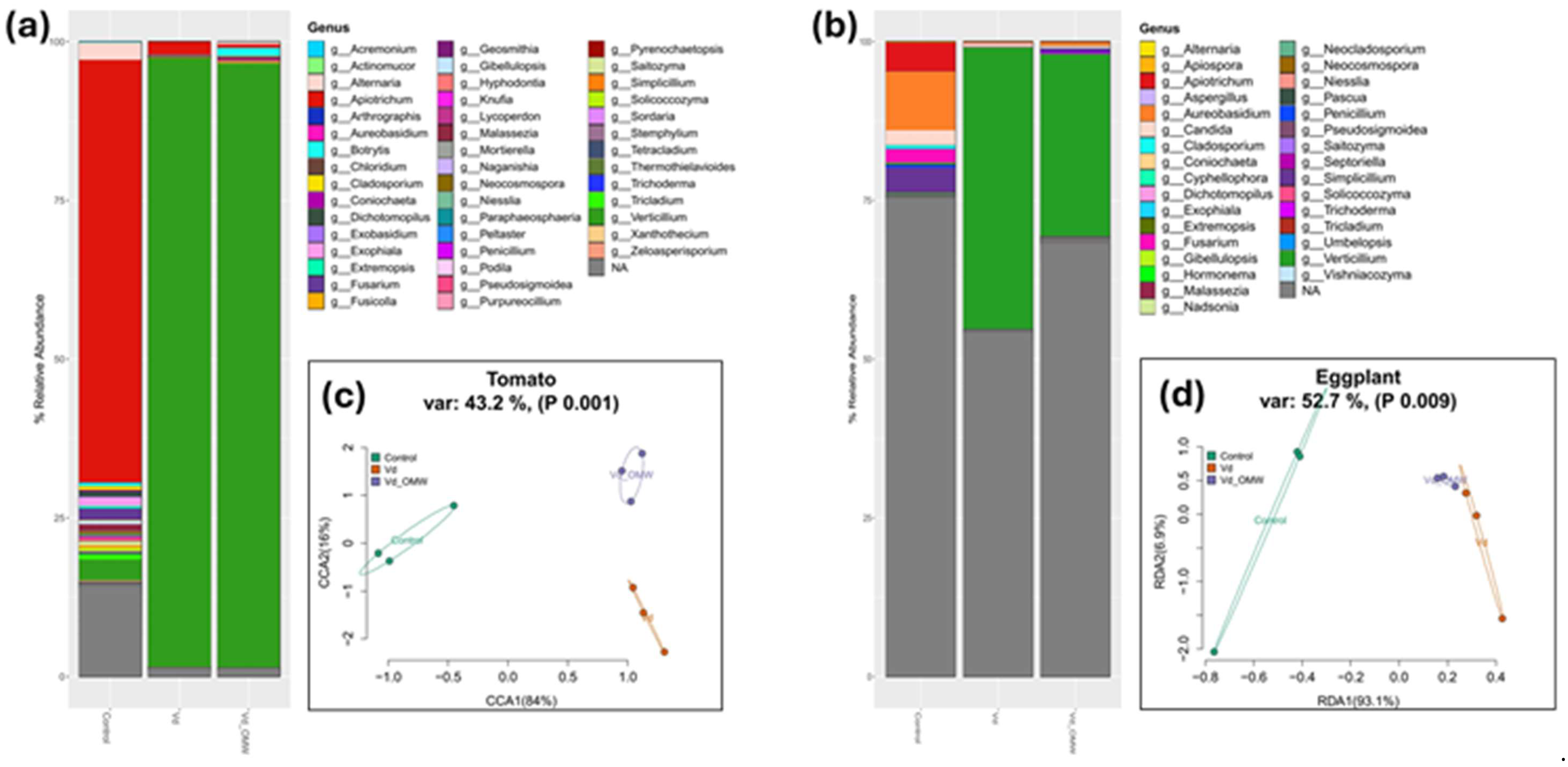

Table 1.
Values (±standard errors) of fungal parameters of Verticillium dahliae grown on PDA amended with sterilized olive mill wastewater (OMW) at various concentrations (0.00%,0.001%, 0.05%, 0.10%, 0.25%, 0.50%, 1.00% and 5.00%).
Table 1.
Values (±standard errors) of fungal parameters of Verticillium dahliae grown on PDA amended with sterilized olive mill wastewater (OMW) at various concentrations (0.00%,0.001%, 0.05%, 0.10%, 0.25%, 0.50%, 1.00% and 5.00%).
| Treatment | Fungal parametersa | |||||
|---|---|---|---|---|---|---|
| Growth rate (mm/day)b | Spores (×105) per 5-mm-diameter discc | Hyphae width (μm)d | Microsclerotial area (cm2)e | Spore germination (%)f | Microsclerotium germination (%)g | |
| V. d. + 0.00% OMW | 3.84±0.18 a | 27.92±7.87 ab | 3.35±0.13 a | 12.72±2.09 a | 63.66±4.28 a | 37.03±4.97 a |
| V. d. + 0.01% OMW | 3.46±0.22 ab | 21.08±2.16 abcd | 2.58±0.13 b | 8.39±2.31 a | 59.03±2.70 ab | 26.88±5.92 ab |
| V. d. + 0.05% OMW | 3.24±0.23 abc | 38.00±5.18 a | 2.17±0.11 bc | 7.67±2.31 a | 56.01±4.22 abc | 23.14±5.37 ab |
| V. d. + 0.10% OMW | 3.11±0.21 abc | 25.42±4.97 abc | 1.78±0.08 cd | 4.93±1.70 a | 50.23±2.20 abc | 28.19±3.60 ab |
| V. d. + 0.25% OMW | 2.95±0.24 bc | 11.83±2.07 bcd | 2.02±0.09 cd | 5.59±1.98 a | 54.40±3.80 abc | 24.56±3.96 ab |
| V. d. + 0.50% OMW | 2.66±0.10 bc | 10.25±1.25 cd | 1.86±0.08 cd | 5.14±1.28 a | 47.92±2.50 bc | 20.52±4.47 abc |
| V. d. + 1.00% OMW | 2.61±0.12 c | 8.92±0.97 cd | 1.72±0.08 d | 5.09±1.28 a | 43.98±2.82 c | 10.94±5.11 bc |
| V. d. + 5.00% OMW | 2.45±0.08 c | 6.17±0.95 d | 2.07±0.11 cd | 7.93±0.38 a | 0.00±0.00 d | 5.89±2.82 c |
a Each value represents the mean of 6 replicates. Within columns, values followed by the same letter are not significantly different according to Tukey’s HSD test at P ≤ 0.05.b Isolates were grown on PDA amended with sterilized olive mill wastewater at various concentrations at 24 ˚C in the dark and their colonies’ diameter was measured at day 3, 7, 10 and 14.c At the end of the bioassays (14 dpi), a 5 mm-diameter disc taken from the periphery of each culture was transferred into a 1.5 ml Eppendorf tube containing 1 ml of sterilized distilled water and vortexed for 30 s. The number of spores was measured using a haematocytometer under a light microscope.d Mycelia from cultures’ periphery were prepared and microscopic observations (30 readings per culture) were carried out to estimate hyphae width.e At the end of the bioassays (14 dpi) the underside of the plates was scanned using a Samsung Xpress SL-M2875ND Laser Multifunction Printer and microsclerotial (black) area on each plate image was determined using the image processing software ImageJ 1.46r (National Institutes of Health, United States).f Conidial suspension was adjusted to 1 spore μl-1 and eighteen 1-μl-volume drops were deposited onto PDA medium (six replicated PDA plates per treatment) and the plates were incubated at 24 ˚C in the dark for 3 days. Spore germination was assessed visually and estimated as percentage of the emerging colonies. g Microsclerotial suspension was adjusted to 0.5 microslcerotia μl-1 and eighteen 2-μl-volume drops were deposited onto PDA medium in plates that were incubated at 24 ˚C in the dark for 2 days. Microsclerotia were examined under a light microscope and microsclerotium germination was estimated as percentage of the germinated microsclerotia. A microsclerotium was considered germinated when the germ tube was ≥ than the microsclerotium diameter.
Table 2.
Values (±standard errors) of disease and growth parameters for eggplants mock inoculated (control-) or artificially inoculated with high or low inoculum density of Verticillium dahliae and treated with olive mill wastewater (OMW) or TRIANUM-P or non treated, in experiment Ι.
Table 2.
Values (±standard errors) of disease and growth parameters for eggplants mock inoculated (control-) or artificially inoculated with high or low inoculum density of Verticillium dahliae and treated with olive mill wastewater (OMW) or TRIANUM-P or non treated, in experiment Ι.
| Treatment | Disease parametersa | Plant growth parametersb | ||||||
|---|---|---|---|---|---|---|---|---|
| DI (%) | FDS (%) | M (%) | RAUDPC (%) | IR (0-1) | L | H (cm) | FW (gr) | |
| Control- | 0.00±0.00 c | 0.00±0.00 c | 0.00±0.00 b | 0.00±0.00 c | 0.00±0.00 c | 6.76±0.14 a | 18.31±0.34 a | 6.56±0.17 a |
| V.d. high | 90.48±6.15 a | 68.49±5.43 a | 47.62±9.91 a | 26.76±2.95 a | 0.59±0.08 a | 6.24±0.14 ab | 17.00±0.39 ab | 2.89±0.31 b |
| V.d. low | 52.38±6.14 b | 34.27±7.91 b | 9.52±6.15 b | 6.80±2.01 bc | 0.29±0.14 b | 6.52±0.13 ab | 18.29±0.39 a | 6.19±0.49 a |
| V.d. high+OMW | 14.29±14.29 c | 4.06±2.36 c | 0.00±0.00 b | 0.25±0.15 c | 0.10±0.06 bc | 6.25±0.14 ab | 16.75±0.34 ab | 6.47±0.37 a |
| V.d. low+OMW | 4.76±4.76 c | 1.90±1.90 c | 0.00±0.00 b | 0.66±0.66 c | 0.13±0.07 bc | 6.05±0.13 b | 17.71±0.48 ab | 5.96±0.37 a |
| V.d. high+TRIANUM-P | 52.38±6.74 b | 33.45±7.44 b | 4.76±4.76 b | 7.88±1.94 b | 0.25±0.16 bc | 6.48±0.11 ab | 16.14±0.56 b | 5.87±0.42 a |
a Disease parameters were evaluated periodically on the basis of external symptoms during a period of 30 days after root drenching (dpi) with 20 ml of V. dahliae conidial suspension per plant at high (5 × 10⁶ conidia ml-1) or low (2 × 10⁶ conidia ml-1) inoculum density. One week prior to inoculation with V. dahliae, plants were root-drenched with OMW (20 ml of 5% OMW per plant). TRIANUM-P was also applied by root drenching (20 ml of 3 × 10⁷ cfu ml-1 per plant). DI = final disease incidence; FDS = final disease severity; M = mortality; RAUDPC = relative area under the disease progress curve with reference to the maximum value potentially reached over each assessment period; IR = isolation ratio. Each value represents the mean of 21 plants. Within columns, values followed by the same letter are not significantly different according to Tukey’s HSD test at P ≤ 0.05.b Plant growth parameters were evaluated at 30 dpi. L = number of leaves; H = plant height; FW = plant fresh weight. Each value represents the mean of 21 plants. Within columns, values followed by the same letter are not significantly different according to Tukey’s HSD test at P ≤ 0.05.
Table 3.
Values (±standard errors) of disease and growth parameters for eggplants mock inoculated (control-) or artificially inoculated with high or low inoculum density of Verticillium dahliae and treated with olive mill wastewater (OMW) in non-sterilized or sterilized soil, various microbial strains (KX1, KX2, KX3, KX6, KX7 or KF8), TRIANUM-P or non-treated (control-), in experiment ΙI.
Table 3.
Values (±standard errors) of disease and growth parameters for eggplants mock inoculated (control-) or artificially inoculated with high or low inoculum density of Verticillium dahliae and treated with olive mill wastewater (OMW) in non-sterilized or sterilized soil, various microbial strains (KX1, KX2, KX3, KX6, KX7 or KF8), TRIANUM-P or non-treated (control-), in experiment ΙI.
| Treatment | Disease parametersa | Plant growth parametersb | |||||||
|---|---|---|---|---|---|---|---|---|---|
| DI (%) | FDS (%) | M (%) | RAUDPC (%) | IR (0-1) | qPCR | L | H (cm) | FW (gr) | |
| Control- | 0.00±0.00 e | 0.00±0.00 c | 0.00±0.00 b | 0.00±0.00 e | 0.00±0.00 d | 0.00±0.00 b | 7.10±0.41 a | 15.22±0.84 ab | 7.73±0.47 a |
| V.d. high | 100.00±0.00 a | 75.22±1.57 a | 33.33±10.29 ab | 38.40±1.48 a | 0.98±0.02 a | 3.90±1.10 a | 6.95±0.26 a | 11.57±0.37 c | 2.53±0.16 c |
| V.d. low | 85.72±6.73 ab | 66.81±5.06 a | 23.81±14.02 ab | 29.63±3.28 ab | 0.84±0.06 a | ne | 7.05±0.29 a | 13.21±0.48 bc | 4.24±0.55 bc |
| V.d. high+OMW | 42.86±14.02 c | 32.91±7.73 b | 9.52±6.15 ab | 12.84±3.37 cd | 0.37±0.09 c | 1.12±0.35 b | 6.90±0.15 a | 15.12±0.62 ab | 6.26±0.62 ab |
| V.d. high_Steril. soil+OMW | 57.14±15.79 bc | 35.96±7.20 b | 0.00±0.00 b | 10.23±2.74 de | 0.49±0.10 bc | ne | 7.10±0.23 a | 16.74±0.65 a | 6.27±0.53 ab |
| V.d. low+OMW | 42.86±11.98 c | 28.34±7.55 b | 14.28±6.73 ab | 8.20±2.78 de | 0.30±0.09 cd | ne | 6.90±0.15 a | 15.14±0.57 ab | 6.12±0.61 ab |
| V.d. high+KX1 | 100.00±0.00 a | 72.80±1.16 a | 19.05±9.91 ab | 30.81±1.92 ab | ne | ne | 6.62±0.15 a | 12.21±0.41 c | 2.78±0.28 c |
| V.d. high+KX2 | 90.48±6.15 ab | 69.54±5.30 a | 52.38±12.30 a | 30.29±3.09 ab | ne | ne | 6.62±0.33 a | 13.38±0.31 bc | 3.00±0.45 c |
| V.d. high+KX3 | 100.00±0.00 a | 70.68±2.40 a | 23.81±9.52 ab | 31.78±2.17 ab | ne | ne | 7.10±0.28 a | 13.00±0.43 bc | 3.29±0.25 c |
| V.d. high+KX6 | 100.00±0.00 a | 76.15±1.35 a | 42.86±9.52 ab | 33.15±1.57 ab | ne | ne | 6.48±0.13 a | 12.81±0.41 bc | 2.52±0.14 c |
| V.d. high+KX7 | 100.00±0.00 a | 75.28±2.32 a | 42.86±9.52 ab | 32.19±2.08 ab | ne | ne | 6.52±0.11 a | 12.17±0.27 bcd | 2.80±0.27 c |
| V.d. high+KF8 | 95.24±4.76 ab | 70.16±3.37 a | 33.33±10.29 ab | 26.55±2.60 ab | ne | ne | 6.71±0.18 a | 14.05±0.59 bcd | 3.74±0.45 c |
| V.d. high+MIXED | 85.71±9.91 ab | 63.32±6.26 a | 23.76±9.52 ab | 28.28±3.53 ab | ne | ne | 6.62±0.41 a | 12.26±0.54 c | 3.48±0.51 c |
| V.d. high+TRIANUM-P | 80.95±9.91 abc | 61.58±7.00 a | 37.95±13.48 ab | 22.91±3.37 bc | 0.76±0.08 ab | 0.56±0.09 b | 6.57±0.44 a | 12.67±0.69 bc | 3.76±0.59 c |
a Disease parameters were evaluated periodically on the basis of external symptoms during a period of 32 days after root drenching (dpi) with 20 ml of V. dahliae conidial suspension per plant at high (5 × 10⁶ conidia ml-1) or low (2 × 10⁶ conidia ml-1) inoculum density. One week prior to inoculation with V. dahliae, plants transplanted in non-sterilized or sterilized soil were root-drenched with OMW (20 ml of 5% OMW per plant). Separated or mixed microbial strains (KX1, KX2, KX3, KX6, KX7, KF8 or MIXED) were also applied by root drenching 20 ml of 1 × 10⁷ spores ml-1 per plant; whereas TRIANUM-P was applied by root drenching 20 ml of 3 × 10⁷ cfu ml-1 per plant. DI = final disease incidence; FDS = final disease severity; M = mortality; RAUDPC = relative area under the disease progress curve with reference to the maximum value potentially reached over each assessment period; IR = isolation ratio. ‘ne’ indicates that IR and qPCR were not estimated for the respective treatments. Each value represents the mean of 21 plants. Within columns, values followed by the same letter are not significantly different according to Tukey’s HSD test at P ≤ 0.05.b Plant growth parameters were evaluated at 32 dpi. L = number of leaves; H = plant height; FW = plant fresh weight. Each value represents the mean of 21 plants. Within columns, values followed by the same letter are not significantly different according to Tukey’s HSD test at P ≤ 0.05.
Table 4.
Values (±standard errors) of disease and growth parameters for tomato plants mock inoculated (control-) or artificially inoculated with high inoculum density of Verticillium dahliae and treated with olive mill wastewater (OMW) or non-treated, in experiment ΙII.
Table 4.
Values (±standard errors) of disease and growth parameters for tomato plants mock inoculated (control-) or artificially inoculated with high inoculum density of Verticillium dahliae and treated with olive mill wastewater (OMW) or non-treated, in experiment ΙII.
| Treatment | Disease parametersa | Plant growth parametersb | |||||||
|---|---|---|---|---|---|---|---|---|---|
| DI (%) | FDS (%) | M (%) | RAUDPC (%) | IR (0-1) | qPCR | L | H (cm) | FW (gr) | |
| Control- | 0.00±0.00 c | 0.00±0.00 c | 0.00±0.00 a | 0.00±0.00 c | 0.00±0.00 c | 0.002±0.001 c | 7.71±0.10 a | 38.39±0.78 a | 11.26±0.34 a |
| V.d. | 95.27±4.76 a | 42.76±1.89 a | 0.00±0.00 a | 25.14±1.43 a | 0.62±0.07 a | 0.182±0.026 a | 7.67±0.13 a | 34.74±0.83 b | 8.98±0.23 c |
| V.d.+OMW | 52.38±9.91 b | 22.36±4.87 b | 0.00±0.00 a | 11.54±2.62 b | 0.38±0.09 b | 0.097±0.021 b | 7.50±0.11 a | 36.13±0.75 ab | 10.21±0.37 b |
a Disease parameters were evaluated periodically on the basis of external symptoms during a period of 35 days after root drenching (dpi) with 20 ml of Verticillium dahliae conidial suspension per plant at high (5 × 10⁶ conidia ml-1) inoculum density. One week prior to inoculation with V. dahliae, plants were root-drenched with OMW (20 ml of 5% OMW per plant). DI = final disease incidence; FDS = final disease severity; M = mortality; RAUDPC = relative area under the disease progress curve with reference to the maximum value potentially reached over each assessment period; IR = isolation ratio. Each value represents the mean of 21 plants. Within columns, values followed by the same letter are not significantly different according to Tukey’s HSD test at P ≤ 0.05.b Plant growth parameters were evaluated at 35 dpi. L = number of leaves; H = plant height; FW = plant fresh weight. Each value represents the mean of 21 plants. Within columns, values followed by the same letter are not significantly different according to Tukey’s HSD test at P ≤ 0.05.
Table 5.
Values (±standard errors) of disease and growth parameters for eggplants mock inoculated (control-) or artificially inoculated with high inoculum density of Verticillium dahliae and treated with sterilized or non-sterilized olive mill wastewater (OMW) or non-treated, and for eggplants in a split-root set-up with the half of the split-root system being inoculated with the fungus and the other half with water (V.d./-) or the half of the split-root system being inoculated with the fungus and the other half being treated with olive mill wastewater (V.d./OMW), in experiment ΙV.
Table 5.
Values (±standard errors) of disease and growth parameters for eggplants mock inoculated (control-) or artificially inoculated with high inoculum density of Verticillium dahliae and treated with sterilized or non-sterilized olive mill wastewater (OMW) or non-treated, and for eggplants in a split-root set-up with the half of the split-root system being inoculated with the fungus and the other half with water (V.d./-) or the half of the split-root system being inoculated with the fungus and the other half being treated with olive mill wastewater (V.d./OMW), in experiment ΙV.
| Treatment | Disease parametersa | Plant growth parametersb | |||||||
|---|---|---|---|---|---|---|---|---|---|
| DI (%) | FDS (%) | M (%) | RAUDPC (%) | IR (0-1) | L | H (cm) | FW (gr) | ||
| Control- | 0.00±0.00 c | 0.00±0.00 c | 0.00±0.00 b | 0.00±0.00 c | 0.00±0.00 b | 7.57±0.22 ab | 17.79±0.72 a | 10.67±0.54 a | |
| V.d. | 100.00±0.00 a | 79.91±1.64 a | 57.14±14.02 a | 37.24±1.39 a | 0.78±0.06 a | 6.62±0.22 b | 13.67±0.52 b | 2.93±0.18 c | |
| V.d.+OMW | 80.95±6.73 ab | 56.78±6.51 b | 23.81±6.15 ab | 23.72±3.03 b | 0.48±0.11 ab | 6.95±0.30 ab | 16.31±0.68 a | 5.01±0.71 bc | |
| V.d.+Steril.OMW | 76.19±9.52 b | 53.32±7.08 b | 14.28±6.73 b | 21.77±3.12 b | 0.63±0.09 a | 7.29±0.27 ab | 15.83±0.65 ab | 5.50±0.75 bc | |
| V.d./- | 85.72±6.73 ab | 58.54±6.50 ab | 14.28±6.73 b | 28.15±4.05 ab | 0.70±0.10 a | 7.57±0.21 ab | 18.05±0.60 a | 8.48±1.43 ab | |
| V.d./OMW | 85.72±6.73 ab | 62.13±5.83 ab | 14.29±9.91 b | 28.71±3.11 ab | 0.74±0.09 a | 7.71±0.23 a | 16.86±0.70 a | 7.60±1.25 ab | |
a Disease parameters were evaluated periodically on the basis of external symptoms during a period of 32 days after root drenching (dpi) with 20 ml of V. dahliae conidial suspension per plant at high (5 × 10⁶ conidia ml-1) inoculum density. One week prior to inoculation with V. dahliae, plants were root-drenched with non-sterilized or sterilized OMW (20 ml of 5% OMW per plant). DI = final disease incidence; FDS = final disease severity; M = mortality; RAUDPC = relative area under the disease progress curve with reference to the maximum value potentially reached over each assessment period; IR = isolation ratio. Each value represents the mean of 21 plants. Within columns, values followed by the same letter are not significantly different according to Tukey’s HSD test at P ≤ 0.05.b Plant growth parameters were evaluated at 32 dpi. L = number of leaves; H = plant height; FW = plant fresh weight. Each value represents the mean of 21 plants. Within columns, values followed by the same letter are not significantly different according to Tukey’s HSD test at P ≤ 0.05.
Table 6.
Values (±standard errors) of disease and growth parameters for eggplants mock inoculated (control-) or artificially inoculated with high inoculum density of Verticillium dahliae and treated with olive mill wastewater (OMW) or non-treated, in experiment V.
Table 6.
Values (±standard errors) of disease and growth parameters for eggplants mock inoculated (control-) or artificially inoculated with high inoculum density of Verticillium dahliae and treated with olive mill wastewater (OMW) or non-treated, in experiment V.
| Treatment | Disease parametersa | Plant growth parametersb | |||||||
|---|---|---|---|---|---|---|---|---|---|
| DI (%) | FDS (%) | M (%) | RAUDPC (%) | IR (0-1) | L | H (cm) | FW (gr) | ||
| Control- | 0.00±0.00 b | 0.00±0.00 b | 0.00±0.00 a | 0.00±0.00 b | 0.00±0.00 b | 7.29±0.22 a | 15.65±0.40 a | 7.87±0.32 a | |
| V.d. | 100.00±0.00 a | 70.35±1.97 a | 28.57±11.34 a | 41.37±1.71 a | 0.92±0.04 a | 6.19±0.15 b | 11.86±0.36 b | 2.46±0.26 b | |
| V.d.+OMW | 100.00±0.00 a | 70.16±1.41 a | 19.05±9.91 a | 36.62±1.49 b | 0.86±0.06 a | 6.19±0.13 b | 11.79±0.27 b | 2.26±0.11 b | |
a Disease parameters were evaluated periodically on the basis of external symptoms during a period of 32 days after root drenching (dpi) with 20 ml of Verticillium dahliae conidial suspension per plant at high (5 × 10⁶ conidia ml-1) inoculum density. One week prior to inoculation with V. dahliae, plants were root-drenched with OMW (20 ml of 5% OMW per plant). DI = final disease incidence; FDS = final disease severity; M = mortality; RAUDPC = relative area under the disease progress curve with reference to the maximum value potentially reached over each assessment period; IR = isolation ratio. Each value represents the mean of 21 plants. Within columns, values followed by the same letter are not significantly different according to Tukey’s HSD test at P ≤ 0.05.b Plant growth parameters were evaluated at 32 dpi. L = number of leaves; H = plant height; FW = plant fresh weight. Each value represents the mean of 21 plants. Within columns, values followed by the same letter are not significantly different according to Tukey’s HSD test at P ≤ 0.05.
Disclaimer/Publisher’s Note: The statements, opinions and data contained in all publications are solely those of the individual author(s) and contributor(s) and not of MDPI and/or the editor(s). MDPI and/or the editor(s) disclaim responsibility for any injury to people or property resulting from any ideas, methods, instructions or products referred to in the content. |
© 2025 by the authors. Licensee MDPI, Basel, Switzerland. This article is an open access article distributed under the terms and conditions of the Creative Commons Attribution (CC BY) license (http://creativecommons.org/licenses/by/4.0/).
Copyright: This open access article is published under a Creative Commons CC BY 4.0 license, which permit the free download, distribution, and reuse, provided that the author and preprint are cited in any reuse.


