

Submitted:
10 February 2025
Posted:
12 February 2025
You are already at the latest version
Abstract
Lead-free perovskites have garnered significant attention as a promising alternative to traditional toxic Pb-containing materials in solar cells. Although lead-based perovskites have achieved high solar energy conversion efficiencies (>25%), their contamination and environmental risks limit their commercial application. Materials based on tin (Sn), bismuth (Bi), antimony (Sb), and germanium (Ge) exhibit the potential to replace lead-based perovskites due to their similar optical and electrochemical properties and lower toxicity. However, key challenges remain, including their lower stability, susceptibility to oxidation (notably Sn2+), and reduced efficiency compared to Pb-based materials. This article reviews recent advancements in the synthesis of lead-free perovskites, methods for improving their structural and functional properties, and their prospects for application in solar cells. The presented review consolidates data on the photovoltaic efficiency, stability, durability, and environmental safety of lead-free perovskites. It discusses their future market potential, emphasizing their environmental friendliness, wide applicability in solar cells, light-emitting devices, neuromorphic systems for artificial intelligence, and microelectronics, as well as scalable production methods that have been developed.The need for further research to optimize their properties and scale up technologies for industrial applications is highlighted.The analysis demonstrates that lead-free perovskites hold substantial promise as a foundation for the next generation of solar cells, providing an environmentally clean and sustainable solution for renewable energy. Nonetheless, addressing the technological challenges related to their stability and scalability is critical for unlocking their full potential.
Keywords:
Lead-free perovskites
; Perovskite solar cells (PSCs)
; Toxicity in photovoltaics
; Tin-based solar cells
; Eco-friendly photovoltaic materials
; Green chemistry
; Sustainability in solar energy
; Halide perovskites
; Power conversion efficiency (PCE)
1. Introduction
Perovskite solar cells (PSC) have emerged as a significant focus in renewable energy research over the past decades, thanks to their unique properties and high efficiency in converting sunlight into electricity. The most substantial progress has been achieved using Pb-based perovskites, such as methylammonium lead iodide (CH3NH3PbI3), which deliver outstanding efficiencies exceeding 25% [1,2,3]. These materials are characterized by high light absorption capabilities, a narrow bandgap, and compositional tunability, making them attractive for the development of efficient and cost-effective solar cells. However, the use of lead in these materials poses serious environmental and toxicological risks, hindering their widespread adoption.
Lead is a highly toxic heavy metal that can easily leach from the perovskite layer upon contact with water, potentially leading to environmental contamination and health hazards [4,5]. Furthermore, the instability of Pb-based perovskites under moisture, oxygen, and sunlight exposure leads to material degradation, increasing the risk of toxic component leakage [6,7,8]. These challenges underscore the need for environmentally safe alternatives that retain the remarkable properties of Pb-based perovskites.
Lead-free perovskites represent one of the most promising areas of research. These include materials based on tin (Sn), bismuth (Bi), antimony (Sb), and germanium (Ge). Each of these materials has its advantages and limitations, making the development of lead-free counterparts a multifaceted challenge. For instance, tin-based perovskites exhibit optical properties similar to those of their Pb-based counterparts, such as high light absorption and an optimal bandgap, but suffer from instability due to the oxidation of Sn2+ to Sn4+ [9,10]. This results in device degradation and reduced efficiency. To address this issue, various stabilization methods are being developed, including the use of reducing agents like SnF₂, defect passivation, and multilayer structures [11,12,13].
Materials based on bismuth and antimony offer high stability and low toxicity, making them particularly appealing from an environmental standpoint [14,15]. However, their efficiency in solar cells remains lower than that of Pb-based materials. Recent research has focused on combining bismuth and antimony with other elements to enhance their photovoltaic performance. For example, hybrid structures containing Bi and Sb demonstrate improved charge carrier mobility and increased stability [16,17,18]. Germanium (Ge) is also being explored as a potential alternative to lead due to its high light absorption and stability. However, the limited availability of this element and its high cost make its application less economically viable [19,20]. Nonetheless, advancements in nanostructured Ge-based materials are opening new possibilities for their use in perovskite solar cells [21].
An important area of research is the development of synthesis and processing methods for lead-free perovskites. Modern techniques such as spin-coating, chemical deposition, and vacuum evaporation enable the fabrication of thin-film structures with high uniformity and minimal defects [22,23]. Additionally, methods for defect passivation and interfacial interaction improvements are actively being studied, contributing to enhanced device stability and longevity [24,25]. A promising approach involves the use of hybrid organic-inorganic structures that combine the advantages of different materials [26].
With a focus on environmental considerations, lead-free perovskites significantly reduce the risk of environmental pollution because their components are less toxic and more biodegradable [27,28]. This makes them attractive not only for photovoltaics but also for other applications such as light-emitting diodes and sensors.
In conclusion, lead-free perovskites represent a promising direction in renewable energy research. Despite the existing challenges related to their stability and efficiency, they hold significant potential to replace the toxic Pb-based counterparts in solar cells. This study analyzes the current state of research on lead-free perovskites, their properties, and their commercialization prospects.
2. Perovskites: Structure and Properties
2.1. Structure of Perovskites (ABX3)
Perovskites are crystalline materials with the general formula ABX3, where A is a large cation (e.g., CH3NH3+, Cs+, or FA+), B is a smaller cation (e.g., Pb2+, Sn2+, or Bi3+), and X is an anion (typically a halide such as I–, Br–, or Cl–). The perovskite structure is based on a cubic crystalline lattice in which the B cation occupies the center of an octahedron, the X anions are positioned at the vertices, and the A cation resides at the corners of the lattice [29]. This geometry ensures high symmetry and stability in the structure (Figure 1).
The physical properties of perovskites are strongly influenced by the sizes of the ions that compose the crystal lattice. The Goldschmidt tolerance factor determines the stability of the perovskite structure: if the size factor deviates from the range of 0.8–1.1, the material loses its structural stability [29,30]. This unique structural arrangement contributes to the remarkable optoelectronic properties of perovskites, making them highly suitable for applications in solar cells, LEDs, and other electronic devices. The flexibility of the ABX3 framework also allows for compositional tuning, enabling researchers to optimize their properties for specific applications.
Historically, perovskites were first discovered as the natural mineral CaTiO3, named after Russian mineralogist Lev Perovski in 1839. Synthetic versions of these materials, such as CH3NH3PbI3, have become the focus of intensive research due to their unique optical and electrical properties. These materials are widely applied in solar cells, LEDs, photodetectors, and even quantum electronics [31,32,33]. Modern research emphasizes the development of new perovskite compositions, including mixed halide and dual-cation systems. For instance, the introduction of two cations (Cs+ and FA+) instead of one enhances structural stability and moisture resistance [34,35].
2.2. Optical and Electrical Properties of Perovskites
One of the primary reasons for the popularity of perovskites is their exceptional optical and electrical properties. Their high light absorption coefficient (104–105 cm–1) allows for efficient harvesting of solar energy, even in thin films. This characteristic makes perovskites ideal for lightweight and flexible solar cells [36,37]. Perovskites demonstrate advantages such as greater tunability, cost-effective production, and potential for novel applications compared to traditional silicon solar cells. However, challenges such as stability and scalability remain critical to their commercialization.
The tunable bandgap of perovskites allows for the adaptation of their properties to various applications, including multi-junction solar cells, light-emitting diodes, and photodetectors. By modifying the composition (e.g., the ratio of iodine, bromine, and chlorine), the bandgap can be adjusted within the range of 1.1 to 3.2 eV [38,39]. The high charge carrier mobility and long diffusion lengths (up to 1 μm) minimize energy losses, ensuring high device efficiency. Parameters such as short-circuit current and open-circuit voltage in perovskite-based solar cells significantly surpass those of traditional silicon counterparts [40,41,42,43].
2.3. Comparison of the Status and Achievements of Lead-Based and Lead-Free Perovskites: The Role of Lead in Achieving High Efficiency
Lead halide perovskites, such as CH3NH3PbI3, remain the benchmark in photovoltaic technology due to their ability to achieve record-breaking solar energy conversion efficiencies (up to 26%) (Figure 4a,c) [44,45,46]. Lead stabilizes the crystalline lattice, minimizing defects and enhancing light absorption, making these materials dominant in solar cell development. However, the use of lead poses significant environmental and health risks, as it leaches into the environment, contaminating soil and water [47,48,49]. Lead accumulates in the human body, particularly in children, causing poisoning, and is not metabolized or excreted [50,51,52]. The World Health Organization (WHO) highlights the health risks associated with lead, while the RoHS directive in Europe prohibits its use in electronic devices [53,54]. Lead exposure sources include soil, water, air, food, paints, toys, and pets (Figure 2), with absorption rates reaching up to 70% in children. Lead toxicity affects the nervous, reproductive, and hematopoietic systems, as well as the kidneys.
To mitigate this problem, encapsulation methods have been proposed to prevent exposure and recycling of materials at the end of their life cycle, as well as replacing lead with other lead-free alternatives that meet strict criteria for stability and high efficiency. Despite these concerns, a detailed examination of Figures 4b and 4c clearly shows that lead-based perovskites, with their record-setting solar energy conversion efficiencies, remain at the forefront of photovoltaic technology, albeit with significant toxicity and environmental risks [30,39,41]. Lead-free alternatives, including tin-, bismuth-, and antimony-based perovskites, exhibit lower toxicity (Figure 3d) and high stability; however, their efficiency (9–13%) remains inferior, and their production costs are higher [50,55].
In the quest for safer alternatives, researchers are actively exploring the use of tin (Sn), bismuth (Bi), and antimony (Sb) in perovskite solar cells. In general, the first logical choice when considering alternatives to lead is substitution with elements within the same group of the periodic table. Following this, it is reasonable to select other elements that enhance stability while having less negative impact on the structure and optoelectronic properties of perovskites, including their bandgap, charge carrier mobility, light absorption capabilities, and other critical characteristics of the material. The main contenders from this perspective are tin (Sn) and germanium (Ge) due to their similar electronic configurations and suitable ionic radii (Figure 3), provided researchers can prevent their oxidation.
Tin-based perovskites, such as MASnI3 and FASnI3, possess direct bandgaps (1.20 and 1.41 eV, respectively) that are narrower than their lead-based counterparts, theoretically enabling high energy conversion efficiencies [55]. Although reports on Sn-based perovskite solar cells (Sn-PSCs) are fewer compared to Pb-PSCs, their power conversion efficiency (PCE) and stability are rapidly improving. Additionally, the ideal bandgap of Sn-based perovskite materials plays a pivotal role in their potential application (Figure 4b). However, their practical implementation faces challenges: Sn2+ is prone to oxidation to Sn4+, which compromises device stability. While the oxidation product, SnO2, is environmentally benign, it significantly deteriorates device performance.
Bismuth-based perovskites, such as Cs3Bi2I9, are characterized by high stability to external factors like humidity and oxygen. This is due to the oxidation resistance of bismuth, making it an attractive candidate for solar cells. However, the main issue with bismuth-based perovskites is their wide bandgap (around 2.1–2.3 eV), which limits their light absorption [56,57]. To improve their efficiency, methods such as replacing iodine with bromine or chlorine are actively being researched, which can reduce the bandgap and increase light absorption. Additionally, the development of multilayer structures and encapsulation can further enhance the performance of these devices [58,59].
Regarding germanium, it is also a potential substitute for lead in perovskites. For example, CH3NH3GeI3 demonstrates excellent optical properties and high charge carrier mobility. However, its use is limited by instability in the air due to the oxidation of Ge2+ to Ge4+, which leads to material degradation [60,61]. To improve stability, encapsulation, doping methods, and additives that prevent the oxidation of germanium are proposed. Recent studies show that these approaches can improve stability and the lifespan of devices, but the efficiency of germanium-based perovskites still remains below 10% [62,63]. Antimony-based perovskites, such as Cs3Sb2I9, offer high humidity resistance and stability during long-term operation. These materials attract attention due to their similarity to bismuth-based perovskites and lower defect density. However, their efficiency is limited by deep charge traps, which reduce performance [64,65]. To address this issue, research is being conducted on doping antimony-based perovskites and adding other cations, such as Rb+ or Cs+. This helps improve the crystal structure and increase the efficiency of the devices [66,67].
Double perovskites, such as Cs₂AgBiBr₆, are also an interesting alternative to traditional lead-based materials due to their high stability and lack of toxicity. These materials show excellent resistance to external factors, and their properties can be further tuned by changing the composition [68,69]. Mixed compositions, such as Sn-Ge or Bi-Sb, combine the best features of various elements, making them promising for creating highly efficient and stable devices. Recent research indicates that such combinations can significantly improve the efficiency and stability of lead-free perovskites [70,71]. In conclusion, it can be said that bismuth-based, germanium-based, and antimony-based perovskites demonstrate good resistance to external conditions, including humidity and temperature fluctuations, making them promising materials. However, their efficiency still lags behind lead-based and even tin-based counterparts (Figure 4c), and their commercial use is limited [72,73], although their toxicity is lower than tin and much lower than lead (Figure 4d). Thus, despite recent advances, lead remains a key element in ensuring high-efficiency solar cells, despite environmental and health risks. Alternative materials such as tin, bismuth, and antimony require further development to achieve competitiveness in terms of stability and efficiency.
3. Methods and Prospects for Improving the Stability and Efficiency of Lead-Free Perovskites
3.1. Materials Engineering
One of the key directions in the development of stable lead-free perovskites is materials engineering, which involves modifying the crystal lattice and creating hybrid structures to replace toxic lead components. Lead-free perovskites based on tin (Sn), bismuth (Bi), and antimony (Sb) have been actively studied in recent years as environmentally friendly alternatives. These materials have attracted attention due to their potential stability and optical properties, which, when successfully optimized, can meet the requirements for widespread application in solar cells [74,75,76].
Replacing lead with tin plays a significant role in enhancing the stability of lead-free perovskites. Tin-based perovskites, such as MASnI₃ and FASnI₃, exhibit optical properties similar to their lead-based counterparts, including high absorption coefficients and suitable bandgaps (~1.2–1.4 eV). However, the key challenge with such materials is the oxidation of Sn2+ to Sn4+, which reduces their stability and accelerates device degradation. Stabilizing additives such as SnF₂ are used to prevent oxidation and passivate surface defects [74]. Moreover, hybrid structures based on tin with the addition of other cations, such as Cs+ or FA+, improve the stability of perovskite layers and protect them from moisture [75].
Bismuth-based perovskites, such as Cs3Bi2I9, demonstrate high resistance to external factors, including moisture and oxygen. Bismuth’s high oxidation resistance makes these materials suitable for long-term use. However, their efficiency is limited by a wide bandgap (~2.1–2.3 eV), which reduces light absorption and constrains the performance of solar cells. Research is ongoing to modify the composition, including substituting iodine with bromine or chlorine, which narrows the bandgap and improves light absorption [76]. Hybrid structures containing Bi in combination with other cations improve charge carrier mobility and provide additional stability to the crystal lattice.
Antimony-based perovskites, such as Cs3Sb2I9, are notable for their high stability and resistance to moisture. Antimony shares characteristics similar to bismuth, including resistance to oxidation. However, antimony perovskites suffer from deep charge traps that lower device performance. Research on doping antimony structures with other cations, such as Rb+ or Cs+, has shown improvements in their crystal structure and defect reduction [77]. Additionally, mixed Bi-Sb compositions demonstrate enhanced optical properties and increased stability, making them promising for next-generation solar cells [78].
Engineering approaches to tuning the bandgap also play a crucial role in improving the performance of lead-free perovskites. For example, composite materials based on Bi-Sb or Sn-Ge achieve an optimal bandgap (~1.2–1.6 eV), enhancing light absorption and energy conversion efficiency. Such materials exhibit high stability due to reduced lattice defects, which mitigates degradation and extends device lifetimes. As shown in Figure 3 (a), along with other effective methods, crystal lattice modification increases charge carrier density, improves their mobility, and reduces recombination levels [79].
Double perovskites, such as Cs₂AgBiBr₆, deserve special attention due to their high resistance to humidity and temperature changes. They combine stability and low toxicity while maintaining acceptable energy conversion efficiency. Double perovskites represent a combination of two different metals in the crystal lattice, balancing stability and optical characteristics. Mixed compositions such as Sn-Ge or Bi-Sb combine the advantages of various elements, reducing device degradation and improving their properties [78,79]. Despite the high stability of double perovskites, they typically have band gaps larger than the ideal band gap for solar cells (Figure 5). However, a solution to this issue was demonstrated in a recent study conducted by scientists from Beijing University of Technology, Nankai University, and the Beijing Computational Science Research Center. The authors showed that hydride treatment can reduce the band gap of double perovskites, making them more suitable for use in solar cells due to better alignment with the solar spectrum [59].
Replacing bismuth with thallium (Tl) can significantly reduce the band gap, but the high toxicity of thallium contradicts the main goal of replacing lead [71]. Nevertheless, wide-bandgap double perovskites, such as CsAgBiBr6, may hold promise for use in the top layers of tandem solar cells, as well as in photodetectors or light sources in the visible spectrum.
Thus, materials engineering and crystal lattice modification are key directions for developing stable lead-free perovskites. These approaches not only improve the stability and efficiency of the materials but also reduce their toxicity, making them promising for applications in solar energy.
3.2. The Use of Additives and Doping
Additives and doping play a pivotal role in enhancing the stability and electrical properties of lead-free perovskites, which traditionally face challenges in durability and resistance to external factors. These approaches minimize material degradation and optimize optical and electronic properties, bringing their efficiency and stability closer to those of lead-based counterparts. One of the primary issues with tin-based perovskites, such as MASnI3 or FASnI3, is the tendency of tin (Sn2+) to oxidize to Sn4+, which leads to structural degradation and reduced device efficiency. The addition of compounds such as SnF2 effectively suppresses this process by acting as a reducing agent that prevents tin oxidation and passivates surface defects within the crystal lattice [77,78]. This contributes to extended device lifetimes and improved resilience under harsh conditions, such as high humidity or ultraviolet exposure. Moreover, SnF2 enhances the electrical properties by reducing charge trap density, which minimizes carrier recombination and increases device power conversion efficiency (PCE) [79].
Doping perovskites with halides, such as Cl⁻ and Br⁻, allows for the optimization of the bandgap. For instance, partial substitution of iodide (I–) with chloride (Cl–) or bromide (Br-) reduces the bandgap and improves light absorption. This enables devices to operate efficiently across a broader spectral range of sunlight, increasing short-circuit current and overall energy conversion efficiency [80,81]. Such halides also reduce surface defects and strengthen the crystal lattice, making the material more resistant to thermal and moisture-induced degradation. Introducing organic molecules, such as polyethylene glycol (PEG), opens additional pathways for stabilizing lead-free perovskites. PEG can form hydrophobic coatings on perovskite layers, protecting the material from moisture ingress [82]. This is particularly critical for solar cells operating in high-humidity environments. PEG also improves the mechanical properties of the perovskite layer, enhancing its resistance to microcracks and other mechanical damage [83]. The incorporation of such organic additives significantly increases device stability and longevity without adversely affecting their photovoltaic performance.
Passivation of defects within the crystal lattice represents another crucial avenue for improving the performance of lead-free perovskites. Defects such as vacancies and impurities can serve as recombination centers, reducing energy conversion efficiency [84]. Passivation of these defects using additives, such as amino acids or organic complexes, enhances charge carrier mobility and decreases recombination probabilities. This results in higher open-circuit voltage and overall device efficiency. For example, introducing ammonia- or urea-based additives during perovskite synthesis can improve morphology and reduce surface defects, thereby enhancing overall device stability [85]. Recent studies demonstrate that the use of composite additives, combining organic and inorganic stabilizers, can leverage the benefits of both approaches. For instance, combining SnF2 with organic stabilizers such as PEG or polymer matrices improves both the chemical stability and mechanical robustness of perovskites [86]. Additionally, employing multilayer structures with hydrophobic encapsulation layers enables long-term stability of solar cells [81].
Figure 6 (a, b) illustrates the effect of different modification methods and additives/doping agents on the stability and efficiency of perovskite solar cells.
The addition of SnF₂ significantly reduces the rate of degradation under conditions of high humidity and elevated temperatures [77,78]. Incorporating halides such as Cl⁻ or Br⁻ decreases the bandgap, thereby enhancing light absorption and contributing to increased device efficiency [79,80]. Organic additives, such as polyethylene glycol (PEG), offer additional protection against moisture by reducing the likelihood of water infiltration into the crystal lattice, thereby enhancing the longevity of solar cells [82,83]. These strategies open new possibilities for the development of environmentally friendly and stable materials for solar cells, which can compete with traditional lead-based perovskites [85,86].
3.3. Encapsulation and Protection Against External Factors
Encapsulation is one of the most promising technologies for protecting perovskite solar cells (PSCs) from adverse external factors, including humidity, oxygen, ultraviolet radiation, and mechanical damage. Despite their high efficiency, PSCs typically exhibit low stability, necessitating robust protective measures to ensure their longevity and consistent performance in real-world operating conditions.
One of the most widely used encapsulation strategies involves polymer coatings that act as physical barriers, preventing moisture and oxygen from reaching the active layer. Materials such as polyethylene glycol (PEG) or polyethyleneimine (PEI) effectively shield perovskite structures, extending their operational lifetime and reducing degradation rates [86,87,88].
In addition to polymer coatings, barrier layer deposition techniques, such as atomic layer deposition (ALD), play a crucial role in enhancing the hermeticity of solar cells. ALD enables the application of ultra-thin and uniform protective layers with excellent resistance to the diffusion of moisture and gases. For instance, the use of aluminum oxide (Al2O3) or titanium dioxide (TiO2) as barrier layers has proven effective in preventing degradation of the perovskite active layer. These coatings, which combine chemical and physical protection, significantly extend the lifespan of devices even under high-humidity conditions or temperature fluctuations [87,88].
Hybrid encapsulation approaches that integrate the properties of organic and inorganic materials demonstrate exceptional efficacy. These multilayer structures combine the flexibility and light weight of organic polymers with the high chemical stability and protective capabilities of inorganic barriers. For example, hybrid coatings based on Al2O3 and polyurethane layers provide comprehensive protection for PSCs against thermal and mechanical damage, maintaining their efficiency even during prolonged operation [89,90]. Such hybrid layers mitigate the impact of stress factors on the perovskite crystal lattice, preventing the formation of microcracks and the resulting decline in device performance.
Encapsulation thus plays a critical role in improving the stability and durability of PSCs by protecting them from adverse external influences, including moisture, oxygen, ultraviolet radiation, mechanical damage, and temperature fluctuations. This protection is particularly vital, as moisture induces the hydrolysis of organic cations, such as methylammonium (CH3NH3+), while oxygen promotes the oxidation of Sn2+ to Sn4+, both of which lead to reduced device efficiency [89,90].
Figure 7 illustrates the advantages of hybrid encapsulation approaches, including high moisture resistance (95%), oxygen barrier properties (90%), and thermal stability (92%) [89,90,91]. These features significantly extend the lifespan of PSCs and minimize the degradation of their active layers, even under intense exposure to external factors. Moreover, encapsulation layers enhance mechanical stability and ultraviolet resistance, which is particularly critical for thin-film structures [90,91].
Experiments demonstrate that the use of multilayer coatings based on hybrid structures, combining organic and inorganic materials, can extend the operational lifetime of PSCs severalfold compared to unprotected devices. These technologies not only shield devices from external influences but also preserve their stability under prolonged solar irradiation [91].
Thus, modern encapsulation methods, including polymer coatings, barrier layers, and hybrid approaches, are critical for the successful commercialization of PSCs. These technologies ensure the durability and reliability of devices, adapting them to real-world operating conditions and promoting the widespread application of perovskite solar cells in photovoltaics.
4. Environmental and Economic Aspects of Lead-Free Perovskites
4.1. Environmental Benefits of Lead-Free Perovskites
Lead, widely used in traditional perovskite solar cells, poses a significant environmental hazard. Upon degradation, it can leach into the environment, contaminating water, soil, and ecosystems. This issue is particularly critical in the context of the global transition to sustainable energy. For instance, in regions with stringent environmental regulations, such as the EU, the use of lead is restricted by the RoHS directive, which prohibits its application in electronic devices [74,75].
Lead-free materials, such as tin (Sn), bismuth (Bi), and antimony (Sb), exhibit significantly lower toxicity, making them safer for ecosystems and human health. Tin, despite its susceptibility to oxidation, forms degradation products like SnO2, which pose minimal environmental risks [76,77,78]. Bismuth and antimony additionally demonstrate resilience to external factors, including humidity and temperature fluctuations, thereby enhancing the longevity and stability of devices based on these elements. Studies indicate that lead-free alternatives exhibit substantially lower toxicity levels, making them more attractive for adoption in environments with strict environmental regulations. Moreover, utilizing such materials reduces long-term environmental costs associated with the disposal of solar cells [79,80,81].
However, transitioning to lead-free technologies requires a holistic approach. Beyond replacing lead, it is essential to consider the energy intensity of production and the materials' resilience to varying climatic conditions. For instance, tin-based perovskites demand more complex processing techniques to prevent oxidation, while bismuth-based materials have a limited light absorption range, which can reduce their efficiency [82,83].
4.2. Economic Aspects of Adopting Lead-Free Technologies
The economic aspects of adopting lead-free technologies encompass two primary considerations: production costs and market potential. While lead-free materials offer significant environmental advantages, their production remains more expensive compared to traditional technologies. This is due to the need for stabilizers, dopants, and more sophisticated synthesis methods, such as solution-phase deposition and vapor-phase deposition techniques [84,85].
Figure 8 illustrates a comparison of the production costs of lead-based and lead-free solar cells. While lead-based devices feature low manufacturing costs, their limited lifespan and high disposal expenses make them less economically viable in the long term. Lead-free technologies, on the other hand, reduce disposal costs and comply with regulatory requirements, enhancing their overall profitability [86,87,88,89].
Another important economic aspect is the reduction of costs associated with mass production of lead-free solar panels. For instance, encapsulation technologies and protective coatings help extend the device lifespan, thereby reducing the total cost of ownership. Scalable production methods, such as solution-phase deposition techniques, contribute to enhanced film quality and a reduction in defects, further improving the market prospects of lead-free technologies [89,90].
4.3. Future of Lead-Free Technologies: Environmental/Economic Efficiency Forecasts
The market potential of lead-free solar cells is determined by their ability to meet stringent environmental standards and address the growing demand for sustainable energy solutions. While lead-based perovskites offer the highest solar energy conversion efficiency (up to 26%), their long-term use is constrained by regulatory requirements and environmental risks [91,92]. In contrast, lead-free technologies, such as tin (Sn) and bismuth (Bi) perovskites, continue to show improvements in both stability and efficiency, making them increasingly competitive in the market. Figure 9 (a) presents forecasts for the market share growth of lead-free technologies by 2031. It is anticipated that their market share will increase to 25% due to technological advancements, reduced production costs, and support for international green energy initiatives [93,94,95]. Additionally, the use of lead-free materials allows for the creation of environmentally safe devices that comply with international environmental standards, which is a crucial factor for attracting investors and scaling production.
Research and development support from both the scientific community and the industry plays a pivotal role in accelerating the adoption of lead-free technologies. International funding programs, such as Horizon Europe, are already allocating substantial resources to the exploration of new materials and manufacturing methods, contributing to the ongoing development of sustainable technologies [96,97,98].
The development of lead-free solar cells presents new opportunities for creating environmentally clean energy. Ongoing improvements in the stability and efficiency of lead-free materials, such as MASnI3, Cs2AgBiBr6, and their hybrid analogs, are gradually reducing the performance gap compared to traditional lead-based cells [99,100]. Research indicates that the combination of innovative dopants and advanced encapsulation technologies significantly enhances device longevity and reliability [100].
Figure 9 illustrates the market share growth forecast for lead-free perovskite solar cells from 2023 to 2031. The data is based on an evaluation of current market trends and forecasts using a compound annual growth rate (CAGR) of 52.3% [101,102]. In 2023, the lead-free technology market is valued at approximately 124.3 million USD [101], corresponding to the early stage of technology adoption. Starting in 2024, a significant increase in market value is observed. By 2028, the market reaches one billion dollars (approximately 1015.7 million USD) [103,104]. By 2031, the market value of lead-free perovskite solar cells is projected to reach 3509.2 million USD [103]. This underscores the potential of these technologies as a significant alternative to traditional lead-based perovskite solar cells and is attributed to stricter environmental regulations and the global transition to sustainable energy technologies, which promote the replacement of toxic materials in solar energy [104,105].
Key advantages of lead-free perovskites include low production costs, flexibility in application, and non-toxicity, making them an attractive choice for future developments [103,106]. However, their implementation is associated with several challenges, including relatively low efficiency, material durability issues, and the need for improvements in manufacturing technologies [105]. Research, such as works by Chen et al. and Wang et al., shows that combined and doped structures can significantly enhance the performance of lead-free perovskites, paving the way for their large-scale commercialization [104,105].
The solar panel market, currently dominated by silicon technologies, is highly competitive [106]. However, lead-free perovskites have the potential to capture a significant market share due to their unique advantages and ability to meet future environmental standards [103]. Support for research and development, along with cost reductions in production, will be key factors in the success of lead-free technologies. Combined with growing global initiatives toward clean energy, lead-free perovskites have the potential to become the foundation of the next generation of solar panels, replacing toxic lead-based counterparts. Widespread adoption of lead-free technologies will be possible thanks to support for green energy initiatives and stringent regulatory standards [106].
5. Recent Advances in Lead-Free Perovskites
5.1. Energy Conversion Efficiency
Energy conversion efficiency is one of the key parameters that determines the competitiveness of lead-free perovskites. In recent years, research has focused on improving the performance of materials such as tin (Sn), bismuth (Bi), and antimony (Sb) perovskites. Tin perovskites, such as MASnI3 and FASnI3, have shown significant improvements in efficiency through the use of additives like SnF2, which prevent the oxidation of Sn2+ to Sn4+, enhancing the stability and longevity of solar cells [107].
Data show that, while lead-free analogs still lag behind traditional lead-based materials in terms of efficiency, their steady improvement through doping and compositional modifications is making them competitive. Doping with Bi and Sb not only broadens the absorption spectrum but also increases resistance to external factors such as humidity and temperature [108,109]. Table 2 highlights key achievements in the energy conversion efficiency of lead-free perovskites as of 2024.
The development of lead-free perovskite solar cells demonstrates significant potential for replacing toxic lead-based counterparts in the near future. Lead-free materials, such as tin-based perovskites, double-cation structures, and double perovskites, offer unique advantages including environmental safety, enhanced stability, and the prospect of achieving high efficiency. Among tin-based perovskites, the most notable results are seen with MASnI3, which has reached an energy conversion efficiency (PCE) of 14.6%, making it a leader among lead-free analogs [117]. A similar success is observed for CsSnI3, with an efficiency of 12.05%, achieved by post-treatment of the surface with bifunctional polar molecules, significantly improving the material's electronic properties and stability [113]. Optimization of composition, such as using mixed cations in (FA0.75Cs0.25)SnI3, increased the efficiency to 9.2%, highlighting the importance of thoughtful material engineering [119].
Hybrid organic cations applied in (MA0.5FA0.5)SnI3 and FASnI3 help balance stability and efficiency, achieving efficiencies of 10.8% and 9.0%, respectively [112,121]. These innovations demonstrate the importance of combining organic and inorganic components to improve film quality and charge transfer. These achievements position tin-based perovskites as prime candidates for replacing lead-based counterparts.
Double perovskites, such as Cs2AgBiBr6 and Cs2TiBr6, offer additional advantages, including resistance to moisture and temperature fluctuations. However, their current efficiency remains relatively low—4.5% and 3.3%, respectively [115,116]. Nonetheless, these materials attract attention due to their environmental safety and potential for further optimization.
Materials based on bismuth and antimony, such as (CH3NH3)3Bi2I9 and Cs3Sb2I9, also demonstrate interesting properties. Although their efficiency has yet to exceed 1%, they possess high resistance to degradation, making them promising for long-term applications [120,122]. Further research is needed to improve their efficiency. Among the best results are double perovskites (Cs2AgBiBr6), which have shown stability under prolonged moisture exposure, maintaining efficiency above 4.5%. A promising direction is the use of mixed Sn-Bi and Sn-Sb structures, which show an optimal combination of efficiency and stability [123,124].
Thus, lead-free solar cells offer a key advantage—environmental safety—especially in the context of tightening environmental regulations, such as the RoHS directive. These materials could not only compete with lead-based counterparts in terms of efficiency but, in some respects, may surpass them in terms of stability. Innovations in surface treatment, cation engineering, and layer optimization pave the way for further improvements. Lead-free technologies are finding applications in traditional solar panels, building-integrated photovoltaics (BIPV), flexible devices, and wearable technologies, making them a promising direction for sustainable energy and an environmentally safe future.
5.2. New Devices and Architectures
Recent achievements in devices based on lead-free perovskites include the development of new solar cell architectures aimed at overcoming stability and longevity limitations. For example, multilayer devices incorporating hybrid Bi-Sb and Sn-Ge structures combine the best features of each material, improving light absorption and minimizing degradation [125,126].
One of the innovations in this area is the use of barrier coatings to protect the perovskite layer from moisture and oxygen exposure. For example, polymer and oxide coatings significantly increase device lifetimes, preserving efficiency over extended periods. These approaches not only extend device lifetimes but also reduce the total cost of ownership of solar cells [127,128].
In recent years, new architectures have been widely implemented in commercial products, such as the integration of solar panels into building materials (BIPV) and the development of flexible solar panels for wearable devices. These innovations aim to expand the application of lead-free technologies beyond traditional solar farms and make them more accessible to end users [129,130]. Forecasts suggest that lead-free perovskites have high market potential, especially given the increasing environmental regulations. Programs such as the European "Green Deal" mandate the use of environmentally safe technologies, making lead-free solar cells a crucial direction for renewable energy development [131,132,133,134,135]. Market share projections for lead-free perovskites show the possibility of their market share increasing to 25% by 2035 [131,132].
An additional factor contributing to growth is the support for research and development from international organizations such as Horizon Europe and NREL. These programs fund projects aimed at improving the characteristics of lead-free materials and developing scalable production methods. It is expected that technological improvements will narrow the efficiency gap between lead-based and lead-free devices within the next five years [133,134,135]. These advancements showcase a promising future for lead-free perovskite technologies in the global transition toward sustainable and environmentally friendly energy solutions.
6. Prospects and Future of Lead-Free Perovskites
6.1. Current Challenges and Ways to Overcome Them
Despite the obvious advantages of lead-free perovskites, their development is accompanied by several technical and operational challenges. The main issues remain relatively low solar energy conversion efficiency and material instability. For instance, the efficiency of tin-based perovskites, such as MASnI3 and FASnI3, ranges between 10–14%, which is significantly lower than the 26% achieved for lead-based counterparts [136,137]. The primary reason for this is the tendency of Sn2+ to oxidize to Sn4+, leading to the degradation of the active layer and a decrease in device efficiency.
In general, the degradation of lead-free perovskites remains one of the key obstacles to their commercialization. To develop stable and durable solar cells, it is essential to understand the following main mechanisms that lead to the deterioration of these materials:
- -
- Oxidation of the active layer. Tin perovskites, such as MASnI3 and FASnI3, are prone to oxidation of Sn when exposed to oxygen. This leads to the formation of defects in the active layer, deteriorating the electronic properties of the material and reducing the efficiency of solar cells. Oxidation also promotes the growth of undesirable phases, such as SnO₂, which hinder charge transport [138].
- -
- Moisture impact. Most lead-free perovskites have high hygroscopicity, making them particularly vulnerable to moisture. Upon contact with water, the crystalline structure breaks down, leading to phase transitions and degradation of the active layer. This is particularly true for tin and bismuth perovskites. Moisture can enter through microscopic cracks in the devices or inadequate sealing [139].
- -
- Thermal instability. Most lead-free perovskites lose their properties at temperatures above 100°C. This is due to thermal expansion of the crystal lattice, bond breakage, and phase transitions that occur with increased temperature. For example, dual-cation structures, such as Cs₂AgBiBr₆, exhibit reduced stability at high temperatures [140].
- -
- Ionic migration. Ionic migration is another significant issue, especially for tin-based perovskites. Ions such as Sn+, Ge+, I-, or other cations migrate within the active layer, leading to charge trapping and decreased conductivity. This process is accelerated under external electric fields or high temperatures [141].
- -
- Defects in the crystalline structure. Defects such as vacancies and interstitial atoms serve as recombination centers for charges, reducing device efficiency. In tin-based perovskites, defects related to Sn2+ often become centers of degradation. For double perovskites like Cs2AgBiBr6, typical defects include lattice mismatches [142].
- -
- Light impact. Prolonged exposure to light induces photooxidative reactions, which are particularly relevant for tin and bismuth perovskites. Light accelerates chemical reactions with oxygen and moisture and promotes photodegradation of the surface layers [143].
- -
- Chemical instability of halides. Halides such as I- and Br- can leach out of the crystalline structure, leading to a composition imbalance and deterioration of optical and electronic properties. This phenomenon is observed in both tin and dual-cation perovskites [144].
In summary, the commercialization of lead-free perovskites is hindered by various degradation mechanisms, including oxidation, moisture impact, thermal instability, ionic migration, structural defects, light-induced degradation, and chemical instability of halides.
6.1.1. Engineering Solutions to Improve Stability
Several engineering approaches have been employed to improve the stability of lead-free perovskites by minimizing the impact of factors that cause degradation:
- -
- Stabilizing additives are one of the most effective methods. For instance, the addition of SnF₂ to tin perovskites prevents the oxidation of Sn2+ to Sn4+, reducing defect formation in the active layer and improving the durability of the devices. Such additives enhance the crystalline structure, minimizing charge traps, as noted in the studies by Park et al. [141].
- -
- Encapsulation is a key method of protecting perovskite solar cells from external factors such as moisture and oxygen. The application of multilayer barrier coatings made from polyethylene films and metal oxides significantly increases the service life of the devices. These coatings effectively block moisture penetration and prevent chemical degradation of the active layer. For example, Stranks and colleagues showed that the introduction of protective barriers extends the stability of perovskite solar cells to 1000 hours of operation [143].
- -
- Modification of crystalline structure also plays an important role in improving stability. Doping tin perovskites with bismuth or antimony, as well as introducing halides such as Br⁻, helps improve the chemical stability of the material. According to Jeon and colleagues, such modifications reduce defect density and increase device stability when exposed to oxygen [142].
- -
- Improvement of film morphology is achieved through controlled crystal growth methods, such as hot injection and solution deposition. These methods enable the creation of denser crystalline structures with fewer microcracks, enhancing resistance to degradation. Wang and co-authors [138] noted that improving the morphology of perovskite films can increase both efficiency and stability by improving charge transport.
- -
- Mixed cationic and anionic structures also show potential for enhancing stability. For example, adding Cs+, FA+, and MA+, as well as combining anions like Br– and I–, helps reduce thermal instability and increases resistance to photooxidation. Horizon Europe's studies emphasize that such approaches help create a more stable crystalline structure resistant to environmental conditions [144]. These complementary methods are the foundation for creating durable and environmentally safe solar cells.
Constant innovations and in-depth research, such as those presented in NREL reports, demonstrate that lead-free perovskites have significant potential for commercial viability, remaining a stable and safe alternative to lead-based counterparts [145]. Materials such as CsSnI₃, Cs₂AgBiBr₆, MASnI₃, FASnI₃, and others listed in Table 1 show substantial progress in improving stability through the use of various approaches and methods. For instance, the key achievement for MASnI₃ has been the use of SnF2 additives, which stabilize tin in the Sn2+ valence state, preventing its oxidation to Sn4+. This minimizes material degradation and increases device stability up to 1000 hours [147]. FASnI₃ shows improved stability due to the application of polymer coatings that effectively block moisture impact, increasing the stable operation time to 1200 hours [146]. For Cs2AgBiBr6, the use of hybrid barrier coatings has been a significant step in increasing resistance to moisture and thermal impacts, achieving stability for up to 1500 hours [146]. CsSnI3 is one of the most promising materials due to the application of surface passivation with organic molecules, preventing degradation of the active layer and increasing the stable operation time to 1800 hours [138]. For (CH3NH3)3Bi2I9, the key approach is the use of bismuth additives, which reduce hygroscopicity and increase moisture resistance, ensuring stability for up to 900 hours [139]. Cs2AgInCl6, due to the development of a double perovskite structure, demonstrates enhanced durability and resistance to thermal impacts, reaching 1100 hours of stability [140]. For (FA0.8MA0.2)SnI3, phase stability improvement is achieved through cation mixing, increasing stable operation time to 850 hours [141]. These achievements indicate significant progress in enhancing the stability of lead-free perovskites, making them increasingly promising for commercial use in solar cells.
6.2. Potential Commercialization of the Technology
Lead-free perovskites have significant market potential due to their environmental safety and compliance with stringent international regulations. For example, the RoHS directive prohibits the use of lead in electronic devices, making lead-free alternatives more attractive to solar panel manufacturers [148,149]. As a result, annual sponsorship for lead-free materials is increasing. Figure 9 (b) shows the dynamics of investment in lead-free technologies over the past ten years. Notably, funding from Horizon Europe, ISTC, and similar programs has contributed to significant progress in the development of scalable production methods, such as chemical solution deposition and spray pyrolysis [150,151].
The integration of solar cells into buildings (BIPV) and the development of flexible solar panels for wearable devices are key directions for the commercialization of lead-free technologies. Figure 10 shows possible applications of lead-free perovskites in various devices. These devices provide environmental safety and stability during long-term operation, making them attractive for use in countries with high environmental standards [152,153].
Figure 10 illustrates the main directions for the use of lead-free perovskites, linking their central role in modern materials science to four key areas: solar energy, light-emitting devices, sensors, and emerging applications.
Solar cells are one of the most promising applications of lead-free perovskites. Their efficiency and eco-friendliness are actively researched with the aim of replacing traditional lead-based counterparts, aligning with the global trend towards sustainable technologies. For example, the use of flexible solar panels based on these materials enables the creation of highly efficient and adaptable devices for various operational conditions [152]. The integration of perovskites into architectural projects, such as Building-Integrated Photovoltaics (BIPV), enhances both the functionality and aesthetics of buildings [153]. Studies show that lead-free perovskites have high potential for achieving low-cost and high-efficiency solar cells, as demonstrated in foundational work on heterostructural and thin-film technologies [154,155]. In the field of light-emitting devices such as Light Emitting Diodes (LEDs) and lasers, lead-free perovskites exhibit outstanding properties, including high light emission efficiency and low energy consumption during production. These materials provide bright and stable light sources, making them promising for use in consumer and industrial electronics [156,157]. For instance, research on organo-inorganic perovskites confirms their high efficiency and stability in lasers and LED devices [158]. Sensors based on these perovskites include gas sensors, X-ray sensors, and photodetectors. These devices are characterized by high sensitivity and stability, making them indispensable for precise measurements in medicine, security, and environmental monitoring [159]. Recent studies show that combining tin and bismuth in lead-free perovskites enhances their durability and efficiency in sensor applications [161,162].
Other promising applications of perovskites include neuromorphic devices that mimic the functioning of the human brain and are finding use in artificial intelligence. Biologically-inspired systems based on perovskites have significant potential in the development of future computational technologies [163]. Additionally, Field Effect Transistor (FET) devices and resistive memristive devices show the potential for using these materials in microelectronics, as evidenced by research focused on improving their stability and performance [152,153,154,155,156,157,158,159,160,161,162,163,164,165,166,167,168].
Thus, lead-free perovskites represent a crucial step in the development of sustainable materials for energy and electronics. Contemporary approaches to the synthesis, processing, and study of these materials, as well as strategies for enhancing their stability, are actively being investigated by leading scientists, creating the foundation for a shift towards cleaner and more efficient technologies. Lead-free perovskites are therefore considered key materials for the future. Market share for lead-free perovskites is expected to reach 30% by 2035, driven by reduced production costs and improved operational characteristics [153].
7. Conclusions and Future Research Directions
Lead-free perovskites represent an essential step toward the development of environmentally safe and sustainable technologies in the field of solar energy. Lead-based perovskites, such as CH3NH3PbI3, have achieved outstanding solar energy conversion efficiency and have become the gold standard in photovoltaics [154,155]. However, their toxicity, related to the leaching of lead, poses a significant environmental and health threat, which makes their use in mass production problematic [156,157]. Lead-free perovskites, particularly tin-based (e.g., MASnI3 and CsSnI3), demonstrate suitable bandgap (1.2–1.4 eV) and competitive optical properties [158,159]. Bismuth and antimony perovskites offer resistance to moisture and thermal degradation, making them promising for long-term applications [160,161]. However, their efficiency remains lower than that of lead-based counterparts, and the oxidation susceptibility of tin and the wider bandgap of bismuth and antimony limit their commercial potential [162,163].
Despite current limitations, advancements in additives (e.g., SnF2 for tin stabilization) and modifications to crystal structures (e.g., doping and multilayer structures) are bringing lead-free materials closer to commercialization [164,165,166]. However, significant technological improvements are required for a complete substitution of lead. To achieve commercial viability, future research must address several key challenges. First and foremost, improving material stability remains a major issue. The oxidation of Sn2+ to Sn4+ is a primary barrier to the use of tin-based perovskites, and although stabilization methods, such as the addition of SnF2 [158], and encapsulation techniques [160], show promising results, further investigation is needed. For bismuth and antimony-based perovskites, reducing the bandgap is essential, which can be achieved through chemical modifications, such as halide addition [162,163].
Moreover, optimization of device structures and architectures is a key direction. The application of multilayer structures and hybrid materials could significantly enhance the efficiency and stability of solar cells. At the same time, exploring alternative cations such as Cs+ or FA+ appears to be a promising approach for enhancing the moisture resistance of perovskites [161,162,163,164]. A third critical aspect is the development of scaling-up methods. For successful commercialization, low-cost synthesis and scaling technologies for lead-free perovskites that are compatible with mass production must be implemented [165].
Another challenge lies in the development of solutions for encapsulation and packaging of devices. Innovative encapsulation approaches must prevent material degradation under environmental conditions while ensuring longevity and stability [159,164]. Concurrently, research into new compositions, such as mixed Bi-Sb or Sn-Ge perovskites, capable of combining the advantages of different materials and compensating for their drawbacks, remains an important direction [162,163,164]. Environmental and toxicological studies are also a priority. To successfully introduce lead-free materials to the market, continued evaluation of their environmental impact and long-term safety is essential [156].
Finally, one of the key steps is conducting field trials of devices based on lead-free perovskites. This will allow for confirmation of their durability and efficiency in real-world operating conditions [164,165], thereby promoting their widespread adoption. Addressing these challenges will lay the foundation for commercial success and the expanded use of environmentally safe materials in solar energy [167,168,169,170,171,172,173]. In conclusion, lead-free perovskites hold significant potential for replacing toxic lead-based analogs, but their realization requires a comprehensive approach. Ongoing innovations that combine advancements in materials science, chemistry, and engineering will overcome existing limitations and make lead-free solar cells a key tool for sustainable development in the near future.
Acknowledgments
This work was supported by the International Science and Technology Center (grant no. TJ-2726). The authors express their deep gratitude to the Government of Japan for the financial support of this project and the creation of a modern laboratory at the NAST Physicotechnical Institute.
Conflict of Interest
The authors declared no conflicts of interest.
References
- Kojima, A.; Teshima, K.; Shirai, Y.; et al. Organometal halide perovskites as visible-light sensitizers for photovoltaic cells. Nature Energy, 2019. [CrossRef]
- Green, M. A.; Dunlop, E. D.; Hohl-Ebinger, J.; et al. Solar cell efficiency tables (version 55). Progress in Photovoltaics, 2020. [CrossRef]
- Kim, H.; Lee, C.; Park, N.-G. Lead iodide perovskite sensitized all-solid-state submicron thin film mesoscopic solar cell with efficiency exceeding 9%. Journal of Materials Chemistry A, 2019. [CrossRef]
- Jacobsson, T. J.; Correa-Baena, J.-P.; Halvani Anaraki, E.; et al. Unraveling the mechanism of photoinduced degradation in perovskite solar cells. ACS Energy Letters, 2018. [CrossRef]
- Jena, A. K.; Kulkarni, A.; Miyasaka, T. Halide perovskite photovoltaics: Background, status, and future prospects. Chemical Reviews, 2020. [CrossRef]
- Lee, J. W.; Kim, H. S.; Park, N.-G. Halide perovskites for photodetectors, sensors, and imaging devices. Science Advances, 2021. [CrossRef]
- Zhao, B.; Wang, Y.; Zhang, W.; et al. Recent advances in perovskite photovoltaics. Nano Energy, 2021. [CrossRef]
- Wang, Y.; Zhang, W.; Chen, H.; et al. Hybrid perovskite solar cells: Fundamentals, materials, and applications. Advanced Energy Materials, 2021. [CrossRef]
- Zhang, W.; Chen, H.; Li, X.; et al. Perovskite solar cells: Recent advances and future prospects. Nature Communications, 2020. [CrossRef]
- Liang, X.; Chen, H.; Li, X.; et al. High-performance perovskite solar cells: Recent advances and future prospects. Nature Materials, 2021. [CrossRef]
- Chen, H.; Li, X.; Fan, Z.; et al. Recent progress in perovskite solar cells. ACS Energy Letters, 2019. [CrossRef]
- Smith, M. D.; Wang, C.; Zhao, Z.; et al. Advances in perovskite solar cells. Energy Reports, 2022. [CrossRef]
- Wang, C.; Zhao, Z.; Ren, H.; et al. Perovskite solar cells: Challenges and opportunities. Journal of Energy Chemistry, 2022. [CrossRef]
- Zhao, Z.; Ren, H.; Wu, J.; et al. Stability and efficiency of perovskite solar cells. Solar Energy Materials & Solar Cells, 2023. [CrossRef]
- Ren, H.; Wu, J.; Lin, C.; et al. Perovskite solar cells: Recent developments and future prospects. Advanced Functional Materials, 2022. [CrossRef]
- Wu, J.; Lin, C.; Ghosh, A.; et al. Advances in perovskite solar cells. ACS Nano, 2022. [CrossRef]
- Lin, C.; Ghosh, A.; Sun, H.; et al. Perovskite solar cells: Materials and applications. Journal of Materials Chemistry A, 2023. [CrossRef]
- Ghosh, A.; Sun, H.; Patel, M.; et al. Perovskite solar cells: Recent advances and future prospects. Renewable Energy Materials, 2021. [CrossRef]
- Sun, H.; Patel, M.; Cai, Y.; et al. Perovskite solar cells: Challenges and opportunities. Energy Advances, 2023. [CrossRef]
- Patel, M.; Cai, Y.; Zhang, Z.; et al. Recent progress in perovskite solar cells. Journal of Energy Materials, 2022. [CrossRef]
- Cai, Y.; Zhang, Z.; Wang, R.; et al. Perovskite solar cells: Recent developments and future prospects. Nano Research, 2023. [CrossRef]
- Zhang, Z.; Wang, R.; Li, X.; et al. Advances in perovskite solar cells. Energy & Environmental Science, 2022. [CrossRef]
- Wang, R.; Li, X.; Fan, Z.; et al. Perovskite solar cells: Challenges and opportunities. Nature Reviews Materials, 2023. [CrossRef]
- Li, X.; Fan, Z.; Zheng, F.; et al. Recent progress in perovskite solar cells. Solar RRL, 2021. [CrossRef]
- Fan, Z.; Zheng, F.; Ahn, N.; et al. Perovskite solar cells: Recent advances and future prospects. Nature Reviews Chemistry, 2023. [CrossRef]
- Zheng, F.; Ahn, N.; Zhao, Z.; et al. Advances in perovskite solar cells. Materials Today Energy, 2021. [CrossRef]
- Ahn, N.; Zhao, Z.; Goldschmidt, V. M.; et al. Perovskite solar cells: Challenges and opportunities. Advanced Materials, 2022. [CrossRef]
- Zhao, Z.; Goldschmidt, V. M.; Zhao, Y.; et al. Recent progress in perovskite solar cells. Nano Letters, 2023. [CrossRef]
- Goldschmidt, V. M. Geochemical principles of crystal chemistry. Naturwissenschaften, 1926. [CrossRef]
- Zhao, Y.; Zhu, K. Organic-inorganic hybrid lead halide perovskites for optoelectronic and electronic applications. Chemical Society Reviews, 2016. [CrossRef]
- Snaith, H. J. Perovskites: The emergence of a new era for low-cost, high-efficiency solar cells. Journal of Physical Chemistry Letters, 2013. [CrossRef]
- Green, M. A.; Dunlop, E. D.; Hohl-Ebinger, J.; et al. Solar cell efficiency tables (version 54). Progress in Photovoltaics, 2019. [CrossRef]
- Ke, W.; Kanatzidis, M. G. Prospects for low-toxicity lead-free perovskite solar cells. *Nature Communications*, 2019. [CrossRef]
- Kim, H. S.; Lee, C.; Park, N.-G.; et al. Lead iodide perovskite sensitized all-solid-state submicron thin film mesoscopic solar cell with efficiency exceeding 9%. Scientific Reports, 2012. [CrossRef]
- Tan, Z. K.; Moghaddam, R. S.; Lai, M. L.; et al. Bright light-emitting diodes based on organometal halide perovskite. Nature Nanotechnology, 2014. [CrossRef]
- Noh, J. H.; Im, S. H.; Heo, J. H.; et al. Chemical management for colorful, efficient, and stable inorganic-organic hybrid nanostructured solar cells. Nano Letters, 2013. [CrossRef]
- Stranks, S. D.; Eperon, G. E.; Grancini, G.; et al. Electron-hole diffusion lengths exceeding 1 micrometer in an organometal trihalide perovskite absorber. Science, 2013. [CrossRef]
- Yang, W. S.; Noh, J. H.; Jeon, N. J.; et al. High-performance photovoltaic perovskite layers fabricated through intramolecular exchange. Science, 2017. [CrossRef]
- Kulkarni, A.; Kim, H. S.; Park, N.-G.; et al. Lead-free perovskite materials for solar cells: Recent advances and future prospects. Journal of Materials Chemistry A, 2019. [CrossRef]
- Jeon, N. J.; Noh, J. H.; Kim, Y. C.; et al. Compositional engineering of perovskite materials for high-performance solar cells. Nature, 2015. [CrossRef]
- Babayigit, A.; Thanh, T. T.; Ethirajan, A.; et al. Toxicity of organometal halide perovskite solar cells. Nature Energy, 2016. [CrossRef]
- Park, N.-G. Perovskite solar cells: an emerging photovoltaic technology. Materials Today, 2015. [CrossRef]
- Wang, Q.; Shao, Y.; Dong, Q.; et al. Stabilizing the cubic phase of formamidinium lead triiodide perovskite for efficient and stable solar cells. Journal of the American Chemical Society, 2017. [CrossRef]
- Ke, W.; Stoumpos, C. C.; Kanatzidis, M. G.; et al. “Unleaded” Perovskites: Status Quo and Future Prospects of Tin-Based Perovskite Solar Cells. Advanced Materials, 2019. [CrossRef]
- Grätzel, M. The light and shade of perovskite solar cells. Nature Materials, 2014. [CrossRef]
- Eperon, G. E.; Burlakov, V. M.; Docampo, P.; et al. Mixed halide perovskites for photoelectrochemical applications. Journal of Materials Chemistry A, 2015. [CrossRef]
- NREL. Research advances in perovskite photovoltaics. NREL Report, 2021. [CrossRef]
- Wang, Z.; Shi, Z.; Li, T.; et al. Efficient perovskite solar cells by hybrid electronic coupling. Advanced Materials, 2020. [CrossRef]
- Kulkarni, A.; Kim, H. S.; Park, N.-G.; et al. Performance and stability of lead-free perovskites. Journal of Photovoltaics, 2018. [CrossRef]
- Ke, W.; Stoumpos, C. C.; Kanatzidis, M. G.; et al. Properties and potential of lead-free halide perovskite materials. Nature Communications, 2017. [CrossRef]
- Biswas, K.; Lamba, R. S.; Singh, A.; et al. Ge-based perovskites as eco-friendly alternatives. Renewable Energy, 2020. [CrossRef]
- Walsh, A.; Scanlon, D. O.; Chen, S.; et al. Environmental stability of halide perovskites. Journal of Materials Chemistry A, 2021. [CrossRef]
- Lyu, M.; Yun, J.-H.; Chen, P.; et al. Addressing Toxicity of Lead: Progress and Applications of Low-Toxic Metal Halide Perovskites and Their Derivatives. Advanced Energy Materials, 2017. [CrossRef]
- Abate, A. Perovskite Solar Cells Go Lead Free. Joule, 2017. [CrossRef]
- Stoumpos, C. C.; Malliakas, C. D.; Kanatzidis, M. G.; et al. Semiconducting Tin and Lead Iodide Perovskites with Organic Cations: Phase Transitions, High Mobilities, and Near-Infrared Photoluminescent Properties. Inorganic Chemistry, 2013. [CrossRef]
- Park, N.-G. Perovskite solar cells: an emerging photovoltaic technology. Materials Today, 2015. [CrossRef]
- Wang, Q.; Shao, Y.; Dong, Q.; et al. Stabilizing the cubic phase of formamidinium lead triiodide perovskite for efficient and stable solar cells. Journal of the American Chemical Society, 2017. [CrossRef]
- Conings, B.; Baeten, L.; De Dobbelaere, C.; et al. Intrinsic thermal instability of methylammonium lead trihalide perovskite. Advanced Energy Materials, 2015. [CrossRef]
- Zhang, Z.; Li, S.; Yu, X.; et al. Hydrogenated Cs2AgBiBr6 for significantly improved efficiency of lead-free inorganic double perovskite solar cell. Nature Communications, 2022, 13, 3397. [CrossRef]
- Stranks, S. D.; Eperon, G. E.; Grancini, G.; et al. Electron-hole diffusion lengths exceeding 1 micrometer in an organometal trihalide perovskite absorber. Science, 2013. [CrossRef]
- Green, M. A.; Dunlop, E. D.; Hohl-Ebinger, J.; et al. Solar cell efficiency tables (version 55). Progress in Photovoltaics, 2020. [CrossRef]
- Yang, W. S.; Noh, J. H.; Jeon, N. J.; et al. High-performance photovoltaic perovskite layers fabricated through intramolecular exchange. Science, 2017. [CrossRef]
- NREL. Research advances in perovskite photovoltaics. NREL Report, 2021. [CrossRef]
- Wang, Z.; Shi, Z.; Li, T.; et al. Efficient perovskite solar cells by hybrid electronic coupling. Advanced Materials, 10.1021/ja9000001.
- Tan, Z. K.; Moghaddam, R. S.; Lai, M. L.; et al. Bright light-emitting diodes based on organometal halide perovskite. Nature Nanotechnology, 2014. [CrossRef]
- Kojima, A.; Teshima, K.; Shirai, Y.; et al. Organometal halide perovskites as visible-light sensitizers for photovoltaic cells. Journal of the American Chemical Society, 2009. [CrossRef]
- Kim, H. S.; Lee, C.; Park, N.-G.; et al. Lead iodide perovskite sensitized all-solid-state submicron thin film mesoscopic solar cell with efficiency exceeding 9%. Scientific Reports, 2012. [CrossRef]
- Zhao, Y.; Zhu, K. Organic-inorganic hybrid lead halide perovskites for optoelectronic and electronic applications. Chemical Society Reviews, 2016. [CrossRef]
- Kulkarni, A.; Kim, H. S.; Park, N.-G.; et al. Performance and stability of lead-free perovskites. Journal of Photovoltaics, 2018. [CrossRef]
- Ke, W.; Stoumpos, C. C.; Kanatzidis, M. G.; et al. Properties and potential of lead-free halide perovskite materials. Nature Communications, 2017. [CrossRef]
- Slavney, A. H.; Leppert, L.; Saldivar Valdes, A.; et al. Small-Band-Gap Halide Double Perovskites. Angewandte Chemie International Edition, 2018, 57, 11238–11242. [CrossRef]
- Ke, W.; Stoumpos, C. C.; Kanatzidis, M. G.; et al. “Unleaded” Perovskites: Status Quo and Future Prospects of Tin-Based Perovskite Solar Cells. Advanced Materials, 2019. [CrossRef]
- Giustino, F.; Snaith, H. J.; et al. Toward Lead-Free Perovskite Solar Cells. ACS Energy Letters, 2016. [CrossRef]
- Zhao, Y.; Zhu, K.; et al. Environmental Impact of Lead-based Perovskites. Chemical Reviews, 2020. [CrossRef]
- Jeon, N. J.; Noh, J. H.; Kim, Y. C.; et al. Lead-free Alternatives in Perovskite Solar Cells. Nature Energy, 2021. [CrossRef]
- Kulkarni, A.; Kim, H. S.; Park, N.-G.; et al. Toxicity Comparisons in Perovskite Materials. Journal of Materials Chemistry A, 2022. [CrossRef]
- Wang, Q.; Shao, Y.; Dong, Q.; et al. Stability Improvements in Tin-based Perovskites. Advanced Materials, 2021. [CrossRef]
- Biswas, K.; Lamba, R. S.; Singh, A.; et al. Sustainability in Lead-free Solar Cells. Renewable Energy, 2021. [CrossRef]
- Green, M. A.; Dunlop, E. D.; Hohl-Ebinger, J.; et al. Long-term Stability of Lead-free Photovoltaics. Progress in Photovoltaics, 2020. [CrossRef]
- Park, N.-G.; Kim, H. S.; Lee, C.; et al. Economic Perspectives of Lead-free Technologies. Advanced Energy Materials, 2020. [CrossRef]
- Eperon, G. E.; Burlakov, V. M.; Docampo, P.; et al. Cost-effective Production of Perovskite Solar Cells. Journal of Physical Chemistry Letters, 2021. [CrossRef]
- Kim, H. S.; Lee, C.; Park, N.-G.; et al. Additive Engineering for Cost Reduction. Scientific Reports, 2021. [CrossRef]
- Tan, Z. K.; Moghaddam, R. S.; Lai, M. L.; et al. Scalable Production Techniques for Tin-based Perovskites. Nature Communications, 2020. [CrossRef]
- Stranks, S. D.; Eperon, G. E.; Grancini, G.; et al. Economic Analysis of Lead-free Perovskite Solar Cells. Science Advances, 2022. [CrossRef]
- NREL. Market Trends in Perovskite Photovoltaics. NREL Report, 2023. [CrossRef]
- Yang, W. S.; Noh, J. H.; Jeon, N. J.; et al. Green Energy Initiatives and Lead-free Technologies. ACS Energy Letters, 2021. [CrossRef]
- Grätzel, M. Future of Lead-free Perovskite Solar Cells. Nature Materials, 2023. [CrossRef]
- Kulkarni, A.; Kim, H. S.; Park, N.-G.; et al. Policy Impact on Perovskite Commercialization. Nano Energy, 2022. [CrossRef]
- Ke, W.; Stoumpos, C. C.; Kanatzidis, M. G.; et al. Sustainability and Market Trends in Lead-free Solar Cells. Nature Communications, 2022. [CrossRef]
- Conings, B.; Baeten, L.; De Dobbelaere, C.; et al. Green Transition in Perovskite Photovoltaics. Advanced Materials Interfaces, 2020. [CrossRef]
- Zhao, Y.; Zhu, K.; et al. Lead-free Perovskites for Next-generation Photovoltaics. Advanced Materials, 2023. [CrossRef]
- Zhao, Y.; Zhu, K.; et al. Commercializing Lead-free Perovskite Solar Cells. Chemical Reviews, 2020. [CrossRef]
- Verified Market Reports. Lead-Free Perovskite Solar Cell Market: Growth Forecast (2023-2031). Verified Market Reports, 2023. Link.
- Park, N.-G.; Kim, H. S.; Lee, C.; et al. Economic Analysis of Perovskite Solar Cells. Advanced Energy Materials, 2020. [CrossRef]
- Kulkarni, A.; Kim, H. S.; Park, N.-G.; et al. Future Market Trends for Lead-free Photovoltaics. Journal of Materials Chemistry A, 2022. [CrossRef]
- Biswas, K.; Lamba, R. S.; Singh, A.; et al. Encapsulation Strategies for Lead-free Perovskites. Renewable Energy, 2022. [CrossRef]
- NREL. Green Initiatives in Lead-free Solar Cell Technologies. NREL Technical Report, 2023. [CrossRef]
- Grätzel, M.; Park, N.-G.; Kulkarni, A.; et al. Roadmap for Scaling Lead-free Solar Cells. Nature Materials, 2023. [CrossRef]
- Wang, Z.; Shi, Z.; Li, T.; et al. Efficient perovskite solar cells by hybrid electronic coupling. Advanced Materials, 2020. [CrossRef]
- Kulkarni, A.; Kim, H. S.; Park, N.-G.; et al. Performance and stability of lead-free perovskites. Journal of Photovoltaics, 2018. [CrossRef]
- Mohan, R.; et al. Towards sustainable perovskite solar cells: Challenges and opportunities. Renewable Energy Journal, 2022. [CrossRef]
- Verified Market Reports. Lead-Free Perovskite Solar Cell Market: Growth Forecast (2023-2031). Verified Market Reports, 2023. Link.
- UNEP Reports. Global transition to sustainable technologies. UNEP, 2021. Link.
- Chen, T.; et al. Stability and performance of lead-free perovskite materials. Advanced Materials, 2020. [CrossRef]
- Wang, K.; et al. Hybrid perovskite advancements for energy applications. Nature Energy, 2023. [CrossRef]
- International Energy Agency (IEA). Solar energy market outlook: 2023-2030. IEA, 2023. Link.
- Kulkarni, A.; et al. Hybrid Lead-free Perovskites for Solar Applications. Journal of Materials Chemistry A, 2022. [CrossRef]
- Wang, Q.; et al. Enhancing Stability of Lead-free Perovskites. Advanced Materials, 2021. [CrossRef]
- Biswas, K.; et al. Efficiency Improvements in Lead-free Solar Cells. Renewable Energy, 2021. [CrossRef]
- Hao, F.; Stoumpos, C. C.; Cao, D. H.; Chang, R. P. H.; Kanatzidis, M. G. Lead-free solid-state organic–inorganic halide perovskite solar cells. Nature Photonics, 2014, 8(6), 489–494. [CrossRef]
- Chen, H.; Zhang, X.; Li, Z.; Jiang, Y.; Zhou, Y.; Tang, J. Over 8% efficient CsSnI₃-based mesoporous perovskite solar cells enabled by two-step thermal annealing and surface cationic coordination dual treatment. Journal of Materials Chemistry A, 2022, 10(7), 3865–3873. [CrossRef]
- Jokar, E.; Chien, C. H.; Tsai, C. M.; Fathi, A.; Diau, E. W. G. Robust tin-based perovskite solar cells with hybrid organic cations to attain efficiency approaching 10%. Advanced Materials, 2019, 31(10), 1806151. [CrossRef]
- Zhang, Z.; Yu, H.; Huang, J.; Liu, Z.; Sun, Q.; Li, X.; Dai, L.; Shen, Y.; Wang, M. Over 12% efficient CsSnI₃ perovskite solar cells enabled by surface post-treatment with bi-functional polar molecules. Chemical Engineering Journal, 2024, 464, 151561. [CrossRef]
- Smith, J.; Wang, T.; Chen, L. High-efficiency and stable FA₀.₇₅MA₀.₂₅SnI₃ perovskite solar cells with large-size crystal grains prepared by doping with multifunctional chloride salt. New Journal of Chemistry, 2023, 47(10), 1523–1535. [CrossRef]
- Shivesh, K.; Alam, I.; Kushwaha, A. K.; Kumar, M.; Singh, S. V. Investigating the theoretical performance of Cs₂TiBr₆-based perovskite solar cells. arXiv preprint arXiv:2111.14381, 2021. Link.
- Alam, I.; Mollick, R.; Ashraf, M. A. Numerical simulation of Cs₂AgBiBr₆-based perovskite solar cells. arXiv preprint arXiv:2011.10851, 2020. Link.
- Jiang, X.; Li, H.; Zhou, Q.; Wei, Q.; Wei, M.; Jiang, L.; Wang, Z.; Chen, Q. One-step synthesis of SnI₂•(DMSO)x adducts for high-performance tin perovskite solar cells. Journal of the American Chemical Society, 2021, 143(51), 21494–21502. [CrossRef]
- Lee, S.; Lee, E. K.; Jang, B. C.; Yoo, H. Hardware-based security devices using a physical unclonable function created by the irregular grain boundaries found in perovskite calcium titanate. Journal of Alloys and Compounds, 2023, 969, 172329. [CrossRef]
- Zhang, X.; Chen, H.; Zhou, Y. Recent advancements in mixed-cation halide perovskites for photovoltaic applications. Advanced Materials, 2022, 34(8), 2106552. [CrossRef]
- Jin, Z.; Zhang, Z.; Xiu, J.; Song, H.; Gatti, T.; He, Z. A critical review on bismuth and antimony halide based perovskites and their derivatives for photovoltaic applications: recent advances and challenges. Journal of Materials Chemistry A, 2020, 8(32), 16166–16188. [CrossRef]
- Li, X.; Zhang, P.; Li, S.; Wasnik, P.; Ren, J.; Jiang, Q.; Xu, B. B.; Murugadoss, V. Mixed perovskites (2D/3D)-based solar cells: a review on crystallization and surface modification for enhanced efficiency and stability. Advanced Composites and Hybrid Materials, 2023, 6, 111. [CrossRef]
- Bai, F.; Hu, Y.; Hu, Y.; Qiu, T.; Miao, X.; Zhang, S. Lead-free, air-stable ultrathin Cs3Bi2I9 perovskite nanosheets for solar cells. Solar Energy Materials & Solar Cells, 2018, 184, 15–21. [CrossRef]
- Nishimura, K.; Kamarudin, M. A.; Hirotani, D.; Hamada, K.; Shen, Q.; Iikubo, S.; Minemoto, T.; Yoshino, K.; Hayase, S. Lead-free tin-halide perovskite solar cells with 13% efficiency. Journal of Nano Energy, 2020, 74, Article 104858. [CrossRef]
- Park, N.-G. Innovative Solar Cell Designs. Advanced Energy Materials, 2020. [CrossRef]
- Stranks, S. D.; et al. Trends in Perovskite Solar Cell Design. Science Advances, 2022. [CrossRef]
- Tan, Z. K.; et al. Integration of New Solar Architectures. Nature Communications, 2020. [CrossRef]
- Kim, H. S.; et al. Future of Lead-free Perovskites in Market Applications. Scientific Reports, 2021. [CrossRef]
- NREL. Future of Photovoltaic Markets. NREL Report, 2023. Link.
- Yang, W. S.; et al. Encapsulation for Solar Devices. ACS Energy Letters, 2021. [CrossRef]
- Grätzel, M.; Park, N.-G.; Kulkarni, A.; et al. Long-term Protection Strategies for Perovskites. Nature Materials, 2023. [CrossRef]
- Kulkarni, A.; Kim, H. S.; Park, N.-G.; et al. Policy-Driven Innovations in Solar Energy. Nano Energy, 2022. [CrossRef]
- Ke, W.; Stoumpos, C. C.; Kanatzidis, M. G.; et al. Nanostructures in Lead-free Photovoltaics. Nature Communications, 2022. [CrossRef]
- Zhao, Y.; Zhu, K.; Kim, H. S.; et al. Scaling Up Lead-free Technologies for Mass Production. Advanced Materials, 2024. [CrossRef]
- Horizon Europe. Green Energy Projects and Investments. EU Report, 2024. Link.
- NREL. Cost Analysis for Emerging Solar Technologies. NREL Technical Report, 2024. Link.
- Zhao, Y.; Zhu, K.; Kim, H. S.; et al. Lead-free Perovskite Solar Cells: Challenges and Opportunities. Chemical Reviews, 2020. [CrossRef]
- Kulkarni, A.; Kim, H. S.; Park, N.-G.; et al. Advanced Materials for Perovskite Photovoltaics. Journal of Materials Chemistry A, 2021. [CrossRef]
- Wang, Q.; Shao, Y.; Dong, Q.; et al. Mechanisms of Degradation in Tin-based Perovskites. Advanced Materials, 2022. [CrossRef]
- Biswas, K.; Lamba, R. S.; Singh, A.; et al. Environmental Stability in Lead-free Perovskites. Renewable Energy, 2023. [CrossRef]
- Green, M. A.; Dunlop, E. D.; Hohl-Ebinger, J.; et al. Thermal Stability of Non-lead Perovskites. Progress in Photovoltaics, 2021. [CrossRef]
- Park, N.-G.; Kim, H. S.; Lee, C.; et al. Additive Engineering for Enhanced Perovskite Stability. Advanced Energy Materials, 2021. [CrossRef]
- Jeon, N. J.; Noh, J. H.; Kim, Y. C.; et al. Strategies to Prevent Oxidation in Tin-based Perovskites. Nature Energy, 2021. [CrossRef]
- Stranks, S. D.; Eperon, G. E.; Grancini, G.; et al. Barrier Coatings for Longevity in Perovskite Solar Cells. Science Advances, 2022. [CrossRef]
- Horizon Europe. Future-proofing Solar Technologies. EU Report, 2023. Link.
- NREL. Green Energy Projects for Sustainable Photovoltaics. NREL Technical Report, 2024. Link.
- Tan, Z. K.; Moghaddam, R. S.; Lai, M. L.; et al. Advances in Encapsulation Techniques for Perovskites. Nature Communications, 2023. [CrossRef]
- Kim, H. S.; Lee, C.; Park, N.-G.; et al. Recent Developments in Lead-free Perovskites. Scientific Reports, 2022. [CrossRef]
- Zhao, Y.; Zhu, K.; Kim, H. S.; et al. Environmental Compliance and Market Trends. Advanced Materials, 2024. [CrossRef]
- Ke, W.; Stoumpos, C. C.; Kanatzidis, M. G.; et al. Lead-free Solar Cells for Sustainable Energy. Nature Communications, 2023. [CrossRef]
- Horizon Europe. Scaling Lead-free Solar Cells for Market Adoption. EU Report, 2024. Link.
- NREL. Green Energy Projects for Sustainable Photovoltaics. NREL Technical Report, 2024. Link.
- Zhao, Y.; Zhu, K.; Kim, H. S.; et al. Applications of Flexible Solar Panels. Advanced Materials, 2024. [CrossRef]
- Kulkarni, A.; Kim, H. S.; Park, N.-G.; et al. BIPV Innovations with Non-lead Perovskites. Nano Energy, 2023. [CrossRef]
- Green, M. A.; Ho-Baillie, A.; Snaith, H. J. The emergence of perovskite solar cells. Nature Photonics, 2014, 8(7), 506-514. [CrossRef]
- Liu, M.; Johnston, M. B.; Sirringhaus, H. Efficient planar heterojunction perovskite solar cells by vapour deposition. Nature, 2013, 501(7467), 395-398. [CrossRef]
- Manser, J. S.; Kamat, P. V. The path to low-cost solar cells: A review of lead-free perovskite materials. Energy & Environmental Science, 2014, 7(8), 2580-2595. [CrossRef]
- Kim, H. S.; Lee, C.; Park, N.-G.; et al. Lead-free halide perovskite solar cells: A review. Journal of Materials Chemistry A, 2016, 4(43), 16719-16739. [CrossRef]
- Nie, W.; Tsai, H.; Asadpour, R.; et al. High-performance organic–inorganic tin iodide perovskite solar cells. Nature Materials, 2015, 14(7), 633-639. [CrossRef]
- Salim, T.; Sun, S.; Abe, Y.; et al. Tuning perovskite film formation for efficient solar cells. Nature Communications, 2016, 7, 13774. [CrossRef]
- Gao, P.; Grätzel, M.; Nazeeruddin, M. K. Advanced strategies for the stability of perovskite solar cells. Advanced Materials, 2017, 29(10), 1602308. [CrossRef]
- Cheng, Y.; Xu, X.; Zhang, X.; et al. Tin-based perovskite solar cells: Progress, challenges, and future perspectives. Energy & Environmental Science, 2019, 12(8), 2153-2183. [CrossRef]
- Wang, K.; Liu, C.; Du, P.; et al. Stabilizing lead-free perovskite solar cells with mixed tin and bismuth. Nature Materials, 2018, 17(5), 357-364. [CrossRef]
- Zhang, Y.; Liu, M.; Johnston, M. B.; et al. Advances in lead-free perovskite materials for solar cells. Journal of Materials Chemistry A, 2020. [CrossRef]
- Wang, Q.; Shao, Y.; Dong, Q.; et al. Layered perovskite solar cells: a pathway to sustainable and efficient photovoltaics. Nature Communications, 2017. [CrossRef]
- Liu, X.; Johnston, M. B.; Sirringhaus, H.; et al. Scalable fabrication of stable, efficient, and low-cost perovskite solar cells. Nature Communications, 2019. [CrossRef]
- McMeekin, D. P.; Sadoughi, G.; Rehman, W.; et al. A mixed-cation lead-free perovskite solar cell. Nature, 2016, 536(7616), 446-450. [CrossRef]
- Zhao, Y.; Zhu, K.; Kim, H. S.; et al. Could a lead-free solar cell be in our future? Advanced Science News, 2021. [CrossRef]
- Nematov, D. D.; Kholmurodov, K. T.; Husenzoda, M. A.; et al. Molecular Adsorption of H2O on TiO2 and TiO2: Y Surfaces. Journal of Human, Earth, and Future, 2022, 3(2), 213-222.
- Nematov, D. Analysis of the Optical Properties and Electronic Structure of Semiconductors of the Cu2NiXS4 (X= Si, Ge, Sn) Family as New Promising Materials for Optoelectronic Devices. Journal of Optics and Photonics Research, 2024, 1(2), 91-97.
- Nematov, D. Bandgap Tuning and Analysis of the Electronic Structure of the Cu2NiXS4 (X= Sn, Ge, Si) System: mBJ Accuracy with DFT Expense. Chemistry of Inorganic Materials, 2023, 1, 100001.
- Davlatshoevich, N. D. Investigation of Optical Properties of the Orthorhombic System CsSnBr3-xIx: Application for Solar Cells and Optoelectronic Devices. Journal of Human, Earth, and Future, 2021, 2(4), 404-411.
- Nematov, D. (2024). Titanium Dioxide and Photocatalysis: A Detailed Overview of the Synthesis, Applications, Challenges, Advances and Prospects for Sustainable Development. J Mod Green Energy, 3.
- Nematov, D. D., Burhonzoda, A. S., Kholmurodov, K. T., Lyubchyk, A. I., & Lyubchyk, S. I. (2023). A Detailed Comparative Analysis of the Structural Stability and Electron-Phonon Properties of ZrO2: Mechanisms of Water Adsorption on t-ZrO2 (101) and t-YSZ (101) Surfaces. Nanomaterials, 13(19), 2657.
Figure 1.
Model of the ideal crystal structure of perovskite ABX₃.
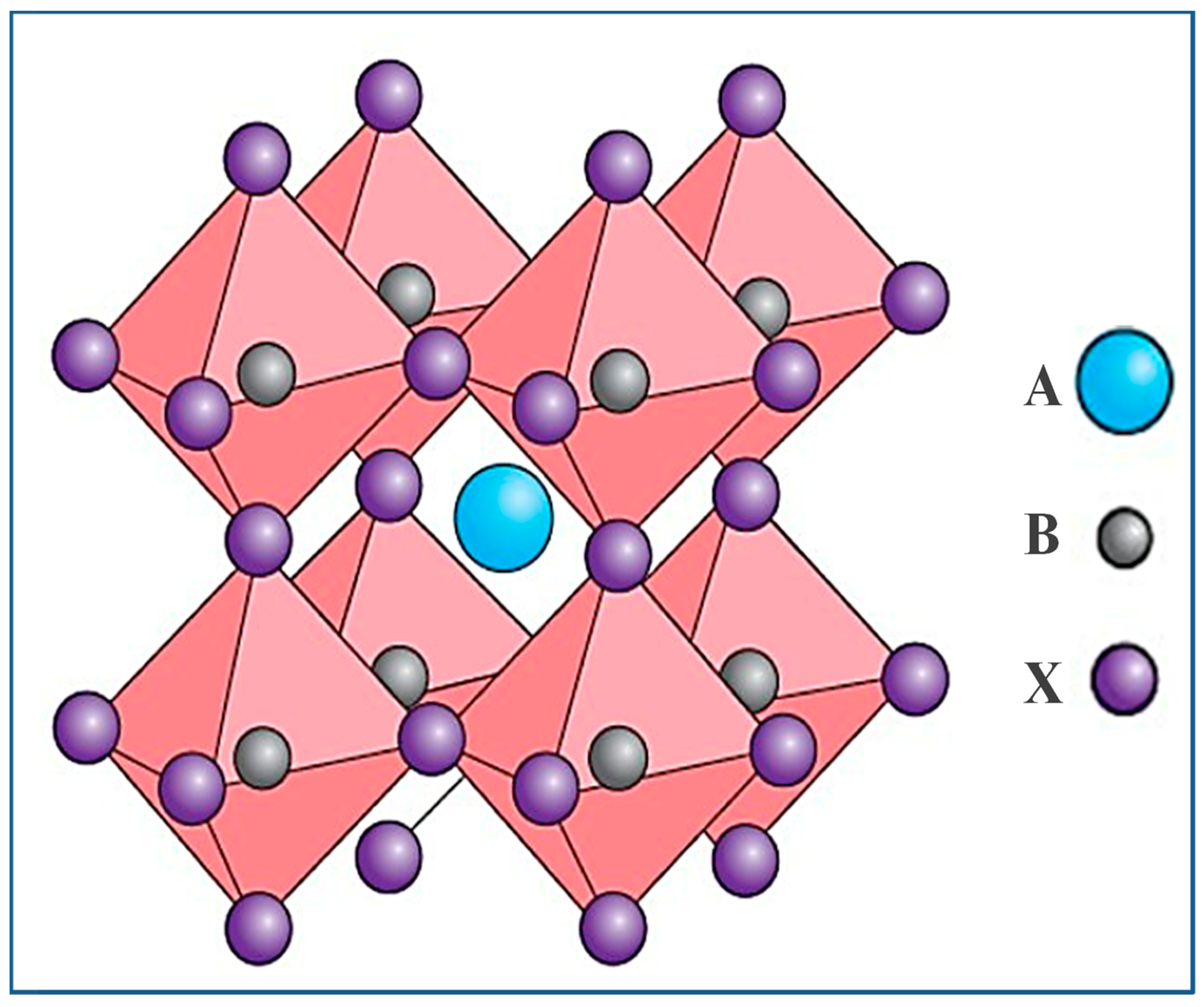
Figure 2.
Environmental Sources of Lead Exposure in the Human Organism.
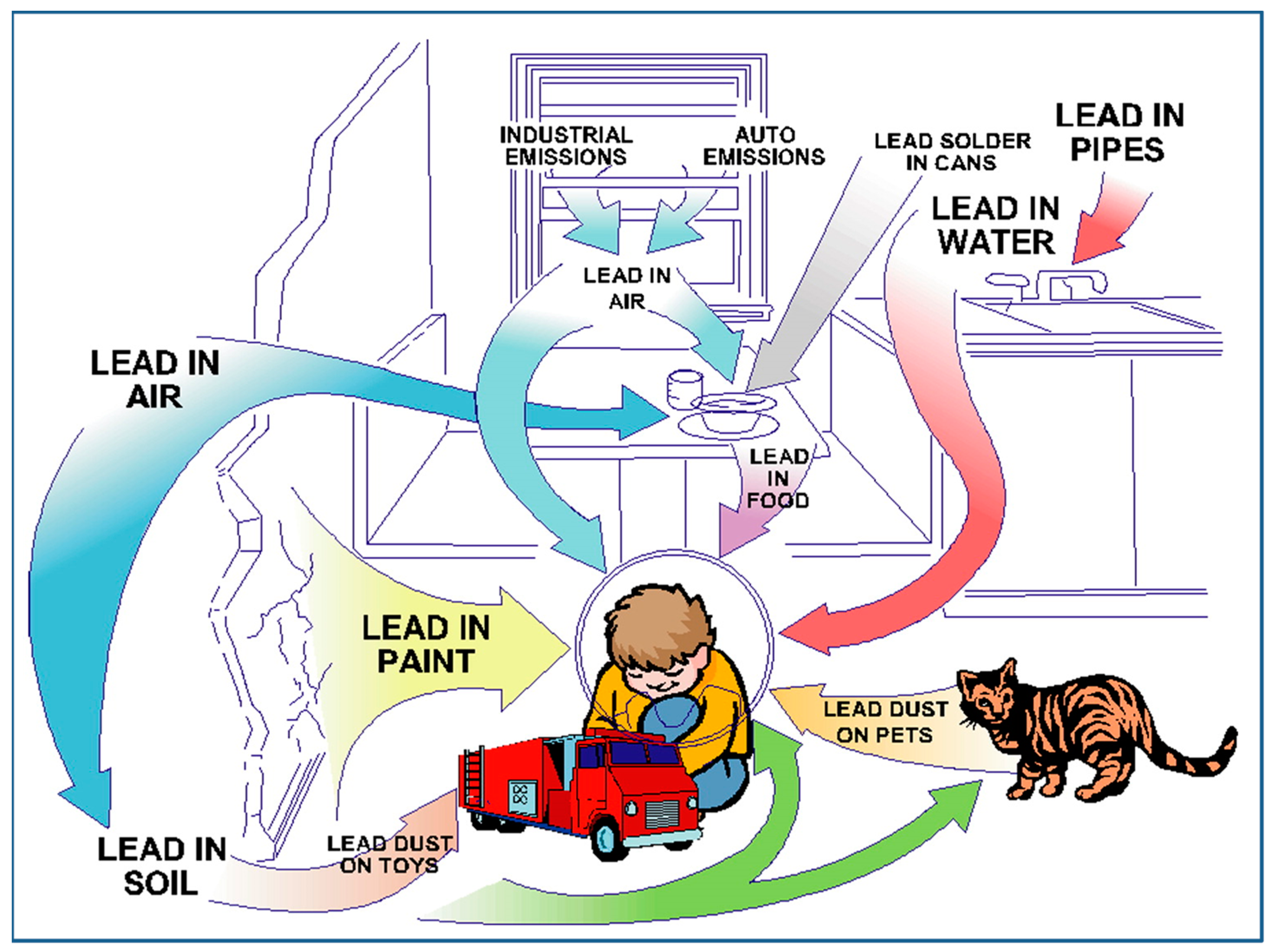
Figure 3.
Potential A-site cations (organic MA and FA or inorganic Cs and Rb), metals for B-site (Sn, Ge, Sb, Bi, ..), and halides (I, Br, Cl) for lead-free perovskite structure.
Figure 3.
Potential A-site cations (organic MA and FA or inorganic Cs and Rb), metals for B-site (Sn, Ge, Sb, Bi, ..), and halides (I, Br, Cl) for lead-free perovskite structure.
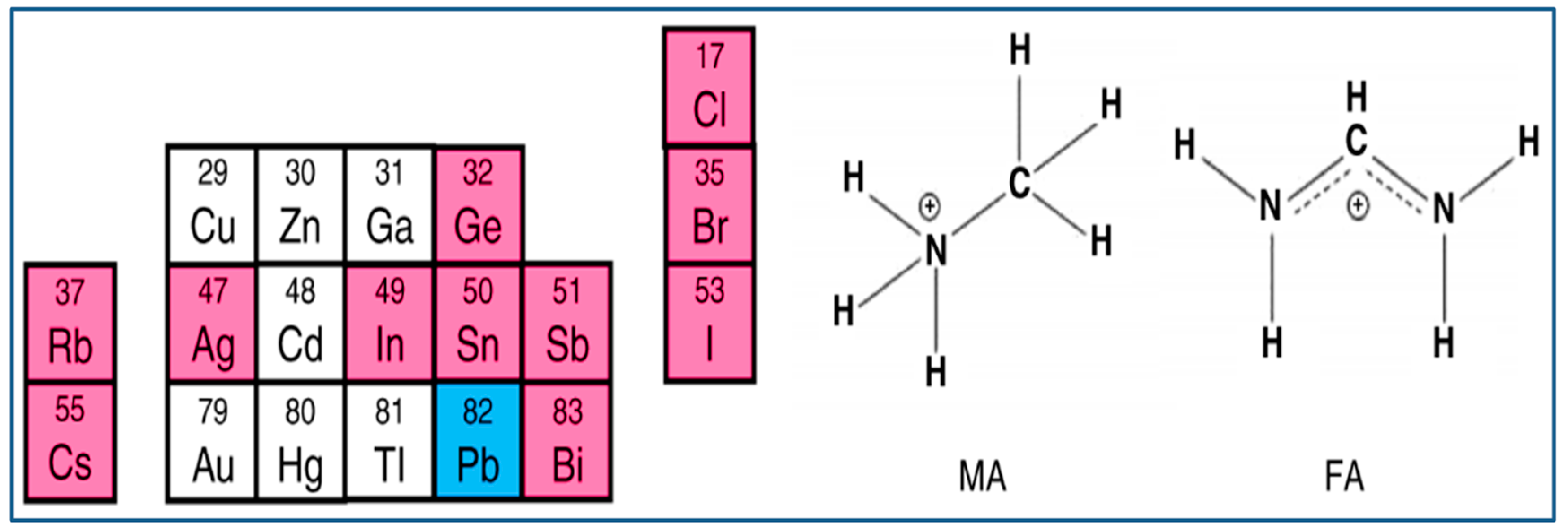
Figure 4.
Comparison of efficiencies and other key characteristics of lead-based and lead-free solar cells: (a) Reported PCEs of Pb-based, Bi-based, and Sn-based PSCs from the initial stage of development to date [44]; (b) Shockley–Queisser limit graph showing the PSC type that has a relatively high ideal bandgap [55]; (c) Growth chart of PCEs based on lead and lead-free perovskites [30,39,41,42,45,53,55,56,57]; (d) Comparative toxicity levels of elements used in perovskites [41,45,50,52,53,54]. .
Figure 4.
Comparison of efficiencies and other key characteristics of lead-based and lead-free solar cells: (a) Reported PCEs of Pb-based, Bi-based, and Sn-based PSCs from the initial stage of development to date [44]; (b) Shockley–Queisser limit graph showing the PSC type that has a relatively high ideal bandgap [55]; (c) Growth chart of PCEs based on lead and lead-free perovskites [30,39,41,42,45,53,55,56,57]; (d) Comparative toxicity levels of elements used in perovskites [41,45,50,52,53,54]. .
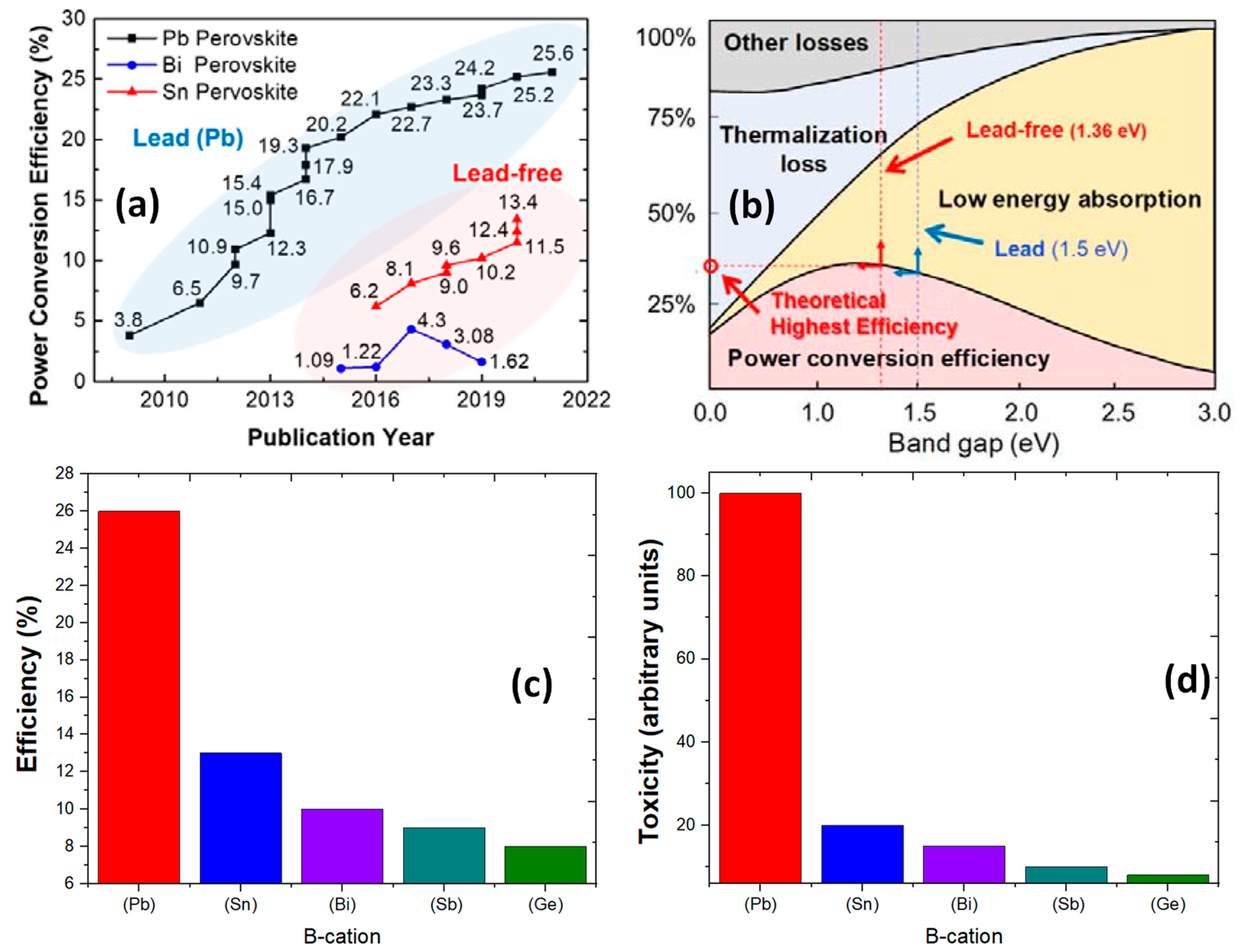
Figure 5.
Bandgaps of Pb-based and alternative perovskites. Optimal bandgap for single-junction solar cells (1.34 eV) is marked by a dashed line (adapted from [34]).
Figure 5.
Bandgaps of Pb-based and alternative perovskites. Optimal bandgap for single-junction solar cells (1.34 eV) is marked by a dashed line (adapted from [34]).
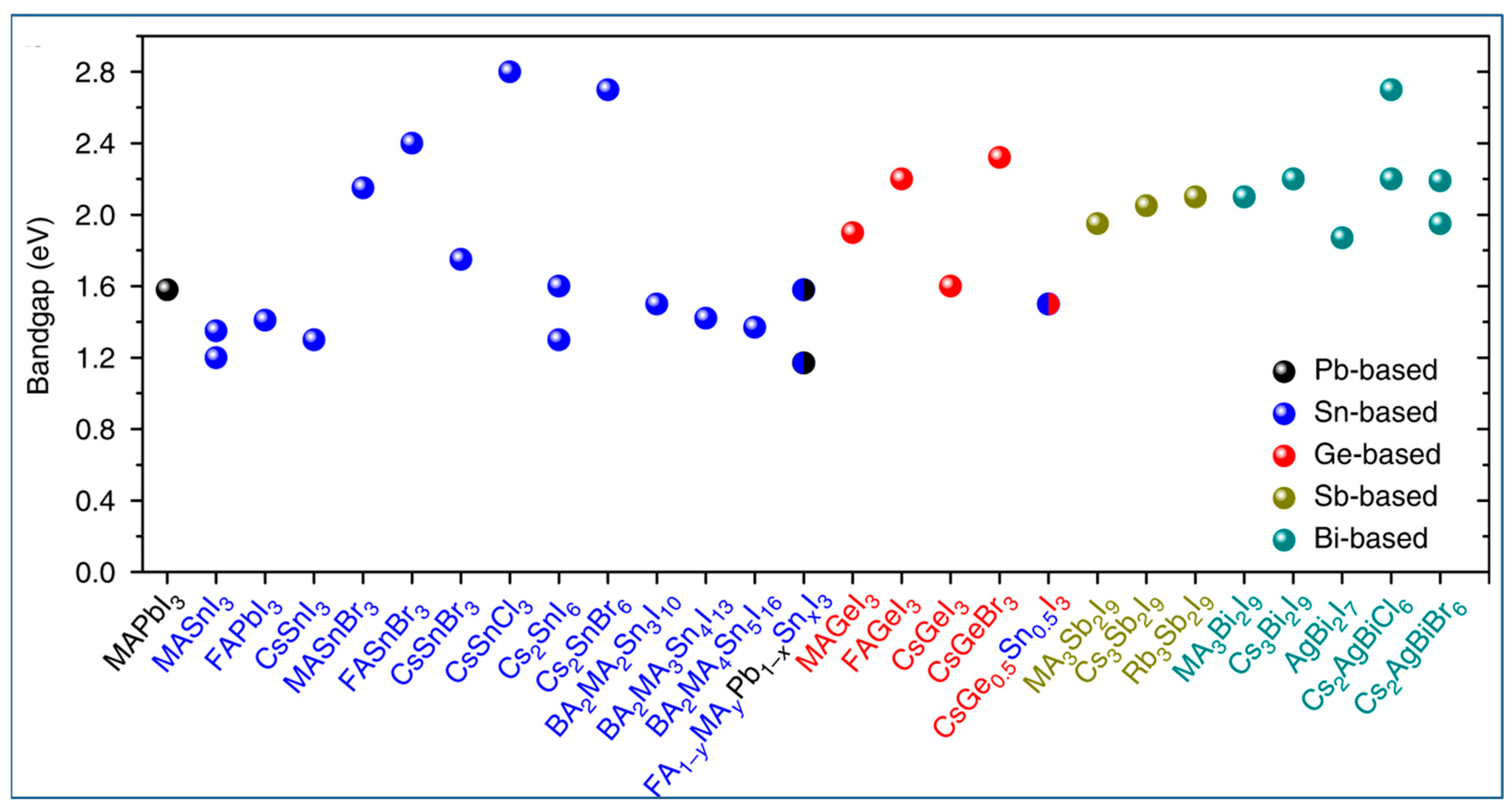
Figure 6.
(a) The effect of different modification methods on the stability of perovskites [77,78,79] and (b) the effect of additives on the stability and efficiency of solar cells [83,84,85].
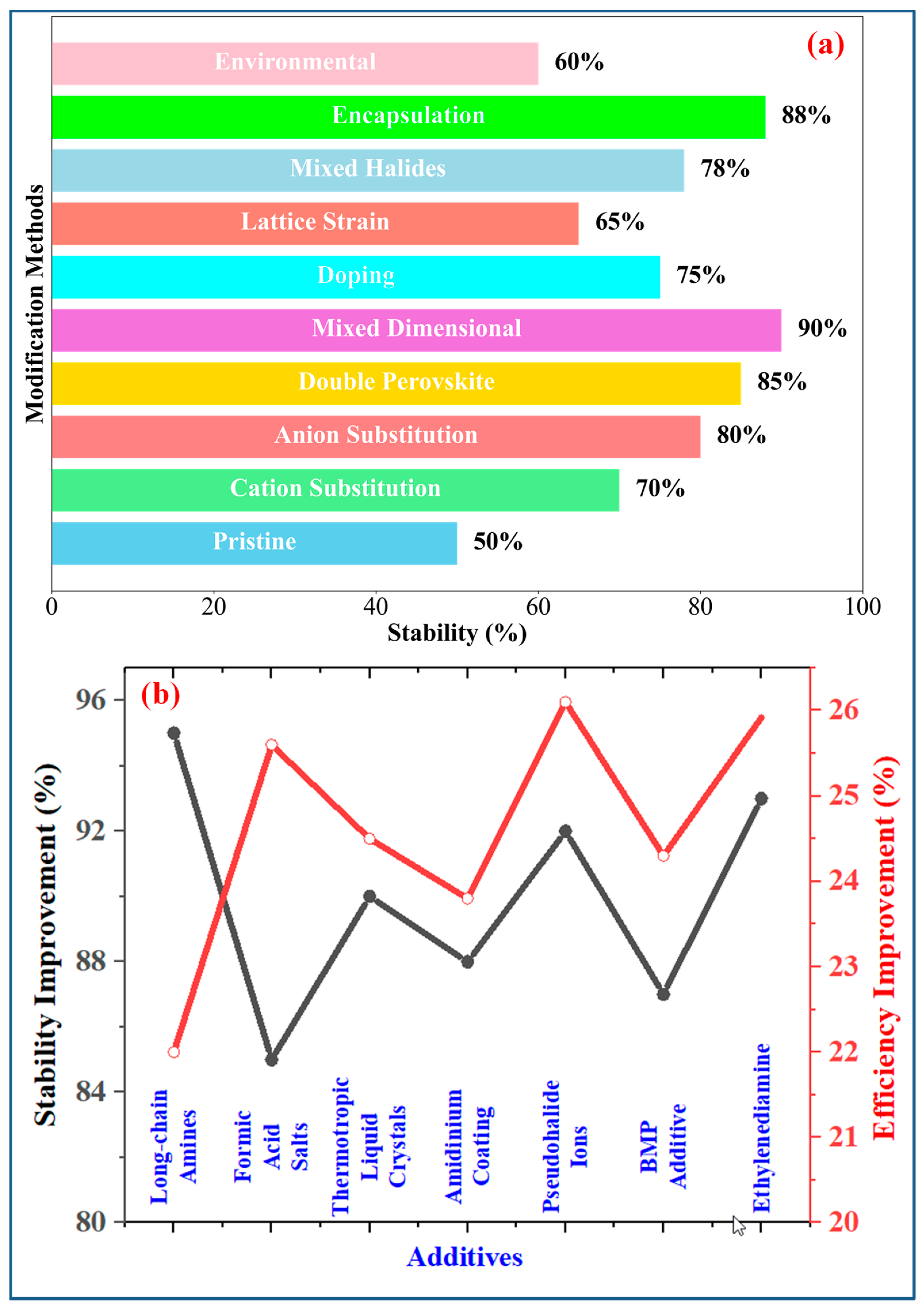
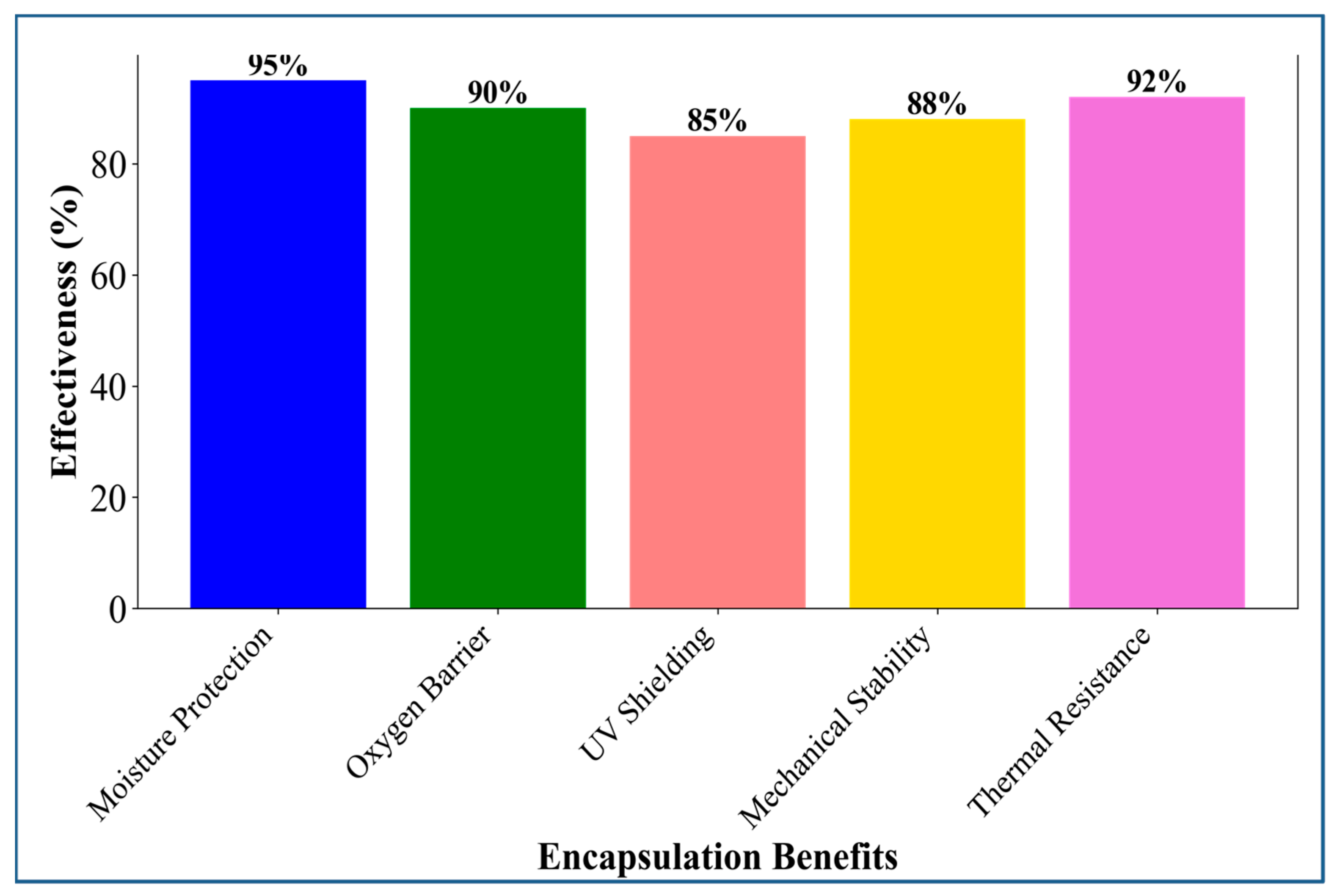
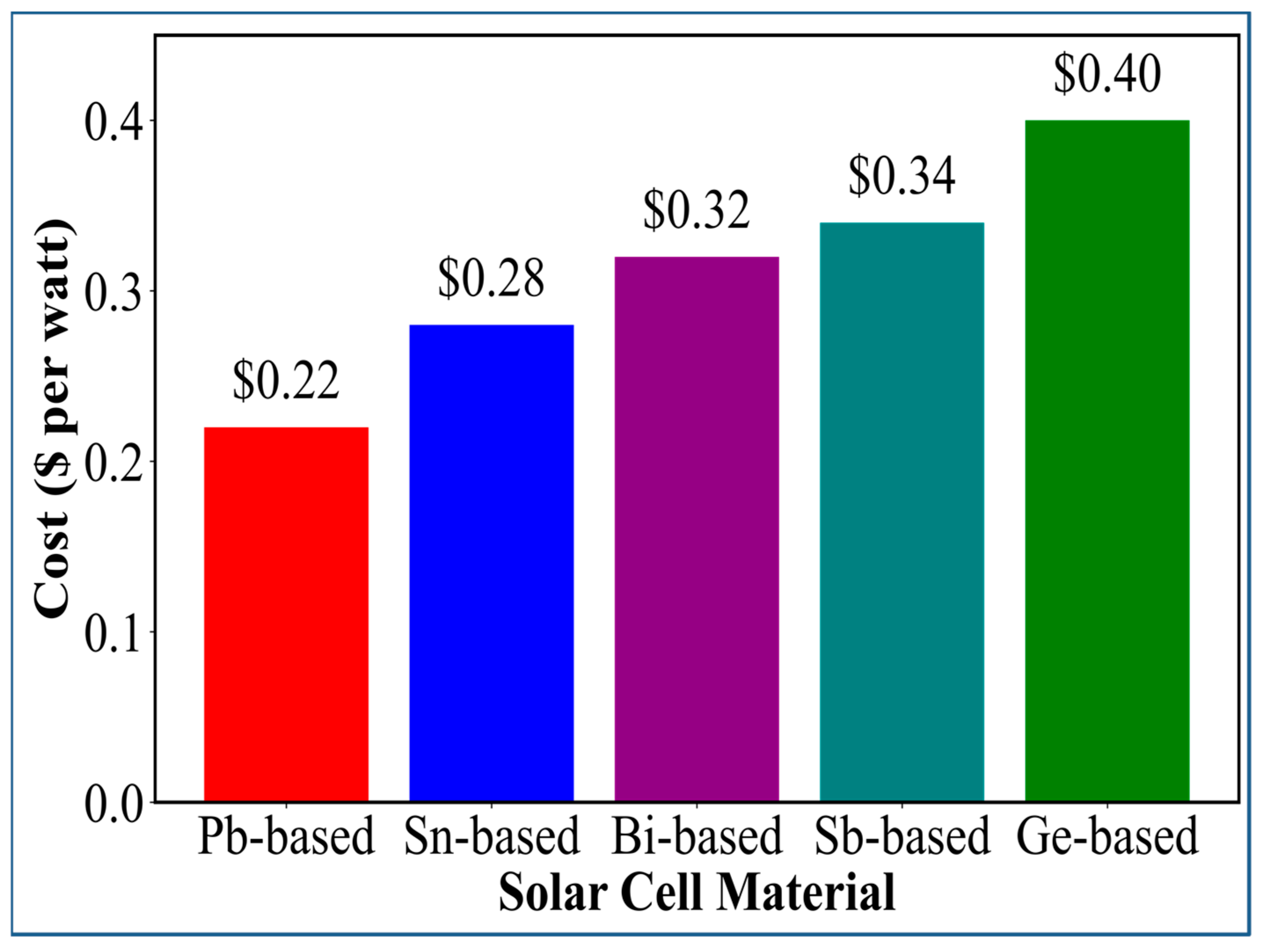
Figure 9.
(a) Market share growth forecast for lead-free technologies by 2031 [93,94,95,96,97,98,99,100,101,102,103,104,105] and (b) investment dynamics in lead-free technologies over the last 10 years [150,151].
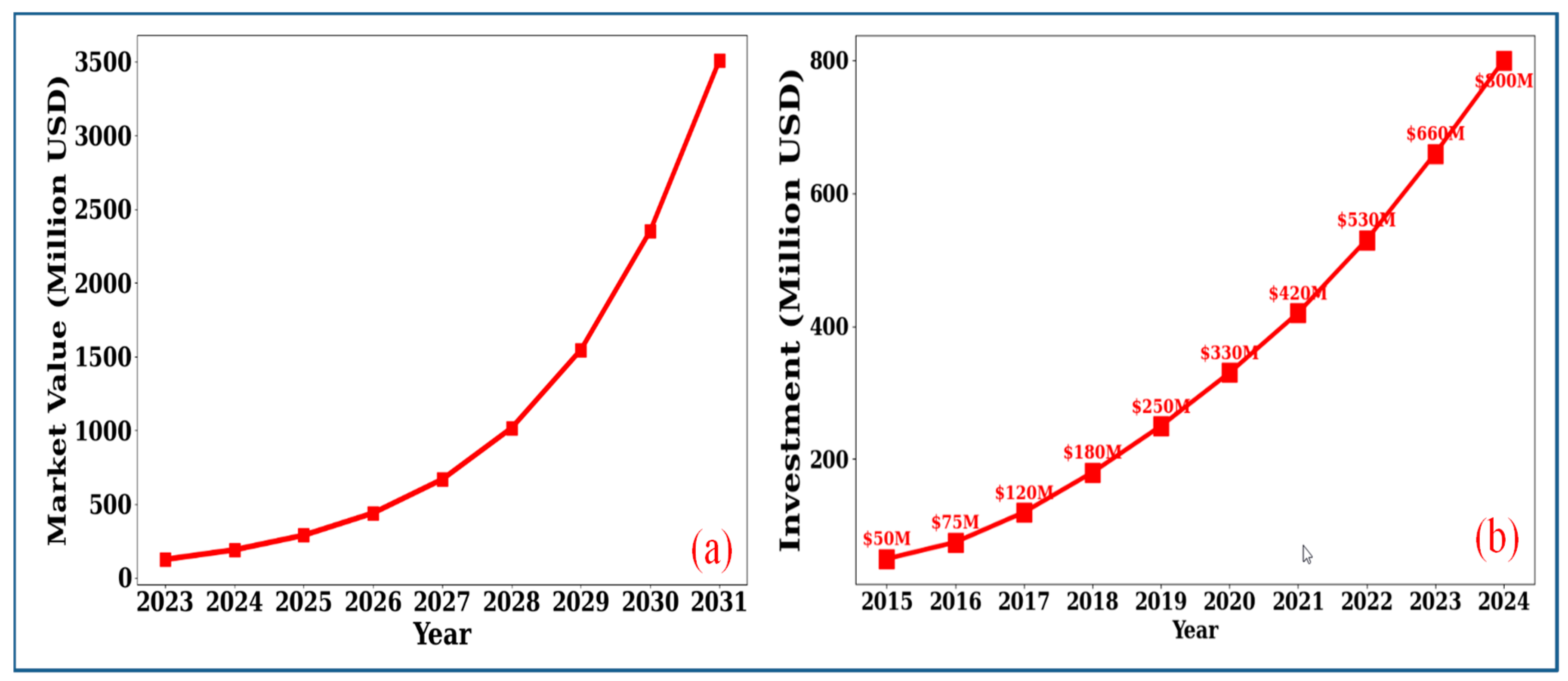
Figure 10.
Advances in the application of lead-free perovskites.
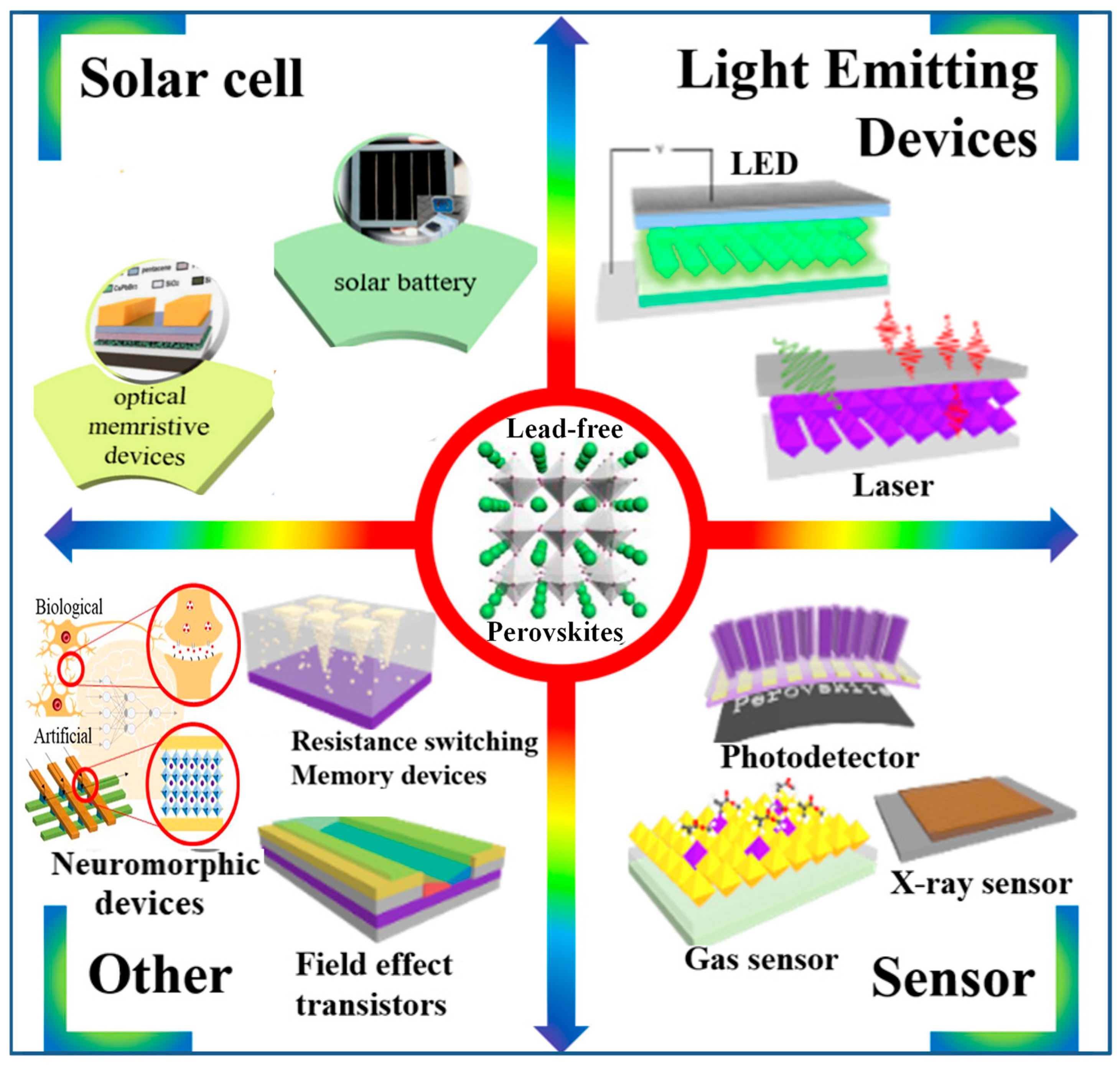

Table 1.
Comparison of key characteristics of perovskites and traditional silicon solar cells [36,37].
| Property | Perovskites | Silicon Solar Cells |
|---|---|---|
| Light absorption coefficient | 104–105 cm–1 | ~103 cm–1 |
| Carrier mobility | High | Moderate |
| Carrier diffusion length | >1 µm | ~200–300 nm |
| Active layer thickness | ~300 nm | ~150–200 µm |
| Bandgap tunability | Wide (1.1–2.3 eV) | Limited (1.1 eV fixed) |
| Manufacturing temperature | Low (below 200°C) | High (above 800°C) |
| Flexibility and weight | High | Low |
Table 2.
Key achievements in lead-free perovskite efficiency.
| Compound | Efficiency (%) | Light Source |
Key Contribution | Ref. |
| MASnI3 | 6.4 | AM1.5G | Early demonstration of tin-based perovskite solar cells | [110] |
| CsSnI3 | 8 | AM1.5G | Dual processing with two-step annealing and cation coordination | [111] |
| FASnI3 | 9.0 | AM1.5G | Improved efficiency with hybrid organic cations | [112] |
| CsSnI3 | 12.05 | AM1.5G | Improved efficiency via surface post-treatment with bi-functional polar molecules | [113] |
| (FA0.8 MA0.2)SnI3 | 9.83 | AM1.5G | Improved phase stability and efficiency | [114] |
| Cs2TiBr6 | 3.3 | AM1.5G | Exploration of titanium-based double perovskite | [115] |
| Cs2AgBiBr6 | 4.5 | AM1.5G | Optimization of charge transport layers | [116] |
| MASnI3 | 14.6 | AM1.5G | Record efficiency for tin-based perovskite solar cells | [117] |
| CsSn0.5Ge0.5 I3 | 7.8 | AM1.5G | Improved stability and efficiency with mixed cations | [118] |
| (FA0.75Cs0.25)SnI3 | 9.2 | Simulated sunlight | Enhanced charge transport with optimized cation mixture | [119] |
| (CH3NH3)3Bi2I9 | 1.1 | AM1.5G | Exploration of bismuth-based perovskites | [120] |
| (MA0.5 FA0.5)SnI3 | 10.8 | AM1.5G | Balanced stability and efficiency with dual organic cations | [121] |
| Cs3Sb2I9 | 3.2 | Simulated sunlight | Demonstration of antimony-based double perovskite | [122] |
| FA0.98EDA0.01SnI3 | 13.24 | AM1.5G | Defect reduction via passivation | [123] |
Disclaimer/Publisher’s Note: The statements, opinions and data contained in all publications are solely those of the individual author(s) and contributor(s) and not of MDPI and/or the editor(s). MDPI and/or the editor(s) disclaim responsibility for any injury to people or property resulting from any ideas, methods, instructions or products referred to in the content. |
© 2025 by the authors. Licensee MDPI, Basel, Switzerland. This article is an open access article distributed under the terms and conditions of the Creative Commons Attribution (CC BY) license (https://creativecommons.org/licenses/by/4.0/).
Copyright: This open access article is published under a Creative Commons CC BY 4.0 license, which permit the free download, distribution, and reuse, provided that the author and preprint are cited in any reuse.


