

Submitted:
06 February 2025
Posted:
07 February 2025
You are already at the latest version
Abstract
The pursuit of sustainable design has made strides in improving building practices, yet traditional approaches often fall short in addressing the holistic needs of both the environment and human well-being. This research delves into the emerging field of regenerative design, which extends beyond sustainability by seeking to restore and enhance ecological and human systems. By integrating regenerative principles into indoor environments, this study evaluates their impact on indoor environmental quality (IEQ). Through a comprehensive literature review, the research demonstrates that regenerative design can significantly enhance air quality, thermal comfort, lighting, and acoustics, ultimately creating healthier and more productive indoor spaces. This paper also discusses potential challenges and outlines future research directions to further advance the application of regenerative design in building practices.
Keywords:
Regenerative Design
; Indoor Environmental Quality
; Sustainable Design
; Building Performance
; Environmental Impact
1. Introduction
As global awareness of environmental degradation and public health issues grows, traditional sustainability efforts have largely focused on minimizing negative impacts through energy efficiency, resource conservation, and emissions reduction. While these measures are essential, they often address only the symptoms of deeper ecological and societal challenges, rather than confronting their underlying causes. This narrow view of sustainability underscores the need for a more holistic approach—one that not only seeks to mitigate harm but also actively regenerates and restores both natural ecosystems and human communities.
Regenerative design offers a transformative shift in this direction, moving beyond sustainability to cultivate resilience and vitality within the built environment. This paradigm emphasizes the interconnectedness of human and ecological systems, advocating for designs that enhance the health of both. By reimagining our relationship with the environment, regenerative design seeks to create spaces that not only minimize negative effects but also contribute positively to the well-being of occupants and the broader ecosystem.
This manuscript explores the principles of regenerative design and their application to optimizing Indoor Environmental Quality (IEQ) in built spaces. Indoor environments play a crucial role in influencing occupant health, productivity, and quality of life, making the integration of regenerative practices particularly relevant. The paper provides an overview of how regenerative design can enhance various aspects of IEQ, including air quality, lighting, thermal comfort, and acoustics. Through an extensive review of the literature, it highlights how regenerative approaches can foster healthier, more productive environments. Additionally, the manuscript identifies challenges in implementing regenerative design and proposes avenues for future research to advance its integration into building practices.
2. Understanding the Regenerative Design Approach
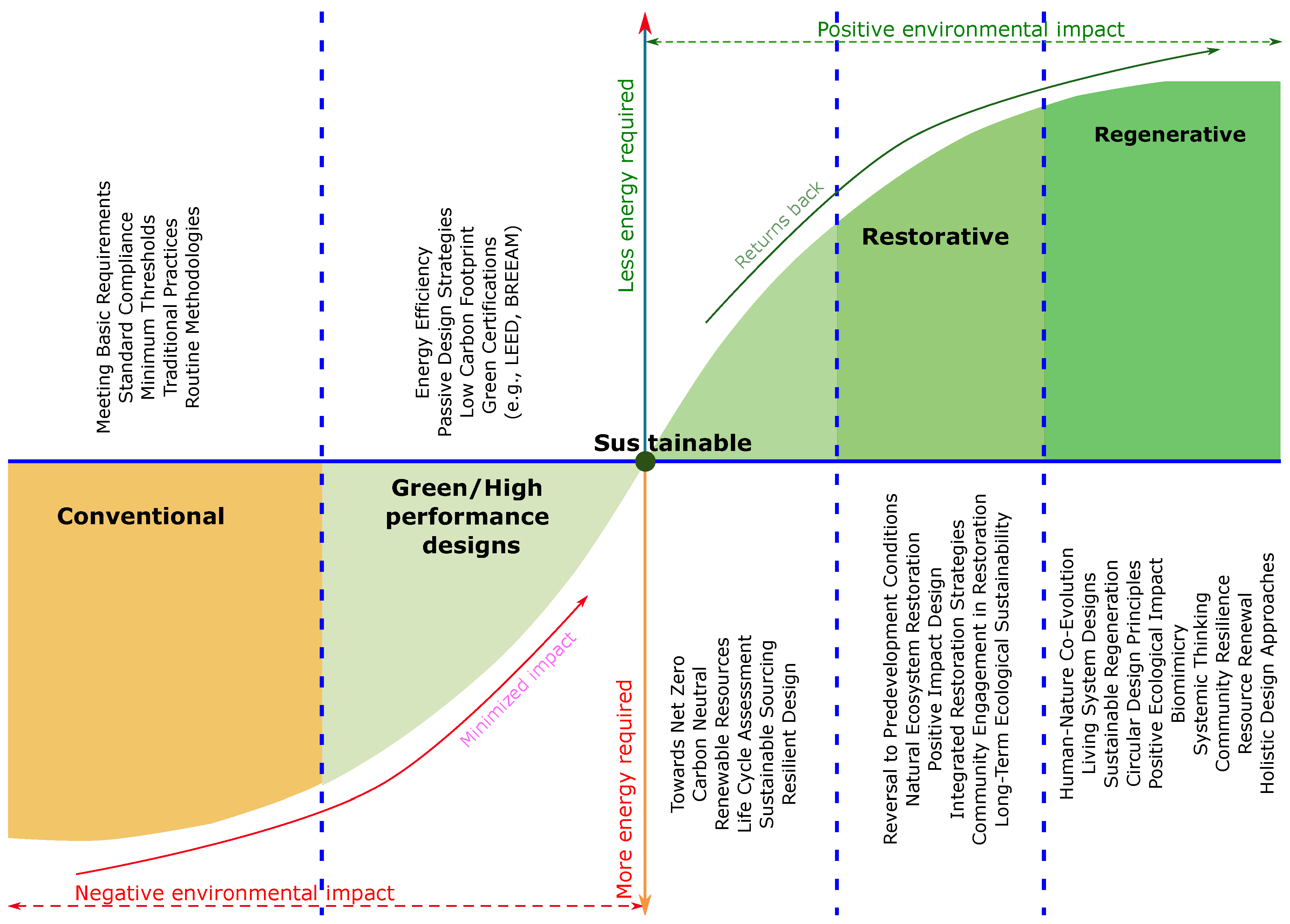
Regenerative design goes beyond reducing environmental impact to actively restore and enhance ecological and social systems [1]. It integrates ecological principles, systems thinking, and a holistic view of human-environment interactions to create resilient, self-renewing designs that contribute positively to their surroundings [2,3]. Unlike traditional, green, or sustainable design, which focuses on functionality, aesthetics, and cost with limited environmental consideration, regenerative design improves and restores both natural environments and communities [4,5]. While green design reduces negative impacts, regenerative design enhances ecosystems and social conditions, ensuring they thrive. It builds on sustainable design by boosting resilience and continuously adapting to improve both environmental and community health. Unlike restorative design, which repairs damaged ecosystems, regenerative design fosters ongoing enhancement and renewal, aiming to leave the world better than before [6]. Figure 1 illustrates the shift from a conventional design approach to a regenerative design paradigm.
Regenerative design is used in various fields, including architecture, agriculture, urban planning, and product design. In architecture, buildings integrate with the natural environment, incorporating features like green walls, rainwater harvesting, renewable energy, and wildlife habitats. In agriculture, regenerative practices enhance soil health and biodiversity. Urban planning creates regenerative cities with green spaces, walkable neighborhoods, and sustainable transportation. In product design, durability, recyclability, and compostability reduce waste and resource consumption.
From a built environment perspective, regenerative design fosters deep connections between buildings, landscapes, and communities, actively enhancing biodiversity, water management, and carbon footprints [7,8,9,10,11]. It also promotes long-term sustainability through adaptable, resilient buildings that reduce maintenance and extend longevity. Socially, it improves well-being through healthier living environments, while economically, it leads to long-term savings, increased property value, and higher occupant satisfaction.
Regenerative design encourages interdisciplinary collaboration, fostering partnerships among architects, engineers, ecologists, sociologists, and other experts to forge holistic solutions addressing the multifaceted challenges of the built environment. Projects are conceived with long-term goals, considering the life cycle of buildings and communities and aiming for enduring value. Like sustainability, regenerative design includes assessment tools to track progress and identify areas for improvement.
Figure 1.
Paradigm shift from conventional design to regenerative design approach. (Inspired from the work of Bill Read [2] and Craft et al. [12]).
2.1. Principal Elements of Regenerative Design
Regenerative design has evolved significantly from earlier environmental and sustainability movements. It originated in the late 20th century when architects and planners recognized the limitations of traditional "sustainable" design. Its roots trace back to the ecological and systems thinking movements of the 1960s and 70s, which emphasized the interconnectedness of human and natural systems. Initially, sustainable design focused on minimizing negative impacts through energy efficiency and resource conservation. Frameworks such as LEED (launched in 1998) in the USA, WELL Building Standard-V1 (introduced between 2013 and 2014) in the USA, International Living Future Institute (ILFI) in the USA, REthinking Sustainability TOwards a Regenerative Economy (RESTORE) in the EU, BREEAM in the UK, and CASBEE in Japan establish standards for environmental performance [13]. However, these frameworks typically prioritize minimizing negative impact rather than promoting the restoration or enhancement of ecological systems.
The concept of regenerative design took shape in the 2000s as a more advanced approach. Pioneers like William McDonough and Michael Braungart, with their Cradle to Cradle design philosophy, advocated shifting from sustainability to regeneration [14,15]. They proposed going beyond reducing negative impacts to creating positive effects, such as restoring ecosystems and promoting well-being.
Figure 2 illustrates regenerative design’s core principles, emphasizing the interconnection between human activities and ecological systems. It highlights the importance of aligning human activities with natural processes, with key elements including integration with natural systems, closed-loop systems, regenerative feedback loops, human well-being, systemic thinking, and regenerative metrics and evaluation.
Integration with Natural Systems: Regenerative design aims to align human-made systems with natural processes, acknowledging the interdependence between human activities and ecological systems [16,17,18,19]. This approach focuses on creating buildings and spaces that harmonize with their natural surroundings, enhancing or mimicking natural processes such as water filtration, air purification, and climate regulation. It emphasizes designing with a deep respect for and utilization of local ecological characteristics, including climate, geology, and biodiversity. Additionally, regenerative design involves creating environments that support or restore local flora and fauna, incorporating green roofs, living walls, and diverse landscapes to promote biodiversity. For instance, a regenerative building might include rain gardens and permeable pavements to naturally manage stormwater, provide habitats for local species, and minimize runoff pollution [20,21]. This holistic approach fosters a symbiotic relationship between human structures and the environment, contributing to ecological health and sustainability.
Closed-Loop Systems: Closed-loop systems, also known as circular systems, are designed to create regenerative processes where the byproducts of one stage become valuable resources for another, starkly contrasting with the traditional linear model of "take-make-dispose" [22,23,24]. This approach emphasizes the continuous circulation of materials and energy, aiming to minimize waste and reduce resource depletion. In these systems, materials are repeatedly repaired, reconditioned, reused, recycled, or composted rather than discarded, which helps cut down on waste and decreases the need for new resources [25,26]. Additionally, energy systems are crafted to be self-sustaining by integrating renewable sources, thus reducing reliance on finite, non-renewable energy. A key aspect of closed-loop systems is the differentiation between biological and technical loops: biological nutrients can safely re-enter the environment, while technical nutrients are designed to be perpetually cycled within the industrial framework. For example, a building that follows closed-loop principles might feature materials easily disassembled for reuse or recycling at the end of its lifecycle and incorporate an energy system with solar panels and storage solutions to achieve a net-zero energy footprint. This comprehensive approach enhances sustainability by ensuring that materials and energy flow through the system in a continuous, efficient cycle.
Regenerative Feedback Loops: Regenerative feedback loops involve monitoring and adjusting systems based on their performance and environmental impact, emphasizing the importance of adaptability and responsiveness [27]. This principle is centered on using real-time data and sensors to track building performance, allowing for adjustments that optimize both efficiency and occupant comfort. Through adaptive design, systems such as HVAC and lighting are continuously refined based on feedback, adjusting to factors like occupancy levels and environmental conditions. This approach fosters a culture of continuous improvement, learning from successes and failures to enhance design practices. For instance, a smart building might employ occupancy sensors to dynamically adjust lighting and climate controls, maximizing energy efficiency and occupant comfort while remaining flexible to changing conditions. This iterative process helps ensure systems remain effective and responsive, reflecting a commitment to ongoing enhancement and environmental stewardship.
Human Well-Being and Connection: Regenerative design emphasizes the health and well-being of occupants by crafting environments that support physical, mental, and emotional health, recognizing the deep connection between human well-being and environmental quality [28,29]. This principle involves designing spaces focusing on optimal indoor air quality, thermal comfort, natural lighting, and acoustic quality to enhance overall occupant health. It also incorporates biophilic design elements, such as integrating natural features and fostering connections to nature within indoor spaces, which helps reduce stress and improve mood. Additionally, regenerative design encourages community engagement by involving users in the design process and creating environments that promote social interaction and community cohesion. For example, offices that feature abundant natural light, access to outdoor views, and biophilic elements like indoor plants can significantly boost employee productivity and satisfaction, highlighting the positive impact of thoughtful design on occupant well-being.
Systemic Thinking: Systemic thinking in regenerative design entails recognizing and addressing the interconnections among various elements within a system, emphasizing that projects should be viewed as integral parts of larger ecological, social, and economic frameworks [30,31,32,33,34]. This approach involves holistic design, where the effects of design choices are evaluated across multiple dimensions, including social, environmental, and economic factors. It also requires interdisciplinary collaboration, bringing together experts from diverse fields—such as architects, ecologists, and engineers—to tackle complex challenges and develop integrated solutions. Furthermore, systemic thinking incorporates a long-term perspective, considering the enduring impacts of design decisions on the environment and future generations. For instance, a community development project might combine energy-efficient buildings with local food production systems and communal spaces, creating a resilient and self-sustaining ecosystem that supports current and future needs.
Regenerative Metrics and Evaluation: These measure the good effects of design on both human and environmental systems. They shift the focus from traditional sustainability metrics to measuring regenerative outcomes [35,36]. This principle involves measuring contributions to ecosystem restoration, social equity, and community well-being rather than merely quantifying reductions in negative impacts. It also emphasizes the development of dynamic metrics that reflect the evolving nature of regenerative processes and their long-term effects [37]. Additionally, regenerative metrics incorporate feedback from various stakeholders to capture the broader impact of design interventions. For example, rather than only tracking energy savings, regenerative metrics might evaluate how a building enhances local biodiversity, improves community health, and fosters social well-being, thus providing a more comprehensive view of a project’s positive contributions.
3. Indoor Environmental Quality (IEQ)
Indoor environmental quality (IEQ) refers to the overall conditions of indoor space that influence the comfort, well-being, and satisfaction of its occupants within the built environment [38]. It encompasses various elements such as air quality, thermal comfort, lighting, and acoustics, all of which play crucial roles in ensuring the well-being, comfort, and satisfaction of occupants within the built environment. Figure 3 highlights the essential components of IEQ, focusing on their interrelationships and impacts on occupant well-being and productivity.
One fundamental aspect is indoor air quality (IAQ). It refers to the air quality within buildings and structures, such as homes, offices, schools, and other indoor environments. It is a crucial aspect of our overall well-being, as we spend a significant amount of time indoors, especially in developed countries (e.g., USA), where people often spend more than 90% of their time inside buildings. Several factors can influence indoor air quality, including ventilation, pollutants, temperature and humidity, building materials, and occupant activities. Adequate ventilation is essential to maintain good indoor air quality as it involves the exchange of stale indoor air with fresh outdoor air. Insufficient ventilation can accumulate pollutants and increase humidity levels, resulting in discomfort and potential health issues. Indoor air can contaminate various pollutants, including volatile organic compounds (VOCs), tobacco smoke, mold, pet dander, dust mites, and allergens. Gases such as carbon monoxide (CO) and nitrogen dioxide (NO2) can also be present in indoor environments, especially in poorly ventilated areas or spaces with faulty appliances. Temperature and humidity levels in indoor spaces can impact comfort and air quality. High humidity levels can promote the growth of mold and mildew, while low humidity can cause dryness and discomfort. Temperature extremes, whether too hot or cold, can also affect indoor air quality and occupant well-being. Some building materials, such as asbestos and certain types of insulation or flooring, can release harmful particles or fibers into the air if damaged or deteriorating. Human activities within indoor spaces, such as cooking, smoking, using specific cleaning products, and operating equipment or machinery that emit pollutants, can also contribute to indoor air pollution. Poor IAQ can significantly impact human health, leading to respiratory problems, allergies, eye irritation, headaches, fatigue, and, in severe cases, even more serious conditions. Long-term exposure to indoor air pollutants has been linked to respiratory diseases, cardiovascular issues, and other health complications.
Thermal environment is another important aspect of indoor environmental quality that focuses on creating a comfortable and pleasant thermal experience for building occupants. It refers to the state of mind (subjective feeling) that individuals have when they are satisfied with the thermal conditions in their indoor environment. Achieving thermal comfort involves considering ambient temperature, humidity, air movement, and radiant heat. Proper control of heating, ventilation, and air conditioning systems, along with thoughtful building design and insulation, is crucial in achieving optimal thermal comfort. Providing occupants with an environment that promotes thermal satisfaction can enhance productivity and overall satisfaction.
Visual environment (lighting and daylighting) is essential factor in creating a high-quality indoor environment. Adequate lighting levels and effective use of natural daylight contribute to occupant comfort, well-being, and productivity. Artificial lighting systems should be designed to provide appropriate illumination for various tasks and activities while minimizing glare and visual discomfort. Incorporating daylight into indoor spaces reduces reliance on artificial lighting, enhances visual comfort, positively affects occupants’ mood and circadian rhythm, and helps establish a connection with the outdoors. Proper placement of windows, skylights, and light shelves can optimize daylight penetration while controlling solar heat gain. By maximizing the utilization of natural daylight and implementing energy-efficient artificial lighting systems, indoor environments can be optimized for visual comfort, occupant satisfaction, and energy efficiency.
Acoustic environment is another critical aspect of IEQ that pertains to creating a favorable auditory experience for occupants within a building. It involves managing sound levels, minimizing unwanted noise, and optimizing sound quality. While often overlooked, acoustics significantly influence occupants’ comfort, concentration, and well-being. Excessive noise levels, echo, and poor speech intelligibility can create a stressful environment, leading to decreased productivity, lack of concentration, and impaired communication [39,40]. Achieving acoustic comfort requires controlling noise from external sources, such as traffic or construction, and internal sources, like HVAC systems, fans, or equipment. Proper insulation, sound-absorbing materials, and strategic room layout can help reduce reverberation and echoes, enhancing speech intelligibility and reducing distractions. By ensuring a peaceful and acoustically pleasant environment, indoor spaces can promote concentration, productivity, and overall well-being for occupants.
Additionally, acoustic privacy is essential for IEQ. It pertains to individuals’ ability to have private discussions or work without being disrupted by unwanted noise from neighboring areas. Inadequate acoustic privacy can negatively affect occupants’ well-being, productivity, and overall satisfaction with their indoor environment. It can cause increased stress, reduced concentration, and compromised confidentiality. Also, acoustic distractions can significantly affect productivity and concentration levels in various settings, such as offices, educational institutions, and healthcare facilities. In open-plan offices, for instance, the absence of adequate acoustic privacy can lead to reduced work performance, decreased focus, and lower cognitive abilities. It becomes challenging for employees to concentrate on tasks that require sustained attention, affecting overall work efficiency. Therefore, by ensuring proper acoustic privacy through thoughtful design, sound-absorbing materials, and sound masking systems, occupants can experience a healthier and more comfortable indoor environment conducive to productivity and well-being.
Together, these factors—air quality, thermal comfort, lighting, and acoustics—create an environment that nurtures health, enhances productivity, and fosters overall well-being. Building and facility managers, architects, and designers who prioritize these elements contribute significantly to creating spaces that support the physical, mental, and emotional health of their occupants. The integration of these features, as outlined in Figure 4, reflects key performance indicators (KPIs) for evaluating and improving indoor environmental quality. These KPIs are used as benchmarks to assess the effectiveness of various IEQ measures, guiding the design and maintenance of spaces that improve quality of life for all occupants.
4. Integrating Regenerative Design with IEQ
Regenerative design is a holistic approach to creating spaces that restore and enhance the natural environment while prioritizing human health and well-being. By incorporating principles of IEQ, regenerative design can greatly enhance indoor air quality, improve occupant comfort, and boost overall building performance. This integration can be achieved through various methods, including:
4.1. Indoor Air Quality (IAQ)
Achieving superior IAQ through regenerative design involves more than just reducing pollutants; it requires adopting strategies that actively improve and rejuvenate the air within a space. Biophilic design is crucial in leveraging nature’s natural air-purifying abilities. It has been shown that using indoor plants and green walls can greatly improve indoor air quality (for example, by lowering the indoor CO2 label) [41,42,43,44,45,46]. Selecting a variety of plants known for their air-cleaning properties, such as spider plants, peace lilies, and snake plants, helps remove toxins like formaldehyde and benzene from the air. Creating living walls with these plants increases the surface area available for air purification and assists in regulating indoor humidity. Optimizing natural light within the space reduces reliance on artificial lighting, which can sometimes contribute to indoor air pollutants through off-gassing.
Material selection is another key aspect of regenerative design aimed at improving IAQ. To enhance IAQ, it is vital to choose building and household materials that are natural, eco-friendly, and sustainable. Selecting materials with low volatile organic compound (VOC) emissions is particularly important, as these materials help minimize indoor air pollution [47]. Natural materials such as wood, stone, and wool are often preferable because they generally release fewer harmful chemicals compared to synthetic alternatives [48,49]. Additionally, using low-VOC paints, adhesives, and finishes contributes to a healthier indoor environment by reducing the emission of potentially harmful substances. It is also important to recognize that electronic products, furniture, and textiles can introduce new sources of indoor air pollution, making careful material selection and management essential for maintaining high IAQ [50]. Biocoating paints have recently gained significant attention in sustainable building design, particularly for enhancing indoor air quality. These cutting-edge paints, dubbed "Green Living Paint," created by Krings et al. [51], contain live bacteria, specifically Chroococcidiopsis cubana. This bacterium performs photosynthesis, producing oxygen while capturing CO2, thereby improving air quality in enclosed spaces by increasing oxygen levels and helping to mitigate greenhouse gas emissions. As a result, these paints serve as valuable tools for promoting healthier indoor environments. Chroococcidiopsis cubana thrives in arid conditions and requires minimal water, making it adaptable to various climates. The potential applications of these paints are extensive, ranging from residential and commercial buildings to public spaces, all of which can benefit from cleaner, fresher air. Moreover, these paints may facilitate self-cleaning surfaces that reduce indoor pollutants and incorporate sensors for real-time air quality monitoring. However, challenges such as ensuring the long-term viability of the bacteria, addressing regulatory and safety concerns, and promoting public acceptance of living organisms in paints need to be carefully considered. Moreover, The National Aeronautics and Space Administration (NASA)’s Mars Oxygen In-Situ Resource Utilization Experiment (MOXIE) showcases a groundbreaking approach to oxygen production by extracting carbon dioxide from Mars’ atmosphere [52]. The MOXIE instrument electrochemically splits CO2 molecules into oxygen and carbon, analyzing the oxygen for purity before venting it back into the Martian atmosphere along with the carbon and other exhaust byproducts. This regenerative technology has potential applications for improving IAQ on Earth. By utilizing similar methods to convert CO2 into breathable oxygen, we could create systems that enhance air quality in enclosed environments, contributing to healthier living and working spaces. Such advancements in air purification and oxygen generation could be crucial in sustainable building designs and indoor environmental management.
Efficient ventilation and advanced air filtration are critical for maintaining good IAQ [53,54,55]. According to the American Society of Heating, Refrigerating and Air-Conditioning Engineers (ASHRAE) standards 6.1 and 6.2, it is essential to design ventilation systems that optimize fresh air intake while reducing energy consumption. Implementing balanced ventilation systems and heat recovery ventilation (HRV) can improve energy efficiency while ensuring a steady supply of fresh air. To capture fine particles and pollutants, employing high-efficiency particulate air (HEPA) and activated carbon filters is effective. Additionally, installing air quality monitoring systems with sensors that continuously track parameters such as CO2 levels, particulate matter, and humidity allows for real-time adjustments to ventilation and filtration systems, ensuring optimal IAQ [56].
Effective moisture control is essential for optimal IAQ and ensuring a healthy and comfortable environment. According to the Occupational Safety and Health Administration (OSHA) standards, relative humidity levels in indoor spaces should fall within specific ranges: below 60% for general indoor settings, between 30% and 50% for school buildings, and between 20% and 60% for offices and larger spaces. Maintaining these humidity levels helps mitigate risks such as mold growth and structural damage, which can adversely affect both the building and its occupants. Proper moisture management involves addressing common sources of excess moisture, such as roof leaks, rain penetration through faulty windows, and design or construction defects [57]. In addition, ensuring adequate ventilation, particularly in moisture-prone areas like bathrooms and kitchens. Dehumidifiers and effective waterproofing measures further support moisture control by preventing water infiltration and managing indoor humidity, thus safeguarding the building’s integrity and the health of its occupants.
Waste reduction and management further contribute to a healthier indoor environment. Minimizing single-use plastics and disposable items is particularly important, as these materials often release VOCs, contributing to indoor air pollution and respiratory problems. Reducing the use of such products helps lower VOC emissions and improves indoor air quality. Additionally, efficient waste management systems are vital in ensuring proper disposal, which prevents unpleasant odors and potential health hazards [58]. Proper waste segregation, which involves sorting waste into recyclables, compostables, and non-recyclables, further enhances recycling efficiency and reduces contamination, leading to more effective waste processing. This practice supports recycling efforts and decreases landfill use. For example, composting organic waste rather than sending it to landfills reduces methane emissions, a potent greenhouse gas. Thus, effective waste segregation and disposal practices are essential for maintaining a clean and healthy indoor environment.
Finally, monitoring and adaptive controls are crucial for continuously enhancing IAQ. The installation of IAQ monitoring systems provides valuable real-time data by tracking key air quality parameters such as pollutants, humidity, and temperature. This data is essential for adaptive control systems, which automatically adjust ventilation, filtration, and other environmental factors in response to changing air quality conditions, ensuring a healthy indoor environment. In particular, adaptive HVAC control systems contribute to low-energy IAQ management by utilizing various digital technologies [59,60]. Innovations such as the Internet of Things (IoT), Building Information Modeling (BIM), and machine learning play a pivotal role in integrating and visualizing data from multiple sources [61,62,63]. These technologies enable a web-based interface that facilitates easy data retrieval, rapid prediction, and intelligent control through sophisticated backend algorithms, making it possible to manage indoor air quality efficiently and effectively while minimizing energy consumption.
4.2. Thermal Environment
Regenerative design can significantly enhance indoor thermal comfort and overall environmental quality by integrating various innovative strategies that address building performance and occupant well-being. A key component of regenerative design is harnessing natural systems. For instance, biomimicry draws inspiration from nature’s efficient energy strategies, such as the passive cooling systems found in termite mounds. These mounds regulate temperature through natural convection and ventilation via tunnels and chimneys, effectively maintaining stable internal temperatures despite external fluctuations [64]. By emulating these natural processes, regenerative design incorporates passive cooling techniques that enhance energy efficiency and comfort.
Green walls, or living walls, are another crucial element in achieving thermal comfort indoors [65,66]. They function as additional insulation layers that stabilize indoor temperatures by reducing heat loss in winter and minimizing heat gain in summer. The plants on green walls absorb and reflect sunlight, lowering indoor temperatures and decreasing the need for air conditioning. Additionally, through evapotranspiration, plants release moisture into the air, which cools the surrounding environment and combats the dryness caused by air conditioning [67]. Green walls also improve indoor air quality by filtering pollutants and releasing oxygen, contributing to a healthier atmosphere. They further act as sound barriers, reducing external noise pollution, and add aesthetic value that enhances mood and reduces stress [68].
Solar shading techniques are vital in managing solar heat and light, thereby improving thermal and visual comfort [69,70,71,72]. By controlling the amount of sunlight that enters a building, solar shading helps maintain a stable indoor temperature and reduces reliance on mechanical cooling systems, leading to improved energy efficiency. External shading methods like overhangs, awnings, adjustable louvers, and green roofs can effectively block sunlight before it enters the building, reducing heat gain and glare [73]. Internal shading options, such as blinds and curtains, provide additional control over light and heat. Dynamic systems like automated blinds and smart glass adjust in real-time based on environmental conditions, optimizing shading and enhancing energy efficiency. These techniques improve thermal comfort, reduce cooling costs, and offer better glare control and privacy.
High-performance building envelopes also contribute significantly to indoor thermal comfort. These envelopes are designed to minimize heat gain and loss through advanced materials and construction techniques [74]. They often include superior insulation, low-emissivity windows, and airtight construction to reduce thermal bridging and air leakage.
Strategies such as improving building insulation can be effective in reducing energy consumption. However, thermal energy storage (TES) is one of the most promising methods. TES systems store thermal energy during periods of low demand or availability and release it during peak times. TES can be used for cooling and heating, with three main methods: sensible heat, latent heat, and chemical reactions. A lot of research has been done on phase change materials (PCM)-based latent heat thermal energy storage (LHTES) in the last few years [75,76,77,78,79,80,81]. PCMs store and release energy during phase transitions (e.g., solid to liquid, liquid to gas) at specific temperatures, allowing for energy storage with minimal temperature fluctuations. Several PCMs are commonly used in building applications to enhance thermal energy storage and manage indoor temperatures. Some of the most common types of PCMs are inorganic (like salts, salt hydrates, and metallic PCMs), organic (like paraffin wax and non-paraffin materials like fatty acids, esters, and alcohols), and eutectic (like eutectic salts) [82]. These materials generally exhibit phase transition temperatures between 15°C and 30°C [83]. They are utilized in the construction of building envelopes, including gypsum board panels, bricks, wall panels, insulation boards, ceiling tiles, floor coverings, glazed windows, heat exchangers, and underfloor heating systems [84]. Moreover, by leveraging renewable energy sources like geothermal, wind, or solar [85,86,87,88], TES systems can decrease reliance on conventional energy sources while improving thermal comfort in buildings.
Advanced HVAC systems, including heat pumps and radiant heating, significantly improve energy efficiency and enhance aesthetic appeal, contributing to better thermal comfort [89,90,91,92,93]. Heat pumps are highly efficient, transferring heat for both heating and cooling, which reduces energy consumption and lowers costs. Radiant heating, which distributes warmth evenly through floors or walls, eliminates drafts and enhances occupant comfort. These systems can be seamlessly integrated into interiors, fostering sustainable energy use while creating inviting and comfortable spaces. Smart HVAC systems, which adjust heating, ventilation, and air conditioning based on real-time environmental data, further boost energy efficiency by optimizing energy consumption according to occupancy patterns, outdoor weather, and indoor air quality. These systems enhance comfort while helping to reduce energy use, aligning with the broader goals of regenerative design by minimizing environmental impact and promoting positive contributions to the surrounding ecosystem. Additionaly, adaptive design and user-interactive controls refine thermal comfort by incorporating smart building technologies [94]. These technologies use sensors and automation to adjust indoor conditions based on occupancy, weather, and individual preferences, allowing for a more personalized and comfortable indoor experience.
4.3. Visual Environment
Improving visual comfort in indoor environments through regenerative design involves a multifaceted approach. It focuses on natural and artificial lighting, material choices, and user adaptability.
Natural lighting, or daylighting, is key to enhancing visual comfort. Research consistently demonstrates that daylighting aids in regulating circadian rhythms, vital for regulating various physiological processes and overall well-being [95]. Regenerative design optimizes natural light through careful planning and strategic techniques. Key elements include the size, orientation, and placement of windows [96]. When positioned thoughtfully, windows enhance daylight while minimizing glare and excessive heat gain, leading to a well-lit, comfortable interior environment. Furthermore, dynamic glazing, which adjusts its opacity in response to changing light conditions, is essential for managing light transmission. This technology helps reduce glare and ensures consistent visual comfort throughout the day.
Artificial lighting plays a vital role in visual comfort, particularly in areas with limited natural light. For optimal comfort, it is recommended to use lighting systems with a Color Rendering Index (CRI) of 80 or higher to ensure accurate color representation and minimize visual strain. Adjustable fixtures with variable brightness and color temperatures ranging from 2700K to 5000K allow users to customize their environments. Task lighting should provide 300-500 lumens for clarity, while uniform light distribution of 300-500 lux helps prevent harsh shadows and excessive contrast. Additionally, glare reduction through diffusers or indirect lighting enhances visual comfort and supports overall well-being.
Additionally, integrating circadian lighting design that mimics natural light patterns helps regulate sleep-wake cycles and overall health [97]. Equivalent Melanopic Lux (EML) is a special measurement that shows how a light source affects melanopsin receptors, which are important for circadian rhythms [98]. Unlike traditional lux, EML measures how effectively a light supports our internal biological clocks. For effective circadian lighting design, recommended EML values vary by time of day: 200 to 400 EML during the day for alertness, 10 to 50 EML in the evening to minimize circadian disruption and support sleep, and ideally below 10 EML at night to avoid disturbing circadian rhythms.
Incorporating biophilic design elements such as indoor plants and water features further enhances visual comfort. These natural elements improve visual aesthetics and soften and diffuse light, enhancing overall visual quality. Indoor plants help filter air pollutants, contributing to a healthier atmosphere, while water features provide calming sounds that reduce stress. Together, these elements foster a stronger connection with nature, promoting relaxation and well-being. Integrating biophilic features makes spaces more inviting and engaging, making occupants feel more at ease and connected to their environment.
Moreover, regenerative design enhances visual comfort through careful material selection, color palette choices, and spatial organization. Choosing materials with natural visual appeal and tactile qualities—such as wood, stone, and textiles—creates a pleasing sensory experience and a warm, inviting atmosphere. The color palette is another critical element; choosing hues harmonizing with the natural surroundings helps evoke a sense of calm and well-being. Integrating colors complementing the environment makes the space more cohesive and relaxing. Additionally, effective spatial organization is essential for visual comfort. Designing spaces with careful consideration of visual flow and balance ensures clear sightlines and appropriate proportions, which promotes a sense of order and tranquility. This thoughtful arrangement helps to create an environment where visual elements are harmoniously integrated, enhancing overall comfort and satisfaction.
Recently, environmentally adaptive building envelope designs have garnered attention for their critical role in fostering sustainable and regenerative architecture. These designs aim to create dynamic facades that respond to changing environmental conditions, such as sunlight, temperature, and wind. Integrating features like adjustable shading systems, dynamic glazing, smart materials, and adaptive envelopes enhances energy efficiency, improve occupant comfort, and reduces environmental impact [99]. This innovative approach leads to the development of buildings that are both resilient and resource-efficient while positively influencing their surroundings. A notable example of emerging construction materials is high-performance translucent concrete (HPTC). This specialized concrete incorporates optical fibers, polymethyl methacrylate (PMMA) fibers, or other light-transmitting materials, allowing it to transmit light while maintaining the strength and durability of traditional concrete [100,101,102]. The concept, introduced by Hungarian architect Aron Losonczi in 2001, aims to combine concrete’s robust qualities with innovative light-transmitting properties [103,104]. This feature enhances aesthetic appeal and functionality by reducing the need for artificial lighting, improving indoor environmental quality, and fostering a connection between indoor and outdoor areas. Additionally, it helps regulate indoor temperatures and creates dynamic lighting effects, contributing to energy savings and occupant well-being. Ultimately, translucent concrete supports sustainable practices by lowering energy consumption and potentially utilizing recycled materials, making it a compelling choice for modern, eco-friendly buildings.
4.4. Acoustic Environment
The regenerative design approach plays a key role in achieving sustainable acoustic solutions for indoor environments. It integrates acoustics with broader design strategies, ensuring they align with other sustainability goals like energy efficiency, thermal comfort, and indoor air quality. A well-insulated, airtight building envelope, central to regenerative design, helps reduce external noise sources, such as traffic or industry. This design acts as an acoustic shield, maintaining indoor comfort. Additionally, energy efficiency reduces reliance on noisy HVAC systems, which can be designed to minimize noise, enhancing both energy savings and acoustic comfort.
Regenerative design principles often integrate biophilic elements, emphasizing a connection to nature. Such biophilic spaces generally foster more pleasant and calming atmospheres, contributing to acoustic comfort by reducing stress and anxiety [105]. Biophilic design typically features natural materials and textures, greenery, indoor plants, and water elements, all known for their beneficial acoustic properties. Additionally, indoor green walls and plants improve IEQ by purifying air pollutants and enhancing visual and auditory aesthetics [106,107]. These elements serve as natural sound barriers, absorbing sound and breaking up sound waves to reduce noise pollution. Eşmebaşı and Lau [108] recently investigated how indoor greenery and traffic sounds through open or closed windows affect audio-visual perception in a shared office setting for two people. They used 32 audio-visual stimuli, combining varying greenery levels (0%, 7%, 10%, 13%) with traffic sound levels (50 dBA, 55 dBA, 60 dBA, 65 dBA), presented to 42 participants via screens and headphones. Their partial least squares structural equation model analyzed the interplay between greenery, traffic sounds, and perceptual attributes like pleasantness and visual aesthetics. The study found that traffic sound levels significantly influence visual perception, with indoor greenery enhancing auditory pleasantness indirectly, supporting biophilic design for better acoustic and visual comfort in office spaces.
Planted trees can function like sonic crystals, effectively reducing noise in urban environments through their strategic arrangement and unique physical properties [109,110,111,112,113]. When arranged in specific, periodic patterns, these trees can manipulate sound waves to enhance their noise-reducing capabilities. This phenomenon is rooted in the principles of metamaterials, where the arrangement and physical properties of materials can control sound propagation [114]. Sonic crystals these trees create can produce band gaps—frequency ranges where sound waves are significantly attenuated or blocked. By strategically spacing trees and varying their heights and trunk diameters, urban planners can optimize these band gaps to target specific noise frequencies, such as traffic-generated ones. Studies have shown that increasing tree stem diameter and reducing spacing between trees enhance the effectiveness of noise reduction, leading to significant insertion losses at lower frequencies [115,116,117]. The mechanisms behind this noise reduction include scattering, diffraction, and sound wave absorption. Specifically, tree leaves and branches scatter sound, while trunks and root systems absorb vibrations. However, when leaves are oriented in a particular direction, they can enhance reflected sounds, ultimately increasing the transmitted noise levels. Additionally, the forest floor contributes to further sound dampening, creating a multi-layered defense against noise pollution. By employing design strategies that treat urban forests as engineered arrays, we can harness the natural acoustic properties of trees to create effective green buffers against unwanted noise. This approach enhances the auditory environment while promoting biodiversity and improving urban aesthetics. In essence, planted trees serve as both functional and aesthetic components of urban design, significantly contributing to noise management and enhancing the quality of life in cities.
Moreover, water features such as curtains or fountains play a significant role in enhancing acoustic comfort by masking unwanted noise and creating a soothing background sound. Research supports that these elements can effectively mitigate intrusive sounds and improve the overall auditory indoor environment and soundscapes [118,119,120,121]. For instance, Yang et al. [122] explored how indoor water sounds affect the perception of environmental noise through natural ventilation openings. The study involved 40 participants (18 women and 22 men) aged 19 to 27, measuring water sound levels from 35.8 dBA to 59.8 dBA and environmental noise from 43.0 dBA to 62.1 dBA. Results showed that water sounds improved perceptions of environmental noise, reducing annoyance and enhancing feelings of pleasantness, calmness, and naturalness, with pleasantness being the most sensitive attribute. Women were more responsive to water sounds than men, especially regarding noisiness, loudness, and annoyance. However, water masking systems can add background noise, so they should be designed carefully to meet specific needs.
Acoustic absorber panels are frequently used for improving indoor acoustic comfort by reducing noise and controlling reverberation [123]. In recent years, the emphasis on sustainability has led to the development of acoustic panels made from reused or recycled materials. Textile waste, such as discarded clothing and fabric scraps, is repurposed effectively due to its fibrous structure, which improves sound attenuation and aligns with circular economy goals by reducing landfill waste and lessening the demand for new materials [124]. Similarly, agricultural by-products like straw, coconut fibers, fruit stones, husks, and shells are utilized for their natural sound-absorbing properties, as shown in research by Segura et al. [125] and Sheikhmozafari [126], turning potential waste into valuable resources. Animal-based waste, including wool and hides, offers unique acoustic benefits, providing excellent thermal insulation and sound absorption, thus contributing to a more sustainable lifecycle for building materials [127,128,129,130]. Natural fibers such as hemp, jute, and flax, along with waste materials such as recycled papers and polyurethane waste, are also recognized for their acoustic performance and environmental advantages, helping to reduce the carbon footprint of construction materials [131,132,133,134]. Incorporating these reused materials aligns with circular economy principles by promoting the extended use of resources, minimizing waste, and reducing the environmental impact of new material production [135].
Table 1 highlights key regenerative design interventions for enhancing Indoor Environmental Quality (IEQ) by improving occupant health, comfort, and productivity while reducing environmental impact. For IAQ, strategies include low-emission materials, natural ventilation, and air-purifying systems. Thermal interventions focus on passive heating and cooling, energy-efficient HVAC, and proper insulation. Visual environment improvements emphasize maximizing daylight, controlling glare, and providing task-specific lighting. In acoustics, sound-absorbing materials, noise-reducing layouts, and natural noise barriers are used to create quieter spaces. These interventions support a healthier, more sustainable environment, aligning human well-being with ecological balance. The table also lists relevant standards and frameworks for regenerative design.
5. Case Studies
In recent years, regenerative design principles have garnered considerable attention as a promising approach to improving IEQ in buildings. These principles integrate various factors, including energy efficiency, sustainable materials, water management, air quality, and biophilic elements, all working in harmony to create environments that promote human health and adaptability. Recent case studies provide compelling evidence of the successful implementation of regenerative design strategies, demonstrating how they improve both environmental performance and occupant well-being. This section explores several notable examples, showcasing how regenerative design is being applied in real-world settings to achieve both ecological sustainability and enhanced quality of life.
For instance, Rendy Abdillah et al. [139] explored regenerative design strategies in a medium-rise residential building in Jakarta, Indonesia, evaluating the impact of passive ventilation, window side fins, light shelves, green roofs, and photovoltaic systems on thermal comfort and daylight performance across current and future climate scenarios. Their findings revealed substantial improvements in thermal comfort, with up to 94% of days in the 2020s meeting ASHRAE-55 standards. However, the energy production capacity of photovoltaic panels declined by the 2080s, covering only 30% of cooling demand. Despite a reduction in daylight availability, the study emphasized the potential of integrated regenerative solutions, such as photovoltaic green roofs, suggesting further exploration of their long-term effects.
In another case study, Petrovski et al. [140] examined the implementation of regenerative design principles in the refurbishment of Spain’s first regenerative building, designed to meet the Living Building Challenge (LBC) standards. This study highlighted both the challenges and benefits of regenerative design, such as the need for transparent material sourcing, high upfront costs for systems like photovoltaic panels and energy storage, and navigating regulatory barriers. Despite these hurdles, the research demonstrated that regenerative design could successfully integrate human and environmental systems, improving biodiversity, urban agriculture, and water management. The study further emphasized the importance of an integrated project team and effective management throughout all project phases to overcome challenges and meet LBC imperatives. Together, these case studies offer valuable insights into the evolving field of regenerative design, advocating for the broader adoption of these principles to create energy-positive, contextually responsive, and climate-resilient buildings.
Biomimicry in architecture also presents significant opportunities to enhance regenerative design. Nature provides examples of resilient materials and optimized structural forms that inspire sustainable building practices. For example, Mouton et al. [141] conducted a life cycle assessment (LCA) to evaluate regenerative design strategies by examining the environmental impacts of bio-based building materials, such as timber, straw, and hemp, in a European context. Their results demonstrate that bio-based materials generally exhibit much lower embodied greenhouse gas (GHG) emissions than conventional materials like brick or concrete. This highlights the environmental benefits of using bio-based construction materials as alternatives to traditional options, while also pointing to key environmental trade-offs within bio-based materials that require further investigation.
In a separate study, Mouton et al. [142] analyzed the environmental impacts of two passive solar design buildings—be2226 and N11 SolarHouse—that were designed to eliminate the need for active heating or cooling systems. Their findings showed that the N11 building successfully meets established climate targets, further demonstrating the potential of regenerative design strategies in reducing environmental impacts.
The integration of circular economy principles is another key strategy for advancing sustainable building practices. Sah and Hong [143] examined the application of circular economy principles at the Taiwan Sugar Company (TSC), which focused on redesigning production processes, establishing closed-loop systems, and improving resource efficiency. Following the British Standard 8001:2017, their study highlighted TSC’s progress in adopting renewable energy, repurposing byproducts, developing sustainable packaging, and utilizing output products for industrial or agricultural purposes. These initiatives contributed to reducing waste and enhancing environmental performance.
These case studies provide valuable insights into the expanding potential of regenerative design. The effective implementation of these strategies underscores the need for interdisciplinary collaboration and ongoing research to further advance regenerative design in the built environment.
5.1. Notable Buildings Projects Worldwide
Across the globe, numerous notable buildings showcase regenerative design concepts [144,145,146,147]. One example is the Bullitt Center in Seattle, USA, often hailed as one of the ’greenest’ commercial buildings in the world. It integrates regenerative principles such as solar panels for energy generation, rainwater harvesting, composting toilets, and natural ventilation, alongside biophilic elements like green roofs and living walls, creating a restorative space for occupants. In Amsterdam, the Edge showcases the blend of regenerative design with cutting-edge technology, featuring solar panels, geothermal energy, and smart lighting systems, alongside open-plan spaces, indoor plants, and flexible workstations that promote health and collaboration. In Milan, Bosco Verticale (Vertical Forest) represents an innovative approach to urban sustainability, with residential towers covered in over 9,000 trees and 5,000 plants, improving air quality, reducing noise, and offering a direct connection to nature for residents. In Shanghai, the Shanghai Tower incorporates a range of sustainable features, including a double-glazed façade that improves energy efficiency, a rainwater collection system, and wind turbines that generate renewable energy, while its innovative design helps reduce its environmental footprint. Also, the Crystal in London functions as a hub for sustainable urban innovation, incorporating rainwater harvesting, energy-efficient systems, green roofs, and solar panels to reduce reliance on traditional energy sources, while ensuring an optimal indoor environment for comfort and productivity.
The 50/50 City Plan in Singapore, conceived by the WOHA group, offers another groundbreaking example of regenerative design. The plan envisions a city where 50% of the space is dedicated to nature, including green spaces, parks, and natural systems, while the other 50% is allocated to buildings and infrastructure. This vision aims to harmonize urban development with ecological sustainability by integrating nature-based solutions like vertical gardens, green roofs, and passive cooling systems alongside energy-efficient, low-impact architecture. The 50/50 City Plan seeks to improve environmental performance while enhancing occupant well-being through access to nature, reducing urban heat islands, and promoting biodiversity. This concept emphasizes the importance of cities as dynamic ecosystems, advocating for a more balanced, resilient, and sustainable urban future.
The Circular House in the Netherlands is another pioneering example, being one of the world’s first social housing projects built according to circular principles [148]. Designed by 3XN Architects, the project serves as a model for circular construction in Denmark, with 90% of its materials designed for disassembly, reuse, or resale without loss of value. Sustainable materials like cork and old newspapers for the façade, eelgrass and granules for insulation, and used car tires for the flooring’s underlay were employed, demonstrating the feasibility and profitability of circular construction. Supported by the Danish Environmental Protection Agency and Realdania, the project is expected to reduce CO2 emissions from building materials by 38% by 2050, with an estimated economic potential of €7.75 billion annually for Denmark’s building industry by 2035. These buildings exemplify how regenerative design principles can harmonize environmental sustainability with occupant well-being.
6. Challenges
The regenerative design approach, while promising for enhancing indoor environmental quality (IEQ), faces challenges arising from the need for a paradigm shift, integration of complex systems, and collaboration across disciplines. One major obstacle is shifting from a traditional, linear approach to a holistic, regenerative mindset. Conventional design often prioritizes short-term outcomes like efficiency and aesthetics, while regenerative design focuses on long-term sustainability by integrating systems such as energy, water, waste, and ecology. This requires a change in how architects, developers, and other stakeholders approach design, necessitating education and awareness programs to equip them with knowledge about regenerative principles, environmental restoration, and their potential to improve occupant health.
Economic considerations also pose a challenge, as regenerative design often requires substantial upfront investments in sustainable materials, renewable energy systems, and advanced technologies. While these buildings can provide long-term benefits such as energy savings and increased property value, the initial costs may deter developers focused on short-term returns. However, considering the life-cycle costs—including operational savings and tax incentives—highlights the long-term value of regenerative design, shifting the focus from immediate expenses to enduring benefits like improved occupant productivity and health.
Technical complexity is another barrier, as regenerative design requires the integration of energy, water, waste, and ecological systems. Ensuring these systems work harmoniously demands advanced expertise and innovative approaches. Tools like Building Information Modeling (BIM) help with this complexity by facilitating collaboration and predicting outcomes, though widespread adoption requires additional investments in training and software. Collaboration among architects, engineers, contractors, and sustainability experts is vital, though it can be challenging due to differing priorities. Overcoming these challenges requires a culture of collaboration and a shared understanding of regenerative design’s value.
The regulatory and policy landscape also creates hurdles. Many building codes and zoning regulations are outdated and do not accommodate the integrated systems needed for regenerative practices, such as graywater recycling or the use of sustainable materials. Advocating for policy changes through case studies and pilot projects can help drive reform, supported by industry associations and professional bodies offering expertise to shape policy.
The specialized knowledge required for regenerative design presents another significant barrier, as it demands expertise across architecture, environmental science, engineering, and sustainable technologies. To bridge this gap, investment in professional development and training is essential, alongside collaboration with universities and research institutions. Certification programs and professional accreditations can further promote regenerative knowledge within the industry.
Lastly, the success of regenerative design depends on occupant behavior and engagement, as many systems rely on user participation, such as energy-saving practices or recycling. Changing established habits can be challenging, particularly when people are accustomed to conventional methods. Designing for diverse occupant needs adds complexity, but effective engagement through education and incentives can support the success of regenerative systems.
Despite these challenges, regenerative design holds significant potential for creating healthier, more sustainable indoor environments. By addressing these barriers through education, collaboration, and innovation, regenerative practices can lead to buildings that benefit both occupants and the environment. Overcoming these obstacles requires a concerted effort from all stakeholders, focusing on long-term value and collective well-being.
7. Future Research Directions
Regenerative design, with its holistic approach to creating sustainable and human-centered environments, holds immense potential for enhancing indoor environmental quality (IEQ). As research in this innovative field progresses, several key areas deserve further exploration. One primary direction is quantifying the benefits of regenerative design, particularly its effects on occupant health, productivity, and cognitive function. Longitudinal studies should assess the long-term impacts of regenerative design features, while also comparing energy performance with conventional structures. This research should explore the direct health effects and how regenerative designs influence cognitive performance and productivity. At the same time, evaluating the long-term environmental benefits, such as carbon sequestration, water conservation, and waste reduction, will help solidify regenerative design as a viable solution for mitigating climate change and promoting ecological balance.
Technology will play a key role in advancing regenerative design, and future research should explore how cutting-edge technologies can optimize resource management and IEQ. The integration of advanced sensors, building automation systems, and artificial intelligence to monitor and adjust building environments will enable improved energy management and air quality. Research should delve into new materials, such as bio-based and self-healing coatings, to enhance both sustainability and performance. Additionally, exploring renewable energy sources like solar and wind will provide insights into their integration within regenerative buildings.
A major area for exploration is the integration of nature within the built environment, a core principle of regenerative design. Future research should investigate how elements like green roofs, vertical gardens, and natural lighting improve occupant well-being while benefiting the surrounding ecosystem. Additionally, studying the transition to a circular economy in regenerative design is essential. Research should assess material life cycles, particularly renewable and recyclable options, to understand their potential to reduce waste and promote material reuse. Exploring innovative approaches like 3D printing using sustainable materials should also be a focus.
As climate change presents increasing risks, regenerative design must prioritize resilience and adaptability. Future studies should integrate strategies that enhance the resilience of buildings and communities to withstand natural disasters and climate challenges. Research on passive design, energy-efficient systems, and sustainable water management will be vital. Collaboration across disciplines will also be critical, as architects, engineers, urban planners, and policymakers must work together to create holistic solutions. Collaborative platforms will facilitate knowledge exchange and improve regenerative design practices.
The ethical dimensions of regenerative design will also require attention. Research should explore how regenerative design can promote inclusivity, accessibility, and social equity. Incorporating local communities’ needs and aspirations into the design process is essential for ensuring equitable outcomes. Additionally, collecting data on occupant satisfaction and perceived IEQ will help refine design strategies. User feedback can provide valuable insights into how regenerative spaces are experienced and adapted.
Long-term monitoring systems will be essential to assess the ongoing performance of regenerative design features. Research should focus on developing tools to track parameters like air quality and temperature. Retrofitting existing buildings with regenerative elements can also improve sustainability and IEQ. Comparative studies of successful regenerative projects worldwide can highlight best practices and inform how regenerative design strategies can be adapted to various climates and cultural contexts. Establishing guidelines and regulatory frameworks will help drive the adoption of regenerative design on a larger scale.
Lastly, integrating Indigenous knowledge and engaging local communities in the design process will be essential for the success of regenerative design. Research should focus on how regenerative design can reflect local cultural and environmental contexts [149]. By addressing these research directions, we can deepen our understanding of regenerative design’s potential to create healthier, more sustainable, and resilient environments that benefit both people and the planet.
8. Conclusions
In conclusion, regenerative design presents a transformative approach to improving indoor environmental quality (IEQ) in the built environment. Moving beyond traditional sustainability, this framework emphasizes reducing negative impacts while actively restoring and rejuvenating surrounding ecosystems. To fully realize the potential of regenerative design for IEQ, several critical areas require further investigation. These include developing comprehensive methods to assess the holistic benefits of regenerative strategies, incorporating cutting-edge technologies like building automation systems and advanced materials, and focusing on occupant experience and well-being throughout the design process. Ongoing monitoring and adaptive strategies are essential to ensure the continued effectiveness of regenerative solutions, adapting to shifting needs and environmental conditions. Successful implementation relies on fostering interdisciplinary collaboration among architects, engineers, policymakers, and building occupants. By adopting these principles, we can create healthier, more sustainable, and resilient indoor environments that elevate the quality of life for everyone.
Data Availability Statement
Not applicable.
Conflicts of Interest
The authors declare no conflict of interest.
References
- Mang, P.; Haggard, B.; Regenesis, G. Regenerative development and design: a framework for evolving sustainability; Wiley, 2016. [Google Scholar]
- Reed, B. Shifting from ‘sustainability’to regeneration. Build. Res. Inf. 2007, 35, 674–680. [Google Scholar] [CrossRef]
- Du Plessis, C. Towards a regenerative paradigm for the built environment. Build. Res. Inf. 2012, 40, 7–22. [Google Scholar] [CrossRef]
- Gibbons, L.V. Regenerative—The new sustainable? Sustainability 2020, 12, 5483. [Google Scholar] [CrossRef]
- Fischer, J.; Farny, S.; Abson, D.J.; Zuin Zeidler, V.; von Salisch, M.; Schaltegger, S.; Martín-López, B.; Temperton, V.M.; Kümmerer, K. Mainstreaming regenerative dynamics for sustainability. Nat. Sustain. 2024, 1–9. [Google Scholar] [CrossRef]
- Morseletto, P. Restorative and regenerative: Exploring the concepts in the circular economy. J. Ind. Ecol. 2020, 24, 763–773. [Google Scholar] [CrossRef]
- Lyle, J.T. Regenerative design for sustainable development; John Wiley & Sons, 1996. [Google Scholar]
- Cole, R.J. Regenerative design and development: current theory and practice. Build. Res. Inf. 2012, 40, 1–6. [Google Scholar] [CrossRef]
- Naboni, E.; Natanian, J.; Brizzi, G.; Florio, P.; Chokhachian, A.; Galanos, T.; Rastogi, P. A digital workflow to quantify regenerative urban design in the context of a changing climate. Renew. Sust. Energ. Rev. 2019, 113, 109255. [Google Scholar] [CrossRef]
- Camrass, K. Urban regenerative thinking and practice: a systematic literature review. Build. Res. Inf. 2022, 50, 339–350. [Google Scholar] [CrossRef]
- Sala Benites, H.; Osmond, P.; Prasad, D. A neighbourhood-scale conceptual model towards regenerative circularity for the built environment. Sustain. Dev. 2023, 31, 1748–1767. [Google Scholar] [CrossRef]
- Craft, W.; Ding, L.; Prasad, D.; Partridge, L.; Else, D. Development of a regenerative design model for building retrofits. Procedia engineering 2017, 180, 658–668. [Google Scholar] [CrossRef]
- Wei, W.; Wargocki, P.; Zirngibl, J.; Bendžalová, J.; Mandin, C. Review of parameters used to assess the quality of the indoor environment in Green Building certification schemes for offices and hotels. Energy Build. 2020, 209, 109683. [Google Scholar] [CrossRef]
- McDonough, W.; Braungart, M. Cradle to cradle: Remaking the way we make things; North point press, 2002. [Google Scholar]
- McDonough, W.; Braungart, M. Towards a sustaining architecture for the 21st century: the promise of cradle-to-cradle design. Industry and environment 2003, 26, 13–16. [Google Scholar]
- Plaut, J.M.; Dunbar, B.; Wackerman, A.; Hodgin, S. Regenerative design: the LENSES Framework for buildings and communities. Build. Res. Inf. 2012, 40, 112–122. [Google Scholar] [CrossRef]
- Pawlyn, M. Biomimicry in architecture; Routledge, 2019. [Google Scholar]
- Zari, M.P.; Hecht, K. Biomimicry for regenerative built environments: Mapping design strategies for producing ecosystem services. Biomimetics 2020, 5, 18. [Google Scholar] [CrossRef]
- Toner, J.; Desha, C.; Reis, K.; Hes, D.; Hayes, S. Integrating Ecological Knowledge into Regenerative Design: A Rapid Practice Review. Sustainability 2023, 15, 13271. [Google Scholar] [CrossRef]
- Zari, M.P. Ecosystem services analysis: Mimicking ecosystem services for regenerative urban design. Int. J. Sustain. Built Environ. 2015, 4, 145–157. [Google Scholar] [CrossRef]
- Benyus, J.; Dwyer, J.; El-Sayed, S.; Hayes, S.; Baumeister, D.; Penick, C.A. Ecological performance standards for regenerative urban design. Sustain. Sci. 2022, 17, 2631–2641. [Google Scholar] [CrossRef]
- Pearce, D.W.; Turner, R.K. Economics of natural resources and the environment; Johns Hopkins University Press, 1989. [Google Scholar]
- Camilleri, M.A. The circular economy’s closed loop and product service systems for sustainable development: A review and appraisal. Sustain. Dev. 2019, 27, 530–536. [Google Scholar] [CrossRef]
- Kara, S.; Hauschild, M.; Sutherland, J.; McAloone, T. Closed-loop systems to circular economy: A pathway to environmental sustainability? CIRP Annals 2022, 71, 505–528. [Google Scholar] [CrossRef]
- Velenturf, A.P.; Purnell, P. Principles for a sustainable circular economy. Sustain. Prod. Consum. 2021, 27, 1437–1457. [Google Scholar] [CrossRef]
- Prakash, A. Green marketing, public policy and managerial strategies. Bus. Strateg. Environ. 2002, 11, 285–297. [Google Scholar] [CrossRef]
- Buckton, S.J.; Fazey, I.; Sharpe, B.; Om, E.S.; Doherty, B.; Ball, P.; Denby, K.; Bryant, M.; Lait, R.; Bridle, S.; et al. The Regenerative Lens: A conceptual framework for regenerative social-ecological systems. One Earth 2023, 6, 824–842. [Google Scholar] [CrossRef]
- Giusti, M.; Samuelsson, K. The regenerative compatibility: A synergy between healthy ecosystems, environmental attitudes, and restorative experiences. PloS one 2020, 15, e0227311. [Google Scholar] [CrossRef]
- Betley, E.C.; Sigouin, A.; Pascua, P.; Cheng, S.H.; MacDonald, K.I.; Arengo, F.; Aumeeruddy-Thomas, Y.; Caillon, S.; Isaac, M.E.; Jupiter, S.D.; et al. Assessing human well-being constructs with environmental and equity aspects: A review of the landscape. People nat. 2023, 5, 1756–1773. [Google Scholar] [CrossRef]
- Svec, P.; Berkebile, R.; Todd, J.A. REGEN: Toward a tool for regenerative thinking. Build. Res. Inf. 2012, 40, 81–94. [Google Scholar] [CrossRef]
- Reith, A.; Brajković, J. Scale Jumping: Regenerative Systems Thinking within the Built Environment. A guidebook for regenerative implementation: Interactions, tools, platforms, metrics, practice. 2021. [Google Scholar]
- Cianchi, B.; Everard, M.; Gething, B.; Cooke, R.; Ginepro, M. The efficacy of biodiversity and ecosystem assessment approaches for informing a regenerative approach to built development. Integr. Environ. Assess. Manag. 2024, 20, 248–262. [Google Scholar] [CrossRef]
- Pavez, F.; Maxwell, D.; Bunster, V. Towards a Regenerative Design Project Delivery Workflow: A Critical Review. Sustainability 2024, 16, 5377. [Google Scholar] [CrossRef]
- Whalen, B. Systems Thinking, Regenerative Design, and the Living Building Challenge in Post-Pandemic Workplace Interior Design. 2024. [Google Scholar]
- Attia, S. Regenerative and positive impact architecture: Learning from case studies; Springer, 2018. [Google Scholar] [CrossRef]
- Pistore, L.; Konstantinou, T.; Pasut, W.; Naboni, E. A framework to support the design of a regenerative indoor environment. Front. Built Environ. 2023, 9, 1225024. [Google Scholar] [CrossRef]
- Oyefusi, O.N.; Enegbuma, W.I.; Brown, A.; Olanrewaju, O.I. Development of a novel performance evaluation framework for implementing regenerative practices in construction. Environ. Impact Assess. Rev. 2024, 107, 107549. [Google Scholar] [CrossRef]
- Kumar, S.; Underwood, S.H.; Masters, J.L.; Manley, N.A.; Konstantzos, I.; Lau, J.; Haller, R.; Wang, L.M. Ten questions concerning smart and healthy built environments for older adults. Build. Environ. 2023, 244, 110720. [Google Scholar] [CrossRef]
- Astolfi, A.; Pellerey, F. Subjective and objective assessment of acoustical and overall environmental quality in secondary school classrooms. J. Acoust. Soc. Am. 2008, 123, 163–173. [Google Scholar] [CrossRef] [PubMed]
- Astolfi, A.; Puglisi, G.E.; Murgia, S.; Minelli, G.; Pellerey, F.; Prato, A.; Sacco, T. Influence of classroom acoustics on noise disturbance and well-being for first graders. Front. Psychol. 2019, 10, 2736. [Google Scholar] [CrossRef] [PubMed]
- Allen, J.G.; MacNaughton, P.; Satish, U.; Santanam, S.; Vallarino, J.; Spengler, J.D. Associations of cognitive function scores with carbon dioxide, ventilation, and volatile organic compound exposures in office workers: a controlled exposure study of green and conventional office environments. Environ. Health Perspect. 2016, 124, 805–812. [Google Scholar] [CrossRef]
- Brilli, F.; Fares, S.; Ghirardo, A.; de Visser, P.; Calatayud, V.; Muñoz, A.; Annesi-Maesano, I.; Sebastiani, F.; Alivernini, A.; Varriale, V.; et al. Plants for sustainable improvement of indoor air quality. Trends Plant Sci. 2018, 23, 507–512. [Google Scholar] [CrossRef] [PubMed]
- Chuang, K.J.; Lee, C.Y.; Wang, S.T.; Liu, I.J.; Chuang, H.C.; Ho, K.F. The Association between Indoor Carbon Dioxide Reduction by Plants and Health Effects. Indoor Air 2023, 2023, 1558047. [Google Scholar] [CrossRef]
- Weerasinghe, N.H.; Silva, P.K.; Jayasinghe, R.R.; Abeyrathna, W.P.; John, G.K.P.; Halwatura, R.U. Reducing CO2 level in the indoor urban built environment: Analysing indoor plants under different light levels. Cleaner Engineering and Technology 2023, 14, 100645. [Google Scholar] [CrossRef]
- Shen, X.; Sun, Q.; Mosey, G.; Ma, J.; Wang, L.; Ge, M. Benchmark of plant-based VOCs control effect for indoor air quality: Green wall case in smith campus at Harvard University. Sci. Total Environ. 2024, 906, 166269. [Google Scholar] [CrossRef]
- Han, K.T. Effects of window status and indoor plants on air quality, air temperature, and relative humidity: a pilot study. J. Asian Archit. Build. Eng. 2024, 23, 313–324. [Google Scholar] [CrossRef]
- Alapieti, T.; Vornanen-Winqvist, C.; Mikkola, R.; Salonen, H. Measured and perceived indoor air quality in three low-energy wooden test buildings. Wood Mater. Sci. Eng. 2023, 18, 827–840. [Google Scholar] [CrossRef]
- Babich, F.; Demanega, I.; Avella, F.; Belleri, A. Low polluting building materials and ventilation for good air quality in residential buildings: A cost–benefit study. Atmosphere 2020, 11, 102. [Google Scholar] [CrossRef]
- Richter, M.; Horn, W.; Juritsch, E.; Klinge, A.; Radeljic, L.; Jann, O. Natural building materials for interior fitting and refurbishment—what about indoor emissions? Materials 2021, 14, 234. [Google Scholar] [CrossRef] [PubMed]
- Arar, M.; Jung, C.; Qassimi, N.A. Investigating the influence of the building material on the indoor air quality in apartment in Dubai. Front. Built Environ. 2022, 7, 804216. [Google Scholar] [CrossRef]
- Krings, S.; Chen, Y.; Keddie, J.L.; Hingley-Wilson, S. Oxygen evolution from extremophilic cyanobacteria confined in hard biocoatings. Microbiol. Spectr. 2023, 11, e01870-23. [Google Scholar] [CrossRef] [PubMed]
- NASA. The Mars Oxygen In-Situ Resource Utilization Experiment (MOXIE). 2021; Last accessed 26 Sept 2024. [Google Scholar]
- Xu, Y.; Raja, S.; Ferro, A.R.; Jaques, P.A.; Hopke, P.K.; Gressani, C.; Wetzel, L.E. Effectiveness of heating, ventilation and air conditioning system with HEPA filter unit on indoor air quality and asthmatic children’s health. Build. Environ. 2010, 45, 330–337. [Google Scholar] [CrossRef]
- Liu, G.; Xiao, M.; Zhang, X.; Gal, C.; Chen, X.; Liu, L.; Pan, S.; Wu, J.; Tang, L.; Clements-Croome, D. A review of air filtration technologies for sustainable and healthy building ventilation. Sustain. Cities Soc. 2017, 32, 375–396. [Google Scholar] [CrossRef]
- Ji, W.; Chen, C.; Zhao, B. A comparative study of the effects of ventilation-purification strategies on air quality and energy consumption in Beijing, China. Build. Simul. 2021, 14, 813–825. [Google Scholar] [CrossRef]
- Swamy, G. Development of an indoor air purification system to improve ventilation and air quality. Heliyon 2021, 7, e08153. [Google Scholar] [CrossRef]
- Persily, A.; Hewett, M.; et al. Using ASHRAE’s new IAQ guide. ASHRAE Journal 2010, 52, 75–82. [Google Scholar]
- Amaral, R.E.; Brito, J.; Buckman, M.; Drake, E.; Ilatova, E.; Rice, P.; Sabbagh, C.; Voronkin, S.; Abraham, Y.S. Waste management and operational energy for sustainable buildings: a review. Sustainability 2020, 12, 5337. [Google Scholar] [CrossRef]
- Zhang, J.; Chan, C.C.; Kwok, H.H.; Cheng, J.C. Multi-indicator adaptive HVAC control system for low-energy indoor air quality management of heritage building preservation. Build. Environ. 2023, 246, 110910. [Google Scholar] [CrossRef]
- Cui, C.; Liu, Y. A hierarchical HVAC optimal control method for reducing energy consumption and improving indoor air quality incorporating soft Actor-Critic and hybrid search optimization. Energy Conv. Manag. 2024, 302, 118118. [Google Scholar] [CrossRef]
- Shin, S.; Baek, K.; So, H. Rapid monitoring of indoor air quality for efficient HVAC systems using fully convolutional network deep learning model. Build. Environ. 2023, 234, 110191. [Google Scholar] [CrossRef]
- Qian, Y.; Leng, J.; Zhou, K.; Liu, Y. How to measure and control indoor air quality based on intelligent digital twin platforms: A case study in China. Build. Environ. 2024, 253, 111349. [Google Scholar] [CrossRef]
- Afroz, R.; Guo, X.; Cheng, C.W.; Omar, S.; Carney, V.; Zuidhof, M.J.; Zhao, R. Assessments and application of low-cost sensors to study indoor air quality in layer facilities. Environ. Technol. Innov. 2024, 36, 103773. [Google Scholar] [CrossRef]
- Korb, J.; Linsenmair, K.E. The architecture of termite mounds: a result of a trade-off between thermoregulation and gas exchange? Behav. Ecol. 1999, 10, 312–316. [Google Scholar] [CrossRef]
- Gómez, A.; Esenarro, D.; Martinez, P.; Vilchez, S.; Raymundo, V. Thermal Calculation for the Implementation of Green Walls as Thermal Insulators on the East and West Facades in the Adjacent Areas of the School of Biological Sciences, Ricardo Palma University (URP) at Lima, Peru 2023. Buildings 2023, 13, 2301. [Google Scholar] [CrossRef]
- Mohammed, A.B. Employing systems of green walls to improve performance and rationalize energy in buildings. J. Eng. Appl. Sci. 2022, 69, 99. [Google Scholar] [CrossRef]
- Oquendo-Di Cosola, V.; Olivieri, F.; Ruiz-García, L. A systematic review of the impact of green walls on urban comfort: temperature reduction and noise attenuation. Renew. Sustain. Energy Rev. 2022, 162, 112463. [Google Scholar] [CrossRef]
- Ma, X.; Du, M.; Deng, P.; Zhou, T.; Hong, B. Effects of green walls on thermal perception and cognitive performance: An indoor study. Build. Environ. 2024, 250, 111180. [Google Scholar] [CrossRef]
- Yao, J. An investigation into the impact of movable solar shades on energy, indoor thermal and visual comfort improvements. Build. Environ. 2014, 71, 24–32. [Google Scholar] [CrossRef]
- Evola, G.; Gullo, F.; Marletta, L. The role of shading devices to improve thermal and visual comfort in existing glazed buildings. Energy Procedia 2017, 134, 346–355. [Google Scholar] [CrossRef]
- Dagher, S.; Akhozheya, B.; Slimani, H. Energy analysis studying the effect of solar shading on daylight factors and cooling hours in an extreme weather. Energy Rep. 2022, 8, 443–448. [Google Scholar] [CrossRef]
- Pérez-Carramiñana, C.; González-Avilés, Á.B.; Castilla, N.; Galiano-Garrigós, A. Influence of Sun Shading Devices on Energy Efficiency, Thermal Comfort and Lighting Comfort in a Warm Semi-Arid Dry Mediterranean Climate. Buildings 2024, 14, 556. [Google Scholar] [CrossRef]
- Yao, B.; Salehi, A.; Baghoolizadeh, M.; Khairy, Y.; Baghaei, S. Multi-objective optimization of office egg shadings using NSGA-II to save energy consumption and enhance thermal and visual comfort. Int. Commun. Heat Mass Transf. 2024, 157, 107697. [Google Scholar] [CrossRef]
- Sozer, H. Improving energy efficiency through the design of the building envelope. Build. Environ. 2010, 45, 2581–2593. [Google Scholar] [CrossRef]
- Al-Yasiri, Q.; Szabó, M. Incorporation of phase change materials into building envelope for thermal comfort and energy saving: A comprehensive analysis. J. Build. Eng. 2021, 36, 102122. [Google Scholar] [CrossRef]
- Ji, R.; Li, X.; Lv, C. Synthesis and evaluation of phase change material suitable for energy-saving and carbon reduction of building envelopes. Energy Build. 2023, 278, 112603. [Google Scholar] [CrossRef]
- Taj, S.A.; Khalid, W.; Nazir, H.; Khan, A.; Sajid, M.; Waqas, A.; Hussain, A.; Ali, M.; Zaki, S.A. Experimental investigation of eutectic PCM incorporated clay brick for thermal management of building envelope. J. Energy Storage 2024, 84, 110838. [Google Scholar] [CrossRef]
- Tan, Q.; Liu, H.; Shi, Y.; Zhang, M.; Yu, B.; Zhang, Y. Lauric acid/stearic acid/nano-particles composite phase change materials for energy storage in buildings. J. Energy Storage 2024, 76, 109664. [Google Scholar] [CrossRef]
- Mahmoud, M.; Yousef, B.A.; Radwan, A.; Alkhalidi, A.; Abdelkareem, M.A.; Olabi, A.G. Thermal assessment of lightweight building walls integrated with phase change material under various orientations. J. Build. Eng. 2024, 85, 108614. [Google Scholar] [CrossRef]
- Liu, X.; Fan, Z.; Cao, X.; Wang, Y.; Luo, K.; Wang, L. Comprehensive performance of a novel radiative cooling phase change roof: An experimental study. Appl. Therm. Eng. 2024, 243, 122568. [Google Scholar] [CrossRef]
- Ayadi, B.; Al-Ebrahim, M.A.; Rajhi, W.; Abu-Hamdeh, N.H.; Nusier, O.K.; Pham, V.; Karimipour, A. Simultaneous use of renewable energies and phase change materials to reduce energy consumption in Saudi buildings: Examine the photovoltaic cells. Case Stud. Therm. Eng. 2024, 55, 104143. [Google Scholar] [CrossRef]
- Sharshir, S.W.; Joseph, A.; Elsharkawy, M.; Hamada, M.A.; Kandeal, A.; Elkadeem, M.R.; Thakur, A.K.; Ma, Y.; Moustapha, M.E.; Rashad, M.; et al. Thermal energy storage using phase change materials in building applications: A review of the recent development. Energy Build. 2023, 285, 112908. [Google Scholar] [CrossRef]
- Kalnæs, S.E.; Jelle, B.P. Phase change materials and products for building applications: A state-of-the-art review and future research opportunities. Energy Build. 2015, 94, 150–176. [Google Scholar] [CrossRef]
- Gao, Y.; Meng, X. A comprehensive review of integrating phase change materials in building bricks: Methods, performance and applications. J. Energy Storage 2023, 62, 106913. [Google Scholar] [CrossRef]
- Elghamry, R.; Hassan, H. Impact a combination of geothermal and solar energy systems on building ventilation, heating and output power: Experimental study. Renewable Energy 2020, 152, 1403–1413. [Google Scholar] [CrossRef]
- Krishnan, H.H.; Ashin, K.; Muhammed, A.A.; Ayalur, B.K. Experimental and numerical study of wind tower integrated with solar heating unit to meet thermal comfort in buildings during cold and sunny climate conditions. J. Build. Eng. 2023, 68, 106048. [Google Scholar] [CrossRef]
- Krishnan, H.H.; Jadhav, N.; Ashin, K.; Ayalur, B.K. Experimental investigation of dynamic wind tower augmented with solar heating unit for improved thermal comfort in buildings during cold conditions. Build. Environ. 2023, 245, 110882. [Google Scholar] [CrossRef]
- Li, J.; Zhang, Y.; Yue, T. A new approach for indoor environment design of passive solar buildings in plateau areas. Sustain. Energy Technol. Assessments 2024, 63, 103669. [Google Scholar] [CrossRef]
- Wu, W.; Skye, H.M.; Domanski, P.A. Selecting HVAC systems to achieve comfortable and cost-effective residential net-zero energy buildings. Appl. Energy 2018, 212, 577–591. [Google Scholar] [CrossRef]
- Hwang, Y.J.; Jeong, J.W. Energy saving potential of radiant floor heating assisted by an air source heat pump in residential buildings. Energies 2021, 14, 1321. [Google Scholar] [CrossRef]
- Kılkış, B. Exergy-Optimum coupling of radiant panels with heat pumps for minimum CO2 emission responsibility. Energy Convers. Manage.: X 2023, 20, 100439. [Google Scholar] [CrossRef]
- Kim, E.J. Thermal Comfort and Energy Consumption: Evaluating Modern HVAC Solutions. Journal of Innovative Technologies 2024, 7. [Google Scholar]
- Wu, F.; Alkandari, S.; Ma, J.; Dhillon, P.; Liu, H.; Braun, J.E.; Karava, P.; Ziviani, D.; Horton, W.T. Wall-embedded micro heat pump for radiant heating in buildings: Evaluation of energy and thermal comfort performance. Energy Build. 2024, 310, 114075. [Google Scholar] [CrossRef]
- Liu, X.; Lee, S.; Bilionis, I.; Karava, P.; Joe, J.; Sadeghi, S.A. A user-interactive system for smart thermal environment control in office buildings. Appl. Energy 2021, 298, 117005. [Google Scholar] [CrossRef]
- Brainard, G.C.; Hanifin, J.P.; Greeson, J.M.; Byrne, B.; Glickman, G.; Gerner, E.; Rollag, M.D. Action spectrum for melatonin regulation in humans: evidence for a novel circadian photoreceptor. J. Neurosci. 2001, 21, 6405–6412. [Google Scholar] [CrossRef]
- Bianchi, E.; Bencharit, L.Z.; Murnane, E.L.; Altaf, B.; Douglas, I.P.; Landay, J.A.; Billington, S.L. Effects of architectural interventions on psychological, cognitive, social, and pro-environmental aspects of occupant well-being: Results from an immersive online study. Build. Environ. 2024, 253, 111293. [Google Scholar] [CrossRef]
- Dai, Q.; Cai, W.; Shi, W.; Hao, L.; Wei, M. A proposed lighting-design space: circadian effect versus visual illuminance. Build. Environ. 2017, 122, 287–293. [Google Scholar] [CrossRef]
- Dai, Q.; Huang, Y.; Hao, L.; Lin, Y.; Chen, K. Spatial and spectral illumination design for energy-efficient circadian lighting. Build. Environ. 2018, 146, 216–225. [Google Scholar] [CrossRef]
- Hosseini, S.M.; Mohammadi, M.; Schröder, T.; Guerra-Santin, O. Bio-inspired interactive kinetic façade: Using dynamic transitory-sensitive area to improve multiple occupants’ visual comfort. Front. Archit. Res. 2021, 10, 821–837. [Google Scholar] [CrossRef]
- Ahuja, A.; Mosalam, K.M. Evaluating energy consumption saving from translucent concrete building envelope. Energy Build. 2017, 153, 448–460. [Google Scholar] [CrossRef]
- Tahwia, A.M.; Abdelaziz, N.; Samy, M.; Amin, M. Mechanical and light transmittance properties of high-performance translucent concrete. Case Stud. Constr. Mater. 2022, 17, e01260. [Google Scholar] [CrossRef]
- Lyu, Q.; Dai, P.; Chen, A. Mechanical strengths and optical properties of translucent concrete manufactured by mortar-extrusion 3D printing with polymethyl methacrylate (PMMA) fibers. Compos. B Eng. 2024, 268, 111079. [Google Scholar] [CrossRef]
- Losonczi, A. Building block comprising light transmitting fibres and a method for producing the same, 2012. US Patent US809 1315B2.
- Su, X.; Zhang, L.; Liu, Z. Daylighting and energy performance of the combination of optical fiber based translucent concrete walls and windows. J. Build. Eng. 2023, 67, 105959. [Google Scholar] [CrossRef]
- Zhong, W.; Schröder, T.; Bekkering, J. Biophilic design in architecture and its contributions to health, well-being, and sustainability: A critical review. Front. Archit. Res. 2022, 11, 114–141. [Google Scholar] [CrossRef]
- D’Alessandro, F.; Asdrubali, F.; Mencarelli, N. Experimental evaluation and modelling of the sound absorption properties of plants for indoor acoustic applications. Build. Environ. 2015, 94, 913–923. [Google Scholar] [CrossRef]
- Latini, A.; Torresin, S.; Oberman, T.; Di Giuseppe, E.; Aletta, F.; Kang, J.; D’Orazio, M. Virtual reality application to explore indoor soundscape and physiological responses to audio-visual biophilic design interventions: An experimental study in an office environment. J. Build. Eng. 2024, 87, 108947. [Google Scholar] [CrossRef]
- Eşmebaşı, M.; Lau, S.K. Traffic Sounds in Office Spaces: PLS-SEM Study on Audio-Visual Perception with Open or Closed Windows and Biophilic Design. Build. Environ. 2024, 111915. [Google Scholar] [CrossRef]
- Fang, C.F.; Ling, D.L. Guidance for noise reduction provided by tree belts. Landsc. Urban Plan. 2005, 71, 29–34. [Google Scholar] [CrossRef]
- Van Renterghem, T.; Forssén, J.; Attenborough, K.; Jean, P.; Defrance, J.; Hornikx, M.; Kang, J. Using natural means to reduce surface transport noise during propagation outdoors. Appl. Acoust. 2015, 92, 86–101. [Google Scholar] [CrossRef]
- Lacasta, A.; Penaranda, A.; Cantalapiedra, I.; Auguet, C.; Bures, S.; Urrestarazu, M. Acoustic evaluation of modular greenery noise barriers. Urban Forestry & Urban Greening 2016, 20, 172–179. [Google Scholar] [CrossRef]
- Gush, M.B.; Blanuša, T.; Chalmin-Pui, L.S.; Griffiths, A.; Larsen, E.K.; Prasad, R.; Redmile-Gordon, M.; Sutcliffe, C. Environmental horticulture for domestic and community gardens—An integrated and applied research approach. Plants, People, Planet 2024, 6, 254–270. [Google Scholar] [CrossRef]
- Nardini, A.; Cochard, H.; Mayr, S. Talk is cheap: rediscovering sounds made by plants. Trends Plant Sci. 2024, 29, 662–667. [Google Scholar] [CrossRef]
- Kumar, S.; Lee, H.P. The present and future role of acoustic metamaterials for architectural and urban noise mitigations. Acoustics 2019, 1, 590–607. [Google Scholar] [CrossRef]
- Martínez-Sala, R.; Rubio, C.; García-Raffi, L.M.; Sánchez-Pérez, J.V.; Sánchez-Pérez, E.A.; Llinares, J. Control of noise by trees arranged like sonic crystals. J. Sound Vib. 2006, 291, 100–106. [Google Scholar] [CrossRef]
- Van Renterghem, T.; Botteldooren, D.; Verheyen, K. Road traffic noise shielding by vegetation belts of limited depth. J. Sound Vib. 2012, 331, 2404–2425. [Google Scholar] [CrossRef]
- Liu, Y.f.; Huang, J.k.; Li, Y.g.; Shi, Z.f. Trees as large-scale natural metamaterials for low-frequency vibration reduction. Constr. Build. Mater. 2019, 199, 737–745. [Google Scholar] [CrossRef]
- Yang, W.; Moon, H.J. Effects of recorded water sounds on intrusive traffic noise perception under three indoor temperatures. Appl. Acoust. 2019, 145, 234–244. [Google Scholar] [CrossRef]
- Abdalrahman, Z.; Galbrun, L. Audio-visual preferences, perception, and use of water features in open-plan offices. J. Acoust. Soc. Am. 2020, 147, 1661–1672. [Google Scholar] [CrossRef]
- Lu, Y.; Tan, J.K.A.; Hasegawa, Y.; Lau, S.K. The interactive effects of traffic sound and window views on indoor soundscape perceptions in the residential area. J. Acoust. Soc. Am. 2023, 153, 972–989. [Google Scholar] [CrossRef] [PubMed]
- Calarco, F.M.; Galbrun, L. Sound mapping design of water features used over road traffic noise for improving the soundscape. Appl. Acoust. 2024, 219, 109947. [Google Scholar] [CrossRef]
- Yang, W.; Moon, H.J.; Kim, M.J. Perceptual assessment of indoor water sounds over environmental noise through windows. Appl. Acoust. 2018, 135, 60–69. [Google Scholar] [CrossRef]
- Arenas, J.P.; Sakagami, K. Sustainable acoustic materials. Sustainability 2020, 12, 6540. [Google Scholar] [CrossRef]
- Fridrichová, L.; Němeček, P.; Knížek, R.; Buczkowska, K.E. Opportunities to use textile waste for the production of acoustic panels. Text. Res. J. 2024, 00405175241256593. [Google Scholar] [CrossRef]
- Segura, J.; Montava, I.; Juliá, E.; Gadea, J. Acoustic and thermal properties of panels made of fruit stones waste with coconut fibre. Constr. Build. Mater. 2024, 426, 136054. [Google Scholar] [CrossRef]
- SheikhMozafari, M.J.; Taban, E.; Soltani, P.; Faridan, M.; Khavanin, A. Sound absorption and thermal insulation performance of sustainable fruit stone panels. Appl. Acoust. 2024, 217, 109836. [Google Scholar] [CrossRef]
- Kobiela Mendrek, K.; Baczek, M.; Broda, J.; Rom, M.; Espelien, I.; Klepp, I. Acoustic performance of sound absorbing materials produced from wool of local mountain sheep. Materials 2022, 15, 3139. [Google Scholar] [CrossRef]
- Beheshti, M.H.; Firoozi, A.; Jafarizaveh, M.; Tabrizi, A. Acoustical and Thermal Characterization of Insulating Materials Made from Wool and Sugarcane Bagasse. J. Nat. Fibers 2023, 20, 2237675. [Google Scholar] [CrossRef]
- Hetimy, S.; Megahed, N.; Eleinen, O.A.; Elgheznawy, D. Exploring the potential of sheep wool as an eco-friendly insulation material: A comprehensive review and analytical ranking. Sustain. Mater. Technol. 2024, 39, e00812. [Google Scholar] [CrossRef]
- Oliveira, M.A.; António, J. Animal-based waste for building acoustic applications: A review. J. Build. Eng. 2024, 84, 108430. [Google Scholar] [CrossRef]
- Halashi, K.; Taban, E.; Soltani, P.; Amininasab, S.; Samaei, E.; Moghadam, D.N.; Khavanin, A. Acoustic and thermal performance of luffa fiber panels for sustainable building applications. Build. Environ. 2024, 247, 111051. [Google Scholar] [CrossRef]
- Rezaieyan, E.; Taban, E.; Berardi, U.; Mortazavi, S.B.; Faridan, M.; Mahmoudi, E. Acoustic properties of natural fiber reinforced composite micro-perforated panel (NFRC-MPP) made from cork fiber and polylactic acid (PLA) using 3D printing. J. Build. Eng. 2024, 108491. [Google Scholar] [CrossRef]
- Salino, R.E.; Catai, R.E. A study of polyurethane waste composite (PUR) and recycled plasterboard sheet cores with polyurethane foam for acoustic absorption. Constr. Build. Mater. 2023, 387, 131201. [Google Scholar] [CrossRef]
- Buratti, C.; Belloni, E.; Lascaro, E.; Lopez, G.A.; Ricciardi, P. Sustainable panels with recycled materials for building applications: environmental and acoustic characterization. Energy Procedia 2016, 101, 972–979. [Google Scholar] [CrossRef]
- Neri, M.; Levi, E.; Cuerva, E.; Pardo-Bosch, F.; Zabaleta, A.G.; Pujadas, P. Sound absorbing and insulating low-cost panels from end-of-life household materials for the development of vulnerable contexts in circular economy perspective. Applied Sciences 2021, 11, 5372. [Google Scholar] [CrossRef]
- Lollini, R.; Pasut, W.; et al. Regenerative technologies for the indoor environment Inspirational guidelines for practitioners; COST Action CA16114 RESTORE, Working Group Four Report; 2020. [Google Scholar]
- Romano, R.; Konstantinou, T.; Fiorito, F. Beyond sustainability. Regenerative technologies for a restorative indoor environment. TECHNE-J. Technol. Archit. Environ. 2021, 21, 315–326. [Google Scholar] [CrossRef]
- Kujundzic, K.; Stamatovic Vuckovic, S.; Radivojević, A. Toward Regenerative Sustainability: A Passive Design Comfort Assessment Method of Indoor Environment. Sustainability 2023, 15, 840. [Google Scholar] [CrossRef]
- Rendy Abdillah, M.; Mavrogianni, A. The impact of regenerative design solutions on indoor temperature and daylight access in a medium-rise residential building in a tropical city-A case study in Jakarta, Indonesia. In Proceedings of the 13th Masters Conference: People and Buildings, London, UK; NCEUB, 2024. [Google Scholar] [CrossRef]
- Petrovski, A.A.; Pauwels, E.; González, A.G. Implementing regenerative design principles: A refurbishment case study of the first regenerative building in spain. Sustainability 2021, 13, 2411. [Google Scholar] [CrossRef]
- Mouton, L.; Allacker, K.; Röck, M. Bio-based building material solutions for environmental benefits over conventional construction products–Life cycle assessment of regenerative design strategies (1/2). Energy Build. 2023, 282, 112767. [Google Scholar] [CrossRef]
- Mouton, L.; Trigaux, D.; Allacker, K.; Röck, M. Low-tech passive solar design concepts and bio-based material solutions for reducing life cycle GHG emissions of buildings–Life cycle assessment of regenerative design strategies (2/2). Energy Build. 2023, 282, 112678. [Google Scholar] [CrossRef]
- Sah, A.K.; Hong, Y.M. Circular Economy Implementation in an Organization: A Case Study of the Taiwan Sugar Corporation. Sustainability 2024, 16, 7865. [Google Scholar] [CrossRef]
- Gardner, G.T.; Prugh, T.; Renner, M. Can a City be Sustainable? Island Press: Washington, DC, 2016. [Google Scholar] [CrossRef]
- FasterCapital. The Role of Green Building Practices in Modern Architecture. 2024; Last accessed 26 Dec 2024. [Google Scholar]
- Hammond, V. Utilizing Biomimicry to Design Sustainable Architecture. 2024. [Google Scholar]
- WOHA Architects. 50/50 City. 2020; Last accessed 26 Dec 2024. [Google Scholar]
- StateofGreen. Denmark’s first circular social housing project. 2021; Last accessed 26 Dec 2024. [Google Scholar]
- Falanga, R.; Nunes, M.C. Tackling urban disparities through participatory culture-led urban regeneration. Insights from Lisbon. Land Use Policy 2021, 108, 105478. [Google Scholar] [CrossRef]
Figure 2.
Schematic representation of regenerative design principles.
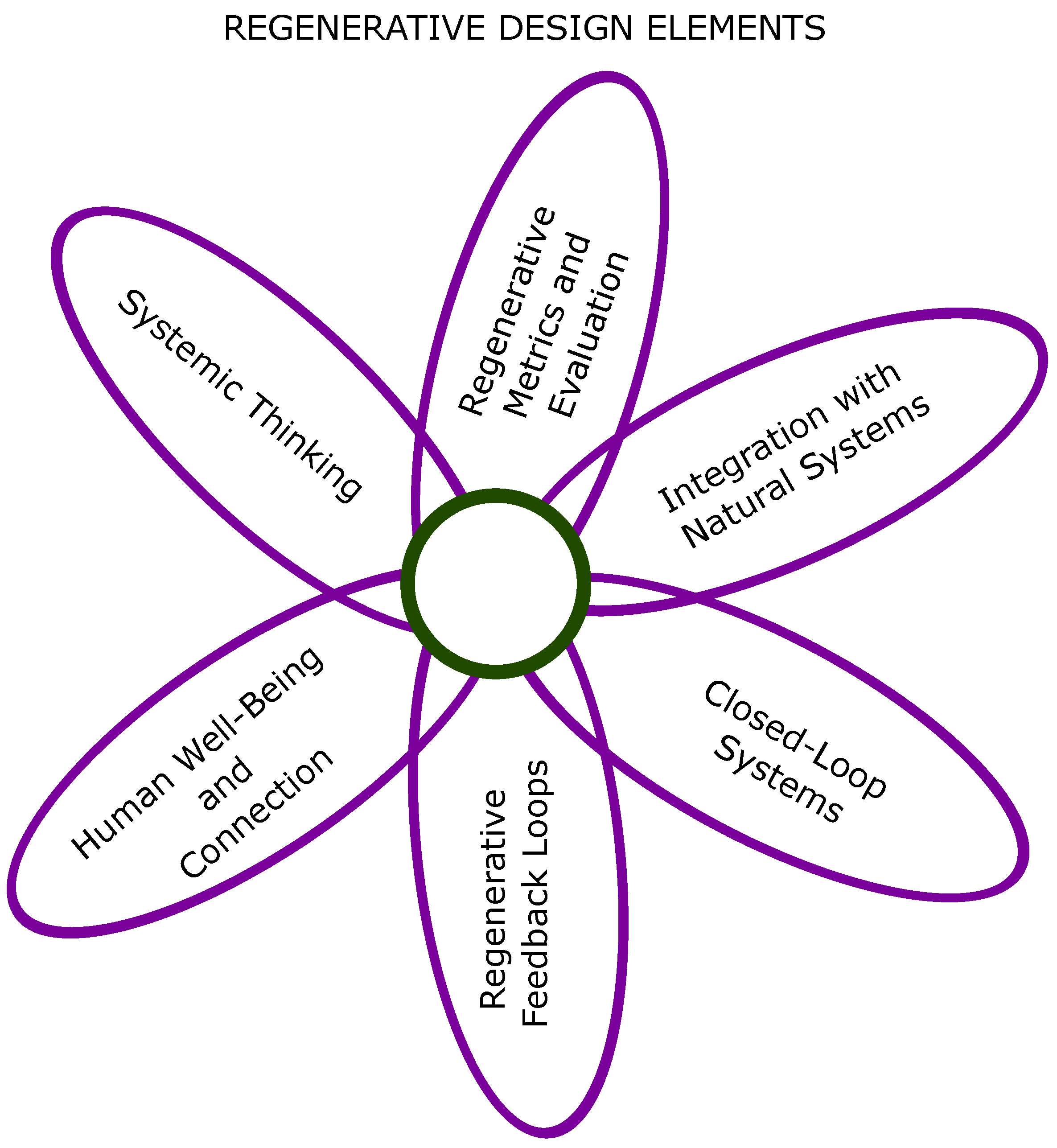
Figure 3.
Key Components Influencing Indoor Environmental Quality.
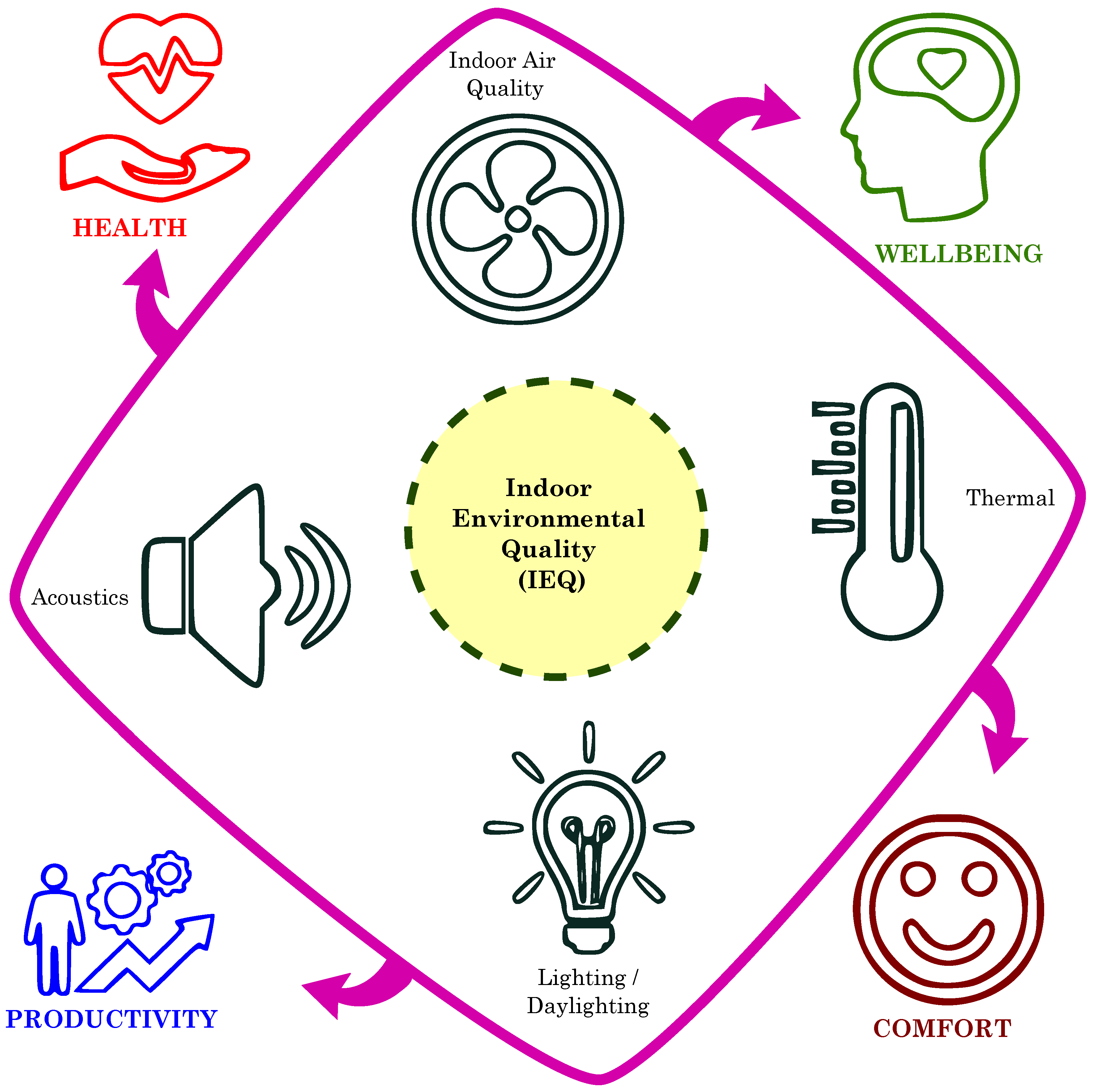
Figure 4.
Key performance indicators for indoor environmental quality (IEQ) / regenerative indoor environment (RIE).
Figure 4.
Key performance indicators for indoor environmental quality (IEQ) / regenerative indoor environment (RIE).
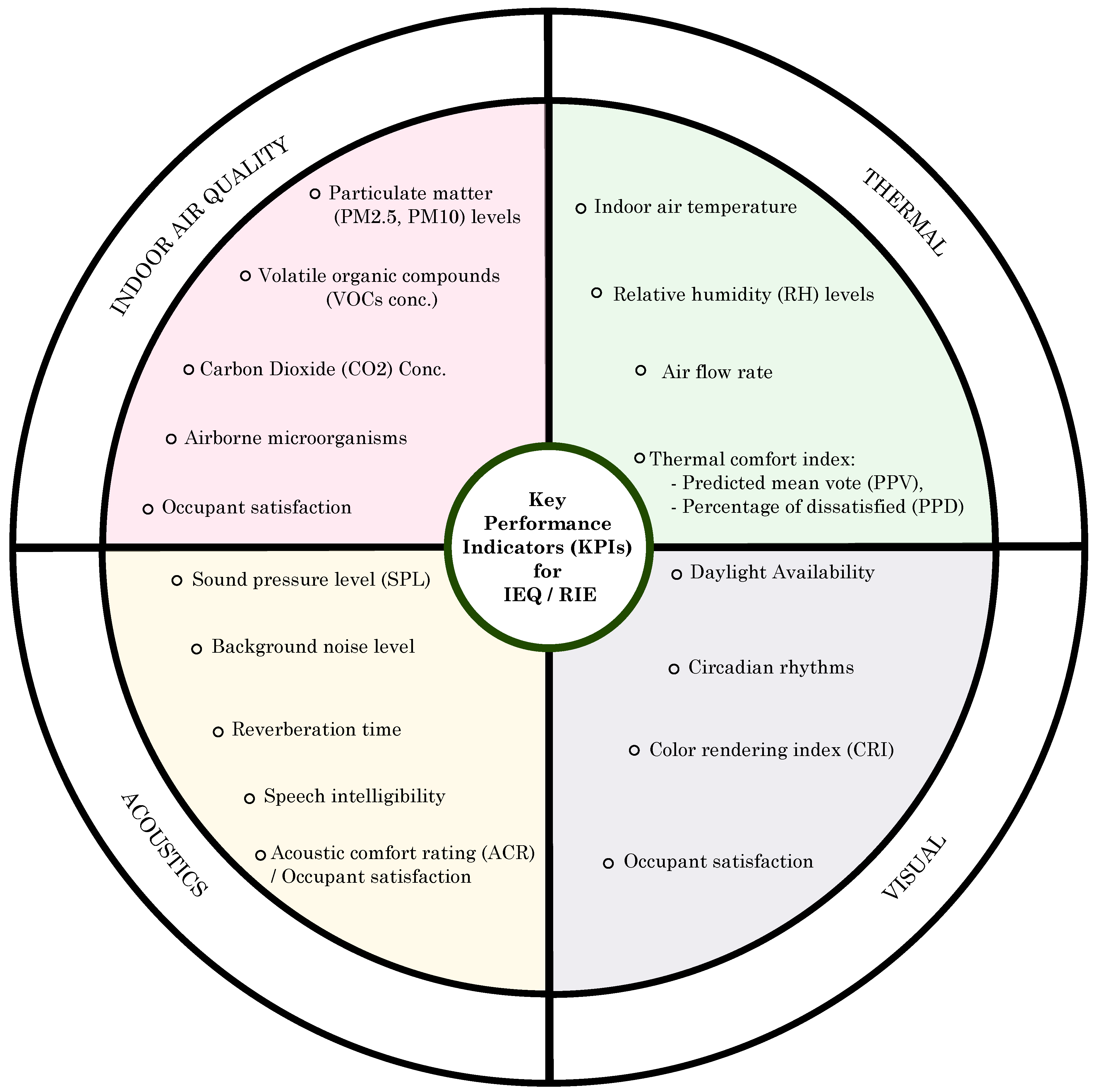

Table 1.
Regenetaive design based interventions and available standards or frameworks for IEQ [136,137,138].
| IEQ Components | Interventions | Standards/ Frameworks 1 |
|---|---|---|
| Indoor air quality environment | Indoor plants, green roofs/walls, vegetation, dynamic ceilings, smart low-emission materials, natural recyclable materials, adaptive building envelope, building management systems (BMS), etc. | EPA, WHO, NIOSH, OSHA, ANSI/ASHRAE 62.1, CEN (UNI EN 16798-1), LEED V4, BREEAM, CASBEE, LBC V4, WELL-BUILDING (IWBI), ILFI |
| Thermal environment | Green roofs/walls, passive heating and cooling systems, dynamic ceilings, nature-based solar shading (e.g., tree plantations, green facades), wind barriers, building design and orientation, BMS, smart materials, adaptive building envelope, energy-efficient HVAC systems, etc. | ANSI/ASHRAE 55, CEN (UNI EN 16798-1), CEN (EN ISO 7730), LEED V4, BREEAM, CASBEE, LBC V4, WELL-BUILDING |
| Visual environment | Dynamic ceilings, switchable glazing systems, adaptive building envelope, automated shading technologies, solar tubes and sheds, window solar shelves, automated artificial lighting, BMS, etc | CEN (UNI EN 16798-1), CEN (EN 12464-1), CIBSE, USGBC, DGNB, IES, LEED V4, BREEAM, CASBEE (Q1), LBC V4 (I09), WELL-BUILDING (L01 to L09), ILFI |
| Acoustic environment | Natural noise barriers (e.g., green roofs/walls, water features), sound-absorbing panels, noise barriers, natural and recycled materials, advanced acoustic materials (e.g., metamaterials), adaptive building envelope, etc. | CEN (UNI EN 16798-1), LEED V4, BREEAM, CASBEE (Q1), LBC V4, WELL-BUILDING (S01 to S07) |
1 EPA: Environmental Protection Agency, WHO: World Health Organization, NIOSH: National Institute for Occupational Safety and Health, OSHA: Occupational Safety and Health Administration, ANSI/ASHRAE: American National Standards Institute / American Society of Heating, Refrigerating, and Air-Conditioning Engineers, CEN: European Committee for Standardization, USGBC: U.S. Green Building Council, DGNB: Deutsche Gesellschaft für Nachhaltiges Bauen, IES: Illuminating Engineering Society, LEED: Leadership in Energy and Environmental Design, BREEAM: Building Research Establishment Environmental Assessment Method, CASBEE: Comprehensive Assessment System for Built Environment Efficiency, LBC: Living Building Challenge, WELL-BUILDING (IWBI): WELL Building Standard (International WELL Building Institute), ILFI: International Living Future Institute.
Disclaimer/Publisher’s Note: The statements, opinions and data contained in all publications are solely those of the individual author(s) and contributor(s) and not of MDPI and/or the editor(s). MDPI and/or the editor(s) disclaim responsibility for any injury to people or property resulting from any ideas, methods, instructions or products referred to in the content. |
© 2025 by the authors. Licensee MDPI, Basel, Switzerland. This article is an open access article distributed under the terms and conditions of the Creative Commons Attribution (CC BY) license (http://creativecommons.org/licenses/by/4.0/).
Copyright: This open access article is published under a Creative Commons CC BY 4.0 license, which permit the free download, distribution, and reuse, provided that the author and preprint are cited in any reuse.