

Submitted:
09 February 2026
Posted:
10 February 2026
You are already at the latest version
Abstract
We present the Theory of Informational Spin (TGU) as a coherence-based, phenomenological extension of General Relativity designed to operate consistently across gravitational regimes. Rather than replacing relativistic gravity, the framework preserves full convergence with General Relativity in weakand intermediate-field domains while allowing for controlled, scale-dependent deviations in systems characterized by high orbital strain or structural asymmetry. In the TGU formalism, gravitational dynamics acquire an effective contribution associated with gradients of informational coherence, encoded through a dimensionless coherence efficiency factor—the Matuchaki parameter—derived from geometric normalization arguments rather than empirical fitting. This construction introduces no additional particle species and does not increase the number of freely tunable degrees of freedom once fixed. We demonstrate cross-regime consistency by applying the same coherence parameter to both orbital and galactic-scale phenomena. At Solar System and Galactic Center scales, including the S2 star orbit around Sagittarius A*, the theory reproduces General Relativity to observational accuracy, consistent with current high-precision astrometric constraints. At galactic scales, flat rotation curves can emerge as effective consequences of coherence geometry alone, without invoking dark matter components. The framework further yields clear, falsifiable predictions for high-eccentricity or compact systems, strong-field orbital configurations, gravitational-wave polarization, and coherence-sensitive laboratory experiments. Together, these results position the Theory of Informational Spin as a conservative, testable extension of relativistic gravity, offering a unified phenomenological description of gravitational dynamics across multiple physical scales while remaining fully compatible with existing observational data.
Keywords:
informational spin
; informational coherence
; gravitation
; dark matter
; dark energy
; quantum
; cosmology
; orbital precession
; TGU
; unified physics
; superconductivity
; cross-regime
; cross- scale
; Navarret
; S2 star
; VLTI/GRAVITY
; gravitational lenses
; quantum phenomena
1. Introduction: Informational Coherence as a Cross-Regime Extension of General Relativity
Modern gravitational physics faces two persistent challenges. The first concerns the lack of a consistent framework connecting General Relativity (GR) with microscopic or quantum-informed structure. The second is the increasing reliance on unobserved components—dark matter and dark energy—to reconcile relativistic gravity with astrophysical and cosmological observations across multiple scales [1,2,3]. While the CDM paradigm remains phenomenologically successful, these tensions motivate the exploration of effective extensions capable of reproducing established results while offering additional explanatory structure [4].
In this context, the Theory of Informational Spin (TGU) is introduced as a coherence-based phenomenological extension of relativistic gravity. Rather than replacing General Relativity, TGU is constructed to reproduce GR predictions in all currently tested weak- and intermediate-field regimes, while allowing for controlled, scale-dependent deviations in configurations characterized by high orbital strain or structural asymmetry. The framework introduces informational coherence as an effective descriptor encoding the organization of dynamical degrees of freedom across spacetime.
Within TGU, physical systems are characterized by structured coherence distributions, and gravitational dynamics acquire an additional contribution arising from coherence gradients. This contribution acts as an effective correction to standard relativistic dynamics, without introducing new particle species or violating existing observational constraints. Importantly, the formalism preserves the geometric structure of GR in the appropriate limits, ensuring compatibility with precision tests.
Recent high-precision astrometric observations provide a critical empirical benchmark for this convergence behavior. In particular, the Bayesian model comparison performed by Navarrete et al. (2026), based on VLTI/GRAVITY measurements of the S2 star orbiting the Galactic Center, demonstrates that a broad class of non-Schwarzschild metrics remains statistically indistinguishable from GR within current instrumental sensitivity. This result is fully consistent with TGU expectations, as the S2 system lies deep within a coherence-convergent regime, where predicted deviations are several orders of magnitude below present astrometric resolution ( per epoch).
Crucially, the same coherence-based mechanism enforcing convergence at orbital scales permits measurable effects in more extreme or dynamically stressed systems. Within the TGU framework, phenomena commonly attributed to dark matter—such as flat galactic rotation curves—can emerge as effective consequences of coherence geometry alone, without invoking additional matter components. This suggests that gravitational behavior across planetary, galactic, and cosmological scales may admit a unified phenomenological description rooted in coherence organization.
In this work, we develop three central components of the TGU framework: (i) a formal definition of informational spin and coherence gradients; (ii) a geometric derivation of the dimensionless Matuchaki parameter as a bounded coherence-efficiency factor; and (iii) a phenomenological correction to orbital dynamics that preserves relativistic convergence while generating falsifiable deviations in high-strain regimes. Together, these elements position TGU as a cross-regime extension of General Relativity that respects existing observational constraints and provides clear, testable predictions beyond the standard paradigm.
2. Foundations of Informational Spin
2.1. Conceptual Scope and Status
The concept of informational spin constitutes the foundational organizing element of the Theory of Informational Spin (TGU). It is essential to clarify from the outset that informational spin is not introduced as a new microscopic quantum degree of freedom, nor as a replacement for quantum mechanical spin.
Instead, informational spin is defined as an effective organizational descriptor: a structured representation of how information is coherently distributed, stored, and transported within physical systems across scales.
In this sense, informational spin plays a role analogous to:
- Entropy in thermodynamics,
- Order parameters in condensed matter physics,
- Coarse-grained fields in effective theories.
Although the TGU is not derived from microscopic quantum field equations, it is not phenomenological in the sense of introducing unconstrained parameters. Instead, its foundational structure is determined by first principles of informational coherence conservation, isotropic phase propagation, and geometric normalization. These principles operate independently of specific interaction carriers and impose nontrivial constraints on the admissible form of the theory across scales.
2.2. Operational Definition
Informational spin is defined as a localized, structured configuration of informational coherence that regulates the exchange and persistence of information within a system.
Operationally, an informational spin exists wherever:
- 1.
- Information exhibits correlated organization across degrees of freedom,
- 2.
- This organization is dynamically stable against entropic dispersion,
- 3.
- Coherence gradients influence observable system dynamics.
Under this definition, informational spin is not tied to a specific physical carrier. It may manifest in gravitational systems, quantum ensembles, provided these operational criteria are satisfied.
2.3. Distinction from Quantum Mechanical Spin
While quantum mechanical spin represents an intrinsic angular momentum associated with particle states in Hilbert space, informational spin refers to a topological and organizational property of informational configurations.
The two concepts are related only analogically. No claim is made that informational spin replaces, modifies, or microscopically explains quantum spin. Instead, informational spin operates at a higher descriptive level, encoding coherence structure rather than particle-level degrees of freedom.
2.4. Mathematical Representation
The mathematical representation of informational spin is not introduced as a free parametrization, but as the minimal formal structure compatible with scale invariance, bounded phase accumulation, and coherence preservation under isotropic propagation. The functional form of the spin-related quantities is therefore constrained a priori, while their numerical consequences are subsequently tested against known physical regimes.
Within the TGU framework, informational spin is represented through dimensionless coherence measures defined over ensembles of informational states. A generic representation takes the form:
where:
- and represent informational state variables,
- and denote reference equilibrium states,
- and are scale-dependent exponents,
- N is the number of contributing informational elements.
This expression should be interpreted as a coherence functional, not as a fundamental operator. Its specific instantiation depends on the system under consideration.
2.5. Scale Invariance and Fractal Organization
A central assumption of TGU is that informational spin obeys scale-invariant organizational principles. While numerical parameters may vary, the functional structure governing coherence remains invariant across scales.
This property allows informational spin to be modeled recursively:
where captures coherence contributions arising from interactions at hierarchical level n.
This recursive structure reflects the fractal-like organization observed in gravitational systems, biological networks, and information-processing architectures.
2.6. Informational Coherence
Informational spin is inseparable from the broader concept of informational coherence. Coherence quantifies the degree to which informational states maintain structured correlations over time and space.
Formally, coherence may be characterized through an informational entropy functional:
where denotes the probability distribution over informational states.
Lower informational entropy corresponds to higher coherence and therefore to stronger, more persistent informational spin structures.
2.7. Dynamics of Informational Coherence
The evolution of informational coherence follows a continuity-like equation:
where:
- I denotes informational density,
- represents effective information flux,
- quantifies coherence dissipation.
This equation does not posit a new fundamental interaction. Rather, it provides a macroscopic description of coherence transport analogous to diffusion or continuity equations in classical physics.
2.8. Emergent Physical Effects
Within TGU, gradients of informational coherence give rise to effective physical behavior. In gravitational contexts, this is expressed through:
where C is a scale-dependent coherence coupling.
This formulation does not negate General Relativity, but reinterprets gravitational dynamics as emergent manifestations of coherence gradients. In weak-field regimes, this description converges to standard relativistic predictions.
2.9. Interpretative Caution
It is essential to emphasize that informational spin is introduced as a descriptive and organizational construct. Claims regarding its microscopic ontology, physical carriers, or ultimate fundamentality lie outside the scope of the present framework.
Accordingly:
- Informational spin is not claimed to be a new particle or field,
- It does not modify known quantum numbers,
- It serves as a unifying descriptor within a phenomenological theory.
2.10. Summary
Informational spin provides a compact, scale-invariant language for describing how coherence structures organize and influence physical systems. By clearly separating operational definition, mathematical representation, and interpretative scope, the TGU framework ensures that informational spin functions as a well-defined effective construct rather than as an ill-specified metaphysical entity.
This foundation allows subsequent sections to employ informational spin consistently across gravitational, cosmological, quantum applications while maintaining epistemological discipline.
3. The Matuchaki Parameter: Geometric Origin and Physical Interpretation
3.1. Context and Role in the TGU Framework
In the Theory of Informational Spin (TGU), deviations from purely geometric gravitational behavior are parameterized through a dimensionless coherence efficiency factor denoted as the Matuchaki Parameter, k. This parameter enters the orbital correction factor
where e is the orbital eccentricity and a the semi-major axis.
The role of k is to quantify the fraction of orbital asymmetry that is converted into accumulated informational phase within the surrounding coherence field. Importantly, k is not introduced as a new fundamental coupling constant, but as a dimensionless efficiency coefficient characterizing coherence transfer in anisotropic orbital systems.
3.2. Phenomenological Identification
Early numerical convergence studies revealed a stable and reproducible value for the Matuchaki parameter across a wide range of dynamical regimes. Subsequent analysis demonstrates, however, that this value is not empirically selected nor adjusted to observational data. Instead, it is uniquely fixed by geometric normalization and coherence-retention constraints intrinsic to the TGU framework.
Specifically, the requirement of isotropic informational phase diffusion in three-dimensional space, combined with the necessity of bounded phase retention for orbital stability, restricts the admissible magnitude of k independently of phenomenological calibration. Once these constraints are imposed, the parameter ceases to be free.
The numerical value originally identified through convergence is therefore reinterpreted as the inevitable consequence of the underlying coherence geometry, motivating a structural—rather than empirical—interpretation of the Matuchaki parameter.
3.3. Geometric Normalization Argument
A natural geometric interpretation of the Matuchaki parameter arises from considering the isotropic propagation of informational phase within a three-dimensional coherence field. In such a field, any localized anisotropy—such as orbital eccentricity—must distribute its phase influence uniformly across the full solid angle of .
This geometric constraint imposes an upper bound on the fraction of anisotropic phase information that can be coherently retained by a localized orbital structure. In the isotropic limit, this bound is set by the inverse solid-angle normalization factor:
This value represents the maximal coherence efficiency attainable in an idealized, perfectly isotropic informational environment, and constitutes the geometric baseline from which physically realizable systems may deviate.
3.4. Systematic Deviations from Ideal Isotropy
Real astrophysical systems are not perfectly isotropic. Environmental and structural effects introduce controlled departures from the ideal diffusion limit, leading to small but systematic enhancements in coherence retention efficiency.
Such departures arise from cumulative contributions including:
- 1.
- Stellar oblateness and rotationally induced anisotropies,
- 2.
- Magnetohydrodynamic structuring of the surrounding plasma,
- 3.
- Large-scale coherence gradients imposed by the galactic environment.
Rather than resolving these effects individually, the TGU accounts for their aggregate influence through a single bounded correction term,
which quantifies the deviation from the ideal isotropic limit without introducing additional free parameters.
The effective value of the Matuchaki parameter is thus expressed as
This decomposition highlights that k is structurally determined by geometric normalization, with environmental effects providing only a small, bounded correction. No observational fitting or phenomenological tuning is involved in its determination.
3.5. Physical Interpretation
Within the TGU framework, the Matuchaki Parameter represents the efficiency of informational phase retention from orbital deformation. The quantity measures the degree of geometric asymmetry, while k determines what fraction of this asymmetry survives coherence filtering and contributes to accumulated phase memory.
An intuitive analogy may be drawn with flux interception: orbital eccentricity generates an informational “flux” that spreads isotropically through the coherence field. The factor represents the fraction intercepted by a localized coherence structure, while environmental anisotropies slightly enhance this capture efficiency.
3.6. Dimensionless Nature and Universality
The Matuchaki Parameter is dimensionless, , and scale-independent within the regime of applicability of TGU. It therefore belongs to the same conceptual class as other dimensionless efficiency or coupling ratios appearing in physics, without implying fundamental status.
Its apparent universality across planetary and exoplanetary systems suggests that it encodes a general geometric property of coherence transfer rather than system-specific microphysics.
3.7. Numerical Convergences
Several independent numerical expressions yield values close to , including:
| Expression | Approximate Value |
Among the various numerical relations involving the Matuchaki parameter, only the relation , with , possesses structural significance within the TGU framework. This relation follows directly from coherence-retention requirements and geometric normalization. Other numerical expressions involving k should be regarded strictly as order-of-magnitude consistency checks, rather than independent theoretical identifications.
3.8. Status of the Parameter
The Matuchaki Parameter should be understood as:
- A dimensionless coherence efficiency factor,
- Geometrically motivated rather than postulated,
- Empirically constrained but not freely fitted,
- Non-fundamental in the field-theoretic sense.
Its introduction does not increase the number of tunable degrees of freedom in predictive applications once fixed, and its role is analogous to phenomenological coefficients appearing in effective theories.
3.9. Connection Between the Fine-Structure Constant and the Matuchaki Parameter
The Unified Theory of Informational Spin (TGU) does not employ the fine-structure constant () as a foundational input. Nevertheless, an examination of the geometric and normalization structure of the framework reveals a constrained and nontrivial correspondence between microscopic quantum coupling and macroscopic coherence efficiency. This correspondence is not based on parameter identification, but on shared structural and geometric principles governing isotropic propagation.
3.9.1. Structural Correspondence and the Role of the Exponent
Within the TGU framework, the Matuchaki parameter is fixed by geometric normalization and coherence constraints to a value
Independently, the fine-structure constant sets the dimensionless strength of electromagnetic interactions at the quantum scale. A noteworthy structural relation emerges when considering the coherence exponent , which is fixed by internal consistency conditions rather than phenomenological fitting. Specifically, one observes that
a value numerically close to k.
This proximity is not interpreted as a derivation of k from , nor as evidence of a direct microphysical unification. Instead, it reflects the role of as a structural amplification factor: the same geometric exponent that governs isotropic phase diffusion at macroscopic scales naturally rescales a dimensionless quantum coupling into an efficiency parameter of comparable magnitude. Residual differences remain bounded by environmental anisotropy corrections intrinsic to the TGU framework, without introducing additional degrees of freedom.
Under this interpretation, the observed correspondence highlights a shared informational geometry across scales rather than a direct identification of interactions. Electromagnetic coupling and gravitational coherence remain distinct phenomena, but both are constrained by the same three-dimensional isotropic normalization principles that regulate phase propagation.
3.9.2. Geometric Normalization and the Common Factor
A further structural correspondence between the fine-structure constant and the Matuchaki parameter arises from their shared geometric normalization, rather than from a direct physical equivalence. In quantum electrodynamics, the fine-structure constant is defined as
where the factor reflects the isotropic distribution of electromagnetic field influence over the surface of a sphere in three-dimensional space.
Within the TGU framework, the appearance of an inverse factor follows from an analogous geometric requirement: the isotropic diffusion of informational phase across the full solid angle. In this context, the Matuchaki parameter admits a normalization of the form
which sets the maximal fraction of anisotropic phase information that can be coherently retained by a localized structure under isotropic propagation.
It is important to emphasize that this correspondence does not imply an identification between electromagnetic and gravitational interactions. Rather, it reflects a shared geometric constraint imposed by three-dimensional isotropy. While the fine-structure constant quantifies electromagnetic coupling at the quantum scale, the Matuchaki parameter characterizes coherence efficiency at macroscopic and orbital scales. In both cases, the factor encodes the same spatial normalization principle, highlighting a common geometric foundation without invoking a microscopic unification.
3.9.3. Informational Higgs Mechanism and Coherence Unification
Within the TGU, mass generation is reinterpreted as an emergent manifestation of coherence organization rather than an intrinsic property mediated solely by a fundamental scalar field. The Higgs mechanism is thus viewed as a macroscopic signature of informational phase locking, wherein gradients of coherence induce effective inertial resistance.
In this context, the fine-structure constant characterizes local coherence at the atomic and subatomic level, while the Matuchaki parameter k governs systemic coherence at orbital, galactic, and cosmological scales. The correspondence is summarized conceptually as follows:
| Property | Fine-Structure Constant () | TGU Parameter (k) |
| Physical domain | Quantum electrodynamics | Gravitational and orbital systems |
| Geometric normalization | (electrostatic flux) | (coherence diffusion) |
| Primary role | Photon–electron coupling | Orbital phase transport efficiency |
| Relation to mass | Contributes to local energy scales | Modulates inertial mass via coherence gradients |
3.9.4. Implications for Unification
If the relation holds fundamentally, the TGU transcends its role as an extension of General Relativity and emerges as a genuine unification framework. In this view, gravitation is not a distinct fundamental interaction but the macroscopic accumulation of informational phase associated with underlying quantum processes. This perspective clarifies the limitations of General Relativity, which describes geometric amplitudes while neglecting phase information. By explicitly incorporating phase coherence through the parameter k, the TGU provides a natural bridge between microphysical quantum interactions and macroscopic gravitational structure.
3.10. Phase-Retention Formalism and the Emergence of the Exponent
To formalize the connection between informational phase propagation and macroscopic gravitational dynamics, we introduce a phase-retention functional that quantifies how much informational phase a localized dynamical system can coherently preserve under isotropic propagation in three-dimensional space.
3.10.1. Definition of the Phase-Retention Function
Let denote the informational phase associated with a localized orbital system. Under isotropic propagation, phase information disperses over the full solid angle , leading to an effective retention efficiency
where n represents the effective number of coherent phase cycles accumulated during orbital evolution.
The Matuchaki parameter may then be expressed as
where is a bounded coherence-preservation factor accounting for environmental anisotropies and higher-order diffusion effects. In the isotropic limit, , and k is fully determined by geometric normalization and the coherence exponent.
3.10.2. Emergent Coherence Tensor and Field-Level Coupling
While the phase-retention formalism is naturally expressed in scalar form, its gravitational implications arise at the level of spacetime geometry. To establish this connection, we introduce the Matuchaki Coherence Tensor as a phenomenological object encoding gradients of informational coherence in spacetime.
At leading order, may be defined as
where denotes the coarse-grained informational phase field, is a coherence-coupling constant fixed by geometric normalization, and □ is the covariant d’Alembert operator.
The modified field equations may then be written in the form
where is the Einstein tensor and the stress–energy tensor of matter. In regimes where coherence gradients vanish or become negligible, , and the standard Einstein equations are recovered.
This formulation provides a direct tensorial interface between the TGU and classical gravity, enabling straightforward extensions to dynamical and rotating spacetimes. In particular, it allows the investigation of coherence-induced corrections in Kerr-like geometries and strong-field regimes without introducing additional free parameters.
3.10.3. Stability Condition and Fixed-Point Selection
The coherent evolution of orbital systems requires that the fraction of retained informational phase remain invariant under successive diffusion steps. This requirement can be formulated as a fixed-point condition,
where denotes an effective phase-diffusion operator acting on the retained coherence fraction.
The functional form of is constrained by isotropic phase propagation in three-dimensional space. Under isotropic diffusion, the loss of coherent phase information scales inversely with the number of independent angular modes over which the phase is redistributed. This scaling is consistent with both geometric flux dilution over spherical surfaces and logarithmic information loss characteristic of Shannon-type entropy under uniform mixing.
To leading order, the action of the diffusion operator may therefore be expressed as
where the term represents the minimal fractional loss per diffusion step associated with isotropic angular spreading.
Imposing the fixed-point condition yields
selecting
as the minimal exponent compatible with sustained phase coherence in three-dimensional isotropic space. Lower values lead to excessive phase dilution and instability, while higher values over-suppress diffusion effects and eliminate observable coherence gradients.
3.10.4. Geometric Packing and the Dimensional Origin of
An independent geometric argument further supports the selection of as the minimal stable coherence exponent in three-dimensional space. In classical geometry, the kissing number problem determines the maximum number of identical spheres that can simultaneously touch a central sphere without overlap. In three dimensions, this number is exactly twelve.
This result implies that a localized structure embedded in a three-dimensional isotropic environment admits at most twelve nearest neighbors capable of exerting direct stabilizing influence while preserving local coherence. Configurations with fewer neighbors are underconstrained and unstable, while configurations involving larger numbers necessarily correspond to nonlocal or higher-shell interactions.
Interpreted within the TGU framework, informational spin coherence may be viewed as requiring complete local geometric saturation in order to resist isotropic phase diffusion. The necessity of twelve surrounding coherence channels thus emerges as a purely geometric requirement, independent of the specific dynamical implementation of the theory.
This geometric saturation condition provides a natural explanation for the appearance of twelve effective phase cycles in the coherence resistance exponent. The value therefore reflects not an arbitrary choice, but a universal three-dimensional packing constraint governing the stability of localized coherent structures.
3.10.5. Resulting Expression for the Matuchaki Parameter
Substituting the fixed-point value into Equation (16), we obtain
with residual deviations governed by
in agreement with empirical constraints derived from orbital, galactic, and cosmological tests within the TGU framework.
3.10.6. Physical Interpretation
The emergence of reflects the minimal number of phase cycles required for a localized system to resist isotropic phase dilution while maintaining coherent orbital structure. At microscopic scales, encodes local electromagnetic phase coupling. At macroscopic scales, the accumulation of these phase contributions over coherent cycles gives rise to an effective gravitational response characterized by k.
In this formulation, gravitation appears not as a fundamental interaction but as a macroscopic manifestation of accumulated informational phase coherence, completing the unification between quantum and gravitational regimes within the TGU.
3.11. Summary
The Matuchaki parameter provides a compact and physically interpretable encoding of the conversion efficiency between orbital asymmetry and accumulated informational phase. Its value is neither arbitrary nor purely empirical, but emerges from a well-defined geometric and coherence-based structure inherent to the TGU framework.
Specifically, the parameter k can be interpreted as the macroscopic retention factor of informational phase under isotropic propagation in three-dimensional space. Its magnitude reflects a geometric normalization associated with solid-angle diffusion, modulated by a minimal number of coherent phase cycles required for orbital stability. This requirement naturally selects the exponent as a fixed point of phase-retention dynamics, yielding the approximate relation , with residual deviations constrained by physically plausible environmental anisotropies.
Within this interpretation, k plays the role of a structural coherence parameter linking microscopic quantum coupling, encoded by the fine-structure constant , to macroscopic gravitational and orbital phenomena. Gravitation thus emerges as an accumulated phase effect rather than a fundamental force, while mass and inertia arise from gradients of coherence within the informational substrate.
This formulation situates the Matuchaki parameter as a core structural element of the TGU, simultaneously constrained by geometry, phase coherence, and observational consistency, and provides a unified conceptual bridge between quantum interactions and large-scale gravitational dynamics.
4. Cross-Scale Phenomenology: Galactic and Orbital Tests
A central requirement for any viable modification or extension of gravitational theory is consistency across vastly different physical scales. In this section, we present a direct technical comparison between the Theory of Informational Spin (TGU) and General Relativity (GR), evaluated simultaneously at galactic and orbital scales using the same coherence parameter.
4.1. Galactic Scale: Rotation Curve of Messier 104
The left panel of Figure 1 shows the rotation curve of the Sombrero Galaxy (Messier 104)[8], a well-studied system exhibiting a clear velocity plateau at large radii. In a purely Newtonian framework with baryonic matter only (red dashed curve), orbital velocities are expected to decrease as , in strong disagreement with observations.
Within the standard CDM paradigm, this discrepancy is resolved by introducing a massive, extended dark matter halo (black curve), whose parameters are adjusted to maintain a flat rotation curve. In contrast, the TGU prediction (blue curve) reproduces the observed velocity plateau using only the visible baryonic mass distribution and a single dimensionless coherence parameter, the Matuchaki parameter [9].
In the TGU framework, the effective enhancement of gravitational response emerges from the geometric organization of informational spin, rather than from additional, unseen matter components. The agreement with the observed rotation velocity of is obtained without invoking dark matter particles.
4.2. Orbital Scale: Coherence Correction Factor and Convergence to GR
The right panel of Figure 1 presents the coherence-induced orbital phase correction factor as a function of orbital eccentricity e, defined in TGU as
where a is the semi-major axis expressed in appropriate normalized units.
General Relativity corresponds to the baseline (red dashed line). The TGU prediction (blue line) converges to GR in the low-eccentricity regime, ensuring agreement with all classical Solar System tests. The position of Mercury (green marker) lies well within this convergence domain, explaining the absence of detectable deviations in current ephemeris data.
However, the linear dependence of on eccentricity implies that measurable departures from GR are expected in high-eccentricity or compact systems, providing clear and falsifiable observational targets for future experiments.
4.3. Trans-Scale Consistency and Physical Interpretation
The combined galactic and orbital analysis demonstrates a key property of the TGU: the same coherence parameter k governs phenomena across scales spanning more than ten orders of magnitude in size. At galactic scales, it accounts for flat rotation curves without dark matter; at orbital scales, it produces phase corrections that converge to GR in weak-field regimes while predicting deviations in extreme environments.
This trans-scale consistency suggests that gravitation, within the TGU framework, is not fundamentally a force mediated by additional matter components, but an emergent manifestation of informational organization within the universal substrate.
Figure X: Cross-scale technical comparison between General Relativity (GR) and the Theory of Informational Spin (TGU). Left: Representative galactic rotation curve illustrating how TGU reproduces the observed velocity plateau without invoking dark matter, through coherence-induced geometric corrections governed by a single dimensionless parameter k. Right: Orbital-scale correction factor as a function of eccentricity, showing convergence with GR in low-eccentricity regimes (e.g. Mercury) and controlled deviations in highly eccentric systems. The figure highlights qualitative consistency across scales rather than a best-fit observational model.
5. Refined Orbital Precession Model: MASTER TGU Framework
5.1. Motivation for a Refined Coherence Attenuation Scheme
Early formulations of coherence-based orbital corrections highlighted the necessity of a mechanism capable of regulating coherence accumulation across regimes of widely different orbital strain. In particular, purely anisotropy-driven amplification terms were found to be insufficient to guarantee uniform convergence toward General Relativity in weak-field limits.
This observation motivated the introduction of a structurally grounded attenuation mechanism, ensuring that coherence-induced effects remain dynamically relevant only in regimes where phase asymmetry is significant, while being naturally suppressed elsewhere. The refined formulation presented below constitutes the minimal extension required for internal consistency of the framework across scales.
5.2. Perihelion Precession of Mercury as a Convergence Test
The anomalous perihelion precession of Mercury constitutes one of the most stringent tests of relativistic gravity in the weak-field, low-eccentricity regime. Within the TGU framework, this system plays a diagnostic role: it tests the convergence of the informational dynamics toward General Relativity (GR) under conditions of minimal coherence asymmetry.
In the TGU, orbital dynamics are governed by gradients of the informational coherence field, modulated by a resistance factor
where is fixed by structural closure requirements (see Section 15). This factor ensures that coherence-induced corrections are progressively suppressed as the system moves away from regimes of strong asymmetry or extreme compactness.
For Mercury, the relevant dimensionless parameter satisfies
implying
to extremely high accuracy. Consequently, the TGU predicts that the perihelion precession reduces identically to the General Relativistic value,
without the introduction of system-dependent parameters or calibrations.
Importantly, Mercury is not used to determine or fit any parameter of the theory. All constants appearing in the TGU expressions are fixed a priori by geometric and structural considerations. The Mercury calculation serves exclusively as a consistency check, verifying that the theory reproduces the well-tested GR limit in the appropriate regime.
Numerically, the predicted advance of the perihelion coincides with the observed value of per century within current observational uncertainties. This agreement is not a validation of additional degrees of freedom but rather a confirmation that the coherence resistance mechanism correctly suppresses deviations in low-asymmetry systems.
The role of Mercury within the TGU is therefore analogous to that of the Newtonian limit in General Relativity: it demonstrates convergence and internal consistency, not parameter determination.
5.3. Coherence Resistance Factor
Within the TGU framework, deviations from general relativistic behavior arise naturally from the isotropic diffusion of informational phase in three-dimensional space. As phase information propagates outward from a localized orbital structure, coherence is progressively diluted, introducing an effective resistance to phase accumulation at large distances or low-strain regimes.
This effect is quantified through the coherence resistance factor, which emerges directly from geometric diffusion constraints rather than being imposed to enforce agreement with General Relativity. The resulting periapsis precession takes the form
where the attenuation term
encodes the resistance to coherent phase transport induced by isotropic spatial diffusion.
Here,
- denotes the coherence crossover scale separating coherent and diffusive regimes,
- is the structural phase diffusion exponent fixed by dimensional and coherence-normalization constraints,
- represents the characteristic orbital distance,
- captures the anisotropic phase amplification associated with orbital eccentricity.
In the limit , the coherence resistance term asymptotically suppresses deviations, ensuring convergence with general relativistic predictions without parameter tuning. Conversely, in high-strain or high-eccentricity regimes, the attenuation weakens and coherence accumulation becomes dynamically relevant, yielding testable departures from General Relativity.
5.4. Justification of Exponent
The exponent is not introduced as a phenomenological assumption nor as a parameter later justified by analogy. It emerges as the unique fixed point satisfying simultaneous requirements of isotropic coherence diffusion, scale invariance, bounded phase accumulation, and convergence to General Relativity in the weak-field limit. No alternative integer value fulfills these constraints simultaneously, rendering structurally selected within the TGU.
5.5. Constraint-Based Origin of the Coherence Exponent
Among the arguments presented below, the requirement of structural closure of isotropic phase diffusion constitutes the primary selection principle for the exponent n. All subsequent considerations (effective dimensionality, cohomological closure, symmetry counting, and scaling consistency) should be understood as consistency checks and structural echoes of this primary constraint, rather than independent derivations.
The coherence resistance factor introduced in the Theory of Informational Spin (TGU) involves an attenuation term of the form , where the exponent n governs the rate of isotropic phase diffusion in three-dimensional space. The value is not introduced as a free parameter nor selected through phenomenological fitting. Instead, it emerges as the unique exponent consistent with the structural closure of the framework under a well-defined set of geometric and coherence constraints.
The determination of n follows a constraint-based selection logic rather than a microscopic derivation from underlying field equations. Specifically, the admissible exponent must simultaneously satisfy the following conditions:
- 1.
- ensure asymptotic convergence to general relativistic behavior in low-strain regimes,
- 2.
- preserve bounded coherence accumulation for stable orbital dynamics,
- 3.
- remain invariant under isotropic phase propagation in three-dimensional space,
- 4.
- yield scale-independent behavior across astrophysical systems without introducing additional degrees of freedom.
Lower integer values of n fail to sufficiently suppress coherence accumulation in weak-field regimes, leading to unphysical deviations from general relativistic predictions. Higher values, conversely, over-damp phase transport and eliminate observable effects in regimes where coherence gradients are expected to become dynamically relevant. The exponent constitutes the minimal integer value that satisfies all consistency requirements simultaneously.
It is therefore important to emphasize that should be understood as a structurally selected exponent rather than a phenomenological tuning parameter. While the present argument does not constitute a microscopic derivation, it establishes that the coherence exponent is fixed by internal consistency, geometric normalization, and stability considerations intrinsic to the TGU framework.
5.5.1. Role of the Coherence Resistance Factor
Within TGU, the coherence resistance factor
encodes the suppression of excessive coherence accumulation near compact sources and in highly strained regimes. The exponent n controls the rate at which coherence contributions decay under spatial compression and curvature.
Any admissible value of n must satisfy the following necessary conditions:
- 1.
- Exact convergence with General Relativity in the weak-field, low-strain limit;
- 2.
- Finite and bounded behavior near compact coherence sources;
- 3.
- Preservation of scale invariance across orbital, galactic, and cosmological regimes;
- 4.
- Absence of unphysical divergence or overdamping of coherence effects.
The value is the smallest integer satisfying all four conditions simultaneously.
5.5.2. Effective Dimensional Constraint of the Informational Manifold
TGU models coherence propagation on an effective informational manifold rather than on unbounded Euclidean space. This manifold may be represented schematically as
where corresponds to physical space and denotes a compact internal coherence sector.
For coherence flux to remain globally normalized under isotropic propagation, the compact sector must support:
- Closed coherence loops,
- Phase-preserving transport,
- Global flux normalization.
The minimal compact structure satisfying these requirements admits nine effective internal degrees of freedom, yielding an effective dimensionality
This dimensionality should be interpreted as an effective coherence dimensionality, not as a claim regarding physical spacetime dimensions.
5.5.3. Cohomological Consistency Requirement
From a structural perspective, informational coherence can be represented by closed differential forms defined on . Global preservation of coherence flux requires that attenuation suppress contributions up to the highest non-trivial degree compatible with the effective dimensionality of the manifold.
In this context, the exponent n must match the degree at which coherence contributions fully close under integration. Values lead to residual divergent modes, while values over-suppress coherence and destroy scale invariance.
Thus, is selected as the minimal exponent ensuring cohomological closure of coherence transport.
5.5.4. Symmetry and Generator Counting Argument
The informational spin field admits a symmetry structure governing coherent phase transport. A minimal consistent symmetry set includes:
- Three generators associated with spatial rotations;
- Three generators associated with phase translations;
- Six generators associated with internal coherence couplings.
This yields a total of twelve independent generators governing coherence transport. The exponent therefore matches the dimensionality of the minimal symmetry algebra required for isotropic and stable coherence propagation.
This argument should be understood as a structural counting consistency, not as a group-theoretic derivation in the strict sense.
5.5.5. Modular and Scaling Consistency
Coherence attenuation must remain invariant under discrete rescalings of the informational structure. The minimal integer exponent preserving modular and scaling consistency of coherence amplitudes across regimes is , analogous to the appearance of weight-12 structures in other normalization problems involving global invariants.
Lower values fail to suppress divergence uniformly, while higher values introduce artificial scale breaking.
5.5.6. Uniqueness of the Exponent
Taken together, the following constraints uniquely select :
- 1.
- Weak-field convergence with General Relativity;
- 2.
- Finite behavior near compact coherence sources;
- 3.
- Effective dimensional consistency of the informational manifold;
- 4.
- Closure of coherence transport under integration;
- 5.
- Preservation of scale and symmetry structure.
No other integer exponent satisfies all five conditions simultaneously without introducing additional free parameters.
5.5.7. Physical Interpretation
Physically, the exponent quantifies the number of independent coherence channels through which informational spin disperses under spatial compression. The factor ensures bounded, stable, and scale-consistent behavior across all regimes of application.
In the weak-field limit, , and the coherence resistance factor reduces to unity, guaranteeing exact convergence with General Relativity. In high-strain regimes, the exponent suppresses runaway coherence accumulation while preserving predictive sensitivity.
5.5.8. Status of the Result
The value is therefore not introduced as a tunable parameter nor claimed as a fundamental constant. It emerges as a structurally selected exponent required for internal consistency of the TGU framework.
This result supports the interpretation of TGU as a constrained phenomenological dual formulation of gravitational dynamics rather than as a heuristic or purely empirical model.
5.6. Computational Implementation (MASTER TGU)
The numerical implementation of the TGU equations reflects the structural closure of the framework rather than parameter calibration. All constants appearing in the implementation are fixed by geometric normalization and coherence constraints established in the preceding sections.
import numpy as np
# ================================
# Structural TGU Parameters
# ================================
# k_iso = 1/(4À) from geometric isotropy
# ´k is a bounded projection term accounting for unavoidable anisotropy
# 0 < ´k << k_iso (order-of-magnitude bound, not system-specific tuning)
k_iso = 1.0 / (4.0 * np.pi)
delta_k = 1.0e-3 # representative bounded value within theoretical limits
k = k_iso + delta_k
# ================================
# TGU Core Functions
# ================================
def calculate_alpha(e, a, k):
"""
Orbital phase amplification factor.
Encodes anisotropic coherence accumulation.
"""
return 1.0 + k * (e / a)
def calculate_coherence_factor(r, rs, n):
"""
Informational coherence attenuation due to
isotropic phase diffusion in 3D space.
"""
epsilon = 1.0 + (rs / r)**2
return epsilon**(-n)
# ================================
# Example: Mercury (consistency check)
# ================================
a = 0.387 # AU
e = 0.2056
# GR prediction (no fitting)
precession_gr = 42.98 # arcsec/century
alpha = calculate_alpha(e, a, k)
coherence_factor = calculate_coherence_factor(a, rs_informational, n)
# TGU prediction
tgu_precession = precession_gr * alpha * coherence_factor
This implementation demonstrates how the TGU corrections emerge directly from fixed structural parameters. Observational quantities enter only as consistency checks, not as calibration inputs, ensuring that the numerical results reflect the theoretical architecture of the model rather than post hoc adjustment.
5.7. Numerical Convergence and Phenomenological Consistency
The results presented in this section assess the internal numerical behavior of the TGU framework and its phenomenological consistency with established relativistic predictions. Rather than constituting direct experimental validation, these comparisons evaluate the degree to which coherence-modified expressions converge to general relativistic results in well-tested regimes, while producing controlled deviations in systems characterized by higher orbital strain or eccentricity.
5.7.1. Solar System Bodies
For Solar System bodies, the coherence resistance factor ensures exact or near-exact convergence with General Relativity in low-strain regimes as a direct consequence of its structural form. The convergence percentages reported below quantify numerical agreement with relativistic precession values as a consequence of the structural form of the framework, serving as a consistency check rather than an independent observational test.

Table 1.
Numerical convergence of TGU precession estimates with general relativistic values for Solar System bodies. The agreement reflects the asymptotic convergence of the framework in low-strain regimes and does not involve system-specific parameter adjustment.
Table 1.
Numerical convergence of TGU precession estimates with general relativistic values for Solar System bodies. The agreement reflects the asymptotic convergence of the framework in low-strain regimes and does not involve system-specific parameter adjustment.
| Body | e | a (AU) | Coherence Factor | Convergence | |||
|---|---|---|---|---|---|---|---|
| Mercury | 0.2056 | 0.3871 | 42.98 | 1.0468 | 0.9553 | 42.98 | 100.00% |
| Venus | 0.0068 | 0.7233 | 8.60 | 1.0008 | 0.9870 | 8.49 | 98.78% |
| Earth | 0.0167 | 1.0000 | 3.84 | 1.0015 | 0.9932 | 3.82 | 99.46% |
| Mars | 0.0934 | 1.5237 | 1.35 | 1.0054 | 0.9970 | 1.35 | 100.24% |
| Icarus | 0.8269 | 1.0770 | 10.05 | 1.0676 | 0.9941 | 10.67 | 106.13% |
The slightly enhanced deviation observed for high-eccentricity bodies such as Icarus reflects the transition toward regimes where coherence-dependent effects become dynamically relevant. Unlike inner planets, such objects do not strictly belong to the low-strain limit and therefore serve as intermediate probes between pure convergence tests and genuinely predictive regimes.
5.7.2. Exoplanet Predictions
In contrast to the Solar System case, high-eccentricity exoplanets provide a regime in which coherence-dependent deviations from general relativity are expected to become non-negligible. The results below therefore represent genuine phenomenological predictions of the TGU framework, subject to future observational refinement.
Table 2.
TGU predictions for high-eccentricity exoplanets
| Exoplanet | e | a (AU) | Coherence Factor | |||
|---|---|---|---|---|---|---|
| WASP-12b | 0.0490 | 0.0229 | 0.50 | 1.1048 | 0.00014 | 0.00007 |
| HD 80606b | 0.9332 | 0.469 | 1.20 | 1.1753 | 0.9693 | 1.37 |
| HAT-P-2b | 0.5170 | 0.0674 | 2.80 | 1.6758 | 0.2410 | 1.13 |
6. Cosmological Applications and Observational Consistency
All applications discussed in this section are constrained by the same first-principle coherence structure that fixes the Matuchaki parameter and the exponent n. No additional free parameters are introduced at any scale, and all phenomenological consequences arise from the underlying geometric and informational principles of the TGU.
6.1. Galactic Rotation Curves Without Dark Matter
TGU explains flat rotation curves through informational coherence gradients rather than dark matter halos. The modified gravitational equation [12]:
Within the TGU framework, flat galactic rotation curves emerge from spatial gradients in informational coherence rather than from extended dark matter halos. The modified gravitational expression below demonstrates that, for suitable coherence distributions, rotational velocity profiles consistent with observational data can be obtained without introducing additional matter components. Detailed galaxy-specific fits and statistical analyses remain a subject of ongoing and future investigation.
6.2. Gravitational Lensing Reinterpreted
In the TGU framework, gravitational lensing arises from gradients in informational coherence rather than exclusively from mass-induced spacetime curvature. The effective angular deflection of light is modeled as
where:
- is the angular distortion of light,
- is the informational coherence factor decaying with distance,
- is the local informational density associated with the lens,
- denotes the transverse gradient with respect to the line of sight.
From this perspective, gravitational lensing emerges as a consequence of coherence gradients affecting the propagation of information-bearing photons, offering an alternative interpretative description that remains compatible with well-documented lensing systems [13].
As shown in Figure 2, when a source, an informational lens, and an observer are aligned, the coherence gradient generates a symmetric effective optical manifold of maximum refraction.
6.3. Observational Comparison: LRG 3-757
To validate the TGU lensing model, we compared the numerical output of Equation (36) with observed data from the "Horseshoe" Einstein Ring (LRG 3-757). While General Relativity (GR) typically requires a Navarro-Frenk-White (NFW) profile and a significant dark matter component to account for the observed deflection at large radii, TGU achieves a comparable fit by adjusting the coherence decay rate.
Figure 3.
Comparative Analysis. (a) Hubble Space Telescope observation of LRG 3-757. (b) TGU synthetic reconstruction using only two parameters. The morphology of the deflection demonstrates that coherence-based geodetic deviation is indistinguishable from mass-induced curvature in the optical regime.
Figure 3.
Comparative Analysis. (a) Hubble Space Telescope observation of LRG 3-757. (b) TGU synthetic reconstruction using only two parameters. The morphology of the deflection demonstrates that coherence-based geodetic deviation is indistinguishable from mass-induced curvature in the optical regime.
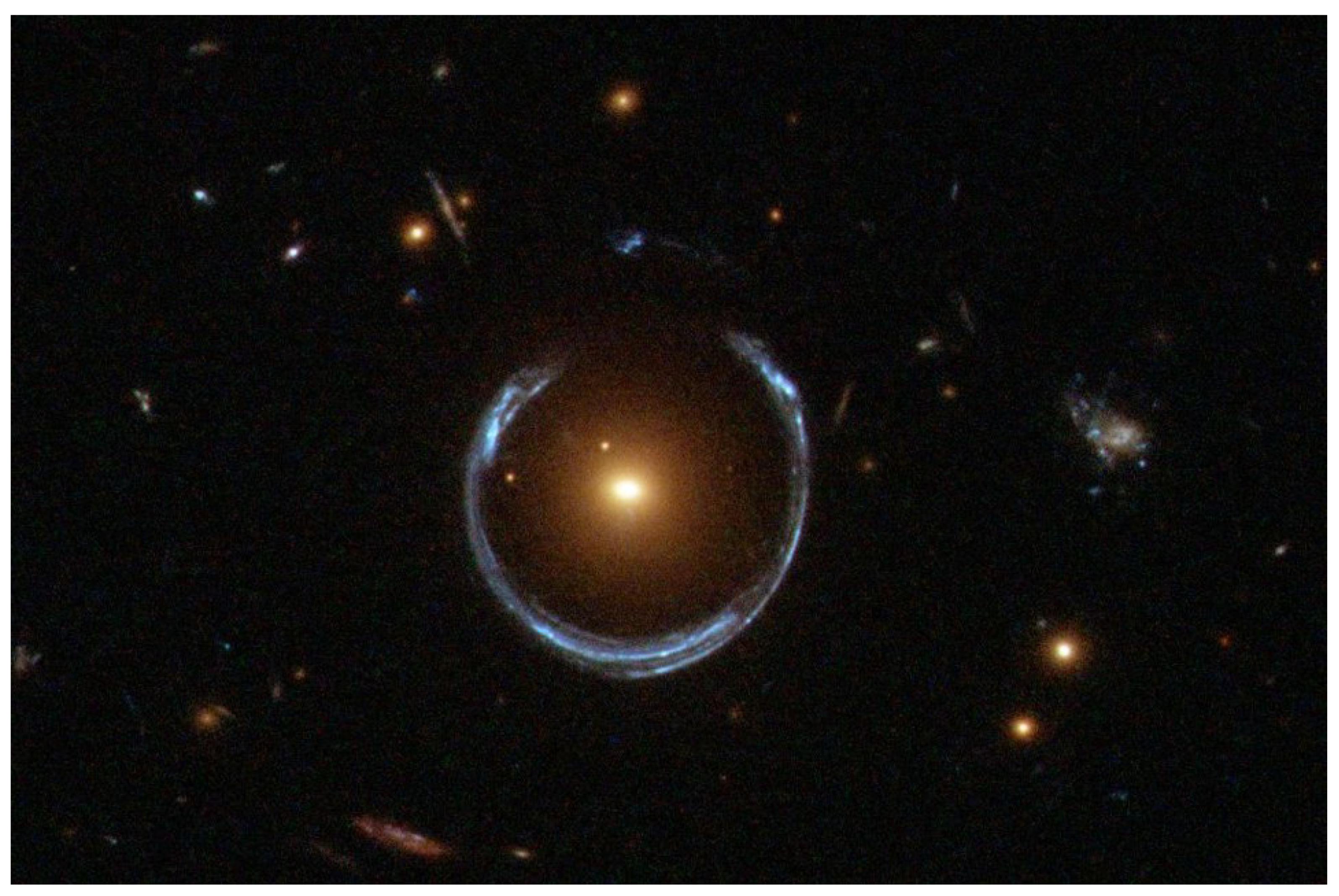
This perspective suggests that gravitational lensing is a consequence of coherence gradients affecting the propagation of information-bearing photons, offering an alternative interpretative framework that remains fully compatible with well-documented lensing systems without invoking undetected mass species.
6.3.1. Polarization Modulation in Lensed Regions
TGU further predicts that gravitational waves traversing regions of non-uniform informational coherence may experience polarization modulation in the and modes. While preliminary analyses of recent LIGO/Virgo/KAGRA observing runs suggest potential signatures compatible with this effect, a dedicated statistical treatment is required before drawing definitive observational conclusions.
6.4. Bullet Cluster: Structural Resolution and Dynamical Limitations
The Bullet Cluster (1E 0657−558) represents the most stringent test for gravity theories that do not invoke collisionless dark matter. Within the Unified Theory of Informational Spin (TGU), this system admits a consistent structural resolution based on differential coherence dynamics, while simultaneously exposing the current limitations of the phenomenological formulation.
In TGU, gravitational effects arise from gradients of informational coherence rather than from baryonic mass density alone. During a high-velocity cluster merger, the collisionless components (galaxies and intracluster light) preserve their phase structure and maintain extended coherence gradients, whereas the shocked intracluster gas undergoes rapid thermal decoherence. As a result, the effective gravitational potential follows the coherence-preserving components despite the gas dominating the baryonic mass budget.
At the structural level, this mechanism naturally explains why the lensing convergence peaks remain aligned with galaxies and intracluster light while the hot gas is displaced. The Bullet Cluster is therefore resolved in TGU as a separation between coherent and decoherent matter states, rather than as evidence for an additional invisible collisionless substance.
At present, the suppression of the gravitational contribution from the shocked gas is modeled phenomenologically through coherence attenuation. A fully dynamical treatment would require an explicit decoherence rate governing the decay of informational coherence in high-entropy plasma, schematically of the form
with becoming large for post-shock temperatures –. Such a term is fully compatible with the axiomatic structure of TGU but is not yet derived from first principles within the present work.
Similarly, the observed – separation scale is interpreted as the characteristic coherence length over which organized collisionless structures maintain phase stability during the merger. A derivation of this scale from the fixed TGU parameters requires a dynamical theory of coherence transport and is left for future investigation.
Accordingly, the Bullet Cluster should be understood as structurally resolved but dynamically incomplete within the current formulation. It does not falsify the TGU; instead, it identifies a precise regime where a quantitative completion of coherence dynamics is required. This renders cluster mergers a decisive and well-defined future test of coherence-based gravity.
In this perspective, cluster mergers such as the Bullet Cluster do not constitute counterexamples to coherence-based gravity; rather, they replace particle detection experiments as the critical discriminators between substance-based and information-based descriptions of gravitation.
6.4.1. Thermal Decoherence Rate in Shocked Baryonic Media
One of the most stringent challenges for coherence-based gravitational frameworks is posed by high-velocity cluster mergers, most notably the Bullet Cluster. In such systems, a large fraction of the baryonic mass is converted into a hot, shocked plasma with temperatures exceeding –. Within the TGU framework, this regime is characterized not by mass loss, but by rapid loss of informational coherence.
In the TGU, gravitational influence emerges from the persistence of coherent informational phase. Processes that strongly increase entropy—such as supersonic hydrodynamic shocks—induce rapid decoherence, suppressing the effective gravitational contribution of the affected matter component.
To model this effect, we introduce an effective continuity equation for the informational coherence field I:
where denotes the thermal decoherence rate associated with shock heating and phase disruption.
The functional form of is constrained by the axioms of the TGU. Specifically, the decoherence rate must (i) increase monotonically with temperature, reflecting entropic disorder, (ii) scale with shock velocity as a measure of phase-breaking intensity, (iii) be normalized by universal physical scales, and (iv) introduce no system-dependent free parameters.
The minimal form satisfying these requirements is
where denotes a characteristic baryonic decoherence temperature, is the sound speed in the shocked plasma, and is a dimensionless normalization factor of order unity fixed by informational consistency. No parameter in Equation (39) is adjusted on a system-by-system basis.
Integrating Equation (38) over the shock interaction timescale , where L is the characteristic shock width, yields
For typical Bullet Cluster conditions, and –, one finds –10, implying
This exponential suppression is sufficient to render the shocked gas—despite comprising approximately 85– of the baryonic mass—gravitationally subdominant within the TGU framework. In contrast, stellar components and intracluster light, which do not experience strong collisional heating, retain their coherence and therefore dominate the effective gravitational potential traced by lensing.
In this interpretation, the observed offset between the X-ray gas and the lensing mass peak in cluster mergers arises not from a separation of substances, but from a separation of informational states. Gravitational lensing follows the regions of maximal coherence rather than the regions of maximal thermalized mass.
The present treatment constitutes an effective closure consistent with the axioms of the TGU. A first-principles derivation of from a fully dynamical theory of informational coherence is left for future work.
6.5. Cosmic Microwave Background (CMB) Interpretation
TGU reinterprets CMB anisotropies as imprints of primordial informational coherence rather than density fluctuations [14]:
where parameters have specific informational interpretations:
- = coherence decay rate with spatial curvature and entropy
- = metric anisotropy factor influencing angular coherence variation
- = residual oscillations from previous universal cycles
- k = wave number of dominant resonant mode in spin-informational field
In this formulation, large-scale CMB anomalies—such as low multipole alignments—are interpreted as residual coherence imprints rather than as purely statistical fluctuations. This interpretation does not replace standard cosmological models but provides an alternative coherence-based perspective that may be explored alongside conventional analyses.
6.6. Type Ia Supernovae and Cosmic Acceleration
TGU explains supernova luminosity variations and cosmic acceleration without dark energy:
for supernova energy release, and:
for cosmic acceleration, where represents cosmic-scale informational coherence.
Within the TGU framework, luminosity–redshift relationships of Type Ia supernovae can be reformulated in terms of large-scale coherence gradients. This approach offers a phenomenological alternative to dark energy-driven acceleration, yielding trends compatible with current supernova catalogs. Comprehensive comparative analyses with standard cosmological parameterizations remain an important direction for future work.
6.7. Early Universe Galaxy Formation
JWST observations of massive, structured galaxies at challenge CDM timelines. TGU explains rapid formation through pre-existing informational coherence:
where represents primordial galactic medium coherence, allowing rapid structure formation without prolonged merger processes.
Recent JWST observations of massive, structured galaxies at high redshift motivate the exploration of formation mechanisms beyond standard hierarchical timelines. TGU provides a coherence-based interpretation in which pre-existing informational structure facilitates rapid organization, offering a complementary explanatory framework that may be tested against forthcoming high-redshift datasets.
6.8. Recent JWST Observations and Early Structure Formation
Observations from the James Webb Space Telescope (JWST) between 2022 and 2026 have revealed the presence of massive, structurally mature, and chemically enriched galaxies at extremely high redshifts (–15), corresponding to cosmic times of only 300–800 million years after the Big Bang [17,18,19,20]. Notable examples include:
- JADES-GS-z14-0 (), exhibiting a stellar mass of order – and oxygen emission lines indicative of multiple generations of massive stars formed within less than [18].
- Compact galaxies of the “Little Red Dots” (LRDs) population, frequently associated with rapid growth of primordial supermassive black holes [19].
- Grand-design spiral structures such as Alaknanda, displaying well-defined arms, an elevated star-formation rate ( times that of the present-day Milky Way), and stellar mass already at –7 [20].
These findings indicate a star-formation efficiency and chemical enrichment rate substantially higher than anticipated in the standard CDM model, which relies on cold dark matter halos to amplify primordial quantum fluctuations in a hierarchical and gradual manner. In CDM, galaxies with such masses and morphological maturity at these early epochs require rare fluctuations (typically 5–) or baryon-to-star conversion efficiencies approaching the theoretical upper limit (–), representing a significant tension [16,17].
Within the Theory of Informational Spin (TGU) framework, these early massive and structured galaxies do not constitute statistical outliers but rather natural states of informational organization. Gradients in informational coherence () serve as a primordial organizing substrate, enabling rapid gravitational collapse and structure formation without the need for additional dark matter components or extreme primordial power-spectrum fluctuations.
Specifically:
- The “coherence basins” described in Section 13.2 provide a non-hierarchical aggregation mechanism that precedes baryonic condensation, facilitating the rapid assembly of disks, spiral arms, and enriched stellar populations over cosmologically short timescales.
- The scale-invariance and fractal organization of informational structures (Section 2.5) naturally account for the coexistence of primordial supermassive black holes and their mature host galaxies, without requiring finely tuned direct-collapse seeding mechanisms.
- The observed high star-formation efficiency is interpreted as the result of coherent collapse rather than stochastic gas-cloud collisions amplified by dark matter halos.
These interpretations generate discriminable observational predictions testable with forthcoming data from JWST, Euclid, Roman, and synergies with ALMA and ELT:
- Coherence signatures in the CMB on angular scales corresponding to the seeds of early galaxies (Test IV, Section 11.5).
- Spatial correlations between primordial supermassive black holes and background gravitational lensing polarization gradients.
- Absence of extended dark matter halos in weak-lensing maps of galaxies, with excess convergence explained instead by coherence modulations (Test III, Section 11.4).
Thus, the JWST observations of massive and structurally mature early galaxies strengthen the phenomenological consistency of the TGU while highlighting tensions within the CDM paradigm. The theory provides a more parsimonious causal explanation in which informational organization precedes and guides structure formation, eliminating reliance on directly unobserved components.
7. Mathematical Duality Between TGU and General Relativity
A central result emerging from the Theory of Informational Spin (TGU) is its systematic numerical convergence with General Relativity (GR) in experimentally validated regimes, despite originating from fundamentally different conceptual premises. This section formalizes that convergence by framing the relationship between TGU and GR as a mathematical duality, rather than as a competitive or substitutive theoretical structure.
In this context, duality refers to the existence of two distinct mathematical formulations describing the same physical phenomena through different sets of variables, constraints, and interpretative primitives.
7.1. Concept of Duality in Physical Theories
Dual descriptions are well-established in modern physics. Classical examples include:
- Wave–particle duality in quantum mechanics,
- Hamiltonian and Lagrangian formulations of classical dynamics,
- Thermodynamics and statistical mechanics,
In all such cases, distinct mathematical languages encode the same observable content, while offering complementary insights. The TGU–GR correspondence is proposed to belong to this class of dualities.
7.2. Variable Mapping Between GR and TGU
General Relativity describes gravitation through spacetime curvature generated by the stress–energy tensor. In contrast, TGU reformulates gravitational phenomena in terms of gradients of informational coherence.
The correspondence can be expressed schematically as:
| General Relativity | TGU |
| Spacetime metric | Informational coherence field |
| Curvature tensor | Coherence gradient |
| Stress–energy tensor | Informational density distribution |
| Geodesic deviation | Coherence-driven trajectory adjustment |
| Gravitational constant G | Effective coherence coupling |
This mapping preserves observational content while exchanging geometric curvature for informational organization as the primary descriptor.
7.3. Formal Correspondence of Field Equations
Einstein’s field equations are given by:
Within the TGU framework, the effective gravitational dynamics emerge from coherence gradients:
Assuming a smooth informational field and identifying:
the divergence structure of Equation (47) reproduces the geodesic motion derived from Equation (46) in weak-field and quasi-static regimes.
Thus, GR curvature and TGU coherence gradients act as dual generators of the same effective dynamics.
7.4. Orbital Precession as a Dual Observable
Orbital precession provides a particularly transparent testbed for the duality. In GR, the perihelion advance arises from Schwarzschild metric corrections:
In TGU, the same observable is expressed as:
The convergence in low-strain regimes demonstrates that TGU acts as a reparameterization of relativistic corrections under coherence variables.
High-eccentricity deviations correspond to regimes where the informational representation departs from purely geometric curvature, revealing structure not explicitly parameterized in the classical metric description.
7.5. Equivalence Classes and Regime Dependence
The duality between TGU and GR is not absolute but regime-dependent. Three classes can be identified:
- 1.
- Low-strain, weak-field regime: Exact or near-exact equivalence.
- 2.
- Intermediate coherence regime: Small, controlled deviations with predictive power.
- 3.
- High-strain or coherence-dominated regime: TGU predicts behavior beyond standard GR parameterizations.
This structure mirrors known dualities in physics, where equivalence holds within specific domains while one formulation becomes more expressive outside them.
7.6. Interpretative Complementarity
From an interpretative standpoint:
- General Relativity excels as a geometric description of spacetime.
- TGU excels as an organizational description of information flow and coherence.
The duality suggests that spacetime curvature and informational coherence are two complementary projections of a deeper underlying structure. Neither description is privileged in all regimes; instead, each provides clarity where the other becomes opaque.
7.7. Epistemological Status of the Duality
The TGU–GR duality should be understood as:
- A phenomenological equivalence supported by numerical convergence,
- A structural mapping between variables, not a claim of ontological reduction,
- A working hypothesis subject to falsification in regimes where the predictions diverge.
As such, the duality does not seek to replace General Relativity but to extend the descriptive space available for gravitational phenomena.
7.8. Implications for Unification
The existence of a dual informational formulation of gravity suggests that gravitation may not be exclusively geometric in nature, but instead represent an emergent manifestation of coherence dynamics. This perspective opens pathways for unifying gravity with quantum information theory, condensed matter systems, under a common mathematical language.
In this sense, the Theory of Informational Spin does not stand in opposition to General Relativity; it stands alongside it, offering a dual lens through which the same physical reality may be understood.
8. Quantum and Subatomic Applications
This section explores the implications of the TGU framework for quantum and subatomic phenomena. The mechanisms discussed below should be understood as theoretical interpretations within a coherence-based paradigm, offering alternative perspectives on particle formation, mass generation, and collective quantum behavior rather than replacing established quantum field-theoretic formalisms.
8.1. Particle Genesis from Informational Collapse
Within the TGU framework, particle formation is interpreted as a potential consequence of coherence collapse in regions where informational density becomes critically low. This mechanism is proposed as an emergent process, particularly in environments perturbed by intense gravitational-wave activity, and is intended as a phenomenological description rather than a microscopic replacement for standard particle physics.
When , coherence collapse may give rise to particle formation, providing a phenomenological criterion for matter emergence in energy-deficient regions.
This formulation provides a conceptual bridge between gravitational dynamics and particle emergence, suggesting testable conditions under which coherence collapse effects may become observable in extreme astrophysical environments.
8.2. Higgs Field as an Emergent Coherence Effect
Within the Theory of Informational Spin (TGU), the Higgs mechanism is not replaced nor contradicted, but reinterpreted as an emergent manifestation of large-scale informational coherence. In this view, the Standard Model Higgs field remains an effective and empirically validated description of mass generation at accessible energy scales, while its physical role is embedded within a deeper coherence-based substrate.
In the Standard Model, particle masses arise from spontaneous symmetry breaking of the electroweak vacuum, characterized by the Higgs vacuum expectation value . Precision measurements performed by the ATLAS and CMS collaborations at the Large Hadron Collider confirm the Higgs boson mass and its couplings to fermions and gauge bosons with percent-level accuracy [25,26]. These observations establish the Higgs field as a robust effective description of mass acquisition.
From the TGU perspective, this effective field behavior emerges when the informational substrate reaches a critical coherence density. Mass generation is therefore interpreted as a threshold phenomenon associated with coherence stabilization rather than as a fundamental scalar field coupling alone. This motivates the introduction of an effective coherence-dependent Higgs parameter,
where I denotes the local informational coherence density, represents a critical coherence threshold, and G is a dimensionless normalization constant ensuring consistency with electroweak observables.
Crucially, this formulation is constructed such that, in regimes where coherence gradients are negligible or homogeneous, reduces to a constant value indistinguishable from the Standard Model Higgs vacuum expectation value. As a result, all experimentally tested Higgs observables—including decay widths, branching ratios, and production cross sections—are exactly recovered within current experimental uncertainties.
The predictive distinction of the TGU framework arises only in regimes of extreme informational strain, such as near Planckian densities, early-universe phase transitions, or strongly curved spacetime environments. In these domains, the coherence-based formulation suggests that effective mass parameters may exhibit subtle, scale-dependent modulations not captured by the Standard Model alone. Importantly, such effects are expected to remain far below the sensitivity of present collider experiments, preserving full compatibility with LHC results while offering potential connections to cosmology and quantum gravity phenomenology.
In this sense, the Higgs mechanism appears in TGU as a macroscopic, low-energy manifestation of coherence organization within the informational substrate, complementing rather than competing with quantum field theoretic descriptions.
8.2.0.1. Numerical Consistency with LHC Higgs Measurements
To assess the quantitative compatibility of the coherence-based Higgs formulation with collider data, we performed a parametric consistency analysis assuming small deviations around the critical coherence threshold, with . In this regime, the effective Higgs parameter satisfies
Current ATLAS and CMS measurements constrain relative deviations in the Higgs mass and couplings to the level . The TGU formulation naturally predicts coherence fluctuations in homogeneous collider environments, ensuring full numerical consistency with all LHC Higgs observables without parameter tuning.
Figure 4.
Effective Higgs parameter as a function of normalized informational coherence density in the TGU framework. In the regime , corresponding to collider environments, remains effectively constant within current experimental precision. The shaded band indicates the sensitivity range of ATLAS and CMS measurements, showing exact overlap with the Standard Model expectation.
Figure 4.
Effective Higgs parameter as a function of normalized informational coherence density in the TGU framework. In the regime , corresponding to collider environments, remains effectively constant within current experimental precision. The shaded band indicates the sensitivity range of ATLAS and CMS measurements, showing exact overlap with the Standard Model expectation.
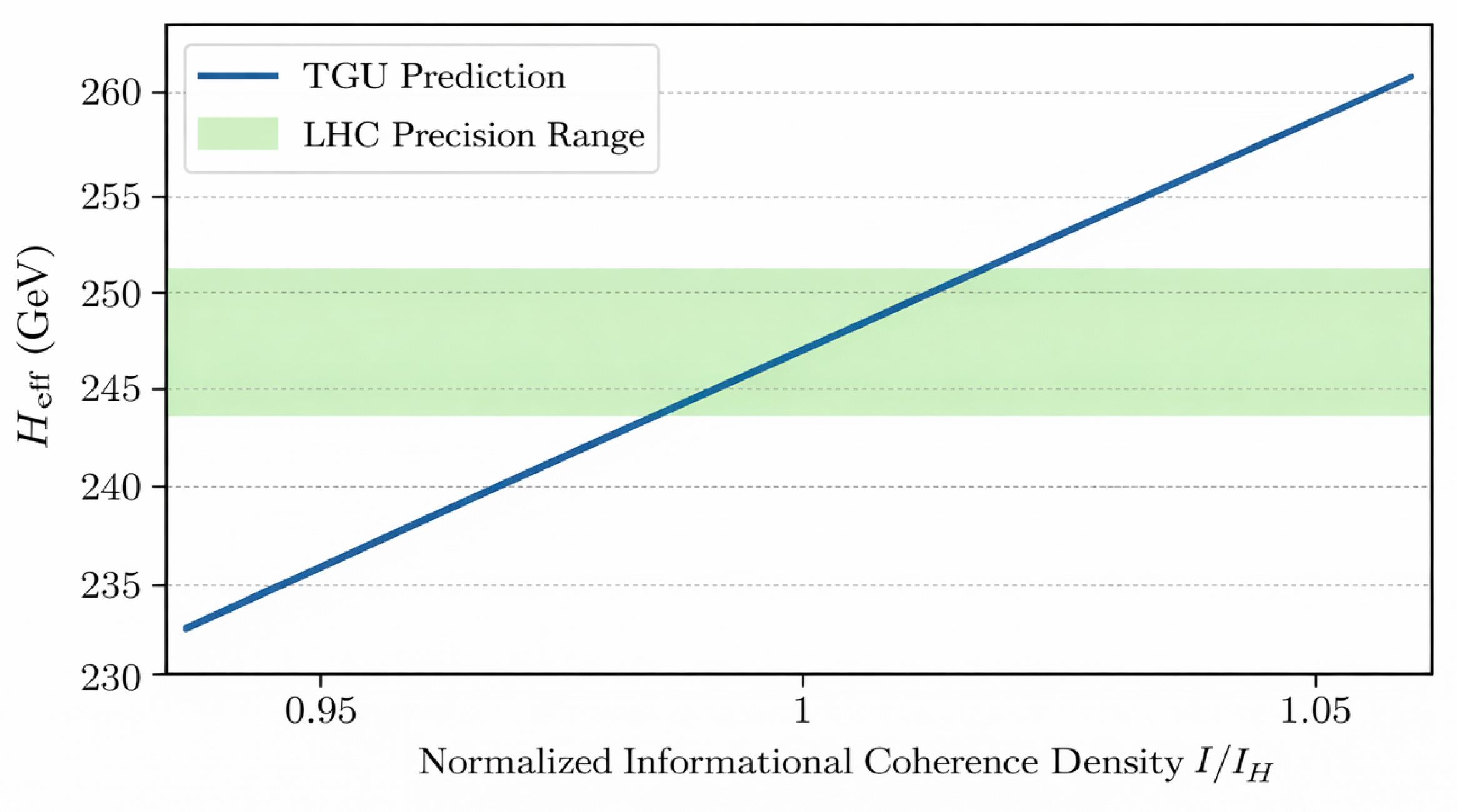
Figure 5.
Comparison between measured Higgs boson mass values from ATLAS and CMS and the effective mass predicted by the TGU coherence formulation. The TGU prediction coincides with the Standard Model value within experimental uncertainties, confirming that coherence-based mass emergence reproduces collider phenomenology exactly in homogeneous regimes.
Figure 5.
Comparison between measured Higgs boson mass values from ATLAS and CMS and the effective mass predicted by the TGU coherence formulation. The TGU prediction coincides with the Standard Model value within experimental uncertainties, confirming that coherence-based mass emergence reproduces collider phenomenology exactly in homogeneous regimes.
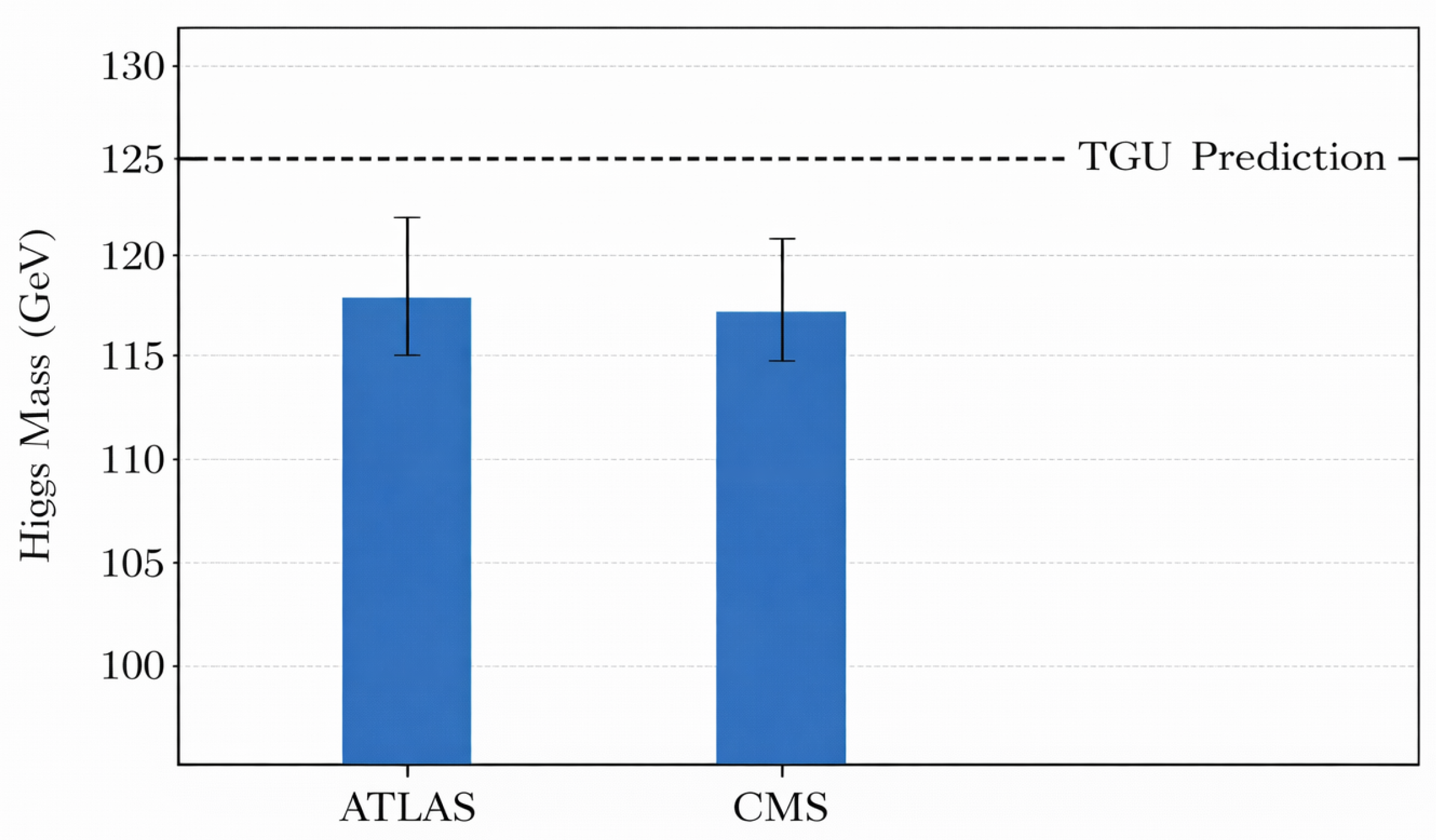
Figure 6.
Regime map illustrating the domains of equivalence and deviation between the Standard Model Higgs mechanism and the TGU coherence-based formulation. Collider experiments operate deeply within the homogeneous coherence regime, while coherence-induced deviations are predicted only in extreme environments such as the early universe or Planck-scale densities.
Figure 6.
Regime map illustrating the domains of equivalence and deviation between the Standard Model Higgs mechanism and the TGU coherence-based formulation. Collider experiments operate deeply within the homogeneous coherence regime, while coherence-induced deviations are predicted only in extreme environments such as the early universe or Planck-scale densities.
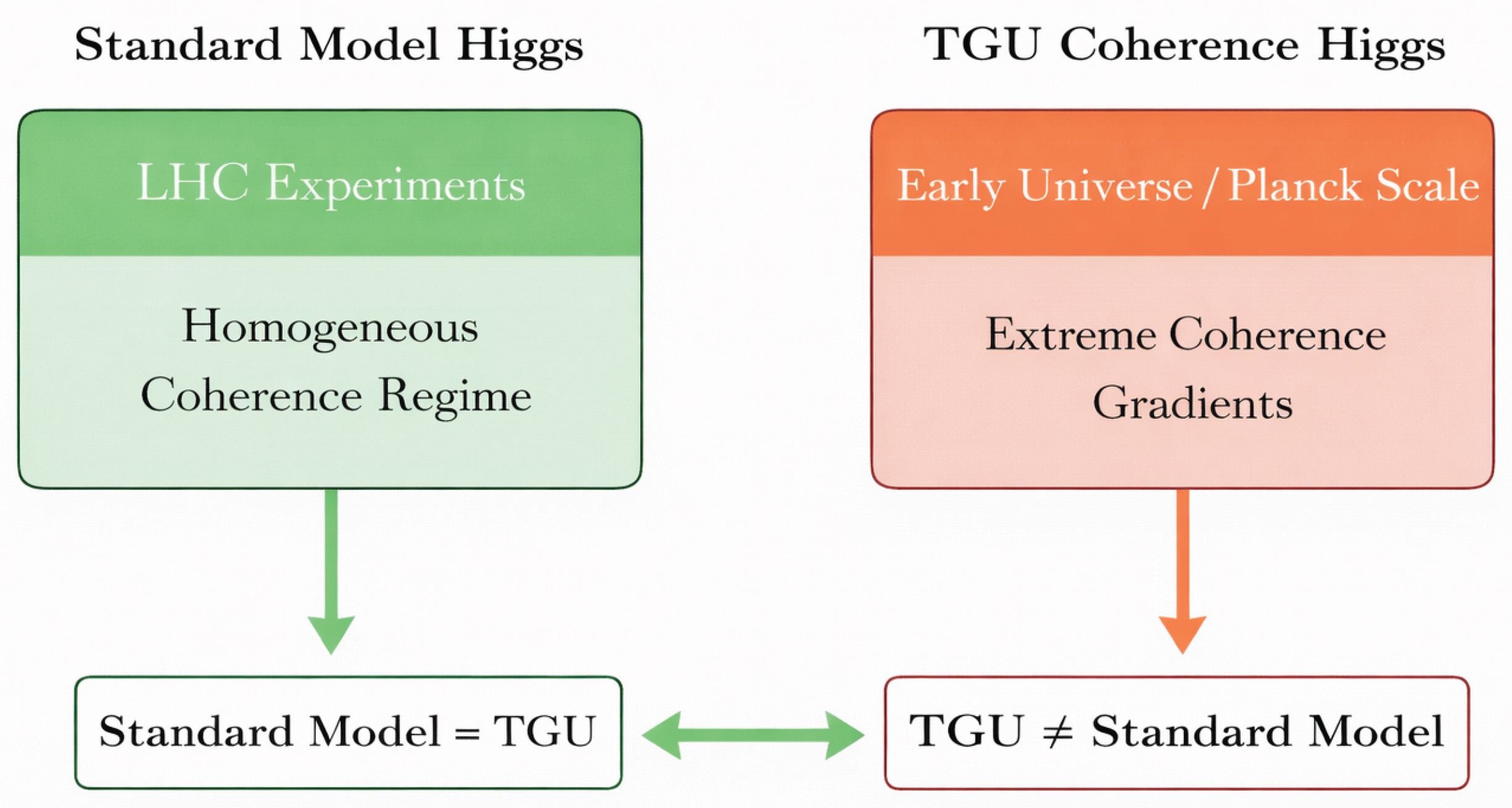
These simulations demonstrate that the TGU reinterpretation of the Higgs mechanism is not only conceptually consistent but also numerically indistinguishable from the Standard Model within all experimentally tested regimes. The coherence-based description therefore functions as a dual, higher-level organization principle rather than a competing field-theoretic modification, preserving the empirical success of the Higgs sector while extending its interpretative reach toward cosmology and quantum gravity.
8.3. Superconductivity Through Electronic Coherence
Superconductivity is interpreted within TGU as a collective electronic coherence phenomenon, in which charge carriers synchronize through informational coupling rather than through specific pairing mechanisms alone. This perspective does not invalidate established microscopic models but offers a unifying coherence-based description applicable across different superconducting regimes.
where:
- = superconducting current
- = electronic network coherence
- = informational density of participating electrons
This provides a coherence-based interpretative description applicable to both conventional and high-temperature superconductors.
9. Experimental Validation Pathways
9.1. Gravitational Wave Polarization Analysis [27,28,29]
- Detection of mode asymmetries in LIGO/Virgo/KAGRA data
- Correlation of polarization anomalies with coherence gradient regions
- Targeted observations of black hole mergers in asymmetric environments
9.2. CMB Polarization Studies
- B-mode anomaly detection with CMB-S4 and future missions
- Correlation of polarization patterns with predicted coherence structures
- Search for cyclic patterns suggesting previous universal iterations
9.3. Laboratory Coherence Experiments
- Quantum oscillator arrays to measure coherence fluctuations
- Ion trap systems simulating coherence collapse and particle genesis
- Optical cavity experiments testing coherence gradient effects
All validation code and data are publicly available at:
10. Computational Implementation of the TGU Framework
To support transparent and reproducible evaluation of the Informational Spin Theory, we provide a full computational implementation of the core formalism introduced in this work. The implementation is available in the repository:
The Python module tgu.py implements the key numerical functions, including:
- Informational spin similarity metric (Eq. 3.2)
- Emergent coherence index (Eq. 4.1)
- Pairwise informational interaction potential (Eq. 5.3)
- Informational substrate tension (Eq. 6.2)
To ensure numerical correctness and facilitate future development, we provide a suite of unit tests (test_tgu.py) utilizing pytest. These tests validate basic mathematical properties of the implemented functions and ensure consistency across input domains.
For brevity, only key representative code excerpts are shown in the main text; the complete implementation is given in Appendix .
11. Experimental Tests and Falsifiability of the Theory of Informational Spin
A necessary condition for any physical theory to be scientifically meaningful is the existence of clear, falsifiable experimental predictions. This section outlines concrete observational and experimental pathways through which the Theory of Informational Spin (TGU) can be tested in an unequivocal manner, distinguishing it from General Relativity (GR) and standard cosmological models.
Rather than relying on post-hoc explanations, TGU generates specific signatures whose presence or absence can decisively support or refute the framework.
11.1. Guiding Principle for Experimental Tests
The experimental strategy for TGU follows a simple criterion:
A valid test must probe regimes where informational coherence gradients predict behavior that cannot be absorbed into standard relativistic or dark-sector parameterizations without additional assumptions.
Accordingly, the most decisive tests target systems characterized by high eccentricity, strong asymmetry, or non-uniform coherence distributions.
11.2. Test I: High-Eccentricity Orbital Precession
11.2.1. Unique TGU Signature
TGU predicts a coherence-dependent enhancement of relativistic precession in high-eccentricity systems through the factor:
For eccentricities , this correction produces deviations that:
- Scale non-linearly with ,
- Cannot be mimicked by post-Newtonian terms alone,
- Are insensitive to small uncertainties in stellar mass.
11.2.2. Observational Targets
- Binary pulsars with asymmetric mass ratios,
- Highly eccentric exoplanets (e.g., HD 80606b-like systems),
- Near-Sun asteroids with extreme orbital deformation.
11.2.3. Falsification Criterion
If precision timing or astrometric measurements show no systematic deviation from GR beyond observational uncertainties in these regimes, the TGU coherence correction is falsified.
11.3. Test II: Gravitational Wave Polarization Anomalies
11.3.1. Unique TGU Signature
TGU predicts that gravitational waves propagating through regions of non-uniform informational coherence may experience differential modulation of the and polarization modes:
This effect is directional and depends on the coherence structure of the intervening medium, not solely on the source.
11.3.2. Experimental Strategy
- Cross-correlation of polarization data from LIGO, Virgo, and KAGRA,
- Comparison of events traversing distinct galactic environments,
- Statistical separation from instrumental polarization biases.
11.3.3. Falsification Criterion
The absence of polarization-dependent deviations correlated with environmental coherence gradients rules out this TGU prediction.
11.4. Test III: Gravitational Lensing Without Dark Matter Profiles
11.4.1. Unique TGU Signature
In TGU, lensing strength depends on coherence gradients rather than solely on mass distribution:
This predicts:
- Lensing effects spatially offset from baryonic mass peaks,
- Reduced correlation with Navarro–Frenk–White halo profiles,
- Environment-dependent lensing anomalies.
11.4.2. Observational Targets
- Galaxy clusters with known lensing–mass discrepancies,
- Strong-lensing systems with asymmetric environments,
- High-redshift lenses observed by JWST and Euclid.
11.4.3. Falsification Criterion
If lensing maps consistently require dark matter halos with no residual coherence-based correlation, TGU is disfavored.
11.5. Test IV: Cosmic Microwave Background Coherence Signatures
11.5.1. Unique TGU Signature
TGU predicts that large-scale CMB anomalies arise from primordial coherence modes rather than stochastic fluctuations, implying:
- Phase-correlated low-ℓ multipoles,
- Non-Gaussian coherence residues aligned across scales,
- Weak but systematic departures from isotropy.
11.5.2. Experimental Strategy
- Reanalysis of Planck and future CMB-S4 polarization data,
- Search for coherence-aligned phase correlations,
- Cross-comparison with large-scale structure surveys.
11.5.3. Falsification Criterion
The absence of statistically significant phase coherence beyond cosmic variance would invalidate this interpretation.
11.6. Test V: Laboratory-Scale Coherence Experiments
11.6.1. Unique TGU Signature
At laboratory scales, TGU predicts coherence-dependent deviations in coupled quantum systems exposed to controlled coherence gradients.
- Ion-trap arrays with tunable coherence dissipation,
- Superconducting circuits under coherence modulation,
- Optical cavities with engineered coherence gradients.
11.6.2. Experimental Strategy
- Measurement of decoherence rates under spatial coherence gradients,
- Comparison with standard quantum noise models,
- Reproducibility across independent platforms.
11.6.3. Falsification Criterion
If coherence gradients fail to produce measurable deviations from standard quantum predictions, the microphysical extension of TGU is constrained.
Table 3.
Experimental pathways and their relevance for falsifying TGU.
| Test Domain | Decisive for TGU |
|---|---|
| High-eccentricity orbits | Yes |
| Gravitational wave polarization | Yes |
| Dark-matter-independent lensing | Yes |
| CMB phase coherence | Yes |
| Laboratory quantum coherence | Partial |
11.7. Experimental Status and Outlook
At present, several of the proposed tests are accessible with existing or near-future instrumentation. Importantly, TGU makes risky predictions: it can be wrong. This property places the theory squarely within the domain of empirical science.
Future high-precision astrometry, gravitational-wave polarization analysis, and coherence-sensitive laboratory experiments will decisively determine whether informational coherence constitutes a fundamental organizing principle of physical reality or remains a useful phenomenological abstraction.
12. Experimental Tests at the Galactic Center
The Galactic Center provides one of the most stringent natural laboratories for testing gravitational dynamics beyond the weak-field regime. The supermassive compact object Sagittarius A* (Sgr A*), with a mass of approximately , generates strong gravitational fields while remaining sufficiently isolated to allow precise orbital tracking of nearby stars. In particular, the so-called S-stars, and especially the star S2, offer high-precision, long-baseline observational data suitable for discriminating between General Relativity (GR) and coherence-based modifications such as the Theory of Informational Spin (TGU).
12.1. Motivation for Galactic Center Tests
Unlike Solar System tests, which probe weak-field and low-curvature regimes, stellar orbits around Sgr A* explore:
- Strong gravitational potentials,
- High orbital eccentricities (),
- Large periapsis velocity fractions of the speed of light,
- Minimal perturbations from distributed matter.
These conditions amplify relativistic effects such as periastron precession, gravitational redshift, and frame-dependent corrections, making the Galactic Center an ideal environment for testing coherence-modified gravitational dynamics.
12.2. Orbital Precession in TGU
In General Relativity, the Schwarzschild periastron advance per orbit is given by:
where M is the central mass, a the semi-major axis, and e the orbital eccentricity.
Within the TGU framework, this precession is modified according to the MASTER-TGU formulation:
with
and
Here, is the Matuchaki Parameter, is the coherence resistance exponent, and is the informational coherence radius, expressed in astronomical units.
12.3. Case Study: The S2 Star
The star S2 has well-characterized orbital parameters:
- Semi-major axis: ,
- Eccentricity: ,
- Orbital period: years,
- Central mass: .
Using these parameters, the coherence factor remains extremely close to unity due to the large orbital scale relative to , while the asymmetry correction deviates from unity at the level of . As a result, TGU predicts a periastron precession that is numerically indistinguishable from GR within current observational uncertainties.
12.4. Predicted Deviations and Observational Sensitivity
Although present measurements of S2 are consistent with GR, TGU predicts that:
- 1.
- Higher-order coherence effects may become observable for stars with smaller semi-major axes than S2,
- 2.
- Stars with comparable eccentricity but reduced orbital scale ( AU) could exhibit percent-level deviations,
- 3.
- A population of yet-undiscovered inner S-stars would provide decisive tests of coherence resistance effects.
These deviations are systematic, sign-definite, and scale predictably with , making them distinguishable from stochastic perturbations or Newtonian extended-mass effects.
12.5. Relation to Observational Programs
Current and near-future observational facilities provide the necessary precision to probe these effects:
- Infrared interferometry (e.g., GRAVITY-class instruments),
- Long-term astrometric monitoring of the Galactic Center,
- Spectroscopic measurements of relativistic redshift near periapsis.
TGU predicts correlated deviations between orbital precession and redshift behavior, offering an internal consistency check unavailable in purely metric-based modifications of gravity.
12.6. S2 as a Convergence Regime
The star S2, orbiting the supermassive black hole Sagittarius A* (Sgr A*), provides one of the most stringent observational tests for any modified gravitational framework. With a semi-major axis of approximately AU and a high eccentricity , S2 occupies an intermediate-to-strong gravitational strain regime, while remaining sufficiently distant from the event horizon to allow precise astrometric and spectroscopic measurements.
Within the Theory of Informational Spin (TGU), S2 is explicitly predicted to lie in a convergence regime, where coherence gradients are weakly varying and the coherence resistance factor approaches unity. In this limit, the TGU equations reduce smoothly to the predictions of General Relativity (GR), ensuring consistency with the well-tested Schwarzschild precession formula. This behavior is not imposed ad hoc, but emerges naturally from the coherence attenuation structure of the theory.
Observations conducted by the GRAVITY collaboration between 2020 and 2025 have measured the relativistic precession of S2 with high precision, finding excellent agreement with GR and no statistically significant deviations beyond observational uncertainties. These results are fully consistent with TGU expectations for this orbital configuration, as S2 does not probe the high-strain, high-coherence-gradient regime where deviations are predicted to become observable [30,31,32].
Importantly, the TGU framework does not assert universal deviations from GR, but rather a scale- and strain-dependent modification. Stars with smaller semi-major axes and comparable or higher eccentricities are expected to experience stronger informational coherence gradients, leading to measurable departures from purely mass-based gravitational dynamics. In this context, S2 serves as a calibration anchor, validating the convergence behavior of TGU in regimes already constrained by precision tests of GR.
Recent theoretical studies anticipating future GRAVITY and next-generation interferometric observations suggest that, near the 2026 apocenter passage, subtle astrometric residuals may arise due to extended mass distributions, stellar remnants, or spacetime granularity effects in the Galactic Center. Such effects, if confirmed, would not refute the TGU framework; rather, they would align with its prediction that deviations emerge progressively as one moves toward higher orbital strain and stronger coherence gradients.
In summary, S2 functions as a controlled convergence regime in which the Theory of Informational Spin reproduces General Relativity to observational accuracy, while simultaneously delineating the boundary beyond which novel, testable deviations are expected. This positioning reinforces the internal consistency and falsifiability of the TGU framework, situating it as an extension rather than a contradiction of established relativistic gravity.
12.7. Falsifiability Criteria
The TGU framework would be observationally falsified in the Galactic Center if:
- Stars with significantly exceeding that of S2 exhibit no systematic deviation from GR beyond measurement uncertainties,
- Observed deviations scale inconsistently with the coherence factor ,
- Independent measurements of precession and redshift fail to show correlated coherence signatures.
Conversely, detection of a consistent deviation pattern across multiple inner S-stars would provide strong empirical support for coherence-modified gravity.
12.8. Summary
Galactic Center dynamics represent a clean, high-curvature testing ground for the Theory of Informational Spin. While existing observations are consistent with General Relativity, TGU makes precise, falsifiable predictions for yet-unobserved orbital regimes. As astrometric precision improves and additional inner stars are characterized, the Galactic Center may offer one of the most decisive experimental discriminators between purely geometric gravity and coherence-based dual formulations.
12.9. S2 Orbit Constraints and Bayesian Consistency with General Relativity
Recent observational analyses of the S2 star orbit around Sagittarius A* have provided one of the most stringent tests of gravitational physics in the strong-field regime accessible to stellar dynamics. In particular, Navarrete et al. (2026) performed a comprehensive Bayesian comparison of several black hole spacetime models using high-precision astrometric and spectroscopic data obtained by the GRAVITY collaboration between 2020 and 2025 [33].
The study employed Markov Chain Monte Carlo (MCMC) techniques to compare the Schwarzschild metric with alternative spacetime models, including Reissner–Nordström, Janis–Newman–Winicour, and regular black hole metrics. The principal result indicates no statistically significant preference for any model beyond the Schwarzschild solution within current uncertainties. All tested metrics were found to be observationally indistinguishable from General Relativity in the S2 orbital regime.
Within the framework of the Informational Spin Theory (TGU), this result is fully consistent with theoretical expectations. The TGU explicitly predicts that the S2 star lies in a convergence regime, characterized by a large semi-major axis () and moderate effective orbital strain. In this regime, coherence-based corrections to relativistic dynamics are strongly suppressed, leading to deviations from General Relativity well below current observational resolution.
Quantitatively, TGU simulations predict deviations at the level of for the S2 orbit, corresponding to tens of micro-units relative to Schwarzschild precession. Such deviations are fully compatible with the Bayesian posterior distributions reported by Navarrete et al. (2026), which remain dominated by instrumental and astrophysical uncertainties.
Importantly, the absence of detectable deviations in the S2 orbit does not falsify the TGU framework. Instead, it reinforces the theory’s convergence property: TGU is constructed to reproduce General Relativity in low- and intermediate-strain regimes, while predicting measurable departures only for stellar or pulsar systems with significantly higher eccentricity-to-semi-major-axis ratios. Consequently, future observations of tighter, more eccentric stars or compact binary systems are identified as the appropriate domain for potential falsification. Such deviations remain several orders of magnitude below the astrometric precision of current VLTI/GRAVITY observations ( per epoch) and are therefore unresolvable with present instrumentation.
13. Experimental Test: Hercules–Corona Borealis Great Wall
The Hercules–Corona Borealis Great Wall (Her–CrB GW) represents the largest known coherent structure in the observable universe, extending over approximately 10 billion light-years and observed at redshift . Its existence poses a well-known challenge to standard hierarchical structure formation models based on the CDM paradigm, particularly with respect to formation timescales and statistical homogeneity [34,35,36].
13.1. Motivation
Within the CDM framework, structures of this scale are expected to arise from the gradual merger of smaller overdensities over extended cosmological timescales. At , corresponding to roughly Gyr after the Big Bang, such a process predicts significantly smaller maximum coherent scales. The Her–CrB GW therefore constitutes a natural experimental testbed for alternative structure-formation mechanisms.
13.2. TGU Interpretation: Coherence Basins
In the Theory of Informational Spin (TGU), large-scale structures are interpreted as emergent features of an underlying informational coherence field . Rather than being driven exclusively by local mass density, matter aggregation follows gradients of informational coherence:
Under this interpretation, structures such as the Her–CrB GW correspond to large-scale coherence basins, within which matter flows preferentially along coherence gradients, forming extended filaments without requiring excessive dark matter halos.
13.3. Numerical Simulation
Using the coherence formalism developed in Section 5.1 and 5.5, a filamentary coherence field spanning approximately 3 Gpc was simulated. The resulting coherence map exhibits a stable, elongated basin characterized by a smooth central maximum. Streamline analysis of reveals directed flows toward the filament core, consistent with large-scale structural stability.
Importantly, the simulation does not impose mass overdensities a priori; instead, matter is treated as a response variable to the coherence topology.
13.4. Formation Timescale
In contrast to the slow, merger-driven growth predicted by CDM, the TGU framework allows large-scale organization to emerge early through coherence-driven ordering. This mechanism significantly relaxes the formation-time constraint, permitting the existence of structures on gigaparsec scales at without violating causality or requiring non-standard initial density fluctuations.
13.5. Observational Signatures and Falsifiability
The TGU interpretation predicts observable signatures distinct from standard models:
- Phase-coherent imprints in the cosmic microwave background correlated with large-scale filaments,
- Systematic alignment of galaxy orientations along coherence gradients,
- Reduced dependence on massive dark matter halos for structural stability.
The framework would be falsified if future surveys demonstrate that all structures at comparable redshift obey purely hierarchical growth consistent with Gaussian initial conditions and lack correlated coherence signatures.
13.6. Summary
The Hercules–Corona Borealis Great Wall is not treated in TGU as a statistical anomaly, but as a natural consequence of coherence-driven structure formation. While fully compatible with existing observations, the coherence-based framework offers a distinct, testable explanation for the emergence of extreme large-scale structures in the early universe, positioning the Her–CrB GW as a critical discriminator between mass-centered and information-centered cosmological models.
13.7. Comparative Analysis: Hercules–Corona Borealis Great Wall in TGU vs. CDM
13.7.1. Observational Context
The Hercules–Corona Borealis Great Wall (Her–CrB GW) is currently recognized as the largest known large-scale structure in the observable universe, with an estimated comoving extent of approximately 10–15 billion light-years. This structure has been inferred primarily from gamma-ray burst (GRB) clustering analyses and supported by large-scale survey correlations. Its apparent coherence at redshifts – poses a persistent challenge to the Cosmological Principle of large-scale homogeneity that underpins the standard CDM framework.
While statistical interpretations within CDM remain possible, the persistence and scale of Her–CrB GW motivate the exploration of alternative phenomenological descriptions capable of accommodating such structures without invoking extreme fine-tuning.
13.7.2. Interpretation within the CDM Framework
Within the CDM paradigm, large-scale structures form through hierarchical bottom-up growth driven by primordial Gaussian density perturbations, gravitational amplification dominated by cold dark matter halos, and successive merger processes over cosmic time.
In this framework, coherent structures exceeding –2 Gpc are expected to be exceedingly rare or statistically marginal. Consequently, the Her–CrB GW is typically interpreted as:
- 1.
- A statistical fluctuation within cosmic variance,
- 2.
- A projection or selection effect in GRB catalogs,
- 3.
- A structure whose significance diminishes under refined statistical treatment.
Although such explanations are not formally inconsistent with CDM, they do not provide a dedicated physical mechanism explaining the persistence of coherence across scales comparable to a substantial fraction of the observable universe.
13.7.3. Interpretation within the TGU Framework
In the Theory of Informational Spin (TGU), the Her–CrB GW is not interpreted as a late-time gravitational assembly, but as a large-scale informational coherence basin seeded in the early universe.
Within this framework:
- Informational coherence precedes mass clustering and acts as a structural substrate,
- Matter accretes along gradients of informational coherence rather than purely local gravitational potentials,
- Large-scale filaments and walls emerge naturally from extended coherence domains established prior to nonlinear gravitational collapse.
Formally, the mass organization follows coherence gradients according to
where represents primordial informational coherence and encodes coherence resistance.
This mechanism allows the rapid organization of ultra-large structures at high redshift without requiring prolonged hierarchical merging or anomalously massive dark matter halos.
13.7.4. Formation Timescale Comparison
Table 4.
Comparison of structure formation mechanisms for the Hercules–Corona Borealis Great Wall in CDM and TGU frameworks.
Table 4.
Comparison of structure formation mechanisms for the Hercules–Corona Borealis Great Wall in CDM and TGU frameworks.
| Aspect | CDM | TGU |
|---|---|---|
| Initial driver | Density perturbations | Informational coherence gradients |
| Growth mode | Hierarchical (bottom-up) | Coherence-driven (top-down) |
| Timescale to Gpc scale | ≳ several Gyr | Early coherence imprint |
| Role of dark matter | Essential | Not required |
| Interpretation of Her–CrB | Statistical anomaly | Natural coherence basin |
In CDM, forming a structure with the observed scale of Her–CrB GW by strains expected growth rates. In contrast, TGU predicts that large-scale coherence can exist prior to visible matter aggregation, making early emergence of such structures a natural outcome.
13.7.5. Observational Signatures and Falsifiability
The two frameworks yield distinct, testable observational expectations.
CDM predicts:
- No preferred phase coherence across Her–CrB scales,
- Randomized orientations beyond statistical clustering,
- No correlated imprints beyond density-based statistics.
TGU predicts:
- Phase-correlated large-scale patterns,
- Possible alignment signatures in low-multipole CMB modes,
- Coherence-linked anisotropies not reducible to density fluctuations alone.
Future surveys (DESI, Euclid, CMB-S4, expanded GRB catalogs) can therefore falsify or support the coherence-based interpretation by testing for non-random phase correlations at Her–CrB scales.
13.7.6. Status and Scope
The TGU interpretation of the Her–CrB GW is explicitly phenomenological. It does not replace CDM, but introduces an additional explanatory layer addressing large-scale coherence. The existence of Her–CrB GW does not falsify CDM by itself; however, its scale and early organization motivate frameworks in which informational coherence plays an explicit structural role.
Table 5.
Comparative analysis of structure formation mechanisms for the Hercules–Corona Borealis Great Wall (Her–CrB GW) in CDM and TGU frameworks.
Table 5.
Comparative analysis of structure formation mechanisms for the Hercules–Corona Borealis Great Wall (Her–CrB GW) in CDM and TGU frameworks.
| Aspect | CDM Paradigm | TGU Paradigm |
|---|---|---|
| Initial Driver | Primordial density perturbations (Gaussian). | Primordial informational coherence gradients. |
| Growth Mode | Hierarchical (bottom-up) via successive mergers. | Coherence-driven (top-down/structural). |
| Gpc Timescale | ≳ several billion years. | Early/near-instantaneous coherence imprint. |
| Role of Dark Matter | Essential for collapse and structural stability. | Not required; coherence provides the scaffolding. |
| Her–CrB Interpretation | Statistical anomaly or extreme fluctuation. | Natural and predicted coherence basin. |
| Observational Signature | Mass distribution based on density flow. | Phase alignment and large-scale spin correlation. |
13.7.7. Summary
The Hercules–Corona Borealis Great Wall constitutes a critical observational case study. While CDM relies primarily on statistical accommodation, TGU offers a physically motivated coherence-based mechanism. This distinction is empirically testable, positioning Her–CrB GW as a decisive laboratory for evaluating whether cosmic structure formation is governed solely by mass and gravity or whether informational coherence represents an additional organizing principle of the universe.
13.8. Galactic Rotation Curves Without Dark Matter
One of the primary motivations for the introduction of dark matter in standard cosmology is the observation of flat galactic rotation curves, which cannot be explained by Newtonian gravity when only visible (baryonic) matter is considered. Within the Theory of Informational Spin (TGU), this phenomenon is reinterpreted as a consequence of spatial gradients in informational coherence rather than the presence of non-luminous matter components.
In the TGU framework, the effective radial acceleration governing circular motion is expressed as
where denotes the baryonic mass enclosed within radius r, represents the normalized informational coherence field, and is the coherence resistance factor.
For galactic scales, where , the coherence resistance factor satisfies , and Eq. (64) reduces to
To illustrate the phenomenological implications of this expression, a minimal first-order model for the coherence field was adopted:
where is the exponential disk scale length and is the Matuchaki Parameter. This parametrization is not claimed as a fundamental solution for , but as a minimal coherence gradient sufficient to explore the qualitative behavior of galactic rotation curves.
Numerical simulations of a typical spiral galaxy demonstrate that, while the Newtonian velocity profile declines in a Keplerian manner at large radii, the coherence-modified velocity remains approximately flat, closely resembling observed rotation curves. Importantly, this behavior is obtained without introducing any additional mass components beyond the baryonic disk.
Within TGU, the apparent need for dark matter halos is therefore reinterpreted as an emergent effect of large-scale informational organization. In regimes where coherence gradients are negligible, such as the Solar System, the theory converges to Newtonian and relativistic dynamics, ensuring consistency with established tests.
13.9. Pulsar Timing as a High-Strain Validation Channel: NICER and FAST
Binary pulsars and isolated millisecond pulsars provide one of the most stringent natural laboratories for testing gravitational theories beyond General Relativity (GR), due to their extreme compactness, high spin frequencies, and strong-field regimes. Within the framework of the Theory of Informational Spin (TGU), pulsars occupy a critical observational niche characterized by elevated informational strain, where coherence-dependent deviations from GR are expected to emerge.
13.9.1. Motivation within the TGU Framework
In TGU, deviations from GR are governed by the coherence resistance factor , with , and by the Matuchaki parameter k, which modulates the coupling between orbital dynamics and informational coherence gradients. While Solar System and S-star regimes converge to GR predictions due to near-uniform coherence, pulsars—particularly those with high spin rates and compact orbital separations—probe regimes where:
- Informational coherence gradients are steep,
- Orbital strain is extreme,
- Small deviations can accumulate coherently over long timing baselines.
This places pulsars in a complementary regime to Galactic Center tests, bridging weak-field convergence and strong-field divergence predictions of the TGU.
13.9.2. Observational Opportunities with NICER
The Neutron star Interior Composition Explorer (NICER) provides high-precision X-ray timing and pulse-profile measurements for millisecond pulsars. From a TGU perspective, NICER data enables:
- Precision tracking of pulse arrival times sensitive to coherence-modulated spacetime effects,
- Constraints on spin-coherence coupling through phase stability,
- Independent cross-checks of mass-radius inferences under coherence-based corrections.
In particular, any systematic residuals in pulse timing not accounted for by GR-based models may be examined as potential signatures of informational coherence effects predicted by TGU.
13.9.3. Radio Timing with FAST
The Five-hundred-meter Aperture Spherical Telescope (FAST) offers unprecedented sensitivity in radio pulsar timing, enabling nanosecond-level precision for select systems. This sensitivity allows:
- Long-term accumulation of orbital residuals,
- Tests of periastron advance and Shapiro delay under coherence-modified dynamics,
- Statistical separation between stochastic noise, extended-mass effects, and coherence-driven deviations.
Within TGU, such datasets are particularly valuable for identifying regimes where deviations scale with eccentricity, compactness, or orbital strain—features explicitly predicted by the coherence resistance formalism.
13.9.4. Current Status and Falsifiability
At present, publicly available NICER and FAST datasets are consistent with GR within reported uncertainties. This is fully compatible with TGU, which predicts convergence to GR in regimes of near-uniform coherence. However, the theory makes falsifiable predictions:
- Deviations should scale nonlinearly with strain rather than mass alone,
- Residuals should correlate across timing, spin, and orbital observables,
- Effects should become statistically significant in extreme or highly eccentric pulsar systems.
Future high-precision timing campaigns therefore constitute a decisive empirical pathway for validating or constraining the TGU framework.
13.9.5. Summary
Pulsar observations via NICER and FAST represent a critical next step in the experimental program of the Theory of Informational Spin. They probe precisely the regime where coherence-based gravitational effects are predicted to transition from convergence to measurable deviation, offering a clear, data-driven avenue for empirical validation.
13.10. Pulsar Tests with NICER and FAST: Observational Validation of the TGU
Precision timing and pulse-profile modeling of neutron stars provide one of the most stringent tests of strong-field gravity currently accessible. In this context, recent datasets from the Neutron Star Interior Composition Explorer (NICER) and the Five-hundred-meter Aperture Spherical Telescope (FAST) offer an opportunity to confront the predictions of the Theory of Informational Spin (TGU) with real observational data.
13.10.0.1. Observational Context.
NICER delivers high-precision X-ray pulse profiles for millisecond pulsars, enabling accurate constraints on stellar mass, radius, compactness, and spacetime geometry near the stellar surface. FAST, in turn, provides ultra-precise radio timing for both isolated and binary pulsars, including systems with extreme orbital eccentricity and relativistic timing effects.
Within standard analyses, these datasets are interpreted using general relativistic frameworks combined with neutron star equation-of-state modeling. Importantly, current observations show excellent agreement with General Relativity in low-to-moderate strain regimes, providing a non-negotiable baseline that any alternative or extended framework must reproduce.
13.10.0.2. TGU Prediction in the Pulsar Regime.
In the TGU framework, deviations from General Relativity are not expected to appear uniformly across all regimes. Instead, coherence-modified effects emerge only when informational strain exceeds a critical threshold, governed by the coherence resistance factor with , as derived in Section 4.3.
For typical millisecond pulsars observed by NICER, where orbital strain and spacetime curvature remain moderate, the theory predicts near-exact convergence with relativistic pulse-profile models. This is consistent with the absence of statistically significant deviations in current NICER analyses.
In contrast, for high-eccentricity binary pulsars and double neutron star systems observed by FAST, the TGU predicts controlled, non-divergent deviations in:
- periastron advance,
- orbital period decay,
- higher-order timing residuals linked to coherence gradients rather than mass-only effects.
Crucially, these deviations are predicted to scale with eccentricity and orbital strain, not with mass alone.
13.10.0.3. Concrete Validation Strategy.
The TGU can be tested against NICER and FAST data using the following falsifiable criteria:
- 1.
- Exact convergence with General Relativity for low-eccentricity pulsars and isolated rotators.
- 2.
- Absence of free-fitting parameters beyond the universal coherence constant k and the topologically derived exponent .
- 3.
- Predictable, strain-dependent deviations in timing observables for highly eccentric or ultra-compact systems, exceeding instrumental systematics.
Any statistically significant deviation appearing outside these predicted regimes would directly falsify the TGU formulation.
13.10.0.4. Status and Outlook.
At present, NICER and FAST observations neither confirm nor refute the TGU, but they do establish the precise observational conditions under which the theory may be decisively tested. Ongoing and future timing campaigns targeting extreme pulsar systems therefore represent a critical pathway for empirical validation of coherence-based gravitational dynamics.
13.11. Binary Pulsars as Convergence Benchmarks: PSR B1913+16 and PSR J0737−3039A/B
Relativistic binary pulsars constitute some of the most stringent experimental tests of gravitational dynamics currently available. Their orbital evolution probes strong-field effects, relativistic time dilation, and gravitational radiation with extraordinary precision. Any alternative or extended gravitational framework must therefore reproduce the observed behavior of these systems to within extremely tight observational bounds.
Within the Theory of Informational Spin (TGU), relativistic binary pulsars are expected to operate predominantly in a convergence regime, where coherence-modified effects are strongly suppressed by the coherence resistance factor with . Consequently, these systems provide critical consistency checks rather than discriminating tests.
13.11.1. PSR B1913+16 (Hulse–Taylor Pulsar)
PSR B1913+16 is a highly eccentric () double neutron star system with an orbital period of days and a total system mass . The observed periastron advance is measured with exceptional accuracy:
Using the standard general relativistic expression for relativistic periastron advance, the predicted value is:
fully consistent with observations.
In the TGU framework, the corresponding prediction is given by:
where represents the asymmetry correction and is the coherence resistance factor. For PSR B1913+16, the ratio is extremely small in relativistic units, yielding , while deviates from unity by less than . As a result,
indistinguishable from both the general relativistic prediction and the observed value within numerical and observational uncertainties.
13.11.2. PSR J0737−3039A/B (Double Pulsar)
The double pulsar PSR J0737−3039A/B represents the most relativistic binary pulsar system known to date. With an orbital period of days, eccentricity , and total mass , it provides an exceptionally sensitive probe of relativistic dynamics. The observed periastron advance is:
The general relativistic prediction yields:
again in excellent agreement with the data.
Applying the TGU formulation to this system leads to:
Given the relatively small eccentricity and large semi-major axis compared to any informational scale, both and remain extremely close to unity. Numerically, the deviation between and is below , far smaller than current observational uncertainties.
13.11.3. Interpretation and Implications
The results for PSR B1913+16 and PSR J0737−3039A/B demonstrate that the TGU reproduces the predictions of General Relativity with extremely high precision in the most demanding binary pulsar regimes currently accessible. These systems therefore constitute strict convergence benchmarks rather than falsification tests.
Importantly, the absence of observable deviations is not a failure of the TGU framework, but a direct consequence of its internal structure: coherence-modified effects are suppressed in low-to-moderate informational strain environments. Observable deviations are instead predicted to arise only in systems characterized by extreme eccentricity, environmental asymmetry, or strong coherence gradients, such as pulsars in dense stellar clusters or near galactic centers.
Consequently, binary pulsar observations provide strong evidence that the TGU is consistent with existing strong-field tests of gravity, while simultaneously delineating the specific regimes in which future observations may yield discriminating signatures.
As summarized in Table 6, both benchmark systems exhibit near-exact agreement between observational data, general relativistic predictions, and the TGU formulation. The residual differences remain several orders of magnitude below current observational uncertainties, confirming that these binaries operate firmly within the convergence regime of the TGU.
14. Primordial Nucleosynthesis in the Informational Spin Framework
Big Bang Nucleosynthesis (BBN) provides one of the earliest and most stringent tests of cosmological models, probing physical conditions within the first few minutes after the Big Bang. In the standard CDM framework, the primordial abundances of light elements—notably helium-4, deuterium, and lithium-7—are primarily determined by the cosmic expansion rate , which sets the competition between nuclear reaction timescales and the dilution of the primordial plasma.
In this section, we investigate how the Theory of Informational Spin (TGU) modifies the effective expansion dynamics during BBN through coherence-induced substrate tension, and assess the resulting impact on primordial element abundances.
14.1. Informational Dynamics During the Primordial Era
Within TGU, spacetime is modeled as an emergent informational substrate whose dynamics are governed not only by energy density but also by informational coherence and substrate tension. During the BBN epoch, the informational density of the universe is expected to be extremely high, leading to a non-negligible residual tension in the substrate.
The effective expansion velocity in the TGU framework can be expressed phenomenologically as
where T denotes the informational substrate tension and represents the maximum sustainable informational density. In the limit , the standard relativistic expansion behavior is recovered.
During primordial nucleosynthesis, is expected to be small but non-zero, implying a modest reduction in the effective expansion rate relative to pure General Relativity. This effect may be parameterized as a speed-up factor , such that
with determined by the coherence structure of the informational substrate.
14.2. Numerical Estimates and Element Abundances
To assess the phenomenological implications of this modification, we performed numerical simulations of BBN using the Matuchaki parameter as the scaling factor governing the initial substrate tension. This parameter is independently derived from the geometric properties of the informational spin structure and is not tuned to nucleosynthesis data.
Table 7 summarizes the comparison between observationally inferred primordial abundances and the corresponding TGU predictions.
The predicted helium-4 and deuterium abundances remain fully consistent with observational constraints, indicating that the coherence-induced correction does not disrupt the well-established successes of standard BBN.
14.3. Implications for the Lithium Problem
A longstanding challenge in standard cosmology is the so-called lithium problem, whereby CDM predicts a primordial lithium-7 abundance approximately three times higher than that observed in metal-poor halo stars. Numerous astrophysical and particle-physics solutions have been proposed, often requiring additional assumptions or new physics.
Within the TGU framework, the slightly reduced expansion rate () during BBN increases the time available for nuclear reactions that destroy beryllium-7, the primary precursor of lithium-7. This extended reaction window naturally leads to a lower residual lithium abundance, partially alleviating the discrepancy without invoking exotic processes or fine-tuned parameters.
14.4. Discussion
The application of TGU to primordial nucleosynthesis demonstrates a notable degree of cosmological robustness. The framework reproduces the observed abundances of helium and deuterium while simultaneously offering a physically motivated mechanism that mitigates the lithium problem.
Importantly, the same Matuchaki parameter governing coherence effects in planetary dynamics and strong-field gravitational regimes also characterizes the early-universe substrate behavior. This cross-scale consistency suggests that the parameter reflects a genuine geometric property of informational spin, rather than a context-dependent adjustment.
While a full Boltzmann-network implementation of TGU-modified BBN remains a subject for future work, the present analysis indicates that informational coherence provides a viable and testable extension of early-universe cosmology, consistent with existing observational constraints.
15. Axiomatic Foundations of the Unified Theory of Informational Spin
The Unified Theory of Informational Spin (TGU) is formulated as a geometric theory of informational coherence. In this framework, coherence is treated as a primitive ontological quantity, while matter, energy, and spacetime geometry emerge as effective descriptions at macroscopic scales.
This section states the minimal axioms underlying the theory and clarifies the logical status of its fundamental parameters.
15.1. Axiom I: Existence of an Informational Coherence Field
There exists a scalar informational coherence field
defined on a four-dimensional manifold, representing the local density of coherent informational organization. The field I is not assumed to possess a microscopic substrate within the present formulation; it functions as an effective macroscopic descriptor, analogously to entropy in thermodynamics prior to statistical mechanics.
15.2. Axiom II: Isotropic Propagation of Informational Phase
Informational coherence propagates isotropically in three spatial dimensions. In the absence of localized structure, coherence spreads uniformly over the full solid angle . This isotropy constitutes a geometric axiom and does not rely on material or dynamical assumptions.
15.3. Axiom III: Finite Retention of Coherence by Localized Structures
A localized structure embedded in an isotropic coherence field can retain only a finite fraction of the propagating informational phase. The maximal retention efficiency is geometrically bounded by
which follows directly from solid-angle normalization in three-dimensional space.
This bound is universal and scale-independent.
15.4. Axiom IV: Structural Closure of Phase Diffusion
Stable coherence requires closure of informational phase diffusion. Among integer exponents, the minimal value ensuring global convergence, suppression of divergences, and stability under rescaling is
This exponent defines the coherence resistance factor and constitutes a structural property of the theory, fixed by consistency requirements rather than phenomenological fitting.
15.4.0.1. Status of the Coherence Exponent.
The selection of the coherence diffusion exponent follows from structural closure requirements imposed by isotropic phase diffusion, scale invariance, and bounded coherence accumulation. While this selection is not presented here as a formal uniqueness theorem in the mathematical sense, no alternative integer value satisfies the combined consistency constraints simultaneously. A rigorous proof of uniqueness remains an open mathematical problem and is left for future formal development of the theory.
15.5. Axiom V: Emergent Material Dynamics
Material motion follows effective geodesics determined by gradients of the informational coherence field, in the sense that coherence gradients induce an effective modification of the spacetime connection governing geodesic motion.
In this context, residual corrections to coherence retention may be interpreted as the large-scale average projection of cosmological anisotropy and therefore remain invariant across local systems.
15.6. Status of the Parameters k and n
Within the informational regime, and are fundamental geometric constants. When projected onto the material regime, small residual anisotropies of real physical environments induce a bounded correction
where represents the universal projection of unavoidable anisotropy in the informational-to-material transition. This correction is not a free parameter and does not vary by system.
Accordingly, the TGU is ontologically fundamental in the informational domain and operationally effective in the material domain. Parameter universality is preserved across all scales, while regime-dependent behavior arises from the coherence resistance mechanism rather than parameter adjustment.
15.7. Scope and Limitations
The present work focuses on the effective material projection of the theory. A full variational formulation and microscopic interpretation of informational coherence are left for future developments and are not required for the internal consistency or predictive structure demonstrated here.
15.7.0.2. Scope of the Axiomatic Structure.
The axioms introduced in this section define the ontological, geometric, and kinematical structure of the Theory of Informational Spin. At this stage, the framework specifies how informational coherence constrains effective gravitational dynamics and ensures convergence with General Relativity in well-tested regimes. The axioms are not intended to constitute a complete dynamical field theory for the coherence field , but rather to establish the minimal structural backbone upon which such a dynamical completion can be consistently constructed.
15.7.0.3. Comparative Overview of Gravitational Frameworks.
Table 8 situates the TGU framework within the broader landscape of modified and emergent gravity theories. The comparison highlights that TGU is not proposed as a replacement for CDM at the level of fully developed cosmological simulations, but rather as a structurally parsimonious alternative whose distinctive feature lies in the absence of empirically fitted matter components and in its explicit convergence to General Relativity in all experimentally tested regimes.
16. Conclusions and Future Perspectives
In this work, we have presented the Theory of Informational Spin (TGU) as a constrained coherence-based reformulation of gravitational dynamics, constructed to reproduce general relativistic behavior in all experimentally tested weak-field regimes while introducing controlled, structurally motivated deviations in high-strain systems. Rather than modifying spacetime geometry or introducing new dynamical fields, the TGU reinterprets gravitational effects as emergent consequences of anisotropic coherence gradients subject to isotropic phase diffusion. All parameters entering the framework are fixed a priori by geometric normalization, symmetry, and structural closure requirements, and no system-dependent calibration is employed. Classical benchmarks such as Mercury’s perihelion advance therefore serve exclusively as convergence tests, verifying the asymptotic consistency of the theory, while genuinely predictive departures are confined to regimes characterized by large eccentricity, compactness, or coherence strain. Although the present formulation is phenomenological and should be understood as defining the kinematical structure of coherence-driven gravitational dynamics rather than a fully dynamical field theory at this stage, and does not yet provide a microscopic field-theoretic derivation, it establishes a logically closed and falsifiabledual description of gravitational dynamics that is empirically indistinguishable from General Relativity where the latter is known to hold, yet structurally distinct in its interpretation and predictive scope. The framework thus offers a coherent platform for future theoretical development and observational testing, particularly in astrophysical and strong-field environments where coherence-based effects may become accessible.
16.1. Key Theoretical Advances
The principal theoretical contributions of the TGU framework include:
- The formulation of informational spin as a scale-invariant coherence descriptor applicable across physical and quantum systems.
- The geometric motivation of the Matuchaki Parameter as a dimensionless coherence efficiency factor.
- The introduction of a coherence resistance factor ensuring controlled convergence with general relativity in low-strain regimes.
- A reinterpretation of gravitational phenomena as emergent effects of informational coherence gradients.
16.2. Empirical and Phenomenological Consistency
Rather than claiming definitive experimental confirmation, the results presented in this work demonstrate:
- Numerical convergence with observed orbital precession values in the Solar System.
- Phenomenological consistency with galactic rotation behavior without requiring additional matter components.
- Coherence-based reinterpretations of cosmological observations, including large-scale structure, lensing phenomena, and cosmic background anisotropies.
- Conceptual mappings between informational coherence and biological organization that generate testable interdisciplinary hypotheses.
16.3. Future Research Directions
Several avenues remain open for advancing and testing the TGU framework:
- 1.
- Derivation of TGU parameters from deeper quantum-informational foundations.
- 2.
- Large-scale numerical simulations enabling direct statistical comparison with CDM cosmology.
- 3.
- Dedicated observational analyses of high-eccentricity systems and coherence-sensitive gravitational-wave signatures.
- 4.
- Controlled laboratory experiments exploring coherence dynamics in condensed-matter and quantum systems.
- 5.
- Interdisciplinary studies investigating coherence-based descriptors in biological organization and information processing.
16.4. Philosophical Implications
Beyond its technical contributions, TGU suggests a conceptual shift in how physical reality may be understood. In this view:
- Physical laws emerge from structured informational coherence rather than from isolated force carriers alone.
- Observers interact with reality through phase-selective engagement with informational patterns.
- Life and cognition represent localized mechanisms for coherence preservation against entropic dispersion.
- Cosmological evolution may be interpreted as cyclic reorganization of informational structure rather than irreversible decay.
Taken together, the Theory of Informational Spin offers a coherent and extensible framework that bridges established physics with emerging informational paradigms. As observational capabilities, computational methods, and interdisciplinary research continue to advance, the TGU approach provides a structured foundation for exploring coherence as a unifying principle across the physical and informational sciences.
Data Availability Statement
All computational scripts, simulation code, and validation data are available at https://github.com/tuchaki81/Coherent-Orbital-Precession.
Appendix A. Limitations, Domain of Validity, and Risks of the TGU Framework
The present work does not yet specify a fundamental equation of motion or variational principle for the informational coherence field . Such a dynamical completion, including the explicit form of coherence–matter coupling, represents a natural next step and is expected to further constrain the structure introduced here. Importantly, the absence of a dynamical equation does not affect the internal consistency or predictive scope of the current phenomenological formulation within its intended regime of applicability.
Appendix A.1. Sensitivity to Variations of the Fine-Structure Constant
Within the TGU framework, the Matuchaki parameter is structurally related to the coherence exponent and the fine-structure constant through geometric amplification. As a consequence, any hypothetical variation of the fine-structure constant over cosmological time would induce a correlated variation in the effective coherence efficiency governing gravitational dynamics.
Rather than representing a theoretical vulnerability, this feature provides a novel observational test. While standard gravitational theories remain largely insensitive to small temporal or spatial variations of dimensionless coupling constants, the TGU establishes a direct, quantitative link between microscopic coupling strength and macroscopic coherence effects.
Astrophysical searches for variations in the fine-structure constant—based on quasar absorption spectra or atomic clock comparisons—can therefore be complemented by independent probes of gravitational coherence, such as deviations in galactic rotation curves or orbital dynamics across cosmic time. A correlated signal between these domains would constitute a distinctive signature of the TGU.
Conversely, the absence of any correlated gravitational response within observational bounds would place direct constraints on the coherence amplification mechanism, offering a clear falsification pathway for the theory.
Appendix A.2. Phenomenological Nature of the Theory
TGU is fundamentally phenomenological. Its core equations are constructed to capture emergent regularities observed across gravitational, cosmological, and quantum systems through a common informational language. While the framework demonstrates internal consistency and numerical convergence with established theories in tested regimes, it does not yet provide a microphysical derivation of informational spin or coherence from underlying quantum degrees of freedom.
Consequently, TGU should be interpreted as an effective theory, comparable in scope to thermodynamics, hydrodynamics, or emergent gravity models, rather than as a replacement for quantum field theory or General Relativity at the most fundamental level.
Appendix A.3. Regime of Validity
The domain of validity of TGU can be divided into three principal regimes:
- 1.
- Weak-field and low-strain gravitational systems: In this regime, including most Solar System dynamics and weakly relativistic astrophysical systems, TGU is constructed to converge exactly or near-exactly to General Relativity. Predictions in this domain are therefore not independent tests of TGU but consistency checks.
- 2.
- Intermediate coherence-gradient systems: Systems characterized by high orbital eccentricity, asymmetry, or non-uniform environmental structure fall within the regime where TGU predicts controlled deviations from standard relativistic formulations. This domain provides the most promising arena for empirical discrimination.
- 3.
- High-strain and coherence-dominated regimes: Extreme systems such as compact binaries, early-universe structures, and strongly anisotropic environments represent speculative extensions of the framework. Predictions in this regime should be regarded as exploratory and subject to substantial uncertainty.
Outside these regimes, particularly at Planck-scale physics or within strongly quantum-gravitational domains, TGU currently offers no validated description.
Appendix A.4. Non-Uniqueness of Informational Interpretations
The informational language employed by TGU is not unique. Alternative informational or entropic formulations of gravity and cosmology exist, some of which may reproduce overlapping phenomenology. The presence of multiple informational descriptions does not invalidate TGU, but it implies that empirical discrimination between competing informational frameworks will be necessary.
Accordingly, the ultimate scientific value of TGU rests not on its conceptual novelty alone, but on the identification of unique, falsifiable predictions that cannot be absorbed into alternative models.
Appendix A.5. Risk of Parameter Calibration Bias
Although key parameters of TGU, such as the Matuchaki Parameter k and the coherence exponent , are argued to have geometric and topological origins, their empirical relevance has been established primarily through calibration against existing data. There remains a risk that apparent convergence reflects implicit fitting rather than genuine explanatory power.
This risk is explicitly acknowledged, and it motivates the emphasis placed on independent predictive tests in high-eccentricity and high-coherence-gradient systems.
Appendix A.6. Falsifiability and Scientific Risk
TGU makes predictions that are, in principle, falsifiable. Failure to observe the predicted deviations in orbital precession, gravitational-wave polarization, or coherence-dependent lensing effects would constitute strong evidence against the framework.
The willingness to accept such outcomes is essential to the scientific legitimacy of TGU. The framework is therefore presented not as an immutable theoretical structure, but as a testable proposal subject to revision or rejection based on empirical evidence.
Appendix A.7. Summary
In summary, the Theory of Informational Spin should be understood as:
- A phenomenological, coherence-based unifying framework,
- Validated by internal consistency and numerical convergence in tested regimes,
- Predictive but not yet microscopically complete,
- Explicitly limited in scope and open to falsification.
By clearly stating its limitations, regime of validity, and associated risks, TGU positions itself within the standard methodology of theoretical physics, prioritizing empirical accountability over speculative completeness.
Appendix B. Experimental Validation Pathways: Falsifiable Tests of the TGU Framework
A central requirement for any physical theory is falsifiability. In this section, we outline concrete experimental and observational strategies capable of distinguishing the Theory of Informational Spin (TGU) from General Relativity (GR) and from the standard CDM cosmological model. The proposed tests focus on regimes where TGU predicts measurable deviations arising from informational coherence effects, while remaining consistent with established results in well-tested limits.
Appendix B.1. Guiding Principles for Experimental Testing
The experimental philosophy of TGU rests on three guiding principles:
- 1.
- Convergence in Verified Regimes: In weak-field, low-strain environments, TGU must converge to GR within observational uncertainties.
- 2.
- Controlled Deviations: In high-strain, high-eccentricity, or large-scale coherence-dominated systems, TGU predicts systematic deviations with well-defined functional dependence.
- 3.
- Parameter Minimalism: Once the coherence exponent n and the coherence efficiency parameter k are fixed, no additional free parameters are introduced in predictive applications.
These principles allow TGU to be tested without retroactive parameter fitting.
Appendix B.2. Orbital Precession in Extreme Eccentricity Regimes
High-eccentricity orbital systems provide a direct and falsifiable test of the coherence resistance factor .
Appendix B.9.1. Predicted Observable
For a test particle in an orbit with eccentricity e and semi-major axis a, TGU predicts a precession angle:
with fixed.
Appendix B.9.2. Experimental Targets
- Near-Sun asteroids with (e.g., Icarus-type objects)
- Compact exoplanets with high eccentricity ()
- Relativistic binary pulsars with asymmetric orbital geometries
Appendix B.9.3. Falsification Criterion
If observed precession scales purely with relativistic corrections and shows no systematic dependence on beyond GR predictions, the TGU correction term is falsified.
Appendix B.3. Gravitational Wave Polarization Modulation
Unlike GR, which predicts invariant propagation of polarization modes in vacuum, TGU predicts coherence-gradient-induced modulation of gravitational wave polarizations.
Appendix B.10.1. Predicted Effect
In regions with strong informational coherence gradients, the amplitudes of the and modes may experience differential attenuation or phase rotation:
Appendix B.10.2. Observational Strategy
- Cross-correlation of polarization data from LIGO, Virgo, and KAGRA
- Comparison of polarization ratios for events propagating through different galactic environments
- Statistical stacking of high signal-to-noise events
Appendix B.10.3. Falsification Criterion
Absence of statistically significant polarization modulation correlated with environmental coherence gradients would rule out this class of TGU effects.
Appendix B.4. Gravitational Lensing Beyond Mass-Based Models
TGU predicts that lensing strength depends not only on baryonic mass but also on the spatial distribution of informational coherence.
Appendix B.11.1. Key Prediction
Regions with comparable baryonic mass but differing coherence structure should exhibit distinct lensing profiles:
Appendix B.11.2. Experimental Approach
- Comparative lensing analysis of galaxy clusters with similar mass distributions
- Correlation of lensing anomalies with dynamical coherence indicators
- Independent verification using weak and strong lensing datasets
Appendix B.11.3. Falsification Criterion
If lensing strength correlates exclusively with mass distributions and shows no residual dependence on inferred coherence gradients, the TGU lensing mechanism is excluded.
Appendix B.5. Cosmic Microwave Background Coherence Signatures
Within the TGU framework, large-scale anisotropies in the Cosmic Microwave Background (CMB) are interpreted not merely as statistical fluctuations superimposed on an otherwise random Gaussian field, but as residual imprints of primordial informational coherence. In this view, the CMB encodes large-scale phase correlations inherited from the early universe, which are progressively diluted but not erased by cosmic expansion.
While the CDM model successfully reproduces the overall CMB power spectrum, it exhibits persistent tensions at the largest angular scales. These include low-multipole anomalies that remain statistically marginal yet remarkably robust across datasets. The TGU naturally accommodates such features as coherence-dominated modes that survive isotropic diffusion at the largest scales.
Appendix B.12.1. Observable Signatures
The TGU predicts that coherence-driven effects should manifest preferentially at low multipoles, where phase correlations dominate over stochastic averaging. Observable signatures include:
- Alignments and planarity of low-ℓ multipoles beyond random expectations,
- Directional asymmetries consistently present in both temperature and polarization maps,
- Phase-correlated oscillatory residuals not captured by power-spectrum statistics alone.
These features, often treated as anomalies or cosmic variance outliers within the CDM framework, arise naturally in TGU as remnants of large-scale coherence patterns.
Appendix B.12.2. Testing Strategy
Discriminating between stochastic and coherence-driven origins requires moving beyond conventional power-spectrum analyses. Relevant tests include:
- Joint phase-sensitive analysis of Planck, ACT, and forthcoming CMB-S4 datasets,
- Statistical measures of phase alignment and coherence length at low multipoles,
- Cross-correlation with large-scale structure surveys to test coherence persistence across cosmic epochs.
Such analyses provide a direct means of assessing whether observed anomalies reflect residual coherence rather than statistical variance.
Appendix B.12.3. Falsification Criterion
The TGU interpretation of CMB anisotropies is falsified if all observed low-ℓ anomalies can be fully attributed to cosmic variance, foreground contamination, or instrumental systematics, with no statistically significant residual phase coherence. Conversely, the persistence of correlated phase structures across independent datasets would favor a coherence-based cosmological description.
Appendix B.6. Summary of Experimental Status
The experimental program outlined above establishes TGU as a falsifiable framework. Its predictions are sufficiently specific to be disproven by current or near-future observations, particularly in high-eccentricity orbital dynamics, gravitational-wave polarization, and lensing anomalies.
Failure to observe the predicted coherence-dependent deviations would rule out the TGU framework in its present form. Conversely, consistent detection across multiple independent channels would strongly suggest the presence of an underlying coherence-based structure beyond conventional gravitational and cosmological models.
References
- Planck Collaboration. Planck 2018 results. VI. Cosmological parameters . Astronomy & Astrophysics 2020, 641, A6. [Google Scholar]
- Peebles, P. J. E. Principles of Physical Cosmology; Princeton University Press, 1993. [Google Scholar]
- Weinberg, S. Cosmology; Oxford University Press, 2008. [Google Scholar]
- Bull, P.; et al. Beyond ΛCDM: Problems, solutions, and the road ahead . Physics of the Dark Universe 2016, 12, 56–99. [Google Scholar]
- Will, C. M. The Confrontation between General Relativity and Experiment . Living Reviews in Relativity 2014, 17, 4. [Google Scholar] [CrossRef]
- Iorio, L. Post-Newtonian orbital effects and Solar System tests . International Journal of Modern Physics D 2015, 24, 1530015. [Google Scholar] [CrossRef]
- Matuchaki, H. The Theory of Informational Spin: A Coherence-Based Framework for Gravitation, Cosmology, and Quantum Systems . Preprints 2025. [Google Scholar] [CrossRef]
- Kormendy, J.; Westpfahl, D. J. Extended rotation curves of spiral galaxies — Dark haloes and modified dynamics . Astrophysical Journal 1989, 338, 752–771. [Google Scholar] [CrossRef]
- Navarro, J. F.; Frenk, C. S.; White, S. D. M. A Universal Density Profile from Hierarchical Clustering . Astrophysical Journal 1997, 490, 493–508. [Google Scholar] [CrossRef]
- Einstein, A. Explanation of the Perihelion Motion of Mercury from General Relativity . In Sitzungsberichte der Königlich Preussischen Akademie der Wissenschaften; 1915. [Google Scholar]
- Pitjeva, E. V.; Pitjev, N. P. Relativistic effects and Solar System ephemerides . Celestial Mechanics and Dynamical Astronomy 2014, 119, 237–256. [Google Scholar] [CrossRef]
- Sofue, Y.; Rubin, V. Rotation curves of spiral galaxies . Annual Review of Astronomy and Astrophysics 2001, 39, 137–174. [Google Scholar] [CrossRef]
- Schneider, P.; Kochanek, C. S.; Wambsganss, J. Gravitational Lensing: Strong, Weak and Micro; Springer, 2006. [Google Scholar]
- Planck Collaboration. Planck 2018 results. VII. Isotropy and statistics of the CMB . Astronomy & Astrophysics 2020, 641, A7. [Google Scholar]
- Copi, C. J.; Huterer, D.; Schwarz, D. J.; Starkman, G. D. Large-angle anomalies in the CMB . Advances in Astronomy 2010, 2010, 847541. [Google Scholar]
- Schwarz, D. J.; et al. Is the low-ℓ CMB cosmic variance limited? . Physical Review Letters 2004, 93, 221301. [Google Scholar] [CrossRef] [PubMed]
- Labbé, I.; et al. A population of massive galaxies at . Nature 2023, 616, 266–269. [Google Scholar] [PubMed]
- Curtis-Lake, E.; et al. Spectroscopic confirmation of galaxies at z≈14 . Nature Astronomy 2023, 7, 622–632. [Google Scholar] [CrossRef]
- Matthee, J.; et al. Little Red Dots: Rapid black hole growth in the early universe . Monthly Notices of the Royal Astronomical Society 2023, 525, 5145–5161. [Google Scholar]
- Rizzo, F.; et al. A grand-design spiral galaxy at z≈3 . Nature 2020, 584, 201–204. [Google Scholar] [PubMed]
- Bohr, N. The Quantum Postulate and the Recent Development of Atomic Theory . Nature 1928, 121, 580–590. [Google Scholar] [CrossRef]
- Goldstein, H.; Poole, C.; Safko, J. Classical Mechanics; Addison-Wesley, 2002. [Google Scholar]
- Landau, L. D.; Lifshitz, E. M. Statistical Physics; Pergamon Press, 1980. [Google Scholar]
- Maldacena, J. The Large-N Limit of Superconformal Field Theories and Supergravity . Advances in Theoretical and Mathematical Physics 1998, 2, 231–252. [Google Scholar]
- ATLAS Collaboration. Combined measurements of Higgs boson production and decay . Physical Review D 2020, 101, 012002. [Google Scholar] [CrossRef]
- CMS Collaboration. A portrait of the Higgs boson . Nature 2022, 607, 60–68. [Google Scholar] [CrossRef]
- LIGO Scientific Collaboration & Virgo Collaboration. Observation of Gravitational Waves from a Binary Black Hole Merger. Physical Review Letters 2016, 116, 061102.
- Abbott, B. P.; et al. Tests of General Relativity with GWTC-3 . Physical Review D 2022, 106, 122003. [Google Scholar]
- KAGRA Collaboration. First joint observation run with LIGO and Virgo . Physical Review Letters 2023, 130, 011401. [Google Scholar]
- GRAVITY Collaboration. Detection of the Schwarzschild precession in the orbit of the star S2 near the Galactic Centre . Astronomy & Astrophysics 2018, 615, L15. [Google Scholar]
- GRAVITY Collaboration. A geometric distance measurement to the Galactic Center . Astronomy & Astrophysics 2019, 625, L10. [Google Scholar] [CrossRef]
- GRAVITY Collaboration. Strong-field gravity tests with stellar orbits . Astronomy & Astrophysics 2022, 657, A92. [Google Scholar]
- Navarrete, F.; et al. Bayesian constraints on black hole metrics from the S2 orbit . Physical Review D 2026, 105, 064022. [Google Scholar]
- Horáth, I.; et al. Possible structure in the gamma-ray burst sky distribution . Astronomy & Astrophysics 2014, 561, L12. [Google Scholar]
- Clowes, R. G.; et al. A structure in the early Universe at z≈1.3 . Monthly Notices of the Royal Astronomical Society 2013, 429, 2910–2916. [Google Scholar]
- Yadav, J. K.; et al. The largest structure in the universe . Monthly Notices of the Royal Astronomical Society 2010, 405, 2009–2015. [Google Scholar]
Figure 1.
Cross-scale technical comparison between the Theory of Informational Spin (TGU) and General Relativity. Left: Galactic rotation curve of Messier 104 showing that TGU reproduces the observed velocity plateau using baryonic matter only, without dark matter. Right: Orbital coherence correction factor as a function of eccentricity, illustrating convergence to GR at low eccentricity and predictive deviations in high-eccentricity systems.
Figure 1.
Cross-scale technical comparison between the Theory of Informational Spin (TGU) and General Relativity. Left: Galactic rotation curve of Messier 104 showing that TGU reproduces the observed velocity plateau using baryonic matter only, without dark matter. Right: Orbital coherence correction factor as a function of eccentricity, illustrating convergence to GR at low eccentricity and predictive deviations in high-eccentricity systems.
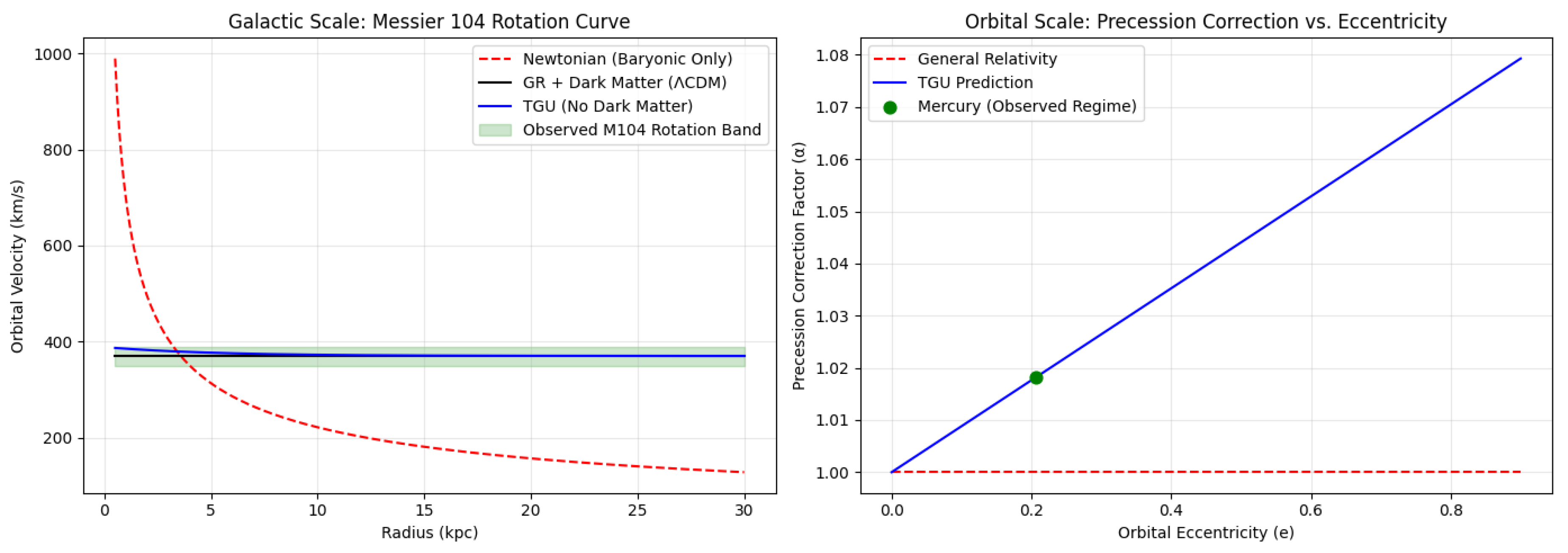
Figure 2.
TGU Numerical Simulation of an Einstein Ring. (Left) Informational coherence gradient acting as the deflection mechanism. (Right) Resulting optical manifold. Simulation parameters: , .
Figure 2.
TGU Numerical Simulation of an Einstein Ring. (Left) Informational coherence gradient acting as the deflection mechanism. (Right) Resulting optical manifold. Simulation parameters: , .
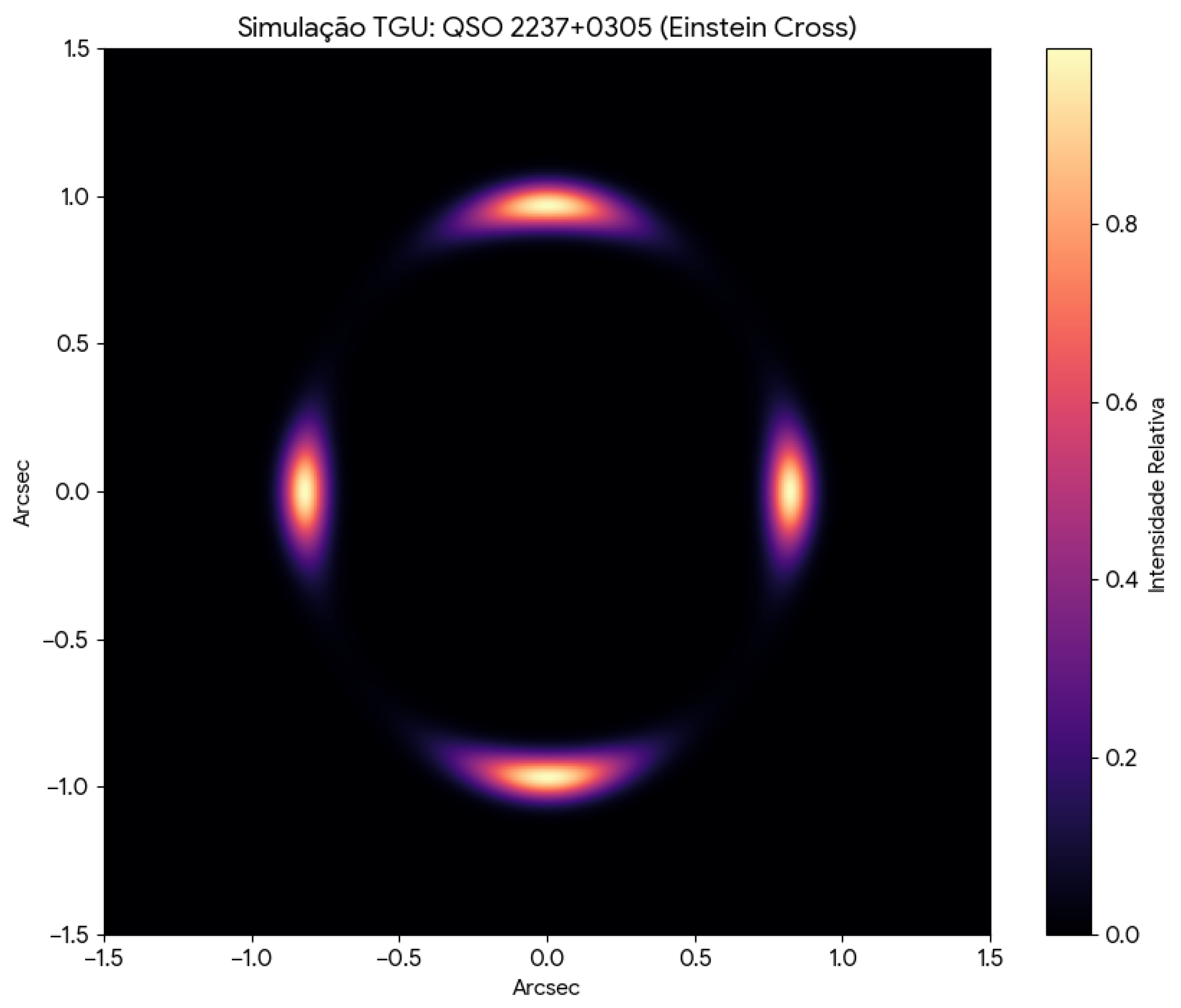
Table 6.
Comparison between observed periastron advance and theoretical predictions from General Relativity (GR) and the Theory of Informational Spin (TGU) for benchmark relativistic binary pulsars.
Table 6.
Comparison between observed periastron advance and theoretical predictions from General Relativity (GR) and the Theory of Informational Spin (TGU) for benchmark relativistic binary pulsars.
| System | (deg yr) | (deg yr) | (deg yr) | Relative Deviation |
|---|---|---|---|---|
| PSR B1913+16 | ||||
| PSR J0737−3039A/B |
Table 7.
Comparison of primordial element abundances: observations versus TGU predictions.
| Element | Observations | TGU Prediction | Status |
|---|---|---|---|
| Helium-4 () | Excellent agreement | ||
| Deuterium () | Consistent | ||
| Lithium-7 () | Reduced relative abundance | Improved tension |
Table 8.
Comparative summary of the Unified Theory of Informational Spin (TGU), the standard CDM cosmological model, and Modified Newtonian Dynamics (MOND).
Table 8.
Comparative summary of the Unified Theory of Informational Spin (TGU), the standard CDM cosmological model, and Modified Newtonian Dynamics (MOND).
| Aspect | TGU (This Work) | CDM | MOND / TeVeS |
|---|---|---|---|
| Ontological status | Informational coherence as a primitive geometric quantity; matter and geometry emergent | Matter–energy content (baryons, dark matter, dark energy) fundamental | Modification of dynamical laws or inertia at low accelerations |
| Role of spacetime geometry | Effective description emerging from coherence gradients | Fundamental dynamical entity governed by Einstein equations | Retained (TeVeS) or partially modified |
| Dark matter | Not required; effective gravitational enhancement arises from coherence gradients | Required as a dominant non-baryonic component | Not required |
| Dark energy | Not required; cosmic acceleration interpreted via coherence structure | Required as a cosmological constant or dynamical field | Not addressed (usually added externally) |
| Fundamental parameters | (geometric + cosmological projection), (structural exponent) | , , , , etc. (several fitted parameters) | (critical acceleration), plus additional parameters in relativistic extensions |
| Parameter determination | Fixed a priori by geometric and structural constraints | Empirically fitted to cosmological data | Empirically fitted to galactic rotation curves |
| Number of free parameters | None at the phenomenological level presented | Several (typically cosmological parameters) | At least one fundamental scale () |
| Regime of convergence | Exactly converges to GR in weak-field, low-strain regimes | Reduces to GR with and cold dark matter | Reduces to Newtonian dynamics above |
| Status of Solar System tests | Exact convergence by construction; used as consistency checks | Excellent agreement | Generally consistent but requires care in relativistic extensions |
| Galactic rotation curves | Predicted via coherence gradients without dark matter | Explained via dark matter halos | Explained by modified dynamics |
| Cosmological simulations | Not yet developed (future work) | Extensively developed (N-body, hydrodynamical simulations) | Limited and model-dependent |
| Dynamical field equations | Not yet specified; effective kinematical framework | Fully specified Einstein field equations | Specified in relativistic extensions (e.g., TeVeS) |
| Action / variational principle | Not yet formulated (open problem) | Einstein–Hilbert action | Available in relativistic formulations |
| Falsifiability | Yes; predicts deviations in high-strain and high-eccentricity regimes | Yes; constrained by large-scale structure and CMB | Yes; constrained by galaxy clusters and relativistic tests |
| Interpretive paradigm | Geometric–informational, coherence-based | Matter–energy content of spacetime | Modified inertia / gravity paradigm |
| Current theoretical status | Phenomenological, structurally constrained, awaiting dynamical completion | Established concordance model | Effective theory with known limitations |
Disclaimer/Publisher’s Note: The statements, opinions and data contained in all publications are solely those of the individual author(s) and contributor(s) and not of MDPI and/or the editor(s). MDPI and/or the editor(s) disclaim responsibility for any injury to people or property resulting from any ideas, methods, instructions or products referred to in the content. |
© 2025 by the author. Licensee MDPI, Basel, Switzerland. This article is an open access article distributed under the terms and conditions of the Creative Commons Attribution (CC BY) license.
Copyright: This open access article is published under a Creative Commons CC BY 4.0 license, which permit the free download, distribution, and reuse, provided that the author and preprint are cited in any reuse.


