

Submitted:
06 February 2025
Posted:
06 February 2025
You are already at the latest version
Abstract
This paper delves into the potential of AI-driven optimization algorithm for integrating virtual power plant (VPP) into the electrical grid, aiming to enhance grid efficiency and maximize the utilization of renewable energy sources. By examining the fundamental principles of these advanced algorithms and their crucial role in enhancing power systems, this study demonstrates how artificial intelligence (AI) can improve both the accuracy and efficiency of optimization processes. Through a comprehensive comparative analysis of existing optimization techniques, our research highlights their inherent strengths and limitations, thereby providing a solid foundation for informed and innovative algorithm design. We propose a sophisticated AI-centric optimization framework that underscores the critical importance of robust data acquisition and pro-cessing mechanisms. The implementation, testing, and validation of our algorithm demonstrate its efficacy, indicating sig-nificant potential to enhance VPP operations. This work reinforces the theoretical foundation necessary for advancing the intelligence of VPP and offers valuable technical insights. It serves as a guiding beacon in promoting sustainable energy uti-lization while deepening our understanding of AI's profound impact on power system integration and optimization. Fur-thermore, our research provides novel perspectives and practical recommendations for future advancements in Smart Grid, contributing meaningfully to this burgeoning field.
Keywords:
Virtual Power Plant
; Smart Grid
; AI-driven Optimization
; Algorithm Design
; Utilization of Renewable Energy
1. Introduction
Under the background of global energy transition, VPP, as an innovative model of power system management, have received widespread attention. By integrating distributed energy resources such as wind and solar power along with energy storage systems, VPP establish a unified scheduling platform. This enhances the utilization of renewable energy sources and improves the flexibility and reliability of the power system through real-time monitoring and forecasting, optimized scheduling strategies, efficient resource allocation, and robust policy and technical support [1].With the increase in the proportion of renewable energy, traditional power systems are facing challenges of scheduling complexity and unstable power supply. VPP provide an effective solution. Figure 1 shows the interaction and integration of VPP and Smart Grid. VPP play an important role in Smart Grid, promoting the integration and management of renewable energy by optimizing resource allocation and improving energy utilization efficiency.
1.1. Characteristics of VPP
A is a system that integrates multiple distributed energy resources, aiming to achieve efficient power management by coordinating and optimizing the operation of these resources. Figure 2 shows the relationship between the components of a VPP and their functions. The power generation unit is responsible for generating electricity, load management is used to regulate the demand for electricity, and the energy storage system is used to store excess electricity. Through coordination, the VPP can achieve overall optimization, improve the efficiency and stability of the power grid. In the power market, it flexibly dispatches based on real-time demand and prices, provides peak shaving and frequency regulation services, reduces costs, and promotes energy conversion [2].
1.2. Characteristics of Smart Grid
The characteristics of Smart Grid are mainly reflected in aspects such as their self-healing ability, real-time monitoring, extensive application of data communication and information technology. The self-healing ability enables Smart Grid to quickly identify problems and perform automatic repair when a fault occurs, reducing power outage time and economic losses. This feature relies on advanced sensors and monitoring systems that can collect real-time data on the operation of the power grid to ensure the stability and reliability of power supply [3]. For example: State Grid Shishi City power supply company through the intelligent automation construction of distribution network, the distribution network fault second level full self-healing. In a short-circuit fault, thanks to the multi-level self-healing protection function of the distribution network, the fault occurs in less than 20 seconds, and all users along the line return to normal power consumption. There are significant differences between Smart Grid and traditional grids in many aspects. Smart Grid have features such as real-time monitoring, two-way communication, and automatic control, which can effectively improve the efficiency and reliability of the power system. The construction of Smart Grid not only improves the operational efficiency of the power system but also provides users with more flexible electricity usage options[4,5,6]. Table 1 shows the specific technical indicators and application scenarios comparing the main characteristics and advantages of the two. Gain a clearer understanding of the key shifts in power systems from the past to the future. It not only affects the production, transmission and consumption of energy, but also has significant advantages in terms of technological innovation, efficiency improvement, flexibility and user participation.
1.3. The Relationship Between VPP and Smart Grid
The relationship between VPP and Smart Grid is close, and the two complement each other to jointly promote the modernization of the power system. VPP form a centralized managed power supply system by integrating distributed energy resources such as wind energy, solar energy, and energy storage devices[7]. This integration not only improves the utilization rate of renewable energy but also enhances the flexibility and reliability of the power system. Smart Grid, through advanced information technology and communication technology, achieve real-time monitoring and management of the power system and can quickly respond to load changes and fault conditions. Within the framework of Smart Grid, VPP can conduct load dispatching and energy management more effectively[8]. The data analysis and prediction capabilities provided by Smart Grid enable VPP to optimize their power generation and energy storage strategies based on real-time power demand and market prices. This dynamic dispatching ability makes VPP more competitive in the power market, reduces operating costs, and improves economic benefits. The flexibility of VPP also guarantees the stability of Smart Grid[9],When facing sudden load fluctuations or the uncertainty of renewable energy power generation, VPP can quickly adjust their output to balance the grid load and ensure the continuity and reliability of power supply. Through this synergy, VPP not only enhance the operating efficiency of Smart Grid but also provide new solutions for the sustainable development of the power system.
With the continuous advancement of technology, AI-based Optimization Algorithm have become a research hotspot. The combination of VPP and Smart Grid can effectively deal with the volatility and uncertainty of renewable energy, ensure the stable operation of the power market, achieve real-time monitoring to fully grasp the state of the power grid, optimize resource allocation through data communication, improve scheduling efficiency with information technology, and adopt multi-level protection measures in terms of security[10], Promote the development of the power industry in a more intelligent and flexible direction. This development trend will bring more opportunities and challenges to the future power market, and prompt the continuous innovation and application of related technologies.
2. Literature Review
2.1. Review of Technological Advances and Future Development of Smart Grid
Smart grid, as the development direction of the future power system, is receiving widespread attention and shows great potential with the integration of Internet of Things technology. Enhance data collection, communication, and computing processing capabilities to promote the future development of Smart Grid. In the book "The Basic Ideas and Key Technologies of Smart Grid", the core ideas of smart grid are systematically introduced, including multiple aspects such as the demand for renewable energy and the mainstreaming of distributed energy [11]. Currently, the development of Smart Grid has its own characteristics. Our country is committed to the construction of the ubiquitous power Internet of Things and has drawn on the smart grid technology framework and cyber security standards of the US NIST [12]. In the practical application of Smart Grid, researchers have proposed various models and schemes. For example, a two-layer energy management model of smart distribution networks aims to maximize the profit of flexible renewable VPP and minimize network energy loss and voltage deviation[13]. In a practical application of Smart Grid, the researchers propose a two-tier energy consumption monitoring intelligent Model (EMM) for distribution networks (SDN) that takes into account FRVPP participation in day-ahead energy and reserve markets. Layer 1 EMM is applied to FRVPP to maximize profits in proposed markets with renewable and flexible energy constraints, taking into account the coordination between these energy sources and the VPP. The second layer creates coordination between VPPOs and distribution system operators to manage SDN energy losses and voltage deviation functions as linear normalized objective functions based on minimizing network summation[14]. And for the problem of data privacy leakage, data aggregation and incentive schemes designed based on the Paillier algorithm, etc [15]. Furthermore, aspects such as privacy protection, monitoring data transmission efficiency, and security detection of Smart Grid are also the focus of research. Researchers are committed to solving these problems through technical means such as cryptography, blockchain, secure multi-party computing, and AI[16]. To enhance the operation quality of Smart Grid, some researchers have also proposed flexible planning methods, bi-level multi-objective planning models, user participation research models, etc [17,18,19]. In the smart distribution system, the power management of VPP is also a hot topic of discussion. By optimizing the management of active and passive power of flexible renewable energy, the economic, operational and voltage security status of the network can be significantly improved[20]. The development of Smart Grid is crucial for improving the efficiency of power production and meeting the demands of economic development, and will further promote the future development of Smart Grid[21].
2.2. A Review of Multi-Dimensional Issues and Optimization Strategies of VPP
It explored the multi-dimensional issues of VPP in promoting the consumption of renewable energy, integration with the national power grid and the application of smart grid technologies. It analyzed the new characteristics, constituent entities and key technologies of VPP in the context of big data, and studied the application of data-driven methods[22]. It discussed community-based VPP and demonstrated their diversity through cases[23]. The economic dispatch model under the carbon trading mechanism has improved the emission reduction benefits and wind energy utilization of VPP[24]. Based on the wind-solar output scenarios of the Frank-Copula theory, a day-ahead scheduling model of the VPP was established, which reduced volatility, improved economy, and reduced wind and solar curtailment[25]. In the multi-collaborative market, devices such as electric vehicles were introduced, and an optimization model was established to effectively deal with the fluctuations of distributed energy and the integration of electric vehicles into the grid [26].The application of the VPP optimal scheduling model with energy-saving measures for 5G base stations and energy storage batteries has reduced the electricity cost of base stations and improved the consumption of renewable energy[27]. For the household prosumers in the smart grid, real-time power management strategies were studied[28], Designed the trading varieties and clearing models of flexible energy blocks in the new power system [29]. Aiming at the problem of new energy consumption, a multi-time-scale optimal scheduling strategy of VPP based on robust stochastic optimization theory was proposed[30]. A dynamic aggregation method of VPP considering the reliability of renewable energy was proposed[31]. In the research on the optimal integration of VPP, the relevant literature was reviewed, a scheduling optimization model of the multi-energy collaborative system was proposed, the technical challenges were analyzed, and the key research directions were put forward [32,33,34]. The multi-VPP alliance game optimization method considering carbon trading and the scheduling optimization of combined heat and power VPP were studied[35,36]. In terms of participating in the external energy market with a VPP, a two-stage model with a hydrogen energy storage system was built, optimizing the internal resource complementary operation and electricity-hydrogen market bidding strategies.[37]。We propose a dual-layer game relationship between distributed energy and VPP, and establish a mechanism for aggregating and operating VPP.[38]。In response to the impact of new energy integration, a demand response model was established, and the impact of time-of-use pricing on the economic feasibility of VPP was discussed.[39]。Furthermore, the brittle relationships were analyzed based on the equivalent model of smart grid, and the system performance was optimized.[40]。In line with the "dual carbon" goal, a multi-energy complementary VPP optimization dispatch strategy was proposed, a full-chain operation mechanism was established, and the system framework and functions of the VPP intelligent operation and control platform were described.[41,42]。It provides a theoretical basis and practical guidance for decarbonization, high efficiency, and sustainable development of energy and power systems.
Existing studies show that the optimization of Smart Grid mostly focuses on a single grid or VPP, while the research on cross-regional collaborative optimization still needs to be further explored. In the efficient operation of VPP, real-time data collection and AI-driven analysis play a core role. Among them, machine learning and deep learning algorithms significantly improve the accuracy of power prediction and optimize power dispatching by mining historical data, thereby enhancing the operational efficiency of the power grid. The AI optimization Algorithm proposed in this study addresses the multi-objective and multi-constraint optimization problem of power grids, with the potential to adjust strategies for economic benefits and market adaptability. In the future, AI-driven integrated Optimization Algorithm need to further explore new models and strategies, and interdisciplinary cooperation is crucial for promoting the development of this field.
3. AI Optimization Integrated Optimization Algorithm
3.1. Integrated Optimization Strategy
During the critical period of global energy structure transformation, exploring the integrated optimization algorithm of AI-driven VPP and Smart Grid has profound practical significance for coping with challenges such as the volatility of power supply, dynamic changes in load, and market complexity brought about by the rapid development of renewable energy. In terms of real-time adaptability, AI-driven optimization can collect and analyze data in real time, and dynamically adjust strategies according to real-time changes in power grid status, with strong adaptability. With the help of machine learning and deep learning technology, valuable information can be mined from historical data to build intelligent prediction models. In terms of optimization efficiency, it can deal with a large number of variables and constraints, and find the optimal or near-optimal solution through global search and iterative optimization. In terms of model construction, different optimization models and prediction models can be constructed according to actual needs and data characteristics. Intelligent level with independent learning and decision-making ability, based on historical data and real-time information, intelligent adjustment of strategies and parameters. This research is dedicated to promoting the intelligent upgrade of the power system by introducing cutting-edge AI technologies and strengthening the integration efficiency and operational stability of VPP in Smart Grid.
In the process of optimizing the power system, multiple key goals were comprehensively considered, including minimizing power loss and maximizing the utilization rate of renewable energy, and these goals were quantitatively defined by constructing precise mathematical models. These models provide a solid theoretical basis for the optimization of the power system, ensuring the clarity and measurability of the research goals.
- (1)
- Minimize power loss
Among equation (1), is the total power loss, is the resistance of the th line, is the current passing through the th line, and is the total number of lines.
- (2)
- Maximize the utilization rate of renewable energy
Among equation (2), is the utilization rate of renewable energy, is the total power generation of renewable energy, and is the total power generation of the system.
- (3)
- Comprehensive optimization objective
In order to consider both of these two objectives simultaneously, a multi-objective optimization model can be constructed, which can usually be achieved by using the weighting method or the Pareto optimization method. Suppose we use the weighting method, it can be expressed as:
Among equation (3), is the comprehensive objective function, and and are weighting coefficients, representing the importance of power loss and the utilization rate of renewable energy, respectively.
- (4)
- Constraint conditions
During the optimization process, some constraint conditions also need to be considered. For example:
Power balance constraint:
Among equation (4), is the output power of the th power generation unit, and is the total load of the system.
Power generation capacity limit of renewable energy:
Through the above inequality (5), the quantitative objectives of the research can be clarified and theoretical support can be provided for the optimization of the power system.
This research aims to explore how to utilize advanced optimization Algorithm, combined with the powerful computing capabilities of AI, to achieve efficient scheduling and management of VPP resources.
Through comprehensive analysis of various factors such as power demand, power generation capacity, and energy storage systems, the optimization algorithm can respond quickly in the real-time environment to ensure the reliability and economy of power supply. At the same time, the research will also focus on the iterative optimization of the algorithm, enhance its adaptability to changes in the future power market, and actively explore the improvement of existing algorithms and new solutions to cope with changes in the future power market. In addition, the research also hopes to explore new solutions through the improvement of existing algorithms to achieve more efficient resource allocation and lower operating costs.
3.2. Power Grid Optimization Research
Faced with the power supply fluctuations and instabilities brought about by the rapid development of renewable energy, VPP can efficiently integrate distributed energy resources and significantly enhance the flexibility and reliability of the power system. The introduction of AI technology enables optimization Algorithm to play a crucial role in real-time scheduling and load management, thereby effectively improving the operational efficiency of the power grid. A series of key indicators are used to comprehensively evaluate the impact of AI optimization Algorithm on grid efficiency and the utilization of renewable energy. These indicators include: the reduction of peak load, the improvement of load balancing capacity, and the effective utilization rate of wind and solar energy. Table 2 details these indicators and their expected improvement amplitudes, providing strong data support for the quantitative assessment of the research.
Economically, The optimization algorithm effectively reduces operational costs of power generation through intelligent scheduling and resource allocation, thus enhancing the market competitiveness of VPP. As of August 2024, the Shenzhen VPP regulation and management cloud platform has carried out 71 load adjustments, reducing 2,273 tons of carbon dioxide. It is expected that by the end of the year, the cumulative reduction of carbon dioxide emissions will be 3,000 tons. The AI algorithm improves the system response speed and guarantees the stability of power supply. Environmentally, the optimization algorithm increases the utilization rate of renewable energy, reduces reliance on fossil fuels, lowers carbon emissions, and promotes the development of a green economy. Technically, the AI optimization algorithm offers new thoughts for the intelligent transformation of the power system, enhances the efficiency of power dispatching, and promotes the development of Smart Grid. The technical solution of this study provides powerful support for constructing a green and efficient intelligent power system.
3.3. Optimization Algorithm
Optimization Algorithm constitute a key technology for addressing complex issues within power systems. The crux lies in seeking the optimal or approximately optimal solutions via mathematical models and computational approaches to fulfill specific objective functions and constraints. In the domain of power systems, the application of optimization Algorithm is of paramount importance, encompassing crucial links such as load dispatching, operational scheduling of power generation units, and energy management. The following are the fundamental mathematical principles and their applications in power systems.
(1)Linear programming
Among inequality (6), is the coefficient vector of the objective function, is the decision variable, is the coefficient matrix of the constraint conditions, and is the right vector of the constraint conditions. In the power system, linear programming can be employed in power generation dispatch issues to minimize the generation cost while meeting the load demand and generator constraints. For instance, determining the output power of each generator such that the total cost is minimized while satisfying: load demand, minimum and maximum output limits of the generators.
(2)Nonlinear programming
In inequality (7), represents the objective function, denotes the inequality constraints, and indicates the equality constraints. In the power system, nonlinear programming is frequently utilized for optimizing the output of generators to fulfill the nonlinear load requirements and the characteristics of generators. For instance, taking into account the generation efficiency and fuel cost of generators, the output power of generators is optimized to achieve the minimization of the total generation cost.
- (3)
- Load forecasting
Load forecasting usually encompasses time series analysis and regression models, with the objective of forecasting future electricity demand. Linear regression models can be expressed as:
Among equation (8), is the load at time , is the temperature, is the humidity, is the regression coefficient, and is the error term. Through load forecasting, the power system can arrange the generation plan in advance to ensure adequate power supply during high-load periods and avoid power shortages.
- (4)
- Power dispatch
The power generation dispatch issue can be modeled by means of Mixed Integer Linear Programming (MILP), with the aim of minimizing the generation cost while fulfilling the load demands and the constraints of generators. It can be represented as:
Among inequality (9), is the cost function of generator , is the total load demand, and and are the minimum and maximum outputs of the generator. Power generation dispatch ensures that the output of generators can meet the electricity demand within different time periods, while minimizing the generation cost and optimizing the utilization of resources.
To achieve the minimization of operational costs, the maximization of the utilization ratio of renewable energy, or the enhancement of system reliability, optimization Algorithm are required to handle a multitude of variables and constraints, such as the output capability of generators, load demands, network topology, etc. The complexity of these factors makes traditional solution approaches ineffective to cope with, thereby the introduction of optimization Algorithm becomes particularly crucial. Common optimization Algorithm encompass linear programming, nonlinear programming, integer programming, etc. These algorithms possess distinct characteristics and are applicable to different types of problems. Linear programming is suitable for optimization problems with linear relations, while nonlinear programming is capable of handling more complex nonlinear relations. Integer programming plays a significant role when certain variables need to be discretized. With the advancement of computing capabilities, heuristic algorithms and meta-heuristic algorithms, such as genetic algorithms and particle swarm optimization, have gradually become popular choices for solving complex optimization problems. These algorithms, by simulating the evolutionary process or group behavior in nature, can find relatively optimal solutions within a short period of time and have strong adaptability, being suitable for the dynamic power market environment. In the practical applications of the power system, optimization Algorithm not only enhance the dispatch efficiency but also provide a scientific basis for decision-makers, assisting them in making more rational decisions in a complex context. With the development of Smart Grid and VPP, the research and application of optimization Algorithm will be further intensified, promoting the intelligent and efficient process of the power system.
3.4. Application of AI Technology in Optimization Algorithm
AI technology has demonstrated extensive application and notable superiority in the optimization dispatch of power systems. With the aid of machine learning and deep learning techniques, optimization Algorithm can extract valuable information from historical data, enhance the accuracy and efficiency of decision-making, and effectively address complex nonlinear problems that traditional algorithms struggle to cope with. Through the construction of intelligent models, real-time analysis of key factors such as power demand, generation capacity, and market prices is achievable, facilitating the dynamic and efficient dispatch of the power system. When researching the integration optimization Algorithm of AI-driven VPP and intelligent grids, the code block in Figure 3 can be employed to showcase an example of load forecast optimization based on a genetic algorithm. This case has effectively improved the efficiency and accuracy of power generation dispatch.
Through real-time data analysis and load forecasting, the power generation plan is dynamically adjusted to ensure the stable and reliable operation of the power grid. AI technology has the ability of adaptive learning and can optimize parameter settings according to different conditions to maintain the efficient operation of the system. Moreover, AI technology has also constructed an intelligent decision support system, providing real-time and scientific decision-making suggestions for power operators to help them respond quickly to the complex and changeable market environment. Through simulating operating scenarios, AI can evaluate the impact of different decisions and provide a scientific basis for decision-making. In terms of data processing, AI technology has achieved automatic cleaning and feature extraction, significantly reducing manual intervention, improving processing efficiency, and enhancing the flexibility and response speed of the system. AI technology not only significantly improves the performance of optimization Algorithm but also injects a strong new impetus into the intelligent transformation of the power system.
3.5. Comparison of Existing Optimization Algorithm
In the integrated optimization of VPP, each optimization algorithm has distinct features and is applicable to different scenarios as shown in Table 3. The genetic algorithm is based on natural selection and genetics, is good at handling multi-objective nonlinear problems, and is suitable for multiple constraint conditions in power dispatch, but has a slow convergence speed. The particle swarm optimization simulates the foraging of bird flocks, with rapid convergence through information sharing, and is suitable for real-time dispatch, but is prone to falling into local optimum. The ant colony algorithm is based on swarm intelligence, has excellent performance in path optimization, is suitable for power load dispatch, has strong adaptability, but has high computational complexity for large-scale problems. The simulated annealing algorithm simulates physical annealing, avoids local optimum, and is suitable for combinatorial optimization, but the parameter setting is complex.
4. AI-Based Integrated Optimization Algorithm for VPP
4.1. Algorithm Design Framework
In the design of the AI-driven integrated optimization algorithm for VPP, constructing the algorithm framework is crucial, covering steps such as demand analysis, model construction, algorithm selection, implementation, and testing. In the demand analysis stage, the specific goals of the VPP need to be clarified, including demands in aspects such as load forecasting, energy scheduling, and economic benefits. The outcome of this stage will provide a basis for the subsequent model construction. Figure 4 shows the overall framework and process of the AI-driven integrated optimization algorithm for the smart grid of VPP. "Data input" collects grid data from different sources, including load forecasting, renewable energy generation data, etc. "Algorithm processing" uses AI algorithms to analyze and optimize the input data to generate the optimal grid scheduling scheme. "Result output" feeds the optimization results back to the grid management system to achieve intelligent scheduling and resource allocation.
Model construction is the core of the algorithm design, involving mathematical modeling of the power system. It comprehensively considers the power market, user demands, and characteristics of renewable energy to construct an optimization model that reflects physical, economic, and environmental characteristics. The accuracy of the model directly affects the algorithm effect and requires sufficient verification and adjustment. Algorithm selection needs to be based on demands and model characteristics. Common algorithms include genetic algorithms, particle swarm optimization, ant colony algorithms, etc. Each algorithm has its unique advantages and disadvantages. When choosing, it is necessary to weigh computing efficiency, convergence speed, and adaptability. Implementation and testing are the keys to putting theory into practice. It is necessary to program the algorithm, conduct multiple rounds of tests to verify its validity, and optimize the algorithm based on the test results to ensure reliability and stability. Through iterative optimization, an efficient and intelligent integrated optimization algorithm for VPP is formed to support the intelligent development of the power system.
4.2. Data Acquisition and Processing
In the research of the integrated optimization algorithm of VPP, data acquisition and processing are crucial links. The quality and accuracy of data directly affect the effect and reliability of the optimization algorithm. Data sources include sensors, smart meters, market transaction data, and meteorological information, etc. Sensors monitor the operation of the power system in real time, providing key indicators such as load, power generation, and energy storage status; smart meters provide users’ electricity consumption data to analyze electricity consumption patterns; market transaction data reflects the dynamics of the power market and provides a basis for optimization decisions; meteorological information is crucial for the prediction of renewable energy power generation. Factors such as wind speed, temperature, and humidity will affect the power generation efficiency of wind and solar energy. Table 4 summarizes different data acquisition methods and their advantages and disadvantages, and lists the corresponding preprocessing techniques and tools at the same time.
The data collection strategy has a decisive influence on the preprocessing effect of the optimization algorithm for the smart grid. Preprocessing techniques, including data cleaning, standardization, and feature extraction, are crucial for improving data quality and provide an accurate data basis for the algorithm implementation. Data cleaning removes noise and outliers to ensure data integrity. Standardization processing ensures data comparability, while feature extraction enhances the predictive ability of the model. Historical data analysis reveals the patterns and trends of power demand, and machine learning techniques play an important role in this process. Through training the model, it is possible to predict future power demand and the power generation of renewable energy more accurately. This predictive ability provides a scientific basis for the dispatching decision-making of VPP and helps achieve more efficient resource allocation and energy management.

Table 4.
Different data acquisition methods and their advantages and disadvantages.
| Data Acquisition Methods | Pros | Cons | Pretreatment technique | Tools |
|---|---|---|---|---|
| Sensor data | Strong real-time and high precision | High cost and complex maintenance | Data cleansing | Python, R |
| Market data | Large amount of data, wide coverage | There may be noise and inconsistencies | Feature selection | Weka, Scikit-learn |
| Social media data | Reflect user behavior and be dynamic | Data quality is uneven | Data normalization | Pandas, NumPy |
| Remote sensing data | Wide space coverage and easy access | The analysis is complicated and the processing time is long | Data interpolation | ArcGIS, QGIS |
4.3. Algorithm Implementation and Testing
In the algorithm implementation stage, it is first necessary to select the appropriate programming language and development environment. Commonly used programming languages include Python, Java, and C++. Among them, Python is widely favored due to its rich libraries and concise syntax. The selection of the development environment is also crucial. Commonly used IDEs such as PyCharm, Eclipse, and Visual Studio can all provide good support.
When studying the AI-driven integrated optimization algorithm for VPP Smart Grid, a Python code snippet can be used to show the key parts of the algorithm implementation such as Figure 5, along with the visualization of the test results. This code implements a simple optimization algorithm and uses the Matplotlib library to plot the curve graph of the test results.
Code Description: This code snippet implements a simple optimization algorithm, with the objective function being a quadratic function. By calling the ‘optimize‘ function, the x values and the corresponding objective function values are generated, and the result curve is plotted using the Matplotlib library.
The algorithm is divided into four core modules: data input, model construction, solution optimization, and result output. The data input module collects key operating parameters, such as power demand, power generation capacity, and market pricing. The model construction module builds the corresponding mathematical model framework based on the optimization goal. In the solution optimization link, iterative strategies are adopted, combined with heuristic or meta-heuristic algorithms such as genetic algorithms and particle swarm optimization, to improve the convergence speed and the quality of the solution. In the testing stage, unit and system tests are conducted to evaluate the independence and overall performance of the modules, including execution efficiency and result accuracy. For the problems in the test, debugging and optimization are carried out to ensure the stability and reliability of the algorithm, and ultimately achieve efficient support for the optimization of VPP.
5. Conclusions
This research delves into the design and implementation of the integration optimization algorithm of VPP and Smart Grid based on AI. It analyzes the key role of VPP in integrating distributed energy sources and enhancing the flexibility and reliability of the power system, as well as the function of Smart Grid in achieving real-time monitoring and management of the power system through information technology and communication means. In the algorithm research, multiple AI technologies are integrated to improve the computational efficiency and accuracy. By comparing and analyzing existing Optimization Algorithm and evaluating their performance in the integration of VPP, theoretical support is provided for algorithm design. The effectiveness of the algorithm framework and data processing ensures its feasibility and reliability in practical applications.
The experimental results confirm that the proposed optimization algorithm has significant advantages in power dispatching and resource allocation, improving the operational efficiency of the power grid. The in-depth analysis of data verifies the potential of AI technology in innovative applications in the power system. This research not only provides a new perspective for the optimization of VPP but also lays the foundation for the development of Smart Grid. Future research can further explore emerging technologies on this basis to promote the sustainable development of the power industry.
References
- Bo, Q.; et al. Robust Optimal Dispatching of Power Grid with the Participation of Virtual Power Plants. Journal of Physics: Conference Series 2024, 2788, 012023. [CrossRef]
- Xinfa, T.; et al. The Optimization of Supply–Demand Balance Dispatching and Economic Benefit Improvement in a Multi-Energy Virtual Power Plant within the Jiangxi Power Market. Energies 2024, 17, 4691. [CrossRef]
- Jia, Y.; et al. Adaptive Partitioning Approach to Self-Sustained Smart Grid. IET Generation, Transmission & Distribution 2017, 11, 485-494. [CrossRef]
- Kiasari, M.M.; Aly, H.H. A Proposed Controller for Real-Time Management of Electrical Vehicle Battery Fleet with MATLAB/SIMULINK. Journal of Energy Storage 2024, 99, 113235. [CrossRef]
- Wang, L.; Li, D. Optimizing Domestic Energy Management with a Wild Mice Colony-Inspired Algorithm: Enhancing Efficiency and Coordination in Smart Grids through Dynamic Distributed Energy Storage. Heliyon 2024, 10, e35462. [CrossRef]
- Khemakhem, S.; et al. Home Energy Management Based on Plug-in Electric Vehicle Power Control in a Residential Smart Grid. International Journal of Digital Signals and Smart Systems 2019, 3, 173-186. [CrossRef]
- Abdelkader, S.; et al. Virtual Power Plants: An In-Depth Analysis of Their Advancements and Importance as Crucial Players in Modern Power Systems. Energy, Sustainability and Society 2024, 14, 52. [CrossRef]
- Xiu, J.; et al. Energy Management Optimization Strategy of Virtual Power Plant Based on Deep Reinforcement Learning. Journal of Physics: Conference Series 2022, 2384, 012041. [CrossRef]
- Tian, L.; et al. A Review on the Study of Management and Interaction Mechanism for Distributed Energy in Virtual Power Plants. Power System Technology 2020, 44, 2097-2108. [CrossRef]
- Hongying, L. Research on the Application of Artificial Intelligence Technology in Power System Intelligent Dispatching Automation. Journal of Physics: Conference Series 2021, 2083, 042047. [CrossRef]
- He, F.; et al. Application and Development of Internet of Things in Smart Grid. Power System Protection and Control 2020, 48, 58-69. [CrossRef]
- Yu, Y. A Brief Description of the Basics of the Smart Grid. Journal of Tianjin University (Science and Technology) 2020, 53, 551-556. [CrossRef]
- Deng, J.; et al. Study of NIST’s Interoperable Smart Grid Technology Architecture. Power System Protection and Control 2020, 48, 9-21. [CrossRef]
- Asl, S.A.F.; et al. A New Two-Layer Model for Energy Management in the Smart Distribution Network Containing Flexi-Renewable Virtual Power Plant. Electric Power Systems Research 2021, 194, 107085. [CrossRef]
- Sreenivasulu, G.; Balakrishna, P. Optimal Dispatch of Renewable and Virtual Power Plants in Smart Grid Environment through Bilateral Transactions. Electric Power Components and Systems 2021, 49, 488-503. [CrossRef]
- Zhu, S.; Wang, H. Paillier-Based Data Aggregation and Stimulation Scheme in the Smart Grid. Computer Engineering 2021, 47, 166-174. [CrossRef]
- Li, K. Research on Data Aggregation and User Query Privacy Protection in Smart Grid. Ph.D. Thesis, North China Electric Power University (Beijing), 2023. [CrossRef]
- Wiezorek, C.; et al. Validating Algorithms for Flexible Load Control in a Smart Grid Laboratory Environment. In Proceedings of the 11th IEEE-PES Innovative Smart Grid Technologies Europe (IEEE-PES ISGT Europe), 2021; pp. 1-6. [CrossRef]
- Xiong, Y. Smart Grid Based on Bi-Level Programming False Data Injection Attacks Research. Ph.D. Thesis, Chongqing University of Posts and Telecommunications, 2022. [CrossRef]
- Iqbal, S.; et al. A Comprehensive Review on Residential Demand Side Management Strategies in Smart Grid Environment. Sustainability 2021, 13, 7170. [CrossRef]
- Akbari, E.; et al. Multi-Objective Economic Operation of Smart Distribution Network with Renewable-Flexible Virtual Power Plants Considering Voltage Security Index. Scientific Reports 2024, 14, 70095. [CrossRef]
- Zhang, Y.; et al. Overview of Smart Grid Development in China. Power System Protection and Control 2021, 49, 180-187. [CrossRef]
- Li, Z.; et al. Application of Data-Driven Technology in Virtual Power Plant. Power System Technology 2020, 44, 2411-2419.
- Summeren, L.F.M.v.; et al. 2020. Community energy meets smart grids: Reviewing goals, structure, and roles in Virtual Power Plants in Ireland, Belgium and the Netherlands. Energy Research & Social Science 63, 101415. [CrossRef]
- Zhang, L.; et al. Economic dispatch model of virtual power plant considering electricity consumption under a carbon trading mechanism. Power System Protection and Control 2020. 48, 154-163. [CrossRef]
- Mei, G.; et al. Scheduling Strategy for Multi-energy Complementary Virtual Power Plant Considering the Correlation Between Wind and Solar Output and Carbon Emission Quota. Proceedings of the CSU-EPSA 2021. 33, 62-69. [CrossRef]
- Wang, R.; et al. Optimal Dispatching of Virtual Power Plant Containing Electric Vehicles in Multi-Cooperative Market. Southern Power System Technology 2021. 15, 45-55. [CrossRef]
- Liu, Y.; Fan, Y. Optimal Scheduling Strategy for Virtual Power Plant Considering 5G Base Station Technology, Energy-storage, and Energy-saving Measures. Proceedings of the CSU-EPSA 2022. 34, 8-15. [CrossRef]
- Liu, D.; et al. Real-time Electricity Management Optimization Algorithm for the Household Prosumer in Smart Grid. Southern Power System Technology 2022. 16, 20-28. [CrossRef]
- Liu, D.; et al. Flexible Block Order Trading Clearing Model for New Power Systems. Power System Technology 2022. 46, 4150-4159. [CrossRef]
- Zhang, D.; et al. Multi-Time Scale of New Energy Scheduling Optimization for Virtual Power Plant Considering Uncertainty of Wind Power and Photovoltaic Power. Acta Energiae Solaris Sinica 2022. 43, 529-537. [CrossRef]
- Bai, X.; et al. Dynamic aggregation method of virtual power plants considering reliability of renewable energy. Electric Power Automation Equipment 2022. 42, 102-110. [CrossRef]
- Goia, B.; et al. 2022. Virtual Power Plant Optimization in Smart Grids: A Narrative Review. Future Internet 14. [CrossRef]
- Kong, X.Y.; et al. Robust stochastic optimal dispatching method of multi-energy virtual power plant considering multiple uncertainties. Applied Energy 2020. 279. [CrossRef]
- Cheng, R.; et al. Review of Key Technologies for Mega-City Virtual Power Plants upon Regional Unified Power Market. Southern Power System Technology 2023. 17, 90. [CrossRef]
- Hou, H.; et al. Coalition Game Optimization Method for Multiple Virtual Power Plants Considering Carbon Trading. Proceedings of the CSU-EPSA 2023. 35, 77-85. [CrossRef]
- Guo, W.S.; et al. Optimal dispatching of electric-thermal interconnected virtual power plant considering market trading mechanism. Journal of Cleaner Production 2021. 279. [CrossRef]
- Gao, R.; et al. A Two-Stage Dispatch Mechanism for Virtual Power Plant Utilizing the CVaR Theory in the Electricity Spot Market. Energies 2019. 12. [CrossRef]
- Xie, M.; et al. Evolutionary Game Decision and Mechanism Analysis of Dynamical Aggregation of Distributed Energy Resources Into Virtual Power Plant. Power System Technology 2023. 47, 4958-4977. [CrossRef]
- Zeng, X.; Tang, C. Research on optimization of virtual power plants dispatch by considering the consumption of new energy under time-of-use electricity price environment. Journal of Electric Power Science and Technology 2023. 38, 24-34. [CrossRef]
- Hui, W.; et al. A novel approach to hybrid dynamic environmental-economic dispatch of multi-energy complementary virtual power plant considering renewable energy generation uncertainty and demand response. Renewable Energy 2023. 219. [CrossRef]
- Liu, X.O. Research on optimal dispatch method of virtual power plant considering various energy complementary and energy low carbonization. International Journal of Electrical Power & Energy Systems 2022. 136. [CrossRef]
Figure 1.
The relationship between virtual power plants and Smart Grid.
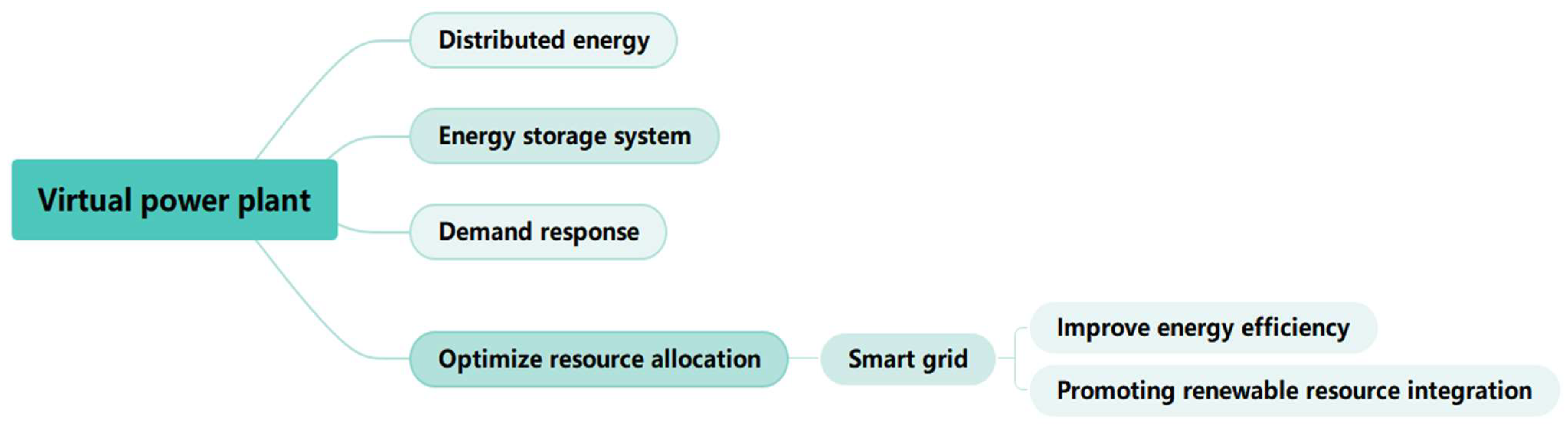
Figure 2.
Components and functional relationships of a virtual power plant.
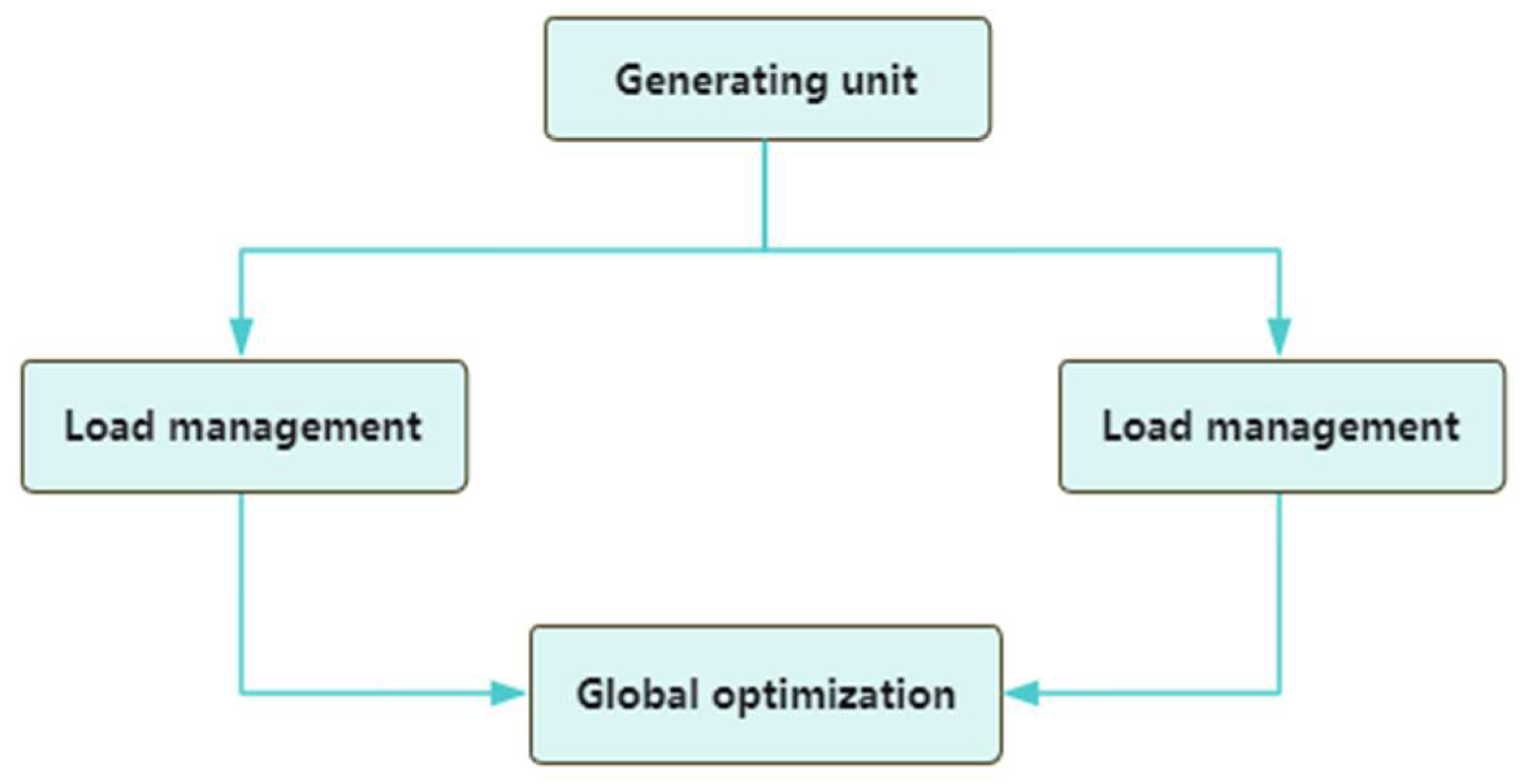
Figure 3.
Code example of load forecast optimization practice based on genetic algorithm.
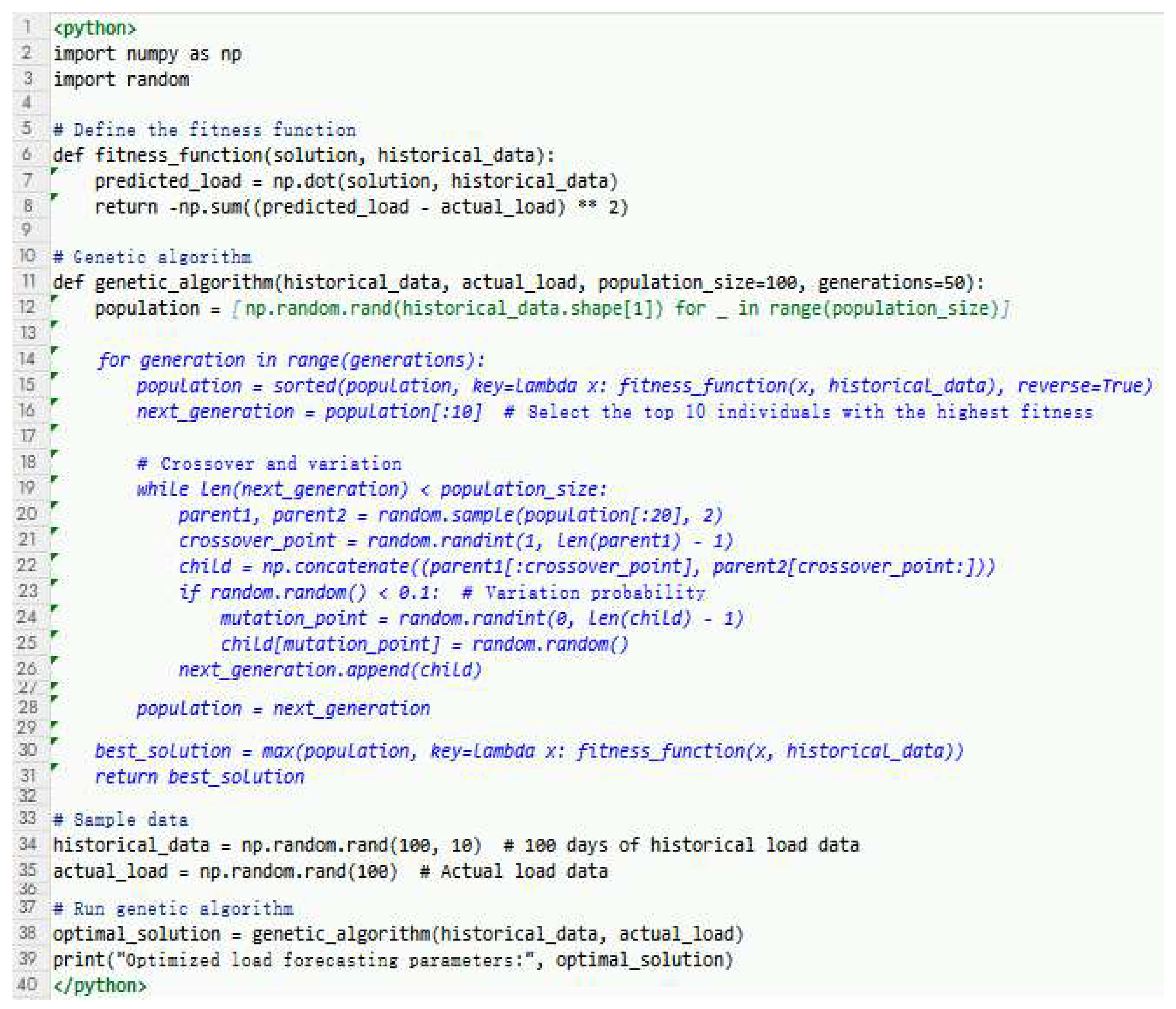
Figure 4.
Overall framework and flow chart of the optimization algorithm.
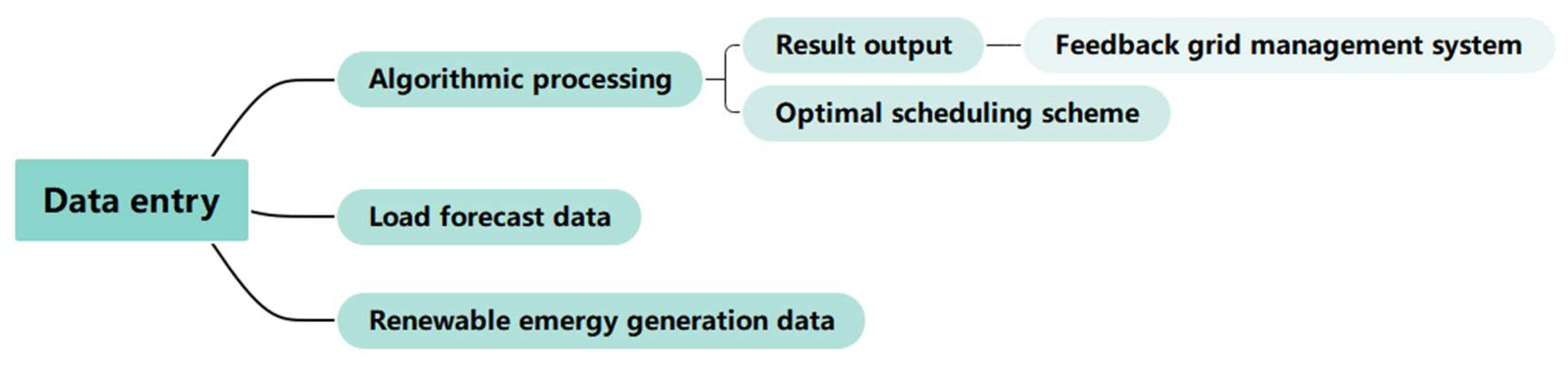
Figure 5.
Python code snippet .
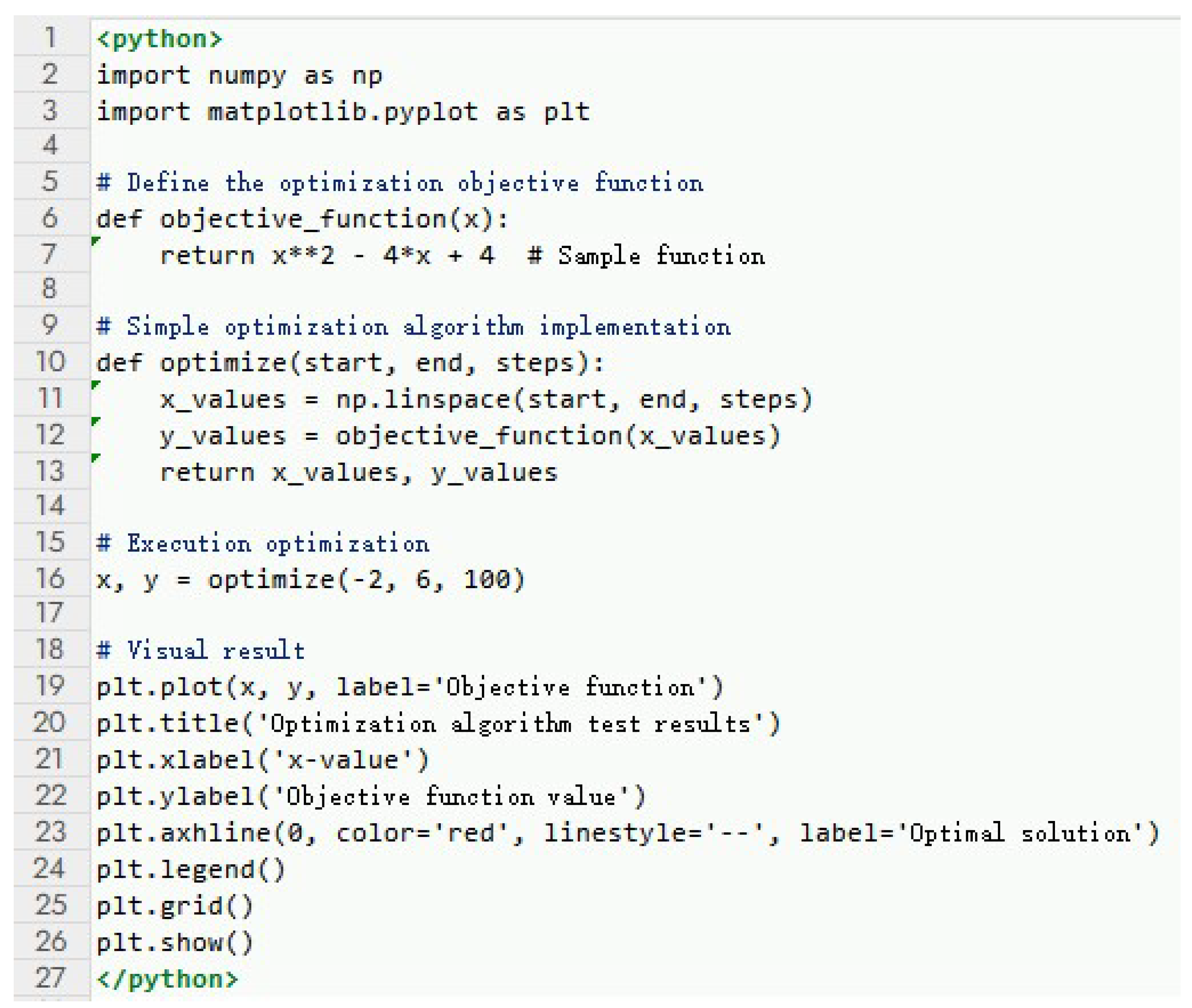
Table 1.
Differences between smart grid and traditional grid.
| Features | Smart grid | Traditional power grid |
|---|---|---|
| Real-time monitoring | Support real-time data acquisition and analysis | It relies on regular inspections and human monitoring |
| Two-way communication | Two-way information flow between users and the power grid | Only one-way information flow is supported |
| Automated control | With self-regulation and fault self-healing ability | The control system is relatively simple, slow response |
| Energy Management | Support the integration and optimization of renewable energy sources | It is difficult to integrate renewable energy effectively |
| Application Scenarios | Smart home, distributed power generation, demand response | Traditional industry, centralized power generation |
Table 2.
Key metrics and expected improvement rates.
| Indicators | Current level | Expected increase | Specific impact |
|---|---|---|---|
| Peak load | 1000 MW | 10% lower | Reduce stress on the grid and reduce the cost of supplying electricity |
| Load balancing capability | 75% | 15% boost | Improve grid stability and reduce the risk of power outages |
| Utilization rate of wind energy | 30% | 20% improvement | Increase the share of renewable energy and reduce dependence on fossil fuels |
| Solar integration capacity | 25% | 25% boost | Improve the efficiency of solar power generation and optimize resource allocation |
Table 3.
Comparative analysis of optimization algorithm.
| Name of algorithm | Features | Applicable scenarios | Strengths | Limitations |
|---|---|---|---|---|
| Genetic algorithms | Based on the principles of natural selection and genetics, it is good at dealing with multi-objective nonlinear problems | Multi-constraint optimization problems in power scheduling | Able to search the solution space globally and find good quality solutions | The convergence rate is relatively slow, which may increase the calculation time |
| Particle swarm optimization algorithm | Simulate the foraging behavior of birds and realize fast convergence through information sharing | Real-time power dispatching requires fast response | Fast convergence, suitable for dynamic environment | It is easy to fall into local optimal solutions, affecting global optimality |
| Ant colony algorithm | Based on the principle of swarm intelligence, strong path optimization ability | Power load scheduling, need to consider a variety of path selection | Strong adaptability, able to flexibly respond to changes | High computational complexity when dealing with large-scale problems |
| Simulated annealing algorithm | Simulate the physical annealing process to avoid falling into local optimality | Combinatorial optimization problems, such as resource allocation in electricity markets | Strong global search ability, can effectively avoid local optimization | The parameter Settings are complex and need to be fine-tuned to obtain the best performance |
Disclaimer/Publisher’s Note: The statements, opinions and data contained in all publications are solely those of the individual author(s) and contributor(s) and not of MDPI and/or the editor(s). MDPI and/or the editor(s) disclaim responsibility for any injury to people or property resulting from any ideas, methods, instructions or products referred to in the content. |
© 2025 by the authors. Licensee MDPI, Basel, Switzerland. This article is an open access article distributed under the terms and conditions of the Creative Commons Attribution (CC BY) license (http://creativecommons.org/licenses/by/4.0/).
Copyright: This open access article is published under a Creative Commons CC BY 4.0 license, which permit the free download, distribution, and reuse, provided that the author and preprint are cited in any reuse.


