

Submitted:
03 February 2025
Posted:
04 February 2025
You are already at the latest version
Abstract
Lactic acid bacteria (LAB) play a pivotal role in vinegar fermentation, contributing significantly to its functional and sensory qualities. This review examines the microbial diversity of Lactic Acid Bacteria (LAB) in vinegar fermentation, focusing on their specific metabolic contributions and the bioactive compounds they produce, which contribute to vinegar’s sensory and health benefits. Key bioactive components produced or enriched by LAB, such as organic acids, phenolic compounds, melanoidins, and tetramethylpyrazine, have demonstrated health benefits, including antibacterial, antioxidant, anti-inflammatory, and metabolic regulatory effects. These properties position vinegar as a promising functional food with potential health applications. The review also explores advancements in vinegar production, including modernized fermentation processes and optimized aging techniques, which enhance these beneficial compounds and ensure product consistency and safety. By examining the variety of LAB strains and the bioactive profiles of different vinegar types, this study highlights vinegar’s value beyond a culinary product, as a potential therapeutic agent in human nutrition and health. The findings underscore vinegar's relevance not only in dietary and preventive healthcare but also as a potential functional food ingredient. Further research is needed to explore the mechanisms of action through which LAB contribute to vinegar's health benefits, particularly in areas like metabolic regulation, anti-inflammatory effects, and antioxidant properties.
Keywords:
lactic acid bacteria
; fermentation
; vinegar
; health benefits
; diversity
; functionality
1. Introduction
Lactic acid bacteria (LAB) can be employed as probiotics, offering major health benefits [1]. They have been linked with dairy and non-dairy products lately due to the high demand for gluten-free and lactose-free products [2]. Vinegar constitutes one of the earliest culinary creations representing an ancient fermented food with a long history dating back to 2000 BCE [3]. Its sedative and curative properties make its application as a remedy unique with reports in the Bible [4]. It can be employed as a preservative, a flavor enhancer, but also as a cleaning agent for surfaces and utensils [5]. The natural fermentation of vinegar involves the presence of LAB [6].
LAB species, utilizing plants, cereals, fruits, whey, and honey as raw materials are usually introduced at the initial stage of vinegar fermentation [7]. Even at lower concentrations, LAB can be constant and/or dominate vinegar fermentation [8,9].
Vinegar harnesses antibacterial properties and fosters tissue repair and this is ascribed to the extracellular structure synthesized by Acetobacter species [10]. It has an antidiabetic effect which is due to the action of acetic acid as reported by the previous authors and a hypotensive effect is reported for red wine vinegar by inhibition of the renin-angiotensin system in rats [11]. It might also protect against oxidative stress-related injuries [12], also promoting anti-inflammatory and anti-cancer activities. Excretion of calcium works for acetate for the prevention of kidney stone formation [1], which can also reduce glucose blood levels by helping its conversion to glycogen [13]. Vinegar’s consumption benefits are directly influenced by the bioactive compounds produced by LAB, such as those isolated from tangerine vinegar, which include organic acids, polyphenols, and melanoidins. These compounds are known for their antioxidant, anti-inflammatory, and metabolic-regulating properties, which are linked to the health benefits of vinegar [14]. On the other hand, some of the organic acids and bioactive components of vinegar (e.g., acetic acid, gallic acid, catechin, epicatechin, chlorogenic acid, caffeic acid, p-coumaric acid, and ferulic acid) [10], could play a crucial role in various physiological processes such as absorption of minerals by lowering the gastrointestinal pH [15].
This review aims to compile the overall microbial diversity of LAB in vinegar and identify vinegar’s functional and bioactive compounds along with their health benefits making it a postbiotic supplement in human nutrition. We have searched the internet and databases such as Scopus, Science Direct, Researchgate with the keywords lactic acid bacteria, and fermentation, and vinegar, and health benefits, and diversity, or functionality.
2. Diversity and Application of LAB During Vinegar Fermentation
Vinegar fermentation involves a remarkable diversity of LAB, surpassing that of acetic acid bacteria (AAB). LAB encompass six genera and 26 species, with major genera including Lactobacillus, Pediococcus, Leuconostoc, and others. These species play distinct roles at various stages of fermentation, such as early fermentation, flavor development, and health-promoting compound production [16]. LAB are extensively present in various vinegar types including apple [17], rice [18,19], cereal [20,21], Shanxi-aged [8], Zhejiang rosy [6], Zhenjiang aromatic vinegar [22,23], Qishan [24], and Tianjin Duliu [25], Sichuan sun vinegar [26,27,28], rose vinegar [29], malt vinegar [30], persimmon vinegar [31], highlighting their significant role throughout the fermentation process [6]. The dominant genus, Lactobacillus, constitutes over 70% of the LAB population and includes key species such as L. plantarum, L. casei, L. acetotolerans, and L. fermentum [25]. Following closely, the Pediococcus genus predominantly features P. acidilactici and P. pentosaceus. Additionally, species such as Weissella confusa, Lactococcus lactis, Leuconostoc mesenteroides, and Oenococcus contribute to the complex microbial ecosystem during vinegar production [24]. The presence and dominance of different LAB genera vary across fermentation stages and vinegar types. For example, Lactobacillus is prevalent in most types except for rice and cereal vinegar [18,20]. Additionally, Pediococcus and Lactococcus are dominant in Shanxi-aged vinegar [8] and Daqu starter [32], while Weissella is common in Tianjin Duliu and Qishan vinegar [24,25]. Leuconostoc thrives in Qishan vinegar, and Oenococcus is associated with apple vinegar fermentation [33].
LAB typically dominate the early and middle stages of vinegar fermentation, often in symbiosis with yeasts such as Saccharomyces cerevisiae predominate the group ranging within 102–106 CFU/g with the total microbial population of vegetables and fruits ranging between 105 and 107 CFU/g and LAB, representing the minor part of the microbiota, ranging between 102 and 104 CFU/g [34], which provide essential amino acids and vitamins. In turn, LAB, particularly species such as Lactobacillus plantarum, Lactobacillus acetotolerans, and Pediococcus acidilactici, play a significant role in the early stages of fermentation. These species are responsible for lactic acid production, which lowers the pH of the fermentation medium. This process creates an optimal environment for the formation of polyphenols and melanoidins, compounds known for their antioxidant and anti-inflammatory properties [35]. For instance, during the initial 10–30 days of Zhejiang rosy vinegar fermentation, Lactobacillus is predominant; however, Acetobacter becomes more abundant during later stages [6]. LAB abundance tends to decline as the fermentation process progresses into acetic acid fermentation (AAF) due to their low tolerance for acidic conditions [36]. Despite this, species such as L. acetotolerans and L. fermentum persist, demonstrating their adaptability to low pH environments [8,25].
Beyond their role in microbial dynamics, LAB play a critical part in improving the sensory characteristics and safety of vinegar [9]. They produce lactic acid, which lowers pH and imparts a fresh and mild sourness that balances the strong acidity of acetic acid [23,25]. LAB also generate volatile compounds like esters and aldehydes, contributing to fruity, creamy, and buttery flavors in vinegar, which enhance the sensory quality of the final product. Furthermore, melanoidins produced during fermentation are known for their antioxidant properties, which contribute to the health-promoting effects of vinegar, such as oxidative stress reduction [36,37]. For example; the key microorganisms responsible for the flavor of Zhenjiang aromatic vinegar (ZAV) include Lactobacillus acetotolerans, Lactobacillus plantarum, Lactobacillus reuteri, Lactobacillus fermentum, Acetobacter pasteurianus as reported by Ye, et al. [22]. Additionally, bacteriocins produced by LAB inhibit the growth of spoilage and pathogenic microorganisms [6]. Their metabolic adaptability allows LAB to survive and function in harsh conditions by altering cell membrane composition and employing proton pumps to maintain intracellular pH balance [23]. Furthermore, LAB such as L. fermentum are known to inhibit the formation of harmful advanced glycation end-products (AGEs), enhancing both the safety and sensory appeal of the final product [38]. Overall, the diversity and functional applications of LAB in vinegar fermentation underscore their indispensable role in producing high-quality vinegar with desirable sensory and microbial properties.
3. Vinegar Functional Compounds
Kinds of vinegar contain bioactive compounds such as organic acids, polyphenols, melanoidins, and tetramethylpyrazine. These compounds have been shown to offer a range of health advantages, including antibacterial and antioxidant properties. Regular vinegar consumption may contribute to weight management, improved blood pressure and glucose control, and better vascular health [10,13,39].
3.1. Organic Acids
Vinegar’s acidity stems from a combination of organic acids. These acids can be categorized into volatile ones, such as acetic, formic, propionic, butyric, and quinic acids, and nonvolatile ones, including lactic, malic, pyroglutamic, citric, and succinic acids [13,40,41]. The origins of these organic acids can be traced back to both the fermentation process and the raw materials used. Acetic acid, predominantly formed during acetic acid fermentation, and lactic acid, a byproduct of alcohol fermentation, are the most abundant organic acids in vinegar [25,40,42,43]. Additionally, fruits contribute a range of organic acids, such as malic, citric, tartaric, lactic, succinic, and γ-aminobutyric (GABA) acids, to the overall composition of fruit vinegar [40,44,45]. The organic acids in the different types of vinegar are shown in Table 1. Among these, acetic acid reigns supreme, constituting a substantial portion (30-50%) of the total organic acid content in various vinegar types [46]. While acetic acid is the predominant volatile organic acid, lactic acid holds the title of the most abundant nonvolatile organic acid [45,47,48,49]. Other organic acids, such as formic, citric, malic, and succinic acids, have also been identified in vinegars, particularly balsamic vinegar, through advanced analytical techniques like nuclear magnetic resonance (NMR) [50]. Acetic acid, with its potent aroma and flavor, is a significant contributor to vinegar’s sensory profile. However, the presence of lactic, tartaric, malic, and succinic acids acts as a counterbalance, resulting in a milder overall taste [46]. Beyond their organoleptic properties, organic acids in vinegar offer nutritional and functional benefits. Compounds like malic, citric, succinic, and lactic acids can be metabolized through the tricarboxylic acid cycle, a fundamental pathway for energy production from carbohydrates, lipids, and amino acids. Moreover, these acids, especially acetic acid, exhibit antimicrobial properties. Acetic acid, in particular, has demonstrated potent efficacy against harmful bacteria such as Escherichia coli O157:H7 [39]. Its antibacterial action is further enhanced when combined with citric acid. In addition to antimicrobial effects, acetic acid has garnered attention for its potential health benefits. Animal studies have indicated that acetic acid can contribute to lipid management by reducing cholesterol and triglyceride levels through mechanisms involving liver lipogenesis inhibition and increased bile acid excretion [51]. Furthermore, it has been shown to influence body fat accumulation by upregulating genes associated with fatty acid oxidation in the liver. Shen, et al. [52] research provides compelling evidence for the potential therapeutic benefits of acetic acid and vinegar in inflammatory bowel disease (IBD), specifically colitis. Their study demonstrated that both acetic acid (0.3% w/v) and vinegar (5% v/v) were effective in alleviating the symptoms of colitis induced by dextran sulfate sodium (DSS) in mice.
3.2. Phenolic Compounds
The phenolic compounds that enrich vinegars primarily originate from the raw materials used in their production. Research has consistently identified a variety of phenolic acids within grain-based vinegars, including those derived from sorghum, bran, barley, pea, and rice bran. These phenolic acids encompass a diverse range of compounds such as gallic, ferulic, syringic, vanillic, protocatechuic, caffeic, chlorogenic, p-coumaric, p-hydroxybenzoic, sinapic, and salicylic acids [49,62,63]. Fruit vinegars, derived from fruits such as apples, grapes, pomegranates, blueberries, and black wolfberry, are abundant sources of phenolic acids. These compounds include catechin, syringic acid, gallic acid, chlorogenic acid, epicatechin, caffeic acid, ferulic acid, rutin, protocatechuic acid, and p-coumaric acid [45,64,65,66].
Phenolic acids are renowned for their antioxidant properties. They effectively neutralize harmful free radicals like hydroxyl radicals and superoxide anions through electron transfer, thereby preventing chain reactions. Additionally, these compounds can chelate with metal ions, inhibiting oxidation processes [67]. A detailed overview of the phenolic acid profiles in different vinegar types can be found in Table 2. A comparative analysis of phenolic compounds in various vinegars revealed significant disparities in their composition. For instance, Zhenjiang aromatic vinegar exhibited the highest concentration of gallic acid (555.3 ± 2.32 mg/L), while red wine vinegar was characterized by the most abundant caftaric acid (176.61 ± 0.24 mg/L) [48,68]. These findings underscore the notion that the specific phenolic profile of vinegar is contingent upon both the raw materials used and the manufacturing processes involved. A study by Budak, et al. [69] revealed that traditionally produced grape wine vinegar contains higher levels of chlorogenic and syringic acids compared to its industrially produced counterpart. Conversely, industrial grape wine vinegar exhibited a greater concentration of catechin. Regarding antioxidant capacity, as measured by Oxygen Radical Absorbance Capacity (ORAC) and Trolox Equivalent Antioxidant Capacity (TEAC) values, traditional grape wine vinegar outperformed the industrial variety. Additionally, both types of grape wine vinegar demonstrated superior antioxidant properties when compared to apple cider vinegar [69,70,71]. Furthermore, studies by Bertelli, et al. [72] and Xie, et al. [73] have indicated a positive correlation between aging time and the overall polyphenol content in vinegars. This suggests that the aging process significantly influences the phenolic composition of vinegar products. Research consistently demonstrates the potent antioxidant properties of vinegar phenolic compounds, contributing to reduced oxidative stress, improved lipid metabolism, blood pressure regulation, cardiovascular health, liver protection, and anti-aging effects. A strong correlation exists between phenolic content and antioxidant capacity in vinegars [40,73,74]. Comparative studies have shown that traditional vinegar production methods yield products with higher antioxidant activity than those produced industrially [65,75]. Analysis of traditional balsamic vinegars revealed that both melanoidins and polyphenols significantly contribute to their antioxidant properties [76,77,78]. Vinegar studies commonly identify gallic, caffeic, and catechin acids as prevalent phenolic compounds. However, flavonoid content in vinegars remains relatively lower. A notable exception is pomegranate vinegar, which Kharchoufi, et al. [79] found to contain 17 phenolic compounds—a significantly higher number than in other vinegars—as determined by UPLC-MS analysis. Protocatechuic acid was the most abundant phenolic compound in pomegranate vinegar, followed by gallic acid.
Cell and animal studies have shown that polyphenols in both grain and fruit vinegars possess potent antioxidant properties [72,80,81]. These compounds can effectively reduce oxidative stress and protect hepatocytes from damage by activating the Nrf2 signaling pathway [73,82]. Furthermore, vinegar polyphenols have been shown to lower blood lipid levels, regulate blood glucose, prevent blood clots, and exhibit anti-tumor effects [69,74,83,84]. These findings collectively highlight the significant health benefits of vinegar consumption, including improved cardiovascular health, liver protection, and overall well-being.
3.3. Melanoidins and Tetramethylpyrazine
Melanoidins, complex brown molecules formed during the Maillard reaction between sugars and proteins [91,92], are abundant in vinegars due to thermal processing and aging. Thermal treatment in grain vinegar production breaks down complex compounds into simpler sugars and amino acids, which then react to create melanoidins [93]. Aging concentrates these compounds and incorporates phenolic compounds from wood in fruit vinegar [87,94]. These high molecular weight melanoidin (10-100 kD) [95] are potent antioxidants, effectively binding metals [96] and gaining additional antioxidant power from incorporated phenolic acids [97]. Beyond their impact on flavor [91], melanoidin’s in vinegar like Zhenjiang aromatic and traditional balsamic exhibit strong antioxidant properties [98]. These compounds significantly contribute to the vinegar’s overall antioxidant capacity, as measured by 2,2′-azino-bis (3-ethylbenzothiazoline-6-sulfonic (ABTS) and ferric reducing antioxidant power (FRAP) assays [98], and protect the liver from oxidative damage [99]. Additionally, melanoidin’s demonstrate antibacterial activity against common pathogens [100].
Tetramethylpyrazine (TMP), a compound produced through Maillard reactions and microbial fermentation, is a key component influencing the characteristics of vinegar. Its concentration fluctuates throughout the vinegar production process. For instance, TMP levels in Shanxi-aged vinegar increase during acetic acid fermentation after a low initial concentration [101]. In tartary buckwheat vinegar, TMP content rises initially but declines after three days of thermal processing [102]. Conversely, TMP accumulates over time in Zhenjiang aromatic vinegar [43]. A broader study of 137 vinegars revealed higher TMP levels in solid-state fermented vinegars than liquid-fermented ones [82,103,104], suggesting that thermal and aging processes are crucial for TMP formation. Beyond its impact on flavor, TMP offers potential health benefits. It has been linked to inhibiting platelet aggregation, vasodilation, lipid reduction, and antioxidant activity [105,106]. Studies on HepG2 cells have shown TMP’s ability to improve lipid profiles by activating the PPARγ-LXRa-ABCA1 pathway, suggesting its potential in treating cardiovascular diseases [105].
3.4. Other Bioactive Compounds
Vinegar’s diverse applications stem from unique production methods and specialized raw materials. For instance, Monascus aged vinegar contains lovastatin, a byproduct of microbial fermentation, which has been linked to reduced blood lipid and pressure levels [107]. Baoning vinegar, a renowned Chinese product, undergoes a meticulous process involving Daqu preparation, fermentation, boiling, and filtration. The addition of medicinal herbs like Amomum villosum, Elettaria cardamomum, Eucommia ulmoides, and Angelica sinensis to Daqu endows the vinegar with therapeutic properties, including spleen fortification, stomach nourishment, and overall health enhancement.
Intriguingly, Cao, et al. [108] discovered fluorescent nanoparticles (FNs) in mature Chinese vinegar. These approximately 1.40 ± 0.40 nm spherical particles are hypothesized to originate from the breakdown and restructuring of polysaccharides and proteins during the vinegar-making process. The interaction of these FNs with dopamine suggests potential health implications, warranting further investigation into vinegar’s multifaceted benefits.
4. Functional Quality and Safety Improvements of Vinegar
The functional qualities and safety of vinegars will have impact on consumers’ health. The bioactive components present in vinegar such as organic acids, melanoidins, polyphenols, and tetramethylpyrazine, can impact the functions of antioxidative activity, protect the liver, control blood pressure and glucose, regulate lipid metabolism, play anti-fatigue and anti-tumor, promotes digestion, stimulates the appetite, has antidiabetic effects, and show antimicrobial properties [40,109]. Bouazza, et al. [110] investigated lipid metabolism and liver damage in orally dosed high-fat fed rats with fruit vinegars made from pomegranate [Punica granatum L. (Punicaceae)], prickly pear [Opuntia ficus-indica (L.) Mill. (Cactaceae)], and apple [Malus domestica Borkh. (Rosaceae)]. They reported that these fruit vinegars regulate lipid metabolism and decrease liver damage in high-fat-fed rats.
Vinegar produced by spontaneous fermentation is vulnerable to consistent quality and complexity of microbiota. Therefore, the fermentation process should be monitored, controlled, and optimized to enhance the safety, flavor, and health benefits of the final vinegar. To avoid these challenges modern biological technology and vinegar fermentation have put the following strategies [111]: 1) Apply statistical techniques (partial least squares regression, two-way partial least squares regression, etc.) and metagenomics techniques to identify the metabolic functions of the fermenting microbiota. 2) Isolating strains having high-temperature tolerance, acid tolerance, and tolerance under pressure conditions using modern biological technology. 3) Regulate the key driving forces of the fermentation process using metatranscriptomic, metaproteomic, and metabolomics analysis methods. 4) Utilize bottom-up approaches, including classical microbiology and single-cell technology, along with top-down metagenomics, to enhance the qualitative and quantitative analysis of microbiota throughout the fermentation process. This approach enables precise microbiota modeling, contributing to the standardization and modernization of vinegar production. Generally, the methods employed to produce vinegar are classified as the slow method (Orleans method) and the rapid methods (submerged and generator methods) [109]. Many traditional vinegar production passes through five common processes: steaming the raw material, two-stage fermentation, fumigation, vinegar pouring, and aging. Figure 1 shows the sources of materials, fermentation methods, and other common processes during vinegar production.
4.1. Vinegar Quality Improvement
Quality of vinegars is dependent on finding appropriate additives, selecting perfect raw materials, mechanism of controlling environmental factors, and mechanisms of microbial biotransformation [111].
Molds, yeasts, and bacteria degrade proteins, carbohydrates and fats present in the fermentation substrate affecting the final vinegar quality by secreting enzymes such as amylase, glucoamylase, lipase, and proteases during the fermen tation [111].
In the present world, special vinegars are produced by employing different acetification methods and the addition of extracts. In particular, Bertan, et al. [112] produced specialty vinegars from pineapple processing residues by enriching with phenolic contents and antioxidant potential from red-Jambo Syzygium malaccense leaf extract. The enriched specialty vinegars were found to contain polyphenols (443.6–337.3 mg GAE/L). Moreover, the acetification method applied reduced the saturation index and able to intensify the color of the final vinegar.
The maturation of young vinegar for an extended time helps to improve its flavor. The following latest advanced vinegar flavor maturation regulation technologies are currently developed [113]: 1) Microbial fortification or multi starter fermentation, in which the fermentation byproducts like total acids, esters, and aroma precursors facilitate vinegar flavor maturation. 2) Optimization of key production processes such as oxygen flow, fermentation temperature, and adjusting raw materials compositions enhance its flavor by generating alcohols, organic acids, polyphenols, and esters. 3) Applying novel physical processing like ultrasonication, ultra-high pressure, and microwave treatment promotes the conversion of alcohols into acids and esters in vinegar, which reduce flavor maturation time for over six months. For instance, Wang, et al. [46] investigated the application of slim-ultrasonic treatment to accelerate Zhenjiang vinegar maturation. They reported that many mature vinegar quality indicators such as reducing total amino acid from 1082.259 mg/100mL to 871.045 mg/100mL, enhancing volatile components (total esters, aldehydes and heterocyclic), and increasing total non-volatile organic acids from 202.59 mg/10mL to 233.87 mg/10mL were achieved at optimum ultrasonic power of 50 W/100mL, time of 75 min and addition of 0.75% (V/V) ethanol for aging vinegar.
Nutrients present in raw materials are converted into unique flavor-creating components (volatile or nonvolatile) of vinegar such as alcohols, aldehydes, phenols, organic acids, reducing sugars, and amino acids (Figure 2A). Hence, flavor quality and sensory perception of vinegars are directly affected by microbial composition and quantity [113]. Moreover, understanding the specific microbial genes, proteins, enzyme systems, and pathways during the vinegar fermentation helps to select and modify the excellent prominent microorganisms, which positively affect the final quality of vinegar. For instance, lengthy startup times can be reduced by controlling the ethanol oxida tion pathway enzyme and cofactor Pyrroloqui noline quinine (PQQ) of Acetobacter, and alleviating conflict among the increase of acetic acid production and cell fitness reduction [111]. Figure 2B depicts environmental factors that affect the reaction mechanisms of the main microorganisms during vinegar fermentation. The types of vinegars and methods employed for quality production are summarized in Table 3.
4.2. Vinegar Safety Performance Improvement
Vinegars have side effects alongside to its beneficial health effects. The amount of consumption, concentration, duration, age, pregnancy case, etc. are determining factors for selecting consumers. In particular, health side effects like bowel movements and increased frequency of burping or flatulence were reported on apple vinegar. This effect was observed with the consumption of larger doses of apple cider (> 4 tablespoons daily) [119]. Undiluted or consumption of more than 2 tablespoons daily might cause episodes of hypoglycemia on patients having insulin-dependent diabetes [120]. However, other studies conducted on animals reported that there is no any adverse effects caused by the consumption of 14 mL apple vinegar/kg body weight daily for 18 weeks (equivalent to 1120 mL apple vinegar daily for a person having 80 kg weight) [121]. Hlebowicz, et al. [122] studied the effect of apple cider vinegar on delayed gastric emptying rats on diabetes mellitus patients. They reported that patients with insulin-dependent diabetes mellitus having diabetic gastroparesis are significantly affected by delaying gastric emptying rat, which have problems with glycaemic control.
Many quality and safety issues of vinegars could be produced by undesirable microorganisms during fermentation and/or aging/maturation. Vinegar quality and safety triggered by microbial contaminations (caused by Bacillus sp., Acetobacter sp., and Lactobacillus sp.) such as swollen vinegar, stickiness, gas-producing ones (Acetobacter sp. and Bacillus sp. and Lactobacillus sp.), and turbidity [123]. These vinegar spoilages caused by Lactobacillaceae (lower the vinegar total sugar and furfural) and a gas-producing bacterium named as Acetilactobacillus jinshanensis subsp. aerogenes can be available throughout the vinegar fermentation process. Although the Acetilactobacillus jinshanensis subsp. aerogenes are acid resistant, complete deactivation through heating (60 °C) is effective.
Safety of vinegar can be improved through technological-based microbial strain selection, proper maturation/aging and subsequently aging by adding oak chips. In particular, Lalou, et al. [124] produced persimmon balsamic vinegar through the pretreatment of oak chips which accelerated the aging conditions.
Enrichment of health-boosting and safety of vinegar bioactive components employing ultrasound treatment was achieved [125]. In this study, ultrasound treatment was applied for the enrichment of bioactive components of tomato vinegar and showed positive health effects. Moreover, Yıkmış, et al. [126] investigated ultrasound treatment of verjuice vinegar commonly produced from unripe grapefruit juice. The Verjuice vinegar produced by ultrasound treatment enriched its bioactive components which showed anticarcinogenic effects.
5. Vinegar Health Benefits
The principal functional goods of vinegars included antimicrobial, antioxidant, blood glucose and lipid metabolism control, weight loss, anti-inflammatory and anticancer potential.
5.1. Anti-Microbial Activity
Yagnik, et al. [127] investigated the impact of apple vinegar (ACV) on the growth of 2 resistant bacterial strains MRSA: methicillin-resistant S. aureus and E. coli resistant to cefepime-enmetazobactam and cefepime). The proteome approach of MRSA and E. coli displayed the inactivation of key metabolic enzymes for respiratory proteins and the replication of DNA. ACV perforated microbial cell membranes and organelles and therefore could alter vital proteins expression. This fact led to a reduction in the expression of proteins and only identifies ribosomal subunits proteins in rE. coli. In MRSA, extension factor phosphoglycerate kinase OS and iNOS present the sole existing proteins. Jia, et al. [128] demonstrated that Eucommia ulmoides leaves vinegar applied its antibacterial impact by a destructive bacterial cell wall and cell membrane, raising the cell permeability which led to the structural lesions and release of cell mechanisms, thus causing cell death.
Grain vinegars can efficiently inhibit respiratory pathogens viz. M. catarrhalis, S. albus, D. pneumonia, and A. streptococcus, however, apple vinegar powerfully inhibits the growth of pathogenic bacteria like S. epidermidis, P. aeruginosa, P. mirabilis, and K. pneumoniae. Al-Rousan, et al. [39] displayed that vinegar at 0.4% can decrease the S. Typhimurium and E. coli O157:H7 development and could prevent the Yersinia enterocolitica from growing at 0.156% (v/v) [39], On the other hand, some studies demonstrated that several the polyphenols presented in vinegar are liable for its developed antibacterial effect. Reygaert and Jusufi [129] reported that epicatechin-3-gallate may prevent microbial species at 720µg/mL. In addition, the epigallocatechin-3-gallate can inhibit of S. aureus, S. mutans, E. coli O157:H7, and P. aeruginosa 0.1, 0.1, 0.5, and 0.5 μg/mL [130].
The vinegar antifungal potential was documented. For instance, Yagnik, et al. [131] reported a MIC for ACV equal to 250 µg/mL against C. albicans. On another study, wood vinegar derived from cocoa pod shells present ɸ inhibitory zones covering till 12 mm against C. albicans, and 14 mm against A. niger which corresponds to 10% [132], while in the investigation of Oramahi and Yoshimura [133], the 1% wood Vitex pubescens vahl vinegar was capable to prevent Fomitopsis palustris. Chien, et al. [134] pointed out that wood bamboo vinegar might stop the Trichoderma viride development. According to Shiah, et al. [135], organic acids and phenolics intervene with fungal wall cells, consequently augmenting the permeability.
5.2. Antioxidant Potential
Apropos antioxidant activity (Antiox. Act) outcomes of diverse fruit vinegars, Kelebek, et al. [70] stated that the grape vinegars Antiox. Act, expressed by DPPH, extended from 5 to 14 mM Trolox/L and from 7-18 mM Trolox/L (ABTS)). Regarding apple vinegars, this activity corresponds to 2-15 mM Trolox/L (DPPH) and 4-20 mM Trolox/L (ABTS). In the studies conducted by Xia, et al. [136], the antioxidant potential of traditional balsamic vinegar was improved with ripening time. By comparing industrial processes, it appeared that traditional vinegar showed the highest Antiox. Act compared to manufacturing ones [75]. On the other hand, many investigations evidenced that vinegar phenolic substances possess an elevated connection with the antioxidant potential [73,74]. According to Tagliazucchi, et al. [98], it has been validated that the Antiox. Act of traditional balsamic vinegar was principally linked to the melanoidins and polyphenolic fractions. Xia, et al. [40] stated that the polysaccharides fraction of buckwheat vinegar essentially comprised the Ara, Xyl, Glu, Man, and Gal presented a good antioxidant power. By examining the in vitro digestion impact of the digestion on the jujube vinegar antioxidant activity, Li, et al. [38] confirmed that while gastric digestion decreased the content of total polyphenolics (TPC) at 55%, gastric acid and gastric protease could preserve a high antioxidant level (DPPH). In this study, the intestinal digestion, the TPC augmented ~ 9 %, and the DPPH· was also enhanced to 24% in the first 30 min. Besides, cell culture and animal investigations established that polyphenols in fruit and grain vinegars may decrease the free radical damage [137,138] and protect the hepatocytes versus free radical damage through the nuclear factor erythroid-2-related factor 2 (Nrf2) signal route [73].
5.3. Anti-Inflammatory Activity
Several investigations have exposed that fruit vinegar could govern the proinflammatory cytokines product [139,140], and it enhances intestinal permeability and governs the microbiota, thus hindering the access of damaging elements of the bloodstream and monitoring the inflammation progression Meng, et al. [141]. Furthermore, it should be noted that fruit vinegar consumption frequently decreases the inflammatory cytokines, cyclooxygenase (COX)-2, nitric oxide (NO), inducible nitric oxide synthase (iNOS), and mitogen-activated protein kinase (MAPKs) [142,143].
Throughout the vinegar aging progression, vinegar covers remarkable amounts of functional and living microorganisms and lipopolysaccharides [144]. By promoting the phagocytic impact and supporting the immune system, these molecules regulate macrophage function and control allergy, cancer, and inflammation [127]. As an illustration, nipa vinegar touches gut microbiota, expanding the population of ProteobacteriaphylumVerrucomicrobia, and diminishing the gut Firmicutes/Bacteroidetes rate [137]. Some studies have revealed that the organic acids present in vinegars control the gut community by governing the gastrointestinal pH and increasing pancreatic activity [145]. Furthermore, organic acids prevent the occupation and adherence of invasive and pathogenic microorganisms [146], and boost barrier function and intestinal morphology [147]. As a model, the investigation reported by Jiang et al. [148] announced that the vinegar enhanced the detachment of lamina propia of the intestinal mucosa, inflammatory cell permeation in the reduction of wall intestinal: p65 and ICAM-1 expression, and augmented E-cadherin in the rats’ intestinal tract [148]. Additionally, the control of the intestinal microbiota recovers the course of short-chain fatty acids (SCFA) production concerned with the mechanism of the inflammatory pathways that engaged in several diseases [149].
Likewise, vinegar improves diverse diseases in which the inflammatory action arranges their development, including arthritis, atopic dermatitis, colitis, and oxidative stress [150]. Fruit vinegar was considered to govern the production of inflammatory markers, increase the immune reaction, and ensure the gut microbiota that plays an essential part in asthma pathophysiology [151]. During 24 days, the oak wood vinegar reduced the IgE production in 2,4-dinitrochlorobenzene (DNCB)-induced contact dermatitis mice model [152]. Moreover, nipa vinegar effectively showed its capability to overturn the inflammatory intermediaries’ expression like iNOS and NF-kB, inducing the NO levels to decrease. In this line, NO at high levels circuitously triggers Th2 cells, which are concerned in asthma physiopathology [153].
To reduce the inflammatory cell permeation and arthritic index in rats [154], inspected the capacity of a pioneering preparation of the vinegar Pangolin Scale Processed (PSP). PSP dropped the serum levels of inflammatory cytokines, comprising TNF-α and IL-1ß [154].
In the animal model, tetramethylpyrazine, an active compound of vinegar, had been associated in the inhibition of acute pancreatitis by hindering the nuclear factor-kappa B (NF-ĸß) [155]. Choi, et al. [142] noticed that vinegar amended pro-inflammatory markers viz. NO, iNOS, TNF-α IL-6, and MCP-1, which are convoluted in the inflammatory reaction. Furthermore, ligustrazine has displayed talented leads to acute pancreatitis, endorsing acinar cell apoptosis at the initial step and attenuating the Erk MAP and p38 pathways [156]. Table 4 summarizes some examples of vinegar functions on health. Figure 3 represents the functional qualities and health benefits of vinegar for human consumption.
6. Conclusions
This review highlights vinegar’s remarkable versatility and potential health benefits driven by its bioactive components, including organic acids, polyphenols, melanoidins, and tetramethylpyrazine. These compounds collectively contribute to vinegar’s antimicrobial, antioxidant, and anti-inflammatory properties, as well as its potential roles in glucose regulation, lipid metabolism, and weight management. LABs, crucial to the fermentation process, contribute not only to vinegar’s unique sensory qualities but also to its functional benefits. Additionally, LAB’s presence enhances the probiotic potential of vinegar, while melanoidins and polyphenols contribute significantly to its antioxidant capacity.
Vinegar production methods, such as traditional aging and modern fermentation optimization, influence its bioactive profile and health benefits. Advances in fermentation technology, including microbial selection, controlled fermentation environments, and novel maturation techniques, are essential for ensuring quality and safety while enhancing vinegar’s health-promoting properties. These improvements make vinegar a promising functional food ingredient with applications in diet and therapeutic fields.
Overall, this review underscores the diverse applications of vinegar and supports its inclusion in diets aimed at health improvement. Further research is encouraged to explore vinegar’s therapeutic applications in clinical settings and its potential as a functional supplement in food and nutrition.
Funding
This research received no external funding.
Author Contributions
Slim Smaoui: Writing – review & editing, Writing – original draft, Validation, Resources, Investigation, Formal analysis, Data curation, Conceptualization. Theo Varzakas: Writing – review & editing, Writing – original draft, Visualization, Validation, Supervision, Project administration, Methodology, Investigation, Formal analysis, Data curation, Conceptualization. Elahesadat Hosseini: Writing – original draft, Writing – review & editing, Validation, Formal analysis, Data curation, Investigation. Zenebe Tadesse Tsegay: Writing – review & editing, Writing – original draft, Visualization, Validation, Methodology, Investigation, Data curation. All authors reviewed the manuscript.
Data Availability Statement
All the supporting data are included within the manuscript.
Conflicts of Interest
The authors declare no conflicts of interest.
References
- Zhu, W. Liu, Y. Lan, X. Li, L. Luo, X. Duan, M. Lei, G. Liu, Z. Yang, X. Mai, Y. Sun, L. Wang, S. Lu, L. Ou, W. Wu, Z. Mai, D. Zhong, C. Cai, Z. Zhao, W. Zhong, Y. Liu, Y. Sun, and G. Zeng, Dietary vinegar prevents kidney stone recurrence via epigenetic regulations. eBioMedicine. 2019, 45, 231–250. [Google Scholar] [CrossRef] [PubMed]
- Tadesse, S.A.; Emire, S.A. Production and processing of antioxidant bioactive peptides: A driving force for the functional food market. Heliyon. 2020, 6. [Google Scholar] [CrossRef] [PubMed]
- Solieri, L. and P. Giudici, Vinegars of the World, in Vinegars of the World, L. Solieri and P. Giudici, Editors(2009), Springer Milan: Milano. p. 1-16. [CrossRef]
- Plessi, M. , VINEGAR, in Encyclopedia of Food Sciences and Nutrition (Second Edition), B. Caballero, Editor 2003), Academic Press: Oxford. p. 5996-6004. [CrossRef]
- Hemke, J., P. Rasane, S. Kaur, P. Kumbhar, and J. Singh, Vinegar: A traditional functional food. Think India Journal. 2019, 22, 581–629. [Google Scholar]
- Fang, G.-Y., L. -J. Chai, X.-Z. Zhong, and Y.-J. Jiang, Deciphering the succession patterns of bacterial community and their correlations with environmental factors and flavor compounds during the fermentation of Zhejiang rosy vinegar. International Journal of Food Microbiology. 2021, 341, 109070. [Google Scholar] [CrossRef]
- Garcia-Parrilla, M.C. J. Torija, A. Mas, A.B. Cerezo, and A.M. Troncoso, Chapter 25 - Vinegars and Other Fermented Condiments, in Fermented Foods in Health and Disease Prevention, J. Frias, C. Martinez-Villaluenga, and E. Peñas, Editors(2017), Academic Press: Boston. p. 577-591. [CrossRef]
- Wu, J.J., Y. K. Ma, F.F. Zhang, and F.S. Chen, Biodiversity of yeasts, lactic acid bacteria and acetic acid bacteria in the fermentation of “Shanxi aged vinegar”, a traditional Chinese vinegar. Food Microbiology. 2012, 30, 289–297. [Google Scholar] [CrossRef]
- Maske, B.L., G. V. de Melo Pereira, A. da Silva Vale, D.S. Marques Souza, J. De Dea Lindner, and C.R. Soccol, Viruses in fermented foods: are they good or bad? Two sides of the same coin. Food Microbiology. 2021, 98, 103794. [Google Scholar] [CrossRef]
- Budak, N.H., E. Aykin, A.C. Seydim, A.K. Greene, and Z.B. Guzel-Seydim, Functional Properties of Vinegar. Journal of Food Science. 2014, 79, R757–R764. [Google Scholar] [CrossRef]
- Honsho, S., A. Sugiyama, A. Takahara, Y. Satoh, Y. Nakamura, and K. Hashimoto, A red wine vinegar beverage can inhibit the renin-angiotensin system: experimental evidence in vivo. Biological and Pharmaceutical Bulletin. 2005, 28, 1208–1210. [Google Scholar] [CrossRef]
- Perumpuli, P. and D.M.N. Dilrukshi, Vinegar: A functional ingredient for human health. International Food Research Journal. 2022, 29, 959–974. [Google Scholar] [CrossRef]
- Chen, H., T. Chen, P. Giudici, and F. Chen, Vinegar Functions on Health: Constituents, Sources, and Formation Mechanisms. Comprehensive Reviews in Food Science and Food Safety. 2016, 15, 1124–1138. [Google Scholar] [CrossRef]
- Sui, Y., J. Liu, Y. Liu, Y. Wang, Y. Xiao, B. Gao, and D. Zhu, In vitro probiotic characterization of Lactobacillus strains from fermented tangerine vinegar and their cholesterol degradation activity. Food Bioscience. 2021, 39, 100843. [Google Scholar] [CrossRef]
- Safari, R., S. H. Hoseinifar, S. Nejadmoghadam, and M. Khalili, Apple cider vinegar boosted immunomodulatory and health promoting effects of Lactobacillus casei in common carp (Cyprinus carpio). Fish & Shellfish Immunology. 2017, 67, 441–448. [Google Scholar] [CrossRef]
- Leal Maske, B., A. F. Murawski de Mello, A. da Silva Vale, J.G. Prado Martin, D.L. de Oliveira Soares, J. De Dea Lindner, C.R. Soccol, and G.V. de Melo Pereira, Exploring diversity and functional traits of lactic acid bacteria in traditional vinegar fermentation: A review. International Journal of Food Microbiology. 2024, 412, 110550. [Google Scholar] [CrossRef] [PubMed]
- Trček, J., A. Mahnič, and M. Rupnik, Diversity of the microbiota involved in wine and organic apple cider submerged vinegar production as revealed by DHPLC analysis and next-generation sequencing. International Journal of Food Microbiology. 2016, 223, 57–62. [Google Scholar] [CrossRef]
- Haruta, S., S. Ueno, I. Egawa, K. Hashiguchi, A. Fujii, M. Nagano, M. Ishii, and Y. Igarashi, Succession of bacterial and fungal communities during a traditional pot fermentation of rice vinegar assessed by PCR-mediated denaturing gradient gel electrophoresis. International Journal of Food Microbiology. 2006, 109, 79–87. [Google Scholar] [CrossRef]
- Shi, J., Y. Liu, W. Feng, X. Chen, Y. Zhu, and X. Liang. Investigation of Bacterial Diversity in Traditional Meigui Rice Vinegar by PCR-DGGE Method. in Proceedings of the 2012 International Conference on Applied Biotechnology (ICAB 2012). 2014, Berlin, Heidelberg: Springer Berlin Heidelberg.
- Zhang, Q., C. Fu, C. Zhao, S. Yang, Y. Zheng, M. Xia, Y. Yan, F. Lang, and M. Wang, Monitoring microbial succession and metabolic activity during manual and mechanical solid-state fermentation of Chinese cereal vinegar. LWT. 2020, 133, 109868. [Google Scholar] [CrossRef]
- Li, T., X. Wang, C. Li, Q. Fu, X. Xu, J. Sun, C. Wang, J. Du, B. Wang, and X. Shi, Investigation of microbial succession and volatile compounds dynamics during the fermentation of traditional cereal vinegar in Xinjiang. LWT. 2023, 186, 115258. [Google Scholar] [CrossRef]
- Ye, X.; Yu, Y.; Liu, J.; Zhu, Y.; Yu, Z.; Liu, P.; Wang, Y.; Wang, K. Seasonal environmental factors drive microbial community succession and flavor quality during acetic acid fermentation of Zhenjiang aromatic vinegar. Frontiers in Microbiology 2024, 15. [Google Scholar] [CrossRef]
- Wang, Z.-M., Z. -M. Lu, J.-S. Shi, and Z.-H. Xu, Exploring flavour-producing core microbiota in multispecies solid-state fermentation of traditional Chinese vinegar. Scientific Reports. 2016, 6, 26818. [Google Scholar] [CrossRef]
- Gan, X., H. Tang, D. Ye, P. Li, L. Luo, and W. Lin, Diversity and dynamics stability of bacterial community in traditional solid-state fermentation of Qishan vinegar. Annals of Microbiology. 2017, 67, 703–713. [Google Scholar] [CrossRef]
- Nie, Z., Y. Zheng, M. Wang, Y. Han, Y. Wang, J. Luo, and D. Niu, Exploring microbial succession and diversity during solid-state fermentation of Tianjin duliu mature vinegar. Bioresource Technology. 2013, 148, 325–333. [Google Scholar] [CrossRef] [PubMed]
- Fu, J., J. Feng, G. Zhang, J. Liu, N. Li, H. Xu, Y. Zhang, R. Cao, and L. Li, Role of bacterial community succession in flavor formation during Sichuan sun vinegar grain (Cupei) fermentation. Journal of Bioscience and Bioengineering. 2023, 135, 109–117. [Google Scholar] [CrossRef] [PubMed]
- Wu, J., Q. Li, K. Hu, J. Li, E. Durán-Guerrero, S. Liu, M. Guo, and A. Liu, Microbial characterization of Sichuan Baoning vinegar: lactic acid bacteria, acetic acid bacteria and yeasts. Archives of Microbiology. 2024, 206, 59. [Google Scholar] [CrossRef] [PubMed]
- Dong, K., W. Li, Q. Xu, Z. Hong, S. Zhang, B. Zhang, Y. Wu, H. Zuo, J. Liu, Z. Yan, and X. Pei, Exploring the correlation of metabolites changes and microbial succession in solid-state fermentation of Sichuan Sun-dried vinegar. BMC Microbiology. 2023, 23, 197. [Google Scholar] [CrossRef]
- Zhang, Y.; Liu, Q.; Liu, Z.; Zhang, C.; Song, Y. Preparation of Rose Vinegar Rich in Gamma-Linolenic Acid and Analysis of its Nutritional Composition and Antioxidant Activity. American Journal of Biochemistry and Biotechnology. 2023, 19. [Google Scholar] [CrossRef]
- Jang, S.-W., H. H. Oh, K.E. Moon, B.-M. Oh, D.-Y. Jeong, and G.-S. Song, Lactic acid bacteria-malted vinegar: fermentation characteristics and anti-hyperlipidemic effect. Food Science and Biotechnology. 2024, 33, 1425–1436. [Google Scholar] [CrossRef]
- Zhang, L., M. Wang, H. Song, W. Liang, X. Wang, J. Sun, and D. Wang, Changes of microbial communities and metabolites in the fermentation of persimmon vinegar by bioaugmentation fermentation. Food Microbiology. 2024, 122, 104565. [Google Scholar] [CrossRef]
- Tang, H., H. Liang, J. Song, W. Lin, and L. Luo, Comparison of microbial community and metabolites in spontaneous fermentation of two types Daqu starter for traditional Chinese vinegar production. Journal of Bioscience and Bioengineering. 2019, 128, 307–315. [Google Scholar] [CrossRef]
- Song, J., J. -H. Zhang, S.-J. Kang, H.-Y. Zhang, J. Yuan, C.-Z. Zeng, F. Zhang, and Y.-L. Huang, Analysis of microbial diversity in apple vinegar fermentation process through 16s rDNA sequencing. Food Science & Nutrition. 2019, 7, 1230–1238. [Google Scholar] [CrossRef]
- Ruiz Rodríguez, L.G.; Mohamed, F.; Bleckwedel, J.; Medina, R.; De Vuyst, L.; Hebert, E.M.; Mozzi, F. Diversity and Functional Properties of Lactic Acid Bacteria Isolated From Wild Fruits and Flowers Present in Northern Argentina. Frontiers in Microbiology 2019, 10. [Google Scholar] [CrossRef]
- Chen, Y., Y. Huang, Y. Bai, C. Fu, M. Zhou, B. Gao, C. Wang, D. Li, Y. Hu, and N. Xu, Effects of mixed cultures of Saccharomyces cerevisiae and Lactobacillus plantarum in alcoholic fermentation on the physicochemical and sensory properties of citrus vinegar. LWT. 2017, 84, 753–763. [Google Scholar] [CrossRef]
- Zhu, Y., F. Zhang, C. Zhang, L. Yang, G. Fan, Y. Xu, B. Sun, and X. Li, Dynamic microbial succession of Shanxi aged vinegar and its correlation with flavor metabolites during different stages of acetic acid fermentation. Scientific Reports. 2018, 8, 8612. [Google Scholar] [CrossRef] [PubMed]
- Chai, L.-J., T. Qiu, Z.-M. Lu, Y.-J. Deng, X.-J. Zhang, J.-S. Shi, and Z.-H. Xu, Modulating microbiota metabolism via bioaugmentation with Lactobacillus casei and Acetobacter pasteurianus to enhance acetoin accumulation during cereal vinegar fermentation. Food Research International. 2020, 138, 109737. [Google Scholar] [CrossRef] [PubMed]
- Li, G.; Yan, N.; Li, G. The Effect of In Vitro Gastrointestinal Digestion on the Antioxidants, Antioxidant Activity, and Hypolipidemic Activity of Green Jujube Vinegar. Foods 2022, 11, 1647. [Google Scholar] [CrossRef]
- Al-Rousan, W.M., A. N. Olaimat, T.M. Osaili, A.A. Al-Nabulsi, R.Y. Ajo, and R.A. Holley, Use of acetic and citric acids to inhibit Escherichia coli O157:H7, Salmonella Typhimurium and Staphylococcus aureus in tabbouleh salad. Food Microbiology. 2018, 73, 61–66. [Google Scholar] [CrossRef]
- Xia, T., B. Zhang, W. Duan, J. Zhang, and M. Wang, Nutrients and bioactive components from vinegar: A fermented and functional food. Journal of Functional Foods. 2020, 64, 103681. [Google Scholar] [CrossRef]
- Shi JiYong, S.J. X. Zou XiaoBo, H.X. Huang XiaoWei, Z.J. Zhao JieWen, L.Y. Li YanXiao, H.L. Hao LiMin, and Z.J. Zhang JianChun, Rapid detecting total acid content and classifying different types of vinegar based on near infrared spectroscopy and least-squares support vector machine. 2013.
- Nie, Z., Y. Zheng, S. Xie, X. Zhang, J. Song, M. Xia, and M. Wang, Unraveling the correlation between microbiota succession and metabolite changes in traditional Shanxi aged vinegar. Scientific Reports. 2017, 7, 9240. [Google Scholar] [CrossRef]
- Xu, W., Q. Xu, J. Chen, Z. Lu, R. Xia, G. Li, Z. Xu, and Y. Ma, Ligustrazine formation in Zhenjiang aromatic vinegar: changes during fermentation and storing process. Journal of the Science of Food and Agriculture. 2011, 91, 1612–1617. [Google Scholar] [CrossRef]
- Bureau, S., I. Ścibisz, C. Le Bourvellec, and C.M.G.C. Renard, Effect of Sample Preparation on the Measurement of Sugars, Organic Acids, and Polyphenols in Apple Fruit by Mid-infrared Spectroscopy. Journal of Agricultural and Food Chemistry. 2012, 60, 3551–3563. [Google Scholar] [CrossRef]
- Gao, Q., Y. Song, Y. Liang, Y. Li, Y. Chang, R. Ma, X. Cao, and S. Wang Dynamics of Physicochemical Properties, Functional Compounds and Antioxidant Capacity during Spontaneous Fermentation of Lycium ruthenicum Murr. (Qinghai–Tibet Plateau) Natural Vinegar. Foods 2022, 11, 1344. [Google Scholar] [CrossRef]
- Wang, Z., T. Li, F. Liu, C. Zhang, H. Ma, L. Wang, and S. Zhao, Effects of ultrasonic treatment on the maturation of Zhenjiang vinegar. Ultrasonics Sonochemistry. 2017, 39, 272–280. [Google Scholar] [CrossRef] [PubMed]
- Sáiz-Abajo, M.J., J. M. González-Sáiz, and C. Pizarro, Prediction of organic acids and other quality parameters of wine vinegar by near-infrared spectroscopy. A feasibility study. Food Chemistry. 2006, 99, 615–621. [Google Scholar] [CrossRef]
- Ren, M., X. Wang, C. Tian, X. Li, B. Zhang, X. Song, and J. Zhang, Characterization of Organic Acids and Phenolic Compounds of Cereal Vinegars and Fruit Vinegars in China. Journal of Food Processing and Preservation. 2017, 41, e12937. [Google Scholar] [CrossRef]
- Zhu, H., J. Zhu, L. Wang, and Z. Li, Development of a SPME-GC-MS method for the determination of volatile compounds in Shanxi aged vinegar and its analytical characterization by aroma wheel. Journal of Food Science and Technology. 2016, 53, 171–183. [Google Scholar] [CrossRef]
- Lalou, S., E. Hatzidimitriou, M. Papadopoulou, V.G. Kontogianni, C.G. Tsiafoulis, I.P. Gerothanassis, and M.Z. Tsimidou, Beyond traditional balsamic vinegar: Compositional and sensorial characteristics of industrial balsamic vinegars and regulatory requirements. Journal of Food Composition and Analysis. 2015, 43, 175–184. [Google Scholar] [CrossRef]
- Fushimi, T., K. Suruga, Y. Oshima, M. Fukiharu, Y. Tsukamoto, and T. Goda, Dietary acetic acid reduces serum cholesterol and triacylglycerols in rats fed a cholesterol-rich diet. British Journal of Nutrition. 2006, 95, 916–924. [Google Scholar] [CrossRef]
- Shen, F., J. Feng, X. Wang, Z. Qi, X. Shi, Y. An, Q. Zhang, C. Wang, M. Liu, B. Liu, and L. Yu, Vinegar Treatment Prevents the Development of Murine Experimental Colitis via Inhibition of Inflammation and Apoptosis. Journal of Agricultural and Food Chemistry. 2016, 64, 1111–1121. [Google Scholar] [CrossRef]
- Sanarico, D., S. Motta, L. Bertolini, and A. Antonelli, HPLC Determination of Organic Acids in Traditional Balsamic Vinegar of Reggio Emilia. Journal of Liquid Chromatography & Related Technologies. 2003, 26, 2177–2187. [Google Scholar] [CrossRef]
- Papotti, G.; Bertelli, D.; Graziosi, R.; Maietti, A.; Tedeschi, P.; Marchetti, A.; Plessi, M. Traditional balsamic vinegar and balsamic vinegar of Modena analyzed by nuclear magnetic resonance spectroscopy coupled with multivariate data analysis. LWT - Food Science and Technology 2015, 60, 1017–1024. [Google Scholar] [CrossRef]
- Cocchi, M., C. Durante, M. Grandi, P. Lambertini, D. Manzini, and A. Marchetti, Simultaneous determination of sugars and organic acids in aged vinegars and chemometric data analysis. Talanta. 2006, 69, 1166–1175. [Google Scholar] [CrossRef]
- Sáiz-Abajo, M.J., J. M. González-Sáiz, and C. Pizarro, Multi-objective optimisation strategy based on desirability functions used for chromatographic separation and quantification of l-proline and organic acids in vinegar. Analytica Chimica Acta. 2005, 528, 63–76. [Google Scholar] [CrossRef]
- Caligiani, A., D. Acquotti, G. Palla, and V. Bocchi, Identification and quantification of the main organic components of vinegars by high resolution 1H NMR spectroscopy. Analytica Chimica Acta. 2007, 585, 110–119. [Google Scholar] [CrossRef] [PubMed]
- Koyama, M., Y. Ogasawara, K. Endou, H. Akano, T. Nakajima, T. Aoyama, and K. Nakamura, Fermentation-induced changes in the concentrations of organic acids, amino acids, sugars, and minerals and superoxide dismutase-like activity in tomato vinegar. International Journal of Food Properties. 2017, 20, 888–898. [Google Scholar] [CrossRef]
- Liu, F. and Y. He, Application of successive projections algorithm for variable selection to determine organic acids of plum vinegar. Food Chemistry. 2009, 115, 1430–1436. [Google Scholar] [CrossRef]
- Corsini, L., R. Castro, C. G. Barroso, and E. Durán-Guerrero, Characterization by gas chromatography-olfactometry of the most odour-active compounds in Italian balsamic vinegars with geographical indication. Food Chemistry. 2019, 272, 702–708. [Google Scholar] [CrossRef]
- Morales, M.L., A. G. Gonzalez, and A.M. Troncoso, Ion-exclusion chromatographic determination of organic acids in vinegars. Journal of Chromatography A. 1998, 822, 45–51. [Google Scholar] [CrossRef]
- Dykes, L. and L.W. Rooney, Sorghum and millet phenols and antioxidants. Journal of Cereal Science. 2006, 44, 236–251. [Google Scholar] [CrossRef]
- Shimoji, Y., Y. Tamura, Y. Nakamura, K. Nanda, S. Nishidai, Y. Nishikawa, N. Ishihara, K. Uenakai, and H. Ohigashi, Isolation and Identification of DPPH Radical Scavenging Compounds in Kurosu (Japanese Unpolished Rice Vinegar). Journal of Agricultural and Food Chemistry. 2002, 50, 6501–6503. [Google Scholar] [CrossRef]
- Aykın, E., N. H. Budak, and Z.B. Güzel-Seydim, Bioactive Components of Mother Vinegar. Journal of the American College of Nutrition. 2015, 34, 80–89. [Google Scholar] [CrossRef]
- Budak, H.N. and Z.B. Guzel-Seydim, Antioxidant activity and phenolic content of wine vinegars produced by two different techniques. Journal of the Science of Food and Agriculture. 2010, 90, 2021–2026. [Google Scholar] [CrossRef]
- Veberic, R., M. Trobec, K. Herbinger, M. Hofer, D. Grill, and F. Stampar, Phenolic compounds in some apple (Malus domestica Borkh) cultivars of organic and integrated production. Journal of the Science of Food and Agriculture. 2005, 85, 1687–1694. [Google Scholar] [CrossRef]
- Perron, N.R. and J.L. Brumaghim, A Review of the Antioxidant Mechanisms of Polyphenol Compounds Related to Iron Binding. Cell Biochemistry and Biophysics. 2009, 53, 75–100. [Google Scholar] [CrossRef]
- Cerezo, A.B., W. Tesfaye, M.J. Torija, E. Mateo, M.C. García-Parrilla, and A.M. Troncoso, The phenolic composition of red wine vinegar produced in barrels made from different woods. Food Chemistry. 2008, 109, 606–615. [Google Scholar] [CrossRef]
- Budak, N.H., D. Kumbul Doguc, C.M. Savas, A.C. Seydim, T. Kok Tas, M.I. Ciris, and Z.B. Guzel-Seydim, Effects of Apple Cider Vinegars Produced with Different Techniques on Blood Lipids in High-Cholesterol-Fed Rats. Journal of Agricultural and Food Chemistry. 2011, 59, 6638–6644. [Google Scholar] [CrossRef] [PubMed]
- Kelebek, H., P. Kadiroğlu, N.B. Demircan, and S. Selli, Screening of bioactive components in grape and apple vinegars: Antioxidant and antimicrobial potential. Journal of the Institute of Brewing. 2017, 123, 407–416. [Google Scholar] [CrossRef]
- Bakir, S.; Toydemir, G.; Boyacioglu, D.; Beekwilder, J.; Capanoglu, E. Fruit Antioxidants during Vinegar Processing: Changes in Content and in Vitro Bio-Accessibility. International Journal of Molecular Sciences 2016, 17, 1658. [Google Scholar] [CrossRef]
- Bertelli, D., A. Maietti, G. Papotti, P. Tedeschi, G. Bonetti, R. Graziosi, V. Brandolini, and M. Plessi, Antioxidant Activity, Phenolic Compounds, and NMR Characterization of Balsamic and Traditional Balsamic Vinegar of Modena. Food Analytical Methods. 2015, 8, 371–379. [Google Scholar] [CrossRef]
- Xie, X., Y. Zheng, X. Liu, C. Cheng, X. Zhang, T. Xia, S. Yu, and M. Wang, Antioxidant Activity of Chinese Shanxi Aged Vinegar and Its Correlation with Polyphenols and Flavonoids During the Brewing Process. Journal of Food Science. 2017, 82, 2479–2486. [Google Scholar] [CrossRef]
- Yusoff, N.A., M. F. Yam, H.K. Beh, K.N. Abdul Razak, T. Widyawati, R. Mahmud, M. Ahmad, and M.Z. Asmawi, Antidiabetic and antioxidant activities of Nypa fruticans Wurmb. vinegar sample from Malaysia. Asian Pacific Journal of Tropical Medicine. 2015, 8, 595–605. [Google Scholar] [CrossRef]
- Zhao, C.; Xia, T.; Du, P.; Duan, W.; Zhang, B.; Zhang, J.; Zhu, S.; Zheng, Y.; Wang, M.; Yu, Y. Chemical Composition and Antioxidant Characteristic of Traditional and Industrial Zhenjiang Aromatic Vinegars during the Aging Process. Molecules. 2018, 23, 2949. [Google Scholar] [CrossRef]
- Xu, Q.P., Z. H. Ao, and W.Y. Tao, Antioxidative activity of Heng-shun aromatic vinegar extracts. China Brewing. 2004, 7, 16–18. [Google Scholar]
- Xu, Q.P., W. Y. Tao, and Z.H. Ao, Bioactivity of ethanol supernate of vinegar. Journal of Food Science and Biotechnology. 2005, 24, 76–80. [Google Scholar]
- Verzelloni, E., D. Tagliazucchi, and A. Conte, From balsamic to healthy: Traditional balsamic vinegar melanoidins inhibit lipid peroxidation during simulated gastric digestion of meat. Food and Chemical Toxicology. 2010, 48, 2097–2102. [Google Scholar] [CrossRef] [PubMed]
- Kharchoufi, S., J. Gomez, C. Lasanta, R. Castro, F. Sainz, and M. Hamdi, Benchmarking laboratory-scale pomegranate vinegar against commercial wine vinegars: antioxidant activity and chemical composition. Journal of the Science of Food and Agriculture. 2018, 98, 4749–4758. [Google Scholar] [CrossRef]
- Beh, B.K., N. E. Mohamad, S.K. Yeap, K.L. Lim, W.Y. Ho, H.M. Yusof, S.A. Sharifuddin, A. Jamaluddin, K. Long, and N.B. Alitheen, Polyphenolic profiles and the in vivo antioxidant effect of nipa vinegar on paracetamol induced liver damage. RSC Advances. 2016, 6, 63304–63313. [Google Scholar] [CrossRef]
- Kim, H., H. -D. Hong, H.-J. Suh, and K.-S. Shin, Structural and immunological feature of rhamnogalacturonan I-rich polysaccharide from Korean persimmon vinegar. International Journal of Biological Macromolecules. 2016, 89, 319–327. [Google Scholar] [CrossRef]
- Zou, B., G. Xiao, Y. Xu, J. Wu, Y. Yu, and M. Fu, Persimmon vinegar polyphenols protect against hydrogen peroxide-induced cellular oxidative stress via Nrf2 signalling pathway. Food Chemistry. 2018, 255, 23–30. [Google Scholar] [CrossRef]
- Fan, J., Y. Zhang, X. Chang, B. Zhang, D. Jiang, M. Saito, and Z. Li, Antithrombotic and Fibrinolytic Activities of Methanolic Extract of Aged Sorghum Vinegar. Journal of Agricultural and Food Chemistry. 2009, 57, 8683–8687. [Google Scholar] [CrossRef]
- Shimoji, Y., H. Kohno, K. Nanda, Y. Nishikawa, H. Ohigashi, K. Uenakai, and T. Tanaka, Extract of Kurosu, a Vinegar From Unpolished Rice, Inhibits Azoxymethane-Induced Colon Carcinogenesis in Male F344 Rats. Nutrition and Cancer. 2004, 49, 170–173. [Google Scholar] [CrossRef]
- Plessi, M., D. Bertelli, and F. Miglietta, Extraction and identification by GC-MS of phenolic acids in traditional balsamic vinegar from Modena. Journal of Food Composition and Analysis. 2006, 19, 49–54. [Google Scholar] [CrossRef]
- Barnaba, C., E. Dellacassa, G. Nicolini, T. Nardin, M. Malacarne, and R. Larcher, Identification and quantification of 56 targeted phenols in wines, spirits, and vinegars by online solid-phase extraction – ultrahigh-performance liquid chromatography – quadrupole-orbitrap mass spectrometry. Journal of Chromatography A. 2015, 1423, 124–135. [Google Scholar] [CrossRef] [PubMed]
- Alonso, Á.M., R. Castro, M.C. Rodrı́guez, D.A. Guillén, and C.G. Barroso, Study of the antioxidant power of brandies and vinegars derived from Sherry wines and correlation with their content in polyphenols. Food Research International. 2004, 37, 715–721. [Google Scholar] [CrossRef]
- Kawa-Rygielska, J.; Adamenko, K.; Kucharska, A.Z.; Piórecki, N. Bioactive Compounds in Cornelian Cherry Vinegars. Molecules. 2018, 23, 379. [Google Scholar] [CrossRef]
- Nakamura, K., Y. Ogasawara, K. Endou, S. Fujimori, M. Koyama, and H. Akano, Phenolic Compounds Responsible for the Superoxide Dismutase-like Activity in High-Brix Apple Vinegar. Journal of Agricultural and Food Chemistry. 2010, 58, 10124–10132. [Google Scholar] [CrossRef] [PubMed]
- Chen, H., Y. Zhou, Y. Shao, and F. Chen, Free Phenolic Acids in Shanxi Aged Vinegar: Changes During Aging and Synergistic Antioxidant Activities. International Journal of Food Properties. 2016, 19, 1183–1193. [Google Scholar] [CrossRef]
- Wang, H.-Y., H. Qian, and W.-R. Yao, Melanoidins produced by the Maillard reaction: Structure and biological activity. Food Chemistry. 2011, 128, 573–584. [Google Scholar] [CrossRef]
- Echavarría, A.P., J. Pagán, and A. Ibarz, Melanoidins Formed by Maillard Reaction in Food and Their Biological Activity. Food Engineering Reviews. 2012, 4, 203–223. [Google Scholar] [CrossRef]
- Aili, W., S. Huanlu, R. Changzhong, and L. Zaigui, Key aroma compounds in Shanxi aged tartary buckwheat vinegar and changes during its thermal processing. Flavour and Fragrance Journal. 2012, 27, 47–53. [Google Scholar] [CrossRef]
- Tesfaye, W., M. L. Morales, M.C. García-Parrilla, and A.M. Troncoso, Evolution of Phenolic Compounds during an Experimental Aging in Wood of Sherry Vinegar. Journal of Agricultural and Food Chemistry. 2002, 50, 7053–7061. [Google Scholar] [CrossRef]
- Hofmann, T. , Studies on the Relationship between Molecular Weight and the Color Potency of Fractions Obtained by Thermal Treatment of Glucose/Amino Acid and Glucose/Protein Solutions by Using Ultracentrifugation and Color Dilution Techniques. Journal of Agricultural and Food Chemistry. 1998, 46, 3891–3895. [Google Scholar] [CrossRef]
- Pastoriza, S. and J.A. Rufián-Henares, Contribution of melanoidins to the antioxidant capacity of the Spanish diet. Food Chemistry. 2014, 164, 438–445. [Google Scholar] [CrossRef]
- Liu, J., J. Gan, S. Nirasawa, Y. Zhou, J. Xu, S. Zhu, and Y. Cheng, Cellular uptake and trans-enterocyte transport of phenolics bound to vinegar melanoidins. Journal of Functional Foods. 2017, 37, 632–640. [Google Scholar] [CrossRef]
- Tagliazucchi, D., E. Verzelloni, and A. Conte, Antioxidant properties of traditional balsamic vinegar and boiled must model systems. European Food Research and Technology. 2008, 227, 835–843. [Google Scholar] [CrossRef]
- Yang, L., X. Wang, and X. Yang, Possible Antioxidant Mechanism of Melanoidins Extract from Shanxi Aged Vinegar in Mitophagy-Dependent and Mitophagy-Independent Pathways. Journal of Agricultural and Food Chemistry. 2014, 62, 8616–8622. [Google Scholar] [CrossRef] [PubMed]
- Guo, L. and X. Yang, Separation of melanoidin from Shanxi Aged Vinegar and its antibacterial activity. Food Science. 2016, 37, 25–30. [Google Scholar]
- Li, S., P. Li, X. Liu, L. Luo, and W. Lin, Bacterial dynamics and metabolite changes in solid-state acetic acid fermentation of Shanxi aged vinegar. Applied Microbiology and Biotechnology. 2016, 100, 4395–4411. [Google Scholar] [CrossRef]
- Wang, A., J. Zhang, and Z. Li, Correlation of volatile and nonvolatile components with the total antioxidant capacity of tartary buckwheat vinegar: Influence of the thermal processing. Food Research International. 2012, 49, 65–71. [Google Scholar] [CrossRef]
- Chen, J.-C., Q. -H. Chen, Q. Guo, S. Ruan, H. Ruan, G.-Q. He, and Q. Gu, Simultaneous determination of acetoin and tetramethylpyrazine in traditional vinegars by HPLC method. Food Chemistry. 2010, 122, 1247–1252. [Google Scholar] [CrossRef]
- Chinnici, F., E. Durán Guerrero, F. Sonni, N. Natali, R. Natera Marín, and C. Riponi, Gas Chromatography−Mass Spectrometry (GC−MS) Characterization of Volatile Compounds in Quality Vinegars with Protected European Geographical Indication. Journal of Agricultural and Food Chemistry. 2009, 57, 4784–4792. [Google Scholar] [CrossRef]
- Chen, J., J. Tian, H. Ge, R. Liu, and J. Xiao, Effects of tetramethylpyrazine from Chinese black vinegar on antioxidant and hypolipidemia activities in HepG2 cells. Food and Chemical Toxicology. 2017, 109, 930–940. [Google Scholar] [CrossRef]
- Wang, L.S., Q. Guo, J. Han, Y.F. Zhang, and X.J. Chen, Pharmacokinetics of ligustrazine in blood, brain, and liver of mice. Chin Tradit Herb Drugs. 2009, 40, 935–8. [Google Scholar]
- Castano, G., R. Menendez, R. Mas, A. Amor, J.L. Fernandez, R.L. Gonzalez, M. Lezcay, and E. Alvarez, Effects of policosanol and lovastatin on lipid profile and lipid peroxidation in patients with dyslipidemia associated with type 2 diabetes mellitus. International journal of clinical pharmacology research. 2002, 22, 89–99. [Google Scholar] [PubMed]
- Cao, L., X. Song, Y. Song, J. Bi, S. Cong, C. Yu, and M. Tan, Fluorescent nanoparticles from mature vinegar: their properties and interaction with dopamine. Food & Function. 2017, 8, 4744–4751. [Google Scholar] [CrossRef]
- Ho, C.W., A. M. Lazim, S. Fazry, U.K.H.H. Zaki, and S.J. Lim, Varieties, production, composition and health benefits of vinegars: A review. Food Chemistry. 2017, 221, 1621–1630. [Google Scholar] [CrossRef]
- Bouazza, A., A. Bitam, M. Amiali, A. Bounihi, L. Yargui, and E.A. Koceir, Effect of fruit vinegars on liver damage and oxidative stress in high-fat-fed rats. Pharmaceutical Biology. 2016, 54, 260–265. [Google Scholar] [CrossRef]
- Shi, H., X. Zhou, Y. Yao, A. Qu, K. Ding, G. Zhao, and S.Q. Liu, Insights into the microbiota and driving forces to control the quality of vinegar. LWT. 2022, 157, 113085. [Google Scholar] [CrossRef]
- Bertan, F.A.B., E. da Silva Pereira Ronning, M.L.K. Marchioro, T.L.C. Oldoni, R.F.H. Dekker, and M.A.A. da Cunha, Valorization of pineapple processing residues through acetification to produce specialty vinegars enriched with red-Jambo extract of Syzygium malaccense leaf. Scientific Reports. 2022, 12, 19384. [Google Scholar] [CrossRef]
- Zhang, Z., Z. -h. Zhang, R. He, G. Zhao, Y. Yu, R. Zhang, and X. Gao, Research advances in technologies and mechanisms to regulate vinegar flavor. Food Chemistry. 2024, 460, 140783. [Google Scholar] [CrossRef]
- Hashimoto, M., K. Obara, M. Ozono, M. Furuyashiki, T. Ikeda, Y. Suda, K. Fukase, Y. Fujimoto, and H. Shigehisa, Separation and characterization of the immunostimulatory components in unpolished rice black vinegar (kurozu). Journal of Bioscience and Bioengineering. 2013, 116, 688–696. [Google Scholar] [CrossRef]
- Spinosa, W.A., V. d. Santos Júnior, D. Galvan, J.L. Fiorio, and R.J.H.C. Gomez, Vinegar rice (Oryza sativa L.) produced by a submerged fermentation process from alcoholic fermented rice. Food Science and Technology. 2015, 35, 196–201. [Google Scholar] [CrossRef]
- Gullo, M. and P. Giudici, Acetic acid bacteria in traditional balsamic vinegar: Phenotypic traits relevant for starter cultures selection. International Journal of Food Microbiology. 2008, 125, 46–53. [Google Scholar] [CrossRef] [PubMed]
- Callejón, R.M., M. J. Torija, A. Mas, M.L. Morales, and A.M. Troncoso, Changes of volatile compounds in wine vinegars during their elaboration in barrels made from different woods. Food Chemistry. 2010, 120, 561–571. [Google Scholar] [CrossRef]
- Wang, C.Y., J. Zhang, and Z.Z. Gui, Acetobacter bacteria are found in Zhenjiang vinegar grains. Genetics and Molecular Research. 2015, 14, 5054–5064. [Google Scholar] [CrossRef]
- Johnston, C.S., A. M. White, and S.M. Kent, A preliminary evaluation of the safety and tolerance of medicinally ingested vinegar in individuals with type 2 diabetes. Journal of medicinal food. 2008, 11, 179–183. [Google Scholar] [CrossRef]
- Launholt, T.L., C. B. Kristiansen, and P. Hjorth, Safety and side effects of apple vinegar intake and its effect on metabolic parameters and body weight: a systematic review. European Journal of Nutrition. 2020, 59, 2273–2289. [Google Scholar] [CrossRef]
- Bounihi, A., A. Bitam, A. Bouazza, L. Yargui, and E.A. Koceir, Fruit vinegars attenuate cardiac injury via anti-inflammatory and anti-adiposity actions in high-fat diet-induced obese rats. Pharmaceutical Biology. 2017, 55, 43–52. [Google Scholar] [CrossRef]
- Hlebowicz, J., G. Darwiche, O. Björgell, and L.-O. Almér, Effect of apple cider vinegar on delayed gastric emptying in patients with type 1 diabetes mellitus: a pilot study. BMC Gastroenterology. 2007, 7, 46. [Google Scholar] [CrossRef]
- Wang, X., K. Hu, F. Liu, J. Mou, J. Lai, M. Zhang, S. Wang, Q. Li, J. Li, A. Liu, X. Ao, L. He, S. Chen, Y. Yang, and S. Liu, Isolation and characterization of a gas-producing and acid-resistant bacterium from spoiled vinegar. International Journal of Food Microbiology. 2023, 394, 110167. [Google Scholar] [CrossRef]
- Lalou, S., S. A. Ordoudi, and F.T. Mantzouridou, Evaluation of safety and quality parameters of persimmon balsamic-type vinegar during multistarter culture fermentation and accelerated aging with oak chips. Food Bioscience. 2024, 57, 103526. [Google Scholar] [CrossRef]
- Yıkmış, S., F. Aksu, S.S. Altunatmaz, and B.G. Çöl Ultrasound Processing of Vinegar: Modelling the Impact on Bioactives and Other Quality Factors. Foods. 2021, 10, 1703. [Google Scholar] [CrossRef]
- Yıkmış, S., E. Bozgeyik, and M.A. Şimşek, Ultrasound processing of verjuice (unripe grape juice) vinegar: effect on bioactive compounds, sensory properties, microbiological quality and anticarcinogenic activity. Journal of Food Science and Technology. 2020, 57, 3445–3456. [Google Scholar] [CrossRef] [PubMed]
- Yagnik, D., M. Ward, and A.J. Shah, Antibacterial apple cider vinegar eradicates methicillin resistant Staphylococcus aureus and resistant Escherichia coli. Scientific Reports. 2021, 11, 1854. [Google Scholar] [CrossRef] [PubMed]
- Jia, C.-F., W. -N. Yu, and B.-L. Zhang, Manufacture and antibacterial characteristics of Eucommia ulmoides leaves vinegar. Food Science and Biotechnology. 2020, 29, 657–665. [Google Scholar] [CrossRef]
- Reygaert, W.; Jusufi, I. Green tea as an effective antimicrobial for urinary tract infections caused by Escherichia coli. Frontiers in Microbiology. 2013, 4. [Google Scholar] [CrossRef]
- Cui, Y., Y. J. Oh, J. Lim, M. Youn, I. Lee, H.K. Pak, W. Park, W. Jo, and S. Park, AFM study of the differential inhibitory effects of the green tea polyphenol (−)-epigallocatechin-3-gallate (EGCG) against Gram-positive and Gram-negative bacteria. Food Microbiology. 2012, 29, 80–87. [Google Scholar] [CrossRef]
- Yagnik, D., V. Serafin, and A. J. Shah, Antimicrobial activity of apple cider vinegar against Escherichia coli, Staphylococcus aureus and Candida albicans; downregulating cytokine and microbial protein expression. Scientific Reports. 2018, 8, 1732. [Google Scholar] [CrossRef]
- Desvita, H., M. Faisal, Mahidin, and Suhendrayatna, Antimicrobial potential of wood vinegar from cocoa pod shells (Theobroma cacao L.) against Candida albicans and Aspergillus niger. Materials Today: Proceedings. 2022, 63, S210–S213. [Google Scholar] [CrossRef]
- Oramahi, H.A. and T. Yoshimura, Antifungal and antitermitic activities of wood vinegar from Vitex pubescens Vahl. Journal of Wood Science. 2013, 59, 344–350. [Google Scholar] [CrossRef]
- Chien, L.H., M. Yasuhide, and S. Tsang-Chyi, Application of Moso Bamboo Vinegar with Different Collection Temperature to Evaluate Fungi Resistance of Moso Bamboo Materials. Journal of the Faculty of Agriculture, Kyushu University. 2008, 53, 107–113. [Google Scholar]
- Shiah, T.-C., S. -K. Wu, J.-C. Huang, and H.C. Lin, The fungi resistance of bamboo materials treated with bamboo vinegar using soaking treatment. Journal of Agriculture and Forestry, NCYU. 2006, 3, 1–22. [Google Scholar]
- Xia, T., J. Yao, J. Zhang, Y. Zheng, J. Song, and M. Wang, Protective effects of Shanxi aged vinegar against hydrogen peroxide-induced oxidative damage in LO2 cells through Nrf2-mediated antioxidant responses. RSC Advances. 2017, 7, 17377–17386. [Google Scholar] [CrossRef]
- Beh, B.K., N. E. Mohamad, S.K. Yeap, H. Ky, S.Y. Boo, J.Y.H. Chua, S.W. Tan, W.Y. Ho, S.A. Sharifuddin, K. Long, and N.B. Alitheen, Anti-obesity and anti-inflammatory effects of synthetic acetic acid vinegar and Nipa vinegar on high-fat-diet-induced obese mice. Scientific Reports. 2017, 7, 6664. [Google Scholar] [CrossRef] [PubMed]
- Yun, J.-H., Y. -J. Kim, and K.-H. Koh, Investigation into factors influencing antioxidant capacity of vinegars. Applied Biological Chemistry. 2016, 59, 495–509. [Google Scholar] [CrossRef]
- Ali, Z., H. Ma, A. Wali, I. Ayim, and M.N. Sharif, Daily date vinegar consumption improves hyperlipidemia, β-carotenoid and inflammatory biomarkers in mildly hypercholesterolemic adults. Journal of Herbal Medicine. 2019, 17–18, 100265. [Google Scholar] [CrossRef]
- Hwa, H.S., M. Kwon, H.Y. Lee, Y.M. Park, D.Y. Shin, and J.S. Choi, Immunomodulatory effect of fermented vinegar on cyclophosphamide-induced immunosuppression model. J Food Nutr Res. 2021, 9, 469–476. [Google Scholar]
- Meng, H., J. Song, Y. Li, X. Li, X. Li, J. Gou, Z. Nie, J. Wang, Y. Zheng, and M. Wang, Monascus vinegar protects against liver inflammation in high-fat-diet rat by alleviating intestinal microbiota dysbiosis and enteritis. Journal of Functional Foods. 2022, 93, 105078. [Google Scholar] [CrossRef]
- Choi, J.-H., S. -E. Park, S.-H. Yeo, and S. Kim Anti-Inflammatory and Cytotoxicity Effects of Cudrania tricuspidata Fruits Vinegar in a Co-Culture System with RAW264.7 Macrophages and 3T3-L1 Adipocytes. Foods 2020, 9, 1232. [Google Scholar] [CrossRef] [PubMed]
- Xia, T., J. Zhang, J. Yao, B. Zhang, W. Duan, C. Zhao, P. Du, J. Song, Y. Zheng, and M. Wang Shanxi Aged Vinegar Protects against Alcohol-Induced Liver Injury via Activating Nrf2-Mediated Antioxidant and Inhibiting TLR4-Induced Inflammatory Response. Nutrients. 2018, 10, 805. [Google Scholar] [CrossRef] [PubMed]
- Tamang, J.P.; Shin, D.-H.; Jung, S.-J.; Chae, S.-W. Functional Properties of Microorganisms in Fermented Foods. Frontiers in Microbiology. 2016, 7. [Google Scholar] [CrossRef]
- Dibner, J.J. and P. Buttin, Use of Organic Acids as a Model to Study the Impact of Gut Microflora on Nutrition and Metabolism1. Journal of Applied Poultry Research. 2002, 11, 453–463. [Google Scholar] [CrossRef]
- Zare, R., A. Abedian Kenari, and M. Yazdani Sadati, Influence of dietary acetic acid, protexin (probiotic), and their combination on growth performance, intestinal microbiota, digestive enzymes, immunological parameters, and fatty acids composition in Siberian sturgeon (Acipenser baerii, Brandt, 1869). Aquaculture International. 2021, 29, 891–910. [Google Scholar] [CrossRef]
- Dai, D.; Qiu, K.; Zhang, H.-J.; Wu, S.-G.; Han, Y.-M.; Wu, Y.-Y.; Qi, G.-H.; Wang, J. Organic Acids as Alternatives for Antibiotic Growth Promoters Alter the Intestinal Structure and Microbiota and Improve the Growth Performance in Broilers. Frontiers in Microbiology. 2021, 11. [Google Scholar] [CrossRef] [PubMed]
- Jiang, D., A. Kang, W. Yao, J. Lou, Q. Zhang, B. Bao, Y. Cao, S. Yu, S. Guo, Y. Zhang, Y. Tang, and L. Zhang, Euphorbia kansui fry-baked with vinegar modulates gut microbiota and reduces intestinal toxicity in rats. Journal of Ethnopharmacology. 2018, 226, 26–35. [Google Scholar] [CrossRef]
- Ríos-Covián, D.; Ruas-Madiedo, P.; Margolles, A.; Gueimonde, M.; de los Reyes-Gavilán, C.G.; Salazar, N. Intestinal Short Chain Fatty Acids and their Link with Diet and Human Health. Frontiers in Microbiology. 2016, 7. [Google Scholar] [CrossRef]
- Luu, L.A., R. H. Flowers, Y. Gao, M. Wu, S. Gasperino, A.L. Kellams, D.C. Preston, B.J. Zlotoff, J.A. Wisniewski, and S.L. Zeichner, Apple cider vinegar soaks do not alter the skin bacterial microbiome in atopic dermatitis. PloS one. 2021, 16, e0252272. [Google Scholar] [CrossRef]
- Dębińska, A. and B. Sozańska Fermented Food in Asthma and Respiratory Allergies—Chance or Failure? Nutrients. 2022, 14, 1420. [Google Scholar] [CrossRef]
- Lee, C.S., E. H. Yi, H.-R. Kim, S.-R. Huh, S.-H. Sung, M.-H. Chung, and S.-K. Ye, Anti-dermatitis effects of oak wood vinegar on the DNCB-induced contact hypersensitivity via STAT3 suppression. Journal of Ethnopharmacology. 2011, 135, 747–753. [Google Scholar] [CrossRef]
- Prado, C.M., M. A. Martins, and I.F.L.C. Tibério, Nitric Oxide in Asthma Physiopathology. International Scholarly Research Notices. 2011, 2011, 832560. [Google Scholar] [CrossRef]
- Lv, H., Z. Li, Z. Xie, X. Hu, H. Li, J. Sun, X. Chen, and C. Wen, Innovated formulation of TCM pangolin scales to develop a nova therapy of rheumatoid arthritis. Biomedicine & Pharmacotherapy. 2020, 126, 109872. [Google Scholar] [CrossRef]
- Chen, L., Y. Chen, H. Yun, and Z. Jianli, Tetramethylpyrazine (TMP) protects rats against acute pancreatitis through NF-κB pathway. Bioengineered. 2019, 10, 172–181. [Google Scholar] [CrossRef]
- Chen, J., J. Chen, X. Wang, C. Wang, W. Cao, Y. Zhao, B. Zhang, M. Cui, Q. Shi, and G. Zhang, Ligustrazine alleviates acute pancreatitis by accelerating acinar cell apoptosis at early phase via the suppression of p38 and Erk MAPK pathways. Biomedicine & Pharmacotherapy. 2016, 82, 1–7. [Google Scholar] [CrossRef]
- Ozturk, I., O. Caliskan, F. Tornuk, N. Ozcan, H. Yalcin, M. Baslar, and O. Sagdic, Antioxidant, antimicrobial, mineral, volatile, physicochemical and microbiological characteristics of traditional home-made Turkish vinegars. LWT - Food Science and Technology. 2015, 63, 144–151. [Google Scholar] [CrossRef]
- Chou, C.-H., C. -W. Liu, D.-J. Yang, Y.-H.S. Wu, and Y.-C. Chen, Amino acid, mineral, and polyphenolic profiles of black vinegar, and its lipid lowering and antioxidant effects in vivo. Food Chemistry. 2015, 168, 63–69. [Google Scholar] [CrossRef]
- Seo, K.-I., J. Lee, R.-Y. Choi, H.-I. Lee, J.-H. Lee, Y.-K. Jeong, M.-J. Kim, and M.-K. Lee, Anti-obesity and anti-insulin resistance effects of tomato vinegar beverage in diet-induced obese mice. Food & Function. 2014, 5, 1579–1586. [Google Scholar] [CrossRef]
- Lee, J.-H., H. -D. Cho, J.-H. Jeong, M.-K. Lee, Y.-K. Jeong, K.-H. Shim, and K.-I. Seo, New vinegar produced by tomato suppresses adipocyte differentiation and fat accumulation in 3T3-L1 cells and obese rat model. Food Chemistry. 2013, 141, 3241–3249. [Google Scholar] [CrossRef]
- Guan, Q.; Gong, T.; Lu, Z.-M.; Geng, Y.; Duan, W.; Ren, Y.-L.; Zhang, X.-J.; Chai, L.-J.; Shi, J.-S.; Xu, Z.-H. Hepatoprotective Effect of Cereal Vinegar Sediment in Acute Liver Injury Mice and Its Influence on Gut Microbiota. Frontiers in Nutrition. 2021, 8. [Google Scholar] [CrossRef]
- Geng, Y., Y. Yue, Q. Guan, Y. Ren, L. Guo, Y. Fan, Z.-M. Lu, J.-S. Shi, and Z.-H. Xu, Cereal Vinegar Sediment Alleviates Spontaneous Ulcerative Colitis in Il-10 Deficient Mice. Molecular Nutrition & Food Research. 2021, 65, 2001227. [Google Scholar] [CrossRef]
- Du, P., J. Song, H. Qiu, H. Liu, L. Zhang, J. Zhou, S. Jiang, J. Liu, Y. Zheng, and M. Wang Polyphenols Extracted from Shanxi-Aged Vinegar Inhibit Inflammation in LPS-Induced RAW264.7 Macrophages and ICR Mice via the Suppression of MAPK/NF-κB Pathway Activation. Molecules. 2021, 26, 2745. [Google Scholar] [CrossRef]
- Du, P., J. Zhou, L. Zhang, J. Zhang, N. Li, C. Zhao, L. Tu, Y. Zheng, T. Xia, J. Luo, J. Song, and M. Wang, GC × GC-MS analysis and hypolipidemic effects of polyphenol extracts from Shanxi-aged vinegar in rats under a high fat diet. Food & Function. 2020, 11, 7468–7480. [Google Scholar] [CrossRef]
- Coelho, E., Z. Genisheva, J.M. Oliveira, J.A. Teixeira, and L. Domingues, Vinegar production from fruit concentrates: effect on volatile composition and antioxidant activity. Journal of Food Science and Technology. 2017, 54, 4112–4122. [Google Scholar] [CrossRef]
- Davies, C.V., L. M. Gerard, M.M. Ferreyra, M.d.C. Schvab, and C.A. Solda, Bioactive compounds and antioxidant activity analysis during orange vinegar production. Food Science and Technology. 2017, 37, 449–455. [Google Scholar] [CrossRef]
- Özdemir, N., H. Pashazadeh, O. Zannou, and I. Koca, Phytochemical content, and antioxidant activity, and volatile compounds associated with the aromatic property, of the vinegar produced from rosehip fruit (Rosa canina L.). LWT. 2022, 154, 112716. [Google Scholar] [CrossRef]
- Chen, C., S. Wu, Y. Li, Y. Huang, and X. Yang, Effects of different acetic acid bacteria strains on the bioactive compounds, volatile compounds and antioxidant activity of black tea vinegar. LWT. 2022, 171, 114131. [Google Scholar] [CrossRef]
- Budak, H.N. , Alteration of antioxidant activity and total phenolic content during the eight-week fermentation of apple cider vinegar. Horticultural Studies. 2021, 38, 39–45. [Google Scholar] [CrossRef]
- Chatatikun, M., A. Tedasen, N.C. Pattaranggoon, W. Palachum, S. Chuaijit, A. Mudpan, S. Pruksaphanrat, S. Sohbenalee, K. Yamasaki, and W.K. Klangbud, Antioxidant activity, anti-tyrosinase activity, molecular docking studies, and molecular dynamic simulation of active compounds found in nipa palm vinegar. PeerJ. 2023, 11, e16494. [Google Scholar]
- Yıldızlı, G., G. Coral, and F. Ayaz, Anti-bacterial, anti-fungal, and anti-inflammatory activities of wood vinegar: a potential remedy for major plant diseases and inflammatory reactions. Biomass Conversion and Biorefinery. 2024, 14, 3633–3642. [Google Scholar] [CrossRef]
- Wei, N., X. Wang, Y. Wu, L. Liu, Y. Zhao, and R. Zhao, Comparative Study on Anti-Inflammatory Effect of Polysaccharides from Vinegar-Baked Radix Bupleuri Using Different Methods. ACS Omega. 2023, 8, 29253–29261. [Google Scholar] [CrossRef]
- El Abdali, Y., H. Saghrouchni, M. Kara, I. Mssillou, A. Allali, Y.A.B. Jardan, N.E. Kafkas, E.-M. El-Assri, H.-A. Nafidi, M. Bourhia, K.S. Almaary, N. Eloutassi, and A. Bouia Exploring the Bioactive Compounds in Some Apple Vinegar Samples and Their Biological Activities. Plants. 2023, 12, 3850. [Google Scholar] [CrossRef]
- Liao, W., Y. Chen, Z. Zhu, J. Chen, T. Gao, B. Limsila, Y. Techadamrongsin, L. Wang, J. Yu, C. Fu, and R. Li, Vinegar-processed Curcuma phaeocaulis promotes anti-angiogenic activity and reduces toxicity in zebrafish and rat models. Pharmaceutical Biology. 2021, 59, 408–415. [Google Scholar] [CrossRef]
Figure 1.
Raw materials and fermentation methods of vinegar production. (Reproduced from Xia, et al. [40] with permission from Journal of Functional Foods, copyright 2020).
Figure 1.
Raw materials and fermentation methods of vinegar production. (Reproduced from Xia, et al. [40] with permission from Journal of Functional Foods, copyright 2020).
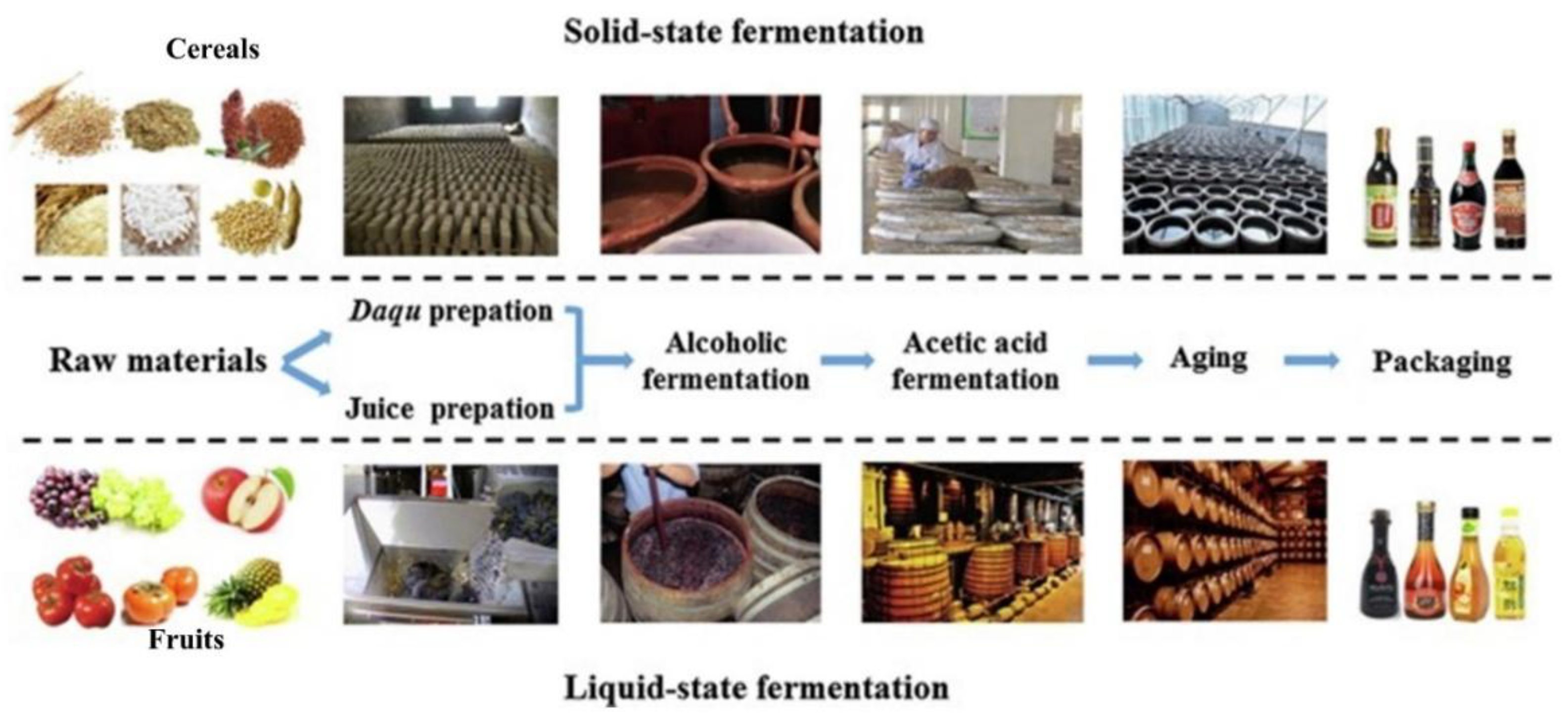
Figure 2.
Vinegar fermentation mechanisms help to monitor the final vinegar quality. (A) Fermentation mechanism for the production of traditional Chinese vinegar (Reproduced from Zhang, et al. [113] with permission from Food Chemistry, copyright 2024). (B) Environmental factors that affect reaction mechanisms of core microorganisms and vinegar quality during the vinegar fermentation (Reproduced from Shi, et al. [111] with permission from LWT, copyright 2022).
Figure 2.
Vinegar fermentation mechanisms help to monitor the final vinegar quality. (A) Fermentation mechanism for the production of traditional Chinese vinegar (Reproduced from Zhang, et al. [113] with permission from Food Chemistry, copyright 2024). (B) Environmental factors that affect reaction mechanisms of core microorganisms and vinegar quality during the vinegar fermentation (Reproduced from Shi, et al. [111] with permission from LWT, copyright 2022).
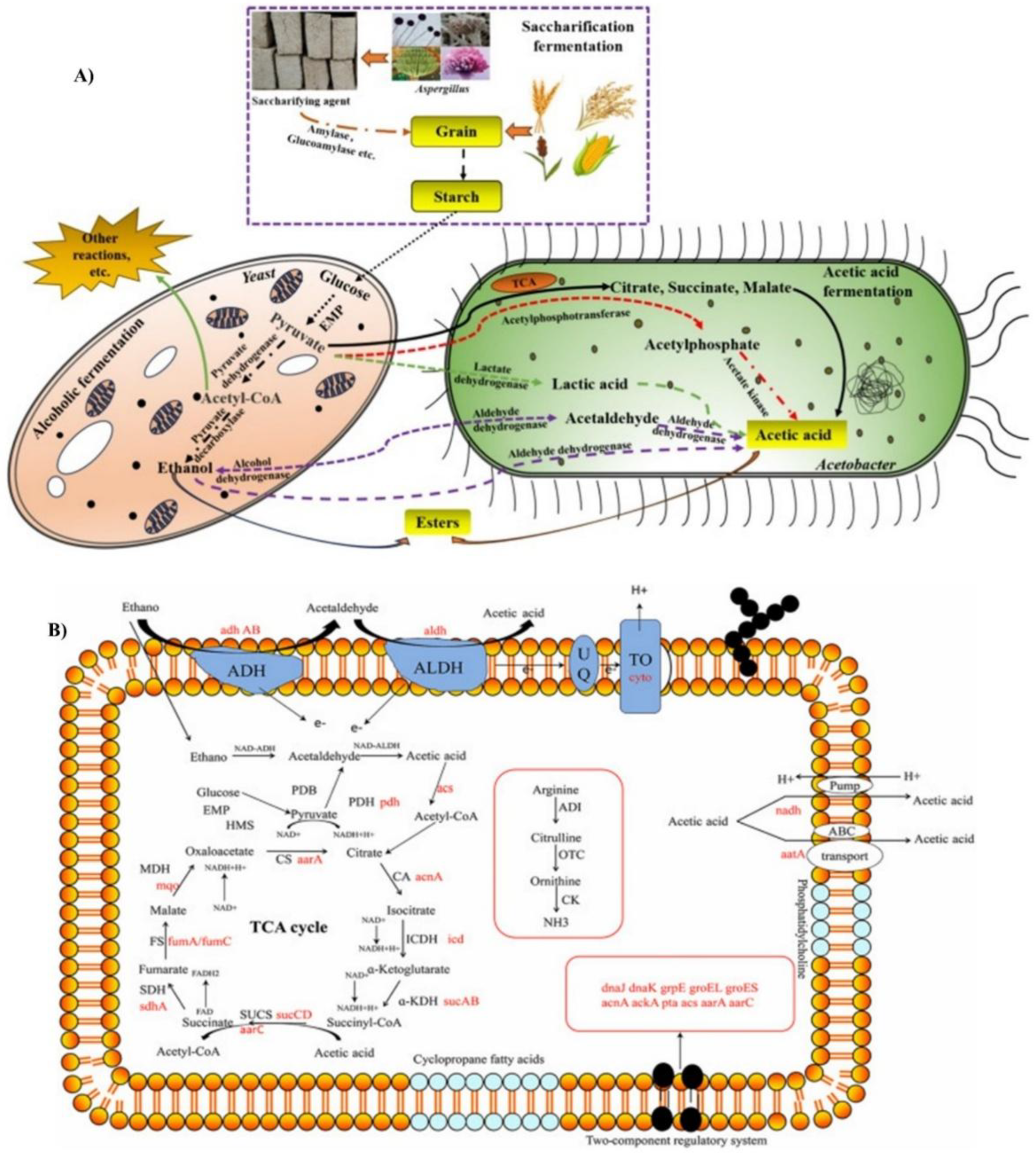
Figure 3.
Functional qualities and health benefits of vinegar for human consumption.
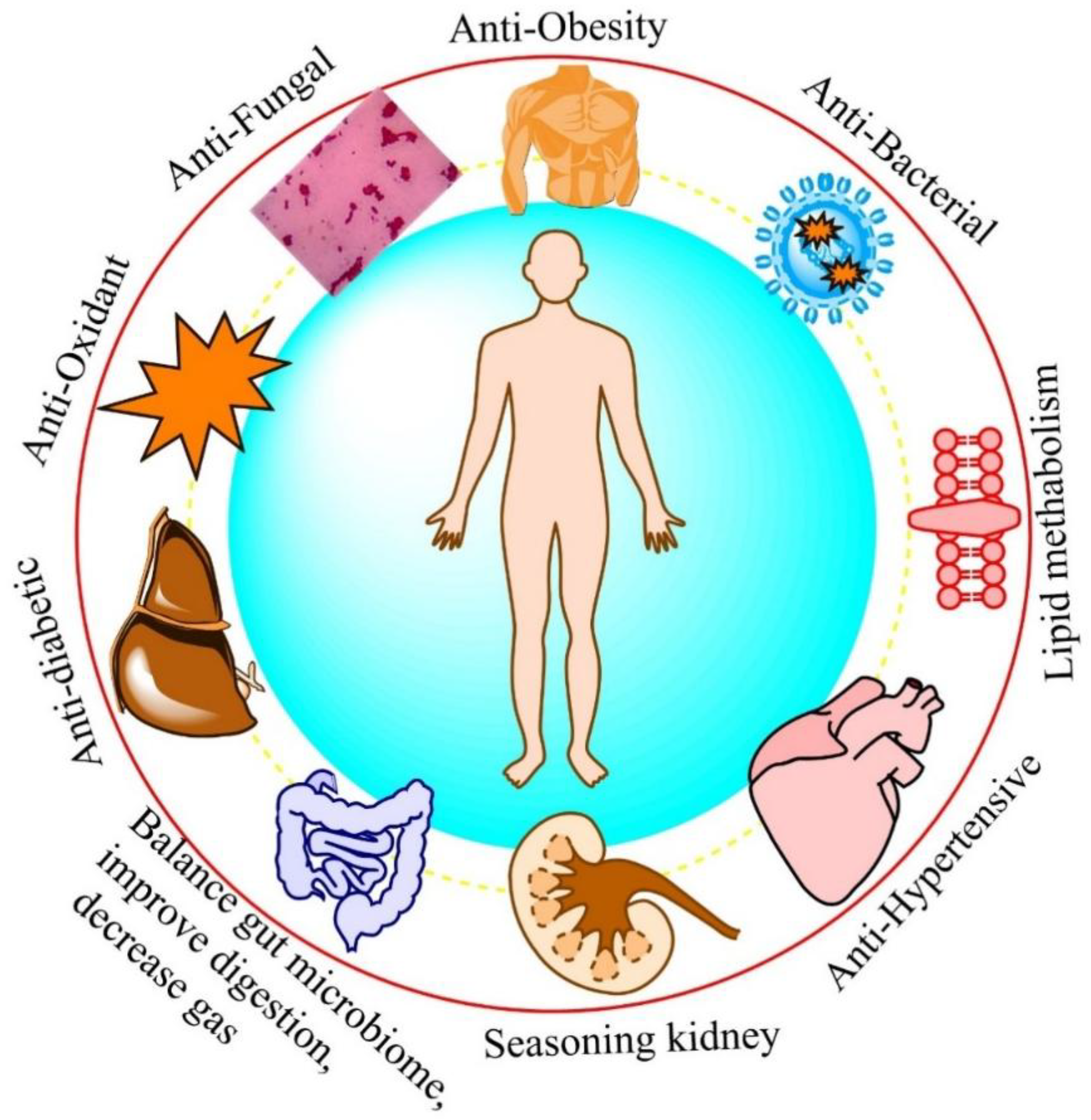

Table 1.
Organic acids in different types of vinegars.
| Vinegars | Organic acids | References |
|---|---|---|
| Traditional balsamic vinegar | Citric, tartaric, gluconic, malic, succinic , lactic and acetic, formic , and tartaric acids | [53,54,55] |
| Alcohol vinegar | Acetic acid | [56] |
| Cider vinegar | Acetic, citric, formic, lactic, malic, and succinic acids | [57] |
| Wine vinegar | Tartaric, malic, lactic, acetic, citric, succinic and formic acids | [47,57] |
| Tomato vinegar | Acetic, citric, formic, lactic, malic, and succinic acids | [57,58] |
| Plum vinegar | Acetic, tartaric, and lactic acids | [59] |
| Balsamic vinegar | Acetic, formic, citric, lactic, malic and succinic, tartaric, propanoic acid, 2 methylpropanoic acid, butanoic acid, 3-methylbutanoic acid, (E)- but-2-enoic acid, hexanoic acid, octanoic acid, 4-oxopentanoic acid, furan-2-carboxylic acid and 2-phenylacetic acids | [50,54,60] |
| Persimmon vinegar | Acetic, lactic, quinic, tartaric, propanedioic , malic, and succinic acids | [48] |
| Malt vinegar | Acetic, citric, lactic, and succinic acids | [56] |
| Apple vinegar | Acetic, lactic, quinic, tartaric, propanedioic, malic, succinic and citric acids | [48] |
| Kiwifruit vinegar | Acetic, lactic, quinic, tartaric, propanedioic, malic, succinic and citric acids | [48] |
| Sherry vinegar | Acetic, tartaric, lactic, malic, and citric acids | [61] |
| Zhenjiang vinegar | Acetic, 2-methyl propionate, 3-methylbutanoic, caproic, octanoic and propionic acids | [46] |
| Shanxi aged vinegar | Acetic, propionic, butyric acid, 3-methyl butyric, pentanoic, hexanoic, lactic, succinic, tartaric and citric acids | [49] |
| Black wolfberry vinegar | Lactic, acetic, sorbic, ascorbic, succinic, oxalic, malic, citric, tartaric and γ-aminobutyric (GABA) acids | [45] |
Table 2.
Phenolic compounds in various types of vinegars.
| Vinegar types | Phenolic compounds | References |
|---|---|---|
| Traditional balsamic vinegar | Furan-2-carboxylic, 5 hydroxyfuran-2-carboxylic,4-hydroxybenzoic, vanillic, protocatecuic, syringic, isoferulic, pcoumaric, gallic, ferulic and caffeic acids |
[85] |
| Balsamic vinegar | Protocatechuic, gallic, p-coumaric, syringic, caffeic, ferulic, vanillic, salicylic, homovanillic, hydroxytyrosol, gentisic, p-carboxyphenol, protocatechuic, sinapinic and p-hydroxybenzoic acids and phenol, catechin, aesculetin, epicatechin, vanillin, coniferyl alcohol, 4-methylcatechol, syringaldehyde, isopropiovanillone, scopoletin, aceto-/isoacetovanillone, isopropiosiringone, acetosyringone, isoacetosiringone, syringol, coniferylaldehyde, sinapinaldehyde, tryptophol, o-vanillina, methyl vanillate, (m + p)-cresol, 4-ethylcatechol, ocresol, vanillyl ethyl ether, guaiacol, 4-methylsyringol, 4-vinylphenol, ethyl vanillate, 3,4- xylenol, 4-vinylguaiacol, ellagic acid, 4-ethylphenol, 4-methylguaiacol, 4-ethylguaiacol, 4-allylsyringol, eugenol and isoeugenol |
[85,86] |
| Grape vinegar | Gallic, chlorogenic, caffeic, syringic, and ferulic acids and catechin and epicatechin | [65] |
| Sherry vinegar | Gallic acid, Ellagic acid, protocatechuic, caffeoylquinic acid, protocatechualdehyde, tyrosol, p-OH-benzoic acid, catechin, p-OH-benzaldehyde, siringic, vanillin, caftaric, cis-p-coutaric, trans-p-coutaric, fertaric, caffeic, cis-p-coumaric, trans-p-coumaric, ferulic acids and quercetin 3-o-galactoside, quercetin 3-oglucuronide, kaempferol 3-o-galactoside, pelargonidine 3-o-galactoside, pelargonidine 3- o-robinobioside and aromadendrin 7-o-glucoside | [87,88] |
| Apple vinegar | Gallic, vanillic, chlorogenic, caffeic, p-coumaric, trans-ferulic, 4-pcoumaroylquinic, pcoumaroylquinic, p hydroxybenzoic, and protocatechuic acids, and (−)-epicatechin gallate and phloridzin |
[48,89] |
| Apple cider vinegar | Gallic acid, catechin, epicatechin, chlorogenic acid, caffeic acid, and p-coumaric acid | [69] |
| Persimmon vinegar | Gallic, chlorogenic, caffeic, p-coumaric, trans-ferulic, Hydroxycinnamic, acids, (−)-epicatechin gallate, gallocatechin gallate, procyanidin A2, rutin epigallocatechin phloridzin, catechin hydrate, flavanols | [48,82] |
| Red wine vinegar | Gallic acid, protocatechuic acid, caffeic acid, vanillic acid, catechin, epicatechin, caftaric acid, syringic acid, ellagic acid, p-coumaric acid, ferulic acid and chlorogenic acid | [65,68] |
| Shanxi aged vinegar | Protocatechuic, p-hydroxybenzoic, salicylic, dihydrosinapic, p-coumaric, sinapic, dihydroferulic and ferulic acids | [90] |
| Pomegranate vinegar | Gallic acid, punicalagin, catechin, vanillic acid, syringic acid, galloylglucoside, protocatechuic acid, ethyl gallate, ellagic acid, chlorogenic acid, caffeic acid, p-coumaric acid, ferulic acid, ferulic acid hexoside, tyrosol and trans-p-Coumaric derivates | [79] |
| Zhenjiang aromaticvinegar | Gallic, vanillic, chlorogenic, p-coumaric and trans-ferulic acids, epicatechin and catechin hydrate | [48] |
Table 3.
Types of vinegar and quality production methods.
| Types of vinegars | Bacterial strain used for fermentation | Methods employed | Quality improvement applied | References |
|---|---|---|---|---|
| Black vinegar | Acetobacter pasteurianus | Saccharification of rice by Aspergillus oryzae | A year of aging | [114] |
| Cereal vinegar | Acetobacter sp. | Submerged fermentation of rice wine (Oryza sativa L. | [115] | |
| Balsamic vinegar | Gluconacetobacter europaeus and/or Acetobacter malorum | Spontaneous acetification cooked of grape must using seed-vinager | Aged in wood barrels | [116] |
| White and red wine vinegar | Gluconacetobacter europaeus and/or Acetobacter malorum | Surface culture or submerged culture acetification | Aged in wood barrels (oak, chestnut, acacia and cherry) | [117] |
| Mature vinegar (Zhenjiang vinegar maturation) |
Acetobacter, Lactobacillus, Gluconoacetate, Bacillus | Surface culture or submerged culture acetification | Aging by ultrasonic treatment | [46,118] |
| Aromatic vinegar (Zhenjiang aromatic vinegar) | Lactobacillus acetotolerans, Lactobacillus plantarum, Lactobacillus reuteri, Lactobacillus fermentum, Acetobacter pasteurianus | Solid-state fermentation | Addition of ground herbs | [22] |
| Fruit vinegar | Wild acetic bacteria strains | Acetification of pineapple pulp and peel wines using wild acetic bacteria strains | Leaf extract of Red-Jambo, Syzygium malaccense | [112] |
Table 4.
health benefits of vinegar.
| Vegetable vinegars | Target activity | Objective of the study | Main findings | References |
|---|---|---|---|---|
| Leaves of Eucommia ulmoides | Antibacterial potential | Study the mechanism of action against B. subtilis | -↗antibacterial effect and yeast - Cell wall and cell membrane were damaged - ↗ increasing the cell permeability |
[128] |
| Grape, apple, Artichoke, pomegranate, Apple-Lemon, Hawthorne and sour cherry | Antimicrobial potential and antiradical activity | Distinguish between the traditional and industrailised Turkish vinegars. | -↗ antimicrobial activity in traditional vinegars compared to industrial ones -↗ antiradical potential of pomegranate vinegars compared to industrial ones |
[157] |
| Black vinegar | Antiox. Act and in vivo lipid-lowering | Investigate these activities via a hamster model | - ↘ weight gain -↗ lipid contents and hepatic Antiox. Act |
[158] |
| Tomato | Lipid and Glu metabolic enzyme | -Mechanism investigation -Arbitrated the anti-insulin and anti-obesity effect |
-↘ fat accumulation -Variations arbitrated by PPARa and AMPK increased expression. |
[159] |
| Tomato | Anti-obesity impact | Assess the efficiency in lipid accumulation | -Inhibition of lipid formation. | [160] |
| Cereal | Hepatoprotective impact | Explore the hepatoprotective impact | Changes in gut microbiota | [161] |
| Cereal | Impact on the spontaneous colitis impact | Explore the process of spontaneous colitis and investigate the variations in the in the epithelial wall function, inflammation and gut microbiota. | -Improvement of epithelium damage, -Inhibition of myeloperoxidase activity and malondialdehyde (MDA) |
[162] |
| Shanxi-aged vinegar | Anti-inflammatory activities | Investigate the anflammatory mechanism | -Enhancement of the lipid, inflammatory stress and oxidative stress. | [163] |
| Shanxi-aged vinegar | Impact on gut microbiome and metabolome | Investigate the immune/inflammation factors and explore the in vivo impact of vinegar on gut microbiome and metabolome. | - ↘Inflammatory factors - Vinegar consumption changed gut microbiota structure |
[164] |
| Orange, mango, cherry and banana | Antioxidant potential | Investigate the kinetics, chemical profile and Antiox. Act | -Total antioxidant activity was assessed at 8 and 40 times greater than a commercial vinegar. | [165] |
| Orange | Antioxidant potential | Investigate the fluctuations of chemical profile and Antiox. Act during fermentation. | Antiox. Act was linked to ascorbic acid and phenolic compounds levels. | [166] |
| Rosehip fruit (Rosa canina L.) | Antioxidant potential | Expose the chemical profile and Antiox. Act | -↗ of antioxidant activity linked to the ↘ of flavonoids | [167] |
| black tea | Antioxidant potential | -Evaluation the chemical profile and Antiox. Act | - ↗of organic acids contents, volatile compounds and the antioxidant activity | [168] |
| Apple Cider | Antioxidant potential | Investigate the change of antioxidant properties and bioactive compounds | →Antioxidant activity and phenolic substances during the acetic acid fermentation. | [169] |
| green jujube | Antioxidant potential | Study the impact of the in vitro gastrointestinal digestion on the Antiox. Act and hypolipidemic potential | -↗ correlation between Antiox. Act, TPC, TFC, and total acid contents -weak correlation with cholesterol adsorption capacity/antioxidant capacity |
[38] |
| nipa palm | Antioxidant and anti-tyrosinase activities |
-Characterize chemical profile, Antiox. Act, and anti-tyrosinase potential. -Perform molecular docking study and molecular dynamic simulation |
-Concentration-dependent anti-tyrosinase activity and antioxidant potential | [170] |
| Wood | Antimicrobial and anti-inflammatory potential | -Asses the in vivo inflammatory activity of the mammalian macrophages and antimicrobial activity against pathogenic bacteria and fungi | -Stimulation of mammalian macrophages by lipopolysaccharide -High antimicrobial activity but no anti-bacteriophage activity |
[171] |
| Cudrania tricuspidata Fruits (CTFV) | Anti-Inflammatory potential | In vitro anti-inflammatory impacts | CTFV reduced inflammatory reaction by improving inflammatory factors | [142] |
| vinegar-baked Radix Bupleuri (VBCP) | Anti-Inflammatory potential | -study the impact of extraction techniques on the physicochemical properties and biological activities of VBCP | ammonia-assisted extraction is an effective tool to achieve high anti-inflammatory | [172] |
| Apple | antioxidant, antimicrobial, antidepressant and anti-inflammatory activities |
Study the biological activity of our different apple cultivars, as well as physicochemical attributes and chemical composition |
-↗ antidepressant impact -effective against bacteria, -↗ antioxidant activity |
[173] |
| Curcuma phaeocaulis | anti-angiogenic effect | Evaluation of anti-angiogenic impact and toxicity of C. phaeocaulis via zebrafish and rat models. | -↘ toxicity and ↗anti-angiogenic activity | [174] |
Disclaimer/Publisher’s Note: The statements, opinions and data contained in all publications are solely those of the individual author(s) and contributor(s) and not of MDPI and/or the editor(s). MDPI and/or the editor(s) disclaim responsibility for any injury to people or property resulting from any ideas, methods, instructions or products referred to in the content. |
© 2025 by the authors. Licensee MDPI, Basel, Switzerland. This article is an open access article distributed under the terms and conditions of the Creative Commons Attribution (CC BY) license (http://creativecommons.org/licenses/by/4.0/).
Copyright: This open access article is published under a Creative Commons CC BY 4.0 license, which permit the free download, distribution, and reuse, provided that the author and preprint are cited in any reuse.


