

Submitted:
31 January 2025
Posted:
03 February 2025
You are already at the latest version
Abstract
Overweight and obesity are major public health concerns, often leading to increased cardiovascular risk. This eight-week intervention study examined whether regular consumption of two natural bilberry products could improve body composition and li-pid profiles in overweight/obese women. A total of 30 participants (aged 50–60 years) were assigned to consume either 125 mL/day of 100% bilberry juice or 10 g/day of 100% bilberry fibre, while maintaining their habitual diets and lifestyles. Although no signif-icant changes were found in anthropometric parameters or blood pressure in either group, both interventions reduced LDL-C and increased HDL-C. Surprisingly, total cholesterol levels rose (in the bilberry juice group from 6.41 ± 1.23 mmol/L to 6.94 ± 1.30 mmol/L (p < 0.001), in the fibre group from 6.06 ± 1.39 mmol/L to 6.43 ± 1.05 mmol/L (p = 0.046), likely due to elevated HDL-C (p < 0.001) overshadowing the drop in LDL-C (p < 0.05). Triacylglycerols did not change significantly and were still within the reference range. Notably, the bilberry juice group experienced a significant reduc-tion in atherogenic small dense LDL (sdLDL) subfractions, suggesting a favourable shift in cardiovascular risk factors. These findings highlight the potential of bilber-ry-based products as a supportive strategy for improving lipid profiles in over-weight/obese women.
Keywords:
overweight
; obesity
; bilberry
; juice
; fibre
; lipid profile
; sdLDL
; intervention
1. Introduction
Obesity is a complex chronic condition characterized by excessive adipose tissue accumulation, which can adversely affect health. In 2022, an estimated 2.5 billion adults worldwide (43% of individuals aged 18 years and older) were classified as overweight, with 890 million (16%) meeting the criteria for obesity [1]. Obesity is frequently associated with detrimental metabolic, biomechanical, psychosocial, and economic consequences [2]. Obesity and its related comorbidities significantly impact quality of life and reduce life expectancy [3]. Among the most commonly reported risks associated with obesity are cardiovascular diseases (CVD), in particular coronary heart disease and heart failure [4,5,6,7]. Sex-specific differences in obesity may carry significant implications for cardiovascular health. Halland et al. [8] reported that in the FATCOR study, the majority of obese and overweight individuals exhibited subclinical heart disease. This condition may contribute to the poorer prognosis associated with obesity. Notably, the prevalence of subclinical heart disease was higher among women than men.
The risk of CVD was 40% higher in overweight women, 60% higher in women with overall obesity, and 30% higher in women with abdominal obesity compared to men [9]. Increased overall adiposity and abdominal fat are associated with multiple cardiovascular pathological disorders, manifested in electrocardiographic, hemodynamic, structural, and functional changes [10].
Atherogenic dyslipidemia is strongly associated with obesity and plays a significant role in the increased risk of atherosclerosis and coronary artery disease. This dyslipidemic condition is characterized by high plasma concentrations of triglycerides and apolipoprotein (apo) B-containing lipoproteins and low concentrations of high-density lipoprotein (HDL-C) [11]. Atherosclerosis, the primary cause of CVD, is linked to chronic inflammation and oxidative processes that result in the modification of atherogenic lipoproteins [12]. Elevated LDL (sdLDL) particle levels are associated with an increased risk of CVD [13]. These particles easily penetrate the subendothelial space and attach to the arterial wall, thereby increasing the risk of atherosclerosis [14]. To improve risk factors associated with dyslipidemia, a dietary strategy focused on heart-healthy eating habits is recommended, emphasizing plant-based foods including vegetables, fruits, whole grain products, legumes and nuts [15]. These foods contain phytochemicals or produce secondary metabolites such as polyphenols, which may be considered non-essential nutrients with medicinal importance [16]. Polyphenols have demonstrated the ability to improve endothelial function, prevent abnormal platelet aggregation, reduce inflammation, and enhance the plasma lipid profile, all contributing to better cardiovascular health [17]. Several studies investigating the consumption of berries or berry-based products rich in bioactive compounds have demonstrated statistically significant positive effects on health when consumed regularly. These effects include notable improvements in cardiovascular health parameters [18,19,20,21,22], particularly bilberry consumption, showing substantial benefits [19,23].
Bilberry (Vaccinium myrtillus L.) is recognized as a functional food, with its fruits resembling small dark blueberries (Vaccinium corymbosum L.). The distinctive colouration of bilberries is attributed to their high anthocyanin content, which is also linked to their beneficial health effects [24]. However, no clinical studies have been conducted on the relationship between the intake of 100% bilberry fruit juice or bilberry fibre and the modulation of lipid profile and sdLDL subfractions in overweight/obese women.
This study aims to test the hypothesis that regular short-term consumption of 100% bilberry juice or bilberry fibre, both rich sources of polyphenols and other bioactive compounds, may have beneficial effects on the modulation of CVD risk factors (e.g., improvement of body composition parameters, increase HDL-C, reduction of TC, LDL-C, TAG, and the atherogenic LDL3-7 subfraction) in middle-aged women with overweight/obesity. To test this hypothesis, the female Slovak University of Agriculture employees volunteered to regularly drink 100% bilberry juice or bilberry fibre daily for 8 weeks. Their body composition and lipid profiles (TC, LDL-C, HDL-C TAG), LDL subfractions (1-7), including lipoprotein indexes TC/HDL ratio, LDL/HDL ratio and AIP index were monitored before (pre) and after (post) bilberry products intervention. While studies exist on mixed berry interventions, pure bilberry juice/fibre with direct sdLDL measurements in overweight/obese women is still underreported.
2. Materials and Methods
2.1. Participants and Study Design
The aim of this single-arm pre-post intervention study [25] was to evaluate the effect of supplementation with 100% natural bilberry products on lipid profile and other CVD risk factors in overweight/obese women. For logistical reasons, the control group was not included. The method of selecting volunteers was slightly modified as reported by Habanova et al. (2022). Participants had to meet the following inclusion criteria: Willingness to participate in an 8-week interventional program. Overweight/obese status based on anthropometric parameters (for overweight BMI 25-30 kg/m², for obese BMI >30 kg/m²). Presence of one or more CVD risk factors, such as an abnormal lipid profile (TC > 5.20 mmol/L, LDL-C > 3.4 mmol/L, HDL-C < 1.03 mmol/L, and/or TAG > 1.70 mmol/L), hypertension (systolic blood pressure >140 mm Hg, or diastolic blood pressure >90 mm Hg), and/or the presence of atherogenic small-dense LDL (LDL3-7 subfractions). Aged 50–60 years. Stable body weight (±3 kg) during the last 3 months. Alcohol consumption of <30 g/day. Exclusion criteria included the inability to give informed consent. Chronic diseases (e.g., CVD, inflammatory diseases, diabetes, cancer, and allergy). Thyroid abnormalities or active liver disease. Use of corticosteroids. Self-reported high concentration of fat or lipid in the blood, or high blood pressure treated with medication. Use of cholesterol-lowering medicines or supplements. Pregnancy. Tobacco, alcohol, or drug addiction. Regular use of antacids or laxatives (at least once a week). Irregular or unbalanced dietary patterns. Food intolerance or allergy to polyphenols. Intake of any berries, berry products, or nutritional supplements (e.g., vitamins, minerals, antioxidants, and flavonoids). Parallel participation in other dietary intervention studies.
This study was conducted according to the guidelines of the Declaration of Helsinki and approved by the Slovak University of Agriculture in Nitra, Institute of Nutrition and Genomics, Slovakia, and by the Ethical Committee of the Specialized Hospital of St. Svorad Zobor in Nitra, Slovakia (Study No. 4/071220/2020). Written informed consent was obtained from all participants before enrolment. Additionally, they were informed about potential risks before the intervention began.
2.2. Intervention
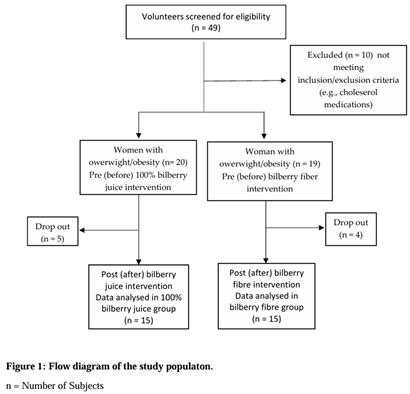
A group of 30 adult overweight/obese women (mean age 55.83 ± 2.95 years) participated in an 8-week pre-post intervention program (Figure 1). The participants were divided into two groups: one group consumed 125 mL/day of 100% organic bilberry juice. In contrast, the other group consumed 10 g/day of 100% organic bilberry fibre in their regular diets. The doses of juice/fibre were determined based on the recommendations of the producer. Throughout the study, the participants were instructed to maintain their habitual diet, physical activity, and overall lifestyle without making significant changes. The bilberry products were supplied by Wellberry (Slovak Republic) and were made in Slovakia from 100% pure bilberry (Vaccinium myrtillus L.). The bilberry juice was gently pasteurized at 72°C and labelled NFC (not from concentrate), while the dietary fibre was derived from bilberry pomace left over after commercial juice processing. Both products were free of additives and did not contain any common allergen.
The concentration of some important bioactive substances, antioxidant activity, and vitamin C was quantified in the products used. The total phenolic content was determined according to Lachman et al. [26] using the Folin-Ciocalteu method with a UV-1800 Spectrophotometer (Shimadzu, Kyoto, Japan) and expressed as gallic acid equivalent (mg GAE·g⁻¹). The total anthocyanin content was determined using a slightly modified method based on Lapornik et al. [27]. The content of individual phenolic substances was determined by high-performance liquid chromatography (HPLC-DAD) using an Agilent 1260 Infinity HPLC (Agilent Technologies GmbH, Waldbronn, Germany) following a slightly modified method from Gabriele et al. [28]. Antioxidant activity was measured using the stable radical 2,2-diphenyl-1-picrylhydrazyl (DPPH) assay, with results expressed as the percentage of radical inhibition [29]. Vitamin C concentration was determined using a Waters Separations Module 2695 HPLC system with a 2996 UV detector [30]. The reported results represent the average of multiple replicates of individual concentrations.
2.3. Anthropometric Measurements
By trained personnel, anthropometric measurements were performed at the beginning of the research (week 0, pre-intervention) and the end (8 weeks, post-intervention). Body height (cm) was measured in the upright standing, without shoes, using calibrated outpatient electronic medical scales (Tanita WB-3000, Tanita Co., Tokyo, Japan). Body weight (kg), body mass index (BMI; kg/m²), waist circumference (cm), waist-to-hip ratio (WHR index), fat-free mass (FFM; kg), fat-free mass to total mass (FFM; %), skeletal muscle mass (SMM; kg), body fat mass (BFM; kg), body fat percentage (PBF; %), and visceral fat area (VFA; cm²) were measured using multi-frequency bioelectrical impedance analysis (MFBIA) with the InBody 720 device (Biospace Co., Seoul, Korea). The following optimal values of the monitored body composition parameters were determined: BMI 18.5 – 24.99 kg/m², waist circumference < 80 cm, WHR < 0.85, FFM (%) 70 – 80%, PBF 18 – 28%, and VFA < 100 cm². Women with a BMI of 25 – 30 kg/m² were categorized as overweight, while those with a BMI > 30 kg/m² were categorized as obese [31]. Systolic and diastolic blood pressure (measured in millimetres of mercury, mm Hg) and pulse were measured using a Sphygmomanometer DM-3000 (Nihon Seimitsu Sokki Co., Nakago Shibukawa Gunma, Japan). At the same time, participants remained seated in a relaxed position, having rested for at least 15 minutes before each measurement. Blood pressure values were compared to the reference values for systolic pressure (<120 mm Hg) and diastolic pressure (< 80 mm Hg) according to the American College of Cardiology/American Heart Association guidelines [32]. All body composition and blood pressure measurements were conducted in the anthropometric laboratory of the Institute of Nutrition and Genomics at the Slovak University of Agriculture in Nitra, Slovakia. Pre- and post-intervention analyses were consistently performed under the same conditions to minimize random errors.
2.4. Preparation of Blood Samples
Blood samples were collected pre-and post-intervention. Venous blood was drawn from the peripheral cubital vein in the elbow socket into two S-Monovette tubes: one containing ethylenediaminetetraacetic acid (EDTA; 2.7 mL) and another containing serum gel (7.5 mL). The blood collection was performed in the morning after an 8-hour fasting period. Whole blood was centrifuged using a Hettich® MIKRO 220R centrifuge (Andreas Hettich GmbH & Co., Germany) under the following conditions: EDTA tubes at 1800 rpm for 15 minutes and serum gel tubes at 3000 rpm for 10 minutes. This process ensured the separation of blood plasma (from EDTA tubes) and blood serum (from serum gel tubes).
2.5. Clinical Parameters
Analyses of lipid profile, glucose, and other parameters from blood serum were performed on thawed samples using a biochemical analyzer, BioMajesty® JCA-BM6010/C (JEOL Ltd., Tokyo, Japan), with commercially available analytical kits from DiaSys (Diasys Diagnostic System GmbH, Holzheim, Germany) and Randox (Randox Laboratories Ltd., Crumlin, UK), following the manufacturer's instructions. From the measured values of total cholesterol (TC), triacylglycerols (TAG), LDL cholesterol (LDL-C), and HDL cholesterol (HDL-C), the TC/HDL ratio, LDL/HDL ratio, and atherogenic index of plasma (AIP index) were calculated. The AIP index was calculated as the logarithmically converted TAG/HDL ratio: log(TAG/HDL). The lipid profile values were compared to reference values from NCEP ATP III [33], while the TC/HDL and LDL/HDL ratios were assessed according to Millán et al. [34] and the AIP index according to Dobiásová [35]. Lipoprotein subfractions—including VLDL, IDL 1–3, large LDL (subfractions LDL1 and LDL2), and atherogenic small-dense LDL (sdLDL; subfractions LDL3-7)—were determined using the Lipoprint® system (Quantimetrix Corp., Redondo Beach, CA, USA) with the Quantimetrix Lipoprint System LDL Subfractions Kit (Lipoprint LDL Kit, Quantimetrix, Redondo Beach, CA, USA). Based on the results from the Lipoprint® system, subjects were divided into two groups as described by Zitnanova et al. [35]: atherogenic (presence of LDL3-7 subfractions ≥ 6 mg/dL) and non-atherogenic (absence of LDL3-7 subfractions < 6 mg/dL). The Lipoprint® system provides measured values in mg/dL, which we then converted to mmol/L using the coefficient 0.0259 (mg/dL x 0.0259). Pre- and post-intervention parameters were compared using the methodology described by Harris et al. [36] to evaluate potential causal relationships.
2.6. Statistical Analysis
Data were processed and statistically analysed using STATISTICA 13 (TIBCO Software, Inc., Palo Alto, CA, USA) and Microsoft Excel 2016. Statistical tests included the Shapiro-Wilk test for normality, two-sample and paired t-tests, analysis of variance (ANOVA), and post hoc Tukey's test. Results are presented as mean ± standard deviation (SD), and statistical significance was set at p < 0.05.
3. Results
3.1. The Bioactive Compounds in 100% Bilberry Juice and Dietary Fibre of Bilberry
The concentrations of monitored bioactive compounds in bilberry juice and bilberry dietary fibre (including total phenolic content, total anthocyanins, caffeic acid, coumaric acid, ferulic acid, rutin, myricetin, resveratrol, quercetin, vitamin C, and antioxidant activity) are shown in Table 1. Some biologically active substances (such as ferulic acid, rutin, and vitamin C) were found in higher concentrations in bilberry juice. In contrast, others (such as total phenolic content, total anthocyanins, caffeic acid, coumaric acid, myricetin, resveratrol, quercetin, and antioxidant activity) were present in higher concentrations in bilberry dietary fibre.
3.2. Characteristics of Study Participants
3.2.1. Anthropometric Parameters and Blood Pressure Measurements
A group of 30 overweight/obese adult women (mean age 55.83 ± 2.95 years) participated in an 8-week pre-post intervention program with bilberry product supplementation. The women were divided into two groups: one consumed 125 mL/day of 100% organic bilberry juice, and the second consumed 10 g/day of 100% organic bilberry fibre as part of their regular diets. The monitored parameters during this intervention are shown in Table 2. Although some values of the anthropometric parameters and blood pressure changed, these changes were not statistically significant in either group.
3.1.2. Changes in Basic Lipid Profile Parameters and Lipoprotein Indexes
The mean total cholesterol levels were above the reference values at the start of the study. After the 8-week intervention, a further increase was observed in both groups. In the group consuming bilberry juice, the mean TC value increased from 6.41 ± 1.23 mmol/L to 6.94 ± 1.30 mmol/L (p < 0.001), while in the fibre group, it increased from 6.06 ± 1.39 mmol/L to 6.43 ± 1.05 mmol/L (p = 0.046). Simultaneously, a statistically significant decrease in LDL-C (p < 0.05) and a significant increase in HDL-C (p < 0.001) were observed in both groups (Table 3). The triacylglycerol levels in both study groups remained within the reference range, and no statistically significant changes were detected following bilberry supplementation.
In addition, there was a statistically significant improvement in the TC/HDL and LDL/HDL ratios. In the bilberry juice group, the TC/HDL ratio decreased significantly from 3.69±0.92 to 3.33±0.63 (p=0.006), while the LDL/HDL ratio decreased from 2.15±0.71 to 1.65±0.49 (p<0.001). Similarly, in the fibre group, there was a significant reduction in the mean TC/HDL ratio from 3.92±0.90 to 3.48±0.72 (p<0.001), as well as in the LDL/HDL ratio from 2.34±0.71 to 1.69±0.49 (p<0.001). However, the AIP index in both groups was not significantly affected (p>0.05).
3.1.3. Changes in Lipoprotein Subfractions
In the study group, the presence of atherogenic sdLDL (LDL 3-7 subfraction) was detected using the Lipoprint® system (Quantimetrix, CA, USA) before the intervention in 12 participants in the juice group and 9 participants in the fibre group (Table 4). Statistically significant changes following the bilberry intervention were observed in the bilberry juice group (p < 0.05).
In response to the intervention, Figure 2 shows a typical lipoprotein profile for a woman with phenotype B. Before the intervention, the women had values for TC (6.79 mmol/L), LDL-C (4.35 mmol/L), HDL-C (1.47 mmol/L), LDL/HDL ratio (2.96 mmol/L) and LDL 3-7 (0.5439 mmol/L). These levels indicate an increased risk of CVD. The intervention with 100% bilberry juice for 8 weeks significantly improved the values of all monitored parameters: LDL-C (3.83 mmol/L), HDL-C (1.77 mmol/L), the value of the LDL/HDL ratio (2.16 mmol/L) and LDL 3-7 (0.1036 mmol/L). The TC value increased slightly (6.88 mmol/L) due to the increase in HDL-C.
4. Discussion
Berries have garnered increasing attention for their potential health benefits, largely due to their high content of bioactive compounds [38]. Several studies highlight the beneficial properties of bilberries (Vaccinium myrtillus L.) [39,40] and blueberries (Vaccinium corymbosum L.) [41,42], both of which are economically significant. These berries are rich in antioxidants and other beneficial compounds, which drive consumer demand and market growth despite competition from alternative crops [43].
The bilberry products used in this intervention were of commercial quality, with no added sugar, artificial sweeteners, colouring, or preservatives. The results of quantitative analyses support the presence of significant health-promoting substances in bilberries and their products, with concentrations of total phenolics, total anthocyanins, and other selected polyphenolic compounds detailed in Table 1. The consistency of clinical evidence regarding the relationship between the consumption of fruit products, such as polyphenol-rich juices, and improved cardiovascular health has been reviewed [44,45].
The popularity of blueberries continues to grow worldwide, driven by their increasing consumption not only in fresh form but also in processed forms. The significance of blueberries for the processing industry is also evident, with the majority of blueberries being processed through freezing or juicing. Drying is also receiving attention. However, it is important to recognize that each processing method induces changes, as each step in the processing of blueberries affects the quantity and quality of biologically active compounds in different ways [46].
The analysis results reveal notable differences between the juice and fibre samples. The total phenolic content was 2.29±0.01 mg/g in the juice and 32.81±0.15 mg/g in the fibre. Blueberries are a rich source of anthocyanins, which constitute more than half of the total polyphenol content and are considered to have the greatest impact on consumer health [47]. In the samples used in this study, the following anthocyanin concentrations were observed: 1.48 ± 0.03 mg/g in juice and 6.82±0.06 mg/g in fibre. In the study by Mendelová et al. [48] the range of anthocyanin concentrations was found to be from 1.93 g/kg to 3.95 g/kg. Wu et al. [49] found that the anthocyanin content in blueberries ranged from 2.50 g/kg to 4.95 g/kg. The lower anthocyanin concentration in the juice compared to the fibre may be attributed to the pasteurization process, which can lead to the decomposition of anthocyanins at higher temperatures during processing. Data from the study by Kalt et al. [41] also indicate that blueberry processing can change the phytochemical profile. Heat, oxygen, and enzymes can break down the phytochemicals in blueberries during processing, with the most significant losses occurring in anthocyanins and vitamin C. Berries contain vitamins A, C, and E, which act as antioxidants and can help reduce inflammation [50]. We also detected vitamin C in our samples. The fibre sample contained 1.44 ± 0.12 µg/g, while the juice sample contained 126.40 ± 0.13 µg/g. The antioxidant activity of the products was 49.30±0.56% radical inhibition in the juice and 67.20±0.41% in the fibre. The high antioxidant activity is attributed to the positive correlation of polyphenolic compounds present in the fruit [51,52].
Blueberries also contain other flavonoids such as catechin, caffeic acid, ferulic acid, rutin, myricetin, and quercetin, some of which were found in our samples [53,54]. According to the data, the mean body weight increased slightly after the 8-week intervention compared to baseline, although the changes were not statistically significant (Table 2). Other body composition parameters also showed no significant changes. Several studies have reported similar results [19,20,55,56,57].
The effect of blueberry product supplementation on lipid profile modulation in overweight/obese women was also investigated, as shown by our results in Table 3. The lipid profile is recognized as an important risk factor and predictor of cardiovascular disease [58]. Blood serum levels of TC (juice group: p < 0.001; fibre group: p = 0.046) and HDL-C (p < 0.001) decreased significantly after 8 weeks of supplementation. Conversely, there were statistically significant reductions in key CVD risk factors such as LDL-C (juice group: p = 0.010; fibre group: p = 0.001), while changes in TAG were not statistically significant. Despite the increase in total cholesterol, short-term supplementation with bilberry products and its effects on the lipid profile in overweight/obese women are considered positive, as the increase in TC value was associated with an increase in HDL-C.
HDL-C and LDL-C play an important role in regulating total cholesterol levels in the body. Lowering LDL-C and increasing HDL-C can help reduce the risk of CVD [59,60]. LDL-C is a key parameter, and its reduction is considered the primary goal of treatment. However, despite its reduction, nearly half of the residual cardiovascular risk may persist, leading to the identification of new predictors of cardiovascular disease [61]. Several lipoprotein ratios and atherogenic indices have been defined, and their use is justified, as they provide greater predictive power for assessing cardiovascular risk [62,63]. The TC/HDL ratio is a highly effective predictor of cardiovascular disease [34], particularly the risk of ischemic heart disease in middle-aged women and acute myocardial infarction in women aged 50 - 59 years [64]. The LDL/HDL ratio has also been shown to be a better indicator than either LDL or HDL alone in predicting the severity of cardiovascular disease [65]. In addition to these parameters, the atherogenic plasma index (AIP) has been proposed as a strong predictor of atherosclerosis and coronary heart disease [58]. Based on the data obtained, we calculated the TC/HDL ratio, the LDL/HDL cholesterol ratio, and the AIP index (Table 3). Although the values were consistent with reference values, they decreased after bilberry supplementation, with this decrease being statistically significant.
In addition, the presence of an atherogenic lipid profile in the subjects and the effect of blueberry supplementation on its positive modulation were identified. The atherogenic lipoprotein profile (phenotype B) is characterized by a predominance of atherogenic lipoproteins: very low-density lipoprotein (VLDL), intermediate-density lipoproteins (IDL1 and IDL2), and, in particular, the presence of sdLDL, (LDL 3-7 subfractions) [66,67]. In the monitored group, the Lipoprint® system detected the presence of atherogenic LDL 3-7 subfractions in 12 subjects (juice group) and 9 subjects (fibre group) before the intervention (Table 4). Post-intervention changes were statistically significant in the blueberry juice group (p < 0.05). Detecting the presence of atherogenic subfractions—i.e., atherogenic versus non-atherogenic lipoprotein profiles—represents a significant advancement in lipid diagnostics [36], which can better identify individuals at higher risk of developing CVD [68]. A significant reduction in sdLDL cholesterol particles was observed after regular consumption of freeze-dried strawberry powder as a drink for 8 weeks [69]. A notable improvement in the atherogenic profile of overweight and obese women, with a reduction in LDL 3-7 subfractions, was observed after consuming 300 mL of berry and apple juice for 6 weeks, as reported by Habanova et al. [20]. Additionally, a reduction in small, dense atherogenic LDL cholesterol subfractions was found in men in the study by Habanova et al. [70].
The interest in bilberries as a superfood is clearly based on a wealth of scientific evidence. With a wide range of therapeutic potential, this fruit could undoubtedly be innovative in the development of functional foods and nutraceuticals based on blueberries. It may also be an appropriate therapeutic strategy in managing the primary prevention of lipid profile disorders.
This study has several limitations. A key issue is the small sample size, which may have limited the statistical power to detect significant differences in outcomes, along with the relatively short duration of the intervention trial. Another limitation is the absence of a control group receiving a placebo or a pre-treatment control experiment within the same group assessing the effects of bilberry products such as 100% juice or dietary fibre. Additionally, the potential impact of thermal pasteurization on bioactive compounds, including vitamin C and certain phenolics, highlights the importance of investigating alternative pasteurization methods or untreated juice as controls. Finally, the study did not evaluate flavonoid intake from participants' baseline diets, which could influence the observed effects.
5. Conclusions
Foods rich in bioactive compounds are protective in mitigating the adverse effects of risk factors associated with cardiovascular disease (CVD) development. In this study, a therapeutic intervention using bilberry-based products was introduced as part of a primary prevention strategy for CVD in overweight and obese women. While some changes were observed in body composition parameters and blood pressure, these changes were not statistically significant in either group. However, after 8 weeks of bilberry supplementation, significant improvements were noted in LDL-C and HDL-C levels, along with favourable changes in the TC/HDL and LDL/HDL ratios. In contrast, neither group detected any significant changes in TAG levels. A promising outcome was the reduction in atherogenic sdLDL subfractions observed in the juice group, highlighting the potential of bilberry-based products as a non-pharmacological intervention for enhancing cardiovascular health. This is the first study demonstrating the short-term benefits of pure bilberry juice and bilberry fibre on sdLDL reduction in overweight/obese women.
These findings are clinically and commercially significant, offering potential avenues for developing novel functional products and natural approaches to CVD prevention. Future investigations should prioritize establishing the optimal dosages of products high in bioactive compounds, employing longer study durations, larger sample sizes, and the inclusion of placebo-controlled groups to enhance the reliability and applicability of the results.
Author Contributions
Conceptualization, M.H. and M.B.; methodology, M.H.; software, M.B. and M.G.; validation, M.G. and P.L.; formal analysis, M.B. and J.P.; investigation, J.H. and M.G. and P.L.; resources, M.H. and R.L.; data curation, R.L.; writing—original draft preparation, M.H.; writing—review and editing, M.B. and R.L.; visualization, J.P.; supervision, J.H.; project administration, M.H.; funding acquisition, M.H. All authors have read and agreed to the published version of the manuscript.
Funding
This publication was created thanks to the support under the Operational Programme Integrated Infrastructure for the project: Long-term Strategic Research of Prevention, Intervention, and Mechanisms of Obesity and its Comorbidities, IMTS: 313011V344, co-financed by the European Regional Development Fund and the VEGA 1/0387/25 Environmental Screening of Plant Resources in the Soil-ecological Units of Slovakia for Optimal Use of the Landscape.
Institutional Review Board Statement
This study was conducted according to the guidelines of the Declaration of Helsinki and approved by the Slovak University of Agriculture (SUA) in Nitra, Department of Human Nutrition, Slovakia; and by the Ethical Committee of the Specialized Hospital of St. Svorad Zobor in Nitra, Slovakia (Study No. 4/071220/2020).
Informed Consent Statement
Informed consent was obtained from all subjects involved in the study. Written informed consent was also obtained for the publication of these results. All subjects were informed of the potential risks prior to the intervention.
Data Availability Statement
All datasets related to the results of this study are available from the primary author on request.
Acknowledgments
We appreciate the excellent technical assistance of Dr. Petr Chlebo during the professional blood collection.
Conflicts of Interest
The authors declare no conflicts of interest. The funders had no role in the design of the study, the collection, analysis, or interpretation of data, the writing of the manuscript, or the decision to publish the results.
Abbreviations
The following abbreviations are used in this manuscript:
| ANOVA | Analysis of Variance |
| BFM | Body Fat Mass |
| BMI | Body Mass Index |
| CVD | Cardiovascular Disease |
| DBP | Diastolic Blood Pressure |
| DPPH | 2,2-Diphenyl-1-Picrylhydrazyl |
| EDTA | Ethylenediaminetetraacetic Acid |
| FFM | Fat-Free Mass |
| GAE | Gallin Acid Equivalent |
| HDL | High Density Lipoprotein |
| HDL-C | High Density Cholesterol |
| IDL | Intermediate-Density Lipoprotein |
| LDL | Law Density Lipoprotein |
| LDL-C | Law Density Cholesterol |
| MFBIA | Multi-Frequency Bioelectrical Impedance Analysis |
| NCEP ATP III | National Cholesterol Education Program Adult Treatment Panel III |
| TC | Total Cholesterol |
| LDL | Law Density Cholesterol |
| NFC | Not From Concentrate |
| PBF | Body Fat Percentage |
| SBP | Systolic Blood Pressure |
| sdLDL | Small-Dense Low-Density Cholesterol |
| SSM | Skeletal Muscle Mass |
| TC/HDL | Ratio of Total Cholesterol to High-Density Lipoprotein |
| TAG | Triacylglycerol |
| VFA | Visceral Fat Area |
| VLDL | Very-Low-Density Lipoprotein |
| WC | Waist Circumference |
| WHR | Waist-To-Hip Ratio |
References
- WHO. 2024. Obesity and overweight. Available online: https://www.who.int/news-room/fact-sheets/detail/obesity-and-overweight (accessed on 10 January, 2025).
- Saxena, I.; Preet Kaur, A.; Suman, S. et al. The Multiple Consequences of Obesity. In Weight Management - Challenges and Opportunities. IntechOpen. Anthem AZ, USA, 2022, 250 p. Available at: http://dx.doi.org/10.5772/intechopen.104764.
- Taylor, V.H.; Forhan, M.; Vigod, S.N.; McIntyre, R.S.; Morrison, K.M. The impact of obesity on quality of life. Best Practice & Research. Clinical Endocrinology & Metabolism 2013, 27, 139-146. [CrossRef]
- Koskinas, K.C.; Van Craenenbroeck, E.M.; Antoniades, C.; Blüher, M.; Gorter, T.M.; Hanssen, H.; Marx, N.; McDonagh, T.A.; Mingrone, G.; Rosengren, A;, Prescott, E.B.; ESC Scientific Document Group. Obesity and cardiovascular disease: an ESC clinical consensus statement. European Heart Journal 2024, 45, 4063–4098. [CrossRef]
- Minglan, J.; Xiao, R.; Longyang, H.; Xiaowei, Z. Associations between sarcopenic obesity and risk of cardiovascular disease: A population-based cohort study among middle-aged and older adults using the CHARLS. Clinical Nutrition 2024, 43, 796-802, . [CrossRef]
- Perone, F.; Pingitore, A.; Conte, E.; Halasz, G.; Ambrosetti, M.; Peruzzi, M.; Cavarretta, E. Obesity and Cardiovascular Risk: Systematic Intervention Is the Key for Prevention. Healthcare 2023, 11, 902. [CrossRef]
- Guo, F.; Garvey, W.T. Cardiometabolic Disease Risk in Metabolically Healthy and Unhealthy Obesity: Stability of Metabolic Health Status in Adults. Obesity 2016, 24, 516-525. [CrossRef]
- Halland, H.; Lønnebakken, M.T.; Pristaj, N.; Saeed, S.; Midtbø, H.; Einarsen, E.; Gerdts, E. Sex differences in subclinical cardiac disease in overweight and obesity (the FATCOR study). Nutrition, Metabolism and Cardiovascular Diseases 2018, 28, 1054-1060. [CrossRef]
- Bakhtiyari, M.; Kazemian, E.; Kabir, K.; Hadaegh, F.; Aghajanian, S.; Mardi, P.; Ghahfarokhi, N.T.; Ghanbari, A.; Mansournia, M.A.; Azizi, F. Contribution of obesity and cardiometabolic risk factors in developing cardiovascular disease: A population-based cohort study. Sci. Rep. 2022, 12, 1544. [CrossRef]
- Lopez-Jimenez, F.; Almahmeed, W.; Bays, H.; Cuevas, A.; Di Angelantonio, E.; le Roux, C.W.; Sattar, N.; Sun, M.C.; Wittert, G.; Pinto, F.J.; Wilding, J.P.H. Obesity and cardiovascular disease: Mechanistic insights and management strategies. A joint position paper by the World Heart Federation and World Obesity Federation. Eur. J. Prev. Cardiol. 2022, 29, 2218–2237. [CrossRef]
- Chan, D.C.; Pang, J.; Watts, G.F. Dyslipidemia in Obesity. In Ahima, R.S. (eds) Metabolic Syndrome. 2016, Springer, Cham. Available at: . [CrossRef]
- Libby, P.; Ridker, P.M.; Maseri, A. Inflammation and atherosclerosis. Circulation. 2002, 105, 1135–1143. [CrossRef]
- Chary, A.; Tohidi, M.; Hedayati, M. Association of LDL-cholesterol subfractions with cardiovascular disorders: a systematic review. BMC Cardiovasc Disord. 2023, 23, 533. [CrossRef]
- Deza, S.; Colina, I.; Beloqui, O.; Monreal, J. I.; Martínez-Chávez, E.; Maroto-García, J.; Mugueta, C.; González, A.; Varo, N. Evaluation of measured and calculated small dense low-density lipoprotein in capillary blood and association with the metabolic syndrome. Clin Chim Acta. 2024, 557, 117897. [CrossRef]
- Sikand, G.; Severson, T. Top 10 dietary strategies for atherosclerotic cardiovascular risk reduction. Am. J. Prev. Cardiol. 2020, 4, 100106. [CrossRef]
- Iqbal, I.; Wilairatana, P.; Saqib, F.; Nasir, B.; Wahid, M.; Latif, M. F.; Iqbal, A.; Naz, R.; Mubarak, M. S. Plant Polyphenols and Their Potential Benefits on Cardiovascular Health: A Review. Molecules. 2023, 28, 6403. [CrossRef]
- Murray, M.; Dordevic, A.L.; Ryan, L.; Bonham, M.P. An emerging trend in functional foods for the prevention of cardiovascular disease and diabetes: Marine algal polyphenols. Crit. Rev. Food Sci. Nutr. 2018, 58, 1342–1358. [CrossRef]
- Yang, B.; Kortesniemi, M. Clinical evidence on potential health benefits of berries. Curr. Opin. Food Sci. 2015, 2, 36-42. [CrossRef]
- Habanova, M.; Saraiva, J.A.; Haban, M.; Schwarzova, M.; Chlebo, P.; Predna, L; Gažo, J.; Wyka, J. Intake of bilberries (Vaccinium myrtillus L.) reduced risk factors for cardiovascular disease by inducing favorable changes in lipoprotein profiles. Nutr Res. 2016, 36, 1415-1422. [CrossRef]
- Habanova, M.; Holovicova, M.; Scepankova, H.; Lorkova, M.; Gazo, J.; Gazarova, M.; Pinto, C.A.; Saraiva, J.A.; Estevinho, L.M. Modulation of Lipid Profile and Lipoprotein Subfractions in Overweight/Obese Women at Risk of Cardiovascular Diseases through the Consumption of Apple/Berry Juice. Antioxidants (Basel). 2022, 11, 2239. [CrossRef]
- Zhang, L.; Muscat, J.E.; Kris-Etherton, P.M.; Chinchilli, V.M.; Al-Shaar, L.; Richie, J.P. The Epidemiology of Berry Consumption and Association of Berry Consumption with Diet Quality and Cardiometabolic Risk Factors in United States Adults: The National Health and Nutrition Examination Survey, 2003–2018. J Nutr. 2024, 154, 1014-1026. [CrossRef]
- Donno, D.; Neirotti, G.; Fioccardi, A.; Razafindrakoto, Z.R.; Tombozara, N.; Mellano, M.G.; Beccaro, G.L.; Gamba, G. Freeze-Drying for the Reduction of Fruit and Vegetable Chain Losses: A Sustainable Solution to Produce Potential Health-Promoting Food Applications. Plants 2025, 14, 168. [CrossRef]
- Yousdefizadeh, S.; Farkhondeh, T.; Almzadeh, E.; Samarghandian, S. A Systematic Study on the Impact of Blueberry Supplementation on Metabolic Syndrome Components. Curr Nutr Food Sci. 2025, 21, 333–340. [CrossRef]
- Pires, T.C.S.P.; Caleja, C.; Santos-Buelga, C.; Barros, L.; Ferreira, I.C.F.R. Vaccinium myrtillus L. Fruits as a Novel Source of Phenolic Compounds with Health Benefits and Industrial Applications - A Review. Curr Pharm Des. 2020, 26, 1917-1928. [CrossRef]
- Thiese, M.S. Observational and interventional study design types; an overview. Lessons Biostat. 2014, 24, 199–210. [CrossRef]
- Lachman, J.; Hamouz, K.; Čepl J.; Pivec, V.; Šulc, M.; Dvořák, P. The Effect of Selected Factors on Polyphenol Content and Antioxidant Activity in Potato Tubers. Chem. Listy. 2006, 100, 522-527. http://www.chemicke-listy.cz/ojs3/index.php/chemicke-listy/article/view/1916/1916.
- Lapornik, B.; Prošek, M.; Golc Wondraet, A. Comparison of extracts prepared from plant by-products using different solvents and extraction time. J. Food Eng. 2005, 71, 214-222. [CrossRef]
- Gabriele, M.; Pucci, L.; Árvay, J.; Longo V. Anti-inflammatory and antioxidant effect of fermented whole wheat on TNFα-stimulated HT-29 and NF-κB signalling pathway activation. J Functional Foods. 2018, 48, 392-400. [CrossRef]
- Brand-Williams, W.; Cuvelier, M.E.; Berset, C. Use of a Free Radical Method to Evaluate Antioxidant Activity. LWT-Food Sci. Technol. 1995, 28, 25–30. [CrossRef]
- Hernández, Y.; Lobo, M.G.; Gonzálezet, M. Determination of vitamin C in tropical fruits: A comparative evaluation of methods. Food Chem. 2006, 96, 654-664. [CrossRef]
- Skrzypczak, M.; Szwed, A.; Pawli, R.; Skrzypulec, V. Assessment of the BMI, WHR and W/Ht in pre- and postmenopausal women. Anthropol. Rev. 2007, 70, 3–13. [CrossRef]
- Whelton, P.K.; Carey, R.M.; Aronow, W.S.; Casey, D.E.; Collins, K.J.; Dennison Himmelfarb, C.; DePalma, S.M.; Gidding, S.; Jamerson, K.A.; Jones, D.W.; MacLaughlin, E.J.; Muntner, P.; Ovbiagele, B.; Smith, S.C.; Spencer, C.C.; Stafford, R.S.; Taler, S.J.; Thomas, R.J.; Williams, K.A.; Williamson, J.D.; Wright, J. T. 2017 ACC/AHA/AAPA/ABC/ACPM/AGS/APhA/ASH/ASPC/NMA/PCNA Guideline for the Prevention, Detection, Evaluation, and Management of High Blood Pressure in Adults: Executive Summary: A Report of the American College of Cardiology/American Heart Association Task Force on Clinical Practice Guidelines. Hypertension. 2018, 71, 1269-1324. [CrossRef]
- NCEP ATP III. Executive Summary of The Third Report of The National Cholesterol Education Program (NCEP) Expert Panel on Detection, Evaluation, And Treatment of High Blood Cholesterol In Adults (Adult Treatment Panel III). JAMA. 2001, 285, 2486-2497. [CrossRef]
- Millán, J.; Pintó, X.; Muñoz, A.; Zúñiga, M.; Rubiés-Prat, J.; Pallardo, L.F.; Masana, L.; Mangas, A.; Hernández-Mijares, A.; González-Santos, P.; Ascaso, J.F.; Pedro-Botet, J. Lipoprotein ratios: Physiological significance and clinical usefulness in cardiovascular prevention. Vasc Health Risk Manag. 2009, 5, 757-765.
- Dobiásová, M. AIP-atherogenic index of plasma as a significant predictor of cardiovascular risk: from research to practice. Vnitr Lek. 2006, 52, 64-71. https://www.casopisvnitrnilekarstvi.cz/pdfs/vnl/2006/01/14.pdf.
- Zitnanova, I.; Oravec, S.; Janubova, M.; Konarikova, K.; Dvorakova, M.; Laubertova, L.; Kralova, M.; Simko, M.; Muchova, J. Gender differences in LDL and HDL subfractions in atherogenic and nonatherogenic phenotypes. Clin Biochem. 2020, 79, 9-13. [CrossRef]
- Harris, A.D.; McGregor, J.C.; Perencevich, E.N.; Furuno, J.P.; Zhu, J.; Peterso, D.E.; Finkelstein, J. The Use and Interpretation of Quasi-Experimental Studies in Medical Informatics. J. Am. Med. Inform. Assoc. 2006, 13, 16–23. [CrossRef]
- Lavefve, L.; Howard, L.R; Carboneroi, F. Berry polyphenols metabolism and impact on human gut microbiota and health. Food Funct. 2020, 11, 45-65. [CrossRef]
- Vaneková, Z.; Rollinger, J.M. Bilberries: Curative and Miraculous - A Review on Bioactive Constituents and Clinical Research. Front Pharmacol. 2022, 13, 909914. [CrossRef]
- Brezoiu, A.M.; Deaconu, M.; Mitran, R.-A.; Sedky, N.K.; Schiets, F.; Marote, P.; Voicu, I.-S.; Matei, C.; Ziko, L.; Berger, D. The Antioxidant and Anti-Inflammatory Properties of Wild Bilberry Fruit Extracts Embedded in Mesoporous Silica-Type Supports: A Stability Study. Antioxidants 2024, 13, 250. [CrossRef]
- Kalt, W.; Cassidy, A.; Howard, L.R.; Krikorian, R.; Stull, A.J.; Tremblay, F.; Zamora-Ros, R. Recent Research on the Health Benefits of Blueberries and Their Anthocyanins. Adv Nutr. 2020, 11, 224-236. [CrossRef]
- Yaqiong, W.; Tianyu, H.; Hao, Y.; Lianfei, Lyu.; Weilin, L., Wenlong Wu. Known and potential health benefits and mechanisms of blueberry anthocyanins: A review. Food Bioscience 2023, 55, 103050. [CrossRef]
- Negrușier, C.; Colișar, A.; Rózsa, S.; Chiș, M.S.; Sîngeorzan, S.-M.; Borsai, O.; Negrean, O.-R. Bilberries vs. Blueberries: A Comprehensive Review. Horticulturae 2024, 10, 1343. [CrossRef]
- McCullough, M.L.; Peterson, J.J.; Patel, R.; Jacques, P.F.; Shah, R.; Dwyer, J.T. Flavonoid intake and cardiovascular disease mortality in a prospective cohort of US adults. Am J Clin Nutr. 2012, 95, 454-64. [CrossRef]
- Habauzit, V.; Verny, M.A.; Milenkovic, D.; Barber-Chamoux, N.; Mazur, A.; Dubray, C.; Morand, C. Flavanones protect from arterial stiffness in postmenopausal women consuming grapefruit juice for 6 mo: a randomized, controlled, crossover trial. Am J Clin Nutr. 2015, 102, 66-74. [CrossRef]
- Michalska, A.; Łysiak, G. Bioactive Compounds of Blueberries: Post-Harvest Factors Influencing the Nutritional Value of Products. Int J Mol Sci. 2015, 16, 18642-18663. [CrossRef]
- Kuntz, S.; Kunz, C.; Rudloff, S. Inhibition of pancreatic cancer cell migration by plasma anthocyanins isolated from healthy volunteers receiving an anthocyanin-rich berry juice. Eur J Nutr. 2017, 56, 203-214. [CrossRef]
- Mendelová, A.; Mendel, Ľ.; Fikselová, M.; Czako, P. Evaluation of anthocynin changes in blueberries and in blueberry jam after the processing and storage. Potravinarstvo Slovak Journal of Food Sciences 2013, 7, 130–135. http://dx.doi.org/10.5219/293.
- Wu, X.; Beecher, G.R.; Holden, J.M.; Haytowitz, D.B.; Gebhardt, S.E.; Prior, R.L. Concentrations of anthocyanins in common foods in the United States and estimation of normal consumption. J Agric Food Chem. 2006, 54, 4069-4975. [CrossRef]
- Skrovankova, S.; Sumczynski, D.; Mlcek, J.; Jurikova, T.; Sochor, J. Bioactive Compounds and Antioxidant Activity in Different Types of Berries. Int J Mol Sci. 2015, 16, 24673-706. [CrossRef]
- Casas-Forero, N.; Orellana-Palma, P.; Petzold, G. Comparative Study of the Structural Properties, Color, Bioactive Compounds Content and Antioxidant Capacity of Aerated Gelatin Gels Enriched with Cryoconcentrated Blueberry Juice during Storage. Polymers (Basel) 2020, 12, 2769. [CrossRef]
- Zorzi, M.; Gai, F.; Medana, C.; Aigotti, R.; Morello, S.; Peiretti, P.G. Bioactive Compounds and Antioxidant Capacity of Small Berries. Foods 2020, 9, 623. [CrossRef]
- Huang, W.Y.; Zhang, H.C.; Liu, W.X.; Li, C.Y. Survey of antioxidant capacity and phenolic composition of blueberry, blackberry, and strawberry in Nanjing. J Zhejiang Univ Sci B. 2012, 13, 94-102. [CrossRef]
- Wood, E.; Hein, S.; Heiss, C.; Williams, C.; Rodriguez-Mateos, A. Blueberries and cardiovascular disease prevention. Food Funct. 2019, 10, 7621-7633. [CrossRef]
- Azari, H.; Morovati, A.; Pourghassem Gargari, B.; Sarbakhsh, P. Beneficial effects of blueberry supplementation on the components of metabolic syndrome: a systematic review and meta-analysis. Food Funct. 2022, 13, 4875-4900. [CrossRef]
- Kolehmainen, M.; Mykkänen, O.; Kirjavainen, P.V.; Leppänen, T.; Moilanen, E.; Adriaens, M. et al. Bilberries reduce low-grade inflammation in individuals with features of metabolic syndrome. Mol Nutr Food Res. 2012, 56, 1501-1510. [CrossRef]
- Stull, A.J.; Cash, K.C.; Johnson, W.D.; Champagne, C.M.; Cefalu, W.T. Bioactives in blueberries improve insulin sensitivity in obese, insulin-resistant men and women. J Nutr. 2010, 140, 1764-1768. [CrossRef]
- Niroumand, S.; Khajedaluee, M.; Khadem-Rezaiyan, M.; Abrishami, M.; Juya, M.; Khodaee, G.; Dadgarmoghaddam, M. Atherogenic Index of Plasma (AIP): A marker of cardiovascular disease. Med J Islam Repub Iran. 2015, 29, 240. https://pmc.ncbi.nlm.nih.gov/articles/PMC4715400/.
- Huang, H.; Chen, G.; Liao, D.; Zhu, Y.; Xue, X. Effects of Berries Consumption on Cardiovascular Risk Factors: A Meta-analysis with Trial Sequential Analysis of Randomized Controlled Trials. Sci Rep. 2016, 6, 23625. [CrossRef]
- Grohmann, T.; Litts, C.; Horgan, G.; Zhang, X.; Hoggard, N.; Russell, W.; de Roos, B. Efficacy of Bilberry and Grape Seed Extract Supplement Interventions to Improve Glucose and Cholesterol Metabolism and Blood Pressure in Different Populations-A Systematic Review of the Literature. Nutrients. 2021, 13, 1692. [CrossRef]
- Ridker, P.M.; Rifai, N.; Rose, L.; Buring, J.E.; Cook, N.R. Comparison of C-reactive protein and low-density lipoprotein cholesterol levels in the prediction of first cardiovascular events. N Engl J Med. 2002, 347, 1557-1565. [CrossRef]
- Cao, X.; Wang, D.; Zhou, J.; Chen, Z. Comparison of lipoprotein derived indices for evaluating cardio-metabolic risk factors and subclinical organ damage in middle-aged Chinese adults. Clin Chim Acta. 2017, 475, 22-27. [CrossRef]
- Fernández-Aparicio, Á.; Perona, J.S.; Schmidt-RioValle, J.; Padez, C.; González-Jiménez, E. Assessment of Different Atherogenic Indices as Predictors of Metabolic Syndrome in Spanish Adolescents. Biol Res Nurs. 2022, 24, 163-171. [CrossRef]
- Calling, S.; Johansson, S.E.; Wolff, M.; Sundquist, J.; Sundquist, K. The ratio of total cholesterol to high density lipoprotein cholesterol and myocardial infarction in Women's health in the Lund area (WHILA): a 17-year follow-up cohort study. BMC Cardiovasc Disord. 2019, 19, 239. [CrossRef]
- Sun, T.; Chen, M.; Shen, H.; PingYin, Fan, L.; Chen, X.; Wu, J.; Xu, Z.; Zhang, J. Predictive value of LDL/HDL ratio in coronary atherosclerotic heart disease. BMC Cardiovasc Disord. 2022, 22, 273. [CrossRef]
- Oravec, S.; Dukat, A.; Gavornik, P.; Kucera, M.; Gruber, K.; Gaspar, L.; Rizzo, M.; Toth, P.P.; Mikhailidis, D.P.; Banach, M. Atherogenic versus non-atherogenic lipoprotein profiles in healthy individuals. is there a need to change our approach to diagnosing dyslipidemia? Curr Med Chem. 2014, 21, 2892-901. [CrossRef]
- Kasko, M.; Gaspar, L.; Dukát, A.; Gavorník, P.; Oravec, S. High-density lipoprotein profile in newly-diagnosed lower extremity artery disease in Slovak population without diabetes mellitus. Neuro Endocrinol Lett. 2014, 35, 531-5. https://pubmed.ncbi.nlm.nih.gov/25433844/.
- Vekic, J.; Zeljkovic, A.; Cicero, A.F.G.; Janez, A.; Stoian, A.P.; Sonmez, A.; Rizzo, M. Atherosclerosis Development and Progression: The Role of Atherogenic Small, Dense LDL. Medicina (Kaunas). 2022, 58, 299. [CrossRef]
- Basu, A.; Fu, D.X.; Wilkinson, M.; Simmons, B.; Wu, M.; Betts, N.M.; Du, M.; Lyons, T.J. Strawberries decrease atherosclerotic markers in subjects with metabolic syndrome. Nutr Res. 2010, 30, 462-9. [CrossRef]
- Habanova, M.; Saraiva, J.A.; Holovicova, M.; Moreira, S.A.; Fidalgo, L.G.; Haban, M.; Gazo, J.; Schwarzova, M.; Chlebo, P.; Bronkowska, M. Effect of berries/apple mixed juice consumption on the positive modulation of human lipid profile. J. Funct. Foods. 2019, 60, 103417. [CrossRef]
Figure 2.
The changes in LDL lipoprotein subfractions in women with atherogenic phenotype B after 8 weeks of 100% bilberry juice consumption. Panel (a) represents the pre-intervention state characterised by LDL phenotype B, which includes atherogenic subfractions LDL3-7 (shown in red) and larger, less atherogenic subfractions LDL1-2 (shown in yellow). Panel (b) shows the post-intervention results, where LDL phenotype A is observed, with a significant reduction in the atherogenic LDL 3-7 subfractions (in red) and the larger, less atherogenic subfractions LDL1-2 (in yellow).
Figure 2.
The changes in LDL lipoprotein subfractions in women with atherogenic phenotype B after 8 weeks of 100% bilberry juice consumption. Panel (a) represents the pre-intervention state characterised by LDL phenotype B, which includes atherogenic subfractions LDL3-7 (shown in red) and larger, less atherogenic subfractions LDL1-2 (shown in yellow). Panel (b) shows the post-intervention results, where LDL phenotype A is observed, with a significant reduction in the atherogenic LDL 3-7 subfractions (in red) and the larger, less atherogenic subfractions LDL1-2 (in yellow).
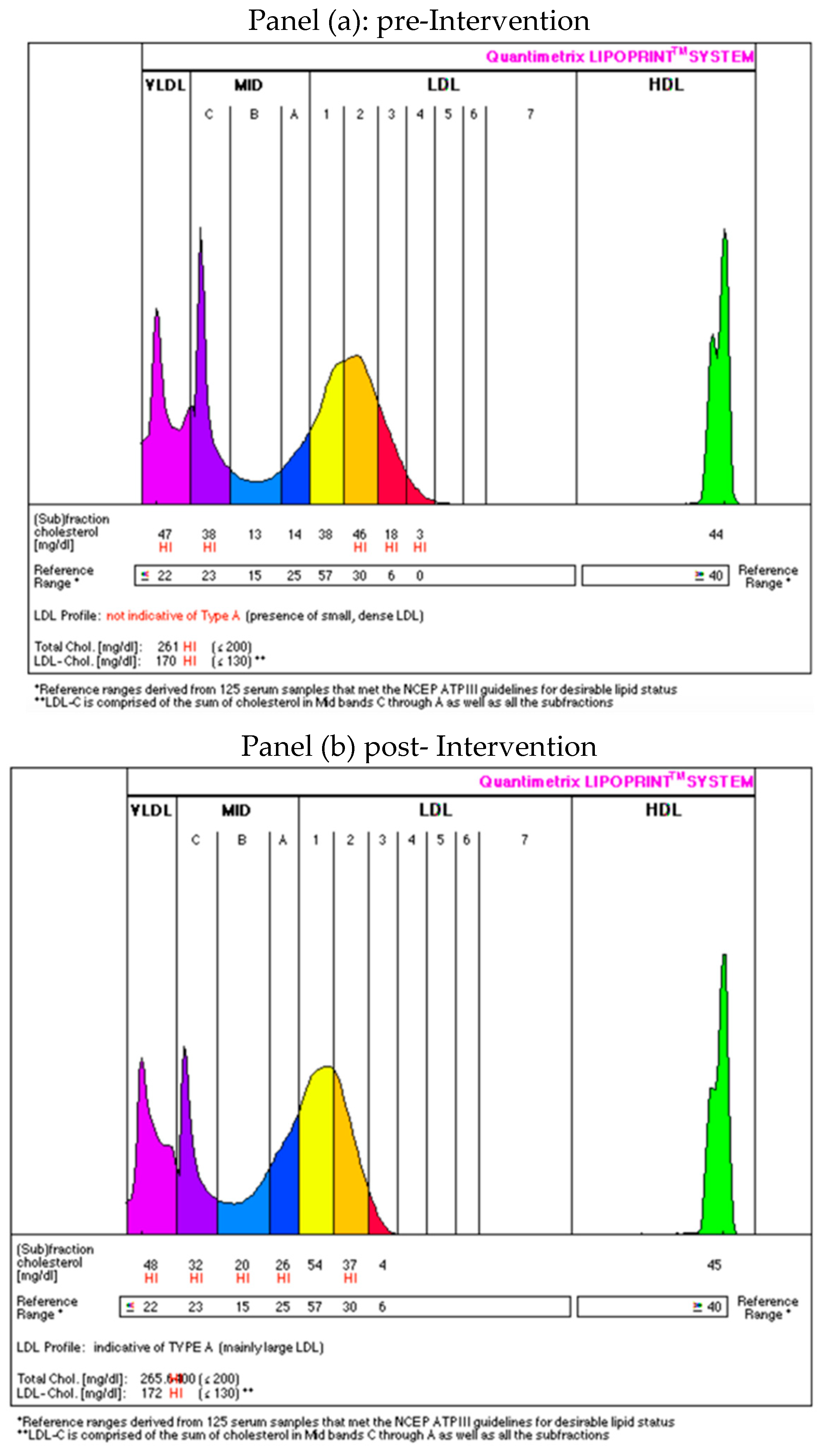

Table 1.
The concentration of monitored bioactive compounds in bilberry juice and dietary fibre of bilberry.
Table 1.
The concentration of monitored bioactive compounds in bilberry juice and dietary fibre of bilberry.
| Parameter | 100% Bilberry Juice | Dietary Fibre of Bilberry |
| Total phenolic content (mg GAE*/g) | 2.29±0.01 | 32.81±0.15 |
| Total anthocyanins (mg/g) | 1.48±0.03 | 6.82±0.06 |
| Caffeic acid (mg/L) | 24.87±0.41 | 85.47±0.31 |
| Coumaric acid (mg/L) | 28.59±1.57 | 125.35±0.26 |
| Ferulic acid (mg/L) | 123.11±0.83 | 77.94±0.21 |
| Rutin (mg/L) | 309.95±1.27 | 24.21±0.08 |
| Myricetin (mg/L) | 34.66±1.73 | 52.79±0.44 |
| Resveratrol (mg/L) | 9.50±0.74 | 30.15±0.39 |
| Quercetin (mg/L) | 5.44±0.04 | 53.45±1.05 |
| Antioxidant activity (%) | 49.30±0.56 | 67.20±0.41 |
| Vitamin C (µg/g) | 126.40±0.13 | 1.44±0.12 |
Notes: *GAE: gallic acid equivalent. Data are expressed as means ± Standard Deviation (SD).
Table 2.
Anthropometric parameters and blood pressure measurements of volunteers of pre-post intervention of bilberry supplementation.
Table 2.
Anthropometric parameters and blood pressure measurements of volunteers of pre-post intervention of bilberry supplementation.
| Parameter | 100% bilberry juice (n=15) | Dietary fibre of bilberry (n=15) | ||||
| pre | post | p | pre | post | p | |
| Bodyweight (kg) | 80.14±11.86 | 80.17±11.97 | 0.853 | 80.56±8.68 | 81,09±9,12 | 0,116 |
| BMI (kg/m2) | 29.89±3.75 | 29.90±3.81 | 0.842 | 29.52±3.06 | 29,71±3,13 | 0,125 |
| WC (cm) | 103.39±10.49 | 104.21±9.85 | 0.084 | 100.93±7.11 | 101,66±7,52 | 0,083 |
| WHR index | 1.00±0.06 | 1.01±0.05 | 0.073 | 0.97±0.05 | 0,98±0,05 | 0,086 |
| SMM (kg) | 24.99±2.57 | 25.12±2.51 | 0.151 | 26.76±3.33 | 26,86±3,30 | 0,388 |
| FFM (kg) | 45.78±4.48 | 45,.6±4.41 | 0.334 | 48.59±5.61 | 48,77±5,54 | 0,313 |
| FFM (%) | 57.39±4.10 | 57.66±4.26 | 0.256 | 60.48±4.83 | 60,33±4,73 | 0,516 |
| BFM (kg) | 34.08±8.40 | 33.98±8.62 | 0.614 | 31.97±5,92 | 32,32±6,11 | 0,237 |
| PBF (%) | 42.44±4.18 | 42.20±4.39 | 0.274 | 39.53±4,83 | 39,66±4,74 | 0,561 |
| VFA (cm2) | 134.18±26.46 | 134.56±25.24 | 0.596 | 124.64±18,99 | 126,59±20,26 | 0,071 |
| SBP (mm Hg) | 126.93±13.83 | 124.67±11.73 | 0.271 | 129.80±12,23 | 128,07±11,93 | 0,508 |
| DBP (mm Hg) | 83.80±6.93 | 82.20±4.65 | 0.244 | 87.53±6,52 | 86,87±6,51 | 0,692 |
Abbreviations: n, Number of Participants; pre, Parameters Measured at Baseline (Before Intervention); post, Parameters Measured After the Intervention; BMI, Body Mass Index; WC, Waist Circumference; WHR index, Waist-to-Hip Ratio; SMM, Skeletal Muscle Mass; FFM, Fat-Free Mass (kg); FFM, Fat-Free Mass to Total Mass (%); BFM, Body Fat Mass; PBF, Body Fat Percentage; VFA, Visceral Fat Area; SBP, Systolic Blood Pressures and DBP, Diastolic Blood Pressures; data are expressed as means ± Standard Deviation (SD); Statistical significance at p < 0.05.
Table 3.
Changes in the values of selected lipid profile parameters and lipoprotein indexes in volunteers during pre- and post-bilberry supplementation intervention.
Table 3.
Changes in the values of selected lipid profile parameters and lipoprotein indexes in volunteers during pre- and post-bilberry supplementation intervention.
| Parameter | 100% Bilberry Juice (n=15) | Dietary Fibre of Bilberry (n=15) | |||||
| pre | post | p | pre | post | p | RV | |
| TC (mmol/L) | 6.41±1.23 | 6.94±1.30 | <0.001 | 6.06±1.39 | 6.43±1.05 | 0.046 | 3-5.2 |
| TAG (mmol/L) | 1.34±0.50 | 1.38±0.47 | 0.721 | 1.41±0.65 | 1.39±0.68 | 0.880 | <1.7 |
| LDL-C (mmol/L) | 3.70±0.94 | 3.42±1.00 | 0.010 | 3.56±0.81 | 3.08±0.62 | 0.001 | <2.6 |
| HDL-C (mmol/L) | 1.78±0.32 | 2.11±0.38 | <0.001 | 1.60±0.43 | 1.92±0.52 | <0.001 | >1.3 |
| TC/HDL | 3.69±0.92 | 3.33±0.63 | 0.006 | 3.92±0.90 | 3.48±0.72 | <0.001 | <4 |
| LDL/HDL | 2.15±0.71 | 1.65±0.49 | <0.001 | 2.34±0.71 | 1.69±0.49 | <0.001 | <2.5 |
| AIP index | -0.14±0.21 | -0.20±0.18 | 0.152 | -0.08±0.25 | -0.17±0.26 | 0.061 | -0.3-0.1 |
Abbreviations: n, Number of Participants; pre, Parameters Measured at Baseline (Before Intervention); post, Parameters Measured After the Intervention; RV, References Value; TC, Total Cholesterol; TAG, Triacylglycerol; LDL-C, LDL Cholesterol; HDL-C, HDL Cholesterol; AIP index, Atherogenic Index of Plasma, AIP=log(TAG/HDL); data are expressed as means ± Standard Deviation (SD); Statistical significance at p < 0.05.
Table 4.
Changes in lipoprotein subfraction values in participants with sdLDL (3-7) subfractions present before intervention.
Table 4.
Changes in lipoprotein subfraction values in participants with sdLDL (3-7) subfractions present before intervention.
| Parameter | 100% Bilberry Juice (n=12) | Dietary Fibre of Bilberry (n=9) | ||||
| pre | post | p | pre | post | p | |
| LDL subfractions | ||||||
| VLDL (mmol/L) | 1.04±0.20 | 1.19±0.25 | 0.011 | 1.12±0.30 | 1.25±0.41 | 0.098 |
| IDL A (mmol/L) | 0.47±0.22 | 0.75±0.18 | <0.001 | 0.49±0.27 | 0.60±0.23 | 0.168 |
| IDL B (mmol/L) | 0.40±0.16 | 0.51±0.12 | 0.008 | 0.41±5.15 | 0.51±0.09 | 0.084 |
| IDL C (mmol/L) | 0.85±0.24 | 0.63±0.45 | 0.041 | 0.81±0.23 | 0.70±0.15 | 0.246 |
| LDL 1 (mmol/L) | 1.07±0.32 | 1.35±0.35 | 0.009 | 1.04±0.36 | 1.13±0.18 | 0.430 |
| LDL 2 (mmol/L) | 0.87±0.35 | 0.75±0.42 | 0.088 | 0.90±0.28 | 0.84±0.43 | 0.937 |
| LDL 3-7 (mmol/L) | 0.26±0.23 | 0.11±0.16 | 0.016 | 0.31±0.32 | 0.24±0.31 | 0.261 |
Notes: n, number of participants; pre, Parameters Measured at Baseline (Before Intervention); post, Parameters Measured After the Intervention; data are expressed as means ± Standard Deviation (SD); Statistical significance at p < 0.05.
Disclaimer/Publisher’s Note: The statements, opinions and data contained in all publications are solely those of the individual author(s) and contributor(s) and not of MDPI and/or the editor(s). MDPI and/or the editor(s) disclaim responsibility for any injury to people or property resulting from any ideas, methods, instructions or products referred to in the content. |
© 2025 by the authors. Licensee MDPI, Basel, Switzerland. This article is an open access article distributed under the terms and conditions of the Creative Commons Attribution (CC BY) license (http://creativecommons.org/licenses/by/4.0/).
Copyright: This open access article is published under a Creative Commons CC BY 4.0 license, which permit the free download, distribution, and reuse, provided that the author and preprint are cited in any reuse.


