

Submitted:
29 January 2025
Posted:
03 February 2025
You are already at the latest version
Abstract
In this study, we tested existing conceptual frameworks for describing modernization such as Industry 4.0, Industry 5.0, maturity and readiness models. To this end, various conceptual scenarios were proposed, including office, industrial, laboratory, and artisanal processes. For each scenario, specific questions were posed to determine whether they could be answered using the current conceptual foundations. Unexpectedly, our findings revealed that the existing concepts of Industry 4.0 and Industry 5.0, along with maturity and digital readiness models, failed to address fundamental questions when describing modernization efforts. The results and subsequent analysis suggest that significant efforts are needed to enhance the underlying conceptual framework rigorously. The implications of this work highlight that if the current conceptual base fails to directly address fundamental questions, then its credibility and applicability come into question, making it imperative to critically reassess and refine the foundational frameworks of research in the field of Industry 4.0/5.0, maturity and digital readiness models.
Keywords:
Industry 4.0
; Smart Systems
; Industry 5.0
; Digital Transformation
; Maturity Model
1. Introduction
Industry 4.0 (I4.0) has been defined as a concept that describes the recent digital revolution. I4.0 has been described as encompassing technologies such as the Internet of Things (IoT), smart automation, big data analysis, and connectivity to create highly efficient, flexible, and interconnected production and manufacturing environments [1]. Industry 4.0 can be considered a subsequent stage to traditional control and automation technologies, as it enhances the monitoring and automation capabilities of companies’ processes. The interconnection of devices, real-time data collection and analysis, and data-driven decision-making are distinctive capabilities of Industry 4.0. In the food industry, I4.0 has been applied primarily to improve product quality, traceability, and process efficiency [2,3,4]. The Smart Systems concept has also been used to describe the new modernization capabilities of the digital revolution, stating that this stage is the natural evolution of systems theory [5,6]. Smart systems are characterized by embedded knowledge, including communication, learning, reasoning, perception, and control capabilities, along with properties such as self-organization and context awareness [6]. The concept of “4.0” has also been applied to non-industrial areas such as Education 4.0 and Healthcare 4.0, showing that different areas can be categorized as 4.0 if they incorporate the digital technologies that characterize Industry 4.0 [7,8,9,10]. Despite the widespread use of the concept of Industry 4.0 or the Fourth Industrial Revolution, some authors still consider it as part of the Third Industrial Revolution [11,12]. Recently, the new Industry 5.0 concept has emerged, defined by the European Commission as a value-driven, collaborative, human-centric, resilient, and sustainable industrial development stage [13,14,15,16,17,18].
How can we measure process modernization? One of the critical challenges when implementing modernization projects is to assess their actual impact accurately. Evaluating the technological level of a process is not trivial; the countless available technologies, their different domains, and their varying effects on the process make standardization in measurement difficult [19]. The Secretariat of the Organization for Economic Cooperation and Development (OECD) has worked on classification methods for various industries [20], but their efforts have undergone revisions and improvements to reflect new technological changes. Other studies have explored various models to assess the progress of implementing Industry 4.0 technologies [21]. Some authors have proposed estimating or measuring a maturity level in companies with a focus on digitalization and Industry 4.0 with the intent to measure the improvements in implementing these technologies, with examples such as DREAMY (Digital REadiness Assessment MaturitY) [22], SMSRL (Smart Manufacturing Readiness Level) [23,24] and MOM (Manufacturing Operations Management Capability Maturity Model) [25,26,27]. Another model is IMPULS, which evaluates readiness for Industry 4.0 across six dimensions: strategy and organization, smart factory, intelligent operations, smart products, data-driven services, and employees [28]. Furthermore, studies have focused on developing a self-assessment method to identify the current stage of development of small and medium enterprises towards Industry 4.0, aiming to determine the levels of preparation and maturity of companies towards Industry 4.0 and digitalization [19]. Finally, other studies have searched for literature on the precedence between automation and information technologies with respect to Industry 4.0. These studies state that the implementation of Industry 4.0 requires a measurement of the degree of automation and digitalization of the company [29].
The incorporation of technology in professional tasks has been continuous but has not changed the nature of how these activities are performed to date. The reason for the reduced change is related to the fact that for these tasks, the value creation has relied mainly on human rather than financial capital [30,31]. Examples of these activities include writing expert reports that require specialized knowledge and understanding of the subject matter. Technologies can speed up the completion of reports and further facilitate their distribution when completed, as in the transition from paper-pencil to mechanical writing machines, computers, and, more recently, to web-based word processing software. Report writing has remained human-driven until recently. The rise of large language models now enables the creation of articles that integrate analysis and expert knowledge. Adopting these tools could enable automatic report writing, potentially revolutionizing how professional tasks are performed, with potential applications in modernizing industrial processes [32]. The impact of new technologies and digitalization on professional activities is an area of ongoing research interest [33,34,35].
Based on our literature review, we hypothesize that there is a gap regarding the question of how process modernization can be measured: the concepts of Industry 4.0/5.0 and existing maturity and readiness models are unable to provide precise answers to simple questions regarding human and technological improvements and process modernization in terms of quantity and functionalities, considering the independent contributions of each technological component. This study aims to identify the potential limitations of existing conceptualizations and models, including Industry 4.0, Industry 5.0, maturity, and readiness frameworks, to better define and strengthen the foundations of this research domain.
2. Materials and Methods
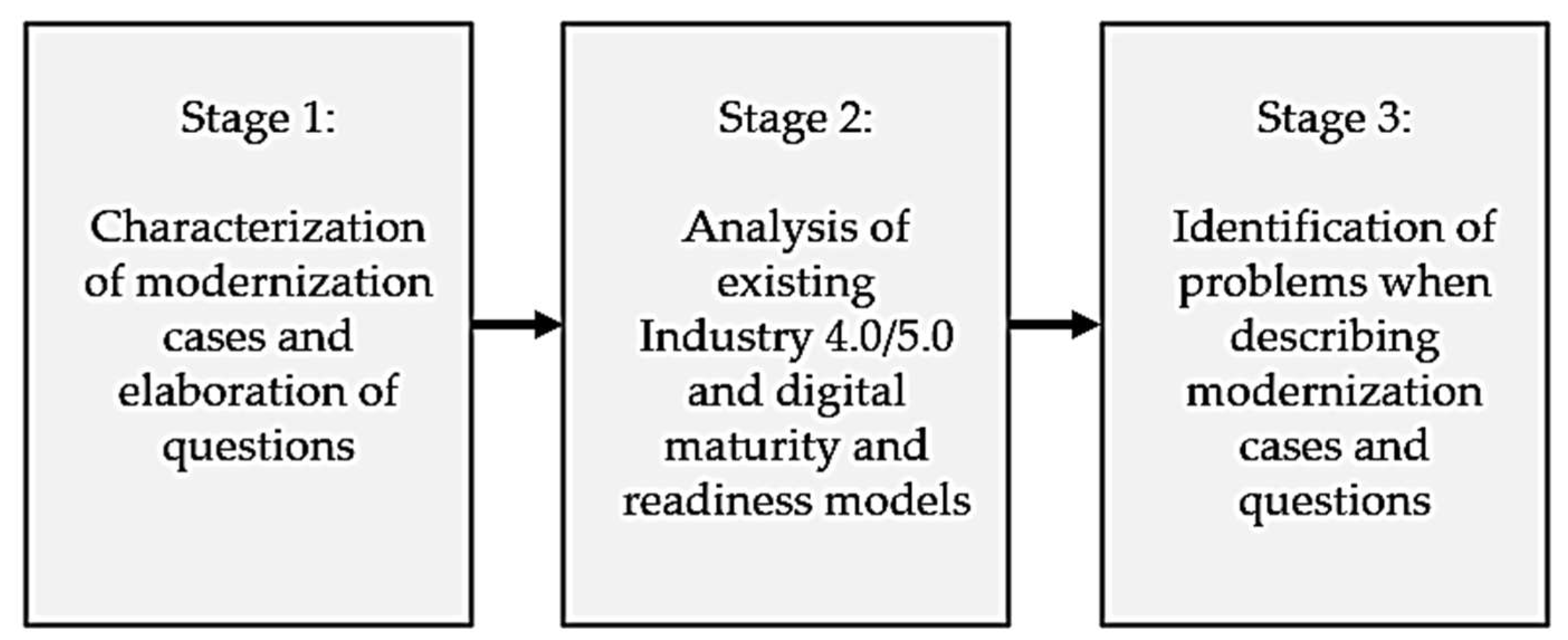
This work selected a set of cases as a testing ground for the existing Industry 4.0/5.0, maturity and readiness models. The characterization centered around office, industrial, laboratory, and artisanal processes. For each type of process, one initial consideration was defined, and one or more final modernization cases were also considered, in which different aspects of the process were changed. Then, a set of general questions related to the initial and final cases were formulated. The details of the characterization and questions are presented in the following section 2.1. Then, a literature review was performed with the aim of identifying a descriptive tool for evaluating and describing the modernization of the proposed cases and answering the initial questions. Following, a discussion of the cases, questions, and literature was performed to determine specific problems that have not been solved with reported research. The general structure of the methodology is presented in Figure 1.
2.1. Characterization of Proposed Contexts for Concept Testing
This study considered various scenarios to test the effectiveness of the existing concepts of Industry 4.0/5.0, readiness, and maturity models when describing modernization. The problems were intentionally diverse in nature but centered around the context of industrial and business processes. The problems tried to describe situations found at various technological levels and production volumes including human-centered processes, such as those that consider the elaboration of writing reports in the context of process supervision. Finally, problems related to the evaluation of modernization when integrating language models in processes with industrial applications.
2.2.1. Industrial Process
Industrial Initial Case: A generic industrial process is considered, utilizing automatic temperature control provided by a Programmable Logic Controller (PLC). Question 0.1: What precisely distinguishes Industry 3.0 from Industry 4.0? Question 0.2: Does the definition of an “Industry” stem from the incorporation of technologies within a specific historical context, the invention date of the technologies, or their widespread adoption?
Industrial Modernization Case 1: The process is modernized through a project that incorporates a computer connected to the internet. Question 1: Is Industry 4.0 characterized by the simultaneous use of artificial intelligence and internet connectivity?
Industrial Modernization Case 2: The process is modernized through a project that incorporates a single soft sensor based on neural networks—equipment designed to infer the state of the process using digital data. To implement the soft sensor, a digital computer is added to the process. Although the computer has interfaces for internet connectivity, they are not utilized. Question 2: Can the same piece of equipment contribute to multiple Industry levels simultaneously?
Industrial Modernization Case 3: In this variation, the process is further modernized by adding three soft sensors and three computers to the industrial process instead of one. Question 3: If adding multiple systems categorized as part of Industry 4.0 contributes meaningfully to modernization, how should they be accounted for?
Industrial Modernization Case 4: This variation replicates Industrial Modernization Case 1, but after one week, the operators chose not to use the soft sensor. Question 4: Does unused hardware, despite being introduced, enhance the modernization of the process?
2.2.2. Laboratory Process
Laboratory Initial Case: A complex laboratory process involving expert human operators and no computers is performed. Laboratory Question 0: Is it appropriate to use the term “Industry” to define a low-volume process?
Laboratory Modernization Case: The process is modernized by incorporating a modern, internet-connected computer equipped with a soft sensor based on a neural network, designed to enhance process monitoring and decision-making capabilities. Laboratory Question 1: How should a process performed by experts and professionals be described within the framework of Industry 4.0/5.0?
2.2.3. Artisanal Process
Artisanal Initial Case 1: An artisanal process performed by a single operator is considered. This process does not require the use of steam, coal, or electricity. Artisanal Question 0: What is the Industry level of the initial artisanal production processes?
Artisanal Modernization Case 1: The operator brings a smartphone to work to make simple calculations in a calculator app. Artisanal Question 1.1: What is the Industry level of the artisanal production processes with a smartphone? Artisanal Question 1.2: How should a smartphone be categorized when it can connect to the Internet and compute complex artificial intelligence algorithms but instead is used only as a basic calculator application? Artisanal Question 1.3: Can modernization occur by improving non-digital aspects of processes, such as enhancing practices or utilizing non-electrical equipment?
Artisanal Modernization Case 2: The process is modernized by the operator bringing a smartphone, which is used for performing simple calculations and writing brief reports using Google Docs, enhancing documentation and data management. The process is divided into two distinct parts: the first focused on artisanal production, and the second dedicated to calculations and report writing using Google Docs. Artisanal Question 2.1: If a process begins with the operator bringing a computer or smartphone, is it immediately classified as Industry 3.0 or 4.0, or does modernization require incremental integration of previous technologies? Artisanal Question 2.2: Does the act of performing simple calculations on a smartphone, categorized as Industry 4.0, make the process more advanced than an entirely artisanal process without computers? Artisanal Question 2.3: Are modernization and production separate attributes of a process?
Artisanal Modernization Case 3: The process can be modernized through two options with different operating costs. One of the options involves the implementation of a prototype that may have malfunctions. Artisanal Question 3.1: How can two systems be compared for modernization if they are identical in every aspect except operating costs? Artisanal Question 3.2: How should modernization involving prototypes, which may be unreliable, be described?
2.2.4. Office Process
Office Initial Case: An office-based process involving office workers and computers connected to the Internet, utilizing cloud-based services such as Google Drive, is considered as the initial condition. Office Question 0: If Industry 4.0 is characterized by using software connected to the Internet, does that mean all offices utilizing cloud storage, such as Google Drive, are operating at the Industry 4.0 level?
Office Modernization Case: The process is modernized by introducing ChatGPT, a cloud-based generative AI service provided by OpenAI, to enhance productivity and support decision-making. Office Question 1: Is Industry 4.0 defined by the simultaneous occurrence of wireless data transmission and the introduction of artificial intelligence? Office Question 2: How should the introduction of generative artificial intelligence be described if it is perceived as a new technological revolution?
3. Results
3.1. Analysis of Potential Solutions Provided by Industry 4.0/5.0 Maturity and Readiness Models
A literature review was performed in order to identify if the maturity models provided answers or solutions to the potential problems found when applying the existing conceptualizations of Industry 4.0/5.0 to the proposed contexts. The literature analysis also focused on the possibility of complementing Industry 4.0/5.0 with maturity models.
3.1.1. Analysis of Potential Solutions Provided by SMSRL
The Smart Manufacturing System Readiness Assessment, 2011, is a model that provides a Maturity level after responding to a questionnaire into four dimensions: organizational maturity, IT maturity, performance management maturity, and information connectivity maturity [23,24]. A maturity scale was proposed in all four dimensions to present the task score results: Not performed, initial, managed, defined, qualitative, and optimizing. Then, an improvement plan is developed depending on the evaluation obtained previously. When analyzing SMSRL to obtain answers to the questions and problems, no useful answers or insights were obtained.
3.1.2. Analysis of Potential Solutions Provided by Impuls Industry 4.0 Readiness Model
The Impuls Industrie 4.0 readiness model, 2015, was analyzed using the related literature [28]. The Impuls model defined six levels of Industry 4.0 implementation in companies, meaning that the score description is above the operational level of specific processes. In this regard, the Impuls model can not answer the questions raised when evaluating a process. As Impuls focuses on Industry 4.0, the problem about the lack of consideration for other non-digital technologies remains unanswered. Regarding smart operations, readiness is determined using the following criteria: information sharing, cloud usage, security, and autonomous processes. In this sense, problem m can be answered with the Impuls model as this considers information sharing and cloud services usage as part of the company’s readiness with regard to Industry 4.0, for which Google Drive is a good platform example. The readiness model classifies the role of employees in the companies, describing its skills with a focus on digitalization with the levels of outsider, beginner, intermediate, experienced, expert, and top performer, which are important when assessing the level of digital technology proficiency, however showing the lack of an appropriate category for the expert operator in manual processes or professionals in labors that can be performed without digital technologies.
3.1.3. Analysis of Potential Solutions Provided by MOM Manufacturing Operations Management Capability Maturity Level
In MOM, manufacturing operations management capability maturity level, 2016, the functioning model of an enterprise is divided into six levels: the physical production process, sensing and manipulating the production process, monitoring, supervisory and automated control of the process, manufacturing operations management, business planning and logistics and company management. MOM focuses on level 3 from zero to five, in which the manufacturing operations management level centers on controlling the produce to obtain desired end products, for which records and optimization of the process is required [27]. In MOM, six maturity levels are defined as no evaluation, initial, managed, defined, quantitatively managed, and optimizing, all of which are applied to seven aspects of maturity being these policies and procedures, technology and tools, personal and training, roles and responsibilities, successions plans, information integration and the use of key performance indicators. As can be inferred, MOM is useful for describing the activities of documentation of the processes; however, even when this model as been applied in the context of manufacturing 4.0, in cases of intrusion detection [36], this model does not comply with its design with Industry 4.0 concepts, for which these model does not offer answers to the problems stated, although being described as a smart manufacturing readiness assessment [37].
3.1.4. Analysis of Potential Solutions Provided by DREAMY Digital Readiness and Maturity Model
The DREAMY model, 2017, was analyzed using the available literature [22,37] for its capacity to solve and answer the problems previously found. The DREAMY model focuses on digital transformation, as this is evident in the concept of a Digital Backbone that connects the five main areas in manufacturing processes: design and engineering, production management, quality management, maintenance management, and logistics management. In this sense, DREAMY can have application in areas smaller than that of the company size, for which a maturity level definition was performed, declaring levels such as initial, managed, defined, integrated, interoperable, and digital-oriented. Also, four dimensions were considered to evaluate the manufacturing company’s digital readiness: Processes, monitoring and control, technology, and organization. When applied to specific cases such as an Aerospace and Defense company and digitalization in IT departments, DREAMY considered a set of questions and in-depth interviews. For these cases, the results show values regarding the processes in relation to different maturity levels regarding processes, control, organization, and technology; however, as stated by its authors, DREAMY lacks an objective quantification of the main weaknesses when implementing digitalization [38,39]. Finally, as the DREAMY objective is to obtain a general overview of various aspects of a company deviating from the initial Industry 4.0 conceptualization, it cannot provide answers to the problems found.
3.1.5. Analysis of Potential Solutions Provided by Other Digital Maturity Models
Several digital maturity models were also analyzed in search of answers to the question and problems previously found. The Digital Business Transformation, 2016, did not consider the terminology of Industry 4.0, defining dimensions and maturity levels, but without new useful information [40]. Other models include the digital maturity model for telecommunications service providers, 2016 [41]; the maturity assessment for Industry 4.0, 2018; Maturity Model of Digital Transformation, 2019 [42]. Multi-Attribute Assessment of Digital Maturity of SMEs, 2021 [43]; The digital transformation self-assessment maturity model, 2024 [44], all have the same general idea of establishing maturity levels that can be applied to certain areas or the general company. The development of maturity models for digitalization measurement has been criticized due to a general lack of proper definition of digital maturity itself or related concepts, that most models offer different dimensions to evaluate with a lack of standardization of the measurements made, often failing when presenting a theoretical basis [45]. These criticisms raised about maturity models highlight the lack of answers that these models provide when dealing with concrete questions and problems, such as those previously shown. Thus, despite recent reviews performed in the area [46], no effective solutions could be derived from the literature analysis for the previously outlined problems. The models presented are primarily designed as diagnostic and recommendation tools at the strategic level, focusing on broader organizational goals. In contrast, the analyzed problems pertain to the operational level, requiring tools that provide detailed insights and actionable guidance for process-specific modernization challenges.
3.1.6. Analysis of Potential Solutions Provided by Industry 5.0 Readiness Level
A reported work that has tried to implement a measuring-like approach of a specific process in terms of Industry 1.0 to 5.0 practice and digital readiness models has been recently reported [47]. This work has classified industrial practices within the seafood processing industry according to Industry levels from 1.0 to 5.0. These classifications address various levels of practice, adoption, and readiness, however, the classification presented some contradictory aspects in the methodology, which hinders its applicability to the cases and questions previously provided.
4. Discussion
4.1. Applying the Concepts of Industry 4.0/5.0 and Digital Maturity Models to Cases and Questions
4.1.1. Problems Identified When Describing Industrial Production Processes
For the Industrial Initial Case, a generic industrial process is considered, utilizing automatic temperature control provided by a Programmable Logic Controller (PLC). Question 0.1: What precisely distinguishes Industry 3.0 from Industry 4.0? The initial case would have the classic automation labeled by Industry 3.0 if industrial progress were to be considered from a historical perspective, as stated by others [48]. For instance, if modernization into Industry 4.0 is wanted, a system based on 4.0 technologies could be purchased and installed to provide more complex insights and data analysis. If installed, the process would be evaluated as Industry 4.0, following an approach reported by others [40]. However, there are difficulties with regard to the exact difference between Industry 3.0 and Industry 4.0 in industrial processes, considering that both levels have digital technologies, including computers, as stated by others [21]. This same problem could be elaborated further, as other authors have stated that the third industrial revolution already incorporates the elements attributed to the I4.0 technologies [11,12]. This fundamental question poses a significant challenge, as no clear answer has been provided since the initial conceptualization of Industry 4.0 (problem 1).
Question 0.2: Does the definition of an “Industry” stem from the incorporation of technologies within a specific historical context, the invention date of the technologies, or their widespread adoption? Let us consider that the key difference between Industry 4.0 and Industry 3.0 lies in the incorporation of the internet. A problem arises when attempting to classify a modernization project in an industrial setup that involves implementing an industrial network with functionalities resembling those of the early ARPANET—a 1969 project designed for transmitting digital packets and considered a precursor to the modern internet. As stated in the literature Industry 4.0 would be proper of the XXI century [49] however, wireless or digital communication are older technologies (problem 2).
Industrial Modernization Case 1: The process is modernized through a project that incorporates a computer connected to the internet. Question 1: Is Industry 4.0 characterized by the simultaneous use of artificial intelligence and internet connectivity? Some definitions of Industry 4.0 suggest it involves internet and wireless communication and smart algorithms [1], the internet of Things [50], and artificial intelligence [51], implemented using neural networks [52]. However, the internet and artificial intelligence are two distinct technologies that do not necessarily need to coexist, which becomes a problem as the specific requirements for evaluating a process at the Industry 4.0 level are unclear (problem 3).
Industrial Modernization Case 2: The process is modernized through a project that incorporates a single soft sensor based on neural networks—equipment designed to infer the state of the process using digital data. A digital computer is added to the process to implement the soft sensor. Although the computer has interfaces for internet connectivity, they are not utilized. Question 2.1: Can the same piece of equipment contribute to multiple Industry levels simultaneously? For this question there is not clear answer. This scenario suggests that the same piece of equipment could simultaneously drive multiple “revolutions” in production depending on the real functionalities used, a consideration that complicates the evaluation of a process. This complexity is further increased if the systems’ functionalities are not clearly defined—a requirement often overlooked in related research (problem 4).
Industrial Modernization Case 3: In this variation, the process is further modernized by incorporating three soft sensors and three computers into the industrial process instead of one. Question 3: If adding multiple systems categorized as part of Industry 4.0 contributes meaningfully to modernization, how should they be accounted for? The answer is that, as more modern systems are integrated, the process does indeed improve. However, a challenge arises when evaluating modernization: how to describe and compare the addition of one system (as in Industrial Modernization Case 1), two systems, or multiple systems (as in Industrial Modernization Case 3) categorized as Industry 4.0 or similar technologies addressing different variables. When applying the Industry 4.0 concept to these industrial cases, from the historical perspective, both processes would still be considered part of Industry 4.0, with no distinction in the attribute “4.0” for describing different levels of equipment integration, despite the different quantities of the systems incorporated, as the addition of more system could not be considered as constituting a step change into a more advance modernization level. This brief analysis suggests that the concept of Industry 4.0 lacks precision when describing technological modernization by quantity (Problem 5).
Industrial Modernization Case 4: This variation replicates Industrial Modernization Case 1, but after one week, the operators chose not to use the soft sensor. Question 4: Does unused hardware, despite being introduced, enhance the modernization of the process? It is unclear what the criteria are in systems with functionalities that are not used, such as in the Industrial final case 3, as they clearly would affect the cost and efficiency of the operation but are not considered in the literature (problem 6).
4.1.2. Problems Identified When Describing Laboratory Processes
The Laboratory Initial Case involves a complex laboratory process carried out with specialized equipment and expert operators. In the laboratory context, Question 1 referred to how to evaluate, in the scale of Industry 1.0 to 4.0, a process with expert operators in a laboratory setup; there are no clear answers. For the initial case, in the absence of computers, Industry 1.0 to Industry 2.0 would be the Industry levels available. It is worth noting that some laboratory processes, such as performing a basic polymerase chain reaction (PCR), were initially developed and conducted without the use of computers, relying solely on the laboratory materials available at the time [53]. There is not a clear industry level to describe these laborious and specialized tasks, and the efforts to describe them as part of the first or second industrial revolution seem inappropriate and questionable (problem 7).
The final modernization case, which incorporates a modern internet-connected computer equipped with soft sensors, has been described in the literature as constitutive of the Industry 4.0 level, aligning more clearly with the digital connectivity and advanced functionalities characteristic of this classification [48].
In the laboratory context, Question 2 asks whether using the term Industry to describe processes with low laboratory volumes is appropriate. In a laboratory setup, the concept of Industry becomes problematic, as large-scale industrial production is absent, and improvements are not aimed at increasing capacity but rather at achieving specific experimental objectives. This raises questions about the appropriateness of applying the term Industry to such settings. Furthermore, this case demonstrates that high technological levels and high production volumes do not necessarily occur simultaneously, highlighting a disconnect between the traditional industrial framework and laboratory processes (problem 8). This is consdered a problem that has to be discussed further, although some practical solutions have been found when eliminating Industry and applying the term 4.0 in other non industrial areas such as pharmaciutical processes [54], education [9,10] and health processes [55].
4.1.3. Problems Identified When Describing Artisanal Production Processes
The initial case for the artisanal process considers a simple task performed by an operator in the absence of steam, coal or electricity. In this context, Question 0 asks what the industry level of the initial artisanal production processes is. Concerning the classification of artisanal processes in an Industrial revolution, a challenge arises due to the lack of a defined level to accurately describe the production process’s low technological level and small scale. Artisanal production could be performed not involving mechanization, steam, or even equipment made of steel, which would typically relate the process to Industry 1.0. Furthermore, the process does not necessarily require electricity, which is part of Industry 2.0. Considering artisanal production as part of Industry 1.0, even if it does not involve steam-powered equipment, would create some challenges as the term Industry 1.0 has been considered synonymous with the first industrial revolution. In contrast, artisanal production has been carried out since ancient times and continues to thrive in the present (problem 9).
The Artisanal Modernization Case 1 considered that the operator brings to work a smartphone to make simple calculations. For this case there is no explicit answer in the literture as to which Industry level would account for the Cellphone introduction. However, for this analysis, as the device could make use of internet, let us consider the system as Industry 4.0. When technical staff or engineers are required to write reports about a process, this task can traditionally be completed using paper and pencil. It remains unclear how to categorize a process performed by experts and professionals that can be executed both with and without technology. Furthermore, it is uncertain whether the introduction of technology truly constitutes modernization if it is ultimately used for tasks that were previously performed manually without significant added value (problem 10).
Artisanal Question 1.2: How should a smartphone be categorized when it can connect to the Internet and compute complex artificial intelligence algorithms but instead is used only as a basic calculator application? This question is similar to the case in which the soft sensor functionality was not used in the industrial setup, but in this case, the inefficiency is not the complete lack of use, but the inefficient use as making simple calculators could contribute to the process, but there is no use of the internet based technologies that could also be present. It is unclear if a single smartphone with a calculator app could lead to a technological revolution, as described in the Industry 4.0 literature. The problem when evaluating this case has not been solved in the literature (problem 11) Artisanal Question 1.3: Can modernization occur by improving non-digital aspects of processes, such as enhancing practices or utilizing non-electrical equipment? The intuitive answer is that a process can indeed be improved by other types of technologies. However, if the process in question is evaluated under the Industry 4.0 framework, a problem arises. This framework focuses exclusively on the most advanced levels of technology, meaning that modernization efforts at levels below digitalization may go unnoticed, even if these contributions are more significant to productivity. While Industry 4.0 primarily focuses on revolutionary advancements within industrial processes, modernization can also occur incrementally within artisanal technology. To illustrate this, consider two scenarios: the first batch of products is made by a producer without experience, using no specialized manual methods. Then, compare this with the same process performed a year later, where, with more training, the producer still uses the artisanal method but incorporates several manual, experience-based techniques to improve the quality of the product. Modernization can also occur by improving non-digital aspects of the processes; if the producer invests in learning and applying better manual techniques or there are improvements in non-electrical equipment, the concept of Industry 4.0 and related models still cannot precisely represent these changes in production, efficiency, and quality improvements (problem 12).
Artisanal Modernization Case 2: The process is modernized by the operator bringing a smartphone, which is used for performing simple calculations and writing brief reports. Question 2.1: If a process begins with the operator bringing a computer or smartphone, is it immediately classified as Industry 3.0 or 4.0, or does modernization require incremental integration of previous technologies? If processes can begin immediately at the Industry 3.0 level, this suggests that the system may not require the initial phases of industrial evolution, as seen in cases where the process is entirely computational or digital from the outset. However, without the prerequisite of incorporating previous technologies into the process to reach a certain technological level, this could create inconsistencies with the historical progression narrative of modernization throughout the industrial revolutions, particularly in the frameworks of Industry 4.0 and 5.0 (problem 13).
Artisanal Question 2.2: Does performing simple calculations on a smartphone, categorized as Industry 4.0, make the process more advanced than an entirely artisanal process without computers? In this scenario, the process is divided into two distinct parts: the first focused on artisanal production, and the second dedicated to calculations and report writing using Google Docs. An artisanal process could be modernized by using a smartphone to write reports, aligning it with Industry 4.0. However, if the process is divided into these two parts, as suggested by others [56], the report-writing phase—despite involving no production—would still be classified as Industry 4.0. This classification paradoxically positions it as more advanced than the artisanal production process without computers, even if the latter produces tangible products. This highlights a discrepancy between technological classification and actual productivity. Artisanal Question 2.3: Are modernization and production separate attributes of a process? In the analyzed case, this suggests that modernization and productivity are not necessarily correlated, which contradicts the initial premises of Industry 4.0. A paradox emerges, as Industry 4.0 has been associated with promises of increased production, improved efficiency, and enhanced product quality [1]. This raises questions about whether modernization can be accurately evaluated independently of productivity outcomes. There is no clear answer to these questions within the Industry 4.0/5.0 literature (problem 14).
Two questions emerged for the Artisanal Modernization Case 3, which involves modernization through two options with different operating costs, including implementing a prototype that may malfunction. Artisanal Question 3.1: How can two systems be compared for modernization if they are identical in every aspect except operating costs? Artisanal Question 3.2: How should modernization involving prototypes, which may be unreliable, be described? Existing frameworks struggle to describe how modernization processes impact key operational metrics such as productivity, efficiency, or operational costs, as well as how to evaluate the use of prototype technologies that may affect reliability. These questions remain unanswered in the literature (problem 15).
4.1.4. Problems Identified When Describing Office Processes
Office Initial Case: An office-based process involving office workers and computers connected to the Internet, utilizing cloud-based services such as Google Drive, is considered as the initial condition. Office Question 0: If Industry 4.0 is characterized by using software connected to the Internet, does that mean all offices utilizing cloud storage, such as Google Drive, are operating at the Industry 4.0 level? If Industry 4.0 is about using software connected to the internet, then it could be considered that all offices that use some cloud storage, such as Google Drive, are at the Industry 4.0 level. In this case, the final question would be, if Industry 4.0 is so ubiquitous present, why is there so much fanfare for the Industry 4.0 concept? (problem 16).
Office Modernization Case: The process is modernized by introducing ChatGPT, a cloud-based generative AI service provided by OpenAI, to enhance productivity and support decision-making. Office Question: How should the introduction of generative artificial intelligence be described if it is perceived as a new technological revolution? In report writing, one can argue that report writing went from mechanical machines (Industry 1.0) to electrical and electronic machines, ending up now with laptop computers with internet connectivity that could be assessed as part of Industry 4.0. In this sense, it can be argued that modernization has occurred through technological revolutions. When analyzing the application of large language models, some problems arise with the Industry 4.0 concept. How can we depict the introduction of generative artificial intelligence? Large language models can be a new technological revolution that goes far beyond the initial considerations of the original Industry 4.0 conceptualization.
In 2011, when the term Industrie 4.0 was first introduced, neither artificial intelligence nor large language models were mentioned [1]. If introducing large language models could result in a new technological revolution representative of complex autonomous or cooperative artificial intelligence, this would imply the emergence of a new Industry 5.0. However, there is a problem: the concept of Industry 5.0 already exists and has been defined as not being a technology-driven revolution but a value-driven initiative that drives technological transformation with a particular purpose [13]. The traditional Industry 5.0 definition focused on sustainable processes and human-centered technologies. A critical analysis can show that a sustainable approach and focus on humans could still be implemented with previous technologies. For example, we could implement an environmentally friendly and sustainable process, even using only artisanal methods in beer or yogurt production. In this sense, in the current Industry 5.0 definitions, there is a focus on the use of technology rather than on the incorporation of new technology, which cannot necessarily be called a revolution. Following our reasoning, a very sophisticated process could be automated entirely through advanced AI, which could surpass the technology of traditional 4.0, and the sustainable aspect would not necessarily be a requisite, especially if these processes or factories are installed outside, for instance, the regulatory framework of Europe (problem 17).
4.2. Literature Discussion
A reported study attempted to measure Industry 1.0 to 5.0 levels in seafood processing [47]. However, the application of Industry 4.0 concepts reveals notable contradictions. For example, manual tasks are categorized under Industry 1.0, even though manual labor is not representative of industrial production. Similarly, the replacement of manual labor by machines has been classified as part of Industry 2.0 processes in other works [57], despite mechanization being described in early sources as a defining feature of the first industrial revolution [58,59]. Oral communication is classified as Industry 1.0, even though it predates the first industrial revolution, while written communication is associated with Industry 2.0, despite its historical significance in transitioning from prehistoric to historical times. Additionally, the use of electricity is attributed to Industry 3.0, although key contributions to electric machinery by Tesla and Edison predate the 20th century, and electricity is widely regarded as the driving force of the Second Industrial Revolution [58,59]. Human sensory methods are also classified under Industry 1.0, despite their lack of direct relevance to the first industrial revolution. On the other hand, technologies such as IoT, AI, and cloud-based solutions, which define Industry 4.0 [56,59] have been included in the classification of Industry 5.0 in smart food laboratories. While these inconsistencies and contradictions do not undermine the overall merit of the study’s aim to classify different aspects within specific Industry levels, they highlight the limitations of frameworks based on industrial revolutions, including Industry 4.0/5.0 concepts, as well as maturity and digital readiness models.
4.3. Overall Analysis and Final Remarks
A model is a tool for describing reality. In this sense, the Industry 4.0 and Industry 5.0 paradigms can be considered a model for describing the latest industrial digitalization and modernization stages. However, some problems exist when applying the existing concepts to actual processes and contexts to obtain precise evaluations of modernization. In total, 16 problems or unanswered questions were analized in contexts characterized by industrial, artisanal, and laboratory processes, office-based report writing, and the integration of advanced language models. To deal with these problems, an analysis was made of reported maturity models in search of a complementary tool that could answer the problems identified; however, no useful answer was found, which allows us to question the usefulness of the existing Industry 4.0/5.0 concepts and the maturity and readiness models.
Maybe the idea of maturity in modernization is not correct, and digital maturity models are not the best tools for describing the technological transformations in processes because maturity is rarely, if ever, fully achieved as technological progress always goes further. In this context, a quantitative approach appears to offer a more accurate and adaptable framework for assessing advancements. For example, computers and software continually evolve with new models and versions, described by ascending numbers and letters that describe improvements. In this regard, the business rejects the concept of maturity to avoid stagnation and mitigate the risk of losing market share to emerging competitors. In practice, computers and software models are not described by a level of digital maturity, which seems to confirm this specific hypothesis. The inability of the existing conceptualizations to solve simple problems explains the need for designing a new model that could provide the required solutions.
While Industry 4.0 primarily emphasizes revolutionary advancements in industrial processes, modernization can also occur incrementally by gradually integrating systems within the same technological level, resulting in step-by-step improvements. The Industry 4.0 framework defines revolutionary changes through transitions from levels 1.0 to 4.0 but does not effectively address incremental advancements within a single level. In the Industry 4.0 framework, if an initial Industry 4.0 process is modernized by incorporating various new Industry 4.0 technologies, it would still be classified as Industry 4.0 with the classic approach.
The concept of Industry 4.0 based on historical revolution hinders the ability to describe current processes. Further analysis would show that defining previous industry levels as historical would make it difficult to use them for measuring modernization. When discussing the Industry 4.0 framework with specialists, particularly those focused on mechanical research, mechanical engineers might argue that defining the Industry 1.0 related to mechanization could render the mechanical aspects of modernization outdated. This could demotivate mechanical engineering students, who, upon hearing about Industry 4.0, might perceive their field as centered on obsolete technologies, overlooking the fact that mechanization continues to be an area of active research and development that could offer new functionalities when implementing modernization.
Regarding office-based processes such as report writing, it is challenging to address technology modernization, as these processes primarily rely on mental human tasks and abilities. Still, some devices can be integrated due to modernization efforts, such as mechanical writing machines, embedded computers, and computers with the Internet. This modernization trend would continue with the emergence of natural language models allowing us to predict that an important part of the technical writing reports that operators currently make will end up being automated by complex artificial intelligence with capabilities that go beyond those of traditional Industry 4.0, however there is a problem with the conceptualization, because Industry 5.0 have been already defined and did not considered large language models.
In light of the current state of the art in measuring the technological level of processes, we believe this work represents an advancement by defining problems for which the current literature regarding Industry 4.0&5.0, maturity, and readiness models cannot give precise answers. These problems could serve as a foundation for developing more advanced and robust tools for assessing process modernization in other fields and areas not yet explored.
5. Conclusions
In this study, we tried to use the concepts of Industry 4.0 and 5.0 conceptualization and digital maturity models to describe simple conceptual processes (office, industrial, laboratory, and artisanal) and answer fundamental questions that could emerge when discussing the processes.
Unexpectedly, our findings revealed that the existing concepts of Industry 4.0 and Industry 5.0, along with maturity and digital readiness models, failed to address fundamental and essential questions when describing modernization efforts in with well defined 17 problems.
The findings highlighted several critical issues: the absence of a framework for adequately describing human-based processes; significant challenges in evaluating state-of-the-art processes with low production volumes; the definition of Industry 4.0 being excessively centered on the historical context of industrial revolutions, thereby complicating the assessment of contemporary processes; an overemphasis on digital technologies while neglecting other important technological contributions; difficulties in the evaluation and integration of generative language models; and a disconnect between Industry 5.0’s sustainability focus and the technological revolution framework established by preceding industrial revolutions.
Finally, we consider that more rigorous efforts have to be made to better define the tools and their limitations regarding Industry 4.0/5.0 and maturity and readiness models, which are widely used by modernization agencies when describing the impact of a modernization project but which currently cannot solve basic questions. The definition of the 17 problems not answered by current literature is a valuable test ground for future iterations of improved Industry 4.0/5.0 and maturity and readiness models.
Author Contributions
Conceptualization, C.A. and S.A.; methodology, C.A.; validation, C.A., and S.A.; investigation, C.A., and S.A; resources, C.A.; writing—original draft preparation, C.A.; writing—review and editing, C.A. and S.A. All authors have read and agreed to the published version of the manuscript.
Funding
“ANID Fondef VIU23P0092 Automated Brew funded this research”.
Acknowledgments
The authors extend their gratitude to the engineers and experts funded by project VIU23P0092—Enrique Flores, Francisca Valenzuela, and Paola Ramirez—for their valuable contributions. They also sincerely thank Professor Carolina Shene for her continuous support and mentorship, and express special appreciation to Carla Ortega Vallejos for her insightful comments.
Conflicts of Interest
“The authors declare no conflicts of interest.”
References
- Kagermann, H.; Wahlster, W.; Helbig, J.; Hellinger, A.; Stumpf, M.A.V.; Treugut, L.; Blasco, J.; Galloway, H.; Findeklee, U. Recommendations for Implementing the Strategic Initiative INDUSTRIE 4.0: Securing the Future of German Manufacturing Industry; Final Report of the Industrie 4.0 Working Group; 2013. [Google Scholar]
- Noor Hasnan, N.Z.; Yusoff, Y.M. Short Review: Application Areas of Industry 4.0 Technologies in Food Processing Sector. In Proceedings of the 2018 IEEE 16th Student Conference on Research and Development, SCOReD 2018; Institute of Electrical and Electronics Engineers Inc, 2 July 2018. [Google Scholar]
- Hassoun, A.; Aït-Kaddour, A.; Abu-, A.M.; Bhojraj Rathod, N.; Bader, F.; Barba, F.J.; Biancolillo, A.; Cropotova, J.; Galanakis, C.M.; Jambrak, R.; et al. The Fourth Industrial Revolution in the Food Industry-Part I: Industry 4.0 Technologies 2.
- Konur, S.; Lan, Y.; Thakker, D.; Morkyani, G.; Polovina, N.; Sharp, J. Towards Design and Implementation of Industry 4.0 for Food Manufacturing. Neural Comput Appl 2023, 35, 23753–23765. [Google Scholar] [CrossRef]
- Sarker, I.H. AI-Based Modeling: Techniques, Applications and Research Issues Towards Automation, Intelligent and Smart Systems. SN Comput Sci 2022, 3. [Google Scholar] [CrossRef] [PubMed]
- Romero, M.; Guédria, W.; Panetto, H.; Barafort, B. Towards a Characterisation of Smart Systems: A Systematic Literature Review. Comput Ind 2020, 120, 103224. [Google Scholar] [CrossRef]
- Kishor, A.; Chakraborty, C. Artificial Intelligence and Internet of Things Based Healthcare 4.0 Monitoring System. Wirel Pers Commun 2022, 127, 1615–1631. [Google Scholar] [CrossRef]
- Osama, M.; Ateya, A.A.; Sayed, M.S.; Hammad, M.; Pławiak, P.; Abd El-Latif, A.A.; Elsayed, R.A. Internet of Medical Things and Healthcare 4.0: Trends, Requirements, Challenges, and Research Directions. Sensors 2023, 23. [Google Scholar] [CrossRef] [PubMed]
- Aziz Hussin, A. Education 4.0 Made Simple: Ideas For Teaching. International Journal of Education and Literacy Studies 2018, 6, 92. [Google Scholar] [CrossRef]
- Azah Mansor, N.; Abdullah, N.; Abd Rahman, H. Towards Electronic Learning Features in Education 4.0 Environment: Literature Study. Indonesian Journal of Electrical Engineering and Computer Science 2020, 19, 442. [Google Scholar] [CrossRef]
- Rifkin, J. The Third Industrial Revolution: How Lateral Power Is Transforming Energy, the Economy, and The; Carleton, E., Ed.; Palgrave Macmillan: New York, 2011; ISBN 978-0-230-11521-7. [Google Scholar]
- Moll, I. Why There Is No Technological Revolution, Let Alone a ‘Fourth Industrial Revolution’. S Afr J Sci 2023, 119. [Google Scholar] [CrossRef]
- Xu, X.; Lu, Y.; Vogel-Heuser, B.; Wang, L. Industry 4.0 and Industry 5.0—Inception, Conception and Perception. J Manuf Syst 2021, 61, 530–535. [Google Scholar] [CrossRef]
- Breque, M.; De Nul, L.; Petridis, A. Industry 5.0: Towards a Sustainable, Human-Centric and Resilient European Industry; Publications Office of the European Union, 2021; ISBN 9789276253082. [Google Scholar]
- Alves, J.; Lima, T.M.; Gaspar, P.D. Is Industry 5.0 a Human-Centred Approach? A Systematic Review. Processes 2023, 11. [Google Scholar] [CrossRef]
- Nagy, L.; Abonyi, J.; Ruppert, T. Knowledge Graph-Based Framework to Support Human-Centered Collaborative Manufacturing in Industry 5.0. Applied Sciences (Switzerland) 2024, 14. [Google Scholar] [CrossRef]
- Introna, V.; Santolamazza, A.; Cesarotti, V. Integrating Industry 4.0 and 5.0 Innovations for Enhanced Energy Management Systems. Energies (Basel) 2024, 17, 1222. [Google Scholar] [CrossRef]
- Panza, L.; Bruno, G.; Lombardi, F. Integrating Absolute Sustainability and Social Sustainability in the Digital Product Passport to Promote Industry 5.0. Sustainability 2023, 15, 12552. [Google Scholar] [CrossRef]
- Brozzi, R.; D’Amico, R.D.; Pasetti Monizza, G.; Marcher, C.; Riedl, M.; Matt, D. Design of Self-Assessment Tools to Measure Industry 4.0 Readiness .A Methodological Approach for Craftsmanship SMEs. In Proceedings of the IFIP Advances in Information and Communication Technology, Springer New York LLC, 2018; Vol. 540, pp. 566–578. [Google Scholar]
- Hatzichronoglou, T. Revision of the High-Technology Sector and Product Classification; 1997. [Google Scholar]
- Alcácer, V.; Rodrigues, C.; Carvalho, H.; Cruz-Machado, V. Tracking the Maturity of Industry 4.0: The Perspective of a Real Scenario. The International Journal of Advanced Manufacturing Technology 2021, 116, 2161–2181. [Google Scholar] [CrossRef] [PubMed]
- De Carolis, A.; Macchi, M.; Negri, E.; Terzi, S.; Terzi, S.A. A Maturity Model for Assessing the Digital Readiness of Manufacturing Companies. 2017, 13–20. [CrossRef]
- Jung, K.; Kulvatunyou, B.; Choi, S.; Brundage, M.P. An Overview of a Smart Manufacturing System Readiness Assessment.; 2011; p. 1.
- Jung, K.; Kulvatunyou, B.; Choi, S.; Brundage, M.P. An Overview of a Smart Manufacturing System Readiness Assessment. In Proceedings of the IFIP Advances in Information and Communication Technology, Springer New York LLC, 2016; Vol. 488, pp. 705–712. [Google Scholar]
- Mittal, S.; Khan, M.A.; Romero, D.; Wuest, T. A Critical Review of Smart Manufacturing & Industry 4.0 Maturity Models: Implications for Small and Medium-Sized Enterprises (SMEs). J Manuf Syst 2018, 49, 194–214. [Google Scholar]
- Schumacher, A.; Erol, S.; Sihn, W. A Maturity Model for Assessing Industry 4.0 Readiness and Maturity of Manufacturing Enterprises. In Proceedings of the Procedia CIRP, Elsevier B.V., 2016; Vol. 52, pp. 161–166. [Google Scholar]
- Castor, N.; Damberg, D.; Sjöborg, E. MESA MOM Capability Maturity Level; 2016. [Google Scholar]
- Lichtblau, K.; Stich, V.; Bertenrath, R.; Blum, M.; Bleider, M.; Millack, A.; Schmitt, K.; Schmitz, E.; Schröter, M. Industrie 4.0 Readiness; Aachen, 2015. [Google Scholar]
- Martell, F.; López, J.M.; Sánchez, I.Y.; Paredes, C.A.; Pisano, E. Evaluation of the Degree of Automation and Digitalization Using a Diagnostic and Analysis Tool for a Methodological Implementation of Industry 4.0. Comput Ind Eng 2023, 177, 109097. [Google Scholar] [CrossRef]
- Lowendahl, B. Strategic Management of Professional Service Firms; Copenhagen Business School Press, 2005. [Google Scholar]
- Kronblad, C.; Pregmark, J.E.; Berggren, R. Difficulties to Digitalize: Ambidexterity Challenges in Law Firms. Journal of Service Theory and Practice 2023, 33, 217–236. [Google Scholar] [CrossRef]
- Sahebi, F. Application of Large Language Models in the Industry. International Journal of Sustainable Applied Science and Engineering 2024.
- Wang, F.Y.; Yang, J.; Wang, X.; Li, J.; Han, Q.L. Chat with ChatGPT on Industry 5.0: Learning and Decision-Making for Intelligent Industries. IEEE/CAA Journal of Automatica Sinica 2023, 10, 831–834. [Google Scholar] [CrossRef]
- Liu, Y.; Han, T.; Ma, S.; Zhang, J.; Yang, Y.; Tian, J.; He, H.; Li, A.; He, M.; Liu, Z.; et al. Summary of ChatGPT-Related Research and Perspective Towards the Future of Large Language Models. 2023. [Google Scholar] [CrossRef]
- Thirunavukarasu, A.J.; Ting, D.S.J.; Elangovan, K.; Gutierrez, L.; Tan, T.F.; Ting, D.S.W. Large Language Models in Medicine. Nat Med 2023, 29, 1930–1940. [Google Scholar] [CrossRef]
- Alem, S.; Espes, D.; Nana, L.; Martin, E.; De Lamotte, F. A New Normative Approach to Intrusion Detection in Manufacturing 4.0. IFAC-PapersOnLine 2023, 56, 3692–3697. [Google Scholar] [CrossRef]
- De Carolis, A.; Macchi, M.; Kulvatunyou, B.; Brundage, M.P.; Terzi, S.; Maturity, S.T. Maturity Models and Tools for Enabling Smart Manufacturing Systems: Comparison and Reflections for Future Developments. In Proceedings of the In Product Lifecycle Management and the Industry of the Future: 14th IFIP WG 5.1 International Conference, PLM 2017; Springer International Publishing: Seville, Spain, 10 July 1 2017; pp. 23–35. [Google Scholar]
- Acerbi, F.; Spaltini, M.; De Carolis, A.; Taisch, M. Developing a Roadmap Towards the Digital Transformation of Small & Medium Companies: A Case Study Analysis in the Aerospace & Defence Sector. In Proceedings of the IFIP Advances in Information and Communication Technology, Springer Science and Business Media Deutschland GmbH, 2023; Vol. 667 IFIP, pp. 284–293. [Google Scholar]
- Azizan, S.; Ismail, R.; Baharum, A.; Hidayah Mat Zain, N. Exploring the Factors That Influence the Success of Digitalization in An Organization’s IT Department. In Proceedings of the 2021 6th IEEE International Conference on Recent Advances and Innovations in Engineering, ICRAIE 2021; Institute of Electrical and Electronics Engineers Inc., 14 February 2022. [Google Scholar]
- Berghaus, S.; Back, A. Stages in Digital Business Transformation: Results of an Empirical Maturity Study. In Proceedings of the MCIS 2016 Proceeding; Mediterranean Conference on Information Systems (MCIS) at AIS Electronic Library (AISeL); 2016. [Google Scholar]
- Valdez-De-Leon, O. A Digital Maturity Model for Telecommunications Service Providers; 2016; Vol. 6. [Google Scholar]
- Ifenthaler, D.; Egloffstein, M. Development and Implementation of a Maturity Model of Digital Transformation. TechTrends 2020, 64, 302–309. [Google Scholar] [CrossRef]
- Kljajić Borštnar, M.; Pucihar, A. Multi-Attribute Assessment of Digital Maturity of SMEs. Electronics (Basel) 2021, 10, 885. [Google Scholar] [CrossRef]
- Haryanti, T.; Rakhmawati, N.A.; Subriadi, A.P. Assessing the Digital Transformation Landscapes of Organization: The Digital Transformation Self-Assessment Maturity Model (DX-SAMM). In Proceedings of the Procedia Computer Science, Elsevier B.V., 2024; Vol. 234, pp. 1561–1569. [Google Scholar]
- Thordsen, T.; Murawski, M.; Bick, M. How to Measure Digitalization? A Critical Evaluation of Digital Maturity Models. In Proceedings of the Lecture Notes in Computer Science (including subseries Lecture Notes in Artificial Intelligence and Lecture Notes in Bioinformatics), Springer, 2020; Vol. 12066 LNCS, pp. 358–369. [Google Scholar]
- Hein-Pensel, F.; Winkler, H.; Brückner, A.; Wölke, M.; Jabs, I.; Mayan, I.J.; Kirschenbaum, A.; Friedrich, J.; Zinke-Wehlmann, C. Maturity Assessment for Industry 5.0: A Review of Existing Maturity Models. J Manuf Syst 2023, 66, 200–210. [Google Scholar] [CrossRef]
- Madhavan, M.; Sharafuddin, M.A.; Wangtueai, S. Measuring the Industry 5.0-Readiness Level of SMEs Using Industry 1.0–5.0 Practices: The Case of the Seafood Processing Industry. Sustainability 2024, 16, 2205. [Google Scholar] [CrossRef]
- Alarcon, C.; Shene, C. Fermentation 4.0, a Case Study on Computer Vision, Soft Sensor, Connectivity, and Control Applied to the Fermentation of a Thraustochytrid. Comput Ind 2021, 128. [Google Scholar] [CrossRef]
- Popkova, E.G.; Yulia; Ragulina, V.; Bogoviz Editors, A.V. Industry 4.0: Industrial Revolution of the 21st Century; Popkova, E.G., Ragulina, Y.V., Bogoviz, A.V., Eds.; Studies in Systems, Decision and Control; Springer International Publishing: Cham, 2019; Vol. 169, ISBN 978-3-319-94309-1. [Google Scholar]
- Kunst, R.; Avila, L.; Binotto, A.; Pignaton, E.; Bampi, S.; Rochol, J. Improving Devices Communication in Industry 4.0 Wireless Networks. Eng Appl Artif Intell 2019, 83, 1–12. [Google Scholar] [CrossRef]
- Peres, R.S.; Jia, X.; Lee, J.; Sun, K.; Colombo, A.W.; Barata, J. Industrial Artificial Intelligence in Industry 4.0 -Systematic Review, Challenges and Outlook. IEEE Access 2020. [Google Scholar] [CrossRef]
- Elhoone, H.; Zhang, T.; Anwar, M.; Desai, S. Cyber-Based Design for Additive Manufacturing Using Artificial Neural Networks for Industry 4.0. Int J Prod Res 2020, 58, 2841–2861. [Google Scholar] [CrossRef]
- Saiki, R.K.; Scharf, S.; Faloona, F.; Mullis, K.B.; Horn, G.T.; Erlich, H.A.; Arnheim, N. Enzymatic Amplification of β-Globin Genomic Sequences and Restriction Site Analysis for Diagnosis of Sickle Cell Anemia. Science (1979) 1985, 230, 1350–1354. [Google Scholar] [CrossRef]
- Alarcon, C.; Shene, C. Arduino Soft Sensor for Monitoring Schizochytrium Sp. Fermentation, a Proof of Concept for the Industrial Application of Genome-Scale Metabolic Models in the Context of Pharma 4.0. Processes 2022, 10. [Google Scholar] [CrossRef]
- Kishor, A.; Chakraborty, C. Artificial Intelligence and Internet of Things Based Healthcare 4.0 Monitoring System. Wirel Pers Commun 2022, 127, 1615–1631. [Google Scholar] [CrossRef]
- Martín-Gómez, A.M.; Agote-Garrido, A.; Lama-Ruiz, J.R. A Framework for Sustainable Manufacturing: Integrating Industry 4.0 Technologies with Industry 5.0 Values. Sustainability (Switzerland) 2024, 16. [Google Scholar] [CrossRef]
- Zhironkin, S.; Ezdina, N. Review of Transition from Mining 4.0 to Mining 5.0 Innovative Technologies. Applied Sciences (Switzerland) 2023, 13. [Google Scholar] [CrossRef]
- Lasi, H.; Fettke, P.; Kemper, H.G.; Feld, T.; Hoffmann, M. Industry 4.0. Business and Information Systems Engineering 2014, 6, 239–242. [Google Scholar] [CrossRef]
- Vinitha, K.; Ambrose Prabhu, R.; Bhaskar, R.; Hariharan, R. Review on Industrial Mathematics and Materials at Industry 1.0 to Industry 4.0. In Proceedings of the Materials Today: Proceedings, Elsevier Ltd, 2020; Vol. 33, pp. 3956–3960. [Google Scholar]
Figure 1.
Methodology that shows the characterization of the processes proposed, the analysis of existing Industry 4.0/5.0 and digital maturity and readiness models, and the identification of problems when applying the concepts to the cases and questions proposed.
Figure 1.
Methodology that shows the characterization of the processes proposed, the analysis of existing Industry 4.0/5.0 and digital maturity and readiness models, and the identification of problems when applying the concepts to the cases and questions proposed.
Disclaimer/Publisher’s Note: The statements, opinions and data contained in all publications are solely those of the individual author(s) and contributor(s) and not of MDPI and/or the editor(s). MDPI and/or the editor(s) disclaim responsibility for any injury to people or property resulting from any ideas, methods, instructions or products referred to in the content. |
© 2025 by the authors. Licensee MDPI, Basel, Switzerland. This article is an open access article distributed under the terms and conditions of the Creative Commons Attribution (CC BY) license (http://creativecommons.org/licenses/by/4.0/).
Copyright: This open access article is published under a Creative Commons CC BY 4.0 license, which permit the free download, distribution, and reuse, provided that the author and preprint are cited in any reuse.


