

Submitted:
27 January 2025
Posted:
27 January 2025
You are already at the latest version
Abstract
The transition towards energy-efficient and sustainable buildings is a cornerstone of global efforts to combat climate change. Building Automation and Control Systems (BACS), standardized under EN ISO 52120, and the Smart Readiness Indicator (SRI) have emerged as pivotal tools for optimizing energy performance, integrating smart technologies, and enhancing building adaptability. This review provides a comprehensive analysis of the current research landscape and practical applications of these frameworks, focusing on their role in advancing energy efficiency, occupant comfort, and environmental sustainability. Key contributions include an exploration of challenges in SRI evaluation, considering the limitations of simplified methods, the need for long-term validation, and gaps in integrating advanced control functions. The study emphasizes innovative solutions for adapting SRI assessments to diverse building types, climate conditions, and regulatory frameworks. Furthermore, it presents original insights into leveraging advanced technologies, including Building Information Modeling (BIM) and Digital Twins (DT), to refine SRI evaluation methods and optimize BACS system designs. These findings contribute to the development of sustainable, intelligent buildings that align with EU climate goals. The authors conclude by highlighting promising directions for future research to further enhance smart energy and strategic facility management practices.
Keywords:
smart readiness indicator
; EN ISO 52120
; EPBD
; building automation and control systems
; energy efficiency
; energy management
; facility management
1. Introduction
The increasing complexity of modern infrastructure, particularly in commercial, office, and public utility buildings, underscores the importance of facility management (FM) and energy efficiency for sustainability and user comfort. FM, which involves managing building systems, operations, and maintenance, is crucial for optimizing building performance [1,2,3]. These factors are central to the sustainable development of urban areas, driven by environmental, economic, and social goals. Buildings account for around 40% of global energy consumption and nearly a third of greenhouse gas emissions, making improvements in energy performance vital for addressing climate change and meeting sustainability targets [4,5,6]. The European Union's Energy Performance of Buildings Directive (EPBD), with updates in 2018 and 2024 [7,8], has been key in shaping building performance standards. The EPBD provides a framework for improving energy performance, focusing on reducing emissions and integrating renewable energy sources (RES). The 2018 revision introduced nearly zero-energy buildings (nZEB) with strict energy efficiency criteria, while the 2024 update emphasized smart technologies, energy efficiency, and adaptability to evolving building needs, aligning with the EU's climate goals of a 55% emissions reduction by 2030 and climate neutrality by 2050 [8,9].
Building automation and control systems (BACS) play a crucial role in achieving energy efficiency goals by enhancing the operation of heating, ventilation, air conditioning (HVAC), lighting, and other building systems in real-time [10,11,12]. These systems dynamically adjust to occupancy patterns, outdoor conditions, and energy demand, reducing energy consumption and improving occupant comfort. In commercial, office, and public utility buildings, where energy management and comfort are key, BACS provide a solution that balances operational costs with performance [1,11,13,14]. The integration of smart technologies, such as occupancy sensors, demand-controlled ventilation, and automated shading systems, further optimizes energy use while maintaining comfort, addressing the growing need for flexibility in building usage, especially in hybrid workspaces and multi-use facilities [15,16,17,18].
Standardized frameworks and tools are crucial for guiding the design, modernization, and operational optimization of buildings. The EN ISO 52120 standard [19] outlines a methodology for assessing energy efficiency, emphasizing the integration of automated systems, system flexibility, control accuracy, and integration with other building services. Compliance with EN ISO 52120 is recommended for building stakeholders to ensure the effective deployment of automated systems and maximize energy performance [19,20,21,22]. Additionally, the Smart Readiness Indicator (SRI), introduced in 2018 as part of the EPBD framework, evaluates a building’s capacity to incorporate smart technologies, improve occupant comfort, adapt to various uses, and interact with smart grids. The SRI supports improvements in energy efficiency, operational costs, and environmental impact [23,24,25,26].
Collectively, these advancements represent a significant shift in building design, management, and optimization. The integration of modern building automation, adherence to international standards, and the adoption of smart technologies provide facility managers with essential tools to create energy-efficient, occupant-responsive buildings [27,28,29]. To meet sustainability targets outlined in EU documents and directives, effectively utilizing these tools and frameworks is crucial for realizing the full potential of smart, sustainable, and user-centric buildings.
This work presents an extensive review of the current research landscape and the endeavors of engineering and methodological teams in actively applying the EN ISO 52120 standard and the SRI across various domains. These tools are increasingly crucial for boosting energy efficiency and sustainability in contemporary buildings through the integration of BACS. The review investigates their application in optimizing building performance, refining energy management, and fostering smarter, adaptive operations. The authors provide a comprehensive analysis of these frameworks’ effectiveness in diverse scenarios, highlighting key challenges and potential improvements to advance energy efficiency and sustainability in the built environment. The paper also includes significant original contributions, specifically insights from the authors' research on leveraging Building Information Modeling (BIM) tools and Digital Twin (DT) frameworks to implement EN ISO 52120 guidelines and the SRI framework more effectively. Section 5 offers an in-depth exploration of these tools' capabilities in supporting SRI evaluations, designing BACS systems, and enhancing building energy efficiency. The authors emphasize the strategic role of BIM and DT in streamlining the application of SRI metrics, ultimately contributing to more sustainable building practices and informed decision-making in energy management.
The rest of this paper is organized as follows. Section 2 outlines the methodology for literature analysis and publication selection. Section 3 presents key information on the EN 15232 and EN ISO 52120 standards, along with a literature review highlighting gaps and challenges. Section 4 covers the SRI indicator framework, offering an in-depth analysis of related literature and key challenges for R&D. Section 5 discusses the solutions and contributions proposed by the authors. Section 6 summarizes the main conclusions and suggests future research directions.
2. Methodology of the Literature Review
As SRI and the EN ISO 52120 standard are relatively recent concepts SRI was first defined in 2018 in the EPBD revision, and the first edition of EN ISO 52120 was published in 2021), in this review the authors have decided to introduce them to the reader and analyze the state of research and engineering work using them in practice, with a particular focus on the organization of building automation systems and the improvement of the energy efficiency of buildings. The methodology for organizing this review primarily considers two areas of literature analysis:
- The first area encompasses literature published up to 2018, which demonstrates the background, activities and research that contributed to the fact that the 2018 update of the EPBD directive placed such strong emphasis on and indicated the importance of automation and smart technologies in buildings. The development of the new EN ISO 52120 standard, which defines the impact of automation systems and functions on improving the energy efficiency of buildings, is also examined;
- The second area focuses on literature published post-2018, following the EPBD 2018 [7], examining scientific and technical publications by various research teams and engineering groups. These publications explore the effective use of the new indicator and standard in practice, as well as the development of innovative control functions for comfort, safety, and energy management in buildings. The review methodology also incorporates a set of keywords: “BACS + building automation,” “EN 15232,” “EN ISO 52120,” and “SRI + readiness + indicator.” The EN 15232 standard, first published in 2007 and updated several times before being replaced in 2021 by EN ISO 52120, is particularly relevant. Additional terms were used for acronym keywords (e.g., BACS, SRI) to clarify the search scope. These keywords were employed to verify the number of relevant publications in recognized bibliographic databases. The verification results are outlined in Table 1.
As illustrated in Table 1, a new column has been incorporated to present information regarding the aggregate number of publications addressing building energy performance concerns documented in bibliometric databases. The numerical data presented in this column reveal a pronounced and sustained interest in the field of energy performance in relation to buildings, as evidenced by the extensive research and engineering efforts worldwide. However, when these numbers are juxtaposed with those presented in the initial columns, it becomes evident that research pertaining to the implementation of guidelines, specific standards, and building automation technologies in this domain is still in its preliminary and developmental phase.
This observation is further confirmed by bibliometric data from the databases of recognized publishers of scientific publications, in particular from technological and technical areas, as illustrated in Table 2.
The authors, with extensive experience in BACS technology and functions, argue that the effective use of building automation techniques, especially within the framework of the EN ISO 52120 standard and the SRI indicator, holds significant potential. They emphasize that EU directives and regulations aimed at improving building energy efficiency and readiness for smart solutions will guide future R&D, particularly concerning BACS and their monitoring and control functions. Further revisions of the EPBD directive are expected to formalize SRI evaluation procedures as part of certification for new and renovated buildings across the EU. This highlights the relevance of the current study, which is one of the first comprehensive reviews of the literature on BACS utilization in alignment with the EN ISO 52120 and SRI guidelines. To assess the state of the art, a literature and content analysis was conducted using the Web of Science and Scopus databases.
3. EN 15232 and EN ISO 52120 – Basics of Standards, Innovations and Research Areas
The late 20th and early 21st centuries marked a period of rapid development in microelectronics and network communication technologies, leading to the emergence of various fieldbus network systems for industrial and building applications. The diversity of these technologies prompted the need for standardized communication protocols, transmission media, and network variables. In building automation, three international standards: LonWorks [30], KNX [31] and BACnet [32], dedicated to non-proprietary BACS. were developed for non-proprietary BACS. As these systems gained popularity for enhancing comfort and safety, the range of control, monitoring, and management functions expanded. This growth underscored the need for further standardization, focusing on the integration, interoperability, and automation functions of advanced BACS systems. Additionally, energy efficiency became an increasingly important consideration in the design and modernization of buildings with automation systems.
3.1. EN 15232 Standard - BACS Functions Sistematization
Consequently, in 2007, the EN 15232 standard was published for the first time, introducing the concept of BACS and standardizing their automation and technical building management functions, whilst also evaluating the impact of BACS on the energy performance of buildings. Subsequent updates and revisions of this standard were published in 2012 and 2017 [33]. The standard provides a precise systemization of technical installations that have a significant impact on energy consumption in buildings, including:
- Heating;
- Domestic hot water;
- Cooling;
- Ventilation and air conditioning;
- Lighting;
- Blinds;
- Technical building management (TBM) functions.
For these categories of technical installations, possible control methods have been identified, with the emphasis that these methods will depend strictly on the construction and technical solutions used in these installations, in particular distributed sensors and actuators enabling local control and monitoring of building infrastructure devices at the level of individual rooms. The BACS control and TBM functions for each category of technical installations have been meticulously delineated. However, the following general assumption of the control concept was adopted for each category, with a gradation of the level of BACS functions and integration advancement:
- Complete absence of automatic control (level 0);
- Central automatic control of energy sources and manual control of energy receivers (level 1);
- Individual automatic control of receivers in rooms (level 2);
- Individual automatic control of receivers in rooms with communication with the superior system (level 3);
- Individual automatic control of receivers in rooms with communication with the superior system and identification of the demand for energy of a given type (level 4).
The EN 15232 standard delineates the methodology for the assessment of the impact of BACS and TBM functions on the energy performance of buildings. The methodology is based on four BACS efficiency classes (A, B, C, D), which are defined as follows: Class A: BACS and TBM systems with very high energy performance impact; Class B: Advanced BACS and TBM systems with high energy performance impact; Class C: Standard BACS with minimum impact on energy performance; Class D: Non-energy efficient BACS [34,35,36]. The classes are dependent on the level of advancement of BACS and TBM functions and their integration and interoperability in the context of technical building installations.
The second element of the methodology is the method of assessing the impact of BACS and TBM on the energy performance of buildings. The standard delineates three methods:
- Qualitative, predicated on technical verification and analysis of technical installations extant in a given building, in conjunction with their control methods (checklist method employing tables provided in the standard);
- Quantitative, predicated on energy efficiency coefficients stipulated in the standard, verified post technical and functional analysis of BACS systems in a given building, related to reference class C;
- Numerical, necessitating the incorporation of additional industry standards in the procedure, enabling the calculation of the forecasted energy consumption in the building for individual classes of BACS and TBM systems.
- The standard emphasizes that the estimation and evaluation of BACS and energy performance depend on factors specific to each facility, such as building type, location, and climate zone. It recommends calculating energy savings with correction factors specified in the standard and verifying these savings after design or modernization, once the building is operational. This approach calls for practical verification, ideally through case studies of various building types. The standard’s categorization of functions and their impact on energy performance offers a comprehensive tool for designing automation and TBM functions in new and modernized buildings. This standardization has also enabled automation engineers to propose new approaches to design and investment procedures, aiding the integration of technology into buildings [37,38]. This is a significant development in the context of R&D efforts aimed at automating processes, particularly the effective organization, integration, and interoperability of BACS and Building Management Systems (BMS) [39,40,41].
3.2. EN ISO 52120 Standard - BACS and TBM Advanced Functions
The dynamic technological development of building infrastructure and BACS systems in the early 21st century, coupled with the evolving role of buildings in the power system (e.g., smart grids, RES installations, and energy storage), led to an update of the EN 15232 standard and its internationalization. In 2021, the revised EN ISO 52120 standard was published [19], incorporating these advancements and systematizing new BACS and TBM functions. The transition from EN 15232 (2017) to EN ISO 52120 (2021) marks a significant evolution in standards governing BACS and TBM functions. While EN 15232 established a strong framework for energy efficiency, EN ISO 52120 places more emphasis on standardizing and specifying control and management functions. The new standard is notable for its dynamic, integrated approach that reflects technological progress and sustainability priorities. Table 3 compares the two standards, highlighting key differences and innovations in BACS function categories.
The EN ISO 52120 standard marks a significant advancement in building energy management, focusing on advanced integration, real-time adaptability, and sustainability. By enabling seamless communication with smart grids, it allows buildings to participate actively in energy systems, optimizing consumption and supporting grid stability through DSM and demand-side response (DSR). Predictive and adaptive controls, powered by technologies like IoT and ML, enable dynamic responses to fluctuating energy demands, ensuring efficiency while maintaining occupant comfort. A key focus is the integration of renewable energy sources, such as solar power and heat pumps, to promote energy independence and reduce carbon footprints. Enhanced zonal management optimizes heating, cooling, and lighting systems based on real-time occupancy and conditions, minimizing energy consumption. Ventilation systems have been upgraded with advanced monitoring of indoor air quality (e.g., CO2 and humidity), ensuring optimal comfort and health. The standard also introduces centralized platforms for BACS and TBM to improve system interoperability and enable real-time monitoring and reporting of energy performance, enhancing operational efficiency and facilitating predictive maintenance and long-term energy planning.
The EN ISO 52120 standard represents a shift toward smarter, more eco-friendly, and efficient buildings, aligning with sustainability goals and addressing the need for resilient, energy-conscious infrastructure. These principles are closely linked to the doctrine of sustainable development promoted by the EU and international organizations [42,43], with a particular emphasis on minimizing environmental impact, maximizing energy performance, and integrating buildings into dynamic electric and thermal energy production and distribution systems.
3.3. EN 15232 and EN ISO 52120 Standards - State of the Art and Challenges
The publication of the EN 15232 standard, and subsequently the EN ISO 52120 standard, prompted numerous research works to be undertaken in the area of application of their guidelines and verification of the methods indicated therein for improving the energy performance of buildings thanks to the application of BACS and TBM functions.
3.3.1. EN 15232 Research and Evaluation
Considerable research has focused on evaluating the effectiveness of BACS in achieving energy savings, often using the EN 15232 standard as a reference. However, a common criticism is that the BACS factor method in EN 15232 is insufficiently accurate for reliable energy savings estimation. Studies [34,44,45,46] have shown that this method overlooks important factors such as building design, occupant behavior, and climate, resulting in significant discrepancies in energy performance outcomes. In a review [47], an Thilo et al. compared the EN 15232 method with dynamic simulations from the literature, concluding that the BACS factor method fails to account for these critical variables. The analysis also highlights considerable variability in BACS performance due to differences in modeling approaches, further emphasizing the limitations of simplified estimation methods.
Numerous studies have analyzed specific case studies across various building types and climate zones. Research [48,49,50] focuses on Scandinavian countries with cold climates, while [11,51,52] examines southern European countries with warm climates. Felius et al. [49] explore the use of BACS guidelines and control scenarios from the EN 15232 standard for retrofitting residential buildings in Norway. Their analysis of a single-family house and an apartment building showed that implementing BACS functions was more cost-effective than upgrading the building's façade or structural components. In a separate study [50], simulations of a single-family house in Norway using the IDA ICE tool assessed BACS energy classes and control scenarios with significant energy savings potential, highlighting the need for long-term verification. Additionally, a study [48] conducted on a university campus in Denmark developed a holistic energy model with Energy Plus software, demonstrating the effectiveness of BACS control and monitoring functions per EN 15232. Ożadowicz et al. [53] conducted similar verification studies in a BACS laboratory, analyzing changes in energy consumption and further confirming the efficiency of BACS in enhancing energy performance.
The second major group of publications focuses on the application of BACS functions in lighting systems, both indoor and outdoor. In [44] the efficiency of energy consumption prediction methods for building lighting is analyzed, revealing limitations of the EN 15232 standard. The study compares qualitative indicators from EN 15232 with those from EN 15193, using simulations in DIALUX and EnergyPlus. It highlights that EN 15232 does not account for daylight or specific lighting characteristics, limiting its applicability to approximate estimates. A similar conclusion is drawn in [45], which notes that EN 15232 overlooks the impact of daylight and advances in lighting technologies, such as LEDs, as well as the energy consumption of automation, monitoring, and control systems. Publications [54,55] identify a significant gap in the EN 15232 standard regarding outdoor lighting systems. These studies propose guidelines based on indoor lighting standards and perform long-term evaluations of energy performance indicators for outdoor lighting in residential buildings, considering geographic location factors for potential energy efficiency changes.
A small but notable body of publications links the EN 15232 standard to sustainable development, decarbonization, and the smart grid concept. In [56] Beucker et al. analyze the energy sector in Germany, emphasizing the relationship between energy use and CO2 emissions. They highlight the utility of EN 15232 guidelines for selecting BACS functions and scenarios, focusing on energy analysis and potential CO2 reduction, with applicability suggested for other EU countries. In [46] the study examines energy performance and CO2 reduction in a historic office building in Pisa, using the CARNOT Toolbox (MATLAB) for simulations. The authors stress the need for long-term verification through measurements. Additionally, [34] explores advanced energy management in buildings, utilizing EN 15232 guidelines and focusing on DSM/DSR mechanisms and demand response flexibility, while preliminarily assessing BACS efficiency coefficients to improve energy performance in prosumer networks with renewable energy sources and building infrastructure.
3.3.2. EN ISO 52120 Research and Evaluation
Published in 2021, the EN ISO 52120 standard, has limited research due to its recent introduction, but existing studies highlight significant improvements over its predecessor, EN 15232. Most publications focus on evaluating the standard's guidelines and methods for estimating energy performance across various building types.
In [22] Yin et al. propose a multi-criteria control algorithm for heating and ventilation systems that incorporates EN ISO 52120 guidelines. Their study on a single-family house in Norway showed improved energy performance and occupant comfort, with potential efficiency gains through advanced strategies like ML and Model Predictive Control (MPC). In [21] BACS and TBM guidelines were applied to assess and optimize BACS network organization in the Escuela Politécnica de Cáceres in Spain. A study in [57] examined BACS control of occupancy-controlled and daylight-dimmed lighting in Brussels, highlighting significant discrepancies (up to 49.2%) in simplified assessment methods like the BACS factor method. Dynamic simulations underscored the need for detailed numerical modeling and long-term validation. Lastly, a review in [20] identified gaps in energy efficiency assessment methods in both EN 15232 and EN ISO 52120, advocating for the integration of BIM and DT to streamline energy performance assessments.
3.3.3. EN ISO 52120 Research and Developments
The following Table 4 provides a synopsis of the salient gaps and challenges that have been identified in the research on the EN ISO 52120 standard. As highlighted in various previously discussed studies, while the standard offers promising guidelines for assessing and improving energy performance in buildings, certain limitations persist. These gaps underscore the necessity for additional research and development to enhance the precision and applicability of the standard's methods, ensuring more effective energy savings and performance improvements in various building types and environments.
4. Smart Readiness Indicator – Concept, Validation and Research Areas
Technological and organizational changes in building infrastructure during the first two decades of the 21st century have necessitated updates to technical standards and guidelines regarding energy efficiency and sustainable development. This is especially relevant for public utility, commercial, office, and residential buildings. Additionally, the growing integration of RES and energy storage systems has led to a significant transformation in the energy characteristics of these facilities.
4.1. Smart Readiness Indicator - New Tool for Buildings Evaluation
As noted in Section 1, the third revision of the EPBD in 2018 introduced a new category of intelligent technical solutions for buildings, specifically the SRI indicator, which evaluates the readiness of buildings for smart solutions. Concurrently, a special scientific and technical group at the Directorate-General for Energy, Directorate C - Renewables, Research and Innovation, Energy Efficiency initiated the development of a generic technical framework, which was designed after extensive Europe-wide stakeholder consultations and published in the form of a report [26]. This framework defined the categories of smart services to be implemented in buildings. The list of services and their functionality levels, detailed in annexes E and F of the report [26] is extensive. Notably, the proposed service domains extend the BACS and TBM categories established in earlier standards. The domains are as follows:
- Heating;
- Domestic hot water;
- Cooling;
- Controlled ventilation;
- Lighting;
- Dynamic building envelope;
- Electricity;
- Electric vehicle charging;
- Monitoring and control.
Compared to the categories in the EN 15232 and EN ISO 52120 standards, the nomenclature in the SRI domain list has been adjusted, with three domains modified and two new ones created, focusing on electrical installations and electric vehicle charging. Each service within these domains is assigned functionality levels from 0 (non-smart) to 4 (advanced smart), reflecting the progression of control and monitoring functions.
Three methods for estimating and calculating the SRI value have been proposed. The assessment duration depends on the complexity of the building's infrastructure and SRI definition. To address this, two SRI assessment types are suggested: a simplified version for less complex buildings (e.g., residential) to reduce costs, and a detailed version for validating advanced systems in complex buildings (e.g., commercial, public). Additionally, some stakeholders have called for integrating actual performance data from operational buildings for a more advanced SRI evaluation. The technical group has explored three potential SRI assessment methods [26]:
- Method A: a simplified approach for residential and small non-residential buildings, utilizing a checklist with a limited services list for a rapid evaluation, potentially completed in under an hour for a single-family home. This method allows for self-assessment (online) but requires third-party expert evaluation for formal certification;
- Method B: a detailed assessment primarily for non-residential buildings, taking half a day to a full day, depending on size and complexity. It typically involves an on-site inspection by a qualified third-party expert. Self-assessment by non-independent experts (e.g., facility managers) is possible, but formal certification requires third-party evaluation;
- Method C: a metered approach based on real data to quantify the actual performance of operational buildings, assessing smart technology outcomes like energy savings, flexibility, and comfort. This method extends beyond self-reported BACS and TBM parameters. Although considered for future development, its implementation faces practical and legal challenges and is seen as a potential evolution of the SRI certification framework.
The challenges associated with Method C, along with its improved accuracy and flexibility, have prompted the exploration of BIM and DT tools to support its implementation, as initially discussed in Section 5. Additionally, the control and monitoring services/functions listed in the EN 15232 and EN ISO 52120 standards can guide the selection of functions for modern BACS, especially for active energy and media management in buildings. The development of a universal parametric and verification specification for SRI has proven complex, similar to the earlier standards. This complexity arises from the need to account for factors such as diverse climatic conditions and building-specific uses, complicating the SRI calculation algorithm. As a result, numerous research and technical teams have initiated R&D efforts to verify existing methods and develop new approaches for selecting BACS and TBM services/functions, as well as refining SRI calculation.
4.2. Research and Development for and with SRI
The inaugural studies of this subject were conducted in the immediate aftermath of the publication of EPBD 2018. The forerunner of these studies was a team from the University of Natural Resources and Life Sciences in Vienna, Austria. The analysis of the current state of research indicates the presence of two main thematic groups of scientific publications in the area of SRI. The first group encompasses the analysis and support of the indicator evaluation methodology, together with economic and social aspects. The second group is concerned with the implementation and verification of SRI guidelines in specific applications, together with the analysis of real and simulated case studies.
Given the pivotal significance of the subject of R&D within the ambit of SRI for the present review, the authors took the decision to undertake more exhaustive analyses of specific literature items. The summaries are arranged in chronological order, thus indicating the evolution of specific R&D themes in subsequent years.
4.2.1. Group 1 - The Analysis and Support of the SRI evaluation methodology
Marzinger et al. [58] emphasize the expanding role of SRI in evaluating the energy performance of buildings and the certification thereof. The necessity for quantitative assessments of energy capacity and load-shifting potential, in accordance with the 2018 EPBD requirements, is highlighted by the authors, in order to verify SRI effectively. The methodology employed by the authors involves the calculation of key performance indicators and the analysis of four theoretical case studies of various building types. The authors call for the calculation framework to be expanded beyond qualitative methods to integrate SRI into energy certification processes. In a subsequent study [59] the same research group applied the aforementioned methodology to a building complex in Vienna, analyzing four energy scenarios based on modernization efforts aimed at enabling buildings to participate in prosumer and smart grid concepts. The findings of this study contribute to the ongoing discourse on SRI development and framework refinement.
In the publication [60] Markoska et al. explore the application of continuous commissioning and performance testing (PTing) in the SRI framework, building on their previous work [61]. The authors underline the capacity of PTing to automatically evaluate building behavior with high portability and introduce the PT-SRI metric to assess a building's minimum SRI score across all domains. Their preliminary findings suggest that a minimum PT-SRI of 23% is required for the case study building, thereby demonstrating its broad applicability across diverse building types.
The authors of the paper [62] proposed utilizing SRI guidelines in a smart campus at the University of Zaragoza, Spain. They implemented an energy monitoring system alongside comfort parameter measurements—temperature and CO2 levels—at three facilities (Ada Byron, Torres Quevedo, and Agustín de Betancourt), covering areas between 14,000 to 27,000 m² and accommodating up to 2,000 students and 450 staff members. The system's design was based on the United Nations' Sustainability Goals [43], employing distributed IoT sensors to monitor and analyze energy usage. The study evaluated the system's functional capabilities in estimating the SRI level, highlighting opportunities for further enhancements. Specifically, the findings suggest leveraging the existing IoT infrastructure to introduce advanced control and monitoring services, with a focus on enabling buildings to dynamically respond to varying energy demands.
One of the earliest studies to explore integrating BIM and IFC schemas into the SRI evaluation process is by Boje et al. [63]. They conducted an analysis and semantic alignment of IFC schemas with SRI requirements using the Duplex House open model, available at [64] to extract relevant SRI information from the BIM model. This analysis covered all SRI service/function domains and revealed significant overlaps between IFC classes and SRI domains, demonstrating which BIM model elements could be retrieved. Although the alignment was primarily at the class and type levels, future developments could provide more precise BIM contexts. The study highlighted the effectiveness of using semantic web models and rules to streamline the identification of BIM objects critical to the SRI evaluation process. The publication [24] highlights the correlation between SRI service/function guidelines and the EN 15232 standard. An analysis was conducted to explore how these guidelines could enhance the design of BACS systems. However, the author notes gaps in the EN 15232 standard regarding certain building infrastructure elements and proposes a new set of control function guidelines within the standard's framework. The analysis concludes that the EN 15232 guidelines are complemented by some new SRI-defined services/functions, enhancing their applicability to emerging technical domains.
Siddique et al. [27] emphasize the qualitative nature of SRI evaluation methods and propose a quantitative approach that incorporates building user requirements and energy efficiency factors. Their research highlights the need to shift towards quantitative evaluation, especially for automation and monitoring services across various building types. In a subsequent publication [65], the authors introduce advanced algorithms for quantitatively verifying the effectiveness of SRI services/functions aimed at improving building energy efficiency. They also analyze large datasets on building infrastructure, suggesting the integration of this tool with popular BIM software like Revit, which, although offering some energy efficiency suggestions, lacks personalized recommendations. In [66]. the issue of aligning SRI evaluation with user needs is further explored through a methodology combining multi-criteria decision-making and indoor environmental quality assessment, particularly focusing on comfort and well-being. Moreover, Papadopoulos et al. [67] investigate the development of smart applications in buildings, considering BACS functionality, installation costs, and potential energy savings. They also analyze price variations for automation products across Europe, highlighting differences due to local factors such as distribution costs, regulations, taxation, and market demand. These variations point to the necessity of a diversified SRI evaluation approach, tailored to each country’s economic context and socio-economic status.
From 2020 to 2024, several research initiatives, funded by the European Commission, aimed at developing software and online tools to enhance the efficiency of SRI evaluation. The paper [68] outlines the conceptual framework, development process, and testing of a tool called Smart2, which includes the proposed tool architecture and data processing algorithms for SRI evaluation. The tool was tested using data from 163 buildings across various EU countries. The paper identifies key challenges, such as data integrity issues, particularly when evaluating older buildings, and the difficulty in creating a universal user interface that caters to diverse stakeholders. Significant challenges also include the implementation of advanced ML mechanisms for complex buildings and examining the correlation between high SRI scores and actual energy savings. The authors suggest integrating sustainability metrics into the SRI assessment, aligning it with environmental goals like reducing carbon footprints and promoting renewable energy use.
Carnero et al. [69] investigate the potential of using BIM modeling, particularly the Industry Foundation Classes (IFC) schema, to improve SRI evaluation. Their research, based on HVAC system models, addresses domains and functions defined for SRI. While the outcomes were promising, the authors note that the SRI ontology is not fully represented in the IFC 4.0.2.1 schema, especially regarding smart-ready services for Electric Vehicle Charging and Monitoring and Control technical domains. They also point out that the existing IFC schema is insufficient for detailing building automation and control systems. Therefore, the authors suggest that defining rules for semi-automatic assessment of smart functionality cannot be achieved with the current schema alone and call for future research to extend the IFC schema to cover the full range of smart-ready buildings.
Paper [70] addresses the social aspects of SRI applicability, analyzing EU efforts to promote SRI knowledge and provide guidelines for investors, building owners, and users. The authors highlight the importance of SRI in raising awareness about the need to modernize building infrastructure, implement BACS and TBM functions, and connect SRI with energy performance. Furthermore, Avendano et al. [71] evaluated the usability of SRI evaluation methods through a case study of 10 non-residential buildings in Norway, mostly schools. They propose a new framework for assessing SRI, with adjustments to the calculation of component indicators. The authors discuss challenges specific to Norway, such as the high share of RES and the growing use of electric cars, and how these factors influence the implementation of SRI guidelines for building energy performance.
In the paper [72] the authors examine the SRI evaluation of 59 high-performance buildings in South Tyrol, Italy, focusing on the relationship between SRI guidelines and energy performance. Their findings reveal no correlation between SRI, its domain scores, and the "energy efficiency" domain with building energy demands or production. Although the buildings show varying levels of smartness, a direct link to improved energy performance is not observed. Garzia et al. emphasize that current EPC calculation methods often oversimplify the benefits of smart technologies. The paper concludes that there is a pressing need to develop guidelines that account for this correlation and integrate SRI into EPC evaluation. Publication [23] explores the technical, industry, and social aspects of implementing and regulating SRI evaluation for building energy performance assessment. The authors analyze 49 industry reports on modernization, focusing on the efficiency and smartness of the technical domains proposed for SRI. The analysis is supplemented by interviews with three energy advisors involved in the inspections and report generation. The conclusions highlight future directions for developing SRI evaluation methods and the challenges of integrating SRI with EPC, as well as establishing principles for combining building smartness evaluation with energy performance.
Eventually, Calota et al. [73] highlight the gap between traditional energy performance assessments, like EPC, and the SRI approach, stressing the need to integrate smart technologies for better energy management. They argue that this gap can lead to misinterpretations of a building's efficiency and adaptability, affecting stakeholder decisions and policy. The paper presents case studies of two pilot buildings: the Faculty of Building Services in Bucharest, Romania, and the Tseri Passive House in Nicosia, Cyprus. Key conclusions include:
- the need for a more nuanced building assessment approach, recognizing energy efficiency and smartness as distinct yet interconnected aspects of performance, and integrating these criteria into future standards and certifications;
- the urgent need to refine the SRI methodology to ensure accurate evaluation of building smartness, supporting informed decisions by stakeholders;
- the critical need for policy interventions and incentives to promote the adoption of smart building technologies, alongside interdisciplinary collaboration among architects, engineers, policymakers, and technology providers to drive innovation and best practices.
In the context of this thematic group, a number of publications were also issued that addressed the subjects of sustainable development and CO2 emissions.
In a concise publication [74] Janhunen et al. analyzed a heating system model with heat pumps for the Helsinki Metropolitan Area, Finland, incorporating service/control function guidelines for heating and flexibility functions for SRI. The simulation showed minimal reductions in energy consumption for heating, with a 0.02% decrease in CO2 emissions after recalculation. The study concluded that Finland's relatively clean electricity network was responsible for the modest emissions reduction. The findings highlighted the need for further research into the effectiveness of SRI in decarbonizing electricity grids in northern Europe and stressed the importance of detailed case studies and a methodology for precise multi-criteria SRI evaluation in building assessments (the C method).
In their study, Giama et al. [75] propose a methodology for correlating environmental certification schemes, including Leadership in Energy and Environmental Design (LEED) and the Building Research Establishment Environmental Assessment Method (BREEAM), with the SRI evaluation approach. They apply this methodology to a typical office building in Greece, located in the Mediterranean climate zone. The study finds that integrating automation and control technologies within the SRI framework promotes energy-efficient practices, contributing to a reduction in the building's carbon footprint. This finding is significant in the context of mitigating climate change and ensuring sustainable development, as highlighted by the United Nations Sustainable Development Goals [43].
Paper [25] demonstrates the effectiveness of SRI guidelines in analyzing the current condition and potential modernization of buildings. The authors analyze a case study of an office building in Thessaloniki, Greece, which has a Mediterranean climate similar to cities like Toulon, France, and Split, Croatia. The study highlights the applicability of SRI in assessing and improving the smart readiness of buildings, revealing its critical role in identifying opportunities for technological and energy efficiency upgrades. The authors emphasize SRI's potential to advance low-carbon building initiatives, positioning it as an essential tool for promoting sustainable, energy-efficient, and intelligent buildings, crucial for achieving climate goals.
4.2.2. Group 2 - The Implementation and Verification of SRI Guidelines
The authors of the publication [76] conducted studies to assess the applicability of service/control functionality guidelines for all domains defined for SRI. Case studies were performed on three buildings in Helsinki, Finland, with varying energy performance certificates (EPC) ratings, construction years, and purposes: a modern educational building (EPC A), a regular educational building (EPC B), and a traditional office building (EPC E). For each building, the levels of smart functionality and corresponding SRI levels were verified. The study concludes that the European SRI baseline design is not directly applicable to cold climate countries. The authors suggest methodological changes and recommend adopting a cold climate-specific framework, starting with a comprehensive smart-ready service catalog. Additionally, re-evaluating the selection of relevant building services through practical experiments could enhance SRI applicability in these regions.
Consequently, Fokaides et al. [77] conducted a preliminary verification of SRI's usefulness in assessing building energy efficiency, focusing on the main wing of Frederick University in Cyprus, a two-story, 2000 m² mixed-use building built in 2007. Consistent with [76], the authors calculated SRI values for various domains, analyzing available services/functions and their functionality levels. The study was conducted in a warm climate zone in southern Europe, highlighting the need for practical verification of SRI frameworks considering climate specificity and the adoption of smart systems across European countries. The paper identifies key gaps and challenges in the SRI concept:
- Gap 1: limited adaptability of universal guidelines for evaluating the SRI level for specific and highly diverse buildings - both in the context of their purpose and the applied smart technical solutions;
- Gap 2: omitting the specific challenges of applying SRI in historical buildings, which significantly limits achievable SRI levels;
- Challenge 1: integrating SRI guidelines with sustainability goals in green building certificates like LEED, BREEAM, and WELL, while accounting for building life cycle variability and modernization;
- Challenge 2: as SRI may become part of building energy certification, the authors propose defining minimum functional requirements and developing a cost-effectiveness methodology for building systems' smartness, similar to Regulation 244/2012 of the European Commission [78].
The inclusion of SRI evaluation procedures in the EPC process is supported by the authors of [79]. The paper examines the SRI evaluation for the Faculty of Civil Engineering and Architecture building at Kaunas University of Technology, Lithuania. The study reveals that technical systems vary by building type (e.g., residential vs. commercial or educational), emphasizing the need to adapt the SRI methodology to different building functions. This adaptation is also recognized at the national level. Kourgiozou et al. [80] discuss the relationship between SRI evaluation and energy performance certification, based on certification data from various buildings in Wales and England. They propose a methodology for selecting technical domains and services that enhance both energy performance and SRI levels. The authors suggest correlating energy performance guidelines with the SRI technical domains to improve assessment accuracy. Additionally, Klitou et al. [81]. conduct a comprehensive review of EPC and SRI evaluation tools as part of the Smarter EPC project. Their goal is to create a European atlas of EPC and SRI tools, enhancing transparency and collaboration among stakeholders to support the EU's energy efficiency and smart building objectives.
Research on the effectiveness of SRI was conducted at The Energy Center at Politecnico di Torino, Italy, in 2017. The authors of [82] argue that SRI is still considered too subjective, relying heavily on expert interpretation and service relevance. They emphasize the need for a more replicable and objective assessment method to facilitate comparisons between buildings with similar characteristics and services. The study also explores the potential integration of traditional tools, like energy dynamic simulation, with SRI for a more comprehensive building assessment. The authors stress the importance of defining specific indicators and tools for certifying energy performance, leveraging the ongoing digitalization in the building sector. The study suggests that integrating SRI with energy tools, such as EPCs, is essential for enhancing building renovation efforts, aiming to reduce environmental impact and improve digitalization and smartness.
In the same year, Canale et al. [83] conducted simulations and calculations to assess different BACS control scenarios based on SRI guidelines for the Italian residential building stock. Using statistical, industry, and experimental data, they identified eight "smart building typologies" and performed simulations for three scenarios: (i) base scenario (current building stock), (ii) "energy scenario" (simple energy retrofit), and (iii) "smart energy scenario" (smart energy retrofit). The results suggested the potential for a nationwide analysis of smart functions in both residential and non-residential buildings. However, the study, in line with other research, stressed the need to individualize and improve the objectivity of SRI calculation methods. Furthermore, Raezani et al. [84] emphasize the need for extensive case study analysis across various building types and climate zones. Their study evaluated the SRI for two non-residential buildings in Coimbra, Portugal, part of the Itecons Institute. The results were extended to the Mediterranean region, where the authors identified the need for adjustments to better reflect the characteristics of non-residential buildings in Mediterranean climates. Specifically, the weighting factors used in the SRI evaluation were found inadequate for assessing energy performance in these buildings, requiring revision. Additionally, retrofitting measures aimed at improving energy efficiency and thermal comfort fell short in enhancing the SRI value.
Despite the SRI concept having been developed primarily for the European region and European Union countries, in a study conducted by Markoska et al. [85] the SRI framework was evaluated in an office building located in Newcastle, Australia, marking an application outside the European region. The research assessed the building's SRI level and tested triage procedures to identify the services that contribute to the overall SRI. The authors concluded that the existing SRI methodology (as of 2020) is not directly applicable to Australian buildings. They proposed an alternative approach that combines modeling, stakeholder feedback, and tailored weighing factors for selecting relevant services. This study serves as a preliminary step for future investigations into standardized methods for assessing building technical preparedness. A similar conclusion was reached in publication [86], which emphasized the need to improve the implementation of SRI evaluation methods, particularly for automation services in the context of energy and budget considerations.
A significant publication by Apostolopoulos et al. [87] offers an extensive analysis of SRI evaluation procedures across several buildings in five EU countries. The study evaluated SRI levels for 10 typical residential buildings (five single-family and five multi-family houses) located in different climate zones and explored several retrofitting scenarios with various control applications. The research also compared Method A and B for indicator evaluation. The findings include both the achieved SRI levels and their economic implications, such as costs and potential savings. The authors advocate for further research to integrate energy efficiency measures and smart renovation packages to enhance energy savings, while emphasizing the need for smart building systems to prove their investment value through desirable smartness or energy efficiency levels and attractive payback periods. The authors of the publication [88] analyze the readiness for applying SRI evaluation procedures and solutions for building automation and digitalization across Europe. Using a multicriteria framework, they assessed a country's preparedness for the SRI scheme, considering social, political, economic, and technological dimensions, along with twelve evaluation criteria. The study concludes with a clear call for differentiating SRI evaluation procedures and requirements across European regions, emphasizing the need for quantitative methodologies. Moreover, in [89] Zamanidou et al. explore the upscaling of building smartness and sustainability evaluations to encompass groups of buildings, campuses, and districts. Their analysis focuses on integrating the SRI evaluation with sustainability certifications like LEED and BREEAM, creating a comprehensive framework for neighborhood smartness. The authors provide a review of the procedures, highlighting their dependencies, similarities, and differences. They conclude by emphasizing the crucial role of local communities in implementing sustainable development strategies, particularly in the context of automation systems and smart city technologies, which are often influenced by the geographical location of real estate.
The publication by Canale et al. [90] further explore the implementation of SRI guidelines through case study analyses, contributing to the discussion of applying these guidelines on a national scale in Italy. The study presents the results of an SRI evaluation for two non-residential buildings: an office building in Milan (2018, LEED platinum) and a school in Bolzano (2017). The authors examine two approaches: i) the "Smart Possible", considering all domains and services as relevant regardless of their actual presence, and ii) the "Smart Ready", which only includes activated domains and services. They emphasize the importance of triage procedures, efficiency analysis in individual domains, and the need for further case studies. On the other hand, the authors of the paper [91] conducted a case study on a commercial office building in central London (completed in 2017), examining the application of SRI guidelines for controlling the dynamic building envelope. The study focuses on services within the "Dynamic Building Envelope" domain, including "Window Solar Shading Control," "Window Open/Closed Control," and "Reporting Performance Information." Two key findings are highlighted. First, changes in dynamic envelope control strategies do not always guarantee high building performance, and low SRI scores do not necessarily indicate poor performance. Second, incorporating smart services with high functionality does not automatically enhance performance; the integration of design and control strategies is crucial for optimal outcomes.
4.2.3. Synthetic Summary - the Most Important Challenges for Future R&D Work
To conclude the exhaustive review of publications on substantive and application analyses of SRI presented in subsections 4.2.1 and 4.2.2, Table 5 indicates the five most significant challenges for future research identified by the relevant authors.
5. Contributions and Results
Addressing the gaps and challenges in verifying and calculating the SRI level, this review explores the potential use of existing simulation and design tools to support these processes. Special attention is given to the applicability of BIM models, IFC schemas, and DT elements. A detailed analysis was conducted on a range of widely used tools in building design, simulation, and evaluation domains.
5.1. MATLAB Environment
MATLAB provides extensive tools for analyzing data from IFC files, although its capabilities are limited to data calculations without direct 3D model visualization, for which tools like Blender and Trimble are more suitable. MATLAB excels in modeling functional blocks, creating graphs, and simulating BIM systems. In BACS and TBM systems, its strength lies in developing and optimizing control algorithms through the Simulink toolbox, which offers a virtual testing environment for strategies in climate control, energy management, and security systems, enhancing efficiency and occupant comfort. Its compatibility with other software supports seamless integration of BIM data with real-time building management systems. MATLAB, with Simulink, facilitates the design, simulation, and implementation of BACS and TBM, enabling the creation of mathematical models for key components like HVAC systems, focusing on airflow, heat exchange, and temperature and humidity control. In lighting systems, it provides possibility to model the relationship between lighting intensity, energy consumption, and user comfort, contributing to energy efficiency. For security systems, it allows to simulate alarm scenarios and system responses. Integrating these models with 3D building models via Simulink enhances the design and optimization of BACS systems. Additionally, MATLAB's ability to generate C/C++ code from Simulink models is crucial for programming PLCs (Programmable Logic Controllers), aiding in the implementation of complex control algorithms in real building applications.
5.1.1. Digital Twin for Building’s HVAC System with MATLAB - Example
HVAC systems account for a significant portion of energy consumption in residential and non-residential buildings. To explore MATLAB's application in building models for BIM and DT, the authors reference a study [92] that presents an innovative approach to enhancing HVAC performance using a digital twin (HVACDT). The study integrates artificial neural networks (ANN) and a multi-objective genetic algorithm (MOGA) to optimize energy consumption while maximizing occupant thermal comfort.
The process begins with preparing a BIM model for data extraction using Autodesk Revit 2022, ensuring data completeness. A custom C# plugin for Revit facilitates data transfer from HVAC sensors, including temperature, pressure, and flow. The full schematic of the optimized system is presented in Figure 1. User surveys provide key thermal comfort metrics: predicted mean vote (PMV) and predicted percentage of dissatisfied (PPD). In the next stage, input parameters extracted from the BIM model are saved in an Excel spreadsheet and entered into Simulink for modeling, with the system's power consumption verified against actual data. The cooling unit model uses fan speed, cooling water temperature, air temperature, and airflow as inputs, yielding the cooling load. MATLAB and MOGA optimize this model, with results updating the BIM model autonomously. The optimization considers the minimum airflow requirements of Norwegian Standard NS 3701:2012 [93] and EN ISO 52000-1:2017 [92], ensuring compliance while reducing energy consumption. In summary, Simulink models of HVAC systems, driven by ANN, support intelligent management and optimization of energy use and thermal comfort in buildings.
The method utilizing MATLAB, Simulink, and Autodesk Revit has proven effective for calculating the SRI, particularly in optimizing energy consumption, a key factor for achieving high SRI scores. It incorporates minimum airflow requirements, aligning with established standards, ensuring compliance with air quality and ventilation guidelines, which is critical for a positive SRI evaluation. Thermal comfort indicators, such as PMV and PPD, which reflect the quality of the indoor environment, also play a significant role in the SRI assessment. The HVACDT approach emphasizes multi-criteria optimization of system operations, requiring a thorough understanding of the integration and interaction of building components, a concept integral to SRI criteria. Simulation outcomes from this method can serve as input for SRI calculation tools, enhancing system optimization to boost SRI scores, especially regarding energy efficiency. The use of digital twin technologies for monitoring and managing HVAC systems enables continuous adjustment of operational parameters, increasing system flexibility and efficiency. This capability is particularly relevant for advanced SRI assessments, such as method C, underscoring the method's value in improving SRI performance.
5.1.2. Digital Twin for Building’s HVAC System with MATLAB - Example
The MATLAB package includes numerous libraries for implementing BIM models, and MathWorks Inc. offers a variety of pre-built models for building infrastructure systems, simplifying the development of extensive simulation models. Examples available on the MathWorks website illustrate MATLAB's application in BIM, highlighting its potential for supporting SRI evaluation.
One notable example is the Building Thermal Management model, which demonstrates system operation and functionality. It details the modeling of temperature and humidity in large-scale buildings using Simscape (within Simulink), leveraging the Building HVAC domain and associated library blocks, as depicted in Figure 2 [94].
In the Building block, variables such as interior and exterior walls, lighting, number of occupants, windows, and interior zones are available. The system integrates these elements to automatically assemble and simulate a building or its components. The Elements sublibrary represents the fundamental components of the building model, with the Zone Air Volume block managing the internal air volume. Typically, a building consists of interconnected air spaces where heat and moisture exchange occurs. Parameterization of the building thermal management model begins with fully open and editable blocks. Examples of components from the Elements library are shown in Figure 3.
The tutorial guides users to modify equations and dependencies within blocks, add new blocks, and propose original solutions. The Sensors block library includes a single element for temperature and humidity measurement, with adjustable parameters such as relative humidity and dry/wet bulb temperature. Users can expand the library by adding custom sensors, like presence, sunlight, or pressure sensors, relevant to building automation. Example settings are illustrated in Figure 4.
The proposed model enables the analysis of internal temperature dynamics as a function of heat output, accessible via the Source block. Users can examine building operations and properties based on parameters such as material heat capacity and insulation thickness. The model allows tracing and evaluating the SRI response to factors like heat transfer coefficients, where improved insulation correlates with reduced heat loss, higher SRI, and lower energy consumption. This serves as a foundation for advanced HVAC system simulations. The SRI calculation begins by identifying relevant criteria and assigning appropriate weights. The model supports evaluating building insulation, technical equipment (e.g., sensors and thermostats), HVAC energy efficiency, and remote management capabilities. Automating the SRI estimation in MATLAB using model function block parameters streamlines the process.
A relevant example of MATLAB library usage is the Model House Heating System [95], which includes a heat source model controlled by a thermostat to maintain a room's temperature. MathWorks Inc. provides detailed instructions on identifying and adding system components. Despite its simplicity, the model's design mirrors that of more complex systems, allowing users to observe the relationship between external and internal temperatures and the effects of parameter adjustments. The modeling process begins with component identification and data collection, and the model, depicted in Figure 5, integrates both indoor and outdoor environments, along with the house's thermal properties and heating system.
An example of the control procedure logic is presented in Figure 6. The thermostat provides a binary signal (on/off) to the heater, which generates heat based on the output and simulation value. This value is then transferred to the room, where the temperature is regulated according to the external temperature and heat output. When the heater is off, the room temperature equals the external temperature.
This model allows the analysis of the SRI indicator for a specific regulator model, depending on the chosen control algorithm, which significantly affects energy consumption and system stability. Key characteristics of the heater, such as power, reaction time, and efficiency, influence the room's heating rate. While these models are not typically designed for SRI analysis, a simple MATLAB script, using an assessment criterion and weight derived from model data, can automate the process. Additionally, initial SRI-based calculations are valuable when selecting the appropriate heater or thermostat model.
5.2. FreeCAD Engineering Platform
FreeCAD [96] is an open-source 3D parametric modeling tool used for engineering and BIM design, first released in 2002. It is recognized as one of the most significant open-source CAD tools, praised for its intuitive interface and modular design, which allows extensive customization through extensions and add-ons. A key strength is its parametric modeling functionality, enabling users to modify any dimension without redesigning the entire model. This feature is particularly useful for SRI assessment, as it allows modifications to evaluate the impact of design changes on a building's intelligence. Additionally, the Python API supports script creation and process automation, facilitating SRI calculation. FreeCAD is integrated with Octave and other data analysis tools [97] though it is not intended for dynamic simulations, focusing instead on static models for system analysis. An example model built with FreeCAD is shown in Figure 7, representing a small, detached house (8.5 m x 9.5 m) made from foam concrete, adapted from the source at https://github.com/rmavrichev/freecad-projects/tree/master/house_ytong_8500x9500.
This type of visualization is particularly valuable when engaging with investors or presenting the benefits of smart systems under development. It allows for modeling the connections between various systems (e.g., HVAC and lighting), improving the evaluation of their integration and identifying potential deficiencies. The application's ability to assign production dates, manufacturer names, and technical specifications to each component makes it a useful tool for record-keeping. Similar to AutoCAD, it enables users to create individual layers and select which ones and projections are visible. An example of layer description is shown in Figure 8. Additionally, the ability to show or hide specific equipment or systems enhances the presentation and expandability of the models.
An example of FreeCAD's application for SRI involves identifying areas in need of modernization. The ability to combine systems helps assess the readiness for integrating ventilation, air conditioning, and heating systems with other building systems. Calculating the SRI evaluates a building's automation potential, and this tool aids in model analysis and efficient energy management. For instance, text notes can be added to the model to evaluate SRI, specifying which elements meet particular criteria. The "Draft" function in the Workbench allows for creating 2D text that can be applied to relevant model elements. Alternatively, element properties can be used to label them according to SRI compliance. These labels can be made visible in a 3D view with scripts or additional tools. To further automate the process, elements can be color-coded based on their compliance with SRI criteria, with green for compliant elements and red for those requiring improvement. This approach aligns with the trend of tagging variables and parameters in automation applications. The Python script shown in Figure 9 demonstrates this action on generic data.
Users can export analysis results from FreeCAD to CSV or other formats. FreeCAD offers valuable support in creating a BACS overview and facilitates communication with investors. Its ability to generate detailed 3D models enables visualization of key BACS components, such as sensors, actuators, and control panels. However, FreeCAD lacks advanced BACS-specific features, such as control logic programming, essential for efficient management of building automation systems. It can serve as a complementary tool alongside specialized BACS software, focusing on visualization and geometric analysis, which aids in the planning and understanding of building automation solutions. Additionally, the FreeCAD community is continuously developing new tools and add-ons. As SRI calculations gain importance, expanding its functionality for this purpose is likely. With the development of BIM standardization, a corresponding extension for assessing readiness for intelligent solutions will likely emerge. The integration of Python could be pivotal in automating and facilitating these operations.
5.3. Blender Open-Source Platform
The Blender [98], an open-source 3D graphics software initially developed in 1994 for the NeoGeo game console, has become widely used in architecture, art, film, and gaming since its release as open-source in 1998. In the context of SRI evaluation and BIM applications, Blender supports simulation and animation creation, helping visualize the operation of building systems such as intelligent lighting, temperature regulation, and HVAC systems. It also allows the analysis of natural and artificial lighting for lighting systems. However, Blender lacks physical simulation capabilities, such as representing air movement or energy consumption. While its analytical functions are limited compared to dedicated engineering programs, Blender's strength lies in its visualization and prototyping capabilities for BACS systems. It can identify design issues early, optimize device shape and functionality, and integrate with other BIM tools for 3D model visualization. The tool's potential is enhanced by its active and evolving community, which contributes to new add-ons and extensions, expanding its role in BIM. Blender also serves as a valuable tool in SRI education, enabling the modeling and analysis of intelligent technologies in buildings.
5.4. Trimble Connect Platform
The Trimble Connect Platform was developed to enhance collaboration among stakeholders in construction projects, offering a common data environment (CDE) to eliminate the need for data format conversions. Users can access real-time data stored in the cloud, with integration capabilities across other Trimble solutions, covering all stages of construction management. The platform supports multiple file formats (e.g., ifc., dwg., las.) and enables the generation of reports from 3D models to quickly assess material requirements and export them to Excel. Its full editability allows for custom documentation, object attributes, and metadata creation. Compatible with BIM leaders like Autodesk Revit and Tekla Structures, Trimble Connect also complies with relevant ISO standards. Trimble Connect aids SRI analysis and BIM development by evaluating system integration, similar to other software solutions. It helps optimize energy consumption by analyzing sensor data, assessing areas needing upgrades, and monitoring building conditions to prevent failures, thus reducing SRI-related risks. The platform acts as a data repository, encompassing BIM models, schematics, documentation, and more, and enables quick identification of system conflicts (e.g., HVAC, electrical, plumbing). Trimble Connect also documents BACS configurations and deviations from design, allowing for the creation of detailed building maps with access zones and user permissions. This functionality improves project management efficiency and enhances security in automated environments.
When combined with Blender, Trimble Connect enriches design and project management. Blender’s 3D modeling capabilities can be used for detailed BACS visualization and analysis, while Trimble Connect supports team collaboration by enabling sharing, commenting, and editing of the models. The integration of both platforms facilitates improved project coordination and design iteration. A comparative analysis of the three open platforms (Trimble Connect, FreeCAD, Blender) is summarized in Table 6.
5.5. ESBO Platform
The ESBO (Early-Stage Building Optimization) tool, developed by EQUA Simulation AB, is a simulation program designed for building design and optimization. It includes modules for various manufacturers, such as Svenska Solskydds Förundet and Swegon. The version ES-SO ESBO 2.4, created for the European Solar Shading Organization (ES-SO), is used in this study. The tool is applied in optimizing heating and cooling systems and analyzing the impact of building materials and construction on energy consumption. It uses algorithms based on European standards, including EN ISO 52022-3 [99], EN 410 [100], and ISO 15099 [101]. A trial version, ESBO Light, is available for free, but full functionality requires purchasing a license for the appropriate module. Higher editions, such as IDA Indoor Climate and Energy (IDA ICE), provide access to detailed models, equations, and parameters [50]. Operating the full version requires expertise in building construction and modeling. Simulation results include cooling power saved (W/m²), total solar energy transmittance (g-total), and the U-value of glazing. The G-value indicates solar gain from incident solar radiation, affecting the solar gain effect within a space, while the U-value reflects the thermal insulation value (heat transfer coefficient). These parameters are critical in building design and shading system installation to prevent overheating.
To illustrate the energy analysis process, the ESBO tool was used to assess a basic office space model in Krakow, Poland, utilizing meteorological data from a Krakow Balice station (50°04'21" N, 19°48'21" E). The simulation used a full year of 2021 ASHRAE Fundamentals data. The room dimensions were 5m x 4m x 3m, with a window area of 5m², as shown in Figure 10. The program’s advanced features allow for customization of the building’s exterior, window type, and other parameters, ensuring accurate simulations. While the full version enables modeling of the entire building, a more basic simulation focusing on rooms most prone to overheating, and a standard room for comparison, is sufficient for investment analysis.
The program module aims to demonstrate potential savings and benefits of various casings. Architects can choose from sunscreens such as awnings, blinds, and shutters, with materials varying in permeability and reflectivity. Users can customize the data for specific models. The simulation used standard materials and SGG Cool Lite SKN 176 glazing by default. Besides comparing the effect of shields on cooling energy gains, EQUA's control algorithms prioritize sun protection, daylight use, timers, or heat generation, contributing to the SRI index calculation. The sample simulation used an external roller blind with a sun protection algorithm, as shown in Figure 11, illustrating its annual energy impact. Additionally, the program provides data on window performance and annual temperature, both affecting user comfort and SRI criteria.
Table 7 shows a significant reduction in annual energy consumption for maintaining a comfortable temperature in an office with external shields. However, the use of these shields led to increased heating energy demand. This is due to the sun shading algorithm, which prevents overheating in summer but also blocks solar radiation in winter, reducing passive solar heating. To model a real-world intelligent shading control system, dynamic control schedules should be employed, allowing varying priorities based on seasonal and diurnal changes. A simplified approach was used in this simulation, which led to higher heating energy demand during winter months.
Although the ESBO tool was not specifically developed for calculating the SRI indicator, it provides ample data and simulations that can facilitate such an assessment. The tool supports the analysis of a building's energy consumption and the modeling of systems like HVAC, lighting, and energy production. SRI evaluation also considers user comfort factors such as protection from overheating, indoor temperature regulation, and air quality. In office buildings, additional variables like user occupancy and fan operating times can also be factored into the assessment. The simulation results can help identify areas for modernization and inform the overall SRI evaluation. The potential for ESBO to evolve towards a more direct application of the SRI indicator is evident, as EQUA continues to enhance and update the software. The paid BIM Import add-on, for example, allows for the direct importation of three-dimensional building models in the IFC format, enabling smoother integration with CAD tools. Conversely, buildings modeled in ESBO for shading and simulation purposes can be exported back to CAD systems for further use.
Simulation results from ESBO are pivotal in the design and configuration of BACS, as they allow for the selection of appropriate sensors and actuators, optimizing system efficiency and reliability. Additionally, the optimization of control algorithms based on simulation analysis ensures that the system can better adapt to changing environmental conditions and the specific needs of building occupants. These recommendations support more precise energy management, resulting in both cost savings and improved user comfort. Furthermore, the insights gained from ESBO simulations help make a strong case for investments in advanced technologies, such as heat recovery systems and intelligent lighting controls, which can significantly enhance energy efficiency and reduce the building's environmental impact. In this way, ESBO not only serves as a technological tool but also becomes a strategic asset in promoting the sustainable development of construction.
6. Conclusions
This review has delved into the pivotal roles of the SRI and EN ISO 52120 standard in advancing energy efficiency within buildings. Both frameworks are crucial in addressing the increasing demand for sustainable building practices, particularly through the integration of BACS and TBM. These systems and their services/functions optimize energy use, enhance operational efficiency, and contribute to the broader goals of reducing emissions and promoting sustainability in the built environment.
Key challenges identified include the imprecision of current simplified evaluation methods, such as the BACS factor method, which often overlook critical variables like building design and occupant behavior. To enhance accuracy, there is a need for more detailed modeling approaches that can capture the complexities of energy performance. Additionally, the integration of advanced technologies like ML and MPC remains limited, restricting the full potential of BACS in adapting to dynamic energy needs. Addressing these limitations is essential for achieving more responsive and efficient building systems.
Another pressing challenge is the need for long-term verification of energy performance metrics. While current evaluations provide valuable insights, they may not fully reflect the long-term benefits and operational efficiencies of BACS. However, the use of BIM and DT technologies offers a promising solution. These tools can support detailed energy performance assessments through advanced modeling, reducing the need for extensive life-cycle measurements and analyses. By simulating building operations and energy usage, BIM and DT models can provide accurate projections and insights, enabling more efficient and timely evaluations of SRI without the constraints of long-term data collection considering life cycle of real buildings.
The contributions of this review, particularly the focus on BIM and DT technologies, underscore their potential in enhancing the implementation of SRI and EN ISO 52120. These tools not only provide a framework for more precise and integrated energy performance assessments but also support the automation of procedures for selecting and configuring BACS and TBM functions. By leveraging BIM and DT, stakeholders can streamline the selection process, ensuring that building systems are optimally designed and managed to meet energy efficiency goals. Therefore, looking ahead, future research should concentrate on refining energy performance evaluation methods and expanding the application of BIM and DT in the implementation of advanced SRI assessment methodologies and related energy performance evaluations. Further work should also focus on leveraging BIM and DT to automate the execution of BACS functions, enhancing their integration and interoperability. These technologies offer significant potential to streamline the management of complex building systems, ultimately supporting more effective and efficient FM. Advancing these areas will be crucial for developing smarter, more sustainable buildings that align with global climate objectives and meet evolving energy efficiency standards.
Author Contributions
Conceptualization, G.W. and A.O.; methodology, A.O.; software, G.W.; validation, G.W. and A.O.; formal analysis, A.O.; investigation, G.W.; resources, G.W. and A.O.; writing—original draft preparation, G.W.; writing—review and editing, G.W. and A.O.; visualization, G.W.; supervision, A.O. All authors have read and agreed to the published version of the manuscript.
Funding
This research received no external funding.
Data Availability Statement
Not applicable.
Conflicts of Interest
The authors declare no conflicts of interest.
Nomenclature
| Abbreviation | Definition |
| BACS | Building Automation and Control Systems |
| BIM | Building Information Modeling |
| BMS | Building Management System |
| BREEAM | Building Research Establishment Environmental Assessment Method |
| CDE | Common Data Environment |
| DSM | Demand Side Management |
| DSR | Demand Side Response |
| DT | Digital Twin |
| EPBD | Energy Performance of Buildings Directive |
| EPC | Energy Performance Certificate |
| FM | Facility Management |
| HVAC | Heating, Ventilation, Air Conditioning |
| IFC | Industry Foundation Classes |
| LEED | Leadership in Energy and Environmental Design |
| ML | Machine Learning |
| MPC | Model Predictive Control |
| nZEB | nearly Zero-Energy Buildings |
| PMV | Predicted Mean Vote |
| PPD | Predicted Percentage of Dissatisfied |
| PTing | Performance Testing |
| RES | Renewable Energy Sources |
| SRI | Smart Readiness Indicator |
| TBM | Technical Building Management |
References
- van Roosmale, S.; Hellinckx, P.; Meysman, J.; Verbeke, S.; Audenaert, A. Building Automation and Control Systems for Office Buildings: Technical Insights for Effective Facility Management - A Literature Review. Journal of Building Engineering 2024, 97, 110943. [Google Scholar] [CrossRef]
- van Roosmale, S.; Audenaert, A.; Meysman, J. Understanding the Opportunities and Challenges of Building Automation and Control Systems to Support Facility Management – an Extensive Literature Review. Facilities 2024, 42, 677–693. [Google Scholar] [CrossRef]
- Mannino, A.; Dejaco, M.C.; Re Cecconi, F. Building Information Modelling and Internet of Things Integration for Facility Management—Literature Review and Future Needs. Applied Sciences 2021, 11, 3062. [Google Scholar] [CrossRef]
- International Energy Agency, I. Energy Efficiency 2024; 2024.
- International Energy Agency, I. Using Digitalisation in Emerging Markets and Developing Economies to Enable Demand Response in Buildings; 2023.
- Ożadowicz, A.; Walczyk, G. Energy Performance and Control Strategy for Dynamic Façade with Perovskite PV Panels—Technical Analysis and Case Study. Energies (Basel) 2023, 16, 3793. [Google Scholar] [CrossRef]
- European Parliament Directive (EU) 2018/844 of the European Parliament and the Council on the Energy Performance of Buildings; EU, 2018.
- European Parliament Directive (EU) 2024/1275 of the European Parliament and the Council on the Energy Performance of Buildings; EU: Strasbourg, France, 2024.
- European Commission; European Parliament; European Economic and Social Committee State of the Energy Union Report 2023; Brussels, 2023.
- Albesiano Marizia BACS: Energy Performance and Technical-Economic Analysis of HVAC Technologies; Torino, 2023.
- Mancini, F.; Lo Basso, G.; de Santoli, L. Energy Use in Residential Buildings: Impact of Building Automation Control Systems on Energy Performance and Flexibility. Energies (Basel) 2019, 12, 2896. [Google Scholar] [CrossRef]
- Martirano, L.; Mitolo, M. Building Automation and Control Systems (BACS): A Review. In Proceedings of the 2020 IEEE International Conference on Environment and Electrical Engineering and 2020 IEEE Industrial and Commercial Power Systems Europe (EEEIC / I&CPS Europe); IEEE, June 2020; pp. 1–8. [Google Scholar] [CrossRef]
- Vandenbogaerde, L.; Verbeke, S.; Audenaert, A. Optimizing Building Energy Consumption in Office Buildings: A Review of Building Automation and Control Systems and Factors Influencing Energy Savings. Journal of Building Engineering 2023, 76, 107233. [Google Scholar] [CrossRef]
- Manganelli, M.; Greco, G.; Martirano, L. Design of a New Architecture and Simulation Model for Building Automation Toward Nearly Zero Energy Buildings. IEEE Trans Ind Appl 2019, 55, 6999–7007. [Google Scholar] [CrossRef]
- Merz, H.; Hansemann, T.; Hübner, C. Building Automation; Signals and Communication Technology; Springer International Publishing: Cham, 2018; ISBN 978-3-319-73222-0. [Google Scholar]
- Bouchabou, D.; Nguyen, S.M.; Lohr, C.; LeDuc, B.; Kanellos, I. A Survey of Human Activity Recognition in Smart Homes Based on IoT Sensors Algorithms: Taxonomies, Challenges, and Opportunities with Deep Learning. Sensors 2021, 21, 6037. [Google Scholar] [CrossRef]
- Kazeem, O.O.; Akintade, O.; Kehinde, L.O.; Akintade, O.O.; Kehinde, L.O. Comparative Study of Communication Interfaces for Sensors and Actuators in the Cloud of Internet of Things. International Journal of Internet of Things 2017, 2017, 9–13. [Google Scholar] [CrossRef]
- Yar, H.; Imran, A.S.; Khan, Z.A.; Sajjad, M.; Kastrati, Z. Towards Smart Home Automation Using IoT-Enabled Edge-Computing Paradigm. Sensors 2021, 21, 4932. [Google Scholar] [CrossRef]
- ISO 52120-1:2021, I. 205 T.C. Energy Performance of Buildings Contribution of Building Automation, Controls and Building Management; Geneva, Switzerland, 2021.
- Walczyk, G.; Ożadowicz, A. Building Information Modeling and Digital Twins for Functional and Technical Design of Smart Buildings with Distributed IoT Networks—Review and New Challenges Discussion. Future Internet 2024, 16, 225. [Google Scholar] [CrossRef]
- Montalbán Pozas, B.; Lucas Bonilla, M.; Serrano Candela, F.; Bustos García de Castro, P. A Methodology for Designing an Automated System to Improve the Thermal Performance of a Large Building in Operation. Buildings 2023, 13, 1938. [Google Scholar] [CrossRef]
- Yin, H.; Norouziasas, A.; Hamdy, M. PCM as an Energy Flexibility Asset: How Design and Operation Can Be Optimized for Heating in Residential Buildings? Energy Build 2024, 322, 114721. [Google Scholar] [CrossRef]
- Autio, P.; Borgentorp, E.; Pulkka, L.; Junnila, S. Smart Readiness Indicator: Ready for Business? Evidence from a Northern EU Country. Buildings 2024, 14, 3638. [Google Scholar] [CrossRef]
- Ożadowicz, A. A Hybrid Approach in Design of Building Energy Management System with Smart Readiness Indicator and Building as a Service Concept. Energies (Basel) 2022, 15, 1432. [Google Scholar] [CrossRef]
- Chatzikonstantinidis, K.; Giama, E.; Fokaides, P.A.; Papadopoulos, A.M. Smart Readiness Indicator (SRI) as a Decision-Making Tool for Low Carbon Buildings. Energies (Basel) 2024, 17, 1406. [Google Scholar] [CrossRef]
- Verbeke Stijin; Aerts Dorien; Reynders Glenn; Ma Yixiao; Waide Paul FINAL REPORT ON THE TECHNICAL SUPPORT TO THE DEVELOPMENT OF A SMART READINESS INDICATOR FOR BUILDINGS; Brussels , 2020.
- Siddique, M.T.; Koukaras, P.; Ioannidis, D.; Tjortjis, C. A Methodology Integrating the Quantitative Assessment of Energy Efficient Operation and Occupant Needs into the Smart Readiness Indicator. Energies (Basel) 2023, 16, 7007. [Google Scholar] [CrossRef]
- Liu, Z.; Zhang, X.; Sun, Y.; Zhou, Y. Advanced Controls on Energy Reliability, Flexibility and Occupant-Centric Control for Smart and Energy-Efficient Buildings. Energy Build 2023, 297, 113436. [Google Scholar] [CrossRef]
- Vakalis, D.; Hellwig, R.T.; Schweiker, M.; Gauthier, S. Challenges and Opportunities of Internet-of-Things in Occupant-Centric Building Operations: Towards a Life Cycle Assessment Framework. Curr Opin Environ Sustain 2023, 65, 101383. [Google Scholar] [CrossRef]
- International Organization for Standardization ISO/IEC 14908-1:2012 Information Technology Control Network Protocol - LonWorks; Geneva, Switzerland , 2012.
- International Organization for Standardization ISO/IEC 14543-3-10:2020 Information Technology Home Electronic Systems (HES) Architecture - KNX; Geneva, Switzerland , 2020.
- International Organization for Standardization ISO 16484-6:2020 Building Automation and Control Systems (BACS) - BACnet; Geneva, Switzerland , 2020.
- EN 15232; European Committee for Standarization Energy Performance of Buildings - Impact of Building Automation, Controls and Building Management; Brussels, 2017.
- Ożadowicz, A. A New Concept of Active Demand Side Management for Energy Efficient Prosumer Microgrids with Smart Building Technologies. Energies (Basel) 2017, 10, 1771. [Google Scholar] [CrossRef]
- Schönenberger, P. Eu. Bac System. Energy Build 2015, 100, 16–19. [Google Scholar] [CrossRef]
- Engvang, J.A.; Jradi, M. Auditing and Design Evaluation of Building Automation and Control Systems Based on Eu.Bac System Audit – Danish Case Study. Energy and Built Environment 2021, 2, 34–44. [Google Scholar] [CrossRef]
- Kwasnowski, P.; Fedorczak-Cisak, M. Methodology of Specification and Design of Public Utility Buildings to Reach the Maximum Energy Performance According to EPBD and EN 15232: 2012 Standard. TECHNICAL TRANSACTIONS ARCHITECTURE 2014, 7-A, 133–138. [Google Scholar]
- Grela, J.; Ożadowicz, A. Building Automation Planning and Design Tool Implementing EN 15 232 BACS Efficiency Classes. In Proceedings of the 2016 IEEE 21st International Conference on Emerging Technologies and Factory Automation (ETFA); IEEE, September 2016; pp. 1–4. [Google Scholar] [CrossRef]
- Dibowski, H.; Ploennigs, J.; Kabitzsch, K. Automated Design of Building Automation Systems. IEEE Transactions on Industrial Electronics 2010, 57, 3606–3613. [Google Scholar] [CrossRef]
- Runde, S.; Dibowski, H.; Fay, A.; Kabitzsch, K. Integrated Automated Design Approach for Building Automation Systems. IEEE International Conference on Emerging Technologies and Factory Automation 2008, 1488–1495. [Google Scholar] [CrossRef]
- Fernbach, A.; Kastner, W. Semi-Automated Engineering in Building Automation Systems and Management Integration. In Proceedings of the 2017 IEEE 26th International Symposium on Industrial Electronics (ISIE); IEEE, June 2017; pp. 1528–1534. [Google Scholar] [CrossRef]
- European Commission The European Green Deal ; Brussels, 2019.
- United Nations Sustainable Development Goals. Available online: https://www.un.org/sustainabledevelopment/ (accessed on 3 January 2025).
- Bonomolo, M.; Zizzo, G.; Beccali, M.; Di Pietra, B.; Sciumè, G.; Guarino, S. Methods to Predict Energy Use for Lighting Systems: An Overview and an Application on a Real Case Study. In Proceedings of the 2022 Workshop on Blockchain for Renewables Integration (BLORIN); IEEE, September 2 2022; pp. 194–199. [Google Scholar] [CrossRef]
- Bonomolo, M.; Zizzo, G.; Ferrari, S.; Beccali, M.; Guarino, S. Empirical BAC Factors Method Application to Two Real Case Studies in South Italy. Energy 2021, 236, 121498. [Google Scholar] [CrossRef]
- Salvadori, G.; Ferrari, L.; Romano, L.; Fantozzi, F. Use of CARNOT Toolbox to Evaluate the Impact of Building Automation and Control Systems on Energy and CO2 Emission Savings. In Proceedings of the 2020 IEEE International Conference on Environment and Electrical Engineering and 2020 IEEE Industrial and Commercial Power Systems Europe (EEEIC / I&CPS Europe); IEEE, June 2020; pp. 1–6. [Google Scholar] [CrossRef]
- Van Thillo, L.; Verbeke, S.; Audenaert, A. The Potential of Building Automation and Control Systems to Lower the Energy Demand in Residential Buildings: A Review of Their Performance and Influencing Parameters. Renewable and Sustainable Energy Reviews 2022, 158, 112099. [Google Scholar] [CrossRef]
- Jradi, M. The Trade-off between Deep Energy Retrofit and Improving Building Intelligence in a University Building. E3S Web of Conferences 2020, 172, 18002. [Google Scholar] [CrossRef]
- Felius, L.C.; Hamdy, M.; Dessen, F.; Hrynyszyn, B.D. Upgrading the Smartness of Retrofitting Packages towards Energy-Efficient Residential Buildings in Cold Climate Countries: Two Case Studies. Buildings 2020, 10, 200. [Google Scholar] [CrossRef]
- Felius, L.C.; Hamdy, M.; Hrynyszyn, B.D.; Dessen, F. The Impact of Building Automation Control Systems as Retrofitting Measures on the Energy Efficiency of a Typical Norwegian Single-Family House. IOP Conf Ser Earth Environ Sci 2020, 410, 012054. [Google Scholar] [CrossRef]
- López-González, L.M.; López-Ochoa, L.M.; Las-Heras-Casas, J.; García-Lozano, C. Update of Energy Performance Certificates in the Residential Sector and Scenarios That Consider the Impact of Automation, Control and Management Systems: A Case Study of La Rioja. Appl Energy 2016, 178, 308–322. [Google Scholar] [CrossRef]
- Marinakis, V.; Doukas, H.; Karakosta, C.; Psarras, J. An Integrated System for Buildings’ Energy-Efficient Automation: Application in the Tertiary Sector. Appl Energy 2013, 101, 6–14. [Google Scholar] [CrossRef]
- Ożadowicz, A.; Grela, J. Impact of Building Automation Control Systems on Energy Efficiency — University Building Case Study. In Proceedings of the 2017 22nd IEEE International Conference on Emerging Technologies and Factory Automation (ETFA); IEEE, September 2017; pp. 1–8. [Google Scholar] [CrossRef]
- Bonomolo, M.; Ferrari, S.; Zizzo, G. Assessing the Electricity Consumption of Outdoor Lighting Systems in the Presence of Automatic Control: The OL-BAC Factors Method. Sustain Cities Soc 2020, 54, 102009. [Google Scholar] [CrossRef]
- Beccali, M.; Bonomolo, M.; Zizzo, G. Definition and Assessment of a BAC Factor for Estimating Electrical Consumption of Outdoor Lighting. 2018 IEEE International Conference on Environment and Electrical Engineering and 2018 IEEE Industrial and Commercial Power Systems Europe (EEEIC / I&CPS Europe) 2018, 1–6. [CrossRef]
- Beucker, S.; Hinterholzer, S. Decarbonization Potential of Building Automation: Results of a German Study and Outlook. In Proceedings of the 2022 International Conference on ICT for Sustainability (ICT4S); IEEE, June 2022; pp. 119–127. [Google Scholar] [CrossRef]
- Van Thillo, L.; Verbeke, S.; Audenaert, A. Occupant Behaviour and the Potential of Automating Lighting Control in Terms of Energy Consumption – Is There a Link for Residential Buildings? J Phys Conf Ser 2023, 2654, 012065. [Google Scholar] [CrossRef]
- Märzinger, T.; Österreicher, D. Supporting the Smart Readiness Indicator—A Methodology to Integrate A Quantitative Assessment of the Load Shifting Potential of Smart Buildings. Energies (Basel) 2019, 12, 1955. [Google Scholar] [CrossRef]
- Märzinger, T.; Österreicher, D. Extending the Application of the Smart Readiness Indicator—A Methodology for the Quantitative Assessment of the Load Shifting Potential of Smart Districts. Energies (Basel) 2020, 13, 3507. [Google Scholar] [CrossRef]
- Markoska, E.; Jakica, N.; Lazarova-Molnar, S.; Kragh, M.K. Assessment of Building Intelligence Requirements for Real Time Performance Testing in Smart Buildings. In Proceedings of the 2019 4th International Conference on Smart and Sustainable Technologies (SpliTech); IEEE, June 2019; pp. 1–6. [Google Scholar] [CrossRef]
- Markoska, E.; Johansen, A.; Lazarova-Molnar, S. A Framework for Fully Automated Performance Testing for Smart Buildings. In Proceedings of the Third International Congress on Information and Communication Technology; Yang, X.-S., Sherratt, S., Dey, N., Joshi, A., Eds.; Springer Singapore: Singapore, 2019; pp. 235–243. [Google Scholar]
- Martínez, I.; Zalba, B.; Trillo-Lado, R.; Blanco, T.; Cambra, D.; Casas, R. Internet of Things (IoT) as Sustainable Development Goals (SDG) Enabling Technology towards Smart Readiness Indicators (SRI) for University Buildings. Sustainability 2021, 13, 7647. [Google Scholar] [CrossRef]
- Boje, C.; Kubicki, S.; Guerriero, A.; Thomas, S. Aligning IFC and SRI Domains for BIM Supported SRI Assessement. In Proceedings of the 2022 IEEE 28th International Conference on Engineering, Technology and Innovation (ICE/ITMC) & 31st International Association For Management of Technology (IAMOT) Joint Conference; IEEE, June 19 2022; pp. 1–8. [Google Scholar] [CrossRef]
- Xinglei, X.; Zhiliang, M.; Huanmin, H.; Peng, X. Automated Extraction of Attributes of IFC Objects Based on Graph Theory and SPARQL Query. IOP Conf Ser Mater Sci Eng 2022, 1218, 012024. [Google Scholar] [CrossRef]
- Siddique, M.T.; Koukaras, P.; Ioannidis, D.; Tjortjis, C. SmartBuild RecSys: A Recommendation System Based on the Smart Readiness Indicator for Energy Efficiency in Buildings. Algorithms 2023, 16. [Google Scholar] [CrossRef]
- Maggiulli, M.; Piscitelli, M.S.; Capozzoli, A. A Data-Driven Approach to Evaluate the Smart Readiness Indicator for the Functionality “Respond to Users’ Needs”. In Sustainability in Energy and Buildings 2023; Littlewood John R. and Jain, L. and H.R.J., Ed.; Springer Nature Singapore: Singapore, 2024; pp. 589–599.
- Papadopoulos, P.; Koukaras, P.; Giama, E.; Ioannidis, D.; Papadopoulos, A.M.; Fokaides, P.A. Enhancing Smart Readiness through Simplified Financial Indicators. In Proceedings of the 2024 9th International Conference on Smart and Sustainable Technologies (SpliTech); IEEE, June 25 2024; pp. 1–5. [Google Scholar] [CrossRef]
- Afxentiou, N.; Douni, O.; Paraskakis, N.; Fokaides, P.A. Simplifying Smart Readiness: A Novel Tool for Rapid SRI Assessment in European Buildings. In Proceedings of the 2024 9th International Conference on Smart and Sustainable Technologies (SpliTech); IEEE, June 25 2024; pp. 1–7. [Google Scholar] [CrossRef]
- Carnero, P.; Koltsios, S.; Veliskaki, A.; Katsaros, N.; Fokaides, P.A.; Ioannidis, D.; Tzovaras, D. Innovative SRI Evaluation Through BIM: Developing a Unique Rule-Checking Methodology Utilizing the IFC Schema. In Proceedings of the 2024 9th International Conference on Smart and Sustainable Technologies (SpliTech); IEEE, June 25 2024; pp. 1–6. [Google Scholar] [CrossRef]
- Zamanidou, A.; Carnero Melero, P.; Martinez Garcia, L.; Novakova, A.; Vladimir Litiu, A.; Olschewski, D.; Tzanev, D.; Fokaides, P.A. Enhancing Smart Readiness of Buildings: Bridging the Knowledge Gap to European Citizens. International Journal of Sustainable Energy 2024, 43, 2385632. [Google Scholar] [CrossRef]
- Campodonico Avendano, I.A.; Heimar Andersen, K.; Erba, S.; Moazami, A.; Aghaei, M.; Najafi, B. A Novel Framework for Assessing the Smartness and the Smart Readiness Level in Highly Electrified Non-Residential Buildings: A Norwegian Case Study. Energy Build 2024, 314, 114234. [Google Scholar] [CrossRef]
- Garzia, F.; Pernigotto, G.; Menegon, D.; Finozzi, L.; Klammsteiner, U.; Gasparella, A. Assessment of the Potential Correlation between Smart Readiness Indicator and Energy Performance in a Dataset of Buildings in South Tyrol. Energy Build 2024, 321, 114623. [Google Scholar] [CrossRef]
- Calotă, R.; Bode, F.; Souliotis, M.; Croitoru, C.; Fokaides, P.A. Bridging the Gap: Discrepancies in Energy Efficiency and Smart Readiness of Buildings. Energy Reports 2024, 12, 5886–5898. [Google Scholar] [CrossRef]
- Janhunen, E.; Junnila, S. The Contribution of Smart Buildings to Low-Carbon Built Environment. IOP Conf Ser Earth Environ Sci 2022, 1101, 022010. [Google Scholar] [CrossRef]
- Giama, E.; Chatzikonstantinidis, K.; Chantzis, G.; Manataki, M.; Fokaides, P.; Papadopoulos, A. Smart Readiness, A Tool for Green Building Certification Schemes Towards Carbon Neutrality in the Built Environment. In Proceedings of the 2024 9th International Conference on Smart and Sustainable Technologies (SpliTech); IEEE, June 25 2024; pp. 1–5. [Google Scholar] [CrossRef]
- Janhunen, E.; Pulkka, L.; Säynäjoki, A.; Junnila, S. Applicability of the Smart Readiness Indicator for Cold Climate Countries. Buildings 2019, 9. [Google Scholar] [CrossRef]
- Fokaides, P.A.; Panteli, C.; Panayidou, A. How Are the Smart Readiness Indicators Expected to Affect the Energy Performance of Buildings: First Evidence and Perspectives. Sustainability 2020, 12, 9496. [Google Scholar] [CrossRef]
- European Commission Commission Delegated Regulation (EU) No 244/2012 of 16 January 2012 Supplementing Directive 2010/31/EU of the European Parliament and of the Council on the Energy Performance of Buildings by Establishing a Comparative Methodology Framework for Calculating Cost-Optimal Levels of Minimum Energy Performance Requirements for Buildings and Building Elements; 2012.
- Plienaitis, G.; Daukšys, M.; Demetriou, E.; Ioannou, B.; Fokaides, P.A.; Seduikyte, L. Evaluation of the Smart Readiness Indicator for Educational Buildings. Buildings 2023, 13. [Google Scholar] [CrossRef]
- Kourgiozou, V.; Shimizu, D.G.; Dowson, M.; Commin, A.; Tang, R.; Rovas, D.; Mumovic, D. A New Method for Estimating the Smart Readiness of Building Stock Data Using Display Energy Certificate Data. Energy Build 2023, 301, 113673. [Google Scholar] [CrossRef]
- Klitou, T.; Pavlou, N.; Barrère, C.; Dourlens–Quanranta, S.; Momi, S.; Messervey, T.B.; Vuorenmaa, A.; Lapila, S.; Elisabeth, D.; Fokaides, P.A. Bridging the Gap: A Comprehensive Review of EPC and SRI Calculation Tools in Europe. In Proceedings of the 2024 9th International Conference on Smart and Sustainable Technologies (SpliTech); IEEE, June 25 2024; pp. 01–05. [Google Scholar] [CrossRef]
- Becchio, C.; Corgnati, S.P.; Crespi, G.; Pinto, M.C.; Viazzo, S. Exploitation of Dynamic Simulation to Investigate the Effectiveness of the Smart Readiness Indicator: Application to the Energy Center Building of Turin. Sci Technol Built Environ 2021, 27, 1127–1143. [Google Scholar] [CrossRef]
- Canale, L.; De Monaco, M.; Di Pietra, B.; Puglisi, G.; Ficco, G.; Bertini, I.; Dell’Isola, M. Estimating the Smart Readiness Indicator in the Italian Residential Building Stock in Different Scenarios. Energies (Basel) 2021, 14, 6442. [Google Scholar] [CrossRef]
- Ramezani, B.; Silva, M.G.d.; Simões, N. Application of Smart Readiness Indicator for Mediterranean Buildings in Retrofitting Actions. Energy Build 2021, 249, 111173. [Google Scholar] [CrossRef]
- Markoska Elena and Sethuvenkatraman, S. and J.N. and L.-M.S. Are We Ready to Evaluate the Smart Readiness of Australian Buildings? In Proceedings of the Sustainability in Energy and Buildings 2020; Littlewood John and Howlett, R.J. and J.L.C., Ed.; Springer Singapore: Singapore, 2021; pp. 549–559.
- Emich Tristan and Faeghi, S. and L.K. Maximization of the Smart Readiness Indicator of Buildings Under Budget Constraints. In Proceedings of the Operations Research Proceedings 2022; Grothe Oliver and Nickel, S. and R.S. and S.O., Ed.; Springer International Publishing: Cham, 2023; pp. 261–269.
- Apostolopoulos, V.; Giourka, P.; Martinopoulos, G.; Angelakoglou, K.; Kourtzanidis, K.; Nikolopoulos, N. Smart Readiness Indicator Evaluation and Cost Estimation of Smart Retrofitting Scenarios - A Comparative Case-Study in European Residential Buildings. Sustain Cities Soc 2022, 82, 103921. [Google Scholar] [CrossRef]
- Samaras, P.; Stamatopoulos, E.; Arsenopoulos, A.; Sarmas, E.; Marinakis, E. Readiness to Adopt the Smart Readiness Indicator Scheme Across Europe: A Multi-Criteria Decision Analysis Approach. In Proceedings of the 2024 IEEE International Workshop on Metrology for Living Environment (MetroLivEnv); IEEE, June 12 2024; pp. 268–273. [Google Scholar] [CrossRef]
- Zamanidou, A.; Magliozzi, A.; Fokaides, P. From Buildings to Neighborhoods: Upscaling Smartness Assessment for Enhanced Sustainability. In Proceedings of the 2024 9th International Conference on Smart and Sustainable Technologies (SpliTech); IEEE, June 25 2024; pp. 1–5. [Google Scholar] [CrossRef]
- Canale, L.; Bongiorno, S.; De Monaco, M.; Di Pietra, B.; La Notte, L.; Badan, N.; Ficco, G.; Puglisi, G.; Dell’Isola, M. Preliminary Results of the Deployment of the Smart Readiness Indicator in Italy. J Phys Conf Ser 2024, 2893, 012042. [Google Scholar] [CrossRef]
- Paydar, M.A.; Robertson, C.; Burman, E.; Mumovic, D. A Comparison between the Impact of Dynamic Envelope Control Strategies on the Buildings’ Smart Readiness Indicator and Modelled Performance. Building Services Engineering Research and Technology 2024, 0, 01436244241306595. [Google Scholar] [CrossRef]
- Hosamo, H.; Hosamo, M.H.; Nielsen, H.K.; Svennevig, P.R.; Svidt, K. Digital Twin of HVAC System (HVACDT) for Multiobjective Optimization of Energy Consumption and Thermal Comfort Based on BIM Framework with ANN-MOGA. Advances in Building Energy Research 2023, 17, 125–171. [Google Scholar] [CrossRef]
- NS 3701; Standards Norway Kriterier for Passivhus Og Lavenergibygninger - Yrkesbygninger; 2012.
- MathWorks Building Thermal Management. Available online: https://www.mathworks.com/help/hydro/ug/BuildingThermalManagement.html (accessed on 10 January 2025).
- MathWorks Model House Heating System. Available online: https://www.mathworks.com/help/simulink/ug/model-a-house-heating-system.html (accessed on 10 January 2025).
- FreeCAD Team FreeCAD Software. Available online: https://www.freecad.org (accessed on 10 January 2025).
- John, W. Eaton GNU Octave Platform. Available online: https://octave.org (accessed on 10 January 2025).
- The Blender Foundation Blender. Available online: https://www.blender.org (accessed on 10 January 2025).
- International Organization for Standardization ISO 52022-3:2017 Energy Performance of Buildings — Thermal, Solar and Daylight Properties of Building Components and Elements Part 3: Detailed Calculation Method of the Solar and Daylight Characteristics for Solar Protection Devices Combined with Glazing; Geneva, Switzerland, 2017.
- European Committee for Standardization EN 410:2011 Glass in Building - Determination of Luminous and Solar Characteristics of Glazing; Brussels, Belgium, 2011.
- International Organization for Standardization ISO 15099:2003 Thermal Performance of Windows, Doors and Shading Devices — Detailed Calculations; Geneva, Switzerland, 2003.
Figure 1.
Component model schematic.
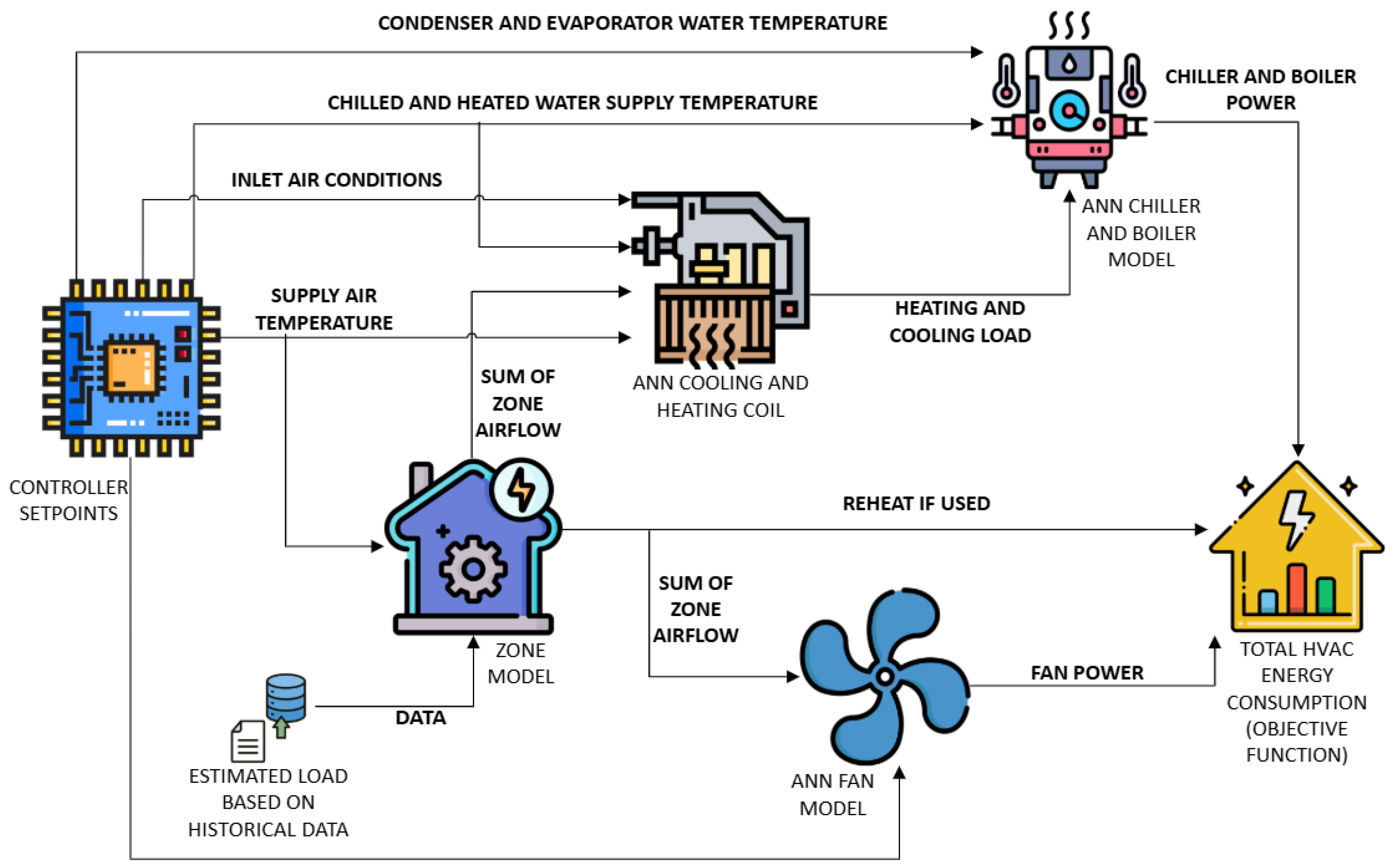
Figure 2.
Building HVAC Library.
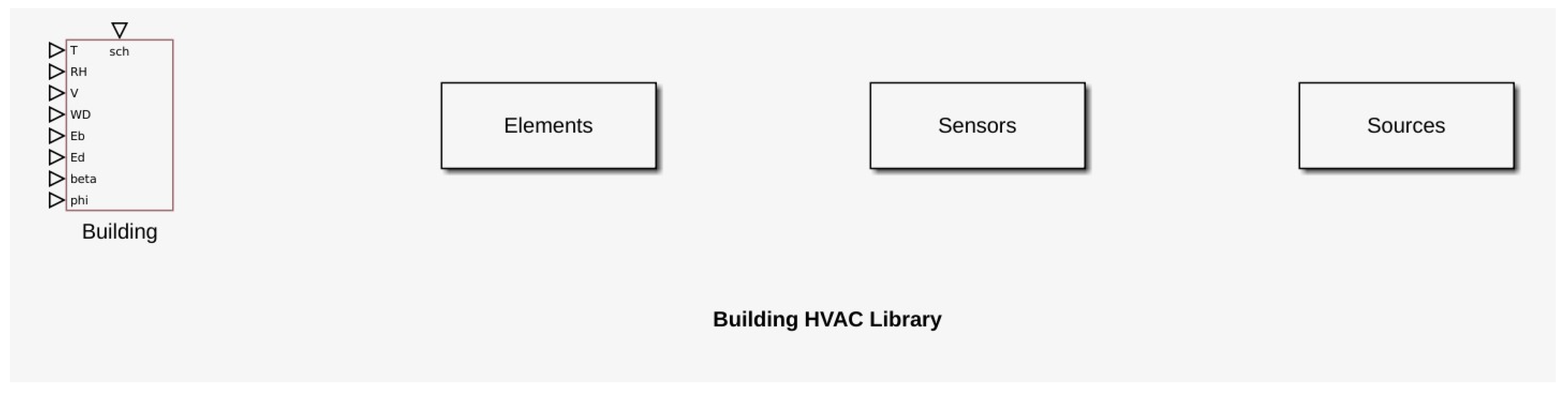
Figure 3.
Sublibrary elements.
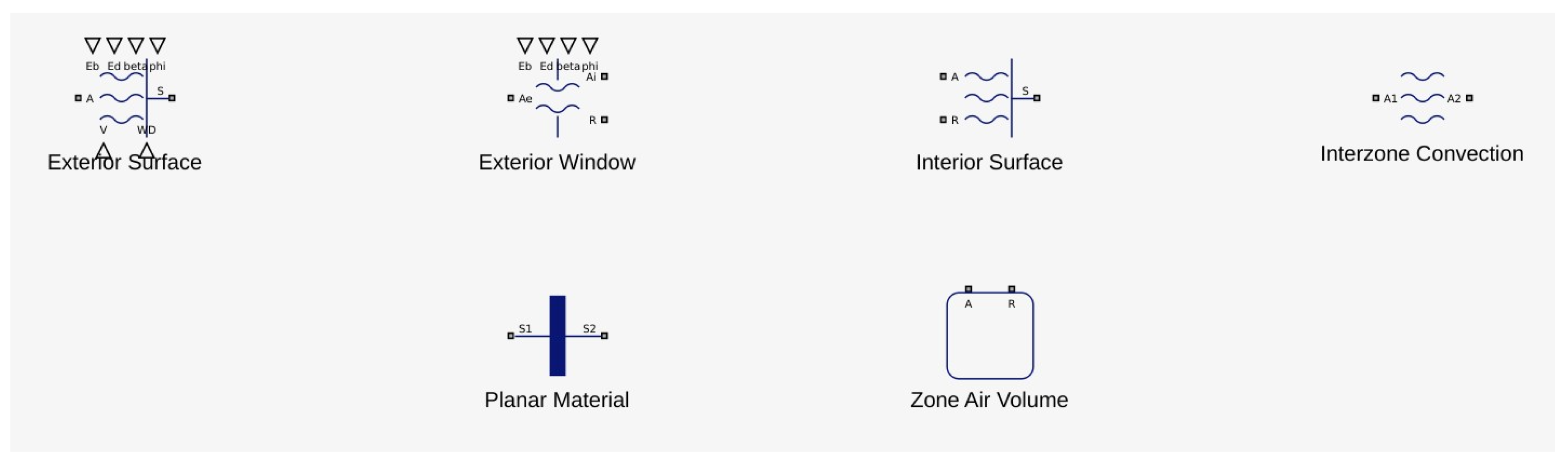
Figure 4.
Temperature and Humidity Sensor.
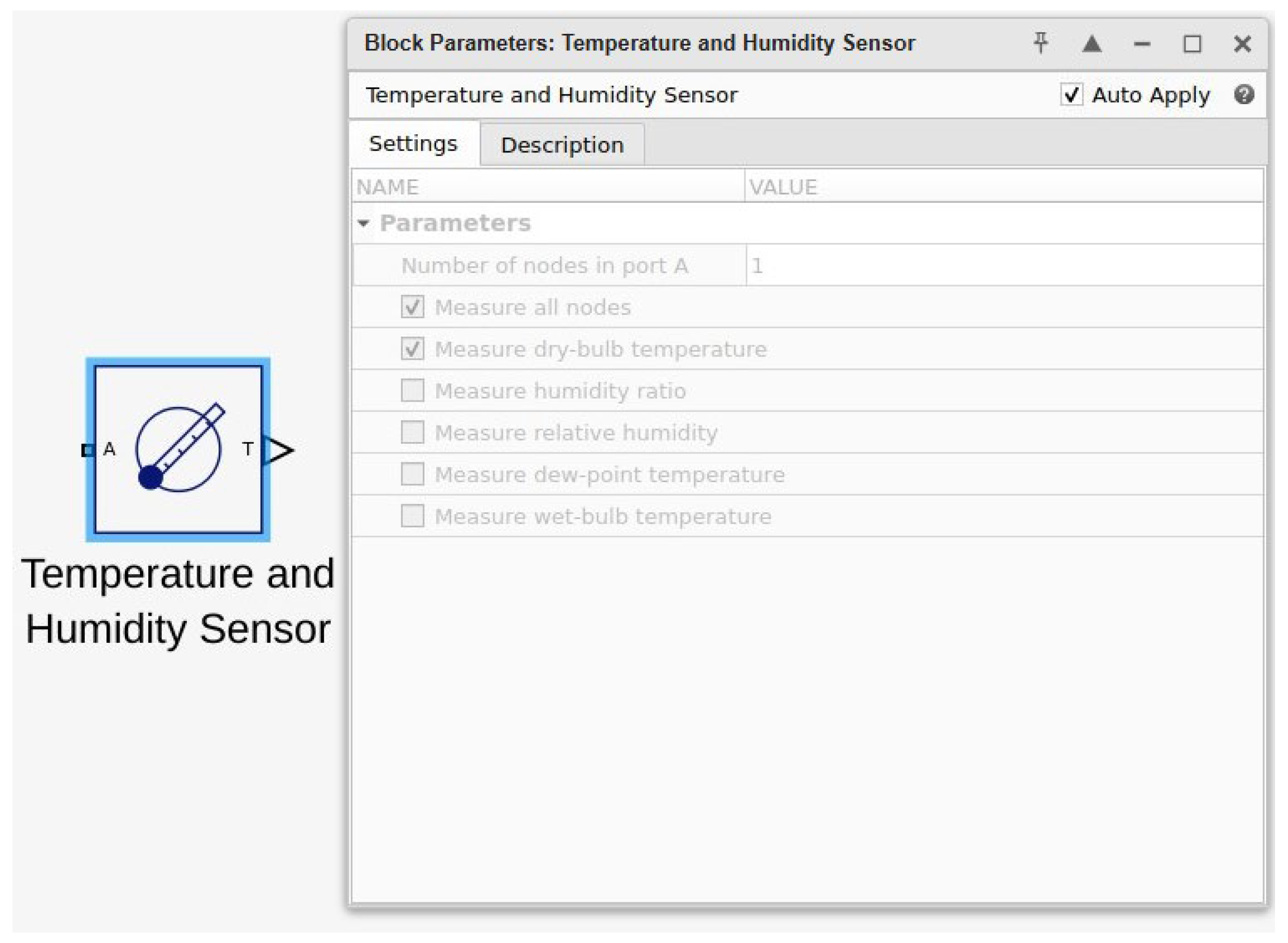
Figure 5.
Model House Heating System.
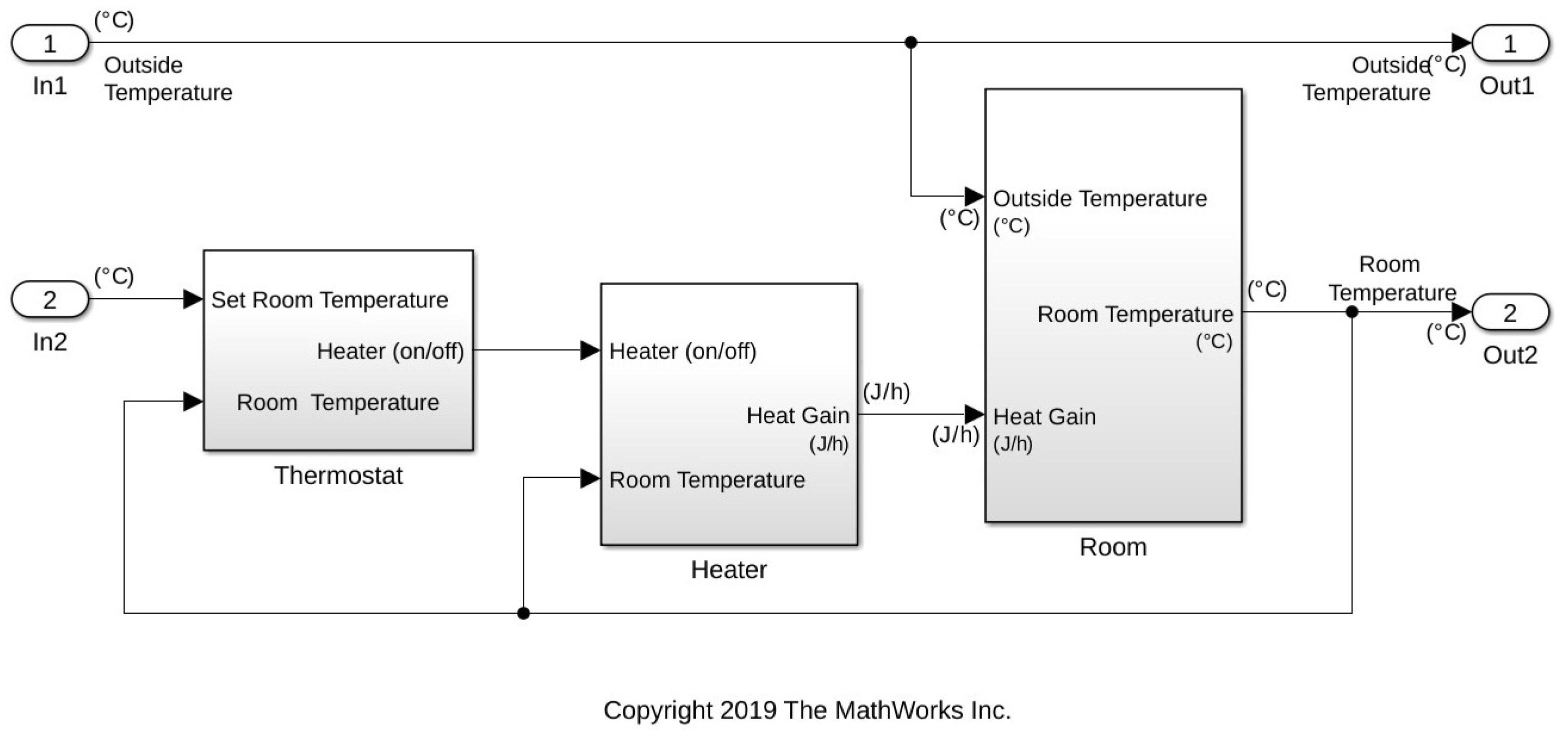
Figure 6.
Subsystems: (a) Thermostat; (b) Heater; (c) Room.
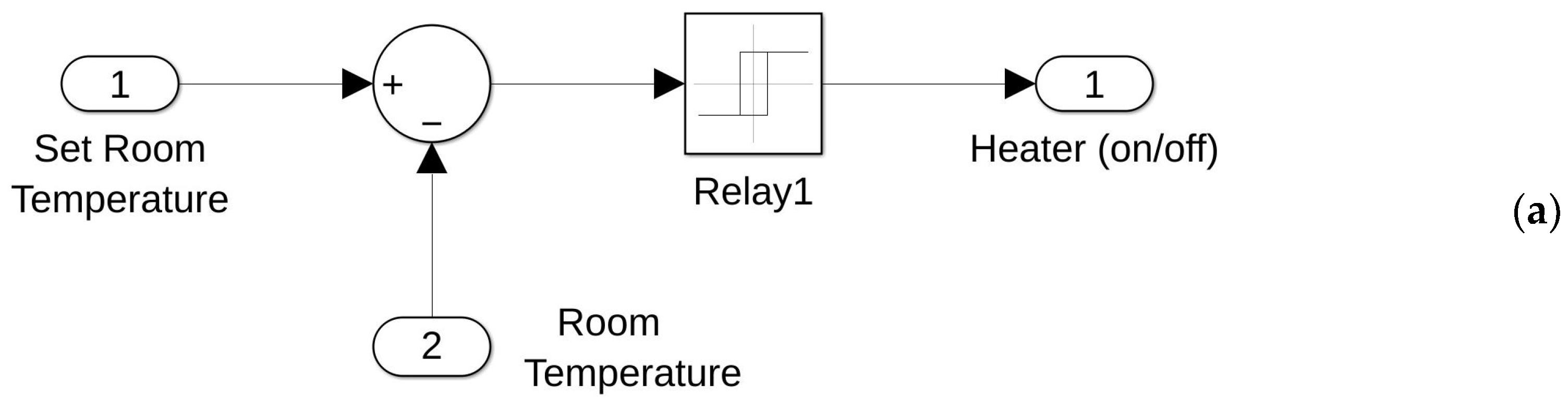
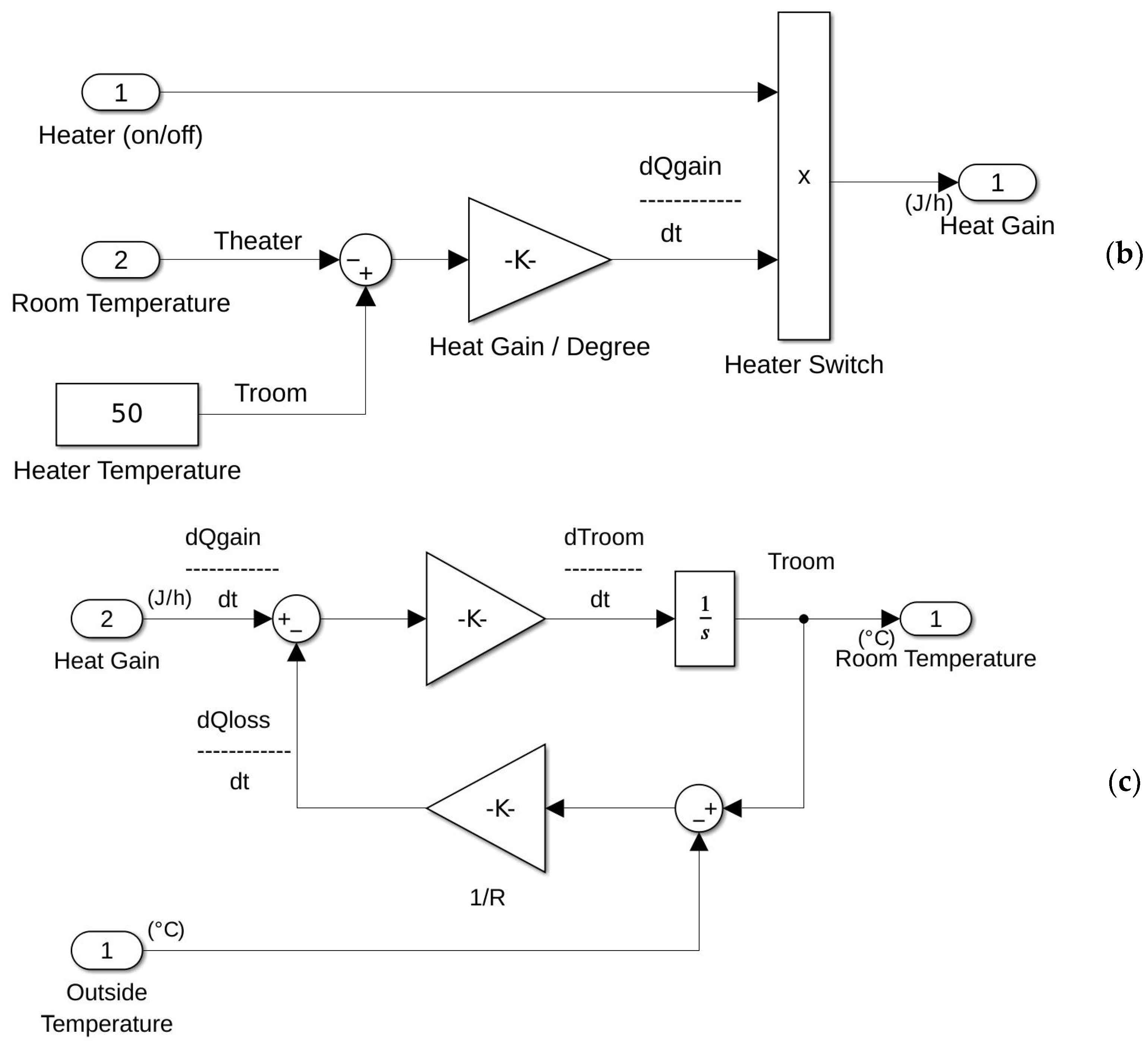
Figure 7.
FreeCAD sample: (a) Model of a house; and (b) a bird's eye view diagram {an open access projects made in FreeCAD (cc-by-nc-sa 4.0)}.
Figure 7.
FreeCAD sample: (a) Model of a house; and (b) a bird's eye view diagram {an open access projects made in FreeCAD (cc-by-nc-sa 4.0)}.
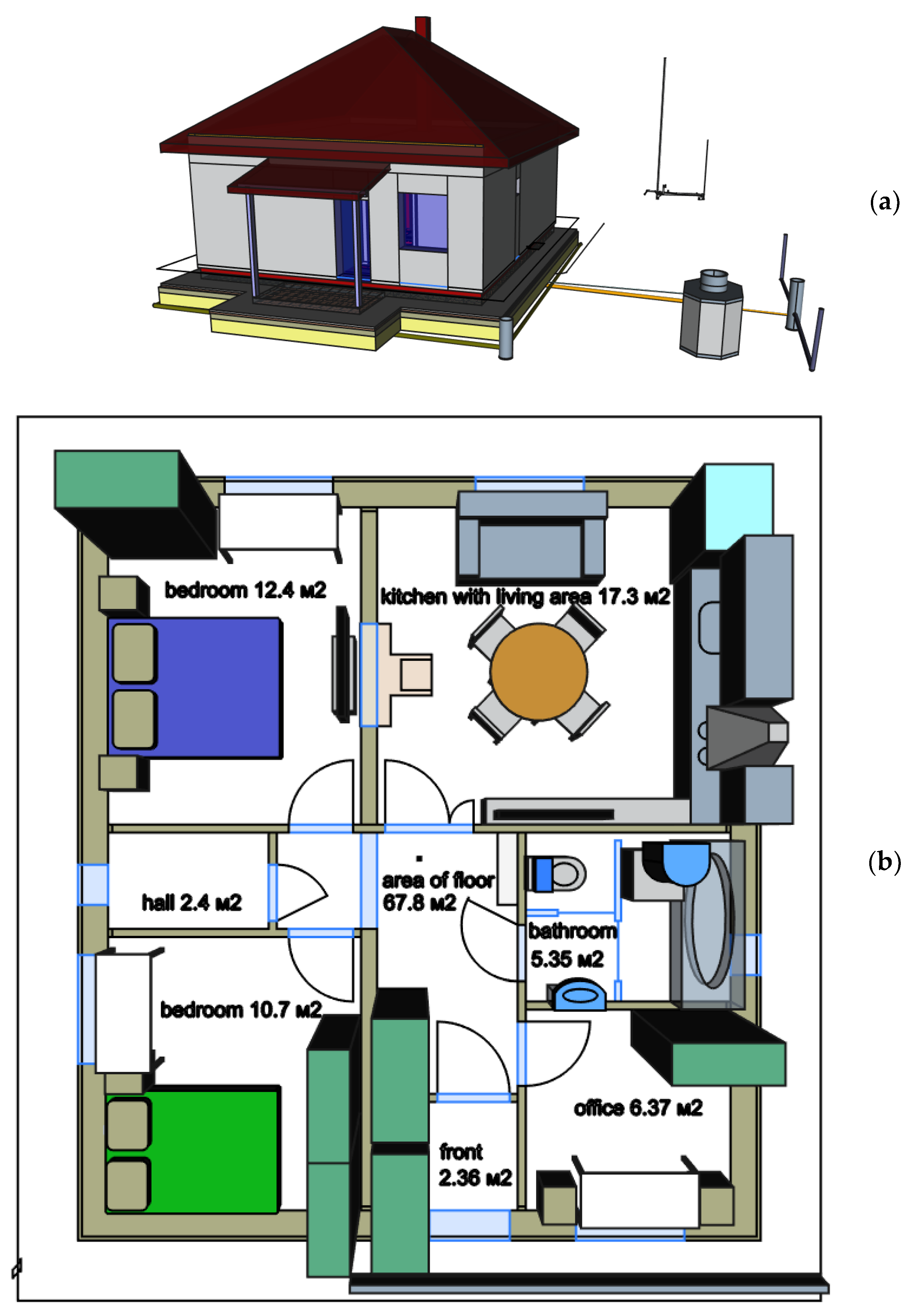
Figure 8.
A description of the layers of the model used and a top plan of the house with the de-scription of the rooms.
Figure 8.
A description of the layers of the model used and a top plan of the house with the de-scription of the rooms.
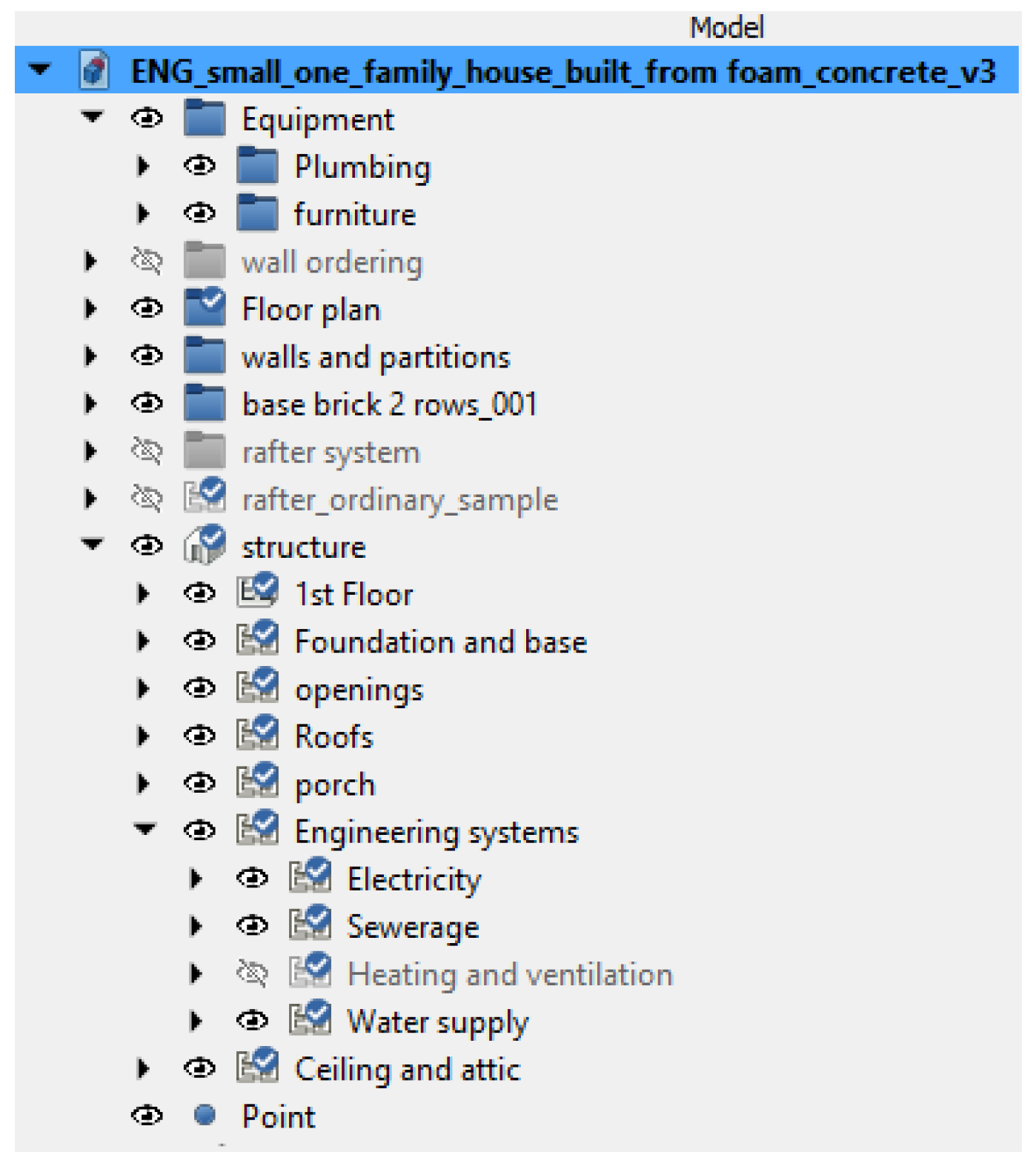
Figure 9.
Example Python script where elements that meet all SRI criteria are marked in green and those that need improvement are marked in red.
Figure 9.
Example Python script where elements that meet all SRI criteria are marked in green and those that need improvement are marked in red.
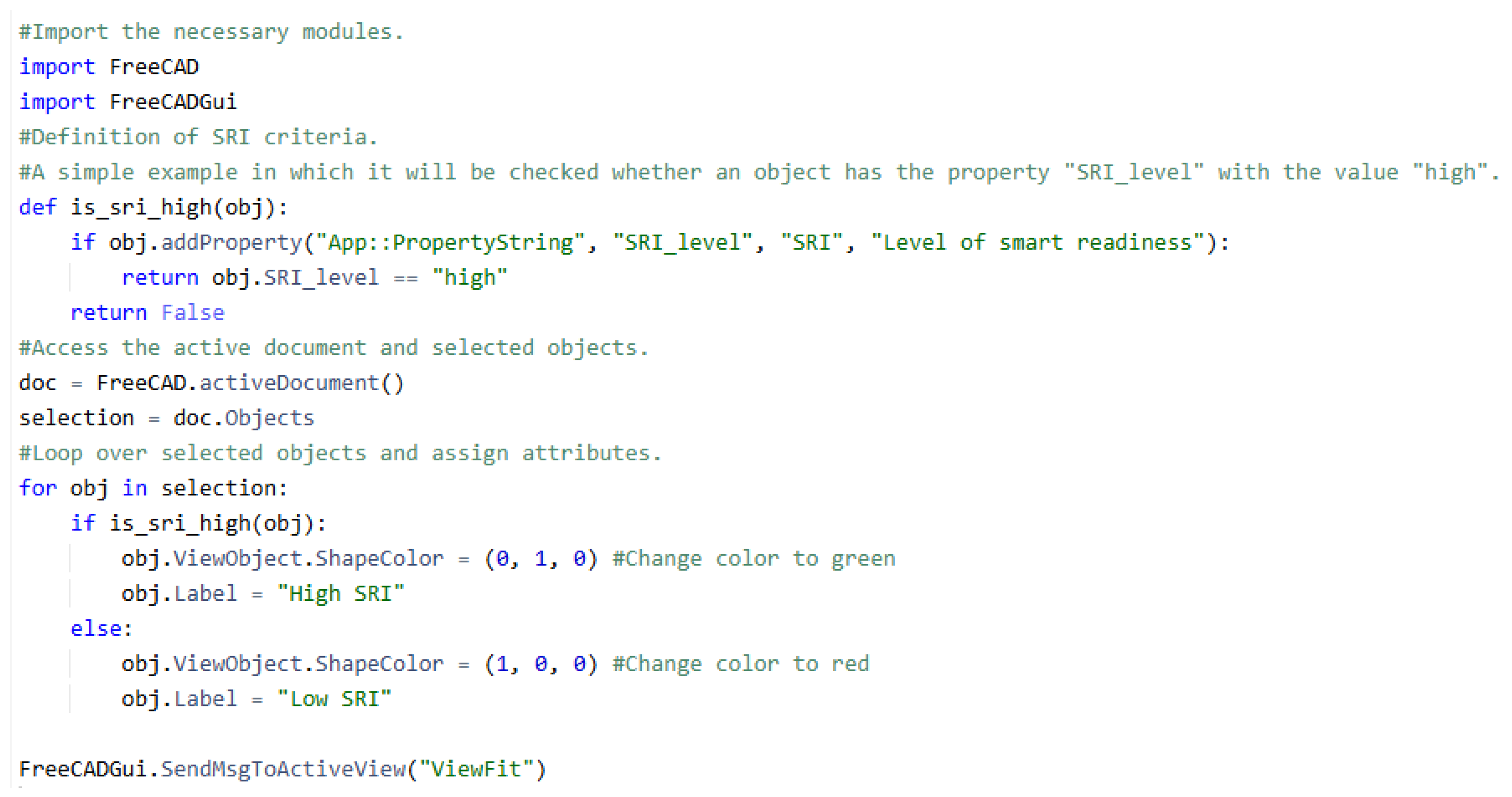
Figure 10.
A model of a simulated office in the southeast orientation: (a) without shading and (b) with a blind.
Figure 10.
A model of a simulated office in the southeast orientation: (a) without shading and (b) with a blind.
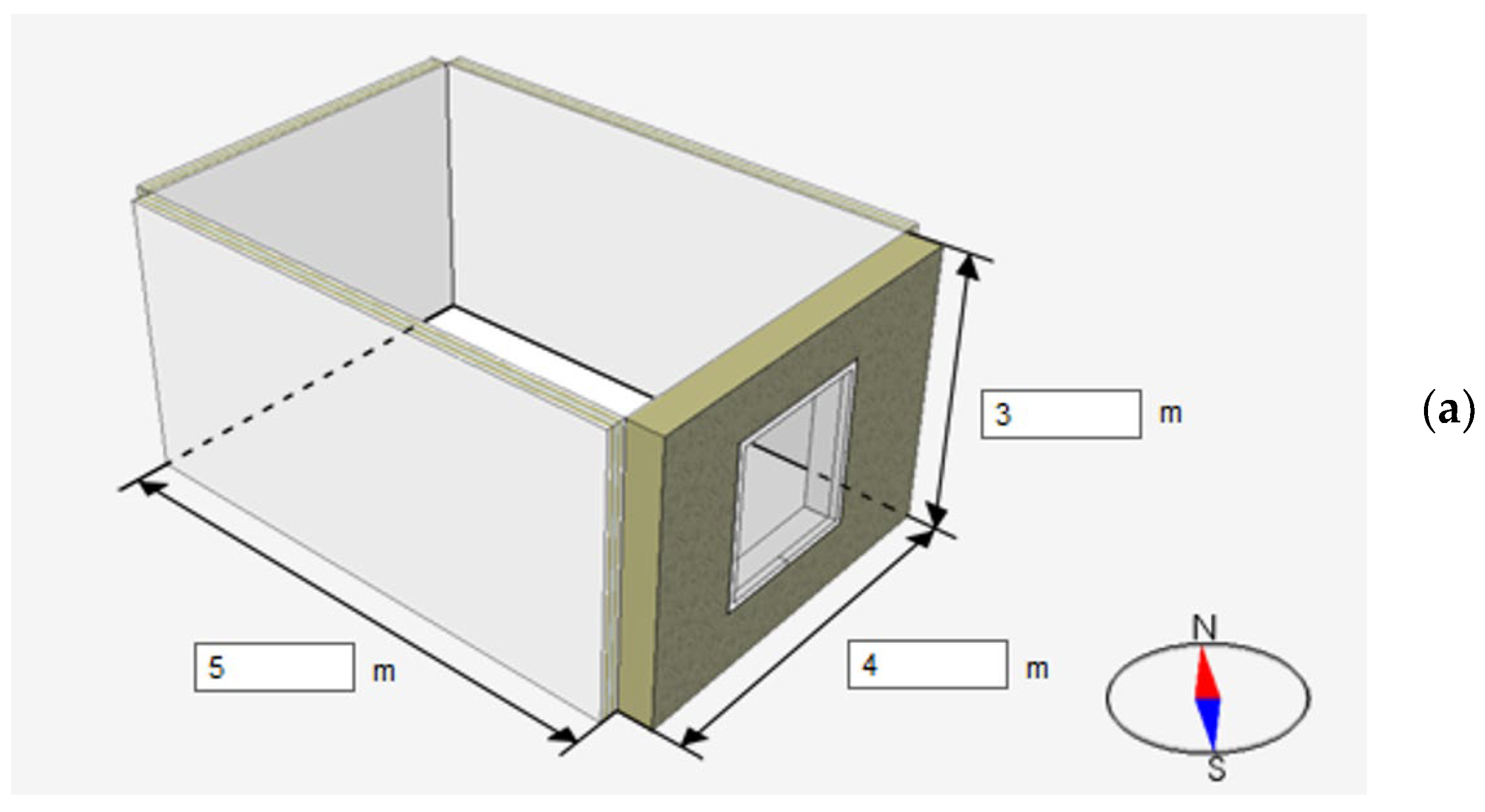
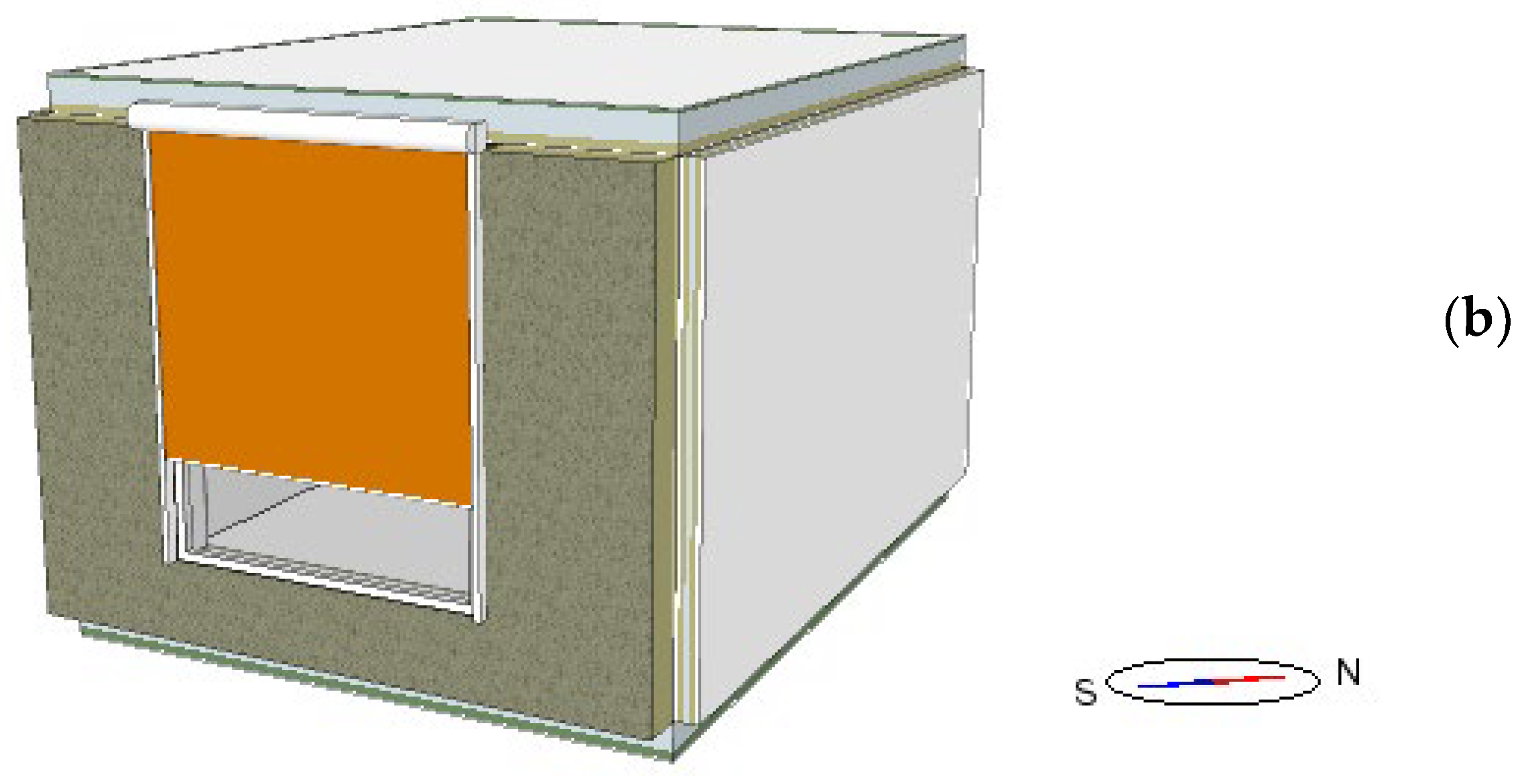
Figure 11.
Comparison of annual energy used to cool a room: (a) without sun protection and (b) with a blind.
Figure 11.
Comparison of annual energy used to cool a room: (a) without sun protection and (b) with a blind.
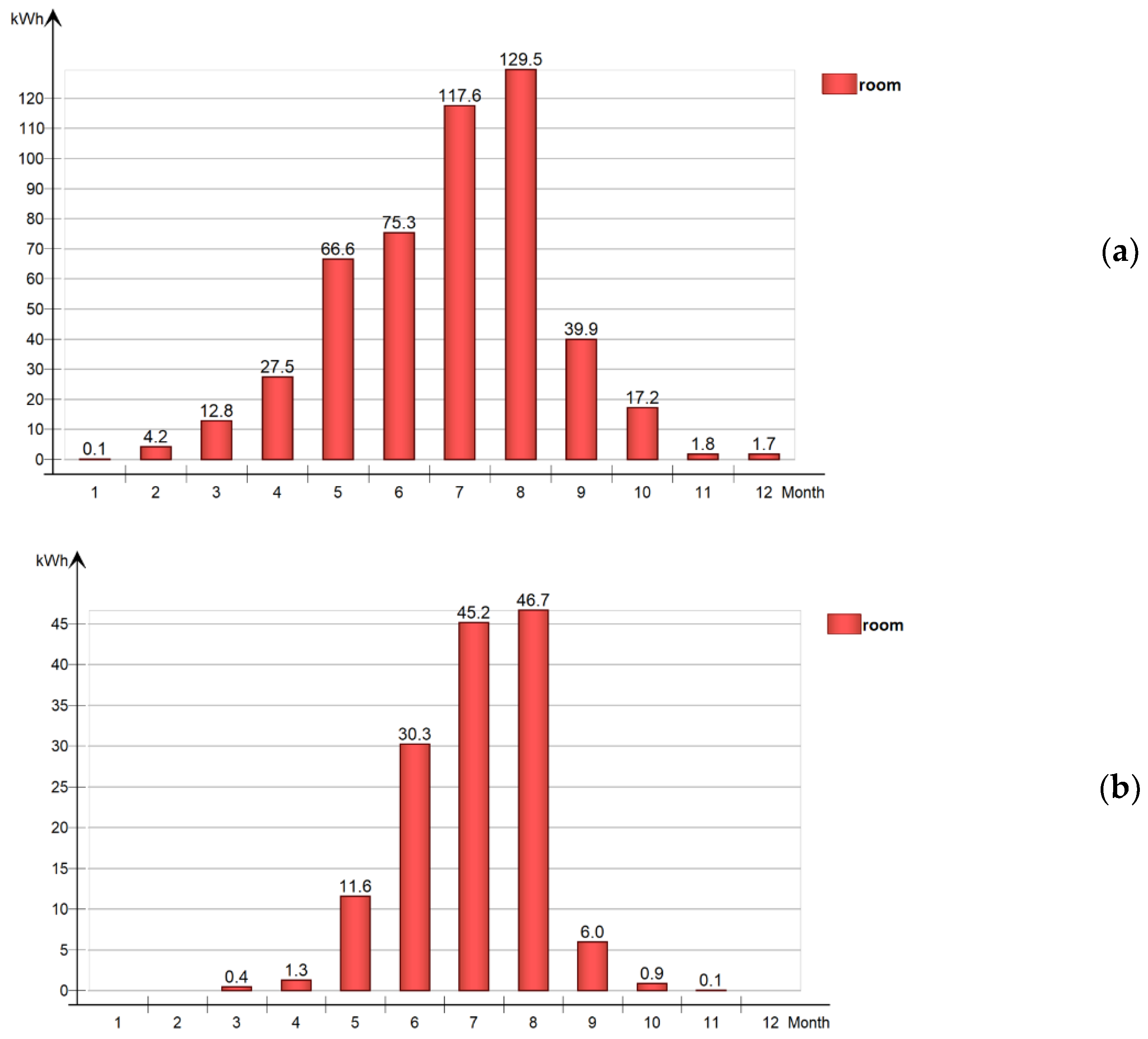

Table 1.
The results of the general literature review from bibliometric databases.
| Database | BACS + building automation |
EN 15232 | EN ISO 52120 | SRI +smart readiness indicator |
Building energy performance |
|---|---|---|---|---|---|
|
Web of Science before and including 2018 after 2018 (6 years) |
43 39 |
20 10 |
0 3 |
0 32 |
142,514 total number |
|
Scopus before and including 2018 after 2018 (6 years) |
62 59 |
22 16 |
0 4 |
0 47 |
113,427 total number |
|
Google Scholar before and including 2018 after 2018 (6 years) |
16,500 13,900 |
13,700 8090 |
0 125 |
1550 14,600 |
5,450,000 total number |
Table 2.
The results of the general literature review from publisher databases.
| Database | BACS + building automation |
EN 15232 | EN ISO 52120 | SRI +smart readiness indicator |
|---|---|---|---|---|
|
ScienceDirect before and including 2018 after 2018 (6 years) |
12 14 |
5 3 |
0 1 |
0 8 |
|
Springer before and including 2018 after 2018 (6 years) |
13 25 |
9 8 |
0 1 |
0 5 |
|
MDPI before and including 2018 after 2018 (6 years) |
3 10 |
1 0 |
0 1 |
0 12 |
|
IEEEXplore before and including 2018 after 2018 (6 years) |
42 16 |
9 3 |
0 0 |
0 13 |
|
Taylor & Francis before and including 2018 after 2018 (6 years) |
8 2 |
2 1 |
0 1 |
0 8 |
|
Wiley Online Library before and including 2018 after 2018 (6 years) |
10 4 |
9 3 |
0 1 |
0 10 |
Table 3.
Comparison of BACS and TBM function categories defined for EN 15232 and EN ISO 52120 standards.
Table 3.
Comparison of BACS and TBM function categories defined for EN 15232 and EN ISO 52120 standards.
| BACS / TBM Categories | Key Features in EN 15232 (2017) | Key Innovations in EN ISO 52120 |
|---|---|---|
| Heating | - Static energy efficiency classification for heating systems - Limited renewable energy integration - Basic time-based heating schedules |
- Predictive heating control using data analytics and machine learning (ML) - Dynamic integration with RES (e.g., solar, heat pumps) - Zonal temperature control |
| Domestic hot water |
- Simple time-based control without consideration of grid dynamics - No renewable energy prioritization - Manual efficiency monitoring |
- Integration with surplus renewable energy from smart grids - Automated monitoring of system efficiency - Dynamic adjustment of heating schedules based on grid conditions |
| Cooling | - Basic occupancy-based control - Limited participation in demand-side response (DSR) - Static setpoint optimization |
- Adaptive cooling based on real-time conditions - Integration with DSR for load flexibility - Natural and passive cooling techniques |
| Ventilation and air conditioning |
- Basic control using occupancy sensors - Limited energy recovery from ventilation - Static performance monitoring |
- Advanced air quality-based control (CO2, humidity, Volatile Organic Compounds VOCs) - Predictive control for minimizing energy use - Integration with renewable energy systems for ventilation power |
| Lighting | - Static lighting scenarios based on time or occupancy - Manual adjustment for daylight utilization - Limited integration with other building systems |
- Smart lighting systems integrated with IoT - Dynamic daylight control and dimming - Support for demand-side management (DSM) to optimize energy consumption |
| Blind control | - Time-based shading control - Static integration with HVAC systems - Basic response to external weather conditions |
- Dynamic shading control for optimizing energy use (e.g., reducing cooling needs) - Real-time integration with HVAC for holistic energy management - Weather-adaptive shading |
| Technical and building management | - Standalone systems for monitoring and control - Limited energy reporting capabilities - No integration with smart grids or renewable energy systems |
- Integrated, centralized BACS and TBM platform integrating all systems - Real-time performance monitoring and reporting - Full integration with smart grids for demand flexibility and cost control |
Table 4.
Synthesis of the most important gaps and research and development challenges of the EN ISO 52120 standard.
Table 4.
Synthesis of the most important gaps and research and development challenges of the EN ISO 52120 standard.
| Gap/Challenge | Description | Potential Solutions |
|---|---|---|
| Imprecision of Simplified Energy Performance Evaluation Methods |
Simplified methods, like the BACS factor method, fail to accurately account for variables such as building design, occupant behavior, and climate, leading to discrepancies in energy performance. | Implement detailed and dynamic modeling for more accurate energy performance estimation. |
| Need for Long-Term Verification and Easier Way for More Accurate Numerical Evaluation Methods |
Lack of long-term verification and parametric validation affects the reliability of energy assessments. A need exists for long-term verification studies on real facilities. |
Conduct comprehensive long-term studies and continuous monitoring to validate energy metrics. Utilize BIM and DT as tools to support numerical methods for evaluating building energy performance. |
| Absence of Guidelines for Outdoor Lighting |
The current standard lacks comprehensive guidelines for outdoor lighting systems, limiting its scope. | Increase case-study and simulation analyses. Develop specific guidelines and performance indicators for outdoor lighting systems. |
| Integration of Advanced Control Strategies | BACS control strategies do not fully utilize advanced technologies, reducing potential efficiency gains. | Incorporate advanced control strategies like ML and MPC to optimize energy performance. |
| Utilization of Emerging Technologies |
There is a gap in integrating modern technologies like BIM and DT for improved evaluation and monitoring. | Adopt BIM and DT for more accurate and expedited energy efficiency assessments. |
Table 5.
Synthesis of the most important for future R&D works for SRI.
| Challenge | Description |
|---|---|
| Expansion of Calculation Framework | - Need for a robust quantitative framework to integrate SRI into energy certification - Development of KPIs for energy capacity and load-shifting potential - Standardization of methodologies for different building types |
| Integration with BIM and IFC Schemas | - Alignment of SRI evaluation with BIM models for improved data extraction - Addressing gaps in the IFC schema, particularly for Electric Vehicle Charging and Monitoring as well as prosumer microgrids - Enhancing semantic web models to better identify BIM objects relevant to SRI |
| Quantitative vs. Qualitative Evaluation | - Shift towards quantitative methods to complement qualitative evaluations - Development of algorithms for verifying the effectiveness of SRI services/functions - Incorporating user needs and energy efficiency metrics in evaluations |
| Adaptability to Climate and Building Type | - Adapting SRI frameworks for specific climates and building types - Addressing limitations in applying SRI to historic and non-residential buildings in diverse climates - Proposals for cold climate-specific frameworks and tailored triage processes |
| Policy and Incentive Framework (with UN Sustainability Goals) |
- Creating policies and incentives to encourage smart building technologies - Integrating SRI with broader environmental goals like reducing carbon footprints and promoting renewable energy - Aligning SRI with UN Sustainability Goals to promote sustainable development in the building sector - Encouraging interdisciplinary collaboration to innovate and share best practices for smart buildings |
Table 6.
Synthetic comparative analysis of FreeCAD, Blender and Trimble packages in terms of usability for SRI and BIM development.
Table 6.
Synthetic comparative analysis of FreeCAD, Blender and Trimble packages in terms of usability for SRI and BIM development.
| Feature | FreeCAD | Blender | Trimble |
|---|---|---|---|
| Main Application | 3D parametric modelling, engineering |
3D graphic design, animations, visualizations | BIM, management |
| Complexity | Medium, easy to learn, intuitive | High, takes time to master the functions |
High, many advanced features |
| BIM | Partial BIM support, but developing |
Small BIM support, mainly visualizations |
Good support, full BIM functionality |
| Simulations | Limited | Simulation, visualization but not calculation |
Advanced physical and energetic simulations |
Table 7.
Comparison of yearly energy used to heat and cool a room before and after the application of the shields.
Table 7.
Comparison of yearly energy used to heat and cool a room before and after the application of the shields.
| Results | Without Shading | With Shading |
|---|---|---|
| Heating energy [kWh] | 960.8 | 1298.7 |
| Heating energy per m2 [kWh/m2] | 48.0 | 64.9 |
| Cooling energy [kWh] | 494.3 | 142.4 |
| Cooling energy per m2 [kWh/m2] | 24.7 | 7.1 |
Disclaimer/Publisher’s Note: The statements, opinions and data contained in all publications are solely those of the individual author(s) and contributor(s) and not of MDPI and/or the editor(s). MDPI and/or the editor(s) disclaim responsibility for any injury to people or property resulting from any ideas, methods, instructions or products referred to in the content. |
© 2025 by the authors. Licensee MDPI, Basel, Switzerland. This article is an open access article distributed under the terms and conditions of the Creative Commons Attribution (CC BY) license (http://creativecommons.org/licenses/by/4.0/).
Copyright: This open access article is published under a Creative Commons CC BY 4.0 license, which permit the free download, distribution, and reuse, provided that the author and preprint are cited in any reuse.


