

Submitted:
24 January 2025
Posted:
27 January 2025
You are already at the latest version
Abstract
In spite of the increasing industrial cultivation of lavender (Lavandula angustifolia Mill.) and developed genomic resources, no genetic map has been reported for lavender or other Lavandula species. Here we present the development of a set of SSR markers and the construction of the first genetic linkage map of L. angustifolia following the genotyping with SSR and SRAP markers of a segregating population obtained by self-pollination of the industrial variety Hemus. The resulting genetic map comprises 25 linkage groups /LGs/ corresponding to the chromosome number of the lavender reference genome. The map includes 375 loci covering a total of 2518,9 cM. The average marker distance in the established map is 7,05 cM. The number of markers on each LG ranges from 9 to 26, with an average number of 15. The orders of SSR loci in most of the LGs aligns well with the order of SSR loci in the reference genome. The overall comparison of the LG maps and reference chromosome sequences shows that the LG maps cover between 49,2% and 99,4% of the chromosome sequences, with an average of 84,4% per chromosome. The PCR amplification of genomic DNA from L. angustifolia var. Hidcote Blue, L. latifolia and the intersectional hybrid L. × heterophylla var. Big Boy James suggests that the developed SSR marker set possesses high intra-species (> 93%) and inter-species (> 78%) transferability and could be successfully applied in various genetic diversity studies, the development of integrated maps and an anchor SSR set for the genus Lavandula.
Keywords:
lavender
; Lavandula angustifolia
; SSR markers
; genetic linkage map
; reference genome
; SSR transferability
1. Introduction
The lavender (Lavandula angustifolia Mill.), lavandin (Lavandula x intermedia Emeric ex Loisel.) and to some extent spike lavender (Lavandula latifolia Medik.) are widely industrially cultivated members of the genus Lavandula worldwide [1,2,3,4,5]. The industrially cultivated lavender and lavandin are mainly used for production of essential oil and to a lesser extent of concrete and hydrolate [2,3,6]. Due to its unique fine fragrance the lavender oil is widely used in perfumery, cosmetics, aromatherapy and medicinal applications [7,8,9,10]. Cultivated lavandin provides higher yield of essential oil per acre than lavender, but its sensory profile is less sophisticated and attractive which assigns the use of lavandin oil mainly in the industrial perfumery. Bulgaria, France and China have been the largest lavender oil suppliers in the world during the last decade [3,11], whereas the production of lavandin oil has been dominated by France [2,4]. The requirement, that the produced essential oil must meet the ISO standards for lavender (ISO 3515:2002) and lavandin (ISO 3054:2017) oil, has resulted in the growing demand for production and use of high-quality planting material from superior vegetatively propagated varieties [2,11]. The increased use and demands of lavender and lavandin oil further attracts farmers and companies from various countries to expand the industrial cultivation and processing of lavender and lavandin, including the start of cultivation in new areas [6,11,12,13,14]. The expansion of lavender and lavandin farming areas is often related to their cultivation in soil and/or climatic conditions that significantly differ from the optimal for the varieties initially developed for the environmental conditions specific for the traditional areas of cultivation [13,15]. Often such cultivation at sub-optimal conditions of the available varieties results in large variations of flower and essential oil yields and quality, and significant economic losses. In addition, the introduction of new technologies for mechanization of lavender and lavandin cultivation, processing and extraction often requires the use of varieties suited for the application of the particular technology [6,16,17,18]. The described above suggests the need for development of genomic resources and related molecular marker tools for better characterization of the available lavender and lavandin genetic resources, identification of QTLs for important agronomic and essential oil quality traits and application of marker assisted selection for efficient breeding of new elite varieties meeting the new challenges of the industry [2,11,19,20].
The biosynthesis and accumulation of volatile organic compounds in lavender and lavandin flowers were the subject of a number of studies which resulted in the identification of a set of genes involved in particular biosynthetic steps, for example [21,22,23,24,25,26], or the regulation of these processes [27,28]. These studies were further supported by transcriptome sequencing [29,30,31] and genome-wide characterization of gene families related to the terpenoid biosynthesis pathways [32,33,34], as well as by the reported nuclear genome sequence assemblies of three L. angustifolia varieties including var. Maillette [35], var. Jingxun 2 [36] and the reference genome sequence of var. Munstead [37] accessible through the GenBank database. Accordingly, lavender was proposed as a model of aromatic and medicinal plants to study the biosynthesis of volatiles and the related ecology and evolution [15,31,38,39,40]. So far, characterization of the genetic diversity and resources of Lavandula species has been the subject of few studies employing EST-SSR [41], SRAP [42], and RAPD [43] markers.
Over the last three decades construction of genetic linkage maps and QTL analysis has been widely applied as an effective tool for the identification of loci for important agronomic traits and direct application of the obtained results in marker-assisted selection programs in various crops including medicinal and aromatic plants [44,45]. Although the construction of genetic maps increasingly involves the application of SNP based markers, the genetic linkage maps based on SSR markers offer the attractive opportunity to be used as core genetic maps for different genotypes of the species of interest, due to the high transferability of SSR markers. In spite the large number of molecular genetics and genomic studies and related data in lavender and lavandin, surprisingly no construction of a genetic linkage map has been reported for them. Moreover, the only SSR markers reported so far is a set of EST-SSR markers, which are not sufficient for genome mapping studies and QTL analysis.
In the present study, we report the development of an extended set of SSR markers for lavender and the construction of the first genetic linkage map for this species following genotyping of an F2 segregating population obtained by self-pollination of the industrial variety Hemus.
2. Results and Discussion
2.1. Development of an F2 Segregating Population by Self-Pollination of L. angustifolia var. Hemus
Variety Hemus of L. angustifolia has been established in 1974 and during the years has become one of the most widely industrially cultivated lavender varieties in Bulgaria. It is suitable for mechanized harvesting, tolerates cultivation in different geographic regions in the country [46] and provides high-quality of the distilled lavender oil. For some period of time, var. Hemus was also used as a state standard for evaluation of the performance of newly developed lavender varieties. Since its initial development var. Hemus has been propagated vegetatively, both for maintenance in genetic resources collections and for the production of planting material. Considering all this, var. Hemus was selected for the development of a F2 segregating population and genetic linkage map of lavender. Our early attempt to develop F2 segregating population through spontaneous or mechanical self-pollination of a single var. Hemus plant was not successful. The spontaneous self-pollination set up by covering the entire plant with a cage of fine mesh for isolation of insects resulted in the formation of no seeds, supporting the recently reported lack of spontaneous self-pollination in lavender [47]. The mechanical self-pollination of flowers placed under an isolator produced only a small number of seeds, not sufficient for the development of a large segregating population. Therefore, to generate a larger seed set after self-pollination, a single var. Hemus plants was grown under open field conditions, with no other L. angustifolia detected in the same area. As a result, over 1200 seeds were produced from a single three years old var. Hemus plant during the 2020 flowering season, due to insect-mediated self-pollination. The germination and planting of these seeds resulted in the generation of a segregating population of a thousand plants. The SSR marker genotyping of 110 randomly chosen plants from this population and comparison of the scored alleles with those of the starting var. Hemus plant showed that only one of these plants had alleles not observed in the mother plant. This suggests that the plant most likely originated from cross-pollination of the mother plant with unknown L. angustifolia plant mediated by long-distance pollen transfer by the insects. Accordingly, 95 of these tested plants were selected as a mapping population. The results demonstrated that such open-field self-pollination of a single plant could be successfully employed for the generation of a segregating population. Moreover, the open-field cultivation could be substituted by growing plants in insect restrained room and the use of dedicated greenhouse insects as pollinators. Such an approach could be further applied for the generation of self-pollinated seeds for plants of other species from the Lamiaceae family, already reported as difficult for self-pollination [48,49].
2.2. SSR Marker Development
Three groups of primer pairs were tested for amplification of genomic regions containing SSR sequences and development of a large set of SSR markers for genotyping of the segregating population, including: 471 NGS-SSR primer pairs determined after analysis of Illumina MiSeq generated genomic sequences of var. Hemus, 170 GEN-SSR primer pairs determined after analysis of the reference genome sequence of var. Munstead retrieved from GenBank and a set of EST-SSR primer pairs reported by Adal et al.l [41]. The testing included two rounds, first for successful amplification of the target SSR region from DNA isolated from var. Hemus and production of a distinct profile of the amplified DNA fragments, and second round for generation of segregating alleles after analysis of 8 plants from the segregating population. The results of the tests are demonstrated in Table 1 and show that testing of the NGS-SSR group was the most efficient for development of polymorphic SSR markers. The testing of markers from the EST-SSR group resulted in the identification of a significantly lower portion of polymorphic markers, which support the higher efficiency and informativeness of the genomic SSRs compared to EST-derived SSR markers marker observed also in other studies [50,51]. The testing of SRAP markers showed that this type of markers could be readily applied for simultaneously genotyping of a higher number of loci, due to the higher number of alleles which could be detected and analyzed by a single marker. Thus, SRAP markers could be efficiently applied to increase the marker density of SSR-developed genetic maps.
2.3. Linkage Map Construction
A total of 410 loci were analyzed for linkage mapping, including 377 loci obtained through genotyping with three groups of SSR markers and 33 loci identified through analysis with SRAP markers. The first round of map construction involved genotyping of the segregating population with 5 previously reported EST-SSR markers [41] and 255 NGS-SSR markers developed after analysis and testing of SSR regions in genomic sequences of L. angustifolia var. Hemus. This first version of the map was developed shortly before the publication in GenBank of the reference genome sequence of L. angustifolia var. Munstead. Using the latter, BLAST search with the primer and SSR region sequences in the reference genome sequence was used to affiliate the constructed LG maps to the corresponding reference chromosome sequences and for determination the physical position of the mapped SSR loci. The obtained data were used to proceed in a second round of map expansion through identification, selection and testing GEN-SSR primer pairs for amplification of SSR regions located in the chromosome regions outside of the range of the corresponding linkage groups or located in the low marker density regions of the map. All this resulted in mapping of additional 90 loci after analysis with 79 GEN-SSR markers. Finally, the segregating population was genotyped with 11 SRAP markers which resulted in the mapping of 33 SRAP loci. The overall data analysis and quality check of the obtained genetic map resulted in the identification of a total of 25 LGs, which correspond to the number of assembled chromosome sequences in the reference genome, as well as to the chromosome number of var. Hemus used for the development of the segregating population, Figure 1. The main parameters of the map are shown in Table 2 and details for the position of each locus are presented in Table S3, Supplementary Materials. The constructed genetic linkage map of L. angustifolia var. Hemus contains 375 loci covering a total of 2518,9 cM. The average marker distance in the map is 7,05 cM. The number of markers on each LG ranged from 9 (LG 13 and LG 23) to 26 (LG 3), with an average number of 15, and the length per LG ranged from 54,8 cM (LG 25) to 172,2 cM (LG 6), with an average length of 100,8 cM. A total of 35 analyzed loci were not included in the map. Of them, 16 loci had no distinct affiliation to the established LGs, Table S3. The other 19 loci initially affiliated to different LGs were excluded from the final map since they showed segregation distortion and their inclusion resulted in significant changes of the marker order in the maps of the corresponding LG, Table S3. The appearance of loci with segregation distortion which significantly change the established map after their inclusion was reported for different plant species, for example [52,53,54,55,56], and could be expected for continuously vegetatively propagated lavender varieties like var. Hemus. The performed BLAST search revealed that sequences of two NGS-SSR markers, 245 (LG4) and 247 (LG19), were allocated on two scaffold sequences of the reference genome: scaffold 293 (acc. JAPVEC010000093) and scaffold 515 (acc. JAPVEC010000026), which were not included into the chromosome sequence assemblies, Table S3. In reverse, the genotyping of the GEN-SSR marker S246 targeting an SSR region on scaffold 246 (acc. JAPVEC010000206) was affiliated to a locus on LG18, whereas the GEN-SSR marker S229 targeting an SSR region on scaffold 229 (acc. JAPVEC010000199) corresponded to loci on LG10 (S229A) and LG23 (S229B), Table S3. Accordingly, the established genetic map and additional genotyping of selected SSR markers could be applied to clear some ambiguities in the current reference chromosome assembly and affiliate some of the scaffolds to particular chromosomes. The use of high-density genetic maps for improving reference genome assemblies has been reported in other plant species. [57,58,59].
The BLAST search determined positions of SSR sequences in the reference genome and comparison with the respective SSR loci positions in the established genetic map shows that the order of SSR loci in several LGs well resembles those predicted from the corresponding chromosome sequence assemblies, for example LG6, LG9, LG15, LG18, LG19, LG20, LG22, LG24 and LG25, Table S3. For other LGs, the order of SSR loci has a patchy character in comparison with the reference genome predicted order, for example, LG7, LG10 and LG12, Table S3. These LGs contain one or more sub-linkage group(s) in which the loci order corresponds to the predicted from the reference genome, but the order of the rest of the loci differs from the predicted or the sub-LGs have twisted directions and/or positions in comparison to the predicted. The reasons for such differences are not clear and could be a result of chromosome rearrangements in the genome of var. Hemus or/and var. Munstead, local map disorders due to not sufficient marker saturation or even in local genome sequence disorders due to local irregularities of the genome sequence assembly. Further saturation of the map in the border regions of such sub-LGs will provide valuable information to clear these issues. The last together with the appearance of 16 loci with no distinct affiliation to a particular LG and the presence in some LG maps of adjacent markers with a large distance between them suggest that a follow-up genome guided regional saturation of the map will be essential for further improvement of the constructed map. The overall comparison of the established LG maps and corresponding positions of the markers in the reference chromosome sequences makes it possible to estimate the genome coverage of the map. The comparison shows that the genetic map covers between 49,2% and 99,4% of the reference chromosome sequences, with an average coverage of 84,4% +/- 14,2% per chromosome, Table 2. Correspondingly, the current level of marker saturation and genome coverage of the established map is sufficient to carry out efficient QTL analysis, as the early version of the map was already successfully applied for the identification of a QTL controlling the ratio of linalool to linalyl acetate in the flowers of L. angustifolia var. Hemus [60].
2.3. SSR Marker Transferability
Intra- and inter-species transferability of the employed SSR markers is essential for the wide range application of the established genetic linkage map and the construction of SSR marker anchored reference genetic map of lavender and Lavandula sp. To evaluate the transferability of the SSR markers applied in the established map, the SSR primer pairs were tested for PCR amplification of genomic DNAs isolated from L. angustifolia var. Hidcote Blue, two L. latifolia accessions, and the intersectional hybrid L. × heterophylla var. Big Boy James. A summary of the results is presented in Table 3 and described in details in Table S4, Supplementary Materials. The obtained results show high transferability of the majority of SSR markers used for the development of the genetic map, as above 93% of the tested SSR primer pairs show positive PCR amplification for the L. angustifolia garden variety Hidcote Blue, and above 78% of the SSR markers exhibit positive PCR amplification of DNAs from other Lavandula species. The observed high intra- and inter-species marker transferability suggests that the developed marker set could be efficiently employed for evaluation of the genetic diversity of natural populations and genetic resources collections of Lavandula species, as well as could be further applied for development of an integrated genetic map of L. angustifolia and SSR marker anchored genetic maps in the genus Lavandula. Such SSR marker-anchored genetic maps have been successfully and increasingly applied in modern plant breeding [61,62,63].
3. Materials and Methods
3.1. Plant Material
L. angustifolia var. Hemus plant used for the development of an F2 segregating population was obtained from the Institute of Roses and Aromatic Plants, Kazanlak, Bulgaria. For development of the segregating population, a single plant of var. Hemus was cultivated in the area of the village of Zagore, Thracian lowland, Bulgaria and seeds were collected after the 2020 flowering period. No other lavender plants were detected to grow in the same area during this period. The seeds were stratified for 12 weeks at 4 °C, and germinated in a tray on planting soil. The obtained seedlings were transferred in pots, grown in the greenhouse for 10 weeks and cultivated in the experimental field of the Agrobioinstitute (ABI), Kostinbrod, Bulgaria. The plants of L. angustifolia var. Hidcote Blue, L. latifolia and the intersectional hybrid L. × heterophylla ‘Big Boy James’ were purchased from Bastin Nursery (Kwekerij Bastin), Aalbeek, the Netherlands. The L. latifolia (Ll_abi2) plant was grown and selected from seeds purchased from WeberSeeds Botany Ethnobotany, the Netherlands. The plants were grown in pots in the greenhouse of ABI, Kostinbrod, Bulgaria
3.2. Genomic DNA Isolation
About 20–25 young leaves from every plant were placed in 15-ml plastic containers, immediately frozen in liquid nitrogen and stored at −80 ◦C. The frozen leaf samples were ground to a fine powder by using the Qiagen TissueLyser II Mill at 30Hz for 2min. Genomic DNA was purified according to the cetyltrimethylammonium bromide (CTAB) protocol [64]. Genomic DNA concentration was measured spectrophotometrically by using Nanodrop 2000 (Thermo Fisher Scientific, Waltham, MA, USA) and diluted to a final concentration of 25 ng/μL with Type I ultrapure water.
3.3. Next Generation Sequencing, SSR Identification and Primer Design
Microsatellite sequences from L. angustifolia var. Hemus were identified as a service by Ecogenics GmbH, Switzerland following NGS sequencing of a genomic DNA sample isolated from the var. Hemus plant used for development of the segregating population. The Illumina TruSeq nano DNA library was sequenced by using MiSeq Reagent Nano Kit v2 and Illumina MiSeq sequencing platform. The paired-end reads were passed through Illumina’s chastity filter and were further subject to de-multiplexing and trimming of Illumina adaptor residuals. The quality of the surviving reads was checked with FastQC v0.11.8 [65]. The paired-end reads were next quality filtered and merged with USEARCH v11.0.667 [66] to reform in silico the sequenced molecules. The merged reads were screened with the software Tandem Repeats Finder, v4.09 [67]. Merged reads containing SSR region with at least six repeat units of tri- or a tetra-nucleotide, or at least ten repeat units a dinucleotide of were selected. Primer 3 [68,69] software was used for primer design. Raw NGS sequences can be accessed at the NCBI Sequence Read Archive under accession number PRJNA1207064.
3.4. SSR Identification after Search of Reference Genome Sequence and Primer Design
The reference genome sequence of L. angustifolia var. Munstead was downloaded from the NCBI website (https://www.ncbi.nlm.nih.gov/datasets/genome/?taxon=39169, GenBank acc. No GCA_028984105.1) [37,70]. The genome sequence includes 795,075,733 bp chromosome-scale assembly representing 25 chromosomes with a N50 scaffold length of 31,371,815 bp [37]. The Krait Microsatellite Identification and Primer Design tool (v1.5.1) [71] was used for the search of reference genome sequence for the presence of SSR motifs. The following minimal parameters for SSR identification were applied: 12 for mononucleotides, 7 for dinucleotides, 5 for trinucleotides, 4 for tetranucleotides, 4 for pentanucleotides, and 4 for hexanucleotides. The primer pairs flanking the selected SSRs were designed to amplify predicted PCR products ranged from 100 bp to 300 bp. In addition to the primers for SSR regions identified from NGS and genome sequence data, five more primer pairs for PCR amplification of EST-SSR loci LAF1, LAF5, LAF8, LAF9 and LAF15, described by Adal et al. [41] were used within the study. All primers were synthesized by Macrogen Europe BV, the Netherlands. The primer sequences of primer pairs used for genotyping of plants from the segregating population are presented in Table S1, Supplementary Materials. The theoretical positions of the applied SSR markers were determined after BLAST search of the reference genome sequence of L. angustifolia var. Munstead by using the primer sequences and the sequence of the SSR genome region obtained from NGS data for var. Hemus.
3.5. PCR Amplification of SSR Regions
The PCR amplifications of SSR regions from plant genomic DNA, for testing the transferability of SSR markers or for analysis by the Agilent 5200 Fragment Analyzer System, were performed in a volume of 16 µL including: 1 µL of forward primer (10 pmol/ µL), 1 µL of reverse primer (10 pmol/ µL), 8 µL of 2x MyTaqTM Mix (Meridian Bioscience), 4,7 µL ultra-pure water, and 1.3 µL genomic DNA (25 ng/µL). The following PCR conditions were used: 95 oC for 3 min followed by 33 cycles of 95 oC for 15 s, 57 oC for 30 s, 72 oC for 30 s and a final elongation at 72 oC for 10 min. For testing the SSR marker transferability, the PCR products were resolved after electrophoresis in 1.8% agarose gels and observed under UV light. For fragment analysis and plant genotyping, the PCR products were subject to analysis by the Agilent 5200 Fragment Analyzer System (Agilent Technologies, Inc.) using the dsDNA 905 Reagent Kit (1-500bp).
3.6. PCR Amplification of SSR regions with Tailed Primers
The PCR amplifications of SSR regions from plant genomic DNA, subject of fragment analysis by a fluorescent capillary sequencer, were carried out using the designed reverse and 5′-tailed forward primers. Five different types of tails [72,73] were used including: M13 tail (5′-TAAAACGACGGCCAGT), A tail (5′- GCCTCCCTCGCGCCA), B tail (5′- GCCTTGCCAGCCCGC), C tail (5′-CAGGACCAGGCTACCGTG) and D tail (5′- CGGAGAGCCGAGAGGTG). The tails used for 5′-tailing of the forward primer were: M13 tail when the Tm of the reverse primer was ≤ 58 oC, C and D tails when the Tm of the reverse primer was 58 oC < Tm ≤62 oC, A and B tails when the Tm of the reverse primer was > 62 oC. The tails were synthesized and 5′-labeled with FAM, JOE, ROX and TAMRA dyes, as a service by Macrogen Europe BV, the Netherlands. All tails and primer combinations for the used primer pairs are presented in Table S1, Supplementary Materials. Based on the specific tail used, the annealing temperatures (Ta) of the PCR reactions were 54 oC for M13 tail, 57 oC for C and D tails, and 59 oC for A and B tails. The PCR reactions were performed in a volume of 16 µL, containing 0.8 µL of 5′-tailed forward primer (3 pmol/ µL), 1 µL of 5′-labeled tail primer (10 pmol/ µL), 1 µL of reverse primer (10 pmol/ µL), 8 µl 2x MyTaqTM Mix (Meridian Bioscience), 4 µL ultra-pure water, and 1.2 µL genomic DNA (25 ng/µL). The following PCR conditions were used: 95 oC for 3 min followed by 33 cycles of 95 oC for 15 s, Ta for 30 s (Ta is according to the type of tail used, described above), 72 oC for 30 s, and a final elongation at 72 oC for 10 min. The PCR amplified DNAs were further subjected to fragment analysis using ABI 3130 Genetic Analyzer (Thermo Fisher Scientific, Waltham, MA, US).
3.7. PCR Amplification of SRAP Fragments
In addition to the SSR marker genotyping, eleven SRAP primer pairs were used for amplification of SRAP fragments from the genomic DNA of L. angustifolia var. Hemus and plants of the analyzed segregating population. The ME and EM type of SRAP primers were designed according to Li and Quiros [74] and are shown in Table S2, Supplementary Materials. The PCR reactions were carried out in a volume of 20 µL containing: 1.5 µL of DNA template (25 ng/µL), 1 µL of 5′-labeled forward EM primer (10 pmol/ µL), 1 µL of reverse ME primer (10 pmol/µL), 10 µL 2x MyTaq HS Mix (Meridian Bioscience), 6.5 µL ultra-pure water. Samples were PCR amplified using the following thermal profile: 5 min at 94 oC; 3 cycles of 1 min at 94 oC, 1 min at 35 oC and 1 min at 72 oC; 35 cycles of 1 min at 94 oC, 1 min at 50 oC and 1 min at 72 oC and a final elongation step of 3 min at 72 oC. The forward ME primers were 5′-end labeled with FAM. The PCR amplified DNAs were further subjected to fragment analysis using ABI 3130 Genetic Analyzer (Thermo Fisher Scientific, Waltham, MA, US).
3.8. SSR and SRAP Fragment Analysis
ABI 3130 Genetic Analyzer with 36-cm long capillaries, Pop-7 polymer and GeneScanTM 500 LIZTM size standard (all from Thermo Fisher Scientific, Waltham, MA, USA) were used for fragment analysis of the amplified SSR an SRAP fragments, as described earlier [42,50]. The fragment sizing was carried out by using GeneMapper 4.0 (Thermo Fisher Scientific, Waltham, MA, USA). The allele combination for each SSR locus and analyzed plants were determines following comparison with the alleles of the mother L. angustifolia var. Hemus plant. The SRAP fragment analysis was carried out for fragments in the range of 60–600 bp. All SRAP fragments showing a distinct presence or absence in the SRAP patterns of the analyzed plants from the segregating population were scored. Each of these SRAP fragments was considered a dominant allele of a separate locus, and the obtained data were used in linkage analysis.
3.5. Linkage Analysis and Genetic Map Construction
JoinMap 5 [75] was used for linkage analysis. The grouping was done by using the maximum likelihood (ML) mapping algorithm with the Haldane mapping function. The markers were grouped into linkage groups using a LOD score of 4.0 or higher. The values of Nearest Neighbor (NN) Fit and NN Stress from the Fit & Stress tabsheet and –log10P values from the Genotype Probabilities: Locus Means tabsheet were used to inspect quality of the established map. Markers related to poor map quality criteria were excluded and after that re-introduced one by one and mapping analysis was performed again. If re-introduction of a marker confirms its poor fit, the marker was removed from further analysis until a good quality map was established. The obtained order of SSR markers in each linkage group was compared with their theoretical position in the reference genome sequence. When the order of SSR markers in the linkage groups differed from the order of their theoretical position in the corresponding chromosome of the reference genome sequence the possible change of their order was tested through evaluation of the map quality after using the fixed order input in JoinMap 5 and observation of the map quality criteria (high NN Fit, NN Stress or –log10P values). When the fixed order didn’t result in deterioration of the map quality, it was considered as a genetic map of the corresponding linkage group. The genetic map were drawn with Map-Chart v2.32 [76].
Supplementary Materials
The following supporting information can be downloaded at the website of this paper posted on Preprints.org, Table S1: SSR primers used for genotyping and genetic map construction; Table S2: SRAP primers used for genotyping; Table S3: Positions of the SSR and SRAP loci in the LG maps and SSR sequences in the lavender reference genome; Table S4: SSR marker transferability
Author Contributions
Conceptualization, I.A.; methodology, I.A. and K.R.; software K.R. and I.A.; investigation, P.G., M.R., M.K., K.R. and I.A.; data curation, K.R. and I.A.; writing—original draft preparation, I.A. and K.R.; project administration, I.A.; funding acquisition, I.A. All authors have read and agreed to the published version of the manuscript.
Funding
This research was funded by the Bulgarian National Science Fund, grant KP-06-N56/2, as well as by the Centre of Competence “Sustainable Utilization of Bio-resources and Waste of Medicinal and Aromatic Plants for Innovative Bioactive Products” (BIORESOURCES BG) project BG16RFPR002-1.014-0001, funded by the Program “Research, Innovation and Digitization for Smart Transformation” 2021-2027, co-funded by the EU.
Data Availability Statement
Raw NGS sequences can be accessed at the NCBI Sequence Read Archive under project number PRJNA1207064
Acknowledgments
The authors would like to thank Rumyana Velcheva (AgroBioInstitute, Sofia, Bulgaria) for the excellent technical assistance.
Conflicts of Interest
The authors declare no conflict of interest. The funders had no role in the design of the study; in the collection, analyses, or interpretation of data; in the writing of the manuscript; or in the decision to publish the results.
References
- Cáceres-Cevallos, G. J.; Quílez, M.; Ortiz de Elguea-Culebras, G.; Melero-Bravo, E.; Sánchez-Vioque, R.; Jordán, M. J., Agronomic Evaluation and Chemical Characterization of Lavandula latifolia Medik. under the Semiarid Conditions of the Spanish Southeast. Plants 2023, 12, (10), 1986.
- Gallotte, P.; Fremondière, G.; Gallois, P.; Bernier, J.-P. B.; Buchwalder, A.; Walton, A.; Piasentin, J.; Fopa-Fomeju, B., Lavandula angustifolia Mill. and Lavandula x Intermedia Emeric Ex Loisel: Lavender and Lavandin. In Medicinal, Aromatic and Stimulant Plants, Springer: 2020; pp 303-311.
- Giray, F. H., An analysis of world lavender oil markets and lessons for Turkey. Journal of essential oil bearing plants 2018, 21, (6), 1612-1623. [CrossRef]
- Lis-Balchin, M., Lavender: the genus Lavandula. CRC press: London, UK, 2002.
- Pokajewicz, K.; Czarniecka-Wiera, M.; Krajewska, A.; Maciejczyk, E.; Wieczorek, P. P., Lavandula× intermedia—A Bastard lavender or a plant of many values? Part I. Biology and chemical composition of lavandin. Molecules 2023, 28, (7), 2943.
- Crișan, I.; Ona, A.; Vârban, D.; Muntean, L.; Vârban, R.; Stoie, A.; Mihăiescu, T.; Morea, A., Current trends for lavender (lavandula angustifolia Mill.) crops and products with emphasis on essential oil quality. Plants 2023, 12, (2), 357. [CrossRef]
- Aprotosoaie, A. C.; Gille, E.; Trifan, A.; Luca, V. S.; Miron, A., Essential oils of Lavandula genus: a systematic review of their chemistry. Phytochemistry Reviews 2017, 16, 761-799. [CrossRef]
- Diass, K.; Merzouki, M.; Elfazazi, K.; Azzouzi, H.; Challioui, A.; Azzaoui, K.; Hammouti, B.; Touzani, R.; Depeint, F.; Ayerdi Gotor, A., Essential Oil of Lavandula officinalis: Chemical Composition and Antibacterial Activities. Plants 2023, 12, (7), 1571. [CrossRef]
- Malloggi, E.; Menicucci, D.; Cesari, V.; Frumento, S.; Gemignani, A.; Bertoli, A., Lavender aromatherapy: A systematic review from essential oil quality and administration methods to cognitive enhancing effects. Applied Psychology: Health and Well-Being 2022, 14, (2), 663-690. [CrossRef]
- Wells, R.; Truong, F.; Adal, A. M.; Sarker, L. S.; Mahmoud, S. S., Lavandula essential oils: a current review of applications in medicinal, food, and cosmetic industries of lavender. Natural Product Communications 2018, 13, (10), 1934578X1801301038.
- Stanev, S.; Zagorcheva, T.; Atanassov, I., Lavender cultivation in Bulgaria-21 st century developments, breeding challenges and opportunities. Bulgarian Journal of Agricultural Science 2016, 22, (4).
- Détár, E.; Németh, É. Z.; Gosztola, B.; Demján, I.; Pluhár, Z., Effects of variety and growth year on the essential oil properties of lavender (Lavandula angustifolia Mill.) and lavandin (Lavandula x intermedia Emeric ex Loisel.). Biochemical Systematics and Ecology 2020, 90, 104020. [CrossRef]
- Kiprovski, B.; Zeremski, T.; Varga, A.; Čabarkapa, I.; Filipović, J.; Lončar, B.; Aćimović, M., Essential oil quality of lavender grown outside its native distribution range: A study from Serbia. Horticulturae 2023, 9, (7), 816. [CrossRef]
- Vijulie, I.; Lequeux-Dincă, A.-I.; Preda, M.; Mareci, A.; Matei, E., Could Lavender Farming Go from a Niche Crop to a Suitable Solution for Romanian Small Farms? Land 2022, 11, (5), 662.
- Despinasse, Y.; Moja, S.; Soler, C.; Jullien, F.; Pasquier, B.; Bessière, J.-M.; Baudino, S.; Nicolè, F., Structure of the chemical and genetic diversity of the true lavender over its natural range. Plants 2020, 9, (12), 1640. [CrossRef]
- Dobreva, A.; Petkova, N.; Todorova, M.; Gerdzhikova, M.; Zherkova, Z.; Grozeva, N., Organic vs. Conventional Farming of Lavender: Effect on Yield, Phytochemicals and Essential Oil Composition. Agronomy 2023, 14, (1), 32. [CrossRef]
- Jug-Dujaković, M.; Ninčević Runjić, T.; Grdiša, M.; Liber, Z.; Šatović, Z., Intra-and Inter-Cultivar Variability of Lavandin (Lavandula× intermedia Emeric ex Loisel.) Landraces from the Island of Hvar, Croatia. Agronomy 2022, 12, (8), 1864.
- Perović, A. B.; Karabegović, I. T.; Krstić, M. S.; Veličković, A. V.; Avramović, J. M.; Danilović, B. R.; Veljković, V. B., Novel hydrodistillation and steam distillation methods of essential oil recovery from lavender: A comprehensive review. Industrial Crops and Products 2024, 211, 118244. [CrossRef]
- Ashraf, A.; Sultan, P.; Qazi, P.; Rasool, S., Approaches for the genetic improvement of Lavender: A short review. Journal of Pharmacognosy and Phytochemistry 2019, 8, (2), 736-740.
- Sharan, H.; Pandey, P.; Singh, S., Genetic Resources and Breeding Strategies for Lavender (Lavandula angustifolia Mill.). In Ethnopharmacology and OMICS Advances in Medicinal Plants Volume 2: Revealing the Secrets of Medicinal Plants, Nandave, M.; Joshi, R.; Upadhyay, J., Eds. Springer Nature Singapore: Singapore, 2024; pp 33-54.
- Adal, A. M.; Mahmoud, S. S., Short-chain isoprenyl diphosphate synthases of lavender (Lavandula). Plant molecular biology 2020, 102, 517-535. [CrossRef]
- Adal, A. M.; Najafianashrafi, E.; Sarker, L. S.; Mahmoud, S. S., Cloning, functional characterization and evaluating potential in metabolic engineering for lavender (+)-bornyl diphosphate synthase. Plant Molecular Biology 2023, 111, (1), 117-130. [CrossRef]
- Adal, A. M.; Sarker, L. S.; Malli, R. P.; Liang, P.; Mahmoud, S. S., RNA-Seq in the discovery of a sparsely expressed scent-determining monoterpene synthase in lavender (Lavandula). Planta 2019, 249, 271-290. [CrossRef]
- Demissie, Z. A.; Sarker, L. S.; Mahmoud, S. S., Cloning and functional characterization of β-phellandrene synthase from Lavandula angustifolia. Planta 2011, 233, 685-696. [CrossRef]
- Despinasse, Y.; Fiorucci, S.; Antonczak, S.; Moja, S.; Bony, A.; Nicolè, F.; Baudino, S.; Magnard, J.-L.; Jullien, F., Bornyl-diphosphate synthase from Lavandula angustifolia: a major monoterpene synthase involved in essential oil quality. Phytochemistry 2017, 137, 24-33. [CrossRef]
- Guitton, Y.; Nicolè, F.; Moja, S.; Valot, N.; Legrand, S.; Jullien, F.; Legendre, L., Differential accumulation of volatile terpene and terpene synthase mRNAs during lavender (Lavandula angustifolia and L. x intermedia) inflorescence development. Physiologia plantarum 2010, 138, (2), 150-163.
- Dong, Y.; Zhang, W.; Li, J.; Wang, D.; Bai, H.; Li, H.; Shi, L., The transcription factor LaMYC4 from lavender regulates volatile Terpenoid biosynthesis. BMC Plant Biology 2022, 22, (1), 289. [CrossRef]
- Sarker, L. S.; Adal, A. M.; Mahmoud, S. S., Diverse transcription factors control monoterpene synthase expression in lavender (Lavandula). Planta 2020, 251, 1-5. [CrossRef]
- Cheng, S.; Zhang, X.; Mu, H.; Wang, J.; Jiang, Y.; Li, X.; Wen, Y.; Ma, Q.; Guo, S., Transcriptome analysis unravels differential genes involved in essential oil content in callus and tissue culture seedlings of Lavandula angustifolia. Biotechnology & Biotechnological Equipment 2024, 38, (1), 2367097. [CrossRef]
- Guo, D.; Kang, K.; Wang, P.; Li, M.; Huang, X., Transcriptome profiling of spike provides expression features of genes related to terpene biosynthesis in lavender. Scientific Reports 2020, 10, (1), 6933. [CrossRef]
- Lane, A.; Boecklemann, A.; Woronuk, G. N.; Sarker, L.; Mahmoud, S. S., A genomics resource for investigating regulation of essential oil production in Lavandula angustifolia. Planta 2010, 231, 835-845. [CrossRef]
- Kelimujiang, K.; Zhang, W.; Zhang, X.; Waili, A.; Tang, X.; Chen, Y.; Chen, L., Genome-wide investigation of WRKY gene family in Lavandula angustifolia and potential role of LaWRKY57 and LaWRKY75 in the regulation of terpenoid biosynthesis. Frontiers in Plant Science 2024, 15, 1449299. [CrossRef]
- Li, H.; Li, J.; Dong, Y.; Hao, H.; Ling, Z.; Bai, H.; Wang, H.; Cui, H.; Shi, L., Time-series transcriptome provides insights into the gene regulation network involved in the volatile terpenoid metabolism during the flower development of lavender. BMC plant biology 2019, 19, 1-17. [CrossRef]
- Zhang, W.; Li, J.; Dong, Y.; Huang, Y.; Qi, Y.; Bai, H.; Li, H.; Shi, L., Genome-wide identification and expression of BAHD acyltransferase gene family shed novel insights into the regulation of linalyl acetate and lavandulyl acetate in lavender. Journal of Plant Physiology 2024, 292, 154143. [CrossRef]
- Malli, R. P.; Adal, A. M.; Sarker, L. S.; Liang, P.; Mahmoud, S. S., De novo sequencing of the Lavandula angustifolia genome reveals highly duplicated and optimized features for essential oil production. Planta 2019, 249, 251-256. [CrossRef]
- Li, J.; Wang, Y.; Dong, Y.; Zhang, W.; Wang, D.; Bai, H.; Li, K.; Li, H.; Shi, L., The chromosome-based lavender genome provides new insights into Lamiaceae evolution and terpenoid biosynthesis. Horticulture research 2021, 8. [CrossRef]
- Hamilton, J. P.; Vaillancourt, B.; Wood, J. C.; Wang, H.; Jiang, J.; Soltis, D. E.; Buell, C. R.; Soltis, P. S., Chromosome-scale genome assembly of the ’Munstead’ cultivar of Lavandula angustifolia. BMC Genom Data 2023, 24, (1), 75.
- Fontez, M.; Bony, A.; Nicole, F.; Moja, S.; Jullien, F., Lavandula angustifolia Mill. a model of aromatic and medicinal plant to study volatile organic compounds synthesis, evolution and ecological functions. Botany Letters 2023, 170, (1), 65-76. [CrossRef]
- Guitton, Y.; Nicolè, F.; Moja, S.; Benabdelkader, T.; Valot, N.; Legrand, S.; Jullien, F.; Legendre, L., Lavender inflorescence: a model to study regulation of terpenes synthesis. Plant signaling & behavior 2010, 5, (6), 749-751.
- Habán, M.; Korczyk-Szabó, J.; Čerteková, S.; Ražná, K., Lavandula Species, Their Bioactive Phytochemicals, and Their Biosynthetic Regulation. International Journal of Molecular Sciences 2023, 24, (10), 8831.
- Adal, A. M.; Demissie, Z. A.; Mahmoud, S. S., Identification, validation and cross-species transferability of novel Lavandula EST-SSRs. Planta 2015, 241, 987-1004. [CrossRef]
- Zagorcheva, T.; Stanev, S.; Rusanov, K.; Atanassov, I., SRAP markers for genetic diversity assessment of lavender (Lavandula angustifolia mill.) varieties and breeding lines. Biotechnology & Biotechnological Equipment 2020, 34, (1), 303-308.
- Ražná, K.; Čerteková, S.; Štefúnová, V.; Habán, M.; Korczyk-Szabó, J.; Ernstová, M., Lavandula spp. diversity assessment by molecular markers as a tool for growers. Agrobiodiversity for Improving Nutrition, Health and Life Quality 2023, 7, (1). [CrossRef]
- Chahota, R. K.; Katoch, M.; Sharma, P. K.; Thakur, S. R., QTLs and Gene Tagging in Crop Plants. In Agricultural Biotechnology: Latest Research and Trends, Kumar Srivastava, D.; Kumar Thakur, A.; Kumar, P., Eds. Springer Nature Singapore: Singapore, 2021; pp 537-552.
- Chaturvedi, T.; Gupta, A. K.; Lal, R. K.; Tiwari, G., March of molecular breeding techniques in the genetic enhancement of herbal medicinal plants: present and future prospects. The Nucleus 2022, 65, (3), 413-436. [CrossRef]
- Stanev, S., Evaluation of the stability and adaptability of the Bulgarian lavender (Lavandula angustifolia Mill.) sorts yield. Agricultural Science and Technolog 2010, 2(3), 121–123.
- Valchev, H.; Kolev, Z.; Stoykova, B.; Kozuharova, E., Pollinators of Lavandula angustifolia Mill., an important factor for optimal production of lavender essential oil. BioRisk 2022, 17, 297-307. [CrossRef]
- Alekseeva, M. E.; Rusanova, M. G.; Georgieva, L. N.; Rusanov, K. E.; Atanassov, I. I., High cross-pollination rate of Greek oregano (O. vulgare ssp. hirtum) with Common oregano (O. vulgare ssp. vulgare) under open field conditions as revealed by microsatellite marker analysis. Biotechnology & Biotechnological Equipment 2023, 37, (1), 2279636.
- Valchev, H.; Kozuharova, E. In In situ and ex situ investigations on breeding systems and pollination of Sideritis scardica Griseb.(Lamiaceae) in Bulgaria, Proceedings of the Bulgarian Academy of Sciences, 2022; pp 527-535.
- Alekseeva, M.; Rusanova, M.; Rusanov, K.; Atanassov, I., A set of highly polymorphic microsatellite markers for genetic diversity studies in the genus Origanum. Plants 2023, 12, (4), 824. [CrossRef]
- Manco, R.; Chiaiese, P.; Basile, B.; Corrado, G., Comparative analysis of genomic-and EST-SSRs in European plum (Prunus domestica L.): Implications for the diversity analysis of polyploids. 3 Biotech 2020, 10, 1-9.
- Garavello, M.; Cuenca, J.; Dreissig, S.; Fuchs, J.; Navarro, L.; Houben, A.; Aleza, P., Analysis of crossover events and allele segregation distortion in interspecific citrus hybrids by single pollen genotyping. Frontiers in Plant Science 2020, 11, 615. [CrossRef]
- Ma, Z.; Gao, W.; Liu, L.; Liu, M.; Zhao, N.; Han, M.; Wang, Z.; Jiao, W.; Gao, Z.; Hu, Y., Identification of QTL for resistance to root rot in sweetpotato (Ipomoea batatas (L.) Lam) with SSR linkage maps. BMC genomics 2020, 21, 1-14. [CrossRef]
- Martin, G.; Baurens, F. C.; Hervouet, C.; Salmon, F.; Delos, J. M.; Labadie, K.; Perdereau, A.; Mournet, P.; Blois, L.; Dupouy, M., Chromosome reciprocal translocations have accompanied subspecies evolution in bananas. The Plant Journal 2020, 104, (6), 1698-1711. [CrossRef]
- Mittelsten Scheid, O., Mendelian and non-Mendelian genetics in model plants. The Plant Cell 2022, 34, (7), 2455-2461. [CrossRef]
- Yoosefzadeh Najafabadi, M.; Hesami, M.; Rajcan, I., Unveiling the mysteries of non-mendelian heredity in plant breeding. Plants 2023, 12, (10), 1956. [CrossRef]
- Canaguier, A.; Grimplet, J.; Di Gaspero, G.; Scalabrin, S.; Duchêne, E.; Choisne, N.; Mohellibi, N.; Guichard, C.; Rombauts, S.; Le Clainche, I., A new version of the grapevine reference genome assembly (12X. v2) and of its annotation (VCost. v3). Genomics data 2017, 14, 56. [CrossRef]
- Howe, K.; Chow, W.; Collins, J.; Pelan, S.; Pointon, D.-L.; Sims, Y.; Torrance, J.; Tracey, A.; Wood, J., Significantly improving the quality of genome assemblies through curation. GigaScience 2021, 10, (1), giaa153. [CrossRef]
- Li, S.; Yang, G.; Yang, S.; Just, J.; Yan, H.; Zhou, N.; Jian, H.; Wang, Q.; Chen, M.; Qiu, X.; Zhang, H.; Dong, X.; Jiang, X.; Sun, Y.; Zhong, M.; Bendahmane, M.; Ning, G.; Ge, H.; Hu, J.-Y.; Tang, K., The development of a high-density genetic map significantly improves the quality of reference genome assemblies for rose. Scientific Reports 2019, 9, (1), 5985. [CrossRef]
- Rusanov, K.; Vassileva, P.; Rusanova, M.; Atanassov, I., Identification of QTL controlling the ratio of linalool to linalyl acetate in the flowers of Lavandula angustifolia Mill var. Hemus. Biotechnology & Biotechnological Equipment 2023, 37, (1), 2288929. [CrossRef]
- Anilkumar, C.; Sunitha, N.; Harikrishna; Devate, N. B.; Ramesh, S., Advances in integrated genomic selection for rapid genetic gain in crop improvement: a review. Planta 2022, 256, (5), 87. [CrossRef]
- Liu, Z.; Bernard, A.; Wang, Y.; Dirlewanger, E.; Wang, X., Genomes and integrative genomic insights into the genetic architecture of main agronomic traits in the edible cherries. Horticulture Research 2025, 12, (1), uhae269. [CrossRef]
- Vervalle, J. A.; Costantini, L.; Lorenzi, S.; Pindo, M.; Mora, R.; Bolognesi, G.; Marini, M.; Lashbrooke, J. G.; Tobutt, K. R.; Vivier, M. A., A high-density integrated map for grapevine based on three mapping populations genotyped by the Vitis 18K SNP chip. Theoretical and Applied Genetics 2022, 135, (12), 4371-4390. [CrossRef]
- Murray, M.; Thompson, W., Rapid isolation of high molecular weight plant DNA. Nucleic acids research 1980, 8, (19), 4321-4326. [CrossRef]
- Andrews, S., FastQC: a quality control tool for high throughput sequence data. Available online: https://www.bioinformatics. babraham.ac.uk/projects/fastqc/ (accessed on 23 August 2023).
- Edgar, R. C., Search and clustering orders of magnitude faster than BLAST. Bioinformatics 2010, 26, (19), 2460-2461. [CrossRef]
- Benson, G., Tandem repeats finder: a program to analyze DNA sequences. Nucleic acids research 1999, 27, (2), 573-580. [CrossRef]
- Koressaar, T.; Remm, M., Enhancements and modifications of primer design program Primer3. Bioinformatics 2007, 23, (10), 1289-1291. [CrossRef]
- Untergasser, A.; Cutcutache, I.; Koressaar, T.; Ye, J.; Faircloth, B. C.; Remm, M.; Rozen, S. G., Primer3—new capabilities and interfaces. Nucleic acids research 2012, 40, (15), e115-e115.
- O’Leary, N. A.; Cox, E.; Holmes, J. B.; Anderson, W. R.; Falk, R.; Hem, V.; Tsuchiya, M. T.; Schuler, G. D.; Zhang, X.; Torcivia, J., Exploring and retrieving sequence and metadata for species across the tree of life with NCBI Datasets. Scientific data 2024, 11, (1), 732. [CrossRef]
- Du, L.; Zhang, C.; Liu, Q.; Zhang, X.; Yue, B., Krait: an ultrafast tool for genome-wide survey of microsatellites and primer design. Bioinformatics 2018, 34, (4), 681-683. [CrossRef]
- Blacket, M.; Robin, C.; Good, R.; Lee, S.; Miller, A., Universal primers for fluorescent labelling of PCR fragments—an efficient and cost-effective approach to genotyping by fluorescence. Molecular ecology resources 2012, 12, (3), 456-463. [CrossRef]
- Schuelke, M., An economic method for the fluorescent labeling of PCR fragments. Nature biotechnology 2000, 18, (2), 233-234. [CrossRef]
- Li, G.; Quiros, C. F., Sequence-related amplified polymorphism (SRAP), a new marker system based on a simple PCR reaction: its application to mapping and gene tagging in Brassica. Theoretical and applied genetics 2001, 103, 455-461. [CrossRef]
- Ooijen, V., JoinMap® 5, Software for the calculation of genetic linkage maps in experimental populations of diploid species. Kyazma BV, Wageningen, Netherlands. 2018.
- Voorrips, R. E., MapChart: Software for the Graphical Presentation of Linkage Maps and QTLs. Journal of Heredity 2002, 93, (1), 77-78.
Figure 1.
Genetic linkage map of L. angustifolia var. Hemus.
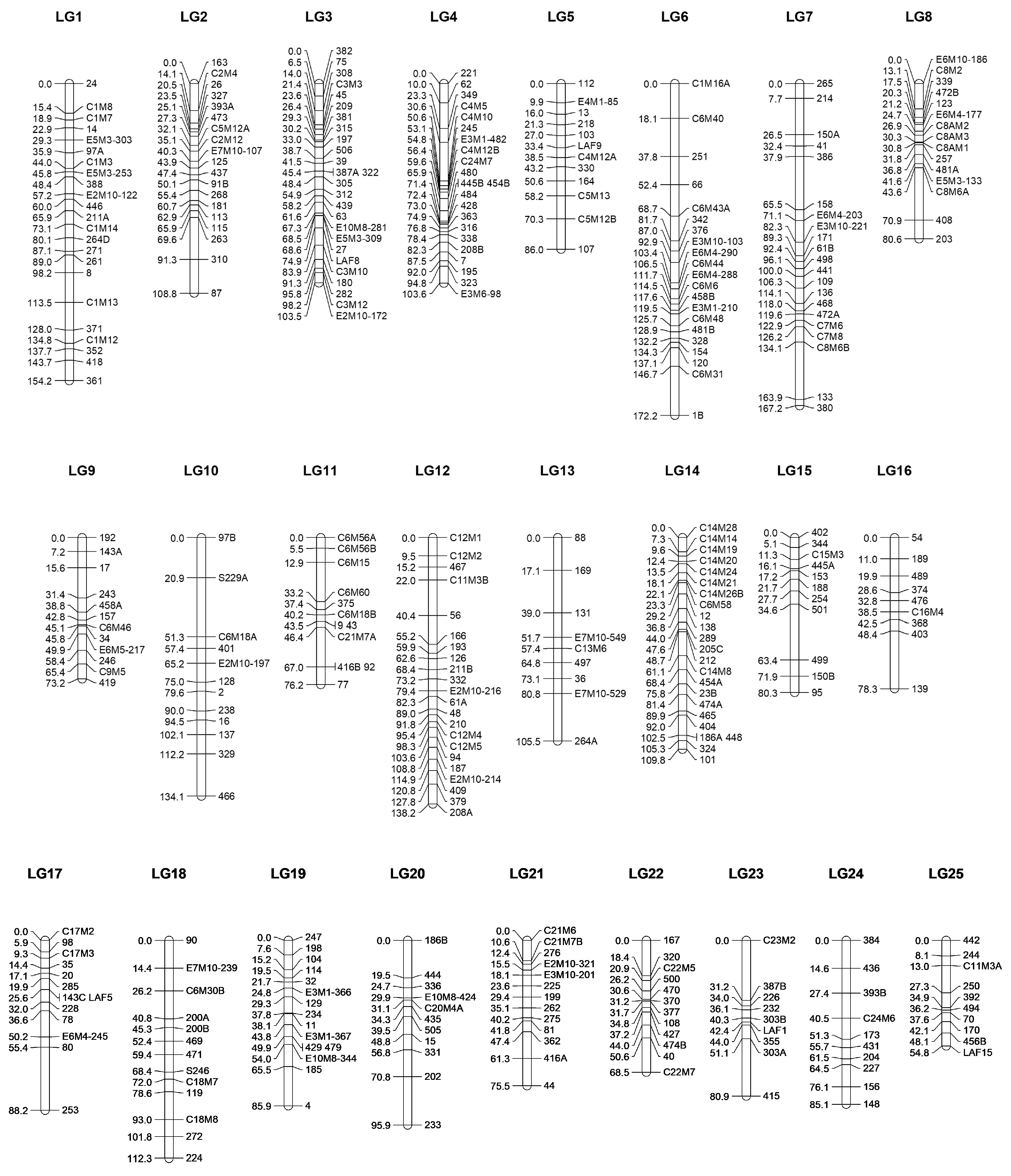

Table 1.
Development and selection of polymorphic SSR and SRAP markers.
| Type of the tested markers | total number of tested markers |
markers showing positive amplification and distinct pattern (% from the total number of tested markers) |
number of polymorphic markers (% from the total number of tested markers) [% from the markers with positive amplification] |
total number of loci identified (average number of detected loci per marker) |
| NGS-SSR | 471 | 442 (93,8%) | 255 (54,1%) [57,7%] | 282 (1,11) |
| GEN-SSR | 170 | 154 (90,6%) | 79 (46,5%) [51,3%] | 90 (1,14) |
| EST-SSR | 22 | 17 (77,3%) | 5 (22,7%) [29,4%] | 5 (1,0) |
| SRAP | 11 | 11 (100%) | 11 (100%) [100%] | 33 (3,0) |
| Total for the SSR markers | 663 | 613 | 339 | 377 |
Table 2.
Summary of the L. angustifolia var. Hemus map and location of the loci on the reference genome sequence.
Table 2.
Summary of the L. angustifolia var. Hemus map and location of the loci on the reference genome sequence.
| Linkage group | Number of loci * | Map length (cM) |
Map density (loci/cM) |
Largest gap (cM) |
Chromosome sequence (Mbp) |
Foremost position of the loci (Mbp) | Rearmost position of the loci (Mbp) |
Coverage of the chromosome (%) |
| LG1 | 23 | 154,23 | 6,71 | 15,37 | 43,13 | 1,64 | 40,38 | 89,8% |
| LG2 | 19 | 108,82 | 5,73 | 21,70 | 40,25 | 1,08 | 39,51 | 95,5% |
| LG3 | 26 | 103,45 | 3,98 | 9,04 | 39,13 | 1,54 | 39,09 | 96,0% |
| LG4 | 22 | 103,61 | 4,71 | 20,09 | 37,48 | 0,30 | 34,65 | 91,6% |
| LG5 | 12 | 86,01 | 7,17 | 15,69 | 35,70 | 1,86 | 35,64 | 94,6% |
| LG6 | 21 | 172,22 | 7,83 | 19,73 | 35,32 | 0,08 | 35,18 | 99,4% |
| LG7 | 21 | 167,25 | 7,96 | 29,71 | 34,57 | 0,05 | 34,21 | 98,8% |
| LG8 | 15 | 80,61 | 5,37 | 27,30 | 33,58 | 1,31 | 33,47 | 95,8% |
| LG9 | 12 | 73,22 | 6,10 | 15,83 | 33,03 | 10,06 | 30,87 | 63,0% |
| LG10 | 12 | 134,11 | 11,18 | 30,40 | 32,61 | 0,14 | 32,21 | 98,3% |
| LG11 | 12 | 76,24 | 6,35 | 20,61 | 31,76 | 0,78 | 31,00 | 95,2% |
| LG12 | 22 | 138,18 | 6,28 | 18,39 | 31,37 | 0,02 | 26,38 | 84,0% |
| LG13 | 9 | 105,47 | 11,72 | 24,66 | 30,09 | 7,42 | 26,93 | 64,8% |
| LG14 | 23 | 109,78 | 4,77 | 12,39 | 29,44 | 0,25 | 28,75 | 96,8% |
| LG15 | 11 | 80,33 | 7,30 | 28,86 | 28,69 | 1,16 | 27,98 | 93,5% |
| LG16 | 9 | 78,26 | 8,70 | 29,88 | 28,47 | 1,04 | 15,06 | 49,2% |
| LG17 | 13 | 88,16 | 6,78 | 32,75 | 27,94 | 2,54 | 26,43 | 85,5% |
| LG18 | 13 | 112,34 | 8,64 | 14,61 | 27,54 | 2,61 | 27,51 | 90,4% |
| LG19 | 15 | 85,91 | 5,73 | 20,46 | 27,40 | 0,11 | 19,59 | 71,1% |
| LG20 | 11 | 95,90 | 8,72 | 25,05 | 27,08 | 4,13 | 26,87 | 84,0% |
| LG21 | 13 | 75,46 | 5,80 | 14,19 | 27,05 | 5,20 | 26,54 | 78,9% |
| LG22 | 12 | 68,54 | 5,71 | 18,39 | 26,81 | 0,59 | 25,15 | 91,6% |
| LG23 | 9 | 80,88 | 8,99 | 31,23 | 26,63 | 8,33 | 25,49 | 64,4% |
| LG24 | 10 | 85,09 | 8,51 | 14,63 | 23,28 | 1,45 | 17,98 | 71,0% |
| LG25 | 10 | 54,84 | 5,48 | 14,24 | 22,94 | 1,37 | 16,55 | 66,2% |
| Minimal value for LG | 9 | 54,84 | 3,98 | 49,2% | ||||
| Maximal value for LG | 26 | 172,22 | 11,72 | 99,4% | ||||
| Average value per LG | 15,00 +/- 5,33 |
100,75 +/- 30,93 |
7,05 +/- 1,92 |
84,4% +/- 14,2% |
||||
| Total value for the map | 375 | 2518,91 | 6,72 |
* not included 35 analyzed loci, among them: 16 loci for which no affiliation to a particular LG was found; and 19 loci showing segregation distortion and affiliated to different LGs, which inclusion resulted in significant changes of the LG map.
Table 3.
SSR marker transferability.
| PCR amplification (*) | Results of SSR amplification from DNA of the tested plants** | |||
|
L. angustifolia var. Hidcote Blue |
L. latifolia Ll_abi2 |
L. latifolia Bastin Nursery |
L. × heterophylla var. Big Boy James | |
| (+) | 291 | 243 | 172 | 251 |
| 93,9% | 78,4% | 78,5% | 81,0% | |
| (w) | 10 | 15 | 7 | 10 |
| 3,2% | 4,8% | 3,2% | 3,2% | |
| (-) | 9 | 52 | 40 | 49 |
| 2,9% | 16,8% | 18,3% | 15,8% | |
| Total number tested SSRs | 310 | 310 | 219 | 310 |
* (+) – distinct PCR amplification from genomic DNA isolated of tested plants similar to those of L. angustifolia var. Hemus positive control ; (w) – weak PCR amplification; (-) – no PCR amplification observed. ** - percentage from the total number of tested plants.
Disclaimer/Publisher’s Note: The statements, opinions and data contained in all publications are solely those of the individual author(s) and contributor(s) and not of MDPI and/or the editor(s). MDPI and/or the editor(s) disclaim responsibility for any injury to people or property resulting from any ideas, methods, instructions or products referred to in the content. |
© 2025 by the authors. Licensee MDPI, Basel, Switzerland. This article is an open access article distributed under the terms and conditions of the Creative Commons Attribution (CC BY) license (http://creativecommons.org/licenses/by/4.0/).
Copyright: This open access article is published under a Creative Commons CC BY 4.0 license, which permit the free download, distribution, and reuse, provided that the author and preprint are cited in any reuse.


