

Submitted:
23 January 2025
Posted:
24 January 2025
You are already at the latest version
Abstract
Lumbar range of movement (ROM) is essential to develop effective movements during underwater undulatory swimming technique. Core exercises are used to improve the strength of the muscles that participate on that technique, nevertheless, they are not designed to improve lumbar ROM. The aim of this study was to examine the effects of an 11-week of 3 functional core exercises for underwater technique on lumbar ROM. Methods: A sample of 57 professional swimmers, 34 males (20.24.2 years) and 23 females (20.73.3yrs), volunteered to complete the study. They were randomly divided into 2 experimental groups (EG1 and EG2) and 1 control group (CG). All subjects underwent the same type of training program in parallel with the EG intervention. EG1 and EG2 fulfilled 3 sets, and 10 repetitions of lumbar flexion and extension exercises at breathing pace, 6 days a week during 11-weeks. EG1 performed the core workout with closed eyes and focusing the attention on the lumbar movement, while EG2 just did the workout only by following the breathing pace. Lumbar flexion (F), extension (E) and total ROM (TROM) were assessed by an electro goniometer on a seated relaxed position over a Swiss ball. Results: Repeated measures ANOVA showed significant differences in the multivariate profiles across groups and over time. F (8, 48) = 3.495, p = 0.002. EG1 had non-significant increases of their lumbar ROM, EG2 had significant increases of the TROM and extension ROM and CG had no changes. Conclusions: The results suggest that repeating maximal lumbar movement at breathing pace, with opened eyes and non-focusing attention on the movement, increases lumbar ROM in sagittal plane.
Keywords:
lumbar mobility
; undulatory underwater swimming
; high performance
; conscious movement
; dynamic stretching
; core training
; motor control
1. Introduction
Lumbar range of motion (ROM) has been studied to determine changes that could cause core instability, low back pain or other lumbar disorders [1,2,3,4,5]. Lumbar ROM is essential to develop effective movements during both daily living and sports activities, and it has been an important factor in low back pain, especially when the “Neutral Zone” (the region of intervertebral motion around the neutral posture where little resistance is offered by the passive spinal column) is increased [6,7]. It is known that the normal lumbar ROM allows the body to respond better to external forces and prevent most lumbar injuries and lumbar pain as significant reduction in lumbar ROM, particularly in the sagittal plane, among those with low back pain. Moreover, there is a decrease in lumbar ROM in individuals with low back pain [5,8].
The core area is considered as one of the focuses in most strength and conditioning programs in elite swimmers, as it has been proposed that the core muscles contract during swimming to decrease form resistance or drag on a swimmer’s body to increase speed [9,10,11,12]. In swimming, the maintenance of posture, balance and alignment is believed to be critical to maximizing propulsion and reducing drag [9,13,14].
Recently, it has been reported that differences among high-level swimmers in terms of performance stem from their ability to perform high-speed undulatory underwater swimming (UUS). Undulatory underwater swimming efficiency depend on the lumbar range on movement, core stiffness and the swimmers’ ability to control and develop the maximal lumbar flexion and extension velocity, followed by the inertial movement of the hips, knees and ankles [14,15,16,17,18]. UUS is used after diving starts and turns in competitive swimming, and the technique can help maintain the high swimming velocity obtained by pushing off the start block or wall. Several studies have reported that the swimming velocity during the underwater phase is related to the total performance of the start and the turn phases [13,14,16,19,20,21]. Therefore, improvements in the performance of the underwater dolphin kick can reduce times at the start or turns and improve overall performance. Several previous studies reported relationships between kinematic parameters and swimming performance during underwater dolphin kick. Other studies have been developed to analyse the motor patterns of the UUS and found that flexor and extensor muscles in the trunk, thigh, and leg are required to contract alternately during dolphin kicking. More specifically measurements were taken on the following core muscles of each swimmer: rectus abdominis (RA), internal abdominal muscle (IO), erector spinae (ES) and multifidus (MF). The study analyzed the muscular synergies on 3 moments of the UUS, those involved in the transition from upward kick to downward kick, downward kick, and upward kick. In the UUS in elite swimmers, both the upward kick and downward kick followed the trunk muscles involved in the pelvic forward-backward tilt movement, and muscles in the lower limb were activated [16].
Core exercises use to be purposed to improve core motor control or strength in athletes or low back pain subjects [9,10,11,12,22,23]. There is strong evidence about the large beneficial influence of strengthening on posture. However, the underlying mechanisms are a matter of debate. Surprisingly, there is a lack of conclusive research on resistance training-induced changes of the muscle’s passive mechanical properties [24]. Core workouts are one of the essentials for swimming strength and conditioning programs and often are used into the dry land warm-up in swimming practice, as the significant improvement in core muscular function contribute to an improvement of swimming records [10,11,12]. Moreover, current swimming dry land warm-ups include mobility exercises, as the trunk and shoulders mobility are crucial for technical requirements in swimming strokes [11,25,26]. Nevertheless, to our knowledge, the effect of core exercises on lumbar range of motion remains unclear [27,28,29]. Therefore, the aim of this study was to examine the effects of an 11-week of 3 functional core exercises for underwater technique on lumbar ROM. We hypothesized that swimmers who develop core exercises which suppose to perform maximal lumbar range of moment will increase their lumbar total range of movement respect with control group.
2. Materials and Methods
2.1. Study Design
We conducted a randomized clinical trial according to the CONSORT checklist [30]. The arms of the study and flowchart are shown in Figure 1. Informed consent was obtained from all participants, and all procedures were conducted according to the Declaration of Helsinki. This research protocol was approved by the institutional Human Research Ethics Committee of Ramon Llull University, Spain. The study was registered within Trial registration Current Controlled Trials website at www.ClinicalTrials.gov (NCT06747702).
2.2. Study Population
The GPOWER v3.1 software (Bonn FRG, University of Bonn, Department of Psychology) was used to calculate a priori the sample size necessary to obtain a Power (1-ß) > 0.9, effect size=0.4 and α=0.05. The result showed a required total sample of 36 subjects. Finally, the sample was established at maximal volunteer participants in anticipation of possible sample loss.
Fifty-seven professional swimmers completed the study. They were recruited from the Spanish national swimming team. All participants met the inclusion criteria (Table 1) and were informed written and verbally about the procedures of the study prior to the assessing day.
2.3. Procedures
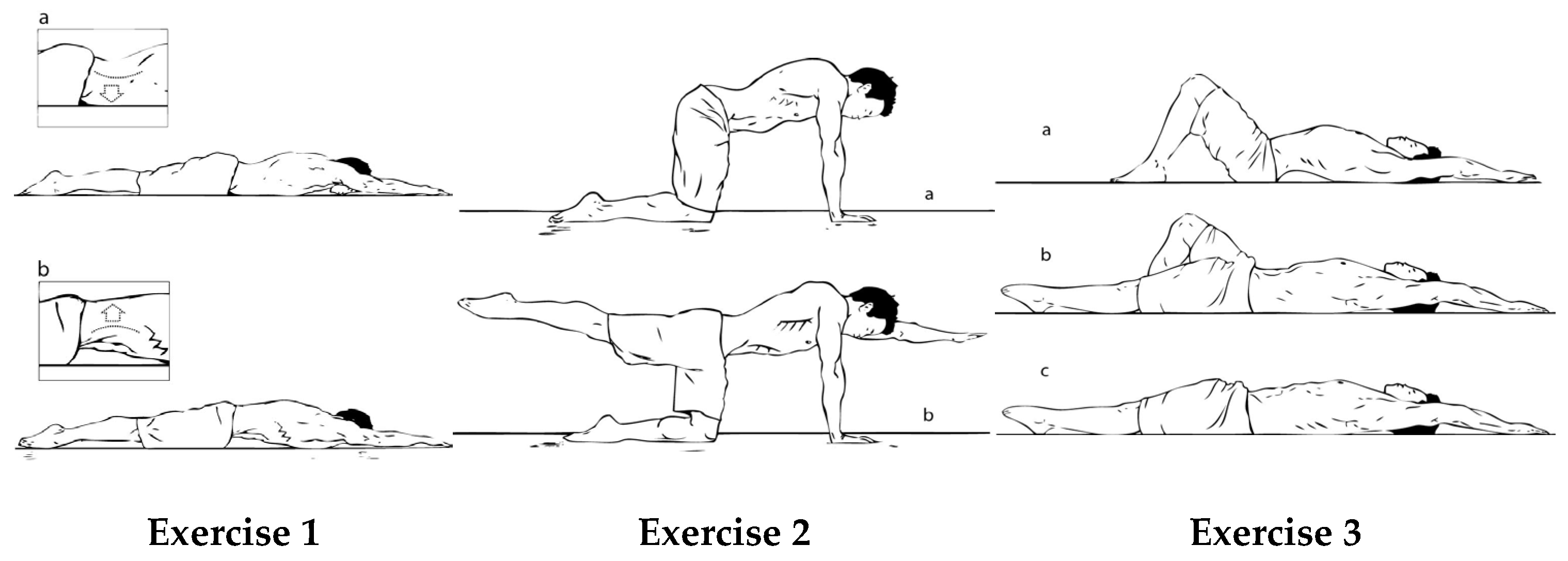
All participants were recruited from two training camps of the Spanish swimming national team. Swimmers who agreed to participate were interviewed to collect descriptive data (Table 2) and tested for the first time at their training facilities. Participants were randomly divided using the online randomization software Research Randomizer (randomizer.org) in EG1, EG2 and CG (Figure 1). Both EG were instructed about the technical requirements of the exercises and how to use the breathing to count the repetitions. They had to develop maximal lumbar extension when inhaling (Figure 2, Exercise 1a) and return to neutral aligned position while exhaling (Figure 2, Exercise 1b). Moreover, EG1 was instructed on anatomy and biomechanics of the lumbar spine during sagittal plane movements and were asked to close their eyes and try to focus their attention through imagery on lumbar spine movements while doing the exercises.
Four national coaches were instructed to guide and control the development of the intervention. The intervention consisted of performing 3 core exercises in the sagittal plane, at breathing pace, just one set of 10 breathings at normal breathing pace each exercise (Figure 1). It was asked to rest for a 30-sec among exercises. At a breathing pace of 1 breath each 5 to 6-sec, all the intervention last from 4-5 min and were performed as the first exercises of their specific warm-up to avoid any nervous system fatigue.
All subjects were retested after completing 66 sessions, 11-weeks using the same protocol at the same time as the first test was done to avoid differences in the number of sessions completed.
Figure 2.
Exercises 1a detail about required extension while inhaling and 1b detail of lumbar alignment while exhaling. Exercise 2 and Exercise 3.
Figure 2.
Exercises 1a detail about required extension while inhaling and 1b detail of lumbar alignment while exhaling. Exercise 2 and Exercise 3.
2.4. Testing Protocol
An electrogoniometer was used (Transducer TSD130A, Biopac Systems, Inc., United States) which was integrated with a computer and Acknowledge 3.0.9 software (Biopac Systems) to assess lumbar electrogoniometer flexion, extension, total ROM degrees. The equipment was calibrated prior to each testing day to determine the 0° and 90° of each frontal and sagittal plane, but only the sagittal data were analysed as is the plane of movement of the undulatory underwater swimming (UUS). The cranial arm of the goniometer was placed over D11 and D12 spinal process while the lower arm was placed over the sacrum (Figure 3a). Therefore, flexion movements were associated with positive degrees and extension movements were associated with negative degrees. Lumbar ROM scores were obtained by summing the mean flexion degrees and the mean absolute extension degrees collected in each trial.
The computer was calibrated with a sample rate of 500 Hz. A manual chronometer (Namaste© model 898, Spain) was used to identify the interval in seconds over which the subjects maintained each position at the recorded degrees. Different Swiss balls (Gymnic Plus Stability physioballs, TMI, Inc., Italy) ranging in diameter from 55–90 cm were used to ensure a correct seated body position, at 90 degrees of hips and knee flexion, with the feet separated at hips height to increase seated stability (Figure 3b). The ball inflation was checked at 3 bars between tests to ensure that the diameter remained stable. We used three sizes of Swiss balls during the evaluation: 55 cm for subjects between 1.60 and 1.70 m tall, 65 cm for between 1.71 and 1.80 m tall and 90 cm for subjects between 1.81 m and 1.90 m tall. All tests were completed between 2 and 5 PM by the same primary investigator to minimize fluctuations in circadian lumbar ROM [32].
Figure 3.
Testing procedures: (a) Electrogoniometer placement; (b)Testing position.

2.5. Statistical Analyses
SPSS Version 28 software (SPSS Inc., Chicago, IL, USA) was used for statistical analysis. The descriptive data of the variables are presented as mean (SD). The distribution of the variables was verified using the Kolmogorov-Smirnov test. Repeated measures MANOVA was conducted to examine the effects of Group (EG1, EG2 and CG) on a set of dependent variables (Flexion, Extension, TROM) measured at two time points (pre and post–intervention). The analysis aimed to determine if there were significant differences in the multivariate profiles of these variables across groups and over time. Multivariate contrast was performed using univariate contrast to determine differences among dependent variables in each condition. When univariate contrasts showed statistically significant main or interaction effects, pairwise comparisons were carried out using the Bonferroni correction. The level of significance was set at p=0.05. Multivariate contrast was performed using univariate contrast to determine differences among dependent variables in each condition. The partial eta squared (η²p) was used as the effect size of the multivariate and univariate contrasts. When univariate contrasts showed statistically significant main or interaction effects, pairwise comparisons were carried out using the Bonferroni correction. The level of significance was set at p=0.05. For effect size, the η²p was calculated on the main effects with an interpretation of 0.01, 0.06, and 0.14 as small, medium, and large effect sizes, respectively. Concomitantly, Cohen’s d effect size was calculated on all pre and post–intervention scores with the interpretation of small (0.2), moderate (0.5), and large (0.8) [33].
3. Results
Repeated measures MANOVA showed significant differences in the multivariate profiles across groups and over time. F (8, 48) = 3.495, p = 0.002. EG1 had non-significant increases of their lumbar ROM. EG2 had significant increases of the TROM and extension ROM and CG had no changes. Differences between Test and Retest values are moderate for flexion scores (F), with noticeable variability across groups. The distributions show distinct group trends, with some groups showing improvement or decline from Test to Retest (Figure 4)
Regarding the Cohen’s d values for flexion in most groups, the Cohen’s d values for flexion have small effect size for all groups, with confidence intervals overlapping zero. However, in EG2, the negative Cohen’s d suggests a small decline in scores, but with the confidence interval spanning zero, this effect might not be practically meaningful. For all groups, positive Cohen’s d values suggest an improvement in scores on retest, moderate for EG1, large for EG2 and small for CG. TROM had negative Cohen’s d values, for EG1 was moderated, for CG was small, while a large negative effect in EG2 (Table 3).
4. Discussion
The aim of this study was to determine the effects of an 11-week of 3 functional core exercises for underwater technique on lumbar ROM. The main finding of the research was that large Cohen’s d values for Extension and TROM indicate meaningful changes for EG2. These changes may reflect the effectiveness of the intervention. Thus, doing core exercises, on the underwater undulatory swimming range of movement, with no extra requirements but developing the right technique and the complete lumbar extension range of movement, had a high impact for extension but had no meaningful effect on flexion ROM in EG2. A possible explanation for these significant and meaningful differences for EG2 could be in the technical requirements for the exercises without focusing attention on lumbar movement. Analyzing the purposed exercises, all of them were developed achieving the maximal individual lumbar extension and it was not required to perform the maximal flexion. These findings are in line with previous studies that found that dynamic stretches could produce increases on joint range of motion and did not reduce strength [34]. The technical requirement of the purposed exercises asked participants to develop their maximal active lumbar extension in the initial phase during inhaling and then trying to align the lumbar spine in the streamline position when exhaling. This movement had to dynamically stretch the abdominal muscles and produces the contraction of the lumbar erector’s spinae muscles. Nevertheless, there was no stretches on the posterior lumbar muscles, as the required range of movement stopped on the neutral aligned position.
However, the small effect sizes suggest stable performance across tests and retests for all measures in EG1. This could indicate that the intervention for EG1 did not strongly influence variability for EG1 specific intervention, had little immediate impact on flexibility or range of motion over short-term measurements. The specific intervention for EG1 included closed eyes and focused their attention on lumbar movements while doing the same technical requirements than the EG2. The results of this study showed that introducing the conscious control and focusing attention on the movement could increase the proprioceptive spindles activity, as proprioception is increased by focusing attention and avoiding the visual input [35,36]. Increased muscle spindles activity could mediate in reducing the maximal stretch of the abdominal muscles and therefore reducing the lumbar extension limit on EG1 on each repletion [37,38] . Thus, by reducing the abdominal length, the proprioception system seems to enhance the action to create adjusted abdominal contraction for the lumbar alignment after maximal controlled extension in each repetition for each exercise in EG1. Moreover, EG1 was instructed on lumbar anatomy to being able to practice on imagery of the lumbar spine movements and the surrounding muscles activity. Imagery in sport is often used to prepare athletes for competition [39]. Motor imagery is based on the activity of specific neural networks. Many of these areas and pathways have been elucidated by researchers investigating brain activity during motor imagery. Brain activation during the imagery of an action is stronger when sensory inputs are like those that occur during the real execution of the same action [40]. In the present study we required to apply cognitive specific imagery at the time when participants were performing the exercises, by focusing on the lumbar spine movements during the execution. Furthermore, EG1 was instructed to improve the individual differences in the ability to create vivid motor imagery by receiving lumbar anatomy and biomechanics lessons prior to starting the intervention. This instruction could lead into major activation of neurophysiological motor control actions during the intervention and mediating on reducing the possibilities to stretch too much the abdominal muscles and let them perform more controlled and intense contractions during lumbar flexion movements in all 3 exercises and thus reduce their length and total lumbar extension after 11-weeks.
The short core workout was included at the beginning of the warm-up in the morning session. The idea was not disrupting too much the habitual practice and also doing the exercises in a condition where the nervous system is not fatigated and ready to focus in a technical action as it is reported that the central nervous system fatigue can negative impact on motor control and proprioception [41,42,43,44]. Behind the ecological validity of the intervention and considering that the participant should complete 11-week, six sessions per week, we decided not to include more than 3 exercises and just one set of 10 repetitions. On this behalf we tried to control the adherence to the intervention and the minimal loss for follow-up. Despite of these, we lost 10 participants in the CG and 11 in the EG. In an elite environment it is important not only to respect the ecological validity of the studies but also design integrated workouts to allow athletes, coaches and strength and conditioners professionals to get the performance goals with the minimum loss of time.
It’s accepted that core workouts should include exercises that involve the same muscle chains of the specific sport technique to get high transference to performance requirements [45,46,47]. Nevertheless, there is still a lack of research on specific core workouts for improving specific swimming techniques, as most of the reported programs use the conventional core exercises, as they include basic core movements that could be part of any training program for any athlete, without specifying the sport. [10,11,12,46,48]. For example, in swimming the effects of a 6-week core exercises on swimming performance of national level swimmers. The program included Flutter kicks (scissors), Single leg V-ups, Prone physio ball trunk extension and Russian twists. This non-functional core training program caused non-significant improvement of the number of swimming variables, which together result an overall increase in 50 m front crawl swimming performance by 1.2% in the EG, whereas the CG swimmers improved their performance just by 0.7% [12]. Another research aimed to investigate the effect of a 12-week dry-land core training program on physical fitness and swimming performance in elite adolescent swimmers. Core training program consisted of 4-weeks of core stabilization (Bridge, plank to push-up, and bird dog), 4-weeks of core muscular power (Deadlift, squat, and row were conducted using a single arm or leg for resistance exercise), and 4-weeks of power endurance (core training motions such as medicine ball slam, one-arm dumbbell snatch, and chop exercises were conducted). The 12-week dry-land core training program resulted in statistically significant improvements in anaerobic power, core stability, upper extremity muscular endurance, and swimming performance, although that research used non-specific core exercises [11]. Additionally, 6-week of 3 sessions per week of non-functional core-training program along with regular swimming training significantly improved the freestyle swimming performance and core muscle properties, such as contractility, excitability, extensibility, and elasticity, of the young swimmers experimental group compared with the group, although the authors state that these results can only be applied on the same age group, as they were 18 young recreational swimmers (13 ± 2 years), with different madurative ages [10].
The present study was designed for specific lumbar gesture on underwater undulatory swimming, trying to reproduce the synergies on 3 moments of the UUS, those involved in the transition from upward kick to downward kick, downward kick, and upward kick. All 3 exercises required the EG to reach the maximal lumbar extension while inhaling, activating the erector spinae (ES) and multifidus (MF), and reach for the streamline lumbar position when exhaling, activating the rectus abdominis (RA), internal abdominal muscle (IO) and the transversus abdominis (TrA) at prone, four tab and supine lying position. Exercise 1 and 2 were more demanding for ES and MF, as the gravity acted against the anterior pelvic tilt and lumbar extension movements. Exercise 3 was more demanding for RA and IO as gravity interferes with developing posterior pelvic tilt and lumbar flexion. In the UUS in elite swimmers, both the upward kick and downward kick follow the trunk muscles involved in the pelvic forward-backward tilt movement [13,16]. Moreover, flexor and extensor muscles in the trunk, thigh, and leg are required to contract alternately during dolphin kicking [13,14,16,21]. Functional movement patterns play a very important role in reaching sports performance to higher levels. It is accepted that it is important to define athletes’ functional movement ways in the swimming technique and to follow the joint stability and mobility regularly as the functional movement patterns of an athlete which are not proper has negative effects on athletes’ performance [46].
Although it was not an aim for this study, there was an intentionality on synchronizing the breath as we did. We required to inhale with the lumbar extension and exhale to reach the lumbar streamline position. We proposed this breathing pattern trying to increase the demands of the involved core muscles, as it is well studied that inspiratory muscles involve some ES and MF, while main voluntary expiratory are the TrA, RA, IO and major and minor obliques [49,50,51]. Moreover, several studies agreed that controlling the breathing pattern during exercise can lead on improving pelvic posture and lumbar alignment [52,53]. By adding voluntary expiration with lumbar flexion, we also were looking for additional activation of the TrA, which have demonstrated to be one of the most important muscles to increase core stability and stiffness, so important to reduce drag on UUS [10,11,47,54,55].
Regarding the testing procedures and instruments, we decided to assess the lumbar ROM with the electrogoniometer in a seated position on a Swiss ball, as this seated position allowed the free lumbar movements on the sagittal plane. Having both feet on the floor, separated at hips height became a stable seated position where swimmers could produce their maximal flexion and extension movements without discomfort, limitation or disbalance. The most reliable and valid instruments to assess spine ROM are X-rays and MRI, but these instruments are associated with radiation and can be expensive [3,56] Perriman et al. [57] measured subjects in static positions using an electrogoniometer because the “clinical gold standard” is a static measurement [57]. We decided to ask active lumbar movements as there is evidence of better reliability for the active movements test than the passive movements test; and only an experimented researcher conducted all the measurements as poor reliability is often caused by inexperienced researchers and difficulties placing the device sensors in the right places [58,59].
Limitations of the present study can be the fact that we focused on the effects of lumbar ROM and the biomechanical aspect of breathing, and we did not measure the pulmonary function, neither other aspect related to UUS performance. Another limitation was the loss of participants in both experimental and control group. In the future, it would be reasonable to consider the evaluation of the influence of the specific short core training on the ability to reproduce the lumbar alignment or in the effect of this 11-week purpose on UUS time or deep on the outcomes analysis that result from closed eyes, focusing and imaging the lumbar movement during the execution of the EG1 which lead into non-significant improvements on lumbar ROM as the EG2 did. of the intervention. Further research is needed to determine the effects of these 3 exercises on proprioceptive outcomes or skills for improving UUS or gliding body position, and how these affect UUS performance.
5. Conclusions
Applying 11-weeks of 3 core exercises 6 times per week, at breathing pace and coordinating the inspiration with maximal extension and the expiration with lumbar streamline position increased significantly and had large meaningful increasing of the lumbar extension and TROM of 20 elite swimmers. Nevertheless, doing the same technical requirement with closed eyes, focusing the attention on lumbar spine and imaging the lumbar movements did not have a significant increase of lumbar movement outcomes in sagittal plane. Practitioners should consider this program to apply in athletes who need to increase their lumbar extension in swimming, either to improve the coordination of impulses in the UUS,
Author Contributions
Conceptualization, M.S-T. and A.B-R.; methodology, J.C. and M.G-B; software, J.C. and A.B–Z; validation, J.C, M.G-B., A.B–Z and A.B-R.; formal analysis, J.C.; investigation, M.S-T.; resources, M.S-T.; data curation, J.C. and A.B–Z; writing—original draft preparation, M.S-T.; writing—review and editing, M.S-T, A.B-R, A.B–Z and M.G-B; visualization, M.G-B.; supervision, J.C and M.G-B.; project administration, M.G-B.. All authors have read and agreed to the published version of the manuscript.
Funding
This research received no external funding.
Institutional Review Board Statement
The study was conducted in accordance with the Declaration of Helsinki, and approved by the Ethics Committee of Ramon Llull University (protocol code 0000001DA and date of approval November 17th 2020).” for studies involving humans.
Informed Consent Statement
Informed consent was obtained from all subjects involved in the study. Written informed consent has been obtained from the patients to publish this paper.
Data Availability Statement
We encourage all authors of articles published in MDPI journals to share their research data. In this section, please provide details regarding where data supporting reported results can be found, including links to publicly archived datasets analyzed or generated during the study. Where no new data were created, or where data is unavailable due to privacy or ethical restrictions, a statement is still required. Suggested Data Availability Statements are available in section “MDPI Research Data Policies” at https://www.mdpi.com/ethics.
Acknowledgments
The authors would like to acknowledge the support given by the Spanish swimming federation, swimmers and coaches that helped to develop this trial.
Conflicts of Interest
The authors declare no conflicts of interest.
References
- Ha, T.H.; Saber-Sheikh, K.; Moore, A.P.; Jones, M.P. Measurement of Lumbar Spine Range of Movement and Coupled Motion Using Inertial Sensors - A Protocol Validity Study. Man Ther 2013, 18, 87–91.
- Consmüller, T.; Rohlmann, A.; Weinland, D.; Druschel, C.; Duda, G.N.; Taylor, W.R. Comparative Evaluation of a Novel Measurement Tool to Assess Lumbar Spine Posture and Range of Motion. Eur Spine J 2012, 21, 2170–2180. [CrossRef]
- Edmondston, S.J.; Song, S.; Bricknell, R. V; Davies, P.A.; Fersum, K.; Humphries, P.; Wickenden, D.; Singer, K.P. MRI Evaluation of Lumbar Spine Flexion and Extension in Asymptomatic Individuals. Man Ther 2000, 5, 158–164.
- Apti, A.; Çolak, T.K.; Akçay, B. NORMATIVE VALUES FOR CERVICAL AND LUMBAR RANGE OF MOTION IN HEALTHY YOUNG ADULTS. Journal of Turkish Spinal Surgery 2023, 34, 113–117. [CrossRef]
- Errabity, A.; Calmels, P.; Suck Han, W.; Bonnaire, R.; Pannetier, R.; Convert, R.; Molimard, J. The Effect of Low Back Pain on Spine Kinematics: A Systematic Review and Meta-Analysis. Clinical Biomechanics 2023, 108. [CrossRef]
- Leetun, D.T.; Ireland, M.L.; Willson, J.D.; Ballantyne, B.T.; Davis, I.M. Core Stability Measures as Risk Factors for Lower Extremity Injury in Athletes. Med Sci Sports Exerc 2004, 36, 926–934. [CrossRef]
- Panjabi, M.M. The Stabilizing System of the Spine. Part I. Function, Dysfunction, Adaptation, and Enhancement. J Spinal Disord 1992, 5, 383–389; discussion 397.
- Mok, N.W.; Hodges, P.W. Movement of the Lumbar Spine Is Critical for Maintenance of Postural Recovery Following Support Surface Perturbation. Exp Brain Res 2013, 231, 305–313.
- Hibbs, A.E. Development and Evaluation of a Core Training Programme in Highly Trained Swimmers, 2011.
- Khiyami, A.; Nuhmani, S.; Joseph, R.; Abualait, T.S.; Muaidi, Q. Efficacy of Core Training in Swimming Performance and Neuromuscular Parameters of Young Swimmers: A Randomised Control Trial. J Clin Med 2022, 11. [CrossRef]
- Ji, M.-Y.; Yoon, J.-H.; Song, K.-J.; Oh, J.-K. Effect of Dry-Land Core Training on Physical Fitness and Swimming Performance in Adolescent Elite Swimmers; 2021; Vol. 50;.
- Karpiński, J.; Rejdych, W.; Brzozowska, D.; Gołaś, A.; Sadowski, W.; Swinarew, A.S.; Stachura, A.; Gupta, S.; Stanula, A. The Effects of a 6-Week Core Exercises on Swimming Performance of National Level Swimmers. PLoS One 2020, 15. [CrossRef]
- Ruiz-Navarro, J.J.; Cuenca-Fernández, F.; Sanders, R.; Arellano, R. The Determinant Factors of Undulatory Underwater Swimming Performance: A Systematic Review. J Sports Sci 2022, 40, 1243–1254. [CrossRef]
- Veiga, S.; Lorenzo, J.; Trinidad, A.; Pla, R.; Fallas-Campos, A.; de la Rubia, A. Kinematic Analysis of the Underwater Undulatory Swimming Cycle: A Systematic and Synthetic Review. Int J Environ Res Public Health 2022, 19.
- Houel, N.; Elipot, M.; Andrée, F.; Hellard, H./ Kinematics Analysis of Undulatory Underwater Swimming during a Grab Start of National Level Swimmers. XIth International Symposium for Biomechanics & Medicine in Swimming 2010, 97–99.
- Matsuura, Y.; Matsunaga, N.; Iizuka, S.; Akuzawa, H.; Kaneoka, K. Muscle Synergy of the Underwater Undulatory Swimming in Elite Male Swimmers. Front Sports Act Living 2020, 2. [CrossRef]
- Nakashima, M. Simulation Analysis of the Effect of Trunk Undulation on Swimming Performance in Underwater Dolphin Kick of Human. Journal of Biomechanical Science and Engineering 2009, 4, 94–104. [CrossRef]
- Born, D.-P.; Burkhardt, D.; Buck, M.; Schwab, L.; Romann, M. Key Performance Indicators and Reference Values for Turn Performance in Elite Youth, Junior and Adult Swimmers. Sports Biomech 2024, 1–21. [CrossRef]
- Connaboy, C.; Coleman, S.; Moir, G.; Sanders, R. Measures of Reliability in the Kinematics of Maximal Undulatory Underwater Swimming. Med Sci Sports Exerc 2010, 42, 762–770. [CrossRef]
- Gavilan, A.; Arellano, R.; Sanders, R. UNDERWATER UNDULATORY SWIMMING: STUDY OF FREQUENCY, AMPLITUDE AND PHASE CHARACTERISTICS OF THE “BODY WAVE.” Revista Portuguesa de Ciencias do Desporto 2006, 6, 35–37.
- Houel, N.; Elipot, M.; Andrée, F.; Hellard, H./ Kinematics Analysis of Undulatory Underwater Swimming during a Grab Start of National Level Swimmers. XIth International Symposium for Biomechanics & Medicine in Swimming 2010, 97–99.
- Marshall, P.W.M.; Desai, I.; Robbins, D.W. Core Stability Exercises in Individuals With and Without Chronic Nonspecific Low Back Pain. J Strength Cond Res 2011, 25, 3404–3411. [CrossRef]
- Willardson, J.M. Core Stability Training: Applications to Sports Conditioning Programs. Journal of strength and conditioning research / National Strength & Conditioning Association 2007, 21, 979–985. [CrossRef]
- Warneke, K.; Lohmann, L.H.; Wilke, J. Effects of Stretching or Strengthening Exercise on Spinal and Lumbopelvic Posture: A Systematic Review with Meta-Analysis. Sports Med Open 2024, 10.
- Zhou, Z.; Morouço, P.G.; Dalamitros, A.A.; Chen, C.; Cui, W.; Wu, R.; Wang, J. Effects of Two Warm-up Protocols on Isokinetic Knee Strength, Jumping Ability and Sprint Swimming Performance in Competitive Swimmers. Sci Rep 2024, 14. [CrossRef]
- Papadimitriou, K.; Loupos, D.; Tsalis, G.; Manou, B. Effects of Proprioceptive Neuromuscular Facilitation (PNF) on Swimmers Leg Mobility and Performance. Journal of Physical Education and Sport 2017, 17, 663–668. [CrossRef]
- Emery, K.; De Serres, S.J.; McMillan, A.; Côté, J.N. The Effects of a Pilates Training Program on Arm-Trunk Posture and Movement. Clinical Biomechanics 2010, 25, 124–130.
- Desai, I.; Marshall, P.W.M. Acute Effect of Labile Surfaces during Core Stability Exercises in People with and without Low Back Pain. Journal of Electromyography and Kinesiology 2010. [CrossRef]
- Skundric, G.; Vukicevic, V.; Lukic, N. Effects of Core Stability Exercises, Lumbar Lordosis and Low-Back Pain: A Systematic Review. Journal of Anthropology of Sport and Physical Education 2021, 5, 17–23. [CrossRef]
- Lepage, L.; Altman, D.G.; Schulz, K.F.; Moher, D.; Egger, M.; Davidoff, F.; Elbourne, D.; Gøtzsche, P.C.; Lang, T. The Revised CONSORT Statement for Reporting Randomized Trials: Explanation and Elaboration. Ann Intern Med 2001.
- World Medical Association; Association, W.M. Declaration of Helsinki Ethical Principles for Medical Research Involving Human Subjects. JAMA 2013, 310, 2191–2194. [CrossRef]
- Madson, T.J.; Youdas, J.W.; Suman, V.J. Reproducibility of Lumbar Spine Range of Motion Measurements Using the Back Range of Motion Device. J Orthop Sports Phys Ther 1999, 29, 470–477. [CrossRef]
- Cohen, J. Statistical Power Analysis for the Behavioral Sciences; 2nd ed.; Lawrence Erlbaum Associates, Hillsdale, NJ, 1988;
- Behm, D.G.; Chaouachi, A. A Review of the Acute Effects of Static and Dynamic Stretching on Performance. Eur J Appl Physiol 2011.
- Nieto-Guisado, A.; Solana-Tramunt, M.; Marco-Ahulló, A.; Sevilla-Sánchez, M.; Cabrejas, C.; Campos-Rius, J.; Morales, J. The Mediating Role of Vision in the Relationship between Proprioception and Postural Control in Older Adults, as Compared to Teenagers and Younger and Middle-Aged Adults. Healthcare (Switzerland) 2022, 10. [CrossRef]
- Portas, C.M.; Rees, G.; Howseman, A.M.; Josephs, O.; Turner, R.; Frith, C.D. A Specific Role for the Thalamus in Mediating the Interaction of Attention and Arousal in Humans. J Neurosci 1998, 18, 8979–8989.
- Johnson, E.O.; Babis, G.C.; Soultanis, K.C.; Soucacos, P.N. Functional Neuroanatomy of Proprioception. J Surg Orthop Adv 2008, 17, 159–164.
- Proske, U. What Is the Role of Muscle Receptors in Proprioception? Muscle Nerve 2005, 31, 780–787.
- Short, S.E.; Tenute, A.; Feltz, D.L. Imagery Use in Sport: Mediational Effects for Efficacy. J Sports Sci 2005, 23, 951–960.
- Mizuguchi, N.; Nakata, H.; Uchida, Y.; Kanosue, K. Motor Imagery and Sport Performance; 2012; Vol. 1;.
- Hiemstra, L.A.; Lo, I.K.; Fowler, P.J. Effect of Fatigue on Knee Proprioception: Implications for Dynamic Stabilization. J Orthop Sports Phys Ther 2001, 31, 598–605.
- Myers, J.B.; Guskiewicz, K.M.; Schneider, R. a.; Prentice, W.E. Proprioception and Neuromuscular Control of the Shoulder after Muscle Fatigue. J Athl Train 1999, 34, 362–367.
- Brown, J.P.; Bowyer, G.W. Effects of Fatigue on Ankle Stability and Proprioception in University Sportspeople. Br J Sports Med 2002, 36, 310. [CrossRef]
- Gear, W.S. Effect of Different Levels of Localized Muscle Fatigue on Knee Position Sense. J Sports Sci Med 2011, 10, 725–730.
- Cabrejas, C.; Solana-Tramunt, M.; Morales, J.; Campos-Rius, J.; Ortegón, A.; Nieto-Guisado, A.; Carballeira, E. The Effect of Eight-Week Functional Core Training on Core Stability in Young Rhythmic Gymnasts: A Randomized Clinical Trial. Int J Environ Res Public Health 2022, 19. [CrossRef]
- Kurt, S.; İbiş, S.; Burak Aktuğ, Z.; Altundağ, E. The Effect of Core Training on Swimmers’ Functional Movement Screen Scores and Sport Performances. 2023.
- Lederman, E. The Myth of Core Stability. J Bodyw Mov Ther 2010, 14, 84–98. [CrossRef]
- Hibbs, A.E. Development and Evaluation of a Core Training Programme in Highly Trained Swimmers, 2011.
- Grooms, D.R.; Grindstaff, T.L.; Croy, T.; Hart, J.M.; Saliba, S.A. Clinimetric Analysis of Pressure Biofeedback and Transversus Abdominis Function in Individuals With Stabilization Classification Low Back Pain. Journal of Orthopaedic & Sports Physical Therapy 2013. [CrossRef]
- Hodges, P.; Kaigle Holm, A.; Holm, S.; Ekström, L.; Cresswell, A.; Hansson, T.; Thorstensson, A. Intervertebral Stiffness of the Spine Is Increased by Evoked Contraction of Transversus Abdominis and the Diaphragm: In Vivo Porcine Studies. Spine (Phila Pa 1976) 2003, 28, 2594–2601.
- Breathing Pattern 2014 Ijspt-02-028.
- Talasz, H.; Kremser, C.; Talasz, H.J.; Kofler, M.; Rudisch, A. Breathing, (S)Training and the Pelvic Floor—A Basic Concept. Healthcare (Switzerland) 2022, 10. [CrossRef]
- Zbieta Szczygiel, E._; Edrzej Blaut, J.; Zielonka-Pycka, K.; Tomaszewski, K.; Golec, J.; Czechowska, D.; Maslo, A.; Golec, E. The Impact of Deep Muscle Training on the Quality of Posture and Breathing;
- Okada, T.; Huxel, K.C.; Nesser, T.W. Relationship between Core Stability, Functional Movement, and Performance. Journal of strength and conditioning research / National Strength & Conditioning Association 2011, 25, 252–261.
- Hibbs, A.E.; Thompson, K.G.; French, D.; Wrigley, A.; Spears, I. Optimizing Performance by Improving Core Stability and Core Strength. Sports Medicine 2008, 38, 995–1008. [CrossRef]
- Pearcy, M.; Portek, I.; Shepherd, J. Three-Dimensional x-Ray Analysis of Normal Movement in the Lumbar Spine. Spine (Phila Pa 1976) 1984, 9, 294–297.
- Perriman, D.M.; Scarvell, J.M.; Hughes, A.R.; Ashman, B.; Lueck, C.J.; Smith, P.N. Validation of the Flexible Electrogoniometer for Measuring Thoracic Kyphosis. Spine (Phila Pa 1976) 2010, 35, E633-40.
- Luomajoki, H.; Kool, J.; de Bruin, E.D.; Airaksinen, O. Reliability of Movement Control Tests in the Lumbar Spine. BMC Musculoskelet Disord 2007, 8, 90.
- May, S.; Littlewood, C.; Bishop, A. Reliability of Procedures Used in the Physical Examination of Non-Specific Low Back Pain: A Systematic Review. Aust J Physiother 2006, 52, 91–102.
Figure 1.
Flowchart. T0= Baseline test, T1=Retest. EG1= experimental group 1; EG2 Experimental group 2; CG= control group; ROM=Range of motion.
Figure 1.
Flowchart. T0= Baseline test, T1=Retest. EG1= experimental group 1; EG2 Experimental group 2; CG= control group; ROM=Range of motion.
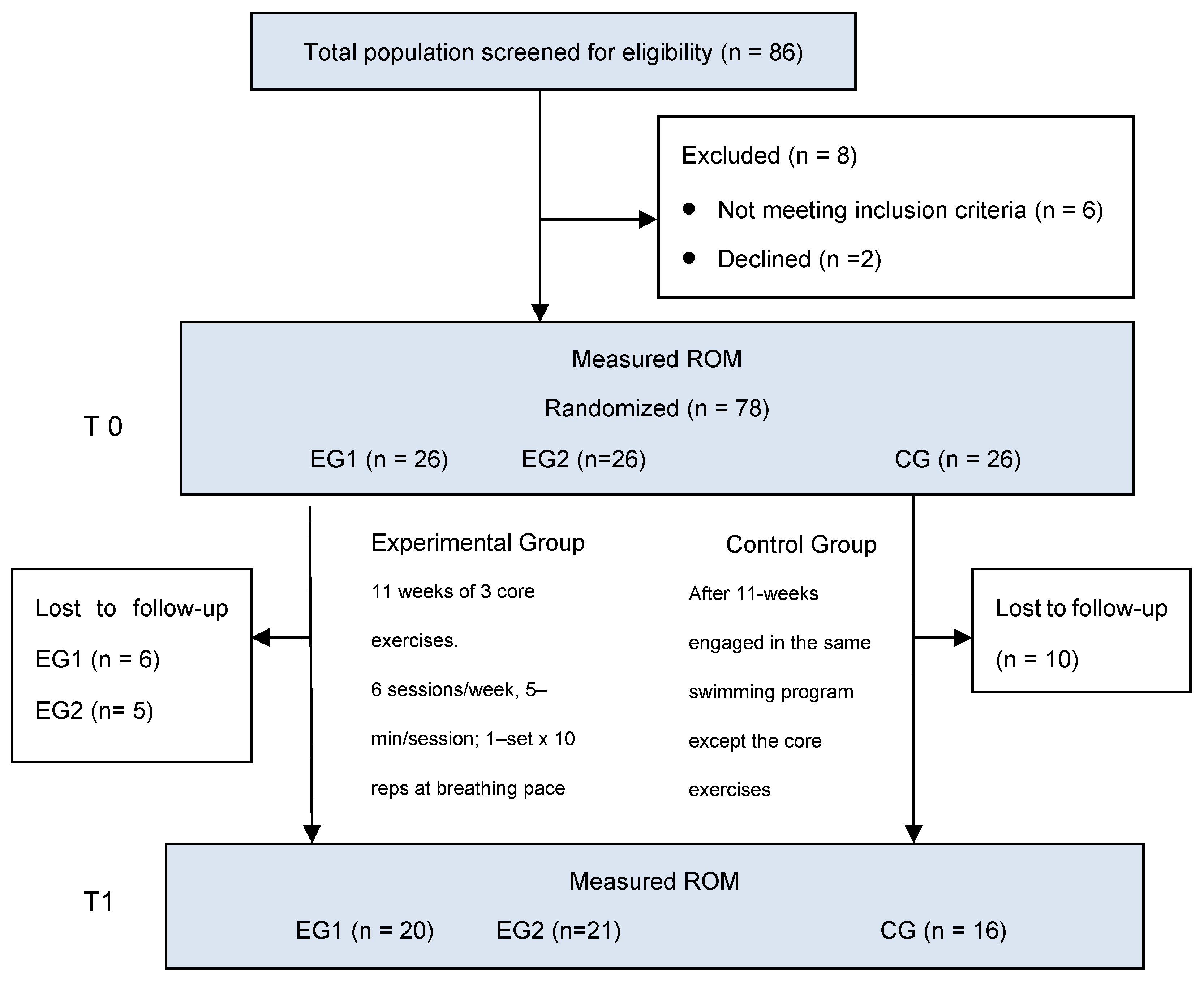
Figure 4.
Boxplots for each dependent variable expressed by degrees, comparing Test and Retest values across the three groups: (a) Boxplot for TROM values; (b) Boxplot for Extension variable.
Figure 4.
Boxplots for each dependent variable expressed by degrees, comparing Test and Retest values across the three groups: (a) Boxplot for TROM values; (b) Boxplot for Extension variable.
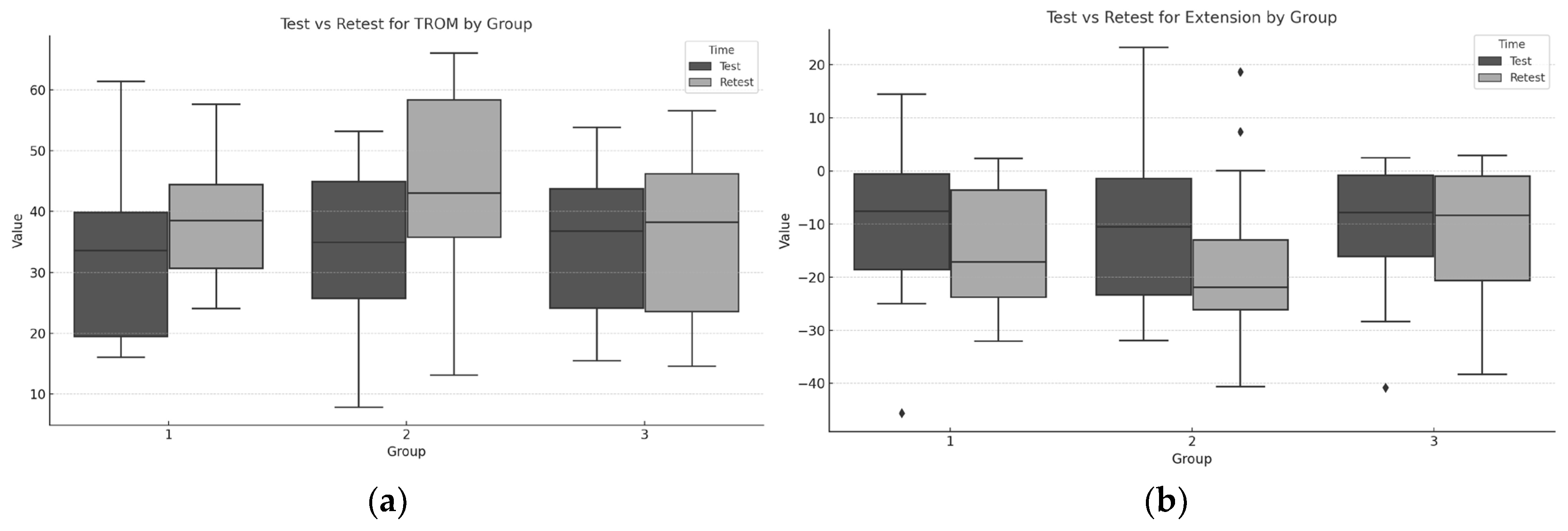

Table 1.
Inclusion Criteria.
|
Table 2.
Descriptive characteristics of the participants.
| Age (yr), mean (SD) Males Females |
20.2 (4.2) 20.7 (3.3) |
| Gender, n female (%) | 23 (40.3%) |
| Body mass Kg, mean (SD) | 69.7 (10.3) |
| Height, cm, mean (SD) | 177.8 (7.5) |
| Professional swimming experience (years) mean (SD) Level, n (%) Olympic International National Main swimming style n (%) Freestyle Breastroke Butterfly Backstroke Individual Medley Main competition distance n (%) 50-100 200-400 800-1500 |
8.7 (4.4) 33 (57.8%) 13 (22.8%) 11 (19.2%) 18 (31.5%) 14 (24.5%) 9 (15.7%) 8 (14.0%) 8 (14.0%) 20 (35.1%) 31 (54.4%) 6 (10.5%) |
Table 3.
Test and retest descriptive values and Cohen’s d effect size for flexion (Flex), extension (Ext) and TROM.
Table 3.
Test and retest descriptive values and Cohen’s d effect size for flexion (Flex), extension (Ext) and TROM.
| Group | Flex test | Flex retest | d(CI) | Ext test | Ext retest | d(CI) | TROM test | TROM retest | d(CI) |
|---|---|---|---|---|---|---|---|---|---|
| EG1 | 22.8 | 23.5 | -0.10 | -9.6 | -14.5 | 0.47 | 32.4 | 38.0 | 0.52 |
| (8.6) | (5.6) | (-0.48) | (14.2) | (10.5) | (-0.15) | (12.9) | (9.4) | (-0.85) | |
| EG2 | 24.1 | 26.4 | -0.47 | -10.2 | -18.3* | 0.83 | 34.4 | 44.7* | -1.12 |
| (6.4) | (6.1) | (-0.78) | (14.2) | (15.1) | (-0.05) | (12.0) | (14.0) | (-1.11) | |
| CG | 23.5 | 24.0 | -0.38 | -11.2 | -11.9 | 0.16 | 34.7 | 35.9 | -0.31 |
| (7.8) | (7.6) | (-0.52) | (11.9) | (12.4) | (-0.45) | (11.9) | (12.5) | (-0.64) |
* Results are expressed by degrees mean (SD) Significant differences are marked with bolt and *(p<0.05). EG1= Experimental group 1, EG2=Experimental group 2, CG=Control group. Test= Lumbar baseline test, Retest= Lumbar degrees after 11-weeks.
Disclaimer/Publisher’s Note: The statements, opinions and data contained in all publications are solely those of the individual author(s) and contributor(s) and not of MDPI and/or the editor(s). MDPI and/or the editor(s) disclaim responsibility for any injury to people or property resulting from any ideas, methods, instructions or products referred to in the content. |
© 2025 by the authors. Licensee MDPI, Basel, Switzerland. This article is an open access article distributed under the terms and conditions of the Creative Commons Attribution (CC BY) license (http://creativecommons.org/licenses/by/4.0/).
Copyright: This open access article is published under a Creative Commons CC BY 4.0 license, which permit the free download, distribution, and reuse, provided that the author and preprint are cited in any reuse.


