

Submitted:
22 January 2025
Posted:
22 January 2025
You are already at the latest version
Abstract
We investigated the reaction Q-value (Qα) for the α decay of Tl, Bi, and At isotopes using the deformed relativistic Hartree-Bogoliubov theory in continuum (DRHBc) with the covariant density functional PC-PK1. The α decay half-lives of Tl, Bi, and At isotopes are evaluated using various empirical formulas, based on both experimental Qα and those obtained from DRHBc calculations. The calculated Qα and α decay half-lives are compared with experimental data. On the basis of these results, we also predicted the α decay half-lives of isotopes for which experimental data are unavailable.
Keywords:
deformed relativistic Hartree-Bogoliubov theory in continuum (DRHBc)
; α decay half-lives
; Empirical formula
1. Introduction
To date, various nuclear decay modes have been experimentally observed, including decay, decay, proton decay, neutron decay, spontaneous fission, and electron capture [1]. Among these, decay is one of the most crucial decay modes, widely recognized as a key tool for investigating unstable and neutron-deficient isotopes, as well as superheavy elements. Since its discovery by Becquerel in 1896, decay has become a major research topic in nuclear physics. This decay mode also provides essential insights into the structure and stability of atomic nuclei, as well as the mechanisms behind decay. Additionally, decay plays a crucial role in the synthesis of superheavy elements, providing valuable insights for predicting and understanding the existence of specific elements. For example, it enables the prediction of the half-lives of superheavy elements and the discovery of new decay pathways. As such, decay remains a central focus of various nuclear physics research.
Owing to the significant advancements in experimental technology, substantial progress has been made in both the experimental [2,3] and theoretical [4,5] aspects of decay. Experimentally, various heavy nuclei have been successfully discovered through the analysis of alpha decay chains in recent years. For example, 214U, a new -emitting nucleus, has been successfully produced through the 182W(36Ar, 4n)214U reaction. [6]. Theoretically, several empirical formulas have been developed to study decay half-lives, including the Royer formula [6], AKRA [7], Viola-Seaborg-Sobiczewski (VSS) formula [8,9], Sobiczewski-Parkhomenko (SP) formula [10], Universal Decay Law (UDL) [11,12], and others.
is one of the significant characteristic quantities of an alpha-emitting nucleus. It is given as follows:
Up to now, the nuclear masses of over 2000 nuclei have been experimentally measured. However, decay is still anticipated to occur in the vast, unexplored regions of the nuclear chart, which remain beyond the reach of experimental techniques in the near future. Therefore, a detailed analysis of must depend on reliable theoretical nuclear mass models.
For addressing the mentioned issue, a well-refined and state-of-the-art relativistic nuclear model is essential. This model should simultaneously account for the deformation, pairing correlations, and continuum effects within a microscopic framework capable of covering the entire nuclear mass range. In this context, the deformed relativistic Hartree–Bogoliubov theory in continuum (DRHBc), based on point-coupling density functionals, has been developed [13,14]. The DRHBc theory has been shown to provide a robust description of nuclear masses with high predictive power [15,16], and it has also been applied to study the nuclear structure of various isotopes [17,18,19,20,21,22,23,24,25].
In this article, we investigate the decay half-lives of Tl, Bi, and At isotopes using empirical formulas and the DRHBc theory with the PC-PK1 density functional [26]. The article is organized as follows. Section 2 introduces a brief overview of the DRHBc theory and the empirical formulas used in this study, along with the numerical details for DRHBc calculations. The results and discussions for Tl, Bi, and At isotopes are presented in Section 3. Finally, the summary and conclusions are provided in Section 4.
2. Theoretical Framework
2.1. Deformed Relativistic Hartree-Bogoliubov Theory in Continuum
The detailed formalism of the DRHBc theory can be found in Refs. [27,28,29]. Here, we provide only a brief overview of the formalism of the DRHBc theory. In the DRHBc theory, the relativistic Hartree-Bogoliubov (RHB) equation [30] is expressed as follows.
Here, is the Fermi energy and and are the quasiparticle energy and quasiparticle wave function. In the coordinate space,tThe Dirac Hamiltonian can be defined as
where M is the nucleon mass, and and are the vector and scalar potentials, respectively. The paring potential is expressed in terms of the pairing tensor as follows
using a density-dependent zero range force
The total energy can be computed as
where denotes the center of mass correction energy.
For the numerical calculations of the Tl, Bi and At isotopes, we employ the energy cut-off 300 MeV and the angular momentum cutoff for the Dirac Woods-Saxon basis. The pairing strength = – 325.0 MeV fm3, a pairing window of 100 MeV, and a saturation density of = 0.152 fm−3 are taken, respectively. The numerical details can be found in Refs. [13,14].
2.2. Empirical Formula for Decay Half-Lives
Empirical formulas for the decay half-lives typically depend on the proton number (Z), the mass number (A), and the reaction Q-value () for the decay. The most crucial factor in the decay process of the heavy nuclei is the accurate determination of , as it reflects the structure of the heavy nuclei through the binding energy. The significance of is clearly mentioned in Refs. [8,31]. For , we use both experimental data and DRHBc mass table data, particularly when experimental are unavailable.
2.2.1. Royer Formula
The Royer formula [6] is given by
where A, Z, and are the mass number, proton number, and the reaction Q-value for the decay, respectively. Also, the parameters a, b, and c, are for odd Z-even N nuclei, with −25.68, −1.1423, 1.592; and for odd Z-odd N nuclei −29.48, −1.113, 1.6971, respectively [32].
2.2.2. AKRA Formula
Akrawy and Poenaru presented [7] a new expression for calculating the decay half-life by incorporating nuclear isospin asymmetry .
For odd Z-even N nuclei case (odd Z-odd N nuclei case), the parameters a, b, c, d, and e are: -31.79248 (-26.27896), -1.07636 (-1.20130), 1.75354 (1.65906), -2.22627 (-0.08411), 0.39378 (67.59728) [33].
2.2.3. Viola-Seaborg-Sobiczewski (VSS) Formula
The VSS [8,9] formula proposed by Sobiczewski extended the original Viola-Seaborg formula to better account for heavy and superheavy nuclei are widely used to calculate and predict the decay half-lives.
where 1.66175, -8.5166, -0.20228, and -33.9069, respectively. The term describes the hindrance effects related to odd-Z and/or odd-N. Its value is 0.772 for odd-Z even-N nuclei and 1.114 for odd-Z odd-N nuclei [34].
2.2.4. Parkhomenko-Sobiczewski (SP) Formula
The Parkhomenko-Sobiczewski (SP) formula, which is a phenomenological expression used to explain the decay half-lives of nuclei heavier than 208Pb, was introduced by Parkhomenko and Sobiczewski [10]. The (SP) formula is given by:
where the values of the coefficients [34] are 1.5372, −0.1607, and −36.573. The represents the average excitation energy, with values of 0.113 and 0.284 for odd–even and odd–odd nuclei, respectively.
2.2.5. Universal Decay Law (UDL) Formula
Qi et al. [11,12] derived a linear universal decay law (UDL) based on R-matrix theory that describes the microscopic mechanism of emission and is applicable to decay. The UDL formula is expressed as follows:
Here, , where denotes the mass number of the emitted alpha particle and represents the mass number of the daughter nucleus. In Eq. 11, the coefficients for the UDL formula, as provided in Ref. [33], are as follows: 0.4314, -0.4087, and -25.7725.
3. Results
It is well known that the decay half-lives are highly sensitive to the . Therefore, selecting an accurate is crucial for making reliable predictions. First, we examined the of the Tl, Bi, and At by the DRHBc theory. In Figure 1, the for Tl, Bi, and At obtained from the DRHBc calculations are plotted against the neutron number, along with the available experimental data [35]. Additionally, for a quantitative comparison, we present the differences between the calculated results and the experimental data, with uncertainties represented by standard deviation of less than 1.14 MeV, 1.03 MeV, and 0.95 MeV for Tl, Bi, and At, respectively, as shown in Figure 1.
The decay half-lives calculated using five empirical formulas (AKRA, Royer, SP, UDL, and VSS) are presented in Figure 2. The results were obtained using the experimental values and the values derived from DRHBc calculations, as shown in panels (a) and (b) of Figure 2, respectively. For comparison with the experiment, we use the experimental decay half-lives from NNDC [36]. Since multiple decay modes can exist for each nucleus, we consider only 17 experimental data points where the branching ratio of decay is close to 100%. The logarithmic differences between the experimental half-lives and the calculated values are shown in Figure 2 (c) and (d). Additionally, the calculated decay half-lives are listed in Table 1 and Table 2. Table 1 shows the results derived using experimental values, while Table 2 displays the results obtained using values from DRHBc calculations. The standard deviations between the experimental data and the calculated results, as defined by
are provided in the last row of Table 1 and Table 2.
The predicted decay half-lives of Tl (Z = 81), Bi (Z = 83), and At (Z = 85) isotopes, calculated using the VSS and SP formulas—two models with the smallest standard deviations among the five models, as shown in Table 2—are shown in Figure 3 (a) and (b), with values taken from AME2020 [35] and the DRHBc mass table. We also compared the results obtained using values derived from AME2020 and the DRHBc mass table. In Figure 4 (a), the logarithmic differences between the results obtained using values derived from AME2020 and those derived from the DRHBc mass table versus the mass number of the parent nucleus are presented. The results of the two formulas, VSS and SP, are nearly identical, except for 208Bi. Additionally, the differences with respect to ( - ) are presented in Figure 4 (b). We can observe that as the value of ( - ) increases, the logarithmic differences between the results predicted using values from AME2020 and those from the DRHBc mass table also increase, particularly when it exceeds 2.0. Finally, we can see that the difference between the results of VSS and SP formulas increases. We will calculate and predict the decay half-lives using the predicted densities in the DRHBc theory within the WKB approximation framework [37,38] in the following study.
4. Summary
In this work, we evaluated the reaction Q-value () for the decay of Tl, Bi, and At isotopes using the DRHBc theory and compared the results with experimental data from AME2020. Since multiple decay modes exist for each nucleus, we considered only 17 experimental data points where the branching ratios for decay modes are almost 100%. The decay half-lives of these isotopes were calculated using 5 different empirical formulas, based on both experimental values and those obtained from the DRHBc calculations. The calculated decay half-lives were also compared with experimental data from NNDC. The VSS and SP formulas have the smallest standard deviations () between the calculated results and the experimental data among the five models. Based on these results, we calculated and predicted the decay half-lives of Tl , Bi, and At isotopes using VSS and SP formulas. In the future study, we will calculate and predict the decay half-lives using the densities obtained from the DRHBc theory within the WKB approximation framework.
Author Contributions
formal analysis, M.-H.M.; investigation, M.-H.M.; writing—original draft preparation, M.-H.M.; writing—review and editing, All authors; All authors have read and agreed to the published version of the manuscript.
Funding
This research received no external funding.
Data Availability Statement
Data will be made available on request.
Acknowledgments
Helpful discussions with members of the DRHBc Mass Table Collaboration are greatly appreciated. This work of M.-H.M. was supported by the National Research Foundation of Korea (NRF) grant funded by the Korea government (MSIT) (Grant Nos. NRF-2021R1F1A1060066). M.-K.C. was supported by the NRF grant funded by the Korea government (MSIT) (Grants No. 2020R1A2C3006177 and No. 2021R1A6A1A03043957). K.H. was supported in part by Basic Science Research Program through the National Research Foundation of Korea (NRF) funded by the Ministry of Education (Grant Nos. RS-2024-00460031).
Conflicts of Interest
The authors declare no conflicts of interest.
References
- Sobiczewski, A.; Pomorski, K. Description of structure and properties of superheavy nuclei. Prog. Part., Nucl. Phys. 2007, 58, 292.
- Zhang, Z.Y.; Yang, H.B.; Huang, M.H; et al. New α-Emitting Isotope 214U and Abnormal Enhancement of α-Particle Clustering in Lightest Uranium Isotopes. Phys. Rev. Lett. 2021, 126, 152502. [CrossRef]
- Oganessian, Y.T. Synthesis of the heaviest elements in 48Ca-induced reactions. Radiochimica Acta 2011, 99, 429. [CrossRef]
- Basu, D.N. Role of effective interaction in nuclear disintegration processes. Phys. Lett. B 2003, 566, 90. [CrossRef]
- Manjunatha, H.C.; Sowmya, N.; Damodara Gupta, P.S. et al. Investigation of decay modes of superheavy nuclei. Nucl. Sci. Tech. 2021, 32, 130. [CrossRef]
- Royer, G. Alpha emission and spontaneous fission through quasi-molecular shapes. J. Phys. G 2000, 26, 1149. [CrossRef]
- Akrawy, D.T.; Poenaru, D.N. Alpha decay calculations with a new formula. J. Phys. G 2017, 44, 105105. [CrossRef]
- Viola, V.E.Jr.; Seaborg, G.T. Nuclear systematics of the heavy elements—II Lifetimes for alpha, beta and spontaneous fission decay. J. lnorg. Nucl. Chem 1966, 28, 741. [CrossRef]
- Sobiczewski, A.; Patyk, Z.; Cwiok, S. Deformed superheavy nuclei. Phys. Lett. B 1989, 224, 1. [CrossRef]
- Parkhomenko, A.; Sobiczewski, A. PHENOMENOLOGICAL FORMULA FOR α-DECAY HALF-LIVES OF HEAVIEST NUCLEI. Acta Phys. Pol. B 2005, 36, 3095.
- Qi, C.; Xu, F.R.; Liotta, R. J.; Wyss, R. Universal Decay Law in Charged-Particle Emission and Exotic Cluster Radioactivity. Phys. Rev. Lett. 2009, 103, 072501. [CrossRef]
- Qi, C.; Xu, F.R.; Liotta, R.J.; Wyss, R.; Zhang, M.Y.; Asawatangtrakuldee, C.; Hu, D. Microscopic mechanism of charged-particle radioactivity and generalization of the Geiger-Nuttall law. Phys. Rev. C 2009, 80, 044326. [CrossRef]
- Zhang, K.; Cheoun, M.-K.; Choi, Y.-B.; Chong, P.S.; Dong, J.; Geng, L.; et al. Deformed relativistic Hartree-Bogoliubov theory in continuum with a point-coupling functional: Examples of even-even Nd isotopes. Phys. Rev. C 2020, 102, 024314. [CrossRef]
- Pan, C.; K.; Cheoun, M.-K.; Choi, Y.-B.; Dong, J.; Du, X.; Fan, X.-H.; et al. Deformed relativistic Hartree-Bogoliubov theory in continuum with a point-coupling functional. II. Examples of odd Nd isotopes. Phys. Rev. C 2022, 106, 014316. Pan, Cong.
- Zhang, K.; Cheoun, M.-K.; Choi, Y.-B.; Chong, P.S.; Dong, J; et al. Nuclear mass table in deformed relativistic Hartree–Bogoliubov theory in continuum, I: Even–even nuclei. At. Data Nucl. Data Tables 2022, 144, 101488.
- Peng, G.; Xiaojie, C.; Kangmin, C.; Zhihui, C.; Cheoun, M.-K.; Choi, Y.-B.; et al. Nuclear mass table in deformed relativistic Hartree–Bogoliubov theory in continuum, II: Even- nuclei. At. Data Nucl. Data Tables 2024, 158, 101661.
- Sun, X.-X. Deformed two-neutron halo in 19B. Phys. Rev. C 2021, 103, 054315. [CrossRef]
- Yang, Z.H.; Kubota, Y.; Corsi, A.; Yoshida, K.; Sun, X.-X.; Li, J.G.; et al. Quasifree Neutron Knockout Reaction Reveals a Small s-Orbital Component in the Borromean Nucleus 17B. Phys. Rev. Lett. 2021, 126, 082501. [CrossRef]
- Kim, S.; Mun, M.-H.; Cheoun, M.-K.; Ha, E. Shape coexistence and neutron skin thickness of Pb isotopes by the deformed relativistic Hartree-Bogoliubov theory in continuum. Phys. Rev. C 2022, 105, 034340. [CrossRef]
- Zhang, K.Y.; Papakonstantinou, P.; Mun, M.-H.; Kim, Y.; Yan, H.; Sun, X.-X. Collapse of the N = 28 shell closure in the newly discovered 39Na nucleus and the development of deformed halos towards the neutron dripline. Phys. Rev. C 2023, 107, L041303. [CrossRef]
- Zhang, K.Y.; Yang, S.Q.; An, J.L.; Zhang, S.S.; Papakonstantinou, P.; Mun, M.-H.; et al. Missed prediction of the neutron halo in 37Mg. Phys. Lett. B 2023, 844, 138112. [CrossRef]
- Mun, M.-H.; Kim, S.; Cheoun, M.-K.; So, W.Y.; Choi, S.; Ha, E. Odd-even shape staggering and kink structure of charge radii of Hg isotopes by the deformed relativistic Hartree–Bogoliubov theory in continuum. Phys. Lett. B 2023, 847, 138298. [CrossRef]
- Guo, P.; Pan, C.; Zhao, Y.C.; Du, X.K.; Zhang, S.Q. Prolate-shape dominance in atomic nuclei within the deformed relativistic Hartree-Bogoliubov theory in continuum. Phys. Rev. C 2023, 108, 014319. [CrossRef]
- An, J.L.; Zhang, K.Y.; Lu, Q.; Zhong, S.Y.; Zhang, S.S. A unified description of the halo nucleus 37Mg from microscopic structure to reaction observables. Phys. Lett. B 2024, 849, 138422. [CrossRef]
- Mun, M.-H.; Ha, E.; Sagawa, H.; Colò, G.; Cheoun, M.-K. Symmetry energy from two-nucleon separation energies of Pb and Ca isotopes. Phys. Rev. C 2024, 110, 014314. [CrossRef]
- Zhao, P.W.; Li, Z.P.; Yao, J.M.; Meng, J. New parametrization for the nuclear covariant energy density functional with a point-coupling interaction. Phys. Rev. C 2010, 82, 054319. [CrossRef]
- Zhou,S.G.; Meng, J.; Ring, P.; Zhao, E.G. Neutron halo in deformed nuclei. Phys. Rev. C 2010, 82, 011301. [CrossRef]
- Li, L.; Meng, J.; Ring, P.; Zhao, E.G.; Zhou, S.G. Deformed relativistic Hartree-Bogoliubov theory in continuum. Phys. Rev. C 2012, 85, 024312. [CrossRef]
- Li, L.; Meng, J.; Ring, P.; Zhao, E.G.; Zhou, S.G. Odd Systems in Deformed Relativistic Hartree Bogoliubov Theory in Continuum. Chin. Phys. Lett. 2012, 29, 042101. [CrossRef]
- Kucharek, H.; Ring, P.; Schuk, P.; Bengtsson, R.; Girod, M. Pairing properties of nuclear matter from the gogny force. Phys. Lett. B 1989, 216, 249. [CrossRef]
- Geiger, H.; Nuttall, J.M. LVII. The ranges of the α particles from various radioactive substances and a relation between range and period of transformation. Philos. Mag. Ser. 1911 22, 613.
- Deng, J.-G.; Zhang, H.-F.; Royer, G. Improved empirical formula for α-decay half-lives. Phys. Rev. C 2020, 101, 034307. [CrossRef]
- Rashidpour, Z.; Naderi, D. An empirical formula for the alpha decay half-lives. Int. J. Mod. Phys. E 2023, 32 2350028.
- Luo, S.; Xu, Y.-Y.; Zhu, D.-X.; He, B.; Chu, P.-C.; Li, X.-H. Improved Geiger–Nuttall law for α-decay half-lives of heavy and superheavy nuclei, Eur. Phys. J. A 2022, 58, 244.
- Wang, M.; Huang, W.J.; Kondev, F.G.; Audi, G.; Naimi, S. The AME 2020 atomic mass evaluation (II). Tables, graphs and references. Chin. Phys. C 2021, 45, 030003.
- NNDC (National Nuclear Data Center), Brookhaven National Laboratory, https://www.nndc.bnl.gov/nudat2/.
- Gurvitz, S.A.; Kalbermann, G. Decay width and the shift of a quasistationary state. Phys. Rev. Lett. 1987, 59, 262. [CrossRef]
- Xu, C.; Ren, Z. New deformed model of α-decay half-lives with a microscopic potential. Phys. Rev. C 2006, 73, 041301(R).
Figure 1.
for Tl, Bi, and At isotopes determined by DRHBc calculations. They are compared with available experimental data taken from Ref. [35]. The numbers in parentheses stand for standard deviation in MeV to the data [35].
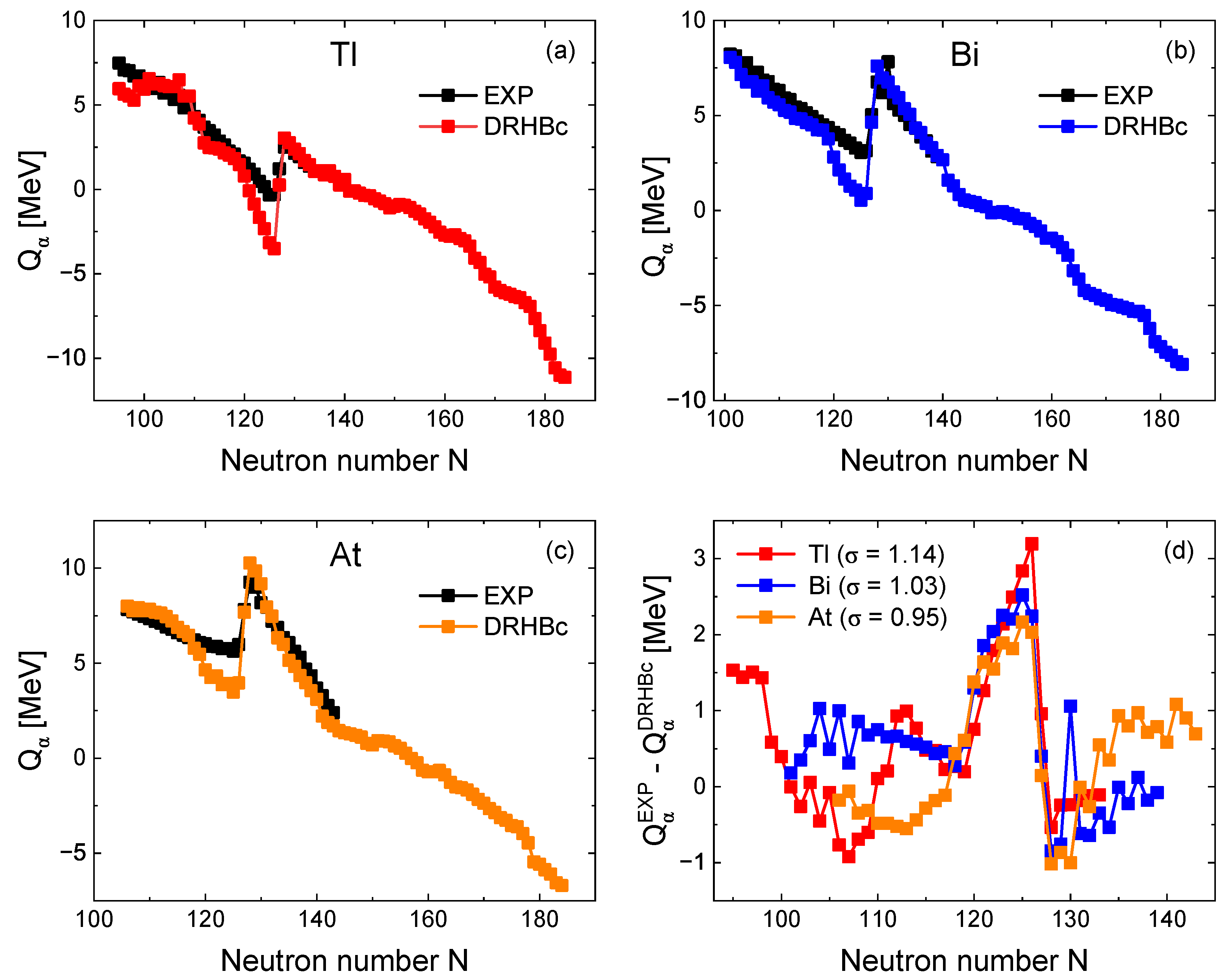
Figure 2.
The decay half-lives obtained of Bi and At isotopes by different five empirical formulas (AKRA, Royer, SP, UDL, and VSS) using (a) the experimental values and (b) the values derived from DRHBc calculations. (c) and (d) the logarithmic differences between the experimental half-lives and the calculated values.
Figure 2.
The decay half-lives obtained of Bi and At isotopes by different five empirical formulas (AKRA, Royer, SP, UDL, and VSS) using (a) the experimental values and (b) the values derived from DRHBc calculations. (c) and (d) the logarithmic differences between the experimental half-lives and the calculated values.
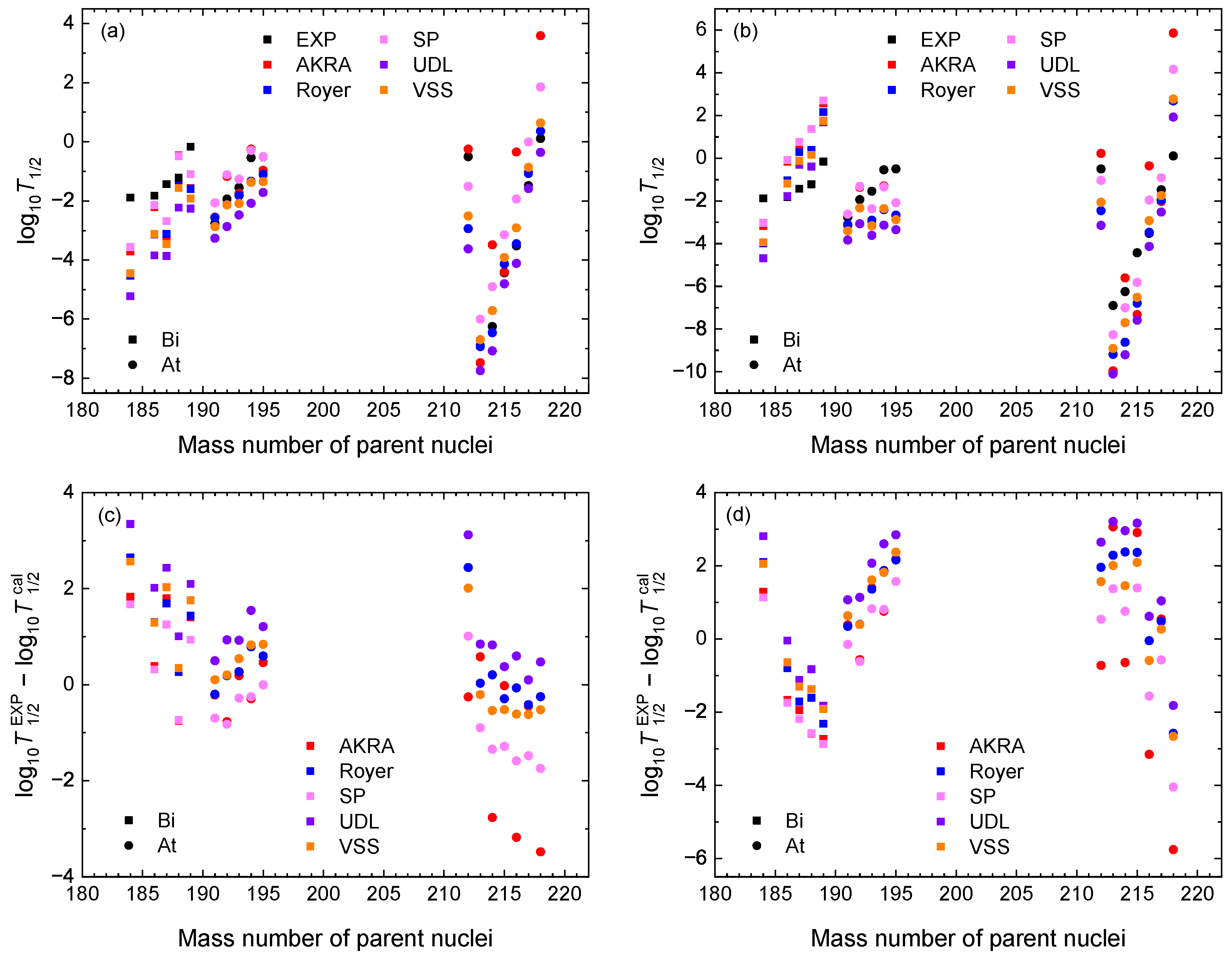
Figure 3.
The predicted decay half-lives in logarithmic form for Tl (Z = 81), Bi (Z = 83), and At (Z = 85) isotopes using VSS and SP formula with (a) available experimental and (b) the obtained from DRHBc calculations.
Figure 3.
The predicted decay half-lives in logarithmic form for Tl (Z = 81), Bi (Z = 83), and At (Z = 85) isotopes using VSS and SP formula with (a) available experimental and (b) the obtained from DRHBc calculations.
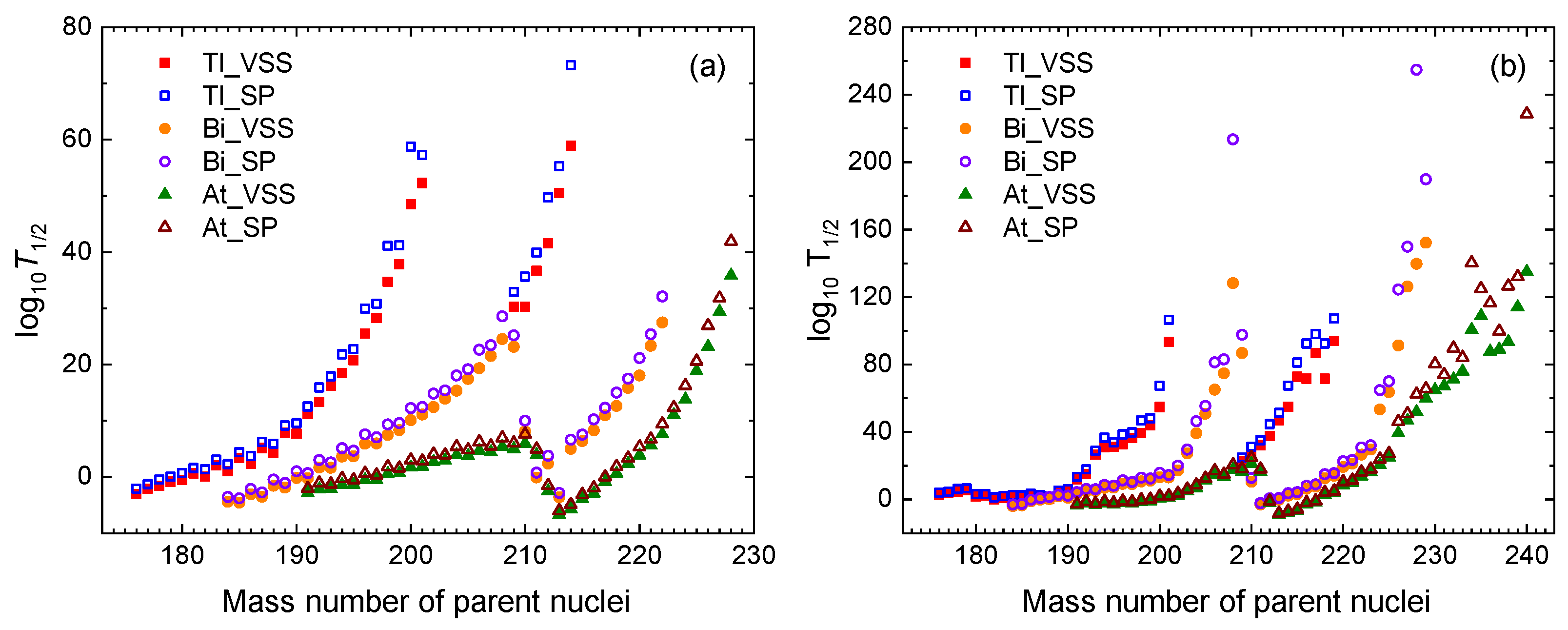
Figure 4.
The logarithmic differences between the results obtained using values derived from AME2020 and derived from (a) the DRHBc mass table versus the mass number of the parent nucleus and (b) ( - ).
Figure 4.
The logarithmic differences between the results obtained using values derived from AME2020 and derived from (a) the DRHBc mass table versus the mass number of the parent nucleus and (b) ( - ).
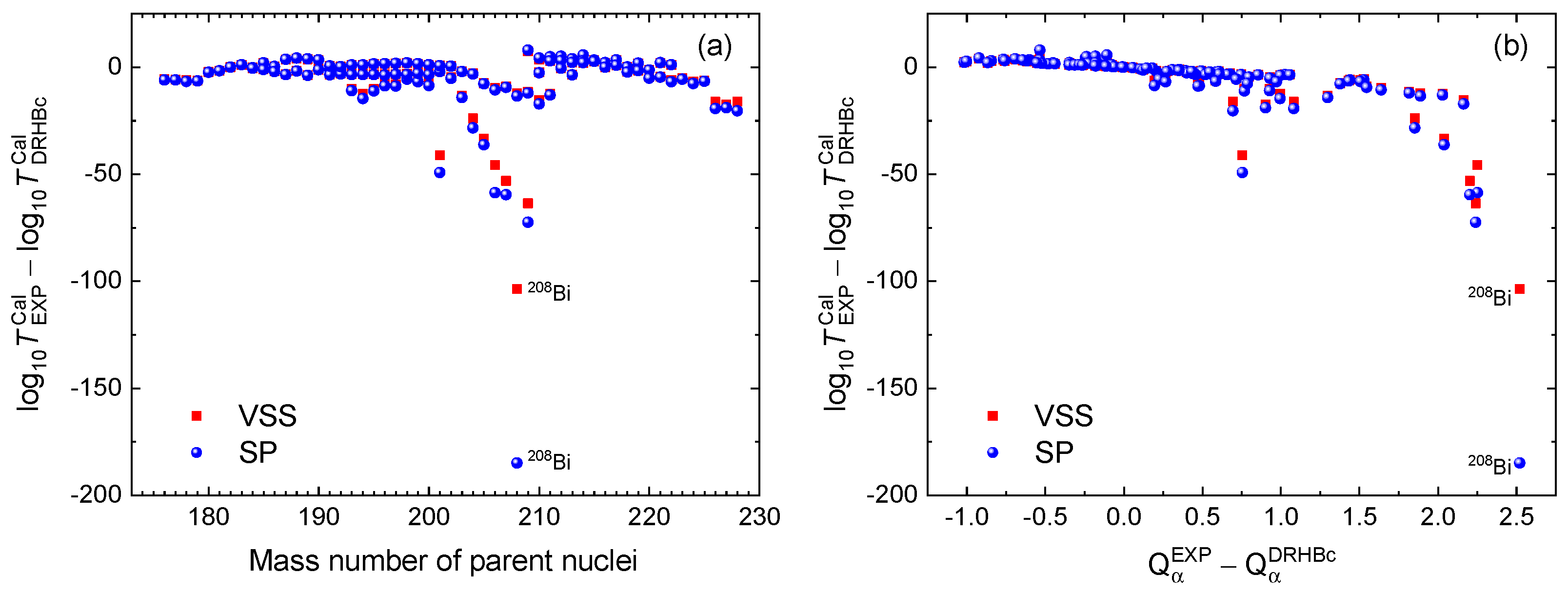

Table 1.
The calculated half-life of decay using selected empirical formulas. The experimental data for and half-lives are taken from AME2020 [35] and NNDC [36], respectively. The units of and are MeV and seconds (s), respectively.
| transition | EXP | AKRA | Royer | SP | UDL | VSS | |
| 184Bi →180Tl | 8.22 | -1.89 | -3.71 | -4.53 | -3.56 | -5.23 | -4.45 |
| 186Bi →182Tl | 7.76 | -1.83 | -2.21 | -3.13 | -2.15 | -3.85 | -3.12 |
| 187Bi →183Tl | 7.76 | -1.43 | -3.23 | -3.12 | -2.68 | -3.87 | -3.46 |
| 188Bi →184Tl | 7.26 | -1.22 | -0.47 | -1.49 | -0.49 | -2.23 | -1.57 |
| 189Bi →185Tl | 7.27 | -0.16 | -1.56 | -1.60 | -1.10 | -2.26 | -1.92 |
| 191At →187Bi | 7.82 | -2.77 | -2.55 | -2.57 | -2.07 | -3.27 | -2.87 |
| 192At →188Bi | 7.70 | -1.94 | -1.17 | -2.13 | -1.12 | -2.87 | -2.14 |
| 193At →189Bi | 7.57 | -1.55 | -1.74 | -1.82 | -1.27 | -2.47 | -2.09 |
| 194At →190Bi | 7.45 | -0.54 | -0.25 | -1.33 | -0.29 | -2.09 | -1.37 |
| 195At →191Bi | 7.34 | -0.51 | -0.97 | -1.11 | -0.50 | -1.72 | -1.35 |
| 212At →208Bi | 7.82 | -0.50 | -0.25 | -2.94 | -1.51 | -3.62 | -2.51 |
| 213At →209Bi | 9.25 | -6.90 | -7.48 | -6.93 | -6.00 | -7.75 | -6.70 |
| 214At →210Bi | 8.99 | -6.25 | -3.49 | -6.46 | -4.91 | -7.08 | -5.71 |
| 215At →211Bi | 8.18 | -4.43 | -4.41 | -4.14 | -3.15 | -4.81 | -3.91 |
| 216At →212Bi | 7.95 | -3.52 | -0.35 | -3.45 | -1.94 | -4.12 | -2.91 |
| 217At →213Bi | 7.20 | -1.49 | -1.04 | -1.07 | -0.01 | -1.58 | -0.87 |
| 218At →214Bi | 6.88 | 0.11 | 3.59 | 0.36 | 1.85 | -0.36 | 0.63 |
| standard deviation | 1.55 | 1.11 | 1.09 | 1.61 | 1.16 | ||
Table 2.
The same as Table 1, but with results obtained using from the DRHBc calculations.
Table 2.
The same as Table 1, but with results obtained using from the DRHBc calculations.
| transition | EXP | AKRA | Royer | SP | UDL | VSS | |
| 184Bi →180Tl | 8.04 | -1.89 | -3.18 | -3.98 | -3.02 | -4.69 | -3.94 |
| 186Bi →182Tl | 7.15 | -1.83 | -0.16 | -1.03 | -0.08 | -1.79 | -1.19 |
| 187Bi →183Tl | 6.75 | -1.43 | 0.52 | 0.28 | 0.76 | -0.31 | -0.13 |
| 188Bi →184Tl | 6.77 | -1.22 | 1.36 | 0.38 | 1.36 | -0.39 | 0.15 |
| 189Bi →185Tl | 6.27 | -0.16 | 2.57 | 2.15 | 2.70 | 1.66 | 1.75 |
| 191At →187Bi | 8.00 | -2.77 | -3.15 | -3.11 | -2.62 | -3.84 | -3.40 |
| 192At →188Bi | 7.76 | -1.94 | -1.37 | -2.33 | -1.32 | -3.08 | -2.33 |
| 193At →189Bi | 7.92 | -1.55 | -2.94 | -2.91 | -2.37 | -3.62 | -3.16 |
| 194At →190Bi | 7.77 | -0.54 | -1.30 | -2.41 | -1.35 | -3.14 | -2.36 |
| 195At →191Bi | 7.83 | -0.51 | -2.69 | -2.67 | -2.08 | -3.35 | -2.88 |
| 212At →208Bi | 7.67 | -0.50 | 0.22 | -2.46 | -1.04 | -3.15 | -2.07 |
| 213At →209Bi | 10.27 | -6.90 | -9.97 | -9.19 | -8.27 | -10.11 | -8.91 |
| 214At →210Bi | 9.86 | -6.25 | -5.61 | -8.63 | -7.01 | -9.21 | -7.71 |
| 215At →211Bi | 9.18 | -4.43 | -7.34 | -6.79 | -5.82 | -7.59 | -6.52 |
| 216At →212Bi | 7.96 | -3.52 | -0.37 | -3.48 | -1.96 | -4.14 | -2.93 |
| 217At →213Bi | 7.46 | -1.49 | -2.03 | -1.97 | -0.91 | -2.52 | -1.75 |
| 218At →214Bi | 6.33 | 0.11 | 5.86 | 2.68 | 4.15 | 1.93 | 2.77 |
| standard deviation | 2.33 | 1.77 | 1.75 | 2.11 | 1.62 | ||
Disclaimer/Publisher’s Note: The statements, opinions and data contained in all publications are solely those of the individual author(s) and contributor(s) and not of MDPI and/or the editor(s). MDPI and/or the editor(s) disclaim responsibility for any injury to people or property resulting from any ideas, methods, instructions or products referred to in the content. |
© 2025 by the authors. Licensee MDPI, Basel, Switzerland. This article is an open access article distributed under the terms and conditions of the Creative Commons Attribution (CC BY) license (http://creativecommons.org/licenses/by/4.0/).
Copyright: This open access article is published under a Creative Commons CC BY 4.0 license, which permit the free download, distribution, and reuse, provided that the author and preprint are cited in any reuse.