

Submitted:
21 January 2025
Posted:
22 January 2025
You are already at the latest version
Abstract
Teaching can contribute substantially to achieving the Sustainable Development Goals (SDGs) by addressing traditional curriculum-relevant topics in new contexts related to sustainability. A suitable context is green facades, which support several SDGs at once. The aim of sustainability education should be to foster all components of the KAP triad, i.e., promoting environmental knowledge (K) and attitude (A), but also enabling appropriate practices (P). This study analyzes the effect of a short-term extracurricular intervention (4 hours) on green facades on the KAP triad. Pre-, post- and follow-up tests were conducted with n = 71 students aged M = 14.20 (SD = 1.33). Knowledge and attitude development were analyzed using ANOVA. Regression analyses were calculated to assess the relations of knowledge and attitude with practices. The results show that even a short-term intervention can lead to longer-term effects regarding knowledge growth but will only bring about short-term changes in attitude. Attitude items with the strongest change were not related to students’ direct or immediate activities. In addition, environmental knowledge and attitude appear to support different kinds of activities. Therefore, it seems important that didactic interventions focus on knowledge and attitude to enable students to engage in pro-environmental behaviors.
Keywords:
facade greening
; sustainability
; SDGs
; education for sustainable development
; extracurricular learning
; knowledge
; attitude
; practices
; behavior
; KAP
1. Introduction
Sustainability has been promoted over the last 30 years by the United Nations (UN). Particularly, in 2015, the 17 Sustainable Development Goals (SDGs) were defined [1]. The United Nations Educational, Scientific and Cultural Organization (UNESCO) led and coordinated the Education 2030 Agenda through a guidance document, “Education for Sustainable Development (ESD)—Learning Objectives” [2]. It serves as a resource bank for educators and teachers (topics and activities) to promote sustainability among young people, who are key in reaching the SDGs as the main actors for change. ESD has become an integral part of the SDGs, as no. 4, Quality Education, explicitly highlights. Target 4.7 of this SDG states: “By 2030, ensure that all learners acquire knowledge and skills needed to promote sustainable development, including, among others, through education for sustainable development […]“ ([2], p. 8). Notably, ESD leads to achieving all SDGs: “ESD enables all individuals to contribute to achieving the SDGs by equipping them with the knowledge and competencies they need, not only to understand what the SDGs are about, but to engage as informed citizens in bringing about the necessary transformation” ([2], p. 8).
ESD should, therefore, have a special status in school lessons. It is thus necessary to consider which traditional curriculum-relevant topics can be summarized under an environmental context and taught with a new focus. Such a new focus could be provided by referring to green facades, because this context allows teachers to address various SDGs, particularly 3, 11, 13, and 15 (see section 2.1.1). However, such a new context, which often originates in research, seldom finds its way directly into school lessons, but rather via the “detour” of extracurricular learning venues and activities. The latter usually offer courses of limited duration, e.g., half a day or one day. This raises the question of the effectiveness of these short-term offers, whereby longer-term effects are desired. Ideally, these effects should relate to all components of the KAP triad, i.e., students’ knowledge (K), attitude (A) and practices/behavior (P) in the context of interest. Our study therefore focuses on the longer-term effects on the KAP triad caused by an extracurricular project day on green facades for students aged around 14 at a German university.
2. Theoretical Background
2.1. Green Facades, an Exemplary Topic for Teaching/Learning About Sustainability
There are content-related and educational reasons why the topic of green facades is suitable for learning about sustainability in schools.
2.1.1. Content-Related Reasons for Teaching About Green Facades
Content-related reasons why green facades should be addressed in the classroom relate to various SDGs touched upon by this topic, namely
- Goal no. 3: Good health and well-being
- Goal no. 11: Sustainable cities and communities
- Goal no. 13: Climate action
- Goal no. 15: Life on land
The relation between the aforementioned SDGs and green facades can be explained as follows. Green Facades are any way of setting plants on the vertical facade of a building [3]. They are regarded as a type of nature based solutions, since they have the potential to counteract several environmental problems in cities, such as climate warming emphasized by the Urban Heat Island (UHI) effect [4,5], lack of green areas [6], unhealthy living conditions [6,7,8], and loss of biodiversity [9,10,11]. More precisely, they regulate the temperature inside the buildings [5,12] by shading, by the “albedo effect” and by evapotranspiration (“cooling effect”). Temperature regulation results in less energy consumption and, in turn, less CO2 emission. In doing so, green facades provide summer thermal protection that is beneficial for human health (SDG no. 3) and mitigate climate warming (SDG no. 13). In addition, green facades sequester CO2 [13] through the photosynthesis process, another contribution to mitigating climate warming (SDG no. 13). Furthermore, green facades capture dust and air pollutants, thus improving the air quality [7] and providing healthier conditions for people (SDG no. 3). They contribute to improving the psychological well-being of people since they fill the lack of greenness in dark-grey cities (SDG no. 3) [6]. In addition, green facades muffle noise [8] and determine better humidity conditions for dry, warm cities [5] (SDG no. 3). They also contribute to counteracting the loss of biodiversity, hosting little animals (SDG no. 15) [9,10,11]. Overall, green facades make cities more sustainable (SDG no. 11).
2.1.2. Educational Reasons for Teaching About Green Facades
From an educational perspective, the topic of green facades is also suitable for science lessons. This can be seen, for example, if one takes Klafki’s reasons for selecting teaching themes as a basis [14]:
- Exemplarity: Green facades are an example to demonstrate the multiple positive environmental effects of greening measures in general (parks, hedges, etc.). In addition, green facades support thinking in another spatial dimension: Not only in the horizontal, but also in the vertical, which may also be relevant for plant cultivation.
- Students’ current life meaning: Green facades may be present in students’ neighborhoods and could provide a direct object of study. However, even with a green facade, students may pass but not realize it. However, they should notice and appreciate it because of its strong pro-environmental power.
- Students’ future life meaning: Students should know about the pro-environmental benefits of green facades to support such (and other) greening measures, both on an individual and societal/political level.
In addition, there are also other criteria related to school practice that support the selection of green facades as a teaching topic:
- Link to school curricula: Teaching about green facades can address various curriculum-relevant topics, such as photosynthesis, light absorption and reflection, heat transfer as latent heat during evaporation, and the transpiration process in plants.
- Feasibility: The topic of green facades can be easily integrated into lessons, as various effects of the facade plants can be shown in short-term, cost-effective laboratory experiments at school.
Due to their content-related and educational relevance, green facades are used in the present study to design an intervention, which can be seen as a central phase of an ideally even more comprehensive teaching unit [15].
2.2. The Theoretical Construct of the KAP Triad
The KAP triad [16,17] is a construct referring to the relationship between individuals’ knowledge, attitude, and practices related to a specific topic. The abbreviation KAB may also be found in literature, with the B referring to behaviors, i.e., practices [18]. Here, we stick to the term KAP. The triad can be applied in different ways: On the one hand, KAP data can be used to describe the baseline situation in a study population and subsequently, to plan adequate educational interventions. On the other hand, it can be used to evaluate the effectiveness of a teaching intervention.
An educational intervention may affect the KAP triad in different ways (Figure 1). In the 1970s, Iverson and Portnoy [19] summarized many of these relations. Knowledge and attitude can be seen as important factors in explaining and influencing the third one, behavior, even if they alone are not sufficient as a basis for explanation and optimization [19,20]. Various personal and situational factors contribute to this relationship, e.g., competing needs and motives, different levels of self-efficacy or the presence of others who provide support [16,17]. However, the present study will not address these additional factors because they are outside the realized intervention.
2.3. Empirical Results Referring to the KAP Triad
KAP data have been collected in various fields of research, such as analyzing sustainable agriculture [21], immunization practices [22], waste management [23], health education [24], and environmental education [25]. Adopting appropriate practices/behaviors is particularly important in certain areas of education that are connected to social and/or individual well-being, such as environmental and health education.
Concerning environmental education, a recent meta-analysis [26] demonstrated the impact of environmental education, particularly education for sustainable development, on improving environmental knowledge, environmental attitude, and pro-environmental behaviors. The effect sizes were high for knowledge and small to medium for attitude and behaviors. Interventions that differed in the type of student activities (ranging from traditional classroom activities to field trips and camps) or in their length (one vs. several days) appeared to be similarly effective [26]. This could indicate that even short-term programs, such as those often offered by extracurricular learning venues, can be effective.
However, other studies found an effect of the duration of the intervention. In a study by Bogner [27], a one-day outdoor program was compared with a five-day outdoor program in a national park. The one-day environmental education had a positive effect on knowledge, but a longer program was required for positive and consistent effects on attitudes and behavior, also stable over a long-term period of six months.
On the other hand, there are also short-term education interventions that found effects on KAP. For example, a study with students’ attendance in a “green classroom” for just half a day had positive effects on knowledge and raised awareness of small animals and plants compared to a control group [28]. The authors argue that these positive changes could support the importance of the educational programs outside school.
Hence, next to duration of an intervention, others argue that effects of programs outside school or intensive and authentic nature discovery, e.g., in a botanical garden as form of a “green classroom”, could be essential factors for fostering knowledge and pro-environmental attitudes [27,29].
However, such outdoor experiences [30] differ from those gained in a laboratory conducting experiments (as with our teaching intervention on green facades) [31]. Therefore, the question of pro-environmental long-term effects of a short-term educational intervention is still relevant (i.e., effects might differ depending on the type of intervention).
In the context of teaching/learning about environmental topics, literature also shows that environmental knowledge significantly influences ecological behaviors [32,33,34,35]. However, this relation has also been mediated by more proximal factors, such as attitudes [36,37], which are meaningful predictors of pro-environmental behaviors. In addition, when examining pro-environmental behavior, it must be considered that different kinds of behavior are implemented with varying degrees of ease because of higher or lower psychological barriers or other costs [26,38].
More recently, the learning process itself has been considered a form of pro-environmental behavior, in which attitudes play a double role: they control how likely learning will occur and also how intensively students will engage in the learning process [30,39,40].
Overall, literature suggests a connection between the three components knowledge, attitude, and practices. However, there does not seem to be one unequivocal causal direction.
2.4. Possible Subcomponents of the KAP Triad
When analyzing the effect of interventions on the KAP triad, the question arises as to whether there are subcategories in knowledge, attitude and practices.
With environmental knowledge, a distinction is made between 3 different types of knowledge: system, action-related and effectiveness knowledge [32,34,41,42]. While system knowledge is about how environmental systems work and how natural processes operate, action-related knowledge is about what can or needs to be done to achieve resource conservation and environmental preservation. Finally, effectiveness knowledge is about how to achieve best resource conservation, namely knowledge about the effectiveness of various behaviors, i.e., their impact.
When imparting knowledge at extracurricular learning centers (such as university laboratories), the focus is usually on the subject matter and less on individual action knowledge, i.e., how to improve one’s pro-environmental behavior. Thus, primarily system and effectiveness knowledge (e.g., the impact of greening measures on the environment and their contribution to sustainability) is imparted, which we will summarize here as content knowledge. If extracurricular learning centers allow experiments to be carried out and scientific data to be collected, another type of knowledge is also imparted, which we would like to call technical knowledge. Regarding green facades, content knowledge addresses the structure and function of green facades and their relationship with environmental problems and the SDGs. In contrast, technical knowledge focuses on experiments, measurement instruments, and environmental parameters directly experienced by students during laboratory work.
Concerning attitude, indicators can be rather general, referring to many different environmental-relevant areas of life [43] or specific to a certain topic, such as green facades [44]. Although it is questionable whether these indicators (general vs. specific) represent different underlying dispositions [39], a more specific indicator can be seen as beneficial if an intervention is limited to a certain content domain. This is because changes may occur more easily in this specific domain than in related ones and the specific indicator focuses exactly on this domain and is therefore more sensitive than a general indicator. In the survey data presented here, we thus refer to the specialized attitude towards green facades and not to a general (pro-)environmental attitude.
Regarding practices, two different lines of action may be considered: Behaviors that rather address one’s mind and cognition versus behaviors that focus more on one’s emotions and responsibility. These action lines may then be related to knowledge and attitude.
Figure 2 provides an overview of the possible subcomponents of the KAP triad described above. The relationships among them examined in the present study are marked with arrows.
3. Research Questions
Our research aims to investigate how an educational intervention on facade greening in the form of a half-day visit to an out-of-school place of learning (i.e., a German university) affects components of the KAP triad. In this paper, we seek to answer the following research questions:
- K: How does the intervention affect students’ knowledge—considering content and technical knowledge?
Based on previous studies [5], we assume that knowledge (content and technical one) strongly increases after the intervention and that this effect is still partially present after four weeks [3].
- 2.
- A: How does the intervention affect students’ attitudes towards green facades?
Based on previous studies [5], we assume that the level of specific attitude increases slightly after the intervention and that parts of this change are still detectable after four weeks [3].
- 3.
- P: How do knowledge and attitude correspond to students’ practices?
Based on the KAP frameworks, we expect positive relations between knowledge and practices, as well as attitude and practices. We will explore these relations, considering cognitive and emotional lines of action.
4. Materials and Methods
Additional material such as detailed information on the didactic intervention can be found in the supplementary online material:
4.1. Study Design
An educational intervention on facade greening was performed and analyzed using a longitudinal treatment-only design (pre-test, post-test, follow-up) regarding its effect on the components of the KAP triad. The questionnaires were developed and tested in the context of a prior project day and were modified and supplemented with further items for the current study. This was done to adjust the ad-hoc knowledge measure to better fit the students’ knowledge level and to add knowledge questions referring to the practical contents (not only to the theoretical ones) of the project day. Moreover, items on attitude towards green facades were added to cover a broader range of difficulties and thus, achieve better differentiation between persons. Data collection was conducted in autumn 2023 with students from six different classes and project groups (grade 5-11) from four different secondary schools (grammar and integrated comprehensive schools)
Participation was voluntary and anonymous. Parents or legal guardians were consulted prior to data collection. Points of measurement were matched using a personal code generated by the students.
4.2. Participants and Procedure
The final sample across all points of measurement consisted of N = 117 students (npre = 105, npost = 105, nfollow-up = 76). Students who participated in the follow-up survey but not the intervention (i.e., T2 but not T1, n = 11) were excluded due to reduce noise in the follow-up data, especially for the knowledge questions. Furthermore, we excluded 20 individual datasets (from n = 10 different persons) because of data quality concerns (i.e., suspected answering patterns or implausible person code duplicates). All remaining students (117) were used to determine the student’s knowledge scores (see section 4.4).
As we were interested in our constructs’ development over time, we used the subsample of n = 71 complete cases (i.e., students who participated in all points of measurement) for our main analyses. The mean age in the complete cases subsample was 14.20 years (SD = 1.33) with a gender distribution of 36.6% females, 57.8% males and 5.6% not stated. The characteristics of the full all sub-samples can be found in the online supplementary material.
The surveys to evaluate the effect of the project day were conducted one week before the didactic intervention (pre-test, T0), directly after the didactic intervention (post-test, T1), and approximately four weeks after the didactic intervention (follow-up test, T2). Students received paper-pencil questionnaires at all points of measurement, where they first answered items on their attitude towards green facades. In the second part, they answered questions on content and technical knowledge related to green facades. Lastly, they were asked for age, gender and grade. At the beginning of the post-test questionnaire, students additionally indicated the stations on which they had worked during the project day.
Due to the limited time available at the end of the project day and to reduce the workload, we used a split version of the knowledge questionnaire at T1, i.e., not all students had to answer all items, but some items were administered to all students.
After the project day, students were given the option to take a small plant and a flyer home with them. The follow-up questionnaire therefore included further questions on the students’ behaviors related to the plant and the flyer after the project day.
In addition, all questionnaires included further items (e.g., referring to students’ general environmental attitude, their social environment and further behavior) that were not used in the current research.
4.3. Didactic Intervention
The didactic intervention lasted 4 hours and included an introductory, a practical/experimental and a wrap-up phase.
The introductory phase (frontal lecture-style) was meant to introduce and link the topic to more general environmental issues and the SDGs. It highlighted the most common issues in cities, such as global warming and the Urban Heat Island effect, the loss of biodiversity, and pollution in the air, along with possible solutions based on nature, such as green facades. The introduction ended with open questions referring to whether, and in what way, green facade plants may counteract the mentioned problems and thereby, contribute to the SDGs.
In the practical/experimental phase (hands-on, activity-based) students should answer the questions raised before. The focus of the work phase was on several specific operating mechanisms of green facades: (i) CO2 sequestration related to photosynthesis (SDG no. 13 and 11), (ii) temperature regulation due to shade and albedo effects (SDGs no. 3, 13, and 11) (iii) increase in humidity due to transpiration of plants (SDG no. 13 and 11), and finally (iv) the contribution to dust capturing (SDG no. 3) and biodiversity (SDG no. 15 and 11). Activity-based learning was chosen as a teaching method, with three stations (i—iii) requiring experimental work in laboratory conditions, while the fourth station was informative, involving the interpretation of measurement charts (data from research) and familiarization with common inhabitants of green facades using illustrations. Students were split into small groups during this practical phase and alternated between the various stations.
The wrap-up phase (interactive, Q&A) was intended to collate, compare and assess the workstations’ results and to come to conclusions about the initial questions. Subsequently, follow-up activities at home were proposed to keep students engaged in the topic of green facades: (i) A flyer was offered to recap the day and to suggest new activities for the students to carry out on their own, to stimulate them to recall the experience gained during the project day and talk about them with others. Reading the flyer and using the suggested links to websites with more information about green facades (including videos) was considered to belong to a cognitive line of action. (ii) In addition, a little ivy plant could be taken home to look after (e.g., watering it) and observe its growth. These activities have a caring aspect and were therefore counted as part of an emotional line of actions.
For more details on the didactic intervention, see the online supplementary material.
4.4. Survey Instruments
To answer our research questions on the effects of the didactic intervention, we assessed students’ knowledge, attitude and practices.
A two-dimensional partial credit Rasch model with content and technical knowledge was calibrated for each point of measurement. Calibrating both forms of knowledge in the same model offers the advantage of reduced standard errors and increased reliability. Moreover, it accounts for relations between the dimensions and offers more precise correlation estimates [45]. To compare the knowledge estimates across the different points of measurement, we used the follow-up calibration (T2) as our reference as this represented the decisive point of measurement, i.e., whether the educational intervention was successful in the long term. Therefore, we first aligned the two dimensions for this point of measurement (with person estimates fixed to zero and content knowledge as the reference dimension, see [46]) and then linked the item estimates of the other two calibrations (T0 and T1) to the reference calibration (T2) [47]. For the calibrations, the datasets of all 117 students were used to improve the fit.
For content knowledge, we had one assignment task, 15 single-choice and 13 multiple-choice questions. For technical knowledge, we also had one assignment task, one single-choice question and 13 multiple-choice questions. Single- and multiple-choice questions with only one correct answer were evaluated as correct (1) or incorrect (0). The assignment tasks and the other -multiple-choice questions were evaluated using three categories: whether the answer was incorrect (0), partially correct (i.e., if not all correct answers for a multiple-choice question were selected) (1) and correct (2). At T1 and T2, only the questions concerning stations that students engaged with were considered, based on the students’ indication of station engagement at the beginning of the T1 questionnaire (see section 4.2). Questions related to stations where students indicated non-engagement were treated as missing. Besides, systematically unanswered knowledge questions were treated as missing, i.e., when it was clear that the respective students stopped answering the questionnaire (In these cases, all unanswered questions before the last answered question were treated as incorrect, all remainig questions as missings. A model with all unanswered questions evaluated as incorrect was also calibrated. However, this did not improve model fit). Note that for Rasch scales, parameter estimates can be determined even with incomplete data due to the maximum likelihood approach in the estimation procedure (for more details, see, e.g., [48])
Overall, all models had a reasonable fit with person separation reliabilities ranging from .44 (technical knowledge at pre-test) to .77 (technical knowledge at follow-up test). Subsequently, knowledge estimates for the 71 complete cases were extracted.
Attitude towards green facades was measured using eight self-developed items on a 5-point Likert scale. Items included more general opinions (e.g., “Cities would be more beautiful with more green walls/facades.”) or referred to personal commitment (e.g., “I would take part in maintaining a green facade at my school.”) or to official measures (“The greening of house walls is so important that it should be supported by the government”). We calculated mean values [49] (We refrained from calibrating a Rasch model as small sample size (< 150) together with only few items are associated with low accuracy of parameter estimates due to relatively few data points.) to determine a person’s attitude towards green facades. Reliabilities were high at all measurement points (McDonald’s ωT0 = .88, ωT1 = .89, ωT2 = .88).
Behaviors related to the flyer and the plant were measured using self-reports. Regarding the flyer, students were asked whether they took it (yes/no), and if so, whether they looked at it again (yes/no) and whether they used the QR codes for videos and further information on green facades provided on the flyer (yes/no). These activities were interpreted to contribute to a cognitive activity strand. We excluded one further item from the evaluation because it was a creativity-oriented activity, namely going on a photo safari concerning green facades. Similarly, students were asked whether they took a plant after the project day (yes/no) and if so, whether they watered the plant (yes/no) and whether they watched it grow (yes/no). These activities were seen as part of an emotion-oriented activity strand.
To analyze the behaviors, we created an index for each behavior by summing up the respective activities. Concerning the flyer, n = 23 students did not take a flyer, n = 27 students took a flyer but did not do any further activities, n = 18 also looked into the flyer again, and n = 3 students also used the QR codes mentioned in the flyer. Concerning the plant, n = 32 students did not take a plant, n = 13 students took a plant but did not do any further activities, n = 11 students did one additional activity (watering or observing the plant), and n = 15 students did two.
5. Results
5.1. Results to RQ1: How Does the Intervention Affect Students’ Knowledge?
Knowledge results are reported in logit values, the metric of Rasch scales. We conducted repeated measures ANOVA with post-hoc t-tests (one-sided and Bonferroni-corrected) to test for changes in knowledge over time. If Mauchly’s test for sphericity was significant, we applied the Greenhouse-Geisser correction of degrees of freedom for the within-subject factor.
Due to incomplete questionnaires, the number of students for whom an estimate of technical knowledge could be derived was n = 62. To compare content and technical knowledge, we only considered this subsample for the following analyses.
The content knowledge of students significantly changed through the educational intervention, F(1.69,102.96) = 6.76, p = .002, ω2 = .14 (see Figure 3a). The students had higher content knowledge after the intervention (T1: M = 0.19, SD = 0.72) than before (T0: M = -0.12, SD = 0.59), p = .004, d = 0.40 (T0 vs. T1). Compared to the pre-test, the increase remained stable also after four weeks, although with a diminished effect size, p = .033, d = 0.30 (T0 vs. T2). Removing one outlier with an extremely low knowledge score at the pre-test (see Figure 3a) led to a slight decrease in the overall effect size (ω2 = .12) and the knowledge increase from pre-test to follow-up (T0 vs. T2) was just not significant anymore, p = .051, but the effect size remained similar, d = 0.28. Using the whole complete cases subsample (n = 71), effect sizes remained similar, with (p < .001, ω2 = .16) and also without two outliers (p = .003, ω2 = .13), and the increase in knowledge from pre-test to after four weeks was also significant and similar in size, both with (p = .018, d = 0.31) and without outliers (p = .046, d = 0.27).
The technical knowledge also changed over time, but much more drastically than the content knowledge, F(2,122) = 78.14, p < .001, ω2 = .71 (see Figure 3b). Technical knowledge was higher at the post-test (T1: M = 0.27, SD = 1.01) than at the pre-test (T0: M = -1.17, SD = 0.67), p < .001, d = 1.51 (T0 vs. T1). Four weeks later, it stayed substantially higher than before the educational intervention, although the effect was somewhat smaller, p < .001, d = 1.05 (T0 vs. T2). Excluding two outliers in the follow-up measurement (see Figure 3b) did not change the results (ω2 = .75).
We further explored differences between the two kinds of knowledge (two-sided tests). Excluding the three outliers, the technical knowledge was significantly lower than the content knowledge before the intervention, t(58) = 12.29, p < .001, d = 1.60. However, directly after the intervention and also four weeks later, the two knowledge types were on a similar level, T1: t(58) = 0.773, p = .442, d = 0.10, T2: t(58) = 0.46, p = .644, d = 0.06. Including the outliers did not change the interpretation or significance of the results. Furthermore, as also indicated by the boxplots in Figures 3a and 3b, the variance in content and technical knowledge is similar at the pre-test, F(58,58 = 1.48, p = .141, ω2 = .32 but higher for technical knowledge directly after the intervention, F(58,58) = 1.82, p = .025, ω2 = .45, and also four weeks later, F(58,58) = 2.08, p = .006, ω2 = .52. In other words, there were more individual differences in learning about the technical aspects, leading to a wider range in technical knowledge compared to content knowledge.
Despite some differences in the development of the two knowledge types, we found that they were highly correlated, even before the intervention with rT0 = .70 which increased to rT1 = .89 directly after the intervention and remained high at follow-up, rT2 = .87. Put differently, students who have a higher content knowledge also tend to have a higher technical knowledge. This relationship is even more pronounced after the project day.
Because of this very high overlap between the two constructs, we collapsed the two measures into an overall measure of facade greening knowledge for further analyses by calibrating a unidimensional model for each point of measurement, again linking the pre- and pots-test calibration to follow-up as reference (relT0 = .59, relT1 = .77, relT2 = .76). For this composite measure, we extracted knowledge scores for the subsample of all complete cases (n = 71).
5.2. Results to RQ2: How Does the Intervention Affect Students’ Attitudes Towards Green Facades?
Again, we conducted repeated measures ANOVA with post-hoc t-tests (one-sided and Bonferroni-corrected) to test for changes over time.
We found a significant change in attitude toward green facades through the intervention, F(2,140) = 10.65, p < .001, ω2 = .21. Specifically, there was an increase from the pre-test (T0: M = 2.69, SD = 0.82) to the post-test (T1: M = 3.06, SD = 0.81), p < .001, d = 0.52 (T0 vs. T1). However, this increase was lost at the follow-up, i.e., attitude values returned to baseline (T2: M = 2.81, SD = 0.85), p = .210, d = 0.18 (T0 vs. T2). Removing the three outliers at T0 and one at T1 (see Figure 4), did not change the results. Therefore, their data was maintained.
We further investigated which aspects of facade greening students changed their minds. Because most of the items did not meet the criteria for an ANOVA, we conducted the Friedman test as a non-parametric alternative. The results are displayed in Table 1. Although the test indicated small but significant differences between points of measurement for all but item #6, post-hoc tests using exact values [50] and Bonferroni correction revealed that the agreement with the facade greening items was increased after the intervention only for items #1 (p = .003), #2 (p = .004) and #4 (p < .001). However, this increase (T0 vs. T1) did not last until four weeks after the intervention (T0 vs. T2: #1: p = .185, #2: p = .5, #4: p = .181).
5.3. Results to RQ3: How Do Knowledge and Attitude Correspond to Students’ Practices?
We investigated the relation between post-test knowledge and attitude with flyer- and plant-related behaviors using ordinal regression. Knowledge and attitude were substantially correlated at r = .39, p < .001 (r = .47 when corrected for measurement error attenuation). Hence, we calculated separate models for both predictors. We found that knowledge and attitude seemed to correspond to different kinds of behaviors. While post-test knowledge was predictive of the performance of flyer-related activities (OR = 2.35, 95% CI [1.29; 4.27], Nagelkerke’s pseudo-R² = .122), the attitude was predictive of plant-related activities (OR = 1.99, 95% CI [1.13; 3.52], Nagelkerke’s pseudo-R² = .090). Thus, higher knowledge and higher attitude lead to more performed activities. We did not find the opposite relations, i.e., knowledge was not predictive of plant-related (OR = 0.86, 95% CI [0.51; 1.54], Nagelkerke’s pseudo-R² = .003) and attitude not of flyer-related activities (OR = 1.34, 95% CI [0.76; 2.28], Nagelkerke’s pseudo-R² = .017). See the online supplementary material for the full regression models.
6. Discussion
6.1. Answer to RQ1: How Does the Intervention Affect Students’ Knowledge?
Both content and technical knowledge showed a significant increase directly after the project day (T0 vs. T1). The extent of this increase, however, varied for content and technical knowledge. The increase in content knowledge was only small and therefore less than expected [26]. An explanation could be that the intervention focused more on practical activities and students spent much more time on experiments than on theory. In addition, it could also be that the content knowledge was not as new to the students as we had anticipated. They may have taken up relevant information from their private life or already learned about the content in class. For technical knowledge, on the other hand, we saw a very strong effect of the intervention. Considering the very low baseline for technical knowledge, there was a high potential for improvement through the intervention, which ultimately led to an assimilation of both knowledge levels (content and technical-related).
Four weeks after the intervention, a significantly increased knowledge level was still found when compared with the initial value (T0 vs. T2). Thus, not only experiences in nature lead to longer-term knowledge gains [27,28] but also experiences through laboratory experiments.
Despite this longer-term increase in knowledge, some of the newly acquired knowledge was lost again. This loss was higher for technical than for content knowledge. These differences in retention of knowledge can be attributed to the fact that the amount of newly acquired knowledge was lower for content than for technical knowledge and, if less was learnt, less can be forgotten. An alternative explanation could be that content knowledge (which relates to environmental protection and the SDGs) is of general importance and may be addressed in lessons as well as in private life, e.g., when listening to the daily news. This helps to retain knowledge better. In contrast, technical knowledge relates to specific experiments that are unlikely to be repeated or carried out again in class and may therefore be more easily forgotten.
In addition, further differences can be seen in the development of content and technical knowledge: At the pre-test, technical knowledge was significantly less pronounced than content knowledge. This may be related to the fact that there is limited time for experiments at school and therefore, less technical knowledge is acquired. It must also be considered that the questions in the survey instrument are related to very specific experiments and not to experimental knowledge in general. This specialized knowledge can only be present if experiments have already been carried out in a similar form at school or if their structure has been discussed in theory. While the content knowledge tested was more general, the technical knowledge was specialized.
There was also a difference in (statistical) variance between the two types of knowledge: after the project day, the dispersion of technical knowledge was significantly higher than that of content knowledge. An explanation for this could be inter-individual differences in learning behavior and interest in experimenting. Because of the low baseline level of technical knowledge and, thus, the potential for improvement in technical knowledge, there is also more room for engagement or non-engagement in learning activities.
Despite these differences in their progression, the two kinds of knowledge were highly correlated and could even be calibrated as a unidimensional construct. That is, they indeed represent two subdimensions of the same broader construct. This construct can be described as general facade-greening or project day-related knowledge. However, as the difference between the two dimensions at the pre-test (T0) makes clear, it can also be sensible to distinguish the two forms as knowledge: Only the two-dimensional model reveals the differences between these forms of knowledge and may therefore help to design better targeted interventions as well as classroom follow-up activities after a project day.
6.2. Answer to RQ2: How Does the Intervention Affect Students’ Attitudes Towards Green Facades?
Regarding attitude towards green facades, there was a large significant increase immediately after the project day. This even exceeded expectations based on literature which assumes a small to medium effect [26]. However, over the following four weeks of our study, there was a significant decrease back to the baseline. Thus, no significant change in attitude towards green facades could be detected when comparing the first and last surveys. This suggests that the issue became more important to the students in the short term as the project day brought the topic to their awareness. However, this positive change in attitude towards green facades receded in the longer term, i.e., over the next four weeks. This could be because green facades do not play a prominent role in the students’ lives, and therefore, other issues that are more important to them right now come to the fore. Another explanation could be that students responded in terms of social desirability just after the project day because they (unconsciously) felt obliged to do so after a didactic intervention [51].
Looking at the individual items, the omnibus tests indicated that nearly all items (7 out of 8) showed significant changes in the degree of consent (except #6, see Table 1). However, subsequent tests revealed significant changes between pre- and post-tests for only three items (T0 vs. T1). It can be assumed that low statistical power potentially led to insignificant results in the post-hoc tests, at least for some of the other items. However, items with the strongest effects (#1, #2, #4), even in the small current sample, have certain characteristics. These items do not require any direct activities from students themselves, and if they do, these activities can be postponed to the future or are not feasible for students at present. Specifically, these items refer to the government, which should support the implementation of green facades (#1) or make green facades mandatory for new houses (#4), thus affecting homeowners but not students. It should also be noted that this last item received comparatively less support from students, which could be due to its mandatory nature and thus restricting personal freedom. In addition, students increasingly agreed that they would green their houses (#2). However, students currently do not own a house. This means they do not have to take action now. Their agreement only means they would accept greenery on the house they live in (or will live in the future).
In contrast to the items mentioned above, others did not significantly change, either in general (#6) or just in the post-hoc tests. Next to the low statistical power, there may also be content-related reasons. On the one hand, these items (#3, #7) are not specific measures that lead to a greater prevalence of green facades and, thus, directly contribute to more sustainability. Instead, the items merely refer to opinions on object characteristics (such as beauty and presence of spiders). On the other hand, there are items (#5, #6, #8) that refer to specific measures, but these do not come from the state, but may concern the young people at the current point in their lives, such as donating money for installing new green facades (#5), maintaining green facades (e.g., at school) (#6), or distributing leaflets about green facades (#8). This means that the more concrete, realistic and timely certain demands set out in the items are, the less significant a change in the level of agreement will be. There could be different reasons for this assumption: (i) Respondents can better estimate the effort for concrete, timely actions that affect them personally and are therefore less willing to agree with them. This is consistent with findings that the perceived difficulty of actions is a key predictor of behaviors [43,52]. (ii) Respondents consider individual activities to have little impact when it comes to solving problems on a global scale (such as climate change) [53]. Therefore, they may be more in favor of government actions rather than actions by individuals. (iii) Respondents may see the proposed measures (such as distributing flyers or collecting donations) as little help in convincing citizens to green their house facades. On the other hand, government measures may exert more pressure on the public or offer greater incentives and would therefore be more effective [54].
6.3. How to Explain the Differences in the Development of Knowledge and Attitude?
Our project day of just four hours led to significant changes in knowledge and attitude towards facade greening. However, the constancy of these changes varied. While four weeks after the project day, there was still a significant increase in knowledge compared to the pre-test (T0 vs. T2), attitude at the later measurement point (T2) was no longer significantly different from the pre-test.
A possible reason for the different persistence of increased knowledge and attitude could be as follows: Whenever a person consciously perceives something as important (like what was said or done on a project day), then attention is increased and learning gain will be greater. This gained knowledge will not be quickly overlaid by other knowledge but will remain in the memory, at least for some time [55]. If a change in attitude is to be maintained over a longer period, this is likely to involve more effort for a person. It does not only require a change in agreement with statements in a questionnaire but further, more challenging or costly behavioral change, such as donating money to organizations advocating facade greening. However, if a shift in attitude is rather the result of a momentary (perceived) higher salience of a topic, like during or right after a project day, this shift might not be strong enough to remain over a longer period under decreased salience or to result in changes of more demanding behaviors.
6.4. What Differences Can Be Seen in the Implementation of Voluntary Follow-Up Activities Offered at the End of the Project Day?
Activities that required no extra effort, such as taking a plant or a flyer after the project day, were carried out more often than the proposed time-consuming activities, such as watering and observing the plant, or reading the flyer and visiting websites with further information on facade greening. As with the short-term changes in attitude, those follow-up activities that were associated with low personal costs were also favored here. It can be assumed that the number of performed more demanding activities reflects the students’ interest in the topic, although the latter was not investigated in this study.
6.5. Answer to RQ3: How Do Knowledge and Attitude Correspond to Students’ Practices?
We found positive relations between knowledge and practices, as well as attitude and practices. This is consistent with other studies that showed environmental knowledge significantly influences environmental behavior [32,33,34,35]. The positive relation between pro-environmental attitude and behavior is also in line with many studies [56,57].
However, knowledge and attitude seemed to correspond to different kinds of behaviors. While post-test knowledge predicted performance in flyer-related activities, the higher attitude predicted plant-related activities, but not vice versa.
The relation between the level of knowledge and the number of flyer-related activities can be explained by the fact that, apart from taking the flyer, the activities based on it were cognitive in nature. The more people know about a topic, the more interested they may be in further information, and the easier and better they can understand it [58]. Regarding attitude, there was a significant correlation with the number of plant-related activities. Watering and closely observing a plant can both be classified as caring activities. Therefore, if there is a more positive attitude towards green facades, it can be assumed that this goes along with a higher appreciation of the green environment and nature, leading to more plant care.
Moreover, it seems important that didactic interventions focus on knowledge and attitude to enable students to engage in pro-environmental behaviors. This would be consistent with other research findings suggesting that environmental knowledge and attitudes influence behavior through different pathways [59].
However, the observed effect was rather weak for both causal relations (knowledge and flyer-related activities; attitude and plant-related activities). Thus, there must be other important influencing factors (e.g., limited time, other commitments and interests), which were not part of this study.
7. Limitations of the Study
As usual, our research does not come without limitations.
First, the intervention was short with only a four-hour project day. Still, we were able to show a longer-term change in knowledge, a short-term change in attitude and to identify a relation between these constructs and students’ behaviors. A longer or repeated program would have been desirable to investigate whether such more intensive interventions could also achieve long-term changes in attitude. However, such longer interventions are rather limited in everyday school life (due to the curriculum and limited opportunities to visit out-of-school places), and we wanted to expand the evidence on short-term interventions with our study.
A second limitation concerns the timing of the follow-up test. It is not possible to say anything about a truly long-term development of knowledge and attitude, e.g., within six months or a whole year, as the follow-up test took place only four weeks after the project day. However, such a long-term development would have led to the difficulty that other influencing factors independent of the project day would have had greater weight, so the causes of the development would have been unclear.
Third, the questionnaire structure followed a fixed pattern, with the questions on technical knowledge at the end. A problem might have been that some students no longer answered the items at the end of the questionnaire with the same care as at the beginning. As a result, some students dropped out before the end and could not be included in comparing content-related and technical knowledge (reduction from n = 71 to n = 62). Changing the order of the knowledge items for the students would have produced an even more reliable result. Nevertheless, as the Rasch model handles missing values comparatively well, we still achieved overall satisfying person separation reliabilities.
Fourth, the rather small sample of students who completed all three surveys affected the study’s statistical power. Still, we were able to find meaningful effects with on our constructs of interest, i.e., knowledge, attitude and practices. In addition, our study lacks a control group. To gain more accurate insights into the effects of our short-term intervention, it would have been helpful to compare the students with other students who learned about green facades but not outside school and/or with other students who did not work with experiments.
Lastly, to measure the effect of a project day on the KAP construct, it would have been advantageous to also measure behaviors (and not just knowledge and attitude) in the pre-, post-, and follow-up tests. However, our indicators did not allow such a longitudinal evaluation of behavior. In addition, we have only assessed behavior in the form of self-reports, which may be biased by social desirability.
8. Conclusions
The topic of green facades is suitable for addressing various SDGs, such as sustainable cities contributing to climate action, better health, and preservation of biodiversity on land. Even a short-term instructional intervention of only four hours at an extracurricular learning location can lead to longer-term effects on knowledge growth. However, it will only bring about short-term changes in attitude. Regarding attitude, activities that require immediate, concrete action by an individual are more likely to be disapproved. The question is therefore whether extracurricular learning locations should offer not only laboratory activities but also those activities that allow pupils to directly engage with the environment by taking over activities that they otherwise would not do (e.g., promoting facade greening by participating in the installation and/or maintenance of it and/or by informing others about this topic). Voluntary activities at home are likely to be less effective as they are only implemented to a limited extent. Especially attitude seems to play a role in implementing plant-related care activities, while knowledge may support subsequent cognitive activities. Therefore, it seems important that didactic interventions focus on knowledge and attitude to enable students to engage in pro-environmental behaviors.
Author Contributions
Conceptualization, A.P., M.B. and K.S.; questionnaire development, A.P. M.B., M.F. and K.S.; data collection, A.P.; data analysis, M.B.; writing—original draft preparation, A.P. and M.B.; writing—review, rewriting and editing, A.P., M.B., M.F., J.G. and K.S.; supervision, K.S. and J.G. All authors have read and agreed to the published version of the manuscript. All authors have read and agreed to the published version of the manuscript.
Funding
This research received no external funding.
Institutional Review Board Statement
As approved by the German Research Foundation (DFG) [Deutsche Forschungsgemeinschaft (Ger man Research Foundation). FAQ: Humanities and Social Science. Available online: https://www.dfg.de/foerderung/faq/geistes_sozialwissenschaften/index.html (accessed on 1 December 2022).], the present survey did not require approval by an ethics committee, as it did not pose any threats, risks or high physical or emotional stress for the respondents. Nevertheless, we strictly adhered to ethical guidelines, the Declaration of Helsinki [World Medical Association. World Medical Association Declaration of Helsinki: Ethical Principles for Medical Research Involving Human Subjects. JAMA 2013, 310, 2191–2194.], and the European data protection regulations [European Union. Regulation (EU) 2016/679 of the European Parliament and of the Council of 27 April 2016 on the Protection of Natural Persons with Regard to the Processing of Personal Data and on the Free Movement of Such Data, and Repealing Directive 95/46/EC (General Data Protection Regulation); Hart Publishing: London, UK, 2016].
Informed Consent Statement
Informed consent was obtained from all subjects and parents involved in the study.
Data Availability Statement
The data presented in this study are available on request from the author (M.B).
Acknowledgments
We would like to express our sincere thanks to Simon Meul, who assisted us in the development of the teaching materials for the didactic intervention, the student teachers who helped with the execution of the project day as well as all teachers and especially students who participated in our surveys.
Conflicts of Interest
The authors declare no conflicts of interest.
References
- UN. Transforming our world: the 2030 Agenda for Sustainable Development. 2015.
- UNESCO. Education for Sustainable Development Goals; United Nations Educational, Scientific and Cultural Organization: 2017. 2.
- Wong, N.H.; Tan, A.Y.K.; Chen, Y.; Sekar, K.; Tan, P.Y.; Chan, D.; Chiang, K.; Wong, N.C. Thermal evaluation of vertical greenery systems for building walls. Building and Environment 2010, 45, 663–672. [Google Scholar] [CrossRef]
- Taha, H. Urban climates and heat islands: albedo, evapotranspiration, and anthropogenic heat. Energy and buildings 1997, 25, 99–103. [Google Scholar] [CrossRef]
- Pérez, G.; Coma, J.; Cabeza, L.F. Vertical Greening Systems to Enhance the Thermal Performance of Buildings and Outdoor Comfort. In Nature Based Strategies for Urban and Building Sustainability, Pérez, G., Perini, K., Eds.; Elsevier: 2018; pp. 99–108.
- Elsadek, M.; Liu, B.; Lian, Z. Green facades: Their contribution to stress recovery and well-being in high- density cities. Urban Forestry & Urban Greening 2019, 46. [Google Scholar] [CrossRef]
- Perini, K.; Roccotiello, E. Vertical Greening Systems for Pollutants Reduction. In Nature Based Strategies for Urban and Building Sustainability, Pérez, G., Perini, K., Eds.; Elsevier: 2018; pp. 131–140.
- Azkorra, Z.; Pérez, G.; Coma, J.; Cabeza, L.F.; Bures, S.; Álvaro, J.E.; Erkoreka, A.; Urrestarazu, M. Evaluation of green walls as a passive acoustic insulation system for buildings. Applied Acoustics 2015, 89, 46–56. [Google Scholar] [CrossRef]
- Chiquet, C. The animal biodiversit of Green Walls in the urban environment. Staffordshire University, 2014.
- Mayrand, F.; Clergeau, P.; Vergnes, A.; Madre, F. Vertical Greening Systems as Habitat for Biodiversity. In Nature Based Strategies for Urban and Building Sustainability, Pérez, G., Perini, K., Eds.; Elsevier: 2018; pp. 227–237.
- Madre, F.; Clergeau, P.; Machon, N.; Vergnes, A. Building biodiversity: Vegetated façades as habitats for spider and beetle assemblages. Global Ecology and Conservation 2015, 3, 222–233. [Google Scholar] [CrossRef]
- Pérez, G.; Coma, J.; Martorell, I.; Cabeza, L.F. Vertical Greenery Systems (VGS) for energy saving in buildings: A review. Renewable and Sustainable Energy Reviews 2014, 39, 139–165. [Google Scholar] [CrossRef]
- Marchi, M.; Pulselli, R.M.; Marchettini, N.; Pulselli, F.M.; Bastianoni, S. Carbon dioxide sequestration model of a vertical greenery system. Ecological Modelling 2015, 306, 46–56. [Google Scholar] [CrossRef]
- Klafki, W. Didactic analysis as the core of preparation of instruction (Didaktische Analyse als Kern der Unterrichtsvorbereitung). Journal of Curriculum Studies 1995, 27, 13–30. [Google Scholar] [CrossRef]
- Pacini, A.; Edelmann, H.G.; Großschedl, J.; Schlüter, K. A Literature Review on Facade Greening: How Research Findings May Be Used to Promote Sustainability and Climate Literacy in School. Sustainability 2022, 14, 4596. [Google Scholar] [CrossRef]
- Fautsch Macias, Y.; Glasauer, P. Guidelines for Assessing Nutrition-Related Knowledge, Attitudes and Practices—KAP Manual—Food and Agriculture Organization of the United Nations, Rome.; 2014.
- Schlüter, K.; Vamos, S.; Wacker, C.; Welter, V.D.E. A conceptual model map on health and nutrition behavior (CMMHB/NB). International Journal of Environmental Research and Public Health 2020, 17, 7829. [Google Scholar] [CrossRef]
- Schrader, P.G.; Lawless, K.A. The knowledge, attitudes, & behaviors approach how to evaluate performance and learning in complex environments. Performance Improvement 2004, 43, 8–15. [Google Scholar]
- Iverson, D.C.; Portnoy, B. Reassessment of the knowledge/attitude/behavior triad. Health education 1977, 8, 31–34. [Google Scholar] [CrossRef]
- Gross, S.J.; Niman, C.M. Attitude-behavior consistency: A review. Public opinion quarterly 1975, 39, 358–368. [Google Scholar] [CrossRef]
- Liao, X.; Nguyen, T.P.L.; Sasaki, N. Use of the knowledge, attitude, and practice (KAP) model to examine sustainable agriculture in Thailand. Regional Sustainability 2022, 3, 41–52. [Google Scholar] [CrossRef]
- GebreEyesus, F.A.; Tarekegn, T.T.; Amlak, B.T.; Shiferaw, B.Z.; Emeria, M.S.; Geleta, O.T.; Mewahegn, A.A.; Feleke, D.G.; Chanie, E.S. Knowledge, attitude, and practices of parents about immunization of infants and its associated factors in Wadla Woreda, North East Ethiopia, 2019. Pediatric Health, Medicine and Therapeutics 2021, 223-238.
- Babaei, A.A.; Alavi, N.; Goudarzi, G.; Teymouri, P.; Ahmadi, K.; Rafiee, M. Household recycling knowledge, attitudes and practices towards solid waste management. Resources, Conservation and Recycling 2015, 102, 94–100. [Google Scholar] [CrossRef]
- Chawla, S.P.S.; Kaur, S.; Bharti, A.; Garg, R.; Kaur, M.; Soin, D.; Ghosh, A.; Pal, R. Impact of health education on knowledge, attitude, practices and glycemic control in type 2 diabetes mellitus. Journal of family medicine and primary care 2019, 8, 261–268. [Google Scholar]
- Zsóka, Á.; Szerényi, Z.M.; Széchy, A.; Kocsis, T. Greening due to environmental education? Environmental knowledge, attitudes, consumer behavior and everyday pro-environmental activities of Hungarian high school and university students. Journal of cleaner production 2013, 48, 126–138. [Google Scholar] [CrossRef]
- Van De Wetering, J.; Leijten, P.; Spitzer, J.; Thomaes, S. Does environmental education benefit environmental outcomes in children and adolescents? A meta-analysis. Journal of Environmental Psychology 2022, 81, 101782. [Google Scholar] [CrossRef]
- Bogner, F.X. The influence of short-term outdoor ecology education on long-term variables of environmental perspective. The Journal of environmental education 1998, 29, 17–29. [Google Scholar] [CrossRef]
- Drissner, J.; Steigmüller, M.L.; Hille, K. Environmental education outside school: Effects of a half-day teaching programme. Education Journal 2013, 2, 231–235. [Google Scholar] [CrossRef]
- Wiegand, F.; Kubisch, A.; Heyne, T. Out-of-school learning in the botanical garden: Guided or self-determined learning at workstations? Studies in Educational Evaluation 2013, 39, 161–168. [Google Scholar] [CrossRef]
- Baierl, T.M.; Bogner, F.X. Cognitive learning about forests: the key role of environmental attitude. International Journal of Science Education 2024, 1–21. [Google Scholar] [CrossRef]
- Hofstein, A.; Kind, P.M. Learning in and from science laboratories. Second international handbook of science education 2012, 189–207. [Google Scholar]
- Kaiser, F.G.; Fuhrer, U. Ecological behavior’s dependency on different forms of knowledge. Applied psychology 2003, 52, 598–613. [Google Scholar] [CrossRef]
- Maurer, M.; Bogner, F.X. Modelling environmental literacy with environmental knowledge, values and (reported) behaviour. Studies in Educational Evaluation 2020, 65, 100863. [Google Scholar] [CrossRef]
- Frick, J.; Kaiser, F.G.; Wilson, M. Environmental knowledge and conservation behavior: Exploring prevalence and structure in a representative sample. Personality and Individual differences 2004, 37, 1597–1613. [Google Scholar] [CrossRef]
- Vicente-Molina, M.A.; Fernández-Sáinz, A.; Izagirre-Olaizola, J. Environmental knowledge and other variables affecting pro-environmental behaviour: comparison of university students from emerging and advanced countries. Journal of Cleaner Production 2013, 61, 130–138. [Google Scholar] [CrossRef]
- Liu, P.; Teng, M.; Han, C. How does environmental knowledge translate into pro-environmental behaviors?: The mediating role of environmental attitudes and behavioral intentions. Science of the total environment 2020, 728, 138126. [Google Scholar] [CrossRef]
- Carmi, N.; Arnon, S.; Orion, N. Transforming environmental knowledge into behavior: The mediating role of environmental emotions. The Journal of Environmental Education 2015, 46, 183–201. [Google Scholar] [CrossRef]
- Kaiser, F.G.; Lange, F. Offsetting behavioral costs with personal attitude: Identifying the psychological essence of an environmental attitude measure. Journal Of Environmental Psychology 2021, 75. [Google Scholar] [CrossRef]
- Baierl, T.M.; Kaiser, F.G.; Bogner, F.X. The supportive role of environmental attitude for learning about environmental issues. Journal of Environmental Psychology 2022, 81. [Google Scholar] [CrossRef]
- Baierl, T.M.; Kaiser, F.G.; Bogner, F.X. The role of attitude toward nature in learning about environmental issues. Frontiers in Psychology 2024, 15, 1471026. [Google Scholar] [CrossRef] [PubMed]
- Kaiser, F.G.; Roczen, N.; Bogner, F.X. Competence formation in environmental education: Advancing ecology-specific rather than general abilities. Umweltpsychologie 2008, 12, 56–70. [Google Scholar]
- Roczen, N.; Kaiser, F.G.; Bogner, F.X.; Wilson, M. A competence model for environmental education. Environment and Behavior 2014, 46, 972–992. [Google Scholar] [CrossRef]
- Kaiser, F.G.; Wilson, M. Goal-directed conservation behavior: The specific composition of a general performance. Personality and individual differences 2004, 36, 1531–1544. [Google Scholar] [CrossRef]
- Kaiser, F.G.; Oerke, B.; Bogner, F.X. Behavior-based environmental attitude: Development of an instrument for adolescents. Journal of environmental psychology 2007, 27, 242–251. [Google Scholar] [CrossRef]
- Briggs, D.C.; Wilson, M. An introduction to multidimensional measurement using Rasch models. 2003.
- Feuerstahler, L.; Wilson, M. Scale alignment in the between-item multidimensional partial credit model. Applied psychological measurement 2021, 45, 268–282. [Google Scholar] [CrossRef] [PubMed]
- Kolen, M.J.; Brennan, R.L. Test Equating, Scaling, and Linking: Methods and Practices; Springer New York 2014.
- Embretson, S.F.; Reise, S.P. Item response theory for psychologist; Lawrence Erlbaum Associates, Publishers: 2000.
- Linacre, J.M. Sample Size and Item Calibration [or Person Measure] Stability. Rasch Measurement Transactions 1994, 7(4), 328. [Google Scholar]
- Eisinga, R.; Heskes, T.; Pelzer, B.; Te Grotenhuis, M. Exact p-values for pairwise comparison of Friedman rank sums, with application to comparing classifiers. BMC bioinformatics 2017, 18, 1–18. [Google Scholar] [CrossRef] [PubMed]
- Lavidas, K.; Papadakis, S.; Manesis, D.; Grigoriadou, A.S.; Gialamas, V. The effects of social desirability on students’ self-reports in two social contexts: Lectures vs. lectures and lab classes. Information 2022, 13, 491. [Google Scholar] [CrossRef]
- Kaiser, F.G.; Wilson, M. The Campbell paradigm as a behavior-predictive reinterpretation of the classical tripartite model of attitudes. European psychologist 2019. [Google Scholar] [CrossRef]
- Moussaoui, L.S.; Desrichard, O. Act local but don’t think too global: The impact of ecological goal level on behavior. The Journal of social psychology 2016, 156, 536–552. [Google Scholar] [CrossRef]
- DeSombre, E.R. Individual behavior and global environmental problems. Global Environmental Politics 2018, 18, 5–12. [Google Scholar] [CrossRef]
- Naceur, A.; Schiefele, U. Motivation and learning—The role of interest in construction of representation of text and long-term retention: Inter-and intraindividual analyses. European journal of psychology of education 2005, 20, 155–170. [Google Scholar] [CrossRef]
- Kaiser, F.G.; Wölfing, S.; Fuhrer, U. Environmental attitude and ecological behaviour. Journal of environmental psychology 1999, 19, 1–19. [Google Scholar] [CrossRef]
- Kaiser, F.G. Climate change mitigation within the Campbell paradigm: doing the right thing for a reason and against all odds. Current Opinion in Behavioral Sciences 2021, 42, 70–75. [Google Scholar] [CrossRef]
- Tobias, S. Interest, prior knowledge, and learning. Review of educational Research 1994, 64, 37–54. [Google Scholar] [CrossRef]
- Levine, D.S.; Strube, M.J. Environmental attitudes, knowledge, intentions and behaviors among college students. The Journal of social psychology 2012, 152, 308–326. [Google Scholar] [CrossRef] [PubMed]
Figure 1.
KAP triad and possible interactions (modified graphic based on Iverson & Portnoy [19]).
Figure 1.
KAP triad and possible interactions (modified graphic based on Iverson & Portnoy [19]).
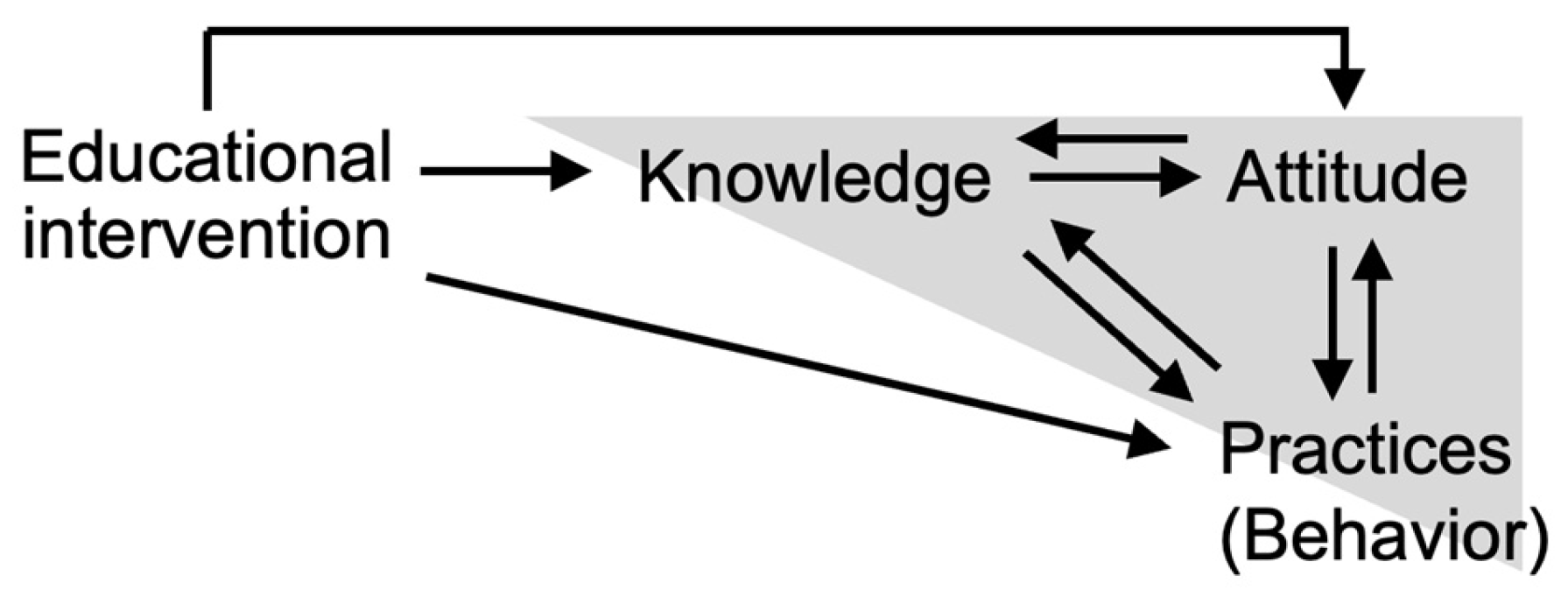
Figure 2.
Possible subcomponents of the KAP triad. * Although the general environmental attitude was also surveyed, the data are not included in this publication because the focus in this publication is a different one.
Figure 2.
Possible subcomponents of the KAP triad. * Although the general environmental attitude was also surveyed, the data are not included in this publication because the focus in this publication is a different one.
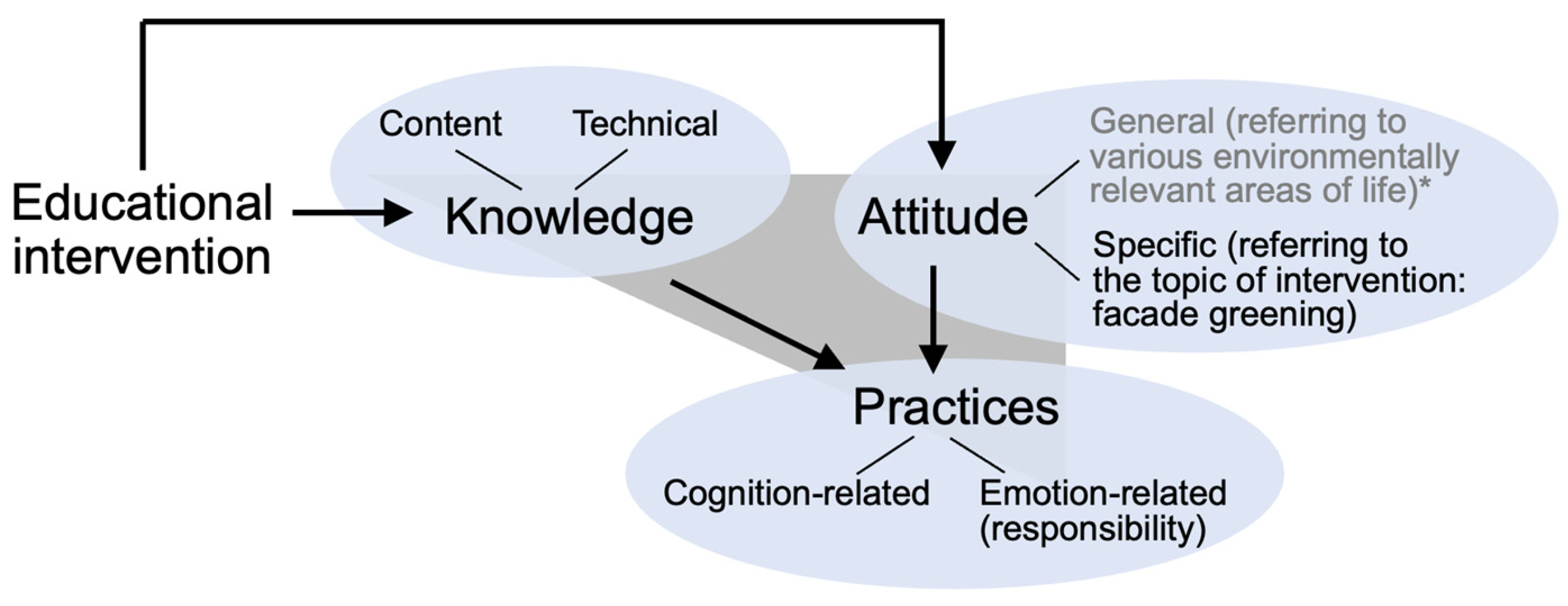
Figure 3.
Content knowledge over time (a), technical knowledge over time (b). n = 62. Box plots including mean (◆). When removing outliers (grey dots), the main result of a knowledge increase through the educational intervention did not change. n.s. = not significant, * p < .05, ** p < .01, *** p < .001.
Figure 3.
Content knowledge over time (a), technical knowledge over time (b). n = 62. Box plots including mean (◆). When removing outliers (grey dots), the main result of a knowledge increase through the educational intervention did not change. n.s. = not significant, * p < .05, ** p < .01, *** p < .001.
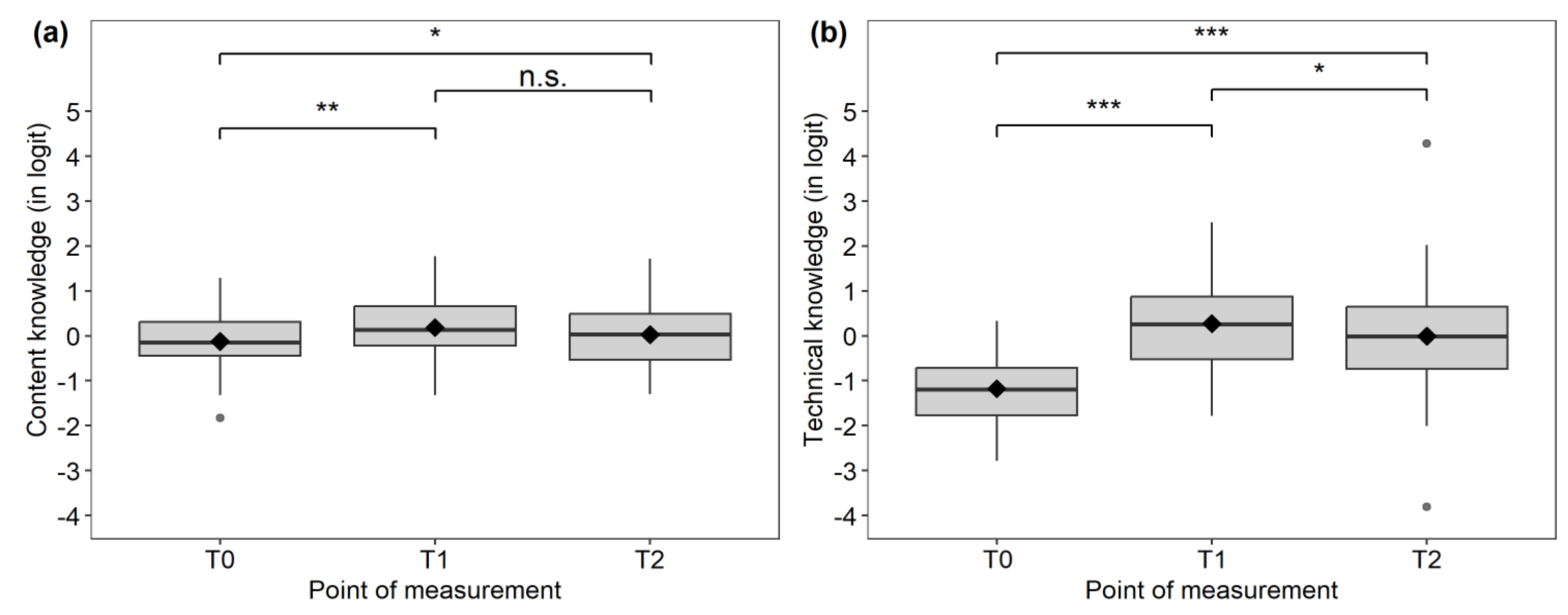
Figure 4.
Attitude towards the green facades over time. n = 71. Box plots including mean (◆). n.s. = not significant, * p < .05, ** p < .01, *** p < .001.
Figure 4.
Attitude towards the green facades over time. n = 71. Box plots including mean (◆). n.s. = not significant, * p < .05, ** p < .01, *** p < .001.
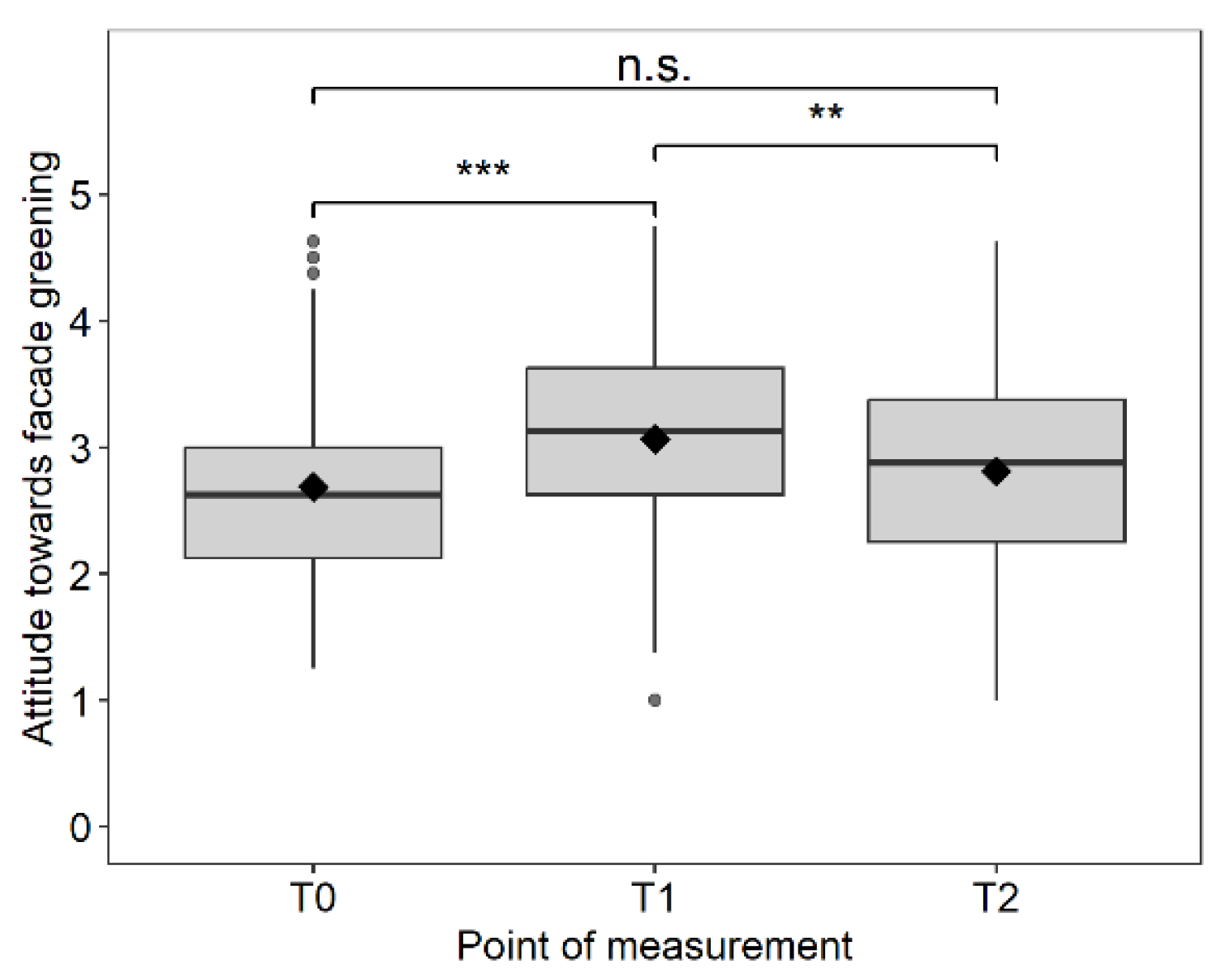

Table 1.
Differences in the level of agreement with specific attitude items (relating to green facades) across three measurement points.
Table 1.
Differences in the level of agreement with specific attitude items (relating to green facades) across three measurement points.
| # | Facade greening items | n | M (SD) | Chi2 (df = 2) |
p | W | ||
|---|---|---|---|---|---|---|---|---|
| T0 | T1 | T2 | ||||||
| 1* | The greening of house walls is so important that it should be supported by the government. (Official measures) | 71 | 3.39 (1.05) |
3.85 (1.19) |
3.56 (1.24) |
13.67 | .001 | .10 |
| 2* | If I had a house, I would green the house walls (facade). (Personal commitment) | 67 | 2.57 (1.30) |
3.18 (1.22) |
2.79 (1.28) |
15.86 | < .001 | .12 |
| 3 | Cities would be more beautiful with more green walls/facades. (Object properties) | 70 | 3.54 (1.32) |
3.80 (1.21) |
3.63 (1.31) |
6.78 | .034 | .05 |
| 4* | For new buildings, facade greening should be mandatory. (Official measures) | 71 | 2.13 (1.17) |
2.87 (1.26) |
2.48 (1.26) |
27.30 | < .001 | .19 |
| 5 | I would donate money for the construction of green facades on public buildings. (Personal commitment) | 69 | 2.30 (1.11) |
2.49 (1.13) |
2.24 (1.21) |
7.49 | .024 | .05 |
| 6 | I would take part in maintaining a green facade at my school (e.g., cutting back vegetation on the facade). (Personal commitment) | 70 | 2.89 (1.27) |
2.81 (1.23) |
2.70 (1.29) |
2.05 | .359 | .01 |
| 7 | It would bother me if I had more spiders around me because of a green facade. (Object properties, reverse item) | 70 | 2.72 (1.63) |
3.25 (1.63) |
3.19 (1.59) |
8.42 | .015 | .06 |
| 8 | I would distribute informational flyers in my free time to promote green facades. (Personal commitment) | 69 | 1.96 (1.01) |
2.20 (1.13) |
1.93 (1.20) |
10.98 | .004 | .08 |
Note. Sample sizes n differ due to missing values. W = Kendall’s W. * = Items for which the post-hoc tests (using exact values and Bonferroni correction) revealed a significant, but not lasting increase in attitude after the intervention (T0 vs.T1: sig., T0 vs.T2: n.s.).
Disclaimer/Publisher’s Note: The statements, opinions and data contained in all publications are solely those of the individual author(s) and contributor(s) and not of MDPI and/or the editor(s). MDPI and/or the editor(s) disclaim responsibility for any injury to people or property resulting from any ideas, methods, instructions or products referred to in the content. |
© 2025 by the authors. Licensee MDPI, Basel, Switzerland. This article is an open access article distributed under the terms and conditions of the Creative Commons Attribution (CC BY) license (http://creativecommons.org/licenses/by/4.0/).
Copyright: This open access article is published under a Creative Commons CC BY 4.0 license, which permit the free download, distribution, and reuse, provided that the author and preprint are cited in any reuse.


