

Submitted:
21 January 2025
Posted:
21 January 2025
Read the latest preprint version here
Abstract
Polymeric gels represent one of the most important classes of functional biomaterials for biomedical applications. A variety of methods had been devised to fabricate polymeric gels with an aim to incorporate suitable porosity, appropriate mechanical strength, and functionality for specific biological applications. It is challenging to simultaneously incorporate these three properties via many such methods like thermally induced phase separation, salt leaching, three-dimensional printing, etc., owing to reasons such as the complexity of the procedure, involvement of toxic/harsh chemicals, or formation of toxic intermediates during synthesis and high-cost of the procedure. Cryogels, obtained by cryogelation of polymeric/monomeric precursors usually in an aqueous solvent at sub-zero temperatures, offer an easy and cost-effective way of incorporating macro/micro porosity, mechanical strength, and chemical cues simultaneously into polymeric gels for biomedical applications. Therefore, this review aims to provide comprehensive and updated information on the recent trends in the phenomenon of cryogelation and factors affecting cryotropic gelation. The three major stages of cryogelation, i.e., freezing, incubation/polymerization, and thawing are described in depth along with various kinds of crosslinking mechanisms such as covalently, physically, or ionically crosslinked cryogels. Further, the parameters affecting cryogelation, i.e., ice nucleation and temperature regime, the effect of solutes, the effect of solvent, precursor composition, etc. are also discussed in detail. All this information is expected to greatly assist in understanding the mechanism and factors affecting cryogelation, which in turn can be used for future modifications to yield advanced cryogels for biomedical applications.
Keywords:
cryogels
; hydrogels
; scaffolds
; macroporous
; tissue engineering
; ice templated
1. Introduction
Porous interconnected networks build some very intricate structures serving important structural and biological functions and are abundantly found in nature [1]. Several examples of porous structures exist in nature exemplifying the important role of such porous networks in every aspect of tissue properties and biochemical exchange. Porous structures are found in the most complex mammals to simplest microorganisms like diatoms surrounded by a protective cell wall composed of porous silica-containing shell [2,3]. They can also be observed in the form of aligned pores in plants which are responsible for water supply and in more complex structures like human spongy bone wherein pores provide flexibility to otherwise high-strength yet brittle structures [1]
Generating porous scaffolds with appropriate mechanical strength is a much sought-after goal, especially for biomedical applications [1,4]. Three-dimensional macroporous materials are increasingly becoming important for in vitro culture of cells or encapsulation of cells for cell delivery and tissue engineering [5,6,7,8]. These scaffolds provide the basic matrix which helps in constructing native tissue-like environments for the cells, thus being an important step for achieving the goal of tissue regeneration and repair. The pore morphology, surface properties, and pore structure besides polymer composition, all seem to enhance and modulate cell phenotype and physiology [5,9,10]. Recently they have also been applied for vaccine and drug delivery [11,12].
Macroporous polymeric scaffolds may be synthesized or molded by various fabrication techniques. Some of the commonly used methods are solvent casting, gas foaming, particulate leaching, thermally induced phase separation, compression molding, and solid freeform fabrication [5,13,14]. Almost all of these techniques use a method to generate pores by using two immiscible phases [6,13]. Thermally-induced phase separation relies on phase separation induced by the insolubility of one liquid in the other upon increase in temperature resulting in pore formation. In the case of particulate leaching or salt leaching method, particles of salt are used as porogens to create pores of a specific size corresponding to the size of the salt particles in the otherwise continuous polymer walls. The salt is ultimately washed off to create a three-dimensional (3D) network of pores [5,6,13,15].
These methods share several common drawbacks, including the use of organic solvents during synthesis, which can impact biocompatibility, incomplete removal of salt particles serving as porogen, resulting in non-optimal scaffold structures, formation of pores with limited interconnectivity, lengthy processing, and washing steps, and the creation of matrices with non-uniform material properties. Additionally, while solid freeform fabrication shows promise for generating scaffolds tailored to specific sizes and patients, it comes with its own challenges such as high cost, complexity, and the need for specialized equipment [5,6,13,16].
In the past few years, ice templating of porous materials has received significant attention. Freeze-casting or ice-templating is used not only for soft polymers but also for hard materials like ceramics and metals [17]. The method usually involves suspending the precursors in water, and freezing the solution starting at room temperature to obtain a solid ice block. Subsequent sublimation of ice and sintering of the resulting green body gives rise to a macroporous structure. The method relies heavily upon ice nucleation and crystal growth which dictate the properties especially homogeneity and pore distribution of the resulting macroporous scaffold. In all the above-mentioned cases, the presence of a structural gradient is observed close to the cooling surface. The process is highly versatile, environmentally friendly, and biocompatible as it uses water converted to ice as the second immiscible phase or as a porogen. The pore structure of the network can be modified by tweaking the process that controls the nucleation conditions or additives that affect the morphology of growing ice crystals [17,18,19,20].
Closely related to ice templating as a method to develop macroporous scaffolds is ‘cryotropic’ gelation [21]. The super macroporous polymeric matrices synthesized through cryotropic gelation are termed “cryogels”. Cryogels can be described as ice-templated macroporous polymeric networks where a negative replica of the ice crystals formed during the gelation is obtained upon thawing [22,23]. The process of generating cryogels is inspired by the natural phenomenon of permafrost formation in frozen grounds, frost heave, or the formation of ice cream [24]. Cryotropic gelation involves the rejection of solute particles from growing ice crystals in an aqueous solution that is under a semi-frozen state [22,25]. The process of cryotropic gelation in cryogels differs from the formation of macroporous materials made via freeze-drying for two main reasons: i) cryotropic gelation in cryogels typically involves crosslinking of the precursors while in a semi-frozen state, leading to the formation of thick polymeric walls that line the pores; ii) Unlike freeze-dried macroporous substances, which tend to lose their macroporous structure upon thawing, cryogels obtained through cryogelation are stable and maintain their crosslinked macroporous structure even after thawing at room temperature [25,26]. This makes cryogelation to be a single-step process for obtaining the macroporous structure where no specialized equipment is necessarily required to ensure complete drying of the solvent as is the case for freeze drying [27,28]. Consequently, cryogels produced through cryotropic gelation offer an appealing and straightforward approach to fabricate macroporous scaffolds. Due to their simplicity of synthesis and utilization of eco-friendly chemistry, these cryogels have been increasingly embraced for diverse biomedical purposes. Therefore, this review aims to delve into the details of the method involved in the synthesis of macroporous cryogels, and various factors affecting their synthesis.
2. Phenomenon of Cryogel Synthesis
Cryotropic gelation (cryogelation/cryostructuration) (from the Greek κριoσ [kryos] meaning frost or ice) occurs as a consequence of cryogenic treatment of monomeric or polymeric precursors which can form crosslinked polymeric networks resulting in gel formation [25,29]. Cryotropic gelation involves crystallization of the solvent at sub-zero temperatures, which is in contrast to cooling-induced gelation, where the gel is formed due to a decrease in temperature and does not involve any phase transition [25].
The process of cryogel closely resembles the natural phenomena of ice templating or synthesis under sub-zero temperatures, a natural phenomenon that may have played a significant role in the origin of life. It is believed that, during the inception of life, the dilute dispersion of building blocks of life that is nucleotides/biomacromolecules were cryo-concentrated by the intricate structure of ice crystals in a saline environment. This is also applicable to salt and microorganisms, entrapped in the brine channels which characteristically have high salt concentrations. It has been demonstrated that the freezing-induced gelation or growing ice crystals allows even dilute solutions to reach a critical concentration of compounds required for polymerization. Solute rejection due to increasing ice crystals can lead to a 200-fold increase in the concentration of biomacromolecules locally in the inter-crystal/interstitial space and accelerate the polymerization without the need for an enzyme or catalyst. [30,31].
The phenomenon of cryogels synthesis can be divided into three specific steps: 1) freezing of polymeric precursors, 2) incubation under a frozen state, and 3) subsequent thawing of the frozen but crosslinked polymeric network to obtain macroporous porous gels called cryogels (Figure 1) [22]. Every step of cryogel synthesis is adaptable, providing opportunities to modify the synthesis procedure and properties of the resulting cryogel. These three steps are further discussed in detail:
2.1. Freezing of Precursor Solutions and Phase Separation with Ice Formation
Low or high molecular-weight precursors/solute particles are dissolved in a suitable solvent and frozen below the solvent crystallization point. It is essential for the formation of cryogels that the significant bulk of the solvent freezes to form ice crystals. Apparently, most of the liquid phase converts into solid crystals beyond the freezing point, though a small amount of solvent containing the dissolved solutes remains as non-frozen liquid microphases (NFLMP). Consequently, a heterogeneous two-phase system is formed by the combination of NFLMP along with the crystals of the frozen solvent. The formation of NFLMP is an essential and characteristic feature of the first step in cryogel formation [32].
The mechanism of NFLMP formation is initiated when an aqueous solution containing dissolved salts or precursor macromolecules is subjected to freezing, which is accompanied by the growth of ice crystals. In the process, the growing ice crystals reject any solute particles present in the solution. The expelled solute/salt/precursor monomers then concentrate in a much smaller aqueous volume which is still not frozen and thus in a liquid phase known as NFLMP. The phenomena of reduction of aqueous volume and concentration of solute particles into much smaller volume is called cryo-concentration [33,34]. Pioneering studies by Butler and Bruice [35] comparing the kinetics of chemical reactions in water and ice have confirmed the presence of such NFLMP in moderately frozen solutions.
Usually, the NFLMP is a few degrees colder than the freezing point of the pure solvent. As the name suggests “cryo-concentration” the solutes are present in a very high concentration due to a reduction in the volume of solvent available to keep the solutes dissolved. The volume of the NFLMP varies from 0.1 to 10% of the total sample volume [36,37]. The volume of the NFLMP is determined by a number of factors such as the cryogenic temperature regime, precursor concentration, nature of solvent, and presence of other solute particles. Modulation of NFLMP volume not only guides the reaction efficiency but also the ultimate properties of the cryogel so formed [38].
2.2. Incubation Under Frozen Condition, Cryo-Concentration and Polymerization
Cryo-concentration of the precursor molecules in the NFLMP [39] leads to precipitation and re-dissolution of solutes as they are continuously consumed in a chemical reaction [37]. Several other studies investigating the detailed kinetics of the reactions in the cryo-concentrated NFLMP region confirm their existence and occurrence of further chemical reactions in the otherwise ice block using in situ Nuclear Magnetic Resonance Spectroscopy (NMR) [33,40]. Despite the low temperatures, owing to cryo-concentration and some other factors such as the increase in the dielectric constant of the medium upon cooling, chemical reactions are accelerated in a certain range of negative temperatures in relation to the used solvent. The reaction proceeds faster with a greater yield fraction of gel than in a liquid medium with the same initial concentration and at temperature above freezing point which is typical of cryogel synthesis at sub-zero temperatures [32,34,35].
Due to cryo-concentration, a higher concentration of the precursors leads to the formation of denser polymer walls around the ice crystals. The length of the reaction, as with any other reaction, is important in determining the total gel fraction yield and ultimately the physical strength of the polymeric network. It has been found that almost 80% of the polymerization occurs in the first 2 h of incubation while an additional 6 to 10 h of incubation is required for the gel yield fraction to reach 90% although the exact values can vary depending upon the type of polymeric network [38].
2.3. Thawing and Formation of Interconnected Pore network
During the freezing period, the polymerization continues in the NFLMP, while the solvent crystals keep growing from the vessel periphery towards the center, around the non-continuous NFLMP, until they meet the facets of the other crystals leading to the formation of a continuous network of solvent crystals along the sides of the polymeric walls. The solvent polycrystals act as porogen that melts away upon thawing and leaves behind interconnected pores or cavities that were initially occupied by frozen solvent. Furthermore, due to the high concentration of the solutes in NFLMP (cryoconcentration), the cryogel has a dense polymer phase resulting in a heteroporous and heterophase system. The dimensions and shape of the pores are determined by a number of factors of which precursor concentration and temperature regime are the most important. The decrease in temperature decreases the entropy due to a lower Gibbs free energy leading to increased surface tension at the solid (ice)-liquid (polymer walls) interface. Thus, to overcome the increased surface tension the initially bent/sharp pores acquire a round and smooth shape after thawing [37]. The thawing rate is an important factor in the formation of certain types of cryogels and determines their ultimate properties [41].
3. Crosslinking Mechanisms for Cryogels
On the basis of the intermolecular bonding in the cross-linked polymers, the cryogels can be classified into three categories [29]; covalently cross-linked cryogels either chemical [42,43,44,45,46,47,48,49,50,51], Schiff base [46] or irradiation-induced [50,52,53,54], physically cross-linked cryogels with hydrogen or hydrophobic bonds linking the polymer chain [41,55,56,57,58,59,60,61,62] and lastly ionotropic cryogels whereby ionic crosslinking between polyelectrolytes [63,64,65,66], or crosslinking of polymer chains via ionic interaction with metal ion form the crosslinked network [65].
Covalently cross-linked cryogels may further be subdivided as polymerizing systems, where the synthesis is done using low molecular weight monomeric precursors (e.g. acrylamide (AAm), N, N-diethylacrylamide) [37,67,68,69,70,71,72,73,74]. The other class comprises, cross-linking of macromolecules like proteins (gelatin cryogel) [43,75], polysaccharides (chitosan, agarose, or alginate cryogels) [12,42,64,65,66], or end-functionalized polymers like polyethylene glycol (PEG) under frozen conditions [76]. The most common reaction mechanism used for the formation of covalently crosslinked cryogels is free radical polymerization. Chemical initiators mostly ammonium persulphate and N,N,N',N'-tetramethylethane-1,2-diamine (APS/TEMED) redox pair have been used very commonly to initiate free radical polymerization in cryogel systems. Polyacrylamide (PAAm) cryogels are a widely studied cryogel formed by free radical polymerization of the respective monomers and have been used for a multitude of applications [37,72,77,78]. Other examples include cryogels of poly-dimethylaminoethyl-methacrylate (pDMAEMA) [73,79,80], poly-dimethylacrylamide (pDMAAm) [81], poly-hydroxyethyl-methacrylate (pHEMA) [82,83], poly-ethyleneglycol (PEG) [84,85,86], poly-N-isopropylacrylamide (pNIPAAm) [87,88]. Other common methods that have been used more recently to induce free radical polymerization in cryogel systems include ultraviolet (UV) radiation [89], photoinitiators like hydrogen peroxide (H2O2) [90], 2,2′-azo-bis-isobutyronitrile (AIBN) or Irgacure [91], γ irradiation, and high energy electron beam [92]. Several examples exist where UV-initiated polymerization has been used to induce polymerization in semi-frozen systems to form crosslinked networks [93,94,95]. An advantage of using UV-initiated polymerization or irradiation method is that the cryogels can be templated using both porogen that is ice and light to create complex architecture [96]. Moreover, photoinitiated polymerization cryogelations can be easily combined with 3D printing inks to generate cryogels of complex architectures and unique properties [49,97,98].
To extend the use of free radical-initiated crosslinking, acrylated or methacrylated derivatives of polymers, particularly natural polymers have been synthesized. Acrylation of natural polymers like gelatin, alginate, etc. allows the formation of covalently crosslinked cryogels of polymers which otherwise cannot take part in free radical-mediated crosslinking. The use of free radical polymerization in such polymers allows for greater flexibility in the modulation of cryogel properties by tweaking the reaction parameters such as concentrations of polymer and crosslinker degree of acrylation which controls the degree of crosslinking [94,99,100,101]. This is particularly useful for natural polymers whereby the mechanical stability of the gels is increased by covalent crosslinking rather than physical crosslinking of the natural polymers [102,103]. Some of the examples where this approach is utilized include natural polysaccharides such as agarose[104] dextran[105], hyaluronic acid [102,106], alginate, and gelatin [103]. Moreover, due to the high molecular weight of the precursor polymeric chains free radical polymerization in such cases can also be initiated using irradiation by using either gamma irradiation [107] of low dose or high energy electron beam [106]. An advantage of using such irradiation for free radical initiation is that it does not require additional chemical initiators or crosslinkers traces which may sometimes be toxic in case the intended cryogel which is to be used for biomedical applications. Some additional advantages of using a high electron beam over gamma irradiation for initiating gelation of cryogels include a small reaction time of up to 10 min, inexpensive, and environmentally friendly because continuous radiation emission from the instrument is not required [53,108]. The technique has been used to produce cryogel of polymethacrylate [106,108], dextran and hyaluronic acid. The properties of the cryogel so formed are found to be dependent upon the irradiation dose and monomer concentration [53,106,108].
Recently, cryogels with covalent bonds have been developed using a multitude of click reactions to crosslink macromolecules like peptides, polysaccharides, or end-functionalized PEG polymers [109]. "Click"-reaction-based techniques for cross-linking polymers to create networks have gained popularity since the discovery of "click" chemistry, a class of chemical transformations that proceed with high efficiency under mild conditions without the formation of toxic byproducts [110]. A commonly used click reaction is Michael-type conjugate addition which has been explored to make cryogels of end-functionalized polyethylene glycol (PEG) macromers [111]. The reaction is known to proceed under mild and non-toxic conditions. Different end-functionalized PEG macromers and their combination can be used including maleimide-amine, and acrylate-thiol. Such reaction chemistry has been used to generate redox-responsive PEG cryogels made by the reaction between PEG triamine and dithiobis(maleimido)ethane [112]. The cryogels so formed are responsive to the excess concentration of reducing agents like glutathione which reduces the disulfide bond in the maleimide-containing crosslinker leading to stimuli-responsive degradation [76]. Some other covalent reactions that have been successfully used to induce cryogelation include the Schiff base reaction [113], aldol condensation [114], carbodiimide crosslinking [115], and peptide ligation [116].
Physically cross-linked cryogels have been extensively studied and applied in various areas [117]. The cryogel formation in these gels usually involves heating the polymeric solution, freezing the solution before the gel point of the polymer, and then thawing at a controlled rate. Once the gel is formed it is subjected to a repeated freeze-thaw cycle. Contrary to covalently crosslinked cryogels physically linked cryogels are reversible in nature as crosslinking between polymer chains is due to physical interaction rather than covalent. Repeated freeze-thawing and controlled rate of thawing of the system are generally seen to increase the mechanical strength [118]. The commonly studied cryogel formed by this method is polyvinyl alcohol (PVA) cryogels. As with any cryogel system freezing temperature is an important factor in deciding the final properties of the cryogel. If the solution is frozen beyond the glass transition temperature (Tg) of the system, the gel stability decreases which can be attributed to decreased mobility of the polymeric chains at temperatures below (Tg) [119]. Other classes of polymer which have been made into cryogel by inducing physical gelation under freezing conditions include polysaccharides such as agarose[120], gellan[121], carrageenan[122], and locust bean gum [123]. Physically cross-linked cryogels are thermally reversible and fuse at elevated temperatures, repeated freezing/thawing of the solution further results in a cryogel. A common problem in the method is that it requires heating of the polymeric solution and then freezes quickly before the solution cools down to form a gel [61]. This generates heterogeneous cryogels if the gel point of the polymer is above room temperature for example in agarose cryogels [124]. Chaotropic substances (urea or lithium chloride) can break hydrogen bonds, weaken cryogel, or lessen its mechanical strength. Conversely, kosmotropic substances (trehalose, sodium fluoride, or amino acids) can strengthen mechanical strength and thermal tolerance. In similar lines, using amino acids of increasing hydrophobicity facilitates enhancing rigidity and heat endurance of resultant cryogel [125]. However, most of these studies have been done using PVA cryogels as model systems. It will be exciting to see if these results can also be applied to other physically crosslinked cryogels systems.
Similar mechanisms of physical gelation have been observed in hyaluronic acid (HA) cryogels. Cryogels of HA formed by physical crosslinking of HA in moderately frozen solutions lead to the formation of a relatively stable system in spite of the known non-gelling nature of the HA polysaccharide. The physical interactions between hydroxyl, carboxyl, and amine groups with possible hydrophobic regions can lead to the stabilization of crosslinks between the HA chains under frozen conditions [126,127]. The example demonstrates that crosslinking under moderately frozen conditions may facilitate the formation of rather stable systems that are otherwise difficult to obtain at room temperature. Alternatively, physical gelation in certain polymers can also be induced due to the re-arrangement of polymer chains, such as in polypeptides like silk-based cryogels [128]. Formation of silk cryogel usually involves the addition of an initiating agent that can induce a transition from α helices to β-chains which stabilizes the silk structure and causes gelation to occur [129]. A number of stimuli can be used in such cases such as the use of chemical initiators like ethylene glycol diglycidyl ether (EGDE), organic solvents like alcohol or dimethyl sulfoxide (DMSO), or physical initiators like sonication or vortexing [129]. Like other physically crosslinked systems, crosslinking interactions between chains arise from a combination of hydrogen bonding and hydrophobic interactions.
Physical gelation of cryogel usually is a highly biocompatible process as it does not involve the use of any chemical crosslinkers or initiators or the use of irradiation sources. However, one of the disadvantages is long processing times are required and repeated freeze-thawing at controlled rates which extends the length of the process. Moreover, it can only be used in polymers that render themselves to hydrogen bonding or hydrophobic bonding [130,131].
Ionically crosslinked cryogels are difficult to obtain as ionic reactions are very rapid and result in instantaneous gelation. Thus, prohibiting freezing of the precursor solution before the completion of the gelation [32,36]. A few common examples of cryogels formed by ionic gelation include chitosan cryogels/hydrogel gelled by the inter- and intramolecular hydrogen bonds [132]. One such example was presented by Krisebom and colleagues [65]. The group has made ionically crosslinked chitosan cryogels using the ionic interaction between chitosan, acetic acid, and gold (in the form of cholorauric acid). The cryogels were stable in high molar salt solution (0.2-0.8 M) and 4 and 5.5 pH. Increasing the ionic concentration of gold and increasing the incubation time from 18h to 48 h increased 3-fold the elastic modulus of the cryogels, indicating increased stability. Furthermore, chemical crosslinking using glutaraldehyde of the ionically crosslinked chitosan cryogel resulted in the formation of Au nanoparticles distributed with the pore walls of the cryogel which might hold potential for the cryogel to be used as a catalytic flow-through reactor. The authors also demonstrated the formation of chitosan cryogel with other noble metal ions like platinum and palladium [65].
4. Factors Affecting Cryotropic Gel Formation
Several factors affect cryotropic gelation at different stages of cryogelation and thus guide the ultimate process of cryogel formation. Cryogels of significantly different characteristics such as porosity, pore size, pore wall thickness, and mechanical strength can be obtained by interplay of the parameters affecting cryogelation. Some of these parameters include ice nucleation and crystal growth, type of solvent, ratio of aqueous to organic solvent, temperature gradient and direction of cooling, thawing rate, type and concentration of the solute, ionic strength of the solvent, pH of the reaction and precursor composition [36,87,135,136]. These factors are further discussed in detail
4.1. Ice Nucleation and Crystal Growth
Various factors influencing the properties or synthesis of cryogel primarily revolve around the control of ice nucleation and crystal growth. Thus, understanding the process of ice nucleation or crystal growth is critical in order to successfully obtain the cryogels of desired properties. X-ray radiographic and tomographic experiments [137] have shown that upon freezing an aqueous suspension starting at room temperature the suspension enters a super-cooled state before the beginning of ice nucleation and crystal growth, thus, taking the system away from equilibrium. Numerous investigations in the field of cryopreservation and ice-templating technology have explored the elements that influence ice nucleation. It is established that a major factor that affects ice nucleation is solute particle size and surface area, both of which serve as nucleation sites [38]. Smaller particle sizes and larger surface areas generate more nucleation sites. Another factor that influences ice nucleation is temperature. The larger the difference between the initial and final temperatures (lower temperatures), the more significant the degree of supercooling, leading to the creation of a greater number of smaller ice nuclei. Conversely, a slower cooling process results in fewer but larger nucleation sites (Figure 2A) [18]. The extent of supercooling is also associated with the rate of solidification, with a higher degree of supercooling leading to faster propagation during the initial stages of solidification. In the case of cryogel crosslinked by covalent bonding the degree of supercooling and rate of cooling affects the final microstructure of the resulting cryogel. Hwang et al. demonstrated that PEG cryogels formed at colder temperatures using a rapid cooling rate, and accelerated rate of ice nucleation, resulting in the quicker initiation of ice crystal formation following supercooling and the formation of homogenous macroporous structure [138]. If the precursor solutions remain in a supercooled nonfrozen state for too long the resultant cryogels are heterogenous and non-porous in structure. Krisebom et al 2009 [33] compared the polymerization of dimethylacrylamide (DMAAm) cross-linked with PEG diacrylate in a semi-frozen and a supercooled system using proton nuclear magnetic resonance spectroscopy (1H NMR). The two systems exhibited significantly different concentrations of the monomer in the liquid phase when synthesized using the same initial monomer concentration. Specifically, the supercooled system had a 6% w/v monomer concentration, whereas the semi-frozen system due to the cryoconcentration effect had a concentration of 33% w/v monomer in NFLMPs. As expected, under supercooling conditions the cryogels had non-homogenous, non-porous structures and high structural gradients in the resulting material (Figure 2B), while a spongy, macroporous, elastic and opaque cryogel was formed under semi-frozen state (Figure 2C).
Similar observations about the impact of modulating ice nucleation and the degree of supercooling have also been made in physically crosslinked cryogels, especially PVA cryogels. Zhang et al generated ultrasoft PVA cryogels by modulating the ice crystal size using calcium chloride as the antifreeze agent. The addition of calcium chloride to the PVA solution suppressed ice growth and led to a depression in freezing point upon (0 to -58 °C) freezing in a concentration-dependent manner, leading the solution to be supercooled liquid phase for a longer time [139]. As a result of the coexistence of free and hydrogen-bonded hydroxyl groups, PVA polymer chains were able to assemble uniformly and obtain tunable softness of the cross-linked network. When compared to traditional PVA cryogels, these demonstrated tissue-like properties such as Young's modulus of 4–10 kPa, high stretchability (~600%), transparency (~92%), and self-healing (<0.3 s). As a result, authors found advanced uses in pressure sensors and artificial nerve fibers[139].
4.2. Effect of Solvent
Cryotropic gelation may take place either in aqueous or organic solvents by choosing a suitable temperature regime under which the solvent crystallizes and does not vitrify [140]. The choice of solvent system is restricted by the solubility of the precursor and the intended application of the cryogels. For example, cryogels intended for biomedical applications are preferably made in aqueous solution due to the toxicity issues associated with organic solvents. Some of the examples of the restriction imposed by the solubility of the precursors are a) formation of chitosan cryogel in dilute aqueous solutions of acetic acid, and b) cross-linked polystyrene cryogels formed by the catalytic activity of tin (IV) chloride in nitrobenzene as solvent. Some other commonly used solvents for cryogel synthesis included cyclohexane [141] and dimethylsulphoxide (DMSO) [142,143]. The type of solvent used for the formation of the cryogels influences the pore structure, strength, and other physical characteristics of the cryogel since the solvent plays a vital role in pore formation wherein solvent crystals act as pore-forming agents. For instance, cryogels of regular pore arrangement may be formed by use of appropriate solvent, as in the case of polyacrylamide (PAAm) cryogels containing N, N’ methylene bis acrylamide (MBAAm) as cross-linker prepared in aqueous solutions have an oval pore shape (Figure 3A–D). Those prepared in formamide solvent have a prolate pore form oriented in the direction of the temperature gradient, while PAAm cryogels prepared in 1,4 dioxane solvent have a bimodal pore (large macropores and microporous walls) distribution due to solvent-induced phase separation. Similarly, poly(N-isopropylacrylamide) (poly(NiPAAm)) cryogel prepared in DMSO as a solvent has different pore structure and swelling properties than the one prepared in the aqueous solvent [144] (Figure 3E–H). Furthermore, a mixture of solvents can also be used to obtain cryogels of hierarchal porosity [145]. This may be possible by deriving the ternary phase diagram of the system to optimize the best temperature for synthesis. Tripathi et al used water and 0.1% acetic acid containing aqueous solution for synthesis of agarose and gelatin cryogels. The cryogels synthesized in water showed a gradient of pores from top to bottom (187 to 76 μm ) while the cryogels made in 0.1% acetic acid had uniform pore size throughout the cryogel column [145]. Moreover, the use of a miscible/immiscible solvent system allows for the incorporation of mesopores along with macropores. Such biporous systems are well desired for various applications which require simultaneous mass transport and catalysis or high surface area [145]. Thus, the choice of appropriate solvent system can be used to control pore shape and size and, in some cases, the mechanical stability of cryogels based on the type of solvent. Apart from being just a porogen, the solvent can also act as an initiator for gelation for example, in silk cryogels, where ethanol or other organic solvents induce the gelation of silk [129,146]. Although solvents can lead to different microstructures and physical properties of the resulting cryogels, this is a relatively underexplored area for shaping the cryogel properties and merits further investigation.
4.3. Effect of Temperature
Temperature regime is one of the most important parameters that has been demonstrated to influence both the synthesis and properties of cryogels. Typically, the production of cryogels involves optimization of the temperature during synthesis and the thawing temperature as well as the thawing rate in specific instances [22,37,43,60,67,150]. It has been established that the temperature dependence of cryogelation has an optimum point, as observed in cryogels formed either by polymerizing systems/covalent cross-linking of polymers, or gelation by physical cross-linking of polymeric networks [151,152]. This is irrespective of the solvent system being used for the synthesis of the cryogels [39,153]. The temperature used for cryogel synthesis should be such that while it allows the solvent system to freeze and form crystals, it should not be so low that the whole process becomes sluggish.
The reaction temperature affects cryogel synthesis in many ways. Firstly, the temperature used for incubation or the rate of cooling affects both the reaction rate and the pore structure obtained by influencing the amount of NFLMP and also the size of ice crystals formed when freezing [33,154]. Reducing the freezing temperature enhances the apparent concentration of solutes in the NFLMP, consequently reducing its volume. This could potentially result in thicker pores and greater mechanical strength. However, contrary to expectations, studies indicate otherwise. Various methods, including NMR and solute diffusion studies in NFLMP, confirm that diffusion within the NFLMP is further hindered by decreasing temperatures and the apparent increase in reactant concentration cannot sufficiently offset the sluggish reaction rates at much lower temperatures. Additionally, prolonged reaction times diminish reaction efficiency, yielding smaller gel fractions and consequently weaker cryogels [33,154].
Secondly, in polymerizing systems initiated from monomeric precursors like AAm, when starting with equivalent precursor concentrations, lower negative temperatures yield smaller pore sizes and reduced porosities compared to higher temperatures. This can be comprehended logically by considering ice nucleation: as temperatures deviate further from the freezing point, a greater number of smaller ice nuclei are generated. Consequently, this results in smaller ice crystals leading to smaller pore sizes in cryogels formed at lower negative temperatures [37,154]. For example, while the total pore volume of the PAAm cryogels prepared at –12 °C and –18 °C exceeded 90%, there was considerable difference in the distributions of large and small pores between these cryogels, resulting in variations in flow resistance [155].
This can be further explained based on the degree of supercooling of the precursor solution at a given negative temperature. Overcooling (or supercooling) is defined as cooling below the initial freezing point of the water without forming ice crystals. This is a non-equilibrium, metastable state of water. As explained earlier, the degree of supercooling is affected by the temperature and rate of freezing used for making the cryogels. Thus, a high degree of supercooling at lower negative temperatures for freezing promotes faster gelation and formation of heterogeneous networks that possess characteristic features of a hydrogel and a cryogel (Figure 2). While higher negative temperatures and lower degree of supercooling contribute to faster nucleation leading to the formation of uniform macroporous networks [33]. Additionally, conditions promoting a faster nucleation rate also promote larger pore sizes while the faster rate of gelation promotes smaller pore sizes. This can be understood based on the size of the ice crystals formed as a result of faster nucleation which grows to form bigger size crystals that lead to bigger pore sizes in these ice-templated polymeric networks upon thawing [85,135]. Thus, a balance of the freezing temperature which promotes both freezing and formation of adequate ice crystals along with realistic gelation rates is required. It can be derived from these observations that increasing the freezing rate or lowering the freezing temperature leads to the formation of more nucleation sites and smaller ice crystals.
The type of polymeric or monomeric precursor used for cryogel formation also regulates how the rate of freezing will affect cryogel formation. Experiments exploring the cryopolymerization mechanism of monomeric systems, especially employing PAAm as a model for cryogels, have observed that the process of forming PAAm cryogels is influenced by the method of freezing. The cryogels prepared with and without pre-cooling in liquid nitrogen to -196 °C differ significantly in pore morphology and physical properties. Cryogels prepared using pre-cooling have collapsed and smaller pores while cryogels prepared without pre-cooling have open polyhedral pores [156]. On the contrary, in the case of physically crosslinked systems, the final incubation temperature plays a significant role in the cryo-structuration rather than the rate of freezing. Freezing-induced cryo-concentration in NFLMP promotes physical crosslinks to form between the suspended polymer chains merely due to the increased proximity of the functional groups involved in forming the hydrogen bonds. Therefore, covalently and physically crosslinked cryogel systems also have an optimum temperature, above and below which the cryogels obtained have inferior physical properties [150].
A common limitation with ice-templated materials like cryogels is that such systems are highly sensitive to tiny variations in temperature. The range of homogeneity of the temperature that can be achieved in such systems is limited. In large systems, there is always a possibility of extreme temperature gradients leading to gradients in properties even at lower cooling rates which might not be feasible for fast-gelling systems [17]. Thus, the accurately controlled temperature of synthesis and incubation is critical to generating homogenous cryogels.
4.4. Rate of Thawing
The cryostructuring of gels can occur at various stages of synthesis, and this process is also influenced by the specific type of polymeric system under investigation. Cryostructuration may take place while freezing, for instance, in the case of an aqueous solution of locust bean gum wherein the formation of thermoreversible physical cryogels depends on the freezing temperature and rate [59,157]. Alternatively, cryostructuration may happen during the incubation of samples in the frozen state, particularly in chemically cross-linked cryogels such as PAAm, poly(NiPAAm), or poly(vinylcaprolactam) (poly(VCL)) [68,87,158]. In the case of, physically cross-linked cryogels, the cryogelation also takes place while thawing, and thus the gel properties depend greatly on the rate of thawing and the temperature history (number of freeze-thaw cycles) of the sample [150,159]. The slower the thawing rate, the greater the time for reorientation of intermolecular bonds and formation of physical bonds like hydrogen bonds, leading to greater mechanical strength of the gels [59]. The reason for this is the fact that the sol-gel transition in a system needs some period of time to occur and this process proceeds rather slowly in a highly viscous NFLMP medium. This phenomenon is most prominent in cryogels where hydrogen bonding is the principal type of intermolecular association stabilizing the polymer network junction knots [59]. Cryogels synthesized using PVA [151], locust bean gum [59], starch/polysaccharides, maltodextrin [60], amylopectin [32], and agar-agar [32], are examples of such systems. It was found in subsequent studies that the efficiency of cryotropic gelation (gel yield) increases with an increase in initial precursor concentration and a decrease in defrosting rate but it is the thawing rate or defrosting rate that has the greatest influence [151,160]. Furthermore, multiple freeze-thaw cycles in PVA and other physically crosslinked cryogels increase the mechanical strength by 10 to 20 times while total porosity increases by a factor of 1.5 to 2 depending upon the initial concentration of the polymer. One to five cycles of freeze-thaw are optimum but maximum changes in gel strength and mechanical properties are observed with a freeze-thaw cycle of 2 [59,150].
Recently cryogels of linear polyethyleneimine (L-PEI) were fabricated by the process of repeated freeze-thaw leading to physical crosslinking between the polymer chains [61]. The gel's mechanical strength correlated to the freezing temperature and was highest for a freezing temperature of −196 °C. The cryogels made at this temperature also showed the highest degree of crystallinity in the gels and enthalpy of fusion. Further, these cryogels exhibited thermoreversibility. The authors hypothesize that the hydrogen bonding between primary amines and hydroxyl groups leads to the formation of the physically crosslinked cryogel.
4.5. Effects of Added Solutes
Another factor that might influence the cryo-structuration of the polymers is the presence of solute particles. The type and concentration of these low molecular weight particles modify the formation of cryogels, greatly by affecting the size of NFLMP or sometimes even disrupting the crosslinking mechanism. Moreover, physicochemical properties of solute particles such as particle size, shape, mechanical properties, and chemical structure all influence the final cryogel properties. Particles like salts, sugars, dextran beads, microorganisms (bacteria, fungi, yeast) [161,162,163,164], ionic particles (anionic or cationic)[41], surfactants which cause foaming [165] hydrophilicity or hydrophobicity of particles [166], etc., all affect the mechanical and thermal-physical properties of cryogel [167,168].
More pronounced effects of added solute have been observed in the case of physically cross-linked cryogels. Most of these studies have been done in PVA cryogel [169]. However, such studies have far-reaching consequences for cryogels such as proteins where crosslinking is also mediated by physical interaction between the amino acid chains and may be disrupted by salt type and concentration [170]. The presence of low molecular weight solutes capable of interfering with the hydrogen bonds also interferes with cryotropic gelation. In a study in PVA cryogels, chaotropic ions (LiCl, NaBr, NaSCN) which are capable of interfering with hydrogen bonding, disturb the cryotropic gel-formation process and facilitate swelling, whereas antichaotropic ions (CsCl, NaOAc, NaF) which promote the hydrogen bonding, reinforces cryogel formation, mechanical strength and shrinking of cryogels when compared to PVA cryogel prepared in pure water without salt additives. The ability to reinforce or disrupt is proportional to the order of the anion or cation in the Hoffmeister series. Both anion and cation show the phenomena with the anion showing stronger effects than the cation [41]. Moreover, a stronger salting out effect is seen with stronger antichaotropic anions like NaF and water-soluble zwitterion forming hydrophilic amino acids like glycine, lysine, and aspartic acid. All of these factors reinforce cryogel formation and strength [171].
More pronounced effects are observed for anions as compared to cations [41,55]. By the same phenomena, the addition of anion exchange resin (Amberlite) loaded with either OH- or Cl- as the exchange ion reinforces the PVA cryogel strength. The extent of the effect of resin on cryogel is determined by the ion providing the negative charge for instance OH- has a greater reinforcing strength than the Cl- [169]. The greater effect of the OH- containing Amerblite resin can be attributed to cryoconcentration of the OH- in the NFLMP phase which causes a localized rise in pH leading to the deprotonation of PVA chains forming O- charge on the chains which then strongly interacts with basic quaternary tetraalkylammonium groups (+) ions on the resin in these cryoconcentrated NFLMP. As the polymerization proceeds the interaction between the dispersed resin phase and PVA chains is strengthened due to immobilization of the PVA chains. This effect is not seen when Cl- containing Amberlite resin is added. This gave a way to control the strength of cryogel by modulating the ionic interaction of the dispersed phase[169]. Moreover, the stronger the ion lesser the decrease in mechanical strength. For instance, strong ions like OH- and H+ make PVA cryogels of higher strength compared to weak ions like Na+, and Br- [168]. Similarly, the addition of ionic and non-ionic surfactants induces foaming in PVA and PVA-like polymeric solutions and affects the mechanical stability and pore structure. In general, the addition of surfactants induces foaming and results in larger pore formation of up to 180 µm formation along with the regular pore size of 1 µm commonly found in PVA cryogels. This can be due to the ionic and surface characteristics of the surfactant. For instance, the addition of non-ionic surfactants like decaoxyethylene cetyl ether increases the mechanical strength of the PVA cryogels compared to cryogels formed with ionic surfactants like sodium dodecyl sulfate and cetyltrimethylammonium bromide [165].
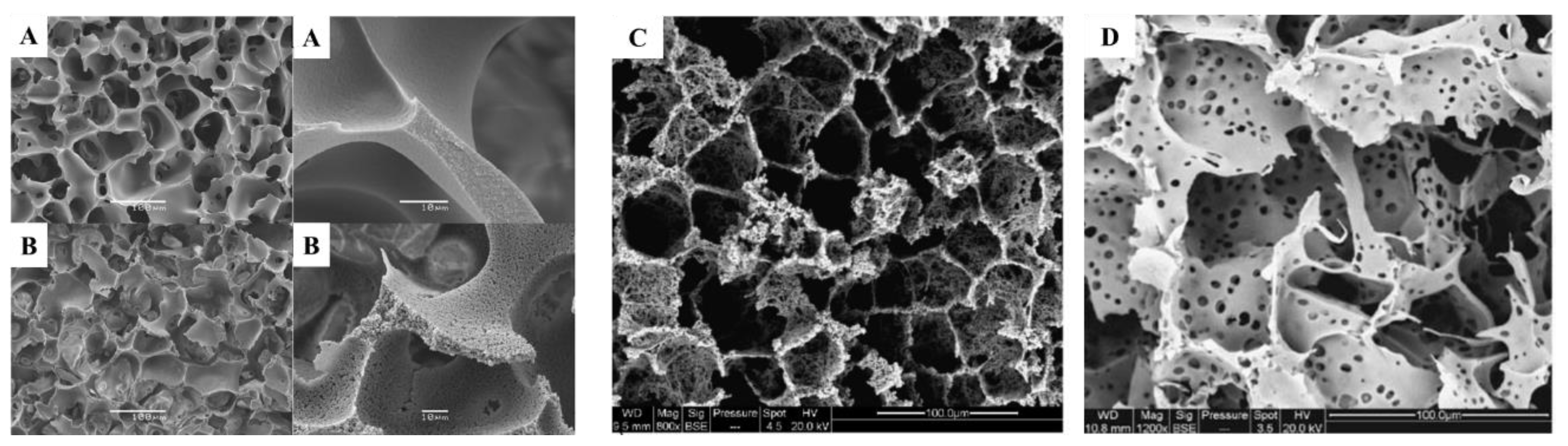
The addition of solutes not only influences the crosslinking in cryogels but also the first step of cryogel preparation which is freezing and phase separation. This is mainly a function of cryo-concentration of added solutes in the NFLMP regions leading to apparently very high concentrations of dissolved solutes in these regions. Although the dissolved solutes do not take part in the reaction or crosslinking, they interfere with the composition and properties of NFLMP considerably. An NMR study of such phenomena in polyacrylamide cryogels formed by free radical polymerization was done by Kirsebom et al [38]. The study showed that the presence of water-miscible polar (methanol) and non-polar solvent (acetone) in small amounts caused a phase separation in NFLMP as water freezes at the incubation temperature while the non-polar solvent remains unfrozen. Simultaneously the unfrozen solvent acts as a poor solvent for the formed polymer-phase separation giving rise to bimodal pore sizes of 10-80 µm due to cryogelation while 1 µm in the polymer walls forming the pore (Figure 4A-B). Moreover, the addition of solvent causes freezing point depression which increases the size of NFLMP. Similar, observations have been made by Kumar and coworkers [67,172] when cryogel of sparingly water-soluble monomeric precursors like acrylonitrile was made. The pores were formed due to both cryogelation as well as phase separation of the acrylonitrile in NFLMP (Figure 4C-D). In comparison to the organic solvents addition of salts does not cause phase separation in NFLMP but leads to higher cryo-concentration of the solutes in NFLMP leading to thicker non-porous wall formation and reduction in porosity of the cryogels as demonstrated in a polyacrylamide cryogel system using NMR [38]. Similar observations have also been made for PVA cryogels upon the addition of 2-11% methanol in NFLMP. The presence of methanol causes the polymeric walls to have the fibrous appearance and lose the polymeric network leading to a ~ 30% decrease in mechanical strength in a concentration-dependent manner [173]. Thus, the addition of solutes of different physiochemical properties gives a way of modulating the NFLMP and affects the final properties of the cryogels.
Additional inert solutes can also induce pore formation in the polymeric walls of the cryogel. The properties in such cases can be modulated by the molecular weight of the inert solute, e.g., PEG polymer of different molecular weights [108].
Figure 4.
Effect of solute on cryogel synthesis. SEM images of PAAm cryogels at low and high magnification A) 0.3M NaCl added, B) 0.6M acetone added. SEM image of C) polyacrylonitrile cryogel made at -12°C D) polyacrylonitrile-gelatin (2:1) interpenetrating network cryogel. Reproduced from [38,67,172].
Figure 4.
Effect of solute on cryogel synthesis. SEM images of PAAm cryogels at low and high magnification A) 0.3M NaCl added, B) 0.6M acetone added. SEM image of C) polyacrylonitrile cryogel made at -12°C D) polyacrylonitrile-gelatin (2:1) interpenetrating network cryogel. Reproduced from [38,67,172].
4.6. Precursor Composition
The type of gel-forming agent, its initial concentration, and the type of bonding also determine the properties of the resulting cryogels. Covalently cross-linked cryogels by polymerization of low molecular weight precursors characteristically differ from cryogels synthesized by cross-linking of high molecular weight precursors. These rather have different pore morphology and properties than cryogels formed by physical cross-linking. Covalently crosslinked cryogels obtained using natural polymers are found to have larger pore sizes than the cryogels of synthetic low molecular weight precursors, which might be due to the efficiency of polymerization under frozen conditions affecting the molecular weight of the generated polymeric chains [42,43,87,135]. As expected, the initial concentration of gel-forming precursors has been found to be inversely related to porosity (Figure 5) while it relates directly to mechanical strength [87,135]. However, the upper limit of initial precursor concentration is limited by their solubility in the solvent used for synthesis, beyond which the precursor concentrations may become too high and precipitate out immediately on freezing, leading to the formation of poor gel structure [147]. Specifically, in the case of polymeric precursors (both for covalently or physically cross-linked cryogels), very high initial concentration may lead to very high viscosities in NFLMP which might sterically and physically hinder the bond formation processes [33]. Moreover, high viscosities are found to affect the crystallization of solvent into ice crystals which act as a porogen for the formation of cryogel upon thawing [33]. This effect is evident for a higher amount of polymer, wherein the smaller amount of water is converted into ice at the same negative temperature.
In cryogels formed by cross-linking of macromolecules by physical bonds such as hydrogen bonds, van der Waals interaction, or hydrophobic interactions [60,151], the nature of the polymer and its molecular weight influences the strength of bond formation at the cross-links [151]. Depending on the type and initial concentration of the polymer and the regimes of cryogenic treatment, this gives either spongy cryostructurates with moderate strength or elastic non-spongy cryogels which are exemplified by PVA cryogels [175]. Such cryogels are formed by repeated freeze-thawing and are thermally reversible [175]. The macro- and micromorphology and physicomechanical and thermal properties of non-covalent cryogels depend appreciably on some characteristics of the polymer precursors, which do not matter in the case where cryogels are formed through covalent cross-linking of macromolecules eg., molecular weight (MW), chain tacticity, functional groups on the polymer [175]. When non-covalent cryogels such as albumin cryogels are formed through hydrophobic interactions, the accessibility of hydrophobic regions for intermolecular contacts becomes a crucial factor. This is determined by the conformation of chains, in particular by denaturation-related changes in the macromolecules of these globular proteins, which are specially induced by pretreatment (before freezing) such as the addition of chaotropic agents (which destroy the cluster structure of water), heating, or high-pressure treatment [32,176]. Thus, as in the case of `usual' psychrotropic gelation, for the formation of physical cryogels, too, the chemical structure and the degree of exposure of the chain groups involved in intermolecular interactions are important factors.
5. Conclusions and future directions
Cryogels are synthesized at subzero temperatures and have features that make them superior to regular hydrogels for tissue engineering applications. They have a three-dimensional, highly interconnected macroporous structure that allows for the interchange of nutrients and waste products, creating an ideal milieu for cell adherence. In comparison to other methods that may involve the use of inorganic/organic solvents (salt leaching, hydrogenation), probability of toxic intermediate formation during synthesis procedure (thermally induced phase separation), complex and expensive procedures (bioprinting, 3D printing); cryogelation is a relatively simpler, environment-friendly, and cost-effective procedure that can produce desired biomaterials in large scale under mild synthesis conditions.
Cryogel is advantageous for tissue engineering applications in comparison to hydrogels due to its enhanced porosity, mechanical stability, elasticity, and injectability. This review summarizes and discusses the cryogel synthesis methods, crosslinking mechanisms, and, factors affecting the cryogelation process. A thorough discussion of these features, as well as their pros and downsides, could assist researchers in comprehending the exact requirements for the development of cryogels as tissue-engineered scaffolds. In the past few years, methodologies for the synthesis of macroporous cryogels have been constantly improvised, and the notion of cryogelation has become increasingly significant for the synthesis of tissue-engineered scaffolds.
Improving the overall properties of cryogel will require a deeper comprehension of this intricate gel-forming system. Therefore, this review can provide a one-platform, comprehensive information about the cryogelation phenomenon which in turn can help the readers to inculcate a deeper understanding of this topic in order to develop advanced cryogenic biomaterials. Considering its significant advantages in the field of tissue engineering, it is possible to conclude from the recent trends that cryogels are promising scaffolding materials for biomedical applications.
Author Contributions
E.J. contributed to conceptualization, writing the draft and revising; R.M. contributed to writing and revising the draft. K.H. contributed to writing and revising the draft. All authors have read and agreed to the published version of the manuscript.
Funding
This research received no external funding.
Data Availability
Data available upon request to the corresponding authors.
Conflicts of Interest
The authors declare that they have no conflicts of interest.
References
- Wegst UG, Bai H, Saiz E, Tomsia AP, Ritchie RO. Bioinspired structural materials. Nat Mater. 2015;14:23-36.
- Petkovich ND, Stein A. Controlling macro- and mesostructures with hierarchical porosity through combined hard and soft templating. Chemical Society reviews. 2013;42:3721-39.
- Chen W, Gan L, Huang J. Design, Manufacturing and Functions of Pore-Structured Materials: From Biomimetics to Artificial. Biomimetics (Basel, Switzerland). 2023;8.
- Sai H, Tan KW, Hur K, Asenath-Smith E, Hovden R, Jiang Y, et al. Hierarchical porous polymer scaffolds from block copolymers. Science. 2013;341:530-4.
- Loh QL, Choong C. Three-Dimensional Scaffolds for Tissue Engineering Applications: Role of Porosity and Pore Size. Tissue Eng Part B-Re. 2013;19:485-502.
- Ma, PX. Scaffolds for tissue fabrication. Mater Today. 2004;7:30-40.
- Górnicki T, Lambrinow J, Golkar-Narenji A, Data K, Domagała D, Niebora J, et al. Biomimetic Scaffolds—A Novel Approach to Three Dimensional Cell Culture Techniques for Potential Implementation in Tissue Engineering. Nanomaterials. 2024;14:531.
- Çimen D, Özbek MA, Bereli N, Mattiasson B, Denizli A. Injectable Functional Polymeric Cryogels for Biological Applications. Biomedical Materials & Devices. 2024:1-11.
- Andres M, Robertson E, Hall A, McBride-Gagyi S, Sell S. Controlled pore anisotropy in chitosan-gelatin cryogels for use in bone tissue engineering. Journal of Biomaterials Applications. 2024:08853282231222324.
- Xiang Y, Yan J, Bao X, Gleadall A, Sun T. Investigation of cell infiltration and colonization in 3D porous scaffolds via integrated experimental and computational strategies. Journal of Biotechnology. 2024;382:78-87.
- Garg T, Singh O, Arora S, Murthy RSR. Scaffold: A Novel Carrier for Cell and Drug Delivery. Crit Rev Ther Drug. 2012;29:1-63.
- Shih TY, Blacklow SO, Li AW, Freedman BR, Bencherif S, Koshy ST, et al. Injectable, Tough Alginate Cryogels as Cancer Vaccines. Adv Healthc Mater. 2018;7.
- Mi HY, Jing X, Turng LS. Fabrication of porous synthetic polymer scaffolds for tissue engineering. J Cell Plast. 2015;51:165-96.
- Pelin G, Sonmez M, Pelin C-E. The Use of Additive Manufacturing Techniques in the Development of Polymeric Molds: A Review. Polymers. 2024;16:1055.
- Chen D, Yang B, Yang C, Wu J, Zhao Q. Macroporous Hydrogels Prepared By Ice Templating: Developments And Challenges. Chinese Journal of Chemistry. 2023;41:3082-96.
- Hollister, SJ. Porous scaffold design for tissue engineering. Nat Mater. 2005;4:518-24.
- Deville, S. Ice-templating, freeze casting: Beyond materials processing. J Mater Res. 2013;28:2202-19.
- Deville S, Maire E, Lasalle A, Bogner A, Gauthier C, Leloup J, et al. Influence of Particle Size on Ice Nucleation and Growth During the Ice-Templating Process. J Am Ceram Soc. 2010;93:2507-10.
- Deville S, Saiz E, Nalla RK, Tomsia AP. Freezing as a path to build complex composites. Science. 2006;311:515-8.
- Deville S, Saiz E, Tomsia AP. Freeze casting of hydroxyapatite scaffolds for bone tissue engineering. Biomaterials. 2006;27:5480-9.
- Joukhdar H, Seifert A, Jüngst T, Groll J, Lord MS, Rnjak-Kovacina J. Ice Templating Soft Matter: Fundamental Principles and Fabrication Approaches to Tailor Pore Structure and Morphology and Their Biomedical Applications. Advanced materials (Deerfield Beach, Fla). 2021;33:e2100091.
- Kumar A, Mishra R, Reinwald Y, Bhat S. Cryogels: Freezing unveiled by thawing. Mater Today. 2010;13:42-4.
- Saylan Y, Denizli A. Supermacroporous Composite Cryogels in Biomedical Applications. Gels. 2019;5.
- Shur YL, Jorgenson MT. Patterns of permafrost formation and degradation in relation to climate and ecosystems. Permafrost Periglac. 2007;18:7-19.
- Lozinsky, V.I. Polymeric cryogels as a new family of macroporous and supermacroporous materials for biotechnological purposes. Russian Chemical Bulletin. 2008;57:1015-32.
- Joukhdar H, Seifert A, Jüngst T, Groll J, Lord MS, Rnjak-Kovacina J. Ice Templating Soft Matter: Fundamental Principles and Fabrication Approaches to Tailor Pore Structure and Morphology and Their Biomedical Applications. Advanced Materials. 2021;33:2100091.
- Kirsebom H, Mattiasson B, Galaev IY. Building macroporous materials from microgels and microbes via one-step cryogelation. Langmuir : the ACS journal of surfaces and colloids. 2009;25:8462-5.
- Zhang H, Lee JY, Ahmed A, Hussain I, Cooper AI. Freeze-align and heat-fuse: microwires and networks from nanoparticle suspensions. Angewandte Chemie. 2008;47:4573-6.
- Lozinsky VI, Galaev IY, Plieva FM, Savina IN, Jungvid H, Mattiasson B. Polymeric cryogels as promising materials of biotechnological interest. Trends in Biotechnology. 2003;21:445-51.
- Attwater J, Wochner A, Pinheiro VB, Coulson A, Holliger P. Ice as a protocellular medium for RNA replication. Nat Commun. 2010;1.
- Liu RH, Orgel LE. Efficient oligomerization of negatively-charged beta-amino acids at -20 degrees C. J Am Chem Soc. 1997;119:4791-2.
- Lozinsky, V.I. Cryogels on the basis of natural and synthetic polymers: Preparation, properties and application. Uspekhi Khimii. 2002;71:559-85.
- Kirsebom H, Rata G, Topgaard D, Mattiasson B, Galaev IY. Mechanism of Cryopolymerization: Diffusion-Controlled Polymerization in a Nonfrozen Microphase. An NMR Study. Macromolecules. 2009;42:5208-14.
- Pincock, R.E. Reactions in Frozen Systems. Accounts Chem Res. 1969;2:97-&.
- Bruice TC, Butler AR. Ionic Reactions in Frozen Aqueous Systems. Federation proceedings. 1965;24:S45-9.
- Lozinsky VI, Plieva FM, Galaev IY, Mattiasson B. The potential of polymeric cryogels in bioseparation. Bioseparation. 2001;10:163-88.
- Carvalho BMA, Da Silva SL, Da Silva LHM, Minim VPR, Da Silva MCH, Carvalho LM, et al. Cryogel Poly(acrylamide): Synthesis, Structure and Applications. Sep Purif Rev. 2014;43:241-62.
- Kirsebom H, Topgaard D, Galaev IY, Mattiasson B. Modulating the porosity of cryogels by influencing the nonfrozen liquid phase through the addition of inert solutes. Langmuir. 2010;26:16129-33.
- Lozinsky VI, Vainerman ES, Titova EF, Belavtseva EM, Rogozhin SV. Study of Cryostructurization of Polymer Systems.4. Cryostructurization of the System - Solvent Vinyl Monomer Divinyl Monomer Initiator of Polymerization. Colloid and Polymer Science. 1984;262:769-74.
- Gusev DG, Lozinsky VI, Bakhmutov VI. Study of Cryostructurization of Polymer Systems.10. H-1-Nmr and H-2-Nmr Studies of the Formation of Cross-Linked Polyacrylamide Cryogels. European Polymer Journal. 1993;29:49-55.
- Lozinsky VI, Domotenko LV, Zubov AL, Simenel IA. Study of cryostructuration of polymer systems.12. Poly(vinyl alcohol) cryogels: Influence of low-molecular electrolytes. Journal of Applied Polymer Science. 1996;61:1991-8.
- Tripathi A, Kathuria N, Kumar A. Elastic and macroporous agarose-gelatin cryogels with isotropic and anisotropic porosity for tissue engineering. Journal of Biomedical Materials Research Part A. 2009;90a:680-94.
- Kathuria N, Tripathi A, Kar KK, Kumar A. Synthesis and characterization of elastic and macroporous chitosan-gelatin cryogels for tissue engineering. Acta Biomater. 2009;5:406-18.
- Dainiak MB, Galaev IY, Kumar A, Plieva FM, Mattiasson B. Chromatography of living cells using supermacroporous hydrogels, cryogels. Adv Biochem Eng Biot. 2007;106:101-27.
- Lin TW, Hsu SH. Self-Healing Hydrogels and Cryogels from Biodegradable Polyurethane Nanoparticle Crosslinked Chitosan. Adv Sci (Weinh). 2020;7:1901388.
- Lin T-W, Hsu S-h. Self-Healing Hydrogels and Cryogels from Biodegradable Polyurethane Nanoparticle Crosslinked Chitosan. Advanced Science. 2020;7:1901388.
- Yetiskin B, Okay O. High-strength silk fibroin scaffolds with anisotropic mechanical properties. Polymer. 2017;112:61-70.
- Yetiskin B, Okay O. High-strength and self-recoverable silk fibroin cryogels with anisotropic swelling and mechanical properties. International Journal of Biological Macromolecules. 2019;122:1279-89.
- Cheng Q-P, Hsu S-h. A self-healing hydrogel and injectable cryogel of gelatin methacryloyl-polyurethane double network for 3D printing. Acta Biomaterialia. 2023;164:124-38.
- Bilici C, Altunbek M, Afghah F, Tatar AG, Koc B. Embedded 3D Printing of Cryogel-Based Scaffolds. ACS Biomater Sci Eng. 2023;9:5028-38.
- Zhang X, Hang Y, Ding Z, Xiao L, Cheng W, Lu QJB. Macroporous silk nanofiber cryogels with tunable properties. J Am Chem Soc. 2022;23:2160-9.
- Petrov PD, Tsvetanov CB. Cryogels via UV Irradiation. In: Okay O, editor. Polymeric Cryogels: Macroporous Gels with Remarkable Properties. Cham: Springer International Publishing; 2014. p. 199-222.
- Reichelt S, Abe C, Hainich S, Knolle W, Decker U, Prager A, et al. Electron-beam derived polymeric cryogels. Soft Matter. 2013;9:2484-92.
- Haleem A, Chen S, Pan J, Weidong H. Gamma radiation induced synthesis of double network hydrophilic cryogels at low pH loaded with AuNPs for fast and efficient degradation of Congo red. Journal of Hazardous Materials Advances. 2023;10:100299.
- Lozinsky VI, Sakhno NG, Damshkaln LG, Bakeeva IV, Zubov VP, Kurochkin IN, et al. Study of cryostructuring of polymer systems: 31. Effect of additives of alkali metal chlorides on physicochemical properties and morphology of poly(vinyl alcohol) cryogels. Colloid J+. 2011;73:234-43.
- Rodionov IA, Grinberg NV, Burova TV, Grinberg VY, Lozinsky VI. Cryostructuring of polymer systems. Proteinaceous wide-pore cryogels generated by the action of denaturant/reductant mixtures on bovine serum albumin in moderately frozen aqueous media. Soft Matter. 2015;11:4921-31.
- Cai Z, Tang Y, Wei Y, Wang P, Zhang H. Physically Cross-Linked Hyaluronan-Based Ultrasoft Cryogel Prepared by Freeze–Thaw Technique as a Barrier for Prevention of Postoperative Adhesions. Biomacromolecules. 2021;22:4967-79.
- Cai Z, Zhang F, Wei Y, Zhang H. Freeze–Thaw-Induced Gelation of Hyaluronan: Physical Cryostructuration Correlated with Intermolecular Associations and Molecular Conformation. Macromolecules. 2017;50:6647-58.
- Lozinsky VI, Damshkaln LG, Brown R, Norton IT. Study of cryostructuring of polymer systems. XIX. On the nature of intermolecular links in the cryogels of locust bean gum. Polymer International. 2000;49:1434-43.
- Lozinsky VI, Damshkaln LG, Brown R, Norton IT. Study of cryostructuration of polymer systems. XXI. Cryotropic gel formation of the water-maltodextrin systems. Journal of Applied Polymer Science. 2002;83:1658-67.
- Soradech S, Williams AC, Khutoryanskiy VV. Physically cross-linked cryogels of linear polyethyleneimine: influence of cooling temperature and solvent composition. Macromolecules. 2022;55:9537-46.
- Takei T, Danjo S, Sakoguchi S, Tanaka S, Yoshinaga T, Nishimata H, et al. Autoclavable physically-crosslinked chitosan cryogel as a wound dressing. J Biosci Bioeng. 2018;125:490-5.
- Dragan ES, Dinu MV, Ghiorghita CA. Chitosan-Based Polyelectrolyte Complex Cryogels with Elasticity, Toughness and Delivery of Curcumin Engineered by Polyions Pair and Cryostructuration Steps. Gels2022.
- Pita-López ML, Fletes-Vargas G, Espinosa-Andrews H, Rodríguez-Rodríguez R. Physically cross-linked chitosan-based hydrogels for tissue engineering applications: A state-of-the-art review. European Polymer Journal. 2021;145:110176.
- Berillo D, Mattiasson B, Kirsebom H. Cryogelation of Chitosan Using Noble-Metal Ions: In Situ Formation of Nanoparticles. Biomacromolecules. 2014;15:2246-55.
- Takei T, Danjo S, Sakoguchi S, Tanaka S, Yoshinaga T, Nishimata H, et al. Autoclavable physically-crosslinked chitosan cryogel as a wound dressing. Journal of bioscience and bioengineering. 2018;125:490-5.
- Jain E, Kumar A. Designing supermacroporous cryogels based on polyacrylonitrile and a polyacrylamide-chitosan semi-interpenetrating network. Journal of biomaterials science Polymer edition. 2009;20:877-902.
- Srivastava A, Kumar A. Synthesis and characterization of a temperature-responsive biocompatible poly(N-vinylcaprolactam) cryogel: a step towards designing a novel cell scaffold. J Biomater Sci Polym Ed. 2009;20:1393-415.
- Jain E, Damania A, Shakya AK, Kumar A, Sarin SK, Kumar A. Fabrication of macroporous cryogels as potential hepatocyte carriers for bioartificial liver support. Colloid Surface B. 2015;136:761-71.
- Hwang Y, Sangaj N, Varghese S. Interconnected macroporous poly(ethylene glycol) cryogels as a cell scaffold for cartilage tissue engineering. Tissue Eng Part A. 2010;16:3033-41.
- Jain A, Bajpai J, Bajpai AK, Mishra A. Thermoresponsive cryogels of poly(2-hydroxyethyl methacrylate-co-N-isopropyl acrylamide) (P(HEMA-co-NIPAM)): fabrication, characterization and water sorption study. Polymer Bulletin. 2020;77:4417-43.
- Tonta MM, Sahin ZM, Cihaner A, Yilmaz F, Gurek A. Synthesis of Polyacrylamide-Based Redox Active Cryogel Using Click Chemistry and Investigation of Its Electrochemical Properties. ChemistrySelect. 2021;6:12644-51.
- Dragan ES, Dinu MV, Ghiorghita CA, Lazar MM, Doroftei F. Preparation and Characterization of Semi-IPN Cryogels Based on Polyacrylamide and Poly(N,N-dimethylaminoethyl methacrylate); Functionalization of Carrier with Monochlorotriazinyl-β-cyclodextrin and Release Kinetics of Curcumin. Molecules2021.
- Sedlačík T, Nonoyama T, Guo H, Kiyama R, Nakajima T, Takeda Y, et al. Preparation of Tough Double- and Triple-Network Supermacroporous Hydrogels through Repeated Cryogelation. Chemistry of Materials. 2020;32:8576-86.
- Jain E, Srivastava A, Kumar A. Macroporous interpenetrating cryogel network of poly(acrylonitrile) and gelatin for biomedical applications. Journal of Materials Science: Materials in Medicine. 2009;20:173-9.
- Dispinar T, Van Camp W, De Cock LJ, De Geest BG, Du Prez FE. Redox-Responsive Degradable PEG Cryogels as Potential Cell Scaffolds in Tissue Engineering. Macromolecular Bioscience. 2012;12:383-94.
- Kumar A, Srivastava A. Cell separation using cryogel-based affinity chromatography. Nature Protocols. 2010;5:1737-47.
- Davidson-Rozenfeld G, Chen X, Qin Y, Ouyang Y, Sohn YS, Li Z, et al. Stiffness-Switchable, Biocatalytic pH-Responsive DNA-Functionalized Polyacrylamide Cryogels and their Mechanical Applications. Advanced Functional Materials. 2024;34:2306586.
- Dragan ES, Cocarta AI. Smart Macroporous IPN Hydrogels Responsive to pH, Temperature, and Ionic Strength: Synthesis, Characterization, and Evaluation of Controlled Release of Drugs. Acs Appl Mater Inter. 2016;8:12018-30.
- Okten NS, Tanc B, Orakdogen N. Design and molecular dynamics of multifunctional sulfonated poly (dimethylaminoethyl methacrylate)/mica hybrid cryogels through freezing-induced gelation. Soft Matter. 2019;15:7043-62.
- Persson P, Baybak O, Plieva F, Galaev IY, Mattiasson B, Nilsson B, et al. Characterization of a continuous supermacroporous monolithic matrix for chromatographic separation of large bioparticles. Biotechnology and Bioengineering. 2004;88:224-36.
- Uygun M, Senay RH, Avcibasi N, Akgol S. Poly(HEMA-co-NBMI) Monolithic Cryogel Columns for IgG Adsorption. Appl Biochem Biotech. 2014;172:1574-84.
- Bakhshpour M, Topcu AA, Bereli N, Alkan H, Denizli A. Poly (Hydroxyethyl Methacrylate) immunoaffinity cryogel column for the purification of human immunoglobulin M. Gels. 2020;6:4.
- Hwang YS, Sangaj N, Varghese S. Interconnected Macroporous Poly(Ethylene Glycol) Cryogels as a Cell Scaffold for Cartilage Tissue Engineering. Tissue Engineering Part A. 2010;16:3033-41.
- Hwang YS, Zhang C, Varghese S. Poly(ethylene glycol) cryogels as potential cell scaffolds: effect of polymerization conditions on cryogel microstructure and properties. J Mater Chem. 2010;20:345-51.
- Ferraraccio LS, Russell J, Newland B, Bertoncello P. Poly (ethylene glycol)(PEG)-Cryogels: a novel Platform towards Enzymatic Electrochemiluminescence (ECL)-based Sensor Applications. Electrochimica Acta. 2024:144007.
- Srivastava A, Jain E, Kumar A. The physical characterization of supermacroporous poly(N-isopropylacrylamide) cryogel: Mechanical strength and swelling/de-swelling kinetics. Materials Science and Engineering A. 2007;464:93-100.
- Salar Amoli M, Anand R, EzEldeen M, Geris L, Jacobs R, Bloemen V. Development of 3D Printed pNIPAM-Chitosan Scaffolds for Dentoalveolar Tissue Engineering. Gels 2024, 10, 140. 2024.
- Haleem A, Wu F, Ullah M, Saeed T, Li H, Pan J. Chitosan functionalization with vinyl monomers via ultraviolet illumination under cryogenic conditions for efficient palladium recovery from waste electronic materials. Separation and Purification Technology. 2024;329:125213.
- Stoyneva V, Momekova D, Kostova B, Petrov P. Stimuli sensitive super-macroporous cryogels based on photo-crosslinked 2-hydroxyethylcellulose and chitosan. Carbohyd Polym. 2014;99:825-30.
- Chatterjee S, Ghosal K, Kumar M, Mahmood S, Thomas S. A detailed discussion on interpenetrating polymer network (IPN) based drug delivery system for the advancement of health care system. Journal of Drug Delivery Science and Technology. 2023;79:104095.
- Thönes S, Kutz LM, Oehmichen S, Becher J, Heymann K, Saalbach A, et al. New E-beam-initiated hyaluronan acrylate cryogels support growth and matrix deposition by dermal fibroblasts. International journal of biological macromolecules. 2017;94:611-20.
- Madaghiele M, Salvatore L, Demitri C, Sannino A. Fast synthesis of poly(ethylene glycol) diacrylate cryogels via UV irradiation. Materials Letters. 2018;218:305-8.
- Georgiev GL, Trzebicka B, Kostova B, Petrov PD. Super-macroporous dextran cryogels via UV-induced crosslinking: synthesis and characterization. Polymer International. 2017;66:1306-11.
- Barrow M, Zhang H. Aligned porous stimuli-responsive hydrogels via directional freezing and frozen UV initiated polymerization. Soft Matter. 2013;9:2723-9.
- Thomas AM, Shea LD. Cryotemplation for the rapid fabrication of porous, patternable photopolymerized hydrogels. Journal of Materials Chemistry B. 2014;2:4521-30.
- Serex L, Braschler T, Filippova A, Rochat A, Béduer A, Bertsch A, et al. Pore Size Manipulation in 3D Printed Cryogels Enables Selective Cell Seeding. Advanced Materials Technologies. 2018;3:1700340.
- Bilici Cid, Altunbek M, Afghah F, Tatar AG, Koç B. Embedded 3D printing of cryogel-based scaffolds. ACS Biomaterials Science & Engineering. 2023;9:5028-38.
- Bencherif SA, Sands RW, Bhatta D, Arany P, Verbeke CS, Edwards DA, et al. Injectable preformed scaffolds with shape-memory properties. Proc Natl Acad Sci USA 2012;109:19590-5.
- Singh D, Zo SM, Kumar A, Han SS. Engineering three-dimensional macroporous hydroxyethyl methacrylate-alginate-gelatin cryogel for growth and proliferation of lung epithelial cells. Journal of Biomaterials Science, Polymer Edition. 2013;24:1343-59.
- Berillo D, Volkova N. Preparation and physicochemical characteristics of cryogel based on gelatin and oxidised dextran. Journal of materials science. 2014;49:4855-68.
- Carballo-Pedrares N, López-Seijas J, Miranda-Balbuena D, Lamas I, Yáñez J, Rey-Rico A. Gene-activated hyaluronic acid-based cryogels for cartilage tissue engineering. Journal of Controlled Release. 2023;362:606-19.
- Bayir, E. Comparative evaluation of alginate-gelatin hydrogel, cryogel, and aerogel beads as a tissue scaffold. Sakarya University Journal of Science. 2023;27:335-48.
- Mancino R, Caccavo D, Barba AA, Lamberti G, Biasin A, Cortesi A, et al. Agarose Cryogels: Production Process Modeling and Structural Characterization. Gels. 2023;9:765.
- Şeker Ş, Aral D, Elçin AE, Murat EY. Biomimetic mineralization of platelet lysate/oxidized dextran cryogel as a macroporous 3D composite scaffold for bone repair. Biomedical Materials. 2024;19:025006.
- Reichelt S, Becher J, Weisser J, Prager A, Decker U, Moller S, et al. Biocompatible polysaccharide-based cryogels. Mat Sci Eng C-Mater. 2014;35:164-70.
- Kumakura, M. Preparation method of porous polymer materials by radiation technique and its application. Polym Advan Technol. 2001;12:415-21.
- Reichelt S, Prager A, Abe C, Knolle W. Tailoring the structural properties of macroporous electron-beam polymerized cryogels by pore forming agents and the monomer selection. Radiat Phys Chem. 2014;94:40-4.
- Tonta MM, Sahin ZM, Cihaner A, Yilmaz F, Gurek A. Synthesis of Polyacrylamide-Based Redox Active Cryogel Using Click Chemistry and Investigation of Its Electrochemical Properties. ChemistrySelect. 2021;6:12644-51.
- Kolb HC, Finn MG, Sharpless KB. Click chemistry: diverse chemical function from a few good reactions. Angewandte Chemie International Edition. 2001;40:2004-21.
- Crowell AD, FitzSimons TM, Anslyn EV, Schultz KM, Rosales AM. Shear Thickening Behavior in Injectable Tetra-PEG Hydrogels Cross-Linked via Dynamic Thia-Michael Addition Bonds. Macromolecules. 2023;56:7795-807.
- Smith, G.P. Chemical and Proteolytic Modification of Antibodies. Making and Using Antibodies. 2006:195-260.
- Lin TW, Hsu Sh. Self-Healing Hydrogels and Cryogels from Biodegradable Polyurethane Nanoparticle Crosslinked Chitosan. Advanced Science. 2020;7:1901388.
- Lin K-T, Ma R, Wang P, Xin J, Zhang J, Wolcott MP, et al. Deep eutectic solvent assisted facile synthesis of lignin-based cryogel. Macromolecules. 2018;52:227-35.
- Sezen S, Thakur VK, Ozmen MM. Highly effective covalently crosslinked composite alginate cryogels for cationic dye removal. Gels. 2021;7:178.
- Chambre L, Maouati H, Oz Y, Sanyal R, Sanyal A. Thiol-Reactive Clickable Cryogels: Importance of Macroporosity and Linkers on Biomolecular Immobilization. Bioconjugate Chemistry. 2020;31:2116-24.
- Ciolacu D, Rudaz C, Vasilescu M, Budtova T. Physically and chemically cross-linked cellulose cryogels: Structure, properties and application for controlled release. Carbohydrate polymers. 2016;151:392-400.
- Fukumori T, Nakaoki T. Significant improvement of mechanical properties for polyvinyl alcohol film prepared from freeze/thaw cycled gel. Open Journal of Organic Polymer Materials. 2013;2013.
- Mao S, Onggowarsito C, Feng A, Zhang S, Fu Q, Nghiem LD. A cryogel solar vapor generator with rapid water replenishment and high intermediate water content for seawater desalination. Journal of Materials Chemistry A. 2023;11:858-67.
- Tripathi A, Kumar A. Multi-featured macroporous agarose–alginate cryogel: Synthesis and characterization for bioengineering applications. Macromolecular bioscience. 2011;11:22-35.
- da Silva LP, Cerqueira MT, Sousa RA, Reis RL, Correlo VM, Marques AP. Engineering cell-adhesive gellan gum spongy-like hydrogels for regenerative medicine purposes. Acta biomaterialia. 2014;10:4787-97.
- Elsherbiny DA, Abdelgawad AM, El-Naggar ME, El-Sherbiny RA, El-Rafie MH, El-Sayed IE-T. Synthesis, antimicrobial activity, and sustainable release of novel α-aminophosphonate derivatives loaded carrageenan cryogel. International Journal of Biological Macromolecules. 2020;163:96-107.
- Meena LK, Raval P, Kedaria D, Vasita R. Study of locust bean gum reinforced cyst-chitosan and oxidized dextran based semi-IPN cryogel dressing for hemostatic application. Bioactive Materials. 2018;3:370-84.
- Zhang H, Zhang F, Wu J. Physically crosslinked hydrogels from polysaccharides prepared by freeze–thaw technique. Reactive and Functional Polymers. 2013;73:923-8.
- Kolosova OY, Karelina PA, Vasil'ev VG, Grinberg VY, Kurochkin II, Kurochkin IN, et al. Cryostructuring of polymeric systems. 58. Influence of the H2N-(CH2)n-COOH–type amino acid additives on formation, properties, microstructure and drug release behaviour of poly(vinyl alcohol) cryogels. Reactive and Functional Polymers. 2021;167:105010.
- Okamoto A, Miyoshi T. A BIOCOMPATIBLE GEL OF HYALURONAN. In: Kennedy JF, Phillips GO, Williams PA, editors. Hyaluronan: Woodhead Publishing; 2002. p. 285-92.
- Luan T, Wu L, Zhang H, Wang Y. A study on the nature of intermolecular links in the cryotropic weak gels of hyaluronan. Carbohyd Polym. 2012;87:2076-85.
- Rajasekaran R, Dutta A, Ray PG, Seesala VS, Ojha AK, Dogra N, et al. High fibroin-loaded silk-PCL electrospun fiber with core–shell morphology promotes epithelialization with accelerated wound healing. Journal of Materials Chemistry B. 2022;10:9622-38.
- Kadakia PU, Jain E, Hixon KR, Eberlin CT, Sell SA. Sonication induced silk fibroin cryogels for tissue engineering applications. Materials Research Express. 2016;3:055401.
- Chen H, Hao B, Ge P, Chen S. Highly stretchable, self-healing, and 3D printing prefabricatable hydrophobic association hydrogels with the assistance of electrostatic interaction. Polymer Chemistry. 2020;11:4741-8.
- Yuan T, Cui X, Liu X, Qu X, Sun J. Highly tough, stretchable, self-healing, and recyclable hydrogels reinforced by in situ-formed polyelectrolyte complex nanoparticles. Macromolecules. 2019;52:3141-9.
- Dragan ES, Dinu MV, Ghiorghita CA. Chitosan-Based Polyelectrolyte Complex Cryogels with Elasticity, Toughness and Delivery of Curcumin Engineered by Polyions Pair and Cryostructuration Steps. Gels. 2022;8.
- Jonidi Shariatzadeh F, Solouk A, Bagheri Khoulenjani S, Bonakdar S, Mirzadeh H. Injectable and reversible preformed cryogels based on chemically crosslinked gelatin methacrylate (GelMA) and physically crosslinked hyaluronic acid (HA) for soft tissue engineering. Colloids and Surfaces B: Biointerfaces. 2021;203:111725.
- Wang M, Hu J, Ou Y, He X, Wang Y, Zou C, et al. Shape-recoverable hyaluronic acid–waterborne polyurethane hybrid cryogel accelerates hemostasis and wound healing. ACS applied materials & interfaces. 2022;14:17093-108.
- Plieva F, Xiao HT, Galaev IY, Bergenstahl B, Mattiasson B. Macroporous elastic polyacrylamide gels prepared at subzero temperatures: control of porous structure. J Mater Chem. 2006;16:4065-73.
- Memic A, Colombani T, Eggermont LJ, Rezaeeyazdi M, Steingold J, Rogers ZJ, et al. Latest Advances in Cryogel Technology for Biomedical Applications. Advanced Therapeutics. 2019;2:1800114.
- Van Rie J, Declercq H, Van Hoorick J, Dierick M, Van Hoorebeke L, Cornelissen R, et al. Cryogel-PCL combination scaffolds for bone tissue repair. Journal of Materials Science: Materials in Medicine. 2015;26:1-7.
- Hwang Y, Zhang C, Varghese S. Poly(ethylene glycol) cryogels as potential cell scaffolds: effect of polymerization conditions on cryogel microstructure and properties. Journal of Materials Chemistry. 2010;20:345-51.
- Zhang X, Yan H, Xu C, Dong X, Wang Y, Fu A, et al. Skin-like cryogel electronics from suppressed-freezing tuned polymer amorphization. Nature Communications. 2023;14:5010.
- Lozinsky VI, Damshkaln LGJJoAPS. Study of cryostructuration of polymer systems. XVII. Poly (vinyl alcohol) cryogels: Dynamics of the cryotropic gel formation. 2000;77:2017-23.
- Tuncaboylu DC, Okay O. Hierarchically macroporous cryogels of polyisobutylene and silica nanoparticles. Langmuir : the ACS journal of surfaces and colloids. 2010;26:7574-81.
- Zhang XZ, Wang FJ, Chu CC. Thermoresponsive hydrogel with rapid response dynamics. J Mater Sci Mater Med. 2003;14:451-5.
- Zhang XZ, Chu CC. Thermosensitive PNIPAAm cryogel with superfast and stable oscillatory properties. Chemical communications. 2003:1446-7.
- Zhang XZ, Chu CC. Synthesis of temperature sensitive PNIPAAm cryogels in organic solvent with improved properties. J Mater Chem. 2003;13:2457-64.
- Tripathi A, Kathuria N, Kumar A. Elastic and macroporous agarose–gelatin cryogels with isotropic and anisotropic porosity for tissue engineering. Journal of Biomedical Materials Research Part A: An Official Journal of The Society for Biomaterials, The Japanese Society for Biomaterials, and The Australian Society for Biomaterials and the Korean Society for Biomaterials. 2009;90:680-94.
- Ak F, Oztoprak Z, Karakutuk I, Okay O. Macroporous Silk Fibroin Cryogels. Biomacromolecules. 2013;14:719-27.
- Plieva F, Huiting X, Galaev IY, Bergenståhl B, Mattiasson B. Macroporous elastic polyacrylamide gels prepared at subzero temperatures: control of porous structure. Journal of Materials Chemistry. 2006;16:4065-73.
- Srivastava A, Jain E, Kumar A. The physical characterization of supermacroporous poly (N-isopropylacrylamide) cryogel: mechanical strength and swelling/de-swelling kinetics. Materials Science and Engineering: A. 2007;464:93-100.
- Zhang X-Z, Chu C-C. Synthesis of temperature sensitive PNIPAAm cryogels in organic solvent with improved properties. Journal of Materials Chemistry. 2003;13:2457-64.
- Lozinsky VI, Damshkaln LG, Shaskol'skii BL, Babushkina TA, Kurochkin IN, Kurochkin II. Study of cryostructuring of polymer systems: 27. Physicochemical properties of poly(vinyl alcohol) cryogels and specific features of their macroporous morphology. Colloid J+. 2007;69:747-64.
- Lozinsky VI, Damshkaln LG. Study of cryostructuration of polymer systems. XVII. Poly(vinyl alcohol) cryogels: Dynamics of the cryotropic gel formation. Journal of Applied Polymer Science. 2000;77:2017-23.
- Lozinsky VI, Ivanov RV, Kalinina EV, Timofeeva GI, Khokhlov AR. Redox-initiated radical polymerisation of acrylamide in moderately frozen water solutions. Macromolecular Rapid Communications. 2001;22:1441-6.
- Lozinsky VI, Vainerman ES, Korotaeva GF, Rogozhin SV. Study of Cryostructurization of Polymer Systems.3. Cryostructurization in Organic Media. Colloid and Polymer Science. 1984;262:617-22.
- Gun'ko VM, Savina IN, Mikhalovsky SV. Cryogels: Morphological, structural and adsorption characterisation. Advances in colloid and interface science. 2013;187:1-46.
- Plieva FM, Andersson J, Galaev IY, Mattiasson B. Characterization of polyacrylamide based monolithic columns. J Sep Sci. 2004;27:828-36.
- Ozmen MM, Dinu MV, Dragan ES, Okay O. Preparation of Macroporous Acrylamide-Based Hydrogels: Cryogelation Under Isothermal Conditions. Journal of Macromolecular Science, Part A: Pure and Applied Chemistry. 2007;44:1195-202.
- Tanaka R, Hatakeyama T, Hatakeyama H. Formation of locust bean gum hydrogel by freezing-thawing. Polymer International. 1998;45:118-26.
- Kumar A, Rodriguez-Caballero A, Plieva FM, Galaev IY, Nandakumar KS, Kamihira M, et al. Affinity binding of cells to cryogel adsorbents with immobilized specific ligands: effect of ligand coupling and matrix architecture. Journal of Molecular Recognition. 2005;18:84-93.
- Lozinsky VI, Damshkaln LG, Bloch KO, Vardi P, Grinberg NV, Burova TV, et al. Cryostructuring of polymer systems. XXIX. Preparation and characterization of supermacroporous (spongy) agarose-based cryogels used as three-dimensional scaffolds for culturing insulin-producing cell aggregates. Journal of Applied Polymer Science. 2008;108:3046-62.
- Lozinsky VI, Zubov AL, Savina IN, Plieva FM. Study of cryostructuration of polymer systems. XIV. Poly(vinyl alcohol) cryogels: Apparent yield of the freeze-thaw-induced gelation of concentrated aqueous solutions of the polymer. Journal of Applied Polymer Science. 2000;77:1822-31.
- Lozinsky VI, Zubov AL, Kulakova VK, Titova EF, Rogozhin SV. Study of Cryostructurization of Polymer Systems.9. Poly(Vinyl Alcohol) Cryogels Filled with Particles of Cross-Linked Dextran Gel. Journal of Applied Polymer Science. 1992;44:1423-35.
- Lozinsky VI, Zubov AL, Makhlis TA. Entrapment of Zymomonas mobilis cells into PVA-cryogel carrier in the presence of polyol cryoprotectants. Immobilized Cells: Basics and Applications. 1996;11:112-7.
- Lozinsky VI, Savvichev AS, Tumansky BL, Nikitin DI. Some microorganisms during their entrapment in PAAG act as ''biological accelerators'' in how they affect the gel-formation rate. Immobilized Cells: Basics and Applications. 1996;11:118-25.
- Lozinsky VI, Zubov AL, Titova EF. Poly(vinyl alcohol) cryogels employed as matrices for cell immobilization.2. Entrapped cells resemble porous fillers in their effects on the properties of PVA-cryogel carrier. Enzyme and Microbial Technology. 1997;20:182-90.
- Lozinsky VI, Damshkaln LG, Kurochkin IN, Kurochkin II. Study of cryostructuring of polymer systems: 25. The influence of Surfactants on the properties and structure of gas-filled (Foamed) poly(vinyl alcohol) cryogels. Colloid J+. 2005;67:589-601.
- Lozinskii VI, Savina IN. Study of cryostructuring of polymer systems: 22. Composite poly(vinyl alcohol) cryogels filled with dispersed particles of various degrees of hydrophilicity/hydrophobicity. Colloid J+. 2002;64:336-43.
- Savina IN, Mattiasson B, Galaev IY. Graft polymerization of acrylic acid onto macroporous polyacrylamide gel (cryogel) initiated by potassium diperiodatocuprate. Polymer. 2005;46:9596-603.
- Savina IN, Lozinskii VI. Study of cryostructuring of polymer systems: 23. Composite poly(vinyl alcohol) cryogels filled with dispersed particles containing ionogenic groups. Colloid J+. 2004;66:343-9.
- Savina IN, Hanora A, Plieva FM, Galaev IY, Mattiasson B, Lozinsky VI. Cryostructuration of polymer systems. XXIV. Poly(vinyl alcohol) cryogels filled with particles of a strong anion exchanger: Properties of the composite materials and potential applications. Journal of Applied Polymer Science. 2005;95:529-38.
- Savina IN, Hanora A, Plieva FM, Galaev IY, Mattiasson B, Lozinsky VI. Cryostructuration of polymer systems. XXIV. Poly (vinyl alcohol) cryogels filled with particles of a strong anion exchanger: Properties of the composite materials and potential applications. Journal of applied polymer science. 2005;95:529-38.
- Kolosova OY, Ryzhova AS, Chernyshev VP, Lozinsky VI. Study of Cryostructuring of Polymer System. 65. Features of Changes in the Physicochemical Properties of Poly(vinyl alcohol) Cryogels Caused by the Action of Aqueous Solutions of Amino Acids of General Formula H2N–(CH2)n–COOH. Colloid Journal. 2023;85:930-42.
- Jain E, Srivastava A, Kumar A. Macroporous interpenetrating cryogel network of poly(acrylonitrile) and gelatin for biomedical applications. J Mater Sci Mater Med. 2009;20 Suppl 1:S173-9.
- Lozinsky VI, Bakeeva IV, Presnyak EP, Damshkaln LG, Zubov VP. Cryostructuring of polymer systems. XXVI. Heterophase organic-inorganic cryogels prepared via freezing-thawing of aqueous solutions of poly(vinyl alcohol) with added tetramethoxysilane. Journal of Applied Polymer Science. 2007;105:2689-702.
- Carvalho BMA, Da Silva SL, Da Silva LHM, Minim VPR, Da Silva MCH, Carvalho LM, et al. Cryogel poly (acrylamide): synthesis, structure and applications. Separation & Purification Reviews. 2014;43:241-62.
- Podorozhko EA, Buzin MI, Golubev EK, Shcherbina MA, Lozinsky VI. A Study of Cryostructuring of Polymer Systems. 59. Effect of Cryogenic Treatment of Preliminarily Deformed Poly (vinyl alcohol) Cryogels on Their Physicochemical Properties. Colloid Journal. 2021;83:634-41.
- Konstantinova NR, Lozinsky VI. Cryotropic gelation of ovalbumin solutions. Food Hydrocolloids. 1997;11:113-23.
Figure 1.
The process of cryogel formation. A) Schematic of the three phases of cryogel formation. B) Measurement of the three phases of cryogel formation using micro-CT. The process of cryogel formation is shown in the form of a change in three-dimensional structure (transverse cryogel sections), object volume, porosity, and average pore size. Reproduced from [22].
Figure 1.
The process of cryogel formation. A) Schematic of the three phases of cryogel formation. B) Measurement of the three phases of cryogel formation using micro-CT. The process of cryogel formation is shown in the form of a change in three-dimensional structure (transverse cryogel sections), object volume, porosity, and average pore size. Reproduced from [22].
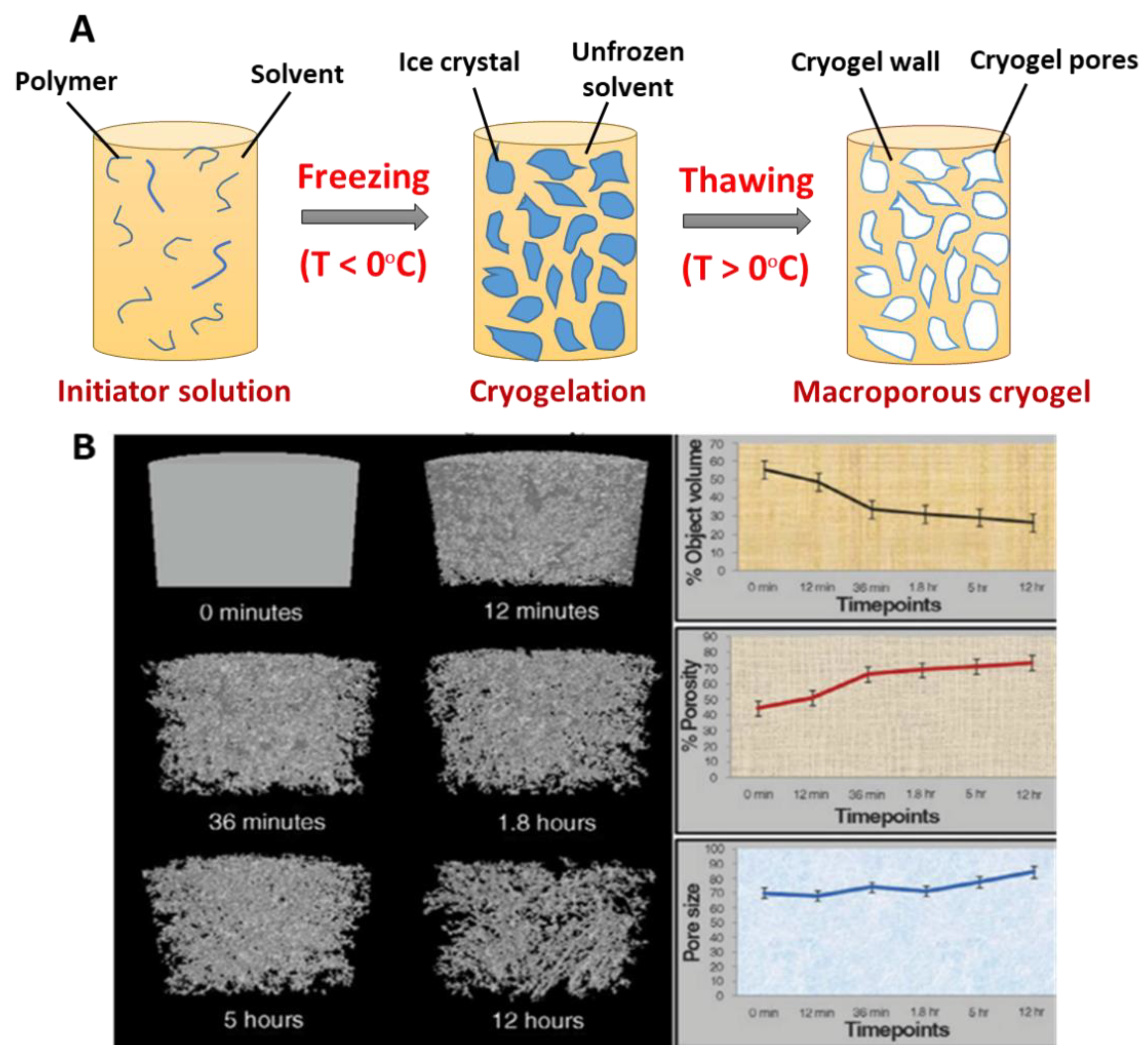
Figure 2.
Schematic description of ice nucleation starting temperatures. A) Ice nucleation at -5 °C generates a larger but smaller number of ice crystals. At lower negative temperatures due to the higher degree of supercooling a larger fraction of ice freezes forming smaller and numerous ice crystals. SEM images of cryogel (6% w/v) made under two different conditions at B) -20 °C in a supercooled system, and C) at -20 °C in a semi-frozen system (b). (Reprinted with permission from [33]).
Figure 2.
Schematic description of ice nucleation starting temperatures. A) Ice nucleation at -5 °C generates a larger but smaller number of ice crystals. At lower negative temperatures due to the higher degree of supercooling a larger fraction of ice freezes forming smaller and numerous ice crystals. SEM images of cryogel (6% w/v) made under two different conditions at B) -20 °C in a supercooled system, and C) at -20 °C in a semi-frozen system (b). (Reprinted with permission from [33]).
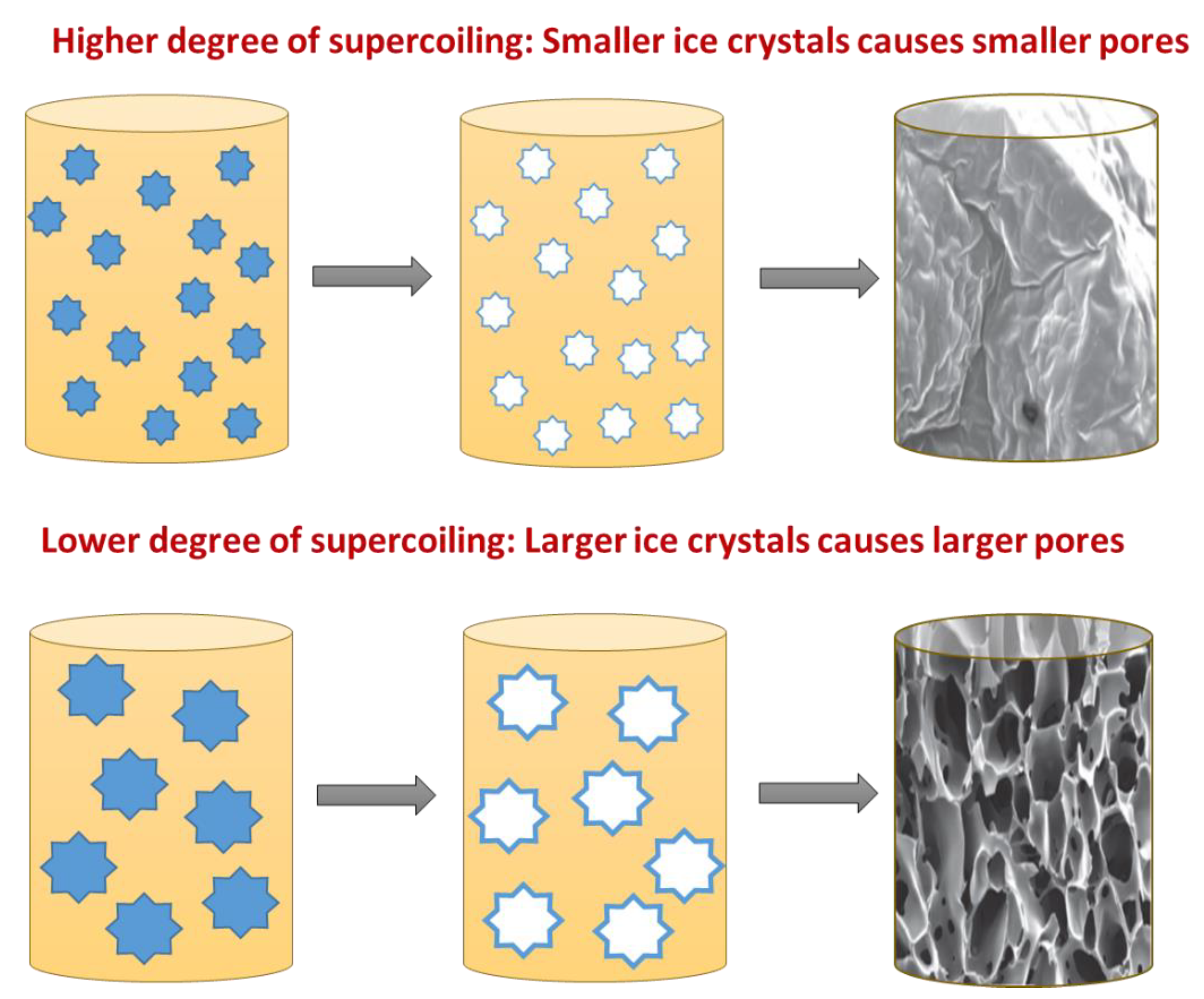
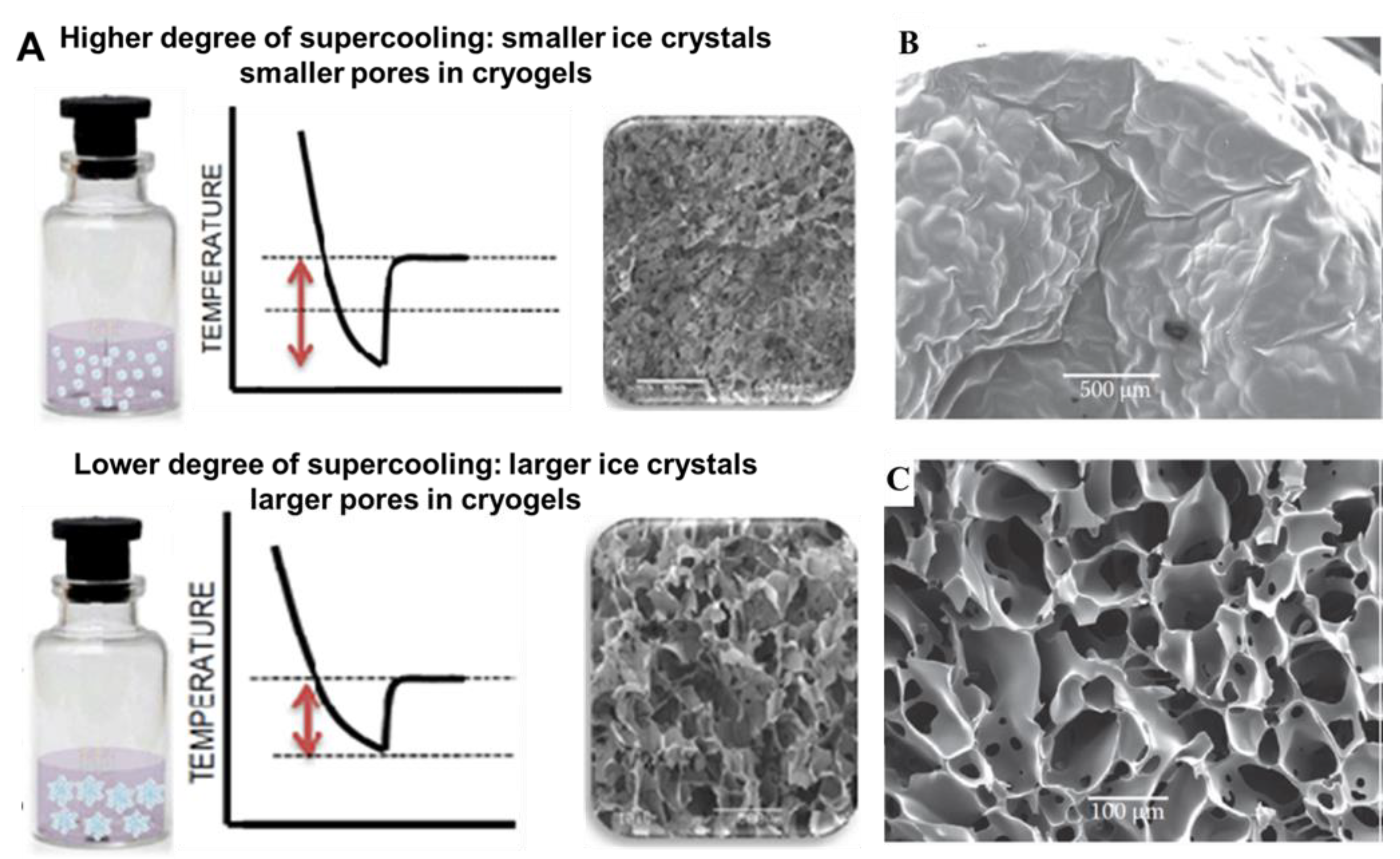
Figure 3.
Effect of solvent on cryogel pore morphology. SEM images of PAAm cryogel prepared A) at 22 °C B) at −20 °C C) in 95% formamide at -20 °C and D) in 95% dioxane at -20 °C Reproduced from [147]. PNiPAAm cryogel prepared E) in aqueous medium at -12 °C Reproduced from [148]and F-H) in DMSO at different temperatures ( -20 °C, 0.5 °C) Reproduced from [149]. .
Figure 3.
Effect of solvent on cryogel pore morphology. SEM images of PAAm cryogel prepared A) at 22 °C B) at −20 °C C) in 95% formamide at -20 °C and D) in 95% dioxane at -20 °C Reproduced from [147]. PNiPAAm cryogel prepared E) in aqueous medium at -12 °C Reproduced from [148]and F-H) in DMSO at different temperatures ( -20 °C, 0.5 °C) Reproduced from [149]. .
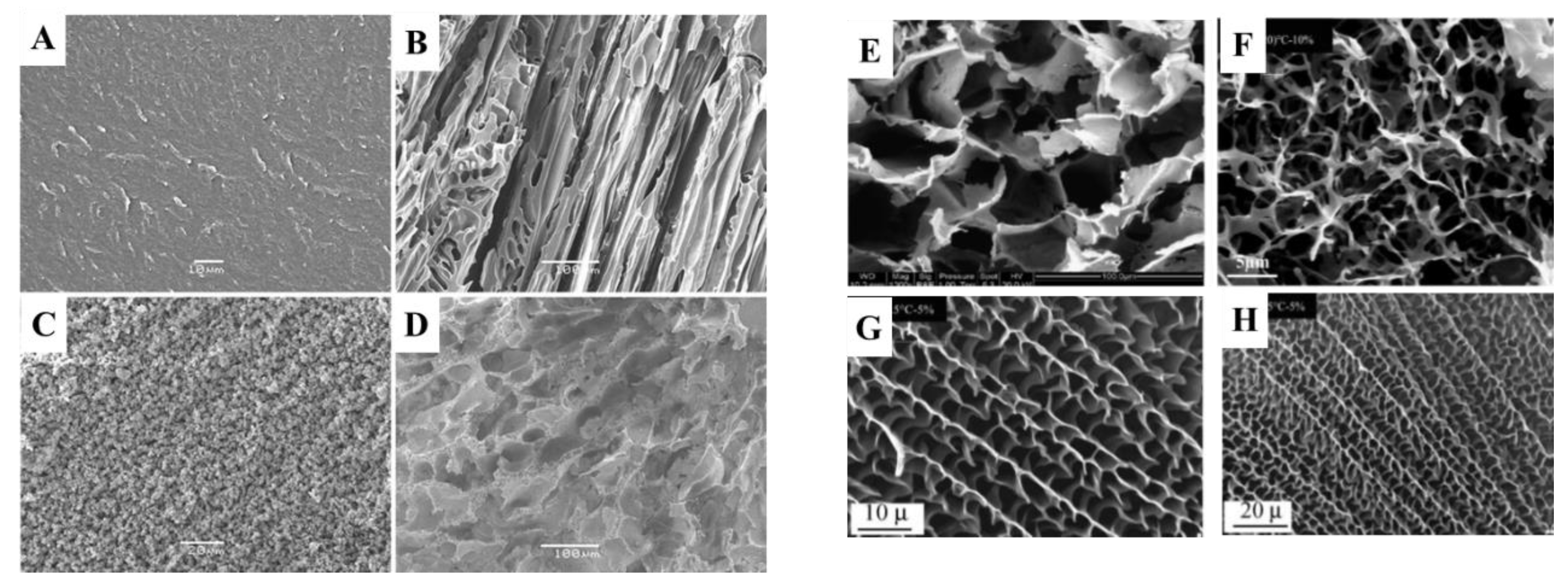
Figure 5.
Influence of precursor concertation on cryogel porosity. PAAm cryogel was made at different starting concentrations and the porosity was measured [174].
Figure 5.
Influence of precursor concertation on cryogel porosity. PAAm cryogel was made at different starting concentrations and the porosity was measured [174].
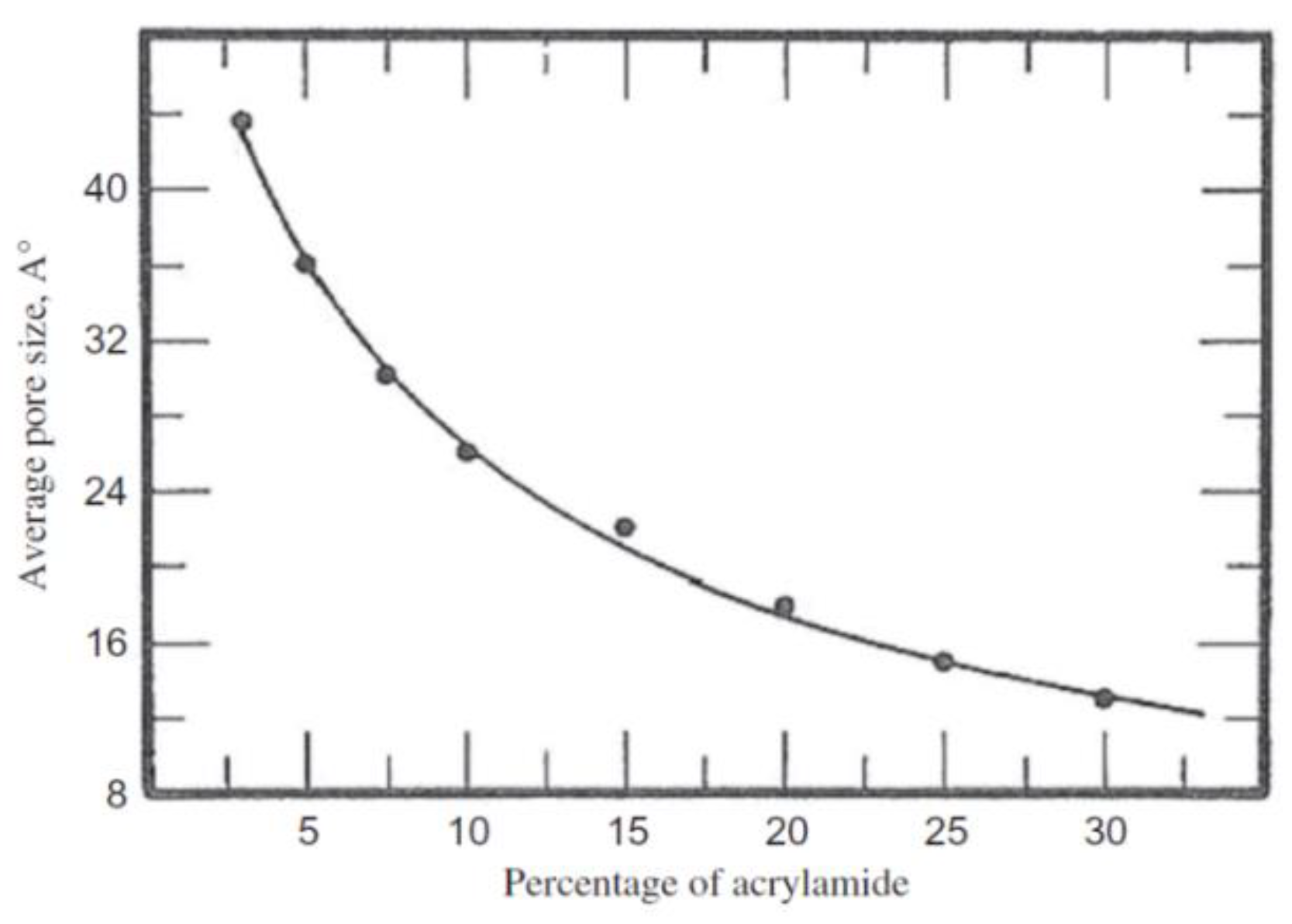
Disclaimer/Publisher’s Note: The statements, opinions and data contained in all publications are solely those of the individual author(s) and contributor(s) and not of MDPI and/or the editor(s). MDPI and/or the editor(s) disclaim responsibility for any injury to people or property resulting from any ideas, methods, instructions or products referred to in the content. |
© 2025 by the authors. Licensee MDPI, Basel, Switzerland. This article is an open access article distributed under the terms and conditions of the Creative Commons Attribution (CC BY) license (http://creativecommons.org/licenses/by/4.0/).
Copyright: This open access article is published under a Creative Commons CC BY 4.0 license, which permit the free download, distribution, and reuse, provided that the author and preprint are cited in any reuse.