

Submitted:
16 January 2025
Posted:
17 January 2025
You are already at the latest version
Abstract
The article deals with the bioproductivity of 2 poplar genotypes propagated by single-tree stem cuttings. The experiment compared variants using cuttings of different lengths (10-22 cm) and containers with volumes from 1 to 3 litres. The experiment also considered the variant grown using the Pot-in-pot technology. It was found that the best growth performance of seedlings in height according to the traditional container technology (70.6±5.5-111.5±5.0 cm) was observed in the intersectional hybrid of poplar ‘E.s.-38’ (genotype 1). Annual seedlings of black poplar (genotype 2) were inferior in this index (53.7±4.8-68.1±7.8 cm). PiP technology in case of both genotypes showed good results of height gain (genotype 1 - 165±10.3 cm, genotype 2 - 73.3±8.6 cm). The predominance of the factor ‘Genotype’ over the technology of rooting cuttings (selection of the length of the initial material and the volume of the growing container) was established. In terms of total biomass, G1 (54.4 g) on average exceeds G2 (9.9 g) (natural species) (by 5.5 times), which is determined by a reliable difference in height (by 1.74 times), in diameter by 1.7 times. For both genotypes, depending on the cultivation variant, we can distinguish productivity groups based on the total dry weight of plants: high-productive groups: for G1 - 3L18cm; 3L14cm; 2L22cm; PiP, for G2 - PiP; 3L22cm; 3L18cm, low-productive groups: for G1 - 2L10cm; 1L10cm; 1L14cm, for G2 - 3L14cm; 3L10cm; 2L14cm; 2L10cm; 1L14cm; 1L10cm. The fast-growing genotype 1 ʻE.s.-38ʼ has high productivity and plant height indices, which allows it to be recommended as a variety allowing to grow standard planting material in containers in one season. For genotype 1, the length of cuttings can be 10-14 cm when the container volume is increased to 3 litres, which will increase the number of cuttings from one mother plant by 2-3 times. For genotype 1, the use of containers with a volume of 2 or more litres will produce planting material with a height of more than 100 cm and a diameter of 8-10 mm. Planting material of hard-to-cut poplar species and varieties should be grown in containers with the volume of at least 2 litres. The optimum length of cuttings is 22 cm. Application of Pot-in-pot technology will increase the height of containerised seedlings of fast-growing poplar genotypes by 47 %, diameter by 60 %, and in case of hard-to-propagate genotypes it will increase the height by 20 %, diameter by 20.3 %, which agrees with the data of researches obtained in nurseries of different countries.
Keywords:
poplar
; genotype
; rhizogenesis
; planting material
; closed root system
; biomass
; Pot-in-pot
1. Introduction
The relevance of the research topic of studying the effect of container volume and cuttings size on growth parameters of closed root system (CRS) seedlings of two poplar genotypes is due to several important factors in the field of silviculture and ecology in the context of current environmental and economic challenges.
Forests play a critical climate-regulating function on our planet, covering 31 per cent of the land surface (4.06 billion hectares). Forests absorb up to 2 billion tonnes of carbon dioxide per year, and wood provides up to 40 per cent of renewable energy, which significantly reduces the consumption of fossil fuels. [1]. Over the past 60 years, the global forest area has decreased by 81.7 million hectares, reducing the total forest area per capita by more than 60 per cent. [2].
Between 1990 and 2020 alone, 420 million hectares of forests were lost to deforestation. The rate of deforestation is decreasing, but it was still 10 million hectares per year between 2015 and 2020. Deforestation on a planetary scale leads to natural disasters, the damage of which hits the global economy hard [3]. Damage from climate change by 2049 could be expressed in the reduction of world income by 19 %, from the base scenario in which climate change would not occur [4].
The effects of climate change, such as increased heat waves, droughts, mild winters, floods, reduced snow cover and soil freezing depth, can be a negative factor for tree growth, forest health and forest ecosystems, which requires further study [5,6,7,8]. Global climate change poses challenges for foresters, ecologists, botanists and dendrologists to preserve forested areas.
Today, there are three main approaches to reforestation activities: natural regeneration, artificial regeneration, and a combined method. The method of artificial reforestation, by planting ready-made seedlings or by sowing seeds, has gained advantage [9]. Reforestation and afforestation require a large amount of standardised planting material with good hereditary properties. Improvement of the processes of growing seedlings of tree species in containers and selection of species with improved hereditary qualities, resistance to external unfavourable environmental factors is the most important scientific and practical task at the present stage of forestry production development [10,11,12].
Firstly, in the context of global climate change, forest ecosystems play a key role in carbon balance and resilience to changing climatic conditions
Poplar, as a fast-growing and adaptive species, is of significant interest for multi-scale reforestation and reclamation projects.
Secondly, modern technologies for growing seedlings with closed root system can significantly reduce the time of forest crop formation, which is important for the forestry sector and the wood industry.
Thus, optimisation of technological parameters, such as container volume and cuttings size, can significantly increase the efficiency and economic profitability of seedling production
The third aspect of the relevance of the topic is related to the study of poplar genotypic diversity. Studies focusing on differences in genotypes open up additional opportunities for breeding programmes and the creation of new, more resistant and productive varieties.
In addition, the development of agro-technologies in recent years has led to active research on the influence of physical factors, such as container volume, on plant growth parameters. In-depth research in this area allows for improved cultivation techniques and increased survival of plants after transplanting.
Members of the genus Populus of the Willow family (Salicaceae) are among the fastest growing tree species in temperate and boreal climate zones. Poplar is widely used worldwide for plantation cultivation [13,14,15], restoration of degraded lands, forest landscapes, and mitigation of climate change. Nowadays, it is increasingly demanded in bioenergy plantation cultivation for biofuel production [16]. According to Chong et al., [17,18,19]. Poplar is of great value to plant breeders in terms of high biodiversity, its distribution range is in a wide range of environmental conditions [20]. Many poplar species are actively used in agroforestry programmes in Europe, North America [21] and the Russian Federation [22,23]. In this regard, research in the field of breeding and silvicultural production of this species is an imperative at the present stage of forest sciences development.
According to D.I. Dickmann [24], the number of poplar species ranges from 22 to 45. Poplar hybrids (Populus spp.) are the result of natural and artificial crossing of poplar species growing in different ecological conditions and play an important role in agroforestry in Europe and North America [25]. The genus is divided into five sections: Leuce (aspen), to which P. grandidentata and P. tremuloides (bigtooth aspen and quaking aspen) belong; Aigeiros (poplar), to which P. deltoides, P. sargentii, P. fremontii, and P. wislizeni (eastern, plain, Fremont, and Rio Grande poplar) belong. The range of P. deltoides in America is more southerly, from the Gulf of Mexico to south-western Canada; Tacamahaca (balsam poplar), to which P. balsamifera, P. angustifolia, R trichocarpa and (balsam poplar, narrow-leaved, black poplar) belong, is adapted to northern climates - growing from south-eastern Canada to Alaska.
P. heterophylla P. balsamifera subsp. Trichocarpa belong to Leucoides (swamp poplar) [26]. The distribution range of P. trichocarpa in the north and south is extremely extensive - this species grows in America from California to Alaska. Poplar grows naturally not only in Europe and North America, but also in China, India, Argentina, Chile and Kenya [27], making Populus spp. an important tree species worldwide. To establish short rotation plantations or plantation forests, poplars are propagated vegetatively under different environmental conditions, e.g., under controlled conditions in greenhouses or under uncontrolled conditions outdoors in nurseries or directly in plantation plots.
In such traditionally forested countries as Canada, Sweden, Finland, Norway, more than 90 % of forest crops are planted with seedlings with closed terminal system (CLS) [28]. Modern high-tech methods of production of seedlings and seedlings in containers allow to increase plant establishment and accelerate the processes of their utilisation [29]. The most widespread method of production of plants with CLS is the cultivation of containerised annual seedlings of coniferous species (spruce, pine), in cassettes, in specially equipped greenhouses, with the necessary microclimate, fertilizers and irrigation [30].
Important parameters in the selection of cassettes and containers for growing planting material are their volume, product material, and shape, which affects the architecture of the root system that develops in it. When selecting the type of container and its main parameters: height and width, as well as upper and lower diameters, it is necessary to take into account the type of root system of the tree species [31]. Plants with a strong, tap root develop well in tall pots, cultures with a lobe root system grow normally in shallow and wide pots. It is noted that in pots shaped like a truncated cone with a wide top the roots acquire a spiral twist, the degree of which directly depends on the duration of cultivation of the seedling in a container without transplanting. The volume of the container should be selected depending on the growth intensity of the tree species. When plants with a moderate growth rate are planted in containers with a large volume, the producing area in the nursery is lost and the plant intensively builds up root mass to the detriment of crown development [32].
When growing planting material in containers, substrate and air temperature play a crucial role [33]. Substrate temperature in containers exposed on the soil surface can reach more than 50°C [34]. The problem of suppression of root system growth and development caused by sharp fluctuations in substrate temperature and humidity in the container has necessitated the development of a new technology for the production of pot-in-pot planting material, also known as the ‘Minnesota system’) [35,36].
The basic principle of the technology is to grow a plant in two containers: a production pot with a plant (‘production pot’) placed in a container of the same or larger volume (‘socket pot’) dug into the soil on a specially prepared polygon [37]. Some researchers [38,39,40,41,42] have noted a significant difference in the growth and productivity of plants grown using the Pot-in-pot technology compared to the standard container technology. The effectiveness of Pot-in-pot technology application in the Russian Federation on a wide range of tree and shrub species is still insufficiently studied, which requires research in different climatic zones.
The purpose of this study is to comprehensively analyse the effect of container volume and cuttings size on growth parameters of poplar seedlings with closed root system grown on the basis of two different genotypes. The study involves a thorough evaluation of the interaction of these factors and their impact on key growth parameters such as vegetative development rate, root system formation and structure, and overall seedling survival rate. The results obtained will be of practical importance to foresters and nursery professionals, providing empirical evidence to optimise growing processes and improve the efficiency of production of quality planting material.
Thus, an in-depth study of this topic not only contributes to scientific progress in botany and forestry, but also has practical applications that can have a positive impact on environmental programmes and the economics of the forestry sector.
2. Materials and Methods
2.1. Objects of Research and Methodology of Experimentation
The objects of the study are poplar genotypes differing in growth activity and root formation intensity in stem cuttings:
Genotype 1, designated as ʻE.s.-38ʼ (Elite Seedling-38), is an intersectional poplar hybrid created by crossing the species Populus deltoides Marsh, Populus balsamifera L. and the complex Populus alba L. + Populus tremula L. This hybrid was bred by Professor M. M. Veresin (Professor Breeder at Voronezh Forestry University) and demonstrates a high capacity for vegetative propagation by means of winter cuttings. It is characterised by intensive growth rates and increased winter hardiness, which is especially evident in the conditions of the forest-steppe zone, where its winter hardiness is superior to that of a number of Euro-American poplars.
Genotype 2 represents black poplar (Populus nigra L.), which is a native species for the forest-steppe zone of European Russia. This species is characterised by the formation of a spreading crown and predominantly grows on well-moistened floodplains. At maturity, plants of this species develop a powerful root system, including both superficial and deeply penetrating anchor roots [43].
Propagation of the genotypes under consideration was carried out by planting stem cuttings. The cuttings were prepared from annual shoots in early spring on the floodplain areas of the Khopyorsky Reserve in the Voronezh Region. To prevent their desiccation, the cut whips were stored in a snowdrift in uncut form. As part of the experiment, poplar cuttings with different lengths were prepared: 10 cm, 14 cm, 18 cm and 22 cm. Each cuttings contained at least four buds and the average diameter at the top cut level was 1 cm. Plastic containers with different volumes were used for the experiment: 1 litre (container height - 10 cm, diameter - 13 cm), 2 litres (height - 19 cm, diameter - 12 cm) and 3 litres (height - 23 cm, diameter - 13.5 cm).
The substrate used was a mixture of neutralised peat (Russia) and perlite in the ratio of 3:1. There were 40 plants in each experimental group in 3 repetitions. Mineral fertilisers were applied to the substrate of all variants of the experiment: Fertika (Universal-2) Spring-Summer (NPK12:8:14) Application doses per g/1 l of substrate - 4-5 g, Osmocote Pro 3-4 mo. (NPK:17-11-10+2MgO+TE) 3-4 gr, Fertika Autumn Fertiliser NPK 4,8:20,8:31,3+MICRO, Phosphorus-potassium fertiliser ‘Autumn’ P2O5-5%, K2O-18%, CaO-8%), MgO-2,5%, S-12%, Micronutrients: B - 0.15% to form optimal conditions for rooting.
Seedling height was measured using a measuring tape and stem diameter was determined with a caliper at the base of the growth. In addition, the number of leaves per plant was counted and their area was estimated using a portable laser leaf area meter CI-202 (CID Bio-Science, USA).
At the end of the experiment, the wet and dry weights of leaves, shoots and roots were measured by weighing on an electronic laboratory scale Ohaus (USA), with an accuracy of 0.01 g. To determine the dry weight of plant organs, they were dried in an RS422 Binder desiccator (Germany) to absolute dryness at 102 °C.
The biological productivity of plants was determined by the total dry mass of leaves, stems and roots, and using the productivity coefficient of the plant assimilation apparatus 44.
In order to evaluate the efficiency of containerised seedling growing technology using the Container-in-Container method in comparison with traditional planting material growing in an open area, two experimental plots were laid in May 2023. (Figure 1).
The site was prepared as follows: turf was removed, digging was carried out, leveling was done with a 2-5° slope, and then a 10-15 cm layer of coarse river sand was applied. The surface was covered with black spunbond of 60 g/m² density with UV stabilisation of 4%, which serves to mulch the soil and prevent weed germination. The spunbond was secured with metal staples of 40-50 cm length. Irrigation was carried out by sprinkler irrigation using an oscillating sprinkler and the irrigation regime was controlled by a programmable electronic timer.
2.2. Statistical Analysis
Specialised software Statistica version 10.0 was used for statistical processing of the obtained data. In order to establish the influence of various factors, such as ‘genotype’, ‘container volume’ and ‘cuttings length’, on the main biometric parameters of plants, several types of statistical analyses were carried out. In particular, one-factor analysis of variance (ANOVA) was used to assess the significance of the influence of each of the considered factors separately on the studied parameters.
In addition, correlation and regression analysis was used to establish relationships and patterns between the variables under study, which made it possible to identify both linear and non-linear dependencies. For a more comprehensive understanding of the structural organisation of the data and their grouping, cluster analysis based on the calculation of Euclidean distance was used. This method made it possible to form clusters of objects with similar characteristics and thus to identify characteristic groups based on the similarity of their biometric indicators.
These types of analyses provided a comprehensive interpretation of the results obtained and made it possible to draw reasonable conclusions regarding the impact of the studied factors on the growth parameters of seedlings.
3. Results
3.1. Effect of Cuttings Size and Container Volume, Genotype on the Height of Annual Seedlings Obtained by Cuttings
The results of the study showed that genotype 1 was significantly superior to genotype 2 in terms of ‘Height of annual seedling’ in all variants of the experiment, which is confirmed by statistically significant differences (p < 0.01) presented in Figure 2. This indicates a higher potential of genotype 1 with respect to growth during the first year of its development.
Additionally, when the biometric parameters of plants of each genotype were evaluated during the intensive growth phase, which was conducted on 25 August, a marked influence of factors such as container size and cuttings length on the final seedling height was revealed. As shown in Figure 2, changes in these conditions correlated directly with changes in plant growth parameters. This emphasises the importance of selecting the optimum parameters when growing seedlings in order to maximise plant growth and development, especially during critical phases of their life cycle when they enter the intensive growth stage. Thus, these results provide valuable data for further improvement of cultivation techniques under controlled environment conditions.
Genotype 1 is characterised by the highest height growth. Among the tested variants of container volume and cuttings length, two main groups are distinguished by the intensity of growth processes in height. The group with maximum indices (111.9±5.0- 96.9±5.9cm) includes: experiment variants 3L22cm; 3L18cm; 3L14cm; 3L10cm; 2L22cm; 2L18cm. 2L14cm; 2L10cm; The second group includes variants with lower results of seedling height (89.4±4.5- 70.6±5.5 cm): 1L14cm; 1L10cm. Differences between groups are reliable at the level of p < 0.05.
The variant using Pot-in-Pot (PiP) technology showed a 44.6 % increase in seedling height compared to the rest of the experimental groups, reaching 165±10.3 cm. These differences are statistically significant (p < 0.01).
Analysing the influence of the factor ‘Cuttings length’ on the height of annual seedlings of genotype 1 ʻE.s.-38ʼ, it was found that the greatest contribution of this factor is observed in the conditions of using two-litre containers, where its influence is 59 % (η²=0.59) of the total set of influencing factors. Consequently, this parameter should be taken into account when harvesting cuttings, optimally choosing a length of 18-22 cm. The lowest influence of this factor, equal to 26 % (η²=0.26), was recorded for seedlings grown in three-litre containers. Such a decrease may be due to the fact that the effect of the factor ‘Cuttings length’ in this case is compensated by the large volumes of root-covering coma and root system. Variants with one-litre pots occupy an intermediate position with an influence of 38 % (η²=0.38).
When comparing the data for the Pot-in-Pot variant with a cutting’s length of 22 cm and the use of a 2-litre pot-insert with a similar above-ground container, it was found that the placement of the container significantly affects the height gain, accounting for up to 87 % (η²=0.87) of all factors affecting plant growth.
During the experiment with genotype 2, which is characterised by average growth and biological traits, differences in seedling height were also recorded in the different variants analysed, as illustrated in Figure 2. Although the differences in seedling height between the different experimental staging conditions were statistically significant, the severity of these differences was less marked compared to genotype 1.
This may indicate genotype 2’s greater tolerance to changing environmental conditions or its lower sensitivity to the factors considered, such as container volume and cuttings length. The lower degree of expression of growth differences in genotype 2 compared to genotype 1 may be related to its genetic characteristics affecting the morphological and physiological processes that determine plant growth.
Such observations are important for the development of breeding strategies, as they highlight the need for an individual approach to the selection of agronomic conditions for different genotypes in order to maximise their growth potential and adaptive capacity under specific growing conditions.
For genotype 2, the highest seedling height values were observed in the variants using three-litre containers at cuttings lengths of 18 cm and 22 cm, where the average height was 68.1±7.8 cm and 67.1±6.3 cm, respectively. These results emphasise the importance of the optimal combination of container and cuttings size to achieve maximum plant growth.
The second group in terms of seedling height, with values of 61.1±5.7 cm to 56.2±3.2 cm, is formed by most of the variants studied, including 3L14cm; 3L10cm; 2L22cm; 2L18cm; 2L14cm; 2L10cm, and 1Lh10cm. These results indicate that differences in container volume and cuttings length have a marked effect on growth, but the effect of these factors is less pronounced compared to the first group.
The lowest height increment was recorded in the variant with a root closure volume of 1 litre and a cuttings length of 14 cm, where seedling height was 53.7±4.8 cm. This indicates limitations in the availability of resources for the root system in the limited space of the container, which restrains the growth of the plant.
The application of Pot-in-Pot (PiP) technology, as in the case of genotype 1, had a significant positive effect on the height growth of annual seedlings of genotype 2. In particular, the contribution of the PiP factor to overall height growth was 73 % (η²=0.73) of the total plant influencing factors. This underlines the effectiveness of this technology in creating conditions maximally conducive to plant development through the optimisation of growing medium parameters, which is important for achieving a high level of productivity of planting material.
3.2. Effect of Cuttings Size and Container Volume, Genotype on the Diameter of Annual Seedlings Produced by Cuttings
The average stem diameter values of the experiment variants are presented in Figure 3.
Comparative analysis of average values of seedling growth diameter of G1 and G2 seedlings revealed the superiority of G1 in all variants of initial cuttings length and container volume, and showed reliable differences, with the difference ranging from 1.28 (1L10cm) to 2.23 (PiP) times, depending on the experiment variant.
The maximum values were obtained for G1 variants: 3L22cm, 3L18cm and 3L14cm (12.8±0.42-12.3±0.24mm). The averages were for variants: 3L10cm; 2L22cm, 2L18cm and 2L14cm (11.8±0.2211.1±0.27mm mean), the differences in diameter were significant (p < 0.05). The lowest mean values were recorded in variants 2L10cm 1L14cm 1L10cm (10.4±0.44 - 8.7±0.42) In general for G1 variability of the parameter ‘Shoot diameter’ is average, coefficient of variation - 13.2 %. In the G1 PiP variant, the average diameter was 19.0±1.04.
For G2, the maximum values of diameter were observed at cuttings lengths of 18 and 22 cm in 3L, with average values in the range of 7.3±41- 7.9±0.4 mm. The coefficient of variation of the parameter ‘Shoot diameter’ among the variants of genotype 2 is average, as well as for genotype 1, and is 15.2 %. Genotype 2 shows a direct dependence of diameter growth on cuttings length, so in cuttings with length of 10-14 cm average values of diameter are in the range of 6.2±0.23 mm - 6.7±0.24, while in variants with cuttings length of 18-22 cm average values exceed 7.0 mm (p < 0.05). Experimental samples grown by PiP technology are characterised by average diameter growth (8.3±0.63 mm), in contrast to fast-growing G1, for which in PiP variant 2Lh22cm the average diameter value exceeds the standard variant of container cultivation (2Lh22cm) by 20.3 %, which indicates the effectiveness of the above technology.
Correlation analysis carried out for the pair of traits ‘seedling height - diameter’ showed dependence on container volume. The correlation coefficient rs calculated on the basis of taking into account all variants for genotype 1 was 0.5, for genotype 2 - 0.55. The average strength of the correlation between height and diameter indicates the presence of morphogenesis specificities for genotypes when cuttings of material of different lengths and in different container variants. On the contrary, the overall considered correlation coefficient rs combining the data for the two genotypes as a function of container volume is 0.88 for 1L and 2L, and 0.9 for 3L, showing a strong positive relationship.
While considering the correlation relationship depending on genotype and container type, differences were found for genotypes. In genotype 2, the maximum correlation between the length of the initial cuttings and the diameter of the resulting growth was found for 3L containers (rs = 0.62), for 2L container - rs = 0.47, for 1L - 0.26. Apparently, limitation of root system volume has a negative effect on seedling growth. For the fast-growing genotype 1, the results are of the opposite nature - for 2L (rs = 0.9) and 1L containers (rs = 0.62) the relationship is higher than in the 3L variant (rs = 0.2).
This trend for genotype 1 is probably related to the redirection of nutrients into the root system to utilise a large volume of the root zone during root growth.
3.3. Effect of Cuttings Size and Container Volume, Genotype on Biological Productivity (Biomass) of Annual Seedlings Obtained by Cuttings
The value of the formed biomass in a particular period of plant development is an important integral indicator of the efficiency of the productivity process [45]. Data on dry mass of G1 plants are given in Table 1.
Analysis of the data in Table 1 allows us to conclude that seedling productivity is not uniform and depends on the combination of container volume and initial cuttings height.
In general, fast-growing G1 is characterised by an increase in all plant organs with increasing length of the initial cuttings, and this dynamics can be traced for all container variants. The best results on accumulation of total dry biomass were demonstrated by G1 variants: 3L22cm; 3L18cm; 3L14cm. The second group included: 3L10cm; 2L22cm; 2L18cm; 2L14cm. The G1 variants 3L10cm, 2L10cm, 2L14cm and 2L10cm are significantly behind the top group. This ranking clearly indicates the effect of container volume and cuttings length on overall plant productivity. Average indicators of dry mass accumulation of the whole plant in the variant 2 L22cm PiP in 2.4 times higher than these parameters in the ground variant 2L22cm and in 1.7 times the most productive variant of the experiment (3L22cm). It is important to note that the obtained data on productivity of PiP variant were calculated without taking into account the biomass of root germinated into the ground through the bottom of containers, and the differences are reliable (p<0.001). The actual total biomass of seedlings in the PiP variant will exceed the values presented in the table.
Slow-growing G2 is characterised by the increase of seedling organs to a greater extent with increasing length of the initial cuttings. The volume of the container gives advantage only for the volume of the root system in the 3L pot variant for long cuttings (18, 22cm). Dry weight of annual seedlings (Table 2) at ground method of exposing containers with plants was maximum in variants 3L22cm and 3L18cm, significantly lower (p < 0.05) this index was for plants in variants 3L14cm, 3L10cm, 2L22cm, 2L18cm, 2L14cm, 2L10cm, 1L14cm and 1L10cm. G2 plants grown using PiP technology were 8.2 % higher than the average values of the most productive ground variant.
Analysis of the ratio of organ weights relative to the weight of the whole plant shows the difference between genotypes depending on cultivation options (container volume and cuttings length). Comparative diagrams are presented in Figure 4.
It is interesting to note the revealed changes in relation to G2 leaf parameters for variants with minimal values of initial cuttings length when comparing 1L and 2L containers: an increase in specific surface density of the leaf and their proportion relative to the mass of the whole plant, which demonstrates the activation of photosynthetic processes.
For 3L pots and the PiP variant, an increase in the proportion of stem and roots relative to the whole plant was observed with an overall increase in productivity. The variations found between the genotypes studied reflect the peculiarities of plant growth during the rooting process depending on the cuttings length and container volume. In genotype 2 (native species), obtained from short cuttings in a small container volume, the intensity of leaf growth increases, the proportion of stem mass relative to the whole plant decreases, and in containers of large volume for plants there is a recovery of organ mass ratios to the average for the genotype indicators. For the fast-growing genotype, an increase in container volume leads to an increase in the proportion of stem relative to the whole plant, along with an increase in total productivity, which leads to seedlings with maximum stem height.
Comparison of average values of plant dry weight of two contrasting poplar genotypes shows significant biomass dominance of fast-growing G1 over hard-to-root G2. Thus, in the most productive variants G1 3L22cm and G2 3L22cm the excess is 3.75 times, in the least productive G1 1L10cm and G2 1L10cm the difference is 2.8 times. Comparison of variants G1 2L22cm PiP (40.5 cm) and G2 2 L22cm PiP (6.8 cm) also demonstrated both high efficiency of the technology and higher intensity (5.96 times) of biomass accumulation in G1 in the first year of seedling growth.
In general, comparing the average height indices of G1 variants with maximum productivity and similar samples of G2, it should be noted that G1 dominance is reliable (p < 0.05) (by 44-45.3 %). In case of observance of correct agrotechnics of cultivation, selection of optimal parameters of cuttings and container volume, it is possible to obtain during one season planting material with biometric parameters that are not inferior to the plants obtained by A.P. Tsarev et al. (Tsarev 2024 [22], in open ground conditions, but have advantages due to better preservation of the root system.
Figure 5 shows images of the main variants of the experiment, with plants showing normal development and standard quality.
Based on the cluster analysis of the main biological productivity indicators, dendrograms of object proximity were constructed (Figure 6, cluster association distances are presented in Table 3). For fast-growing genotype 1, 3 main clusters are distinguished. The first cluster (low-productive group) includes variants with small cuttings length: 1L10cm, 1L14cm, 2L10cm, (association distance - 2.17). The second cluster (intermediate group) included variants 2L14cm, 2L18cm, 3L10cm (association distance - 3.21). The third cluster (high productivity group) is represented by variants 3L14cm, 3L18cm, 3L22cm, PiP with high bioproductivity. Variant 2L22cm has an intermediate position between the high-yielding group and the intermediate group (association distance - 23.9).
The data of cluster analysis confirm the possibility of separating groups of seedlings according to the accumulation of crude and dry mass of the whole plant.
Three groups were identified for genotype 2. The first cluster (low-productive group) with association distance of 0.25 includes variants with cuttings length of 10-14 cm: 1L10 cm, 1L14 cm, 2L10 cm, 2L14 cm, 3L10 cm, 3L14 cm. The second cluster (intermediate group) includes variants 2L18 and 2L22 (association distance is 0.14), the third cluster is maximally distant from the first two (high-yielding group), which includes variants: 3L18 cm, 3L22 cm and PiP (association distance - 0.58).
Comparative analysis of the tree diagram data shows that cuttings length has a great influence on the overall productivity of seedlings in both genotypes in the selected groups. It is possible to increase the productivity by increasing the volume of root zone by increasing the container volume. The association distance of contrasting clusters in the two genotypes differs by almost an order of magnitude (0.5 in the main clusters in G2 versus 5 in G1), indicating different levels of biomass accumulation.
The parameters of the selected groups show that for fast-growing genotype 1 it is possible to increase the growth activity of seedlings from short cuttings of 10 and 14 cm by increasing the container volume to 2 and 3L.
For slow-growing genotype 2, the growth activity of seedlings obtained from short cuttings (10, 14 cm) is low and does not increase by increasing the container volume. Maximum productivity for genotype 2 can only be achieved using 18 and 22 cm cuttings, and increasing the container volume from 2 to 3L leads to a 1.5-fold increase in plant dry weight (from 4.4 to 6.4 g).
Thus, in the case of genotype 2, seedling growth can be reliably increased by increasing the root ball to three litres and using a cuttings of at least 18 cm. This is confirmed by determining the strength of the influence of the factor ‘Cuttings length’ on plant height, which was maximum in variants with genotype 2 in three-litre containers (η2=0.24). In 1L and 2L containers, the influence of this factor did not exceed 10 %. Probably, in the case of black poplar G2, the influence of genotype has a decisive impact on the growth processes taking place. The positive influence of phenotypic features is manifested with the increase of the root zone, which improves conditions for the growth of above-ground and underground parts of the plant.
Taking into account the detected variability of rooting and growth of cuttings depending on the genotype and cuttings variants, a correlation analysis of the relationship between seedling organ biomass formation for the parameters root, stem and leaf dry weight was performed. The growth peculiarities of genotypes in the studied variants of the experiment were revealed (Figure 7).
The data indicate a high degree of positive relationship between root and stem dry biomass, and for hard-to-root genotype 2 this was observed for all variants of the experiment (the exception is variant 1L14cm with a decreased relationship). For genotype 1, rs varies from minimum 0.1 to maximum 0.97. Maximum correlation was observed in variants with small container volume and cuttings length (1L10cm, 1L14cm, 2L10cm) and in case of large container volume and small length of initial cuttings (3L10cm, 3L14cm).
Thus, for the hard-to-root genotype, the f value of the root system depends on the size of the initial stem cuttings.
Interesting results were obtained when evaluating the relationship between leaf and root, leaf and stem dry biomass. For hard-to-root G2, in general, the relationship between leaf and stem biomasses is low, the exceptions being variants of the high-yielding group (3L18cm, 3L22cm), as well as some of the medium-yielding groups. At the same time, the correlation between root and leaf biomasses for these variants is significantly high (rs from 0.73 to 0.91). Thus, in the hard-to-root genotype, the growth of the root system depends on the biomass of leaves and, consequently, on their photosynthetic activity. The absence of a strong correlation between cuttings size (with their equal thickness) and leaf size shows that the stock of carbohydrates contained in the initial cuttings is redistributed to the root, and the root formation process prevails over stem and leaf growth at the first stages of rooting.
For fast-growing genotype 1, the correlation between leaf and stem biomasses is higher than for genotype 1, rs exceeding 0.45 in 7 variants of the experiment out of 11. The highest relationship is shown for high yielding variants in medium volume container (2L18cm, 2L22cm). The correlation between root and leaf biomasses, is lower in comparison with genotype 2. The maximum relationship is characteristic of low and medium-productive (intermediate) variants 1L10cm, 1L14cm, 2L10cm, 2L14cm (rs from 0.51 to 0.72), as well as two high-productive variants. In the fast-growing G1 poplar, organ growth is more proportional, the dependence of stem and leaf biomass is higher. Thus, during rooting there is a rapid increase in leaf biomass, simultaneously with the growth of the root system.
Regarding the values of the raw leaf specific surface density and dry leaf specific surface density (SSD), no regular variation among the variants could be distinguished for both genotypes. The mean values of specific surface density of raw and dry leaf weight for G1 are 0.024 ± 0.0004 and 0.0057 ± 0.000142, respectively. The mean values of specific surface density of crude and dry leaf weight for G2 are 0.025 ± 0.0005 and 0.007 ± 0.0002, respectively.
Differences between genotypes are reliable according to Fisher’s criterion (p< 0.01; p< 0.001, respectively). However, no differences were found among the selected groups in terms of productivity. Thus, there is no change in leaf thickness depending on the rooting and growth characteristics of the variants.
However, changes were found, as mentioned above, in the share of leaf mass relative to the mass of the whole plant (Figure 4). The most pronounced regularity was revealed for hard-rooting G2: the greater the productivity, the smaller the proportion of leaves relative to the weight of the whole plant (in variants of high-yielding groups the proportion of leaves - 8.2 - 9.0 %, in low-yielding groups - 10.6 - 14.6 %). Thus, it can be assumed that for variants of cuttings with lengths of 10 and 14 cm the carbohydrate reserve is insufficient for root formation and there is an increase in photosynthetic activity due to an increase in leaf mass.
4. Discussion
The first thing to note is the differences in growth parameters of the studied genotypes. Despite relatively identical growing medium conditions, one of the genotypes showed a higher growth rate and a developed root system. This supports the hypothesis that genetic factors may play a predominant role in determining growth rate and rhizogenesis compared to the effects of environmental or agronomic measures6.
Containerised seedling cultivation has its own specific characteristics, such as space limitations for the root system and the need to maintain optimal microconditions. Genotypes more adapted to such conditions will exhibit better adaptive performance, which is related to their natural tendency to utilise the resource more efficiently. These findings correlate with the works of Konatowska, M. and co-authors7, where enhanced root formation is observed in certain genotypes of Willow under container cultivation.
Comparative analysis of the obtained seedlings of two contrasting poplar genotypes in terms of growth intensity and rhizogenesis showed a significant contribution of genotype when growing planting material in containers, which is consistent with the results of studies on the evaluation of container cultivation of poplar and willow genotypes. Poplar is characterised by the persistence of genotype influence on growth features not only in the first year of rooting, but also in subsequent years, as well as the selection of genotypes and genomic groups with the highest rooting ability based on growth parameters [46,47]. In Salix and Populus clones, significant differences in the initiation of root formation, total root length and dry mass of plants have been established, which will affect the growth characteristics of seedlings both in the container and in the open ground [48]. Significant differences in the development of root biomass within 2 years after planting have also been found [49]
Modern studies show differences in rooting and growth of contrasting poplar genotypes at both morphological, physiological, and genetic levels. In experiments to study the effect of light on rooting of P. tremula stem cuttings, it was shown that in darkness root growth slows down within 24 hours, and on the second to third day it stops completely. After removal of leaves or steam destruction of tissues on the stem cuttings under the leaves - stops already within 24 hours [50]. In the case of using root cuttings, it is shown that there is no effect of light on their germination, but light inhibits rooting of root cuttings.
At the same time, stored carbohydrates are consumed during rooting of stem cuttings, but this does not determine the biological rooting potential of genotypes. For example, in a rooting study of P. tremula, there was no evidence to support the view that failure to root was due to inadequate carbohydrate reserves. In leafless hardwood cuttings, carbohydrate content was initially very high (14-19 %) but declined rapidly (to 5-10 %) as roots, callus or shoots developed. One of the differences between easily rooted P. × euramericana and hard-to-root P. tremula was the apparent downward transfer of assimilates in P. × euramericana cuttings [51].
Analyses of plant dry mass and the distribution of dry mass between plant parts are similar to those of other poplars. Fast-growing poplars have a greater root mass per unit leaf area and a higher rate of root elongation after transplanting compared to very slow-growing clones, indicating a better water balance and drought prevention, at least at the beginning of growth [52].
Thus, both the process of photosynthesis and carbohydrate supply from leaves and downward transfer of assimilants in cuttings are important for rooting of stem cuttings. This explains the results we obtained on productivity in the selected groups and the revealed differences in the strength of correlations between the masses of plant organs.
The type and volume of the container have a significant influence on the development of the root system of plants. Our study has shown that due to genotypic differences and peculiarities of the source material it is necessary to carefully select appropriate containers. The use of maximum volume containers is not always justified from an economic point of view, as it may lead to increased cultivation costs and difficulties in transporting the plants [53]. It is expected that seedling characteristics generated according to cultivation methods will remain influential in the early stages of field cultivation [54]. In addition, the length of the initial cuttings is an important factor influencing the development of the root system.
In studies conducted on Populus clone Max 4 and Salix clone Inger, it was found that using 20 and 40 cm cuttings, longer cuttings showed an increase in biomass, but had different effects on shoot growth and root system distribution in both clones. It was found that longer cuttings of Populus cl. Max contribute to greater aboveground biomass, mainly at the expense of leaves, compared to 20 cm long cuttings. At the same time, 40 cm cuttings of Salix cl. Inger develop longer but thinner roots. Thus, long cuttings may be more suitable for forming clonal plantations of Salix cl. Inger on sites with limited water and nutrient resources. Despite the difficulties associated with planting and the higher cost of long cuttings, their use may be justified by increased survival and aboveground productivity for some clones.
In the future, it is necessary to determine the optimal length of cuttings, taking into account not only different environmental conditions, but also the specifics of poplar species and clones [55]. The possibility of regulating the biological features of seedlings opens up prospects for improving their adaptation to open ground conditions. Moisture-deficient cuttings show a longer rooting process and form fewer roots, whereas pre-soaking favours rooting, especially in drier soils. The initial water potential of cuttings decreased with time, but stabilised with the formation of a root system [56].
Soil density is an important limiting factor in the development of root systems. Studies show that poplar and willow clones show significant differences in root initiation, root length and root dry mass. However, for both genera, more fine roots were found to form in soils with low bulk density compared to higher density soils. Increasing soil density significantly inhibited the development of root systems in both Salix and Populus clones [57].
Based on the results of the study on the influence of container depth and substrate heterogeneity on the growth of nodal seedlings of Populus sibirica, an effective methodology for growing high-quality planting material is proposed. The use of deeper containers and heterogeneous substrate favours the formation of root systems adapted to difficult conditions, including arid and semi-arid environments [58]. Heterogeneous soil structure in combination with deep containers favours increased carbon supply to the root system and hence intensification of its growth [59]. The depth of the container and the depth of planting of the cuttings influence the spatial organisation of the root systems of seedlings, and the use of chemical pruning with copper allows the formation of planting material with asymmetric root systems [60,61].
Our data are consistent with previous studies on the topic under study. In studies conducted by Boytsov A.I. and co-authors (2023) (Boitsov, A. K. Ten-year selection trials on growing clones of hybrid aspen and other hybrid poplars in the conditions of northwest Russia / A. K. Boitsov, A.V. Zhigunov // Proceedings of the St. Petersburg Research Institute of Forestry. - 2023. - № 3. - P. 38-52. - DOI 10.21178/2079-6080.2023.3.38. - EDN RZCNXP.), similar results were obtained for several poplar genotypes, which supports our conclusion about the significant role of genotype in the formation of growth and root characteristics. This suggests that genotypic specificity plays a key role in the adaptive abilities of plants when cultivation methods are altered. The identification of genotypes that can develop most efficiently under container growing conditions has significant practical implications for silviculture and agroecological programmes. Such genotypes have the potential to improve the efficiency of production processes and can contribute to the success of programmes to restore disturbed ecosystems (Mashkina, O.S. Technology of long-term storage in in vitro culture of valuable birch genotypes and growing planting material on its basis / O.S. Mashkina, T.M. Tabatskaya, N.I. Vnukova // Biotechnology. - 2019 - Т. 35. - № 3. - P. 57-67.).
The presented study emphasises the importance of selecting suitable containers for seedling production, taking into account genotypic differences and specific requirements of the source material. It is found that the use of maximum volume containers is not always appropriate for economic and logistical reasons. The choice of cuttings length is also identified as a critically important factor affecting the development of both the aboveground part and the root system, with particularity in the different responses observed in Populus and Salix clones.
In addition, soil density has a significant effect on the formation of root systems, where light soils favour the development of fine roots, while higher density limits their growth. These results emphasise the need for containers with optimal depth and the use of heterogeneous substrates to improve the quality of planting material. Also, the proposed methods for regulating the biological characteristics of cuttings, such as pre-soaking and chemical pruning, can enhance plant adaptation to outdoor conditions, especially in arid and semi-arid environments.
Thus, an integrated approach, including selection of containers, cuttings length and substrate parameters, can optimise seedling growth processes, opening up new opportunities to improve seedling productivity and persistence under different environmental conditions. This study provides valuable recommendations for improving practices in silviculture and crop production.
5. Conclusions
A study on the propagation of two poplar genotypes differing in rhizogenesis and productivity characteristics by stem cuttings revealed the following key aspects:
1. Genotypic differences: The influence of genotype was found to be more significant than rooting technology including selection of cuttings length and container volume. This indicates the dominance of genetic factors over agronomic conditions in determining rooting success.
2. Comparative productivity analysis: Genotype G1 outperformed the natural species G2 in terms of total biomass by 5.5 times, also showing superiority in height (1.74 times) and diameter (1.7 times). However, the rooting rate (RR) remains identical for both genotypes.
3. Effect of cuttings length: The strength of the effect of the factor ‘Cuttings length’ on height increment is 8-10 % for G2 and 19-41 % for G1. In terms of total biomass, this effect is 12-41 % for G2 and 15-75 % for G1, indicating variability in rooting across genotypes.
4. Productivity grouping: Genotype G1 shows high productivity in 3L18cm, 3L14cm, 2L22cm and PiP groups, whereas for G2, PiP, 3L22cm and 3L18cm groups are highly productive. On the contrary, poor productivity is observed in groups with cuttings length of 10-14cm for both genotypes.
5. Correlation and morphological features: Analysis of correlations between seedling height and growth diameter and dry weight distribution indicates biological rooting characteristics that differ between the two genotypes. The plants of the natural species G2 showed a faster root system development, while the growth of the hybrid G1 is more proportional, especially when larger volume containers are used.
6. Recommendations for propagation conditions: Consideration of biological traits and genetic characteristics is critical for optimising rooting conditions under greenhouse conditions. Genotype 1 (‘E.s.-38’) has shown high productivity, offering the potential for rapid production of standardised planting material.
7. Recommendations for cuttings and container parameters: For genotype G1, cuttings of 10-14 cm in length with a container volume of 2 litres or more are recommended for optimal results, including a height of more than 100 cm and a diameter of 8-10 mm. For genotypes with propagation difficulty, containers of at least 2 litres are recommended, with cuttings 22 cm long.
8. Pot-in-pot technology: The application of pot-in-pot technology can significantly increase the height and diameter of seedlings; for fast-growing genotypes by 47 % and 60 %, respectively, and for genotypes difficult to cut, by 20 % and 20.3 %. These data are supported by the results of nursery studies in different countries.
9. Need for further research: In order to optimise propagation parameters for other poplar species and cultivars, further research is required to ensure the correct choice of container volume and cuttings length.
Thus, a comprehensive study of factors affecting poplar rooting allows optimising stem cuttings techniques, improving the production characteristics of planting material depending on the genetic background and agronomic environment, and opens up new opportunities for improving the quality and productivity of planting material, stimulating sustainable development of forestry and related industries. This not only improves the economic efficiency of production, but also supports efforts to conserve biodiversity and ecosystem services provided by forest ecosystems.
Financing
The work was carried out within the framework of the state assignment of the Ministry of Science and Higher Education of the Russian Federation №1023013000020-6.4.1.2 ‘Selection of economically valuable and climate-resistant tree crops characterised by high biological productivity and sequestration potential, taking into account regional soil and climatic features for the implementation of climate projects (FZUR-2023-0002).
Author Contributions
Conceptualisation, PME, TAN, RAA; methodology, PME, TAN; software, and; validation, ; formal analysis, ; investigation, , , and; resources, , PME and; data curation, ; writing - preparation of original draft, and; writing-reviewing and editing, ; visualisation, ; supervision, ; project administration, PME, ; funding acquisition, PME and. All authors have read and agreed to the published version of the manuscript.
Acknowledgements
Voronezh State University of Forestry and Technologies named after G.F. Morozov for the opportunity to conduct research.
Conflict of interest
The authors declared that there are no conflicts of interest.
References
- Forests will help fight climate change https://news.un.org/ru/story/2019/05/1354972.
- Hannay Juliet New study finds global forest area per capita has decreased by over 60 % ] https://www.ffpri.affrc.go.jp/press/2023/20230221-02/documents/20230221-02press.pdf.
- FAO. 2020. Global Forest Resources Assessment 2020 – Key findings. Rome. [CrossRef]
- Kotz, M.; Levermann, A.; Wenz, L. The economic commitment of climate change. Nature 2024, 628, 551–557. [Google Scholar] [CrossRef] [PubMed]
- Sicard, P.; Augustaitis, A.; Belyazid, S.; Calfapietra, C.; De Marco, A.; Fenn, M.E.; Bytnerowicz, A.; Grulke, N.E.; He, S.; Matyssek, R.; et al. Global topics and novel approaches in the study of air pollution, climate change and forest ecosystems. Environ. Pollut. 2016, 213, 977–987. [Google Scholar] [CrossRef] [PubMed]
- Pollastrini, M.; Puletti, N.; Selvi, F.; Iacopetti, G.; Bussotti, F. Widespread Crown Defoliation After a Drought and Heat Wave in the Forests of Tuscany (Central Italy) and Their Recovery—A Case Study From Summer 2017. Front. For. Glob. Chang. 2019, 2. [Google Scholar] [CrossRef]
- Pliura, A.; Jankauskiene, J.; Lygis, V.; Suchockas, V.; Bajerkevičiene, G.; Verbylaite, R. Response of juvenile progeny of seven forest tree species and their populations to simulated climate change-related stressors, heat, elevated humidity and drought. iForest - Biogeosciences For. 2018, 11, 374–388. [Google Scholar] [CrossRef]
- Gudynaitė-Franckevičienė, V.; Pliūra, A.; Suchockas, V. Ecogenetic plasticity and genetic variation in Populus hybrids under the impact of simulated climate change related stressors. Balt. For. 2020, 26, 157–169. [Google Scholar] [CrossRef]
- Grossnickle, S.C.; Ivetić, V. Direct Seeding in Reforestation – A Field Performance Review. Reforesta 2017, 94–142. [Google Scholar] [CrossRef]
- Singh, A.; Husain, M.; Ali, S.R. EFFECT OF CONTAINER TYPE AND GROWING MEDIA ON GERMINATION AND SEEDLING GROWTH PARAMETERS AT NURSERY STAGE IN ALLEPO PINE IN KASHMIR VALLEY, INDIA. Flora Fauna 2018, 24. [Google Scholar] [CrossRef]
- Luoranen, J.; Rikala, R.; Smolander, H. Root Egress and Field Performance of Actively Growing Betula pendula Container Seedlings. Scand. J. For. Res. 2003, 18, 133–144. [Google Scholar] [CrossRef]
- Simpson, D.G. Growing Density and Container Volume Affect Nursery and Field Growth of Interior Spruce Seedlings. North. J. Appl. For. 1991, 8, 160–165. [Google Scholar] [CrossRef]
- Blonskaya, L.; Sultanova, R.; Muftakhova, S.; Martynova, M.; Konashova, S.; Sabirzyanov, I.; Odintsov, G. Biological indices of Bashkir Lombardy poplar (Populus nigra L. × Populus nigra var. italica Du Roi) in urban landscapes. Bulg. J. Agric. Sci. 2019, 25 (Suppl. S2), 30–36.
- Tsarev, A.P. Selection and variety testing of poplars : a monograph / under the general editorship of A.P. Tsarev / A.P. Tsarev, Y.V. Plugatar, R.P. Tsareva.- Simferopol : IT ‘ARIAL’, 2019. - 252 p.
- Tsarev A., P. New intersectional hybrids of true poplars Eupopulus L. Tsarev A. P., Tsareva R. P., Tsarev V. A., Myakotnikova E. A., Momot R. V. Forest Engineering Journal 2023.-#1.- P. 5-22.
- The Growth Course of Neva Poplar (Populus х newesis Bogd.) and Californian Poplar (Populus trichocarpa Torr. et Gray) in the European North of Russia N.A. Demidova, S.V. The Growth Course of Neva Poplar (Populus х newesis Bogd.) and Californian Poplar (Populus trichocarpa Torr. et Gray) in the European North of Russia N.A. Demidova, S.V. Yaroslavtsev, T.M. Durkina, I.V. Fedotov, A.S. Il’intsev Леснoй журнал. 2016. № 3. – 77-86.
- Chong, G.W.; Simonson, S.E.; Stohlgren, T.J.; Kalkhan, M.A. Biodiversity: Aspen stands have the lead, but will nonnative species take over. In Sustaining Aspen in Western Landscapes: Symposium; US Department of Agriculture, Forest Service Rocky Mountain Research Station: Fort Collins, CO, USA, 2001; p. 261. [Google Scholar]
- Evlakov, P. M. Advanced technology in the area of the pedunculate oak (Quercus robur L.) containerized seedlings growing / P. M. Evlakov, L. A. Ryazantseva, O. M. Korchagin. – Text: direct // Proceedings of the International Conference on Plant Biology and Biotechnology. - Almaty: IIBR, 2014. - P. 163.
- Evlakov, P.M. , Tsarev A.P., Tsareva R.P., Rzhevsky S.G., Zapletin V. // IOP Conf. Ser.: Earth Environ. Sci. 226 012018. [19].
- Heimann, L.; Horst, I.; Perduns, R.; Dreesen, B.; Offermann, S.; Peterhansel, C. A Common Histone Modification Code on C4 Genes in Maize and Its Conservation in Sorghum and Setaria italica. Plant Physiol. 2013, 162, 456–469. [Google Scholar] [CrossRef]
- Boruszewski, P.; Laskowska, A.; Jankowska, A.; Klisz, M.; Mionskowski, M. Potential Areas in Poland for Forestry Plantation. Forests 2021, 12, 1360. [Google Scholar] [CrossRef]
- Tsaryov, A.; Tsaryova, R.; Tsaryov, V.; Tseplyaev, A.; Tregubov, O.; Laktionov, A.; Mizin, Y.; Miligula, Y.; Pokhvalenko, V.; Voronezh State Forestry University named after G.F., Morozov; et al. ROOTABILITY OF POPLAR STEM CUTTINGS AND HEIGHT OF 1-YEAR-OLD SEEDLINGS USING VARIOUS CULTIVATION METHODS. 2024. [Google Scholar] [CrossRef]
- Bakulin, V.T. Black poplar in Western Siberia. Novosibirsk: Academic Publishing House ‘Geo’, 2007.- 121 p. ISBN 978-5-9747-0068-2.
- Dickmann, D.I. An overview of the genus Populus. In Poplar Culture in North America, (Part A); NRC Research Press: Ottawa, ON, Canada, 2001; 397p. [Google Scholar]
- De Rigo, D.; Enescu, C.M.; Houston Durrant, T.; Caudullo, G. Populus nigra in Europe: Distribution, habitat, usage and threats. In European Atlas of Forest Tree Species; Publ. Off. EU: Luxembourg, 2016. [Google Scholar]
- Demeritt, Maurice E., Jr. 1981. Growth of hybrid poplars in Pennsylvania and Maryland clonal tests. USDA Forest Service, Research Note NE-302. Northeastern Forest Experiment Station, Bromall, PA. 2 p.
- Shortle, W.C. Compartmentalization of Decay in Red Maple and Hybrid Poplar Trees. Phytopathology® 1979, 69, 410–413. [Google Scholar] [CrossRef]
- Zhigunov, A. V. Production of planting material in forest nurseries of North-West Russia: practical recommendations / A.V. Zhigunov, I.A. Markova. - Saint-Petersburg : 2005. - 120 p.
- Burtsev, D. S. Development of research in the field of improving the technology of growing planting material with a closed root system in the St. Petersburg Research Institute of Forestry / D. S. Burtsev // Proceedings of the St. Petersburg Research Institute of Forestry. - St. Petersburg, 2014. - Issue 2. - P. 27-31.
- Whitcomb, C. E. Plant Production in Containers II / C. E. Whitcomb. –Lacebark Inc. Stillwater, 2003. – 1150 p. – Text: direct.
- Thomas, S. H. Tips to improve the way you produce container-grown trees / S. H. Thomas. – Text: direct // Nursery Manager. – 1994. – Vol. 10(1). – P. 50-54.
- Thiffault, N. Stock type in intensive silviculture: a (short) discussion about roots and size / N. Thiffault. – Text: direct // For Chron. – 2004. – Vol. 80. – P. 463-468.
- Whitcomb, C. E. Temperature control and water conservation in aboveground containers / C. E. Whitcomb, A. C. Whitcomb. – Text: direct // Proc. Int. Plant Propagators Soc. – 2006. – Vol. 56. – P. 588-594.
- Sibley, J. L. High temperature tolerance of roots of container-grown red maple cultivars / J. L. Sibley, J. M. Ruter, D. J. Eakes. – Text : direct // Proc. Southern Nurserymen’s Assoc. – 1999. – Vol. 44. – P. 24-28.
- Parkerson, C. H. P. A new field-type nursery operation / C. H. P. Parkerson. – Text: direct // Proc. International Plant Propagator’s Society. – 1990. – Vol. 40. – P. 417-419.
- Holcomb, M. The pot-in-pot (PNP) production system / M. Holcomb, D. Fare; U.S. National Arboretum. – Text: electronic. – McMinnville, 2009. – URL: http://www.tnstate.edu/faculty/ablalock/documents/Pot-N-Pot.pdf.
- Adolph, R. Pot-in-pot: from concept to reality / R. Adolph. – Text: direct // Comb. Proc.: Intern. Plant Propagators’Soc. – 2000. – Vol. 49. – P. 434-436.
- Mathers, H. Above ground and pot-in-pot container culture / H. Mathers. – Text: direct // The Digger. – 1999. – Vol. 43 (9). – P. 41-43.
- Mathers, H. M. Summary of temperature stress issues in nursery containers and current methods of protection / H. M. Mathers. – Text: direct // HortTechnology. – 2003. – Vol. 13. – P. 617-624.
- McNiel, R. E. Pot-in-pot production of nursery stock / R. E. McNiel. – Text: direct // Comb. Proc. Intern. Plant Propagators’ Soc. – 1998. – S. 1, Vol. 47. – P. 637-638.
- Owings, A. D. Pot-in-pot nursery production / A. D. Owings. – Text: direct // Louisiana Agric. – 2005. – Vol. 48(2). – P. 20.
- Ruter, J. M. The practicality of pot-in-pot / J. M. Ruter. – Text: direct // American Nurseryman. – 1997. – Vol. 185(1). – P. 32-37.
- Hybridisation of poplar trees : a monograph / A., P. Tsarev, R. P. Tsareva,. V. A. Tsarev, P. M. Evlakov / edited by A. P. Tsarev ; Ministry of Science and Higher Education of the Russian Federation, VSUFT’.- Voronezh, 2021.- 289 p.
- J. Coombs, D. O. J. Coombs, D. O. Hall, S. P. Long Techniques in Bioproductivity and Photosynthesis: Pergamon International Library of Science, Technology, Engineering and Social Studies Elsevier, 2014. - 324 p. ISBN 1483190803, 9781483190808.
- Ort, D. R. Redesigning photosynthesis to sustainably meet global food and bioenergy demand / D. R. Ort, S. S. Merchant, J. Alric, A. Barkan, R. E. Blankenship, R. Bock // PNAS. – 2015. – V. 112. – P. 8529–8536.
- Zalesny Jr, Ronald & Hall, R.B. & Bauer, E.O. & Riemenschneider, D.E. (2003). Shoot Position Affects Root Initiation and Growth of Dormant Unrooted Cuttings of Populus. Silvae Genetica. 52. 273-279.
- Douglas, G.B.; McIvor, I.R.; Lloyd-West, C.M. Early root development of field-grown poplar: effects of planting material and genotype. New Zealand J. For. Sci. 2016, 46, 1. [Google Scholar] [CrossRef]
- McIvor, I.R.; Sloan, S.; Pigem, L.R. Genetic and environmental influences on root development in cuttings of selected Salix and Populus clones – a greenhouse experiment. Plant Soil 2014, 377, 25–42. [Google Scholar] [CrossRef]
- Douglas, G.B.; McIvor, I.R.; Lloyd-West, C.M. Early root development of field-grown poplar: effects of planting material and genotype. New Zealand J. For. Sci. 2016, 46, 1. [Google Scholar] [CrossRef]
- Eliasson, L. Dependence of Root Growth on Photosynthesis in Populus tremula. Physiol. Plant. 2006, 21, 806–810. [Google Scholar] [CrossRef]
- Okoro, O.O.; Grace, J. The Physiology of Rooting Populus Cuttings. Physiol. Plant. 2006, 36, 133–138. [Google Scholar] [CrossRef]
- Pallardy, Stephen & Kozlowski, T.. (1979). Early root and shoot growth of Populus clones. Silvae Genetica. 28.
- Vigl, F.; Rewald, B. Size matters? – The diverging influence of cutting length on growth and allometry of two Salicaceae clones. Biomass- Bioenergy 2014, 60, 130–136. [Google Scholar] [CrossRef]
- Park, B.B.; Han, S.H.; Hernandez, J.O.; An, J.Y.; Nyam-Osor, B.; Jung, M.H.; Lee, P.S.-H.; Lee, S.I. The Use of Deep Container and Heterogeneous Substrate as Potentially Effective Nursery Practice to Produce Good Quality Nodal Seedlings of Populus sibirica Tausch. Forests 2021, 12, 418. [Google Scholar] [CrossRef]
- Vigl, F.; Rewald, B. Size matters? – The diverging influence of cutting length on growth and allometry of two Salicaceae clones. Biomass- Bioenergy 2014, 60, 130–136. [Google Scholar] [CrossRef]
- Puri, Sanam & Thompson, F.B. (2003). Relationship of water to adventitious rooting in stem cuttings of Populus species. Agroforestry Systems. 58. 1-9. 10.1023/A:1025494221846.
- McIvor, I.R.; Sloan, S.; Pigem, L.R. Genetic and environmental influences on root development in cuttings of selected Salix and Populus clones – a greenhouse experiment. Plant Soil 2014, 377, 25–42. [Google Scholar] [CrossRef]
- Park, B.B.; Han, S.H.; Hernandez, J.O.; An, J.Y.; Nyam-Osor, B.; Jung, M.H.; Lee, P.S.-H.; Lee, S.I. The Use of Deep Container and Heterogeneous Substrate as Potentially Effective Nursery Practice to Produce Good Quality Nodal Seedlings of Populus sibirica Tausch. Forests 2021, 12, 418. [Google Scholar] [CrossRef]
- Rahman, A.; Meng, L.; Han, S.H.; Seo, G.C.; Jung, M.H.; Park, B.B. The effect of soil heterogeneity and container length on the growth of Populus euramericana in a greenhouse study. Korean J. Agric. Sci. 2018, 45, 143–153. [Google Scholar] [CrossRef]
- Montagnoli, A.; Dumroese, R.K.; Negri, G.; Scippa, G.S.; Chiatante, D.; Terzaghi, M. Asymmetrical copper root pruning may improve root traits for reforesting steep and/or windy sites. New For. 2022, 53, 1093–1112. [Google Scholar] [CrossRef]
- Rahman, A.; Meng, L.; Han, S.H.; Seo, G.C.; Jung, M.H.; Park, B.B. The effect of soil heterogeneity and container length on the growth of Populus euramericana in a greenhouse study. Korean J. Agric. Sci. 2018, 45, 143–153. [Google Scholar] [CrossRef]
Figure 1.
a- Scheme of container arrangement on experimental sites: 1 - Genotype 1 by Pot-in-pot technology; 2 - Genotype 1 - ground container site; 3 - Genotype 2- ground container site; 4- Genotype 2 by Pot-in-pot technology; b- Scheme of container arrangement by Pot-in-pot technology.
Figure 1.
a- Scheme of container arrangement on experimental sites: 1 - Genotype 1 by Pot-in-pot technology; 2 - Genotype 1 - ground container site; 3 - Genotype 2- ground container site; 4- Genotype 2 by Pot-in-pot technology; b- Scheme of container arrangement by Pot-in-pot technology.
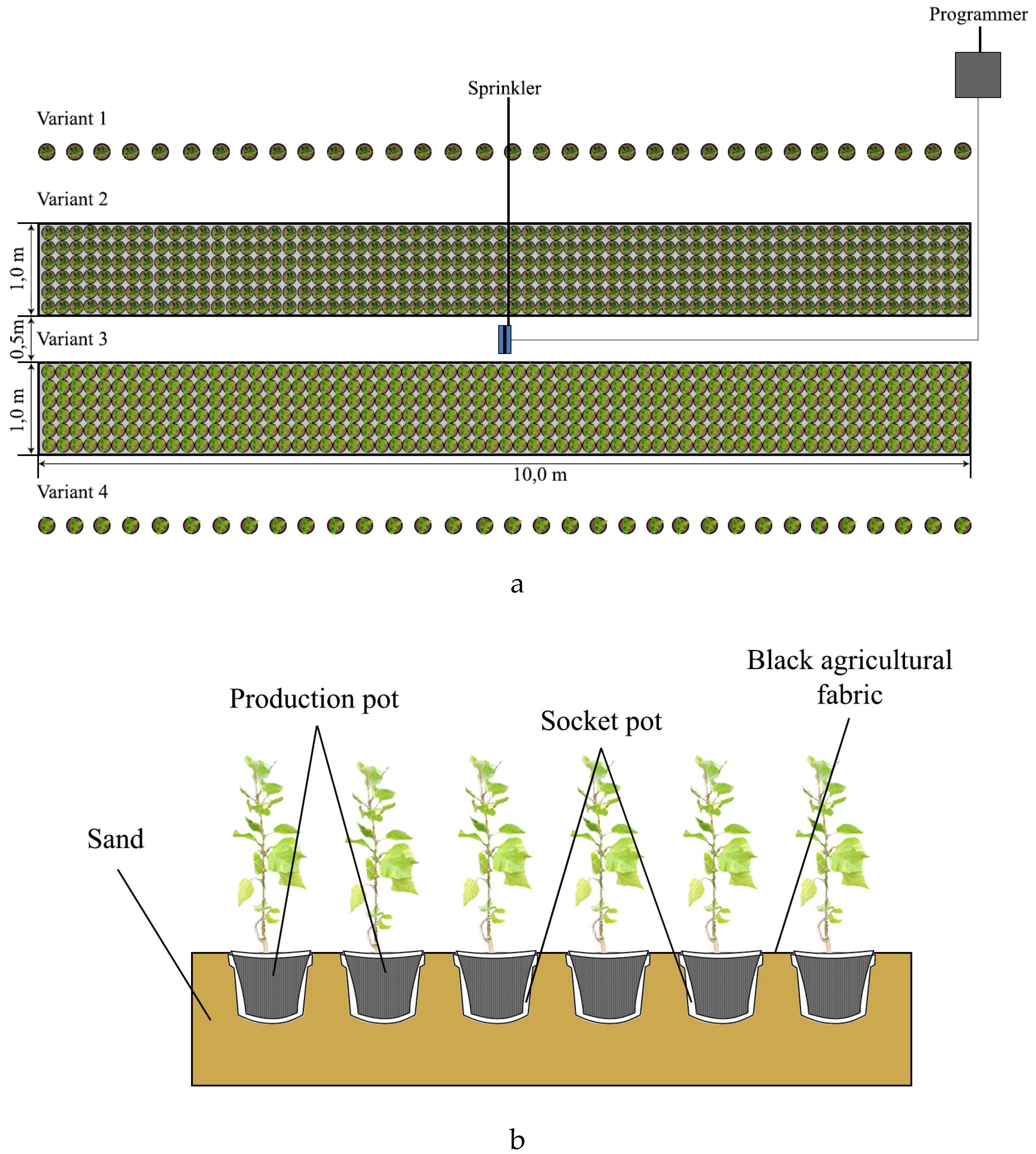
Figure 2.
Height of poplar plants of different genotypes: (a) container 1L; (b) container 2L; (c) container 3L.
Figure 2.
Height of poplar plants of different genotypes: (a) container 1L; (b) container 2L; (c) container 3L.
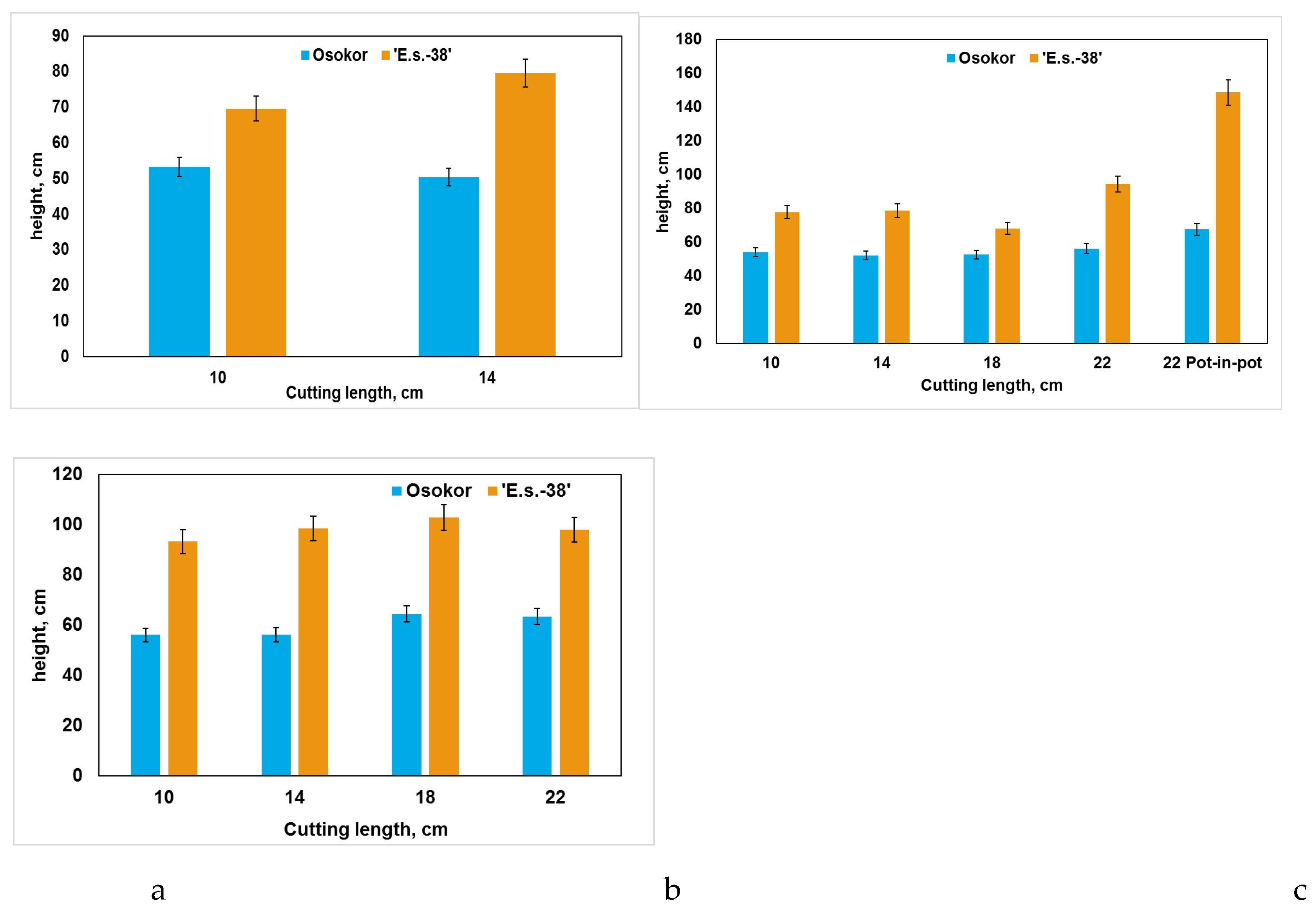
Figure 3.
Average values of trunk diameter of annual poplar seedlings: a - container volume - 1L; b - container 2L, c - container 3 L.
Figure 3.
Average values of trunk diameter of annual poplar seedlings: a - container volume - 1L; b - container 2L, c - container 3 L.
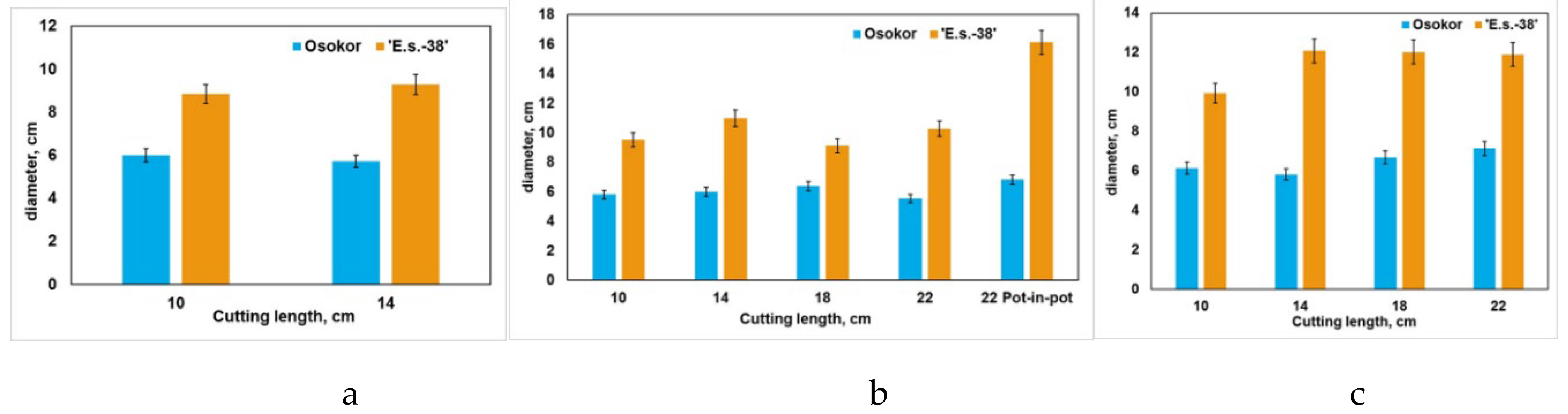
Figure 4.
Fractions of dry weights of individual organs of seedlings relative to the whole plant weight depending on genotype and experiment variant for genotype 1 and genotype 2.
Figure 4.
Fractions of dry weights of individual organs of seedlings relative to the whole plant weight depending on genotype and experiment variant for genotype 1 and genotype 2.
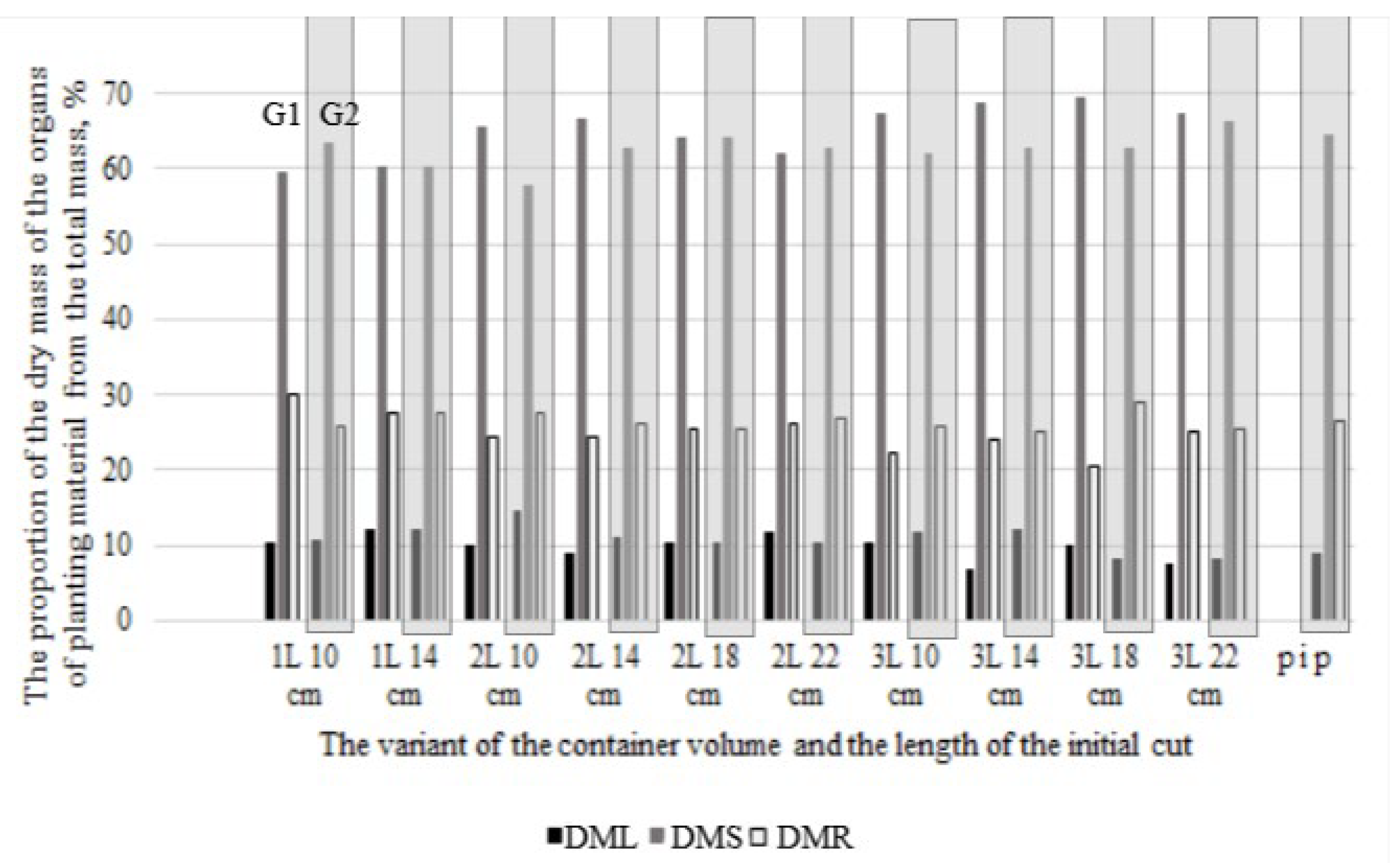
Figure 5.
Appearance of annual seedlings during the period of intensive poplar growth: (a) G1 2L22 cm; (b) G2 2L22cm.
Figure 5.
Appearance of annual seedlings during the period of intensive poplar growth: (a) G1 2L22 cm; (b) G2 2L22cm.
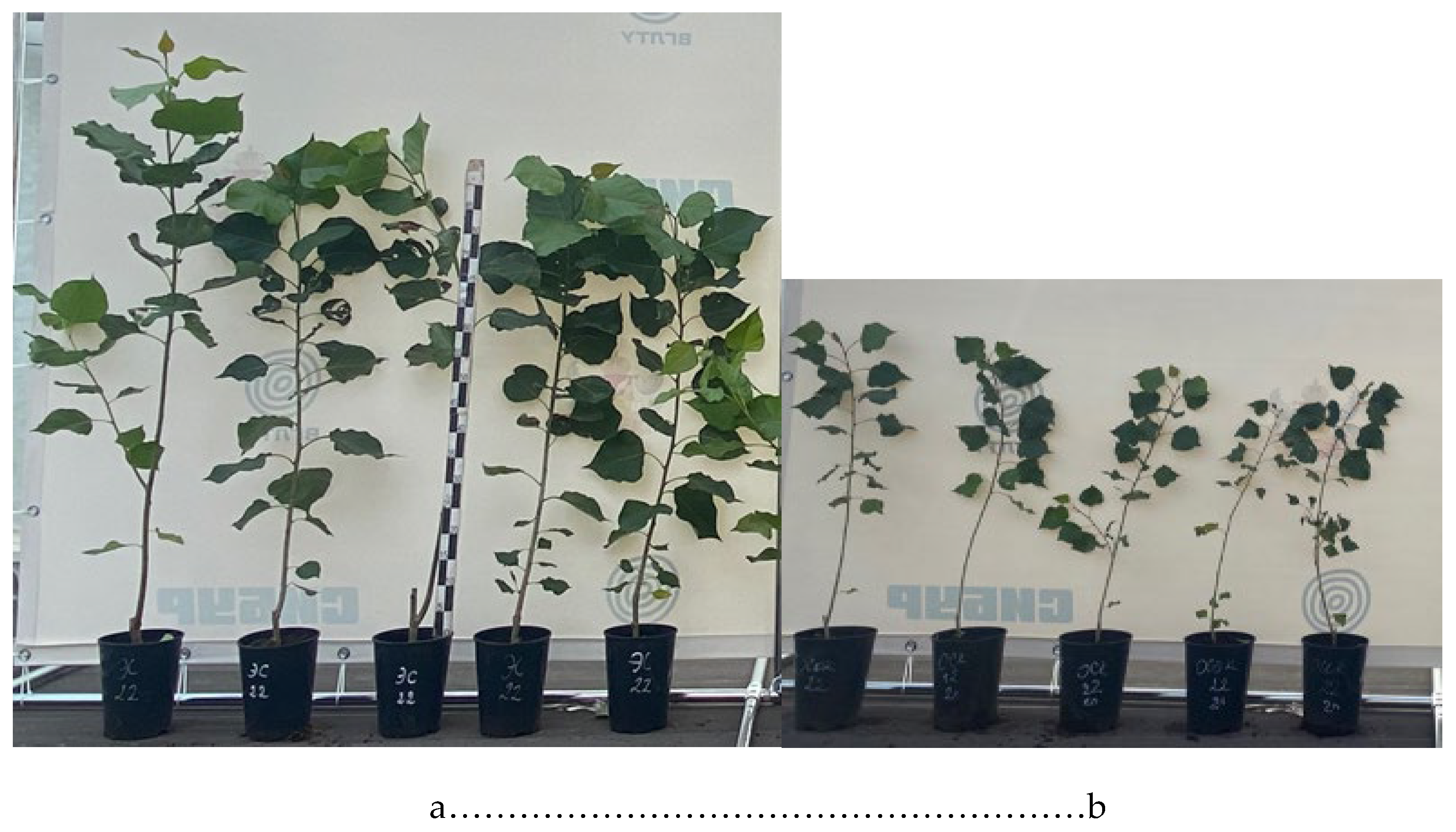
Figure 6.
Tree diagram based on the calculation of Euclidean distance for the variants of the experiment with poplar: (a) genotype -1; (b) genotype-2.
Figure 6.
Tree diagram based on the calculation of Euclidean distance for the variants of the experiment with poplar: (a) genotype -1; (b) genotype-2.
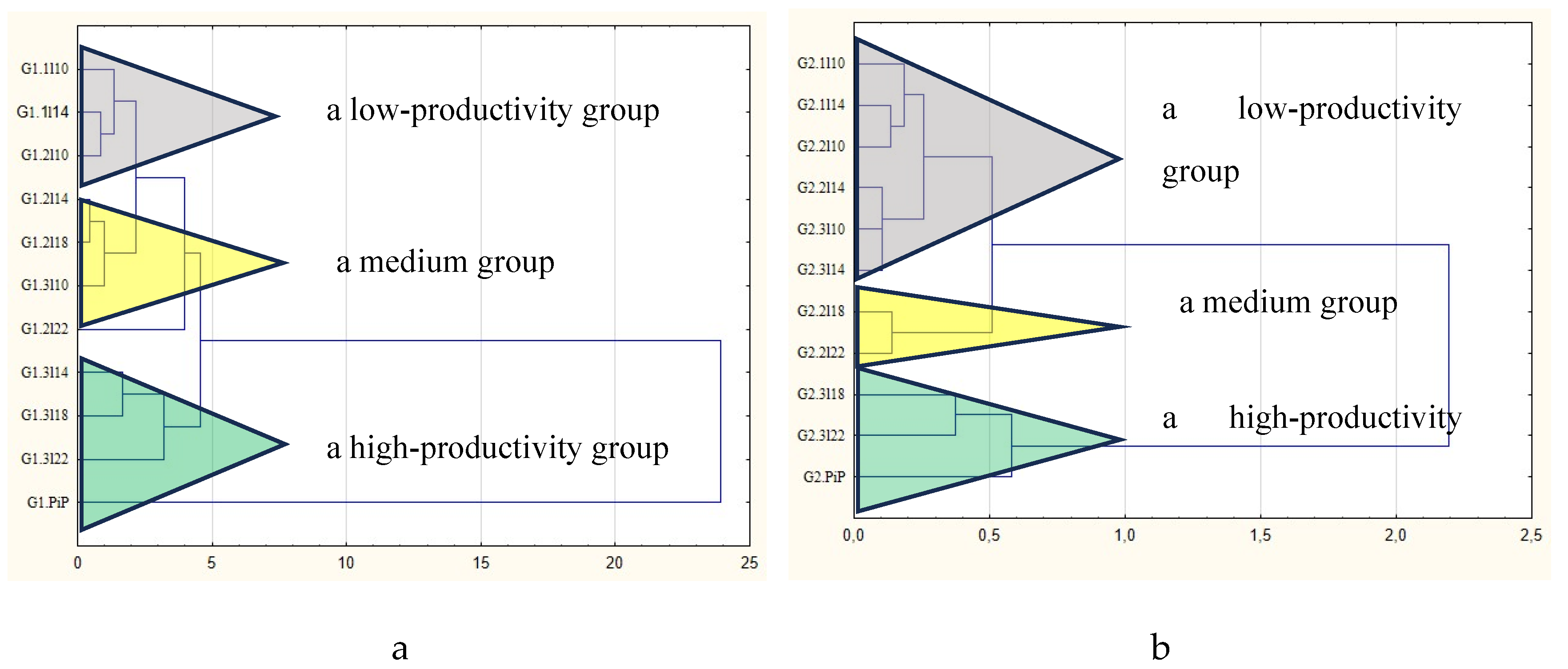
Figure 7.
Diagram of correlation coefficient depending on poplar genotypes and experiment variant: (a) for ‘DMS/DML’ pair, (b) ‘DMS/DMR’, (c) DMR/DML.
Figure 7.
Diagram of correlation coefficient depending on poplar genotypes and experiment variant: (a) for ‘DMS/DML’ pair, (b) ‘DMS/DMR’, (c) DMR/DML.
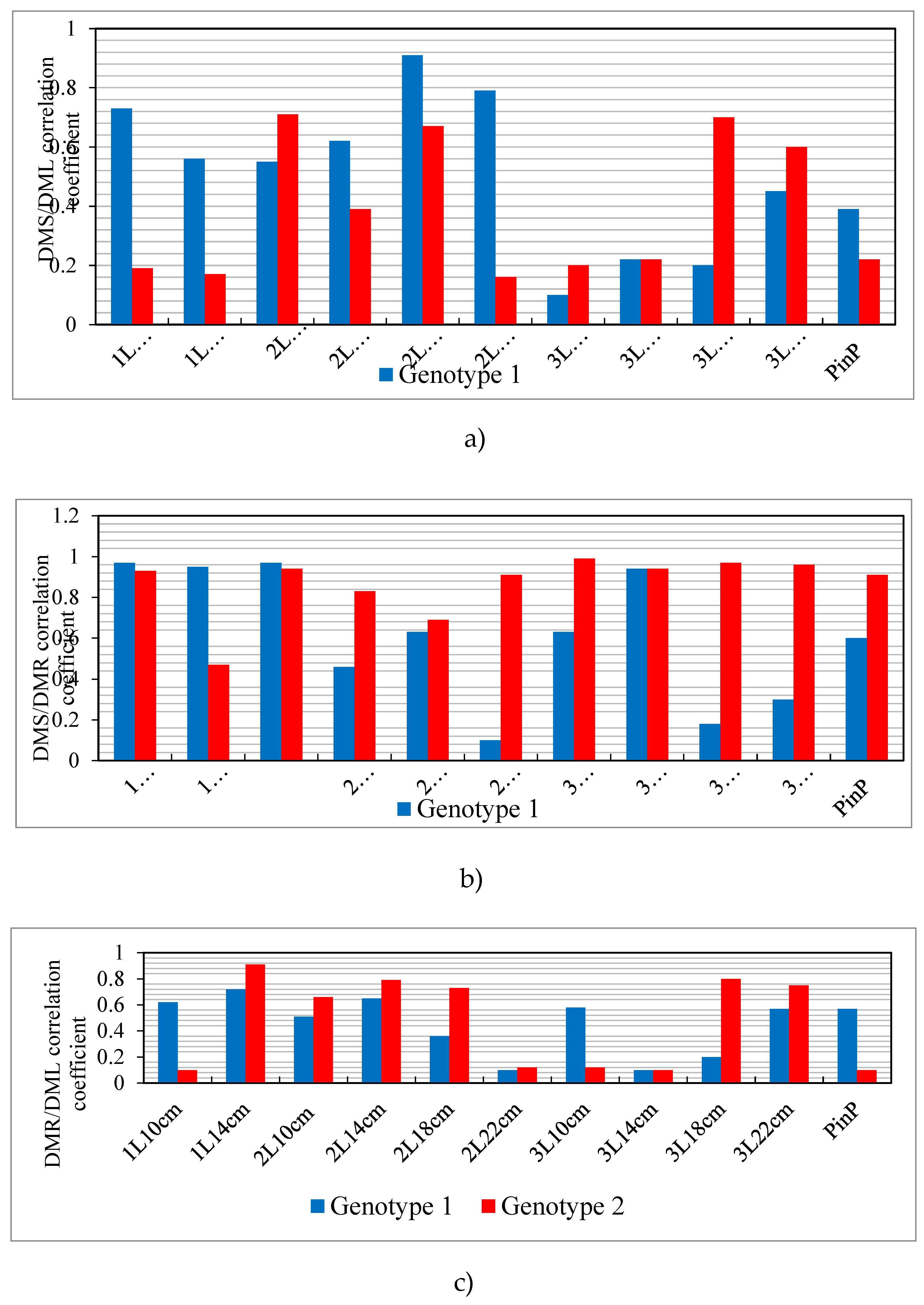

Table 1.
Estimation of dry biomass by fractions of underground and above-ground plant parts G1 ratio of whole plant mass to total assimilative surface area.
Table 1.
Estimation of dry biomass by fractions of underground and above-ground plant parts G1 ratio of whole plant mass to total assimilative surface area.
| Experience options |
Leaf mass dry, М, g ±mм |
Specific surface density of dry leaves g ±mм |
Stem dry mass g ±mм |
Root dry mass g ±mм | Weight of whole plant g ±mм | Productivity coefficient of the assimilation apparatus (g/m2) |
|---|---|---|---|---|---|---|
| G1 (P. deltoids Marsh. x P. dalsamifera L. x (P. alba L.+ P. tremula L.) ʻЕ.s.-38ʼ, 1 L | ||||||
| 10 см | 1,0±0,16 | 2,08±0,08 | 5,8±0,54 | 2,9±0,27 | 9,7±0,92 | 20,2 |
| 14 см | 1,3±0,08 | 2,44±0,14 | 6,5±0,79 | 3±0,7 | 10,8±1,1 | 20,3 |
| G1 (P. deltoids Marsh. x P. dalsamifera L. x (P. alba L.+ P. tremula L.) ʻЕ.s.-38ʼ , 2 L | ||||||
| 10 см | 1,1±0,17 | 2,32±0,09 | 7,3±1,19 | 2,7±0,58 | 11,1±1,2 | 23,6 |
| 14 см | 1,2±0,12 | 2,4±0,14 | 9±0,51 | 3,3±0,41 | 13,5±1,2 | 25 |
| 18 см | 1,4±0,17 | 2,4±0,11 | 9,6±1,45 | 3,5±0,46 | 14,5±1,3 | 25 |
| 22 см | 2,0±0,15 | 2,6±0,05 | 10,5±0,8 | 4,4±0,36 | 16,9±1,5 | 21 |
| PiP 22 см | 1,9±0,24 | 2,46±0,05 | 32,8±0,63 | 5,8±0,53* | 40,5±3,46* | 52,6 |
| G1 (P. deltoids Marsh. x P. dalsamifera L. x (P. alba L.+ P. tremula L.)ʻЕ.s.-38ʼ , 3 L | ||||||
| 10 см | 1,3±0,14 | 2,32±0,05 | 8,5±0,54 | 2,8±0,25 | 12,6±1,5 | 22,5 |
| 14 см | 1,4±0,2 | 2,48±0,05 | 13,8±1,69 | 4,8±0,77 | 20,0±1,8 | 35,7 |
| 18 см | 2,1±0,18 | 2,58±0,09 | 14,7±0,61 | 4,3±0,6 | 21,1±1,9 | 26 |
| 22 см | 1,8 ±0,19 | 2,56±0,13 | 15,9±1,82 | 5,9±1,14 | 23,6±1,98 | 33,7 |
Note: the colour of the rows in the table corresponds to the results of cluster analysis of groups by productivity (Figure 6); * - for the PiP variant the root yield outside the container is marked, the biomass for the root in the container is indicated in the table.
Table 2.
- Dry biomass by fractions of underground and aboveground plant parts G2.
| Experience options | Leaf mass dry, М, g ±mм | Specific surface density of dry leaves g ±mм |
Stem dry mass g ±mм | Root dry mass g ±mм | Weight of whole plant g ±mм | Productivity coefficient of the assimilation apparatus (g/m2) |
|||
|---|---|---|---|---|---|---|---|---|---|
| G2 (Populus nigra L.), 1 L | |||||||||
| 10 см | 0,37±0,02 | 0,78±0,03 | 2,2±0,21 | 0,9±0,13 | 3,5±0,32 | 7,4 | |||
| 14 см | 0,44±0,04 | 0,83±0,04 | 2,2±0,13 | 1,0±0,14 | 3,64±0,35 | 6,8 | |||
| G2 (Populus nigra L.), 2 L | |||||||||
| 10 см | 0,53±0,07 | 0,77±0,05 | 2,1±0,3 | 1±0,3 | 3,63±0,3 | 5,3 | |||
| 14 см | 0,43±0,07 | 0,71±0,06 | 2,4±0,28 | 1±0,13 | 3,8±0,4 | 6,3 | |||
| 18 см | 0,45±0,06 | 0,77±0,02 | 2,8±0,38 | 1,1±0,22 | 4,3±0,4 | 7,4 | |||
| 22 см | 0,46±0,06 | 0,72±0,08 | 2,8±0,26 | 1,2±0,2 | 4,4±0,4 | 6,9 | |||
| PiP 22 см | 0,62±0,08 | 0,71±0,12 | 4,4±0,2 | 1,8±0,27 | 6,8±0,6 | 7,8 | |||
| G2 (Populus nigra L.), 3 L | |||||||||
| 10 см | 0,46±0,07 | 0,62±0,07 | 2,4±0,42 | 1,0±0,39 | 3,9±0,4 | 5,2 | |||
| 14 см | 0,48±0,04 | 0,66±0,03 | 2,5±0,4 | 1,0±0,2 | 3,4±0,4 | 5,4 | |||
| 18 см | 0,51±0,07 | 0,73±0,03 | 3,9±0,55 | 1,8±0,48 | 6,2±0,5 | 8,9 | |||
| 22 см | 0,53±0,04 | 0,74±0,07 | 4,2±0,2 | 1,6±0,16 | 6,3±0,5 | 8,9 | |||
Note: the colour of rows in the table corresponds to the results of cluster analysis of groups by productivity (Figure 6).
Table 3.
Characterisation of selected groups of seedlings of genotype 1 and 2 by biometric indices and productivity among the experiment variants.
Table 3.
Characterisation of selected groups of seedlings of genotype 1 and 2 by biometric indices and productivity among the experiment variants.
| Selected groups by productivity | G 1 | G 2 | ||
| Total dry mass, g | Cultivation options |
Total dry mass, g | Cultivation options | |
| High-productivity group | 21,5 ± 0,97 | 3L18cm; 3L14cm; 2L22cm. | 6,4±0,19 | PiP; 3L22cm; 3L18cm. |
| Medium productivity group | 14,4 ± 0,49 | 3L10cm; 2L14cm; 2L18cm. |
4,4 ± 0,05 | 2L22cm; 2L18cm. |
| Low-productivity group | 10,5 ± 0,42 | 2L10cm; 1L10cm; 1L14cm. |
3,6 ± 0,08 | 3L14cm; 3L10cm; 2L14cm; 2L10cm; 1L14cm; 1L10cm. |
| Experience options outside the clusters |
40,5 16,9 |
PiP 2L22 |
- | - |
| Average productivity of all variants of the experiment | 17,9 ± 2,6 | 4,5 ± 0,38 | ||
Explanation: differences in total dry weight between groups are significant (p < 0.01).
Disclaimer/Publisher’s Note: The statements, opinions and data contained in all publications are solely those of the individual author(s) and contributor(s) and not of MDPI and/or the editor(s). MDPI and/or the editor(s) disclaim responsibility for any injury to people or property resulting from any ideas, methods, instructions or products referred to in the content. |
© 2025 by the authors. Licensee MDPI, Basel, Switzerland. This article is an open access article distributed under the terms and conditions of the Creative Commons Attribution (CC BY) license (http://creativecommons.org/licenses/by/4.0/).
Copyright: This open access article is published under a Creative Commons CC BY 4.0 license, which permit the free download, distribution, and reuse, provided that the author and preprint are cited in any reuse.


