

Submitted:
15 January 2025
Posted:
16 January 2025
You are already at the latest version
Abstract
The design of multilayer SIW cavity-fed filtenna is presented. The proposed filtenna can be used as a unified module in antenna arrays structure. It consists of 3-pole bandpass filter with slot antenna positioned centrally within the top module surface. The modules aperture dimensions λ0/2×λ0/2 in conjunction with SMA feeding port located on the bottom filtenna surface allow to implement an antenna array of different configurations. This approach allow to greatly simplify the feeding and matching scheme of the array. This module is designed to operate 2.655 GHz central frequency with a 70 MHz bandwidth. The procedure of the filtenna design is described in detail The proposed filtenna is fabricated and tested. Simulation and measurement results show a good agreement. The measurements demonstrate the maximum measured gain of the prototype is 3.64 dBi with a small variation in the passband.
Keywords:
filtenna
; SIW cavity
; bandpass filter
; anttenna array
; slot antenna
1. Introduction
The ongoing advancement in wireless communication systems raises demands on their key components in terms of their sizes and performance. During evolvement, the communications shift from a stand-alone point-to-point link to networks. Each network has its own standards and specifications of frequency bands, channel capacity, etc. To fulfill the demanding criteria of today’s communication standards, devices need to have a smaller size while keeping high performance, low loss and appropriate power handling capability. However, a variety of different wireless applications lead to a diversity of device designs and technical solutions that should be supported by a single terminal. It can be clearly observed by the example of the smartphone market, where a single device should provide the ability to operate in different networks. With continuous development of the IoT concept, this problem is becoming much more emphasized. In general, two possible ways can be marked to overcome this "variety boom", there are unification and functionality convergence of device designs.
Unification is usually an industry point of interest, since it can provide reasonable trade-off between performance and overall system development cost. However, in multidisciplinary electronics, it may include scientific research as proving grounds, especially for attempting to unite electromagnetic phenomena of different scales [1] or increase functionality integration [2]. The option of functionality convergence can be demonstrated by concepts such as antenna-on-chip (AoC) [3,4], antenna-in-package (AiP) [5,6], active integrated antenna (AiA) [7,8], and filtennas (filtering antennas) [9,10,11]. In contrast to AiP, AoC, etc., the filtenna is a more general concept that can be implemented in different frequency ranges and does not rely on the technological process of device fabrication. The use of the filtenna design allows miniaturization of the overall size but also improves the system performance by reducing mismatching losses between the filter and antenna. Examples of filtennas in planar design are presented in [9,12,13,14]. Integration of the filtering structure into feedline is a typical approach for a planar filtenna design. A drawback of these configurations is the requirement to develop complex matching circuits to obtain stable radiation in the frequency range.
Improvement of the passband characteristics can be achieved by the use of cavity resonators in the filtering structure. The substrate integrated waveguide (SIW) is a kind of microwave transmission line that is compatible with PCB manufacturing process. The cavity based on SIW cannot provide quality factors as high as bulk ceramic resonators; however, they can be easily integrated into the feed network of most PCB antennas [10,11,15]. Various methods for constructing antenna designs utilizing SIW technology can be emphasized. One of them is the use of single layer SIW cavity like the structure presented in [10]. The study utilized integrated electric and magnetic coupling configurations along with fundamental modes to create two distinct radiation nulls. The main disadvantage of this structure is narrow passband characteristics. In the single layer SIW filtennas this can be solved by the use of specified topology on the cavity surface. For example, in [15], two U-shaped slots are etched on the cavity surface to provide a radiation null at the left edge of the passband; this allows for an increase in filtennas bandwidth of up to 11.86%.
Another example of using etched slots on the cavity to modified passband characteristics is presented in [11]. This study explores the potential of a single-layer SIW filtenna to operate in dual or tri-band frequency mode through the implementation of multifunctional cavity-backed slots. Multiple SIW cavity resonators arranged on a single plate can be employed to construct an filtenna design [16,17]. This technique enables a significant improvement in filtennas bandwidth characteristics. In [16] four pole cavity SIW filter was designed while slot antenna were etched on the fourth’s cavity surface. The design proposed in [17] differs by the integration method of radiation element in the filtenna structure. Patch antenna considered as a resonator and form three pole filter with two cavity SIW resonators. A significant drawback of using multiple resonator cavities in a single-layer structure is the large dimensions of the device. This is especially critical at low frequencies and when using a high order filter in filtenna. To overcome this limitation the multilayer SIW structures can be considered [18,19,20]. Authors presented the filtenna based on a 3-pole cavity SIW filter on a three-layer substrate in [20]. The 2×2 antenna array using the proposed filtenna structure was designed and fabricated. The filtenna design presented in [19] is a complete analogue of the single-layer filtenna structure with a slot antenna presented in [17]. Coupling between resonators was achieved by using the rectangular slots etched on the metallic layers between them. The slot antenna is integrated into the upper surface of the top cavity resonator. It is worth noting that in [19,20] simple filters without cross coupling between resonators were used. In the work [18] double slot coupling scheme is used in the middle ground layer between resonators to not only couple the them but also generate two more radiation nulls. This feature significantly improve out-of-band radiation suppression level of filtenna.
Filtennas demonstrate good out-of-band radiation suppression, so they can be used in multiband aperture-shared base station array antenna designs to overcome the mutual coupling of the array elements without increasing the total size of the antenna [21]. In the case of a filtenna aperture formed by an SIW cavity loaded on a radiating slot, its dimensions should be close to . Noting that each module can be fed by any PCB compatible connector (e.g., SMA), a various antenna array configuration can be easily configured on their base. Such a method does not necessitate elaborating a complete design of the antenna array feeding PCB; instead, it utilizes filtering antenna modules with connectors that allow forming an optimal array according to the application. Array antennas based on filtenna modules can operate in duplex mode due to the high isolation level between the input ports. Consequently, this type of module demonstrates high potential for application in next-generation wireless networks.
This work is devoted to the design and elaboration of the filtenna module formed by SIW cavities loaded on a radiating slot and based on a multilayer PCB. This article is a revised and expanded version of a paper entitled "Antenna Module with Integrated SIW Passband Filter for Application in Communication Systems", which was presented at International Conference on Electrical Engineering and Photonics (EExPolytech), Saint Petersburg, Russian Federation, 18 October 2024 [22]. The specification of the filtenna passband and corresponding design procedure is presented in the following section. The third section describes the design of a slot antenna and its integration to the SIW filtering structure. The fourth section presents the fabricated prototype and its frequency and radiating characteristics in comparison with simulated ones. In the Conclusion section the obtained results are summarized.
2. Calculation of Microwave Filter Parameters
The initial phase in the filtenna module design involved calculating the parameters of the bandpass filter. The specified parameters for pass-band characteristic of elaborated antenna were: bandwidth (BW) 70 MHz; central frequency 2.655 GHz; return loss (RL) less than -15 dB. The schematic of 3-pole filter presented in Figure 1.
Three resonators, presented in scheme as a serial connection of RLC lumped elements. K-impedance inverters indicate the coupling between adjacent resonators. The design of the passband filter was performed in two steps, following the conventional approach based on the equivalent circuit method [23]. At the first stage, a prototype low-pass filter was calculated. For the Chebyshev 3-pole filter, the g-parameters of the low-pass prototype with 0.5 dB ripples in the passband are the following: =1, =1.5963, =1.0967, =1.5963, =1. External quality factor of the filter can be calculated using
where and are the lowest and highest frequency in the passband; - the central frequency of the passband.
The relations between K-impedance inverter parameters and the g-parameters of the low-pass prototype filter are as follows:
where – wavelength in structure corresponds for central frequency in bandpass; and – wavelength in structure corresponds for lowest and highest frequency in bandpass respectively. It was mentioned earlier that the suggested filter configuration based a multilayer printed circuit board, with a cavity SIW resonator integrated into each separate layer. The rectangular slots etched in the metallic layer between adjacent resonators are used as coupling elements. These slots may be represented as equivalent series and shunt inductances, with their reactance values calculated in the following way [23]:
where and are reactances of slots equivalent series and shunt inductances respectively; , are scattering matrix elements. The relationships among K-impedance inverter parameters, resonator length , and both series and shunt inductances of coupling slots are presented below:
The process of the SIW cavity filter design based on synthesized prototype is organized in the following manner. The parameters of K-impedance inverters were determined by the use of Equations (2)–(4). The model of two SIW cavity resonators coupled by a rectangular slot in a metallic layer in between was formed to provide a full-wave analysis. Metallized dielectric plates with and were used as material for three layer filter structure. Each layer had an identical thickness of 0.5 mm. The SIW cavity resonator was formed in each dielectric layer. The extent of unwanted radiation emitted by the structure is influenced by the size of the metal holes, denoted as d, and the spacing between them, referred to as p. To minimize this effect the value d must be less than one fifth of the wavelength in dielectric and more than one half of p value [24]. For determination of effective cross-sectional width of the SIW resonator for the mode the follows expression was used [25]:
where w – the width of the SIW cavity.
Simulation was performed for model with different sizes of coupling slots. Once the S-parameters were acquired, equations (5) and (6) were employed to calculate the reactance of the coupling slots. Determined and values were used to found K-impedance inverters parameters using (7). Founded values were comprised with results obtained for calculation of K-impedance inverters parameters by employing Equations (2)–(4). The variation of coupling slot sizes occurred until the results matched.
The filter model and topology of each layer are presented in Figure 2 and Figure 3. The feed point of SIW cavities was determined with the help of full-wave electromagnetic simulation. The footprint for the coaxial connector is a ring-shaped slot with an external and internal diameter = 4.22 mm and =1.27 mm. The SMA connector was used as a terminal, allowing easy prototype performance tests by the use of common coaxial feed lines. The external quality factor can be changed by varying the distance between a central pin of the SMA connector and the SIW cavity boundary. The values of geometrical sizes for filter model are presented in Table 1.
Figure 4 presents S-parameters obtained as a result of designed SIW filter full-wave simulation. One can see that the central frequency of the filter is 2.655 GHz with the bandwidth of 70 MHz. The return loss is more than 18 dB and the insertion loss is less than 1.5 dB without significant ripples in the bandwidth.
3. Design of Filtena
The model of the designed SIW band-pass filter was modified to form the filtenna module. For this reason, one of the 50 Ohm terminals was replaced by a radiating slot. The slot antenna was selected as a radiating element for its simplicity of incorporation into the SIW cavity and directional radiation pattern. The equivalent circuit of the slot can be presented by a series connection of R, L, and C elements; The corresponding equivalent circuit of the filtenna is presented in Figure 5. Reactance of the equivalent inductor and capacitor determines the value of resonant frequency (corresponding to central frequency of the passband SIW filter), while resistance R - effectiveness of radiation of the radiating slot. These equivalent component values can be calculated using the following equations:
Thus of the slot can be calculated as:
It is essential to design a radiating slot so that equations (1) and (14) provide identical values of the external quality factor. It is required to maintain the frequency response of the designed filtenna. The electromagnetic model of the SIW filter was correspondingly modified for further full-wave analysis and the determination of the optimal slot dimensions. The layout of the SIW cavities for filtenna module is presented in Figure 6.
During simulation the optimization of topology elements was carried out in the time domain [26] using the algorithm of the inverse chirp-z transformation [27]. It was observed that there is no optimal set of parameters , , and , while the thickness of the SIW cavity loaded on radiating slot is constant. Thus the value of the loaded cavity thickness was also added to an optimization process. In final, the filtenna was a three-layer structure with layer thicknesses of 0.5, 0.5, and 2.4 mm. The dimensions of the topology elements of the filtenna’s final design are listed in Table 2. For the assembly of the filtenna prototype, steel pins were used for PCB layer alignment, while the mechanical connection of PCBs was provided by screws. The final design of the filtenna module is presented in Figure 7.
Simulation results of S-parameters of SIW filter prototype and filtena are presented in Figure 8. The integration of the slot antenna into the filter structure, as illustrated in the presented figure, successfully maintained the filter’s transmission characteristics without any distortion. In Figure 8 the simulated dependence of filtenna gain on frequency is presented. The maximal gain value of 4.8 dBi at the central passband frequency is observed. This characteristic shows high uniformity in the frequency passband, the maximal deviation of the antenna gain is 0.4 dBi and can be observed at the edges of the bandwidth only.
The coupling along apertures of the filtenna modules were simulated to estimate the potential of the filtenna array performance. Two configurations of the filtenna modules were considered (see insets in Figure 9); the distance between the center points of the modules is half of the free-space wavelength at the center frequency of the passband for both configurations. Results show that higher coupling is achieved in the case of parallel orientation of radiating slots, however it is close to -20 dB in the worst case. Thus, filtenna modules demonstrate good isolation without any additional decoupling technique implemented.
The radiation pattern of the 16 filtenna modules was estimated by the array factor (AF) calculation on the basis of the simulated radiation pattern of the single module Modules were organized as a plane 4×4 array with spacing between center points of the modules of half free-space wavelength at the central passband frequency Comparison between radiation patterns of the single module and 4×4 array presented in Figure 10. One can see that the main beam of the radiation pattern for the array has a lower beamwidth (∼23 degrees in both planes) in contrast to the single filtenna module (∼ 67 and 50.5 degrees for E- and H-plane respectivelly) in both the E- and H-planes. The sidelobe level less than ∼-17 dB was achieved with uniform magnitude distribution among modules and without any suppression technique implemented.
4. Experimental Results
The copper-clad composite material based on polytetrafluoroethylene (PTFE) was used as a base material for the PCB fabrication. The weight fraction of Ti addition of the composite was ∼25 %. Preliminary, samples of composite material were manufactured by hot pressing for experimental investigation of the parameters that were performed by the resonance technique, explained in detail in [28]. The measured dielectric constant value was with a loss tangent of order 0.005 at 10 GHz. The layers of the filtenna module were manufactured separately by printed circuit board technology. A layer of immersion silver was applied over the copper metal surfaces to prevent oxidation. The use of screw connections to assemble PCBs into a stack allows eliminating soldering in between. That in turn allows replacing PCB layers. In contrast to other filtenna designs [18,19,20,29,30], the central pin of the SMA connector does not pass through the board; it is soldered to the metallic pad of the coaxial excitation point (see and in Figure 6). Such an approach allows replacing the SMA connector with any mechanically compatible connector that fits the feed point footprint.
The experimental investigation of the filtenna’s frequency response and radiation pattern was elaborated with the help of VNA Cyear 3672C in the anechoic chamber environment. The assembled filtenna module during the measurement process is presented in Figure 11. The comparison of the experimental results of filtennas gain and reflection coefficient frequency dependencies with the simulation results is presented in Figure 12. Experimental results shows that designed filter antenna prototype operates at a central frequency of 2.655 GHz with a bandwidth 70 MHz, which meets the requirements of the Band7 frequency range used in modern communication systems. The maximum antenna gain is 3.64 dB at the center frequency. Figure 13 presents measured radiation patterns of the filtenna module at the lower (2.62 GHz, see Figure 13a) and upper edges (2.69 GHz, see Figure 13c) of passband as well as central frequency (2.655 GHz, see Figure 13b). The measured level of cross-polarization is less than -19 dB in the E-plane and less than -20 dB in the H-plane respectively. It can be seen that the measurement results are in good agreement with the simulation results.
5. Conclusions
The compact SIW cavity filtenna module was designed. The proposed design demonstrates the possible unification of the filtenna module for application in antenna arrays. The appropriate application in the arrays design features of filtenna are the stacked arrangement of cavities, the slot radiating element positioned centrally on the top module surface, module aperture dimensions (), and the SMA feeding port located on the bottom filtenna surface. A synthesis technique of the proposed filtering antenna module has been described. A filtenna module operating in the LTE Band 7 at a center frequency of 2.655 GHz with a bandwidth of 70 MHz has been designed and fabricated. The PTFE-based composite material was manufactured and used for the filtenna’s PCB fabrication. The measured permittivity of the composite material was close to 3.5, with a loss tangent in the order of 0.005. Simulation and measurement results are in good agreement. The gain value dependence on frequency for the fabricated module shows high uniformity in the frequency passband with a maximal value of 3.64 dBi. The measured cross-polarization level is below -19 dB/-20 dB in the E/H-plane. The proposed compact filtenna offers the advantages of low cost and simple configuration with stable in-band radiation performance characteristics and excellent out-of-band selectivity. These advantages empower it suitably for practical applications in many wireless mobile space-limited platforms.
Author Contributions
Conceptualization, A.A. and A.S.; methodology, A.A. and A.S.; software, A.S. and T.L.; validation, A.A., A.S. and R.P.; formal analysis, A.K. and A.B.K.; investigation, A.S. and T.K.; resources, A.K.; data curation, A.S. and T.K.; writing—original draft preparation, A.S., R.P and T.K.; writing—review and editing, A.A., A.K. and A.B.K.; visualization, A.S.; supervision, A.K.; project administration, A.B.K. and A.A.; funding acquisition, A.K. and A.B.K. All authors have read and agreed to the published version of the manuscript.
Funding
This research was funded by The Ministry of Education and Science of the Russian Federation within the framework of the state assignment No. 075-01438-22-07 of 28.10.2022 (FSEE-2022-0019).
Institutional Review Board Statement
Not applicable.
Informed Consent Statement
Not applicable.
Data Availability Statement
The original contributions presented in the study are included in the article, further inquiries can be directed to the corresponding author.
Conflicts of Interest
The authors declare no conflicts of interest.
References
- Dhillon, A.S.; Radi, B.; Liboiron-Ladouceur, O. An Analysis of RF On-Chip Antennas in Si-Based Integrated Microwave Photonics. IEEE Photonics Journal 2021, 13, 1–18. [CrossRef]
- Nallandhigal, S.N.; Burasa, P.; Wu, K. Deep Integration and Topological Cohabitation of Active Circuits and Antennas for Power Amplification and Radiation in Standard CMOS. IEEE Transactions on Microwave Theory and Techniques 2020, 68, 4405–4423. [CrossRef]
- Hedayati, M.K.; Abdipour, A.; Sarraf Shirazi, R.; Ammann, M.J.; John, M.; Cetintepe, C.; Staszewski, R.B. Challenges in On-Chip Antenna Design and Integration With RF Receiver Front-End Circuitry in Nanoscale CMOS for 5G Communication Systems. IEEE Access 2019, 7, 43190–43204. [CrossRef]
- Burasa, P.; Djerafi, T.; Wu, K. A 28 GHz and 60 GHz Dual-Band On-Chip Antenna for 5G-Compatible IoT-Served Sensors in Standard CMOS Process. IEEE Transactions on Antennas and Propagation 2021, 69, 2940–2945. [CrossRef]
- Liu, X.; Zhang, W.; Hao, D.; Liu, Y. Differential-Fed Magneto-Electric Dipole Antenna With Integrated Balun Based on Ball Grid Array Packaging. IEEE Transactions on Components, Packaging and Manufacturing Technology 2022, 12, 981–987. [CrossRef]
- Ma, L.; Lai, J.; Yin, Y.; Xia, C.; Gu, C.; Mao, J. A Wideband Co-Linearly Polarized Full-Duplex Antenna-in-Package With High Isolation for Integrated Sensing and Communication. IEEE Antennas and Wireless Propagation Letters 2023, 22, 2185–2189. [CrossRef]
- Nallandhigal, S.N.; Wu, K. Unified and Integrated Circuit Antenna in Front End—A Proof of Concept. IEEE Transactions on Microwave Theory and Techniques 2019, 67, 347–364. [CrossRef]
- Du, Z.X.; Cui, M.; Zhang, Y.; Guo, C.; Zhang, G.; Zhang, X.Y. Compact and Scalable Active-Integrated Antenna System With Both Oscillation and Amplification Characteristics for High-Power Applications. IEEE Transactions on Antennas and Propagation 2023, 71, 7673–7678. [CrossRef]
- El Ouadi, Z.; Amadid, J.; Khabba, A.; El Yassini, A.; Ibnyaich, S.; Zeroual, A. Compact microstrip filtenna designed for wireless local area network applications. In Proceedings of the 2022 International conference on decision aid sciences and applications (DASA). IEEE, 2022, pp. 1593–1597.
- Wang, C.; Wang, X.; Liu, H.; Chen, Z.; Han, Z. Substrate integrated waveguide filtenna with two controllable radiation nulls. IEEE Access 2020, 8, 120019–120024.
- Zheng, Z.; Li, D.; Tan, X.; Chen, Q. Single-layer dual-/tri-band SIW filtenna based on multifunctional cavity-backed slots. IEEE Transactions on Antennas and Propagation 2023, 71, 4498–4503.
- Balalem, A.; Machac, J.; Omar, A. Microstrip-CPW bandpass filter for antenna application. Microwave and Optical Technology Letters 2008, 50, 51–55.
- Chen, Y.; Zhou, Y. Design of a filter-antenna subsystem for UWB communications. In Proceedings of the 2009 3rd IEEE International Symposium on Microwave, Antenna, Propagation and EMC Technologies for Wireless Communications. IEEE, 2009, pp. 593–595.
- Chuang, C.T.; Chung, S.J. Synthesis and design of a new printed filtering antenna. IEEE Transactions on Antennas and Propagation 2011, 59, 1036–1042.
- Yin, J.Y.; Bai, T.L.; Deng, J.Y.; Ren, J.; Sun, D.; Zhang, Y.; Guo, L.X. Wideband single-layer substrate integrated waveguide filtering antenna with U-shaped slots. IEEE Antennas and Wireless Propagation Letters 2021, 20, 1726–1730.
- Yusuf, Y.; Gong, X. Compact low-loss integration of high-Q3-D filters with highly efficient antennas. IEEE transactions on microwave theory and techniques 2011, 59, 857–865.
- Yusuf, Y.; Gong, X. Integrated filter/antennas with high efficiency and increased bandwidth. In Proceedings of the WAMICON 2011 Conference Proceedings. IEEE, 2011, pp. 1–4.
- Zhang, Y.; Zhang, X.Y.; Liu, Q.H. A dual-layer filtering SIW slot antenna utilizing double slot coupling scheme. IEEE Antennas and Wireless Propagation Letters 2021, 20, 1073–1077.
- Yusuf, Y.; Cheng, H.; Gong, X. A seamless integration of 3-D vertical filters with highly efficient slot antennas. IEEE Transactions on Antennas and Propagation 2011, 59, 4016–4022.
- Cheng, H.; Yusuf, Y.; Gong, X. Vertically integrated three-pole filter/antennas for array applications. IEEE Antennas and Wireless Propagation Letters 2011, 10, 278–281.
- Mao, C.X.; Zhang, Y.; Zhang, X.Y.; Xiao, P.; Wang, Y.; Gao, S. Filtering antennas: Design methods and recent developments. IEEE Microwave Magazine 2021, 22, 52–63.
- Sosunov, A.; Legkova, T.; Spetsakova, D.; Altynnikov, A. Antenna Module with Integrated SIW Passband Filter for Application in Communication Systems. In Proceedings of the 2024 International Conference on Electrical Engineering and Photonics (EExPolytech), 2024, pp. 52–55. [CrossRef]
- Cameron, R.J.; Kudsia, C.M.; Mansour, R.R. Microwave filters for communication systems: Fundamentals, design, and applications; John Wiley & Sons, 2018.
- Deslandes, D.; Wu, K. Design consideration and performance analysis of substrate integrated waveguide components. In Proceedings of the 2002 32nd European microwave conference. IEEE, 2002, pp. 1–4.
- Han, S.; Wang, X.L.; Fan, Y.; Yang, Z.; He, Z. The generalized Chebyshev substrate integrated waveguide diplexer. Progress In Electromagnetics Research 2007, 73, 29–38.
- Dunsmore, J. Tuning band pass filters in the time domain. In Proceedings of the 1999 IEEE MTT-S International Microwave Symposium Digest (Cat. No. 99CH36282). IEEE, 1999, Vol. 3, pp. 1351–1354.
- Sukhoy, V.; Stoytchev, A. Generalizing the inverse FFT off the unit circle. Scientific Reports 2019, 9, 14443.
- Gagarin, A.; Tsyganova, D.; Altynnikov, A.; Komlev, A.; Platonov, R. An Adaptation of the Split-Cylinder Resonator Method for Measuring the Microwave Properties of Thin Ferroelectric Films in a “Thin Film—Substrate” Structure. Sensors 2024, 24. [CrossRef]
- Choi, J.; Kim, J.; Ji, Y.; Lee, S.; Lee, J.; Yu, B.; Park, S.; Kim, M.; Jung, K.Y. SIW-Fed Patch Array Filtenna With Significant Suppression of Adjacent 5G Spectrum for Radio Altimeters. IEEE Access 2023, 11, 135846–135854.
- Li, T.; Gong, X. Vertical Integration of High-Q Filter With Circularly Polarized Patch Antenna With Enhanced Impedance-Axial Ratio Bandwidth. IEEE Transactions on Microwave Theory and Techniques 2018, 66, 3119–3128.
Figure 1.
An equivalent circuit of a three-pole bandpass filter.

Figure 2.
Model of 3-pole SIW filter prototype.
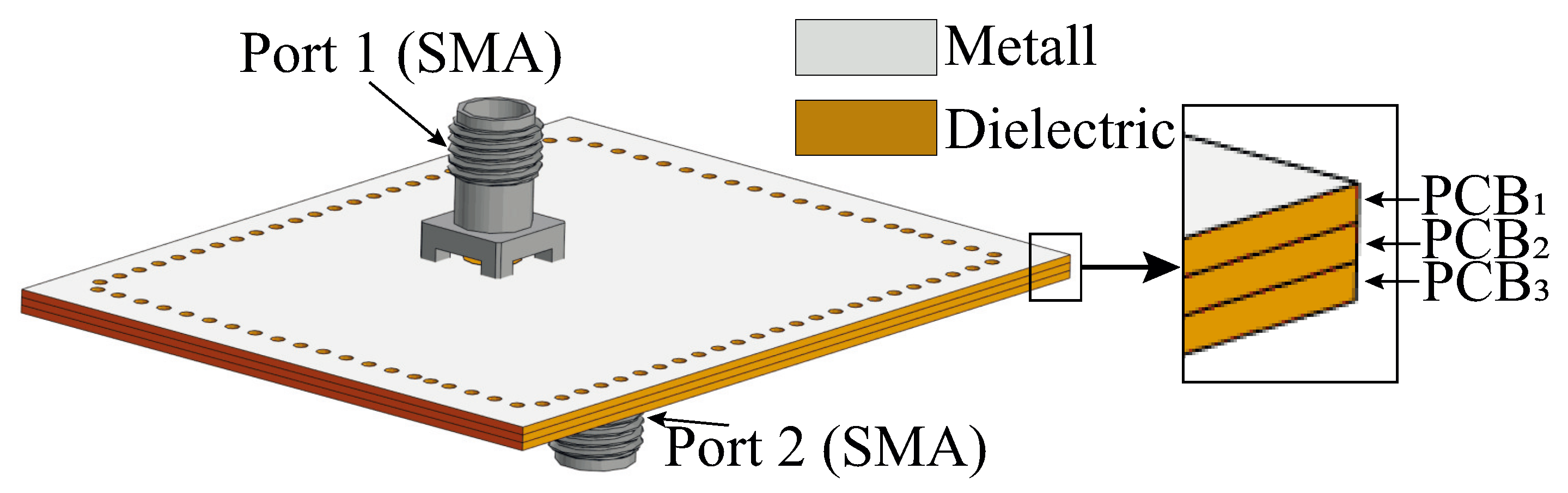
Figure 3.
Schematic of filter proyotype layers topology.
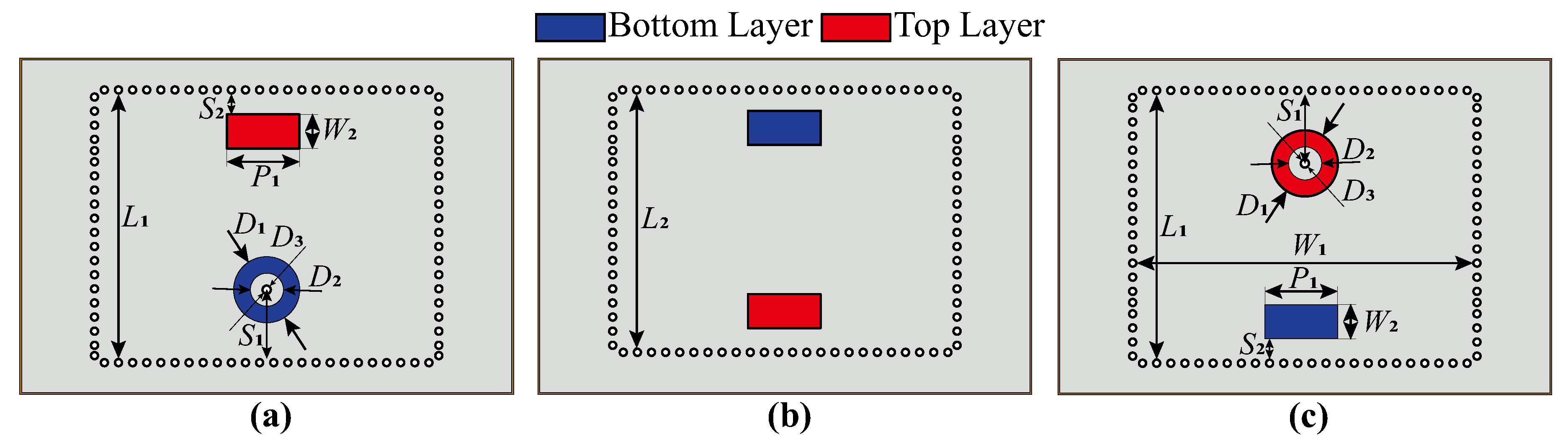
Figure 4.
Simulation results of filter prototype.
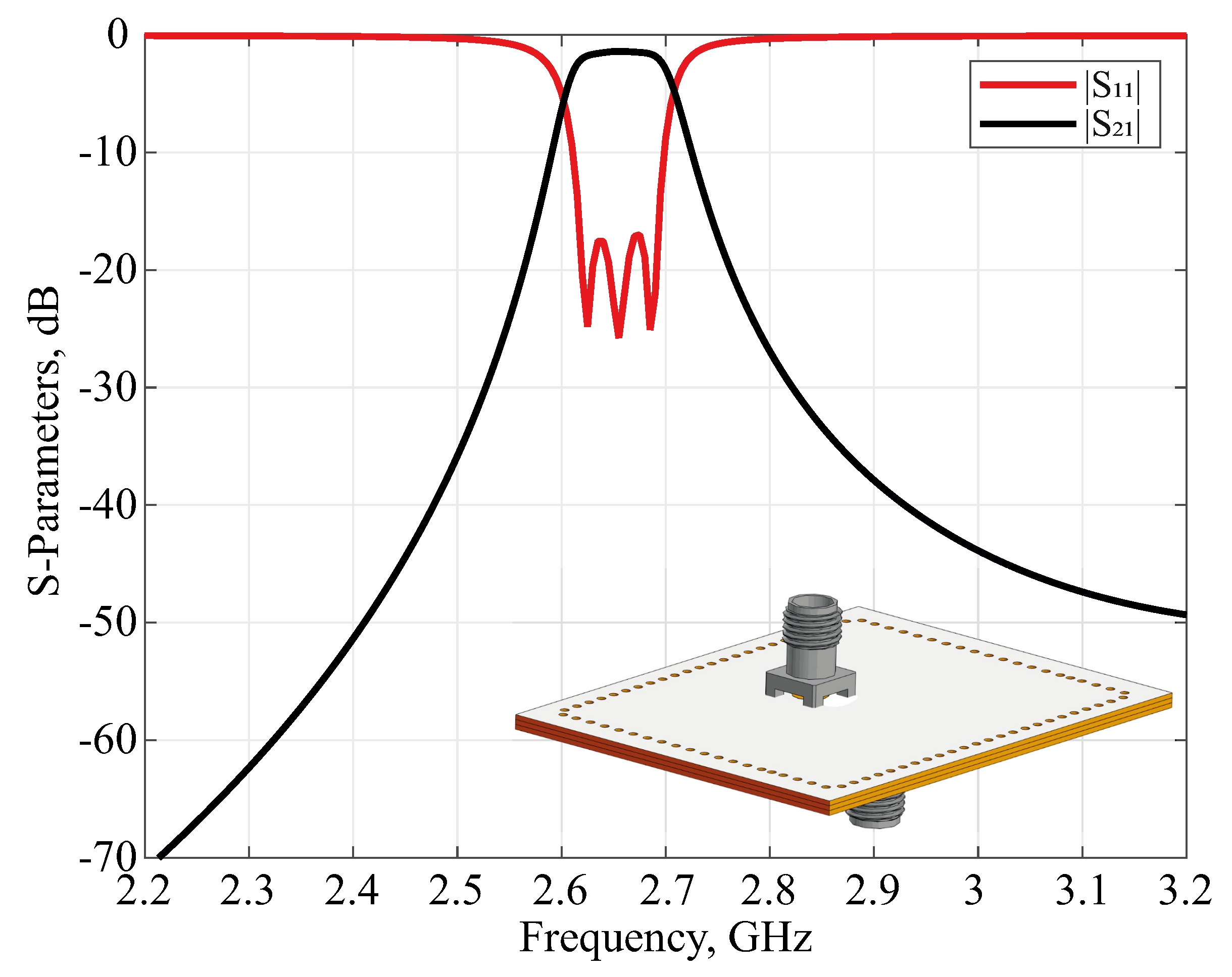
Figure 5.
Equivalent circuit of the filtenna based on SIW filter

Figure 6.
Top view – (a) and side view – (b) of filtenna model.
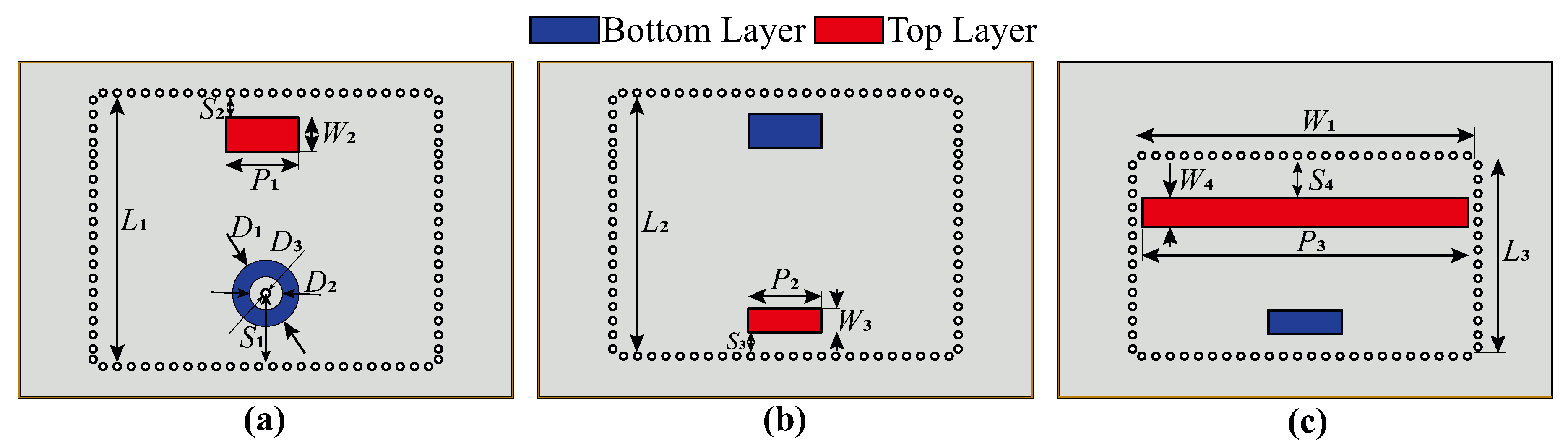
Figure 7.
Top view – (a) and side view – (b) of filtenna model.
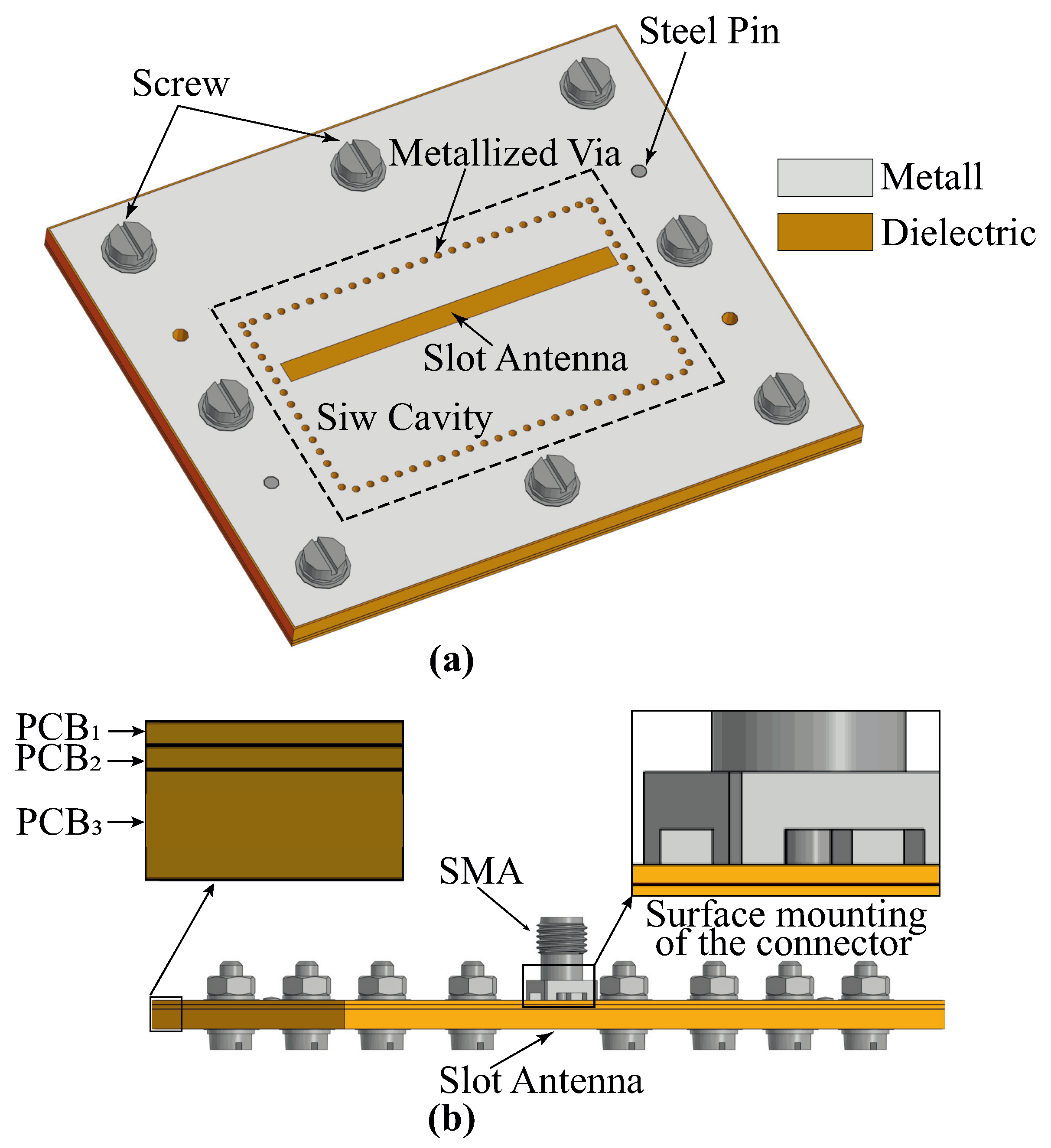
Figure 8.
Comparison of the simulation results of the SIW filter prototype – (a) and filtenna module – (b)
Figure 8.
Comparison of the simulation results of the SIW filter prototype – (a) and filtenna module – (b)
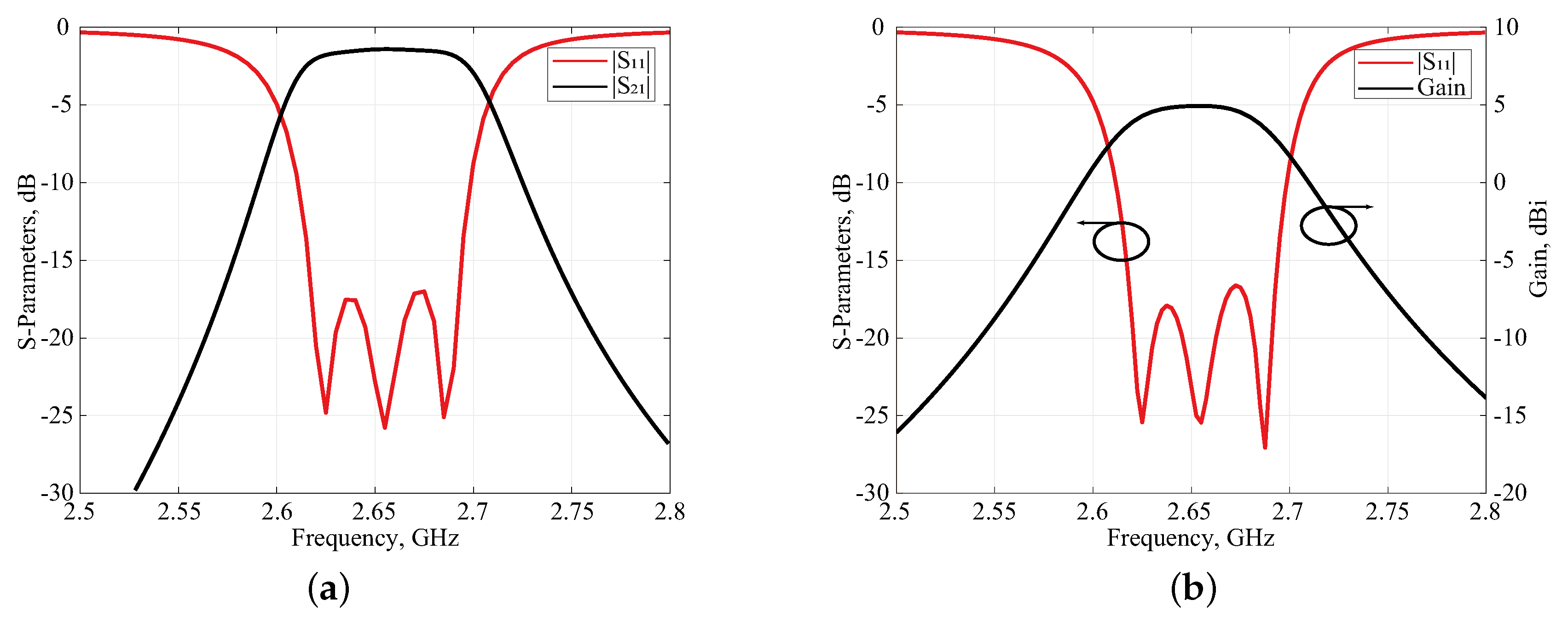
Figure 9.
Simulation results of cross coupling of the two filtenna modules
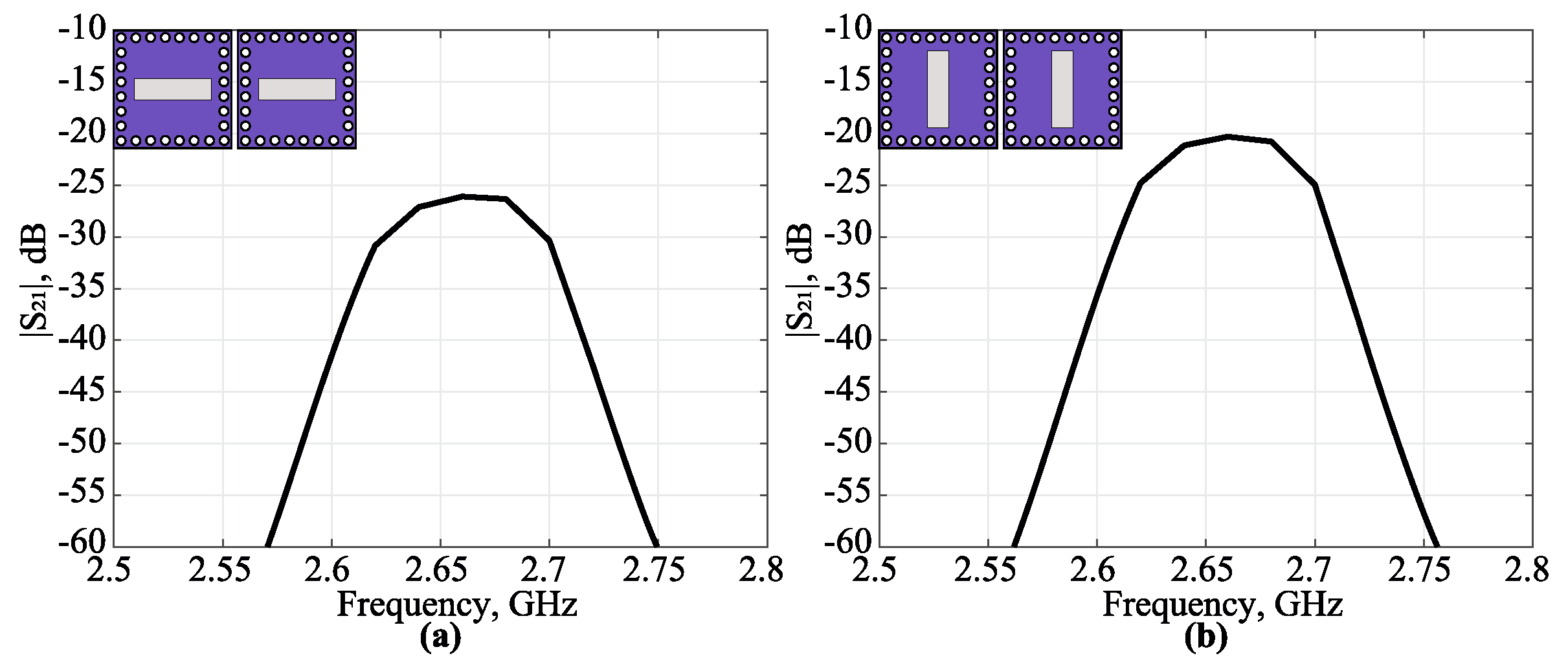
Figure 10.
Comparison of the radiation pattern of single module and 16-elements array
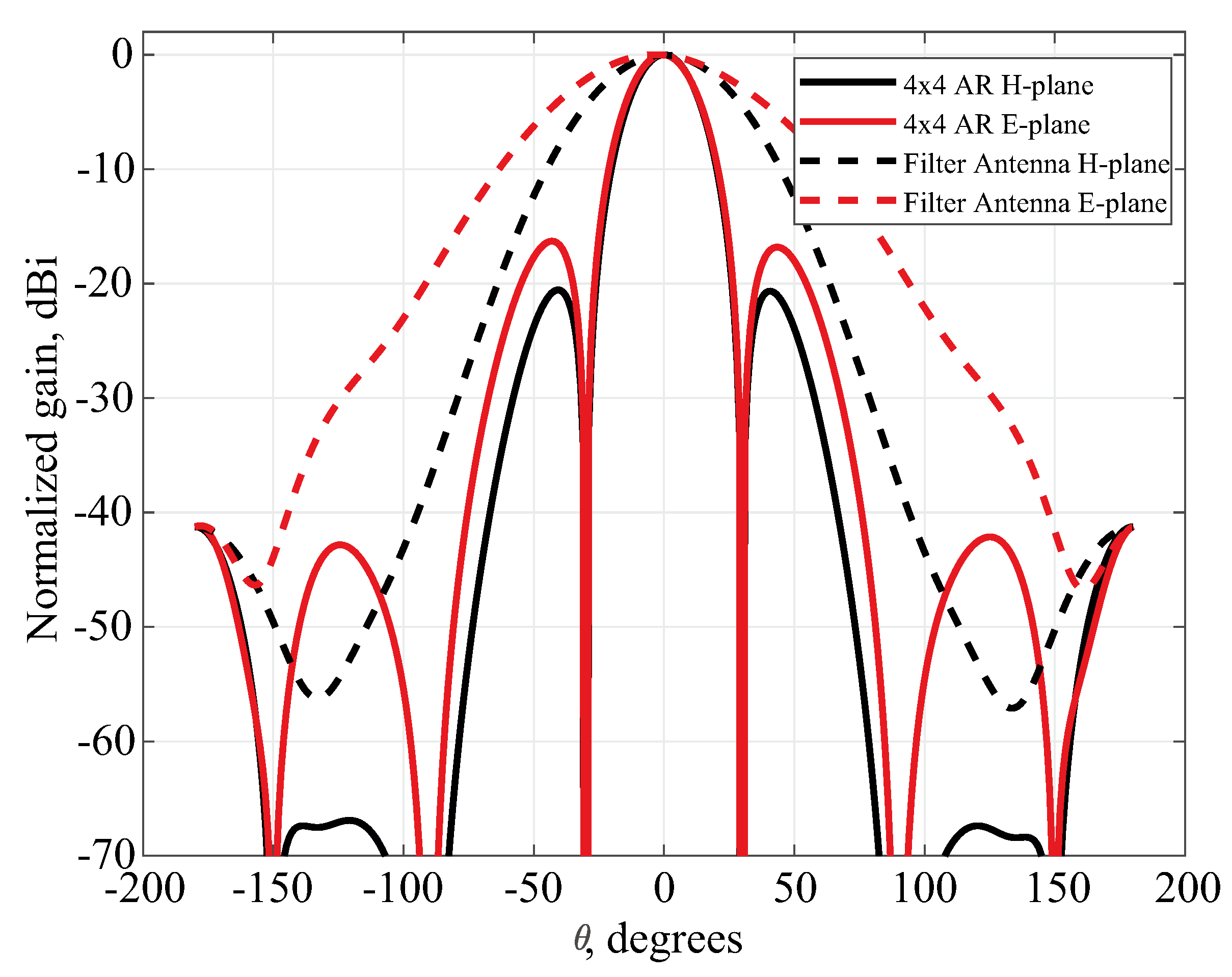
Figure 11.
Photos of the assembled filtenna module prototype in anechoic chamber
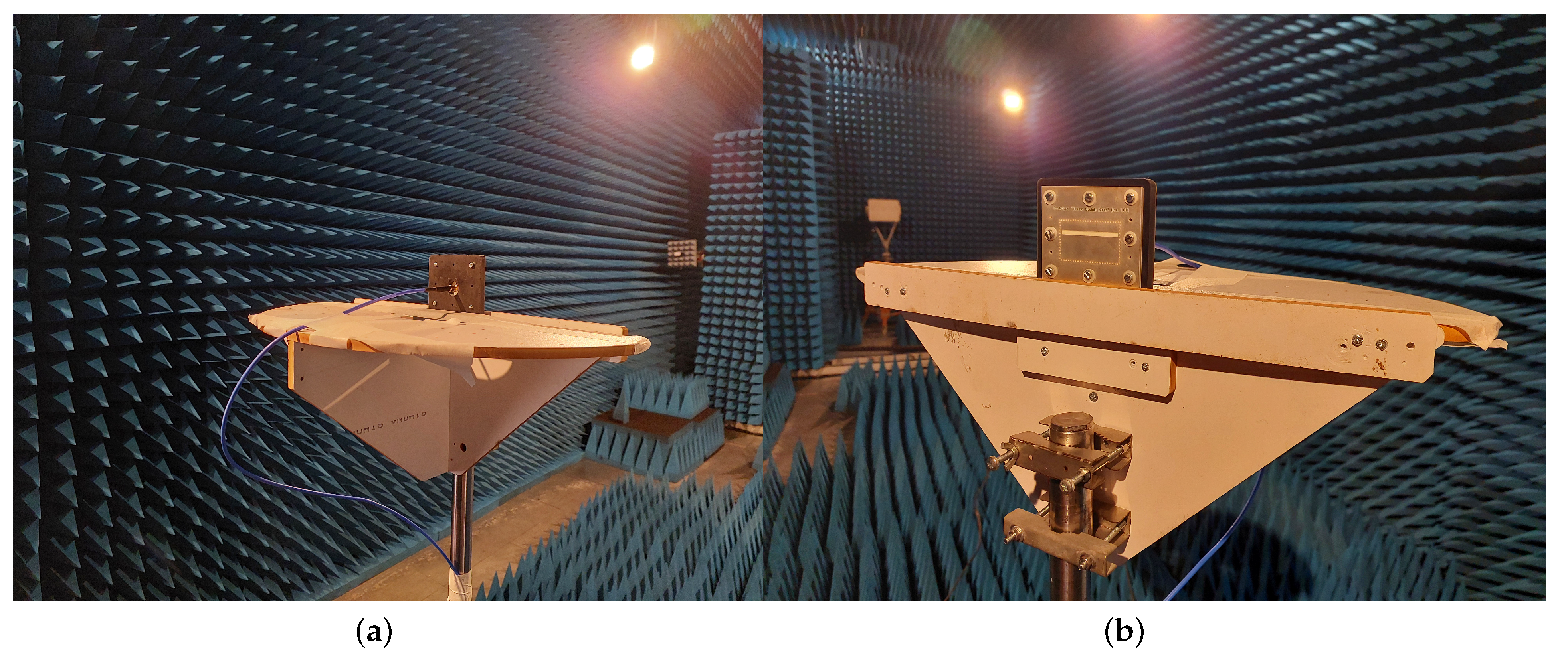
Figure 12.
Comparison of experimental results of filtennas gain and reflection coefficient on frequency with simulated ones
Figure 12.
Comparison of experimental results of filtennas gain and reflection coefficient on frequency with simulated ones
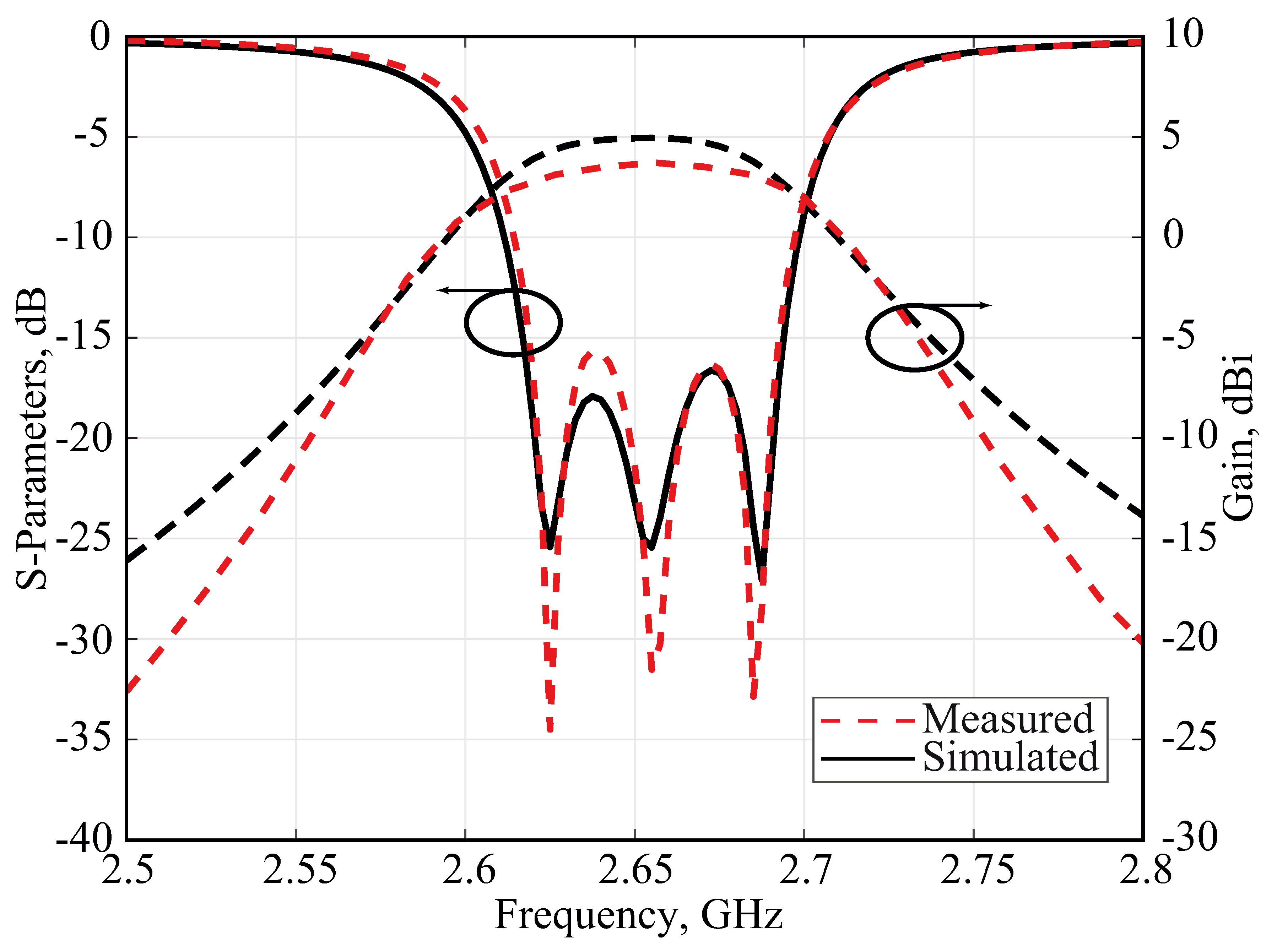
Figure 13.
Comparison of experimental and simulation results of filtenna’s gain at different frequencies
Figure 13.
Comparison of experimental and simulation results of filtenna’s gain at different frequencies
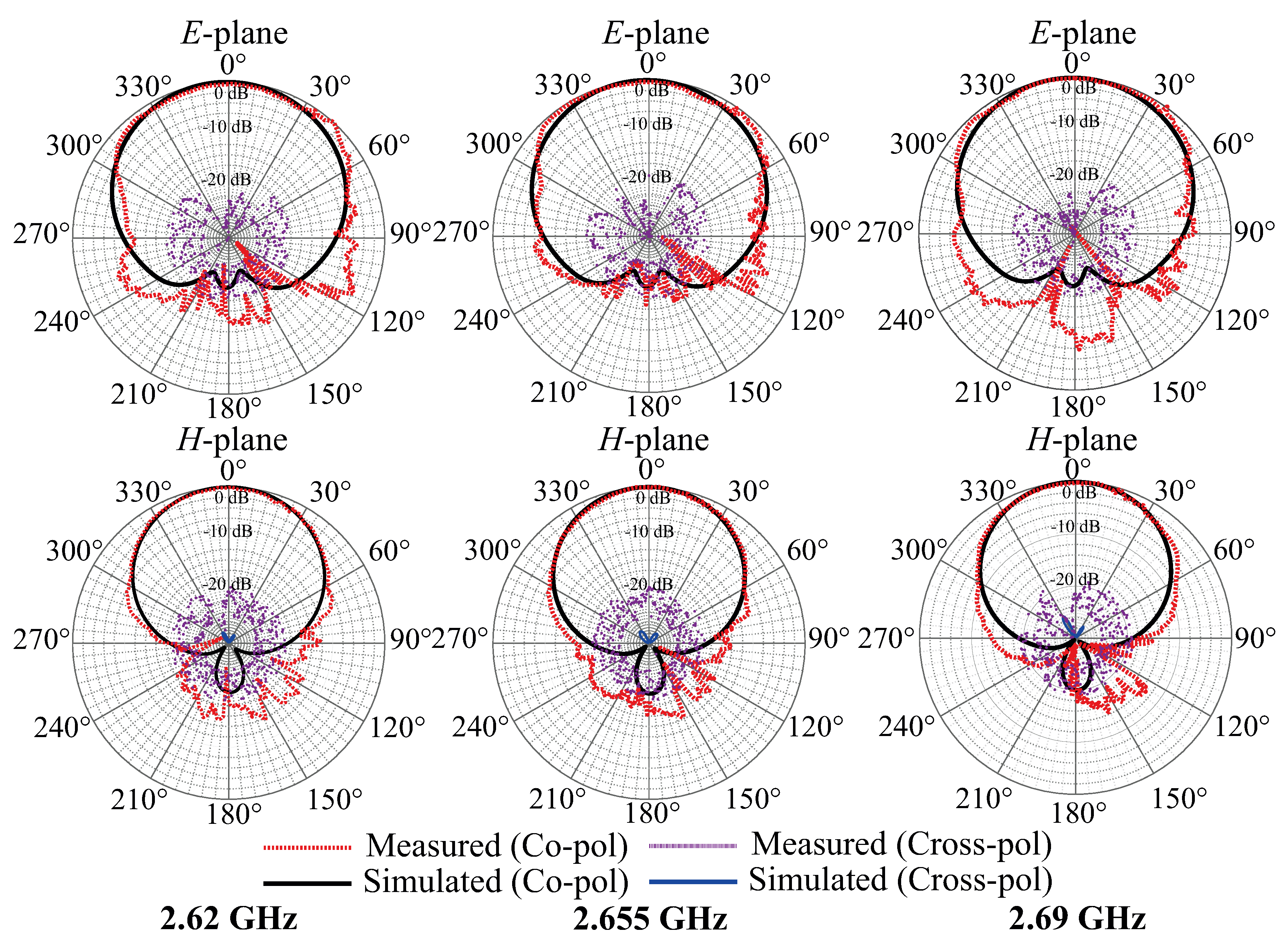

Table 1.
Dimensions of filter prototype elements.
| mm | mm | mm | mm | mm | mm | mm | mm | mm | mm |
|---|---|---|---|---|---|---|---|---|---|
| 38.15 | 36.84 | 4.5 | 2 | 47.8 | 3 | 8.96 | 4.22 | 1.27 | 0.5 |
Table 2.
Dimensions of filtenna elements.
| mm | mm | mm | mm | mm | mm | mm | mm | mm |
|---|---|---|---|---|---|---|---|---|
| 38.84 | 37.03 | 30.21 | 14.7 | 2 | 2 | 6.48 | 6.4 | 6.31 |
| mm | mm | mm | mm | mm | mm | mm | mm | |
| 46 | 4 | 2.1 | 0.5 | 48.8 | 3 | 2 | 3 |
Disclaimer/Publisher’s Note: The statements, opinions and data contained in all publications are solely those of the individual author(s) and contributor(s) and not of MDPI and/or the editor(s). MDPI and/or the editor(s) disclaim responsibility for any injury to people or property resulting from any ideas, methods, instructions or products referred to in the content. |
© 2025 by the authors. Licensee MDPI, Basel, Switzerland. This article is an open access article distributed under the terms and conditions of the Creative Commons Attribution (CC BY) license (http://creativecommons.org/licenses/by/4.0/).
Copyright: This open access article is published under a Creative Commons CC BY 4.0 license, which permit the free download, distribution, and reuse, provided that the author and preprint are cited in any reuse.


