1. Introduction
Methane (CH
4) emissions pose a significant global environmental challenge due to their profound impact on climate change and air quality. As a greenhouse gas, methane has a global warming potential (GWP) 28–36 times greater than carbon dioxide (CO₂) over a 100-year timeframe, making it a critical contributor to short-term climate forcing [
1,
2,
3]. Methane emissions originate from both natural sources, such as wetlands, and anthropogenic activities, including agriculture, oil and gas operations, and coal mining, which collectively account for approximately 60% of global methane emissions [
4,
5,
6]. Beyond its climate implications, methane also contributes to the formation of ground-level ozone, a harmful air pollutant linked to respiratory issues and ecosystem degradation [
7]. Addressing methane emissions has been identified as a rapid and cost-effective means of mitigating climate change, as reducing methane levels can yield immediate benefits for atmospheric cooling and public health [
8]. These factors highlight the pressing need for comprehensive mitigation strategies aimed at methane-intensive industries, such as coal mining, which continues to be a significant global emitter [
9,
10].
Poland’s energy sector is heavily dependent on coal mining, which not only supplies a significant portion of the country’s energy needs but also makes Poland one of the largest coal producers in Europe. This reliance comes at a considerable environmental cost, as coal mining is a major source of methane (CH
4) emissions. Methane released during coal extraction, both from active mining operations and abandoned sites, was responsible for over 752 million cubic meters of emissions annually in 2023, equating to approximately 53.57 million tons of CO₂ equivalent [
9]. In 2023, Poland’s total greenhouse gas emissions were approximately 406 million tons of CO₂ equivalent, with fugitive methane emissions from coal mining accounting for 53.57 million tons of CO₂ equivalent, representing 13.2% of the nation’s total emissions [
8]. Despite efforts to capture and utilize methane for energy generation, approximately 65% of emissions from coal mining operations in 2023 were still released into the atmosphere, exacerbating Poland’s climate impact and posing significant challenges in meeting European Union climate goals under the Methane Strategy and Green Deal initiatives [
8]. Addressing these emissions is therefore critical for Poland’s transition to a more sustainable energy framework and alignment with international climate targets. In 2023, methane emissions from coal mining operations, including both active and abandoned mines, were a significant contributor to Poland’s greenhouse gas inventory, accounting for approximately 13.2% of the nation’s total emissions, equivalent to 53.57 million tons of CO₂ equivalent, out of a total of 406 million tons of CO₂ equivalent [
8,
11]. Understanding the scale and sources of these emissions is essential for developing targeted mitigation strategies.
The primary purpose of this study is to analyze methane emissions from Polish coal mines, a critical concern for both environmental sustainability and compliance with international climate commitments. By focusing on comprehensive data collection and analysis, this study examines the pathways of methane release, including ventilation air methane (VAM) and coal mine methane (CMM), to quantify their contributions accurately. This analysis provides a foundation for addressing the dual challenge of reducing methane emissions while leveraging its potential as an energy resource, aligning with the EU Methane Strategy and the Global Methane Pledge [
9,
10,
11]. The study highlights the importance of integrating advanced monitoring technologies and methodologies, such as gas chromatography and real-time sensors, to enhance the precision and reliability of emissions data, thereby facilitating more effective mitigation measures. A critical purpose of this study is to evaluate the measurement methods used to quantify methane emissions in Polish coal mines, which is essential for accurate reporting and the development of effective mitigation strategies. Reliable measurement is the cornerstone of understanding methane emission dynamics, enabling compliance with international guidelines such as the UNECE Best Practice Guidance [
9,
10] and the IPCC methodologies [
5,
6]. This study assesses the effectiveness of current techniques, including gas chromatography, portable gas analyzers, and continuous monitoring systems, in capturing data on VAM and CMM emissions [
6]. Particular attention is given to the precision, scalability, and practicality of described methods in the context of Poland’s unique mining conditions, where methane concentrations can vary significantly between active and abandoned sites [
10,
12]. By comparing traditional approaches with emerging technologies, such as remote sensing and real-time monitoring, the study identifies gaps and opportunities for improvement. This evaluation aims to establish a robust framework for accurate methane quantification, ensuring emissions are reliably monitored, reported, and used to inform effective mitigation strategies.
Additionally, this study aims to explore innovative mitigation and utilization strategies to address methane emissions from Polish coal mines, focusing on both environmental impact reduction and resource optimization. Methane, a potent greenhouse gas, also represents a valuable energy resource when effectively captured and utilized. The study investigates cutting-edge technologies such as ventilation air methane oxidation, catalytic systems, and regenerative thermal oxidizers designed to handle low-concentration methane emissions typical of coal mining operations [
10,
13,
14]. Emphasis is placed on the economic feasibility and scalability of proposed technologies, as well as their compatibility with Polish mining conditions and infrastructure. By integrating case studies from projects, the research highlights practical pathways for methane utilization [
15,
16].
2. Materials and Methods
2.1. Detail the Data Sources
The foundation of this study is built upon critical reports and policies that provide a framework for understanding and addressing methane emissions from coal mining. The UNECE Best Practice Guidance for Effective Management of Coal Mine Methane [
9] establishes international standards for monitoring, reporting, verification, and mitigation of methane emissions, emphasizing the need for precision and innovation in measurement and capture technologies. This guideline provided crucial information and observations related to methane emissions, proposed mitigation measures, and available solutions for effective emission management. Complementing these is the European Union’s Methane Strategy, which outlines actionable steps to reduce methane emissions across sectors, including energy and mining. This strategy highlights the importance of aligning national efforts with global climate goals and prioritizing methane utilization to mitigate environmental impacts while contributing to energy security [
10,
17,
18]. These foundational documents guide the study’s methodology, ensuring it is rooted in robust data, international best practices, and policy relevance.
This paper relies on diverse data sources to ensure a comprehensive analysis of methane emissions from coal mines in Poland. All data used in this study comes from publicly available sources, such as KOBiZE reports, industry data, and project results, which ensures transparency and the possibility of verifying the results. Additional data was made available by cooperating entities from the mining sector, in full compliance with applicable data protection and confidentiality regulations. The primary dataset is derived from the KOBiZE National Inventory Reports [
8], which provide an extensive account of greenhouse gas emissions in Poland, detailing the contribution of methane from active and abandoned coal mines. These reports serve as a cornerstone for understanding national emission trends and evaluating compliance with international climate commitments [
8]. In addition, industry reports from major mining companies, such as Jastrzębska Spółka Węglowa S.A. (JSW), were used. These documents offer valuable insights into methane emissions from operational and abandoned mines, detailing the efficiency of ventilation and drainage systems [
12]. To complement above described sources, data from various project evaluations [
19,
20,
21] were included. These pilot studies are instrumental in understanding the practical applicability and scalability of advanced mitigation strategies under real-world mining conditions and provide critical information on the performance of innovative methane capture and utilization technologies.
2.2. The Methodologies for Methane Quantification
The methodologies for methane quantification focus on measuring emissions from VAM and CMM sources, employing advanced techniques for accuracy and reliability.
Gas chromatography is a primary method used to analyze methane concentrations in VAM, which typically range from 0.1% to 0.5%. This technique ensures precise detection and quantification of methane within complex air mixtures emitted from mine ventilation shafts [
22]. In mine workings, advanced measurement techniques allow for the monitoring of methane concentration and airflow rate. Methane emission control is crucial for ensuring safety and effective ventilation management. Methane concentration measurement is based on gas sensors using infrared (NDIR - Non-Dispersive Infrared) or catalytic detection technologies. These sensors are characterized by a measurement range from 0 to 5% CH
4 for low concentrations, typical for ventilation, and up to 100% CH
4 in methane drainage systems. Their accuracy is ±0.01% CH
4 in low concentrations and ±2% in high concentrations, and the response time is less than 10 seconds. Additionally, these devices are resistant to dust and moisture according to the IP67 standard, which allows for their reliable operation in difficult mining conditions [
23,
24,
25]. Air velocity is measured using ultrasonic or thermoanemometric anemometers. The measurement range is from 0.1 to 30 m/s, with an accuracy of ±0.1 m/s for low velocities and ±2% for higher values. The response time is less than 1 second, which allows for a quick response to changing conditions. These sensors operate in a wide temperature range, from -20°C to +50°C, making them suitable for mines. Based on the corridors’ dimensions and flow velocity, airflow volume is calculated. Methane concentration data and calculations of the airflow volume allow for the accurate determination of the amount of methane released into the atmosphere from mine ventilation. Such analysis is the basis for the design and evaluation of methane emission reduction systems and monitoring their effectiveness [
26,
27,
28,
29].
For CMM, which involves higher methane concentrations captured through drainage systems, real-time monitoring systems are employed. These systems utilize portable sensors and fixed monitoring units to provide continuous data on methane flow rates and purity, allowing for dynamic assessments of emission trends. Methane measurement at methane drainage stations is carried out using measuring devices that provide precise analysis of high methane concentrations and monitoring of gas flow parameters in variable drainage system conditions. Gas sensors based on nondispersive infrared sensors (NDIR) or acoustic technology enable accurate measurement of methane concentrations in the range of 0 to 100% CH
4. Anemometers, ultrasonic, and thermal flowmeters enable precise measurement of gas flow. These devices are compatible with SCADA and PLC systems, which enable remote monitoring and data reporting. Stationary monitoring systems, such as SIMTARS GasGuard or Dräger Polytron 8700, offer continuous measurement of CH
4, CO₂, and other gases and advanced data analysis. These devices are equipped with integrated data loggers and visual and acoustic alarms, which ensure continuous safety control, monitoring of the efficiency of methane drainage systems, and assessing the current efficiency of the systems in real-time. Data generated by the software was used for detailed analysis and assessment of the amount of methane emissions into the atmosphere [
24,
30].
Both methodologies are critical for understanding the scale and variability of methane emissions in Polish coal mines. The integration of these measurement techniques facilitates accurate emissions reporting and supports the evaluation of mitigation technologies tailored to varying methane concentrations.
3. Results
3.1. Methane Emission Trends in Polish Coal Mines
3.1.1. Quantified Methane Emissions data of Polish Mines
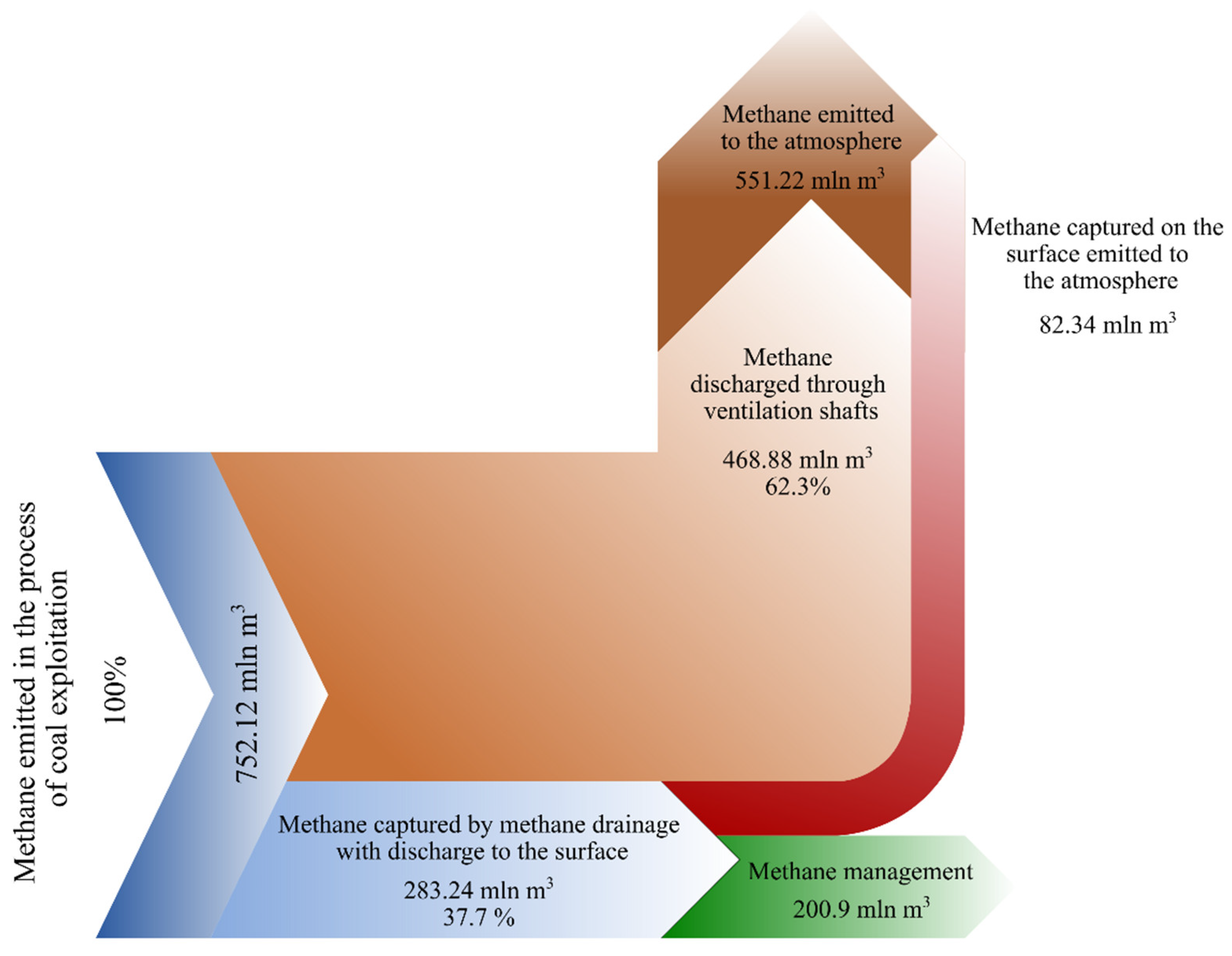
In 2023, methane emissions from Polish hard coal mines amounted to a total of 752.12 million cubic meters (m
3), released during coal extraction processes. Of this, approximately 551.22 million m
3, representing 73.3% of the total methane generated, was emitted directly into the atmosphere.
Figure 1 shows the methane emission balance in Polish hard coal mines in 2023.
The primary source of these emissions was ventilation air methane, accounting for 468.88 million m
3 or 61% of the total emissions [
12]. Methane captured through drainage systems totaled 283.24 million m
3, representing 37.7% of the methane released during mining activities. However, only 200.9 million m
3 was effectively utilized, primarily for energy production. Despite these efforts, 82.34 million m
3 of captured methane was still emitted into the atmosphere. These figures highlight the significant challenges associated with methane management in Polish coal mining, emphasizing the need for enhanced capture and utilization technologies to minimize environmental impact.
Table 1 presents methane emissions from individual Polish hard coal mines in 2023.
In the next stage, the locations of methane intake by the drainage system were analyzed. This data allows for a detailed analysis of the locations of methane intakes and their percentage share in the total emission each year. Data for 2021-2023 is presented in
Table 2.
In 2023, methane in Polish mines was mainly captured from three locations: mining workings, corridors (longwalls), and goafs behind dams. The data indicate that in 2023, 178.1 million m3 CH4/year came from mining workings, which was about 63% of the total methane capture. Methane captured from corridors (heads) amounted to 3.65 million m3 CH4/year, which was about 1.3%, while 101.49 million m3 CH4/year was captured from goafs behind dams, which was 35.7% of the total methane capture.
3.1.2. Emission Trends Over the Past Decade
Over the last decade, methane emissions from Polish coal mines have shown a general decreasing trend, which is the result of both reduced coal extraction and the implementation of more effective emission reduction methods. According to data from KOBiZE and industry reports, total methane emissions in 2013 amounted to 847.8 million m
3, and by 2023 they had fallen to 752.12 million m
3. In the same period, the amount of captured methane increased from 276.6 million m
3 in 2013 to 283.24 million m
3 in 2023, with methane utilization amounting to 187.7 million m
3 in 2013 and 200.9 million m
3 in 2023, respectively. The decrease in total methane emissions and the increase in the efficiency of capturing and managing this gas prove the effectiveness of the implemented technologies and actions aimed at reducing the impact of mining on the environment.
Table 3 presents data on total methane emissions from Polish hard coal mines in 2013–2022, taking into account the amount of captured and utilized methane and hard coal extraction in this period.
In 2021, 214.16 million m3 of CH4 was utilized, which was the highest value in the analyzed period. In 2022, this value dropped to 206.07 million m3 of CH4, and in 2023 it reached 200.9 million m3 of CH4. At the same time, the amount of unused methane decreased from 126.76 million m3 of CH4 in 2021 to 83.234 million m3 of CH4 in 2023. Such a reduction may indicate an improvement in the efficiency of methane drainage systems and a greater use of methane in energy processes. Despite the decrease in the total amount of captured methane (from 340.92 million m3 CH4 in 2021 to 283.24 million m3 CH4 in 2023), the data suggest that the share of gas intended for management is increasing, which may have a positive impact on reducing methane emissions to the atmosphere. Further optimization and investment in methane management technologies are key to achieving climate goals and minimizing the impact of mining on the environment. Compared to previous years, the share of methane captured from mining pits decreased (from 67.7% in 2022 to 63% in 2023), which may be the result of a decrease in extraction and changes in mining technology. On the other hand, the share of methane from goafs behind dams remained stable, indicating the continuing importance of this source in mine methane drainage systems. The above data emphasize the diversity of methane emission locations in hard coal mining and the need to adapt methane drainage technology to specific mine conditions. Despite the increases in the amount of captured methane in 2013–2016 (from 276.6 million m3 to 342.1 million m3), a gradual decrease was observed in subsequent years, reaching 303.5 million m3 in 2022. At the same time, the amount of methane utilized remained relatively stable, with minor fluctuations, ranging from 187.7 million m3 in 2013 to 206.1 million m3 in 2022. Hard coal extraction decreased significantly during this period – from 76.5 million tons in 2013 to 52.8 million tons in 2022, which contributed to the decrease in methane emissions over the years. The number of active mines has also decreased from 30 in 2013 to 20 in 2022, which is another factor limiting the total methane emissions in Polish mining. These trends indicate ongoing changes in the structure and technology of mining while increasing the efficiency of methane drainage systems.
3.1.3. Example of active Mine “Budryk”
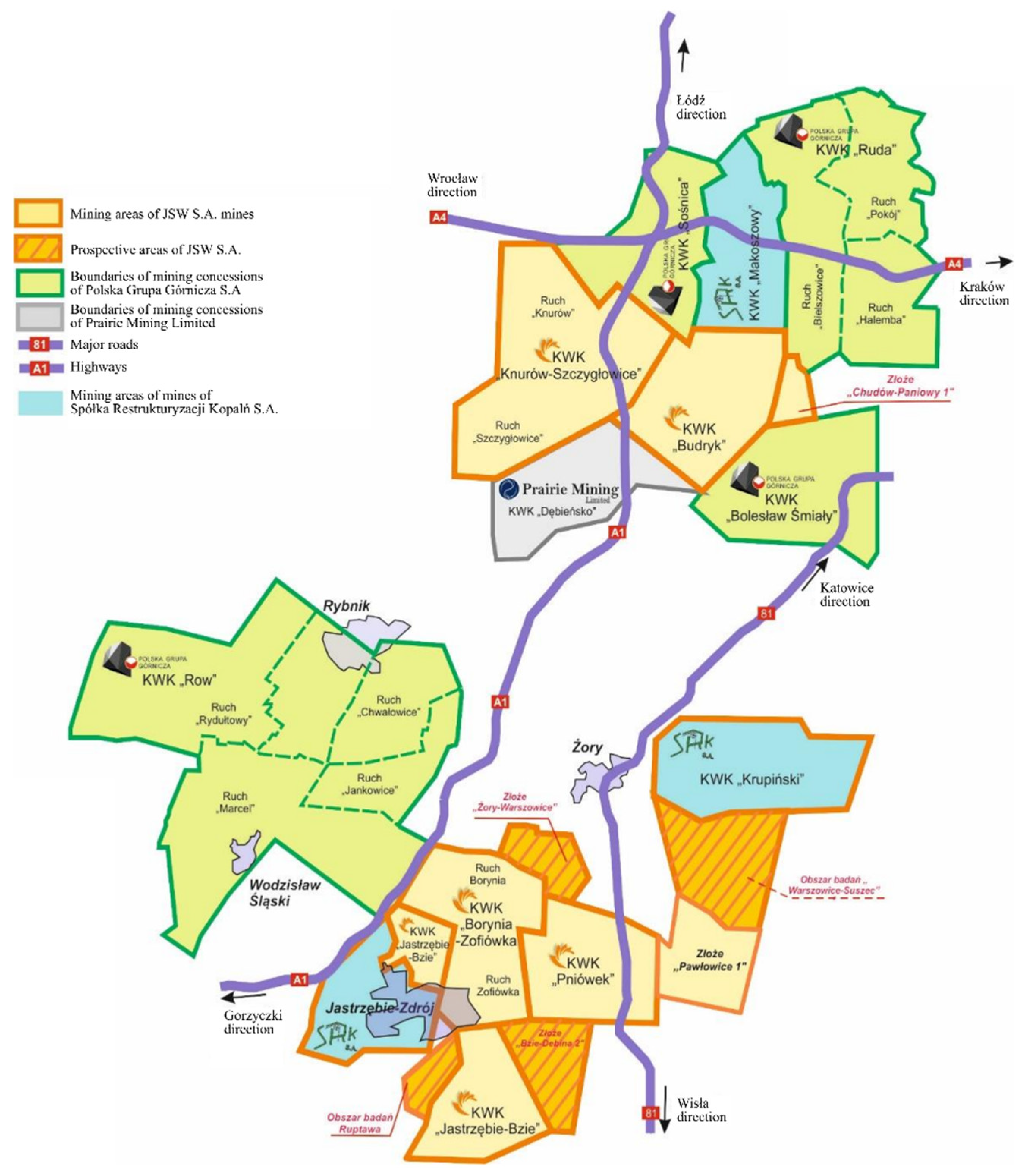
Jastrzębska Spółka Węglowa S.A. is one of the largest producers of hard coal and coking coal in Poland and Europe. JSW plays a key role in the domestic mining sector, supplying raw materials necessary for the metallurgical, steel, and energy industries. Coking coal produced by the company is a strategic raw material in metallurgical processes. JSW manages several mines, including the most methane-producing plants in Poland, such as KWK “Pniówek” KWK “Budryk”, KWK “Knurów-Szczygłowice” and KWK “Borynia-Zofiówka”. Thanks to investments in modern technologies and sustainable development, JSW is an important participant in the energy transformation in Poland.
Figure 2 shows the distribution of mining areas of mines belonging to Jastrzębska Spółka Węglowa S.A. and areas of prospective and strategic investments.
The example of the “Budryk” Coal Mine will show the current emission of methane into the atmosphere. It is one of the most modern mining plants in Poland, playing a key role in the exploitation of coking coal. The balance resources of the Budryk mine amount to approximately 1,364 million tons of hard coal, which makes it one of the largest mining plants in terms of available deposits in the region. The operational resources that can be extracted using current technology are estimated at 249.6 million tons. The exploitation in the “Budryk” Coal Mine takes place at great depths, reaching even 1,290 meters below the surface of the earth, which places it in the group of mines with the deepest extraction in Poland. “Budryk” Mine recorded significant methane emissions from the exploitation of hard coal deposits in 2021–2023. In 2021, absolute methane content amounted to 186.26 m3 CH4/min, which translated into annual emissions of 97.9 million m3, of which 91.38 m3/min was ventilation emissions, and 56.28 m3/min was captured in methane drainage processes, achieving an efficiency of 38.11%. In 2022, absolute methane content dropped to 147.66 m3 CH4/min, which translated into emissions of 77.61 million m3/year, reducing emissions by 20.29 million m3 compared to the previous year. In 2023, absolute methane content amounted to 191.48 m3 CH4/min, which translated into annual emissions of 100.64 million m3, which meant an increase in emissions by 23.03 million m3 compared to 2022.
In the “Budryk” Coal Mine, methane obtained in methane drainage processes is widely used in energy systems. The key directions of its management include:
Electricity production – The mine has installed JMS624GS-SL gas engines with a capacity of 2x4 MWel and gas systems with a capacity of up to 10 MWel, which enable the conversion of methane into electricity.
Heat generation – Part of the methane is used in boiler rooms to produce heat, which is used in technological and heating processes. This value is approximately 330.5 million m3 of methane per year.
External supplies – Approximately 12,254.7 million m3 of methane is supplied to the Heat Production Plant.
Based on data from previous years and assuming that the rate of change in emissions will correspond to the current trend, it is possible to estimate the forecasted methane emissions in the Budryk Mine until 2030. The results are presented in
Table 4..
By 2030, total methane emissions from the Budryk Coal Mine are expected to decrease by approximately 19.5 million m3/year compared to 2023 levels. This reduction reflects a steady year-on-year decline in both ventilation air and drainage methane emissions. In particular, greater emphasis should be placed on reducing VAM emissions, which traditionally constitute a significant portion of total emissions. The predicted decrease underlines the effectiveness of ongoing and planned methane mitigation strategies, such as improved methane capture technologies and increased operational efficiency.
In the case of the “Budryk” Coal Mine, which is characterized by one of the highest methane content among hard coal mines in Poland. In 2023, the mine recorded ventilation emissions of 101.92 m3/min, which indicates significant amounts of methane emitted directly into the atmosphere. To reduce VAM emissions, it is necessary to implement low-concentration methane capture technologies, such as catalytic oxidation or regenerative thermal oxidation systems, which can effectively convert VAM into electrical or thermal energy. However, this technology in industrial conditions (hard coal mines) is at the stage of pilot projects. In addition, the “Budryk” Coal Mine already has an infrastructure of gas engines with a total capacity of over 10 MW. The expansion of such systems and the optimization of existing cogeneration installations could significantly improve the efficiency of methane management. The next step should be to increase the efficiency of methane drainage (currently 46.77%) by using the drainage method using Long Reach Directionally Drilled Boreholes (LRDD). Finally, investments in real-time monitoring and data analysis systems will allow for better emission management and faster response to changing operating conditions. In the case of the “Budryk” Coal Mine, such actions may not only contribute to a significant reduction in methane emissions but also to better methane emission management. In addition, the “Budryk” Coal Mine already has an infrastructure of gas engines with a total capacity of over 10 MW. The expansion of such systems and the optimization of existing cogeneration installations could significantly improve the efficiency of methane management. The next step should be to increase the efficiency of methane drainage (currently 46.77%) by using the drainage method using Long Reach Directionally Drilled Boreholes (LRDD). Finally, investments in real-time monitoring and data analysis systems will allow for better emission management and faster response to changing operating conditions. In the case of the “Budryk” Coal Mine, such actions may not only contribute to a significant reduction in methane emissions but also to better methane emission management.
3.1.4. Example of abandoned Mine “Krupiński”
The “Krupiński” Coal Mine was one of the mines belonging to Jastrzębska Spółka Węglowa. It was established in 1983 and its operations were terminated in March 2017 as part of the restructuring of the mining sector, aimed at reducing unprofitable mining plants. This mine was characterized by difficult geological and mining conditions, which significantly affected the operating costs. The coal extracted in this mine was mainly of the energy type, with an average sulfur and ash content, which limited its competitiveness in the market. The “Krupiński” Mine remains an example of the difficulties associated with the exploitation of hard coal in conditions of high operating costs and a changing energy market. After the end of mining operations, the “Krupiński” Mine continues to effectively capture methane thanks to an advanced methane drainage system. The infrastructure based on pipelines of various diameters, including polyester-glass DN500 and DN400, enables the transport of the gas mixture from the dammed excavations to the surface, where the gas is sent to the methane drainage station. The station equipment includes a compressor unit with a capacity of 58.9 m3/min and five blowers, which allows for achieving a throughput of up to 200 m3/min. The monitoring system, including a chromatograph, CGT-02 turbine flow meters, and FCI thermal flow meters, ensures precise process management. The methane captured in the methane drainage system of the “Krupiński” Coal Mine is a key element of the local energy system, producing electricity and heat in a cogeneration system. The CHP plant equipment includes four gas engines driving generators with a total capacity of: 2.7 MW, 3.9 MW, 2 MW, and 2 MW. Additionally, the system includes: a WR 10 coal-gas water boiler, a PWPg-6 gas water boiler, and a WR 10 coal-fired water boiler.
Based on data from previous years and assuming that the rate of change in emissions will correspond to the current trend, it is possible to estimate the projected methane emissions in the “Krupiński” Mine until 2030. The results are presented in
Table 5.
Since 2017, the “Krupiński” Mine has been systematically operating in the area of methane capture. Analysis of the results allows us to see changes in the efficiency and concentration of gas, which is important in the context of methane drainage efficiency. In the analyzed period, there was a noticeable decrease in both the average efficiency of the methane drainage system and methane concentration. In 2017, the average efficiency for the gas mixture was 60.58 m3/min, of which 41.40 m3/min was pure methane, which translated into an annual amount of the captured mixture of 23,975,300 m3 and 16,387,200 m3 of methane. The average methane concentration this year was 69.0%. In 2018, despite the increase in the annual amount of captured gas mixture to 29,144,500 m3, the average efficiency of 100% methane dropped to 29.51 m3/min, and its annual amount decreased to 15,510,800 m3, with a decrease in the average methane concentration to 53.2%. 2017 is distinguished by the highest gas concentration (69%) and the amount of captured gas. In the following years, the concentration and amount of captured methane decreased.
3.2. Performance of Mitigation Technologies
Technologies for reducing methane emissions from hard coal mines include both the utilization of drainage methane and the use of methane from ventilation air. In the case of CMM, the most commonly used methods are gas engines, which convert methane into electrical and thermal energy. These systems are characterized by high conversion efficiency, especially at methane concentrations above 30%. Additionally, micro gas turbines are used, which are suitable for lower flows and methane concentrations, offering flexible solutions for smaller drainage installations. Other methods include methane compression and transmission systems to local gas networks or their use in industrial boilers for the production of process heat [
15].
For VAM, which is characterized by low methane concentration (0.1–0.5%), the most effective technologies are thermal and catalytic reactors. Regenerative thermal oxidizers (RTO) allow for efficient combustion of methane using recovered heat, which increases the energy efficiency of the process. Alternatively, catalytic oxidation systems, which operate at lower temperatures than RTO, offer the possibility of reducing emissions while limiting energy consumption. As part of innovative solutions, technologies for the capture and separation of methane from VAM using membranes are also being investigated, which can enable its concentration and further use. The evaluation of these technologies focuses on their efficiency, operating costs, and possibilities of integration with existing mine infrastructure [
31,
32].
3.2.1. Technology for Ventilation Air Methane
Ventilation air methane technologies focus on capturing and utilizing methane present in diluted concentrations within ventilation air from coal mines. The primary methods tested in pilot projects include Regenerative Thermal Oxidizers (RTOs) and Catalytic Oxidizers (CRTOs) [
33,
34,
35]:
RTO systems have demonstrated the capacity to treat methane concentrations as low as 0.2%, achieving flow rates exceeding 1,000,000 m3/h in modular configurations. These systems typically achieve methane destruction efficiencies between 85–95%. Scalability of RTO systems is high due to their modular design, which allows for customization based on mine airflow and methane concentration. Mines with higher ventilation airflows can implement multiple RTO units to scale up capacity, with global deployment in 15 projects, indicating strong adaptability to various operational conditions. However, operational costs and energy demands can limit scalability in smaller mines.
CRTO technology, while slightly less mature, offers advantages in terms of lower pressure drops (up to 30% lower compared to RTOs) and reduced ignition temperatures, operating efficiently at approximately 450°C. Methane destruction efficiencies for CRTO systems range from 92–98%, with better cost-effectiveness in low-flow or variable-flow environments. Scalability remains moderate as the technology is still in early deployment phases, with 8 pilot projects globally, including 3 in Poland, proving its potential for broader adoption. CRTO systems are particularly suited for medium-scale operations, where cost and operational flexibility are critical.
Both technologies demonstrate high efficiency in methane reduction and scalability potential, though infrastructure investment and operational cost optimization remain critical challenges for their widespread adoption.
3.2.2. Technology for Coal Mine Methane
Coal Mine Methane mitigation focuses on methane captured directly from coal seams during mining operations. Pilot projects have employed combined heat and power (CHP) systems, direct thermal utilization, and methanol production plants [
15,
35]:
CHP systems dominate this sector, with installations ranging in capacity from 30 kW to 55 MW, achieving methane utilization efficiencies of up to 60%. These systems are highly scalable, allowing for deployment in small-scale setups (e.g., single-mine applications) or large-scale configurations (e.g., regional power generation hubs). Globally, 53 operational CHP projects highlight the versatility and scalability of this technology, with 11 projects in Poland achieving efficiencies of up to 60%. The modularity of CHP systems supports scalability across a range of mine sizes and methane production rates.
Methanol production plants convert methane into methanol with utilization efficiencies ranging from 70–85%, depending on plant design and methane purity. While these plants are less scalable than CHP systems due to higher capital investment and infrastructure needs, they offer substantial long-term returns in regions with industrial demand for methanol. Globally, 7 pilot projects are operational, with 2 in Europe, showcasing scalability in areas with access to industrial markets.
Compressed natural gas (CNG) refueling stations achieve utilization efficiencies of approximately 85%. These stations are moderately scalable, depending on transportation infrastructure and proximity to end-users. A single station processes 2–5 million m3/year, making them suitable for targeted methane utilization in transportation hubs. Poland’s operational project highlights the potential for regional expansion in this sector.
3.2.3. Scalability of Projects
The scalability of methane mitigation technologies varies significantly based on operational scale, regional infrastructure, and market needs. RTO and CRTO systems are well-suited for large-scale mines with high airflow, while CHP systems offer the greatest flexibility across both small and large operations. Methanol production and CNG refueling stations provide niche scalability in regions with industrial or transportation demands. The modularity of RTO and CHP systems ensures adaptability to varying methane production rates, making them the most versatile options for widespread deployment. Improving scalability through cost reductions, modular designs, and infrastructure development will enable the coal mining sector to significantly enhance methane capture rates, contributing to a projected reduction in emissions of up to 75% by 2030.
3.2.4. Economic Feasibility of Technologies
In Poland, the economic feasibility of VAM technologies such as RTOs and CRTOs is influenced by the relatively high costs of initial investment and operational energy demands. RTO systems, despite their proven scalability and modular design, require significant capital investment, estimated at €2–5 million per unit, making them suitable for larger mines with substantial airflows. CRTO systems, while offering lower operational costs, are still in early deployment phases and require further optimization for wide-scale adoption. Financial support mechanisms such as subsidies, carbon credit schemes, and alignment with EU climate policies could enhance the adoption of VAM technologies in Polish mines. However, the economic feasibility heavily depends on methane concentration levels and airflow rates, which vary across mining operations in Poland.
The economic feasibility of CMM technologies in Poland depends on the ability to monetize captured methane through combined heat and power systems, methanol production, or CNG stations. CHP systems are particularly attractive, offering efficiencies of up to 60% and enabling co-generation of heat and electricity for nearby industrial facilities. For example, the integration of CHP systems in Polish mines like Budryk Mine has demonstrated returns on investment within 5–7 years, supported by the sale of electricity and heat. However, the feasibility of methanol production and CNG refueling stations is contingent on market demand and infrastructure development, which remains limited in Poland. State incentives and EU funding for methane utilization projects could further enhance the economic appeal of CMM technologies.
3.2.5. Environmental Benefits and Challenges of VAM and CMM Technologies
VAM technologies have a significant environmental impact by reducing methane emissions from ventilation air, which accounts for a large share of total emissions in Polish coal mines. RTO systems can reduce methane emissions by up to 95%, while CRTO systems achieve similar efficiency levels with lower energy demands, making them environmentally sustainable options. Implementing these technologies across mines like KWK Budryk and KWK Pniówek could lead to annual reductions of several hundred thousand cubic meters of methane, significantly contributing to Poland’s commitments under the EU Methane Strategy. However, energy consumption and potential CO₂ emissions from RTO operations must be carefully managed to avoid offsetting environmental benefits.
CMM technologies offer significant environmental benefits by capturing high concentrations of methane directly from coal seams, reducing emissions that would otherwise escape into the atmosphere. CHP systems, with methane utilization efficiencies exceeding 60%, can drastically lower methane emissions while producing renewable energy, aligning with Poland’s energy transition goals. Methanol production and CNG stations provide additional pathways for mitigating emissions, particularly in industrial and transportation sectors. However, flaring, often used as a fallback, emits CO₂ and negates the full environmental benefits of methane utilization. By prioritizing energy recovery solutions over flaring, Polish mines can significantly reduce their greenhouse gas footprint while contributing to EU-wide climate targets.
3.3. Scenario Analysis
3.3.1. Comparing Mitigation Strategies in Polish Conditions
In the context of Polish coal mining, implementing mitigation strategies aligned with the EU Methane Strategy and the Global Methane Pledge presents both opportunities and challenges. Deploying VAM technologies, such as RTOs, has the potential to reduce VAM emissions by up to 95%, translating to annual reductions of approximately 300–400 million m3 of methane if applied across key mines like KWK Budryk and KWK Pniówek. However, the high initial investment costs for RTO installations, estimated at €20–30 million per mine, and the extended timeline of 5–7 years for full deployment pose significant financial and logistical challenges. These constraints necessitate prioritization of mines with the highest VAM emissions.
Similarly, expanding the use of CMM technologies, including CHP systems, could lead to methane utilization rates exceeding 70%, resulting in reductions of 150–250 million m3 annually. For Polish mines, where much of the infrastructure is aging, the capital expenditure required for new CHP systems ranges between €10–15 million per unit, with deployment timelines averaging 3–5 years. While these technologies are economically feasible for larger operations, smaller mines may face barriers due to limited economies of scale and market access for methane-derived products.
The combined implementation of VAM and CMM technologies could reduce total methane emissions by up to 65–70%, aligning with the EU’s 30% methane reduction target by 2030. However, achieving this will require €200–300 million in total sector-wide investment and sustained governmental and EU funding support. Time constraints further complicate these efforts, as significant reductions must be realized within the next 5–10 years. Without accelerated policy frameworks, streamlined permitting processes, and financial incentives, meeting these ambitious goals may prove challenging. Poland’s dependency on coal mining and associated socio-economic considerations will also play a critical role in shaping the pace and scope of these mitigation strategies [
36].
3.3.2. Optimizing Methane Utilization for Energy Generation in Polish Conditions
In the Polish coal mining sector, scenarios optimizing methane utilization for energy generation offer significant potential to reduce atmospheric methane emissions while contributing to national energy security. Key technologies include combined heat and power systems, which convert CMM into electricity and heat, and emerging solutions like CNG production. These scenarios are particularly relevant for mines such as KWK Budryk and KWK Pniówek, where high CMM volumes (exceeding 150 million m3 annually in total) provide ample resources for energy recovery.
Optimized implementation of CHP systems could enable a methane utilization rate of 70–80%, producing up to 500 GWh of electricity annually across key mines. For Poland, where coal remains a dominant energy source, this represents an opportunity to transition toward cleaner energy generation while leveraging existing mining infrastructure. However, achieving these outcomes requires substantial investments, with costs for individual CHP installations ranging from €10–15 million per mine and deployment timelines of 3–5 years per site. These costs could be mitigated through EU funding mechanisms such as the Just Transition Fund, which supports projects in coal-dependent regions.
For VAM emissions, technologies like RTOs and CRTOs offer potential for reducing atmospheric impacts. Although these systems are not directly tied to energy generation, their ability to significantly mitigate methane emissions (by up to 95%) can complement energy-focused strategies by creating a more comprehensive emission reduction framework. The initial capital required for RTO systems—approximately €20–30 million per mine—poses a financial challenge but is feasible within a 5–7-year timeline with strategic public-private partnerships and policy support.
Scenarios focusing on energy generation and methane reduction could reduce total emissions by 60–70% while generating economic value through energy sales and industrial applications. However, achieving these goals requires addressing barriers such as the aging infrastructure of Polish mines, limited market access for methane-derived products, and administrative delays in project approvals. By aligning national policies with EU strategies and leveraging available funding, Poland can feasibly implement these scenarios within a decade, significantly enhancing both environmental and economic outcomes.
3.3.3. China’s Experience in Managing Methane Emissions From Coal Mines
China has demonstrated significant advancements in managing methane emissions from coal mines, offering valuable insights for global mitigation strategies. The implementation of advanced methane capture and utilization technologies, particularly in high-emission regions like Shanxi and Inner Mongolia, highlights China’s commitment to addressing CMM and VAM emissions. Over 30 large-scale projects have been deployed across the country, utilizing technologies such as RTO and CRTO systems, achieving methane destruction efficiencies exceeding 95%. Notable projects include the “Shanxi Lu’an Group Methane Utilization Project” and the “Datong Coal Mine Group VAM Oxidation Demonstration Plant,” which have significantly reduced methane emissions while contributing to local energy systems [
37]. Moreover, China has successfully integrated CMM capture with energy recovery systems, such as CHP plants, in over 40 installations nationwide. These systems have proven economically viable in areas with high methane concentrations and have generated over 2,000 GWh of electricity annually, providing energy security for industrial and residential use. Pilot projects, such as the “Guizhou Methanol Production from CMM” and the “Fushun CMM-to-LNG Demonstration Plant,” have demonstrated the potential for diversifying methane utilization pathways to address industrial and transportation demands [
38].
China’s large-scale operations underscore the challenges of deploying these technologies in older mines with variable methane concentrations and less robust infrastructure. However, the success of projects like the “Jincheng Anthracite Mining Group VAM Project”, which combines advanced VAM technologies with renewable energy solutions, illustrates the potential for innovative integration [
38].
China’s experience offers a model for countries like Poland, where coal mining remains a significant contributor to methane emissions. By adapting China’s approach to local conditions, including leveraging modular technologies and scaling pilot projects, Poland can enhance its methane management framework while contributing to EU-wide emission reduction targets under the Methane Strategy. The success of these initiatives in China highlights the importance of strong policy support, financial incentives, and international collaboration in overcoming technical and economic barriers to large-scale implementation [
39].
3.3.4. US Approach to Managing Coal Mine Methane Emissions
The United States has implemented several initiatives to manage methane emissions from coal mines, focusing on both active and abandoned sites. Methane, a potent greenhouse gas, is released during coal mining operations and from abandoned mines, contributing significantly to climate change.
The U.S. Department of Energy (DOE) has established the Methane Mitigation Technologies program, which aims to develop accurate, cost-effective, and efficient solutions to identify, measure, monitor, and eliminate methane emissions from the oil, gas, and coal sectors. This program supports the Administration’s mission to address climate change by targeting methane, which accounts for about 20% of global emissions. Research efforts include developing advanced materials for pipeline construction, monitoring sensors, data management systems, and more efficient compressor stations [
33]. The Advanced Research Projects Agency–Energy (ARPA-E) launched the Reducing Emissions of Methane Every Day of the Year (REMEDY) program, focusing on reducing methane emissions from the oil, gas, and coal value chains. The program addresses methane emissions from sources such as coal mine ventilation air methane exhausted from operating underground mines. REMEDY seeks to develop technologies that can be rapidly scaled to various applications, including lean-burn, large-bore natural gas engines, aiming to reduce methane emissions by 20% to 60% [
38]. The DOE has funded projects focused on innovative methane measurement, monitoring, and mitigation. For example, the Southwest Research Institute in San Antonio, Texas, is working on reducing methane emissions with an engine fuel reformer. The objective is to reform an engine’s natural gas fuel feed into a hydrogen-containing fuel mixture that maximizes methane oxidation during combustion, aiming to reduce methane emissions by 20% to 60% using a cost-effective modular approach [
35]. The Environmental Protection Agency (EPA) runs the Coalbed Methane Outreach Program, which encourages the recovery and use of methane from coal mines. This program helps the mining industry find ways to use or sell methane that would otherwise be released into the atmosphere, thereby reducing greenhouse gas emissions and improving mine safety. The DOE’s Office of Clean Energy Demonstrations has selected and awarded projects under the Clean Energy Demonstration Program on Current and Former Mine Land. These projects aim to repurpose former mine lands for clean energy development, such as solar energy installations, contributing to economic revitalization and emission reductions in former coal communities.
4. Discussion
The effective management of methane emissions holds profound implications for Poland’s energy and environmental policies. Methane, being a potent greenhouse gas, significantly contributes to the country’s carbon footprint, particularly from the coal mining sector. By advancing methane capture and utilization technologies, such as combined heat and power systems for CMM and regenerative thermal oxidizers for VAM, Poland can align its industrial practices with the EU Methane Strategy and the Global Methane Pledge. Such measures not only aid in reducing emissions but also enhance energy security by utilizing methane as a resource for electricity and heat generation. However, the economic and technical challenges of deploying these technologies, especially in older mining infrastructures, require substantial investment and policy support. Incentives like carbon credits and EU funding can facilitate the transition. Furthermore, achieving these goals necessitates integrating advanced monitoring systems and scaling up pilot projects into full-scale implementations to ensure sustainability and compliance with international climate commitments. Future research should focus on optimizing these technologies for broader application in Polish coal mines.
Scaling methane mitigation technologies in Poland faces several challenges, particularly in the context of the country’s aging mining infrastructure and economic constraints. While technologies such as RTOs and CHP systems have proven effective in pilot projects, their widespread deployment requires significant upfront investment. Economic barriers, such as high installation costs and the uncertain return on investment, deter coal mining companies from adopting these technologies at scale. Additionally, technical challenges, such as adapting advanced systems to variable methane concentrations in VAM or efficiently capturing CMM in older mines, further complicate implementation. To overcome these obstacles, targeted policy interventions are essential, including subsidies, tax incentives, and access to low-interest loans. Moreover, enhancing cross-sector collaboration and utilizing EU funding mechanisms, such as those aligned with the European Green Deal, can provide financial and technical support. Addressing these challenges requires not only financial incentives but also robust research and development efforts to optimize technology performance and reduce costs, ensuring scalability across Poland’s coal mining sector.
Polish strategies for methane capture and utilization align with global best practices in several areas but also highlight areas for improvement. Globally, countries like Australia and the United States have achieved significant advancements in methane management through comprehensive policies, cutting-edge technologies, and cross-sector collaboration. For example, the U.S. has leveraged federal tax incentives and robust public-private partnerships to deploy advanced VAM oxidation technologies and CHP systems. Similarly, Australia’s focus on integrating methane capture into its national emissions reduction framework has led to widespread adoption of modular systems for CMM utilization. In Poland, while efforts have been made to implement similar technologies, economic constraints and reliance on aging infrastructure have limited scalability. The Polish approach primarily relies on in-mine methane drainage systems and surface cogeneration units, which, although effective, lack the flexibility and integration seen in global practices. To bridge this gap, Poland can benefit from adopting strategies such as incentivizing innovation through tax breaks, expanding international collaborations, and aligning national policies with global methane reduction goals like the Global Methane Pledge. Future research should explore the adaptation of global practices to Poland’s unique geological and economic conditions, ensuring sustainable and scalable methane management solutions.
5. Conclusions
Advancing methane management technologies and policies is crucial for Poland to align its coal mining practices with global climate commitments and to mitigate the environmental impact of methane emissions. Methane, with its high global warming potential, poses an urgent challenge for the country’s carbon-intensive energy sector. Current technologies, such as combined heat and power systems, catalytic oxidation, and regenerative thermal oxidizers, have demonstrated significant potential to reduce emissions. However, their deployment remains limited by high capital costs, scalability challenges, and policy inefficiencies. Strengthening regulatory frameworks, incentivizing innovation, and streamlining investment processes are essential to facilitate widespread adoption of these technologies. Enhanced policies should also focus on integrating methane utilization into Poland’s renewable energy strategy, transforming methane from an environmental liability into a valuable resource. This dual approach will ensure Poland’s progress towards EU climate goals while fostering technological advancements that could serve as a model for other coal-dependent economies. Future research should prioritize improving the efficiency and economic feasibility of methane capture systems, ensuring that these advancements contribute to both national and global climate objectives.
Key findings from this analysis reveal substantial potential for methane emission reduction in the Polish coal mining sector, particularly through the adoption of advanced technologies and alignment with international climate objectives. In 2023, methane emissions from KWK “Budryk” were recorded at 100.64 million m3 annually, with a capture efficiency of 46.77%, highlighting significant room for improvement in methane utilization. Similarly, KWK “Krupiński,” despite its closure, demonstrated effective methane capture, with 16.39 million m3 of methane (100%) utilized in 2017 and decreasing to 12.15 million m3 by 2019.
The adoption of technologies like catalytic oxidation or combined heat and power systems could elevate methane utilization in these mines and others across Poland. For instance, in KWK “Budryk,” where 53.57 million m3/year of methane was emitted through ventilation, implementing VAM-specific technologies could recover a significant proportion of this gas for energy production. At KWK “Krupiński,” the captured methane is already used for power and heat generation, demonstrating a viable model for post-closure mine management. By leveraging these technologies, Poland has the potential to significantly reduce its methane emissions from coal mining, contributing to global climate targets under the EU Methane Strategy and Global Methane Pledge. With targeted investments, these innovations could increase methane capture efficiency in mines like KWK “Budryk” to over 60%, aligning with international best practices and demonstrating the sector’s commitment to sustainability. Such measures also underscore the importance of scaling these technologies to fully capitalize on their environmental and energy-related benefits.
Author Contributions
Conceptualization, MB and JC; methodology, MB and KZG; software, JC; validation, MB, KZG, and JC; formal analysis, KZG; investigation, MB and JC; resources, MB; data curation, KZG; writing—original draft preparation, MB and JC; writing—review and editing, MB, KZG, and JC; visualization, KZG; supervision, MB; project administration, MB; funding acquisition, JC.
Funding
This research received no external funding.
Data Availability Statement
The data analyzed in this study are included in the article. Further inquiries can be directed to the corresponding author
Conflicts of Interest
The authors declare no conflicts of interest.
Abbreviations
The following abbreviations are used in this manuscript:
| CHP |
Combined Heat and Power |
| CMM |
Coal Mine Methane |
| CNG |
compressed natural gas |
| CRTO |
Catalytic Regenerative Thermal Oxidizer |
| GHG |
Greenhouse Gas |
| GWP |
Global Warming Potential |
| JSW |
Jastrzębska Spółka Węglowa S.A. |
| KOBiZE |
National Balancing and Emissions Management Center, Poland |
| LRDD |
Long Reach Directional Drilling |
| NDIR |
Non-Dispersive Infrared |
| RTO |
Regenerative Thermal Oxidizer |
| VAM |
Ventilation Air Methane |
References
- EPA. Greenhouse gas emissions reporting from the petroleum and natural gas industry. Background technical support document. U.S. Environmental Protection Agency, Washington, DC, 2010. Available online: http://www.epa.gov/climatechange/emissions/downloads10/Subpart-W_TSD.pdf (accessed on 24 October 2024).
- Howarth, R. W.; Santoro, R.; Ingraffea, A. Methane and the greenhouse gas footprint of natural gas from shale formations. Clim. Change Lett. 2011, 106, 679–690. [CrossRef]
- U.S. Environmental Protection Agency Office of Inspector General. EPA needs to improve air emissions data for the oil and natural gas production sector. EPA OIG, Washington, DC, 2013.
- IPCC. Climate Change 2013: The Physical Science Basis. Contribution of Working Group I to the Fifth Assessment Report of the Intergovernmental Panel on Climate Change; Stocker, T.F.; Qin, D.; Plattner, G.-K.; Tignor, M.; Allen, S.K.; Boschung, J.; Nauels, A.; Xia, Y.; Bex, V.; Midgley, P.M., Eds.; Cambridge University Press: Cambridge, UK, and New York, NY, USA, 2013; pp. 1–1535. Available online: https://www.ipcc.ch/report/ar5/wg1/.
- United Nations Environment Programme and Climate and Clean Air Coalition (UNEP/CCAC). Global Methane Assessment: Benefits and Costs of Mitigating Methane Emissions. Nairobi: United Nations Environment Programme, 2021.
- IPCC. Climate Change 2021: The Physical Science Basis. Contribution of Working Group I to the Sixth Assessment Report of the Intergovernmental Panel on Climate Change; Masson-Delmotte, V., Zhai, P., Pirani, A., Connors, S., Péan, C., Berger, S., et al., Eds.; Cambridge University Press: Cambridge, UK, and New York, NY, USA, 2021; pp. 1–3949. Available online: https://www.ipcc.ch/report/ar6/wg1/ (accessed on 14 January 2024).
- Shindell, D.; Kuylenstierna, J.C.; Vignati, E.; van Dingenen, R.; Amann, M.; Klimont, Z.; Anenberg, S.C.; Muller, N.; Janssens-Maenhout, G.; Raes, F.; Schwartz, J.; Faluvegi, G.; Pozzoli, L.; Kupiainen, K.; Höglund-Isaksson, L.; Emberson, L.; Streets, D.; Ramanathan, V.; Hicks, K.; Oanh, N.T.; Milly, G.; Williams, M.; Demkine, V.; Fowler, D. Simultaneously mitigating near-term climate change and improving human health and food security. Science 2012 13;335(6065):183-9. [CrossRef]
- KOBiZE. Poland’s National Inventory Report 2024: Greenhouse Gas Inventory for 1988–2022. Ministry of Climate and Environment: Warsaw, Poland, 2024. (accessed on 4 February 2024).
- United Nations Economic Commission for Europe (UNECE). Best Practice Guidance for Effective Management of Coal Mine Methane at National Level: Monitoring, Reporting, Verification and Mitigation; ECE Energy Series No. 71; United Nations: Geneva, Switzerland, 2021.
- United Nations Economic Commission for Europe (UNECE). Best Practice Guidance for Effective Methane Drainage and Use in Coal Mines; ECE Energy Series No. 47; United Nations: Geneva, Switzerland, 2016.
- Saunois, M.; Stavert, A.R.; Poulter, B.; et al. The global methane budget 2000–2017. Earth Syst. Sci. Data 2020, 12, 1561–1623. [CrossRef]
- Główny Instytut Górnictwa. Metan z Pokładów Węgla: Wykorzystanie i Zasoby; Główny Instytut Górnictwa: Katowice, Poland, 2023.
- Liu, Y.; Gao, H.; Yu, Z.; et al. Managing Methane Emissions in Abandoned Coal Mines: Comparison of Different Recovery Technologies by Integrating Techno-Economic Analysis and Life-Cycle Assessment. Environ. Sci. Technol. 2023, 56, 13900–13908. [CrossRef]
- IEA. Driving Down Coal Mine Methane Emissions: A Rapid and Cost-Effective Route to Achieving Climate Goals; International Energy Agency: Paris, France, 2021.
- Nawrat, S.; Kuczera, Z.; Łuczak, R.; Życzkowski, P.; Napieraj, S.; Gatnar, K. Utylizacja Metanu z Pokładów Węgla w Polskich Kopalniach Podziemnych; Uczelniane Wydawnictwa Naukowo-Dydaktyczne: Kraków, Poland, 2009; ISBN 978-83-7464-213-2.
- Borowski, M.; Szmuk, A.; Krokos, K. Integration of Modern Visualization and Simulation Technologies in the Optimization of Ventilation Systems in Underground Mining—A Case Study. Presented at the 12th School of Mining Aerology, Kraków, Poland, 2024.
- European Commission. European Union Methane Action Plan. Regulation (EU) 2021/1119 of the European Parliament and of the Council on establishing the framework for achieving climate neutrality and amending Regulations (EC) No 401/2009 and (EU) 2018/1999 (European Climate Law). European Union: Brussels, Belgium, 2021. Available online: https://ec.europa.eu/clima/eu-methane-strategy.
- European Commission. Methane Strategy for a Climate-Neutral Europe. European Commission: Brussels, Belgium, 2020. Available online: https://ec.europa.eu/methane-strategy (accessed on 5 February 2024).
- Nwabueze, Q.A.; Leggett, S. Advancements in the Application of CO2 Capture and Utilization Technologies—A Comprehensive Review. Fuels 2024, 5(3), 508-532. [CrossRef]
- Liotta, L.F.; Wu, H. Carbon Capture, Utilization, and Storage: Catalysts Design. Catalysts 2024, 14, 80. [CrossRef]
- Kamkeng, A.D.N.; Wang, M.; Hu, J.; Du, W.; Qian, F. Transformation Technologies for CO2 Utilization: Current Status, Challenges, and Future Prospects. Chem. Eng. J. 2021, 409, 128138. [CrossRef]
- Nisbet, E.G.; Fisher, R.E.; Lowry, D.; France, J.L.; Allen, G.; Bakkaloglu, S.; Broderick, T.J.; Cain, M.; Coleman, M.; Fernandez, J.; Forster, G.; Griffiths, P.T.; Iverach, C.P.; Kelly, B.F.J.; Manning, M.R.; Nisbet-Jones, P.B.R.; Pyle, J.A.; Townsend-Small, A.; al-Shalaan, A.; Warwick, N.; Zazzeri, G. Methane Mitigation: Methods to Reduce Emissions, on the Path to the Paris Agreement. Rev. Geophys. 2020, 58, e2019RG000675. [CrossRef]
- Gu, B.; Fang, Z. Research on the Optical Fiber Gas Sensing System Based on the Gas Concentration Measurement. Adv. Mater. Res. 2012, 421–422, 144–149. [CrossRef]
- Liang, Y.; Chen, C.; Tian, F.; Wang, J. Methane Gas Detection Technology and Its Application in Coal Mines. Meitan Kexue Jishu/Coal Sci. Technol. 2021, 49, 1–10. [CrossRef]
- Zhu, Z.; Xu, Y.; Jiang, B. A One ppm NDIR Methane Gas Sensor with Single Frequency Filter Denoising Algorithm. Sensors 2012, 12, 11485–11497. [CrossRef]
- Santos, F.A.O.; Villanueva, J.M.M.; Villarim, M.R. Sensitivity Analysis in Wind Speed Measurement Using Ultrasonic Transducers. INSCIT 2019 - 4th International Symposium on Instrumentation Systems, Circuits and Transducers 2019. [CrossRef]
- Yadav, V.P.; Sinha, A.; Khosla, A. Design and Implementation of Ultrasonic Anemometer. 4th International Conference on Power, Control and Embedded Systems (ICPCES), 2017. [CrossRef]
- Shan, Z.; Xie, X.; Liu, X. Wind Speed and Direction Measurement Based on Three Mutually Transmitting Ultrasonic Sensors. IEEE Geosci. Remote Sens. Lett. 2023. [CrossRef]
- Sun, J.; Loo Carbajal, L.G.; Wei, G. A Three-Dimensional Ultrasonic Anemometer for Indoor Environmental Applications. Proc. SPIE Int. Soc. Opt. Eng. 2013. [CrossRef]
- Zheng, C.; Jiang, B.; Xue, S.; Li, H. Coalbed Methane Emissions and Drainage Methods in Underground Mining for Mining Safety and Environmental Benefits: A Review. Process Saf. Environ. Prot. 2019, 128, 1–10. [CrossRef]
- Setiawan, A.; Kennedy, E.M.; Stockenhuber, M. Development of Combustion Technology for Methane Emitted from Coal-Mine Ventilation Air Systems. Energy Technol. 2017, 5, 727–736. [CrossRef]
- Cluff, D.L.; Kennedy, G.A.; Bennett, J.G.; Foster, P.J. Capturing Energy from Ventilation Air Methane: A Preliminary Design for a New Approach. Appl. Therm. Eng. 2015, 75, 975–984. [CrossRef]
- Su, S.; Beath, A.C.; Guo, H.; Mallett, C.W. An Assessment of Mine Methane Mitigation and Utilisation Technologies. Prog. Energy Combust. Sci. 2005, 31, 123–170. [CrossRef]
- Su, S.; Chen, H.; Teakle, P.; Xue, S. Characteristics of Coal Mine Ventilation Air Flows. J. Environ. Manag. 2008, 86, 44–62. [CrossRef]
- Karacan, C.Ö.; Ruiz, F.A.; Cotè, M.; Phipps, S. Coal Mine Methane: A Review of Capture and Utilization Practices with Benefits to Mining Safety and to Greenhouse Gas Reduction. Int. J. Coal Geol. 2011, 86, 121–156. [CrossRef]
- Borowski, M.; Życzkowski, P.; Cheng, J.; Zwolińska, K. The Combustion of Methane from Hard Coal Seams in Gas Engines as a Technology Leading to Reducing Greenhouse Gas Emissions—Electricity Prediction Using ANN. Energies 2020, 13, 2061. [CrossRef]
- Wang, X.; Zhou, F.; Ling, Y.; Kang, J. Overview and Outlook on Utilization Technologies of Low-Concentration Coal Mine Methane. Energy Fuels 2021, 35, 11432–11450. [CrossRef]
- Gao, P. Development and Present Situation of Utilization Technology of Ventilation Air Methane (VAM) Enrichment and Utilization. IOP Conf. Ser. Earth Environ. Sci. 2019, 238, 012048. [CrossRef]
- Wang, L.; Sun, Y.; Zheng, S.; Zhang, X. How Efficient Coal Mine Methane Control Can Benefit Carbon-Neutral Target: Evidence from China. J. Clean. Prod. 2023, 415, 137941. [CrossRef]
|
Disclaimer/Publisher’s Note: The statements, opinions and data contained in all publications are solely those of the individual author(s) and contributor(s) and not of MDPI and/or the editor(s). MDPI and/or the editor(s) disclaim responsibility for any injury to people or property resulting from any ideas, methods, instructions or products referred to in the content. |
© 2025 by the authors. Licensee MDPI, Basel, Switzerland. This article is an open access article distributed under the terms and conditions of the Creative Commons Attribution (CC BY) license (http://creativecommons.org/licenses/by/4.0/).