1. Introduction
Microscopic particles possess wave-particle duality, which is a widely accepted explanatory conclusion at present. The key experimental evidence for forming this explanatory conclusion is the double-slit interference experiment of electrons.
Richard Feynman once said, "The double-slit experiment contains the entire mystery of the quantum world." "The principle of the double-slit experiment can be understood even by high school students, but its connotation is incredibly profound; even Einstein and Bohr failed to fathom it. The confusion caused by this experiment remains unresolved to this day."
Chinese quantum theoretical physicist, Researcher Zhao Guoqiu pointed out: "How to understand the wave-particle duality of light (microscopic particles) is a worldwide problem. Scientists have made efforts for nearly a hundred years to solve the mystery of wave-particle duality, and it is still an unremitting pursuit dream for people up to now." "The material wave only shows the wave nature of microscopic objects when its wavelength is about the same as the slit width! Why? Is there a deeper physical mechanism that has not been discovered?" (Note: The slit width here refers to the width of the gap in electron double-slit or single-slit experiments.)
How to interpret the double-slit interference experiment determines the main research direction of quantum mechanics. If it is interpreted incorrectly, it will bring a directional principle error to quantum mechanics at the initial stage of its inception, causing the research and development of quantum mechanics to go astray.
Is the orthodox interpretation of quantum mechanics for the double-slit interference experiment completely correct? Are there any other more reasonable explanations?
For this purpose, this paper attempts to re-analyze and judge the double-slit interference experiment of electrons from three basic elements of observation and measurement of microscopic physical objects, as well as seven criteria for judging the scientific nature of hypotheses and explanations, and make a different interpretation.
The reason why the double-slit interference experiment with electrons can produce interference fringes is that there is a periodic fluctuating Coulomb force field in the slits of the double-slit. Regardless of whether electrons have wave properties, a large number of electrons interacting with the periodic fluctuating Coulomb force field in the slits will form a regular probability distribution similar to the wave function graph of the fluctuating Coulomb force field. The regular probability distributions of a large number of electrons passing through the two slits are superimposed, thus forming the so-called interference fringes. Therefore, the double-slit interference experiment cannot prove that microscopic particles have wave properties.
2. There Are Essential Differences in the Measurement of Macroscopic and Microscopic Physical Objects
In macroscopic physical measurements, although the measurement process does indeed involve physical media, such as the materials of the measuring instruments, the impact of these factors on the measurement results is extremely small and can usually be ignored. This is because the physical quantities such as the mass and energy of macroscopic objects are much larger than those of the measurement media, so the influence of the media is relatively weak.
However, in the microscopic domain, the situation is completely different. Microscopic physical objects, such as atoms and molecules, are on a similar order of magnitude with respect to physical mass and energy as the measurement medium and environmental factors. This means that their interactions are extremely significant and cannot be ignored. For example, in quantum measurement, the state of the measuring instrument directly affects the quantum system being measured.
Therefore, the measurement of microscopic physical objects must comprehensively consider three basic elements: the microscopic physical object, the microscopic physical medium, and the microscopic physical environment. Only by fully considering these three elements can one avoid one-sidedness. If any one of them is ignored, the measurement results may not truly reflect the objective facts, and the hypotheses and explanations based on this will lack scientific rationality.
The Heisenberg Uncertainty Principle in microphysics indicates that the act of measurement will interfere with the state of microscopic particles, leading to uncertainty in the measurement results. The essence of this phenomenon lies in the fact that observation inevitably requires the use of microscopic physical media, such as photons, electromagnetic waves, etc., which will inevitably affect their state when interacting with the observed object.
Here is a commonly overlooked misconception: the act of measurement inevitably disrupts the state of the object. It should be noted that the act of observation necessarily relies on microscopic physical media, and these media will inevitably interact with the observed object, thereby affecting and disrupting it. Therefore, the human act of observation itself is not the direct source of interference, but is achieved through the use of microscopic media. The key issue lies in the microscopic physical media required for observation, not the act of observation itself. Consequently, the view that human consciousness affects the state of the observed object lacks reliable theoretical basis and universal, replicable evidence in science.
In a sense, quantum mechanics is a science based on the uncertainty principle. Under the circumstances where it is impossible to obtain relatively complete and accurate physical parameters of the measurement object, it can only rely on observation and measurement. By using human existing experience, logic and mathematical tools, it makes hypotheses, explanations and probability predictions about the interaction relationship between observation behavior and observed microscopic physical objects, observation physical media, microscopic physical environment, as well as microscopic physical phenomena.
3. How to Determine Whether Hypotheses, Explanations and Probability Predictions Are Scientific?
What are the criteria and standards for judging whether hypotheses, explanations, and probability predictions are scientific and reasonable? After integrating multiple academic viewpoints, the following seven points can be summarized as:
- A.
Experimental verification: Scientific hypotheses, explanations and probability predictions must be verifiable through experiments or observations. If the theoretical prediction is consistent with the experimental results, then the hypothesis and explanation are scientific.
- B.
Reproducibility: Experimental results should be independently replicable by other researchers to ensure the reliability of the experiment.
- C.
Logical consistency: Assumptions and explanations should be inherently logically sound and not produce self-contradictory situations.
- D.
Integrity: This assumes that the analysis of hypotheses and explanations includes all physical factors comprehensively and completely, without any omissions. For example, it must include various physical influencing factors of three basic elements: microscopic physical objects, microscopic physical media, and microscopic physical environment.
- E.
Falsifiability: It is the possibility that a theory or proposition can be refuted by empirical facts or experiments. In other words, if a theory or proposition is falsifiable, then there exists at least one possible observation or experimental result that can prove the theory or proposition to be wrong. If a hypothesis or explanation cannot be falsified under the current level of science and technology, it means that there are only two possibilities: either its hypothesis or explanation has exceeded the range of existing science and technology; or its hypothesis or explanation can only belong to science fiction speculation.
- F.
Uniqueness: Refers to the ability of a hypothesis and explanation to independently and exclusively elucidate a certain phenomenon or problem, without the existence of other contradictory, opposing explanations that are equally effective or more reasonable. If a hypothesis and explanation can be replaced by other contradictory, opposing hypotheses and explanations, then such a hypothesis and explanation lacks uniqueness and is also incomplete.
- G.
Theoretical basis: Assumptions and explanations should be built on existing scientific theories and knowledge systems, rather than being based on wild guesses.
In summary, to judge whether the hypotheses, explanations and probability predictions of microscopic physical phenomena are scientific, it is necessary to comprehensively consider factors such as experimental verification, repeatability, logical consistency, completeness, falsifiability, uniqueness and theoretical basis. These criteria together constitute the basic basis for judging the correctness of scientific hypotheses, explanations and probability predictions.
4. Comprehensive Analysis of the Double-Slit Interference Experiment with Electrons
This article follows the model of Young’s double-slit interference experiment and focuses on a comprehensive analysis of the electron double-slit interference experiments conducted by Klaus Jönsen in 1961 and Pierre George Méliès in 1974. As for the quantum delay and erasure interference experiments based on the Mach-Zehnder interferometer, since the experimental systems involved too many factors and are too complicated, although the problems brought about by these experiments are unavoidable, they can only be discussed in another article.
These two experiments are important research in the field of quantum mechanics, and the core of both experiments is to use a double-slit interference device to observe the behavior of electrons. When electrons pass through the double slits, they do not form two clear stripes like classical particles, but instead form an interference pattern, indicating that electrons simultaneously exhibit wave-particle duality (orthodox interpretation).
4.1. Analysis of the Three Elements of the Experiment
The main components of the two experiments are as follows: observation object - electron, emitted by an electron gun; measurement medium - electron landing display wall, electron trajectory detector (depends on the detection of photon reflection from collision with electrons); experimental environment - double-slit baffle and double-slit made of a certain mixed solid material, as well as the light environmental factors for detecting electron trajectories (the experiment shields the external electromagnetic field (radiation) environment, and the gravitational field environment is in a constant state and is ignored).
The specific impact of these three elements on the experiment is mainly reflected in:
The physical nature of the object of observation - the electron - is either a pure particle, a wave, or possesses wave-particle duality; at the same time, electrons have mass, energy, and electric charge, and are able to interact with other particles, etc. The physical nature of electrons will inevitably have a decisive impact on the experiment, and this is also what the experiment aims to analyze and interpret; the emission density or frequency of electrons, and the impact of continuous incoherent individual electrons on the experimental results, etc.
Measurement Medium 1 - Electronic Display Wall, mainly reflects the final landing position of electrons after passing through double slits (or single slit), which basically belongs to macroscopic observation results, and its possible interaction influencing factors can be ignored (wave function has collapsed); Measurement Medium 2 - The photons emitted by the electron trajectory detector to the electrons and double slits will obviously form a physical environmental influencing factor for the double slits (or single slit), which cannot be ignored; At the same time, it will have an undeniable impact on the trajectory of electrons and their possible wave states.
Experiment Environment 1 - Double-slit baffle and double slit, physical properties of the baffle material (different materials may produce different Casimir effects), physical properties of the double slit or single slit (spatial dimensions, whether there is a physical wave dynamic field in the gap of the double slit or single slit; for example, the orthodox interpretation of the Casimir effect may be incorrect, and the effect may be formed by the Coulomb force interaction between atoms and electrons within the material, and a fluctuating Coulomb force field is generated within a certain spatial range around it.), these factors all have non-negligible interactive influence factors on the experiment. Experiment Environment 2 - Photons emitted by the detector towards electrons and double slits, this factor has been discussed before.
4.2. Analysis of the Orthodox Interpretation of the Experiment
The so-called orthodox interpretation refers to the mainstream interpretation widely recognized in the academic circle at present. The orthodox interpretation can be summarized as the following points:
- A.
Electrons have wave properties.
The reason is that the final landing point of the electron forms an interference fringe, and the interference fringe can only be the result of the superposition of waves with the same frequency and a phase difference. This reason comes from the logical inference made based on the research results of the observation of the mutual superposition of macroscopic mechanical coherent waves.
- B.
The wave nature of electrons is a matter wave.
Matter waves differ from macroscopic mechanical waves, and there is an essential distinction between them; matter waves belong to probability waves. Macroscopic mechanical waves, such as sound waves and water waves, propagate energy and momentum through the vibration of the medium. They require a medium to exist, and their propagation speed is limited by the properties of the medium. Their position and velocity can be precisely determined. However, matter waves differ from macroscopic mechanical waves in their mode of vibrational propagation. Instead, they represent the probability distribution of particle occurrence. The propagation of matter waves does not depend on a medium. Matter waves are probability waves, which means they describe the probability of a particle appearing at a certain point in space, rather than a definite position. The propagation speed of matter waves is related to the motion state of the particles, and they embody the wave-particle duality, that is, particles exhibit wave characteristics under certain experimental conditions and particle characteristics under other conditions.
Why does the matter wave - probability wave have coherence? It cannot be understood and explained in terms of physical principles, but the result of the electron interference experiment is the same as that of macroscopic mechanical coherent waves, producing interference fringes, and thus proving that the matter wave also has coherence (which belongs to macroscopic logical proof).
- C.
Continuous irrelevant single electron interference phenomenon
Continuous uncorrelated single electrons show a particle dot at the landing position on the display screen, which is random; however, a large number of continuous uncorrelated single electrons show interference fringes at the landing positions on the display screen. But when the path of electrons passing through the double slits is measured, the interference fringes at the landing positions of a large number of continuous uncorrelated single electrons on the display screen disappear, the wave nature of the electrons disappears, and they show pure particle nature.
How does a single electron interfere with itself? Why do the interference fringes disappear after the electron path is detected?
Generally, the matter wave of microscopic particles is interpreted as having a spatial superposition state, which implies that a single electron (wave) can pass through two slits simultaneously (unfalsifiable), and form two kinds of spatial coherent states to interfere with each other. However, when photons are used to detect the path of electrons, the wave function of the electron will collapse, and the superposition state of the electronic matter wave disappears, forming an eigenstate (particle state).
The above explanation is based on several assumptions: microscopic particles have material wave - probability fluctuation; material waves have the superposition of multiple states existing simultaneously; when material waves interact with the environment, their wave functions will collapse (the orthodox interpretation is the observer effect, that is, the observation behavior causes their wave functions to collapse. This interpretation is easy to mislead people’s understanding and misunderstand that human consciousness causes the wave function to collapse).
These assumptions do not explain the physical mechanisms and logical relationships clearly, and there are many doubts and contradictions. For example, what is the essential difference between particle matter waves and macroscopic mechanical waves? Since matter waves have a superposition of multiple states at the same time (an unfalsifiable assumption), how do they form two wave states with the same frequency and phase difference? Mechanical waves do not collapse when encountering obstacles (when interacting with the environment); they only split into several waves. Why does the matter wave collapse? When an electron passes through the slits of a double-slit (also a microscopic physical environment), does it interact with this microscopic physical environment? If an interaction occurs, why doesn’t the wave function collapse at this time, but instead exhibits wave characteristics? Since the logical systems of the microscopic and macroscopic worlds are different, why use the macroscopic wave logic to prove the microscopic wave logic (which is the fundamental and foothold of proving the wave characteristics of microscopic particles), while denying the macroscopic logic (a typical logical double standard), and so on? Moreover, these assumptions completely ignore some important factors of the microscopic physical environment of the double slits. Only the size of the gap and the possibility of interference formation are considered, but what is the reason? What kind of microscopic physical environment exists in the gap is completely ignored.
Therefore, several orthodox basic assumptions and interpretations of quantum mechanics have fundamental problems such as unclear physical mechanisms, logical inconsistency, unfalsifiability, and the main considerations lacking completeness.
5. Other Explanatory Approaches to Interference
Due to the mainstream interpretation of electron double-slit interference having numerous problems, especially considering that the factors involved lack completeness, it provides ample possibility for multiple approaches and explanations. Therefore, the author attempts to mainly provide a different interpretation of electron double-slit interference from the perspective of analyzing the microscopic physical environment of the double-slit gaps.
5.1. Basic Theoretical Basis
In the double-slit interference experiment with electrons, the double-slit barrier is made up of solid matter. The stability of solid matter stems from the spatial structure of its internal atoms and molecules. These atoms and molecules are arranged according to specific rules, forming a dynamic equilibrium state. In this state, the interatomic and intermolecular forces (such as van der Waals forces, chemical bonds, etc.) keep them in relatively fixed positions and motion states within the microscopic space. The atoms and molecules in solid matter are indeed constantly moving, presenting as thermal vibrations. This vibration amplitude is very small and will not change the spatial structure relationship between atoms and molecules in a relatively stable macroscopic environment, so the macroscopic shape and properties of the solid remain unchanged.
Secondly, an atom is composed of a nucleus and electrons that revolve around it, and electrons are dynamic. The reason why atoms and molecules can form a stable spatial structure due to the dynamic relationship of electrons is that there is an interaction between electrons and the nucleus. This interaction must exhibit specific regularity (synchronization, same frequency). Just like a group of dancers need to dance to a certain rhythm to maintain a stable formation, it can be inferred that the electrons involved in the interaction have a regularity of synchronization and same frequency in the system. The dynamic interaction of synchronization and same frequency between electrons and between electrons and the nucleus ensures the stability of the structure of solid matter. This kind of dynamic interaction of synchronization and same frequency is the key to the stability of atoms and molecules. Without this regularity, the structure of matter would be disordered and unable to form the stable (solid) matter we see. In other words, this dynamic interaction relationship has specific regularity. Only in this way can a relatively stable spatial structure be formed between atoms and molecules.
In solid substances, the specifically regular electronic oscillations will have corresponding interactive effects on free particles within a certain spatial range around them. When free particles enter this range of periodically changing force fields, they will be affected by the force field and produce corresponding interactions. Specifically, free particles will be subject to the action of electric field forces, causing changes in their state of motion, such as velocity and direction.
If we first assume the fixed spatial positions of atoms and molecules, due to the periodic motion of electrons, a periodically changing force field (Coulomb force field) will inevitably form at some (fixed) spatial point around the atoms and molecules, and this kind of force field will inevitably exhibit regular fluctuation.
In summary, it can be concluded that: the spatial structure between atoms and molecules in solid substances is a dynamically balanced stable structure; the interaction relationship between electrons in atoms and molecules has specific synchronous regularity; atoms and molecules have a fluctuating Coulomb force field at some fixed point within a certain spatial range around them. The first conclusion can be found with ample theoretical basis in any modern physics textbook; the latter two conclusions are the obvious and inevitable results of logical deduction (the Casimir effect may be empirical evidence for this, and if the Casimir force can be detected to be periodic fluctuation, that will form ironclad evidence).
5.2. Establish a Simple Analysis Model of the Double-Slit Physical Environment
Currently, there is no theory that can provide a detailed quantitative description of the microscopic interaction relationships in the physical environment of the double-slit gap. For this reason, the author adopts the ensemble method and establishes a simple abstract analysis model of the ensemble.
That is, the atomic nucleus in atoms and molecules is abstracted into a single abstract particle with a certain amount of positive charge - referred to as: abstract atomic nucleus; the numerous electrons in atoms and molecules are abstracted into a single abstract electron (particle) with a certain negative charge, which moves regularly around its abstract atomic nucleus; the charges carried by this abstract atomic nucleus and abstract electron are equal in magnitude and opposite in polarity. Thus, an abstract atom or abstract molecule is formed.
Extract two abstract atoms (molecules) to form a slit in a double-slit interference experiment, with a slight fluctuation in the distance between the two abstract atoms (molecules). To simplify the analysis, the distance relationship is assumed to be fixed in this model; the abstract electrons orbit their abstract nuclei in uniform circular motion (assumed for simplicity, though elliptical motion or so-called harmonic oscillation may also occur); when a free electron passes between these two abstract atoms (molecules), analyze their interaction relationship, thereby analogously simulating the electron passing through one of the slits in a double-slit experiment.
5.3. Mathematical Analysis
The purpose of the mathematical analysis in this article is only to illustrate that there is a periodic fluctuating electric field in the slits of the double-slit, as well as the relationship and physical principles of the interaction between the fluctuating electric field and electrons when they pass through. Therefore, the method of mathematical analysis has been simplified as much as possible.
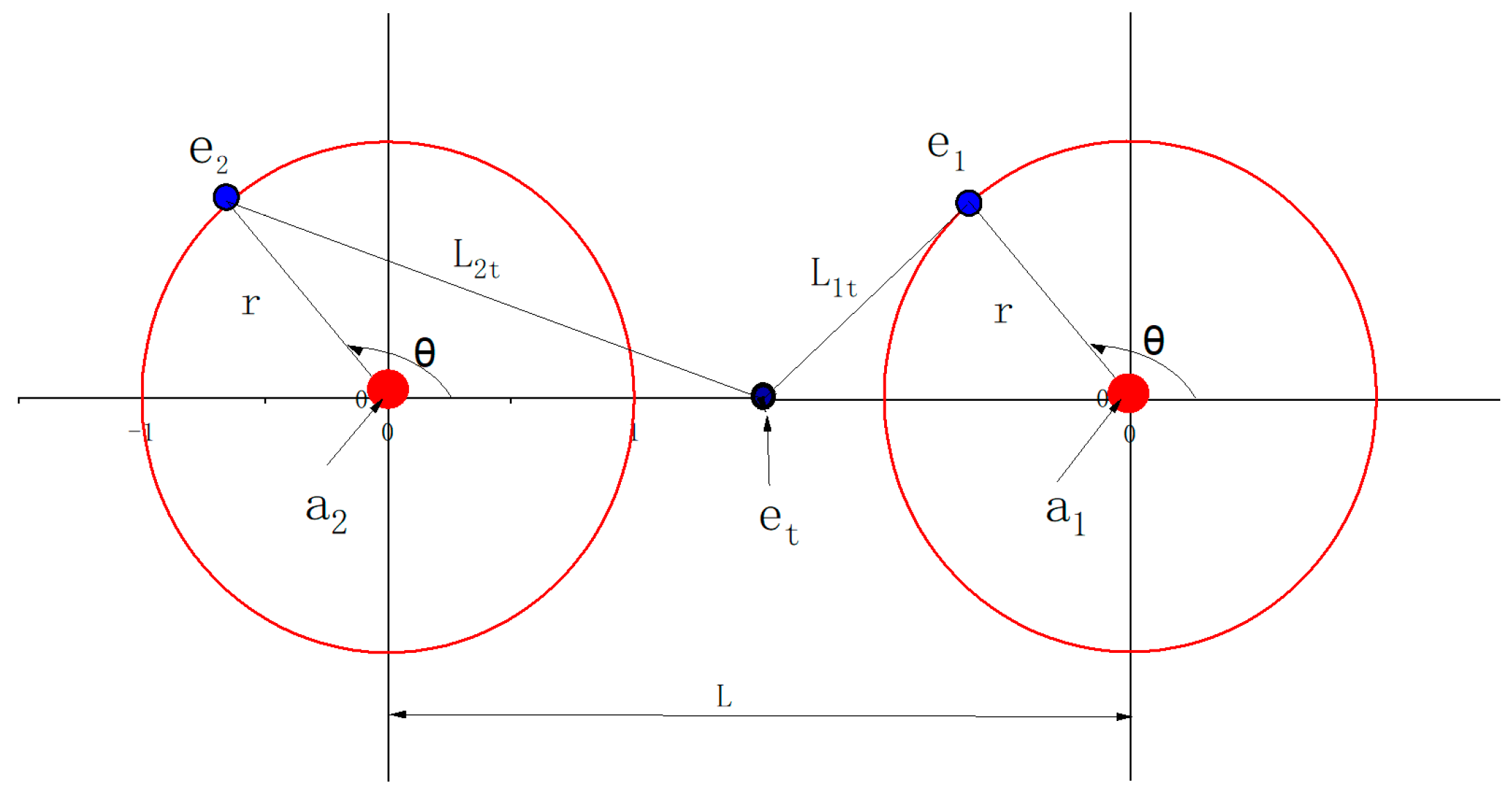
As shown in
Figure 1, there are two abstract atoms a
1 and a
2, with abstract charge quantities q
a1 and q
a2 of one positive charge unit, respectively. The positions and distances between a
1 and a
2 are assumed to be fixed (in reality, there should be micro-distance thermal vibrations), set to L; each abstract atom has an abstract electron revolving around it at a constant speed in a circle with an abstract radius of r, labeled as e
1 and e
2, respectively, with abstract charge quantities q
e1 and q
e2 of one negative charge unit, respectively. Their abstract angular velocities are the same and there is no phase difference (i.e., taking the line connecting the two abstract atomic nuclei as the x-axis, the angle θ between the line connecting the abstract electron and its abstract atomic nucleus and the x-axis is the same, as shown in the figure). For the simplest analysis, it is assumed that at a certain different moment (designated by the angle θ), there is a free electron e
t located at the midpoint between these two abstract atoms (at this time, the attractive force vector of this free electron from the two abstract atomic nuclei is zero. Such an assumption can greatly simplify the mathematical analysis and calculation without affecting the description of their physical relationship), and its charge quantity is q
et.
After making these simplifying assumptions, analyze the interaction relationship between the free electron and the two abstract atoms at different times using mathematical methods. It is only necessary to analyze the interaction relationship between et and e1 and e2.
Figure 1.
Schematic diagram of the interaction between two abstract atoms and free electrons.
Figure 1.
Schematic diagram of the interaction between two abstract atoms and free electrons.
According to Coulomb’s law:
er is the unit vector in the direction of the radial vector from qe1 to qet;
Ft1 is the Coulomb force vector generated between et and e1;
Ft2 is the Coulomb force vector generated between et and e2;
L1t is the distance between e1 and et.
L2t is the distance between e2 and et.
Ft1x is the wave function of the relationship between the free electron et and e1 in the radial Coulomb force on the X-axis at different times (θ);
F
t1y is the wave function for the fluctuation of the radial Coulomb force between the free electron e
t and e
1 at different times (θ) along the Y-axis;
Ft2x is the wave function of the relationship between free electrons et and the radial Coulomb force of e2 on the X-axis at different times (θ);
F
t2y is the wave function of the relationship between free electrons e
t at different times (θ) and the radial Coulomb force of e
2 occurring on the Y-axis;
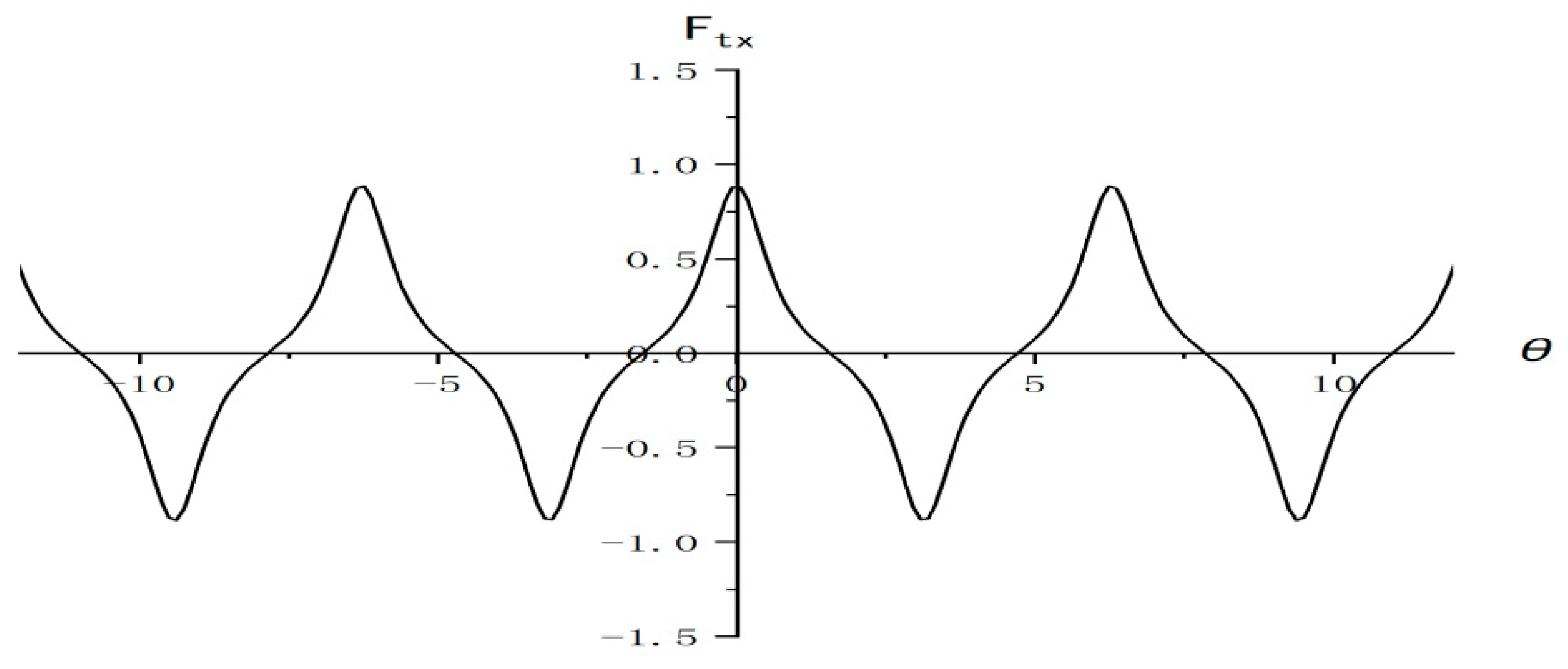
Ftx is the wave function for the fluctuation of the Coulomb force experienced by free electrons et at different times (θ) along the X-axis radial direction;
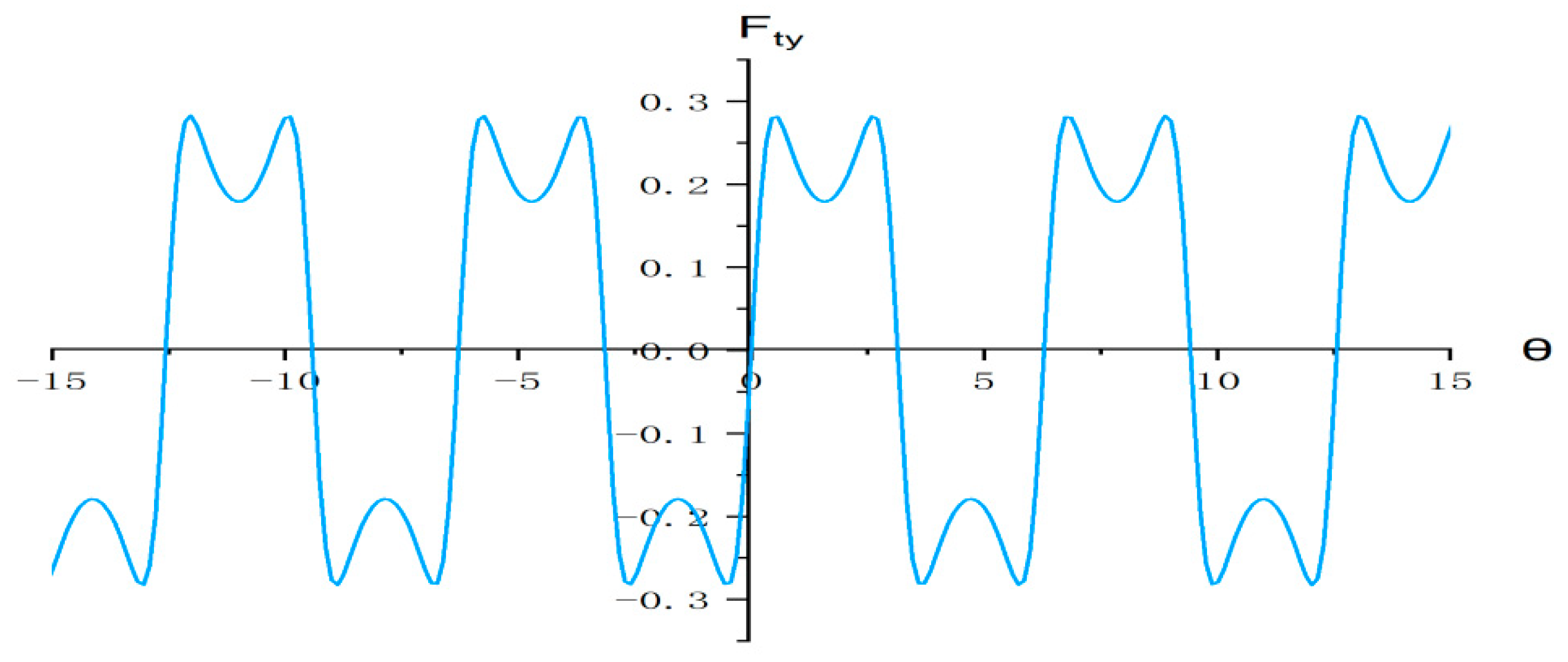
Fty is the wave function of the Coulomb force fluctuation on the radial direction of the Y-axis experienced by free electrons et at different times (θ);
Assuming L=4r, r=1, q
1=q
2=q
e=1, and ignoring the coefficient k value, that is, F
t1=q
eq
1e
r/L
1t2, and so on for F
t2, then:
Figure 2.
Wave function graph of the radial Coulomb force on free electrons et at different times (θ).
Figure 2.
Wave function graph of the radial Coulomb force on free electrons et at different times (θ).
The X-axis refers to the coordinate axis formed by the line connecting a
1 and a
2.
Figure 3.
Wave function graph of the radial Coulomb force on free electrons et at different times (θ) along the Y-axis.
Figure 3.
Wave function graph of the radial Coulomb force on free electrons et at different times (θ) along the Y-axis.
According to the aforementioned hypothetical parameters, at the moment when a free electron passes through the middle of two abstract atoms, it will be affected by the Coulomb force with periodic fluctuations in the X and Y axial directions (ignoring the influence of the radial flight of the free electron). The spatial position of the free electron passing through the space between the two abstract atoms, as well as the time, is a random event. Although this article only analyzes the interaction influence relationship at one position for simplicity, the interaction influence relationships at other positions are the same in terms of physical principles, and will all be affected by the Coulomb force with periodic fluctuations in the X and Y axial directions, only the mathematical expression relationship is more complicated.
Through the above simple mathematical analysis, the following judgments and explanations can be made.
- A.
In a certain spatial range within each slit of the double slit, there exists a regular periodic fluctuating Coulomb force field;
- B.
When free electrons pass through a gap, their spatial position and the moment they are in the gap are probabilistic;
- C.
A large number of free electrons pass through the gap, and their spatial position probability distribution in the gap is uniform; the probability distribution at the moment according to the θ angle parameter is also uniform.
- D.
When a large number of free electrons pass through a single slit, they will interact with the periodic fluctuating Coulomb force field according to their probability and undergo regular deflection. Importantly, this deflection is not random but follows certain regularities because the Coulomb force field itself is periodic. Eventually, a regular distribution similar to the wave function pattern of the periodic fluctuating Coulomb force field is formed on the projection screen; this should also be an optimal possible principle explanation for electron diffraction.
- E.
When a large number of free electrons pass through the slits of a double-slit, the regular periodic wave dynamic field formed by the two slits will superimpose the probability distribution of electrons, and finally an interference pattern is formed on the projection screen.
- F.
When a certain amount of photons is directed at the slit (this amount must be very large, because a significantly greater number of photons than electrons need to be emitted to ensure that some photon will collide with some electron. It’s like needing to fire a large number of anti-aircraft shells to increase the probability of hitting an airplane), the photons will interact with the Coulomb force field in the slit, thereby disrupting or disturbing its original regularity, or the trajectory of the electrons passing through the slit is altered. As a result, the so-called interference fringes disappear.
The above judgment conclusion has a sufficient physical theoretical basis, is completely logically self-consistent, and can also be established in mathematical derivation. It completely eliminates many contradictions and confusions brought about by the orthodox interpretation of quantum mechanics. Therefore, there is every reason to regard it as a more reasonable explanation for the double-slit interference experiment. At the same time, this explanation at least shows that whether microscopic particles have wave properties or not, interference will be formed in the double-slit interference experiment, and diffraction will be formed in the single-slit experiment. Therefore, the double-slit interference experiment cannot prove that particles have wave properties.
6. Basic Idea of Verification
Can the explanation of the double-slit interference experiment in this article be verified by experiments?
It is very clear that the tensile strengths of different solid substances are different. This is because the forces that form their interactions and bonds are not the same in different abstract atoms (molecules). There may be several reasons for this phenomenon: one is that the same abstract atoms (molecules) have different spatial structures; the second is that the abstract atomic nuclei and abstract electrons in different atoms have different Coulomb charge amounts; the third is that the abstract atomic nuclei and abstract electrons have different motion laws; the fourth is that there are obvious differences in the macroscopic physical environment in which the same solid substances are located. For example, differences in temperature cause the spatial structure sizes of atoms (molecules) in solid substances to be different. Among them, the most important influencing factor is that the Coulomb charge amounts of the abstract atomic nuclei and abstract electrons that make up the solid substances are different.
Based on these factors, a deduction can be made; that is, under the condition that all other physical environmental parameters are exactly the same (including the crystal space structure of the solid), two kinds of solid materials with particularly large differences in tensile strength are selected to make two comparative double - slit baffles, and double - slit interference experiments of electrons (or light) are carried out respectively. According to the explanation in this paper, it is theoretically inferred that there will be differences in the interference fringes of the two experiments in terms of spatial scale (the spatial interval between the fringes). As for how large this difference is and whether it can be detected? Personally, I think the difficulty should be very great. However, as long as the experimental control precision is high enough, the resolution of the detection instrument is large enough, and some special technical means are adopted, it should still be detectable.
Another possible experimental verification method is to perform high-precision dynamic continuous detection of the Casimir force. As long as it can be detected that there are regular periodic fluctuations in the Casimir force, it can at least be proven that there is a regular periodic wave dynamic field within a certain spatial range in each slit of the double-slit. If this periodic wave dynamic field exists, it will interact with free electrons passing through its force field within a certain spatial scale range and periodically change the trajectory of the electrons. Thus forming the diffraction and interference phenomena of electrons (microscopic particles).
7. Summary
7.1 This article analyzes the characteristics of microphysics and measurement. It concludes that the measurement of microphysical objects must take into account three basic elements: the microphysical object, the microphysical medium, and the microphysical environment.
7.2 Quantum mechanics is a science that, based on the uncertainty principle and in the absence of relatively complete and accurate physical parameters of the measurement object, can only make hypotheses, explanations and probability predictions about microscopic physical phenomena on the basis of observation and measurement, by using human existing experience, logic and mathematical tools.
7.3 To judge whether the hypotheses, explanations and probability predictions about microscopic physical phenomena are scientific, it is necessary to comprehensively consider factors such as experimental verification, repeatability, logical consistency, completeness, falsifiability, uniqueness and theoretical basis. These criteria together constitute the basic basis for judging the correctness of scientific hypotheses, explanations and probability predictions.
7.4 Several orthodox basic assumptions and interpretations of quantum mechanics have basic problems such as unclear physical mechanisms, logical inconsistency, unfalsifiability, and the main considerations lacking completeness.
7.5 Due to the periodic fluctuating Coulomb force field in each slit of the double-slit, whether microscopic particles have wave properties or not, interference patterns will also be formed in the double-slit interference experiment, as well as diffraction patterns in the single-slit experiment. Therefore, the double-slit interference experiment cannot prove that particles have wave properties.
In addition, this paper also proposes two ideas for experimental verification, which are left for those who are capable to test.
The above judgment conclusion has sufficient physical theoretical basis, clear physical mechanism, completely self-consistent logic, and can also be established in mathematical derivation. It completely eliminates many contradictions and confusions brought about by the orthodox interpretation of quantum mechanics. Therefore, there is every reason to regard it as the most reasonable explanation for the double-slit interference experiment and to be paid attention to by the majority of researchers.
References
- (India) Anil Ananthaswamy. Double-slit Experiment and Quantum Mechanics[M]. Translated by Zhu Jinjie. Beijing: CITIC Publishing House, 2024.
- Zhao Guoqiu. Fundamentals of Double Four-Dimensional Spacetime Quantum Mechanics: The Spacetime Origin of Quantum Probability[M]. Wuhan: Hubei Science and Technology Press, 2016.
- Richard Feynman, Robert Leighton, Matthew Sands. Feynman Lectures on Physics[M]. Translated by Zheng Yongling et al. Shanghai: Shanghai Science and Technology Press, 2020.
- (Germany) W. Heisenberg. The Physical Principles of the Quantum Theory[M]. Translated by Wang Zhengxing, Li Shaoguang, Zhang Yu. Beijing: Higher Education Press, 2017.
- Jin Shangnian. The Physical Foundations and Philosophical Background of Quantum Mechanics[M]. Shanghai: Fudan University Press, 2007.
- Zhao Kaihua, Luo Weiyin. New Concept Physics Course. Quantum Physics (2nd Edition) [M]. Beijing: Higher Education Press, 2008.
|
Disclaimer/Publisher’s Note: The statements, opinions and data contained in all publications are solely those of the individual author(s) and contributor(s) and not of MDPI and/or the editor(s). MDPI and/or the editor(s) disclaim responsibility for any injury to people or property resulting from any ideas, methods, instructions or products referred to in the content. |
© 2025 by the authors. Licensee MDPI, Basel, Switzerland. This article is an open access article distributed under the terms and conditions of the Creative Commons Attribution (CC BY) license (http://creativecommons.org/licenses/by/4.0/).