

Submitted:
24 December 2024
Posted:
26 December 2024
You are already at the latest version
Abstract
The aim of this study is to conduct a scoping review of the literature on the marketing environment and Fair Trade in the coffee industry, identifying its contribution to organizations and society. Quantitative studies were selected from databases such as Web of Science and Scopus, following a selection process aligned with the PRISMA methodological guidelines and establishing eligibility criteria for articles using the PICOS strategy. To understand the effects of macromarketing, strategic marketing, and operational marketing on the development of the Fair Trade coffee market, the results demonstrate that marketing plays a significant role in the market's growth. Specifically, marketing is crucial in communicating the value of Fair Trade, raising consumer awareness, and supporting the economic well-being of coffee producers. Ethical consumption and branding strategies are essential for positioning Fair Trade coffee in competitive markets. However, further studies are needed to corroborate these findings and provide more up-to-date perspectives.
Keywords:
Agribusiness
; Coffee studies
; Rural management
; Sustainable agriculture
; Cooperativism
; Sustainability
1. Introduction
Fair Trade has established itself as a disruptive approach to market development, balancing traditional trade dynamics by promoting fairer conditions for small producers and fostering social and environmental sustainability [1,2,3]. This model challenges conventional trade structures by ensuring fair prices, reducing economic inequality and improving labor conditions in sectors such as coffee [4,5]. Its impact has generated greater global awareness of fairness in supply chains, where consumers are willing to pay a higher premium for ethical products. In Fairtrade International reported [6] that more than two million farmers and workers in 68 countries have improved their livelihoods in a sustainable way, addressing issues such as human rights and gender equity [6]. In this context, marketing plays a crucial role in connecting Fair Trade values with consumers, making it possible to communicate the added value of these products and differentiating them from conventional ones [7]. This relationship is key because marketing not only positions Fair Trade products in the market, but also educates consumers about the positive impacts of their purchases, incentivizing ethical consumption [8,9]. In addition, marketing helps to bridge the gap between intentions and actual actions of ethical consumers, who require clear information to opt for sustainable products [10,11]. To analyze this relationship, three dimensions need to be addressed: Macromarketing (MM), strategic marketing (SM) and operational marketing (OM).
1.1. Macromarketing
Macromarketing focuses on analyzing systems in a broad context, considering how marketing decisions impact society, the environment and the global economy [12,13]. Unlike micromarketing, which focuses on specific tactics implemented by organizations and studies consumer behaviors, macromarketing addresses more complex issues, such as sustainability and social welfare [14,15,16]. This approach promotes more ethical marketing by considering the impact of business decisions not only on companies, but also on communities and the environment [17,18]. In Fair Trade, macromarketing addresses global inequalities by regulating social, environmental and economic aspects in international markets [4]. In Latin America, one of the main industries that has incorporated this way of articulating business is the coffee industry [19]. Fair Trade initiatives in the coffee industry have improved the welfare of producers by offering more equitable trading conditions, guaranteeing a minimum price to producers. This additional income has improved living conditions in farming communities and, in some cases, has allowed them to resist pressure from large industries that threaten their land [19]. One example is the case of Peru, where Fair Trade certified farmers have increased their income thanks to better prices on the international market, which has allowed their children to have greater access to education. In Mexico, additional income has also facilitated school attendance, although educational attainment depends on local infrastructure, and in Nicaragua, although improvements in health have been limited, Fair Trade has provided certain economic benefits that improve living conditions and access to education [20]. However, other studies have shown that much of the value generated in the supply chain remains with retailers and processors in consuming countries, reducing the direct economic impact on producers [21].
1.2. Strategic Marketing
Strategic marketing refers to the set of integrated decisions that an organization makes in terms of products, markets and marketing resources to generate and deliver value to customers, which is essential to achieve its objectives [22]. Although there are different approaches to its classification and functions, there is consensus that from the organizational focus centered on marketing decisions, its function encompasses understanding consumer behavior, segmentation and targeting strategies, branding strategy decisions, analysis of the environment and competition, and ensuring the organization’s strategic compliance [22,23]. Its role is key for Fair Trade organizations, as it facilitates market segmentation, allowing the identification of consumers who value ethical and sustainable products [7,24,25]. Coffee companies involved in Fair Trade target ethical consumers, motivated by moral and environmental reasons [10,26]. Studies such as [27] analyze how ethical values influence the purchase of Fair Trade coffee, while research by authors [28] highlights the use of authenticity as a positioning strategy in the competitive coffee market. In addition, [19] examines how personal values impact the willingness to pay more for ethical products in the coffee industry, connecting strategic marketing with ethical consumer behavior. Another important factor in companies related to Fair Trade is differentiation, which is fundamental to positioning themselves in areas of sustainability, as has occurred massively in Western Europe, where Fair Trade labeling has promoted an increase in ethical consumption [29].
1.3. Operational Marketing
Operational marketing, based on the 7P’s (price, promotion, product place, people, processes and physical evidence), refers to the tactics to be executed to achieve the proposed objectives of the organization [30]. In the case of product tactics, they must meet the expected quality standards and communicate their contribution to sustainability [31]. Price tactics should reflect the added value that consumers are willing to pay for improving the welfare of producers [32]. Place tactics should ensure product accessibility, while promotion should effectively communicate the benefits derived from Fair Trade. Physical evidence, such as labeling, should build trust by ensuring ethical standards [30]. The process is key to transparency in the supply chain, and people, both employees and consumers, are critical to maintaining trust in the brand [33]. In the coffee industry, these elements have proven to be crucial in aligning ethical products with consumer expectations. Communication campaigns and labeling have reinforced consumer trust in fair products [34,35], while packaging and the organization of collective actions have been essential in highlighting the transparency and sustainability of brands [19,27].
What are the main thematic areas addressed by marketing (macromarketing, strategic marketing, and operational marketing) in the literature on Fair Trade in the coffee industry? How do these areas contribute to the development of organizations and society? and what is the geographical scope of the reported cases, considering the distinction between core and peripheral countries in terms of development? The aim of this study is to conduct a scoping review of the literature on marketing (macromarketing, strategic marketing, and operational marketing) in the context of Fair Trade in the coffee industry, to identify its contribution to the development of organizations and society, and to analyze the geographical scope of the reported cases, considering the distinction between core and peripheral countries in terms of development.
2. Materials and Methods
This work about marketing components in Fair Trade coffee studies uses the scoping review, a specific typology within review studies [36], the Preferred Reporting Items for Systematic Reviews and Meta-Analyses (PRISMA) guidelines [37], in particular PRISMA Extension for Scoping Reviews (PRISMA-ScR) [38], and the PICOS (Participants, Interventions, Comparators, Outcomes and Study Design) strategy to establish eligibility criteria for articles [39], whose protocol has been registered in Zenodo [40], under the modified PROSPERO format recommended by Tricco et al. [38].
According to the current checklist of the PRISMA-ScR guidelines [38], the following quality steps for systematic reviews were verified according to these items: (1) title, (2) structured summary, (3) rationale, (4) objectives, (5) protocol and registration, (6) eligibility criteria, (7) information sources, (8) search, (9) selection of sources of evidence, (10) data charting process, (11) data items, (12) critical appraisal of individual sources of evidence, (13) synthesis of results, (14) selection of sources of evidence, (15) characteristics of sources of evidence, (16) critical appraisal within sources of evidence, (17) results of individual sources of evidence, (18) synthesis of results, (19) summary of evidence, (20) limitations, (21) conclusions, and (22) funding. The initial search for articles was performed using bibliometric procedures [41].
2.1. Information Sources and Search Strategy
We used a set of articles from two databases, with equivalent search vectors and without additional restrictions (such as period of years or types of documents), reporting double indexing and both report citations, relying on the Web of Science - Core Collection (WoSCC)[42] and Scopus [43], selecting articles published in journals indexed in these databases, from a search vector on Fair Trade Coffee in WoSCC: { TS=(Fair NEAR/0 Trade NEAR/0 Coffee) }, and Scopus: { TITLE-ABS-KEY(Fair W/0 Trade W/0 Coffee) }. We used the thematic search tag TS (searching simultaneously on title, abstract, author keywords, and Keywords Plus®), and the word proximity operator (NEAR/0) that simultaneously incorporates contiguous words that make up the concept of Fair Trade coffee. Equivalently in Scopus we searched in Title, Source title, Author Keywords, and Index Keywords, and we used the word proximity operator (W/0). Providing coverage for the PRESS 2015 guideline statement [44].
2.2. Eligibility Criteria
The selection of articles was based on the following eligibility criteria: target population (participants), interventions (methodological techniques), elements of comparison of these studies, outcomes of these studies, and study designs (the criteria of the PICOS strategy as shown in Table 1).
2.3. Study Selection and Data Extraction
As a first step, according to the search strategy, a first extraction of documents from WoSCC and Scopus databases was carried out on August 27, 2024.
Then, duplicates were manually removed. Then, the titles and abstracts of articles were checked for relevance by two researchers (A.V.-M, and N.C.-B.). Subsequently, they independently reviewed the full texts of potentially eligible articles. Any disagreements were discussed with a third researcher (J.M.-L.), until a consensus was reached.
According to the eligibility criteria declared in Table 1, we then excluded letters, editorial materials, reviews, and documents containing only abstracts. Articles that were not related to the concepts of marketing components in Fair Trade coffee were excluded (this process was repeated in the full document detail review). In addition, articles not written in English were non excluded (other full-length documents written in French and Spanish).
The data items in phase one correspond to 64 fields per record in WoSCC and 46 fields per record in Scopus, as detailed below. WoSCC: 1) Authors, 2) Book Authors, 3) Book Editors, 4) Book Group Authors, 5) Author Full Names, 6) Book Author Full Names, 7) Group Authors, 8) Article Title, 9) Source Title, 10) Book Series Title, 11) Language, 12) Document Type, 13) Conference Title, 14) Conference Date, 15) Conference Location, 16) Conference Sponsor, 17) Conference Host, 18) Author Keywords, 19) Keywords Plus, 20) Abstract, 21) Addresses, 22) Affiliations, 23) Reprint Addresses, 24) Email Addresses, 25) Researcher Ids, 26) ORCIDs, 27) Funding Orgs, 28) Funding Name Preferred, 29) Funding Text, 30) Cited Reference Count, 31) Times Cited, WoS Core, 32) Times Cited, All Databases, 33) 180 Day Usage Count, 34) Since 2013 Usage Count, 35) Publisher, 36) Publisher City, 37) Publisher Address, 38) ISSN, 39) eISSN, 40) ISBN, 41) Journal Abbreviation, 42) Journal ISO Abbreviation, 43) Publication Date, 44) Publication Year, 45) Volume, 46) Issue, 47) Special Issue, 48) Start Page, 49) End Page, 50) Article Number, 51) DOI, 52) DOI Link, 53) Book DOI, 54) Early Access Date, 55) Number of Pages, 56) WoS Categories, 57) Web of Science Index, 58) Research Areas, 59) IDS Number, 60) Pubmed Id, 61) Open Access Designations, 62) Date of Export, 63) UT (Unique WOS ID), and 64) Web of Science Record [45]. And Scopus: 1) Authors, 2) Author full names, 3) Author(s) ID, 4) Title, 5) Year, 6) Source title, 7) Volume, 8) Issue, 9) Art. No., 10) Page start, 11) Page end, 12) Page count, 13) Cited by, 14) DOI, 15) Link, 16) Affiliations, 17) Authors with affiliations, 18) Abstract, 19) Author Keywords, 20) Index Keywords, 21) Molecular Sequence Numbers, 22) Chemicals/CAS, 23) Tradenames, 24) Manufacturers, 25) Funding Details, 26) Funding Texts, 27) References, 28) Correspondence Address, 29) Editors, 30) Publisher, 31) Sponsors, 32) Conference name, 33) Conference date, 34) Conference location, 35) Conference code, 36) ISSN, 37) ISBN, 38) CODEN, 39) PubMed ID, 40) Language of Original Document, 41) Abbreviated Source Title 42) Document Type, 43) Publication Stage, 44) Open Access, 45) Source, and 46) EID [46].
2.4. Quality Assessment, Risk of Bias, and Results Synthesis
In a first phase of quality assurance, a critical evaluation of the articles included was carried out, using the focus on marketing components in Fair Trade coffee as a discriminant comparator, being an outcome of interest to observe the diversity of thematic categories selected.
The risk of bias of the included studies will be assessed according to Campbell et al. (2014) in the case of theoretical articles and the Mixed Methods Appraisal Tool (MMAT) scale will be used for quantitative, qualitative, and mixed studies [45]. The MMAT scale is a valid measure of the methodological quality of the article. Two authors will review the studies independently, and a third author will be incorporated to settle tiebreakers.
Mixed Methods Appraisal Tool (MMAT), a checklist used in systematic reviews based on synthesis of qualitative and quantitative evidence, includes criteria for the evaluation of mixed studies; it defines the study category, and 7 items are applied according to a score from zero to one, to obtain a final percentage mean. Studies are considered as high quality > 75%, moderate quality 50–74%, and low quality < 49%. Studies with values below 75% were excluded from the category analysis and discussion [46].
As a synthesis of the results, we have used comparative elements of the selected articles, contributing to the process of establishing categories of study on the marketing components of Fair Trade coffee. As outcomes, we have focused on the constructs studied and the items that compose or disaggregate these constructs.
3. Results
Firstly, the result of the PRISMA analysis summary provided a total of 174 records identified through the Web of Science (WOS) database and 158 additional records obtained from the SCOPUS database, resulting in 257 unique records after duplicates were removed. During the screening process, 232 records were excluded for not being related to marketing, and 11 additional records were excluded for not being quantitative studies, leaving a total of 25 records for further evaluation. Subsequently, 14 full-text articles were assessed for eligibility, of which 4 were excluded based on criteria related to the MMAT method. Finally, 10 studies were included in the final synthesis as shown in Figure 1.
3.1. Results from the Description of the Selected Articles
The ten selected articles span a publication range from 2007 to 2021, reflecting the evolving academic interest in the impact of Fair Trade in the coffee industry. Published in high-impact journals such as Food Research International, Sustainability, and Journal of Public Policy & Marketing, these studies stand out for their interdisciplinary focus. They address topics such as consumer preferences for specialty coffee [47], sustainable branding strategies [48], personal values and willingness to pay for Fair Trade coffee [49], and the subjective quality of life of producers in Latin America [50]. Additionally, they include research on ethical consumer motivations [51,52] and the benefits of Fair Trade on producers’ income, education, and health [53].
Other studies analyze factors influencing producers’ engagement with cooperatives in Mexico [54] and value capture through market disintermediation [55]. This timeline highlights a shift from a focus on producer benefits to a more consumer-oriented analysis promoting ethical values. The table below provides details on each article, including authors, study design, geographic origin, and key findings, as seen in Table 2.
The geographic distribution of studies reveals a concentration of research in specific countries, reflecting the focal points of Fair Trade coffee’s impact and consumer behavior. The United States stands out with the highest frequency of studies, highlighting its significant role as a consumer market and its emphasis on ethical consumption and sustainability in coffee production. Latin America, particularly Nicaragua, Peru, and Guatemala, is another key region, with multiple studies addressing the socioeconomic effects of Fair Trade on coffee producers. These countries are pivotal due to their central role in global coffee production and their reliance on Fair Trade systems to improve producer outcomes. The map visually represents the frequency of studies conducted in each country, with varying shades of blue indicating the concentration of research. Lighter shades represent countries with a single study, such as Germany, Mexico, South Korea, and New Zealand, reflecting emerging or specialized research areas, while darker shades highlight countries with higher frequencies of studies, such as the United States and the combined regions of Nicaragua, Peru, and Guatemala, which together account for three studies. This gradient illustrates the intensity of academic focus on regions, emphasizing the dual importance of consumer markets in developed countries and production regions in developing nations. Additionally, South Africa, Mexico, and New Zealand contribute to the diversity of perspectives, focusing on unique consumer motivations and market strategies, while Germany and South Korea emphasize consumer preferences and ethical considerations in non-coffee-producing countries. This geographic distribution demonstrates both the global reach of Fair Trade coffee research and the need for more extensive exploration in underrepresented regions to gain a comprehensive understanding of its impact, as illustrated in Figure 2.
3.2. Results Studies Macromarketing
Three of them [50,53,56] conducted studies in Peru, Nicaragua and Guatemala and one of them [54] in Mexico. Their focus was on conducting a quantitative descriptive study in the producing areas by measuring according to self-report questionnaires the perception of improvements in quality of life in different dimensions. Geiger-Oneto et al. analyzed [50] how Fair Trade improves the quality of life for coffee producers in Nicaragua, Perú and Guatemala, emphasizing the role of cooperatives in enhancing their well-being and examining its broader social and economic impact on global relationships between producers and consumers, the findings show that farmers in Fair Trade cooperatives report higher quality of life, improved income, and a more positive outlook for their families’ future. Arnould et al.’s [53] studies assessed whether Fair Trade fulfills its core value proposition by improving the income, education, and health of small coffee producers in in Nicaragua, Perú and Guatemala, examining its social and economic impact and connecting consumers and producers within a global ethical trade system.
3.3. Results Studies Stategic Marketing
Research included in the strategic marketing category addresses the influence of personal values, psychological characteristics and positioning strategies on consumers’ decisions regarding Fair Trade coffee. Ufer et al. [47] and Paetz et al. [48] highlight that personality traits such as extraversion, responsibility and openness are positively associated with a greater willingness to pay premium prices for sustainable and Fair Trade products. In Fair Trade International reported [6] identify that humanitarian values and knowledge about Fair Trade are key determinants in segmenting consumers according to their predisposition to purchase these products. In terms of motivations, Darian et al. [51] note that regular consumers especially value the ethical and community benefits associated with Fair Trade, while Hwang et al. [52] observe that ethical consumption motivations are mostly driven by individualistic factors, such as self-fulfillment, rather than empathy towards producers. Finally, Murphy et al. [55] discuss how incorporating Fair Trade into brand positioning strategies can influence consumer perceptions, although they note challenges related to price and product quality expectations. These findings underscore the importance of understanding the psychological, ethical, and social dimensions of consumer behavior to develop more effective marketing strategies. However, they also highlight significant limitations, such as the disconnection between the strategic narratives employed in recipient markets and the actual impacts on producer communities. This systematized information can be seen in Table 3.
The cross-matrix analysis highlights the differentiation between central and peripheral countries in the study of marketing within agricultural contexts, particularly in Fair Trade coffee research. In central countries, strategic marketing emerges as the dominant focus, with studies in Germany, the United States, South Korea, and New Zealand addressing issues such as consumer behavior, market segmentation, sustainability branding, and positioning strategies. These topics reflect the advanced market dynamics and consumer-driven priorities characteristic of developed economies, where ethical consumption and branding play a pivotal role in promoting Fair Trade coffee. However, no cases were identified in macromarketing or operational marketing, indicating potential gaps in examining broader systemic influences or logistical aspects in these regions.
In peripheral countries, such as Nicaragua, Peru, Guatemala, and Mexico, the emphasis shifts to macromarketing, with research concentrating on cooperativism, quality of life, and the impacts of Fair Trade on health and education. These studies underscore the developmental dimension of Fair Trade marketing, focusing on the socioeconomic well-being of producers and the systemic benefits of cooperative models. South Africa stands out as a unique case within strategic marketing in peripheral regions, with research exploring humanitarian values, consumer knowledge about Fair Trade, and the willingness to pay premium prices. Notably, operational marketing remains absent across both central and peripheral countries, revealing an opportunity for further investigation into the operationalization and supply chain aspects of Fair Trade in the agricultural marketing domain. This matrix illustrates the divergent focal points in marketing research, shaped by the socio-economic and market realities of central and peripheral regions, while also highlighting areas requiring deeper exploration to fully understand Fair Trade’s role in agriculture.
4. Discussion
This study provides a comprehensive review of the literature on Fair Trade marketing within the coffee industry, focusing on macromarketing, strategic marketing, and operational marketing. It emphasizes the contributions of these areas to the development of organizations and society while analyzing the geographical scope of reported cases, highlighting distinctions between core and peripheral regions. The findings reveal key patterns and notable gaps in the scope and focus of current research.
At the macromarketing level, studies such as Geiger-Oneto et al. [50] and Arnould et al. [53,56] emphasize the positive, albeit modest, contributions of Fair Trade to improving the quality of life and economic well-being of producers in cooperatives. These benefits include increased income, access to education, and better healthcare services. However, these improvements are often uneven and limited by the structural challenges prevalent in peripheral countries, particularly in regions with weaker institutional frameworks and resource constraints. Furthermore, the geographical concentration of macromarketing studies in Latin America leaves critical gaps in understanding the experiences of producers in Africa and Asia, where socioeconomic contexts and challenges differ significantly. Additionally, there is a notable absence of studies in operational marketing across all regions, and limited exploration of strategic marketing in peripheral areas, particularly in Africa and Asia. This underscores the need to broaden the geographical and thematic scope to include diverse contexts and challenges faced by producers in these regions.
In strategic marketing, studies such as Ufer et al. [47] and Paetz et al. [48] highlight the importance of segmentation, positioning, and consumer education in promoting Fair Trade in central markets. These strategies effectively leverage consumer preferences, humanitarian values, and knowledge about Fair Trade to drive willingness to pay a premium for ethical products. However, research, such as Hwang et al. [52], reveals that these motivations are frequently self-oriented, focusing on consumer identity and self-actualization rather than genuine concern for producer conditions. This disconnect suggests an opportunity to align central market narratives more closely with the realities of producer communities in peripheral regions.
Operational marketing, which bridges strategic narratives and on-the-ground impacts, is notably underrepresented in the literature. Despite the critical role of operational processes such as certification, logistics, and resource allocation, these aspects remain insufficiently explored. The limited focus on smaller or resource-constrained cooperatives, particularly in Africa and Asia, exacerbates the disconnect between ethical narratives and the practical challenges faced by producers. This gap hinders Fair Trade’s potential to deliver transformative outcomes in peripheral communities and weakens its value proposition in core markets.
5. Conclusions
In conclusion, this study underscores the essential role of Fair Trade marketing in advancing ethical consumption in core markets while addressing the socioeconomic challenges of producer communities in peripheral regions. Macromarketing research demonstrates that Fair Trade contributes to modest improvements in income, education, and health for producers, though these benefits are often constrained by systemic limitations. Strategic marketing has successfully mobilized consumer demand through effective segmentation and positioning strategies, yet the narratives often prioritize individualistic motivations over genuine connections to producer realities. The virtual absence of operational marketing research further highlights critical gaps in understanding the practical implementation of Fair Trade principles, particularly in underrepresented regions such as Africa and Asia.
By promoting more equitable trade practices, Fair Trade helps improve the income and quality of life of producers, especially in rural communities in developing countries, thereby strengthening their economic and social well-being. Additionally, Fair Trade promotes environmental sustainability by prioritizing environmentally friendly production methods, reinforcing the impact of SDG 12. Furthermore, the strengthening of cooperatives and community networks in these regions facilitates access to education and healthcare services, aligning with the goals of quality education (SDG 4) and ensuring healthy lives (SDG 3). Together, Fair Trade not only benefits producers and consumers but also reinforces the foundations of a more equitable and sustainable global development.
To address these limitations, future research must focus on expanding the scope of Fair Trade studies to encompass the diverse socio-economic contexts of Africa and Asia, where challenges differ significantly from those in Latin America. Operational marketing should become a priority area for research, with a focus on optimizing logistical processes, reducing certification costs, and supporting smaller, resource-constrained cooperatives. Furthermore, strategic narratives in core markets must evolve to authentically represent the challenges and achievements of producer communities, bridging the gap between consumer expectations and producer realities. By addressing these gaps, Fair Trade can strengthen its ethical value proposition, foster deeper connections between consumers and producers, and drive meaningful socioeconomic transformations in the most vulnerable contexts.
Supplementary Materials
The following supporting information can be downloaded at the website of this paper posted on Preprints.org, Table S1: FTC ScR data.xlsx.
Author Contributions
Conceptualization, J.M.-L., A.V.-M. and N.C.-B.; methodology, J.M.-L. and G.S.-S.; validation, A.V.-M.; formal analysis, J.M.-L.; writing—original draft preparation, N.C.-B. , J.M.-L.; writing—review and editing, J.M.-L., N.C.-B., A.V.-M. and G.S.-S.; supervision, A.V.-M.; project administration, J.M.-L. and N.C.-B; funding acquisition, A.V.-M., N.C.-B. and G.S.-S. All authors have read and agreed to the published version of the manuscript.
Funding
This article has received partial funding for the article processing charge (APC), thanks to Basal Funds from Chilean Ministry of Education, directly or via the publication incentive fund from the following Higher Education Institutions: Universidad Arturo Prat (Code: APC2025), Universidad Católica de la Santísima Concepción (Code: APC2025), Universidad Central de Chile (Code: APC2025), Universidad de Las Américas (Code: APC2025), and Pontificia Universidad Católica de Valparaíso (Code: APC2025).
Institutional Review Board Statement
Not applicable; this study does not involve humans or animals.
Informed Consent Statement
Not applicable.
Data Availability Statement
Data availability in the Supplementary Materials.
Conflicts of Interest
The authors declare no conflicts of interest.
Appendix A

Table A1.
Eligibility criteria using (MMAT) Mixed Methods Appraisal Tool.
| Articles | Journal | Pub. Year |
Category of Study Design | S1 | S2 | 3,1 | 3,2 | 3,3 | 3,4 | 3,5 | 4,1 | 4,2 | 4,3 | 4,4 | 4,5 | Quality | Studies Selects >75% | ||
|---|---|---|---|---|---|---|---|---|---|---|---|---|---|---|---|---|---|---|---|
| Ufer, D; Lin, W; Ortega, DL. [47] | Food Res. Int. | 2019 | Quantitative non-randomized | 0.75 | 1 | 1 | 1 | 1 | 1 | 1 | 96% | Yes | |||||||
| Paetz, F. [48] | Sustainability | 2021 | Quantitative non-randomized | 0.75 | 1 | 1 | 1 | 1 | 1 | 1 | 96% | Yes | |||||||
| Lappeman, J; Orpwood, T; Russell, M; Zeller, T; Jansson, J. [49] | J. Clean Prod. | 2019 | Quantitative non-randomized | 1 | 1 | 0.75 | 0.75 | 0.75 | 0.75 | 0.5 | 79% | Yes | |||||||
| Linton A.; Liou C.C.; Shaw K.A. [59] | Globalizations | 2004 | Quantitative descriptive | 0.5 | 1 | 0.5 | 0.5 | 0.5 | 0.5 | 1 | 64% | No | |||||||
| Geiger-Oneto, S; Arnould, EJ. [50] | J. Macromark. | 2011 | Quantitative descriptive | 0.75 | 1 | 0.75 | 1 | 1 | 1 | 1 | 93% | Yes | |||||||
| Darian J.C.; Tucci L.; Newman C.M.; Naylor L. [51] | J. Int. Consum. Mark. | 2015 | Quantitative descriptive | 0.75 | 1 | 1 | 1 | 1 | 0.75 | 1 | 93% | Yes | |||||||
| Winchester M.; Arding R.; Nenycz-Thiel M. [60] | J. Food Prod. Mark. | 2015 | Quantitative descriptive | 0.75 | 1 | 0.75 | 0.75 | 0.75 | 0.25 | 0.25 | 71% | No | |||||||
| Hwang, K; Kim, H. [52] | J. Bus. Ethics | 2018 | Quantitative descriptive | 0.75 | 1 | 1 | 1 | 1 | 1 | 1 | 96% | Yes | |||||||
| Arnould, EJ; Plastina, A; Ball, D. [53] | J. Public Policy Mark. | 2009 | Quantitative descriptive | 1 | 1 | 1 | 1 | 1 | 1 | 1 | 100% | Yes | |||||||
| Arana-Coronado J.J.; Trejo-Pech C.O.; Velandia M.; Peralta-Jimenez J. [54] | J. Int. Food Agribus. Mark. | 2019 | Quantitative descriptive | 0.75 | 1 | 1 | 1 | 1 | 1 | 1 | 96% | Yes | |||||||
| Murphy A.; Jenner-Leuthart B. [55] | J. Consum. Mark. | 2011 | Quantitative descriptive | 1 | 1 | 0.75 | 0.75 | 0.75 | 0.75 | 0.75 | 82% | Yes | |||||||
| Arnould E.J.; Plastina A.; Ball D. [56] | Adv. Int. Manage. | 2007 | Quantitative descriptive | 1 | 1 | 1 | 1 | 1 | 1 | 1 | 100% | Yes | |||||||
| Webb, J [57] | Sociol. Res. Online | 2007 | Quantitative descriptive | 1 | 0.5 | 0.5 | 0.5 | 0.5 | 0.5 | 0.5 | 57% | No | |||||||
| Howard, PH; Jaffee, D [58] | Sustainability | 2013 | Quantitative descriptive | 1 | 1 | 0.5 | 0.5 | 0.5 | 0.5 | 0.5 | 64% | No |
References
- Nicholls, A.; Huybrechts, B. Sustaining inter-organizational relationships across institutional logics and power asymmetries: the case of fair trade. J. Bus. Ethics 2016, 135, 699–714. [Google Scholar] [CrossRef]
- Fairtrade International. Fairtrade and the Sustainable Development Goals: A Review of the Impact of Fairtrade. Sustainability 2020, 12, 240–253. [CrossRef]
- Fairtrade USA. Consumer Report: Conscious Consumerism Goes Mainstream, 2022. Available online: https://www.fairtradecertified.org.
- Raynolds, L.T. Fair Trade: Social regulation in global food markets. Journal of Rural Studies, 2012, 28, 276–287. [Google Scholar] [CrossRef]
- Meemken, E.M.; Sellare, J.; Kouame, C.N.; Qaim, M. Effects of Fairtrade on the livelihoods of poor rural workers. Nature Sustainability 2019, 2, 635–642. [Google Scholar] [CrossRef]
- Fairtrade International. Annual Report: Driving Progress through Fairtrade, 2023. Available online: https://www.fairtrade.net.
- Bezençon, V.; Blili, S. Ethical products and consumer involvement: what’s new? Eur. J. Mark. 2010, 44, 1305–1321. [Google Scholar] [CrossRef]
- Koszewska, M. A typology of Polish consumers and their behaviours in the market for sustainable textiles and clothing. International Journal of Consumer Studies 2013, 37, 507–521. [Google Scholar] [CrossRef]
- Garcia-De los Salmones, M.; Pérez, A. The role of brand utilities: application to buying intention of fair trade products. Journal of Strategic Marketing 2019, 27, 119–135. [Google Scholar] [CrossRef]
- Carrington, M.J.; Neville, B.A.; Whitwell, G.J. Why Ethical Consumers Don’t Walk Their Talk: Towards a Framework for Understanding the Gap Between the Ethical Purchase Intentions and Actual Buying Behaviour of Ethically Minded Consumers. J. Bus. Ethics 2010, 97, 139–158. [Google Scholar] [CrossRef]
- Balzarova, M.; Dyer, C.; Falta, M. Perceptions of blockchain readiness for fairtrade programmes. Technological Forecasting and Social Change 2022, 185, 122086. [Google Scholar] [CrossRef]
- Layton, R.A. Marketing systems—a core macromarketing concept. J. Macromark 2007, 27, 227–242. [Google Scholar] [CrossRef]
- Wooliscroft, B. Macromarketing and the Systems Imperative. J. Macromark 2020, 41, 7–22. [Google Scholar] [CrossRef]
- Kilbourne, W.E.; McDonagh, P.; Prothero, A. Sustainable Consumption and the Quality of Life: A Macromarketing Challenge to the Dominant Social Paradigm. Journal of Macromarketing 1997, 17, 4–24. [Google Scholar] [CrossRef]
- Mittelstaedt, J.D.; Shultz, C.J.; Kilbourne, W.E.; Peterson, M. Sustainability as Megatrend: Two Schools of Macromarketing Thought. J. Macromark. 2014, 34, 253–264. [Google Scholar] [CrossRef]
- Sirgy, M.J. Macromarketing Metrics of Consumer Well-Being: An Update. J. Macromark 2020, 41, 104–110. [Google Scholar] [CrossRef]
- Klein, M.J. Assessing distributive justice in marketing: A benefit-cost approach. Eur. J. Mark. 2007, 28, 33-43, 1098-1118. [CrossRef]
- Samuel, K.; Peattie, K. Grounded Theory as a Macromarketing Methodology: Critical Insights from Researching the Marketing Dynamics of Fairtrade Towns. Journal of Macromarketing 2015, 36, 11–26. [Google Scholar] [CrossRef]
- Fridell, M. Fair Trade and the international moral economy. Crit. Sociol. 2007, 33, 427–450. [Google Scholar] [CrossRef]
- Arnould, E.; Plastina, A.; Ball, D. Does Fair Trade Deliver on Its Core Value Proposition? Effects on Income, Educational Attainment, and Health in Three Countries. J. Public Policy Mark. 2009, 28, 186–201. [Google Scholar] [CrossRef]
- Johannessen, S.; Wilhite, H. Who Really Benefits from Fairtrade? An Analysis of Value Distribution in Fairtrade Coffee. Globalizations 2010, 7, 525–544. [Google Scholar] [CrossRef]
- Varadarajan, R. Customer information resources advantage, marketing strategy and business performance: A market resources based view. Ind. Mark. Manag. 2020, 89, 89–97. [Google Scholar] [CrossRef]
- Sintani, L.; Ridwan, R.; Kadeni, K.; Savitri, S.; Ahsan, M. Understanding marketing strategy and value creation in the era of business competition. Int. J. Bus. Econ. Manag. 2023, 6, 69–77. [Google Scholar] [CrossRef]
- Yen, G.-F.; Wang, R.-Y.; Yang, H.-T. How consumer mindsets in ethnic Chinese societies affect the intention to buy Fair Trade products: The mediating and moderating roles of moral identity. Asia Pac. J. Mark. Logist. 2017, 29, 553–568. [Google Scholar] [CrossRef]
- Konopka, R.; Wright, M.J.; Avis, M.; Feetham, P.M. If you think about it more, do you want it more? The case of fairtrade. Eur. J. Mark. 2019, 53, 2556–2581. [Google Scholar] [CrossRef]
- Wang, E.S.-T.; Chou, C.-F. Norms, consumer social responsibility and fair trade product purchase intention. Int. J. Retail Distrib. Manag. 2020, 49, 23–39. [Google Scholar] [CrossRef]
- Davies, I.A.; Gutsche, S. Consumer motivations for Fair Trade: Why are consumers buying Fairtrade products? J. Bus. Ethics 2016, 136, 431–446. [Google Scholar] [CrossRef]
- Jaffee, D. Fair trade standards, corporate participation, and social movement responses in the global economy. Sociol. Perspect. 2014, 57, 416–439. [Google Scholar] [CrossRef]
- Koos, S. Moralising markets, marketizing morality. The fair trade movement, product labeling and the emergence of ethical consumerism in Europe. J. Nonprofit Public Sect. Mark. 2021, 33, 168–192. [Google Scholar] [CrossRef]
- Sukotjo, C. Marketing mix for service businesses: The 7Ps. Bus. Rev. 2010, 54, 115–123. [Google Scholar]
- He, X.; Zhang, X.; Zhao, X. Green marketing and sustainability in China. Sustainability 2021, 13, 1907. [Google Scholar] [CrossRef]
- Balzarova, M.A.; Castka, P.; Boughen, N. Sustainability and the fair trade premium: A stakeholder approach. Sustainability 2022, 14, 2341. [Google Scholar] [CrossRef]
- Lavorata, L. Retailers’ commitment to sustainable development: A strategy to gain consumer loyalty? J. Retail. Consum. Serv. 2014, 21, 1021–1030. [Google Scholar] [CrossRef]
- Littrell, M.A.; Dickson, M.A.; Vieira, E.A. Fair Trade apparel: consumer perceptions of social responsibility. J. Consum. Mark. 2012, 29, 15–25. [Google Scholar] [CrossRef]
- Lever, J.; Evans, A. Ethical food labeling and consumer trust. J. Consum. Policy 2017, 40, 125–140. [Google Scholar] [CrossRef]
- Grant, M.J.; Booth, A. A typology of reviews: an analysis of 14 review types and associated methodologies. Health Info. Libr. J. 2009, 26, 91–108. [Google Scholar] [CrossRef] [PubMed]
- Page, M.J.; Moher, D.; Bossuyt, P.M.; Boutron, I.; Hoffmann, T.C.; Mulrow, C.D.; et al. PRISMA 2020 explanation and elaboration: updated guidance and exemplars for reporting systematic reviews. BMJ 2021, 372, 160. [Google Scholar] [CrossRef] [PubMed]
- Tricco, A.C.; Lillie, E.; Zarin, W.; O’Brien, K.K.; Colquhoun, H.; Levac, D.; Moher, D.; Peters, M.D.J.; Horsley, T.; Weeks, L.; Hempel, S.; Akl, E.A.; Chang, C.; McGowan, J.; Stewart, L.; Hartling, L.; Aldcroft, A.; Wilson, M.G.; Garritty, C.; Lewin, S.; Godfrey, C.M.; Macdonald, M.T.; Langlois, E.V.; Soares-Weiser, K.; Moriarty, J.; Clifford, T.; Tunçalp, Ö.; Straus, S.E. PRISMA Extension for Scoping Reviews (PRISMA-ScR): Checklist and Explanation. Ann Intern Med. 2018, 169, 467–473. [Google Scholar] [CrossRef]
- Methley, A.M.; Campbell, S.; Chew-Graham, C.; McNally, R.; Cheraghi-Sohi, S. PICO, PICOS and SPIDER: A comparison study of specificity and sensitivity in three search tools for qualitative systematic reviews. BMC Health Serv. Res. 2014, 14, 579. [Google Scholar] [CrossRef] [PubMed]
- Vega-Muñoz, A.; Maradiaga-López, J.; Salazar-Sepúlveda, G.; Contreras-Barraza, N. Study protocol for a scoping review about Marketing components in fair trade coffee studies. [CrossRef]
- Porter, A.L.; Kongthon, A.; Lu, J.C. Research profiling: Improving the literature review. Scientometrics 2002, 53, 351–370. [Google Scholar] [CrossRef]
- Clarivate. Advanced Search Query Builder, Web of Science. Available online: https://www.webofscience.com/wos/woscc/advanced-search (accessed on 27 August 2024).
- Scopus. Advanced search. Available online: https://www-scopus-com.unap.idm.oclc.org/search/form.uri?display=advanced (accessed on 27 August 2024).
- McGowan, J.; Sampson, M.; Salzwedel, D.M.; Cogo, E.; Foerster, V.; Lefebvre, C. PRESS Peer Review of Electronic Search Strategies: 2015 Guideline Statement. J. Clinic. Epidemiol. 2016, 75, 40–46. [Google Scholar] [CrossRef] [PubMed]
- Hong, Q.N.; Fàbregues, S.; Bartlett, G.; Boardman, F.; Cargo, M.; Dagenais, P.; Gagnon, M.; Griffiths, F.; Nicolau, B.; O’Cathain, A.; et al. The Mixed Methods Appraisal Tool (MMAT) version 2018 for information professionals and researchers. Educ. Inf. 2018, 34, 285–291. [Google Scholar] [CrossRef]
- Arenas-Monreal, L., Galván-Estrada, I.G., Dorantes-Pacheco, L., Márquez-Serrano, M., Medrano-Vázquez, M., Valdez-Santiago, R., & Piña-Pozas, M. Alfabetización sanitaria y COVID-19 en países de ingreso bajo, medio y medio alto: Revisión sistemática. Global. Health Promot. 2023, 17579759221150207. [CrossRef]
- Ufer, D.; Lin, W.; Ortega, D.L. Personality traits and preferences for specialty coffee: Results from a coffee shop field experiment. Food Res. Int. 2019, 125, 108504. [Google Scholar] [CrossRef] [PubMed]
- Paetz, F. Recommendations for sustainable brand personalities: An empirical study. Sustainability 2021, 13, 4747. [Google Scholar] [CrossRef]
- Lappeman, J.; Orpwood, T.; Russell, M.; Zeller, T.; Jansson, J. Personal values and willingness to pay for fair trade coffee in Cape Town, South Africa. J. Clean Prod. 2019, 239, 118012. [Google Scholar] [CrossRef]
- Geiger-Oneto, S.; Arnould, E.J. Alternative trade organization and subjective quality of life: The case of Latin American coffee producers. J. Macromark 2011, 31, 276–290. [Google Scholar] [CrossRef]
- Darian, J.C.; Tucci, L.; Newman, C.M.; Naylor, L. An analysis of consumer motivations for purchasing fair trade coffee. J. Int. Consum. Mark. 2015, 27, 318–327. [Google Scholar] [CrossRef]
- Hwang, K.; Kim, H. Are Ethical Consumers Happy? Effects of Ethical Consumers’ Motivations Based on Empathy Versus Self-orientation on Their Happiness. J. Bus. Ethics 2018, 151, 579–598. [Google Scholar] [CrossRef]
- Arnould, E.J.; Plastina, A.; Ball, D. Does Fair Trade Deliver on Its Core Value Proposition? Effects on Income, Educational Attainment, and Health in Three Countries. J. Public Policy Mark. 2009, 28, 186–201. [Google Scholar] [CrossRef]
- Arana-Coronado, J.J.; Trejo-Pech, C.O.; Velandia, M.; Peralta-Jimenez, J. Factors Influencing Organic and FairTrade Coffee Growers Level of Engagement with Cooperatives: The Case of Coffee Farmers in Mexico. J. Int. Food Agribus. Mark.Marketing 2018, 31, 22–51. [Google Scholar] [CrossRef]
- Murphy, A.; Jenner-Leuthart, B. Fairly sold? Adding value with fair trade coffee in cafes. J. Consum. Mark. 2011, 287, 508–515. [Google Scholar] [CrossRef]
- Arnould, E.J.; Plastina, A.; Ball, D. “Market Disintermediation and Producer Value Capture: The Case of Fair Trade Coffee in Nicaragua, Peru, and Guatemala. Product and Market Development for Subsistence Marketplaces. Adv. Int. Manage. 2007, 20, 319–340. [Google Scholar] [CrossRef]
- Webb, J. Seduced or Sceptical Consumers? Organised Action and the Case of Fair Trade Coffee. Sociol. Res. Online 2007, 12, 73–85. [Google Scholar] [CrossRef]
- Howard, P.; Jaffee, D. Tensions between firm size and sustainability goals: Fair trade coffee in the United States. Sustainability 2013, 5, 72–89. [Google Scholar] [CrossRef]
- Linton, A.; Liou, C.C.; Shaw, K.A. A taste of trade justice: marketing global social responsibility via Fair Trade coffee. Globalizations 2004, 1, 223–246. [Google Scholar] [CrossRef]
- Winchester, M.; Arding, R.; Nenycz-Thiel, M. An Exploration of Consumer Attitudes and Purchasing Patterns in Fair Trade Coffee and Tea. J. Food Prod. Mark. 2015, 21, 552–567. [Google Scholar] [CrossRef]
Figure 1.
Preferred Reporting Items for Systematic Reviews and Meta-Analyses (PRISMA).
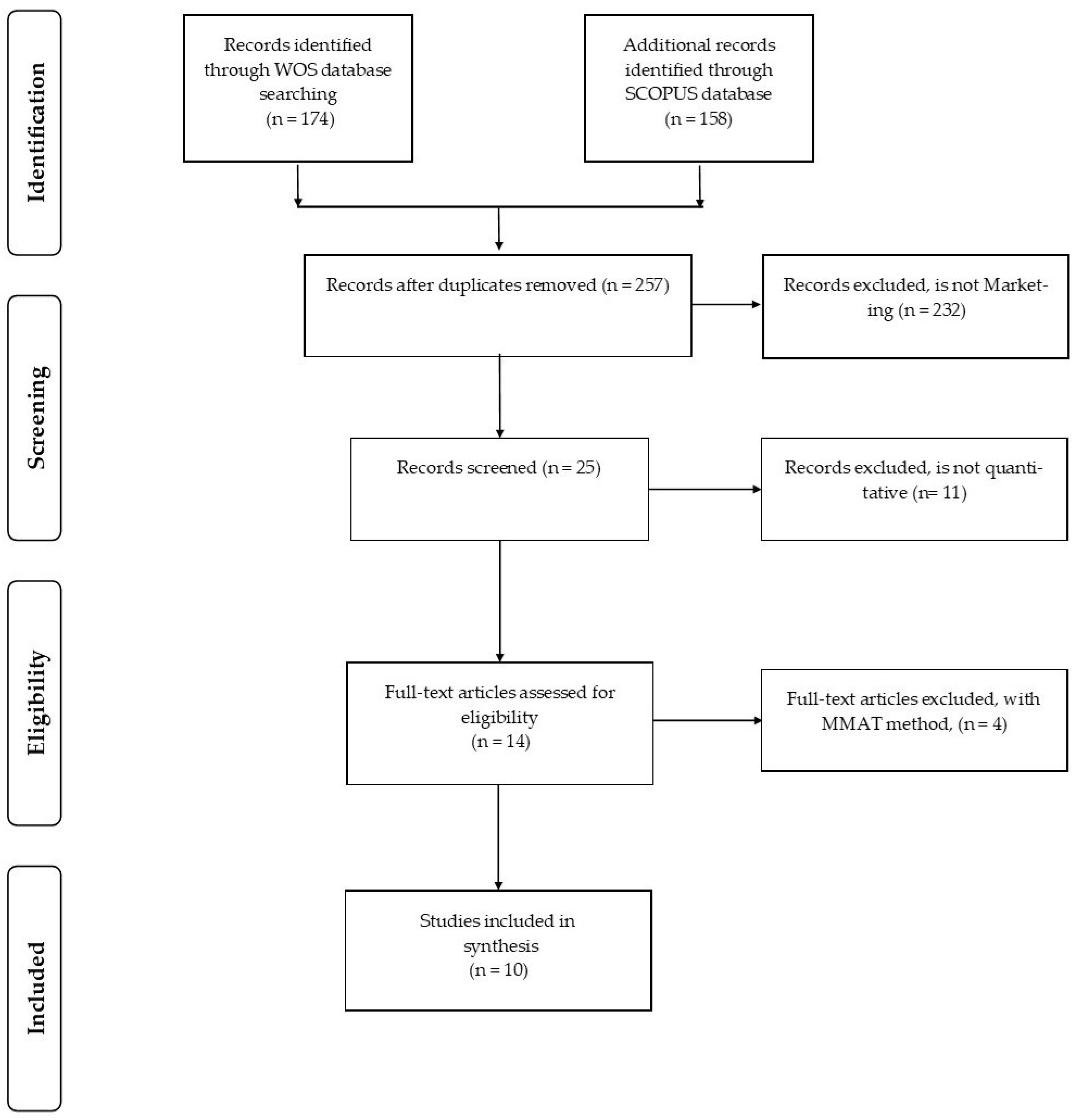
Figure 2.
Countries studies in selected articles.
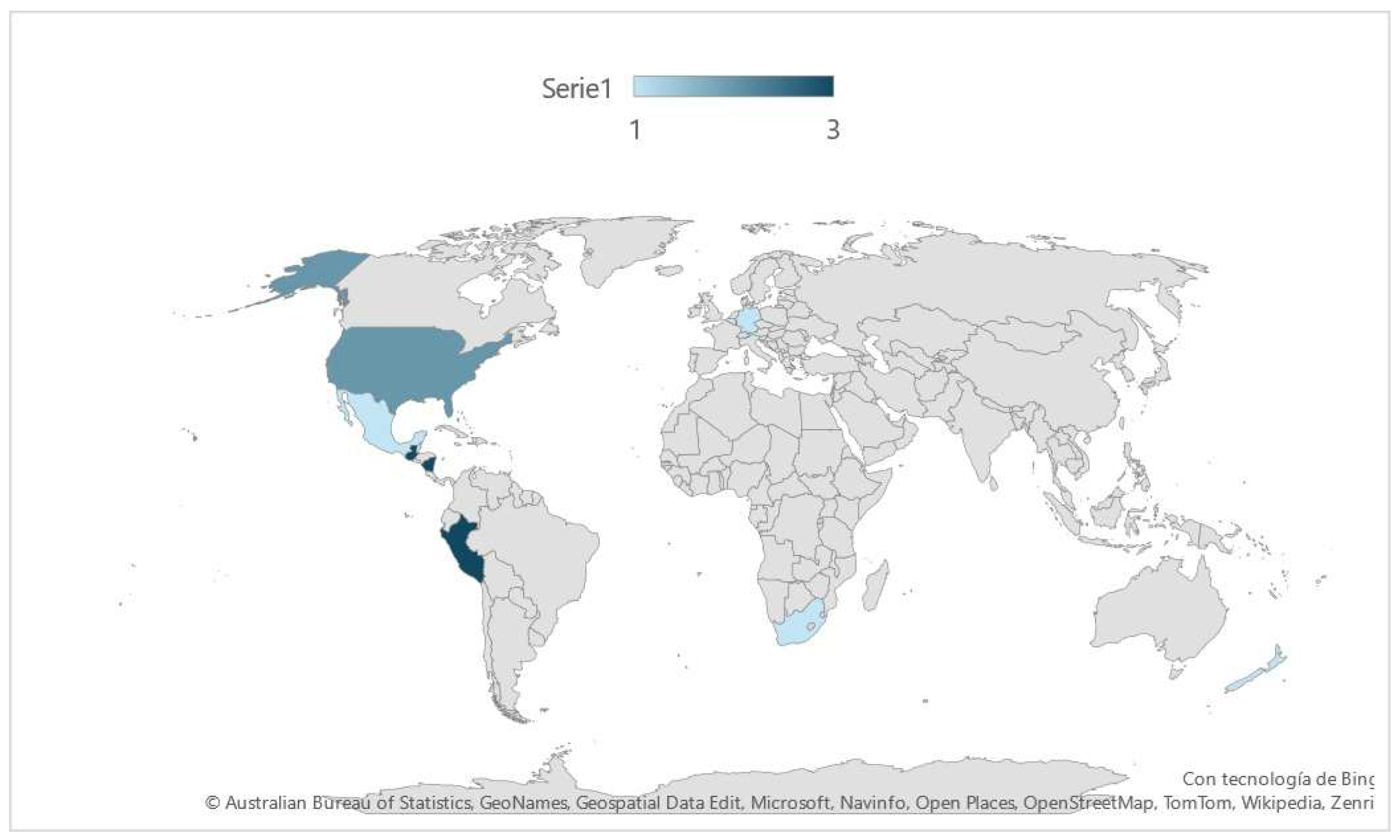
Table 1.
Eligibility criteria using.
| PICOS | Description | Inclusion reason |
| Population | Coffee consumers, Coffee farmers, Coffee traders, Communities near coffee plantations. | Theoretical beneficiaries of Fair Trade coffee. |
| Interventions | Application of questionnaires and quantitative methods under standard The Mixed Methods Appraisal Tool. | Open to formal and empirical sciences. |
| Comparator | 1) Focus on Macromarketing (MM), Strategic Marketing (SM), and Operational Marketing (OM) 2) Research method. | Focus on the topic under study. |
| Outcomes | 1) Classifications of SM (consumer behavior, segmentation and targeting strategies, branding strategy decisions, analysis of the business environment and competition) 2) Classifications of OM (price, promotion, product place, people, processes and physical evidence) 3) Macromarketing Categories 4) SDG Classifications OM MM and SM. | Focus on the topic under study. |
| Study designs | Quantitative studies, under standard The Mixed Methods Appraisal Tool. | Empirical sciences. |
Table 2.
Characterization of ten selected articles according to PRISMA-ScR guidelines.
| Authors | Articles | Journal |
Pub. Year |
Category of Study Design MMAT |
Country | Source Data Base | DOI | ||||||||
| Ufer, D; Lin, W; Ortega, DL [47] | Personality traits and preferences for specialty coffee: Results from a coffee shop field experiment | Food Res. Int. | 2019 | Quantitative non-randomized | United States | WoS | 10.1016/j.foodres.2019.108504 | ||||||||
| Paetz, F [48] | Recommendations for Sustainable Brand Personalities: An Empirical Study | Sustainability | 2021 | Quantitative non-randomized | Germany | WoS | 10.3390/su13094747 | ||||||||
| Lappeman, J; Orpwood, T; Russell, M; Zeller, T; Jansson, J [49] | Personal values and willingness to pay for fair trade coffee in Cape Town, South Africa | J. Clean Prod. | 2019 | Quantitative non-randomized | South Africa | WoS; Scopus |
10.1016/j.jclepro.2019.118012 | ||||||||
| Geiger-Oneto, S; Arnould, EJ [50] | Alternative Trade Organization and Subjective Quality of Life: The Case of Latin American Coffee Producers | J. Macromark. | 2011 | Quantitative descriptive | Nicaragua, Peru and Guatemala | WoS; Scopus |
10.1177/0276146711405668 | ||||||||
| Darian J.C.; Tucci L.; Newman C.M.; Naylor L. [51] | An Analysis of Consumer Motivations for Purchasing Fair Trade Coffee | J. Int. Consum. Mark. | 2015 | Quantitative descriptive | United States | Scopus | 10.1080/08961530.2015.1022920 | ||||||||
| Hwang, K; Kim, H [52] | Are Ethical Consumers Happy? Effects of Ethical Consumers’ Motivations Based on Empathy Versus Self-orientation on Their Happiness | J. Bus. Ethics | 2018 | Quantitative descriptive | South Korean | WoS; Scopus |
10.1007/s10551-016-3236-1 | ||||||||
| Arnould, EJ; Plastina, A; Ball, D [53] | Does Fair Trade Deliver on Its Core Value Proposition? Effects on Income, Educational Attainment, and Health in Three Countries | J. Public Policy Mark. | 2009 | Quantitative descriptive | Nicaragua, Peru, and Guatemala. | WoS; Scopus |
10.1509/jppm.28.2.186 | ||||||||
| Arana-Coronado J.J.; Trejo-Pech C.O.; Velandia M.; Peralta-Jimenez J. [54] | Factors Influencing Organic and Fair Trade Coffee Growers Level of Engagement with Cooperatives: The Case of Coffee Farmers in Mexico | J. Int. Food Agribus. Mark. | 2019 | Quantitative descriptive | Mexico | Scopus | 10.1080/08974438.2018.1471637 | ||||||||
| Murphy A.; Jenner-Leuthart B. [55] | Fairly sold? Adding value with fair trade coffee in cafes | J. Consum. Mark. | 2011 | Quantitative descriptive | New Zealand | Scopus | 10.1108/07363761111181491 | ||||||||
| Arnould E.J.; Plastina A.; Ball D. [56] | Market Disintermediation and Producer Value Capture: The Case of Fair Trade Coffee in Nicaragua, Peru, and Guatemala | Adv. Int. Manage. | 2007 | Quantitative descriptive | Nicaragua, Peru, and Guatemala | Scopus | 10.1016/S1571-5027(07)20014-2 |
Table 3.
Outcomes of ten selected articles according to PRISMA-ScR guidelines.
| Authors | Journals | Focus publications marketing and Fair Trade | Outcomes marketing categories | Outcomes marketing subcategories | Outcomes Main SDG identified* |
Brief conclusions studies |
||||||
| Ufer, et al. [47] | Food Res. Int. | This article explores how personality characteristics, such as extraversion and conscientiousness, influence consumers’ willingness to pay for specialty coffee from cooperatives, highlighting the importance of segmenting them not only by demographic factors, but also by psychological ones. | Strategic Marketing | Consumer Behavior | 12 | Personality traits, such as extraversion and responsibility, increase the willingness to pay a premium price for products that promote fairer and more sustainable trade | ||||||
| Paetz, et al. [48] | Sustainability | How sustainable consumer personalities can be aligned with brand personalities to achieve greater success in marketing sustainable products. The research analyzes sustainable consumer personalities and proposes brand personality dimensions, such as competence, emotion and sincerity, to create a harmonious and effective brand strategy. | Strategic Marketing | Consumer Behavior | 12 | The consumer’s personality, specifically those who are more open and friendly, positively influences their willingness to pay more for sustainable products, such as those with Fair Trade certification. | ||||||
| Lappeman et al. [49] | J. Clean Prod. | Relationship between personal values and willingness to pay for Fair Trade coffee in Cape Town. The study segments consumers according to their willingness to pay and how their personal values, such as humanitarianism, influence their purchasing decision. | Strategic Marketing | Consumer Behavior, Segmentation |
9 | Findings indicate that consumers with humanitarian values and knowledge of Fair Trade are willing to pay a premium price for these products. | ||||||
| Geiger-Oneto, et al. [50] | J. Macromark. | The effects of Fair Trade on the quality of life of coffee producers in Latin America, evaluating how cooperatives impact their subjective and economic well-being. that examines the impact of the Fair Trade system on the relationships between producers, consumers and the global market, considering large-scale social and economic aspects. | Macromarkeitng | Quality Life, coperativism | 1 | The findings highlight that farmers participating in Fair Trade cooperatives report a higher quality of life, better income and a more positive outlook on the future for their families. | ||||||
| Darian et al. [51] |
J. Int. Consum. Mark. | The focus of the article is to investigate consumers’ motivations for purchasing Fair Trade coffee, focusing on the perceived benefits to workers and farmers, examining the reasons behind purchasing decisions and how consumers value the ethical aspects of Fair Trade. | Strategic Marketing | Consumer Behavior | 9 | Consumers mainly buy Fair Trade coffee to improve wages and working conditions for farmers and workers. Frequent buyers and those with greater knowledge of Fair Trade prioritize long-term benefits such as community development and producer empowerment more than occasional buyers. | ||||||
| Hwang, et al. [52] |
J. Bus. Ethics | What ethical consumers’ motivations, based on empathy or self-orientation, affect their happiness when they consume Fair Trade coffee. It explores how emotional and psychological factors influence consumer satisfaction and repurchase intention. | Strategic Marketing | Consumer Behavior | 9 | The study shows that ethical consumers’ happiness is primarily driven by self-oriented motivations such as self-actualization and narcissism, rather than moral emotions like empathy and guilt. Narcissism fosters self-actualization, which then boosts happiness and encourages repurchasing Fair Trade coffee | ||||||
| Arnould, et al. [53] |
J. Public Policy Mark. | Assessing whether Fair Trade meets its core value proposition by improving the income, education and health of small coffee producers in Latin America. examines the social and economic impact of Fair Trade on the lives of producers, connecting consumers and producers within a global system of ethical trade. | Macromarkeitng | Quality Life, cooperativism | 3 | Fair Trade coffee participation boosts farmers’ income and offers some educational and health benefits, though inconsistently. Cooperative membership increases the chances of children attending school and improves access to medical care, particularly for long-term participants. | ||||||
| Arana-Coronado et al. [54] |
J. Int. Food Agribus. Mark. | Factors that influence the level of engagement of organic and Fair Trade coffee producers with cooperatives in Mexico. It studies how the economic and social relationships between producers and cooperatives affect farmers’ participation in the global market, focusing on the large-scale implications of Fair Trade and organic coffee. | Macromarkeitng | Quality life, Cooperativism | 9 | Farmers in Fair Trade cooperatives in Mexico report better income and quality of life. Payment delays and uncertainty reduce their engagement, leading some to sell outside the cooperative. Strengthening commitment and improving payment processes increase cooperative participation. | ||||||
| Murphy et al. [55] |
J. Consum. Mark. | Explores how Fair Trade coffee can help differentiate and strategically position coffee shops by analyzing how the use of Fair Trade coffee and its promotion can influence customer perceptions and help coffee shops stand out from the competition. | Strategic Marketing | Positioning | 9 | The study found that many customers overestimated their Fair Trade knowledge. More informed customers valued fair trade and the cafe atmosphere but expected lower price premiums. After learning more, they supported higher prices, though their expectations for coffee taste worsened. | ||||||
| Arnould et al. [56] |
Adv. Int. Manage. | How participation in Fair Trade enables small coffee producers to capture more economic value through disintermediation. Studies the large-scale social and economic impact of Fair Trade in rural communities, improving the quality of life, education, and access to health services for producers. | Macromarkeitng | Quality Life, cooperativism | 4 | Producers in TransFair USA-supported Fair Trade cooperatives capture more value than nonparticipants, leading to modest but measurable improvements in quality of life, health, education, and sustainable agricultural practices. |
* SDGs: 1: No poverty, 3: Good health and well-being, 4: Quality education, 9: Industry, innovation and infrastructure, 12: Responsible consumption and production.
Table 4.
Cross-matrix with respect to concentric studies in peripheral and central areas.
| Macromarketing | Strategic Marketing | Operational Marketing | |
| Central Countries | No cases found | Germany, United State, South Korea, New Zealand issues related to Consumer Behavior, Segmentation, Positioning and Sustainability Branding | No case found |
| Peripheral countries | Nicaragua, Peru, and Guatemala, Mexico. Main topics related to cooperativism, quality of life and impacts on health and education | South Africa, Main issues related to Humanitarian Values, Fair Trade Knowledge, Willingness to Pay Premium Price | No case found |
Disclaimer/Publisher’s Note: The statements, opinions and data contained in all publications are solely those of the individual author(s) and contributor(s) and not of MDPI and/or the editor(s). MDPI and/or the editor(s) disclaim responsibility for any injury to people or property resulting from any ideas, methods, instructions or products referred to in the content. |
© 2024 by the authors. Licensee MDPI, Basel, Switzerland. This article is an open access article distributed under the terms and conditions of the Creative Commons Attribution (CC BY) license (http://creativecommons.org/licenses/by/4.0/).
Copyright: This open access article is published under a Creative Commons CC BY 4.0 license, which permit the free download, distribution, and reuse, provided that the author and preprint are cited in any reuse.


