

Submitted:
24 December 2024
Posted:
25 December 2024
You are already at the latest version
Abstract
The effects of the various protection programs to control the European cherry fruit fly, cherry brown rot and cherry leaf spot on sour cherry were investigated. The effects of acetamiprid, spinetoram, dodine, boscalid and pyraclostrobin, applied alone and in combination with sucrose, were determined using standard EPPO methods. The residues of the applied pesticides were determined in the cherry fruit using liquid chromatography coupled with mass spectrometry. The highest efficiency in controlling the European cherry fruit fly was achieved by applying acetamiprid twice and spinetoram three times during fruit ripening. Successful protection of cherries against brown rot was achieved with a single application of boscalid and pyraclostrobin with the addition of sucrose. Dodine in combination with boscalid and pyraclostrobin had good efficacy in controlling cherry leaf spot, which increased with the addition of sucrose. The residues of spinetoram, boscalid and pyraclostrobin were below the limit of quantification, while only acetamiprid and dodine residues were detected in the fruit samples, but these were well below the maximum residue levels. This study has shown that there are several alternative protection programs that can be used to successfully protect cherries against the European cherry fruit fly and diseases during the critical stage of fruit ripening, with residue levels below the prescribed maximum levels.
Keywords:
Blumeriella jaapii
; Monilinia spp.
; Rhagoletis cerasi
; control and pesticide residues
1. Introduction
According to the Food and Agriculture Organization of the United Nations (FAOSTAT) statistical database for 2022, the total production of sour cherries worldwide amounted to 1,593,024.7 tons, of which 1,034,868.04 tons (64.96%) were produced in Europe. With a production of 164,446 tons, Serbia ranks fifth in the world after Russia, Poland, Ukraine and Turkey [1].
The production of sour cherries (Prunus cerasus L.) is threatened by a variety of pests and plant diseases that occur during the growing season [2] (González-Núñez, 2021). The presence of weeds can also pose a further threat to cherry orchards, where they are usually controlled mechanically or with fluroxypyr-meptil and glyphosate-based preparations [3,4] (Dakić et al. 2012; Osipitan et al. 2020). The fungi of the order Monilinia (Monilinia laxa Honey and Monilinia fructigena Schumach.) as pathogens of cherry brown rot and the fungus Blumeriella jaapii Wolf as pathogen of cherry leaf spot are the most destructive fungal diseases whose occurrence has a direct impact on yield and fruit quality. Species of the genus Monilinia can cause blossom and twig dryness as well as fruit rot in sour cherries [5,6] (Holb, 2003; Holb et al., 2013). Infection of fruit can occur at any stage of development, but most commonly during ripening under conditions of increased moisture [7] (Larena et al., 2021). More serious infections are caused by mechanical damage or insect infestation. Cherry brown rot can cause up to 33 % damage at harvest, and under storage conditions (temperature of 0 °C) the damage reaches up to 86% within 30 days [8] (Xu et al., 2007). The control of brown rot requires several fungicide applications during the growing season, which ends with the beginning of the ripening period.
B. jaapii causes a fungal leaf disease that can lead to premature defoliation. As a result, damage can be considerable, with fruit remaining smaller and difficult to ripen, flower bud formation being interrupted for the next growing season, and buds and twigs freezing at very low winter air temperatures [9] (Proffer et al., 2013). Depending on the infection conditions, five to seven treatments with fungicides are recommended, starting with the petal fall stage of the blossom until the post-harvest period [10] (Holb et al., 2010).
The most important and most common pest in cherry orchards is the cherry fruit fly, Rhagoletis cerasi L. (order Diptera, family Tephritidae). If the population of R. cerasi is high, yield losses can be up to 100% [11] (Olszak and Maciesiak, 2004). As this pest regularly occurs in cherry orchards, it must be controlled with insecticides from the beginning of the ripening period. It causes worming of the fruit in which its larvae develop, and the damaged fruit is susceptible to fungal infections, especially brown rot [12] (Medic, 2022).
Very strict criteria are applied to determine the quality of sour cherries, often requiring the absolute absence of R. cerasi larvae in the sample taken for analysis in order for the fruit to be classified in a high class, i.e., suitable for consumption and export requirements. If larvae are detected in the sample, the quality of the fruit is classified in a lower class and such fruit can only be used for industrial processing, which significantly reduces its market value. The tolerance threshold for the presence of larvae in fruit varies from country to country; in Switzerland and Spain, for example, it is 2% [13] (Daniel and Grunder, 2012), while in Turkey and Serbia the presence of larvae in fruit intended for export is not tolerated [14] (Alaserhat, 2022). In view of these criteria, the use of insecticides to control R. cerasi is a common measure in cherry protection programs. Acetamiprid from the neonicotinoid group is the leading active ingredient for the control of R. cerasi in modern cherry protection programs and shows high efficacy [15] (Maciesiak et al. 2005), without data on the possible occurrence of resistant populations. The semi-synthetic bioinsecticide spinetoram from the spinosin group could be a good alternative to acetamiprid for the control of R. cerasi, considering its short pre-harvest interval (7 days), its good toxicological and ecotoxicological profile and its significant systemic activity [16] (Tomlin, 2010). In the absence of literature data, we decided to investigate the justification of its use to control R. cerasi, as it has been successfully used in cherry protection programs against Drosophila suzukii Matsumura [17,18] (Profaizer et al. 2015; Shaver et al. 2018).
Some studies have confirmed that the addition of sucrose to the spray mixture significantly increases the efficacy and persistence of certain insecticides [19] (Cowles et al., 2015). Sucrose is approved as an adjuvant for pesticides in the United States of America [20] (US EPA) and in the European Union [21] (EU – EC 1).
The European cherry fruit fly, brown rot and cherry leaf spot are controlled during fruit ripening with pesticides that can be combined with sucrose, which, as already mentioned, can also prolong their persistence. For these reasons, there is a real risk of increased pesticide residues in fruit. Fruit destined for the domestic market and for export must meet strict prescribed standards. These standards relate to the presence of residues of the individual active ingredients used in order to be safe for human health, i.e., to comply with the maximum residue levels set by the European Food Safety Authority (EFSA) [22] (EU – EC 2). A maximum residue level (MRL) is defined as the highest amount of a pesticide residue that is legally tolerated when pesticides are used properly in or on food or feed (good agricultural practice) [23] (EU – EC 3).
The aim of this study was to determine the efficacy of the most commonly used pesticides to protect cherries from European cherry fruit fly, brown rot and cherry leaf spot disease during fruit ripening, namely: acetamiprid, spinetoram, dodine and the combination of boscalid with pyraclostrobin. In addition to efficacy, which is of great importance in plant protection, the timing and frequency of application as well as the application rates are equally important in order to keep pesticide residues within the legally defined limits [24] (Jacquet et al., 2022). Pesticide residues in cherry fruit were determined after harvest to assess their compliance with the MRLs [25] (Anonymous 1 EC 2005).
The most commonly implemented program in Serbia to protect cherries from the main pest R. cerasi and fungal diseases is the application of acetamiprid twice at 7-day intervals in combination with fungicides during fruit ripening. The combination of pesticides with sucrose has not yet been included in the protection programs for this period, although data from the literature indicate that sucrose as an adjuvant can increase the efficacy of pesticides, but also their residues in the fruit, as already mentioned. Also, the semi-synthetic bioinsecticide spinetoram is not included in the systems for the protection of cherries against the European cherry fruit fly in our country. Our main objective was to investigate different protection programs for cherries during fruit ripening. In this way, we determined the effects of such alternative protection programs, which include, in addition to the established program (acetamiprid + fungicides), programs with the use of spinetoram as a possible alternative to the use of acetamiprid, as well as programs with the addition of sucrose in the high-risk period of fruit ripening. A further objective was to determine consumer safety in relation to pesticide residues, which were also identified.
2. Materials and Methods
Field Trial
The trial was conducted in 2023 at the Mačvanski Metković site (Bogatić municipality; GPS: 44°51’06 “N 19°33’48 “E) in the sour cherry orchard. In the orchard, the usual agrotechnical measures and measures to protect against diseases and pests were carried out until the time of the experiment, so that the orchard was in a good state of health. The trial was conducted according to the completely randomized block design in four replications (Table 1), and the size of the experimental plot was three cherry trees [26] (Anonymous 2 PP 1/152 (4)). The plant protection products were sprayed vertically using a backpack sprayer “Solo 423” with a dosage expression for tall-growing plants according to the standard method PP 1/239 (3) [27] (Anonymous 3 PP 1/239 (3)). An overview of the protection programs tested in the trial is shown in Table 2. The cherry trees in the control plots (untreated plot, Table 2) have not been treated with pesticides since the beginning of the growing season.
Control of the European Cherry Fruit Fly
The efficacy of the insecticide in controlling the cherry fruit fly (R. cerasi) was determined according to the standard method [28] (Anonymous 4 PP 1/35 (2)). The time of treatment was determined by observing the flight of the cherry fruit fly imago with yellow sticky traps in the phenophase of the beginning of fruit ripening (BBCH 81).
To evaluate the experiment, 300 fruits per experimental plot were collected at the time of cherry harvest. The harvested fruits were immersed in a saturated aqueous sodium chloride solution to allow the larvae to leave the fruit [28] (Anonymous 4 PP 1/35 (2)). After 24 hours, the number of larvae was determined.
Control of Cherry Leaf Spot Disease
The efficacy of the fungicides in controlling cherry leaf spot was determined using the partially adapted standard method [29] (Anonymous 5 PP 1/30 (2)). During the trial, an evaluation of the effects was carried out at phenophase BBCH 85, i.e., 15 days after treatment (DAT). In this evaluation, the appearance of disease symptoms was observed on 10 leaves on 10 marked branches per replicate. The severity of the disease on the leaves was graded according to the scale proposed by Schuster and Tobutt [30], and the intensity of infection was determined according to the formula given by Townsend and Heuberger [31].
Control of Brown Rot of the Cherry
In order to evaluate the effect of fungicides in the control of cherry brown rot, 300 fruits per sample plot were randomly sampled at the time of cherry harvest. The sampled fruits were analyzed and all fruits showing symptoms of brown rot were considered infected. The fruit infection per treatment replicate, the average fruit infection per treatment and the standard deviation (SD) were determined.
Statistical Analysis
Mean fruit damage (R. cerasi), fruit infection (Monilinia spp.) and leaf infection (B. jaapii) (Ms) by treatment and standard deviation (SD) were determined as well as the comparison of means, i.e., the significance of differences between treatments (t-test). The analysis of variance was performed using the Microsoft Excel computer program. The percentages of fruit damage, fruit infection and leaf infection after replicates (x) were previously transformed using statistics: √(x+0.5), and were used as such in the analysis of variance. The efficacy of the pesticide was determined using Abbott’s formula [32].
Pesticide Residues in Cherry Fruit
The samples were collected on the dates indicated in Table 7. The cherries were sampled in accordance with Commission Directive 2002/63/EC [33] (Anonymous 6) and stored frozen until analysis.
Chemicals and equipment: the analytical standards used in the study were acetamiprid (Nippon Soda Co., Ltd., purity 99.9%), boscalid (Dr. Ehrenstorfer GmbH, purity 99.02%), dodine (Pestanal, purity 99%), pyraclostrobin (BASF, purity 99.9%) and spinetoram solution (Sigma-Aldrich 100 µg/ml in acetonitrile). Carbofuran d3 (Sigma-Aldrich, purity 99.3%) was used as an internal standard at a concentration of 10 µg ml-1 in acetonitrile. The basic standard solutions were prepared by dissolving the analytical standards in appropriate solvents, while the working solution, i.e., the mixture of analyzed pesticides, was obtained by mixing and diluting the basic standards with acetonitrile, resulting in a final mass concentration of 10 µg ml-1. The QuEChERS Extraction Pouch (Cat.#: COQP4115; Biocomma Limited, PR China), dispersive SPE 2 ml for pigment samples (Part No. 5982-5221; Agilent Technologies, USA) and acetonitrile (Fisher Scientific, Belgium) were used to extract and purify the pesticide residues.
An Agilent 1260 Infinity LC liquid chromatograph (Agilent Technologies) coupled with a 6460 Triple Quad LC/MS mass spectrometer was used for the analysis. Ionization was performed by electrospray ionization (ESI). The mass spectrometer operates in Multiresidue Reaction Monitoring (MRM) mode (Table 3). The Mass Hunter Optimizer software version B06.00 (Agilent Technologies, 2011) was used for data acquisition and processing. Chromatographic separation was performed on the Agilent XDB-C18, 4.6х50 mm; 1.8 micron. The mobile phase was 0.1% formic acid in water (A) and 0.1% formic acid in acetonitrile (B) with gradient 0 min - 5% В, 2 min - 5% В, 15 min - 80% В, 20 min - 80% В, 23 min - 98% В, 25 min - 98% В. The flow rate was 0.4 ml/min and the injection volume was 2 μl.
Validation parameters: The linearity of the detector response was checked by preparing a blank sample of cherry to which an internal standard Carbofuran d3 was added according to the QuEChERS method. Linearity was checked at concentrations of 0.01; 0.025; 0.050 and 0.100 µg ml-1 in the matrix (Table 4).
The “recovery” was checked by spiking 10 g of a blank sample of cherries at two levels (0.010 and 0.100 mg kg-1) in six replicates by adding an aliquots of 10 and 100 μl of pesticide standard solution (10 µg ml-1) and adding 100 μl of the internal standard Carbofuran d3 (10 µg ml-1). The QuEChERS extraction was performed with the spiked samples with the addition of 10 ml acetonitrile. After shaking in a vortex mixer (1 minute), the QuEChERS Extraction Pouch (Cat.#: COQP4115; Biocomma Limited, PR China) was added to the mixture. The mixture was shaken again and centrifuged (5 minutes at 3000 rpm), 1 ml of the supernatant was mixed with 2 ml of a dispersive SPE for the pigment sample (Part No. 5982-5221; Agilent Technologies, USA). With repeated centrifugation, 0.5 ml of the supernatant was filtered into 2 ml LC/MS vials [34,35,36,37,38] (Anastassiades et аl., 2003; Payá et al., 2007; Lesueur et al., 2008; Lehotay et al., 2010; Dehouck et al., 2015).
The limits of detection (LOD) were calculated using the calculator “Calculate Signal-to-Noise” in the Mass Hunter Optimizer software version B06.00 (Agilent Technologies, 2011) (Table 3).
The limits of quantification (LOQ) were set at the lowest calibration level of 0.01 µg kg-1.
3. Results
The average damage to cherry fruit by R. cerasi larvae at harvest was high and amounted to 6.75 % in the untreated plot (Table 5). Most treatments, i.e., protection programs, showed very high efficiency (100%) in controlling cherry fruit fly, namely: acetamiprid was applied twice independently and in combination with sucrose, spinetoram was applied three times independently and in combination with sucrose. However, the efficacy of spinetoram applied twice was low (66.67%), while it was significantly higher (77.78%) when sucrose was added, which was also applied twice.
Statistical analysis showed that spinetoram applied twice, independently and with sucrose, had a statistically significantly lower efficacy compared to other insecticides tested, i.e., protection programs. Spinetoram applied twice alone also had statistically lower efficacy than the program that combined this insecticide with sucrose (P ≤ 0.05; P ≤ 0.01).
In the untreated plot, a moderate infection of fruit with Monilinia spp. was observed, amounting to 9.0% (Table 6). The application of a combination of boscalid and pyraclostrobin was effective in suppressing brown rot. However, the applied fungicide combination without sucrose achieved a much lower efficacy of 86.11% compared to the efficacy of the same combination with sucrose, where the efficacy was high and amounted to 94.44%.
Statistical analysis showed that boscalid and pyraclostrobin were statistically significantly less effective when applied alone than in the program where these fungicides were combined with sucrose (P ≤ 0.05; P ≤ 0.01).
The untreated plot showed weak to moderate infection of the leaves with B. jaapii, averaging 7.55% (Table 7). The application of dodine and the combination of boscalid and pyraclostrobin achieved good efficacy in controlling cherry leaf spot. The independent application of these fungicides achieved a good efficacy of 96.03%. However, the addition of sucrose significantly increased the efficacy of these agents to 98.01%.

Table 7.
Disease intensity (%) of cherry leaves with B. jaapii and efficacy of fungicides used.
| Treatment | Percentage of leaf infection by treatment replications | Average infection in treatment (%) (Ms)* | Sd* | Efficacy (%) | |||
|---|---|---|---|---|---|---|---|
| A | B | C | D | ||||
| Dodine + Boscalid + Pyraclostrobin | 0.2 | 0.4 | 0.2 | 0.4 | 0.3a** | 0.12 | 96.03 |
| Dodine + Boscalid + Pyraclostrobin + sucrose | 0.2 | 0 | 0 | 0.4 | 0.2b | 0.19 | 98.01 |
| Untreated plot | 9.0 | 7.8 | 6 | 7.4 | 7.6c | 1.24 | - |
| LSD0.05 | 0.0193 | ||||||
| LSD0.01 | 0.0444 | ||||||
*Data are expressed as mean values (Ms) and standard deviation (Sd) of four replications (A, B, C, D) of each pesticide treatment; **Mean values followed by the same superscript letter(s), within the same column, are insignificantly different (P ≤ 0.05; P ≤ 0.01) according to t –test.
Statistical analysis showed that the protection program with the independent application of dodine, boscalid and pyraclostrobin had a statistically significantly lower efficacy than the program that combined these fungicides with sucrose (P ≤ 0.05; P ≤ 0.01).
According to the results in Table 8, the pesticide residues in all samples of cherry fruit were below the MRLs [25] (Anonymous 1 396/2005). In the samples tested, spinetoram, boscalid and pyraclostrobin were below the limit of quantification after the pre-harvest interval (PHI 14 days), i.e., <0.01 mg kg-1. Although the PHI for boscalid and pyraclostrobin is 14 days, their residues were already below the limit of quantification 7 days after application. In the fruit sample in which acetamiprid was applied twice in combination with sucrose, 0.197 mg kg-1 a.i. was detected, which was 0.03 mg kg-1 a.i. more than in the sample in which acetamiprid was applied alone (0.167 mg kg-1). However, the residues in both samples were well below the legal maximum residue level (1.5 mg kg-1).
The highest amount of dodine residues of 1.593 mg kg-1 was detected in samples after 14 days of application (PHI 21 days), but these residues were also below the prescribed maximum residue level (3 mg kg-1). A lower amount of dodine was detected in the sample in which it was applied alone (1.199 mg kg-1), while a higher residue level (1.593 mg kg-1) was detected in the treatment with the addition of sucrose. In the fruits sampled after the pre-harvest interval (PHI 21 days), the following residues of dodine were detected when applied alone (mg kg-1): 0.45; 0.918; 0.522; in combination with sucrose they were (mg kg-1): 0.585; 1.39; 0.787. In most samples, the use of dodine in combination with sucrose led to an increase in the residue concentration without, however, exceeding the maximum residue limits.
4. Discussion
In our study, the application of acetamiprid achieved good efficacy in the control of R. cerasi when applied twice (with and without sucrose) in protection programs. In addition, two applications of spinetoram together with sucrose were more effective than spinetoram alone, while maximum efficacy was achieved with three applications of this agent, regardless of whether it was used in combination with sucrose or alone. Trials in Poland show good efficacy of acetamiprid in split applications, with efficacy in controlling fruit flies on cherries ranging from 97.6% to 100% [11] (Olszak & Maciesiak, 2004). An efficacy of 92.9% after a single application of acetamiprid to control this pest on cherries in Serbia was found by Lazić et al. [39] (2018). In a study on the efficacy of different programs for the control of R. cerasi, a program that included the application of acetamiprid, phosmet, spinetoram and deltamethrin achieved a high efficacy of 100% [40] (Shawer et al., 2018).
Such systems for the protection of cherries against R. cerasi under conditions of heavy infestation showed that successful protection was achieved by applying: 1) acetamiprid (alone or in combination with sucrose) twice at 7-day intervals; 2) spinetoram (alone or in combination with sucrose) three times at 7-day intervals. Using spinetoram only twice did not lead to satisfactory results under these conditions. The addition of sucrose increased the efficacy of spinetoram when used twice, but still did not provide sufficient protection. According to the data of other authors, the application of sucrose increases the efficacy of certain insecticides. Cowles et al. [19] (2015) confirmed that the addition of sucrose to the spray mixture significantly increased the efficacy of certain insecticides, including acetamiprid, spinetoram, cyantraniliprole and bifenthrin, in controlling Drosophila suzukii Matsumura. Acetamiprid and spinetoram significantly prevented larval development 7 days after treatment (DAT) when combined with sucrose compared to application without sucrose. The same authors state that the application of pesticides with sucrose does not lead to more intense rot development. However, as far as the mixture with fungicides is concerned, there is currently no data to prove that the addition of this adjuvant increases the efficacy of these agents.
Adaskaveg et al. [41] (2005) found that the application of a combination of boscalid and pyraclostrobin as a low-risk fungicide provided high efficiency in protecting nectarines against brown rot during the ripening period, ranging from 88% to 94% depending on the variety and intensity of infection. According to our results, this fungicide combination applied only once before harvest achieved good efficacy in suppressing brown rot on sour cherries, while this combination with the addition of sucrose achieved statistically significantly better efficacy.
In our study, both programs achieved good protection of sour cherry under the conditions of higher incidence of cherry leaf spot disease in the untreated plot, but the program with dodine, boscalid and pyraclostrobin with the addition of sucrose showed significantly higher efficacy compared to the program where only fungicides were applied. No data on the effect of sucrose on the efficacy of fungicides in the control of B. jaapii can be found in the available literature. However, other authors investigated the efficacy of certain fungicides in controlling this cherry disease. For example, Proffer et al. [9] (2013) determined the high efficacy of the cherry protection program, in which only dodine was used, under conditions of very heavy disease incidence. Božić et al. [42] (2021) found a high efficacy of dodine of 96.3% at moderate intensity of B. jaapii infection (9.47%) on sweet cherry, while Khan et al. [43] (2016) found a similar efficacy (96.33%) at very high disease intensity in the untreated plot (51.50%).
In this study, we found that the residues of acetamiprid and spinetoram were several times lower than the residue levels prescribed for the EU region, both when applied independently and in combination with sucrose. The level of residues of these compounds in cherry fruit was also determined by other authors. When studying the dynamics of degradation of acetamiprid in cherry fruit in the time interval of 0-14 days, Lazić et al. [39] (2018) and [44] (2014) reported low acetamiprid residues at 14DAT, namely 0.111 mg kg-1 and 0.09 mg kg-1, respectively. Haviland & Beers [45] (2012) showed that after sampling cherry fruit at 0, 3, 7 and 21DAT, spinetoram residues ranged from below the detection limit to 0.19 ppm. VanWoercom et al. [46] (2022) found that spinetoram residues in cherry fruit samples amounted to 0.02 mg kg-1 after several applications of this compound. Even with increasing precipitation, the spinetoram residues did not decrease significantly, which the authors explained by the rapid absorption of the compound by the cuticle of the fruit peel.
Our results show that the addition of sucrose slightly increased the level of dodine residues in cherry fruit harvested on 14DAT (1.593 mg kg-1) and 21DAT (up to 1.39 mg kg-1). However, these increased residues were also below the prescribed maximum residue level of 3 mg kg-1. Residues were also detected in programs in which this fungicide was used without sucrose (21DAT: 0.45; 0.918; 0.522 mg kg-1; 14DAT: 1.199 mg kg-1), which were within the permissible limit. Similar results were reported by Božić et al. [42] (2021), who detected dodine residues of 3.27 mg kg-1 7DAT and 0.93 mg kg-1 21DAT in cherry fruit samples.
González-Núñez et al. [2] (2022) investigated the effects of different protection programs for cherries against diseases and pests and determined the residues of several fungicides and insecticides. In this study, the residues of boscalid and pyraclostrobin were at the limit of detection, which is consistent with our results where the residues of these fungicides were below the limit of quantification.
5. Conclusions
According to the results of our tests, the application of pesticides in combination with sucrose can increase the efficacy of spinetoram in the control of R. cerasi and of dodine, boscalid and pyraclostrobin in the control of B. jaapii and of boscalid and pyraclostrobin in the control of Monillinia spp. This combination of insecticides and fungicides with sucrose also did not increase the residues of spinetoram, boscalid and pyraclostrobin, and their residues were below the limit of quantification. On the other hand, the addition of sucrose increased the residue levels of acetamiprid and dodine in cherry fruit, but even with this increase, the levels remained below the prescribed MRLs. However, despite acceptable residues of certain pesticides, the addition of sucrose must be done with additional precautions. These results show that it is possible to apply innovative systems to protect sour cherries from R. cerasi and pathogens during fruit ripening in accordance with the PHI for each pesticide while keeping pesticide residues in line with the MRLs for the EU market.
Author Contributions
Conceptualization, M.S., N.T. and B.Š.T.; methodology, N.T., M.S., and B.Š.T.; software, N.T. and B.Š.T.; validation, N.T., M.S., and B.Š.T.; formal analysis, N.T. and B.Š.T.; investigation, M.S., B.Š.T.; resources, M.S. and B.Š.T.; data curation, N.T. and B.Š.T.; writing—original draft preparation, N.T., M.S., and B.Š.T.; writing—review and editing, D.B. and N.M.; visualization, N.T.; supervision, D.B. and N.M.; funding acquisition, N.T., D.B. and N.M. All authors have read and agreed to the published version of the manuscript.
Funding
This research received no external funding
Data Availability Statement
The data presented in this study are available on request from the corresponding author. The data are not publicly available due to privacy.
Conflicts of Interest
The authors declare no conflicts of interest.
References
- FAOSTAT. Available online: https://www.fao.org/faostat/en/#data/QCL (accessed on 3 April 2024).
- González-Núñez, M.; Sandín-España, P.; Mateos-Miranda, M.; Cobos, G.; De Cal, A.; Sánchez-Ramos, I.; Alonso-Prados, J.L.; Larena, I. Development of a Disease and Pest Management Program to Reduce the Use of Pesticides in Sweet-Cherry Orchards. Agronomy 2022, 12, 1–19. [Google Scholar] [CrossRef]
- Dakić, P., Matić, L., Božić, D., Vrbničanin, S., Jovanović-Radovanov, K., Elezović, I., Pavlović, D. Weed control in raspberry and blackberry plantings by herbicides. Acta Hortic. 2012, 946, 309–316. [CrossRef]
- Osipitan, O.A.; Yildiz-Kutman, B.; Watkins, S.; Brown, P.H.; Hanson, B.D. Impacts of repeated glyphosate use on growth of orchard crops. Weed Technol. 2020, 34, 888–896. [Google Scholar] [CrossRef]
- Holb, I.J. The brown rot fungi of fruit crops (Monilinia spp.). I. Important features of their biology. Int. J. Hortic. Sci. 2003, 9, 23–36. [Google Scholar] [CrossRef]
- Holb, I.J.; Szoke, S.; Abonyi, F. Temporal development and relationship amongst brown rot blossom blight, fruit blight and fruit rot in integrated and organic sour cherry orchards. Plant Pathol. 2013, 62, 799–808. [Google Scholar] [CrossRef]
- Larena, I.; Villarino, M.; Melgarejo, P.; De Cal, A. Epidemiological Studies of Brown Rot in Spanish Cherry Orchards in the Jerte Valley. J. Fungi 2021, 203, 1–12. [Google Scholar] [CrossRef]
- Xu, X.; Bertone, C.; Berrie, A. Effects of wounding, fruit age and wetness duration on the development of cherry brown rot in the UK. Plant Pathol. 2007, 56, 114–119. [Google Scholar] [CrossRef]
- Proffer, T.J.; Lizotte, E.; Rothwell, N.L.; Sundin, G.W. Evaluation of dodine, fluopyram and penthiopyrad for the management of leaf spot and powdery mildew of tart cherry, and fungicide sensitivity screening of Michigan populations of Blumeriella jaapii. Pest Manag. Sci. 2013, 69, 747–754. [Google Scholar] [CrossRef]
- Holb, I.J.; Lakatos, P.; Abonyi, F. Some aspects of disease management of cherry leaf spot (Blumeriella jaapii) with special reference to pesticide use. Int. J. Hortic. Sci. 2010, 16, 45–49. [Google Scholar] [CrossRef]
- Olszak, R.W.; Maciesiak, A. Problem of cherry fruit fly (Rhagoletis cerasi) in Poland – flight dynamics and control with some insecticides. Integrated plant protection in stone fruit IOBC/wprs Bull. 2004, 27, 91–96. [Google Scholar]
- Medic, A.; Hudina, M.; Veberic, R.; Solar, A. Walnut Husk Fly (Rhagoletis completa Cresson), the Main Burden in the Production of Common Walnut (Juglans regia L.). In Advances in Diptera - Insight, Challenges and Management Tools; Kumar, S., Eds.; IntechOpen, 2022; pp. 1–15.
- Daniel, C.; Grunder, J. Integrated Management of European Cherry Fruit Fly Rhagoletis cerasi (L.): Situation in Switzerland and Europe. Insects 2012, 3, 956–988. [Google Scholar] [CrossRef] [PubMed]
- Alaserhat, I. Investigation of Distribution, Population Development, Flight Period, Infestation and Damage Rate of Cherry Fruit Fly, Rhagoletis cerasi L. (Diptera: Tephritidae), Associated with Cherry and Sour Cherry Orchards. Erwerbs-Obstbau 2022, 64, 155–164. [Google Scholar] [CrossRef]
- Maciesiak, A.; Olszak, R.W. Perspective of control of cherry fruit fly (Rhagoletis cerasi L.) with neonicotinoid pesticides. Prog. Plant Prot. 2005, 45, 877–880. [Google Scholar]
- Tomlin, C.D.S. The e-Pesticide Manual, ver. 5.0; British Crop Protection Council: Farnham, Surrey, UK, 2010. [Google Scholar]
- Profaizer, D.; Angeli, G.; Sofia, M.; Zadra, E. Chemical control of Drosophila suzukii infesting cherries. Inf. Agrar. 2015, 71, 51–55. [Google Scholar]
- Shawer, R.; Tonina, L.; Tirello, P.; Duso, C.; Mori, N. Laboratory and field trials to identify effective chemical control strategies for integrated management of Drosophila suzukii in European cherry orchards. Crop Prot. 2018, 103, 73–80. [Google Scholar] [CrossRef]
- Cowles, R.C.; Rodriguez-Saona, C.; Holdcraft, R.; Loeb, G.M.; Elsensohn, J.E.; Hesler, S.P. Sucrose Improves Insecticide Activity Against Drosophila suzukii (Diptera: Drosophilidae). J. Econ. Entomol. 2015, 108, 640–653. [Google Scholar] [CrossRef]
- US EPA. Available online: https://www.epa.gov/sites/default/files/2015-10/documents/alphacomplete.pdf (accessed on 3 April 2024).
- EU – EC 1. Available online: https://ec.europa.eu/food/plant/pesticides/eu-pesticides-database/start/screen/active-substances/details/1206 (accessed on 3 April 2024).
- EU – EC 2. Available online: https://ec.europa.eu/food/plant/pesticides/eu-pesticides-database/start/screen/mrls (accessed on 3 April 2024).
- EU – EC 3. Available online: https://food.ec.europa.eu/plants/pesticides/maximum-residue-levels_en (accessed on 3 April 2024).
- Jacquet, F.; Jeuffroy, M.H.; Jouan, J.; Le Cadre, E.; Litrico, I.; Malausa, T.; Reboud, X.; Huyghe, C. Pesticide-free agriculture as a new paradigm for research. Agron. Sustain. Dev. 2022, 42, 8. [Google Scholar] [CrossRef]
- Anonymous 1. Commission Regulation EC No 396/2005: Maximum residue levels of pesticides in or on food and feed of plant and animal origin and amending Council Directive 91/414/EEC. Official Journal of the European Union (OJEU) L 2005, 70/1, 1–16. [Google Scholar]
- Anonymous 2. Design and analysis of efficacy evaluation trials PP 1/152 (4). Efficacy evaluation of plant protection products. EPPO Bull. 2012, 42, 367–381. [Google Scholar] [CrossRef]
- Anonymous 3. Dose expression for plant protection products PP 1/239 (3). Efficacy evaluation of plant protection products. EPPO Bull. 2021, 51, 10–33. [Google Scholar] [CrossRef]
- Anonymous 4. Rhagoletis cerasi PP 1/35 (2). In EPPO standards, Guidelines for the efficacy evaluation of plant protection products: Insecticides and Acaricides, European and Mediterranean Plant Protection Organization, EU, 1997, Volume 3, pp. 52–54.
- Anonymous 5. Blumeriella jaapii PP 1/30 (2). In EPPO Standards, Guidelines for the Efficacy Evaluation of Plant Protection Products: Fungicides and Bactericides, European and Mediterranean Plant Protection Organization, EU, 2004, Volume 2, pp. 44–46.
- Schuster, M.; Tobutt, K.R. Screening of Cherries for Resistance to Leaf Spot, Blumeriella jaapii. Acta Hortic. 2004, 663, 239–240. [Google Scholar] [CrossRef]
- Townsend, G.R.; Heuberger, J.W. Methods for estimating losses caused by diseases in fungicide experiments. Plant Dis. Rep. 1943, 27, 340–343. [Google Scholar]
- Abbott, W.S. A Method of Computing the Effectiveness of an Insecticide. J. Econ. Entomol. 1925, 18, 265–267. [Google Scholar] [CrossRef]
- Anonymous 6. Commission Directive 2002/63/EC: Methods of sampling for the official control of pesticide residues in and on products of plant and animal origin. Official Journal of the European Community (OJEC) L 2002, 187/30.
- Anastassiades, M.; Lehotay, S.J.; Stajnbaher, D.; Schenck, F.J. Fast and easy multiresidue method employing acetonitrile extraction/partitioning and “dispersive solid-phase extraction” for the determination of pesticide residues in produce. J. AOAC Int. 2003, 86, 412–431. [Google Scholar] [CrossRef]
- Payá, P.; Anastassiades, M.; Mack, D.; Sigalova, I.; Tasdelen, B.; Oliva, J.; Barba, A. Analysis of pesticide residues using the quick easy cheap effective ruggedand safe (QuEChERS) pesticide multiresidue method in combination withgas and liquid chromatography and tandem mass spectrometric detection. Anal. Bioanal. Chem. 2007, 389, 1697–1714. [Google Scholar] [CrossRef]
- Lesueur, C.; Knittl, P.; Gartner, M.; Mentler, A.; Fuerhacker, M. Analysis of 140 pesticides from conventional farming foodstuff samples after extraction with the modified QuEChERS method. Food Control. 2008, 19, 906–914. [Google Scholar] [CrossRef]
- Lehotay, S.J.; Son, K.A.; Kwon, H.; Koesukwiwat, U.; Fu, W.; Mastovska, K.; Hoh, E.; Leepipatpiboon, N. Comparison of QuEChERS sample preparation methods for the analysis of pesticide residues in fruit and vegetables. J. Chromatogr. A. 2010, 1217, 2548–2560. [Google Scholar] [CrossRef]
- Dehouck, P.; Grimalt, S.; Dabrio, M.; Cordeiro, F.; Fiamegos, Y.; Robouch, P.; Fernandez-Alba, A.R.; de la Calle, B. Proficiency test on the determination of pesticide residues in grapes with multi-residue methods. J. Chromatogr. A. 2015, 1395, 143–151. [Google Scholar] [CrossRef]
- Lazić, S., Šunjka, D., Jovanov, P., Vuković, S., Guzsvány, V. LC-MS/MS determination of acetamiprid residues in sweet cherries. Rom. Biotechnol. Lett. 2018, 23, 13317–13326.
- Shawer, R.; Tonina, L.; Tirello, P.; Duso, C.; Mori, N. Laboratory and field trials to identify effective chemical control strategies for integrated management of Drosophila suzukii in European cherry orchards. Crop Prot. 2018, 103, 73–80. [Google Scholar] [CrossRef]
- Adaskaveg, J.E.; Förster, H.; Gubler, W.D.; Teviotdale, B.L.; Thompson, D.F. Reduced-risk fungicides help manage brown rot and other fungal diseases of stone fruit. Calif. Agr. 2005, 59, 109–114. [Google Scholar] [CrossRef]
- Božić, V.; Vuković, S.; Grahovac, M.; Lazić, S.; Aleksić, G.; Šunjka, D. Fungicide application and residues in control of Blumeriella jaapii (Rehm) Arx in sweet cherry. Emir. J. Food Agr. 2021, 33, 253–259. [Google Scholar] [CrossRef]
- Khan, K.A.; Nabi, S.U.; Khan, N.A. Evaluation of different fungicides for effective management of Blumeriella leaf spot of cherry in Kashmir valley. Indian Phytopathol. 2016, 69, 314–315. [Google Scholar]
- Lazić, S.; Šunjka, D.; Panić, S.; Inđić, D.; Grahovac, N.; Guzsvány, V.; Jovanov, P. Dissipation rate of acetamiprid in sweet cherries. Pestic. Phytomed. (Belgrade). 2014, 29, 75–82. [Google Scholar] [CrossRef]
- Haviland, D.R.; Beers, E.H. Chemical control programs for Drosophila suzukii that comply with international limitations on pesticide residues for exported sweet cherries. J. Integr. Pest Manag. 2012, 3, 1–6. [Google Scholar] [CrossRef]
- VanWoerkom, A.H.; Whalon, M.E.; Gut, L.J.; Kunkel, D.L.; Wise, J.C. Impact of Multiple Applications of Insecticides and Post-harvest Washing on Residues at Harvest and Associated Risk for Cherry Export. Int. J. Fruit Sci. 2022, 22, 346–357. [Google Scholar] [CrossRef]
Table 1.
Schematic representation of the experimental design with the treatment positions shown and their replications in the cherry orchard.
Table 1.
Schematic representation of the experimental design with the treatment positions shown and their replications in the cherry orchard.
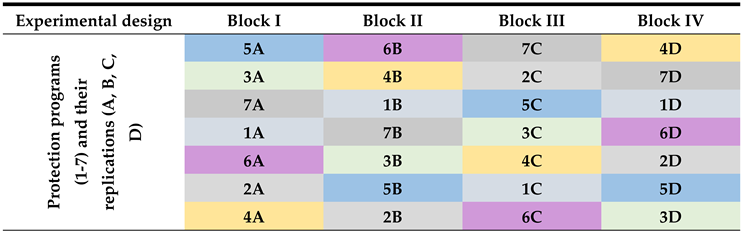
Table 2.
Tested protection programs in a sour cherry orchard trial.
| No. | Protection program | Commercial products | Amount of a.i. per ha | Date of treatment |
|---|---|---|---|---|
| 1. | Acetamiprid + Dodine | Afinex 20 SP + Syllit 400 SC | 50 g + 600 g | June 2, 2023 |
| Acetamiprid + Boscalid + Pyraclostrobin | Afinex 20 SP + Signum* | 50 g + 200.25 g + 50.25 g | June 9, 2023 | |
| 2. | Acetamiprid + Dodine + sucrose | Afinex 20 SP + Syllit 400 SC + sucrose | 50 g + 600 g + 1.2 kg | June 2, 2023 |
| Acetamiprid + Boscalid + Pyraclostrobin + sucrose | Afinex 20 SP + Signum + sucrose | 50 g + 200.25 g + 50.25 g + 1.2 kg | June 9, 2023 | |
| 3. | Spinetoram + Dodine | Delegate 250 WG + Syllit 400 SC | 75 g + 600 g | June 2, 2023 |
| Spinetoram + Boscalid + Pyraclostrobin | Delegate 250 WG + Signum | 75 g + 200.25 g + 50.25 g | June 9, 2023 | |
| 4. | Spinetoram + Dodine + sucrose | Delegate 250 WG + Syllit 400 SC + sucrose | 75 g + 600 g + 1.2 kg | June 2, 2023 |
| Spinetoram + Boscalid + Pyraclostrobin + sucrose | Delegate 250 WG + Signum + sucrose | 75 g + 200.25 g + 50.25 g + 1.2 kg | June 9, 2023 | |
| 5. | Spinetoram + Dodine | Delegate 250 WG + Syllit 400 SC | 75 g + 600 g | June 2, 2023 |
| Spinetoram + Boscalid + Pyraclostrobin | Delegate 250 WG + Signum | 75 g + 200.25 g + 50.25 g | June 9, 2023 | |
| Spinetoram | Delegate 250 WG | 75 g | June 16, 2023 | |
| 6. | Spinetoram + Dodine + sucrose | Delegate 250 WG + Syllit 400 SC + sucrose | 75 g + 600 g + 1,2 kg | June 2, 2023 |
| Spinetoram + Boscalid + Pyraclostrobin + sucrose | Delegate 250 WG + Signum + sucrose | 75 g + 200.25 g + 50.25 g + 1.2 kg | June 9, 2023 | |
| Spinetoram + sucrose | Delegate 250 WG + sucrose | 75 g +1.2 kg | June 16, 2023 | |
| 7. | Untreated plot | - | - | - |
*Signum (WG formulation contains: 267 g/kg boscalid and 67 g/kg pyraclostrobin).
Table 3.
Multiresidue reaction monitoring transitions of active substances.
| Active substance | Precursor ion, m z-1 | Product ion, m z-1 | Retention time (min) | Fragmentation energy(V) | Collision energy (V) | Polarity |
|---|---|---|---|---|---|---|
| acetamiprid | 223.1 | 126 | 9.17 | 80 | 27 | positive |
| 90 | 80 | 45 | ||||
| boscalid | 343 | 307.1 | 14.36 | 145 | 16 | positive |
| 272.1 | 145 | 32 | ||||
| 271.2 | 145 | 32 | ||||
| dodine | 228.2 | 60.5 | 12.69 | 130 | 23 | positive |
| 57.1 | 130 | 23 | ||||
| pyraclostrobin | 388.11 | 193.8 | 16.47 | 95 | 8 | positive |
| 163.1 | 95 | 20 | ||||
| spinetoram J | 748.4 | 203 | 13.59 | 170 | 40 | positive |
| 142 | 170 | 32 | ||||
| spinetoram D | 760.4 | 203.1 | 14.07 | 170 | 34 | positive |
| 142 | 170 | 34 | ||||
| Carbofurane d3 | 225.1 | 165 | 11.56 | 94 | 10 | positive |
| 123 | 94 | 22 |
Table 4.
Validation parameters for pesticide residues determination in cherries.
| Active supstance | Correlation coeficient R^2 | Recovery (%) at level 0.01 mg kg-1 | Recovery (%) at level 0.1 mg kg-1 | LOD* (µg kg-1) |
|---|---|---|---|---|
| acetamipride | 0.994 | 81.2 | 73.6 | 0.34 |
| boscalid | 0.996 | 91.2 | 86.9 | 5.89 |
| dodine | 0.996 | 74.2 | 105.8 | 3.42 |
| pyraclostrobin | 0.995 | 111.4 | 81.5 | 0.18 |
| spinetoram J | 0.999 | 78.8 | 93.5 | 0.20 |
| spinetoram D | 0.999 | 90.1 | 74.9 | 0.31 |
*LOD: The limits of detection.
Table 5.
Damage intensity (%) to cherry fruit by the larvae of the cherry fly, R. cerasi, and efficacy of insecticides.
Table 5.
Damage intensity (%) to cherry fruit by the larvae of the cherry fly, R. cerasi, and efficacy of insecticides.
| Insecticide | The percentage of fruit damage after treatment replication | Average infestation in treatment (%) (Ms)** | Sd* | Efficacy (%) | |||
|---|---|---|---|---|---|---|---|
| A | B | C | D | ||||
| Acetamiprid (2x)* | 0 | 0 | 0 | 0 | 0a*** | 0 | 100 |
| Acetamiprid + sucrose (2x) | 0 | 0 | 0 | 0 | 0a | 0 | 100 |
| Spinetoram (2x) | 2.0 | 2.33 | 1.67 | 3.0 | 2.3b | 0.57 | 66.67 |
| Spinetoram + sucrose (2x) | 2.0 | 1.67 | 1.33 | 1.0 | 1.5c | 0.43 | 77.78 |
| Spinetoram (3x)* | 0 | 0 | 0 | 0 | 0a | 0 | 100 |
| Spinetoram + sucrose (3x) | 0 | 0 | 0 | 0 | 0a | 0 | 100 |
| Untreated plot | 8.33 | 5.33 | 6.0 | 7.33 | 6.8d | 1.34 | - |
| LSD0.05 | 0.0100 | ||||||
| LSD0.01 | 0.0152 | ||||||
* 2x, 3x: number of pesticide applications; **Data are expressed as mean values (Ms) and standard deviation (Sd) of four replications (A, B, C, D) of each pesticide treatment; ***Mean values followed by the same superscript letter(s), within the same column, are insignificantly different (P ≤ 0.05; P ≤ 0.01) according to t –test.
Table 6.
Disease intensity (%) of cherry fruit with Monilinia spp. and efficacy of fungicides used.
| Treatment | Percentage of fruit infection by treatment replications | Average infection in treatment (%) (Ms)* | Sd | Efficacy (%) | |||
|---|---|---|---|---|---|---|---|
| A | B | C | D | ||||
| Boscalid + Pyraclostrobin | 1.0 | 1.67 | 1.33 | 1.0 | 1.3a** | 0.32 | 86.11 |
| Boscalid + Pyraclostrobin + sucrose | 0.67 | 0.33 | 0.67 | 0.33 | 0.5b | 0.19 | 94.44 |
| Untreated plot | 10.33 | 7.33 | 8.33 | 10.0 | 9.0c | 1.41 | - |
| LSD0.05 | 0.0366 | ||||||
| LSD0.01 | 0.0844 | ||||||
*Data are expressed as mean values (Ms) and standard deviation (Sd) of four replications (A, B, C, D) of each pesticide treatment; **Mean values followed by the same superscript letter(s), within the same column, are insignificantly different (P ≤ 0.05; P ≤ 0.01) according to t –test.
Table 8.
Pesticide residues in cherry fruit.
| A sample (protection program) |
Sampling date: | acetamiprid (mg kg-1) | spinetoram (mg kg-1) |
dodine (mg kg-1) |
boscalid (mg kg-1) |
pyraclostrobin (mg kg-1) |
|---|---|---|---|---|---|---|
| PHI (days) | ||||||
| 14 | 7 | 21 | 14 | 14 | ||
| MRL (mg kg-1) in EU | ||||||
| 1.5 | 2.0 | 3.0 | 5.0 | 3.0 | ||
| Acetamiprid 2x + Dodine 1x + Boscalid + Pyraclostrobin 1x | June 23, 2023 | 0.167 | - | 0.45 | <0.01 | <0,01 |
| Acetamiprid 2x + Dodine 1x + Boscalid + Pyraclostrobin 1x + sucrose 2x | June 23, 2023 | 0.197 | - | 0.585 | <0.01 | <0.01 |
| Spinetoram 2x + Dodine 1x + Boscalid + Pyraclostrobin 1x | June 23, 2023 | - | <0.01 | 0.918 | <0.01 | <0.01 |
| Spinetoram 2x + Dodine 1x + Boscalid + Pyraclostrobin 1x + sucrose 2x | June 23, 2023 | - | <0.01 | 1.39 | <0.01 | <0.01 |
| Spinetoram 2x + Dodine 1x + Boscalid + Pyraclostrobin 1x | June 16, 2023 | <0.01 | <0.01 | 1.199 | <0.01 | <0.01 |
| Spinetoram 2x + Dodine 1x + Boscalid + Pyraclostrobin 1x + sucrose 2x | June 16, 2023 | <0.01 | <0.01 | 1.593 | <0.01 | <0.01 |
| Spinetoram 3x + Dodine 1x + Boscalid + Pyraclostrobin 1x | June 23, 2023 | <0.01 | <0.01 | 0.522 | <0.01 | <0.01 |
| Spinetoram 3x + Dodine 1x + Boscalid + Pyraclostrobin 1x + sucrose 2x | June 23, 2023 | <0.01 | <0.01 | 0.787 | <0.01 | <0.01 |
| Untreated plot | June 23, 2023 | - | - | - | - | |
* PHI: pre-harvest interval; MRL: Maximum Residue Limit; 1x, 2x, 3x: number of pesticide applications.
Disclaimer/Publisher’s Note: The statements, opinions and data contained in all publications are solely those of the individual author(s) and contributor(s) and not of MDPI and/or the editor(s). MDPI and/or the editor(s) disclaim responsibility for any injury to people or property resulting from any ideas, methods, instructions or products referred to in the content. |
© 2024 by the authors. Licensee MDPI, Basel, Switzerland. This article is an open access article distributed under the terms and conditions of the Creative Commons Attribution (CC BY) license (http://creativecommons.org/licenses/by/4.0/).
Copyright: This open access article is published under a Creative Commons CC BY 4.0 license, which permit the free download, distribution, and reuse, provided that the author and preprint are cited in any reuse.


