
Submitted:
24 December 2024
Posted:
25 December 2024
You are already at the latest version
Abstract
This paper provides a comprehensive review and an in-depth analysis of the multifaceted issues surrounding food security in China, exploring historical trends, current challenges, and future strategies. Drawing upon a wide range of sources including government reports, academic literature, and expert analyses, it examines the complex interplay of factors influencing food production, distribution, and consumption in China. The paper highlights the importance of addressing environmental sustainability, technological innovation, and social equity in shaping China's food security agenda. By synthesizing key findings and proposing actionable recommendations, this paper contributes to the ongoing discourse on food security in China and offers insights for policymakers, researchers, and practitioners alike.
Keywords:
food security
; challenges
; strategies
; sustainability
; agriculture
; environment
This paper is a revised and expanded version of a paper entitled ‘Addressing Food Security Challenges in China: A Comprehensive Review and Future Strategies’ presented at 12th Global Conference on Global Warming, Sanliurfa, Türkiye, May 16-19, 2023. (https://gcgw2024.harran.edu.tr/)
1. Introduction
In the face of global climate change, achieving sustainable food production is essential to meet rising demand, particularly in countries with large populations like China. In 1995, Lester R. Brown [1] sounded an alarm with his book “Who Will Feed China?” highlighting a potential food crisis. By 2004, China had shifted from being a net exporter to a net importer of food, signaling the global relevance of its food challenges. Recently, renewed discussions have emerged, sometimes referred to as the "China food threat theory," emphasizing the complex dynamics of China's food production and supply within the 21st century e.g., [[2[4]. China must feed nearly 20 percent of the global population, despite being home to less than 10 percent of the world’s arable land and 6 percent of the world’s water resources [5,6]. China’s food security concerns have garnered significant international attention e.g., [4,7], and the question of "who will feed China" remains timely [8]. For China, food security is a multifaceted issue that impacts agriculture, economics, public health, and, critically, social and political stability [9]. Food security remains a pressing issue for China, with impacts that extend beyond national borders and influence global food markets [7]. Numerous studies have evaluated China’s food security from various perspectives, including food availability, access, nutritional use, land use, and resilience to food insecurity e.g., [6,7,10,11,12,13,14,15,16,17]. There is an increasing focus on enhancing the resilience of food systems through traditional agricultural practices and organic methods, which could improve their adaptability to climate impacts [18,19]. Innovations like precision agriculture, biotechnology, and climate-smart techniques also hold promise in helping Chinese farmers cope with changing environmental conditions [20,21]. Additionally, well-crafted policies and incentives that support sustainable farming, reduce greenhouse gas emissions, and bolster smallholder farmers are vital to bolstering food production amidst a warming climate [22]. Furthermore, improvements in air quality could positively impact China’s food security [23]. This paper responds to growing international attention on China’s agricultural and food security concerns by providing a comprehensive overview of recent trends in food production, imports, exports, and consumption. Through analysis of historical and current food-related challenges, along with future projections, it seeks to illuminate the complex interactions between China’s population dynamics and food security.
2. Historical Population and Food Production/Consumption Projections
2.1. Past Predictions of Chinese Population
In 1990, China's population was recorded at 1.134 billion. Since then, numerous projections have varied significantly among experts regarding China’s population growth trajectory. For example, as shown in Figure 1, Sato [24] of the Japan External Trade Organization (JETRO) estimated a 2020 population of 1.565 billion, while the United Nations and World Bank projected 1.46 to 1.489 billion. Lester R. Brown [1] anticipated that the population would reach 1.5 billion by 2017, while in 1996, the Chinese government [25] projected a peak of 1.6 billion by 2030. However, more recent forecasts suggest an earlier peak and lower growth rate. The United Nations [26] estimates a peak of 1.464 billion around 2031, and Li Jianmin [27] projects a peak at 1.442 billion in 2029. Guo et al. [28] forecast a population of 1.458 billion by 2030, with a peak of about 1.46 billion by 2035. Dai et al. [29] predict a maximum population range of 1.38 to 1.45 billion, averaging a peak year around 2028. Some projections, like Jiang et al. [30] under SSP3, foresee a lower peak of 1.43 billion by 2035 under high climate stress. More recent data by Rieffel and Wang [31] indicates China’s population began to decline in 2022, and the latest United Nations report [32] suggests it could decrease to 1.3 billion by 2050. Collectively, these forecasts reflect a trend toward lower peak population figures, with most estimates suggesting a peak above 1.44 billion before gradual decline.
2.2. Past Predictions of Food Production/Consumption
In 1995, Lester Brown [1] voiced concerns that China might struggle to meet its rapidly rising grain demand, potentially requiring imports of 270 to 369 million tons by 2030. Brown highlighted shrinking arable land, limited irrigation resources, and the challenges in further yield improvements as key factors constraining China’s food production. In response, the Chinese government issued the “China Food White Paper” in 1996, committing to a 95% self-sufficiency rate. This optimistic stance suggested that, with strategic measures, China’s grain production could keep pace with population growth and shifting dietary habits. By 2030, China’s food demand was projected to reach approximately 640 million tons, based on a peak population of 1.6 billion and a per capita consumption rate of 400 kg. Strategies to meet this demand included boosting yields on existing farmland, developing reserve agricultural land, applying technological advancements, leveraging non-food resources, and enhancing food conservation practices.
Konishi [33] from the Japan Research Institute of Agricultural Policy anticipated substantial imports of feed grains would be needed, driven by increased demand for livestock products, industrial use, and climate challenges in key agricultural regions. He also highlighted that trade policy shifts following China’s WTO accession could impact China’s grain self-sufficiency. Overall, these forecasts reflect diverse perspectives on China’s food production trajectory, from achieving self-sufficiency to anticipating significant reliance on imports to satisfy growing consumption needs.
Lots of predictions of food production and consumption have been introduced e.g., [34,35,36,37,38,39]. The peak food demand amount is predicted at 640 to 758.17 million tons e.g., [40]. Specially, the prediction results show that China’s grain consumption will continue to increase from 2022 to 2031, which is consistent with the factors of population change, urbanization promotion, consumption structure upgrading, and so on e.g., [39].
3. Actual Population and Food Production/Consumption Trends Up to 2023
3.1. Changes in Population Growth
China had a population of 1.41 billion people in 2023, around 2.08 million fewer than in the previous year (not including Hong Kong, Macau, and Taiwan). Demographic growth in the country turned negative in 2022 [41,42], much earlier than previously predicted by demographers both in and outside of China. This was significantly lower than the predictions made by Lester R. Brown of the United States [1] and Mr. Sato [24] of the Asia Economic Research Institute, among others. The impact of China's four-decade-long one-child policy and recent rapid economic development is believed to have contributed to this discrepancy. According to the "Seventh National Population Census" (National Bureau of Statistics [43]), the population distribution in 2020 was as follows: 253.38 million (17.9% of the total population) were aged 0-14, 894.38 million (63.4%) were of working age (15-59), and 264.02 million (18.7%) were aged 60 and above, with 190.64 million (13.5%) aged 65 and above. Compared to 2010, the working-age population decreased by 452.4 million (a 6.8 percentage point decrease), while the elderly population increased by 86.37 million (a 5.4 percentage point increase). The trend of a declining share of the working-age population and an increasing share of the elderly population is expected to continue, posing challenges related to population aging. Particularly in rural areas, where there has been a significant outflow of young labor, aging is more pronounced compared to urban areas. In 2020, the share of the population aged 60 and above in rural areas was 23.8%, and the share of the population aged 65 and above was 17.7%, which was 8.0 and 6.6 percentage points higher than in urban areas, respectively. Considering the delay in pension system development in rural areas, the aging issue is even more severe in rural areas than in urban areas.
3.2. Changes in Grain Import/Export
Figure 2 depicts the net trade volume of grains and soybeans in China from 1960 to 2020. Data until 2006 are from the Foreign Agricultural Policy Institute of the U.S. Department of Agriculture, and data for 2007 onwards are from Chinese statistical data. It is presumed that the data from the Foreign Agricultural Policy Institute of the U.S. Department of Agriculture do not deduct exports. Grains include barley, corn, millet, mixed grains, oats, rice, rye, sorghum, and wheat. While the massive grain imports predicted by Lester R. Brown in 1995 did not materialize, China began net imports in 2009, with a growing trend observed. Particularly, soybean imports have been increasing since the 1990s, reaching 100 million tons in 2020. The total food imports (including soybeans) did not meet Lester R. Brown's 1995 prediction but amounted to 133 million tons.
3.3. Changes in Food Production
Figure 3 illustrates the year-on-year changes in China's food production volume. In addition to grains, legumes and tubers are included in food production. The year-on-year changes in China's food production volume show an S-shaped curve. It gradually increased from 1978 to 1995, stagnated from the 1990s to 2005, and then experienced rapid growth from 2006 to 2016. By 2016, China's food production volume had already reached the government's projected production of 640 million tons by 2030. However, as shown in Figure 2, growth has stagnated in the past five years. Moreover, the growth rates of rice and wheat production were lower than those of other grains. The food production volume in 2020 significantly exceeded Lester R. Brown's prediction made in 1995.
4. Factors Contributing to the Increase in China's Food Production and Food Imports
4.1. Factors Contributing to the Increase in China's Food Production
4.1.1. Government Food Production Policies
Kawahara [44] of the Agriculture, Forestry and Fisheries Policy Research Institute analysed the fluctuations in China's food production volume, identifying three corresponding periods.
Period of price support policy (Mid-1990s to 1999)
Period of liberalization policy (2000-2003)
Period of production subsidy policy (2004-Present)
During the price support policy period, despite efforts to increase food production, surplus food resulted in stagnation due to the high prices set by the government for purchasing agricultural products. The subsequent transition to liberalization policy led to a decrease in food production as farmers' incentive to produce decreased. However, the introduction of production subsidy policy from 2004 onwards aimed to promote recovery and increase production through direct subsidies to farmers, continuing the foundation of market-oriented pricing and development of major production areas initiated during the liberalization policy period.
Notably, key policies such as the "National Medium- to Long-Term Food Security Strategy (2008-2020)" and the "National Food Production Capacity Increase Plan by 50 Million Tons (2009-2020)" played crucial roles in enhancing food production. The former emphasized domestic food supply as the cornerstone of food security, targeting a self-sufficiency rate of over 95%. The latter, based on this strategy, aimed to achieve a 50-million-ton increase in food production by 2020, focusing on 800 counties nationwide for concentrated investment to promote food production.
4.1.2. Introduction of High-Yield Crops (Including Varietal Improvements) and Changes in Food Consumption Structure
Substituting low-yield crops with high-yield varieties has been crucial in increasing land productivity and food production. The introduction of hybrid rice varieties in China's "Green Revolution" since the mid-1970s led to rapid adoption in rice-producing regions, expanding rice cultivation to northern and northeastern China by the early 1980s [45]. However, the development of new rice varieties subsequently slowed down, affecting the pace of rice production growth.
The period from 1978 to 1990 witnessed significant changes in food consumption structure, particularly the transition from coarse grains to rice and wheat, and the introduction of high-yield crops such as hybrid rice played a significant role in this shift [46]. Varietal improvements in rice cultivation contributed to a 30% increase in rice production in China during the late 1980s to mid-1990s, with yields reaching around 9 tons per hectare by 2000. Moreover, the introduction of super high-yield rice varieties since 1996 further boosted production, with yields reaching 15 tons per hectare by 2014 [47].
4.1.3. Introduction of Chemical Fertilizers, Pesticides, and New Technologies
Chemical Fertilizers
The application of chemical fertilizers in China increased significantly from the late 1970s, particularly nitrogen, following the implementation of land privatization reforms [48]. By the 2000s, nitrogen application rates surpassed 200 kilograms per hectare, ranking among the world's highest [49]. This increase in fertilizer usage significantly contributed to yield improvement, with China achieving substantial growth in grain production compared to global averages [48].
Pesticides
The use of pesticides also increased in China, contributing to higher food production. From 1991 to 2012, pesticide use per hectare increased by 135%, significantly surpassing the OECD average. Despite efforts to improve the safety of pesticides, China's pesticide use per hectare remains twice the world average [50]. China has implemented a series of policies to reduce the usage of chemical pesticides to maintain food production safety and to reduce water and soil pollution. However, there is still a huge gap in developing biological pesticides to replace chemical agents or managing pests to prevent crop production loss [51].
Introduction of New Technologies
China's advancements in agricultural science and technology, including the development of hybrid crop varieties and modern farming machinery, have played a crucial role in increasing food production [52]. The adoption of technologies such as precision farming, drought-resistant crop varieties, and unmanned harvesting equipment has further enhanced productivity and reduced the impact of natural disasters on agricultural output [53].
In addition to technological advancements, China has actively promoted the development and commercial cultivation of genetically modified crops as a strategic measure to enhance agricultural efficiency and competitiveness [54]. The Chinese government has been actively promoting research, development and commercial cultivation of the introduction of genetically modified crops for the past 30 years, treating it as a major national project. However, the commercialization of genetically modified crops has faced challenges due to limited varieties, low public acceptance, stringent regulations, and insufficient cooperation between research institutions and companies.
4.2. Factors Contributing to the Increase in Food Imports
4.2.1. International Grain Prices: Grain Prices Are Upside Down Domestically and Internationally
The popularity of imported grains in China stems mainly from the fact that the prices of imported grains are more favourable, particularly for some processing companies, which desire to import more grains. Taking soybeans as an example, the average purchase price of domestically produced soybeans is 5,500 yuan per ton, which is 2.75 yuan per 500g. In contrast, the average price of imported soybeans in the first half of 2021 was 1.71 yuan per 500g. Thus, the price of imported soybeans is 1.04 yuan per 500g cheaper than that of domestically produced soybeans. From January to July 2020, the average price of imported corn was 0.87 yuan per 500g, while the market purchase price of domestically produced corn was 1.35 yuan per 500g, resulting in a price difference of 0.48 yuan per 500g between domestic and imported corn. Many companies and traders opt for grain imports due to this price reversal.
4.2.2. Domestic Supply Structure: The Structural Supply of Domestically Produced Grains is Insufficient
While domestic grain production of varieties such as wheat and rice can achieve complete self-sufficiency for the nation, in some grain varieties, domestic cultivation cannot meet market demand. Soybeans are the most obvious example, with the domestic total production in 2020 amounting to only 19.6 million tons, while market demand exceeds 120 million tons. Such significant market gaps can only be filled by imported soybeans. Additionally, grain varieties like sorghum and barley are not extensively cultivated in wide areas of China, yet there is an objective demand in the market. This is also a major reason for the significant increase in the import of sorghum and barley. Although the import volume of grain varieties like wheat remains stable, it is significantly reflected in the quality preferred by domestic consumers.
4.2.3. Demand for International Trade Diplomacy: Sometimes Necessitates Importing Food Sources
In addition to being market-driven, food imports can also serve diplomatic needs. For instance, when China entered the international market for high-speed railways, it obtained several resources through exchanges for high-speed railway construction projects, thereby necessitating the import of a certain amount of food. With international situations becoming increasingly complex, there might be occasions where economic trade with other countries becomes necessary, and the consumption market of agricultural products is an advantage for China. Importing an appropriate number of agricultural products can increase bargaining chips in diplomatic negotiations. For example, previous soybean imports from the United States were also a last resort for China. Therefore, some countries closely communicate with China, acknowledging that agricultural product trade is inevitable in economic cooperation. The significant increase in the import volume of grains and fruits may also be due to political factors, exceeding the expected total grain import volume.
4.3. Reasons Why Soybean Production Cannot Achieve 100% Self-Sufficiency
4.3.1. Low Yield of Domestically Produced Soybeans
While the yield of crops like rice and wheat commonly exceeds 600 kg/mu and sometimes even surpasses 750 kg/mu, the situation is different for soybeans. According to data released by the National Bureau of Statistics, the average yield of soybeans in China in 2020 was 132 kg per mu. Even in good areas, the yield per mu is only around 250 kg. The inadequate total production of soybeans in China is mainly due to the relatively low yield of domestically produced soybeans.
4.3.2. Relatively High Cost of Soybean Cultivation in China
The northeastern region of China is the main soybean production area, where planting scale is relatively large, and the level of mechanization is relatively high. However, there are several objective factors leading to increased agricultural costs such as land rents, increased agricultural expenses including capital and labour. The planting cost is high. Compared with countries like Brazil and the United States, soybeans in China are at a disadvantage. Moreover, soybeans are clearly susceptible to natural disasters; when disasters like floods occur, the harvest of grains often fails. These factors to some extent influence the enthusiasm of farmers for soybean cultivation. In non-major soybean production areas, many farmers do not have subsidies for soybean producers, making their investment and production even more uncertain.
4.3.3. Limited Per Capita Land, Unable to Meet the Demand for Soybean Cultivation
While the soybean consumption demand in China continues to grow, the objective reality is that significantly increasing the domestic soybean cultivation area is difficult. Achieving complete localization of soybeans is almost impossible, primarily because there is not enough land equivalent to the cultivated area per yield of soybeans when calculated. At the current stage, even if all existing cultivated land in China were used for soybean cultivation, the total soybean production would still not meet domestic consumption. Of course, this strategy is not realistic. After all, varieties like rice and wheat are related to the staple food of ordinary people. Sacrificing staple foods to meet the market demand for soybeans is impossible. In short, the increasing popularity of imported grains reflects a certain degree of changes in market demand, and the domestic consumption level is steadily improving. However, attention should also be paid to the phenomenon of increased food imports. Ultimately, China's approach is to avoid being controlled by others since grains are in its own hands. The challenge lies in how to effectively utilize domestic land and enhance the enthusiasm of farmers for grain production, which needs to be continuously studied.
5. Future Issues and Countermeasures
5.1. Population Issue
As previously noted, China's population growth has fallen well below earlier projections, and a clear trend has emerged of a shrinking working-age population coupled with an increasing proportion of elderly individuals, creating significant aging challenges. This issue is particularly acute in rural areas. Recognizing the seriousness of the situation, Chinese authorities have expressed a strong sense of urgency e.g., [55,56]. As Takeshige [57] pointed, the People's Bank of China released a working paper titled “Understanding and Countermeasures for China's Population Dynamics Transformation” [58]. The paper suggests various strategies, including the full removal of birth restrictions, leveraging the labour force through investments in new regions both domestically and internationally, reforming the pension system, and advancing education and technological development.
5.2. Food Issue
China’s population has not increased as projected, yet per capita food consumption continues to grow. Should per capita consumption remain steady, future food security concerns could be alleviated. However, with rising living standards driven by economic development, food consumption is likely to increase further.
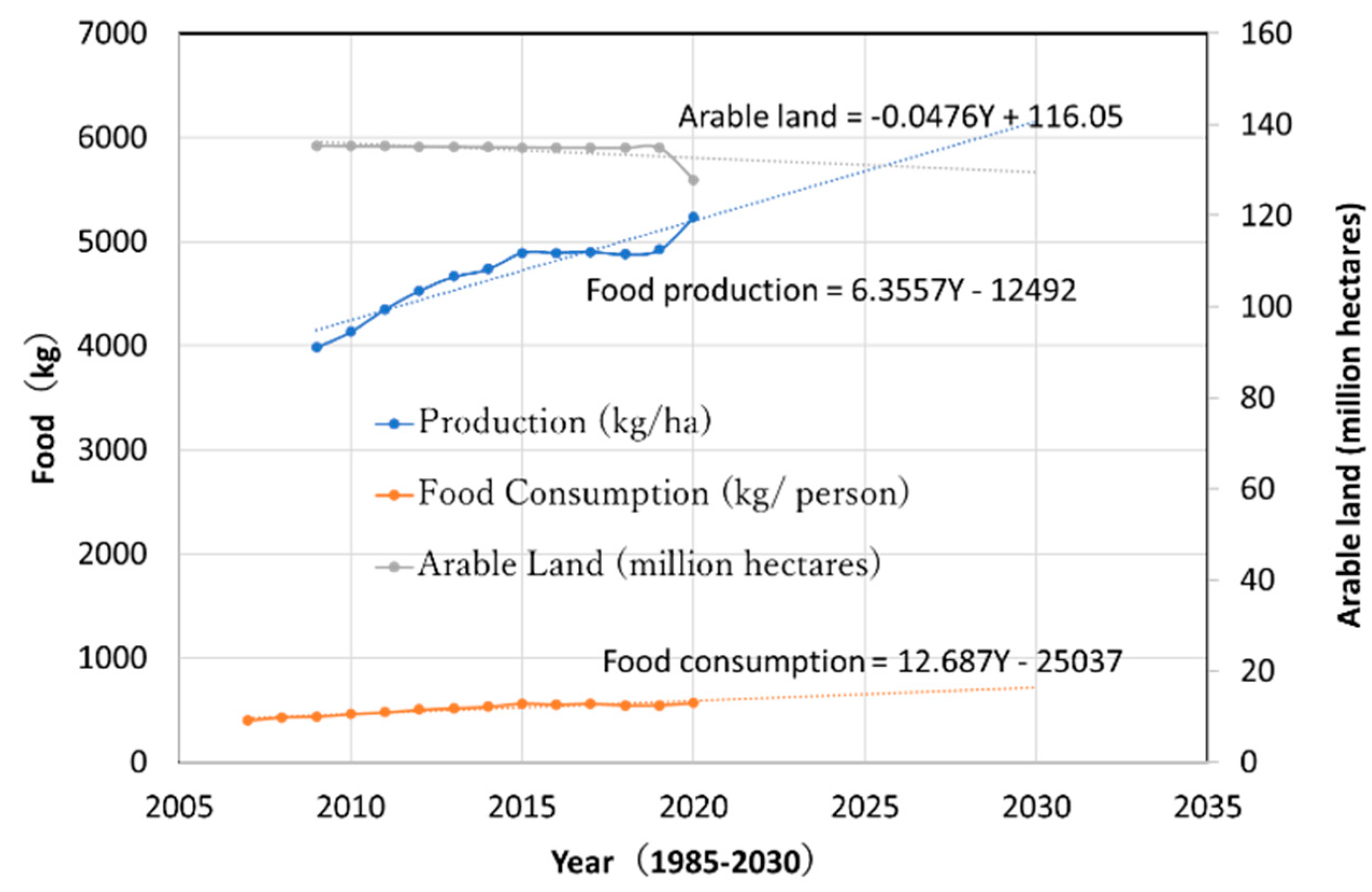
There are many future food issues of China e.g., [12,59,60,61]. The projected ~15%–24% reliance on agricultural imports in 2030-2050 would be occurred. Figure 4 illustrates trends and projections for per capita food consumption, yield per unit area, and cultivated land area in China. Historical data were sourced from the “China Statistical Yearbook” published annually by the National Bureau of Statistics of China. Per capita food consumption was calculated by dividing total domestic production and net imports (including soybeans) by the population, while yield per unit area was determined by dividing total domestic production by the cultivated land area. The predictions shown are based on simple regression analysis.
According to Figure 4, China’s per capita food consumption in 2020 was 570 kg per person and is projected to rise to 710 kg per person by 2030. Although this still falls short of current U.S. consumption levels, the rate of increase in yield per unit area is not keeping pace with rising consumption, and cultivated land continues to shrink. Up to 2020, yield growth per unit area has lagged behind consumption growth, contributing to an increase in China’s net food imports. As indicated in Figure 4, in 2020, China’s net food imports totalled 133 million tons, comprising 100 million tons of soybeans and 33 million tons of grains, accounting for 16.6% of total consumption. If current trends continue, food imports, including soybeans, could reach 210 million tons by 2030, representing 20% of total consumption.
Furthermore, projections for food production and consumption by 2030 (based on linear regression in Figure 4) estimate that production will reach 796.4 million tons, while consumption could rise to 1.019 billion tons (with per capita consumption at 710 kg). This would result in a deficit of 223 million tons, suggesting that imports may increase even beyond the current rate of growth.
5.3. China's Countermeasures
In 1996, the Chinese government published a white paper titled "China's Food Issues" to respond to the global question of "who will feed China?" As projected, China managed its food security largely without creating major international concerns. In 2019, the government released another white paper, "China's Food Security," which addressed various challenges, clarified its food policies, and reaffirmed its commitment and capacity to secure the nation's food supply. This document emphasized China’s dedication to a food security strategy that reflects both domestic priorities and a global outlook. Key measures outlined include:
Enhancing food production capacity: Protecting cultivated land and optimizing water use; ensuring stable grain-sown areas over 110 million hectares with a production capacity above 600 million tons; adjusting crop structures to increase the supply of green, high-quality grains and edible oils; stabilizing grain-sown areas while promoting region-specific crops like potatoes and beans; and advancing agricultural science to boost productivity.
Strengthening emergency grain reserve management: Improving reserve management practices; enhancing the emergency food supply system; refining early warning and monitoring systems for grain conditions; and promoting conservation efforts to minimize losses.
Establishing a modern grain circulation system: Accelerating the development of a modern grain market system; enhancing the construction of warehouses and logistics networks; and building a contemporary grain industry system.
Promoting global food security: Actively participating in global efforts to ensure food security worldwide.
This comprehensive approach highlights China’s focus on both self-sufficiency and international cooperation in maintaining stable food supplies.
5.4. Some Suggestions about Food Productions
Given the trends and challenges discussed above and review all the listed literatures, several strategic recommendations could strengthen China’s food production and enhance food security in the face of rising demand, demographic shifts, and environmental constraints:
5.4.1. Promote Sustainable Agricultural Practices:
Adopt climate-smart agricultural practices to increase resilience against climate change. Techniques like precision agriculture, water-efficient irrigation, and soil conservation should be encouraged. Encourage organic and environmentally friendly farming practices to protect arable land and promote long-term soil health, particularly in regions vulnerable to degradation.
5.4.2. Increase Investment in Agricultural Innovation:
Invest in advanced agricultural technologies, including biotechnology, precision farming, and genetically modified crops, to boost productivity. Genetic improvements in crop varieties, such as drought-resistant or high-yield crops, could be particularly beneficial. Expand research and development in sustainable farming and create programs that transfer innovative practices and technologies to smallholder farmers.
5.4.3. Enhance Support for Smallholder Farmers:
Provide financial and technical support to smallholder farmers to increase their productivity and ensure their participation in modernized agriculture. This could include subsidies, access to credit, training programs, and technology-sharing initiatives. Implement policies that support small-scale farmers in accessing markets, stabilizing incomes, and participating in agricultural cooperatives.
5.4.4. Optimize Land Use and Protect Farmland:
Strengthen policies to protect farmland from urban encroachment and industrial development, ensuring that essential arable land remains dedicated to agriculture. Promote crop rotation and diversification to optimize land use based on regional conditions. This could improve soil health and yield while increasing the resilience of food systems.
5.4.5. Improve Food Supply Chain and Storage Infrastructure:
Modernize food storage facilities to reduce post-harvest losses and enhance food quality. Proper storage facilities could help stabilize food supply during periods of shortage. Strengthen logistics and distribution systems to ensure efficient transportation of food across regions, particularly to areas with food shortages. Investing in cold-chain logistics could also reduce spoilage and improve food safety.
5.4.6. Encourage Water-Efficient Crop Choices:
Encourage the cultivation of crops that require less water, especially in water-scarce regions. Promote alternative crops such as millet or sorghum where they are viable alternatives to water-intensive crops like rice and wheat. Invest in water-saving technologies and irrigation systems to optimize water usage in agriculture and reduce the dependency on groundwater and other limited water resources.
5.4.7. Enhance Food Import Policies as a Supplementary Strategy:
Although self-sufficiency is a goal, ensure that food import policies remain flexible to address shortages or fluctuations in domestic production. Strategic imports of essential grains and oilseeds, like soybeans, could supplement domestic supply. Develop trade agreements with food-exporting countries to secure a stable and diversified source of imports, ensuring food availability even in times of domestic shortfall.
5.4.8. Implement Population and Labour Policies to Support Agriculture:
Address labour shortages in rural areas by creating incentives for younger generations to engage in agriculture, including policies that improve rural infrastructure, social services, and the quality of life in farming communities. Reform retirement policies and consider programs that encourage older adults in rural areas to stay active in agriculture, possibly through flexible, part-time arrangements or community farming initiatives.
5.4.9. Promote Awareness and Education on Food Conservation:
Educate the public on the importance of reducing food waste to ensure that available food is used efficiently. Awareness campaigns on food conservation can help consumers understand their role in enhancing food security. Encourage food conservation practices at all levels, from production to consumer behaviour, as a way to make more effective use of existing resources.
By adopting these strategies, China can work toward a more resilient, sustainable, and efficient food production system that meets the demands of its population and economic development while minimizing environmental impact.
6. Conclusions
As mentioned above, China's food issues remain challenging. While the Chinese government has demonstrated determination, confidence, and capability in ensuring food security, further assessment is necessary. Particularly concerning the improvement of food production capacity, attention should be paid to policies regarding the introduction and effectiveness of new technologies, considering the potential for further increases in food consumption. It should be noted that China’s food issues require radical and coordinated action by diverse stakeholders.
Acknowledgments
We express sincere thanks to our colleagues at the Xinjiang institute of ecology and geography, Chinese Academy of Sciences for their critical advice on the subject.
References
- Brown, L. R. Who Will Feed China? Wake-up Call for a Small Planet, W.W. Norton & Company, New York and London, 1995.
- Brown, L. R. Outgrowing the Earth: The Food Security Challenge in an Age of Falling Water Tables and Rising Temperatures, W.W. Norton & Company, New York, 2004.
- Brown, L. R. The New Geopolitics of Food Scarcity, Norton & Company, New York and London, 2012.
- Fukase E. and Martin W. Who Will Feed China in the 21st Century? Income Growth and Food Demand and Supply in China. Journal of Agricultural Economics, 2016, Vol. 67 No. 1, 3–23. [CrossRef]
- Huang J. and Yang G. Understanding Recent Challenges and New Food Policy in China, Global Food Security, 2017, Vol. 12, 119–126.
- Dong K., Prytherch M., McElwee M., Kim P., Jude Blanchette J. and Hass R. China’s food security: Key challenges and emerging policy responses, CSIS BRIEFS, Available online at: https://www.csis.org/analysis/chinas-food-security-key-challenges-and-emerging-policy-responses (accessed on 20 October 2024).
- Zhang Y. and Lu X. A Comprehensive Evaluation of Food Security in China and Its Obstacle Factors. International Journal of Environmental Research and Public Health, 2023, Vol. 20 No. 1, 451. [CrossRef]
- Cui K. and Shoemaker S. P. A look at food security in China. Science of Food, 2018, Vol. 2 No. 4, doi:10.1038/s41538-018-0012-x.
- Veeck, G. China’s food security: past success and future challenges, Eurasian Geography and Economics, 2013, Vol. 54 No. 1, 42–56. [CrossRef]
- Nie F., Bi J. and Zhang X. Study on China’s Food Security Status. Agriculture and Agricultural Science Procedia, 2010, Vol. 1, 301–310.
- Wong J. and Huang J. China's Food Security and Its Global Implications, China. An International Journal, 2012. Vol. 10 No. 1, 113-124. https://muse.jhu.edu/article/472545.
- Ghose B. Food security and food self-sufficiency in China: from past to 2050. Food and Energy Security, 2014, Vol. 3 No. 2, 86–95. [CrossRef]
- Huang J., Wei W. and Cui Q. The prospects for China’s food security and imports: Will China starve the world via imports? Journal of Integrative Agriculture, 2017, Vol. 16 No.12, 2933–2944.
- He G., Zhao Y., Wang L., Jiang S. and Zhu Y. China's food security challenge: Effects of food habit changes on requirements for arable land and water, Journal of Cleaner Production, 2019, Vol. 229, 739-750.
- Liu Y. and Zhou Y. Reflections on China's food security and land use policy under rapid urbanization, Land Use Policy, 2021, Vol. 109, 105699. [CrossRef]
- Niu Y., Xie G., Xiao Y., Liu J., Zou H., Qin K., Wang Y, Huang M. The story of grain self-sufficiency: China's food security and food for thought, Food Energy Security, 2022, Vol. 11, e344. [CrossRef]
- Liang X., Jin X., Dou Y., Meng F. and Zhou Y. Exploring China's food security evolution from a local perspective. Applied Geography, 2024, Vol. 172, 103427. [CrossRef]
- Altieri, M.A., Nicholls, C.I. The adaptation and mitigation potential of traditional agriculture in a changing climate, Climatic Change, 2017, Vol. 140, 33–45. [CrossRef]
- Yu T., Mahe L., Li Y., Wei X., Deng X. and Zhang D. Benefits of Crop Rotation on Climate Resilience and Its Prospects in China. Agronomy, 2022, Vol. 12 No. 2, 436; [CrossRef]
- Xu Y., Li J., and Wan J. Agriculture and crop science in China: Innovation and sustainability. The Crop Journal, 2017, Vol. 5, 95-99.
- Chen J., Zhong F. and Sun D. Lessons from farmers’ adaptive practices to climate change in China: a systematic literature review. Environment Science Pollution Research, 2022, Vol. 29, 81183–81197. [CrossRef]
- Nsabiyeze A., Ma R., Li J., Luo H., Zhao Q., Tomka J. Tackling climate change in agriculture: A global evaluation of the effectiveness of carbon emission reduction policies. Journal of Cleaner Production, 2024, Vol. 468, 142973. [CrossRef]
- Liu, X., Chu, B., Tang, R. et al. Air quality improvements can strengthen China’s food security, Nature Food, 2024, Vol. 5, pp.158–170. [CrossRef]
- Sato Ryuzaburo. China's Future Demographics. In Yasuko Hayase (Eds.), China's Population Changes, Japan External Trade Organization (JETRO), Chiba, Japan, 1992, pp.287-301.
- Chinese government (1996). White paper: China's Food Issues (in Chinese). https://www.gov.cn/zhengce/2005-05/25/content_2615740.htm.
- United Nations. (2019). World Population Prospects, The 2019 Revision. (accessed 19 February 2024). [CrossRef]
- Yukawa, K. China’s long-term demographic trends and their impact on the economy and society (part 1). https://spc.jst.go.jp/experiences/special/economics/economics_2112.html, 2011. (accessed on 12 Dec 2024).
- Guo A., Ding X., Zhong F., Cheng Q., and Huang C. Predicting the Future Chinese Population using Shared Socioeconomic Pathways, the Sixth National Population Census, and a PDE Model. Sustainability, 2019, Vol. 11 No. 13, 3686; [CrossRef]
- Dai, K., Shen, S. & Cheng, C. Evaluation and analysis of the projected population of China. Sci. Rep. 2022, 12, 3644. [CrossRef]
- Jiang T., Zhao J., Jing C., Cao L., Wang Y., Sun H., Wang A., Huang J., Su B., Wang R. National and Provincial Population Projected to 2100 Under the Shared Socioeconomic Pathways in China. Climate Change Research, 2017, Vol. 13 No. 2, 128-137.
- Rieffel L. and Wang X. China’s Population Could Shrink to Half by 2100 - Is China’s future population drop a crisis or an opportunity? Available online at: https://www.scientificamerican.com/article/chinas-population-could-shrink-to-half-by-2100 (accessed 28 February 2024).
- United Nations. World Population Prospects 2024. https://population.un.org/wpp/Publications/. (accessed 19 February 2024).
- Konishi. Global food supply and demand outlook (in Japanese). Available online at: https://www.maff.go.jp/primaff/kanko/review/attach/pdf/070629_pr24_02.pdf. (accessed 28 February 2024).
- Huang J., Rozelle S., and Rosegrant M. China's Food Economy to the Twenty-first Century: Supply, Demand, and Trade. Economic Development and Cultural Change, 1999, Vol. 47 No. 4, . [CrossRef]
- Sun X., Lin Z., Sun Y. Dynamic Prediction and Suggestion of Total Farmland in China. Journal of natural resources, 2005, Vol. 20 No. 2, 200-205. [CrossRef]
- Lv, X. Review of mid- and long-term predictions of China's grain security. China Agricultural Economic Review, 2013, Vol. 5 No. 4, 567-582. [CrossRef]
- Hamshere P., Sheng Y., Moir B., Syed F. and Caroline G. What China wants - Analysis of China's food demand to 2050. Paper presented at the 44th ABARES Outlook conference 4–5 March 2014, Canberra, ACT. https://www.agriculture.gov.au/sites/default/files/sitecollectiondocuments/abares/publications/AnalysisChinaFoodDemandTo2050_v.1.0.0.pdf. (accessed 4 October 2024).
- Sheng Y. and Song L. Agricultural production and food consumption in China: A long-term projection. China Economic Review, 2019, Vol. 53, pp.15-29.
- Zhang X., Bao J., Xu S., Wang Y. and Wang S. Prediction of China’s Grain Consumption from the Perspective of Sustainable Development—Based on GM(1,1) Model. Sustainability, 2022, Vol. 14 No. 17, 10792. [CrossRef]
- Du Y., Xu Y., Zhang L., Song S. Can China’s food production capability meet her peak food demand in the future? Based on food demand and production capability prediction till the year 2050. International Food and Agribusiness Management Review, 2019, Vol. 23 No. 1, pp.1 – 17. [CrossRef]
- Master F. China's population drops for second year, with record low birth rate, Reuters news 2024/01/17. Available online at: https://www.reuters.com/world/china/chinas-population-drops-2nd-year-raises-long-term-growth-concerns-2024-01-17/. (accessed 4 October 2024).
- Zhai F. Macroeconomic Implications of China's Population Aging: A Dynamic OLG General Equilibrium Analysis, AMRO Working Paper (WP/24-09). https://amro-asia.org/wp-content/uploads/2024/08/AMRO-WP_Macroeconomic-Implications-of-Population-Aging-in-China_Sept-2024.pdf. (accessed 4 October 2024).
- National Bureau of Statistics. Main Data of the Seventh National Population Census. Available online at: https://www.stats.gov.cn/english/PressRelease/202105/t20210510_1817185.html. (accessed 28 February 2024).
- Kawahara Shoichiro. China's food supply and demand problem (in Japanese). Agriculture, forestry and Fisheries Policy Research of Japan. Available at https://www.maff.go.jp/primaff/koho/seminar/2014/attach/pdf/141216_01.pdf. (accessed 4 October 2024).
- Xiao P. and Wang Q. Changes in food production in China since 1949 and their contributing factors. Geographical Review Ser. A, 1999, Vol. 72, 589-599. [CrossRef]
- Li J., Luo X. and Zhou K. Research and development of hybrid rice in China. Plant Breeding, 2024, Vol. 143 No. 1, 96-104. [CrossRef]
- Singh, S.K., P.K. Bhati, A. Sharma and V. Sahu. Super hybrid rice in China and India: Current status and future prospects. International Journal of Agriculture & Biology, 2015, Vol. 17, 221‒232.
- Yu X., Li H.2 and Doluschitz R. Towards Sustainable Management of Mineral Fertilizers in China: An Integrative Analysis and Review. Sustainability, 2020, Vol. 12 No.17, 7028; [CrossRef]
- Nishio N. Effects of the Law Prohibiting the Increase in the Application of Chemical Fertilizers on Chinese Agriculture, Nishio Morality's Environmental Conservation Agriculture Report No. 370. Available online at: https://lib.ruralnet.or.jp/nisio/?p=4635. https://www.csis.org/analysis/chinas-food-security-key-challenges-and-emerging-policy-responses. (accessed 4 October 2024).
- Nishio N. Environmental Performance of Chinese Agriculture: Current Status and Challenges, Nishio Morality's Environmental Conservation Agriculture Report No.350. Available online at: https://lib.ruralnet.or.jp/nisio/?p=4035. (accessed 28 February 2024).
- Wang X., Chi Y. and Li F. Exploring China stepping into the dawn of chemical pesticide-free agriculture in 2050’, Frontiers in Plant Science, 2022, Vol. 13, 942117. [CrossRef]
- Hollósy Z, Ma’ruf MI, Bacsi Z. Technological Advancements and the Changing Face of Crop Yield Stability in Asia. Economies, 2023, Vol. 1 No.12, 297. [CrossRef]
- Huang W. and Wang X. The Impact of Technological Innovations on Agricultural Productivity and Environmental Sustainability in China. Sustainability, 2024, Vol. 16 No.19, 8480. [CrossRef]
- Ministry of Agriculture and Rural Affairs of the People's Republic of China. Policy Interpretation: Chinese rice bowl, Available online at: http://www.nkj.moa.gov.cn/zcjd/201906/t20190625_6319195.htm (accessed 10 October 2023).
- Ministry for Foreign Affairs of Japan. Economic Cooperation Program for China, Available online at: https://www.mofa.go.jp/policy/oda/region/e_asia/china-2.html. (accessed 10 November 2024).
- Lin Y., Zhang B., Hu M., Yao Q., Jiang M. and Zhu C. The effect of gradually lifting the two-child policy on demographic changes in China. Health Policy and Planning, 2024, Vol. 39, No. 4, 363–371. [CrossRef]
- Takeshige N. China's Growing Demographic Problem-Total population decline will be significantly accelerated, Ricoh Economic and Social Research Institute report. Available at https://blogs.ricoh.co.jp/RISB/china_asia/post_704.html. (accessed 21 February 2024).
- Chinese government. White paper: China's Food Security (in Chinese). Available at https://www.gov.cn/zhengce/2019-10/14/content_5439410.htm. (accessed 4 November 2024).
- Ma L., Bai Z., Ma W., Guo M., Jiang R., Liu J., Oenema O., Velthof G. L., Whitmore A. P., Crawford J., Dobermann A., Schwoob M. and Zhang F. Exploring Future Food Provision Scenarios for China. Environmental Science & Technology, 2019, Vol. 53 No. 3, 1385–1393. [CrossRef]
- Zhao, H., Chang, J., Havlík, P. et al. China’s future food demand and its implications for trade and environment. Nature Sustainability, 2021, Vol. 4, 1042–1051. [CrossRef]
- Hu, Y., Su, M., Wang, Y. et al. Food production in China requires intensified measures to be consistent with national and provincial environmental boundaries. Nature Food, 2020, Vol. 1, 572–582. [CrossRef]
Figure 1.
Historical population projections.
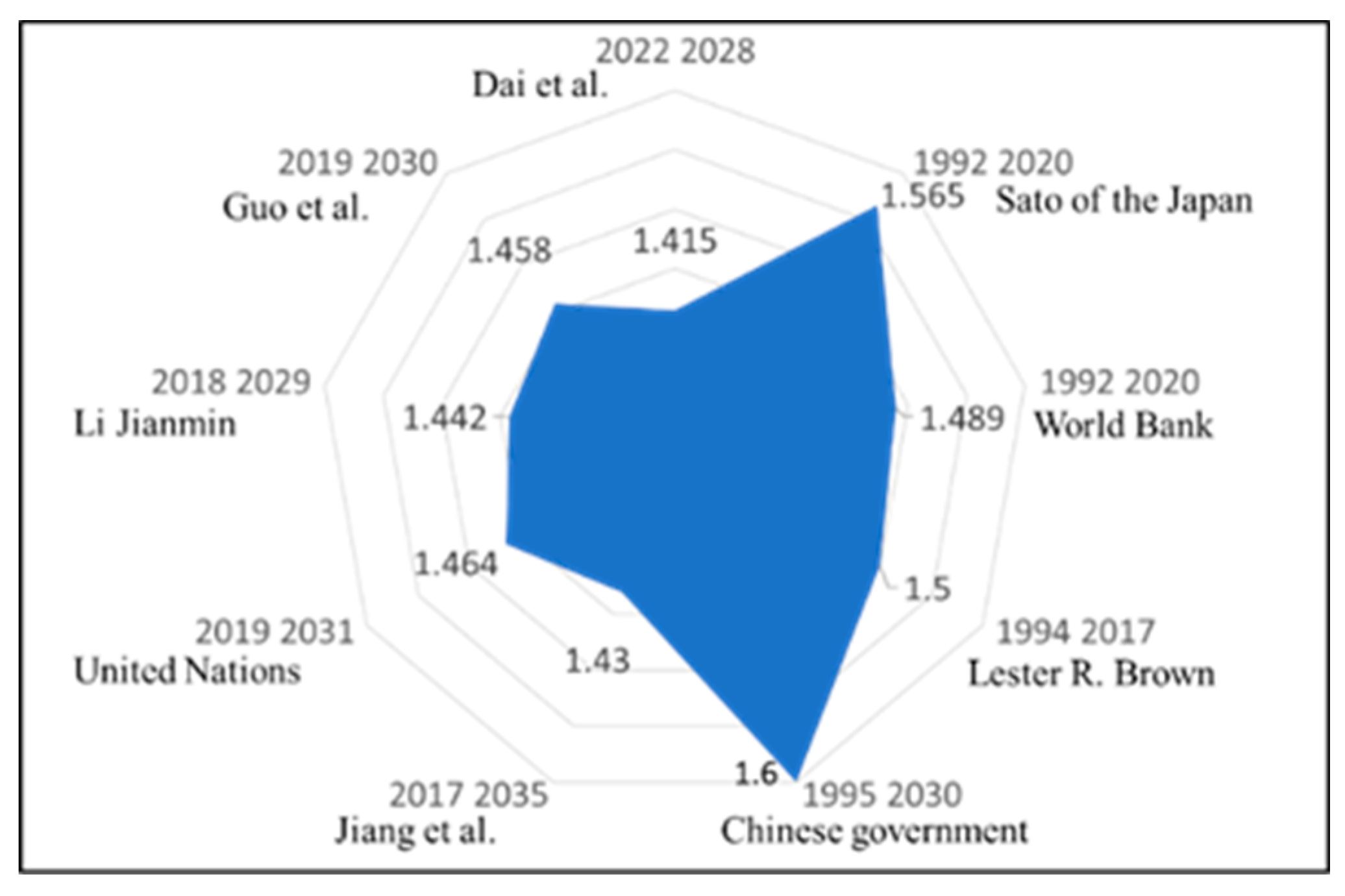
Figure 2.
Trends in net trade volume of grains and soybeans in China (Source: National Bureau of Statistics of China, from the annual China Statistical Yearbook).
Figure 2.
Trends in net trade volume of grains and soybeans in China (Source: National Bureau of Statistics of China, from the annual China Statistical Yearbook).
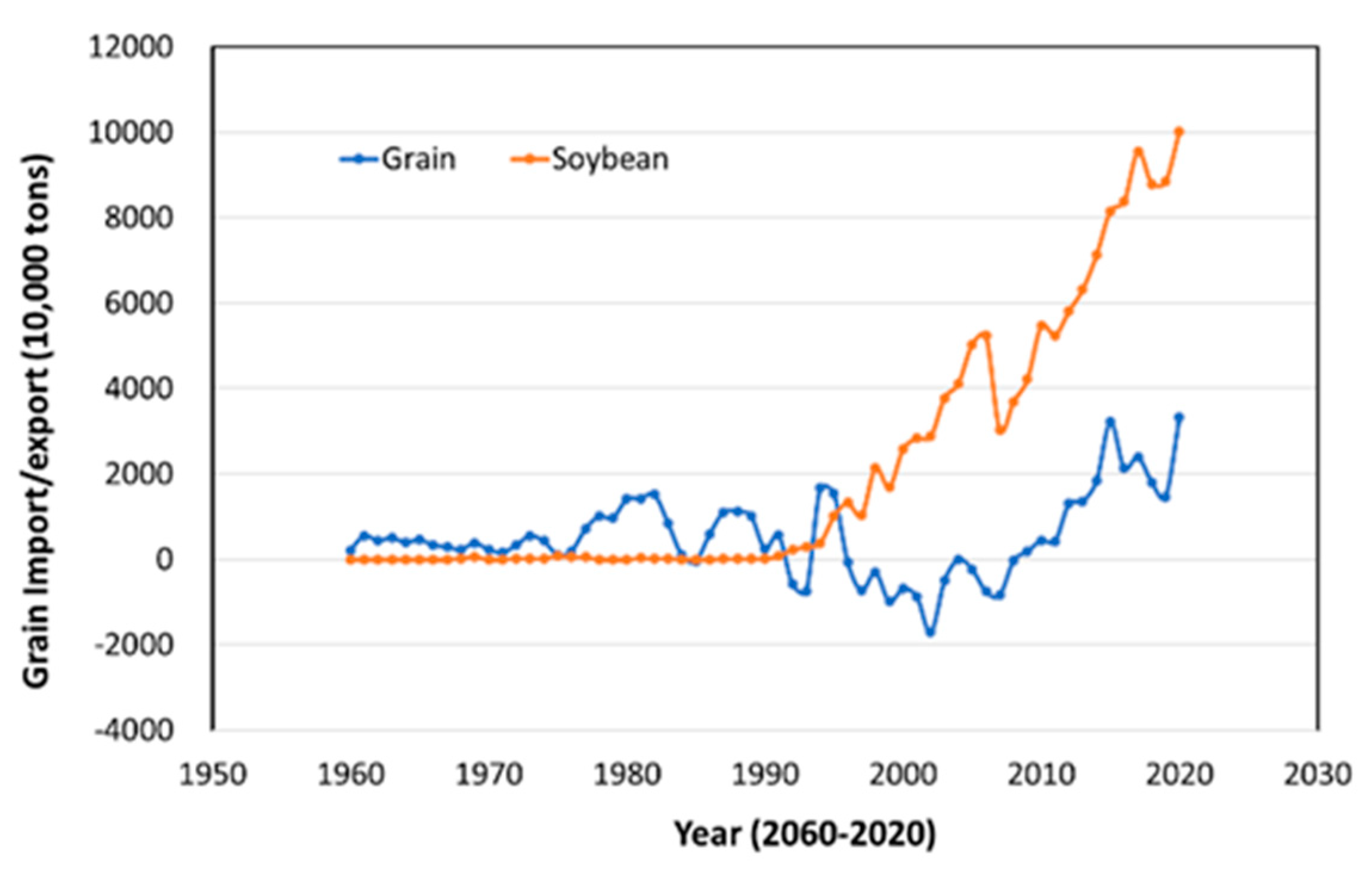
Figure 3.
Year-on-year changes in China's food production volume (Source: National Bureau of Statistics of China, from the annual China Statistical Yearbook).
Figure 3.
Year-on-year changes in China's food production volume (Source: National Bureau of Statistics of China, from the annual China Statistical Yearbook).
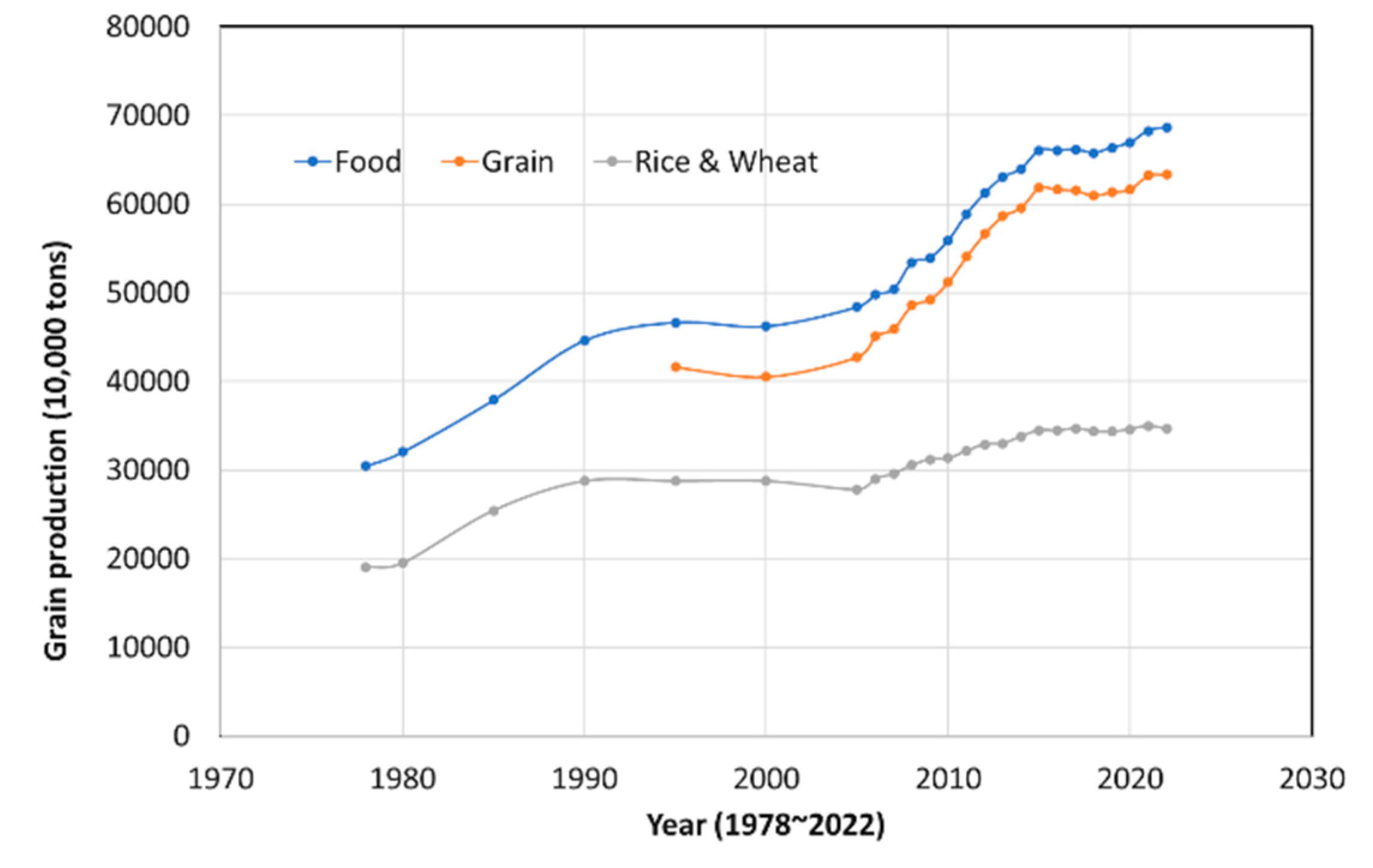
Figure 4.
Trends and Forecasts of Per Capita Food Consumption, yield per Unit Area, and Cultivated Land Area in China (Source: National Bureau of Statistics of China, from the annual China Statistical Yearbook).
Figure 4.
Trends and Forecasts of Per Capita Food Consumption, yield per Unit Area, and Cultivated Land Area in China (Source: National Bureau of Statistics of China, from the annual China Statistical Yearbook).
Disclaimer/Publisher’s Note: The statements, opinions and data contained in all publications are solely those of the individual author(s) and contributor(s) and not of MDPI and/or the editor(s). MDPI and/or the editor(s) disclaim responsibility for any injury to people or property resulting from any ideas, methods, instructions or products referred to in the content. |
© 2024 by the authors. Licensee MDPI, Basel, Switzerland. This article is an open access article distributed under the terms and conditions of the Creative Commons Attribution (CC BY) license (http://creativecommons.org/licenses/by/4.0/).
Copyright: This open access article is published under a Creative Commons CC BY 4.0 license, which permit the free download, distribution, and reuse, provided that the author and preprint are cited in any reuse.


