

Submitted:
16 December 2024
Posted:
18 December 2024
You are already at the latest version
Abstract
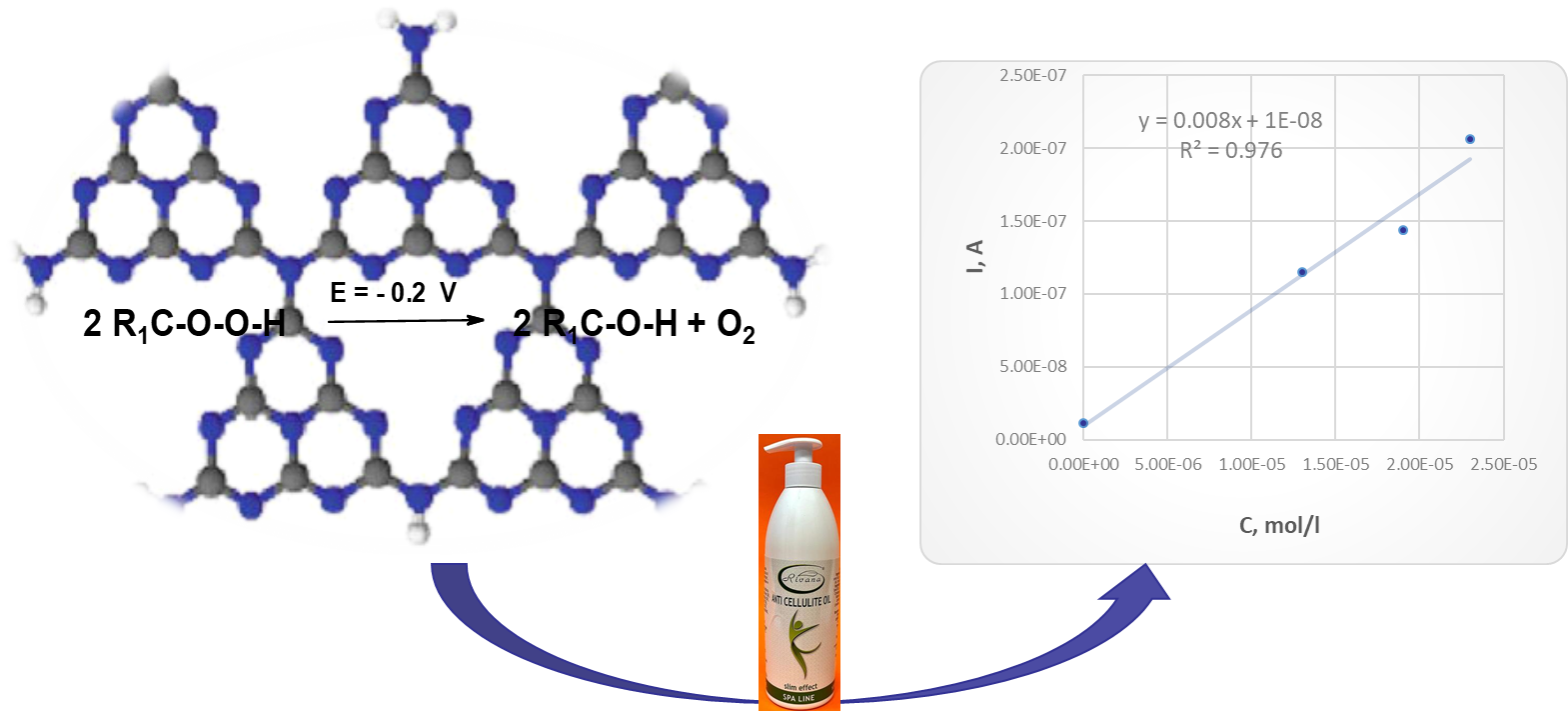
Lipid peroxidation is a major process that determines the quality of various oil samples during their use and storage, in which the primary products are hydroperoxides (HP’S). HP’S are very stable compounds at ambient conditions and are harmful to human health. Therefore, the eval-uation of the degree of oil oxidation is an excellent tool for ensuring food safety. Тhe peroxide value (PV) is the main parameter for quality control of oils. Herein, we propose an alternative electrochemical method to the most widely used classical iodometric titration for determining the PV. Our approach is based on the electrochemical quantification of hydroperoxides/peroxides in an organic solvent medium (acetonitrile and organic ammonium salt) using a composite electro-catalyst-glassy carbon electrode modified with 2D-nanomaterial graphitic carbon nitride doped with Co3O4. Calibration was made by standard addition method using benzoyl peroxide (BPO) as a model peroxide compound, dissolved in chloroform and added to fresh Rivana brand an-ti-cellulite oil used as a model oil sample. Calibration plots showed a linear response and very good reproducibility of the analytical result (R2˃0.99). Further, in term of accuracy, the method showed good results, since the BPO quantitative analysis was close to the theoretical response. In addition, the accuracy of the electrochemical method was compared with that of the standard iodometric titration method for determining the PV of vegetable fats (according to Bulgarian State Standard, BSS EN ISO 3960:2017). Finally, using the electrochemical method, the concentration of peroxides was determined in a real sample - an anti-cellulite oil of the trademark Rivana with an expired shelf life.
Keywords:
1. Introduction
2. Results
2.1. Optimisation of the Operating Conditions
- I
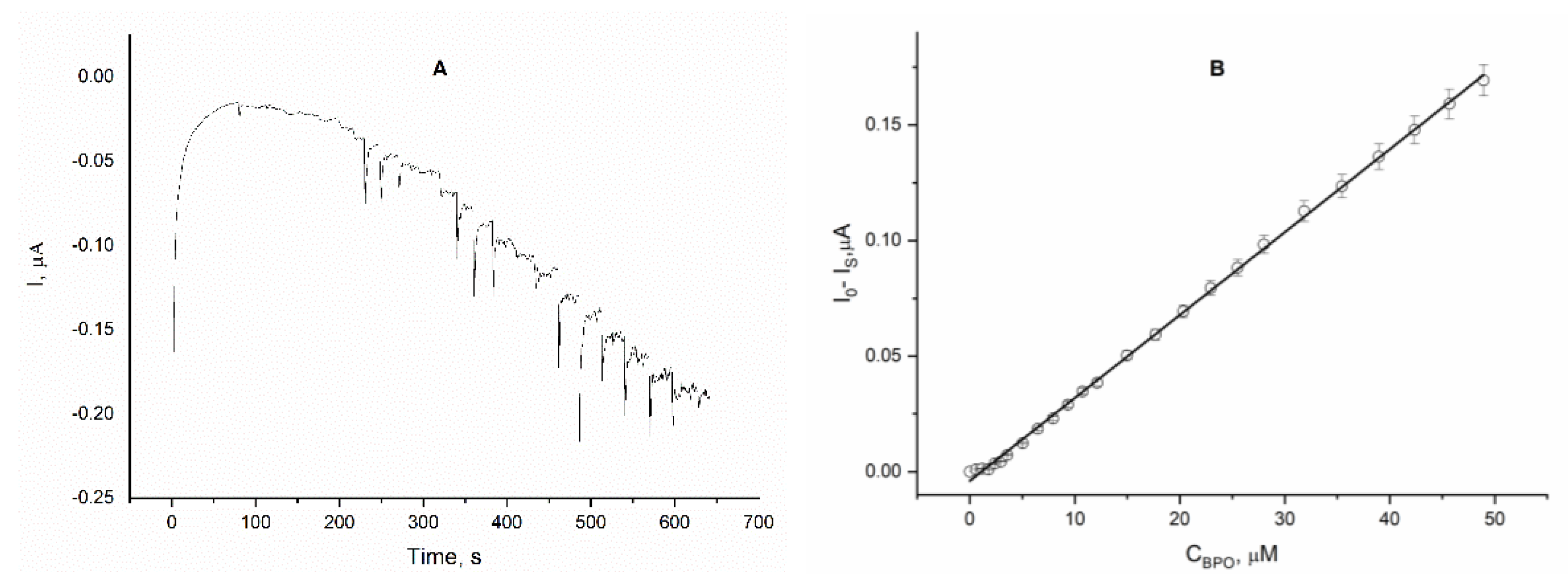
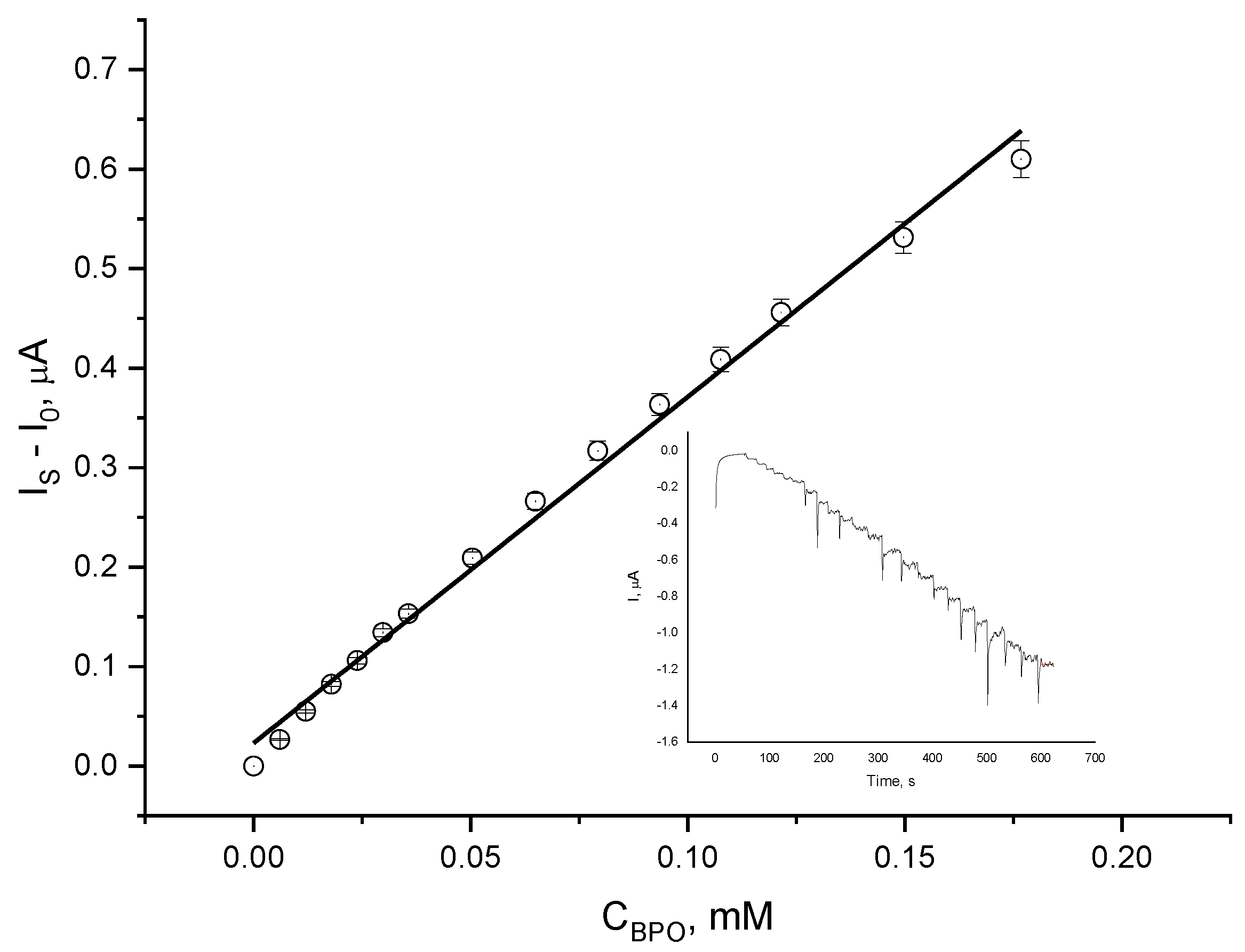
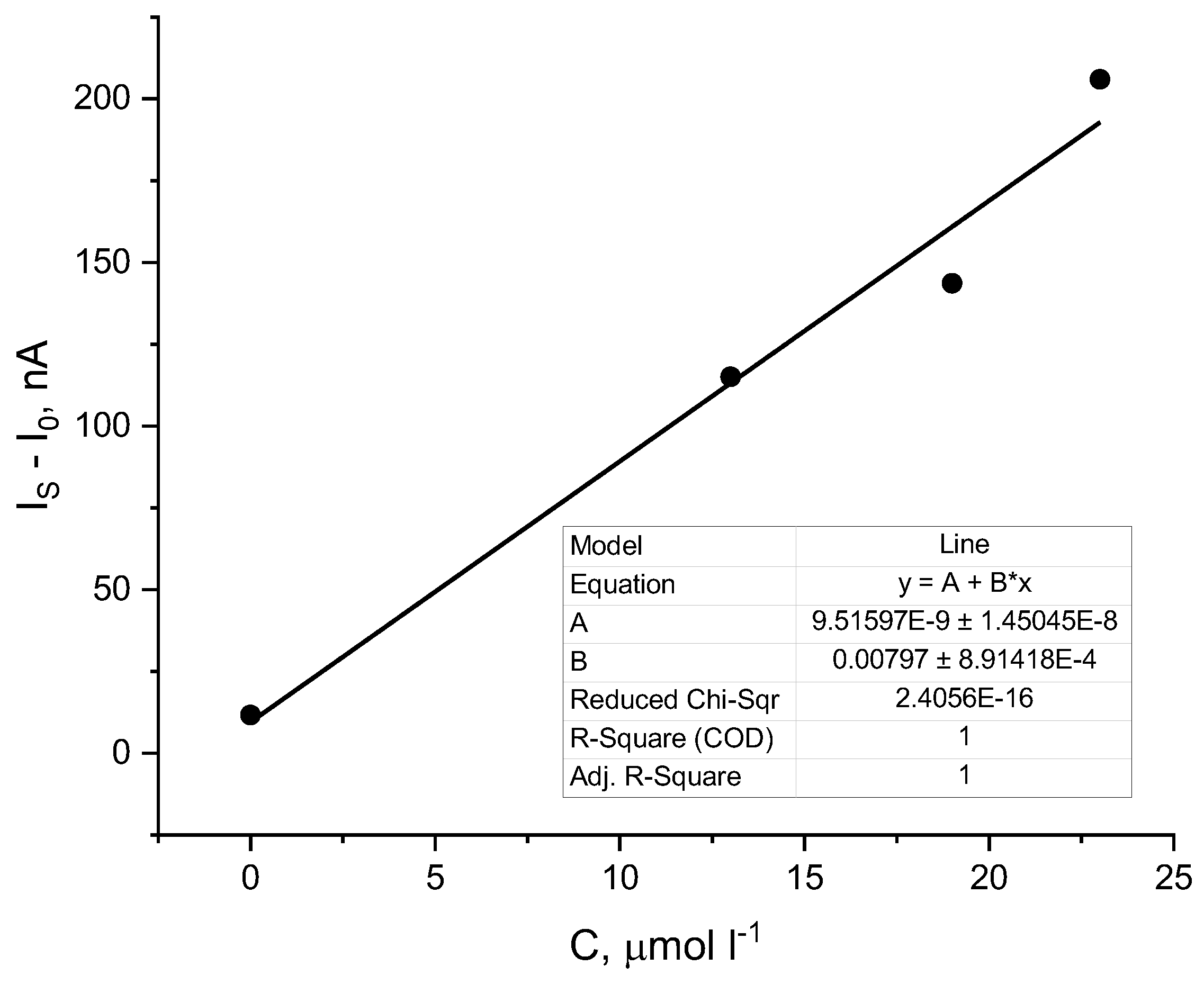
- S – I 0 = (-3,962.10-9 ± 4,9483.10-10) + (3,59.10-3 ±2,12994.10-5) *C BPO
- I
- where: I S - steady state signal in the presence of the peroxide, µA;
- I
- 0 – background current, µA;
- C
- BPO – concentration of BPO, µM.
2.2. Analytical Performance of the Catalytic Peroxide Electrode
3. Discussion
4. Materials and Methods
4.1. Materials
4.2. Apparatus and Measurments
4.3. Synthesis of Co-Doped g-C3N4
4.4. Modification of Working Electrode
4.5. Study of the Electrocatalytic Activity of Co-g-C3N4/Nafion – Modified GCE
4.6. Preparation of the Calibration Curve
4.7. Assessment of the Accuracy of the Method Over the Range of Low Peroxide Concentrations
4.8. Assessment of the Accuracy of the Electrochemical Method in a Wide Concentration Range
4.9. Peroxide Value (PV) Measurement of the Anti-Cellulite Oil by Iodometric Titration
- V-
- volume of 0,002 N Na2S2O3 in cm3, used to titrate the vegetable oil sample.
- V-
- Vo- volume of 0,002 N Na2S2O3 in cm3, used to titrate the blank sample.
- V-
- 0,002- the concentration in normality of the Na2S2O3 solution
- V-
- m- the mass of vegetable oil
4.10. Determination of Peroxide Concentration in a Real Sample - Highly Rancid Anti-Cellulite Oil From the TRADEMARK RIVANA
4.11. Calculus
- 1,25.10-4 M × 0.1 ml of the sample = х × 14,9 ml sample
- х =1,86×10⁻² M peroxides in 15 ml sample
- The number of moles of peroxides in this 15 ml sample is calculated:
- n=M.V=1,86.10-2mol/l × 15.10-3 liters= 2.76×10⁻⁴ mol peroxides
- The number of moles is converted to μmol:
- mol→106 μmol
- 2.76×10⁻⁴ mol = 276 μmol
5. Patents
Author Contributions
Funding
Institutional Review Board Statement
Informed Consent Statement
Data Availability Statement
Acknowledgments
Conflicts of Interest
References
- Wang, D.; Bao, A.; Yuan, Y.; Wang, Y.; Li, L.; Song, G.; Yuan, T.; Gong, J. Whey protein isolate-stabilized gardenia fruit oil nanoemulsions: Ultrasonic preparation, characterization and applications in nutraceuticals delivery. Ind Crops Prod 2024, 212, 118345. [Google Scholar] [CrossRef]
- Sun, X.; Wang, J.; Dong, M.; Zhang, H.; Li, L.; Wang, L. Food spoilage, bioactive food fresh-keeping films and functional edible coatings: Research status, existing problems and development trend. Trends Food Sci. Technol. 2022, 119, 122–132. [Google Scholar] [CrossRef]
- Kasaikina, O. T.; Krugovov, D. A.; Mengele, E. A. Unusual antioxidant effects in multiphase and complex systems. Eur. J. of Lipid Sci. Technol. 2017, 119(6), 1600286. [Google Scholar] [CrossRef]
- Hori, K.; Koh, F. H.; Tsumura, K. A. Metabolomics approach using LC TOF-MS to evaluate oxidation levels of edible oils. Food Anal. Methods 2019, 12(8), 1799–1804. [Google Scholar] [CrossRef]
- Zhang, N.; Li, Y.; Wen, S.; Sun, Y.; Chen, J.; Gao, Y.; Sagymbek, A.; Yu, X. Analytical methods for determining the peroxide value of edible oils: A mini- review. Food Chem. 2021, 358, 129834. [Google Scholar] [CrossRef] [PubMed]
- Yi, Y.; Yao, J.; Xu, W.; Wang, L.-M.; Wang, H.-X. Investigation on the quality diversity and quality-FTIR characteristic relationship of sunflower seed oils. RSC Adv. 2019, 9(47), 27347–27360. [Google Scholar] [CrossRef] [PubMed]
- Liang, P.; Chen, C.; Zhao, S.; Ge, F.; Liu, D.; Liu, B.; Fan, Q.; Han, B.; Xiong, X. Application of Fourier Transform Infrared Spectroscopy for the Oxidation and Peroxide Value Evaluation in Virgin Walnut Oil. Int. J. Spectrosc. 2013, 8, 1–5. [Google Scholar]
- Sinelli, N.; Cosio M., S.; Gigliotti, C.; Casiraghi, E. Preliminary study on application of mid infrared spectroscopy for the evaluation of the virgin olive oil ‘freshness’. Anal. Chim. Acta 2007, 598, 128–134. [Google Scholar] [CrossRef]
- Maggio R., M.; Kaufman T., S.; Carlo M., D.; Cerretani, L. Monitoring of fatty acid composition in virgin olive oil by Fourier transformed infrared spectroscopy coupled with partial least squares. Food Chem. 2009, 114, 1549–1554. [Google Scholar] [CrossRef]
- Guillen M., D.; Cabo, N. Fourier transform infrared spectra data versus peroxide and anisidine values to determine oxidative stability of edible oils. Food Chem. 2002, 77, 503–510. [Google Scholar] [CrossRef]
- Deyrieux, C.; Villeneuve, P.; Barea, B.; Decker E., A.; Guiller, I.; Salaun F., M.; Durand, E. Measurement of peroxide values in oils by triphenylphosphine/triphenylphosphine oxide (TPP/TPPO) assay coupled with FTIR-ATR spectroscopy: comparison with iodometric titration. Eur. J. Lipid Sci. Technol. 2018, 120, 1800109–1800119. [Google Scholar] [CrossRef]
- Yu, X. , Vandevoort, F., Sedman, J. Determination of peroxide value of edible oils by FTIR spectroscopy with the use of the spectral reconstitution technique. Talanta 2007, 74, 241–246. [Google Scholar] [CrossRef]
- Liu, H.; Chen, Y.; Shi, C.; Yang, X.; Han, D. FT-IR and Raman spectroscopy data fusion with chemometrics for simultaneous determination of chemical quality indices of edible oils during thermal oxidation. LWT 2020, 119, 108906. [Google Scholar] [CrossRef]
- Muste, S.; Racolta, E.; Semeniuc C., A.; Man, S.; Birou, A.; Mureȿan, V.; Chircu, C. Determination of Peroxide Value in Sunflower Halva using a Spectrophotometric Method. Bulletin UA SVM Agriculture 2010, 67, 334–339. [Google Scholar]
- DeLong J., M.; Prange R., K.; Hodges D., M.; Forney C., F.; Bishop M., C.; Quilliam, M. Using a modified ferrous oxidation–xylenol orange (FOX) assay for detection of lipid hydroperoxides in plant tissue. J. Agric. Food Chem. 2002, 50(2), 248–254. [Google Scholar] [CrossRef]
- Abuzaytoun, R.; Budge, S.; Hansen L., T.; MacKinnon, S. ) Modification of the ferrous oxidation-xylenol orange method for determination of peroxide value in highly pigmented sea cucumber viscera lipid. JAOCS 2020, 97(5), 509–516. [Google Scholar] [CrossRef]
- Parker, T.; Limer, E.; Watson, A.D.; Defernez, M.; Williamson, D.; . Kemsley E., K. 60 MHz 1H NMR spectroscopy for the analysis of edible oils. TRAC 2014, 57, 147–158. [Google Scholar]
- Alonso-Salces, R.M.; Holland, M.V.; Guillou, C. H-1-NMR fingerprinting to evaluate the stability of olive oil. Food Control 2011, 22, 2041–2046. [Google Scholar] [CrossRef]
- Knothe, G.; Kenar, J.A. Determination of the fatty acid profile by H-1-NMR spectroscopy, Eur. J. Lipid Sci. Technol. 2004, 106, 88–96. [Google Scholar] [CrossRef]
- Guillen, M.D.; Ruiz, A. Edible oils: discrimination by H-1 nuclear magnetic resonance.
- J. Sci. Food Agric. 2003, 83, 338-346.
- Liu, X.; Wang, S.; Tamogami, S.; Chen, J.; Zhang, H. An evaluation model for the quality of frying oil using key aldehyde detected by HS-GC/MS. Foods 2022, 11, 2413. [Google Scholar] [CrossRef] [PubMed]
- Sharma, A.; Bhardwaj, A.; Khanduja, G.; Kumar, S.; Bagchi, S.; Kaur, R.; Sharma, M.; Singla, M.; Ravinder, T.; Bhondekar, A.; Devi, B.L.A. Determination of Hexanal using static headspace GC-FID method and its correlation with oxidative rancidity in edible oils, Food Anal. Methods 2022, 15, 2652–2663. [Google Scholar]
- Lu, Y.; Xiong, R.; Tang, Y.; Yu, N.; Nie, X.; Zhang, L.; Meng, X. An overview of the detection methods to the edible oil oxidation degree: Recent progress, challenges, and perspectives. Food Chem. 2025, 463, 141443. [Google Scholar] [CrossRef]
- Chen, J.; Cai, D.; Zhang, Y. Rapid determination of lipid peroxidation using a novel pyridoxamine-participating ferrous oxidation-sulfosalicylic acid spectrophotometric method. Food Chemistry 2016, 211, 637–644. [Google Scholar] [CrossRef] [PubMed]
- Manikanta M., P.; Nikam R., R.; Tigari, G.; Mallana N., B. Novel nickel (II) phthalocyanine/reduced graphene oxide: an electrochemical sensing platform for analysis of hydroquinone and chloramphenicol in environmental samples. Anal. Methods 2024, 16, 1770–1784. [Google Scholar]
- Jyothi, S.P.; Vinod, D.; Chandran, D.; Antherjanam, S.; Saraswathyamma, B.; Balaraman, V.; Rajamani, R. Poly-4-amino-6-chloro-1,3-benzene disulfonamide decorated pencil graphite electrode for the simultaneous electrochemical quantification of catechol and hydroquinone. J. Appl. Electrochem. 2024, 54, 1819–1831. [Google Scholar] [CrossRef]
- Aryan, Z.; Khajehsharifi, H.; Shahrokhian, S. AuNPs-Ultrathin/Graphitic-C3N4 nanosheets as a sensitive platform for electrochemical detection and determination of dopamine. Microchem. J. 2024, 198, 110087. [Google Scholar] [CrossRef]
- Wang, R.; Liu, S.; Song, X.; Jiang, K.; Hou, Y.; Cheng, Q.; Miao, W.; Tian, L.; Ren, Y.; Xu, S. Polypyrrole/α-Fe2O3 Hybrids for Enhanced Electrochemical Sensing Performance towards Uric Acid. Coatings 2024, 14, 227. [Google Scholar] [CrossRef]
- Suriyaprakash, J.; Thangavelu, I.; Huang, Y.; Hu, Z.; Wang, H.; Zhan, Y.; Wu, L.; Shan, L. Precise surface molecular engineering of 2D-Bi2S3 enables the ultrasensitive simultaneous detection of dopamine, epinephrine, serotonin and uric acidSurf. Interfaces 2024, 46, 104021. [Google Scholar]
- Cosio, M. S.; Ballabio, D.; Benedetti, S.; Gigliotti, C. Evaluation of different storage conditions of extra virgin olive oils with an innovative recognition tool built by means of electronic nose and electronic tongue. Food Chem. 2007, 101(2), 485–491. [Google Scholar] [CrossRef]
- Rodrigues, N.; Dias, L. G.; Veloso, A. C. A.; Pereira, J. A.; Peres, A. M. Monitoring olive oils quality and oxidative resistance during storage using an electronic tongue. LWT 2016, 73, 683–692. [Google Scholar] [CrossRef]
- Rodrigues, N.; Marx, ´I. M. G.; Casal, S.; Dias, L. G.; Veloso, A. C. A.; Pereira, J. A.; Peres, A. M. Application of an electronic tongue as a single-run tool for olive oils’ physicochemical and sensory simultaneous assessment. Talanta 2019, 197, 363–373. [Google Scholar] [CrossRef]
- Majchrzak, T.; Wojnowski, W.; Dymerski, T.; Gębicki, J.; Namie´snik, J. Electronic noses in classification and quality control of edible oils: A review. Food Chem. 2018, 246, 192–201. [Google Scholar] [CrossRef]
- Fagiolari, L.; Sampò, M.; Lamberti, A.; Amici, J.; Francia, C.; Bodoardo, S.; Bella, F. Integrated energy conversion and storage devices: Interfacing solar cells, batteries and supercapacitors. Energy Storage Mater. 2022, 51, 400–434. [Google Scholar] [CrossRef]
- Pollok, D.; Waldvogel S., R. Electro-organic synthesis-a 21stcentury technique. Chem. Sci. 2020, 11, 12386–12400. [Google Scholar] [CrossRef]
- McCreery, The merger of electrochemistry and molecular electronics. Chem. Rec. 2012, 12, 149–163. [CrossRef] [PubMed]
- Kraft, Electrochromism: a fascinating branch of electrochemistry. ChemTexts 2019, 5, 1–18. [CrossRef]
- Peng, B.; Hongliang, L.; Guochen, Z.; Minrui, R.; Lili, C.; Hanjie, G.; Yanpeng, X. Robust Super-Hydrophobic Coating Prepared by Electrochemical Surface Engineering for corrosion protection. Coatings 2019, 9, 452. [Google Scholar] [CrossRef]
- Díaz-Cruz, J.M.; Serrano, N.; Pérez-Ràfols, C.; Ariño, C.; Esteban, M. Electroanalysis from the past to the twenty-first century: challenges and perspectives. J. Solid State Electrochem. 2020, 24, 2653–2661. [Google Scholar] [CrossRef] [PubMed]
- Zhao, Z.; Cai, D.; Shao, Y.; Tian, J.; Wang, L.; Dong, Y. (). Detection of di(2- ethylhexyl) phthalate in edible vegetable oils using a sensitive aptasensor based on carbon nanomaterials and copper metal-organic framework. J. Food Compos. Anal. 2023, 123, 105510. [Google Scholar] [CrossRef]
- Novoselov K., S.; Geim A., K.; Morozov S., V.; Jiang, D.; Zhang, Y.; Dubonos S., V.; Grigorieva I., V.; Firsov A., A. Electric field effect in atomically thin carbon films. Science (New York, N.Y.) 2004, 306, 666–669. [Google Scholar] [CrossRef]
- Tan, C.; Cao, X.; Wu, X.-J.; He, Q.; Yang, J.; Zhang, X.; Chen, J.; Zhao, W.; Han, S.; Nam, G.-H.; Sindoro, M.; Zhang, H. Recent Advances in Ultrathin Two-Dimensional Nanomaterials, Chem. Rev. 2017, 117, 6225–6331. [Google Scholar]
- Mamba, G.; Mishra, A.K. Graphitic carbon nitride (g-C3N4) nanocomposites: A new and exciting generation of visible light driven photocatalysts for environmental pollution remediation. Appl. Catal. B Environ. 2016, 198, 347–377. [Google Scholar] [CrossRef]
- Hu, T.; Mei, X.; Wang, Y.; Weng, X.; Liang, R.; Wei, M. Two-dimensional nanomaterials: fascinating materials in biomedical field. Sci. Bull. 2019, 64, 1707–1727. [Google Scholar] [CrossRef]
- Moraes, L.P.R.; Mei, J.; Fonseca, F.C.; Sunet, Z. Two-dimensional metal oxide nanomaterials for sustainable energy applications. INC 2020, 39–72. [Google Scholar]
- Joshi, N.; Hayasaka, T.; Liu, Y.; Liu, H.; Oliveira, O.N.; Lin, L. A review on chemiresistive room temperature gas sensors based on metal oxide nanostructures, graphene and 2D transition metal dichalcogenides. Microchim. Acta 2018, 185, 213. [Google Scholar] [CrossRef] [PubMed]
- Wang, M.; Wu, Z.; Dai, L. Graphitic carbon nitrides supported by nitrogen-doped graphene as efficient metal-free electrocatalysts for oxygen reduction. JEAC 2015, 753, 16–20, 2015. [Google Scholar] [CrossRef]
- Jiang, S.; Zhang, Z.; Yang, N.; Li, L.; Wei, Z. Probing the Interaction between Nitrogen Dopants and Edge Structures of Doped Graphene Catalysts for the Highly Efficient Oxygen Reduction Reaction. J. Phys. Chem. C 2022, 126, 19113–19121. [Google Scholar] [CrossRef]
- Ong, W.J.; Tan, L.L.; Ng, Y.H.; Yong, S.T.; Chai, S.P. Graphitic Carbon Nitride (g-C3N4)-Based Photocatalysts for Artificial Photosynthesis and Environmental Remediation: Are We a Step Closer To Achieving Sustainability. Chem. Rev. 2016, 116, 7159–7329. [Google Scholar] [CrossRef]
- Wang, X.; Maeda, K.; Thomas, A.; Takanabe, K.; Xin, G.; Carlsson, J.M.; Domen, K.; Antonietti, M. A metal-free polymeric photocatalyst for hydrogen production from water under visible light. Nat. Mater 2009, 8, 76–80. [Google Scholar] [CrossRef]
- Li, J.; Fang, J.; Ye, P.; Wu, D.; Wang, M.; Li, X.; Xu, A. Peroxymonosulfate activation by iron oxide modified g-C3N4 under visible light for pollutants degradation. JPPA 2017, 342, 85–93. [Google Scholar]
- Agnihotri, A.S.; Varghese, A.; Nidhin, M. Transition metal oxides in electrochemical and bio sensing: A state-of-art review. Appl. Surf. Sci. Advances 2020, 4, 100072. [Google Scholar] [CrossRef]
- Pimpilova, M.; Ivanova-Kolcheva, V.; Stoyanova, M.; Dimcheva, N. 2D Nanomaterial—Based Electrocatalyst for Water Soluble Hydroperoxide Reduction. Catalysts 2022, 12, 807. [Google Scholar] [CrossRef]
- Ziyatdinova, G; Guss, E.; Yakupova, E. Electrochemical sensors based on the electropolymerized natural phenolic antioxidants and their analytical application. Sensors 2021, 21, 8385. [Google Scholar] [CrossRef]
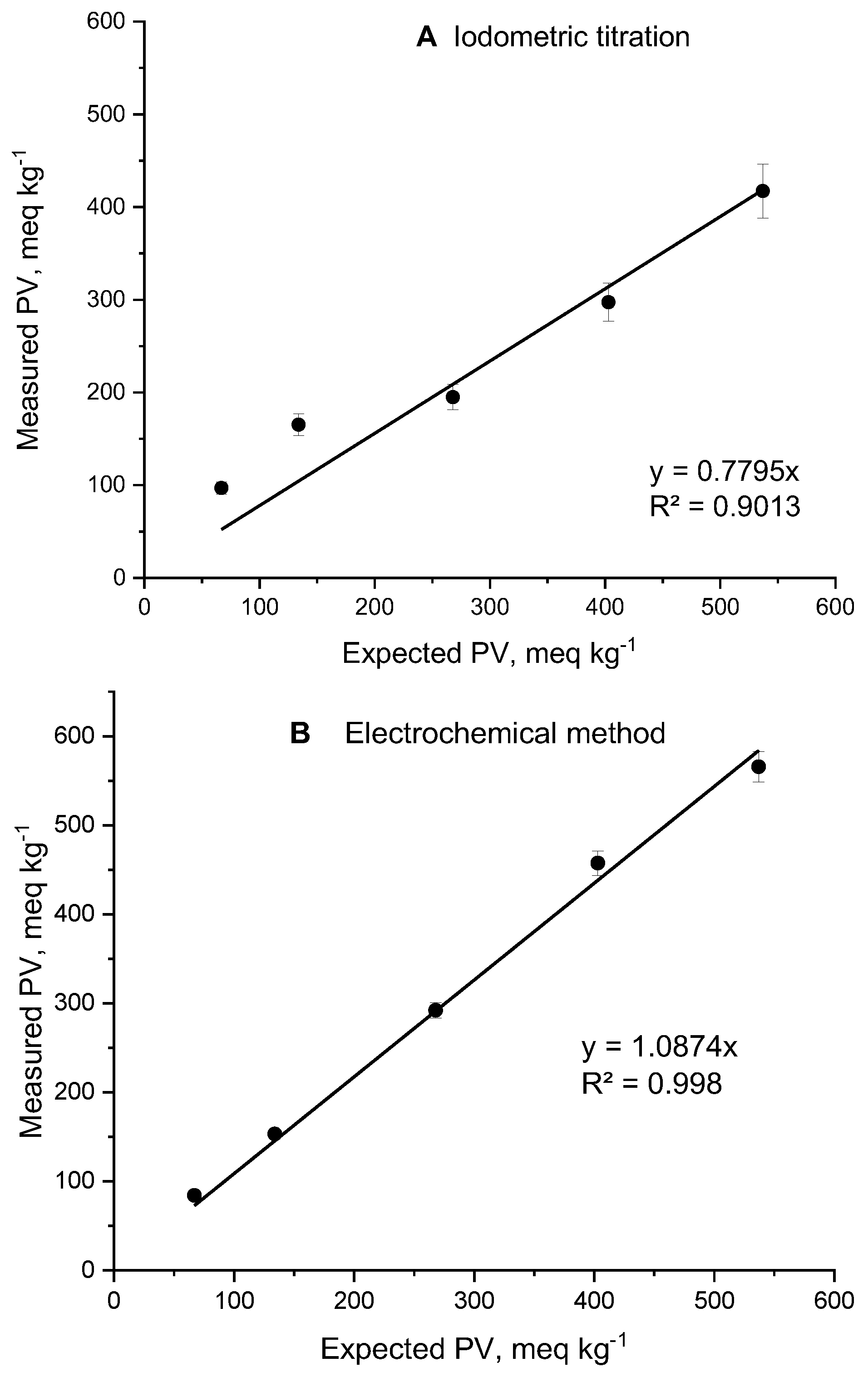

| Expected PV, meq O2/kg (standard solution) |
Measured PV, meq O2/kg by titrimetric method |
Deviation of the titrimetric value from the expected, in % | Measured PV, meq O2/kg by electrochemical method |
Deviation of the electrochemically measured PV from the expected, in % |
|---|---|---|---|---|
| 67 | 97.0 | +44.78 | 84.2 | +25.67 |
| 134 | 165.3 | +23.36 | 153.3 | +14.40 |
| 268 | 195.0 | -27.24 | 292.1 | +8.99 |
| 403 | 297.4 | -26.20 | 457.5 | +13.52 |
| 537 | 417.3 | -22.29 | 565.8 | +5.36 |
| Standard solution | Volume (BPO/CHCl3), ml with the given concentration, | Mass of the weighed oil, g |
|---|---|---|
| St1 | 0.5 ml 1mM BPO/CHCl3 | 0.4000 ±0.0075 |
| St2 | 0.5 ml 2mM BPO/CHCl3 | 0.4000 ±0.0075 |
| St3 | 0.5 ml 3 mM BPO/CHCl3 | 0.4000 ±0.0075 |
| St4 | 0.5 ml 6 mM BPO/CHCl3 | 0.4000 ±0.0075 |
| St5 | 0.5 ml 10 mM BPO/CHCl3 | 0.4000 ±0.0075 |
| Standard solution |
Volume (BPO/CHCl3) with certain concentration, ml | DF* |
Mass of the weighed oil, g |
|---|---|---|---|
| St0 | 0.5 ml chloroform | 1 | 0.4000 ±0.0075 |
| St1 | 0.5 ml 50mM BPO/CHCl3 | 4 | 0.4000 ±0.0075 |
| St2 | 0.5 ml 100 mM BPO/CHCl3 | 10 | 0.4000 ±0.0075 |
| St3 | 0.5 ml 200 mM BPO/CHCl3 | 20 | 0.4000 ±0.0075 |
| St4 | 0.5 ml 300 mM BPO/CHCl3 | 30 | 0.4000 ±0.0075 |
| St5 | 0.5 ml 400 mM BPO/CHCl3 | 50 | 0.4000 ±0.0075 |
| Standart solution | Volume of a highly rancid anti-cellulite oil- Rivana, ml | Volume of a standard 10 mM BPO/CHCl3 solution, ml |
|---|---|---|
| St 0 | 0.1 | 0.000 |
| St1 | 1.0 | 0.150 |
| St2 | 1.0 | 0.200 |
| St3 | 1.0 | 0.250 |
| St4 | 1.0 | 0.300 |
Disclaimer/Publisher’s Note: The statements, opinions and data contained in all publications are solely those of the individual author(s) and contributor(s) and not of MDPI and/or the editor(s). MDPI and/or the editor(s) disclaim responsibility for any injury to people or property resulting from any ideas, methods, instructions or products referred to in the content. |
© 2024 by the authors. Licensee MDPI, Basel, Switzerland. This article is an open access article distributed under the terms and conditions of the Creative Commons Attribution (CC BY) license (http://creativecommons.org/licenses/by/4.0/).


