

Submitted:
11 December 2024
Posted:
12 December 2024
You are already at the latest version
Abstract
The growing demand for accessible and effective e-learning platforms has led to an increased focus on innovative solutions to address the challenges posed by diverse linguistic backgrounds of learners. This paper explores the use of AI-generated virtual speakers to enhance multilingual e-learning experiences. The study employs a system developed using Google Sheets and Google Script to create and manage multilingual courses, integrating AI-powered virtual speakers to deliver content in learners' native languages. The e-learning platform used is a customized Moodle, and three courses were developed: “Mental Wellbeing in Mining”, “Rescue in the Mine” and “Risk Assessment” for a European ERASMUS+ project. The study involved 150 participants from various educational and professional backgrounds. The main findings indicate that AI-generated virtual speakers significantly improve the accessibility of e-learning content. Participants preferred content in their native language and found AI-generated videos effective and engaging. The study concludes that AI-generated virtual speakers offer a promising approach to overcoming linguistic barriers in e-learning, providing personalized and adaptive learning experiences. Future research should focus on addressing ethical considerations, such as data privacy and algorithmic bias, and expanding the user base to include more languages and proficiency levels.
Keywords:
Artificial Intelligence (AI)
; e-Learning
; virtual speakers
; multilingual education
; adaptive learning
; personalized learning
; AI-generated content
1. Introduction
The growing demand for accessible and effective e-learning platforms has led to an increased focus on exploring innovative solutions to address the challenges posed by the diverse linguistic backgrounds of learners [1]. Traditionally, the creation of audio and video content for e-learning platforms has been a costly and often ineffective endeavor, as the content may be in a different language than that of the participant users [2].
To overcome these limitations, the use of Artificial Intelligence-generated virtual speakers has emerged as a promising approach. These AI-powered virtual speakers can be programmed to deliver content in the native languages of the learners, thereby enhancing the accessibility and engagement of the learning experience [2]. Furthermore, the integration of AI technologies into e-learning platforms can enable personalized and adaptive learning experiences, tailored to the specific needs and proficiency levels of individual learners [1].
Despite the potential benefits, the implementation of AI-generated virtual speakers in e-learning settings presents several challenges that require careful consideration. Ensuring the accuracy and naturalness of the virtual speech, as well as the seamless integration of the AI-powered components into the learning platform, are critical factors to address [3]. Additionally, the ethical considerations surrounding the use of AI in education, such as data privacy and algorithmic bias, must be thoroughly examined [3].
Nevertheless, the rapid advancements in AI and speech recognition technologies offer significant opportunities for enhancing the language learning experience. By leveraging AI-generated virtual speakers, e-learning platforms can provide learners with a more immersive and personalized learning environment, promoting language acquisition and improving learning outcomes [1,2].
The integration of AI-generated virtual speakers into e-learning platforms holds the promise of overcoming the linguistic barriers that have traditionally hindered the accessibility and effectiveness of online learning.
As the technology continues to evolve, the opportunities for AI-powered language learning solutions will only grow, paving the way for a more inclusive and engaging e-learning landscape [4].
The ERASMUS+ project named DigiRescueMe, Standardization and Digitalization of Rescue Education in Mining (2021-1-TR01-KA220-VET-000028090) has the goal to develop e-learning modules aiming at increasing knowledge, mental and awareness level of miners, rescue members and mining engineers on topics about rescue, risk assessment and wellbeing as investigated to point out their learning needs [6]. But it has the main problem to reach people from Türkiye, Poland, Portugal and Italy as well with an easy-to-understand content. Usually, people working in the mines do not speak English very well and the vocabulary in their own tongue is not so rich in terms. For these reasons a multi-language approach should be preferred to better engage people and keep content more effective for them. To do so, engaging teachers or human speakers in different languages may be expensive and difficult to manage.
2. Materials and Methods
2.1. The Developed System to Manage Content
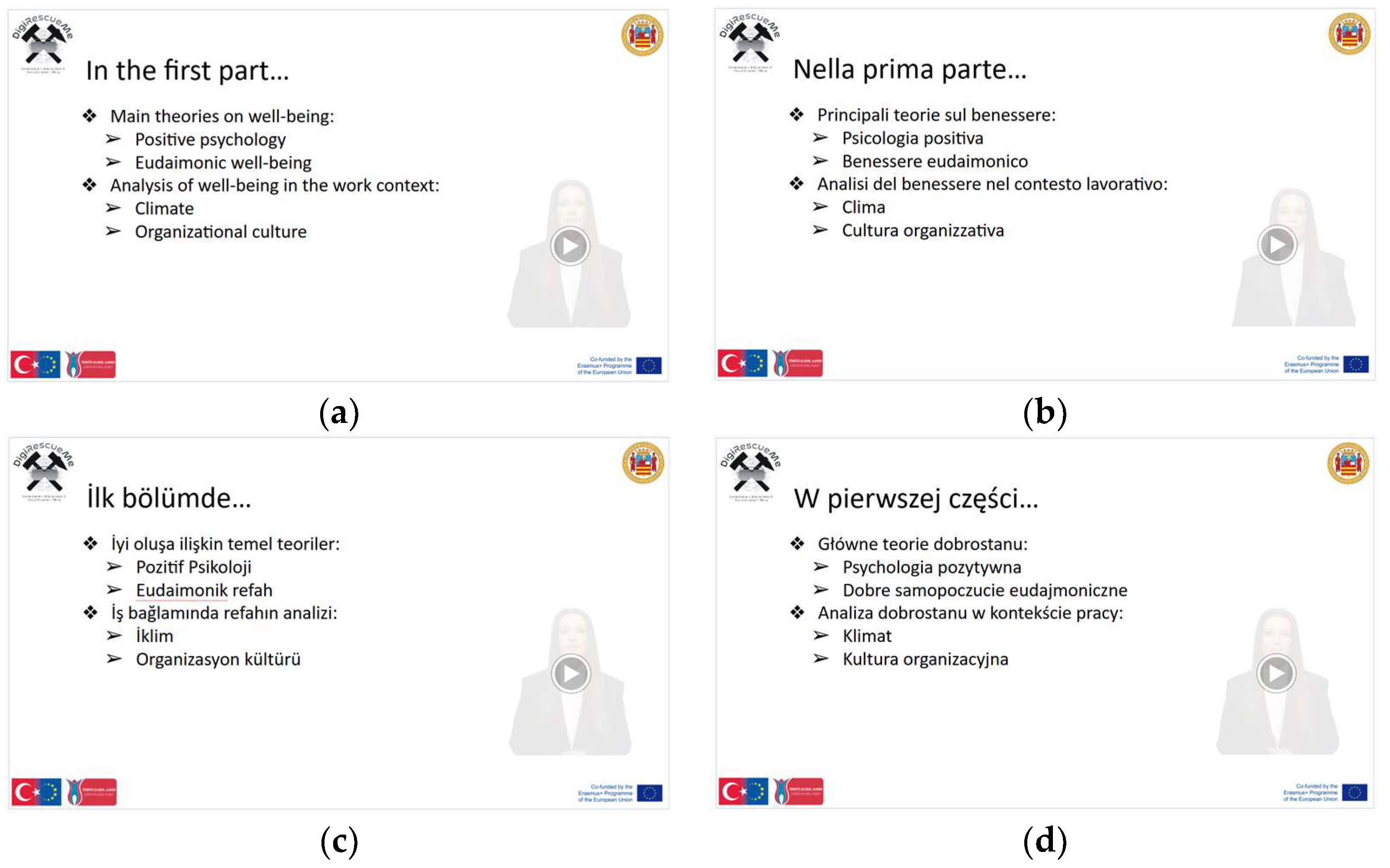
By using Google Sheets and their Google Script programming language, a sort of management system has been developed. It supports creating and managing the production of multilanguage courses. It has been designed to allow instructional designers to define in their own language what they would like to show in their slides to the learners. By using Google Translator functions directly accessed in the cells of Google Sheets, these details are automatically translated in all language they need (Figure 1). This system, by Google Script procedures and a set of slide templates where titles, subtitles, content and a speaker shape are defined (Figure 2), automatically creates Google Presentations with the detailed slides. It can create one Google presentation for each chosen language.
Afterwards, the course designers may define what a teacher should say on each slide by writing their speeches and, still using Google Translator functions, translating them into the language they want (Figure 3).
By using API, an external Artificial Intelligence engine may be called to create virtual talking avatars. For this project ELAI [X] has been selected since it offers high quality in generating speaking avatars (Figure 3) and many API functions to be called directly from Google scripts. It allowed automatizing the process of creating multilanguage content. The talking avatar videos can be created, downloaded and integrated into the Google slides directly by using Google Script procedures.
Figure 3.
The ELAI environment to create virtual speaking avatars.
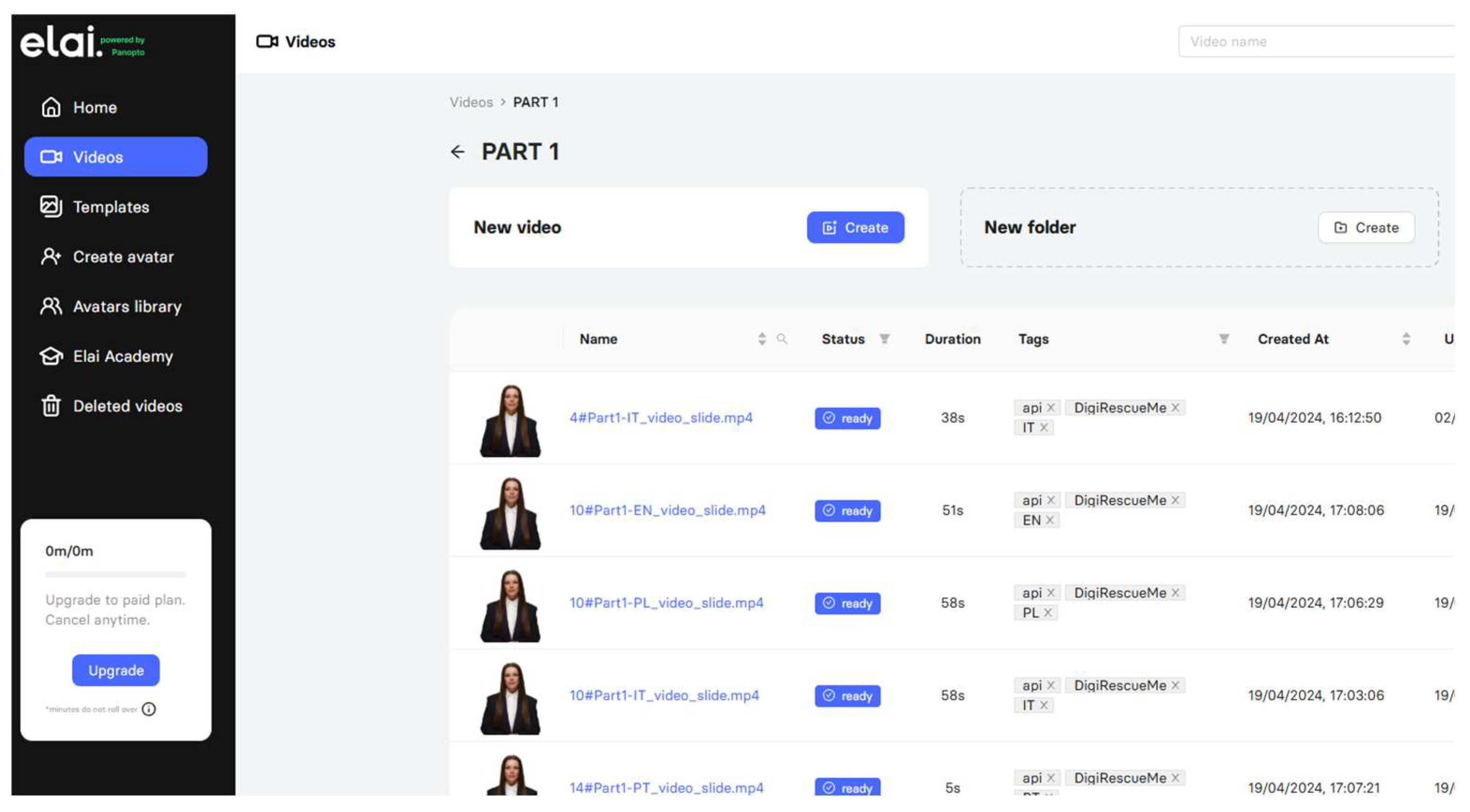
Figure 4.
Multilanguage slides automatically created by the developed Google Script procedures in (a) English; (b) Italian; (c) Turkish; (d) Polish.
Figure 4.
Multilanguage slides automatically created by the developed Google Script procedures in (a) English; (b) Italian; (c) Turkish; (d) Polish.
2.2. The e-Learning Platform
The used e-learning platform is a Moodle customized on the needs of the project.
Figure 5.
The home page of the e-Learning platform.
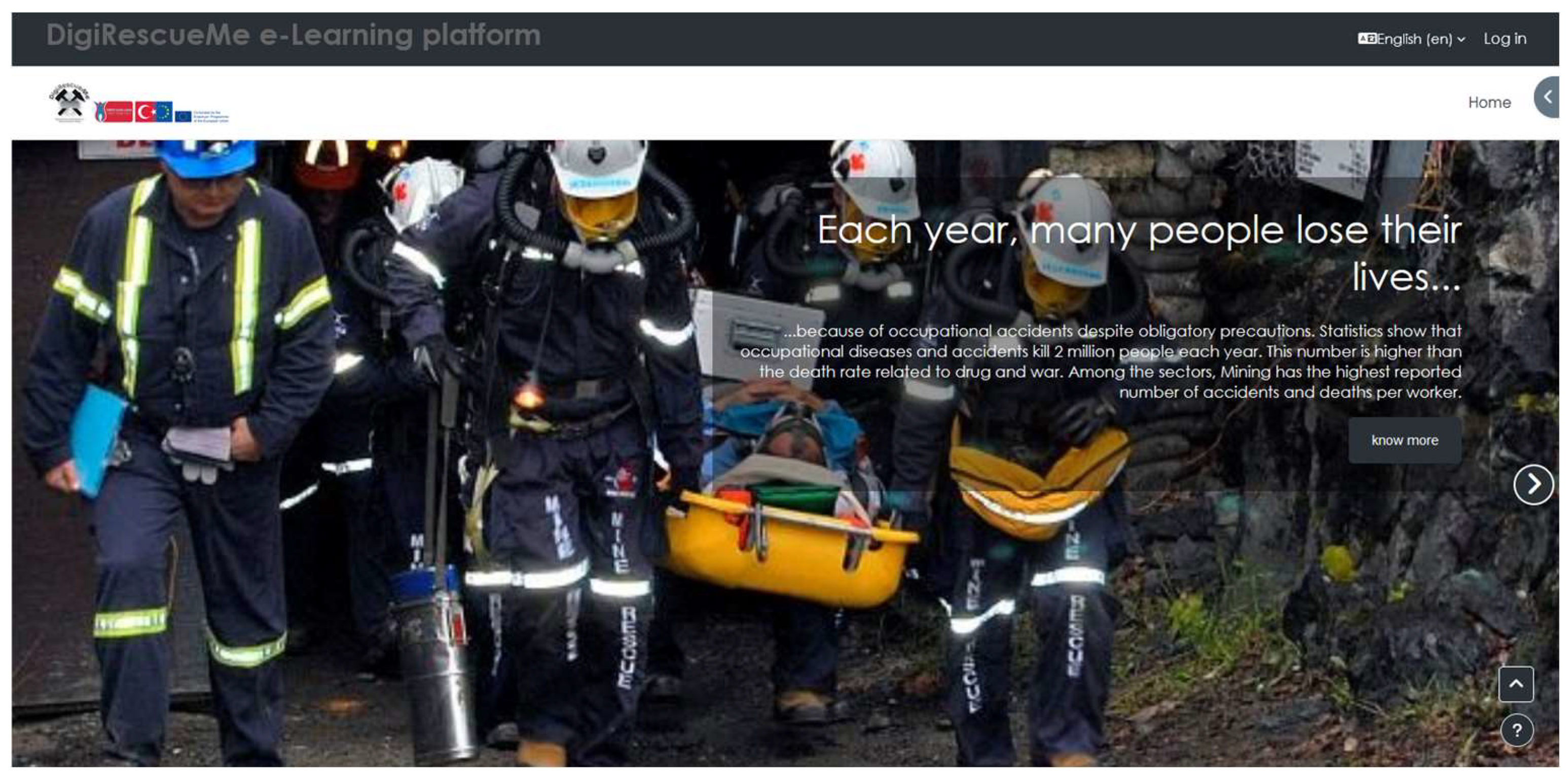
Figure 6.
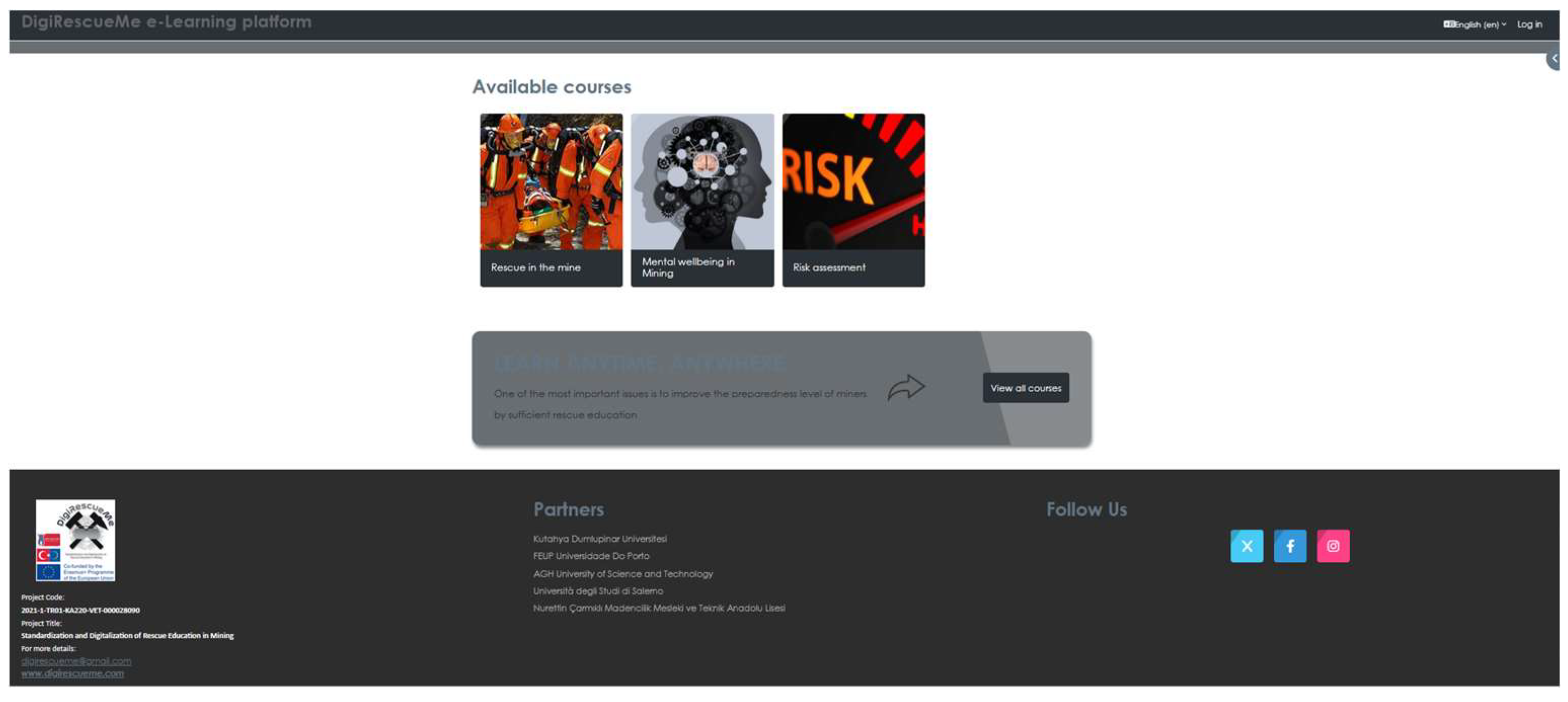
The course catalogue.
2.3. The Courses
Three courses have been created:
- Mental wellbeing in Mining;
- Rescue in the mine;
- Risk assessment.
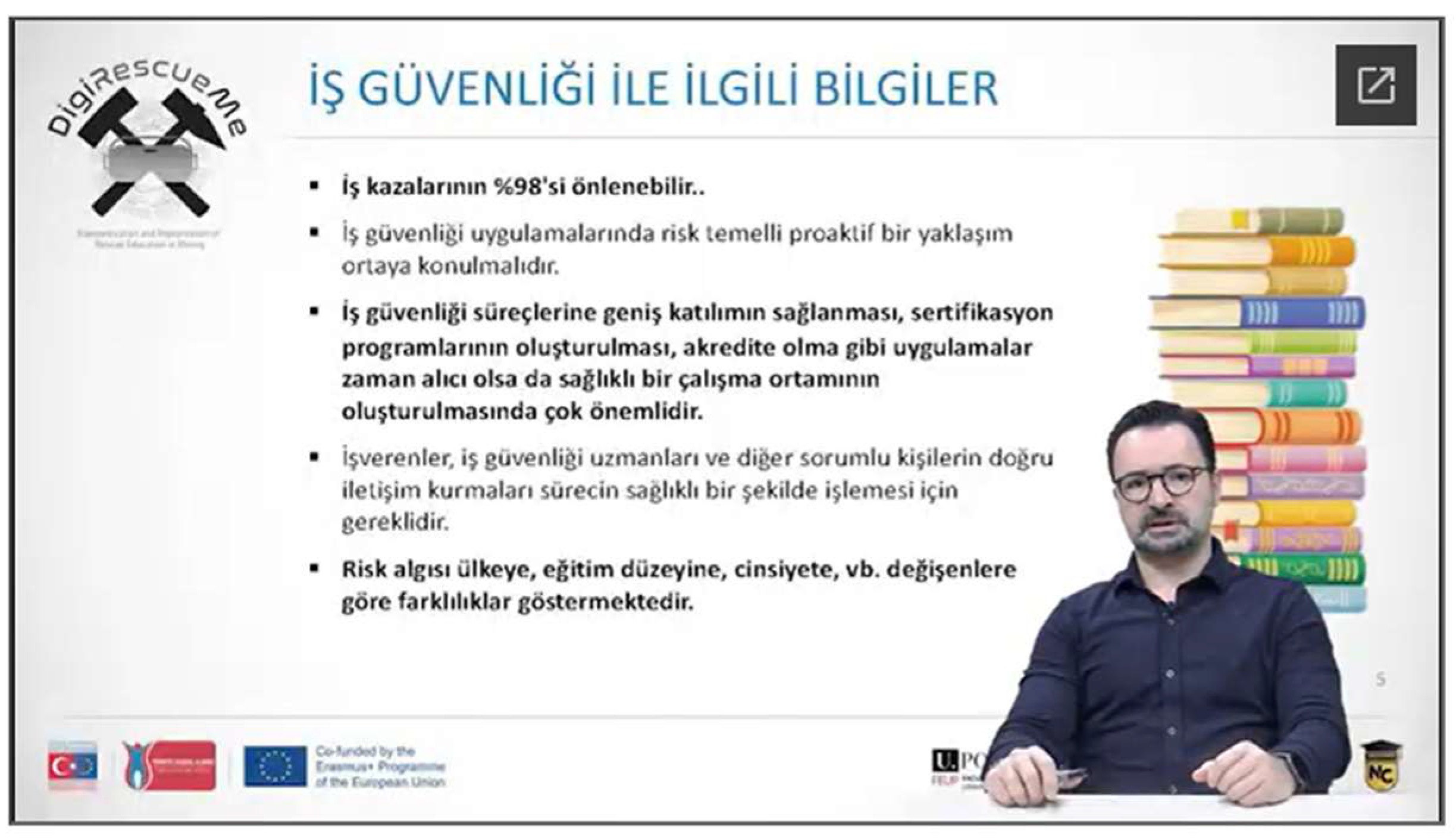
The structure of all the three courses is the same: an initial assessment on the knowledge treated in the course; a sequence of videos with a speaker and supported by slides; a final assessment on the treated concepts and a questionnaire to collect their opinions about this e-learning experience. The “Mental wellbeing in Mining” and “Rescue in the mine” courses have a virtual speaker; the “Risk assessment” course has a human speaker.
Figure 7.
One of the videos in English with an AI-generated talking avatar.
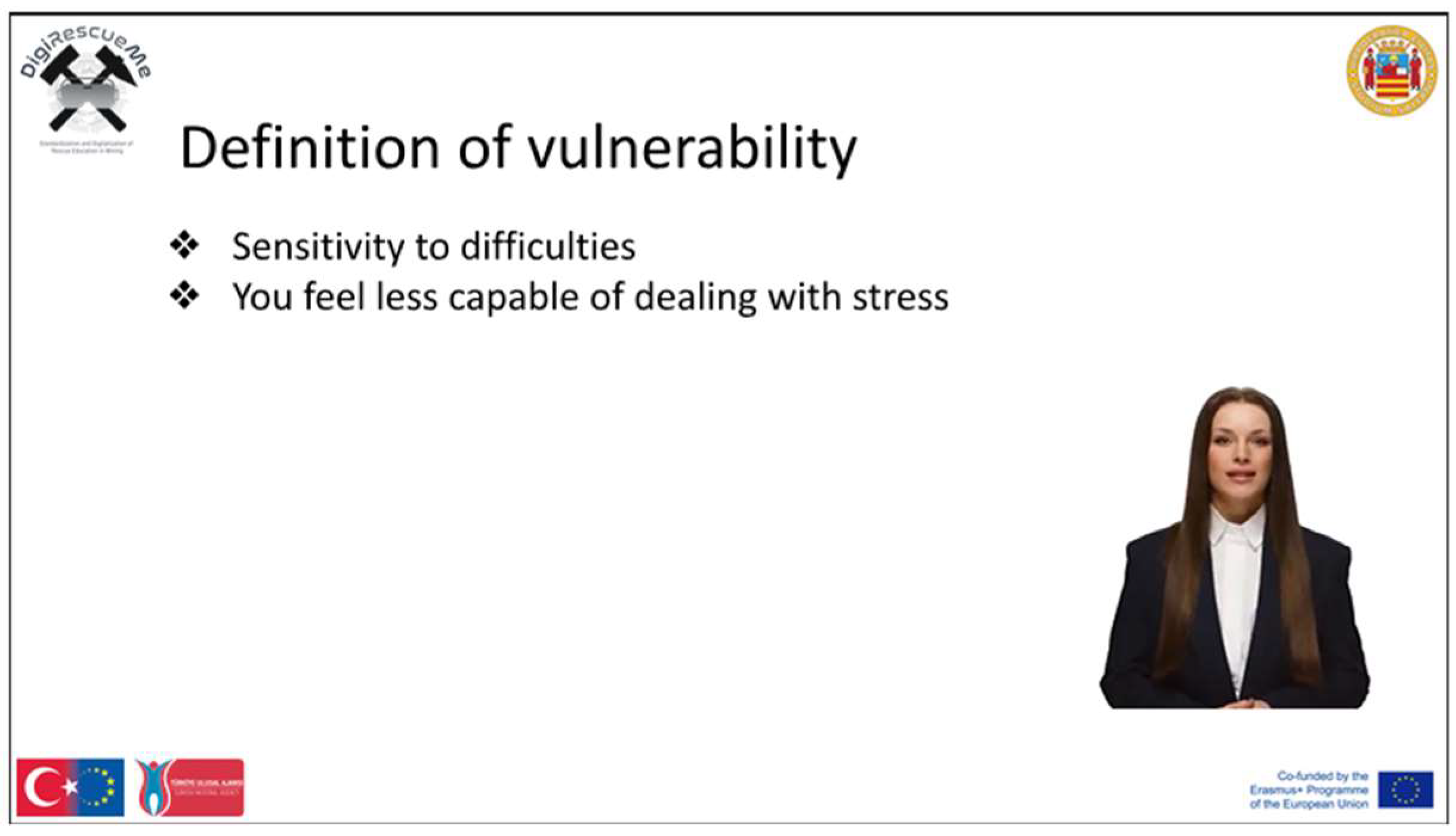
Figure 8.
One of the videos in Turkish with a human speaker.
2.4. The Questionnaire
Krosnick and Presser [7] emphasized the importance of clear and concise question wording to avoid ambiguity and ensure respondents understand the questions as intended. They recommend using simple language and avoiding technical jargon. They also suggest using a mix of closed and open-ended questions to capture both quantitative and qualitative data. To collect opinions of users on their e-learning experience a questionnaire has been defined inspired by the UEQ model [8]: and the TUXEL technique for user experience evaluation in e-learning [9].
These references provided insights into the methodologies and findings related to user experience and satisfaction with e-learning platforms to design a questionnaire that has been delivered at the end of each course. It has the following eighteen questions:
- Sex (Female, Male);
- Age (number);
- Occupation (single choice in the list: School student, University student, Researcher, Specialized technician, Employee, Teacher, Unemployed);
- Country (open text);
- Do you like this e-learning platform? (Yes, More Yes than No, More No than Yes, No);
- Are you interested in the topic of this course? (Yes, More Yes than No, More No than Yes, No);
- Have you done the initial test? (Yes, No);
- What score did you get on the initial test? (number)
- The contents are multilingual, that is, they are provided in the language in which you access the platform. Do you prefer to see and listen to content in your language? (Yes, More Yes than No, More No than Yes, No);
- The videos in this course are generated with an Artificial Intelligence system. Do you like them? (Yes, More Yes than No, More No than Yes, No);
- Do you think this communication based on videos generated with Artificial Intelligence directly in your language is effective? (Yes, More Yes than No, More No than Yes, No);
- Would you have preferred a human interpreter speaking in a language other than yours and with subtitles in your language? (Yes, More Yes than No, More No than Yes, No);
- Do you rate the contents currently in this course? (number from 1 to 10);
- When the other contents are also available, will you return to see them on this platform? (Yes, More Yes than No, More No than Yes, No);
- Would you recommend this course to a friend or colleague? (Yes, More Yes than No, More No than Yes, No);
- What device did you primarily use to access this content? (Desktop Computer, Notebook, Tablet, Smartphone);
- What did you like most about the course? (open text);
- What did you like least about the course? (open text).
Many questions allow people to express their own opinion in a 4 levels scale (Yes, More Yes than No, More No than Yes, No). The two final questions allow participants to detail what they liked most and what they liked least about the e-learning platform and its content in an open text box.
2.5. The People
During the piloting phase of the project, people from school, university and enterprises from Türkiye, Poland, Portugal and Italy have been asked to take part to our experiments. Each one of them had the opportunity to choose just one of the available courses.
3. Results
3.1. The Engaged People
One hundred and fifty-five people have been engaged. Among them, seventy-eight users provided answers to the questionnaire. All the details about number for each course, sex, occupation and used device of them are in the Table 1.
In the two courses “Mental wellbeing in Mining” and “Rescue in the mine”, AI-generated virtual speakers have been used as explaining teachers, in the course “Risk assessment” a human teacher has been involved. This allowed having an experimental group (EG) with 54 participants and a control group (CG) with 24 participants to compare their perception about the content and their e-learning experience.
3.2. The Collected Data
The data collected by the questionnaire are in the Tables from 2 to 9.

Table 2.
This table shows the results of question n.5 about the perception of the users on the e-Learning platform.
Table 2.
This table shows the results of question n.5 about the perception of the users on the e-Learning platform.
| Do you like this e-learning platform? | |||||||||
| Yes | More Yes than No | More No than Yes | No | ||||||
| Mental wellbeing in Mining | 19 | 19 | 100% | 0 | 0% | 0 | 0% | 0 | 0% |
| Rescue in the mine | 35 | 27 | 77% | 5 | 14% | 1 | 3% | 2 | 6% |
| EG | 54 | 46 | 85% | 5 | 9% | 1 | 2% | 2 | 4% |
| Risk assessment (CG) |
24 | 20 | 83% | 2 | 8% | 2 | 8% | 0 | 0% |
| TOTAL | 78 | 66 | 85% | 7 | 9% | 3 | 4% | 2 | 3% |
Table 3.
This table shows the results of question n.6 about the perception of the users on the treated topics.
Table 3.
This table shows the results of question n.6 about the perception of the users on the treated topics.
| Are you interested in the topic of this course? | |||||||||
| Yes | More Yes than No | More No than Yes | No | ||||||
| Mental wellbeing in Mining | 19 | 18 | 95% | 1 | 5% | 0 | 0% | 0 | 0% |
| Rescue in the mine | 35 | 26 | 74% | 4 | 11% | 1 | 3% | 4 | 11% |
| EG | 54 | 44 | 81% | 5 | 9% | 1 | 2% | 4 | 7% |
| Risk assessment (CG) |
24 | 19 | 79% | 2 | 8% | 3 | 13% | 0 | 0% |
| TOTAL | 78 | 63 | 81% | 7 | 9% | 4 | 5% | 4 | 5% |
Table 4.
This table shows the results of question n.9 about the perception of the users on the multilanguage content.
Table 4.
This table shows the results of question n.9 about the perception of the users on the multilanguage content.
| The contents are multilingual, that is, they are provided in the language in which you access the platform. Do you prefer to see and listen to content in your language? | |||||||||
| Yes | More Yes than No | More No than Yes | No | ||||||
| Mental wellbeing in Mining | 19 | 19 | 100% | 0 | 0% | 0 | 0% | 0 | 0% |
| Rescue in the mine | 35 | 26 | 74% | 4 | 11% | 3 | 9% | 2 | 6% |
| EG | 54 | 45 | 83% | 4 | 7% | 3 | 6% | 2 | 4% |
| Risk assessment (CG) |
24 | 19 | 79% | 3 | 13% | 1 | 4% | 1 | 4% |
| TOTAL | 78 | 64 | 82% | 7 | 9% | 4 | 5% | 3 | 4% |
Table 5.
This table shows the results of question n.10 about the perception of the users on the AI-generated content.
Table 5.
This table shows the results of question n.10 about the perception of the users on the AI-generated content.
| The videos in this course are generated with an Artificial Intelligence system. Do you like them? | |||||||||
| Yes | More Yes than No | More No than Yes | No | ||||||
| Mental wellbeing in Mining | 19 | 17 | 89% | 2 | 11% | 0 | 0% | 0 | 0% |
| Rescue in the mine | 35 | 23 | 66% | 7 | 20% | 2 | 6% | 3 | 9% |
| EG | 54 | 40 | 74% | 9 | 17% | 2 | 4% | 3 | 6% |
| Risk assessment (CG) |
24 | 20 | 83% | 2 | 8% | 1 | 4% | 1 | 4% |
| TOTAL | 78 | 60 | 77% | 11 | 14% | 3 | 4% | 4 | 5% |
Table 6.
This table shows the results of question n.11 about the perception of the users on the effectiveness of the AI-generated content.
Table 6.
This table shows the results of question n.11 about the perception of the users on the effectiveness of the AI-generated content.
| Do you think this communication based on videosgenerated with Artificial Intelligence directly in your language is effective? | |||||||||
| Yes | More Yes than No | More No than Yes | No | ||||||
| Mental wellbeing in Mining | 19 | 17 | 89% | 2 | 11% | 0 | 0% | 0 | 0% |
| Rescue in the mine | 35 | 28 | 80% | 2 | 6% | 3 | 9% | 2 | 6% |
| EG | 54 | 45 | 83% | 4 | 7% | 3 | 6% | 2 | 4% |
| Risk assessment (CG) |
24 | 19 | 79% | 2 | 8% | 2 | 8% | 1 | 4% |
| TOTAL | 78 | 64 | 82% | 6 | 8% | 5 | 6% | 3 | 4% |
Table 7.
This table shows the results of question n.12 about the perception of the users on the non-human speaker.
Table 7.
This table shows the results of question n.12 about the perception of the users on the non-human speaker.
| Would you have preferred a human interpreter speaking in a language other than yours and with subtitles in your language? | |||||||||
| Yes | More Yes than No | More No than Yes | No | ||||||
| Mental wellbeing in Mining | 19 | 0 | 0% | 1 | 5% | 5 | 26% | 13 | 68% |
| Rescue in the mine | 35 | 10 | 29% | 2 | 6% | 3 | 9% | 20 | 57% |
| EG | 54 | 10 | 19% | 3 | 6% | 8 | 15% | 33 | 61% |
| Risk assessment (CG) |
24 | 0 | 0% | 2 | 8% | 2 | 8% | 20 | 83% |
| TOTAL | 78 | 10 | 13% | 5 | 6% | 10 | 13% | 53 | 68% |
Table 8.
This table shows the results of question n.14 about the possibility of the users coming back to see new other content.
Table 8.
This table shows the results of question n.14 about the possibility of the users coming back to see new other content.
| When the other contents are also available, will you return to see them on this platform? | |||||||||
| Yes | More Yes than No | More No than Yes | No | ||||||
| Mental wellbeing in Mining | 19 | 13 | 68% | 5 | 26% | 0 | 0% | 1 | 5% |
| Rescue in the mine | 35 | 22 | 63% | 4 | 11% | 3 | 9% | 6 | 17% |
| EG | 54 | 35 | 65% | 9 | 17% | 3 | 6% | 7 | 13% |
| Risk assessment (CG) |
24 | 17 | 71% | 2 | 8% | 2 | 8% | 3 | 13% |
| TOTAL | 78 | 52 | 67% | 11 | 14% | 5 | 6% | 10 | 13% |
Table 9.
This table shows the results of question n.15 about the possibility of the users recommending these courses to their friends.
Table 9.
This table shows the results of question n.15 about the possibility of the users recommending these courses to their friends.
| Would you recommend this course to a friend or colleague? | |||||||||
| Yes | More Yes than No | More No than Yes | No | ||||||
| Mental wellbeing in Mining | 19 | 16 | 84% | 2 | 11% | 0 | 0% | 1 | 5% |
| Rescue in the mine | 35 | 28 | 80% | 4 | 11% | 2 | 6% | 1 | 3% |
| EG | 54 | 44 | 81% | 6 | 11% | 2 | 4% | 2 | 4% |
| Risk assessment (CG) |
24 | 19 | 79% | 2 | 8% | 2 | 8% | 1 | 4% |
| TOTAL | 78 | 63 | 81% | 8 | 10% | 4 | 5% | 3 | 4% |
From the question n.17 “What did you like most about the course?” the collected answers are:
- test; depth of questions; current issues; questions; questions; discussing current issues; contains current issues; questions; questions; questions; contains current issues; having current topics; questions; questions; questions; questions; discussing current issues; questions; purposes of questions; professional; everything; I didn’t like anything; trainer; trainer; expression; everything; our teacher’s explanation; everything; nothing; explained in a clear and understandable language; expression; education; explanation; nothing; education; topics; trainer; videos in education; everything; everything; lesson; explanation; videos in education; the flow of the narrative; everything; expression; use of clear and understandable language; lesson; yes; lesson; everything; trainer; simple to understand and informative; ease of access; everything; everything; nothing; explanation; everything; questions; everything; contents; everything; sexy speaker; satisfaction; it is for the purpose of supporting topics I do not know about; simple, sufficient information; have short and clear videos; short explanation; information; be in summary form; our teacher uses very clear language; keeping information transfer short and clear; ensuring the integrity of the issues; the videos were short, fluent, fast and instructive.; exams and videos; keep it short and concise; the videos are short, clear and instructive.
From the question n.18 “What did you like least about the course?” the collected answers are:
- contents; time; time; time; minute; time is short; time is short; I didn’t know; less time; nothing; duration; times are short; time is short; question type; time; duration; decrease in duration; time is short; minutes of questions; translation; there was nothing I didn’t like; I didn’t like anything; explanation; I didn’t like the explanation; there was nothing I didn’t like; nothing; lighting; none; nothing; none; questionnaire; none; the silence; nothing; none; questionnaire; trainer; none; everything; everything; lighting; none; lighting; question; expression; none; questionnaire; exam; none; nothing; it was beautiful; lack of content; nothing; nothing; nothing; lighting; I liked everything; question tests; nothing; tests; all; I don’t know; satisfaction; no; some videos: visual information left behind by the teacher; there is nothing I don’t like; it could have been a little more detailed.; no; to be tested; videos created with artificial intelligence; everything is at a sufficient level. thanks.; none; do not skip the videos in order; I didn’t encounter anything I didn’t like.
4. Discussion
From the data reported in Table 2 on question n.5 the participants from both groups EG and CG appreciated the quality of the e-learning platform. In EG, 46 participants (85%) answered Yes, and 5 participants (9%) answered More Yes than No. Just 1 participant (2%) answered More No than Yes and, finally, only 2 participants (4%) answered No by declaring they did not like it. In CG, 20 participants (83%) answered Yes, and 2 participants (8%) answered More Yes than No. 2 participant (8%) answered More No than Yes and, finally, 0 participants answered No.
These answers confirmed that the platform realized by using the Moodle framework and a personalization made for the project have been appreciated by the participants from both EG and CG.
From the data reported in Table 3 on question n.6 the participants from both groups EG and CG appreciated the topics treated in the on-line courses. In EG, 44 participants (81%) answered Yes, and 5 participants (9%) answered More Yes than No. Just 1 participant (2%) answered More No than Yes and, finally, 4 participants (7%) answered No by declaring they are not interested in it. In CG, 19 participants (79%) answered Yes, and 2 participants (8%) answered More Yes than No. 3 participants (13%) answered More No than Yes and, finally, 0 participants answered No.
These answers confirmed that the participants from both EG and CG found the topic chosen to treat in the on-line courses interesting for them.
The data reported in Table 4 on question n.9 show that the users preferred to see the content in their own language. In EG, 45 participants (83%) answered Yes, and 4 participants (7%) answered More Yes than No. 3 participants (6%) answered More No than Yes and, finally, 2 participants (4%) answered No. In CG, 19 participants (79%) answered Yes, and 3 participants (13%) answered More Yes than No. Just 1 participant (4%) answered More No than Yes and, finally, 1 participant (4%) answered No.
These answers confirmed that, into the e-learning platform, the participants from both EG and CG preferred to see and listen to content in their own language, eventually, automatically customized on the base on the tongue they have chosen during the logging in.
The data reported in Table 5 on question n.10 show that the users liked the content generated by using AI. In EG, 40 participants (74%) answered Yes, and 9 participants (17%) answered More Yes than No. 2 participants (4%) answered More No than Yes and, finally, 3 participants (6%) answered No. In CG, 20 participants (83%) answered Yes, and 2 participants (8%) answered More Yes than No. Just 1 participant (4%) answered More No than Yes and, finally, 1 participant (4%) answered No.
These answers confirmed that, into the e-learning platform, the participants from both EG and CG liked the content (total 91% of positive perception related to Yes and More Yes than No). A higher percentage (83% of Yes vs 74%) is for the human teacher adopted in CG versus that one automatically generated by using the AI-based engine adopted in EG.
The data reported in Table 6 on question n.11 show that the users felt this communication was effective. In EG, 45 participants (83%) answered Yes, and 4 participants (7%) answered More Yes than No. 3 participants (6%) answered More No than Yes and, finally, 2 participants (4%) answered No. In CG, 19 participants (79%) answered Yes, and 2 participants (8%) answered More Yes than No. 2 participants (8%) answered More No than Yes and, finally, 1 participant (4%) answered No.
These answers confirmed that the participants from EG (83%) felt this AI-generated communication was more effective than those perceived by the participants from CG (79%) that is based on a human teacher instead of a speaker generated by the AI engine.
The data reported in Table 7 on question n.12 show how the users perceived an AI-generated speaker in their own language instead of a human speaking in a different language with subtitles. In EG, 10 participants (19%) answered Yes, and 3 participants (6%) answered More Yes than No. 8 participants (15%) answered More No than Yes and, finally, 33 participants (61%) answered No. In CG, 0 participants (0%) answered Yes, and 2 participants (8%) answered More Yes than No. 2 participants (8%) answered More No than Yes and, finally, 20 participants (83%) answered No.
These answers confirmed that the participants from both EG and CG perceived content in their own language obviously more effective than other content in a different language with subtitles. Of course, people that listened to the human teacher perceived this communication very effective and declared they would have not preferred another speaker with subtitles.
The data reported in Table 8 on question n.14 show whether the users will come back again to the platform to see other content when available. In EG, 35 participants (65%) answered Yes, and 9 participants (17%) answered More Yes than No. 3 participants (6%) answered More No than Yes and, finally, 7 participants (13%) answered No. In CG, 17 participants (71%) answered Yes, and 2 participants (8%) answered More Yes than No. 2 participants (8%) answered More No than Yes and, finally, 3 participants (13%) answered No. These answers confirmed that the participants from both EG and CG liked the course they followed, and they will come back again to have other on-line experience in this platform.
The data reported in Table 9 on question n.15 show whether the users would recommend the course they followed to colleagues and friends. In EG, 44 participants (81%) answered Yes, and 6 participants (11%) answered More Yes than No. 2 participants (4%) answered More No than Yes and, finally, 2 participants (4%) answered No. In CG, 19 participants (79%) answered Yes, and 2 participants (8%) answered More Yes than No. 2 participants (8%) answered More No than Yes and, finally, just 1 participant (4%) answered No. These answers confirmed that the participants from both EG and CG liked the course they followed, and they will recommend it to their friends and colleagues.
From the open question n.17 “What did you like most about the course?”, the participants liked most the assessment in the course, the language used in the explanations easy to understand, the brevity of videos that are simple and direct.
From the open question n.18 “What did you like least about the course?”, the participants disliked how to navigate the content; someone disliked the time too short for the tests or for the explanations.
5. Conclusions
The integration of AI-generated virtual speakers into e-learning platforms can enable personalized and adaptive learning experiences, tailored to the specific needs and proficiency levels of individual learners [1]. Usually, authoring content as audio and video for e-learning platforms is a process very expensive and, often, ineffective and unwelcome since its result may be in a different language than that of the participant users [2].
Several scientific studies have explored the potential and applications of AI in this domain. AI technologies are being used to automate the creation of educational content, such as quizzes, summaries, and interactive activities. This automation not only saves time for educators but also ensures that the content is consistently high-quality and aligned with learning objectives [10].
NLP techniques are employed to develop AI-driven chatbots and virtual assistants that can interact with learners in natural language. These tools provide instant support, answer questions, and offer explanations, enhancing the overall learning experience [11]. AI systems analyze large datasets to provide insights into learners’ behavior, performance, and engagement. These insights help educators to identify areas where learners may need additional support and to make data-informed decisions about content delivery and instructional strategies [12].
AI is used to create gamified learning experiences that increase learner engagement and motivation. By incorporating game elements such as points, badges, and leaderboards, AI-driven e-learning platforms make learning more interactive and enjoyable [13].
These initiatives demonstrate the transformative potential of AI in e-learning, offering personalized, efficient, and engaging educational experiences, but there is a need to gather information on pedagogical effects and student perceptions, and expand the user base to include more languages and proficiency levels [14]. AI is transforming education, particularly in language learning and assessment. Educators, institutions, and policymakers must collaborate to fully harness AI’s potential in education. As AI continues to evolve, its capacity to revolutionize education remains promising, requiring ongoing exploration and adaptation. This highlights the transformative potential of AI in education and the importance of addressing challenges to fully realize its benefits [15].
The experiment described in this paper collected some small proofs in this route by highlighting that the AI-based technologies could be helpful and a great support to instructional designers in their arduous work of preparing effective and engaging e-learning experiences.
Author Contributions
Conceptualization, S.M. and R.V.; Methodology, S.M. and R.V.; Formal analysis, S.M.; Investigation, R.V.; Supervision, S.M. All authors have read and agreed to the published version of the manuscript.
Funding
This research has been done in the project 2021-1-TR01-KA220-VET-000028090 named DigiRescueMe, Standardization and Digitalization of Rescue Education in Mining funded by the ERASMUS+ programme of the European Union.
Institutional Review Board Statement
Social and Human Sciences Scientific Research and Publication Ethics Committee of Kütahya Dumlupinar University (protocol code 147851 and date of approval: 17 October 2022).
Informed Consent Statement
Informed consent was obtained from all subjects involved in the study.
Data Availability Statement
All information related to the cited project may be founded at http://digirescueme.com/
Acknowledgments
These studies have been employed for the need analysis in the work package O1 – Development of Standardized Rescue Curriculum – of the project 2021-1-TR01-KA220-VET-000028090 named DigiRescueMe, Standardization and Digitalization of Rescue Education in Mining, funded by the ERASMUS+ programme of the European Union. For the administration of the questionnaires, the interviews and many fruitful discussions, special thanks are addressed to colleagues from the partner institutions: Kütahya Dumlupinar Universitesi, Türkiye (DPU), Akademia Gorniczo-Hutnicza Im. Stanislawa Staszica W Krakowie, Poland (AGH), Universidade Do Porto, Portugal (Uporto) and Nurettin Çarmıklı Madencilik Mesleki ve Teknik Anadolu Lisesi, Türkiye (BalVET).
Conflicts of Interest
The authors declare no conflict of interest.
References
- Jia, F.; Sun, D.; Ma, Q.; Looi, C.-K. Developing an AI-Based Learning System for L2 Learners’ Authentic and Ubiquitous Learning in English Language. Sustainability 2022, 14, 15527. [CrossRef]
- MingYang Liu, Exploring the Application of Artificial Intelligence in Foreign Language Teaching: Challenges and Future Development. SHS Web Conf. 2023, 168 03025. [CrossRef]
- Chen, J.; Lai, P.; Chan, A.; Man, V.; Chan, C.-H. AI-Assisted Enhancement of Student Presentation Skills: Challenges and Opportunities. Sustainability 2023, 15, 196. [CrossRef]
- Wang, T.; Lund, B.D.; Marengo, A.; Pagano, A.; Mannuru, N.R.; Teel, Z.A.; Pange, J. Exploring the Potential Impact of Artificial Intelligence (AI) on International Students in Higher Education: Generative AI, Chatbots, Analytics, and International Student Success. Appl. Sci. 2023, 13, 6716. [CrossRef]
- ELAI. Available online: https://elai.io/ (accessed on 10/12/2024).
- Miranda, Sergio; Marzano, Antonio; Vegliante, Rosa. An Investigation of Learning Needs in the Mining Industry. Education Sciences. 2023; 13(10):1036. MDPI AG. [CrossRef]
- Krosnick, J. A., & Presser, S. Question and questionnaire design. In P. V. Marsden & J. D. Wright (Eds.), Handbook of Survey Research, 2010 (2nd ed., pp. 263-313). Emerald Group Publishing Limited. [CrossRef]
- Alansari, I. Evaluating user experience on e-learning using the User Experience Questionnaire (UEQ) with additional functional scale. Journal of Information Systems and Informatics. 2022. [CrossRef]
- Nakamura, W. (2018). TUXEL: A technique for user experience evaluation in e-learning. Journal of Educational Psychology Studies. 2018. Retrieved from Academia.
- Lee, H., & Kim, S. Automated content creation for e-learning using AI technologies. Computers & Education. 2021, 160, 104034. [CrossRef]
- Garcia, M., & Martinez, L. Natural language processing in e-learning: Enhancing the learning experience. International Journal of Artificial Intelligence in Education. 2022, 28(2), 123-140. [CrossRef]
- Wang, X., Liu, Y., & Zhang, Z. Data-driven insights in e-learning: Leveraging AI for improved outcomes. Journal of Learning Analytics. 2020, 7(1), 89-105. [CrossRef]
- Johnson, R., & Smith, T. Gamification in e-learning: Increasing engagement through AI. Journal of Interactive Learning Research. 2021, 32(4), 567-589. [CrossRef]
- Woo, Jin Ha; Choi, Heeyoul. Systematic Review for AI-based Language Learning Tools. Journal of Digital Contents Society. Vol. 22 , No. 11p. 1783. [CrossRef]
- Rashmi, Dr.; Unlocking the Potential of AI in Education: Challenges and Opportunities. IJFMR. 2023; Volume 5, Issue 4, July-August 2023. [CrossRef]
Figure 1.
Google Sheet to create multilanguage presentations.
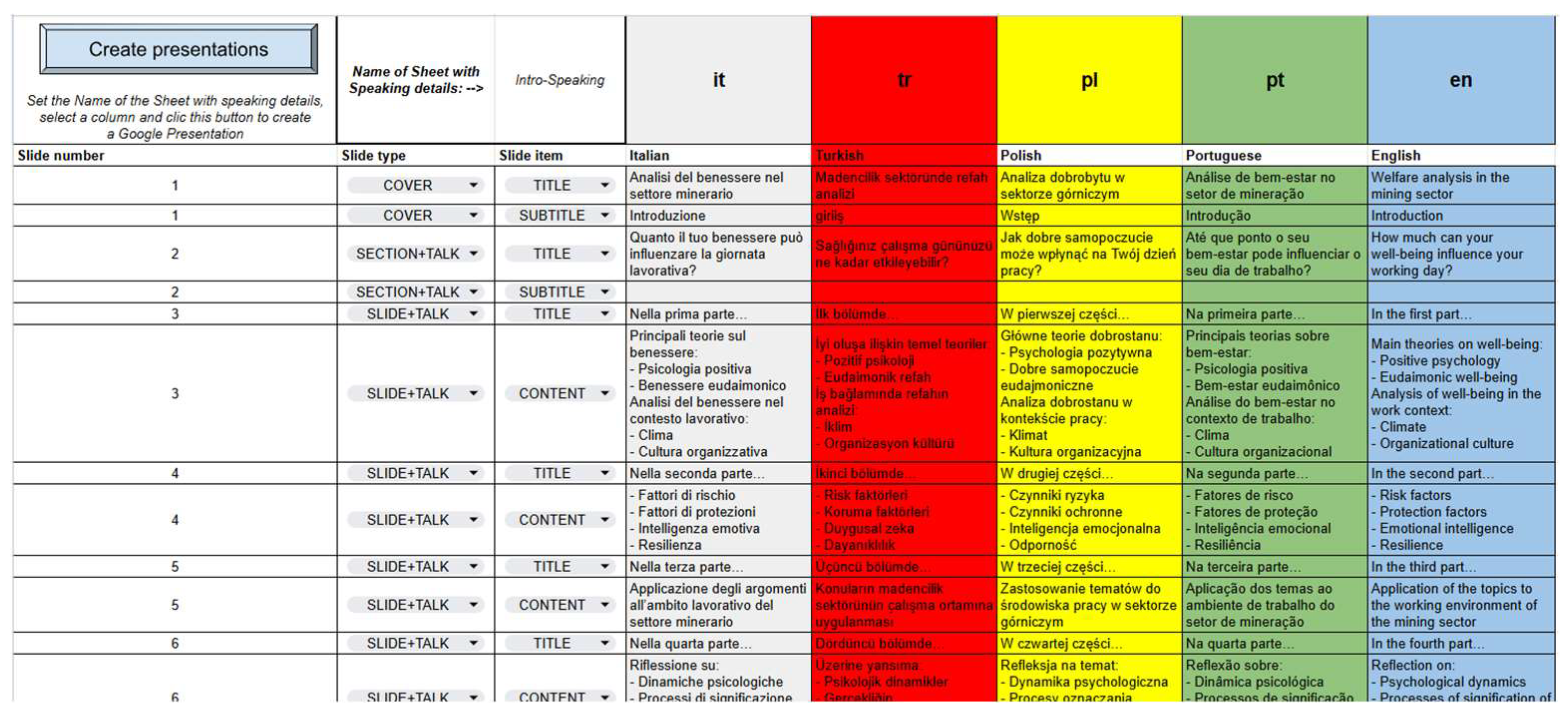
Figure 2.
Google Presentation template with all different types of slides to be used.
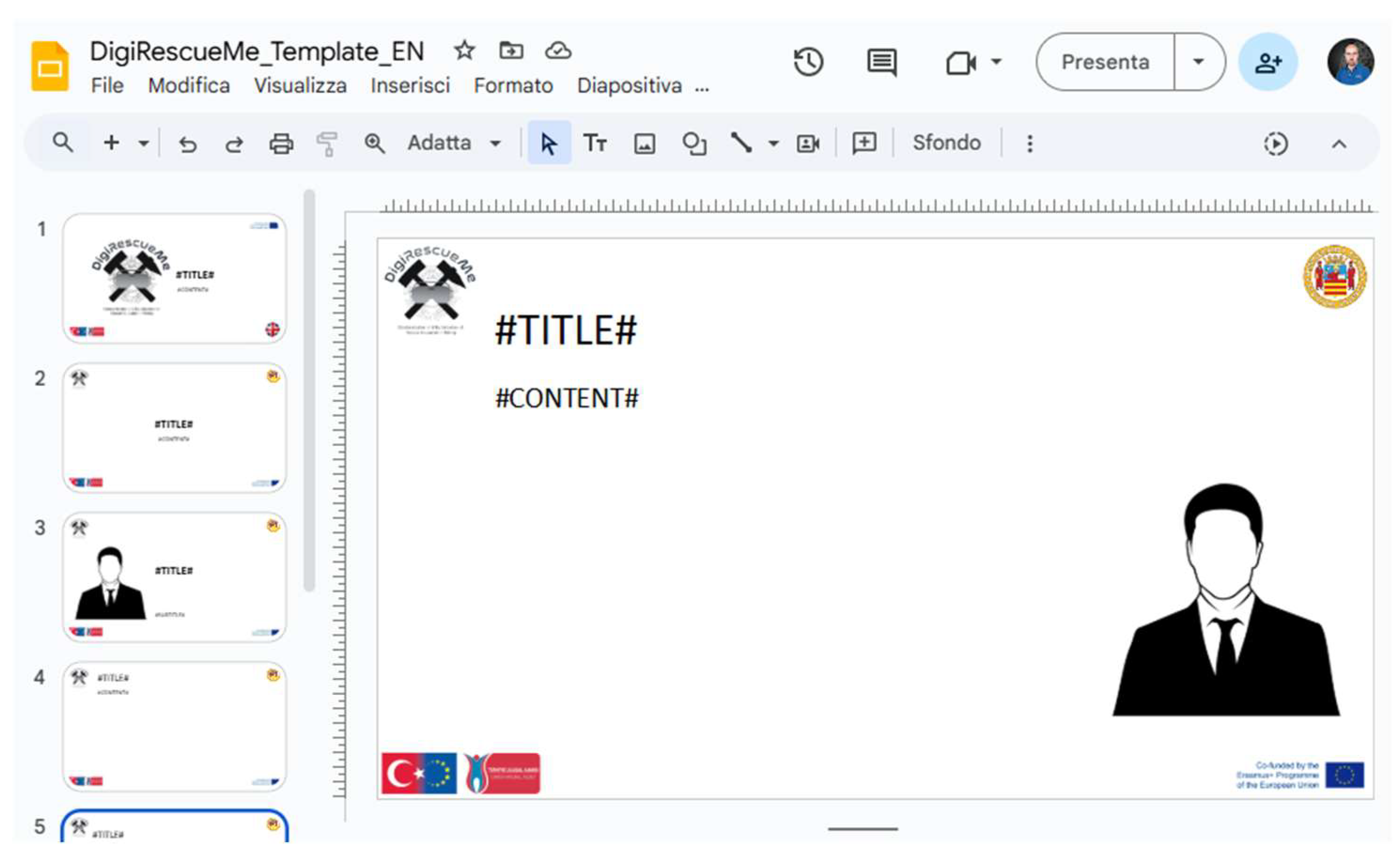
Figure 3.
Google Sheet to create multilanguage videos with virtual speaking avatars.
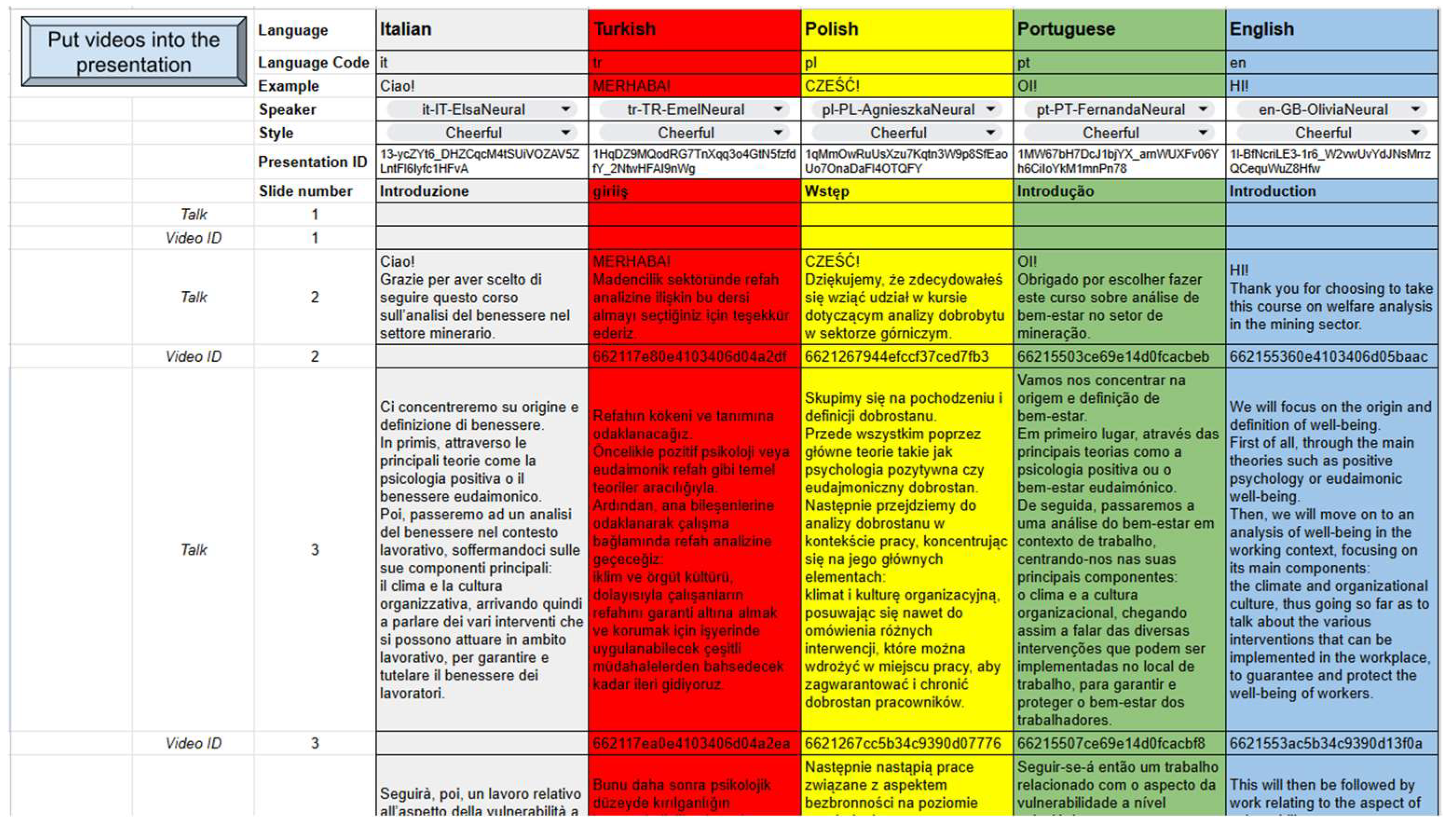
Table 1.
This table shows details about the engaged people.
| Sex | Occupation | Device | ||||||||||
|---|---|---|---|---|---|---|---|---|---|---|---|---|
| Female | Male | School student | University student | Researcher | Specialized technician | Employee | Teacher | Unemployed | Computer | Smartphone | ||
| Mental wellbeing in Mining | 19 | 5 | 14 | 17 | 1 | 0 | 0 | 0 | 1 | 0 | 0 | 19 |
| Rescue in the mine | 35 | 4 | 31 | 31 | 1 | 1 | 0 | 0 | 2 | 0 | 5 | 30 |
| EG | 54 | 9 | 45 | 48 | 2 | 1 | 0 | 0 | 3 | 0 | 5 | 49 |
| Risk assessment (CG) |
24 | 7 | 17 | 11 | 1 | 0 | 1 | 9 | 1 | 1 | 8 | 16 |
| TOTAL | 78 | 16 | 62 | 59 | 3 | 1 | 1 | 9 | 4 | 1 | 13 | 65 |
Disclaimer/Publisher’s Note: The statements, opinions and data contained in all publications are solely those of the individual author(s) and contributor(s) and not of MDPI and/or the editor(s). MDPI and/or the editor(s) disclaim responsibility for any injury to people or property resulting from any ideas, methods, instructions or products referred to in the content. |
© 2024 by the authors. Licensee MDPI, Basel, Switzerland. This article is an open access article distributed under the terms and conditions of the Creative Commons Attribution (CC BY) license (http://creativecommons.org/licenses/by/4.0/).
Copyright: This open access article is published under a Creative Commons CC BY 4.0 license, which permit the free download, distribution, and reuse, provided that the author and preprint are cited in any reuse.


