
Submitted:
10 December 2024
Posted:
10 December 2024
You are already at the latest version
Abstract
The main objective of this study is to determine the effect of population growth and economic growth on carbon emissions in Turkey. The STIRPAT ARDL model was used to analyze the effect of population growth and economic growth on carbon emissions for this purpose. The STIRPAT ARDL(4,0,4), the STIRPAT ARDL(4,4,3), and the STIRPAT ARDL(1,4,3) models were developed for this purpose. These models provide appropriate answers for the study's objective. As a result, population growth and economic growth are associated with increased carbon emissions in Turkey. These results are statistically significant and consistent with the literature. As a result of the results, policy makers will be able to identify two important factors when formulating sustainable environmental policies. The STIRPAT ARDL(4,4,3) model, however, failed to provide an adequate answer to the study's questions.
Keywords:
Carbon Emissions
; Population
; Economic Growth
; STIRPAT ARDL Model
1. Introduction
In today's world, economic growth and population growth are the two main causes of global warming and climate change. Increasing environmental degradation and global concerns have led to numerous studies on the environmental effects of economic growth and population growth.
Several studies have suggested that environmental quality deteriorates during the early stages of economic development and improves during the later stages of economic development. In the early stages of economic growth, degradation and pollution increase. Nonetheless, beyond a certain level of per capita income, which will differ for different indicators, the trend reverses, so that economic growth at higher income levels can contribute to environmental improvement [1,2,3]. This phenomenon is known as the environmental Kuznets curve (EKC), which hypothesizes an inverted U-shaped relationship between environmental degradation and economic development. In the early stages of economic growth, industries often prioritize production and expansion over environmental concerns, leading to increased pollution and resource depletion. However, as economies mature and income levels rise, there tends to be greater investment in cleaner technologies and stronger regulatory frameworks, resulting in improved environmental outcomes.
As a result of the combustion of fossil fuels, economic activities contribute significantly to changes in the global climate [4]. In order to mitigate the negative impact of classical economic growth on the natural environment and climate, it has been argued that increased carbon dioxide (CO2) emissions and energy consumption are closely associated with classical economic growth [5]. The increase in carbon emissions is attributed to human activities. The most significant anthropogenic factors are (i) population, (ii) economic activity, (iii) technology, (iv) political and economic institutions, and (v) attitudes and beliefs [6]. In addition to increasing living standards in most countries, economic growth has also resulted in increased CO2 emissions and the depletion of natural resources [7].To achieve a sustainable balance, it is crucial for policymakers to integrate environmental considerations into economic planning and development strategies. This involves promoting renewable energy sources, enhancing energy efficiency, and implementing stricter environmental regulations to mitigate the adverse effects of economic growth on the environment. By prioritizing sustainable practices, economies can continue to grow while reducing their ecological footprint and preserving natural resources for future generations.
Several factors have been discussed when environmental degradation is considered in conjunction with population growth, however energy consumption, which increases as the population grows, turns out to have the greatest adverse effect on the environment [8]. In addition, rapid urbanization along with population growth is another factor that accelerates environmental degradation along with economic prosperity. A significant amount of greenhouse gas emissions are attributed to population growth, which is a result of urbanization, aging, and changes in household size [9]. In the opinion of environmental scientists, energy consumption is mainly responsible for the emission of carbon dioxide (CO2), which contributes to global warming and climate change by forming greenhouse gases in the atmosphere [10]. As a result, the rapid increase in energy demand, especially global climate change as a consequence of carbon dioxide (CO2) emissions from burning fossil fuels, has presented environmental challenges [11]. However, there are arguments to the contrary that population growth increases carbon emissions. According to [12] developed countries with low fertility rates emit more carbon than countries with high fertility rates.
Generally, there has been a large amount of research concerning the effects of economic growth and population growth on carbon emissions. Some of these studies have been conducted in Turkey. However, the findings of studies focusing solely on economic growth and population growth are ambiguous and limited. As a result, a more detailed analysis of the issue specific to Turkey is required.
This study aims to examine the impact of population, affluence, and technology factors on environmental impacts by using the IPAT (Impact = Population . Affluence . Technology) models and STIRPAT (Stochastic Impacts by Regression on Population, Affluence and Technology) model to analyze short and long term impacts. Additionally, the study includes solutions for the future that aim to promote both economic growth and environmental protection.
2. Literature Review
The study presents chronologically the studies on economic growth, population growth, and carbon emissions [13,14,15,16,17,18,19,20,21,22,23,24,25,26,27,28,29,30,31,32,33,34,35,36,37,38,39,40,41,42,43,44,45,46]. Overall, the results indicate that economic growth and energy consumption are the primary factors that threaten environmental sustainability by causing CO2 emissions to increase. As a result of economic growth and population growth, energy demand and production activities increase, resulting in higher CO2 emissions. Depending on income levels and energy policy, this effect may vary from country to country. Additionally, economic growth and population growth play an important role in increasing carbon emissions. For instance, developed countries with higher income levels often have stricter energy policies and more efficient technologies, which can mitigate the impact of economic growth on emissions. In contrast, developing countries may experience higher emission rates due to less stringent regulations and reliance on fossil fuels. Additionally, regions with abundant renewable energy resources might see slower growth in carbon emissions as they transition to cleaner energy sources.
3. Theoretical Framework
STIRPAT is a common model for measuring environmental impact. The model is based on the IPAT formula derived from [47]. The IPAT formula represents environmental impact as a product of population (P), wealth (A) and technology (T). Although the IPAT formula shows a simple structure, it is rigid and deterministic. It explains the environmental impact with these three variables. It asserts that the relationship between the variables is linear. Later on, [6] transformed the formula into a more flexible structure and transformed the process into a stochastic form. This transformation allowed for the incorporation of non-linear relationships and greater complexity in analyzing environmental impacts. Dietz and Rosa's approach also enabled researchers to consider additional factors and interactions that might influence environmental outcomes. Consequently, the STIRPAT model offers a more nuanced and adaptable framework for understanding the multifaceted nature of human-environment interactions.
When we transform this equation into logarithmic form, the model can be written as follows:
4. Purpose and Scope of the Study
The present study mainly aims to determine the impacts of population growth and economic growth on carbon emissions in the Turkish economy.
The growth in an economy is typically measured by addressing the increase in a country’s GDP, which reflects the total production value of various economic sectors. Energy production and industrial activities are critical components of economic growth, and the increase in these sectors’ activities often results in higher carbon emissions. For example, the increase in energy production (fossil fuel use) and the expansion of industrial output not only contribute to the growth of GDP but also increase carbon emissions [48]. The transportation sector, which meets the logistics needs of trade and industry, is a key component of economic growth. Transportation activities, particularly the heavy use of motor vehicles and air transport, are significant sources of carbon emissions. Expansion in these sectors, together with economic growth, increases carbon emissions [49]. The agriculture and construction sectors are two other important elements of economic growth. Agricultural activities contribute to carbon emissions both directly (e.g., machinery use and fertilization) and indirectly (through land-use changes). The construction sector also increases emissions due to material production (cement, steel) and construction activities [50]. In this context, economic growth encompasses the effects of sectoral contributions, including carbon emissions. In economic growth analyses, GDP is generally used as an important metric. In this study, per capita GDP was chosen as an indicator of the growth in economy.
Per capita GDP is considered a clearer indicator of economic welfare. Therefore, using per capita GDP captures the effects of individuals’ consumption and production habits on the environment more accurately when analyzing the environmental impacts of economic growth [51]. In countries with rapidly growing populations, the level of income per capita is critically important for environmental sustainability [52]. As per capita income increases, individuals’ consumption patterns and energy demand rise, which directly impacts carbon emissions [48].
5. Dataset and Method
The annual time series data of the period of 1998-2021 were analyzed in this study. The variables examined are greenhouse gas emissions (CO2) (in million tons), mid-year population (in thousands), and per capita GDP (in TRY). The data utilized in the analysis were obtained from the Turkish Statistical Institute (TURKSTAT). The time series were subjected to logarithmic transformation for analysis purposes. The ARDL version of STIRPAT was used in the study. The findings for the standard ARDL model are as follows:
This model analyzes both short-term and long-term relationships within a single framework. As a result, the dynamic interactions between variables can be examined more comprehensively [53]. This model can also be used to investigate cointegration among variables, which is particularly important when variables exhibit different stationarity levels (I(0) or I(1)) since the model offers flexibility for such variables [54]. Even with small sample sizes, this model yields reliable results. This is a significant advantage over other time series models, because many economic datasets may contain a limited number of observations [55]. The ARDL model accounts for different lag lengths for each independent variable, enhancing the model’s flexibility and allowing for more accurate forecasts [53]. However, the process of determining the optimal lag lengths can be complex. If the lag lengths for the independent variables are not specified accurately, then the validity and reliability of the model may be affected [56]. The inclusion of lagged independent variables can lead to high multicollinearity among the variables, which can reduce the statistical significance of the estimated coefficients and complicate the interpretation of the model [57].
6. STIRPAT Model in ARDL Form
When the STIRPAT model is implemented with an ARDL model, the model can be written as follows:
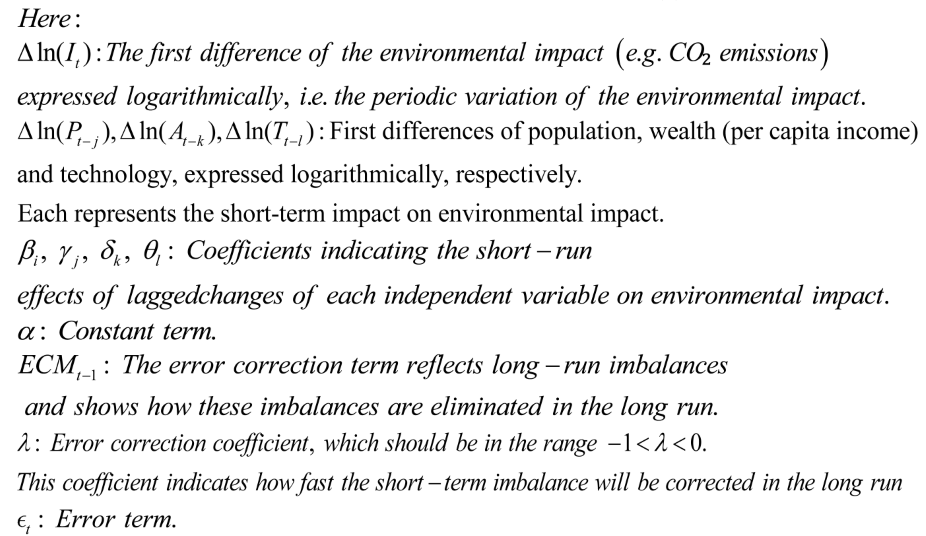
A STITPAT ARDL model can analyze short-run and long-run relationships between variables.
In this study, the technology variable is excluded from the model to simplify the model and to account for the lack of reliable data measuring the level of technology. The SPIRTAT ARDL model without the technology variable is as follows:
7. Results and Discussion
Table 1 summarizes the main statistical characteristics of LOGCO2, LOGPOPULATION, and LOGGROWTH.
According to Table 1, the mean of LOGCO2 was 19.53, LOGPOPULATION was 18.12 and LOGGROWTH was 9.55.Their median values, 19.54, 18.10, and 9.62, are very close to their means, indicating that the distributions of the data are symmetric. The standard deviations are relatively low for LOGCO2 and LOGPOPULATION (0.27 and 0.10), but higher for LOGGROWTH (1.12), suggesting a higher level of variability in the growth rate. While LOGCO2 and LOGGROWTH exhibit negative skewness, LOGPOPULATION demonstrates positive skewness. The kurtosis values are close to normal for all three variables, even though LOGGROWTH has a slightly higher kurtosis (2.70), which may indicate the presence of outliers. Given the results obtained from Jarque-Bera test, all variables satisfy the assumption of normal distribution (p-values greater than 0.05). This analysis, based on 24 observations, provides a foundational assessment of the potential nexus among economic growth, population growth, and carbon emissions.
Table 2 summarizes the results of the SPIRTAT ARDL(4,0,4) model, which was developed to examine the relationship between greenhouse gas emissions (CO2), population and GDP per capita.
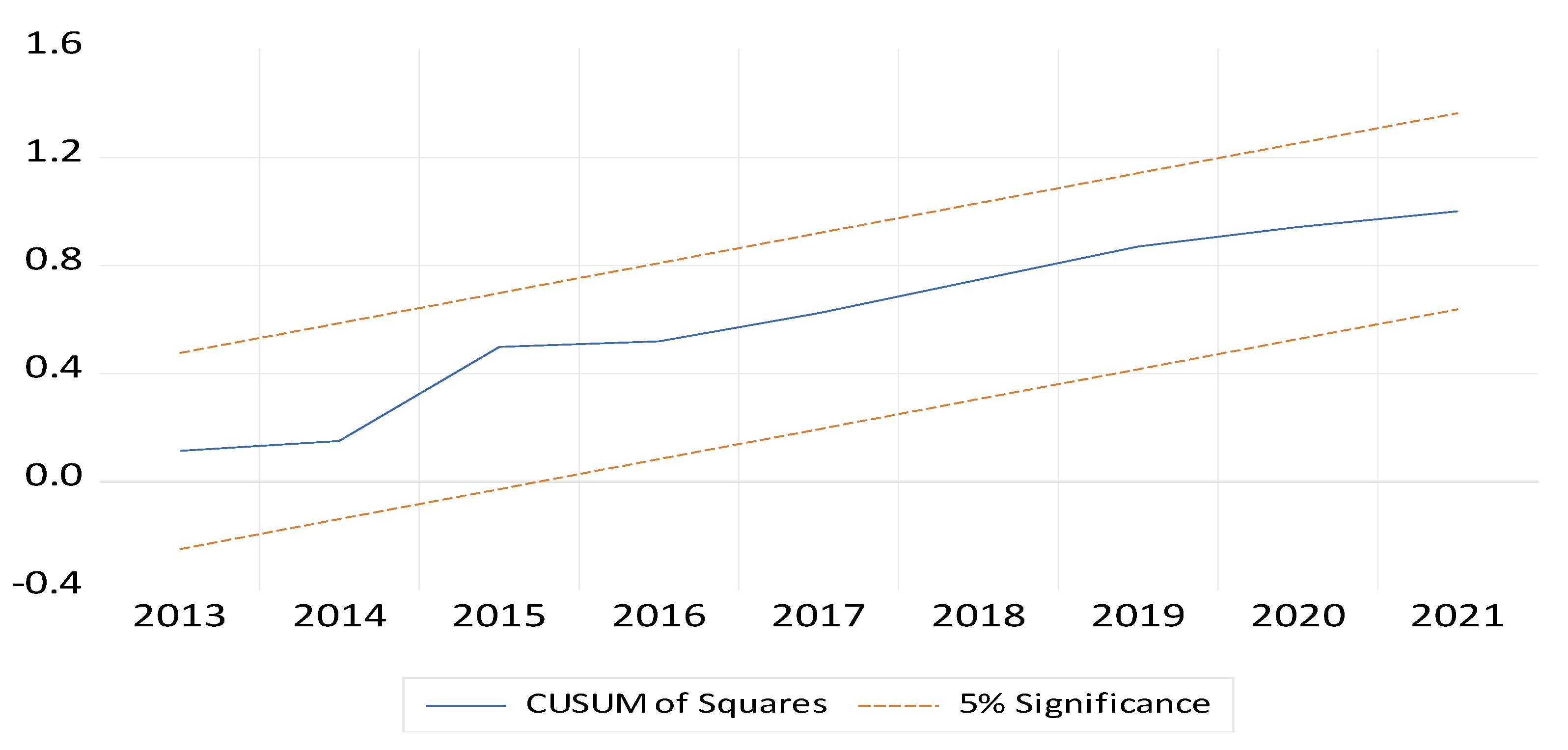
The long-term nexus between the series was investigated first. Hypotheses formulated for this purpose were “H0: There is no long-term nexus” and “H1: There is a long-term nexus”. As seen Table 1, the calculated F-statistic value was found to be 6.78, which was higher than the upper critical value of I(1) at 3.35, indicating a long-term nexus among the variables. In addition, the lagged error term, CointEq(-1)*, with a value of -1.40, is statistically significant and has a negative coefficient. This finding suggests that the discrepancy between the short- and long-term is reduced by 1.40% each period, gradually disappearing over time. The variable ‘GDP per Capita,’ representing the short-term parameter in Table 2, was also found to be statistically significant. Furthermore, no autocorrelation issue was detected between the series, and no structural changes were identified in the parameters.
Figure 1.
CUSUM.
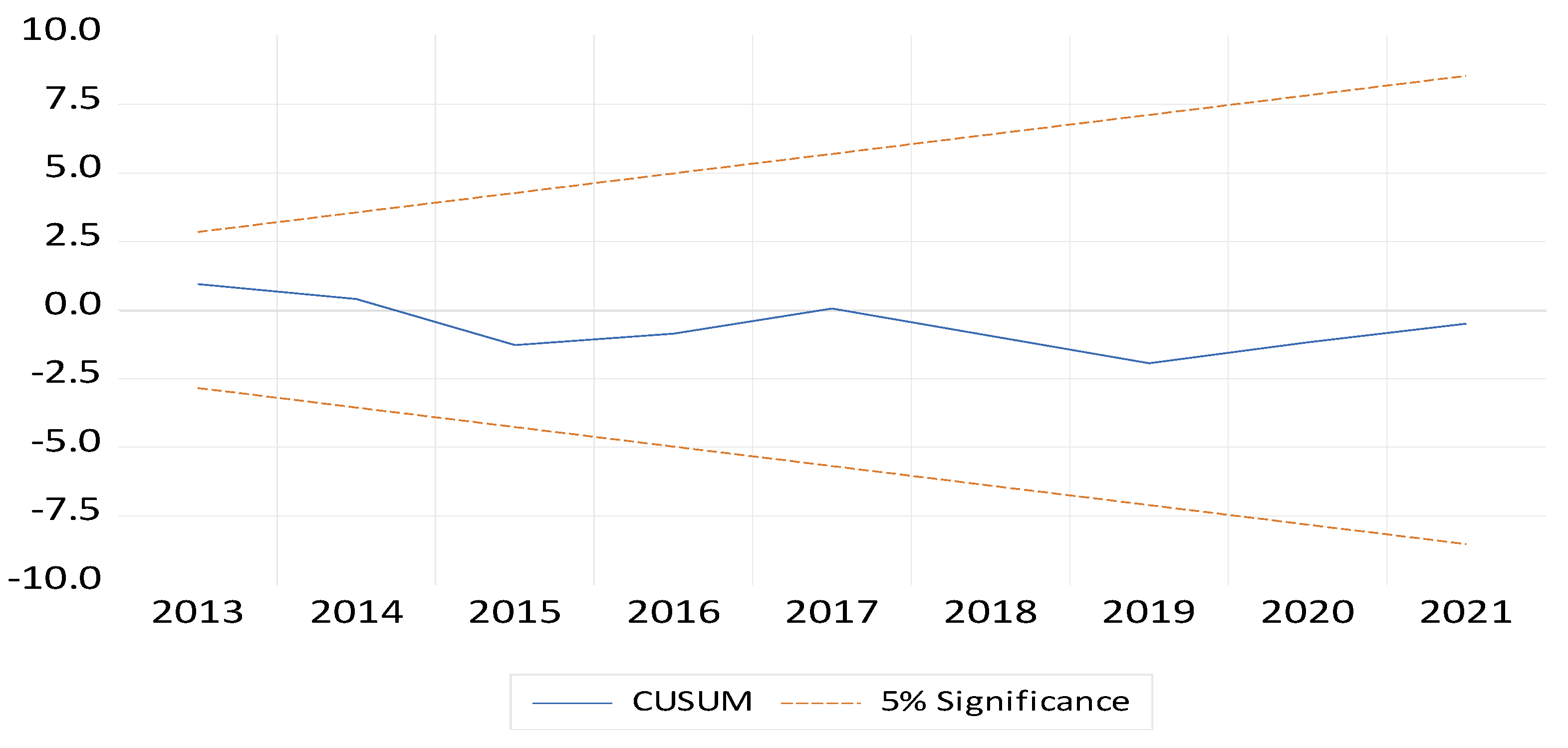
Figure 2.
CUSUMQ of Squares.
Based on the SPIRTAT ARDL(4,4,3) model between GDP per capita, population, and carbon emissions, Table 3 summarizes the results.
The first analysis focused on the long-term nexus between the series. As seen in Table 3, the calculated F-statistic value was found to be 3.24, between the lower (2.63) and the upper (3.35) critical bound. This result introduces uncertainty regarding a long-term nexus between the series, thus findings obtained from other analyses were not included.
Table 4 summarizes the findings obtained from the SPIRTAT ARDL(1,4,3) model established between GDP per capita, population, and carbon emissions.
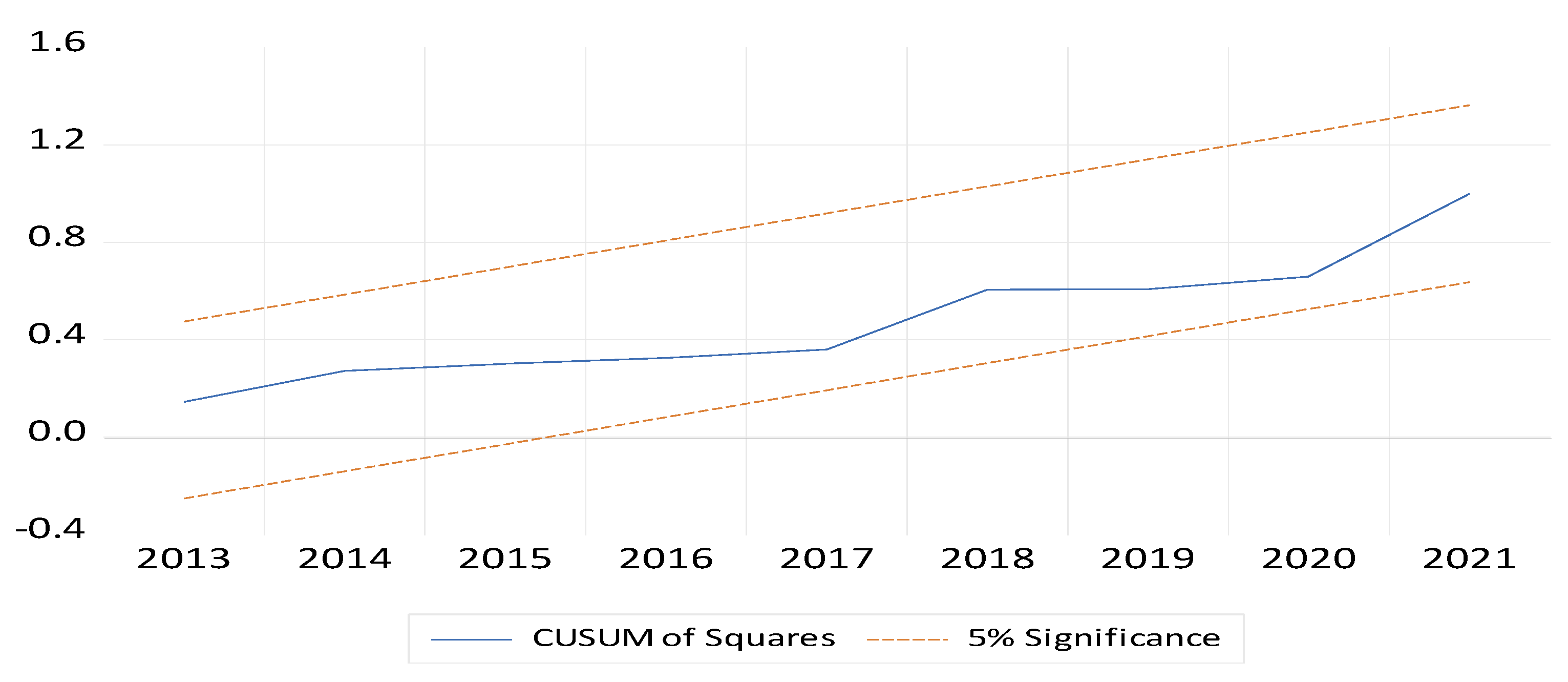
As seen in Table 4, the calculated F-statistic value was found to be 20.35, higher than the upper critical bound (I(1)) of 3.35, indicating a long-term nexus between the variables. In addition, the lagged error term, CointEq(-1)*, which was found to be -0.61, is significant and has a negative coefficient. This finding suggests that the short- and long-term discrepancy is reduced by 0.61% each period, gradually disappearing over time. The short-term parameter ‘Population’ in Table 4 was also found to be statistically significant. Moreover, no autocorrelation issue was observed between the series, and no structural change was identified in the parameters.
Figure 3.
CUSUM.
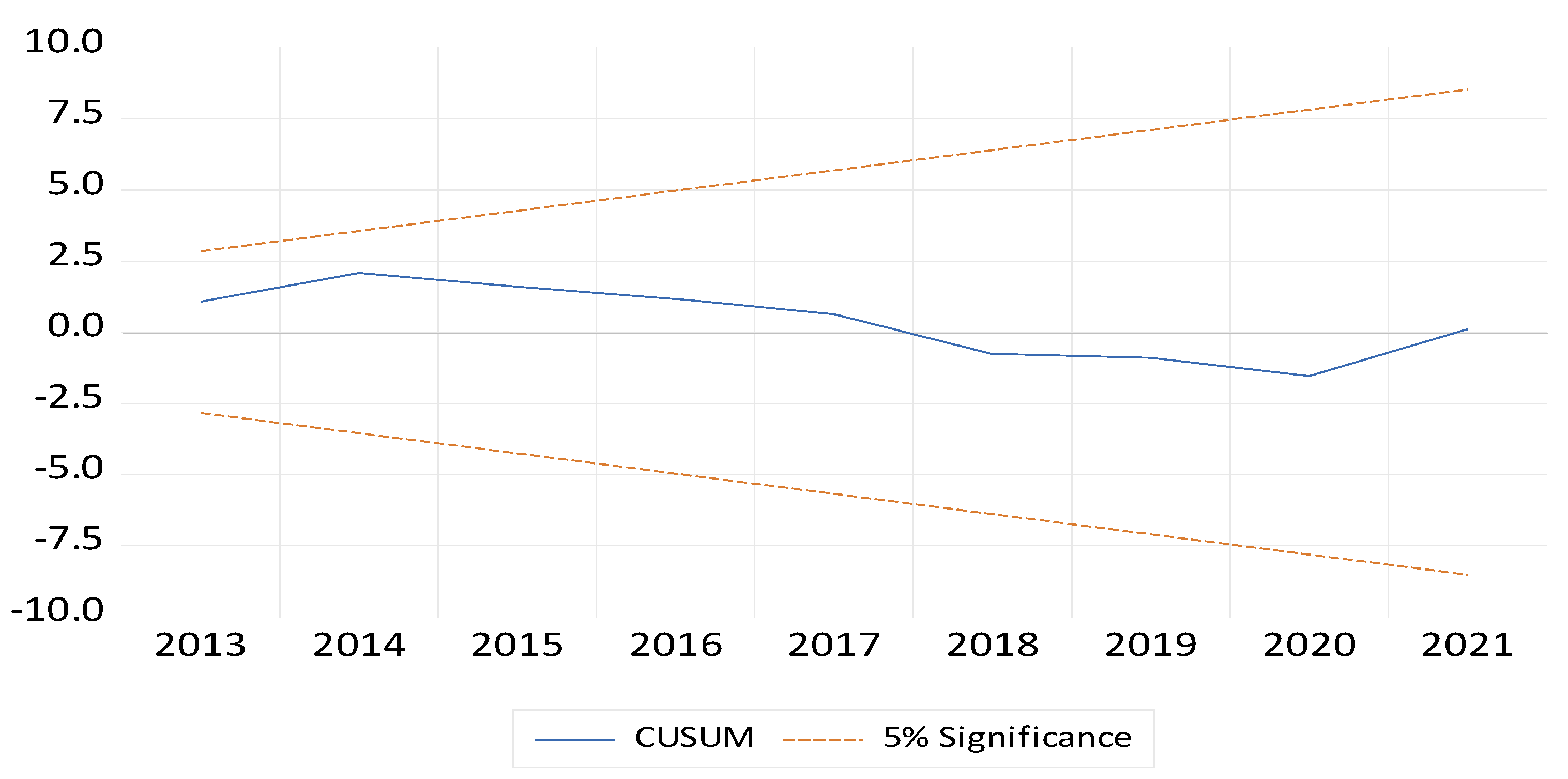
Figure 4.
CUSUM of Squares.
8. Conclusions and Policy Implications
This study analyzes how population growth and economic growth affect carbon emissions in Turkey using the SPIRTAT ARDL model. For this purpose, SPIRTAT ARDL(4,0,4), SPIRTAT ARDL(4,4,3) and SPIRTAT ARDL(1,4,3) are used. SPIRTAT ARDL(4,0,4) and SPIRTAT ARDL(1,4,3) models indicate statistically significant and positive relationships between the variables over both the short and long run. A statistically significant error correction coefficient is also found to support the explanatory power and accuracy of these two models, which are attributed to population growth and economic growth in Turkey. A number of factors contribute to the development of environmentally sustainable economic policies in the Turkish economy, including population growth and economic growth. In contrast, the long-run relationship between the variables in the SPIRTAT ARDL(4,4,3) model is uncertain.
Comparing the results of the study with those of previous literature, it is evident that both technical and conceptual consistency exists. According to [58] local governments must develop environmentally friendly policies in order to reduce carbon emissions, and economic growth and environmental impacts must be maintained in balance. As argued by [59], energy efficiency and the use of renewable energy sources will play an important role in reducing carbon dioxide emissions. [60], urbanization policies should be developed to minimize the effects of population growth on environmental degradation. It can be concluded from this standpoint that educating and raising awareness of the environmental damage caused by carbon dioxide emissions and the widespread use of environmentally friendly technologies will prevent environmental degradation and allow economic growth to continue sustainably [61].
In conclusion, efficient and effective population growth and economic growth are two vital issues for national economies. The world faces a number of problems, including global warming and climate change. A reduction of carbon emissions can be achieved through energy efficiency and the use of renewable energy. To reduce carbon emissions on a global scale, agreements promoting energy efficiency and renewable energy use, reducing fossil fuel use, and green-friendly tax regulations will be crucial.
A number of renewable energy sources are available in Turkey, including solar power, wind power, sea waves, and organic agriculture with its fertile soils and forests, which have a geographical comparative advantage. In this study, it is recommended not only to increase the share of these investments, but also to convert these investments into commercial products and export them. For this to be achieved, Turkey must adopt policies that are in accordance with international law, transparent, auditable and reliable, and based on social consensus.
Supplementary Materials
There is no supplementary material.
Author Contributions
It is a single-author work.
Funding
This research received no external funding.
Data Availability Statement
Data available on request from the authors. The data that support the findings of this study are available from the corresponding author, [Hakan Altın], upon reasonable request.
Conflicts of Interest
The author declare no conflicts of interest.
References
- Dinda, S. Environmental Kuznets Curve hypothesis: A survey. Ecological Economics 2004, 49, 431–455. [Google Scholar] [CrossRef]
- Stern, D. I. The rise and fall of the environmental Kuznets curve. World Development 2004, 32, 1419–1439. [Google Scholar] [CrossRef]
- Zhang, X. P.; Cheng, X. M. Energy consumption, carbon emissions, and economic growth in China. Ecological Economics 2009, 68, 2706–2712. [Google Scholar] [CrossRef]
- Anser, M. K.; Alharthi, M.; Aziz, B.; Wasim, S. Impact of urbanization, economic growth, and population size on residential carbon emissions in the SAARC countries. Clean Technologies and Environmental Policy 2020, 22, 617–629. [Google Scholar] [CrossRef]
- González-Álvarez, M.; Montañés, A. Energy consumption and CO2 emissions in economic growth models. Journal of Environmental Management 2023, 328, 116979. [Google Scholar] [CrossRef]
- Dietz, T.; Rosa, E. A. Effects of population and affluence on CO2 emissions. Proceedings of the National Academy of Sciences 1997, 94, 175–179. [Google Scholar] [CrossRef]
- Streimikiene, D.; Mardani, A.; Cavallaro, F.; Loganathan, N.; Khoshnoudi, M. Carbon dioxide (CO2) emissions and economic growth: A systematic review of two decades of research from 1995 to 2017. Science of the Total Environment 2019, 658, 703–719. [Google Scholar] [CrossRef]
- Martínez-Zarzoso, I.; Maruotti, A. The impact of population on CO2 emissions: Evidence from European countries. Environmental and Resource Economics 2011, 48, 1–19. [Google Scholar] [CrossRef]
- O'Neill, B. C.; Dalton, M.; Fuchs, R.; Jiang, L.; Pachauri, S.; Zigova, K. Global demographic trends and future carbon emissions. Proceedings of the National Academy of Sciences 2010, 107, 17521–17526. [Google Scholar] [CrossRef]
- Alam, M. M.; Murad, M. W.; Noman, A. H. M.; Ozturk, I. Relationships among carbon emissions, economic growth, energy consumption and population growth: Testing Environmental Kuznets Curve hypothesis for Brazil, China, India and Indonesia. Ecological Indicators 2016, 70, 466–479. [Google Scholar] [CrossRef]
- Dong, K.; Hochman, G.; Zhang, Y.; Sun, R.; Li, H.; Liao, H. CO2 emissions, economic and population growth, and renewable energy: empirical evidence across regions. Energy Economics 2018, 75, 180–192. [Google Scholar] [CrossRef]
- Casey, G.; Galor, O. Is faster economic growth compatible with reductions in carbon emissions? The role of diminished population growth. Environmental Research Letters 2017, 12, 014003. [Google Scholar] [CrossRef]
- Knapp, T.; Mookerjee, R. Population growth and global CO2 emissions: a secular perspective. Energy Policy 1996, 24, 31–37. [Google Scholar] [CrossRef]
- Say, N. P.; Yücel, M. Energy consumption and CO2 emissions in Türkiye: Empirical analysis and future projection based on an economic growth. Energy policy 2006, 34, 3870–3876. [Google Scholar] [CrossRef]
- Martínez-Zarzoso, I.; Bengochea-Morancho, A.; Morales-Lage, R. The impact of population on CO 2 emissions: evidence from European countries. Environmental and Resource Economics 2007, 38, 497–512. [Google Scholar] [CrossRef]
- Ozturk, I.; Acaravci, A. CO2 emissions, energy consumption and economic growth in Türkiye. Renewable and Sustainable Energy Reviews 2010, 14, 3220–3225 1. [Google Scholar] [CrossRef]
- Ohlan, R. The impact of population density, energy consumption, economic growth and trade openness on CO 2 emissions in India. Natural hazards 2015, 79, 1409–1428. [Google Scholar] [CrossRef]
- Begum, R. A.; Sohag, K.; Abdullah, S. M. S.; Jaafar, M. CO2 emissions, energy consumption, economic and population growth in Malaysia. Renewable and Sustainable Energy Reviews 2015, 41, 594–601. [Google Scholar] [CrossRef]
- Azam, M.; Khan, A. Q.; Abdullah, H. B.; Qureshi, M. E. The impact of CO 2 emissions on economic growth: evidence from selected higher CO 2 emissions economies. Environmental Science and Pollution Research 2016, 23, 6376–6389. [Google Scholar] [CrossRef]
- Chen, P. Y.; Chen, S. T.; Hsu, C. S.; Chen, C. C. Modeling the global relationships among economic growth, energy consumption and CO2 emissions. Renewable and Sustainable Energy Reviews 2016, 65, 420–431. [Google Scholar] [CrossRef]
- Aye, G. C.; Edoja, P. E. Effect of economic growth on CO2 emission in developing countries: Evidence from a dynamic panel threshold model. Cogent Economics & Finance 2017, 5, 1–21. [Google Scholar] [CrossRef]
- Sulaiman, C.; Abdul-Rahim, A. S. Population growth and CO2 emission in Nigeria: a recursive ARDL approach. Sage Open 2018, 8, 1–14. [Google Scholar] [CrossRef]
- Wang, S.; Li, G.; Fang, C. Urbanization, economic growth, energy consumption, and CO2 emissions: Empirical evidence from countries with different income levels. Renewable and sustainable energy reviews 2018, 81, 2144–2159. [Google Scholar] [CrossRef]
- Abdouli, M.; Kamoun, O.; Hamdi, B. The impact of economic growth, population density, and FDI inflows on CO 2 emissions in BRICTS countries: Does the Kuznets curve exist? . Empirical Economics 2018, 54, 1717–1742. [Google Scholar] [CrossRef]
- Mikayilov, J. I.; Galeotti, M.; Hasanov, F. J. The impact of economic growth on CO2 emissions in Azerbaijan. Journal of cleaner production 2018, 197, 1558–1572. [Google Scholar] [CrossRef]
- Acheampong, A. O. Economic growth, CO2 emissions and energy consumption: what causes what and where? . Energy Economics 2018, 74, 677–692. [Google Scholar] [CrossRef]
- Mohsin, M.; Abbas, Q.; Zhang, J.; Ikram, M.; Iqbal, N. Integrated effect of energy consumption, economic development, and population growth on CO 2 based environmental degradation: a case of transport sector. Environmental Science and Pollution Research 2019, 26, 32824–32835. [Google Scholar] [CrossRef]
- Hashmi, R.; Alam, K. Dynamic relationship among environmental regulation, innovation, CO2 emissions, population, and economic growth in OECD countries: A panel investigation. Journal of cleaner production 2019, 231, 1100–1109. [Google Scholar] [CrossRef]
- Mardani, A.; Streimikiene, D.; Cavallaro, F.; Loganathan, N.; Khoshnoudi, M. Carbon dioxide (CO2) emissions and economic growth: A systematic review of two decades of research from 1995 to 2017. Science of the total environment 2019, 649, 31–49. [Google Scholar] [CrossRef]
- Vo, A. T.; Vo, D. H.; Le, Q. T. T. CO2 emissions, energy consumption, and economic growth: New evidence in the ASEAN countries. Journal of Risk and Financial Management 2019, 12, 1–20. [Google Scholar] [CrossRef]
- Mohmmed, A.; Li, Z.; Arowolo, A. O.; Su, H.; Deng, X.; Najmuddin, O.; Zhang, Y. Driving factors of CO2 emissions and nexus with economic growth, development and human health in the Top Ten emitting countries. Resources, Conservation and Recycling 2019, 148, 157–169. [Google Scholar] [CrossRef]
- Rahman, M. M.; Saidi, K.; Mbarek, M. B. Economic growth in South Asia: the role of CO2 emissions, population density and trade openness. Heliyon 2020, 6, 1–9. [Google Scholar] [CrossRef] [PubMed]
- Odugbesan, J. A.; Rjoub, H. Relationship among economic growth, energy consumption, CO2 emission, and urbanization: evidence from MINT countries. Sage Open 2020, 10, 1–15. [Google Scholar] [CrossRef]
- Hussain, I.; Rehman, A. Exploring the dynamic interaction of CO2 emission on population growth, foreign investment, and renewable energy by employing ARDL bounds testing approach. Environmental Science and Pollution Research 2021, 28, 39387–39397. [Google Scholar] [CrossRef]
- Namahoro, J. P.; Wu, Q.; Xiao, H.; Zhou, N. The impact of renewable energy, economic and population growth on CO2 emissions in the East African region: evidence from common correlated effect means group and asymmetric analysis. Energies 2021, 14, 312. [Google Scholar] [CrossRef]
- Pachiyappan, D.; Ansari, Y.; Alam, M. S.; Thoudam, P.; Alagirisamy, K.; Manigandan, P. Short and long-run causal effects of CO2 emissions, energy use, GDP and population growth: evidence from India using the ARDL and VECM approaches. Energies 2021, 14, 1–17. [Google Scholar] [CrossRef]
- Yang, X.; Li, N.; Mu, H.; Pang, J.; Zhao, H.; Ahmad, M. Study on the long-term impact of economic globalization and population aging on CO2 emissions in OECD countries. Science of the Total Environment 2021, 787, 1–10. [Google Scholar] [CrossRef]
- Onofrei, M.; Vatamanu, A. F.; Cigu, E. The relationship between economic growth and CO2 emissions in EU countries: A cointegration analysis. Frontiers in Environmental Science 2022, 10, 1–11. [Google Scholar] [CrossRef]
- Rehman, E.; Rehman, S. Modeling the nexus between carbon emissions, urbanization, population growth, energy consumption, and economic development in Asia: Evidence from grey relational analysis. Energy Reports 2022, 8, 5430–5442. [Google Scholar] [CrossRef]
- Uzair Ali, M.; Gong, Z.; Ali, M. U.; Asmi, F.; Muhammad, R. CO2 emission, economic development, fossil fuel consumption and population density in India, Pakistan and Bangladesh: a panel investigation. International Journal of Finance & Economics 2022, 27, 18–31. [Google Scholar] [CrossRef]
- Ahmed, M.; Huan, W.; Ali, N.; Shafi, A.; Ehsan, M.; Abdelrahman, K. ; ... & Fnais, M. S. The effect of energy consumption, income, and population growth on CO2 emissions: evidence from NARDL and machine learning models. Sustainability 2023, 15, 1–19. [Google Scholar] [CrossRef]
- Li, J.; Irfan, M.; Samad, S.; Ali, B.; Zhang, Y.; Badulescu, D.; Badulescu, A. The relationship between energy consumption, CO2 emissions, economic growth, and health indicators. International Journal of Environmental Research and Public Health 2023, 20, 1–20 https://wwwmdpicom/journal/ijerph. [Google Scholar] [CrossRef] [PubMed]
- Rehman, A.; Alam, M. M.; Ozturk, I.; Alvarado, R.; Murshed, M.; Işık, C.; Ma, H. Globalization and renewable energy use: how are they contributing to upsurge the CO2 emissions? A global perspective. Environmental Science and Pollution Research 2023, 30, 9699–9712. [Google Scholar] [CrossRef] [PubMed]
- Guo, H.; Jiang, J.; Li, Y.; Long, X.; Han, J. An aging giant at the center of global warming: Population dynamics and its effect on CO2 emissions in China. Journal of Environmental Management 2023, 327, 1–12. [Google Scholar] [CrossRef]
- Mitić, P.; Fedajev, A.; Radulescu, M.; Rehman, A. The relationship between CO2 emissions, economic growth, available energy, and employment in SEE countries. Environmental Science and Pollution Research 2023, 30, 16140–16155. [Google Scholar] [CrossRef]
- Dritsaki, M.; Dritsaki, C. The relationship between health expenditure, CO2 emissions, and economic growth in G7: Evidence from heterogeneous panel data. Journal of the Knowledge Economy 2024, 15, 4886–4911. [Google Scholar] [CrossRef]
- Ehrlich, P. R.; Holdren, J. P. Impact of population growth. Science 1971, 171, 1212–1217. [Google Scholar] [CrossRef]
- Stern, D. I. The rise and fall of the environmental Kuznets curve. World Development 2004, 32, 1419–1439. [Google Scholar] [CrossRef]
- Schäfer, A.; Victor, D. G. The future mobility of the world population. Transportation Research Part A: Policy and Practice 2000, 34, 171–205. [Google Scholar] [CrossRef]
- Smith, P.; Martino, D.; Cai, Z.; Gwary, D.; Janzen, H.; Kumar, P.; ... & Smith, J. (2014). Agriculture. In O. Edenhofer et al. (Eds.), Climate Change 2014: Mitigation of Climate Change. Contribution of Working Group III to the Fifth Assessment Report of the Intergovernmental Panel on Climate Change, 811-922. Cambridge University Press. [CrossRef]
- Ravallion, M. Troubling tradeoffs in the Human Development Index. Journal of Development Economics 2012, 99, 201–209. [Google Scholar] [CrossRef]
- Perman, R.; Stern, D. I. Evidence from panel unit root and cointegration tests that the environmental Kuznets curve does not exist. Australian Journal of Agricultural and Resource Economics 2003, 47, 325–347. [Google Scholar] [CrossRef]
- Pesaran, M. H.; Shin, Y. An autoregressive distributed-lag modelling approach to cointegration analysis. Econometrics and Economic Theory in the 20th Century: The Ragnar Frisch Centennial Symposium 1998, 371-413.
- Pesaran, M. H.; Shin, Y.; Smith, R. J. Bounds testing approaches to the analysis of level relationships. Journal of Applied Econometrics 2001, 16, 289–326. [Google Scholar] [CrossRef]
- Narayan, P. K. The saving and investment nexus for China: Evidence from cointegration tests. Applied Economics 2005, 37, 1979–1990. [Google Scholar] [CrossRef]
- Nkoro, E.; Uko, A. K. Autoregressive distributed lag (ARDL) cointegration technique: Application and interpretation. Journal of Statistical and Econometric Methods 2016, 5, 63–91. [Google Scholar]
- Zivot, E.; Wang, J. (2006). Modeling financial time series with S-PLUS (2nd ed.). Springer Science & Business Media.
- Zhang, Z.; Sharifi, A. Analysis of decoupling between CO2 emissions and economic growth in China’s provincial capital cities: A Tapio model approach. Urban Climate 2024, 55, 1–16. [Google Scholar] [CrossRef]
- Pradhan, K. C.; Mishra, B.; Mohapatra, S. M. Investigating the relationship between economic growth, energy consumption, and carbon dioxide (CO2) emissions: a comparative analysis of South Asian nations and G-7 countries. Clean Technologies and Environmental Policy 2024, 1–19. [Google Scholar] [CrossRef]
- Rahman, M. M. Do population density, economic growth, energy use and exports adversely affect environmental quality in Asian populous countries? . Renewable and Sustainable Energy Reviews 2017, 77, 506–514. [Google Scholar] [CrossRef]
- Lee, C. C.; Zhao, Y. N. Heterogeneity analysis of factors influencing CO2 emissions: the role of human capital, urbanization, and FDI. Renewable and Sustainable Energy Reviews 2023, 185, 1–15. [Google Scholar] [CrossRef]

Table 1.
Statistical Summary.
| LOGCO2 | LOGPOPULATION | LOGGROWTH | |
|---|---|---|---|
| Mean | 19.53367 | 18.11838 | 9.553095 |
| Median | 19.54165 | 18.10466 | 9.616482 |
| Maximum | 19.96139 | 18.27781 | 11.36479 |
| Minimum | 19.13610 | 17.97023 | 7.049063 |
| Std. Dev. | 0.268532 | 0.098055 | 1.120131 |
| Skewness | -0.073138 | 0.229835 | -0.562768 |
| Kurtosis | 1.709517 | 1.789605 | 2.697803 |
| Jarque-Bera | 1.686744 | 1.676353 | 1.358156 |
| Probability | 0.430257 | 0.432499 | 0.507084 |
| Observations | 24 | 24 | 24 |
Table 2.
SPIRTAT ARDL Error Correction Regression.
| Variable | Coefficient | Std. Error | t-Statistic | Prob. |
|---|---|---|---|---|
| D(LOGCO2(-1)) | 0.466906 | 0.110200 | 4.236906 | 0.0022 |
| D(LOGCO2(-2)) | 0.260733 | 0.112703 | 2.313454 | 0.0460 |
| D(LOGCO2(-3)) | 0.263481 | 0.102463 | 2.571480 | 0.0301 |
| D(LOGGROSS DOMESTIC PRODUCT PER CAPITA) | 0.315177 | 0.070221 | 4.488349 | 0.0015 |
| D(LOGGROSS DOMESTIC PRODUCT PER CAPITA(-1)) | 0.021612 | 0.112672 | 0.191817 | 0.8521 |
| D(LOGGROSS DOMESTIC PRODUCT PER CAPITA(-2)) | -0.380254 | 0.109997 | -3.456937 | 0.0072 |
| D(LOGGROSS DOMESTIC PRODUCT PER CAPITA(-3)) | -0.412386 | 0.138473 | -2.978109 | 0.0155 |
| CointEq(-1)* | -1.406583 | 0.233770 | -6.016964 | 0.0002 |
| F-Bounds Test | ||||
| Test Statistic | Value | Signif. | I(0) | I(1) |
| F-statistic | 6.788223 | 10% | 2.63 | 3.35 |
| k | 2 | 5% | 3.1 | 3.87 |
| 2.5% | 3.55 | 4.38 | ||
| 1% | 4.13 | 5 | ||
| Breusch-Godfrey Serial Correlation LM Test: | ||||
| F-statistic | 4.398655 | Prob. F(2,7) | 0.0579 | |
| Obs*R-squared | 11.13773 | Prob. Chi-Square(2) | 0.0538 | |
Table 3.
SPIRTAT ARDL Error Correction Regression.
| Variable | Coefficient | Std. Error | t-Statistic | Prob. |
|---|---|---|---|---|
| D(LOGPOPULATION(-1)) | 1.484185 | 0.194174 | 7.643563 | 0.0003 |
| D(LOGPOPULATION(-2)) | -0.309401 | 0.395535 | -0.782235 | 0.4638 |
| D(LOGPOPULATION(-3)) | 0.660272 | 0.280088 | 2.357371 | 0.0565 |
| D(LOGGROSS DOMESTIC PRODUCT PER CAPITA) | 0.016508 | 0.008568 | 1.926629 | 0.1023 |
| D(LOGGROSS DOMESTIC PRODUCT PER CAPITA(-1)) | 0.001240 | 0.008731 | 0.142013 | 0.8917 |
| D(LOGGROSS DOMESTIC PRODUCT PER CAPITA(-2)) | 0.025359 | 0.009858 | 2.572529 | 0.0422 |
| D(LOGGROSS DOMESTIC PRODUCT PER CAPITA(-3)) | 0.013437 | 0.007768 | 1.729849 | 0.1344 |
| D(LOGCO2) | 0.028484 | 0.014115 | 2.017893 | 0.0902 |
| D(LOGCO2(-1)) | -0.055184 | 0.016309 | -3.383619 | 0.0148 |
| D(LOGCO2(-2)) | -0.028793 | 0.010618 | -2.711800 | 0.0350 |
| CointEq(-1)* | -0.438621 | 0.099400 | -4.412675 | 0.0045 |
| F-Bounds Test | ||||
| Test Statistic | Value | Signif. | I(0) | I(1) |
| F-statistic | 3.245283 | 10% | 2.63 | 3.35 |
| k | 2 | 5% | 3.1 | 3.87 |
| 2.5% | 3.55 | 4.38 | ||
| 1% | 4.13 | 5 | ||
| Breusch-Godfrey Serial Correlation LM Test: | ||||
| F-statistic | 3.118461 | Prob. F(4,2) | 0.2573 | |
| Obs*R-squared | 17.23639 | Prob. Chi-Square(4) | 0.2017 | |
Table 4.
SPIRTAT ARDL Error Correction Regression.
| Variable | Coefficient | Std. Error | t-Statistic | Prob. |
|---|---|---|---|---|
| D(LOGCO2) | 0.539473 | 0.186394 | 2.894263 | 0.0178 |
| D(LOGCO2(-1)) | 0.299143 | 0.177801 | 1.682461 | 0.1268 |
| D(LOGCO2(-2)) | -0.164511 | 0.154507 | -1.064748 | 0.3147 |
| D(LOGCO2(-3)) | -0.452009 | 0.155062 | -2.915016 | 0.0172 |
| D(LOGPOPULATION) | 6.497350 | 3.649440 | 1.780369 | 0.0087 |
| D(LOGPOPULATION(-1)) | -11.49908 | 6.394548 | -1.798263 | 0.1057 |
| D(LOGPOPULATION(-2)) | -10.86854 | 5.287504 | -2.055514 | 0.0700 |
| CointEq(-1)* | -0.612472 | 0.058780 | -10.41975 | 0.0000 |
| F-Bounds Test | ||||
| Test Statistic | Value | Signif. | I(0) | I(1) |
| F-statistic | 20.35709 | 10% | 2.63 | 3.35 |
| k | 2 | 5% | 3.1 | 3.87 |
| 2.5% | 3.55 | 4.38 | ||
| 1% | 4.13 | 5 | ||
| Breusch-Godfrey Serial Correlation LM Test: | ||||
| F-statistic | 4.121644 | Prob. F(2,7) | 0.0656 | |
| Obs*R-squared | 10.81563 | Prob. Chi-Square(2) | 0.0545 | |
Disclaimer/Publisher’s Note: The statements, opinions and data contained in all publications are solely those of the individual author(s) and contributor(s) and not of MDPI and/or the editor(s). MDPI and/or the editor(s) disclaim responsibility for any injury to people or property resulting from any ideas, methods, instructions or products referred to in the content. |
© 2024 by the authors. Licensee MDPI, Basel, Switzerland. This article is an open access article distributed under the terms and conditions of the Creative Commons Attribution (CC BY) license (http://creativecommons.org/licenses/by/4.0/).
Copyright: This open access article is published under a Creative Commons CC BY 4.0 license, which permit the free download, distribution, and reuse, provided that the author and preprint are cited in any reuse.


