

Submitted:
09 December 2024
Posted:
10 December 2024
You are already at the latest version
Abstract
Chitosan, a multifaceted amino polysaccharide biopolymer derived from chitin, has extensive antibacterial efficacy against diverse pathogenic microorganisms, including both Gram-negative and Gram-positive bacteria, in addition to fungus. Over the course of the last several decades, chitosan nanoparticles (NPs), which are polymeric and bio-based, have garnered a great deal of interest as an efficient antibacterial agent. This is mostly due to the fact that they are used in a wide variety of applications, including medical treatments, food, chemicals, and agricultural products. Within the context of the antibacterial mechanism of chitosan and chitosan NPs, we present a review that provides an overview of the synthesis methods, including novel procedures, and compiles the applications that have been developed in the field of biomedicine. These applications include wound healing, drug delivery, dental treatment, water purification, agriculture, and food preservation. In addition to this, we focus on the mechanisms of action and the factors that determine the antibacterial activity of chitosan and its derivatives. In conjunction with this line of inquiry, researchers are strongly urged to concentrate their efforts on developing novel and ground-breaking applications for chitosan NPs.
Keywords:
Chitosan
; Chitosan Nanoparticles
; Antibacterial
; Drug delivery
; Agriculture
; Nanocomposites
; Physicochemical Property
; Chitosan Synthesis
; Food Preservation
1. Introduction
Chitosan is a naturally occuring linear polysaccharide, primarily found in the crustacean shells, fungal cell walls and insect exoskeletons [1]. It is obtained by the N-deacetylation of chitin, regarded as one of the most abundant polysaccharides in nature [2]. The structure of chitosan consists alternating units of 1-4 linked N-acetylglucosamine (2-acetamido-2-deoxy-β-d-glucopyranose) and glucosamine (2-amino-2-deoxy-glucopyranose), (Figure 1) [3]. It also includes three reactive functional groups, primary amine and primary and secondary hydroxyl. These groups enable the production of polymers with unique properties and behaviors for various biomedical applications by facilitating number of modifications [4].
Utilization of chitosan has emerged as one of the cutting-edge topics in polymer science, as it significantly contributes to the development of novel, cost-effective and eco-friendly approaches [7]. Main reason behind this is the advantageous characteristics of chitosan, such as non-toxicity, biodegradability and biocompatibility, stemming from its inherent nature [8].
Currently, the ongoing research in literature highlights chitosan as a potent antimicrobial agent [9,10]. Among its antimicrobial properties, bactericidal efficiency is the most expressed and studied characteristic of chitosan.
To give a few examples, Rani et al. highlighted the antibacterial activity of chitosan, derived from the shell of Cherax quadricarinatus, against both Gram-positive Staphylococcus aureus (S. aureus) and Gram-negative Escherichia coli (E. coli) [11]. From another perspective, Wang et al. evaluated the antibacterial characteristics of liposomes decorated with varying concentrations of chitosan (0, 0.25, 0.5, 1, 2, 3, and 4 mg/mL). Results revealed rapid and long-term bactericidal efficiency, with increasing concentrations leading to stronger outcomes, evidenced by lower minimum inhibitory concentration (MIC) values [12].
Apart from its employment in the natural form, there is also growing interest towards chitosan as NPs in the field of nanotechnology [13]. NPs are nanostructures with sizes ranging from 1 to 100 nm [14]. They possess unique characteristics due to their high surface-area-to-volume ratio, tunable physicochemical properties and ease of functionalization with various substances. Moreover, NPs can be tailored specifically for desired uses, from antibacterial studies to development of biosensors, depending on their synthesis methods [15,16]. These methods include physical, chemical and biological ones, each with distinct advantages and disadvantages [17].
Currently, researchers are mostly focused on the development of nature-friendly green-synthesis approaches, in order to overcome toxicity, regarded as one of the major limitations associated with commonly employed nanomaterials, such as silver and gold NPs [18]. Chitosan NPs, in this aspect, can be considered as a potent candidate to replace these metallic NPs, being a naturally-occuring, biodegradable and cost-effective compound.
Chitosan NPs have wide-ranging applications in the current literature, such as cancer diagnosis, drug delivery, antioxidant therapy, antimicrobial therapy, water treatment, agricultural and so on [13]. Among these applications, the antibacterial properties of chitosan NPs are among the most extensively studied and widely utilized due to their strong research background and practical applications. Chitosan NPs exhibit multiple antibacterial mechanisms against a wide range of bacteria [13]. They can initiate electrostatic interactions with negatively charged bacterial residues and interfere with cellular pathways, thereby preventing proliferation and inducing cell death [19]. As a result, studies to harness the superior antibacterial activity of chitosan NPs have been ongoing for many years.
Furthermore, both chitosan and chitosan NPs have been combined with various materials to develop bactericidal nanocomplexes for biomedical applications [20,21]. Similar to the antibacterial mechanism of chitosan NPs, chitosan-based nanocomplexes and hybrid particles can directly interact with bacterial cell walls and cellular components, disrupt intracellular synthesis pathways, inhibit bacterial growth, and induce cell death [22]. Additionally, the antibacterial activity of chitosan NPs is heavily influenced by physicochemical and environmental factors such as pH, temperature, medium composition, particle size, capping agents and molecular weight [19]. These properties also influence the composition and activity of chitosan-based nanostructures, making both the synthesis process and structural variations critical considerations for their applications. These factors are discussed in detail in the following sections.
Beyond biomedicine, use of chitosan also extends to agricultural applications, where antibacterial food packaging and food preservation materials are produced [23,24]. Many chitosan films, including various materials such as metal ions (e.g., silver, titanium dioxide, and copper), nanocrystals, NPs, and extracts, have been widely applied in food packaging to provide antibacterial activity, enhance thermal stability and mechanical properties, and extend the shelf life of various products [25]. Additionally, chitosan NPs are commonly incorporated into nanocomposites, further advancing the development of food packaging materials. However, the incorporation of chitosan NPs significantly affects both the characteristics and functional capabilities of composites, making it a option that requires detailed consideration rather than a direct application [26].
Similar to their applications in food packaging, chitosan NPs show significant promise in dentistry. Many chitosan-based biomaterials have been applied in dentistry for similar reasons [27]. In addition, chitosan NPs hold significant potential in dental caries treatment, serve as a key component in developing delivery systems for periodontal disease therapies, and are combined with various materials for implants [28].
Another promising strategy to utilize antibacterial activity of chitosan NPs is the wound healing applications. Use of nanochitosan and its derivatives, either alone or combined with different molecules, hold great importance for advancing current wound healing studies as they promote the acceleration of the healing process [29]. Main reason behind this is the immense antibacterial activity of chitosan, which enables the development of non-toxic, biodegradable and environmentally safe dressings for proper wound care management. Besides, thanks to its non-allergenic nature, various research utilizing chitosan-based nanomaterials have been conducted in vivo to optimize and facilitate their wide-scale application in the future [30,31,32].
Moreover, researchers have been employing chitosan NPs in industrial areas for water purification due to their high efficiency in the removal of pollutants, such as heavy metal ions and commercial dyes [33]. A notable application where use of chitosan NPs is significant is the disinfection of bacteria from water, in which positively charged functional groups of chitosan NPs interact with negatively charged cell membranes to possess antibacterial effects [34]. These, collectively, not only position chitosan NPs as promising candidates for industrial applications but also offer cost-effective solutions in addressing challenges.
Considering these diverse usage areas of chitosan, requirement for the modification of synthesis methods arises. Hence, optimization and improvement of important parameters affecting this process would be crucial to maximize the efficiency of synthesized chitosan NPs in further uses.
2. Synthesis of Chitosan Nanoparticles
Chitosan NPs were initially described by Ohya et al. for the systemic administration of 5-fluorouracil, a chemotherapeutic agent [35]. Using emulsification, precipitation, or crosslinking, researchers have since developed techniques for generating of chitosan NPs based on variables such as size, stability, drug loading capacity, and retention period [36]. The earliest technique for producing chitosan NPs that was documented in the literature used emulsification and crosslinking, which combined the aldehyde group of a crosslinking agent with the amino group of chitosan [35].
The first time that emulsification solvent diffusion method was described was by El-Shabouri [37]. The Poly(lactic-co-glycolic acid) (PLGA)-based approach has been developed by Niwa et al. and is a modified version of that method [38]. The formation of an emulsion is accomplished by first infusing an organic phase into a chitosan solution that contains a stabilizing agent such as poloxamer, and then homogenizing the mixture under high pressure. After this, the emulsion is diluted with water, which results in the precipitation of polymers and the production of NPs simultaneously [13].
Another approach that is based on covalent crosslinking is the reversed micelles (microemulsion) method. This method is comparable to the emulsification and crosslinking in that it is a microemulsion. In order to produce chitosan NPs, the reverse miceller procedure requires dissolving a surfactant in N-hexane and chitosan in acetic solution, then adding glutaraldehyde, agitating the mixture at room temperature, and finally creating tiny particles. During the course of one night, the process of crosslinking between the free amine group of chitosan and glutaraldehyde is finished. When used in this procedure, glutaraldehyde performs the function of a crosslinker. Next, the organic solvent is eliminated by the process of evaporation under low pressure. Following this, the surplus surfactant was eliminated through the precipitation of CaCl2 and the subsequent removal of the precipitant using centrifugation [39]. Reverse micellar methods eliminates the need for crosslinker and highly hazardous chemical solvents, resulting in the production of ultrafine NPs with a restricted size range. In order to do this, chitosan is added to an organic solvent that contains surfactant, and then reverse micelles are formed while the mixture is continuously agitated [40]. Using this method, one of the most important characteristics for a wide variety of applications in which the specific surface area plays a role is the fact that it is feasible to produce ultrafine NPs with a size less than 100 nm [41].
Emulsification and precipitation are the fundamental components of the phase inversion precipitation technique. By using precipitation-based techniques, chitosan NPs may also be synthesized. The utilization of emulsification alongside precipitation is an essential component of the phase inversion precipitation technique. An organic phase consisting of dichloromethane and acetone, together with an aqueous solution of chitosan, is used in the process of creating the oil-in-water emulsion inside the presence of a stabilizer known as polyoxamer. During the process of high-pressure homogenization, nanometer-sized emulsion droplets are produced. These droplets are then separated by evaporation at low pressure and room temperature. This process leads to the diffusion of acetone out of the droplets and the precipitation of NPs [37]. A different approach, known as desolvation or emulsion-droplet coalescence, has been reported. It is based on the coalescence of two water-in-oil emulsions, which causes NPs to precipitate since one of the emulsions contains NaOH, which acts as a precipitation agent. Two emulsions are made using sorbitan sesquioleate with liquid paraffin, chitosan, and NaOH. The chitosan emulsion is made via high-speed homogenization. As NaOH diffuses into ultrafine droplets, it reduces the solubility of chitosan, which causes precipitation and the production of NPs. The processes of centrifugation, solvent washing, and freeze-drying are used to produce NPs [42]. Thus, precipitation techniques produce NPs with sizes greater than 600-800 nm; however, these techniques are rarely chosen since they involve the use of organic solvents and demand a high level of energy homogeneity. In spite of the limited number of research that has been conducted in the literature, the phase inversion precipitation approach is able to produce chitosan NPs that have a high encapsulation effectiveness for hydrophobic medicines such as Cyclosporin A [43].
Ionotropic gelation method is another effective approach for the synthesis of chitosan NPs, an electrostatic contact takes place between the amine group of chitosan and a negatively charged polyanion such as tripolyphosphate (TPP) in order to bring about the desired effect. In the presence of acetic acid, chitosan can dissolve without the need for stabilizing chemicals such as poloxamer. The addition of polyanion results in the spontaneous formation of NPs while the mixture is being stirred mechanically at room temperature. Through the manipulation of the proportion of chitosan to the stabilizer, it is possible to alter the size of the particles as well as their surface charge. It was discovered that there was a general rise in particle compactness and size when the concentration of chitosan was increased, as well as when the ratio of polymer to polyanion was increased [44]. This method was initially described by Calvo et al., and since then, it has been subjected to much research and development [45]. Through the use of this approach, insulin, silk peptide, and serum albumin have all been effectively administered through the oral route. A restricted quantity of applications is now accessible, perhaps attributable to an extended production process [43,46].
It is also possible to utilize ionic gelation in conjunction with radical polymerization, which causes the gelation of chitosan to occur concurrently with the polymerization of acrylic or methacrylic acid [47]. Potassium persulfate is used as an initiator in the polymerization procedure, which necessitates a stirring period of 6 hours at temperatures ranging from 60 to 70 °C [48]. Oral administration of insulin, silk peptide, and serum albumin has been effectively accomplished via the use of this approach. Apparently as a result of the lengthy development process, there are just a few apps that are now accessible [43,46].
Self-assembly is a frequently used process that is based on many simultaneous contacts between chitosan and other molecules. These interactions can be electrostatic, hydrophobic, linked to hydrogen bonding, or van der Waals forces. NP synthesis can occur by self-assembly, which is a method that is extensively utilized [49]. By agitating polymer solutions, chitosan polyelectrolyte may form complexes with naturally occurring anionic substances such as alginate or hyaluronic acid. With acyl-chitosan, stearic acid-grafted chitosan, and PEGylated chitosan affecting hydrophobic interactions during self-assembly, its hydrophobicity may be altered by grafting. When it comes to encapsulating hydrophilic and lipophilic pharmaceuticals, NPs that are generated by self-assembly are particularly advantageous. This is because they enable the active ingredient to remain stable within the biocompatible matrix, which can be easily changed through this gentle process.

Table 1.
The General Summary of Chitosan NPs and Their Advantages and Limitations.
| Synthesis Method | Principle | Advantages | Limitations | References |
|---|---|---|---|---|
| Ionic gelation | The electrostatic interaction of a polyanion (such as TPP) with chitosan | Simple, mild, and eco-friendly | Limited particle size control; sensitive to ionic strength | [50] |
| Emulsion-Droplet Coalescence | NPs are formed in a water-oil system via solvent diffusion or evaporation. | Uniform particles, suitable for hydrophobic drugs | Requires organic solvents; time-consuming | [42] |
| Spray Drying | Chitosan solution atomization and solvent evaporation | Produces dry, stable powders; scalable | High-energy process; potential loss of bioactivity for sensitive molecules; large particle size | [48] |
| Self-Assembly | Chitosan molecules assembling spontaneously under some circumstances | No organic solvents; suitable for biomolecules | Sensitive to pH and ionic strength | [49] |
| Reverse Micellar Method | NPs generated in microemulsions of water and oil | Produces small, uniform particles | Complex process; use of organic solvents | [41] |
| Chemical Crosslinking | Crosslinked NPs are produced with substances like glutaraldehyde. | Produces stable NPs with tunable properties | Use of potentially toxic crosslinkers | [36] |
| Supercritical-CO2- assisted solubilization and atomization | Atomization | Solvent-free method; does not require additional separation process | Large particle size; time-consuming process. | [36] |
| Phase inversion precipitation | Precipitation | Suitable for large scale production, simple and cost effective | Requires organic solvent which can be toxic, limited control for particle size and morphology | [43] |
| Ionic gelation with radical polymerization | Polymerization and crosslinking | Precise control for particle size and morphology, suitable for drug delivery applications | Complex synthesis procedure, high cost | [46] |
| Top-down | Acid hydrolysis and deacetylation | Scalable for the industrial application, precise control for particle size and morphology | High energy consumption including harsh reaction conditions | [51] |
The research on chitosan nanostructures is substantially less extensive than that conducted using bottom-up strategies, as the "top-down" approach in nanofabrication entails disintegrating a larger parent superstructure to create nanostructures [51]. To manufacture NPs using the top-down method, chitin is first hydrolyzed with acid to produce chitin nanocrystals, and then deacetylation is performed to replace the acetyl group with an amino group. Centrifugation and washing are two of the procedures that are involved in this process. Hydrochloric acid is used to disrupt glycosidic bonds, and the amorphous component is removed. As a result of many centrifugation stages, chitin nanocrystals are successfully separated. In order to achieve chitosan NPs with a degree of deacetylation more than 60%, alkaline treatment is used for the deacetylation process [51].
On the other hand, chitosan extraction by chemical processes has a number of downsides, including the fact that it can alter physicochemical qualities, result in the presence of chemicals in wastewater effluents, and lead to an increase in purifying costs. As a result, biological/green synthesis methods have become increasingly popular.
The biological technique utilizing microorganisms proved superior to the chemical method, as it maintained the structural integrity of chitin. Spray drying is one of these approaches; chitosan is mostly dissolved in the aqueous acetic acid, and NPs are produced by passing this solution through a nozzle at temperatures ranging from 120 to 150 °C. This technique is used rather frequently in the manufacture of chitosan microparticles as well as in the separation of NPs that have been acquired via the use of other techniques [48]. The supercritical-CO2-assisted solubilization and atomization (SCASA) technique is an environmentally friendly technology that eliminates the need for toxic solvents by being prepared just using water and carbon dioxide. Chitosan is dissolved in water by means of compressed carbon dioxide under high pressure, which is a pioneering environmentally friendly technology. The chitosan solution is delivered to a fluidized bed by a spraying nozzle, which ultimately results in atomization, after a dissolving stage that takes a considerable amount of time (48 hours). In the course of the drying process, NPs are produced, and they are collected by a filter that is situated on top of the fluidized bed [52].
The overall assessment of preparation techniques is shown in Table 1, along with the benefits and limitations of each approach with regard to NP properties, hazardous chemical usage, and simplicity of preparation. Methods that follow mild processes and generate NPs quickly, such as ionic gelation, self-assembly, and spray drying, appear to be the most important choices from the perspectives of human health and a sustainable future, even though it is impossible to single out one technique or principle as the best for all applications.
3. Antibacterial Mechanism of Chitosan Nanoparticles
Bacterial resistance has become a significant threat to humanity during the past 25 years, and it may soon reach a point where even minor illnesses might become fatal. There is an urgent need for the discovery and production of new and more powerful antimicrobial compounds because of the rise of multidrug-resistant bacteria and the dearth of new antimicrobial medications on the market. NPs based on chitosan have demonstrated great promise as an antibacterial agent [53].
Chitosan and its derivatives have garnered a lot of attention because of their antibacterial properties. In actuality, chitosan's antimicrobial properties are advantageous for a variety of commercial uses, such as food preservation, the production of wound dressings, and antimicrobial-finished fabrics [54]. Numerous parameters, such as the kind of chitosan, the degree of polymerization, and some of its other physicochemical characteristics, affect its antibacterial effectiveness [48]. Compared to Gram-negative bacteria, chitosan has a stronger antibacterial activity against Gram-positive bacteria. Additionally influenced by solvent and molecular weight, chitosan's antibacterial activity is negatively correlated with pH, being more active at lower pH levels [55,56].
Because of their small dimensions and quantum size impact, NPs have a unique property that may allow chitosan NPs to show better activities. The mechanism of chitosan NPs' antibacterial action has been explained by a number of theories, most likely involving communication with the bacterial cell wall or membrane. The electrostatic interaction between the positively charged amino groups of glucosamine and the negatively charged bacterial cell membranes is the most well-known chitosan-NPs mechanism of antimicrobial activity [57]. This contact triggers significant alterations to the cell surface, resulting in changes in membrane permeability that subsequently provoke osmotic imbalance and the outflow of intracellular chemicals, culminating in cell death [54,58,59].
The electrostatic force between chitosan and the bacterial cell wall facilitates a tighter contact with charged molecules, resulting in the penetration of chitosan NPs through the bacterial cell wall [60]. Thus, the likelihood of chitosan NPs collecting at the site of contact escalates. Furthermore, chitosan NPs can alter the electron transport pathway of bacteria. The principal antibacterial mechanism of chitosan includes electrostatic interactions, modification of membrane permeability, DNA binding, and disruption of DNA replication, resulting in bacterial cell death. Its reduced molecular weight enables cellular entry and inhibits replication machinery. The flocculation of electronegative components by chitosan within the cell disrupts the physiological functions of bacteria, resulting in bacterial cell death [61].
A probable mechanism is the chelating activity of chitosan for metal ions, which promotes toxin synthesis and inhibits bacterial survival. Chitosan has antibacterial effects owing to its capacity to chelate metal ions, including Fe2+, Mg2+, Ni2+, Co2+, Cu2+, and Zn2+, in acidic circumstances. This method is most efficient at elevated pH, when chitosan captures positive ions owing to unprotonated NH2 groups and available electron pairs on amine nitrogen. Chitosan molecules can obstruct essential nutrition transport, resulting in cell death, therefore necessitating careful consideration of several parameters for the effective application of chitosan NPs (Figure 2) [62].
Derivatives of chitosan have strong antibacterial activity against a range of bacterial species. Chitosan NPs derived from a chitosan derivative, namely betaine, were evaluated for antibacterial efficacy. Chitosan compounds possessing medium molecular weight and elevated degrees of substitution showed superior antibacterial efficacy compared to commercial antibiotics. The findings indicated that a higher degree of substitution resulted in enhanced antibacterial activity of chitosan with varying molecular weights [65]. Compared to pure chitosan, chitosan NPs derived from the most potent heterocyclic derivative of chitosan with a modest molecular mass increased the antibacterial activity by around three times [66]. A research described a novel approach to the manufacturing of chitosan NPs that substitutes chemical cross-linking with cinnamaldehyde for the conventional technique of utilizing TPP as an ionic cross linker. The inhibitory effect of chitosan was considerably enhanced from 62% to 96% against E. coli and from 65% to 98% against S. aureus, indicating synergistic antibacterial action [67].
Thus, the antibacterial properties of chitosan and its derivatives are both safe and efficient. The goal of recent research is to create more powerful chemicals by decreasing and encapsulating metal NPs. In order to synthesize NPs from natural resources such as plant and bacterial extracts, new methods are being developed. Chitosan NPs may work in concert to provide antibacterial activity, which might result in the development of a new class of antimicrobial drugs.
4. Effect of Physicochemical Properties of Chitosan and Chitosan NPs in Antibacterial Applications
The physicochemical properties of NPs are major factors influencing their activity. It has been emphasized that these properties, such as size, shape, surface charge, and optical characteristics, greatly alter the efficiency of NPs in various applications [68,69]. Among these applications, the efficiency of antibacterial therapy can be greatly influenced by the properties of NPs [70,71]. For instance, physicochemical properties significantly impact the cellular uptake of NPs. Depending on the type of the NPs, various properties can increase or reduce the uptake efficiency. Generally small-sized NPs can be uptaken more easily; surface charge can enhance the initiation of cellular interaction; surface modification with various biomolecules can increase both specificity and uptake efficiency; and certain shapes (such as spherical) lead to more efficient uptake compared to its counterparts (Figure 3) [72].
These properties not only affect the applicability of NPs in nanomedicine, but also ensure their safety through controller synthesis and determined properties [74]. This is why, like other types of NPs, the physicochemical properties of chitosan NPs need to be considered to achieve high efficiency in antibacterial therapies and prevent any adverse effects the NPs may cause (Table 2). The changes in the property of chitosan NPs can affect their antibacterial capability in the therapies.
4.1. Effect Of Surface Chemistry Of Chitosan NPs In Their Antibacterial Applications
Surface chemistry is another crucial factor influencing the application efficiency of NPs. Surface modification of NPs modifies their charge density and biological characteristics. Depending on the charge density, NPs can exhibit the following features: naturally charged particles enhance stability while minimizing direct interaction with biological systems (increasing circulation); positively charged particles promote interactions with anionic residues on cell surfaces; and negatively charged particles influence aggregation and cellular uptake mechanisms [82]. Various approaches for surface modification of NPs include covalent conjugation, noncovalent functionalization, polymer functionalization, and cross-coupling [83]. Some of these methods have been applied to chitosan NPs to enhance their applications. For instance, the surface chemistry of chitosan NPs has been modified using crosslinking in multiple studies to increase efficiency and stabilize the particles in various applications, particularly in the development of drug delivery systems for various areas [84,85]. Drug delivery is one of the most common approaches that is used in chitosan NP-based antibacterial therapy. Usage of chitosan NPs as a both antibacterial agent and a carrier for other antibacterial agents are significantly promising in the antibacterial therapies. Considering these, research has been conducted to increase chitosan NP-based antibacterial therapies through enhancing both its carrier capability and antibacterial activity.
4.1.1. Effect Of Crosslinking
Crosslinking alters the surface chemistry of chitosan NPs, which may impact their antibacterial application.
TPP is one the most common crosslinking agents that has been used in biomedical applications of chitosan NPs, including antibacterial therapy and drug delivery [86].
In synthesis, there are certain factors that influence the physicochemical property of chitosan NPs during the crosslinking. As an example for TPP, the concentration of both chitosan and TPP, pH of the solution, and salinity can impact the physicochemical property of final product [87]. Moreover, the crosslinking degree might also change the activity of the particle. This was evaluated in a study that demonstrates the effect of crosslinking degree of TPP on both property and antibacterial capability of chitosan NPs [88].
Khoerunnisa et al. demonstrated the physicochemical properties of TPP crosslinked chitosan NPs with antibacterial activity investigation [89]. The experiments emphasized the following changes in the physicochemical properties of TPP-chitosan NPs. The particle size was inversely proportional to the chitosan concentration, with the highest concentration (2%) resulting in the smallest average size of 79.244 nm. SEM images revealed slight structural changes depending on the chitosan concentration; lower concentrations produced smooth, sheet-like particles, while higher concentrations resulted in small chunks with smoother surfaces and homogenous sizes. Moreover, the most significant changes in particle morphology were attributed to the degree of crosslinking. TPP crosslinking caused a blue shift in the surface plasmon resonance (SPR) peak of chitosan from 234 nm to 231–228 nm. Changes in antibacterial activity were observed on S. aureus and E. coli. The zone of inhibition (ZOI) of TPP crosslinked chitosan NPs was up to 2-fold higher than that of the unlinked chitosan at the highest chitosan concentration (2.5 ± 0.15 and 2.3 ± 0.15 to 5.5 ± 0.27 and 5±0.25, respectively). The increased charge density of chitosan NPs achieved through TPP crosslinking enhanced their bactericidal activity. The most important finding was the enhanced antibacterial activity of TPP-chitosan NPs against both gram-positive and Gram-negative bacteria. Gram-negative bacteria possess negatively charged cellular surfaces, facilitating chitosan NP uptake via positive charge density, whereas gram-positive bacteria lack this feature, suggesting an alternative mechanism for antibacterial activity. The researchers emphasized the role of lipoteichoic acids in initiating chitosan interactions.
Considering the proven drug-carrying capability of chitosan NPs, they have been widely utilized in various antibacterial drug delivery applications. Surface modification is an efficient method widely employed in the development of numerous drug delivery systems, including those incorporating chitosan NPs. Crosslinking can enhance the drug encapsulation efficiency and release profile of chitosan NPs [90]. As drug delivery constitutes a significant portion of the antibacterial applications of chitosan NPs, the impact of physicochemical properties in these systems must be discussed to emphasize the role of surface modification in this field.
Depending on the crosslinking agent, the drug delivery capability of chitosan NPs significantly changes, which may alter their efficiency in antibacterial applications. As an example, a similar experiment was conducted to investigate the effect of various crosslinking agents on property and drug release profile of chitosan NPs [91]. In comparison of three different crosslinking agents, TPP, phytic acid (PA), and sodium hexametaphosphate (SHMP), several properties of the system were observed. While there were no significant changes in the morphological characteristics, their size greatly differed based on the capping agents after the encapsulation of myricetin. TPP crosslinked chitosan NPs demonstrated lowest size 146.1 ± 11.3 nm and the encapsulation efficiency 30.1 ± 0.7 %, while both of these values were approximately 50% higher for other two agents (at pH value of 3). Conversely, when the pH value increased to 5, TPP crosslinking become the most efficient agent with the highest 47.4 ± 0.2 % encapsulation efficiency and lowest size by 183.6 ± 0.4 nm. Drug release behavior was constant and slower for SHMP and PA, while it was approximately 2-fold higher for TPP. The effect of agents on mucoadhesiveness was also observed, with PA crosslinking showed superiority compared to other two agents. These results now only demonstrate the impact of crosslinking agents in delivery efficiency, but also the factors during the parameters, such as pH and mucoadhesivity, can alter the efficiency of these agents for specific applications. Similar studies that investigate the change on drug delivery capability of chitosan NPs with comparing crosslinking agents exist, including with other types of nanocomplexes [85].
As an example for antibacterial drug delivery, Nayak et al. demonstrated the crosslinked chitosan NPs with tannic acid (TA) and borax acid (BA) to deliver metronidazole against bacterial vaginosis [92]. The choice of crosslinking agent significantly influenced the size and zeta potential of particles before the drug loading. TA crosslinking resulted in particles with a size of 256.06 ± 6.5 nm and a zeta potential of 36 ± 2.1 +mV, whereas BX crosslinking produced larger particles measuring 341.36 ± 6.2 nm and a zeta potential of 45 ± 3.1 +mV. The particle size difference exceeded two-fold, with TA-chitosan NPs measuring 171.96 ± 7.2 nm compared to 380.16 ± 8.4 nm for BA-chitosan NPs. However, the disparity in zeta potentials was less notable. TPP was employed as a third crosslinking agent and included in subsequent experiments. The antimicrobial activity of the particles was evaluated through in vitro experiments involving E. coli and Candida albicans (C. albicans). The MIC values against E. coli were as follows: for BX crosslinking, 79 ± 0.7 μg/mL (unloaded) and 24 ± 0.6 μg/mL (loaded); for TA crosslinking, 48 ± 0.3 μg/mL (unloaded) and 32 ± 0.4 μg/mL (loaded); and for TPP crosslinking, 161 ± 0.7 μg/mL (unloaded) and 158 ± 0.3 μg/mL (loaded). Interestingly, TA-crosslinked chitosan NPs exhibited the strongest antibacterial activity without drug encapsulation, whereas BX crosslinking achieved the lowest MIC value with drug encapsulation (61.5 ± 1.06 encapsulation efficiency), demonstrating the highest antibacterial activity in the experiment. Biofilm quantification assay and in vivo antibacterial activity supported the significant activity of drug loaded BX-chitosan NPs.
Based on the discussed studies, crosslinking chitosan NPs not only modifies their physicochemical properties but also significantly impacts their antibacterial activity and drug-carrying capability. Surface modification through crosslinking represents a promising approach for enhancing antibacterial applications. However, the alterations in properties and activities require thorough investigation to identify the most effective approach.
4.1.2. Effect Of Surface Charge Density
Another important factor that affects the antibacterial activity of NPs is their charge density. Depending on the charge density, either anionic or cationic, the NPs can initiate stronger interaction with bacterial cells, lead potent mitochondrial damage, and possess higher cellular uptake [93]. Chitosan NPs are known with enhanced cellular uptake when they have positive charge density, which was shown against several types of cell lines 10.1021/bm101482r. Similar to other properties, factors during the synthesis process, especially pH, have a notable impact in determination of surface charge density and zeta potential of chitosan NPs.
Their surface charge is altered during the synthesis process of the particles. Athavale et al. represented the tunable surface charge of chitosan NPs within a pH range of 2-9 [94]. It was emphasized that chitosan NPs demonstrated more stabilized nature and higher zeta potential compared to particles that are found in natural and basic environments. While the chitosan NPs had approximately 42 mV zeta potential at the most acidic environment (2 pH), this value almost reached 0 mV at the pH near to 9. In addition, when the pH levels exceed 5, the NPs showed a high rate of aggregation. It can be concluded that positively charged chitosan NPs can exhibit high stability and affinity towards negatively charged residues, which will make their antibacterial mechanisms more precise.
Chang et al. demonstrated the influence of pH values and molecular weight of chitosans on zeta potential and antibacterial activity of chitosan [95]. Chitosans with molecular weights ranging from 3.3 to 300 kDa were synthesized at both acidic and neutral pH levels. Depending on the temperature and pH levels, chitosan exhibited the lowest molecular weight of 3.3 kDa at pH 7 and demonstrated the strongest antibacterial activity during the experiments. However, at acidic pH levels, the antibacterial activity of chitosans was proportional to their molecular weight, which was completely opposite at neutral pH levels. Changes in zeta potential also varied depending on the pH levels. At acidic pH levels, an increase in molecular weight corresponded to a proportional increase in zeta potential, whereas lower molecular weight resulted in higher zeta potential. In contrast, at neutral pH levels, an increase in molecular weight significantly reduced the zeta potential to negative values, thereby affecting antibacterial activity. These factors are crucial in chitosan NP synthesis for controlling their antibacterial activity. In this case, a similar study using chitosan NPs, whereas the smallest chitosan NPs with highest zeta potential demonstrated the highest activity [96].
Still, it needs to be mentioned that there are certain cases where negatively charged chitosan NPs possess potential utilization for certain applications, such as in development of drug delivery systems [97]. However, their affinity to aggregate in non-positive charge density should be carefully considered, as it can affect their involvement in drug delivery applications where they are tend to be used in nanocomplexes such as nanogels [98].
4.2. Effect Of Physicochemical Property And Concentration Of Chitosan NPs On Nanocomplex-based Antibacterial Applications
Various types of nanocomplexes, including hybrid NPs, NP-integrated hydrogels, and nanocomposites, have been designed to enhance antibacterial activity [99,100,101]. Chitosan is among the most preferred agents incorporated into these nanocomplexes for antibacterial applications, functioning both as a biomolecule and in NP form. In these applications, both the concentration and physicochemical property of chitosan NPs influences the activity of complexes.
For instance, a study showed the change in physicochemical properties of gold-chitosan hybrid NPs on antimicrobial activity [102]. Chitosan concentration (up to 1000 μg/mL) was used as a variable to observe changes in the property of hybrid NP. With increased chitosan concentration, the following properties were observed: an increase in zeta potential from +25.1 to + 53.1 mV, a reduction in size from 34.7 ± 7.6 to 16.9 ± 3.9 nm (as measured by TEM), a proportional increase in intensity of absorption bands, reduced aggregation, and increased thermal stability. Notably, the particle shape remained constant and spherical. As expected, these changes led to an enhancement in the antibacterial activity of hybrid NPs. NPs synthesized with the highest chitosan concentration demonstrated the lowest MIC values against S. aureus (31.2 to 15.6 μg/mL) and P. aeruginosa (125 to 31.2 μg/mL). Additionally, a reduction in the MIC value was observed for C. albicans (250 to 62.5 μg/mL), demonstrating enhanced antifungal activity of the NP. It was emphasized that both size reduction and increased charge density (positive charge) contributed to the enhanced antibacterial activity of the particles.
Ahmet et al. developed TPP crosslinked chitosan NP hydrogels for testing the antibacterial efficiency of the structure [103]. The antibacterial activity was compared among crosslinked and modified chitosan NP-included hydrogels, chitosan-only hydrogels, and sole administration of modified chitosan NPs and chitosan. Slight morphological differences were observed: chitosan hydrogels had a smooth surface, while crosslinked chitosan NP-included hydrogels exhibited a rougher and more irregular surface. The nanogels exhibited spherical and regular shapes, with slight size variations attributed to TPP crosslinking. The modified TPP-chitosan NP hydrogels demonstrated the highest thermal stability during the experiments. The in vitro antibacterial experiments were conducted on eight bacterial strains, including four Gram-negative and four Gram-positive. Bacterial inhibition was assessed using ZOI measurements, with all hydrogels exhibiting slightly higher activity against gram-positive bacteria. Chitosan modification increased the average ZOI values from 12–16 mm to 14.5–18 mm. Additionally, the incorporation of chitosan NPs with TPP crosslinking further increased these values from 9–17 mm to 16.5–20.5 mm. In conclusion, hydrogels containing crosslinked chitosan NPs exhibited the strongest antibacterial activity against gram-positive bacteria, with the lowest MIC (19.5–31.2 μg/mL) and minimum bactericidal concentration (MBC) (38–58.5 μg/mL) values, showing a 2- to 3-fold reduction compared to other formulations. Although the values were less significant for Gram-negative bacteria, the same formulation demonstrated the highest antibacterial activity.
Another study demonstrated changes in the physicochemical properties of starch nanocomposites based on the incorporated chitosan NPs with various concentrations [104]. The study incorporated chitosan NPs at four different concentrations (1%, 2%, 3%, and 4%) into starch nanocomposites to enhance antibacterial activity for food packaging applications. As the concentration of chitosan NPs increased, the following changes in the properties of the nanocomposite were observed: a notable reduction in water absorption, water vapor transmission rate, and permeability (approximately 20% compared to non-chitosan-incorporated composites); a significant increase in Young's modulus and tensile strength of up to nearly 3-fold; and substantial improvements in overall mechanical properties. A highly dense morphology and rich nanofiller content were also observed. In terms of antibacterial activity, as expected, while the unloaded nanocomposite did not exhibit any antibacterial activity, the incorporation of chitosan NPs demonstrated significant activity against both Gram-positive and Gram-negative bacteria. The reduction in Gram-negative bacteria reached 81.77%, while Gram-positive bacteria showed 100% reduction, demonstrating superior activity against gram-positive bacteria.
Chitosan NPs can be utilized in antibacterial applications not only as an antimicrobial agent within various types of nanocomplexes but also by being synthesized with other types of NPs to form hybrids that enhance their applications. In these approaches, both the physicochemical properties of chitosan NPs and the nanocomplexes they are incorporated into are significantly affected. Moreover, the conditions during their synthesis and the concentration incorporated during nanocomplex development further affect the efficiency of the application. In conclusion, variations in the antibacterial activity of chitosan NPs should also be considered in nanocomplex-based applications, taking into account their physicochemical properties.
5. Antibacterial Applications of Chitosan Nanoparticles
Chitosan is a promising and reliable biomaterial with significant antimicrobial potential, leading to its involvement in diverse applications across various fields. Its high biocompatibility, reliable biodegradability, and strong antibacterial activity have enabled its use in various sectors, including targeted antibacterial drug delivery, agriculture, environmental management, wound care and dentistry. In this section, we have discussed the mentioned areas where both chitosan and chitosan NPs demonstrate their significant antibacterial activity and biocompatibility. In addition, we have briefly discussed the chitosan NP-based structures, primarily nanocomposites, in most of these applications.
Chitosan NPs have been used in various types of structures in biomedical applications, such as nanocomposites, complexes, and other types of NPs [105]. Table 3 summarizes some of the key studies from recent years (2020–2024), highlighting the continuous development of chitosan NPs applications and their impactful contributions to antibacterial research.
5.1. Antibacterial Applications of Chitosan and Chitosan NPs with Drug Delivery Systems
Chitosan NPs are recognized for their exceptional ability to transport various antibacterial agents while simultaneously exhibiting their well-known antibacterial activity. They can enable controlled drug release, be modified for targeted delivery strategies, cross biological barriers (such as the blood-brain barrier), and enhance the solubility, stability, and bioavailability of encapsulated drugs [125]. Moreover, numerous drug delivery systems have utilized chitosan-based films, nanocomposites, and various nanostructures, highlighting their usability and significance in the field [126], showing their significance in the area. As a result, a wide range of studies have employed chitosan NPs in delivery applications, including cancer therapy, gene delivery, vaccine delivery, ocular drug delivery, and more [127].
As highlighted in the previous section, the physicochemical properties are heavily influenced during the development of drug delivery systems. Under certain conditions, antibacterial-based drug delivery strategies can enhance the overall activity of chitosan NPs and the antibacterial agents they carry.
Gláucia-Silva et al. demonstrated the enhanced antibacterial activity of cross-linked chitosan NPs carrying Tityus stigmurus venom [128]. The synthesized spherical chitosan NPs exhibited a zeta potential of +23.20 ± 1.47 mV and a size of 134.40 ± 0.75 nm. After the drug loading at 1%, the size decreased to 106.03 ± 1.94 nm, and the zeta potential increased to +26.96 ± 0.58, with an encapsulation efficiency of 78.67%. In addition, drug loading at 0.5% exhibited undesirable drug delivery characteristics, with a notable increase in particle size to 176.16 ± 1.45 nm, despite slightly higher zeta potential and encapsulation efficiency values (+28.63 ± 0.58 mV and 81.36%, respectively). The effect of size differences in the drug delivery system was reflected in antibacterial efficiency. Against S. aureus, small-sized chitosan NPs exhibited 2-fold higher antibacterial activity, with a MIC value of 44.6 µg/mL, compared to 89.2 µg/mL for larger-sized particles. Interestingly, unloaded chitosan NPs exhibited higher antibacterial activity against E. coli than both types of drug-loaded particles. The study also emphasized that antifungal activity was enhanced with small-sized drug-loaded particles.
Another study showed the enhanced properties of both chitosan NPs and Eucommia ulmoides seed essential oil including antibacterial activity [129]. The encapsulated chitosan NPs showed an increase in encapsulation efficiency from 36.95 ± 1.62% to 67.80 ± 1.42% at a 1:0.75 drug concentration ratio. However, at higher drug concentration ratios (1:1 and 1:2.5), a slight reduction in encapsulation efficiency to 59.31 ± 1.85% was observed. Despite the reduction, the drug-loading percentage increased proportionally, reaching 7.50 ± 0.23%. As the drug loading increased, the zeta potential decreased to 17.4 ± 0.6 mV, while the particle size increased to 276.0 ± 16.6 nm. Despite the increased size and reduced zeta potential, antibacterial studies revealed that drug-loaded chitosan NPs exhibited greater activity than both unloaded particles and the sole administration of the drug. In tests against three bacterial strains, chitosan and the sole drug treatment showed approximate ZOI of 2.5 cm and 4 cm, respectively, whereas drug-loaded particles exhibited a ZOI of 5 cm, outperforming both. Additionally, drug-loaded particles demonstrated superior biofilm prevention activity compared to the sole administration of the compounds. Furthermore, the antibacterial effects of these compounds were compared based on their administration concentrations. While chitosan alone induced cell lysis and destruction at a higher concentration of 1280 μg/mL, drug-loaded particles caused initial morphological changes at 80 μg/mL and signs of destruction at 320 μg/mL. At the same concentration of 1280 μg/mL, drug-loaded particles nearly achieved complete destruction of bacterial cells.
Antibacterial drug-loaded delivery strategies utilizing chitosan NPs can significantly enhance the effectiveness of antibacterial therapies. As highlighted in the referenced studies, drug-loading applications can outperform both the sole administration of chitosan and the drugs alone. However, it is important to note that drug-loading significantly alters the physicochemical properties of the particles, which in turn affects their activity and stability. Given the alterations in size and zeta potential, the resulting changes in antibacterial activity may not be significant against certain bacterial strains. Nonetheless, chitosan NPs offer significant advantages for drugs with poor bioavailability, solubility, and stability [130]. Additionally, they can facilitate controlled drug release and targeted delivery through surface modifications. As a result, with precise control over their properties, chitosan-based NPs can provide significant advantages in developing novel drug delivery strategies in the future.
In addition to direct utilization of chitosan NPs in drug delivery systems, there are a variety of studies that use chitosan s in various nanocomposites for enhancing delivery strategies. Addition of chitosan into nanocomposites not only enhances the expected antibacterial activity, but also increases biocompatibility, thermal stability, mechanical properties and bioactivity, leading their involvement in high concentrations [7].
Sanmugam et al. demonstrated the enhanced antibacterial and drug delivery capability of chitosan-based reduced graphene oxide-CeO2 nanocomposites [131]. The synthesized nanocomposite exhibited the following features: increased thermal resistance, a crystalline and rough structure, faster and sustained drug release, and higher optical transparency compared to chitosan and chitosan-based reduced graphene oxide. In terms of antibacterial activity, chitosan demonstrated a ZOI diameter of 12 ± 0.18 mm for both E. coli and S. aureus. The addition of reduced graphene oxide doubled this value (25 ± 10.31 mm), while the synthesized nanocomposite increased it nearly fourfold (42 ± 0.84 mm). The researchers emphasized the higher antibacterial activity against gram-positive bacteria, attributing it to interactions initiated with the peptidoglycan layers of the bacterial cell walls. Additionally, the researchers highlighted the typical electrostatic interaction between the positively charged nanocomposite and negatively charged bacterial residues.
A similar study investigated pH-sensitive behaviour of polysaccharide–chitosan NP nanocomposites in terms of their drug delivery and antibacterial capability [132]. The synthesized composite NPs had an approximate size of 153 nm and a spherical morphology at a pH of 7.4. The composite failed to maintain its structure and exhibited significant aggregation at a pH of 10, while forming large, irregular, and loosely shaped particles at a pH of 4.0. Nanocomposites at a pH of 7.4 exhibited the lowest zeta potential, measured at −20.31 ± 1.6 mV. Antibacterial activity tests revealed that the synthesized nanocomposite particles were most effective against gram-positive Staphylococcus epidermidis (S. epidermidis), destroying 45% of the bacteria. Against gram-negative E. coli, the nanocomposites achieved a bacterial destruction rate of 30%, making it the second most effective agent in the experiment. Pure chitosan showed the highest antibacterial activity, destroying nearly 60% of S. epidermidis. However, it was not significantly effective against E. coli, with a destruction rate of approximately 17%. The drug delivery capacity of the composite particles was tested with three different types of drugs in acidic, basic and natural pH levels. In an acidic environment, the composite showed the fastest drug release, followed by the natural environment. The in vitro experimentation and release kinetics highlighted the significant drug carrier capability of the composite particles.
Chitosan is typically utilized in nanocomposites in its natural form rather than as a NP structure. Additionally, studies often examine the antibacterial and drug delivery capabilities of chitosan separately, focusing more on characterization than application. However, current research highlights the significant potential of chitosan composites in both drug delivery and antibacterial applications, with the possibility of integrating these functionalities in future studies. The most important point to highlight is the variability in composite properties and their differing effectiveness against Gram-negative and Gram-positive bacteria. Based on the discussed antibacterial activity of chitosan NPs, developing and optimizing chitosan-based composites for specific pH levels and bacterial strains could be more effective than traditional chitosan NP-based applications.
5.2. Antibacterial Application of Chitosan and Chitosan NPs in Agriculture
Chitosan and chitosan NPs have been widely employed by researchers in the field of agriculture owing to their immense antibacterial activity. Primarily owing to their antibacterial activity, they are being incorporated into food packaging and food preservation systems to enhance shelf life of fruits and vegetables [133].
As an example, Sree et al. developed edible chitosan coatings with different concentrations (0.5%, 1%, 2% and 2.5%), to reduce post-harvest loss of tomato fruit by delaying the ripening process [134]. Following 30 days of application at 30 ± 3 °C, coated tomatoes remained less decayed, firmer and higher in titratable acidity. On the other hand, the control group demonstrated rapid deterioration only after 20 days of storage, supported by an increase in shrinkage from 0% to 30.57%. However, chitosan coated samples demonstrated a maximum shrinkage of 25.98% even at the lowest concentration of 0.5%.
Similarly, researchers utilized chitosan in the form of NP to develop bioplastic packaging materials [23]. Modifying NPs with various molecules, including polyethylene glycol methyl ether methacrylate (PEGMA), stearyl methacrylate (SMA) and deoxycholic acid (DC), they have obtained three different chitosan NP derivatives within the size range of 25 to 60 nm. Later, these derivatives were incorporated into polylactic acid (PLA) films and their bactericidal activity was evaluated. Results revealed immense antibacterial activity against S. aureus by all of the modified NPs, evidenced by an average inhibition rate of more than 98%. In contrast, antibacterial activity of the films containing chitosan-PEGMA and chitosan-DC NPs found to be 0.20 CFU/mL (36.84%) and 0.69 CFU/mL (79.29%), respectively, when tested against E. coli. However, chitosan-SMA NP-incorporated films remained the most potent, with an antibacterial activity of 1.33 CFU/mL (95.33%). Besides, application of chitosan-SMA NP containing-films on bread slices showed inhibition of the growth of microorganisms, as well as reduced levels of mold expansion following five days of storage.
Hosseini et al. synthesized cinnamaldehyde-loaded chitosan NPs (CCNPs) and integrated them into a ternary film matrix containing chitosan/poly(vinyl alcohol)/fish gelatin (CPF) [135]. CPF-CCNPs demonstrated enhanced antibacterial activity against both Gram-negative (E. coli and Salmonella enteritidis) and Gram-positive (S. aureus and L. monocytogenes) food-borne pathogens, in comparison to the CPF alone. Besides, application of the packaging extended shelf life of rainbow trout fillets from 8 to 12 days, as CPF-CCNPs effectively controlled the bacterial growth. The films maintained the total viable count (TVC) at 6.29 log CFU/g and prevented it from exceeding the acceptable limit of 7 log CFU/g following 12 days of storage.
Apart from these studies incorporating chitosan NPs into the food packaging materials, there is also an increasing number of research focusing on the formulation of chitosan NP-containing food protection solutions.
To give a few examples, Alarfaj et al. investigated the use of antibacterial chitosan NPs with different concentrations (10, 25, 50, 100 and 150 µg), for the protection against food spoilage bacteria Bacillus sp. and Pseudomonas sp [24]. Results revealed notable bactericidal activity by chitosan NPs’, with more pronounced effects at elevated concentrations. In particular, an increase in the ZOIs was observed, from 14 to 18 mm for Bacillus sp. and 12 to 19 mm for Pseudomonas sp., when chitosan NP concentration is increased from 100 to 150 µg.
Similarly, Paomephan et al. developed a chitosan NP-incorporated vegetable wash disinfectant and focused on the effect of physical properties on the efficiency of synthesized NPs [136]. In their study, they have utilized NPs of three different sizes and two different molecular weights. Comparative experiments on E. coli revealed smaller sized chitosan NPs, either at low or high molecular weight, had superior antibacterial activity by leading to 2 log reduction in the number of bacteria within 12 hours. Further, chitosan NPs were formulated in 1% citric acid to enhance overall antimicrobial activity and tested for their effectiveness. Results revealed 3.38 log CFU/mL reduction in E. coli by the smallest NPs, while largest NPs leading to 2.83 log CFU/mL reduction in the number of S. typhimurium, within 15 minutes. At last, when the solution is applied to fresh lettuce, it led to more than 1 log reduction in bacterial population, confirming the promising potential of the final product.
In addition, chitosan NPs are regarded as crucial materials to replace commercially used chemical pesticides with their non-toxic and biodegradable nature.
As an example, Sreelatha et al. synthesized thymol-loaded chitosan NPs (TCNPs) against plant bacterial pathogen Xanthomonas campestris pv. campestris. (Xcc) [137]. In vitro antibacterial assays demonstrated significant inhibition of Xcc by TCNPs, within the range of 100 to 600 μg/mL. Also, percentage inhibition of Xcc increased with increasing NP concentrations, reaching nearly 80% at the concentration of 600 μg/mL. These findings collectively indicated the promising potential of chitosan NP included nanopesticide formulations to control the growth of plant pathogens.
Khairy et al. investigated the use of chitosan NPs against potato and tomato bacterial wilt. Bacterial wilt is one of the most destructive diseases associated with Solanum spp. and is known to be caused by soil-borne bacterium Ralstonia solanacearum (RS) [138]. Conducting experiments on three different RS isolates (RS1, RS3 and RS5), researchers recorded the largest inhibition zones at highest NP concentration (200 μg/mL), as 2.59, 3.10 and 2.00 cm for RS1, RS3 and RS5, respectively. Additionally, in vivo spraying application of 200 μg/mL chitosan nanoformulation reduced disease incidence and severity of potato plant by 78.93% and 71.85%. When applied to tomato plants, at the same concentrations, NPs led to reductions in disease incidence and severity by 81.64% and 77.63%.
Considering these results, chitosan NPs, either alone or combined with various biomolecules, can be regarded as promising nanomaterials in the field of agriculture. Being immense antibacterials, they can be incorporated into food packaging materials and food preservation solutions, or used as natural alternatives to commonly used chemical pesticides. In addition to these applications, their employment also extends to various aspects, including the plant growth regulation studies to increase crop yields [139,140,141]. Hence, further optimization and widespread use of chitosan NPs will not only advance antibacterial studies but also hold great capability to provide novel strategies in the industrial area.
5.3. Chitosan NPs in Water Disinfection
Chitosan NPs possess great importance in industrial areas, especially in wastewater treatment, owing to their desirable characteristics such as high adsorption potential and ability to chelate metallic cations effectively [142]. In this manner, their employment for the removal of heavy metals, including lead, mercury, copper, chromium, and dyes from aqueous solutions has significantly increased [143,144,145]. Yet, use of chitosan NPs in the industrial field is not limited with these applications but also extends to the purification of pathogenic bacteria from water.
For example, Denisova et al. investigated the disinfection capability of chitosan NPs on drinking water [146]. In their study, NPs of three different molecular weights (low, medium and high) at different concentrations (0.25, 0.5 and 2%) were synthesized. Antibacterial tests on tap water containing approximately 5 × 10⁵ CFU/mL of bacteria revealed a 4.0 ± 0.06 reduction and 1.5 ± 0.11 log inactivation in cultivable and metabolically active E. coli, respectively, by the 0.25% medium molecular weight NPs following 6 hours of exposure. In addition, when contact time is increased up to 24 hours, enhanced bactericidal effects with 5.9 ± 0.09 log reduction for cultivable and 4.9 ± 1.1 log reduction for metabolically active bacteria were observed.
Garcia Peña et al. developed cork matrices embedded with hybrid chitosan-silver NPs to reduce microbial contamination in drinking water [147]. In vitro assays on samples containing approximately 107 CFU/mL of E. coli revealed 4 and 5 log reductions in bacterial count after two 15 minute long disinfection cycles. Also, complete removal of bacteria was achieved when water residence time was increased from 15 minutes to 8 hours.
From another perspective, certain studies use chitosan as a platform in nanocomposite form on various studies. Motshekga et al. established novel antibacterial bentonite-chitosan nanocomposites by incorporating bentonite containing silver and ZnO NPs, either alone or combined, to the chitosan matrix [148]. In vitro tests on E. coli and Enterococcus faecalis contaminated water (at concentrations of 500, 5000 and 50000 CFU/mL) demonstrated superior results when silver and ZnO NPs were used in combination, leading to a minimum removal efficiency of 78%. The same formulation also led to total inhibition of both bacterial counts at 500 CFU/mL, within just 2 minutes of exposure. However, when NPs were administered individually, ZnO NP containing samples resulted in stronger results by achieving complete bacterial inactivation within 10 minutes, outperforming the formulations with silver NPs that required 15 minutes. Moreover, researchers demonstrated enhanced activity towards E. coli, which is attributed to the thinner cell wall of Gram-negative bacteria in comparison to their Gram-positive counterparts.
Another application where chitosan NPs’ water disinfection capability is exploited is the water injection method, which oil and gas producing companies widely used to purify microorganisms and biofilms from seawater. In this aspect, Rasool et al. demonstrated ZnO interlinked chitosan NPs are capable of inhibiting sulfate reducing bacteria (SDR), regarded as one of the primary factors that affect water safety [149].
Considering these studies and given applications of chitosan NPs and chitosan-containing nanosystems in wastewater treatment, their large-scale employment will not only promote a safer environment but also contribute to overcoming economic challenges in industrial areas. Therefore, it would be crucial to focus on the development of chitosan incorporating nanosystems and promote their wider use in further research.
5.4. Chitosan Nanoparticles in Wound Healing Applications
Use of nanotechnology in wound healing research is regarded as a promising approach for the development of novel therapeutic systems [150]. Recently, various studies in current literature highlighted the effectiveness of NP-incorporated wound dressings with superior antimicrobial capability [151,152,153].
In this aspect, bio-safe Chitosan NPs come forward with their distinctive antibacterial activity combined with high drug loading capability to enhance and accelerate wound care process [29].
As an example, Fahimirad et al. developed poly(ε-caprolactone)/chitosan/curcumin nanofibers electrosprayed with curcumin-loaded chitosan NPs (CURCSNPs) [154]. Following incorporation of CURCSNPs into the nanofibers resulted in enhanced antibacterial activity against MRSA and E. coli, with 99.3% and 98.9% growth inhibition rates after 48 hours, respectively. Further in vivo assays on the mouse model revealed 96.4% and 98.5% healing percentages in 1.5 × 10⁸ CFU/mL MRSA-infected and in non-infected wounds, following 15 days of treatment. Also, CURCSNP containing nanofibers demonstrated highest bactericidal efficiency compared to its counterparts by leading to complete inactivation of bacterial growth at the end of day 10. The same formulation also promoted quicker healing, supported by better epithelialization, improved well-organized granulation tissue and less lymphocyte and neutrophil infiltration.
In another study Thao et al. investigated the wound healing activity of novel N-succinyl (N-SuC) chitosan NP films, a water soluble derivative of chitosan that is known to play major role in wound healing acceleration due to its desirable properties [155]. In vitro tests on both Gram-positive S. aureus and Gram-negative E. coli revealed potent antibacterial activity by N-SuC NP films, with MIC values of 8 mg/mL and 6 mg/mL, respectively. Also, wound healing capability of NP-containing film was found to be superior to that of N-SuC in its natural form, as indicated by the percentage of open wound area rates after 36 hours, 15.25% for N-SuC and 5.25% for N-SuC NP films. Similarly, in vivo administration of N-SuC NP containing films on Wistar rats (with wound defects of 8 mm in diameter) accelerated the healing process by leading to 84.21% wound closure, compared to N-SuC film with 72.48%, following 9 days of treatment.
Alternatively, chitosan NPs have the potential to be combined with other antibacterials to strengthen bactericidal efficiency and improve overall wound healing effects [156]. Focusing on this, researchers synthesized chitosan NPs loaded with recombinant LL37 antimicrobial peptides (CSLL37NPs) [157]. Further experiments on E. coli and MRSA revealed superior activity by CSLL37NPs, in comparison to free chitosan NPs and LL37, evidenced by lower MIC values. Specifically, exposure to CSLL37NPs at concentrations of 32 µg/mL and 16 µg/mL, both representing twice the MIC value, led to three log reductions in number of viable cells within 60 minutes, which then resulted in complete bacterial inhibition after 80 and 100 minute of exposure against E. coli and MRSA, respectively. On the other hand, LL37 alone achieved the same results after 120 minutes, while chitosan NPs alone caused a 6 log reduction in bacterial count but were unable to reach complete inhibition in this period of time.
Given the broad range of application of antibacterial chitosan NPs in wound healing studies, it is possible to develop biodegradable, non-toxic and non-allergenic formulations that would facilitate an accelerated way of healing while promoting tissue regeneration and reducing the risk of infections.
5.5. Chitosan Nanoparticles in Dental Applications
NPs have diverse applications in dentistry, particularly for the treatment of caries and periodontal diseases, as they are incorporated into dental implants and resin nanocomposites [158]. Chitosan is a commonly preferred molecule in many dentistry applications. It is used in oral products such as toothpaste and mouthwashes, as an additive in prosthodontics, and in endodontic therapies, among other applications [36]. Chitosan NPs are used in dentistry to promote mineralization, contribute to tissue engineering structures, and, most importantly, prevent bacterial growth [159]. The antibacterial activity of chitosan NPs is a key feature driving their application in dentistry, implemented through various strategies.
One approach employing chitosan in dentistry involves utilizing its drug delivery capability for the treatment of caries. Zhu et al. demonstrated the anti-caries effect of chitosan-based nanogels with dual drug encapsulation [160]. The drug-loaded chitosan nanogels had an average size of 260.2 nm and a zeta potential was −16.3 ± 3.97 mV. The characterized hydrogel was tested for its potential biofilm effect and antibacterial activity against S. aureus. Colony counts following co-treatment with the nanogels showed a rapid and significant reduction within five minutes to 3.10–3.45 CFU/mL, compared to 14.45–15.70 CFU/mL with double-distilled water treatment. The colony count further reduced to 0.45–0.76 CFU/mL after 24 hours. Furthermore, Streptococcus mutans biofilms were grown on teeth for two days and then treated with hydrogels to evaluate their antibiofilm capability. The nanogels significantly reduced biofilm levels to 55.7%, compared to 89.9% in double-distilled water-treated groups. Finally, the nanogels exhibited the lowest surface hardness loss at 29.2%, highlighting their potential in anti-demineralization applications.
Another study utilized chitosan-silver NPs to modify glass ionomer cement for enhancing antibacterial activity [161]. The antibacterial activities of chitosan NPs and silver NPs were tested separately using the disc diffusion method. Chitosan NPs exhibited an average inhibition zone of 9.87 mm, outperforming the 0.2% silver NP solution (8.52 mm), while the 0.5% silver NP solution showed the highest activity with a 13.87 mm inhibition zone. The primary experiment involved a biofilm test using various concentrations of NPs incorporated into glass ionomer cement. The results showed that chitosan NPs (10%) and silver NPs (0.5%) individually reduced biofilm levels to an average of 172.5 CFU/mL and 168.5 CFU/mL, respectively. Although the difference was not statistically significant, the combined modification with both types of NPs achieved the greatest reduction, lowering biofilm levels to 165 CFU/mL. The findings suggest that chitosan NPs not only hold significant potential for use in dental fillings but can also complement other types of NPs to enhance treatment efficacy.
To give one last example, Pourhajibagher et al. applied a combination of photothermal therapy (PTT) and photo-sonodynamic therapy (PSDT) using chitosan NPs loaded with the photosensitizer indocyanine green to target periopathogenic bacterial biofilms on dental implants [162]. The study synthesized small, spherical NPs approximately 15 nm in size with a zeta potential of −3.6 mV. The study evaluated biofilm reduction and CFU counts across various treatment groups. PTT is a strong strategy that can possess high efficiency in antibacterial applications, which was also observed in this study with 54.4% biofilm reduction to mean value of 4.43 ± 0.12 CFU/mL. Incorporating chitosan NPs into the PTT group increased the inhibition ratio to 67.2%, reducing the mean CFU count to 3.18 ± 0.13 CFU/mL. PSDT alone showed similar efficacy to PTT, achieving a 57.9% biofilm reduction with a mean CFU count of 4.09 ± 0.10 CFU/mL. Adding chitosan NPs to PSDT increased biofilm reduction to 68.4%, highlighting the comparable efficacy of the therapies and the contribution of chitosan to the treatments. Notably, the combined therapy achieved a 73.2% biofilm reduction, which increased to 90.5% with the addition of chitosan NPs, lowering the CFU count to 0.92 ± 0.14 CFU/mL.
Chitosan NPs have extensive applications in dentistry, primarily due to their drug delivery capabilities and antibacterial properties. Similar to their role in wound healing applications, chitosan serves as a valuable biomaterial for coating dental drug carriers and nanostructures [163]. Given the importance of antimicrobial NPs in dental applications, the strong antibacterial potential of chitosan NPs requires greater attention in future research.
6. Conclusions
Chitosan NPs have achieved a significant position in several sectors and scientific domains since their first characterization about two decades ago. A variety of preparation methods have emerged, including environmentally friendly techniques that exclude potentially hazardous or toxic substances, such as spray drying and supercritical CO2-assisted procedures.
The potential of chitosan NPs as antibacterial agents has been extensively demonstrated across diverse fields, including agriculture, environmental management, antimicrobial drug delivery systems, and dental biomaterials. Due to their biocompatibility and high biodegradability, chitosan continues to be widely explored in many antibacterial applications. Besides, the compatibility of chitosan and chitosan NPs with various structures is a significant factor that advances their employment in antibacterial research. These structures can lead into development of novel strategies and relieve the difficulties associated with antibacterial solutions. The use of chitosan NPs in agricultural practices and wastewater treatments offers a significant opportunity to replace commercially used chemicals with chitosan-based materials. Moreover, their significant drug delivery capability can help combat drug-resistant bacteria, addressing one of the most pressing challenges in health sciences. However, the physicochemical properties of both chitosan NPs and chitosan-included structures are crucial and require significant attention during synthesis and further application. Despite their significant potential, the optimization of chitosan NPs' antibacterial efficacy under diverse environmental and physiological conditions remains insufficient to address the challenges of upscaled synthesis and application. Further research aimed at enhancing both the functionality and physicochemical properties of chitosan NP-based structures could significantly advance their practical applications, which is considered a critical focus in chitosan research.
Author Contributions
Conceptualization, S.K. and M.B.; writing—original draft preparation, E.A., H.D., M.B., S. K., and F.E.; writing—review and editing, S.K. and M.B.; visualization, E.A., H.D. and F.E. All authors have read and agreed to the published version of the manuscript.
Funding
This research received no external funding.
Data Availability Statement
Not applicable.
Conflicts of Interest
The authors declare no conflicts of interest.
References
- Terkula Iber, B.; Azman Kasan, N.; Torsabo, D.; Wese Omuwa, J. A Review of Various Sources of Chitin and Chitosan in Nature. Journal of Renewable Materials 2022, 10, 1097–1123. [Google Scholar] [CrossRef]
- Vargas, M.; Sánchez-González, L.; Cháfer, M.; Chiralt, A.; González-Martínez, C. Edible Chitosan Coatings for Fresh and Minimally Processed Foods. In Emerging Food Packaging Technologies; Elsevier, 2012; pp. 66–95 ISBN 978-1-84569-809-6.
- Sharkawy, A.; Barreiro, M.F.; Rodrigues, A.E. Chitosan-Based Pickering Emulsions and Their Applications: A Review. Carbohydrate Polymers 2020, 250, 116885. [Google Scholar] [CrossRef] [PubMed]
- Aranaz, I.; Alcántara, A.R.; Civera, M.C.; Arias, C.; Elorza, B.; Heras Caballero, A.; Acosta, N. Chitosan: An Overview of Its Properties and Applications. Polymers 2021, 13, 3256. [Google Scholar] [CrossRef] [PubMed]
- Islam, S.; Bhuiyan, M.A.R.; Islam, M.N. Chitin and Chitosan: Structure, Properties and Applications in Biomedical Engineering. J Polym Environ 2017, 25, 854–866. [Google Scholar] [CrossRef]
- Kou, S. (Gabriel); Peters, L.M.; Mucalo, M.R. Chitosan: A Review of Sources and Preparation Methods. International Journal of Biological Macromolecules 2021, 169, 85–94. [Google Scholar] [CrossRef] [PubMed]
- Azmana, M.; Mahmood, S.; Hilles, A.R.; Rahman, A.; Arifin, M.A.B.; Ahmed, S. A Review on Chitosan and Chitosan-Based Bionanocomposites: Promising Material for Combatting Global Issues and Its Applications. International Journal of Biological Macromolecules 2021, 185, 832–848. [Google Scholar] [CrossRef]
- Sobral, M.C.M.; Martins, I.M.; Sobral, A.J.F.N. Role of Chitosan and Chitosan-Based Nanoparticles against Heavy Metal Stress in Plants. In Role of Chitosan and Chitosan-Based Nanomaterials in Plant Sciences; Elsevier, 2022; pp. 273–296 ISBN 978-0-323-85391-0.
- Xing, K.; Li, T.J.; Liu, Y.F.; Zhang, J.; Zhang, Y.; Shen, X.Q.; Li, X.Y.; Miao, X.M.; Feng, Z.Z.; Peng, X.; et al. Antifungal and Eliciting Properties of Chitosan against Ceratocystis Fimbriata in Sweet Potato. Food Chemistry 2018, 268, 188–195. [Google Scholar] [CrossRef]
- Kamjumphol, W.; Chareonsudjai, P.; Chareonsudjai, S. Antibacterial Activity of Chitosan against Burkholderia Pseudomallei. MicrobiologyOpen 2018, 7, e00534. [Google Scholar] [CrossRef] [PubMed]
- Rani, Z.; Ridwanto, R.; Nasution, H.M.; Kaban, V.E.; Nasri, N.; Karo, N.B. Antibacterial Activity of Freshwater Lobster (Cherax Quadricarinatus) Shell Chitosan Gel Preparation against Escherichia Coli and Staphylococcus Aureus. J App Pharm Sc 2022. [Google Scholar] [CrossRef]
- Wang, X.; Cheng, F.; Wang, X.; Feng, T.; Xia, S.; Zhang, X. Chitosan Decoration Improves the Rapid and Long-Term Antibacterial Activities of Cinnamaldehyde-Loaded Liposomes. International Journal of Biological Macromolecules 2021, 168, 59–66. [Google Scholar] [CrossRef]
- Divya, K.; Jisha, M.S. Chitosan Nanoparticles Preparation and Applications. Environ Chem Lett 2018, 16, 101–112. [Google Scholar] [CrossRef]
- Eker, F.; Duman, H.; Akdaşçi, E.; Bolat, E.; Sarıtaş, S.; Karav, S.; Witkowska, A.M. A Comprehensive Review of Nanoparticles: From Classification to Application and Toxicity. Molecules 2024, 29, 3482. [Google Scholar] [CrossRef]
- Eker, F.; Duman, H.; Akdaşçi, E.; Witkowska, A.M.; Bechelany, M.; Karav, S. Silver Nanoparticles in Therapeutics and Beyond: A Review of Mechanism Insights and Applications. Nanomaterials 2024, 14, 1618. [Google Scholar] [CrossRef]
- Eker, F.; Akdaşçi, E.; Duman, H.; Bechelany, M.; Karav, S. Gold Nanoparticles in Nanomedicine: Unique Properties and Therapeutic Potential. Nanomaterials 2024, 14, 1854. [Google Scholar] [CrossRef]
- Duman, H.; Eker, F.; Akdaşçi, E.; Witkowska, A.M.; Bechelany, M.; Karav, S. Silver Nanoparticles: A Comprehensive Review of Synthesis Methods and Chemical and Physical Properties. Nanomaterials 2024, 14, 1527. [Google Scholar] [CrossRef] [PubMed]
- Duman, H.; Akdaşçi, E.; Eker, F.; Bechelany, M.; Karav, S. Gold Nanoparticles: Multifunctional Properties, Synthesis, and Future Prospects. Nanomaterials 2024, 14, 1805. [Google Scholar] [CrossRef] [PubMed]
- Nasaj, M.; Chehelgerdi, M.; Asghari, B.; Ahmadieh-Yazdi, A.; Asgari, M.; Kabiri-Samani, S.; Sharifi, E.; Arabestani, M. Factors Influencing the Antimicrobial Mechanism of Chitosan Action and Its Derivatives: A Review. International Journal of Biological Macromolecules 2024, 277, 134321. [Google Scholar] [CrossRef] [PubMed]
- Barreras, U.S.; Méndez, F.T.; Martínez, R.E.M.; Valencia, C.S.; Rodríguez, P.R.M.; Rodríguez, J.P.L. Chitosan Nanoparticles Enhance the Antibacterial Activity of Chlorhexidine in Collagen Membranes Used for Periapical Guided Tissue Regeneration. Materials Science and Engineering: C 2016, 58, 1182–1187. [Google Scholar] [CrossRef] [PubMed]
- Shrestha, A.; Kishen, A. The Effect of Tissue Inhibitors on the Antibacterial Activity of Chitosan Nanoparticles and Photodynamic Therapy. Journal of Endodontics 2012, 38, 1275–1278. [Google Scholar] [CrossRef] [PubMed]
- Mageshwaran, V.; Sivasubramanian, P.; Kumar, P.; Nagaraju, Y. Antibacterial Response of Nanostructured Chitosan Hybrid Materials. In Chitosan Nanocomposites; Swain, S.K., Biswal, A., Eds.; Biological and Medical Physics, Biomedical Engineering; Springer Nature Singapore: Singapore, 2023; pp. 161–179. ISBN 978-981-19964-5-0. [Google Scholar]
- Kongkaoroptham, P.; Piroonpan, T.; Pasanphan, W. Chitosan Nanoparticles Based on Their Derivatives as Antioxidant and Antibacterial Additives for Active Bioplastic Packaging. Carbohydrate Polymers 2021, 257, 117610. [Google Scholar] [CrossRef]
- Alarfaj, A. Preparation, Characterization and Antibacterial Effect of Chitosan Nanoparticles against Food Spoilage Bacteria. J Pure Appl Microbiol 2019, 13, 1273–1278. [Google Scholar] [CrossRef]
- Priyadarshi, R.; Rhim, J.-W. Chitosan-Based Biodegradable Functional Films for Food Packaging Applications. Innovative Food Science & Emerging Technologies 2020, 62, 102346. [Google Scholar] [CrossRef]
- Garavand, F.; Cacciotti, I.; Vahedikia, N.; Rehman, A.; Tarhan, Ö.; Akbari-Alavijeh, S.; Shaddel, R.; Rashidinejad, A.; Nejatian, M.; Jafarzadeh, S.; et al. A Comprehensive Review on the Nanocomposites Loaded with Chitosan Nanoparticles for Food Packaging. Critical Reviews in Food Science and Nutrition 2022, 62, 1383–1416. [Google Scholar] [CrossRef]
- Parhi, B.; Bharatiya, D.; Purohit, S.S.; Swain, S.K. Chitosan-Based Nano Biomaterials and Their Applications in Dentistry. In Chitosan Nanocomposites; Swain, S.K., Biswal, A., Eds.; Biological and Medical Physics, Biomedical Engineering; Springer Nature Singapore: Singapore, 2023; pp. 325–348. ISBN 978-981-19964-5-0. [Google Scholar]
- Moraes, G.; Zambom, C.; Siqueira, W.L. Nanoparticles in Dentistry: A Comprehensive Review. Pharmaceuticals 2021, 14, 752. [Google Scholar] [CrossRef]
- Loo, H.L.; Goh, B.H.; Lee, L.-H.; Chuah, L.H. Application of Chitosan-Based Nanoparticles in Skin Wound Healing. Asian Journal of Pharmaceutical Sciences 2022, 17, 299–332. [Google Scholar] [CrossRef]
- Montazeri, S.; Rastegari, A.; Mohammadi, Z.; Nazari, M.; Yousefi, M.; Samadi, F.Y.; Najafzadeh, S.; Aghsami, M. Chitosan Nanoparticle Loaded by Epidermal Growth Factor as a Potential Protein Carrier for Wound Healing: In Vitro and in Vivo Studies. IET Nanobiotechnology 2023, 17, 204–211. [Google Scholar] [CrossRef] [PubMed]
- Ehterami, A.; Salehi, M.; Farzamfar, S.; Vaez, A.; Samadian, H.; Sahrapeyma, H.; Mirzaii, M.; Ghorbani, S.; Goodarzi, A. In Vitro and in Vivo Study of PCL/COLL Wound Dressing Loaded with Insulin-Chitosan Nanoparticles on Cutaneous Wound Healing in Rats Model. International Journal of Biological Macromolecules 2018, 117, 601–609. [Google Scholar] [CrossRef]
- El-Baz, F.K.; Salama, A.; Ali, S.I.; El-Hashemy, H.A. Dunaliella Salina Chitosan Nanoparticles as a Promising Wound Healing Vehicles: In-Vitro and in-Vivo Study. OpenNano 2023, 12, 100165. [Google Scholar] [CrossRef]
- Benettayeb, A.; Seihoub, F.Z.; Pal, P.; Ghosh, S.; Usman, M.; Chia, C.H.; Usman, M.; Sillanpää, M. Chitosan Nanoparticles as Potential Nano-Sorbent for Removal of Toxic Environmental Pollutants. Nanomaterials 2023, 13, 447. [Google Scholar] [CrossRef]
- Nasser, M.; Abd El-latif, M.B.; Mahmoud, A.; Diaa, D.; Kamal, G.; Mahmoud, H.; Emad, M.; Hany, M.; Hany, R.; Mohamed, S.; et al. Utilization of Ziziphus Spina-Christi Leaf Extract-Loaded Chitosan Nanoparticles in Wastewater Treatment and Their Impact on Animal Health. International Journal of Biological Macromolecules 2024, 282, 137441. [Google Scholar] [CrossRef] [PubMed]
- Ohya, Y.; Shiratani, M.; Kobayashi, H.; Ouchi, T. Release Behavior of 5-Fluorouracil from Chitosan-Gel Nanospheres Immobilizing 5-Fluorouracil Coated with Polysaccharides and Their Cell Specific Cytotoxicity. Journal of Macromolecular Science, Part A 1994, 31, 629–642. [Google Scholar] [CrossRef]
- Yanat, M.; Schroën, K. Preparation Methods and Applications of Chitosan Nanoparticles; with an Outlook toward Reinforcement of Biodegradable Packaging. Reactive and Functional Polymers 2021, 161, 104849. [Google Scholar] [CrossRef]
- El-Shabouri, M.H. Positively Charged Nanoparticles for Improving the Oral Bioavailability of Cyclosporin-A. International Journal of Pharmaceutics 2002, 249, 101–108. [Google Scholar] [CrossRef] [PubMed]
- Niwa, T.; Takeuchi, H.; Hino, T.; Kunou, N.; Kawashima, Y. Preparations of Biodegradable Nanospheres of Water-Soluble and Insoluble Drugs with D,L-Lactide/Glycolide Copolymer by a Novel Spontaneous Emulsification Solvent Diffusion Method, and the Drug Release Behavior. Journal of Controlled Release 1993, 25, 89–98. [Google Scholar] [CrossRef]
- Fang, H.; Huang, J.; Ding, L.; Li, M.; Chen, Z. Preparation of Magnetic Chitosan Nanoparticles and Immobilization of Laccase. J. Wuhan Univ. Technol.-Mat. Sci. Edit. 2009, 24, 42–47. [Google Scholar] [CrossRef]
- Zhao, L.-M.; Shi, L.-E.; Zhang, Z.-L.; Chen, J.-M.; Shi, D.-D.; Yang, J.; Tang, Z.-X. Preparation and Application of Chitosan Nanoparticles and Nanofibers. Braz. J. Chem. Eng. 2011, 28, 353–362. [Google Scholar] [CrossRef]
- Kafshgari, M.H.; Khorram, M.; Mansouri, M.; Samimi, A.; Osfouri, S. Preparation of Alginate and Chitosan Nanoparticles Using a New Reverse Micellar System. Iran Polym J 2012, 21, 99–107. [Google Scholar] [CrossRef]
- Tokumitsu, H.; Ichikawa, H.; Fukumori, Y. Chitosan-Gadopentetic Acid Complex Nanoparticles for Gadolinium Neutron-Capture Therapy of Cancer: Preparation by Novel Emulsion-Droplet Coalescence Technique and Characterization. Pharmaceutical Research 1999, 16, 1830–1835. [Google Scholar] [CrossRef] [PubMed]
- Grenha, A. Chitosan Nanoparticles: A Survey of Preparation Methods. Journal of Drug Targeting 2012, 20, 291–300. [Google Scholar] [CrossRef] [PubMed]
- Jonassen, H.; Kjøniksen, A.-L.; Hiorth, M. Stability of Chitosan Nanoparticles Cross-Linked with Tripolyphosphate. Biomacromolecules 2012, 13, 3747–3756. [Google Scholar] [CrossRef] [PubMed]
- Calvo, P.; Remunan-Lopez, C.; Vila-Jato, J.L.; Alonso, M.J. Novel Hydrophilic Chitosan-Polyethylene Oxide Nanoparticles as Protein Carriers. J. Appl. Polym. Sci. 1997, 63, 125–132. [Google Scholar] [CrossRef]
- Sajeesh, S.; Sharma, C.P. Novel pH Responsive Polymethacrylic Acid–Chitosan–Polyethylene Glycol Nanoparticles for Oral Peptide Delivery. J Biomed Mater Res 2006, 76B, 298–305. [Google Scholar] [CrossRef] [PubMed]
- Hu, Y.; Jiang, X.; Ding, Y.; Ge, H.; Yuan, Y.; Yang, C. Synthesis and Characterization of Chitosan–Poly(Acrylic Acid) Nanoparticles. Biomaterials 2002, 23, 3193–3201. [Google Scholar] [CrossRef] [PubMed]
- Ngan, L.T.K.; Wang, S.-L.; Hiep, Đ.M.; Luong, P.M.; Vui, N.T.; Đinh, T.M.; Dzung, N.A. Preparation of Chitosan Nanoparticles by Spray Drying, and Their Antibacterial Activity. Res Chem Intermed 2014, 40, 2165–2175. [Google Scholar] [CrossRef]
- Quiñones, J.P.; Peniche, H.; Peniche, C. Chitosan Based Self-Assembled Nanoparticles in Drug Delivery. Polymers 2018, 10, 235. [Google Scholar] [CrossRef]
- Fan, W.; Yan, W.; Xu, Z.; Ni, H. Formation Mechanism of Monodisperse, Low Molecular Weight Chitosan Nanoparticles by Ionic Gelation Technique. Colloids and Surfaces B: Biointerfaces 2012, 90, 21–27. [Google Scholar] [CrossRef] [PubMed]
- Wijesena, R.N.; Tissera, N.; Kannangara, Y.Y.; Lin, Y.; Amaratunga, G.A.J.; De Silva, K.M.N. A Method for Top down Preparation of Chitosan Nanoparticles and Nanofibers. Carbohydrate Polymers 2015, 117, 731–738. [Google Scholar] [CrossRef]
- Hijazi, N.; Rodier, E.; Letourneau, J.-J.; Louati, H.; Sauceau, M.; Le Moigne, N.; Benezet, J.-C.; Fages, J. Chitosan Nanoparticles Generation Using CO2 Assisted Processes. The Journal of Supercritical Fluids 2014, 95, 118–128. [Google Scholar] [CrossRef]
- Al-Zahrani, S.S.; Bora, R.S.; Al-Garni, S.M. Antimicrobial Activity of Chitosan Nanoparticles. Biotechnology & Biotechnological Equipment 2021, 35, 1874–1880. [Google Scholar] [CrossRef]
- Raafat, D.; Von Bargen, K.; Haas, A.; Sahl, H.-G. Insights into the Mode of Action of Chitosan as an Antibacterial Compound. Appl Environ Microbiol 2008, 74, 3764–3773. [Google Scholar] [CrossRef] [PubMed]
- No, H. Antibacterial Activity of Chitosans and Chitosan Oligomers with Different Molecular Weights. International Journal of Food Microbiology 2002, 74, 65–72. [Google Scholar] [CrossRef] [PubMed]
- Jia, Z.; Shen, D.; Xu, W. Synthesis and Antibacterial Activities of Quaternary Ammonium Salt of Chitosan. Carbohydrate Research 2001, 333, 1–6. [Google Scholar] [CrossRef] [PubMed]
- Tsai, G.-J.; Su, W.-H. Antibacterial Activity of Shrimp Chitosan against Escherichia Coli. Journal of Food Protection 1999, 62, 239–243. [Google Scholar] [CrossRef] [PubMed]
- Sudarshan, N.R.; Hoover, D.G.; Knorr, D. Antibacterial Action of Chitosan. Food Biotechnology 1992, 6, 257–272. [Google Scholar] [CrossRef]
- Chandrasekaran, M.; Kim, K.; Chun, S. Antibacterial Activity of Chitosan Nanoparticles: A Review. Processes 2020, 8, 1173. [Google Scholar] [CrossRef]
- Cava, F.; Lam, H.; De Pedro, M.A.; Waldor, M.K. Emerging Knowledge of Regulatory Roles of D-Amino Acids in Bacteria. Cell. Mol. Life Sci. 2011, 68, 817–831. [Google Scholar] [CrossRef]
- Eltahlawy, K.; Elbendary, M.; Elhendawy, A.; Hudson, S. The Antimicrobial Activity of Cotton Fabrics Treated with Different Crosslinking Agents and Chitosan. Carbohydrate Polymers 2005, 60, 421–430. [Google Scholar] [CrossRef]
- Ma, Z.; Garrido-Maestu, A.; Jeong, K.C. Application, Mode of Action, and in Vivo Activity of Chitosan and Its Micro- and Nanoparticles as Antimicrobial Agents: A Review. Carbohydrate Polymers 2017, 176, 257–265. [Google Scholar] [CrossRef]
- Preparation and Evaluation of Chitosan-Tripolyphosphate Nanoparticles Suspension as an Antibacterial Agent. J App Pharm Sci 2018, 8, 147–156. [CrossRef]
- Pan, C.; Qian, J.; Fan, J.; Guo, H.; Gou, L.; Yang, H.; Liang, C. Preparation Nanoparticle by Ionic Cross-Linked Emulsified Chitosan and Its Antibacterial Activity. Colloids and Surfaces A: Physicochemical and Engineering Aspects 2019, 568, 362–370. [Google Scholar] [CrossRef]
- Kritchenkov, A.S.; Egorov, A.R.; Artemjev, A.A.; Kritchenkov, I.S.; Volkova, O.V.; Kurliuk, A.V.; Shakola, T.V.; Rubanik, V.V.; Rubanik, V.V.; Tskhovrebov, A.G.; et al. Ultrasound-Assisted Catalyst-Free Thiol-Yne Click Reaction in Chitosan Chemistry: Antibacterial and Transfection Activity of Novel Cationic Chitosan Derivatives and Their Based Nanoparticles. International Journal of Biological Macromolecules 2020, 143, 143–152. [Google Scholar] [CrossRef]
- Kritchenkov, A.S.; Egorov, A.R.; Artemjev, A.A.; Kritchenkov, I.S.; Volkova, O.V.; Kiprushkina, E.I.; Zabodalova, L.A.; Suchkova, E.P.; Yagafarov, N.Z.; Tskhovrebov, A.G.; et al. Novel Heterocyclic Chitosan Derivatives and Their Derived Nanoparticles: Catalytic and Antibacterial Properties. International Journal of Biological Macromolecules 2020, 149, 682–692. [Google Scholar] [CrossRef]
- Gadkari, R.R.; Suwalka, S.; Yogi, M.R.; Ali, W.; Das, A.; Alagirusamy, R. Green Synthesis of Chitosan-Cinnamaldehyde Cross-Linked Nanoparticles: Characterization and Antibacterial Activity. Carbohydrate Polymers 2019, 226, 115298. [Google Scholar] [CrossRef]
- Zein, R.; Sharrouf, W.; Selting, K. Physical Properties of Nanoparticles That Result in Improved Cancer Targeting. Journal of Oncology 2020, 2020, 1–16. [Google Scholar] [CrossRef]
- Liu, Q.; Guan, J.; Qin, L.; Zhang, X.; Mao, S. Physicochemical Properties Affecting the Fate of Nanoparticles in Pulmonary Drug Delivery. Drug Discovery Today 2020, 25, 150–159. [Google Scholar] [CrossRef] [PubMed]
- Shoudho, K.N.; Uddin, S.; Rumon, M.M.H.; Shakil, M.S. Influence of Physicochemical Properties of Iron Oxide Nanoparticles on Their Antibacterial Activity. ACS Omega 2024, 9, 33303–33334. [Google Scholar] [CrossRef] [PubMed]
- Wasilewska, A.; Klekotka, U.; Zambrzycka, M.; Zambrowski, G.; Święcicka, I.; Kalska-Szostko, B. Physico-Chemical Properties and Antimicrobial Activity of Silver Nanoparticles Fabricated by Green Synthesis. Food Chemistry 2023, 400, 133960. [Google Scholar] [CrossRef] [PubMed]
- Sabourian, P.; Yazdani, G.; Ashraf, S.S.; Frounchi, M.; Mashayekhan, S.; Kiani, S.; Kakkar, A. Effect of Physico-Chemical Properties of Nanoparticles on Their Intracellular Uptake. IJMS 2020, 21, 8019. [Google Scholar] [CrossRef]
- Hosseinnejad, M.; Jafari, S.M. Evaluation of Different Factors Affecting Antimicrobial Properties of Chitosan. International Journal of Biological Macromolecules 2016, 85, 467–475. [Google Scholar] [CrossRef] [PubMed]
- Yusuf, A.; Almotairy, A.R.Z.; Henidi, H.; Alshehri, O.Y.; Aldughaim, M.S. Nanoparticles as Drug Delivery Systems: A Review of the Implication of Nanoparticles’ Physicochemical Properties on Responses in Biological Systems. Polymers 2023, 15, 1596. [Google Scholar] [CrossRef] [PubMed]
- Gonçalves, R.R.; Peixoto, D.; Costa, R.R.; Franco, A.R.; Castro, V.I.B.; Pires, R.A.; Reis, R.L.; Pashkuleva, I.; Maniglio, D.; Tirella, A.; et al. Antibacterial Properties of Photo-Crosslinked Chitosan/Methacrylated Hyaluronic Acid Nanoparticles Loaded with Bacitracin. International Journal of Biological Macromolecules 2024, 277, 134250. [Google Scholar] [CrossRef]
- Kazeminava, F.; Javanbakht, S.; Zabihi, M.; Abbaszadeh, M.; Fakhrzadeh, V.; Kafil, H.S.; Ahmadian, Z.; Joulaei, M.; Zahed, Z.; Motavalizadehkakhky, A.; et al. Crosslinking Chitosan with Silver-Sulfur Doped Graphene Quantum Dots: An Efficient Antibacterial Nanocomposite Hydrogel Films. J Polym Environ 2024, 32, 213–224. [Google Scholar] [CrossRef]
- Zhuang, L.; Zhi, X.; Du, B.; Yuan, S. Preparation of Elastic and Antibacterial Chitosan–Citric Membranes with High Oxygen Barrier Ability by in Situ Cross-Linking. ACS Omega 2020, 5, 1086–1097. [Google Scholar] [CrossRef]
- Eivazzadeh-Keihan, R.; Radinekiyan, F.; Aliabadi, H.A.M.; Sukhtezari, S.; Tahmasebi, B.; Maleki, A.; Madanchi, H. Chitosan Hydrogel/Silk Fibroin/Mg(OH)2 Nanobiocomposite as a Novel Scaffold with Antimicrobial Activity and Improved Mechanical Properties. Sci Rep 2021, 11, 650. [Google Scholar] [CrossRef] [PubMed]
- Hussein, M.A.M.; Grinholc, M.; Dena, A.S.A.; El-Sherbiny, I.M.; Megahed, M. Boosting the Antibacterial Activity of Chitosan–Gold Nanoparticles against Antibiotic–Resistant Bacteria by Punicagranatum L. Extract. Carbohydrate Polymers 2021, 256, 117498. [Google Scholar] [CrossRef] [PubMed]
- Derakhshan-sefidi, M.; Bakhshi, B.; Rasekhi, A. Thiolated Chitosan Nanoparticles Encapsulated Nisin and Selenium: Antimicrobial/Antibiofilm/Anti-Attachment/Immunomodulatory Multi-Functional Agent. BMC Microbiol 2024, 24, 257. [Google Scholar] [CrossRef]
- Alharbi, R.A.; Alminderej, F.M.; Al-Harby, N.F.; Elmehbad, N.Y.; Mohamed, N.A. Design, Synthesis, and Characterization of Novel Bis-Uracil Chitosan Hydrogels Modified with Zinc Oxide Nanoparticles for Boosting Their Antimicrobial Activity. Polymers 2023, 15, 980. [Google Scholar] [CrossRef]
- Salatin, S.; Maleki Dizaj, S.; Yari Khosroushahi, A. Effect of the Surface Modification, Size, and Shape on Cellular Uptake of Nanoparticles. Cell Biology International 2015, 39, 881–890. [Google Scholar] [CrossRef] [PubMed]
- Kaymaz, S.V.; Nobar, H.M.; Sarıgül, H.; Soylukan, C.; Akyüz, L.; Yüce, M. Nanomaterial Surface Modification Toolkit: Principles, Components, Recipes, and Applications. Advances in Colloid and Interface Science 2023, 322, 103035. [Google Scholar] [CrossRef] [PubMed]
- Saeed, R.M.; Dmour, I.; Taha, M.O. Stable Chitosan-Based Nanoparticles Using Polyphosphoric Acid or Hexametaphosphate for Tandem Ionotropic/Covalent Crosslinking and Subsequent Investigation as Novel Vehicles for Drug Delivery. Front. Bioeng. Biotechnol. 2020, 8, 4. [Google Scholar] [CrossRef]
- Yang, S.; Liu, L.; Chen, H.; Wei, Y.; Dai, L.; Liu, J.; Yuan, F.; Mao, L.; Li, Z.; Chen, F.; et al. Impact of Different Crosslinking Agents on Functional Properties of Curcumin-Loaded Gliadin-Chitosan Composite Nanoparticles. Food Hydrocolloids 2021, 112, 106258. [Google Scholar] [CrossRef]
- Bugnicourt, L.; Ladavière, C. Interests of Chitosan Nanoparticles Ionically Cross-Linked with Tripolyphosphate for Biomedical Applications. Progress in Polymer Science 2016, 60, 1–17. [Google Scholar] [CrossRef]
- Antoniou, J.; Liu, F.; Majeed, H.; Qi, J.; Yokoyama, W.; Zhong, F. Physicochemical and Morphological Properties of Size-Controlled Chitosan–Tripolyphosphate Nanoparticles. Colloids and Surfaces A: Physicochemical and Engineering Aspects 2015, 465, 137–146. [Google Scholar] [CrossRef]
- Pan, C.; Qian, J.; Zhao, C.; Yang, H.; Zhao, X.; Guo, H. Study on the Relationship between Crosslinking Degree and Properties of TPP Crosslinked Chitosan Nanoparticles. Carbohydrate Polymers 2020, 241, 116349. [Google Scholar] [CrossRef] [PubMed]
- Khoerunnisa, F.; Nurhayati, M.; Dara, F.; Rizki, R.; Nasir, M.; Aziz, H.A.; Hendrawan, H.; Poh, N.E.; Kaewsaneha, C.; Opaprakasit, P. Physicochemical Properties of TPP-Crosslinked Chitosan Nanoparticles as Potential Antibacterial Agents. Fibers Polym 2021, 22, 2954–2964. [Google Scholar] [CrossRef]
- Wathoni, N.; Herdiana, Y.; Suhandi, C.; Mohammed, A.; El-Rayyes, A.; Narsa, A. Chitosan/Alginate-Based Nanoparticles for Antibacterial Agents Delivery. IJN 2024, Volume 19, 5021–5044. [Google Scholar] [CrossRef]
- Sang, Z.; Qian, J.; Han, J.; Deng, X.; Shen, J.; Li, G.; Xie, Y. Comparison of Three Water-Soluble Polyphosphate Tripolyphosphate, Phytic Acid, and Sodium Hexametaphosphate as Crosslinking Agents in Chitosan Nanoparticle Formulation. Carbohydrate Polymers 2020, 230, 115577. [Google Scholar] [CrossRef] [PubMed]
- Nayak, R.; Halder, J.; Rajwar, T.K.; Pradhan, D.; Dash, P.; Das, C.; Rai, V.K.; Kar, B.; Ghosh, G.; Rath, G. Design and Evaluation of Antibacterials Crosslinked Chitosan Nanoparticle as a Novel Carrier for the Delivery of Metronidazole to Treat Bacterial Vaginosis. Microbial Pathogenesis 2024, 186, 106494. [Google Scholar] [CrossRef] [PubMed]
- Fröhlich, E. The Role of Surface Charge in Cellular Uptake and Cytotoxicity of Medical Nanoparticles. IJN 2012, 5577. [Google Scholar] [CrossRef] [PubMed]
- Athavale, R.; Sapre, N.; Rale, V.; Tongaonkar, S.; Manna, G.; Kulkarni, A.; Shirolkar, M.M. Tuning the Surface Charge Properties of Chitosan Nanoparticles. Materials Letters 2022, 308, 131114. [Google Scholar] [CrossRef]
- Chang, S.-H.; Lin, H.-T.V.; Wu, G.-J.; Tsai, G.J. pH Effects on Solubility, Zeta Potential, and Correlation between Antibacterial Activity and Molecular Weight of Chitosan. Carbohydrate Polymers 2015, 134, 74–81. [Google Scholar] [CrossRef]
- Nguyen, T.V.; Nguyen, T.T.H.; Wang, S.-L.; Vo, T.P.K.; Nguyen, A.D. Preparation of Chitosan Nanoparticles by TPP Ionic Gelation Combined with Spray Drying, and the Antibacterial Activity of Chitosan Nanoparticles and a Chitosan Nanoparticle–Amoxicillin Complex. Res Chem Intermed 2017, 43, 3527–3537. [Google Scholar] [CrossRef]
- Cao, J.; Zhang, Y.; Wu, Y.; Wu, J.; Wang, W.; Wu, Q.; Yuan, Z. The Effects of Ligand Valency and Density on the Targeting Ability of Multivalent Nanoparticles Based on Negatively Charged Chitosan Nanoparticles. Colloids and Surfaces B: Biointerfaces 2018, 161, 508–518. [Google Scholar] [CrossRef] [PubMed]
- Sapre, N.; Gumathannavar, R.; Jadhav, Y.; Kulkarni, A.; Shirolkar, M.M. Effect of Ionic Strength on Porosity and Surface Charge of Chitosan Nanoparticles. Materials Today: Proceedings 2022, S2214785322069401. [Google Scholar] [CrossRef]
- Li, S.; Dong, S.; Xu, W.; Tu, S.; Yan, L.; Zhao, C.; Ding, J.; Chen, X. Antibacterial Hydrogels. Advanced Science 2018, 5, 1700527. [Google Scholar] [CrossRef]
- Nguyen Tri, P.; Nguyen, T.A.; Nguyen, T.H.; Carriere, P. Antibacterial Behavior of Hybrid Nanoparticles. In Noble Metal-Metal Oxide Hybrid Nanoparticles; Elsevier, 2019; pp. 141–155 ISBN 978-0-12-814134-2.
- Díez-Pascual, A.M.; Luceño-Sánchez, J.A. Antibacterial Activity of Polymer Nanocomposites Incorporating Graphene and Its Derivatives: A State of Art. Polymers 2021, 13, 2105. [Google Scholar] [CrossRef] [PubMed]
- Mohamady Hussein, M.A.; Baños, F.G.D.; Grinholc, M.; Abo Dena, A.S.; El-Sherbiny, I.M.; Megahed, M. Exploring the Physicochemical and Antimicrobial Properties of Gold-Chitosan Hybrid Nanoparticles Composed of Varying Chitosan Amounts. International Journal of Biological Macromolecules 2020, 162, 1760–1769. [Google Scholar] [CrossRef]
- Ahmed, M. ElS.; Mohamed, H.M.; Mohamed, M.I.; Kandile, N.G. Sustainable Antimicrobial Modified Chitosan and Its Nanoparticles Hydrogels: Synthesis and Characterization. International Journal of Biological Macromolecules 2020, 162, 1388–1397. [Google Scholar] [CrossRef]
- Babaee, M.; Garavand, F.; Rehman, A.; Jafarazadeh, S.; Amini, E.; Cacciotti, I. Biodegradability, Physical, Mechanical and Antimicrobial Attributes of Starch Nanocomposites Containing Chitosan Nanoparticles. International Journal of Biological Macromolecules 2022, 195, 49–58. [Google Scholar] [CrossRef]
- Bashir, S.M.; Ahmed Rather, G.; Patrício, A.; Haq, Z.; Sheikh, A.A.; Shah, M.Z.U.H.; Singh, H.; Khan, A.A.; Imtiyaz, S.; Ahmad, S.B.; et al. Chitosan Nanoparticles: A Versatile Platform for Biomedical Applications. Materials 2022, 15, 6521. [Google Scholar] [CrossRef]
- Choudhury, S.; Mehra, A.; Srivastava, S.; Sharma, M.; Singh, M.; Panda, J.J. Lipopolysaccharide Targeting-Peptide-Capped Chitosan Gold Nanoparticles for Laser-Induced Antibacterial Activity. Nanomedicine 2024, 19, 1913–1929. [Google Scholar] [CrossRef]
- Garavand, F.; Rouhi, M.; Jafarzadeh, S.; Khodaei, D.; Cacciotti, I.; Zargar, M.; Razavi, S.H. Tuning the Physicochemical, Structural, and Antimicrobial Attributes of Whey-Based Poly (L-Lactic Acid) (PLLA) Films by Chitosan Nanoparticles. Front. Nutr. 2022, 9, 880520. [Google Scholar] [CrossRef] [PubMed]
- Ardebilchi Marand, S.; Almasi, H.; Ardebilchi Marand, N. Chitosan-Based Nanocomposite Films Incorporated with NiO Nanoparticles: Physicochemical, Photocatalytic and Antimicrobial Properties. International Journal of Biological Macromolecules 2021, 190, 667–678. [Google Scholar] [CrossRef] [PubMed]
- Roy, S.; Rhim, J.-W. Fabrication of Chitosan-Based Functional Nanocomposite Films: Effect of Quercetin-Loaded Chitosan Nanoparticles. Food Hydrocolloids 2021, 121, 107065. [Google Scholar] [CrossRef]
- Hou, B.; Qi, M.; Sun, J.; Ai, M.; Ma, X.; Cai, W.; Zhou, Y.; Ni, L.; Hu, J.; Xu, F.; et al. Preparation, Characterization and Wound Healing Effect of Vaccarin-Chitosan Nanoparticles. International Journal of Biological Macromolecules 2020, 165, 3169–3179. [Google Scholar] [CrossRef] [PubMed]
- Lopes Rocha Correa, V.; Assis Martins, J.; Ribeiro De Souza, T.; De Castro Nunes Rincon, G.; Pacheco Miguel, M.; Borges De Menezes, L.; Correa Amaral, A. Melatonin Loaded Lecithin-Chitosan Nanoparticles Improved the Wound Healing in Diabetic Rats. International Journal of Biological Macromolecules 2020, 162, 1465–1475. [Google Scholar] [CrossRef]
- Khoshmaram, K.; Yazdian, F.; Pazhouhnia, Z.; Lotfibakhshaiesh, N. Preparation and Characterization of 3D Bioprinted Gelatin Methacrylate Hydrogel Incorporated with Curcumin Loaded Chitosan Nanoparticles for in Vivo Wound Healing Application. Biomaterials Advances 2024, 156, 213677. [Google Scholar] [CrossRef] [PubMed]
- Nalini, T.; Basha, S.K.; Sadiq, A.M.; Kumari, V.S. In Vitro Cytocompatibility Assessment and Antibacterial Effects of Quercetin Encapsulated Alginate/Chitosan Nanoparticle. International Journal of Biological Macromolecules 2022, 219, 304–311. [Google Scholar] [CrossRef]
- Wu, Y.; Gao, H.; Liu, J.; Liang, H. Chitosan Nanoparticles Efficiently Enhance the Dispersibility, Stability and Selective Antibacterial Activity of Insoluble Isoflavonoids. International Journal of Biological Macromolecules 2023, 232, 123420. [Google Scholar] [CrossRef] [PubMed]
- Li, W.; Li, W.; Wan, Y.; Wang, L.; Zhou, T. Preparation, Characterization and Releasing Property of Antibacterial Nano-Capsules Composed of ε-PL-EGCG and Sodium Alginate-Chitosan. International Journal of Biological Macromolecules 2022, 204, 652–660. [Google Scholar] [CrossRef]
- Taghiloo, S.; Ghajari, G.; Zand, Z.; Kabiri-Samani, S.; Kabiri, H.; Rajaei, N.; Piri-Gharaghie, T. Designing Alginate/Chitosan Nanoparticles Containing Echinacea Angustifolia : A Novel Candidate for Combating Multidrug-Resistant Staphylococcus Aureus. Chemistry & Biodiversity 2023, 20, e202201008. [Google Scholar] [CrossRef]
- Zhang, H.; Qiu, T.; Bai, Y.; Chen, B.; Yan, J.; Xu, J. Enhanced Antibacterial Activity of Lysozyme Loaded Quaternary Ammonium Chitosan Nanoparticles Functionalized with Cellulose Nanocrystals. International Journal of Biological Macromolecules 2021, 191, 71–78. [Google Scholar] [CrossRef]
- Soltanzadeh, M.; Peighambardoust, S.H.; Ghanbarzadeh, B.; Mohammadi, M.; Lorenzo, J.M. Chitosan Nanoparticles Encapsulating Lemongrass (Cymbopogon Commutatus) Essential Oil: Physicochemical, Structural, Antimicrobial and in-Vitro Release Properties. International Journal of Biological Macromolecules 2021, 192, 1084–1097. [Google Scholar] [CrossRef]
- Puspitasari, F.H.; Nurdiansyah; Salamah, U.; Sari, N.R.; Maddu, A.; Solikhin, A. Potential of Chitosan Hydrogel Based Activated Carbon Nanoparticles and Non-Activated Carbon Nanoparticles for Water Purification. Fibers Polym 2020, 21, 701–708. [Google Scholar] [CrossRef]
- Ghosh, S.; Ranebennur, T.K.; Vasan, H.N. Study of Antibacterial Efficacy of Hybrid Chitosan-Silver Nanoparticles for Prevention of Specific Biofilm and Water Purification. International Journal of Carbohydrate Chemistry 2011, 2011, 1–11. [Google Scholar] [CrossRef]
- Alhazmi, A.S.; Syame, S.M.; Mohamed, W.S.; Hakim, A.S. Incorporation of Plant Extracted Hydroxyapatite and Chitosan Nanoparticles on the Surface of Orthodontic Micro-Implants: An In-Vitro Antibacterial Study. Microorganisms 2022, 10, 581. [Google Scholar] [CrossRef] [PubMed]
- Alsharbaty, M.H.M.; Naji, G.A.; Ali, S.S. Exploring the Potential of a Newly Developed Pectin-Chitosan Polyelectrolyte Composite on the Surface of Commercially Pure Titanium for Dental Implants. Sci Rep 2023, 13, 22203. [Google Scholar] [CrossRef] [PubMed]
- Xu, S.; Zhou, Q.; Jiang, Z.; Wang, Y.; Yang, K.; Qiu, X.; Ji, Q. The Effect of Doxycycline-Containing Chitosan/Carboxymethyl Chitosan Nanoparticles on NLRP3 Inflammasome in Periodontal Disease. Carbohydrate Polymers 2020, 237, 116163. [Google Scholar] [CrossRef]
- Yıldırım, Y.; İnce, İ.; Gümüştaş, B.; Vardar, Ö.; Yakar, N.; Munjaković, H.; Özdemir, G.; Emingil, G. Development of Doxycycline and Atorvastatin-Loaded Chitosan Nanoparticles for Local Delivery in Periodontal Disease. Journal of Drug Delivery Science and Technology 2023, 82, 104322. [Google Scholar] [CrossRef]
- Herdiana, Y.; Wathoni, N.; Shamsuddin, S.; Muchtaridi, M. Drug Release Study of the Chitosan-Based Nanoparticles. Heliyon 2022, 8, e08674. [Google Scholar] [CrossRef]
- Elgadir, M.A.; Uddin, Md.S.; Ferdosh, S.; Adam, A.; Chowdhury, A.J.K.; Sarker, Md.Z.I. Impact of Chitosan Composites and Chitosan Nanoparticle Composites on Various Drug Delivery Systems: A Review. Journal of Food and Drug Analysis 2015, 23, 619–629. [Google Scholar] [CrossRef]
- Garg, U.; Chauhan, S.; Nagaich, U.; Jain, N. Current Advances in Chitosan Nanoparticles Based Drug Delivery and Targeting. Adv Pharm Bull 2019, 9, 195–204. [Google Scholar] [CrossRef]
- Gláucia-Silva, F.; Torres, J.V.P.; Torres-Rêgo, M.; Daniele-Silva, A.; Furtado, A.A.; Ferreira, S.D.S.; Chaves, G.M.; Xavier-Júnior, F.H.; Rocha Soares, K.S.; Silva-Júnior, A.A.D.; et al. Tityus Stigmurus-Venom-Loaded Cross-Linked Chitosan Nanoparticles Improve Antimicrobial Activity. IJMS 2024, 25, 9893. [Google Scholar] [CrossRef]
- Jiang, X.; Yu, Y.; Ma, S.; Li, L.; Yu, M.; Han, M.; Yuan, Z.; Zhang, J. Chitosan Nanoparticles Loaded with Eucommia Ulmoides Seed Essential Oil: Preparation, Characterization, Antioxidant and Antibacterial Properties. International Journal of Biological Macromolecules 2024, 257, 128820. [Google Scholar] [CrossRef]
- Liu, R.; Luo, C.; Pang, Z.; Zhang, J.; Ruan, S.; Wu, M.; Wang, L.; Sun, T.; Li, N.; Han, L.; et al. Advances of Nanoparticles as Drug Delivery Systems for Disease Diagnosis and Treatment. Chinese Chemical Letters 2023, 34, 107518. [Google Scholar] [CrossRef]
- Sanmugam, A.; Abbishek, S.; Kumar, S.L.; Sairam, A.B.; Palem, V.V.; Kumar, R.S.; Almansour, A.I.; Arumugam, N.; Vikraman, D. Synthesis of Chitosan Based Reduced Graphene Oxide-CeO2 Nanocomposites for Drug Delivery and Antibacterial Applications. Journal of the Mechanical Behavior of Biomedical Materials 2023, 145, 106033. [Google Scholar] [CrossRef] [PubMed]
- Yin, A.-Y.; Xu, J.; Yang, C.-S.; Hsu, S. Antiviral and Antibacterial Sulfated Polysaccharide–Chitosan Nanocomposite Particles as a Drug Carrier. Molecules 2023, 28, 2105. [Google Scholar] [CrossRef] [PubMed]
- Duan, C.; Meng, X.; Meng, J.; Khan, Md.I.H.; Dai, L.; Khan, A.; An, X.; Zhang, J.; Huq, T.; Ni, Y. Chitosan as A Preservative for Fruits and Vegetables: A Review on Chemistry and Antimicrobial Properties. Journal of Bioresources and Bioproducts 2019, 4, 11–21. [Google Scholar] [CrossRef]
- Sree, K.P.; Sree, M.S.; Supriya, P.S. Application of Chitosan Edible Coating for Preservation of Tomato. Int. J. Chem. Stud. 2020, 8, 3281–3285. [Google Scholar] [CrossRef]
- Hosseini, S.F.; Ghaderi, J.; Gómez-Guillén, M.C. Tailoring Physico-Mechanical and Antimicrobial/Antioxidant Properties of Biopolymeric Films by Cinnamaldehyde-Loaded Chitosan Nanoparticles and Their Application in Packaging of Fresh Rainbow Trout Fillets. Food Hydrocolloids 2022, 124, 107249. [Google Scholar] [CrossRef]
- Paomephan, P.; Assavanig, A.; Chaturongakul, S.; Cady, N.C.; Bergkvist, M.; Niamsiri, N. Insight into the Antibacterial Property of Chitosan Nanoparticles against Escherichia Coli and Salmonella Typhimurium and Their Application as Vegetable Wash Disinfectant. Food Control 2018, 86, 294–301. [Google Scholar] [CrossRef]
- Sreelatha, S.; Kumar, N.; Yin, T.S.; Rajani, S. Evaluating the Antibacterial Activity and Mode of Action of Thymol-Loaded Chitosan Nanoparticles Against Plant Bacterial Pathogen Xanthomonas Campestris Pv. Campestris. Front. Microbiol. 2022, 12, 792737. [Google Scholar] [CrossRef] [PubMed]
- Khairy, A.M.; Tohamy, M.R.A.; Zayed, M.A.; Mahmoud, S.F.; El-Tahan, A.M.; El-Saadony, M.T.; Mesiha, P.K. Eco-Friendly Application of Nano-Chitosan for Controlling Potato and Tomato Bacterial Wilt. Saudi Journal of Biological Sciences 2022, 29, 2199–2209. [Google Scholar] [CrossRef]
- Choudhary, R.C.; Kumaraswamy, R.V.; Kumari, S.; Sharma, S.S.; Pal, A.; Raliya, R.; Biswas, P.; Saharan, V. Cu-Chitosan Nanoparticle Boost Defense Responses and Plant Growth in Maize (Zea Mays L.). Sci Rep 2017, 7, 9754. [Google Scholar] [CrossRef] [PubMed]
- Li, R.; He, J.; Xie, H.; Wang, W.; Bose, S.K.; Sun, Y.; Hu, J.; Yin, H. Effects of Chitosan Nanoparticles on Seed Germination and Seedling Growth of Wheat (Triticum Aestivum L.). International Journal of Biological Macromolecules 2019, 126, 91–100. [Google Scholar] [CrossRef]
- Mawale, K.S.; Giridhar, P. Chitosan Nanoparticles Modulate Plant Growth, and Yield, as Well as Thrips Infestation in Capsicum Spp. International Journal of Biological Macromolecules 2024, 254, 127682. [Google Scholar] [CrossRef]
- Naim, M.M.; El-Shafei, A.A.; Elewa, M.M.; Moneer, A.A. Application of Silver-, Iron-, and Chitosan- Nanoparticles in Wastewater Treatment. Desalination and Water Treatment 2017, 73, 268–280. [Google Scholar] [CrossRef]
- Fan, H.-L.; Zhou, S.-F.; Jiao, W.-Z.; Qi, G.-S.; Liu, Y.-Z. Removal of Heavy Metal Ions by Magnetic Chitosan Nanoparticles Prepared Continuously via High-Gravity Reactive Precipitation Method. Carbohydrate Polymers 2017, 174, 1192–1200. [Google Scholar] [CrossRef] [PubMed]
- Yuwei, C.; Jianlong, W. Preparation and Characterization of Magnetic Chitosan Nanoparticles and Its Application for Cu(II) Removal. Chemical Engineering Journal 2011, 168, 286–292. [Google Scholar] [CrossRef]
- Lipatova, I.M.; Makarova, L.I.; Yusova, A.A. Adsorption Removal of Anionic Dyes from Aqueous Solutions by Chitosan Nanoparticles Deposited on the Fibrous Carrier. Chemosphere 2018, 212, 1155–1162. [Google Scholar] [CrossRef] [PubMed]
- Denisova, V.; Mezule, L.; Juhna, T. The Effect of Chitosan Nanoparticles on Escherichia Coli Viability in Drinking Water Disinfection. Water Practice and Technology 2022, 17, 537–543. [Google Scholar] [CrossRef]
- Garcia Peña, L.V.; Petkova, P.; Margalef-Marti, R.; Vives, M.; Aguilar, L.; Gallegos, A.; Francesko, A.; Perelshtein, I.; Gedanken, A.; Mendoza, E.; et al. Hybrid Chitosan–Silver Nanoparticles Enzymatically Embedded on Cork Filter Material for Water Disinfection. Ind. Eng. Chem. Res. 2017, 56, 3599–3606. [Google Scholar] [CrossRef]
- Motshekga, S.C.; Ray, S.S.; Onyango, M.S.; Momba, M.N.B. Preparation and Antibacterial Activity of Chitosan-Based Nanocomposites Containing Bentonite-Supported Silver and Zinc Oxide Nanoparticles for Water Disinfection. Applied Clay Science 2015, 114, 330–339. [Google Scholar] [CrossRef]
- Rasool, K.; Nasrallah, G.K.; Younes, N.; Pandey, R.P.; Abdul Rasheed, P.; Mahmoud, K.A. “Green” ZnO-Interlinked Chitosan Nanoparticles for the Efficient Inhibition of Sulfate-Reducing Bacteria in Inject Seawater. ACS Sustainable Chem. Eng. 2018, 6, 3896–3906. [Google Scholar] [CrossRef]
- Hamdan, S.; Pastar, I.; Drakulich, S.; Dikici, E.; Tomic-Canic, M.; Deo, S.; Daunert, S. Nanotechnology-Driven Therapeutic Interventions in Wound Healing: Potential Uses and Applications. ACS Cent. Sci. 2017, 3, 163–175. [Google Scholar] [CrossRef] [PubMed]
- Hebeish, A.; El-Rafie, M.H.; EL-Sheikh, M.A.; Seleem, A.A.; El-Naggar, M.E. Antimicrobial Wound Dressing and Anti-Inflammatory Efficacy of Silver Nanoparticles. International Journal of Biological Macromolecules 2014, 65, 509–515. [Google Scholar] [CrossRef]
- Boomi, P.; Ganesan, R.; Prabu Poorani, G.; Jegatheeswaran, S.; Balakumar, C.; Gurumallesh Prabu, H.; Anand, K.; Marimuthu Prabhu, N.; Jeyakanthan, J.; Saravanan, M. Phyto-Engineered Gold Nanoparticles (AuNPs) with Potential Antibacterial, Antioxidant, and Wound Healing Activities Under in Vitro and in Vivo Conditions. IJN 2020, Volume 15, 7553–7568. [Google Scholar] [CrossRef]
- Batool, M.; Khurshid, S.; Qureshi, Z.; Daoush, W.M. Adsorption, Antimicrobial and Wound Healing Activities of Biosynthesised Zinc Oxide Nanoparticles. Chem. Pap. 2021, 75, 893–907. [Google Scholar] [CrossRef]
- Fahimirad, S.; Abtahi, H.; Satei, P.; Ghaznavi-Rad, E.; Moslehi, M.; Ganji, A. Wound Healing Performance of PCL/Chitosan Based Electrospun Nanofiber Electrosprayed with Curcumin Loaded Chitosan Nanoparticles. Carbohydrate Polymers 2021, 259, 117640. [Google Scholar] [CrossRef] [PubMed]
- Thao, N.T.T.; Wijerathna, H.M.S.M.; Kumar, R.S.; Choi, D.; Dananjaya, S.H.S.; Attanayake, A.P. Preparation and Characterization of Succinyl Chitosan and Succinyl Chitosan Nanoparticle Film: In Vitro and in Vivo Evaluation of Wound Healing Activity. International Journal of Biological Macromolecules 2021, 193, 1823–1834. [Google Scholar] [CrossRef]
- Karagül, Ş.; Özel, D.; Özturk, İ.; Yurt, F. An in Vitro Evaluation of Hypericum Perforatum Loaded-Chitosan Nanoparticle/Agarose Film as a Wound Dressing. Journal of Drug Delivery Science and Technology 2024, 98, 105873. [Google Scholar] [CrossRef]
- Fahimirad, S.; Ghaznavi-Rad, E.; Abtahi, H.; Sarlak, N. Antimicrobial Activity, Stability and Wound Healing Performances of Chitosan Nanoparticles Loaded Recombinant LL37 Antimicrobial Peptide. Int J Pept Res Ther 2021, 27, 2505–2515. [Google Scholar] [CrossRef]
- Vasiliu, S.; Racovita, S.; Gugoasa, I.A.; Lungan, M.-A.; Popa, M.; Desbrieres, J. The Benefits of Smart Nanoparticles in Dental Applications. IJMS 2021, 22, 2585. [Google Scholar] [CrossRef] [PubMed]
- Karunakaran, H.; Krithikadatta, J.; Doble, M. Local and Systemic Adverse Effects of Nanoparticles Incorporated in Dental Materials- a Critical Review. The Saudi Dental Journal 2024, 36, 158–167. [Google Scholar] [CrossRef]
- Zhu, Y.; Yan, J.; Mujtaba, B.M.; Li, Y.; Wei, H.; Huang, S. The Dual Anti-caries Effect of Carboxymethyl Chitosan Nanogel Loaded with Chimeric Lysin ClyR and Amorphous Calcium Phosphate. European J Oral Sciences 2021, 129, e12784. [Google Scholar] [CrossRef] [PubMed]
- Hussein, R.M.; Kareem, F.A. Synergistic Antibacterial Effect of Chitosan/Silver Nanoparticles Modified Glass Ionomer Cement (an in Vitro Study). Oxford Open Materials Science 2024, 4, itae013. [Google Scholar] [CrossRef]
- Pourhajibagher, M.; Rokn, A.R.; Barikani, H.R.; Bahador, A. Photo-Sonodynamic Antimicrobial Chemotherapy via Chitosan Nanoparticles-Indocyanine Green against Polymicrobial Periopathogenic Biofilms: Ex Vivo Study on Dental Implants. Photodiagnosis and Photodynamic Therapy 2020, 31, 101834. [Google Scholar] [CrossRef]
- Paradowska-Stolarz, A.; Mikulewicz, M.; Laskowska, J.; Karolewicz, B.; Owczarek, A. The Importance of Chitosan Coatings in Dentistry. Marine Drugs 2023, 21, 613. [Google Scholar] [CrossRef]
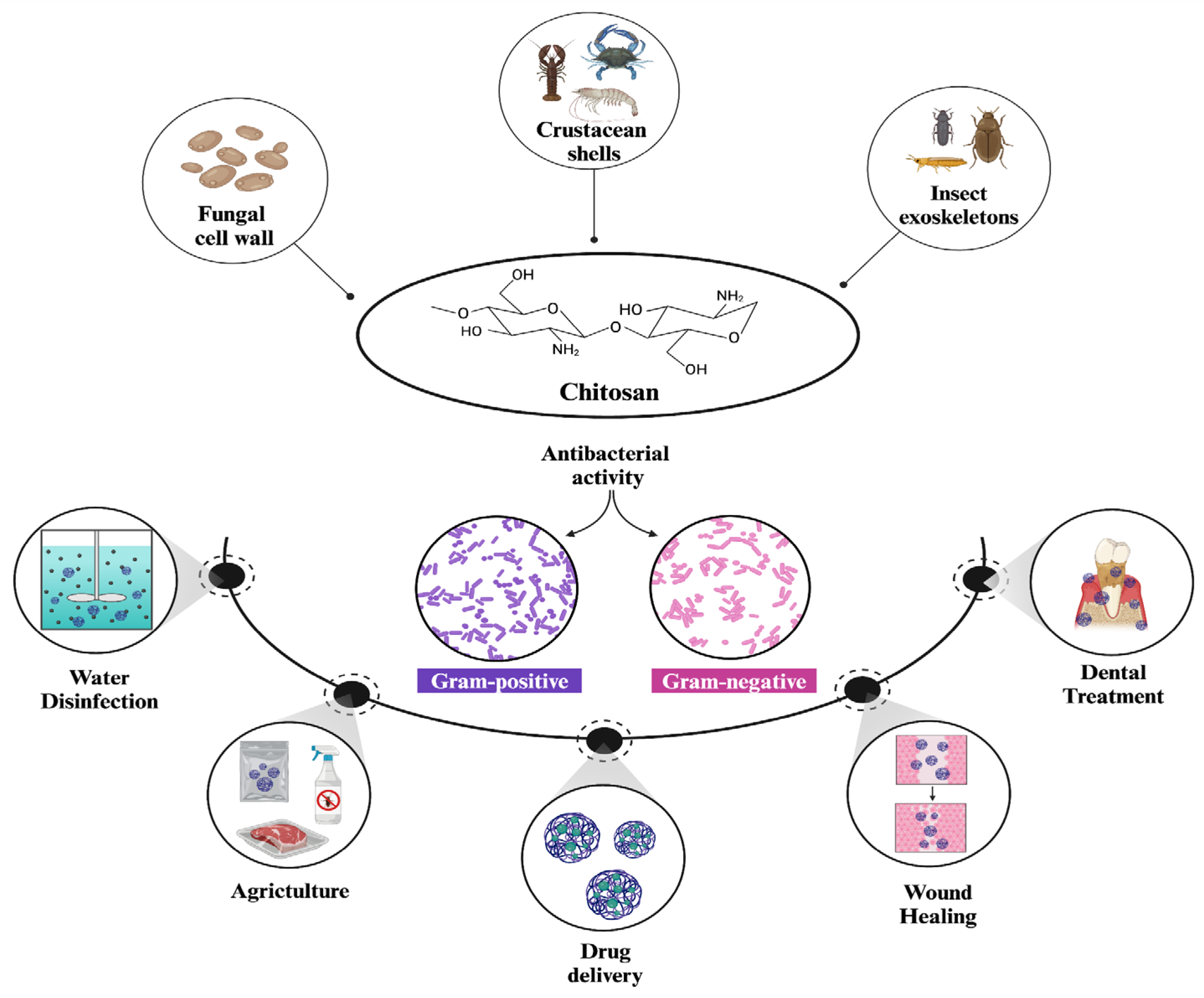
Figure 2.
Antibacterial mechanisms of chitosan NPs, different concentrations of chitosan and TPP. The chitosan NPs made with 0.1% TPP and 0.25% chitosan shown effective antibacterial activity against Pseudomonas aeruginosa (P. aeruginosa) and S. aureus [63]. The antibacterial activity of chitosan NPs against E. coli and S. aureus was examined in a related investigation. In contrast to chitosan NPs without TPP, which shown reduced action, chitosan NPs with TPP demonstrated strong suppression of both E. coli and S. aureus [64].
Figure 2.
Antibacterial mechanisms of chitosan NPs, different concentrations of chitosan and TPP. The chitosan NPs made with 0.1% TPP and 0.25% chitosan shown effective antibacterial activity against Pseudomonas aeruginosa (P. aeruginosa) and S. aureus [63]. The antibacterial activity of chitosan NPs against E. coli and S. aureus was examined in a related investigation. In contrast to chitosan NPs without TPP, which shown reduced action, chitosan NPs with TPP demonstrated strong suppression of both E. coli and S. aureus [64].
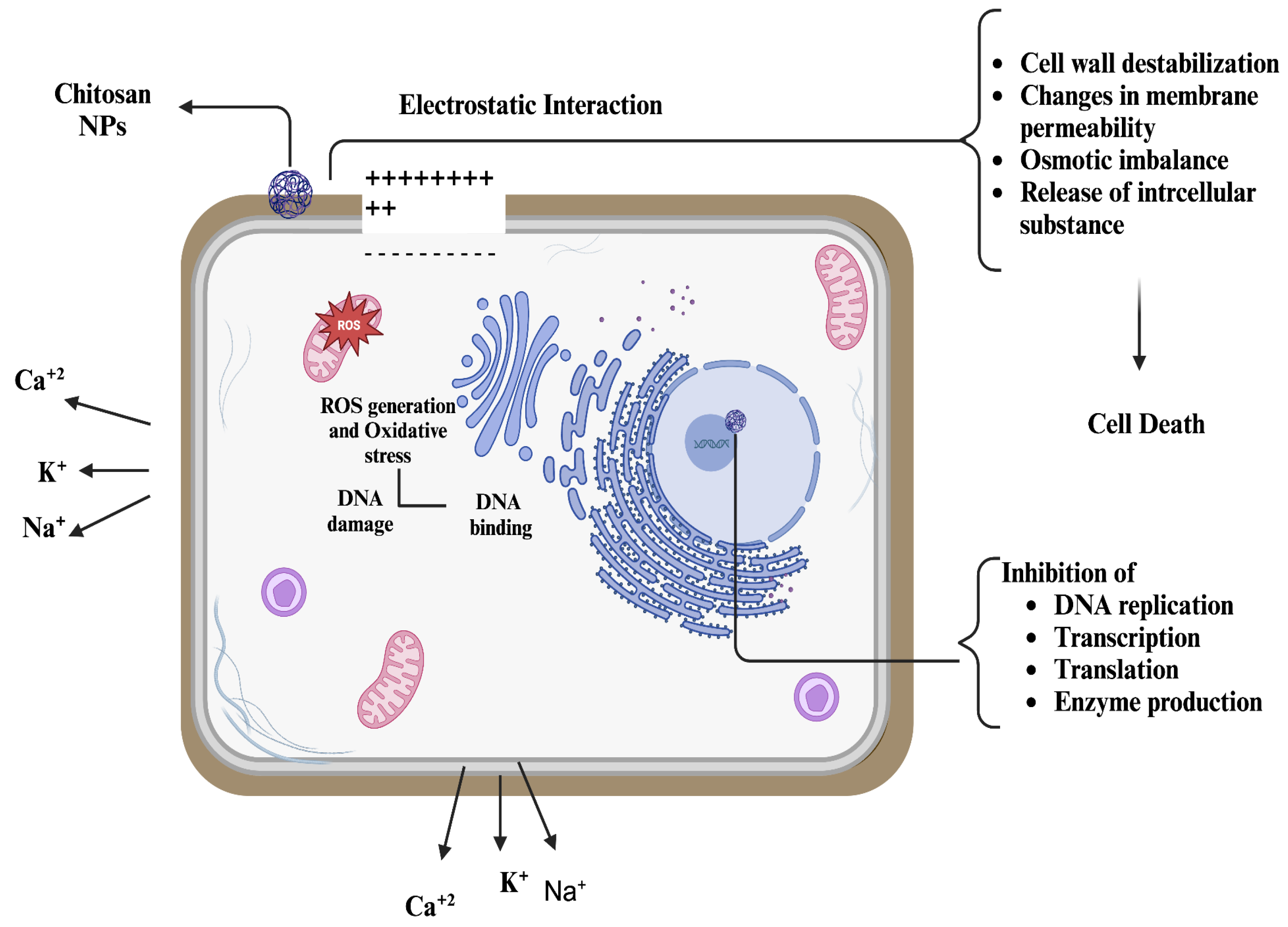
Figure 3.
Factors influencing the antibacterial activity of chitosan NPs [73]. The antibacterial activity of chitosan NPs is significantly influenced by their physicochemical properties, environmental conditions, and the type of bacterial species. Depending on these conditions, chitosan NPs can initiate electrostatic interactions due to their high zeta potential, enhance internalization through smaller sizes, and exhibit stronger activity with crosslinking.
Figure 3.
Factors influencing the antibacterial activity of chitosan NPs [73]. The antibacterial activity of chitosan NPs is significantly influenced by their physicochemical properties, environmental conditions, and the type of bacterial species. Depending on these conditions, chitosan NPs can initiate electrostatic interactions due to their high zeta potential, enhance internalization through smaller sizes, and exhibit stronger activity with crosslinking.
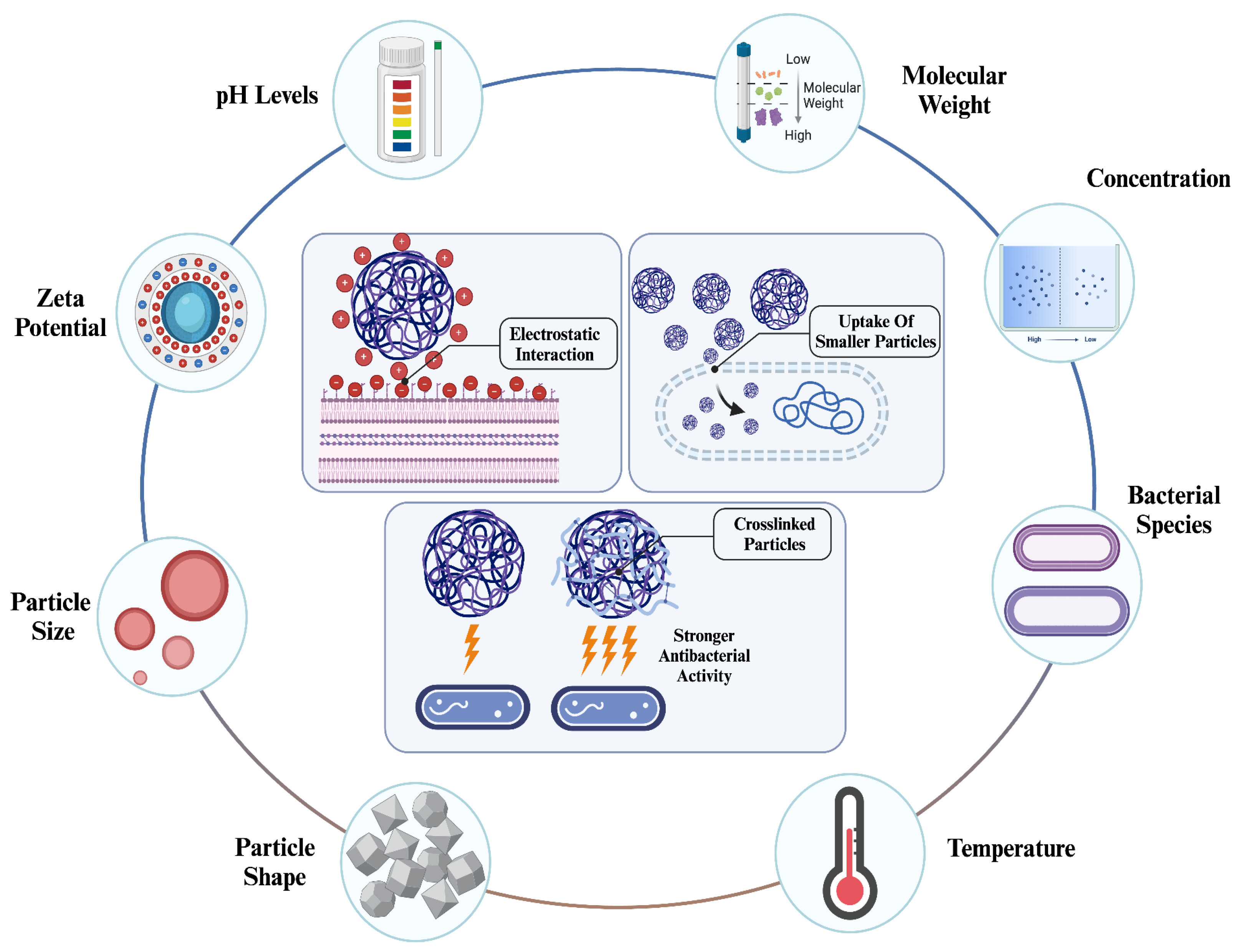
Table 2.
Effect Of Chitosan And Chitosan NPs on Physicochemical Properties In Antibacterial Studies.
Table 2.
Effect Of Chitosan And Chitosan NPs on Physicochemical Properties In Antibacterial Studies.
| Type of the Application and Effect | Physicochemical Property And Changes In Structures | Enhanced Activity Results | References |
|---|---|---|---|
| Crosslinked chitosan NPs for antibacterial drug delivery | Average size of 478 ± 86 nm Zeta potential of −29.2 ± 1.1 mV (physicochemical properties of cross-linked, drug loaded chitosan NPs) |
-Significant reduction in size by nearly 38% with crosslinking. -Crosslinked chitosan NPs exhibited 97% drug loading capacity. -Temperature-dependent antibacterial activity with drug delivery ranging 5 - 15 mm inhibition zone (37 °C > 25 °C) |
[75] |
| Crosslinking of chitosan nanocomposite with silver-sulfur doped graphene quantum dots | Increased optical peak by the crosslinking Ranging concentration of crosslinked quantum dots 5% to 15% Rougher nanocomposite surface with increased quantum dot concentration Notable non toxicity |
-Notable antibacterial activity of the nanocomposite against both Gram-positive and Gram-negative bacteria with increased % of crosslinked quantum dots. -The nanocomposite exhibited antibacterial activity to certain strains of bacteria such as E. coli and S. aureus. |
[76] |
| Antibacterial activity of nanoscaled cross linked chitosans with citric membranes | Improved heat-resistance by 50 °C with crosslinking Extensible film structure with crosslinking (reduced tensile strength and increased elongation at break) High oxygen barrier capability |
-Significant enhancement in antibacterial activity from 65% to 95% (colony counting results). |
[77] |
| Crosslinked chitosan included nanocomposite for improved antibacterial and mechanical properties | High compressive strength (enhanced by 3.5-fold with crosslinking) |
-Enhanced antimicrobial activity by 3-fold higher reduction in OD values of anti-biofilm histogram (the enhancement represented both crosslinking and added Mg(OH)2 NPs into the nanocomposite) |
[78] |
| Using capping agents on chitosan-gold hybrid NPs for enhancing antibacterial activity | Spherical morphology Red shifted absorption peaks from 525 to 532 nm Zeta Potential increased (-26.4 ± 6.3 to 53.1 ± 6.7 mV) with added chitosans, reduced with modification (53.1 ± 6.7 to 31.0 ± 6.0 mV) Size reduced (25.0 ± 4.0 to 16.9 ± 2.0) with added chitosans, increased with modification (25.0 ± 4.0 to 34.1 ± 5.9 nm) |
-Enhanced antibacterial activity against methicillin–resistant S. aureus bacteria. -Addition of chitosan in formation of hybrid NPs reduced the MIC value from 125 to 62.5 μg/mL. -Modification of the NP further reduced the value to 15.6 μg/mL. -Significant impact on growth curve of the bacteria with the minimal concentration of 15.6 μg/mL (nearly 10-fold lower) |
[79] |
| Enhanced delivery pf antibacterial agents with chitosan NP thioliation | Average size of 136.26 ± 43.17 nm with drug loading Spherical morphology with smooth surface Thiolation-dependent drug release property (faster release at pH 7.5 and 3.5 in thiolated and non thiolated chitosan NPs, respectively) |
-Encapsulation efficiency of 69.83%±0.04. -Enhanced antibacterial drug delivery of chitosan NPs with thiolation by up to 8-fold reduction in MIC values (for certain strains of bacteria) |
[80] |
| Effect of differently crosslinked chitosan NPs in antibacterial activity of zinc oxide (ZnO) NP-included nanocomposite | Excluding elemental analysis, no notable observation in the physicochemical properties of the nanocomposites | -Crosslinked chitosan hydrogels exhibited significant antibacterial activity compared to non-modified chitosan (Ranging reduction 20 - 60% in MIC values). -Highest antibacterial activity was observed in ZnO NP and crosslinking chitosan-included nanocomposite. |
[81] |
Table 3.
Antibacterial applications of chitosan and chitosan NPs in recent years (2020-2024).
| Application | Properties | Results | References |
|---|---|---|---|
| Use of peptide-capped chitosan-gold NPs for laser-induced antibacterial activity | Average size of 227 nm (258 nm with peptide conjugation) Solely formed chitosan NPs 11 nm (increased to 22 nm with peptide conjugation) Spherical Morphology Zeta potential of +42 mV |
-Increased internalization of NPs with lipopolysaccharide targeting-peptide. -At the minimum concentration, un-capped NPs decreased colony-forming unit (CFU) values to 136 ± 13 and further decreased with laser irradiation to 103 ± 6. -Capped particles significantly reduced the CFU values to 81 ± 3 and further decreased with laser irradiation 69 ± 4. |
[106] |
| Development of chitosan NP-incorporated whey-based Poly (L-Lactic Acid) (PLLA) packaging films | Thickness between the range of 70–80 μm Smooth surface |
-Increased water vapor permeability and elongation at break by chitosan NPs. -Incorporation of higher amounts of chitosan NPs enhanced the antibacterial effects, with highest inhibition observed at 5% w/w in comparison to 1% and 3% w/w. -Improved tensile strength and Young's modulus, achieving up to 50.2 MPa and 2.28 GPa, respectively, following administration of 3% w/w NPs. |
[107] |
| Fabrication of nickel oxide (NiO) NP-incorporated chitosan-based nanocomposite films | Thickness in the range of 25-31 mm. |
-Antibacterial activity against both Gram-positive and Gram-negative bacteria, S. aureus and Salmonella typhimurium (S. typhimurium), respectively. -Photocatalytic activity evidenced by 72% dye (methyl orange) absorption, following 270 minutes of exposure to UV radiation. |
[108] |
| Development of chitosan-based bioactive films incorporating quercetin-loaded chitosan NPs (QCNPs) | Thickness ranging in between 43.1 and 45.6 μm. High transparency with bright yellow color Intact morphology after administration of QCNPs, with no defects observed |
-Significant UV-light barrier properties. -Enhanced thermal, mechanical and water vapor barrier properties through administration of QCNPs. -Antibacterial activity against E. coli and Listeria monocytogenes (L. monocytogenes). -Improved DPPH and ABTS radical scavenging activity following NP incorporation. |
[109] |
| Development of vaccarin-chitosan NPs for wound healing | Average diameter of 216.6 ± 10.1 nm Spherical-like morphology Zeta potential of +37.1 ± 1.2 mV |
-Faster cell migration by the administration of chitosan-vaccarin NPs . -Improved and faster wound healing effects on rat model, with complete recovery following 10 days of treatment. -Biocompatibility on human umbilical vein endothelial cells (HUVEC). |
[110] |
| Development of melatonin loaded lecithin-chitosan NPs for wound healing | Average size of 160.43 ± 4.45 nm Spherical and subspherical morphology Zeta potential of 25.0 ± 0.57 mV |
-Induced fibroblast proliferation and collagen deposition by NPs. -Accelerated wound healing on rat model through administration of melatonin loaded lecithin-chitosan NPs. -Non-toxicity on Galleria mellonella model. |
[111] |
| Preparation of curcumin-loaded chitosan NPs containing hydrogels for wound healing | Average size of 370 nm with bioink encapsulation Zeta potential of 41.4 mV Spherical morphology |
-Enhanced antibacterial activity against E. coli and S. aureus, with increasing concentrations of chitosan NPs. -Non-toxicity and biocompatibility on normal human dermal fibroblast (nHDF) cells. -Accelerated wound closure in comparison to control group following 14 days of treatment. |
[112] |
| Enhanced antibacterial activity of quercetin-loaded alginate/chitosan NPs | Spherical morphology Similar to rod-shaped structure after drug-loading Encapsulation efficiency up to 82.4% Loading capacity up to 46.5% |
- Antibacterial activity of unloaded alginate/chitosan NPs exhibited ZOI ranging from 8.1 ± 3.0 mm to 9.8 ± 0.17 mm. - Sole administration of quercetin exhibited ZOI ranging from 9.1 ± 0.2 mm to 14.1 ± 0.9 mm. - Drug-loaded particles exhibited ZOI of 12.1 ± 3.0 mm to 17.3 ± 0.30 mm, demonstrating the most significant antibacterial activity. |
[113] |
| Enhanced antibacterial activity of licoricidin | Spherical morphology Approximate size of 90 nm Increased size by drug loading to 150 nm Zeta potential of >45 mV pH responsive release behaviour (higher drug release at pH 5.5) |
-Compared to sole administration of the drug, chitosan NPs exhibited 2-fold reduction in MIC volumes and complete inhibition of the bacteria. -Higher antimicrobial activity in aqueous solution compared to solely used drugs. -Preserved inhibitory activity for 16 hours, while a solely used drug exhibited its activity for 10 hours. |
[114] |
| Antibacterial activity of drug-loaded alginate-chitosan NPs against spoilage bacteria | Approximate size of 100 nm Spherical and elliptical morphology Zeta potential averagely −16.12 ± 3.06 mV Temperature-dependent drug release behaviour (fastest release at 25 °C) |
-Significant reduction in concentrations of bacteria from multiple strains of aquatic products. (down to 2-3 log CFU/mL after 10 hours). -Large ZOI by >10 mm. |
[115] |
| Encapsulated alginate-chitosan NPs against Multidrug-Resistant S. aureus | Average size of 335.3 nm (drug-loaded) and 245.1 nm (unloaded) Spherical morphology Zeta potential of +33.0 ± 1 mV (unloaded) and 45.1 ± 1 mV (drug-loaded) Encapsulation efficiency of 83.45 % |
-Unloaded alginate-chitosan NPs demonstrated MIC and MBC values ranging between 32 - 128 μg/ml and 64 - 256 μg/ml, respectively. -Drug-loaded particles reduced values of MIC and MBC to 1 - 8 μg/ml and 2 - 16 μg/ml, respectively. -Anti-biofilm activity by 65–80%. -Results from biofilm gene expression demonstrated the inhibition of initial attachment of bacteria and biofilm formation. |
[116] |
| Encapsulation of cellulose nanocrystals stabilized lysozymes in chitosan NPs | Average unloaded size of 171.43 and 308.53 nm Spherical morphology Zeta potential of 59.21 mV and 51.24 mV Lowered zeta potential with drug-loading to 33.44 mV and 43.88 mV Encapsulation efficiency up to 88.29% and 84.25% (all respectively to low-sized and high-sized particles) |
-Significant antibacterial activity of drug-loaded chitosan NPs against S. aureus (up to 14.32 mm) and Vibrio parahaemolyticus (up to 11.34 mm). -Reduced MIC for both bacteria in increased particle size (0.094 and 0.377 mg/mL, respectively). -Reduced MBC in increased particle size (0.188 mg/mL) and reduced particle size (0.625 mg/mL), respectively. |
[117] |
| Characterization and antibacterial activity of chitosan NPs encapsulated lemongrass essential oil | Average size of <200 nm (unloaded particle) Spherical morphology Zeta potential of 36.3 mV (unloaded particle) Reduced zeta potential with increased essential oil concentration form 40.8 mV to 20.8 mV Encapsulation efficiency up to 44.82 ± 2.80 Loading percent up to 18.90 ± 0.87 |
-Non-loaded chitosan NPs demonstrated MIC values between 12.5 - 25 mg/mL and ZOI between 2.5 - 6.5 mm. -Loaded particles demonstrated MIC values between 1.56 - 6.25 mg/mL and ZOI between 13.8 - 17.5 mm. -The antifungal activity of both types of particles were evaluated . |
[118] |
| Development of chitosan hydrogels filled with activated and non-activated carbon NPs for water purification | Smooth external surface with several voids Increased crystallinity index with the incorporation of carbon NPs |
-Effective absorption of heavy metals including Fe, Zn, Cu and Pb, with stronger affinity towards Pb. -Bactericidal efficiency on E. coli by the unmodified chitosan hydrogels. -Loss of antibacterial activity following functionalization with carbon NPs due to lack of free positive charges. |
[119] |
| Development of hybrid chitosan-silver NP based films for water purification | - | -High mechanical stability. -Antibacterial activity in saline solution containing E. coli, with an inhibition zone of approximately 0.5 cm. -Biocompatibility on HEK 293 cells. |
[120] |
| Incorporation of chitosan NPs on orthodontic micro-implants for antibacterial activity | Particle size between 70 - 100 nm Uniform crystalline surface with dense structure |
-Strong antibacterial activity by inhibition zones between 13 - 18.3 mm (at the highest concentration of 10 mg/mL) against four different bacteria. -Significantly low MIC and MBC values by 8 - 16 µg/mL and 4 - 8.1 µg/mL, respectively. |
[121] |
| Chitosan-based nanocomposite for coating titanium dental implants | Size ranging from 26 to 52 nm (highest chitosan ratio groups) Low coating coverage and larger size (lowest chitosan ratio groups) Combination of nano-spherical particles and nanofibers |
-Pectin-chitosan nanocomposite demonstrated ZOI between average of 12.312 and 15.413 mm against various oral microorganisms (where both chitosan and pectin found in the highest concentration) -Significant bactericidal effect of 1:2 pectin/chitosan nanocomposite. |
[122] |
| Effect of chitosan NPs encapsulated with doxycycline against periodontal disease | Average size of 203.1 ± 10.51 nm Zeta potential of +32.3 ± 0.4 mV Size of 252.3 ± 4.78 and zeta potential of +30.6 ± 0.4 after drug-loading Spherical morphology Crosslinked particles with TPP |
-Significant bacteriostatic activity of the particles (500 μg/ml) against Porphyromonas gingivalis by reduction in colony numbers from 80 to complete reduction. -Inhibition of NLRP3 inflammasome. |
[123] |
| Drug-loaded chitosan NPs for local delivery in periodontal disease | Approximate size ranging between 60.66 ± 4.97 nm to 87.44 ± 6.41 nm. Zeta potential between -15.26 ± 4.76 mV to −29.52 ± 4.91 mV. Spherical morphology Entrapment efficiency between 81.6 ± 1.8 and 88.0 ± 2.1%. Drug loading between 4.4 ± 0.3 and 16.1 ± 0.7%. |
-Controlled drug release of doxycycline and atorvastatin. -Strong inhibitory effect of chitosan NPs against S. aureus with an inhibition zone of 14–16 mm. -No notable activity against E. coli. |
[124] |
Disclaimer/Publisher’s Note: The statements, opinions and data contained in all publications are solely those of the individual author(s) and contributor(s) and not of MDPI and/or the editor(s). MDPI and/or the editor(s) disclaim responsibility for any injury to people or property resulting from any ideas, methods, instructions or products referred to in the content. |
© 2024 by the authors. Licensee MDPI, Basel, Switzerland. This article is an open access article distributed under the terms and conditions of the Creative Commons Attribution (CC BY) license (http://creativecommons.org/licenses/by/4.0/).
Copyright: This open access article is published under a Creative Commons CC BY 4.0 license, which permit the free download, distribution, and reuse, provided that the author and preprint are cited in any reuse.