

Submitted:
05 December 2024
Posted:
06 December 2024
You are already at the latest version
Abstract
Hydrogen storage in a solid state is a promising alternative to compressed hydrogen. Metal hy-drides (MHs) provide high hydrogen volumetric capacities of up to 150 kg/m3, wide pressure (P) and temperature (T) operative ranges (– 40 to 500 ºC, 1 to > 700 bar), and reversible absorp-tion-desorption processes, making them suitable for mobile and stationary applications. Aside the intrinsic material’s reaction kinetics with hydrogen, in metal hydride beds (MHBs), reaction heat transfer often limits the dynamic performance. Heat transfer within the MHB usually involves the solid and gas phases. To account for both, an effective thermal conductivity (ETC) is defined. Measuring and predicting the ETC of metal hydride beds is of primary importance when designing hydride-based systems for high dynamics. This review paper presents an integral overview of the experimental and modeling approaches to characterize the ETC in MHBs. The most relevant methods for measuring the ETC of metal hydride beds are described, and the results and scopes are shown. A comprehensive description of the models applied to calculate the ETC of the MHBs under different conditions is developed. Moreover, the effects of operation parameters such as P, T, and composition on the ETC of the presented models are analyzed. Finally, a summary and conclusions about experimental techniques, a historical overview with a classification of the ETC models, a discussion about the needed parameters, and a comparison between ETC experimental and cal-culated results are provided.
Keywords:
hydrides
; effective thermal conductivity
; modeling
; experimental
; hydrogen
1. Introduction
Fossil fuels mainly cover the ever-increasing global energy demand nowadays, and cause global warming due to greenhouse gas (GHG) emissions [1]. Therefore, there is a need for sustainable and renewable energy sources, which has led to the research of clean and efficient energy carriers [2]. Hydrogen is one of the most promising options, thanks to its abundance and high gravimetric energy density (LGHV (low gravimetric heating value) of hydrogen: 120 MJ/kg or 33.33 kWh/kg, in comparison to the LGHV of methane: 55.6 MJ/kg or 15.44 kWh/kg) [3,4,5]. However, hydrogen is a flammable gas with a very low boiling point (around 20 K at 1 atm), making it hard to store and transport hydrogen efficiently and safely. In addition, hydrogen has a low volumetric energy density (LVHV (low volumetric heating value) of hydrogen: 10.8 MJ/Nm3 or 3.0 kWh/Nm3) [3]. Physical storage methods, like high-pressure gaseous hydrogen storage (at 350 bar and 700 bar) or liquid and cryo-compressed hydrogen storage, are characterized by high costs for compression and/or liquefaction (5 – 20 % and 30 – 40 % of the LGHV hydrogen is required for compression and liquefaction, respectively) [4,5,6,7,8,9]. Hydrogen storage in carrier materials and, especially, in solid-state, in which hydrogen is bonded to a host material, is a promising alternative [10,11,12,13,14].
Thanks to high hydrogen volumetric capacity ranging from 60 to 150 kg/m3, wide pressure and temperature operative ranges (cryogenic temperature to 500 ºC, and 1 bar to more than 700 bar), and reversibility of the absorption-desorption process, metal hydrides (MHs) are among the materials with the highest potential for hydrogen storage in solid-state for mobile and stationary applications [15,16,17,18,19,20,21,22]. Furthermore, MHs are also used for many other applications, including heat pumps, thermal energy storage systems, heat transfer systems, and thermal hydrogen compressors [17,18,23,24,25,26].
The reversible hydrogenation/dehydrogenation process in MHs under equilibrium conditions can be described with the following Equation (1) [27]:
where Me is a metal, an alloy, or a compound, MexHy is the hydride compound, and ΔH is the reaction enthalpy.
The equilibrium pressure, Peq, is described by the Pressure-Composition-Isotherms (PCIs) in the alpha-beta (αss-βMH) equilibrium condition, as can be seen in Figure 1A. An ideal Me/MexHy system presents flat plateaus that provide the Peq for the hydrogenation and dehydrogenation processes at different temperatures (Figure 1A). The Peqs at different Teqs, equilibrium temperatures, are used to calculate the enthalpy, ΔHr, and entropy, ΔSr, of the hydrogenation/dehydrogenation reaction through the van't Hoff equation (Figure 1B). The ΔHr represents the strength of the Me-H bond and is derived from the slope of the van't Hoff plot. According to Equation (1), the hydrogen absorption reaction is an exothermic process, while the desorption is an endothermic process. The heat absorbed or released varies depending on the hydride. For example, the enthalpy of the reaction for the formation/decomposition of the hydride compound for LaNi5 is approximately 30 kJ·mol H2-1, while for Mg, it is around 75 kJ·mol H2-1 [28,29,30]. The ΔSr is taken as the hydrogen entropy variation from molecular gas to dissolved solid and vice versa, neglecting the entropy change of the αss and βMH phases; the coordinate to the origin determines a ΔSr value of about 130 J·K-1·mol-1, Figure 1B [30,31]. According to the van't Hoff Equation, the equilibrium pressure varies exponentially with the temperature, and the equilibrium conditions of the system are defined just by a Peq and Teq condition, as shown in Figure 1C [30,31]. The hydride compound exists on the left side of the equilibrium line, and on the right side, the metal phase is present.
However, the real Me/MexHy system exhibits plateaus with slope and hysteresis between the hydrogenation and dehydrogenation plateau, as shown in Figure 2. The cause of sloped plateaus can be attributed to the H-H interaction since the space lattice does not continuously increase with hydrogen concentration [32]. The hysteresis phenomenon can be ascribed to the material's strain, which generates a plastic deformation when it absorbs hydrogen [32]. Kinetic limitations near the equilibrium conditions can also lead to an apparent hysteresis in the experiments.
For hydrogen absorption and desorption under dynamic conditions, if the applied hydrogen pressure, Pabs/des, at a given T is higher/lower than the absorption/desorption equilibrium pressure Peq,abs/des, the Me/MexHy system starts to absorb/desorb hydrogen as described in Figure 2. The difference between Peq,abs/des and Pabs/des is the driving force for the chemical reaction. Therefore, if the heat associated with the hydrogenation and dehydrogenation reaction is not efficiently taken out or provided from/into the Me/MexHy system, the reaction rate slows down. Such slow rates are associated with the increase/decrease of the hydride bed temperature, which changes the Peq and reduces the driving force for the hydrogenation and dehydrogenation processes.
In most cases, the hydride-forming materials are in powder form. The hydrogen gas surrounds the solid particles upon hydrogen interaction. The primary heat transport phenomenon upon hydrogen absorption and desorption is conduction. In the case of metal hydride beds (MHBs), the thermal conductivity involving the solid and gas phases is called effective thermal conductivity (ETC) [33,34,35,36,37,38]. The swelling phenomenon also influences the performance of metal hydrides. The hydride-forming material expands and shrinks during cycling due to the metal's varying crystal parameters, and thus, pulverization occurs during repeated hydrogen absorption and desorption cycles [39,40], usually down to a certain particle size. With a reduction of the particle size, the ETC of MHBs drastically decreases. The ETC of hydrides is relatively low and in the range of ≈ 1 W m-1 K-1, and therefore limits the hydrogenation and dehydrogenation reaction rate [33,34,35,36,37,38,39,40]. Hence, measuring and predicting the ETC of metal hydride beds is of primary importance when designing hydride-based systems, in particular if high absorption or desorption dynamics are requested. Experimental methods and mathematical models are required to evaluate the ETC of MHBs. In both cases, however, some issues arise due to the complexity of MHBs, owing to their powdered nature, the swelling phenomenon, incomplete hydrogenation/dehydrogenation reactions, and, in some hydride systems, the formation of intermediate phases. Hence, effective thermal conductivity becomes a complex function of various variables over the hydrogenation and dehydrogenation reaction.
Regarding the experimental measurements, conventional methods and commercially available instruments can usually not fully cover the complex nature of an MHB and can only provide ETC values with certain experimental constraints. It is necessary to perform measurements in a hydrogen pressure-controlled atmosphere of a porous media made of very small particles. Because of this, innovative approaches have been proposed over time, and several examples are reported in the literature [33,41]. However, challenges remain and, so far, it is still impossible to identify a general experimental procedure and setup for measuring the effective thermal conductivity of metal hydride beds.
For modeling the ETC of material beds, various equations and methods have been proposed [42,43,44,45]. However, the main limitations related to this class of "general" models lie in the lack of account for some peculiar aspects of MHBs, like the reactivity between the solid and the gas phase, the consequent expansion/compression of solid particles, or the heat release from the reaction, as expressed in Equation (1). Some of these models, like the Zehner-Schlünder model, have been subsequently adapted to metal hydride systems, while others have been directly developed for this purpose [46,47,48,49,50].
This review paper presents an integral overview of the experimental and modeling approaches to characterize the ETC in MHBs. Section 2 highlights the most relevant methods for measuring the ETC of metal hydride beds, describing the results and limitations. Section 3 provides a comprehensive development of the models in the literature employed to calculate the ETC of the MHBs at different conditions. The difficulties in estimating every parameter are also discussed. The thermal conductivity of the solid phase is also investigated, a critical parameter that has not been covered so far in the literature on the hydrides' field. Section 4 is about the effects of pressure, temperature, and composition on the ETC of the models presented in Section 3. An analysis of the behavior of the models comparing experimental data for LaNi5 is also performed. Finally, summary and conclusions about experimental techniques, an overview with a classification into gas film and particle modification models of the ETC models developed so far, and a discussion about the needed parameters are provided.
2. On the Overview of the Methods Applied to Measure Thermal Conductivity
This section describes the principles of the experimental methods and setups for measuring the ETC of metal hydrides. The obtained results and constraints of the methods are discussed, covering the following main aspects:
- → Time required for the measurements
- → Possibility to measure in a hydrogen atmosphere
- → Possible temperature and pressure range
- → Type of sample
- → Amount of sample
- → Commercial availability
Figure 3 proposes a classification of the existing methods to experimentally determine the ETC. These methods are generally employed not only in metal hydrides but also in polymers, cement, and clays, among other materials. Such methods can be divided into two main categories: steady-state and transient [33,41,51,52,53,54,55]. The main difference is here how the heat source operates during the measurement. In the steady-state methods, the heat is provided from one side of the sample (heat source) and transferred towards the other side of the sample (heat sink). The measurement continues until a constant temperature gradient in either axial or radial direction, depending on the cell design, is reached. The steady-state methods can be divided into two subgroups, depending on the direction of the heat, in axial and radial methods (Figure 3). Applying the steady-state method, the ETC can be calculated from the temperature values at different points of the sample, the constant power of the heat source, and the distances from the heat source to the temperature measurement points. The steady-state method can be applied directly, just with the sample, or in a comparative way, including a reference material. In this section, both subgroups of steady-state methods will be further analyzed.
In contrast, in the transient methods, the heat for the measurement is given as a single or periodic pulse. The ETC is calculated from the sample's temperature change over time. In the case of transient methods, it is possible to distinguish two main techniques: the hot wire and the laser flash. While the two main categories of the ETC measurement methods are well defined, their distinction in sub-categories is less strict and depends on the research field and the author.
2.1 Steady-State Methods
2.1.1 Axial Heat Flow
For the most straightforward axial heat flow method, a sample of known dimensions (usually a cylinder or cuboid) is heated until steady-state conditions are reached. At this point, a one-dimensional heat flow through the sample can be assumed (with constant axial temperature in every sample layer). The Fourier law, Equation (2), describes this case and has the advantage of easy data evaluation [56]:
where q is the heat flow (W), A represents the cross-section area of the sample (m²) through which the heat flows, dT/dx (K m-1) is the temperature gradient, and k is the thermal conductivity of the sample (W m-1 K-1).
Even this straightforward setup has been used for hydride compounds. Eaton et al. measured the ETC of different LaNi5-lead composites, reporting up to 2 W m-1 K-1 [57]. Gradually, several modifications to the basic setup have been made to reduce the error and to make the measurement more robust. For instance, the system is be isolated to prevent heat loss in the radial direction and to ensure a one-dimensional heat flow through the sample. Another possible modification is adopting a comparative setup instead of an absolute one. In this case, the sample is attached to one or two materials of known thermal conductivity, which act as references. The approach is the so-called comparative cut-bar method, and the concept is shown in Figure 4 [58], where the sample is embedded between two references with known thermal conductivities, kRef1 and kRef2. Assuming a constant heat flow through the whole stack, the ETC can be calculated through Equation (3), by measuring the temperature T (K) at given positions Z (m), instead of evaluating the heat flow (e.g., by the heat source's energy consumption):
Another possible application of the axial steady-state method is the guarded hot plate method, where the measurement is isolated and equipped with a so-called guard heater to compensate for possible heat losses. The guard is heated at the same temperature as the measurement's heat source, so there is no radial driving force for the heat. The heat can only travel through the sample in the axial direction. Another modification is to calculate the heat flow through the setup directly with a heat flux sensor instead of calculating it from the energy consumption, leading to the guarded heat flow meter method. Additionally, there might be some slight modifications, like a setup where the heater is placed between two identical samples, which would not change the overall working principle [59].
Due to certain experimental limitations (e.g., the need for good contact between the sample and the reference material) [58], the axial methods are more suited for samples with a flat surface, like metal hydride powders compacted into pellets. For instance, Sanchez et al. [60] have used the comparative cut-bar method to measure the ETC of LaNi4.85Sn0.15 containing expanded natural graphite (ENG) perpendicular to the pressing direction, improving the thermal conductivity up to ≈ 19 W m-1 K-1. Similarly, Park et al. [61] have used the same comparative cut-bar method to investigate the ETC of La0.9Ce0.1Ni5 pellets with ENG, reaching a thermal conductivity of 8 W m-1 K-1 (not specifying the measurement direction). Yasuda et al. [62] have used the heat flow meter method to measure the heat conductivity of two different metal hydrides (TiFe0.9Ni0.1 and La0.6Y0.4Ni4.9Al0.1) pressed with aramid and carbon fiber into sheets. They measured an ETC up to 3 W m-1 K-1 in the planar direction and nearly no heat conductivity through the plane. Kumar et al. [63] applied the guarded hot-plate method to measure the ETC of MmNi4.5Al0.5. They placed the sample in the measurement chamber and slightly compressed it, forming a disk. Measurements have been carried out in a hydrogen atmosphere at 50 bar and about 100 ºC, with an ETC value of about 1.2 W m-1 K-1.
The axial steady-state method's general advantages are the measurements' high accuracy and the straightforwardness of data acquisition. The guarded hot plate method is one of the most precise methods for measuring heat conductivity [41]. However, to reach this high precision, the cell must be well-designed and built, and the measurement devices, such as thermocouples and heat sources, must have high accuracy. This precision comes at the price of long measurement times, which can be hours or days until steady-state conditions are reached [52]. While there are commercial setups whose measurement principle is based on the axial steady-state method [64], their application is aimed towards insulating materials, and often large sample sizes are required. Hence, the reported results in the scope of metal hydrides are made with custom-made devices, and consequently, the operation conditions (sample size, hydrogen atmosphere, and operative temperature) depend on how the device was constructed.
2.1.2 Radial Heat Flow
In radial methods, the sample is placed inside a circular sample holder with a certain number of thermocouples at varying distances from the heat source. In most setups, the heat flow is directed from the center of the sample holder towards the shell, which acts as a heat sink. Similarly to axial methods, radial methods can operate in absolute and comparative modes. Figure 5A shows a schematic design of the absolute radial method: r1 and r2 (m) are the radial positions of two thermocouples, T1 and T2 (K) are the corresponding measured temperatures and hsh (m) is the sample holder radius. In general, radial heat flow setups utilize more than two thermocouples to improve the precision of the measurement. There are reports of setups using three [65], four [66], or even five thermocouples [67], as seen in Figure 5C. Using the schematic setup of Figure 5A, quantifying the heat generated q (W), the ETC can be calculated using Equation (4):
In the comparative mode, the sample holder contains the sample and a reference material. The reference should have a low thermal conductivity to establish a high-temperature gradient and reduce the measurement error; typical reference materials are PTFE [47] or Nylon [68]. In Figure 5B, the setup contains four thermocouples in total (two in the sample and two in the reference material) with distances from the heat source of r1 to r4 (m) and measured temperatures of T1 to T4 (K).
In contrast to the absolute method, in the comparative one, it is not necessary to know the heat generated by the heat source, and with the knowledge of heat conductivity for the reference material, kRef (W m-1 K-1), the ETC for the sample can be calculated according to Equation (5) [33].
Compared to the axial steady-state method, the radial method is more robust (nearly no heat loss due to the placement of the heat source in the middle of the setup), and less or no isolation is needed to prevent undesired heat losses. The outer shell often acts as a heat sink; in this case isolation is even undesirable. This makes the radial steady-state method suited not only for samples with flat surfaces, like pellets, but also for powder samples. The comparative method might have a slight advantage because the heat source is responsible for the most significant error in the calculation [60], and a lower amount of sample might be needed compared to the absolute method. Nevertheless, both methods have been used to determine the ETC (keff) of hydride compounds with no distinct preference. Due to the flexibility of the radial method mentioned above, it has been used for very different samples. Shim et al. [66] used the radial flow method to measure the ETC of MgH2 pellets with added NbF5 and ENG in the absolute mode, using a vessel with four inserted thermocouples, as shown in Figure 5C. They have reached a value up to 13 W m-1 K-1 for samples containing 20 wt% ENG with a particle size of 200 µm and measured up to 70 bar at RT.
In contrast, Wang et al. [68] have measured the ETC of a LaNi5 bed in the comparative mode, reaching a value of 2.1 W m-1 K-1 at 16 bar of hydrogen pressure. Recently, X. Mou et al. [69] have reported ETC measured for LaNi5 with different initial particle sizes and porosities under a He atmosphere and an average temperature of 20 ºC in an in-house design cell. It was found that the porosity decrease and particle size increase could raise the ETC. Additionally, measurements of the LaNi5 powder beds were performed under 1 to 40 bar of hydrogen pressure and average temperature between 20 to 60 ºC, providing values from 0.1 to 1.7 W m-1 K-1.
A general disadvantage of the radial steady-state method is that the cells need to be large enough to have the proper space to allocate several thermocouples. Consequently, a large sample is needed. Madeira et al. [70] used 310 g of La0.8Ce0.2Ni5, while Yang et al. [65] needed 290 g of LaNi5. The radial steady-state method shares the same disadvantage of long measurement times as the axial steady-state method until the steady-state is reached. Furthermore, to our knowledge, there are no available commercial setups for the axial steady-state method, and all reported results have been measured using custom-made devices. The setup design constrains the experimental temperature range, hydrogen pressure, and sample amount among the most relevant parameters.
2.2 Transient Methods
2.2.1 Hot-Wire Method
In contrast to steady-state methods, the heat for ETC measurement is provided as a pulse for transient methods. Hence, no waiting time to reach a steady state is needed, significantly reducing the measurement time from hours to minutes. Figure 6 shows the general working principle of the hot wire method. It is based on using a wire placed inside the sample material. The wire should be infinitely long and thin and acts both as point heat source and sensor. The electric impulse heats the wire by Joule heating, creating a heat flow towards the surrounding media. Samples with higher thermal conductivity can dissipate this heat faster, and the wire remains colder than a material with low thermal conductivity. At a distance from the hot wire, zones with similar temperatures (isothermal lines) exist. Four different sources/sensors can be utilized for such transient measurements: the transient line source (TLS), transient plane source (TPS), modified transient plane source (MTPS), and the eponymous hot-wire. They all share a similar working principle, highlighted by the fact that, recently, devices that can operate with all the four source types have been developed [71].
The ETC of the sample can then be calculated according to Equation (6), where keff is the ETC of the sample W m-1 K-1, q the heating power (W), t1 and t2 (s) the times at which the measurement started and ended, respectively, and ΔT (K) the resulting temperature difference [72].
The temperature difference is mainly measured by the changes in resistance in the wire. The wire should have a linear dependency between resistance and temperature in an extensive temperature range; therefore, platinum wires are mainly used. However, some devices use two wires with different lengths and orientations (cross-wire and parallel-wire techniques) [72].
Sundqvist et al. [73] used the hot-wire methods to investigate potential complex hydride materials (alanates and borohydrides) and performed measurements between 100 K – 300 K and up to 2 GPa hydrogen pressure. For instance, they measured NaAlH4 at RT and 2 GPa for a thermal conductivity of about 3.7 W m-1 K-1, while NaBH4 showed a lower thermal conductivity of about 1.5 W m-1 K-1 at similar conditions. One of the main problems of the hot-wire method is that the wire must be as thin as possible, leading to very delicate systems. The TLS (transient line source or needle probe) overcomes this problem. In the TLS, the wire is encased into a metal needle. This needle contains two thermocouples: one at the middle of the needle (where the highest temperature is expected to be) and one at the tip of the needle as a reference point. The TLS method is more robust than the hot-wire method, sacrificing some accuracy. The TLS is not as thin as the hot wire, which leads to additional axial heat losses [51]. Dedrick et al. [74] used the TLS method to measure the heat conductivity of sodium alanate between RT and 130 ºC and up to 100 bar, reaching about 0.5 W m-1 K-1. While the hot-wire and TLS have the general advantage of fast measurement times and can be used at temperatures up to 200 ºC (which might not be enough for high-temperature hydrides like MgH2 [75]), they have to be embedded into the sample and can therefore be only used for powder beds. Furthermore, there are no commercially available systems for measurements in a hydrogen atmosphere, and the reported results have been obtained from custom-made pressure cells.
In contrast to the hot-wire and TLS methods, the TPS method utilizes a metal spiral (usually made of nickel) embedded into a temperature-stable polymer, like Kapton, or Mica, which also acts as an insulator. For the measurement, different parameters (e.g. the measurement time or the electric power) have to be adjusted to only slightly heat the sample (about 1-2 K) so that the correlation between the resistance and the temperature increase can be assumed as linear [76]. The surrounding material's thermal conductivity can be calculated depending on the sensor's temperature change. The standard TPS sensor is planar, and the heat pulse is emitted in the axial direction. Therefore, two similar samples of sufficient thickness and diameter are needed (Figure 7A) so that the heat pulse of the sensor remains in the sample and there are no influences from the surrounding media. However, the two samples do not need to be identical. They only have to be large enough (twice the radius of the TPS and at least as thick as the radius of the TPS) [33,76], and some deviation between the samples can be tolerated. Hence, the requirements for the samples are not as strict as those for the steady-state methods. In this regard, the MPTS method has the advantage that the working principle and application are similar to the standard TPS method but only needs one sample (Figure 7B).
The flexibility of the TPS method is further highlighted by the possibility to measure both powder [77,78,79] and pellet [80,81,82] samples. This flexibility might contribute to the observation that the use of the TPS method has increased recently, while there are nearly no recent publications on the hot wire with TLS methods for hydride compounds.
Similar to the hot-wire and TLS methods, the TPS sensors can work in an extensive temperature range (up to 300 ºC [71]), mainly limited by the stability of the polymer embedding. Another advantage is also the fast measurement time. If the starting parameters (electric energy, measurement time, etc.) are set correctly, a measurement can be done in minutes. Again, a challenge in metal hydride research is to measure thermal conductivity by TPS in a hydrogen atmosphere. For instance, Jepsen et al. [77] measured the thermal conductivity of Li-Mg reactive hydride composites up to 180 ºC in an argon atmosphere inside a glove box, potentially even underestimating the effective thermal conductivity as hydrogen is more conductive than argon [83]. Other authors have even measured the thermal conductivity of metal hydrides without a protective atmosphere: Atalmis et al. [82] have measured the thermal conductivity of LaNi5 pellets coated with Cu and ENG, reaching up to 13.82 W m-1 K-1 for samples containing 20 wt% ENG at RT. However, efforts have been made to measure the thermal conductivity of metal hydrides directly in hydrogen atmospheres with a TPS sensor system. For instance, Albert et al. [78] constructed a pressure vessel with an embedded TPS sensor so that the thermal conductivity of metal hydrides can be measured directly in a hydrogen atmosphere and investigated a Ni-MgH2 blend up to 25 bar of hydrogen pressure at 300 ºC, reaching up to 0.9 W m-1 K-1.
2.2.2 Laser-Flash Method
In the laser-flash method (LFM), the sample is heated by a laser pulse. The heated sample radiates IR light, which is caught by an IR detector (Figure 8). In order to improve the absorption of the laser radiation and to level surface roughness to a certain degree, the sample should be coated with a layer of carbon before the measurement is performed [84]. The thickness of the coating must be negligible in comparison to the sample thickness, so it does not influence the calculation of the thermal conductivity.
In contrast to other thermal conductivity methods, the LFM does not measure the thermal conductivity directly; instead, it measures the sample's thermal diffusivity, αd (m²/s) (Figure 9). However, with knowledge of the density ρ (kg/m³) and the heat capacity cp (J kg-1 K-1] of the sample, the ETC keff (W m-1 K-1) can be calculated according to Equation (7):
Due to the measurement principle of the LFM, it is challenging to apply it to metal hydride beds in powder form, so, in the scope of metal hydride research, this method is mainly used for pellets. For samples with low thermal conductivity, the gas trapped in the pores, the convection mechanism, and the different path lengths for the radiation can lead to biased results [86]. While the LFM can be used in an extensive temperature range (up to 3000 ºC [59]), the measurement in a reactive atmosphere, like hydrogen, is problematic and might even harm the LFM system [86]. The measurement must be conducted in an inert gas flow (nitrogen or helium) or at a low hydrogen pressure. Pohlmann et al. [87] used the LFM to measure the heat conductivity of Hydralloy C5 (a commercially available AB2-alloy) pellets with varying amounts of ENG in a custom-made protective cell for air-sensitive samples [88], reaching up to 63 W m-1 K-1 for a sample containing 12.5 wt% ENG orthogonal to the pressing direction. They could further show that the thermal conductivity depends mainly on the ENG content, while compaction pressure for the pellets has virtually no impact. Popilevsky et al. [89] investigated MgH2 pellets with embedded 2 wt% multiwall carbon nanotubes and measured the ETC between RT and 250 ºC, reaching up to 35 W m-1 K-1.
The LFM has gained popularity for hydride compounds mainly due to fast measurement times, which are in the order of seconds and are even faster than the hot-wire methods. With known measurement parameters, the samples can be placed in the commercially available system, and the measurement can be started. This might be further accelerated by the possible addition of automatic sample changers so that several samples can be measured in a row. In the hot-wire methods, the sensor has to be removed from the sample and placed in a new one before the measurement can be repeated, adding downtime. However, finding the correct set of measurement parameters for the LFM, e.g. the proper voltage for the laser source, is not trivial. Furthermore, optimizing the initial data is not fully automated, and the user must input the measurement's starting values [90]. Therefore, the measurement's quality can significantly decrease if wrong initial values are chosen, leading to considerably longer measurement times.
3. Development of Models for the Effective Thermal Conductivity
This section comprehensively describes the models used to represent the keff in metal hydride beds. A total of 13 models developed from 1873 to 2023 are discussed. Moreover, the theoretical background of the thermal conductivity of the metal-metal hydride as a solid phase is exposed, and the effect of hydrogen in the metal lattice on the solid thermal conductivity is analyzed.
3.1. Description of the Models and Parameters to Calculate the ETC (keff)
3.1.1 Maxwell Model (1873)
To the authors ' knowledge, the solution proposed by Maxwell [42] can be considered the oldest model for evaluating the effective thermal conductivity of a composite material made by solid particles dispersed in a fluid phase. The model applies to a three-dimensional heat flow for low concentrations of the particulate [48]. Equation (8) describes the model:
where keff is the ETC, kg is the thermal conductivity of the gas (or fluid) phase, ks is the solid thermal conductivity, and ε is the porosity. This model appears very simple and is characterized by only three parameters: ks, kg, and ε.
Additional equations to evaluate the listed parameters are not provided. The Maxwell model was not developed for MHs, and the values of the parameters are not supposed to change. The value of ks is usually available or could be easily measured if a bulk sample of the solid material is available; regarding kg, in the case of hydrogen, there are several sources in the literature, so it can be considered easily achievable. Instead, the initial value of ε can be calculated, while other models are needed for the evaluation during the hydrogenation/dehydrogenation processes. No comparisons of the Maxwell model to experimental data are reported in [42,48]. However, in [91], where a different model is presented, which will be analyzed further in this section, the authors compare experimental data with several models, including the Maxwell model. According to [91], the agreement between the Maxwell model and experimental data for LaNi5-air and Fe-air systems is not very good, and in both cases, the ETC is underestimated.
3.1.2 Yagi and Kunii Model (1957)
In 1957, Yagi and Kunii separated into two terms the effects on the effective thermal conductivity of a packed bed of particles surrounded by a fluid phase: one independent of fluid flow and another dependent on the lateral mixing of the fluid in the packed beds [92]. The field was simplified to a packed bed with motionless fluid. In Figure 10, the model of heat transfer is reported. Equation (9) describes the model:
Here, lp is the effective length between the centers of two adjacent particles, ls is the effective length of the solid particles related to the heat conduction, and lv is the effective thickness of the fluid film adjacent to the contact surface of two solid particles, while hrv and hrs are the radiative heat transfer coefficients for solid-to-solid and void-to-void, respectively, and are given by the following Equations (10 and 11):
Here, e is the emissivity factor of the solid surface. The Yagi and Kunii model appears quite simple, with a limited number of parameters: ks, kg, ε, lp, ls, lv, e.
In addition to the considerations made for the parameters already present in the Maxwell model, the ones added here (lp, ls, lv, and e) must be commented on. By their definition, assuming that particles are rigid spheres in point-contact, lp, and ls have the exact dimension of the particle diameter, while lv can be considered as a fitting parameter, and a value for e is not always available in the literature. However, the contribution of radiation to heat transfer is usually negligible, and emissivity is not required. The authors compared the experimental results reported in previous papers with those calculated: the solid materials used are various and include glass, coal, diphenylamine, alumina, and sand, while the gases used are H2, He, and air, obtaining a good agreement.
3.1.3 Zehner-Schlünder Model (1970)
The model presented by P. Zehner and E. U. Schlünder in 1970 [44] constitutes a base for many other models developed in the subsequent years, as it will be addressed in the following. In Figure 11, an eight of the unit cell of the model is represented [45]. It is made of a cylinder of gaseous phase (empty area) containing one solid particle (shaded area). Adjacent particles only touch each other at one point. Following the assumptions made by Zehner and Schlünder, there are only two parallel paths for heat conduction, one in the fluid area and one in the biphasic region, while there is no heat flow through solid particles. Concerning Figure 11, it appears clear that the influence of the biphasic region depends on the shape of the solid particle, so on Asf. To stand for this geometrical aspect, the authors introduced the shape factor parameter, B, defined through Equation (12):
Following Equation (12), for B=0, the solid particle disappears, so there is only the gas phase. For B=1, the solid particle becomes a sphere, while for B → infinite, the solid particle occupies the entire inner cylinder so that the biphasic region becomes a solid region. Porosity and shape factor are geometrically related by the Equation (13):
Equation (13) can be approximated by applying Equation (14):
where C and m are two fitting coefficients, namely the form factor and the exponential coefficient, For C=1.25 and m=10/9, Equation (14) corresponds to Equation (13) [98]. The central equation of the Zehner-Schlünder model is described by the Equation (15):
The Zehner-Schlünder model appears quite simple, with a small number of parameters: ks, kg, B or C, m, and ε.
If Equation (13) is used, the only new parameter, as compared to the previous models, is the shape factor, B, which has to be treated as a fitting parameter, as it is not possible to determine a specific shape factor starting from measured data, while the porosity is not unknown. Alternatively, Equation (14) can be employed, and C, m, and ε are the unknown parameters. The porosity should be evaluated with a proper model in this latter case, while C and m are fitting parameters. The Zehner-Schlünder model was not developed for metal hydride systems but for composite materials in general, with solid-phase particles dispersed in a continuous fluid phase. Hsu et al. [45] compared the experimental data from Nozad et al. [93,94] to values calculated with the Zehner-Schlünder model. The two-phase systems were obtained by combining different solids and fluids: solids were glass, stainless steel, urea-formaldehyde, bronze, and aluminum, while fluids were water, glycerol, and air. The model agrees with the experimental data for ks/kg<103, while it underpredicts the effective thermal conductivity for higher values of this ratio.
3.1.4 Zehner-Bauer-Schlünder Model (1978)
In the Zehner-Bauer-Schlünder model [95,96], a similar approach to the Zehner-Schlünder model is used, but some novelties are introduced. The most relevant is the area contact between adjacent particles, determined by the flattening factor, φ. This way, a third parallel heat conduction path is introduced, the one through solid particles. The flattening factor is correlated to the particle diameter, d, and the contact area diameter, dc, through the following Equation (16) [95,96]:
Equation (17) represents the primary expression of the model:
In Equation (17), the equivalent thermal conductivity of the biphasic region, kbp, and that of the hollow region, kh, appear, which are defined as described in Equations (18 and 19):
The parameters of the Equations (18 and 19) can be calculated by the Equations (20)-(24) [95,97] :
Furthermore, Equations (12) - (14) are still valid. Referring to the previous equations, Kn* and Nur* are the modified Knudsen and Nusselt numbers, respectively, Nur is the Nusselt number, a is an accommodation coefficient, σ is the Stefan-Boltzmann constant, γ is the hydrogen heat capacity ratio, cv is the hydrogen heat capacity at constant volume, l is the hydrogen mean free path, and μg is the hydrogen dynamic viscosity.
The unit cell of the Zehner-Bauer-Schlünder model is represented in Figure 12.
The number of parameters is higher, i.e., 13 parameters, than the ones needed for the Zehner-Schlünder model, making this model more complex; they are: ks, kg, B or C, m and ε, γ, μg, cv, l, e, d, dc and a.
In addition to the parameters already commented for the previous models, here are some other hydrogen parameters (γ, μg, cv, and l), which can be considered readily available, the diameter of the particles, d, which, if not available from the literature, might be experimentally evaluated, and two fitting parameters, dc and a, as it is difficult to measure or evaluate the contact area diameter correctly.
As for the Zehner-Schlünder model, the Zehner-Bauer-Schlünder model was also made for a packing bed of solid particles surrounded by a fluid species. Kallweit et al. [95] used this model for the comparison to experimental data of two not activated interstitial metal hydrides, LaNi4.7Al0.3 and HWT 5800 (Ti0.98Zr0.02V0.43Fe0.09Cr0.05Mn1.5), with inert void gases, He, Ar, N2 and H2; hydrogen is considered an inert gas in this case, as materials are not activated. The correspondence between experimental and measured values is excellent.
3.1.5 Hayashi Model (1987)
In 1987, Hayashi et al. [43] proposed a model for the thermal conductivity of packed beds following the scheme of Masamune and Smith [98], which is the same used by Zehner, Bauer, and Schlünder [96], according to which the heat transfer in a packed bed of particles can be split into three terms:
- Conductive and radiative heat transfer in the gaseous phase
- Conductive and radiative heat transfer in series through the gas and the solid in the biphasic region
- Conductive heat transfer through the contact surface of solid particles
The unit cell of the model is similar to the ones presented for the previous cases, with a cylinder enclosing two hemispheres in contact with each other (Figure 13).
The effective thermal conductivity is described by the Equation (25):
In the following, the terms appearing in Equation (25) are analyzed. The authors use the same equations introduced by Yagi and Kunii in [92] to calculate hrv and hrs, which are reported above in Equations (10) and (11). kg1 is the thermal conductivity associated with mechanism 1 and is described by (Equation (26)):
where:
Here, a is an accommodation coefficient, and de is the equivalent diameter for the void space, defined in Equation (28):
kg2 is the thermal conductivity associated with mechanism 2, conductive and radiative heat transfer in series through the gas and the solid in the biphasic region, and is equal to:
The fractional area associated with the conductive heat transfer through the contact surface of solid particles, δ, is evaluated as shown in Equation (30):
Here, ke0 is the limit of effective thermal conductivity as pressure tends to zero.
θ is the angle corresponding to the solid-solid contact area, as described in Equation (31):
where n is the number of contact points for a hemispherical particle surface. β' is a factor related to the angle between the actual heat flow direction and that parallel to the axis between particles and varies from 1.0 to 0.9 for loose and close packings, respectively [43]. The authors propose the following estimation, Equation (32):
Here, 0.476 and 0.260 are the values of ε for loose and close packing, respectively. ϕ* is a dimensionless length defined as shown in Equation (33):
Here, lv is the effective thickness of fluid adjacent to two solid surfaces, evaluated as in Figure 13 and Equation (34).
ls is the solid phase length, evaluated via Equation (35):
By mean of a linear approximation similar to that used for β', it is possible to calculate the dimensionless length ϕ* as exhibited in Equation (36):
Hayashi et al. give calculated values for the two parameters introduced in Equation (36), ϕ*1 and ϕ*2, depending on the ratio between the solid and the gas thermal conductivities. In Figure 14, the linear interpolation is reported (for numerical data, refer to [43]).
The Hayashi model appears more complex than the previous ones, with 10 parameters: ks, kg, ke0, ε, γ, d, n, e, l, a. The complexity lies in the large number of unknown parameters, and some are not quickly evaluated. Among these, in addition to the parameters common to the previous models, for which the same considerations are still valid, there are some new ones. The effective thermal conductivity at zero pressure (vacuum), ke0, can only be obtained experimentally (unless this value is available in the literature from published experimental data on the same material); the number of contact points for a hemispherical particle surface, n, can be treated as a fitting parameter, as it is not possible to get this data in other ways (or it would be challenging). Parameters ls and lv also appear in the Yagi and Kunii model, even if they are not given a defining equation.
This model was not developed for metal hydride beds but for solid particles in a fluid media. It has been tested for several combinations of particles and gases: glass beads (0.462 mm Ø), lead balls (1.1 mm Ø), activated alumina (0.23 mm Ø), cylindrical PVC resin (2 mm Ø by 2 mm L, 2 mm Ø by 4 mm L), in combination with He, H2, N2, Ar, C3H6, and a He-N2 mixture, at different temperature and pressure conditions (288.2-313.2 K and 1.33-101.3 kPa). Both for spherical and cylindrical particles, the model shows good predictions. In addition, the authors also compared it with a porous particle system, and, also in this case, the correspondence is good.
In the same paper [43], the authors suggest a simplified model in which the radiative heat transfer is neglected, being very small for such systems. The same considerations made for the base model are valid, and the model's central equation becomes as described in Equation (37):
3.1.6 Sun and Deng Model (1990)
Sun and Deng presented a model for evaluating the effective thermal conductivity of metal hydride beds in 1990 [46,47]. Interestingly, this model was made for metal hydrides and not for general composite materials.
The same three heat flow terms listed for the Hayashi model are considered in this case, too. The system is made of identical quasi-spheres surrounded by a continuous gas phase, as represented in Figure 15.
The central equation of the model is Equation (38):
In Equation (38), the effective thermal conductivity of the gas and the solid phases, kg* and ks*, respectively, are introduced and described in Equation (39) and (40):
In Equations (39) and (40), a and b are accommodation coefficients, L is half of the distance between the centers of two particles in the no-contact direction (Figure 15), P is the current pressure, l0 is the hydrogen mean free path at the pressure P0, and Xat is the H-to-M atomic ratio. L can be related to ε through the following Equation (41), obtained by simple geometrical considerations (here not reported):
The radiative heat transfer coefficients described in Equations (10) and (11) can be used in Equation (38). However, the authors use a slightly different numerical coefficient, 0.2269 instead of 0.1952.
Still, in Equation (38), θ0 is the contact angle between solid particles at zero pressure. When the radiant heat transfer is omitted, it is possible to calculate this parameter from Equation (42):
This model appears to be a good compromise in terms of complexity and completeness, as the number of parameters is not as high. On the other hand, the dependence on the hydrogen concentration in the metal hydride is included. The model has 10 unknown parameters: ks, kg, ke0, ε, e, d, ρg, l, a and b.
Compared to the previous models, no new unknown parameters are added, but b, an accommodation coefficient, and hydrogen density, which is readily available. An interesting feature introduced by this model, reflecting that it was made for hydrides, are the equations for solid and hydrogen thermal conductivity, which are not constant, as they depend on hydrogen concentration and pressure, respectively.
In reference [47], the authors also compare the model and the experimental keff measured for a MlNi4.5Mn0.5 sample in the range 0.1-4 MPa at 40ºC–60ºC, which shows a good agreement.
3.1.7 Extended Zehner-Bauer-Schlünder Model (1994)
In 1994, Kallweit and Hane introduced some improvements to the Zehner-Bauer-Schlünder model, realizing an extended version [95]. These improvements were made to consider the interaction between the solid material and the gas, as it happens for metal hydride beds.
The unit cell and the equations are the same as the Zehner-Bauer-Schlünder model (Figure 12 and Equations (12), (14), and (17)–(24), respectively), but hydrogen concentration-dependent equations for porosity, solid thermal conductivity, and contact radius are introduced. The central equation of the keff is still Equation (17).
As the metal lattice absorbs hydrogen atoms, solid particles expand; the authors use the calculations made by Peisl [99], according to which the volume variation, ΔV, recalls Equation (44):
According to Equation (44), it is possible to calculate the maximum expansion factor of the particles, fve, described in Equation (45):
Here, MWH2 is the molecular weight of molecular hydrogen, ρs is the density of the metal, and Xmax is the maximum hydrogen capacity in wt%. It also can be defined the relative expansion of solid particles, by Equation (46):
Here, Vs,0 is the initial volume of the metal particle, and X is the hydrogen capacity in wt%. The porosity can be related to fve, supposing that the volume expansion is entirely compensated by a reduction of the porosity, being ε0 the initial porosity, according to Equation (47):
Similarly to the variation of the porosity, the authors propose a variation of the solid thermal conductivity with hydrogen to metal concentration, X, as referred to in Equation (48):
Here ks,0 is the solid thermal conductivity of pure metal particles, while ks* is the solid thermal conductivity of the hydride phase, evaluated by the authors as shown in Equation (49):
The extended Zehner-Bauer-Schlünder model also includes a formulation for the increase of the contact area between adjacent particles. The base idea is that it equals a value between two extreme cases: constant contact area fraction during the expansion (upper limit) and particles fully restrained between two plates (lower limit). The force between two particles corresponding to the lower limit, F0, can be calculated with Hertz's first formula as described in Equation (50):
Here, rc,0 is the initial contact area radius (when no hydrogen has been absorbed), E is Young's modulus, ν is the Poisson's ratio, and r0 is the initial particle radius.
FX is the force resulting from the expansion of a particle fully restrained between two plates and can be calculated starting from Hertz's second formula, as shown in Equation (51):
Then, introducing the force factor, fF, it is possible to obtain an expression for the force dependent on the hydrogen concentration through FX, according to Equation (52):
The authors stated that fF lays between 0 and 4% and can be related to ε0 and to fve (with fve>15.5% and 40%<ε0<60%) as described in Equation (53):
Now that F can be calculated, it is possible to use Hertz's first formula, Equation (50), to compute the contact radius, rc, in dependence of X (through F), as shown in Equation (54):
The number of unknown parameters is 17, which represents a higher number than the ones required for the Zehner-Bauer-Schlünder model, making this model quite complex; they are: ks,0, kg, ε0, B or C, m, γ, μg, cv, l, e, rc,0, r0, a, E, ν, ρs, X max.
The extended Zehner-Bauer-Schlünder model introduces some new parameters compared to the parent model. E, ν, ρs and Xmax are parameters of the alloy: Xmax is always available or experimentally evaluable, E and ν are not always known, but if a bulk sample of the alloy is available, they are experimentally evaluable, and ρs is usually known or easily experimentally evaluable. The introduction of some mechanical properties of the solid material among the parameters is a novelty factor. Interestingly, ε and ks vary with hydrogen concentration, and the models proposed differ from those included in the Sun and Deng model.
The authors compared the model to experimental data for LaNi4.7Al0.3 and HWT 5800 (Ti0.98Zr0.02V0.43Fe0.09Cr0.05Mn1.5) at different hydrogen pressures (in the same reference, as reported above, the base Zehner-Bauer-Schlünder model was used for comparison with the same materials but with inert gas). They noted that the typical S-shape of the keff curve was modified due to the interaction of the metal matrix with hydrogen. The model was able to follow this behavior quite well.
3.1.8 Modified Zehner-Schlünder: Area-Contact Model (1994)
Still starting from the Zehner-Schlünder model, Hsu et al. [45] formulated two modified versions of the model, which are analyzed in the current and the following sections.
The first is the area-contact model. As suggested by its name, in this case, a finite contact area between particles is introduced (Figure 16) because, as observed by the authors, its presence is necessary, as the effective thermal conductivity of packed beds under vacuum is not zero, so a heat conduction path through solid particles exists.
To include the finite area-contact, the deformed factor, α, is introduced so that Equation (12) is modified into Equation (55):
For r=rc and z=1, from Equation (55), it is possible to obtain the measure of rc, according to Equation (56):
Similarly to Equation (13), also in this case, it is possible to get a correlation between the geometrical factors, α and B, and the porosity as shown in Equation (58):
Also in this case, Equation (14) is valid, but C and m are functions of α (the expressions of C(α) and m(α) are not reported by the authors).
The area-contact model is quite simple, even if the main equation appears complex, as the number of parameters is limited, these being the same as the base model, with the addition of α, which should be treated as a fitting parameter, as it is not possible to measure it. The list of parameters is reduced as compared with other models (Zehner-Bauer-Schlünder model [95,96], Hayashi model [43], Sun and Deng model [46,47] and Extended Zehner-Bauer-Schlünder model [95]): ks, kg, B or C, m and ε, α.
The experimental keff data reported by Nozad et al. [93] and already compared to the numerical results for the Zehner-Schlünder model (see Section 3.1.3), were compared to the area-contact model curves too [45], taking to a reasonable agreement also for high values of the ratio ks/kg (>103). Despite the improvement of adding a finite contact area, this model was still not explicitly made for metal hydrides.
3.1.9 Modified Zehner-Schlünder: Phase-Symmetry Model (1994)
Here, the second model proposed by Hsu et al. [45], the phase-symmetry model, is analyzed. It is still based on the Zehner-Schlünder model [44] (Section 3.1.3), but the material is considered a sponge-like porous medium, with each phase continuously connected and in phase symmetry. The unit cell (Figure 17) comprises three parallel layers (fluid, biphasic, and solid), and the 1D heat conduction is the sum of the 3 contributions, each referring to a specific domain.
The central equation of the model is described in Equation (59):
Equation (60) gives the relationship between the shape factor and the porosity:
Also, for this model, Equation (14) is valid. The phase-symmetry model appears quite simple, as the number of parameters is low, but it was not explicitly developed for metal hydride beds, and the assumptions made may not be valid for such systems. The list of parameters, which is the same as for the Zehner-Schlünder model, is ks, kg, B, or ε. No comparison to experimental data is reported for this model by the authors [45].
3.1.10 Raghavan-Martin Model (1995)
In the model proposed by Raghavan and Martin in 1995 [49], the unit cell is made of a cubic particle in a more significant cubic volume (Figure 18).
The central equation of the model is described in Equation (61):
In Equation (61), two new parameters appear hMaxwell and Z. The first is a dimensionless height (the h of the unit cell, Figure 18), which takes to Maxwell's result when it is equal to Equation (62):
Z, instead, is a function accounting for the geometric distortions equivalent to the distortions in isotherms and heat flow lines [48,49], which can be calculated through Equation (63):
Here, A0 and A1 are fitting parameters. The authors suggest, through a comparison to other models, 1/3 and 1/4 for A0 and A1, respectively [49].
The Raghavan-Martin model is straightforward, and only a limited number of 5 parameters are involved: ks, kg, ε, A0, A1. Ghafir et al. [48] used the Raghavan-Martin model to inversely evaluate ks starting from keff experimental data from Hahne et al. [100] on LaNi4.7Al0.3 and HWT 5800 and showed a good agreement of the model with experimental data (in terms of keff, as there are no experimental data for ks).
3.1.11 Improved Area-Contact Model (2014)
Starting from the above-reported area-contact model by Hsu et al. [45], Matsushita et al. [50] proposed an improved version of the model, in which the deformed factor was calculated by assuming a simple geometrical deformation was caused by the difference between the particle expansion and the packed bed expansion (Figure 19). The unit cell is the same as reported in Figure 11 for the area-contact model.
In this regard, with α0 and B0 the initial deformed and shape factors, respectively, and αa and Ba the deformed and shape factor after the expansion, respectively, the Equation (64) can be given:
Here, R is the reacted fraction, while ϕp and ϕs are the particle and bed expansion ratio. This last parameter is defined in another paper from the same group [101], where they present an experimental study on the porosity of metal hydride beds. The bed expansion ratio differs among the absorption and desorption processes. The experimental formula proposed is described by Equations (65) and (66):
In Equations (65) and (66), three new parameters appear: Rmax, the maximum reacted fraction, ϕabs, the expansion ratio, and ϕdes, the contraction ratio. Usually, Rmax is meant to be 1 (the maximum value of the reacted fraction), but the reference paper defines it as "the maximum hydrogen storage in each cycle." This definition is more appropriate for X than for R. From this interpretation, it could be calculated as the ratio between the equilibrium concentration at the externally imposed conditions, Xeq, in terms of T and P (not the T and P at every time, as the externally imposed should be the equilibrium ones, taking to the highest X value over the cycle) and the maximum reachable hydrogen concentration for the material, Xmax. According to this argumentation, the maximum reacted fraction is defined in Equation (67):
The Equations (68) and (69) for ϕabs and ϕdes are, instead, directly given by Matsushita et al. [101]:
Here V0, V1, and V2 are the minimum, maximum, and end-of-the-cycle bed volumes. Differently from what is expected, here the authors give Equation (70) for the reacted fraction:
where the dependence on parameters are described by Equation (71) to (75):
In Equations (71)–(75), Peq is the equilibrium pressure, while RP has been interpreted as the reacted fraction at the plateau beginning (the definition is not present in the reference paper [50] but is consistent with the equations).
The central equation of the improved area-contact model is the same as the area-contact model, Equation (57), just with αa and Ba instead of α and B, leading to Equation (76); other parameters are also re-defined:
This expression is very long, and several parameters appear. Ba and αa have already been analyzed. The porosity is related to R, ϕp, and ϕs via Equation (77):
The Eucken equation, Equation (78), is used to calculate the hydrogen thermal conductivity:
Here, cp is the specific heat at constant pressure. At a relatively low pressure, the authors suggest including the Smoluchowski effect:
Here, the already mentioned particle diameter, d, and hydrogen mean free path, l, are present, while a is an accommodation coefficient; kg,Eucken is the hydrogen thermal conductivity calculated with Equation (78). An equation to evaluate how the particle diameter changes with the reacted fraction is also given (linear volume expansion):
The improved area-contact model appears very complex, with 17 parameters, but it is also very detailed, as many equations besides the keff equation are given. The list of the 17 unknown parameters is ks, ε0, α0, B0, αa or Ba, ϕp, V0, V1, V2, Peq, RP, d0, l, γ, a, μ and cp.
As already said for the previous models, the parameters related to hydrogen are straightforward to find in the literature. Regarding α0, B0, αa, and Ba, only one equation relates these parameters to each other, so the other should be treated as fitting parameters, as it is challenging to evaluate the initial ones, α0 and B0, and almost impossible to evaluate the during-process ones, αa and Ba. The volumes V0, V1, and V2 could be easy to evaluate, following the procedure described in [50]. The particle expansion ratio ϕp is usually not available and should be experimentally evaluated, even if, for some "common" alloy, this value can be found in the literature. Peq and RP are known, as they can be deduced from the PCI curves, which are usually available in the literature; for new alloys, the PCIs need to be experimentally realized. One more comment is dedicated to the reacted fraction, R. This parameter is modeled through Equation (70), while in general, it is treated as a variable.
The comparison of the experimental data for the LaNi5 to the improved area-contact model and a version of the model with no change in the contact area is reported in [50], showing how the introduction of a variation of the contact area influences the results, especially at high values of P, leading to a better predictivity.
3.1.12 Abdin-Webb-Gray Model (2018)
In 2018, Abdin et al. [102] developed a model for a metal-hydride tank for hydrogen storage made up of several sub-models. Among them, an effective thermal conductivity model was included. They started from the result of Gusarov and Kovalev [103], who obtained Equation (81):
where N is the particle coordination number, and Rc is the thermal contact resistance. The parameters of Equation (81), N, ε, d, and Rc, have been evaluated by Abdin et al. [102] as follows. A linear volume expansion is assumed, so Equation (80) also expresses the relation between d and R in this case. N, instead, is evaluated with an empirical expression found by van de Lagemaat et al. [104], as shown in Equation (82):
The geometrical model used to evaluate Rc is represented in Figure 20.
The contact between two particles can be divided into two different scale regions: the macro-gap and the micro-gap. The heat flows through the macro-gap, encountering two parallel resistances: the gas (RG) and the contact between solid particles. This last one is divided into two in-series contributions. One is given by assuming a perfect contact between particles (RL) and the other, looking at the micro-gap scale, by including the micro-contacts (Rs) in parallel with the resistance of the interstitial gas contained in the micro-gaps (Rg). In this way, Rc can be described by Equation (83):
The resistance RL is described in the Equation (84):
The model for the thermal resistance of micro-contact is the same one developed by Bahrami et al. [105] and shown in Equation (85):
In Equation (85), Fn is the normal contact force, Hv is the Vickers microhardness, and dv is the mean indentation diagonal depth (the depth from the sample's surface to the indenter tip). Introducing C1 and C2, the Vickers microhardness coefficients, Hv can be expressed as in Equation (86) [106]:
The normal contact force, instead, can be calculated as expressed in Equation (87):
Here, E' is the effective Young modulus, and r is the particle radius. The macro-contact radius, rc, can be calculated as in Equation (88) [107]:
Also, the micro-gap resistance, Rg, has been obtained by Bahrami et al. [105] according to the Equation (89):
Here, the surface roughness, σR, two operators, a2 and a3, the contact microhardness, Hc, and the gas parameter, M, appear. They can be calculated as described in Equations (90) – (93) [102,106]:
In Equations (90) and (91), the maximum contact load pressure, Pload,max, has been introduced, which can be calculated through the Equation (94):
In Equation (93), αT1 and αT2 are thermal accommodation coefficients, depending on the gas-solid combination, and Pr is the Prandtl number. The hydrogen thermal conductivity is taken from [108] and calculated with the Equation (95):
Here kg,ref is the hydrogen thermal conductivity at the gas reference pressure (1 bar), bg is a constant depending on the gas and is equal to 9.87 for hydrogen, and Kn is the Knudsen number, which can be calculated as shown in Equation (96):
In [108], it is also given an equation to calculate the mean free path as shown in Equation (97):
In the end, RG can be calculated as in Equation (98) [103]:
with L (thickness) described by Equation (99):
Substituting Equations (84), (85), (89), and (98) in Equation (83) and then Equation (83) in (81), it is possible to calculate keff.
Concerning the porosity, Abdin et al. [102] propose to use the same equations given by Matsushita et al. [50], i.e., Equations (65), (66), and (77); even if they do not mention Equations (67) to (75), it is possible to assume that such equations are still needed, or R might be treated as a variable.
This model is complex and characterized by many parameters and equations, many of which are taken from different references. It also appears very interesting because of the approach, which is entirely different from that used in the above-presented models, with the distinctions of the contributions from the macro-gaps and the micro-gaps, which are strongly related to the material's mechanical properties. The unknown parameters are 20 as listed: ks, kg,ref, ε0, d0, dv, C1, C2, E’, σR, Pr, αT1,αT2, γ, bg, Peq, RP, ϕp, V0, V1, V2. Apart from the parameters that have already been commented on, here are some new parameters. C1, C2, E', σR, and dv are directly related to the mechanical properties of the solid material. Often, these properties are unknown for the alloys used in MH systems, commonly sold as powders, while a bulk sample would be needed for the experimental characterization. Pr is easy to evaluate (in [102], a value of 0.6 is suggested), as well as kg,ref.
Two comparisons with experimental data are reported in [102]. The first is with LaNi5 data from Pons et al. [109], demonstrating a good agreement, also in comparison to a model published by the same authors [110]; the second is with a LaNi4.7Al0.3 alloy, and in this case, the model from Abdin et al. showed a better approximation to experimental data than other three models (the above presented Extended Zehner-Bauer-Schlünder model and Sun and Deng model, and the model from Asakuma et al. [111]).
3.1.13 Heat Transfer Concentrating Model (2023)
Bai et al. [91] proposed a heat transfer concentrating (HTC) model based on the observation that small gas volumes are responsible for a high quantity of transferred heat. According to the authors, only a minimal amount of heat transfer happens in gas channels, as all the channels in the direction of the heat flow are interrupted by solid surfaces, as shown in Figure 21. In this way, the pure gas channel turns into the pathway of particle-gas film-particle, and the contribution of pure gas channels can be neglected. Furthermore, as the measured effective thermal conductivity in a vacuum is usually extremely low, the contribution of the contact between particles can also be neglected.
The central expression of the heat concentrating model is described in Equation (100):
Compared to the equation reported in the reference [91], Equation (100) appears quite different to the reader because, apart from the different symbols used, some substitutions have been applied to get a compacted form.
In Equation (100), the effective gas coefficient, G, appears. It is defined as the reciprocal of the effective gas film volume ratio, η3, which is the ratio between the gas volume of the effective gas film region, Vgas,eff, and the total gas volume in the characteristic cubic unit, Vgas,all (refer to Figure 21), as shown in Equation (101):
In Equation (102), some new parameters are introduced: τ, the angle from the center of the spherical particle to the annular cylinder, η2, the ratio between the heat quantity transferred through the cylinder region (τ from 0 to ω) and the total heat quantity transferred through the characteristic cubic unit, and ω, the angle of the cylinder region. Imposing a value of ω so that η2=0.9 corresponds to finding the volume of the effective gas film region, Vgas,eff, which is the gas volume in the cylinder, Vgas, cylinder, contributing to 90% of the heat quantity transfer. The expression for η2 is described by Equation (103):
Taking into consideration the geometry of the system (Figure 21), the successive Equations (104) – (106) describe such characteristics:
The HTC model is simple from a mathematical point of view, and the number of parameters is limited, but it has been designed without including the particle expansion typical of hydrides. The four unknown parameters are: ks, kg, ε, d. No new unknown parameter is introduced in the HTC model. Here, ω is not listed as an unknown parameter as it can be calculated by Equation (103) imposing η2=0.9. The comparison of the HTC model to experimental data reported in [93,100,112] and to results from several other models (Maxwell, Yagi and Kunii, Kunii and Smith, Zehner-Schlünder, Abrahamsen, and Geldart, and improved area-contact) gives interesting results. The HTC model best agrees with a comprehensive class of materials regarding solid particles and gases. The tested solid materials are Al2O3, steel, Si, SiC, Cr, Al, Fe, LaNi5, LaNi4.7Al0.3, and HWT 5800 with air, Ar, He, N2 and H2. Even if the results are excellent, it needs to be underlined that the comparison was made for not MH systems or, in the case of LaNi4.7Al0.3 and HWT 5800 with H2, for not activated hydrides (in [100] experimental data for both activated and not activated systems are reported, but it appears that data used in [91] are those of not activated systems).
3.2 On the Thermal Conductivity of the Solid
As described in the previous sections, the hydride-forming metal/alloy falls into very small pieces during cycling, due to the swelling upon hydrogen absorption and the subsequent shrinkage during desorption. The apparent thermal conductivity of both the hydrogen gas and solid phase particles together constitutes the ETC. The thermal conductivity of the gas phase is related to its actual pressure. The solid particles may have a two-phase microstructure, consisting of hydride phase and unhydrided phase or partial solid solutions of hydrogen in the alloy phase. Three models contemplate the effect of the concentration of hydrogen in the solid phase and the behavior of what is called the solid thermal conductivity of the hydride. Sun and Deng's model (Section 3.1.6) [46,47] and extended Zehner-Bauer-Schlünder’s model (section 3.1.7) [95] introduced the ks* in Equations (40) and (48), respectively, to account for the change in the thermal conductivity of the solid phase during the phase transition from metal/alloy to hydride. In the literature, there are two works [48,63] in which the thermal conductivity of the solid (alloy to hydride) is calculated through an inverse methodology from the ETC and applying models. Ghafir et al. [48] calculated the solid thermal conductivity from the ETC by applying the Yagi and Kunii model (3.1.10) [92] to LaNi4.7Al0.3Hx and HWT 5800 - Ti0.98Zr0.02V0.43Fe0.09Cr0.05Mn1.5Hx [49]. Kumar et al. [63] used the same strategy but with the Yagi and Kunii model (3.1.2) [92] to MmNi4.5Al0.5. An increase in the solid thermal conductivity was observed during the transition from the alloy to the hydride compound. Both models (3.1.2 and 3.1.10) were not developed for hydrides, and this is an aspect to be considered when analyzing the results. There is practically no review work in the field of hydride that discusses this important aspect. Therefore, in this section, the main question to address is whether the thermal conductivity of the hydride-forming metal/alloy is lower or higher than that of the solid metal hydride (at the micrometric/nanometric level). The authors propose an analysis of a isolated small particle without considering the gas phase by an analysis of the fundamental physical principles governing the conduction of heat in solids.
Initially, the heat conduction mechanism for the perfect crystalline structures of solids is presented. In the second step, imperfections in the crystalline structure of solids are introduced, and their effects on the thermal conductivity of solids are discussed. Lastly, the thermal conductivity of metal hydrides is considered in this context. Referring to the Fourier law and as already described by Equation (2) in the axial direction (Section 2.1.1), the heat flux transported by conduction in all directions can be defined as in Equation (107):
Here Q is the heat flux perpendicular to an area in the solid with a temperature gradient of ∇T. In general, thermal conductivity k is a tensor; however, for the sake of simplicity, it will be treated in the following as a scalar (assuming isotropic cubic crystal symmetry).
Various energy carriers can transfer thermal energy in the solids. These can be phonons (lattice vibrations), electric charges (electrons and holes, among the most relevant), excitons (electron-hole pairs), photons (electromagnetic waves), plasmons (collective electron oscillations), spin waves, and other excitation processes. Therefore, the thermal conductivity of a solid is the sum of all these heat conduction channels, as described by Equation (108):
where i indicates a specific heat conduction channel. It must be noted that Equation (108) does not consider the cross interaction between different heat conduction channels (no cross terms). In reality, the electrons are scattered by phonons or photons, and phonons scatter photons. These cross-interactions are inharmonic and require a third or higher order of perturbation terms. The contribution of these processes to overall thermal conductivity can be accounted for by perturbation theory [113,114,115,116,117,118] and the Born-Oppenheimer approximation [119,120,121,122,123,124], assuming an adiabatic perturbation [125,126,127]. A more comprehensive understanding of these processes can only be adequately addressed using quantum statistical methods. Readers who are more interested in a rigorous theoretical treatment of this subject are referred to the literature in references [128,129,130,131,132,133]. Another valid simplification to Equation (108) can be made based on the observation that, in most cases, heat conduction in solids is predominantly facilitated by phonons and electrons. Equation (109) describes this simplification:
In the first step, we will address the mechanism of heat conductivity through phonons (kp), followed by the mechanism of heat transport via electrons (ke). The final section will address the comparative implications of these mechanisms for different categories of materials.
In 1911, Arnold Euken [134] experimentally observed very high thermal conductivity for diamond, which was considerably more significant than silver or copper. Furthermore, he reported an inverse proportional relationship between the temperature and its thermal conductivity (k ~ T-1) at elevated temperatures. Peter Debye [135], Max Born [136,137], and others [138,139] could theoretically derive the T-1 thermal conductivity dependency is based on the assumption that heat in solids is carried by a quantum of lattice vibration field (phonons). In particular, Debye [140] could derive, based on the kinetic theory of monoatomic gases, a relatively simple expression for thermal conductivity that could reproduce many experimental results, described in Equation (110):
Here cvp stands for the total heat capacity of the phonon gas (cvp refers to the volume-specific heat capacity of the phonon gas and cvp = np·cp, where np is the concentration of phonons, and cp is their heat capacity), vp is the average group velocity of the phonons and Ʌp represents the particle mean free path between two collision events (Ʌp= vp·τp, where τp is the relaxation time of a phonon). The heat capacity of phonons can be approximated at lower temperatures with the Debye law, as described in Equation (111) and (112) [141]:
with
Natoms is the number of atoms in the sample, kB is the Boltzmann constant, and θD is the Debye temperature. With increasing temperature, the phononic heat capacity reaches the limit of high temperatures, the Dulong-Petit value of 3Natomsθ. It is essential to recognize that Debye's theory was predicated on elastic scattering among phonons, leaning on the classical notion of the kinetic theory of monoatomic gases (phonon "gas"), where energy and momentum are conserved. Furthermore, he assumed a linear dispersion relationship (for all phonon polarizations) in the solid (ωf ~ K, ωf and K being the angular frequency and the wave-vector of the phonons, respectively). This assumption, however, implies an elastic continuum where the group velocity is independent of the frequency. It is worth mentioning that the exact derivation can also be made for other excitation channels as well, which leads to the same expression as in Equation (110) [142,143,144]. Peierls [145] showed that Debye's assumptions were rough approximations, where no physical mechanism was involved in the theory that could lead to thermal resistance in a solid body. He demonstrated that viewing a solid as an elastic continuum would be insufficient for an accurate theoretical representation of the thermal conductivity of a crystalline solid body. A crystalline solid should, instead, be described as a discontinuous lattice, respecting the boundary conditions set by its periodicity. By expanding the perturbation terms for phonons to third order, including all possible three phonon-phonon scatterings, Peierls [145] was able to demonstrate a mechanism (specified in Equations (111) and (112)) that leads to a statistical equilibrium among different oscillatory states in a solid according to Equation (113):
Here, Κ1,2,3 is the wave vector of the ith phonon (i=1,2,3), and G is the reciprocal lattice vector. One possible process is obtained when the reciprocal lattice vector vanishes (G=0). This is the so-called "normal" process (N-process), where the momentum and energy of the phonons are preserved. The following process is possible when the reciprocal lattice vector does not vanish (G≠0), which is the central statement of Peierls' theory [145], stating that if the two phonons are scattered, their total momentum exceeds the first Brillouin zone. Therefore, the lattice vector G has the "obligation" to fold the resulting phonon vector back into the first Brillouin zone. This is the so-called "Umklapp" process or short U-process (Umklappen is a German word that means to fold over). Also, in the U-process, the energy is preserved. However, it does not preserve the momentum, providing the driving force for an equilibrium among different oscillatory states in the solid. Both processes are shown schematically in Figure 22. Therefore, the relaxation time τp of the phonons can be constructed from two distinct additive relaxation times, namely the relaxation time of the N-process and the relaxation time of the U-process.
The relaxation time for the U-process, τU, was derived by Klemens et al. [143] and others, which is proportional to an exponential decay with temperature, as shown in Equation (114) [142,146,147]:
This process becomes more important at higher temperatures, since the wavelengths of the phonons are small enough to exceed, in the scattering process, the first Brillouin zone. If we move away from a perfect crystal and consider real crystalline solids, then additional scattering processes need to be taken into account. In the first step, a real solid is spatially limited by its boundaries, and phonons can scatter at these boundaries (grain boundaries, interfaces, surfaces). The corresponding relaxation time for the phonon-boundary scattering, τP-B, is given by Equation (115) [148]:
In this equation, vs is the speed of sound inside the solid with which the phonons are propagating, and D is the size of the boundary of the solid (the size of the grain in a polycrystalline solid or the thickness of a thin film, for instance). For a bulk crystal, the phonon-boundary effect becomes only dominant at very low temperatures (below the Debye temperature, θD), as the wavelength of the phonons can be compared to the size of the crystal. In contrast, in nanocrystals, the phonon-boundary effect becomes only dominant at very high temperatures, since the wavelengths of the phonons become comparable or smaller than the size of nanocrystals. In both cases, the mean free paths (MFP) of phonons are reduced, hence posing a thermal resistance that reduces the overall thermal conductivity of the solid. Furthermore, real crystalline solids can contain impurities, defects, and isotope variations, to which the phonon field can couple. The most significant hampering effect on the phonons MFP, thereby reducing the overall thermal conductivity, is delivered by the randomly distributed isotopes in a crystal solid. The relaxation time for the phonons MFP, τP-is, is given by Equation (116) [149]:
Here, ΔM is the difference in mass between the two isotopes, Mav is the mass of the average atomic mass, and ωf is the angular moment of the phonon. This scattering mechanism becomes more prominent at temperatures below the Debye temperature, since their wavelengths become comparable to interatomic distances. There are also other scattering mechanisms originating from the lattice imperfections of crystals, such as dislocations, vacancies, interstitials, stacking faults, phonon-resonance scattering, etc. [150,151,152]. Since the relaxation times of all of them, τP-d, are proportional to their concentration, here we summarize them in Equation (117):
In Equation (117), nd is the concentration of defects, and σd represents the corresponding scattering cross-section for phonons. In conclusion, the relaxation times of all phononic scattering processes can be summarized according to Matthiessen's rule, as shown in Equation (118) [153]:
In Figure 21, an example of the aforementioned phononic scattering processes belonging to CoSb3 is shown [154].
Figure 21.
Phonon scattering processes from measurements of a CoSb3 sample (adapted from [154]).
Figure 21.
Phonon scattering processes from measurements of a CoSb3 sample (adapted from [154]).
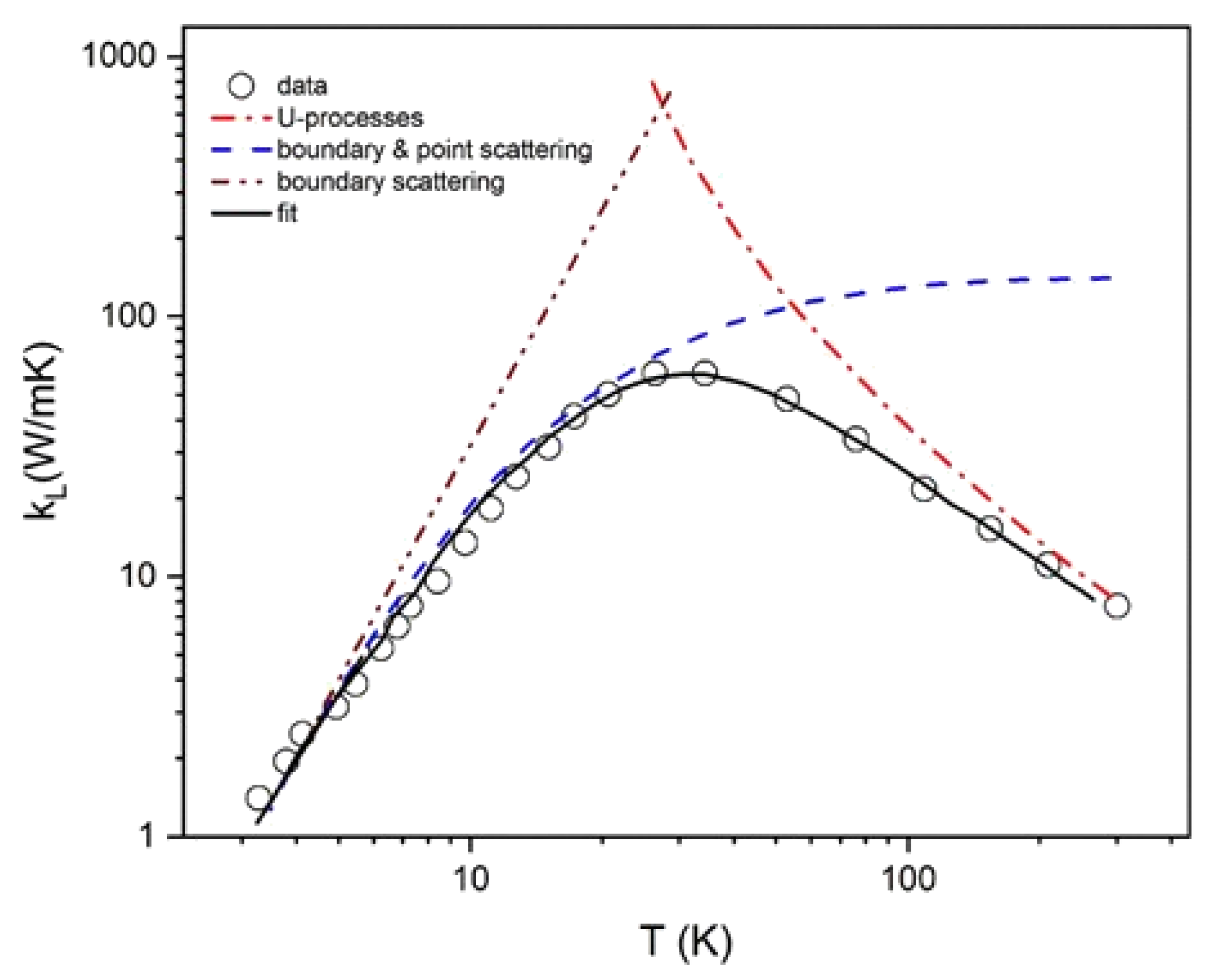
Considering the electronic contribution (ke) to thermal conductivity in solids, primarily metals, alloys, and semiconductors, can make a significant contribution. In these materials, electronic thermal conductivity, alongside phononic thermal conductivity, plays a role in the total thermal conductivity of the material which, for simplicity, we consider only pure metals here. The conduction electrons in metals are delocalized, which can be treated as an electron "gas" within the metal. Therefore, Equation (110) can also be applied here and expressed as in Equation (119):
Here, cve refers to electronic heat capacity per unit volume, Ʌe represents the particle mean free path between two collision events of electrons, τe describes the relaxation time of an electron, vF represents the Fermi velocity of the conducting electrons at the Fermi surface. The heat capacity cve of the electron gas is given by Equation (120) and (121) [155]:
and
With ne as the electron concentration, me as the electron mass, and ЄF as the Fermi energy. Inserting Equations (120) and (121) in Equation (119), it is obtained the electrical thermal conductivity of a solid, as expressed by Equations (122) and (123):
with the definition of the so-called Sommerfeld constant via Equation (124):
It is worth noting the difference in temperature dependency between the phonon heat capacity (cvp~T3) in Equation (111) and (112) and the heat capacity of the electron gas (cve~T). The ratio between them reflects their temperature behavior: cve/cvp~T-2. At very low temperatures, the electronic heat capacity is predominant, whereas at higher temperatures, the phonon heat capacity becomes more prominent. Since electrical conductivity, θelectrical, is defined as in Equation (125):
Here e is the elementary charge, equal to 1.602176634×10⁻¹⁹ C [156]. Combining Equations (122) and (125) results in Equation (126):
Equation (126) shows a proportionality relation between thermal and electronic conductivity, which is an essential relationship since the thermal conductivity can be indirectly determined by measuring its electronic conductivity. Such electronic conductivity measurement has to be carried out, of course, at very low temperatures where the electronic heat capacity is predominant, and all phonon modes are mostly "frozen", as discussed above. Equation (126) is the first approximation of the electronic thermal conductivity of a metal. Landau's Fermi theory of liquids gives a more realistic treatment of metals. In this theory, the overall electronic relaxation time, τe, is split into many processes, such as electron-electron scattering processes, and is given by Equation (127):
It is worth mentioning that this relaxation time is only valid for bulk metals. In the case of thin films or nanotubes, the proportionality with respect to temperature changes significantly. As a further significant interaction, the electron-impurity scattering can be considered, which has a relaxation time described by Equation (128):
Here, V is the volume of the metal, σe-i is the cross-section for the scattering of the impurity, and Ni is the concentration of the impurity in the metal. Lastly, the electrons can be scattered by phonons, and their relaxation time, at low temperatures, is given by Equation (129) [142]:
This is only valid at temperatures below the Debye temperature (T< θD). For higher temperatures, the expression for τe-p-1 becomes proportional to temperature (T) due to increased phonon density.
Other electronic scattering processes are not further relevant to this work. In conclusion, the overall relaxation time for the electronic thermal conductivity in metals can be summarized as follows in Equation (130):
Combining Equation (130) with Equation (118), it is possible to obtain the total relaxation time for a crystalline metal, as expressed in Equation (131):
Considering the phononic and electronic thermal conductivities, phonons are quasi-quantum particles of the solid lattice; hence, they are present in all solids, whereas electronic thermal conductivity is primarily present in metals, alloys, and semiconductors. However, to predict the thermal conductivity of a solid, a quantitative expression of thermal conductivity is desirable. Leibfried and Schlömann [157] derived such a quantitative description explicitly, focusing on the U-processes, which was further improved by Slack [158] by excluding the contribution of optical phonon branches to the group velocity of phonons, as shown in Equation (132):
Here, Aconst is a proportionality constant, Mav is the average atomic mass, δv is the average atomic volum, Natoms-cell is the number of atoms in the unit cell, and γGrü is the Grüneisen parameter. Debye temperature is also proportional to the group velocity (vp) according to Equation (133):
where Bbulk is the bulk modulus. Hence, the thermal conductivity is inversely proportional to Mav1/2 and proportional to Bbulk1/2. This formula is beneficial for predicting the phononic thermal conductivity of materials. It indicates that materials possessing high phononic thermal conductivity are made of light atoms, with a crystal structure containing one atom in the unit cell, strong interatomic (stiff) bonds, and a small Grüneisen parameter. Diamond, Ge, and Si, for instance, fulfill all these requisites, and indeed, they show extremely high thermal conductivity [159,160,161,162]. This phenomenological formula can be applied as a directive measure for the phononic thermal conductivity value of a material. However, it does not consider the details of the phonon band structure of the material [163].
When comparing the thermal conductivity of metals with their corresponding alloys, it can be stated that, in general, the thermal conductivity of metals is higher than that of their corresponding alloys. This is due to their simple crystal structure, as most of them are solidified in FCC or BCC lattice structures, except for a few (Mg, Ti), which have a HCP lattice structure, which allows a uniform propagation of phonons across the metal lattice. Moreover, the contribution of the electronic heat conductivity of metals is higher, as well, in comparison to their corresponding alloys. This is due to their delocalized conducting band electrons, which facilitate heat transfer in metals. Alloys, in contrast, are mixtures of two or more elements exhibiting more complex crystal structures with more than one atom in the unit cell. Furthermore, the introduction of different atoms in the metal lattice can create significantly higher defects (vacancies, dislocations, stacking faults, precipitates, etc.), varying the electron density, and phase variation within the crystal lattice. All these imperfections provide significantly higher scattering sites for phonons and electrons in alloys relative to metals [164]. Similarly, introducing hydrogen into a metal lattice can create a more complex crystal structure with more than one atom in the unit cell. It also introduces more imperfections through embrittlement, blister formation, flacking, and dislocations, among other imperfections [165], which again provide additional scattering sites for phonons and electrons. Therefore, in general, it can be stated that metals are better thermal conductors in comparison to their corresponding alloys and their counterparts in the hydride state. Furthermore, in intermediate stages, two phases (hydride/dehydrided) with very different heat conduction mechanisms can be present within one particle of the hydride bed. While the fraction of each phase can be correlated with the phase transformation kinetics and resembled by respective models, the distribution of phases within the microstructure of a particle is challenging to account for, but may have a significant influence on the apparent thermal conductivity of the solid phase. E.g. upon hydriding, nuclei of the hydride phase may form as islands in an otherwise continuous metallic alloy, or a continuous hydride phase develops all along the crystallite boundaries, where hydrogen diffusion is fastest, then growing into the crystallites from there. In the first case, heat conductivity will be governed by the metallic phase, in the latter it will be controlled by the hydride phase. Similar applies for the desorption case. Depending on the kinetic rate-limiting step, the appropriate phase transformation model may be applied to approximate the heat conductivity in intermediate stages as a function of the transformed fraction a.
4. Effect of the Pressure, Temperature, and Composition on the ETC
This section analyses how the effective thermal conductivity of a metal hydride bed varies with the main hydride’s operation variables, which are pressure (P), hydrogen concentration (X), and temperature (T), for the models described in Section 3.1. Moreover, the experimental results obtained in some papers [63,100,166] are analyzed and compared with the presented models [42,43,44,45,46,47,49,50,91,92,95,96,97,102]. Furthermore, the dependence of the ETC on the hydride composition is not contemplated in models developed for materials other than hydrides. Models developed for MHs are, in particular, Sun and Deng model (Section 3.1.6) [46,47], extended Zehner-Bauer-Schlünder model (Section 3.1.7) [95], improved area contact model (Section 3.1.11) [50], and Abdin-Webb-Gray model (Section 3.1.12) [102].
As ks, kg, and ε are standard parameters for all the models, some brief considerations are needed. Even if keff is not directly dependent on P, T, or X in several cases, these dependences appear in ks, kg, and ε. In a metal hydride system, it can be stated that there is no dependence of ks on P, as well as of kg on X. Porosity mainly depends on X, even if a weak dependence on P and T is present, due to particle compaction and thermal expansion, but these parameters are usually not included in the models for ε. Similarly, the hydrogen mean free path is another parameter appearing in several models. When not differently indicated, it is calculated through the well-known relation described in Equation (134) [167]:
In this equation, the kinetic diameter, dkin, appears. In addition, a dependence on P and T is expressed, which is introduced in the keff models where this expression for l is included. In the following analysis, these assumptions are made:
- the ks, kg, ε, and l expressions given by the authors of every keff model are used;
- if the authors did not include any model for ks, a constant value is used for this parameter;
- if no information or model for kg is given, as it can be considered readily available and generally acceptable, it is calculated through data from RefProp v.10.0 (which is available from the free Mini-RefProp v.10.0 too) [168], where a dependence on P and T is present;
- if the authors did not include any model for ε, a constant value is used for this parameter;
- if no information on l is given, it is calculated through Equation (134);
- to analyze the influence of the composition on keff in the improved area-contact model, X, through R, is treated as a variable and not as a parameter.
The comparison was made using the parameters referring to the LaNi5 alloy, as most of the solid material parameters appearing in the models for this alloy are available in the literature (Error! Reference source not found.). The remaining unknown parameters were evaluated by fitting the models’ equations to the experimental data from Yoshida et al. [166] using the Curve Fitter tool from Matlab. These data were chosen because experimental data of keff vs. P, T, or X for LaNi5 were needed for fitting, and while some examples are available for keff vs. P or X, there are no experimental keff vs. T graphs reported in the literature for LaNi5, to the best of our knowledge. In addition, experimental conditions used to get these data are comparable to those at which material parameters are available in the literature. However, measurements of keff vs. P, T or X for other materials have been reported, such as MmNix-yAly [63], HWT 5800 (Ti0.98Zr0.02V0.43Fe0.09Cr0.05Mn1.5) and LaNix-yAly [48,100].

Table 1.
Standard parameters for models’ comparison based on LaNi5.
| Parameter | Value |
| ε | 0.52 |
| μg | 8.8·10-6 Pa·s |
| cp,g | 14300 J kg-1·K-1 |
| γ | 1.4 |
| ks | 8 W m1·K-1 |
| d | 15·10-6 m |
| dkin | 289·10-12 m |
| lv | 0.034·d |
| e | 0.5 |
| Xmax | 1.45 wt % |
| E | 155·109 Pa |
The dependence on P, T, and X are analyzed from 0.001 to 100 bar, from – 20 to 100 ºC, and from 0 to 1.45 wt%, respectively.
In the following, the graphs of the simulated curves are reported. To express the dependence of keff on one variable, the other two were fixed: the fixed values for P, T, and X are 10 bar, 20 ºC, and 1.0 wt%, respectively. The Abdin-Webb-Gray model (Section 3.1.11) [102] is not present because, using the standard parameters listed in Error! Reference source not found., the argument of the erfc-1 function, present in the expressions to evaluate the parameters a2 and a3, assumes values out of the domain for this function (that is, 0-2). This makes it impossible to evaluate these parameters, so keff. The simplified Hayashi [43] and the simplified Sun and Deng [46,47] models are not reported either, as the results are almost identical to those of the correspondent base models in the analyzed ranges (as it was said, the contribution of radiation is relevant only at high temperatures).
To get a more straightforward and contracted way to refer to every model, the following abbreviations obtained by the initials of the authors’ name or the acronym of the models’ name are used:
- 3.1.1 Maxwell model [42]: M
- 3.1.2 Yagi and Kunii model [92]: YK
- 3.1.3 Zehner-Schlünder model [44]: ZS
- 3.1.5 Hayashi model [43]: H
- 3.1.7 Extended Zehner-Bauer-Schlünder model [95]: EZBS
- 3.1.8 Area-contact model [45]: AC
- 3.1.9 Phase-symmetry model [45]: PS
- 3.1.10 Raghavan-Martin model [49]: RM
- 3.1.11 Improved area-contact model [50]: IAC
- 3.1.12 Abdin-Webb-Gray [102]: AWG
- 3.1.13 Heat transfer concentrating model [91]: HTC
4.1 Effect of the Pressure on the ETC
The experimental outcomes from LaNi5 obtained from [166] and other hydride-forming alloys such as MmNix-yAly [63], HWT 5800 (Ti0.98Zr0.02V0.43Fe0.09Cr0.05Mn1.5), and LaNix-yAly [48,100] have shown S-shape curves. The gas pressure causes a marked effect on the ETC, mainly at intermediate pressures. At extremely low pressures, lower than 10-4 bar, the Kn number ≥ 10 (Kn= mean free path (l) over characteristic length (Ʌ): Kn= l/Ʌ), the ETC is independent of pressure, molecules fly without collisions throughout the pores, the heat is transported by heat conduction in the particle bed, and the effect of radiation is neglectable. Between 10-3 and 10 bar, i.e., 0.01 < Kn < 10, the collisions between molecules increase with pressure, and the exchange of energy among the particles is dependent on the filling gas and proportional to the number of gas molecules. Hence, the ETC becomes pressure-dependent. At higher pressures, over 10 bar and 0.01 ≥ Kn, the pores are saturated with gas, and the gas phase can be considered a continuum, with the ETC independent of the pressure [100].
Figure 22.
Effective thermal conductivity variation with pressure for LaNi5 at 20°C and 1 wt%: models’ comparison. Experimental data from [166] are also reported.
Figure 22.
Effective thermal conductivity variation with pressure for LaNi5 at 20°C and 1 wt%: models’ comparison. Experimental data from [166] are also reported.
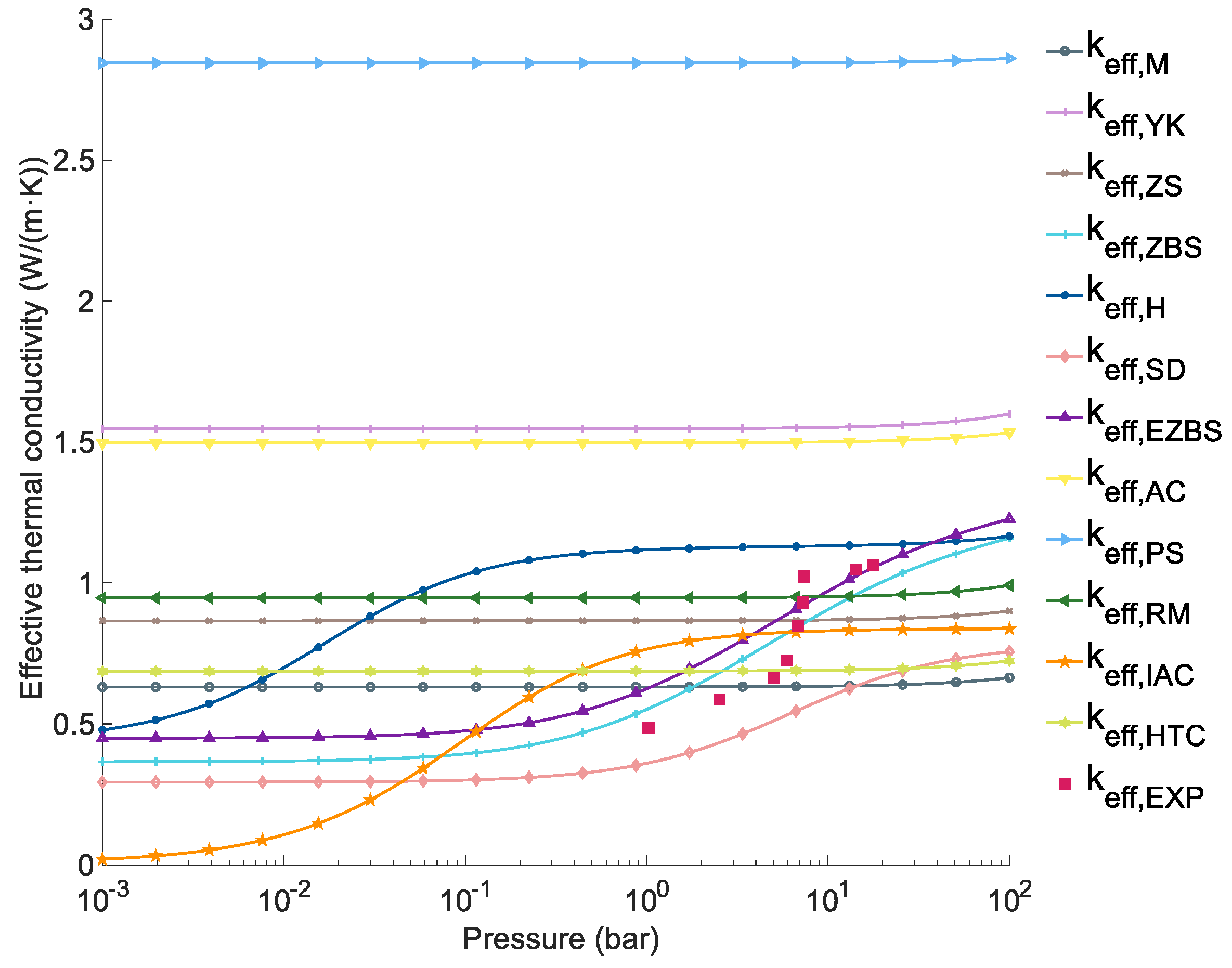
Figure 22 compares the dependence of ETC on P calculated by applying the models and the experimental data for LaNi5 obtained from [166]. Reporting this graph using a logarithmic scale for the pressure axis improves visual clarity. It can be seen that only a few models show the typical S-shaped curve, which are the ZBS (Section 3.1.4), H (Section 3.1.5), SD (Section 3.1.6), EZBS (Section 3.1.7), and IAC (Section 3.1.11). Those models showing S-shape curves include the effect of the gas in the biphasic region and the hollow region, as shown in Figure 12. The other models do not consider such features. Thus, it is possible to note that the other models give almost constant values of ETC with P, slightly increasing at high pressures. PS model (Section 3.1.9) shows values for keff around 2.8 W m-1 K-1, which is much higher than all the other models, while YK (Section 3.1.2) and AC (Section 3.1.8) are around 1.5 W m-1 K-1, barely higher than the other models.
4.2 Effect of the Concentration on the ETC
The experimental evidence with hydride-forming materials such as MmNix-yAly [63], HWT 5800 (Ti0.98Zr0.02V0.43Fe0.09Cr0.05Mn1.5), LaNix-yAly [48,100] and LaNi5 [166] have shown a steep increase of the ETC (in the solid solution region), followed by slight increases as the amount of hydride phase is considerable. This experimental behavior of the ETC has been attributed to the changes from the free hydrogen molecule flow (high Kn numbers) to the pressure dependent flow (transition regimen: 0.01 < Kn < 10) with minor changes in the concentration (solid-solution). Then, as the concentration increases, a region of continuous gas (continuous regimen: 0.01 ≥ Kn) independent of the pressure is formed, and the ETC slightly increases or remains practically constant. It is also important to mention that there are further effects, such as the gas-solid reaction, which overlaps with the pressure effect [100].
In Figure 23, the dependence of ETC on the composition is compared. Only three models are reported since they express a dependence on X: the SD model (Section 3.1.6), the EZBS model (Section 3.1.7), and the IAC model (Section 3.1.11). In addition, the experimental data for LaNi5 obtained from [166] are also reported. The variation is almost linear for the three models, but while it increases for SD and IAC, it decreases for EZBS As seen from the experimental results [48,63,100,166], the pressure always increases as the concentration rises, and therefore, there is a marked effect of the pressure. In the case of the calculation with the SD, IAC, and EZBS models, the pressure remains constant, which might be the reason why it is not possible to see the steepness at low values of X. However, with the increase of X in the case of the SD and IAC models, the ETC continuously increases. Meanwhile, for the EZBS model, the ETC decreases following an opposite trend. The main differences between the SD and IAC models and the EZBS model is the treatment of the contact area between particles and the model for ks. The EZBS model might simplify treatment of the contact area, and use an equation for the calculation of the solid thermal conductivity with a decreasing trend with X (ks is increasing with X for the SD model and constant for the IAC model).
Figure 23.
Effective thermal conductivity variation with composition for LaNi5 at 10 bar and 20°C: models’ comparison. Experimental data from [166] are also reported.
Figure 23.
Effective thermal conductivity variation with composition for LaNi5 at 10 bar and 20°C: models’ comparison. Experimental data from [166] are also reported.
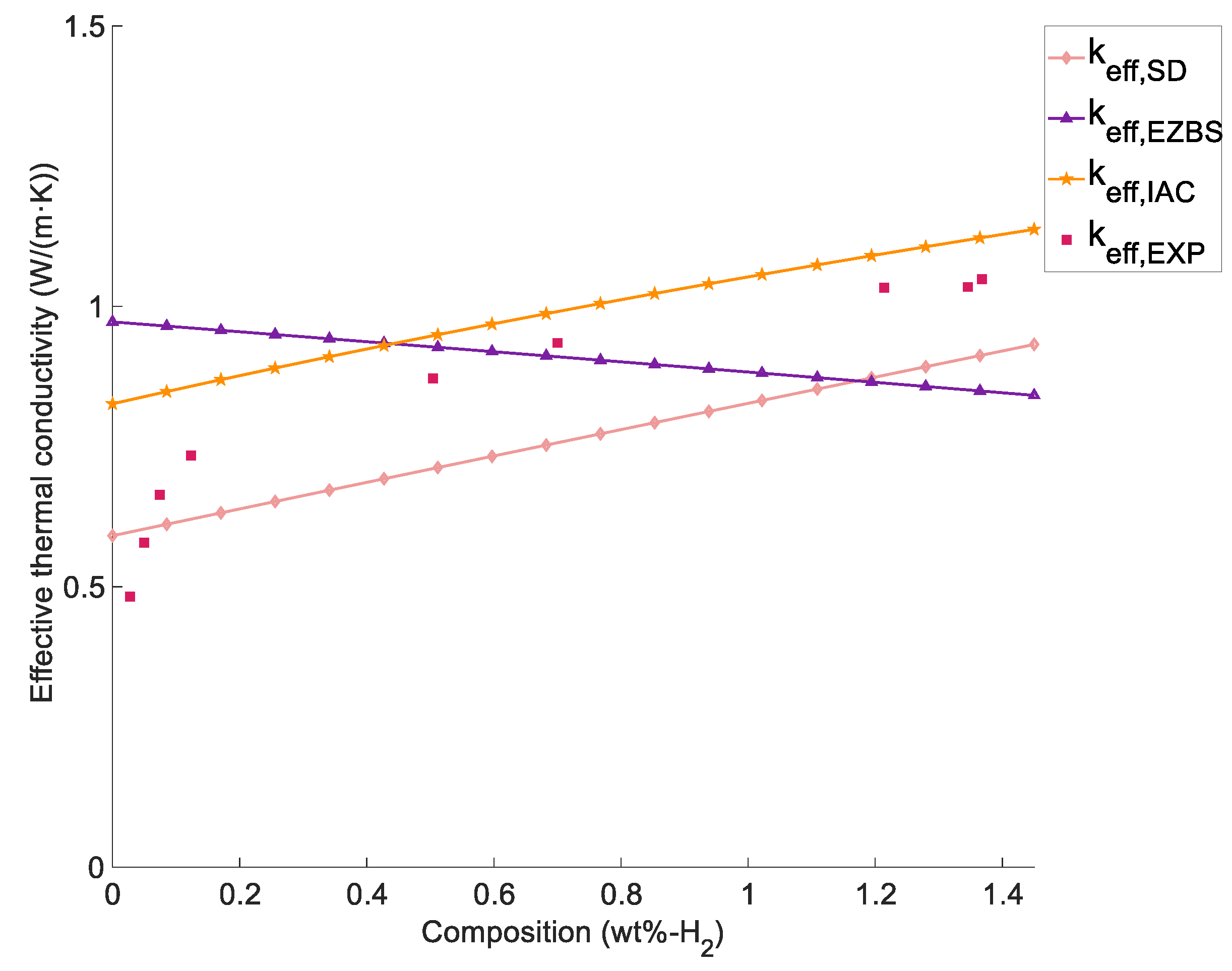
4.3 Effect of the Temperature on the ETC
To the best of our knowledge, there is no experimental data on the dependence of ETC on the temperature for LaNi5. However, an experimental example of the dependence of the ETC on the temperature was presented in ref. [63] for MmNi4.5Al0.5. The authors claimed that it is difficult to maintain constant pressure and concentration as the temperature changes. Hence, the effect of the pressure and composition can not be decoupled completely at the time to measure the dependence of the ETC on the temperature. For MmNi4.5Al0.5 with a porosity of 0.43, it was observed that, at low pressures, the effect of temperature is negligible, and concentration also remains constant (the radiation effects are negligible). As explained in Section 4.1, this effect can be related to the molecules flying without collisions throughout the pores (high Kn numbers). Over a certain pressure (in the ref. [63]: 0.015 bar), as the temperature increases, the concentration slightly decreases, causing decreases in the ETC. It is not possible to speculate about this behavior since it is in the transition range defined by the values of the Kn number (0.01 < Kn < 10), and, according to the effect of the concentration on ETC, the ETC should show a slight increasing trend. It was concluded that the effect of the temperature on ETC is minimal, increasing slightly as the temperature rises [63].
Figure 24 reports the dependence of ETC on T for the models. The variation of the effective thermal conductivity is almost linear and increasing for all the models, as expected from the experimental outcomes. Nonetheless, SD (Section 3.1.6) and IAC (Section 3.1.11) are slightly decreasing. Regarding the values, similar to the comparison on the pressure dependence, the PS (Section 3.1.9) curve assumes higher values than all the others, while the YK (Section 3.1.2) and AC (Section 3.1.8) curves are just higher than the others. The calculations were done at 10 bar, which is the lower limit of the continuous gas phases where the ETC does not depend on the pressure (0.01 ≥ Kn). The concentration used for the calculations was set at 1.0 wt%, which is relatively high, at which the ETC remains also constant. It is possible to propose that the slight increase in the ETC with T for all the models, except SD (Section 3.1.6) and IAC (Section 3.1.11) models, is directly related to the increase of the kg of hydrogen [168]. In the case of the SD (Section 3.1.6) and IAC (Section 3.1.11), instead, an equation for the thermal conductivity of hydrogen showing a decreasing trend with temperature was used, leading to an ETC which decreases with temperature.
Figure 24.
Effective thermal conductivity variation with temperature for LaNi5 at 10 bar and 1.0 wt%: models’ comparison.
Figure 24.
Effective thermal conductivity variation with temperature for LaNi5 at 10 bar and 1.0 wt%: models’ comparison.
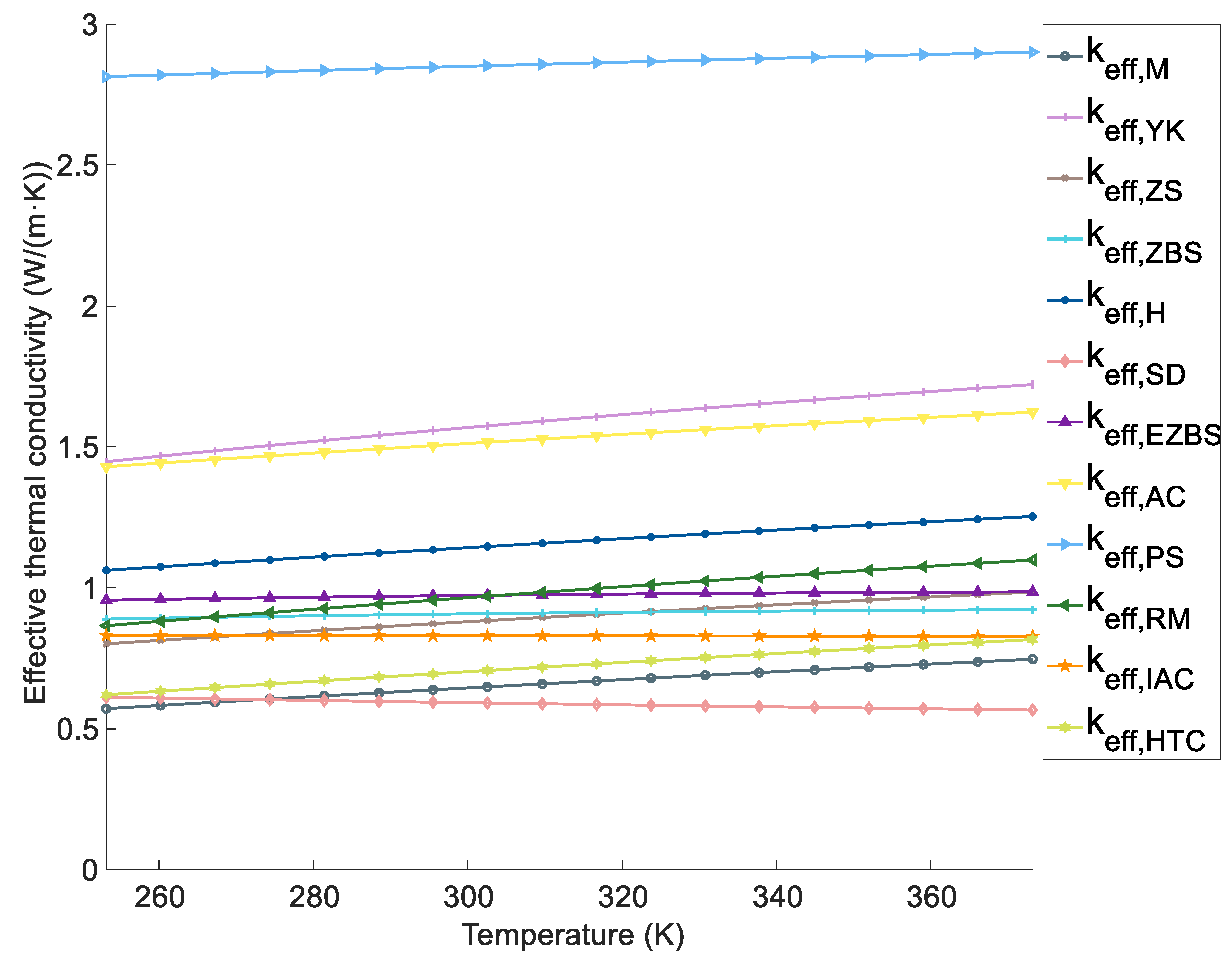
5. Summary and Conclusions
This work provides a comprehensive overview of the most important methods to measure the ETC, thirteen models for the calculation of the ETC employed for MHBs in chronological order of publication, and the effect of the hydride formation on solid thermal conductivity. The main equations, needed data, and parameters for each model are analyzed, and their advantages and disadvantages are investigated. Moreover, the models were applied to a test hydride-forming alloy, LaNi5, and the dependence of the ETC on the temperature, pressure, and concentration of hydrogen was evaluated.
The experimental methods used to measure the thermal conductivity have been classified as steady-state and transient methods. In the case of the steady-state methods, the axial and radial methods need longer measurement times since temperature equilibrium conditions should be reached. To the best of our knowledge, steady-state methods are carried out using in-house developed devices. The setup design constrains the experimental temperature range, hydrogen pressure, and sample amount among the most relevant parameters.
The transient methods, on the contrary, are commercially available: transient line source (TLS), transient plane source (TPS), modified transient plane source (MTPS), and the eponymous hot-wire. Laser flash and transient plane methods are the most frequently used ones. The TPS method shows a better accuracy than the other ones, though the determination of the ETC at elevated temperatures and pressures and its applicability to the industry remain a challenge [41].
The development of models to calculate the ETC of hydride compounds has been a matter of extensive research and has been in constant development. Figure S1 shows the temporal evolution of the models and their main features. Moreover, in the ESI, Table S1 provides a summary of the models with the central equation, brief description, parameters, and advantages and disadvantages, and Table S2 shows experimental and model-calculated ETC values and parameters for different hydride forming and non-forming materials under different atmospheres, temperature and pressure conditions. Figure S1 shows a model classification into those for regular spherical particles (gas-film modification models), those for regular spherical and non-spherical particles (particle modification models), and the models developed for MHBs, which involve gas-film and particle modification models. As also seen, there are common parameters for all the models: kg, ks, and ε, specific parameters for the gas film modification models: e, γ, l, and d, and specific parameters for the particle modification models: B, C, α which are related to the form and contacting of the particles. The models developed for MHBs need additional parameters, such as V, ϕp, Peq, RP Xmax, E’ (AWG [102]), and σR (AWG [102]). The parameters used in the gas film modification models are also utilized in the particle modification models and the MHBs models. Therefore, the number of parameters needed, especially for MHBs, notably increases, thus also increasing the complexity. Table S1 exhibits a clear differentiation between the parameters that can be measured or acquired from the literature and those that are hard to measure or used as fitting parameters of the models. In most models, intrinsic parameters related to the changes of the material upon hydrogenation/dehydrogenation, such as void volumes, the form and contact of the particles, and mechanical properties, are usually employed as fitting parameters since it is challenging to quantify them. In Table S2, it is observed that in several cases, such intrinsic parameters are not even reported. From the presented and employed models for the calculation of the ETC, there are just four models developed for MHBs: SD/SSD (Section 3.1.6), EZBS (Section 3.1.7), IAC (Section 3.1.11) and AWG (Section 3.1.12) [45,46,47,50,95,102]. The SD/SSD was developed as a gas-film model, while the EZBS, IAC, and AWG were created as particle modification models. Comparing the ETC experimental results and calculated with the ETC model, some models such as the M [42], YK [92], ZBS [95,96,97], H [43], AC [45], PS [45], RM [49] and HTC [91] present deviations from 2 % to 80 %. The model with the best agreement, RM, was evaluated in a quite narrow range of ETC so it might contribute to the slight deviation of less than 2 %. In the case of the models developed for MHBs, the deviation between the experimental and model values of ETC stays between 5 % and 15 %. The gas-film SD model and particle modification EZBS and IAC models include the change in the concentration of hydrogen. However, the AWG model does not. The SD, EZBS, and IAC models reproduce the dependence of ETC well on pressure (S-shape curve), temperature (slight increase), and concentration (increase/decrease). From the analyzed models, the EZBS model is considered the most suitable one to calculate the ETC, considering the complexity of the hydrogenation/dehydrogenation processes since it considers different gas regions (far from the particles and near the surface of the particles), change of hydrogen concentration, morphological and mechanical properties.
Supplementary Materials
The following supporting information can be downloaded at Preprints.org, Table S1. Summary of the models with the central equation, brief description, parameters and advantages and disadvantages. Table S2. Experimental and model-calculated ETC values and parameters for different hydride forming and non-forming materials under different atmospheres, temperature and pressure conditions.
Author Contributions
Conceptualization, J. Puszkiel; methodology, G. Scarpati, J, Puszkiel, J. Warfsmann, F. Karimi; formal analysis, G. Scarpati, J, Puszkiel, J. Warfsmann, F. Karimi; investigation, G. Scarpati, J, Puszkiel, J. Warfsmann, F. Karimi; resources, J. Jepsen, T. Klassen, J. Puszkiel; data curation, G. Scarpati, J, Puszkiel, J. Warfsmann, F. Karimi; writing— original draft preparation, G. Scarpati, J, Puszkiel, J. Warfsmann, F. Karimi; writing— review and editing, G. Scarpati, J, Puszkiel, J. Warfsmann, F. Karimi, J. Jepsen, T. Klassen, C. Pistidda; supervision, J. Puszkiel; project administration, J. Jepsen and J. Puszkiel; funding acquisition, J. Jepsen, T. Klassen, C. Pistidda. All authors have read and agreed to the published version of the manuscript."
Funding
The authors would like to thank Bundesministerium für Wirtschaft und Klimaschutz (Förderkennzeichen: 03El3020A) and dtec.bw—Digitalization and Technology Research Center of the Bundeswehr for their support. dtec.bw is funded by the European Union—NextGenerationEU.
Data Availability Statement
Data will be made available on request.
Acknowledgments
Authors: The authors gratefully acknowledge the funding by Bundesministerium für Wirtschaft und Klimaschutz in the frame of the „HyReflexS“ project (Funding code: 03El3020A). This research work is also in the frame of the project Digi-HyPro, funded by dtec.bw – Digitalization and Technology Research Center of the Bundeswehr, which the authors gratefully acknowledge. dtec.bw is funded by the European Union – NextGenerationEU.
Conflicts of Interest
The authors declare no conflict of interest. The funders had no role in the design of the study, in the collection, analyses, or interpretation of data, in the writing of the manuscript, or in the decision to publish the results.
List of Abbreviations
| ABS | Absorption |
| Abs. | Hydrogenation |
| DES | Desorption |
| Des. | Dehydrogenation |
| ETC | Effective thermal conductivity |
| GHG | Greenhouse gas |
| HTC | Heat transfer concentration model |
| LFM | Laser-flash method |
| LGHV | Low gravimetric heating value |
| LVHV | Low volumetric heating value of hydrogen |
| MFP | Mean free path |
| MHB | Metal Hydride Bed |
| MHs | Metal hydrides |
| MTPS | Modified transient plane source |
| PCIs | Pressure-Composition-Isotherms |
| RT | Room temperature |
| TLS | Transient line source |
| TPS | Transient plane source |
List of Symbols
| a | Accommodation coefficient |
| A | Cross-Sectional Area |
| A0 | Fitting parameter |
| Aconst | Proportionality constant |
| a1 | Operator to compact equations |
| A1 | Fitting parameter |
| a2 | Operator to compact equations |
| a3 | Operator to compact equations |
| Asf | Solid-fluid interface |
| b | Accommodation coefficient |
| B | Shape factor |
| Bbulk | Bulk modulus |
| B0 | Initial shape factor |
| b1 | Operator to compact equations |
| b2 | Operator to compact equations |
| Ba | Shape factor after the expansion |
| bg | Constant depending on the gas |
| C | Form factor |
| c1 | Operator to compact equations |
| C1 | Vickers microhardness coefficient 1 |
| c2 | Operator to compact equations |
| C2 | Vickers microhardness coefficient 2 |
| cp | Heat capacity at constant pressure |
| cv | Heat capacity at constant volume |
| cve | Volume-specific heat capacity of the electron gas |
| cvp | Volume-specific heat capacity of the phonon gas |
| d | Particle diameter |
| dkin | Kinetic diameter of hydrogen |
| D | Size of the boundary of the solid |
| d0 | Initial particle diameter |
| dc | Contact area diameter |
| de | Equivalent diameter for the void space |
| dv | Mean indentation diagonal depth |
| e | Elementary charge |
| e | Emissivity factor of the solid surface |
| E | Young's modulus |
| E' | Effective Young's modulus |
| F | Force between two particles |
| F0 | Force between two particles for constant area during expansion |
| fF | Force factor |
| Fn | Normal contact force |
| fve | Maximum expansion factor of the particles |
| FX | Force for the expansion of a fully restrained particle |
| G | Effective gas coefficient |
| G | Reciprocal lattice vector |
| h | Dimensionless height |
| Hc | Contact microhardness |
| hMaxwell | Value of h taking to the Maxwell result |
| hrs | Radiative heat transfer coefficients for solid-to-solid |
| hrv | Radiative heat transfer coefficients for void-to-void |
| hsc | Height of the spherical cap |
| hsh | Height of the sample holder |
| H | Hydrogen Atom |
| Hv | Vickers microhardness |
| k | Thermal conductivity |
| kB | Boltzmann constant |
| kbp | Thermal conductivity of the biphasic region in the model 3.1.4 |
| k’ | Thermal conductivity of the biphasic region in the model 3.1.7 |
| ke | Heat conduction in solids owing to electrons |
| ke0 | Effective thermal conductivity at zero pressure |
| keff | Effective thermal conductivity |
| kg | Gas (hydrogen) thermal conductivity |
| kg,Eucken | Gas (hydrogen) thermal conductivity with the Eucken Equation |
| kg,ref | Gas (hydrogen) thermal conductivity at reference pressure |
| kg1 | Gas (hydrogen) thermal conductivity in the gas domain |
| kg2 | Gas (hydrogen) thermal conductivity in the biphasic domain |
| ki | Heat conduction channels i |
| kp | Heat conduction in solids owing to phonons |
| Kn | Knudsen number |
| Kn* | Modified Knudsen number |
| ks | Solid phase (bulk) thermal conductivity |
| ks* | Solid phase thermal conductivity for the metal/alloy to hydride transition |
| kref | Thermal Conductivity of Reference Materials |
| L | Thickness |
| l | Mean free path |
| lp | Effective length between the centers of two adjacent particles |
| ls | Effective length of the solid particles relating to the heat conduction |
| lv | Effective thickness of fluid film adjacent to the contact surface of two solid particles |
| m | Exponential fitting parameter |
| me | Electron mass |
| M | Gas parameter |
| Mav | Average atomic mass |
| Me | Metal |
| MHs | Metal hydrides |
| MexHy | Metal Hydride Compound |
| MW | Molecular weight |
| MWH2 | Molecular weight of molecular hydrogen |
| N | Particle coordination number |
| NA | Avogadro constant |
| Natoms | Number of atoms in the sample |
| Natoms-cell | Number of atoms in the unit cell |
| Ni | Concentration of the impurity in the metal |
| Nur | Nusselt number |
| Nur* | Modified Nusselt number |
| nd | Defects concentration |
| ne | Electrons concentration |
| np | Phonons concentration |
| P | Pressure |
| P0 | Hydrogen mean free path reference pressure |
| Peq | Equilibrium pressure |
| Pload,max | Maximum contact load pressure |
| Pr | Prandtl number |
| q | Heat flow |
| Q | Operator to compact equations |
| Q | Heat flux perpendicular to an area in the solid |
| R | Reacted fraction |
| rn | Radial position of the thermocouple, with n= 1, 2, 3, …, n. |
| r | Particle radius |
| r0 | Initial particle radius |
| rc | Contact area radius |
| Rc | Thermal contact resistance |
| rc,0 | Initial contact area radius |
| Rg | Micro-gap thermal resistance |
| RG | Macro-gap thermal resistance |
| Rgas | Gas constant |
| RL | Macro-contact thermal resistance |
| Rmax | Maximum reacted fraction |
| RP | Reacted fraction at the beginning of the plateau |
| Rs | Micro-contact thermal resistance |
| T | Temperature |
| Teq | Equlibrium temperature |
| ∇T | Temperature gradient |
| tn | Times, n= 1 (initial) and 2 (final) |
| t0.5 | Time after reaching 50 % of the total temperature increase |
| V | Volume of the metal |
| V0 | Minimum MH bed volume |
| V1 | Maximum MH bed volume |
| V2 | MH bed volume at the end of the cycle |
| vF | Fermi velocity of the conducting electrons at the Fermi surface |
| Vgas,all | Total gas volume in the characteristic cubic unit |
| Vgas,cylinder | Gas volume of the cylinder region |
| Vgas,eff | Effective gas film region |
| vp | Average group velocity of the phonons |
| vs | Speed of sound inside the solid |
| Vs,0 | Initial volume of the solid particle |
| wt% | Weight percentage |
| x | Distance |
| X | Hydrogen to metal concentration (wt%) |
| Xat | Hydrogen to metal atomic ratio |
| Xeq | Equilibrium hydrogen concentration |
| Xmax | Maximum hydrogen to metal concentration |
| Y | Operator to compact equations |
| Z | Operator accounting for geometric distortions |
| Zn | Position of the thermocouple |
List of Greek Symbols
| α | Deformed factor |
| α0 | Initial deformed factor |
| αa | Deformed factor after the expansion |
| αd | Thermal diffusivity |
| αss | Metal solid solution phase |
| αT1 | Thermal accommodation coefficient 1 |
| αT2 | Thermal accommodation coefficient 2 |
| β | Operator to compact equations |
| β' | Factor of the angle between actual and parallel heat flow directions |
| βMH | Metal hydride phase |
| ЄF | Fermi energy |
| Γ | Specific heat ratio |
| γGrü | Grüneisen parameter |
| γSommerfeld | Sommerfeld constant |
| δ | Fractional area associated with the conductive heat transfer through particles |
| δv | Average atomic volume |
| ΔHr | Reaction Enthalpy |
| ΔM | Difference in mass between the two isotopes |
| ΔSr | Reaction Entropy |
| ΔV | Volume variation per hydrogen atom |
| ΔVs | Relative expansion of the solid particle |
| ε | Porosity |
| ε0 | Initial porosity |
| η2 | Heat transferred ratio – "cylinder region": "characteristic cubic unit" |
| η3 | Gas volume ratio – Vgas,eff:Vgas,all |
| θ0 | Contact angle between solid particles at zero pressure |
| θ | Contact angle between solid particles |
| θD | Debye temperature |
| Κ | Wave-vector of the phonons |
| μ | Dynamic viscosity |
| ν | Poisson's ratio |
| ρ | Density |
| ρg | Gas density |
| ρs | Solid material density |
| σ | Stefan-Boltzmann constant |
| σelectrical | Electrical conductivity |
| σe-i | Cross-section for the scattering of the impurity |
| σd | Scattering cross-section for phonons |
| σR | Surface roughness |
| τ | Angle from the centre of the spherical particle to the annular cylinder |
| τe | Relaxation time of an electron |
| τe-e | Relaxation time of the electron-electron scattering processes |
| τe-i | Relaxation time of the electron-impurity scattering |
| τe-p | Relaxation time of electrons scattered by phonons at low temperatures |
| τp | Relaxation time of a phonon |
| τU | Relaxation time for the U-process |
| τp-B | Relaxation time for the phonon-boundary scattering |
| τp-d | Relaxation times for the lattice imperfections of crystals |
| τp-is | Relaxation time for the phonons mean free path |
| τp | Relaxation times of all phononic scattering processes |
| ΔT | Temperature difference |
| ϕ | Flattening factor |
| ϕ* | Dimensionless length |
| ϕ1* | Support parameter for the dimensionless length |
| ϕ2* | Support parameter for the dimensionless length |
| ϕabs | Expansion ratio |
| ϕdes | Contraction ratio |
| ϕp | Particle expansion ratio |
| ϕs | Metal hydride bed expansion ratio |
| ω | Angle of the cylinder region |
| ωf | Angular frequency of the phonons |
| ∇ | Nabla, vector differential operator |
| Ʌ | Characteristic length |
| Λp | Particle mean free path between two collision events for phonons |
| Λe | Particle mean free path between two collision events of electrons |
References
- Allen, M.R., O.P. Dube, W. Solecki, F. Aragón-Durand, W. Cramer, S. Humphreys, M. Kainuma, J. Kala, N. Mahowald, Y. Mulugetta, R. Perez, M. Wairiu, and K. Zickfeld, 2018: Framing and Context Supplementary Material. In: Global Warming of 1.5°C. An IPCC Special Report on the impacts of global warming of 1.5°C above pre-industrial levels and related global greenhouse gas emission pathways, in the context of strengthening the global response to the threat of climate change, sustainable development, and efforts to eradicate poverty [Masson-Delmotte, V., P. Zhai, H.-O. Pörtner, D. Roberts, J. Skea, P.R. Shukla, A. Pirani, W. Moufouma-Okia, C. Péan, R. Pidcock, S. Connors, J.B.R. Matthews, Y. Chen, X. Zhou, M.I. Gomis, E. Lonnoy, T. Maycock, M. Tignor, and T. Waterfield (eds.)]. Available from https://www.ipcc.ch/sr15.
- Lambert, M.; Hawkes, A.; Patonia, A.; Poudineh, R.; Moore, B.; Isaac, T.; Lewis, T.; Schöffel, M.; Barnes, A.; Heather, P.; et al. The Role of Hydrogen in the Energy Transition. The Oxford Institute for Energy Studies 2021.
- Dawood, F.; Anda, M.; Shafiullah, G.M. Hydrogen Production for Energy: An Overview. Int J Hydrogen Energy 2020, 45, 3847–3869. [CrossRef]
- Xu, Z.; Zhao, N.; Hillmansen, S.; Roberts, C.; Yan, Y. Techno-Economic Analysis of Hydrogen Storage Technologies for Railway Engineering: A Review. Energies (Basel) 2022, 15, 6467. [CrossRef]
- Yanxing, Z.; Maoqiong, G.; Yuan, Z.; Xueqiang, D.; Jun, S. Thermodynamics Analysis of Hydrogen Storage Based on Compressed Gaseous Hydrogen, Liquid Hydrogen and Cryo-Compressed Hydrogen. Int J Hydrogen Energy 2019, 44, 16833–16840. [CrossRef]
- Zheng, J.; Liu, X.; Xu, P.; Liu, P.; Zhao, Y.; Yang, J. Development of High Pressure Gaseous Hydrogen Storage Technologies. Int J Hydrogen Energy 2012, 37, 1048–1057. [CrossRef]
- Ahluwalia, R.K.; Peng, J.-K.; Hua, T.Q. Cryo-Compressed Hydrogen Storage. In Compendium of Hydrogen Energy; Elsevier, 2016; pp. 119–145.
- Aziz, M. Liquid Hydrogen: A Review on Liquefaction, Storage, Transportation, and Safety. Energies (Basel) 2021, 14. [CrossRef]
- Aceves, S.M.; Petitpas, G.; Espinosa-Loza, F.; Matthews, M.J.; Ledesma-Orozco, E. Safe, Long Range, Inexpensive and Rapidly Refuelable Hydrogen Vehicles with Cryogenic Pressure Vessels. Int J Hydrogen Energy 2013, 38, 2480–2489. [CrossRef]
- Clematis, D.; Bellotti, D.; Rivarolo, M.; Magistri, L.; Barbucci, A. Hydrogen Carriers: Scientific Limits and Challenges for the Supply Chain, and Key Factors for Techno-Economic Analysis. Energies (Basel) 2023, 16, 6035. [CrossRef]
- Cetinkaya, S.A.; Disli, T.; Soyturk, G.; Kizilkan, O.; Colpan, C.O. A Review on Thermal Coupling of Metal Hydride Storage Tanks with Fuel Cells and Electrolyzers. Energies (Basel) 2022, 16, 341. [CrossRef]
- Zhang, F.; Zhao, P.; Niu, M.; Maddy, J. The Survey of Key Technologies in Hydrogen Energy Storage. Int J Hydrogen Energy 2016, 41, 14535–14552. [CrossRef]
- Wijayanta, A.T.; Oda, T.; Purnomo, C.W.; Kashiwagi, T.; Aziz, M. Liquid Hydrogen, Methylcyclohexane, and Ammonia as Potential Hydrogen Storage: Comparison Review. Int J Hydrogen Energy 2019, 44, 15026–15044. [CrossRef]
- Durbin, D.J.; Malardier-Jugroot, C. Review of Hydrogen Storage Techniques for on Board Vehicle Applications. Int J Hydrogen Energy 2013, 38, 14595–14617. [CrossRef]
- Prachi R., P.; Mahesh M., W.; Aneesh C., G. A Review on Solid State Hydrogen Storage Material. Advances in Energy and Power 2016, 4, 11–22. [CrossRef]
- Liu, Y.; Chabane, D.; Elkedim, O. Intermetallic Compounds Synthesized by Mechanical Alloying for Solid-State Hydrogen Storage: A Review. Energies (Basel) 2021, 14. [CrossRef]
- Pasquini, L.; Sakaki, K.; Akiba, E.; Allendorf, M.D.; Alvares, E.; Ares, J.R.; Babai, D.; Baricco, M.; Bellosta von Colbe, J.; Bereznitsky, M.; et al. Magnesium- and Intermetallic Alloys-Based Hydrides for Energy Storage: Modelling, Synthesis and Properties. Progress in Energy 2022, 4, 032007. [CrossRef]
- Bellosta von Colbe, J.; Ares, J.-R.; Barale, J.; Baricco, M.; Buckley, C.; Capurso, G.; Gallandat, N.; Grant, D.M.; Guzik, M.N.; Jacob, I.; et al. Application of Hydrides in Hydrogen Storage and Compression: Achievements, Outlook and Perspectives. Int J Hydrogen Energy 2019, 44, 7780–7808. [CrossRef]
- Puszkiel, J.; Bellosta von Colbe, J.M.; Jepsen, J.; Mitrokhin, S. V.; Movlaev, E.; Verbetsky, V.; Klassen, T. Designing an Ab2-Type Alloy (TIZr-CrMNMO) for the Hybrid Hydrogen Storage Concept. Energies (Basel) 2020, 13. [CrossRef]
- Dreistadt, D.M.; Puszkiel, J.; Bellosta von Colbe, J.M.; Capurso, G.; Steinebach, G.; Meilinger, S.; Le, T.-T.; Covarrubias Guarneros, M.; Klassen, T.; Jepsen, J. A Novel Emergency Gas-to-Power System Based on an Efficient and Long-Lasting Solid-State Hydride Storage System: Modeling and Experimental Validation. Energies (Basel) 2022, 15, 844. [CrossRef]
- Dematteis, E.M.; Barale, J.; Corno, M.; Sciullo, A.; Baricco, M.; Rizzi, P. Solid-State Hydrogen Storage Systems and the Relevance of a Gender Perspective. Energies (Basel) 2021, 14. [CrossRef]
- Scarpati, G.; Frasci, E.; Di Ilio, G.; Jannelli, E. A Comprehensive Review on Metal Hydrides-Based Hydrogen Storage Systems for Mobile Applications. J Energy Storage 2024, 102, 113934. [CrossRef]
- Møller, K.; Sheppard, D.; Ravnsbæk, D.; Buckley, C.; Akiba, E.; Li, H.-W.; Jensen, T. Complex Metal Hydrides for Hydrogen, Thermal and Electrochemical Energy Storage. Energies (Basel) 2017, 10, 1645. [CrossRef]
- Ge, Y.T.; Lang, P.Y. Alloy Selections in High-Temperature Metal Hydride Heat Pump Systems for Industrial Waste Heat Recovery. Energy Reports 2022, 8, 3649–3660. [CrossRef]
- Guo, F.; Jain, A.; Miyaoka, H.; Kojima, Y.; Ichikawa, T. Critical Temperature and Pressure Conditions of Degradation during Thermochemical Hydrogen Compression: A Case Study of V-Based Hydrogen Storage Alloy. Energies (Basel) 2020, 13. [CrossRef]
- Ham, S.; Kang, S.; Kim, K.J. A Numerical Study for Performance Prediction of a Metal Hydride Thermal Energy Conversion System Elaborating the Superadiabatic Condition. Energies (Basel) 2020, 13. [CrossRef]
- Mohammadshahi, S.S.; Gray, E.M.A.; Webb, C.J. A Review of Mathematical Modelling of Metal-Hydride Systems for Hydrogen Storage Applications. Int J Hydrogen Energy 2016, 41, 3470–3484. [CrossRef]
- Bohmhammel, K.; Wolf, U.; Wolf, G.; Königsberger, E. Thermodynamic Optimization of the System Magnesium–Hydrogen. Thermochim Acta 1999, 337, 195–199. [CrossRef]
- Aguey-Zinsou, K.-F.; Ares-Fernández, J.-R. Hydrogen in Magnesium: New Perspectives toward Functional Stores. Energy Environ Sci 2010, 3, 526. [CrossRef]
- Sandrock, G. A Panoramic Overview of Hydrogen Storage Alloys from a Gas Reaction Point of View. J Alloys Compd 1999, 293–295, 877–888. [CrossRef]
- Gray, E.M.A. Alloy Selection for Multistage Metal-Hydride Hydrogen Compressors: A Thermodynamic Model. Int J Hydrogen Energy 2021, 46, 15702–15715. [CrossRef]
- Schwarz, R.B.; Khachaturyan, A.G. Thermodynamics of Open Two-Phase Systems with Coherent Interfaces. Phys Rev Lett 1995, 74, 2523–2526. [CrossRef]
- Ye, J.; Li, Z.; Zhang, L.; Wang, S.; Jiang, L. Measurement and the Improvement of Effective Thermal Conductivity for a Metal Hydride Bed - a Review. RSC Adv 2022, 12, 25722–25743. [CrossRef]
- Wang, D.; Wang, Y.; Huang, Z.; Yang, F.; Wu, Z.; Zheng, L.; Wu, L.; Zhang, Z. Design Optimization and Sensitivity Analysis of the Radiation Mini-Channel Metal Hydride Reactor. Energy 2019, 173, 443–456. [CrossRef]
- Shafiee, S.; McCay, M.H. Different Reactor and Heat Exchanger Configurations for Metal Hydride Hydrogen Storage Systems - A Review. Int J Hydrogen Energy 2016, 41, 9462–9470. [CrossRef]
- Kukkapalli, V.K.; Kim, S. Optimization of Internal Cooling Fins for Metal Hydride Reactors. Energies (Basel) 2016, 9. [CrossRef]
- Nyamsi, S.N.; Tolj, I. The Impact of Active and Passive Thermal Management on the Energy Storage Efficiency of Metal Hydride Pairs Based Heat Storage. Energies (Basel) 2021, 14. [CrossRef]
- Kukkapalli, V.K.; Kim, S.; Thomas, S.A. Thermal Management Techniques in Metal Hydrides for Hydrogen Storage Applications: A Review. Energies (Basel) 2023, 16. [CrossRef]
- Gillia, O. Hydride Breathing and Its Consequence on Stresses Applied to Containers: A Review. Int J Hydrogen Energy 2021, 46, 35594–35640. [CrossRef]
- Warfsmann, J.; Puszkiel, J.A.; Passing, M.; Krause, P.S.; Wienken, E.; Taube, K.; Klassen, T.; Pistidda, C.; Jepsen, J. Applying Wash Coating Techniques for Swelling-Induced Stress Reduction and Thermal Improvement in Metal Hydrides. J Alloys Compd 2023, 950, 169814. [CrossRef]
- Zhao, W.; Yang, Y.; Bao, Z.; Yan, D.; Zhu, Z. Methods for Measuring the Effective Thermal Conductivity of Metal Hydride Beds: A Review. Int J Hydrogen Energy 2020, 45, 6680–6700. [CrossRef]
- Maxwell, J.C. A Treatise on Electricity and Magnetism; Macmillan and Co.: London, 1873;
- Hayashi, S.; Kubota, K.; Masaki, H.; Shibata, Y.; Takahashi, K. Theoretical Model for the Estimation of the Effective Thermal Conductivity of a Packed Bed of Fine Particles. Chemical Engineering Journal 1987, 35. [CrossRef]
- Zehner, P.; Schlunder, E.U. Warmeleitfahigkeit von Schuttungen Bei Maßigen Temperaturen. Chemie. Ing. Techn. 1970, 42, 933–941. [CrossRef]
- Hsu, C.T.; Cheng, P.; Wong, K.W. Modified Zehner-Schlunder Models for Stagnant Thermal Conductivity of Porous Media. Int J Heat Mass Transf 1994, 37, 2751–2759. [CrossRef]
- Sun, D.-W.; Deng, S.-J. A Theoretical Model Predicting the Effective Thermal Conductivity in Powdered Metal Hydride Beds. Int Journal of Hydrogen Energy 1990, 15, 3–336. [CrossRef]
- Sun, D.-W.; Deng, S.-J. Theoretical Descriptions and Experimental Measurements on the Effective Thermal Conductivity in Metal Hydride Powder Beds. Journal of the Less-Common Metals 1990, 387–395. [CrossRef]
- Ghafir, M.F.A.; Batcha, M.F.M.; Raghavan, V.R. Prediction of the Thermal Conductivity of Metal Hydrides - The Inverse Problem. Int J Hydrogen Energy 2009, 34, 7125–7130. [CrossRef]
- Raghavan, V.R.; Martin, H. Modelling of Two-Phase Thermal Conductivity. Chemical Engineering and Processing: Process Intensification 1995, 34, 439–446. [CrossRef]
- Matsushita, M.; Monde, M.; Mitsutake, Y. Predictive Calculation of the Effective Thermal Conductivity in a Metal Hydride Packed Bed. Int J Hydrogen Energy 2014, 39, 9718–9725. [CrossRef]
- Yüksel, N. The Review of Some Commonly Used Methods and Techniques to Measure the Thermal Conductivity of Insulation Materials. In Insulation Materials in Context of Sustainability; InTech, 2016.
- Vieira, A.; Alberdi-Pagola, M.; Christodoulides, P.; Javed, S.; Loveridge, F.; Nguyen, F.; Cecinato, F.; Maranha, J.; Florides, G.; Prodan, I.; et al. Characterisation of Ground Thermal and Thermo-Mechanical Behaviour for Shallow Geothermal Energy Applications. Energies (Basel) 2017, 10. [CrossRef]
- Burger, N.; Laachachi, A.; Ferriol, M.; Lutz, M.; Toniazzo, V.; Ruch, D. Review of Thermal Conductivity in Composites: Mechanisms, Parameters and Theory. Prog Polym Sci 2016, 61, 1–28. [CrossRef]
- Asadi, I.; Shafigh, P.; Abu Hassan, Z.F. Bin; Mahyuddin, N.B. Thermal Conductivity of Concrete – A Review. Journal of Building Engineering 2018, 20, 81–93. [CrossRef]
- Palacios, A.; Cong, L.; Navarro, M.E.; Ding, Y.; Barreneche, C. Thermal Conductivity Measurement Techniques for Characterizing Thermal Energy Storage Materials – A Review. Renewable and Sustainable Energy Reviews 2019, 108, 32–52. [CrossRef]
- Arfken, G.B.; Griffing, D.F.; Kelly, D.C.; Priest, J. University Physics; 1984;
- Eaton, E.E.; Olsen, C.E.; Sheinberg, H.; Steyert, W.A. Mechanically Stable Hydride Composites Designed for Rapid Cycling. Int. J. Hydrogen Energy 1981, 6, 609–623.
- Xamán, J.; Esquivel-Ramon, J.; Chávez, Y.; Hernández-Pérez, I. Numerical Simulation of an Instrument to Determine the Thermal Conductivity of Conductive Solids. Mechanics and Industry 2017, 18. [CrossRef]
- Springer Handbook of Materials Measurement Methods; Czichos, H., Saito, T., Smith, L., Eds.; Springer Berlin Heidelberg: Berlin, Heidelberg, 2006; ISBN 978-3-540-20785-6.
- Sánchez, A.R.; Klein, H.P.; Groll, M. Expanded Graphite as Heat Transfer Matrix in Metal Hydride Beds. Int J Hydrogen Energy 2003, 28, 515–527. [CrossRef]
- Park, C.S.; Jung, K.; Jeong, S.U.; Kang, K.S.; Lee, Y.H.; Park, Y.-S.; Park, B.H. Development of Hydrogen Storage Reactor Using Composite of Metal Hydride Materials with ENG. Int J Hydrogen Energy 2020, 45, 27434–27442. [CrossRef]
- Yasuda, N.; Tsuchiya, T.; Okinaka, N.; Akiyama, T. Thermal Conductivity and Cycle Characteristic of Metal Hydride Sheet Formed Using Aramid Pulp and Carbon Fiber. Int J Hydrogen Energy 2013, 38, 1657–1661. [CrossRef]
- Anil Kumar, E.; Prakash Maiya, M.; Srinivasa Murthy, S. Measurement and Analysis of Effective Thermal Conductivity of MmNi 4.5Al0.5 Hydride Bed. Ind Eng Chem Res 2011, 50, 12990–12999. [CrossRef]
- Netzsch-Grätebau GmbH. Thermal Insulation Mateirals. Available online: https://analyzing-testing.netzsch.com/en/applications/thermal-insulation (accessed on 10 October 2024).
- Yang, Y.; Mou, X.; Zhu, Z.; Bao, Z. Measurement and Analysis of Effective Thermal Conductivity of LaNi5 and Its Hydride under Different Gas Atmospheres. Int J Hydrogen Energy 2021, 46, 19467–19477. [CrossRef]
- Shim, J.H.; Park, M.; Lee, Y.H.; Kim, S.; Im, Y.H.; Suh, J.Y.; Cho, Y.W. Effective Thermal Conductivity of MgH2 Compacts Containing Expanded Natural Graphite under a Hydrogen Atmosphere. Int J Hydrogen Energy 2014, 39, 349–355. [CrossRef]
- Kapischke, J.; Hapke, J. Measurement of the Effective Thermal Conductivity of a Metal Hydride Bed with Chemical Reaction. Exp Therm Fluid Sci 1994, 9, 337–344. [CrossRef]
- Wang, C.-Y.; Tien, H.-C.; Chyou, S.-D.; Huang, N.-N.; Wang, S.-H. Hydrogen Absorption/Desorption in a Metal Hydride Reactor Accounting for Varied Effective Thermal Conductivity. J Mar Sci Technol 2011, 19, 168–175. [CrossRef]
- Mou, X.; Zhou, W.; Bao, Z.; Huang, W. Measurement and Theoretical Analysis of Effective Thermal Conductivity of Lanthanum Pentanickel Powder Beds for Hydrogen Storage in Different Particle Sizes and Bed Porosities. J Clean Prod 2024, 468, 143098. [CrossRef]
- Madaria, Y.; Anil Kumar, E. Measurement and Augmentation of Effective Thermal Conductivity of La0.8Ce0.2Ni5 Hydride Bed. J Alloys Compd 2017, 691, 442–451. [CrossRef]
- C-Therm Technologies Ltd. Trident Thermal Conductivity Instrument. Available online: https://ctherm.com/thermal-conductivity-instruments/trident/ (accessed on 11 October 2024).
- Salim, S.G.R. Thermal Conductivity Measurements Using the Transient Hot-Wire Method: A Review. Meas Sci Technol 2022, 33, 125022. [CrossRef]
- Sundqvist, B.; Andersson, O. Thermal Conductivity and Phase Diagrams of Some Potential Hydrogen Storage Materials Under Pressure. Int J Thermophys 2009, 30, 1118–1129. [CrossRef]
- Dedrick, D.E.; Kanouff, M.P.; Replogle, B.C.; Gross, K.J. Thermal Properties Characterization of Sodium Alanates. J Alloys Compd 2005, 389, 299–305. [CrossRef]
- Zhang, X.L.; Liu, Y.F.; Zhang, X.; Hu, J.J.; Gao, M.X.; Pan, H.G. Empowering Hydrogen Storage Performance of MgH2 by Nanoengineering and Nanocatalysis. Mater Today Nano 2020, 9, 100064. [CrossRef]
- Zheng, Q.; Kaur, S.; Dames, C.; Prasher, R.S. Analysis and Improvement of the Hot Disk Transient Plane Source Method for Low Thermal Conductivity Materials. Int J Heat Mass Transf 2020, 151, 119331. [CrossRef]
- Julian Jepsen; Chiara Milanese; Julián Puszkiel; Alessandro Girella; Benedetto Schiavo; Gustavo A. Lozano; Giovanni Capurso; José M. Bellosta von Colbe; Amedeo Marini; Stephan Kabelac; et al. Fundamental Material Properties of the 2LiBH4-MgH2 Reactive Hydride Composite for Hydrogen Storage: (II) Kinetic Properties. Energies (Basel) 2018, 11. [CrossRef]
- Albert, R.; Wagner, C.; Urbanczyk, R.; Felderhoff, M. Cycle Stability of the Effective Thermal Conductivity of Nickel-Activated Magnesium Hydride Powder under Operating Conditions. Energy Technology 2020, 8. [CrossRef]
- Jensen, E.H.; Lombardo, L.; Girella, A.; Guzik, M.N.; Züttel, A.; Milanese, C.; Whitfield, P.; Noréus, D.; Sartori, S. The Effect of Y Content on Structural and Sorption Properties of A2B7-Type Phase in the La–Y–Ni–Al–Mn System. Molecules 2023, 28. [CrossRef]
- Pentimalli, M.; Imperi, E.; Zaccagnini, A.; Padella, F. Nanostructured Metal Hydride – Polymer Composite as Fixed Bed for Sorption Technologies. Advantages of an Innovative Combined Approach by High-Energy Ball Milling and Extrusion Techniques. Renew Energy 2017, 110, 69–78. [CrossRef]
- Atalmis, G.; Demiralp, M.; Yelegen, N.; Kaplan, Y. The Effect of Copper Coated Metal Hydride at Different Ratios on the Reaction Kinetics. Int J Hydrogen Energy 2023, 48, 23067–23076. [CrossRef]
- Atalmis, G.; Toros, S.; Timurkutluk, B.; Kaplan, Y. Effect of Expanded Natural Graphite Addition and Copper Coating on Reaction Kinetics and Hydrogen Storage Characteristics of Metal Hydride Reactors. Int J Hydrogen Energy 2024, 53, 647–656. [CrossRef]
- Bock, R.; Hamre, B.; Onsrud, M.A.; Karoliussen, H.; Seland, F.; Burheim, O.S. The Influence of Argon, Air and Hydrogen Gas on Thermal Conductivity of Gas Diffusion Layers and Temperature Gradients in PEMFCS. ECS Trans 2019, 92, 223–245. [CrossRef]
- Albers, A.P.F.; Restivo, T.A.G.; Pagano, L.; Baldo, J.B. Effect of Testing Conditions on the Laser Flash Thermal Diffusivity Measurements of Ceramics. Thermochim Acta 2001, 370, 111–118. [CrossRef]
- Inseis. Die Flash Methode (Temperaturleitfähigkeit). Available online: https://www.linseis.com/methoden/flash-methode/ (accessed on 11 October 2024).
- Lauerer, A.; Lunev, A. Experimental Evidence of Gas-Mediated Heat Transfer in Porous Solids Measured by the Flash Method. International Journal of Thermal Sciences 2023, 184, 107948. [CrossRef]
- Pohlmann, C.; Röntzsch, L.; Heubner, F.; Weißgärber, T.; Kieback, B. Solid-State Hydrogen Storage in Hydralloy-Graphite Composites. J Power Sources 2013, 231, 97–105. [CrossRef]
- Pohlmann, C.; Hutsch, T.; Röntzsch, L.; Weißgärber, T.; Kieback, B. Novel Approach for Thermal Diffusivity Measurements in Inert Atmosphere Using the Flash Method. J Therm Anal Calorim 2013, 114, 629–634. [CrossRef]
- Popilevsky, L.; Skripnyuk, V.M.; Amouyal, Y.; Rabkin, E. Tuning the Thermal Conductivity of Hydrogenated Porous Magnesium Hydride Composites with the Aid of Carbonaceous Additives. Int J Hydrogen Energy 2017, 42, 22395–22405. [CrossRef]
- Lunev, A.; Heymer, R. Decreasing the Uncertainty of Classical Laser Flash Analysis Using Numerical Algorithms Robust to Noise and Systematic Errors. Review of Scientific Instruments 2020, 91. [CrossRef]
- Bai, X.S.; Rong, L.; Yang, W.W.; Yang, F.S. Effective Thermal Conductivity of Metal Hydride Particle Bed: Theoretical Model and Experimental Validation. Energy 2023, 271. [CrossRef]
- Yagi, S.; Kunii, D. Studies on Effective Thermal Conductivities in Packed Beds. A.I.Ch.E. Journal 1957, 3, 373–381. [CrossRef]
- Nozad, I.; Carbonell, R.G.; Whitaker, S. Heat Conduction in Multiphase Systems-I. Theory and Experiment for Two-Phase Systems. Chem Eng Sci 1985, 40, 843–855. [CrossRef]
- Nozad, I.; Carbonell, R.G.; Whitaker, S. Heat Conduction in Multiphase Systems-II. Experimental Method and Results for Three-Phase Systems. Chem Eng Sci 1985, 40, 857–863. [CrossRef]
- Kallweit, J.; Hahne, E. Effective Thermal Conductivity of Metal Hydride Powders: Measurement and Theoretical Modelling. In Proceedings of the International Heat Transfer Conference Digital Library; 1994; pp. 373–378.
- Bauer, R.; Schlünder, E.U. Effective Radial Thermal Conductivity of Packings in Gas Flow. Part II: Thermal Conductivity of the Racking Fraction without Gas Flow. Int. Chem. Eng. 1978, 18, 189–204.
- Kallweit, J. Effektive Wärmeleitfähigkeit von Metallhydrid-Materialien Zur Speicherung von Wasserstoff, Universität Stuttgart : Stuttgart , 1994.
- Masamune, S.; Smith, J. Thermal Conductivity of Beds of Spherical Particles. Industrial & Engineering Chemistry Fundamentals 1963, 2, 136–143.
- Peisl, H. Wasserstoff in Metallen. Physik in unserer Zeit 1978, 9, 37–45.
- Hahne, E.; Kallweit, J. Thermal Conductivity of Metal Hydride Materials for Storage of Hydrogen: Experimental Investigation. Int J Hydrogen Energy 1998, 23, 107–114. [CrossRef]
- Matsushita, M.; Monde, M.; Mitsutake, Y. Experimental Formula for Estimating Porosity in a Metal Hydride Packed Bed. Int J Hydrogen Energy 2013, 38, 7056–7064. [CrossRef]
- Abdin, Z.; Webb, C.J.; Gray, E.M.A. One-Dimensional Metal-Hydride Tank Model and Simulation in Matlab–Simulink. Int J Hydrogen Energy 2018, 43, 5048–5067. [CrossRef]
- Gusarov, A. V.; Kovalev, E.P. Model of Thermal Conductivity in Powder Beds. Phys Rev B Condens Matter Mater Phys 2009, 80. [CrossRef]
- Van de Lagemaat, J.; Benkstein, K.D.; Frank, A.J. Relation between Particle Coordination Number and Porosity in Nanoparticle Films: Implications to Dye-Sensitized Solar Cells. Journal of Physical Chemistry B 2001, 105, 12433–12436. [CrossRef]
- Bahrami, M.; Yovanovich, M.M.; Culham, J.R. Effective Thermal Conductivity of Rough Spherical Packed Beds. Int J Heat Mass Transf 2006, 49, 3691–3701. [CrossRef]
- Song, S.; Yovanovich, M. Explicit Relative Contact Pressure Expression - Dependence upon Surface Roughness Parameters and Vickers Microhardness Coefficients. In Proceedings of the AlAA 25th Aerospace Sciences Meeting; American Institute of Aeronautics and Astronautics (AIAA), March 24 1987.
- Valentin L. Popov Contact Mechanics and Friction - Physical Principles and Applications; Second.; Springer, 2017;
- Ueoka, K.; Miyauchi, S.; Asakuma, Y.; Hirosawa, T.; Morozumi, Y.; Aoki, H.; Miura, T. An Application of a Homogenization Method to the Estimation of Effective Thermal Conductivity of a Hydrogen Storage Alloy Bed Considering Variation of Contact Conditions between Alloy Particles. Int J Hydrogen Energy 2007, 32, 4225–4232. [CrossRef]
- Pons, M.; Dantzer, P. Determination of Thermal Conductivity and Wall Heat Transfer Coefficient of Hydrogen Storage Materials. Int J Hydrogen Energy 1994, 19, 611–616. [CrossRef]
- Pons, M.; Dantzer, P.; Guilleminot, J.J. A Measurement Technique and a New Model for the Wall Heat Transfer Coefficient of a Packed Bed of (Reactive) Powder without Gas Flow. 1993, 36, 2635–2646. [CrossRef]
- Asakuma, Y.; Miyauchi, S.; Yamamoto, T.; Aoki, H.; Miura, T. Homogenization Method for Effective Thermal Conductivity of Metal Hydride Bed. Int J Hydrogen Energy 2004, 29, 209–216. [CrossRef]
- Abyzov, A.M.; Goryunov, A. V.; Shakhov, F.M. Effective Thermal Conductivity of Disperse Materials. I. Compliance of Common Models with Experimental Data. Int J Heat Mass Transf 2013, 67, 752–767. [CrossRef]
- Dirac, P.A.M. The Quantum Theory of the Emission and Absorption of Radiation. Proceedings of the Royal Society of London. Series A, Containing Papers of a Mathematical and Physical Character 1927, 114, 243–265. [CrossRef]
- Schrödinger, E. Quantisierung Als Eigenwertproblem. Ann Phys 1926, 386, 109–139. [CrossRef]
- Hund, F. Allgemeine Quantenmechanik Des Atom- Und Molekelbaues. In Quantentheorie.; Bethe, H., Hund, F., Mott, N.F., Pauli, W., Rubinowicz, A., Wentzel, G., Smekal, A., Eds.; Springer Berlin Heidelberg: Berlin, 1933; pp. 561–694 ISBN 978-3642525650.
- Mayer, I. Perturbational Methods. In Simple Theorems, Proofs, and Derivations in Quantum Chemistry.; Springer US: Boston, 2003; pp. 69–120 ISBN 0306474093.
- Löwdin, P.-O. A Note on the Quantum-Mechanical Perturbation Theory. J Chem Phys 1951, 19, 1396–1401. [CrossRef]
- Born, M. Zur Quantenmechanik Der Stoßvorgänge. Zeitschrift für Physik 1926, 37, 863–867. [CrossRef]
- Born, M.; Oppenheimer, R. Zur Quantentheorie Der Molekeln. Ann Phys 1927, 389, 457–484. [CrossRef]
- Phillips, P. Advanced Solid State Physics.; 2nd ed.; Cambridge University Press: Cambridge, 2012; ISBN 978-0-521-19490-7.
- Sutcliffe, B.T. The Born-Oppenheimer Approximation. In Methods in Computational Molecular Physics; Springer US: Boston, 1992; pp. 19–46.
- Baer, M. Born-Oppenheimer Approach: Diabatization and Topological Matrix. In Beyond Born–Oppenheimer; Wiley, 2006; pp. 26–57 ISBN 9780471778912.
- Baer, M. Degeneracy Points and Born-Oppenheimer Coupling Terms as Poles. In Beyond Born–Oppenheimer; Wiley, 2006; pp. 105–138 ISBN 9780471778912.
- Baer, M. Extended Born-Oppenheimer Approximations. In Beyond Born–Oppenheimer; Wiley, 2006; pp. 197–223 ISBN 9780471778912.
- Born, M. Das Adiabatenprinzip in Der Quantenmechanik. Zeitschrift für Physik 1927, 40, 167–192. [CrossRef]
- Born, M.; Fock, V. Beweis Des Adiabatensatzes. Zeitschrift für Physik 1928, 51, 165–180. [CrossRef]
- Ehrenfest, P. Adiabatische Invarianten Und Quantentheorie. Ann Phys 1916, 356, 327–352. [CrossRef]
- Ho-Kim, Q.; Pham, X.-Y. Elementary Particles and Their Interactions; Springer Berlin Heidelberg: Berlin Heidelberg, 2010; ISBN 978-3-642-08349-5.
- Kleinert, H. Gauge Fields in Condensed Matter; WORLD SCIENTIFIC, 1989; ISBN 978-9971-5-0210-2.
- Fradkin, E. Field Theories of Condensed Matter Physics; Cambridge University Press, 2013; ISBN 9780521764445.
- Rammer, J. Quantum Field Theory of Non-Equilibrium States; Cambridge University Press, 2007; ISBN 9780521874991.
- Haken, H. Quantum Field Theory of Solids, an Introduction; North-Holland, 1976;
- Lannoo, M.; Bescond, M. Non-Equilibrium Green’s Function Formalism. In Simulation of Transport in Nanodevices.; Triozon, F., Dollfus, P., Eds.; Wiley-ISTE, 2016; pp. 223–259.
- Eucken, A. Allgemeine Gesetzmäßigkeiten Für Das Wärmeleitvermögen Verschiedener Stoffarten Und Aggregatzustände. Forschung auf dem Gebiete des Ingenieurwesens 1940, 11, 6–20. [CrossRef]
- Planck, M.; Debye, P.; Nernst, W.; Smoluchowski, M.; Sommerfeld, A.; Lorentz, H.A. Vorträge Über Die Kinetische Theorie Der Materie Und Der Elektrizität : Gehalten in Göttingen Auf Einladung Der Kommission Der Wolfskehlstiftung; Teubner, B.G.: Leipzig and Berlin, 1914;
- Born, M.; von Kármán, T. Uber Schwingungen Im Raumgittern. Physikalishe Zeitschrift 1912, 13, 297–309.
- Born, M. Atomtheorie Des Festen Zustandes (Dynamik Der Kristallgitter). In Encyklopädie der Mathematischen Wissenschaften mit Einschluss ihrer Anwendungen; Vieweg+Teubner Verlag: Wiesbaden, 1926; pp. 527–781.
- Schrödinger, E. Zur Dynamik Elastisch Gekoppelter Punktsysteme. Ann Phys 1914, 349, 916–934. [CrossRef]
- Ornstein, L.; Zernike, F. Bemerkung Zur Arbeit von Herrn KC Kar: Die Molekularzerstreuung Des Lichtes Beim Kritischen Zustande. Physikalische Zeitschrift 1926, 27, 761–763.
- Ross, R.G.; Andersson, P.; Sundqvist, B.; Backstrom, G. Thermal Conductivity of Solids and Liquids under Pressure. Reports on Progress in Physics 1984, 47, 1347–1402. [CrossRef]
- Debye, P. Zur Theorie Der Spezifischen Wärmen. Ann Phys 1912, 344, 789–839. [CrossRef]
- Ziman, J.M. Electrons and Phonons: The Theory of Transport Phenomena in Solids; Oxford University Press, 2001; ISBN 9780198507796.
- Klemens, P.G. Theory of the Thermal Conductivity of Amorphous Solids. In Thermal Conductivity 18; Springer US: Boston, MA, 1985; pp. 307–314.
- Ashcroft, N.W.; Mermin, N.D.; Wi, D. Solid State Physics; Cengage Learning, 2016;
- Peierls, R. Zur Kinetischen Theorie Der Wärmeleitung in Kristallen. Ann Phys 1929, 395, 1055–1101. [CrossRef]
- Callaway, J. Model for Lattice Thermal Conductivity at Low Temperatures. Physical Review 1959, 113, 1046–1051. [CrossRef]
- Tritt, T.M. Thermal Conductivity; Tritt, T.M., Ed.; Springer US: New York, 2004; ISBN 978-0-306-48327-1.
- Frankl, D.; Campisi, G.J. Boundary Scattering of Phonons in Germanium and Silicon; 1972;
- Holland, M.G. Analysis of Lattice Thermal Conductivity. Physical Review 1963, 132, 2461–2471. [CrossRef]
- Klemens, P.G. The Scattering of Low-Frequency Lattice Waves by Static Imperfections. Proceedings of the Physical Society. Section A 1955, 68, 1113–1128. [CrossRef]
- Nabarro, F.R.N.; Peierls, R.E. The Interaction of Screw Dislocations and Sound Waves. Proc R Soc Lond A Math Phys Sci 1951, 209, 278–290. [CrossRef]
- Pohl, R.O. Thermal Conductivity and Phonon Resonance Scattering. Phys Rev Lett 1962, 8, 481–483. [CrossRef]
- Blatt, F.J. Matthiessen’s Rule.; McGraw Hill, 2020;
- Yang, J.; Morelli, D.T.; Meisner, G.P.; Chen, W.; Dyck, J.S.; Uher, C. Influence of Electron-Phonon Interaction on the Lattice Thermal Conductivity of Co1-XNixSb3. Phys Rev B 2002, 65, 094115. [CrossRef]
- Kittel, C.; Fong, C.Y. Quantum Theory of Solids.; Second revised ed.; John Wiley & Sons: NewYork, 1987;
- Newell, D.B.; Tiesinga, E. The International System of Units (SI); Gaithersburg, MD, 2019;
- Leibfried, G.; Schlömann, E. Wärmeleitung in Elektrisch Isolierenden Kristallen; Vandenhoeck & Ruprecht, 1954;
- Slack, G.A. The Thermal Conductivity of Nonmetallic Crystals. In; 1979; pp. 1–71.
- Inyushkin, A. V. Thermal Conductivity of Group IV Elemental Semiconductors. J Appl Phys 2023, 134. [CrossRef]
- Carruthers, J.A.; Geballe, T.H.; Rosenberg, H.M.; Ziman, J.M. The Thermal Conductivity of Germanium and Silicon between 2 and 300° K. Proc R Soc Lond A Math Phys Sci 1957, 238, 502–514. [CrossRef]
- Slack, G.A. Thermal Conductivity of Pure and Impure Silicon, Silicon Carbide, and Diamond. J Appl Phys 1964, 35, 3460–3466. [CrossRef]
- Glassbrenner, C.J.; Slack, G.A. Thermal Conductivity of Silicon and Germanium from 3°K to the Melting Point. Physical Review 1964, 134, A1058–A1069. [CrossRef]
- Ravichandran, N.K.; Broido, D. Phonon-Phonon Interactions in Strongly Bonded Solids: Selection Rules and Higher-Order Processes. Phys Rev X 2020, 10, 021063. [CrossRef]
- Klemens, P.G.; Williams, R.K. Thermal Conductivity of Metals and Alloys. International Metals Reviews 1986, 31, 197–215. [CrossRef]
- Pundt, A.; Wagner, S. Hydrogen Interactions with Defects in Materials. Chemie Ingenieur Technik 2024, 96, 182–191. [CrossRef]
- Yoshida, A.; Naka, Y.; Ohkita, T. Experimental Study on Thermophysical and Kinetic Properties of the LaNi5-H2 System. Transactions of the Japan Society of Mechanical Engineers, Part B 1990, 56, 536–540. [CrossRef]
- Bird, R.B.; Stewart, W.E.; Lightfoot, E.N. Transport Phenomena; Revised 2nd edition.; John Wiley & Sons Inc, 2007; ISBN 978-0470115398.
- Lemmon, E.W.; Bell, I.H.; Huber, M.L.; McLinden, M.O. NIST Standard Reference Database 23: Reference Fluid Thermodynamic and Transport Properties-REFPROP, Version 10.0, National Institute of Standards and Technology 2018.
Figure 1.
A: Ideal PCIs for a M/MexHy system. B: van't Hoff Equation and plot to determine the reaction enthalpy and entropy. C: Exponential dependence of Peq on the temperature. R is the ideal gas constant.
Figure 1.
A: Ideal PCIs for a M/MexHy system. B: van't Hoff Equation and plot to determine the reaction enthalpy and entropy. C: Exponential dependence of Peq on the temperature. R is the ideal gas constant.

Figure 2.
PCI diagram (solid line for absorption and dashed line for desorption).
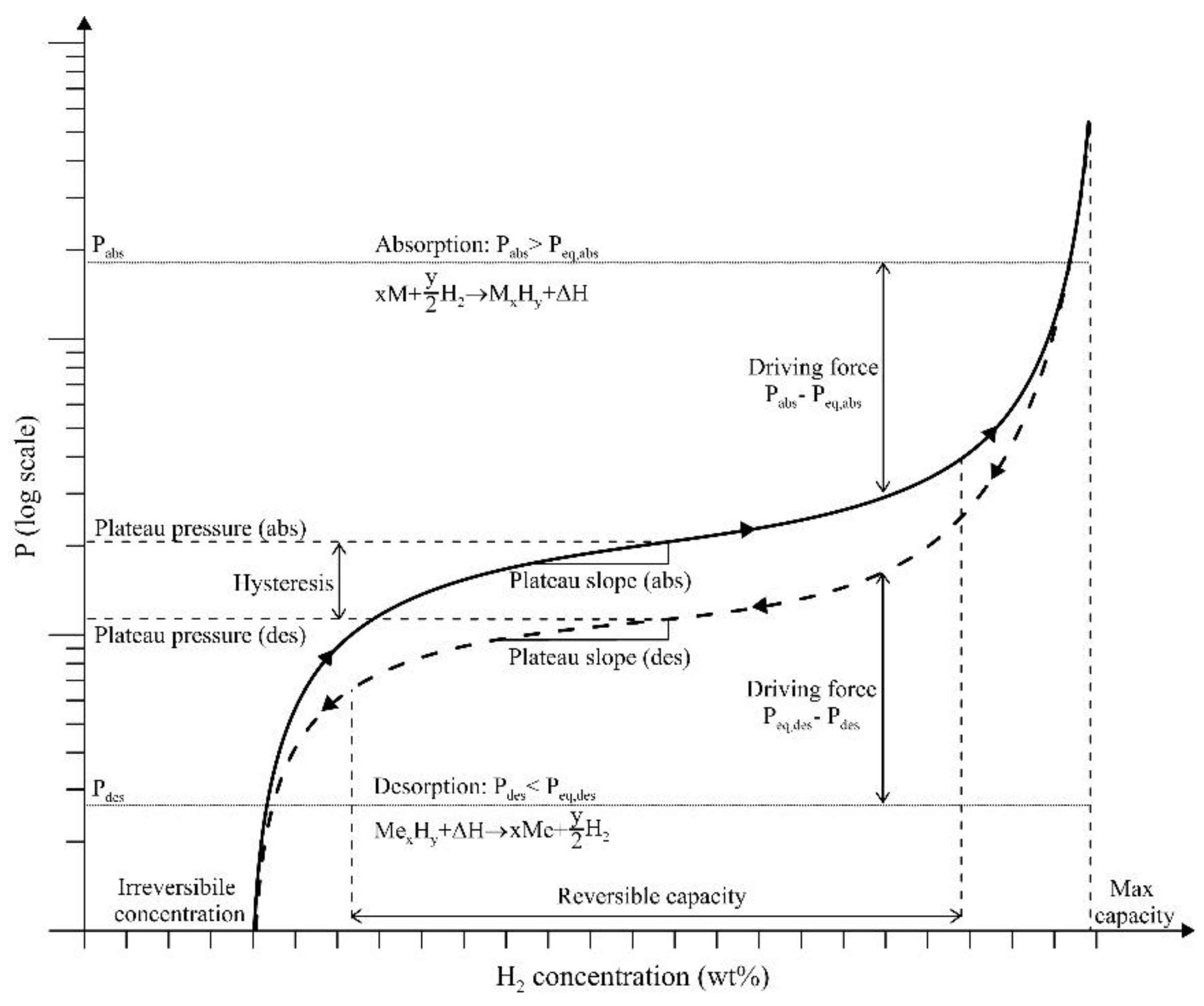
Figure 3.
Classification of the ETC measurement methods used in the scope of metal hydrides.
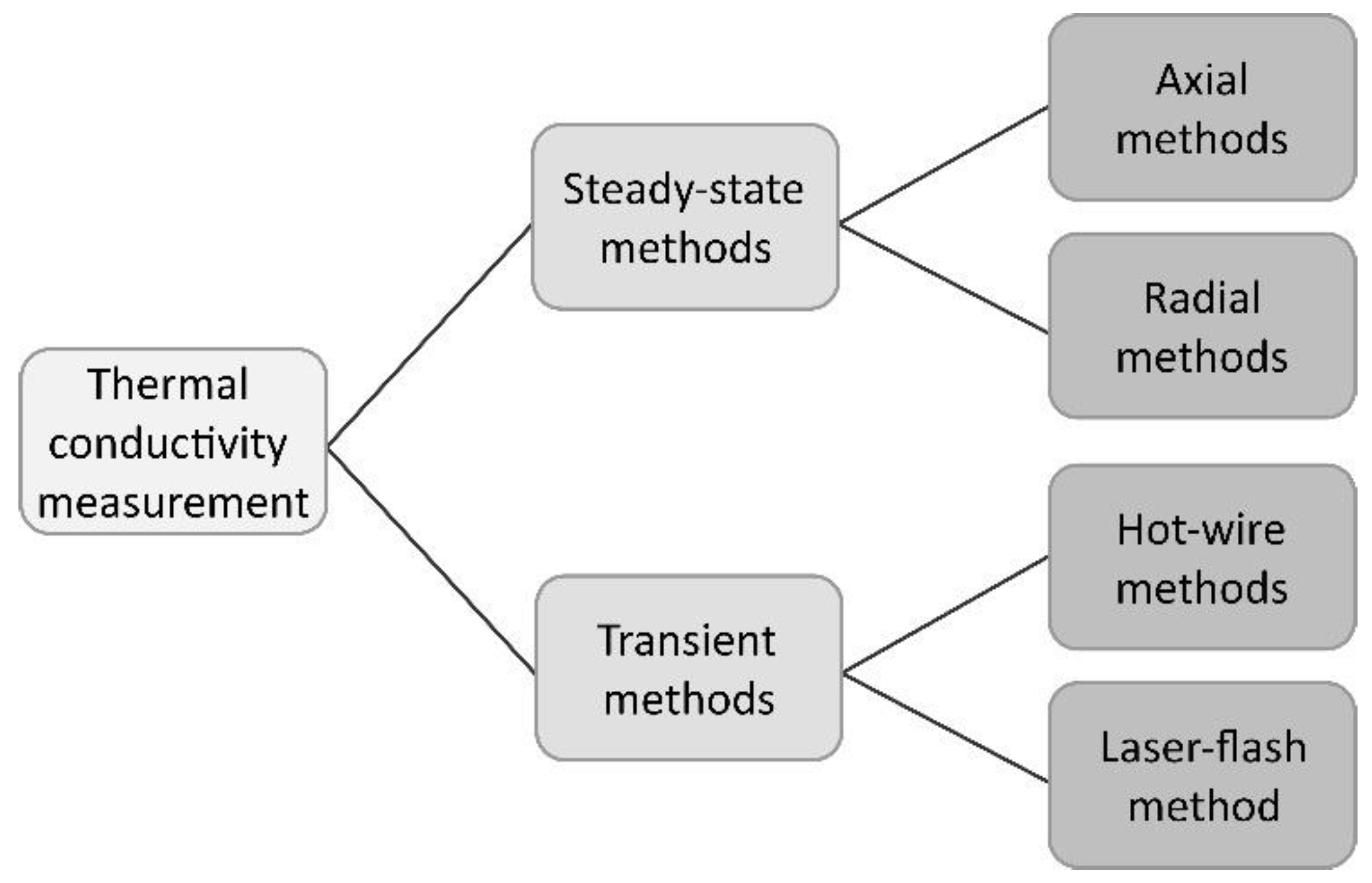
Figure 4.
Scheme of the comparative cut-bar method (radial thermal isolation not shown).
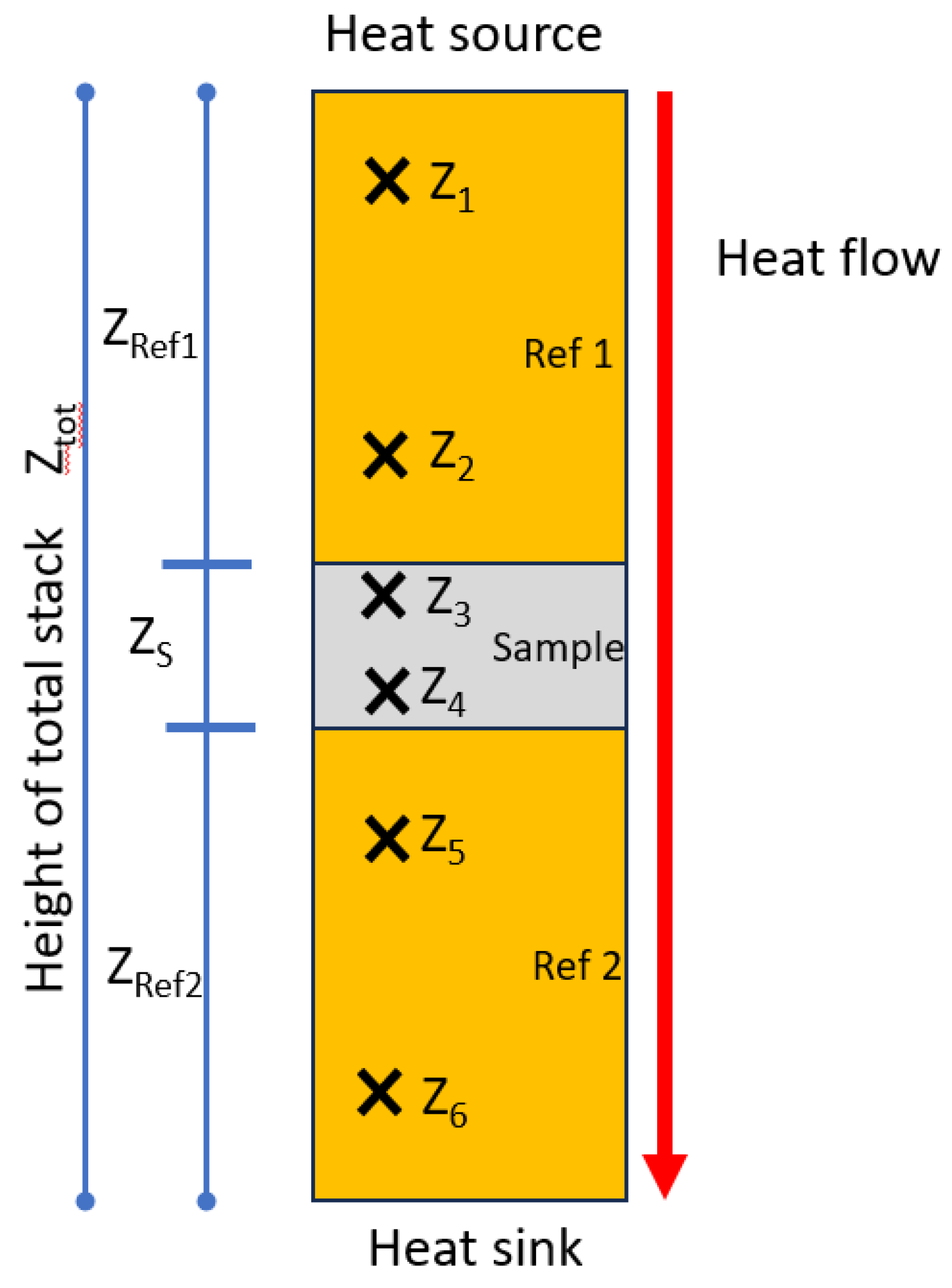
Figure 5.
Schematic image of the absolute radial flow method (A, left) and the comparative radial flow method (B, right). Shim et al. [66] used the absolute radial flow method with four thermocouples (C, bottom; reprinted with permission of Elsevier).
Figure 5.
Schematic image of the absolute radial flow method (A, left) and the comparative radial flow method (B, right). Shim et al. [66] used the absolute radial flow method with four thermocouples (C, bottom; reprinted with permission of Elsevier).
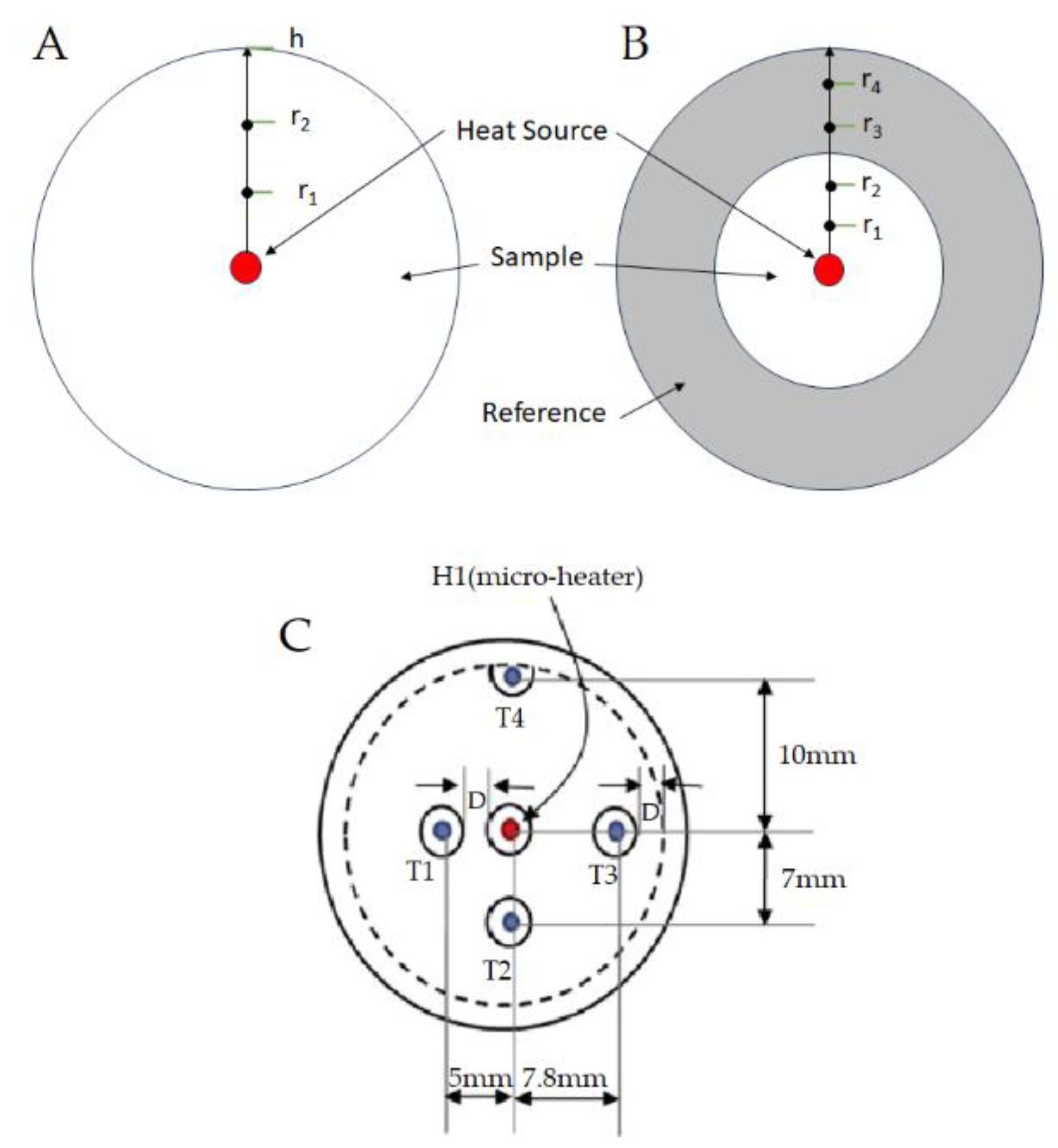
Figure 6.
Visualization of the working principle of a Hot Wire embedded in the sample.
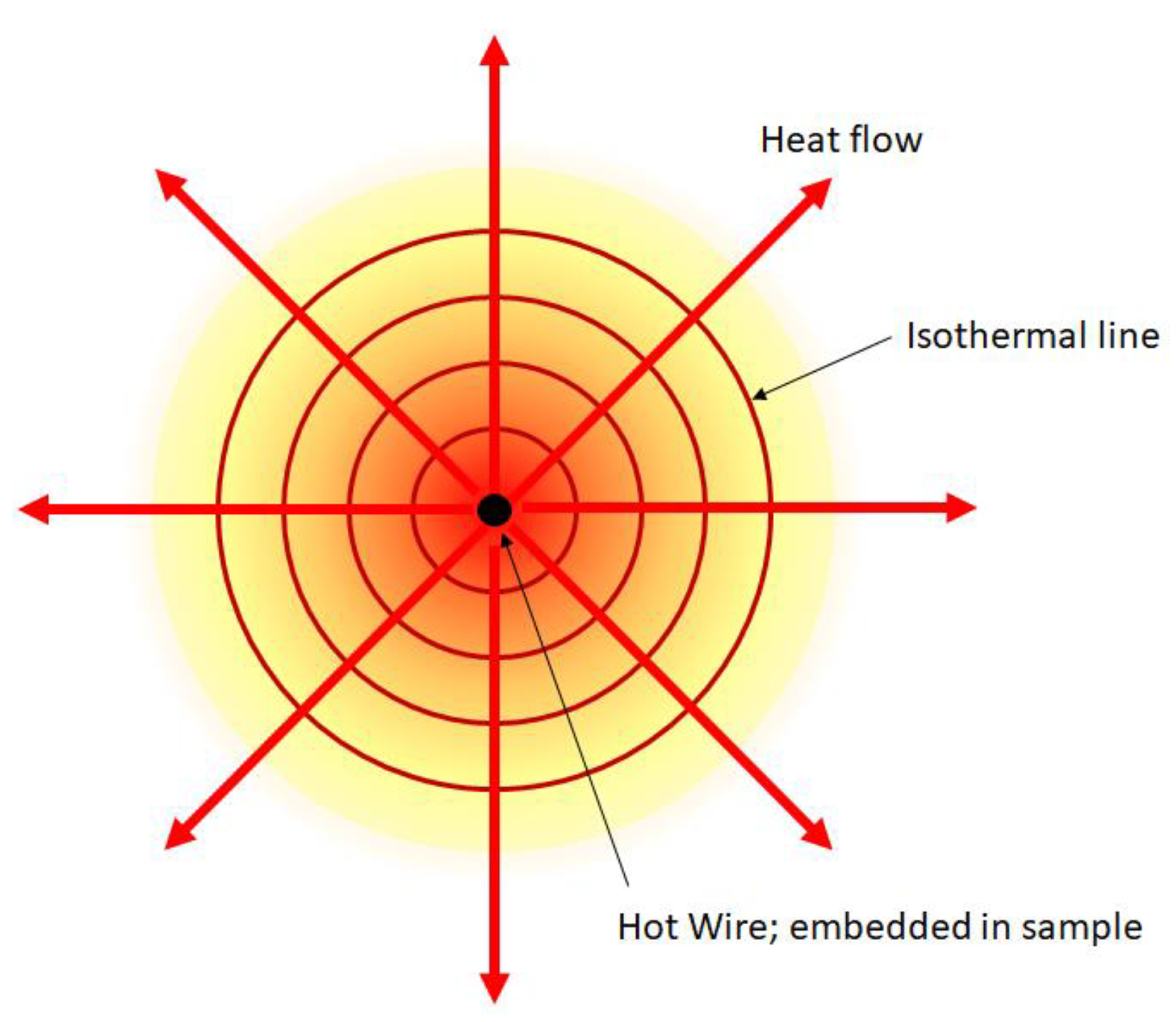
Figure 7.
Schematic image of a TPS measurement setup (A, left) [51] and a commercially available MPTS system (B, right) [71].
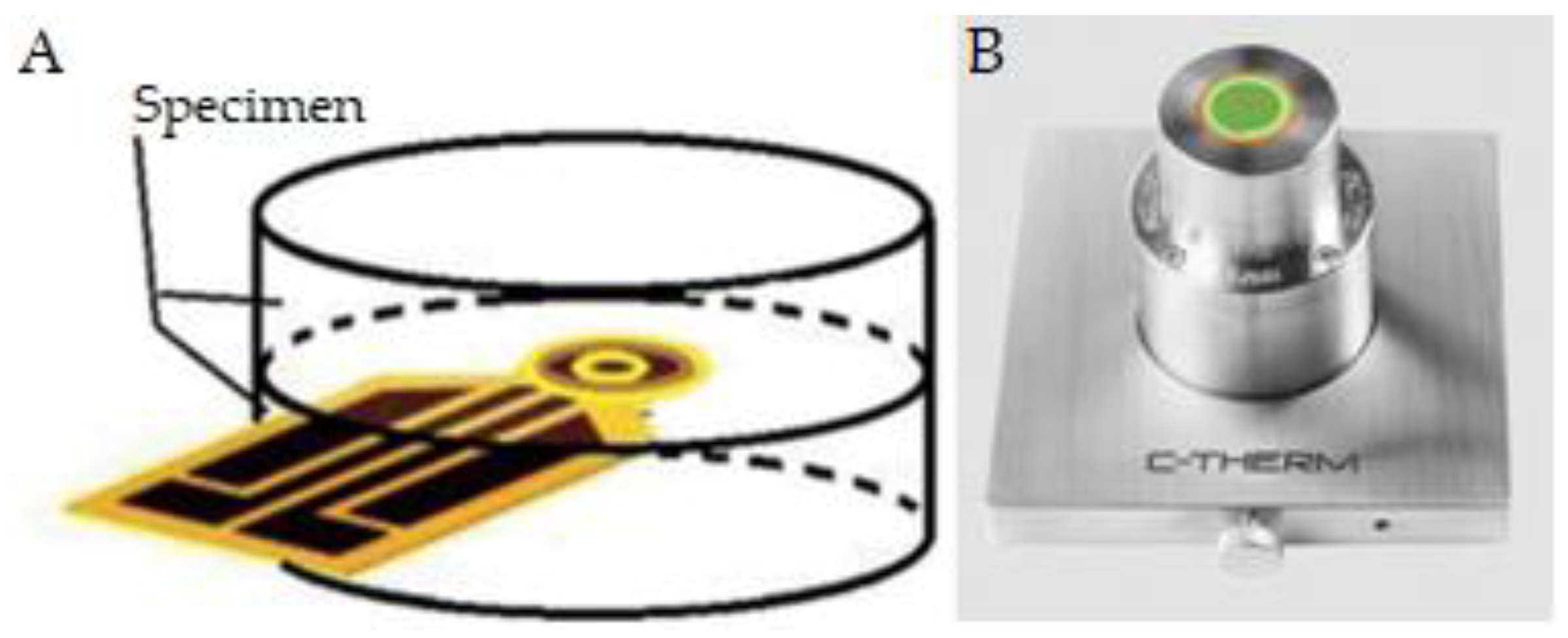
Figure 8.
Schematic image of the laser-flash method (adapted from [85]).
Figure 8.
Schematic image of the laser-flash method (adapted from [85]).
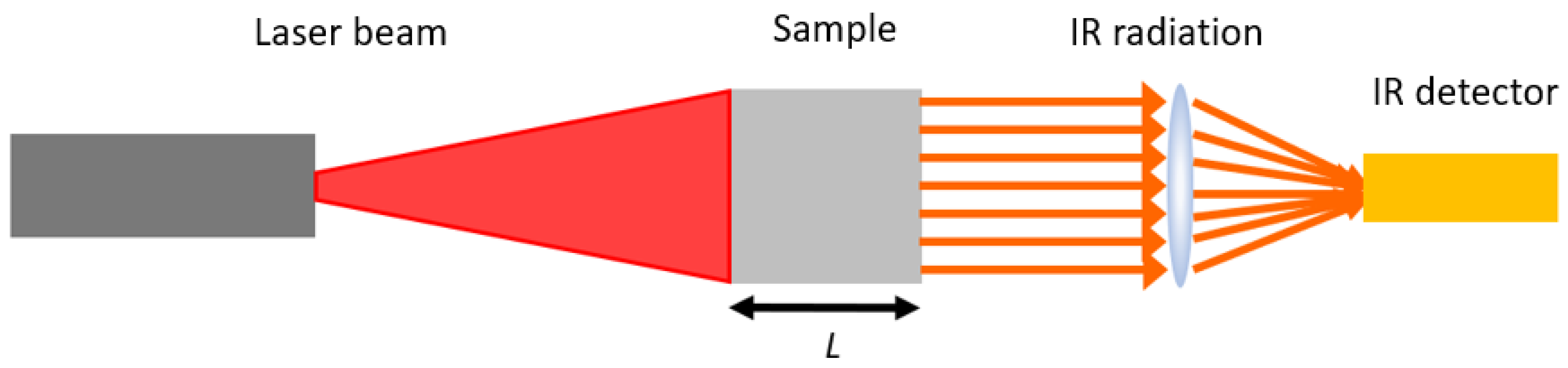
Figure 9.
Typical shape of the measured IR signal during a laser-flash measurement. The time after reaching 50 % of the total temperature increase, t0.5 (s), and the known thickness, L (m), are used to calculate the thermal diffusivity αd (m²/s).
Figure 9.
Typical shape of the measured IR signal during a laser-flash measurement. The time after reaching 50 % of the total temperature increase, t0.5 (s), and the known thickness, L (m), are used to calculate the thermal diffusivity αd (m²/s).
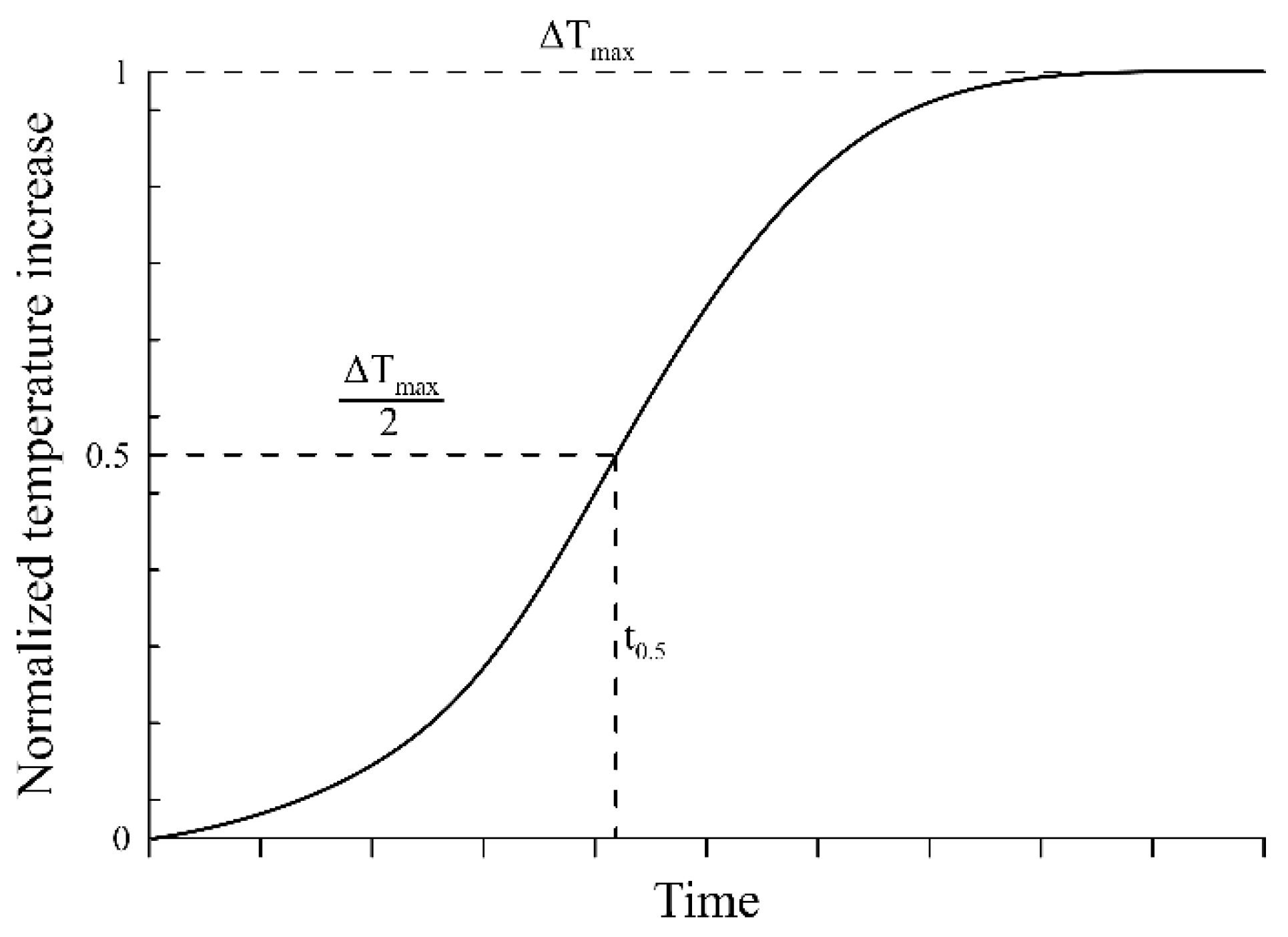
Figure 10.
In A: A' (or B') is the black body surface representing the void A (or B), and CC' is the cross-section perpendicular to the direction of the heat flow; in B: a simplified model for heat transfer in packed bed without fluid flow (adapted from [92]).
Figure 10.
In A: A' (or B') is the black body surface representing the void A (or B), and CC' is the cross-section perpendicular to the direction of the heat flow; in B: a simplified model for heat transfer in packed bed without fluid flow (adapted from [92]).
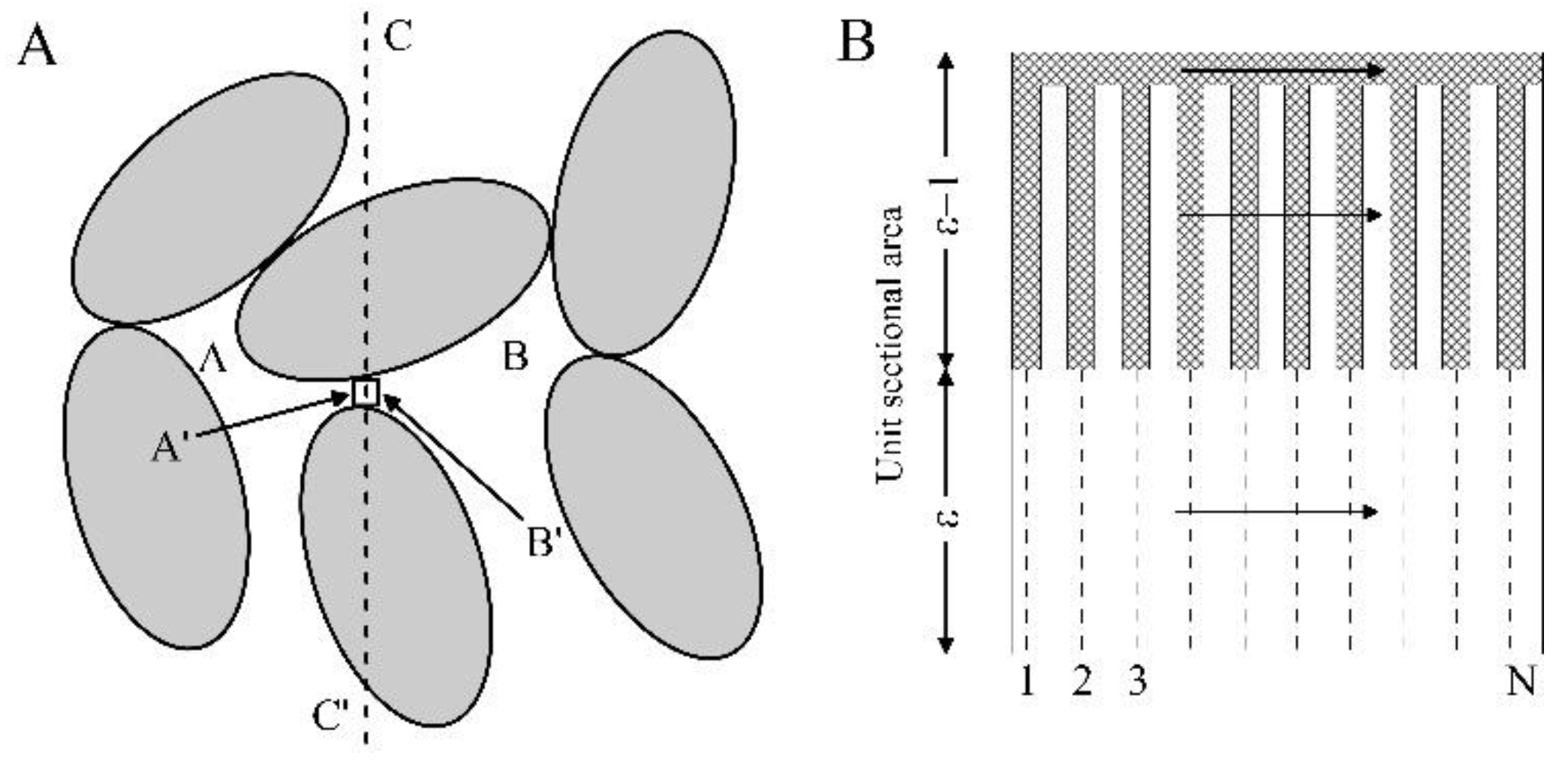
Figure 11.
Unit cell of the Zehner-Schlünder model (reprinted from [45]).
Figure 11.
Unit cell of the Zehner-Schlünder model (reprinted from [45]).
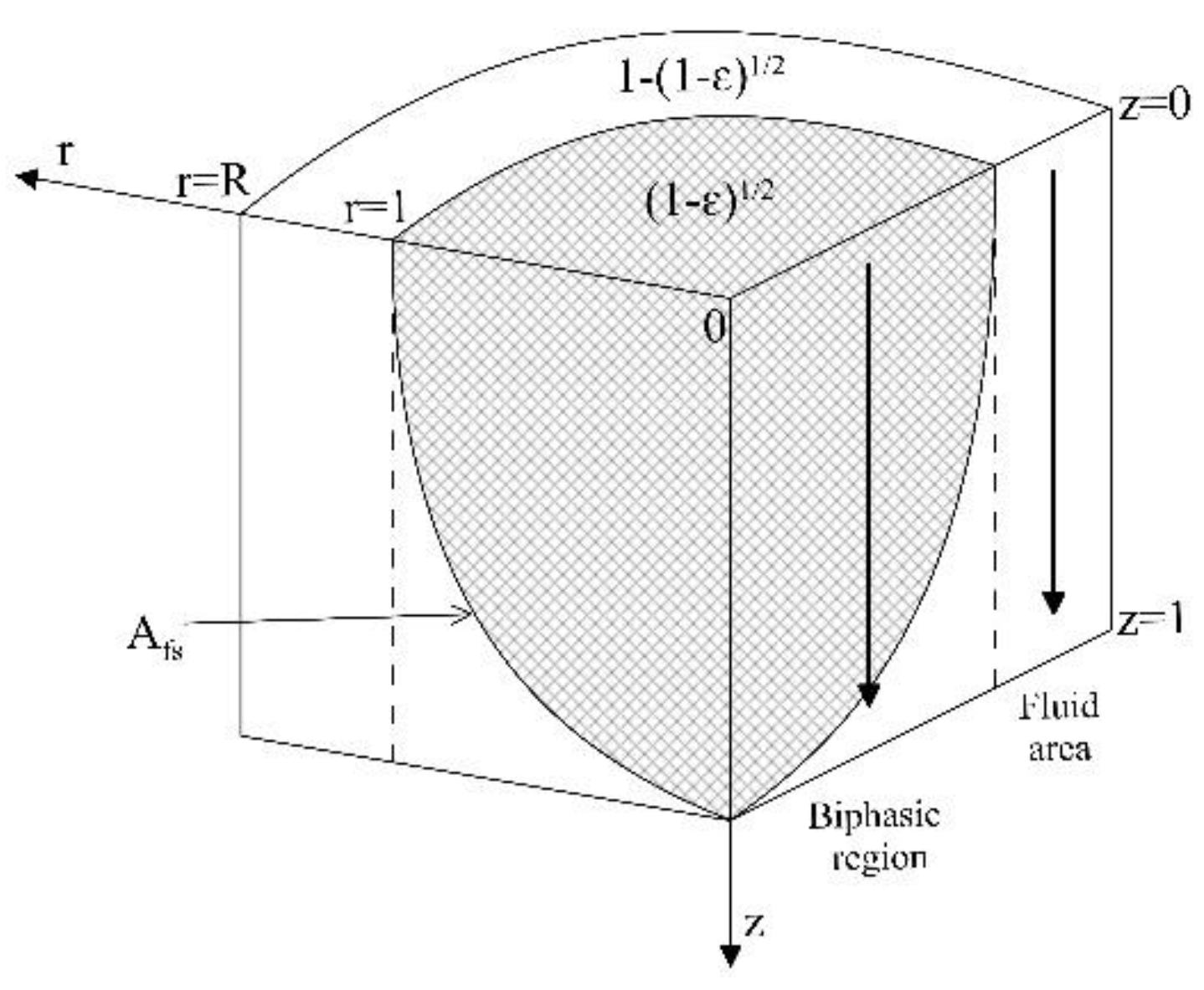
Figure 12.
Unit cell of the Zehner-Bauer-Schlünder model (adapted from [97]).
Figure 12.
Unit cell of the Zehner-Bauer-Schlünder model (adapted from [97]).
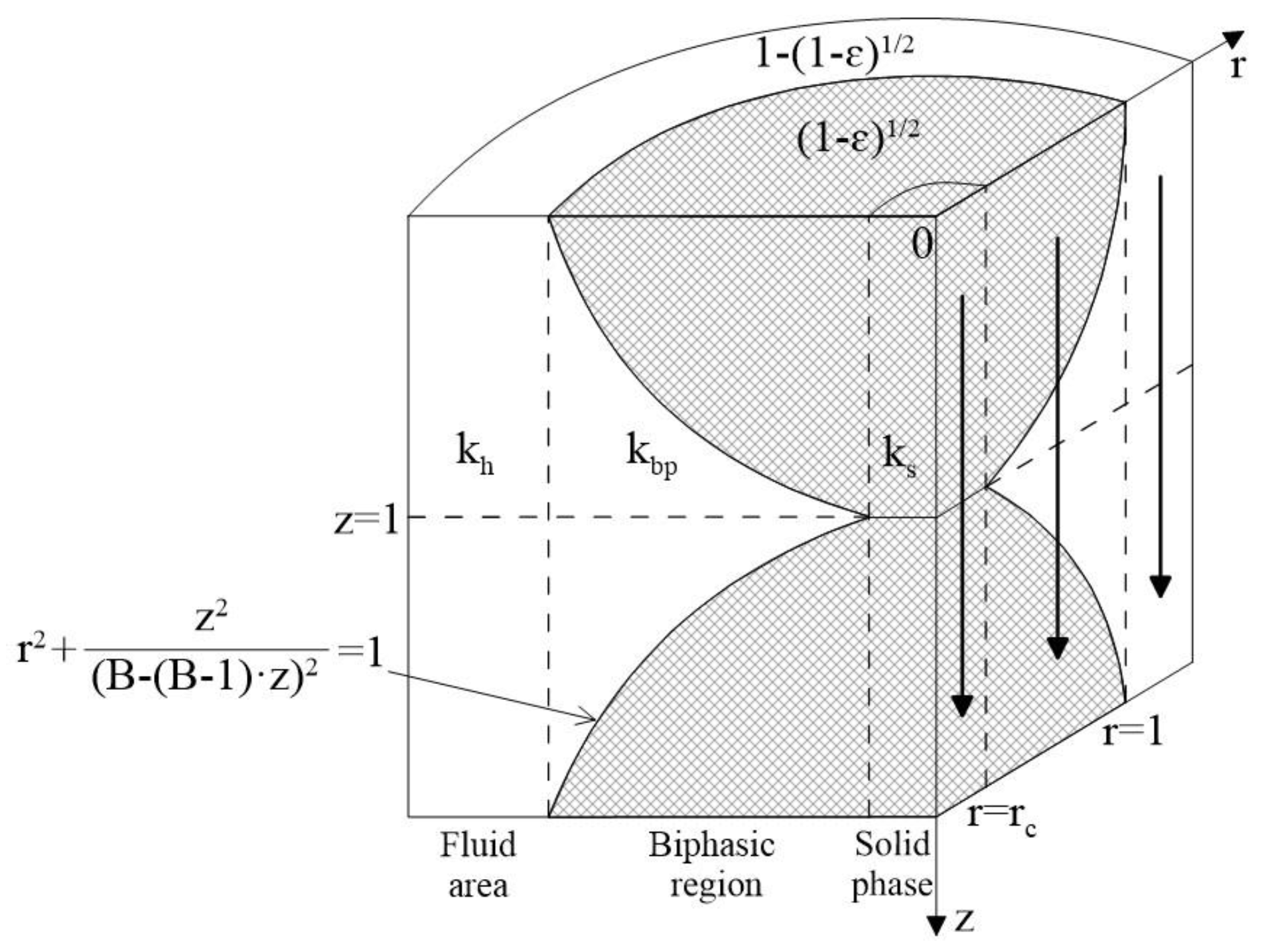
Figure 13.
Unit cell of the Hayashi model (adapted from [43]).
Figure 13.
Unit cell of the Hayashi model (adapted from [43]).
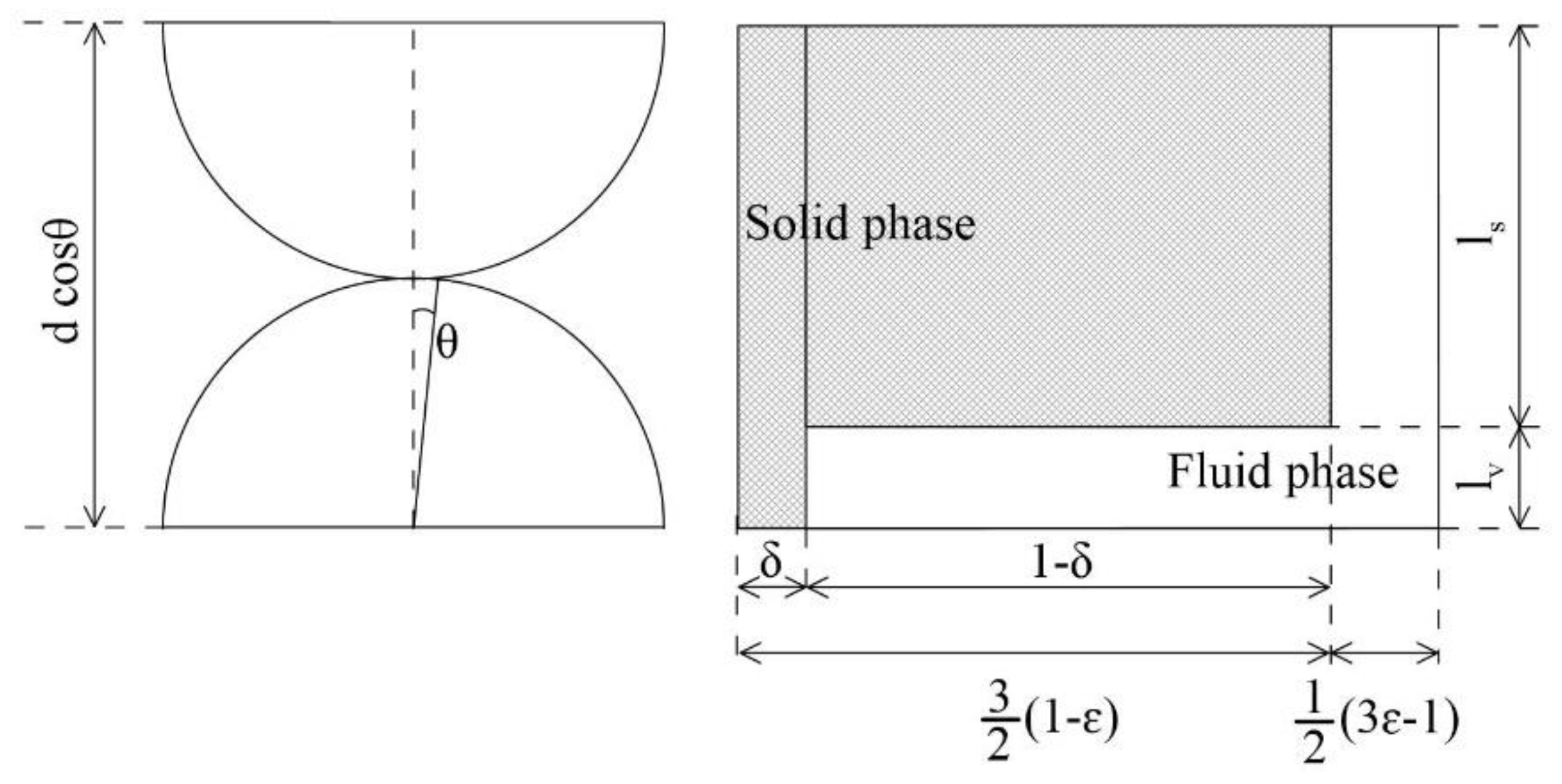
Figure 14.
Linear interpolation of numerical data for ϕ*1 and ϕ*2 vs. ks-to-kg ratio (data subtracted from [43]).
Figure 14.
Linear interpolation of numerical data for ϕ*1 and ϕ*2 vs. ks-to-kg ratio (data subtracted from [43]).
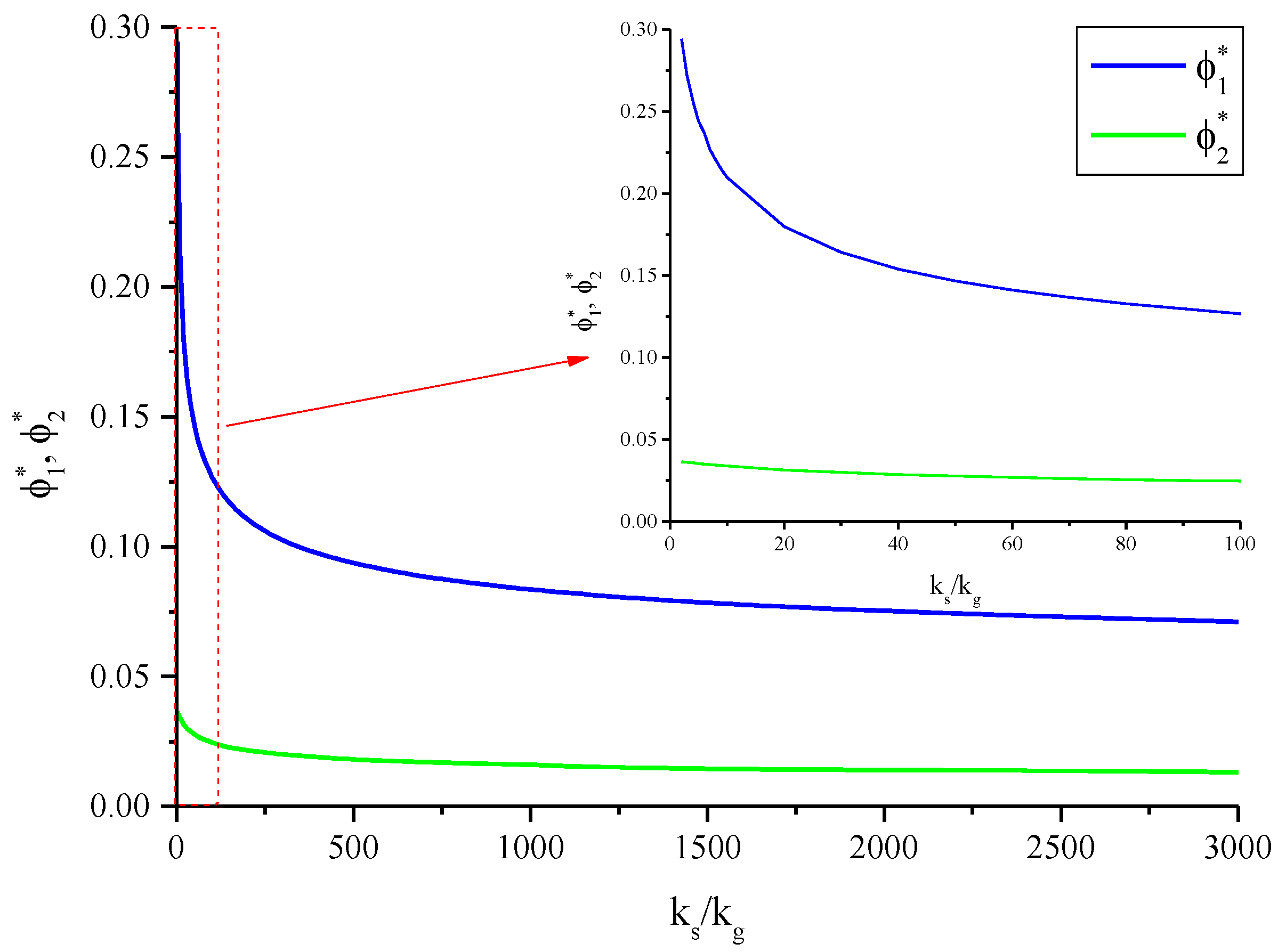
Figure 15.
The unit cell of the Sun and Deng model (adapted from [46]).
Figure 15.
The unit cell of the Sun and Deng model (adapted from [46]).
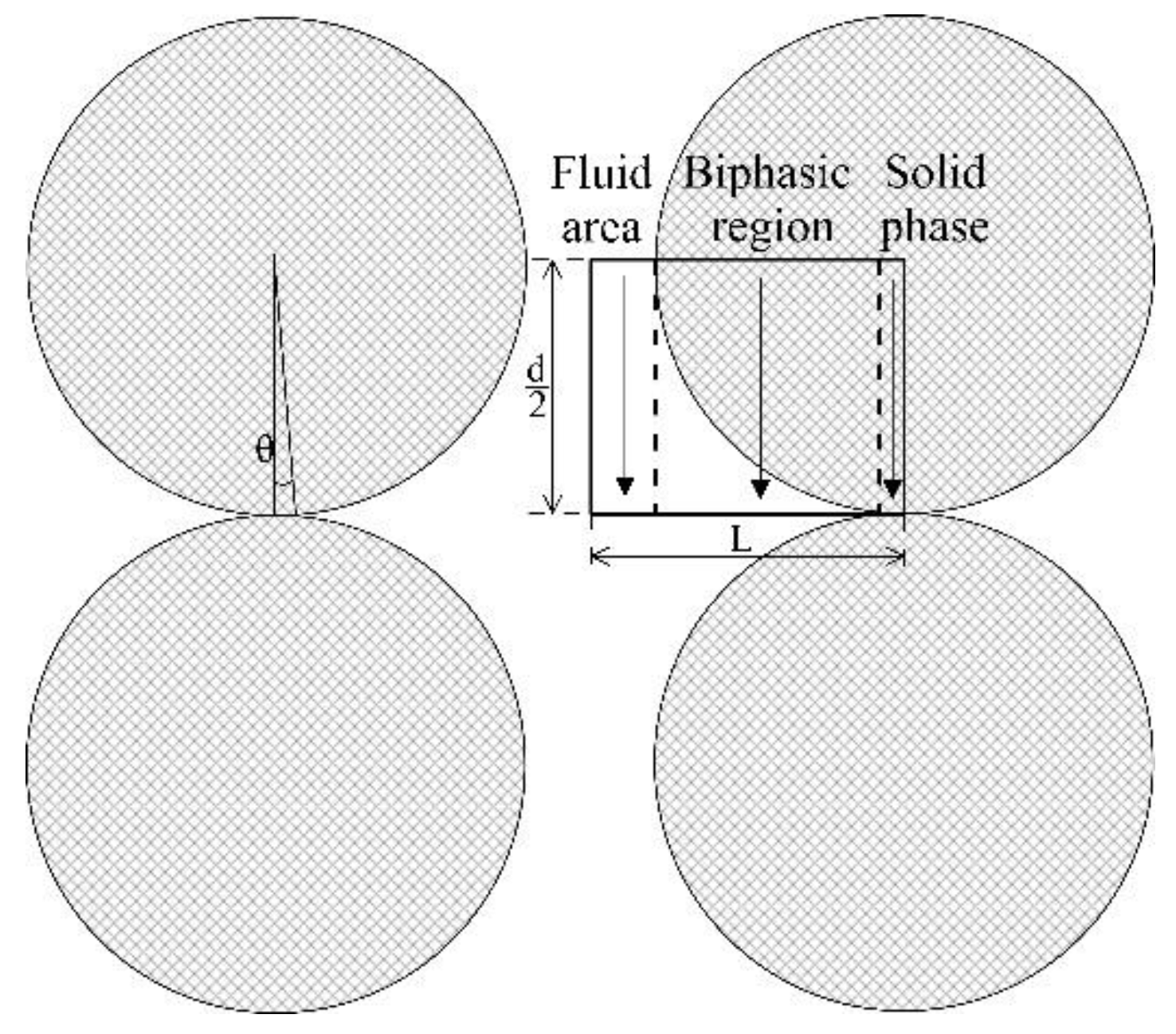
Figure 16.
The unit cell of the area-contact model (adapted from [45]).
Figure 16.
The unit cell of the area-contact model (adapted from [45]).
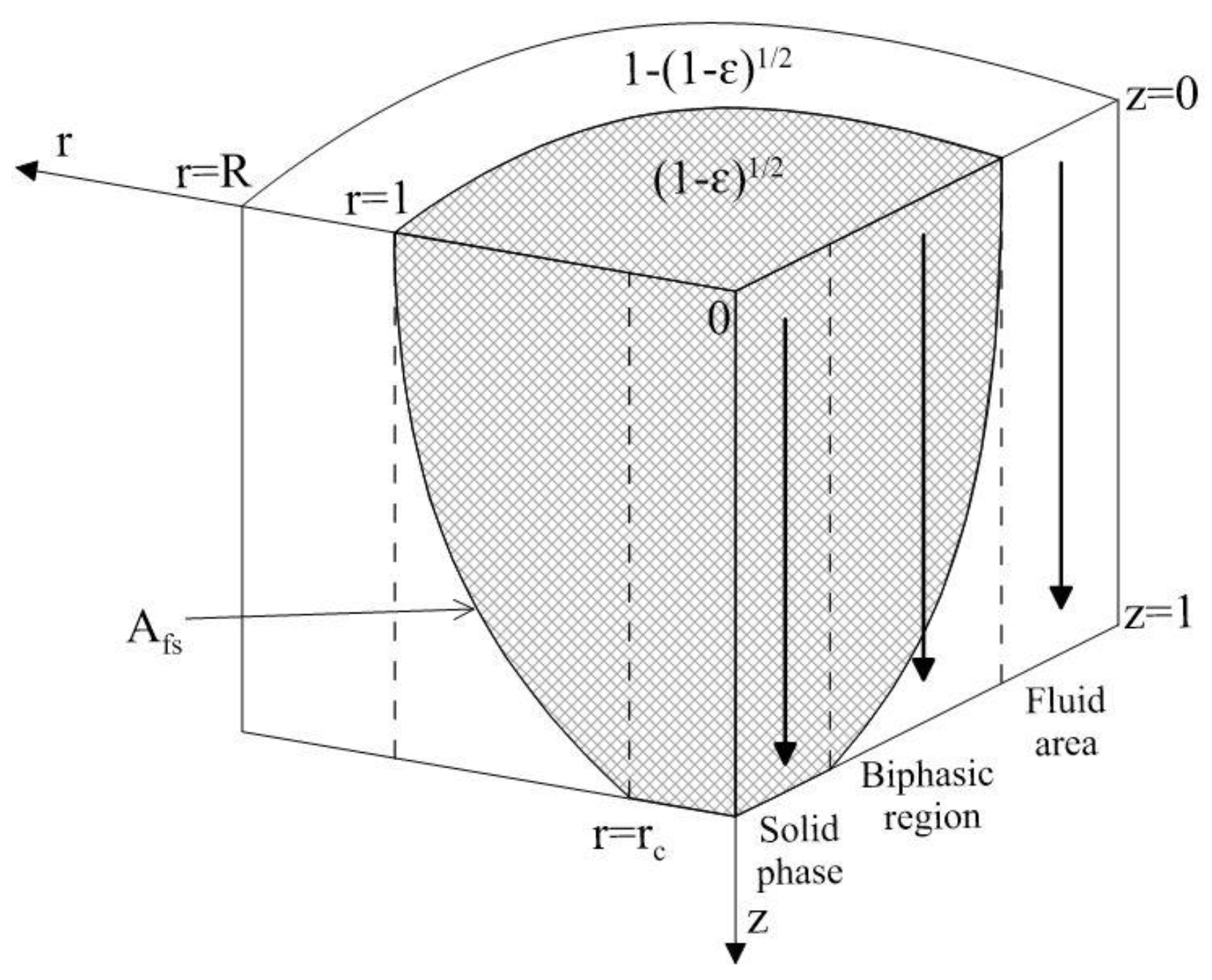
Figure 17.
The unit cell of the phase-symmetry model (adapted from [45]).
Figure 17.
The unit cell of the phase-symmetry model (adapted from [45]).
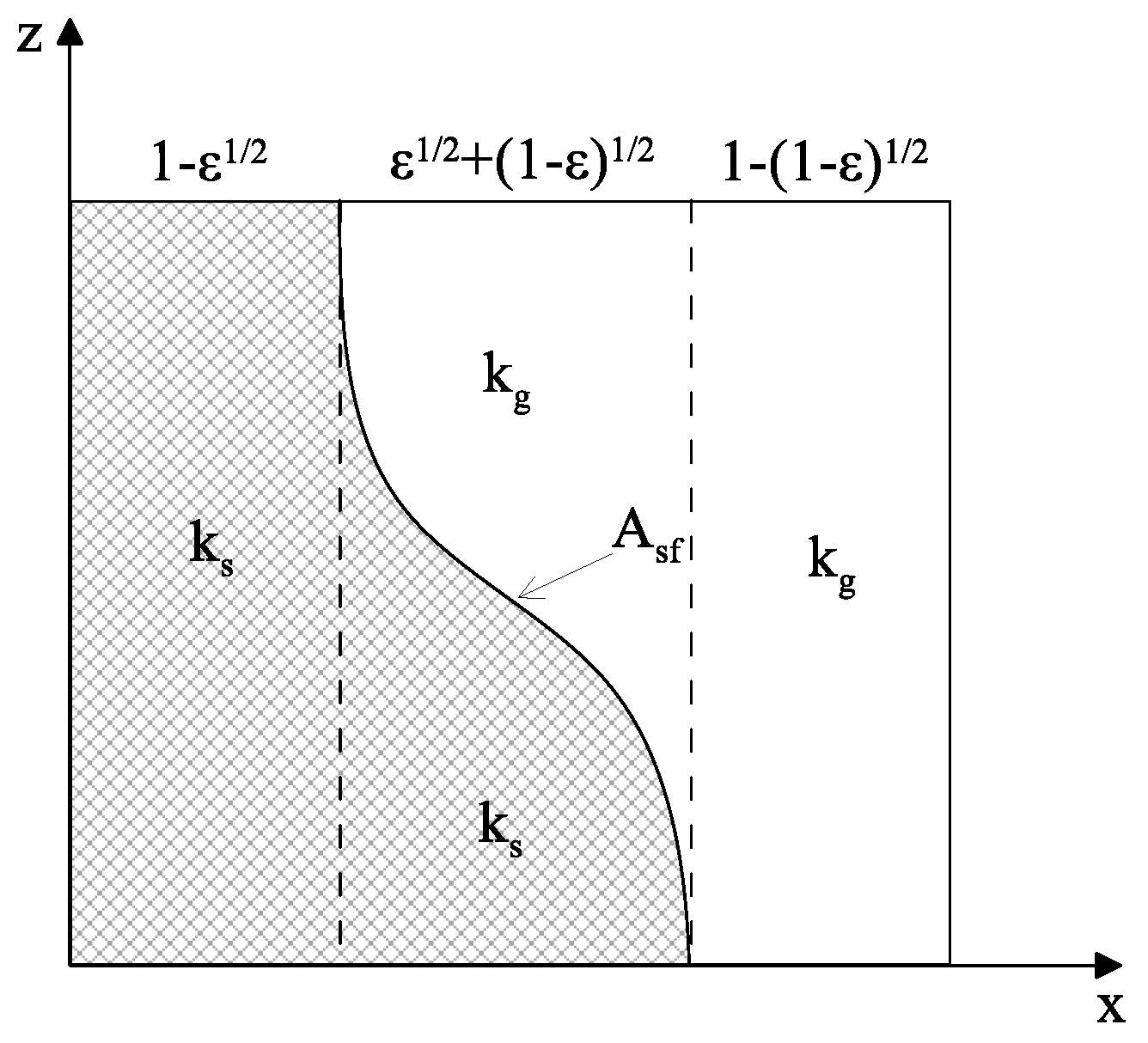
Figure 18.
The unit cell of the Raghavan-Martin model (adapted from [48]).
Figure 18.
The unit cell of the Raghavan-Martin model (adapted from [48]).
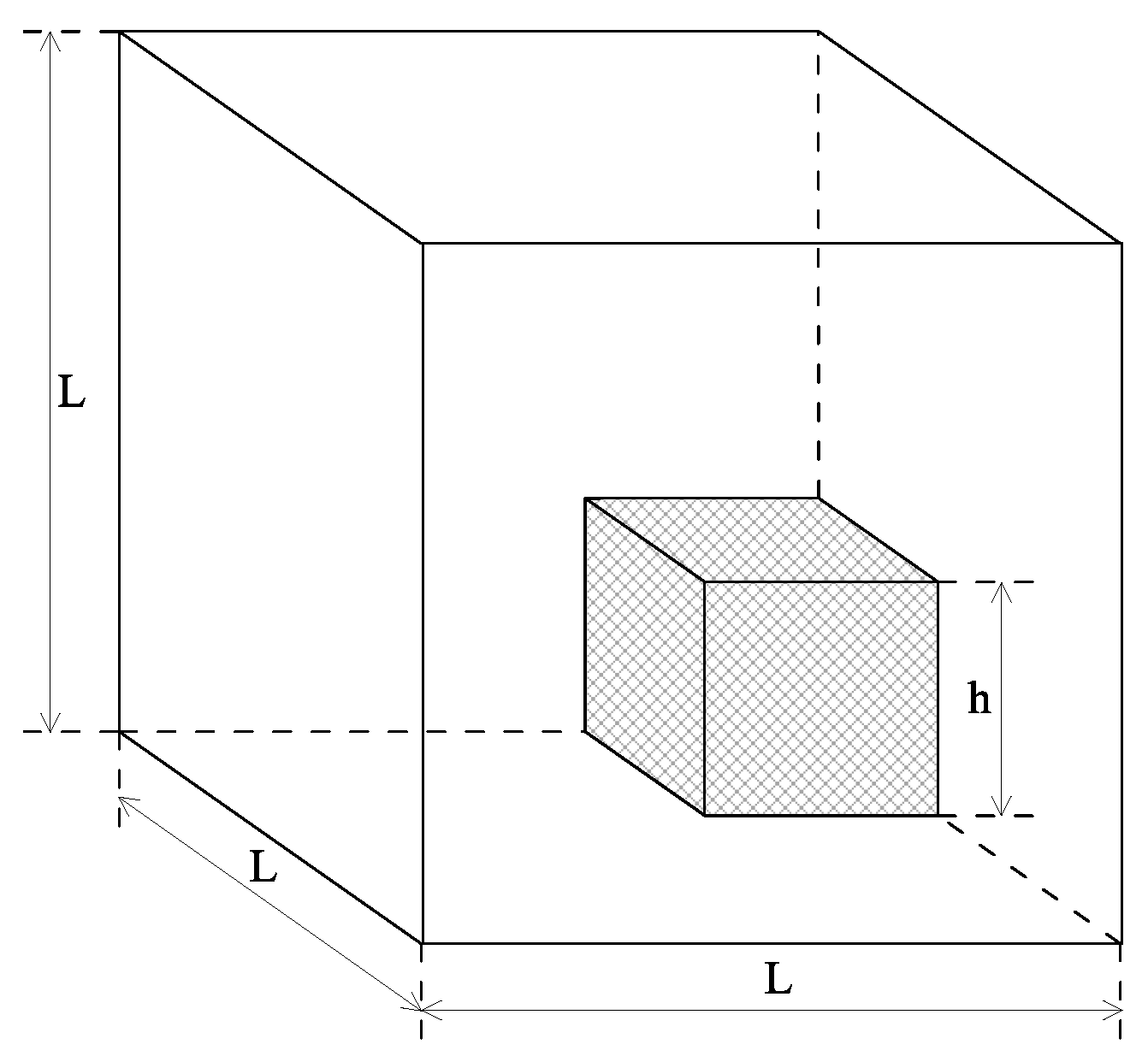
Figure 19.
Particle deformation for the improved area-contact model (adapted from [50]); subscripts “0” and “a” stay for “before absorption“ and “after absorption”, respectively, while the apex (') indicates “before transforming the coordinates”.
Figure 19.
Particle deformation for the improved area-contact model (adapted from [50]); subscripts “0” and “a” stay for “before absorption“ and “after absorption”, respectively, while the apex (') indicates “before transforming the coordinates”.
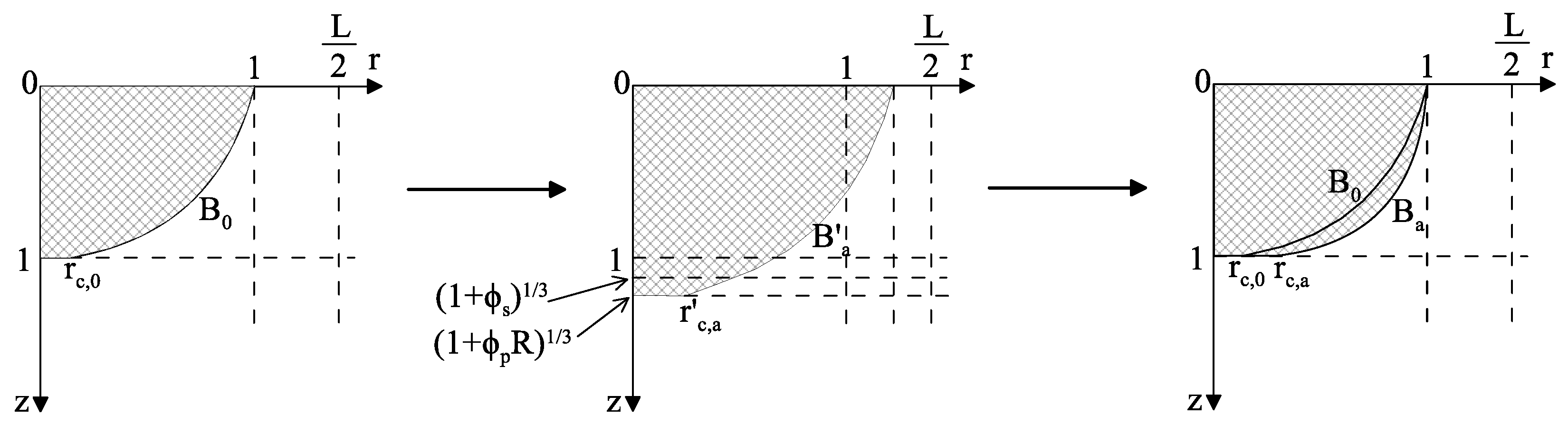
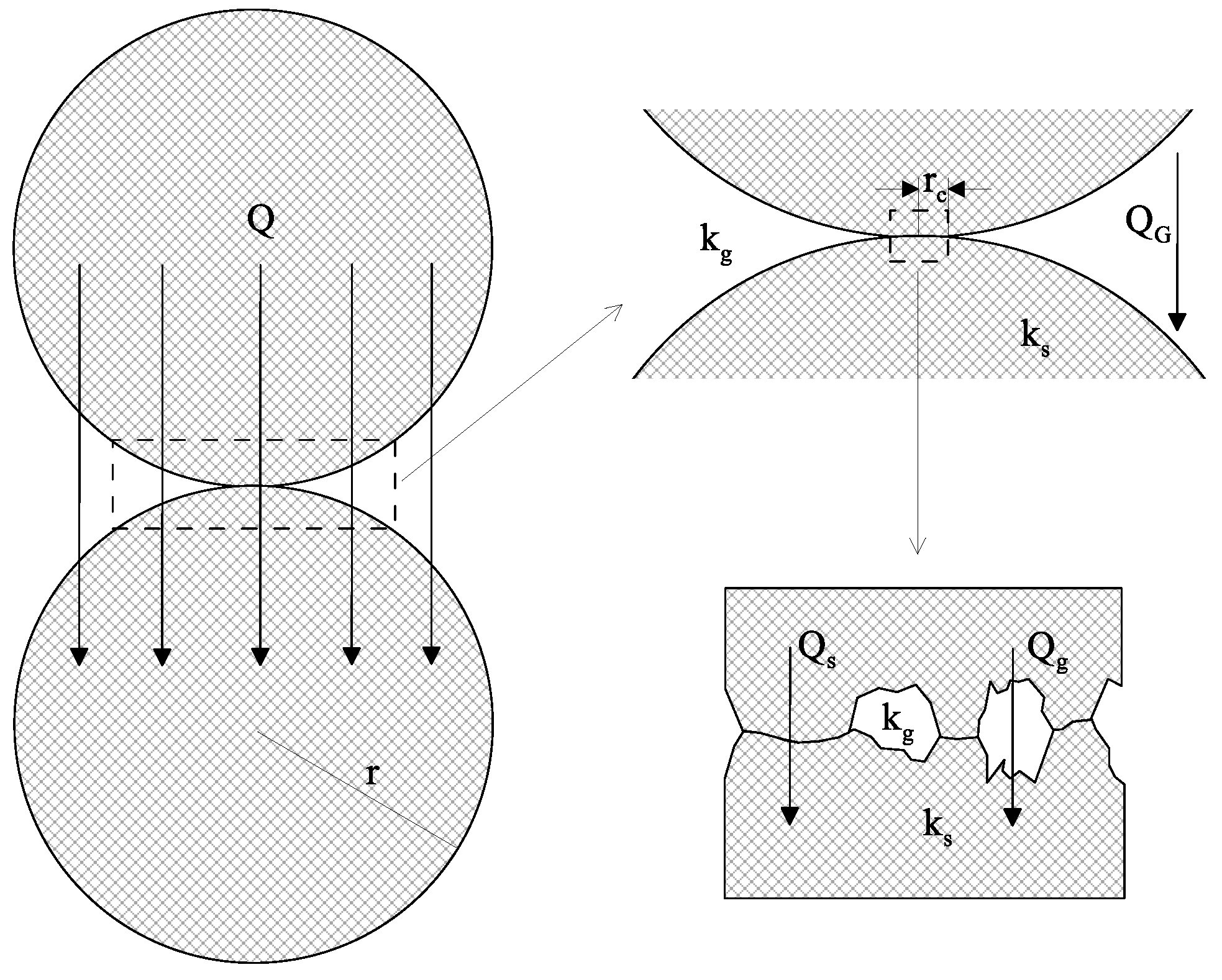
Figure 21.
A 3D illustration (a) and a cross-section view (b) of the unit cell of the heat transfer concentrating model are reported (adapted from [91]).
Figure 21.
A 3D illustration (a) and a cross-section view (b) of the unit cell of the heat transfer concentrating model are reported (adapted from [91]).
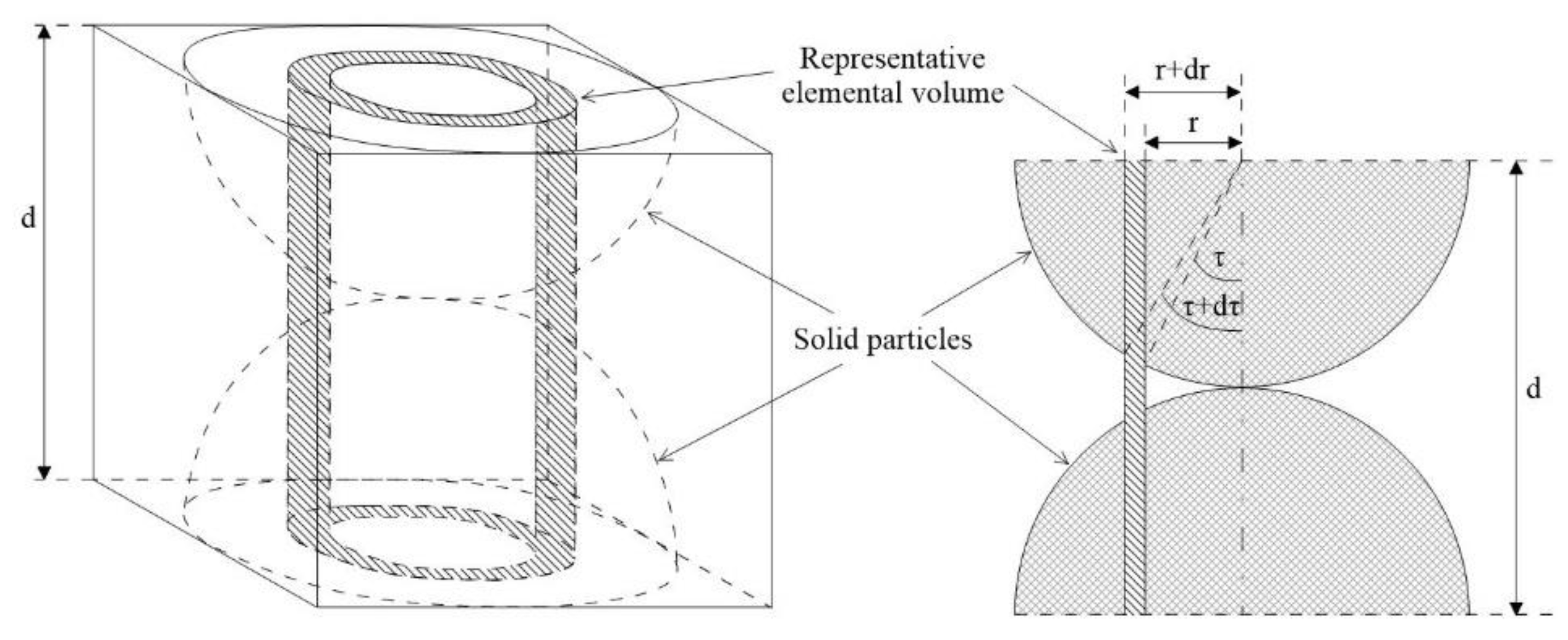
Figure 20.
In A, three phonon-phonon scattering processes are schematically shown inside the first Brillouin zone (gray) in the Normal process (N-process), where the resulting wave vector of the third phonon lies inside the first Brillouin zone. In B, in contrast, in the Umklapp- process (U-process), the wave vector exceeds the first Brillouin zone and is brought back by the lattice vector G.
Figure 20.
In A, three phonon-phonon scattering processes are schematically shown inside the first Brillouin zone (gray) in the Normal process (N-process), where the resulting wave vector of the third phonon lies inside the first Brillouin zone. In B, in contrast, in the Umklapp- process (U-process), the wave vector exceeds the first Brillouin zone and is brought back by the lattice vector G.
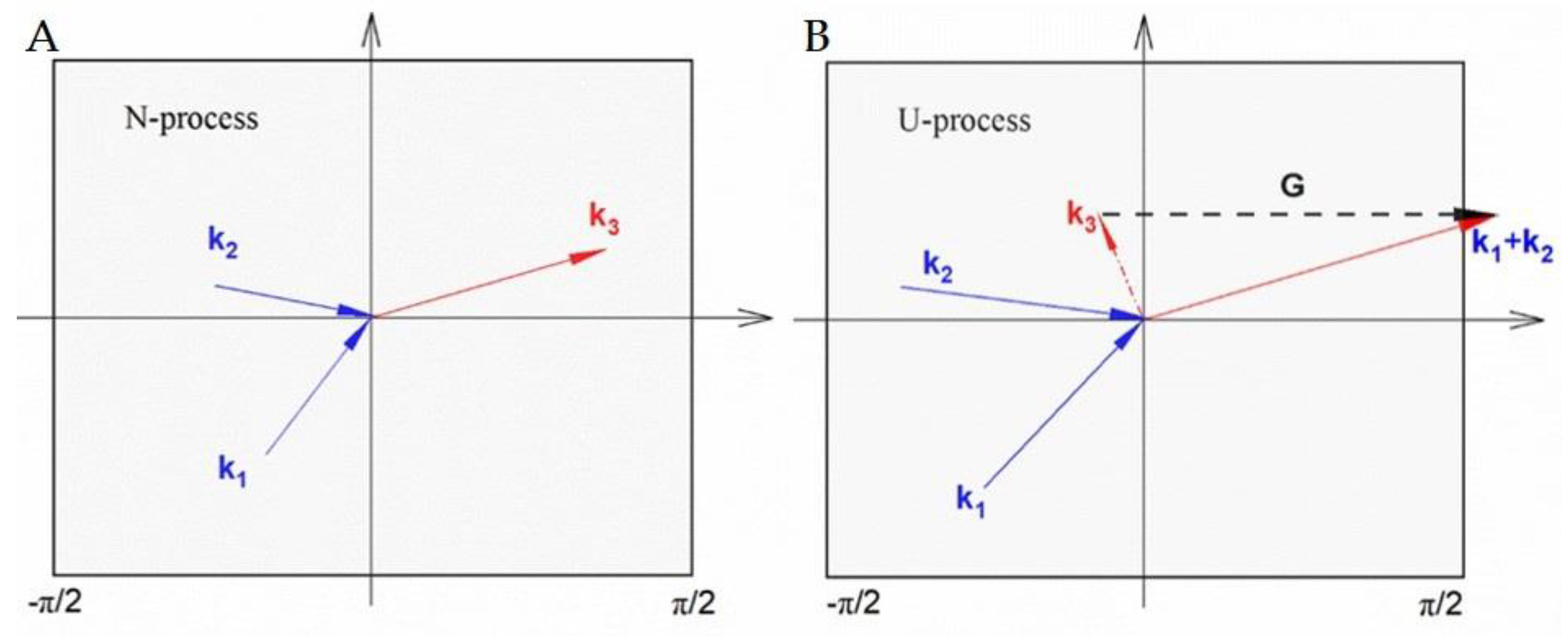
Disclaimer/Publisher’s Note: The statements, opinions and data contained in all publications are solely those of the individual author(s) and contributor(s) and not of MDPI and/or the editor(s). MDPI and/or the editor(s) disclaim responsibility for any injury to people or property resulting from any ideas, methods, instructions or products referred to in the content. |
© 2024 by the authors. Licensee MDPI, Basel, Switzerland. This article is an open access article distributed under the terms and conditions of the Creative Commons Attribution (CC BY) license (http://creativecommons.org/licenses/by/4.0/).
Copyright: This open access article is published under a Creative Commons CC BY 4.0 license, which permit the free download, distribution, and reuse, provided that the author and preprint are cited in any reuse.


