

Submitted:
21 November 2024
Posted:
26 November 2024
You are already at the latest version
Abstract
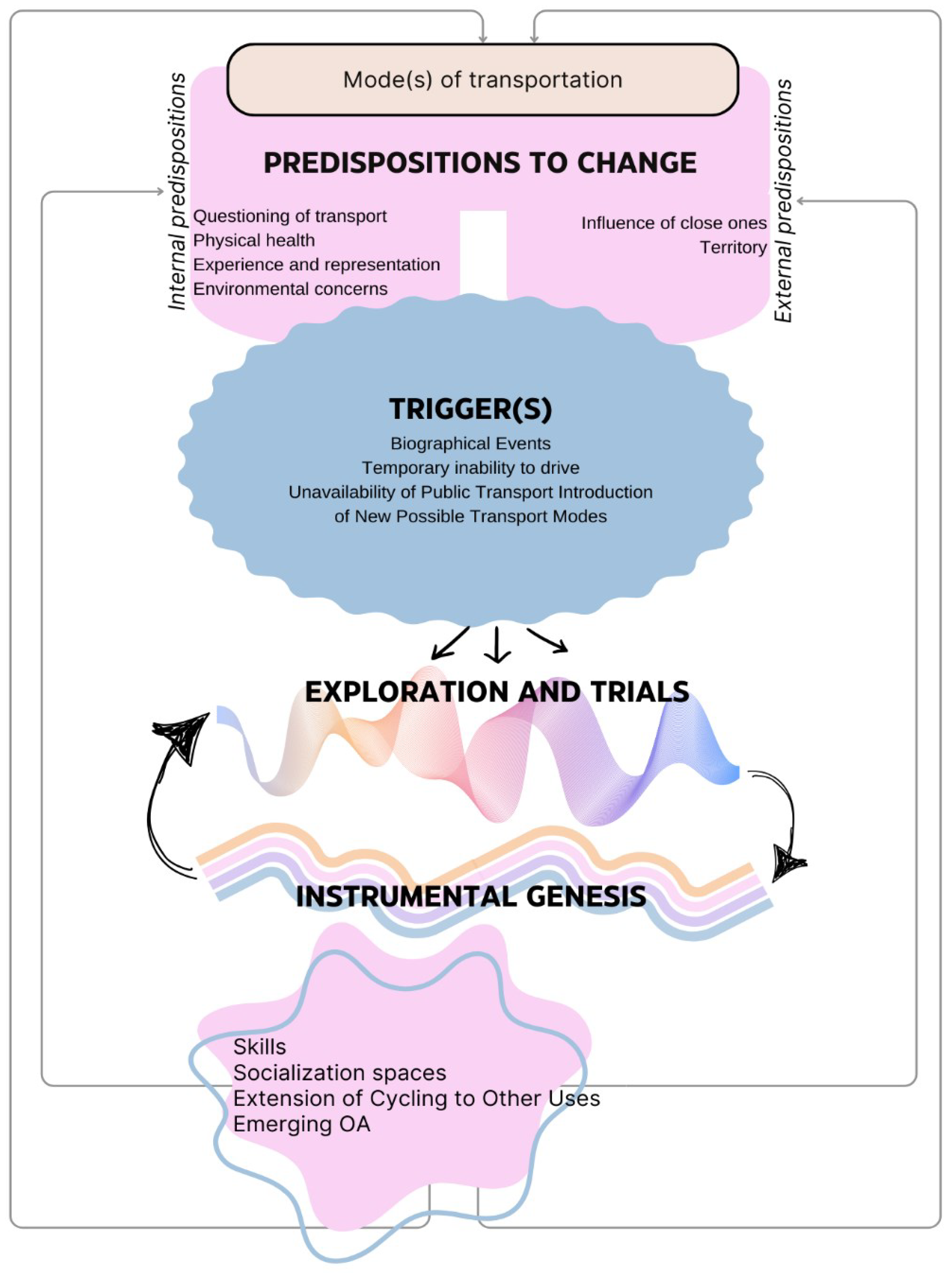
The current climate context is prompting stakeholders in the ecological transition to reconsider our transportation modes. The bicycle, in particular, appears promising, offering numerous benefits such as reducing polluting emissions and CO2, limiting noise pollution, alleviating urban congestion, and improving both the physical and mental health of citizens. However, despite policies aimed at encouraging cycling and the measures implemented, how can we explain the difficulty of urban French citizens in adopting the bicycle? Rather than focusing on the barriers to cycling, we have chosen to center our study on citizens who have opted to reduce or even abandon car use in favor of cycling in urban areas. This study provides a detailed description of the modal shift process that leads 20 individuals to transition from car use to cycling. By adopting a fine-grained approach through semi-structured and biographical interviews, it is possible to highlight the mechanisms behind this modal shift. Key stages appear to emerge: predispositions, triggering factors, the exploration and trial phase, and, in the longer term, the phase of appropriation. The article also explores the situations that lead cyclists to return to using their cars for specific trips.
Keywords:
1. Introduction
2. Related Works
2.1. Automobile Mobility Practices in France
2.2. Modal Shift Studied Through Mobility Biographies
2.3. Research Gap
- Instrumentalization: This is the phase where the user appropriates the tool, meaning they learn how to use it according to their goals. It involves adapting the tool so that it meets the user’s specific needs.
- Instrumentation: This refers to the evolution of the tool itself, which can be modified by the user over time to better align with their practices and contexts of use.
3. Materials and Method: A Qualitative Approach
3.1. Participants
3.2. Research Methods: Between Semi-Structured Interviews and Biographical Interviews
3.3. Analysis Methods
4. Results
4.1. Stages of the Modal Shift to Cycling
4.1.1. Predispositions to Change
4.1.1.1. Questioning the Car
“The traffic, a part of me just wanted to avoid that.”
“It really ruins your life, spending so much time looking for a parking spot morning and night, honestly.”
“I’m convinced that the car is an object of death. I get knots in my stomach when I drive.”
“I used to park on the quays to avoid paying for parking, but there was never a spot, so I would park past the last spaces, far from the university, just to park for free.”
4.1.1.2. Physical Health
“And if I start using a car again, I’ll be sitting down, getting sluggish. But when you walk, when you run to catch the bus, you move. I didn’t want to get sluggish and end up with a big butt.”
4.1.1.3. Experience with Cycling and Its Representation
“[My sisters and I], we were lucky to live in a building with a big park around it, which gave us the opportunity to learn to ride a bike very quickly and safely.”
“Before, cycling was linked to constraints. I only used it when I didn’t have the car. […] As a kid, I always had crappy bikes because of lack of money. So, I didn’t find any enjoyment in it. […] In middle school, I walked because my mom’s apartment was just nearby. It was convenient. I had a bike that I used a few times to go to my friends’ houses. I went to my dad’s place once a week, and he would take me by car. In high school, I took the bus, Line 12. Same for going to town. I also walked to my theater class on Friday evenings. Anyway, my bike got stolen, and I didn’t get another one right away.”
“Today, cycling is part of my transport choices; I think about it. There’s the pleasure of walking and cycling.”
“For us, the cycling gear is really like motorbike gear. On two wheels, we are really vulnerable.”Séverine, 38, Unemployed, Tours
4.1.1.4. Ecological Concerns
“I must say it’s frustrating because I really like the car, and if I weren’t aware of the harm it does to the planet, I’d use it much more often. In fact, I probably use it too much compared to others. But I always ask myself the question. In cold weather, I try to motivate myself to take the bike, even though it’s hard.”
“It took me time to think about my mobility choices and mature them. Some realizations came later than I would have liked. I feel guilty. When I don’t have to use the car, for example, to visit my mother. I often go to the [Atlantes Shopping Center] for groceries. The bags are very heavy, so I tend to take the car. I allow myself to use the car for shopping.”
4.1.1.5. The Influence of Close Ones
4.1.1.6. The Territory
4.1.1.6.1. Terrain and Climate
4.1.1.6.2. Infrastructure
“When I was young, we lived in Mauritania. The streets were unpaved, and cycling wasn’t practical, so we didn’t have bikes. We moved to Paris in 9th grade, and that’s when I started cycling to school. I’ve hardly stopped since.”
4.1.2. Triggers
4.1.2.1. Biographical Events
4.1.2.1.1. Moving and New Territories
“I knew it would be a hassle to get to my new job by bus. There were bus changes, and I hate that. […] On the bike, I was worried about being on the road. I need a lot of safety. But then I realized it wasn’t so bad, and I got used to going by bike.”
“We moved to Tours in the summer of 2021, my wife continues to work in Paris by train. And I was assigned to Nogent-le-Rotrou, it’s an hour and forty minutes by car, even two hours. There’s no public transport. There’s a train, but with transfers in Le Mans or Paris. Given my schedule, it wasn’t feasible. With three kids already, I wanted to be home in the evening, so I knew I would have to buy a car.”
4.1.2.1.2. Changes in Schedules
“I thought that when I retired, I would at least use the car as a minimum. But the bike became my main mode of transport. I don’t really like the bus because it restricts my schedule, and the bike, for me, has always meant freedom.”
4.1.2.1.3. Decrease in Family Responsibilities
“When I had my first child, it wasn’t common to carry kids by bike. […] It was too rushed, the schedules were impossible, so I couldn’t manage everything. I was starting to teach, and I had other things on my mind.”
4.1.2.2. Temporary Inability to Drive
“We’ve had the bike since January. We only had one vehicle. My partner had an accident, and we looked at the second-hand market, but the prices were very high, and there wasn’t much choice. We were debating whether to buy another car or not. Eventually, we decided to buy a solid bike to fit our daughter’s seat. The accident was the trigger.”
“I lost my license too. I started taking the bus and train. That’s when everything switched. I bought a bike. I got my license back, and the shoot ended, but I continued to move around by bike. I handled all my admin tasks on the bike. It was a turning point.”
“I had a car in the garage for two weeks, and I had no choice but to use the bike.”
4.1.2.3. Unavailability of Public Transport
4.1.2.4. Introduction of New Possible Transport Modes
4.1.2.4.2. The Rise of Electric Bikes
“At the start of my retirement, I resumed my activities at La Camusière, sports and activism. I went there up to four times a week. I couldn’t climb the hill, so I used to take my car. But it consumed a lot, and I felt guilty. So, I thought either I get a car that consumes less, or I buy an electric bike. And so, I bought an electric bike and switched to a supplier that provides non-nuclear energy. It was just to go to Saint-Avertin [a town located at the top of a hill, where La Camusière is]. And I have my regular bike for the rest of the city. I also have an allotment garden, and I go there with the electric bike because it’s far, and it’s exhausting.”
4.1.2.4.3. The Rise of Cargo Bikes
4.1.3. Exploration and Trials
4.1.3.1. The Choice of the Bike
“It’s important to have a bike that fits your body. For now, this one works fine. The handlebar height, the saddle, and the comfort with the pedals. I don’t like bikes where you’re hunched over like a racer. I prefer an upright position, like women’s bikes. I don’t feel safe on a hunched bike.”
“When it came time to buy, it was mostly my wife who took care of it. I was dealing with the car. And she decided she was going to choose the cargo bike so that it would be suitable for her and her needs. The goal was to fit three seats, one for each child. She’s quite small, so the seat needed to be low and the bike needed to be maneuverable because she’s small and not very heavy. She did her research on the Internet, checked reviews, and then we tested bikes, looking on sites like Le Bon Coin. We tested bikes at the bike shop.”
“I had considered and experimented with biking—during times when I didn’t have a car—by using Vélib’. I saw that the stations allowed me to move around and reach the stations. It wasn’t as convenient; the bikes weren’t always available, the weather was an issue, and it took a lot of time. The convenience of being in a car, being able to do my shopping on the way home, doing sports afterward, and putting my gym bag in the car—those were things I missed.”
4.1.3.2. The Choice of the Route
“I was with my friend Théa, and I suggested we try the route to my work, we were doing a lot of sports together at the time. On a bike, I’m afraid to be on the road next to cars. I need a lot of safety. And I realized it wasn’t that bad, and I got into the habit of going by bike two or three times a week.”
“I did a route survey by bike with my husband to see how to get there, because he navigates better than I do. Thanks to Covid-19, a lot of bike lanes opened up, so it’s not bad. I’ve tried other options, but I ended up sticking with the original route, it was the best.”
4.1.3.3. The Choice of the Equipment
“I bought enough gear for rain and cold, pants, to be really equipped. I have a big visor to protect myself, all that.”
“I’ve made adjustments by buying equipment to make it more practical and safe: a mirror, a yellow vest, a helmet, lighting... Because I’m very aware of the risks of cycling. I realize that bikes aren’t always visible.”
“I would get dirty... and that annoyed me. So I had a spare shirt in my bag—shirt and pants, in case I needed them in the locker at the school. As a teacher, I need to dress fairly well and be presentable.”
4.1.4. Instrumental Genesis: Towards a Cyclist Identity
4.1.4.1. Development of Skills
- Acquiring experience in traffic situations;
- Knowledge of the area being traveled;
- Physical abilities;
- Technical skills related to the bike;
- Self-confidence.
4.1.4.1.1. Acquisition of Experience in Traffic Situations
“I know that at the beginning, I did quite a few scouting trips, especially with my partner, to get used to it and understand how it worked.”
“When you’re on a bike, there’s a way to position yourself on the road so the person behind understands that you’re going to turn left, for example.”
4.1.4.1.2. Knowledge of the Territory
“I don’t take the gentle slope through the village because the street is narrow and cars go really fast. I prefer Beaugaillard, there’s a bike lane.”
“I added a phone holder to guide me; it’s a really strong magnet to attach it to the handlebars. I use the Geovélo® app. I had to get used to riding by following the route.”
“During periods of extreme heat, I would arrive early enough in the morning so that it wouldn’t be a problem. It was a concern of mine, but it turned out not to be because I adjusted my pace, like walking up the hill if I had a meeting or something.”
“Now, I go more to certain shops than others because I can park my cargo bike there more easily.”
4.1.4.1.3. Physical Abilities
“It’s clear that since I started cycling, I feel in better overall shape. It’s hard to explain, but I just feel better physically in general.”
“Climbing the hill was hard the first two or three times, and after that, you get used to it, you don’t think about it anymore.”
4.1.4.1.4. Technical Bike Skills
“I’ve been cycling for a long time, so I know how to fix small things, like a chain derailment or a flat tire. I’m not afraid of that. My wife gets frustrated, so I do it for her. I’m not a real handyman for bigger repairs, though. If it’s something more complicated, like changing brake cables, I go to the bike shop. I’d like to learn to do everything on my bike, but I haven’t seriously tried yet. Right now, I have a problem with the gears shifting poorly, and I don’t know how to fix that system, but I’ll have to learn one day. For now, I take it to the repair shop.”
4.1.4.1.5. Self-Confidence
“Now, on my new route, it’s much less safe. I wouldn’t have taken it at the beginning. When I started, it was important for me to have bike lanes to feel comfortable.”
4.1.4.2. Development of Socialization Spaces
“Cycling daily sparks other uses. I joined the ‘Droit au Vélo’ association. There is a community aspect to it.”
4.1.4.3. Extension of Cycling to Other Uses
4.1.4.4. Objects of Activity that Sustain Cycling Practice
- Pragmatic OA (OAPra)
- Ecological OA (OAEco)
- Sportive OA (OASpo)
- Health-related OA (OASan)
- Hedonistic OA (OAHed)
- Safety-related OA (OASec)
- Financial OA (OAFin)
- Social OA (OASoc)
“If it really wasn’t practical for me to take the bike—say, if the journey was longer—I would without hesitation take the bus, even though I find it really unpleasant. The secondary motivation is sport. The bike lets me do my exercise. And the last thing is ecology, even though that’s a really important aspect for me.”
“Sometimes, I can really feel lazy. But just the thought that I’ll get my exercise on the bike motivates me to take it. It’s really a reason that pushes me.”
“I think it’s good to move regularly. Also, I have back problems, so I think it helps me to tone up a bit.”
“There’s a moment of relaxation on the bike, something I didn’t get even while reading. Sometimes, on public transport, I couldn’t even take my book out because it was too crowded. The bike is more comfortable, it’s a moment of breathing.”
“In the evening, I always take my bike, even though I’d like to walk around the city. But the bike is a defense tool for me. I’m less bothered, I can escape quickly. That’s the main reason I use the bike in the evening.”
“For me, there’s no safety in the evening. The headlights blind me. Driving at night is really tiring, and I find it very dangerous. It’s never changed. Plus, I have a Twingo, so compared to an SUV... [laughs]... When I’m sick, I think it’s stupid to take my car because I won’t be as attentive.”
4.2. Cyclists Do Not Completely Abandon the Car
4.2.1. Several Situations of Using the Car
4.2.1.1. Distance
“And when it’s not for work, most of the times I use the car is to visit friends in areas far from Touraine.”
4.2.1.2. Managing Work Life
4.2.1.3. Transporting Goods
“This year, I’ll go by bike except when I need to bring specific equipment, plants, or biology materials...”
“At the time, for moving or buying heavy furniture, I would borrow my parents’ Renault Espace. We moved in 2013, a year after I arrived. At that time, my wife didn’t have a car.”
4.2.1.4. Climate
“In cold weather, I try to motivate myself to ride my bike, even if it’s tough. But in the rain, I’m not there yet, unless it’s just a light drizzle.”
“If it’s too hot, I can’t take the bike. I can’t show up at a client’s place all sweaty, smelling strong [from sweat].”
4.2.1.5. Safety
“There are some trips I avoid. I have a friend who lives in Ville-aux-Dames, and I drive to her house. I don’t take the bike over the bridge to get there. Too risky.”
4.2.2. Modal Shift or Systemic Reorganization of Different Transportation Options?
5. Discussion and Implications
6. Conclusions et Future Research
Author Contributions
Informed Consent Statement
Data Availability Statement
Acknowledgments
Conflicts of Interest
References
- Sucha, M.; Viktorova, L.; Risser, R. Can an Experience with No Car Use Change Future Mode Choice Behavior? Sustainability 2019, 11, 4698. Available online: https://www.mdpi.com/2071–1050/11/17/4698 (accessed on 25 October 2024). Available online: https://www.mdpi.com/2071-1050/11/17/4698 (accessed on 25 October 2024). [CrossRef]
- Rigal, A. Habitudes en mouvement: vers une vie sans voiture; Metis Presses: Genève, Switzerland, 2020. [Google Scholar] [CrossRef]
- Tortosa, G. L’aménagement d’un centre-ville sans voiture à Oslo: Véritable politique de restriction automobile ou simple requalification de l’espace public consécutif à l’effacement du trafic motorisé? Flux 2022, 127, 48–64. [Google Scholar] [CrossRef]
- Wilkki, C.M.; Reeve, N. Communication from the Commission to the European Parliament, the Council, the European Economic and Social Committee and the Committee of the Regions on European Missions. European Commission. 2021. Available online: https://ec.europa.eu/info/funding-tenders/opportunities/portal/screen/home (accessed on 25 October 2024).
- Cleuet, M.; Jehanno, A. Developing Sustainable Urban Mobility Plans—Guidelines for Mobilise Your-City geographies. Available online: https://www.mobiliseyourcity.net/sites/default/files/2023-03/SUMP%20Guidelines_final%20%281%29.pdf (accessed on 25 October 2024).
- Deuse, C. Perspectives pour un report modal vers les vélos classique et électrique: Le cas des déplacements vers et au départ de l’Université de Liège. Transport Studies 2016. https://matheo.uliege.be/bitstream/2268.2/1390/8/TFE_Deuse_Caroline_2015_2016.pdf.
- World Health Organization. Regional Office for Europe. Walking and Cycling: Latest Evidence to Support Policy-Making and Practice. World Health Organization 2022. Available online: https://www.who.int/publications/i/item/walking-and-cycling-latest-evidence (accessed on 25 October 2024).
- Gonzalez-Gorman, S.; Kwon, S.-W.; Patterson, D. Municipal efforts to reduce greenhouse gas emissions: Evidence from US cities on the US-Mexico border. Sustainability 2019, 11, 4763. [Google Scholar] [CrossRef]
- Apparicio, P.; Gelb, J.; Jarry, V.; Lesage-Mann, É.; Debax, S. Exposition des cyclistes à la pollution sonore et atmosphérique à Lyon, France. L’Espace géographique 2020, 49, 250–268. [Google Scholar] [CrossRef]
- Brown, A.E. Car-less or car-free? Socioeconomic and mobility differences among zero-car households. Transport Policy 2017, 60, 152–159. [Google Scholar] [CrossRef]
- De Nervaux, L.; Guerra, L. Mobilités et transition; 2023. https://www.moreincommon.com/media/stkcinok/dc_mobilites-et-transition_final_compressed.pdf.
- Middleton, J. The Walkable City: Dimensions of Walking and Overlapping Walks of Life; Taylor & Francis: London, UK, 2021. [Google Scholar] [CrossRef]
- Papon, F.; Dusong, C. Bilan positif de la pratique du vélo-santé et environnement. Séminaire sur la mobilité soutenable comparative Mexique-France 2016, 19 p. https://hal.science/hal-01455380/document.
- Ministère de la Transition écologique et de la Cohésion des territoires. Bilan annuel des transports en 2021. Données et études statistiques pour le changement climatique, l’énergie, l’environnement, le logement, et les transports. Available online: https://www.statistiques.developpement-durable.gouv.fr/bilan-annuel-des-transports-en-2021 (accessed on 25 October 2024).
- Razemon, O. 11 chiffres sur le vélo en Europe. Le Monde 2019, May 11. Available online: https://www.lemonde.fr/blog/transports/2019/05/11/10-chiffres-sur-le-velo-en-europe/ (accessed on 25 October 2024).
- Inddigo - Vertigolab. Impact économique et potentiel de développement des usages du vélo en France; Dossier de la DGE, Government of France: Paris, France, 2020; p. 375. Available online: https://preprod.charentestourisme.com/wp-content/uploads/2020/09/Impact-economique-et-potentiel-developpement-velo-en-france.pdf (accessed on 25 October 2024).
- Rérat, P.; Haldimann, L. Le permis de conduire chez les jeunes: Qui ne le passe pas (encore) et pourquoi? Flux 2020, 119–120, 5–24. [Google Scholar] [CrossRef]
- Demoli, Y.; Lannoy, P. Sociologie de l’automobile; La Découverte: Paris, France, 2019. [Google Scholar] [CrossRef]
- Cacciari, J.; Belton Chevallier, L. La démotorisation des ménages comme analyseur de la diversité des expériences de socialisation à la «norme automobile». Flux 2020, 1, 59–72. [Google Scholar] [CrossRef]
- Vincent, S. Les «altermobilités»: Analyse sociologique d’usages de déplacements alternatifsà la voiture individuelle. Des pratiques en émergence? Ph.D. Thesis, Université René Descartes-Paris V, Paris, France, 2008. [Google Scholar]
- Oakil, A.T.M.; Manting, D.; Nijland, H. Determinants of car ownership among young households in the Netherlands: The role of urbanisation and demographic and economic characteristics. Journal of Transport Geography 2016, 51, 229–235. https://ideas.repec.org/a/eee/jotrge/v51y2016icp229-235.html.
- Clark, B.; Chatterjee, K.; Melia, S. Changes in level of household car ownership: The role of life events and spatial context. Transportation 2016, 43, 565–599. https://link.springer.com/article/10.1007/s11116-015-9589-y.
- Lagrell, E.; Thulin, E.; Vilhelmson, B. Accessibility strategies beyond the private car: A study of voluntarily carless families with young children in Gothenburg. Journal of Transport Geography 2018, 72, 218–227. https://ideas.repec.org/a/eee/jotrge/v72y2018icp218-227.html.
- McCarthy, L.; Delbosc, A.; Currie, G.; Molloy, A. Trajectories and transitions: Mobility after parenthood. Transportation 2021, 48, 239–256. https://ideas.repec.org/a/kap/transp/v48y2021i1d10.1007_s11116-019-10051-5.html.
- Sheller, M.; Urry, J. The city and the car. International Journal of Urban and Regional Research 2000, 24, 737–757. [Google Scholar] [CrossRef]
- Cervero, R.; Sarmiento, O.L.; Jacoby, E.; Gomez, L.F.; Neiman, A. Influences of built environments on walking and cycling: Lessons from Bogotá. International Journal of Sustainable Transportation 2009, 3, 203–226. [Google Scholar] [CrossRef]
- Rocci, A. Changing Mobility Behaviors. Three Qualitative Case Studies: Paris, London and Nagoya. 11th World Conference on Transport Research 2007, World Conference on Transport Research Society. https://trid.trb.org/View/878218.
- Spieser, K.; Treleaven, K.; Zhang, R.; Frazzoli, E.; Morton, D.; Pavone, M. Toward a systematic approach to the design and evaluation of automated mobility-on-demand systems: A case study in Singapore. In Road Vehicle Automation; Springer: Berlin, Germany, 2014; pp. 229–245. Available online: https://dspace.mit.edu/bitstream/handle/1721.1/82904/main.pdf?sequence=1&isAllowed=y (accessed on 25 October 2024).
- Kaufmann, V.; Jemelin, C.; Guidez, J.-M. Automobile et modes de vie urbains: Quel degré de liberté? Recherche Transports Sécurité 2001, 72, 92. [Google Scholar] [CrossRef]
- Héran, F. La remise en cause du tout automobile. Flux 2020, 119–120, 90–101. [Google Scholar] [CrossRef]
- Munch, E. Sustainable and slow cities: The quest for conviviality. Sustainability: Science, Practice and Policy 2024, 20, 2375810. https://hal.science/hal-04696633v1/document.
- Mwale, M.; Luke, R.; Pisa, N. Factors that affect travel behaviour in developing cities: A methodological review. Transportation Research Interdisciplinary Perspectives 2022, 16. [Google Scholar] [CrossRef]
- Limanond, T.; Butsingkorn, T.; Chermkhunthod, C. Travel behavior of university students who live on campus: A case study of a rural university in Asia. Transport Policy 2011, 18, 163–171. [Google Scholar] [CrossRef]
- Van Veldhoven, Z.; Koninckx, T.; Sindayihebura, A.; Vanthienen, J. Investigating public intention to use shared mobility in Belgium through a survey. Case Studies on Transport Policy 2022, 10, 472–484. [Google Scholar] [CrossRef]
- Cortez-Ordoñez, A.; Tulcanaza-Prieto, A.B. The Effect of Gender and Age in Small Bicycle Sharing Systems: Case Study from Logroño, Spain. Sustainability 2023, 15, 7925. [Google Scholar] [CrossRef]
- Archer, D.N. “White Men’s Roads through Black Men’s Homes”: Advancing Racial Equity through Highway Reconstruction. Vand. L. Rev. 2020, 73, 1259. [Google Scholar]
- Jones, P.M. New approach. In Behavioural Travel Modelling; Routledge: London, UK, 1979; pp. 55–80. [Google Scholar] [CrossRef]
- Beige, S.; Axhausen, K.W. Long-term and mid-term mobility decisions during the life course: Experiences with a retrospective survey. IATSS Research 2008, 32, 16–33. [Google Scholar] [CrossRef]
- Jain, T.; Johnson, M.; Rose, G. Exploring the process of travel behaviour change and mobility trajectories associated with car share adoption. Travel Behaviour and Society 2020, 18, 117–131. [Google Scholar] [CrossRef]
- Rau, H.; Matern, A. Mobility practices in a changing climate: Understanding shifts in car ownership and use across the life course. Mobilities 2024, 19, 869–888. [Google Scholar] [CrossRef]
- Bonham, J.; Wilson, A. Bicycling and the life course: The start-stop-start experiences of women cycling. International Journal of Sustainable Transportation 2012, 6, 195–213. [Google Scholar] [CrossRef]
- Van Acker, V.; Mulley, C.; Ho, L. How childhood experiences affect travel behaviour differently across generations: An example of structural equation modelling in mobility biographies research. In Mobility and Travel Behaviour Across the Life Course; Edward Elgar Publishing: Cheltenham, UK, 2020; pp. 190–205. [Google Scholar] [CrossRef]
- Rocci, A. De l’automobilité à la multimodalité? Analyse sociologique des freins et leviers au changement de comportements vers une réduction de l’usage de la voiture. Le cas de la région parisienne et perspective internationale. Ph.D. Thesis, Université René Descartes-Paris V, Paris, France, 2007. Available online: https://theses.hal.science/tel-00194390.
- Cailly, L.; Huyghe, M.; Oppenchaim, N. Les trajectoires mobilitaires: Une notion clef pour penser et accompagner les changements de modes de déplacements? Flux 2020, 3, 52–66. Available online: https://theses.hal.science/tel-00194390. [CrossRef]
- Adam, M.; Ortar, N.; Poisson, A. Compétent-es, mais exposé-es: Du tricycle au vélo utilitaire, socialisations et trajectoires des cyclistes urbain-es. Espaces et Sociétés 2022, 184, 33–49. [Google Scholar] [CrossRef]
- Rabardel, P. Les hommes et les technologies. Approche cognitive des instruments contemporains; Armand Colin: Paris, France, 1995. [Google Scholar]
- Rabardel, P.; Beguin, P. Instrument mediated activity: From subject development to anthropocentric design. Theoretical Issues in Ergonomics Science 2005, 6, 429–461. Available online: https://api.semanticscholar.org/CorpusID:143864608. [CrossRef]
- Rabardel, P.; Bourmaud, G. From computer to instrument system: A developmental perspective. Interacting with Computers 2003, 15, 665–691. [Google Scholar] [CrossRef]
- Bationo-Tillon, A.; Poret, C.; Folcher, V. Appréhender le développement des organisations à la croisée du cours d’action et de l’approche instrumentale: La perspective transitionnelle. Activités. [CrossRef]
- Trouche, L. De l’approche instrumentale à l’approche documentaire du didactique: Une histoire d’appropriations croisées et d’hybridations théoriques. Actes du séminaire national de didactique des mathématiques, 2020; 5. Available online: https://hal.science/hal-02512596/.
- Albert, M.; Judon, N.; Folcher, V.; Bourmaud, G.; Pueyo, V.; Larbaigt, J.; Garrigou, A. Apport des approches instrumentale et ergotoxicologique pour la conception: Le cas du matériel de pulvérisation des pesticides en viticulture. Le Travail Humain 2021, 3, 197–232. Available online: https://hal.univ-lyon2.fr/hal-04081688v1/document. [CrossRef]
- Gras Gentiletti, M. Résumé de thèse. “Soutenir la dimension constructive de l’activité instrumentée par des dispositifs techniques à base d’intelligence artificielle: Une approche développementale de la conception centrée sur le modèle du sujet capable”. Activités, 2023; 20-1. [Google Scholar] [CrossRef]
- Lahoual, D. CONCEPTUALISER LES ACTIVITÉS CONSTRUCTIVES ET LE DÉVELOPPEMENT DU SUJET CAPABLE. Le cas de la médiation à l’art orientée jeune public dans un musée d’art moderne et contemporain. [Doctoral dissertation] Université Paris 8-École Doctorale “Cognition, Langage, Interaction” (ED 224), Paris, France, 2017. https://hal.science/tel-01621677/.
- Demazière, D. L’entretien biographique et la saisie des interactions avec autrui. Recherches Qualitatives 2011, 30, 61–83. [Google Scholar] [CrossRef]
- Cahour, B. l’usage. In Ergonomie, conception de produits et services médiatisés; Valléry, G., Ed.; Presses Universitaires de France: Paris, France, 2010; pp. 273–305. [Google Scholar] [CrossRef]
- Ayache, M.; Dumez, H. Le codage dans la recherche qualitative une nouvelle perspective? Le Libellio d’Aegis 2011, 7, 33–46. Available online: https://hal.science/hal-00657490/.
- Dumez, H. Méthodologie de la recherche qualitative: Les questions clés de la démarche compréhensive; Vuibert: Paris, France, 2016. [Google Scholar]
- Glaser, B.G.; Strauss, A.L. La découverte de la théorie ancrée: Stratégies pour la recherche qualitative; Armand Colin: Paris, France, 2010. [Google Scholar]
- Böhm, A. Theoretical coding: Text analysis in grounded theory. In A Companion to Qualitative Research; Flick, U., von Kardorff, E., Steinke, I., Eds.; Sage: London, UK, 2004; pp. 270–275. [Google Scholar]
- Lahire, B. Portraits sociologiques: Dispositions et variations individuelles; Armand Colin: Paris, France, 2005. [Google Scholar]
- Faure, E.; Bochaton, A.; Demailly, K.-E. Construire un système vélo. 2024. https://hal.science/hal-04707130/.
- Baslington, H. Travel socialization: A social theory of travel mode behavior. International Journal of Sustainable Transportation 2008, 2, 91–114. [Google Scholar] [CrossRef]
- Cacciari, J. Les Mobility Biographies Research et les Travel Socialization Studies sous le regard de la sociologie de la socialisation: Vers l’examen de la production sociale des choix de mobilité spatiale. https://hal.science/hal-03165953/.
- Flamm, M. Se passer de la voiture demande beaucoup de savoir-faire. La Revue Durable 2005, 18, 31–34. Available online: http://www.micoda.ch/download/Flamm-LaRevueDurable2005.pdf.
- Roetynck, A. PRESTO Cycling Policy Guide. Electric bicycles. 2010. https://www.rupprecht-consult.eu/fileadmin/migratedRupprechtAssets/Documents/PRESTO_Cycling_Policy_Guide_Electric_Bicycle.pdf.
- Balsas, C.J. Sustainable transportation planning on college campuses. Transport Policy 2003, 10, 35–49. [Google Scholar] [CrossRef]
- Akar, G.; Clifton, K.J. Influence of individual perceptions and bicycle infrastructure on decision to bike. Transportation Research Record 2009, 2140, 165–172. [Google Scholar] [CrossRef]
- Degand, J.-C. Le stationnement, composante essentielle d’une politique pour le vélo. Transports Urbains 2020, 2, 24–28. [Google Scholar] [CrossRef]
- Vandenbulcke, G.; Dujardin, C.; Thomas, I.; de Geus, B.; Degraeuwe, B.; Meeusen, R.; Panis, L.I. Cycle commuting in Belgium: Spatial determinants and ‘re-cycling’ strategies. Transportation Research Part A: Policy and Practice 2011, 45, 118–137. [Google Scholar] [CrossRef]
- Goodwin, P. Changes in transport users’ motivations for modal choice: Passenger transport. Report of the 68th Round Table on Transport Economics; European Conference of Ministers of Transport: Paris, France, 1985. [Google Scholar] [CrossRef]
- Bourmaud, G. Les systèmes d’instruments: Méthodes d’analyse et perspectives de conception. Ph.D. Thesis, Université Paris VIII Vincennes-Saint Denis, Paris, France, 2006. Available online: https://theses.hal.science/tel-00109046.
- Bourmaud, G. L’organisation systémique des instruments: Méthodes d’analyse, propriétés et perspectives de conception ouvertes. Colloque de l’Association pour la Recherche Cognitive-ARCo’07: Cognition-Complexité-Collectif 2007, 61–76. https://inria.hal.science/inria-00191128/document.
- Abord de Chatillon, M.; Ortar, N.; Sayagh, D. Le vélo: Un objet qui révèle, renforce et perturbe l’ordre du genre. Recherches Sociologiques et Anthropologiques 2021, 52, 25–51. [Google Scholar] [CrossRef]
- Aldred, R.; Watson, T.; Lovelace, R.; Woodcock, J. Barriers to investing in cycling: Stakeholder views from England. Transportation Research Part A: Policy and Practice 2019, 128, 149–159. [Google Scholar] [CrossRef]
- Mundler, M.; Rérat, P. Le vélo comme outil d’empowerment. Les impacts des cours de vélo pour adultes sur les pratiques socio-spatiales. Les Cahiers Scientifiques du Transport-Scientific Papers in Transportation 2018, 73. https://afitl.msh-lse.fr/tl_files/documents/CST/N73/Rerat73.pdf.
- Sayagh, D. Construction sociospatiale de capabilités sexuées aux pratiques urbaines du vélo. Les Annales de la Recherche Urbaine 2017. https://www.annalesdelarechercheurbaine.fr/IMG/pdf/aru112-12.pdf.

| First Name | Age | Gender | Profession | City | Attitude Toward Cycling | Attitude Toward the Car | Occasional Modes of Transport |
|---|---|---|---|---|---|---|---|
| Fabien | 30 | M | Translator | Tours | Personal bike (daily commutes: errands, outings, leisure) | Personal car (family visits [monthly]; music rehearsals [weekly]; vacations [annually]; material transport [occasionally]) | Walking [occasionally] |
| Victor | 31 | M | Unemployed | Nantes | Shared city bike service (daily commutes: errands, outings, leisure; work) | Parents’ car (visiting friends when returning to hometown) [about 6 times/year] | Bus, train, walking [occasionally] |
| Lisa | 31 | F | Bank employee | Tours | Shared city bike service (daily commutes: errands, outings, leisure; work) | Partner’s car (family visits [monthly]; occasional professional trips in the region [about 3 times/year]; vacations [annually]; material transport [occasionally]) | |
| Marcia | 31 | F | Unemployed | Tours | Personal bike (daily commutes: errands, outings, leisure) | Borrowed car from friends (material transport [occasionally]) | |
| Lucie | 32 | F | Engineer | Tours | Electric-assisted cargo bike (daily commutes: errands, outings, leisure; material transport; child transport [weekly]) | Train (work [occasionally]) | |
| Mathéo | 33 | M | Stage manager | Tours | Personal bike (daily commutes: errands, outings, leisure) | Train (work [several weeks/year]); walking [occasionally] | |
| Manon | 33 | F | Life and earth sciences teacher | Tours | Personal bike (daily commutes: errands, outings, leisure; work) | Carpooling with friends (family visits [monthly]; material transport [occasionally]; music rehearsals [weekly]; visits to friends [occasionally]) | |
| Yannick | 34 | M | Social studies teacher | Tours | Electric-assisted cargo bike (daily commutes: errands, outings, leisure; work; material transport [occasionally]; child transport [daily]) Personal bike (daily commutes: errands, outings, leisure; work) |
Personal car (family visits [monthly]; music rehearsals [weekly]; vacations [annually]; material transport [occasionally]) | Bus [occasionally] |
| Séverine | 38 | F | Unemployed | Tours | Electric-assisted cargo bike (daily commutes: errands, outings, leisure; work; material transport [occasionally]; child transport [daily]) | Parents’ car (material transport [occasionally]; vacations [annually]) | |
| Garance | 42 | F | Social studies teacher | Paris | Electric-assisted cargo bike (daily commutes: errands, outings, leisure; work; material transport [occasionally]) | Bus, RER, metro, train, walking [occasionally] | |
| Maryse | 62 | F | Retired | Tours | Electric-bike (daily commutes: errands, outings, leisure; associative missions) Personal bike (daily commutes: errands, outings, leisure; work) |
Personal bike (for short trips) | Borrowed car from friends (material transport [occasionally]) |
| Patrick | 66 | M | Emergency doctor | Lille | Personal bike (daily commutes: errands, outings, leisure; work) | Personal car (daily commutes: errands, outings, leisure) | Metro [occasionally] |
| Heidi | 66 | F | Retired | Tours | Personal bike (daily commutes: errands, outings, leisure; work) | Personal car (material transport [occasionally]; visits to friends [occasionally]) | |
| France | 70 | F | Retired | Tours | Personal bike (daily commutes: errands, outings, leisure; work) | Personal car (material transport [occasionally]; leisure, outings [occasionally]) | |
| Alicia | 54 | F | Jewelry designer | Paris | Personal bike (daily commutes: errands, outings, leisure; work) | Metro (material transport [occasionally]) | |
| Yohann | 48 | M | Consultant | Lille | Personal bike (daily commutes: errands, outings, leisure; work) | Personal car (material transport [occasionally]; leisure, outings [occasionally]) | |
| Thomas | 34 | M | Teacher | Lille | Personal bike (daily commutes: errands, outings, leisure; work) | Personal car (material transport [occasionally]; leisure, outings [occasionally]) | Bus [occasionally] |
| Marc | 45 | M | Unemployed | Paris | Electric-assisted cargo bike (daily commutes: errands, outings, leisure; work; material transport [occasionally]; child transport [daily]) | Personal car (material transport [occasionally]; leisure, outings [occasionally]) | |
| Philippe | 52 | M | Craftsman | Nantes | Shared city bike service (daily commutes: errands, outings, leisure; work) | Borrowed car from friends (material transport [occasionally]; leisure, outings [occasionally]) | Bus [occasionally] |
| Chloé | 28 | F | Communication officer | Nantes | Electric-bike (daily commutes: errands, outings, leisure; work) | Personal car (family visits [monthly]; material transport [occasionally]; leisure, outings [occasionally]) | Bus, walking [occasionally] |
| First Name | Summary of Interview and Identified Activity Objects |
|---|---|
| Fabien | Since moving to Tours three years ago, Fabien uses the car much less, although he enjoys driving. He finds that cycling is as fast as driving into the city center (OAPra) and has the added advantage of being easy and free to park (OAFin). Currently, he tries to do most of his commuting by bike for ecological reasons (OAEco). He enjoys the sport it provides (OASpo) and has also taken up cycling tourism (OAHed). |
| Victor | Victor has lived in the center of Nantes for several years. He regularly uses the city’s shared bike service and also commutes by bus and walking. It is cheaper than using the car (OAFin) and more practical (OAPra). He feels that it benefits his mental health, especially since he suffers from frequent anxiety attacks (OASan). |
| Lisa | After being a long-time car user, Lisa now uses a bike to get to work, except in bad weather. She finds it faster than public transport (OAPra). She also feels it benefits her physically (OASpo) and finds it more secure than other modes of transport (OASec), especially since she rides on dedicated bike lanes. The ecological aspect reinforces her choice (OAEco). |
| Marcia | Marcia uses the bike for most of her daily travel. Unemployed, she chose cycling to stay active (OASan/OASpo) and save money (OAFin). She cycles for shopping, visiting friends, and exploring the city, enjoying the freedom it provides (OAHed). Marcia participates in local events and organized bike rides (OASoc), allowing her to meet other cycling enthusiasts and build a social network. Her commitment to cycling aligns with her desire to live more sustainably (OAEco). The bike is also a safer way to travel at night (OASec). |
| Lucie | Lucie lives in Tours with her husband and children but works in Paris. She commutes by train for work and uses the bike for her daily activities. She finds cycling more secure than driving (OASec) and, most importantly, more ecological (OAEco). |
| Mathéo | Mathéo, a freelance actor, lives in Tours but works mostly in Paris. He has been thinking about reducing his car use for ecological reasons (OAEco). It’s also a financial gain, particularly compared to parking fees in his city, which have risen significantly (OAFin). It’s also more practical since he no longer has to search for parking spaces (OAPra). He has bought a bike and started walking. He also frequently takes the bus. Cycling still presents some challenges for him (e.g., storing the bike in his building’s basement). He still uses the car occasionally. |
| Manon | Manon, who lives in Tours, is a committed cyclist and enjoys cycling a lot (OAHed). She has used the bike for most of her daily commuting for several years, initially for ecological reasons (OAEco) – it pollutes less and takes up less space in public areas – and for sports (OASpo). However, she had to buy a car two years ago due to her transfer to a work site in the northern part of the city and specific schedules (e.g., parent-teacher meetings). Overall, she finds the bike to be the least expensive transport (OAFin) and the fastest for getting around the city (OAPra). She also feels that the bike is safer, especially when she is too tired to drive (OASec). |
| Yannick | Yannick, who has lived in Tours for several years (previously in Île-de-France), uses the bike extensively. He and his wife bought an electric-assisted cargo bike two years ago to drop their children off at school. It’s easier to park (OAPra). His main motivation is ecological (OAEco), and he rarely uses the bike’s battery to save energy. He also enjoys the physical workout the bike provides (OASpo). Yannick mentions that cycling has led to financial savings, though it’s not his primary concern (OAFin). He discovered that cycling is a topic of conversation with other parents at school pick-up time, and he enjoys this (OASoc). |
| Séverine | After a car accident that resulted in material damage, Séverine and her partner decided not to replace their car. They bought an electric-assisted cargo bike instead, which was cheaper than repairing their car (OAFin). Séverine had already tried this type of bike through a city bike-sharing program and found it practical, especially for taking her daughter to school (OAPra). Séverine is very athletic, and cycling allows her to exercise daily, particularly since she is unemployed (OASpo). She also discovered that cycling is a topic of discussion with other parents at the school gates, which she enjoys (OASoc). |
| Garance | Garance hates driving. She has sometimes been forced to use the car for professional reasons. She also used public transport a lot, but didn’t like it. Since acquiring an electric-assisted bike a year ago, she really enjoys this new mode of transport, finding it the safest (OASec). She also considers it helps her maintain good general physical fitness (OASan) and especially strengthens her back (OASpo). The bike is also a moment of relaxation for her (OAHed). |
| Maryse | Maryse, now retired, uses an electric-assisted bike for most of her daily travels. Her main motivation is ecological (OAEco), though some trips, such as to Saint-Avertin (a town bordering Tours), were previously difficult due to steep roads. Since purchasing an electric bike, she finds it very practical for avoiding traffic (OAPra) and not having to search for parking in town. Maryse aims to maintain her physical fitness (OASpo) and enjoys being outdoors (OAHed). The bike is also a safer way to travel at night, such as when she goes to the cinema (OASec). |
| Patrick | Patrick, an emergency doctor at the Roubaix hospital, used to drive alone for years. For several years, he used a folding bike combined with public transport, mainly for ecological reasons (OAEco). Since the COVID-19 crisis in 2019, he now does the entire commute by bike. He is also involved in a cycling association (OASoc). He enjoys the sportiness of cycling (OASpo). |
| Heidi | Heidi lives in Rochecorbon, 7 kilometers from the center of Tours. Since retiring, she has made a greater effort to use the bike for her daily commuting. She loves cycling on paths where she can observe nature (OAHed). She feels that it benefits her mind and keeps her in good spirits (OASan). The ecological aspect of cycling is important to her (OAEco). She also considers that it provides financial savings (OAFin) and saves time compared to driving, as there is no need to wait in traffic or search for parking (OAPra). |
| France | France, a retired artist, uses the bike and bus for transportation. She still uses her car to transport art materials. She believes that cycling helps her stay active (OASan) while being practical (OAPra). |
| Alicia | Alicia has completely switched from driving to cycling to stay in good physical shape (OASan) and avoid traffic (OAPra). She feels less stressed (OASan). She occasionally uses the RER (a commuter train) and metro for professional trips but has switched to cycling now that bike lanes are more widespread in Paris. This transition has helped her save time (OAPra) and discover the city from a new perspective (OAHed). |
| Yohann | Yohann decided to reduce his car use in favor of cycling and public transport, which helps him avoid traffic jams (OAPra) and the stress associated with driving (OASan). Concerned about the environment (OAEco), he also wants to set an example for his child by adopting sustainable modes of transport. While he owns a car for family outings, he systematically prefers the bike and public transport for his daily commute. |
| Thomas | Thomas uses the bike for commuting and leisure. A cycling enthusiast since childhood (OAHed), he enjoys the flexibility the bike offers to navigate the city (OAPra). In addition to his daily commute, he regularly participates in bike outings with a cycling club (OASoc). For him, cycling is both a practical mode of transport and a way to socialize. |
| Marc | Marc uses an electric-assisted cargo bike for city trips. He enjoys the physical activity it provides (OASpo), while teaching his children the importance of sustainable transportation (OAEco). Although he owns a car for longer trips, he consciously makes an effort to use the bike whenever possible. He also uses the car to take his children to school, as it avoids parking difficulties (OAPra). |
| Philippe | Philippe uses the bike for all his personal commuting. Cycling allows him to avoid traffic (OAPra) and stay active (OASpo). As a craftsman, he still uses the car for work-related travel, |
| Chloé | Chloé uses the bike as her primary mode of transport for daily commutes. She appreciates the speed and efficiency of cycling in a city with frequent traffic jams (OAPra). Concerned about the environment (OAEco), she decided to reduce her carbon footprint by prioritizing cycling and participating in events that raise awareness about sustainable mobility (OASoc). |
Disclaimer/Publisher’s Note: The statements, opinions and data contained in all publications are solely those of the individual author(s) and contributor(s) and not of MDPI and/or the editor(s). MDPI and/or the editor(s) disclaim responsibility for any injury to people or property resulting from any ideas, methods, instructions or products referred to in the content. |
© 2024 by the authors. Licensee MDPI, Basel, Switzerland. This article is an open access article distributed under the terms and conditions of the Creative Commons Attribution (CC BY) license (http://creativecommons.org/licenses/by/4.0/).


