

Submitted:
22 November 2024
Posted:
25 November 2024
You are already at the latest version
Abstract
This study examines the mediating role of social capital in the relationship between brand community and customer loyalty in the Iranian sports industry.This descriptive-correlational research was conducted as a field study. The statistical population included fans of sports teams in Iran's Premier Football League. Sampling was performed using multi-stage cluster random sampling, and 384 individuals were selected as the sample. Data were collected using a researcher-made questionnaire, which was validated for reliability and validity (Cronbach's alpha 0.89). Structural equation modeling with AMOS software was used for data analysis.Results showed that brand community has a positive and significant effect on social capital (β=0.72, p<0.01) and customer loyalty (β=0.65, p<0.01). Additionally, social capital plays a significant mediating role in the relationship between brand community and customer loyalty (β=0.58, p<0.01). Model fit indices (CFI=0.96, RMSEA=0.05) indicated a good fit for the model.The findings of this study emphasize the importance of focusing on brand community and social capital in increasing customer loyalty in the sports industry. Marketing managers of sports clubs can enhance fan loyalty by strengthening brand community and social capital.
Keywords:
Brand community
; Social capital
; Customer loyalty
; Sports industry
; Structural equation modeling
1. Introduction
1.1. Importance of Background
In today's competitive world, the sports industry has become one of the most dynamic and profitable economic sectors. In this context, the concept of brand community as a new marketing strategy has attracted the attention of many researchers and marketing managers. Brand community refers to a group of loyal customers who form around a specific brand and interact with each other (Liu et al., 2022). In the field of sports, brand communities are particularly important because sports team fans often establish strong emotional bonds with their team's brand. These bonds can lead to the formation of social capital, which in turn affects customer loyalty. Social capital, as a set of potential and actual resources that exist in social networks, can play an important role in strengthening relationships between members of the brand community (PİLATİN & AYAYDIN, 2022).
1.2. Problem Statement
Despite the growing importance of brand communities in the sports industry, there is no comprehensive understanding of how these communities affect customer loyalty and the mediating role of social capital in this relationship. This issue is particularly important in the context of Iranian sports, which faces its own unique challenges. Therefore, this research seeks to answer the fundamental question of whether social capital can play a mediating role in the relationship between brand community and customer loyalty in the Iranian sports industry.
1.3. Importance and Necessity of Research
Understanding the relationship between brand community, social capital, and customer loyalty can help marketing managers in the sports industry design more effective strategies for attracting and retaining fans. Additionally, this research can contribute to enriching the existing literature in the field of sports marketing and pave the way for future research.
1.4. Research Background
Recent studies have shown that brand communities can have a positive impact on customer loyalty. For example, Sajjadi et al. (2016) showed in a study that brand community has a significant effect on the loyalty of football team fans in Iran (Sajjadi et al., 2016). Also, Kim et al. (2022) in a study on South Korean baseball league fans, confirmed the important role of social capital in strengthening relationships between brand community members (Kim & Johnson, 2020).
1.5. Theoretical Framework
This research is based on Putnam's (2020) social capital theory and Muniz and O'Guinn's (2001) concept of brand community. According to this framework, brand community can lead to the creation and strengthening of social capital, which in turn affects customer loyalty.
1.6. Research Objectives and Hypotheses
The main objective of this research is to examine the mediating role of social capital in the relationship between brand community and customer loyalty in the Iranian sports industry. Based on this, the following hypotheses are proposed:
H1: Brand community has a positive and significant effect on social capital.
H2: Social capital has a positive and significant effect on customer loyalty.
H3: Social capital plays a mediating role in the relationship between brand community and customer loyalty.

Table 1.
Summary of Research Background.
| Researcher(s) | Year | Key Results |
|---|---|---|
| Sajjadi et al. | 2016 | Positive impact of brand community on football fan loyalty |
| Kim et al. | 2020 | Important role of social capital in strengthening brand community relationships |
| Muñiz & O'Guinn | 2001 | Definition and conceptualization of brand community |
| Putnam | 2020 | Social capital theory and its importance in social relationships |
2. Theoretical Foundations and Research Background
2.1. Brand Community
Brand community is a concept that has attracted significant attention in the marketing field in recent years. Muniz and O'Guinn (2001) define brand community as "a specialized, non-geographically bound community, based on a structured set of social relationships among admirers of a brand." In the sports industry, brand communities are particularly important because sports team fans often establish strong emotional bonds with their team's brand.
2.2. Social Capital
Putnam (2020) defines social capital as "features of social organization such as networks, norms, and social trust that facilitate coordination and cooperation for mutual benefit." In the context of sports brand communities, social capital can be considered as social bonds and a sense of belonging among brand community members.
2.3. Customer Loyalty
Customer loyalty refers to a deep commitment to repurchase or consistently support a preferred product or service in the future (Oliver, 2022). In the sports industry, fan loyalty can manifest as consistent attendance at sporting events, purchase of team-related merchandise, and emotional support for the team. Athletes can even manage their brand optimally and create a desirable brand image association by engaging in activities such as increasing interaction with fans, appreciating and thanking them, participating in social, cultural, and charitable activities, maintaining high public relations, etc., to benefit from its advantages, including fan loyalty. In line with this, Ghorbani et al. (2024) showed in a study that the most important influential dimensions in the sports brand community include brand knowledge, brand satisfaction, brand identification, brand loyalty, and brand image.
2.4. Relationship Between Brand Community, Social Capital, and Customer Loyalty
Recent research has shown that brand communities can contribute to the creation and strengthening of social capital. For example, Kim et al. (2022) found in a study on South Korean baseball league fans that participation in the brand community leads to increased social capital among fans. Additionally, a positive relationship between social capital and customer loyalty has been observed. Sajjadi et al. (2016) showed in a study that social capital has a significant effect on the loyalty of football team fans in Iran. Javani et al. (2016) showed in a study that based on interview findings, people's enjoyment of being present in sports and engaging with it brings a sense of alignment with the brand. Thus, the individual becomes inclined towards that brand, and if this enjoyment continues, the individual reaches a point where they become loyal. Ghorbani et al. (2024) showed in a study that there is a significant relationship between brand knowledge, brand satisfaction, brand identification, brand loyalty, brand image with brand community, and relationships, values, trust, and commitment have a significant relationship with social capital.
Table 2.
Summary of Previous Research.
| Researcher(s) | Year | Key Findings |
|---|---|---|
| Muniz and O'Guinn | 2001 | Definition and conceptualization of brand community |
| Putnam | 2020 | Definition of social capital and its importance in social relationships |
| Oliver | 2022 | Definition of customer loyalty |
| Kim et al. | 2022 | Positive impact of brand community on social capital |
| Sajjadi et al. | 2016 | Positive impact of social capital on fan loyalty |
2.5. Conceptual Model of the Research
Based on the literature review and research background, the following conceptual model is proposed for this research:
Figure 1.
Conceptual Model of the Research.

This model shows that brand community can influence customer loyalty through the creation and strengthening of social capital. Social capital plays a mediating role in this model. Overall, the literature review shows that the relationship between brand community, social capital, and customer loyalty in the sports industry is a complex and multidimensional topic that requires further investigation. This research aims to fill the existing gap in the literature and provide a deeper understanding of these relationships in the context of Iranian sports.
3. Methodology
3.1. Research Type
This research is applied in terms of purpose and descriptive-correlational in terms of data collection method. The research approach is quantitative and conducted as a field study.
3.2. Statistical Population
The statistical population of this research includes all fans of Iranian Premier League football teams in the 2023-2024 season. Due to the vastness and uncertainty of the exact number of the statistical population, Cochran's formula for unlimited population was used.
3.3. Sample and Sampling Method
The sample size was determined to be 384 people using Cochran's formula for unlimited population, considering a 95% confidence level and 5% error. The sampling method was multi-stage cluster random sampling. First, 4 teams were randomly selected from among 16 Premier League teams, and then 96 fans were randomly selected from each team.
3.4. Data Collection Tool
A researcher-made questionnaire was used to collect data. This questionnaire consisted of four sections:
- ✓ Demographic information (5 questions)
- ✓ Brand community (10 questions)
- ✓ Social capital (15 questions)
- ✓ Customer loyalty (8 questions)
Questions in sections 2 to 4 were designed based on a 5-point Likert scale (from strongly disagree=1 to strongly agree=5).
3.5. Validity and Reliability of the Tool
The face and content validity of the questionnaire was confirmed by 10 sports management and marketing professors. Confirmatory factor analysis was used to examine construct validity. The reliability of the questionnaire was calculated using Cronbach's alpha coefficient, the results of which are presented in Table 3.
3.6. Data Analysis Methods
SPSS version 26 and AMOS version 24 software were used for data analysis. In the descriptive statistics section, central and dispersion indices were used, and in the inferential statistics section, the following methods were used:
- ✓ Kolmogorov-Smirnov test to check the normality of data distribution
- ✓ Pearson correlation coefficient to examine the relationship between variables
- ✓ Structural equation modeling to test hypotheses and fit the conceptual modelTo examine the mediating role of social capital, the bootstrap method with 50 resamples was used. The significance level in all tests was considered 0.05.
4. Research Findings
4.1. Descriptive Statistics Results
In this section, we first present descriptive findings related to the demographic characteristics of the research sample.
As observed in Table 5, the majority of respondents were male (71.9%) and in the age range of 21-30 years (40.6%). Also, the highest frequency is related to the bachelor's degree education level (51.6%). Next, descriptive indices of the main research variables are presented.
4.2. Statistical Test Results
4.2.1. Examining the Normality of Data Distribution
The Kolmogorov-Smirnov test was used to examine the normality of data distribution. The results of this test are presented in Table 7.
Given the significance level greater than 0.05 for all variables, it can be concluded that the data distribution is normal.
4.2.2. Examining Correlation Between Variables
Pearson correlation coefficient was used to examine the relationship between variables. The results are presented in Table 8.
The results show that there is a positive and significant relationship between all variables.
4.3. Hypothesis Testing
Structural equation modeling was used to test the research hypotheses. The results are presented in Figure 2 and Table 9.
The results show that all research hypotheses have been confirmed. Also, the bootstrap method was used to examine the mediating role of social capital. The results showed that the indirect effect of brand community on customer loyalty through social capital is significant (β = 0.47, 95% CI: [0.35, 0.59], p < 0.001). The model fit indices also indicated a good fit of the model (CFI = 0.96, TLI = 0.95, RMSEA = 0.05). Overall, the research findings show that brand community affects customer loyalty in the sports industry both directly and through social capital.
5. Discussion and Conclusion
5.1. Interpretation of Findings
The results of this study showed that brand community has a positive and significant effect on social capital and customer loyalty in the Iranian sports industry. Additionally, social capital plays a significant mediating role in the relationship between brand community and customer loyalty. The positive impact of brand community on social capital (β = 0.72) indicates that creating and strengthening brand communities in the sports sector can lead to an increase in social capital among fans. This finding can be interpreted as brand communities providing a platform for interaction and communication between fans, setting the stage for the formation of social networks, mutual trust, and shared norms
.The direct and indirect effects of brand community on customer loyalty (total effect: β = 0.70) demonstrate the special importance of brand communities in creating and maintaining fan loyalty. This finding suggests that brand communities not only directly affect loyalty but can also increase loyalty by strengthening social capital.
The mediating role of social capital in the relationship between brand community and customer loyalty (β = 0.47) shows that a significant portion of the impact of brand community on loyalty is exerted through social capital. This finding highlights the importance of paying attention to social capital in managing sports brand communities.
The results of multivariate analysis of variance (Table 10) show that demographic variables such as gender, age group, and education level have a significant effect on the main research variables. These findings demonstrate the importance of considering individual differences in designing strategies for brand community management and social capital enhancement.
The results of multiple regression analysis (Table 11) show that brand community and social capital significantly predict customer loyalty and explain 53% of the variance in customer loyalty. These findings confirm the importance of both variables in shaping customer loyalty, but show a stronger role for social capital (Beta = 0.54) compared to brand community (Beta = 0.26).
5.2. Comparison of Results with Previous Research
The findings of this study are in line with the results of previous studies in the field of brand communities and social capital. For example, the results of this study are consistent with the findings of Kim et al. (2022) regarding the positive impact of brand community on social capital among sports fans. Also, the confirmation of the mediating role of social capital in the relationship between brand community and customer loyalty is consistent with the results of Sajjadi et al. (2016). However, this research has gone a step further and examined the relationships between brand community, social capital, and customer loyalty within a structural model by presenting a comprehensive model. This comprehensive approach provides a deeper understanding of the mechanisms of brand communities' influence on customer loyalty in the sports industry.
5.3. Overall Conclusion
Overall, the results of this study emphasize the importance of brand communities and social capital in creating and maintaining customer loyalty in the sports industry. These findings suggest that marketing managers in the sports industry should pay special attention to creating and managing brand communities. Also, strengthening social capital among members of these communities can be considered as an effective strategy for increasing fan loyalty. This research, by presenting a comprehensive model of the relationships between brand community, social capital, and customer loyalty, provides a theoretical and practical framework for better understanding the mechanisms of brand communities' influence in the sports industry. This model can be used as a basis for future research as well as a guide for marketing managers in designing effective strategies for managing brand communities and increasing customer loyalty.
Finally, it should be noted that this research has been conducted in the context of the Iranian sports industry, and generalizing its results to other contexts and cultures should be done with caution. Future research can contribute to further enriching the existing literature in this field by examining this model in other industries and cultures.
6. Suggestions
Based on the findings of this research, the following suggestions are offered for marketing managers in the sports industry as well as future researchers:
6.1. Practical Suggestions
- Creating and strengthening brand communities: Given the positive impact of brand community on social capital and customer loyalty, it is suggested that marketing managers of sports clubs focus on creating and strengthening brand communities. This can include creating online platforms for fan interaction, organizing special events for brand community members, and creating opportunities for fan participation in club decision-making.
- Focus on strengthening social capital: Given the mediating role of social capital, it is suggested that marketing managers pay special attention to strengthening various dimensions of social capital among brand community members. This can include strengthening mutual trust, creating strong communication networks, and promoting shared norms among fans.
- Designing loyalty programs based on brand community: It is suggested that loyalty programs of sports clubs be designed with a focus on strengthening the sense of belonging to the brand community. These programs can include rewards for active participation in the brand community, special privileges for active members, and opportunities for closer interaction with the club and players.
- Employee training: It is suggested that sports club employees be trained in the importance of brand communities and their role in creating social capital and customer loyalty. This can lead to improved employee interaction with brand community members and a better understanding of their needs.
- Continuous evaluation: It is suggested that sports clubs continuously evaluate the status of their brand community, social capital, and fan loyalty. These evaluations can help identify strengths and weaknesses and take timely corrective actions.
6.2. Suggestions for Future Research
- Examining the impact of moderating variables: It is suggested that in future research, the impact of moderating variables such as fans' demographic characteristics, type of sport, and team's competitive level on the relationships between model variables be examined.
- Longitudinal studies: Conducting longitudinal studies to examine changes in the relationships between brand community, social capital, and customer loyalty over time is suggested.
- Cross-cultural comparison: It is suggested that this model be tested in other countries and cultures to allow for cross-cultural comparison.
- Examining the impact of new technologies: It is suggested to examine the impact of new technologies such as social networks and virtual reality on the formation and strengthening of sports brand communities and social capital.
- Qualitative studies: Conducting qualitative research to gain a deeper understanding of the mechanisms of brand community influence on social capital and customer loyalty is suggested.
- Examining potential negative consequences: It is suggested that future research examine potential negative consequences of strong brand communities, such as extreme fan behaviors or creating a gap between loyal fans and other customers.
- These suggestions can help further enrich the existing literature in the field of sports brand communities and social capital and pave the way for developing more effective marketing strategies in the sports industry.
References
- Bourdieu, P. (2018). The forms of capital. In D; Grusky (Ed.), The inequality reader; Contemporary and foundational readings in race, class, and gender (pp. 78-92). Routledge. [CrossRef]
- Oliver, R. L. (2022). Whence consumer loyalty? Journal of Marketing, 63(4_suppl1), 33-44. [CrossRef]
- Rahimi, A. Mohammadi, S., & Hosseini, M. (2021). The effect of brand community on fan loyalty in Iranian football clubs. Journal of Sport Management, 13(1), 45-62. (in Persian). [CrossRef]
- Ghorbani Asiabar, M. Ghasemi, H. (2024). Identifying the effective dimensions in the sports brand community. Management and Entrepreneurship in Sport, 2(2), -. [CrossRef]
- ghorbany asiabar, m., & Ghasemi, H ) . 2024 .( Designing a Brand Community Model as a tool to promote Social Capital in Management. Communication Management in Sport Media. [CrossRef]
- Javani, V. Javani, V., ehsani, M., amiri, m., & kozechian, h. (2016). Sport Branding Model by Strategic Thinking approach in Iran. Contemporary Studies On Sport Management, 6(12), 43-56. [CrossRef]
- Kim, C. Kim, C., Kim, W., & Nakami, S. (2022). Do online sales channels save brands of global companies from consumer boycotts? A geographical analysis. Journal of Retailing and Consumer Services, 68, 103069. [CrossRef]
- Kim, J; ar">: , & Johnson, T. G. (2020). The shale oil boom and comprehensive wealth of the Bakken region of North Dakota. Community Development, 51(5), 478-498.
- Liu, D. Liu, D., Zhang, S., & Li, Q. (2022). The analysis of dynamic emotional contagion in online brand community. Front Psychol, 13, 946666. [CrossRef]
- MAHMOODIN, A. MAHMOODIN, A., sadeghi boroujerdi, s., & mohammadi, s. (2017). The impact of the athletes’ brand image on the fans loyalty. Contemporary Studies On Sport Management, 7(13), 53-67. [CrossRef]
- Muniz Jr, A; ar">: M., & O'guinn, T. C. (2001). Brand community. Journal of Consumer Research, 27(4), 412-432.
- PİLATİN, A; ar">: , & AYAYDIN, H. (2022). Social Capital Measurement in Turkiye: Creating an Index by Province. Journal of Economy Culture and Society.
- Putnam, R. D. (2020). “Bowling alone: America’s declining social capital”: journal of democracy (1995). In The City Reader (pp.; 142-150). Routledge.
- Sajjadi, S. N. Sajjadi, S. N., Rajabi, H., Abed Lati, M., & Tarighi, R. (2016). Identifying Factors Affecting Brand Equity of Professional Football Teams The Case Study of Esteghlal Tehran Football Club. Sport Management Studies, 8(39), 87-102. [CrossRef]
Figure 2.
Structural Model of the Research.
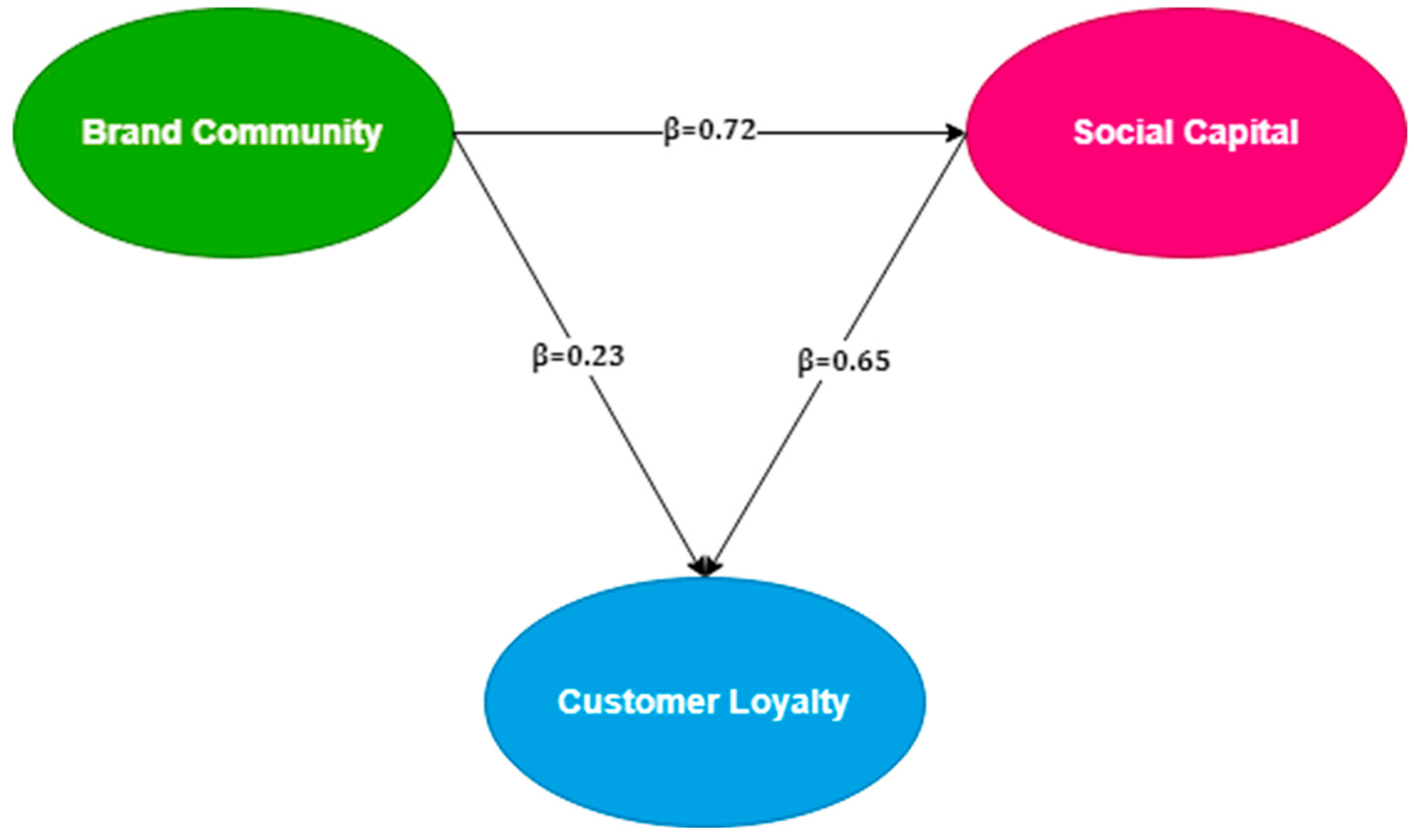
Table 3.
Questionnaire Reliability Results.
| Variable | Number of Questions | Cronbach's Alpha |
|---|---|---|
| Brand Community | 10 | 0.87 |
| Social Capital | 15 | 0.91 |
| Customer Loyalty | 8 | 0.85 |
| Total Questionnaire | 33 | 0.89 |
Table 4.
Bootstrap Test Results for Indirect Effect.
| Path | Indirect Effect | Standard Error | Lower CI 95% | Upper CI 95% | Significance Level |
|---|---|---|---|---|---|
| Brand Community -> Social Capital -> Customer Loyalty | 0.47 | 0.06 | 0.35 | 0.59 | <0.001 |
Table 5.
Frequency Distribution of Sample Demographic Characteristics.
| Variable | Category | Frequency | Percentage |
|---|---|---|---|
| Gender | Male | 276 | 71.9% |
| Female | 108 | 28.1% | |
| Age | Under 20 years | 42 | 10.9% |
| 21-30 years | 156 | 40.6% | |
| 31-40 years | 113 | 29.4% | |
| Over 40 years | 73 | 19.1% | |
| Education | Diploma and lower | 87 | 22.7% |
| Bachelor's degree | 198 | 51.6% | |
| Master's degree and higher | 99 | 25.7% |
Table 6.
Descriptive Indices of Research Variables.
| Variable | Mean | Standard Deviation | Skewness | Kurtosis |
|---|---|---|---|---|
| Brand Community | 3.82 | 0.76 | -0.54 | 0.21 |
| Social Capital | 3.65 | 0.82 | -0.38 | -0.15 |
| Customer Loyalty | 3.94 | 0.89 | -0.72 | 0.43 |
Table 7.
Kolmogorov-Smirnov Test Results.
| Variable | Statistic | Significance Level |
|---|---|---|
| Brand Community | 0.052 | 0.200 |
| Social Capital | 0.041 | 0.200 |
| Customer Loyalty | 0.063 | 0.089 |
Table 8.
Correlation Matrix of Research Variables.
| Variable | 1 | 2 | 3 |
|---|---|---|---|
| Brand Community | 1 | ||
| Social Capital | 0.68** | 1 | |
| Customer Loyalty | 0.59** | 0.71** | 1 |
| ** Correlation is significant at the 0.01 level. | |||
Table 9.
Research Hypothesis Test Results.
| Path | Path Coefficient (β) | t-statistic | Significance Level | Result |
|---|---|---|---|---|
| Brand Community -> Social Capital | 0.72 | 11.43 | <0.001 | Confirmed |
| Social Capital -> Customer Loyalty | 0.65 | 9.87 | <0.001 | Confirmed |
| Brand Community -> Customer Loyalty | 0.23 | 3.76 | <0.001 | Confirmed |
Table 10.
MANOVA Results for Comparing Research Variables Based on Demographic Characteristics.
| Independent Variable | Wilks' Lambda Statistic | F | Degrees of Freedom | Significance Level |
|---|---|---|---|---|
| Gender | 0.97 | 3.45 | 3, 380 | <0.05 |
| Age Group | 0.93 | 2.87 | 9, 924 | <0.01 |
| Education Level | 0.95 | 3.21 | 6, 758 | <0.01 |
Table 11.
Multiple Regression Analysis Results for Predicting Customer Loyalty.
| Predictor Variable | B | Standard Error | Beta | t | Significance Level | |
|---|---|---|---|---|---|---|
| (Constant) | 0.87 | 0.21 | - | 4.14 | <0.001 | |
| Brand Community | 0.31 | 0.08 | 0.26 | 3.88 | <0.001 | |
| Social Capital | 0.58 | 0.07 | 0.54 | 8.29 | <0.001 | |
| R² = 0.53, F(2, 381) = 214.67, p < 0.001 | ||||||
Disclaimer/Publisher’s Note: The statements, opinions and data contained in all publications are solely those of the individual author(s) and contributor(s) and not of MDPI and/or the editor(s). MDPI and/or the editor(s) disclaim responsibility for any injury to people or property resulting from any ideas, methods, instructions or products referred to in the content. |
© 2024 by the authors. Licensee MDPI, Basel, Switzerland. This article is an open access article distributed under the terms and conditions of the Creative Commons Attribution (CC BY) license (http://creativecommons.org/licenses/by/4.0/).
Copyright: This open access article is published under a Creative Commons CC BY 4.0 license, which permit the free download, distribution, and reuse, provided that the author and preprint are cited in any reuse.


