

Submitted:
20 November 2024
Posted:
22 November 2024
You are already at the latest version
Abstract
Background: Every year 9 million diabetics develop foot ulcers (DFU) and 1 million of these will result in an amputation every year resulting in a significant disability burden. Footwear design has been implicated as a major cause of these ulcers resulting in international guidelines recommending specialized protective footwear for diabetics. Unfortunately, in low- and middle-income countries (LMIC), where 80% of diabetics reside, sandals or flip-flops are primary footwear as they are affordable. Studies on flip-flops have focused on plantar pressure and ulcers even though evidence supports that 50% of ulcers are caused by straps on the dorsum of the foot particularly at the toehold. Strap redesign, as evidenced by rolled inner seam (RIS) vs standard straight edge straps, has been shown to reduce pressure on the dorsum of the foot.Objective: This study aims to understand the relationship between toe spread and toehold pressure as toe spread is a modifiable factor in flip-flops by adjusting the thickness of toe posts in the strap. Further, it aims to validate findings from a smaller sample size prior study that RIS design resulted in lesser pressure at the toehold when compared to standard straight edge design.Methods: This cross-over study recruited sixteen patients with 64 measures recorded for toehold pressure during a 5-step walking trial. Toes spread was measured by uploading still images to a convolutional neural network keypoint implementation algorithm which marked the midpoints of the great and second toes and measured the distance between them. Pearson correlation and linear regression models were used to assess the relationship between toe spread and toe hold pressure across and within each flip-flop design. Additionally, a t-test was conducted to compare toehold pressures between the two designs to validate prior study findings.Results: Overall, there was a very weak correlation (r=-0.322) between toe spread and toehold pressure. Regression analysis showed toe spread accounted for a modest variance (R² = 0.104) in toehold pressure overall, with straight edge design showing a slightly stronger association (R² = 0.121) compared to RIS design (R² = 0.022). The t-test validated prior study findings of a statistically significant difference in toehold pressure between RIS and standard straight edge designs, with RIS resulting in lower pressures at the toehold.Conclusion: Toe spread has minimal impact on toehold pressure. RIS strap design results in lower toehold pressure compared to straight edge strap design.
Keywords:
Diabetic Foot Ulcers (DFU)
; footwear design
; toe spread
; toehold pressure
; Rolled Inner Seam (RIS) Design
Background
Over 500 million people suffer from diabetes in the world. The International Diabetes Federation estimates that over 80% of people with diabetes live in low- and middle-income countries (LMIC), where the condition is increasing rapidly due to lifestyle changes and urbanization.
Diabetic foot ulcers (DFU) affect 150 million people with diabetes and result in 1 million amputations a year. They are responsible for 61% of the years lived with disability, putting DFUs conservatively among the top 10 conditions causing disability worldwide. [1]
International guidelines advise people with diabetes to wear close-toed, thick-soled footwear to protect against foot ulceration. [2] However, this type of footwear is not used in some cultures, climates, and socioeconomic conditions in many low and middle-income countries. Sandals and flip-flops are by far the most common footwear in these countries. [3]
Footwear design significantly influences biomechanical factors from balance to pressure and friction on the skin. Toe grip sandals like flip-flops have unique implications for pressure related complications on both plantar and dorsal surfaces. In fact, studies [4], [5] have shown that 50% of diabetic foot ulcers are caused by straps on the dorsal surface. While plantar pressure and modifications to footwear design have been studied extensively, little had been done to understand and mitigate pressure related to the straps of footwear. [6]
Prior Studies
Traditional flip-flop straps have straight edges, and the inner seam comes in maximal contact with the foot contour creating localized pressure points especially at the toehold. [4] We redesigned the flip-flop strap with a rolled inner seam (RIS) design to distribute pressure more evenly and reduce pressure on the dorsum of the foot, particularly at the toe hold.
Previous research from this investigator included a study evaluating time to first abrasion comparing the RIS design to standard straight edge flip-flop straps on pig skin and found that the RIS design showed a statistically significant delayed onset of abrasions. [7] This was promising in the designs ability to reduce pressure and abrasions on the dorsal surface of the foot potentially minimizing the risk of foot ulcers. Subsequently we conducted a study comparing the RIS strap flip-flops with traditional straight edge strap flip-flops on human volunteers and measured the maximal pressure at the toe hold area during a standardized 5-step walking trial. [8] This study found that the pressure at toehold was significantly lower with the RIS design compared to the standard straight edge design flip-flop. This highlighted the RIS designs potential in reducing localized pressure and improving foot health in populations that primarily rely on toe grip footwear like flip-flops.
Identified Gaps
Toe spread has been implicated as a factor affecting plantar pressures and toe deformities in diabetic patients have been implicated in increasing plantar pressures resulting in plantar foot ulcerations. [9,10] However, the impact of toe spread on dorsal foot pressures especially when wearing toe grip footwear like flip-flops has been unexplored. Toe spread is modifiable in flip-flops with toe grip, by altering strap design by changing the thickness of the toe post.
Study Objectives
This study aims to investigate he correlation between toe spread and toehold pressure overall and particularly comparing it between the two strap designs (RIS vs. straight edge). The results of this study could inform further strap design modifications by altering toe post thickness to lessen dorsal foot pressure from the straps to minimize the risk of dorsal foot ulcers.
It tests the following hypotheses:
- Hypothesis1: An increase in toe spread correlates with a decrease in toe hold pressure on the dorsum of the foot.
- Hypothesis 2: Strap design (RIS vs. straight edge) affects toe spread, which in turn influences toe hold pressure in toe grip footwear.
Further, we will validate findings from a previous study with a smaller sample size that showed RIS straps demonstrated lower pressures at the toehold area compared to straight edge straps. [8]
Methods
Study Design and Participants This cross-over study was conducted to evaluate the influence of toe spread on toehold pressure, compared across the rolled inner seam (RIS) and standard straight-edge flip (Figure 1). Toe Spread for purposes of this study is defined as the linear distance between the midpoints of the tip of the great toe and the tip of the second toe. Toehold is defined as the area on the dorsal surface of the foot between the great and second toes, directly beneath the strap of toe grip footwear. Sixteen adults were recruited after written informed consent was obtained, as per study protocols approved by the Institutional Review Board (IRB). Participants included 9 females and 7 males, ranging in age from 18 to 74 years.
All subjects participated in a standardized 5-step walking trial with calibrated portable pressure sensors recording the toehold pressure. Each participant completed the trials in both types of flip-flops worn in random order, resulting in 64 pressure recordings. Still images were taken at the start of the walking trial which were uploaded to the CNN keypoint implementation model described below in Appendix A to measure toe spread.
Data Confidentiality and Security: All personal identifiers were removed from datasets by assigning unique subject IDs to each participant. The key linking subject IDs to personal information was stored securely in a password-protected file.
Statistical Analysis
Both correlation and regression analysis techniques were used to assess linear relationships between the variables, followed by hypothesis testing to compare means between groups.
Correlation Analysis on all data points: Pearson correlation coefficients were calculated to assess the strength and direction of the linear relationship between toe spread and toehold pressure across all data points, irrespective of the flip-flop design. This analysis was done to have a preliminary understanding of the potential influence of toe spread on toe hold pressure.
Regression Analysis: A linear regression was performed between toe spread and toehold pressure using the Statsmodels package in Python. The model’s goodness-of-fit was evaluated using the R-squared statistic, which describes the proportion of variance in the dependent variable, toehold pressure attributable to the independent variable of toe spread.
First, the regression model was done for all measures of toe spread, and toehold pressure readings, across both flip-flop designs, in this regression model. Design-Specific regression models were also evaluated for each flip-flop design, RIS and standard straight edge strap.
For the validation outcome, an independent samples t-test was conducted to compare the mean toehold pressures between the RIS and standard straight edge strap designs of the flip-flops. Statistical significance was considered if p<0.05.
Results
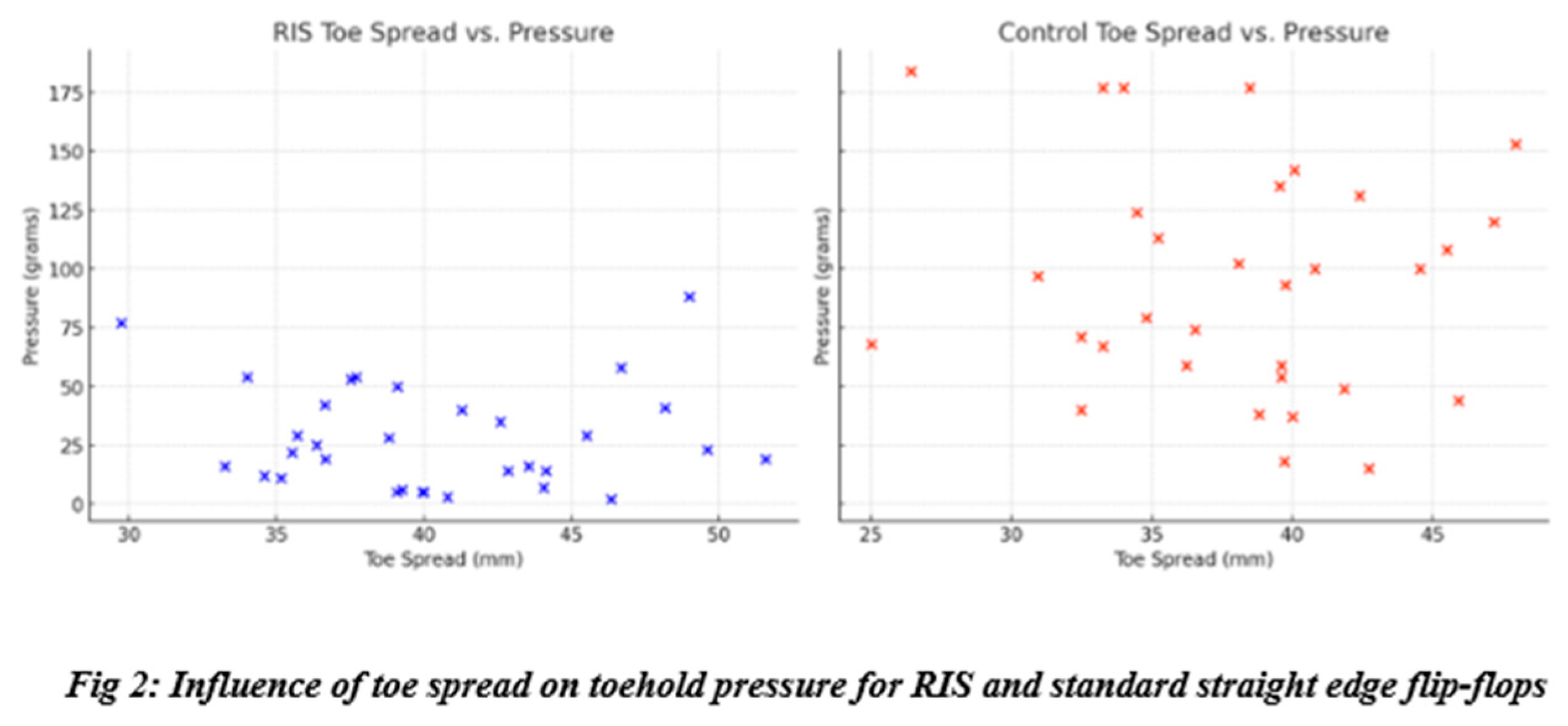
For the correlation between toe spread and toehold pressure overall, irrespective of flip flop strap design, the Pearson correlation coefficient was found to be -0.322. This indicates that with toe spread increases, toehold pressure decreases slightly, but the correlation is weak. There does not appear to be a substantial direct influence of toe spread on toe hold pressure.
The overall regression model covering both designs produced an R-squared of 0.104, indicating that toe spread accounts for approximately 10.4% of the variation in toe hold pressure. This model further indicates that the influence of toe spread on toehold pressure is not substantial.
The regression for the Rolled Inner Seam (RIS) design revealed an R-squared value of 0.022, highlighting a very weak relationship where toe spread explains only about 2.2% of the variability in toe hold pressure. For the Standard Straight-edged design, the regression showed a higher R-squared of 0.121. This model indicates that toe spread can explain up to 12.1% of the variation in toe hold pressure, suggesting a stronger association than that demonstrated by the RIS design but still not significant.
For the validation outcome comparing toehold pressures for RIS vs standard straight edge strap designs, an independent samples t-test yielded a p-value < 0.0001. This result indicates a statistically significant difference in toe hold pressures between the rolled inner seam and standard straight-edged designs, affirming the findings of the prior small sample size study conducted.
In summary, the results indicate a weak overall correlation between toe spread and toehold pressure across both designs (Figure 2). The RIS design showed significantly lower toehold pressure compared to the standard straight-edge design (p < 0.0001), validating prior findings in a smaller sample size study.
Discussion
This study was conducted to evaluate the influence of toe spread on dorsal toehold pressure caused by straps in toe grip footwear like flip-flops. This research was important as the toe post of flip-flop straps can be modified by design to impact toe spread and potentially lower toehold pressure and reduce risk of diabetic foot ulcers.
The results showed, however, that there is only a weak correlation between toe spread and toehold pressure and therefore these results would not result in any further iterative redesigning of the flip-flop strap. The study did however validate outcomes from a prior small sample size study [8] that RIS strap design significantly lowers pressure on the dorsum of the foot at the toehold area compared to standard straight edge design straps. This is an important finding as it supports the adoption of this design by flip-flop manufacturers to reduce the immense burden of diabetic foot ulcers particularly in LMIC’s where people of lower socioeconomic strata who do not have access to expensive protective footwear are at risk for poor health outcomes.
Limitations of this study include the sample size of 16 subjects who contributed 64 data points for toehold pressure and toe spread. While this is larger than prior studies, a much larger study may show a correlation between toe spread and toehold. Further, the study was conducted with a standardized 5-step walking trial on hardwood floors to measure toehold pressure, which may not fully capture the variability of pressure distribution experienced in real-world conditions of walking on uneven streets and with long-term wear conditions.
Future studies which include prolonged walking trials on different surfaces may help us better understand the correlation between toe spread and toehold pressure. The measurement of toe spread was done using a convolutional neural network (CNN) keypoint detection model based on still images. This does not account for dynamic changes in toe spread during walking. My CNN model is being refined to evaluate video images of the walking trial to truly assess toe spread and associated real time changes in toehold pressure which may give us greater insights.
In conclusion, while further studies on larger populations in diverse conditions can provide greater insights on toe spread and toehold pressure which was our primary hypothesis and was not supported by the results, this study adds to the literature on the benefit of RIS design in reducing the pressure at the toehold caused by flip-flop straps and thereby reduces the risks of foot ulcers, a major health concern. Since adoption of the RIS design in manufacturing involves modification of low-cost injection molds to mass produce these redesigned flip-flops, it is easy for manufacturers to incorporate this low-cost, high impact value solution.
Appendix A
Convolutional Neural Network Keypoint Implementation Model
This model was built to map key points on images of feet wearing flip flops as the midpoints of the tips of the great toe and second toe and to measure the toe spread.
Placing the keypoints at the midpoint of the two toes, aligned with the bone, ensures anatomical consistency and minimizes variability due to soft tissue movement. This position reflects the natural spread based on skeletal structure, providing a stable, repeatable reference point for measurements. By anchoring to the bone, the placement avoids artifacts from soft tissue displacement, enhancing both accuracy and reliability in assessing toe spread.
The still images uploaded were resized to be 512 by 512 pixels (Figure 3). I used ImageJ (https://imagej.net/ij/). Since I wanted to calculate the distance between the two toes in pixels I needed to make sure the scale of the images was the same. I used the strap of my flip flop which is around 1.25 cm and used pixel ratios to scale the images. I did that for 78 images. After resizing them I uploaded my raw dataset to Label Studio (https://labelstud.io/) and annotated them with two keypoints (Figure 4). This software exports the dataset in one json file so I used the first script split_json.py to separate each image's annotations. This code uses the image filenames as keys to organize and map the annotations. It also renames JSON files in a folder by replacing specific substrings in the filenames utilizing Python's os and json modules for file handling directory management and data manipulation. Then I used json_load.py to load and process the annotations. The script imports json for handling annotation files os for managing file paths and directories numpy for array manipulations cv2 from OpenCV for reading resizing and normalizing images and train_test_split from sklearn.model_selection to split the dataset into training and testing sets. The images were further processed and saved as NumPy arrays for use in machine learning. It loads images from a specified directory normalizes them by using the standard divide by 255 and extracts keypoint coordinates from corresponding JSON annotation files. The images and keypoints are stored in lists which are later converted into NumPy arrays. After ensuring data is properly loaded the script splits the data into training and testing sets using train_test_split. Finally, it saves these datasets as .npy files for future use ensuring the data is ready for machine learning tasks such as keypoint detection or object recognition.
- Split JSON annotations using split_json.py.
- Process images and annotations using json_load.py.
Model
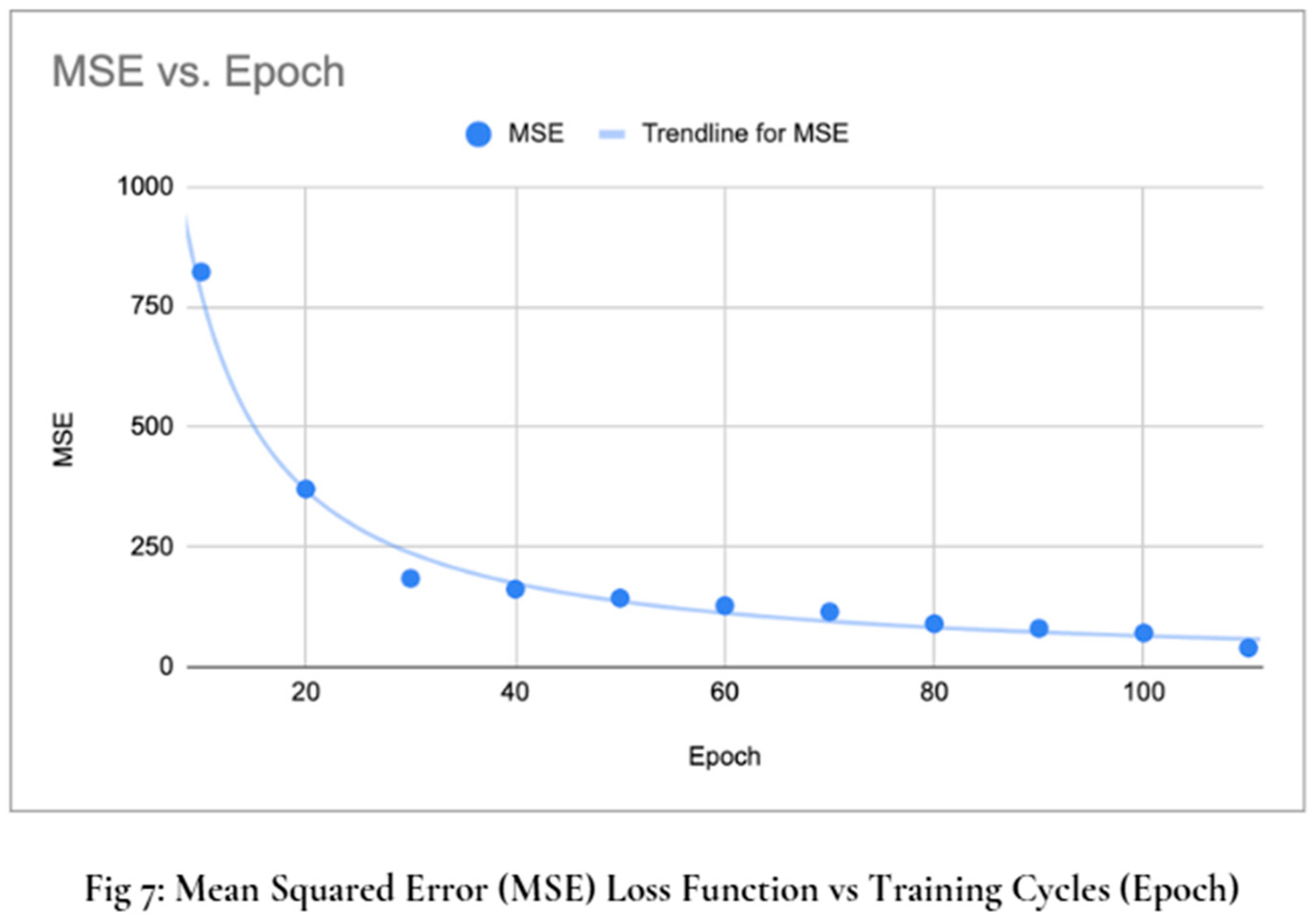
After all the pre-processing steps I ran model_train.py. This code builds a convolutional neural network (CNN) for keypoint detection from images. I decided to use this because similar projects used this format and network, and its functionality fit my purpose. I used NumPy for efficient handling and loading of large datasets ensuring compatibility with TensorFlow which provides the necessary deep learning framework. The model architecture built using TensorFlow’s Keras API leverages convolutional layers (Conv2D) with increasing filters (32 64 128) to progressively extract features from the images which is essential for identifying patterns in spatial data. MaxPooling layers follow each convolution to downsample the feature maps reducing computational complexity and preventing overfitting. The Flatten layer transforms the 2D feature maps into a 1D vector for the fully connected (Dense) layers where 512 neurons (using ReLU activation) capture complex feature relationships followed by 4 output neurons for the predicted keypoint coordinates. Adam optimizer is used for its efficient learning rate adaptation while mean squared error (MSE) is chosen as the loss function appropriate for the continuous nature of keypoint predictions in a regression task. The model is trained for 10 epochs with a batch size of 32 using a 10% validation split to monitor performance on unseen data and reduce overfitting risks. Finally, the trained model is saved allowing for future use without retraining ensuring reproducibility and deployment readiness (Figure 5). I used a virtual environment in Pycharm. I had initially decided to use vscode but it was way more complicated.
- Train the model using model_train.py.
-
Conv2D layers: To extract features from images.
- ○
- I increased the number of filters (from 32 to 128), which allowed the model to capture finer details as it goes deeper. The first few layers capture general patterns (like edges), while the later layers focus on specific, detailed features.
-
MaxPooling layers: To downsample feature maps.
- ○
- MaxPooling layers reduce the dimensionality of the data while retaining important features, making the model faster and more efficient without losing too much critical information. This also helps reduce overfitting by eliminating some irrelevant details.
-
Dense layers: To capture complex feature relationships.
- ○
- Dense layers are used to fully connect all neurons from the previous layer, allowing the model to combine learned features for final predictions, while ReLU activation introduces non-linearity, helping the model capture more complex patterns and relationships in the data.
- Output: 2 keypoint coordinates.
Model Testing
To test the model (Figure 6) and evaluate its performance I used model_test.py. This code script evaluates my pre-trained convolutional neural network by loading test data and the trained model. The use of NumPy ensures efficient handling of the test dataset which is necessary for TensorFlow’s input format. The preprocessed test data (X_test and y_test) are loaded from .npy files which are both memory efficient and fast for handling large datasets in array format. The trained model is then loaded using TensorFlow’s load_model function which allows the script to retrieve the saved model architecture and learned weights from a previously trained instance ensuring the evaluation is performed on the exact model that was trained. The model is evaluated on the test dataset using the evaluate method which computes the loss based on the mean squared error (MSE) loss function used during training (Figure 7).
Figure 3.
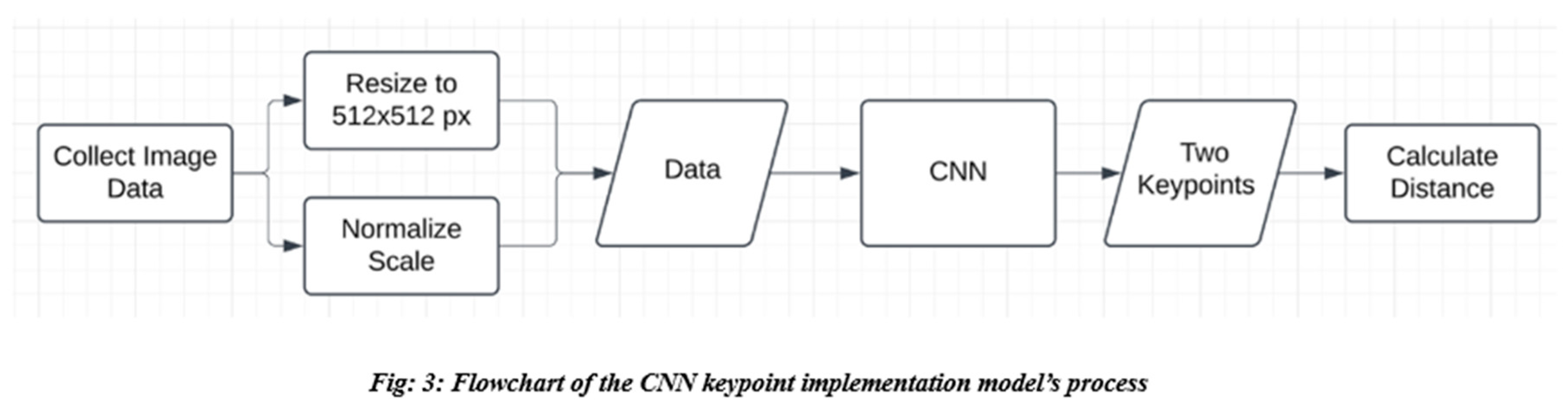
Figure 4.
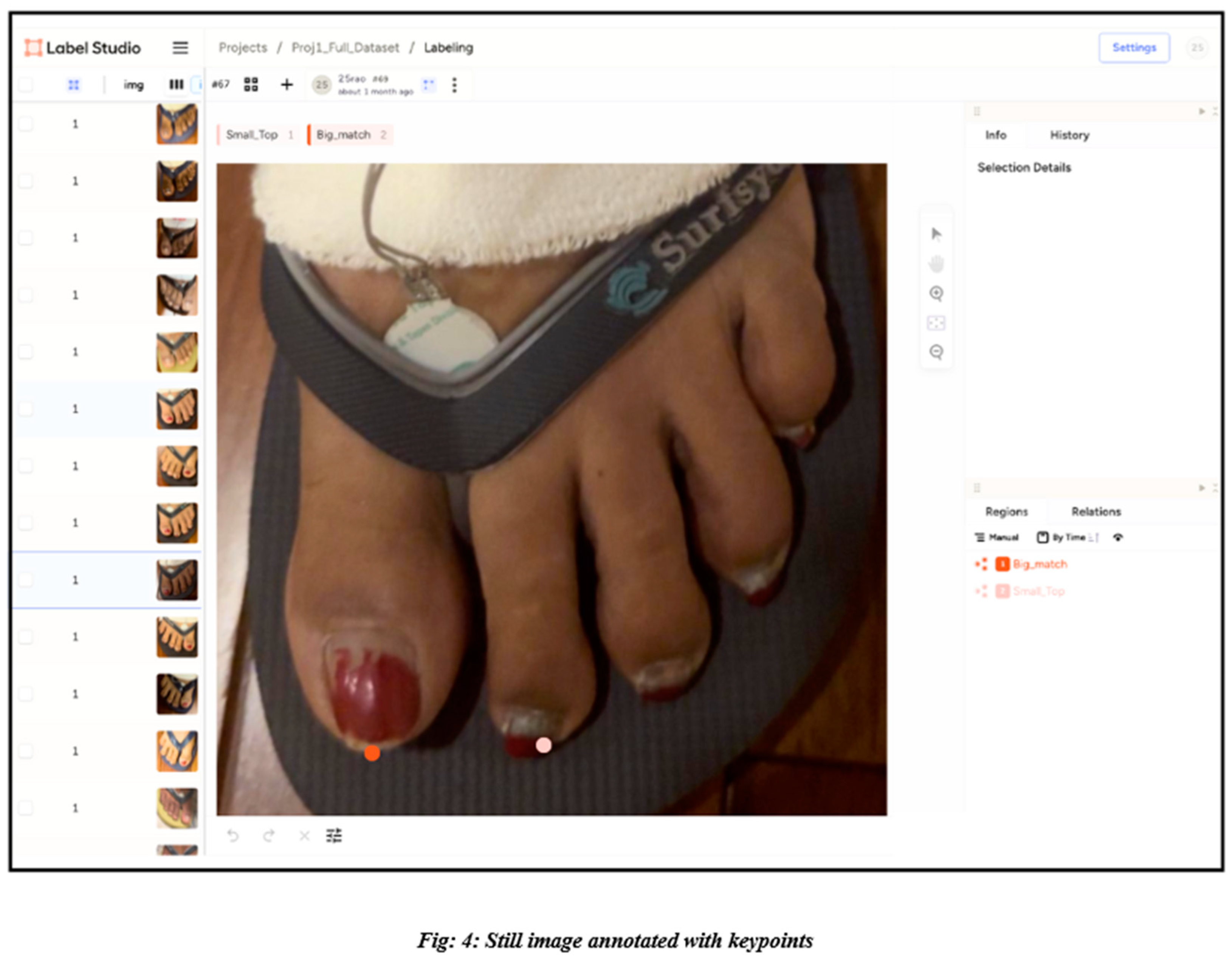
Figure 5.
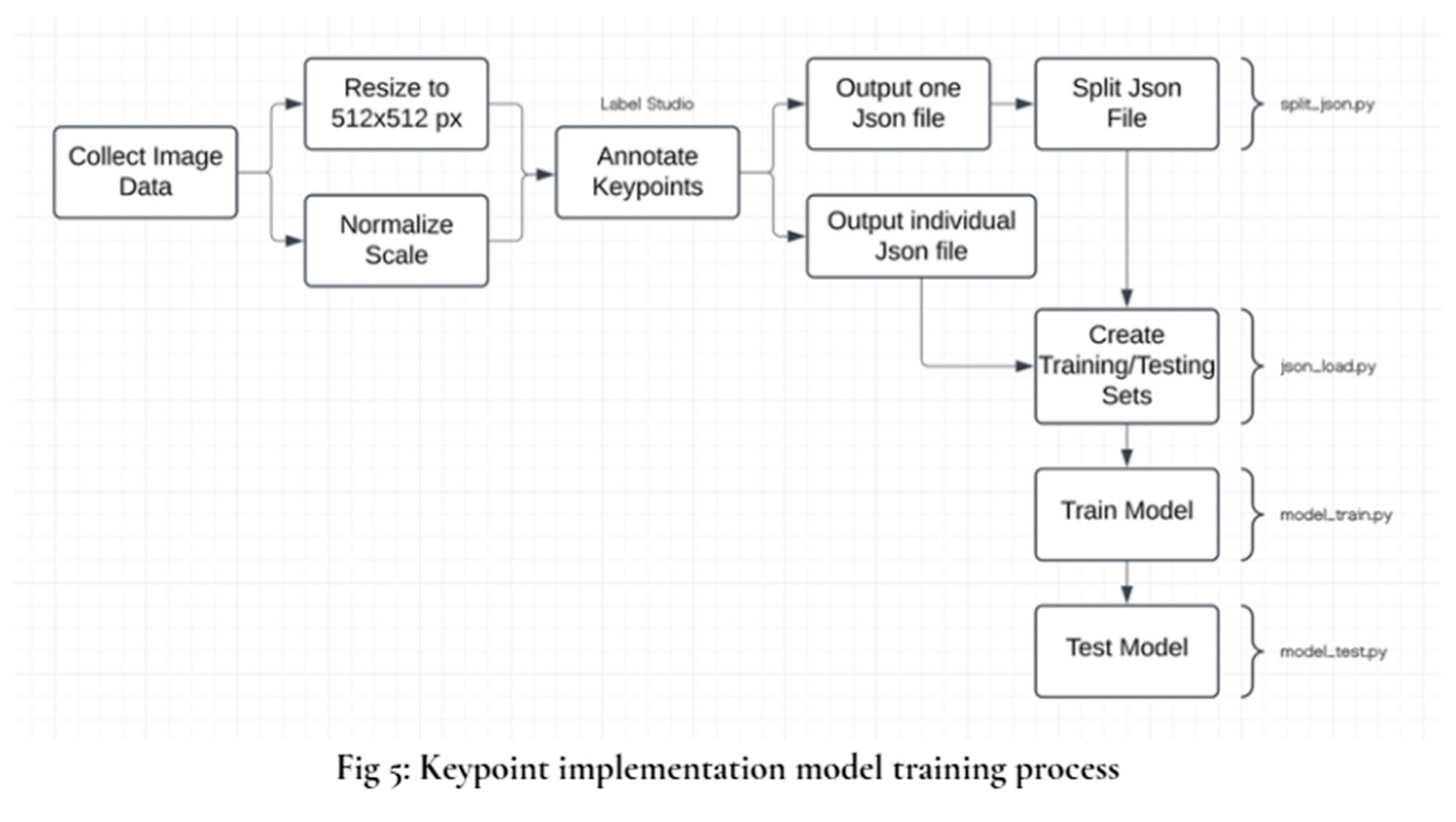
Figure 6.
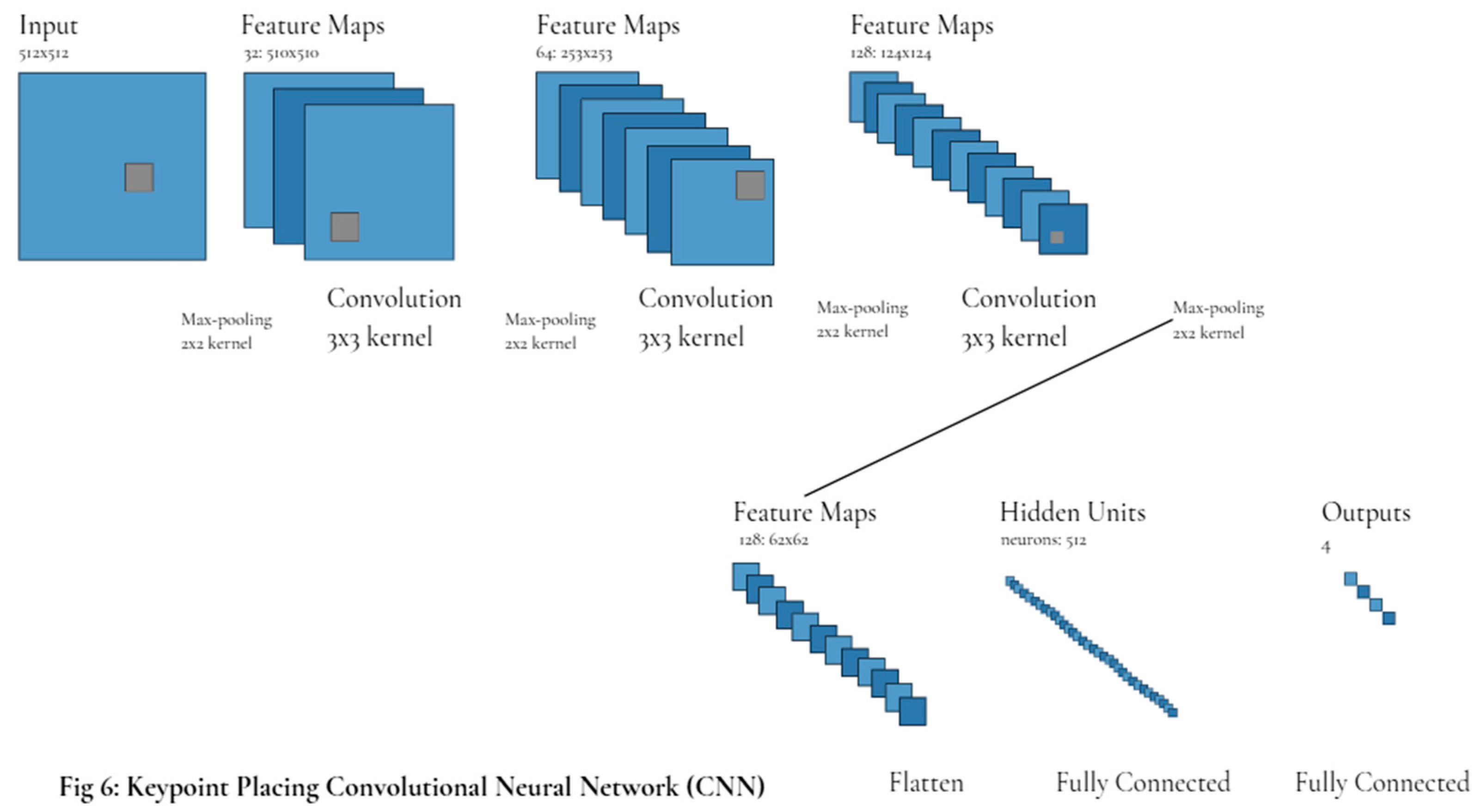
Figure 7.
References
- Lazzarini PA, Pacella RE, Armstrong DG, van Netten JJ. Diabetes related lower-extremity complications are a leading cause of the global burden of disability. Diabet Med. 2018, 35, 1297–1299. [Google Scholar] [CrossRef] [PubMed]
- Available online: https://iwgdfguidelines.org/wp-content/uploads/2019/05/02-IWGDF-prevention-guideline-2019.
- Reddie M, Shallal C, Frey D. A Scoping Review of Footwear Worn by People With Diabetes in Low- and Middle-Income Countries: Implications for Ulcer Prevention Programs. Glob Health Sci Pract. 2023, 11, e2200392. [Google Scholar] [CrossRef] [PubMed] [PubMed Central]
- Ramaswamy, P. , Rajan, P., Rima, J., & Richard, J. Footwear in the causation and prevention of foot ulcers in diabetes mellitus. The National Medical Journal of India 2017, 30, 255–259. [Google Scholar]
- Kesav, P. , Vy, V., & Prabhakar, S. Non-trophic cutaneous ulcers in lepromatous leprosy. The American Journal of Tropical Medicine and Hygiene 2013, 89, 1038–1039. [Google Scholar] [PubMed]
- Razak AH, Zayegh A, Begg RK, Wahab Y. Foot plantar pressure measurement system: a review. Sensors 2012, 12, 9884–912. [Google Scholar] [CrossRef] [PubMed] [PubMed Central]
- Rao, S. , Edwards. W. Time to First Abrasion: A Comparative Evaluation of Flip-flop Strap Designs on Preserved Fetal Pig Skin and Implications for Dorsal Foot Health. Int J Clin Med Edu Res 2024, 3, 01–04. [Google Scholar] [CrossRef]
- Rao S, Maibach H. Comparative Analysis of Strap-Induced Pressure at the Toehold Area: Assessing the Impact of Rolled Inner Seam Flip-flops in Healthy Volunteers. Clin Res Foot Ankle 2023, 11, 471. [Google Scholar]
- Lee KB, Kim BR, Lee KS. Effects of toe spreader on plantar pressure and gait in chronic stroke patients. Technol Health Care 2018, 26, 957–962. [Google Scholar] [CrossRef] [PubMed]
- Sicco, A. Bus, Mario Maas, Antony de Lange, Robert P.J. Michels, Marcel Levi, Elevated plantar pressures in neuropathic diabetic patients with claw/hammer toe deformity. Journal of Biomechanics 2005, 38, 1918–1925. [Google Scholar] [CrossRef]
Figure 1.
Elements of flip-flop strap.
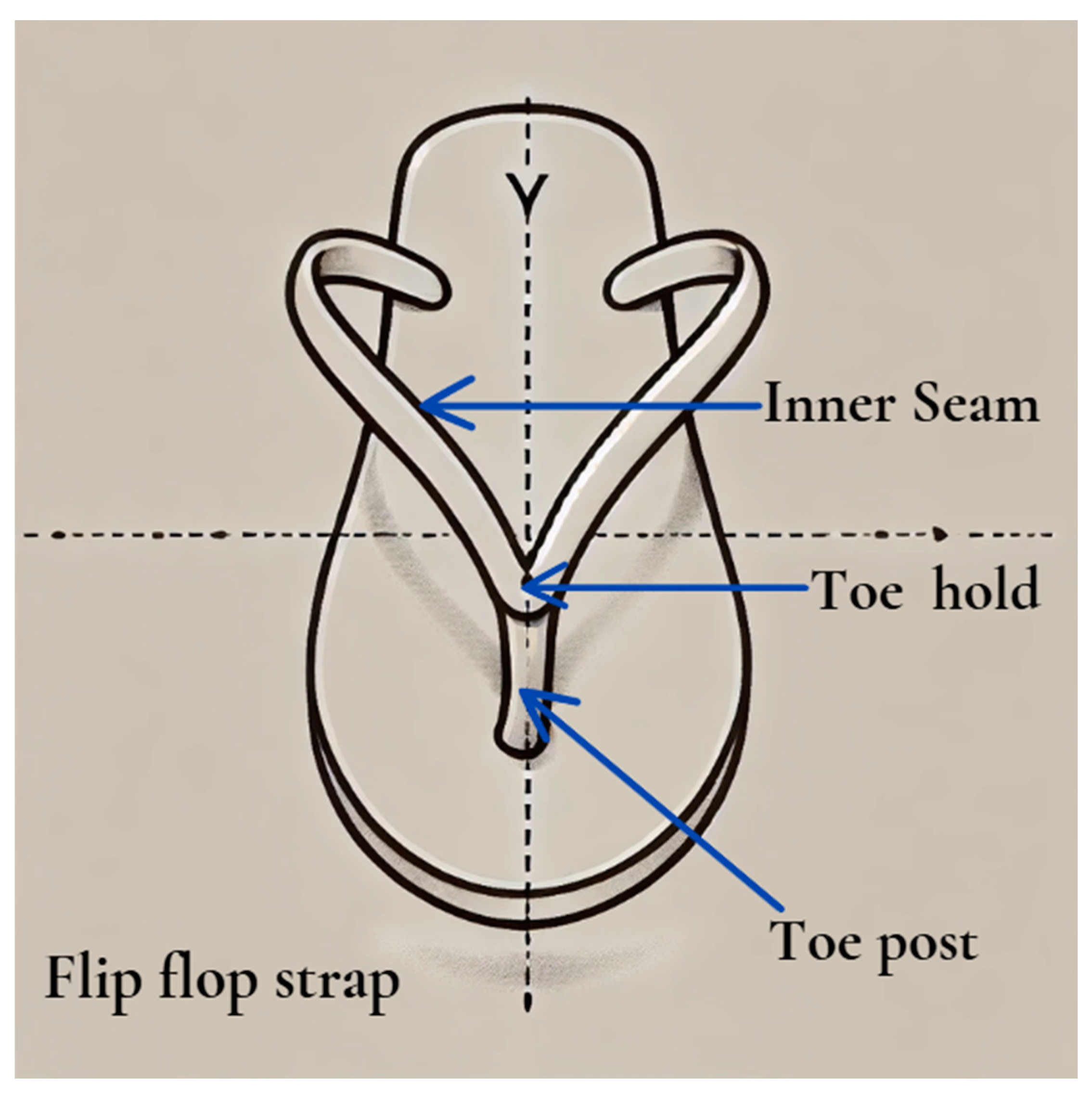
Figure 2.
Disclaimer/Publisher’s Note: The statements, opinions and data contained in all publications are solely those of the individual author(s) and contributor(s) and not of MDPI and/or the editor(s). MDPI and/or the editor(s) disclaim responsibility for any injury to people or property resulting from any ideas, methods, instructions or products referred to in the content. |
© 2024 by the authors. Licensee MDPI, Basel, Switzerland. This article is an open access article distributed under the terms and conditions of the Creative Commons Attribution (CC BY) license (http://creativecommons.org/licenses/by/4.0/).
Copyright: This open access article is published under a Creative Commons CC BY 4.0 license, which permit the free download, distribution, and reuse, provided that the author and preprint are cited in any reuse.


