1. Introduction
Continuous Miner technology has restored the faith of mining industry in underground coal mining methods. This technology has proved to be successful with improved efficiency and safety in difficult and complex geo-mining conditions of Indian underground coal mines. A number of coal mines have already adopted this technology since its introduction in 2003 in Anjan Hill mine of Chirimiri Area of South Eastern Coalfields Limited (a subsidiary of Coal India Limited). In this line, Tawa-I mine in Pathakhera Area of Western Coalfields Limited (also a subsidiary of Coal India Limited) is planning to introduce this technology. Based on the Project Report and Scheme prepared by CMPDIL, it has been proposed by the mine management of Tawa-I mine to introduce Continuous Miner (CM) Technology in Bagdona Coal Seam of the mine. The panels of BCS of the Tawa-I mine is being developed by conventional drilling and blasting method with 3.8 m gallery width up to full seam thickness (average thickness = 1.80 m).
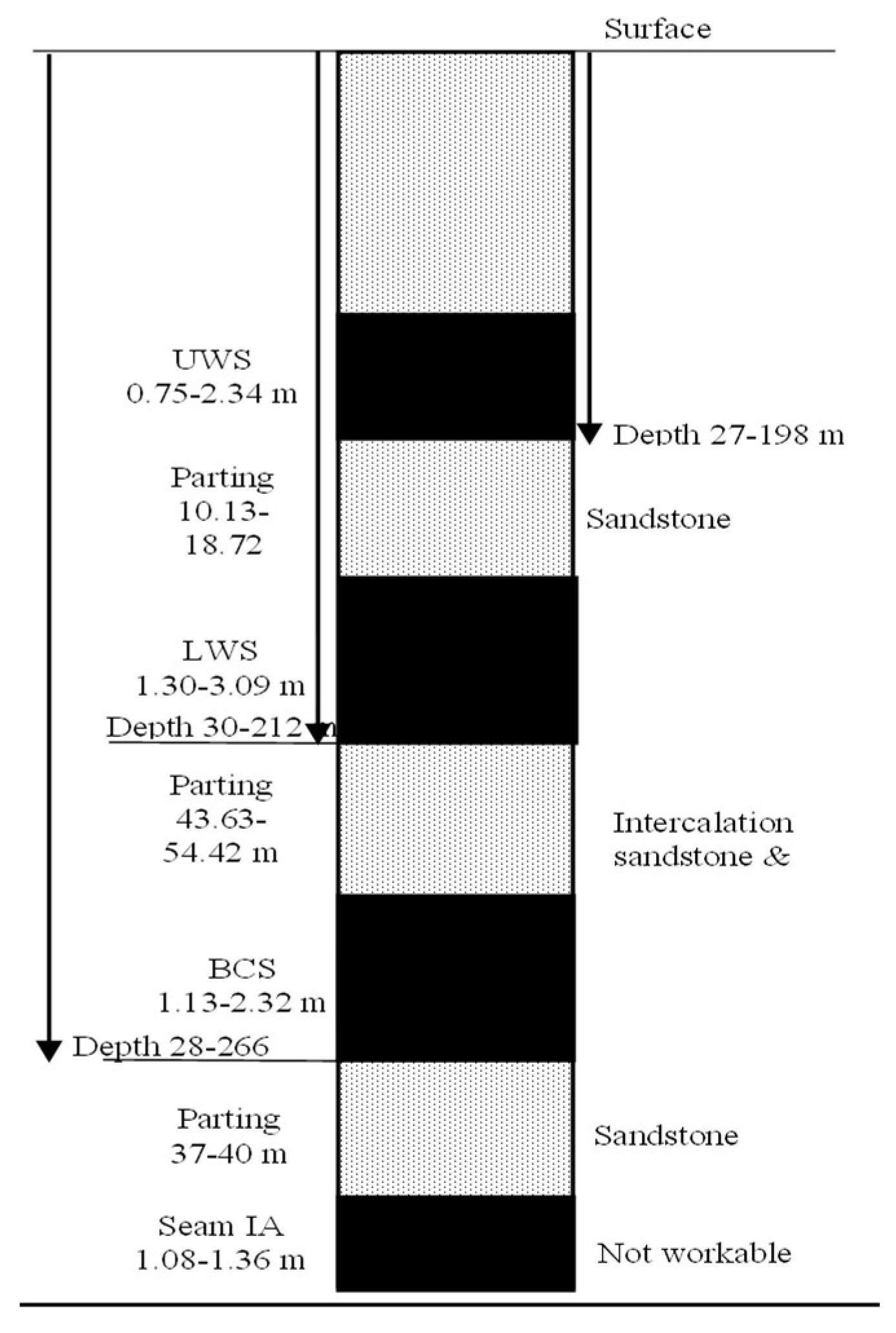
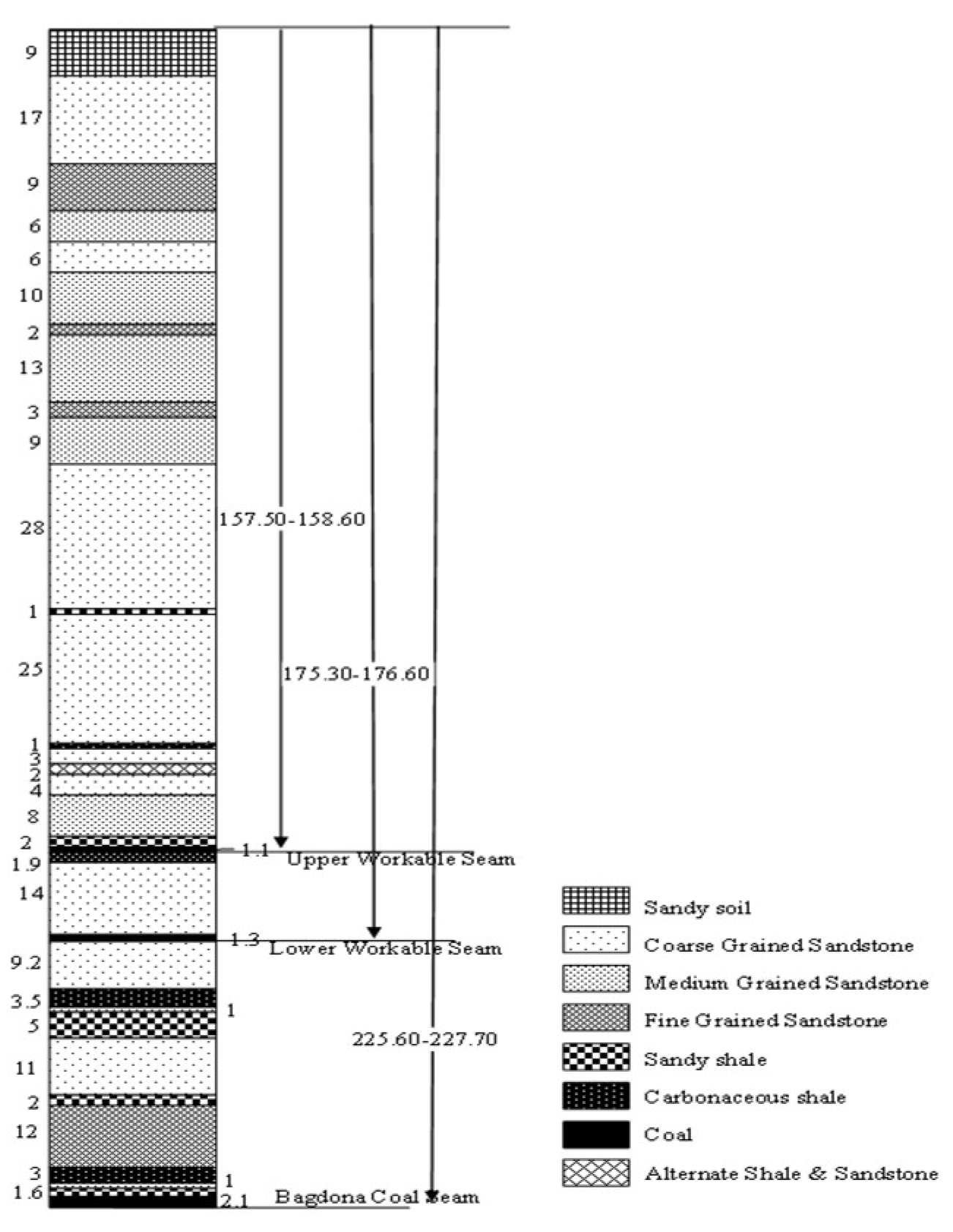
Four coal seams, namely, Upper Workable Seam (UWS), Lower Workable Seam (LWS), Bagdona Coal Seam (BCS), and Seam IA have been established by drilling in Tawa-I Underground Mine. The variation in thickness of different seams and their intervening parting as encountered in different boreholes are mentioned in
Figure 1 and
Figure 2.
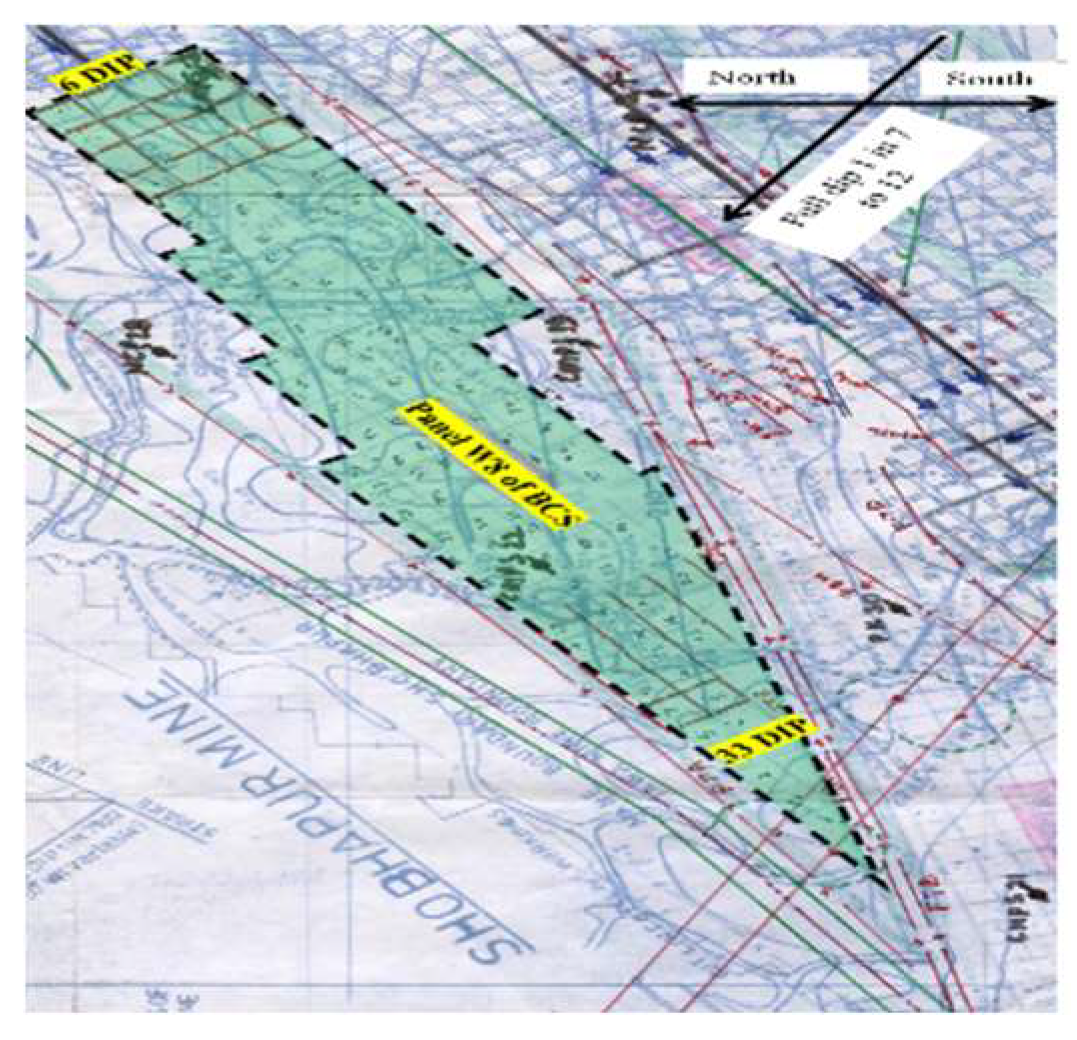
Presently, the panel (
Figure 3) is being developed on pillars (35.7 m x 31.2 m) and galleries (3.8 m x 1.8 m) by Bord & Pillar Mining Method. It has been planned to depillar the conventionally developed pillars in the panel by mechanized Continuous Miner (CM) technology. Further, CM has to extract the sides of the pillar in order to widen the existing galleries of 3.8 m for its adaptability.
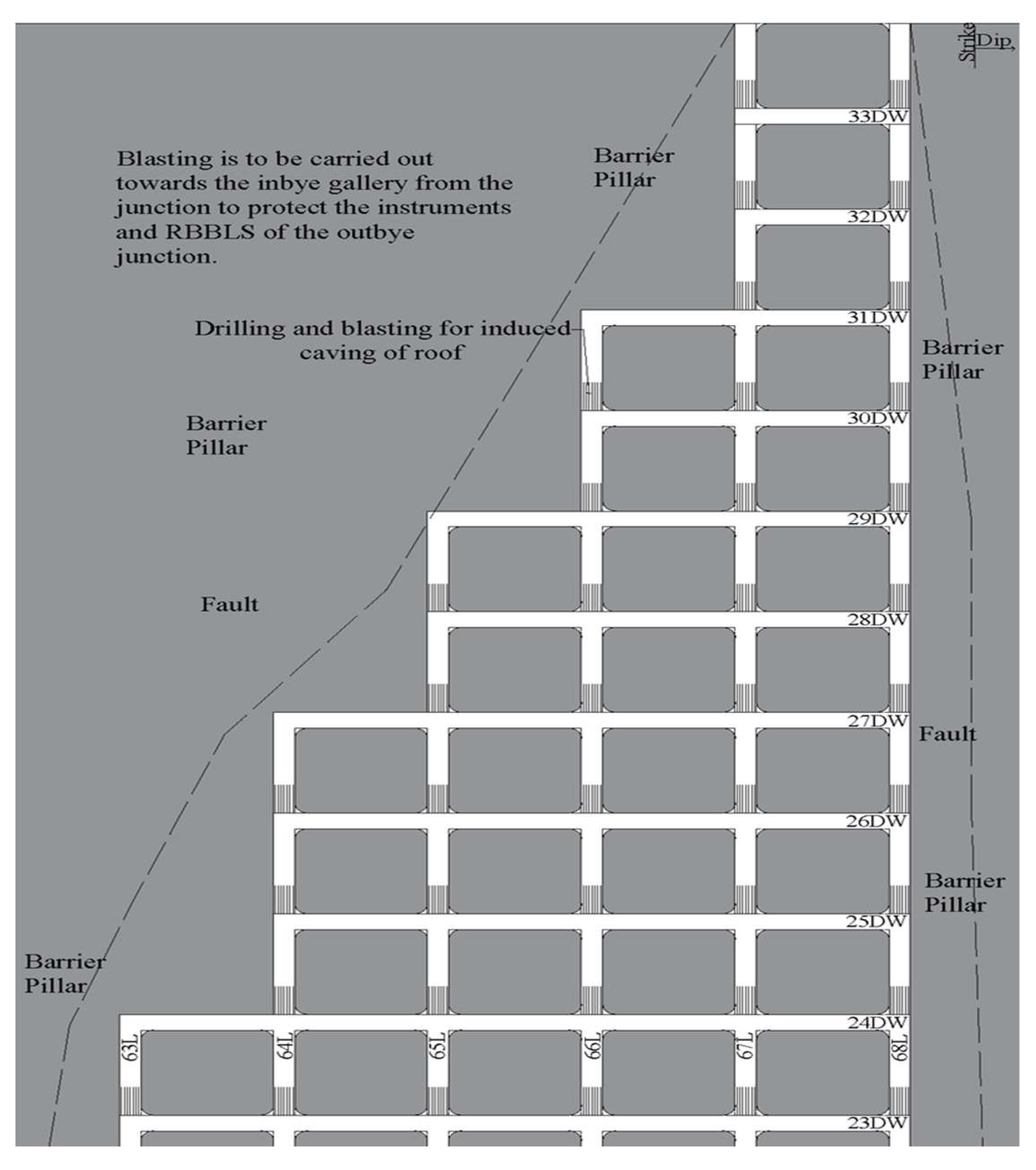
Depillaring operation in the panel needs preparatory arrangement of widening of galleries by cutting sides of pillar using CM for its easy maneuverability and adaptability and advance installation of geotechnical instruments. Shale roof of varying thickness 3-5 m is present above the coal seam in the panel. A fault with 1.5 m throw is running from 4 Dip to 13 Dip between 63L-64L (
Figure 3) and further surrounded by two major faults. The panel is lying below a panel which had been depillared with caving in LWS at an average parting of 50 m. A maximum subsidence of 1.6 m has been reported till date in the Tawa-I mine in panel E2 section of LWS. Maximum angle of draw has been observed up to 11⁰ in the E6 district of LWS which was depillared 11 years ago. The geo-mining conditions of panel is mentioned in
Table 1. A number of developments have been made for the design of geotechnical elements involved during working with Continuous Miner technology. This paper mentions about the design of underground structures based on empirical and simulation studies for better strata control management with CM technology in the panel.
2. Empirical Approach for Design of Underground Structures
Bagdona Coal Seam (BCS) after access through inseam drifts have been extensively developed by Bord and Pillar Mining Method (BPMM). The immediate overlying LWS has already been developed and depillared many years ago. Presently, development operation is in progress in the panel by Load Haul Dumper (LHD) and belt conveyor combination. It has been proposed to depillar these developed pillars with combination of Continuous Miner-Shuttle Car-Quad Bolter-Feeder Breaker technology.
2.1. Caveability Index
On the basis of different field experiences, the caving characteristics of overlying strata are quantified in terms of Caveability Index (
I) [
1], which is defined as:
where, σ is uniaxial compressive strength in kg/cm
2,
l is average length of core in cm, T is thickness of the strong bed in m and the factor
n has a value of 1.2 in the case of uniformly massive rocks with a weighted average of RQD of 80% and above and in all other cases value of n is equal to 1.
Caveability Index of immediate roof of panel is estimated to be 7260, which comes under roof caveable with difficulty (
Table 2). Since, there is no evidence of water in the overlying strata, therefore, it is anticipated that roof fall will be delayed in the goaf during working in the panel.
2.2. Width of Gallery
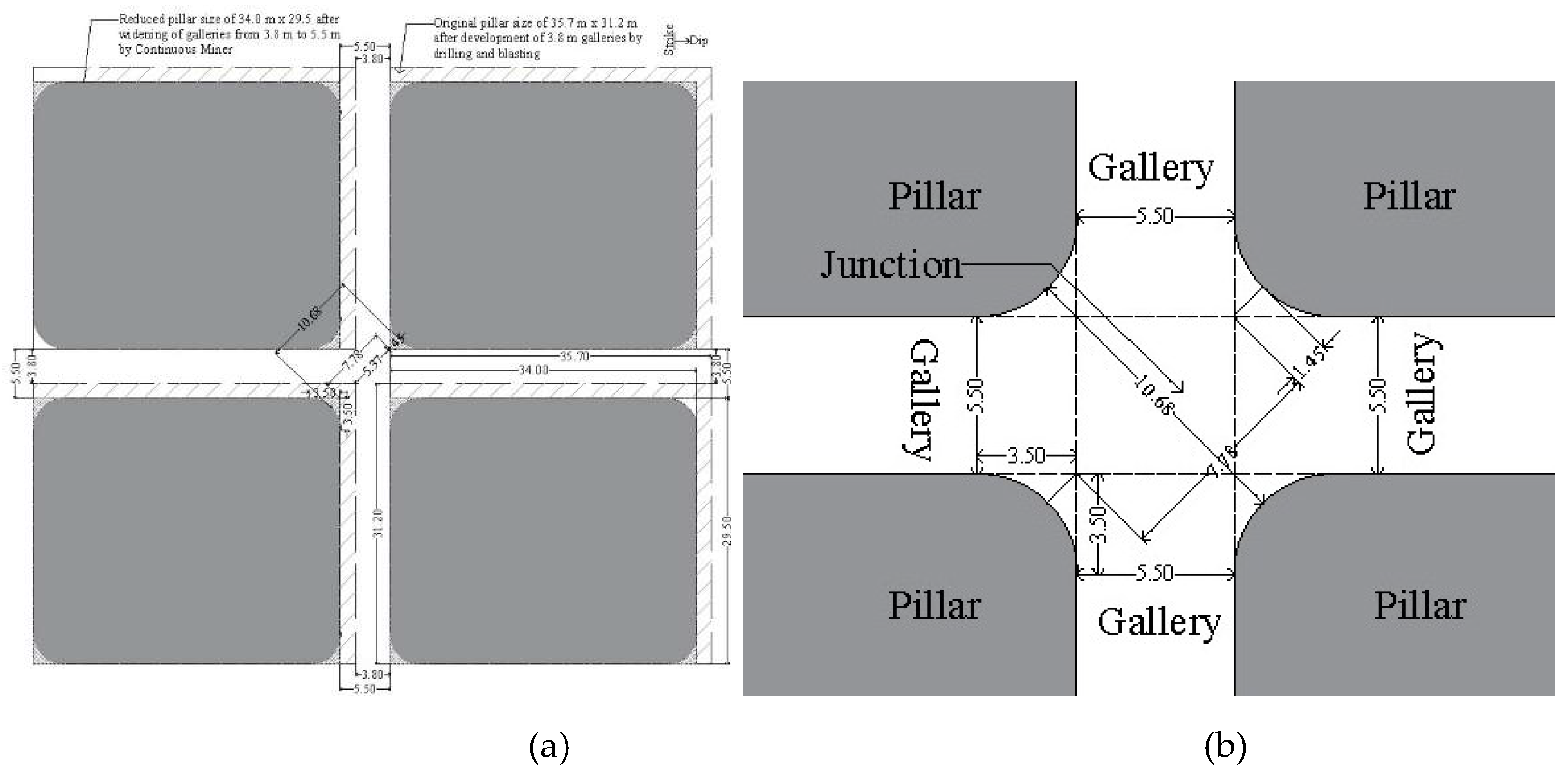
Existing galleries of 3.8 m needs to be widened for adaptability of the CM (
Figure 4a) by cutting the sides of coal pillar of size 35.7 m x 31.2 m (corner-to-corner). Considering the extent of spalling, frequency of slips/joints/discontinuities present in the panel and available case studies of mechanised depillaring (MD) panels using CM technology in different coalfields of India, it is proposed here to widen the 3.8 m width of gallery to 5.5 m only. It is suggested to extract the sides of pillars of 1.70 m in L-shape manner for efficient utilization of CM in the panel. Extraction of sides of coal pillar will reduce the size of pillar from 35.7 m x 31.2 m (corner-to-corner) to 34.0 m x 29.5 m (corner-to-corner). Further, it will also reduce the strength of pillar. Considering the length of the machine as 11.9 m, it will be difficult for CM to turn around the junctions of 5.5 m width of gallery. Diagonal length of around 10.50 m is required around junction for turning the entire length of CM, therefore, it is also proposed here to reduce the corners of the pillar as shown in the
Figure 4b. Around 10.68 m of diagonal length will be available after extraction of corners around junction which provides sufficient turning radius for movement of CM. It has been also found that the sharp 90⁰ corners becomes rounded ultimately dur to induced-stress driven spalling. The suitability of 5.5 m width of gallery has also been simulated in numerical models and found to be appropriate which is presented in the section of Numerical Modelling.
2.2.1. Safety Factor of Pillar and Fender
Sheorey [
2] developed an empirical formula (Equation 2) for the estimation of pillar strength which is well established in Indian coalfields for pillar design.
where, S= pillar strength (MPa), σc= uniaxial compressive strength of coal (MPa), h= working height (m), H= depth of cover (m) and we= effective width of the pillar (m)= 4A/Pc, where A is area and Pc is perimeter of pillar.
Tributary Area Method [
3] is used to calculate load over pillar and fender. The formation of a pillar by drivage of galleries all around disturbs the state of virgin stresses, keeping the total magnitude of the overlying strata weight γH constant. It is normally assumed that the entire weight overlying a tributary area is supported by solid pillars. The stress on pillar (P) is estimated using Tributary Area Method as given in Equation 3.
where,
H= depth cover (m), B= width of the gallery (m), W1= length of pillar (m), W2= width of pillar (m), γ= unit rock pressure (0.025 MPa/m).
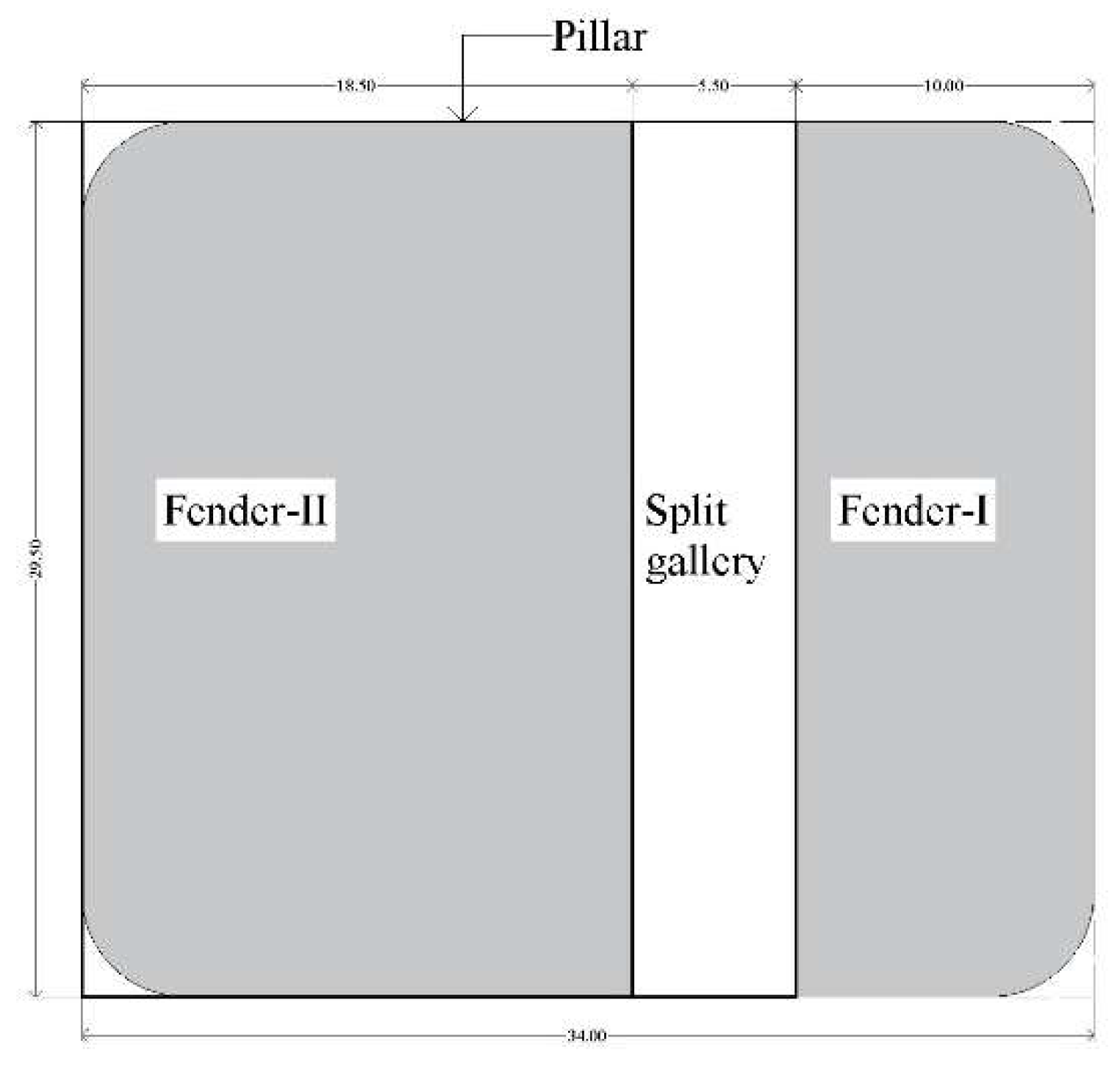
The abovementioned empirical formula has been used to estimate the strength of pillar and fender will be formed during mechanized depillaring in the panel. Here, the fender is half of a pillar after its splitting into two unequal parts (
Figure 5). Unequal division has been suggested to control the cut-out distance (COD) as per the geo-mining conditions. Considering the variation in depth of cover of panel, safety factor of pillar and fender is estimated based on the maximum 266 m depth of cover. The safety factor of pillar is estimated using the strength and load over the pillar, which is mentioned in
Table 3. The estimated safety factor of the pillars (4.28) and fenders (1.64 and 2.84) for the panel seems to be competent for the pillar extraction subjected to regular caving and less disturbance due to geological discontinuities in the working area.
2.2.2. Safe Cut-Out Distance
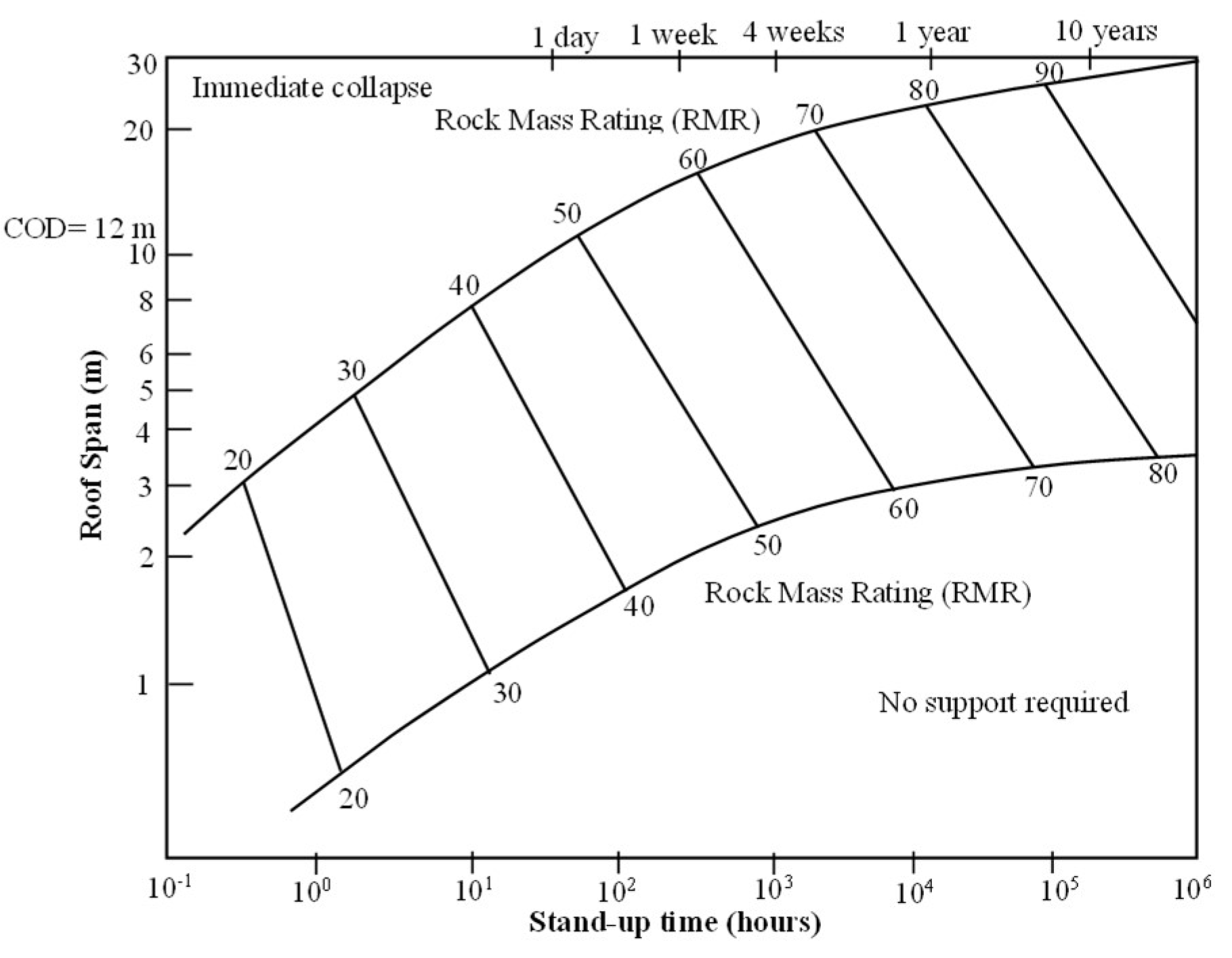
Safe Cut-Out Distance (COD) is defined as the largest length of unsupported span between the advancing face and the nearest supported area or the width between the side pillars i.e., width of excavation. As per the available literature review, Bieniawski [
4] system (
Figure 6) is found to be a suitable approach for estimating the safe COD (unsupported maximum span) during MD in the panel. The observed RMR value of immediate roof strata of BCS is 50.40 with adjustment as the seam was developed by solid blasting. The roof of the BCS is sandy shale having an average value of elastic modulus of immediate roof (E) as 2.0 GPa and width of gallery has been fixed at 5.5 m.
Bieniawski [
5] used the Rock Mass Rating (RMR) developed by Bieniawski [
6] for stand-up time and unsupported span of roof (
Figure 6). The Coal Mine Roof Rating (CMRR) developed by Molinda and Mark [
7] was used to design cut-out distance in US underground mines. Bauer [
8] suggested an empirical formulation (Equation 4) to design cut-out distance based on Coal Mine Roof Rating (CMRR), width of gallery and depth. Mandal et al. [
9] proposed a relationship (Equation 5) to estimate the safe convergence value based on COD, RMR and width of gallery (m). Kumar et al. [
10] proposed a relationship (Equation 6) to estimate the COD based on elastic modulus and width of gallery considering few case studies of MD in Indian coalfields. Saharan et al. [
11] used the concept of Bieniawski [
5] and Mark [
12] to design COD for three Indian coal mines. Kumar et al. [
9] attempted to define the safe and limiting value of roof sagging of 5 mm for a safe design of COD.
where D is cut-out distance (m), R is Coal Mine Roof Rating, W is width of gallery (m) and H is depth of cover (m). Using this relationship (Equation 4), the cut-out distance is found to be 10.67 m for RMR of 50.40, gallery width of 5.5 m and maximum depth of cover of 266 m.
where C is the convergence of immediate roof (mm), W is width of gallery (m), R is Rock Mass Rating, and D is cut-out distance (m). For a safe convergence of 5 mm, this relationship estimates a cut-out distance of 16 m for gallery width 5.5 m and RMR of 50.40.
where, D is cut-out distance (m), E is elastic modulus (GPa) and W is width of gallery (m). Using this relationship, the cut-out distance is found to be 9 m for 5.5 m gallery width and 2.0 GPa elastic modulus of immediate shale roof.
Based on the (
Figure 6) by Bieniawski [
4], the estimated maximum unsupported span i.e., COD for development of galleries comes to be around 12.0 m for the existing conditions of roof rock mass above BCS. Bieniawski [
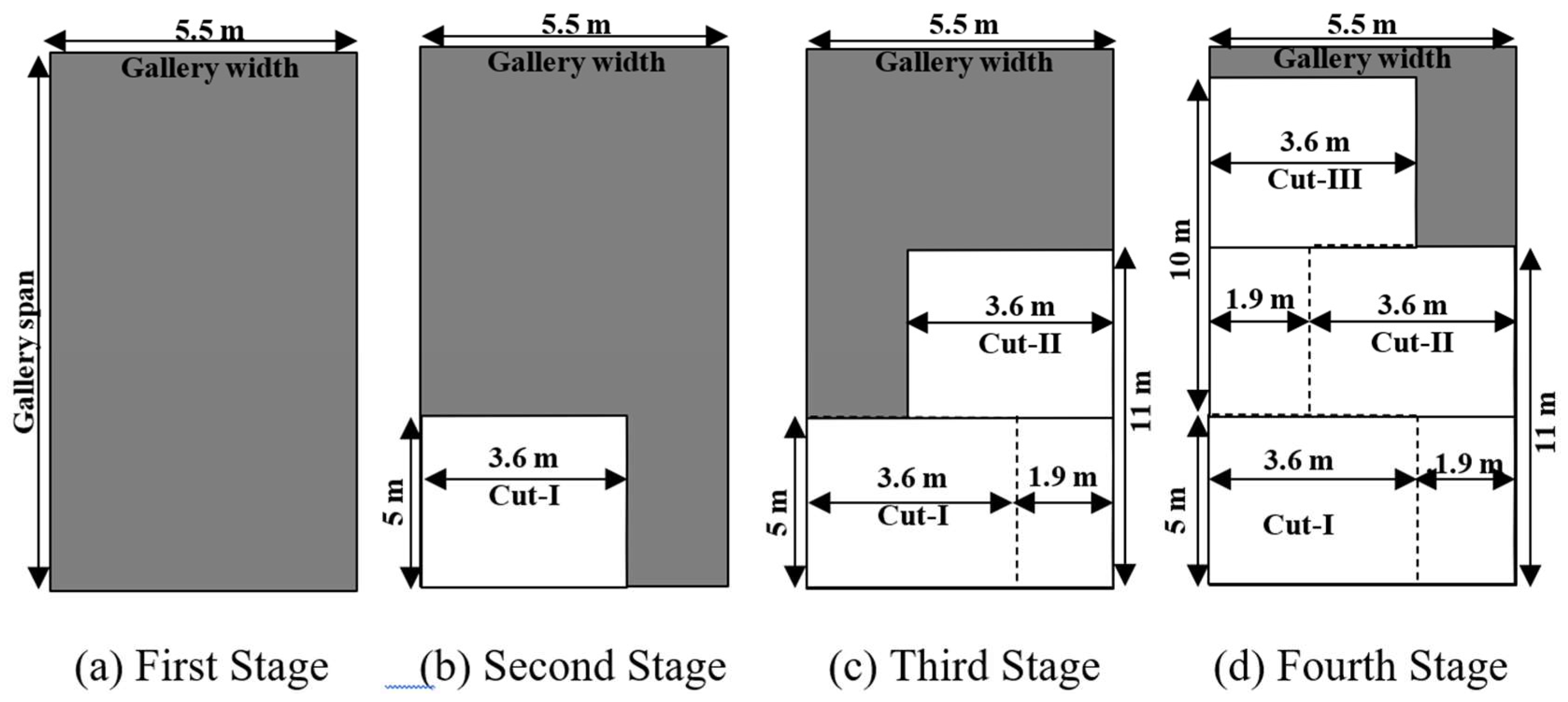
4] developed the relationship to estimate COD for a tunnel which has a single opening. Considering the existing conditions in panel, multiple openings and maximum use of the CM, COD in the panel is kept to be 11.0 m. The estimated value of COD as 11.0 m should be also adopted during the drivage of original/split gallery and slices in the panel. Exposed COD should be supported instantaneously after the dressing of roof before the next cut by the CM in the original/split gallery only, not in slices. This estimated value has also been validated on numerical models through simulation. Simulation study for the geo-mining conditions of the panel is carried out to study the variation in roof deformation for different lengths of unsupported span. The cutting sequences during development/ splitting of a pillar by CM is shown in
Figure 7.
2.3. Extent of Pillar Spalling
Wilson [
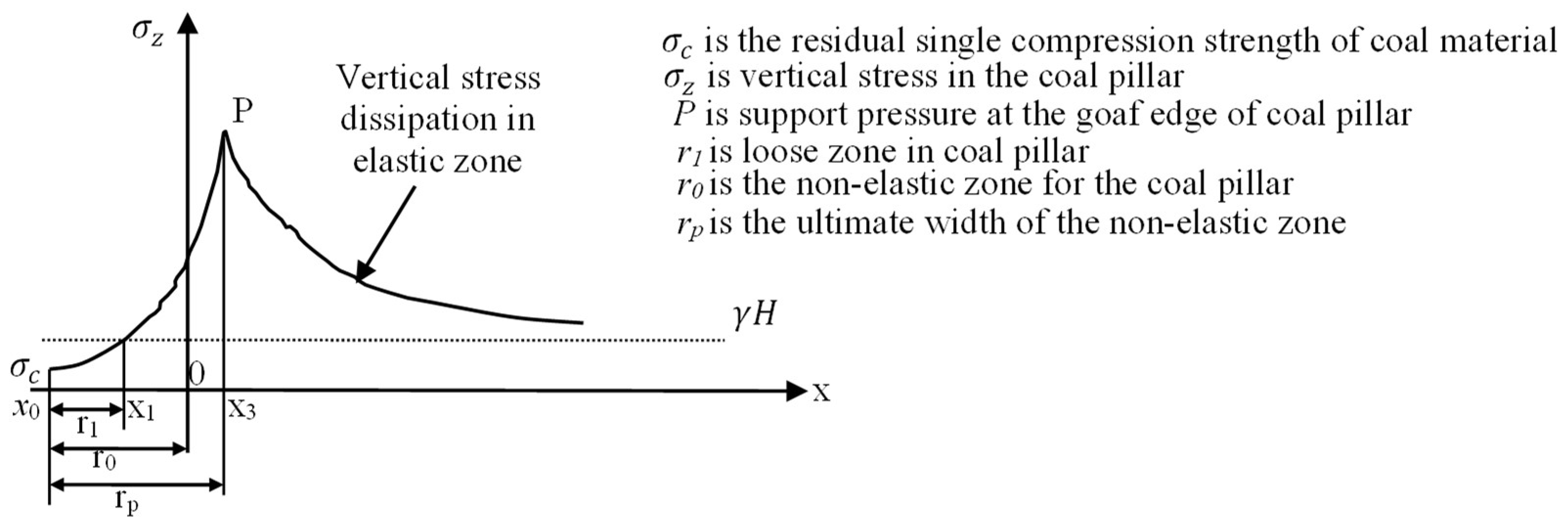
13] developed an empirical equation to estimate the non-elastic zone based on height of extraction and depth of cover of the working seam. Literature survey and different field investigations in Indian coalfields have found that higher value of vertical induced stress is experienced by coal pillars/fenders/ribs/snooks at the goaf edge during MD. This phenomenon is more pronounced when MD is being carried out under a difficult and massive roof at deeper cover. Deterioration of pillar develops in the form of non-elastic zone as side spalling on the outer part and the inner part remains under elastic zone. Further, the non-elastic part is divided into loose (spalled) zone and plastic zone [
14] (
Figure 8). The spalled part of pillar is almost dislodged, hanging and incapable of providing any resistance against load whereas the plastic part of pillar remains attached to the pillar which provides confinement against the load. Thus, it results in fracturing and spalling of corners and sides of pillars, reducing overall size and strength of a pillar. It ultimately affects the size and shape of rib/snook to be left and performance of roof bolt-based breaker line support (RBBLS) and instrumentation plan considering location of instruments to be installed for strata monitoring around the goaf edges. An attempt has been made to estimate the extent of pillar spalling in the panel. Based on the pillar height of 1.8 m and maximum depth of 266 m in the panel, non-elastic zone is found to be around 2.36 m with loose/fractured zone of 1.00 m and plastic zone of 1.36 m. Spalled portion has been already treated during reduction of the corners of pillars by 1.45 m for adaptability of CM.
2.4. Applied Support System in Developed Workings
An attempt has been made to design support system for original gallery and junction/intersection using available empirical approaches [
17], which is also studied using rock load height (RLH) on numerical models in simulation software package considering the site conditions. Required support resistance against the estimated rock load at gallery and junction is calculated using the bearing/anchorage capacity of the applied supports. Supports at the original gallery and junction is designed by considering a support safety factor (SSF) (Equation 8-11) of 1.5 and more for both the empirical and numerical simulation approaches. Basically, the support design depends on parameters like gallery width, rock mass rating (RMR) and unit weight of immediate roof strata.
2.4.1. Rock Load
Efficacy of the support system for original gallery and junction of developed workings of both the panels is estimated using the empirical relationships given as Equations 8 and 9.
where, B= gallery width (m),
= dry unit weight of roof rock (t/m
3),
stands for Rock Mass Rating.
2.4.2. Support resistance
Anchorage capacity of resin grouting material required for estimation of support resistance is tested to be 20 t during the field investigation. Support density is estimated using number of supports (roof bolt) multiplied by anchorage/bearing capacity of that support. Considering these parameters, support resistance is calculated using equation 10.
2.4.3. Support Safety Factor
The support safety factor is calculated using the equation 11 to establish the effectiveness of the support system.
2.4.4. Design of Applied Support
Immediate roof of the panel has been examined during the field visit and found to be competent and dry. The pillars of 39.5 m x 35 m (centre-to-centre) with galleries of 3.8 m are being developed by drilling and blasting in combination with LHD for hauling and belt conveyor for transportation of coal to the surface. The pillars are found to be intact and there are no observations of side spalling during the field visit. Further, there was no evidence of water seepage from roof and the shale in the roof is found to be intact within the panel during the field visit. Bearing capacity of resin grouted roof bolt and RMR are found to be 10 t (in 8 hours) and 50.40 respectively. Rock load, support resistance and SSF are estimated for gallery and junction using the Equations 8-11 for suitable support design (
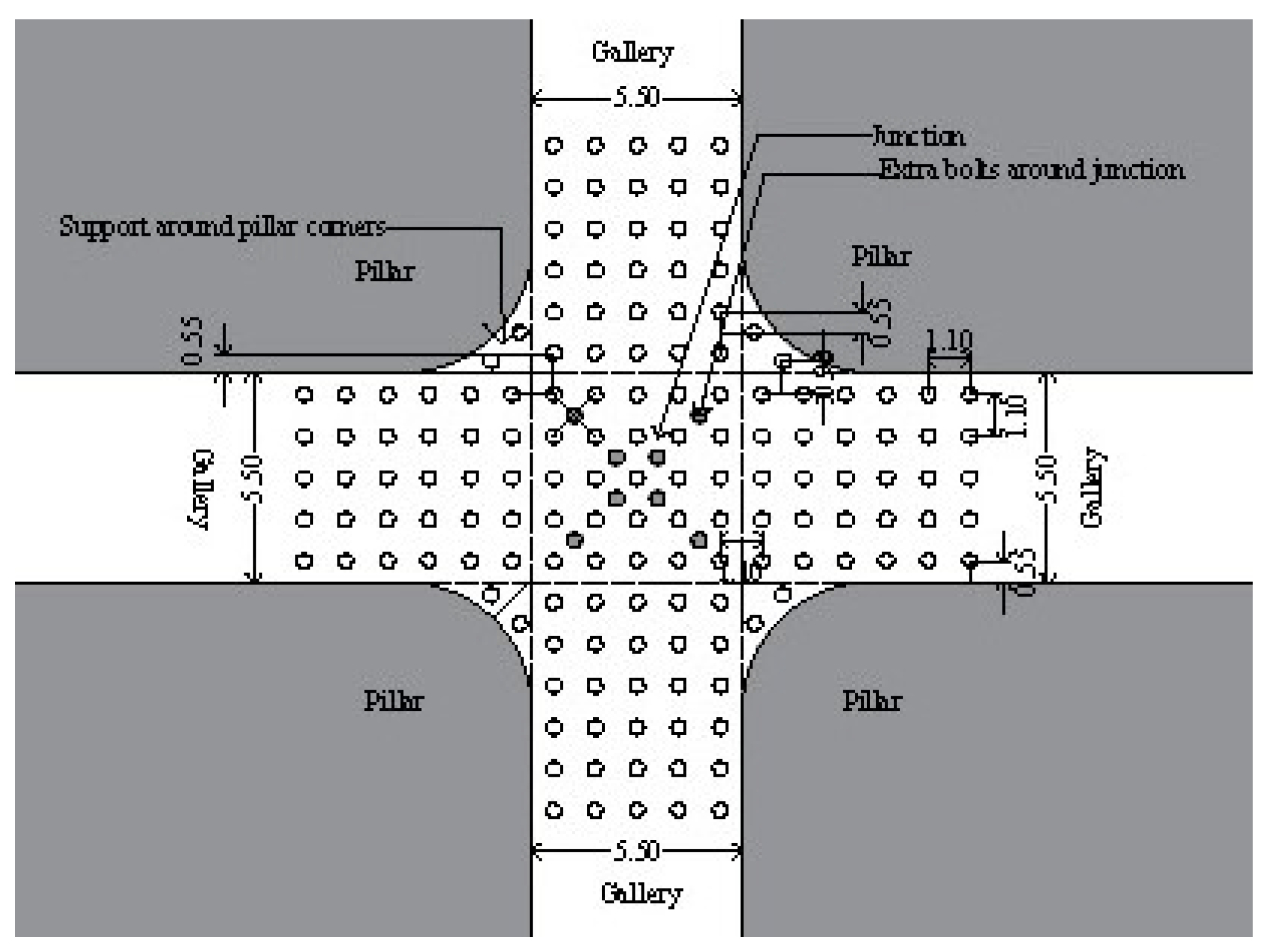
Table 4) of developed workings of panel by drilling and blasting. Further, it is proposed to widen the existing galleries of 3.8 m to 5.5 m, therefore, roof bolts pattern for such widened galleries and junctions are mentioned in
Table 4 and shown in
Figure 9.
2.5. Design of Rib/Snook
Recently, empirical formula [
18,
19] have been developed to estimate the strength, area, width-to-height ratio and equivalent width of rib/snook for Continuous Miner based on case studies of 39 mechanised depillaring panels of different Indian coalfields (Equations 12-15) considering safety factor of rib/snook of 0.30-0.35.
where,
= strength of rib/snook (MPa), w= equivalent width (m), H= depth of cover (m) and h= height of extraction (m), A= area, R= nature of roof in terms of RMR,
equivalent width (m).
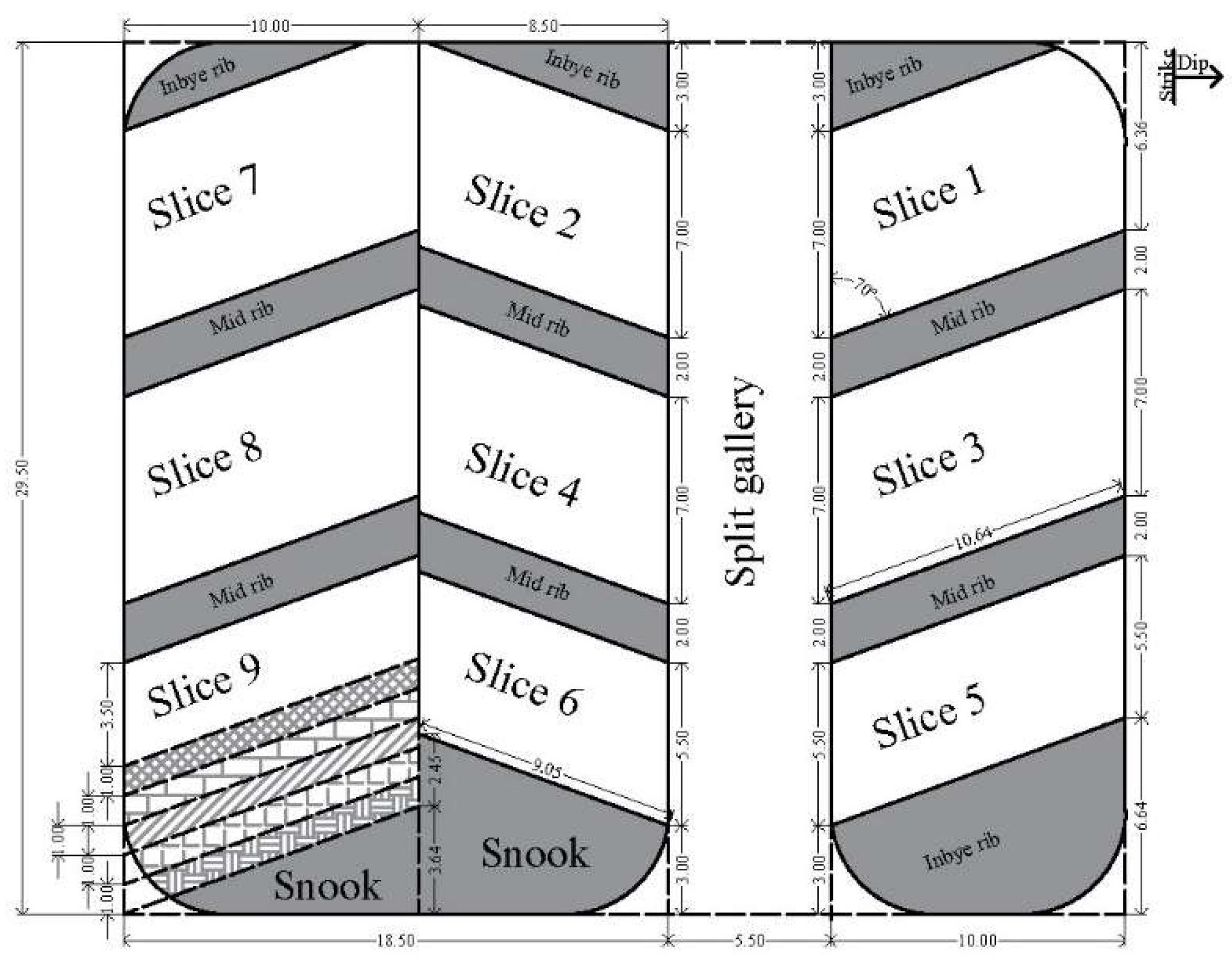
An attempt is also made to estimate strength of different sizes of rib/snook using formulations (Equations 12-15). The strength of different sizes of rib/snook (
Figure 10) formed during MD in the panel is also given in
Table 5.
For the panel, H= 266 m (maximum), RMR (R)= 50.40 and h= 1.80 m, the competent area of out-bye rib/snook (A) = 47.83 m2 having equivalent width of 6.16 m with width-to-height ratio of around 3.42 is required during extraction of pillars by CM. Therefore, rib/snook size of 2.00 m x 18.50 m x 3.00 m having area of around 71.60 m2 with width-to-height ratio of around 3.81 is found to be suitable for the considered geo-mining conditions of panel. This size of rib/snook is the minimum area to be maintained during judicious reduction including the effects of pillar spalling (plastic and loose zone). Therefore, rib/snook size of 3.00 m x 18.50 m x 3.00 m (area of 81.60 m2, equivalent width of 7.62 m and width-to-height ratio of 4.23) is proposed to be left during MD operation, which may be further reduced up to 2.00 m x 18.50 m x 3.00 m (area of 71.60 m2, equivalent width of 6.86 m and width-to-height ratio of 3.81) due to induced-stress driven side spalling of pillars/fender. Further, different sizes of rib/snook in this panel are also tested during the numerical simulation study, explained in the later section.
2.6. Goaf Edge Support
Roof bolt-based breaker line support (RBBLS) is proposed to be installed at the goaf edges in the CM panel. Rock load at the goaf edges is estimated by multiplying the rock load height (RLH) estimated through equations mentioned below (Equations 16-18) by rock density (
. Relationships for RLH at the proposed three different positions of the RBBLS at the goaf edge has been developed [
20] for different out-bye distance from the edge of pillar at the goaf edge, which are given below.
For 0 m out-bye from goaf edge
For 1 m out-bye from goaf edge
For 2 m out-bye from goaf edge
where, H is depth of cover (266 m), and R is RMR (50.40). Using the above equations, RLH is found to be 3.41 m at 0 m out-bye, 2.68 m at 1 m out-bye and 2.04 m at 2.0 m out-bye from the goaf edge. It is not possible to use 2 m length of roof bolts considering 1.8 m average thickness of coal seam. Based on the equations and extent of spalling up to 1 m of the pillar present at the goaf edges, RLH at 1.15 m out-bye from the goaf edge has been used for the design of breaker line support at the goaf edge, which is shown in the
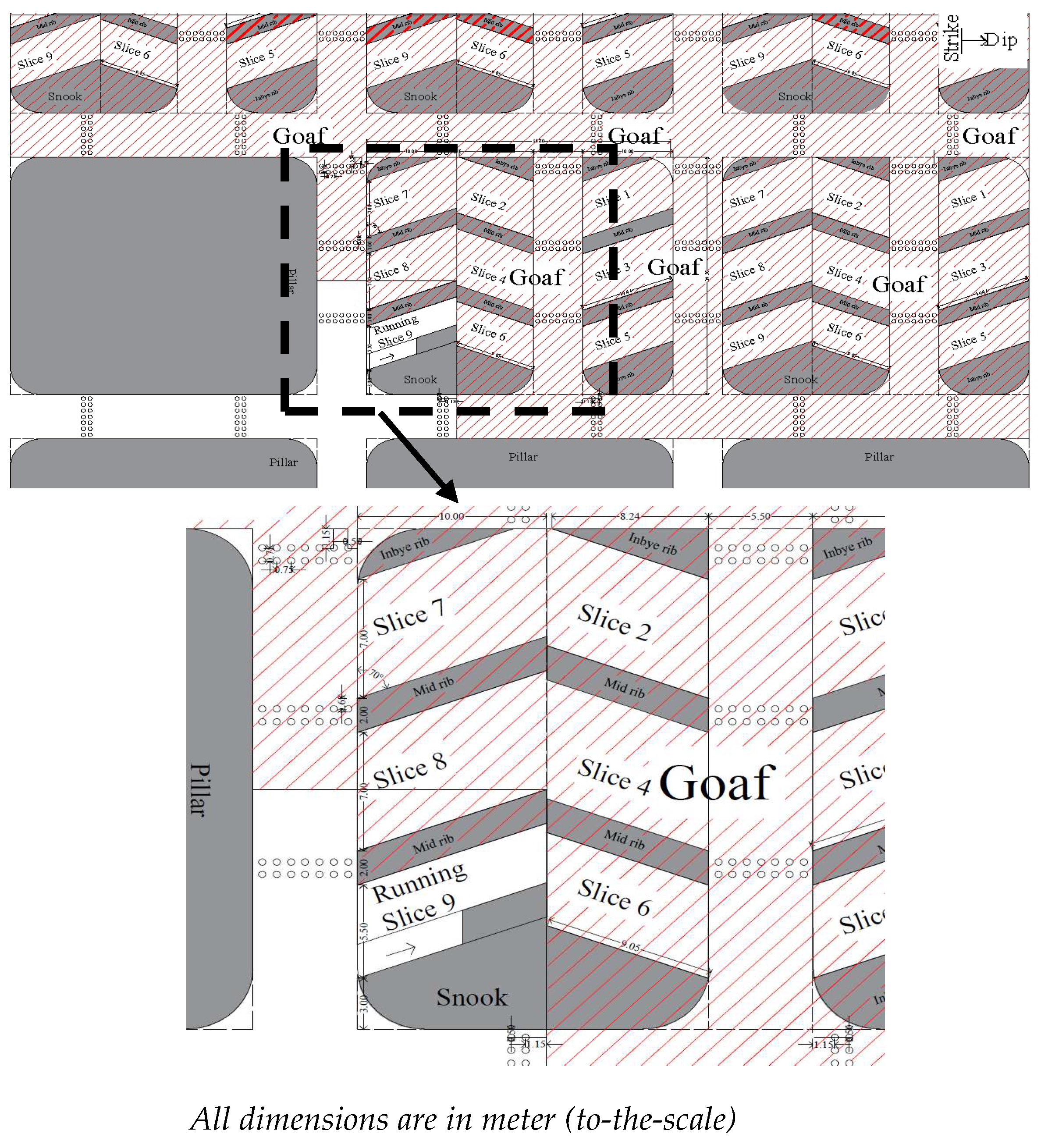
Figure 11. It is proposed here to install two rows of (seven bolts in each row) roof bolts of 1.70 m length at 0.75 m grid pattern located at 1.15 m out-bye from the goaf edge (corner of the pillar facing the goaf line) along middle position of the rib/snook for safe MD of the panel as shown in
Figure 11. Another similar two sets of RBBLS are to be installed in a row along the mid rib in the original/split galleries. It is to be mentioned here that practice of RBBLS will enhance the efficiency and reduce the cost and cycle time. The normal practice of installation of 1.5 m length of bolts should be avoided at the location of RBBLS. Design of RBBLS has been also studied on numerical models and results have been validated with the empirical formulation, presented in numerical simulation section.
3. Hanging Roof Span in Goaf for Caving of Overlying Strata
Van der Merwe [
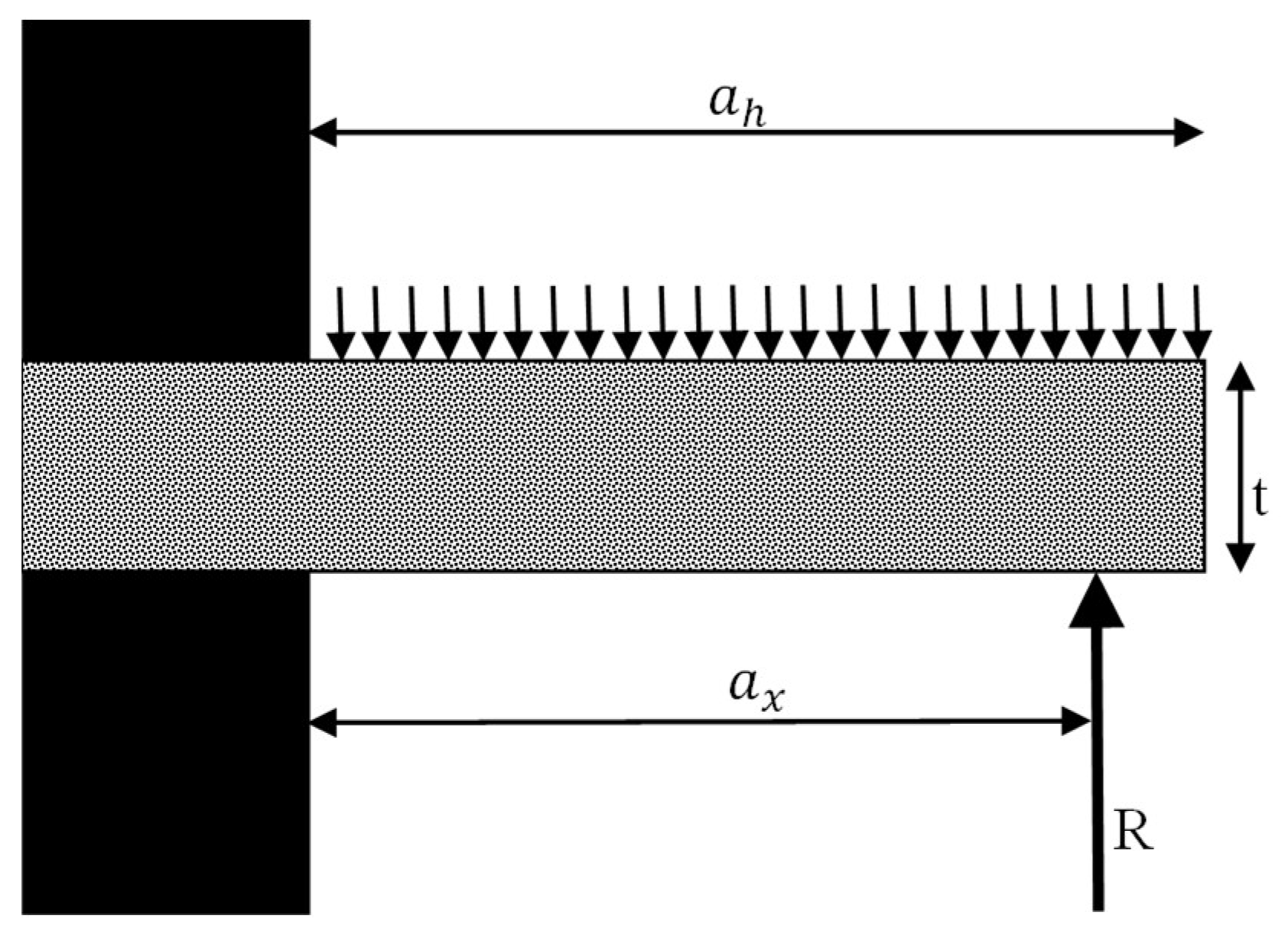
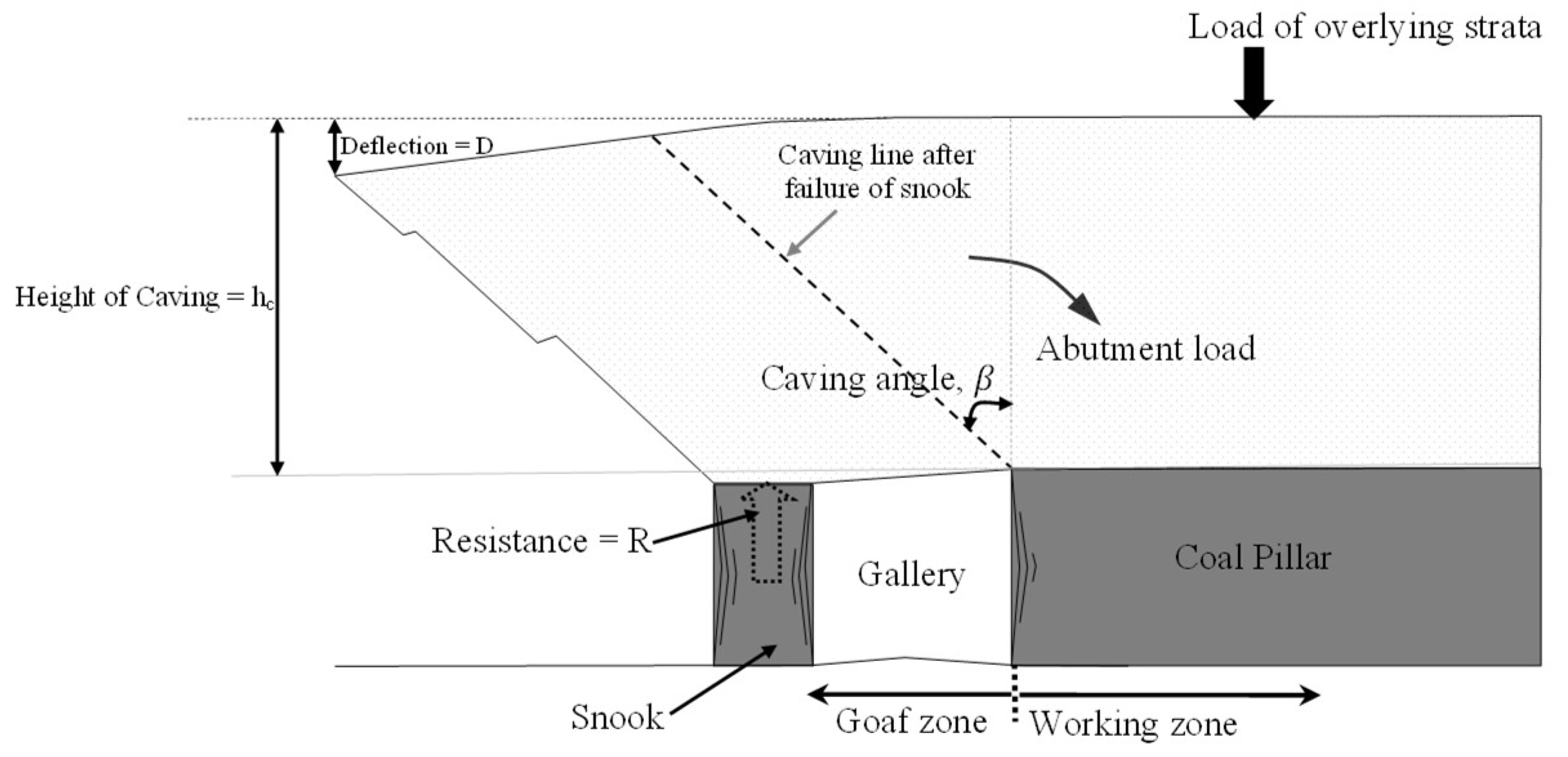
21] developed a relationship to estimate the roof span for roof fall (
Figure 12). There are three possible fundamental modes of roof fall in the goaf. Tension failure mode for overlying strata in goaf may trigger when the weight of the hanging roof span is more than the tensile strength of the rock or the tensile strength across a discontinuity plane. Induced tension at the goaf edges of the roof plate may be another potential mode of failure which will occur when the mathematical sum of the induced tension and the compressive horizontal stress is greater than the tensile strength of the rock. Sliding of the rock blocks along pre-existing vertical or near vertical joint planes may be another mode of failure which will occur when the weight of the block exceeds the cohesion and frictional resistance of the joint planes.
Most of the roof fall occurs mainly under shear failure and failure by induced tension due to roof sagging. Bending induced-tension is the most likely failure mode which is persistent in Indian coalfields. Overlying strata in a sedimentary formation consists of a number of layers with different thickness and stiffness. First major fall often occurs when the face advance is equal to the panel width. After first major fall the continuity of roof beam is lost and the overlying strata behaves like a cantilever. After formation of cantilever the continuity of strata is lost and horizontal stresses diminish. After occurrence of major roof fall, the overburden plates become discontinuous and the roof beam analogy is not valid.
Caving angle is the angle between the vertical line at the goaf edge and the inclined line to the strata over the caved zone (
Figure 13). It remains almost equal to the angle of draw in subsidence which varies between 20°-30° for the Indian coalfields (
Figure 13). Angle of draw of 11⁰ has been observed in Tawa-I mine in E6 district of LWS which was depillared 11 years ago. Considering the thickness, strength and massiveness of overlying strata of the proposed panels of the mine, caving angle is considered to be around 11° from the vertical. As per Palchik [
22], bulking factor (BF) of different rock mass is found to be ranging between 1.05 and 1.84 and it is found to be around 1.1 for roof rock having moderate compressive strength (20-30 MPa). Therefore, the height of caving during roof fall in the goaf is found to be around 18 m (taking 1.8 m as height of extraction) for the panel.
Expected Area of Roof Falls
For the panel, an average hanging roof span of 32 m (around 8700 m2 for panel width of 271 m in the panel is found to be inducing the first major fall of the beam roof to form cantilever. Further, a roof span of around 21 m (around 5687 m2 for panel width of 271 m in panel is found to be causing the subsequent goafing and caving of the cantilever.
Further, actual shape of the panel is asymmetrical (
Figure 3) right from the start 33DW. In the initial three rows of the panel, there is only one pillar width (33DW-31DW), thereafter two rows of 2 pillars (31DW-29DW) and then 2 rows of 3 pillars (29DW-27DW). There are 4 pillars in the next 3 rows (27DW-24DW) and thereafter the actual width of 5 pillars (271 m) is found from 24DW. Width of panel is an important factor for the occurrence of caving in the goaf. Roof fall will not take place in the panel during the initial five rows of pillar extraction even after roof span of 8700 m
2 or more due to insufficient panel width (33DW-29DW). The first main roof fall is expected to occur during or after extraction of pillar in 29DW-28DW.
Splitting of pillar is to be done only one pillar in advance from the pillar under extraction considering the safety of the working. A sequence of driving of split and slice galleries mentioned in
Figure 11 which is followed during the MD operation. Considering the safe COD value, split gallery is to be driven in three cuts as 1
st, 2
nd and 3
rd sequences of 10 m, 10 m and 9.5 m respectively in each length of cut (
Figure 7).
4. Numerical Simulation
A systematic numerical modelling study is conducted on simulated models to visualise the performance of different empirically designed geotechnical structures under the geo-mining conditions of the panel. Taking different advantages of the numerical modelling, the elastic model of the simulation package is used to simulate the rock strata at the goaf edge. Here, rock mass failure criterion developed by Sheorey [
23] is used for the analysis, which uses Rock Mass Rating (RMR) of Bieniawski [
6] for reducing the laboratory strength parameters into the corresponding rock mass values. But this RMR is not frequently used by Indian coal mines, where CMRI-RMR [
17] is commonly used. It is found that the application of CMRI-RMR in the failure criterion provides reasonable results and is used in this study.
The bulk and shear modulus are evaluated using Young’s modulus and Poisson’s ratio by the following equations.
where, E is the Young’s modulus in GPa, K is the Bulk modulus in GPa, G is the Shear modulus in GPa and
is Poisson’s ratio. Average in situ stresses [
24] is used according to following equations:
where, H is depth cover in meter,
is vertical in-situ stress,
is major horizontal in-situ stress and
is minor horizontal in-situ stress. In order to assess the stability of natural supports and the exposed span, safety factors are calculated using the Sheorey [
23] failure criterion in the numerical models as given below:
where,
is triaxial strength of rock mass in MPa,
is confining stress in MPa,
is compressive strength of intact rock in MPa,
is tensile strength of intact rock in MPa, b is exponent in failure criterion, which controls the curvature of triaxial curve,
is compressive strength of rock mass in MPa and
is tensile strength of rock mass in MPa.
The factor of safety is defined as
where,
is induced major principal stress in MPa and
is induced minor principal stress in MPa. From these, the rock mass shear strength,
; the coefficient,
and the angle of internal friction,
are obtained as shown in Equations 31-35 which are used as Mohr-Coulomb Strain Softening parameters in the simulation package used during stress- strain characteristics of different sizes of rib/snook in the two panels of Tawa-I mine.
It is observed that the values of shear strength,
and friction angle,
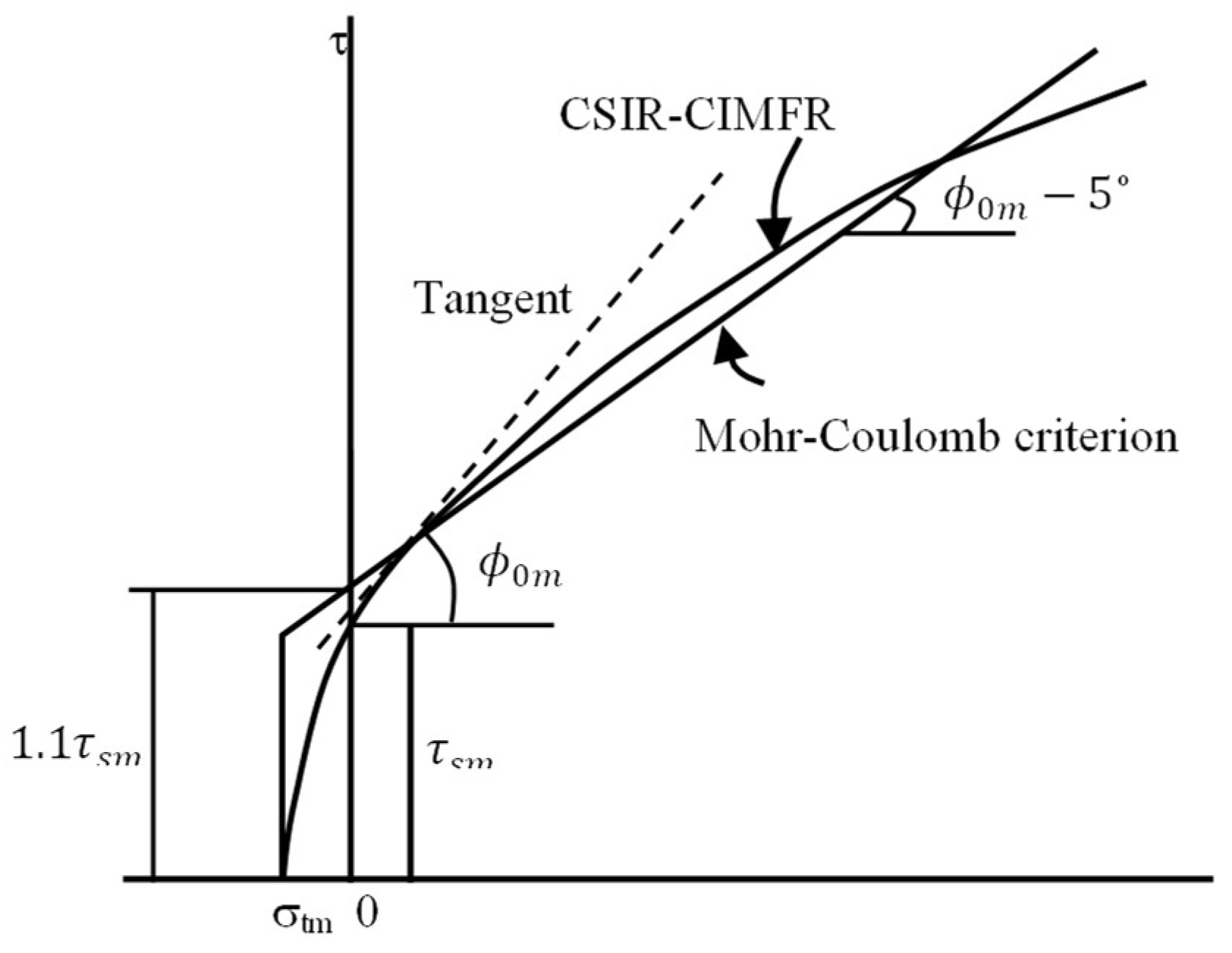
so determined as per Equations 36-38 needed slight adjustment to incorporate the fact that the MCSS plasticity model in the simulation package uses the linear Mohr-Coulomb criterion, while the Sheorey criterion is non-linear. To compensate the difference in nature, the value of
obtained from the Sheorey criterion is increased by 10% and that of
is reduced by 5˚ to use them as MCSS parameters (
Figure 14).
4.1. Simulation of Proposed Panels
Numerical models are developed to simulate the geo-mining conditions of the panel in order to estimate the safe width of widened gallery, cut-out distance, size of rib/snook and pattern of roof bolts-based breaker line support (RBBLS).
4.1.1. Simulation for Design of Gallery Width, Cut-Out Distance and Rib/Snook
Simulation of a single pillar is carried out for estimation of safe split gallery width, cut-out distance and strength of different sizes of rib/snook in the panel. Taking advantage of the existing symmetry conditions of pillar formation, single pillar considering only three layers (floor, coal and roof) is modelled in the simulation software for the estimation of strength of different sizes of pillars whereas different layers as mentioned in
Table 6 are considered for simulation of safe gallery width and COD.
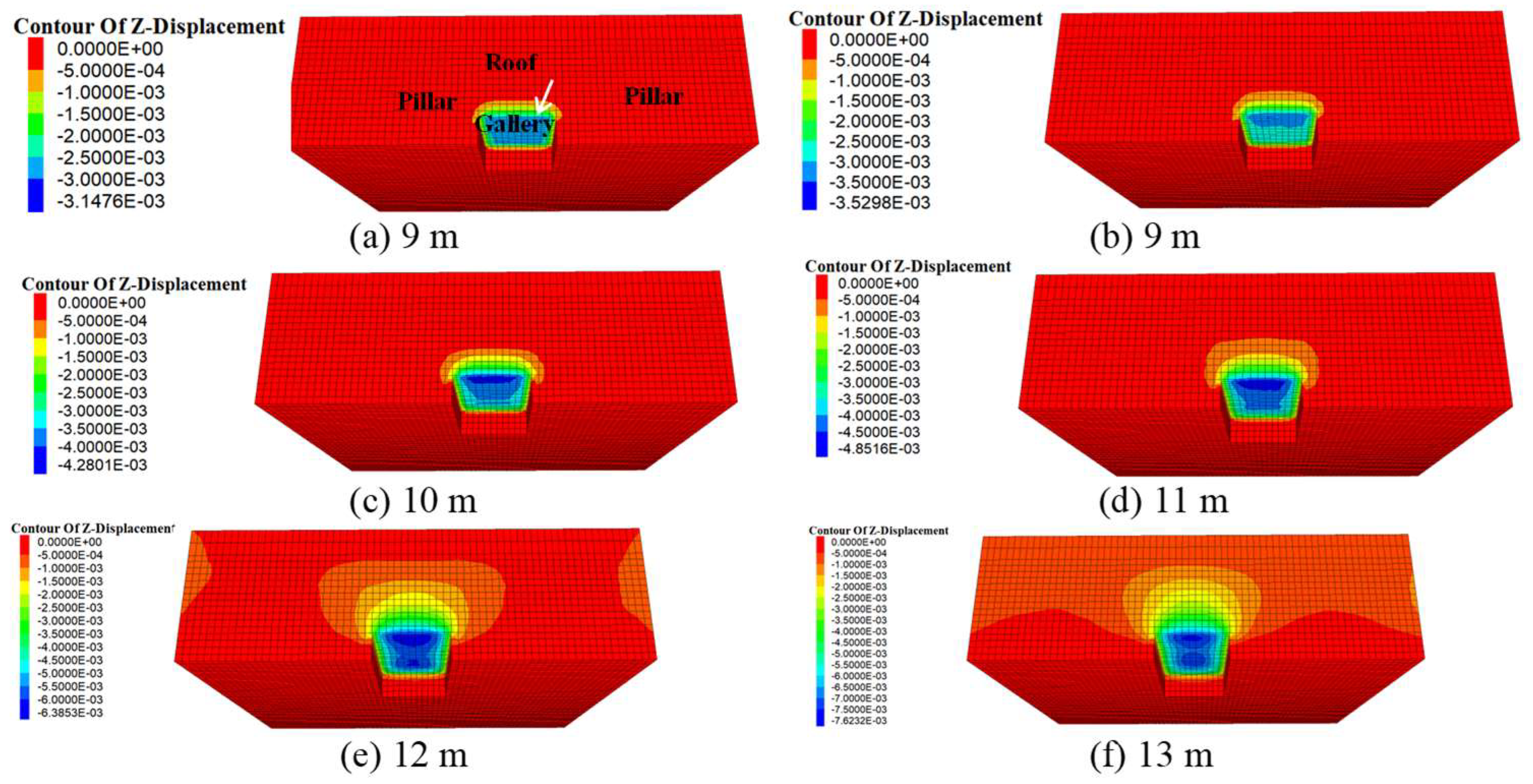
Further, vertical roof displacement is observed over numerical models as per
Table 6 to determine a safe gallery width and cut-out distance based on a safe limiting value of roof sagging of 5 mm. Estimated safe width of gallery is found to be 5.5 m for panel (
Figure 15). Based on experiences of workings under similar geo-mining conditions in different Indian coal mines, safe width of gallery is estimated in the model considering 5 mm [
25] as the limiting value of roof sagging to induce permanent movement (plastic in nature) in the galleries to be widened/split/slice (
Figure 15). It is found that roof of the gallery is stable without considerable amount of roof deformation after the proposed gallery width of 5.5 m (
Figure 15). Pillar size of 34.0 m x 29.5 m (corner-to-corner) and gallery width of 5.5 m is found suitable for panel respectively as per the numerical simulation study and found to be validating the results of empirical formulations.
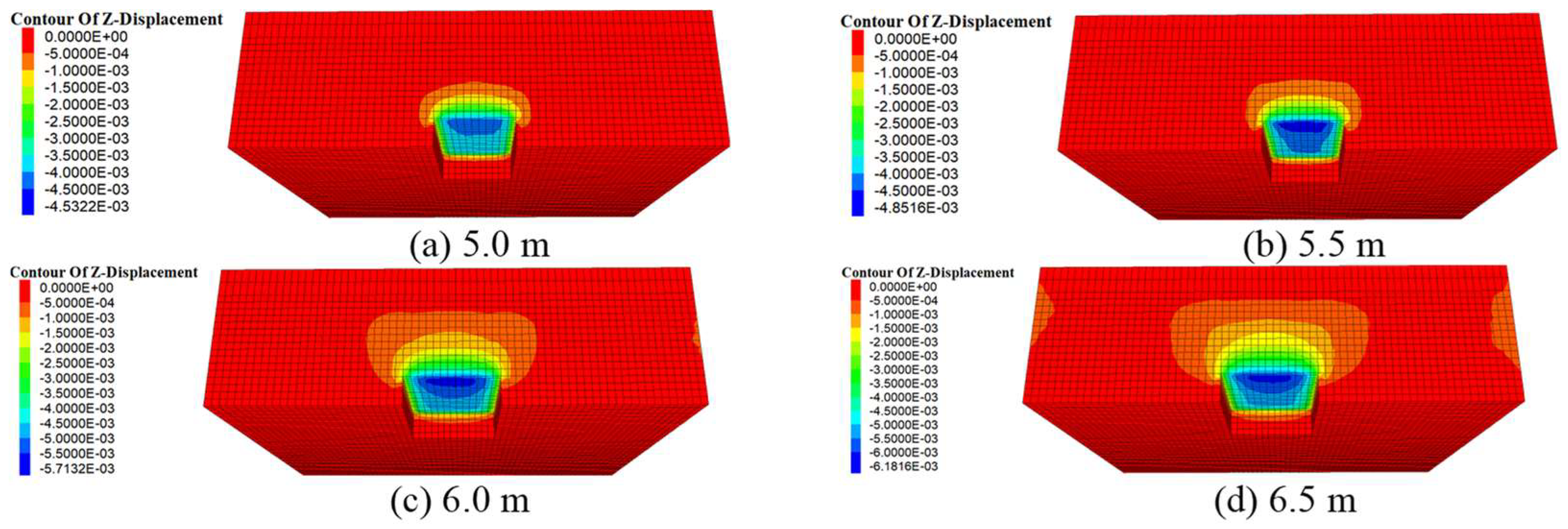
Estimated maximum unsupported span i.e., cut-out- distance (COD) for 5.5 m wide gallery in the panel is found to be around 11 m (
Figure 16). Based on experiences of workings in different Indian coal mines, COD in the model is estimated considering 5 mm as the limiting value of roof sagging to induce permanent movement (plastic in nature) in the split/original galleries/slice to be driven. It is found that pillars are standing without considerable amount of roof deformation after the proposed drivage of 11.0 m and found to be validating the results of empirical formulations.
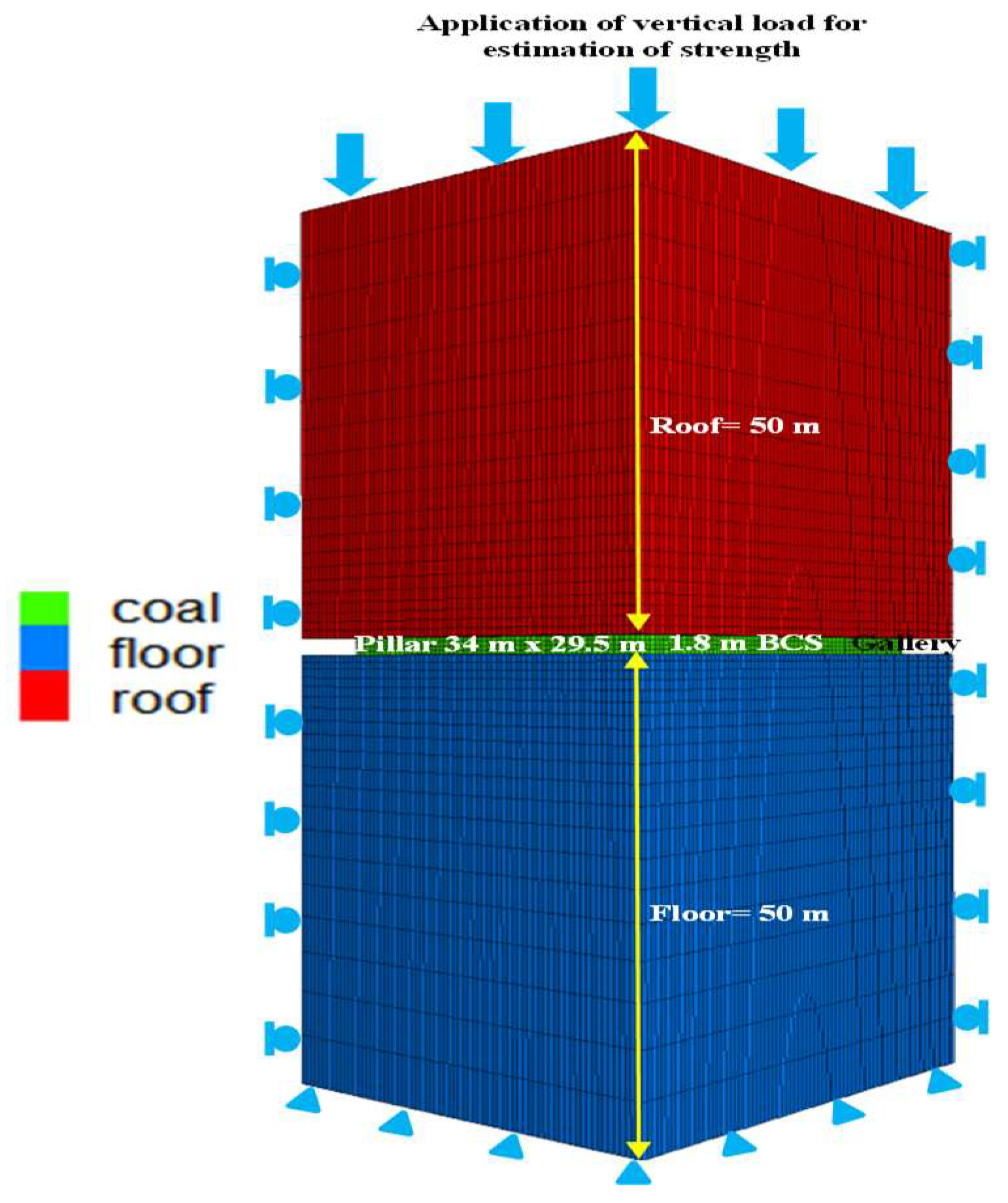
Upper face of the model is fixed for estimation of strength of ribs/snooks with application of a standard calibrated velocity is applied in the vertical direction (
Figure 17) after developing galleries. Displacement in the vertical and horizontal directions are fixed at the bottom and four vertical symmetrical planes of the model are constrained which is considered as boundary conditions during the numerical modelling. A standard size of model is tested during the numerical modelling considering the limitations of the computational memory and runtime requirements, 50 m of the roof and 50 m of the floor are modelled with 1.8 m coal seam in the panel (
Figure 17). Coal seam of 1.8 m thickness is considered as a strain-softening and roof and floor as elastic constitutive model,
in-situ stresses are developed in the model before studying the effects of the mining operations. It is carried out to redistribute the stresses in the model and equilibrium conditions are reached, replicating the actual site conditions. Excavation operations are carried out in the model and equilibrium conditions are reached for the estimation of strength. Vertical displacement of the top of the model is fixed and a velocity is applied in vertical direction for estimation strength of coal pillar. This entire process is simple replication of the laboratory testing of rock samples in uniaxial conditions. Average vertical stress-displacement curves are plotted. The numerical model considered the material properties at 266 m depth of cover for panel. Mohr-Coulomb Strain-Softening (MCSS) parameters have been calibrated for coal seam (
Table 6) by matching the in-situ stress generated in the model with the actual site and pillar strength as per Sheorey (1992).
Three layers of roof, coal and floor are considered for the simulation as the strength of rib/snook has been is found to be independent of the nature of roof. The inputs for the rock mass properties of roof, floor and coal are mentioned in the
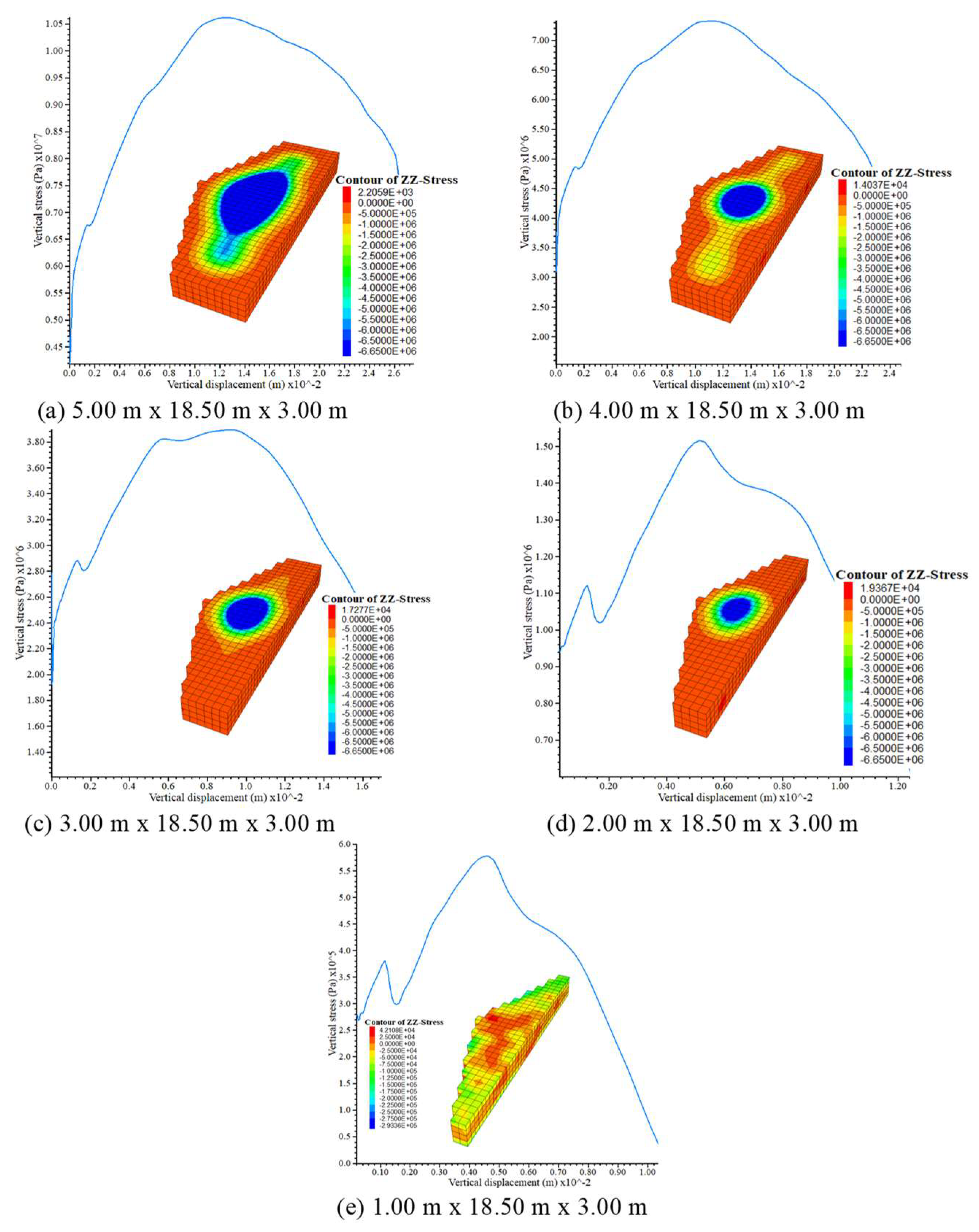
Table 6. Different sizes of the rib/snook varied during the simulation for the manner of pillar extraction is shown in the
Figure 10. The variation in strength of different sizes of rib/snook simulated in numerical models for panel is shown in
Figure 18 respectively. Depth and progress of extraction of coal pillar induces fractured zone in the rib/snook due to standing goaf resulting in a decrease of their strength, therefore, the numerical simulation strength of rib/snook formed during pillar extraction is found to be different from the empirical formula strength. Strength estimated using simulation study is found to be useful in estimating their FOS. Kumar [
19] found that a limiting FOS of rib/snook of 0.30-0.35 is sufficient for temporary support during the slicing operation. Further, such rib/snook fail in a controlled manner without inhibiting roof fall. Here, rib/snook size of 3.00 m x 18.50 m x 3.00 m (area of 81.60 m
2, equivalent width of 7.62 m and width-to-height ratio of 4.23) is proposed to be left during MD operation, which may be further reduced up to 2.00 m x 18.50 m x 3.00 m (area of 71.60 m
2, equivalent width of 6.86 m and width-to-height ratio of 3.81) due to side spalling of pillars based on limiting FOS of 0.30-0.35.
4.1.2. Simulation for Estimation of RLH at Different Places in the Panel
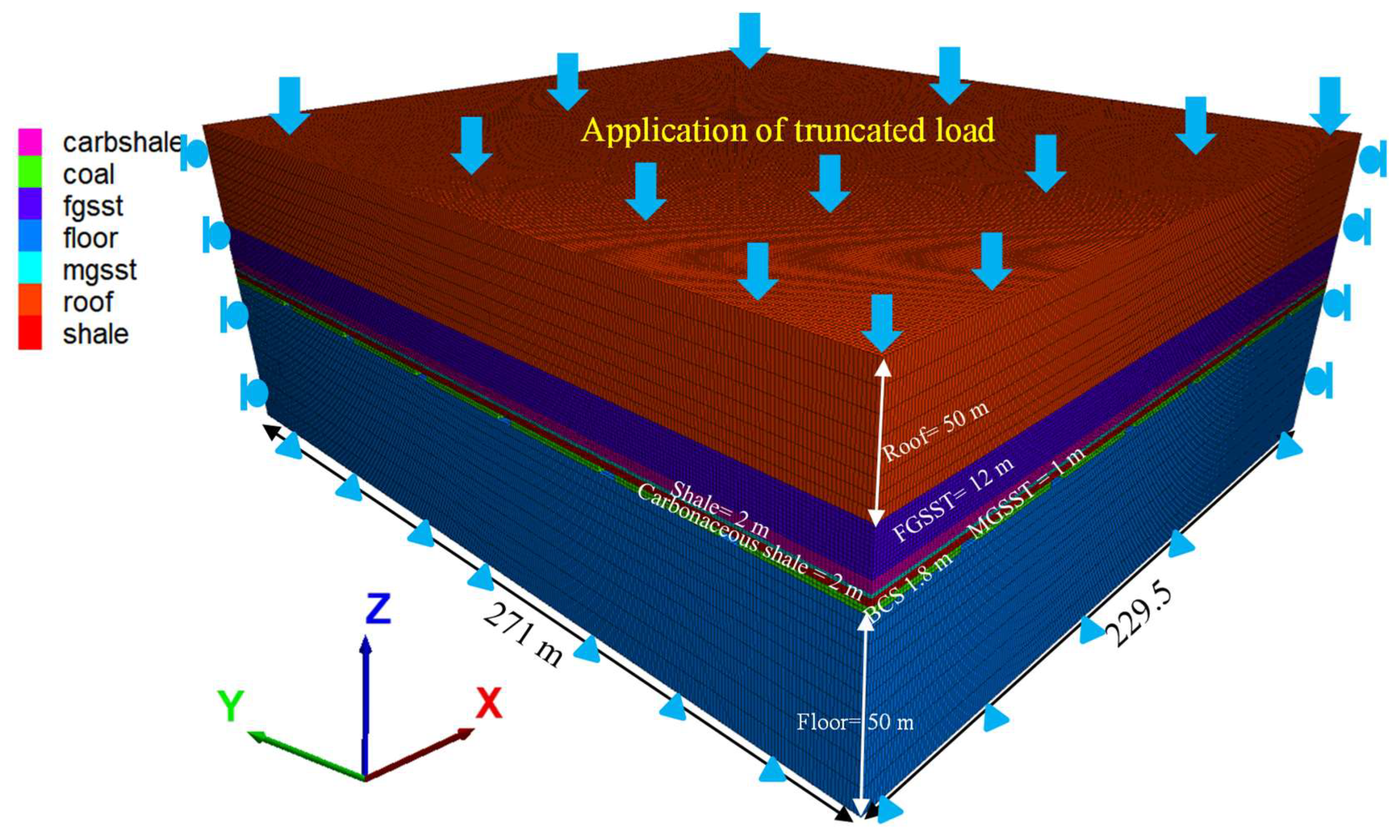
The geometry of the generated model is 229.5 m, 271 m and 102 m along length (x-axis), width (y-axis) and height (z-axis) respectively including 50 m floor (
Figure 19) considering the hardware constraint (memory and runtime) of a computer. This model is incorporated with the existing geo-mining conditions and rock mass properties. The thickness of coal seam considered in the model is 1.8 m and developed and depillared to full height. A truncated load (0.025 MPa/m x 214 m) is applied over the top of the model for the left-out unmodelled roof of 216 m. The width of original/split galleries are kept as 5.5 m respectively. Bottom and four side walls of the model are fixed and the top one is kept free as boundary conditions. The properties of rock mass used in the models are collected from the mines and tested in laboratory are mentioned in
Table 7. Initially,
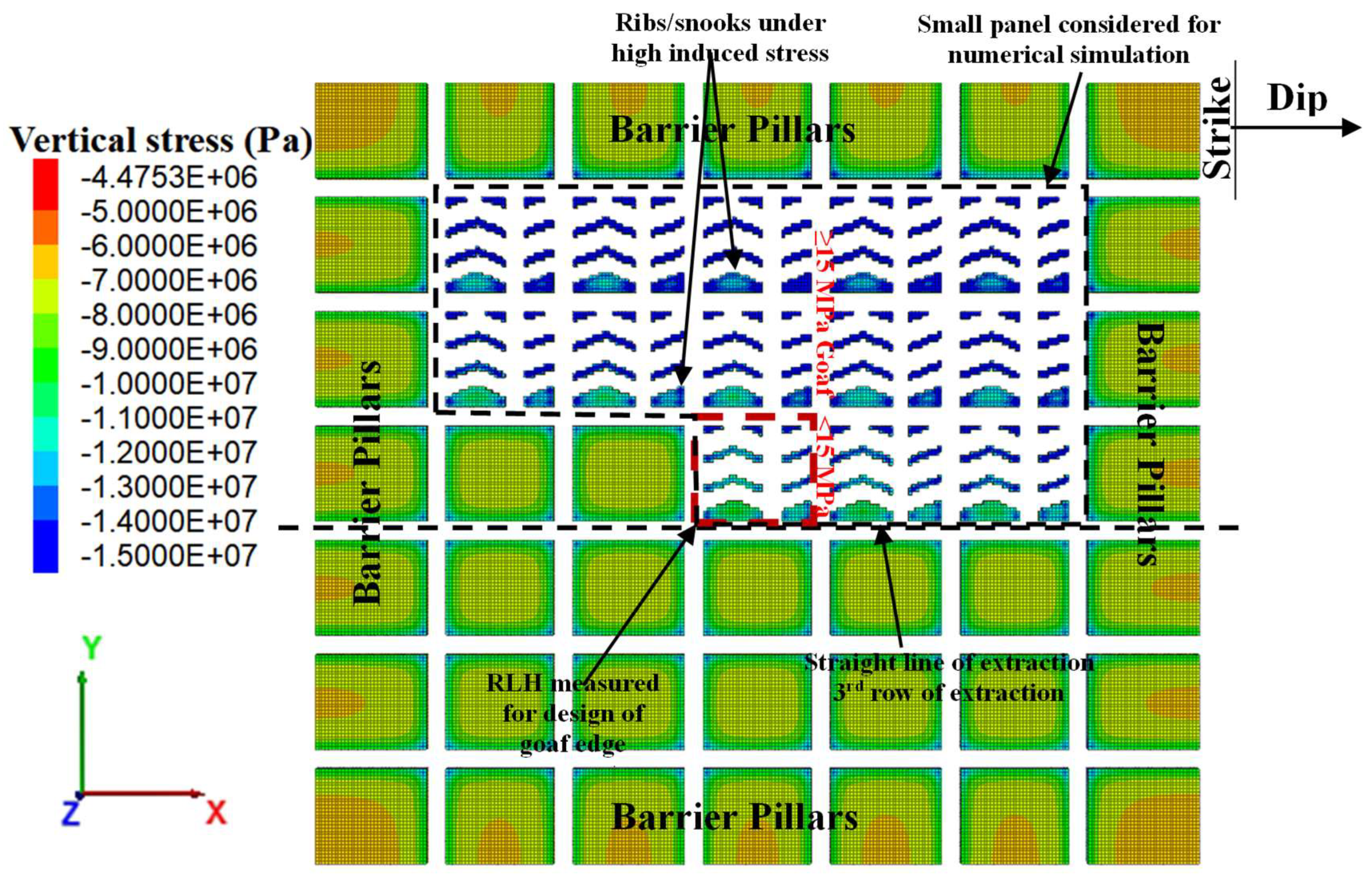
in-situ model is developed as per the abovementioned geometry at a depth of 266 m, followed by development of pillars and galleries as per BPMM. This model is then depillared following straight line of extraction (
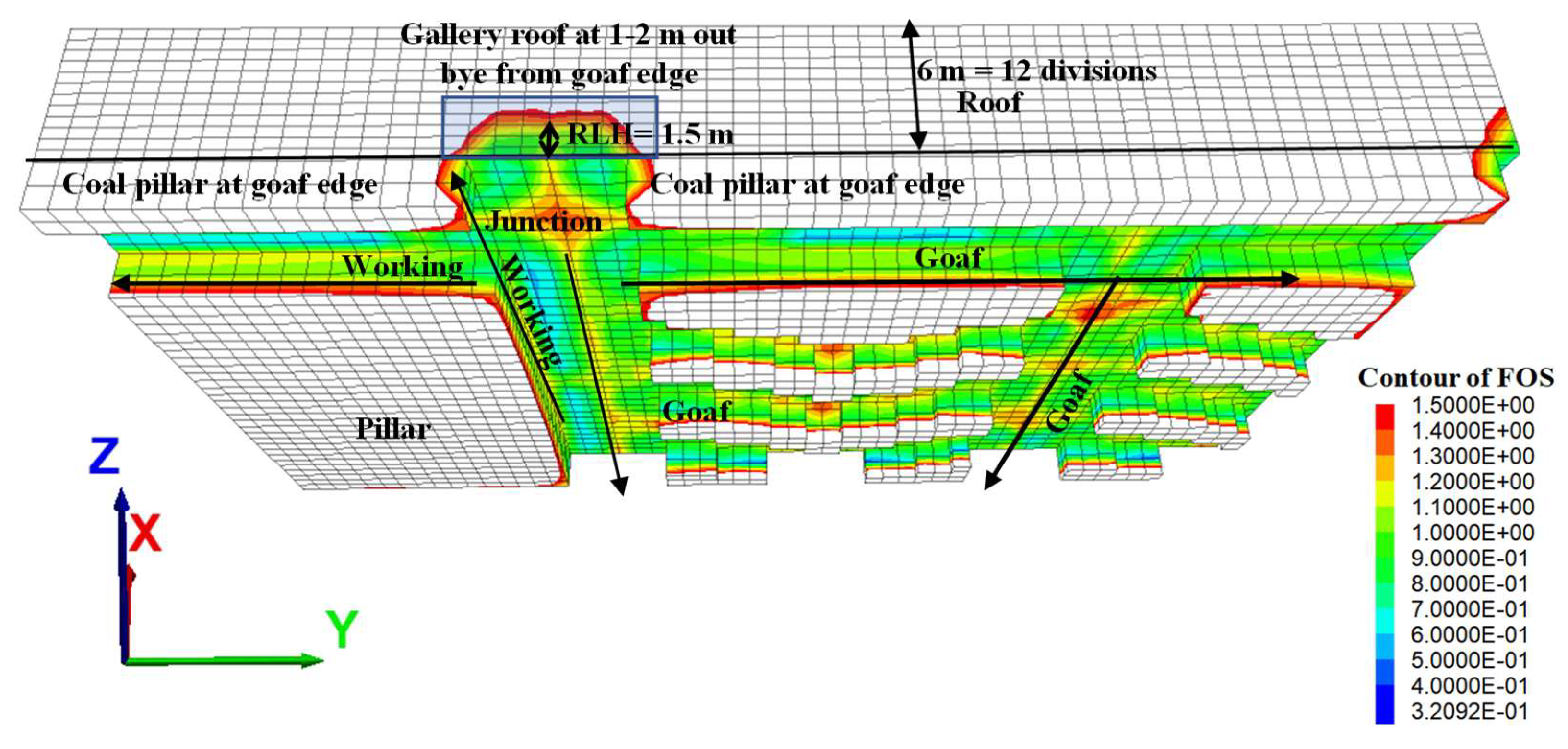
Figure 20). Height of rock load to be supported by roof bolt is estimated for the development and depillaring operation. Here, RLH is defined as the height of the roof strata up to safety factor contour value of 1.0 in the model, needs artificial support. RLH is measured at different locations which is shown in
Figure 20 and
Figure 21. Support design for panel on the basis of numerical modelling study is given in
Figure 9. RLH is measured at a distance of 1.0 m out-bye from the goaf edge (
Figure 21) without using applied supports in the model which is found to be 1.5 m (3.75 t/m
2). SSF of the proposed support plan at the goaf edge is found to be 2.50 for an applied support resistance of 67.87 t/m
2 and considering the dynamic effects at the goaf edge.
5. Strata Control by Roof Blasting
Caving characteristics of overlying strata of the goaf is one of the important parameters, which influences the abutment loading in and around the working face and along the line of extraction. Difficulty in caving leads to built-up of induced stresses leading to fracturing in natural support present in and around working face and sometimes goaf encroachment. Caveability Index determines the difficult-to-easy level of fall of overlying strata [
1] and the key strata exhibits the load transfer mechanism towards working area. Generally, the caving nature is assessed through Caveability Index of overlying strata of around 10-15 times of working height. In case of easily to moderately caveable roof strata (I ≤ 5000), generally, roof blasting for inducing caving is not required as experienced in Pinoura Colliery and Anjan Hills Mine of SECL [
19]. However, overlying strata which are caveable with difficulty (
5000), needs design of roof drilling and blasting to induce roof fall inside the goaf. Roof blasting induces/develops fracture in the roof rock mass which caused the hanging roof to cave. Roof blasting for difficult caveable overlying strata is advantageous for ground control point of view. However, there are some associated blasting issues of ground vibration and toxic gases which affects working conditions. Tawa-I mine has degree 2 gassiness (explosion chances for degree 3 gassiness), therefore, roof blasting to induce caving is to be performed with extra precautions.
Design of Roof Blasting for Inducing Caving
Borehole CMPS 22 (
Figure 2) is considered for the design of roof blasting to induced caving inside the goaf. Considering 10% of bulking factor, height of caving (18 m) will be 10 times of the height of extraction (1.8 m). Overlying strata mostly contains 12 m fine grained sandstone and 1-2 m medium grained sandstone and 2-3 m of shale/carbonaceous shale. Average core recovery is more than 92% and RQD is also well above 90. Caveability Index of overlying strata of around 10 times of working height is found to be between 7000-8000, which is categorized as roof caveable with difficulty in nature and requires induced caving by blasting of roof in case of overhang. Fine grained sandstone of 12 m in the roof will delay the caving of roof in the goaf due to its massiveness of 12 m and uniaxial compressive strength (40 MPa). It will also cause development of higher induced stress along the line of extraction at around 8700 m
2 cumulative area of goaf. It is required to blast this roof horizon to induced caving for regular roof fall. Further, it is reported [
26] that the nature of the immediate roof strata up to 20 m plays a significant role till the caving starts. It explained the process of cantilevering after first roof fall (break of the beam) and further collapse of the hanging cantilever of the roof strata with the progress of the extraction.
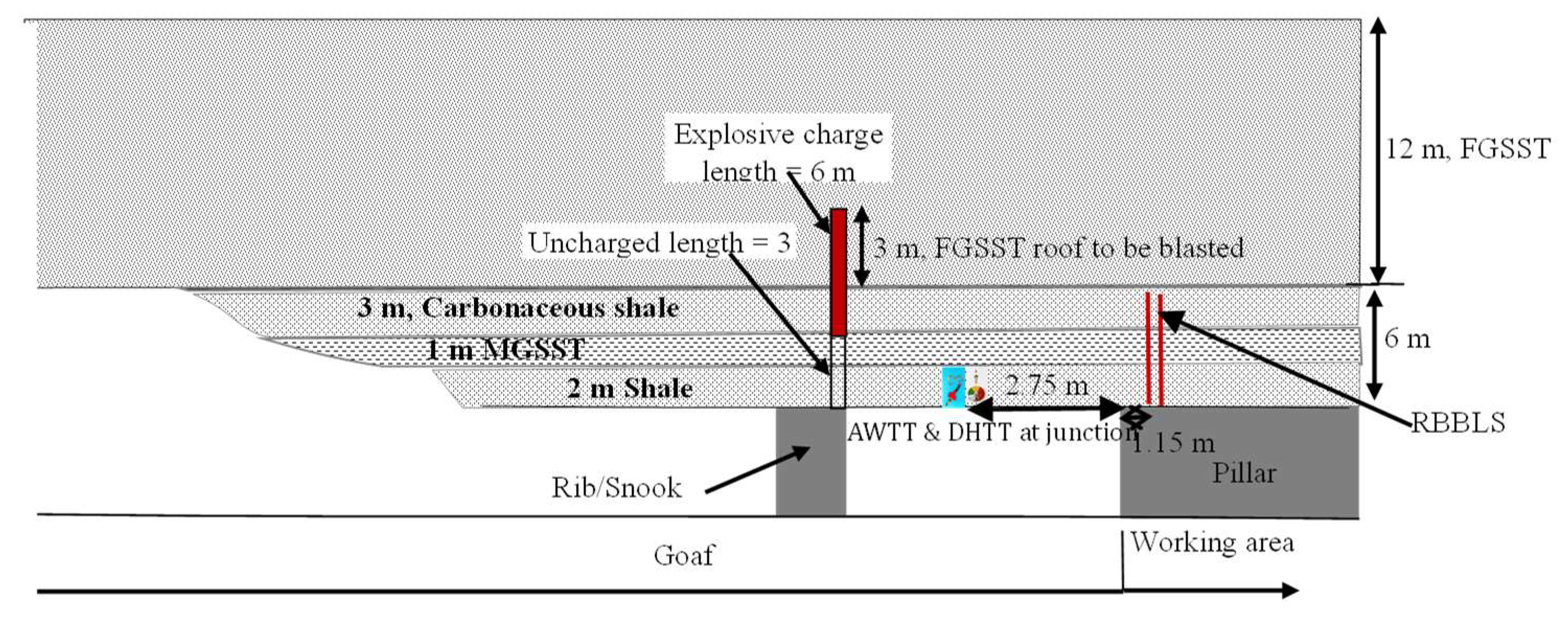
Considering the geo-mining conditions of panel, roof blasting up to 9 m thickness includes 2 m shale, 1 m medium grained sandstone, 3 m carbonaceous shale and 3 m of fine-grained sandstone roof horizon is required to induce fracturing in the rock mass to facilitate regular caving. Roof blasting may be conducted around junction towards barrier pillar right from the start of pillar extraction as shown in
Figure 22. In order to induce fracture in roof horizon, vertical blasthole up to 9 m of 42 mm diameter is to be drilled towards inbye of the junction in the goaf to avoid any sort of damage to RBBLS and instruments installed at junctions as shown in
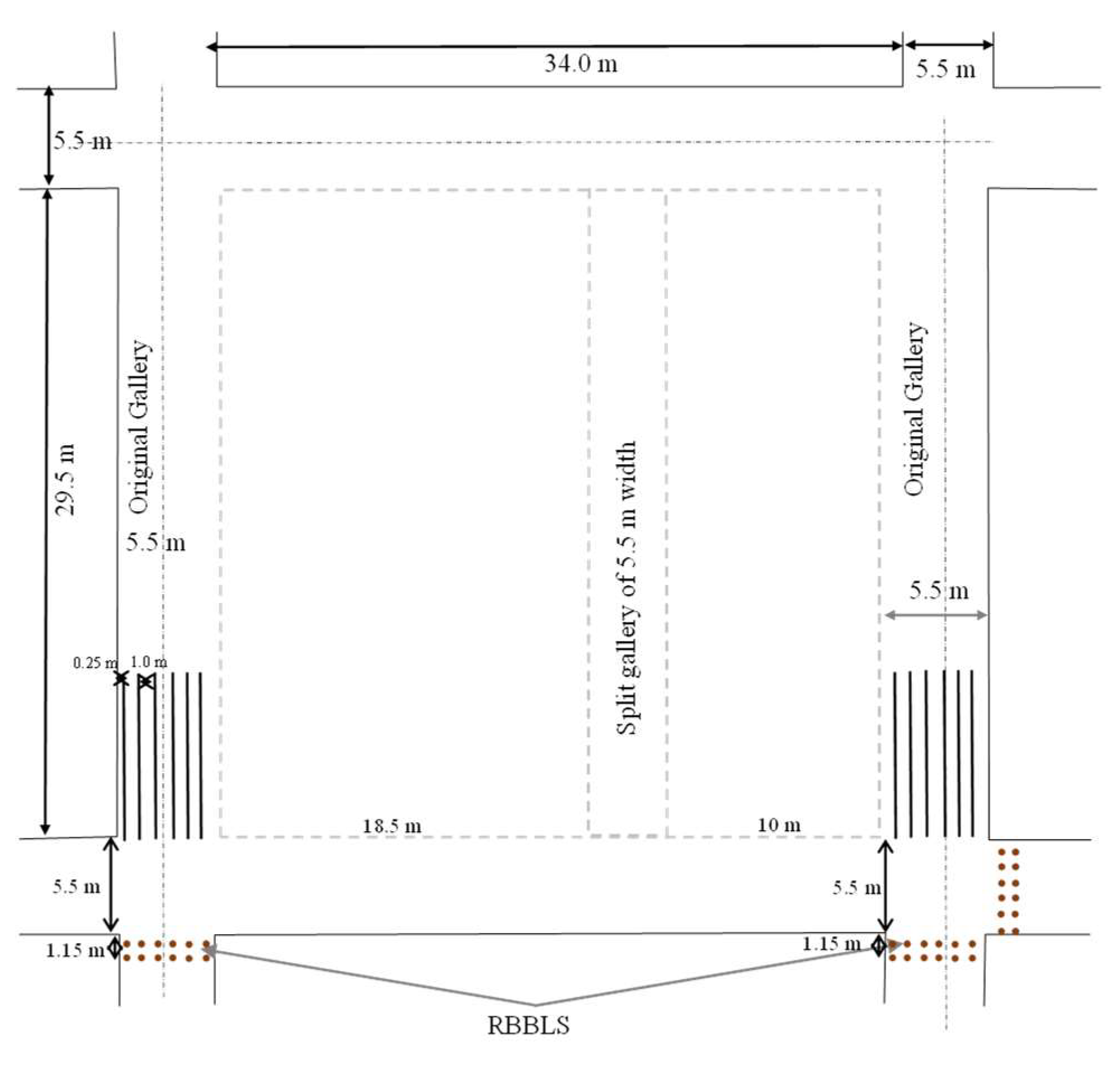
Figure 23. Details of drilling pattern and explosive charging are shown in
Figure 24 and
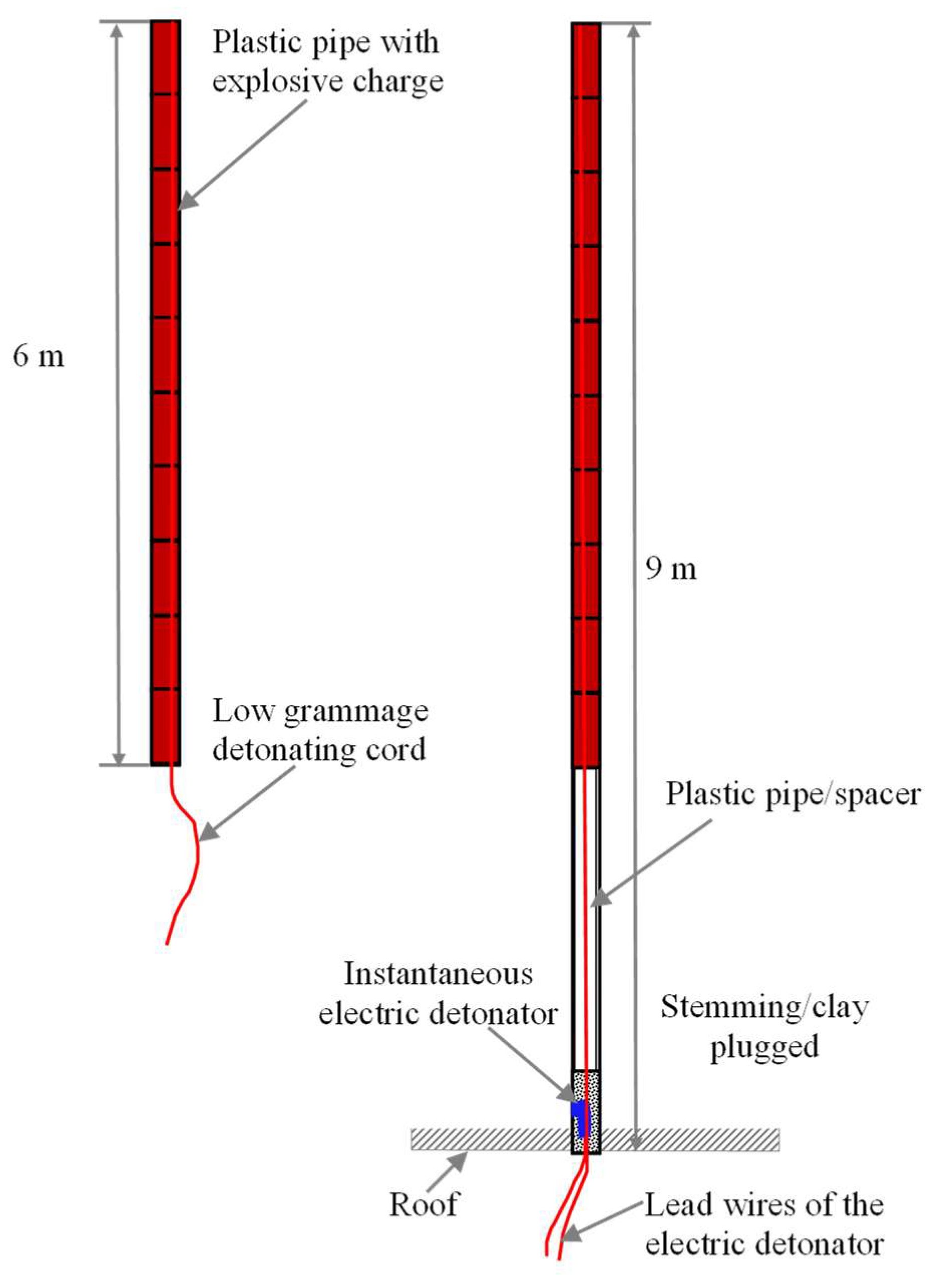
Table 8. Six blastholes should be drilled in a row at a distance of 0.25 m from the adjacent edge of pillar and at a distance of 1.0 m from each other and also it is to be done towards inbye of the junction in the goaf to ensure the efficacy of RBBLS and remote observations of reading of instruments. Drilling and charging at the junctions should be completed before their shifting into goaf. The blasthole is to be charged with 32 mm diameter of explosive cartridge and 6 mm detonating cord together using plastic spacer pipes of 40 mm outer diameter and 38 mm inner diameter and 6 m in length. Proposed method of charging of blast holes is given in
Figure 25.
6. Instrumentation and Monitoring
Strata behaviour during proposed mechanised depillaring of panel needs to be studied through field instrumentation and monitoring. The purpose of the field instrumentation is to enhance safety of the working to protect men and machinery from any risk and also to increase production and productivity of the mine along with verification of the design of different structure involved. It may provide some quantitative values of strata movement and concentration of induced stresses in and around the workings for better understanding of the rock mass behaviour and further, in optimization of the design.
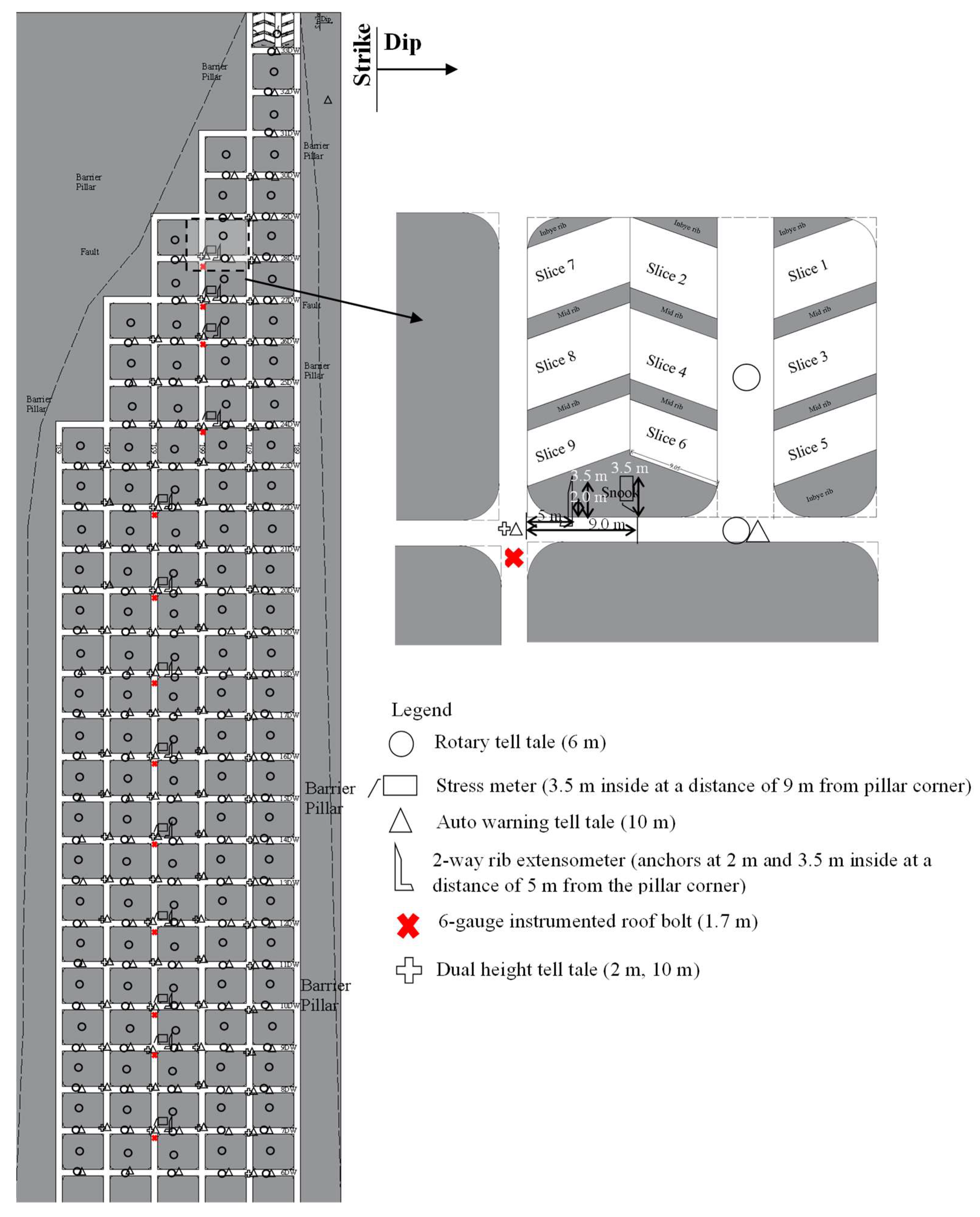
It is important to study the roof sagging in galleries, with special attention at the junctions through roof extensometers. It is always good to opt for a simple approach of instrumentation and monitoring. However, attention is to be paid for selection of durable and robust instruments, suitable for the underground coal mining environment. Attempts are made to monitor the readings of the instruments nearly continuous in time. The density of the instruments at the studied sites are optimized through available experiences of such monitoring. A preliminary instrumentation plan for monitoring the performance of underground structures in panel is shown in
Figure 26 respectively. This plan may be modified as per the extent of development possible, the geological discontinuities unravelled, strata control experiences during working in the panel at different stages of working and also the selection of pillars extracted in the panel.
It should be noted here that extra caution is needed while correct installation of the different geotechnical instruments before commencement of MD operation. An attempt is to be made to monitor the readings of the instrument installed in the active mining zone (AMZ) frequently. Actions to be taken during depillaring operation on the basis of roof displacement are given in
Table 9. Details of the instruments proposed to be used for strata controls monitoring in these panels are mentioned in
Figure 26. Considering the panel for CM based mechanised depillaring at this mine, extra caution has been taken to maintain safety during pillar extraction by installation of a series of geotechnical instruments at suitable locations and comprehensive monitoring.
Main roof fall is expected to occur at an average roof span of around 8700 m2 in the goaf. Since, the width of the panel is not sufficient during the first five rows (33DW-29DW), therefore, first main roof fall would not occur up to working in 29DW. It is expected that the main roof fall will take place during or after extraction in 28DW. Considering the anticipated large roof span (>10,000 m2) in the goaf before main fall and the uncertain behaviour of roof rock, instruments (stress meters, rib extensometers and 6-gauge instrumented roof bolts) have been proposed frequently after 28DW for early indication of first main fall in the panel. If the fall occurred as expected during working in 28DW then the proposed instrumentation plan needs to be modified for 27DW. However, if the fall occur while working either in 27DW or 26DW then the proposed instrumentation plan needs no modification. Further, number of instruments may be optimised based on the observations of strata behaviour at different stages of working in the panel.
7. Conclusions and Recommendations
An attempt has been made here to predict the safe design of underground structures involved for better strata control during working with Continuous Miner technology based on available empirical studies and developments made. Details of the design aspects of galleries, pillar, rib/snook, COD, support design for both the panels of the mine is described in this paper. Further, instrumentation plan has been developed for verification of the design and competence of different geotechnical structures involved. Roof blasting design is also mentioned for regular and frequent caving in order to reduce the induced stresses in the panel.
Author Contributions
Conceptualization, A.G.; methodology, A.G.; formal analysis, A.G., A.K. and S.R.; investigation, A.G.; resources, A.G., A.K. and S.R.; writing—original draft preparation, A.G., A.K. and S.R.; writing—review and editing, A.G., A.K., S.R., K.S., K.Z., A.Z., K.M. and M.M.; visualization, A.G., A.K. and S.R.; supervision, A.G., A.K., S.R., K.S., K.Z., A.Z., K.M. and M.M.; project administration, A.G., A.K., S.R., K.S., K.Z., A.Z., K.M. and M.M.; funding acquisition, A.G., A.K., S.R., K.S., K.Z., A.Z., K.M. and M.M.
Funding
AGH University of Krakow, scientific subsidy under number: 16.16.100.215
Institutional Review Board Statement
The study did not require ethical approval.
Informed Consent Statement
Not applicable.
Data Availability Statement
The data presented in this study are available on request from the corresponding author.
Acknowledgments
The authors express their thankfulness to the Director of IIT(ISM) Dhanbad and the Director of institute of co-authors for their permission to publish this paper. The cooperation provided by the management of Tawa-II Mine and M/s Aurobindo Reality and Infrastructure Private Limited at different stages of the study is thankfully acknowledged. The views expressed in the paper are those of the authors and do not necessarily reflect the opinion of their respective institutes.
Conflicts of Interest
The authors declare no conflicts of interest.
References
- Sarkar, S.K. Mechanised Longwall Mining-The Indian Experiences; Mohan Primlani for Oxford & IBH Publishing Co. Pvt. Ltd.: New Delhi, 1998; pp. 27–35. [Google Scholar]
- Sheorey, P.R. Sheorey, P.R. Pillar strength considering in situ stresses. Information Circular (IC), 9315; United States Department of the Interior, Bureau of Mines: 1992; pp. 122-127.
- Bieniawski, Z.T. The design process in rock engineering. Rock Mech Rock Engineering 1984, 17, 183–190. [Google Scholar] [CrossRef]
- Bieniawski, Z.T. Bieniawski, Z.T. Classification of rock masses for engineering. Comprehensive Rock Engineering. H. J.A. London, Pergamon Press. 3, 1993, 553–573.
- Bieniawski, Z.T. Engineering rock mass classifications. New York: Wiley 1989.
- Bieniawski, Z.T. Rock mass classifications in rock engineering. Z.T. Bieniawski (Ed. 1976; 1. [Google Scholar]
- Molinda, G.M.; Mark, C. The Coal Mine Roof Rating (CMRR) - a practical rock mass classification for coal mines. S.S. Peng (Ed.), 12th Conference on Ground Control in Mining. 1993. [Google Scholar]
- Bauer, E.R. The impact of extended depth-of-cut mining on coal mine ground control and worker safety [PhD Thesis]. The Penn. State Uni., Department of Mineral Engineering, 1998.
- Mandal, P.K.; Das, A.J.; Kumar, N.; Bhattacharjee, R.; Tewari, S.; Kushwaha, A. Assessment of roof convergence during driving roadways in underground coal mines by continuous miner. International Journal of Rock Mechanics and Mining Sciences 2018, 108, 169–178. [Google Scholar] [CrossRef]
- Kumar, A.; Kumar, D.; Singh, A.K.; Ram, S.; Kumar, R.; Singh, A.K.; Raja, M.; Singh, R. Rock mechanics challenges and advances in continuous miner based mechanised depillaring of coal pillars. In Proceedings of the National Conference on Advances in Mining. 14-15 February 2020, CSIR-CIMFR, Dhanbad, India, pp. 32-46.
- Saharan, M.R.; Jha, B.K.; Sazid, M.; Kumar, R. Designing cut out distance for continuous miners operation using numerical modelling and rock mechanics instrumentation. In: Proceeding of Workshop on Application of Rock Mechanics- Tools & Techniques, India, 2010. 24-31.
- Mark, C. Application of coal mine roof rating (CMRR) to extended cuts. Mining Engineering 1999, 51, 52–56. [Google Scholar]
- Wilson, A.H. A hypothesis concerning pillar stability. Mining Engineering 1972, 131, 409–417. [Google Scholar]
- Gao, W. Study on the width of the non-elastic zone in inclined coal pillar for strip mining. International Journal of Rock Mechanics and Mining Sciences 2014, 72, 304–310. [Google Scholar]
- Suchowerska, A.M.; Merifield, R.S.; Carter, J.P. Vertical stress changes in multi-seam mining under supercritical longwall panels. International Journal of Rock Mechanics and Mining Sciences 2013, 61, 306–320. [Google Scholar] [CrossRef]
- Gao, W.; Ge, M. Stability of a coal pillar for strip mining based on an elastic-plastic analysis. International Journal of Rock Mechanics and Mining Sciences 2016, 87, 23–28. [Google Scholar] [CrossRef]
- Venkateswarlu, V.; Ghose, A.K.; Raju, N.M. Rock mass classification for design of roof support – A statistical evaluation of parameters. Mining Science Technology 1989, 8, 97–07. [Google Scholar] [CrossRef]
- Kumar, A.; Kumar, D.; Singh, A.K.; Ram, S.; Kumar, R. Development of empirical model for strength estimation of irregular-shaped-heightened-rib/snook for mechanised depillaring. International Journal of Rock Mechanics and Mining Sciences 2021, 148, 104969. [Google Scholar] [CrossRef]
- Kumar, A. Development of design norms for rib/snook during mechanised depillaring by continuous miner, Ph.D. Thesis submitted to Indian Institute of Technology (Indian School of Mines), Dhanbad-826004. 2021b.
- Ram, S.; Kumar, D.; Singh, A.K.; Kumar, A.; Singh, R. Field and numerical modelling studies for an efficient placement of roof bolts as breaker line support. International Journal of Rock Mechanics and Mining Sciences 2017, 93, 152–162. [Google Scholar] [CrossRef]
- Van der Merwe, J.N. Fundamental analysis of the interaction between overburden behaviour and snook stability in coalmines. The Journal of the South African Institute of Mining and Metallurgy 2005, 105, 63–73. [Google Scholar]
- Palchik, V. Bulking factors and extents of caved zones in weathered overburden of shallow abandoned underground workings. International Journal of Rock Mechanics and Mining Sciences 2015, 79, 227–240. [Google Scholar] [CrossRef]
- Sheorey, P.R. Empirical Rock Failure Criteria, Balkema, Rotterdam 1997, 176.
- Sheorey, P.R. A theory of in situ stress in isotropic and transversely isotropic rocks. International Journal of Rock Mechanics and Mining Sciences 1994, 31, 23–34. [Google Scholar] [CrossRef]
- Kumar, A.; Kumar, D.; Singh, A.K.; Ram, S.; Kumar, R.; Gautam, A.; Singh, R.; Singh, A.K. Roof sagging limit in an early warning system for safe coal pillar extraction. International Journal of Rock Mechanics and Mining Sciences 2019, 123, 104131. [Google Scholar] [CrossRef]
- Anderson, I. 1993. Case studies of buried continuous miners and fatal pillar extraction accidents in New South Wales. Strata Control for Coal Mine Design, School of Mines, University of New South Wales, Sydney.
Figure 1.
Partings between different coal seams present in Tawa-I mine.
Figure 1.
Partings between different coal seams present in Tawa-I mine.
Figure 2.
Borehole lithology above panel of Bagdona Coal Seam based on CMPS 22.
Figure 2.
Borehole lithology above panel of Bagdona Coal Seam based on CMPS 22.
Figure 3.
Panel in Bagdona Coal Seam of Tawa-I Underground Coal Mine.
Figure 3.
Panel in Bagdona Coal Seam of Tawa-I Underground Coal Mine.
Figure 4.
Widening of 3.8 m width of gallery to 5.5 m for adaptability of Continuous Miner machine and extraction of 1.45 m corners of pillars around junction for adaptability of 11.9 m length of the cutting machine.
Figure 4.
Widening of 3.8 m width of gallery to 5.5 m for adaptability of Continuous Miner machine and extraction of 1.45 m corners of pillars around junction for adaptability of 11.9 m length of the cutting machine.
Figure 5.
Pillar (34 m x 29.5 m) is split into two unequal fenders.
Figure 5.
Pillar (34 m x 29.5 m) is split into two unequal fenders.
Figure 6.
Stand-up time and unsupported span based on Rock Mass rating (RMR) and Joint factor (Jr) [
4].
Figure 6.
Stand-up time and unsupported span based on Rock Mass rating (RMR) and Joint factor (Jr) [
4].
Figure 7.
Sequence of cutting in a gallery by continuous miner for an assumed cut-out distance of 10 m.
Figure 7.
Sequence of cutting in a gallery by continuous miner for an assumed cut-out distance of 10 m.
Figure 8.
Distribution of the vertical stress for the coal pillar in the limiting equilibrium state [
14,
15,
16].
Figure 8.
Distribution of the vertical stress for the coal pillar in the limiting equilibrium state [
14,
15,
16].
Figure 9.
Proposed support plan in the 5.5 m widened gallery of the panel.
Figure 9.
Proposed support plan in the 5.5 m widened gallery of the panel.
Figure 10.
Different sizes of rib/snook considered for the panel during extraction of pillar size of 34.0 m x 29.5 m (corner-to-corner).
Figure 10.
Different sizes of rib/snook considered for the panel during extraction of pillar size of 34.0 m x 29.5 m (corner-to-corner).
Figure 11.
Proposed manner of pillar extraction and roof bolt- based breaker line support plan in panel.
Figure 11.
Proposed manner of pillar extraction and roof bolt- based breaker line support plan in panel.
Figure 12.
A model for an overhang of length a
h supported by a snook offering resistance R at a distance a
x from the closest solid pillar [
21].
Figure 12.
A model for an overhang of length a
h supported by a snook offering resistance R at a distance a
x from the closest solid pillar [
21].
Figure 13.
Caving mechanism at the goaf edge during MD using CM.
Figure 13.
Caving mechanism at the goaf edge during MD using CM.
Figure 14.
Non-linearity of Sheorey criterion against the linear Mohr-Coulomb criterion adopted in the simulation package [
23].
Figure 14.
Non-linearity of Sheorey criterion against the linear Mohr-Coulomb criterion adopted in the simulation package [
23].
Figure 15.
Contour of vertical displacement for different widths driven in a gallery length of 10 m.
Figure 15.
Contour of vertical displacement for different widths driven in a gallery length of 10 m.
Figure 16.
Contour of vertical displacement for different lengths driven in a gallery width of 5 m.
Figure 16.
Contour of vertical displacement for different lengths driven in a gallery width of 5 m.
Figure 17.
Geometry of the model and boundary conditions for simulation of rib/snook.
Figure 17.
Geometry of the model and boundary conditions for simulation of rib/snook.
Figure 18.
Vertical stress-displacement characteristics of different sizes of rib/snook in the panel for a pillar size of 34.0 m x 29.5 m (corner-to-corner).
Figure 18.
Vertical stress-displacement characteristics of different sizes of rib/snook in the panel for a pillar size of 34.0 m x 29.5 m (corner-to-corner).
Figure 19.
Generated block and boundary conditions in in-situ model of panel.
Figure 19.
Generated block and boundary conditions in in-situ model of panel.
Figure 20.
Manner of pillar extraction, their sequence and locations marked for measurement of RLH in the numerical model for the design of support system at the goaf edge in panel.
Figure 20.
Manner of pillar extraction, their sequence and locations marked for measurement of RLH in the numerical model for the design of support system at the goaf edge in panel.
Figure 21.
RLH at goaf edge during mechanised depillaring of panel.
Figure 21.
RLH at goaf edge during mechanised depillaring of panel.
Figure 22.
Schematic diagram of induced caving by roof blasting during extraction of second row of pillar after completion of extraction of Pillar No. 5.
Figure 22.
Schematic diagram of induced caving by roof blasting during extraction of second row of pillar after completion of extraction of Pillar No. 5.
Figure 23.
Sectional view of the drilled hole with explosive charging pattern.
Figure 23.
Sectional view of the drilled hole with explosive charging pattern.
Figure 24.
Plan view of drilling pattern for induced caving by blasting along the drilling plane.
Figure 24.
Plan view of drilling pattern for induced caving by blasting along the drilling plane.
Figure 25.
Proposed method of charging of blast holes.
Figure 25.
Proposed method of charging of blast holes.
Figure 26.
Proposed location of different instruments to be used in the panel.
Figure 26.
Proposed location of different instruments to be used in the panel.
Table 1.
Geo-mining conditions of the panel e.
Table 1.
Geo-mining conditions of the panel e.
| Parameters |
Panel Details |
| Name of the coal seam |
Bagdona Coal Seam (BCS) |
| Boreholes in/around the panel |
CMPS- 2, 22 |
| Grade of coal |
G-6 and G-8 |
| Degree of gassiness |
II |
| Seam thickness |
1.77 m ≈ 1.8 m |
| Gradient of seam |
1 in 20 along level and 1 in 16 along dip |
| Status of overlying and underlying coal seams |
Overlying LWS at a parting of 50 m has been extracted by caving method |
| Overlying structures |
Rainy Season Nalla |
| Roof |
1.6 m – sandy shale, 1 m – medium gained sandstone, 3 m – carbonaceous shale, 12 m – fine grained sandstone |
| Immediate roof |
1.6 m – Sandy shale |
| Immediate floor |
Sandy shale with thin sandstone |
| Geological Disturbance |
Within the panel- Local faults having throw of 1.6 m, slips, cracks
Rise side of Panel- Fault F7B having throw of 10- 20 m
Dip side of Panel- Fault F7A having throw of 28 m |
| Panel extent |
63L to 69L and 6D to 33D between faults F7A (upthrow 30 m) and F7B (downthrow 30 m) |
| Size of pillar |
39.5 m x 35 m (centre to centre), 35.7 m x 31.2 m (corner-to-corner) during development by drilling-blasting with 3.8 m gallery width |
| Number of pillars |
114 (may change depending upon slips and faults exposed during development of virgin area in the panel) |
| Panel length |
27 pillars (27x35+4= 949 m) |
| Panel width |
Maximum 5 pillars (39.5x5+4=201.5 m) but vary from 1-5 pillars |
| Extraction height |
1.80 m |
| Present width of gallery by drilling-blasting |
3.8 m during development by drilling-blasting |
| Depth cover |
190 m to 266 m |
| RMR of seam |
50.4 |
| Compressive strength of coal |
23 MPa (as per NIRM report November 2012) |
| Existing Support during development by drilling and blasting |
Quick setting cement grouted roof bolts at 1.2 m x 0.8 m grid pattern |
| Incubation Period |
24 months |
| Boundary |
North
South
East
West |
Mine boundary
Panel No. W7 and W7 X-Cut
Panel No. E8
Shobhapur abandoned coal mine |
| Existing support system |
Quick setting cement grouted roof bolts at 1.2 m x 0.8 m grid pattern |
| Waterlogging and fire |
Free from waterlogging and fire |
Table 2.
Caving index versus caving nature of strata [
1].
Table 2.
Caving index versus caving nature of strata [
1].
| Classification of roof |
Caveability Index |
Remarks |
| Easily caveable roof |
I ≤2000 |
No perceptible weighting on face |
| Moderately caveable roof |
2000 < I ≤ 5000 |
Weighting but not dynamic in nature |
| Roof caveable with difficulty |
5000 < I ≤ 10,000 |
Weighting may or may not be dynamic in nature |
| Caveable with substantial difficulty |
10000 < I ≤ 14000 |
Weighting may or may not be dynamic in nature |
| Caveable with extreme difficulty |
I ≥ 14000 |
Weighting will be dynamic in nature |
Table 3.
Safety factor of the developed pillars by drilling and blasting and reduced pillars by widening of galleries by Continuous Miner and fenders after its splitting.
Table 3.
Safety factor of the developed pillars by drilling and blasting and reduced pillars by widening of galleries by Continuous Miner and fenders after its splitting.
| Method |
Structure |
H(m) |
W1(m) |
W2(m) |
We(m) |
B(m) |
h(m) |
σc(MPa) |
Strength (MPa) |
Load (MPa) |
Safety Factor |
| Drilling & Blasting |
Pillar |
266 |
35.7 |
31.2 |
33.30 |
3.8 |
1.8 |
23 |
41.14 |
8.25 |
4.98 |
| CM |
Pillar |
266 |
34 |
29.5 |
31.60 |
5.5 |
1.8 |
23 |
39.19 |
9.17 |
4.28 |
| Fender-I |
10 |
29.5 |
14.9 |
5.5 |
20.09 |
12.23 |
1.64 |
| Fender-II |
18.5 |
29.5 |
22.7 |
5.5 |
29.04 |
10.24 |
2.84 |
Table 4.
Support design for developed panel.
Table 4.
Support design for developed panel.
| Place |
Parameters |
Development by drilling & blasting |
Development by continuous miner |
| Gallery |
Width (m) |
3.80 |
5.50 |
| Dry density of rock (t/m3) |
2.51 |
2.51 |
| Rock Mass Rating |
50.40 |
50.40 |
| Anchorage strength of resin grouted roof bolts (t) |
10.00 |
20.00 |
| Rock load (t/m2) |
3.27 |
4.74 |
| Spacing between two bolts in a row (m) |
1.20 |
1.10 |
| Spacing between two consecutive rows of bolts (m) |
0.80 |
1.10 |
| Number of roof bolts in a row |
3 |
5 |
| Area supported by one row of bolts (m2) |
4.56 |
6.05 |
| Support resistance (t/m2) |
6.58 |
16.53 |
| Support safety factor |
2.01 |
3.49 |
| Junction |
Rock load (t/m2) |
4.91 |
7.11 |
| Area supported by all bolts (m2) |
14.44 |
30.25 |
| Number of roof bolts |
11 |
33 |
| Support resistance (t/m2) |
7.62 |
21.82 |
| Support safety factor |
1.55 |
3.07 |
Table 5.
Strength of different sizes of rib/snook in the panel.
Table 5.
Strength of different sizes of rib/snook in the panel.
| Size of rib/snook |
Area (m2) |
Perimeter (m) |
Equivalent width (m) |
Width-to-height ratio |
Strength (MPa) |
| 5.00 m x 18.50 m x 3.00 m |
101.60 |
46.84 |
8.68 |
4.82 |
10.57 |
| 4.00 m x 18.50 m x 3.00 m |
91.60 |
44.84 |
8.17 |
4.54 |
10.21 |
| 3.00 m x 18.50 m x 3.00 m |
81.60 |
42.84 |
7.62 |
4.23 |
9.81 |
| 2.00 m x 18.50 m x 3.00 m |
71.60 |
41.75 |
6.86 |
3.81 |
9.23 |
| 1.00 m x 18.50 m x 3.00 m |
61.60 |
41.75 |
5.90 |
3.28 |
8.46 |
Table 6.
Physico-mechanical properties of strata used in numerical modelling.
Table 6.
Physico-mechanical properties of strata used in numerical modelling.
| Strata |
Thickness (m) |
Model |
Young's modulus (GPa) |
Shear modulus (GPa) |
Bulk modulus (GPa) |
Poisson's ratio |
Density (kg/m3) |
Cohesion (MPa) |
Friction angle |
Uniaxial compressive strength (MPa) |
Tensile strength (MPa) |
| Layer 3: Roof |
50 |
Elastic |
7 |
2.8 |
4.67 |
0.25 |
2500 |
2.43 |
- |
- |
- |
| Layer 2: Coal |
1.8 (BCS) |
MCSS |
3.00 |
1.20 |
2.00 |
0.25 |
1400 |
0.181 |
39.59 |
25 |
1.67 |
| Layer 1: Floor |
50 |
Elastic |
7 |
2.8 |
4.67 |
0.25 |
2310 |
- |
- |
- |
- |
Table 7.
Constitutive model selection and physico-mechanical properties of strata used in numerical modelling of panel.
Table 7.
Constitutive model selection and physico-mechanical properties of strata used in numerical modelling of panel.
| Strata |
Constitutive model |
Thickness (m) |
Young's modulus (GPa) |
Shear modulus (GPa) |
Bulk modulus (GPa) |
Poisson's ratio |
Density |
RMR for FOS |
Compressive Strength (MPa) |
Tensile Strength (MPa) |
| Layer 1: Floor (FGSST) |
Elastic |
50.0 |
7.00 |
2.80 |
4.67 |
0.25 |
2500 |
50.40 |
50.00 |
5.00 |
| Layer 2: Coal |
Elastic |
1.8 |
2.00 |
0.80 |
1.34 |
0.25 |
1400 |
50.40 |
23.00 |
2.30 |
Layer 3:
Roof, Shale |
Elastic |
2.0 |
2.50 |
1.00 |
1.67 |
0.25 |
1800 |
50.40 |
30.00 |
3.00 |
| Layer 4: MGSST |
Elastic |
1.0 |
5.00 |
2.00 |
3.33 |
0.25 |
2200 |
50.40 |
40.00 |
4.00 |
| Layer 5: Carbonaceous shale |
Elastic |
3.0 |
2.50 |
1.00 |
1.67 |
0.25 |
1800 |
50.40 |
30.00 |
3.00 |
| Layer 6: Roof (FGSST) |
Elastic |
12.0 |
7.00 |
2.80 |
4.67 |
0.25 |
2500 |
50.40 |
50.00 |
5.00 |
| Layer 6: Roof (MGSST) |
Elastic |
32.0 |
5.00 |
2.00 |
3.33 |
0.25 |
2200 |
50.40 |
40.00 |
4.00 |
| MGSST- Coarse Grained Sandstone, FGSST- Fine Grained Sandstone |
Table 8.
Proposed blast design parameters for induced caving.
Table 8.
Proposed blast design parameters for induced caving.
| Blast Design Parameters |
Value |
| Diameter of blast hole |
42 mm |
| Number of holes per ring in a single blast |
6 |
| Depth of hole |
9.0 m |
| Spacing between holes in a row |
1.0 m |
| Distance from side of pillar |
0.25 m |
| Explosive charge length |
6 m |
| Diameter of each emulsion permitted cartridge |
32 mm |
| Length of each emulsion permitted cartridge |
200 mm |
| Number of cartridges in one hole of 6 m length |
30 |
| Explosive charge per hole |
6 kg |
| Total explosive charge per ring |
36 kg |
Table 9.
Actions to be taken during depillaring operation.
Table 9.
Actions to be taken during depillaring operation.
| Sl. No. |
Convergence observation |
Action to be taken |
| 1 |
up to 5 mm |
No action required, monitoring should be continued but must inform to Strata Control Officer and discussed. |
| 2 |
5-10 mm |
Inform Strata Control Officer, Supervisor and Manager special attention at the observed location. |
| 3 |
10-15 mm
|
If sudden increase
Stop development work and assess conditions and install additional support in the said zone by 1.7 m length resin grouted bolts with ‘W’ strap.
Flexi bolts of 1.7 m length should be installed |
| 4 |
>15 mm
|
Immediately inform Strata Control Officer, Supervisor and Manager.
Stop development work and withdraw machine to out-bye side from the work place.
Additional supports to be installed in the gallery based on the consultation of mine manager with the scientific institute in the said zone.
All workmen and machines shall be withdrawn to safe place within the gallery and not shall be allowed any work related to production. |
|
Disclaimer/Publisher’s Note: The statements, opinions and data contained in all publications are solely those of the individual author(s) and contributor(s) and not of MDPI and/or the editor(s). MDPI and/or the editor(s) disclaim responsibility for any injury to people or property resulting from any ideas, methods, instructions or products referred to in the content. |
© 2024 by the authors. Licensee MDPI, Basel, Switzerland. This article is an open access article distributed under the terms and conditions of the Creative Commons Attribution (CC BY) license (http://creativecommons.org/licenses/by/4.0/).