1.0. Introduction
Short-eared Owls (Asio flammeus) are currently classified as a species of Least Concern by the International Union for Conservation of Nature (IUCN), primarily due to their extensive geographic distribution across various regions of the world (Birdlife International 2021). Despite this relatively secure classification, it is important to note that populations of Short-eared Owls have experienced significant declines in certain areas, a trend that can be largely attributed to habitat loss and the degradation of grassland ecosystems.
The species boasts a Holarctic distribution, meaning it can be found in a wide array of locations across North and South America, as well as Europe, Africa, and parts of Asia, while notably excluding the continents of Antarctica and Australia. Within Israel, Short-eared Owls are classified as a non-breeding species (Israel Bird Base 2024), yet the Israel Red List (2011) identifies them as Critically Endangered. This classification is due to the presence of a small, sporadically breeding population consisting of fewer than 50 adult individuals reported in the past. Historical breeding observations of this owl species in Israel are not only rare but also largely incidental (Shirihai 1996), highlighting the precarious status of these birds in the region.
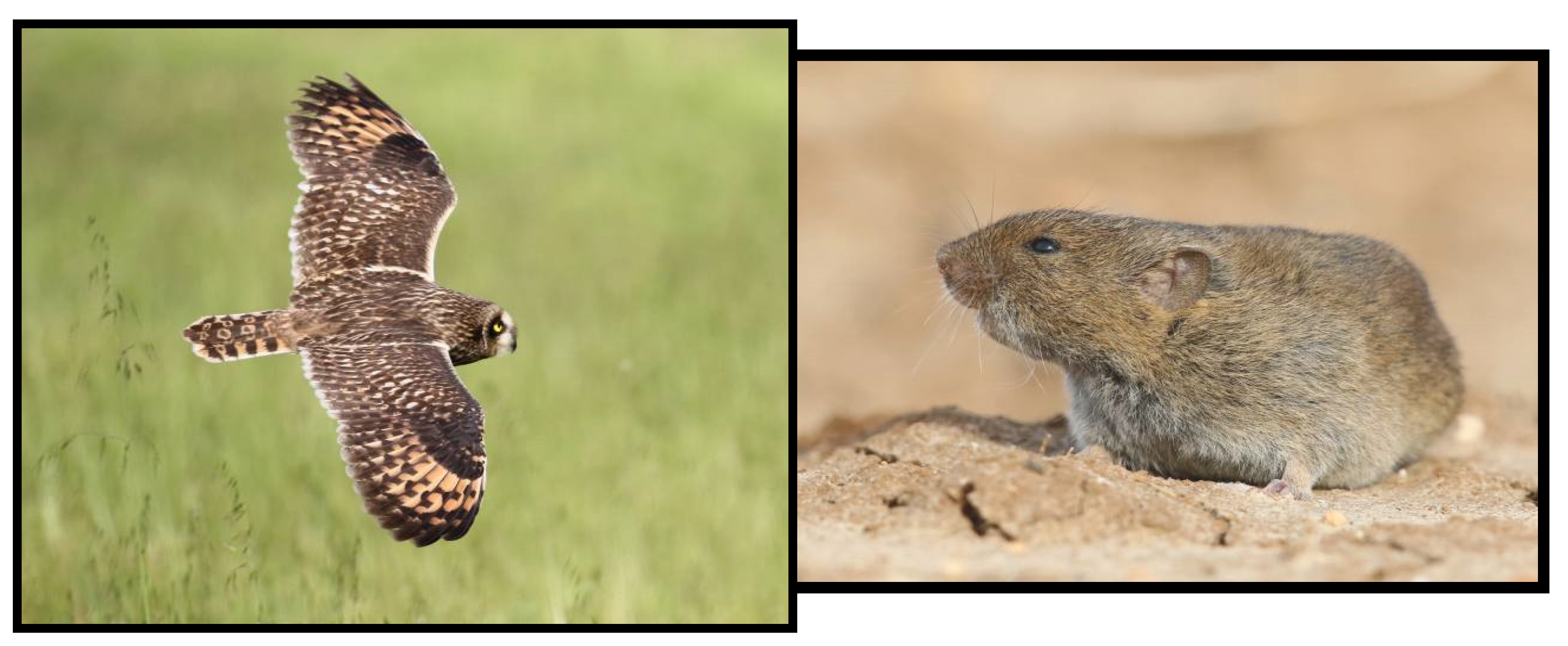
Morphologically, the Short-eared Owl is characterized as a medium-sized owl, with typical measurements ranging from 34 to 43 cm in length and a wingspan that can extend between 85 - 110 cm (Mikkola 1983). One of the distinctive features of this owl is its round head, adorned with small ear tufts that are often difficult to detect, contributing to the species’ name. The plumage of the Short-eared Owl is predominantly brown, interspersed with streaks of buff and dark brown, which serves as highly effective camouflage within grassland habitats, allowing them to blend into their surroundings. Additionally, they possess large, striking yellow eyes that are framed by dark patches, enhancing their keen sense of sight, which is crucial for hunting in low-light conditions (
Figure 1).
Overall, the Short-eared Owl, as an apex predator, represents a species of ecological importance and conservation concern. Its role in maintaining the balance of ecosystems underscores the necessity for ongoing research and protective measures to ensure its survival amidst a range of environmental challenges. Additionally, the lack of comprehensive information about this species across many parts of its distribution further emphasizes the urgency of these efforts. Understanding the dynamics of Short-eared Owl populations, their habitats, and their interactions with other species is crucial for effective conservation strategies.
Figure 1.
Short-eared Owl Asio flammeus in flight in the fields in central Israel and Günther’s vole (Microtus guentheri). Photos Ezra Hadad.
Figure 1.
Short-eared Owl Asio flammeus in flight in the fields in central Israel and Günther’s vole (Microtus guentheri). Photos Ezra Hadad.
Unlike many other owl species, Short-eared Owls are primarily crepuscular and may even exhibit diurnal behavior, frequently hunting during the day or at dusk. These owls are known for their distinctive hunting style, flying low over open fields and marshes as they search for prey. They rely heavily on their exceptional eyesight and acute hearing to detect potential food sources, which mainly consist of small mammals (König and Weick 2008).
Their flight is characterized by a buoyant, moth-like quality, allowing them to cover expansive areas efficiently in pursuit of prey. This adaptability often leads them to concentrate their hunting efforts in regions with high rodent densities, where food is more readily available (Korpimaki and Norrdahl 1991, Reid et al. 2011).
Short-eared Owls consume prey whole, swallowing small animals, and later regurgitating indigestible materials as pellets (Newton 2002, Wiggins et al. 2020). They are opportunistic feeders, adapting their diet to available prey (Williford et al. 2011, Cullen and Smiddy 2012). Pellet analysis is a common method for studying their diet, though it has biases (Yom-Tov and Wool 1997, Redpath et al. 2001). Pellets over-represent smaller prey, while prey remains over-represent larger species. Combining these methods doesn't fully eliminate biases, though biomass estimates may be more accurate (Hadad et al. 2022b).
Despite their extensive global distribution, the majority of studies examining the diet of Short-eared Owls have predominantly focused on populations in North America and Europe (Clark 1975, Rau et al. 1992). Quantitative data specifically pertaining to their diet in the Middle East is notably sparse, with the existing research primarily limited to the Levant, particularly in Turkey (Güngör 2021).
In Israel, the phenomenon of rodent population explosions, especially in agricultural fields, is well-documented. These surges often occur following poisoning events that are implemented to control such outbreaks (Mendelssohn and Paz 1977). In the Judea region, agricultural development has contributed to periodic increases in rodent populations, particularly featuring species such as Günther’s vole (Microtus guentheri; Fig. 1), Tristram’s jird (Meriones tristrami), and house mice (Mus musculus) (Hadad et al. 2019, 2022a).
During the winters of 2015 and 2016, these rodent outbreaks reached exceptionally high densities, which in turn facilitated the overwintering of relatively large numbers of various raptor species, including Eastern Imperial Eagles (Aquila heliaca), Spotted Eagles (A. clanga), Black Kites (Milvus migrans), Marsh Harriers (Circus aeruginosus), Steppe Buzzards (Buteo buteo vulpinus), and Long-legged Buzzards (B. rufinus) (Hadad et al. 2022a). This significant seasonal rodent outbreak, occurring over two consecutive winters, provided the conditions necessary for opportunistic breeding by three pairs of Short-eared Owls (Hadad 2019).
As many as 20 Short-eared Owls, representing the largest concentration ever recorded in Israel, roosted and foraged in these agricultural fields, with three pairs successfully breeding in close proximity (Hadad et al. 2022a). This remarkable situation provided us with the opportunity to collect pellets from the breeding sites for dietary analysis. We hypothesized that the relative abundance of rodents in the surrounding fields would be mirrored in the diet of the Short-eared Owls, as has been suggested in previous studies (Stone et al. 1994, Reid et al. 2011). This correlation would allow us to gain valuable insights into the feeding behavior and ecological dynamics of these owls in relation to their prey availability.
2.0. Methods
The study took place in the Judea region of Israel, covering 2,644 km². Specific locations included Kedma (31°42′5″N, 34°46′32″E), Moshav Zohar (31°35′43″N, 34°41′32″E), and Kibbutz Bet Nir (31°38′52″N 34°52′26″E). These sites have water bodies surrounded by marshes and grasslands, which is where the Short-eared Owls bred on the ground.
We collected 260 pellets from the three sites during the winters of 2015 and 2016. Pellets were stored individually in ziplock bags and cardboard cartons. We randomly weighed 68 oven-dried pellets (digital scale ± 0.01 g) and measured their length and breadth (digital caliper ± 0.01 mm). Each pellet was analyzed to identify prey species. We excluded invertebrate weights due to their small biomass compared to vertebrates, comprising only 0.8% of the diet (
Table 1).
Mammalian prey identification was aided by Mendelssohn and Yom-Tov (1987, 1999), with body masses referenced from Wilson et al. (2017) and Krystufek et al. (2011). Avian prey identification was based on Snow and Perrins (1998).
3.0. Results
From 260 pellets, we identified 385 prey items (
Table 1), with 384 (99.7%) identified to species level. We measured 68 pellets (26.2%), finding an average weight of 3.3 g (± 1.11 SD, range 1.0–4.77), average length of 57.8 mm (± 16.2, range 23.8–87.8), and average breadth of 19.9 mm (± 2.36, range 13.3–25.2).
Most prey items were mammals (N = 378, 98.2%;
Table 1), with only four birds (1.0%) and three arthropods (0.8%). Mammals made up 99.3% of the biomass, while avian prey accounted for 0.7%. Günther’s vole (Fig. 2) dominated the diet, representing 87.3% (N = 336) of prey items and 91.7% of the total biomass.
4.0. Discussion
Our study uncovers the significant dependence of Short-eared Owls on rodent populations, which plays a crucial role in supporting their breeding success in regions characterized by a high abundance of prey. This opportunistic behavior is particularly noteworthy; the owls migrate to different locations when their primary food sources are scarce, yet they choose to breed in areas where prey is plentiful. The dominance of small mammals, particularly rodents, in the diet of Short-eared Owls is well-documented across various studies. For instance, in southern South America, rodents constituted 80.0% of their diet (Rau et al., 1992), while in Hawaii, the figure rose to 83.1% (Wang 2022). In Colombia, 75.2% of their diet comprised rodents (Restrepo-Cardona et al., 2021), and in Massachusetts, the percentages were 83.0% during the breeding season and a staggering 95.0% during the non-breeding season (Holt 1993). Further evidence from Romania shows that 99.4% of their diet consisted of small mammals (Ionescu et al., 2017), and in Yukon, Canada, this number was similarly high at 99.0% (Reid et al., 2011). In western Siberia, rodents made up 100.0% of their dietary intake (Dupal and Chernyshov 2013), while in northwestern Turkey, this figure was 95.4% (Güngör 2021). In Baluchistan, Pakistan, small mammals constituted 96.7% of their diet (Mushtaq-Ul-Hassan et al., 2007), and in Maharashtra, India, they accounted for 81.0% (Jathar et al., 2011).
Despite this heavy reliance on rodents, Short-eared Owls also demonstrate a remarkable degree of dietary flexibility. For example, in regions where rodents are not readily available, such as certain islands, these owls adapt their feeding habits by preying on alternative sources like rabbits (Oryctolagus cuniculus; 60.8%) and petrels (Pterodroma spp.; 19.6%), as observed in the Juan Fernández Archipelago in Chile (González-Acuña et al., 2023). In Algeria, the situation is different; here, rodents constituted only 28.5% of their diet by number and 26.9% by biomass, while birds accounted for a significant 52.0% of biomass, alongside contributions from amphibians (11.4%), reptiles, and insects. In Andhra Pradesh, India, wintering Short-eared Owls exhibited a preference for birds, which made up a remarkable 86.3% of their diet, with mammals being a secondary food source at 10.3% (Srinivasulu and Srinivasulu 2007). Additionally, in Toronto, Canada, Short-eared Owls primarily targeted migratory birds, even in the presence of voles (Munro 1918). This adaptability highlights the owls' ability to adjust their foraging strategies in response to the availability of different prey types.
A particularly notable prey item for the Short-eared Owl is Kuhl's pipistrelle (Pipistrellus kuhlii), especially given that bats are infrequently observed in the diets of these owls, as highlighted by Sieradzki and Mikkola (2020). However, there is an intriguing exception documented in Algeria, where bats accounted for a substantial 39.4% of the total prey items consumed by Short-eared Owls, albeit representing only 9.3% of the total biomass (Djilali et al., 2016). This discrepancy suggests that while bats may be caught frequently, they do not provide a significant amount of energy relative to their hunting costs. The low energetic cost:benefit ratio associated with hunting bats likely explains their overall exclusion from the typical diet of Short-eared Owls in most regions.
Our study also revealed that the dimensions of owl pellets vary significantly across different geographical areas. In our research, we recorded an average pellet length of 57.8 mm and a breadth of 19.9 mm. Djilali et al. (2016) conducted similar measurements and found that their study revealed an average pellet length of 39.2 mm (± 8.8, with a range from 23 to 75 mm) and a width of 25.7 mm (± 4.8, with a range from 15 to 41 mm). In Maharashtra, India, the average dimensions were somewhat smaller, with an average length of 34.0 mm (± 8.7) and a breadth of 16.4 mm (± 3.3). These variations in pellet dimensions may reflect differences in prey availability, hunting strategies, and environmental conditions across regions.
Our findings further indicate that during the significant rodent outbreak in the agricultural areas of Judea between 2015 and 2016, Günther's vole (Microtus guentheri) emerged as the dominant prey species, comprising an impressive 87.3% of the total prey items and contributing 91.7% of the total biomass. This data is invaluable for informing farmers about potential future mitigation measures. By understanding the frequency and magnitude of rodent outbreaks through systematic census efforts, it may be possible to identify the environmental factors that trigger breeding behaviors in Short-eared Owls.
In conclusion, this study underscores the critical dependence of Short-eared Owls on rodent prey for successful breeding in central Israel. As habitat loss and environmental changes increasingly threaten both the owls and their rodent prey, it is imperative that conservation efforts focus on preserving habitats and managing rodent populations effectively. By fostering a balanced ecosystem, we can enhance the resilience of these owls and support the potential establishment of a permanent breeding population of Short-eared Owls in Israel. Such initiatives will not only benefit the owls but also contribute to the broader ecological health of the region.
References
- BirdLife International. 2021. Asio flammeus. The IUCN Red List of Threatened Species 2021: e.T22689531A202226582. https://dx.doi.org/10.2305/IUCN.UK.2021-3.RLTS.T22689531A202226582.en. Accessed on 15 September 2024.
- Cullen, C. and Smiddy, P., 2012. Diet of Short-eared Owls Asio flammeus over seven winters in County Cork, Ireland. In Biology and Environment: Proceedings of the Royal Irish Academy 112:217-223. Royal Irish Academy.
- Djilali, K., Sekour, M., Souttou, K., Ababsa, L., Guezoul, O., Denys, C. and Doumandji, S., 2016. Diet of Short-eared Owl Asio flammeus (Pontoppidan, 1763) in desert area at Hassi El Gara (El Golea, Algeria). Zoology and Ecology 26:159-165. [CrossRef]
- Dupal, T.A. and Chernyshov, V.M., 2013. Small mammals in the diets of the Long-eared Owl (Asio otus) and Short-eared Owl (A. flammeus) in the south of Western Siberia. Russian Journal of Ecology 44:397-401.
- Fisher, A. K. 1893. Hawks and owls of the United States. U.S. Dept. Agric. Bull. No. 3, Washington, D.C.
- González-Acuña, D., K. Ardiles, E. S. Corales, R. A. Figueroa. 2023. European rabbits and petrels as the staple prey of the Short-eared Owl (Asio flammeus) in the Juan Fernández Archipelago off the coast of Chile. Revista Chilena de Ornitología 29:114-118.
- Güngör, U., Bacak, E. and Beşkardeş, V., 2021. Short-eared Owl (Asio flammeus)’s winter diets in northwestern Turkey (Thrace). Forestist 71:40-44.
- . [CrossRef]
- Hadad, E. 2019. Short-eared Owl in Israel. Teva HaDvarim. 288:50-60. In Hebrew.
- Hadad, E., P. Zduniak, R. Yosef. 2022a. Sustaining winter raptor populations in Central Israel:a 38 year perspective. Sustainability 14:12481. [CrossRef]
- Hadad, E., M. Charter, J.Z. Kosicki and R. Yosef. 2022b. Prey-base does not influence breeding success in Eagle Owls (Bubo bubo) in Judea, Israel. Animals 12: 1280. [CrossRef]
- Holt, D.W., 1993. Breeding season diet of Short-eared Owls in Massachusetts. Wilson Bulletin 105:490-496.
- Ionescu, D.T., Hodor, C. and Sándor, A.D., 2017. Diet of Wintering Shorteared Owl Asio flammeus (Pontoppidan, 1763)(Strigiformes: Strigidae) in South-eastern Romania. Acta Zoologica Bulgarica 69:295-297.
- Israel Bird Base. 2024. https://www.birdsbase.com/bbis_test/heb/spec.jsp?id=316. Accessed on 24 September 2024.
- Israel Red List. Updated 1 January 2011. https://redlist.parks.org.il/aves/detail/Asio%20flammeus/. Accessed on 24 September 2024.
- Jathar, G.A., Deshmukh, A.J., Khawale, V.S., Patil, P.S., Pradhan, S.S., Nandvikar, P.D. and Sawant, A.D., 2011. Winter diet of Short-eared Owls Asio flammeus in Akola, Maharashtra. Indian Birds 7:17-19.
- König, C. and Weick, F., 2008. Owls of the world. A&C Black.
- Korpimaki, E., and K. Norrdahl. 1991. Numerical and functional responses of Kestrels, Short-eared Owls and Long-eared Owls to vole densities. Ecology 72: 814-826.
- Krystufek, B.; Ivanitskaya, E.; Arslan, A.; Arslan, E.; Buzan, E. 2011. Evolutionary history of mole rats (genus Nannospalax) inferred from mitochondrial cytochrome b sequence. Biol. J. Linn. Soc., 105, 446–455.
- Mendelssohn, H. & Paz, U. 1977. Mass mortality of birds of prey caused by Azodrin, an organophosphorus insecticide. Biological Conservation 11:163-170.
- Mendelssohn, H.; Yom-Tov, Y. Appendix to Volume 7: Mammals. Skull and body measurements. In Plants and Animals of the Land of Israel; Alon, A., Ed.; Ministry of Defence Publishing House: Tel Aviv, Israel, 1987.
- Mendelssohn, H.; Yom-Tov, Y. Fauna Palaestina. In Mammalia of Israel; The Israel Academy of Sciences and Humanities: Jerusalem, Israel, 1999.
- Mikkola, H. 1983. Owls of Europe. T & A D Poyser Ltd., Staffordshire, England.
- Munro, J. A. 1918. Short-eared Owl (Asio flammeus) eating birds. Auk 35:223.
- Mushtaq-ul-Hassan, M., Ghazi, R.R. and NISA, N.U., 2007. Food preference of the Short-eared Owl (Asio flammeus) and barn owl (Tyto alba) at Usta Muhammad, Baluchistan, Pakistan. Turkish Journal of Zoology 31:91-94.
- Newton, I. (ed.). 2002. Ecology and conservation of owls. Csiro Publishing.
- Rau, J.R., Villagra, M.C., Mora, M.L., Martinez, D.R. and Tilleria, M.S., 1992. Food habits of the Short-eared Owl (Asio flammeus) in southern South America. Journal of Raptor Research 26:35-36.
- Redpath, S.M.; Clarke, R.; Madders, M.; Thirgood, S.J. 2001. Assessing raptor diet: Comparing pellets, prey remains, and observational data at hen harrier nests. Condor 103:184–188.
- Reid, D.G., Doyle, F.I., Kenney, A.J. and Krebs, C.J., 2011. Some observations of Short-eared Owl, Asio flammeus, ecology on arctic tundra, Yukon, Canada. The Canadian Field-Naturalist 125:307-315.
- Restrepo-Cardona, J. S., J. D. Ocampo-Velásquez, A. Delgado, H. Mikkola, D. R. Rodríguez-Villamil. 2021. Feeding habits of the Stygian Owl (Asio stygius) and the Short-eared Owl (A. flammeus) in the southwest of Bogotá Savanna, Cundinamarca, Colombia. Ornitología neotropical 32:89-93.
- Shirihai, H. 1996. The birds of Israel. Academic Press, London.
- Sieradzki, A. and Mikkola, H., 2020. A review of European owls as predators of bats. Owls, pp.1-20. [CrossRef]
- Snow, D.W.; Perrins, C.M. The Birds of the Western Palearctic; Concise Edition; Vol. 1 Non-Passerines, Vol. 2. Passerines; Oxford University Press: Oxford, UK, 1998.
- Srinivasulu, B., C. Srinivasulu. 2007. Diet of Short-eared Owl Asio flammeus (Pontopiddan, 1763) wintering in Rollapadu Wildlife Sanctuary and its vicinity in Andhra Pradesh, India. Zoo’s Print Journal 22:2829-2831.
- Stone, E., Smith, J. and Thornton, P. 1994. Seasonal variation and diet selection from pellet remains of Short-eared Owls (Asio flammeus) in Wyoming. Great Basin Naturalist, 54:191-192.
- Wang, O. 2022. Breeding ecoloy and management of Pueo (Hawaiian Short-eared Owl, Asio flammeus sandwichensis). M.Sc. thesis, University of Hawaii at Manoa. 82 pp.
- Wiggins, D. A., D. W. Holt, and S. M. Leasure (2020). Short-eared Owl (Asio flammeus), version 1.0. In Birds of the World (S. M. Billerman, Editor). Cornell Lab of Ornithology, Ithaca, NY, USA. [CrossRef]
- Wilson, D.E.; Mittermeier, R.A.; Lacher, T.E. Handbook of the Mammals of the World; Vol. 7. Rodents II; Lynx Ediciones: Barcelona, Spain, 2017.
- Williford, D., Woodin, M.C. and Skoruppa, M.K., 2011. The Winter Diet of Short-eared Owls in Subtropical Texas: Do Southern Diets Provide Evidence of Opportunism? Journal of Raptor Research 45:63-70.
- Yom-Tov, Y.; Wool, D. 1997. Do the contents of Barn Owl pellets accurately represent the proportion of prey species in the field? Condor 99:972–976.
|
Disclaimer/Publisher’s Note: The statements, opinions and data contained in all publications are solely those of the individual author(s) and contributor(s) and not of MDPI and/or the editor(s). MDPI and/or the editor(s) disclaim responsibility for any injury to people or property resulting from any ideas, methods, instructions or products referred to in the content. |
© 2024 by the authors. Licensee MDPI, Basel, Switzerland. This article is an open access article distributed under the terms and conditions of the Creative Commons Attribution (CC BY) license (http://creativecommons.org/licenses/by/4.0/).