

Submitted:
19 November 2024
Posted:
19 November 2024
You are already at the latest version
Abstract
The last decades have offered new challenges to researchers worldwide through the problems our planet is facing both in the environment protection field and the need to replace fossil fuels with new environmentally friendly alternatives. Bioenergy as a form of renewable energy is an acceptable option from all points of view and biofuels due to their biological origin have the ability to satisfy the new needs of humanity. By releasing some non-polluting combustion products into the atmosphere, biofuels have already been adopted as additives in traditional liquid fuels, being intended mainly for internal combustion engines of automobiles. The current work proposes an extension of biofuels application in combustion processes specific to industrial furnaces. This technical concern is not found in the literature, except for achievements of the research team involved in this work, which has performed previous investigations. A 51.5 kW-burner was designed to operate with glycerine originating from triglycerides of plants and animals, mixed with ethanol, an alcohol produced by the chemical industry recently used as an additive in gasoline for automobile engines. Industrial oxygen was chosen as the oxidizing agent necessary for the liquid mixture combustion, allowing to obtain much higher flame temperatures compared to the usual combustion processes using air. Mixing glycerine with ethanol in 8.8 ratio allowed growing flame stability, accentuated also by creating swirl currents in the flame through the speed regime of fluids at the exit from the burner body. Results were excellent both through the flame stability and low level of polluting emissions.
Keywords:
biofuel
; burner
; glycerine
; ethanol
; oxygen
; flame stability
; environment
1. Introduction
The traditional combustion methods using fossil fuels have been the main method of converting the chemical energy contained in these fuels into heat since ancient times. The conversion was achieved by initiating the exothermic oxidation processes of energetically active components of fossil fuels (mainly carbon).
These combustion processes were the key to most industrial manufacturing processes based on the technological necessity of reaching high temperatures. The main disadvantage of burning fossil fuels has been carbon dioxide emission in ever-increasing quantities with the industrial development of the planet.
The excessive increase in these emissions has brought humanity to the brink of possible natural disasters caused by the damage to the protective ozone layer [1]. Reducing the carbon footprint in all economic activities at the global level has become an important challenge of the current times.
According to Chen et al. [2], in present, the challenge of achieving carbon neutrality is very acute. Given that only less than 5 % of the world's countries have achieved zero carbon emissions, the 26th Summit of the United Nations Climate Change Conference in Glasgow, UK in 2021 established a set of measures to control carbon emissions in order to obtain their neutrality.
In the last decades, renewable power, including bioenergy, has come to constitute an important alternative for reducing emissions of pollutants in the atmosphere and preserving the current natural energy resources that are in sharp decline.
Biological mass as a provenance of renewable energy has the particularity of being able to be directly turned into biofuel, unlike other known sources of renewable energy. The most well-known types of liquid biofuel used especially in transport are ethanol and biodiesel, constituting the basis of biofuel technology [3]. Ethanol (C2H5OH) is prepared from some vegetable sources (biomass). In most cases, ethanol is extracted from sugar and starch existing in plants.
Recent research refers to the possibility of obtaining ethanol from cellulose and hemicellulose available in high quantities in plant mass [4,5]. Mixed with gasoline, ethanol has the ability to increase its octane number and to reduce the emission of carbon monoxide responsible for the creation of smog [6]. According to the literature [7], in road transport, the frequently used proportion of ethanol is 10 %. Also, they are known liquid fuels of this type in which the proportion of ethanol can even reach 85 %.
The accentuated increase of crude diesel production influenced the increase in the demand for glycerine [8,9]. Thus, the world glycerine market at the end of the last decade of the 20th century reached a very high level, the supply of this biological product being much greater than the demand (about 6 times) [10]. Under these conditions, the glycerine prix significantly dropped and the need for new ways of capitalizing it appeared [11].
Considering the problems related to the continuous deterioration of the environment quality at the global level, the International Energy Agency is mainly focused on security energy, environmental protection, and economic development.
The significant reduction of CO2 emissions in the atmosphere and the use of environmentally friendly alternatives are main elements of the environmental protection. The Climate Change Summit including solutions for the future is scheduled to take place in Bucharest (Romania) in October 15-17, 2024. The renewable energy projects are essential to decarbonize the economic activities.
Climate changes, determined by growing concentration of greenhouse gases in the atmosphere, mainly due to the use of fossil fuels, are currently recognized worldwide as a planetary menace. This recognition was recorded to a global consensus in the Summit of the International Energy Agency in 2019 in Paris (France) [12] by world’s nations.
An excellent alternative for diminishing greenhouse gas emissions (mainly CO2) was the use of biofuels especially in internal combustion engines for the transport domain. Being derived from vegetable mass, burning liquid biofuels occurs under advantageous ecological conditions [13,14,15].
Although until recently, the share of the use of biofuels in the total renewable energy was very small, the biofuel market has registered significant increases in recent years due to the increased concern about climate change, energy security, and the need for sustainable alternatives to fossil fuels.
For the following years, the market is projected to continue growing with an annual growth rate of 5.7 % [16]. One of solutions for the forecasted increase are environmental regulations in many countries of the world, promoting the use of biofuels to reduce dangerous emissions.
In addition, the technological development of biofuels, reflected in the accelerated growth of the market for these products. The main areas of the world where the biofuel market (including ethanol, biodiesel, and other advanced biofuels) is intensively exhibited are North America, Europe, and Asia-Pacific.
Unlike the applications of biofuels in internal combustion engines mentioned above, the current paper addressed the use of biofuels in oxy-combustion thermal processes in industrial furnaces. The approach represents a concern that has not been encountered in the literature, except for the work published in 2022 by Paunescu et al. [17], i.e. some authors of the present paper.
The mentioned article has tested the use of glycerine as a polyol compound together with ethanol as an alcohol. The combustion of this liquid mixture atomized with water was performed by the addition of industrial oxygen. The glycerine/ethanol mass ratio had the value of 8,1, while the biofuel mix/oxygen flow ratio was 0.41 kg·m3N-1. The effect of using these proportions on the content of CO2, CO, NO, and NO2 in the residual gases resulting from the combustion process showed the existence of extremely low contents (0.06-0.13 vol. % CO2, zero vol. % CO, less than 199 mg·m3N-1 NO, and under 210 mg·m3N-1 NO2.
The objective of the paper presented below was to continue the research on the combustion of biofuels for applications in oxy-combustion thermal processes, aiming to improve performances previously obtained.
2. Methods and Materials
2.1. Methods
In the case of burning biofuels, the flame stability in operation depends on their concentration in aqueous solution. Thus, glycerine is low volatile by comparison with water and ethanol is higher volatile. That is why, in the case of using glycerine, water is predominantly transformed into vapours, while in the case of using ethanol, this biofuel is predominantly turned into vapours.
The operational stability of the flame with low vaporization compared to water is obtained with difficulty under the conditions of using large amount of water for atomizing the liquid fuel. Increasing the flame stability of a biofuel with low volatility (e.g. glycerine) is possible by adding small amount of ethanol.
According to Yi and Axelbaum [18], satisfactory experimental results were obtained in the case of utilizing an aqueous solution of glycerine with 30 % concentration and the addition of 10 % ethanol.
Generally, the basic constructive features of the achieved and tested burner in the work [17] were unchanged maintained according to the scheme in Figure 1. One of the important elements of obtaining the stability of the flame development remained the recirculation of biofuel and oxygen jets in the exit area from the burner by creating turbulence on the metallic frontal surface of the combustion equipment.
The method of swirling the flame by creating turbulence currents in the flame propagation was previously known from the literature [19,20,21], being especially applied to low calorific value-gaseous fuels.
According to the scheme presented above, the supply with the liquid mixture of biofuels is made through a central pipe provided at the front end with a metal plate that completely closes this end of the pipe. The output of the biofuel is made through several radial orifices placed near the closing plate.
The radial fuel jets meet the atomizing water flow, which circulates through an annular space between the fuel supply pipe and the oxygen pipe. The contact between the radial jets and the annular water jet distributed with a high rate finely sprays this mixture that at the same time is divergently oriented under an angle of 45 degrees to the axis of the burner.
The external annular jet of oxygen also divergently oriented under the same value of the angle is distributed in the area of the combustion chamber (intensively cooled with water). Due to the high speed of the water-atomized biofuel jets, an enough high depression is created in the area of the outer surface of metal plate, causing their partial recirculation.
Also, in the space between the divergent slope for the orientation of the oxygen circulation at the exit from the burner body and the cylindrical surface of the combustion chamber, conditions are created for the formation of recirculation currents of atomized biofuel and oxygen jets. The two zones in the burner head where recirculation currents are produced play a major role in the process of functional stabilization of the flame.
By design, energy fluids were supplied on concentric routes. Of these, the outer jet of oxygen was the fastest. Due to its superior speed, the annular jet of oxygen sucked the jet of atomized oxy-fuel, thus ensuring an adequate mixture between them and excellent conditions for the combustion process to take place.
The combustion process was the summation of the oxidation reactions of glycerine (1) and ethanol (2), both of which being characterized by intense heat release. The fact that it was decided to use industrial oxygen instead of air or oxygen-enriched air allowed the total elimination of nitrogen, which is only an important inert component of air. Nitrogen does not participate in chemical reactions and its negative role in combustion processes is to cool the combustion gases, lowering the process temperature [22].
The oxidation reactions of glycerine and ethanol are shown below:
C3H8O3 + 3.5O2 = 3CO2 + 4H2O
C2H5OH + 3O2 = 2CO2 + 3H2O
A burner testing stand (Figure 2) in the Romanian Metallurgical Research Institute SA was utilized for investigating the main thermal characteristics of the oxy-biofuel burner.
2.2. Materials
As mentioned above, glycerine and ethanol were chosen as biofuels for this experiment. Industrial oxygen was adopted as the oxidant product able to supply the pure oxygen necessary for the thermal oxidation (i.e. burning) of the two fuels. Water as an atomizing agent for the liquid biofuel mix was used as a necessary component of the process.
Glycerine is naturally found in the triglycerides of plants and animals. The method of obtaining glycerine as a by-product includes several available processes, of which the most frequently used is hydrolysis [23]. Glycerine obtained from triglycerides is intensively used all over the world at an extremely advantageous prix of up to 5 US cents per kilogram [24].
Ethanol belongs to the alcohols class and is an important product of the chemical industry. Pure ethanol is a flammable liquid made by fermentation or hydration techniques of some chemical materials [25]. It is utilized as a solvent, in synthesis processes of other organic chemical products as well as an additive in gasoline for diesel motor vehicles.
Both chemical products mentioned above were commercially purchased and bottled. The mixture of the two liquids has been previously made in a tank for the purpose of experiment. The burner supply with this mixture was performed through an adequate hose with the help of a pump. The water from the industrial circuit was injected with a pressure pump into the burner body for the fine atomization of the fuel mixture using a hose for the water transport.
The industrial oxygen adopted for the biofuel combustion was provided by a small internal factory of the Metallurgical Research Institute, being taken over through a suitable flexible connection from the general distribution pipe.
2.3. Methods for Determining the Technical Performances of the Burner
The main tools utilized to determine the hourly flows of energy fluids were: Tecfluid flowmeter series DP 65 for glycerine and ethanol, LZQ-7 oxygen flowmeter 3-30 LPM for oxygen, and flowmeter rotameter LS 32-600 for water. Measuring the flame temperature was performed with a Pyrovar radiation pyrometer. The analysis of the chemical composition of gas emission (especially CO, NO, and NO2) was carried out with TESTO 350 analyzer.
3. Results and Discussion
3.1. Results
The constructive principle of the burner previously designed and tested by the team of Romanian researchers [17] was generally maintained in the current work. Also, the nominal thermal power was at the value of 51.5 kW.
The main difference existing between the nominal parameters of the improved burner and those of the reference burner is the new ratio between the nominal flow values of glycerin (10.10 kg·h-1) and ethanol (1.15 kg·h-1), which increased to 8.8 compared to 8.1. Therefore, the ratio growing (by about 8 %) solution was adopted by slightly improving the glycerine share compared to ethanol. In order not to lose the functional stability of the flame, they were chosen solutions for growing the recirculation volume of jets at the exit from the burner body by adopting higher speeds of fluids involved in the combustion process, in accordance with the functional principle of swirl burners [19,20].
The nominal technical parameters of the burner designed in this work are presented in Table 1.
During the burner testing eight thermal regimes with values included between maximum and minimum limits were tried. The biofuel mix flow had values in the range of 6.08-11.33 m3N·h-1, the oxygen flow fell within the limits 7.80-11.94 m3N·h-1, and atomizing water flow had values between 47.40-82.71 kg·h-1.
Pollutant composition in waste gases (CO, NO, and NO2) after leaving the combustion chamber of the burner, temperature and size of the flame for each of the tried thermal regimes are presented in Table 2.
According to the data in Table 2, the conditions of the biofuel combustion process using industrial oxygen led to obtaining much higher flame temperatures compared to the combustion processes that use air no-enriched in oxygen. On the other hand, the influence of increasing the temperature of the combustion process on the formation of nitrogen oxides (NO and NO2) is known.
Despite the very high temperature of the flame (1790-1860 C), compensated by the formation of recirculation currents during the propagation of the flame, the amounts of NO and NO2 emitted into the atmosphere are relatively low, of maximum 181 and 197 mg·m3N-1, respectively, accepted by the existing regulations regarding the limits of these emissions [26].
It is also remarkable that no traces of CO are found in any of the tested thermal regimes.
The flame corresponding to the biofuel mix combustion process using industrial oxygen had excellent functional stability in the entire minimum-maximum operating range. The strongly radiant aspect of the flame in all the tried thermal regimes is highlighted in the images in Figure 3 (referring to the nominal regime-no. 2). The picture shows a longitudinal image of the flame propagation (a) as well as a frontal image (b).
3.2. Discussion
The literature [27,28] considers based on previous experimental results that burning glycerin as the only fuel is not possible due to the high level of cohesion and self-ignition capability as well as releasing emissions with high danger degree to health.
Instead, mixed in relatively small proportions with products of the chemical industry belonging to the class of alcohols (such as methanol, butanol, ethanol), it was found that glycerin can become a biofuel with radically improved properties. The three mentioned products are usually used as solvents and intermediate chemicals for the manufacture of a large number of other products, but also as additives for internal combustion engines of vehicles, ships, etc.
Authors’ team of the current paper had previously carried out tests of combining glycerine with ethanol, the mass ratio between the two liquids being 8.1 [17]. As a result, stability of the thermal intensified flame by using oxygen has been significantly improved.
The experiment described in the current paper continued own investigations in the field of oxy-biofuel burners using the constructive principle of previously tested combustion equipment, but modifying firstly the glycerine/ethanol mass ratio to 8.8 and also some functional elements (slightly higher speed of fluids in combustion zone) able to increase swirling th flame.
Testing under experimental conditions of modifications brought to the burner showed their viability, leading to improved performances on the functional stability of the flame, its high radiant character, the increase of the flame temperature up to 1850 ℃ (at the nominal regime) and 1860 ℃ (at the maximum regime) as well as the decrease of the emission values of nitrogen oxides (between 154-182 mg·m3N-1 for NO and 169-197 mg·m3N-1 for NO2) compared to the results obtained in the first stage of the research [17].
The transition from applications of biofuels combustion in internal combustion engines (at an advanced stage), to testing their combustion for industrial thermal processes at high temperature constitutes the main originality element of the work and the experimental results are promising.
4. Conclusions
An oxy-biofuel burner intended for thermal processes at high temperature in industrial furnaces was designed, made, and experimentally tested, representing a forward step compared to the current knowledge of applying biofuel combustion in internal combustion engines. This was the objective of the research presented in the paper.
The research was based on the fact that an atomized liquid biofuel is not a viable option for combustion processes when used alone, without mixing with an alcohol produced in the chemical industry (methanol, butanol or ethanol) due to the poor functional stability of the flame. In the current work, glycerine as a biofuel was used in a mixture with ethanol (in mass ratio 8.8) and moreover, it was subjected to combustion in the presence of industrial oxygen for the thermal intensification of the flame.
On the other hand, the method known for more than 50 years of favouring the stability of the flame by swirling it, applied in burners operating with gaseous fuels, was also taken over in the case of burning biofuels. The experimental results confirmed the viability of the adopted solution by obtaining an excellent stability of the flame in operation, increasing its temperature, and achieving a low level of nitrogen oxide emissions (NO and NO2).
Author Contributions
Conceptualization, A.I. and L.P.; methodology, E.V.; software, N.C.; formal analysis, I.L.C(B).
Funding
This research received no external funding.
Conflicts of Interest
The authors declare no conflict of interest.
References
- Andres, R.J., Boden, T.A., Bréon, F.M., Ciais, P., Davis, S., Erickson, D., Gregg, J.S., Jacobson, A., Marland, G., Miller, J., Oda, T., Olivier, J.G.J., Rauparch, M.R., Rayner, P., Treanton, K., A synthesis of carbon dioxide emissions from fossil-fuel combustion, Journal of the European Geosciences Union, Copernicus Publications, Göttingen, Germany, 2012, vol. 9, no. 5, pp. 1845-1871. https://bg.copernicus.org/articles/9/1845/2012/.
- Chen, L., Msigwa, G., Yang, M., Osman, A.I., Fawzy, S., Rooney, D.W., Yap, P., Strategies to achieve a carbon neutral society: A review, Environmental Chemistry Letters, Springer Link, 2022, vol. 20, pp. 2277-2319. [CrossRef]
- Biofuel basics, Office of Energy Efficiency & Renewable Energy-US Department of Energy, Washington DC, the United States, 2023. https://www.energy.gov/eere/bioenergy/biofuel-basics.
- Sharmila, S., Jeyanthi, L.R., Ankush, S.D.R., Kowsalya, E., Extraction of bioethanol from plant leaves, Pharmacia Lettre, Scolars Research Library, 2016, vol. 8, no. 8, pp. 97-99, ISSN 0975-5071.
- Chandrakart, P., Bisaria, V.S., Simultaneous bioconversion of cellulose and hemicellulose to ethanol, Critical Reviews in Biotechnology, National Library of Medicine, 1998, vol. 18, no. 4, pp. 295-331. [CrossRef]
- Tsai, J., Ko, Y., Huang, C., Chiang, H., Effects of blending ethanol and gasoline on the performance of motorcycle catalysts and airborne pollutant emissions, Aerosol and Air Quality Research, 2019, vol. 19, no. 12. [CrossRef]
- Ethanol fuel basics, In: Alternative fuels data center, Energy Efficiences & Renewable Energy, US Department of Energy, Washington DC, the United States, 2023. https://afde.energy.gov/fuels/ethanol-fuel-basics.
- Nicol, R.W., Marchand, K., Lubitz, W.D., Bioconversion of crude glycerol by fungi, Applied Microbiology and Biotechnology, Springer Link, 2012, vol. 93, pp. 1865-1875. https://link.springer.com/article/10.1007/s00253-012-3921-7.
- US renewable diesel production growth drastically impacts global feedstock trade, International Agricultural Trade Report, US Department of Agriculture, Washington DC, the United States, June 2024.
- Christoph, R., Schmidt, B., Steinberner, U., Dilla, W., Karinen, R., Glycerol, In: Ullmann’s Encyclopedia of Industrial Chemistry, Wiley-VCH Verlag GmbH & Co. KGaA, Weinheim, Germany, 2012, vol. 17, pp. 67-82.
- Cornejo, A., Barrio, I., Campoy, M., Lazaro, J., Navarrete, B., Oxigenated fuel additives from glycerol valorization. Main production pathways and effects on fuel properties and engine performance: a critical review, Renewable and Sustainable Energy Reviews, Elsevier, 2017, vol. 79, pp. 1400-1413. [CrossRef]
- World Energy Outlook. Report Extract Data, The International Energy Agency (IEA), Paris (France), 2019.
- Agarwal, A.K., Biofuels (alcohols and biodiesel) applications as fuels for internal combustion engines, Progress in Energy and Combustion Science, Elsevier, 2007, vol. 33, pp. 233-271. [CrossRef]
- Caliskan, H., Yildiz, I., Mori, K., Chapter 10, Biofuels combustion in internal combustion engines, In: Advances in Biofuels Production, Optimization and Applications, Elsevier, 2024, pp. 185-205.
- Ramos, J.L., Valdivia, M., Garcia-Lorente, F., Segura, A., Benefits and perspectives on the use of biofuels, Microbial Biotechnology,2016, vol. 9, no. 4, pp. 435-440. [CrossRef]
- Global biofuel market overview, October 2024-2028, ReportLinker.com, 2024. https://www.reportlinker.com/market-report/Bioenergy/132956/Biofuel?term=biofuel%20outlook&matchtype=b&loc_interest=&8loc_physical=9194739&utm_gr.
- Paunescu, L., Surugiu, G., Volceanov, E., Experimentally use of glycerol as a biofuel in oxy-combustion thermal process, Nonconventional Technologies Review, 2022, vol. 26, no. 3, pp. 22-27. https://revtn/index.php/revtn/about.
- Yi, F., Axelbaum, R.L., Oxy-combustion of low-volatility liquid fuel with high water content, Energy & Fuels, 2015, vol. 29, no. 2, pp. 1137-1142. [CrossRef]
- Mihaescu, L., Cristea, E.D., Panoiu, N., Swirl burners: Theory, construction, use, 1st ed., Technical Publishing House, Bucharest, Romania, 1986 (in Romanian).
- Froud, D.Y., Syred, N., Characterisation of industrial swirl burners for efficient combustion of low calorific value gases, Proceedings of the Institute of Energy Conference Held, December 4-5, 1995, London, United Kingdom.
- Basu, P., Kefa, C., Jestin, L., Swirl burners, In: Boilers and Burners, Mechanical Engineering Series, Springer Link, 2000, pp. 212-242, ISBN 978-1-4612-1250-8_8. https://link.springer.com/chapter/10.1007/978-1-4612-1250-8_8.
- Ҫengel, Y.A., Boles, M.A., Kanoglu, M., Thermodynamics: An engineering approach, 10th ed., McGraw Hill, ISBN 9781266664489, 2024.
- Pei, S.K., Mohamed, K.A., Dand, A.W., Mohd, W., Conversion of crude and pure glycerol into derivates: A feasibility evaluation, Renewable and Sustainable Energy Reviews, 2016, vol. 63, pp. 533-555. [CrossRef]
- Kohse-Höinghaus, K., Osswald, P., Cool, T.A., Kasper, T., Hansen, N., Qi, F., Westbrook, C.K., Westmoreland, P.R., Biofuel combustion chemistry: From ethanol to biodiesel, Agewandte (International Edition), Journal of the German Chemical Society, Wiley Online Library, 2010, vol. 49, no. 21, pp. 3572-3579. [CrossRef]
- Ethanol-chemical compound, Britannica, available at: https://www.britannica/science/ethanol. Accessed: 15.08.2022.
- Moron, W., Rybak, W., NOx and SO2 emissions of coals, biomass and their blends under different oxy-fuel atmospheres, Atmospheric Environment, Elsevier, 2015, vol. 116, pp. 65-71. [CrossRef]
- Bohon, M.D., Metzger, B.A., Linak, W.P., King, C.J., Roberts, W.L., Glycerol combustion and emissions, Proceedings of the Combustion Institute, Elsevier, 2011, vol. 33, no. 2, pp. 2717-2724.
- Stainmetz, S.A., Herrington, J.S., Winterrowd, C.K., Roberts, W.L., Wendt, J.O.L., Crude glycerol combustion: Particulate, acrolein, and other volatile organic emissions, Proceedings of the Combustion Institute, Elsevier, 2012, vol. 34, no. 2, pp. 2749-2757.
Figure 1.
Constructive and operational scheme of the oxy-biofuel burner. a – glycerine and ethanol mix; b – water for atomizing; c – oxygen; d – cold water entrance; e – water exit; f – propagated flame.
Figure 1.
Constructive and operational scheme of the oxy-biofuel burner. a – glycerine and ethanol mix; b – water for atomizing; c – oxygen; d – cold water entrance; e – water exit; f – propagated flame.
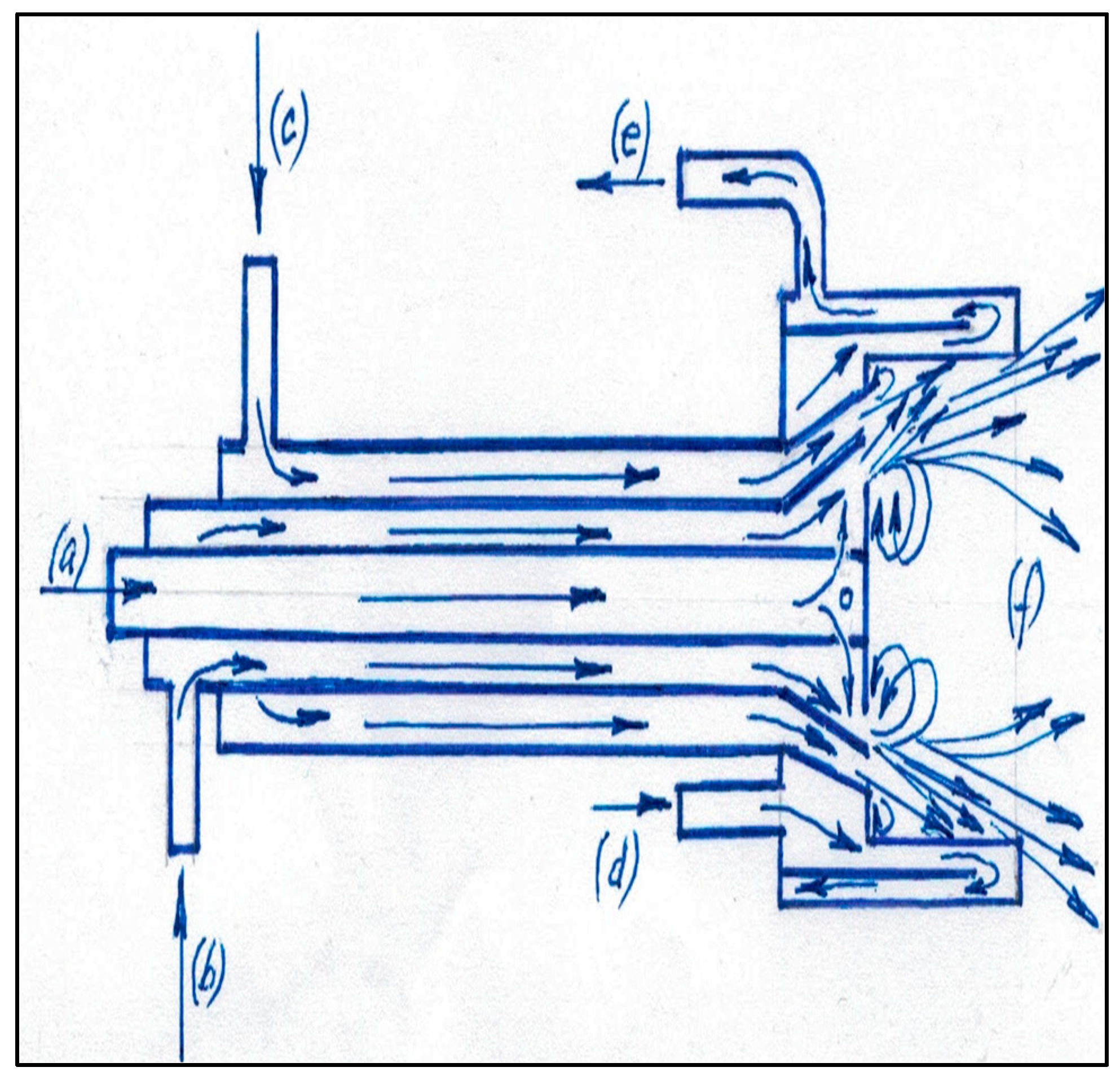
Figure 2.
Partial image of the burner testing stand.
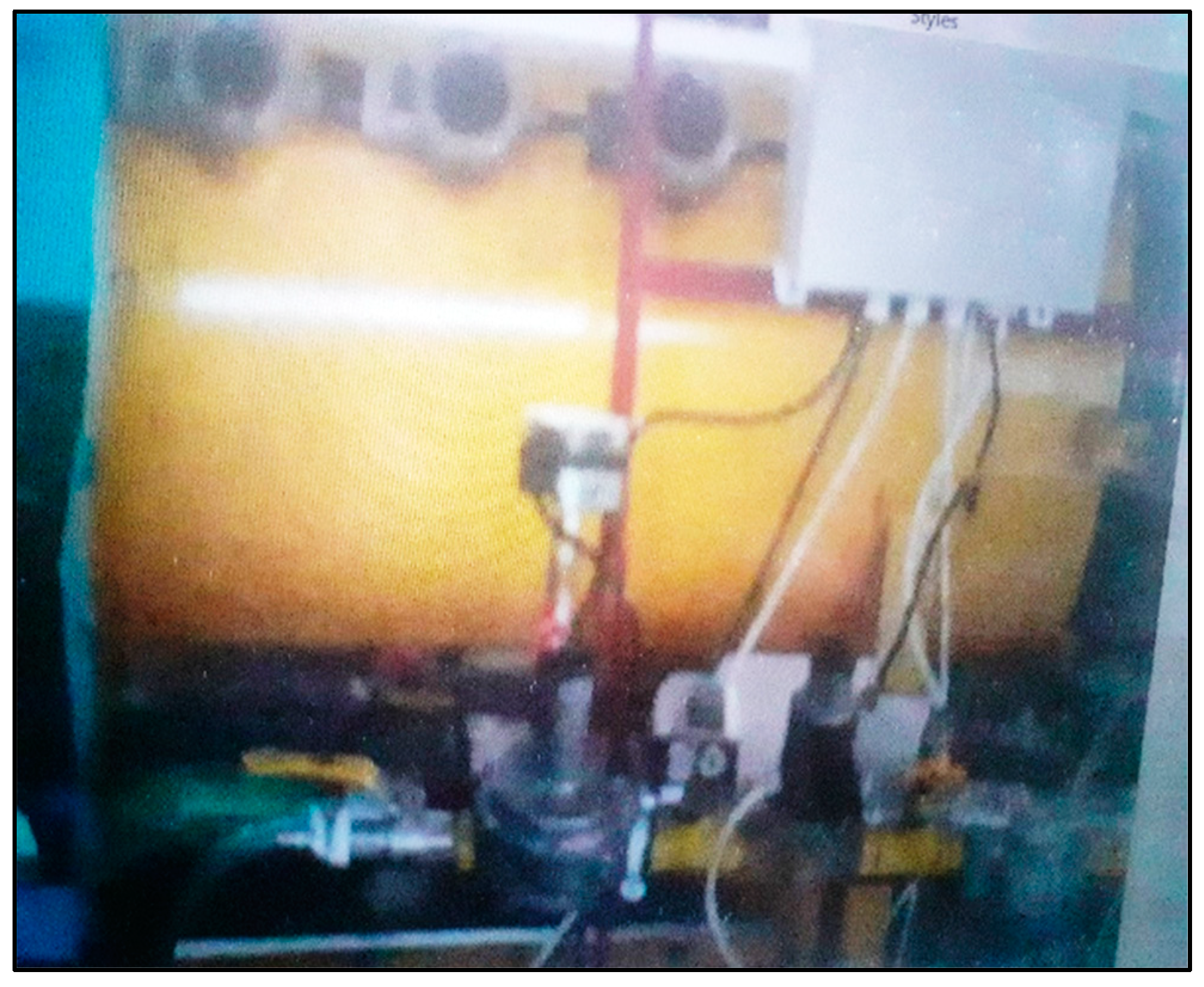
Figure 3.
Images of the flame propagation. (a) longitudinal image; (b) frontal image.
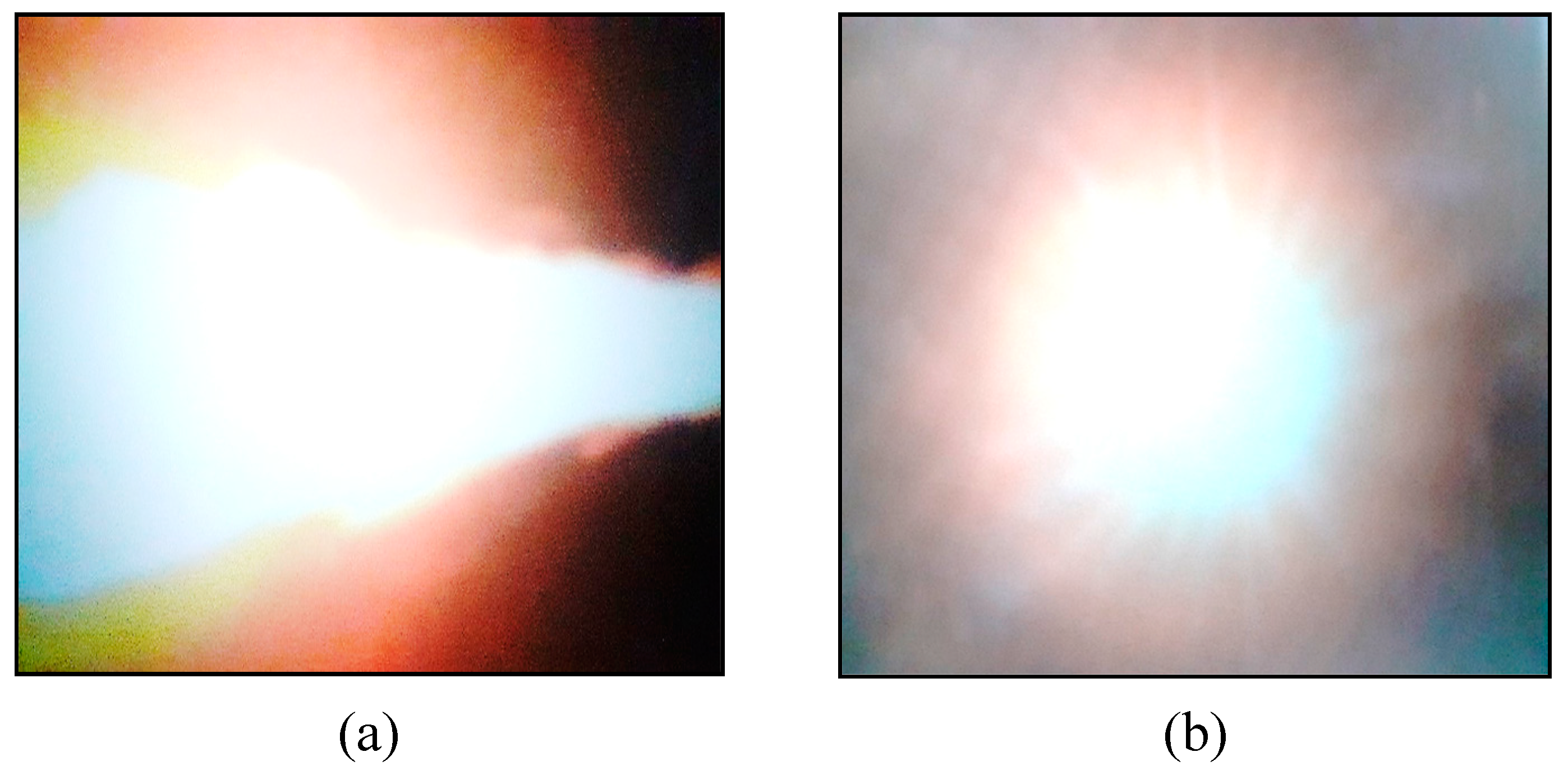

Table 1.
Nominal parameters of the burner.
| Parameter | Unit | Value |
|---|---|---|
| Burner heat power | kW | 51.5 |
| Glycerine hourly flow | kg·h-1 | 10.10 |
| Ethanol hourly flow | kg·h-1 | 1.15 |
| Glycerine and ethalon mix pressure | bar | 0.4 |
| Atomizing water flow | kg·h-1 | 79.5 |
| Atomizing water pressure | bar | 1.6 |
| Oxygen flow | m3N·h-1 | 11.73 |
| Oxygen pressure | mbar | 190 |
| Biofuel mix speed in radial orifice | m·s-1 | 177 |
| Biofuel spray speed in the annular section | m·s-1 | 210 |
| Oxygen speed in the annular section | m·s-1 | 215 |
| Waste gas speed at the exit from the burner | m·s-1 | 135 |
| Cooling water flow | m3·h-1 | 1.9 |
| Cooling water speed | m·s-1 | 1.4 |
Table 2.
Operational parameters of the oxy-biofuel burner.
| Parameter | Thermal Regime | |||||||
|---|---|---|---|---|---|---|---|---|
| 1 | 2 | 3 | 4 | 5 | 6 | 7 | 8 | |
| Biofuel mix hourly flow (m3N·h-1) |
11.33 | 11.25 | 10.97 | 10.00 | 8.97 | 7.95 | 7.01 | 6.08 |
| Oxygen flow (m3N·h-1) | 11.94 | 11.73 | 10.92 | 10.20 | 9.58 | 9.00 | 8.41 | 7.80 |
| Atomizing water flow (kg·h-1) |
82.71 |
79.50 |
73.11 |
68.01 |
62.70 |
57.68 |
52.51 |
47.40 |
| Waste gas pollution composition NO (mg·m3N-1) NO2 (mg·m3N-1) CO (vol. %) |
181 197 - |
178 193 - |
175 190 - |
171 186 - |
168 184 - |
165 180 - |
161 175 - |
154 169 - |
| Flame temperature (°C) | 1860 | 1850 | 1840 | 1835 | 1830 | 1820 | 1810 | 1790 |
| Flame length (mm) | 570 | 560 | 550 | 540 | 520 | 500 | 470 | 450 |
Disclaimer/Publisher’s Note: The statements, opinions and data contained in all publications are solely those of the individual author(s) and contributor(s) and not of MDPI and/or the editor(s). MDPI and/or the editor(s) disclaim responsibility for any injury to people or property resulting from any ideas, methods, instructions or products referred to in the content. |
© 2024 by the authors. Licensee MDPI, Basel, Switzerland. This article is an open access article distributed under the terms and conditions of the Creative Commons Attribution (CC BY) license (http://creativecommons.org/licenses/by/4.0/).
Copyright: This open access article is published under a Creative Commons CC BY 4.0 license, which permit the free download, distribution, and reuse, provided that the author and preprint are cited in any reuse.


