

Submitted:
17 November 2024
Posted:
19 November 2024
You are already at the latest version
Abstract
Maritime traffic accounts for more than 90% of world trade. Noise, pollution, and litter are its drawbacks, affecting especially vulnerable migratory fish. Here, a motivated team of citizen scientists analyzed maritime traffic from three estuaries of the south Bay of Biscay and three from the south of the Iberian Peninsula, where the European eel is critically endangered, during the season of the entrance of glass eels. More than 164,000 data about ship types and positions were collected. Results showed that traffic differences between estuaries would explain, at least partially, the different eel conservation status. The participants appreciated learning about ships and nature conservation and acquiring awareness of the real volume of shipping and its potential impacts. All the citizen scientists, new and experienced, would like to get involved in ocean research again.
Keywords:
citizen science
; migratory fish
; maritime traffic
; conservation
1. Introduction
Maritime transport represents the principal means of international trade, with approximately 80% of the world's goods transported by sea. The United Nations Conference on Trade and Development [1] has estimated the size of the world's merchant fleet. Global maritime trade was transported on board 105,493 vessels of 100 gross tons (GT) and above in January 2023, with oil tankers, bulk carriers, and container ships accounting for 85% of the total capacity. The global shipping sector currently moves approximately 11 billion tonnes of cargo annually, with projections indicating a minimum increase of 240% by 2050 [2]. This expansion of maritime traffic can also give rise to concerns regarding pollution, safety, and marine conservation.
Shipping has significant impacts on marine fish species. To give a few examples, the presence and movement of vessels changes the home range of Arctic cod compared to periods without maritime traffic [3]. In estuaries, boat movements cause a decrease in the abundance of mid-sized fish, attributable to the noise and the production of bubbles [4]. Motorboat traffic significantly reduces the call rate of different fish species, altering the complexity of the fish assemblages [5]. Likewise, commercial shipping negatively affects the communication of both Atlantic cod and haddock [6].
The European eel, Anguilla anguilla, has experienced a drastic reduction in its populations since the last decades of the 20th century and has been catalogued as a critically endangered species by the International Union for Conservation of Nature since 2008 [7,8,9]. This species is catadromous, which means that they reproduce in the ocean and migrate to grow in freshwater [10]. The European eel spawns in the Sargasso Sea and grows in European and North African continental waters (Figure 1).
The leptocephalus larvae, which are the early developmental stages of the eel (Figure 2), travel from the Sargasso Sea to the coasts of Europe and North Africa, enter the river estuaries, and run upstream [12,13]. They arrive in the estuaries in the second development stage, as transparent juveniles called glass eels. When juveniles enter the river and start running upstream, they acquire pigmentation and are called elvers. In the river, they settle as yellow eels (immature adult phase). After 5 to 25 years growing in continental waters, they start a silvering process, and as silver eels they migrate downstream and travel back to the Sargasso Sea to reproduce [14,15,16,17].
Perhaps the most vulnerable stage of A. anguilla is the glass eel phase, in which they face many stressors when arriving in the estuaries. There, they are exposed to the abrupt natural change in salinity, to a new ecosystem with parasites and predators, and to anthropogenic disturbances like river pollution, fishing, and shipping [18,19]. The status of the European eel differs across its distribution in European waters, depending on the particular region and the natural and anthropogenic disturbances they found therein. In the Iberian Peninsula, there is a difference between the north and the south coasts. In the north (south Bay of Biscay, Cantabrian Sea, Galicia) the populations are still fished when entering the rivers, although the exploitation of yellow and silver eels is forbidden [20]. In contrast, in the south, the species is in a very bad situation and its fishing has been banned in Andalusia since 2010 [21]. Overfishing was considered as one of the main causes of the 98% decline in eel populations, as well as the reduction of eel habitat in 88% [22]. In response, the Regional Government of Andalusia adopted a 10-year moratorium on eel fishing, including the ban on the capture of all stages of European eel, both in inland and continental maritime waters, to recover the species [23]. These measures were in addition to the Eel Management Plan of Andalusia, which consisted mainly of the prohibition of harvesting, but also the protection against predators, the transport of eels from inland waters to the sea, and their restocking through aquaculture. However, by 2020, the eel population had not yet recovered sufficiently to resume fishing, and the ban was extended for another decade [24].
Maritime transport may contribute to the difference in the A. anguilla conservation status between European regions, not only because of the known pollution caused by vessels [25] but also because this species is sensitive to boat noises [26]. Large and medium estuaries shelter maritime ports whose increasing activity surely interferes with European eels during their most vulnerable stage, when they are about to experience the change from glass eels to elvers and must adapt to freshwater [27]. In the rivers of the north and south of the Iberian Peninsula, the entry of glass eels usually occurs between the end of autumn and the end of winter, which may be a good time to check whether the greater or lesser density of maritime traffic at those times of the year has any impact on the species. To monitor maritime traffic, we launched a citizen science strategy [28], that is, encouraging citizen participation in the gestation and development of a scientific project.
Our study therefore focused on two main objectives: to determine whether maritime traffic could affect glass eels when they enter the estuaries in the north and south of the Iberian Peninsula, and if citizen science could be a good research resource to verify it.
On one hand, as the European eel is more affected in the South, we expected to find more intense traffic in southern estuaries during the season of the entrance of glass eels. On the other hand, we hope that the direct involvement in research of the recruited people will motivate them to get involved in new citizen science initiatives.
2. Materials and Methods
2.1. Ethics Statement
In accordance with the ethical principles of scientific research [29], non-discriminatory and culturally respectful procedures were followed in recruiting volunteers who later became citizen scientists. Likewise, this research has followed the European Code of Conduct for Ethical and Responsible Research [30], as well as Regulation (EU) 2016/679 of the European Parliament and of the Council, of April 27, 2016, regarding the protection of natural persons with regard to the processing of personal data. All participating citizens were informed in detail about the objective of this study, agreed to participate voluntarily without any financial compensation, and are aware of the results obtained.
2.2. Citizen Science Recruitment
Volunteers were recruited using snowball methodology [31], starting in the Faculty of Biology and the Higher School of Civil Navy of the University of Oviedo. Our students, by and large, met the basic criteria of the study we intended to carry out (time and desire) and so we invited them to become volunteers while suggesting the recommendation of other possible participants who also met these criteria. Turned into citizen scientists [32], 21 participating volunteers aged between 23 and 66 years were trained to visualize maritime traffic online on the website https://www.marinetraffic.com [33] and received instructions in writing about how to use the webpage and register data. They were also asked to take screenshots from that online application showing the number and type of vessels present during their records, as additional information to validate the recorded information if needed.
2.3. Estuaries Studied
Six estuaries were investigated in this study: those of the Nalón and the Sella rivers and the estuary of Avilés, on the Cantabrian coast, and those of the Odelouca, Guadiana, and Guadalhorce rivers, in the south of the Iberian Peninsula. The main characteristics of each estuary are summarized in Table 1.
2.4. Maritime Traffic Records
The protocol consisted of collecting data from the Maritime Traffic website mentioned above. This is a website that shows real-time tracking of ships around the world and that allows you to choose a region on the world map and observe all the maritime traffic that occurs in a time interval and the type of ships that are sailing in that specific area. The website takes information from the Automatic Identification System (AIS), which is used in maritime navigation for the automatic exchange of information between different vessels or between vessels and land stations. It allows ships to transmit data such as their position, speed, heading, course, and other relevant details, using radio frequency signals. Since 31 May 2014, all fishing vessels over 15 meters in length operating within the EU must be equipped with AIS. More information about this system can be found in the International Maritime Organization [34].
The project lasted from December to February, to cover the main period of entrance of glass eels in the studied rivers. Volunteers checked the webpage four times a day (8:00 AM, 12:00 PM, 16:00 PM, and 20:00 PM) and collected data about the number and type of vessels, among others. Citizen scientists were organized to register data on times and days compatible with their availability and preferences. The data were recorded in spreadsheets for further analysis.
2.5. Post-Activity Survey
After the observation period, citizen scientists were asked to answer an online questionnaire with three questions (the first as a Likert scale question and the next two as dichotomous questions):
1) Between 0 as extremely bad and 10 as extremely good, how do you evaluate this citizen science experience?
2) Could you please describe briefly what was the most interesting part of this project for you?
3) After this experience, would you participate in other citizen science projects? (yes/no)
Socio-demographic data (age group as >30 or <30 years old; gender as woman, man, or non-binary; education level as the highest degree earned) were also gathered.
2.6. Data Curation
Data in the spreadsheet were examined by the researchers and the format was homogenized whenever necessary (for example using the same system, comma or period, for decimal positions, etc.). In some cases, the names of the vessels monitored by citizen scientists were written in capital letters, and others were written in lowercase, or their descriptions did not exactly correspond to their real names. Furthermore, since there are many types of vessels, it was decided to unify their description by type (Table 2) to facilitate the use of the data.
During vessel monitoring and tracking, when a vessel did not move during the data collection time (4 hours) it was counted only once for the final count.
2.7. Statistics
For quantitative data like the scores given by citizen scientists to the experience, first, the dataset normality was checked using the Shapiro-Wilk test. Since it was not met, non-parametric PERMANOVA tests with 9999 permutations and Bray-Curtis distance were employed to compare groups of participants (e.g. men versus women, secondary versus higher education, people over 30 years old versus people under 30 years old).
For qualitative data, such as the proportion of different types of vessels, a comparison between the north and south of the Iberian Peninsula was done using contingency analysis. Statistics were performed using the PAST free software version 4.17 [35].
3. Results
3.1. Citizen Science Performance And Volunteer Satisfaction
The 21 volunteers collected a total of 33.887 data from the Bay of Biscay and 130.644 data from the Mediterranean Sea, which were recorded daily from the 8th of December 2023 to the 15th of February 2024. There were no failures to monitor maritime traffic, and records were made even during weekends and Christmas holidays.
The volunteers considered the activity satisfactory, because the mean score was 8.36 (SD = 1.14 (Figure 3). However, there were some observable differences between groups of participants, e.g., men versus women, or individuals with higher education versus those of lower educational levels. The data did not meet normality, thus non-parametric PERMANOVA test was employed. No significant effect of gender (F = 2.63, p = 0.124) or age (F = 0.358, p = 0.532) was found. In contrast, individuals of higher education scored the experience significantly higher than the rest (mean 8.59 with SD 0.93 versus 7.6 with SD 1.5, respectively; F = 3.975, p = 0.043).
3.2. Maritime Traffic Recorded In The Studied Estuaries
All the information was taken from the webpage of Marine traffic, such as the type, origin, destination, and course of each vessel, among others. The raw data collected [36] is part of a larger ongoing investigation. Maritime traffic was more intense in the south than in the north during the studied period (Figure 4), with a total of 3,962 ships in the three estuaries of the Bay of Biscay and 11,256 in those of the south of the Iberian Peninsula.
The types of vessels were also very different (Table 3), being cargo more abundant in the north and recreational and passenger vessels in the south. The difference between the two Iberian coasts (north versus south) was highly significant (Chi-square = 1693.4, 4 d.f., p << 0.001).
4. Discussion
Although in the research activity developed, participants with a higher educational level rated the experience significantly better than those with a lower level, we share the idea that the active participation of citizens in scientific activities contributes to the population's scientific literacy [37]. It also serves to democratize science, making it accessible to everyone. The group of volunteers turned into citizen scientists showed their satisfaction in carrying out this study. Having highly motivated citizens concerned about the protection of ecosystems and the desire to contribute to minimizing global change [38] helps to develop scientific projects from new perspectives [39,40]. Citizen science strategies also play an active and valid role in research on marine ecosystems [41]. Here, in the observation and monitoring of maritime traffic and the impact it causes on migratory aquatic species, specifically on the European eel, the contributions of the participating citizen scientists have been a key element in the approach, development, and results of the research. The value of citizen science strategies has already been significantly accredited [42,43,44], so we support the convenience of including citizens in scientific research whenever possible.
The landscape of estuary maritime traffic revealed from the citizen science strategy developed in this study is very different in the north and the south of the Iberian Peninsula. In the south, the number of recorded vessels was three times higher than in the North. This coincides with a worse conservation status of migratory European eel in the south, which could be due, at least partially, to the impacts produced by the boat movements. The sensitivity of the species to the sound of ship engines while sailing would support this possibility, as eels exposed to ship noise alter their swimming and predator avoidance behaviors [45]. Other reasons may be ship-derived pollution like oil and chemical spills, antifoulants, garbage, sewage, and more [46], because the species is very sensitive to pollution [47].
What is evident is that migratory fish are especially affected by maritime traffic, which can alter not only their habitats but also the behavior of their species [48]. Noise pollution has been shown to alter the orientation and communication of species that use acoustic signals to navigate, feed, and avoid predators [49,50]. In areas with high densities of shipping, such as the Mediterranean Sea, migratory fish can suffer from collisions, especially in coastal areas and estuarine zones, where fish usually spend long periods of time during their life cycle [51,52]. Plenty of studies have been conducted to monitor and estimate the impact of ship collisions with whale species [53], such as the case of the fin whale in the Mediterranean Sea [54]. Oils and chemical spills left by vessels produce toxic effects in the marine environment, affecting every living organism in the impacted area [55]. Harbor facilities, channels, and barriers are sources of pollution, but they can also act as obstacles for migratory routes [56]. The European eel depends on the connectivity between freshwater and marine ecosystems, and such interruptions may alter its life cycle [57,58]. Coastal areas and estuaries, used as spawning sites for migratory species, can be degraded or even destroyed during the construction of ports and dredges [59]. Finally, shipping activities are sources for the introduction of invasive species through ballast water, leading to modifications of the habitat and competition with the local marine species for habitat and food [60,61,62]. From these results, we could recommend some management measures to help the critically endangered European eel. Establishing corridors free of marine traffic in the estuaries could be proposed, especially in the south, where the pressure of maritime traffic is much higher. The corridors could be established during the migration season of glass eels to protect the species in this vulnerable stage.
Author Contributions
Conceptualization, L.R-I, V. S-L, and E.G-V; methodology, L.R-I, V. S-L, E.G-V. and E.D.; software, L.R-I, and V. S-L.; validation, E.G-V and V. S-L; formal analysis, L.R-I, V. S-L, and E.G-V.; investigation, L.R-I, V. S-L, E.G-V. and E.D; resources, E.G-V and V. S-L.; data curation, L.R-I, V. S-L, and E.G-V; writing—original draft preparation, L.R-I, V. S-L, E.G-V. and E.D.; writing—review and editing, L.R-I, V. S-L, E.G-V. and E.D.; visualization, L.R-I, V. S-L, E.G-V. and E.D.; supervision, E.G-V and V. S-L; project administration, E.G-V and V. S-L; funding acquisition, E.G-V. All authors have read and agreed to the published version of the manuscript.
Funding
This research was supported by the Spanish Ministry of Science, Innovation and Universities Grants PID2022-138523OB-100 and FCT-23-19037.
Institutional Review Board Statement
Not applicable.
Informed Consent Statement
Informed consent was obtained from all subjects involved in the study. Also, written informed consent was obtained from the individuals cited for publication of this article.
Data Availability Statement
The raw data are available in the public EUDAT repository with the DOI https://doi.org/10.23728/b2share.8d8f33e4fcb640abb2269ec61ad7213c accessed 29 October 2024).
Acknowledgments
Special thanks to the volunteers who enthusiastically and kindly wised to become citizen scientists and participate in this research project. We also express our gratitude to Aida Dopico García for the review and editing of the entire manuscript.
Conflicts of Interest
The authors declare no conflicts of interest.
References
- UNCTAD. Review of maritime transport 2023. Towards a green and just green and just transition transition. United Nations Publications, New York, 2023. https://unctad.org/system/files/official-document/rmt2023_en.pdf (accessed on 29 October 2024).
- Sardain, A.; Sardain, E.; Leung, B. Global forecasts of shipping traffic and biological invasions to 2050. Nat Sustain 2019, 2, 1–9. [Google Scholar] [CrossRef]
- Ivanova, S.V.; Kessel, S.T. , Espinoza, M., McLean, M.F.; O'Neill, C., Landry, J., Hussey, N.E., Williams, R.; Vagle, S.; Fisk, A.T. Shipping alters the movement and behavior of Arctic cod (Boreogadus saida), a keystone fish in Arctic marine ecosystems. Ecol Appl 2020, 30, e02050. [Google Scholar] [CrossRef] [PubMed]
- Becker, A.; Whitfield, A. , Cowley, P.; Järnegren, J.; Næsje, T. Does boat traffic cause displacement of fish in estuaries? Mar Pollut Bull 2013, 75, 168–173. [Google Scholar] [CrossRef] [PubMed]
- González Correa, J.M.; Bayle Sempere, J-T.; Juanes, F.; Rountree, R.; Ruíz, J.F.; Ramis, J. Recreational boat traffic effects on fish assemblages: First evidence of detrimental consequences at regulated mooring zones in sensitive marine areas detected by passive acoustics. Ocean Coast Manag 2019, 168, 22–34. [CrossRef]
- Stanley, J.A.; Van Parijs, S.M.; Hatch, L.T. Underwater sound from vessel traffic reduces the effective communication range in Atlantic cod and haddock. Sci Rep 2017, 7, 14633. [Google Scholar] [CrossRef]
- Barry, J. The foraging specialisms, movement and migratory behaviour of the European Eel, PhD thesis. University of Glasgow, Scotland, 2015.
- Dekker, W. Management of the eel is slipping through our hands! Distribute control and orchestrate national protection. ICES J Mar Sci 2016, 73, 2442–2452. [Google Scholar] [CrossRef]
- Pike, C.; Crook, V.; Gollock, M. Anguilla anguilla. The IUCN Red List of Threatened Species 2020: E.T60344A152845178. https://www.fishsec.org/app/uploads/2022/11/200709-Assessment-10.2305_IUCN.UK_.2020-2.RLTS_.T60344A152845178.en_.pdf (accessed on 19 August 2024).
- McDowall, R.M. Diadromy in fishes: Migration between freshwater and marine environments. Timber press, Oregon, USA, 1988; pp. 308.
- https://globalmaritimetraffic.org/. (accessed on 11 August 2024).
- Daverat, F.; Lanceleur, L.; Pécheyran, C.; Eon, M.; Dublon, J.; Pierre, M.; Schäfer, J.; Baudrimont, M.; Renault, S. Accumulation of Mn, Co, Zn, Rb, Cd, Sn, Ba, Sr, and Pb in the otoliths and tissues of eel (Anguilla anguilla) following long-term exposure in an estuarine environment. Sci Total Environ 2012, 437, 323–330. [Google Scholar] [CrossRef]
- Durif, C.; Dufour, S.; Elie, P. The silvering process of Anguilla anguilla: A new classification from the yellow resident to the silver migrating stage. J Fish Biol 2005, 66, 1025–1043. [Google Scholar] [CrossRef]
- Tesch, F. W.; Thorpe, J.E. (Eds.). The eel. Blackwell Science, Oxford, UK, 2003. pp. 1–408.
- Cresci, A. A comprehensive hypothesis on the migration of European glass eels (Anguilla anguilla). Biol Rev 2020, 95, 1273–1286. [Google Scholar] [CrossRef]
- Podda, C.; Palmas, F.; Pusceddu, A.; Sabatini, A. Hard times for catadromous fish: The case of the European eel Anguilla anguilla (L. 1758). Adv Oceanog Limnol 2021, 12, 9997. [Google Scholar] [CrossRef]
- ICES. 2023. European eel (Anguilla anguilla) throughout its natural range. In Report of the ICES Advisory Committee, 2023. ICES Advice 2023, ele.2737.nea. [CrossRef]
- Dekker, W.; Casselman, J.M. The 2003 Québec Declaration of concern about eel declines - 11 years later: Are eels climbing back up the slippery slope? Fisheries 2014, 39, 613–614. [Google Scholar] [CrossRef]
- Drouineau, H.; Durif, C.; Castonguay, M.; Mateo, M.; Rochard, E. , Verreault, G.; Yokouchi, K.; Lambert, P. Freshwater eels: A symbol of the effects of global change. Fish Fish 2018, 19, 903–930. [Google Scholar] [CrossRef]
- European eel management plan in Spain, 2010. Secretaría General del Mar, Ministerio de Medio Ambiente, y Medio Rural y Marino del Gobierno de España (MARM). Gobierno de España. https://www.mapa.gob.es/es/pesca/temas/planes-de-gestion-y-recuperacion-de-especies/plan%20de%20gesti%C3%B3n%20anguila_Espa%C3%B1a_tcm30-282062.pdf (accessed on 23 August 2024).
- Eel Management Plan of Andalusia, 2010. Consejería de Agricultura y Pesca, Consejería de Medio Ambiente. https://www.juntadeandalucia.es/export/drupaljda/PGA_Andalucia.pdf (accessed on 23 August 2024). (accessed on null).
- Clavero, M.; Hermoso, V. Historical data to plan the recovery of the European Eel. J. Applied Ecol 2015, 52, 960–968. [Google Scholar] [CrossRef]
- Decree 396/2010. 2010, November 2. Laying down measures for the recovery of the European eel (Anguilla anguilla). Retrieved from https://www.juntadeandalucia.es/boja/2010/221/2 (accessed on 19 August 2024).
- Decree 209/2020. 2020, December 9. Laying down measures for the recovery of the European eel (Anguilla anguilla). https://laadministracionaldia.inap.es/noticia.asp?id=1205885 (accessed on 19 August 2024).
- Erbe, C.; Smith, J.N.; Redfern, J.V.; Peel, D. Editorial: Impacts of Shipping on Marine Fauna. Front Mar Sci 2020, 7, 637. [Google Scholar] [CrossRef]
- Purser, J.; Bruintjes, R.; Simpson, S.D.; Radford, A.N. Condition-dependent physiological and behavioural responses to anthropogenic noise. Physiol Behav 2016, 155, 157–161. [Google Scholar] [CrossRef]
- Durif, C.M.F.; Arts, M.; Bertolini, F.; Cresci, A.; Daverat, F.; Karlsbakk, E.; Koprivnikar, J.; Moland, E.; Olsen, E.M.; Parzanini, C.; Power, M.; Rohtla, M.; Skiftesvik, A.B.; Thorstad, E.; Vøllestad, L.A.; Browman, H.I. The evolving story of catadromy in the European eel (Anguilla anguilla). J Mar Sci 2023, 80, 2253–2265. [Google Scholar] [CrossRef]
- Dopico, E.; Ardura, A.; Borrell, Y. J.; Miralles, L.; García-Vázquez, E. Boosting adults scientific literacy with experiential learning practices. Eu J Res Educ Learn Adults 2021, 12, 223–238. [Google Scholar] [CrossRef]
- European Commission: Directorate-General for Research and Innovation, Ethics for researchers – Facilitating research excellence in FP7, Publications Office, 2013. https://data.europa.eu/doi/10.2777/7491 (accessed on 19 August 2024).
- ALLEA. The European Code of Conduct for Research Integrity – Revised Edition 2023. All European Academies, Berlin, 2023.
- Valerio, M.A.; Rodriguez, N.; Winkler, P.; Lopez, J.; Dennison, M.; Liang, Y.; Turner, B. J. Comparing two sampling methods to engage hard-to-reach communities in research priority setting. BMC Med. Res. Methodol 2016, 16, 146. [Google Scholar] [CrossRef]
- Fraisl, D. , Hager, G., Bedessem, B.; Margaret Gold, M.; Hsing, P.H.; Danielsen, F.; Hitchcock, C.B.; Joseph M. Hulbert, J.M.; Piera, J.; Spiers, H.; Thiel, M.; Haklay, M. Citizen science in environmental and ecological sciences. Nat Rev Methods Primers 2022, 2, 64. [Google Scholar] [CrossRef]
- https://www.marinetraffic.com (accessed on 12 June 2024).
- https://www.imo.org/en/OurWork/Safety/Pages/AIS.aspx (accessed on 1 November 2024).
- Hammer, Ø.; Harper, D.A.T.; Ryan, P.D. PAST: Paleontological statistics software package for education and data analysis. Palaeontol. Electron. 2001, 4, 9. Available online: http://palaeo-electronica.org/2001_1/past/issue1_01.htm (accessed on 12 September 2024).
- Rivas-Iglesias, L.; Garcia-Vazquez, E.; Soto-López, V. Maritime traffic from the Asturian coast. 2024. https://b2share.eudat.eu. (accessed on 1 November 2024). [CrossRef]
- Ardura, A.; Dopico, E.; Fernandez, S.; Garcia-Vazquez, E. . Citizen volunteers detect SARS-CoV-2 RNA from outdoor urban fomites. Sci. Total Environ 2021, 787, 147719. [Google Scholar] [CrossRef]
- Raman, N. V.; Dubey, A.; Millar, E.; Nava, V.; Leoni, B.; Gallego, I. Monitoring contaminants of emerging concern in aquatic systems through the lens of citizen science. Sci Total Environ 2023, 874, 162527. [Google Scholar] [CrossRef] [PubMed]
- Mannino, A.M.; Borfecchia, F.; Micheli, C. Tracking Marine Alien Macroalgae in the Mediterranean Sea: The Contribution of Citizen Science and Remote Sensing. J Mar Sci Eng 2021, 9, 288. [Google Scholar] [CrossRef]
- Merlino, S.; Locritani, M.; Guarnieri, A.; Delrosso, D.; Bianucci, M.; Paterni, M. Marine Litter Tracking System: A Case Study with Open-Source Technology and a Citizen Science-Based Approach. Sensors 2023, 23, 935. [Google Scholar] [CrossRef]
- Coppari, M.; Roveta, C.; Di Camillo, C.; Garrabou, J.; Lucrezi, S.; Pulido Mantas, T.; Cerrano, C. The pillars of the sea: Strategies to achieve successful marine citizen science programs in the Mediterranean area. BMC Ecol Evol 2024, 24, 100. [Google Scholar] [CrossRef]
- Balázs, B.; Mooney, P.; Nováková, E.; Bastin, L.; Arsanjani, J. J. (2021). Data quality in citizen science. In The science of citizen science; Vohland, K.; Land-Zandstra, A.; Ceccaroni, L.; Lemmens, R.; Perelló, J.; Ponti, M.; Samson, R.; Wagenknecht, K.; Springer, Switzerland, 2021; pp. 139– 158.
- Freschi, G.; Menegatto, M.; Zamperini, A. Conceptualising the Link between Citizen Science and Climate Governance: A Systematic Review. Climate 2024, 12, 60. [Google Scholar] [CrossRef]
- Hadjichambis, A.; Paraskeva-Hadjichambi, D.; Georgiou, Y.; Adamou, A. How can we transform citizens into ‘environmental agents of change'? Towards the citizen science for environmental citizenship (CS4EC) theoretical framework based on a meta-synthesis approach. Int J Sci Educ 2024, 14 Pt B, 72–92. [Google Scholar] [CrossRef]
- Deleau, M. J.; White, P. R.; Peirson, G.; Leighton, T. G.; Kemp, P. S. Use of acoustics to enhance the efficiency of physical screens designed to protect downstream moving European eel (Anguilla anguilla). Fish Managt Ecol 2020, 27, 1–9. [Google Scholar] [CrossRef]
- Walker, T.R.; Adebambo, O.; Del Aguila Feijoo, M.C.; Elhaimer, E.; Hossain, T.; Edwards, S.J.; Morrison, C.E.; Romo, J.; Sharma, N.; Taylor, S.; Zomorodi, S. Environmental Effects of Marine Transportation. In World Seas: An Environmental Evaluation; Sheppard, C. Ed.; Elsevier, Netherlands, 2019; pp. 505–530.
- Turan, F.; Karan, S.; Ergenler, A. Effect of heavy metals on toxicogenetic damage of European eels Anguilla anguilla. Environ Sci Pollut Res 2020, 27, 38047–38055. [Google Scholar] [CrossRef]
- Lennox, R.J.; Paukert, C.P.; Aarestrup, K.; Auger-Méthé, M.; Baumgartner, L.; Birnie-Gauvin, K.; Boe, K.; Brink, K.; Brownscombe, J.W.; Chen, Y., Davidsen, J.G.; Eliason, E.J.; Filous, A.; Gillanders, B.M.; Helland, I.P.; Horodysky, A.Z.; Januchowski-Hartley, S.R.; Lowerre-Barbieri, S.K.; Lucas, M.C.; Martins, E.G.; Murchie, K.J.; Pompeu, P.S.; Power, M.; Raghavan, R.; Rahel, F.J.; Secor, D.; Thiem, J.D.; Thorstad, E.B.; Ueda, H.; Whoriskey, F.G.; Cooke, S.J. One hundred pressing questions on the future of global fish migration science, conservation and policy. Front Ecol Evol 2019, 7. [CrossRef]
- Popper, A.N.; Hastings, M.C. The effects of anthropogenic sources of sound on fishes. J Fish Biol 2009, 75, 455–489. [Google Scholar] [CrossRef]
- Erbe, C.; Marley, S.A.; Schoeman, R.P.; Smith, J.N.; Trigg, L.E. , Embling, C.B. The effects of ship noise on marine mammals – A review. Front Mar Sci 2019, 6, 606. [Google Scholar] [CrossRef]
- Schoeman, R.P.; Patterson-Abrolat, C.; Plön, S. A global review of vessel collisions with marine animals. Front Mar Sci 2020, 7. [Google Scholar] [CrossRef]
- Marino, M.; Cavallaro, L.; Castro, E.; Musumeci, R.E.; Martignoni, M.; Roman, F.; Foti, E. New frontiers in the risk assessment of ship collision. Ocean Eng 2023, 274, 113999. [Google Scholar] [CrossRef]
- Laist, D.W.; Knowlton, A.R.; Mead, J.G.; Collet, A.S.; Podesta, M. Collisions between ships and whales. Mar Mammal Sci 2006, 17, 35–75. [Google Scholar] [CrossRef]
- Sèbe, M.; David, L.; Dhermain, F.; Gourguet, S.; Madon, B.; Ody, D.; Panigada, S.; Peltier, H.; Pendleton, L. Estimating the impact of ship strikes on the Mediterranean fin whale subpopulation. Ocean Coast Manag 2023, 237, 106485. [Google Scholar] [CrossRef]
- Zhang, B.; Matchinski, E.J.: B.C..; Chen, B.; Xundong. Y.; Jing, L.; Lee, K. Marine oil spills – oil pollution, sources and effects. In World Seas: An Environmental Evaluation, Sheppard, C. Ed; Elsevier, Netherlands, 2019; pp. 391–406.
- Verhelst, P.; Reubens, J.; Buysse, D.; Goethals, P.; Van Wichelen, J.; Moens, T. Toward a roadmap for diadromous fish conservation: The Big Five considerations. Front Ecol Environ 2021, 19, 396–403. [Google Scholar] [CrossRef]
- Bevacqua, D.; Meliá, P.; Gatto, M.; De Leo, G.A. A global viability assessment of the European eel. Glob Chang Biol 2015, 21, 3323–3335. [Google Scholar] [CrossRef]
- Forrester, R.; Honkanen, H.M.; Lilly, J.; Green, A.; Rodger, J.R.; Shields, B.A.; Ramsden, P.; Koene, J.P.; Fletcher, M. , Bean, C.W., Adams, C.W. The effect of downstream translocation on Atlantic salmon Salmo salar smolt outmigration success. J Fish Biol 2024, 1–13. [Google Scholar] [CrossRef]
- Komyakova, V.; Jaffrés, J.B.D.; Strain, E.M.A.; Cullen-Knox, C.; Fudge, M.; Langhamer, O. , Bender, A. ; Yaakub, S.M., Wilson, E.; Allan, B.J.M., Sella, I., Haward, M. Conceptualisation of multiple impacts interacting in the marine environment using marine infrastructure as an example. Sci Tot Environ 2022, 830, 154748. [Google Scholar] [CrossRef]
- Bax, N.; Williamson, A.; Aguero, M.; González Poblete, E.; Geeves, W. 2003. Marine invasive alien species: A threat to global biodiversity. Mar Pol 2003, 27, 313–323. [Google Scholar] [CrossRef]
- Molnar, J.L.; Gamboa, R.L.; Revenga, C.; Spalding, M.D. Assessing the global threat of invasive species to marine biodiversity. Front Ecol Environ 2008, 6, 485–492. [Google Scholar] [CrossRef]
- Rayon-Viña, F.; Fernandez-Rodriguez, S.; Ibabe, A.; Dopico, E.; Garcia-Vazquez, E. Public awareness of beach litter and alien invasions: Implications for early detection and management. Ocean Coast Manag 2022, 219, 106040. [Google Scholar] [CrossRef]
Figure 1.
Map with the route followed by Anguilla anguilla that grows in Iberian rivers, showing the spawning site (Sargasso Sea), the maritime traffic occurring on 24th of May 2024, and the migration route the species follows between Iberian rivers and the Sargasso Sea (blue arrows). This self-made map has been generated from the website https://globalmaritimetraffic.org/ [11].
Figure 1.
Map with the route followed by Anguilla anguilla that grows in Iberian rivers, showing the spawning site (Sargasso Sea), the maritime traffic occurring on 24th of May 2024, and the migration route the species follows between Iberian rivers and the Sargasso Sea (blue arrows). This self-made map has been generated from the website https://globalmaritimetraffic.org/ [11].
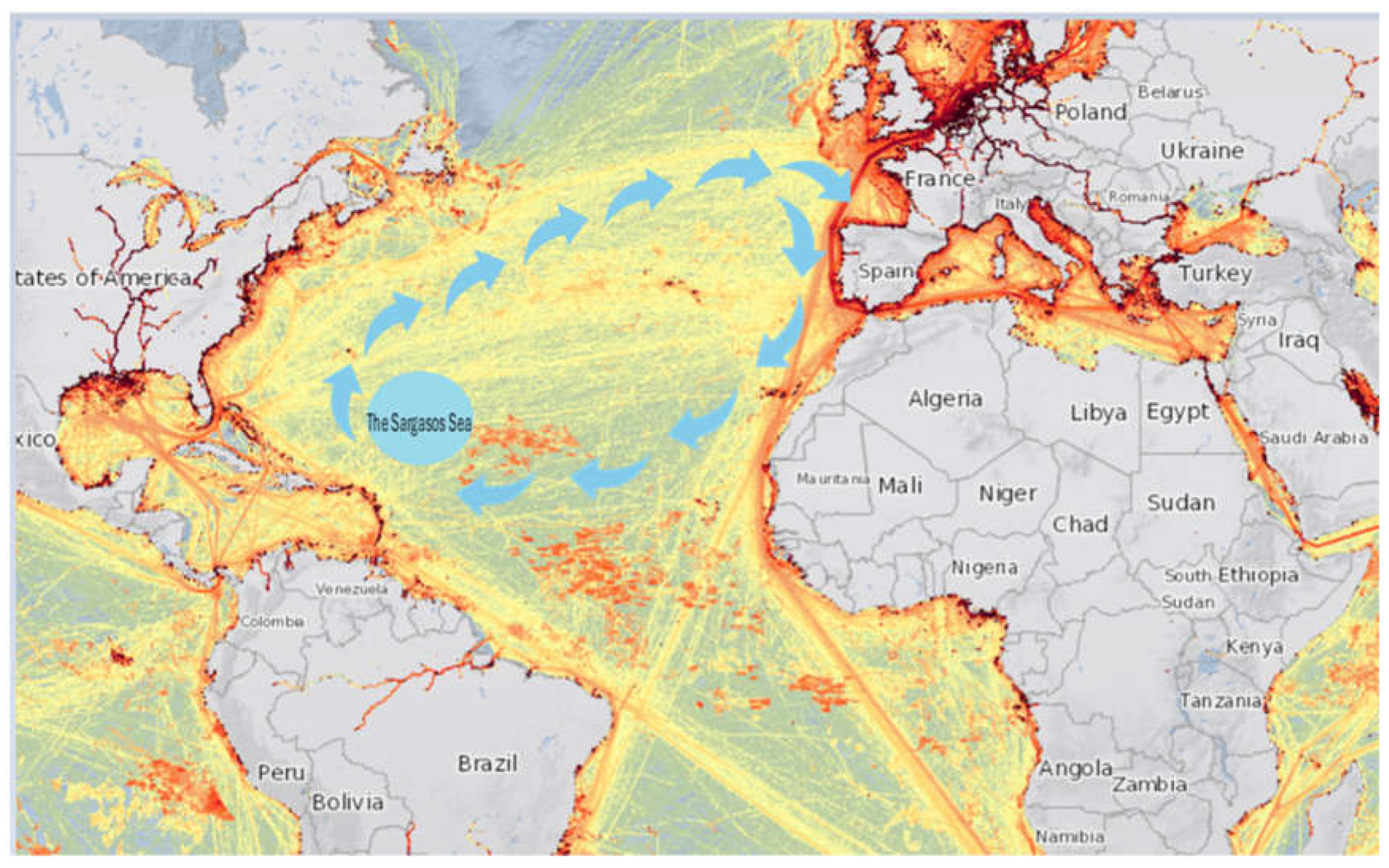
Figure 2.
Life cycle of the European eel Anguilla anguilla.
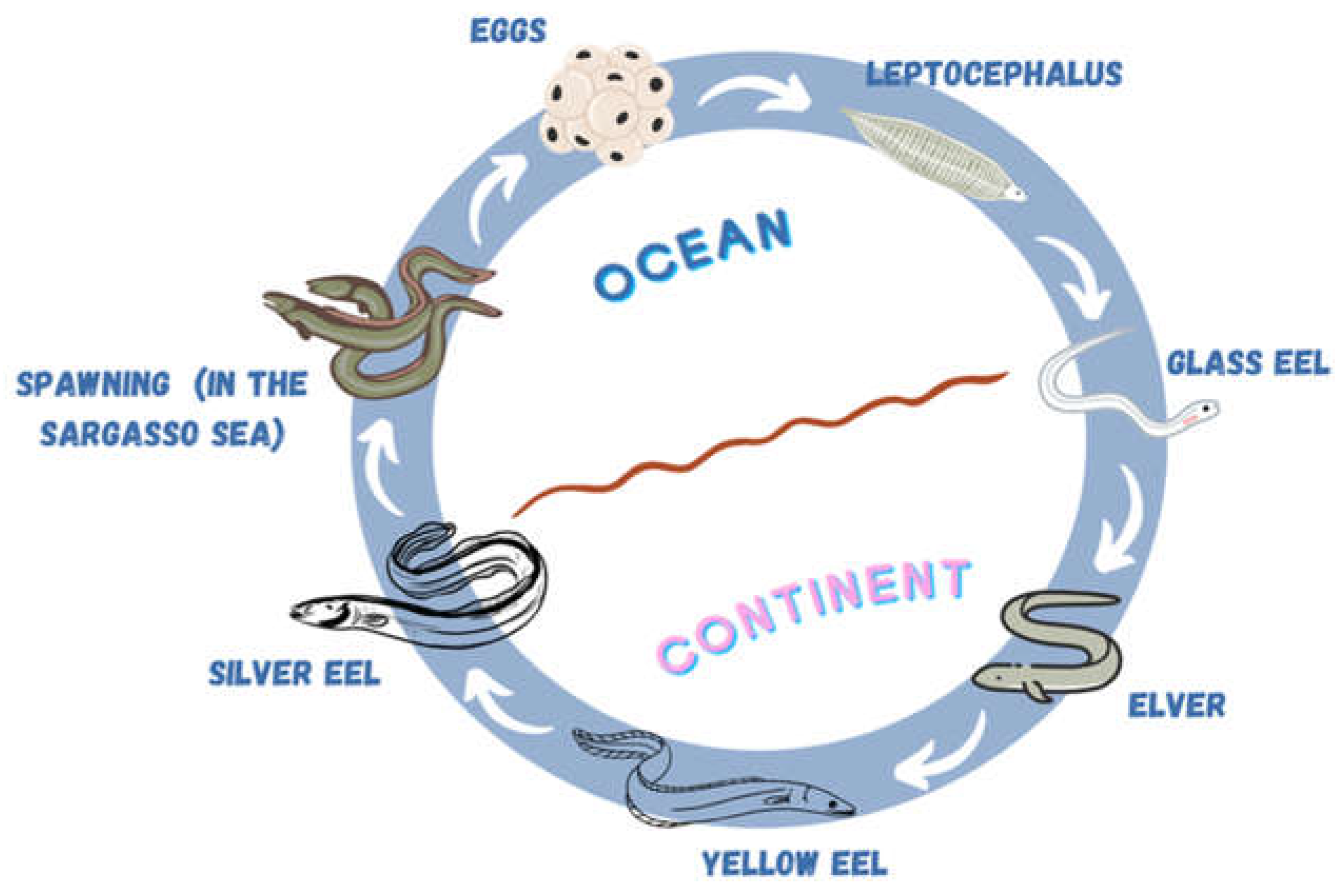
Figure 3.
Evaluation of the citizen science experience by the participants, as mean score (SD as capped bars) over a maximum of 10 as extremely good. Data are presented by age, gender, and education level.
Figure 3.
Evaluation of the citizen science experience by the participants, as mean score (SD as capped bars) over a maximum of 10 as extremely good. Data are presented by age, gender, and education level.
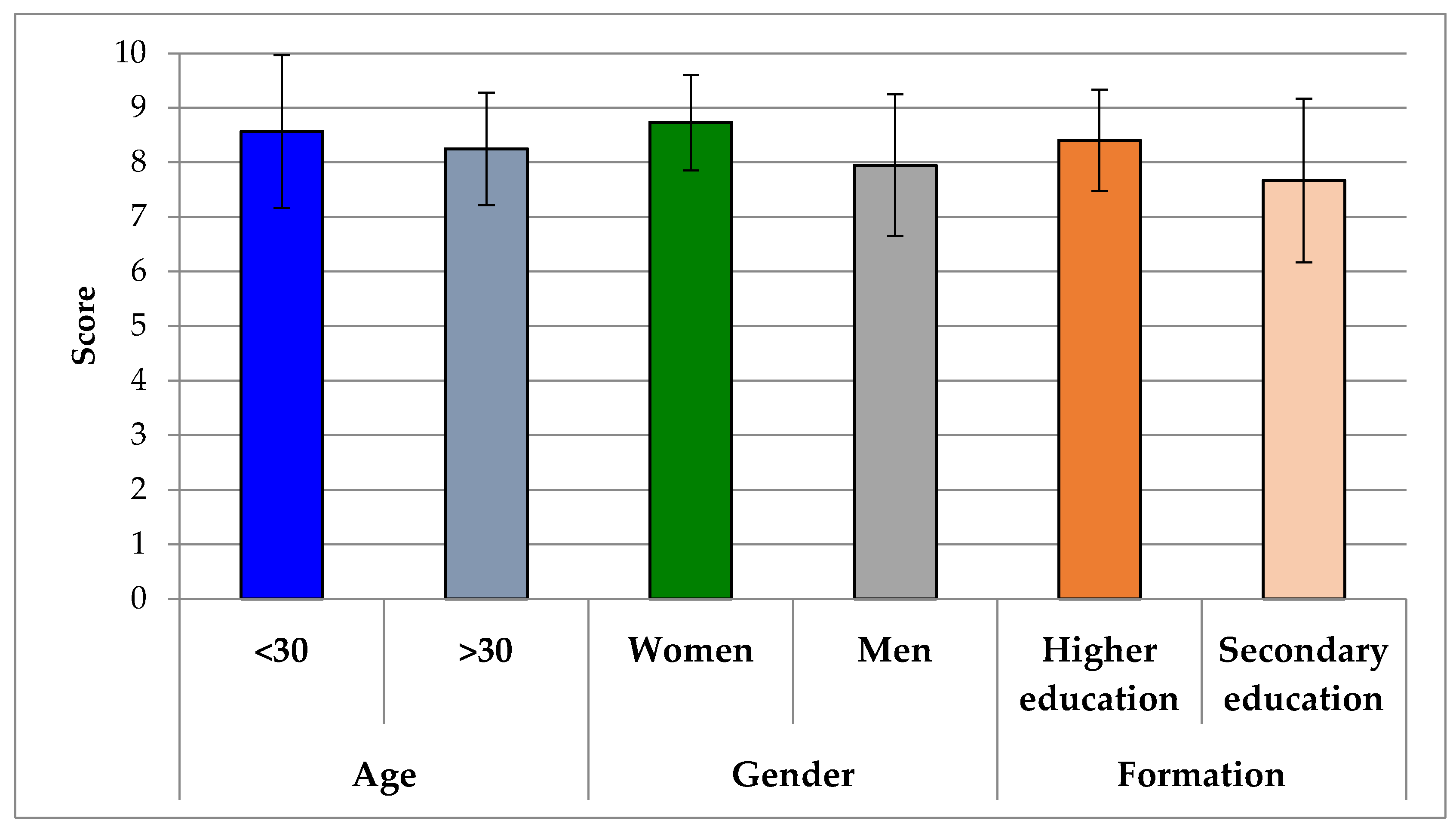
Figure 4.
Proportion in types of vessels (cargo, fishing, special craft and sailing, passengers, naval craft) for the studied estuaries. The difference in sizes of the graphs responds to the abundance of maritime traffic per estuary.
Figure 4.
Proportion in types of vessels (cargo, fishing, special craft and sailing, passengers, naval craft) for the studied estuaries. The difference in sizes of the graphs responds to the abundance of maritime traffic per estuary.
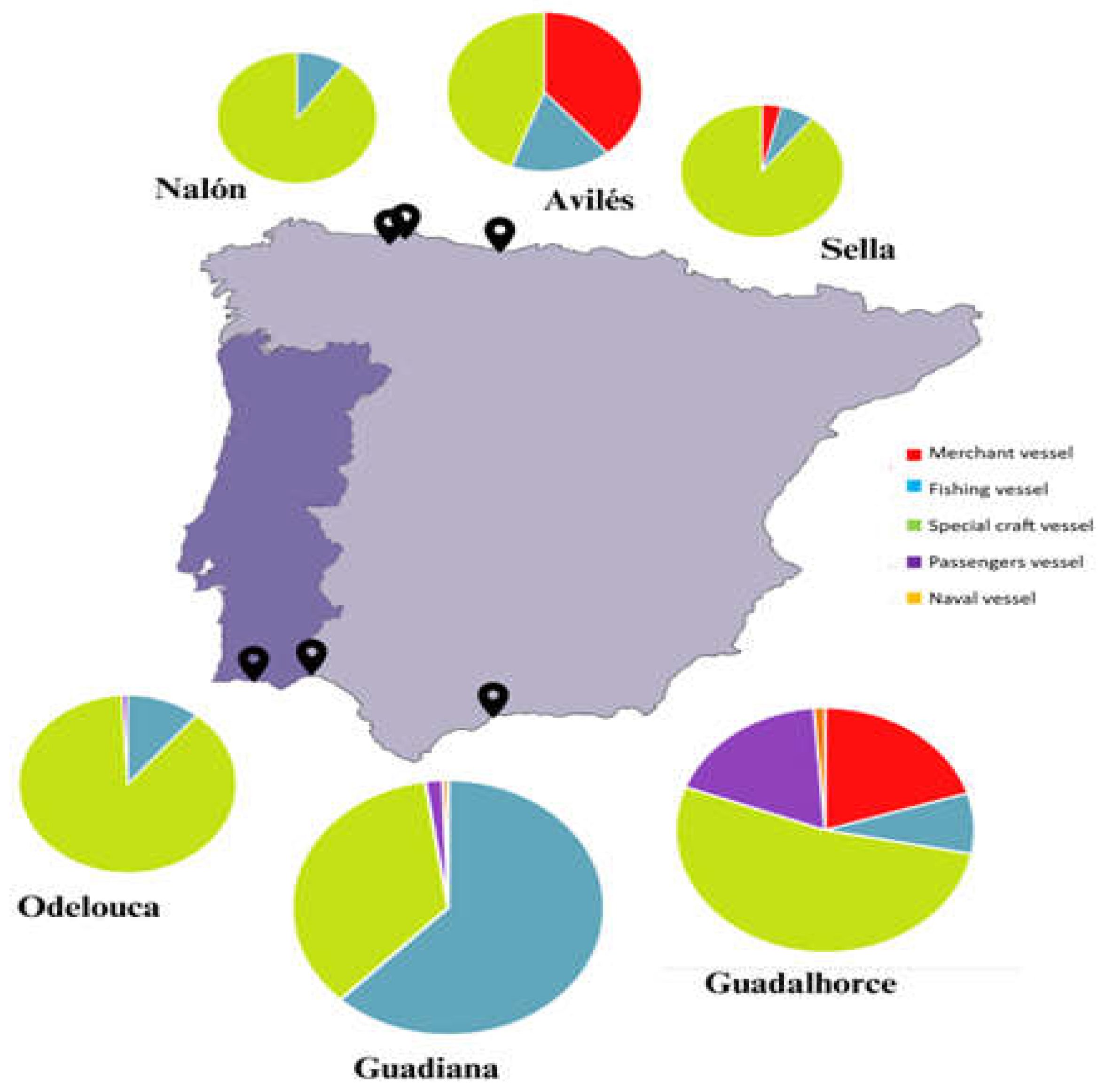

Table 1.
Estuaries considered. The location coordinates, river length, number and type of ports (commercial, fishing, marina), are provided.
Table 1.
Estuaries considered. The location coordinates, river length, number and type of ports (commercial, fishing, marina), are provided.
| Estuary | Coordinates | River length (km) | Number and type of ports |
|---|---|---|---|
| Nalón | 43º 33’ 53” N 6º 04’ 36” W |
140.8 | Two fishing ports |
| Sella | 43º 28’ 02” N 5º 03’ 51” W |
66 | A fishing port and a marina |
| Ria of Avilés | 43º 35’ 34” N 5º 56’ 08” W |
22.1 | A fishing port and a marina |
| Odelouca | 37º 10’ 38” N 8º 29’ 07” W |
92.5 | A marina |
| Guadiana | 39º 07’ 54” N 3º 43’ 59” W |
865 | Two fishing ports and three recreational ports |
| Guadalhorce | 36º 39’ 58” N 4º 27’ 18” W |
154 | A fishing, commercial and recreational port |
Table 2.
Types of vessels and their nomenclature.
| Vessel Type | Nomenclature |
|---|---|
| ME (Merchant vessels) | Bull carrier; Oil/Chemical tanker; Container; Crude oil tanker; LPG tanker; Ro-Ro/Passenger ship; General cargo; Cargo vessel; Chemical vessel; Container cargo; Container ship; Container vessel; Vehicles carrier |
| FI (Fishing vessels) | Trawler; Fishing; Fishing vessel |
| SC (Special Craft vessels) | Special craft; Sailing vessel; Recreational craft; Yacht; Firefighting vessel; SAR |
| PA (Passenger vessels) | Passenger |
| NC (Naval vessels) | Naval craft; Maritime ops |
Table 3.
Proportion of different vessel types in each Iberian coast examined. N, total number of vessels recorded.
Table 3.
Proportion of different vessel types in each Iberian coast examined. N, total number of vessels recorded.
| Iberian coast | ||
|---|---|---|
| Type of vessel | North | South |
| Cargo | 0.255 | 0.054 |
| Fishing boat | 0.136 | 0.304 |
| Special craft + sailing + recreational | 0.609 | 0.579 |
| Passengers vesel | 0 | 0.058 |
| Naval craft | 0 | 0.006 |
| N | 3962 | 11256 |
Disclaimer/Publisher’s Note: The statements, opinions and data contained in all publications are solely those of the individual author(s) and contributor(s) and not of MDPI and/or the editor(s). MDPI and/or the editor(s) disclaim responsibility for any injury to people or property resulting from any ideas, methods, instructions or products referred to in the content. |
© 2024 by the authors. Licensee MDPI, Basel, Switzerland. This article is an open access article distributed under the terms and conditions of the Creative Commons Attribution (CC BY) license (http://creativecommons.org/licenses/by/4.0/).
Copyright: This open access article is published under a Creative Commons CC BY 4.0 license, which permit the free download, distribution, and reuse, provided that the author and preprint are cited in any reuse.


