

Submitted:
14 November 2024
Posted:
14 November 2024
You are already at the latest version
Abstract
Starch films have attracted increasingly attentions since they are not only biodegradable but also edible, or using as animal feeds from the post-products. Applications of starch-based films include food packaging, coating and medicine capsules etc. One of the well-recognized weaknesses of starch-based film is brittle, especially under dry condition since starch retrogradation and instability of plasticizers. Various strategies and methodologies have been developed to improve this weakness, including plasticizing, chemical modification and physical reinforcement etc. This review includes both fundamental science such as microstructures, phase transitions and compatibility, and application techniques like processing, plasticizer evaluation and chemical modifications etc. Plasticizers act as very important role in developing starch-based materials since without plasticizer the starch-based materials will be very brittle even unprocessable. Since starches contain many hydroxyl groups all the plasticizers used for starch-based materials must contain hydroxyl or polar groups. Chemical modification like esterification and etherification can prevent starch recrystallization. Reinforcement, in particular with nano-cellulous significantly improved the mechanical properties of starch film. Based on the literatures and our experience, we have not only discussed and summarized the achievements in this area, but also pointed out the weakness of current technologies and proposed research directions in this review.
Keywords:
starch
; phase transition
; toughness
; plasticizer
; modification
; reinforcement
1. Introduction
The invention of plastic is a double-edged sword, as it has significantly enhanced the quality of human life while concurrently engendering severe ecological pollution through plastic waste. The packaging industry stands out as one of the foremost driving forces behind the exponential proliferation of plastics usage; thus, transitioning towards sustainable alternative packaging materials derived from renewable resources should be embraced as a more circular and eco-centric approach. Consequently, an urgent imperative arises to foster novel materials that offer commensurate functionalities to plastic products but are environmentally benign.
Starch is one of the most abundant natural polysaccharides on earth, found in all grain crops, with a wide range of advantages such as abundant sources, low cost, excellent biocompatibility, biodegradability, and ease of processing. Currently, natural starch and its modified products have been used as biodegradable packaging materials or bio-coatings to extend the shelf life of fresh agricultural products [1]. At the same time, starch is a biocompatible material certified by the US Food and Drug Administration (FDA) and can be used as edible packaging, medicine capsules, tablets, suppositories, implants, and stents [2]. For example, in the pharmaceutical market, compared to traditional gelatin capsules, plant-based capsules made from starch have better biocompatibility and can avoid the transmission of prions, and be acceptable by vegetarian and some religious, with great market value.
When used as packaging materials for food and drugs, starch-based films generally have low cost, good transparency, solubility and biodegradability [3]. However, the brittleness of starch films is a significant weakness, as their mechanical properties are inadequate to maintain structural integrity and resist deformation and damage during subsequent processing, thereby greatly reducing their utilization efficiency. Furthermore, high-quality packaging materials require better water vapor barrier properties to ensure product quality [4], but the strong hydrophilicity of starch results in poor water barrier properties and hydrophobicity of starch-based degradable plastics, leading to inferior mechanical properties in wet environments. Additionally, due to hydrogen bond interactions between and within molecules, natural starch cannot be directly thermally processed using convenient and popular facilities used for traditional plastic processing like extrusion and blowing film. Starches must undergo plasticization treatment to form thermoplastic starch with desired plasticity [5].
Herein, developing strategies and methodologies of improving toughness of starch film is decisive for the future perspective of practical application, and efforts have been devoted massively to conquer this challenge. This paper firstly presents the hierarchical structure of starch, serving as fundamental knowledge to enhance comprehension of the underlying factors contributing to the distinctive properties exhibited by starch-based films. Secondly the phase transition behaviors of starch under different treatments are reviewed, mainly focusing on the change of the interior hydrogen bond net-work within starch molecules, with both intrinsic and extrinsic factors influencing the molecular behavior discussed. Then we comprehensively examine diverse strategies and methodologies aimed at enhancing the toughness of starch films. These include chemical modification, and compositing with nanocellulose and other hydrophilic polymers, in conjunction with fabrication techniques. By systematically outlining their respective advantages and disadvantages, our objective is to provide fundamental knowledge and inspiration for the development of innovative and effective approaches towards fabricating advanced starch-based films suitable for food and drug packaging.
2. Resources and Microstructures of Starches
2.1. Resources of Starches
Starch is an important component in many main foods, such as bread-making, pastries, noodles etc., and it is also used in various non-food products including paper products, textile industrials, adhesives and bioplastics etc. The main resources of starch are various plants, especially the parts of plants that are rich in carbohydrates. Here are some major resources of starch: 1. Grains and cereals, such as wheat, corn, rice, barley, oats, and millet. These grains are the primary source of starch in the global human diet; 2.Pseudocereal grains like quinoa, amaranth, buckwheat, chia seeds and such; 3.Root and tuber vegetables like potatoes, sweet potatoes, cassava, and yams, and the roots or tubers of these plants have a high starch content; 4. Legumes such as mung beans, red beans, black beans, and lentils contain a certain amount of starch along with proteins; 5.Seeds of some plants like mango, litchi, avocado seeds etc. also have a relatively high starch content; 6.Certain fruits like bananas, apples, and pears contain some amount of starch although typically not as much as grains and root vegetables do; 7. Some plant leaves like spinachand kale may not have a high starch content compared to root crops but still serve as a source of starch; 8.Certain algae, such asspirulina, also contain starch [3,6,7,8,9,10]. The molecular weight, granule size and shape, amylopectin/amylose ratio, crystallinity and lipids and protein contents differ significantly depending on the resources of starch. As a result, gelatinization, retrogradation, and film properties also vary accordingly [11].
2.2. The Multi-Scale Structure of Starch
The sophisticated microstructure of starch is organized in multiple scales (Figure 1) [12]. Researchers have divided it into five levels according to the scale from macro to micro dimensions, as known as granule morphology, growth ring, blocklets, lamellar structures (crystalline features), helical structures and the amylose/amylopectin ratio [13,14,15,16].
The two main components of starch, slightly branched amylose and highly branched amylopectin, is decisive to starch properties. Amylose is composed of D-glucose connected by α-(1,4) linkage, with a degree of polymerization (DP) around 250-1000. The α-(1,4) linkage leads to the naturally twist of glucan chain into single helix and it prefers to combine with a variety of complexing agents [17]. Depending on the size of these complexing agents, the amylose chain can take up a helical structure having either six, seven or eight glucose units per turn. For amylopectin, its main chain of glucose units is connected by α-(1, 4)-glucoside bonds and branched by α-(1, 6)-glucoside bonds. Based on the chain length and DP, the branching chains are classified as A, B1, B2, B3 and C types [18]. Chains are located in the outermost with no branching points and a DP of 6-12. B1(DP 13-24), B2(DP 25-36) and B3(DP > 36) are distinguished by length and the number of clusters they span [19,20]. The single C chain possesses the only one reducing terminal residue in each molecule [21].
Liner chains of A and B type with a degree of polymerization ranging from 10 to 20 have the tendency to form double helical structures through hydrogen bonding, resulting in improved thermal stabilization and higher crystallinity. Each double helix is composed of six glucose residues per turn from each contributing strand, with a pitch of 2.1 nm and length between 4-6 nm [22]. The periodic arrangement of these helical structures via intraregional hydrogen bonding leads to short-range order, which plays a crucial role in starch crystallinity, solubility, rheological properties, digestion, retrogradation and gelatinization. The short-range ordered structure can be used as the basis for the formation of starch clusters, which mainly comprise of A- and B-type short chains (DP < 36) [12]. Because of their shorter length and higher density, the short chains within the clusters are more likely to be arranged in an ordered method, which is the basis of starch crystallization [16].
In the subsequent stage, approximately 150-300 double-helices are densely packed into crystallites, which have been classified as A, B, C, and V type polymorphs [24]. The V type polymorph represents the aggregation of left-handed amylose single helices following their interaction with small ligands such as lipids and fatty acids [25]. The A-type crystalline stacks in a more compact way, where the double-helices are closely packed into a monoclinic unit cell (a=20.83 Å, b=11.45 Å, c=10.58 Å, space group B2), containing 8 water molecules inter-helically. In the B-type crystal, the double-helices are packed in a hexagonal unit cell (a= b= 18.5 Å, c=10.4 Å, space group P61) with 36 water molecules [26]. The C polymorph is considered as the mixture of A and B type, which can be found in certain legumes and grain starches [11]. The crystalline regions demonstrate as lamellae and further aggregates into a super-helix model, with a pitch of 9 nm and a diameter of 18 nm, which was indicated by SAXS and WAXS diffraction images [15]. The crystalline lamellae co-constructs with the amorphous lamellae into an alternative structure, known as the semi-crystalline blocklets, which could be regarded as a level of crystalline structure between that of the growth rings and the amylopectin lamellae [27]. Blocklets also host the super helix and the latter, therefore, represents a single amylopectin macromolecule. Blocklets are organized into a spherical morphology with the diameters ranging between 20 and 500 nm, depending on the resource of starch and their location in the granule [15]. An interconnecting matrix surrounding groups of blocklets exists, called blocklets complex. Tang et al. proposed the concept of hard shell and soft shell (Figure 2) [23]. The normal blocklets constitute hard shell while the defective ones constitute the soft shell, alternative arrangement of hard and soft shell appears as the growth ring morphology of starch granules [28]. This ordered arrangement of crystal structures results in the anisotropic optical property of starch particles, namely birefringence. Hence, when granules are subjected to polarized light, a Maltese cross is observed which confirms the anisotropic structure, due to the symmetry of crystal structure [29].
3. Phase Transitions of Starch During Thermal Processing
3.1. Starch Gelatinization
The gelatinization of starch refers to the irreversible phase change process in which starch particles absorb water and undergo swelling under heating, ultimately resulting in the formation of a gel-like substance with high viscosity and certain elasticity [30,31]. This intricate process involves four distinct steps: (1) Water absorption and granule swelling: Initially, water molecules permeate into the amorphous regions of starch granules, causing their volume to gradually increase [32]; (2) Granule breakage: As temperature rises and more water infiltrates, stress is transferred from the amorphous regions to the crystalline regions within granules. Consequently, ordered crystalline regions disintegrate and transform into an amorphous state while birefringence gradually disappears, leading to the release of amylose into the aqueous solution [33]. (3) Molecular reorganization: Released starch molecules are rearranged by water action, forming a network structure [21]; (4) Gel formation: Interactions between starch molecules such as hydrogen bonds regenerate upon cooling down, resulting in a stable gel structure [34]. It should be noted that due to the complexity of internal structure within starch granules and heterogeneity of molecular structures involved, gelatinization does not occur at a single temperature point but rather encompasses multiple endothermic events taking place at different temperature stages [35].
The thermodynamic parameters for characterizing this process include gelatinization onset gelatinization onset (To), peak (Tp) and conclusion (Tc) temperature, as well as gelatinization enthalpy (ΔH) [36,37].These parameters reflect the energy required for the disassembly of starch, which are correlated to the intrinsic molecular structure of starch, including granule size and shape, amylose\amylopectin ratio, chain length distribution, the inter-block chain length and crystal structure [18,38,39,40,41]. The granules with bigger diameters are more subject to water penetration due to looser interior structure. And due to water is first absorbed by the amorphous regions, causing the granule to expand and transmitting the destructive power to the crystalline regions, starch with higher crystallinity has higher gelatinization temperature and enthalpy. Amylopectin consists of chains of different lengths, and the length distribution of these chains affects its ability to form double helices, which in turn affects the gelatinization temperature. Longer chains tend to form more stable double helices and require higher temperatures to gelatinize. The A (~ DP 6–12) and B1 (~ DP 13–24) chains of amylopectin form a double helical structure in the semi-lattice of starch particles [42]. The thermal stability of these double helices is positively related to the gelatinization temperature of amylopectin [43]. And the trans-lamella chains (DP 37–69) forming long amylopectin double helices protruding from crystalline lamellae intro continuing amorphous lamellae are decisive to Tc, because of their higher thermal stability [33]. Amylose, on the other hand, has a more intricate impact on the gelatinization enthalpy, which is neither parabolic nor linear. In simple terms, amylose might expand the gelatinization temperature range (Tc-To) by participates in the double helical structures with certain segments of amylopectin [44,45].
The water content, among external factors, significantly influences the order and rate of gelatinization [32,46]. With insufficient water content, the process of starch gelatinization may exhibit multi-stage heat absorption peaks and starches may need higher temperatures to start gelatinizing, and the crystalline structure may not be completely destroyed, resulting in incomplete gelatinization. The more moisture, the easier the starch granules are to fully absorb water and expand, and gelatinize faster [47]. The effect of salt on starch gelatinization is varied, which exclusively depends on the type and concentration of salt [33,48]. The influence mechanism of salt ions on starch gelatinization mainly comes from three aspects as follow: 1. Structural disruption or formation. Salts can act as structural-"breaking" or "making" by affecting the hydrogen bond networks of water molecules, altering the interaction between starch and water[32,48]; 2. Electrostatic interactions: Charged ions interreact with the polar groups (mainly hydroxy groups) on starch molecules, and interfere the formation of hydrogen binding net-work within starch granules[49]; 3. Ion competition: Salt ions may compete with starch molecules for water molecules, affecting the hydration degree and gelatinization of starch[50]. Hence, the influence of ions is rather exclusive, for instance, magnesium chloride was found to have significant promotive effect on gelatinization of potato starch, due to it could enhance the hydration of starch molecules, that is to say, the hydrogen bond between starch molecules and water molecules increased [51]. Ions with high charge density (such as SO42- and Ca2+) may increase the viscosity of the solution by forming structured water, thereby increasing the gelatinization temperature. In contrast, low charge density ions (such as I-, IO4- and SCN-) may destroy the structure of water, reduce viscosity, and lower gelatinization temperature41. Even the same salt may have different effects on starch gelatinization at different concentrations. Maaurf et al. observed that the T0 of starch increased as more NaCl was added into the system when its concentration was below 2 mol/L, but the opposite change of when the concentration of NaCl reached up to 2 mol/L [52]. In general, as the salt concentration increases, its effect on the gelatinization temperature may change from a decrease to an increase.
Lipids, proteins, non-starch polysaccharides, oligosaccharides, sugar or sugar alcohols also have significant influence on alternating the swelling behavior, gelatinization temperature of starch, and gel’s viscosity and toughness. These additives are capable of interacting with the abundant hydroxy groups via non-covalent interaction force such as hydrogen bonding, hydrophobic interaction and van der Waals forces [53,54,55]. The hydrophilic hydroxyl groups of starch’s α-(1-4) glucan helices are arranged on the outer surface, whereas methylene groups and the oxygens of the glucosidic bonds line the inner core forming a hydrophobic cavity that can accommodate suitable ligands. Therefore, lipids like long and medium-chain fatty acids (palmitic acid, stearic acid, lauric acid, etc.), monoglycerides, and phospholipids could insert in the helical structure of amylose, forming the V-type composite with a specific X-ray diffraction (XRD) pattern [56]. SAXS indicated that the addition of lipid molecules may increase the crystalline thickness and the crystallinity. This helps to stabilize the helical structure of amylose by restricting the hydrogen bond between starch molecules, thus reducing the dilatability and solubility of starch [57]. Chao et al found that the composite of lauric acid with starch inhibited the expansion of starch particles during the heating process, thus raising the gelatinization starting temperature [58]. Their research confirmed that when lipid molecules bind to starch particles, they competed with water molecules inside the starch particles, reducing the number of water molecules available for gelatinization in the starch particles. This competition reduced the water absorption capacity of the starch particles, thereby increasing the gelatinization temperature. Lipid molecules may also form a barrier film outside the surface of starch particles that can block the penetration of water and limit the expansion of starch particles when heated [59]. Similar to lipids, proteins also contribute to the formation of complex and elevate the gelatinization temperature [54,60,61,62]. The endogenous proteins closely surround the starch granules, serving as a "solid defense" against starch gelatinization [63]. Moreover, protein, lipid and starch tend to composite into a ternary complex with better thermal stability, higher galvanization temperature and enthalpy change [60].
Altogether, sugars, sugar alcohols, oligosaccharides and non-starch polysaccharide regulate the gelatinization behavior of starch by forming hydrogen bond net-work with starch molecules, changing water activity, increasing solution viscosity and affecting the expansion and rupture of granules [55,64,65,66], but their regulatory mechanisms differ in detail. For example, in addition to the above-mentioned principles, certain sugars and sugar alcohols could enhance the stability of the starch crystal structure and restrict the molecular movement in amorphous regions of starch granules [65]. Sugars and sugar alcohols exhibit a single increasing effect on the gelatinization temperature and enthalpy of starch concentration-dependent [10,67]. The stereochemical features of sugars, such as the molecular volume and shape, flexibility, the D-type and L-type configurations, cyclic structure and the spatial arrangement of hydroxyl groups, may affect their interactions with starch molecules [68]. Sugars with more equatorial and exocyclic hydroxyl groups may be more effective in interacting with starch molecules, enhancing the stability of the crystal structure [68]. The effect of non-starch polysaccharides is conducted exteriorly considering polysaccharides’ incapacity in infiltration into granules, so they tend to generate a physical barrier around starch particles, limiting the access of water molecules and the expansion of starch particles. And the impact of polysaccharides on solution viscosity is more pronounced due to its large molecular weight [53,55,69,70]. The effect of polysaccharides on starch gelatinization is not a simple promoting effect like sugars or sugar alcohols, but has a complex multifaceted nature, with the specific effects depending on various factors, including the type, concentration, interaction with starch, and preparation conditions of the polysaccharides. Guar gum and xanthan gum could reduce swelling force and gelatinization temperature of Colocasia esculenta starch while carboxymethyl cellulose showed an opposite effect [71].
3.2. Starch Retrogradation
Starch retrogradation, also known as starch aging, refers to the process in which the molecular chains of gelatinized starch reorganize through hydrogen bonds into an ordered structure during cooling under certain conditions [72,73,74]. The retrogradation involves the transition of gelatinized starch molecules from a state of disorder to one of order. During the process of gelatinization, starch molecules undergo a transition from an ordered or partially ordered state to a high-energy disordered state under the influence of external energy, such as heat or pressure [10]. Upon cooling, starch molecules undergo intermolecular and spatial conformation rearrangement with water molecules, leading to their transformation into a low-energy ordered state. As temperature decreases during recirculation, molecular motion diminishes and the side chains of amylose and amylopectin molecules tend to realign in parallel orientation through hydrogen bonding [75]. This leads to their closer proximity and the reformation of microcrystalline bundles, ultimately resulting in precipitation or gel formation. Based on the kinetic properties of starch retrogradation recrystallization, the process can be divided into four stages: conformational change of starch chains, formation of double-helices, crystal nucleus induction and crystallization growth, and perfect crystallization formation [76,77]. Depending on the duration of retrogradation and the state of molecular motion, the process of starch retrogradation can be classified into short-term retrogradation and long-term retrogradation. Short-term retrogradation typically occurs within a few hours to 24 hours after starch gelatinization and is primarily dominated by amylose due to its smaller molecular weight and fewer side chains [78]. The directional movement of amylose chains facilitates intermolecular hydrogen bonding, resulting in the formation of a double-helices structure and gradually progressing towards the development of a three-dimensional network structure. Then, with the extension of time, amylopectin with larger molecular chains and more side chains forms crystalline clusters through intermolecular hydrogen bonding, which intertwine with each other and lead to long-term at a much slower rate, typically requiring several weeks [77,79,80].
Retrogradation can be considered as the inverse process of gelatinization, thus the factors influencing gelatinization also impact retrogradation. Similarly, in terms of intrinsic factors, there is a positive correlation between amylose content and retrogradation rate. Amylose forms double helical structures through intermolecular hydrogen bonding, which serve as connecting points during the retrogradation process [81]. A higher amylose content leads to more molecules being gathered by hydrogen bonding, resulting in a greater enthalpy of starch regeneration and faster regeneration rate [80,82]. The recovery of amylose is influenced by the length of its molecular chain, with longer chains experiencing steric hindrance that impedes orderly arrangement and retards regeneration, while shorter chains are more readily dissolved and pose challenges for revival [19]. It has been observed that amylose with a polymerization degree ranging from 250 to 1100 can rapidly regenerate within 100 minutes [19,83]. For long-term retrogradation, the length and distribution of amylopectin's side chain play a crucial role in the process. The side chain of amylopectin must consist of at least 10 glucose units to enable the formation of a crystalline structure through a double helix arrangement. Conversely, shorter side chains with less than 10 glucose units impede retrogradation [79,84,85]. Additionally, the proportion of short side chains with a polymerization degree (DP) ranging from 9 to 11 in amylopectin significantly impacts starch recovery rate. Slower starch retrogradation is observed with a decrease in the proportion of short side chains [85,86]. The presence of amylose facilitates the retrogradation of amylopectin, and an increase in amylose content leads to faster long-term retrogradation [87,88]. A synergistic effect between amylose and amylopectin retrogradation is evident, where the short-term retrogradation of amylose acts as a crystal nucleus for the recrystallization of amylopectin, promoting its retrogradation. However, it should be noted that while amylose promotes the recrystallization and accelerated retrogradation of amylopectin, it does not impact its final crystallinity [72,89].
The retrogradation of amylopectin is closely related to the water content in the system. Amylopectin retrogradation primarily involves B-type crystallization, which has a higher water content compared to A-type crystallization. Water serves two main functions in amylopectin regeneration: firstly, as a plasticizer, it facilitates the migration and orderly arrangement of amylopectin molecules; secondly, water participates in the recrystallization process by acting as bound water [32]. The promotion of amylopectin recrystallization by water is dependent on its content. It has been observed that wheat starch recrystallization increases with increasing water content within the range of 27% to 50%. However, when the water content exceeds 50%, wheat starch recrystallization decreases with further increase in water content [90]. Temperature is another decisive factor. When the temperature of starch paste surpasses its melting temperature (Tm), molecular movement becomes intense resulting in disordered distribution of amylopectin molecules that cannot be recrystallized effectively. On the other hand, if the temperature falls below glass transition temperature (Tg), molecular chain movement freezes leading to limited directional migration over a short period of time. However, when retrogradation temperature ranges between Tg and Tm, thermodynamically unstable state occurs allowing significant directional migration for achieving ordered arrangement through hydrogen bonding interactions ultimately leading to attainment of thermodynamic stability and subsequent reformation into crystals [84,91,92].
Figure 3 is a schematic representation of retrogradation after gelatinization. It is seen that the double-helical crystalline structure in the amylopectin were torn apart during gelatinization, however, the chains remain in a regular pattern and formed gel-balls. The gel balls mainly contain the chains from same sub-main chain. The molecular entanglements between gel-balls and super-globes are much less than those between linear polymer chains due to the size and length of the chains. During recrystallization or retrogradation, amylose firstly foamed V-type single helix crystals. Gelatinized amylopectin initially remains in an amorphous state, but with increasing time the crystallinity increased [93].
The presence of cations not only decelerates the rate of retrogradation, but also hinders the recrystallization rate [95]. Divalent cations (such as Ca2+ and Mg2+) have more obvious effect in comparison to monovalent cations (such as Li+, NH4+, Na+, and K+) [96,97]. This phenomenon is believed to be associated with the higher charge density of divalent cations, resulting in stronger hydration and subsequently lower water activity. Ciesielski and Tomasik argued that the hydrogen bond between starch molecules and the complex association between starch and metal cations were in competition with each other, so the complex association between cations and starch in the presence of salt might be a reason for the reduction of starch retrogradation (dependent on intermolecular hydrogen bond) [98].
The additives including lipids, carbohydrates and proteins impact the retrogradation at different stage via various mechanisms [76,99]. Lipids and carbohydrates (monosaccharides polysaccharides, oligosaccharides, polyols) are generally suppressive for starch retrogradation. Lipids constrain the starch molecules’ movement via forming complex with starch and physically hindering the proximity and rearrangement of molecule chains [59]. Lipids may also affect the dynamics of starch chains and reduce the fluidity of starch chains [100]. It is worth noting that instances where carbohydrates promote retrogradation are relatively rare and require specific conditions or concentrations. Most carbohydrates inhibit retrogradation by competing with starch molecules for water, thereby forming physical barriers or altering the microscopic structure of starch gels [99,101]. Moreover, retrogradation is a complex process influenced by various factors such as starch type, water content, temperature, pH value, and other components within the system. Therefore, the specific effects of carbohydrates on retrogradation may vary depending on experimental conditions and food systems. Proteins display a multiple and concentration-dependent influence on retrogradation. If protein content is too high, it may form disulfide bonds, which may restrict water migration, thereby reducing its anti-retrogradation ability [102]. And in different retrogradation stages, proteins may have different effects, which may inhibit retrogradation in the early stage and promote it in the long term [103]. Rice protein and glutenin in wheat has been reported to delay retrogradation, while starch granule-associated proteins (SGAPs) accelerate the retrogradation process by competitively binding with water molecules and thus enhancing the hydrogen binding interactions between starch molecules [104].
3.3. Phase Transition Under Shearless and Shear Strength Conditions
The semi-crystalline starch would undergo a phase transition from an ordered structure to a disordered structure due to factors such as heat, moisture, and shear force, and starch molecules will undergo a process of self-reorganization through the reestablishment of hydrogen bonds between chains when the gelatinized starch is cooled down. These transformations encompass granule expansion, dissolution, gelatinization, as well as subsequent retrogradation or recrystallization phenomena upon cessation of external energy input [105,106,107]. During the phase transition of starch, shear force not only facilitates the expansion and disintegration of starch granules but also influences the alignment of starch molecules, thereby holding significant practical implications in food processing and material preparation. Taking the gelatinization process for instance, under shearless condition, sufficient water (over 70%) and proper temperature is needed for granules’ expansion and eventual collapse. But with shear force, this process requires much less water. This phenomenon occurs due to the disruptive effect of shear force on hydrogen bonds between and within molecules, leading to the distortion of starch's double helix structure and facilitating the binding of water molecules to free hydroxyl groups in starch, thereby accelerating the gelatinization process [108,109,110].
It is widely recognized that due to its higher glass transition temperature and melting temperature compared to the decomposition temperature (225-250°C), starch is deemed unsuitable for processing and utilization similar to synthetic plastics [91]. However, the synthesis of thermoplastic starch and its derivatives can be achieved by employing approaches that generate sufficient shear force. In these approaches, the primary role of shear force is to disrupt molecular bonds, rather than relying solely on water molecule penetration to induce crystal dissolution. The typical methods for producing thermoplastic starch include single- and twin-screw extrusion, kneading, casting, and pressing, with extrusion and casting being the most commonly employed techniques [111,112,113]. The operating conditions of extrusion process, such as screw rotation speed (SRS), temperature and moisture content significantly affect the morphology and functionality of starch-based materials. The SRS directly determines the residence time of the material in the extruder, which in turn affects the degree of mixing and thermal treatment of the materials and the amount of mechanical energy input into the material during the extrusion process [114,115,116]. Seligra et al. studied how SRS influenced the final mechanical properties of starch films [117]. It was found that when SRS was set at 40 rpm, the mechanical energy input might not be sufficient to fully disintegrate starch granules, resulting in the presence of ungelatinized starch particles within the material, which served as potential sources for crack propagation, thereby impacting both uniformity and functionality. When operating at 80 rpm, a moderate screw speed is achieved which can potentially facilitate more effective breakdown of starch particles, leading to an increased contact area between starch and plasticizer and consequently enhancing their interfacial action. This enhanced interfacial action contributes to improved film toughness. However, when running at 120 rpm, although smaller particle sizes may be obtained, excessive degree of breakdown could weaken the interfacial action between starch particles and plasticizer, thus reducing film toughness. If other components like plasticizers, polymers, nano-fillers are co-extruded with starch, SRS is the decisive factor for mixing uniformity and interfacial interactions. Regarding water content, inadequate moisture can lead to insufficient intergranular bonding of starch particles, thereby impacting the tensile strength and elongation at break of the film. Optimal moisture content facilitates gelatinization and plasticization of starch particles, consequently enhancing the flexibility and extensibility of the film. Conversely, excessive moisture content may result in a decline in mechanical properties due to bubble formation or uneven structure during drying.
Additionally, shear force also has a significant impact on the rheological properties of starch during its thermal processing. Yu and Chen et al. observed the gelatinization of corn starch with different contents of amylopectin using a rheometer, and the relationship between the viscosity and particle changes under shear force was investigated [107,118]. Under a constant shear rate of 5 s-1, the internal structure stability of starch granules was maintained through the interplay between structural degradation induced by shear force and continuous gelatinization. The viscosity value was measured to be 0.13 Pa·s. Notably, significant changes in starch particles were observed at 65℃, with the same shear viscosity reaching a stable value of 25 Pa·s. Subsequently, as temperature increased within the range of 70~75℃, the viscosity further rose to 110 Pa·s before gradually decreasing to around 70 Pa·s due to starch structure degradation. These findings demonstrate that during the progress of gelatinization process, starch particles undergo gradual breakdown accompanied by phase separation between amylose and amylopectin, leading to an increase in system viscosity. However, when all starch granules are completely broken down under continuous shear force, a phenomenon known as shear thinning is observed.
The shear force can also inhibit the retrogradation of starch, which is crucial for maintaining the quality of starch-based products and promote starch gel’s mechanical properties. Appropriate shear forces can enhance the thermal stability of starch gels, allowing them to maintain their structure and properties at high temperatures. This phenomenon may arise due to the facilitation of intermolecular interactions between starch molecules by shear force, resulting in the formation of a more compact and uniformly interconnected gel network. Zeng et al. investigated the impact of extrusion on the retrogradation properties of chestnut starch in both short and long-term durations, revealing that the extrusion treatment induced alterations in the molecular structure of starch, facilitating the formation of new ordered structures in the short term (1 day) [119]. However, over an extended period (21 day), it impeded the development of ordered crystallization due to damage and reorganization within molecular chains. The findings of Zhu et al. also confirmed that the application of shear force and exposure to high temperature resulted in the fragmentation of starch molecular chains [120]. This breakage predominantly affected the elongated segment of amylopectin, leading to a conversion of some branched amylopectin into amylose, which possesses a more linear structure and promotes the formation of short-range ordered structures while inhibiting the development of long-range ordered structures, consequently decelerating retrogradation kinetics.
4. Improving Toughness by Plasticizers
Plasticizers play a crucial role in starch-based materials production and processing, improving flexibility and workability by modifying the mechanical properties of starch. The plasticization mechanism involves plasticizers penetrating into starch molecules, weakening the intermolecular forces between starch chains [8,121]. This is primarily achieved through the interaction of the polar groups of plasticizers with the hydroxyl groups on starch, replacing some of the hydrogen bonds between starch molecules. Simultaneously, non-polar groups of plasticizers isolate and shield the hydroxyl groups, reducing van der Waals forces between starch molecules. This increases the mobility of starch chains, leading to enhanced flexibility of the material [122,123].
4.1. Waters
Water is one of the most widely used plasticizers in starch-based materials, having been utilized in various food processes for millennia [65]. Acting both as a plasticizer and a gelatinization agent, water facilitates the transformation of starch from a rigid structure to a more flexible one [121]. However, its low boiling point causes it to volatilize during storage and processing, which often results in the starch material becoming hard and brittle over time [124,125,126]. This limitation makes it necessary to explore other more stable plasticizing agents.
4.2. Polyols and Saccharides
Polyols and saccharides are commonly used as plasticizers in starch-based films due to their structural similarity to starch, which enhances their compatibility. Polyols such as ethylene glycol, propylene glycol, glycerol, sorbitol, and xylitol are effective plasticizers due to the presence of multiple hydroxyl (-OH) groups [127,128]. The plasticization efficiency is directly related to the number of hydroxyl groups; polyols with more hydroxyl groups exhibit better compatibility with starch. However, alcohols with fewer hydroxyl groups, particularly mono-alcohols, show poor plasticization efficiency as they are not well retained in the starch matrix. The presence of a long alkyl chain in the alcohol reduces compatibility with the starch matrix even more. This type of material like pentanol and hexanol has low or no plasticizer efficiency. Di-alcohols with short -R chains like ethylene glycol show enhanced compatibility. Like mono-alcohols, the extended -R chain reduced plasticizing efficacy due to a decreased compatibility with starch. Polyols that contain multiple -OH groups have been shown to demonstrate good compatibility with starch. The effectiveness of these alcohols is based on the number of -OH groups present [129].
Saccharides, including monosaccharides (glucose, mannose, fructose, xylose), and disaccharides (sucrose and maltose) and dextrin with different molecular weights can act as co-plasticizers when used synergetic water or polyols since they are all in solid-state under dry conditions. These saccharides and starch are fully compactable and miscible since they have similar chemical components [130]. Cyclic saccharides can be stably incorporated into the starch matrix without significantly affecting polymer microstructures. However, linear saccharides, such as fructose and xylose, are more efficient in disrupting ordered structures of starch and enhancing the movement of starch polymer chains, leading to improved plasticization efficiency. The development direction should be focused on the synergetic plasticizing system [125].
4.3. Other Polar Substances
In addition to polyols and saccharides, various other polar compounds, including amines, amides, carboxylic acids, and their salts, as well as amino acids, have been explored as effective plasticizers for starch. These substances generally exhibit higher boiling points and contain polar functional groups such as -COOH and -NH2, which can form hydrogen bonds with starch molecules [131,132]. This interaction disrupts the native molecular associations between starch chains, thus enhancing the flexibility and plasticization of starch-based materials.
For example, Carvalho et al. [133] reported that citric acid has been identified as both a plasticizer and a modifier in the melt processing of starch. Despite its effectiveness, plasticizers with low molecular weights, like citric acid, tend to induce water sensitivity and lead to unstable mechanical properties over time, primarily due to recrystallization during aging. Additionally, the analysis of succinic acid, oxalic acid, and adipic acid as plasticizers revealed that succinic acid interacted most effectively with starch, resulting in starch films with lower crystallinity and better thermal properties [132]. And result shown that ester bond formation, indicating strong interactions between the acids and the starch matrix. The length of the fatty acid chains was shown to influence the structural and thermal behavior of starch-based biofilms, with shorter chains like succinic acid demonstrating superior reactivity.
Further comparative studies on common polar plasticizers (formamide, urea, glycerol, and glycol) highlighted the significance of the functional groups involved in starch plasticization [131,134]. Result showed that the hydrogen bond (H-O…H-N) between formamide and starch is the strongest, resulting in better plasticizing performance. Chen et al. [135] reported that hydroxyl groups in ethylene glycol (EG) and amino groups in ethylenediamine (EDA) predominantly form hydrogen bonds with the hydroxyl groups on starch chains, enhancing plasticization. Amide groups in ethylbutylformamide (EBF), however, establish hydrogen bonds not only with hydroxyl groups but also with ether bonds on the starch backbone, resulting in even more effective plasticization.
4.4. Novel Plasticizers
Recent advances in starch plasticization have introduced ionic liquids (ILs) and deep eutectic solvents (DES) as novel plasticizers [136]. ILs, composed entirely of organic salts, exhibit unique properties such as non-volatility, non-flammability, and excellent thermal and electrochemical stability. Imidazolium-based ILs, such as 1-butyl-3-methylimidazolium chloride ([BMIM]Cl) [137] and 1-ethyl-3-methylimidazolium acetate ([Emim]Ac) [138], have demonstrated strong plasticizing effects on starch. When combined with glycerol, ILs enhance starch flexibility by significantly reducing water content, crystallinity, and glass-transition temperature.
Similarly, DES and low-transition-temperature mixtures (LTTM) have shown promising plasticizing effects [139,140]. These plasticizers are less hygroscopic, promote crosslinking with polysaccharides, and result in more amorphous starch materials. DES, which are mixtures of hydrogen bond donors and acceptors, exhibit a lower phase transition temperature than their individual components, offering an alternative pathway for effective starch plasticization. Studies reported by other authors have identified and made the most of the advantages offered by mixtures of different plasticizers, to the fore being glycerol-sorbitol,[140] urea-ethanolamine, urea-formamide, and sugars-glycerol [141]. Mixing the plasticizers allows stronger molecular interactions with starch than when the plasticizers are used individually, and comprises a field of research worth exploring.
5. Chemical Modifications
The abundant hydroxy groups provide available sites for diverse chemical modifications. The introduction of active groups is an effective approach for altering starch-based materials’ properties such as aqueous solubility, gelatinization temperature, hydrophobicity with the alternation of structure and crystallinity at the same time. General modification of starch includes esterification, acetylation, etherification, oxidation, polymer grafting, crosslinking, hydrolysis etc. (Figure 4.) [94,142]. The level of modification is determined by two criteria: degree of substitution (DS) and molar substitution (MS). DS represents the average number of substituents reacted with the free hydroxyl sites on starch glucose, with a maximum DS of 3.0 for substituted starch. On the other hand, MS indicates the average number of substituents attached to either hydroxyl sites on starch glucose or substituents, which can exceed 3.0 [143,144].
5.1. Esterification
Esterification is a common modification method for the preparation of hydrophobic and thermoplastic starch. Due to the presence of a multitude of hydroxyl groups on starch molecules, they can form esters with various organic or inorganic acids, resulting in the formation of starch derivatives with lipophilic groups. The esterifying agents commonly employed include organic carboxylic acids (acetic acid, propionic acid, butyric acid, and others), acid chlorides (including acetyl chloride and vinyl chloride acids), anhydrides (acetic anhydride, propionic anhydride, and octenyl succinic anhydride), inorganic acids (phosphoric acid, nitric acid, and sulfuric acid), enol esters (vinylacetic acid and allyl acetic acid), as well as polyhydric alcohols (glycerol, sorbitol, and mannitol) [145,146,147,148].
The implementation of esterification has demonstrated various advantages in terms of starch film production. The inherent polyhydroxyl nature of starch imparts excellent hydrophilicity, but this characteristic, along with its inferior mechanical properties, limits its application potential, particularly in wet environments. Esterification serves as an effective strategy to overcome these limitations [149,150]. Esterified starch not only exhibits a reduced degree of retrogradation and diminished occurrences of paste gelation and dehydration condensation phenomena, but also undergoes alterations in sugar permeability, glossiness, viscosity characteristics, gel texture formation ability, film-forming capacity, thermal stability, and emulsification stability within the starch paste matrix. The formation of esterified starch occurs through the reaction between the hydroxyl group in the starch molecule and either an inorganic acid or a carboxylic acid derivative, resulting in a weakening of intermolecular hydrogen bonds [151]. As a result, esterified starch demonstrates heightened levels of hydrophobicity and thermoplasticity compared to its original form. Furthermore, this process significantly enhances both mechanical strength and toughness, making esterified starch suitable for extensive applications across diverse industries such as food processing and preservation, medicine production processes, textile manufacturing industry, composite materials development, paper production and environmental protection field [151,152,153,154].
It is worth noting that the type and length of the carbon chain in these agents significantly influence reaction kinetics. The reactivity of a fatty acid typically increases as its chain length decreases. Short-chain fatty acids, such as acetyl chloride and propionyl chloride, exhibit a higher likelihood of reacting with starch molecules due to their enhanced accessibility and penetration into starch granules. Consequently, this facilitates achieving a higher degree of substitution. Fatty acids of varying chain lengths can lead to distinct substitution patterns. For instance, studies have suggested that the utilization of short-chain fatty acid derivatives (such as acetyl chloride) is more likely to result in substitution reactions occurring at positions C2 and C3 on the starch molecule, whereas long-chain fatty acid derivatives may promote greater substitution at position C6 [155]. Correspondingly, the crystallinity, toughness, strength and hydrophobicity of starch films vary. Short-chain fatty acid derivatives, such as acetic acid and propionic acid, typically enhance the water solubility and absorption of starch by increasing its hydrophilicity. On the other hand, long-chain fatty acid derivatives like palmitic acid and stearic acid augment the hydrophobicity of starch, potentially reducing its water solubility but enhancing its solubility in non-polar solvents. Long-chain fatty acid-modified starches often exhibit improved thermal stability and mechanical properties, making them advantageous for high-temperature processing and various applications [156,157,158].
5.2. Etherification
Etherified starch is a starch derivative in which the active hydroxyl group of starch and the etherifying agent are connected by oxygen atoms. Commonly employed etherification agents encompass epoxides such as epoxypropane, ethylene oxide and 2,3-epoxypropyltrimethyl- ammoniu chloride, acrylic acid derivatives like methyl methacrylate, methacrylic acid, 2-ethylhexyl acrylate, alkyl chlorides including butyl chloride, octyl chloride dodecyl chloride, and benzyl chloride, maleates like diethyl maleate, dipropyl maleate and dibutyl maleat, dimethylsulfuric acid and some iodine and bromine hydrocarbons [21,159,160,161]. The etherification of starch typically occurs in an alkaline aqueous medium, wherein the hydroxyl groups present on starch molecules are transformed into alkoxide anions that can effectively react with the esterification agents. The pH value, reaction temperature and duration, physical properties of starch granules (such as particle size, shape, porosity, crystallinity, and surface properties), concentration of etherifying agents, pretreatment methods, and operating conditions (including stirring speed and pressure) are the key factors influencing reaction efficiency [162,163,164]. Novel approaches have been proposed to improve etherification efficiency. Xie et al. utilized a reactive extrusion process in an alkaline etherification to prepare carboxymethyl starch (CMS) with amphipathic characteristics (both hydrophobic and hydrophilic) by reacting CMS with cetyl bromide (CB). The results demonstrated that the application of extrusion led to significantly more efficient hydrophobic modification compared to traditional methods.
Starch ethers can be divided into nonionic starch and ionic starch ethers according to the electric charge characteristic in aqueous solution. Ionic starch derivatives include carboxymethyl starch and quaternized starch [165,166,167], and non-ionic starch ethers mainly include hydroxyethyl starch and hydroxypropyl starch [161,168]. The introduction of these larger side groups can reduce the intermolecular interaction between starch molecules, decrease starch retrogradation, stabilize the viscosity of starch slurry, diminish the hardness and brittleness of starch film, enhance the transparency of starch film and provide new functionalities to starch. And the incorporating ionic groups can improve water solubility while also enabling it to function as a polymer electrolyte suitable for various applications [169]. Cationic quaternary ammonium groups modified starch has demonstrated positively charged surface, better swelling power, increased viscosity, higher water absorption rate and solubility, and improved biodegradability, while carboxymethyl starch possesses a negative charge, this property alteration also facilitates enhanced repulsion between starch molecules and their interaction with water molecules. The introduction of hydrophobic side groups onto starch can also be achieved through etherification [170]. In the study of Jong et al. a thermosensitive hydrophobic polymer, 2-hydroxy-3-(2-propynyloxy) propyl hydroxyethyl starch (PyHES), was synthesized by modifying hydroxyethyl starch (HES) with 2-propylglycidyl ether (PGE) in an aqueous medium.
5.3. Oxidization and Acid Hydrolysis
Oxidation and acid hydrolysis of starch can both introduce carbonyl and/or carboxyl groups onto the starch molecule. However, the oxidation process involves the initial conversion of the hemiacetal group at C1 of the glucose ring into a carboxyl group, followed by successive oxidations of the C6 aldehyde group to a ketone and then to a carboxylic acid group. Additionally, the vicinal hydroxyl groups at C2, C3, and C4 are oxidized to carbonyl groups, which further undergo oxidation to form carboxyl groups. This oxidative transformation also leads to the breaking of glycosidic bonds and weakening of glycosidic linkages. Ultimately, these reactions result in degradation of starch molecules [171,172,173]. Acid hydrolysis primarily occurs through the cleavage of α-1,4 and α-1,6 glycosidic bonds within the starch molecules, resulting in the formation of new reducing ends. During this process, acids target the amorphous regions of starch granules first, leading to chain fragmentation and potentially generating smaller molecular fragments [162,174,175].
Commonly used oxidizing agents include sodium hypochlorite, hydrogen peroxide, ozone, sodium periodate, and sodium permanganate, and various innovative approaches have been employed such as photocatalytic oxidation, enzymatic oxidation, electrochemical oxidation, and pulsed electric field (PEF) treatment [3,4,145]. Oxidation treatment increases the hydrophilicity of starch molecules by converting hydroxyl groups in starch molecules into carboxyl and carbonyl groups. This increased hydrophilicity helps starch molecules form hydrogen bonds, which enhances the inner cohesion and mechanical strength of starch films [176]. In one study, cassava starch films treated with oxidation exhibited increased tensile strength and Young's modulus, but decreased ductility, resulting in a more brittle film [177]. This suggested that the oxidative treatment enhanced hydrogen bonding between starch molecules by increasing carboxyl and carbonyl groups, thereby improving the rigidity and tensile strength of the film. Additionally, the oxidation treatment can potentially impact the crystallinity of the starch film, consequently affecting its mechanical properties. The impact of oxidation treatment on the mechanical properties of starch films is contingent upon various factors, encompassing the extent of oxidation, the origin of starch, and the film preparation process. By meticulously controlling these parameters, it is possible to optimize the characteristics of starch films to ensure they retain requisite mechanical strength while simultaneously exhibiting commendable ductility and toughness.
Acid hydrolysis has a significant impact on the thermal stability and mechanical properties of starch films, which depends on the degree of hydrolysis, the source of starch and the hydrolysis conditions (such as the type and concentration of acid, time, and temperature) [174]. Moderate acid hydrolysis can break down starch molecular chains, reduce the interactions between molecules, thereby lowering the tensile strength and modulus of elasticity of the film, but it may also increase the elongation at break of the film, making it more flexible [178,179]. Apart from the commonly used hydrochloric acid, sulfuric acid and phosphoric acid, citric acid can serve as a catalyst for starch hydrolysis in food-grade applications. Citric acid is an organic acid that is occasionally employed for gentle starch hydrolysis, particularly when the desired final product should retain citric acid's properties [180].
5.4. Grafting
Grafting modification is a chemical method that able to enhance the physical, chemical, and mechanical properties of starch by grafting monomers (such as methyl methacrylate, acrylic acid, butyl acrylate, lactide, etc.) onto the molecular chain of starch through a copolymerization reaction [181]. This technique facilitates improved thermoplasticity, enhanced mechanical strength, superior water resistance, and reduced moisture absorption in starch, thereby broadening its applications in diverse fields including packaging materials, sustained-release drug carriers, paper processing, and biomaterials [182,183]. The grafting method could be classified as “grafting from” and “grafting onto” [184]. In the former method, monomer polymerization is initiated directly on the starch molecular chain. Starch molecular chains can serve as initiators due to the presence of active functional groups in their structure or through functional groups introduced after chemical modification. The formation of graft copolymers involves the polymerization of monomers onto starch molecules through either free radical or ring-opening polymerization [185]. A typical "grafting from" reaction involves the copolymerization of starch grafted polyacrylic acid (starch-g-PAA). This type of grafting reaction is initiated by the decomposition of initiators, such as ammonium sulfate (APS), potassium persulfate (KPS), ammonium cerium nitrate (CAN) or Fenton’s initiator, to generate free radicals [185,186]. These radicals then react with the hydroxy groups on starch and subsequently react with monomers (such as acrylic acid, methyl methacrylate, methacrylic acid (MAA) etc.), thereby initiating the polymerization of monomers onto starch [182]. The properties of starch graft copolymers can be tailored by selecting different monomers, controlling the grafting ratio, and adjusting the grafting density, thereby enabling precise regulation of the mechanical characteristics of films. The starch-g-PMAA films synthesized by Weerapoprasit and Prachayawarakorn exhibited a decrease in crystallinity, reduced mechanical strength, lower Young's modulus (i.e., stiffness), and enhanced flexibility with an increase in the MAA grafting percentage [187].
The "grafting onto" method refers to the covalent attachment of a pre-synthesized polymer chain with a reactive end group onto starch chains through chemical reaction. This requires the presence of functional groups on starch molecules capable of undergoing reactions with polymer end groups. Tai et al. prepared an ultra-flexible starch-polyurethane film by grafting PEG-iso onto starch to form an interpenetrating polymer network. In the starch-polyurethane composite material, PEG serves as the soft segment, providing excellent flexibility, while the polyurethane network acts as the hard segment, offering necessary strength and rigidity. The compatibility and synergistic effect between these segments enable the film to exhibit exceptional toughness [188,189].
5.5. Other Modification Methods
In the chemical modification of starch, condensing reaction refers to the introduction of new chemical groups onto starch molecules, leading to the formation of more intricate molecular structures. A typical example is the modification of starch using silane coupling agents (Figure 5.) [145]. Silane coupling agents, such as hexamethyldisilazane (HMDS) or hexamethyldisiloxane (HMDSO), can form stable Si-O-C bonds with hydroxyl groups on starch molecules under acidic or alkaline conditions. Following silanization treatment, starch exhibits enhanced surface properties, heightened hydrophobicity, and improved compatibility with non-polar materials [190,191,192]. Additionally, silane coupling agents can react with the surfaces of starch molecules and nanofillers (such as SiO2) through their two distinct reactive groups, forming chemical bonds. The introduction of these chemical bonds aid in the formation of a cohesive and compact network structure, thereby enhancing the tensile strength and elongation at break of the starch film. For instance, research has demonstrated that incorporating nano-SiO2 modified by silane coupling agents into starch-PVA composite films resulted in an increase in tensile strength ranging from 49.0% to 68.35% [193].
Chemical cross-linking of starch could create multiple networks within the polymer matrix and thus result in the enhancement of mechanical properties. Multifunctional acids and alcohols, dialdehyde, epichlorohydrin are some commonly used cross-linking agents [194,195]. These agents generally react with the hydroxy groups as the generation of ether bonds or ester bonds. The cross-linking points could also be formed between starch and other polymers. Carboxymethyl cellulose (CMC) and starch were cross-linked by citric acid via esterification. Besides, chemically modified starch could form novel cross-linking bonds. The cross-linked rice starch is prepared through the Schiff base reaction between oxidized rice starch and aminated rice starch. The resulting cross-linked starch films demonstrated exceptional toughness, as it possesses a higher capacity for energy absorption prior to fracture. This enhanced toughness can be attributed to the formation of a more tightly interconnected network structure through cross-linking, which enables effective dissipation and absorption of applied forces [196]. To be noticed, meticulous control of the degree of cross-linking is essential as it directly impacts both the mechanical properties and processability of the starch films. If the degree of cross-linking is maintained at a moderate level, the film can obtain proper strength and good flexibility at same time. However, excessive cross-linking can result in excessive rigidity and brittleness in the film, compromising its practicality, an increased degree of cross-linking may reduce the breaking elongation of the starch film due to constrained molecular chain mobility and reduced flexibility. This is attributed to the enhanced intermolecular interactions that restricts molecular chain sliding, thereby improving the film's resistance to external forces. Furthermore, under external forces, an excessively cross-linked film is more prone to fracture rather than deformation [197,198].
6. Composite with Other Hydrophilic Polymers
6.1. Starch/Cellulose Composite
Cellulose, due to its chemical similarity with starch, is the most commonly used polymer for enhancing starch film. This is because it facilitates interactions such as hydrogen bond formation, thereby increasing adhesive strength at the interface [199]. However, cellulose is indissoluble in traditional solvents such as water and most polar solutions due to complex non-covalent interactions within and between its molecules. Therefore, two methods can be employed for compositing cellulose with starch: 1). transforming cellulose into aqueous soluble derivatives via chemical modification (e.g., carboxymethyl cellulose (CMC), methyl cellulose (MC), and hydroxypropyl methyl cellulose (HPMC) [200,201,202]. These cellulose derivatives exhibit enhanced solubility, thereby demonstrating improved film-forming properties when composited with starch. Lan et al. employed a casting method to prepare a composite film embedded with Lactococcus lactis using corn starch (NS) and carboxymethyl cellulose (CMC) [203]. The composite film exhibited optimal mechanical properties at an NS:CMC ratio of 5:5, with a tensile strength of 4.62-5.83 MPa and an elongation at break of 78.59%-86.75%. This edible and pliable composite film possesses excellent ductility, making it suitable for packaging nuts, biscuits, and candies.
2). Extracting nanocellulose (NC) from plant fibrils and incorporating it into a starch matrix, where the NC functions as a nano-filler or reinforcement building block [204,205,206]. The mechanical properties of the composite films are governed by various factors such as aspect ratio and crystallinity of NC, processing conditions, dispersion state, and compatibility between the NC and the starch matrix. According to the diameter and length of NC, it could be classified as nano-fibrillated cellulose (NFC), cellulose nanowhisker (CNW), cellulose nanocrystals (CNC) and bacterial cellulose (BC). Other special forms of nanocellulose like spherical nanocellulose (SNC) and cellulose nanosheet (CNS) have been prepared and composited with starch as well [207,208,209].
As a high modulus and stiffness additive, the incorporation of NC can significantly enhance tensile strength, Young's modulus and puncture strength of starch films [210]. The reinforcement effect of NC generally improves with a higher aspect ratio (length-to-diameter ratio), as the bridging and stress dispersion capabilities of high aspect ratio NC in composite materials enhance the mechanical strength of the material. High aspect ratio NC is more likely to form a three-dimensional interlaced network structure in composite materials, which effectively restricts matrix deformation and enhances material stiffness and strength. Generally, longer fibers with higher aspect ratios exhibit better load transfer efficiency in the matrix due to their increased interaction with the matrix [204,211,212]. The NC content also plays a critical role in determining the mechanical properties of the composite film, as there exists an optimal concentration at which the mechanical performance reaches its peak. At this specific content level, NC is uniformly dispersed within the matrix, forming an efficient stress transfer network that maximizes the material's mechanical properties. However, exceeding a certain threshold of NC content may lead to a decline in the composite's mechanical properties. This could be attributed to excessive aggregation of NC, inadequate compatibility between the reinforcing agents and starch matrix, or compromised processing performance resulting from high levels of NC [204,213,214].
Methods for fabricating NC/starch composite films include solvent casting, hot pressing, blowing, extrusion and other techniques with varying processing conditions [215,216,217]. Solvent casting is the most commonly used method as it is more convenient and in the preparation of multi-layer composite films and this method can achieve good adhesion and uniform compounding between the layers of materials [218]. The novel layered structure of cellulose nanowhiskers (CNWs) in the fractured cross-section of the starch/CNWs composite film was observed by Liu et al. for the first time [219]. This achievement was accomplished through precise control of the water evaporation rate, which exerted a significant influence on the dispersibility of CNWs during the film formation process. Slower evaporation allowed for increased self-rearrangement and arrangement time for CNWs, resulting in the formation of a layered structure within the starch matrix. But this method should ensure the sufficient dispersion of NC. The extrusion method can achieve the mixing and chemical reaction of materials in a single processing step, saving time and labor and improving production efficiency. Fourati et al. successfully fabricated starch/cellulose nanofibrils (CNFs) composites using twin-screw extrusion [220]. This continuous process eliminates the need for additional steps in converting raw materials to CNFs. The strong shearing force exerted during twin-screw extrusion aids in the uniform dispersion of CNFs within the starch matrix, thereby enhancing the overall uniformity and performance of the composite film. The tensile strength and modulus of the film increased with the increase of the content of CNFs, wherein the modulus and strength of the nanocomposite material increased by 1.5 times and 2.7 times, respectively, when the CNFs content was 15 wt%, compared with the unfilled starch. Hot-pressing could be co-executed because it can enhance the crystallinity of composite during the thermal pressing process, as starch molecular chains may reorganize and form a more ordered structure [221].
6.2. Starch/ Hydrophilic Polymer Composites
In addition to cellulose, chitosan serves as an alternative natural polymer for composite formation with starch. The incorporation of chitosan significantly enhances the tensile strength and elongation at break of the film. Previous research has demonstrated that chitosan can effectively reduce the crystallinity of starch films and act as a plasticizer, resulting in a more disordered film structure and thereby improving its flexibility and elongation properties. The amino (-NH2) groups present in chitosan molecules form hydrogen bonds with the hydroxyl (-OH) groups in starch molecules, leading to disruption of the normal arrangement and aggregation of starch molecular chains [222,223,224,225]. This interaction consequently inhibits the ordered crystallization process within starch molecular chains, ultimately increasing their flexibility and fluidity. The flexibility and tensile strength of starch films can also be enhanced by incorporating other water-soluble polysaccharides, such as carrageenan, guar gum, xanthan gum, etc. These polymers exhibit similar characteristics to chitosan in terms of their ability to interact with the abundant hydroxy groups present in starch and disperse uniformly within starch matrix to form an interpenetrating network structure. This structural arrangement facilitates even stress dispersion and contributes to improved tensile and tear resistance properties of the film [226].
Proteins, such as soy protein, corn gluten, collagen, gelatin, can be blended with starch to produce fully biodegradable plastics that are suitable for preparing environmentally friendly and low-cost food packaging materials due to their ability to form dense composite films [227,228]. The research of Romani et al. demonstrated that the starch/fish protein ratio significantly influenced the mechanical properties, water solubility, and color of the blend. The composite film exhibited optimal performance at a ratio of 50:50, characterized by low water vapor permeability and superior mechanical properties with a tensile strength of 5.69 MPa and an elongation at break of 85.5% [229]. Edible film can be produced by blending soybean protein concentrate and cassava starch with glycerin as a plasticizer [230]. The tensile strength, elastic modulus, and elongation at break of the film were enhanced when the content of soybean protein concentrate was increased to 50% and the glycerin content was raised to 20%. Moreover, compared to low-density polyethylene (LDPE) and cellophane, this film exhibited higher tensile strength, elongation at break, and water vapor permeability. Additionally, the processing method also plays a crucial role in determining the properties of the blend. For starch/gelatin blends, there are four commonly employed molding techniques: solvent casting, press molding, blow molding after press molding, and blow molding after extrusion [231]. The composite films prepared through solvent casting exhibited uniformity, transparency, and a low water vapor transmission rate compared to other molding methods. Pressed composites exhibit lower tensile strength and surface cracks on the samples. Blow molded samples following pressing display reduced expansion rates during the blow molding process resulting in surface cracks, decreased tensile strength, and increased water vapor transmission rate. However, relative to other samples, it possesses higher density and a certain degree of crystallinity. Overall, different molding methods significantly influence the properties of the final composite.
The blending of starch with PVA has been widely employed in the fabrication of composite films. Generally, the incorporation of PVA enhances the mechanical properties of starch-based materials, as both starch and PVA possess polar characteristics and hydroxyl groups, which favor the establishment of intramolecular and intermolecular hydrogen bonds, thereby enhancing their compatibility. Mao et al. utilized the melting-extrusion method to prepare films consisting of corn starch, glycerol and PVA [232]. The results demonstrated that at 50% relative humidity, the tensile strength and elongation at break of the starch/glycerol composite were 1.8 MPa and 113%, respectively. Moreover, with the addition of PVA reaching at 9.1wt%, these values increased to 4 MPa and 150%. The incorporation of PVA into the starch/glycerol mixture effectively mitigated the formation of surface cracks, indicating a favorable compatibility between starch and PVA. The physical interaction between cassava starch and PVA was investigated by Sin et al. using DSC analysis [233]. The results demonstrated that the addition of PVA to cassava starch resulted in a composite membrane with a distinct heat absorption peak, exhibiting higher initial and final transition temperatures compared to pure PVA membranes. Moreover, the experimental melting enthalpy of the starch/PVA composite film exhibited a significantly higher value compared to its theoretical counterpart, thereby providing compelling evidence for the robust interplay between starch and PVA. Raj and Somashekar investigated the impact of starch reinforcement on PVA composites, revealing that even with an increase in starch content up to 10 wt%, the composite film maintained its tensile strength and elongation at break [234]. These findings further substantiated the formation of hydrogen bond networks between hydroxyl groups present in both PVA and starch. However, several researchers have presented divergent perspectives. For instance, Chen et al. observed a significant decrease in the tensile strength, elongation at break, and transparency of the composite as the starch content increased to 40 wt%. They attributed this deterioration to the inadequate compatibility between starch and PVA [234].
One critical problem of starch and PVA composite film is the poor water barrier properties. Due to the large amount of hydroxyl group in both starch and PVA molecules, starch /PVA composites exhibit hydrophilic properties, leading to a significant reduction in the tensile strength of the composite as relative humidity increased [232]. Some effective techniques have been employed to modify the water barrier and mechanical properties of the composite system, including chemical modification of starch or PVA before or after blending, such as grafting, acid treatment, cross-linking or surface modification, or incorporation of nanoparticles [235].
7. Coating
The application of starch film coating is a commonly employed strategy to modify the surface properties of starch films, while simultaneously improving their mechanical properties. Chen et al. have conducted a series of studies on utilizing soy oil as a coating for starch films and enhancing the interfacial adhesion between hydrophilic starch and hydrophobic soybean oil. For instance, in one study, (3-Aminopropyl) triethoxysilane (APTES) was utilized as an interfacial binder with amphoteric ends: one end being an amino group (-NH2) and the other end being an ethoxy silane (-Si(OC2H5)3). The -NH2 can form hydrogen bonds or covalent bonds with the -OH on the starch film, thereby enhancing its interaction with the starch matrix. The ethoxy silane end can react with epoxy groups in acrylated epoxidized soybean oil (AESO) coating to form siloxane bonds (Si-O-Si) [236,237]. Duan et al. developed a highly hydrophobic and mechanically reinforced film through compositing with alkyl ketene dimer (AKD). The incorporation of AKD markedly elevated the water contact angle of the membrane while concurrently diminishing its water vapor permeability, thereby improving the membrane's resistance to water. Furthermore, the inclusion of AKD enhances the mechanical properties of the membrane through mechanisms such as chemical crosslinking and intermolecular hydrogen bonding [238].
Summary
Starch films are valued for their biodegradability, edibility and non-toxicity for various post-treatments, but their brittleness limits their wider application. This paper analyzed key factors from both fundamental science and applied technology perspectives, including the resources and microstructure of starch, phase transitions during thermal processing, the use of plasticizers, chemical modification, and physical reinforcement. It provided a comprehensive insight about strategies and methodologies for improving the toughness of starch-based films through enumeration and comparison, wherein objectively evaluated the advantages and short-comings of each progress. Based on the review, some summary points are:
- Microstructures of starches have been extensively investigated in multi-scales. Generally, there are two major chemical structures: linear amylose and branch amylopectin. Amylose chains showed higher flexibility and lower crystallinity, which results in better toughness after gelatinization and modifications. However, higher amylose starches still can’t meet the toughness requirement as packaging film.
- The well-accepted concept of gelatinization for starches is to destroy the crystalline strictures in the starch granules. Without gelatinization starches cannot be thermally processed using traditional facilities processing plastics, such as extrusion, film blowing etc. However, the gelatinized starch will recrystallize or retrogradate, which results brittleness of the starch materials.
- Plasticizing is one of the most popular methods to improve the toughness through internal lubrication. The ideal plasticizer should meet four primary necessities: efficiency, compatibility, less volatility, and performance. Since starch contains many hydroxyl groups, all the plasticizers must contain the same group. By decreasing the inner hydrogen bonding between chains of the starch, plasticizers can increase the flexibility and toughness of starch-based materials. Water is the most popular plasticizer for starches but the properties of starch-based products that are only plasticized by water are unstable, as water is a highly volatile substance with a low boiling point. To replace water as a plasticizer, various alternatives such as polyols, saccharides, and other polar substances like urea have been evaluated and developed. However, they showed lower efficacy under lower humidity conditions.
- Chemical modification is another popular and efficient way to improve performance of starches, including increasing toughness. However, in order to remove the residues of the chemicals used for modifications and higher yield, the modification DC is normally lower reacted in the aqueous solution. The highly efficient extrusion could produce modified starches with higher DC but the changelings is to remove the residues of the chemicals used for modifications. The various modified starch films are still brittle under very lower humidity.
- Blending and compositing with other polymers can improve the mechanical properties, including toughness of starch-based materials. In order to keep the advantages of fully biodegradable even edible, all the additivities must meet these requirements. Recently starches reinforced by various nano-cellulose have showed greatly promise. The weakness of instability under lower humidity conditions still in there plus higher cost.
In summary, it is seen that various strategies and methodologies have been developed to improve the toughness of starch materials and achieved great progress. However, it is still far from fully understanding the mechanisms and providing a clear direction to further improving the toughness, especially under very lower humidity conditions.
Author Contributions
Conceptualization, L.Y.; writing—original draft preparation, Y.Y., J. F.; resources, L.Y.; writing—review and editing, L Y., Q. D., Y.Y., J. F.; visualization, H.L.; supervision, L.Y., H. X., X. D.; project administration, L. Y.; funding acquisition, L.Y. All authors have read and agreed to the published version of the manuscript.
Funding
This research was funded by National Natural Science Foundation of China (Project No. 22178124, 32272340), High-level Talent Research Start-up Project Funding of Henan Academy of Sciences (Project No. 232018005; 241818083), Joint Fund of Henan Province Science and Technology R&D Program (225200810010).
Conflicts of Interest
The authors declare that they have no conflict of interests.
References
- Adewale, P.; Yancheshmeh, M.S.; Lam, E. Starch modification for non-food, industrial applications: Market intelligence and critical review. Carbohydrate Polymers 2022, 291, 119590. [CrossRef]
- Caldonazo, A.; Almeida, S.L.; Bonetti, A.F.; Lazo, R.E.L.; Mengarda, M.; Murakami, F.S. Pharmaceutical applications of starch nanoparticles: A scoping review. International Journal of Biological Macromolecules 2021, 181, 697-704. [CrossRef]
- Ren, Y.; Yuan, T.Z.; Chigwedere, C.M.; Ai, Y. A current review of structure, functional properties, and industrial applications of pulse starches for value-added utilization. Comprehensive Reviews in Food Science and Food Safety 2021, 20, 3061-3092. [CrossRef]
- Lauer, M.K.; Smith, R.C. Recent advances in starch-based films toward food packaging applications: Physicochemical, mechanical, and functional properties. Comprehensive Reviews in Food Science and Food Safety 2020, 19, 3031-3083. [CrossRef]
- Li, M.; Liu, P.; Zou, W.; Yu, L.; Xie, F.; Pu, H.; Liu, H.; Chen, L. Extrusion processing and characterization of edible starch films with different amylose contents. Journal of Food Engineering 2011, 106, 95-101. [CrossRef]
- Govindaraju, I.; Chakraborty, I.; Baruah, V.J.; Sarmah, B.; Mahato, K.K.; Mazumder, N. Structure and Morphological Properties of Starch Macromolecule Using Biophysical Techniques. Starch - Stärke 2020, 73. [CrossRef]
- Pérez-Pacheco, E.; Canto-Pinto, J.C.; Moo-Huchin, V.M.; Estrada-Mota, I.A.; Estrada-León, R.J.; Chel-Guerrero, L. Thermoplastic Starch (TPS)-Cellulosic Fibers Composites: Mechanical Properties and Water Vapor Barrier: A Review. 2016. [CrossRef]
- Nawab, A.; Alam, F.; Haq, M.A.; Hasnain, A. Biodegradable film from mango kernel starch: Effect of plasticizers on physical, barrier, and mechanical properties. Starch - Stärke 2016, 68, 919-928. [CrossRef]
- Wang, S.; Guo, P. Botanical Sources of Starch. In Starch Structure, Functionality and Application in Foods, Wang, S., Ed.; Springer Singapore: Singapore, 2020; pp. 9-27.
- Chen, P.; Yu, L.; Simon, G.P.; Liu, X.; Dean, K.; Chen, L. Internal structures and phase-transitions of starch granules during gelatinization. Carbohydrate Polymers 2011, 83, 1975-1983. [CrossRef]
- He, W.; Wei, C. Progress in C-type starches from different plant sources. Food Hydrocolloids 2017, 73, 162-175. [CrossRef]
- Chi, C.; Li, X.; Huang, S.; Chen, L.; Zhang, Y.; Li, L.; Miao, S. Basic principles in starch multi-scale structuration to mitigate digestibility: A review. Trends in Food Science & Technology 2021, 109, 154-168. [CrossRef]
- Bertoft, E. Understanding Starch Structure: Recent Progress. Agronomy 2017, 7, 56. [CrossRef]
- Xu, H.; Zhou, J.; Liu, X.; Yu, J.; Copeland, L.; Wang, S. Methods for characterizing the structure of starch in relation to its applications: a comprehensive review. Critical Reviews in Food Science and Nutrition 2021, 63, 4799-4816. [CrossRef]
- Liu, P.; Chen, L.; Corrigan, P.A.; Yu, L.; Liu, Z. Application of Atomic Force Microscopy on Studying Micro- and Nano-Structures of Starch. International Journal of Food Engineering 2008, 4. [CrossRef]
- Xie, F.; Liu, H.; Chen, P.; Xue, T.; Chen, L.; Yu, L.; Corrigan, P. Starch Gelatinization under Shearless and Shear Conditions. International Journal of Food Engineering 2006, 2. [CrossRef]
- Si, W.; Zhang, S. The green manufacturing of thermoplastic starch for low-carbon and sustainable energy applications: a review on its progress. Green Chemistry 2024, 26, 1194-1222. [CrossRef]
- Sangwongchai, W.; Tananuwong, K.; Krusong, K.; Natee, S.; Thitisaksakul, M. Starch Chemical Composition and Molecular Structure in Relation to Physicochemical Characteristics and Resistant Starch Content of Four Thai Commercial Rice Cultivars Differing in Pasting Properties. Polymers 2023, 15, 574. [CrossRef]
- Li, C.; Wu, A.; Yu, W.; Hu, Y.; Li, E.; Zhang, C.; Liu, Q. Parameterizing starch chain-length distributions for structure-property relations. Carbohydrate Polymers 2020, 241, 116390. [CrossRef]
- Gebre, B.A.; Zhang, C.; Li, Z.; Sui, Z.; Corke, H. Impact of starch chain length distributions on physicochemical properties and digestibility of starches. Food Chemistry 2024, 435, 137641. [CrossRef]
- Salimi, M.; Channab, B.-e.; El Idrissi, A.; Zahouily, M.; Motamedi, E. A comprehensive review on starch: Structure, modification, and applications in slow/controlled-release fertilizers in agriculture. Carbohydrate Polymers 2023, 322, 121326. [CrossRef]
- Wang, S.; Xu, H.; Luan, H. Multiscale Structures of Starch Granules. In Starch Structure, Functionality and Application in Foods, Wang, S., Ed.; Springer Singapore: Singapore, 2020; pp. 41-55.
- Tang, H.; Mitsunaga, T.; Kawamura, Y. Molecular arrangement in blocklets and starch granule architecture. Carbohydrate Polymers 2006, 63, 555-560. [CrossRef]
- Sun, X.; Sun, Z.; Saleh, A.S.M.; Zhao, K.; Ge, X.; Shen, H.; Zhang, Q.; Yuan, L.; Yu, X.; Li, W. Understanding the granule, growth ring, blocklets, crystalline and molecular structure of normal and waxy wheat A- and B- starch granules. Food Hydrocolloids 2021, 121, 107034. [CrossRef]
- Guo, J.; Ziegler, G.R.; Kong, L. Polymorphic transitions of V-type amylose upon hydration and dehydration. Food Hydrocolloids 2022, 125, 107372. [CrossRef]
- Rodriguez-Garcia, M.E.; Hernandez-Landaverde, M.A.; Delgado, J.M.; Ramirez-Gutierrez, C.F.; Ramirez-Cardona, M.; Millan-Malo, B.M.; Londoño-Restrepo, S.M. Crystalline structures of the main components of starch. Current Opinion in Food Science 2021, 37, 107-111. [CrossRef]
- Lourdin, D.; Putaux, J.-L.; Potocki-Véronèse, G.; Chevigny, C.; Rolland-Sabaté, A.; Buléon, A. Crystalline Structure in Starch. 2015, 61-90. [CrossRef]
- Zhang, Q.; Duan, H.; Zhou, Y.; Zhou, S.; Ge, X.; Shen, H.; Li, W.; Yan, W. Effect of dry heat treatment on multi-structure, physicochemical properties, and in vitro digestibility of potato starch with controlled surface-removed levels. Food Hydrocolloids 2023, 134, 108062. [CrossRef]
- Nowak, E.; Khachatryan, G.; Wisła-Świder, A. Structural changes of different starches illuminated with linearly polarised visible light. Food Chemistry 2021, 344, 128693. [CrossRef]
- Hoover, R. Composition, molecular structure, and physicochemical properties of tuber and root starches: a review. Carbohydrate Polymers 2001, 45, 253-267.
- Liu, H.; Yu, L.; Simon, G.; Dean, K.; Chen, L. Effects of annealing on gelatinization and microstructures of corn starches with different amylose/amylopectin ratios. Carbohydrate Polymers 2009, 77, 662-669. [CrossRef]
- Donmez, D.; Pinho, L.; Patel, B.; Desam, P.; Campanella, O.H. Characterization of starch–water interactions and their effects on two key functional properties: starch gelatinization and retrogradation. Current Opinion in Food Science 2021, 39, 103-109. [CrossRef]
- Yan, X.; McClements, D.J.; Luo, S.; Liu, C.; Ye, J. Recent advances in the impact of gelatinization degree on starch: Structure, properties and applications. Carbohydrate Polymers 2024, 340, 122273. [CrossRef]
- Wang, X.; Liu, S.; Ai, Y. Gelation mechanisms of granular and non-granular starches with variations in molecular structures. Food Hydrocolloids 2022, 129, 107658. [CrossRef]
- Apriyanto, A.; Compart, J.; Fettke, J. A review of starch, a unique biopolymer – Structure, metabolism and in planta modifications. Plant Science 2022, 318, 111223. [CrossRef]
- Li, C. Recent progress in understanding starch gelatinization - An important property determining food quality. Carbohydrate Polymers 2022, 293, 119735. [CrossRef]
- Palabiyik, İ.; Toker, O.S.; Karaman, S.; Yildiz, Ö. A modeling approach in the interpretation of starch pasting properties. Journal of Cereal Science 2017, 74, 272-278. [CrossRef]
- Vamadevan, V.; Bertoft, E. Observations on the impact of amylopectin and amylose structure on the swelling of starch granules. Food Hydrocolloids 2020, 103, 105663. [CrossRef]
- Yashini, M.; Khushbu, S.; Madhurima, N.; Sunil, C.K.; Mahendran, R.; Venkatachalapathy, N. Thermal properties of different types of starch: A review. Critical Reviews in Food Science and Nutrition 2022, 64, 4373-4396. [CrossRef]
- Wang, J.; Yu, L.; Xie, F.; Chen, L.; Li, X.; Liu, H. Rheological properties and phase transition of cornstarches with different amylose/amylopectin ratios under shear stress. Starch-Starke 2010, 62, 667-675. [CrossRef]
- Liu, H.; Xie, F.; Chen, L.; Yu, L.; Dean, K.; Bateman, S. Thermal Behaviour of High Amylose Cornstarch Studied by DSC. International Journal of Food Engineering 2005, 1. [CrossRef]
- Li, C.; Gong, B. Insights into chain-length distributions of amylopectin and amylose molecules on the gelatinization property of rice starches. International Journal of Biological Macromolecules 2020, 155, 721-729. [CrossRef]
- Zhu, F.; Corke, H.; Bertoft, E. Amylopectin internal molecular structure in relation to physical properties of sweetpotato starch. Carbohydrate Polymers 2011, 84, 907-918. [CrossRef]
- Zhang, Y.; Li, G.; Wu, Y.; Yang, Z.; Ouyang, J. Influence of amylose on the pasting and gel texture properties of chestnut starch during thermal processing. Food Chemistry 2019, 294, 378-383. [CrossRef]
- Li, C.; Gong, B. Relations between rice starch fine molecular and lamellar/crystalline structures. Food Chemistry 2021, 353, 129467. [CrossRef]
- Dong, Y.; Dai, Y.; Xing, F.; Hou, H.; Wang, W.; Ding, X.; Zhang, H.; Li, C. Exploring the influence mechanism of water grinding on the gel properties of corn starch based on changes in its structure and properties. Journal of the Science of Food and Agriculture 2023, 103, 4858-4866. [CrossRef]
- Wang, S.; Copeland, L. Molecular disassembly of starch granules during gelatinization and its effect on starch digestibility: a review. Food & Function 2013, 4, 1564-1580. [CrossRef]
- Wang, W.; Zhou, H.; Yang, H.; Zhao, S.; Liu, Y.; Liu, R. Effects of salts on the gelatinization and retrogradation properties of maize starch and waxy maize starch. Food Chemistry 2017, 214, 319-327. [CrossRef]
- Jane, J.-L. Mechanism of Starch Gelatinization in Neutral Salt Solutions. Starch - Stärke 1993, 45, 161-166. [CrossRef]
- Nicol, T.W.J.; Isobe, N.; Clark, J.H.; Matubayasi, N.; Shimizu, S. The mechanism of salt effects on starch gelatinization from a statistical thermodynamic perspective. Food Hydrocolloids 2019, 87, 593-601. [CrossRef]
- Haixia, Z.; Zhiguang, C.; Junrong, H.; Huayin, P. Exploration of the process and mechanism of magnesium chloride induced starch gelatinization. International Journal of Biological Macromolecules 2022, 205, 118-127. [CrossRef]
- Maaurf, A.G.; Che Man, Y.B.; Asbi, B.A.; Junainah, A.H.; Kennedy, J.F. Gelatinisation of sago starch in the presence of sucrose and sodium chloride as assessed by differential scanning calorimetry. Carbohydrate Polymers 2001, 45, 335-345. [CrossRef]
- Wu, K.; Tao, Y.; Cheng, J.; Zeng, Y.; Wang, R.; Yan, X.; Jiang, F.; Chen, S.; Zhao, X. Impacts of Konjac Glucomannan on the Pasting, Texture, and Rheological Properties of Potato Starch with Different Heat–Moisture Treatments. Starch - Stärke 2024. [CrossRef]
- Wang, S.; Chao, C.; Cai, J.; Niu, B.; Copeland, L.; Wang, S. Starch–lipid and starch–lipid–protein complexes: A comprehensive review. Comprehensive Reviews in Food Science and Food Safety 2020, 19, 1056-1079. [CrossRef]
- Chen, S.; Qin, L.; Chen, T.; Yu, Q.; Chen, Y.; Xiao, W.; Ji, X.; Xie, J. Modification of starch by polysaccharides in pasting, rheology, texture and in vitro digestion: A review. International Journal of Biological Macromolecules 2022, 207, 81-89. [CrossRef]
- Putseys, J.A.; Lamberts, L.; Delcour, J.A. Amylose-inclusion complexes: Formation, identity and physico-chemical properties. Journal of Cereal Science 2010, 51, 238-247. [CrossRef]
- Oyeyinka, S.A.; Singh, S.; Venter, S.L.; Amonsou, E.O. Effect of lipid types on complexation and some physicochemical properties of bambara groundnut starch. Starch - Stärke 2017, 69, 1600158. [CrossRef]
- Chao, C.; Liang, S.; Sun, B.; Zhang, Y.; Yang, Y.; Wang, S. Effects of Starch-Lipid Complexes on Quality and Starch Digestibility of Wheat Noodles. Starch - Stärke 2024. [CrossRef]
- Krishnan, V.; Mondal, D.; Thomas, B.; Singh, A.; Praveen, S. Starch-lipid interaction alters the molecular structure and ultimate starch bioavailability: A comprehensive review. International Journal of Biological Macromolecules 2021, 182, 626-638. [CrossRef]
- Duan, Y.; Chao, C.; Yu, J.; Liu, Y.; Wang, S. Effects of different sources of proteins on the formation of starch-lipid-protein complexes. International Journal of Biological Macromolecules 2023, 253, 126853. [CrossRef]
- Wu, J.; Xu, S.; Yan, X.; Zhang, X.; Xu, X.; Li, Q.; Ye, J.; Liu, C. Effect of Homogenization Modified Rice Protein on the Pasting Properties of Rice Starch. Foods 2022, 11, 1601. [CrossRef]
- Zhan, Q.; Ye, X.; Zhang, Y.; Kong, X.; Bao, J.; Corke, H.; Sui, Z. Starch granule-associated proteins affect the physicochemical properties of rice starch. Food Hydrocolloids 2020, 101, 105504. [CrossRef]
- Ding, Y.; Cheng, J.; Lin, Q.; Wang, Q.; Wang, J.; Yu, G. Effects of endogenous proteins and lipids on structural, thermal, rheological, and pasting properties and digestibility of adlay seed (Coix lacryma-jobi L.) starch. Food Hydrocolloids 2021, 111, 106254. [CrossRef]
- Woodbury, T.J.; Mauer, L.J. Oligosaccharide, sucrose, and allulose effects on the pasting and retrogradation behaviors of wheat starch. Food Research International 2023, 171, 113002. [CrossRef]
- Jeong, S.; Kim, G.; Ryu, K.; Park, J.; Lee, S. Effect of different sweeteners on the thermal, rheological, and water mobility properties of soft wheat flour and their application to cookies as an alternative to sugar. Food Chemistry 2024, 432, 137193. [CrossRef]
- Jia, Z.; Luo, Y.; Barba, F.J.; Wu, Y.; Ding, W.; Xiao, S.; Lyu, Q.; Wang, X.; Fu, Y. Effect of β-cyclodextrins on the physical properties and anti-staling mechanisms of corn starch gels during storage. Carbohydrate Polymers 2022, 284, 119187. [CrossRef]
- Ding, S.; Yang, J. The effects of sugar alcohols on rheological properties, functionalities, and texture in baked products – A review. Trends in Food Science & Technology 2021, 111, 670-679. [CrossRef]
- Allan, M.C.; Rajwa, B.; Mauer, L.J. Effects of sugars and sugar alcohols on the gelatinization temperature of wheat starch. Food Hydrocolloids 2018, 84, 593-607. [CrossRef]
- Zhao, K.; Jia, Z.; Hou, L.; Xiao, S.; Yang, H.; Ding, W.; Wei, Y.; Wu, Y.; Wang, X. Study on physicochemical properties and anti-aging mechanism of wheat starch by anionic polysaccharides. International Journal of Biological Macromolecules 2023, 253, 127431. [CrossRef]
- Ren, Y.; Rong, L.; Shen, M.; Liu, W.; Xiao, W.; Luo, Y.; Xie, J. Interaction between rice starch and Mesona chinensis Benth polysaccharide gels: Pasting and gelling properties. Carbohydrate Polymers 2020, 240, 116316. [CrossRef]
- Alam, F.; Nawab, A.; Lutfi, Z.; Haider, S.Z. Effect of Non-Starch Polysaccharides on the Pasting, Gel, and Gelation Properties of Taro (Colocasia esculenta) Starch. Starch - Stärke 2020, 73. [CrossRef]
- Luo, W.; Li, B.; Zhang, Y.; Tan, L.; Hu, C.; Huang, C.; Chen, Z.; Huang, L. Unveiling the retrogradation mechanism of a novel high amylose content starch-Pouteria campechiana seed. Food Chemistry: X 2023, 18, 100637. [CrossRef]
- Matignon, A.; Tecante, A. Starch retrogradation: From starch components to cereal products. Food Hydrocolloids 2017, 68, 43-52. [CrossRef]
- Liu, H.; Yu, L.; Tong, Z.; Chen, L. Retrogradation of waxy cornstarch studied by DSC. Starch-Starke 2010, 62, 524-529. [CrossRef]
- Zhiguang, C.; Junrong, H.; Huayin, P.; Keipper, W. The Effects of Temperature on Starch Molecular Conformation and Hydrogen Bonding. Starch - Stärke 2022, 74, 2100288. [CrossRef]
- Zhang, L.; Zhao, J.; Li, F.; Jiao, X.; Zhang, Y.; Yang, B.; Li, Q. Insight to starch retrogradation through fine structure models: A review. International Journal of Biological Macromolecules 2024, 273, 132765. [CrossRef]
- Yang, S.; Dhital, S.; Shan, C.-S.; Zhang, M.-N.; Chen, Z.-G. Ordered structural changes of retrograded starch gel over long-term storage in wet starch noodles. Carbohydrate Polymers 2021, 270, 118367. [CrossRef]
- Pérez, S.; Bertoft, E. The molecular structures of starch components and their contribution to the architecture of starch granules: A comprehensive review. Starch - Stärke 2010, 62, 389-420. [CrossRef]
- Wang, J.; Jiang, X.; Guo, Z.; Zheng, B.; Zhang, Y. Long-term retrogradation behavior of lotus seed starch-chlorogenic acid mixtures after microwave treatment. Food Hydrocolloids 2021, 121, 106994. [CrossRef]
- Dobosz, A.; Sikora, M.; Krystyjan, M.; Tomasik, P.; Lach, R.; Borczak, B.; Berski, W.; Lukasiewicz, M. Short- and long-term retrogradation of potato starches with varying amylose content. Journal of the Science of Food and Agriculture 2019, 99, 2393-2403. [CrossRef]
- Liu, Y.; Chen, X.; Xu, Y.; Xu, Z.; Li, H.; Sui, Z.; Corke, H. Gel texture and rheological properties of normal amylose and waxy potato starch blends with rice starches differing in amylose content. International Journal of Food Science & Technology 2021, 56, 1946-1958. [CrossRef]
- Holló, J.; Szejtli, J.; Gantner, G.S. Untersuchung der Retrogradation von Amylose (Investigation of the retrogradation of Amylose). Starch - Stärke 1960, 12, 73-77. [CrossRef]
- Clark, A.H.; Gidley, M.J.; Richardson, R.K.; Ross-Murphy, S.B. Rheological studies of aqueous amylose gels: the effect of chain length and concentration on gel modulus. Macromolecules 1989, 22, 346-351. [CrossRef]
- Lu, H.; Zhan, J.; Shen, W.; Ma, R.; Tian, Y. Assessing Starch Retrogradation from the Perspective of Particle Order. Foods 2024, 13, 911. [CrossRef]
- Gidley, M.J.; Bulpin, P.V. Crystallisation of malto-oligosaccharides as models of the crystalline forms of starch: minimum chain-length requirement for the formation of double helices. Carbohydrate Research 1987, 161, 291-300. [CrossRef]
- Ahmad, D.; Ying, Y.; Bao, J. Understanding starch biosynthesis in potatoes for metabolic engineering to improve starch quality: A detailed review. Carbohydrate Polymers 2024, 346, 122592. [CrossRef]
- Li, C.; Hu, Y.; Huang, T.; Gong, B.; Yu, W.-W. A combined action of amylose and amylopectin fine molecular structures in determining the starch pasting and retrogradation property. International Journal of Biological Macromolecules 2020, 164, 2717-2725. [CrossRef]
- Li, C.; Hu, Y. Antagonistic effects of amylopectin and amylose molecules on the starch inter- and intramolecular interactions during retrogradation. LWT 2021, 148, 111942. [CrossRef]
- Lu, Z.-H.; Sasaki, T.; Li, Y.-Y.; Yoshihashi, T.; Li, L.-T.; Kohyama, K. Effect of amylose content and rice type on dynamic viscoelasticity of a composite rice starch gel. Food Hydrocolloids 2009, 23, 1712-1719. [CrossRef]
- Slade, L.; Levine, H.; Reid, D.S. Beyond water activity: Recent advances based on an alternative approach to the assessment of food quality and safety. Critical Reviews in Food Science and Nutrition 1991, 30, 115-360. [CrossRef]
- Liu, P.; Yu, L.; Wang, X.; Li, D.; Chen, L.; Li, X. Glass transition temperature of starches with different amylose/amylopectin ratios. Journal of Cereal Science 2010, 51, 388-391. [CrossRef]
- Lian, X.; Kang, H.; Sun, H.; Liu, L.; Li, L. Identification of the Main Retrogradation-Related Properties of Rice Starch. J. Agric. Food Chem. 2015, 63, 1562-1572. [CrossRef]
- Liu, H.; Xie, F.; Yu, L.; Chen, L.; Li, L. Thermal processing of starch-based polymers. Progress in Polymer Science 2009, 34, 1348-1368. [CrossRef]
- Yu, L.; Christie, G. Microstructure and mechanical properties of orientated thermoplastic starches. Journal of Materials Science 2005, 40, 111-116. [CrossRef]
- Wang, W.; Zhou, H.; Yang, H.; Cui, M. Effects of salts on the freeze–thaw stability, gel strength and rheological properties of potato starch. Journal of Food Science and Technology 2016, 53, 3624-3631. [CrossRef]
- Beck, M.; Jekle, M.; Becker, T. Starch re-crystallization kinetics as a function of various cations. Starch - Stärke 2011, 63, 792-800. [CrossRef]
- Fu, Z.; Chen, J.; Luo, S.-J.; Liu, C.-M.; Liu, W. Effect of food additives on starch retrogradation: A review. Starch - Stärke 2015, 67, 69-78. [CrossRef]
- Ciesielski, W.; Tomasik, P. Thermal properties of complexes of amaranthus starch with selected metal salts. Thermochim. Acta 2003, 403, 161-171. [CrossRef]
- Wang, S.; Li, C.; Copeland, L.; Niu, Q.; Wang, S. Starch Retrogradation: A Comprehensive Review. Comprehensive Reviews in Food Science and Food Safety 2015, 14, 568-585. [CrossRef]
- Wang, S.; Chao, C.; Cai, J.; Niu, B.; Copeland, L.; Wang, S. Starch-lipid and starch-lipid-protein complexes: A comprehensive review. Compr Rev Food Sci Food Saf 2020, 19, 1056-1079. [CrossRef]
- Chang, Q.; Zheng, B.; Zhang, Y.; Zeng, H. A comprehensive review of the factors influencing the formation of retrograded starch. Int J Biol Macromol 2021, 186, 163-173. [CrossRef]
- Scott, G.; Awika, J.M. Effect of protein-starch interactions on starch retrogradation and implications for food product quality. Compr Rev Food Sci Food Saf 2023, 22, 2081-2111. [CrossRef]
- Scott, G.; Awika, J.M. Effect of protein–starch interactions on starch retrogradation and implications for food product quality. Comprehensive Reviews in Food Science and Food Safety 2023, 22, 2081-2111. [CrossRef]
- Wu, C.; Gong, X.; Zhang, J.; Zhang, C.; Qian, J.-Y.; Zhu, W. Effect of rice protein on the gelatinization and retrogradation properties of rice starch. International Journal of Biological Macromolecules 2023, 242, 125061. [CrossRef]
- Carlstedt, J.; Wojtasz, J.; Fyhr, P.; Kocherbitov, V. Understanding starch gelatinization: The phase diagram approach. Carbohydrate Polymers 2015, 129, 62-69. [CrossRef]
- Wang, S.; Chao, C.; Huang, S.; Yu, J. Phase Transitions of Starch and Molecular Mechanisms. 2020; pp. 77-120.
- Chen, P.; Yu, L.; Kealy, T.; Chen, L.; Li, L. Phase transition of starch granules observed by microscope under shearless and shear conditions. Carbohydrate Polymers 2007, 68, 495-501. [CrossRef]
- Ji, Z.; Yu, L.; Liu, H.; Bao, X.; Wang, Y.; Chen, L. Effect of pressure with shear stress on gelatinization of starches with different amylose/amylopectin ratios. Food Hydrocolloids 2017, 72, 331-337. [CrossRef]
- Ali, A.; Yu, L.; Liu, H.; Khalid, S.; Meng, L.; Chen, L. Preparation and characterization of starch-based composite films reinforced by corn and wheat hulls. Journal of Applied Polymer Science 2017, 134. [CrossRef]
- Jiangping Ye, X.H., Shunjing Luo, Wei Liu, Jun Chen, Zhiru Zeng, Chengmei Liu. Properties of starch after extrusion: A review. 2017. [CrossRef]
- Jumaidin, R.; Mohd Zainel, S.N.; Sapuan, S.M. Chapter 2 - Processing of Thermoplastic Starch. In Advanced Processing, Properties, and Applications of Starch and Other Bio-Based Polymers, Al-Oqla, F.M., Sapuan, S.M., Eds.; Elsevier: 2020; pp. 11-19.
- Su, B.; Xie, F.; Li, M.; Corrigan, P.A.; Yu, L.; Li, X.; Chen, L. Extrusion Processing of Starch Film. International Journal of Food Engineering 2009, 5. [CrossRef]
- Xue, T.; Yu, L.; Xie, F.; Chen, L.; Li, L. Rheological properties and phase transition of starch under shear stress. Food Hydrocolloids 2008, 22, 973-978. [CrossRef]
- Huang, X.; Liu, H.; Ma, Y.; Mai, S.; Li, C. Effects of Extrusion on Starch Molecular Degradation, Order–Disorder Structural Transition and Digestibility—A Review. Foods 2022, 11, 2538.
- Wang, K.; Tan, C.; Tao, H.; Yuan, F.; Guo, L.; Cui, B. Effect of different screw speeds on the structure and properties of starch straws. Carbohydrate Polymers 2024, 328, 121701. [CrossRef]
- Huang, X.; Liu, H.; Ma, Y.; Mai, S.; Li, C. Effects of Extrusion on Starch Molecular Degradation, Order-Disorder Structural Transition and Digestibility-A Review. Foods 2022, 11. [CrossRef]
- González-Seligra, P.; Guz, L.; Ochoa-Yepes, O.; Goyanes, S.; Famá, L. Influence of extrusion process conditions on starch film morphology. LWT 2017, 84, 520-528. [CrossRef]
- Yu, L.; Kealy, T.; Chen, P. Study of Starch Gelatinization in a Flow Field Using Simultaneous Rheometric Data Collection and Microscopic Observation. International Polymer Processing 2006, 21, 283-289. [CrossRef]
- Xixi Zeng, B.Z., Gengsheng Xiao, Ling Chen. Synergistic effect of extrusion and polyphenol molecular interaction on the short/long-term retrogradation properties of chestnut starch. Carbohydrate Polymers 2022, 276. [CrossRef]
- Zhu, J.; Zheng, B.; Rao, C.; Chen, L. Effect of extrusion with hydrocolloid-starch molecular interactions on retrogradation and in vitro digestibility of chestnut starch and processing properties of chestnut flour. Food Hydrocolloids 2023, 140, 108633. [CrossRef]
- Meng, L.; Liu, H.; Yu, L.; Duan, Q.; Chen, L.; Liu, F.; Shao, Z.; Shi, K.; Lin, X. How water acting as both blowing agent and plasticizer affect on starch-based foam. Industrial Crops and Products 2019, 134, 43-49. [CrossRef]
- Vieira, M.G.A.; da Silva, M.A.; dos Santos, L.O.; Beppu, M.M. Natural-based plasticizers and biopolymer films: A review. European Polymer Journal 2011, 47, 254-263. [CrossRef]
- Roz, A.; Carvalho, A.; Gandini, A.; Curvelo, A. The effect of plasticizers on thermoplastic starch compositions obtained by melt processing. Carbohydrate Polymers 2006, 63, 417-424. [CrossRef]
- Godbillot, L.; Dole, P.; Joly, C.; Roge, B.; Mathlouthi, M. Analysis of water binding in starch plasticized films. Food Chemistry 2006, 96, 380-386. [CrossRef]
- Fu, J.; Alee, M.; Yang, M.; Liu, H.; Li, Y.; Li, Z.; Yu, L. Synergizing Multi-Plasticizers for a Starch-Based Edible Film. Foods 2022, 11. [CrossRef]
- Fu, J.; Zhou, Y.; Xie, H.; Duan, Q.; Yang, Y.; Liu, H.; Yu, L. From macro- to nano- scales: Effect of fibrillary celluloses from okara on performance of edible starch film. International Journal of Biological Macromolecules 2024, 262. [CrossRef]
- Juansang, J.; Puttanlek, C.; Rungsardthong, V.; Puncha-arnon, S.; Jiranuntakul, W.; Uttapap, D. Pasting properties of heat–moisture treated canna starches using different plasticizers during treatment. Carbohydrate Polymers 2015, 122, 152-159. [CrossRef]
- Liu, Y.; Wei, Z.; Wang, J.; Wu, Y.; Xu, X.; Wang, B.; Abd El-Aty, A.M. Effects of different proportions of erythritol and mannitol on the physicochemical properties of corn starch films prepared via the flow elongation method. Food Chemistry 2024, 437. [CrossRef]
- Alee, M.; Fu, J.; Duan, Q.; Yang, M.; Liu, H.; Zhu, J.; Xianyang, B.; Chen, L.; Yu, L. Plasticizing Effectiveness and Characteristics of Different Mono-Alcohols, Di-Alcohols, and Polyols for Starch-Based Materials. Starch - Stärke 2023, 75. [CrossRef]
- Alee, M.; Duan, Q.; Chen, Y.; Liu, H.; Ali, A.; Zhu, J.; Jiang, T.; Rahaman, A.; Chen, L.; Yu, L. Plasticization Efficiency and Characteristics of Monosaccharides, Disaccharides, and Low-Molecular-Weight Polysaccharides for Starch-Based Materials. ACS Sustainable Chemistry & Engineering 2021, 9, 11960-11969. [CrossRef]
- Guo, A.; Li, J.; Li, F.; Xu, J. Comparison of Single/Compound Plasticizer to Prepare Thermoplastic Starch in Starch-Based Packaging Composites. Materials Science 2019, 25. [CrossRef]
- Cruz, L.C.d.; Miranda, C.S.d.; Santos, W.J.d.; Gonçalves, A.P.B.; Oliveira, J.C.d.; José, N.M. Development of Starch Biofilms Using Different Carboxylic Acids as Plasticizers. Materials Research 2015, 18, 297-301. [CrossRef]
- Carvalho, A.; Zambon, M.; Dasilvacurvelo, A.; Gandini, A. Thermoplastic starch modification during melt processing: Hydrolysis catalyzed by carboxylic acids. Carbohydrate Polymers 2005, 62, 387-390. [CrossRef]
- Shi, R.; Zhang, Z.; Liu, Q.; Han, Y.; Zhang, L.; Chen, D.; Tian, W. Characterization of citric acid/glycerol co-plasticized thermoplastic starch prepared by melt blending. Carbohydrate Polymers 2007, 69, 748-755. [CrossRef]
- Chen, Y.; Wang, Z.; Jia, L.; Niu, C.; Hu, Z.; Wu, C.; Zhang, S.; Ren, J.; Qin, G.; Zhang, G.; et al. Effect of functional groups of plasticizers on starch plasticization. Colloid and Polymer Science 2024, 302, 1323-1335. [CrossRef]
- Montilla-Buitrago, C.E.; Gómez-López, R.A.; Solanilla-Duque, J.F.; Serna-Cock, L.; Villada-Castillo, H.S. Effect of Plasticizers on Properties, Retrogradation, and Processing of Extrusion-Obtained Thermoplastic Starch: A Review. Starch - Stärke 2021, 73. [CrossRef]
- Ren, J.; Zhang, W.; Lou, F.; Wang, Y.; Guo, W. Characteristics of starch-based films produced using glycerol and 1-butyl-3-methylimidazolium chloride as combined plasticizers. Starch - Stärke 2016, 69. [CrossRef]
- Mateyawa, S.; Xie, D.F.; Truss, R.W.; Halley, P.J.; Nicholson, T.M.; Shamshina, J.L.; Rogers, R.D.; Boehm, M.W.; McNally, T. Effect of the ionic liquid 1-ethyl-3-methylimidazolium acetate on the phase transition of starch: Dissolution or gelatinization? Carbohydrate Polymers 2013, 94, 520-530. [CrossRef]
- Leroy, E.; Decaen, P.; Jacquet, P.; Coativy, G.; Pontoire, B.; Reguerre, A.-L.; Lourdin, D. Deep eutectic solvents as functional additives for starch based plastics. Green Chemistry 2012, 14, 3063-3066. [CrossRef]
- Zdanowicz, M. Starch treatment with deep eutectic solvents, ionic liquids and glycerol. A comparative study. Carbohydrate polymers 2020, 229, 115574. [CrossRef]
- Zdanowicz, M.; Johansson, C. Mechanical and barrier properties of starch-based films plasticized with two-or three component deep eutectic solvents. Carbohydrate Polymers 2016, 151, 103-112. [CrossRef]
- Compart, J.; Singh, A.; Fettke, J.; Apriyanto, A. Customizing Starch Properties: A Review of Starch Modifications and Their Applications. Polymers 2023, 15, 3491. [CrossRef]
- Wang, Y.; Ju, J.; Diao, Y.; Zhao, F.; Yang, Q. The application of starch-based edible film in food preservation: a comprehensive review. Critical Reviews in Food Science and Nutrition 2024, 1-34. [CrossRef]
- Masina, N.; Choonara, Y.E.; Kumar, P.; du Toit, L.C.; Govender, M.; Indermun, S.; Pillay, V. A review of the chemical modification techniques of starch. Carbohydrate Polymers 2017, 157, 1226-1236. [CrossRef]
- Xiang Wanga, L.H., Caihong Zhang, Yejun Deng, Pujun Xie, Lujie Liu, Jiang Cheng. Research advances in chemical modifications of starch for hydrophobicity and its applications: A review. Carbohydrate Polymers 2020, 250, 116292-116303. [CrossRef]
- Sneh Punia Bangar, A.O.A., Arashdeep Singh, Vandana Chaudhary, William Scott Whiteside. Enzymatic modification of starch: A green approach for starch applications. Carbohydrate Polymers 2022, 287, 119265-119292. [CrossRef]
- Mingyue Liu, X.W., Yihui Li, Danni Jin, Yuling Jiang, Yong Fang, Qinlu Lin, Yongbo Ding. Effects of OSA-starch-fatty acid interactions on the structural, digestibility and release characteristics of high amylose corn starch. Food Chemistry 2024, 454, 139742-139755. [CrossRef]
- Fan, Y.; Picchioni, F. Modification of starch: A review on the application of “green” solvents and controlled functionalization. Carbohydrate Polymers 2020, 241, 116350. [CrossRef]
- Md. Ruhul Amin, F.R.A., Md. Arif Mahmud, Shahriar Raian. Esterification of starch in search of a biodegradable thermoplastic material. Journal of Polymer Research 2020, 27. [CrossRef]
- Ji-Qiang Mei, D.-N.Z., Zheng-Yu Jin, Xue-Ming Xu, Han-Qing Chen Effects of citric acid esterification on digestibility, structural and physicochemical properties of cassava starch. Food Chemistry 2015, 187, 378–384. [CrossRef]
- Otache, M.A.; Duru, R.U.; Achugasim, O.; Abayeh, O.J. Advances in the Modification of Starch via Esterification for Enhanced Properties. Journal of Polymers and the Environment 2021, 29, 1365–1379. [CrossRef]
- Nuswantari, S.R. Effect of chemical modification by oxidation and esterification process on properties of starch: A review. Eduvest Journal of Universal Studies 2022, 2, 2885-2896. [CrossRef]
- Effect ofRice Starch Hydrolysis and Esterification Processes on the Physicochemical Properties ofBiodegradable Films. Starch - Stärke 2021, 73, 2100022-2100030. [CrossRef]
- Ragavan, K.V.; Hernandez-Hernandez, O.; Martinez, M.M.; Guti´errez, T.J. Organocatalytic esterification of polysaccharides for food applications: A review. Trends in Food Science & Technology 2022, 119, 45-56. [CrossRef]
- Đurđica Ačkar, J.B.; Antun Jozinović , Borislav Miličević , Stela Jokić , Radoslav Miličević , Marija Rajič ,Drago Šubarić Starch Modification by Organic Acids and Their Derivatives: A Review. Molecules 2015, 20, 19554-19570. [CrossRef]
- Zhang, K.; Cheng, F.; Zhang, K.; Hu, J.; Xu, C.; Lin, Y.; Zhou, M.; Zhu, P. Synthesis of long-chain fatty acid starch esters in aqueous medium and its characterization. European Polymer Journal 2019, 119, 136-147. [CrossRef]
- Wang, B.; Zheng, H.; Yang, Y.; Bian, X.; Ma, C.; Zhang, Y.; Liu, X.; Wang, Y.; Zhang, G.; Sun, S.; et al. Effect of different chain-length fatty acids on the retrogradation properties of rice starch. Food Chemistry 2024, 461, 140796. [CrossRef]
- Sun, S.; Jin, Y.; Hong, Y.; Gu, Z.; Cheng, L.; Li, Z.; Li, C. Effects of fatty acids with various chain lengths and degrees of unsaturation on the structure, physicochemical properties and digestibility of maize starch-fatty acid complexes. Food Hydrocolloids 2021, 110, 106224. [CrossRef]
- Wang, S.; Wang, J.; Liu, Y.; Liu, X. Starch Modification and Application. In Starch Structure, Functionality and Application in Foods, Wang, S., Ed.; Springer Singapore: Singapore, 2020; pp. 131-149.
- Otache, M.A.; Duru, R.U.; Achugasim, O.; Abayeh, O.J. Advances in the Modification of Starch via Esterification for Enhanced Properties. Journal of Polymers and the Environment 2021, 29, 1365-1379. [CrossRef]
- Fu, Z.; Zhang, L.; Ren, M.H.; Bemiller, J. Developments in Hydroxypropylation of Starch: A Review. Starch - Starke 2018, 71. [CrossRef]
- Ali, T.M.; Haider, S.; Shaikh, M.; Butt, N.A.; Zehra, N. Chemical Crosslinking, Acid Hydrolysis, Oxidation, Esterification, and Etherification of Starch. In Advanced Research in Starch, Mazumder, N., Rahman, M.H., Eds.; Springer Nature Singapore: Singapore, 2024; pp. 47-94.
- Milotskyi, R.; Bliard, C.; Tusseau, D.; Benoit, C. Starch carboxymethylation by reactive extrusion: Reaction kinetics and structure analysis. Carbohydrate Polymers 2018, 194, 193-199. [CrossRef]
- Kim, Y.; Jung, C. Reaction Mechanisms Applied to Starch Modification for Biodegradable Plastics: Etherification and Esterification. International Journal of Polymer Science 2022, 2022, 2941406. [CrossRef]
- Chen, F.; Cao, X.; Yu, J.; Su, H.; Wei, S.; Hong, H.; Liu, C. Quaternary Ammonium Groups Modified Starch Microspheres for Instant Hemorrhage Control. Colloids and Surfaces B: Biointerfaces 2017, 159, 937-944. [CrossRef]
- Pooresmaeil, M.; Namazi, H. Developments on carboxymethyl starch-based smart systems as promising drug carriers: A review. Carbohydrate Polymers 2021, 258, 117654. [CrossRef]
- Almonaityte, K.; Bendoraitiene, J.; Babelyte, M.; Rosliuk, D.; Rutkaite, R. Structure and properties of cationic starches synthesized by using 3-chloro-2-hydroxypropyltrimethylammonium chloride. International Journal of Biological Macromolecules 2020, 164, 2010-2017. [CrossRef]
- Glover, P.A.; Rudloff, E.; Kirby, R. Hydroxyethyl starch: A review of pharmacokinetics, pharmacodynamics, current products, and potential clinical risks, benefits, and use. Journal of Veterinary Emergency and Critical Care 2014, 24, 642-661. [CrossRef]
- Zia ud, D.; Xiong, H.; Fei, P. Physical and chemical modification of starches: A review. Critical Reviews in Food Science and Nutrition 2017, 57, 2691-2705. [CrossRef]
- Clasen, S.H.; Müller, C.M.O.; Parize, A.L.; Pires, A.T.N. Synthesis and characterization of cassava starch with maleic acid derivatives by etherification reaction. Carbohydrate Polymers 2018, 180, 348-353. [CrossRef]
- Guo, T.; Xie, F.; Chen, L. Oxidation-induced starch molecular degradation: A comprehensive kinetic investigation using NaClO/NaBr/TEMPO system. International Journal of Biological Macromolecules 2024, 277, 134283. [CrossRef]
- Olawoye, B.; Jolayemi, O.S.; Akinyemi, T.Y.; Nwaogu, M.; Oluwajuyitan, T.D.; Popoola-Akinola, O.O.; Fagbohun, O.F.; Akanbi, C.T. Modification of Starch. In Starch: Advances in Modifications, Technologies and Applications, Sharanagat, V.S., Saxena, D.C., Kumar, K., Kumar, Y., Eds.; Springer International Publishing: Cham, 2023; pp. 11-54.
- Dimri, S.; Aditi; Bist, Y.; Singh, S. Oxidation of Starch. In Starch: Advances in Modifications, Technologies and Applications, Sharanagat, V.S., Saxena, D.C., Kumar, K., Kumar, Y., Eds.; Springer International Publishing: Cham, 2023; pp. 55-82.
- Olawoye, B.; Jolayemi, O.S.; Origbemisoye, B.A.; Oluwajuyitan, T.D.; Popoola-Akinola, O. Hydrolysis of Starch. In Starch: Advances in Modifications, Technologies and Applications, Sharanagat, V.S., Saxena, D.C., Kumar, K., Kumar, Y., Eds.; Springer International Publishing: Cham, 2023; pp. 83-101.
- Vanier, N.L.; El Halal, S.L.M.; Dias, A.R.G.; da Rosa Zavareze, E. Molecular structure, functionality and applications of oxidized starches: A review. Food Chem 2017, 221, 1546-1559. [CrossRef]
- Cahyana, Y.; Verrell, C.; Kriswanda, D.; Aulia, G.A.; Yusra, N.A.; Marta, H.; Sukri, N.; Esirgapovich, S.J.; Abduvakhitovna, S.S. Properties Comparison of Oxidized and Heat Moisture Treated (HMT) Starch-Based Biodegradable Films. Polymers 2023, 15, 2046. [CrossRef]
- Oluwasina, O.O.; Olaleye, F.K.; Olusegun, S.J.; Oluwasina, O.O.; Mohallem, N.D.S. Influence of oxidized starch on physicomechanical, thermal properties, and atomic force micrographs of cassava starch bioplastic film. International Journal of Biological Macromolecules 2019, 135, 282-293. [CrossRef]
- Wang, S.; Copeland, L. Effect of acid hydrolysis on starch structure and functionality: a review. Crit Rev Food Sci Nutr 2015, 55, 1081-1097. [CrossRef]
- Wang, S.; Copeland, L. Effect of Acid Hydrolysis on Starch Structure and Functionality: A Review. Critical Reviews in Food Science and Nutrition 2015, 55, 1081-1097. [CrossRef]
- Zhang, M.; Jia, H.; Wang, B.; Ma, C.; He, F.; Fan, Q.; Liu, W. A Prospective Review on the Research Progress of Citric Acid Modified Starch. Foods 2023, 12, 458. [CrossRef]
- Meimoun, J.; Wiatz, V.; Saint-Loup, R.; Parcq, J.; Favrelle, A.; Bonnet, F.; Zinck, P. Modification of starch by graft copolymerization. Starch - Stärke 2018, 70, 1600351. [CrossRef]
- Sarder, R.; Piner, E.; Rios, D.C.; Chacon, L.; Artner, M.A.; Barrios, N.; Argyropoulos, D. Copolymers of starch, a sustainable template for biomedical applications: A review. Carbohydrate Polymers 2022, 278, 118973. [CrossRef]
- Jyothi, A.N.; Carvalho, A.J.F. Starch-g-Copolymers: Synthesis, Properties and Applications. In Polysaccharide Based Graft Copolymers, Kalia, S., Sabaa, M.W., Eds.; Springer Berlin Heidelberg: Berlin, Heidelberg, 2013; pp. 59-109.
- Bhattacharya, A.; Misra, B.N. Grafting: a versatile means to modify polymers: Techniques, factors and applications. Progress in Polymer Science 2004, 29, 767-814. [CrossRef]
- Noordergraaf, I.-W.; Fourie, T.K.; Raffa, P. Free-Radical Graft Polymerization onto Starch as a Tool to Tune Properties in Relation to Potential Applications. A Review. Processes 2018, 6, 31. [CrossRef]
- Noordergraaf, I.-W.; Witono, J.R.; Heeres, H.J. Grafting Starch with Acrylic Acid and Fenton’s Initiator: The Selectivity Challenge. Polymers 2024, 16, 255. [CrossRef]
- Weerapoprasit, C.; Prachayawarakorn, J. Characterization and properties of biodegradable thermoplastic grafted starch films by different contents of methacrylic acid. International Journal of Biological Macromolecules 2019, 123, 657-663. [CrossRef]
- N.L. Tai, R.A., Robert Shanks, Benu Adhikari. Flexible starch-polyurethane films: Physiochemical characteristics and hydrophobicity. Carbohydrate Polymers 2017, 163, 236–246. [CrossRef]
- Tai, N.L.; Adhikari, R.; Shanks, R.; Adhikari, B. Starch-polyurethane films synthesized using polyethylene glycol-isocyanate (PEG-iso): Effects of molecular weight, crystallinity, and composition of PEG-iso on physiochemical characteristics and hydrophobicity of the films. Food Packaging and Shelf Life 2017, 14, 116-127. [CrossRef]
- Jariyasakoolroj, P.; Chirachanchai, S. Silane modified starch for compatible reactive blend with poly(lactic acid). Carbohydrate Polymers 2014, 106, 255-263. [CrossRef]
- Nowak, T.; Mazela, B.; Olejnik, K.; Peplińska, B.; Perdoch, W. Starch-Silane Structure and Its Influence on the Hydrophobic Properties of Paper. Molecules 2022, 27, 3136. [CrossRef]
- Zhao, X.; Huang, Z.; Zhang, D.; Zhou, W.; Peng, S. High-performance poly(lactic acid)/starch materials prepared via starch surface modification and its in situ enhancement. Journal of Applied Polymer Science 2024, 141, e55041. [CrossRef]
- Li, H.; Yang, J.; Feng, X.; Qin, Z. Cellulose Nanofiber-Assisted Dispersion of Halloysite Nanotubes via Silane Coupling Agent-Reinforced Starch–PVA Biodegradable Composite Membrane. Membranes 2022, 12, 169. [CrossRef]
- Ojogbo, E.; Ogunsona, E.O.; Mekonnen, T.H. Chemical and physical modifications of starch for renewable polymeric materials. Materials Today Sustainability 2020, 7-8, 100028. [CrossRef]
- Garavand, F.; Rouhi, M.; Razavi, S.H.; Cacciotti, I.; Mohammadi, R. Improving the integrity of natural biopolymer films used in food packaging by crosslinking approach: A review. International Journal of Biological Macromolecules 2017, 104, 687-707. [CrossRef]
- Narudom Srisawang, S.N., Supa Wirasate, Chayanisa Chitichotpanya. pH-Induced Crosslinking of Rice Starch via Schiff Base Formation. Macromolecular Research 2019. [CrossRef]
- Reddy, N.; Yang, Y. Citric acid cross-linking of starch films. Food Chemistry 2010, 118, 702-711. [CrossRef]
- Duarte, G.A.; Bezerra, M.C.; Bettini, S.H.P.; Lucas, A.A. Real-time monitoring of the starch cross-linking with citric acid by chemorheological analysis. Carbohydrate Polymers 2023, 311, 120733. [CrossRef]
- Wang, H.; Kong, L.; Ziegler, G.R. Fabrication of starch - Nanocellulose composite fibers by electrospinning. Food Hydrocolloids 2019, 90, 90-98. [CrossRef]
- Lee, S.; Lei, Y.; Wang, D.; Li, C.; Cheng, J.; Wang, J.; Meng, W.; Liu, M. The Study of Zeolitic Imidazolate Framework (ZIF-8) Doped Polyvinyl Alcohol/Starch/Methyl Cellulose Blend Film. Polymers 2019, 11, 1986. [CrossRef]
- Ayorinde, J.O.; Odeniyi, M.A.; Balogun-Agbaje, O. Formulation and Evaluation of Oral Dissolving Films of Amlodipine Besylate Using Blends of Starches With Hydroxypropyl Methyl Cellulose. Polimery w medycynie 2016, 46, 45-51. [CrossRef]
- Tavares, K.M.; Campos, A.d.; Mitsuyuki, M.C.; Luchesi, B.R.; Marconcini, J.M. Corn and cassava starch with carboxymethyl cellulose films and its mechanical and hydrophobic properties. Carbohydrate Polymers 2019, 223, 115055. [CrossRef]
- Lan, W.; Zhang, R.; Ji, T.; Sameen, D.E.; Ahmed, S.; Qin, W.; Dai, J.; He, L.; Liu, Y. Improving nisin production by encapsulated Lactococcus lactis with starch/carboxymethyl cellulose edible films. Carbohydrate Polymers 2021, 251, 117062. [CrossRef]
- Gutiérrez, T.J.; Alvarez, V.A. Cellulosic materials as natural fillers in starch-containing matrix-based films: a review. Polymer Bulletin 2016, 74, 2401-2430. [CrossRef]
- Mahardika, M.; Amelia, D.; Azril; Syafri, E. Applications of nanocellulose and its composites in bio packaging-based starch. Materials Today: Proceedings 2023, 74, 415-418. [CrossRef]
- Zhou, Y.; Zhan, Z.; Liu, H.; Xie, H.; Fu, J.; Chen, L.; Yu, L. Preparation and characterization of nanofibrillar cellulose obtained from okara via synergizing chemical and physical functions. Industrial Crops and Products 2023, 203. [CrossRef]
- Qi, Y.; Guo, Y.; Liza, A.A.; Yang, G.; Sipponen, M.H.; Guo, J.; Li, H. Nanocellulose: a review on preparation routes and applications in functional materials. Cellulose 2023, 30, 4115-4147. [CrossRef]
- Mahmoud, M.M.; Chawraba, K.; El Mogy, S.A. Nanocellulose: A Comprehensive Review of Structure, Pretreatment, Extraction, and Chemical Modification. Polymer Reviews 2024, 1-62. [CrossRef]
- Huang, L.; Xu, H.; Zhao, H.; Xu, M.; Qi, M.; Yi, T.; An, S.; Zhang, X.; Li, C.; Huang, C.; et al. Properties of thermoplastic starch films reinforced with modified cellulose nanocrystals obtained from cassava residues. New Journal of Chemistry 2019, 43, 14883-14891. [CrossRef]
- Bangar, S.P.; Whiteside, W.S. Nano-cellulose reinforced starch bio composite films- A review on green composites. International Journal of Biological Macromolecules 2021, 185, 849-860. [CrossRef]
- Karimi, S.; Abdulkhani, A.; Tahir, P.M.; Dufresne, A. Effect of cellulosic fiber scale on linear and non-linear mechanical performance of starch-based composites. Int J Biol Macromol 2016, 91, 1040-1044. [CrossRef]
- Zhang, L.; Zhao, J.; Zhang, Y.; Li, F.; Jiao, X.; Li, Q. The effects of cellulose nanocrystal and cellulose nanofiber on the properties of pumpkin starch-based composite films. International Journal of Biological Macromolecules 2021, 192, 444-451. [CrossRef]
- Mariano, M.; Chirat, C.; El Kissi, N.; Dufresne, A. Impact of cellulose nanocrystal aspect ratio on crystallization and reinforcement of poly(butylene adipate-co-terephthalate). Journal of Polymer Science Part B: Polymer Physics 2016, 54, 2284-2297. [CrossRef]
- Kong, Y.; Qian, S.; Zhang, Z.; Tian, J. The impact of esterified nanofibrillated cellulose content on the properties of thermoplastic starch/PBAT biocomposite films through ball-milling. International Journal of Biological Macromolecules 2023, 253, 127462. [CrossRef]
- Oswaldo Ochoa-Yepes, L.D.G., Silvia Goyanes, Adriana Mauri, Lucía Famá. Influence of process (extrusion/thermo-compression, casting) and lentil protein content on physicochemical properties of starch films. Carbohydrate Polymers 2019, 208, 221–231. [CrossRef]
- Chen, J.; Wang, X.; Long, Z.; Wang, S.; Zhang, J.; Wang, L. Preparation and performance of thermoplastic starch and microcrystalline cellulose for packaging composites: Extrusion and hot pressing. Int J Biol Macromol 2020, 165, 2295-2302. [CrossRef]
- do Val Siqueira, L.; Arias, C.I.L.F.; Maniglia, B.C.; Tadini, C.C. Starch-based biodegradable plastics: methods of production, challenges and future perspectives. Current Opinion in Food Science 2021, 38, 122-130. [CrossRef]
- Versino, F.; Lopez, O.V.; Garcia, M.A.; Zaritzky, N.E. Starch-based films and food coatings: An overview. Starch - Stärke 2016, 68, 1026-1037. [CrossRef]
- Liu, D.; Dong, Y.; Bhattacharyya, D.; Sui, G. Novel sandwiched structures in starch/cellulose nanowhiskers (CNWs) composite films. Composites Communications 2017, 4, 5-9. [CrossRef]
- Fourati, Y.; Magnin, A.; Putaux, J.L.; Boufi, S. One-step processing of plasticized starch/cellulose nanofibrils nanocomposites via twin-screw extrusion of starch and cellulose fibers. Carbohydr Polym 2020, 229, 115554. [CrossRef]
- Alves, Z.; Brites, P.; Ferreira, N.M.; Figueiredo, G.; Otero-Irurueta, G.; Gonçalves, I.; Mendo, S.; Ferreira, P.; Nunes, C. Thermoplastic starch-based films loaded with biochar-ZnO particles for active food packaging. Journal of Food Engineering 2024, 361, 111741. [CrossRef]
- Wang, Y.; Li, R.; Lu, R.; Xu, J.; Hu, K.; Liu, Y. Preparation of Chitosan/Corn Starch/Cinnamaldehyde Films for Strawberry Preservation. Foods 2019, 8, 423. [CrossRef]
- Sun, K.-q.; Li, F.-y.; Li, J.-y.; Li, J.-f.; Zhang, C.-w.; Chen, S.; Sun, X.; Cui, J.-f. Optimisation of compatibility for improving elongation at break of chitosan/starch films. RSC Advances 2019, 9, 24451-24459. [CrossRef]
- Ren, L.; Yan, X.; Zhou, J.; Tong, J.; Su, X. Influence of chitosan concentration on mechanical and barrier properties of corn starch/chitosan films. International Journal of Biological Macromolecules 2017, 105, 1636-1643. [CrossRef]
- Martins da Costa, J.C.; Lima Miki, K.S.; da Silva Ramos, A.; Teixeira-Costa, B.E. Development of biodegradable films based on purple yam starch/chitosan for food application. Heliyon 2020, 6, e03718. [CrossRef]
- Fatima, S.; Khan, M.R.; Ahmad, I.; Sadiq, M.B. Recent advances in modified starch based biodegradable food packaging: A review. Heliyon 2024, 10. [CrossRef]
- Zhang, B.; Qiao, D.; Zhao, S.; Lin, Q.; Wang, J.; Xie, F. Starch-based food matrices containing protein: Recent understanding of morphology, structure, and properties. Trends in Food Science & Technology 2021, 114, 212-231. [CrossRef]
- Jiang, T.; Duan, Q.; Zhu, J.; Liu, H.; Yu, L. Starch-based biodegradable materials: Challenges and opportunities. Advanced Industrial and Engineering Polymer Research 2020, 3, 8-18. [CrossRef]
- Romani, V.P.; Prentice-Hernández, C.; Martins, V.G. Active and sustainable materials from rice starch, fish protein and oregano essential oil for food packaging. Industrial Crops and Products 2017, 97, 268-274. [CrossRef]
- Chinma, C.E.; Ariahu, C.C.; Abu, J.O. Development and characterization of cassava starch and soy protein concentrate based edible films. International Journal of Food Science & Technology 2012, 47, 383-389. [CrossRef]
- Fakhouri, F.M.; Costa, D.; Yamashita, F.; Martelli, S.M.; Jesus, R.C.; Alganer, K.; Collares-Queiroz, F.P.; Innocentini-Mei, L.H. Comparative study of processing methods for starch/gelatin films. Carbohydrate Polymers 2013, 95, 681-689. [CrossRef]
- Mao, L.; Imam, S.; Gordon, S.; Cinelli, P.; Chiellini, E. Extruded Cornstarch-Glycerol-Polyvinyl Alcohol Blends: Mechanical Properties, Morphology, and Biodegradability. Journal of Polymers and the Environment 2000, 8, 205-211. [CrossRef]
- Sin, L.T.; Rahman, W.A.W.A.; Rahmat, A.R.; Samad, A.A. Computational modeling and experimental infrared spectroscopy of hydrogen bonding interactions in polyvinyl alcohol–starch blends. Polymer 2010, 51, 1206-1211. [CrossRef]
- Siddaramaiah; Raj, B.; Somashekar, R. Structure–property relation in polyvinyl alcohol/starch composites. Journal of Applied Polymer Science 2004, 91, 630-635. [CrossRef]
- Abedi-Firoozjah, R.; Chabook, N.; Rostami, O.; Heydari, M.; Kolahdouz-Nasiri, A.; Javanmardi, F.; Abdolmaleki, K.; Mousavi Khaneghah, A. PVA/starch films: An updated review of their preparation, characterization, and diverse applications in the food industry. Polymer Testing 2023, 118, 107903. [CrossRef]
- Chen, Y.; Duan, Q.; Zhu, J.; Liu, H.; Chen, L.; Yu, L. Anchor and bridge functions of APTES layer on interface between hydrophilic starch films and hydrophobic soyabean oil coating. Carbohydrate Polymers 2021, 272. [CrossRef]
- Chen, Y.; Liu, H.; Yu, L.; Duan, Q.; Ji, Z.; Chen, L. Superhydrophobic Modification on Starch Film Using PDMS and Ball-Milled MMT Coating. Acs Sustainable Chemistry & Engineering 2020, 8, 10423-10430. [CrossRef]
- Duan, Q.; Bao, X.; Yu, L.; Cui, F.; Zahid, N.; Liu, F.; Zhu, J.; Liu, H. Study on hydroxypropyl corn starch/alkyl ketene dimer composite film with enhanced water resistance and mechanical properties. International Journal of Biological Macromolecules 2023, 253, 126613. [CrossRef]
Figure 1.
The schematic representation of starch hierarchical structures. Amylose and amylopectin are the basic polysaccharides within starch. Amylose binds with hydrophobic guest molecules and forms V-type crystals. Amylopectin associates to form double helices and then arranges into A- or B-type crystals. The orderly packed A- or B-type crystals and double helices contribute to the formation of lamellar structures that are stacked with amorphous lamellae and crystalline lamellae. Growth rings and blocklets are the semi-crystalline structures with alternating stacks of amorphous and crystalline lamellae [12].
Figure 1.
The schematic representation of starch hierarchical structures. Amylose and amylopectin are the basic polysaccharides within starch. Amylose binds with hydrophobic guest molecules and forms V-type crystals. Amylopectin associates to form double helices and then arranges into A- or B-type crystals. The orderly packed A- or B-type crystals and double helices contribute to the formation of lamellar structures that are stacked with amorphous lamellae and crystalline lamellae. Growth rings and blocklets are the semi-crystalline structures with alternating stacks of amorphous and crystalline lamellae [12].
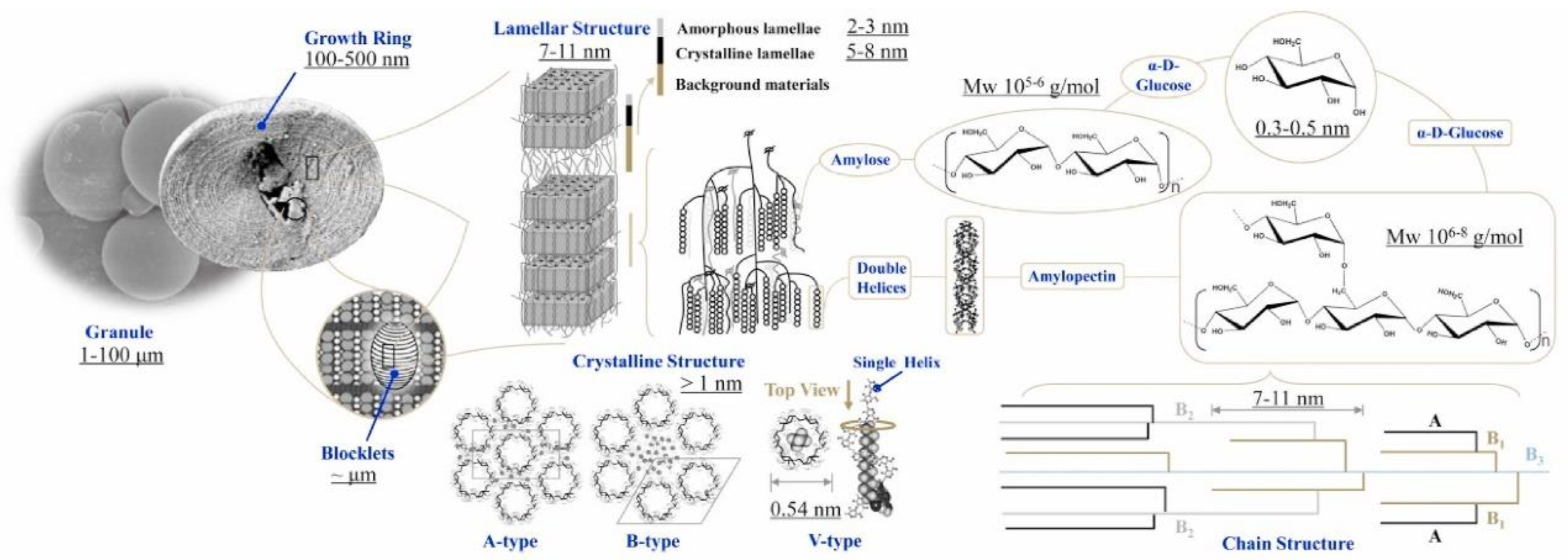
Figure 2.
Scheme of starch granule structures [23].
Figure 2.
Scheme of starch granule structures [23].
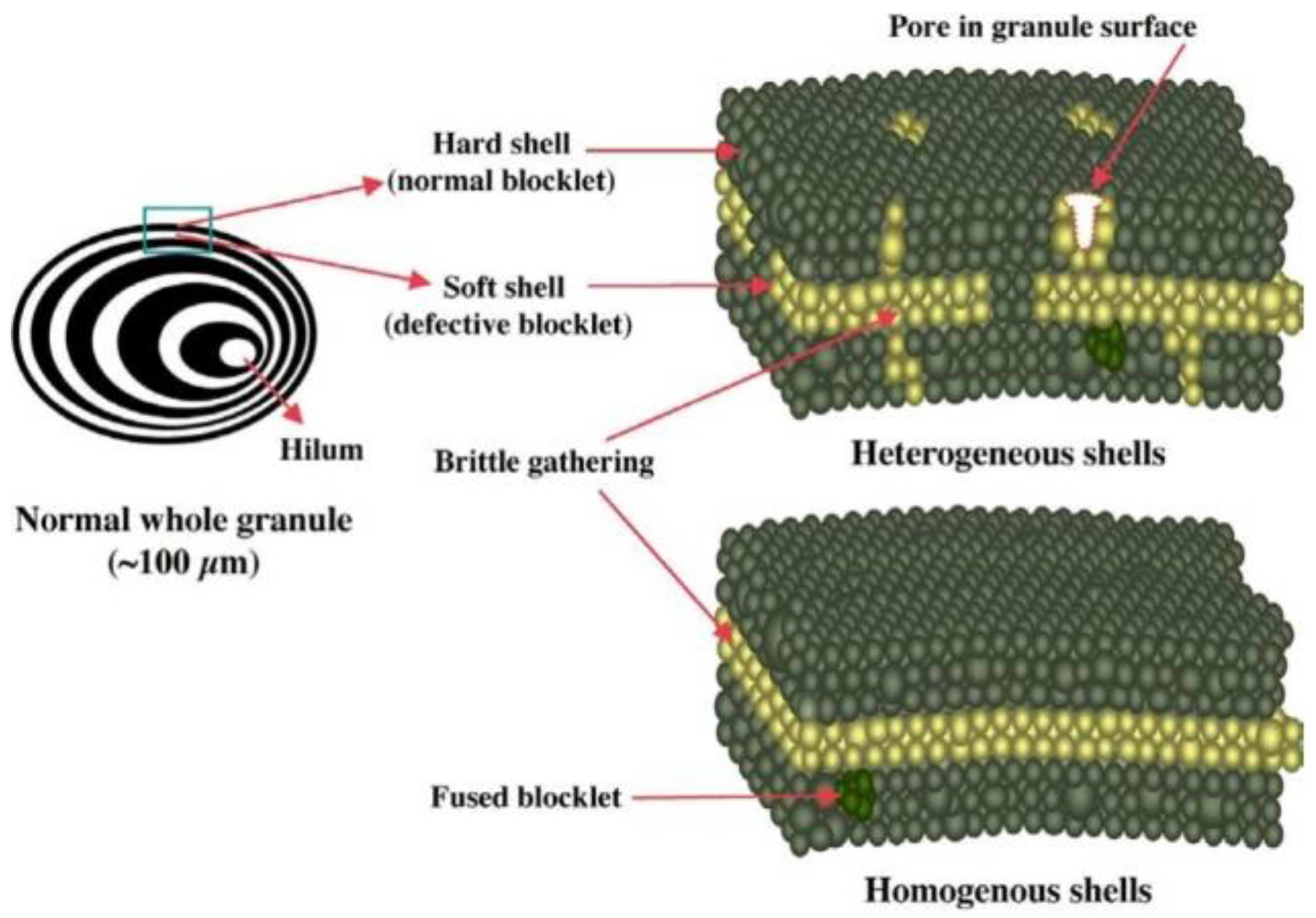
Figure 3.
Schematic representation of the phase transitions of starch during thermal processing and aging [94].
Figure 3.
Schematic representation of the phase transitions of starch during thermal processing and aging [94].
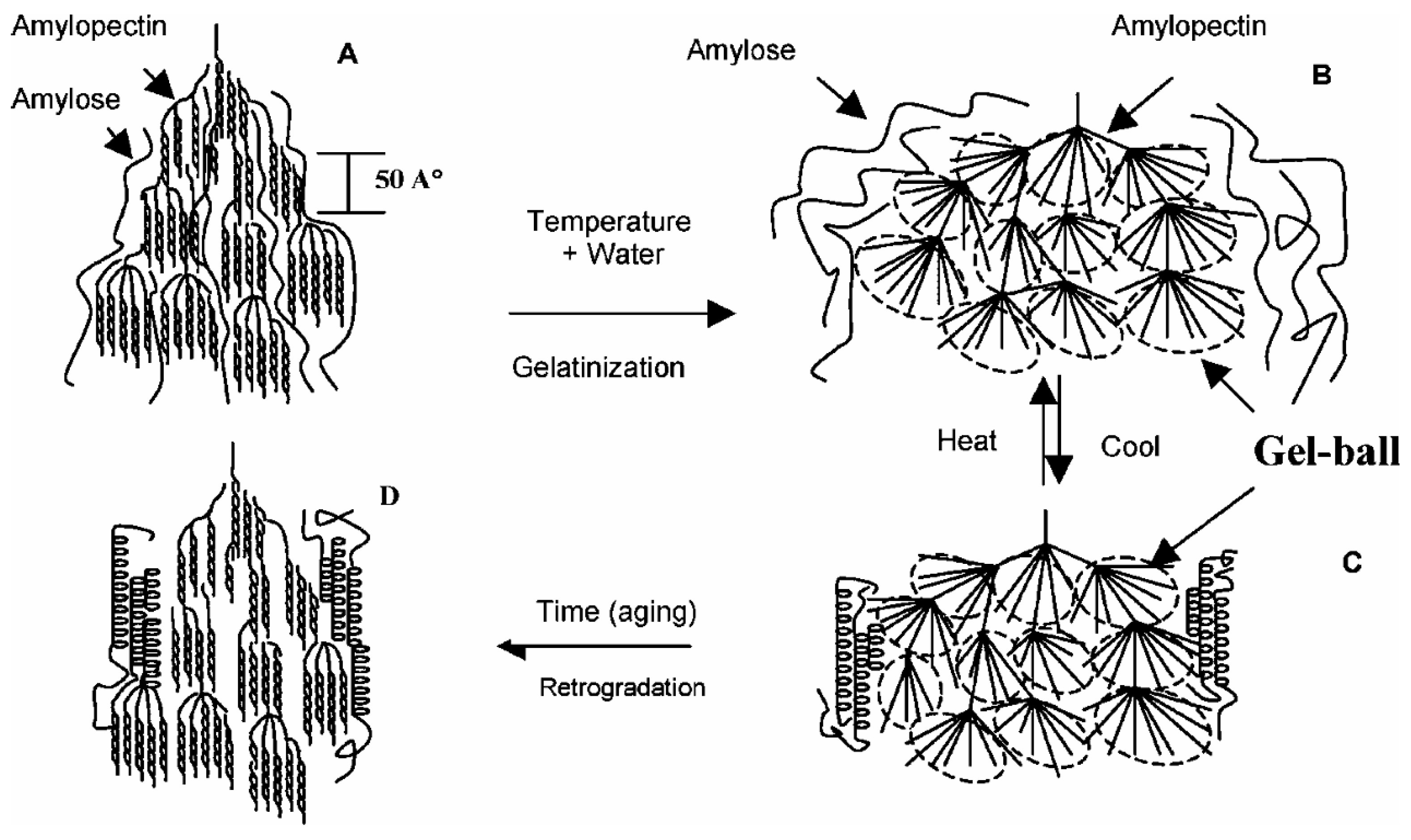
Figure 4.
Chemical modification on starch. Cross-linking modification with (1) CS2 (2) POCl3, Na3P3O9 (3) Epichlorhydrin and (4) C6H5O(COOH)3; Oxidation modification with (5) O3, HIO4; Grafting modification with (6) acrylamide with possible initiators; Etherification modification with (7) C3H6O (8) CH2ClCOONa (9) C2H5Cl; Acid hydrolysis with (10) HCl, TFA, HNO3; Esterification modification with (11) Na2HPO4 and (12) CH3COOH [142].
Figure 4.
Chemical modification on starch. Cross-linking modification with (1) CS2 (2) POCl3, Na3P3O9 (3) Epichlorhydrin and (4) C6H5O(COOH)3; Oxidation modification with (5) O3, HIO4; Grafting modification with (6) acrylamide with possible initiators; Etherification modification with (7) C3H6O (8) CH2ClCOONa (9) C2H5Cl; Acid hydrolysis with (10) HCl, TFA, HNO3; Esterification modification with (11) Na2HPO4 and (12) CH3COOH [142].
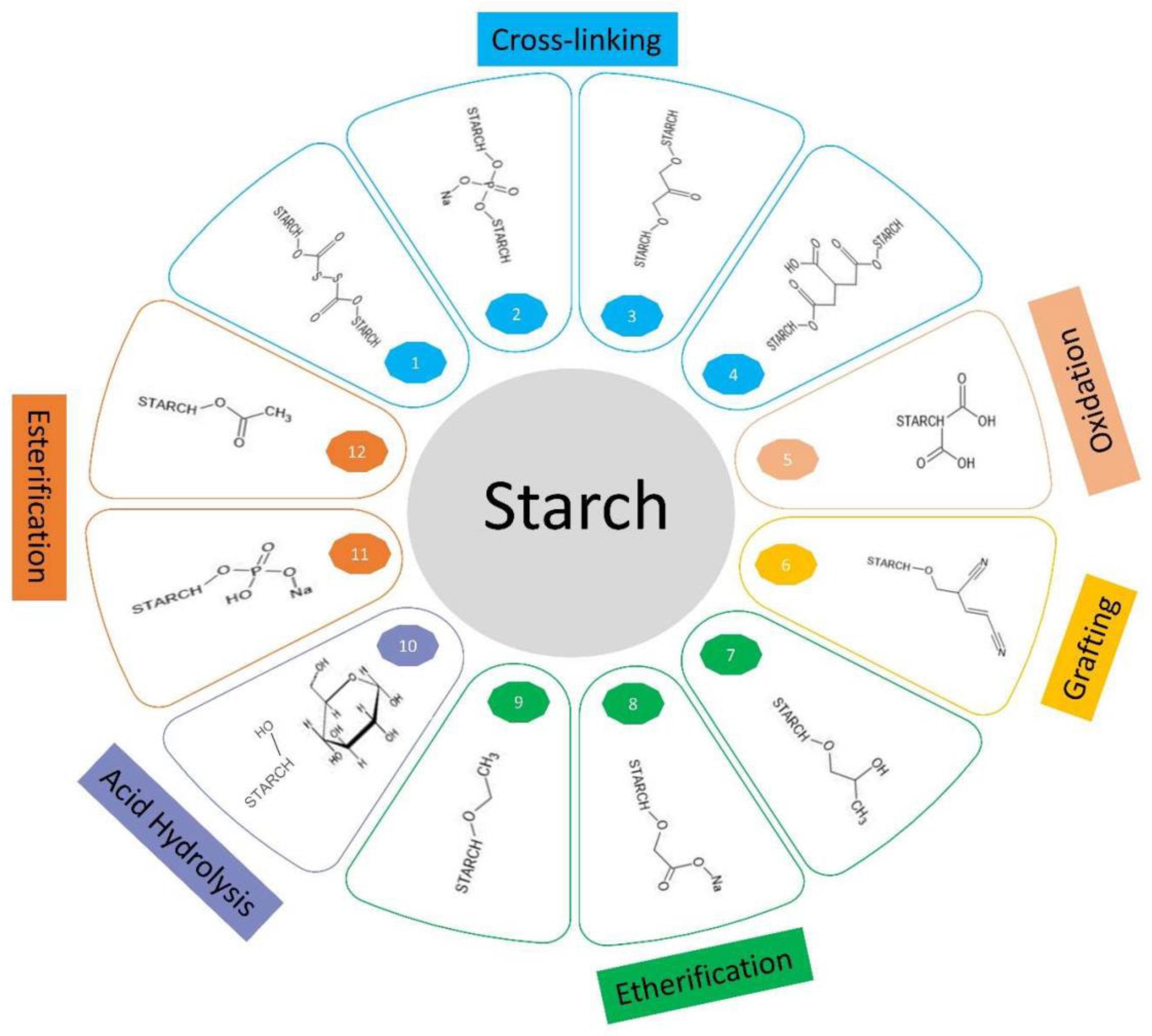
Figure 5.
Schematic summary of condensing reaction [145].
Figure 5.
Schematic summary of condensing reaction [145].
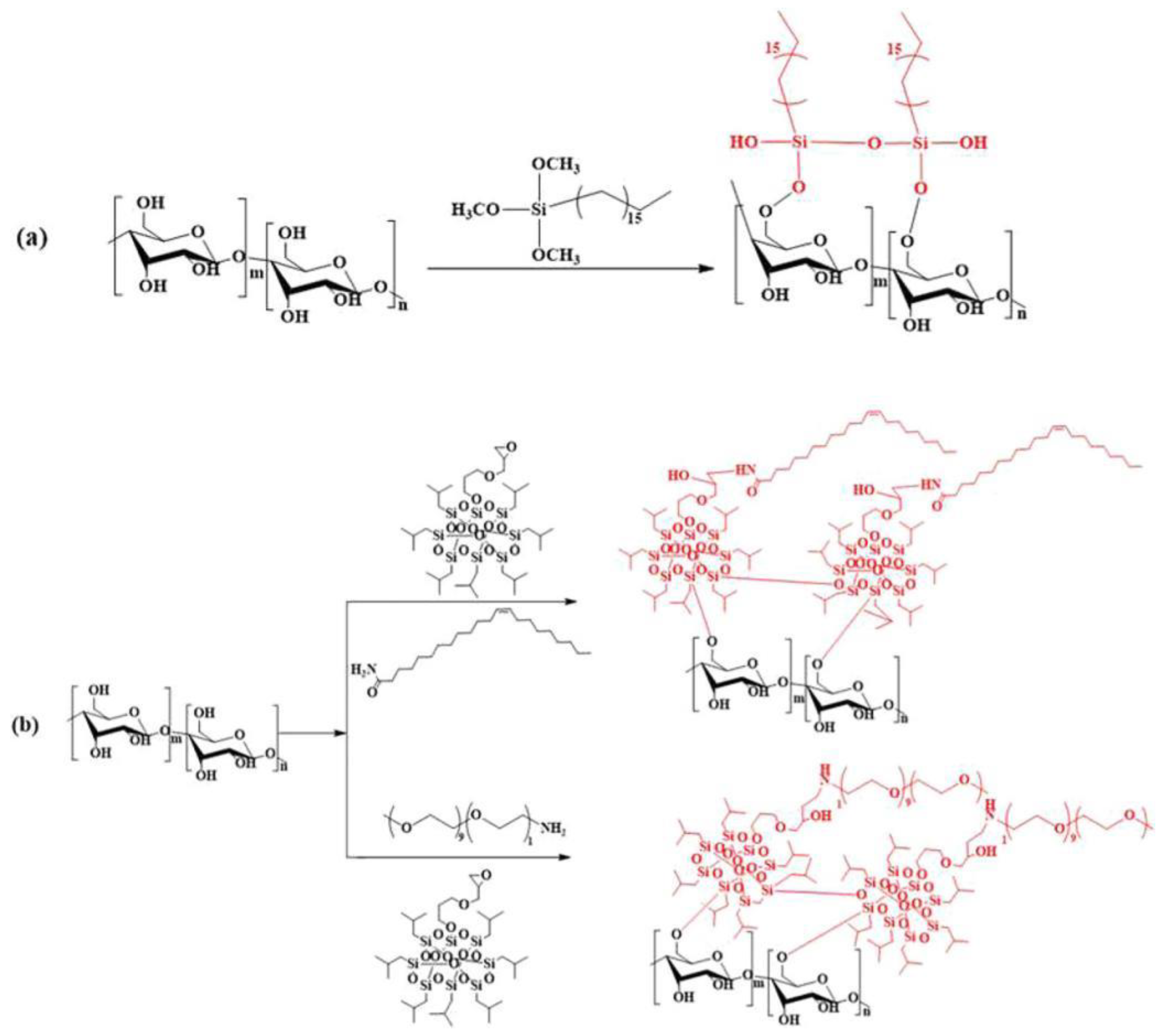
Disclaimer/Publisher’s Note: The statements, opinions and data contained in all publications are solely those of the individual author(s) and contributor(s) and not of MDPI and/or the editor(s). MDPI and/or the editor(s) disclaim responsibility for any injury to people or property resulting from any ideas, methods, instructions or products referred to in the content. |
© 2024 by the authors. Licensee MDPI, Basel, Switzerland. This article is an open access article distributed under the terms and conditions of the Creative Commons Attribution (CC BY) license (http://creativecommons.org/licenses/by/4.0/).
Copyright: This open access article is published under a Creative Commons CC BY 4.0 license, which permit the free download, distribution, and reuse, provided that the author and preprint are cited in any reuse.


