

Submitted:
13 November 2024
Posted:
14 November 2024
You are already at the latest version
Abstract
The aim was to understand and describe the physiological and biomechanical demands of various tasks used in basketball training and, subsequently, to provide a practical application of these tasks across a typical training week. Eighteen basketball players had their external load variables monitored across 179 training sessions using local positioning system technology. These variables included total distance covered, distance covered at various intensity levels, accelerations, decelerations, PlayerLoad™, and explosive efforts. The analysis revealed significant differences in both physiological and biomechanical loads across various drills. The results show that tasks with more space and fewer defenders impose higher physiological loads, while those with less space and more defenders increase biomechanical load. For training design, it is recommended to place tasks with higher biomechanical load at the beginning of the session and those with a physiological orientation towards the end. Understanding the distinct demands of different drills can help coaches better structure training sessions to optimize player load and performance development throughout the week.
Keywords:
team sports
; local positioning system
; load monitoring
; game demands
; training
1. Introduction
In recent years, extensive research has been conducted in team sports, particularly in basketball, to characterize game physical demands [1,2], identify the most demanding passages of play [3,4], to understand the influence of different training manipulations during training sessions, or even to better understand injury mechanisms [5,6]. So, for example, load quantification in basketball has been used to describe the average physical demands or peak demands in competition [1,2,7], observe differences between practice loads and competition loads [8,9,10,11,12], observe the evolution of practice load and the changes in performance throughout the season [13], examine how targeted training programs impact physical performance [14], describe player profiles by age [11,15,16], by gender [17] by position [10,16,18] and category or competitive level [19,20,21].
All this research helps us understand basketball, from a physical demand’s perspective, as an intermittent sport characterized by alternating offensive and defensive actions [22,23,24] and with frequent changes in the types of movement and intensity of the same [25,26] in which periods of high intensity alternate with periods of medium and low intensity in which actions occur unpredictably [24,27,28]. Therefore, it is evident that, during competition, there is an irregular alternation of aerobic and anaerobic physical demands [29] which places different neuromuscular and metabolic demands throughout the match. The different biomechanical, physiological, technical and tactical demands in basketball involve high variability in demand, movements and high intermittency in intensity [30,31,32].
Despite the abundance of indicators, there remains considerable confusion and inconsistency in their application and integration into training processes. Current basketball literature tends to be more descriptive than practical, offering limited insights into physiological or biomechanical stressors. As (Russell et al., (2020) noted in their systematic review, there is a clear misalignment between applied practices and methodological frameworks. Given the limitations of existing studies, it is not yet possible to draw definitive conclusions about the true physical demands of basketball. Most research to date (e.g.,; [4,5,16] analyzed the load experienced by the basketball player based on the classic differentiation between external and internal loading. However, several studies have highlighted the challenges and importance of differentiating between physiological and biomechanical load-response pathways in team sports, including basketball [32].
The monitoring of physiological and biomechanical load-adaptation in team sports, particularly in basketball, is a topic of increasing recognition and research. While the physiological loads have been a primary focus and refer to the work-energy relationship when players move around the court, biomechanical loads encompass the external forces the players are exposed to from their movements. It is well known that biomechanical and neuromuscular factors play an important role in horizontal deceleration during sports involving multidirectional movements, as it happens in basketball. The unique ground reaction force profile of horizontal deceleration, characterized by high-impact peak forces and loading rates, may increase vulnerability to excessive forces and risk of injury if the limbs cannot tolerate these forces [33]. Various metrics are available to quantify biomechanical loads experienced by the body as a whole, its different structures, and individual tissues, but the difficulty lies in measuring these loads within and outside the lab [34]. Biomechanical load involves the external forces acting on an athlete’s body, which can be monitored using Inertial Measurement Units (IMUs). These devices utilize Inertial Movement Analysis (IMA) to capture various biomechanical load variables, such as Player Load or jumps. They are used to monitor adaptations to training and their association with game performance. For example, in football, using Machine Learning techniques, Mandorino et al. [35] developed a new locomotor efficiency index (LEI) to assess the neuromuscular fitness of players. Subsequently, Mandorino et al. [36], analyzed how different training load periodization strategies affect the neuromuscular state of football players. In basketball, a study that quantified the workload during basketball-specific drills using microtechnology found that full-court 3v3 and 5v5 drills had the highest physical demands compared to other traditional balanced basketball drills like 2v2 and 4v4. The acceleration load per minute (AL.min-1) was used as a metric to assess the workload, indicating that the drill format influences the biomechanical load experienced by players [37]. More recently, Olthof et al. (2021) studied the statistical relationships between biomechanical loads in matches and training with game performance. In their results they found that training loads significantly affected game loads in the following match. In particular, increasing loads 2 days before the match resulted in an increase in expected match loads. These results suggested that biomechanical loads were good predictors of game performance.
What we do know for sure so far is that, from the manipulation of certain variables (e.g.,; number of players involved, full court vs half court) the load experienced by the players is clearly different (O’Grady et al., 2020; Svilar et al., 2019) and, therefore, the adaptations brought about by the training (e.g.,; Li et al., 2024). Taking into account all these ideas, therefore, the biomechanical load of the different exercises in basketball, and assuming that the ultimate aim of training should be to prepare the player for competition, we should try to design the training sessions according to this idea, observing the different loads provoked by each exercise used, not only in terms of internal and external load, but also in terms of physiological load and biomechanical load. Knowing the load, physiological or biomechanical, internal or external, each task proposed to the player involves, we could improve the design of the training sessions and, therefore, improve the final performance in competition.
To date and our knowledge of the specific literature, there is not much research that differentiates the type of load (physiological and/or biomechanical) of each task in basketball. There is certainly less literature that, in addition to describing the load, proposes a practical application of this knowledge that allows a better training design. Therefore, the aim of this article is twofold. Firstly, to know and describe the physiological and biomechanical load of the different tasks used in basketball training and, subsequently, to make a practical proposal of these tasks throughout a typical training week.
2. Materials and Methods
2.1. Sample
Elite male basketball players [40] from the same team competing in the highest regional division of an U18 Spanish basketball competition, were included in this study (n = 18, mean ± standard deviation [SD]: age 16.9 ± 0.8 years, height 196.6 ± 9.4 cm, body mass: 91.7 ± 8.2 kg). The monitoring took place during 179 training sessions.
Data collection occurred at the same facility over two consecutive seasons (2018-2019 and 2019-2020). For inclusion in the study, players had to complete a minimum of 50% of the training sessions (n = 90/179) throughout both seasons; those who did not meet this criterion were excluded from the analysis. Additionally, data from players who did not complete at least 80% of the total duration of a specific training session were excluded from that session’s data pool but remained in the overarching study.
After the application of exclusion criteria, 6 participants who entered the study were excluded from the analysis. Consequently, 2896 training data samples from a collective of 12 participants were subjected to analysis. This study was conducted in accordance to the Declaration of Helsinki [41].
2.2. Procedures
This observational investigation was conducted across a 2-year period throughout the 2019-2020 and 2020-2021 seasons. Each player wore a device (Vector S7; Catapult Sports, Melbourne, Australia) in a specially designed pocket within a vest, positioned on the upper thoracic spine between the scapulae. The devices contained an accelerometer (±16 g, 100 Hz), magnetometer (±4,900 µT, 100 Hz), gyroscope (up to 2,000 deg/sec, 100 Hz), and LPS. The ClearSky LPS (ClearSky S7, 10 Hz, firmware version 5.6.; Catapult Sports, Melbourne, Australia) is an ultra-wide band, 4-GHz transmitting system equipped with 24 anchors positioned around the perimeter of basketball stadium that was used to collect LPS data. The technology used in this study has been supported as valid in measuring distance [42,43,44,45], speed, accelerations, decelerations [42,43], and Player LoadTM [46], while similar LPS technology has been shown to be reliable (coefficient of variation (CV) <5%) in measuring distance and speed variables [45]. All players were familiarized with the monitoring technology, having worn the devices during training and games in the previous season. Each device was turned on ~20-40 min before the warm-up preceding each game. Players wore the same device throughout the study period to avoid inter-device variation in external load data outputs [47,48].
Activity editing occurred both during and after the session. To minimize significant inter-observer variability, the editing process for all activities was consistently undertaken by the same individual. During training sessions, the duration was defined as the time, in minutes, that a player actively participated in the training, excluding intervals between exercises, hydration breaks, or instances when a player, during a task, was not actively engaged. A player was considered inactive during a task if they were off the court and did not participate (e.g., in a 5v5, where a player awaits off-court to substitute for a teammate). After completing the data collection, the Catapult Sports Openfield cloud software (version 1.22.0) was used to extract data from each player for every training session, segmented by task. Subsequently, following the predefined exclusion criteria, the collected data were exported into a Microsoft Excel spreadsheet (version 16.0, Microsoft Corporation, Redmond, WA) for further analysis. Drills were classified based on their specificity from 0 to 5, following the classification by [37]. Level 0-1 activities were those performed outside the basketball court and unrelated to basketball practice (e.g., cycling), while level 5 represented an official basketball game (Table 1).
2.3. Physical Variables
The selected physical parameters were categorized into two types (physiological and biomechanical variables) [30,32]. Each variable was extracted and represented as a relative value, indicating the rate of accumulation of that parameter per minute.
2.3.1. Physiological Variables
The following 5 variables were considered physiological: distance (m) per minute covered (TD) and distance (m) per minute covered in different intensity zones including: standing-walking (S-W) = <7 km·h-1; jogging (JOG) = 7-14 km·h-1’; running (RUN) = 14.01-18 km·h-1; and high-speed running (HSR) >18 km·h-1, as previously used in basketball research [19].
To categorized tasks based on the physiological load orientation, a two-step cluster analysis was conducted (average silhouette = 0.5) using the physiological parameters: total distance per minute, distance per minute in different thresholds (Table 2). Tasks were grouped into four categories: low physiological load, medium physiological load, high physiological load, and very high physiological load. Each category was assigned a numerical value, with 1 representing low physiological load, 2 for medium physiological load, 3 for high physiological load, and 4 for very high physiological load.
To determine the physiological load of each task, an average was calculated for each task based on the numerical value of the cluster load ranging from 1 to 4. For instance, if 100 official match records are distributed with 50 in cluster number 4 and 50 in cluster number 3, the average of the 100 records would be a value of 3.5, indicating a physiological load of 3.5.
2.3.2. Biomechanical Variables
The following 5 variables were considered biomechanical: Jumps per minute (JUMPS) > 20 cm, accelerations per minute (ACC) (count) performed >2 m·s-2 (dwell time: 0.3 seconds), decelerations per minute (DEC) (count) performed >-2 m·s-2 (dwell time: 0.3 s), PlayerLoad™ per minute (PL) (arbitrary units [AU]), and explosive efforts per minute (EE). These dwell times were chosen given values between 0.3 and 0.4 s have been identified as the most readily used in basketball settings [49,50,51].
PL was calculated as the square root of the sum of the instantaneous rate of change in acceleration in the three movement planes (x-, y, and z-axis) using the following formula [7,50]: , where fwd indicates movement in the anterior-posterior direction, side indicates movement in the medial-lateral direction, up indicates vertical movement, and t represents time while EE were calculated as the number of inertial movements per minute (n·min) derived from the analysis of high and medium-intensity inertial movements (accelerations, decelerations and change of directions).
To group the tasks based on the biomechanical load orientation, a two-step cluster analysis was conducted (average silhouette = 0.5) using the biomechanical parameters: JUMPS, ACC, DEC, PL and EE (Table 3). The exercises were grouped into tasks with low biomechanical load and tasks with high biomechanical load. A numerical value of 1 was assigned to low biomechanical load, while a value of 2 was given to high biomechanical load. To determine the biomechanical load of each task, an average was calculated for each task based on the numerical value of the cluster load ranging from 1 to 2.
2.4. Statistical Analysis
The mean, standard deviation (SD), and coefficient of variation (CV) were determined to describe the external physical load for each drill, while for describing the load orientation, mean, median, and SD were utilized.
Linear Mixed Model (LMM) was used to identify differences in external load and its orientation between drills (1v0 -Individual Technical-Tactical- half court, 1v1 in longitudinal half court-28x7.5m-, 2v0 -Individual Technical-Tactical- half court, 2v2 full court, 3v0 full court, 3v3 full court, 3v3v3, 4v0 full court, 4v4 full court, 4v4v4, 5v0 full court, 5v5 full court, 5v5v5 and Eleven player break).
“Player” was used as a random effect. Tasks were included as nominal predictor variables in the LMM at 14 levels (1v0 -Individual Technical-Tactical- half court, 1v1 full court in longitudinal half -28x7.5m-, 2v0 -Individual Technical-Tactical- half court, 2v2 full court, 3v0 full court, 3v3 full court, 3v3v3, 4v0 full court, 4v4 full court, 4v4v4, 5v0 full court, 5v5 full court, 5v5v5, Eleven player break).
Cohen’s effect size (ES) and the mean difference with 95% confidence intervals (CI) were determined for all pairwise comparisons and interpreted as: trivial = <0.20; small = 0.20-0.59; moderate = 0.60-1.19; large = 1.20-1.99; and very large = >2.00 [53]. All analyses were conducted using IBM SPSS for Windows (version 23, IBM Corporation, Armonk, New York), except ES, which were calculated using a customized Microsoft Excel spreadsheet (version 16.0, Microsoft Corporation, Redmond, WA).
3. Results
Descriptive analysis for each drill according to physical orientation (physiological or biomechanical) and specificity is presented in Table 4. The distribution of drills based on the orientation of the training load orientation is shown in Figure 1.
The descriptive analysis (mean, ± SD, and % CV) of the external physical load of training drills and the effect size ± 95% CI of the differences between tasks (1v0 -Individual Tactical-Technical- half-court vs. 1v1 full court in longitudinal middle -28x7.5m-, 2v0 -Individual Tactical-Technical- half-court, 2v2 full court, 3v0 full court, 3v3 full court, 3v3v3, 4v0 full court, 4v4 full court, 4v4v4, 5v0 full court, 5v5 full court, 5v5v5, Eleven Player Break) are shown in Figure 2.
Regarding the comparison for physiological load (Figure 3), it is notable that 4v4v4 was significantly lower than 3v3 full court (ES: -1.26), Eleven Player Fast Break (ES: -1.45), and 3v0 full court (ES: -1.30). Furthermore, Eleven Player Fast Break showed significantly higher values than 1v1 full court (ES: 1.23).
Regarding the comparison between tasks for the biomechanical Load (Figure 3), 5v5 full court, 4v4 full court, and 3v3 full court showed significantly higher values than 4v0 full court (ES 5v5 full court: 1.37; ES 4v4 full court: 1.23; ES 3v3 full court: 1.49), 3v0 full court (ES 5v5 full court: 1.67; ES 4v4 full court: 1.85; ES 3v3 full court: 1.88), 2v0 half court (ES 5v5 full court: 1.71; ES 4v4 full court: 1.71; ES 3v3 full court: 1.38), and 1v0 half court (ES 5v5 full court: 1.59; ES 4v4 full court: 1.58; ES 3v3 full court: 1.31). Additionally, 4v4 full court also showed significantly higher values than 5v0 full court (ES: 1.23).
Concerning 3v3v3, the results showed significantly higher values than 3v0 full court (ES: 1.65), 2v0 half court (ES: 1.38), and 1v0 half court (ES: 1.31). Moreover, Eleven Player Fast Break reached significantly higher values than 3v0 full court (ES: 1.29). Regarding 1v1 full court, it showed significantly higher values compared to 5v0 full court (ES: 1.23), 4v0 full court (ES: 1.56), 3v0 full court (ES: 1.93), 2v0 half court (ES: 1.78), and 1v0 half court (ES: 1.64). Finally, 5v0 full court obtained significantly higher values than 4v0 full court (ES: 1.30).
Regarding the comparisons of physiological and biomechanical load, significant differences (p <0.05) with effect sizes ranging from trivial to very large are shown in Table 5.
4. Discussion
The aim of this article was twofold. Firstly, to know and describe the physiological and biomechanical load of the different tasks used in basketball training and, subsequently, to make a practical proposal of these tasks throughout a typical training week.
In relation to the first goal, the present study has allowed us to categorize the different tasks used in basketball training under the perspective of physiological load or biomechanical load. One of the main reasons for conducting this study is that, as reflected in several specific investigations [2,5], there are still many limitations in the research carried out to date on this topic given the large number of variables that can modify the load imposed by each of the tasks used in basketball. Moreover, this aspect is usually analyzed under the view of high or low load, i.e., under the perspective of the amount of load, but not under the perspective of the nature of the training load, which can be physiological or neuromuscular in nature [32]. For example, in the results of the review by O’Grady et al. (2020) [2], it is pointed out that the result of different studies analyzed [37] (Schelling & Torres-Ronda, 2016; Vazquez Guerrero et al., 2018) [37,53], suggest that SSGs with fewer players (2v2, 3v3) cause a greater training load, both internally and externally, compared to SSGs with a greater number of players (4v4, 5v5), and that exercises used in full-court also involve a greater external load than those performed in half-court, regardless of team size. Similarly, Clemente (2016) [54] suggests that involving fewer players in SSGs means higher intensity compared to 5v5. Atli et al. (2013) [55] also suggest that, when the number of players remains constant, but the playing area increases (leading to an increase in the relative distance to be covered), significant differences in the load of each of the SSGs arise. While most of the results found so far are in line with these ideas (Svilar et al., 2019; Torres-Ronda et al., 2016; Vazquez-Guerrero et al., 2018) [37,39,53], they are still very generalist, because as the results of the present research show, under the perspective of biomechanical and physiological loading, these results can be nuanced, and therefore, would be a better help for coaches when designing training sessions.
Therefore, the results of this study are considered relevant, as it is the first research, to the best of the researchers’ knowledge, to classify the different training tasks based on the nature of the load, i.e., physiological load or biomechanical load. The main results obtained can be seen graphically in Figure 1. In summary, it could be said that those tasks that cover more space (full court vs. half court) and with fewer defenders (3vs3, 2vs2, 11 counterattack, 5v0, 4v0, 3v0) have a higher physiological load, while tasks without defense tend to have lower values of biomechanical load. However, those tasks with less space and more defenders (3v3v3, 4v4v4, 5v5, 4v4) have a higher biomechanical load.
It could be concluded that the higher biomechanical load is closely related to the presence of defenders. However, in the case of 1v0 and 2v0 tasks, although less demanding, it should be noted that they present a certain biomechanical load (as they are normally linked to technical work, and therefore accumulate a high number of jumps/min). In this sense, the study by Schelling & Torres (2016) [37] also found that, for variables such as accelerations per minute, half court exercises were more demanding. Specifically, 2v2 and 5v5 in half court showed the highest values of accelerations per minute among the different SSGs analyzed. In the study by Olthof et al. (2021) [38], they found a positive association between the biomechanical load of the training sessions with the players’ statistics during the match and suggested that biomechanical loads were good predictors for game performance, in the way that excessive biomechanical loads from training may negatively impact game performance. Finally, Castillo et al. (2020) [56]found that significant differences in high decelerations and jumps when considering the interaction of the factors defensive style and game-based drills outcome.
Although numerous modulators of the external load (opposition/non-opposition, number of opponents, type of opposition, limitation of technical actions or feedback from the coach) have been described in the specific literature, the playing space seems to be the fundamental variable in the regulation of the intensity of the exercises (i.e.,; [2,4,54]). The m2/player ratio determines and guides the task load. By modifying/restricting the absolute (total m2) or relative (m2/player) spaces, the biomechanical and physiological demands of the exercises can be modulated to a large extent. However, the results obtained in the present study qualify this idea, as it is not only space that will be the main modulator of the load experienced by the player, but also the presence or absence of defenders. The combination of these two variables will therefore be the main modulator of the tasks to impose a greater physiological or biomechanical load on the athlete. This could coincide with the results obtained by Sansone et al. (2023), who, while analyzing the training tasks used in basketball from a different perspective, come to the conclusion that the modification of the number of players involved in the task and the space available to the player should be used to modify the external load experienced.
However, in the present study we should avoid having a dichotomous view of this perspective, and it would be much more convenient to understand this analysis, not as an analysis of the training tasks between two extremes (high physiological load or high biomechanical load), but as a continuum between these possibilities. In this sense, according to the results obtained, it would be much more advisable to classify the tasks as exercises fundamentally of biomechanical orientation (1v1 full court, 3v3v3, 4v4v4v, 5v5v5), exercises fundamentally of physiological orientation (3v0 full court, 4v0 full court, 5v5v5), low intensity mixed orientation drills (1v0 half court, 2v0 half court) and high intensity mixed orientation drills (official match, 4v4 full court, 3v3 full court, 5v5 full court, counter attack of 11, 2v2 full court).
In relation to the second goal, it is necessary to highlight its clear practical application, as the present analysis allows us to model training based on the knowledge of the real impact of each task. With this objective we could define different types of sessions as shown in the Table 6. Based on the results obtained, depending on the objectives we are looking for when designing the training, we will be able to select more suitable tasks for each of these objectives:
Other of the main applications of this tasks classification is the weekly design of training according to the number of competitions and their location. The weekly tapering or short-term tapering is the weekly adjustment of the training load with the objective of obtaining an optimal performance for the competition. This programming involves an overload phase (the days furthest away from the competition) and a tapering phase (the days closest to the competition). Since there is a high sensitivity of physical qualities to tapering in team sports, understanding the differences in the demands of the different tasks allows us to improve the exercise selection system and training design, especially when seeking to optimize weekly performance. It should be noted that there are studies that have revealed a large inter-individual variability in individual sports in response to tapering.
Greater control of the training stimulus and the adaptations that occur during periods of progressive loading and tapering, especially during periods of intense physiological and psychological stress, i.e., prior to competition, could improve training design and management of the training load. Therefore, the choice of exercises could be crucial to establish an optimal pre-competition physical load.
The main limitation of the present study is that probably not all the possible tasks to be used in basketball training have been analyzed, although it can be observed that most of the tasks normally used in training sessions are included. However, what is relevant is that it allows a more correct design of the training sessions by placing the tasks with a greater biomechanical impact at the beginning of the sessions and trying to place the tasks with a greater physiological orientation towards the end of the training. Similarly, if the objective of the planned training is more related to fatigue endurance work, the predominant tasks should be those with a high physiological load; whereas if the objective of the training is mainly tactical or strategic, the tasks to be used will have a high biomechanical load.
5. Conclusions
This study classifies basketball training tasks based on their physiological or biomechanical load, showing that tasks with more space and fewer defenders impose higher physiological loads, while those with less space and more defenders increase biomechanical load. For training design, it is recommended to place tasks with higher biomechanical load at the beginning of the session and those with a physiological orientation towards the end. Manipulating space and the presence of defenders allows for adjusting task intensity to meet specific objectives, optimizing performance and avoiding overtraining.
Author Contributions
For research articles with several authors, a short paragraph specifying their individual contributions must be provided. The following statements should be used “Conceptualization, E.A.P-C. and A.L.; methodology, E.A.P-C and C.R.; software, C.R formal analysis, E.A.P-C. ; investigation, E.A.P-C and C.S.; resources, E.A.P-C. and C.S.; data curation, E.A.P-C, C.R and C.S.; writing—original draft preparation, E.A.P-C and C.R.; writing—review and editing, E.A.P-C and A.L.; visualization, E.A.P-C and C.R.; supervision, C.S, X.S. and A.L.; project administration, C.S.; funding acquisition, A.L. All authors have read and agreed to the published version of the manuscript.” Please turn to the CRediT taxonomy for the term explanation. Authorship must be limited to those who have contributed substantially to the work reported.
Funding
“This research received no external funding”
Institutional Review Board Statement
This study was conducted in accordance to the Declaration of Helsinki [41].
Informed Consent Statement
“Informed consent was obtained from all subjects involved in the study.”
Conflicts of Interest
The authors declare no conflicts of interest.”
References
- Abdelkrim, B.; El Fazaa, S.; El Ati, J. Time-Motion Analysis and Physiological Data of Elite Under-19-Year-Old Basketball Players During Competition. Br J Sports Med 2007, 41, 69–75. [Google Scholar] [CrossRef]
- O’Grady, C.; Fox, J.; Dalbo, V.; Scanlan, A. A Systematic Review of the External and Internal Workloads Experienced during Games-Based Drills in Basketball Players. Int J Sports Physiol Perform 2020, 15, 603–616. [Google Scholar] [CrossRef] [PubMed]
- Alonso-Pérez-Chao, E.; Portes, R.; Gómez, M.Á.; Parmar, N.; Lorenzo, A.; Jiménez Sáiz, S.L. A Narrative Review of the Most Demanding Scenarios in Basketball: Current Trends and Future Directions. J Hum Kinet 2023, 89, 231–245. [Google Scholar] [CrossRef]
- Sansone, P.; Gasperi, L.; Makivic, B.; Gomez-Ruano, M.A.; Tessitore, A.; Conte, D. An Ecological Investigation of Average and Peak External Load Intensities of Basketball Skills and Game-Based Training Drills. Biol Sport 2023, 40, 649–656. [Google Scholar] [CrossRef] [PubMed]
- Russell, J.L.; Mclean, B.D.; Impellizzeri, F.M.; Strack, D.S.; Coutts, A.J. Measuring Physical Demands in Basketball : An Explorative Systematic Review of Practices. Sports Medicine 2020. [Google Scholar] [CrossRef]
- Torres-Ronda, L.; Gámez, I.; Robertson, S.; Fernández, J. Epidemiology and Injury Trends in the National Basketball Association: Pre- and PerCOVID-19 (2017–2021). PLoS One 2022, 17. [Google Scholar] [CrossRef]
- Alonso, E.; Miranda, N.; Zhang, S.; Sosa, C.; Trapero, J.; Lorenzo, J.; Lorenzo, A. Peak Match Demands in Young Basketball Players: Approach and Applications. Int J Environ Res Public Health 2020, 17, 2256. [Google Scholar] [CrossRef]
- Montgomery, P.; Pyne, D.; Minahan, C. The Physical and Physiological Demands of Basketball Training and Competition. Int J Sports Physiol Perform 2010, 5, 75–86. [Google Scholar] [CrossRef]
- Portes, R.; Ribas, C.; López García, A.; Alonso Pérez-Chao, E. A Comparison of Training and Competition Physical Demands in Professional Male Basketball Players. International Journal of Basketball Studies 2023, 2, 25–33. [Google Scholar] [CrossRef]
- Torres-Ronda, L.; Ric, A.; Llabres-Torres, I.; De Las Heras, B.; Schelling, X. Position-Dependent Cardiovascular Response and Time-Motion Analysis during Training Drills and Friendly Matches in Elite Male Basketball Players. Journal of Stregth and Conditioning Research 2016, 30, 60–70. [Google Scholar] [CrossRef]
- Brandão, F.M.; Junior, D.B.R.; da Cunha, V.F.; Meireles, G.B.; Filho, M.G.B. Differences between Training and Game Loads in Young Basketball Players. Revista Brasileira de Cineantropometria e Desempenho Humano 2019, 21. [Google Scholar] [CrossRef]
- Fox, J.L.; Stanton, R.; Scanlan, A.T. A Comparison of Training and Competition Demands in Semiprofessional Male Basketball Players. Res Q Exerc Sport 2018, 89, 103–111. [Google Scholar] [CrossRef]
- Conte, D.; Kolb, N.; Scalan, A.T.; Santolamazza, F. Monitoring Training Load and Well-Being during the Un-Season Phase in NCAA Division I Men’s Basketball. Int J Sports Physiol Perform 2015, 13, 1067–1074. [Google Scholar] [CrossRef]
- Freitas, C.G.; Aoki, M.S.; Arruda, A.F.S.; Franciscon, C.; Moreira, A. Monitoring Salivary Immunoglobulin A Responses to Official and Simulated Matches in Elite Young Soccer Players. J Hum Kinet 2016, 53, 107–115. [Google Scholar] [CrossRef]
- Lupo, C.; Tessitore, A.; Gasperi, L.; Gomez, M.A.R. Session-RPE for Quantifying the Load of Different Youth Basketball Training Sessions. Biol Sport 2017, 34, 11–17. [Google Scholar] [CrossRef] [PubMed]
- Reina, M.; García-Rubio, J.; Feu, S.; Ibáñez, S.J. Training and Competition Load Monitoring and Analysis of Women’s Amateur Basketball by Playing Position: Approach Study. Front Psychol 2019, 9, 1–11. [Google Scholar] [CrossRef]
- Scanlan, A.; Dascombe, B.; Kidcaff, A.P.; Peucker, J.; Dalbo, V. Gender-Specific Activity Demands Experienced during Semiprofessional Basketball Game Play. Int J Sports Physiol Perform 2015, 10, 618–625. [Google Scholar] [CrossRef]
- Abdelkrim, B.N.; Chaouachi, A.; Chamari, K.; Chtara, M.; Castagna, C. Positional Role and Competitive-Level Differences in Elite-Level Men’s Basketball Players. J Strength Cond Res 2010, 24, 1346–1355. [Google Scholar] [CrossRef]
- Sosa, C.; Lorenzo, A.; Trapero, J.; Ribas, C.; Alonso, E.; Jimenez, S.L. Specific Absolute Velocity Thresholds during Male Basketball Games Using Local Positional System; Differences between Age Categories. Applied Sciences 2021, 11. [Google Scholar] [CrossRef]
- Pojskić, H.; Šeparović, V.; Užičanin, E. Modelling Home Advantage in Basketball at Different Levels of Competition; 2011; Vol. 5;
- Trapero, J.; Sosa, C.; Shao Liang, Z.; Portes, R.; Gómez Ruano, M.A.; Bonal, J.; Jiménez Saiz, S.; Lorenzo, A. Comparison of the Movement Characteristics Based on Position-Specific Between Semi-Elite and Elite Basketball Players. Revista de Psicología del Deporte 2019, 28, 140–145. [Google Scholar]
- Aschendorf, P.F.; Zinner, C.; Delextrat, A.; Engelmeyer, E.; Mester, J. Effects of Basketball-Specific High-Intensity Interval Training on Aerobic Performance and Physical Capacities in Youth Female Basketball Players. Physician and Sportsmedicine 2019, 47, 65–70. [Google Scholar] [CrossRef]
- Maggioni, M.A.; Bonato, M.; Stahn, A.; Torre, A. La; Agnello, L.; Vernillo, G.; Castagna, C.; Merati, G. Effects of Ball Drills and Repeated-Sprint-Ability Training in Basketball Players. Int J Sports Physiol Perform 2019, 14, 757–764. [Google Scholar] [CrossRef]
- Stojanović, E.; Stojiljković, N.; Scanlan, A.T.; Dalbo, V.J.; Berkelmans, D.M.; Milanović, Z. The Activity Demands and Physiological Responses Encountered During Basketball Match-Play: A Systematic Review. Sports Medicine 2018, 48, 111–135. [Google Scholar] [CrossRef] [PubMed]
- Matthew, D.; Delextrat, A. Heart Rate, Blood Lactate Concentration, and Time-Motion Analysis of Female Basketball Players During Competition. J Sports Sci 2009, 27, 813–821. [Google Scholar] [CrossRef] [PubMed]
- McInnes, S.E.; Carlson, J.S.; Jones, C.J.; McKenna, M.J. The Physiological Load Imposed on Basketball Players During Competition. J Sports Sci 1995, 13, 387–397. [Google Scholar] [CrossRef] [PubMed]
- Doma, K.; Leicht, A.; Sinclair, W.; Schumann, M.; Damas, F.; Burt, D.; Woods, C. Impact of Exercise-Induced Muscle Damage on Performance Test Outcomes in Elite Female Basketball Players. J Strength Cond Res 2018, 32. [Google Scholar] [CrossRef] [PubMed]
- Edwards, T.; Spiteri, T.; Piggott, B.; Bonhotal, J.; Haff, G.G.; Joyce, C. Monitoring and Managing Fatigue in Basketball. Sports 2018, 6, 1–14. [Google Scholar] [CrossRef]
- Scanlan, A.; Wen, N.; Tucker, P.; Dalbo, V. The Relationships between Internal and External Training Load Models during Basketball Training. J Strength Cond Res 2014, 28. [Google Scholar] [CrossRef]
- Coyne, J.O.C.; Gregory Haff, G.; Coutts, A.J.; Newton, R.U.; Nimphius, S. The Current State of Subjective Training Load Monitoring—a Practical Perspective and Call to Action. Sports Med Open 2018, 4, 58. [Google Scholar] [CrossRef]
- Oba, W.; Okuda, T. A Cross-Sectional Comparative Study of Movement Distances and Speed of the Players and a Ball in Basketball Game. International Journal of Sport and Health Science 2008, 6, 203–212. [Google Scholar] [CrossRef]
- Vanrenterghem, J.; Nedergaard, N.J.; Robinson, M.A.; Drust, B. Training Load Monitoring in Team Sports: A Novel Framework Separating Physiological and Biomechanical Load-Adaptation Pathways. Sports Medicine 2017, 47, 2135–2142. [Google Scholar] [CrossRef] [PubMed]
- Harper, D.J.; McBurnie, A.J.; Santos, T.D.; Eriksrud, O.; Evans, M.; Cohen, D.D.; Rhodes, D.; Carling, C.; Kiely, J. Biomechanical and Neuromuscular Performance Requirements of Horizontal Deceleration: A Review with Implications for Random Intermittent Multi-Directional Sports. Sports Medicine 2022, 52, 2321–2354. [Google Scholar] [CrossRef] [PubMed]
- Warathanagasame, P.; Sakulsriprasert, P.; Sinsurin, K.; Richards, J.; McPhee, J.S. Comparison of Hip and Knee Biomechanics during Sidestep Cutting in Male Basketball Athletes with and without Anterior Cruciate Ligament Reconstruction. J Hum Kinet 2023, 88, 17–27. [Google Scholar] [CrossRef]
- Mandorino, M.; Tessitore, A.; Leduc, C.; Persichetti, V.; Morabito, M.; Lacome, M. A New Approach to Quantify Soccer Players’ Readiness through Machine Learning Techniques. Applied Sciences (Switzerland) 2023, 13. [Google Scholar] [CrossRef]
- Mandorino, M.; Tessitore, A.; Lacome, M. Loading or Unloading? This Is the Question! A Multi-Season Study in Professional Football Players. Sports 2024, 12. [Google Scholar] [CrossRef]
- Schelling, X.; Torres, L. Accelerometer Load Profiles for Basketball-Specific Drills in Elite Players. J Sports Sci Med 2016, 15, 585–591. [Google Scholar] [CrossRef]
- Olthof, S.B.H.; Tureen, T.; Tran, L.; Brennan, B.; Winograd, B.; Zernicke, R.F. Biomechanical Loads and Their Effects on Player Performance in NCAA D-I Male Basketball Games. Front Sports Act Living 2021, 3. [Google Scholar] [CrossRef]
- Svilar, L.; Castellano, J.; Jukic, I. Comparison of 5vs5 Training Games and Match Play Using Microsensor Technology in Elite Basketball. J Strength Cond Res 2019, 33, 1897–1903. [Google Scholar] [CrossRef]
- McKay, A.K.A.; Stellingwerff, T.; Smith, E.S.; Martin, D.T.; Mujika, I.; Goosey-Tolfrey, V.L.; Sheppard, J.; Burke, L.M. Defining Training and Performance Caliber: A Participant Classification Framework. Int J Sports Physiol Perform 2022, 17, 317–331. [Google Scholar] [CrossRef]
- Harriss, D.J.; Atkinson, G. Ethical Standards in Sport and Exercise Science Research: 2014 Update. International Journal Sports Medicine 2014, 34, 1025–1029. [Google Scholar] [CrossRef]
- Hodder, R.W.; Ball, K.A.; Serpiello, F.R. Criterion Validity of Catapult Clearsky T6 Local Positioning System for Measuring Inter-Unit Distance. Sensors 2020, 20, 3693. [Google Scholar] [CrossRef]
- Luteberget, L.; Spencer, M.; Gilgien, M. Validity of the Catapult ClearSky T6 Local Positioning System for Team Sports Specific Drills, in Indoor Conditions. Front Physiol 2018, 9, 115. [Google Scholar] [CrossRef]
- Serpiello, F.R.; Hopkins, W.G.; Barnes, S.; Tavrou, J.; Duthie, G.M.; Aughey, R.J.; Ball, K. Validity of an Ultra-Wideband Local Positioning System to Measure Locomotion in Indoor Sports. J Sports Sci 2018, 36, 1727–1733. [Google Scholar] [CrossRef] [PubMed]
- Hoppe, M.W.; Baumgart, C.; Polglaze, T.; Freiwald, J. Validity and Reliability of GPS and LPS for Measuring Distances Covered and Sprint Mechanical Properties in Team Sports. PLoS One 2018, 13, e0192708. [Google Scholar] [CrossRef]
- Luteberget, L.; Holme, B.; Spencer, M. Reliability of Wearable Inertial Measurement Units to Measure Physical Activity in Team Handball. Int J Sports Physiol Perform 2017, 13, 467–473. [Google Scholar] [CrossRef]
- Castellano, J.; Casamichana, D.; Calleja-González, J.; Román, J.S.; Ostojic, S. Reliability and Accuracy of 10 Hz GPS Devices for Short-Distance Exercise. J Sports Sci Med 2011, 10, 233–234. [Google Scholar] [PubMed]
- Johnston, R.J.; Watsford, M.L.; Kelly, S.J.; Pine, M.J.; Spurrs, R.W. Validity and Interunit Reliability of 10 Hz and 15 Hz GPS Units for Assessing Athlete Movement Demands. J Strength Cond Res 2014, 28, 1649–1655. [Google Scholar] [CrossRef]
- Alonso Perez-Chao, E.; Lorenzo, A.; Scanlan, A.; Lisboa, P.; Sosa, C.; Gómez, M.A. Higher Playing Times Accumulated Across Entire Games and Prior to Intense Passages Reduce the Peak Demands Reached by Elite, Junior, Male Basketball Players. Am J Mens Health. [CrossRef]
- Svilar, L.; Castellano, J.; Jukic, I. Load Monitoring System in Top-Level Basketball Team: Relationship between External and Internal Training Load. Kinesiology 2018, 50, 25–33. [Google Scholar] [CrossRef]
- Alonso Pérez-Chao, E.; Gómez, M.Á.; Lisboa, P.; Trapero, J.; Jiménez, S.L.; Lorenzo, A. Fluctuations in External Peak Demands across Quarters during Basketball Games. Front Psychol. [CrossRef]
- Hopkins, William. ; Marshall, Stephen.; Batterham, Alan.; Hanin, J. Progressive Statistics for Studies in Sports Medicine and Exercise Science. Med Sci Sports Exerc 2009, 41, 3–12. [Google Scholar] [CrossRef]
- Vázquez-Guerrero, J.; Suarez-Arrones, L.; Gómez, D.C.; Rodas, G. Comparing External Total Load, Acceleration and Deceleration Outputs in Elite Basketball Players across Positions during Match Play. Kinesiology 2018, 50, 228–234. [Google Scholar] [CrossRef]
- Clemente, F. Small-Sided and Conditioned Games in Basketball Training. Strength Cond J 2016, 38. [Google Scholar] [CrossRef]
- Atli, H.; Yusuf, K.; Alemdarog, U.; Fatma, U. italic>A Comparison of Heart Rate Response and Frequencies of Technical Actions Between Half-Court and Full-Court 3- a Side Games in High School Female Basketball Players. 2013. [Google Scholar]
- Castillo, D.; Raya-González, J.; Clemente, F.M.; Conte, D.; Rodríguez-Fernández, A. The Effects of Defensive Style and Final Game Outcome on the External Training Load of Professional Basketball Players. Biol Sport 2021, 38, 483–490. [Google Scholar] [CrossRef] [PubMed]
Figure 1.
Distribution of drills based physical orientation (physiological or biomechanical) and specificity.
Figure 1.
Distribution of drills based physical orientation (physiological or biomechanical) and specificity.
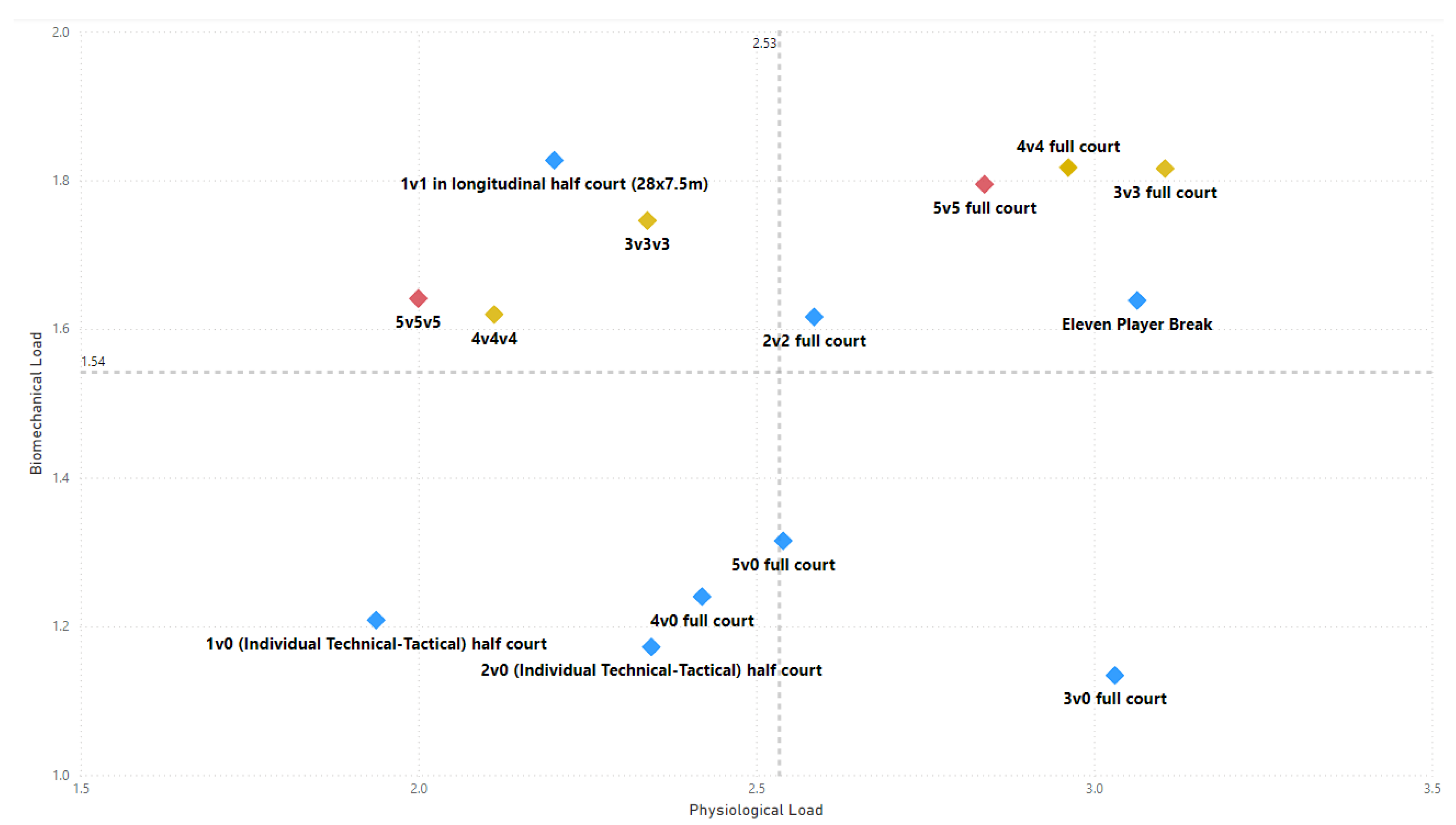
Figure 2.
Standardized differences (Cohen’s d) and their respective 95% confidence intervals (CI) between the training tasks that showed significant large-very large size differences for physiological and biomechanical load.
Figure 2.
Standardized differences (Cohen’s d) and their respective 95% confidence intervals (CI) between the training tasks that showed significant large-very large size differences for physiological and biomechanical load.
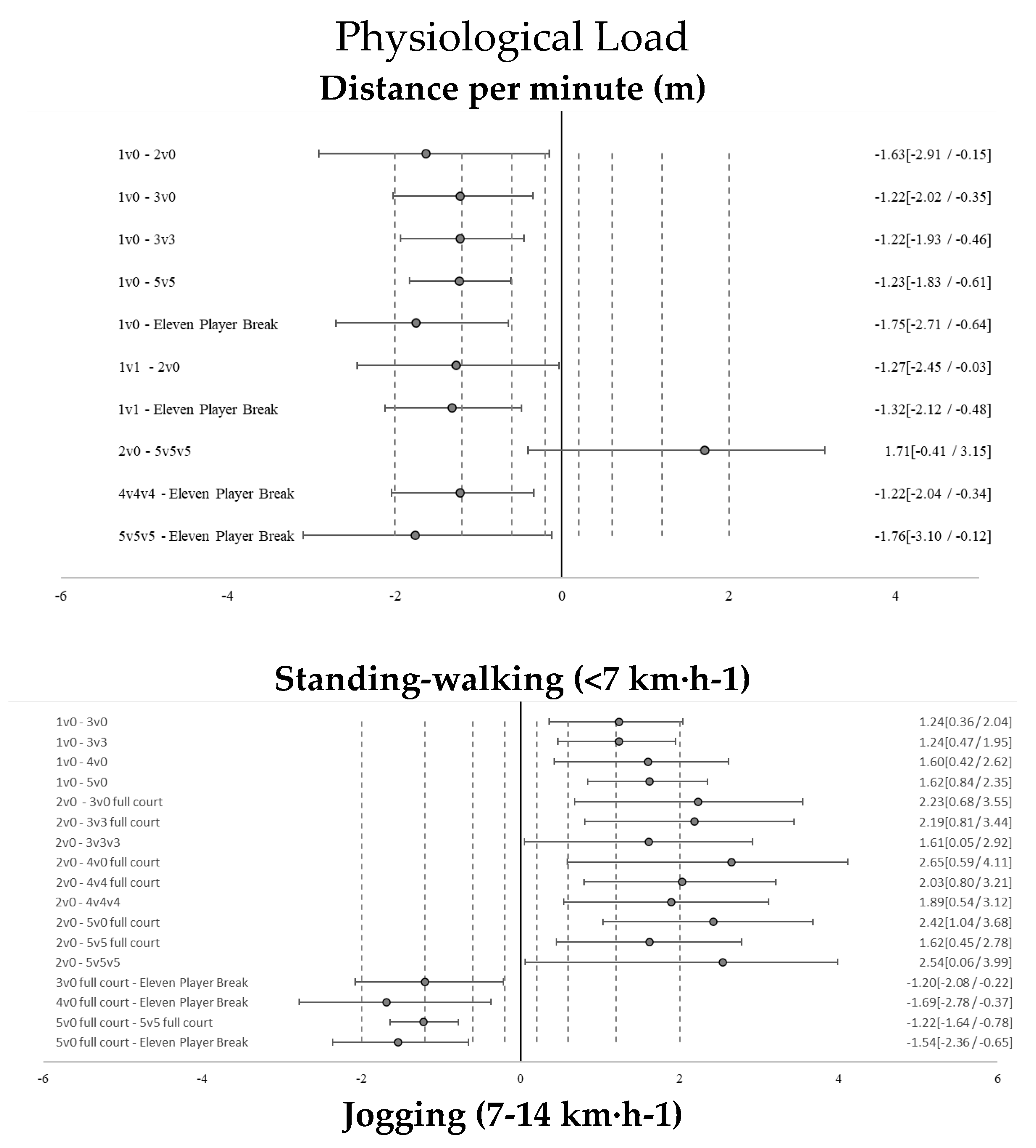
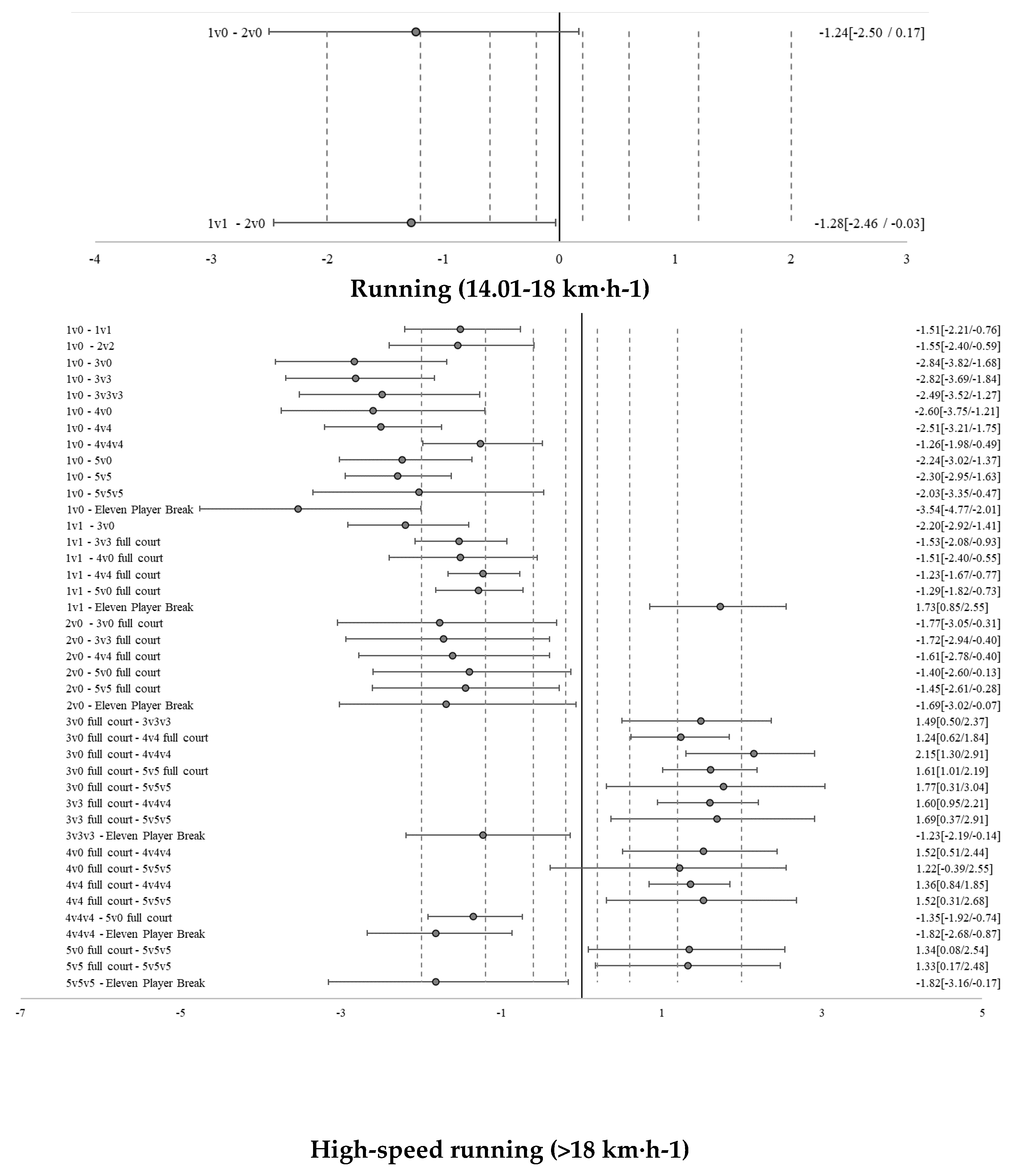
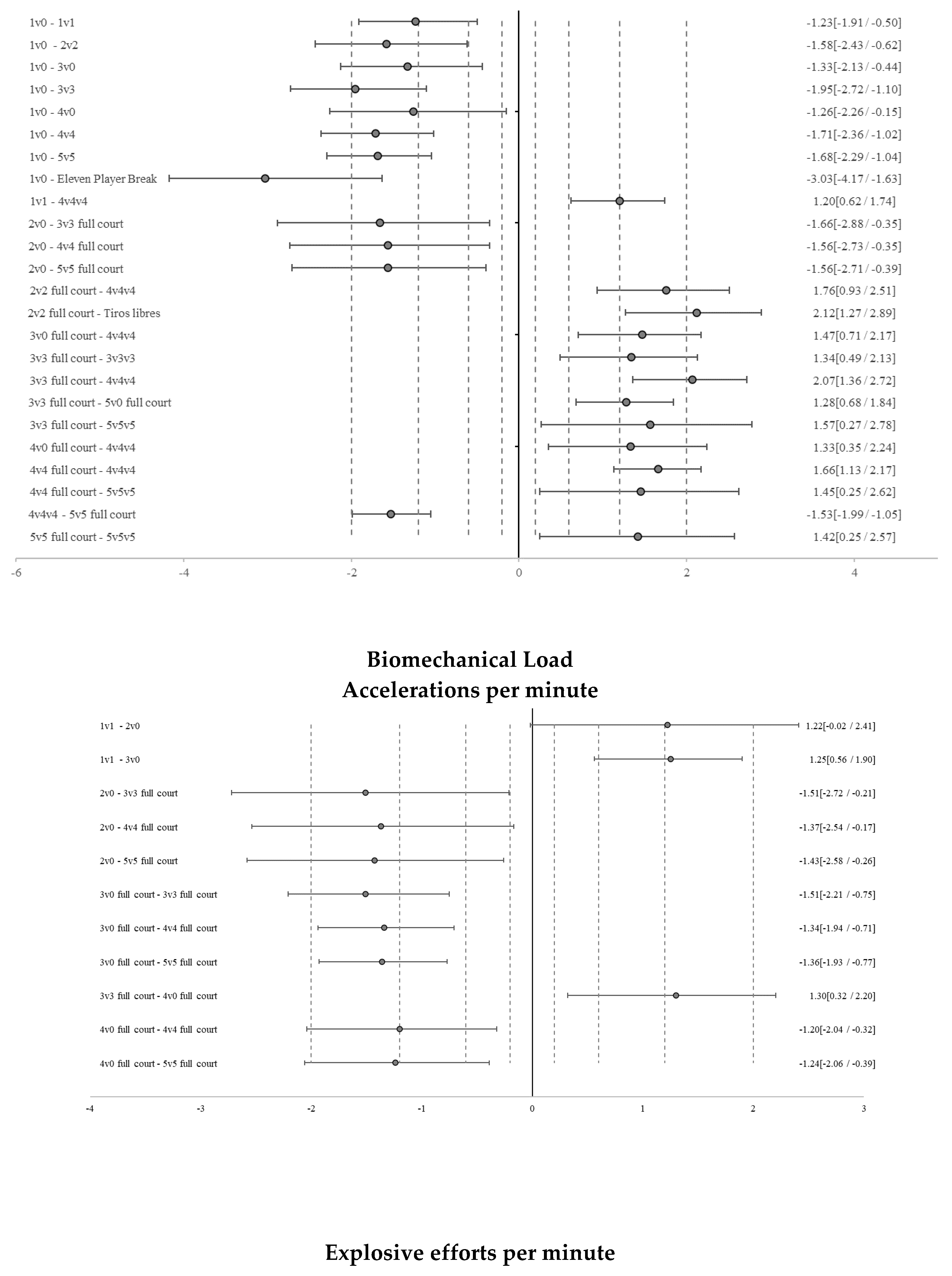
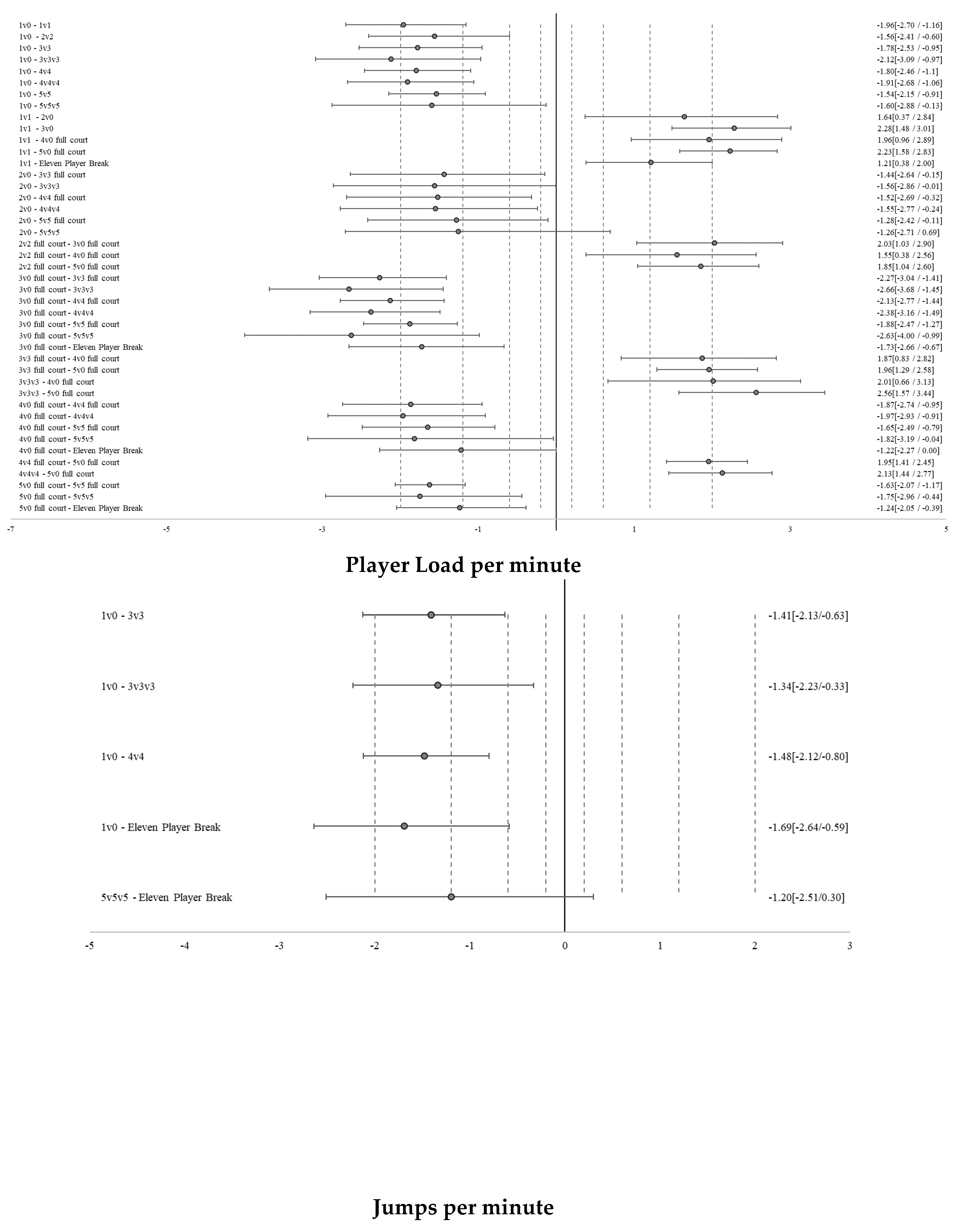
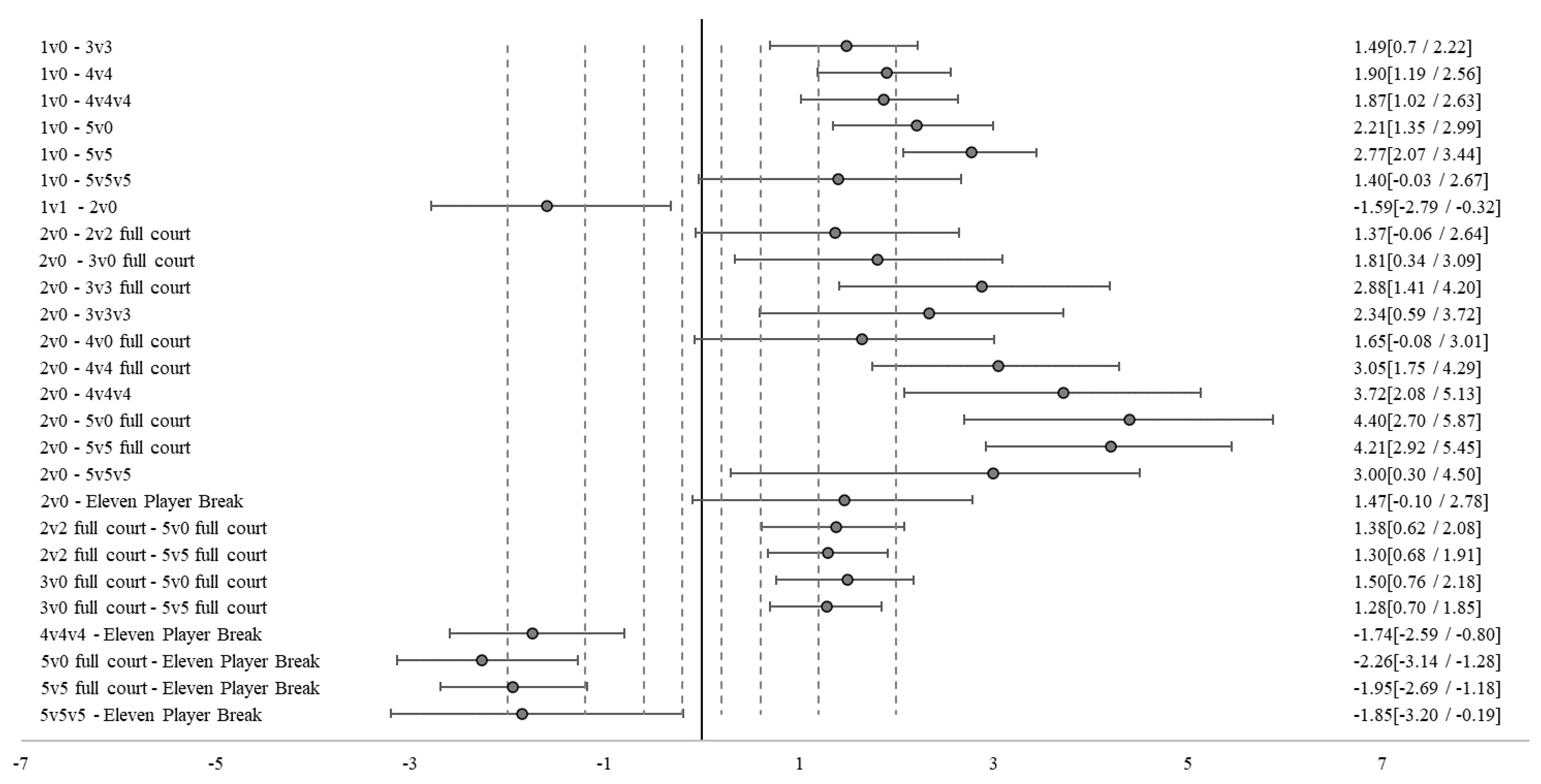
Figure 3.
Standardized differences (Cohen’s d) and their respective 95% confidence intervals (CI) between training tasks and match tasks for physiological and biomechanical load. Notes: The dashed line represents the magnitude of the effect from large to very large.
Figure 3.
Standardized differences (Cohen’s d) and their respective 95% confidence intervals (CI) between training tasks and match tasks for physiological and biomechanical load. Notes: The dashed line represents the magnitude of the effect from large to very large.
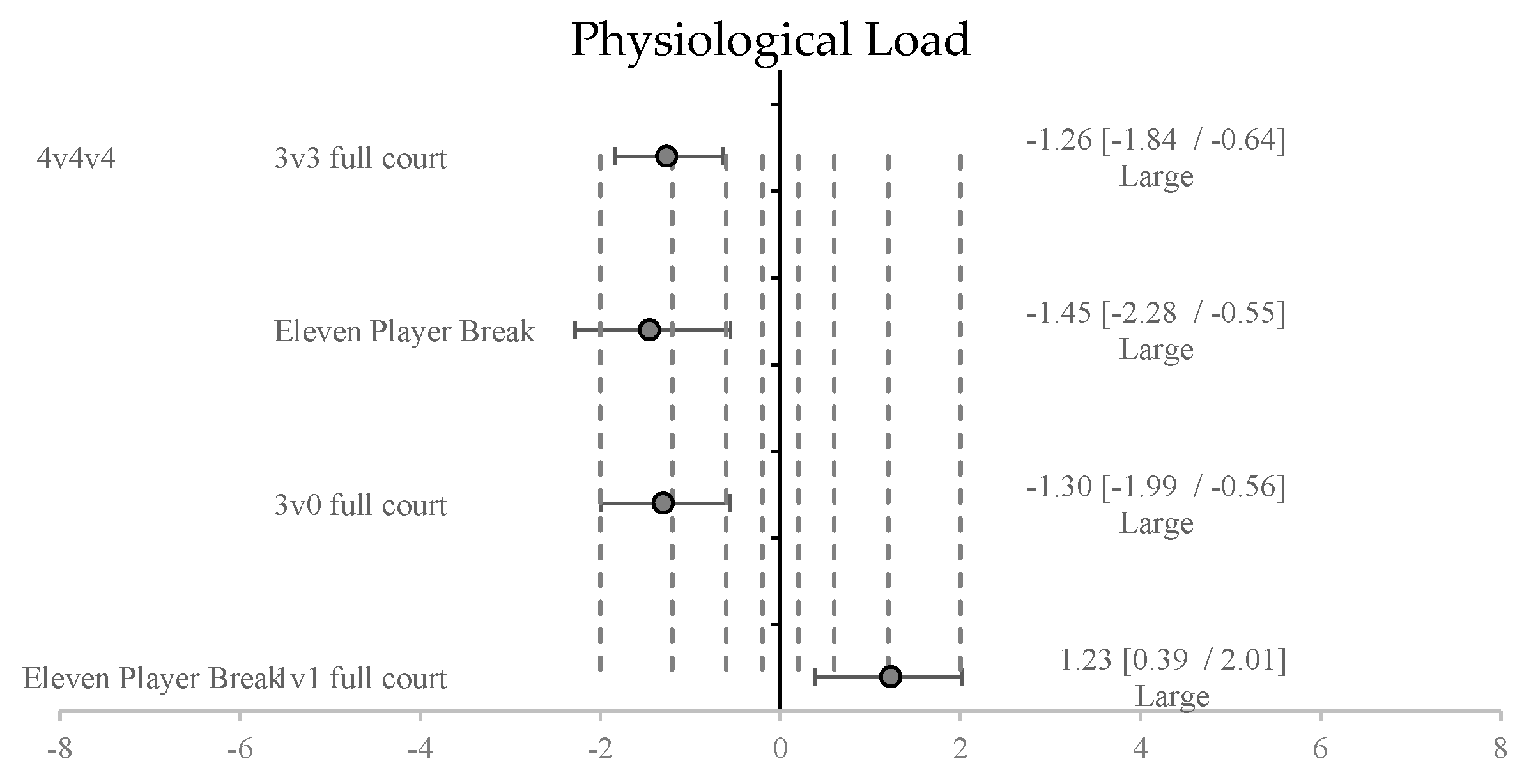
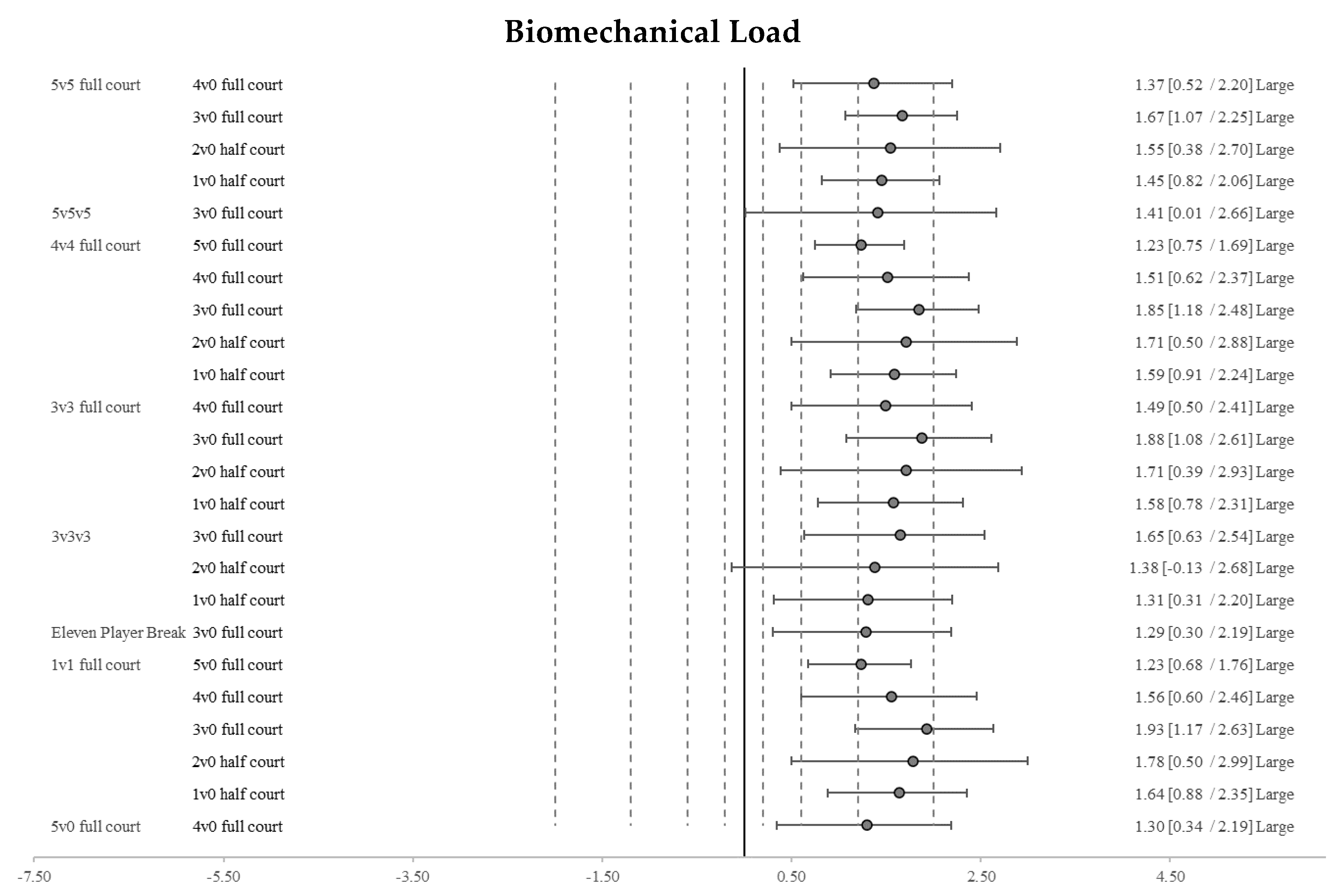
Figure 4.
Weekly design of training according to the number of competitions.
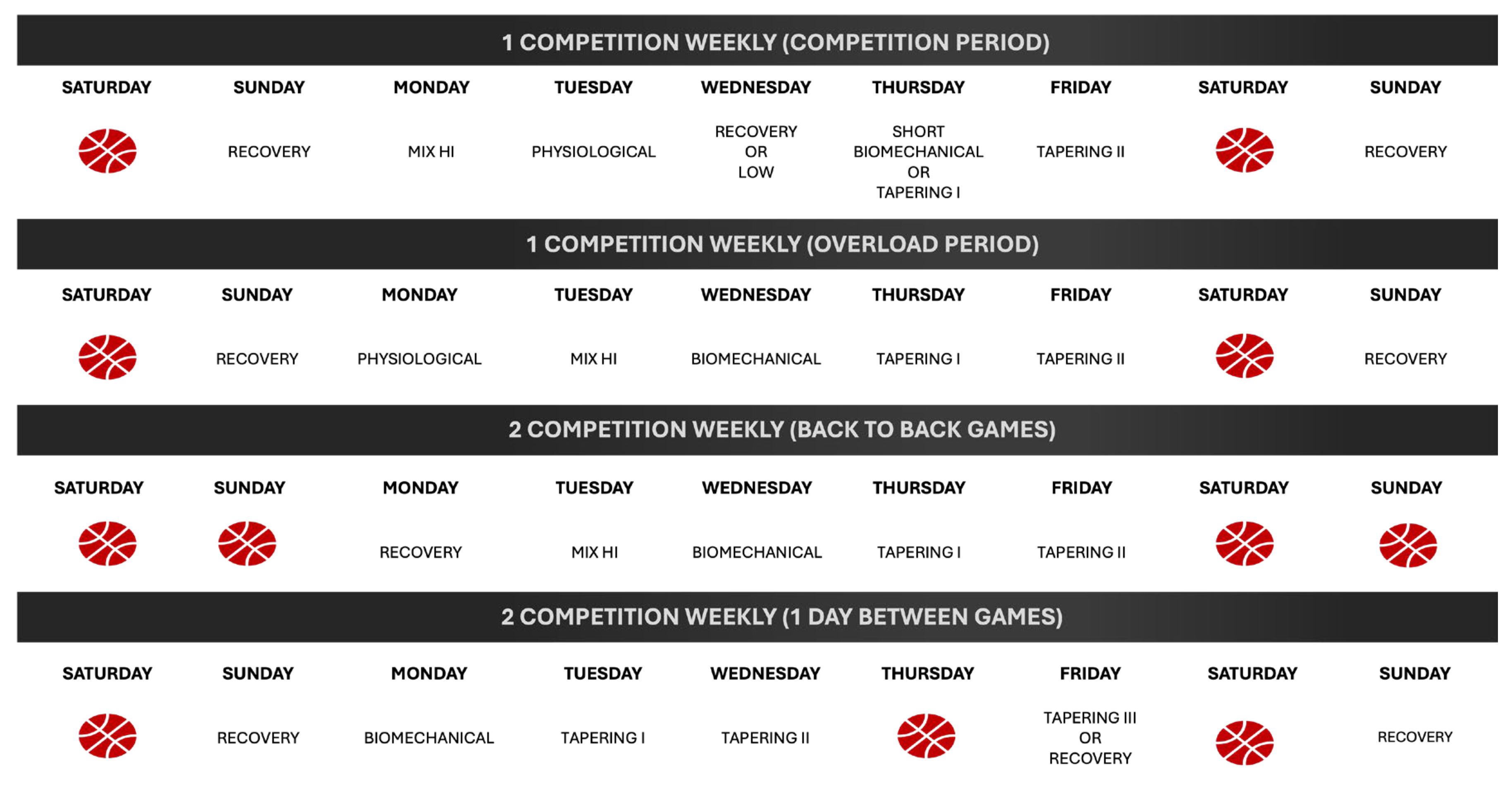

Table 1.
Drills classification based on their specificity from 5 to 0 (Schelling & Torres, 2016).
| 4 | 5v5 full court | A 5v5 game is played with 10 players on the court at the same time. The number of consecutive plays and the work-to-rest ratio vary depending on the coach’s feedback and the pauses they implement | 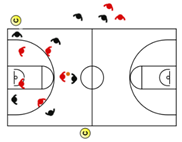 |
| 4 | 5v5v5 | A 5v5v5 game is played where the defending team transitions to offense and attacks the opposite basket | 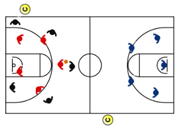 |
| 4 | 4v4 full court | A 4v4 game is played with 8 players on the court at the same time. When the offensive play ends, the defending team transitions to offense and attacks the same team at the opposite basket. The number of consecutive plays and the work-to-rest ratio ranges between 3 and 6, depending on the coach’s feedback and pauses | 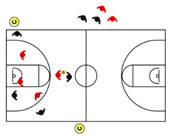 |
| 4 | 4v4v4 | A 4v4v4 game is played where the defending team transitions to offense and attacks the opposite basket, where another team is waiting to defend | 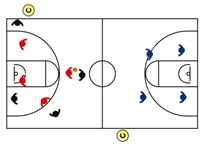 |
| 3 | 3v3 Full court | A 3v3 game is played with 6 players on the court at the same time. When the offensive play ends, the defending team transitions to offense and attacks the same team at the opposite basket. The number of consecutive plays and the work-to-rest ratio varies between 3 and 6, depending on the coach’s feedback and pauses | 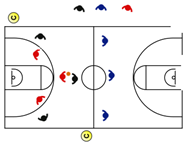 |
| 3 | 3v3v3 | A 3v3v3 game is played where the defending team transitions to offense and attacks the opposite basket, where another team is waiting to defend | 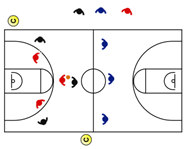 |
| 3 | Eleven Player Break | A continuous 3v2 situation is played. Among the 5 players involved, the one who gains possession when the play ends (whether through a basket, rebound, or turnover) attacks on the opposite side with two players positioned in the corners against two defenders waiting on the other side | 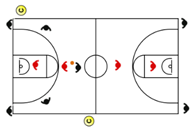 |
| 3 | 2v2 full court | A 2v2 game is played where, after an offensive play, the team defends at the opposite basket. Following the defensive effort, the team passes to one of the two teammates positioned to transition and attack on the opposite court | 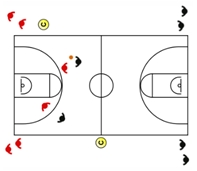 |
| 2 | 1v1 in longitudinal half court (28x7.5m) | The attacking player must attempt to drive past and score after playing a 1v1. Once the offensive play is over, the player who attacked transitions to defense | 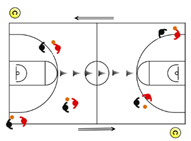 |
| 2 | 5v0 full court | A 5v0 drill is conducted at midcourt, followed by another drill at the opposite end. After completing these drills, 5 new players enter the court. | 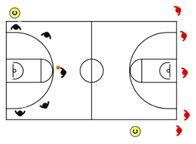 |
| 2 | 4v0 full court | A 4v0 drill is conducted at midcourt, followed by another drill at the opposite end. After completing these drills, 4 new players enter the court | 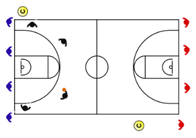 |
| 2 | 3v0 full court | A 3v0 drill is conducted at midcourt, followed by another drill at the opposite end. After completing these drills, 3 new players enter the court | 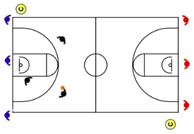 |
| 2 | 2v0 (Individual Technical-Tactical) half court | Different individual technical-tactical situations are practiced without opposition in a 2v0 setting | 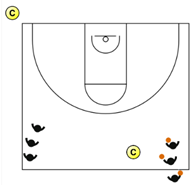 |
| 2 | 1v0 (Individual Technical-Tactical) half court | Different individual technical-tactical situations are practiced without opposition in a 1v0 setting | 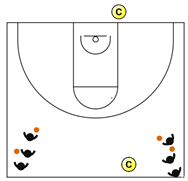 |
Table 2.
Cluster analysis identifying drills groups based on physiological load parameters.
| Variables | Physiological Load | |||
|---|---|---|---|---|
| Low | Medium | High | Very High | |
| Distance per minute (m) | 18.56 | 62.09 | 75.28 | 80.50 |
| Standing-walking (<7 km·h-1) | 15.53 | 31.75 | 65.40 | 34.35 |
| Jogging (7-14 km·h-1) | 3.13 | 21.36 | 51.81 | 28.05 |
| Running (14.01-18 km·h-1) | 0.85 | 6.37 | 17.32 | 12.29 |
| High-speed running (>18 km·h-1) | 0.22 | 2.42 | 3.77 | 6.02 |
| Samples size (N) | 141 | 1831 | 122 | 1042 |
| Sample proportion (%) | 4.5% | 58.4% | 3.9% | 32.2% |
| Bayesian information criterion (BIC) | 9214.44 | |||
| Average silhouette | 0.5 | |||
Note: The value of each physiological load variable is presented as the mean and standard deviation for each group, and the sample size indicates the number of tasks included in each group.
Table 3.
Cluster analysis identifying drills groups based on biomechanical load parameters.
| Variables | Biomechanical Load | |
|---|---|---|
| Low | High | |
| Accelerations per minute | 1.35 | 2.71 |
| Decelerations per minute | 1.20 | 3.38 |
| Explosive efforts per minute | 1.56 | 3.26 |
| PlayerLoad per minute | 5.91 | 8.42 |
| Jumps per minute | 0.65 | 0.73 |
| Sample size (N) | 128 | 2124 |
| Sample proportion (%) | 47.4% | 67.7% |
| Bayesian information criterion (BIC) | 10677,49 | |
| Average silhouette | 0.5 | |
Notes: The value of each physiological load variable is presented as the mean and standard deviation for each group, and the sample size indicates the number of tasks included in each group.
Table 4.
Descriptive statistics for each drill according to physical orientation (physiological or biomechanical) and specificity.
Table 4.
Descriptive statistics for each drill according to physical orientation (physiological or biomechanical) and specificity.
| Drill | Specificity | Physiological Load | Biomechanical Load | ||
|---|---|---|---|---|---|
| Median | Mean ± SD (% CV) | Median | Mean ± SD (% CV) | ||
| 5v5 full court | 4 | 2 | 2.84 ± 0.99 (35%) | 2 | 1.79 ± 0.40 (22%) |
| 5v5v5 | 2 | 2.00 ± 0.00 (0%) | 2 | 1.64 ± 0.48 (29%) | |
| 4v4 full court | 3 | 2 | 2.96 ± 1.01 (34%) | 2 | 1.82 ± 0.38 (21%) |
| 4v4v4 | 2 | 2.11 ± 0.51 (24%) | 2 | 1.62 ± 0.48 (30%) | |
| 3v3 Full court | 4 | 3.11 ± 0.99 (32%) | 2 | 1.82 ± 0.38 (21%) | |
| 3v3v3 | 2 | 2.34 ± 0.75 (32%) | 2 | 1.75 ± 0.43 (25%) | |
| Eleven Player Break | 2 | 4 | 3.06 ± 1.00 (33%) | 2 | 1.64 ± 0.48 (29%) |
| 2v2 full court | 2 | 2.59 ± 0.99 (38%) | 2 | 1.62 ± 0.48 (30%) | |
| 1v1 in longitudinal half court (28x7.5m) | 2 | 2.20 ± 0.62 (28%) | 2 | 1.83 ± 0.37 (20%) | |
| 5v0 full court | 2 | 2.54 ± 0.92 (36%) | 1 | 1.32 ± 0.46 (35%) | |
| 4v0 full court | 2 | 2.42 ± 0.81 (33%) | 1 | 1.24 ± 0.43 (35%) | |
| 3v0 full court | 3 | 3.03 ± 0.97 (32%) | 1 | 1.13 ± 0.34 (30%) | |
| 2v0 (Individual Technical-Tactical) half court | 2 | 2.34 ± 0.72 (31%) | 1 | 1.17 ± 0.38 (32%) | |
| 1v0 (Individual Technical-Tactical) half court | 2 | 1.94 ± 0.24 (12%) | 1 | 1.21 ± 0.40 (33%) | |
Table 5.
Comparisons for each drill according to physical orientation (physiological or biomechanical).
Table 5.
Comparisons for each drill according to physical orientation (physiological or biomechanical).
| Physiological Load | Biomechanical Load | ||||
|---|---|---|---|---|---|
| Dif. Mean [I / S] | Sig. | Dif. Mean [I / S] | Sig. | ||
| 1v0 | 1v1 | -0.26 [-0.63 / 0.10] | 1.000 | -0.62* [-0.79 / -0.45] | 0.000 |
| 2v0 | -0.41 [-1.06 / 0.25] | 1.000 | 0.04 [-0.26 / 0.34] | 1.000 | |
| 2v2 | -0.64* [-1.09 / -0.21] | 0.000 | -0.41* [-0.61 / -0.2] | 0.000 | |
| 3v0 | -1.09* [-1.54 / -0.65] | 0.000 | 0.07 [-0.13 / 0.28] | 1.000 | |
| 3v3 | -1.16* [-1.54 / -0.80] | 0.000 | -0.61* [-0.78 / -0.44] | 0.000 | |
| 3v3v3 | -0.40 [-0.91 / 0.11] | 0.670 | -0.54* [-0.77 / -0.3] | 0.000 | |
| 4v0 | -0.48 [-1.02 / 0.06] | 0.190 | -0.03 [-0.28 / 0.22] | 1.000 | |
| 4v4 | -1.02* [-1.37 / -0.68] | 0.000 | -0.61* [-0.77 / -0.45] | 0.000 | |
| 4v4v4 | -0.17 [-0.56 / 0.21] | 1.000 | -0.41* [-0.59 / -0.24] | 0.000 | |
| 5v0 | -0.60* [-0.99 / -0.22] | 0.000 | -0.11 [-0.28 / 0.07] | 1.000 | |
| 5v5 | -0.90* [-1.23 / -0.57] | 0.000 | -0.59* [-0.74 / -0.43] | 0.000 | |
| 5v5v5 | -0.06 [-0.65 / 0.52] | 1.000 | -0.43* [-0.7 / -0.16] | 0.000 | |
| Eleven Player Break | -1.13* [-1.68 / -0.58] | 0.000 | -0.43* [-0.68 / -0.18] | 0.000 | |
| 1v1 | 2v0 | -0.14 [-0.75 / 0.46] | 1.000 | 0.65* [0.38 / 0.93] | 0.000 |
| 2v2 | -0.38* [-0.75 / -0.02] | 0.020 | 0.21* [0.05 / 0.38] | 0.000 | |
| 3v0 | -0.83* [-1.19 / -0.47] | 0.000 | 0.69* [0.53 / 0.86] | 0.000 | |
| 3v3 | -0.90* [-1.17 / -0.64] | 0.000 | 0.01 [-0.11 / 0.13] | 1.000 | |
| 3v3v3 | -0.14 [-0.58 / 0.31] | 1.000 | 0.08 [-0.12 / 0.28] | 1.000 | |
| 4v0 | -0.22 [-0.69 / 0.26] | 1.000 | 0.59* [0.37 / 0.8] | 0.000 | |
| 4v4 | -0.76* [-0.99 / -0.53] | 0.000 | 0.01 [-0.09 / 0.11] | 1.000 | |
| 4v4v4 | 0.09 [-0.19 / 0.37] | 1.000 | 0.21* [0.08 / 0.34] | 0.000 | |
| 5v0 | -0.34* [-0.62 / -0.05] | 0.000 | 0.51* [0.38 / 0.64] | 0.000 | |
| 5v5 | -0.64* [-0.85 / -0.43] | 0.000 | 0.03 [-0.06 / 0.13] | 1.000 | |
| 5v5v5 | 0.20 [-0.33 / 0.73] | 1.000 | 0.19 [-0.06 / 0.43] | 0.800 | |
| Eleven Player Break | -0.86* [-1.35 / -0.38] | 0.000 | 0.19 [-0.03 / 0.41] | 0.340 | |
| 2v0 | 2v2 | -0.24 [-0.89 / 0.41] | 1.000 | -0.44* [-0.74 / -0.14] | 0.000 |
| 3v0 | -0.69* [-1.34 / -0.03] | 0.030 | 0.04 [-0.26 / 0.34] | 1.000 | |
| 3v3 | -0.76* [-1.37 / -0.16] | 0.000 | -0.64* [-0.92 / -0.37] | 0.000 | |
| 3v3v3 | 0.01 [-0.70 / 0.71] | 1.000 | -0.57* [-0.89 / -0.25] | 0.000 | |
| 4v0 | -0.08 [-0.80 / 0.65] | 1.000 | -0.07 [-0.4 / 0.26] | 1.000 | |
| 4v4 | -0.62* [-1.21 / -0.03] | 0.030 | -0.65* [-0.91 / -0.37] | 0.000 | |
| 4v4v4 | 0.23 [-0.38 / 0.85] | 1.000 | -0.45* [-0.73 / -0.17] | 0.000 | |
| 5v0 | -0.20 [-0.81 / 0.42] | 1.000 | -0.14 [-0.42 / 0.14] | 1.000 | |
| 5v5 | -0.49 [-1.08 / 0.09] | 0.340 | -0.62* [-0.89 / -0.36] | 0.000 | |
| 5v5v5 | 0.34 [-0.41 / 1.10] | 1.000 | -0.47* [-0.82 / -0.12] | 0.000 | |
| Eleven Player Break | -0.72 [-1.45 / 0.01] | 0.060 | -0.47* [-0.8 / -0.13] | 0.000 | |
| 2v2 | 3v0 | -0.45* [-0.89 / 0.00] | 0.050 | 0.48* [0.28 / 0.68] | 0.000 |
| 3v3 | -0.52* [-0.88 / -0.16] | 0.000 | -0.20* [-0.37 / -0.03] | 0.000 | |
| 3v3v3 | 0.25 [-0.26 / 0.76] | 1.000 | -0.13 [-0.36 / 0.1] | 1.000 | |
| 4v0 | 0.17 [-0.37 / 0.70] | 1.000 | 0.38* [0.13 / 0.62] | 0.000 | |
| 4v4 | -0.38* [-0.71 / -0.04] | 0.010 | -0.20* [-0.36 / -0.05] | 0.000 | |
| 4v4v4 | 0.47* [0.10 / 0.85] | 0.000 | 0 [-0.18 / 0.17] | 1.000 | |
| 5v0 | 0.05 [-0.33 / 0.43] | 1.000 | 0.30* [0.13 / 0.48] | 0.000 | |
| 5v5 | -0.25 [-0.58 / 0.08] | 0.790 | -0.18* [-0.33 / -0.03] | 0.000 | |
| 5v5v5 | 0.59* [0.00 / 1.17] | 0.050 | -0.02 [-0.29 / 0.24] | 1.000 | |
| Eleven Player Break | -0.48 [-1.03 / 0.07] | 0.250 | -0.02 [-0.27 / 0.23] | 1.000 | |
| 3v0 | 3v3 | -0.07 [-0.44 / 0.29] | 1.000 | -0.68* [-0.85 / -0.51] | 0.000 |
| 3v3v3 | 0.69* [0.18 / 1.20] | 0.000 | -0.61* [-0.85 / -0.38] | 0.000 | |
| 4v0 | 0.61* [0.07 / 1.15] | 0.010 | -0.11 [-0.35 / 0.14] | 1.000 | |
| 4v4 | 0.07 [-0.27 / 0.41] | 1.000 | -0.68* [-0.84 / -0.53] | 0.000 | |
| 4v4v4 | 0.92* [0.54 / 1.30] | 0.000 | -0.49* [-0.66 / -0.31] | 0.000 | |
| 5v0 | 0.49* [0.11 / 0.87] | 0.000 | -0.18* [-0.36 / -0.01] | 0.030 | |
| 5v5 | 0.19 [-0.14 / 0.52] | 1.000 | -0.66* [-0.81 / -0.51] | 0.000 | |
| 5v5v5 | 1.03* [0.44 / 1.62] | 0.000 | -0.51* [-0.78 / -0.24] | 0.000 | |
| Eleven Player Break | -0.03 [-0.58 / 0.52] | 1.000 | -0.50* [-0.76 / -0.25] | 0.000 | |
| 3v3 | 3v3v3 | 0.77* [0.32 / 1.21] | 0.000 | 0.07 [-0.13 / 0.27] | 1.000 |
| 4v0 | 0.69* [0.21 / 1.16] | 0.000 | 0.58* [0.36 / 0.79] | 0.000 | |
| 4v4 | 0.14 [-0.09 / 0.38] | 1.000 | 0 [-0.11 / 0.11] | 1.000 | |
| 4v4v4 | 0.99* [0.71 / 1.28] | 0.000 | 0.20* [0.06 / 0.33] | 0.000 | |
| 5v0 | 0.57* [0.28 / 0.85] | 0.000 | 0.50* [0.37 / 0.63] | 0.000 | |
| 5v5 | 0.27* [0.05 / 0.48] | 0.000 | 0.02 [-0.08 / 0.12] | 1.000 | |
| 5v5v5 | 1.11* [0.57 / 1.64] | 0.000 | 0.17 [-0.07 / 0.42] | 1.000 | |
| Eleven Player Break | 0.04 [-0.45 / 0.53] | 1.000 | 0.18 [-0.05 / 0.4] | 0.620 | |
| 3v3v3 | 4v0 | -0.08 [-0.68 / 0.51] | 1.000 | 0.51* [0.23 / 0.78] | 0.000 |
| 4v4 | -0.62* [-1.05 / -0.20] | 0.000 | -0.07 [-0.27 / 0.12] | 1.000 | |
| 4v4v4 | 0.23 [-0.23 / 0.68] | 1.000 | 0.13 [-0.08 / 0.34] | 1.000 | |
| 5v0 | -0.20 [-0.66 / 0.26] | 1.000 | 0.43* [0.22 / 0.64] | 0.000 | |
| 5v5 | -0.50* [-0.91 / -0.08] | 0.000 | -0.05 [-0.24 / 0.14] | 1.000 | |
| 5v5v5 | 0.34 [-0.30 / 0.98] | 1.000 | 0.1 [-0.19 / 0.4] | 1.000 | |
| Eleven Player Break | -0.73* [-1.33 / -0.12] | 0.000 | 0.11 [-0.17 / 0.38] | 1.000 | |
| 4v0 | 4v4 | -0.54* [-1.00 / -0.08] | 0.000 | -0.58* [-0.79 / -0.37] | 0.000 |
| 4v4v4 | 0.31 [-0.18 / 0.80] | 1.000 | -0.38* [-0.6 / -0.16] | 0.000 | |
| 5v0 | -0.12 [-0.61 / 0.37] | 1.000 | -0.08 [-0.3 / 0.15] | 1.000 | |
| 5v5 | -0.42 [-0.87 / 0.03] | 0.120 | -0.56* [-0.76 / -0.35] | 0.000 | |
| 5v5v5 | 0.42 [-0.24 / 1.08] | 1.000 | -0.40* [-0.7 / -0.1] | 0.000 | |
| Eleven Player Break | -0.64* [-1.27 / -0.02] | 0.040 | -0.40* [-0.69 / -0.11] | 0.000 | |
| 4v4 | 4v4v4 | 0.85* [0.59 / 1.10] | 0.000 | 0.20* [0.08 / 0.31] | 0.000 |
| 5v0 | 0.42* [0.16 / 0.68] | 0.000 | 0.50* [0.38 / 0.62] | 0.000 | |
| 5v5 | 0.12 [-0.05 / 0.29] | 1.000 | 0.02 [-0.06 / 0.1] | 1.000 | |
| 5v5v5 | 0.96* [0.45 / 1.48] | 0.000 | 0.18 [-0.06 / 0.41] | 0.980 | |
| Eleven Player Break | -0.10 [-0.57 / 0.37] | 1.000 | 0.18 [-0.04 / 0.39] | 0.410 | |
| 4v4v4 | 5v0 | -0.43* [-0.74 / -0.12] | 0.000 | 0.31* [0.16 / 0.45] | 0.000 |
| 5v5 | -0.73* [-0.97 / -0.49] | 0.000 | -0.18* [-0.28 / -0.07] | 0.000 | |
| 5v5v5 | 0.11 [-0.43 / 0.65] | 1.000 | -0.02 [-0.27 / 0.23] | 1.000 | |
| Eleven Player Break | -0.95* [-1.45 / -0.45] | 0.000 | -0.02 [-0.25 / 0.21] | 1.000 | |
| 5v0 | 5v5 | -0.30* [-0.54 / -0.06] | 0.000 | -0.48* [-0.59 / -0.37] | 0.000 |
| 5v5v5 | 0.54 [0.00 / 1.08] | 0.050 | -0.33* [-0.57 / -0.08] | 0.000 | |
| Eleven Player Break | -0.52* [-1.03 / -0.02] | 0.030 | -0.32* [-0.55 / -0.09] | 0.000 | |
| Partido oficial | -0.66* [-1.00 / -0.32] | 0.000 | -0.59* [-0.75 / -0.44] | 0.000 | |
| Tiros libres | 1.54* [1.16 / 1.92] | 0.000 | 0.32* [0.14 / 0.49] | 0.000 | |
| 5v5 | 5v5v5 | 0.84* [0.33 / 1.34] | 0.000 | 0.15 [-0.08 / 0.39] | 1.000 |
| Eleven Player Break | -0.23 [-0.69 / 0.24] | 1.000 | 0.16 [-0.06 / 0.37] | 1.000 | |
| 5v5v5 | Eleven Player Break | -1.06* [-1.73 / -0.39] | 0.000 | 0 [-0.3 / 0.31] | 1.000 |
Table 6.
Different types of sessions according to the objectives and physical orientation (physiological or biomechanical).
Table 6.
Different types of sessions according to the objectives and physical orientation (physiological or biomechanical).
| Orientation | Session duration | Tasks | Task duration |
|
|---|---|---|---|---|
| Main: | 3v0-4v0-5v0 | 15-20 min | ||
| Physiological | 60-90 min | Reinforcing: | 3v3-4v4-5v5 | 10-12 min |
| Accessories: | 1v0-2v0 | 10-12 min | ||
| Main: | 1v1FC-3v3v3-4v4v4-5v5v5 | 15-20 min | ||
| Biomechanical | 60-90 min | Reinforcing: | 5v5HC | 10-12 min |
| Accessories: | 1v0-2v0 | 10-12 min | ||
| Main: | 2v2 FC-11PB-3v3-4v4-5v5-SGs | 15-20 min | ||
| Mixed high intensity | 60-90 min | Reinforcing: | - | - |
| Accessories: | 1v0-2v0 | 10-12 min | ||
| Main: | 3v3v3-4v4v4-5v5v5-4v4-5v5 | 15-20 min | ||
| Tapering I | 60-75 min | Reinforcing: | 3v3 | 10-12 min |
| Accessories: | 1v0-2v0 | 10-12 min | ||
| Main: | 5v5v5-4v4-5v5 | 15-20 min | ||
| Tapering II | 45-60 min | Reinforcing: | 5v0 | 10-12 min |
| Accessories: | 1v0-2v0 | 10-12 min | ||
| Main: | 5v0 | 8-10 min | ||
| Tapering III | 30-45 min | Reinforcing: | 5v5v5-5v5 (limited contact, no tape) | 5-8 min |
| Accessories: | 1v0-2v0 | 10-12 min | ||
Disclaimer/Publisher’s Note: The statements, opinions and data contained in all publications are solely those of the individual author(s) and contributor(s) and not of MDPI and/or the editor(s). MDPI and/or the editor(s) disclaim responsibility for any injury to people or property resulting from any ideas, methods, instructions or products referred to in the content. |
© 2024 by the authors. Licensee MDPI, Basel, Switzerland. This article is an open access article distributed under the terms and conditions of the Creative Commons Attribution (CC BY) license (http://creativecommons.org/licenses/by/4.0/).
Copyright: This open access article is published under a Creative Commons CC BY 4.0 license, which permit the free download, distribution, and reuse, provided that the author and preprint are cited in any reuse.


