Preprint
Article

This version is not peer-reviewed.

An Analytical Solution to Rectangular Isotropic Kirchhoff Plates Having Two Adjacent Edges Free Using Two Single Series and the Boundary Collocation Method

Submitted:

11 November 2024

Posted:

14 November 2024

Read the latest preprint version here

Abstract

An analytical solution to arbitrarily loaded isotropic rectangular Kirchhoff plates supported at three corner points, having two adjacent edges free and the other edges being simply supported, clamped or free, was presented. Analytical methods such as the single trigonometric series of Lévy or the double trigonometric series of Navier are not applicable here because of the adjacent free edges. In this paper the deflection surface was approximated with the sum of a particular solution to the governing differential equation (GDE) and two single series. The terms of the single series were the product of an unknown function of an independent variable and a trigonometric function of the other independent variable, whereby the trigonometric functions were consistent with the deflection-related boundary conditions (zero deflection or not along an edge). On the one hand the terms of the series were required to satisfy the homogeneous GDE, leading to two uncoupled differential equations, one for each unknown function, and so the approximate solution satisfied exactly the GDE. On the other hand the boundary conditions were satisfied only at selected collocation points along the boundary, the number of collocation points in each direction corresponding to the number of terms of the associated series. The results obtained showed a reasonable agreement with the exact results, the accuracy increasing the more terms of series were considered. So a powerful computation tool is needed to consider higher number of terms of the series and so to approach the exact results. Cantilevered plates will be analyzed using this approach in future research.

Keywords: 
;  ;  ;  ;  

1. Introduction

This paper describes the application of Fogang’s [1] approach based on the boundary collocation method, used for the Kirchhoff plates supported at all corner points whereby the edges are arbitrarily supported (simply supported, clamped or free), to Kirchhoff plates supported at three corner points and having two adjacent edges free and the other edges also arbitrarily supported. The Kirchhoff–Love plate theory (KLPT) was developed in 1888 by Love using assumptions proposed by Kirchhoff [2]. Analytical methods such as the single trigonometric series of Lévy or the double trigonometric series of Navier are not applicable to the title problem because of the adjacent free edges. In this study the analysis was conducted using the boundary collocation method. This method, also called the generalized Trefftz [3] approach, consists of the use of trial functions which satisfy the governing differential equations of the problem. The unknown coefficients of those functions are determined by the satisfaction of the boundary conditions at collocation points along the boundary. About this method, Herrera [4] proposed a precise definition of Trefftz method and, starting with it, explained briefly a general theory while Piltner [5] presented a collection of personal choices to help future developers of numerical methods based on Trefftz trial functions. Many authors worked on analytical methods to plate bending problems but very few on plates having two adjacent edges free. Li et al. [6] developed a symplectic superposition method to derive analytic buckling solutions of biaxially loaded rectangular thin plates with two free adjacent edges that are characterized by having both the free edges and a free corner. Xu et al. [7] introduced the finite integral transform method to explore the accurate bending analysis of orthotropic rectangular thin plates with two adjacent edges free and the others clamped or simply supported: this method eliminated the need to preselect the deflection function, which made it more theoretical for calculating the mechanical responses of the plates. Babu et al. [8] extended the Levy's analytical solution approach for the analysis of rectangular strain gradient elastic plates under static loading with different boundary conditions at the edges using the method of superposition.
In this paper two single series were considered due to the possibility offered to satisfy the boundary conditions along the four edges, inspired from the Lévy solution that involves one single series and the satisfaction of the boundary conditions along two opposite edges (the other edges are simply supported). In addition the approach can be seen as a mixed analytical-numerical method: analytical since the efforts and deformations are described analytically throughout the plate and numerical since the boundary conditions are only satisfied at collocation points on the boundary.

2. Materials and Methods

2.1. Governing Equations of the Plate
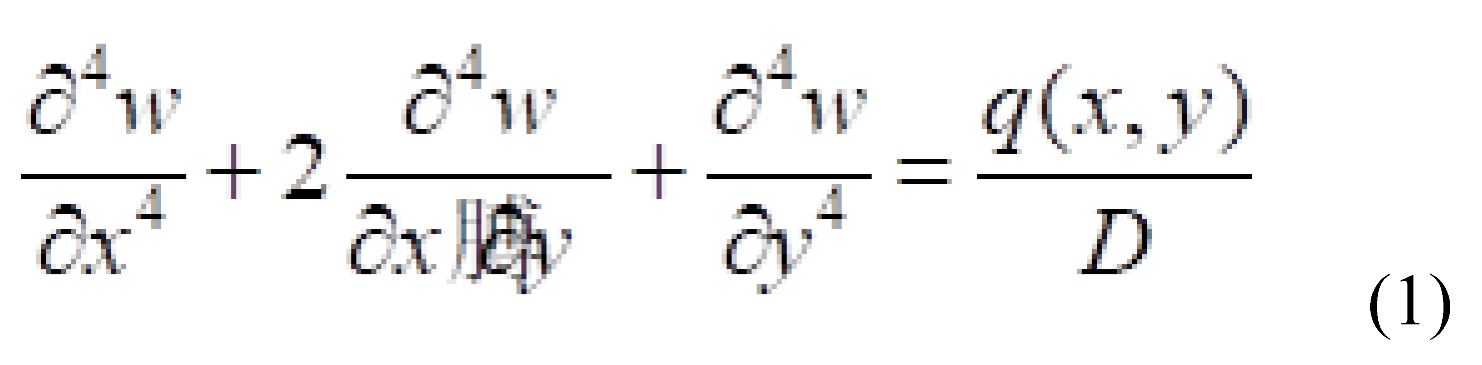
xThe Kirchhoff–Love plate theory (KLPT) [1] is used for thin plates whereby shear deformations are not considered. In this section the equations of the KLPT are recalled. The governing equation of the isotropic Kirchhoff plate, derived by Lagrange, is given by
Preprints 139191 i001
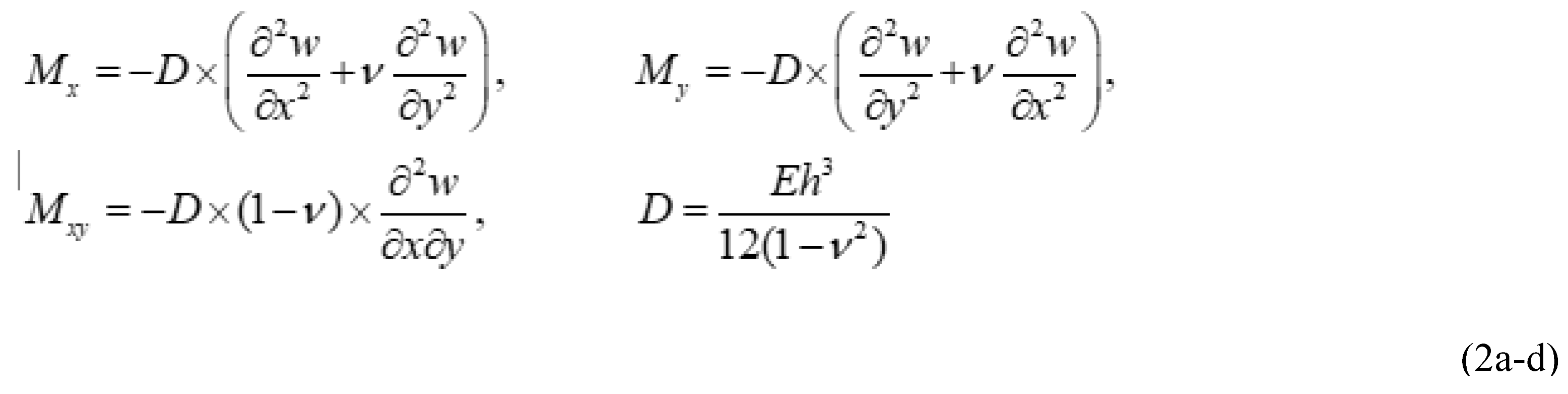
where w(x,y,z) is the mid-plane displacement in z-direction, q(x,y) the transverse distributed load, and D the flexural rigidity of the plate. The bending moments and twisting moments per unit length Mx and My, and Mxy , respectively, are given by
Preprints 139191 i002
The shear forces per unit length are given by
Preprints 139191 i003
The effective shear forces per unit length used along the free edges are expressed as follows:
Preprints 139191 i004
In these equations, E is the elastic modulus of the plate material, h is the plate thickness, and ν is the Poisson’s ratio.

2.2. Plate Having Two Adjacent Edges Free And Supported At Three Corner Points

The rectangular plate and the axis convention (X, Y) are represented in Figure 1 below.
The plate dimensions in x- and y-direction were denoted by a and b, respectively. The rectangular plate was assumed to have the two adjacent edges x = a and y = b free, was supported at the three corner points (0, 0), (a, 0), and (0, b), and arbitrarily supported (simply supported, clamped or free) along the edges x = 0 and y = 0.
The displacement function was approximated with the sum of a particular solution wp(x,y) to the governing differential equation (1) and two single series. The choice of two single series was on the one hand due to the possibility to satisfy the boundary conditions along the four edges: this was inspired from the Lévy solution that involves one single series and the satisfaction of the boundary conditions along two opposite edges, the other edges being simply supported. On the other hand two single series are "geometrically isotropic," in that the independent variables x and y are treated in the same fair way in terms of accuracy. The displacement function can then be taken
Preprints 139191 i005
where m and n are chosen odd numbers in order to have deflections at the free edges and especially at the unsupported angle (a, b). Furthermore the term wp(x,y), a particular solution to Equation (1), can be taken as the deflection of a plate strip parallel to the x-axis (or the y-axis) and subjected to the load q(x,y), and consequently
Preprints 139191 i006
Setting αm = mπ/2a and βn = nπ/2b and substituting Equation (5) into (1) yield
Preprints 139191 i007
Observing Equation (6) and given that (7) holds for any value of x and y, it results the following differential equations
Preprints 139191 i008
The solutions to Equations (8a, b) are given by
Preprints 139191 i009
where the coefficients AFm, BFm, CFm, DFm, AGn, BGn, CGn, and DGn are determined by satisfying the boundary conditions at selected collocation points. The collocation points should be suitably distributed along the edges.
The collocation points at the edges x = 0 and x = a are associated with the series having the function Gn(x) while those at y = 0 and y = b are associated with the series having the function Fm(y). Let us consider an approximate solution where the first and second series have M and N terms, respectively. It results then 4M + 4N unknown coefficients. Therefore M collocation points should be considered at each of the edges y = 0 and y = b and N collocation points at each of the edges x = 0 and x = a, as represented in Figure 2 for M = 4 and N = 5. Since two boundary conditions are set at each collocation point it results in 4M + 4N equations. So there are as many unknowns as equations.
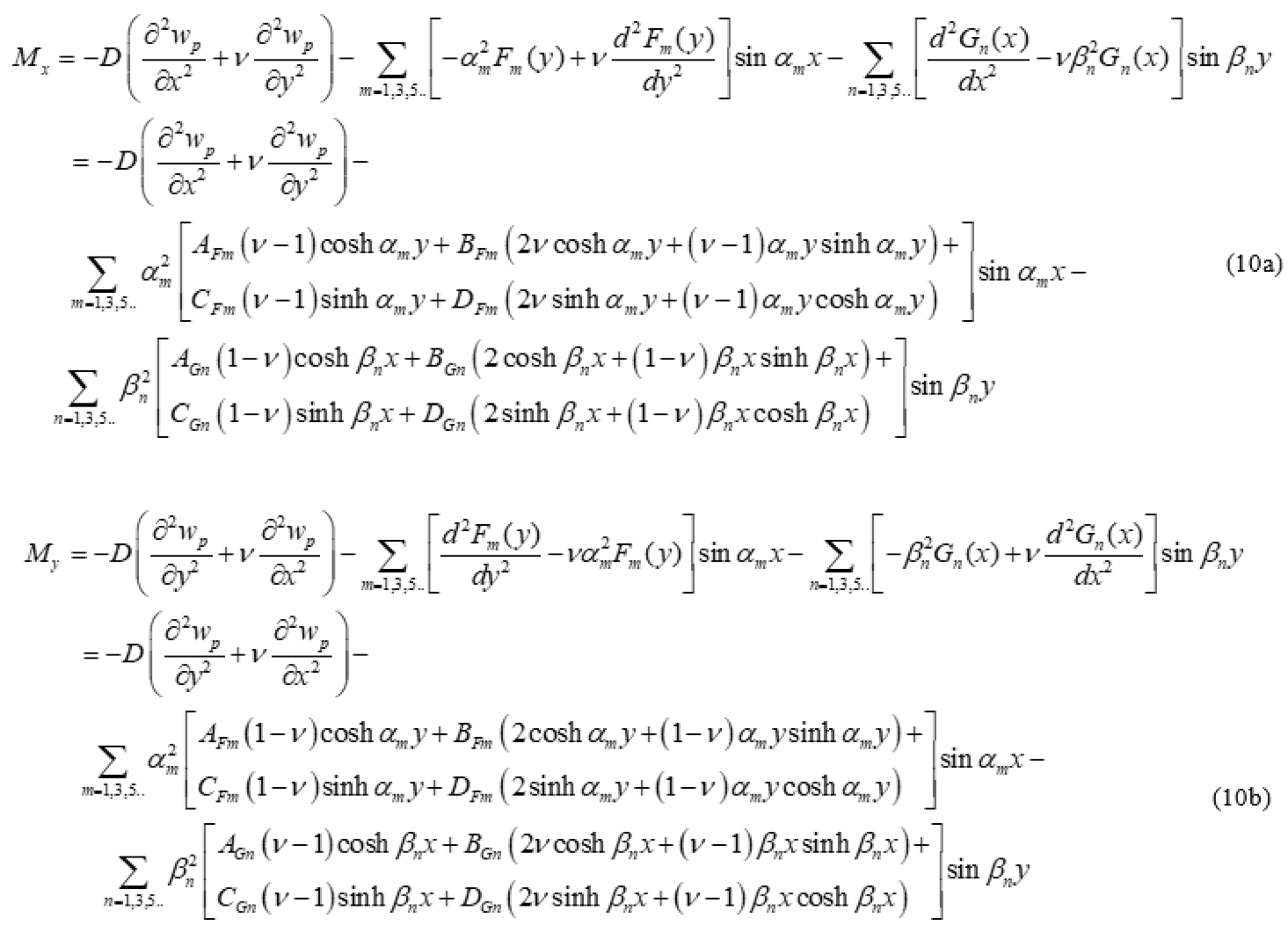
The bending moments per unit length Mx and My, and the twisting moments per unit length Mxy are expressed using Equations (2a-c), (5), and (9a-b) as follows
Preprints 139191 i010
The boundary conditions involving the bending moments at the free edges x = a and y = b are set observing that for odd values of m and n sin (mπ/2) = (-1)(m-1)/2 and sin (nπ/2) = (-1)(n-1)/2. The twisting moments per unit length Mxy using Equations (2c), (5), and (9a-b) are given by
Preprints 139191 i011
Given that no twisting should occur at the unsupported angle (a, b) and observing that the series have zero twisting at this position (for odd values of m and n cos (mπ/2) = cos (nπ/2) = 0), the particular solution should then be twisting free at this position.
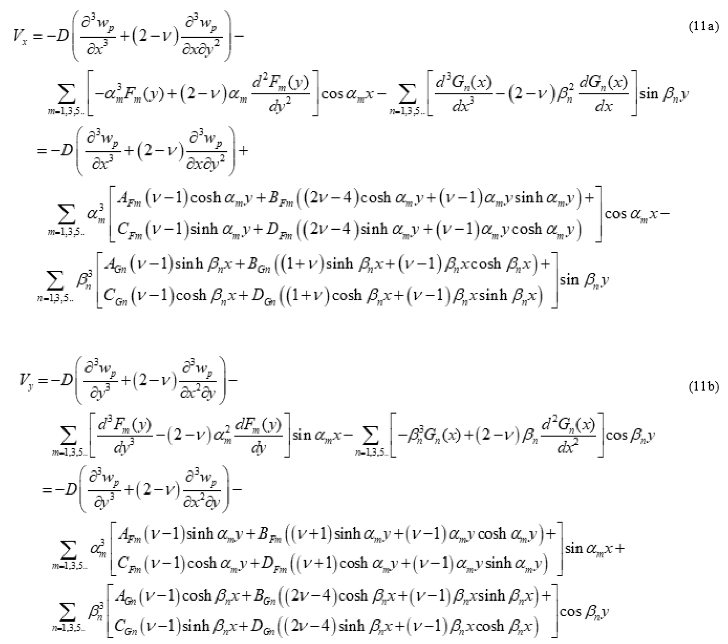
The effective shear forces per unit length Vx and Vy are expressed using Equations (4a-b), (5), and (9a-b) as follows
Preprints 139191 i012
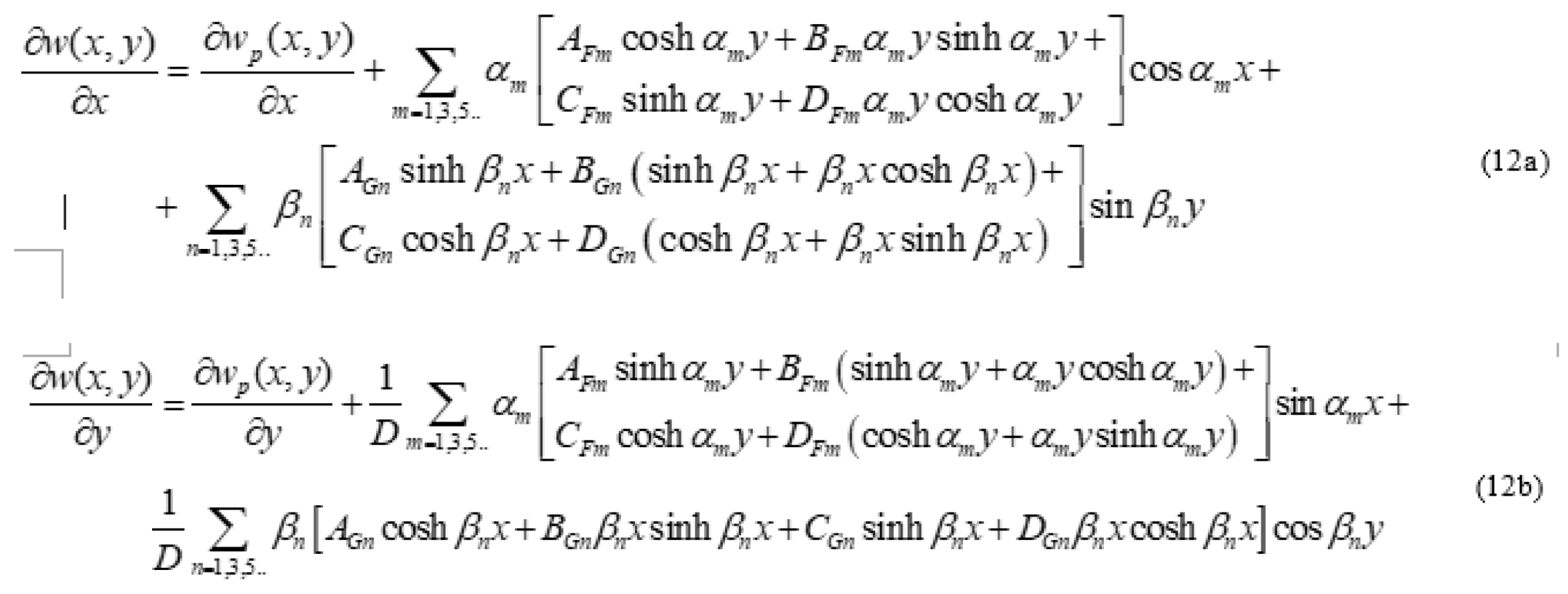
The boundary conditions involving the effective shear forces at the free edges x = a and y = b are set noting that for odd values of m and n cos (mπ/2) = cos (nπ/2) = 0. The slopes ∂w/∂x and ∂w/∂y used as boundary conditions are given by
Preprints 139191 i013
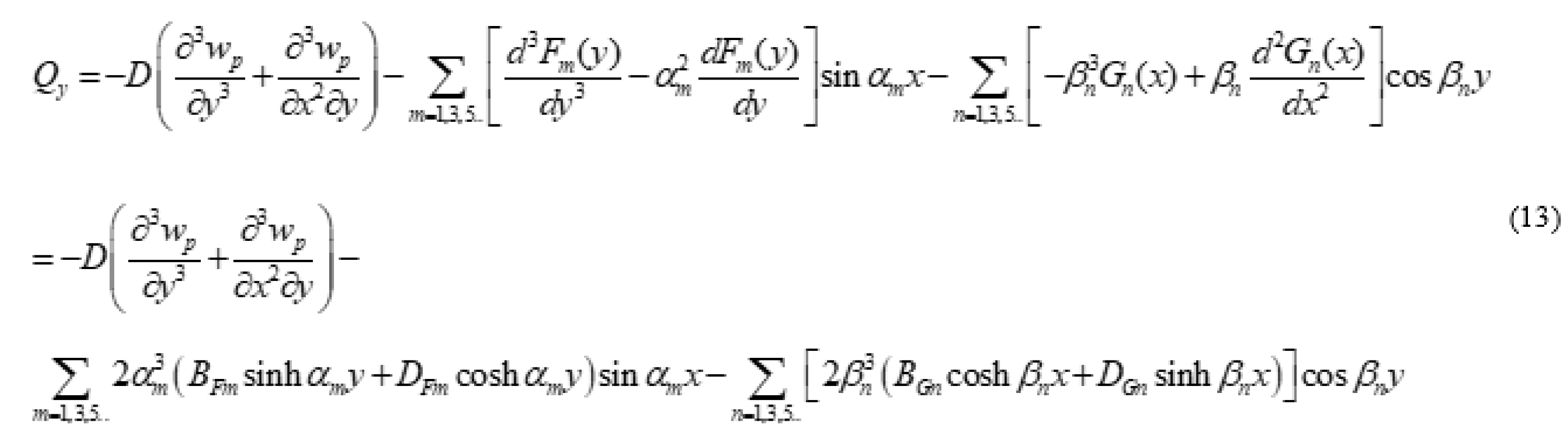
The shear forces Qy used by continuity equations are expressed using Equations (3b), (5), and (9a, b), as follows
Preprints 139191 i014
As a recall the coefficients AFm, BFm, CFm, DFm, AGn, BGn, CGn, and DGn are determined by satisfying the boundary conditions at selected collocation points. Given a displacement function where the first and second series have M and N terms, respectively. The edges x = 0 and x = a should be discretized with N points (positions yj) and the edges y = 0 and y = b with M points (positions xj): the boundary conditions are then applied at these points whereby the positions yj = kNb/N and xj = kMa/M with kN = 1, 2, 3, …N and kM = 1, 2, 3, …M can be taken. Moreover by applying the boundary conditions the external running moments and running loads should be suitably distributed at the collocation points.
With the determination of the coefficients above the deflections are calculated using Equations (5) and (9a, b) and the efforts (bending moments Mx, My, and twisting moments Mxy , and effective shear forces Vx and Vy) using Equations (10a-c) and (11a-b).

Analysis of Special Cases

a) Concentrated load acting at the unsupported angle

Given a displacement function where the first and second series have M and N terms, respectively. As derived before, the edges x = a and y = b are discretized with N and M points, respectively, whereby a node is located at the unsupported angle. Consequently the grid spacing along the edges x = a and y = b are b/N and a/M, respectively. The concentrated force P applied at the unsupported angle can then be distributed over the length d = a/2M + b/2N, and so the boundary conditions involving the effective shear forces, Equations (11a-b), are set as follows
Preprints 139191 i015

b) Concentrated force and moment applied at the interior of the plate

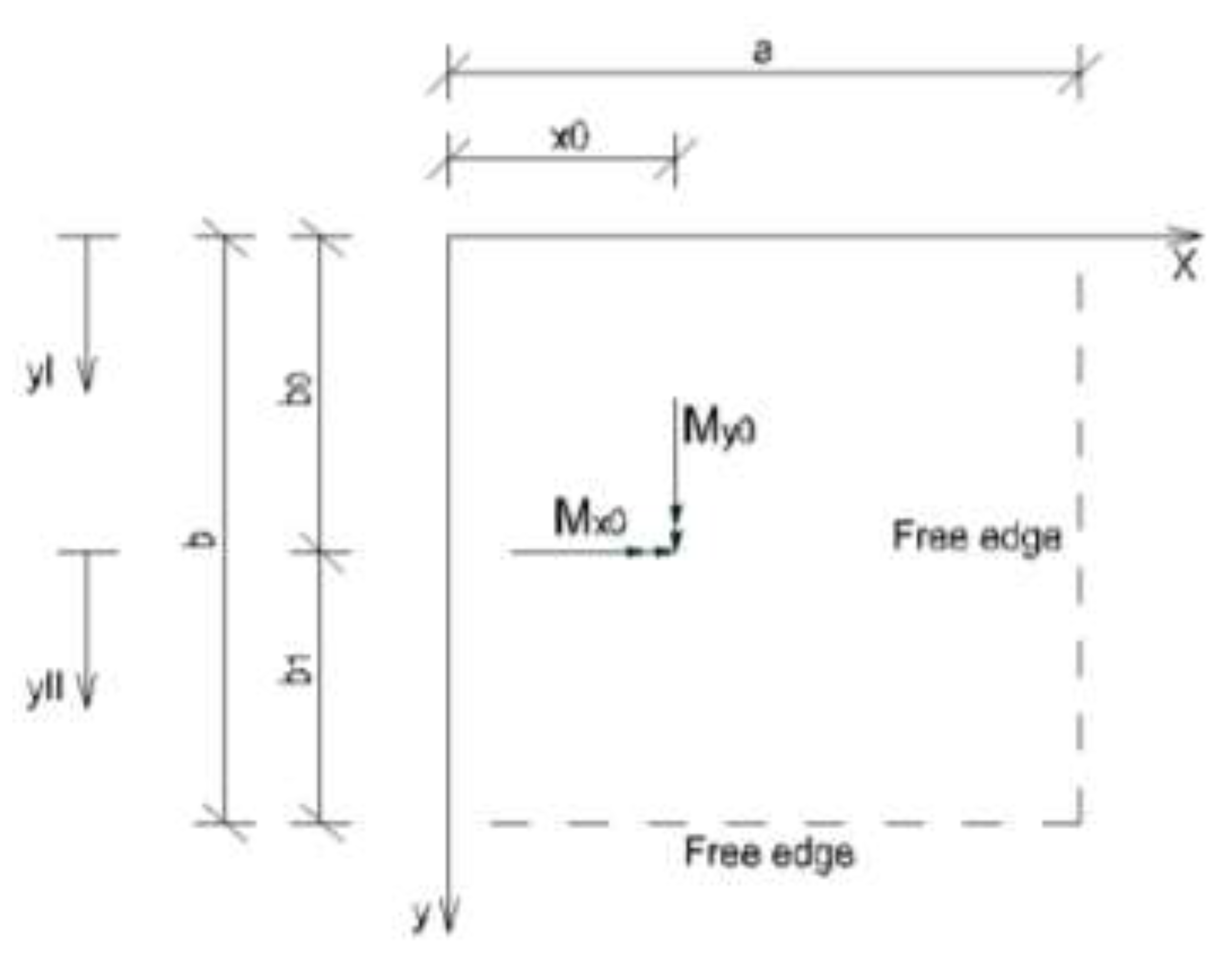
Let an external force P and external concentrated moments Mx0 and My0 be applied at (x0, b0) as shown in Figure 3.
Referring to Figure 3, the deflections defined as before (Equation (5)) are represented with the subscripts I and II for the plate zones 0 ≤ yI ≤ b0 and 0 ≤ yII ≤ b1, respectively, as follows
Preprints 139191 i016
Let the first series of wI and wII have each M terms, and the second series have NI and NII terms, respectively. Therefore, the lines yI = 0, yI = b0 (or yII = 0) and yII = b1 should be discretized with M nodes, and the edges x = 0 and x = a of the plate zone I and II should each be discretized with NI and NII nodes, respectively. It results in 4M + 4NI unknowns in plate zone I and 4M + 4NII unknowns in plate zone II, leading to a total of 8M + 4NI + 4NII unknowns.
The external force P and the moments are distributed to the nodes as follows: if the force P or moment Mx0 is applied at a node the corresponding distributed load p or moment mx0 is obtained by dividing it with the grid spacing; otherwise the force or moment is first distributed to the two neighboring nodes and then divided with the grid spacing to obtain the corresponding distributed loads or moments.
In case of an external moment My0, the continuity equations are applied along the line x = x0.
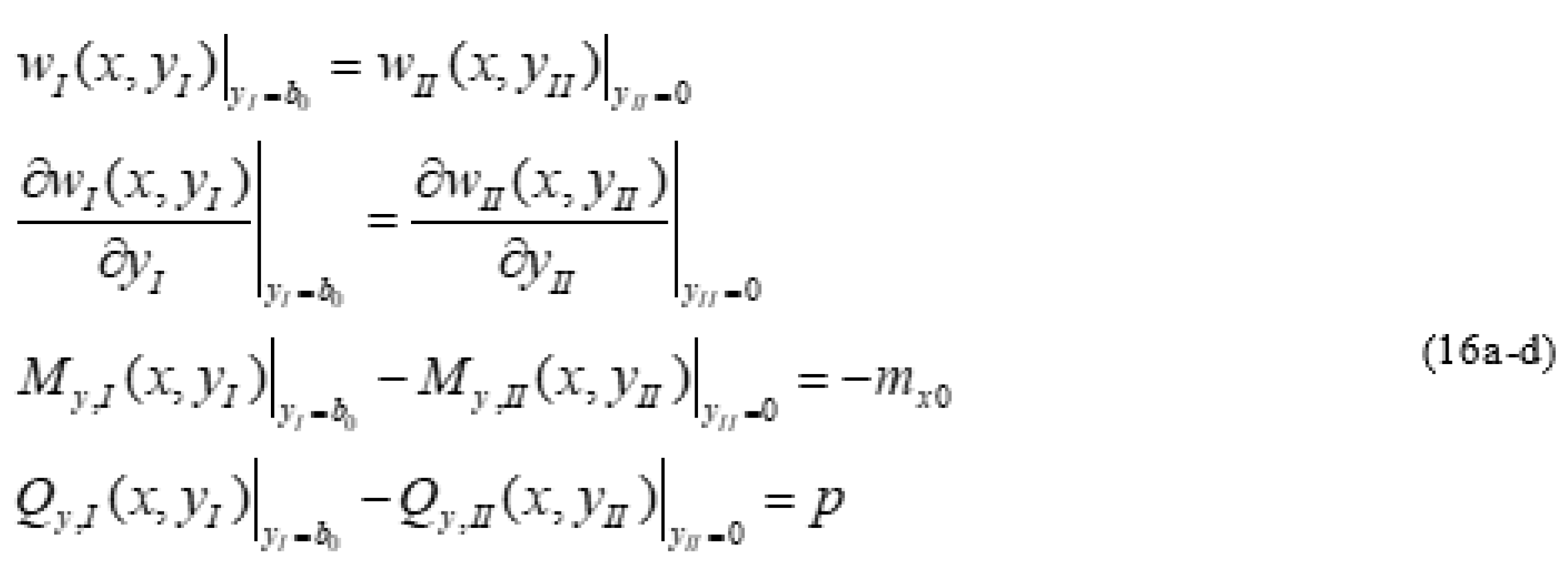
The continuity equations along the line yI = b0 (or yII = 0) express the continuity of the deflection w and slope ∂w/∂y and the equilibrium of bending moment My and shear force Qy. Observing that the position yI = b0 corresponds to yII = 0, these equations are given by
Preprints 139191 i017
Equations (16a-d) are set at each of the M nodes along the line yI = b0 (or yII = 0).
Following number of equations are set for boundary conditions and continuity equations
  • Plate zone I: 2NI equations at each of the edges x = 0 and x = a and 2M equations at yI = 0
  • Plate zone II: 2NII equations at each of the edges x = 0 and x = a and 2M equations at yII = b1
  • 4M continuity equations at yI = b0 (or yII = 0)
In summary, we have a total of 4NI + 4NII + 8M equations. So there are as many unknowns as equations.
It is noted that discrete supports along the line yI = b0 (or yII = 0) can also be modeled. In this case a node is placed at the position of the support and the continuity equation involving the shear force is replaced with a zero deflection equation.

a) Plate resting on three corner points with all edges free

In this case the boundary conditions at the collocation points involve the bending moments and the effective shear forces. However at corner points (a, 0) and (0, b) the boundary conditions involving the effective shear forces are replaced by the vanishing of the deflection.

3 Results and discussion

3.1. Rectangular Plate Having Two Adjacent Edges Free, Simply Supported Along The Other Edges And Subjected To A Uniformly Distributed Loading

Taking the particular solution wp(x,y) as the deflection of a plate strip parallel to x-axis and simply supported at both ends, the displacement function is given by
Preprints 139191 i018
The bending moments per unit length at the plate center, depending on the ratio b/a, are Mx,m = qa2Nxm, My,m = qa2Nym whereby M and N are the number of terms of the first and second single series, respectively. Details of the analysis and results are presented in the supplementary material “Rectangular plate with two adjacent edges free SSFF” whereby the collocation points were the following
  • Case M = 1 N = 1: yj = b along the edges x = 0 and x = a and xj = a along the edges y = 0 and y = b
  • Case M = 2 N = 2: yj = b/2 and b along the edges x = 0 and x = a and xj = a/2 and a along the edges y = 0 and y = b
  • Case M = 3 N = 3: yj = b/3, 2b/3, and b along the edges x = 0 and x = a and xj = a/3, 2a/3, and a along the edges y = 0 and y = b. Table 1 lists the results in Lecture notes [9] and those obtained in the present study.
As Table 1 shows, the results are in reasonable agreement with the exact results, the accuracy increasing the more terms of the series were taken. A powerful computation tool is therefore needed to consider higher number of terms of the series and so to approach the exact results.

4. Conclusions

In this paper, arbitrarily loaded isotropic rectangular Kirchhoff plates supported at three corner points, having two adjacent edges free and the other edges being simply supported, clamped or free, were analyzed. The deflection surface was approximated with the sum of a particular solution to the governing differential equation and two single series: the terms of the series were the product of an unknown function of an independent variable and a trigonometric function of the other independent variable, whereby the trigonometric functions satisfied the deflection-related boundary conditions. On the one hand the particular solution satisfied the nonhomogeneous differential equation and the single series were chosen so as to satisfy the homogeneous differential equation. On the other hand the boundary conditions were only satisfied at selected collocation points along the boundary, the number of collocation points in each direction corresponding to the number of terms of the associated series. However, due to the absence of symmetry of the system many unknown coefficients have to be calculated and so a powerful computation tool is needed to consider higher number of terms of the series and so to increase the accuracy. One numerical example was calculated and the results showed a reasonable agreement with the exact results, the accuracy increasing the more terms of series were considered: more examples with many terms will be presented in the next version of this paper. In future research cantilevered plates will be analyzed using this approach.

Supplementary Materials

The following supporting information can be downloaded at the website of this paper posted on Preprints.org The following file was uploaded during submission: “Rectangular plate with two adjacent edges free SSFF”

Conflicts of Interest

The author declares no conflict of interest.

References

  1. Fogang, V. An Analytical Solution to Rectangular Kirchhoff Plates Supported at All Corner Points Using Two Single Series and the Boundary Collocation Method. Preprints 2024, 2024102244. [Google Scholar] [CrossRef]
  2. Kirchhoff, G. Über das Gleichgewicht und die Bewegung einer elastischen Scheibe. J. für die Reine und Angew. Math.; vol. 18, no. 40, pp. 51-88, 1850.
  3. Trefftz, E. Ein Gegenstück zum Ritzschen Verfahren (An alternative to the Ritz method). Proceedings, 2nd International Congress of Applied Mechanics, Zurich, pp。131-137. 1926. [Google Scholar]
  4. Herrera, I. (2000), Trefftz method: A general theory. Numer. Methods Partial Differential Eq., 16: 561-580. [CrossRef]
  5. R. Piltner. Some remarks on Trefftz type approximations. Engineering Analysis with Boundary Elements, Volume 101, Pages 102-112. 2019. [CrossRef]
  6. R. Li, H. R. Li, H. Wang, X. Zheng, S. Xiong, Z. Hu, X. Yan, Z. Xiao, H. Xu, P. Li. New analytic buckling solutions of rectangular thin plates with two free adjacent edges by the symplectic superposition method. European Journal of Mechanics - A/Solids, Volume 76, 2019, Pages 247-262. [CrossRef]
  7. Q. Gao. Analytical Bending Solutions of Orthotropic Rectangular Thin Plates with Two Adjacent Edges Free and the Others Clamped or Simply Supported Using Finite Integral Transform Method. Advances in Civil Engineering. 2020. [CrossRef]
  8. B. Babu, B.P. B. Babu, B.P. Patel. Analytical solution for strain gradient elastic Kirchhoff rectangular plates under transverse static loading. European Journal of Mechanics - A/Solids, Volume 73, 2019, Pages 101-111. [CrossRef]
  9. E. Ramm. Lecture notes. Flächentragwerke, Platten. 1993. Institut für Baustatik, Universität Stuttgart. In German.
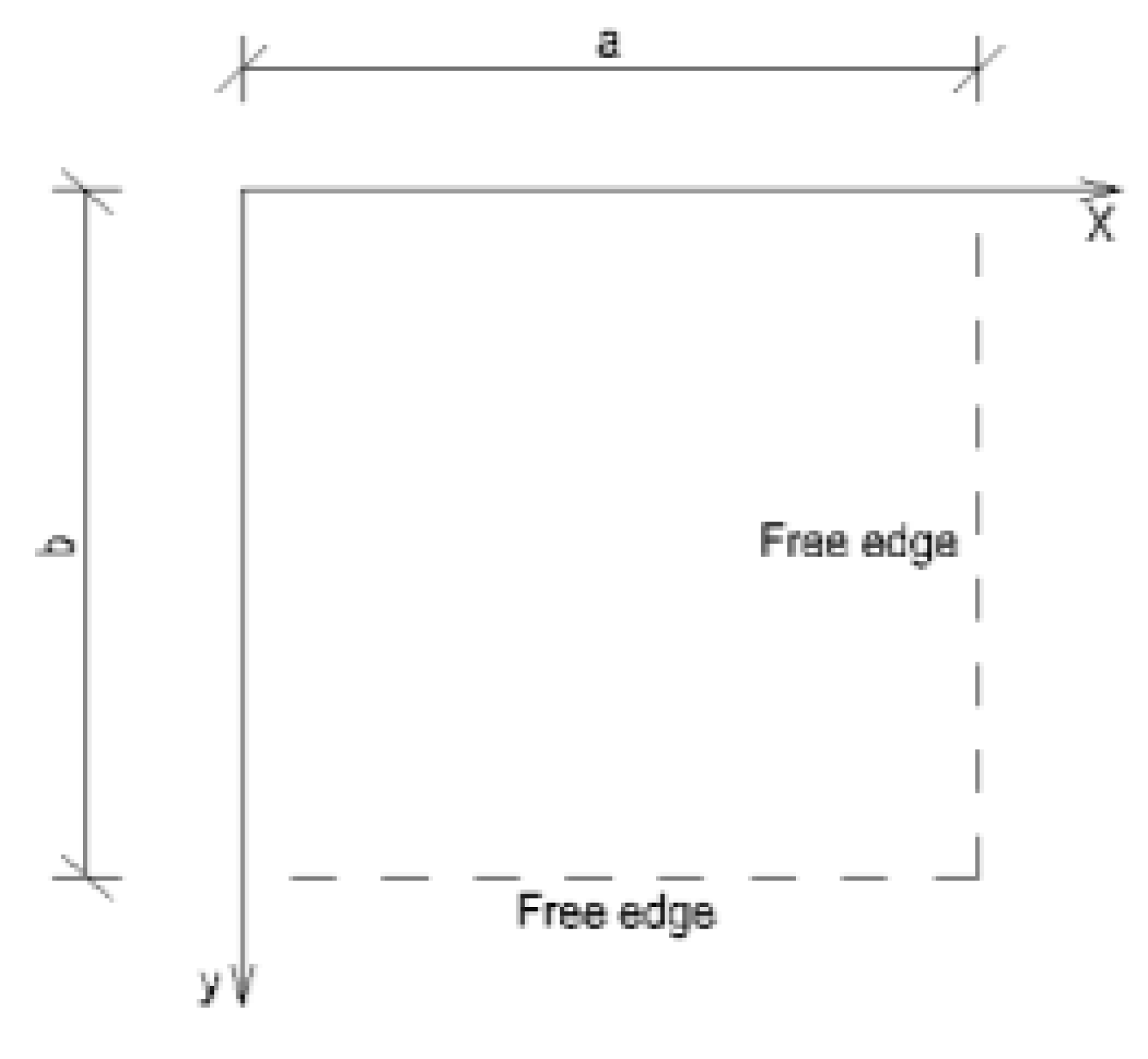
Figure 1. Rectangular plate and axis convention X, Y.
Preprints 139191 g001
Figure 2. Collocation points for M = 4 and N = 5.
Preprints 139191 g002
Figure 3. Plate subjected to an external force P and external moments Mx0 and My0.
Preprints 139191 g003
Table 1. Coefficients of bending moments at the plate center.
b/a = 1.00 1.20 1.50 2.00
Nxm Nym Nxm Nym Nxm Nym Nxm Nym
Lecture notes [9]
0.0508 0.0508 0.0547 0.0669 0.0598 0.0878 0.0703 0.1117
Present study
M = 1 N = 1 0.1073 0.0177 0.1008 0.0314 0.0933 0.0497 0.0857 0.0724
M = 2 N = 2 0.0635 0.0558 0.0733 0.0664 0.0840 0.0805 0.0957 0.0978
M = 3 N = 3 0.0583 0.0615 0.0703 0.0720 0.0826 0.0867 0.0964 0.1049
Disclaimer/Publisher’s Note: The statements, opinions and data contained in all publications are solely those of the individual author(s) and contributor(s) and not of MDPI and/or the editor(s). MDPI and/or the editor(s) disclaim responsibility for any injury to people or property resulting from any ideas, methods, instructions or products referred to in the content.
Copyright: This open access article is published under a Creative Commons CC BY 4.0 license, which permit the free download, distribution, and reuse, provided that the author and preprint are cited in any reuse.
Prerpints.org logo

Preprints.org is a free preprint server supported by MDPI in Basel, Switzerland.

Subscribe

Disclaimer

Terms of Use

Privacy Policy

Privacy Settings

© 2025 MDPI (Basel, Switzerland) unless otherwise stated