

Submitted:
07 November 2024
Posted:
11 November 2024
You are already at the latest version
Abstract
Polymer recycling is an essential and crucial topic in our sustainability-driven society. The depletion of oil and the increasing interest in biomass conversion clearly stimulate the search for alternative carbon sources. On the other hand polymeric products (plastic, rubber etc.) are ubiquitous and an integral part of our life. Recycling these products is then of paramount importance also, and perhaps crucially here, from an environmental point of view. In this work we will focus on the most common commodities , being the most important (in terms of production volume) thermoplastics, rubbers and thermosets. A consequence of this choice is also that the most common materials as well as chemical and biochemical recycling methods will be discussed. New advances in the corresponding technologies will be presented and critically evaluated. Finally, on the basis of this literature review, we will identify current trends and possible future developments.
Keywords:
polymer recycling
; mechanical recycling
; chemical recycling
1. General Definitions and Aim of This Work
Recycling of polymeric products is necessity in the current sustainability-driven climate of our society. This has stimulated an increasing number of research projects, in turn resulting also at academic level in an exponential increase of publications during the last 3 decades (Figure 1).
This general topic and its popularity as objective of scientific and technological development stems among others from environmental concerns as well economic considerations conceptually linked to the depletion of fossil resources and the fate of polymeric products at the end of their lifetime [1].
The legislation in European countries clearly recommend the re-use and recycling of polymer waste (as opposed to landfill) as main priorities [2]. On a longer timescale biodegradation would be obviously the preferred route [3], even though the task of replacing current plastics by fully biodegradable ones can only be defined as tantalizing. When dealing with recycling, which is often seen as the main solution to decrease the environmental impact of polymeric products [4,5] and decrease the energy demand [6], multiple options are possible (Figure 2) and constitute the objective of many multidisciplinary research projects [7] where technical aspects are often combined with economic and environmental ones [8,9].
We notice here that both the materials and chemical recycling offers side opportunities as ground waste (see below) finds also relevant applications while chemical recycling often results in oil that can be conveniently used as fuels and fillers that can be reused in composites.
We use here the term material recycling as opposed to the widespread “mechanical recycling” for two reasons. In first instance, the word “mechanical” does not encompass the possibility, also when dealing with a single recycled polymer, of chemical reactions during processing (e.g., extrusion). The paradigmatic cases of PP (giving degradation upon recycling) and polycondensates (like Nylon, giving usually branching during processing) constitute here relevant examples [10]. Moreover, as discussed below, in case polymer blends are considered, these almost always imply the presence of chemical reactions at the interface with the formation of compatibilizers to improve the dispersion of one component in the other. Also in this case, among other possibilities, the paradigmatic example of transesterification reactions between PET and PC can be put forward [11]. This holds true also for more complex systems, for example for textile waste. Blends of polyamide-6 and polyether-urea copolymers and rPET showed the relevant influence of interchange reactions between ester-amide groups and possibly additional ones (acidolysis, alcoholysis and aminolysis) during processing in the melt [12].
Thermosets and rubbers deserve a special mention as their crosslinked nature factually hinder, although not entirely ([13,14,15,16,17]), the very few attempts at material recycling. For rubbers in particular, the use of thermoplastic elastomers constitute a valid alternative whenever possible based on the product requirements [18]. For thermosets, at least PU or epoxy resins, the aminolysis of the urethane and C-O bonds respectively seems to constitute a viable option [19].
It must be finally stressed here the crucial difference between industrial and post-consumer waste. The former is relatively clean and pure while the latter suffers from severe contamination from impurities and other plastics, thus being much more difficult to recycle [20].
Generally speaking material recycling results in worse properties (thermal and mechanical) with respect to the virgin materials [21,22,23,24,25,26,27], even though in specific cases only at the level of physical appearance [28]. It is stressed that material recycling does not solve the problem of the negative impact of plastics on the environment, it only postpones this solution. This is because after the end-of-life of the recycled plastics they are converted again in waste or litter [29]. Indeed, feedstock recycling (either chemical or biochemical) display the advantage of closing the loop and constitutes a conditio sine qua non as upon multiple recycling steps will ultimately deteriorate the polymer properties in a decisive way [30]. The dichotomy material vs chemical recycling has been the subject of many controversial contributions. It suffices here to say that several Life-cycle analysis has shown the convenience of material recycling for commodity low-cost polymers (e.g., polyolefins) [31] and thermoplastic composites [32]. This is not surprising when making allowances for the fact that separation of waste plastics and their processing (via reactive extrusion) are certainly and self-speaking less energy intensive than pyrolysis, separation of the monomers from the resulting oil, re-polymerization followed by an extrusion step to pelletize the new polymer [33], the last two steps being also carried out when using monomers from fossil resources. As a result, the discussion seems fairly obsolete although it must be noticed that a definitive advantage of the chemical recycling route is the presence of suitable infrastructure as oil refineries can be conveniently used to refine the pyrolysis oil [34].
In this work attention will be paid to commercially available polymers, following similar overviews already published in the past [35], as to provide the reader with a comprehensive summary of the state of the art. In the future outlook section we will provide a concise overview of recent and present developments. A section on design for recycling will try to forecast possible application of reversible chemistry for the circular economy while the reader is referred to recent works for the more industrial oriented product design for recycling [36].
2. Recycling of Current Commercially Available Polymers
2.1. Pre-Treatment
The first step in material recycling for post-consumer waste is the sorting into different components. This is conveniently achieved on the basis of density differences, but also with spectroscopic (especially FTIR and Raman [37,38]) methods. For example FTIR has proven useful in separating acrylonitrile-butadiene-styrene (ABS), high-impact polystyrene (HIPS) and ABS/polycarbonate blend (ABS/PC). Fire tests can be conveniently carried out to detect the presence of flame retardants as in ABS and HIPS [37]. This is crucial as the presence of flame retardants can constitute a problem in terms of side-reactions during melt processing [39]. Generally speaking, sorting still faces many challenges due to the heterogenous nature of the waste and the advent of novel complex product for example from the biomedical sector [40]. Separation form metals is becoming also a relevant issue when dealing with recycling of different materials from electric vehicles [41]. Moreover, specific problems also might arise when sorting specific waste. For example textiles consists usually of different polymeric materials such polyesters, polyamides and acrylics. Their presence in mixed yarns [42] constitutes a relevant challenge, besides the expected issue of contamination with other compounds [43]. Beside spectroscopic characterization, more specific techniques are often required for a precise determination of the polymer physical properties. For example a novel GPC technique has been reported for characterizing molecular weight of recycled polymers [44]. This development requires less difference in refractive index values between polymer and solvent/contaminants, which is obviously a common case for waste materials.
After the sorting step and on the basis of different characterization techniques, it might be clear that the quality of the waste is not enough to justify a re-processing step in the melt. In these cases, grinding into solid particles might still offer option for re-use. Indeed, the use in bitumen, asphalt and concrete as low cost application for waste polymers [45,46,47,48,49,50,51,52,53,54,55,56,57,58,59,60,61,62,63,64,65,66,67,68,69,70,71,72], especially in case of crosslinked materials [73], is still quite popular. For example, the use of recycled latexes from the paint industry in concrete delivered the expected effect on the final product, namely improved bond stress in the elastic region [74]. Concrete application remain attractive also for recovered fibers [57,75] or even single-polymer fibre-reinforced thermoplastic composites [76]. This strategy is quite general and implies the use of recycled polymer in the construction industry in general [77]. It must be stressed here that the complex nature of these materials makes it very difficult, if possible at all, to pinpoint the exact function of the polymers as related to their (chemical) structure. As a consequence, the product designers do not have at their disposal any exact tools for selecting the most suitable materials for a given application and comprehensive/comparative studies will probably still be needed.
Along the same line, a novel application area is the use of waste polymers in metallurgical and mineral manufacturing processes. This is quite interesting as recycled polymers can be used (for example as interfacial agents and binders) as well as their pyrolysis products (for example H2, CH4 and CO), the latter as reducing agents [78]. Also application of recycled polymers as binders has been described [79].
When the possibility exists for direct collection or easy sorting of a plastic waste [80], many technologies become available for recycling [81]. One such example is constituted by ABS from electronic goods. This can be collected and segregated in a relatively easy way according to the existence of proper legislation in many countries. The obtained purified waste can then be recycled mechanically or thermally [82]. It has been shown for example that ABS from monitors can be efficiently recycled as material with little variation in thermal and mechanical properties [83].
After sorting, a further, often more accurate strategy, for the separation of different polymeric materials is the use of selective solvents as in the case of PC, PS and ABS [84]. These processes are often quite accurate and able to distinguish quite a number of different polymers, for example for packaging materials based on LDPE and HDPE, PVC, PS and PET. Generally speaking high yields (>90%) and purities are achieved [85]. This is popular as it allows in principle multi-layer recycling even if its applicability is dependent in the material under investigation [86]. Furthermore, its environmental impact is questionable as many potentially dangerous and not environmental friendly organic solvents are used [87,88]. The same holds true for polymeric products displaying the presence of additives in relevant percentages with PVC being a paradigmatic example [89]. Despite the difficulties in handling organic solvents at large scale, the selective dissolution strategy remains interesting, also form an economic perspective [90], for multi-layer films when the objective is the recovery of the single components [91].
2.2. Material Recycling
After sorting, the co-existence of physical mixture of polymers is more the rule than the exception. If individual components can be separated, generally speaking, mixing of a recycled polymer with the virgin one provides ample opportunities for properties control as shown for PE [92,93], ABS [94] and PLA derivatives [95].
If further separation is not possible or feasible from an economic point of view, a logical solution would be actually to blend the polymers in the melt. Generally speaking the potential of polymer blends (as originated from unsorted plastic waste) is quite underestimated [96,97]. This stems ultimately, among others, from the over-design nature of many polymeric products. Indeed, the use of a specific material for a given application has been driven during the last few decades by technical (satisfaction of the product requirements) as well as economic considerations (economic feasibility) [98,99,100,101,102,103,104,105]. The availability of many materials that satisfies product requirements and are commercially available at relatively low price led also to overdesign. Examples of the blending strategy can be found in PLA/rHDPE [106], rPET/PC [11], rSAN/PVC and rABS/PVC [107] blends and even for rubbers such as EPDM/rEPDM [108]. This strategy often results in products with (slight) inferior quality, thus suggesting a down-cycling character [109]. Obviously one tries to compensate the loss of properties in the recycled material with the gain obtained by choosing a suitable second component in the blend. An example is constituted by rPET/PC blends where the relatively high Tg and barrier properties of the PC are crucial in compensating those for the rPET [11]. Special cases can be highlighted when the waste originates from a given source and with a known composition. For example, polymer blends based on 20 different printers waste have been reported to consist of HIPS/PS (90/10 wt/wt), HIPS/ABS (90/10 wt/wt) and pure HIPS. Despite having slightly different mechanical properties as a result of the different chemical structures, materials obtained by formulating the different components displayed consistent mechanical behaviour and could be used to manufacture hangers, organizing boxes, soles and, watering cans [110].
Blending of different components (usually present already as physical mixtures) represent a valid option especially when suitable compatibilization techniques are used (for example PET/PE/PC, Polyolefins/Nylon or PET blends [111] and even quaternary ones consisting of PE, PP, PS and PET [112]). Compatibilization of polymer blends is most often a pre-requisite to obtain the desired mechanical behavior. This necessity stems from the immiscible nature of polymers [113,114] and thus the necessity to improve the dispersion of one component into the other. Compatibilization helps in strengthening the interfacial adhesion between different polymeric components, thus also when dealing with recycled fibers that most often lack interfacial interaction with polymeric materials, thus resulting in weaker composites [115]. This might be balanced by surface treatment. One example is provided by plasma treatment to modify the surface properties for PET films used then as adhesive [116], but also of carbon fibres [117]. Finally, the addition of specific reactive monomers (e.g., acrylics) has also been reported to increase the interfacial adhesion between PP and different kind of fibres [118].
Compatibilizers are traditionally prepared in the melt by functionalization of virgin polymers (Figure 3) [119].
We take here the functionalization of iPP with MAH as paradigmatic example even if the chemistry of these processes is heavily dependent on the substrate and the used monomers [119]. These reactions and the function from the corresponding compatibilizer (precursor) date back from the last two decades of the 1900s (see for example [119,120,121,122]), but have been recently “brought back to life” in many different studies (vide supra) [123].
For biodegradable polymers (usually polyesters) material recycling is also interesting as it constitutes an added value, besides biodegradability, in terms of end-of-life policy [124]. This has been demonstrated for PLA/PHBV blends [125] and for PLA alone [126] upon addition of a chain extender [127]. Also in the case of polyolefin blends, the use of reactive additives, in this peculiar cases peroxide helps in improving the compatibility between different components, such as PE and PP [128] (Figure 4).
This is probably due to the formation of graft/block copolymers (via radical coupling) and the subsequent action of the latter as compatibilizer for the blend. The use of compatibilizers has been reported as crucial in improving the compatibility also with solid particles for polyolefins waste from agricultural silage films [129]. The latter are mainly constituted by PE with small PP impurities. However, they also comprise solid particles (sand and minerals) that are not easily recovered after grinding the used films. When recycling the obtained particles by extrusion the addition of a compatibilizer (typically a maleic anhydride, MAH, functionalized polymer at 2,5 wt % intake) a chemical reaction between the -OH groups at the surface of the solid particles and the MAH is inferred to take place (Figure 5).
The result of such reactivity is the formation of chemical bonds between filler and matrix and consequently the retaining of the mechanical properties compared to the virgin film. Similar benefits have been also reported for wood-based composites with recycled polymers [130,131,132]. The concept of surface reaction can be exploited also for recycling of crosslinked particles (do not melt upon heating) by creating an interpenetrating network as demonstrated in the case of SAP [133] with silane coupling agents (Figure 6).
The obtained product has been shown a retention of the absorption properties higher than 80 %, thus demonstrating the validity of this approach. In reality this kind of strategy is widely applied as a kind of last resource (vide supra). When the quality of the waste mixed plastic is not enough to justify reprocessing in the melt, use of the grinded solid as filler in combination with a resin still allows the production of composites [134,135].
The promotion of radical reactions during extrusion has benefit for polymer blends [136,137], but also for homopolymers. As shown for the recycling of polyamides, the use of γ-irradiation might result in branching/crosslinking of the polymer [138], thus compensating for the viscosity loss, with respect to the virgin polymer, during the product lifetime. The addition of stabilizers (typically radical quenchers) represent also an effective strategy to counterbalance possible degradation reaction upon recycling [139], even though these low molecular weight compounds do not usually help in improving the compatibility between polymers. In some specific cases the use of recycled polymers results also in superior properties with respect to the virgin one as in the case of rPP in wood composites. This was attributed to the increased crystallinity of rPP as compared to the original one (probably as a consequence of the thermal degradation). The formation of a transcrystalline layer at the surface of the wood fibres was deemed responsible for the observed mechanical behaviour in terms of creep compliance [140].
Food packaging (e.g., PET [141], polyolefins [142]) requires special regulation to be re-applied in the same field [143]. This often results in the need of dedicated policies for the return of specific waste as to minimize possible contamination [144]. However, the combination of recycled with virgin material [145,146] in a multilayer structure could also represent a solution provided that the migration kinetics of pollutants between the recycled and the virgin layer is known [147,148,149] and possibly controlled [150].
Blending is not the only option for material recycling. From a technological point of view, melt blowing represents a convenient method to directly convert recycled polymers into a fabric/film as already demonstrated for PP [151]. A recent development include also the concept of microfibrils, for example blends of PET and LDPE where the former is present as microfibrils [152], ultimately displaying properties superior upon cold drawing [29]. Micronization is also an alternative to blending when weaker bonds (for example O-O or S-S) are present [153].
The idea of recovering high-value materials from polymeric products finds a relevant example in the recovery of glass and carbon fibers [154,155,156,157]. In particular, carbon fibers, given the increase in production and the broad range of applications have been receiving significant attention in the past decade [158,159,160,161]. It is worth noticing here that the recovery of these fibers might display quite general benefits [71,115] as their use in composites with recycled polymers as matrix significantly dampens the effect of recycling. This is a simple consequence of the fact that the property of a composite depend also on the one of the filler according to equations like the one below (1) for the elastic modulus (E).
Where E is the elastic modulus, ϕ the volume fraction and the subscripts m and f refers to the matrix and filler respectively. If we take, for example, the elastic modulus of PP (2 GPa) and carbon fibers (170 GPa) [162] at ϕf=0,05 the modulus of the composite is equal to 10,4 GPa. A 30% loss of modules for PP upon recycling would then result in a composite with modulus equal to 9,83 GPa, thus a loss of about 6%. Natural fibers (such as palm [163,164], silk and cotton [165] ones) can also be used. Recently, also the use of nano-additives has been proposed to minimize the property loss [166,167,168,169,170]. Besides fibers, the addition of different fillers (such as zeolites [171], ash [172], SiC/Al2O3 particles [173], metal powder [174], recycled materials [175,176,177] and toughening particles [178]) to unsorted polymeric waste has also been reported. Comparative studies are able to highlight the difference between different fillers and in some special cases pinpoint synergy in terms of mechanical behavior of the composite [179]. In special cases the presence of the reinforcement results also in improved stability against weathering and aging [180]. All strategies briefly outlined above constitute a part of the sustainability practices that are currently being defined and implemented for composite materials [181,182]. It goes without saying that the possibility of recycling both the matrix and the filler constitutes, whenever possible, the ideal scenario [183].
The general strategy of recovering high value fibers [184,185], even with non-conventional methods [186], is also valid when using recycled fibers in in situ polymerization processes [187], as additives in concrete [188]. A recycled polymer can also be used to produce fibers [189] and be used then as reinforcement in new composites as shown for polyamide 6 [190], PP [191] and PET [192].
In case separation is not an option grinding and use as filler for the all composite is still an investigated option [193] in addition to mixing with concrete [194,195]. Recently the possibility, for thermoplastic composites of grinding and then application for 3D printing has been demonstrated for wind blades [196] and other polymer waste [197,198] based on PLA [199,200,201,202,203], PET and derivatives [200,201,202,204], ABS [200,201,203], HDPE [201]. It must be noticed how this approach often relies on a relatively high purity of waste streams, but, whenever possible, it also reduces the energy demand as well as the carbon footprint of the recycling process [205]. Also the use of recycled fibers in new composites for addictive manufacturing is gaining a lot of interest as recycled fibers are more cost effective, albeit the inferior properties, than virgin ones [206]. Application of recycled composite have also been found in water treatment [207]. Generally speaking, additive manufacturing seems to represent a large application field for many polymers to the point that a specific codification procedure is propose to keep track of the material used [208].
2.3. Chemical Recycling
The general idea of chemical recycling consists in destroying the polymeric structure, whenever possible by depolymerization reactions, as to recover the (original) monomers. Pyrolysis represents in this context the most used technique especially for polyolefins due to difficulties in other methods for separation [209,210], thus especially even when blended with other polymers [211].
Chemical recycling offers a promising solution to enhance recycling rates, with microwave heating emerging as an attractive technology for polymer breakdown [212,213,214,215] in order to improve the degradation kinetics. However, the outcome in terms of chemicals obtained and possibility for direct re-use in polymerization remain heavily dependent on the complex chemistry of degradation [216] as well as the applicability (also from an economic standpoint) of suitable separation techniques. Indeed, many works refer to the pyrolysis oil for other applications such as fuels [217].
Also in this case, when the waste has a consistent chemical structure, for example originating form a common application, interesting results have been reported. The pyrolysis of crosslinked PMMA (from dental waste) yielding >90 wt % liquid phase with >98% purity in the monomer. After purification by distillation and re-polymerisation the properties are similar to the ones of the virgin polymer [218]. Similar results have been also reported by using innovative technologies such as an indirectly heated fluidised bed [219].
For polycondensates chemical recycling is undoubtedly easier than for polyolefins or other polymer involving radical chemistry. Indeed, in this special case, the polymer and the corresponding monomers are usually in thermodynamic equilibrium with each other. This allows the use of reactive chemicals to depolymerize the material to low molecular weight compounds (not necessarily the monomers) that can be re-polymerized again in a theoretically straightforward manner. The approach is quite general (Figure 7a,b) as it applies to a wide range of polycondensates [220,221].
Waste based on thermosets requires generally speaking destructive approaches as to destroy the 3 dimensional structure [222,223] or, in any case, eliminate the bond between the chains similarly to what happens in rubber devulcanization [13,14,15]. This holds true also when trying to recover fillers. Indeed, In case of thermosets, special methods are needed to recover the fibers [224], for example the matrix degradation by using superheated steam [225], supercritical water [226], alcohols [227] or acetic acid near the critical point [228]. Comparative studies have also shown a clear dependence of the composite properties on the strategy to recover the fibers [229]. Interesting developments involve the use of multiple steps as to break the thermoset structure to recover the fibers. An example is the chemical disruption of an epoxy based thermoset [230] (Figure 8).
It is believed that the used solvent diffuses inside the composite thereby causing swelling and increasing the accessibility of the functional groups. The Lewis acid catalyst can then selectively break the C-N bonds, thus effectively degrading the 3-dimensional structure to the level of soluble chemicals. This leaves ultimately the fibers behind.
3. Future Outlook
The stringent necessity for a circular policy, for example European countries committing to full circularity before 2050, will most probably and hopefully attract even more interest in polymer recycling in the coming years. On a long term the design at molecular level of novel materials easier to recycle deserves a relevant spotlight. On the other hand, novel developments for currently available materials are also needed. We highlight in the following section both strategies.
3.1. Design for Recycling
New developments are needed to start producing materials that are inherently recyclable at their end-of life [231]. In the last couple of decades the development of Covalent Adaptable Networks (CANs), also referred to as dynamic covalent networks, rapidly gained momentum. This is due to their ability to potentially replace the conventional thermosets of which the crosslinks cannot be broken easily. Additionally, these types of networks can sometimes exhibit a remarkable feature of self-healing, which expands the service lifetime of the products. The development of CANs spans from the discovery of new reversible ‘click’ chemistries, to the use of these chemistries to design new CANs, and finally tailoring their properties to the product applications. CANs possess reversible covalent bonds which can be broken under a variety of stimuli, among which thermal energy and light are the most common triggers [232]. The equilibrium reactions at the foundation of CANs can be classified into two types, depending on the mechanism of the bond formation and dissociation. As illustrated in Figure 9, the bond exchange can occur via an associative or dissociative mechanism. Associative networks (also known as vitrimers) have the ability to undergo bond exchange and thus possess a degree of flow, while still maintaining the network integrity and the number of crosslinks throughout the recycling process. In contrast, dissociative networks lose complete network integrity after thermal treatment. This becomes apparent as thermal treatment results in a lower viscosity as compared to vitrimers. For this reason dissociative networks are considered to be less challenging to recycle. As illustrated in Figure 9, the reversible bonds can be only part of a crosslink between polymer strands, or the monomers themselves are designed with functional groups to eventually produce a cross-linked network with reversible bonds in the ‘main chain’ as well. We touch upon several considerations in the design of CANs, being the types of chemistry that induces bond dissociation or exchange, several strategies to synthesize such networks and typical recycling conditions of CANs.
Due to the double step mechanism of dissociative reactions, the crosslink density depends on the time and temperature. Therefore, it will vary during the reprocessing step and commonly thereafter as well [233]. The most common chemistry being employed for the design of dissociative CANs is the Diels-Alder reaction, as displayed in Figure 9B. The furan-maleimide couple in particular has been introduced in polymer networks in several ways, by exploiting functionalities in the backbone and introduce furan groups. For instance, poly-ketones can be functionalized with furan groups with a Paal-Knorr reaction with furfuryl amine [234,235]. Others have demonstrated the functionalization of jatropha oil [236,237] with furan groups via epoxidation of unsaturated bonds, followed by an epoxy-amine reaction with furfuryl amine. Similarly, this has been demonstrated for the design of recyclable rubbers [238,239]. Dissociative networks are typically thermally recycled due to macroscopic flow induced by the retro Diels-Alder reaction at elevated temperatures. Higher temperatures break the Diels-Alder crosslinks and thus the recycling will be similar as for a thermoplastic. Typically, the equilibrium conversion of the Diels-Alder reaction starts to decrease at above 70 °C [240]. The actual application window may therefore be more narrow compared to associative networks. The temperature at which the network undergoes a phase transition from a solid to a viscous liquid depends on the cross-link density. This in turn depends on the network architecture and the number of functional groups per monomer. Paul Flory and Walter Stockmayer developed a theory on molecular size distribution and percolation of multifunctional end-capped branch units, leading to a simple relationship [241,242].
Equation (2) is known as the Flory-Stockmayer equation. Here, is the critical gel conversion, i.e., the minimal conversion at which every branch unit becomes part of the total network. This can be calculated with the number of functional groups per monomeric branch unit. and are taken here as the number of functional groups of a furan bearing monomer and a maleimide one. The equilibrium conversion decreases by heating the material to below to induce macroscopic flow. Flory-Stockmayer theory is in line with experimental ‘de-gelation’ temperatures, and can predict accurately at which temperature the gel-liquid transition takes place and thus at which temperature it can be recycled. As such, several publications highlight the good agreement for Diels-Alder systems built from furan end-capped monomers and a bismaleimide [243,244,245,246], which was possible by their accurate description of the reaction kinetics. In dissociative network the main challenge is to recycle without any side reactions. For Diels-Alder networks, the reaction rate is high enough to push the equilibrium downwards in minutes or even seconds at 140 °C, until the point where perhaps the system is heat-transfer limited instead of kinetically limited. However, at these temperatures some other side reactions can jeopardize the reversibility of the system. The most considered ones are maleimide homo-polymerization [247,248], Double Diels-Alder [249] or aromatization [250,251,252], although given methods to prove aromatization are sometimes debatable. Other Diels-Alder couples involving anthracene have been used as well and are generally more stable at higher temperatures, and for this reason also require a higher temperature or time to be reprocessed compared to furan-maleimide systems [253,254]. Other types of chemistries are for this purpose also explored and are summarized in Figure 10. For example, Schiff base reactions involve imine bonds that can undergo both an associative pathway (trans-amination) and a dissociative pathway, being a hydrolysis reaction towards the ketone and primary amine [233]. This mostly occurs in acidic conditions and in water, and these materials could be reprocessed by acid catalyzed degradation in solution to retrieve the starting materials, or alternatively by thermal recycling [255,256].
Boronic acids and diols can form a reversible boronic ester bond, and emerged as an attractive and safe chemistry for biomedical applications [261]. Complexation of a diol and a boronic acids is pH responsive and can therefore its reversibility has mostly been demonstrated with pH as stimulus. Similarly, acylhydrazones are dissociative as well and are recyclable upon changes of pH [262]. pH activation would therefore be favored to induce reversibility as thermal activation brings up concerns about the thermal stability. The conditions used to demonstrate the recyclability of these crosslinked networks are reported in Table 1 along with the reported recycling conditions.
The mechanism in associative networks requires an additional third party to take place in the exchange process. Heat induces both thermal motions to bring these groups together and faster exchange kinetics [263]. Some exchange reactions, such as trans-esterification, are rather slow and may require a catalyst to stimulate the rapid bond exchange. In their review, Kumar et. al. provide an overview of reprocessing conditions for trans-esterification reactions [264]. Transesterification is often catalyzed by Zinc acetate as was done in the pioneering work of Montarnal et. al. [265], and lowers the temperature somewhat to reprocess the material. Zhang et. al. [232] provide an overview several strategies to recycle vitrimers and provide examples in which conditions even vitrimers can be continuously recycled. Taplan and co-workers [266] highlight that so far the reprocessability of vitrimers is limited to compression molding only, but managed to process vitrimers in continuous fashion as well through extrusion at 150 °C. This was done by increasing the bond exchange rate through careful network design. Several examples of typically reported recycling conditions are listed in Table 2 for a variety of reversible chemistries. It should be noted that the conditions to recycle are chosen for the sole purpose to prove the concept of recycling, even though it may be possible at lower temperatures as well. Overall, the thermal cycles employed in these examples highlight via tensile tests the recovery of mechanical properties after several recycling steps.
3.2. General Considerations
For currently available materials many trends and necessities can be identified. In first instance, further improvements of the sorting process (for example based on macroscopic properties such as color and density [270]) as to be able to more efficiently separate almost pure components, would be desirable. In this respect, advances have been booked in improving the spectroscopic techniques, such as FTIR [271]. This is important also at polymer level as biodegradable polymers (e.g., PLA) are gradually replacing oil-based non-biodegradable ones (e.g., PE) in several applications [272,273]. Being able to identify the presence of both kind of polymers is paramount in defining suitable separation strategies or blending ones in case the mixed waste cannot be separated [274].
Secondly the definition of a high-value application and in general upcycling strategies [275,276], for example in batteries [277], is needed as to boost research in the field as well compensate for the low-value applications. One other way is to modify the recycled polymer (directly during extrusion), for example by grafting PE with GMA [278,279] (Figure 11).
The modified polymer is obviously more polar than the original PE and as such can be used for example for adhesive applications.
Thirdly, improved and more sustainable pre-treatment techniques should be systematically developed. Despite the many advantages of material recycling as outlined above one key aspect to be considered is the present of additives such as stabilizers and plasticizers. If these low molecular weight compounds (for example brominated flame retardants [280,281]) present a threat for the people health or for the environment they have to be removed prior to recycling. The same holds true in case these molecules simply interfere with the chemistry, if any, involved in the recycling step in the melt [282]. A new trend is detectable to tackle this problem, namely the use of green solvents as pre-treatment step. At the same time comparative studies have been carried out to selectively isolate and separate low molecular weight additives (as well as oligomeric fractions generated by degradation upon recycling) from the bulk recycled polymers [283]. This knowledge is crucial in selecting the most suitable separation process and thus render the recycled product as pure as possible.
Another aspect deserving attention is the presence of an intermediate way between material and chemical recycling. When degradation cannot be avoided (for example upon multiple recycling steps) the oligomeric nature of the obtained product makes it possible to find applications as lubricants [284]. More importantly, the oligomers route seems to be developing due to less energy demand and possibility to go back to materials quite easily [285].
Developments are also needed at theoretical level for example with the use of advanced machine learning technique to predict polymer properties when mixing virgin and recycled polymers [286]. This is can be achieved also by traditional theoretical approaches to maximize the recycled polymer intake to obtain a given mechanical behavior [287]. Generally speaking, the development of theoretical models able to predict the processing behavior as well as the final product properties represents a crucial development [288]. Form an economic point of view, polymer recycling can be conveniently performed in an integrated manner as to combine in single facilities all recycling options (e.g., chemical and material) in order to minimize transport costs [289]. Moreover, significant advances in the recycling equipment design have been also described [290]. For example by introducing nanoseconds electromagnetic pulses grinded waste polymers can be processed by decreasing the overall heat load, thus reducing the impact of thermal degradation [291].
A possible game changer in the recycling word is the rising use of electrochemical techniques. The general strategy is the one of oxidation (for example of polyolefins [292], Figure 12).
The obtained chemicals can be re-used for the synthesis of polyesters and polyamides. Besides the fact that the obtained polymers are fairly different from the original polyolefins, the technique can also be used to depolymerize polyesters such as PET to the original monomers [292].
Also from a technological view point, recent developments can be mentioned as specifically contributing to the material recycling. For example, extruders able to predict (based on the material properties as well as on the details of the extrusion process) the change in viscosity along the barrel and to compensate for it by adjusting the screw speed, have been recently described [293,294]. Moreover, computational fluid dynamic (CFD) modeling of the extrusion process as well as of ancillary steps (e.g., melt filtration [295]) clearly render a mathematical description as well as subsequent upscaling much easier.
Finally, an integrated approach, following some specific literature examples [296], should be used in order to tackle the challenges posed by recycling in a comprehensive manner. This conceptual integration nicely dovetails the more logistic one (vide supra). This is conceptually counterbalancing the fragmentation factors in industrial and consumer applications [297], which in turn dovetails the kaleidoscopic varieties of recycling strategies.
Acknowledgments
The corresponding author would like to dedicate this paper in memoriam of prof. dr. dr. P.Krijgsman (1940-2024), friend and mentor, who left us during the writing of this manuscript.
Conflicts of Interest
The authors declare no conflicts of interest.
List of Abbreviations
| ABS | Poly(acrylonitrile-butadiene-styrene) |
| CAN | Covalent Adaptable Network |
| CFD | Computational Fluid Dynamic |
| EPDM | Ethylene Propylene Diene Monomer |
| FTIR | Fourier Transform Infrared Spectroscopy |
| GPC | Gel Permeation Chromatography |
| GMA | Glycidyl methacrylate |
| HDPE | High Density Polyethylene |
| HIPS | High Impact Poly(styrene) |
| i | Isotactic |
| LDPE | Low Density Polyethylene |
| LMW | Low Molecular Weight |
| MAH | Maleic anhydride |
| PAA | Poly(acrylic acid) |
| PC | Poly(carbonate) |
| PE | Poly(ethylene) |
| PET | Poly(ethylene terephthalate) |
| PHBV | Poly(3-hydroxybutyrate-co-3-hydroxyvalerate) |
| PLA | Poly(lactic acid) |
| PMMA | Poly(methyl methacrylate) |
| PP | Poly(propylene) |
| PS | Poly(styrene) |
| PU | Poly(urethane) |
| PVC | Poly(vinyl chloride) |
| SAN | Styrene-acrylonitrile resin |
| SAP | Super Adsorbant Polymer |
| r | Recycled |
References
- Gubanova, E., et al., RECYCLING OF POLYMER WASTE IN THE CONTEXT OF DEVELOPING CIRCULAR ECONOMY. Architecture Civil Engineering Environment, 2019. 12(4): p. 99-108. [CrossRef]
- Flizikowski, J., W. Kruszelnicka, and M. Macko, The Development of Efficient Contaminated Polymer Materials Shredding in Recycling Processes. Polymers, 2021. 13(5). [CrossRef]
- Huang, S.J., POLYMER WASTE MANAGEMENT - BIODEGRADATION, INCINERATION, AND RECYCLING. Journal of Macromolecular Science-Pure and Applied Chemistry, 1995. A32(4): p. 593-597. [CrossRef]
- Hu, H.L., et al., Recycling and Upgrading Utilization of Polymer Plastics†. Chinese Journal of Chemistry, 2023. 41(4): p. 469-480. [CrossRef]
- Somers, M.J., J.F. Alfaro, and G.M. Lewis, Feasibility of superabsorbent polymer recycling and reuse in disposable absorbent hygiene products. Journal of Cleaner Production, 2021. 313. [CrossRef]
- Russo, S., et al., Exergy-Based Assessment of Polymers Production and Recycling: An Application to the Automotive Sector. Energies, 2021. 14(2). [CrossRef]
- Mekhzoum, M.E., et al., Recent Advances in Polymer Recycling: A Short Review. Current Organic Synthesis, 2017. 14(2): p. 171-185. [CrossRef]
- Spinacé, M.A.D. and M.A. De Paoli, The technology of polymer recycling. Quimica Nova, 2005. 28(1): p. 65-72. [CrossRef]
- Stein, R.S., POLYMER RECYCLING - OPPORTUNITIES AND LIMITATIONS. Proceedings of the National Academy of Sciences of the United States of America, 1992. 89(3): p. 835-838. [CrossRef]
- Bonardi, A., et al., Effects of degree of recycling on the rheology and processability of thermoplastic polymers. Journal of Polymer Engineering, 2003. 23(2): p. 79-94. [CrossRef]
- Fraïsse, F., et al., Recycling of poly(ethylene terephthalate)/polycarbonate blends. Polymer Degradation and Stability, 2005. 90(2): p. 250-255. [CrossRef]
- Albitres, G.A.V., L.C. Mendes, and S.P. Cestari, Polymer blends of polyamide-6/Spandex fabric scraps and recycled poly(ethylene terephthalate). Journal of Thermal Analysis and Calorimetry, 2017. 129(3): p. 1505-1515. [CrossRef]
- SUTANTO, P., F. PICCHIONI, and L. JANSSEN, The use of experimental design to study the responses of continuous devulcanization processes. JOURNAL OF APPLIED POLYMER SCIENCE, 2006. 102(5): p. 5028-5038. [CrossRef]
- SUTANTO, P., F. PICCHIONI, and L. JANSSEN, Modelling a continuous devulcanization in an extruder. CHEMICAL ENGINEERING SCIENCE, 2006. 61(21): p. 7077-7086. [CrossRef]
- SUTANTO, P., et al., EPDM rubber reclaim from devulcanized EPDM. JOURNAL OF APPLIED POLYMER SCIENCE, 2006. 102(6): p. 5948-5957. [CrossRef]
- JANSSEN, L.P.B.M., P. SUTANTO, and F. PICCHIONI, Modelling a continuous devulcanization in an extruder. Chemical Engineering Science, 2006. vol.61, no.21: p. 7077-86. [CrossRef]
- JANSSEN, L.P.B.M., et al., Modeling on the kinetics of an EPDM devulcanization in an internal batch mixer using an amine as the devulcanizing agent. Chemical Engineering Science, 2006. vol.61, no.19: p. 6442-53. [CrossRef]
- Lee, J.E., et al., Effects of Recycled Polymer on Melt Viscosity and Crystallization Temperature of Polyester Elastomer Blends. Materials, 2023. 16(17). [CrossRef]
- Mormann, W. and P. Frank, (Supercritical) ammonia for recycling of thermoset polymers. Macromolecular Symposia, 2006. 242: p. 165-173. [CrossRef]
- Vogt, B.D., K.K. Stokes, and S.K. Kumar, Why is Recycling of Postconsumer Plastics so Challenging? Acs Applied Polymer Materials, 2021. 3(9): p. 4325-4346. [CrossRef]
- dos Santos, W.N., et al., Effect of recycling on the thermal properties of polymers. Polymer Testing, 2007. 26(2): p. 216-221. [CrossRef]
- Hamad, K., M. Kaseem, and F. Deri, Recycling of waste from polymer materials: An overview of the recent works. Polymer Degradation and Stability, 2013. 98(12): p. 2801-2812. [CrossRef]
- Jiun, Y.L., et al., Effects of Recycling Cycle on Used Thermoplastic Polymer and Thermoplastic Elastomer Polymer. Polymers & Polymer Composites, 2016. 24(9): p. 735-739. [CrossRef]
- La Mantia, F.P., Mechanical properties of recycled polymers. Macromolecular Symposia, 1999. 147: p. 167-172. [CrossRef]
- La Mantia, F.P. and N.T. Dintcheva, Time carbonyl groups equivalence in photo-oxidative aging of virgin/recycled polymer blends. Plastics Rubber and Composites, 2004. 33(4): p. 184-186. [CrossRef]
- Momanyi, J., M. Herzog, and P. Muchiri, Analysis of Thermomechanical Properties of Selected Class of Recycled Thermoplastic Materials Based on Their Applications. Recycling, 2019. 4(3). [CrossRef]
- Zhou, J.F., T.G. Hsu, and J.P. Wang, Mechanochemical Degradation and Recycling of Synthetic Polymers. Angewandte Chemie-International Edition, 2023. [CrossRef]
- Nelson, M.A., et al., Effects of recycling on polystyrene shape memory polymers for in-situ resource utilization. Smart Materials and Structures, 2023. 32(9). [CrossRef]
- Fakirov, S., A new approach to plastic recycling via the concept of microfibrillar composites. Advanced Industrial and Engineering Polymer Research, 2021. 4(3): p. 187-198. [CrossRef]
- Garforth, A.A., et al., Feedstock recycling of polymer wastes. Current Opinion in Solid State & Materials Science, 2004. 8(6): p. 419-425. [CrossRef]
- Karlsson, S., Recycled polyolefins. Material properties and means for quality determination, in Long-Term Properties of Polyolefins, A.C. Albertsson, Editor. 2004. p. 201-229. [CrossRef]
- Khalid, M.Y., et al., Recent trends in recycling and reusing techniques of different plastic polymers and their composite materials. Sustainable Materials and Technologies, 2022. 31. [CrossRef]
- Qureshi, J., A Review of Recycling Methods for Fibre Reinforced Polymer Composites. Sustainability, 2022. 14(24). [CrossRef]
- Sasse, F. and G. Emig, Chemical recycling of polymer materials. Chemical Engineering & Technology, 1998. 21(10): p. 777-789. [CrossRef]
- Ignatyev, I.A., W. Thielemans, and B. Vander Beke, Recycling of Polymers: A Review. Chemsuschem, 2014. 7(6): p. 1579-1593. [CrossRef]
- Ragaert, K., L. Delva, and K. Van Geem, Mechanical and chemical recycling of solid plastic waste. Waste Management, 2017. 69: p. 24-58. [CrossRef]
- Beigbeder, J., et al., Study of the physico-chemical properties of recycled polymers from waste electrical and electronic equipment (WEEE) sorted by high resolution near infrared devices. Resources Conservation and Recycling, 2013. 78: p. 105-114. [CrossRef]
- Florestan, J., et al., RECYCLING OF PLASTICS - AUTOMATIC IDENTIFICATION OF POLYMERS BY SPECTROSCOPIC METHODS. Resources Conservation and Recycling, 1994. 10(1-2): p. 67-74. [CrossRef]
- Bifulco, A., et al., Recycling of flame retardant polymers: Current technologies and future perspectives. Journal of Materials Science & Technology, 2024. 199: p. 156-183. [CrossRef]
- da Silva, D.J. and H. Wiebeck, Current options for characterizing, sorting, and recycling polymeric waste. Progress in Rubber Plastics and Recycling Technology, 2020. 36(4): p. 284-303. [CrossRef]
- Boekhoff, S., H. Zetzener, and A. Kwade, Comminution of Metal-Polymer Composites for Recycling. Chemie Ingenieur Technik, 2024. 96(7): p. 941-949. [CrossRef]
- Harmsen, P., M. Scheffer, and H. Bos, Textiles for Circular Fashion: The Logic behind Recycling Options. Sustainability, 2021. 13(17). [CrossRef]
- Bianchi, S., et al., Opportunities and Limitations in Recycling Fossil Polymers from Textiles. Macromol, 2023. 3(2): p. 120-148. [CrossRef]
- Boborodea, A., S. O’Donohue, and A. Brookes, A new GPC/TREF/LinELSD instrument to determine the molecular weight distribution and chemical composition: application to recycled polymers. International Journal of Polymer Analysis and Characterization, 2021. 26(8): p. 721-734. [CrossRef]
- Brasileiro, L.L., et al., Study of the feasability of producing modified asphalt bitumens using flakes made from recycled polymers. Construction and Building Materials, 2019. 208: p. 269-282. [CrossRef]
- Buczynski, P. and M. Iwanski, The Influence of a Polymer Powder on the Properties of a Cold-Recycled Mixture with Foamed Bitumen. Materials, 2019. 12(24). [CrossRef]
- Casey, D., et al., Development of a recycled polymer modified binder for use in stone mastic asphalt. Resources Conservation and Recycling, 2008. 52(10): p. 1167-1174. [CrossRef]
- dos Reis, J.M.L. and M.A.G. Jurumenha, Experimental Investigation on the Effects of Recycled Aggregate on Fracture Behavior of Polymer Concrete. Materials Research-Ibero-American Journal of Materials, 2011. 14(3): p. 326-330. [CrossRef]
- dos Reis, J.M.L., et al., Mechanical Characterization Using Optical Fiber Sensors of Polyester Polymer Concrete Made with Recycled Aggregates. Materials Research-Ibero-American Journal of Materials, 2009. 12(3): p. 269-271. [CrossRef]
- Eui-Hwan, H., Y.S. Ko, and J.K. Jeon, Effect of polymer cement modifiers on mechanical and physical properties of polymer-modified mortar using recycled waste concrete fine aggregate. Journal of Industrial and Engineering Chemistry, 2007. 13(3): p. 387-394. [CrossRef]
- Figueiredo, F.P., et al., Effects of Recycled Steel and Polymer Fibres on Explosive Fire Spalling of Concrete. Fire Technology, 2019. 55(5): p. 1495-1516. [CrossRef]
- Fuentes-Audén, C., et al., Evaluation of thermal and mechanical properties of recycled polyethylene modified bitumen. Polymer Testing, 2008. 27(8): p. 1005-1012. [CrossRef]
- Asdollah-Tabar, M., M. Heidari-Rarani, and M.R.M. Aliha, The effect of recycled PET bottles on the fracture toughness of polymer concrete. Composites Communications, 2021. 25. [CrossRef]
- Hwang, Y.T., et al., Evaluation of mechanical/dynamic properties of polyetherimide recycled polymer concrete for reducing rail slab noise. Functional Composites and Structures, 2019. 1(2). [CrossRef]
- Jo, B.W., S.K. Park, and J.C. Park, Mechanical properties of polymer concrete made with recycled PET and recycled concrete aggregates. Construction and Building Materials, 2008. 22(12): p. 2281-2291. [CrossRef]
- Jo, B.W., S.K. Park, and C.H. Kim, Mechanical properties of polyester polymer concrete using recycled polyethylene terephthalate. Aci Structural Journal, 2006. 103(2): p. 219-225.
- Martínez-Barrera, G., et al., Modified recycled tire fibers by gamma radiation and their use on the improvement of polymer concrete. Construction and Building Materials, 2019. 204: p. 327-334. [CrossRef]
- Martuscelli, C.C., et al., Polymer-cementitious composites containing recycled rubber particles. Construction and Building Materials, 2018. 170: p. 446-454. [CrossRef]
- Mortazavi, S.B., et al., Properties of Modified Bitumen Obtained from Vacuum Bottom by Adding Recycled Waste Polymers and Natural Bitumen. Iranian Polymer Journal 2010, 19(3), 197–205.
- Navarro, F.J., et al., Bitumen modification with reactive and non-reactive (virgin and recycled) polymers: A comparative analysis. Journal of Industrial and Engineering Chemistry, 2009. 15(4): p. 458-464. [CrossRef]
- Nizamuddin, S., Y.J. Boom, and F. Giustozzi, Sustainable Polymers from Recycled Waste Plastics and Their Virgin Counterparts as Bitumen Modifiers: A Comprehensive Review. Polymers, 2021. 13(19). [CrossRef]
- Rebeiz, K.S., Precast use of polymer concrete using unsaturated polyester resin based on recycled PET waste. Construction and Building Materials, 1996. 10(3): p. 215-220. [CrossRef]
- Rebeiz, K.S. and D.W. Fowler, Flexural strength of reinforced polymer concrete made with recycled plastic waste. Aci Structural Journal, 1996. 93(5): p. 524-530. [CrossRef]
- Rebeiz, K.S., S. Yang, and D.W. Fowler, POLYMER MORTAR COMPOSITES MADE WITH RECYCLED PLASTICS. Aci Materials Journal, 1994. 91(3): p. 313-319. [CrossRef]
- Rebeiz, K.S., D.W. Fowler, and D.R. Paul, MECHANICAL-PROPERTIES OF POLYMER CONCRETE SYSTEMS MADE WITH RECYCLED PLASTIC. Aci Materials Journal, 1994. 91(1): p. 40-45. [CrossRef]
- Reis, J.M.L., et al., Effect of recycled PET in the fracture mechanics of polymer mortar. Construction and Building Materials, 2011. 25(6): p. 2799-2804. [CrossRef]
- Suresh, M., M. Pal, and D. Sarkar, Performance of polymer-reinforced bituminous mixes using recycled coarse aggregate. Proceedings of the Institution of Civil Engineers-Transport, 2021. 174(2): p. 142-156. [CrossRef]
- Tao, Y., S.A. Hadigheh, and Y. Wei, Recycling of glass fibre reinforced polymer (GFRP) composite wastes in concrete: A critical review and cost benefit analysis. Structures, 2023. 53: p. 1540-1556. [CrossRef]
- Viscione, N., et al., Performance-based characterization of recycled polymer modified asphalt mixture. Construction and Building Materials, 2021. 310. [CrossRef]
- Wieser, M., et al., On the Effect of Recycled Polyolefins on the Thermorheological Performance of Polymer-Modified Bitumen Used for Roofing-Applications. Sustainability, 2021. 13(6). [CrossRef]
- Xiong, C., et al., Study of Mechanical Properties of an Eco-Friendly Concrete Containing Recycled Carbon Fiber Reinforced Polymer and Recycled Aggregate. Materials, 2020. 13(20). [CrossRef]
- Yu, Z.Q., et al., Impact of virgin and recycled polymer fibers on the rheological properties of cemented paste backfill. Scientific Reports, 2024. 14(1). [CrossRef]
- Samchenko, S.V. and O.A. Larsen, Modifying the Sand Concrete with Recycled Tyre Polymer Fiber to Increase the Crack Resistance of Building Structures. Buildings, 2023. 13(4). [CrossRef]
- Assaad, J.J. and C.A. Issa, Effect of Recycled Acrylic-Based Polymers on Bond Stress-Slip Behavior in Reinforced Concrete Structures. Journal of Materials in Civil Engineering, 2017. 29(1). [CrossRef]
- Baricevic, A., et al., Influence of recycled tire polymer fibers on concrete properties. Cement & Concrete Composites, 2018. 91: p. 29-41. [CrossRef]
- Gawdzinska, K., et al., The Choice of Recycling Methods for Single-Polymer Polyester Composites. Materiale Plastice, 2018. 55(4): p. 658-665. [CrossRef]
- Kibert, C.J., CONSTRUCTION MATERIALS FROM RECYCLED POLYMERS. Proceedings of the Institution of Civil Engineers-Structures and Buildings, 1993. 99(4): p. 455-464. [CrossRef]
- Devasahayam, S., et al., PlasticsVillain or Hero? Polymers and Recycled Polymers in Mineral and Metallurgical ProcessingA Review. Materials, 2019. 12(4). [CrossRef]
- Fuentes-Audén, C., et al., Formulation of new synthetic properties of recycled binders:: Thermo-mechanical polymer/oil blends. Polymer Testing, 2007. 26(3): p. 323-332. [CrossRef]
- Duflou, J.R., et al., Product clustering as a strategy for enhanced plastics recycling from WEEE. Cirp Annals-Manufacturing Technology, 2020. 69(1): p. 29-32. [CrossRef]
- Dias, P., et al., Recycling WEEE: Polymer characterization and pyrolysis study for waste of crystalline silicon photovoltaic modules. Waste Management, 2017. 60: p. 716-722. [CrossRef]
- Deshmukh, D., et al., Recycling of acrylonitrile butadiene styrene (ABS): a review. Polymer Bulletin, 2024. 81(13): p. 28-38. [CrossRef]
- Gabriel, A.P., R.M.C. Santana, and H.M. Veit, Evaluation of Recycled Polymers From CRT Monitor Frames of Different Years of Manufacture. Progress in Rubber Plastics and Recycling Technology, 2014. 30(1): p. 55-66. [CrossRef]
- Achilias, D.S., et al., Chemical Recycling of Polymers from Waste Electric and Electronic Equipment. Journal of Applied Polymer Science, 2009. 114(1): p. 212-221. [CrossRef]
- Achilias, D.S., A. Giannoulis, and G.Z. Papageorgiou, Recycling of polymers from plastic packaging materials using the dissolution-reprecipitation technique. Polymer Bulletin, 2009. 63(3): p. 449-465. [CrossRef]
- Cecon, V.S., G.W. Curtzwiler, and K.L. Vorst, A Study on Recycled Polymers Recovered from Multilayer Plastic Packaging Films by Solvent-Targeted Recovery and Precipitation (STRAP). Macromolecular Materials and Engineering, 2022. 307(11). [CrossRef]
- Hadi, A.J., G.F. Najmuldeen, and K. Bin Yusoh, Dissolution/reprecipitation technique for waste polyolefin recycling using new pure and blend organic solvents. Journal of Polymer Engineering, 2013. 33(5): p. 471-481. [CrossRef]
- Li, T.M., et al., Progress in Solvent-Based Recycling of Polymers from Multilayer Packaging. Polymers, 2024. 16(12). [CrossRef]
- Denolf, R., et al., Constructing and validating ternary phase diagrams as basis for polymer dissolution recycling. Journal of Molecular Liquids, 2023. 387. [CrossRef]
- Pappa, G., et al., The selective dissolution/precipitation technique for polymer recycling: a pilot unit application. Resources Conservation and Recycling, 2001. 34(1): p. 33-44. [CrossRef]
- Li, B.Y., et al., Modification of fresh and hardened properties of 3D-printed recycled mortar by superabsorbent polymers. Journal of Building Engineering, 2024. 95. [CrossRef]
- Cecon, V.S., et al., The effect of post-consumer recycled polyethylene (PCRPE) on the properties of polyethylene blends of different densities. Polymer Degradation and Stability, 2021. 190. [CrossRef]
- Cecon, V.S., et al., Dataset of the properties of polyethylene (PE) blends of different densities mixed with post-consumer recycled polyethylene (PCRPE). Data in Brief, 2021. 38. [CrossRef]
- Chen, S.C., et al., Influence of Recycled ABS Added to Virgin Polymers on the Physical, Mechanical Properties and Molding Characteristics. Polymer-Plastics Technology and Engineering, 2011. 50(3): p. 306-311. [CrossRef]
- Titone, V., et al., Toward the Decarbonization of Plastic: Monopolymer Blend of Virgin and Recycled Bio-Based, Biodegradable Polymer. Polymers, 2022. 14(24). [CrossRef]
- Dorigato, A., Recycling of polymer blends. Advanced Industrial and Engineering Polymer Research, 2021. 4(2): p. 53-69.
- Rydzkowski, T., PROPERTIES OF RECYCLED POLYMER MIXTURES OBTAINED IN THE SCREW-DISC EXTRUSION PROCESS. Polimery, 2011. 56(2): p. 135-139. [CrossRef]
- PICCHIONI, F., et al., Blends of syndiotactic polystyrene with SEBS triblock copolymers. POLYMER, 2002. 43(11): p. 3323-3329. [CrossRef]
- PICCHIONI, F., et al., Blends of SBS triblock copolymer with poly(2,6-dimethyl-1,4-phenylene oxide)/polystyrene mixture. JOURNAL OF APPLIED POLYMER SCIENCE, 2003. 88(11): p. 2698-2705. [CrossRef]
- PICCHIONI, F., et al., Blending of styrene-block-butadiene-block styrene copolymer with sulfonated vinyl aromatic polymers. POLYMER INTERNATIONAL, 2001. 50(6): p. 714-721. [CrossRef]
- PICCHIONI, F., J. GOOSSENS, and M. VAN DUIN, Solid-state modification of polypropylene (PP): Grafting of styrene on atactic PP. MACROMOLECULAR SYMPOSIA, 2001. 176: p. 245-263. [CrossRef]
- PICCHIONI, F., J. GOOSSENS, and M. VAN DUIN, Solid-state modification of isotactic polypropylene (iPP) via grafting of styrene. II. Morphology and melt processing. JOURNAL OF APPLIED POLYMER SCIENCE, 2005. 97(2): p. 575-583. [CrossRef]
- PICCHIONI, F., et al., Solid-state modification of isotactic polypropylene (iPP) via grafting of styrene. I. Polymerization experiments. JOURNAL OF APPLIED POLYMER SCIENCE, 2003. 89(12): p. 3279-3291. [CrossRef]
- PICCHIONI, F., et al., Blends of syndiotactic polystyrene with SBS triblock copolymers. MACROMOLECULAR CHEMISTRY AND PHYSICS, 2001. 202(11): p. 2142-2147. [CrossRef]
- PICCHIONI, F., et al., Blends of styrene-butadiene-styrene triblock copolymer with random styrene-maleic anhydride copolymers. MACROMOLECULAR CHEMISTRY AND PHYSICS, 2002. 203(10-11): p. 1396-1402. [CrossRef]
- Flores-Silva, P.C., et al., Active Mono-Material Films from Natural and Post-consumer Recycled Polymers with Essential Oils for Food Packaging Applications. Journal of Polymers and the Environment, 2023. 31(12): p. 5198-5209. [CrossRef]
- Garcia, D., et al., Mechanical properties of recycled PVC blends with styrenic polymers. Journal of Applied Polymer Science, 2006. 101(4): p. 2464-2471. [CrossRef]
- Lepadatu, A.M., S. Asaftei, and N. Vennemann, Recycling of EPDM Rubber Waste Powder by Activation with liquid Polymers. Kgk-Kautschuk Gummi Kunststoffe, 2014. 67(1-2): p. 41-47.
- Möllnitz, S., et al., Processability of Different Polymer Fractions Recovered from Mixed Wastes and Determination of Material Properties for Recycling. Polymers, 2021. 13(3). [CrossRef]
- Adam, A.P., et al., Recycling and Mechanical Characterization of Polymer Blends Present in Printers. Materials Research-Ibero-American Journal of Materials, 2017. 20: p. 202-208. [CrossRef]
- Akkapeddi, M.K., et al., PERFORMANCE BLENDS BASED ON RECYCLED POLYMERS. Polymer Engineering and Science, 1995. 35(1): p. 72-78. [CrossRef]
- Titone, V., E.F. Gulino, and F.P. La Mantia, Recycling of Heterogeneous Mixed Waste Polymers through Reactive Mixing. Polymers, 2023. 15(6). [CrossRef]
- Stein, R.S., Polymer recycling: Thermodynamics and economics, in Plastics, Rubber, and Paper Recycling: A Pragmatic Approach, C.P. Rader, et al., Editors. 1995. p. 27-46. [CrossRef]
- Stein, R.S., Polymer recycling: Thermodynamics and economics. Macromolecular Symposia, 1998. 135: p. 295-314. [CrossRef]
- Aldosari, S.M., et al., Mechanical Recycling of Carbon Fiber-Reinforced Polymer in a Circular Economy. Polymers, 2024. 16(10). [CrossRef]
- Amberg, M., et al., Surface modification of recycled polymers in comparison to virgin polymers using Ar/O2 plasma etching. Plasma Processes and Polymers, 2022. 19(12). [CrossRef]
- Ateeq, M., et al., A review of 3D printing of the recycled carbon fiber reinforced polymer composites: Processing, potential, and perspectives. Journal of Materials Research and Technology-Jmr&T, 2023. 26: p. 2291-2309. [CrossRef]
- Czvikovszky, T. and H. Hargitai, Electron beam surface modifications in reinforcing and recycling of polymers. Nuclear Instruments & Methods in Physics Research Section B-Beam Interactions with Materials and Atoms, 1997. 131(1-4): p. 300-304. [CrossRef]
- CIARDELLI, F., et al., Controlled functionalization of olefin/styrene copolymers through free radical processes. POLYMERS FOR ADVANCED TECHNOLOGIES, 2000. 11(8-12): p. 371-376. [CrossRef]
- PASSAGLIA, E., et al., Grafting of diethyl maleate and maleic anhydride onto styrene-b-(ethylene-co-1-butene)-b-styrene triblock copolymer (SEBS). POLYMER, 2000. 41(12): p. 4389-4400. [CrossRef]
- PASSAGLIA, E., et al., Formation and compatibilizing effect of the grafted copolymer in the reactive blending of 2-diethylsuccinate containing polyolefins with poly-epsilon-caprolactam (Nylon-6). POLYMERS FOR ADVANCED TECHNOLOGIES, 1998. 9(5): p. 273-281. [CrossRef]
- PASSAGLIA, E., et al., Features of graft copolymer formation through reaction of functionalized polyolefins with poly-epsilon-caprolatam. TURKISH JOURNAL OF CHEMISTRY, 1997. 21(4): p. 262-269.
- Suresh, S.S., S. Mohanty, and S.K. Nayak, Epoxidized soybean oil toughened recycled blends: a new method for the toughening of recycled polymers employing renewable resources. Polymer Bulletin, 2020. 77(12): p. 6543-6562. [CrossRef]
- Scaffaro, R., et al., Degradation and Recycling of Films Based on Biodegradable Polymers: A Short Review. Polymers, 2019. 11(4). [CrossRef]
- Bavasso, I., et al., Recycling of a commercial biodegradable polymer blend: Influence of reprocessing cycles on rheological and thermo-mechanical properties. Polymer Testing, 2024. 134. [CrossRef]
- Paiva, R., et al., Biobased Polymer Recycling: A Comprehensive Dive into the Recycling Process of PLA and Its Decontamination Efficacy. Acs Applied Polymer Materials, 2024. [CrossRef]
- Beltrán, F.R., et al., Valorization of poly(lactic acid) wastes via mechanical recycling: Improvement of the properties of the recycled polymer. Waste Management & Research, 2019. 37(2): p. 135-141. [CrossRef]
- Capuano, R., et al., Valorization and Mechanical Recycling of Heterogeneous Post-Consumer Polymer Waste through a Mechano-Chemical Process. Polymers, 2021. 13(16). [CrossRef]
- Korol, J., et al., Wastes from Agricultural Silage Film Recycling Line as a Potential Polymer Materials. Polymers, 2021. 13(9). [CrossRef]
- Martikka, O. and T. Kärki, Promoting Recycling of Mixed Waste Polymers in Wood-Polymer Composites Using Compatibilizers. Recycling, 2019. 4(1). [CrossRef]
- Mengeloglu, F. and K. Karakus, Some Properties of Eucalyptus Wood Flour Filled Recycled High Density Polyethylene Polymer-Composites. Turkish Journal of Agriculture and Forestry, 2008. 32(6): p. 537-546.
- Nukala, S.G., et al., Development of Wood Polymer Composites from Recycled Wood and Plastic Waste: Thermal and Mechanical Properties. Journal of Composites Science, 2022. 6(7). [CrossRef]
- Moini, N. and K. Kabiri, Organosilane compounds for tunable recycling of waste superabsorbent polymer fine particles. Polymer Bulletin, 2022. 79(11): p. 10229-10249. [CrossRef]
- Ropota, I., et al., RECYCLING SOLID WASTES AS POLYMER COMPOSITES. Studia Universitatis Babes-Bolyai Chemia, 2013. 58(4): p. 213-225.
- Wisniewska, P., et al., Rubber wastes recycling for developing advanced polymer composites: A warm handshake with sustainability. Journal of Cleaner Production, 2023. 427. [CrossRef]
- Zenkiewicz, M. and M. Kurcok, Effects of compatibilizers and electron radiation on thermomechanical properties of composites consisting of five recycled polymers. Polymer Testing, 2008. 27(4): p. 420-427. [CrossRef]
- Zenkiewicz, M. and J. Dzwonkowski, Effects of electron radiation and compatibilizers on impact strength of composites of recycled polymers. Polymer Testing, 2007. 26(7): p. 903-907. [CrossRef]
- Niño, C.G., et al., Effect of Gamma Radiation on the Processability of New and Recycled PA-6 Polymers. Polymers, 2023. 15(3). [CrossRef]
- La Mantia, F.P., Re-stabilization of recycled polymers. Macromolecular Symposia, 2000. 152: p. 201-210. [CrossRef]
- 140. Bek, M., et al., Long-Term Creep Compliance of Wood Polymer Composites: Using Untreated Wood Fibers as a Filler in Recycled and Neat Polypropylene Matrix. Polymers, 2022. 14(13). [CrossRef]
- Begley, T.H. and H.C. Hollifield, Food packaging made form recycled polymers - Functional barrier considerations, in Plastics, Rubber, and Paper Recycling: A Pragmatic Approach, C.P. Rader, et al., Editors. 1995. p. 445-457. [CrossRef]
- Cecon, V.S., et al., The challenges in recycling post-consumer polyolefins for food contact applications: A review. Resources Conservation and Recycling, 2021. 167. [CrossRef]
- Sadler, G.D., Recycling of polymers for food use: A current perspective, in Plastics, Rubber, and Paper Recycling: A Pragmatic Approach, C.P. Rader, et al., Editors. 1995. p. 380-388. [CrossRef]
- Cruz, S.A., et al., Recycled Polymers for Food Contact. Polimeros-Ciencia E Tecnologia, 2011. 21(4): p. 340-345.
- Kolek, Z., Recycled polymers from food packaging in relation to environmental protection. Polish Journal of Environmental Studies, 2001. 10(1): p. 73-76.
- Vergnaud, J.M., Problems encountered for food safety with polymer packages: chemical exchange, recycling. Advances in Colloid and Interface Science, 1998. 78(3): p. 267-297. [CrossRef]
- Perou, A.L. and J.M. Vergnaud, Contaminant transfer during the processing of thick three-layer food packages with a recycled polymer between two virgin polymer layers. International Journal of Numerical Methods for Heat & Fluid Flow, 1998. 8(7): p. 841-+. [CrossRef]
- Perou, A.L. and J.M. Vergnaud, Contaminant transfer during the co-extrusion of food packages made of recycled polymer and virgin polymer layers. Polymer, 1997. 38(18): p. A1-A6. [CrossRef]
- Perou, A.L. and J.M. Vergnaud, Contaminant transfer during the coextrusion of thin three-layer food packages with a recycled polymer between two virgin polymer layers. Journal of Polymer Engineering, 1997. 17(5): p. 349-361. [CrossRef]
- Feigenbaum, A., S. Laoubi, and J.M. Vergnaud, Kinetics of diffusion of a pollutant from a recycled polymer through a functional barrier: Recycling plastics for food packaging. Journal of Applied Polymer Science, 1997. 66(3): p. 597-607. [CrossRef]
- Bhat, G., et al., Conversion of recycled polymers fibers into melt-blown nonwovens. Polymer-Plastics Technology and Engineering, 1999. 38(3): p. 499-511. [CrossRef]
- Evstatiev, M., et al., Recycling of poly(ethylene terephthalate) as polymer-polymer composites. Polymer Engineering and Science, 2002. 42(4): p. 826-835. [CrossRef]
- Daren, S., Homomicronization - a route for polymer recycling. The Newplast process. Polimery, 1998. 43(6): p. 379-383.
- Arif, Z.U., et al., Recycling of the glass/carbon fibre reinforced polymer composites: A step towards the circular economy. Polymer-Plastics Technology and Materials, 2022. 61(7): p. 761-788. [CrossRef]
- Deng, J.Y., et al., Efficient method of recycling carbon fiber from the waste of carbon fiber reinforced polymer composites. Polymer Degradation and Stability, 2020. 182. [CrossRef]
- May, D., C. Goergen, and K. Friedrich, Multifunctionality of polymer composites based on recycled carbon fibers: A review. Advanced Industrial and Engineering Polymer Research, 2021. 4(2): p. 70-81. [CrossRef]
- Vega-Leal, C., et al., Mechanical recycling of carbon fibre reinforced polymers. Part 1: influence of cutting speed on recycled particles and composites properties. International Journal of Sustainable Engineering, 2024. 17(1): p. 1-10. [CrossRef]
- Ateeq, M., A state of art review on recycling and remanufacturing of the carbon fiber from carbon fiber polymer composite. Composites Part C: Open Access, 2023. 12. [CrossRef]
- Bledzki, A.K., et al., Recycling of Carbon Fiber Reinforced Composite Polymers-Review-Part 1: Volume of Production, Recycling Technologies, Legislative Aspects. Polymers, 2021. 13(2). [CrossRef]
- Bledzki, A.K., et al., Recycling of Carbon Fiber Reinforced Composite Polymers-Review-Part 2: Recovery and Application of Recycled Carbon Fibers. Polymers, 2020. 12(12). [CrossRef]
- Butenegro, J.A., et al., Recent Progress in Carbon Fiber Reinforced Polymers Recycling: A Review of Recycling Methods and Reuse of Carbon Fibers. Materials, 2021. 14(21). [CrossRef]
- Unterweger, C., et al., Impact of fiber length and fiber content on the mechanical properties and electrical conductivity of short carbon fiber reinforced polypropylene composites. Composites Science and Technology, 2020. 188. [CrossRef]
- Khanam, P.N. and M.A. AlMaadeed, Improvement of ternary recycled polymer blend reinforced with date palm fibre. Materials & Design, 2014. 60: p. 532-539. [CrossRef]
- Zadeh, K.M., D. Ponnamma, and M.A. Al-Maadeed, Date palm fibre filled recycled ternary polymer blend composites with enhanced flame retardancy. Polymer Testing, 2017. 61: p. 341-348. [CrossRef]
- Tasdemir, M., et al., Properties of Recycled Polycarbonate/Waste Silk and Cotton Fiber Polymer Composites. International Journal of Polymeric Materials, 2008. 57(8): p. 797-805. [CrossRef]
- Rodríguez-Castellanos, W., et al., Nanomechanical properties and thermal stability of recycled cellulose reinforced starch-gelatin polymer composite. Journal of Applied Polymer Science, 2015. 132(14). [CrossRef]
- Dib, A., et al., Parametric characterization of recycled polymers with nanofillers. Polymer Composites, 2023. [CrossRef]
- Zare, Y., Recent progress on preparation and properties of nanocomposites from recycled polymers: A review. Waste Management, 2013. 33(3): p. 598-604. [CrossRef]
- Zare, Y., et al., An analysis of interfacial adhesion in nanocomposites from recycled polymers. Computational Materials Science, 2014. 81: p. 612-616. [CrossRef]
- Zdiri, K., et al., Reinforcement of recycled PP polymers by nanoparticles incorporation. Green Chemistry Letters and Reviews, 2018. 11(3): p. 296-311. [CrossRef]
- Djoumaliisky, S. and P. Zipper, Modification of recycled polymer blends with activated natural zeolite. Macromolecular Symposia, 2004. 217: p. 391-400. [CrossRef]
- Hong, B. and H. Byun, Preparation of Polymer-modified Mortars with Recycled PET and Their Sound Absorption Characteristics. Polymer-Korea, 2010. 34(5): p. 410-414. [CrossRef]
- Singh, N., R. Singh, and I.P.S. Ahuja, Recycling of polymer waste with SiC/Al2O3 reinforcement for rapid tooling applications. Materials Today Communications, 2018. 15: p. 124-127. [CrossRef]
- Singh, R., et al., Waste management by recycling of polymers with reinforcement of metal powder. Composites Part B-Engineering, 2016. 105: p. 23-29. [CrossRef]
- Keskisaari, A., T. Kärki, and T. Vuorinen, Mechanical Properties of Recycled Polymer Composites Made from Side-Stream Materials from Different Industries. Sustainability, 2019. 11(21). [CrossRef]
- Toncheva, A., et al., Recycled Tire Rubber in Additive Manufacturing: Selective Laser Sintering for Polymer-Ground Rubber Composites. Applied Sciences-Basel, 2021. 11(18). [CrossRef]
- Tong, D.J.Y., et al., Conductive Polymer Composites Made from Polypropylene and Recycled Graphite Scrap. Journal of Physical Science, 2021. 32(3): p. 31-44. [CrossRef]
- Watanabe, T., et al., Closed-loop recycling of microparticle-based polymers. Green Chemistry, 2023. 25(9): p. 3418-3424. [CrossRef]
- Hugo, A.M., et al., Development of recycled polymer composites for structural applications. Plastics Rubber and Composites, 2011. 40(6-7): p. 317-323. [CrossRef]
- Grillo, C.C. and C. Saron, Accelerated aging of polymer composite from Pennisetum purpureum fibers with recycled low-density polyethylene. Journal of Composite Materials, 2023. 57(20): p. 3231-3242. [CrossRef]
- Paraye, P. and R.M. Sarviya, Advances in polymer composites, manufacturing, recycling, and sustainable practices. Polymer-Plastics Technology and Materials, 2024. 63(11): p. 1474-1497. [CrossRef]
- Vieira, D.R., R.K. Vieira, and M.C. Chain, Strategy and management for the recycling of carbon fiber-reinforced polymers (CFRPs) in the aircraft industry: a critical review. International Journal of Sustainable Development and World Ecology, 2017. 24(3): p. 214-223. [CrossRef]
- Scaffaro, R., A. Di Bartolo, and N.T. Dintcheva, Matrix and Filler Recycling of Carbon and Glass Fiber-Reinforced Polymer Composites: A Review. Polymers, 2021. 13(21). [CrossRef]
- Zhao, Q., et al., Efficient and sustainable strategy for recycling of carbon fiber-reinforced thermoset composite waste at ambient pressure. Polymer, 2024. 297. [CrossRef]
- Zhao, X.H., et al., Recycling of natural fiber composites: Challenges and opportunities. Resources Conservation and Recycling, 2022. 177. [CrossRef]
- Sun, H.F., et al., Recycling of carbon fibers from carbon fiber reinforced polymer using electrochemical method. Composites Part a-Applied Science and Manufacturing, 2015. 78: p. 10-17. [CrossRef]
- Feng, H.Z., et al., Facile preparation, closed-loop recycling of multifunctional carbon fiber reinforced polymer composites. Composites Part B-Engineering, 2023. 257. [CrossRef]
- Gao, C., et al., Compressive performance of fiber reinforced polymer encased recycled concrete with nanoparticles. Journal of Materials Research and Technology-Jmr&T, 2021. 14: p. 2727-2738. [CrossRef]
- Li, X.H., et al., Recycling and Reutilizing Polymer Waste via Electrospun Micro/Nanofibers: A Review. Nanomaterials, 2022. 12(10). [CrossRef]
- Gong, Y. and G.S. Yang, Single Polymer Composites by Partially Melting Recycled Polyamide 6 Fibers: Preparation and Characterization. Journal of Applied Polymer Science, 2010. 118(6): p. 3357-3363. [CrossRef]
- Gregor-Svetec, D., et al., MONOFILAMENTS PRODUCED BY BLENDING VIRGIN WITH RECYCLED POLYPROPYLENE. Tekstil Ve Konfeksiyon, 2009. 19(3): p. 181-188.
- Jurumenha, M.A.G. and J.M.L. dos Reis, Fracture Mechanics of Polymer Mortar Made with Recycled Raw Materials. Materials Research-Ibero-American Journal of Materials, 2010. 13(4): p. 475-478. [CrossRef]
- Castro, A.C.M., et al., Sustainable waste recycling solution for the glass fibre reinforced polymer composite materials industry. Construction and Building Materials, 2013. 45: p. 87-94. [CrossRef]
- Clark, E., et al., Recycling carbon and glass fiber polymer matrix composite waste into cementitious materials. Resources Conservation and Recycling, 2020. 155. [CrossRef]
- Dehghan, A., K. Peterson, and A. Shvarzman, Recycled glass fiber reinforced polymer additions to Portland cement concrete. Construction and Building Materials, 2017. 146: p. 238-250. [CrossRef]
- Dertinger, S.C., et al., Technical pathways for distributed recycling of polymer composites for distributed manufacturing: Windshield wiper blades. Resources Conservation and Recycling, 2020. 157. [CrossRef]
- Sanchez, F.A.C., et al., Polymer recycling in an open-source additive manufacturing context: Mechanical issues. Additive Manufacturing, 2017. 17: p. 87-105. [CrossRef]
- Yousaf, A., et al., Potential and challenges of recycled polymer plastics and natural waste materials for additive manufacturing. Sustainable Materials and Technologies, 2024. 41. [CrossRef]
- Fico, D., et al., Sustainable Polymer Composites Manufacturing through 3D Printing Technologies by Using Recycled Polymer and Filler. Polymers, 2022. 14(18). [CrossRef]
- Habiba, R.D., C. Malça, and R. Branco, Exploring the Potential of Recycled Polymers for 3D Printing Applications: A Review. Materials, 2024. 17(12). [CrossRef]
- Maraveas, C., I.V. Kyrtopoulos, and K.G. Arvanitis, Evaluation of the Viability of 3D Printing in Recycling Polymers. Polymers, 2024. 16(8). [CrossRef]
- Pernica, J., et al., Mechanical Properties of Recycled Polymer Materials in Additive Manufacturing. Manufacturing Technology, 2022. 22(2): p. 200-203. [CrossRef]
- Pinho, A.C., A.M. Amaro, and A.P. Piedade, 3D printing goes greener: Study of the properties of post-consumer recycled polymers for the manufacturing of engineering components. Waste Management, 2020. 118: p. 426-434. [CrossRef]
- Flores, J.D.S., et al., Sustainable polymer reclamation: recycling poly(ethylene terephthalate) glycol (PETG) for 3D printing applications. Journal of Materials Science-Materials in Engineering, 2024. 19(1). [CrossRef]
- Olawumi, M.A., B.I. Oladapo, and T.O. Olugbade, Evaluating the impact of recycling on polymer of 3D printing for energy and material sustainability. Resources Conservation and Recycling, 2024. 209. [CrossRef]
- Mantelli, A., et al., UV-Assisted 3D Printing of Polymer Composites from Thermally and Mechanically Recycled Carbon Fibers. Polymers, 2021. 13(5). [CrossRef]
- Alsewailem, F.D. and S.A. Aljlil, RECYCLED POLYMER/CLAY COMPOSITES FOR HEAVY-METALS ADSORPTION. Materiali in Tehnologije, 2013. 47(4): p. 525-529.
- Hunt, E.J., et al., Polymer recycling codes for distributed manufacturing with 3-D printers. Resources Conservation and Recycling, 2015. 97: p. 24-30. [CrossRef]
- Achilias, D.S., P. Megalokonomos, and G.P. Karayannidis, CURRENT TRENDS IN CHEMICAL RECYCLING OF POLYOLEFINS. Journal of Environmental Protection and Ecology, 2006. 7(2): p. 407-413.
- Datta, J. and P. Kopczynska, From polymer waste to potential main industrial products: Actual state of recycling and recovering. Critical Reviews in Environmental Science and Technology, 2016. 46(10): p. 905-946. [CrossRef]
- Vouvoudi, E.C. and D.S. Achilias, Polymer packaging waste recycling: study of the pyrolysis of two blends via TGA. Journal of Thermal Analysis and Calorimetry, 2020. 142(5): p. 1891-1895. [CrossRef]
- Jiang, H.B., et al., Advances in Microwave-Assisted Polymer Recycling. Acta Polymerica Sinica, 2022. 53(9): p. 1032-1040. [CrossRef]
- Vichare, P., et al., Chemical recycling of polymer composites induced by selective variable frequency microwave heating. Journal of Applied Polymer Science, 2024. 141(3). [CrossRef]
- Adam, M., et al., Understanding microwave interactions with polymers to enable advanced plastic chemical recycling. Polymer Testing, 2024. 137. [CrossRef]
- Ali, S., et al., Polymer waste recycling over “used” catalysts. Catalysis Today, 2002. 75(1-4): p. 247-255. [CrossRef]
- Chanda, M., Chemical aspects of polymer recycling. Advanced Industrial and Engineering Polymer Research, 2021. 4(3): p. 133-150. [CrossRef]
- Gobin, K. and G. Manos, Polymer degradation to fuels over microporous catalysts as a novel tertiary plastic recycling method. Polymer Degradation and Stability, 2004. 83(2): p. 267-279. [CrossRef]
- Braido, R.S., L.E.P. Borges, and J.C. Pinto, Chemical recycling of crosslinked poly(methyl methacrylate) and characterization of polymers produced with the recycled monomer. Journal of Analytical and Applied Pyrolysis, 2018. 132: p. 47-55. [CrossRef]
- Kaminsky, W., M. Predel, and A. Sadiki, Feedstock recycling of polymers by pyrolysis in a fluidised bed. Polymer Degradation and Stability, 2004. 85(3): p. 1045-1050. [CrossRef]
- Liu, Z.Y. and Y.W. Ma, Chemical Recycling of Step-Growth Polymers Guided by Le Chatelier’s Principle. Acs Engineering Au, 2024. [CrossRef]
- Tsuneizumi, Y., et al., Chemical recycling of poly(lactic acid)-based polymer blends using environmentally benign catalysts. Polymer Degradation and Stability, 2010. 95(8): p. 1387-1393. [CrossRef]
- Ichiura, H., H. Nakaoka, and T. Konishi, Recycling disposable diaper waste pulp after dehydrating the superabsorbent polymer through oxidation using ozone. Journal of Cleaner Production, 2020. 276. [CrossRef]
- Utekar, S., et al., Comprehensive study of recycling of thermosetting polymer composites - Driving force, challenges and methods. Composites Part B-Engineering, 2021. 207. [CrossRef]
- Sachin, E.K., N. Muthu, and P. Tiwari, Hybrid recycling methods for fiber reinforced polymer composites: A review. Journal of Reinforced Plastics and Composites, 2024. [CrossRef]
- Shi, J., et al., Reusing recycled fibers in high-value fiber-reinforced polymer composites: Improving bending strength by surface cleaning. Composites Science and Technology, 2012. 72(11): p. 1298-1303. [CrossRef]
- Henry, L., et al., Semi-continuous flow recycling method for carbon fibre reinforced thermoset polymers by near- and supercritical solvolysis. Polymer Degradation and Stability, 2016. 133: p. 264-274. [CrossRef]
- Huang, H.H., W.H. Liu, and Z.F. Liu, An additive manufacturing-based approach for carbon fiber reinforced polymer recycling. Cirp Annals-Manufacturing Technology, 2020. 69(1): p. 33-36. [CrossRef]
- Shetty, S., B.R. Pinkard, and I.V. Novosselov, Recycling of carbon fiber reinforced polymers in a subcritical acetic acid solution. Heliyon, 2022. 8(12). [CrossRef]
- Kim, K.W., et al., Comparison of the Characteristics of Recycled Carbon Fibers/Polymer Composites by Different Recycling Techniques. Molecules, 2022. 27(17). [CrossRef]
- Torkaman, N.F., W. Bremser, and R. Wilhelm, Catalytic Recycling of Thermoset Carbon Fiber-Reinforced Polymers. Acs Sustainable Chemistry & Engineering, 2024. 12(20): p. 7668-7682. [CrossRef]
- Nishida, H., Development of materials and technologies for control of polymer recycling. Polymer Journal, 2011. 43(5): p. 435-447. [CrossRef]
- Zhang, H.C., et al., Recycling strategies for vitrimers. International Journal of Smart and Nano Materials, 2022. 13(3): p. 367-390. [CrossRef]
- Liguori, A. and M. Hakkarainen, Designed from Biobased Materials for Recycling: Imine-Based Covalent Adaptable Networks. Macromol Rapid Commun, 2022. 43(13): p. e2100816. [CrossRef]
- Guo, J., F. Picchioni, and R.K. Bose, Electrically and thermally healable nanocomposites via one-step Diels-Alder reaction on carbon nanotubes. Polymer, 2023. 283. [CrossRef]
- Orozco, F., et al., Diels-Alder-based thermo-reversibly crosslinked polymers: Interplay of crosslinking density, network mobility, kinetics and stereoisomerism. European Polymer Journal, 2020. 135. [CrossRef]
- Iqbal, M., et al., Diels(-)Alder-Crosslinked Polymers Derived from Jatropha Oil. Polymers (Basel), 2018. 10(10). [CrossRef]
- Yuliati, F., et al., Thermally Reversible Polymeric Networks from Vegetable Oils. Polymers (Basel), 2020. 12(8). [CrossRef]
- Polgar, L.M., et al., Kinetics of cross-linking and de-cross-linking of EPM rubber with thermoreversible Diels-Alder chemistry. European Polymer Journal, 2017. 90: p. 150-161. [CrossRef]
- Polgar, L.M., et al., Use of Diels–Alder Chemistry for Thermoreversible Cross-Linking of Rubbers: The Next Step toward Recycling of Rubber Products? Macromolecules, 2015. 48(19): p. 7096-7105. [CrossRef]
- van den Tempel, P., F. Picchioni, and R.K. Bose, Designing End-of-Life Recyclable Polymers via Diels-Alder Chemistry: A Review on the Kinetics of Reversible Reactions. Macromol Rapid Commun, 2022. 43(13): p. e2200023. [CrossRef]
- Flory, P., Molecular Size Distribution in Three Dimensional Polymers. Journal of American Chemical Society, 1941. 63: p. 3083–3090. [CrossRef]
- Stockmayer, W.H., Theory of Molecular Size Distribution and Gel Formation in Branched-Chain Polymers. The Journal of Chemical Physics, 1943. 11(2): p. 45-55. [CrossRef]
- Cuvellier, A., et al., The influence of stereochemistry on the reactivity of the Diels–Alder cycloaddition and the implications for reversible network polymerization. Polymer Chemistry, 2019. 10(4): p. 473-485. [CrossRef]
- Terryn, S., et al., Structure–Property Relationships of Self-Healing Polymer Networks Based on Reversible Diels–Alder Chemistry. Macromolecules, 2022. 55(13): p. 5497-5513. [CrossRef]
- Safaei, A., et al., The Influence of the Furan and Maleimide Stoichiometry on the Thermoreversible Diels-Alder Network Polymerization. Polymers (Basel), 2021. 13(15). [CrossRef]
- van den Tempel, P., et al., Looping and gelation kinetics in reversible networks based on furan and maleimide. Materials Today Chemistry, 2024. 42. [CrossRef]
- McReynolds, B.T., et al., Understanding the Effect of Side Reactions on the Recyclability of Furan-Maleimide Resins Based on Thermoreversible Diels-Alder Network. Polymers (Basel), 2023. 15(5). [CrossRef]
- Orozco, F., et al., Maleimide Self-Reaction in Furan/Maleimide-Based Reversibly Crosslinked Polyketones: Processing Limitation or Potential Advantage? Molecules, 2021. 26(8). [CrossRef]
- van den Tempel, P., et al., Beyond Diels-Alder: Domino reactions in furan-maleimide click networks. Polymer, 2023. 274. [CrossRef]
- Beljaars, M., et al., Bio-Based Aromatic Polyesters Reversibly Crosslinked via the Diels–Alder Reaction. Applied Sciences, 2022. 12(5). [CrossRef]
- Briou, B., B. Ameduri, and B. Boutevin, Trends in the Diels-Alder reaction in polymer chemistry. Chem Soc Rev, 2021. 50(19): p. 11055-11097. [CrossRef]
- Tesoro, g.S., Vinod, Synthesis of Siloxane-Containing Bis(furans) and Polymerization with Bis(maleimides). Ind. Eng. Chem. Prod. Res. Dev. , 1986. 25: p. 444-448. [CrossRef]
- Mackinnon, D.J., B. Drain, and C.R. Becer, Exploring Polymeric Diene-Dienophile Pairs for Thermoreversible Diels-Alder Reactions. Macromolecules, 2024. [CrossRef]
- Raut, S.K., et al., Covalent adaptable network in an anthracenyl functionalised non-olefinic elastomer; a new class of self-healing elastomer coupled with fluorescence switching. Chemical Engineering Journal, 2023. 453. [CrossRef]
- Lee, S.-H., S.-R. Shin, and D.-S. Lee, Self-healing of cross-linked PU via dual-dynamic covalent bonds of a Schiff base from cystine and vanillin. Materials & Design, 2019. 172. [CrossRef]
- Wang, S., et al., Robust, Fire-Safe, Monomer-Recovery, Highly Malleable Thermosets from Renewable Bioresources. Macromolecules, 2018. 51(20): p. 8001-8012. [CrossRef]
- Costa Cornellà, A., et al., Self-Healing, Recyclable, and Degradable Castor Oil-Based Elastomers for Sustainable Soft Robotics. ACS Sustainable Chemistry & Engineering, 2023. 11(8): p. 3437-3450. [CrossRef]
- Toncelli, C., et al., Properties of Reversible Diels–Alder Furan/Maleimide Polymer Networks as Function of Crosslink Density. Macromolecular Chemistry and Physics, 2012. 213(2): p. 157-165. [CrossRef]
- Geng, H., et al., Vanillin-Based Polyschiff Vitrimers: Reprocessability and Chemical Recyclability. ACS Sustainable Chemistry & Engineering, 2018. 6(11): p. 15463-15470. [CrossRef]
- Lei, Y., et al., Oxime-Urethane Structure-Based Dynamically Crosslinked Polyurethane with Robust Reprocessing Properties. Macromol Rapid Commun, 2022. 43(13): p. e2100781. [CrossRef]
- Marco-Dufort, B. and M.W. Tibbitt, Design of moldable hydrogels for biomedical applications using dynamic covalent boronic esters. Materials Today Chemistry, 2019. 12: p. 16-33. [CrossRef]
- Caillaud, K. and C. Ladavière, Water-Soluble (Poly)acylhydrazones: Syntheses and Applications. Macromolecular Chemistry and Physics, 2022. 223(15). [CrossRef]
- Van Lijsebetten, F., et al., A Highly Dynamic Covalent Polymer Network without Creep: Mission Impossible? Angew Chem Int Ed Engl, 2022. 61(48): p. e202210405. [CrossRef]
- Kumar, A. and L.A. Connal, Biobased Transesterification Vitrimers. Macromolecular Rapid Communications, 2023. 44(7): p. 21. [CrossRef]
- Montarnal, D., et al., Silica-Like Malleable Materials from Permanent Organic Networks. Science, 2011. 334: p. 965–958. [CrossRef]
- Taplan, C., et al., Fast processing of highly crosslinked, low-viscosity vitrimers. Materials Horizons, 2020. 7(1): p. 104-110. [CrossRef]
- Xu, Y., et al., Catalyst-Free Self-Healing Bio-Based Polymers: Robust Mechanical Properties, Shape Memory, and Recyclability. J Agric Food Chem, 2021. 69(32): p. 9338-9349. [CrossRef]
- Mu, S., et al., Recyclable and Mechanically Robust Palm Oil-Derived Epoxy Resins with Reconfigurable Shape-Memory Properties. ACS Sustainable Chemistry & Engineering, 2020. 8(13): p. 5296-5304. [CrossRef]
- Memon, H. and Y. Wei, Welding and reprocessing of disulfide-containing thermoset epoxy resin exhibiting behavior reminiscent of a thermoplastic. Journal of Applied Polymer Science, 2020. 137(47). [CrossRef]
- Patachia, S., et al., COLORS DISTRIBUTION IN POLYMER WASTES AND COLOR PREDICTION OF RECYCLED POLYMERS. Environmental Engineering and Management Journal, 2019. 18(5): p. 1039-1048. [CrossRef]
- Signoret, C., et al., MIR spectral characterization of plastic to enable discrimination in an industrial recycling context: I. Specific case of styrenic polymers. Waste Management, 2019. 95: p. 513-525. [CrossRef]
- Pavon, C., et al., Identification of biodegradable polymers as contaminants in the thermoplastic recycling process. Dyna, 2021. 96(4): p. 415-421. [CrossRef]
- Scott, G., ‘Green’ polymers. Polymer Degradation and Stability, 2000. 68(1): p. 1-7. [CrossRef]
- Samper, M.D., et al., Interference of Biodegradable Plastics in the Polypropylene Recycling Process. Materials, 2018. 11(10). [CrossRef]
- Jung, H.Y.N., et al., Review of polymer technologies for improving the recycling and upcycling efficiency of plastic waste. Chemosphere, 2023. 320. [CrossRef]
- Podara, C., et al., Recent Trends of Recycling and Upcycling of Polymers and Composites: A Comprehensive Review. Recycling, 2024. 9(3). [CrossRef]
- Jeong, D., et al., Toward Sustainable Polymer Materials for Rechargeable Batteries: Utilizing Natural Feedstocks and Recycling/Upcycling of Polymer Waste. Chemsuschem, 2024. [CrossRef]
- Jeziórska, R., B. Swierz-Motysia, and A. Szadkowska, MODIFIERS APPLIED IN POLYMER RECYCLING: PROCESSING, PROPERTIES AND APPLICATION. Polimery, 2010. 55(10): p. 748-756. [CrossRef]
- Versteeg, F.A., et al., Reactive Extrusion Grafting of Glycidyl Methacrylate onto Low-Density and Recycled Polyethylene Using Supercritical Carbon Dioxide. Applied Sciences-Basel, 2022. 12(6). [CrossRef]
- Lahtela, V., et al., The Effects of Bromine Additives on the Recyclability of Injection Molded Electronic Waste Polymers. Global Challenges, 2023. [CrossRef]
- Schlummer, M. and A. Mäurer, Recycling of styrene polymers from shredded screen housings containing brominated flame retardants. Journal of Applied Polymer Science, 2006. 102(2): p. 1262-1273. [CrossRef]
- Riess, M., et al., Analysis of flame retarded polymers and recycling materials. Chemosphere, 2000. 40(9-11): p. 937-941. [CrossRef]
- Möller, J., E. Strömberg, and S. Karlsson, Comparison of extraction methods for sampling of low molecular compounds in polymers degraded during recycling. European Polymer Journal, 2008. 44(6): p. 1583-1593. [CrossRef]
- Martín-Alfonso, J.E., et al., Influence of some processing variables on the rheological properties of lithium lubricating greases modified with recycled polymers. International Journal of Materials & Product Technology, 2012. 43(1-4): p. 184-200. [CrossRef]
- Yao, H.X., et al., Precisely Tailoring and Renewing Polymers: An Efficient Strategy for Polymer Recycling. Macromolecular Chemistry and Physics, 2022. 223(19). [CrossRef]
- Andraju, N., et al., Machine-Learning-Based Predictions of Polymer and Postconsumer Recycled Polymer Properties: A Comprehensive Review. Acs Applied Materials & Interfaces, 2022. 14(38): p. 42771-42790. [CrossRef]
- Inoue, Y. and H. Okamoto, Estimation method to achieve desired mechanical properties with minimum virgin polymer in plastics recycling. Resources Conservation and Recycling, 2024. 211. [CrossRef]
- van Gisbergen, J. and J. den Doelder, Processability predictions for mechanically recycled blends of linear polymers. Journal of Polymer Engineering, 2020. 40(9): p. 771-781. [CrossRef]
- Ellis, J.R., Polymer recycling: Economic realities, in Plastics, Rubber, and Paper Recycling: A Pragmatic Approach, C.P. Rader, et al., Editors. 1995. p. 62-69. [CrossRef]
- Synyuk, O., et al., Development of Equipment for Injection Molding of Polymer Products Filled with Recycled Polymer Waste. Polymers, 2020. 12(11). [CrossRef]
- Erenkov, O.Y. and D.O. Yavorskiy, Modernized Design of a Polymer Recycling Unit. Chemical and Petroleum Engineering, 2023. 58(9-10): p. 795-797. [CrossRef]
- Karuppaiah, C., N. Vasiljevic, and Z. Chen, Circular Economy of Polymers - Electrochemical Recycling and Upcycling. Electrochemical Society Interface, 2021. 30(3): p. 55-58. [CrossRef]
- Nguyen, B.K., G. McNally, and A. Clarke, Automatic extruder for processing recycled polymers with ultrasound and temperature control system. Proceedings of the Institution of Mechanical Engineers Part E-Journal of Process Mechanical Engineering, 2016. 230(5): p. 355-370. [CrossRef]
- Nguyen, B.K., G. McNally, and A. Clarke, Real time measurement and control of viscosity for extrusion processes using recycled materials. Polymer Degradation and Stability, 2014. 102: p. 212-221. [CrossRef]
- Pachner, S., M. Aigner, and J. Miethlinger, A heuristic method for modeling the initial pressure drop in melt filtration using woven screens in polymer recycling. Polymer Engineering and Science, 2019. 59(6): p. 1105-1113. [CrossRef]
- Hussain, A., et al., The role of paradigms and technical strategies for implementation of the circular economy in the polymer and composite recycling industries. Advanced Industrial and Engineering Polymer Research, 2023. 6(1): p. 1-12. [CrossRef]
- Rejewski, P. and J. Kijenski, WASTE POLYMERS - AN AVAILABLE AND PERSPECTIVE RAW MATERIALS FOR RECYCLING PROCESSES. Polimery, 2010. 55(10): p. 711-717. [CrossRef]
Figure 1.
Number of scientific publications in the last 25 years. Source: Web of Science (retrieved on October 2024 by using the key words “Polymer” AND “recycling”).
Figure 1.
Number of scientific publications in the last 25 years. Source: Web of Science (retrieved on October 2024 by using the key words “Polymer” AND “recycling”).
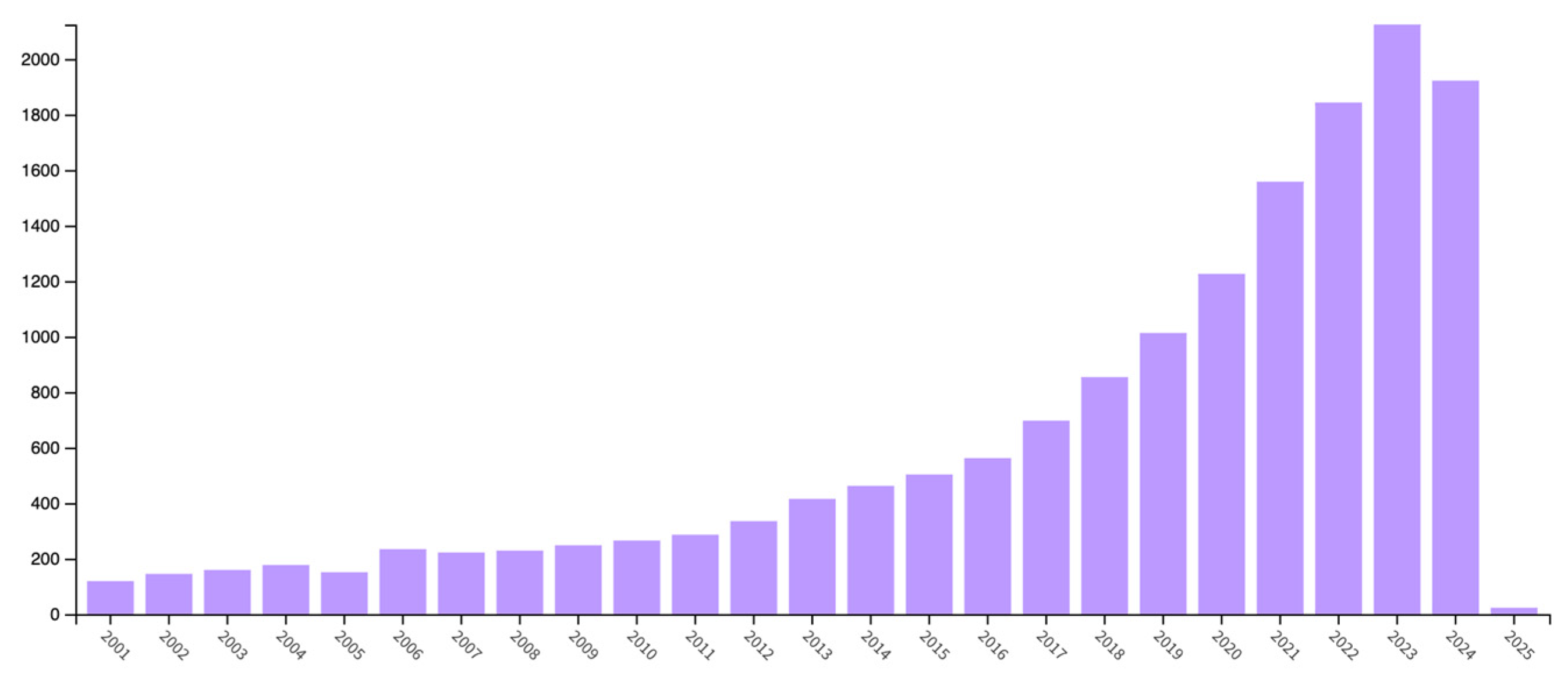
Figure 2.
Schematic representation of recycling options. LMW=low molecular weight.
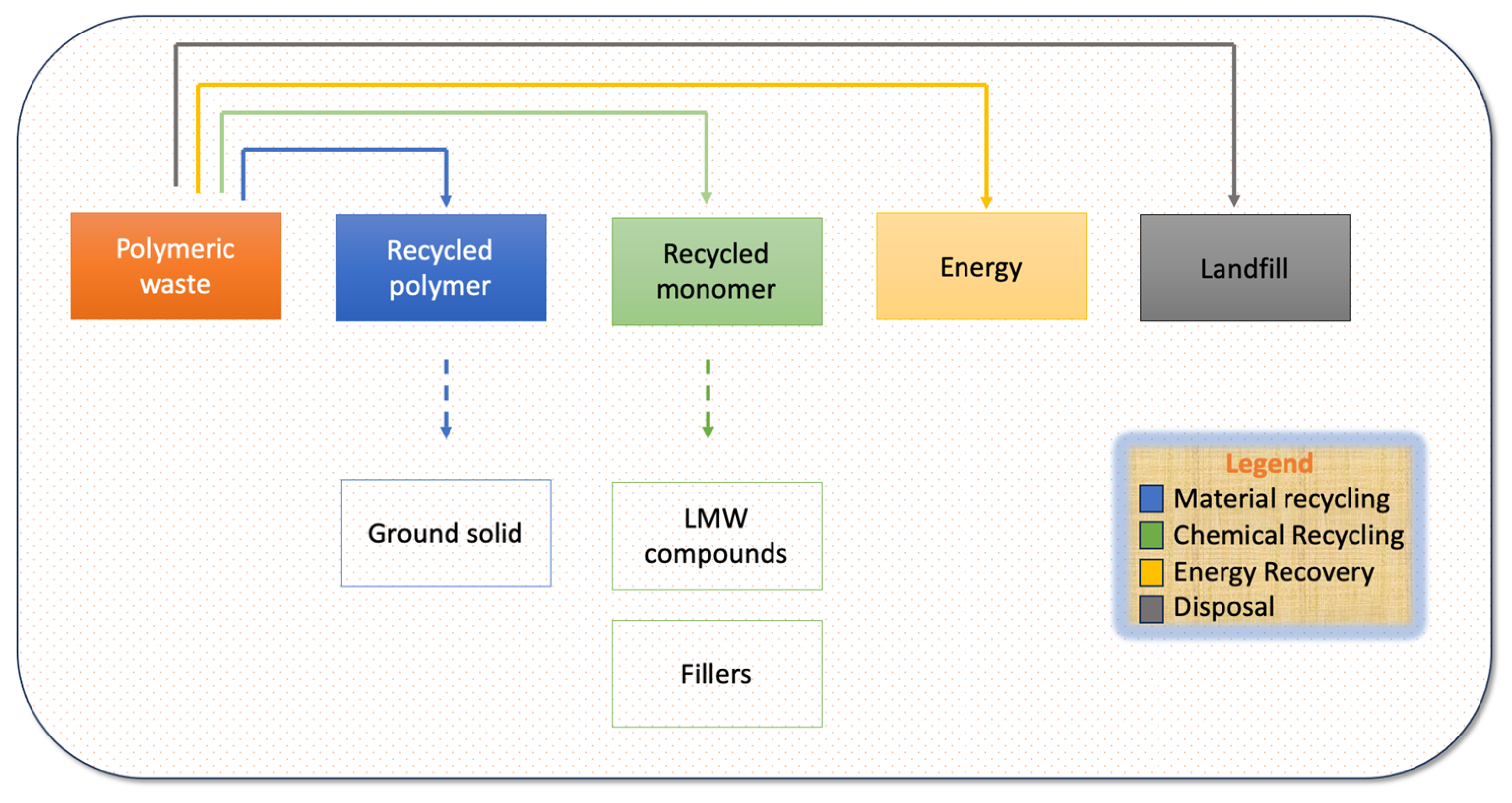
Figure 3.
Functionalization of iPP with MAH.
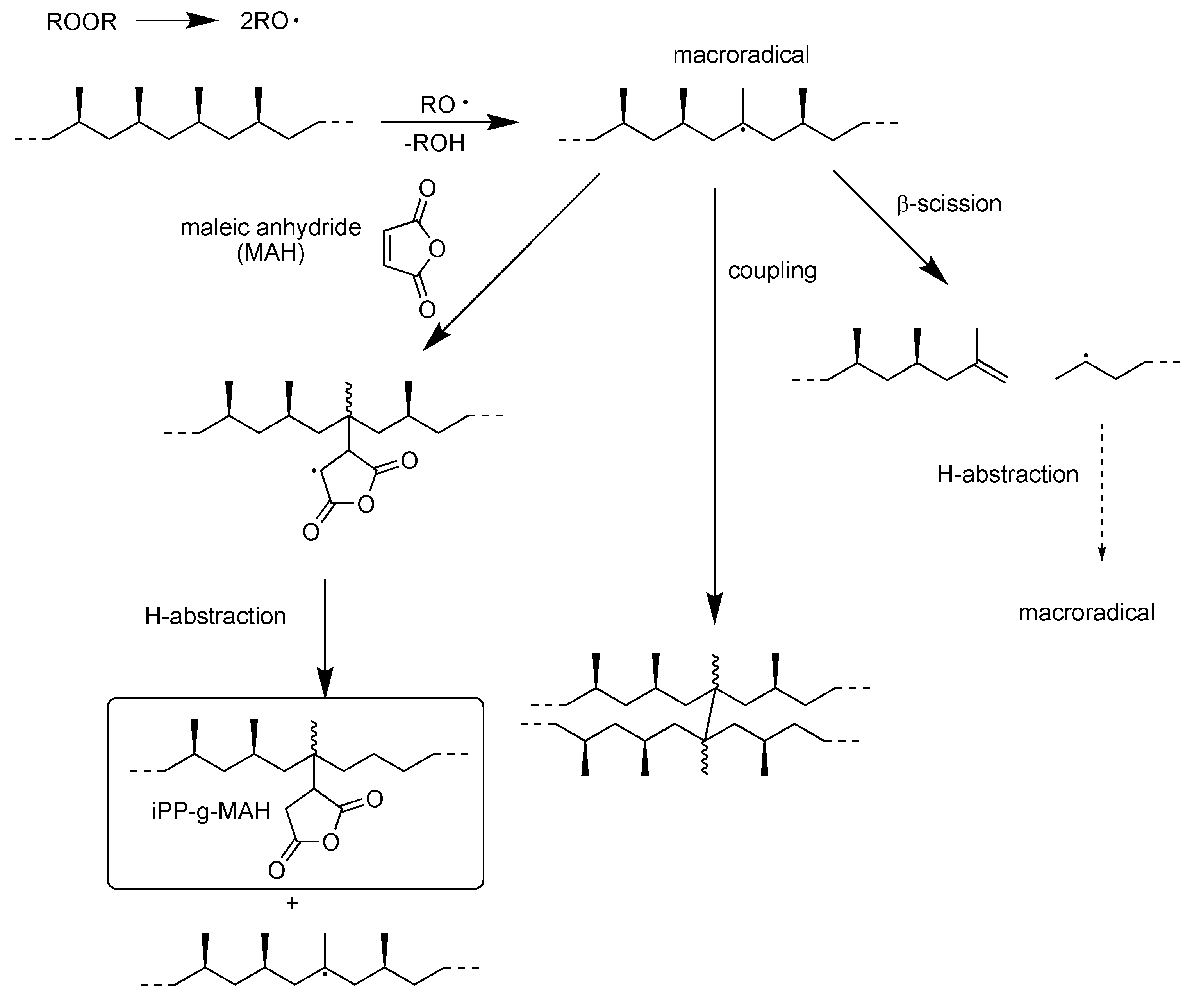
Figure 4.
Schematic representation of radical coupling reactions in PE/PP mixtures.
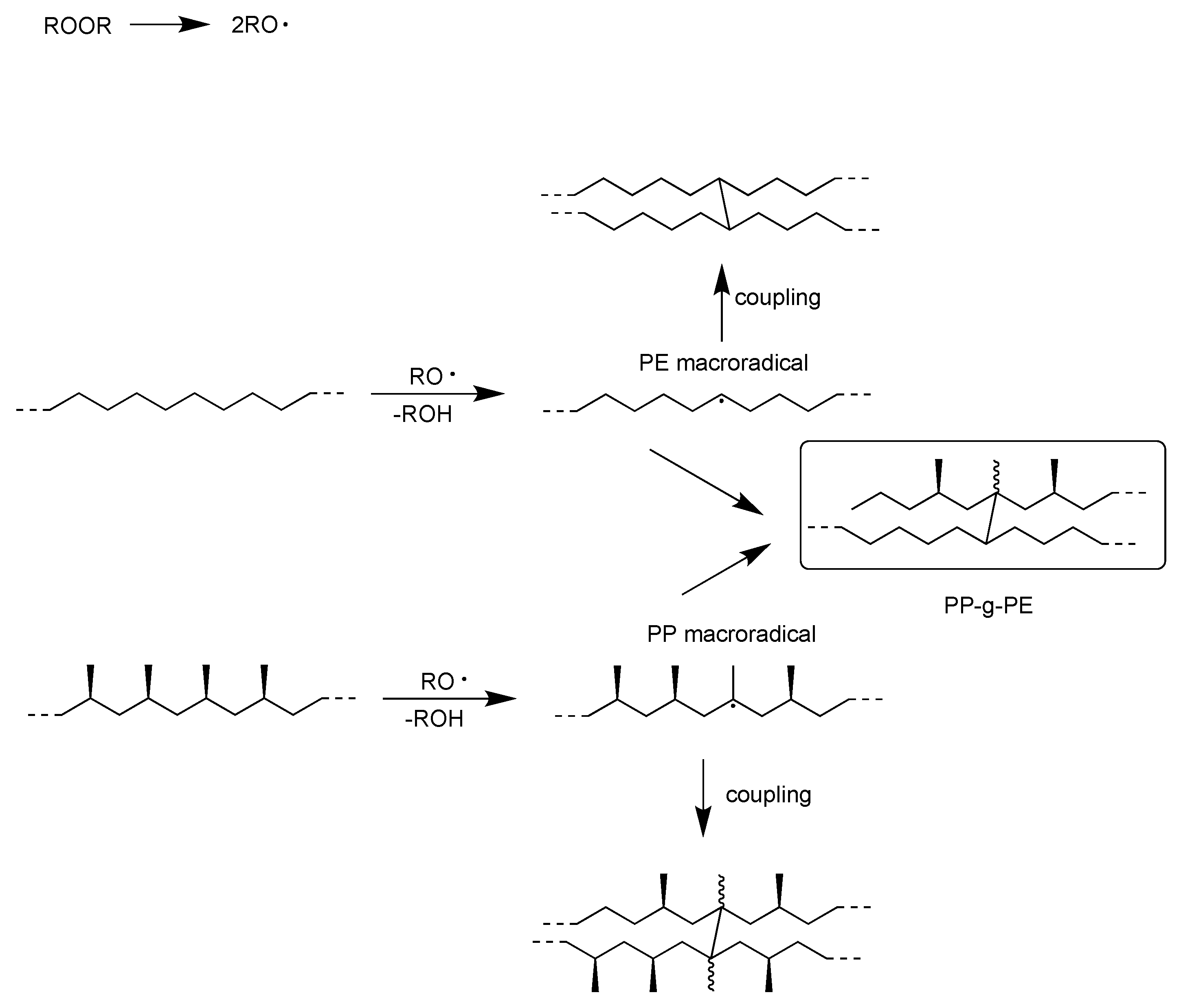
Figure 5.
Reaction at in the interface between PP-g-MAH (taken here as example) and reactive -OH groups at the filler surface.
Figure 5.
Reaction at in the interface between PP-g-MAH (taken here as example) and reactive -OH groups at the filler surface.
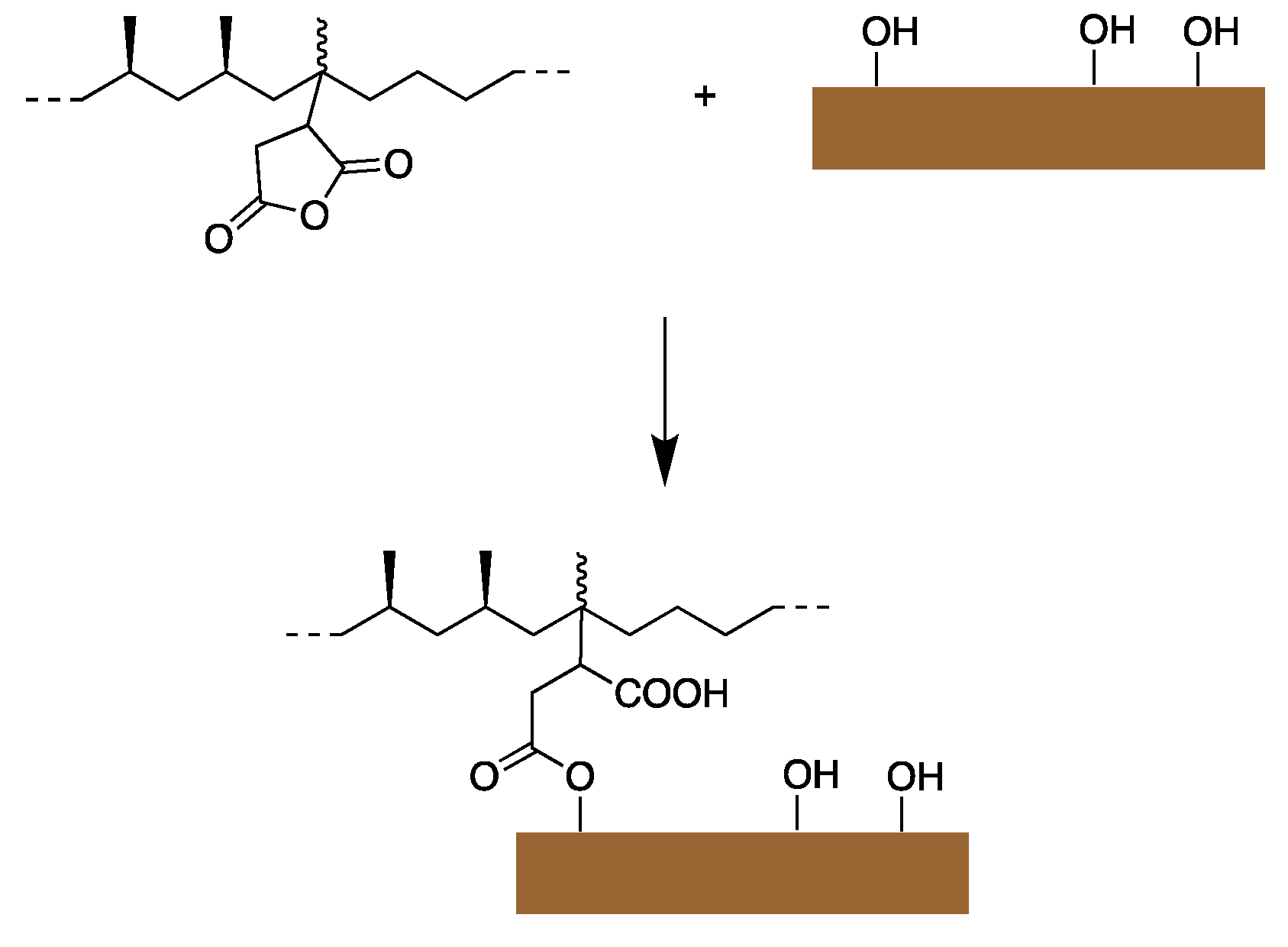
Figure 6.
Schematic representation for the reaction of silane coupling agents with -COOH groups on the surface of SAP particles.
Figure 6.
Schematic representation for the reaction of silane coupling agents with -COOH groups on the surface of SAP particles.
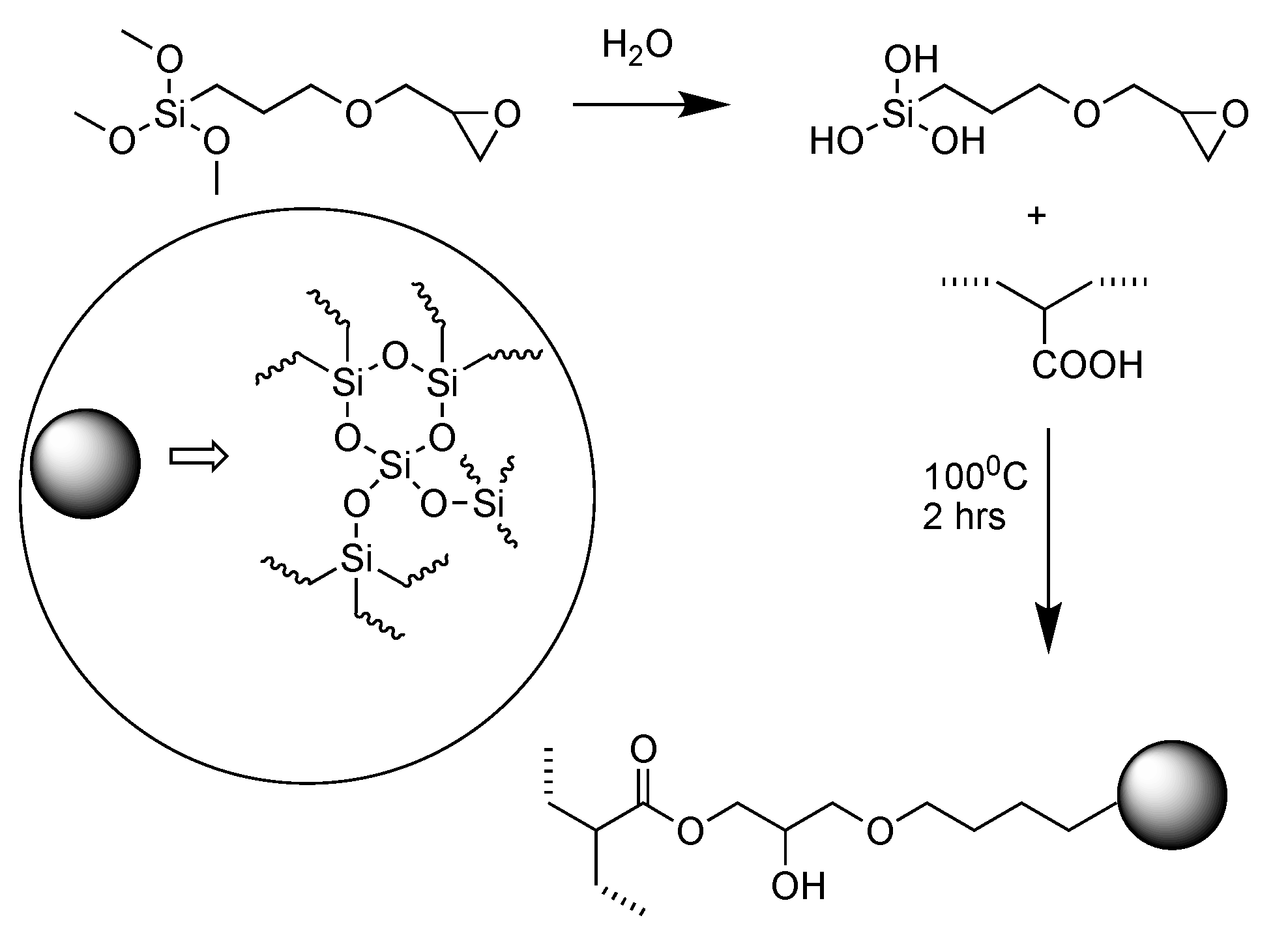
Figure 7.
a. Reactions for the chemical recycling of PET (A), Nylon 6 and 6,4 (B) and PC (C). b. Reactions for the chemical recycling of PU (D).
Figure 7.
a. Reactions for the chemical recycling of PET (A), Nylon 6 and 6,4 (B) and PC (C). b. Reactions for the chemical recycling of PU (D).
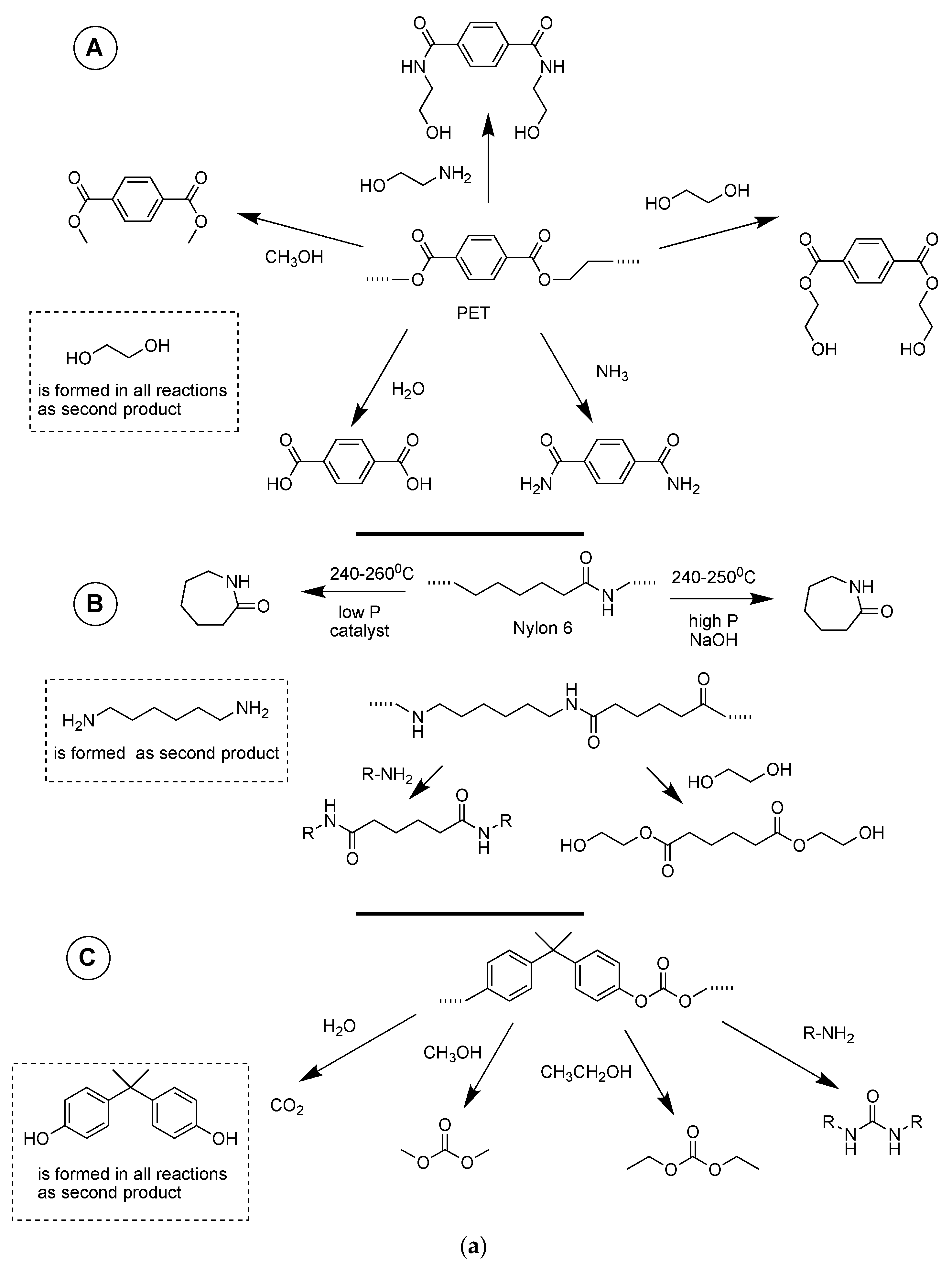
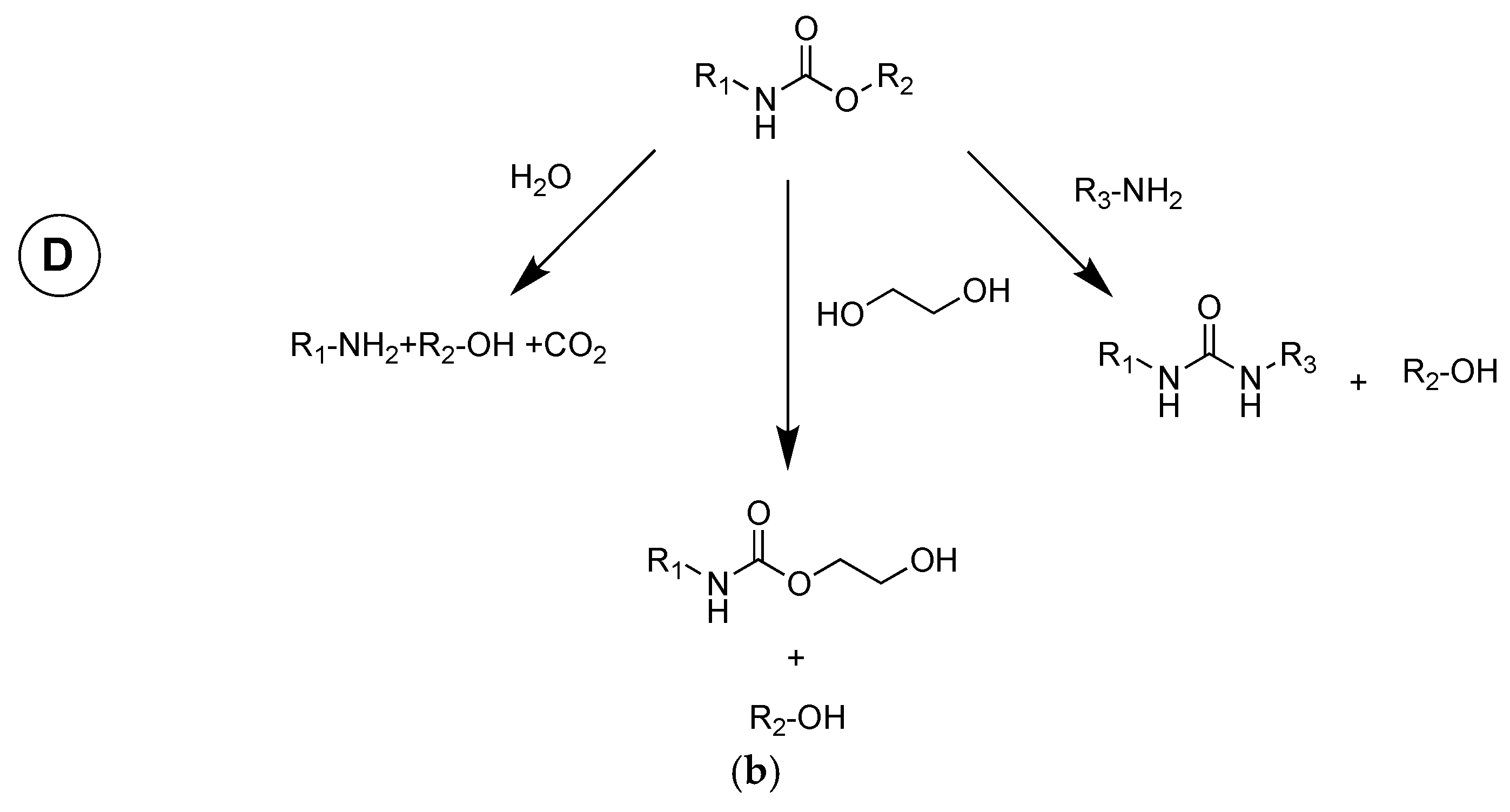
Figure 8.
Chemical recycling of epoxides.
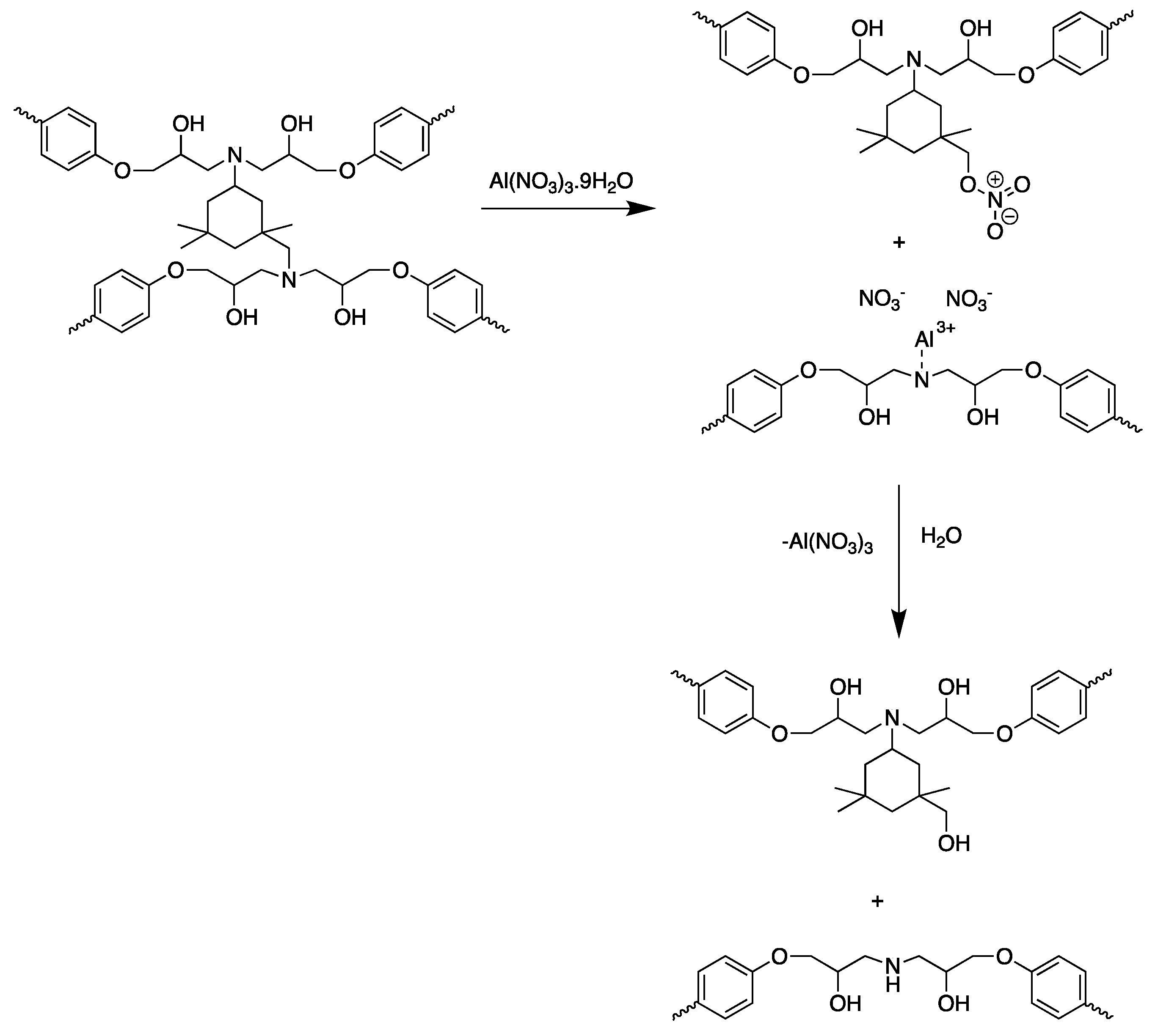
Figure 9.
Schematic representation of A) an associative mechanism, B) a dissociative mechanism. C) An illustration of crosslinks based on reversible chemistry, D) An example of a crosslinked network built from monomers with ‘end-capped’ functional groups.
Figure 9.
Schematic representation of A) an associative mechanism, B) a dissociative mechanism. C) An illustration of crosslinks based on reversible chemistry, D) An example of a crosslinked network built from monomers with ‘end-capped’ functional groups.
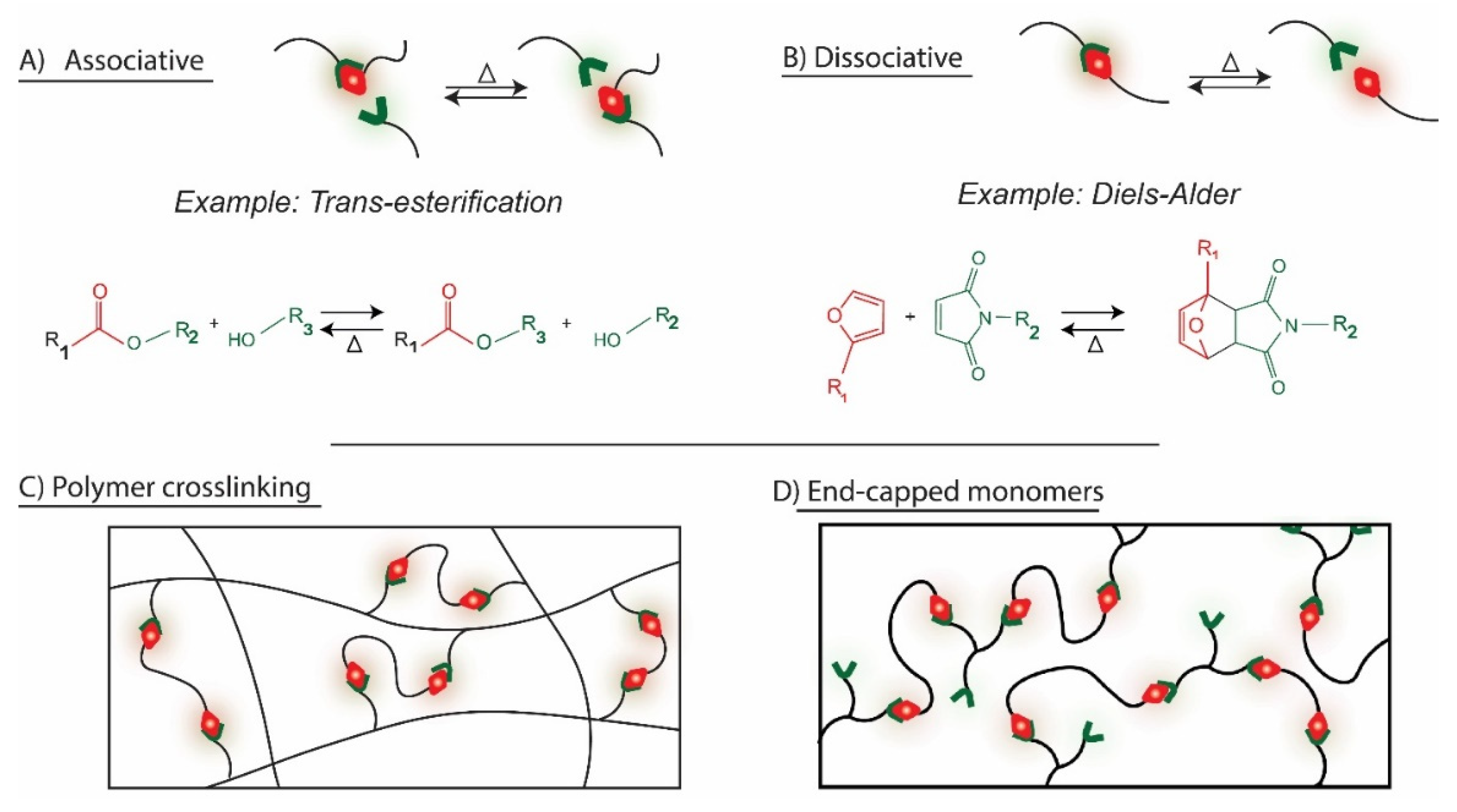
Figure 10.
A) the Schiff base reaction B) Boronic ester complexation C) Oxime chemistry and D) Acylhydrazone chemistry, used for the design of CANs.
Figure 10.
A) the Schiff base reaction B) Boronic ester complexation C) Oxime chemistry and D) Acylhydrazone chemistry, used for the design of CANs.
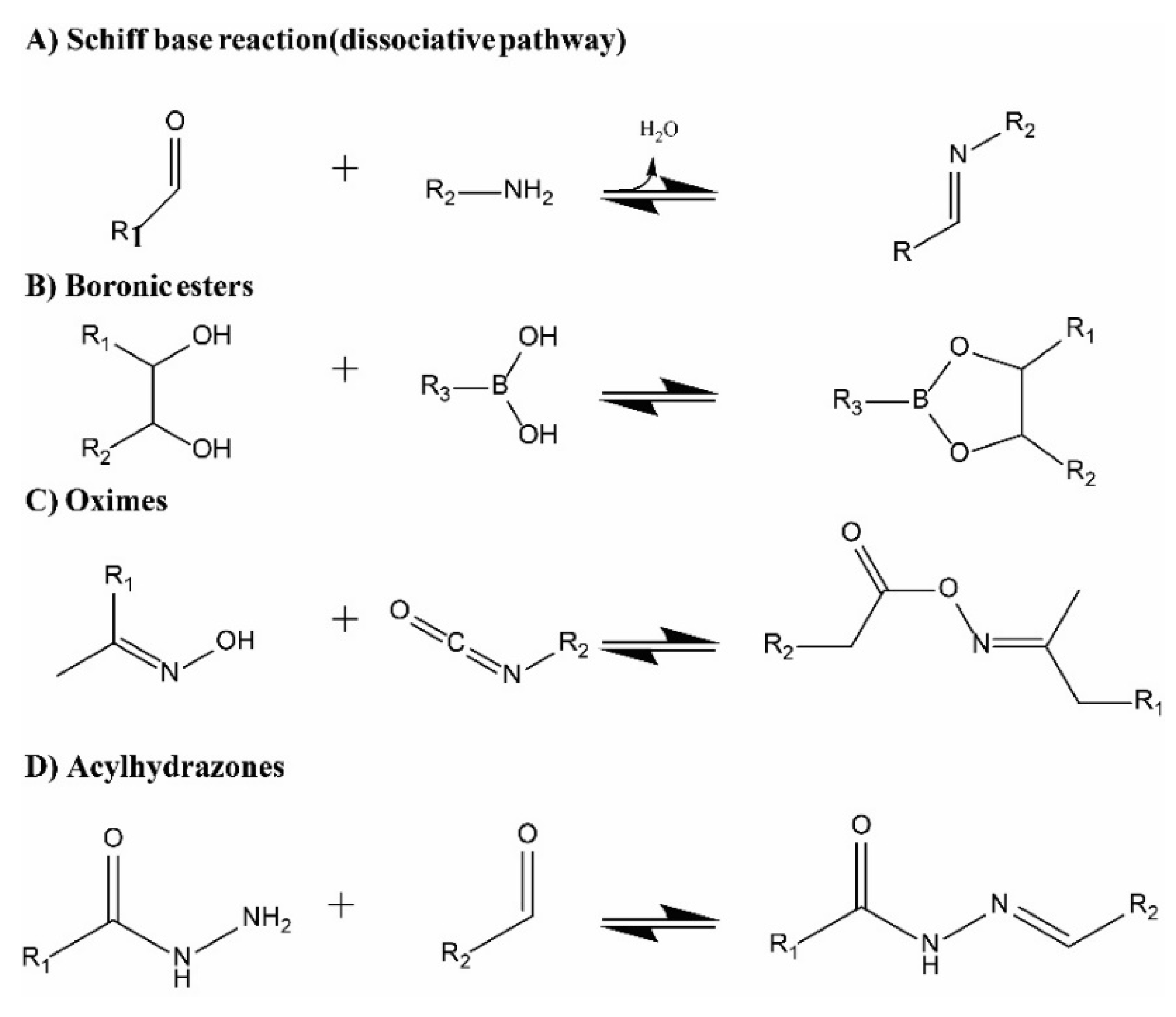
Figure 11.
Grafting of GMA onto PE.
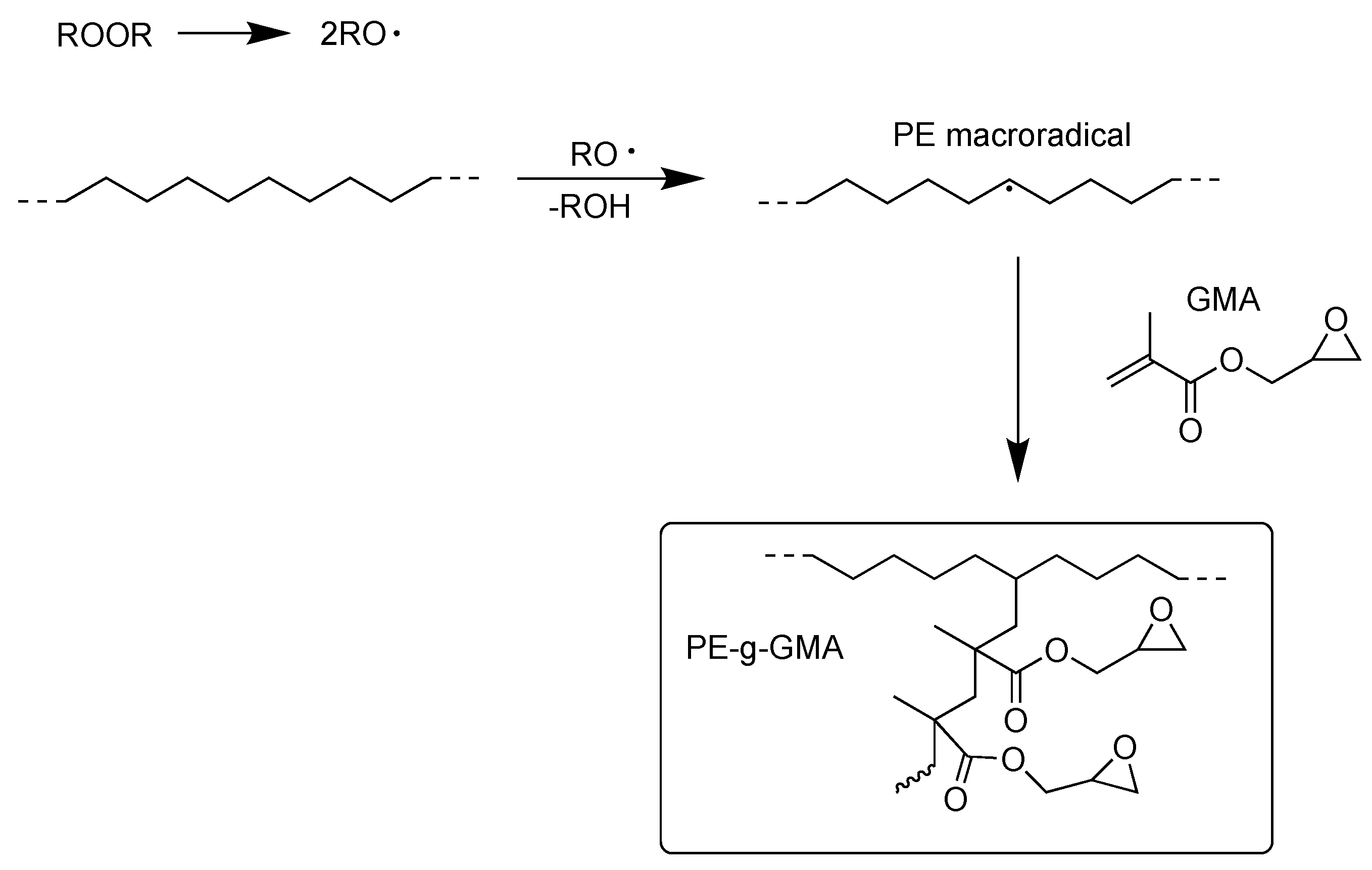
Figure 12.
Oxidation of polyolefins during electrochemical recycling.
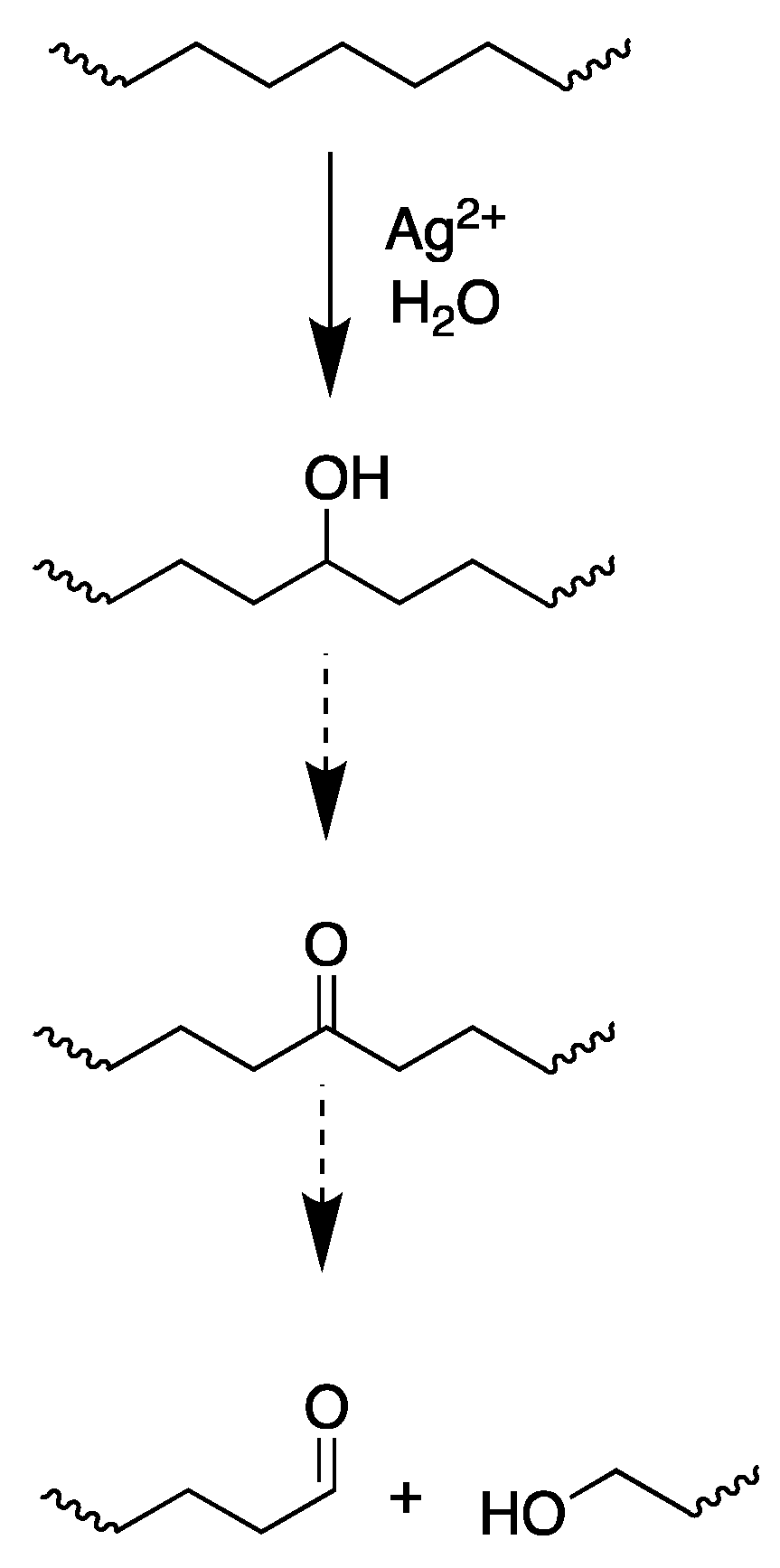

Table 1.
Reported recycling conditions sorted on the type of reversible dissociative chemistry for comparative purposes.
Table 1.
Reported recycling conditions sorted on the type of reversible dissociative chemistry for comparative purposes.
| Chemistry | T (°C) | Method | Comments | reference |
| Diels-Alder: furan-maleimide cross-linked castor oil | 130 | Free flow into mould | three cycles | [257] |
| Diels-Alder: furan-maleimide cross-linked polyketones | 120–150 | Dynamic mechanical thermal analysis | seven cycles | [258] |
| Diels-Alder: furan-maleimide crosslinked EPDM rubber | 175 | Hot pressing | One cycle shown in tensile tests | [239] |
| Schiff base: Vanillin based | 50 °C | Acid hydrolysis | Shown once with NMR | [259] |
| Schiff base: Vanillin based | 170 °C | Hot pressing | three cycles | [255] |
| Oximes | 155 °C | Hot pressing | four cycles | [260] |
Table 2.
Reported reprocessing conditions for vitrimers, listed for various types of associative chemistries.
Table 2.
Reported reprocessing conditions for vitrimers, listed for various types of associative chemistries.
| Chemistry | Temperature | Method | Comments | reference |
| Trans-esterification: fractionated lignin and sebacic acid | 160 °C | Hot pressing | Zn(acac)2 as catalyst | [267] |
| Trans-esterification: palm oil based epoxy and citric acid | 170 °C | Hot pressing | Catalyst free | [268] |
| Di-sulfide metathesis | 180 | Hot pressing | Three cycles, welding performance tested | [269] |
| Polyurethane | 150 | Extrusion | Twin-screw extrusion, one cycle | [266] |
Disclaimer/Publisher’s Note: The statements, opinions and data contained in all publications are solely those of the individual author(s) and contributor(s) and not of MDPI and/or the editor(s). MDPI and/or the editor(s) disclaim responsibility for any injury to people or property resulting from any ideas, methods, instructions or products referred to in the content. |
© 2024 by the authors. Licensee MDPI, Basel, Switzerland. This article is an open access article distributed under the terms and conditions of the Creative Commons Attribution (CC BY) license (http://creativecommons.org/licenses/by/4.0/).
Copyright: This open access article is published under a Creative Commons CC BY 4.0 license, which permit the free download, distribution, and reuse, provided that the author and preprint are cited in any reuse.


