

Submitted:
07 November 2024
Posted:
11 November 2024
You are already at the latest version
Abstract
Oxidation of methane by soil microorganisms is an important mechanism controlling the content of this potent greenhouse gas in the atmosphere. Agricultural soils operate under stressful conditions, and ammonium (N-fertilization) and drying (global warming) may have a significant impact on the methane oxidation. In order to investigate how soil methanotrophs respond to drying-rewetting (DW), ammonium addition (100 mg/g) (A) and their combined action (MS), agricultural soil microcosms were incubated over the three months and methane oxidation was measured before and after perturbations, while community composition was monitoring using the 16S rRNA gene sequencing. A significant decline in the methane-oxidation activity after perturbations was found, with subsequent restoration, and the combined treatment was more effective than the sum of individual treatments, indicating a synergistic effect. After rewetting the structure of the bacterial community returned to pre-dry-down levels, but the application of ammoni
Keywords:
agricultural soils
; methane oxidation
; stress effect
; ammonium
; drying-rewetting
; synergistic effect
; 16S rRNA sequencing
; soil microbiota
1. Introduction
Methane (CH4) ranks as the second most prevalent greenhouse gas (GHG) following carbon dioxide (CO2), exhibiting a heat-trapping capability that is over 28 times greater than that of carbon dioxide when assessed over a 100-year period [1]. Despite having less than 0.02% of the atmosphere, methane is thought to be responsible for 15% of the present global warming [2]. Over the past 200 years, methane concentrations in the atmosphere have more than doubled, mostly as a result of human activity. Energy, industry, agriculture, land usage, waste management, and the agricultural sector all release methane [3]. Reducing methane levels in the atmosphere would have a quick and major impact on the potential for atmospheric warming because it is a potent GHGs and has a shorter half-life than carbon dioxide. In addition to the climate, lowering methane emissions would have immediate and long-term positive effects on agriculture, human health, and ecosystem health.
The only biological agents known to regulate the amount of CH4 in the atmosphere for terrestrial ecosystems are soil methanotrophic bacteria [2]. With an absorption of about 30 Tg CH4 y-1 (6% of the global sink), microbial methane oxidation in aerated soils is the greatest biological sink for atmospheric methane [1]. Although a lot of work has been done on the subject, the mechanisms governing methane uptake in aerobic soils have not yet been thoroughly examined. Because high-affinity CH4-oxidizing bacteria in soil may use methane at atmospheric quantities, upland soils are a significant, albeit much less measured methane sinks [4,5,6]. Temperature, soil texture, water content, and mineral nitrogen content all affect the rate of microbial oxidation [6,7].
Particular attention has been paid to the cycling of methane in agricultural soils. On the one hand, the amount of GHG emissions into the atmosphere is increasing as a result of growing human activity. At the same time, modern agricultural management methods can be used to regulate the methane balance in agroecosystems. The development and advancement of contemporary agricultural technologies should lead to a sustained trend of restoring the biosphere’s functions by restoring the land to its natural state [8]. Controlling the movement of the two primary GHG gases, carbon dioxide and methane, between the soil and the atmosphere through the actions of the soil microbiota is one of these systems’ most crucial functions.
Extreme climate events have become more frequent and intense in recent years as a result of considerable changes in the global atmospheric and water cycle pattern brought about by human activity [1,9]. Extreme climate events have been shown to drastically alter the ecosystem’s water and heat conditions, impacting plant physiology and soil microbial activity, altering soil functions, and upsetting the ecosystem’s initial carbon balance [10]. Research on drought events is now mostly conducted in arid and semi-arid regions, with comparatively little research conducted in temperate regions [11,12,13,14]. It was shown that soil moisture significantly regulates methane intake, and drying significantly affects soil methane uptake and oxidation by microbes in terrestrial ecosystems [15,16]. Dry-wet events are frequently occurring in many agricultural soils not only in arid, but also in temperate ecosystems with moderate temperatures and precipitation [17]. Comprehensive knowledge of their effects on methane oxidation by soil methanotrophs in upland agroecosystems remains elusive.
Nitrogen fertilizer has been attributed for the lower CH4 uptake rate recorded in agricultural soils as in contrast to forest soils [5,18]. Methane oxidation is competitively inhibited by ammonia, and ammonium oxidation products, such as nitrite and hydroxylamine, can accumulate and be harmful to methanotrophs [19,20]. Since ammonium has been shown to both increase and inhibit the soil’s methane oxidizing activity, as well as to had no noticeable impact, its effects on soil methane oxidation and aerobic methanotrophs are still controversial. Previous research demonstrated that the addition of ammonium reduced soil methane uptake [7,21]. Methane in agricultural soils was occasionally increased by fertilization based on ammonium [22,23]. The seemingly contradictory effects of ammonium on methane oxidation have been attributable to the dose and mineral forms of ammonium (e.g., ammonium chloride, ammonium sulfate) [24,25], as well as the methane concentration [21].
Numerous stressors, including increased atmospheric nitrogen deposition, over fertilization, compaction, salinization, pollution, and rising temperatures, are simultaneously found in agricultural soils [26]. The activity and composition of soil methanotrophs are known to be affected by individual stressors, however, little is known about their resistance and resilience to a variety of stresses. In biology, a synergistic effect occurs when two or more elements work together to produce an overall effect that is larger than the sum of the effects of any one of them alone [27]. Acquired tolerance to metal stress in soil microbial communities has been demonstrated to improve resistance to certain related stresses while decreasing resistance to others [28]. It was demonstrated in a study using wetland soil that microcosms that were exposed to soil drying fared better after ammonium addition than microcosms that were not [29]. By favoring more adaptable or resilient group members, stress-on-stress can further boost resilience to additional disruptions [30].
This study aims to investigate the effects of ammonium treatment and drying modification on the activity and community structure of methanotrophs in agricultural soddy-podzolic soil under laboratory conditions. In particular, we want to answer the following questions. (i) Do drying-rewetting and ammonium have an impact on methane oxidation in agricultural soil that contains a lot of organic matter? (ii) Is there a synergistic interaction between drying stress and ammonium? (iii) Does the structure of microbial communities change in response to stressors? (iv) Does the activity and structure of the soil methanotrophic community return to normal once stress exposure has stopped?
To the best of our knowledge, the current study investigated the combined effects of ammonium and drying on methanotrophs in agricultural soil for the first time. In this study, we used microcosm experiments to assess the activity of methane oxidizing communities and 16S rRNA amplicon sequencing to analyze soil microbial communities with a focus on methanotrophs.
According to our hypothesis, soil methanotrophs can resume their activity after drying and ammonium application; however, the combination of these disturbances may cause a significant change in the diversity and structure of the microbial community, most likely as a result of an unidentified synergism.
2. Materials and Methods
2.1. Site Description and Soil Sampling
On June 5, 2023, soil samples were collected in the Odintzovo district of the Moscow Region, Russia, near the Petelino poultry production facilities from a clover-oat crop rotation grassland site (50°36′33” N, 36°49′39” E), with a mean annual temperature of
8.9oC and mean annual precipitation of 1005 mm. The site is located on layers of a moraine and classified as a soddy-podzolic soil according Russian classification [31], Retisols according to FAO classification or Eutric Albic Retisol (Abrupt, Loamic) according to the WRB. The grassland receives regular organic fertilizer at an annual rate 2 T ha-1 (30 kg N ha−1, 10kg P ha−1 and 10 kg K ha−1).
Three composite soil samples were collected from the organic horizon (3-10 cm) and immediately after sampling were homogenized by hand and wet-sieved (<2 mm). About 500 g of fresh soil was used for the microcosm studies, agrochemical and microbiological analysis. Samples were transported and stored in the dark at 5 o C until the start of the experiments (ca. 2 days). About 5 g topsoil in 3 technical replicates was sampled for the molecular analysis of microbial communities were transported and stored at −20 o C.
The soil properties were tested by the relevant detection methods in the core facility “Physico-chemical methods of soil and ecosystem research “of IPCBPSS RAS, Puschino, Moscow Region, Russia.
2.2. Microcosm Experiments
Each microcosm consisted of 10 g soil in a 120 ml glass bottle. Firstly all microcosms were enriched for methanotrophs by pre-incubation in dissecators with methane- air gas mixture (1:9 v:v ) at 25 oC for 21 day. After enrichment, four soil treatments were created simultaneously: (a) 12 control microcosms without stress application (control, C); (b) 12 microcosms treated with soil drying (drying-rewetting, DW); (c) 12 microcosms only treated with ammonium (ammonium, A); (d) 12 microcosms receiving dual perturbation (multiple stressors, MS).
Soil drying was induced by placing the microcosms for 24 h under a ventilator at room temperature without lids. The gravimetric moisture content (24 h at 105 °C) of the air –dried soil samples was 2% WHC. Air-dried soil samples were then rewetted to 50% WHC (optimum moisture) using demineralized water (DW) or water ammonium solution (MS) and gently mixed. Water ammonium solution was also added to pre-incubated soil (A) and microcosm without any perturbations (undisturbed) served as reference (C). Concentration of N-NH4+ in soil after addition was 100 µg g-1. Microcosms were transferred into the dessicator and incubated as previously.
2.3. Methane Oxidation Measurements
Potential methane oxidation activity was evaluated at the first four weeks of experiment according to a previously established procedure; potential methane oxidation activity was assessed in bath incubation studies [32]. Briefly, rubber stoppers were used to hermetically seal soil-filled bottles, methane was injected to the gas phase at a concentration of roughly 200 ppm, and the actual concentrations of CH4 were determined using a Cristall 5000.1 gas chromatograph with flame ionization detector (Khromatek, Russia). The bottles were incubated at 25°C for 24 hours, their gas concentration was then measured again, and the variation in their contents was assessed and utilized as a basis to determine how much oxidized methane had occurred.
After measurement of methane uptake microcosms were used for soil DNA extraction.
2.4. Soil DNA Extraction, Amplification and Metagenome Sequencing
Soil DNA was extracted by the protocol described in [33]. The extracted DNA quantity and quality were monitored on 1% agarose gel and were examined using a Nanodrop 100 Spectrophotometer (Thermo Fisher Scientific, Waltham, MA, USA).
Taxonomic analysis of the bacterial community was conducted using universal primers F515/R806 on the variable region of the 16S rRNA gene-v4 (GTGCCAGCMGCCGCGGTAA /GGACTACVSGGGTATCTAAT), specific to a wide range of microorganisms, including bacteria and archaea [34]. All primers had auxiliary sequences containing linkers and barcodes (necessary for sequencing using Illumina technology).
PCR was performed in a 15 µL reaction mixture containing 0.5 – 1 unit of Q5® High-Fidelity DNA Polymerase (NEB, USA), 5 pM of each forward and reverse primers, 10 ng of DNA template, and 2 nM of each dNTP (LifeTechnologies). The mixture was denatured at 94°C for 1 minute, followed by 35 cycles: 94°C – 30 s, 50°C – 30 s, 72°C – 30 s. The final elongation was carried out at 72°C for 3 minutes. PCR products were purified according to the recommended Illumina protocol using AMPureXP (Beckman Coulter, USA).
Further library preparation was carried out in accordance with the manufacturer’s instructions in the MiSeq Reagent Kit Preparation Guide (Illumina) (https://support.illumina.com/documents/documentation/chemistry documenta-tion/16s/16s-metagenomic-library-prep-guide-15044223-b.pdf). The libraries were se-quenced according to the manufacturer’s instructions on the Illumina MiSeq device (Il-lumina, USA) using the MiSeq® ReagentKit v3 (600 cycle) with paired-end reading (2×300 bp) using the equipment of the resource center “Genomic Technologies, Proteomics, and Cell Biology” of ARRIAM, Russia.
2.5. 16S rRNA Gene Amplicon Analyses
The initial processing of the obtained data, namely, demultiplexing of samples and removal of adapters, was carried out using software from Illumina (Illumina, USA). For subsequent denoising, sequence merging, removal of chimeric reads, recovery of original phylogenetic types (ASV, Amplicon sequence variant), and further taxonomic classification of the obtained ASVs, we used the software packages dada2 [35], phyloseq [36], DECIPHER [37], and the SILVA ribosomal DNA database release 138 [38], with the work being carried out in the R software environment. For the presentation of taxonomic analysis data, the tools of the QIIME software package were used [39].
The general processing of sequences was carried out in the dada2 (v1.14.1) package [35], according to the author’s recommendations. Taxonomy annotation was performed using Naive Bayesian Classifier and SILVA 132 as the reference database [38]. The main analysis (alpha- and beta diversity plots, bargraphs, heatmaps) of the data analysis were carried out using phyloseq (v1.30.0)[36] and tidyverse (2.0.0) [40] packages in R (v4.3.0). PERMANOVA analysis performed with vegan (2.5-6) [41]. Differential abundance of taxa in comparisons was estimated using DESeq2 (v1.26.0) [42]. Difference in abundances (marking ASV as “variable”) was determined by two thresholds (baseMean >= 50 and log2FoldChange >= 2) and p-adj <0.05.
Raw sequences are uploaded to the SRA and available by PRJNA1073750 accession number, or directly via link: https://www.ncbi.nlm.nih.gov/sra/PRJNA1073750.
2.6. Statistical Analysis
All assays were performed in triplicate. The results are presented as means and standard deviations (SD) of three independent experiments, which were calculated using
Microsoft Excel and SPSS Statistics v. 17.0 software. In all tests, a p value<0.05 was considered to be statistically significant.
3. Results
3.1. Basic Parameters of Soil Under Investigation
The soil used in this study is characterized by loamy sand texture and pH values close to neutral. A characteristic feature is the high content of organic carbon (5.97%), which is associated with the use of organic fertilizers (chicken manure). Integral indicators of microbial activity (basal respiration, microbial biomass and metabolic quotient) are very high (Table 1). Proportion between soil organic C (SOC) and soil total nitrogen (TN), C: N ratios is classically used as an available proxy for soil organic matter (SOM) chemical composition and quality [43]. Magnesium (Mg), calcium (Ca) and potassium (K) are three major and essential nutrients for plants. The relative proportion of these elements, as well as the total amount in the soil, depends mainly on the soil parent material. High values of C: N ratio (16.4), as well as significant contents of Mg, Ca and K, characterizes the soil as highly productive.
3.2. Methane Oxidation Response to Drying-Rewetting, Ammomium Addition and Their Combined Action
Both the undisturbed and disturbed incubations showed a similar trend in methane uptake, with activity reaching comparable rates after four weeks (Figure 1). In the first week following drying-rewetting (DW), methane absorption was slightly but considerably lower (p < 0.05) than in the undisturbed incubation (C). However, a week after the stress impact, there was no discernible difference (C, 77 ± 6 μmol day− 1 g dw−1 ; DW, 78 ± 12 μmol day− 1 g dw−1).
Ammonium application (A) had a longer-lasting negative effect that persisted for two weeks. There is a slight methane release seen right after the ammonia is applied. In addition to a restoration, a significant (p<0.05) increase in methanotrophic activity was also seen after 4 weeks of incubation when compared to the undisturbed samples (C) (Figure 1), suggesting that ammonium application had a stimulatory effect (C, 61 ± 10 μmol day− 1 g dw−1 ; A, 75 ± 4 μmol day− 1 g dw−1).
3.3. Sequencing Data and Bacterial α-Diversity of Microbial Communities
The dynamics of the composition of microbial communities in soil microcosms after two, four, and twelve weeks of incubation were compared using Illumina sequencing technology. A total of 922 889 readings were obtained from 36 samples; the average number of reads per sample was 25 635, with a minimum of 19 003. To perform alpha-diversity analysis, the mean abundance of reads per sample was rarefied to the dataset’s lowest abundance (19 003 reads per sample).
The alpha-diversity data demonstrated that soil treated differently varied in terms of both richness and evenness diversity. ANOVA revealed that the stress effect factors (DW, A, and MS) were significant in relation to the incubation period (Figure 2a–c). Richness metrics PD and Observed were significantly higher in control samples than in experimental ones, and they declined over time, especially in the 12th week of the trial. The fact that the experimental groups’ indices at the second week did not differ significantly is noteworthy. In ascending sequence, MS, A, and D, the differences became noticeable in the fourth week and were insignificant by the 12th.
The evenness indices of Pielow and Simpson displayed a comparable pattern, though with different specifics. Variants supplied with ammonium exhibited a significant decline in variety during the second week of the experiment. In comparison to the control (C) and drying-rewetting (DW) samples, which were comparable, the A-samples demonstrated a significantly lower diversity up until the fourth week (Figure 2d,f). By the 12th week, this gap had decreased, and the values of all samples had become irregular, but the general pattern remained the same.
3.4. Bacterial Community Structure
Microbial abundances, visualized as a PCA demonstrated that bacterial communi-ties from untreated soil samples (C) and from multiple stress treatment (MS) were forming separate isolated clusters. It was revealed a distinct community prior to the disturbance (C), and the community shifted soon after desiccation-rewetting (DW) and ammonium application (A), diverging from the community in the undisturbed microcosm (Figure 3). Bacterial community composition at the different sampling times was differentiated based on the Bray–Curtis algorithm with the same alteration trends for DW and A treatments (Figure 3).
According to the beta-diversity study, the duration of exposure had the biggest impact on cultures. The “drifting” of the microbial communities and the emergence of a particular microbial community were demonstrated by a Jaccard distance at the 12th week. The average separation between groups of soils with different treatments did not decrease despite this “drifting.” The same pattern of changes was seen for Weighted UniFrac distances. It is important to note that, in terms of unweighted unifrac distance, the microbial compositions of samples A and DW are extremely similar. Weighted metrics (Bray and Weighted UniFrac distances) validated this pattern using weaker clustering.
Generally speaking, there is a similar pattern in the distances between samples that have received different treatments. The A cluster was further away from the C samples in the second and fourth weeks, while the DW and MS samples formed clusters close to the control (C) samples. At week twelve, the pattern shifted, with MS further out and DW and A in the center cluster (Figure 3).This suggests that microbial taxa can rebound from desiccation, which is an essential reaction that will support the preservation of microbial biodiversity when environmental disruptions such as significant changes in the water supply occur.
3.5. Effects of Stressors on the Composition of Soil Bacterial Community
Overall, the predominant bacterial components of samples from different treatments were similar, and the top 10 species in abundance were consistent. Specifically, the two most dominant phyla were Proteobacteria (relative abundance 34 - 47%) and Bacteroidota (12-14%), were found in all treatments. Moreover, Actinobacteriota (6.2-8.0%), Firmicutes (2.7-5.0%), Desulfobacterota (0.9-1.9%), Planctomycetota (1.1-1.5%), Acidobacteriota (0.7-1.7 %) were found in all samples at a relative abundance higher or about 1%, but lower than 10%.
Different treatments had a significant effect on the bacterial taxa distribution, and after 12 weeks the relative abundance of Proteobacteria was increased in DW treatment (44%) and MS (47%) compared to C samples treatments (38%), but decreased in A treatment (34%). Actinobacteriota abundance was increased from 6% in C to 8% in all treated samples. Bacteroidota was decreased in all treatments to 12-14% compared to C (18%). The most abundant classified genera (>1%) represented in all treatments were
Methylobacter, Rhodococcus, Lenthimicrobium, Chronobacter, Sphingomonas, Hydrogenophaga, Nocardioides, Pseuoxanthomonas, Clostridium.
By changing their structure, bacterial communities react to drying and rewetting, ammonium addition, and their combined action. Due to various dynamics in microbial communities, two methods were used to look for differentially abundant species. Variations in microbe abundances during different exposure durations were observed using a first technique (Figure 4).
The most significant changes were associated with increasing relative abundances of Lentimicrobium, Salinimicrobium, Ohtaekwangia (Bacteroidota), Methylocystis, Arenimonas, and Methylobacter (Proteobacteria).
The second method allowed for the identification of differences in the abundances of microbes across different treatments (Figure 5). Methylobacter (Proteobacteria), Pseudoxanthomonas, Salinimicrobium, and Lentimicrobium (Bacteroidota) were the most intriguing species in this analysis.
While the number of Lentimicrobium increased with exposure duration, the number of Arenimonas dropped in both cases. There was no obvious reaction to the treatment plan when either modification was performed. Samples under stress, especially MS samples, developed Salinimicrobium bacteria. They became less prevalent in these samples over time. Ohtaekwangia abundance was higher in the C and A-samples but stayed relatively constant across time. The most interesting taxon, Methylobacter, was very common in all combinations. These bacteria increased throughout time in all treatments, with the exception of A, where the abundance suddenly decreased at the 12th week. All treatments resulted in an increase in abundance, however the A and MS samples showed the largest increase.
3.6. Structure and Composition of Methylotrophic Soil Bacteria Community
Within the context of this investigation, particular focus was placed on aerobic bacteria that use single-carbon molecules. As a first and very simple analysis, ribosomal gene sequencing can only identify known methanotrophic and methylotrophic bacteria. Both methylotrophic (Methylobacterium-Methylorubrum, Methylobacillus, Methylophaga, and Hyphomicrobium) and methanotrophic (Methylobacter, Methylocaldum, Methylomicrobium, Methylosinus, and Methylocystis) bacteria were found, according to the taxonomic annotation. Consequently, 91 ASVs belonging to 12 taxa were discovered in every sample; Figure 6 shows their abundances.
The control soil (C) has the most varied pattern, with methylotrophic bacteria such as Methylobacterium-Methylorubrum, Hyphomicrobium, and MM2 (Methylovorus) and methanotrophic bacteria such as Methylobacter, Methylocystis, Methylobacillus, and Methylomicrobium.
4. Discussion
The ability of soils to oxidize methane has been greatly reduced by the conversion of natural, undisturbed soils into arable cropping environments. The structure of methanotrophic communities is also impacted by agricultural practices [44,45,46]. Any negative impact or imbalance could be the result of the dramatic ecosystem change, and biological methane oxidation is a crucial step to reduce global climate change. Therefore, a thorough investigation into methanotrophic activity in agricultural environments is desperately needed. Very little information has been provided up to this point regarding CH4 oxidation and consumption in terrestrial, non-wetland soil ecosystems in Russia. Therefore, to assess the global balance of greenhouse gases and their contribution to global warming, it is necessary to monitor and comprehend the CH4 consumption in these soils.
The mechanisms controlling CH4 oxidation and consumption in aerobic soils remain poorly understood despite an extensive number of studies aiming at assessing these parameters. Based on published data and the findings of our earlier research, it was determined that a variety of factors, such as temperature, precipitation, land use, N input, and soil characteristics like pH, organic matter content, and soil texture, influence the exchange of methane between soil and atmosphere. Because other climate parameters frequently alter or interact, it makes it difficult to assess the impact of a single one on methane uptake. A decrease in methane oxidation in agricultural ecosystems could have been caused by a number of factors. First, a shift from high-affinity methanotrophs to low-affinity methane oxidizers may be the cause of this. For Brazilian ferralsols, a comparable pattern has been documented [47]. Second, methane oxidation may be inhibited by substantial NPK and PK fertilizations through both competitive and noncompetitive inhibition [48]. Changes in oxidation rates can also be caused by other environmental factors, such as temperature, soil water content, and carbon availability.
In order to better understand how environmental stress impacts the methane oxidation capacity of agricultural soil and its potential to reestablish the function of the “methane filter” once the stressor has been removed, we evaluated the resilience and resistance of the methane oxidizing communities in this study. We chose two stressors (drying, ammonium content) that we believe are most important for soil methanotrophic activity in the context of global warming and intensified agriculture, and that can be controlled by using ecologically friendly agronomic techniques. Because organic fertilizers are applied annually, the soil under study has a high content of organic matter and nitrogen in the form of organic and mineral molecules. It’s feasible that the high organic content would keep the soil from drying up and that methanotrophic communities are acclimated to nitrogen compounds.
The moisture content of the soil is one of the main factors affecting the methane oxidation activity and influencing gas phase diffusion or soil methanotroph activity by osmotic stress. It was shown that the methanotrophic activity in the soils under investigation dropped after drying and applying an ammonium salt solution. Following the end of stressor exposure, methanotrophic activity recovers quickly. As a result, after drying, it only took a week to attain undisturbed soil values. These results are consistent with data from earlier studies using soil from wetlands [49,50]. Thus, it can be concluded that soil methanotrophic communities exhibit exceptional resilience to desiccation, but do not survive drying. This has been attributed to the existence of methanotroph-produced cysts and exospores that are resistant to desiccation [51].
When ammonium salt solution was added, the recovery of activity was observed after two weeks, and after four weeks, it even exceeded that in the undisturbed control variant. The response of soil methanorophs to ammonium addition is complex. CH4 fluxes can be altered by N fertilization, but the magnitude and direction of alteration is unclear [52]. Ammonium fertilization is usually reported to competitively inhibit CH4 oxidation [53,54]. Some studies, however, reported no effect [55] or positive promotion [56]. These conflicting effects may be due to diversity in methanotrophic communities. It was revealed that application of N fertilizers generally inhibits methane oxidation by type II methanotrophs, but enhances by type I methanotrophs [25]. As such, the coexistence of different methanotrophic communities may reduce the inhibitory effect of NH4+ on methane oxidation [7].
When considering the processes occurring in the environment, it is necessary to take into account that microbial communities are influenced by various stress factors, the interaction of which can fundamentally alter the individual impact of each factor. This suggests that stress resistance can come at a price: acquiring a trait, such as resistance against a certain stressor, costs energy, and diverts resources from other traits. Therefore, the community may be less resilient when facing other stresses. At the same time, stress-on-stress can also increase resilience to further disturbances by selecting for more adaptive or stress-resilient community members [30]. When compare the multiple disturbance (drying-rewetting+ammonium) and separate stress impact on methane oxidation it was found that multiple disturbance leads to a significantly greater inhibition effect in the first two weeks of the experiment, and the recovery of activity is observed only after 4 weeks, and even then it remains below the level of the undisturbed sample. Inhibition of methane oxidation exceeds the sum of the effects of the factors individually and can be considered a synergistic effect.
According to recent studies, methanotrophs and their associated microorganisms play a significant role in regulating methane oxidation [57]. Thus, by sequencing the 16S rRNA gene, we examined changes in the structure of microbial communities, taking into account both methanotrophic and non-methanotrophic bacterial communities. In order to better understand how methane oxidation and methanotroph diversity are related, we used 16S rDNA gene amplicon sequencing analysis to monitor the microbial communities and recover genomic information of key functional species. This allowed us to identify the microorganisms that are responsible for the methane oxidation process in agricultural soil under stress disturbances. A compositional shift in the bacterial communities under all disturbances was demonstrated by the PCA obtained from the 16S rRNA gene sequences.
The stress disturbances events altered the structure of the bacterial communities, with a substantial increase in the relative abundance of Proteobacteria and Actinobacteriota and Bacteroidota. The physiological characteristics influencing stress tolerance mainly include the structure of cell walls and sporulation, thus it is not surprising that Rhodococcus (Actinobacteriota), gram-positive bacteria exhibited high stress tolerance. Rhodococci are bacteria which can survive under various extreme conditions, and their tolerance is associated with the structure of their cell wall and their large array of enzymes, detoxifying harmful compounds [58]. Members of Firmicutes and Bacteroidota were found to be sensitive to the drought treatment, and Bacteroidota have been shown to decrease in relative abundance in drier soils, members of Firmicutes have shown the opposite response [59]. Our studies confirmed a decrease in Bacteroidota relative abundance, but did not an increase in Firmicutes after exposure to drying.
However, these arguments do not explain the increase in the abundance of the Proteobacteria in our study. Proteobacteria, represented mainly by the genera Methylobacter, Pseudoxanthomonas, Hydrogenophaga are all gram-negative and non-spore- forming bacteria. Thus, there must be other bacterial strategies that counter effects of disturbances. Firstly, it may be formation other than spores resting forms. For example, it was demonstrated that Methylobacter strains might form a cyst-like resting forms, which usually confers desiccation resistance [60]. Another possible explanation could be the ability of these bacteria to produce and accumulate osmolytes, contributing to the maintenance of cellular turgor and protection macromolecular structure in microorganisms under drying and ammonium salt stress events. The Pseudoxanthomonas belongs to the family Xanthomonadaceae and is possible to degrade refractory organics, to reduce nitrite and is tolerant to heavy metals [61]. Another possibility could be an established network between different microbial groups, i.e., a beneficial cooperative interaction in microbial communities might potentially enhance their environmental stress resistance.
Some studies have revealed close relationships between methane oxidation rates and community structure, often in the context of environmental change. In a temperate agricultural soil, long-term N-fertilization resulted in simultaneously reduced methanotroph abundance decline in methane oxidation rates [45,62]. Different groups of methanotrophs may show different responses to fertilization, as observed in forest soils where type II methanotrophs were more strongly inhibited by mineral N fertilization than type I methanotrophs [57]. In contrast, organic fertilizer addition can increase methanotroph abundance and associated rates of methane oxidation in agricultural soils [53,63,64]. The pronounced shift in methanotroph diversity, as far as abundance were found to be directly linked with high-affinity methane oxidation in Russian agricultural soils [46,65].
In the undisturbed soil (C) Methylobacter and Methylomicrobium were the predominant Type I (gammaproteobacterial) methanotrophs accompanied with methylotrophic Methylovorus and Hyphomicrobium, known to utilize methanol and co-occur with methanotrophs. Type II methanotrophs were less abundant in the microcosm soils, covering less than 1% of the total microbial population. After treatment, the distribution of stress led to substantial changes in microbial community, and these changes remained comparable across all disturbances. Effect was especially evident for Methylomicrobium which was practically absent until the end of incubation. Increase of Methylobacter was observed and it became the absolute methanotroph dominant. The Hyphomicrobium was changed insufficiently, but the relative abundance of Methylovorus increased. To address our first question, we found that methanotrophic communities are changed under stress in the similar manner. The diversity of methanotrophic communities decreased and Methylobacter and Methylovorus became the predominant. Methylobacter species, members of the Methylococcales, have recently emerged as some of the globally widespread, cosmopolitan species that play a key role in the environmental consumption of methane. Methylobacter appears to be the dominant and the most active species in freshwater and soil environments [60]. The observations on the dominant nature of Methylobacter have also been supported by results from microcosm incubation experiments in which Methylobacter performed as the most competitive species under lanthanum addition [66]. Methanol-utilizing Methylophilaceae have been noted as some of the most persistent partners of Methylobacter in both natural environments [67] and laboratory simulations [68].
Some other groups of bacteria also increased in relative abundance after stress disturbance. For example, the genus Pseudoxanthomonas, and also bacteria from the families Chitinophagaceae and Comamonadaceae showed an increase in relative abundance. Methanotrophs have been found to co-occur with bacteria belonging to the species Pseudoxanthomonas, which is linked to denitrification [69].
The structure of methanotrophic communities does not return together with the reported recovery of methanotrophic activity. This is probably explained by the plasticity of the microbial metagenome and the replacement of microorganisms with others that are better adapted to the prevailing conditions. Stress impact awakening dormant members of the seedbank community and/or generating open niches for recolonization [23,51].
5. Conclusions
More irregular drought and rainfall events are expected due to climate change and these drying-rewetting events induce large carbon fluxes from the soil to the atmosphere. Microbial communities play an important role in regulating the carbon cycle; hence it is critical to understand the microbial processes underpinning this climate feedback. The knowledge of microbial responses to drying-rewetting can also be transferred into ecosystem models to predict carbon dynamics in soils at larger scales.
Our results, which demonstrate the methanotrophs’ varying reactions to disturbances, most likely indicate their ecological life strategies. Widening current understanding, we showed that although methanotrophic activity recovered after desiccation-rewetting and the post-disturbance microbial community may resemble those in the undisturbed soil, the disturbance legacy manifests in the structure of the co-occurrence network, which became more complex but less modular. Therefore, community interaction profoundly changed after desiccation-rewetting, which may have consequences for community functioning with recurring and/or compounded disturbances. More generally, our findings move beyond biodiversity-ecosystem functioning relationships to encompass interaction-induced responses in community functioning.
In this study, we compared the inhibition effect of drying and ammonium on activity and structure of soil methanotrophs, and found that combined action not only showed stronger effect compared to application of individual stressors, but also resulted in some novel beneficial mechanisms.
Author Contributions
Conceptualization, Irina Kravchenko; Data curation, Aleksei Zverev ; Formal analysis, Aleksei Zverev and Liana Gogmachadze; Funding acquisition, Irina Kravchenko; Supervision, Irina Kravchenko; Visualization, Aleksei Zverev ; Writing – original draft, Irina Kravchenko and Aleksei Zverev ; Writing – review & editing, Irina Kravchenko, Aleksei Zverev and Aleksey Stepanov. All authors have read and agreed to the published version of the manuscript.
Funding
This research was funded by the Ministry of Science and Higher Education of Russian Federation. Metagenome sequencing was supported by the Russian Science Foundation (grant number 22-24-00418 to I.K.).
Institutional Review Board Statement
Not applicable.
Data Availability Statement
The data are available upon request.
Acknowledgments
The study was carried out using the equipment of the resource center “Genomic Technologies, Proteomics and Cell Biology” of ARRIAM and the core facility “Physico-chemical methods of soil and ecosystem research “of IPCBPSS RAS.
Conflicts of Interest
The authors declare no conflicts of interest.
References
- IPCC, 2013: Climate Change 2013: The Physical Science Basis. Contribution of Working Group I to the Fifth Assessment Report of the Intergovernmental Panel on Climate Change. Stocker, T.F., Qin, D., Plattner, G.-K., Tignor, M., Allen, S.K., Boschung, J., Nauels, A., Xia, Y., Bex, V., Midgley, P.M., Eds.; Cambridge University Press: Cambridge, United Kingdom and New York, NY, USA, 1535 pp.
- Saunois, M.; Stavert, A.R.; Poulter, B.; Bousquet, P.; Canadell, J.G.; Jackson, R.B.; Raymond, P.A.; Dlugokencky, E.J.; Houweling, S.; Patra, P.K.P.; et al. The global methane budget 2000–2017. ESSD 2020, Earth 12, 1561–1623. [Google Scholar] [CrossRef]
- IPCC, 2021: Climate Change 2021: The Physical Science Basis. Contribution of Working Group I to the Sixth Assessment Report of the Intergovernmental Panel on Climate Change. Masson-Delmotte, V., Zhai, P., Pirani, A., Connors, S.L., Péan, C., Berger, S., Caud, N., Chen, Y., Goldfarb, L., Gomis, M.I., Huang, M., Leitzell, K., Lonnoy, E., Matthews, J.B.R., Maycock, T.K., Waterfield, T., Yelekçi, O., Yu, R., Zhou, B., Eds.; Cambridge University Press: Cambridge, United Kingdom and New York, NY, USA, 2391 pp.
- Cowan, N.; Maire, J.; Krol, D.; Cloy, J.M.; Hargreaves, P.; Murphy, R.; Carswell, A.; Jones, S.K.; Hinton, N.; Anderson, M.; et al. Agricultural soils: a sink or source of methane across the British Isles? Eur. J. Soil Sci. 2021, 72, 1842–1862. [Google Scholar] [CrossRef]
- Kravchenko, I.K. Microbial oxidation of atmospheric methane in natural and agricultural upland soils. In Agro-Environmental Sustainability. Singh, J.S., Seneviratne,G., Eds.; Springer International Publishing AG: Cham, Switzerland, 2017; Volume 2, pp. 183–211. [Google Scholar]
- Hansen, L.V.; Brændholt, A.; Tariq, A.; Jensen, L.S.; Peixoto, L.E.K.; Petersen, S.O.; Bruun, S. Methane uptake rates across different soil types and agricultural management practices in Denmark. Agric. Ecosyst. Environ. 2024, 363, 108878. [Google Scholar] [CrossRef]
- Kravchenko, I.K.; Boeckx, P.; Galchenko, V.; Van Cleemput, O. Short- and medium term effect of NH4+ on CH4 and N2O fluxes in arable soils with a different texture. Soil Biol. Biochem. 2002, 34, 669–678. [Google Scholar] [CrossRef]
- Khan, N.; Ray, R.L.; Sargani, G.R.; Ihtisham, M.; Khayyam, M.; Ismail, S. Current progress and future prospects of agriculture technology: gateway to sustainable agriculture. Sustainability 2021, 13, 4883. [Google Scholar] [CrossRef]
- Thakur, M.P.; Reich, P.B.; Hobbie, S.E.; Stefanski, A.; Rich, R.; Rice, K.E.; Eddy, W.C.; Eisenhauer, N. Reduced feeding activity of soil detritivores under warmer and drier conditions. Nat. Clim. Change 2017, 8, 75–78. [Google Scholar] [CrossRef]
- Reichstein, M.; Bahn, M.; Ciais, P.; Frank, D.; Mahecha, M.; Seneviratne, S.I.; Zscheischler, J.; Beer, C.; Buchmann, N.; Frank, D.C.; et al. Climate extremes and the carbon cycle. Nature 2013, 500, 287–295. [Google Scholar] [CrossRef]
- Beierkuhnlein, C.; Thiel, D.; Jentsch, A.; Willner, E.; Kreyling, J. Ecotypes of European grass species respond differently to warming and extreme drought. J. Ecol. 2011, 99, 703–713. [Google Scholar] [CrossRef]
- Wu, H.; Yan, L.; Li, Y.; Zhang, K.; Hao, Y.; Wang, J.; Zhang, X.; Yan, Z.; Zhang, Y.; Kang, X. Drought-induced reduction in methane fluxes and its hydrothermal sensitivity in alpine peatland. Peer, J. 2020, 8, e8874. [Google Scholar] [CrossRef]
- Lavallee, J.M.; Chomel, M.N.; Segura, A.; deCastro, F.; Magilton, M.; Goodall, T.; Griffiths, R.I.; Baggs, E.M.; Rhymes, J.M.; Delgado-Baquerizo, M.; et al. Land management shapes drought responses of dominant soil microbial taxa across grasslands. Nat. Commun. 2024, 15, 29. [Google Scholar] [CrossRef]
- Reinsch, S.; Robinson, D.A.; van Soest, M.A.J.; Keith, A.M.; Parry, S.; Tye, A.M. Temperate soils exposed to drought—key processes, impacts, indicators, and unknowns. Land 2024, 13, 1759. [Google Scholar] [CrossRef]
- Wang, Y.F.; Chen, H.; Zhu, Q.A.; Peng, C.H.; Wu, N.; Yang, G.; Zhu, D.; Tian, J.; Kang, X.; He, Y.; et al. Soil methane uptake by grasslands and forests in China. Soil Biol. Biochem. 2014, 74, 70–81. [Google Scholar] [CrossRef]
- Ni, X.; Groffman, P.M. Declines in methane uptake in forest soils. Proc. Natl. Acad. Sci. USA. 2018, 115, 8587–8590. [Google Scholar] [CrossRef]
- Gu, X.; Zhang, Q.; Li, J.; Singh, V.P.; Liu, J.; Sun, P.; Cheng, C. Attribution of global soil moisture drying to human activities: a quantitative viewpoint. Geophys. Res. Lett. 2019, 46, 2573–2582. [Google Scholar] [CrossRef]
- Chan, A.S.K.; Parkin, T.B. Methane oxidation and production activity in soils from natural and agricultural ecosystems. J Environ. Qual. 2001, 30, 1896–1903. [Google Scholar] [CrossRef] [PubMed]
- Nyerges, G.; Stein, L.Y. Ammonia cometabolism and product inhibition vary considerably among species of methanotrophic bacteria. FEMS Microbiol. Lett. 2009, 297, 131–136. [Google Scholar] [CrossRef]
- Versantvoort, W.; Pol, A.; Jetten, M.S.M.; van Niftrik, L.; Reimann, J.; Kartal, B.; Op den Camp, H.J.M. Multiheme hydroxylamine oxidoreductases produce NO during ammonia oxidation in methanotrophs. Proc. Natl. Acad. Sci. USA 2020, 117, 24459–24463. [Google Scholar] [CrossRef]
- King, G.M.; Schnell, S. Effects of ammonium and non-ammonium salt additions on methane oxidation by Methylosinus trichosporium OB3b and main forest soils. Appl. Environ. Microbiol. 1998, 64, 253–257. [Google Scholar] [CrossRef]
- Bodelier, P.L.E. , Laanbroek, H.J. Nitrogen as a regulatory factor of methane oxidation in soils and sediments. FEMS Microbiol. Ecol. 2004, 47, 265–277. [Google Scholar] [CrossRef]
- Kaupper,T. ; Luehrs, J.; Lee, H.J.; Mo, Y.; Jia, Z.; Horn, M.A.; Ho, A. Disentangling abiotic and biotic controls of aerobic methane oxidation during re-colonization. Soil Biol. Biochem. 2020, 142, 107729. [Google Scholar]
- Krause, S.; Lüke, C.; Frenzel, P. Methane source strength and energy flow shape methanotrophic communities in oxygen-methane counter-gradients. Environ. Microbiol. Rep. 2012, 4, 203–208. [Google Scholar] [CrossRef] [PubMed]
- Mohanty, S.R.; Bodelier, P.L.E.; Floris, V.; Conrad, R. Differential effects of nitrogenous fertilizers on methane-consuming microbes in rice fled and forest soils. Appl. Environ. Microbiol. 2006, 72, 1346–1354. [Google Scholar] [CrossRef]
- Smith, P.; House, J.I.; Bustamante, M.; Sobocká, J.; Harper. R.; Pan, G.; West, P.C.; Clark, J.M.; Adhya, T.; Rumpel, C. et al. Global change pressures on soils from land use and management. Glob. Chang. Biol. 2016, 22, 1008–1028. [Google Scholar] [CrossRef] [PubMed]
- Corning, A.P. Nature’s magic: synergy in evolution and the fate of humankind. Cambridge University Press: New York, USA, 2003; 431 p.
- Azarbad, H.; Van Gestel, C.A.; Niklinska, M.; Laskowski, R.; Röling, W.F.; Van Straalen, N.M. Resilience of soil microbial communities to metals and additional stressors: DNA-based approaches for assessing “stress-on-stress” responses. Int. J. Mol. Sci. 2016, 17, 933. [Google Scholar] [CrossRef] [PubMed]
- Van Kruistum, H.; Bodelier, P.L.E.; Ho, A.; Meima-Franke, M.; Veraart, A.J. Resistance and recovery of methane-oxidizing communities depends on stress regime and history; a microcosms study. Front. Microbiol. 2018, 9, 1714. [Google Scholar] [CrossRef]
- Tobor-Kapłon, M.A.; Bloem, J.; De Ruiter, P.C. Functional stability of microbial communities from long-term stressed soils to additional disturbance. Environ. Toxicol. Chem. 2006, 25, 1993–1999. [Google Scholar] [CrossRef]
- Shishov, L.L.; Tonkonogov, V.D.; Gerasimova, M.I.; Lebedeva, I.I. New classification system of Russian soils. Eurasian Soil Sci. 2005, 38, S35–S43. [Google Scholar]
- Kravchenko, I.; Sukhacheva, M. Methane oxidation and diversity of aerobic methanotrophs in forest and agricultural soddy-podzolic soils. Appl Soil Ecol. 2017, 119, 267–274. [Google Scholar] [CrossRef]
- Pinaev, A.G.; Kichko, A.A.; Aksenova, T.S.; Safronova, V.I.; Kozhenkova, E.V.; Andronov, E.E. RIAM: a universal accessible protocol for the isolation of high purity DNA from various soils and other humic substances. Methods Protoc. 2022, 5, 99. [Google Scholar] [CrossRef]
- Bates, S.T.; Berg-Lyons, D.; Caporaso, J.G.; Walters, W.A.; Knight, R.; Fierer, N. Examining the global distribution of dominant archaeal populations in soil. ISME J. 2010, 5, 908–917. [Google Scholar] [CrossRef]
- Callahan, B.J.; McMurdie, P.J.; Rosen, M.J.; Han, A.W.; Johnson, A.J.A.; Holmes, S.P. DADA2: High-resolution sample inference from Illumina amplicon data. Nat. Methods 2016, 13, 581–583. [Google Scholar] [CrossRef] [PubMed]
- McMurdie, P.J.; Holmes, S. phyloseq: An R Package for reproducible interactive analysis and graphics of microbiome census data. PLoS ONE 2013, 8, e61217. [Google Scholar] [CrossRef] [PubMed]
- Wright, E.S. Using DECIPHER v2. 0 to analyze big biological sequence data in R. The R Journal 2016, 8, 352–359. [Google Scholar]
- Quast, C.; Pruesse, E.; Yilmaz, P.; Gerken, J.; Schweer, T.; Yarza, P.; Peplies, J.; Glöckner, F.O. The SILVA ribosomal RNA gene database project: improved data processing and web-based tools. NAR 2013, 41, D590–D596. [Google Scholar] [CrossRef]
- Caporaso, J.G.; Kuczynski, J.; Stombaugh, J.; Bittinger, K.; Bushman, F.D.; Costello,E. K.; Fierer, N.; Peña, A.G.; Goodrich, J.K.; Gordon, J.I.; et al. QIIME allows analysis of highthroughput community sequencing data. Nat. Methods 2010, 7, 335–336. [Google Scholar] [CrossRef]
- Wickham, H.; Averick, M.; Bryan,J. ; Chang, W.; D’Agostino McGowan, L.; François, R.; Grolemund, G.; Hayes, A.; Henry, L.; Hester, J. et al. Welcome to the Tidyverse. Journal of Open Source Software 2019, 4, 1686. [Google Scholar] [CrossRef]
- Oksanen, J.; Blanchet,F. G.; Friendly, M.; Kindt, R.; Legendre,P.; McGlinn, D.; Minchin,P.R.; O’Hara,R. B.; Simpson, G.L.; Solymos, P.; et al. vegan: Community Ecology Package. R package version 2.5-6. 2019. Community ecol. 2020, 8, 732–740. [Google Scholar]
- Love, M.I.; Huber, W.; Anders, S. Moderated estimation of fold change and dispersion for RNA-seq data with DESeq2. Genome Biol 2014, 15, 550. [Google Scholar] [CrossRef]
- Cotrufo, M.F.; Lavallee, J.M.; Zhang, Y.; Hansen, P.M.; Paustian, K.H.; Schipanski, M.; Wallenstein, M.D. In-N-Out: A hierarchical framework to understand and predict soil carbon storage and nitrogen recycling. Glob. Chang. Biol. 2021, 27, 4465–4468. [Google Scholar] [CrossRef]
- Kolb, S.; Knief, C.; Stubner, S.; Conrad, R. Quantitative detection of methanotrophs in soil by novel pmoA-targeted real-time PCR assays. Appl Environ Microbiol. 2003, 69, 2423–2429. [Google Scholar] [CrossRef]
- Seghers,D. ; Top, E.M.; Reheul, D.; Bulcke, R.; Boeckx, P.; Verstraete, W.; Siciliano, S.D. Long-term effects of mineral versus organic fertilizers on activity and structure of the methanotrophic community in agricultural soils. Environ Microbiol. 2003, 5, 867–877. [Google Scholar] [CrossRef] [PubMed]
- Kravchenko, I.K.; Semenov, V.M.; Kuznetsova, T.V.; Bykova, S.A.; Dulov, L.E.; Pardini, G.; Gispert, M.; Boeckx, P.; Van Cleemput, O.; Gal’chenko, V.F. Physicochemical and biological factors affecting atmospheric methane oxidation in gray forest soils. Microbiology (Russian Federation) 2005, 74, 216–220. [Google Scholar] [CrossRef]
- Dorr, N.; Glaser, B.; Kolb, S. Methanotrophic communities in Brazilian ferralsols from naturally forested, afforested, and agricultural sites. Appl Environ Microbiol 2010, 76, 1307–1310. [Google Scholar] [CrossRef] [PubMed]
- Dunfield, P.F.; Knowles, R. Kinetics of inhibition of methane oxidation by nitrate, nitrite, and ammonium in a humisol. Appl. Environ. Microbiol. 1995, 61, 3129–3135. [Google Scholar] [CrossRef]
- Ho, A.; Kerckhof, F.-M.; Luke, C.; Reim, A.; Krause, S.; Boon, N.; Bodelier, P.L.E. Conceptualizing functional traits and ecological characteristics of methane-oxidizing bacteria as life strategies. Environ. Microbiol. Rep. 2013, 5, 335–345. [Google Scholar] [CrossRef]
- van Kruistum, H.; Bodelier, P.L.E.; Ho, A.; Meima-Franke, M.; Veraart, A.J. Resistance and recovery of methane-oxidizing communities depends on stress regime and history; a microcosm study. Front. Microbiol. 2018, 9, 1714. [Google Scholar] [CrossRef]
- Collet, S.; Reim, A.; Ho, A.; Frenzel, P. Recovery of paddy soil methanotrophs from long term drought. Soil Biol. Biochem. 2015, 88, 69–72. [Google Scholar] [CrossRef]
- Bodelier, P.L.E. Interactions between nitrogenous fertilizers and methane cycling in wetland and upland soils. Curr. Opinion Environ. Sustain. 2011, 3, 379–388. [Google Scholar] [CrossRef]
- Bykova, S.; Boeckx, P.; Kravchenko, I.; Galchenko, V.; Van Cleemput, O. Impact of fertilization type and CH4 concentration on methane oxidation and methanotrophic diversity in arable soils. Biol. Fertil. Soils 2007, 43, 341–348. [Google Scholar] [CrossRef]
- Acton, S.D.; Baggs, E.M. Interactions between N application rate, CH4 oxidation and N2O production in soil. Biogeochemistry 2011, 103, 15–26. [Google Scholar] [CrossRef]
- Tate, K.R.; Ross, D.J.; Scott, N.A.; Rodda, N.J.; Townsend, J.A.; Arnold, G.C. Post-harvest patterns of carbon dioxide production, methane uptake and nitrous oxide production in a Pinus radiata D. Don plantation. For. Ecol. Manag. 2006, 228, 40–50. [Google Scholar] [CrossRef]
- Jacinthe, P.A.; Lal, R. Labile carbon and methane uptake as affected by tillage intensity in a Mollisol. Soil Tillage Res. 2006, 80, 35–45. [Google Scholar] [CrossRef]
- Aronson, E.L.; Dubinsky, E.A.; Helliker, B.R. Effects of nitrogen addition on soil microbial diversity and methane cycling capacity depend on drainage conditions in a pine forest soil. Soil Biol. Biochem. 2013, 62, 119–128. [Google Scholar] [CrossRef]
- Pátek, M.; Grulich, M.; Nešvera, J. Stress response in Rhodococcus strains. Biotechnol. Adv. 2021, 53, 107698. [Google Scholar] [CrossRef] [PubMed]
- Naylor, D.; Coleman-Derr, D. Drought stress and root-associated bacterial communities. Front. Plant Sci. 2018, 8, 785–852. [Google Scholar] [CrossRef]
- Bowman, J.P. Methylobacter. In: Bergey’s Manual of Systematics of Archaea and Bacteria.; Trujillo, M.E., Dedysh, S., DeVos, P., Hedlund, B., Kämpfer, P., Rainey, F.A., Whitman, W.B., Eds. [CrossRef]
- Wang, H.; Zhang, S.; Zhang, J. The copper resistance mechanism in a newly isolated Pseudoxanthomonas spadix ZSY-33. Environ Microbiol. Rep. 2023, 15, 484–496. [Google Scholar] [CrossRef]
- Maxfield, P.J.; Hornibrook, E.R.C.; Evershed, R.P. Acute impact of agriculture on high-affinity methanotrophic bacterial populations. Environ. Microbiol 2008, 10, 1917–1924. [Google Scholar] [CrossRef]
- Seghers, D.; Verthe, K.; Reheul, D.; Bulcke, R.; Siciliano, S.D.; Verstraete, W.; Top, E.M. Effect of longterm herbicide applications on the bacterial community structure and function in an agricultural soil. FEMS Microb. Ecol 2006, 46, 139–146. [Google Scholar] [CrossRef]
- Ho, A.; Mendes, L.W.; Lee, H.J.; Kaupper, T.; Mo,Y. ; Poehlein, A.; Bodelier, P.L.E.; Jia, Z.; Horn, M.A. Response of a methane-driven interaction network to stressor intensification. FEMS Microbiol. Ecol. 2020, 96, fiaa180. [Google Scholar] [CrossRef]
- Kizilova, A.; Yurkov, A.; Kravchenko, I. Aerobic methanotrophs in natural and agricultural soils of European Russia. Diversity 2013, 5, 541–556. [Google Scholar] [CrossRef]
- Kravchenko, I.K.; Sizov, L.R.; Tikhonova, E.N.; Lysak, L.V. The effect of lanthanum on the composition of methanotrophic community of sod-podzolic soil. Microbiology (Moscow) 2022, 91, 604–608. [Google Scholar] [CrossRef]
- Danilova, O.V.; Ivanova, A.A.; Terent’eva, I.E.; Glagolev, M.V.; Sabrekov, A.F. Microbial community composition of floodplains shallow-water seeps in the Bolshaya Rechka floodplain, Western Siberia. Microbiology (Russian Federation) 2021, 90, 632–642. [Google Scholar] [CrossRef]
- Oshkin, I. , Beck, D., Lamb, A., Tchesnokova,V.; Benuska, G.; McTaggart,T.L.; Kalyuzhnaya,M.G.; Dedysh,S.N.; Lidstrom, M.E.; Chistoserdova, L. Methane-fed microbial microcosms show differential community dynamics and pinpoint taxa involved in communal response. ISME J 2015, 9, 1119–1129. [Google Scholar] [CrossRef]
- Karthikeyan, O.P.; Chidambarampadmavathy, K.; Nadarajan, S.; Lee, P.K.; Heimann, K. Effect of CH4/O2 ratio on fatty acid profile and polyhydroxybutyrate content in a heterotrophic–methanotrophic consortium. Chemosphere 2015, 141, 235–242. [Google Scholar] [CrossRef] [PubMed]
Figure 1.
Methane uptake rates in the undisturbed and disturbed incubations determined 0-1, 1–7, 7–14, and 14–28 days intervals after drying-rewetting, ammonium application and multistress treatments.
Figure 1.
Methane uptake rates in the undisturbed and disturbed incubations determined 0-1, 1–7, 7–14, and 14–28 days intervals after drying-rewetting, ammonium application and multistress treatments.
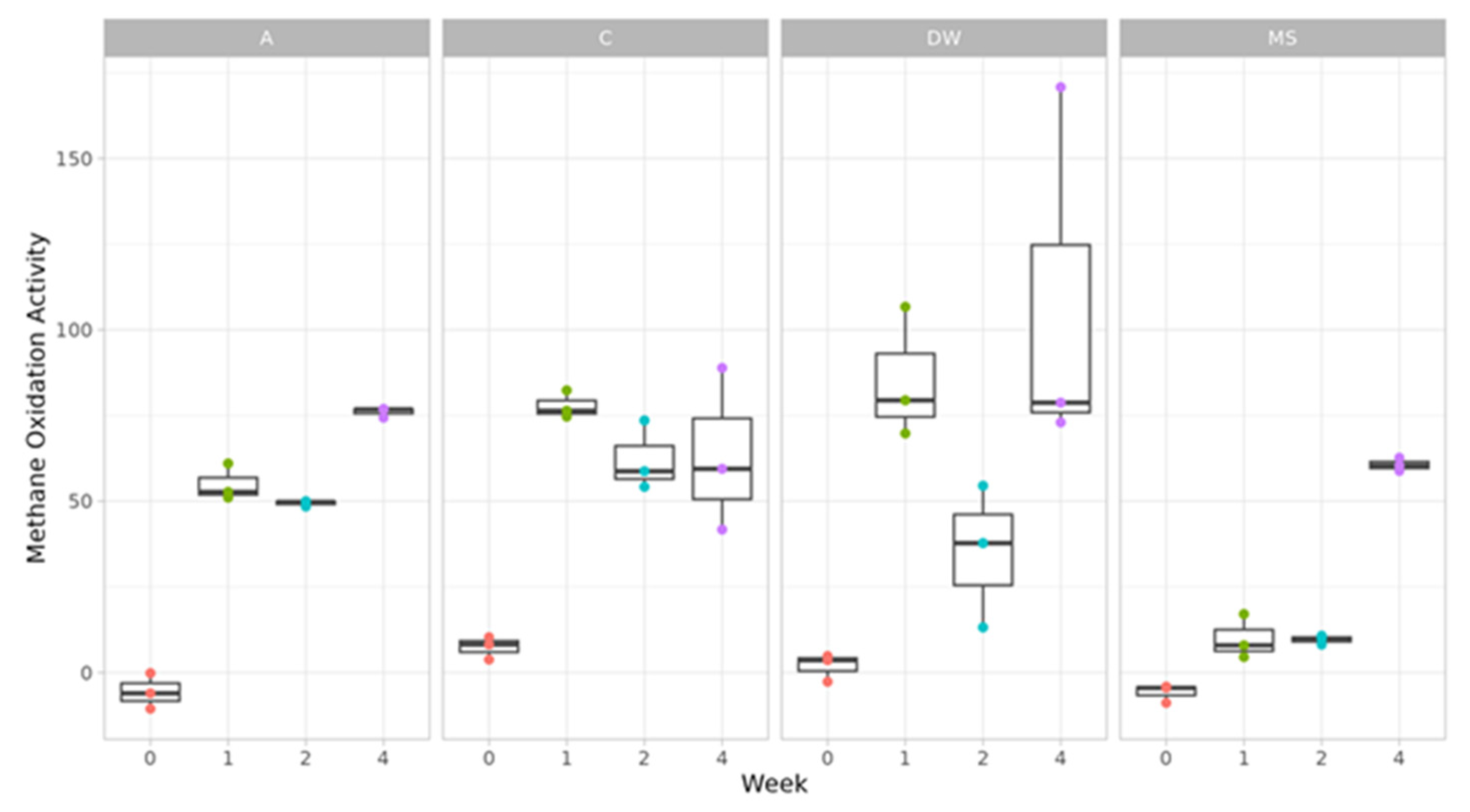
Figure 2.
Comparisons of the alpha diversity index’s dynamics across several treated soils. Abbreviations: no impacts (C), ammonium addition (A), drying-rewetting (DW), combined action of stressors (MS).
Figure 2.
Comparisons of the alpha diversity index’s dynamics across several treated soils. Abbreviations: no impacts (C), ammonium addition (A), drying-rewetting (DW), combined action of stressors (MS).
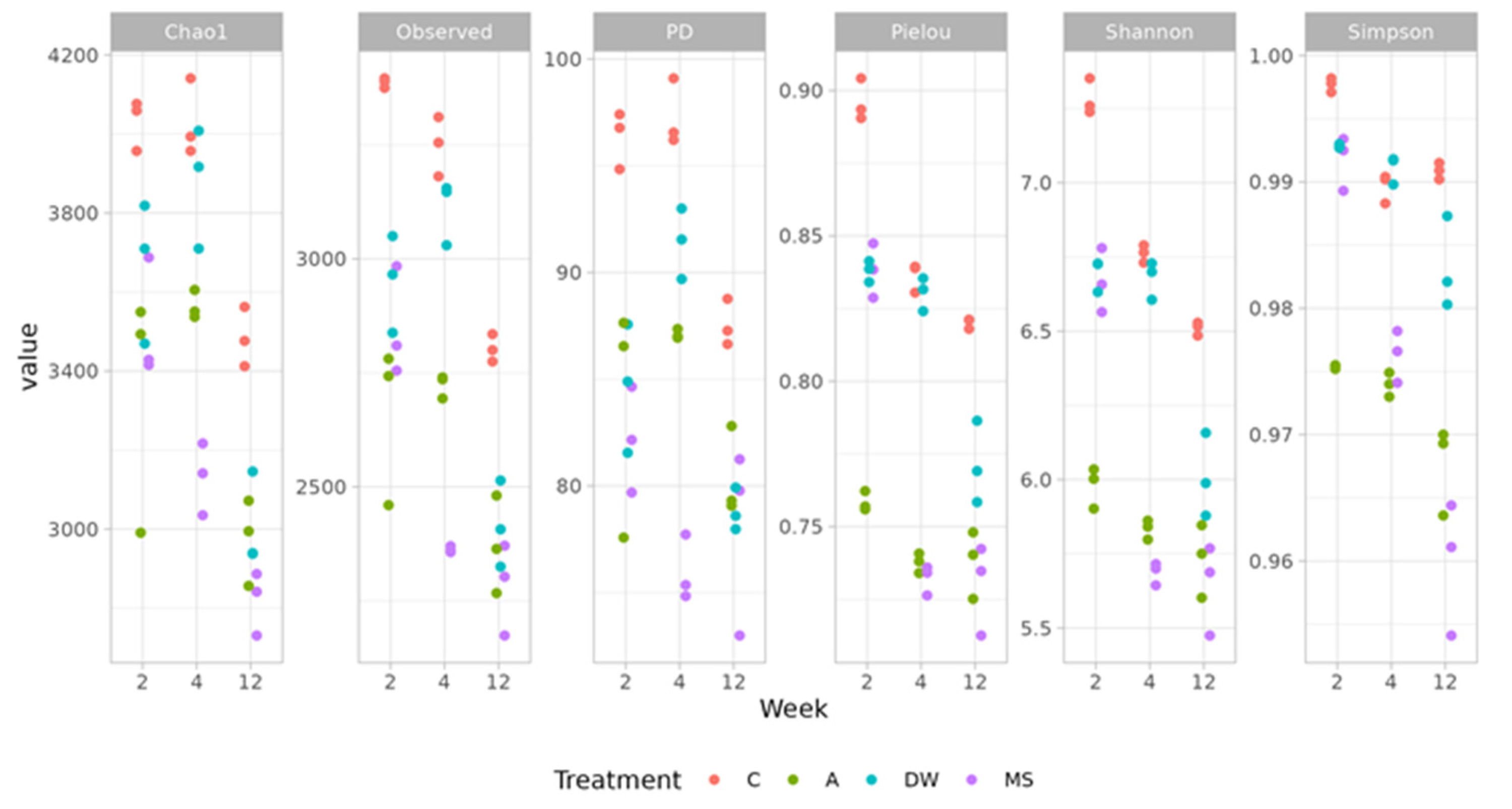
Figure 3.
PCoA ordination of different beta diversity indices of microbial communities.
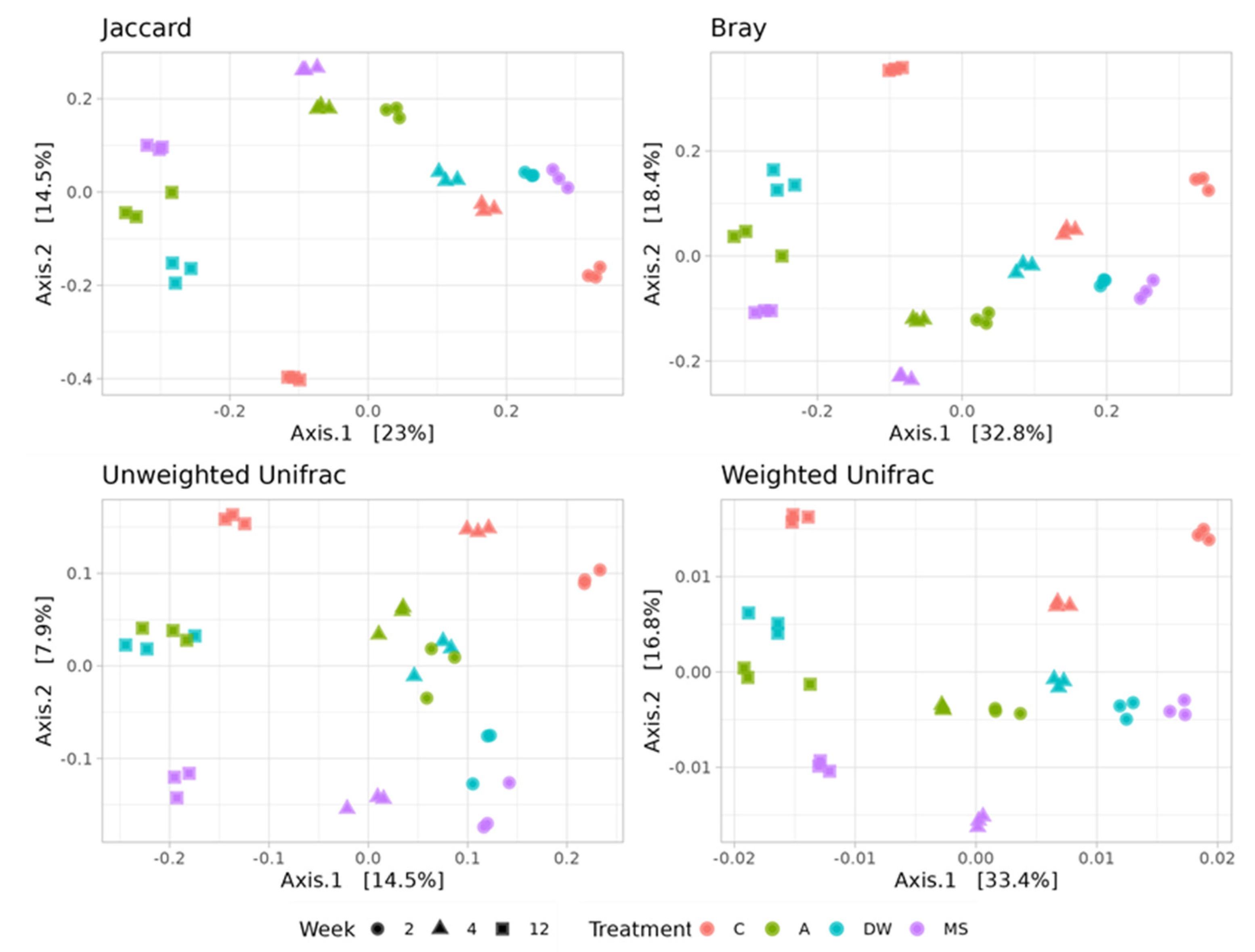
Figure 4.
Abundances of different prokaryotic taxa, determined as the taxa with different abundance across incubation time, based on the 16S rRNA gene sequence analysis.
Figure 4.
Abundances of different prokaryotic taxa, determined as the taxa with different abundance across incubation time, based on the 16S rRNA gene sequence analysis.
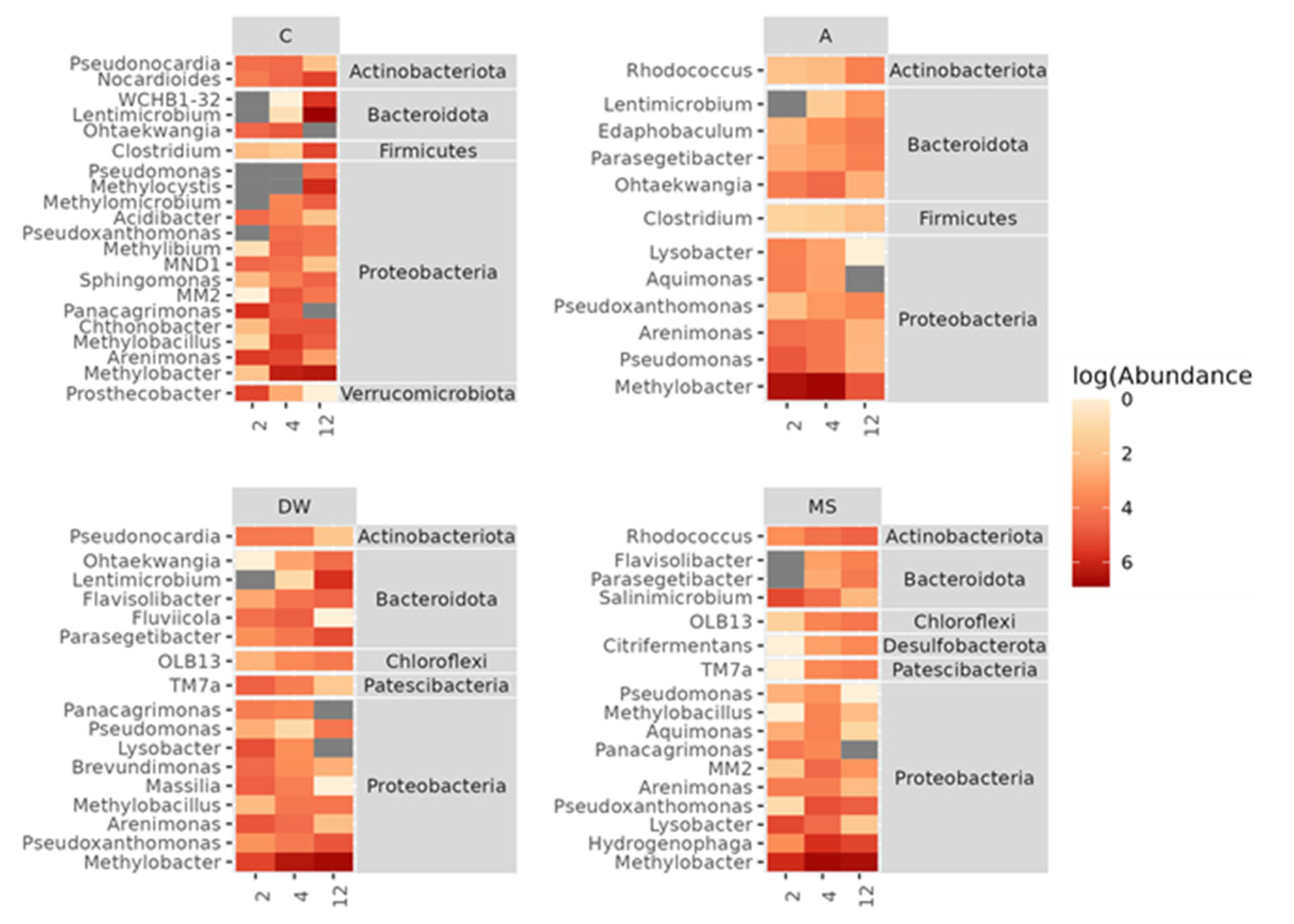
Figure 5.
Abundances of different prokaryotic taxa, determined as the taxa with different abundance across treatment, based on the 16S rRNA gene sequence analysis after incubation at 2, 4 and 12 weeks intervals.
Figure 5.
Abundances of different prokaryotic taxa, determined as the taxa with different abundance across treatment, based on the 16S rRNA gene sequence analysis after incubation at 2, 4 and 12 weeks intervals.
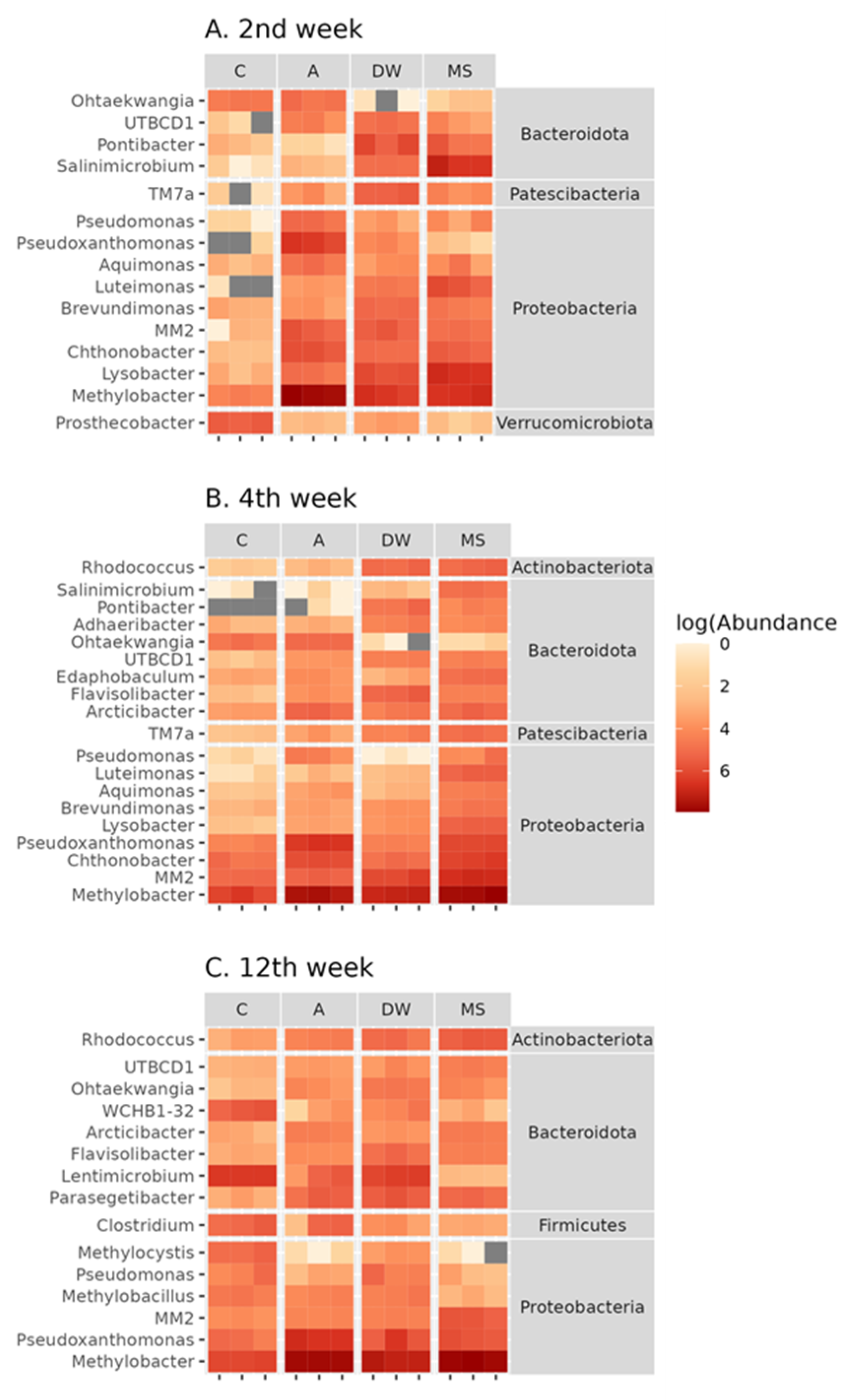
Figure 6.
Relative abundance of the methano- and methylotrophs in control, drying-rewetting, ammonium and multistress treatments in soil samples. Data is based on 16 s rRNA gene sequencing data.
Figure 6.
Relative abundance of the methano- and methylotrophs in control, drying-rewetting, ammonium and multistress treatments in soil samples. Data is based on 16 s rRNA gene sequencing data.
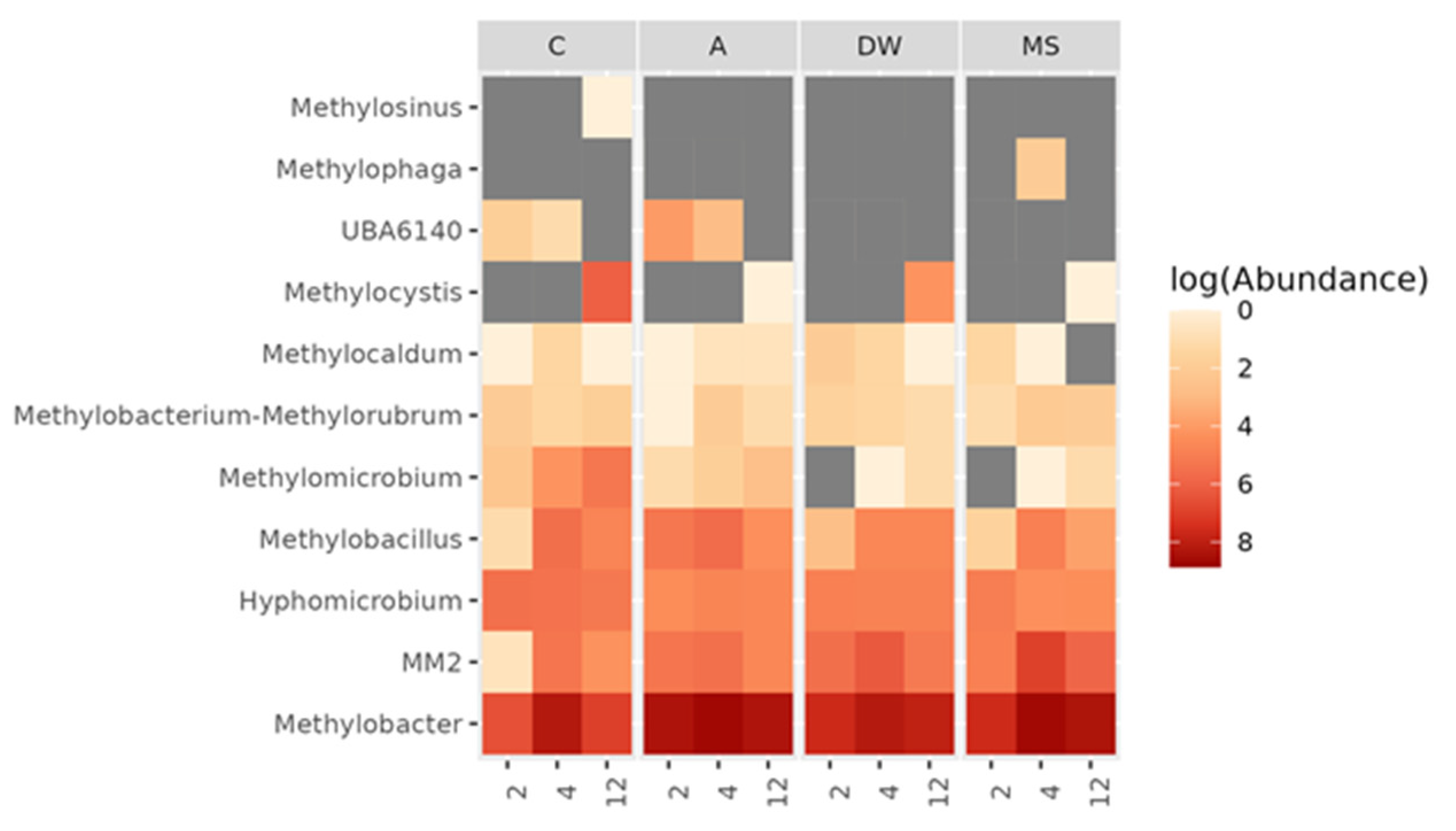

Table 1.
Characteristics of the experimental soil.
| Soil’s parameter, dimension | Parameter`s value |
|---|---|
| Texture | Loamy sanda, coarseb |
| Clay, % | 4 |
| Sand, % | 87 |
| Loam, % | 9 |
| pHH2O | 7.6±0.1 |
| SOC, % TN,% |
5.97±0.9 0.37± 0.02 |
| C:N | 16.14 |
| Soil density, g/ cm3 | 2.55 |
| Na+, mmol/100g | 0.283±0.01 |
| К+, mmol/100g | 0.550±0.01 |
| Ca2+, mmol/100g | 18.15±0.21 |
| Mg2+, mmol/100g | 5.852±0.073 |
| Basal microbial respiration, µg С-СО2 g-1 h-1 | 0.82 ±0.02 |
| Microbial biomass, µg С g-1 | 1252±65 |
| Metabolic quotient (QCO2) | 1.35±0.03 |
aUS Department of Agriculture textural classes. bFAO textural classes.
Disclaimer/Publisher’s Note: The statements, opinions and data contained in all publications are solely those of the individual author(s) and contributor(s) and not of MDPI and/or the editor(s). MDPI and/or the editor(s) disclaim responsibility for any injury to people or property resulting from any ideas, methods, instructions or products referred to in the content. |
© 2024 by the authors. Licensee MDPI, Basel, Switzerland. This article is an open access article distributed under the terms and conditions of the Creative Commons Attribution (CC BY) license (http://creativecommons.org/licenses/by/4.0/).
Copyright: This open access article is published under a Creative Commons CC BY 4.0 license, which permit the free download, distribution, and reuse, provided that the author and preprint are cited in any reuse.


