

Submitted:
04 November 2024
Posted:
06 November 2024
You are already at the latest version
Abstract
The Schwarzschild solution of Einstein’s field equation comes in two variants, one for a
single spherical mass (black hole), and one for the universe as a whole (in which dark energy prevails
over matter). The cosmic variant represents a special form of expanding De-Sitter space (and is a
good match with cosmic reality). In the cosmic variant, the Schwarzschild horizon of a black hole is
replaced by the cosmic event horizon. The world-lines of escaping galaxies and also of photons is
given by a function r(t) in which no square root of a negative number appears, so that the functionvalue
is a real number even when it comes to r larger than the distance to the horizon. It turns out that
no singularity exists beyond the cosmic event horizon. A surprising symmetry is thereby revealed
(with the cosmic event-horizon functioning as a symmetry line). This symmetry comprises timereversals
along world-lines, and the possibility of crossing the cosmic event horizon in both
directions. As a consequence thereof, loop-shaped world lines of objects are within reach (similar to
those in Gödel’s universe), even in the vicinity of planet Earth. As Gödel had correctly pointed out,
loop-shaped world lines are proof of the static model of time, according to which present, past and
future events occurring at the same spatial location are equally part of physical reality, not different
from events occurring at the same time at different places. Kruskal-Szekeres charts do not obstruct
any of these results. These charts have so far been used in an incorrect manner. When using them
correctly, no singularity exists beyond event horizons, neither in the back-hole case, nor in the cosmic
case. Doubts with regard to the existence of singularities, recently expressed by R. P. Kerr (2023), are
thus proved to be justified.
Keywords:
General relativity
; Schwarzschild solution
; Kruskal charts
; cosmic event horizon
; De-Sitter space
; time travel
; time reversal
; closed world lines
; black hole
; white hole
0. Introduction
Special Relativity has revealed that the temporal ordering (earlier/later) of two point-events is frame-dependent and hence relative. However, it has been believed that this relativity of a temporal ordering holds only true for two events which occur far away from each other in space so that there cannot be any causal interaction between them (given a causal front cannot spread at a speed faster than the local speed of light). The intervals between such two events have therefore be called “spacelike” intervals.
But two events may occur so close to each other that there can be a causal interaction between them. The intervals between such two events are called time-like intervals. Birth and death of a person is an example of a pair of these events. It had been believed that there is no place in Relativity for the existence of reference frames in which even time-like intervals between two events are relative in their temporal ordering (with the exception of exotic universes like the one mentioned by K. Gödel, see below). If the temporal orderings of such time-like events were relative, a person’s death would precede her birth in a special frame of reference. Under some additional assumptions, a person could even meet her former self.
It was K. Gödel who was successful in showing that General Relativity allows for such closedness of world lines (however, Stuart Boehmer has recently doubted this result by criticising Goedel for arbitrarily exchanging a space-coordinate for a time-coordinate), but he had to resort to a strange hypothetical universe very different in geometry from ours. This article will show that General Relativity allows for time-reversals and loop-like world lines of persons and objects in our familiar universe as well. Not even such exotic things like ordinary Black Holes are required.
I. Symmetry of the World Line of an Escaping Galaxy in Front of and Beyond the Cosmic Event Horizon Because of a Time-Reversal
- a)
- The Schwarzschild solution of Einstein’s field equation
The Schwarzschild solution for any spherically symmetric arrangement of matter or dark energy is (presuming spatial displacements occur in the radial direction only):
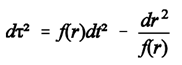 (1)
(1) The function f(r) is either equal to 1-2a/r, or to 1-br².
For the neighborhood of a spherical mass, the first alternative is used, and the constant a is equal to GM/c² = rs/2, with rs being the Schwarzschild radius, G being Newton’s gravitational constant, M being the mass of the spherical body, c being the local speed of light.
If the second alternative is used, the constant b is chosen to be equal to H²/c², where H is Hubble’s constant, that is, the increase in the galaxies’ escape velocity with distance r from the Milky Way. The numerical value of the cosmological constant in Einstein’s field equation determines the numerical value of Hubble’s constant, and its sign determines the sign of Hubble’s constant. In order to apply this variant, the tensor T on the right-hand side of Einstein’s field equation must be set to zero. This is equivalent to saying that in this variant, dark energy prevails over matter. The so-created cosmic variant of the Schwarzschild solution yields a De-Sitter universe.
- b)
-
The Schwarzschild solution of Einstein’s field equation for a single, non-rotating spherical mass
- aa)
- When completed, the first variant of the Schwarzschild solution (which deals with a spherical, non-rotating mass) reads (in polar coordinates t, r, theta, phi):
 (2)
(2)The term rs = 2GM/c² is the Schwarzschild radius (G is Newton’s constant, c is the local and constant speed of light, M is the mass of the spherical body which may imagined to be concentrated at r=0). The Schwarzschild radius is the radius at which the local escape velocity is c. The spatial coordinate r is not the distance between a point in space and the center of the spherical mass measured by stationary meter sticks laid end-to-end, but the circumference of a circle around the spherical mass, divided by 2 pi. This is because the former method would lead of result that depends on the mass of the spherical body (due to the phenomenon of length contraction of radially oriented, stationary meter sticks in a gravity field that is hidden in this equation). The latter method yields the same result both for a stationary observer Bob outside the gravity field and also for a stationary observer Alice in the gravity field.
The meaning of time t has been subject to some misunderstandings. It is the time shown by a clock held in Bob’s hand (Bob sits far away from the spherical mass). But the Schwarzschild solution ascribes an interval delta t of Bob’s time also to the temporal distance between two point-events that occur far away from him in the gravity field. Take two consecutive throbs of Alice’s heart, for example (Alice sits in the gravity field). Thus the Schwarzschild solution presupposes a simultaneity relation between a point-event in Bob’s vicinity (a single tick of his clock) and another point-event that occurs some distance away in the gravity field (a single throb of Alice’s heart). However, simultaneity cannot be defined on the basic law of the invariance of the speed of light in the same way as this is done in Special Relativity (it was Stuart Boehmer who made me aware of this). This is because it is the Schwarzschild solution itself which tells us that the speed of light in a gravity field is not invariant for a distant observer, but depends on the position of the photon in the gravity field and its direction of travel there.
Hence, we must resort to different method of defining ‘simultaneity’ in Bob’s frame of reference: We can imagine that Bob and Alice synchronized their clocks when they were in close contact with each other, that is, prior to Alice’s departure. After a long period of Bob’s time, Alice’s eventually returns to Bob’s position in space. In case Alice’s clock were lagging behind Bob’s (when the two clocks eventually sit side by side) by a factor of ½, every tick of Alice’s clock that occurred while she sat in the gravity field could be attributed a precise moment in Bob’s time, provided that the duration of Alice’s journey to and from her position in the gravity field was vanishingly small compared to the length of her (stationary) stay in the gravity field.
A similar method is the following: Bob and Alice had agreed on the following procedure: From her stationary position in the gravity field, Alice would send off a short radio signal (beep) every second of her time tau. In case Bob receives a signal every two seconds of his time t, we achieve the same result (allowing simultaneity statements) as in the former case (of comparing clocks when they sit side-by-side).
- c)
-
The Schwarzschild solution of Einstein’s field equation for a steadily expanding universe in which dark energy prevails over matter
- aa)
-
The second variant of the Schwarzschild solution deals with the visible universe as a whole. It describes a De-Sitter-universe, in which dark energy prevails over matter (so that matter is negligible), and in which the Hubble-constant H is invariant over space and time. The cosmic variant of the Schwarzschild solution (De Sitter space) is:
 (3)The distance r denotes circumference of a circle around the center of the Milky Way divided by 2 pi; time t is the time measured in the Milky Way; time tau is the time measured in the escaping galaxy. Equation (3) can be found in E. Gaztanaga (2022), his Equation (3) and his Figure 1 [his r* is equal to 1/H, his c is equal to unity, as is made evident between his Equations (2) and (3)].
- bb)
-
In that variant, the role of a Schwarzschild horizon of a black hole is replaced by the cosmic event horizon (see also Gaztanaga, op. cit). Different from the Schwarzschild horizon of a black hole, the cosmic event horizon is a relative thing, and every galaxy has one of its own. The Milky Way’s cosmic event horizon is located at a distance of rhoriz= c/H = 14,000,000,000 lightyears. The parameter c is the local speed of light. The local speed v’’ at which an observer who sits in immediate front of the Milky Way’s cosmic event horizon – and is connected to the Milky Way by a tether that keeps his or her distance from the Milky Way constant – watches an escaping galaxy pass by is very close to that speed c.A neighboring galaxy (that is, a galaxy neighboring our Milky Way) which is not gravitationally bound to any other galaxy will pick up speed as a result of the expansion of space, and will eventually reach the fixed cosmic event horizon several billion lightyears away. Just in front of the cosmic event horizon, the local escape velocity of that escaping galaxy, judged from the perspective the aforementioned local observer who is connected to the center of the distant Milky Way by an imagined, extremely long tether (and is thus standing still with respect to the Milky Way), is almost c (as has been stated already). One should note that escaping galaxies are merely small test-objects in this model in which matter-density is negligible by presupposition (the tensor T in Einstein’s field equation is vanishing everywhere and and at any time).
- cc)
- The escaping galaxy will eventually cross the cosmic event horizon (that is attributed to the reference frame of the Milky Way). But apparently, it will do so only in the reference frame of that escaping galaxy, where this invisible borderline will rush by at a speed of c (just as other galaxies’ cosmic event horizons are rushing past us here on Earth every second at velocity c). From the perspective of the Milky Way, this galaxy is more or less not moving at all, but has got “frozen” in front of the cosmic event horizon, just as freely falling Alice gets “frozen” in front of the Schwarzschild horizon of a black hole from the perspective of distant Bob (see Gaztanaga, op. cit.: “No signal from inside r* can reach the outside, just like in the interior of a BH.”)
- d)
- The world line of an escaping galaxy on a t,r-chart
If Newton’s physics were applicable to expanding cosmic space, the escape velocity of a galaxy as a function of distance from the Milky Way would be:
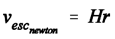 (4)
(4)According to (1), the Newtonian escape velocity (measured in the reference frame of the Milky Way) is reduced by two factors. These factors are the dilation of distant stationary clocks (stationary with respect to the Milky Way) on the one hand, and the shortening of distant, radially oriented stationary meter sticks (stationary with respect to the Milky Way) on the other hand (see below for an analysis of the reason for this phenomenon). This leads to:
 (5)
(5)A re-arrangement leads to (for an escape path of a galaxy that extends even beyond the Milky Way’s cosmic event horizon):
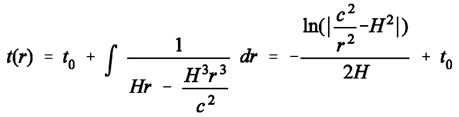 (6)
(6)The (improper) integral is not divergent between limits r<rhoriz and r>rhoriz , although the integrand is infinite at r=rhoriz= c/H (with rhoriz being the distance, that is circumference of a circle divided by 2 pi, between the Milky Way and its cosmic event horizon). The value of the integrand is real and not imaginary even for r>rhoriz, and so is the value of the integral.
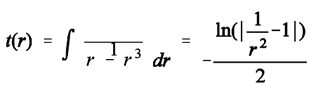
If we set c=1, H=1, t0=0, and if (which, see below, is indispensable after having set both c and H to unity) the coordinate radial distance r is expressed in dimensionless units of multiples of rhoriz (or in dimensionless units of multiples of 14 billion lightyears), and if, because of t=thoriz= rhoriz/c =1, coordinate time t is expressed in dimensionless units of multiples of 14 billion years (that is, in dimensionless units of multiples of coordinate time thoriz required to reach the cosmic event horizon by a light signal sent off from the Milky Way if the speed of light did not slow down in the Milky Way’s frame of reference), (6) turns into:
 (6a)
(6a)The world-line of the escaping galaxy as determined by (6a) is shown in Figure 1a (all t,r- diagrams were generated online by www.integralrechner.de).
The area to the left of the vertical axis has no significance, since a negative r does not exist. The red graph is the function F=t(r), the blue graph is the integrated function f(r).
At r=rhoriz (= c/H =1), the time interval Delta t (in the Milky Way’s frame of reference) that has elapsed since a nearby galaxy – which, at the beginning of the interval, was in the cosmic neighborhood of the Milky Way – has eventually reached the cosmic event horizon, is infinitely large according to (4). Moreover, all motions in the interior of the escaping galaxy – and the escaping galaxy itself – are “frozen” in the reference frame of the Milky Way at spatial positions where r is only differentially smaller than rhoriz. But nevertheless, the escaping galaxy, or at least a copy of it, IS capable of getting to the other side of the cosmic event horizon even in the Milky Way’s frame of reference!
- e)
-
The behaviour of clocks co-moving with the escaping galaxyAs mentioned above, an observer who sits in front of the Milky Way’s cosmic event horizon, and who is connected to the Milky Way by a tether that keeps his or her distance from the Milky Way constant, will also undergo a dilation of his or her time tau (judged by an observer in the Milky Way). This dilation is given by (1), since, in this special case, dr, d phi and d theta are all zero. We therefore get from (1):
 (7)Because of rhoriz= c/H , the quotient dtau/dt vanishes for an r that is approaching rhoriz .Similarly, a radially oriented meter stick held by the tethered observer is contracted in the reference frame of the Milky Way. Its contraction is given as follows when (1) is written in its complete form:
 (8)The parameter ds is the spatial proper length between two local chains of “vertical-world- line” events (as opposed to point events). When a local meter stick rests in the reference frame of the observer (Alice) who sits in the gravity field, both the continued existence of its one end and also the continued existence of its other end form a vertical world-line each in Alice’s tau, r-chart. Since the meter stick is also stationary in Bob’s frame of reference, the two ends also form vertical world-lines in Bob’s t,r-chart. In order to determine the time- invariant spatial distance between the two ends in the two frames of reference, that is, between the two vertical world-lines, both Alice’s d tau and Bob’s dt are set to zero. Given that d tau, dt, d phi and d theta are all zero, we then get by a re-arrangement:
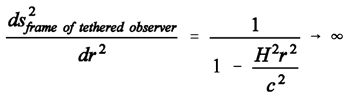 (9)The quotient ds/dr goes to infinity when r approaches rhoriz.
- bb)
- Let us now turn our attention to the (single-primed) reference frame of the escaping galaxy that finds itself near the Milky Way’s cosmic event horizon. In that frame of reference, the dilation of time of a clock held by the (nearby) tethered observer is described by Special Relativity, as it is attributed to the motion of the tethered observer and his or her clock (and not to the motion of space). In comparison, the dilation of time t’’ of a clock held by the tethered observer with respect to the Milky Way’s time t is NOT due to the fact that the tethered observer’s clock is in motion. For this clock is stationary in the Milky Way’s reference frame. We nevertheless have (because of Equation 3):
 (10)
(10)The parameter v’’ is the velocity of the escaping galaxy in the reference frame of the tethered observer. That velocity is equal to almost rhorizH, which, in turn, is equal to c.
On the other hand, the tethered observer’s clock is in motion in the reference frame of the escaping galaxy (as has been stated above). The Lorentz transformation of Special Relativity therefore yields:
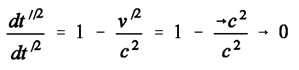 (11)
(11)Time t’ is the time measured in the escaping galaxy, time t’’ is the time of a clock held by the tethered observer. The interval dt’ thus is the time interval between two point-events that do not occur at the same place in the single-primed reference frame of the escaping galaxy, but at two different places. These two events (two ticks of the clock held in the tethered observer’s hands) do, however, occur at the same place in the double-primed reference frame of the tethered observer. The velocity v’ is the velocity at which an observer in the distant galaxy watches the tethered observer pass by; v’’ is the velocity at which the distant galaxy is passing by in the reference frame of the tethered observer. According to the relativity principle, the two velocities v’ and v’’ must be equal in absolute magnitude (which is almost c), and opposite in direction.
Dividing (10) by (11) gives:
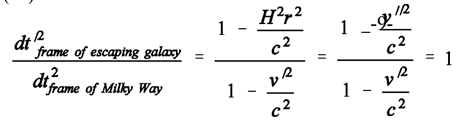 (12)
(12)Thereby it is shown that the rate of time-dilation of the tethered observer’s clock is the same both in the Milky Way’s reference frame and in the escaping galaxy’s frame of reference. As a consequence, there is no time dilation of clocks that sit in the other galaxy, neither from the perspective of the Milky Way, nor from that of the distant, escaping galaxy. This result is not a surprise, as otherwise one galaxy would be privileged over the other, which would be inexplicable.
- f)
- The two axioms of General Relativity must be understood as local principles
However, (12) is apparently challenged by (6) and (6a), according to which proper time in the distant galaxy is standing still in the Milky Way’s frame of reference.
The dilemma can be dissolved as follows: The equality of dt’ (coordinate time of the escaping galaxy) and dt (coordinate time of the Milky Way) is postulated only for a situation in which the two galaxies would meet each other in local contact, that is, when sitting side- by-side. (This hypothetical event will be discussed further below.)
One should note that the equality of dt (Milky Way’s proper time) and dt’ (proper time of the escaping galaxy) is a necessity that follows from the relativity principle as such, that is, from the first basis (=axiom) of Einstein’s theory. The relativity principle (as understood by Einstein) says that any observer who is in free radial fall is entitled to consider himself or herself as being stationary when it comes to applying any physical law.
Moreover, we find, even without any calculations, that no galaxy is privileged over the other. This is for symmetry reasons already.
However, similar to the law of the invariance of the speed of light (which forms the second axiom in Einstein’s theory), the postulate of an equality of dt (time of Milky Way) and dt’ (proper time of escaping galaxy) only holds true locally. It is not true when judged from a greater distance, that is, when the two galaxies are separated from each other by a large distance.
- g)
-
The flow of space not only as a cause of the expansion of space, but also as the cause of time dilation and length contraction in Relativity in general
- aa)
- As has been stated above, time of the tethered observer is dilated in the Milky Way’s frame of reference, even though the distance between the Milky Way and the tethered observer does not change with time. How then can that time dilation (and length contraction) be accounted for in physics (apart from the simple fact that is follows from the cosmic variant of the Schwarzschild solution)?
The answer is: It is the flow of space past a clock and past a meter stick that is responsible for these two relativistic effects. As regards the tethered observer, space volumes that, as a result of cosmic expansion, have emerged somewhere between the Milky Way and its cosmic event horizon rush past the tethered observer at a local velocity of almost c, whereas the escaping galaxy is embedded in that flow. There is simply no other explanation of the behaviour of stationary meter-sticks and stationary clocks other than an expansion of space in a t,r- reference frame of the Milky Way in which the spatial distances between meter-marks are NOT expanding, but are static. As Gaztanaga (op.cit.) correctly put it: “As H becomes dominated by lambda, the expansion becomes static ... in the SW frame.”In the black-hole variant of the Schwarzschild solution (which describes the situation around any spherical, gravitating object), things are similar. For we have: (13)and hence:
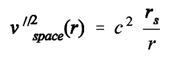 (13a)The parameter v’’esc is the local escape velocity in the gravity field of a spherical mass (whose Schwarzschild radius is rs). In other words: v’’esc is the local escape velocity of a stone that is tossed upward by a stationary observer (whose time is tau) in the gravity field of a spherical mass. That velocity is the same in magnitude as the velocity of a test object in free radial fall that started its journey far away at an initial velocity of almost zero. That velocity, in turn, is not the result of an accelerating force, but of geometry of space; this is because a falling test object is simply following a geodesic. Then it is space itself that is gathering speed. There is no other explanation of what “following a geodesic” could possibly mean.
- bb)
- For comparison, we have in the cosmic case:
 (13b)and
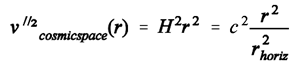 (13c)Textbooks tend to “blame” the effect of time dilation of a stationary clock in a gravity field of a spherical mass) simply on “local gravity” and not on any local flow of space. Consequently, textbook authors would have to regard the sameness of time dilation of a stationary clock in a gravity field with time dilation of a clock outside the gravity field – in motion at a speed which is exactly that of the escape velocity in the former case – as a pure coincidence without any physical significance. However, when it comes to the cosmic variant of the Schwarzschild solution, there is no “gravity” on which the time dilation of the clock held by the tethered observer could be blamed. The force on the tethered observer (brought about by the expansion of space) cannot function as a substitute for gravity, simply because the accelerating force per unit mass the tethered observer is subject to amounts to less than 10-9 m/sec² (see below), and is therefore negligible. Even in the gravity field of a spherical mass where the gravitational acceleration is
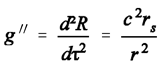 (14)one finds that, at a given quotient rs/r (even if rs/r =1, that is, at the Schwarzschild radius where the local escape velocity v’’esc is c) and hence with an enormous time dilation of a stationary clock in the gravity field, the local gravitational acceleration g’’ is vanishingly small if r is very large. [R in (14) is the radial length measured in stationary meter sticks laid end-to-end, r is circumference of a circle divided by 2pi.]Last not least, when determining the rate of time-dilation of the tethered observer from the perspective of the Milky Way, we get from (3):
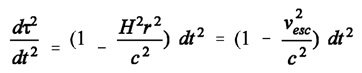 (14a)Although the tethered observer is at rest with respect to the Milky Way, the rate of his or her time dilation is determined by a velocity, and by nothing else. Given there is only vacuum around him or her, it can only be the velocity of space itself that is the cause of his or her time dilation.Things cannot be different when it comes to the case of a stationary clock in the gravity field of a spherical mass. Here, too, the local cause (required by the principle of action-by-contact) of time dilation can only be the flow of space past the respective clock. It is by means of flowing space – and by nothing else – that gravity can be ubiquitously and not only locally be transformed away (see A. Trupp, .. and A. Trupp, ...). Only thereby is it rigorously deprived of its character as a force in physics.
- cc)
- The “flow of space” is a general concept added to General Relativity by A. Einstein a few years prior to his death (see A. Einstein, ....). It can be frame-dependent (or even dependent on the direction of the arrow of time, see A. Trupp, ). As regards frame-dependence, it resembles the flow of electromagnetic energy described by the Poynting vector: When scrutinizing an electric motor, the Poynting vector tells us that, in the reference frame of the stator, electromagnetic energy flows from the electric power source into the rotor that is yielding mechanical work. In the reference frame of the rotor (which, for reasons of simplicity, we imagine to be a straight wire that moves back and forth in transverse, straight motions), the electromagnetic energy flows from the electric power source into the stator, which, in that frame of reference, is yielding mechanical work as a consequence of the fact that the counter-force is acting on the stator over a distance and is thus doing mechanical work.
- h)
- Time-resersed sections of world lines of escaping galaxies
The world line of a galaxy in the t,r-diagram, that is, in the reference frame of the Milky Way, has a negative slope for any value of r larger than rhoriz (see Figure 1). That means: Time is running backwards at those distances. More precisely: Judged in the Milky Way’s frame of reference, the clocks in the escaping galaxy (that is beyond the Milky Way’s cosmic event horizon) are running backwards.
This is for the following reason: The velocity vescape (in the Milky Way’s frame of reference) is numerically negative according to (5) for any r> rhoriz= c/H – while being numerically positive for any r< rhoriz= c/H. That is, the galaxy is not escaping from the Milky Way’s cosmic event horizon beyond rhoriz , but is appoaching it in the reference frame of the Milky Way. In the reference frame of that distant galaxy, however, the Milky Way’s (invisible) cosmic event horizon is increasing its distance from an observer in that galaxy every second of his or her time tau.
Hence, when drawing marks of the galaxy’s proper time tau on the galaxy’s world line in the t, r -reference frame of the Milky Way (starting at the near end of that world line), the numbers that these marks carry increase all the way along that world line, even though the distance between two neighboring marks is not constant from mark to mark (it is very large near the Milky Way’s cosmic event horizon). This leads to the inevitable conclusion that time tau of the distant galaxy is reversed with respect to the Milky Way’s time t beyond the Milky Way’s cosmic event horizon.
- i)
-
Galaxies that exist twice at the same moment in coordinate timeMoreover, the escaping galaxy exists twice at the same time in the reference frame of the Milky Way, provided the distance (of its first copy, i.e., the copy that finds itself on the near side of the horizon) from the Milky Way, is roughly more than 3/4 of the invariant distance rhoriz to the Milky Way’s cosmic event horizon.It is worth mentioning (as has been pointed out by L. Susskind) that, at every second, we are crossing some other galaxy’s cosmic event horizon (which is rushing past us at velocity c). Consequently, our own world line is, at every moment that follows for us, time-reversed in the reference frame of that distant galaxy.The world line of a galaxy in case cosmic expansion is succeeded by contraction
- aa)
-
In order to convince ourselves of the fact that an escaping galaxy is capable of crossing the cosmic event horizon in the reference frame of the Milky Way (so that the continuation of the graph at regions of r>rhoriz is not just an artefact beyond the validity range of the Schwarzschild equation), we imagine the following thing to happen: We imagine that the expansion of the universe is succeeded by a contraction. One can simply assume that all motions of space and galaxies are reversed like the motion of a ping-pong ball hitting a wall (the galaxies wouldn’t feel any acceleration, as they would stay embedded in cosmic space). In the cosmic version of the Schwarzschild solution, the sign of Hubble’s constant H would have to be altered from positive to negative. That’s all. (That’s not strictly true, though: The time-coordinates of distant point-events my have jumped forward or backward as a consequence of the change of sign of H.)(6) is thus converted into:
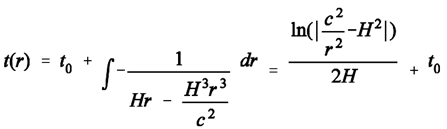 (14b)If c=1, H=1, C=0, t0=0, and if r is expressed in dimensionless units of multiples of the distance to the cosmic event horizon, t as expressed in dimensionless units of multiples of 14 billion years, we get:
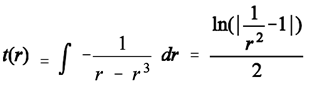 (14c)(14b) and (14c) describe the approach of a distant galaxy, and not its escape. See Figure 1b for a visualization of (14c).Thus, after billions of years, the galaxy that began its trip when it had been located close to the Milky Way is back at the location close to the Milky Way where it once had been. Given that all processes in nature are reversible, such an assumption is permissible.
 - bb)
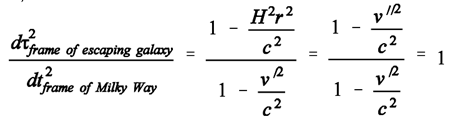
- When comparing their clocks with each other, observers in the Milky Way and in the once distant (and now again nearby) galaxy would find that proper time has elapsed at the same rate in both galaxies. This was shown above already. See again (12), which reads:
 (14d)
(14d)But this equality also follows from the relativity principle, which forms a basis of General Relativity [together with the law of the invariance of the local speed of light, see A. Einstein, (2018), p. 136]. The relativity principle postulates that any observer in free and straight fall (who does not feel any force on him or her) may consider himself or herself as being at rest while all the other stuff of the universe is in accelerated or unaccelerated motion around him or her. This applies to any galaxy that is “going along for the ride” offered by the flow of space in the Milky Way’s frame of reference. Hence if, upon reunion of the two galaxies, the clocks in the two galaxies would differ in time, one of the two galaxies would be privileged over the other – although each of the two galaxies is entitled to consider itself as having been at rest all the time. This would constitute a violation of the relativity principle, and hence an inner contradiction of General Relativity (that is based on the relativity principle).
Within the realm of the black-hole (or spherical-mass) variant of the Schwarzschild solution, this process finds its analogue in a full traverse of a Black Hole by a test object in free radial fall/rise. This hypothetical journey is described and analyzed by A. Trupp (2020).
II. Symmetry of the World Line of a Trans-Horizon Radio Signal That Has a Time-Reversed Section
Next, we will scrutinze the world line of a photon sent off from planet Earth in an arbitrary direction. We will find that it manages to cross the distant event horizon. In a t,r-chart, that is, in the Milky Way’s frame of reference, the world line of the photon finds its continuation beyond the cosmic event horizon, where it is time-reversed (in there reference frame of planet Earth and the Milky Way). Moreover, we find that a distant galaxy beyond our cosmic event horizon can send us radio signals that cross the cosmic event horizon and will eventually reach us, as will be shown in the following.
In greater detail:
In a photon’s rest frame, time does not exist. As a consequence, when applying (3) to a photon, the left-hand side of the equation is set to zero. We then get for a photon (no matter if incoming or outgoing):
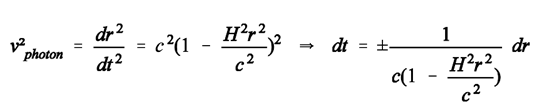 (15)
(15)For an an outgoing photon (that is sent off at r=0, t=0) we then get:
 (15a)
(15a)If c=1, H=1, t0=0, and if r is expressed in dimensionless units of multiples of the distance to the cosmic event horizon, and if t is expressed in dimensionless units of multiples of 14 billion years), we get:
 (16)
(16)That world line can be seen in Figure 2a.
The area to the left of the vertical axis has no significance, since a negative r does not exist. The red graph is the function F=t(r), the blue graph is the integrated function f(r).
For an incoming photon, that is, a photon sent off from the escaping galaxy beyond our cosmic event horizon, and which arrives at the Milky way, that is, at r=0, at time t=0, the limits of the integral in (16) must be interchanged. We then get:
 (16a)
(16a)The world line of the incoming photon is shown in Figure 2b.
Hence, the spatially fixed cosmic event horizon of the Milky Way is penetrable in both directions in the Milky Way’s frame of reference by a photon.
III. Why Kruskal Charts Do Not Object to the Possibility of a Photon’s Trip Back and Forth Across the Cosmic Event Horizon, but Rather Yield a Symmetry
- a)
-
Kruskal-Szekeres charts as means of depicting both variants of the Schwarzschild solution
- aa)
- Given that all textbooks assert that it is impossible even for a photon to cross the Schwarzschild horizon from the inside to the outside, and given the cosmic event horizon is the analogue to the Schwarzschild horizon when it comes to the cosmic variant of the Schwarzschild solution, how can it be that the above results (regarding the crossing of the cosmic event horizons back and forth) can nevertheless be yielded by the Schwarzschild solution?
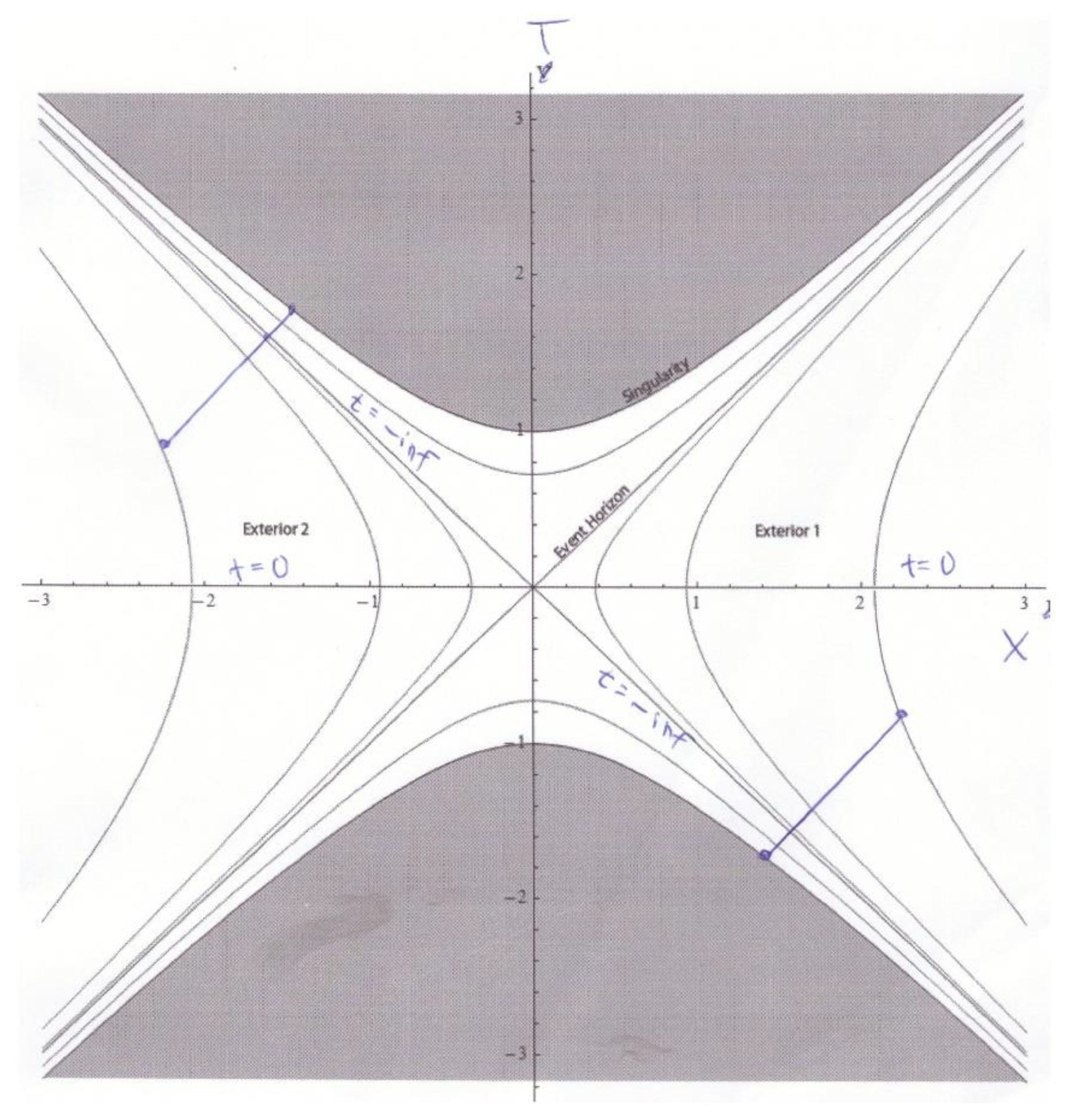
The answer is as follows:For reasons displayed below, textbooks convert the Schwarzschild equation (which uses spherical coordinates) into a so-called Kruskal chart that uses special coordinates. When using a Kruskal chart, the coordinates t and r – which appear in the equation of the Schwarzschild solution for a spherical mass, and which are the coordinates of the observer Bob who sits outside of the gravity field – are substituted by new variables T (ordinate) and X (abscissa). The transformation goes like this: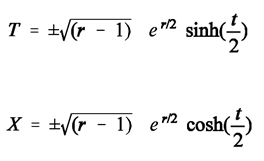 (17)The above transformation rule is used for regions outside the Schwarzschild radius of Black Holes, that is, for r>1. The spatial coordinate r is expressed in dimensionless units of multiples of the Schwarzschild radius rs =2MG/c². The temporal ccordinate t is expressed in dimensionless units of multiples of the time needed for a photon to cover the distance rs in flat spacetime, that is, t is expressed in dimensionless units of multiples of rs/c.For regions inside the Schwarzschild radius (r<1), the following transformation rule is used:
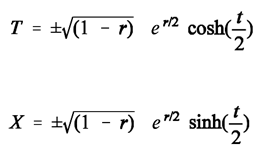 (18)All motions described by the Schwarzschild solution shall be restricted to straight-line motions in the equatorial plane. As a consequence, d tau and d phi are both zero, and no transformations of these variables that appear in the Schwarzschild solution are necessary.Figure 2c. A Kruskal-chart taken from Wikipedia. The numbering I, II, III, IV does not match with the numbering of quadrants used in this article.Figure 2c. A Kruskal-chart taken from Wikipedia. The numbering I, II, III, IV does not match with the numbering of quadrants used in this article.
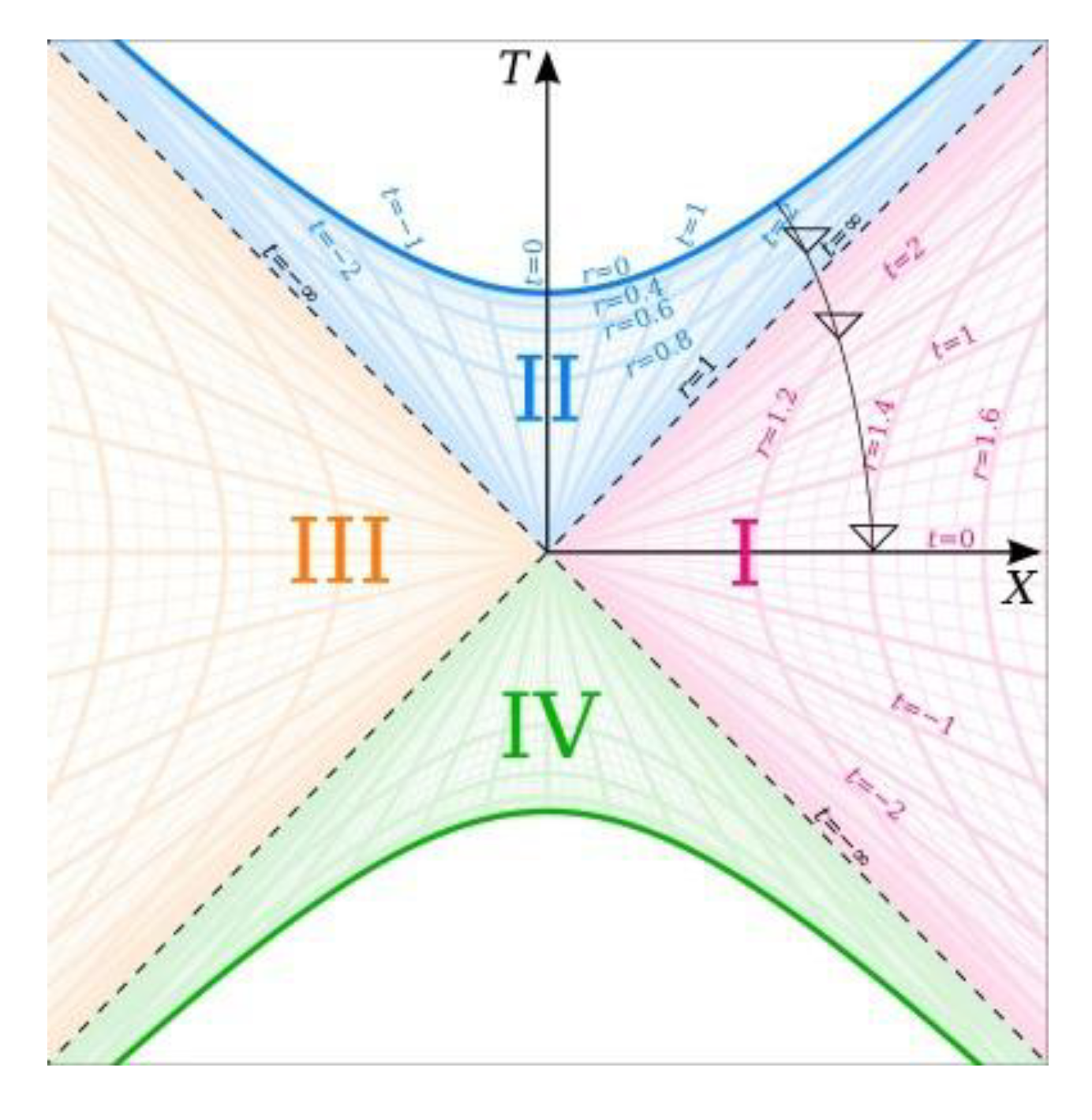 Every point in the t,r-plane of the t,r-chart is thus attributed a point in the T,X-plane of the T,X-chart. More precisely: Every point in the t,r-plane appears to be attributed four points in T,X-plane! This is because of the plus-or-minus sign in front of each of the two square roots, one appearing in the equation for X, the other one appearing in the equation for T. But given that t comes with a positive and a negative sign (different from r that has a positive sign only), and given that a single point in the T,X-plane shall not be a representation of more than one single point in the t,r-plane, every point in the t,r-plane can only be attributed two points in the T,X-plane. If there were four points, a positive T for a positive t could not be distinguished from a positive T for a negative t of the same magnitude. The impossibility would arise whenever the positive sign in front of the square root were chosen in case of a positive t, and the negative sign in front of the square root were chosen in case of a negative t of the same magnitude. The same would apply to X, and one single point in the T,X-plane would stand for two points in the t,r-plane.As a consequence, the combinations + + and - - (and no other combinations) are chosen in front of the two square roots in the pair of equations for T and X by most authors. This choice makes it possible to draw the totality of “lines of constant t” as a bundle of straight lines through the origin of the T,X-coordinate system, without a necessity to change their signs when passing through that origin. Moreover, straight “lines of constant t” then all have positive numerical values in the region that is defined by the (horizontal) positive X-axis and the (vertical) positive Y-axis (quadrant I). Their range is from zero – along both the (horizontal) positive X-axis and the (vertical) positive Y-axis – to positive infinity along the diagonal between these two axes. Similarly, the numerical values of straight “lines of constant t” are all negative between the (horizontal) positive X-axis and the (vertical) negative Y-axis. Their range is from zero – along both the (horizontal) positive X-axis and the (vertical) negative Y-axis – to negative infinity along the diagonal between these two axes.One should note that T does not represent physical time. Instead, it is just a variable that bears some resemblance to time. Similarly, X does not stand for spatial (radial) distance, but is just a variable that bears some resemblance to spatial distance.
- bb)
- In order to transform the cosmic variant of the Schwarzschild solution into the parameters T,X of a Kruskal-chart, r is simply replaced by 1/r², with r now expressed in dimensionless units of multiples of the distance from the Milky Way to its cosmic event horizon. The variable t is unchanged in the transformation equations, but is now expressed in dimensionless units of multiples of the time needed for a light pulse sent off from the Milky Way to reach the Milky Way’s cosmic event horizon if the speed of light did not slow down in the Milky Way’s frame of reference.
- b)
- Special characteristics of Kruskal-charts
- a)
-
When confining our attention to the area between the horizontal, positive X-axis and the vertical, positive T-axis (quadrant I) of the new chart, we find: “lines of same (positive) r“ arise from the horizontal, positive X-axis at right angle, and form curves that assymptotically approach the diagonal (between the vertical, positive T-axis and the horizontal, positive X- axis). The diagonal line (that bisects the right angle between the vertical T-axis and the horizontal X-axis) is identical with the “line of same r=1” (with r =1 denoting the Schwarzschild radius in the spherical-mass case we are considering here).There are other curved “lines of same (positive) r” which do not originate on the (positive) horizontal X-axis, but originate on the vertical (positive) T-axis. They form curves that asymptotically approach the diagonal from the other side. The uppermost of these lines is the “line of same r=0".
- bb)
- As has already been said, there exist lines of “same coordinate time t” (=Bob’s time, who sits outside of the gravity field in the spherical-mass case). Those lines are straight lines all of which run through the origin of coordinates. The horizontal, positive X-axis coincides with the line of “same coordinate time t=0". The diagonal line (which also represents the line of “same r=rs“) coincides with the line of “same coordinate time t= +inf ”. The vertical, positive T-axis coincides with the line of “same coordinate time t=0" (as does the horizontal, positive X-axis).
- cc)
- An important feature of a T,X-diagram is the following: Measuring counter-clockwise, the world-line of a radial light pulse forms an angle (with the X- axis or one of its parallels of the diagram) of 45°, or of 45°+90°= 135°, respectively. Hence, the world-line of an infalling photon that is generated at t=0 and thus orginates on the positive horizontal X-axis of the chart (provided that r, that is, the spatial location where the photon is “born”, is larger than unity) has a slope of 90°+45° = 135°. It intersects the line that bisects the angle formed by the positive X-axis and the positive T-axis, that is, the Schwarzschild horizon (r=1) at right angle. The coordinate time t (Bob’s time) of this crossing of the Schwarzschild horizon is positive infinity. Beyond the Schwarzschild horizon, the photon’s straight world line in the T,X-chart then intersects “lines of same coordinate time t” with declining numerical values of coordinate time t , until the world line reaches the curved line that stands for r=0.
- dd)
- Why are Kruskal-charts considered to be useful? Their usefulness is commonly seen as lying in the fact that, different from the world line of a photon in a t,r-diagram, the world line of the infalling photon on the Kruskal chart is not infinitely long, and has no points or disruptions, not even where it intersects the r=rs-line.
But this should not come as a surprise: As stated above, even though the integrand in (16) is infinitely large, the integral (that yields t), if taken between r=0 and r>rs, is not divergent.
When it comes to Kruskal-charts, the “funny feature” of the function graph (world-line of a
photon) is no longer its infinitely high spike (as it is in a t,r-diagram), but its intersection with a straight t-line (coinciding with the straight r=1 line) that stands for an infinite, positive time
t. It is just a matter of taste which of the two representations of a photon’s fate is considered to be the better one.
- c)
- The world line of photon that falls into a black hole (as it presents itself in a Kruskal- chart)
The world-line of a photon that falls into a black hole is determined by the following equation that is derived from the Schwarzschild solution for a spherical mass:
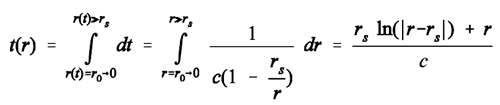 (19)
(19)It is an analogue to (16) and (16a), where we simply replace H²r²/c² by rs/r. One realizes that t approaches equality with r/c (so that r/t= vphoton=c) regardless of spatial location in case rs vanishes, that is, in case of flat spacetime of Special Relativity.
If r is expressed in dimensionless units of multiples of rs, and if t is expressed in dimensionless units of multiples of rs/c, and if c is set to unity, we get:
 (20)
(20)If t0 is set to zero, the photon reaches r=0 at time t=0. The world-line is shown in the t,r- diagram of Figure 3a [the area to the left of the vertical axis has no significance, since a negative r does not exist; the red graph is the function F=t(r), the blue graph is the integrated function f(r)].
When now using a Kruskal-chart for the representation of this world line, we have to choose between four alternatives. This is because a diagonal line that stands for a photon’s world line and hits the “line of constant r=0" at t=0 may sit in four different quadrants, as is shown in Figure 3b.
However, quadrant II and IV in Figure 3b can be singled out as inappropriate. The world lines in these two quadrants stand for an object that –outside of the Schwarzschild horizon – moves away from the spherical body. Only the world lines in the quadrants I and III of Figure 3b stand for an object that – outside of the Schwarzschild horizon – moves towards the spherical body. Both of these two world-lines are representations of what is shown in Figure 3a. Textbooks usually choose only quadrant I in Figure 3b, and disregard quadrant III.
Both in Figure 3a and in Figure 3b, the infalling photon exists twice in Bob’s coordinate space r and coordinate time t (Bob sits outside of the gravity field) and undergoes a time reversal along that part of its world line that sits beyond the Schwarzschild horizon. In textbooks, this phenomenon is not given the attention it deserves. This is because textbooks (wrongly, see below) believe that there is no chain of causal events that would possibly lead from the interior of the black hole (regions of r<rs) to the outside world. The time reversal along the photon’s world line and the double existence of the photon are thus considered to be mere artefacts of no physical significance. The reason for this opinion will be displayed and scrutinized in the following.
- d)
- The world line of photon that rises from a black hole (as it presents itself in a Kruskal-chart)
The world line of a photon that rises from a black hole is determined by the following equation that is obtained from (20) by a simple multiplication of the integral by -1:
 (21)
(21)If t0 is set to zero, the photon leaves r=0 at time t=0. The rising photon’s world line is shown in the t,r-diagram of Figure 3c [the area to the left of the vertical axis has no significance, since a negative r does not exist; the red graph is the function F=t(r), the blue graph is the integrated function f(r)].
One realizes that the photon manages to leave the black hole.
When now using a Kruskal-chart for the representation of this world line, we again have to choose between four alternatives. This is because a diagonal line that stands for a photon’s world-line and which hits the “line of constant r=0" at t=0 may once more sit in four different quadrants, as is again shown in Figure 3b.
It can be realized that it is now for the quadrants II and IV in Figure 3b to step in. Only then is it that the diagonal (outside of the Schwarzschild horizon) represents a world line of an object that distances itself from the spherical mass (rather than approaching it).
- e)
-
A wrong way of using Kruskal-charts
- aa)
-
Now comes the crucial point: It is commonly believed that the world-line of an outbound photon that is “born” in the interior of a black hole at r<rs can (and must) be pictured as a straight line in the same sector of the Kruskal chart which is used for representing the infalling photon. That sector is the one defined by the positive horizontal abscissa (positive X-axis) and the positive vertical ordinate (positive T-axis), that is, quadrant I. The result is shown in Figure 4.The world-line of an outgoing photon and that of an ingoing photon are supposed to form an angle of 90° in the chart (so called “forward lightcone”). The world line of the “outgoing” photon that starts at t=0 and r=0 is thus supposed to form a 45°-angle with the horizontal, positive X-axis (measured in an anti-clockwise direction), and therefore ends up at r=0, right where it started. It has zero-length and thus appears to never approach the Schwarzschild horizon at r=rs .In case the outbound photon starts at 0<r<1 (and not at r=0), say, at r=0.8 and t=1, the fate of the photon appears to be the same. See Figure 4. The photon’s world line is then supposed to form a parallel to the “line of same r=1" (Schwarzschild radius). That parallel is doomed to eventually meet the “line of same r=0" near the upper right corner of the T,X-chart.L. Susskind / A. Cabannes (2023) (Figure 17, p. 232/233) recently expressed this widespread belief as follows:“Remember, in the coordinates that we are using, light moves with a 45° angle. Therefore light cannot escape from the upper quadrant in figure 17. All it can do is eventually hit the singularity [at r=0]. And anything that is moving slower than the speed of light has a slope closer to the vertical, and will also hit the singularity. Consequently, anybody who at some point is in the upper quadrant is doomed. Figure 17, and its variants figures 15 and 16, are pictures you should familiarize yourself with, until they no longer have any secrets. If you want to understand and be able to resolve weird paradoxes about who sees what in the black hole, I recommend that you always go back to these diagrams.”
- bb)
-
But this is clearly at odds with (21), which tells us that the outgoing photon does approach the Schwarzschild horizon asymptotically (see above).To insist, as textboold do, that it is quadrant I (defined by the vertical, positive T-axis and the horizontal, positive X-axis) where the world-line of an outgoing photon has to be placed, is as irrational as it would be to insist that it is quadrant II (defined by the vertical, positive T-axis and the horizontal, negative X-axis) where the world-line of an INGOING photon has to be placed (see Figure 5): If doing the latter, the result would be that the photon would be going backward in time outside of the Schwarzschild horizon, no matter whether the world-line forms a 45°-angle or a 45°+90°= 135°-angle with the horizontal in the Kruskal-chart.
- cc)
-
It still gets worse for the common interpretation of Kruskal-charts: Even Susskind and others would concede that the world-line of an object that does not move at all coincides with a “line of constant r”. Quadrant I (defined by the vertical, positive T-axis and the gorizontal, positive X-axis) is bisected by the diagonal that represents a “line of same r=1", that is, the Schwarzschild horizon. In the area defined by the diagonal (line of Schwarzschild horizon) and the vertical, positive T-axis, any short straight piece of a curved “line of constant r” is, in terms of angle width, farther away from the vertical (in a clockwise direction) than just 45°. A curved line – originating on a “line of constant r” – that is a tiny bit farther away from the vertical (in terms of angle width) than the “line of constant r” on which it orginates represents a world line of an outbound object which is moving between two different “lines of constant r “. That curved line represents a motion of an object as slow as one wishes it to be (so that its behaviour might be almost indistinguishable from complete rest). As has already been stated, it has a slope of more than just 45° (measured from the vertical in a clockwise direction). That slope is thus larger than the slope of the postulated world-line of an outgoing photon, which is thought to be 45° from the vertical. But “anything that is moving slower than the speed of light” cannot have a slope closer to the vertical and also farther from the vertical in comparison with the slope of the world line of an outgoing photon. (The terms “ingoing” and “outgoing” refer to space outside of the Schwarzschild horizon.) Hence, the use of quadrant I for the representation of an outgoing photon leads to an inner contradiction.This inconsistency extends to the case of Kruskal-charts being used in connection with thecosmic variant of the Schwarzschild solution.
- dd)
- Consequently, contrary to what L. Susskind and A. Cabannes are saying (in accordance with all textbooks on Black Holes), their diagram 17 is not crucial for a correct understanding of what Black Holes and the cosmic event horizons are. Instead, that kind of diagram is responsible for a long-standing, complete misconception regarding Black Holes and cosmic event horizons.
- d)
-
How to use Kruskal-charts correctly for regions beyond event horizons
- aa)
- The just described error is rooted in the disregard for the following rule: The sector defined by the positive, horizontal abscissa and the positive, vertical ordinate of the Kruskal chart (quadrant I) can only be used for inbound objects (traveling into the Black Hole), not for outbound ones. For outbound light signals or other objects, a different quadrant of the chart has to be used: either the quadrant defined by the vertical, negative T-axis and the horizontal, positive X-axis, or the quadrant defined by the vertical, positive T-axis and the horizontal, negative X-axis (see above). Then the result given by (19) or (20) for an outgoing light pulse is reproduced by the Kruskal chart (as it should).
- bb)
- In other words: According to (21), an outbound photon originating beyond the Schwarzschild horizon (at r=0 and t=0) approaches the Schwarzschild horizon at infinitely negative time t. But a line of infinitely negative time t is not available in the quadrant defined by the vertical, positive T-axis and the horizontal, positive X-axis of a Kruskal-chart (quadrant I). It is available, though, in the quadrant defined by the vertical, negative T-axis and the horizontal, positive X-axis of a Kruskal-chart (quadrant IV). In addition, it is available in the quadrant defined by the positive, vertical T-axis and the horizontal, negative X-axis (quadrant II). This is shown in Figure 6.
- e)
-
The absence of a singularity beyond the cosmic event horizon and also at r=0 in the interior of black holes
- aa)
-
It has been shown that there is no room for drawing the world-line of an outbound photon in the quadrant defined by the vertical, positive T-axis and the horizontal, positive X-axis (quadrant I). This is why the assertion according to which no object or signal, not even a photon, may leave the interior of a black hole, is evidently wrong.And so is the assertion of a singularity at r=0, according to which all world-lines of all objects beyond the Schwarzschild horizon, even of those that try to leave the black hole, end up at r=0. In other words: There is no such thing as a singularity at r=0.
- bb)
-
When doing things correctly, the world-line of an outgoing photon is symmetrical with respect to the world line of an ingoing photon, just as it should be due to the principle of reversibiliy of any light path.In other words: The common but wrong interpretation of Kruskal charts is incompatible with the principle of “reversibility of any light path”. By contrast, the correct use of Kruskal charts gives due consideration to that principle.
- cc)
- All of what has said with regard to the spherical-mass variant of a Kruskal chart applies to the cosmic variant of that chart as well. This is what is to be highlighted.
- dd)
- It is worth noticing that R.P. Kerr (2023) recently made similar objections to the usual interpretation of Kruskal charts [as did A. Trupp (2020)].
- ee)
- As regards the cosmic variant of the Schwarzschild solution, Kruskal charts postulate no singularities either. This is obvious for symmetry reasons already: Otherwise a cosmic event horizon could not be a relative thing, but would be absolute. But this would entail that a certain point in space is privileged over others places, and would thus violate the symmetry rule.
IV. Cross-Check of the Obtained Result by Means of a Thought Experiment
Finally, a simple thought experiment that functions as a cross-check reveals how an impossibility for any outbound light signal to cross the cosmic event horizon from outside to inside would violate laws of nature:
Imagine Alice finds herself in the interior of a pencil-shaped spacecraft. The spacecraft shall be coasting towards the Milky Way’s cosmic horizon head first. When the spacecraft – which, according to the relativity principle, may consider itself as being at rest – reaches the Milky Way’s cosmic event horizon, the invisible, moving wall which constitutes the Milky Way’s cosmic event horizon is whizzing through the spaceship from head to tail at a speed – in Alice’s (= in the spacecraft’s) frame of reference – much lower than that of light. The low speed of motion of the invisible wall (in Alice’s frame of reference) is due to the following arrangement: The spaceship shall have started its free escape not from a position near the Milky Way, but from the position of the aforementioned tethered observer, who, being at rest with respect to the Milky Way, finds himself or herself not far from the Milky Way’s cosmic event horizon. That nearby event horizon stands still for the tethered observer (as it does for an observer in the Milky Way). Consequently, in the reference frame of Alice’s spacecraft, the (local) speed of motion of the Milky Way’s cosmic event horizon must be somewhere between zero and c when that cosmic event horizon is rushing through the spacecraft from head to tail .
Let us scrutinze the moment in Alice’s time when the shifting, invisible “wall”, that is, the Milky Way’s cosmic event horizon, has reached the spaceship (which considers itself as being at rest) and has just gone by the ship’s bow. In the interior of the pencil-shaped spaceship, a light signal shall be sent from the ship’s bow to its stern. Given the speed of the progressing, invisible wall is much lower than c, the light signal will catch up with the wall and overtake it. It will thus reach the ship’s stern prior to the arrival of the invisible wall.
We realize: In the interior of the spaceship, the Milky Way’s shifting cosmic event horizon is crossed from the outside to the inside by the light signal. In case that did not happen, that is, in case the light signal were slower than c in Alice’s frame of reference, either the law of the invariance of the local speed of light, or the relativity principle (according to which Alice and the spaceship may consider themselves as being at rest) would be violated. But the exceptionless validity of these two principles forms the basis of Relativity.
V. Loop-Shaped World Lines of Objects Crossing the Cosmic Event Horizon Back and Forth
- a)
- The possibility of loop-shaped world lines
So far, loop-shaped world lines have been believed to be confined to strange universes of the kind conceived of by K. Gödel (1949) (p. 447):
“Every world line of matter occurring in the solution is an open line of infinite length, which never approaches any of it's preceding points again; but there also exist closed time-like lines. In particular, if P, Q are any two points on a world line of matter, and P precedes Q on this line, there exists a time-like line connecting P and Q on which Q precedes P; i.e., it is theoretically possible in these worlds to travel into the past, or otherwise influence the past.”
We are now facing the recognition that such loop-shaped world lines can exist in our ordinary universe as well. The graph in Figure 2a (and in Figure 2b) does not only represent the world line of a photon, but also a world line of an object with a non-zero rest mass (say, Alice) that has been accelerated to almost the speed of light. Although the proper time tau needed to reach the Milky Way’s cosmic event horizon cannot be zero (as it is for a photon), it could theoretically be as short as a few days. Having crossed the Milky Ways’s cosmic event horizon, the object can be imagined to make a U-turn. The world line of the returning object would then be represented by the graph in Figure 2b, which can be shifted vertically by choosing a different value for t0 .
We realize: The farther away from the Milky Way (beyond the Milky Way’s cosmic event horizon) the U-turn of the traveling object takes place, the less time will pass in the Milky Way (after departure) before the object will be back home!
In any case, the world line of the object is intersecting itself somewhere between the Milky Way and its cosmic event horizon. This has far-reaching consequences.
- b)
-
Consequences of looped-shaped world lines: Copies of persons and things
- aa)
- As Gödel had correctly pointed out when he introduced his special universe, a loop- shaped world line is proof of the static model of time, according to which present, past and future events occurring at the same spatial location are equally part of physical reality as are events occurring at the same time at different places.
- bb)
- Moreover, in the face of the now emerging grandfather’s paradox, we find that General Relativity leads to two alternative outcomes: As a first possibility, returning Alice is prevented from destroying her former self (when crossing her own world line) by some mysterious mechanism which science has not yet detected. But alternatively, it could well be that the phenomenon of a choice between alternatives – that humans think they are capable of making – requires and is thus proof of the existence of multiple worlds. Hence, when returning Alice decides to destroy her former self (upon crossing her own world line), that destruction happens in a parallel world only, so that Alice is acting on a copy of herself.
A similar situation is described by D. Deutsch (1997)(pp. 304, 305):
“So when I travel to the laboratory’s past, I find that it is not the same past as I have just come from. Because of this interaction with me, the copy of me whom I find there does not behave quite as I remember behaving. If this were physical timetravel, the multiple snapshots at each instant would be parallel universes. Given the quantum concept of time, we should not be surprised at this.”
- c)
- The possibility of creating loop-shaped world lines of material objects in our vicinity and of copies of themselves
It shall now be shown that loop-shaped world lines are not merely a thing of very distant objects. We are thereby benefiting from the fact that the proper time interval Delta tau of any observer Alice, measured by him or her between two aribitraily chosen point-events along Alice’s world-line in Bob’s t,r-diagram, eventually approaches zero provided the acceleration the observer is subject to has endured long enough. This is regardless of how spatially distant these two point-events are in Bob’s frame of reference. The world line of a photon, too, is obtained from the Schwarzschild solution by setting the photon’s proper time dtau to zero, and any object that travels fast enough generates a world-line that is hardly distinguishable from that of a photon.
Imagine that a spaceship in the vicinity of planet Earth has been accelerated to a speed very close to c. In order to create an invisible “tether” between the spaceship and a very distant galaxy whose cosmic event horizon has recently rushed past planet Earth (but not past the spaceship), the spaceship (travelling at a speed close to c) simply has to generate a permanent (local) acceleration of only H²r < 10-9 m/sec² by means of its rocket engine.
Alice shall leave that “tethered” spaceship in a small tender that, in the reference frame of the “tethered” spaceship, approaches the local speed of c within a very short time and a very short distance. In the reference frame (rest frame) of the distant galaxy, the world line of the tender is then almost indistinguishable from that of a photon sent off from the “tethered” spaceship. The tender’s direction of travel shall be in a direction opposite to the direction of the permanent (weak) acceleration the “tethered” spaceship is subject to. The tender is thus travelling towards the cosmic event horizon of the distant galaxy. In the reference frame of that distant galaxy, the tender eventually crosses the distant galaxy’s cosmic event horizon not far from the location of planet Earth.
Beyond that horizon, the tender (whose proper time – in the reference frame of the distant galaxy – is reversed beyond the cosmic event horizon) shall reverse its trajectory at a point of its choice. In the reference frame of the distant galaxy, the world line of the returning tender shall be, again, almost indistinguishable from that of a photon. In the reference frame of the distant galaxy, the tender will, as a consequence of its U-turn, make it back across the stationary cosmic event horizon, and will eventually reunite with the stationary, “tethered” mothership.
In the reference frame of that distant galaxy, the world line of the small tender is loop-shaped, and the tender’s world line intersects itself somewhere between the “tethered” spaceship (mothership) and the cosmic event horizon of the distant galaxy.
Since the intersection of world lines is an absolute phenomenon that occurs in all frames of reference, it must also occur in the reference frame of the “tethered” spaceship, and also in that of planet Earth. The latter is strange, as the returning tender will, in the reference frame of planet Earth (where the passage of the distant galaxy’s cosmic event horizon is a thing of the past), never catch up with the rushing cosmic event horizon of the distant galaxy. It can only be a copy of the tender that will reunite with the “tethered” spaceship.
Copies of things and thus interacting parallel worlds are thus common in General Relativity, not only as regards whole galaxies in front of and beyond the Milky Way’s cosmic event horizon (see above). They, too, are a consequence of the invariance of the local speed of light (and the relativity principle), as are the contraction of meter sticks and the dilation or compression of time. Parallel worlds do not only occur in Quantum physics, but in General Relativity as well.
VI. Results
The results are the following:
- -
- In the cosmic variant of the Schwarzschild solution (expanding space), world lines of objects and even persons may exist that are capable of crossing the Milky Way’s cosmic event horizon back and forth. This constitutes a first symmetry.
- -
- The part of the world line of such an object (crossing the cosmic event horizon) which extends beyond the Milky Way’s cosmic event horizon is time-reversed in the reference frame of the Milky Way. The cosmic event horizon thus acts as a symmetry line of a special kind (second symmetry).
- -
- All persons and objects on earth exist twice in the reference frames of some of those galaxies which find themselves beyond the Milky Way’s cosmic event horizon. This constitutes another strange symmetry (third symmetry).
- -
- Loop-shaped world lines of traveling objects or even persons that cross the cosmic event horizon of a distant galaxy back and forth are allowed to exist even in our neighborhood. The arrows of time along world lines may thus come in two opposite directions. This constitutes a fourth symmetry. It also corroborates the static model of time.
- -
- Kruskal-charts do not obstruct these results. This is because the first quadrant of a T,X- Kruskal chart may only be used for world lines (crossing an event horizon) of outbound photons or other objects, that is, photons or other objects sent off by an observer towards an event horizon. As regards photons or other objects that cross the event horizon in order to reunite with the observer, the second and/or the fourth quadrant – and not the first one – of a Kruskal chart has to be used. This guarantees a complete reversibility – and hence a form of symmetry – of any light path across event horizons. It constitutes a fifth symmetry.
- -
- There is no such thing as a singularity behind an event horizon; neither in the case of black holes, nor in the case of the cosmic event horizons.
References
- Boehmer, Stuart, Tolman’s paradox and the proper treatment of time in relativistic theories, Physics Essays, Vol. 30, 3 (2017), pp. 239-242. [CrossRef]
- Boehmer, Stuart, Supplementary Conditions on solutions of Einstein field equations, uploaded to Academia, 2024.
- Deutsch, D. (1997), The Fabric of Reality. 1997. [Google Scholar]
- Einstein, A. (2018), Doc 31: Ideas and Methods, II, The Theory of General Relativity, in: Janssen, Michel / Schulmann, Robert / Illy, József / Lehner, Christoph / Buchwald, Diana (eds.), The Collected Papers of Albert Einstein. Volume 7: The Berlin Years: Writings, 1918-1921 (English translation supplement) (Digital ed.), California Institute of Technology, retrieved 15 April 2018;
- Gaztanaga, E. (2022), The Cosmological Constant as Event Horizon, Symmetry. 2022; 14, 300. [Google Scholar] [CrossRef]
- Gödel, K. (1949), An Example of a New Type of Cosmological Solutions of Einstein’s Field Equations of Gravitation, Reviews of Modern Physics, Vol. 21, 3 (1949), pp. 447-450. [CrossRef]
- Kerr, R.P. (2023), Do Black Holes have Singularities?, arXiv:2312.00841v1 [gr-qc] 1 Dec 2023;
- Misner, Ch. W, Thorne, K.S., Wheeler, J.A. (1973), Gravitation; 1973.
- Susskind, L. , Cabannes, A. (2023), General Relativity – The Theoretical Minimum. 2023. [Google Scholar]
- Trupp, A. (2020), Traversing a black-and-white hole in free fall and rise, Physics Essays, Vol. 33, 4 (2020), pp. 460-465. [CrossRef]
- Trupp. A. (2022), What the Covariant and Ordinary Divergences of the Tensors in Einstein’s Field Equation Tell about Newton’s Apple When it Hits the Ground, Advanced Studies in Theoretical Physics, Vol. 16, 2022, no. 4, 239 - 257. [CrossRef]
Figure 1a.
World-Line Of An Escaping Galaxy In A T,R-Diagram In Red Colour. The Cosmic Event Horizon Is At R=1.The area to the left of the vertical axis has no significance, since a negative r does not exist.
Figure 1a.
World-Line Of An Escaping Galaxy In A T,R-Diagram In Red Colour. The Cosmic Event Horizon Is At R=1.The area to the left of the vertical axis has no significance, since a negative r does not exist.
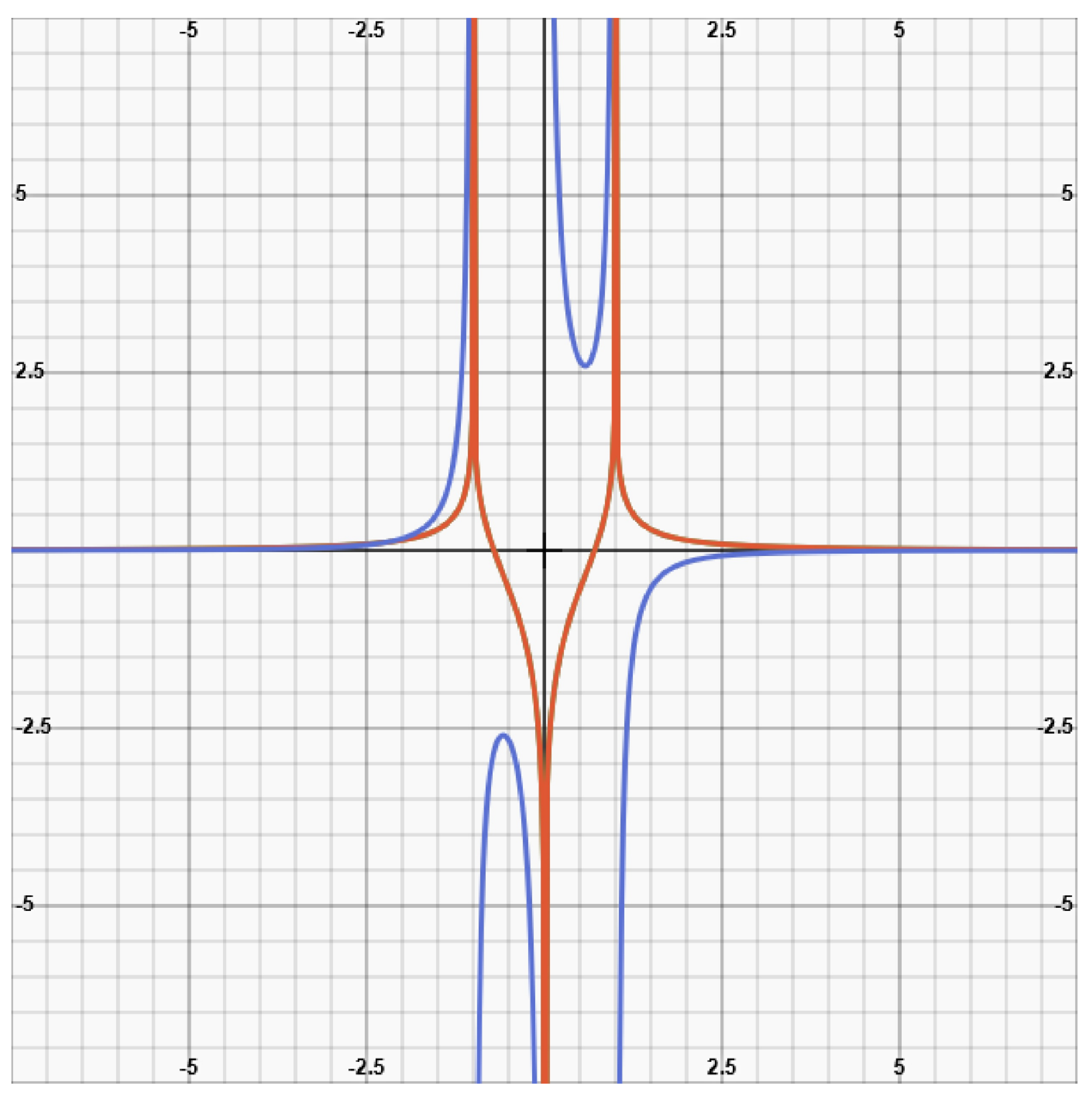
Figure 1b.
World-Line Of Galaxy (In A T,R-Diagram) In Red Colour That Is Approaching The Milky Way Due To A hypothetical contraction of space. The area to the left of the vertical axis has no significance, since a negative r does not exist.
Figure 1b.
World-Line Of Galaxy (In A T,R-Diagram) In Red Colour That Is Approaching The Milky Way Due To A hypothetical contraction of space. The area to the left of the vertical axis has no significance, since a negative r does not exist.
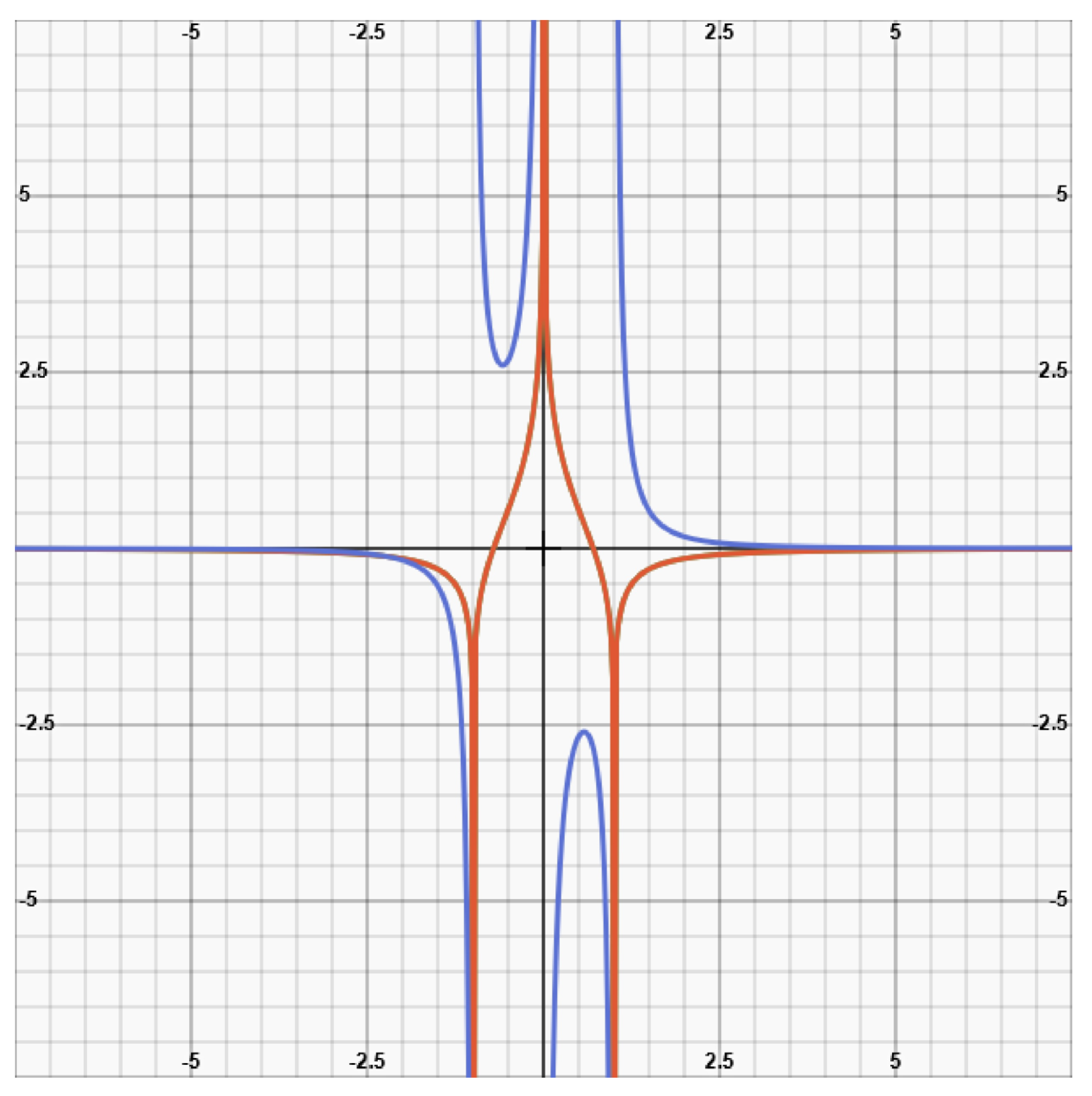
Figure 2a.
World-line in red colour (in a t,r-diagram) of a radio signal sent off from the Milky Way. The cosmic event horizon is at r=1.The area to the left of the vertical axis has no significance, since a negative r does not exist.
Figure 2a.
World-line in red colour (in a t,r-diagram) of a radio signal sent off from the Milky Way. The cosmic event horizon is at r=1.The area to the left of the vertical axis has no significance, since a negative r does not exist.
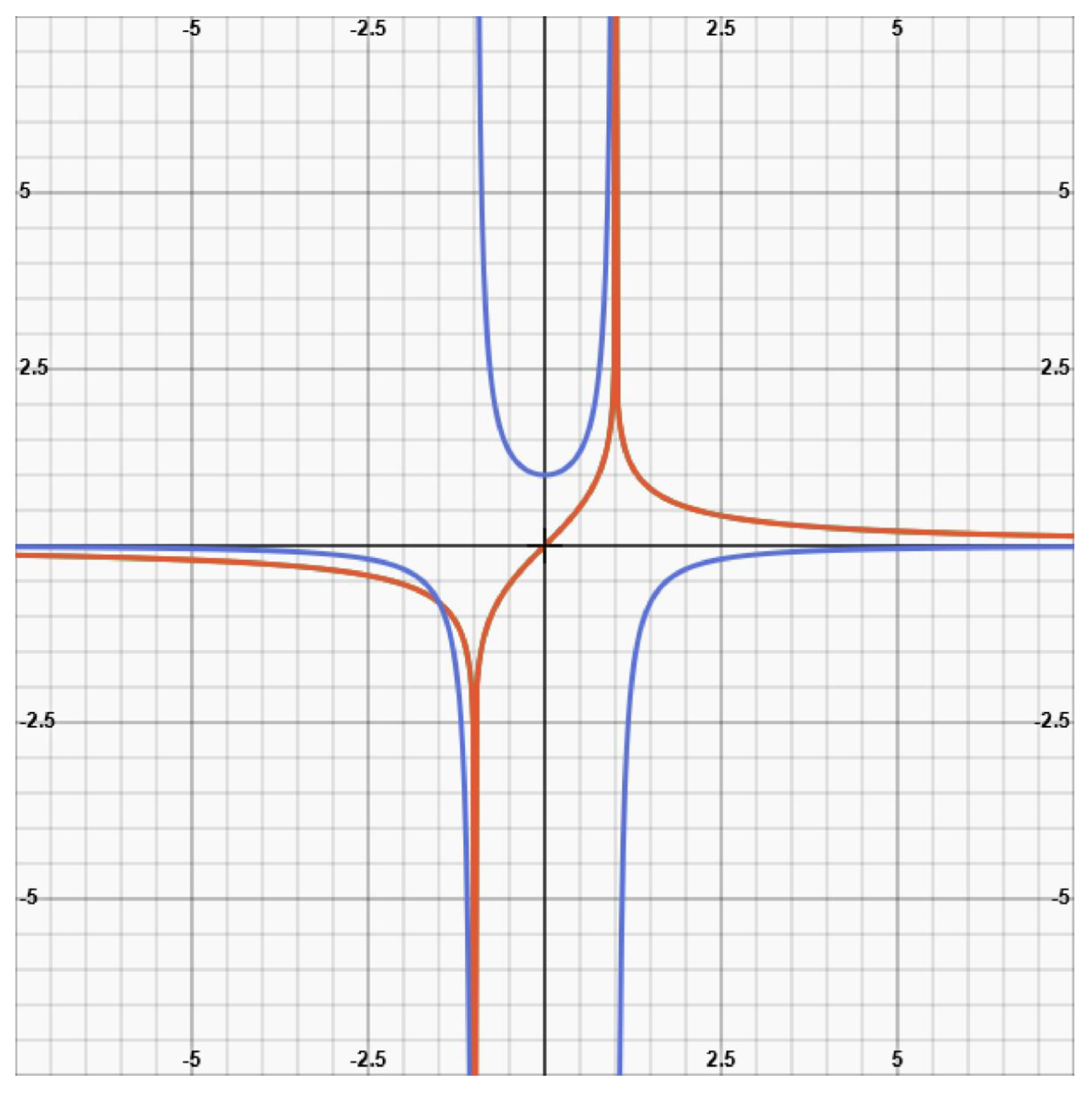
Figure 2b.
World-line (in a t,r-diagram) sent to the Milky Way from beyond the Milky Way’s cosmic event horizon. The area to the left of the vertical axis has no significance, since a negative r does not exist.
Figure 2b.
World-line (in a t,r-diagram) sent to the Milky Way from beyond the Milky Way’s cosmic event horizon. The area to the left of the vertical axis has no significance, since a negative r does not exist.
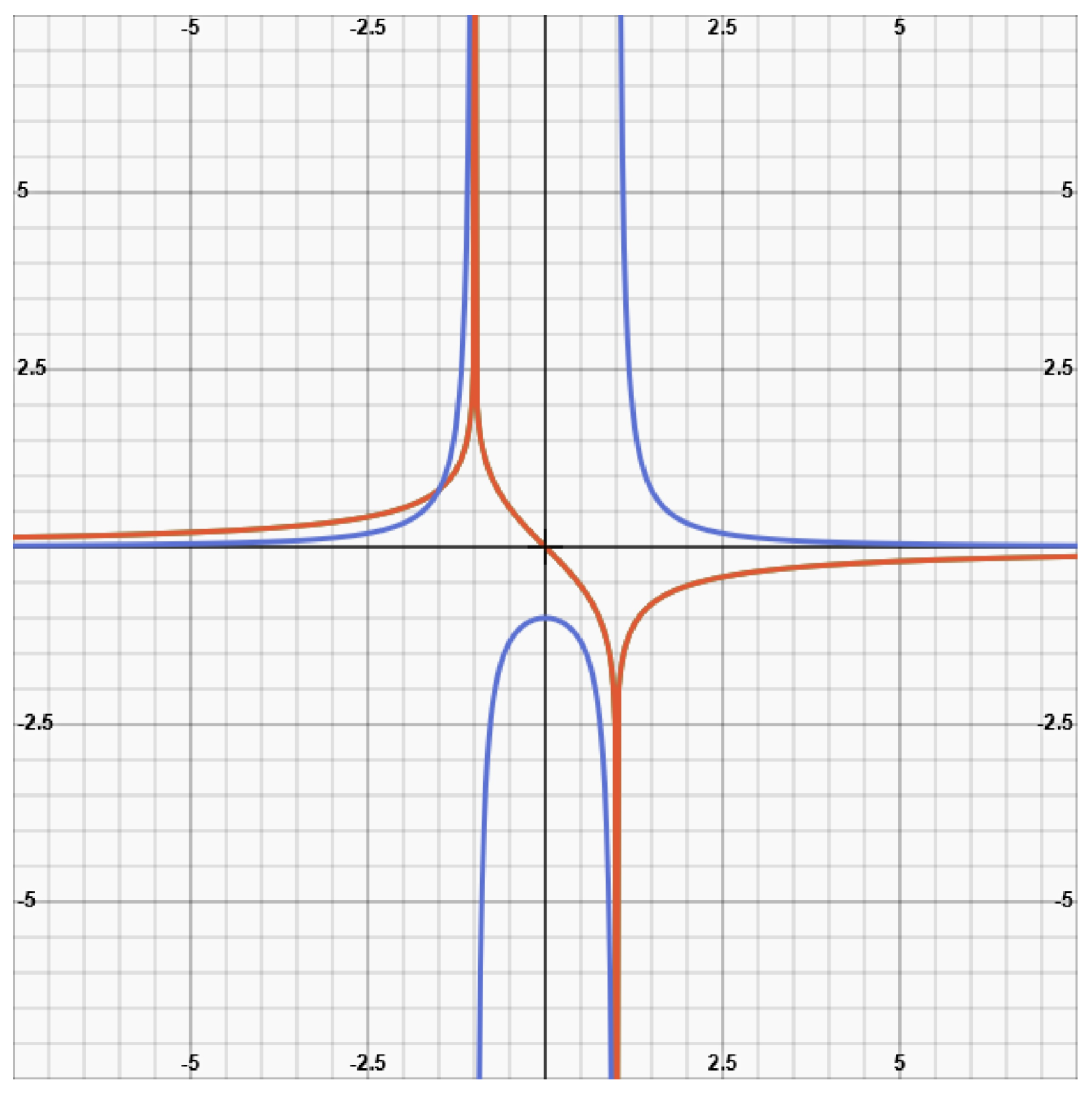
Figure 3a.
The world-line (in a t,r-diagram) of a photon that falls into a black hole. The Schwarzschild horizon is at r=1. The area to the left of the vertical axis has no significance, since a negative r does not exist.
Figure 3a.
The world-line (in a t,r-diagram) of a photon that falls into a black hole. The Schwarzschild horizon is at r=1. The area to the left of the vertical axis has no significance, since a negative r does not exist.
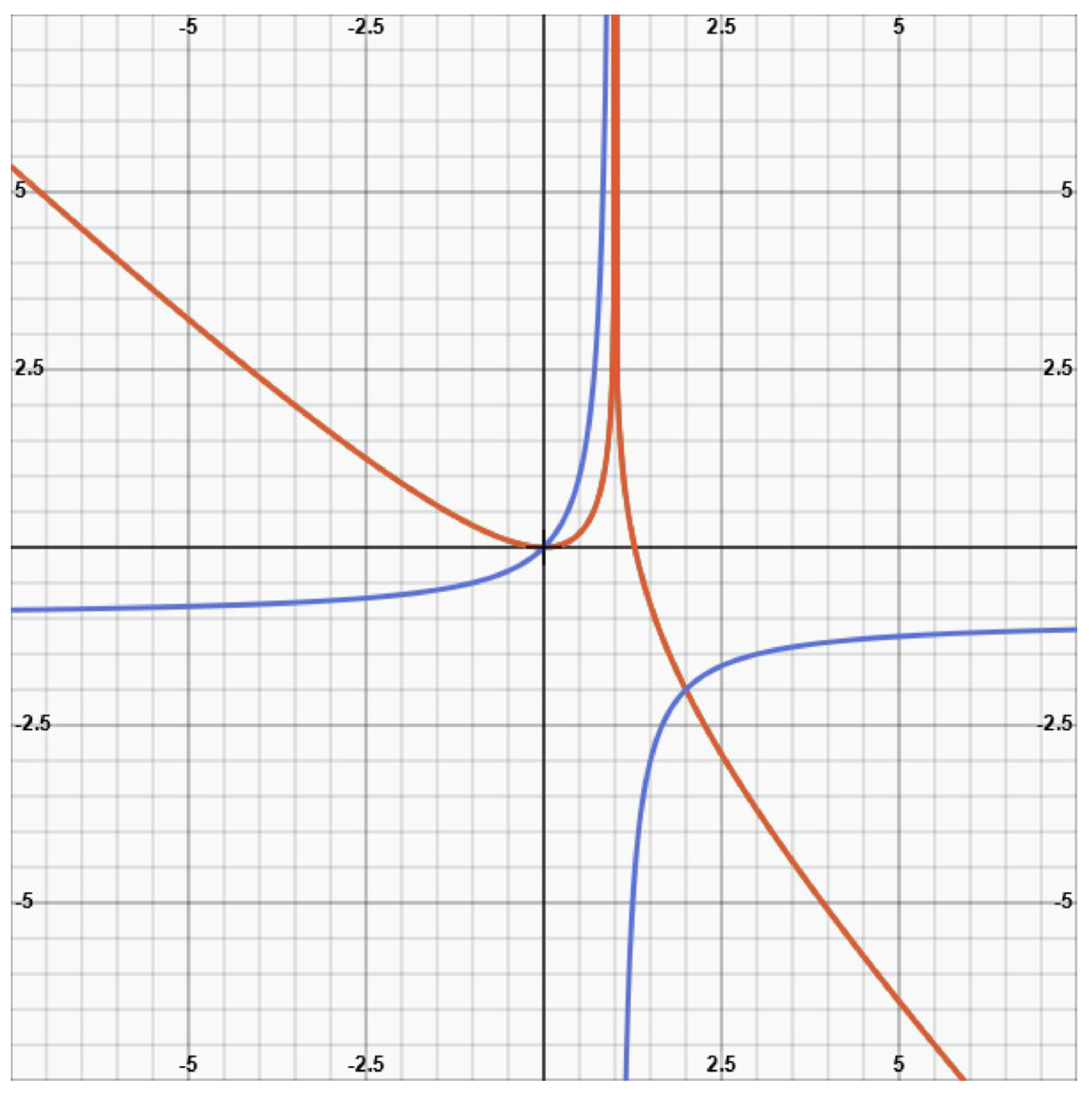
Figure 3b.
A Kruskal-chart (T,X) with four alternatives of a world-line of a photon that falls into a black hole.
Figure 3b.
A Kruskal-chart (T,X) with four alternatives of a world-line of a photon that falls into a black hole.
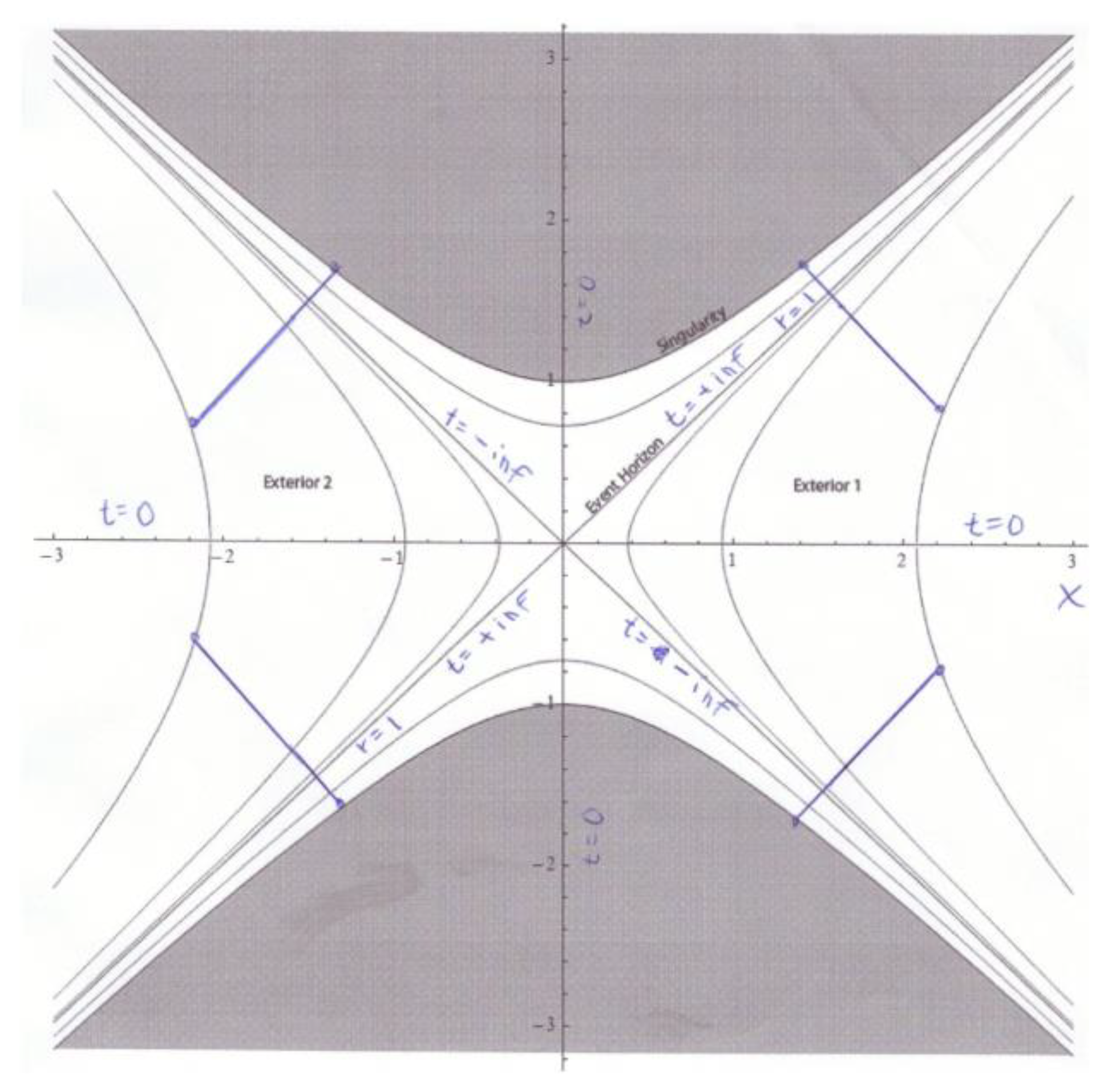
Figure 3c.
World-line (in a t,r-diagram) of a photon that leaves a black hole.The area to the left of the vertical axis has no significance, since a negative r does not exist.
Figure 3c.
World-line (in a t,r-diagram) of a photon that leaves a black hole.The area to the left of the vertical axis has no significance, since a negative r does not exist.
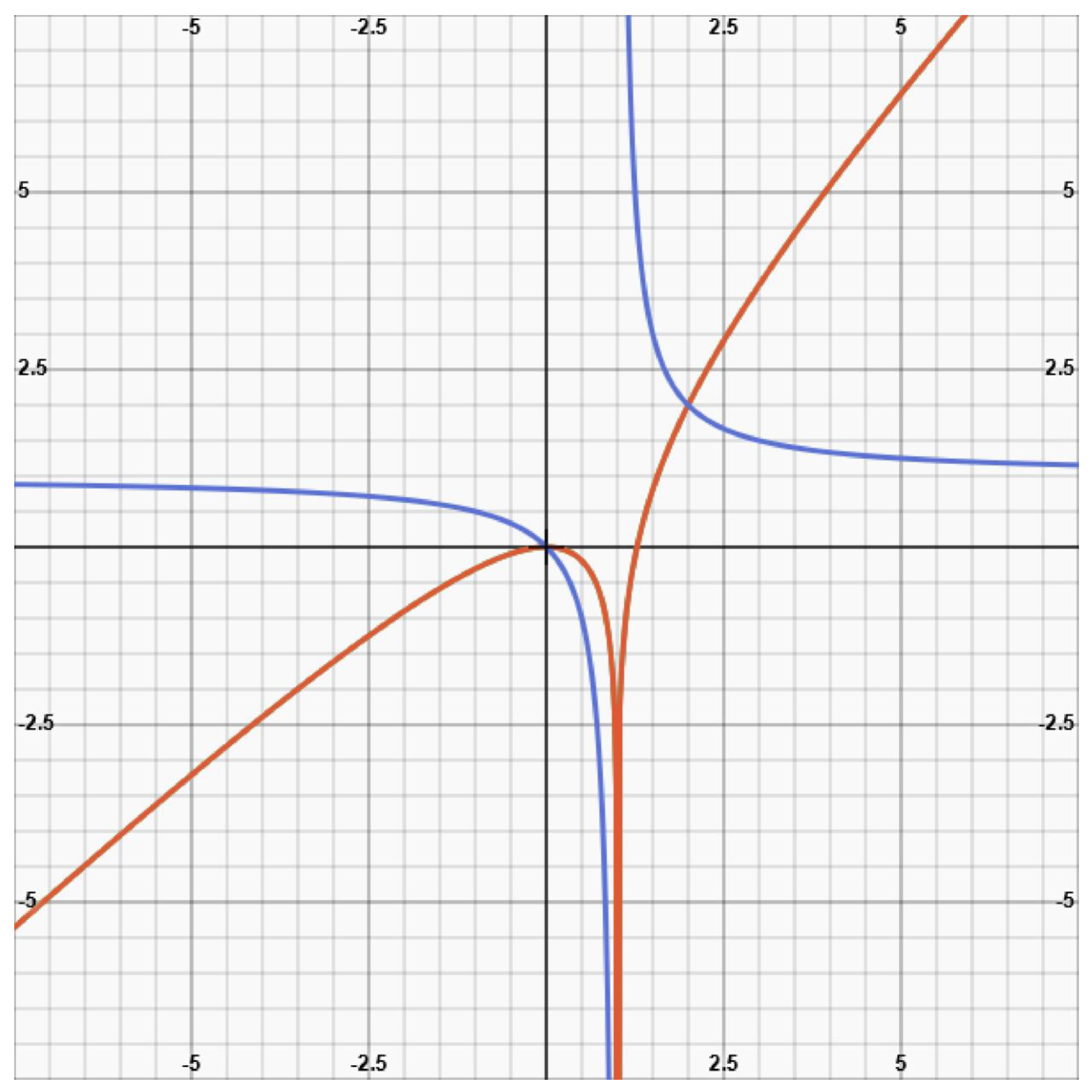
Figure 4.
World-line in a Kruskal-chart of an outgoing photon that is believed to be doomed to end up at r=0 no matter where beyond the Schwarzschild horizon it is starting its journey
Figure 4.
World-line in a Kruskal-chart of an outgoing photon that is believed to be doomed to end up at r=0 no matter where beyond the Schwarzschild horizon it is starting its journey
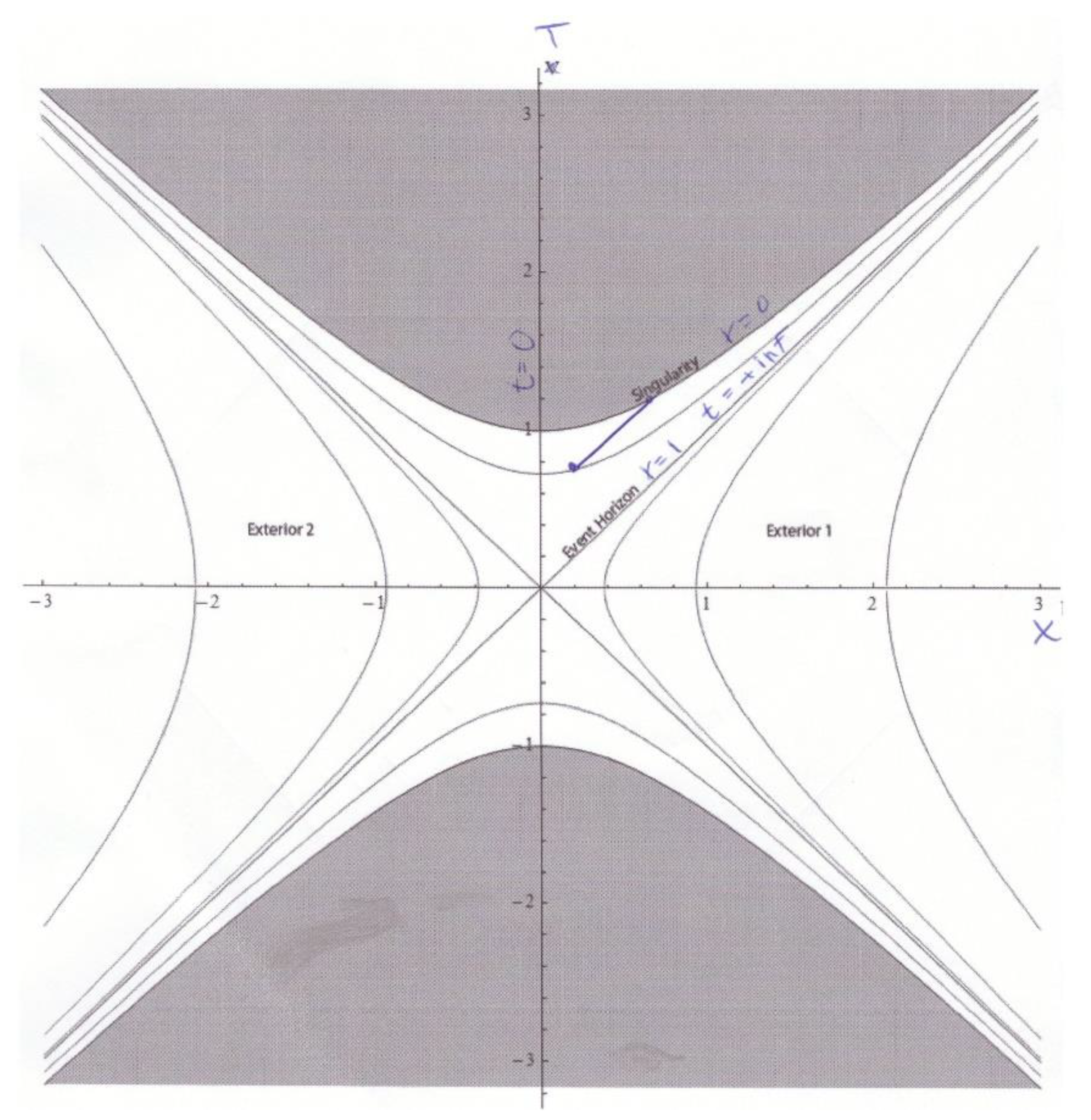
Figure 5.
A wrong way of using Kruskal-charts for the world-line of an INGOING photon. The photon appears to go backward in time outside of the Schwarzschild radius, no matter which of the two paths are chosen. outside.
Figure 5.
A wrong way of using Kruskal-charts for the world-line of an INGOING photon. The photon appears to go backward in time outside of the Schwarzschild radius, no matter which of the two paths are chosen. outside.
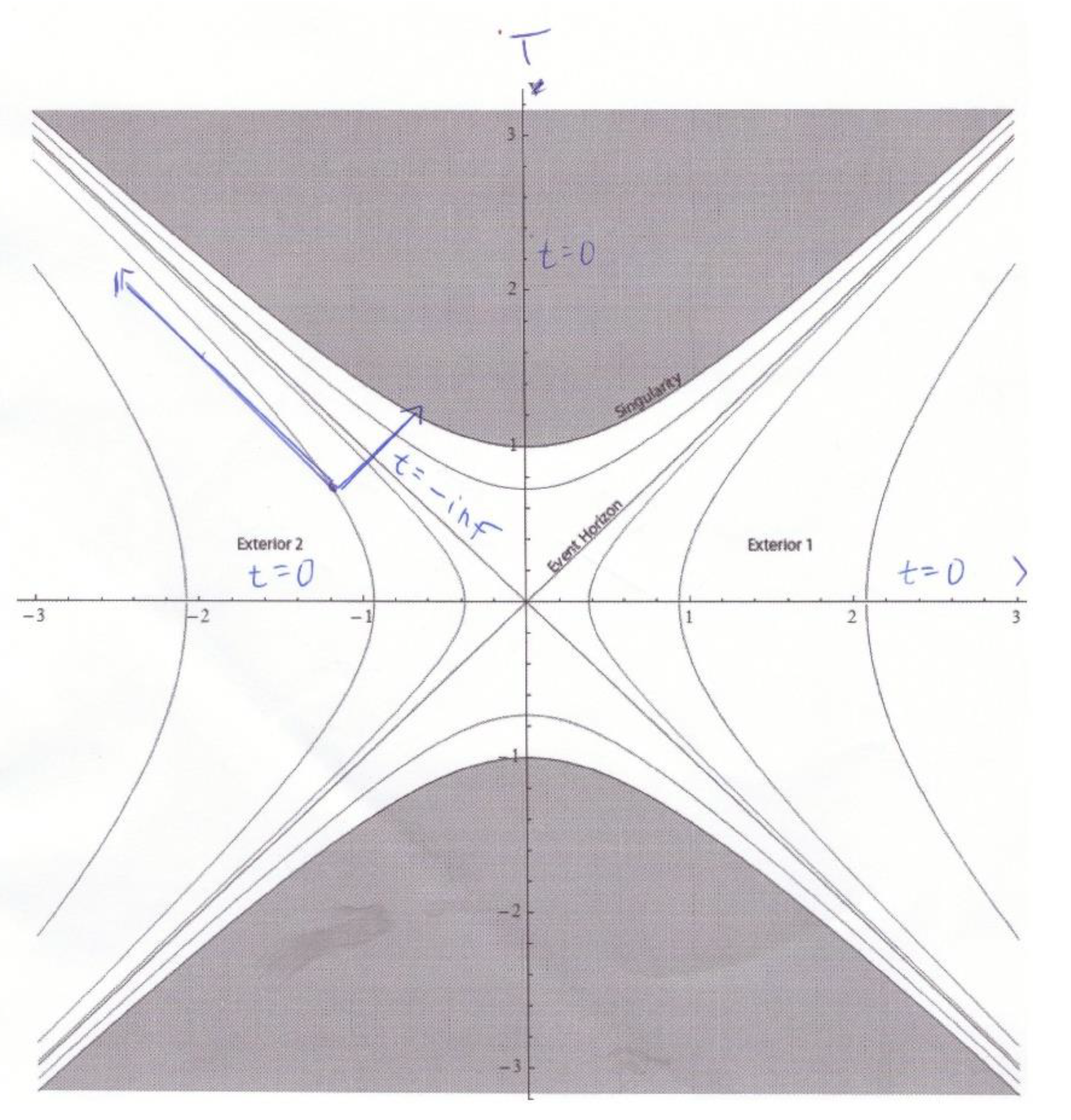
Figure 6.
A correct way of drawing the world-line of an outgoing photon in a Kruskal-chart. Either quadrant II or quadrant IV has to be used.
Figure 6.
A correct way of drawing the world-line of an outgoing photon in a Kruskal-chart. Either quadrant II or quadrant IV has to be used.
Disclaimer/Publisher’s Note: The statements, opinions and data contained in all publications are solely those of the individual author(s) and contributor(s) and not of MDPI and/or the editor(s). MDPI and/or the editor(s) disclaim responsibility for any injury to people or property resulting from any ideas, methods, instructions or products referred to in the content. |
© 2024 by the authors. Licensee MDPI, Basel, Switzerland. This article is an open access article distributed under the terms and conditions of the Creative Commons Attribution (CC BY) license (http://creativecommons.org/licenses/by/4.0/).
Copyright: This open access article is published under a Creative Commons CC BY 4.0 license, which permit the free download, distribution, and reuse, provided that the author and preprint are cited in any reuse.


