

Submitted:
25 October 2024
Posted:
28 October 2024
You are already at the latest version
Abstract
The dispersive and polar properties of materials, and especially of polymers and copolymers play an important role in several engineering applications implying their surfaces and interfaces. The surface energetic properties of poly(styrene-co-butadiene) have never been studied. We proposed in this study an accurate determination of such properties by using the inverse gas chromatography (IGC) at infinite dilution. Background: The IGC surface technique led to the dispersive and polar properties of poly(styrene-co-butadiene) rubber (SBR) by adsorption of organic solvents at various temperatures. Methods: Our new methodology based on the thermal Hamieh model and the London dispersion interaction energy was used to determine the London dispersion surface energy, the polar acid-base surface energy, and the Lewis acid-base properties of the copolymer. Results: The different surface energy parameters of the SBR were obtained as a function of temperature from the chromatographic measurements. Conclusions: The dispersive and polar free energies of adsorption of the various n-alkanes and polar molecules on poly(styrene-co-butadiene) were determined at different temperatures. A decrease of the London dispersive surface energy and the polar Lewis acid-base surface energies of SBR was highlighted when the temperature increased. It was showed a Lewis amphoteric character of poly(styrene-co-butadiene) with a highest basic constant 10 times larger than its acidic constant.
Keywords:
Retention volume
; adsorption
; organic solvents
; Hamieh thermal model
; London dispersive interaction energy
; deformation polarizability
; Dispersive and polar surface energy
; Lewis’s acid–base constants
; molecular separation distance
1. Introduction
One of the most widely used synthetic rubbers is the poly(styrene-co-butadiene) (SBR rubber) considered as the most interesting copolymer because of its low manufacture cost and excellent properties, and especially to replace the natural rubber in practically in all industrial uses and applications [1,2].
SBR materials are note only used in the manufacturing of tires, but also in several engineering applications such as roofing barriers, cover trips, wires, footwear, and sport goods. They are also used in reinforced form with inorganic fillers [3,4,5,6,7,8,9]. The improvement of the properties of SBR rubber was developed in the literature. Radhakrishnan et al. [10] studied the thermal behaviour of SBR/poly (ethylene-co-vinyl acetate) (EVA) blends. They improved the SBR thermal stability by addition of compatibilizer. Other works were devoted to the determination of the flammability of rubbers, the toxicity of the thermal decomposition, and the combustion products of the vulcanizates [11,12]. Vo et al. [13] measured the dielectric properties of styrene–butadiene rubber (SBR) composites and deduced the polymer relaxation at the polymer–nanoparticle interface. By adding some fillers such as clays, silica, and carbon black into SBR matrices, it was possible to optimize the mechanical properties [14,15,16,17,18,19,20,21,22,23,24,25].
Some chemical parameters of SBR were determined by several authors. Diez et al. [26] investigated the solubility, the Flory–Huggins interaction parameters of SBR, and the infinite dilution activity coefficients of various solvents by using the inverse gas chromatography technique. The heat of vaporization and the Hansen solubility parameter of binary solvent poly (styrene-block-butadiene) rubber systems were determined by Benguergoura et al. [27] by investigation of both polar and nonpolar solvents using IGC technique. Whereas, Farshchi et al. (28] used the solubility parameter of SBR to predict the compatibility of solvents with polymer and its interaction parameters.
However, the surface thermodynamic properties of the poly(styrene-co-butadiene) such as the free energy, the enthalpy, and entropy of adsorption, the dispersive and polar surface energies, and the Lewis acid-base properties of this copolymer, were not accurately determined in the literature. This study was devoted to the application of our new methodology for the determination of the different surface thermodynamic parameters of poly(styrene-co-butadiene) using the inverse gas chromatography at infinite dilution [29,30,31,32,33,34,35,36,37,38,39]. This powerful technique experimentally allowed obtaining the net retention time of the n-alkanes and polar solvents adsorbed on the copolymer at different temperatures. The obtained chromatographic measurements led to the London dispersive surface energy of SBR as a function of the temperature using the Hamieh thermal model [40,41,42,43] and Fowkes relation [44. This new model proposed new expressions of the surface area of the adsorbed organic molecules versus the temperature [40] and allowed determining more accurate values of the London dispersive surface energy. Whereas, the polar contributions of the different thermodynamic variables of adsorption were determined applying the London interaction energy given as a function of the deformation polarizability of the various solvents and solid materials [45,46,47,48,49,50,51].
2. Materials and Methods
2.1. Solvents and Materials
The poly(styrene-co-butadiene) () and the different n-alkanes, and polar solvents were purchased from Sigma-Aldrich (Beirut, Lebanon). The n-alkanes were the following: n-pentane, n-hexane, n-heptane, n-octane, and n-nonane. Whereas the polar solvents characterized by their donor (DN in J/mol) and acceptor (AN in J/mol) numbers of electrons [52,53] were given as follows:
- -
- The Lewis’s acid solvents such as chloroform (DN=0, AN=22.54) and dichloromethane (DN=5.02, AN=16.27)
- -
- The amphoteric solvents such as: benzene (DN=0.42, AN=0.72), ethanol (DN=80.35, AN=43.27), acetonitrile (DN=59.01, AN=19.65), and toluene (DN=16.32, AN=3.98)
- -
- The Lewis’s base solvents such as: acetone (DN=71.15, AN=10.49), ethyl acetate (DN=71.56, AN=6.39), diethyl ether (DN=80.35, AN=5.91), cyclohexane (DN=5.89, AN=0.17), and tetrahydrofuran (THF) (DN=83.70, AN=2.29)
2.2. Inverse Gas Chromatography
A Focus GC gas chromatograph (Sigma-Aldrich, France) equipped with a flame ionization detector of high sensitivity was used to carry out the measurements of the retention times of the organic solvents adsorbed on SBR copolymer. A stainless-steel column of length 30 cm and 2 mm internal diameter contained 0.5 g of SBR powder. The flow rate of helium used as a carrier gas was optimized to 20 mL/min. A Hamilton microsyringes of a volume of 1 μL was used for the injection of infinite quantity of organic probes for temperatures varying from 30 °C to 70 °C. Each solvent injection was repeated three times to determine the average retention times obtained with a standard deviation of 1%
The net retention time obtained of organic solvents adsorbed on the copolymer was obtained using the methane probe as inert solvent and the first order integration. The net retention volume of the adsorbed solvents was directly deduced as a function of the temperature T from the net retention time measurements.
2.3. Thermodynamic Methods
The net retention volume of the organic probes adsorbed on SBR led to the free energy of adsorption of the different solvents using the following equation:
where is the perfect constant gas, and a thermodynamic parameter depending on the temperature and the interaction between the solvent and the polymer.
The free energy of adsorption can be written as follows:
Where and are respectively the London dispersive and polar interaction energies.
In the case of the adsorption of n-alkanes (non-polar solvents such as) on SBR, the free interaction energy is equivalent to London dispersive energy:
The determination of the London dispersive component of the surface energy of a solid material was first proposed by Dorris and Gray [54] using the Fowkes’s relation [55] and correlating the work of adhesion to the free energy of adsorption by the help of the surface area a of adsorbed molecule and the geometric mean of the dispersive components of the liquid solvent and the solid .
where is Avogadro’s number.
Dorris and Gray obtained the dispersive component of the surface energy of a solid by taking the following increment given by Equation 5:
Where and represent the general formula of two consecutive n-alkanes.
The London dispersive surface energy can be then determined by Equation 6:
Dorris and Gray used the surface area of methylene group with , independent from the temperature, and the surface energy of methylene group given by the following Equation:
A similar method to determine was also proposed in the literature [31] (Eq. 8):
Where is a constant only depending on the temperature and the solid surface.
In the above methods, the London dispersive surface energy of the solvents and the surface areas of molecules and methylene group were supposed independent from the temperature. Other studies [37] proposed a correction of and the use of different molecular models of the surface areas of organic molecules such as the geometric model, cylindrical model, spherical model. Kiselev results, Van der Waals (VDW) equation, and the Redlich-Kwong (R-K) equation [37].
In 2020, we proposed new relations of the surface area of polar and non-polar molecules and the expression of surface area of methylene group as a function of the temperature to correct the calculation of the London dispersive surface energy of solid materials [40].
The determination of the polar free energy and the polar enthalpy of adsorption was performed by several authors using different reference thermodynamic parameters such as the boiling point of the solvents [29], the vapor pressure of the probes at a fixed temperature [32,33], the London dispersive surface energy [31], the deformation polarizability [34], or the topological index [35,36]. However, we showed that these various methods cannot be considered as accurate quantitative methods. The only method theoretically well-founded was that based on the deformation polarizability. However, this method was not correctly used in the literature because of several approximations leading to wrong values of the polar free energy. Recently, we proposed the London dispersion interaction energy given by Equation 9:
where is the dielectric constant of vacuum, and the respective deformation polarizabilities of the solid material denoted by S and the organic solvent denoted by X, separated by a distance , and and their corresponding ionization energies.
Using the previous equations, Equation 9 can be written as follows:
A new chromatographic interaction parameter was therefore proposed:
The variations of of n-alkanes can be then given by Equation 12:
where is a dispersive parameter of the polymer.
The free polar energy of the adsorbed polar solvents on SBR can be obtained by the following Equation:
The values of obtained by Equation 13 versus the temperature led to the enthalpy and entropy of adsorption of polar solvents on the copolymer using Equation 14:
The determination of the enthalpic (KA, KD) and entropic (, ) Lewis’s acid-base constants of PBR copolymer were determined by Equations 15:
where and are, respectively, the corrected electron donor and acceptor numbers of the polar molecule.
The London dispersive surface energy of PBR as a function of the temperature was obtained using the Hamieh thermal model. Whereas, the polar (or acid-base) contribution of the surface energy of the poly(styrene-co-butadiene) was calculated by applying the Van Oss et al.’s method [56] (Equation 16):
where and are respectively the Lewis acid and base surface energies of the solid material.
The Van Oss et al. [56] method used two solvents such as ethyl acetate (base B) and dichloromethane (acid A), characterized by the following parameters:
Using the expression of the polar solvents given by:
we deduced the Lewis acid and base surface energies of the copolymer by Equations 19:
Therefore, the total surface energy of SBR can be obtained from Equation 20:
3. Experimental Results
3.1. London Dispersive Surface Energy of the SBR Copolymer
The chromatographic measurements led to the values of of the adsorbed solvents as a function of the temperature. The results were given were given in Tables S1 ((Supplementary Materials). In Figure 1 we gave the evolution of of the different organic solvents adsorbed on SBR versus the temperature.
The variations of of the adsorbed organic solvents adsorbed on PBR shown in Figure 1 showed linear evolution for the solvents. Indeed, the temperature interval is located out of the transition temperatures of the copolymer. This justified the linearity variations of the thermodynamic parameter such as as a function of temperature
The representation of given in Table S1 versus of n-alkanes adsorbed on SBR at different temperatures led to linear variation of the Londo dispersive surface energy using the variations of the surface area of solvents obtained from the Hamieh thermal model [40]. The results of of SBR obtained by applying the other molecular models and that used by Schultz et al. [31] were compared in Figure 2 to those of the Hamieh thermal model [40].
Figure 2 showed large differences in the values of the London dispersive surface energy of SBR obtained from the use of the various molecular models. The highest values of were obtained by the spherical model representing an overestimation of the dispersive surface energy, while the smallest values were those of the geometric model. Whereas, the accurate values were obtained by those of the Hamieh thermal model [40] that took into account the thermal effect on the surface area of organic molecules. The global average obtained by taking the mean average of all models coinciding with the values of the thermal model.
The deviation between the various molecular models and the Hamieh thermal model can be more clarified by determining the equations of of the copolymer versus the temperature. The results were given in Table 1 including the values of the dispersive surface entropy , the extrapolated values and the maximum of temperature defined by: for SBR.
The results given in Table 1 showed that the Hamieh thermal model applied to Dorris-Gray method and Fowkes equation gave identical values of , , and compared to the averages values, whereas, a large deviation was observed with the other models. However, all molecular models approximately gave the same values of the maximum temperature . This temperature can be considered as an important thermodynamic intrinsic characteristic of the copolymer.
3.3. Variations of Polar Free Surface Energy () of SBR Copolymer
Using the Equations 9 to 14 relative to the adsorption of n-alkanes and polar molecules on SBR copolymer, we obtained the variations of the polar free surface energy () of polar solvents versus the temperature. The results given in Table S2 allowed classifying the polar solvents in increasing order of their polar free interaction energy () as follows:
Cyclohexane < Benzene < Dichloromethane < Chloroform < Toluene < THF < Ethanol < Acetonitrile < Ethyl acetate < Acetone < Diethyl ether
The above classification slightly varied when the temperature increases from 303.15K to 343.15 for solvents such as THF, ethanol, and acetonitrile. The results showed that the highest values of () was obtained with diethyl ether proving the highest basic character of the copolymer (Figure 3).
The curves plotted in Figure 3 showed linear variations of (). This linearity is due to the temperature interval that was located outside of the transition temperature of SBR.
The different equations of () were given in Table 2 for the polar molecules. This allowed obtaining the polar enthalpy and entropy of adsorption of the various polar solvents using Equation 14 and consequently led to the Lewis acid-base constants of the copolymer.
3.4. Lewis Acid-Base Constants of Poly(styrene-co-butadiene)
The equations of ( given in Table 2 led to the values of the polar enthalpy and entropy of adsorption of the adsorbed polar molecules. The results were given in Table 3.
The values in Table 3 allowed drawing in Figure 4 the variation of ( and ( of the adsorbed organic molecules as a function of their .
The linear variations of ( and ( shown in Figure 4 led to the values of the enthalpic and entropic Lewis acid-base constants of the SBR copolymer using Equations 15. The results given in Table 4 clearly showed the highest basic character of the poly(styrene-co-butadiene). The highest donor capacity of electrons of SBR led to a Lewis basicity which is about 8.6 times larger than its acidity. A similar result was observed in the values of the Entropic Lewis acid and base of SBR.
The comparison of the results obtained with the poly(styrene-co-butadiene) to those obtained in a recent study [57] with another copolymer such as polystyrene-b-poly(4-vinylpyridine) (PS-b-P4VP) showed that SBR is 3.5 times more basic and 2.8 more acidic than PS-b-P4VP. This is certainly due to the presence of butadiene in SBR copolymer that exhibits larger Lewis acid-base constants.
3.5. Dispersive Free Energy and Interaction Distance Between the Solvents and SBR Copolymer
Using the London interaction equation and the chromatographic data, we determined the dispersive free energy of interaction between the different solvents and the copolymer. The results given in Table S3 were plotted in Figure 5.
The curves in Figure 5 showed linear variations of the free dispersive energy ( of all adsorbed organic solvents versus the temperature T (K). The highest value of the free dispersive energy was obtained in the case of n-alkanes exhibiting the highest carbon atom number.
The values of the free dispersive energy of adsorption led to those of the interaction distance between the solvents and the copolymer. In Figure 6, we plotted the evolution of against the temperature. A linear variation of was obtained. The separation distance increased when the temperature increased. This is totally in good agreement with the concept of the thermal agitation.
3.6. Determination of Polar Acid-Base Surface Energies and Total Surface Energy of the Copolymer
The values of the polar Lewis acid and base surface energies of the SBR copolymer with respect of temperature were obtained by applying the Van Oss et al.’s method [56] (Equations 16-19). The polar acid-base surface energy of the copolymer was determined using Equation 20. Whereas, the total surface energy of the copolymer was obtained by summing the two polar and dispersive contributions. The values of the different polar acid and base surface energies of the SBR given in Table 5 allowed drawing their variations in Figure 7 as a function of temperature.
The comparison between the different surface energy components of the copolymer showed the highest values of polar acid surface energy due to the highest basic character of the surface groups of the copolymer blocks. The results in Table 4 showed that the London dispersive surface energy is equivalent to the half of the polar surface energy of the PS-b-P4VP diblock copolymer, whereas, the lowest surface energy was obtained for the basic surface energy component, because of the weaker acid force of the surface groups of the copolymer.
The variations of the various surface energy components plotted in Figure 7.
Figure 7 clearly showed linear variations of the surface energy components of SBR copolymer. This linearity is a direct consequence of non-existence of transition temperatures in the interval temperature [300K, 350K]. In several previous works, a non-linear variation of the different components of the surface energy of polymers was observed around the transition temperatures was proved with the presence of a maximum of surface energy at these temperatures. [61–63,77].
Furthermore, knowing the polar free energy of a polar molecule () with a surface area and the polar surface energy of SBR copolymer, we determined the polar surface energy of the organic molecules using Equation 21:
The polar surface energy of the solvents adsorbed on SBR was then calculated for the different temperatures versus the temperature and represented in Figure 8. An increase of the polar surface energy of the solvents was observed when the temperature increased, except for ethanol where a decrease of was found. The results in Figure 8 showed that the highest value of was obtained with diethyl ether and acetone adsorbed on SBR, due to the highest basic character of the copolymer.
4. Conclusions
The inverse gas chromatography technique at infinite dilution was utilized for the determination of the surface energetic properties of poly(styrene-co-butadiene) as a function of temperature. Several molecular models were applied to calculate the London dispersive surface energy of SBR copolymer. The obtained results were corrected by applying the Hamieh thermal model taking into account the temperature effect. A linear relation of the London dispersive surface energy of SBR was obtained as a function of temperature showing a decrease in the values of when the temperature increased. An intrinsic maximum temperature of the copolymer equal to 365.5K was observed.
The London interaction equation was used to quantify the polar free energy, the polar enthalpy, and the polar entropy of organic solvents adsorbed on the poly(styrene-co-butadiene). This recently proved to be the more accurate chromatographic method to determine the physicochemical properties of solid materials such as the Lewis acid-base parameters and the polar acid-base surface energy of polymers. The results showed that SBR copolymer is 8.63 times more basic than acidic with an acidic constant equal to 2.313 and a basic constant of 0.268. It was also showed an interaction distance H between the solvents and the copolymer increasing with the temperature and varying from 6 Å to 6.9 Å governed by the following equation .
The application of our new method led to values of the acid and base surface energies, the polar acid-base surface energy , the London dispersive surface energy , and the total surface energy of the copolymer for the different temperatures. The variations of the different components were obtained as a function of temperature and given in the following table:
| Surface energy component | Equation |
| Polar base surface energy | = -1.132T + 397.42 |
| Polar acid surface energy | = -0.273T + 110.70 |
| Polar acid-base surface energy | = -1.295T + 471.08 |
| London dispersive surface energy | = -0.590T + 215.36 |
| Total surface energy | = -1.885T + 686.43 |
All surface energy components of SBR copolymer linearly decreased when the temperature increased
Supplementary Materials
The following supporting information can be downloaded at the website of this paper posted on Preprints.org, Table S1. Values of (kJ/mol) of solvents adsorbed on SBR as a function of the temperature. Table S2. Variations of the polar free energy of different polar solvents adsorbed on SBR copolymer as a function of temperature. Table S3. Variations of dispersive free energy of different solvents adsorbed on SBR copolymer as a function of temperature.
Funding
This research did not receive any specific grant.
Data Availability Statement
There is no additional data.
Conflicts of Interest
The author declares no conflict of interest.
References
- G. Ovejero, M.D. Romero, E. Díez, I. Díaz, Thermodynamic interactions of three SBS (styrene–butadiene–styrene) triblock copolymers with different solvents, by means of intrinsic viscosity measurements, European Polymer Journal 46 (2010) 2261–2268.
- Smith WF, Hashemi J. Foundations of materials science and technology. Mexico DF: McGraw-Hill; 2006.
- Biao Zuo, Manabu Inutsuka, Daisuke Kawaguchi, Xinping Wang et Keiji Tanaka, Conformational Relaxation of Poly(styrene-co-butadiene) Chains at Substrate Interface in Spin-Coated and Solvent-Cast Films, Macromolecules 2018 51 (6), 2180-2186, . [CrossRef]
- Jancar, J.; Douglas, J. F.; Starr, F. W.; Kumar, S. K.; Cassagnau, P.; Lesser, A. J.; Sternstein, S. S.; Buehler, M. J. Current Issues in Research on Structure-Property Relationships in Polymer Nanocomposites. Polymer 2010, 51, 3321−3343.
- Song, Y.; Zheng, Q. Concepts and Conflicts in Nanoparticles Reinforcement to Polymers beyond Hydrodynamics. Prog. Mater. Sci. 2016, 84, 1−58.
- Boonstra, B. B. Role of Particulate Fillers in Elastomer Reinforcement: a Review. Polymer 1979, 20, 691−704.
- Edwards, D. C. Polymer-Filler Interactions in Rubber Reinforcement. J. Mater. Sci. 1990, 25, 4175−4185.
- Balazs, A. C.; Emrick, T.; Russell, T. P. Nanoparticle Polymer, Composites: Where Two Small Worlds Meet. Science 2006, 314, 1107−1110.
- Kumar, S. K.; Benicewicz, B. C.; Vaia, R. A.; Winey, K. I. Are Polymer Nanocomposites Practical for Applications? Macromolecules, 2017, 50, 714−731.
- Radhakrishnan, C.K., Sujith, A. & Unnikrishnan, G. Thermal behaviour of styrene butadiene rubber/poly(ethylene-co-vinyl acetate) blends. J Therm Anal Calorim 90, 191–199 (2007). [CrossRef]
- I. C. McNeill, Thermal Degradation, in Comprehensive Polymer Science, Vol. 6, G. Allen, Ed., Pergamon Press, New York 1989, Ch. 15.
- Rybiński, P., Janowska, G., Antkowicz, W. et al. Thermal stability and flammability of butadiene- acrylonitrile rubber cross-linked with iodoform. J Therm Anal Calorim 81, 9–13 (2005). [CrossRef]
- Vo, L. T.; Anastasiadis, S.H.; Giannelis, E.P., Dielectric study of Poly(styrene-co-butadiene) Composites with Carbon Black, Silica, and Nanoclay, Macromolecules 2011, 44, 15, 6162–6171.
- Pilar Posadas, Pilar Bernal-Ortega, M. Mar Bernal, Aurora Nogales, Rodrigo Navarro, Juan L. Valentín. From Nanoscale to Macroscale Characterization of Sulfur-Modified Oxidized Carbon Nanotubes in Styrene Butadiene Rubber Compounds. ACS Omega 2024, 9 (29) , 31669-31683. [CrossRef]
- Clément, F.; Lapra, A.; Bokobza, L.; Monnerie, L.; Ménez, P. Atomic Force Microscopy Investigation of Filled Elastomers and Comparison with Transmission Electron Microscopy - Application to Silica-Filled Silicone Elastomers. Polymer 2001, 42 (14), 6259– 6270, . [CrossRef]
- Špírková, M.; Pavličević, J.; Strachota, A.; Poreba, R.; Bera, O.; Kaprálková, L.; Baldrian, J.; Šlouf, M.; Lazić, N.; Budinski-Simendić, J. Novel Polycarbonate-Based Polyurethane Elastomers: Composition-Property Relationship. Eur. Polym. J. 2011, 47, 959– 972, . [CrossRef]
- Zhou, X.; Zhu, Y.; Liang, J.; Yu, S. New Fabrication and Mechanical Properties of Styrene-Butadiene Rubber/Carbon Nanotubes Nanocomposite. J. Mater. Sci. Technol. 2010, 26, 1127– 1132, . [CrossRef]
- Bertora, A.; Castellano, M.; Marsano, E.; Alessi, M.; Conzatti, L.; Stagnaro, P.; Colucci, G.; Priola, A.; Turturro, A. A New Modifier for Silica in Reinforcing SBR Elastomers for the Tyre Industry. Macromol. Mater. Eng. 2011, 296 (5), 455– 464, . [CrossRef]
- Ward, A. A.; Khalf, A. I. Electrical and Mechanical Properties of SBR Filled with Carbon Black-Silica Blends. Kautsch. Gummi Kunstst. 2007, 60 (11), 623– 630.
- Sae-Oui, P.; Suchiva, K.; Sirisinha, C.; Intiya, W.; Yodjun, P.; Thepsuwan, U. Effects of Blend Ratio and SBR Type on Properties of Carbon Black-Filled and Silica-Filled SBR/BR Tire Tread Compounds. Adv. Mater. Sci. Eng. 2017, 2017, 2476101, . [CrossRef]
- Bhattacharya, M.; Biswas, S.; Bhowmick, A. K. Permeation Characteristics and Modeling of Barrier Properties of Multifunctional Rubber Nanocomposites. Polymer 2011, 52, 1562– 1576, . [CrossRef]
- Stephen, R.; Ranganathaiah, C.; Varghese, S.; Joseph, K.; Thomas, S. Gas Transport through Nano and Micro Composites of Natural Rubber (NR) and Their Blends with Carboxylated Styrene Butadiene Rubber (XSBR) Latex Membranes. Polymer 2006, 47, 858– 870, . [CrossRef]
- Lu, Y. L.; Li, Z.; Yu, Z. Z.; Tian, M.; Zhang, L. Q.; Mai, Y. W. Microstructure and Properties of Highly Filled Rubber/Clay Nanocomposites Prepared by Melt Blending. Compos. Sci. Technol. 2007, 67, 2903– 2913, . [CrossRef]
- Peddini, S. K.; Bosnyak, C. P.; Henderson, N. M.; Ellison, C. J.; Paul, D. R. Nanocomposites from Styrene-Butadiene Rubber (SBR) and Multiwall Carbon Nanotubes (MWCNT) Part 2: Mechanical Properties. Polymer 2015, 56, 443– 451, . [CrossRef]
- Bokobza, L.; Bresson, B.; Garnaud, G.; Zhang, J. Mechanical and AFM Investigations of Elastomers Filled with Multiwall Carbon Nanotubes. Compos. Interfaces 2012, 19 (5), 285– 295, . [CrossRef]
- E. Díez, G. Ovejero, M.D. Romero, I. Díaz, Polymer–solvent interaction parameters of SBS rubbers by inverse gas chromatography measurements, Fluid Phase Equilibria 308 (2011) 107– 113, . [CrossRef]
- 2021; 27. Hassiba Benguergoura, Amina Allel, Waseem Sharaf Saeed, Taïeb Aouak, Capillary column inverse gas chromatography to determine the thermodynamic parameters of binary solvent poly (styrene-block-butadiene) rubber systems, Arabian Journal of Chemistry, 14 (4), 2021, 103040, . [CrossRef]
- Farshchi, N., Abbasian, A. & Larijani, K. Is Inverse Gas Chromatography (IGC) a Convenient Method to Determine Compatibility of Rubber Materials?. Chromatographia 82, 1709–1719 (2019). [CrossRef]
- Sawyer, D.T.; Brookman, D.J. Thermodynamically based gas chromatographic retention index for organic molecules using salt-modified aluminas and porous silica beads, Anal. Chem. 1968, 40, 1847-1850. [CrossRef]
- Conder, J. R.; Young, C. L. Physical measurements by gas chromatography. Eds: John Wiley & Sons, Chichester, New York, 1979, 632 pages.
- Schultz, J.; Lavielle, L.; Martin, C. The role of the interface in carbon fibre-epoxy composites. J. Adhes. 1987, 23, 45-60.
- Saint-Flour, C.; Papirer, E. Gas-solid chromatography. A method of measuring surface free energy characteristics of short glass fibers. 1. Through adsorption isotherms, Ind. Eng. Chem. Prod. Res. Dev. 1982, 21, 337-341, . [CrossRef]
- Saint-Flour, C.; Papirer, E. Gas-solid chromatography: method of measuring surface free energy characteristics of short fibers. 2. Through retention volumes measured near zero surface coverage, Ind. Eng. Chem. Prod. Res. Dev. 1982, 21, 666-669, . [CrossRef]
- Donnet, J.-B.; Park, S.; Balard, H. Evaluation of specific interactions of solid surfaces by inverse gas chromatography, Chromatographia. 1991, 31, 434–440.
- Brendlé, E.; Papirer, E. A new topological index for molecular probes used in inverse gas chromatography for the surface nanorugosity evaluation, 1. Method of Evaluation, J. Colloid Interface Sci. 1997, 194, 207–216.
- Brendlé, E.; Papirer, E. A new topological index for molecular probes used in inverse gas chromatography for the surface nanorugosity evaluation, 2. Application for the Evaluation of the Solid Surface Specific Interaction Potential, J. Colloid Interface Sci. 1997, 194, 217–2224.
- Hamieh, T.; Schultz, J. New approach to characterize physicochemical properties of solid substrates by inverse gas chromatography at infinite dilution. Some new methods to determine the surface areas of some molecules adsorbed on solid surfaces. J. Chromatogr. A 2002, 969, 17–47. [CrossRef]
- Voelkel, A. Inverse gas chromatography: Characterization of polymers, fibers, modified silicas, and surfactants. Crit. Rev. Anal. Chem. 1991, 22, 411–439. [CrossRef]
- Papadopoulou, S.K.; Panayiotou, C. Assessment of the thermodynamic properties of poly(2,2,2-trifluoroethyl methacrylate) by inverse gas chromatography, J. Chromatogr. A, 2014, 1324, 207– 214. [CrossRef]
- Hamieh, T. Study of the temperature effect on the surface area of model organic molecules, the dispersive surface energy and the surface properties of solids by inverse gas chromatography. J. Chromatogr. A 2020, 1627, 461372.
- Hamieh, T. New methodology to study the dispersive component of the surface energy and acid–base properties of silica particles by inverse gas chromatography at infinite dilution. J. Chromatogr. Sci. 2022, 60, 126–142. [CrossRef]
- Hamieh, T.; Ahmad, A.A.; Roques-Carmes, T.; Toufaily, J. New approach to determine the surface and interface thermodynamic properties of H-β-zeolite/rhodium catalysts by inverse gas chromatography at infinite dilution. Sci. Rep. 2020, 10, 20894. [CrossRef]
- Hamieh, T. Some Irregularities in the Evaluation of Surface Parameters of Solid Materials by Inverse Gas Chromatography, Langmuir 2023 39, 17059-17070, . [CrossRef]
- Fowkes, F.M. in: Surface and interfacial aspects of biomedical polymers, Vol. I, pp. 337-372, Ed: J. D. Andrade, Plenum Press, New York, 1985.
- Hamieh, T. New physicochemical methodology for the determination of the surface thermodynamic properties of solid particles. Appl. Chem. 2023, 3, 229–255. [CrossRef]
- Hamieh, T. New Progress on London Dispersive Energy, Polar Surface Interactions, and Lewis’s Acid–Base Properties of Solid Surfaces. Molecules 2024, 29, 949. [CrossRef]
- Hamieh, T. London Dispersive and Lewis Acid-Base Surface Energy of 2D Single-Crystalline and Polycrystalline Covalent Organic Frameworks. Crystals 2024, 14, 148. [CrossRef]
- Hamieh, T. Inverse Gas Chromatography to Characterize the Surface Properties of Solid Materials. Chem. Mater. 2024, 36, 2231–2244. [CrossRef]
- Hamieh, T. Effect of Tacticity on London Dispersive Surface Energy, Polar Free Energy and Lewis Acid-Base Surface Energies of Poly Methyl Methacrylate by Inverse Gas Chromatography. Macromol 2024, 4, 356-375. [CrossRef]
- Hamieh, T. The Effect of Temperature on the London Dispersive and Lewis Acid-Base Surface Energies of Polymethyl Methacrylate Adsorbed on Silica by Inverse Gas Chromatography. Thermo 2024, 4, 202-221. [CrossRef]
- Hamieh, T. Temperature Dependence of the Polar and Lewis Acid–Base Properties of Poly Methyl Methacrylate Adsorbed on Silica via Inverse Gas Chromatography. Molecules 2024, 29, 1688. [CrossRef]
- Gutmann, V. The Donor-Acceptor Approach to Molecular Interactions; Plenum: New York, NY, USA, 1978.
- Riddle, F.L.; Fowkes, F.M. Spectral shifts in acid-base chemistry. Van der Waals contributions to acceptor numbers, Spectral shifts in acid-base chemistry. 1. van der Waals contributions to acceptor numbers. J. Am. Chem. Soc. 1990, 112, 3259–3264. [CrossRef]
- G.M. Dorris, D.G. Gray, Adsorption of n-alkanes at zero surface coverage on cellulose paper and wood fibers, J. Colloid Interface Sci., 77 (1980) 353–362.
- F.M. Fowkes, in: Surface and interfacial aspects of biomedical polymers, Vol. I, pp. 337-372, Ed: J. D. Andrade, Plenum Press, New York (1985).
- C.J. Van Oss, R.J. Good, M.K. Chaudhury, Additive and nonadditive surface tension components and the interpretation of contact angles, Langmuir, 1988, 4 (4) 884. [CrossRef]
- Hamieh, T. Exploring the Application of Advanced Chromatographic Methods to Characterize the Surface Physicochemical Properties and Transition Phenomena of Polystyrene-b-poly(4-vinylpyridine). Molecules 2024, 29, 4812. [CrossRef]
Figure 1.
Variations of (kJ/mol) of organic solvents adsorbed on poly(styrene-co-butadiene) against the temperature.
Figure 1.
Variations of (kJ/mol) of organic solvents adsorbed on poly(styrene-co-butadiene) against the temperature.
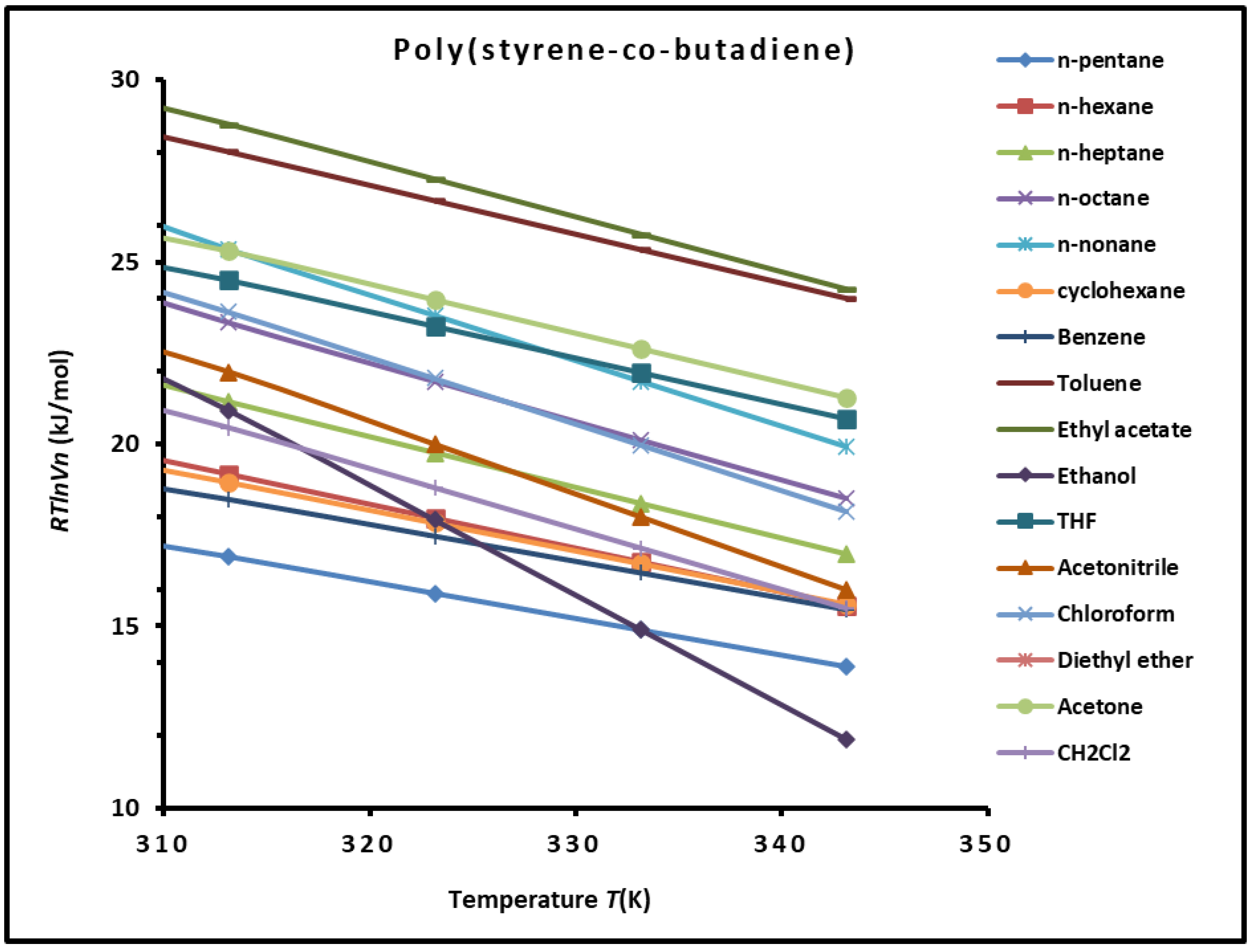
Figure 2.
Variations of the London dispersive surface energy of SBR as a function of the temperature T (K) using the different molecular models compared to Hamieh thermal model.
Figure 2.
Variations of the London dispersive surface energy of SBR as a function of the temperature T (K) using the different molecular models compared to Hamieh thermal model.
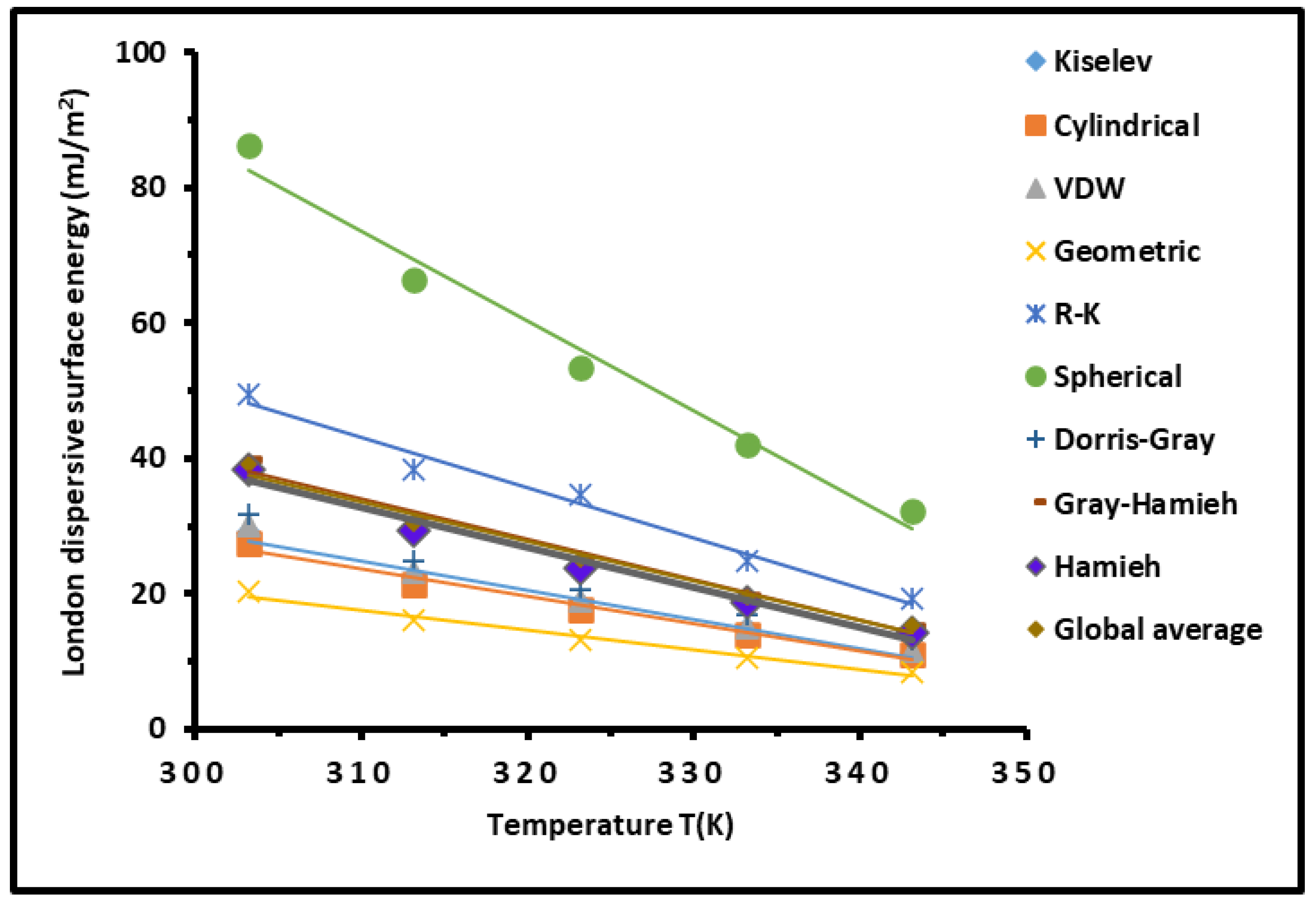
Figure 3.
Variations of the polar free interaction energy (kJ/mol) of polar organic molecules adsorbed on SBR copolymer as a function of temperature.
Figure 3.
Variations of the polar free interaction energy (kJ/mol) of polar organic molecules adsorbed on SBR copolymer as a function of temperature.
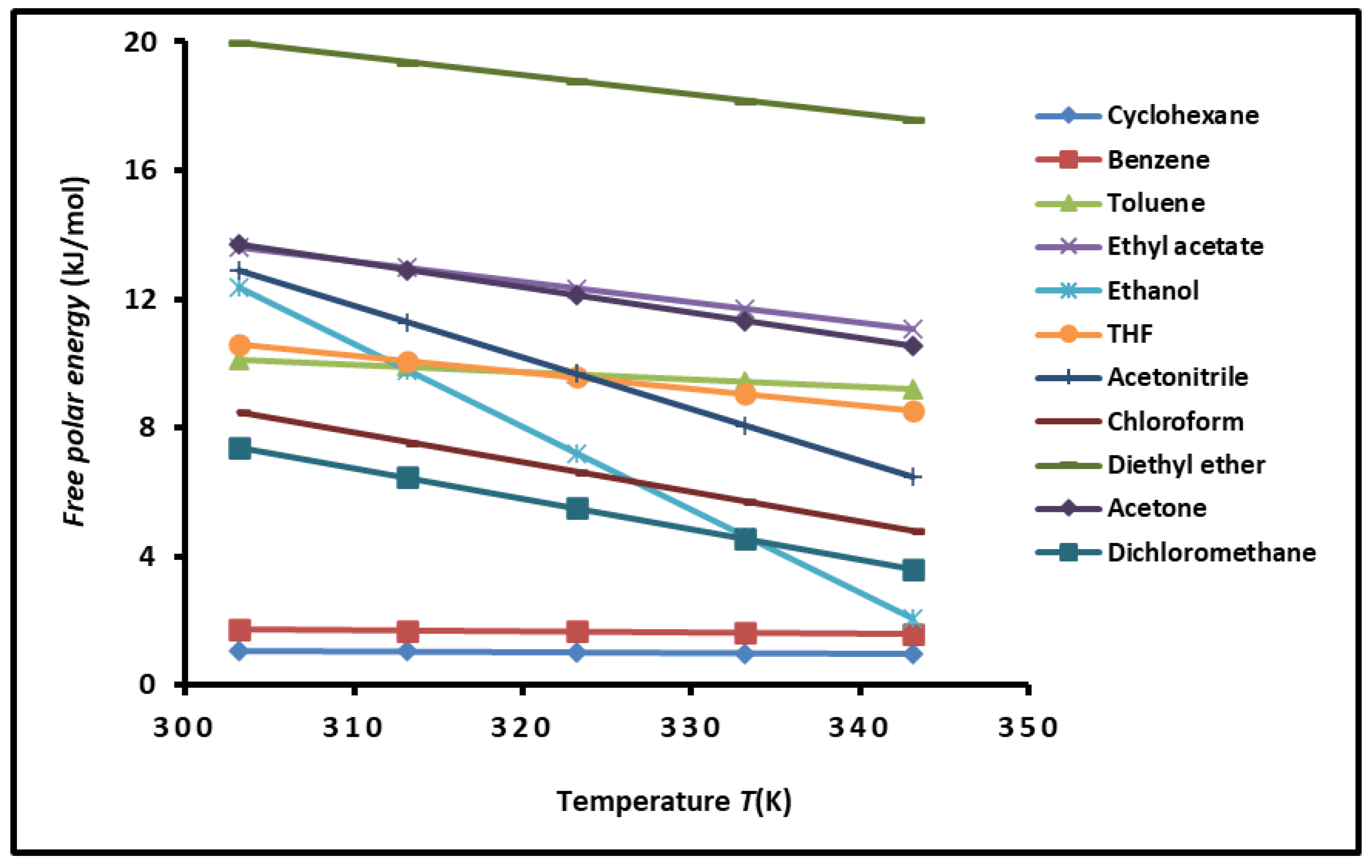
Figure 4.
Variations of ( (a) and ( (b) of the various organic solvents adsorbed on SBR as a function of the ratio of donor number on acceptor number of electrons of the polar molecules.
Figure 4.
Variations of ( (a) and ( (b) of the various organic solvents adsorbed on SBR as a function of the ratio of donor number on acceptor number of electrons of the polar molecules.
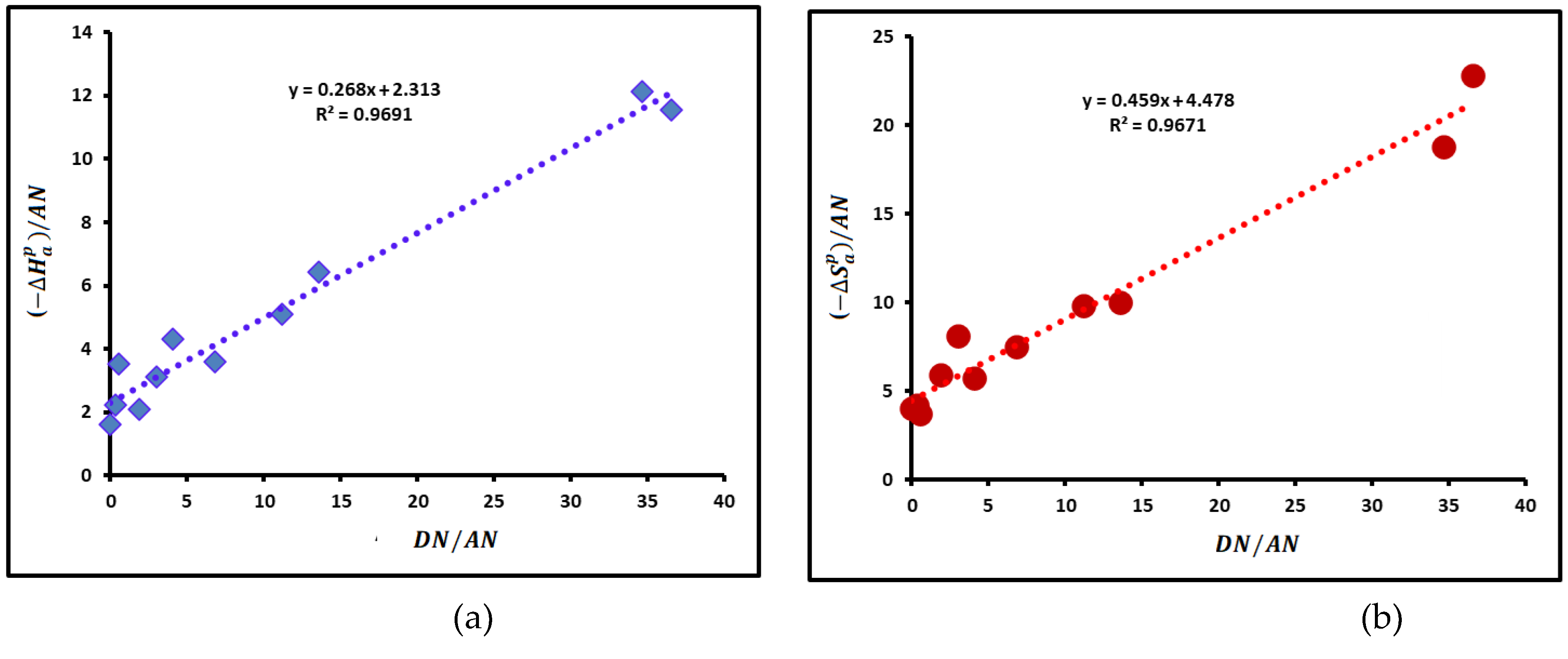
Figure 5.
Variations of the free dispersive energy ( of the different organic solvents adsorbed on the SBR as a function of the temperature T (K).
Figure 5.
Variations of the free dispersive energy ( of the different organic solvents adsorbed on the SBR as a function of the temperature T (K).
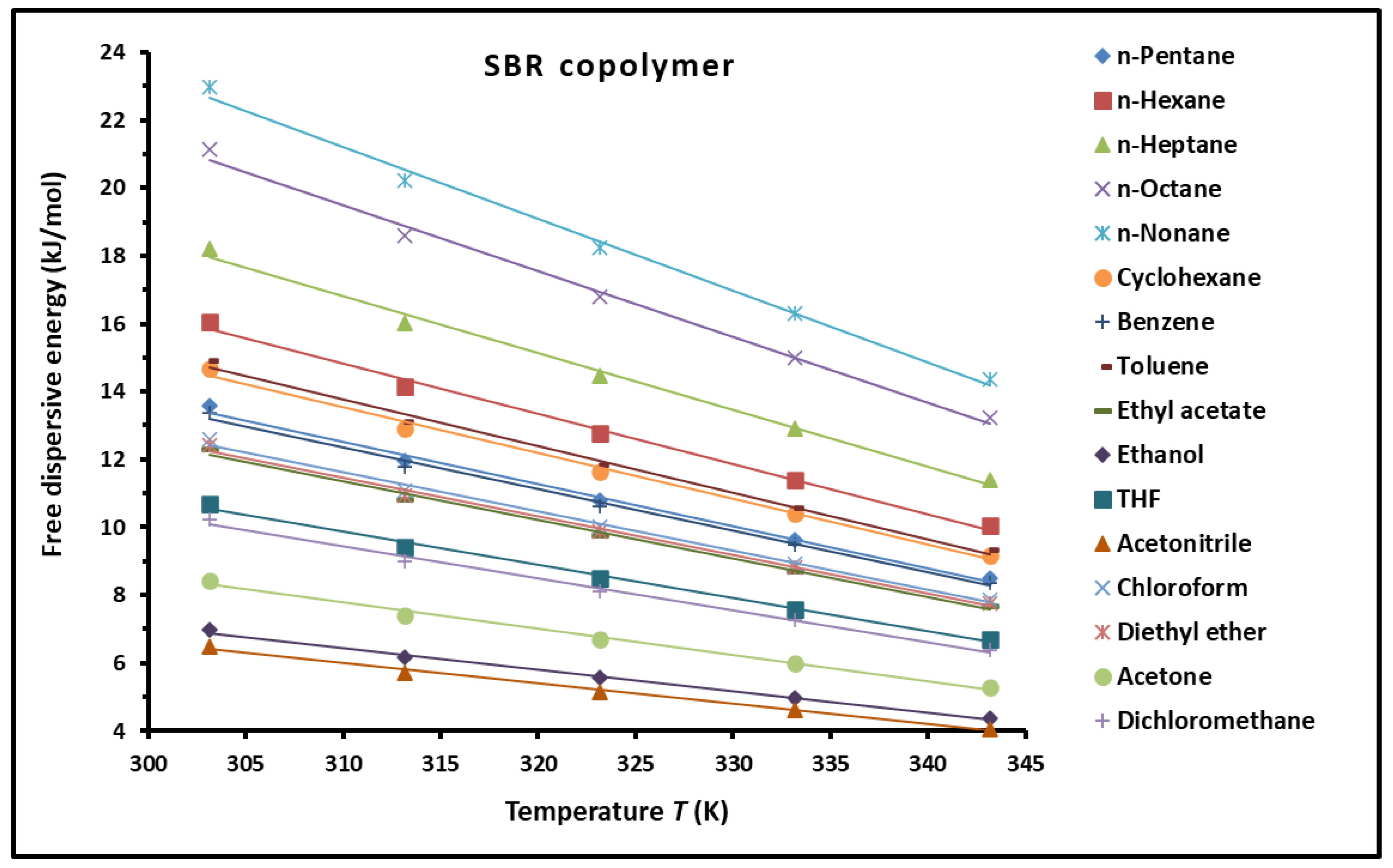
Figure 6.
Variations of the interaction distance H (T) (Å) of the SBR as a function of temperature T (K).
Figure 6.
Variations of the interaction distance H (T) (Å) of the SBR as a function of temperature T (K).
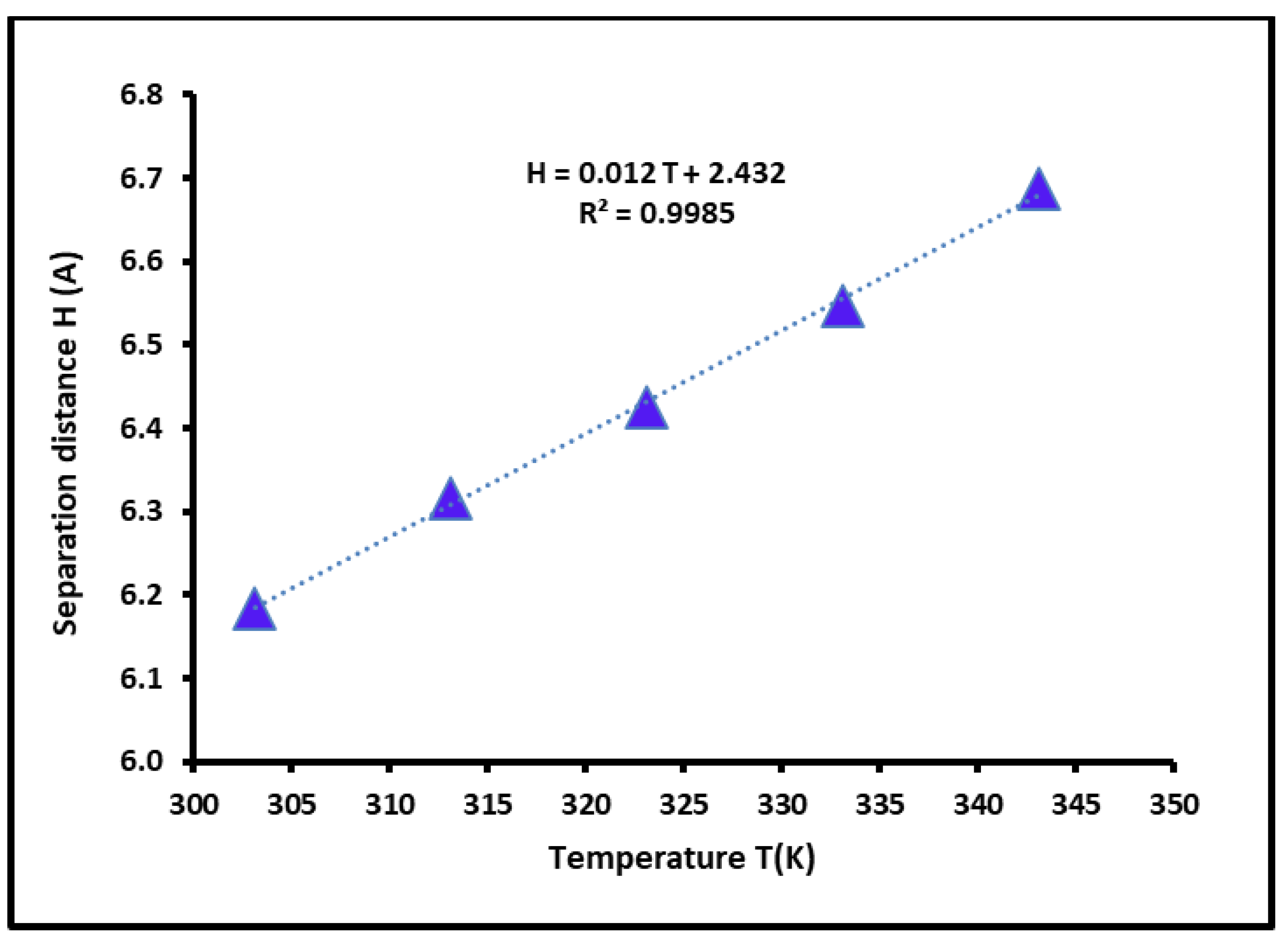
Figure 7.
Variations of the polar acid and base surface energies , , the polar surface energy , the London dispersive surface energy , and the total surface energy (mJ/m2) of the SBR as a function of the temperature.
Figure 7.
Variations of the polar acid and base surface energies , , the polar surface energy , the London dispersive surface energy , and the total surface energy (mJ/m2) of the SBR as a function of the temperature.
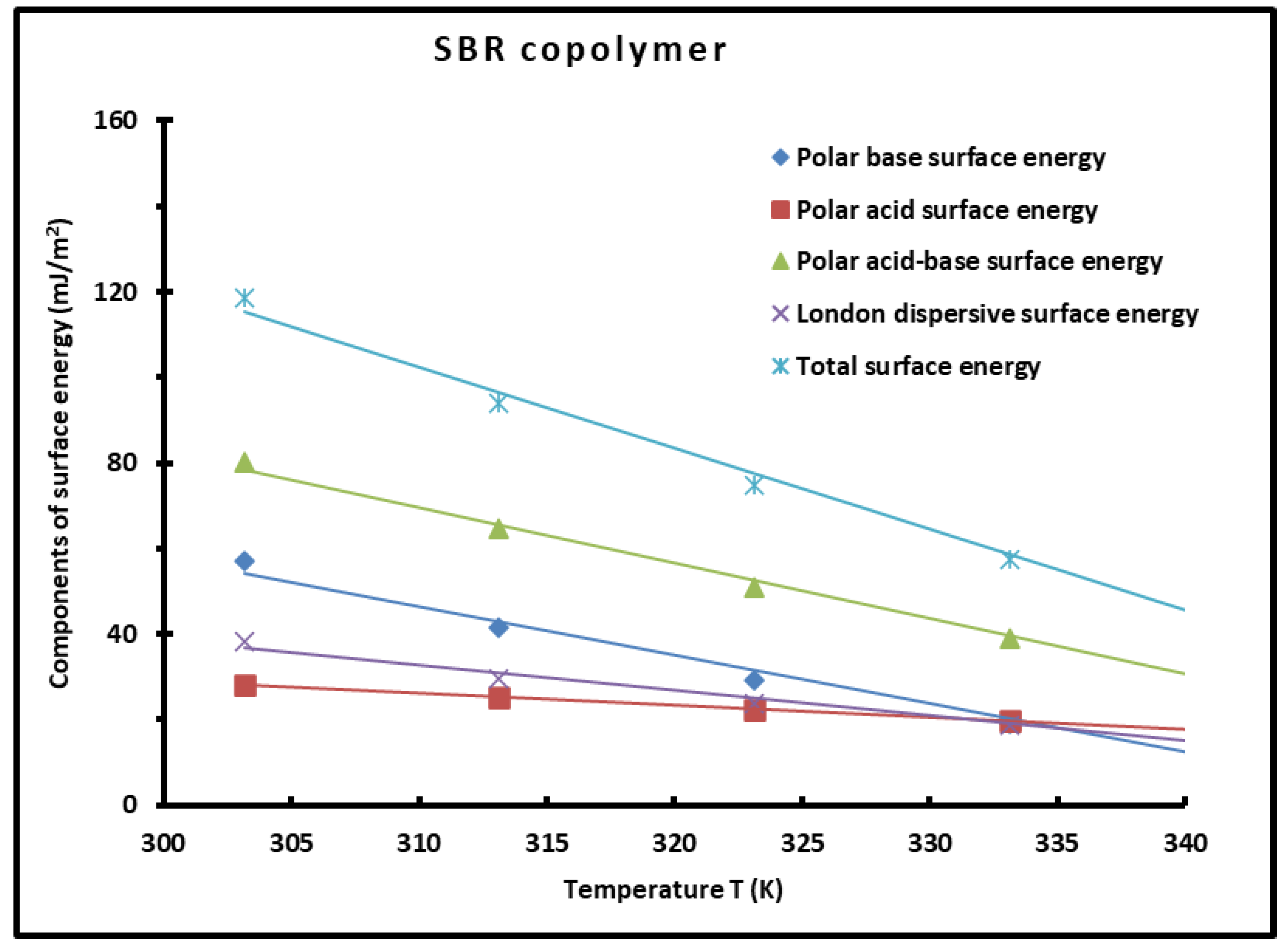
Figure 8.
Evolution of the polar component of the surface energy (mJ/m2) of polar solvents adsorbed on the SBR copolymer as a function of temperature. .
Figure 8.
Evolution of the polar component of the surface energy (mJ/m2) of polar solvents adsorbed on the SBR copolymer as a function of temperature. .
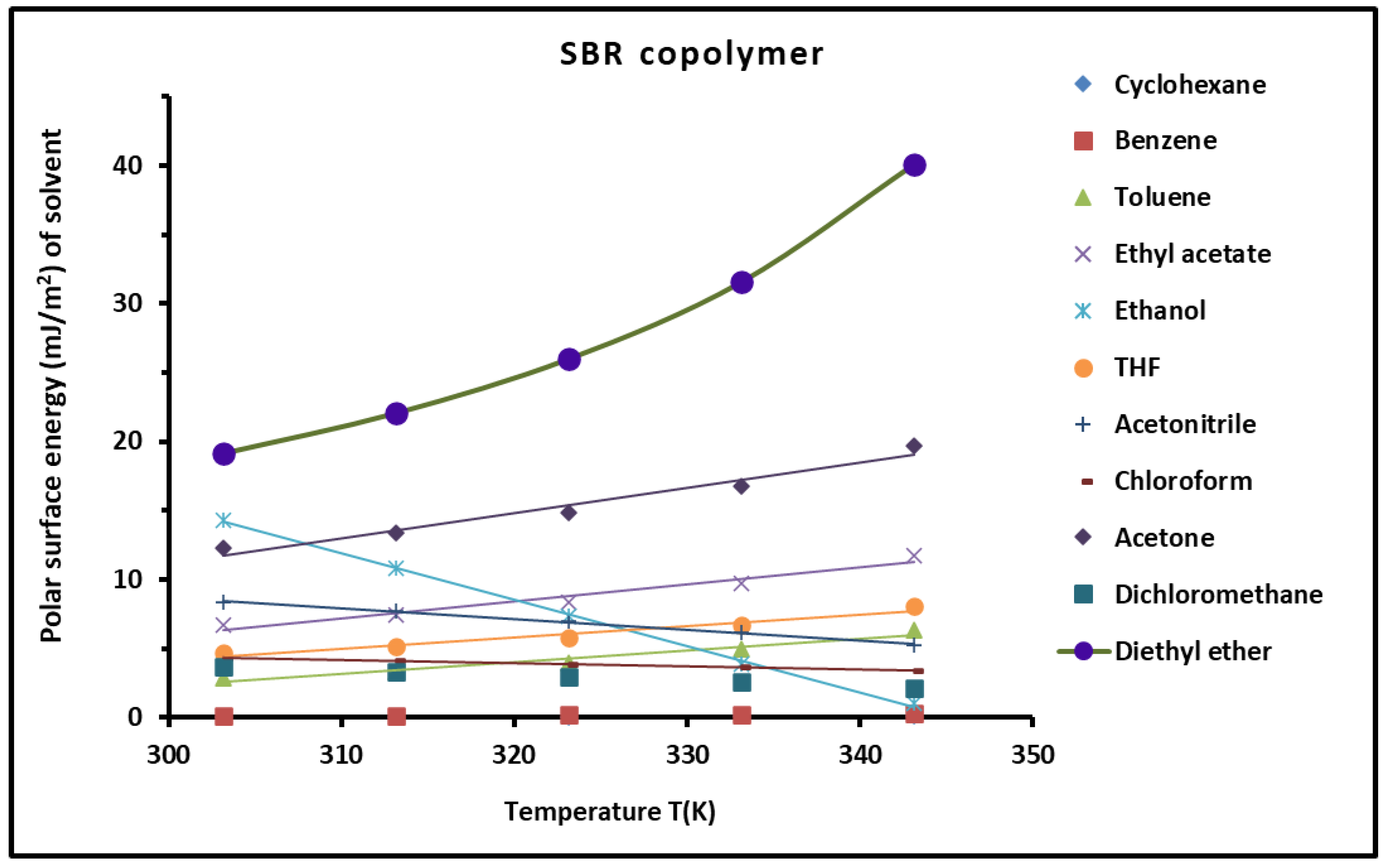

Table 1.
Equations of SBR obtained by the various molecular models compared to the Hamieh thermal model, , , and .
Table 1.
Equations of SBR obtained by the various molecular models compared to the Hamieh thermal model, , , and .
| Molecular model | (mJ/m2) | (mJ m-2 K-1) | (mJ/m2) | (K) | R2 |
| Kiselev | = -0.43 T + 158.83 | -0.43 | 158.83 | 367.66 | 0.9809 |
| Cylindrical | = -0.40 T + 148.22 | -0.40 | 148.22 | 368.61 | 0.9815 |
| VDW | = -0.45 T + 165.22 | -0.45 | 165.22 | 367.40 | 0.9808 |
| Geometric | = -0.29 T + 108.25 | -0.29 | 108.25 | 370.09 | 0.9821 |
| Redlich-Kwong | = -0.74 T + 271.53 | -0.74 | 271.53 | 368.28 | 0.9811 |
| Spherical | = -1.32 T + 483.45 | -1.32 | 483.45 | 365.59 | 0.9795 |
| Dorris-Gray | = -0.45 T + 165.93 | -0.45 | 165.93 | 371.13 | 0.9817 |
| Gray-Hamieh | = -0.60 T + 219.89 | -0.60 | 219.89 | 366.91 | 0.9799 |
| Hamieh | = -0.59 T + 215.36 | -0.59 | 215.36 | 365.45 | 0.9793 |
| Global average | = -0.59 T + 215.19 | -0.59 | 215.19 | 367.5 | 0.9824 |
Table 2.
Equations of the polar free energy ( as a function of temperature for the different polar solvents adsorbed on SBR.
Table 2.
Equations of the polar free energy ( as a function of temperature for the different polar solvents adsorbed on SBR.
| Probes | Equation of ( (kJ/mol)) |
| Cyclohexane | ( = -0.0032T + 2.060 |
| Benzene | ( = -0.0027T + 2.542 |
| Toluene | ( = -0.023T + 17.108 |
| Ethyl acetate | ( = -0.0627T + 37.598 |
| Ethanol | ( = 0.2574T +90.377 |
| THF | ( = -0.0522T + 26.434 |
| Acetonitrile | ( = -0.1103T + 91.466 |
| Chloroform | ( = 0.0918T +76.300 |
| Diethyl ether | ( = -0.0593T +37.928 |
| Acetone | ( = -0.0791T + 57.669 |
| Dichloromethane | ( = -0.0689T + 36.204 |
Table 3.
Equations of the polar enthalpy ( and entropy ( of adsorption polar solvents on SBR copolymer as a function of temperature.
Table 3.
Equations of the polar enthalpy ( and entropy ( of adsorption polar solvents on SBR copolymer as a function of temperature.
| Probes | ( (J/k.mol) | ( (kJ/mol)) |
| Cyclohexane | 3.2 | 2.060 |
| Benzene | 2.7 | 2.542 |
| Toluene | 23.0 | 17.108 |
| Ethyl acetate | 62.7 | 32.598 |
| Ethanol | 257.4 | 90.377 |
| THF | 52.2 | 26.434 |
| Acetonitrile | 160.3 | 61.466 |
| Chloroform | 91.8 | 36.300 |
| Diethyl ether | 59.3 | 37.928 |
| Acetone | 79.1 | 37.669 |
| Dichloromethane | 68.9 | 36.204 |
Table 4.
Values of the various enthalpic ,) and entropic , Lewis’s acid-base constants of the SBR copolymer, with the corresponding linear regression coefficients.
Table 4.
Values of the various enthalpic ,) and entropic , Lewis’s acid-base constants of the SBR copolymer, with the corresponding linear regression coefficients.
| Lewis’s acid-base parameter | Values | R2 |
| 0.268 | 0.9691 | |
| 2.313 | 0.9691 | |
| / | 8.631 | 0.9691 |
| 2.581 | 0.9691 | |
| 0.459 | 0.9671 | |
| 4.478 | 0.9671 | |
| 9.756 | 0.9671 | |
| 4.937 | 0.9671 |
Table 5.
Values of the polar acid and base surface energies , , the polar surface energy , the London dispersive surface energy , and the total surface energy (mJ/m2) of the SBR copolymer versus the temperature.
Table 5.
Values of the polar acid and base surface energies , , the polar surface energy , the London dispersive surface energy , and the total surface energy (mJ/m2) of the SBR copolymer versus the temperature.
| T(K) | |||||
|---|---|---|---|---|---|
| 303.15 | 56.95 | 28.17 | 80.11 | 38.36 | 118.47 |
| 313.15 | 41.59 | 25.10 | 64.62 | 29.47 | 94.08 |
| 323.15 | 29.09 | 22.26 | 50.90 | 23.75 | 74.65 |
| 333.15 | 19.17 | 19.65 | 38.82 | 18.69 | 57.50 |
| 343.15 | 11.57 | 17.25 | 28.25 | 14.28 | 42.53 |
Disclaimer/Publisher’s Note: The statements, opinions and data contained in all publications are solely those of the individual author(s) and contributor(s) and not of MDPI and/or the editor(s). MDPI and/or the editor(s) disclaim responsibility for any injury to people or property resulting from any ideas, methods, instructions or products referred to in the content. |
© 2024 by the authors. Licensee MDPI, Basel, Switzerland. This article is an open access article distributed under the terms and conditions of the Creative Commons Attribution (CC BY) license (http://creativecommons.org/licenses/by/4.0/).
Copyright: This open access article is published under a Creative Commons CC BY 4.0 license, which permit the free download, distribution, and reuse, provided that the author and preprint are cited in any reuse.


