

Submitted:
23 January 2026
Posted:
26 January 2026
You are already at the latest version
Abstract
Tropical cyclones cause thousands of deaths and immense damage annually. While ocean temperatures and atmospheric conditions dominate cyclone formation and behaviour, forests' potential influence has received little systematic attention.In this review I explore and evaluate how forests may affect tropical cyclone incidence, behaviour, and impacts. Evidence strength varies by mechanism and cyclone stage. Post-landfall effects show strongest support: forests demonstrably slow storm decay through surface roughness, reducing wind damage by 20–40% compared to cleared land, while forest soils buffer flooding through enhanced infiltration. Forests also influence storm tracks, though magnitudes remain uncertain.Evidence for pre-landfall effects is more limited but plausible. Forests release massive moisture through evapotranspiration, substantially modifying offshore humidity. Temperature and aerosol effects offer additional pathways. The Biotic Pump theory proposes that large forest areas generate pressure gradients drawing moisture inland, potentially limiting moisture available for ocean storms.Forest influences on cyclone formation and growth should be most evident near the thresholds where small changes matter. This context-dependency reconciles divergent findings and provides a framework for integrating forests into climate risk assessment.Forest conservation offers clear benefits for coastal disaster mitigation through post-landfall protection. Potential effects on cyclone genesis, while uncertain, strengthen the case for forest protection and identify critical research priorities.
Keywords:
tropical cyclones
; deforestation
; ecosystem services
; biotic pump
; land-atmosphere coupling
; climate adaptation
; disaster risk reduction
; atmospheric moisture
; evapotranspiration
1. Introduction
In late 2025, Tropical Cyclone Senyar formed near the Strait of Malacca between Peninsular Malaysia and Sumatra, Indonesia. Senyar made landfall over several areas, killed over 1,500 people and caused US$19.8 billion in damages. Tropical cyclones affect an estimated 20.4 million people yearly, with 1.4 trillion USD in damages plus 779,000 deaths since 1970 (Krichene et al. 2023; WMO https://wmo.int/topics/tropical-cyclone). Long-term consequences include slowed economic growth (Young & Hsiang, 2024). Comparable patterns unfold worldwide, often hitting low- and middle-income areas hardest (Hallegatte et al. 2020). Even minor factors in cyclone risk thus hold profound significance.
Senyar attracted attention not only for its severe impacts but also because tropical cyclones rarely form in near-equatorial zones where favourable conditions seldom align (Gray, 1968; Emanuel, 2003, 2020; Li and Toumi 2025). The affected region has endured extensive forest loss. This raises a question as to whether land cover changes may influence such storms. Forests are seldom considered in this context. We know that vegetation shapes land–atmosphere processes that influence climate (Bonan, 2016; IPCC, 2021), including conditions linked to tropical cyclone formation and behaviour (Hansen et al., 2013; IPCC Chapter 8, 2021). The answer to such questions has implications extending far beyond Senyar. Tropical cyclones in marginal and atypical contexts is a theme examined later in this review.
Evidence suggests that tropical cyclones are becoming stronger (Emanuel, 2021), travelling further (Kossin et al., 2020; Wang & Toumi, 2021, 2022), and affecting larger regions (Li & Chakraborty, 2020). Increasing numbers of people face exposure. Landfalling storms travel farther inland and decay slower, amplifying destruction (Li & Chakraborty, 2020). Warmer oceans intensify storms and rainfall while rising atmospheric stability and circulation changes may also curb formation frequency in some regions (Knutson et al., 2020; Chand et al., 2022; Zhao et al., 2024). Meanwhile, the fiercest storms continue to strengthen and migrate further (Kossin et al., 2020; Bhatia et al., 2022; Li et al., 2023).
Concurrent with these tropical cyclone trends, rapid forest loss and degradation continues, particularly in the tropics. From 2001 to 2024, Global Forest Watch (2025) estimates that 230 Mha (13%) of global forest cover was lost, with 310 Mha severely disturbed or degraded and 130 Mha gained or regrown. These widespread land cover changes raise questions about potential feedbacks between deforestation and tropical cyclone dynamics. Regarding Senyar, the affected region—Peninsular Malaysia, Sumatra, and surrounding areas—were once covered in dense tropical forest but are now largely deforested, with remaining forests often fragmented and degraded. Much of this was recent, Malaysia having lost approximately 7.5 Mha and Sumatra 8 Mha since 2001 (Global Forest Watch, 2025). This raises questions about whether land cover changes may favour such storms.
Ecologists have long studied how tropical cyclones shape forest structure, composition, and dynamics (e.g., Sheil & Burslem, 2003; Lin et al., 2020). The converse—how forests influence tropical cyclones—has received far less attention. While forest-tropical cyclone interactions have received some attention in media and online discussions (Sheil 2017,Gies 2024), systematic peer-reviewed analysis remains limited.
My goal is to fill this gap. While my review focuses on tropical cyclones, similar processes and implications will likely apply to similar systems, such as the extratropical storms that occur in the Mediterranean (see Cavicchia et al., 2014, Flaounas et al., 2022).
Due to the significant threat they pose there has long been considerable interest and research on tropical cyclones (Emanuel 2005, 2018, Lin et al. 2022).
Forests deliver known benefits for biodiversity conservation, climate mitigation, hydrological regulation, and coastal protection (Ellison et al. 2017, 2024, Mo et al., 2023; Jia et al., 2019; Sheil 2018; Smith et al. 2023), alongside other goods and services (Ghazoul and Sheil 2010; Katila et al. 2019; Nambiar 2019; Taye et al. 2021). Some contribute to mitigating tropical cyclone impacts; mangroves, for instance, shield coastal communities from harm (Das and Vincent 2009; Hochard et al. 2019). Access to forest also aids recovery (Liswanti et al. 2011; Wunder et al. 2014). But the question I will consider here is narrower—if forest cover plausibly reduces cyclone incidence or impacts this further strengthens the case for conservation and restoration.
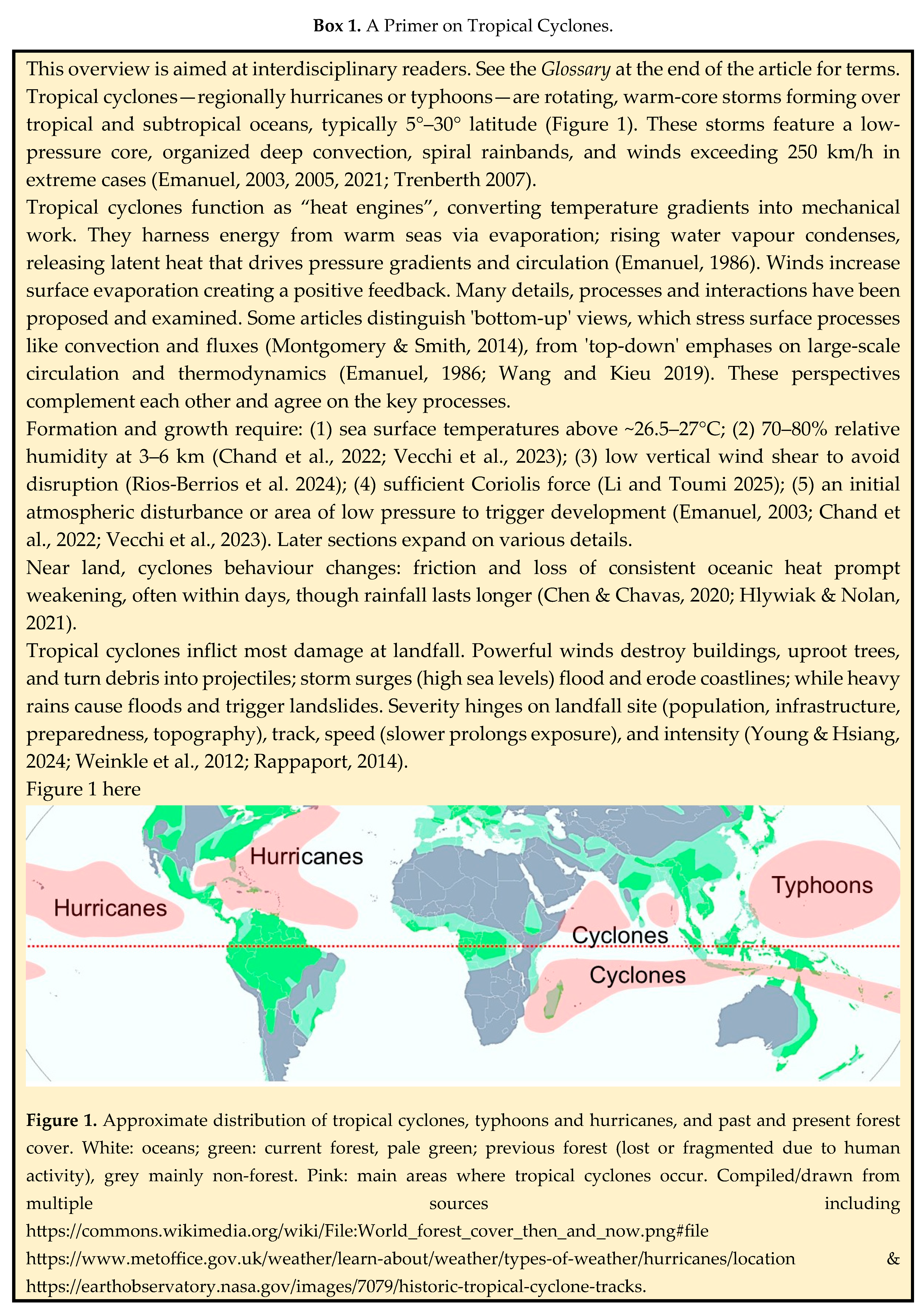
In this review I examine the possible influence of forests on tropical cyclones from genesis to landfall, weighing mechanisms, uncertainties, and scales to consider forests in risk strategies. Section 2 outlines potential pathways and evidence, summarized in Table 1. Section 3, Section 4, Section 5, Section 6 and Section 7 assess remote effects on cyclone genesis and development, while Section 8 covers local impacts at and after landfall. Section 9, Section 10 and Section 11 synthesize the evidence, including regional variations, and conclude with implications for risk management and research.
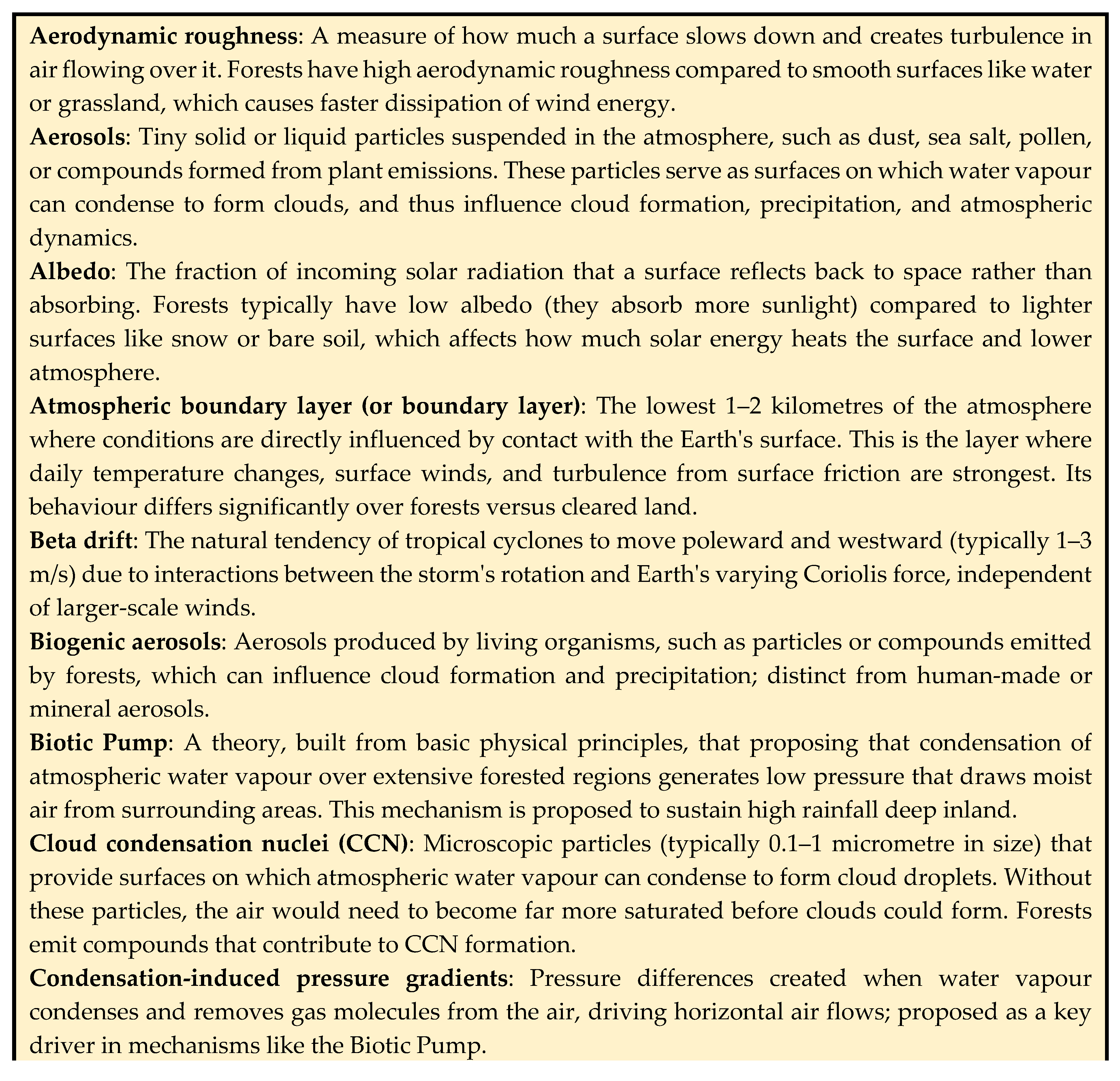
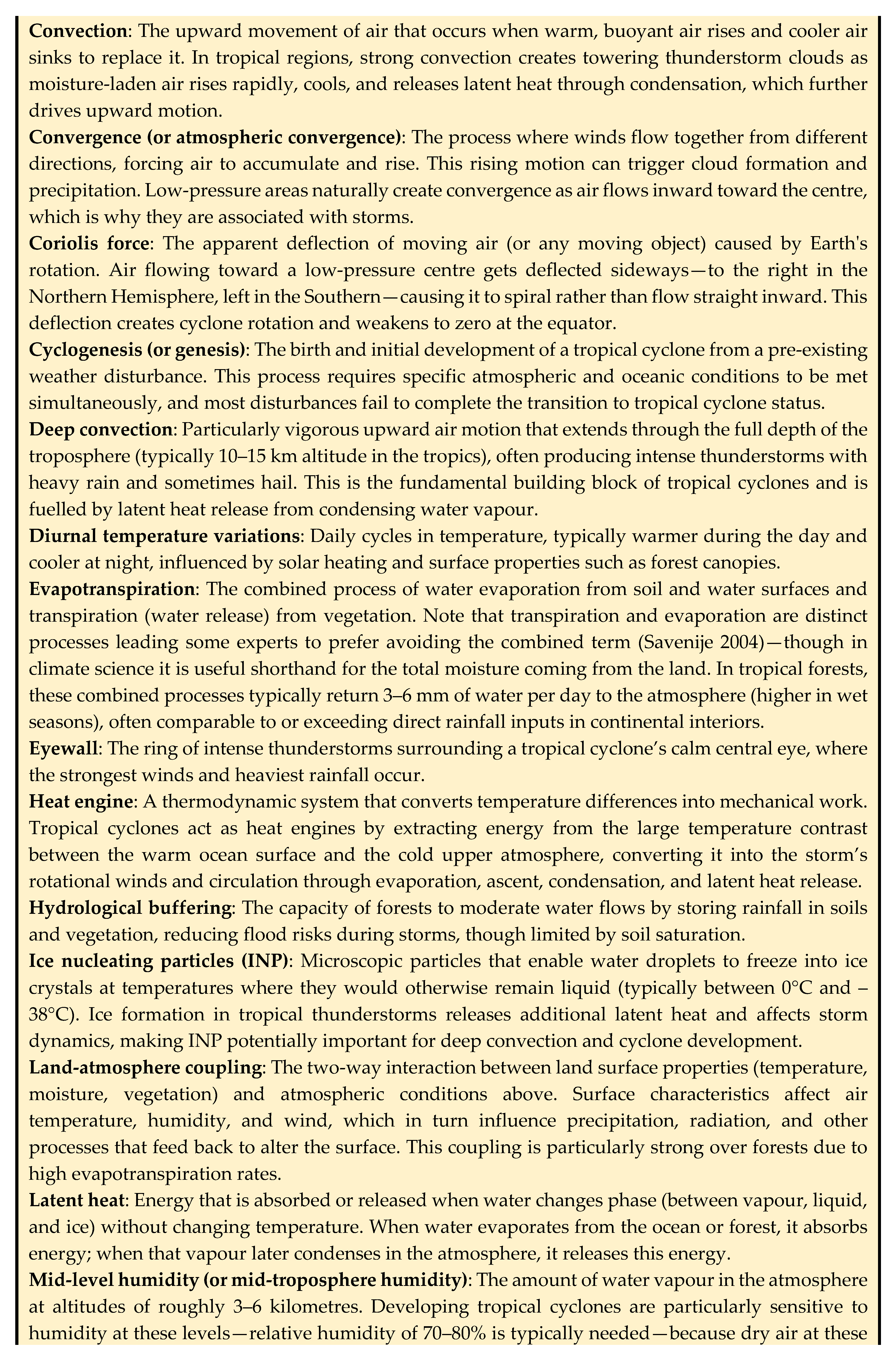
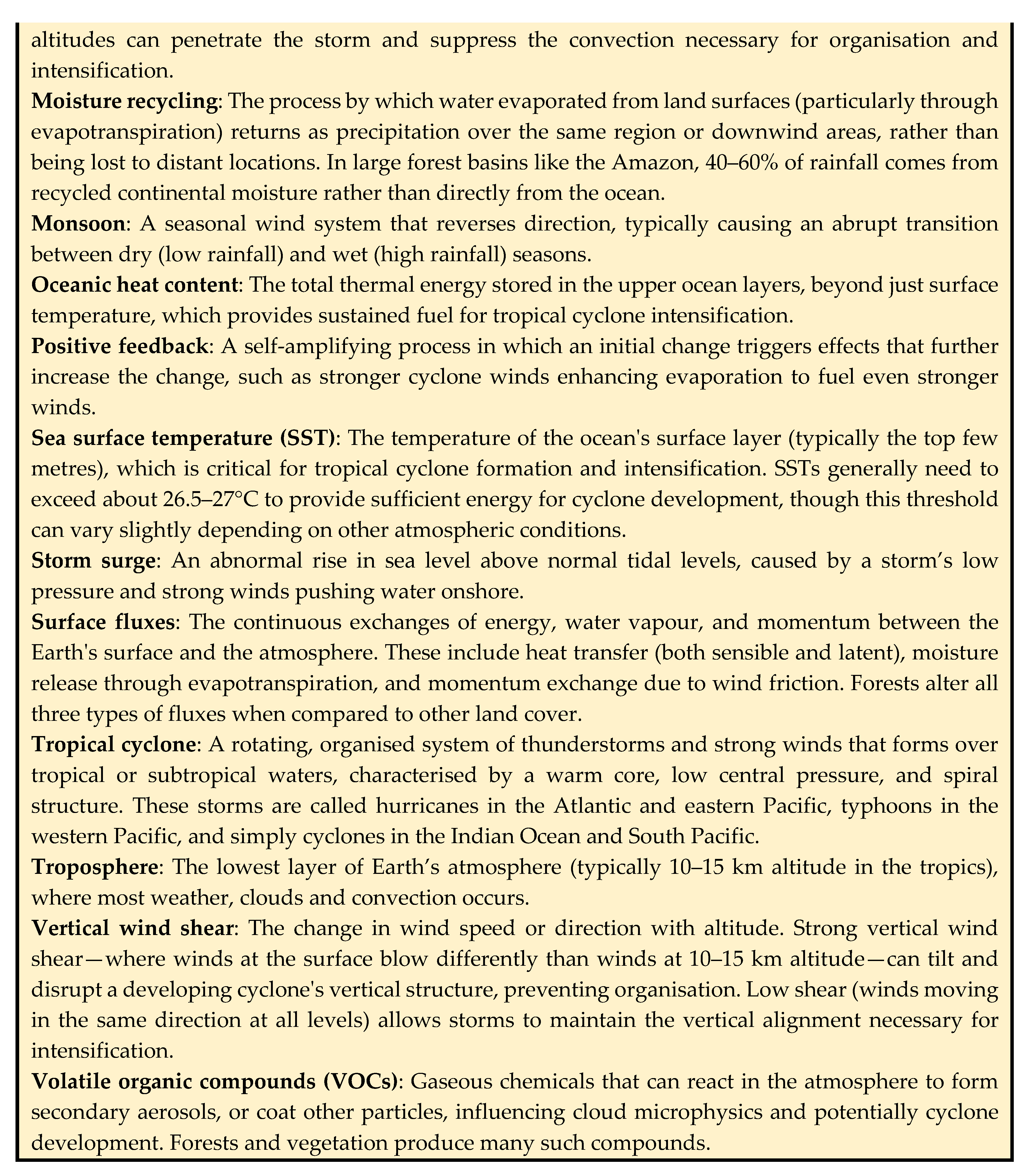
This review is targeted at readers unfamiliar with atmospheric sciences. A primer on tropical cyclones is provided in Box 1 and a glossary of key terms is provided at the end.
2. Potential Pathways and Evidence Framework
Forests may alter cyclone probabilities through many interconnected pathways. These span varied scales, processes, and outcomes and have various support (or not) from theory and evidence. Pathways group by tropical cyclone stage (genesis/development vs. landfall/decay) and evidence strength. I prioritize observational evidence, though tropical cyclone research generally relies on predictive models, statistical patterns, physical mechanisms, and theory (e.g., Schenkel et al. 2023, Takaya, et al. 2023, Montgomery & Smith 2017)—topics where expert views often differ—making the nature and interpretation of “evidence” somewhat subjective. Three confidence levels apply: high (consistent observations/models), medium (plausible with moderate support), low (theoretical/debated). These categories reflect both the strength of empirical support and the degree of scientific consensus. Table 1 summarizes these pathways; Section 3, Section 4, Section 5, Section 6, Section 7 and Section 8 examine each in detail.
Many mechanisms in this review, particularly pre-landfall ones, are uncertain and rely on theoretical or indirect evidence. The precautionary principle holds that where serious harm is plausible, uncertainty should not postpone preventive action (United-Nations 1992; Kriebel et al., 2001). Thus, plausibility remains a key consideration until clearer evidence emerges.
3. Temperature-Mediated Effects
Forests regulate near-surface temperatures via albedo, evapotranspiration, and roughness. Intact forests sustain cooler surfaces than croplands or degraded areas, especially in humid tropics where evaporative cooling dominates (Bonan, 2016; Alkama & Cescatti, 2016). Satellite data show deforestation raises tropical temperatures by 1–3°C, peaking in dry seasons (Li et al., 2015). Temperature changes can extend to coastal zones with prevailing winds, potentially influencing cyclone genesis near land. For example, coastal temperature gradients may reshape pressure fields and convergence, displacing convection seaward (Findell et al., 2017).
Modelling indicates that deforestation-driven warming can weaken low-level convergence over forested continents while enhancing convergence over adjacent oceans, potentially shifting convective activity seaward (Portmann et al. 2022; Fahrenbach et al. 2025). Confirmation of these predictions appears absent from the literature. Despite these uncertainties, the modelled patterns offer a plausible pathway under suitable conditions.
4. Moisture and Circulation Effects
Moisture-related mechanisms offer plausible pathways for forest influence on cyclones, though debate surrounds the scales and mechanisms of land-moisture-rainfall feedbacks. While coarse models underpin much current understanding, recent findings question their ability to capture fine-scale processes (Lee and Hohenegger 2024). I note increased attention to the role of atmospheric moisture in cyclone research (Pérez-Alarcón et al. 2023; Gorja et al. 2024).
Methods are now available to show that while much of the moisture that generates and sustains tropical cyclones derives from the seas over which they develop, significant amounts can also derive from other sources including land (Pérez-Alarcón et al. 2022). For example, observations show that West Africa, and the Sahel contributed more moisture than expected by proximity alone to tropical cyclones forming in the eastern Atlantic north of the equator (Pazos and Gimeno 2017). These flows remain poorly characterised but likely reflect interactions with the monsoons as well as other processes (Drumond et al., 2011, Lélé et al. 2015).
Tropical forests release substantial moisture through evapotranspiration, fuelling precipitation. An estimated 39% of rainfall over the global land surface derives directly from ocean evaporation, the other 61% (71,800 km³) recycles via vegetation following previous precipitation over land (Schneider et al. 2017; Sheil 2018). Forests, and tree cover more generally, play a major role in this recycling (van der Ent, 2010; Spracklen et al., 2012; Jasechko, et al. 2013; Schlesinger and Jasechko 2014, Sheil 2014); deforestation generally reduces regional rainfall (Boers et al. 2017; Andrich & Imberger 2013; McAlpine 2018) and this pattern has been seen across the tropics (Smith et al., 2023). Effects span hundreds to thousands of kilometers.
Recent Amazon data link over 2 cm dry-season rainfall decline to forest loss, with ~74% attribution (Franco et al. 2025). Declines in rainfall in deforested areas often appear to surpass estimates based on direct evapotranspiration losses alone (Li et al., 2026; Qin et al., 2025), implying that other processes amplify these changes.
Conventional theory attributes atmospheric circulation primarily to temperature gradients: warm air ascends, cool air descends, transporting moisture. Forests shape winds through heat, moisture, and momentum exchanges—collectively termed 'land–atmosphere coupling'—in the boundary layer (1–2 km). Land cover influences on atmospheric pressure and the resulting circulation are recognised (IPCC 2023).
Conventional theory attributes atmospheric circulation primarily to temperature gradients. While forests shape winds through heat, moisture, and momentum exchanges (termed 'land-atmosphere coupling') in the boundary layer, some more recent ideas propose that forest-dependent pressure gradients play a role too (I examine this in the following section below).
While sea-to-land transport prevails, reverse flows occur. Winds carry moisture downwind, including over seas (Keys et al., 2012). Intact forests are a major potential source of such humidity and, compared to other land cover, are often effective in maintaining such humidity during periods of drought (Sheil 2018). Degradation past thresholds slashes evapotranspiration, especially in dry periods, intensifying drying (Artaxo 2023; Franco et al. 2025). Dynamics depend on wind directions and geographical contexts.
Studies estimate extensive deforestation cuts offshore humidity in the lower atmosphere by 10–20%, varying by region, season, and method; uncertainties persist (Duque-Gardeazabal et al., 2025). The idea that downwind oceanic moisture that derives from forest contributes to cyclones is plausible but unstudied, though as noted above such moisture sourcing has revealed terrestrial sources (Pazos and Gimeno 2017, Pérez-Alarcón et al. 2022, 2023). The general assumption is that, for most of the time, the inverse effects dominate, with landward moisture flows from oceans far exceeding seaward flows from land (Trenberth et al., 2007a; Schneider et al., 2017)
The estimates of deforestation-related changes in humidity are small when compared with seasonal and interannual variability,—yet could be influential in borderline contexts. Beyond local moisture effects, the question remains whether forests influence circulation and pressure patterns in ways that affect tropical cyclone dynamics.
For completeness, I note published suggestions that forests could generate warm moist air supporting cyclone formation (Andersen and Shepherd 2017). However, frictional forces and diurnal temperature variations over forested landscapes (forest canopies tend to be cool, especially at night) prevent cyclone development, and no such processes have been observed.
5. Condensation-Driven Dynamics: The Biotic Pump
The Biotic Pump theory proposes that condensation drives circulation in addition to conventional temperature-driven mechanisms (Makarieva & Gorshkov 2007, 2010). Condensation removes vapour molecules from the air, altering vertical pressure profiles. This creates pressure gradients between regions that draw in surrounding air at low altitudes and return it aloft, establishing a self-sustaining circulation converging over areas of high condensation. Forests maintain high evapotranspiration and condensation, stabilizing low pressure and inflows over these areas (Makarieva & Gorshkov 2007; Sheil & Murdiyarso 2009).
The concepts underlying the Biotic Pump have been published in peer-reviewed physics and atmospheric science journals. While debated, recent reviews note increased theoretical support, though the mechanisms remain absent from operational models (Baudena et al., 2021; Makarieva et al., 2023). The theory is an additional mechanism rather than a replacement. The question is not whether condensation affects pressure—it does—but how much this shapes large-scale circulation and other relevant processes. There are some specific observations, such as the abruptness of the monsoon rains, that have proved hard to capture in models, but can perhaps be explained by this theory—though notably, there are distinct explanations, and mechanisms that may be seen as alternatives or additional mechanisms that may also generate the necessary feedbacks from forest derived moisture (Boers et al., 2017, Wright et al., 2017, Versieux and Costa 2024).
Similar physical insights as developed in the Biotic Pump have been applied to cyclones. Conventional views prioritize oceanic heat but the alternative view, echoing prior modelling work (Lackmann & Yablonsky, 2004), elevates the additional role of condensation as a major driver of tropical cyclone energetics and structure (Makarieva & Gorshkov, 2009; Makarieva et al., 2015). The theory also predicts that tropical cyclone power scales with rainfall, matching observations (Figure 2).
Data based observations show that tropical cyclones need to draw in moist air from over large regions and use it to fuel their dynamics—more moisture means a more powerful storm (Makarieva 2017). An estimate, using this theory, suggests that energy from water vapour contributes five times more than direct heat in powering tropical cyclones (Makarieva et al., 2017). A consequence of this theory being valid is that any process that reduces the availability of atmospheric moisture will reduce what is available to maintain and energise any such storms. This is how the presence or absence of forest could shape tropical cyclone’s behaviour. The idea is that the low pressure over forests draws in significant winds and moisture from the ocean and it is unavailable for energizing storms. These ideas are elaborated to show the range of possible contexts and consequences in Figure 3.
The South Atlantic's warm seas meet tropical cyclone thresholds, yet unlike the neighbouring Caribbean, storms are scarce. Prevailing explanations stress strong wind shear, unfavourable circulation, and low humidity (Gray, 1968; Emanuel, 2003). Hurricane Catarina in March 2004 marked the satellite era's first South Atlantic tropical cyclone, landing in southern Brazil amid low shear and high moisture—a rare alignment (McTaggart-Cowan et al., 2006; Pezza & Simmonds, 2005).
South Atlantic cyclone rarity, despite warm seas, may reflect condensation-driven moisture drawdown by the Amazon and Atlantic forests (Makarieva et al., 2013b). Forest loss might contribute to changing this pattern if forests indeed are not simply a source of moisture but also draw moisture inland. Such interactions would peak in marginal cyclone zones.
Cyclones generally track with the ambient air flows that they are embedded in (Kossin, 2018) thus any impact of forest circulation could influence storm paths and risks. Even if strong effects occur, the summary risk assessment is uncertain. Forests might draw each storm's track to landfall; this may increase landfalls but also reduce the time available for intensification. Which effect dominates in terms of risk is uncertain—it will likely be context dependent.
6. Aerosols
Forests emit biogenic aerosols—including cloud condensation nuclei (CCN) and ice nucleating particles (INP). These CCN and INP influence moisture condensation and freezing (Fan et al. 2007, Rosenfeld et al. 2007, Stier et al. 2024) and thus the location of energy release and the form and patterns of water transport (Thompson & Eidhammer, 2014; Yu et al., 2025). Effects are nonlinear; particle size, composition, and concentration matter (Carslaw et al. 2010; Kreidenweis et al. 2019; Tao et al. 2012). Theory suggests these can amplify or dampen cyclone formation depending on context the specific aerosols involved (Rosenfeld et al., 2014). Studies suggest anthropogenic aerosols delay and weaken cyclones over SE Asia but bolster peripheral rain (Wang et al. 2014; Seo et al. 2025).
Vegetation, including forests, supplies many aerosols (Sheil 2018). Forests release numerous biological particles (Pöschl 2010) and volatile organic compounds forming secondary aerosols as CCN/INP (Spracklen et al., 2011; Carslaw et al., 2013). These affect cloud formation, precipitation and convection (Artaxo et al. 2022; Després et al. 2012).
The potential of aerosols to influence tropical cyclones appears accepted. Simulations show cyclone sensitivity to aerosols, with context-specific, sometimes conflicting results (Akinyoola et al. 2024; Yu et al. 2025). Aerosols may curb early intensification by favouring condensation at lower levels of humidity reducing energy per air volume (Rosenfeld et al. 2007). Models suggest high loading may invigorate convection by delaying rain and elevating heat release, or may also suppresses it (Fan et al., 2018). One review notes aerosols interact with clouds, potentially altering cyclone development and intensity—an active research area (Akinyoola et al. 2024).
While the effects of biogenic aerosols on clouds and precipitation are well-established, their direct influence on cyclone-scale dynamics remains more speculative. The credibility of the concept appears supported by ongoing research into artificial aerosol interventions, such as cloud seeding, to modify cyclones (Willoughby et al., 1985; Tran et al., 2025), though forest-derived aerosols are not yet specifically studied.
7. Landfall and Track Modification
Forests exert direct, well-supported influence at landfall. Studies show tropical cyclones weaken faster nearing forests than deforested or urban lands (Wu et al., 2022). Tree height, density, and profiles mean that forests are effective in slowing winds (Saha and Wasimi 2015; Lettau 1969). Typical cover slows powerful winds 20-40% quicker than occurs over open terrain. For average landfall, this hastens loss of powerful winds by hours, and shortens storm tracks. Simulations of tropical cyclones making landfall show that the presence of a coastal strip of mangroves rather than more open coastal wetlands results in a 10-20% reduction in peak wind speeds and area flooded (for details see Tiwari et al 2024).
The rain rate of tropical cyclones typically increases for two to three days before landfall. This is thought to reflect friction and reduced humidity over land that enhance convergence (Zhong et al. 2026b). Given forests' high surface roughness, they likely accentuate this effect, though formal examination appears absent from the literature.
Occasionally, tropical cyclones intensify as they near land—typically small storms under clear skies heating shallow seas (Lok et al., 2021). Simulations indicate that roughness and reduced evaporation cut latent heat flux, but sufficient available moisture may sometimes sustain intensification (Wang and Matyas, 2022). Observations show this occurs only where tree cover is sparse and moist heat is available---conditions absent in forested landscapes (e.g., a wet desert; Emanuel et al., 2008). Additional tree cover would presumably weaken, or reverse, such intensification
Forests also influence rainfall and flooding (Wang and Matyas 2022). Forest soils typically possess higher infiltration and storage than non-forest soils, curbing runoff. But after prolonged rain—common in slow storms—any soil saturates reducing the potential for buffering against floods (Blöschl 2022). Forest loss tends to accentuate landslide risk in steep terrain, while intact forests stabilize slopes, but such effects are context-dependent (Jia et al., 2019).
What do we know about storm tracks? Tropical cyclones exhibit beta drift—a shift poleward/westward at 1–3 m/s, faster in intense storms—from the interplay between the storm and the Coriolis force. There are also internal processes that can interact with variation in regional winds that cause significant drift (Zhong, et al. 2026a) .Warming slows and shifts mid-latitude circulation and thus also storm tracks (Kossin 2018). Near land, roughness, topography, and moisture induce wind/convection asymmetries, prompting landward drifts (Szeto & Chan 2010; Wong & Chan 2006). Key factors—roughness, moisture, shear—shape tracks and rain near landfall, varying by conditions (Huang et al. 2011; Jian & Wu 2008; Wu et al. 2015; Romdhani et al. 2024). Forests influence tracks via friction, moisture, temperature, and pressure, though magnitudes remain uncertain.
In summary, while many specific details and magnitudes are uncertain, post-landfall, forests moderate impacts and the severity of damage.
8. Context
Forest–tropical cyclone interactions depend on context. Boreal and temperate forests lie outside tropical cyclone formation zones, though landfall effects discussed here remain relevant to those regions.
The likelihood of observing an influence is highest under conditions that are just below the thresholds for storm development and growth. In favourable environments—warm oceans, low vertical wind shear, abundant moisture—effects from land cover are unlikely to be detectable. Conversely, where physical constraints strongly prevent formation or development, adding or removing forest is unlikely to change that. The sweet spot is thus the borderline conditions where storms prove rare but not impossible. In tropical cyclone hotspots like the western North Pacific or Caribbean, forest effects—if any—blend into noise.
From a research perspective, marginal zones, with rare alignments, offer easier detection potential. One option is to focus on regions near seasonal forests, where coupling fluctuates (Artaxo 2023) and tropical cyclone potential is seasonally limited. We would monitor storm formation and growth and link these to variations in conditions with estimates of the contribution of forest in determining these.
9. Synthesis: Weighing the Evidence
I assess the evidence by mechanism (Table 1).
High confidence: Post-landfall effects—roughness hastening energy loss, hydrological buffering against floods—align with observations and models (Section 8).
Medium confidence: Moisture pathways—evapotranspiration, recycling, condensation dynamics—garner moderate backing; recycling well-documented (Section 4 and Section 6).
Low confidence: Temperature, circulation, aerosol and Biotic Pump related pathways draw weaker support, lacking direct tropical cyclone ties (Section 3, Section 5 and Section 7). Aerosols appear speculative, though continued interest in seeding shows continued belief in their potential potency. Connecting forest-derived aerosols to cyclone-scale impacts remains speculative despite the theoretical plausibility. Biotic Pump mechanisms, while theoretically compelling, are similarly placed in this category due to the limited direct observational validation of cyclone-scale impacts.
Oceanic heat content, large-scale circulation, and vertical wind shear are seen as the dominant controls on tropical cyclone formation and growth (IPCC, 2021, Chapter 11). Forests may tweak these, shifting odds in specific marginal settings.
The Biotic Pump offers a specific mechanism for moisture effects that may—this is not agreed—operate at relevant scales and magnitudes. While debated it warrants continued scrutiny.
Most effects likely curb storm development, but this is not inevitable in every case and context. Forests might sometimes boost oceanic moisture, trigger otherwise absent processes via aerosols, or shift landfall patterns to strike settlements. As with many speculative effects discussed here, these possibilities too require acknowledgment.
Taken together, forests are most likely to matter where (i) atmospheric conditions are marginal for tropical cyclone development, (ii) forest cover is extensive and contiguous, and (iii) mechanisms reinforce one another. Where conditions are strongly favourable or unfavourable, forest effects are likely negligible. This context sensitivity reconciles divergent results and provides a practical framework for integrating forests into climate risk assessments.
10. Conclusion and Implications
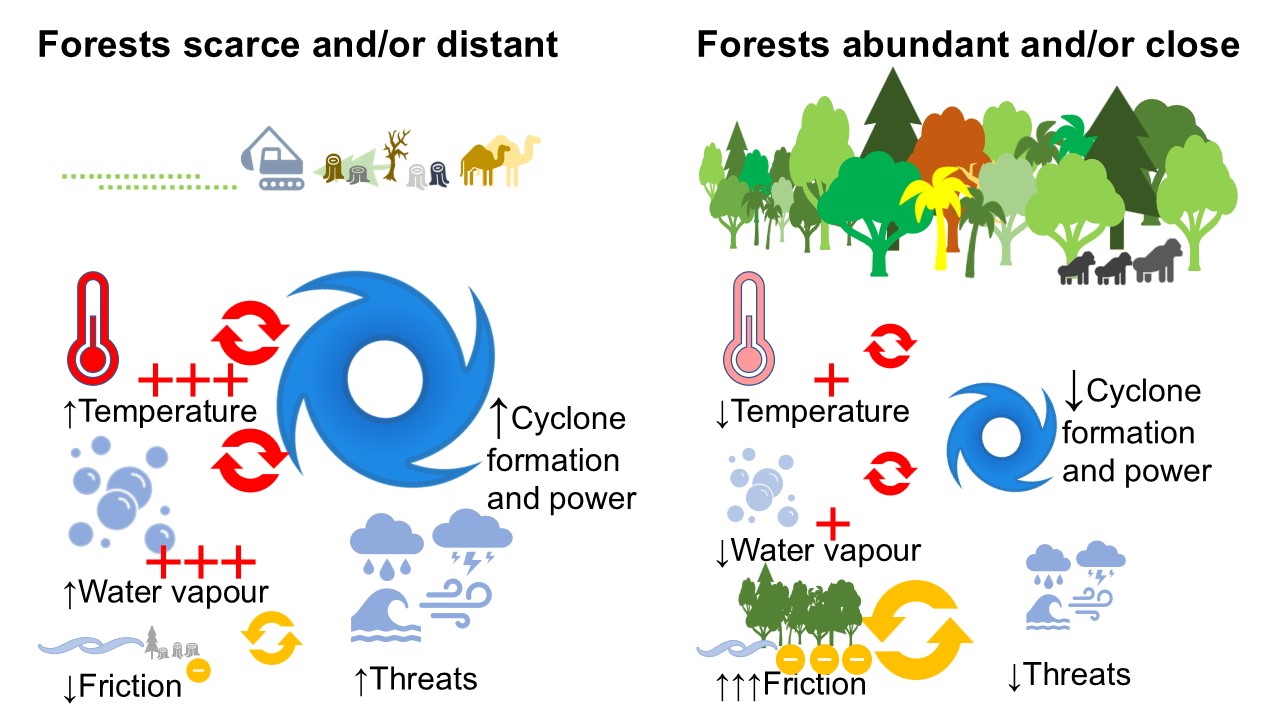
Overall, theory and evidence indicate that tropical forests reduce storm-track damage and may limit the genesis, growth, and persistence of tropical cyclones (see Figure 4). Forests' post-landfall benefits are clear and well-supported: they slow decay, buffer flooding, and curb inland impacts. Evidence justifies integrating conservation and restoration into disaster strategies for at-risk zones.
Pre-landfall effects are less certain. In marginal cyclone zones, forest loss could elevate formation by disrupting moisture flows. Multiple mechanisms noted here warrant systematic appraisal; while speculative, we lack evidence to dismiss them. Given these uncertainties, the precautionary principle supports prioritizing forest conservation: we cannot rule out plausible cyclone risks from deforestation. Research to clarify these links is essential. Meanwhile, natural forests merit protection for their established roles in biodiversity, water security, climate stabilization, and coastal defence—if they also mitigate cyclones, that's an added benefit.
Author Contributions
D.S. proposed the review, conducted the literature review, wrote the manuscript, and prepared the figures and tables.
Funding Information
This research received no external funding.
Data Availability Statement
Not applicable.
Acknowledgements
I am grateful to the many colleagues who have helped inform and develop these ideas. Earlier drafts benefited from comments and suggestions from Dr. Anastassia Makarieva, Professor Kevin Trenberth, Professor Gary Lackmann, Professor Kerry Emanuel and reviewers. I welcome further corrections and suggestions.
Conflicts of Interest
The author declares no conflicts of interest.
Graphical Abstract: See Figure 4.
Glossary
References
- Akinyoola, J. A.; Afolabi, O. O.; Ogunbanjo, O. A.; Akinola, O. E. A review of atmospheric aerosol impacts on regional extreme weather and climate events. Aerosol Sci. Eng. 2024, 8, 249–274. [Google Scholar] [CrossRef]
- Alkama, R.; Cescatti, A. Biophysical climate impacts of recent changes in global forest cover. Science 2016, 351, 600–604. [Google Scholar] [CrossRef]
- Andersen, T.; Shepherd, M. Inland tropical cyclones and the 'brown ocean' concept. In Hurricane Risk; Springer: Cham, Switzerland, 2017; pp. pp 117–134. [Google Scholar] [CrossRef]
- Andrich, M. A.; Imberger, J. The effect of land clearing on rainfall and fresh water resources in Western Australia: A multi-functional sustainability analysis. Int. J. Sustain. Dev. World Ecol. 2013, 20, 549–563. [Google Scholar] [CrossRef]
- Artaxo, P. Amazon deforestation implications in local/regional climate change. Proc. Natl. Acad. Sci. USA 2023, 120, e2317456120. [Google Scholar] [CrossRef]
- Artaxo, P.; Pöhlker, C.; Pöhlker, M. L.; Saturno, J.; Machado, L. A. T.; Andreae, M. O.; Pöschl, U. Tropical and boreal forest–atmosphere interactions: a review. Tellus B 2022, 74, 24–163. [Google Scholar] [CrossRef]
- Austin, K. G.; González-Roglich, M.; Schaffer-Smith, D.; Schwantes, A. M.; Swenson, J. J. Trends in size of tropical deforestation events signal increasing dominance of industrial-scale drivers. Environ. Res. Lett. 2017, 12, 054009. [Google Scholar] [CrossRef]
- Baudena, M.; Tuinenburg, O. A.; Ferdinand, J. P.; van Ek, R.; Staal, A. Effects of land-use change in the Amazon on precipitation are likely underestimated. Glob. Change Biol. 2021, 27, 5580–5587. [Google Scholar] [CrossRef] [PubMed]
- Bhatia, K.; Baker, A.; Yang, W.; Vecchi, G.; Knutson, T.; Murakami, H.; Kossin, J.; Hodges, K.; Dixon, K.; Bronselaer, B.; Whitmore, C. A potential explanation for the global increase in tropical cyclone rapid intensification. Nat. Commun. 2022, 13, 6626. [Google Scholar] [CrossRef]
- Blöschl, G. Three hypotheses on changing river flood hazards. Hydrol. Earth Syst. Sci. 2022, 26, 5015–5033. [Google Scholar] [CrossRef]
- Boers, N.; Marwan, N.; Barbosa, H. M. J.; Kurths, J. A deforestation-induced tipping point for the South American monsoon system. Sci. Rep. 2017, 7, 41489. [Google Scholar] [CrossRef] [PubMed]
- Bonan, G. Ecological Climatology: Concepts and Applications, 3rd ed.; Cambridge University Press: Cambridge, UK, 2016; ISBN 9781107043770. [Google Scholar]
- Carslaw, K. S.; Boucher, O.; Spracklen, D. V.; Mann, G. W.; Rae, J. G. L.; Woodward, S.; Kulmala, M. Large contribution of natural aerosols to uncertainty in indirect forcing. Nature 2013, 503, 67–71. [Google Scholar] [CrossRef] [PubMed]
- Carslaw, K.; Boucher, O.; Spracklen, D.; Mann, G.; Rae, J.; Woodward, S.; Kulmala, M. A review of natural aerosol interactions and feedbacks within the Earth system. Atmos. Chem. Phys. 2010, 10, 1701–1737. [Google Scholar] [CrossRef]
- Cavicchia, L.; von Storch, H.; Gualdi, S. Mediterranean tropical-like cyclones in present and future climate. J. Clim. 2014, 27, 7493–7501. [Google Scholar] [CrossRef]
- Chand, S. S.; Walsh, K. J. E.; Camargo, S. J.; Kossin, J. P.; Tory, K. J.; Wehner, M. F.; Chan, J. C. L.; Klotzbach, P. J.; Dowdy, A. J.; Bell, S. S.; Ramsay, H. A.; Murakami, H. Declining tropical cyclone frequency under global warming. Nat. Clim. Change 2022, 12, 655–661. [Google Scholar] [CrossRef]
- Chen, J.; Chavas, D. R. The transient responses of an axisymmetric tropical cyclone to instantaneous surface roughening and drying. J. Atmos. Sci. 2020, 77, 2807–2834. [Google Scholar] [CrossRef]
- Das, S.; Vincent, J. R. Mangroves protected villages and reduced death toll during Indian super cyclone. Proc. Natl. Acad. Sci. USA 2009, 106, 7357–7360. [Google Scholar] [CrossRef]
- Després, V. R.; Huffman, J. A.; Burrows, S. M.; Hoose, C.; Safatov, A. S.; Buryak, G.; Fröhlich-Nowoisky, J.; Elbert, W.; Andreae, M. O.; Pöschl, U.; Jaenicke, R. Primary biological aerosol particles in the atmosphere: a review. Tellus B 2012, 64, 15598. [Google Scholar] [CrossRef]
- Drumond, A.; Nieto, R.; Gimeno, L. On the contribution of the Tropical Western Hemisphere Warm Pool source of moisture to the Northern Hemisphere precipitation through a Lagrangian approach. J. Geophys. Res. 2011, 116, D00Q04. [Google Scholar] [CrossRef]
- Duque-Gardeazabal, N.; Friedman, A. R.; Brönnimann, S. An Atlantic influence on evapotranspiration in the Orinoco and Amazon basins. Hydrol. Earth Syst. Sci. 2025, 29, 3277–3295. [Google Scholar] [CrossRef]
- Ellison, D.; Morris, C. E.; Locatelli, B.; Sheil, D.; Cohen, J.; Murdiyarso, D.; Gutierrez, V.; van Noordwijk, M.; Creed, I. F.; Pokorny, J.; Gaveau, D.; Spracklen, D. V.; Tobella, A. B.; Ilstedt, U.; Teuling, A. J.; Gebrehiwot, S. G.; Sands, D. C.; Muys, B.; Verbist, B.; Springgay, E.; Sugandi, Y.; Sullivan, C. A. Trees, forests and water: cool insights for a hot world. Glob. Environ. Change 2017, 43, 51–61. [Google Scholar] [CrossRef]
- Ellison, D.; Pokorný, J.; Wild, M. Even cooler insights: on the power of forests to (water the Earth and) cool the planet. Glob. Change Biol. 2024, 30, e17195. [Google Scholar] [CrossRef]
- Emanuel, K. 100 years of progress in tropical cyclone research. Meteorol. Monogr. 2018, 59, 15.1–15.68. [Google Scholar] [CrossRef]
- Emanuel, K. An air-sea interaction theory for tropical cyclones. Part I: steady-state maintenance. J. Atmos. Sci. 1986, 43, 585–605. [Google Scholar] [CrossRef]
- Emanuel, K. Divine Wind: The History and Science of Hurricanes; Oxford University Press: New York, NY, USA, 2005; ISBN 9780195149418. [Google Scholar]
- Emanuel, K. Evidence that hurricanes are getting stronger. Proc. Natl. Acad. Sci. USA 2020, 117, 13194–13195. [Google Scholar] [CrossRef] [PubMed]
- Emanuel, K. Tropical cyclones. Annu. Rev. Earth Planet. Sci. 2003, 31, 75–104. [Google Scholar] [CrossRef]
- Emanuel, K.; Callaghan, J.; Otto, P. A hypothesis for the redevelopment of warm-core cyclones over northern Australia. Mon. Weather Rev. 2008, 136, 3863–3872. [Google Scholar] [CrossRef]
- Emanuel, K.; Camargo, S. J.; Sobel, A. H. Response of global tropical cyclone activity to increasing CO₂: results from downscaling CMIP6 models. J. Clim. 2021, 34, 57–70. [Google Scholar] [CrossRef]
- Fahrenbach, N. L. S.; Wills, R. C. J.; De Hertog, S. J. Mechanistic insights into tropical circulation and hydroclimate responses to future forest cover change. Weather Clim. Dyn. 2025, 6, 1461–1477. [Google Scholar] [CrossRef]
- Fan, J.; Rosenfeld, D.; Zhang, Y.; Giangrande, S. E.; Li, Z.; Machado, L. A. T.; Martin, S. T.; Yang, Y.; Wang, J.; Artaxo, P.; Barbosa, H. M. J.; Braga, R. C.; Comstock, J. M.; Feng, Z.; Gao, W.; Gomes, H. B.; Mei, F.; Pöhlker, C.; Pöhlker, M. L.; Pöschl, U.; de Souza, R. A. F. Substantial convection and precipitation enhancements by ultrafine aerosol particles. Science 2018, 359, 411–418. [Google Scholar] [CrossRef]
- Fan, J.; Zhang, R.; Li, G.; Tao, W.-K. Effects of aerosols and relative humidity on cumulus clouds. J. Geophys. Res.: Atmos. 2007, 112, D14204. [Google Scholar] [CrossRef]
- Findell, K. L.; Yin, Z.; Seo, E.; Dirmeyer, P. A.; Arnold, N. P.; Chaney, N.; Fowler, M. D.; Huang, M.; Lawrence, D. M.; Ma, P.-L.; Santanello, J. A., Jr. Accurate assessment of land–atmosphere coupling in climate models requires high-frequency data output. Geosci. Model Dev. 2024, 17, 1869–1883. [Google Scholar] [CrossRef]
- Flaounas, E.; Davolio, S.; Raveh-Rubin, S.; Pantillon, F.; Miglietta, M. M.; Gaertner, M. A.; Hatzaki, M.; Homar, V.; Khodayar, S.; Korres, G.; Kotroni, V. Mediterranean cyclones: Current knowledge and open questions on dynamics, prediction, climatology and impacts. Weather Clim. Dyn. 2022, 3, 173–208. [Google Scholar] [CrossRef]
- Franco, M. A.; Rizzo, L. V.; Teixeira, M. J.; Artaxo, P.; Azevedo, T.; Lelieveld, J.; Nobre, C. A.; Pöhlker, C.; Pöschl, U.; Shimbo, J.; Xu, X.; Machado, L. A. T. How climate change and deforestation interact in the transformation of the Amazon rainforest. Nat. Commun. 2025, 16, Article number, 7944. [Google Scholar] [CrossRef]
- Gentine, P.; Massmann, A.; Lintner, B. R.; Alemohammad, S. H.; Fu, R.; Green, J. K.; Kennedy, D.; Vilà-Guerau de Arellano, J. Land–atmosphere interactions in the tropics – a review. Hydrol. Earth Syst. Sci. 2019, 23, 4171–4197. [Google Scholar] [CrossRef]
- Ghazoul, J.; Sheil, D. Tropical Rain Forest Ecology, Diversity, and Conservation; Oxford University Press: Oxford, UK, 2010; ISBN 9780199285884. [Google Scholar]
- Gies, E. Is deforestation supercharging cyclones? Hakai Magazine. 21 October 2024. Available online: https://hakaimagazine.com/news/is-deforestation-supercharging-cyclones/ (accessed on 21 January 2026).
- Global Forest Watch. Global Deforestation Rates & Statistics by Country. Available online: https://www.globalforestwatch.org/dashboards/global/ (accessed on 21 January 2026).
- Gorja, M. M. K.; Vissa, N. K.; Viswanadhapalli, Y. Moisture sources for the genesis of tropical cyclones over the Bay of Bengal using the Lagrangian FLEXPART model. Clim. Dyn. 2024, 62, 7127–7147. [Google Scholar] [CrossRef]
- Gray, W. M. Global view of the origin of tropical disturbances and storms. Mon. Weather Rev. 1968, 96, 669–700. [Google Scholar] [CrossRef]
- Hallegatte, S.; Vogt-Schilb, A.; Rozenberg, J.; Bangalore, M.; Beaudet, C. From poverty to disaster and back: a review of the literature. Econ. Disasters Clim. Change 2020, 4, 223–247. [Google Scholar] [CrossRef]
- Hansen, M. C.; Potapov, P. V.; Moore, R.; Hancher, M.; Turubanova, S. A.; Tyukavina, A.; Thau, D.; Stehman, S. V.; Goetz, S. J.; Loveland, T. R.; Kommareddy, A.; Egorov, A.; Chini, L.; Justice, C. O.; Townshend, J. R. G. High-resolution global maps of 21st-century forest cover change. Science 2013, 342, 850–853. [Google Scholar] [CrossRef] [PubMed]
- Hlywiak, J.; Nolan, D. S. The response of the near-surface tropical cyclone wind field to inland surface roughness length and soil moisture content during and after landfall. J. Atmos. Sci. 2021, 78, 983–1000. [Google Scholar] [CrossRef]
- Hochard, J. P.; Hamilton, S. E.; Barbier, E. B. Mangroves shelter coastal economic activity from cyclones. Proc. Natl. Acad. Sci. USA 2019, 116, 12232–12237. [Google Scholar] [CrossRef] [PubMed]
- Huang, C.-Y.; Lin, L.-Y.; Huang, S.-Y.; Liu, S.-C. The influence of island topography on typhoon track deflection. Mon. Weather Rev. 2011, 139, 1708–1727. [Google Scholar] [CrossRef]
- IPCC. Climate Change 2023: Synthesis Report. Contribution of Working Groups I, II and III to the Sixth Assessment Report of the Intergovernmental Panel on Climate Change; Lee, H., Romero, J., Eds.; IPCC: Geneva, Switzerland, 2023; p. 184 pp. [Google Scholar] [CrossRef]
- IPCC. Water Cycle Changes. In Climate Change 2021: The Physical Science Basis. Contribution of Working Group I to the Sixth Assessment Report of the Intergovernmental Panel on Climate Change; Cambridge University Press: Cambridge, UK; Chapter 8, 2021. [Google Scholar] [CrossRef]
- IPCC. Weather and Climate Extreme Events in a Changing Climate. In Climate Change 2021: The Physical Science Basis. Contribution of Working Group I to the Sixth Assessment Report of the Intergovernmental Panel on Climate Change; Cambridge University Press: Cambridge, UK, 2021; p. Chapter 11. [Google Scholar] [CrossRef]
- Jasechko, S.; Sharp, Z. D.; Gibson, J. J.; Birks, S. J.; Yi, Y.; Fawcett, P. J. Terrestrial water fluxes dominated by transpiration. Nature 2013, 496, 347–350. [Google Scholar] [CrossRef]
- Jia, G.; Shevliakova, E.; Artaxo, P.; De Noblet-Ducoudré, N.; Houghton, R.; House, J.; Kitayama, K.; Popp, A.; Sirin, A.; Sukumar, R.; Verchot, L. Land–climate interactions. In Climate Change and Land: An IPCC Special Report on Climate Change, Desertification, Land Degradation, Sustainable Land Management, Food Security, and Greenhouse Gas Fluxes in Terrestrial Ecosystems; Cambridge University Press: Cambridge, UK, 2019; pp. pp 133–206. [Google Scholar] [CrossRef]
- Jian, G.-J.; Wu, C.-C. A numerical study of the track deflection of Supertyphoon Haitang (2005) prior to its landfall in Taiwan. Mon. Weather Rev. 2008, 136, 598–615. [Google Scholar] [CrossRef]
- Sustainable Development Goals: Their Impacts on Forests and People; Katila, P., de Jong, W., Galloway, G., Pacheco, P., Mery, G., Eds.; Cambridge University Press: Cambridge, UK, 2019. [Google Scholar] [CrossRef]
- Keys, P. W.; van der Ent, R. J.; Gordon, L. J.; Hoff, H.; Nikoli, R.; Savenije, H. H. G. Analyzing precipitationsheds to understand the vulnerability of rainfall dependent regions. Biogeosciences 2012, 9, 733–746. [Google Scholar] [CrossRef]
- Knutson, T.; Camargo, S. J.; Chan, J. C. L.; Emanuel, K.; Ho, C.-H.; Kossin, J.; Mohapatra, M.; Satoh, M.; Sugi, M.; Walsh, K.; Wu, L. Tropical cyclones and climate change assessment: Part II. Bull. Am. Meteorol. Soc. 2020, 101, E303–E322. [Google Scholar] [CrossRef]
- Kossin, J. P. A global slowdown of tropical-cyclone translation speed. Nature 2018, 558, 104–107. [Google Scholar] [CrossRef]
- Kossin, J. P.; Knapp, K. R.; Olander, T. L.; Velden, C. S. Global increase in major tropical cyclone exceedance probability over the past four decades. Proc. Natl. Acad. Sci. USA 2020, 117, 11975–11980. [Google Scholar] [CrossRef]
- Kreidenweis, S. M.; Petters, M.; Lohmann, U. 100 years of progress in cloud physics, aerosols, and aerosol chemistry research. Meteorol. Monogr. 2019, 59, 11.1–11.72. [Google Scholar] [CrossRef]
- Krichene, H.; Vogt, T.; Piontek, F. The social costs of tropical cyclones. Nat. Commun. 2023, 14, 7294. [Google Scholar] [CrossRef]
- Kriebel, D.; Tickner, J.; Epstein, P.; Lemons, J.; Levins, R.; Loechler, E.L.; Quinn, M.; Rudel, R.; Schettler, T.; Stoto, M. The precautionary principle in environmental science. Environmental Health Perspectives 2001, 109(9), 871–876. [Google Scholar] [CrossRef]
- Lackmann, G. M.; Yablonsky, R. M. The importance of the precipitation mass sink in tropical cyclones and other heavily precipitating systems. J. Atmos. Sci. 2004, 61, 1674–1692. [Google Scholar] [CrossRef]
- Lawrence, D.; Vandecar, K. Effects of tropical deforestation on climate and agriculture. Nat. Clim. Change 2015, 5, 27–36. [Google Scholar] [CrossRef]
- Lee, J.; Hohenegger, C. Weaker land–atmosphere coupling in global storm-resolving simulation. Proc. Natl. Acad. Sci. USA 2024, 121, e2314265121. [Google Scholar] [CrossRef]
- Lélé, M. I.; Leslie, L. M.; Lamb, P. J. Analysis of low-level atmospheric moisture transport associated with the West African monsoon. J. Clim. 2015, 28, 4414–4430. [Google Scholar] [CrossRef]
- Lettau, H. Note on aerodynamic roughness-parameter estimation on the basis of roughness-element description. J. Appl. Meteorol. 1969, 8, 828–832. [Google Scholar] [CrossRef]
- Li, L.; Chakraborty, P. Slower decay of landfalling hurricanes in a warming world. Nature 2020, 587, 230–234. [Google Scholar] [CrossRef]
- Li, M.; Toumi, R. Can tropical cyclones exist near the Equator? Q. J. R. Meteorol. Soc. 2025, e70014. [Google Scholar] [CrossRef]
- Li, X.; Wu, T.; Xia, K.; Tang, H.; Wang, X.; Wang, S.; Lyne, V.; Zu, Y. Forest loss intensifies meteorological drought in more than half of Earth’s climate zones. Sci. Adv. 2026, 12, eadv7998. [Google Scholar] [CrossRef]
- Li, Y.; Wang, S.; Zhang, Y.; Song, J.; Wang, F. Recent increases in tropical cyclone rapid intensification events in global offshore regions. Nat. Commun. 2023, 14, 5466. [Google Scholar] [CrossRef]
- Li, Y.; Zhao, M.; Manganello, J. V.; Xie, S.-P.; Deng, Z.; Stevens, B. Local cooling and warming effects of forests based on satellite observations. Nat. Commun. 2015, 6, 6603. [Google Scholar] [CrossRef]
- Lin, J.; Qian, T.; Klotzbach, P. Tropical Cyclones. Atmos.-Ocean 2022, 60, 360–398. [Google Scholar] [CrossRef]
- Lin, T.-C.; Hogan, G. D.; Ma, X.; Chang, C.-T. Tropical cyclone ecology: a scale-link perspective. Trends Ecol. Evol. 2020, 35, 594–604. [Google Scholar] [CrossRef]
- Liswanti, N.; Sheil, D.; Basuki, I.; Padmanaba, M.; Mulcahy, G. Falling back on forests: how forest-dwelling people cope with catastrophe in a changing landscape. Int. For. Rev. 2011, 13, 442–455. [Google Scholar] [CrossRef]
- Lok, C. C. F.; Chan, J. C. L.; Wang, Y. Tropical cyclones near landfall can induce their own intensification through feedbacks on radiative forcing. Commun. Earth Environ. 2021, 2, 184. [Google Scholar] [CrossRef]
- Makarieva, A. M.; Gorshkov, V. G. Biotic pump of atmospheric moisture as driver of the hydrological cycle on land. Hydrol. Earth Syst. Sci. 2007, 11, 1013–1033. [Google Scholar] [CrossRef]
- Makarieva, A. M.; Gorshkov, V. G. Condensation-induced dynamic gas fluxes in a mixture of condensable and non-condensable gases. Phys. Rev. E 2009, 80, 046315. [Google Scholar] [CrossRef]
- Makarieva, A. M.; Gorshkov, V. G. The biotic pump: condensation, atmospheric dynamics and climate. Int. J. Water 2010, 5, 365–385. [Google Scholar] [CrossRef]
- Makarieva, A. M.; Gorshkov, V. G.; Li, B.-L. Revisiting forest impact on atmospheric water vapor transport and precipitation. Theor. Appl. Climatol. 2013b, 111, 79–96. [Google Scholar] [CrossRef]
- Makarieva, A. M.; Gorshkov, V. G.; Nefiodov, A. V.; Chikunov, A. V.; Sheil, D.; Nobre, A. D.; Bunyard, P.; Li, B.-L. Empirical evidence for the condensational theory of hurricanes. Phys. Lett. A 2015, 379, 2396–2398. [Google Scholar] [CrossRef]
- Makarieva, A. M.; Gorshkov, V. G.; Nefiodov, A. V.; Chikunov, A. V.; Sheil, D.; Nobre, A. D.; Bunyard, P.; Li, B.-L. Fuel for cyclones: the water vapor budget of a hurricane as dependent on its movement. Atmos. Res. 2017, 193, 216–230. [Google Scholar] [CrossRef]
- Makarieva, A. M.; Gorshkov, V. G.; Sheil, D.; Nobre, A. D.; Li, B.-L. Where do winds come from? A new theory on how water vapor condensation influences atmospheric pressure and dynamics. Atmos. Chem. Phys. 2013a, 13, 1039–1056. [Google Scholar] [CrossRef]
- Makarieva, A. M.; Nefiodov, A. V.; Vozbrannaya, A. E.; Chikunov, A. V.; Gorshkov, V. G.; Sheil, D.; Nobre, A. D.; Bunyard, P. The role of ecosystem transpiration in creating alternate moisture regimes by influencing atmospheric moisture convergence. Glob. Change Biol. 2023, 29, 2536–2556. [Google Scholar] [CrossRef] [PubMed]
- McAlpine, C. A.; Johnson, A.; Salazar, A.; Syktus, J.; Wilson, K.; Meijaard, E.; Seabrook, L.; Dargusch, P.; Nordin, H.; Sheil, D. Forest loss and Borneo's climate. Environ. Res. Lett. 2018, 13, 044009. [Google Scholar] [CrossRef]
- McTaggart-Cowan, R.; Bosart, L. F.; Davis, C. A.; Atallah, E. H.; Gyakum, J. R.; Emanuel, K. A. Analysis of Hurricane Catarina (2004). Mon. Weather Rev. 2006, 134, 3029–3053. [Google Scholar] [CrossRef]
- Mo, L.; Zohner, C. M.; Reich, P. B.; Liang, J.; de Miguel, S.; Nabuurs, G.-J.; Renner, S. S.; van den Hoogen, J.; Araza, A.; Herold, M.; et al. Integrated global assessment of the natural forest carbon potential. Nature 2023, 624, 92–101. [Google Scholar] [CrossRef]
- Montgomery, M. T.; Smith, R. K. Paradigms for tropical-cyclone intensification. Q. J. R. Meteorol. Soc. 2014, 140, 1233–1247. [Google Scholar] [CrossRef]
- Montgomery, M. T.; Smith, R. K. Recent developments in the fluid dynamics of tropical cyclones. Annu. Rev. Fluid Mech. 2017, 49, 541–574. [Google Scholar] [CrossRef]
- Nambiar, E. S. Tamm review: re-imagining forestry and wood business: pathways to rural development, poverty alleviation and climate change mitigation in the tropics. For. Ecol. Manage. 2019, 448, 160–173. [Google Scholar] [CrossRef]
- NASA Global Precipitation Measurement (GPM) Mission. NASA Global Precipitation Measurement (GPM) Mission IMERG precipitation estimates for Cyclone Senyar, November 25-26, 2025. Available online: https://gpm.nasa.gov (accessed on 21 January 2026).
- Pérez-Alarcón, A.; Fernández-Alvarez, J. C.; Sorí, R.; Nieto, R.; Gimeno, L. Moisture source identification for precipitation associated with tropical cyclone development over the Indian Ocean: a Lagrangian approach. Clim. Dyn. 2023, 60, 2735–2758. [Google Scholar] [CrossRef]
- Pérez-Alarcón, A.; Sorí, R.; Fernández-Alvarez, J. C.; Nieto, R.; Gimeno, L. Where does the moisture for North Atlantic tropical cyclones come from? J. Hydrometeorol. 2022, 23, 457–472. [Google Scholar] [CrossRef]
- Pezza, A. B.; Simmonds, I. The first South Atlantic hurricane: Unprecedented blocking, low shear and climate change. Geophys. Res. Lett. 2005, 32, L15712. [Google Scholar] [CrossRef]
- Portmann, R.; Beyerle, U.; Davin, E.; Fischer, E. M.; De Hertog, S.; Schemm, S. Global forestation and deforestation affect remote climate via adjusted atmosphere and ocean circulation. Nat. Commun. 2022, 13, 5569. [Google Scholar] [CrossRef]
- Pöschl, U.; Martin, S. T.; Sinha, B.; Chen, Q.; Gunthe, S. S.; Huffman, J. A.; Borrmann, S.; Farmer, D. K.; Garland, R. M.; Helas, G.; Jimenez, J. L.; King, S. M.; Manzi, A.; Mikhailov, E.; Pauliquevis, T.; Petters, M. D.; Prenni, A. J.; Roldin, P.; Rose, D.; Schneider, J.; Su, H.; Zorn, S. R.; Artaxo, P.; Andreae, M. O. Rainforest aerosols as biogenic nuclei of clouds and precipitation in the Amazon. Science 2010, 329, 1513–1516. [Google Scholar] [CrossRef]
- Qin, Y.; Xiao, Y.; Swenson, J. J.; Lawrence, D.; Zeng, Y.; Tuinenburg, O. A.; Fang, Y.; Wang, Y.; Zhang, X. Impact of Amazonian deforestation on precipitation reverses between seasons. Nature 2025, 639, 102–108. [Google Scholar] [CrossRef]
- Rappaport, E. N. Fatalities in the United States from Atlantic tropical cyclones: New data and interpretation. Bull. Am. Meteorol. Soc. 2014, 95, 341–346. [Google Scholar] [CrossRef]
- Rios-Berrios, R.; Finocchio, P. M.; Alland, J. J.; Chen, X.; Fischer, M. S.; Stevenson, S. N.; Tao, D. A review of the interactions between tropical cyclones and environmental vertical wind shear. J. Atmos. Sci. 2024, 81, 713–741. [Google Scholar] [CrossRef]
- Romdhani, O.; Zarzycki, C. M.; Chavas, D. R.; Davis, C. A. Hurricane track trends and environmental flow patterns under surface temperature changes and roughness length variations. Geophys. Res. Lett. 2024, 51, e2024GL109133. [Google Scholar] [CrossRef]
- Rosenfeld, D.; Bellouin, N.; Field, P.; Forster, P.; Quaas, J.; Myhre, G.; Lohmann, U.; Samset, B. H. Global observations of aerosol-cloud-precipitation-climate interactions. Rev. Geophys. 2014, 52, 750–808. [Google Scholar] [CrossRef]
- Rosenfeld, D.; Lohmann, U.; Raga, G. B.; O'Dowd, C. D.; Kulmala, M.; Fuzzi, S.; Reissell, A.; Andreae, M. O. Simulation of hurricane response to suppression of warm rain by sub-micron aerosols. Atmos. Chem. Phys. 2007, 7, 3411–3424. [Google Scholar] [CrossRef]
- Sabuwala, T.; Gioia, G.; Chakraborty, S. Effect of rainpower on hurricane intensity. Geophys. Res. Lett. 2015, 42, 3024–3029. [Google Scholar] [CrossRef]
- Saha, K. K.; Wasimi, S. A. Statistical modelling of tropical cyclones' longevity after landfall in Australia. Aust. Meteorol. Oceanogr. J. 2015, 65, 376–386. Available online: https://web.archive.org/web/20180602060216id_/http://www.bom.gov.au/jshess/docs/2015/saha.pdf. [CrossRef]
- Savenije, H. H. G. The importance of interception and why we should delete the term evapotranspiration from our vocabulary. Hydrol. Process. 2004, 18, 1507–1511. [Google Scholar] [CrossRef]
- Schenkel, B. A.; Noble, C.; Chavas, D.; Chan, K. T.; Barlow, S. J.; Singh, A.; Musgrave, K. Recent progress in research and forecasting of tropical cyclone outer size. Trop. Cyclone Res. Rev. 2023, 12, 151–164. [Google Scholar] [CrossRef]
- Schlesinger, W. H.; Jasechko, S. Transpiration in the global water cycle. Agric. For. Meteorol. 2014, 189, 115–117. [Google Scholar] [CrossRef]
- Seo, K. H.; Choi, J.; Lee, S. S.; Lau, W. K. M.; Miyakawa, T.; Jin, H.-G. Aerosol effects on Maritime Continent precipitation: Oceanic intensification and land diurnal cycle delay. npj Clim. Atmos. Sci. 2025, 8, 326. [Google Scholar] [CrossRef]
- Sheil, D. Forests, atmospheric water and an uncertain future: the new biology of the global water cycle. For. Ecosys. 2018, 5, 19. [Google Scholar] [CrossRef]
- Sheil, D. How plants water our planet: advances and imperatives. Trends Plant Sci. 2014, 19, 209–211. [Google Scholar] [CrossRef]
- Sheil, D.; Burslem, D. F. R. P. Disturbing hypotheses in tropical forests. Trends Ecol. Evol. 2003, 18, 18–26. [Google Scholar] [CrossRef]
- Sheil, D.; Murdiyarso, D. How forests attract rain: an examination of a new hypothesis. BioScience 2009, 59, 341–347. [Google Scholar] [CrossRef]
- Sheil, D. Forests versus hurricanes. Forests News. 18 Sep 2017. Available online: https://www.forestsnews.org/51566/forests-versus-hurricanes?fnl=en (accessed on 21 January 2026).
- Smith, C.; Baker, J. C. A.; Spracklen, D. V. Tropical deforestation causes large reductions in observed precipitation. Nature 2023, 615, 270–275. [Google Scholar] [CrossRef]
- Spracklen, D. V.; Arnold, S. R.; Taylor, C. M. Observations of increased tropical rainfall preceded by air passage over forests. Nature 2012, 489, 282–286. [Google Scholar] [CrossRef]
- Spracklen, D. V.; Bonn, B.; Carslaw, K. S.; Kulmala, M.; Kerminen, V.-M.; Sihto, S.-L.; Riipinen, I.; Merikanto, J.; Mann, G. W.; Chipperfield, M. P.; Wiedensohler, A.; Birmili, W.; Lihavainen, H. Contribution of particle formation to global cloud condensation nuclei concentrations. Geophys. Res. Lett. 2008, 35, L06808. [Google Scholar] [CrossRef]
- Spracklen, D. V.; Jimenez, J. L.; Carslaw, K. S.; Worsnop, D. R.; Evans, M. J.; Mann, G. W.; Zhang, Q.; Canagaratna, M. R.; Allan, J.; Coe, H.; McFiggans, G.; Rap, A.; Forster, P. Aerosol mass spectrometer constraint on the global secondary organic aerosol budget. Atmos. Chem. Phys. 2011, 11, 12109–12136. [Google Scholar] [CrossRef]
- Stier, P.; van den Heever, S. C.; Christensen, M. W.; Gryspeerdt, E.; Dagan, G.; Saleeby, S. M.; Bollasina, M.; Donner, L.; Emanuel, K.; Ekman, A. M. L.; Feingold, G.; Field, P.; Forster, P.; Haywood, J.; Kahn, R.; Koren, I.; Kummerow, C.; L'Ecuyer, T.; Lohmann, U.; Ming, Y.; Myhre, G.; Quaas, J.; Rosenfeld, D.; Samset, B. H.; Schulz, M.; Stevens, B.; Stubenrauch, C. J.; Tao, W.-K. Multifaceted aerosol effects on precipitation. Nat. Geosci. 2024, 17, 719–732. [Google Scholar] [CrossRef]
- Szeto, K.; Chan, J. Structural Changes of a Simulated Tropical Cyclone Approaching Land: Effects of Land–Sea Contrast. Mon. Weather Rev. 2010, 138, 4340–4360. [Google Scholar] [CrossRef]
- Takaya, Y.; Caron, L. P.; Blake, E.; Bonnardot, F.; Bruneau, N.; Camp, J.; Chan, J.; Gregory, P.; Jones, J. J.; Kang, N.; Klotzbach, P. J. Recent advances in seasonal and multi-annual tropical cyclone forecasting. Trop. Cyclone Res. Rev. 2023, 12, 182–199. [Google Scholar] [CrossRef]
- Tao, W.-K.; Chen, J.-P.; Li, Z.; Wang, C.; Zhang, C. Impact of aerosols on convective clouds and precipitation. Rev. Geophys. 2012, 50, RG2001. [Google Scholar] [CrossRef]
- Taye, F. A.; Folkersen, M. V.; Fleming, C. M.; Buckwell, A.; Luckey, B.; Diwakar, K. C.; Le, D.; Hasan, S.; Saint Ange, C. The economic values of global forest ecosystem services: A meta-analysis. Ecol. Econ. 2021, 189, 107145. [Google Scholar] [CrossRef]
- Thompson, G.; Eidhammer, T. A study of aerosol impacts on clouds and precipitation development in a large winter cyclone. J. Atmos. Sci. 2014, 71, 3636–3658. [Google Scholar] [CrossRef]
- Tiwari, P.; Rao, A. D.; Pandey, S.; Pant, V. Assessing the influence of land use and land cover data on cyclonic winds and coastal inundation due to tropical cyclones: a case study for the east coast of India. Nat. Hazards 2024, 120, 10219–10240. [Google Scholar] [CrossRef]
- Tran, T. L.; Prinsley, R.; Rosenfeld, D.; Cleugh, H.; Fan, J. Can we mitigate tropical cyclone formation using aerosols? A review of cyclogenesis and aerosol effects as a theoretical basis. Atmos. Res. 2025, 314, 107779. [Google Scholar] [CrossRef]
- Trenberth, K. E. Atmospheric moisture recycling: role of advection and local evaporation. J. Clim. 1999, 12, 1368–1381. [Google Scholar] [CrossRef]
- Trenberth, K. E. Warmer oceans, stronger hurricanes. Sci. Am. 2007, 297, 44–51. [Google Scholar] [CrossRef]
- Trenberth, K. E.; Smith, L.; Qian, T.; Dai, A.; Fasullo, J. Estimates of the Global Water Budget and Its Annual Cycle Using Observational and Model Data. J. Hydrometeorol. 2007, 8, 758–769. [Google Scholar] [CrossRef]
- Trenberth, K. E.; Smith, L.; Qian, T.; Dai, A.; Fasullo, J. Water and energy budgets of hurricanes: case studies of Ivan and Katrina. J. Geophys. Res.: Atmos. 2007, 112, D23106. [Google Scholar] [CrossRef]
- United-Nations. Rio Declaration on Environment and Development. Principle 15. United Nations Conference on Environment and Development, Rio de Janeiro, Brazil, 3–14 June 1992; United Nations. Available online: https://www.un.org/en/development/desa/population/migration/generalassembly/docs/globalcompact/A_CONF.151_26_Vol.I_Declaration.pdf.
- van der Ent, R. J.; Savenije, H. H. G.; Schaefli, B.; Steele-Dunne, S. C. Origin and fate of atmospheric moisture over continents. Water Resour. Res. 2010, 46, W09525. [Google Scholar] [CrossRef]
- Versieux, V.; Costa, M. H. Local Evapotranspiration Is the Only Relevant Source of Moisture at the Onset of the Rainy Season in South America. Atmosphere 2024, 15, 932. [Google Scholar] [CrossRef]
- Wang, Q.; Kieu, C.; Vu, T.-A. Large-scale dynamics of tropical cyclone formation associated with ITCZ breakdown. Atmos. Chem. Phys. 2019, 19, 8383–8397. [Google Scholar] [CrossRef]
- Wang, S.; Toumi, R. More tropical cyclones are striking coasts with major intensities at landfall. Sci. Rep. 2022, 12, 5236. [Google Scholar] [CrossRef]
- Wang, S.; Toumi, R. Recent migration of tropical cyclones toward coasts. Science 2021, 371, 514–517. [Google Scholar] [CrossRef] [PubMed]
- Wang, Y.; Lee, K. H.; Lin, Y.; Levy, M.; Zhang, R. Distinct effects of anthropogenic aerosols on tropical cyclones. Nat. Clim. Change 2014, 4, 368–373. [Google Scholar] [CrossRef]
- Wang, Y.; Matyas, C. J. Simulating the Effects of Land Surface Characteristics on Planetary Boundary Layer Parameters for a Modeled Landfalling Tropical Cyclone. Atmosphere 2022, 13, 138. [Google Scholar] [CrossRef]
- Weinkle, J.; Maue, R.; Pielke, R., Jr. Historical global tropical cyclone landfalls. J. Clim. 2012, 25, 4729–4735. [Google Scholar] [CrossRef]
- Willoughby, H. E.; Jorgensen, D. P.; Black, R. A.; Rosenthal, S. L. Project STORMFURY: A Scientific Chronicle 1962–1983. Bull. Am. Meteorol. Soc. 1985, 66, 505–514. [Google Scholar] [CrossRef]
- Wong, M. L. M.; Chan, J. C. L. Tropical cyclone motion in response to land surface friction. J. Atmos. Sci. 2006, 63, 1324–1337. [Google Scholar] [CrossRef]
- World Weather Attribution. World Weather Attribution Report on Cyclone Senyar. Available online: https://worldweatherattribution.org (accessed on 21 January 2026).
- Wright, J. S.; Fu, R.; Worden, J. R.; Chakraborty, S.; Clinton, N. E.; Risi, C.; Sun, Y.; Yin, L. Rainforest-initiated wet season onset over the southern Amazon. Proc. Natl. Acad. Sci. USA 2017, 114, 8481–8486. [Google Scholar] [CrossRef] [PubMed]
- Wu, C.-C.; Li, T.-H.; Huang, Y.-H. Influence of Mesoscale Topography on Tropical Cyclone Tracks: Further Examination of the Channeling Effect. J. Atmos. Sci. 2015, 72, 3032–3050. [Google Scholar] [CrossRef]
- Wunder, S.; Börner, J.; Shively, G.; Wyman, M. Safety nets, gap filling and forests: a global-comparative perspective. World Dev. 2014, 64, S29–S42. [Google Scholar] [CrossRef]
- Young, R.; Hsiang, S. Mortality caused by tropical cyclones in the United States. Nature 2024, 633, 580–586. [Google Scholar] [CrossRef]
- Yu, X.; Lei, Y.; Wang, Z.; Zhao, D.; Li, Y.; Liu, L.; Wu, B.; Che, H.; Zhang, X. Inhomogeneous aerosol forcing increasing tropical cyclone intensity in western North Pacific by weakening vertical wind shear. Environ. Res. Lett. 2025, 20, 034042. [Google Scholar] [CrossRef]
- Zemp, D. C.; Schleussner, C.-F.; Barbosa, H. M. J.; Hirota, M.; Montade, V.; Sampaio, G.; Staal, A.; Wang-Erlandsson, L.; Rammig, A. Self-amplified Amazon forest loss due to vegetation-atmosphere feedbacks. Nat. Commun. 2017, 8, 14681. [Google Scholar] [CrossRef]
- Zhao, H.; Klotzbach, P. J.; Chand, S. S.; Camargo, S. J.; Cao, J.; Wu, L. Decreasing global tropical cyclone frequency in CMIP6 historical simulations. Sci. Adv. 2024, 10, eadl2142. [Google Scholar] [CrossRef]
- Zhao, H.; Klotzbach, P. J.; Chand, S. S.; Camargo, S. J.; Chan, J. C. L.; Wu, L. Decreasing global tropical cyclone frequency in CMIP6 historical simulations. Sci. Adv. 2024, 10, eadl2142. [Google Scholar] [CrossRef] [PubMed]
- Zhong, Q. a; Gan, J.; Shi, D.; Tu, S.; Chan, J. C. L. Do Tropical Cyclones Have a Steady Translation Under a Uniform Steering Flow? Geophys. Res. Lett. 2026, 53, e2025GL119479. [Google Scholar] [CrossRef]
- Zhong, Q. b; Gan, J.; Tu, S.; Toumi, R.; Chan, J. C. L. Global increase in rain rate of tropical cyclones prior to landfall. Nat. Commun. 2026, 17, 68070. [Google Scholar] [CrossRef] [PubMed]
Figure 2.
Predicted and observed power in the cyclone eyewall with respect to cyclone velocity. Empirical data (blue bars with two standard deviations) and predicted values, redrawn from data and analyses presented in [Sabuwala et al 2015; Makarieva, et al. 2015]. See these publications for more details on how the observations and calculations are made.
Figure 2.
Predicted and observed power in the cyclone eyewall with respect to cyclone velocity. Empirical data (blue bars with two standard deviations) and predicted values, redrawn from data and analyses presented in [Sabuwala et al 2015; Makarieva, et al. 2015]. See these publications for more details on how the observations and calculations are made.
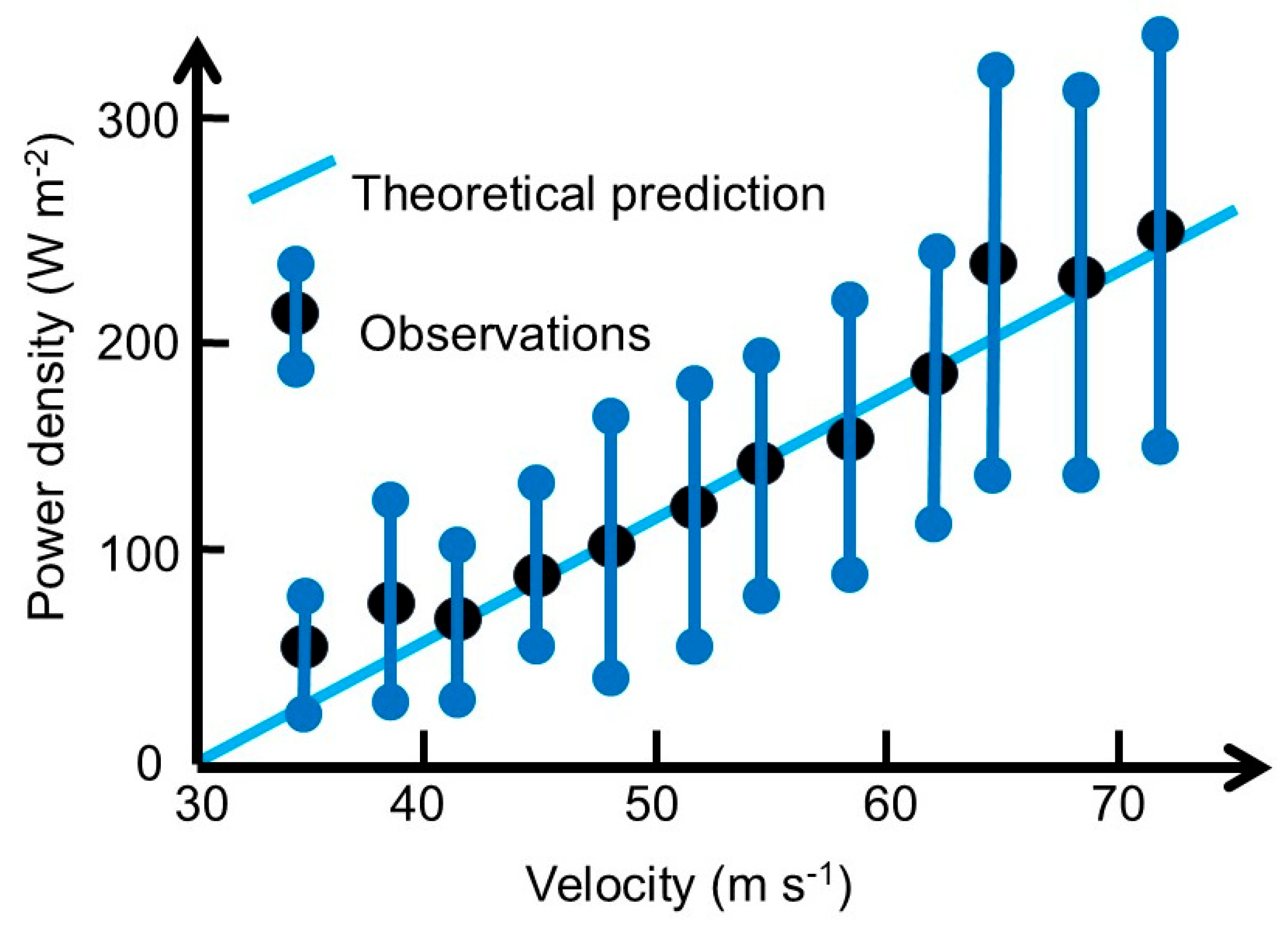
Figure 3.
Schematic illustration of moisture dynamics and the biotic pump concept in relation to atmospheric conditions for cyclone formation. Vertical solid arrows represent evaporation intensity (arrow width indicates relative flux magnitude). The resulting low atmospheric pressure over regions with higher evaporation rates draws in moist air from areas with lower evaporation (horizontal open arrows), creating net moisture transfer toward high-evaporation regions. The dark blue spiral symbol indicates potential cyclone formation. (a) Under full sunshine, tropical forests maintain higher evaporation rates than oceans, drawing moist ocean air inland and reducing moisture available for cyclone formation over oceans. (b) In deserts with low evaporation, air flows toward oceans where moisture accumulates, potentially favouring cyclone formation. (c) In seasonal climates, forest evaporation may fall below oceanic rates during dry winter seasons when solar energy is insufficient; oceans then draw air from land and moisture may accumulate, though lower temperatures reduce cyclone likelihood. In summer, high forest evaporation is reestablished (as in panel a), creating seasonal monsoon circulation. (d) Following deforestation, reduced land evaporation cannot counterbalance oceanic evaporation; air flows seaward, land becomes arid, and moisture accumulates over oceans, potentially increasing cyclone formation. (e) Continuous forest cover maintaining high evaporation draws large volumes of moist air inland from coasts. Conditions most favourable for cyclone formation (sustained high oceanic moisture) occur primarily in scenarios b, c (warm season), and d; the smaller symbol in c reflects lower water vapour at cooler temperatures. Note: Dry air returns at higher altitudes from wetter to drier regions to complete the circulation cycle. Internal recycling of rain contributes significantly to continental-scale rainfall patterns but is not shown. Modified from Sheil and Murdiyarso (2009).
Figure 3.
Schematic illustration of moisture dynamics and the biotic pump concept in relation to atmospheric conditions for cyclone formation. Vertical solid arrows represent evaporation intensity (arrow width indicates relative flux magnitude). The resulting low atmospheric pressure over regions with higher evaporation rates draws in moist air from areas with lower evaporation (horizontal open arrows), creating net moisture transfer toward high-evaporation regions. The dark blue spiral symbol indicates potential cyclone formation. (a) Under full sunshine, tropical forests maintain higher evaporation rates than oceans, drawing moist ocean air inland and reducing moisture available for cyclone formation over oceans. (b) In deserts with low evaporation, air flows toward oceans where moisture accumulates, potentially favouring cyclone formation. (c) In seasonal climates, forest evaporation may fall below oceanic rates during dry winter seasons when solar energy is insufficient; oceans then draw air from land and moisture may accumulate, though lower temperatures reduce cyclone likelihood. In summer, high forest evaporation is reestablished (as in panel a), creating seasonal monsoon circulation. (d) Following deforestation, reduced land evaporation cannot counterbalance oceanic evaporation; air flows seaward, land becomes arid, and moisture accumulates over oceans, potentially increasing cyclone formation. (e) Continuous forest cover maintaining high evaporation draws large volumes of moist air inland from coasts. Conditions most favourable for cyclone formation (sustained high oceanic moisture) occur primarily in scenarios b, c (warm season), and d; the smaller symbol in c reflects lower water vapour at cooler temperatures. Note: Dry air returns at higher altitudes from wetter to drier regions to complete the circulation cycle. Internal recycling of rain contributes significantly to continental-scale rainfall patterns but is not shown. Modified from Sheil and Murdiyarso (2009).
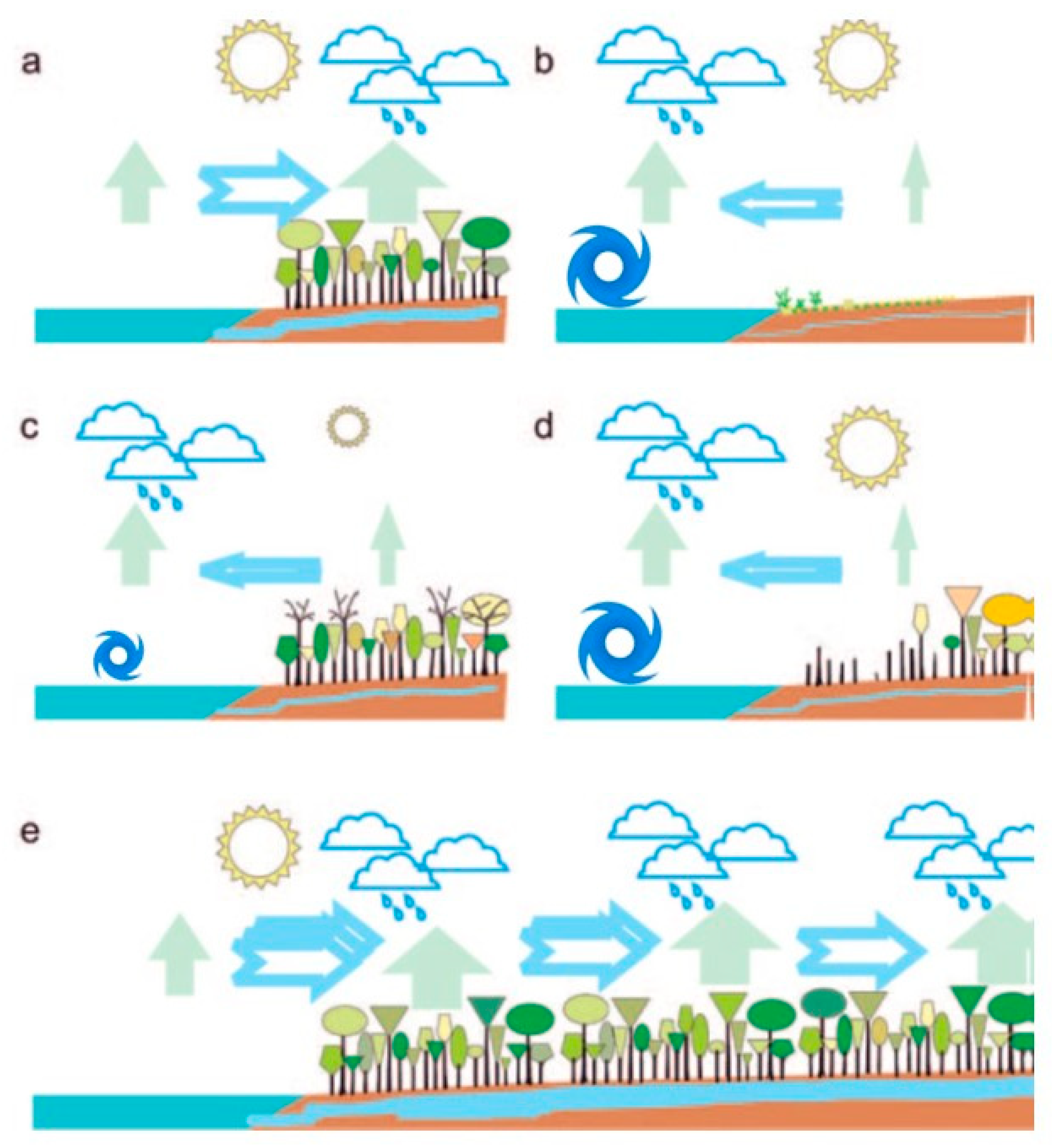
Figure 4.
Schematic representation of the formation and power gain of tropical cyclones in a context without extensive forest and with (and near to) extensive forests. Red + signs show sources of energy (heat and vapour) that available to cyclones while yellow – show losses of energy (friction). We omit aerosols as though they likely play a role their contribution is uncertain. The magnitude of the relationships remains speculative though we are confident about the sign (plus or minus) : i.e., while friction plays a negative role in cyclone development, heat and moisture play positive roles.
Figure 4.
Schematic representation of the formation and power gain of tropical cyclones in a context without extensive forest and with (and near to) extensive forests. Red + signs show sources of energy (heat and vapour) that available to cyclones while yellow – show losses of energy (friction). We omit aerosols as though they likely play a role their contribution is uncertain. The magnitude of the relationships remains speculative though we are confident about the sign (plus or minus) : i.e., while friction plays a negative role in cyclone development, heat and moisture play positive roles.
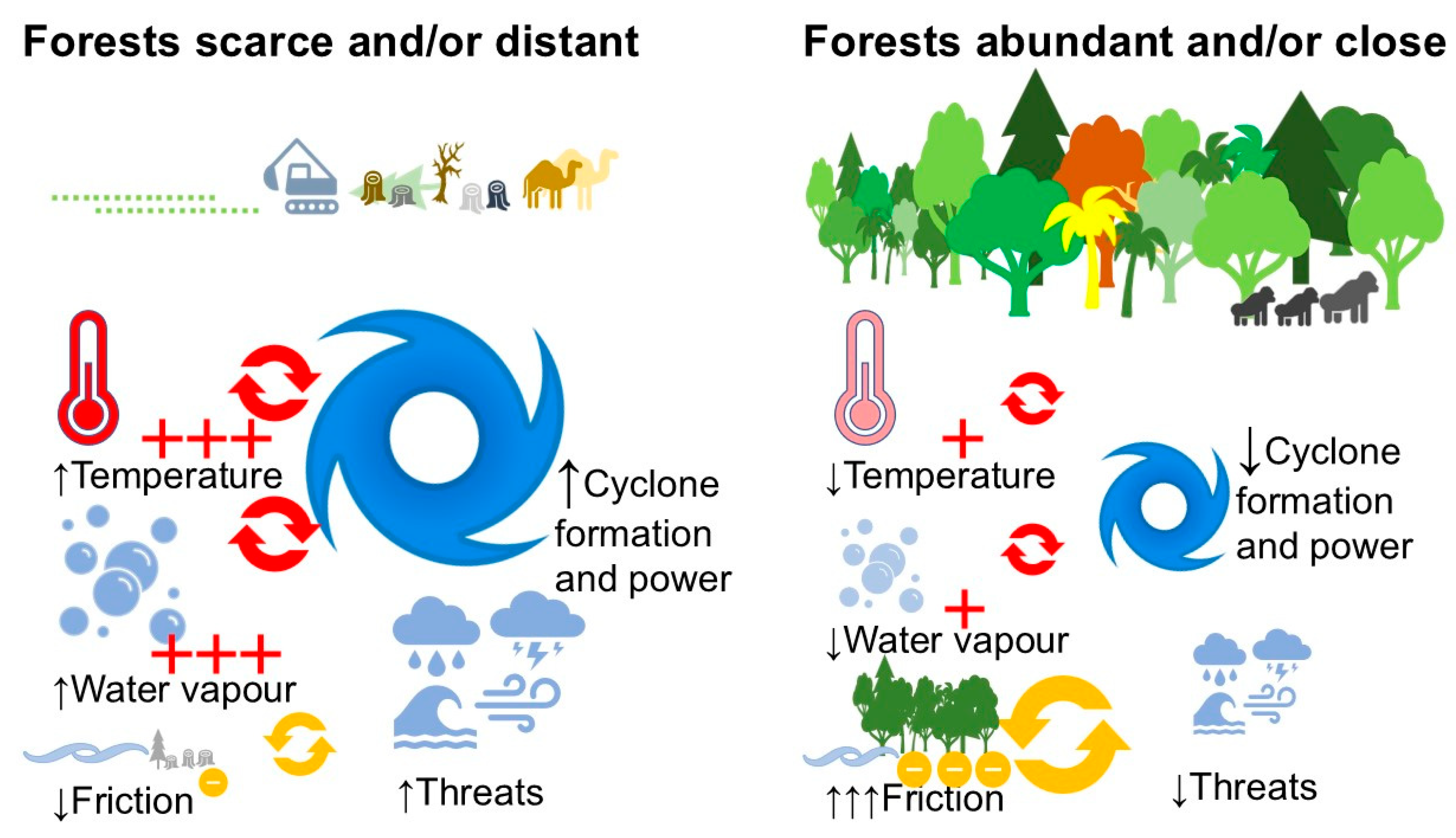

Table 1.
Distinct forest-related processes influencing tropical cyclones, including spatial/temporal scales, potential implications of forest loss, evidence certainty, and key sources. *Evidence certainty: High = consistent observations/models; Medium = plausible with moderate support; Low = theoretical/debated indirect support. **Effects most plausible in marginal atmospheric conditions (e.g., near thresholds for storm genesis and growth).
Table 1.
Distinct forest-related processes influencing tropical cyclones, including spatial/temporal scales, potential implications of forest loss, evidence certainty, and key sources. *Evidence certainty: High = consistent observations/models; Medium = plausible with moderate support; Low = theoretical/debated indirect support. **Effects most plausible in marginal atmospheric conditions (e.g., near thresholds for storm genesis and growth).
| Process/Effect | Scale | Potential Implications of Forest Loss | Evidence Certainty* | Key Sources |
|---|---|---|---|---|
| Surface cooling via albedo, evapotranspiration, and roughness ** | Local to regional (tens to hundreds of km); hours to seasons | Warmer land surfaces, weakening land-sea temperature contrasts and shifting convergence seaward, potentially increasing offshore storm activity in marginal areas | Low | (Bonan, 2016; Alkama & Cescatti, 2016; Li et al., 2015; Lawrence & Vandecar, 2015; Portmann et al., 2022; Fahrenbach et al., 2025) |
| Moisture recycling and evapotranspiration influencing atmospheric humidity ** | Regional to continental (hundreds to thousands of km); seasonal to interannual | Reduced atmospheric moisture availability; effects on cyclone development depend on whether forests act as net moisture source or sink to oceanic areas, and on local circulation patterns | Medium | (Gentine et al., 2019; Zemp et al., 2017; Keys et al., 2012; Duque-Gardeazabal et al., 2025; Artaxo 2023; Trenberth et al., 2007a,b; Schneider et al., 2017; van der Ent, 2010; Boers et al., 2017) |
| Condensation-driven pressure gradients and circulation (Biotic Pump theory) ** | Regional to continental (hundreds to thousands of km); seasonal | Diminished low pressure drawing moisture inland, potentially elevating oceanic moisture availability and cyclone likelihood | Low | (Makarieva et al., 2017; Baudena et al., 2021; Makarieva et al., 2023; Boers et al., 201; Findell et al., 2024;) |
| Aerosols (biogenic CCN/INP) influencing cloud microphysics and precipitation ** | Local to regional (tens to hundreds of km); hours to days | Altered CCN/INP levels may suppress or invigorate convection with uncertain cyclone impacts, including possible suppression of early-stage intensification | Low | (Spracklen et al., 2011; Carslaw et al., 2013; Rosenfeld et al., 2014; Fan et al., 2018; Rosenfeld et al., 2007; Akinyoola et al., 2024; Tran et al., 2025) |
| Surface roughness accelerating energy loss at landfall | Local (tens to hundreds of km); hours to days | Faster storm decay over forest; cleared land extends storm life, increasing inland wind damage by 20-40% | High | (Wu et al., 2022; Chen & Chavas, 2020) |
| Hydrological buffering influencing flooding post-landfall | Local (tens to hundreds of km); hours to days | Increased runoff and flood risk due to reduced infiltration, though context-dependent (e.g., soil saturation limits; effects vary with storm speed and antecedent conditions) | Medium to high | (Jia et al., 2019; Hlywiak & Nolan, 2021; Wang & Matyas, 2022; Blöschl, 2022) |
| Forest influences on storm tracks (via friction, moisture, temperature, and pressure gradients) | Local to regional (tens to hundreds of km); hours to days | Altered landward drift, speed, and rainfall distribution, potentially increasing exposure frequency or duration in coastal areas | Low to medium | (Kossin, 2018; Szeto & Chan, 2010; Huang et al., 2011; Jian & Wu, 2008; Wu et al., 2015; Romdhani et al., 2024) |
Disclaimer/Publisher’s Note: The statements, opinions and data contained in all publications are solely those of the individual author(s) and contributor(s) and not of MDPI and/or the editor(s). MDPI and/or the editor(s) disclaim responsibility for any injury to people or property resulting from any ideas, methods, instructions or products referred to in the content. |
© 2026 by the authors. Licensee MDPI, Basel, Switzerland. This article is an open access article distributed under the terms and conditions of the Creative Commons Attribution (CC BY) license (http://creativecommons.org/licenses/by/4.0/).
Copyright: This open access article is published under a Creative Commons CC BY 4.0 license, which permit the free download, distribution, and reuse, provided that the author and preprint are cited in any reuse.


