

Submitted:
24 October 2024
Posted:
25 October 2024
You are already at the latest version
Abstract
Antimicrobial resistance (AMR) is a growing threat that undermines the effectiveness of global healthcare. The Centers for Disease Control and Prevention and the World Health Organization have identified numerous microbial organisms, particularly members of the ESKAPEE pathogens, as critical threats to global health and economic security. Many clinical isolates of these pathogens have become completely resistant to current antibiotics, making treatment nearly impossible. Herbal remedies, such as those found in Traditional Chinese Medicine (TCM), have been practiced for thousands of years and successfully used to treat a wide range of ailments, including infectious diseases. Surprisingly, despite this extensive knowledge of folk medicine, no plant-derived antibacterial drugs are currently approved for clinical use. This study explores a comprehensive library comprising 664 extracts from 132 distinct TCM plant species for antimicrobial properties against gram-negative (Escherichia coli) and gram-positive (Micrococcus luteus) bacteria using liquid and solid in vitro assays. Intriguingly, our results reveal 17 plant species with potent antimicrobial properties effective primarily against gram-positive organisms, including Streptococcus aureus and epidermidis. Our results indicate that phytobiotics from the identified plants may be potential candidates for novel antimicrobials.
Keywords:
Medicinal Plants
; Traditional Chinese Medicine
; Phytobiotics
; Antimicrobials
; Antibiotic Resistance
1. Introduction
Globally, antimicrobial resistance (AMR) has emerged as a significant threat to sustainable healthcare. In the United States alone, the Centers for Disease Control and Prevention attributes over 35,000 deaths annually to AMR, with nearly 5 million individuals worldwide succumbing to antimicrobial-resistant infections [1,2]. These infections not only cause a significant loss of life but also result in economic losses amounting to billions of dollars [3]. Without viable alternatives to current therapies, it is estimated that the worldwide death toll could increase nearly tenfold, while the economic impact could reduce the global gross domestic product by more than 3% [3,4]. Some organisms in particular, such as the ESKAPEE pathogens, named for Enterococcus faecium, Staphylococcus aureus, Klebsiella pneumoniae, Acinetobacter baumannii, Pseudomonas aeruginosa, Enterobacter spp. and Escherichia coli, are labeled as critical or high-priority threats to global health security due to their prevalence in nosocomial infections and high rates of antimicrobial resistance [1,5,6,7]. As the number of AMR bacterial strains continues to rise, the development of new antibiotics has nearly halted, primarily due to the unfavorable economics associated with sales of therapeutics for acute conditions such as infections [8].
Without new antibiotic development, the research has turned its attention to investigating alternative therapies, including drug repurposing, bacteriophages, silver nanoparticles, and other options [9,10,11,12,13]. Herbal remedies within Traditional Chinese Medicine (TCM) offer a promising yet underexplored source of potential antimicrobial drugs. A comprehensive collection of 664 extracts from 132 TCM plant species is available from the National Cancer Institute [14]. Research into TCM plants and their potential antimicrobial properties has significantly increased over the past several years. While many of the TCM plants have been used for medicinal purposes for thousands of years, demonstrating efficacy against various ailments, including infectious diseases [15], the active components are emerging as potential therapeutics [16]. Plant-derived compounds have long been known for antimicrobial properties, primarily attributed to organic acids, polyphenols, alkaloids, flavonoids, quinones, and volatile oils [17,18,19,20,21]. The most notable of these applications is perhaps artemisinin, derived from Artemisia annua, and is used against Plasmodium falciparum and related species [22]. Discovered by Professor Youyou Tu, artemisinin has become the standard treatment for many forms of malaria and has revolutionized healthcare, earning Professor Tu the Nobel Prize in 2015 [23].
While plants produce thousands of compounds that enhance their immune systems and protect against bacterial infections, efforts to identify phytobiotics suitable for human use have been challenging, as plant compounds are often significantly weaker than antimicrobials produced by bacteria and fungi [24]. Furthermore, it is believed that in some cases, plant extracts are only effective in conjunction with other compounds derived from the same plant, as such combinations are better suited to overcoming bacterial resistance [24]. Among other challenges, plant-derived metabolites often have complicated biosynthesis pathways, which hinders their scale production [25,26]. Despite all the complexities, plants remain a promising source of novel antimicrobials.
In this study, we examine extracts from the TCM library for their antibacterial activity against gram-positive (Micrococcus luteus, S. aureus, Staphylococcus epidermidis) and gram-negative (E. coli) organisms. Employing a combination of solid and liquid screening assays, we initially tested each of the 664 extracts against M. luteus and E. coli and followed up by confirming their antimicrobial activity using Streptococcus species. Of 664 extracts tested, 25 from 17 unique plant species demonstrated activity against gram-positive bacteria. Our study provides a comprehensive analysis of TCM plants for antimicrobial activity, reveals potentially new candidates for further therapeutic development, and opens new opportunities for applications in human and animal medicine.
2. Results
2.1. Experimental Overview and Identification of TCM Plant Extracts with Antimicrobial Properties
To identify plants with antimicrobial properties, we employed both solid and liquid assay screens targeting representative gram-positive and gram-negative organisms. Initially, 25 µL (25 µg total) of each of the 664 extracts was spotted onto a sterile paper disc and incubated on a bacterial lawn of two indicator strains, E. coli (DH5α) or M. luteus (SK58). We specifically chose these strains of bacteria based on our preliminary assessment, indicating that they are more susceptible to antibiotics compared to other strains, thereby enhancing the sensitivity of our screen. Collectively, we tested 768 spots that included vehicle controls and 664 extracts. As expected for a gram-negative strain, M. luteus was much more susceptible to the antimicrobial activity of extracts than E. coli. Therefore, we repeated the screen of all extracts using M. luteus. Collectively, of all extracts tested, 25 exhibited inhibitory properties against gram-positive bacteria, and one showed mild inhibition against gram-negative E. coli (Figure 1, Figure S1, Table 1). Extracts that produced a zone of inhibition (ZOI) greater than the diameter of the paper disc (6 mm) were further validated using a disc diffusion assay and subsequently tested in a plate dilution assay against a broader selection of bacterial species.
2.2. Extract Screen Reveals 17 TCM Plant Species with Antimicrobial Properties
To further validate the efficacy of the 25 extracts with antimicrobial activity, we repeated the disc diffusion assay using M. luteus SK58, S. epidermidis BCM0060, S. aureus 12600, and E. coli DH5a. All ZOI measurements from both the initial and confirmational disc diffusion assays were recorded and are shown in Table 1, with full information, including extract IDs, listed in Table S1. For M. luteus, we recorded the largest ZOI measurement across the three runs. These experiments reveal several extracts with robust antimicrobial properties. In particular, Lithospermum erythrorhizon extract (#396) was the only one that inhibited all four species, though extract #460 from the same plant inhibited three bacterial strains (Figure 2, Table 1). While #396 extract robustly inhibited gram-positive bacteria, it exhibited minimal inhibition against E. coli (Figure 2, Figure S2). Evodia rutaecarpa extracts (#33, #424, and #727), Glycyrrhiza uralensis extract (#245), Juncus effusus extracts (#275, #395, and #415), Sophora flavescens extract (#413), Agrimonia pilosa extract (#456), and Salvia miltiorrhiza extract (#694) inhibited all gram-positive bacteria tested (Table 1). The extracts from all 17 plants identified in our study were previously extensively studied for their antimicrobial property against a broad spectrum of bacterial pathogens (Table 2), further supporting their antimicrobial properties.
2.3. Liquid Assay
E. rutaecarpa extract (#727) was exceptionally effective against M. luteus and other gram-positive species (Table 1, Figure S1, Figure S2). Additionally, three different extracts from this plant (#33, #424, #727) were identified as hits in the initial screen (Table S1), further confirming its antimicrobial potential. Based on these findings, we selected E. rutaecarpa extract #727 for further evaluation of its efficacy in a plate dilution liquid assay. The extract was serially diluted and tested for its ability to inhibit the growth of the four bacterial strains. Our results reveal that the extract was most effective against M. luteus with an MIC of 10.2 µg/mL (Figure 3). Although the extract did not fully inhibit other gram-positive strains, it still exhibited significant antimicrobial activity with greater than 50% growth inhibition observed (Figure 3). In total, we identified 25 extracts from 17 unique plant species that exhibit antimicrobial properties, primarily against gram-positive bacteria. Since crude extracts, rather than isolated active components, were tested in our assays, the exact potency of each phytobiotic remains to be determined in follow-up studies. Nevertheless, our study highlights plants that could potentially serve as sources of novel antimicrobials.
2.4. Phylogenetic Analysis
We sought to examine potential evolutionary relationships between the plants that exhibited antimicrobial properties of their extracts. To accomplish this, we constructed a phylogenetic tree based on the ribulose bisphosphate carboxylase-oxygenase (RuBisCO) protein sequences from 118 plant species with available sequence data (Figure 4). Of the 17 plants identified for antimicrobial properties, 16 had RuBisCO sequences available from the National Center for Biotechnology Information (NCBI) database, and these plant species were highlighted in yellow on the phylogenetic tree. Notably, Artemisia, a genus known to produce the antimalarial compound artemisinin, was the only genus with multiple effective extracts from different species clustering together on the phylogenetic tree. Interestingly, L. erythrorhizon and R. cordifolia were also closely positioned; however, they have distinct evolutionary lineages as they belong to different orders and families. Overall, this analysis suggests no clear evolutionary link among the 17 plants with available protein sequences; however, further exploration involving whole-genome analyses could potentially uncover more genetic similarities between these plants.
2.5. Active Components of TCM Plant Extracts
Numerous studies have isolated active components from almost all the TCM plants identified in our study, yielding at least 99 compounds with antimicrobial activity against 45 unique bacterial species, including all ESKAPEE pathogens (Table S2) [27,28,29,30,31,32,33,34,35,36,37,38,39,40,41,42,43,44,45,46,47,48,49,50,51,52,53,54,55]. Using 78 unique and available compound identification (CID) numbers obtained from PubChem, we determined that 64 of the previously isolated small molecules satisfy the Lipinski Rule of Five, which predicts oral bioavailability (Table S3). As such, the potential for these antimicrobial medicinal plants to retain their activity when consumed whole, or as herbal or other extracts, is likely maintained.
To further analyze the antimicrobial components, we analyzed the compounds for common core structures. To accomplish this, we retrieved Simplified Molecular Input Line Entry System (SMILES) strings for each available CID (Table S3), clustered the compounds based on Tanimoto similarity scores using ChemMine tools, and visualized the results using iTol (Figure S3). To identify common structures, we chose a 0.7 cutoff to allow for a moderate degree of structural similarity, often used to broadly group compounds and allow for more diversity within each cluster. We identified ten significant clusters at the chosen cutoff. Almost all compounds that clustered together were extracted from the same plant. For example, clusters 1-6 and 9-10 contain several structurally similar compounds. However, there were a few exceptions, such as cluster 7, which contained a-terpineol and a-terpinol, two compounds that were extracted from A. annua and A. argyi, respectively (Figure S3, Table S2). These two plant species also share structurally similar borneol and L-borneol found in cluster 8 and both synthesize caryophyllene oxide and camphor. Furthermore, 1,8-cineole was synthesized by A. heterotropoides and A. annua, two plants from the same family but different genera (Table S2).
Collectively, while nearly 100 known antimicrobial compounds were isolated from each of the 14 plants to our knowledge, no known studies fractionated compounds from E. latifolius, D. nipponica, and R. cordifolia. More studies, especially in vivo, are needed to assess the antimicrobial efficacy of the active components.
3. Discussion
3.1. TCM Plant-Derived Antimicrobials
An estimated 50% of pharmaceuticals on the market are derived from plants; however, none of these drugs are antimicrobials [56]. Such lack of plant-derived antimicrobials is primarily attributed to numerous challenges [24,25,26]; nonetheless, plants remain a promising source of novel antimicrobials [57]. In a screen of 664 extracts from 132 unique TCM plants, we identified 25 extracts from 17 unique species that exhibit antimicrobial properties, which is close to a 13% success rate. This number is high compared to previous estimates of the prevalence of plant species with antimicrobial properties, which reveal a rate of less than 1% [58]. The extracts included within the NCI collection represent the most commonly used TCM plants [14,59]; therefore, the active components have been selected for centuries for medicinal indications across various ailments, including infections. The antimicrobial properties of the 17 plant species are further supported by extensive studies revealing their potential utility against a broader spectrum of bacterial strains (Table 2). Of the 17 plants, all but one, Echinops latifolius, have been previously noted for their antimicrobial activities (Table 2).
3.2. Antimicrobial Activities of TCM Plant Extracts
While all of the effective extracts had an inhibitory effect against M. luteus and other gram-positive strains, only one, L. erythrorhizon, resulted in a mild inhibition of E. coli. L. erythrorhizon has been previously investigated for its antimicrobial properties, with several studies demonstrating its potency against gram-positive and gram-negative bacteria (Table 2). L. erythrorhizon is known to produce shikonin, a purple dye that exhibits antimicrobial activity against E. coli [60], S. aureus [61], and other microbes, including fungi [30,62]. Moreover, shikonin is known to synergize with antibiotics, such as colistin [63], and other clinically important antimicrobials [64], but its activity remains predominantly effective against gram-positive bacteria [30,62]. The lack of efficacy against gram-negative bacteria among the identified plants does not negate the potential of their extracts to reveal novel antimicrobials, as the purified active component will likely exhibit increased potency alone or, as demonstrated by previous research, in combination with traditional antibiotics. Numerous studies isolated active fractions from the 17 identified plants effective against gram-negative bacteria (Table 2).
Several extracts present in the library that originated from the same plant species were identified in our screen; these included E. rutaecarpa, Rubia cordifolia, Dioscorea nipponica, A. argyi, J. effusus, and L. erythrorhizon (Table 1). Notably, E. rutaecarpa was effective against all gram-positive bacteria tested and completely inhibited M. luteus in a plate dilution assay at a concentration of 10.2 µg/mL. Evodiamine is the active component of E. rutaecarpa, typically sourced from its fruit and recognized for its potent anti-inflammatory [65], antimicrobial [66], and anticancer properties [67]. However, evodiamine is not the plant’s only active component. Liang et al. highlighted limonin, another major component of E. rutaecarpa extract, as having a stronger antimicrobial effect compared to evodiamine, showing bacteriostatic activity towards E. coli and S. aureus at concentrations of 0.11 mg/mL and above [53]. Our results reveal that the crude E. rutaecarpa extract can inhibit bacteria at much lower concentrations, albeit not against gram-negative bacteria. The MIC of evodiamine against Helicobacter pylori was 20 µM (6.07 µg/mL) [66], which also seems high compared to the MIC of 10.2 µg/mL we obtained using the crude extract. Wang et al. reported that E. rutaecarpa quinolone alkaloids exhibited antimicrobial activity approaching that of ciprofloxacin, with 4-8 µg/mL MICs against S. aureus, S. epidermidis, and B. subtilis [68]. Given that E. rutaecarpa synthesizes at least 11 potent antimicrobials (Table S2), it is unlikely that the antimicrobial activity observed in our screen is due to a single active component but rather due to an additive or synergistic interaction between evodiamine, limonin, evocarpine, and likely other compounds. Such antimicrobial properties mediated by several phytobiotics are not uncommon in plants and likely extend to other species that were identified in our screen [69].
Our results reveal that R. cordifolia inhibited M. luteus only; however, previous studies have demonstrated its extensive antimicrobial properties against numerous clinically important bacterial pathogens, including gram-negative P. aeruginosa [70]. Its broad antimicrobial activity is possibly attributed to its ability to synthesize over 100 phytochemicals, many known for their extensive pharmacological activities [71]. Among R. cordifolia-producing phytochemicals, alizarin is one of at least 28 anthraquinones characterized by red color and potent antimicrobial properties [71,72]. Other notable R. cordifolia compounds with activity against S. aureus include rubiadin, xanthopurpurin, -sitosterol glucoside, 1,2-dihydroxy-6-methoxyanthracene-9,10-dione, and pomolic acid [73]. Therefore, similar to E. rutaecarpa, R. cordifolia produces many phytobiotics that likely function together to enhance the collective antimicrobial activity of the plant extract.
The extract from J. effusus, commonly known as Soft Rush, exhibited a strong inhibitory effect against all gram-positive bacteria tested. Although scarce literature exists on the antimicrobial effect of this TCM plant, our results are in agreement with previously published data revealing the strong antibacterial potency of its two extracts, dehydroeffusol and juncusol, against S. aureus and B. subtilis [41]. Additionally, a previous report revealed the inhibitory effect of J. effusus-derived phenanthrene compounds against M. luteus [42]. While only a few reports suggest the antimicrobial properties of J. effusus, several others noted its strong anti-inflammatory properties. For example, water extract from J. effusus exhibited anti-inflammatory properties explored as a potential application in periodontal diseases [74]. The anti-inflammatory activity of this herb was observed in several other studies [75,76]. Similarly to J. effusus, a few reports noted the antimicrobial properties of D. nipponica. In one study, D. nipponica extract, referred to by its Korean name, Buchae-Ma, slightly inhibited B. subtilis, S. aureus, Proteus vulgaris, and Salmonella Typhimurium in a disc diffusion assay [77]. However, in our study, we observed its efficacy only against M. luteus. Such differences in antimicrobial activities are not uncommon and are likely due to differences in extraction methods, which can result in variations in the concentration and composition of bioactive compounds.
One of the most studied TCM plants belongs to the Artemisia genus. Three of the extracts from two species, annua and argyi, identified in our screen belong to this genus. While our experiments revealed that the extracts from both species were effective only against M. luteus, others have observed their broad antimicrobial activity against a spectrum of gram-positive and negative bacteria [78], fungi [79], viruses [80], and, of course, parasites [81]. Renowned for its exceptional antimalarial activity, an active component of A. annua, artemisinin is also known for its antimalarial, antibacterial, antiviral, antitumor, anti-inflammatory, and anti-fibrotic properties [82,83,84]. A. argyi extracts were also shown to be effective against an extended spectrum of gram-positive and negative bacteria [85,86].
It may seem intuitive to leverage the antimicrobial activity of TCM plants to develop novel antimicrobials for human health; however, the potential applications to mitigate AMR extend beyond that of human applications. For example, the global efforts to ban the use of antibiotics as growth promoters in agriculture and reduce the use of antibiotics important in human medicine, necessitate the development of alternative strategies that would support sustainable food production and continue addressing the urgent and growing issue of AMR. Phytobiotics can be used in agriculture to maintain animal health and reduce the use of antibiotics. Studies in poultry have demonstrated the feasibility of such an approach with TCM plants [87,88]. For example, A. annua, enhanced the health and growth of broilers [89]. Similar benefits were observed with Agrimonia pilosa [90]. A. argyi extracts were also shown to affect gut microbiota in mice, contributing to their growth promotion [91], so the benefits of TCM plants could likely be extended to other animals. In fact, studies have also demonstrated the benefits of utilizing TCM plants in swine [92,93], beef [94], and fish [95]. Proven effective, TCM plants can be employed in food-producing animals; however, their application also comes with challenges that include cultural differences, lack of standardization and quality control, potential toxicity, and, among other factors, supply issues [96].
3.3. Active Components of TCM Plant Extracts
Numerous studies have analyzed fractions from each of the 17 TCM plant species for active antimicrobial components, identifying over 100 compounds. Despite such a large number, it remains a surprise that out of so many antimicrobial compounds, none have been successfully developed into drugs. The diverse chemical structures of the active components suggest they target a broad range of pathways and mechanisms, potentially distinct from those of conventional antibiotics. Almost all purified active components show favorable chemical properties according to Lipinski’s Rule of Five, indicating good potential for oral availability and intestinal absorption. However, given their potential toxicity at therapeutic concentrations and the possible synergistic effects between different active components suggest that their optimal use may remain within herbal medicine, particularly for gastrointestinal or mild infections.
Other notable and potential uses of the purified components include targeting of the resistance mechanisms, making them promising candidates for combinatorial use with conventional antibiotics. Several studies suggest the role of phytochemicals in targeting bacterial mechanisms mediating antibiotic resistance. For example, coumarin derivatives synergized with fluoroquinolone and aminoglycoside antibiotics against S. aureus and E. coli [97]. Several compounds structurally related to coumarin, including p-coumaric acid and quercetin, were previously extracted from T. farfara [32]; therefore, it’s likely that the extract from this plan also synergizes with antibiotics.
Collectively, the extracts from the 17 plant species identified in our screen exhibit a broad range of antimicrobial activities. Many active components likely function synergistically, and others exhibit a strong antimicrobial potential when used alone or in combination with conventional antibiotics. Our study did not identify TCM plants for their novel antimicrobial indication, except for E. latifolius, as this was not our focus given centuries of their use for medicinal purposes, including infectious diseases. However, our results provide a robust basis for future investigation of the 17 TCM plant species for their potential human and animal health applications, particularly combating AMR bacteria and exploring synergistic therapies with existing antibiotics.

Table 2.
Summary of the 17 TCM Plant Species with Documented Antimicrobial Properties. Overlapping antimicrobial activity observed for specific bacterial strains in our screen is highlighted in bold. Selected publications that describe targeted bacteria are listed. *The families Compositae and Asaraceae refer to the same family.
Table 2.
Summary of the 17 TCM Plant Species with Documented Antimicrobial Properties. Overlapping antimicrobial activity observed for specific bacterial strains in our screen is highlighted in bold. Selected publications that describe targeted bacteria are listed. *The families Compositae and Asaraceae refer to the same family.
| *Family. | Genus | Species | Common Name | Chinese Name | Tested for Antimicrobial Activity [Citation] |
|---|---|---|---|---|---|
| Compositae | Asarum | heterotropoides | Wild Ginger | 細辛 | Ralstonia solanacearum, Xanthomonas oryzae, Pseudomonas syringae, Xanthomonas axonopodis [28]; Fusobacterium nucleatum, Prevotella intermedia, Porphyromonas gingivalis [98]. Clostridioides difficile, Clostridium paraputrificum, Clostridium perfringens, Staphylococcus aureus, Bacteroides fragilis, Escherichia coli, Salmonella enterica serovar Typhimurium [27]; Listeria monocytogenes [99]; Staphylococcus epidermidis, Micrococcus luteus, Corynebacterium jeikeium, Corynebacterium xerosis, Propionibacterium freudenreichii [100] |
| Boraginaceae | Lithospermum | erythrorhizon | Purple Gromwell | 紫草 | Bacillus subtilis, Bacillus thuringiensis, Clavibacter michiganensis, Agrobacterium radiobacter, Agrobacterium rhizogenes, Agrobacterium tumefaciens, Bulkholderia cepacian, Erwinia herbicola, Ralstonia solanacearum [62]; Staphylococcus aureus, Micrococcus roseus, Micrococcus luteus, Bacillus subtilis [30] |
| Compositae | Tussilago | farfara | Coltsfoot | 款冬花 | Bacillus cereus, Staphylococcus aureus [101]; Pseudomonas aeruginosa, Escherichia coli, Staphylococcus aureus [102];. Escherichia coli, Klebsiella pneumoniae, Salmonella enterica, Shigella sonnei, Yersinia enterocolitia, Bacillus thuringiensis, Clostridium perfringens, Haemophilus influenzae, Listeria monocytogenes, Staphylococcus aureus [103]; Escherichia coli, Serratia rubidaea, Staphylococcus epidermis, Lactobacillus rhamnosus, Pseudomonas aeruginosa, Enterococcus raffinosus [104] |
| Compositae | Echinops | latifolius | Globe Thistle | 驴欺口 | None |
| Compositae | Artemisia | annua | Sweet Wormwood | 青蒿 | Haemophilus inflenzae, Enterococcus faecalis, Streptococcus pneumoniae, Micrococcus luteus [105]; Bacillus cereus, Staphylococcus aureus, Micrococcus luteus, Escherichia coli, Klebsiella pneumoniae, Salmonella enteritidis, Shigella sp. [33]; Staphylococcus aureus, Escherichia coli, Bacillus subtilis, Bacillus thuringiensis [106]; Enterococcus hirae [107]; Staphylococcus aureus, Escherichia coli [108]; Staphylococcus aureus, Escherichia coli, Bacillus cereus, Enterococcus faecalis, Pseudomonas aeruginosa [109]; Staphylococcus aureus, Bacillus subtilis, Bacillus pumilus, Bacillus cereus, Micrococcus luteus, Escherichia coli, Salmonella typhi, Pseudomonas aeruginosa [110] |
| Compositae | Artemisia | argyi | Mugwort | 艾草 | Staphylococcus aureus, Escherichia coli, Bacillus subtilis, Listeria monocytogenes, Pseudomonas aeruginosa, Streptococcus pneumoniae, Proteus mirabilis, Enterococcus faecalis, Streptococcus agalactiae [86]; Staphylococcus aureus, Bacillus subtilis, Listeria monocytogenes, Escherichia coli, Proteus vulgaris, Salmonella enteritidis [111] |
| Compositae | Sigesbeckia | orientalis | St. Paul’s Wort | 豨莶 | Staphylococcus aureus, Pseudomonas aeruginosa, Escherichia coli [39]; Bacillus subtilis, Staphylococcus epidermidis, Staphylococcus aureus, Streptococcus oralis, Acinetobacter baumannii, Escherichia coli, Pseudomonas aeruginosa [40] |
| Dioscoreaceae | Dioscorea | nipponica | Japanese Yam | 穿龙薯蓣 | Bacillus subtilis, S. aureus, Proteus vulgaris, Salmonella Typhimurium [77] |
| Juncaceae | Juncus | effusus | Soft Rush | 灯心草 | Staphylococcus aureus, Bacillus subtilis [41]; Micrococcus luteus, Bacillus subtilis, Staphylococcus aureus [42] |
| Lamiaceae | Pogostemon | cablin | Patchouli | 广藿香 | Staphylococcus aureus, Escherichia coli, Pseudomonas aeruginosa, Bacillus subtilis, Staphylococcus epidermidis, Streptococcus oralis, Streptococcus pneumoniae, Streptococcus constellatus, Streptococcus pyogenes, Streptococcus mitis [112]; Staphylococcus aureus, Shigella sp. [113] |
| Labiatae | Salvia | miltiorrhiza | Red Sage | 丹参 | Agrobacterium tumefaciens, Escherichia coli, Pseudomonas syringae, Ralstonia solanacearum, Xanthomonas vesicatoria, Bacillus subtilis, Staphylococcus aureus, Staphylococcus haemolyticus [114] |
| Fabaceae | Glycyrrhiza | uralensis | Chinese Licorice | 甘草 | Streptococcus mutans [115]; Staphylococcus aureus [116] |
| Fabaceae | Sophora | flavescens | Sophora Root | 苦参 | Staphylococcus aureus, Bacillus subtilis, Salmonella Typhimurium, Proteus vulgaris, Escherichia coli [117]; Streptococcus mutans [118] |
| Compositae | Areca | catechu | Areca Palm | 檳榔 | Bacillus subtilis, Staphylococcus aureus [119] |
| Rosaceae | Agrimonia | pilosa | Chinese Agrimony | 龙芽草 | Listeria monocytogenes, Streptococcus enteritidis, Escherichia coli [120] |
| Rubiaceae | Rubia | cordifolia | Indian Madder | 茜草 | Erwinia herbicola, Agrobacterium tumefaciens, Xanthamonas campestris [121]; Bacillus cereus, Bacillus pumilus, Bacillus subtilis, Micrococcus luteus, Mycobacterium luteum, Staphylococcus aureus, P. aeruginosa [70] |
| Rutaceae | Evodia | rutaecarpa | Evodia Fruit | 吳茱萸 | Escherichia coli, Staphylococcus aureus [53]; Staphylococcus aureus, Staphylococcus epidermidis, Bacillus subtilis [68] |
4. Materials and Methods
4.1. TCM Plant Extracts
The 664 crude plant extracts were provided by the Developmental Therapeutics Program at the NCI Natural Products Branch. Guangxi Botanical Garden of Medicinal Plants (GBGMP) in Nanning, China. The collection includes extracts from 132 authenticated plant species used in TCM. The library was provided in eight 96-well plates with 0.5 mg of plant extract per well. The extracts were reconstituted with 100 µL of DMSO (Fisher Bioreagents BP231-1) added to each well, resulting in a 5 mg/mL stock solution. After reconstitution, all plates were stored at -80°C.
4.3. Bacteria and Culture
E. coli DH5 (DC226), M. luteus SK58 (HM-114), S. epidermidis BCM0060 (HM-140), and S. aureus 12600 were inoculated fresh from -80 glycerol stock into 5 mL of sterile Luria-Bertani (LB) broth (Lennox, Apex Bioresearch Products) and incubated at 37°C with shaking at 220 RPM for 16 hours.
4.4. Disk Diffusion Assay
Bacteria were swabbed uniformly across fresh tryptic soy agar (TSA, Difco) plates using a sterile cotton swab and allowed to dry. Sterile 6 mm paper discs (Whatman) were arranged in a 3x4 grid on each plate, allowing for the testing of 12 extracts per plate. A 25 µL (25 µg total extract) volume of each extract diluted 1:4 from stock DMSO was aliquoted onto each disc. An appropriately diluted DMSO vehicle was used as a negative control. After the discs had dried, the plates were inverted and incubated overnight at 37°C. Zones of inhibition (ZOI) were measured and recorded in mm to assess the antimicrobial activity against the bacterial strains. The whole screen was repeated with M. luteus, and all hits were further confirmed using M. luteus, E. coli, S. epidermidis, and S. aureus.
4.5. Plate Dilution Assay
Serial dilutions were performed in a 96-well plate (GenClone) to test a select extract. A 20 μL volume of extract diluted to 1 μg/μL was added to 225 μL of LB. A 100 μL aliquot of the dilution was added to the first column of a 96-well plate. A series of 1:1 serial dilutions was performed by transferring 50 μL to the adjacent column. A 50 μL volume containing target bacteria was added to each well. Optical density at 600 nm (OD600) was measured every hour for 14 hours using a Tecan Infinite M Nano+ microplate reader to monitor growth.
4.6. Phylogenetic Analysis
The phylogenetic tree was generated based on a single gene, ribulose biphosphate carboxylase-oxygenase large subunit (RuBiSCO). Protein sequences were downloaded from the NCBI database and aligned using Mafft version 7 via the Bacterial and Viral Bioinformatics Resource Center’s (BV-BRC) website [122,123]. The .nwk tree output from BV-BRC was then visualized using the Interactive Tree of Life (iTol) version 5 [124].
4.7. Compound Structure Similarity
SMILES strings for each CID were retrieved from PubChem and uploaded to ChemMine tools [125]. Hierarchical clustering was performed based on Tanimoto Scores calculated for all compounds, and the results were visualized using a single-linkage method to generate a distance matrix heatmap. The resulting .tre output from ChemMine was further visualized using iTol (version 6) [126]. Binning was conducted with a similarity cutoff of 0.7. Compounds that clustered together are indicated by brackets. The corresponding structures and CIDs are found in Figure S4 and Table S3, respectively.
4.8. Lipinski Rule of Five
The partition coefficient (logP) was predicted using the ALOGPS 2.1 program at the Virtual Computational Chemistry Laboratory [127,128]. CIDs and SMILES strings were retrieved from PubChem. If no CID was available, the closest similar structure was used. Compounds that satisfied the Lipinski Rule of Five had MW<500, 10>HBA, 5>HBD, and logP<5.
4.9. Data Analysis
Growth curves were generated using GraphPad Prism 10.1.1 software.
Supplementary Materials
The following supporting information can be downloaded at the website of this paper posted on Preprints.org. Figure S1: Results of the screen. Images of all hits against M. luteus and E. coli. Figure S2: Confirmation screen. Images of all 25 original hits tested against M. luteus, S. epidemidis, S. aureus, and E. coli. Figure S3: Compound structure similarity tree. Brackets indicate compounds that cluster together into ten bins with a Tanimoto score similarity cutoff of 0.7. Corresponding CIDs are found in Table S2. Table S1: Twenty-five hits representing 17 unique TCM plates. The initial screen was repeated using M. luteus (1) and confirmed with individual hits, M. luteus (2). Table S2: Isolated antimicrobial compounds and their activity against bacteria. The antimicrobial effect of each compound is highlighted grey and marked with a “+.” Corresponding compound ID (CID) numbers for each compound (or its derivative) were obtained from PubChem. NA – Not available. The table does not represent a comprehensive analysis of all studies. Table S3: Lipinski Rule of Five. Simplified Molecular Input Line Entry System (SMILES) strings for each antimicrobial compound were retrieved from PubChem. Molecular weight (MW), hydrogen bond acceptor (HBA), and hydrogen bond donor (HBD) were predicted using ChemMine based on the CID-unique SMILES. The partition coefficient (logP) values were predicted using the ALOGPS 2.1 Program. Compounds without available CIDs were either marked as not available (NA), or the most structurally similar compound was used, denoted by an asterisk (*). Highlighted cells represent metrics that violated Lipinski’s Rule of Five. Of 78 unique compounds analyzed, 14 did not meet the rule’s criteria.
Author Contributions
D.M.C conceived the project. G.L.E., M.E.B., and D.M.C. designed the research protocols and analyzed corresponding data. G.L.E., D.I.D., M.J.B., and D.M.C. performed the original screening. M.E.B, W.R.D, and D.M.C. performed reconfirmation and additional assays. M.J.B. constructed the phylogenetic tree. G.L.E., M.E.B., and D.M.C. wrote the manuscript. All authors read and approved the paper.
Funding
Partial funding for this project was provided by the University of Florida College of Agricultural and Life Sciences Instructional Improvement Grant awarded to D.M.C.
Data Availability Statement
All data generated or analyzed during this study are included in this published article and its supplementary materials. Any additional information will be provided upon request.
Acknowledgments
Bacterial strains (M. luteus and S. epidermidis) were obtained through BEI Resources, NIAID, and NIH as part of the Human Microbiome Project. Figure 1A was generated using BioRender.com. The authors would like to thank NCI for providing the TCM library used in this study. The library was made available through the NCI’s Developmental Therapeutics Program. We would like to acknowledge students registered in the Antimicrobial Resistance Advanced Laboratory (MCB4271L) who have helped with the initial screening of the TCM collection: Nathalie Bonin, Julman Bottino, Kaitlyn Brus, Julia Cartales, Summer Cook, Simon Cooper, Alyssa Davis, Sebastian Guerra, Diego Guerrero, Lana McCann, Caroline Miller, Nil Patel, Sabrina Perna, Archit Pipalva, Brooke Ritchie, Terri Tran, Victoria Valby, and Maria Verde.
Conflicts of Interest
The authors declare no conflicts of interest.
References
- CDC. Antibiotic Resistance Threats in the United States. 2019.
- Naghavi, M.; Vollset, S.E.; Ikuta, K.S.; Swetschinski, L.R.; Gray, A.P.; Wool, E.E.; Robles Aguilar, G.; Mestrovic, T.; Smith, G.; Han, C.; et al. Global burden of bacterial antimicrobial resistance 1990–2021: a systematic analysis with forecasts to 2050. The Lancet 2024. [Google Scholar] [CrossRef]
- Jonas, O.I., A.; Berthe, F.C.J.; Le Gall, F.; Marquez, P. Drug-Resistant Infections: A Threat to Our Economic Future (Vol. 2): Final Report (English); Washington, DC, USA, 2017; p. 172. [Google Scholar]
- J, O.N. Tackling drug-resistant infections globally: Final report and recommendations.; 2016.
- Boucher, H.W.; Talbot, G.H.; Bradley, J.S.; Edwards, J.E.; Gilbert, D.; Rice, L.B.; Scheld, M.; Spellberg, B.; Bartlett, J. Bad Bugs, No Drugs: No ESKAPE! An Update from the Infectious Diseases Society of America. Clinical Infectious Diseases 2009, 48, 1–12. [Google Scholar] [CrossRef] [PubMed]
- WHO Bacterial Priority Pathogens List, 2024: bacterial pathogens of public health importance to guide research, development and strategies to prevent and control antimicrobial resistance; 2024.
- Ruekit, S.; Srijan, A.; Serichantalergs, O.; Margulieux, K.R.; Mc Gann, P.; Mills, E.G.; Stribling, W.C.; Pimsawat, T.; Kormanee, R.; Nakornchai, S.; et al. Molecular characterization of multidrug-resistant ESKAPEE pathogens from clinical samples in Chonburi, Thailand (2017–2018). BMC infectious diseases 2022, 22, 695. [Google Scholar] [CrossRef] [PubMed]
- Årdal, C.; Balasegaram, M.; Laxminarayan, R.; McAdams, D.; Outterson, K.; Rex, J.H.; Sumpradit, N. Antibiotic development — economic, regulatory and societal challenges. Nature Reviews Microbiology 2020, 18, 267–274. [Google Scholar] [CrossRef] [PubMed]
- Spellberg, B.; Bartlett, J.; Wunderink, R.; Gilbert, D.N. Novel approaches are needed to develop tomorrow's antibacterial therapies. American journal of respiratory and critical care medicine 2015, 191, 135–140. [Google Scholar] [CrossRef] [PubMed]
- Czyz, D.M.; Potluri, L.P.; Jain-Gupta, N.; Riley, S.P.; Martinez, J.J.; Steck, T.L.; Crosson, S.; Shuman, H.A.; Gabay, J.E. Host-directed antimicrobial drugs with broad-spectrum efficacy against intracellular bacterial pathogens. mBio 2014, 5, e01534–01514. [Google Scholar] [CrossRef] [PubMed]
- Dove, A.S.; Dzurny, D.I.; Dees, W.R.; Qin, N.; Nunez Rodriguez, C.C.; Alt, L.A.; Ellward, G.L.; Best, J.A.; Rudawski, N.G.; Fujii, K.; et al. Silver nanoparticles enhance the efficacy of aminoglycosides against antibiotic-resistant bacteria. Front Microbiol 2022, 13, 1064095. [Google Scholar] [CrossRef] [PubMed]
- Gorski, A.; Miedzybrodzki, R.; Wegrzyn, G.; Jonczyk-Matysiak, E.; Borysowski, J.; Weber-Dabrowska, B. Phage therapy: Current status and perspectives. Medicinal research reviews 2020, 40, 459–463. [Google Scholar] [CrossRef] [PubMed]
- Ye, J.; Chen, X. Current Promising Strategies against Antibiotic-Resistant Bacterial Infections. Antibiotics (Basel) 2022, 12. [Google Scholar] [CrossRef] [PubMed]
- Eisenberg, D.M.; Harris, E.S.; Littlefield, B.A.; Cao, S.; Craycroft, J.A.; Scholten, R.; Bayliss, P.; Fu, Y.; Wang, W.; Qiao, Y.; et al. Developing a library of authenticated Traditional Chinese Medicinal (TCM) plants for systematic biological evaluation--rationale, methods and preliminary results from a Sino-American collaboration. Fitoterapia 2011, 82, 17–33. [Google Scholar] [CrossRef]
- Chen, K.; Wu, W.; Hou, X.; Yang, Q.; Li, Z. A review: antimicrobial properties of several medicinal plants widely used in Traditional Chinese Medicine. Food Quality and Safety 2021, 5. [Google Scholar] [CrossRef]
- Li, J.; Feng, S.; Liu, X.; Jia, X.; Qiao, F.; Guo, J.; Deng, S. Effects of Traditional Chinese Medicine and its Active Ingredients on Drug-Resistant Bacteria. Front Pharmacol 2022, 13, 837907. [Google Scholar] [CrossRef] [PubMed]
- Gómez-García, M.; Sol, C.; de Nova, P.J.G.; Puyalto, M.; Mesas, L.; Puente, H.; Mencía-Ares, Ó.; Miranda, R.; Argüello, H.; Rubio, P.; et al. Antimicrobial activity of a selection of organic acids, their salts and essential oils against swine enteropathogenic bacteria. Porcine Health Management 2019, 5, 32. [Google Scholar] [CrossRef]
- Manso, T.; Lores, M.; de Miguel, T. Antimicrobial Activity of Polyphenols and Natural Polyphenolic Extracts on Clinical Isolates. Antibiotics (Basel) 2021, 11. [Google Scholar] [CrossRef]
- Cushnie, T.P.T.; Cushnie, B.; Lamb, A.J. Alkaloids: An overview of their antibacterial, antibiotic-enhancing and antivirulence activities. International Journal of Antimicrobial Agents 2014, 44, 377–386. [Google Scholar] [CrossRef]
- Cushnie, T.P.T.; Lamb, A.J. Antimicrobial activity of flavonoids. International Journal of Antimicrobial Agents 2005, 26, 343–356. [Google Scholar] [CrossRef]
- Dahlem Junior, M.A.; Nguema Edzang, R.W.; Catto, A.L.; Raimundo, J.M. Quinones as an Efficient Molecular Scaffold in the Antibacterial/Antifungal or Antitumoral Arsenal. International journal of molecular sciences 2022, 23. [Google Scholar] [CrossRef]
- Wang, J.; Xu, C.; Wong, Y.K.; Li, Y.; Liao, F.; Jiang, T.; Tu, Y. Artemisinin, the Magic Drug Discovered from Traditional Chinese Medicine. Engineering 2019, 5, 32–39. [Google Scholar] [CrossRef]
- Su, X.Z.; Miller, L.H. The discovery of artemisinin and the Nobel Prize in Physiology or Medicine. Sci China Life Sci 2015, 58, 1175–1179. [Google Scholar] [CrossRef]
- Lewis, K.; Ausubel, F.M. Prospects for plant-derived antibacterials. Nature biotechnology 2006, 24, 1504–1507. [Google Scholar] [CrossRef]
- Berida, T.I.; Adekunle, Y.A.; Dada-Adegbola, H.; Kdimy, A.; Roy, S.; Sarker, S.D. Plant antibacterials: The challenges and opportunities. Heliyon 2024, 10, e31145. [Google Scholar] [CrossRef] [PubMed]
- Han, T.; Miao, G. Strategies, Achievements, and Potential Challenges of Plant and Microbial Chassis in the Biosynthesis of Plant Secondary Metabolites. Molecules 2024, 29. [Google Scholar] [CrossRef] [PubMed]
- Perumalsamy, H.; Jung, M.Y.; Hong, S.M.; Ahn, Y.J. Growth-Inhibiting and morphostructural effects of constituents identified in Asarum heterotropoides root on human intestinal bacteria. BMC complementary and alternative medicine 2013, 13, 245. [Google Scholar] [CrossRef] [PubMed]
- Fan, X.; Kong, D.; He, S.; Chen, J.; Jiang, Y.; Ma, Z.; Feng, J.; Yan, H. Phenanthrene Derivatives from Asarum heterotropoides Showed Excellent Antibacterial Activity against Phytopathogenic Bacteria. Journal of agricultural and food chemistry 2021, 69, 14520–14529. [Google Scholar] [CrossRef] [PubMed]
- Lee, Y.-S.; Lee, D.-Y.; Kim, Y.B.; Lee, S.-W.; Cha, S.-W.; Park, H.-W.; Kim, G.-S.; Kwon, D.-Y.; Lee, M.-H.; Han, S.-H. The Mechanism Underlying the Antibacterial Activity of Shikonin against Methicillin-Resistant Staphylococcus aureus. Evidence-Based Complementary and Alternative Medicine 2015, 2015, 520578. [Google Scholar] [CrossRef]
- Honda, G.; Sakakibara, F.; Yazaki, K.; Tabata, M. Isolation of Deoxyshikonin, an Antidermatophytic Principle from Lithospermum erythrorhizon Cell Cultures. Journal of natural products 1988, 51, 152–154. [Google Scholar] [CrossRef] [PubMed]
- Boucher, M.-A.; Côté, H.; Pichette, A.; Ripoll, L.; Legault, J. Chemical composition and antibacterial activity of Tussilago farfara (L.) essential oil from Quebec, Canada. Natural product research 2020, 34, 545–548. [Google Scholar] [CrossRef]
- Zhao, J.; Evangelopoulos, D.; Bhakta, S.; Gray, A.I.; Seidel, V. Antitubercular activity of Arctium lappa and Tussilago farfara extracts and constituents. Journal of ethnopharmacology 2014, 155, 796–800. [Google Scholar] [CrossRef] [PubMed]
- Radulović, N.S.; Randjelović, P.J.; Stojanović, N.M.; Blagojević, P.D.; Stojanović-Radić, Z.Z.; Ilić, I.R.; Djordjević, V.B. Toxic essential oils. Part II: Chemical, toxicological, pharmacological and microbiological profiles of Artemisia annua L. volatiles. Food and Chemical Toxicology 2013, 58, 37–49. [Google Scholar] [CrossRef] [PubMed]
- Donato, R.; Santomauro, F.; Bilia, A.R.; Flamini, G.; Sacco, C. Antibacterial activity of Tuscan Artemisia annua essential oil and its major components against some foodborne pathogens. LWT - Food Science and Technology 2015, 64, 1251–1254. [Google Scholar] [CrossRef]
- 신승원. In vitro Effects of Essential Oils from Aerial Parts of Artemisia annus L. Against Antibiotic-Susceptible and -Resistance Strains of Salmenella typhimurium. YAKHAK HOEJI 2007, 51, 355–360. [Google Scholar]
- Marinas, I.C.; Oprea, E.; Chifiriuc, M.C.; Badea, I.A.; Buleandra, M.; Lazar, V. Chemical Composition and Antipathogenic Activity of Artemisia annua Essential Oil from Romania. Chemistry & biodiversity 2015, 12, 1554–1564. [Google Scholar] [CrossRef]
- Ivarsen, E.; Fretté, X.C.; Christensen, K.B.; Christensen, L.P.; Engberg, R.M.; Grevsen, K.; Kjaer, A. Bioassay-Guided Chromatographic Isolation and Identification of Antibacterial Compounds from Artemisia annua L. That Inhibit Clostridium perfringens Growth. Journal of AOAC International 2014, 97, 1282–1290. [Google Scholar] [CrossRef]
- Wen, W.; Xiang, H.; Qiu, H.; Chen, J.; Ye, X.; Wu, L.; Chen, Z.; Tong, S. Screening and identification of antibacterial components in Artemisia argyi essential oil by TLC–direct bioautography combined with comprehensive 2D GC × GC-TOFMS. Journal of Chromatography B 2024, 1234, 124026. [Google Scholar] [CrossRef]
- Yang, Y.; Chen, H.; Lei, J.; Yu, J. Biological activity of extracts and active compounds isolated from Siegesbeckia orientalis L. Industrial Crops and Products 2016, 94, 288–293. [Google Scholar] [CrossRef]
- Wang, J.P.; Zhou, Y.M.; Zhang, Y.H. Kirenol production in hairy root culture of Siegesbeckea orientalis and its antimicrobial activity. Pharmacogn Mag 2012, 8, 149–155. [Google Scholar] [CrossRef]
- Hanawa, F.; Okamoto, M.; Towers, G.H.N. Antimicrobial DNA-binding Photosensitizers from the Common Rush, Juncus effusus. Photochemistry and photobiology 2002, 76, 51–56. [Google Scholar] [CrossRef] [PubMed]
- Zhao, W.; Xu, L.L.; Zhang, X.; Gong, X.W.; Zhu, D.L.; Xu, X.H.; Wang, F.; Yang, X.L. Three new phenanthrenes with antimicrobial activities from the aerial parts of Juncus effusus. Fitoterapia 2018, 130, 247–250. [Google Scholar] [CrossRef] [PubMed]
- Peng, F.; Wan, F.; Xiong, L.; Peng, C.; Dai, M.; Chen, J. In vitro and in vivo antibacterial activity of Pogostone. Chinese medical journal 2014, 127, 4001–4005. [Google Scholar] [CrossRef] [PubMed]
- Lee, D.-S.; Lee, S.-H.; Noh, J.-G.; Hong, S.-D. Antibacterial Activities of Cryptotanshinone and Dihydrotanshinone I from a Medicinal Herb, Salvia miltiorrhiza Bunge. Bioscience, biotechnology, and biochemistry 1999, 63, 2236–2239. [Google Scholar] [CrossRef] [PubMed]
- Chen, B.-C.; Ding, Z.-S.; Dai, J.-S.; Chen, N.-P.; Gong, X.-W.; Ma, L.-F.; Qian, C.-D. New Insights Into the Antibacterial Mechanism of Cryptotanshinone, a Representative Diterpenoid Quinone From Salvia miltiorrhiza Bunge. Frontiers in Microbiology 2021, 12. [Google Scholar] [CrossRef] [PubMed]
- Zhang, J.; Zhang, X.; Zhang, J.; Li, M.; Chen, D.; Wu, T. Minor compounds of the high purity salvianolic acid B freeze-dried powder from Salvia miltiorrhiza and antibacterial activity assessment. Natural product research 2018, 32, 1198–1202. [Google Scholar] [CrossRef] [PubMed]
- He, J.; Chen, L.; Heber, D.; Shi, W.; Lu, Q.-Y. Antibacterial Compounds from Glycyrrhiza uralensis. Journal of natural products 2006, 69, 121–124. [Google Scholar] [CrossRef] [PubMed]
- Villinski, J.R.; Bergeron, C.; Cannistra, J.C.; Gloer, J.B.; Coleman, C.M.; Ferreira, D.; Azelmat, J.; Grenier, D.; Gafner, S. Pyrano-isoflavans from Glycyrrhiza uralensis with Antibacterial Activity against Streptococcus mutans and Porphyromonas gingivalis. Journal of natural products 2014, 77, 521–526. [Google Scholar] [CrossRef] [PubMed]
- Fan, L.; Liu, Z.; Zhang, Z.; Bai, H. Antimicrobial Effects of Sophora flavescens Alkaloids on Metronidazole-Resistant Gardnerella vaginalis in Planktonic and Biofilm Conditions. Current microbiology 2023, 80, 263. [Google Scholar] [CrossRef] [PubMed]
- Fan, X.; Jiang, C.; Dai, W.; Jing, H.; Du, X.; Peng, M.; Zhang, Y.; Mo, L.; Wang, L.; Chen, X.; et al. Effects of different extraction on the antibacterial and antioxidant activities of phenolic compounds of areca nut (husks and seeds). Journal of Food Measurement and Characterization 2022, 16, 1502–1515. [Google Scholar] [CrossRef]
- Yamaki, M.; Kashihara, M.; Ishiguro, K.; Takagi, S. Antimicrobial Principles of Xian he cao (Agrimonia pilosa). Planta medica 1989, 55, 169–170. [Google Scholar] [CrossRef] [PubMed]
- Kasai, S.; Watanabe, S.; Kawabata, J.; Tahara, S.; Mizutani, J. Antimicrobial catechin derivatives of Agrimonia pilosa. Phytochemistry 1992, 31, 787–789. [Google Scholar] [CrossRef]
- Liang, X.; Li, B.; Wu, F.; Li, T.; Wang, Y.; Ma, Q.; Liang, S. Bitterness and antibacterial activities of constituents from Evodia rutaecarpa. BMC complementary and alternative medicine 2017, 17, 180. [Google Scholar] [CrossRef] [PubMed]
- Wu, J.-Y.; Chang, M.-C.; Chen, C.-S.; Lin, H.-C.; Tsai, H.-P.; Yang, C.-C.; Yang, C.-H.; Lin, C.-M. Topoisomerase I Inhibitor Evodiamine Acts As an Antibacterial Agent against Drug-Resistant Klebsiella pneumoniae. Planta medica 2013, 79, 27–29. [Google Scholar] [CrossRef] [PubMed]
- Su, X.-L.; Xu, S.; Shan, Y.; Yin, M.; Chen, Y.; Feng, X.; Wang, Q.-Z. Three new quinazolines from Evodia rutaecarpa and their biological activity. Fitoterapia 2018, 127, 186–192. [Google Scholar] [CrossRef]
- Cowan, M.M. Plant products as antimicrobial agents. Clinical microbiology reviews 1999, 12, 564–582. [Google Scholar] [CrossRef]
- Woo, S.; Marquez, L.; Crandall, W.J.; Risener, C.J.; Quave, C.L. Recent advances in the discovery of plant-derived antimicrobial natural products to combat antimicrobial resistant pathogens: insights from 2018-2022. Natural product reports 2023, 40, 1271–1290. [Google Scholar] [CrossRef] [PubMed]
- Chassagne, F.; Samarakoon, T.; Porras, G.; Lyles, J.T.; Dettweiler, M.; Marquez, L.; Salam, A.M.; Shabih, S.; Farrokhi, D.R.; Quave, C.L. A Systematic Review of Plants With Antibacterial Activities: A Taxonomic and Phylogenetic Perspective. Front Pharmacol 2020, 11, 586548. [Google Scholar] [CrossRef]
- He, M.; Grkovic, T.; Evans, J.R.; Thornburg, C.C.; Akee, R.K.; Thompson, J.R.; Whitt, J.A.; Harris, M.J.; Loyal, J.A.; Britt, J.R.; et al. The NCI library of traditional Chinese medicinal plant extracts - Preliminary assessment of the NCI-60 activity and chemical profiling of selected species. Fitoterapia 2019, 137, 104285. [Google Scholar] [CrossRef]
- Watson, M.; Saitis, T.; Shareef, R.; Harb, C.; Lakhani, M.; Ahmad, Z. Shikonin and Alkannin inhibit ATP synthase and impede the cell growth in Escherichia coli. International journal of biological macromolecules 2023, 253, 127049. [Google Scholar] [CrossRef]
- Wan, Y.; Wang, X.; Zhang, P.; Zhang, M.; Kou, M.; Shi, C.; Peng, X.; Wang, X. Control of Foodborne Staphylococcus aureus by Shikonin, a Natural Extract. Foods 2021, 10, 2954. [Google Scholar] [CrossRef]
- Brigham, L.A.; Michaels, P.J.; Flores, H.E. Cell-specific production and antimicrobial activity of naphthoquinones in roots of lithospermum erythrorhizon. Plant physiology 1999, 119, 417–428. [Google Scholar] [CrossRef] [PubMed]
- Liu, Y.; Wang, Y.; Kong, J.; Jiang, X.; Han, Y.; Feng, L.; Sun, Y.; Chen, L.; Zhou, T. An effective antimicrobial strategy of colistin combined with the Chinese herbal medicine shikonin against colistin-resistant Escherichia coli. Microbiol Spectr 2023, 11, e0145923. [Google Scholar] [CrossRef]
- Li, Q.Q.; Chae, H.S.; Kang, O.H.; Kwon, D.Y. Synergistic Antibacterial Activity with Conventional Antibiotics and Mechanism of Action of Shikonin against Methicillin-Resistant Staphylococcus aureus. International journal of molecular sciences 2022, 23. [Google Scholar] [CrossRef] [PubMed]
- Yarosh, D.B.; Galvin, J.W.; Nay, S.L.; Peña, A.V.; Canning, M.T.; Brown, D.A. Anti-inflammatory activity in skin by biomimetic of Evodia rutaecarpa extract from traditional Chinese medicine. Journal of dermatological science 2006, 42, 13–21. [Google Scholar] [CrossRef] [PubMed]
- Yang, J.Y.; Kim, J.B.; Lee, P.; Kim, S.H. Evodiamine Inhibits Helicobacter pylori Growth and Helicobacter pylori-Induced Inflammation. International journal of molecular sciences 2021, 22. [Google Scholar] [CrossRef]
- Panda, M.; Tripathi, S.K.; Zengin, G.; Biswal, B.K. Evodiamine as an anticancer agent: a comprehensive review on its therapeutic application, pharmacokinetic, toxicity, and metabolism in various cancers. Cell Biol Toxicol 2023, 39, 1–31. [Google Scholar] [CrossRef] [PubMed]
- Wang, X.-X.; Zan, K.; Shi, S.-P.; Zeng, K.-W.; Jiang, Y.; Guan, Y.; Xiao, C.-L.; Gao, H.-Y.; Wu, L.-J.; Tu, P.-F. Quinolone alkaloids with antibacterial and cytotoxic activities from the fruits of Evodia rutaecarpa. Fitoterapia 2013, 89, 1–7. [Google Scholar] [CrossRef]
- Álvarez-Martínez, F.J.; Barrajón-Catalán, E.; Encinar, J.A.; Rodríguez-Díaz, J.C.; Micol, V. Antimicrobial Capacity of Plant Polyphenols against Gram-positive Bacteria: A Comprehensive Review. Current medicinal chemistry 2020, 27, 2576–2606. [Google Scholar] [CrossRef] [PubMed]
- Basu, S.; Ghosh, A.; Hazra, B. Evaluation of the antibacterial activity of Ventilago madraspatana Gaertn., Rubia cordifolia Linn. and Lantana camara Linn.: isolation of emodin and physcion as active antibacterial agents. Phytotherapy research: PTR 2005, 19, 888–894. [Google Scholar] [CrossRef]
- Wen, M.; Chen, Q.; Chen, W.; Yang, J.; Zhou, X.; Zhang, C.; Wu, A.; Lai, J.; Chen, J.; Mei, Q.; et al. A comprehensive review of Rubia cordifolia L.: Traditional uses, phytochemistry, pharmacological activities, and clinical applications. Front Pharmacol 2022, 13, 965390. [Google Scholar] [CrossRef]
- Khan, A.; Ezati, P.; Rhim, J.W. Alizarin: Prospects and sustainability for food safety and quality monitoring applications. Colloids Surf B Biointerfaces 2023, 223, 113169. [Google Scholar] [CrossRef]
- Chandrasekhar, G.; Shukla, M.; Kaul, G.; K, R.; Chopra, S.; Pandey, R. Characterization and antimicrobial evaluation of anthraquinones and triterpenes from Rubia cordifolia. Journal of Asian natural products research 2023, 25, 1110–1116. [Google Scholar] [CrossRef] [PubMed]
- Wada, A.; Murakami, K.; Ishikawa, Y.; Amoh, T.; Hirao, K.; Hosokawa, Y.; Hinode, D.; Miyake, Y.; Yumoto, H. Anti-Inflammatory and Protective Effects of Juncus effusus L. Water Extract on Oral Keratinocytes. BioMed research international 2022, 2022, 9770899. [Google Scholar] [CrossRef] [PubMed]
- Hu, H.C.; Tsai, Y.H.; Chuang, Y.C.; Lai, K.H.; Hsu, Y.M.; Hwang, T.L.; Lin, C.C.; Fülöp, F.; Wu, Y.C.; Yu, S.Y.; et al. Estrogenic and anti-neutrophilic inflammatory phenanthrenes from Juncus effusus L. Natural product research 2022, 36, 3043–3053. [Google Scholar] [CrossRef]
- Ma, W.; Liu, F.; Ding, Y.Y.; Zhang, Y.; Li, N. Four new phenanthrenoid dimers from Juncus effusus L. with cytotoxic and anti-inflammatory activities. Fitoterapia 2015, 105, 83–88. [Google Scholar] [CrossRef]
- Kwon, J.-B.; Kim, M.S.; Sohn, H.Y. Evaluation of Antimicrobial, Antioxidant, and Antithrombin Activities of the Rhizome of Various Dioscorea Species. 2010.
- Bilia, A.R.; Santomauro, F.; Sacco, C.; Bergonzi, M.C.; Donato, R. Essential Oil of Artemisia annua L.: An Extraordinary Component with Numerous Antimicrobial Properties. Evidence-based complementary and alternative medicine: eCAM 2014, 2014, 159819. [Google Scholar] [CrossRef] [PubMed]
- Das, S.; Vörös-Horváth, B.; Bencsik, T.; Micalizzi, G.; Mondello, L.; Horváth, G.; Kőszegi, T.; Széchenyi, A. Antimicrobial Activity of Different Artemisia Essential Oil Formulations. Molecules 2020, 25. [Google Scholar] [CrossRef]
- Kshirsagar, S.G.; Rao, R.V. Antiviral and Immunomodulation Effects of Artemisia. Medicina (Kaunas) 2021, 57. [Google Scholar] [CrossRef]
- Tu, Y. The discovery of artemisinin (qinghaosu) and gifts from Chinese medicine. Nature medicine 2011, 17, 1217–1220. [Google Scholar] [CrossRef]
- Septembre-Malaterre, A.; Lalarizo Rakoto, M.; Marodon, C.; Bedoui, Y.; Nakab, J.; Simon, E.; Hoarau, L.; Savriama, S.; Strasberg, D.; Guiraud, P.; et al. Artemisia annua, a Traditional Plant Brought to Light. International journal of molecular sciences 2020, 21. [Google Scholar] [CrossRef]
- Golbarg, H.; Mehdipour Moghaddam, M.J. Antibacterial Potency of Medicinal Plants including Artemisia annua and Oxalis corniculata against Multi-Drug Resistance E. coil. BioMed research international 2021, 2021, 9981915. [Google Scholar] [CrossRef] [PubMed]
- Bordean, M.E.; Ungur, R.A.; Toc, D.A.; Borda, I.M.; Marțiș, G.S.; Pop, C.R.; Filip, M.; Vlassa, M.; Nasui, B.A.; Pop, A.; et al. Antibacterial and Phytochemical Screening of Artemisia Species. Antioxidants (Basel) 2023, 12. [Google Scholar] [CrossRef] [PubMed]
- Zhang, J.J.; Qu, L.B.; Bi, Y.F.; Pan, C.X.; Yang, R.; Zeng, H.J. Antibacterial activity and mechanism of chloroform fraction from aqueous extract of mugwort leaves (Artemisia argyi L.) against Staphylococcus aureus. Letters in applied microbiology 2022, 74, 893–900. [Google Scholar] [CrossRef]
- Li, D.; Wang, R.; You, M.; Chen, N.; Sun, L.; Chen, N. The antimicrobial effect and mechanism of the Artemisia argyi essential oil against bacteria and fungus. Brazilian Journal of Microbiology 2024, 55, 727–735. [Google Scholar] [CrossRef]
- Liu, B.; Ma, R.; Yang, Q.; Yang, Y.; Fang, Y.; Sun, Z.; Song, D. Effects of Traditional Chinese Herbal Feed Additive on Production Performance, Egg Quality, Antioxidant Capacity, Immunity and Intestinal Health of Laying Hens. Animals (Basel) 2023, 13. [Google Scholar] [CrossRef] [PubMed]
- Zhou, X.; Li, S.; Jiang, Y.; Deng, J.; Yang, C.; Kang, L.; Zhang, H.; Chen, X. Use of fermented Chinese medicine residues as a feed additive and effects on growth performance, meat quality, and intestinal health of broilers. Front Vet Sci 2023, 10, 1157935. [Google Scholar] [CrossRef] [PubMed]
- Guo, S.; Ma, J.; Xing, Y.; Xu, Y.; Jin, X.; Yan, S.; Shi, L.; Zhang, L.; Shi, B. Effects of Artemisia annua L. Water Extract on Growth Performance and Intestinal Related Indicators in Broilers. J Poult Sci 2023, 60, 2023024. [Google Scholar] [CrossRef] [PubMed]
- McMurray, R.L.; Ball, M.E.E.; Linton, M.; Pinkerton, L.; Kelly, C.; Lester, J.; Donaldson, C.; Balta, I.; Tunney, M.M.; Corcionivoschi, N.; et al. The Effects of Agrimonia pilosa Ledeb, Anemone chinensis Bunge, and Smilax glabra Roxb on Broiler Performance, Nutrient Digestibility, and Gastrointestinal Tract Microorganisms. Animals (Basel) 2022, 12. [Google Scholar] [CrossRef]
- Ma, Q.; Tan, D.; Gong, X.; Ji, H.; Wang, K.; Lei, Q.; Zhao, G. An Extract of Artemisia argyi Leaves Rich in Organic Acids and Flavonoids Promotes Growth in BALB/c Mice by Regulating Intestinal Flora. Animals (Basel) 2022, 12. [Google Scholar] [CrossRef]
- Chen, G.; Li, Z.; Liu, S.; Tang, T.; Chen, Q.; Yan, Z.; Peng, J.; Yang, Z.; Zhang, G.; Liu, Y.; et al. Fermented Chinese Herbal Medicine Promoted Growth Performance, Intestinal Health, and Regulated Bacterial Microbiota of Weaned Piglets. Animals (Basel) 2023, 13. [Google Scholar] [CrossRef]
- Yu, Q.P.; Feng, D.Y.; Xia, M.H.; He, X.J.; Liu, Y.H.; Tan, H.Z.; Zou, S.G.; Ou, X.H.; Zheng, T.; Cao, Y.; et al. Effects of a traditional Chinese medicine formula supplementation on growth performance, carcass characteristics, meat quality and fatty acid profiles of finishing pigs. Livestock Science 2017, 202, 135–142. [Google Scholar] [CrossRef]
- Song, X.; Luo, J.; Fu, D.; Zhao, X.; Bunlue, K.; Xu, Z.; Qu, M. Traditional chinese medicine prescriptions enhance growth performance of heat stressed beef cattle by relieving heat stress responses and increasing apparent nutrient digestibility. Asian-Australas J Anim Sci 2014, 27, 1513–1520. [Google Scholar] [CrossRef]
- Dadras, F.; Velisek, J.; Zuskova, E. An update about beneficial effects of medicinal plants in aquaculture: A review. Vet Med (Praha) 2023, 68, 449–463. [Google Scholar] [CrossRef]
- Gong, J.; Yin, F.; Hou, Y.; Yin, Y. Review: Chinese herbs as alternatives to antibiotics in feed for swine and poultry production: Potential and challenges in application. Canadian Journal of Animal Science 2014, 94, 223–241. [Google Scholar] [CrossRef]
- Martin, A.L.A.R.; De Menezes, I.R.A.; Sousa, A.K.; Farias, P.A.M.; dos Santos, F.A.V.; Freitas, T.S.; Figueredo, F.G.; Ribeiro-Filho, J.; Carvalho, D.T.; Coutinho, H.D.M.; et al. In vitro and in silico antibacterial evaluation of coumarin derivatives against MDR strains of Staphylococcus aureus and Escherichia coli. Microbial pathogenesis 2023, 177, 106058. [Google Scholar] [CrossRef] [PubMed]
- Wang, X.; Xu, F.; Zhang, H.; Peng, L.; Zhen, Y.; Wang, L.; Xu, Y.; He, D.; Li, X. Orthogonal test design for optimization of the extraction of essential oil from Asarum heterotropoides var. Mandshuricum and evaluation of its antibacterial activity against periodontal pathogens. 3 Biotech 2018, 8, 473. [Google Scholar] [CrossRef] [PubMed]
- Oh, J.; Hwang, I.H.; Kim, D.C.; Kang, S.C.; Jang, T.S.; Lee, S.H.; Na, M. Anti-listerial compounds from Asari Radix. Archives of pharmacal research 2010, 33, 1339–1345. [Google Scholar] [CrossRef]
- Haque, A.; Moon, J.N.; Saravana, P.S.; Tilahun, A.; Chun, B.S. Composition of Asarum heterotropoides var. mandshuricum radix oil from different extraction methods and activities against human body odor-producing bacteria. J Food Drug Anal 2016, 24, 813–821. [Google Scholar] [CrossRef] [PubMed]
- Kokoska, L.; Polesny, Z.; Rada, V.; Nepovim, A.; Vanek, T. Screening of some Siberian medicinal plants for antimicrobial activity. Journal of ethnopharmacology 2002, 82, 51–53. [Google Scholar] [CrossRef]
- Lee, Y.J.; Song, K.; Cha, S.H.; Cho, S.; Kim, Y.S.; Park, Y. Sesquiterpenoids from Tussilago farfara Flower Bud Extract for the Eco-Friendly Synthesis of Silver and Gold Nanoparticles Possessing Antibacterial and Anticancer Activities. Nanomaterials (Basel) 2019, 9. [Google Scholar] [CrossRef]
- Ivanišová, E.; Kačániová, M.; Petrová, J.; Frančáková, H.; Tokár, M. The evaluation of antioxidant and antimicrobial effect of Tussilago farfara L. and Cetraria islandica L. Scientific Papers Animal Science and Biotechnologies 2016, 49, 46–46. [Google Scholar]
- Kacaniova, M.; Hleba, L.; Petrová, J.; Felšöciová, S.; Pavelková, A.; Miklášová, K.; Bobková, A.; Čuboň, J. Antimicrobial activity of Tussilago farfara L. Journal of Microbiology, Biotechnology and Food Sciences 2013, 2, 1343–1350. [Google Scholar]
- Ćavar, S.; Maksimović, M.; Vidic, D.; Parić, A. Chemical composition and antioxidant and antimicrobial activity of essential oil of Artemisia annua L. from Bosnia. Industrial Crops and Products 2012, 37, 479–485. [Google Scholar] [CrossRef]
- Li, Y.; Hu, H.; Zheng, X.; Zhu, J.; Liu, L. Composition and antimicrobial activity of essential oil from the aerial part of Artemisia annua. J Medicin Plants Res 2011, 5, 3629–3633. [Google Scholar]
- Juteau, F.; Masotti, V.; Bessière, J.M.; Dherbomez, M.; Viano, J. Antibacterial and antioxidant activities of Artemisia annua essential oil. Fitoterapia 2002, 73, 532–535. [Google Scholar] [CrossRef] [PubMed]
- VERDIAN, R.M.; SADAT, E.E.; HAJI, A.A.; Fazeli, M.; PIRALI, H.M. Chemical composition and antimicrobial activity of Artemisia annua L. essential oil from Iran. 2008. [Google Scholar]
- Massiha, A.; Majid Khoshkholgh-Pahlaviani, M.; Issazadeh, K.; Bidarigh, S.; Zarrabi, S. Antibacterial Activity of Essential Oils and Plant Extracts of Artemisia (Artemisia annua L.) In Vitro. Zahedan J Res Med Sci 2013, 15, e92933. [Google Scholar]
- Gupta, P.C.; Dutta, B.; Pant, D.; Joshi, P.; Lohar, D. In vitro antibacterial activity of Artemisia annua Linn. growing in India. International Journal of Green Pharmacy (IJGP) 2009, 3. [Google Scholar]
- Guan, X.; Ge, D.; Li, S.; Huang, K.; Liu, J.; Li, F. Chemical Composition and Antimicrobial Activities of Artemisia argyi Lévl. et Vant Essential Oils Extracted by Simultaneous Distillation-Extraction, Subcritical Extraction and Hydrodistillation. Molecules 2019, 24. [Google Scholar] [CrossRef] [PubMed]
- Karimi, A.R. Characterization and Antimicrobial Activity of Patchouli Essential Oil Extracted From Pogostemon cablin (Blanco) Benth. (lamiaceae). 2014.
- Aisyah, Y.; Yunita, D.; Amanda, A. Antimicrobial activity of patchouli (Pogostemon cablin Benth) citronella (Cymbopogon nardus), and nutmeg (Myristica fragrans) essential oil and their mixtures against pathogenic and food spoilage microbes. IOP Conference Series: Earth and Environmental Science 2021, 667, 012020. [Google Scholar] [CrossRef]
- Zhao, J.; Lou, J.; Mou, Y.; Li, P.; Wu, J.; Zhou, L. Diterpenoid tanshinones and phenolic acids from cultured hairy roots of Salvia miltiorrhiza Bunge and their antimicrobial activities. Molecules 2011, 16, 2259–2267. [Google Scholar] [CrossRef] [PubMed]
- Yang, S.Y.; Choi, Y.R.; Lee, M.J.; Kang, M.K. Antimicrobial Effects against Oral Pathogens and Cytotoxicity of Glycyrrhiza uralensis Extract. Plants (Basel) 2020, 9. [Google Scholar] [CrossRef] [PubMed]
- Lee, J.W.; Ji, Y.J.; Yu, M.H.; Bo, M.H.; Seo, H.J.; Lee, S.P.; Lee, I.S. Antimicrobial effect and resistant regulation of Glycyrrhiza uralensis on methicillin-resistant Staphylococcus aureus. Natural product research 2009, 23, 101–111. [Google Scholar] [CrossRef] [PubMed]
- Oh, I.; Yang, W.Y.; Chung, S.C.; Kim, T.Y.; Oh, K.B.; Shin, J. In vitro sortase A inhibitory and antimicrobial activity of flavonoids isolated from the roots of Sophora flavescens. Archives of pharmacal research 2011, 34, 217–222. [Google Scholar] [CrossRef] [PubMed]
- Kim, C.S.; Park, S.-N.; Ahn, S.-J.; Seo, Y.-W.; Lee, Y.-J.; Lim, Y.K.; Freire, M.O.; Cho, E.; Kook, J.-K. Antimicrobial effect of sophoraflavanone G isolated from Sophora flavescens against mutans streptococci. Anaerobe 2013, 19, 17–21. [Google Scholar] [CrossRef] [PubMed]
- Rahman, M.; Sultana, P.; Islam, M.S.; Mahmud, M.T.; Rashid, M.M.O.; Foysal; Hossen. Comparative Antimicrobial Activity of Areca catechu Nut Extracts using Different Extracting Solvents. Bangladesh Journal of Microbiology 2016, 31, 19–23. [Google Scholar] [CrossRef]
- McMurray, R.L.; Ball, M.E.E.; Tunney, M.M.; Corcionivoschi, N.; Situ, C. Antibacterial Activity of Four Plant Extracts Extracted from Traditional Chinese Medicinal Plants against Listeria monocytogenes, Escherichia coli, and Salmonella enterica subsp. enterica serovar Enteritidis. Microorganisms 2020, 8. [Google Scholar] [CrossRef] [PubMed]
- Naidu, K.; Ramya Lalam, R.L.; Varaprasad Bobbarala, V.B. Antimicrobial agents from Rubia cordifolia and Glycyrrhiza glabra against phytopathogens of Gossypium. International Journal of PharmTech Research 2009, 1, 1512–1518. [Google Scholar]
- Katoh, K.; Standley, D.M. MAFFT Multiple Sequence Alignment Software Version 7: Improvements in Performance and Usability. Molecular biology and evolution 2013, 30, 772–780. [Google Scholar] [CrossRef]
- Olson, R.D.; Assaf, R.; Brettin, T.; Conrad, N.; Cucinell, C.; Davis, J.J.; Dempsey, D.M.; Dickerman, A.; Dietrich, E.M.; Kenyon, R.W.; et al. Introducing the Bacterial and Viral Bioinformatics Resource Center (BV-BRC): a resource combining PATRIC, IRD and ViPR. Nucleic acids research 2023, 51, D678–d689. [Google Scholar] [CrossRef] [PubMed]
- Letunic, I.; Bork, P. Interactive Tree Of Life (iTOL) v5: an online tool for phylogenetic tree display and annotation. Nucleic acids research 2021, 49, W293–W296. [Google Scholar] [CrossRef]
- Backman, T.W.; Cao, Y.; Girke, T. ChemMine tools: an online service for analyzing and clustering small molecules. Nucleic acids research 2011, 39, W486–491. [Google Scholar] [CrossRef] [PubMed]
- Letunic, I.; Bork, P. Interactive Tree of Life (iTOL) v6: recent updates to the phylogenetic tree display and annotation tool. Nucleic acids research 2024, 52, W78–W82. [Google Scholar] [CrossRef]
- Tetko, I.V.; Tanchuk, V.Y. Application of Associative Neural Networks for Prediction of Lipophilicity in ALOGPS 2.1 Program. Journal of Chemical Information and Computer Sciences 2002, 42, 1136–1145. [Google Scholar] [CrossRef] [PubMed]
- Tetko, I.V.; Gasteiger, J.; Todeschini, R.; Mauri, A.; Livingstone, D.; Ertl, P.; Palyulin, V.A.; Radchenko, E.V.; Zefirov, N.S.; Makarenko, A.S.; et al. Virtual computational chemistry laboratory--design and description. Journal of computer-aided molecular design 2005, 19, 453–463. [Google Scholar] [CrossRef]
Figure 1.
Overview of the Screening Process for Antimicrobial Phytobiotics from the TCM Library. A) The TCM library consisted of 664 extracts *(332 aqueous and 332 organic) derived from 132 unique plant species. First, 25 µL of each extract was applied onto plain paper discs placed on freshly spread lawns of M. luteus (SK58) or E. coli (DH5). Following incubation, plates were inspected for zones of inhibition. Extracts that showed inhibition were subjected to serial dilution and further testing using a liquid plate dilution assay to assess their antimicrobial potency. Antimicrobial activity was confirmed against E. coli, M. luteus, S. aureus, and S. epidermidis for all extracts that initially produced a zone of inhibition. B) Venn diagram representing the distribution of 17 unique plant species and their inhibitory effect on each of the bacterial strains tested.
Figure 1.
Overview of the Screening Process for Antimicrobial Phytobiotics from the TCM Library. A) The TCM library consisted of 664 extracts *(332 aqueous and 332 organic) derived from 132 unique plant species. First, 25 µL of each extract was applied onto plain paper discs placed on freshly spread lawns of M. luteus (SK58) or E. coli (DH5). Following incubation, plates were inspected for zones of inhibition. Extracts that showed inhibition were subjected to serial dilution and further testing using a liquid plate dilution assay to assess their antimicrobial potency. Antimicrobial activity was confirmed against E. coli, M. luteus, S. aureus, and S. epidermidis for all extracts that initially produced a zone of inhibition. B) Venn diagram representing the distribution of 17 unique plant species and their inhibitory effect on each of the bacterial strains tested.
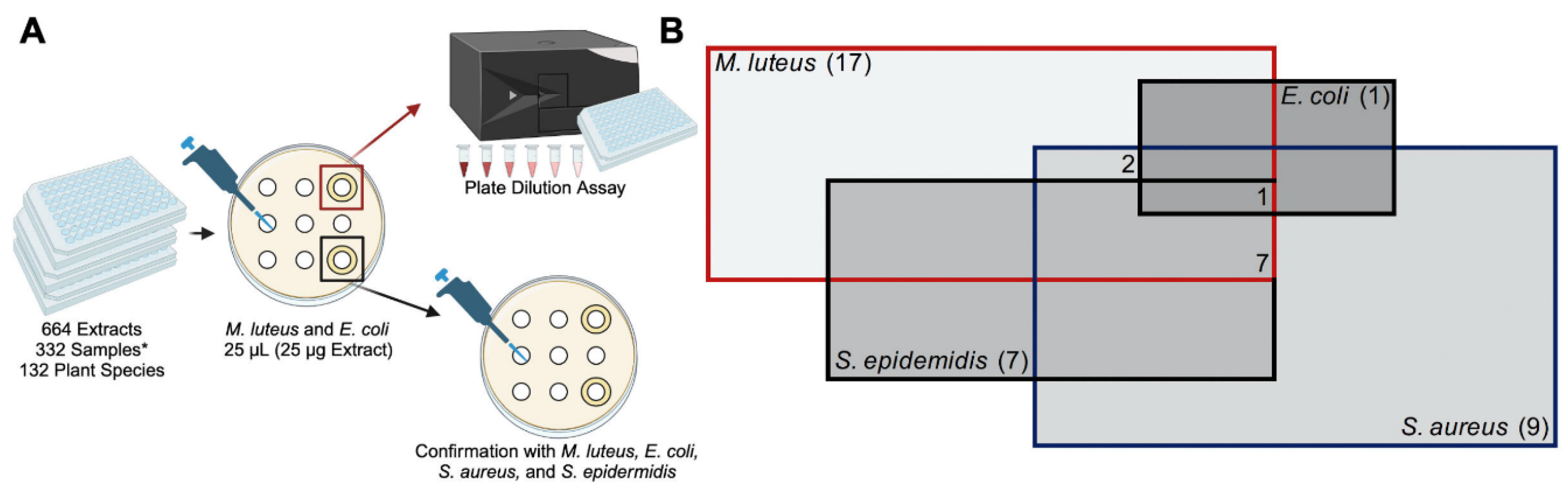
Figure 2.
Disc Diffusion Assay of TCM Library. Representative images of the TCM library extracts spotted against A) M. luteus, B) S. epidermidis, C) S. aureus, and D) E. coli. Zones of inhibition were measured for every effective extract.
Figure 2.
Disc Diffusion Assay of TCM Library. Representative images of the TCM library extracts spotted against A) M. luteus, B) S. epidermidis, C) S. aureus, and D) E. coli. Zones of inhibition were measured for every effective extract.
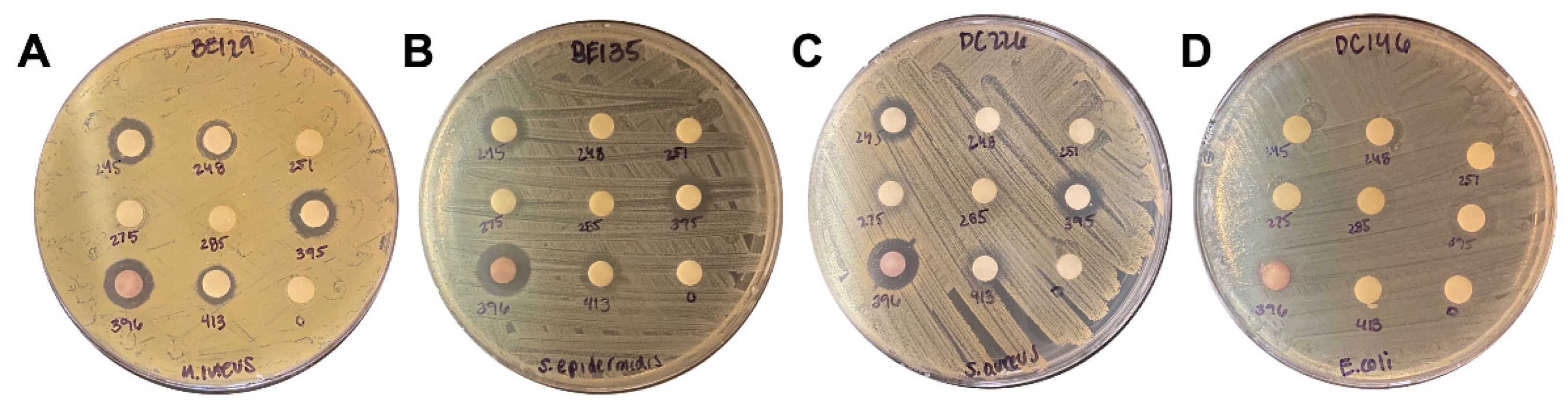
Figure 3.
Antimicrobial assessment of E. rutaecarpa extract (#727) using plate dilution liquid assay. The extract exhibited an inhibitory effect against all gram-positive bacteria tested. The MIC for M. luteus was 10.2 µg/mL. No other strain was fully inhibited, though #727 did significantly affect the microbial growth of S. aureus and S. epidermidis. Control represents vehicle DMSO.
Figure 3.
Antimicrobial assessment of E. rutaecarpa extract (#727) using plate dilution liquid assay. The extract exhibited an inhibitory effect against all gram-positive bacteria tested. The MIC for M. luteus was 10.2 µg/mL. No other strain was fully inhibited, though #727 did significantly affect the microbial growth of S. aureus and S. epidermidis. Control represents vehicle DMSO.
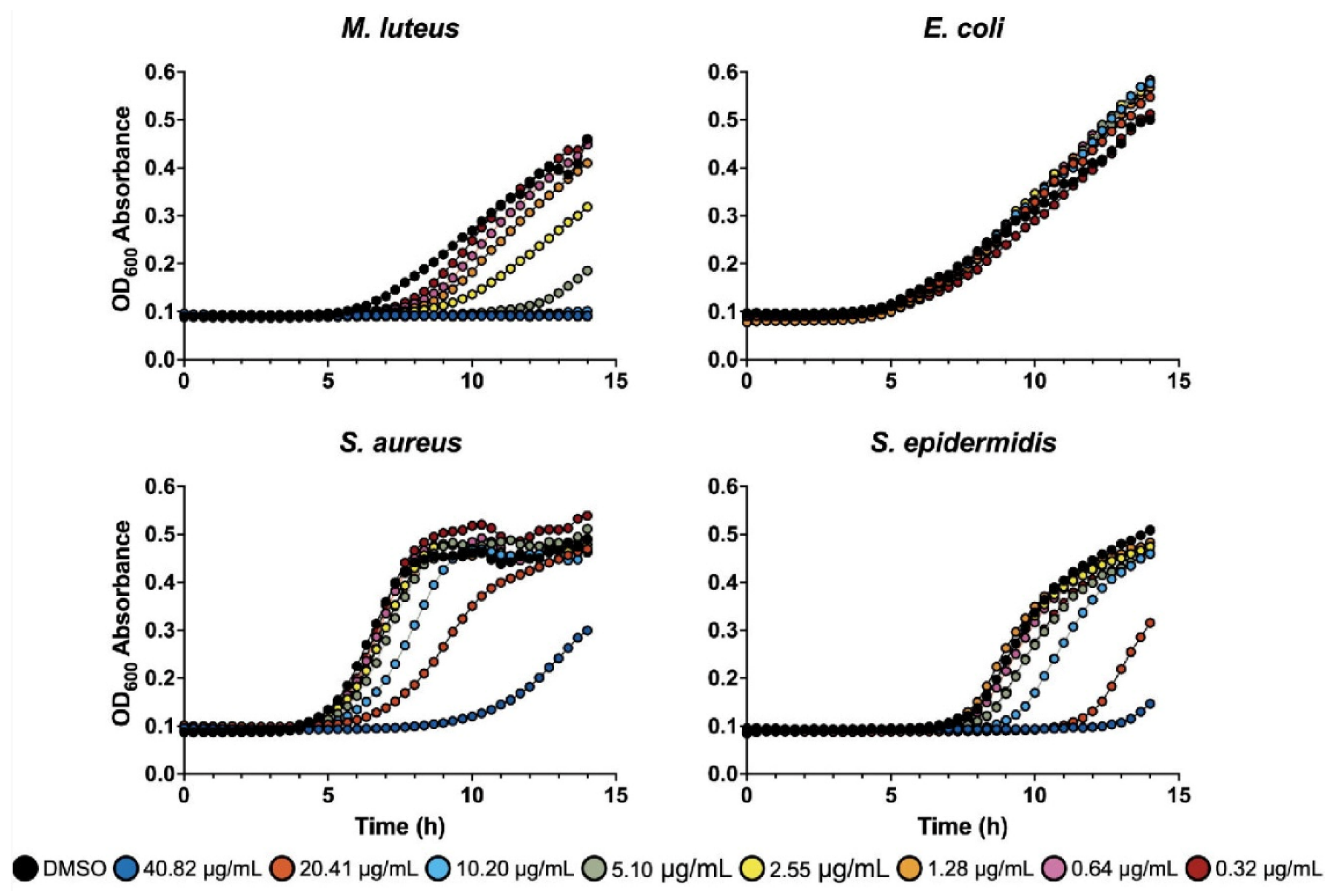
Figure 4.
Phylogenetic analysis of TCM library constructed using RuBisCO. Hits from the library represent a diverse selection of genera. Highlighted species represent plants with antimicrobial properties identified in our study. The scale bar represents the evolutionary distance between species based on RUBisCO sequences.
Figure 4.
Phylogenetic analysis of TCM library constructed using RuBisCO. Hits from the library represent a diverse selection of genera. Highlighted species represent plants with antimicrobial properties identified in our study. The scale bar represents the evolutionary distance between species based on RUBisCO sequences.
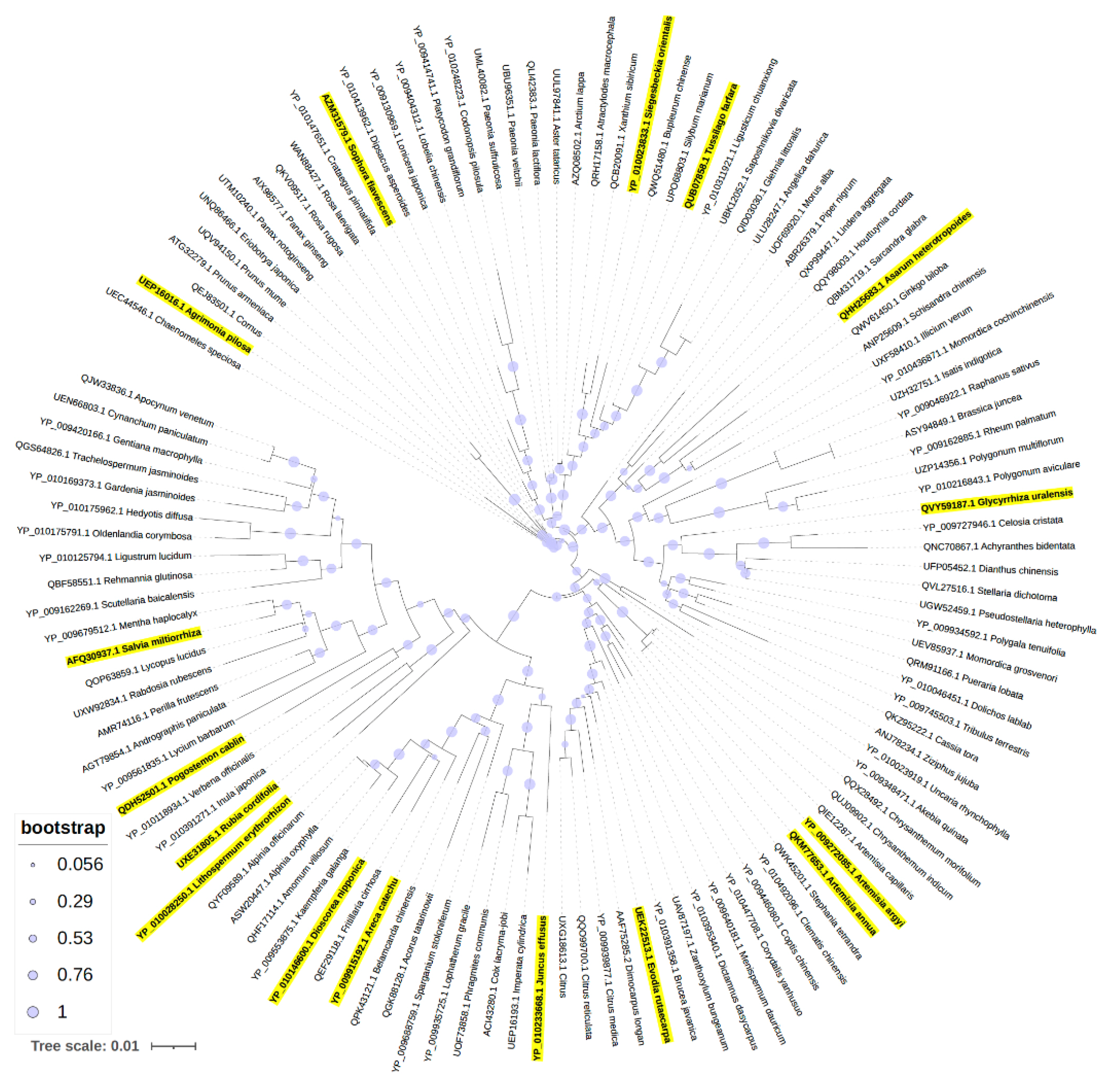
Table 1.
Zones of Inhibition in Disc Diffusion Assay. Zones of Inhibition (mm) produced by 25 extracts against representative gram-negative and gram-positive bacteria. The 25 extracts represent 17 unique plant species. A ZOI of 6 mm indicates no inhibition, as 6 mm corresponds to the diameter of the paper disc. *For M. luteus, the shown measurements represent the largest detected ZOI from among three replicates.
Table 1.
Zones of Inhibition in Disc Diffusion Assay. Zones of Inhibition (mm) produced by 25 extracts against representative gram-negative and gram-positive bacteria. The 25 extracts represent 17 unique plant species. A ZOI of 6 mm indicates no inhibition, as 6 mm corresponds to the diameter of the paper disc. *For M. luteus, the shown measurements represent the largest detected ZOI from among three replicates.
| Zone of Inhibition (mm) | ||||||
|---|---|---|---|---|---|---|
| Spot # | Genus | Species | M. luteus* | --- | S. aureus | S. epidermidis |
| 20 | Tussilago | farfara | 10 | --- | --- | --- |
| 27 | Asarum | heterotropoides | 10 | --- | 12.6 | --- |
| 33 | Evodia | rutaecarpa | 17.6 | --- | 11.6 | 10.8 |
| 42 | Rubia | cordifolia | 11.6 | --- | --- | --- |
| 55 | Dioscorea | nipponica | 9.7 | --- | --- | --- |
| 83 | Dioscorea | nipponica | 11.6 | --- | --- | --- |
| 95 | Echinops | latifolius | 10.9 | --- | 11.8 | --- |
| 201 | Artemisia | annua | 19.4 | --- | --- | --- |
| 245 | Glycyrrhiza | uralensis | 12.6 | --- | 11.7 | 11.6 |
| 248 | Areca | catechu | 10.6 | --- | --- | --- |
| 251 | Artemisia | argyi | 11 | --- | --- | --- |
| 275 | Juncus | effusus | 10.2 | --- | 11.2 | --- |
| 285 | Artemisia | argyi | 8.4 | --- | --- | --- |
| 395 | Juncus | effusus | 13 | --- | 13.2 | 11.8 |
| 396 | Lithospermum | erythrorhizon | 14 | 9.5 | 13.9 | 14.8 |
| 413 | Sophora | flavescens | 12.2 | --- | 11.2 | 11.4 |
| 415 | Juncus | effusus | 11.2 | --- | 11.4 | --- |
| 416 | Rubia | cordifolia | 12 | --- | --- | --- |
| 424 | Evodia | rutaecarpa | 19 | --- | 9.8 | --- |
| 456 | Agrimonia | pilosa | 11.4 | --- | 12.2 | 10.6 |
| 460 | Lithospermum | erythrorhizon | 12.6 | --- | 10.2 | 12.4 |
| 694 | Salvia | miltiorrhiza | 12.2 | --- | 9.81 | 15.6 |
| 704 | Siegesbeckia | orientalis | 9.4 | --- | --- | --- |
| 727 | Evodia | rutaecarpa | 18.4 | --- | 11 | 11.8 |
| 749 | Pogostemon | cablin | 21.4 | --- | --- | --- |
Disclaimer/Publisher’s Note: The statements, opinions and data contained in all publications are solely those of the individual author(s) and contributor(s) and not of MDPI and/or the editor(s). MDPI and/or the editor(s) disclaim responsibility for any injury to people or property resulting from any ideas, methods, instructions or products referred to in the content. |
© 2024 by the authors. Licensee MDPI, Basel, Switzerland. This article is an open access article distributed under the terms and conditions of the Creative Commons Attribution (CC BY) license (http://creativecommons.org/licenses/by/4.0/).
Copyright: This open access article is published under a Creative Commons CC BY 4.0 license, which permit the free download, distribution, and reuse, provided that the author and preprint are cited in any reuse.


