

Submitted:
17 October 2024
Posted:
23 October 2024
You are already at the latest version
Abstract
This study proposes a new concept that explains the modern technological change: technology invasiveness that breaks into a scientific and technological ecosystem, with accelerated diffusion of large quantities of products leading to main change in the innovation ecotone that transfers knowledge and know-how in businesses and markets. Invasive technologies conquer scientific, technological and business space of alternative technologies and expand the knowledge space of adjacent possible by introducing radical innovations that support dynamic interactions between new technologies and emerging development and applications. This theoretical approach is empirically verified in emerging path-breaking technology of transformer, a deep learning architecture having unsupervised and semi-supervised algorithms that create new contents and mimics human ability (Generative Artificial Intelligence). Statistical evidence here, based on patent analyses, reveals that the growth rate of transformer technology is 55.82% (over 2016-2023) more than double compared to 23.02% of all other technologies, such as Convolutional Neural Network: it is force that is revolutionizing the way societies interact with machines. Hence invasive technologies are considered as one of the major causes of global technological change and this study offers a profound exploration of how invasive technologies drive technological change, significantly contributing to our understanding of technological evolution’s dynamics and its societal and industry impacts.
Keywords:
Technological invasions
; innovation policy
; technology invasiveness
; Generative pretraining transformers
; Generative AI
; Technological Change
; Attention mechanism
1. Introduction
The goal of this study is to suggest a new concept the drives technological and social change: accelerated invasiveness of new technologies that is a characteristic hardly known. Invasion is anything that breaks into a place, occupying it or spreading in large quantities in the short run. In nature there are different aspects of invasion: in botany the invasive plants invade lands and human habitats (Walker and Smith, 1997; Gholizadeh et al., 2024); in biology the invasive organism is not indigenous to a particular area and causes environmental harm (Pelicice et al., 2023); in medicine, the invasive cancer navigate in different tissue microenvironments of the body (de Visser and Joyce, 2023; Krakhmal et al., 2015). This study extends the scientific concept of invasiveness, in a broad analogy, to explain the dynamics of technological change in a theoretical framework of generalized Darwinism ( Hodgson and Knudsen, 2006; Wagner and Rosen, 2014). The principal goal is to propose in science the invasive behaviour of technologies to analyze the dynamics of path-breaking technologies that destroy established technologies, occupy their space and become dominant technology supporting technological and social change. The proposed concept of technology invasiveness is supported with a technological and statistical analysis of the new technology of transformer (a neural network) that drives Generative Artificial Intelligence (AI). The invasive behaviour of new technology is especially relevant in a world of rapid technological change with aspects of 'creative destruction' in existing products and competences in science, technology, markets and society (Teece et al., 1997; Tripsas, 1997). Invasive technologies pave the way for development of many inter-related technologies by ‘‘expanding the adjacent possible’’ in science and technological fields (Coccia, 2018; Coccia and Watts, 2020; Kauffman, 2000, 2016, 2019; Kauffman and Clayton, 2006; Kauffman and Gare, 2015; Lehman and Kauffman, 2021; Wagner and Rosen, 2014). In addition, the analysis of the technology invasiveness can create the framework within which a synthesis of basic properties on evolutionary pathways could be worked out, extending lines of research to explain technological evolution in modern economies. The behaviour of invasive technologies can extend the theories of technological evolution and diffusion with a new conceptual approach to explain modern scientific and technological change for a better theory that supports effective science and technology policy implications for societal benefits. Hence, this study offers a profound exploration of how invasive technologies drive technological change, significantly contributing to our understanding of technological evolution’s dynamics and its societal and industrial impacts.
2. Current Approach to Disruptive Technologies
One of the fundamental problems in technological studies is the behaviour of drastic technology in economic system and society (Dosi, 1988; Rogers, 1962; Sahal, 1981; Utterback et al., 2019; Utterback, 1994). One of the most important framework is based on disruptive technology that significantly alters established industries and markets, creating new sectors and business models (Colombo et al., 2015). A technology that generates radical innovations that radically change the way the market structure and how products and services are yielded and consumed. Disruptive innovation by Christensen (1995) causes a relevant change and abruptly interrupts the way in which industries, firms, and consumers operate.
One of the characteristics of destructive technology that generates radical innovations, based on new products and/or processes, is high technical and/or economic performance directed to reduce market share or destroy the usage value of established technologies/products/processes previously used (Christensen, 1997; Christensen et al., 2015; Tria et al., 2014). Calvano (2007) maintains that "Destructive Creation" is the deliberate introduction of new and improved generations of products that destroy, directly or indirectly, current products inducing consumers to change their habits with consequential economic and social change. The dynamics of disruptive technologies generates technological, industrial, economic and social change (Coccia, 2020). Adner (2002, pp. 668-669) claims that: “Disruptive technologies . . . introduce a different performance package from mainstream technologies” (cf., Adner and Zemsky, 2005; Calvano, 2007; Coccia, 2019). Abernathy and Clark (1985, pp. 4ff and pp. 12-13) clearly mention that: “An innovation is . . . . derived from advances in science, and its introduction makes existing knowledge in that application obsolete. It creates new markets, supports freshly articulated user needs in the new functions it offers, and in practice demands new channels of distribution and aftermarket support. In its wake it leaves obsolete firms, practices, and factors of production, while creating a new industry .… innovation that disrupts and renders established technical and production competence obsolete, yet is applied to existing markets and customers, is … labelled ‘Revolutionary’. It thus seems clear that the power of an innovation to unleash Schumpeter's ‘creative destruction’ must be gauged by the extent to which it alters the parameters of competition, as well as by the shifts it causes in required technical competence. An innovation of the most unique and unduplicative sort will only have great significance for competition and the evolution of industry when effectively linked to market needs”.
Christensen (1997) argues that disruptive technology has specific characteristics: a) higher technological performance; b) provide products/processes that satisfy the needs that are demanded by mainstream market. Christensen et al. (2015) claim that disruptive technologies can be generated by small firms with fewer resources that successfully challenge established incumbent businesses (e.g., the case of OpenAI for ChatGPT, funded in 2015). Innovative firms, generating disruptive technologies and innovations, grow more rapidly than other ones (Abernathy and Clark, 1985; Tushman and Anderson, 1986, p. 439). Christensen’s (1997) approach also shows that disruptive technologies or innovations (these terms are used here interchangeably) generate significant shifts in markets and society (cf., Henderson, 2006). In general, technological and market shifts of path-breaking technologies embody competence-destroying because these technologies destroy the competence of established technologies existing in industries (cf., Hill and Rothaermel, 2003; Tushman and Anderson, 1986). Moreover, disruptive innovations undermine the competences and complementary assets of existing producers, and change habits of consumers, fostering economic changes in many sectors (Christensen and Raynor, 2003; Garud et al., 2015; Markides, 2006; cf., Coccia, 2005). The diffusion and growth rate of disruptive innovation are also important drivers to create and sustain competitive advantage of firms and nations amidst rapidly changing business environments (Kessler and Chakrabarti, 1996, p. 1143; Porter, 1980). Disruptive technology also generates a process of actual substitution of a new technique for the established one and, as a consequence, affects the behaviour of manifold inter-related technologies generating a new technological paradigm with different technological trajectories in industries (Sahal, 1981; Fisher and Pry, 1971).
In this context, the study here proposes that the concept of invasive technology in order to develop the approach of disruptive technologies to explain rapid technological change in modern economies. Next section presents the research philosophy, methodology and study design to structure the theory and empirical evidence of basic predictions.
3. From Disruptive to Invasive Technologies
3.1. Research Philosophy of the Study
Proposed theoretical framework here is developed with an evolutionary perspective of technological change guided by generalized or universal Darwinism (Dawkins, 1983; Nelson, 2006; Levit et al., 2011). Hodgson (2002, p. 260) maintains that: “Darwinism involves a general theory of all open, complex systems”. In this context, Hodgson and Knudsen (2006) suggest a generalization of the Darwinian concepts of selection, variation and retention to explain how a complex system evolves (cf., Hodgson, 2002; Stoelhorst, 2008). In the economics of technical change, and in Science of Science (Sun et al., 2013) the generalization of Darwinian principles (“Generalized Darwinism”) can assist in explaining the multidisciplinary nature of scientific and technological processes (cf., Hodgson and Knudsen, 2006; Levit et al., 2011; Nelson, 2006; Schubert, 2014; Wagner and Rosen, 2014). In fact, the heuristic principles of “Generalized Darwinism” can explain aspects of scientific and technological development considering analogies between evolution in biological systems and scientific-technological systems (Oppenheimer, 1955; Price, 1986). Arthur (2009) argues that Darwinism can explain technology and science development as it has been done for the development of species in environment (cf., Schuster, 2016, p. 7). Kauffman and Macready (1995, p. 26) state that: “Technological evolution, like biological evolution, can be considered a search across a space of possibilities on complex, multipeaked ‘fitness,’ ‘efficiency,’ or ‘cost’ landscapes”. Schuster (2016, p. 8) shows the similarity between technological and biological evolution, for instance technologies have finite lifetimes like biological organisms. In general, technological and scientific evolution, as biological evolution, displays novelty, radiations, stasis, survival, adaptation, extinctions, etc. (Bowler and Benton, 2005; Kauffman and Macready, 1995; Solé et al., 2013). However, the invasive behaviour in the domain of science and technology is hardly investigated in social studies of technology but it can be basic to explain important characteristics of technological evolution. The general theoretical background of “Generalized Darwinism” (Hodgson and Knudsen, 2006), described here, can frame a broad analogy between science and technology processes and similar ones in botany and biology that provides a logical structure of scientific inquiry to analyze invasive behaviour of technologies in economic systems and society (Coccia, 2019; Ziman, 2000).
3.2. Theory of Invasive Technologies
Invading organisms or elements play important roles in ecology (Wang and Kot, 2001). However, the role of invasive behaviour in the study of technologies and innovations is unknown but its examination is basic for uncovering new basic aspects of technological diffusion, evolution and change.
Some basic concepts structure the proposed theoretical framework:
- -
- Invasion is an elements that bursts and spreads in a space, occupying the position of other elements in system.
- -
- Invasive technologies can replace, in a specific system, other technologies in several life cycles, producing new technologies and innovations that have the potential to spread in different domains and sectors leading to technological, economic and social change on the invaded environment (‘impacts’)
- Postulates
- -
- Invasive technologies is a driver of technological and social change
- -
- Invasive behaviour ⇒ technological evolution
- -
- Invasive technologies change system and have an adaptive behaviour to different systems and at the same time eliminate the less suitable technologies, leaving the more suitable ones to survive.
- Predictions of the theory of invasive technologies
Testable implications of the theory of invasive technologies are:
- ■
- Technological change =f(invasive technologies)
- ■
- Rate of growth of invasive technology i in a system S is > 2 × rate of growth in alternative technologies j, j=1, …, m
- ■
- Invasive technology (i) is better adapted than alternative technologies (j) in S, if and only if (i) is able to spread, survive and produce new innovations in S than is (j) over time.
Figure 1 shows the interrelationships of invasive technologies in innovation ecosystem.
3.3. Research Setting to Test the Theoretical Prediction of Invasive Technologies: Case study Of Transformers Technologies
The predictions of proposed theory of invasive technologies is verified empirically in some main technologies. In the context of R&D of new products and processes in Artificial Intelligence (AI), this study focuses on new technology of transformer architecture, a new type of neural network, described by Vaswani et al. (2017). Transformer architecture from 2018 is developing pretrained language models (Generative Pretraining Transformers, GPTs), such as OpenAI's GPT series and Google's Bidirectional Encoder Representations from Transformers (BERT) model with radical innovations of ChatGPT introduced in 2022 and Microsoft Copilot started on February 2023.
Before transformer models, established Recurrent Neural Networks (RNNs) are powerful technologies, but they have limitations, such as slow training, do not retain old connections well, etc. Instead, new architecture of transformer technology is based on three powerful elements: a) self-attention; b) positional embeddings and c) multi-head attention. Unlike traditional RNN models, transformer models are designed to learn contextual relationships between words in a sentence or text sequence by the mechanism of self-attention, which allows the model to weigh the importance of different words in a sequence based on their context (Menon, 2023). Transformer models have revolutionized some research fields, such as Natural Language Processing (NLP) for tasks of language modeling, text classification, question answering, sentiment analysis, computer vision, spatial-temporal modeling for video analysis or time series data, and other ones (Menon, 2023). A critical advantage of transformer model is the ability to process input sequences in parallel, which makes this technology faster than RNNs for many NLP tasks (Dell, 2023). One of the main radical innovations in transformer technology is the development of large-scale, pretrained language models, referred to as Generative Pretraining Transformers (GPTs), such as OpenAI's GPT series, from GPT-1 in 2018 to ChatGPT-4 in 2023 capable of generating human-like content (OpenAI, 2015, 2022); Google's Bidirectional Encoder Representations from Transformers (BERT) model (Devlin et al., 2018); Microsoft copilot (Mehdi, 2023), etc. These pretrained models can be used for specific NLP tasks with reduced additional training data, making them highly effective for a wide range of NLP applications, such as (cf., Assael et al., 2022; Kariampuzha et al., 2023): machine translation, document summarization, document generation, named entity recognition, biological sequence analysis, writing computer code based on requirements expressed in natural language, video understanding, computer vision, protein folding applications, etc.
Overall, then, science advances in computer sciences have generated the advent of the large language model (LLM, Bowman, 2023). In this domain, new technology of transformers is directed to model some activities of the human brain with the generative AI — software that can create plausible and sophisticated text, images and computer code at a level that mimics human ability (Pinaya et al., 2023; Tojin et al., 2023). Transformer architecture has revolutionized the field of LLM with main applications in NLP by with radical innovation in GPTs directed to shape the landscape of generative AI. Transformer models are a main case study to explain pervasive and invasive behaviour of technologies that support technological change in society (Dosi, 1988).
3.4. Study Design
The proposed theory of invasive technologies is tested with a patent analysis in emerging transformer technology (a type of deep learning model used in natural language processing-NPL- and in generative Artificial Intelligence). We also analyze a previous technology, the Convolutional Neural Networks, in short CNN, for a comparative analysis of these main technologies in Large Language Model to explain characteristics and properties of the invasive technologies that can explain technological evolution and change.
- ■
- Logic structure of search string
In order to detect accurately the science dynamics of transformer in the library database Scopus (2024), we define General Domain D with following search string directed to detect patents over time:
D= ("machine learning" OR "data science" OR "artificial intelligence").
After that we refine the Domain for two technologies under study: Transformer and CNN.
- ■
- Transformers, period under study 2017-2023
Domain Restricted for Transformers is called DTR
DTR= ("machine learning" OR "data science" OR "artificial intelligence")
AND
("large language models" OR "LLM" OR "Natural Language Processing" OR "Natural Languages" OR "Sentiment Analysis" OR "Text Mining" OR "Question Answering Systems" OR "Semantic Web" OR "Chatbot" OR "Knowledge Representation" OR "Natural Language Understanding" OR "Text-mining" OR "Opinion Mining" OR "Topic Modeling" OR "Word Embedding")
Or
DTR= (D) AND ("large language models" OR "LLM" OR "Natural Language Processing" OR "Natural Languages" OR "Sentiment Analysis" OR "Text Mining" OR "Question Answering Systems" OR "Semantic Web" OR "Chatbot" OR "Knowledge Representation" OR "Natural Language Understanding" OR "Text-mining" OR "Opinion Mining" OR "Topic Modeling" OR "Word Embedding")
In order to detect the impact of Transformers (TRF) on science that is also used with other terms, the search string is given by:
TRF= (DTR) AND ("bert" OR "chatgpt" OR "transformer" OR "attention mechanism"). This set TFR includes the technology with invasive behaviour.
The complement of the set TRF is TRFC :
TRFC = (DTR) AND NOT ("bert" OR "chatgpt" OR "transformer" OR "attention mechanism").
This set included the technologies that have been predated by invasive technology of TRF.
Of course, TRF+ TRFC =DTR
- ■
- Convolutional Neural networks, in short CNN, period under study before 2017, year of the emergence of Transformers
The general domain is D, as defined above, but in order to detect the science dynamics of CNN, we refine the search string with a restriction considering the field in which CNN operates. The keywords are stopped when the restricted set has a marginal increase in documents.
Domain Restricted for CNN is called DCNN
DCNN= ("machine learning" OR "data science" OR "artificial intelligence")
AND
("computer vision" OR "image recognition" OR "Image Processing" OR "Object Detection" OR "Image Segmentation" OR "Image Enhancement" OR "Object Recognition" OR "Image Analysis" OR "Image Classification" OR "Images Classification" OR "Face Recognition" OR "Machine Vision" OR "Image Interpretation" OR "Gesture Recognition" OR "Machine-vision" OR "Augmented Reality")
Or
DCNN= (D) AND ("computer vision" OR "image recognition" OR "Image Processing" OR "Object Detection" OR "Image Segmentation" OR "Image Enhancement" OR "Object Recognition" OR "Image Analysis" OR "Image Classification" OR "Images Classification" OR "Face Recognition" OR "Machine Vision" OR "Image Interpretation" OR "Gesture Recognition" OR "Machine-vision" OR "Augmented Reality")
In order to detect the impact of CNN, the search string is given by:
CNN=(DCNN) AND ("convolutional neural network" OR "CNN"). This set CNN includes technology with invasive behaviour.
The complement of set CNN is CNN C is
CNN C = (DCNN) AND NOT ("convolutional neural network" OR "CNN"). This set included the technologies that have been predated by technology CNN.
Moreover, CNN+CNNC=DCNN
- ■
- Measures and sources of data
This study uses the number of patents concerning research topics and technologies under study. Data are from online library database Scopus (2023), downloaded on 9 November 2023. 2024 is not considered because it is in progress.
- ■
- Samples
The study considers the following sample of data, detected using the previous logic of search strings with a combination of specific keywords and Boolean operators for the search box of search engine Scopus (2023):
Set of Transformers TRF: 8,908 patents (all data available from 2016 to 2023).
Complement of set TRF, TRFC : 79,268 patents (all data available from 2016 to 2023).
Set of CNN: 69,599 patents (all data available from 1995 to 2023).
Complement set of CNN, CNN C: 181,231 patents (all data available from 1995 to 2023).
Data and information analysis procedures
One significant way to understand the invasive behaviour of technologies TFR is to estimate the rates of spread in technological space having different and alternative technologies, such as CNN.
Let Patents (TRF) =number of patents of Transformers, having invasive behaviour
Let Patents (TRFC) =number of patents in other technologies in domain of TRF
Let DTRF = Patents(TRF) +Patents(TRFC), total number of patents in the domain of technologies of Large Language Models
Let Patents(CNN) =number of patents of CNN, have invasive behaviour.
Let Patents(CNNC) =number of patents of other technologies in domain of CNN
Let DCNN = Patents(CNN) +Patents(CNNC), total number of patents in the domain of technologies of Large Language Models
These shares of the spatial growth of invasive technologies in the domain are calculated over time and visualized graphically.
After that, the temporal growth of these technologies is analyzed with a rate of growth compound continuously: r. In this case, the function of patent development is exponential:
Hence, where e is the base of natural logarithm (2.71828…)
where
- r= rate of exponential growth of technology from 0 to t period
- P0 is the patents to the time 0
- Pt is the patents to time t.
- T= t−0
- Trends of invasive technology i at t are analyzed with the following log-linear model:
Log10 yi,t = a + b time+ ui,t
- yt is patents of invasive technologies
- t=time
- ut = error term
- (a = constant; b=coefficient of regression)
4. Empirical Evidence: Test of Prediction in Invasive Technologies
4.1. Pattens of Temporal and Morphological Change in Technologies
Table 1 shows a regression analysis of estimated relationship based on patents over time, using a linear model. R2 is remarkably high in all models, showing a high goodness of fit. F-test is significant with p-value <.001. Estimated coefficient of regression suggests that transformers, as invading technology, has a growth rate of 0.30 (p-value 0.001) that is more than double than other alternative technologies operating in the same domain (0.13, p-value 0.001). Moreover, the most interesting finding is that the growth rate of invading transformers in the space of science and technology compared to other previous radical technology of CNN is almost double (0.16, p-value 0.001). This result suggests that the invasive power of transformers is of a high intensity, having a pervasive diffusion and more drastic impact to generate the conditions for a main radical scientific and technological change (for visual representation see Figure 2 and Figure 3).
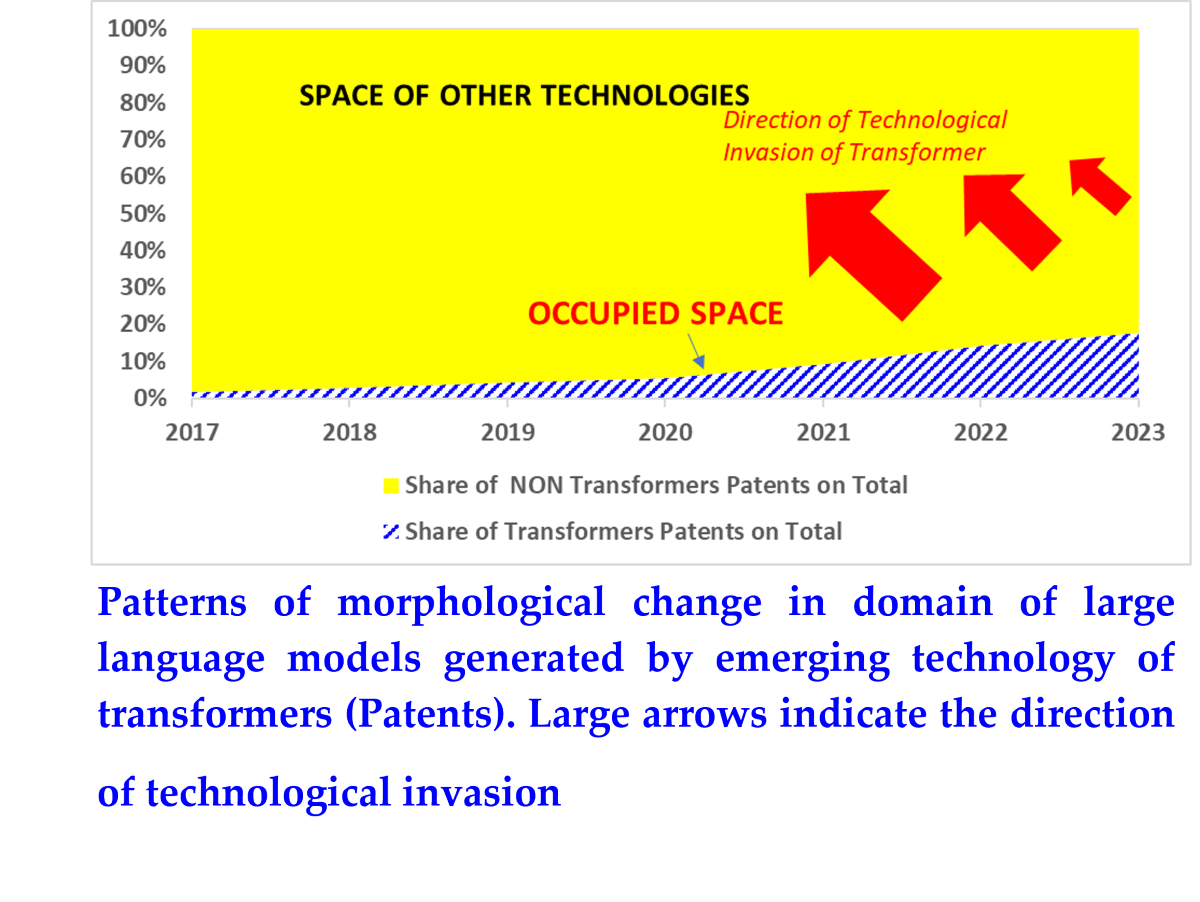
Using the exponential equation to calculate the growth rate of technologies under study, it confirms that the growth rate of invading technology of transformers is about 56% versus 23% of alternative technologies in space (more than double), and it is considerably higher than previous technology of CNN having about 34% (Table2). This result confirms the invasive behaviour of transformer technologies in the space of LLM, based on rapid and strong diffusion. Moreover, the invasive dynamics of transformers in about 7 years, based on share of patents of transformers on total, shows a rapid diffusion invading the space of other alternative technologies in the related domain, changing the ecosystem of LLM with pervasive application of manifold radical innovations in generative AI that generate technological and social change (Figure 4). Share of patents in CNN technologies in 2023 is higher than transformer technology but the accumulation of knowledge started in 1995, compared to Transformers that started in 2017 (Figure 5).
5. Analysis of Findings
Technology analysis of the specific dynamics of invasive behaviour that generates radical changes in a short period of time provides critical information to explain scientific and technological development directed to progress of human society (Bettencourt et al., 2009). Table 3 shows the comparison between the two technologies under study with high rate of growth by Generative Pretraining Transformers show powerful invasive behaviour in the short run compared to CNN.
5.1. Explanation of Empirical Evidence of Invasive Technologies
The emergence of transformer technology is due to the interaction and convergence of competencies from mathematics and model design in neural networks. Transformer architecture was introduced in the context of natural language processing (NLP), revolutionizing it, but it has shown to be versatile and powerful technology, finding new applications in diverse fields such as computer vision, speech recognition, etc. Before transformers, recurrent neural networks (RNNs) had many limitations but a main breakthrough is the introduction of self-attention mechanism which intuitively mimics cognitive attention, such that transformers in large language models removed the recurrent neural network and relied heavily on the faster parallel attention scheme (Tyagi, 2023). The speed at which the invasive technologies expands its range is a fundamental parameter to predict their ability to invade the scientific domain of alternative technologies to be a dominant one in a short run (cf., Schreiber and Ryan, 2011). In fact, temporal and spatial models of technological evolution here, based on data of patents, reveal the highest rate of growth in invasive technologies compared to other technologies. A basic driver of invasive behaviour in transformers is the interaction with different research fields and technologies, such as in autonomous driving, remote sensing images, etc. (Chen et al., 2023; Coccia, 2019, 2019a; 2020, 2020a,b,c; Coccia and Watts, 2020; He and Li, 2022). Scholars have shown that interaction among technologies, as just mentioned, can support technological evolution, and the result here is consistent with the multi-modes interaction of Utterback et al. (2019). In the case under study of transformers, the technological interaction is generating high growth rates and a symbiotic-dependent evolution in which each technology benefits from the activity of the other one (cf., Coccia, 2019; Coccia and Watts, 2020). In particular, technological interaction of transformers with other technologies generates synergistic combinations and fosters major innovations, which are currently progressing at a rapid rate, such ChatGPT and similar ones, opening completely new opportunities in markets (such as AI, Burger et al., 2023; Chen et al., 2023; He and Li, 2022; Krinkin et al., 2023; Roco and Bainbridge, 2002).
Moreover, transformers have invasive behaviour because they have the characteristics to be a General Purpose Technology (Coccia, 2020). Lipsey et al. (1998, p.43) define a GPT as: “a technology that initially has much scope for improvement and eventually comes to be widely used, to have many users and to have many Hicksian and technological complementarities.” (cf., Lipsey et al., 2005). Invasive technologies, such as GPTs, exert a pervasive impact across firms and industries and permeate the overall economy of nations in the short run. Bresnahan and Trajtenberg (1995, pp.86–87) show that GPTs have a treelike structure, radiating out towards every industry of the economy. In fact, transformer architecture, such as GPTs, generates clusters of innovations in several industries because they are basic processes/components/technical systems for the structure of various families of products/processes that are made quite differently supporting co-evolutionary pathways, such as in autonomous driving (He and LI, 2022), very high-resolution remote sensing image change detection (Chen et al., 2022); etc. The manifold applications of transformers such as GPTs are driven by firms (such as Open AI, Microsoft, Google Brain, etc.) to maximize profit and/or to exploit the position of a (temporary) monopoly and/or competitive advantage in industries (Calvano, 2007; Coccia, 2015, 2016). In general, transformers are invasive technologies having the characteristics of disruptive technologies and general purpose technologies characterized by: “pervasiveness, inherent potential for technical improvements and ‘innovational complementarities’, giving rise to increasing returns-to-scale” (Bresnahan and Trajtenberg, 1995, p.83, original emphasis). Many characteristics of invasive technologies are similar to general purpose technologies (GPTs) such as (Jovanovic and Rousseau, 2005, p.1185):
- Pervasiveness to propagate in many sectors
- Technical improvement that reduce costs in products and processes
- Product and process innovation spawning

Table 3.
Differences between disruptive and invasive technologies.
| Disruptive technologies | Invasive technologies | |
|---|---|---|
| Technological type | General Purpose Technologies | Disruptive + General Purpose Technologies |
| Technical characteristic | Pervasiveness and cost reduction | Pervasiveness and innovation spawning |
| Business strategy | Exploitation | Exploration and exploitation (ambidexterity) |
| Evolutionary patterns | Mutualistic interaction | Symbiotic interaction |
| Rate of growth | Rapid | Accelerate |
| Period of diffusion | Medium run | Shot run |
| Current Example | 5G technology | Generative Pretraining Transformers |
Lipsey et al. (1998, p.38ff) describe other similar characteristics of GPTs, appropriate to describe invasive technologies, such as: the scope for improvement, wide variety and range of uses and strong complementarities with existing and potential new technologies (cf., Coccia, 2012a, 2012b, 2017a, 2017). Overall, then, transformers with invasive behaviour are complex technologies that support product/process innovations in several sectors for a corporate, industrial, economic and social change (cf., table 4; Coccia, 2015; cf. Coccia, 2012, 2012a, 2014, 2014a, 2016, 2017).
5.1. Most Important Drivers of Technological Invasion
A list of putatively relevant drivers for technological invasions can be grouped into broader categories:
- (a)
- scientific and technological advances and interaction between fields
- (b)
- socio-economic activities
- (c)
- environmental turbulence and threats (wars, conflicts, emergencies, etc.)
- (d)
- societal awareness, values, lifestyle
- (e)
- cooperation, legislation & agreements, technological strategies at national and corporate level
6. Concluding Remarks
Advances in information sciences are generating new technology with main changes in economies and societies. This study proposes, for the first time, the invasive behaviour of technologies. Successful technological invaders can have devastating impacts on human society and the structure of modern economies. The proposed theoretical framework of invasive technologies can clarify main characteristics of on-going technological change for supporting R&D management and innovation policy in emerging technologies having a high potential impact in almost every sphere of human activity in the current information and digital era (Hicks and Isett, 2020). This study tests the theories of invading technologies focusing on transformer technologies in generative AI that has an unparalleled growth at expense of other technologies creating basic conditions to generate a drastic scientific change in LLM and consequential radical innovations with main effects on economic and social systems in a not-to-distant-future. This specific behaviour of invasive technologies fosters a rapid diffusion, destroys other technologies and captures their scientific, technological and commercial space. This dynamics between different technologies is based on competition of performance and effectiveness in problem solving activities. Fisher and Pry (1971) modeled the diffusion of a new technology becoming a substitute for a prior one (cf., Utterback and Brown,1972). Other scholars have explained this competition as a predator and prays, the new product is a predator of current products (pray; Utterback et al., 2019). This study suggests the main concept of invasive technologies that have the power to disrupt, destroy and make obsolete established competences with a high pervasiveness in manifold industries over a short run with long run impacts (Christensen et al., 2015, 1997; Coccia, 2020). What this study adds is that the invasive behaviour of new technology is more drastic than disruptive technology having also main characteristics of general purpose technologies as verified here with transformer architecture in generative artificial intelligence. What is the cause that drives Transformer architecture to be an invasive technology? One of the possible explanations is a specific interest of scholars, analysts, etc. to solve complex and difficult problems in different contexts (Sun et al., 2013; Coccia et al., 2024; Guimera et al., 2005; Wagner, 2008). In this context, the rapid evolution of invasive technology paves the way for the development of other technologies in spatial-temporal fields in science and technology by ‘‘expanding the adjacent possible’’ (Kaufmann, 1996).
6.1. Theoretical Implications
The predictions of our theoretical framework of invasive technologies are borne out in the phenomena investigated, paving the way to a better understanding and control of innovation processes in a knowledge economy.
- Properties of invasive technologies
Invasive technology ITi in the domain D is when from t to t+n:
- ○
- ITi has a very rapid growth, acceleration
- ○
- ITi disrupts the use of other technologies.
- ○
- ITi invades and captures the scientific space of other technologies
- ○
- ITi creates new dynamic capabilities (the organization’s ability to integrate, build, and reconfigure internal and external competences to address rapidly changing environments; Teece et al. 1997)
- -
- Moreover, other characteristics of invasive technologies are:
- -
- Pervasiveness over time and space in the short run
- -
- Adaptation to a wide range of market applications and environmental conditions
- -
- Interaction with manifold technologies
- -
- Associations with different activities in science and society
These results can be the basis for an emerging science of invasive technologies that can explain technological, economic and social change in three main scientific directions:
- (1)
- invasiveness of technologies
- (2)
- invasibility of innovation ecosystems and
- (3)
- recurrent (patterns of the technologies) × (ecosystem interactions) that may support a technological invasion syndrome based on a set of concurrent aspects that usually form an identifiable pattern.
A science of invasive technologies can encompass ‘typical recurrent associations of technologies and invasion dynamics with particular invasion contexts such as an invasion phases, invaded environment and socioeconomic context’ (cf., Kueffer et al., 2013). We expect that a resulting theory of technological invasions will need to be conceived as a somewhat heterogeneous conglomerate of elements of varying generality and predictive power: laws that apply to well-specified domains, general concepts and theoretical frameworks that can guide thinking in research and management, and in-depth knowledge about the drivers of particular invasions of technologies in specific industries or across sectors.
6.2. Managerial and Policy Implications
Invasive technologies tend to have similar patterns emerge based on two contrasting forces that can have managerial implications: the tendency of retracing already explored avenues (exploit) and the inclination to explore new possibilities. Policymakers and R&D managers can use the findings here to make efficient decisions regarding the sponsoring of specific technologies having a high rate of growth (invasion) to foster technology transfer with fruitful effects for boosting up next economic and industrial change. These managerial approaches can be explained in the framework of the expansion of the adjacent possible, in which the restructuring of the space of possibilities conditional to the occurrence of radical innovations. Proposed theory and empirical findings can guide an ambidexterity strategy for invasive technologies based on:
- (a)
- exploration activities when rate of growth, and uncertainty in research fields and technology is higher. However, organizations that focus only on exploration face the risk of wasting resources on research topics and emerging technologies that may fail and never be developed, so a stage to gate model can reduce failure risk and foster the development of new technology in these contexts (Coccia, 2023);
- (b)
- an exploitation approach to innovation strategy when rate of growth is lower with consequential more stable technological trajectories.
Ambidexterity strategy of innovation management by balancing exploration and exploitation approaches in invading technologies allows the organization to be adaptable to turbulent environments and achieve and sustain competitive advantage (Duncan, 1976; March, 1991; Raisch and Birkinshaw, 2008).
6.3. Limitations and Development of Future Research
This study shows for the first time, to our knowledge, the behaviour of an invasive technology to explain some technological and social change in knowledge economies. However, these conclusions are, of course, tentative. This study provides some interesting but preliminary results in these complex fields of emerging technologies, but some limitations to deal with future studies can be summarized as follows. Many fundamental questions in the science of invasive technologies can only be answered through integrative studies such as, a research that encompasses comprehensive studies of invasive behaviour of a particular technology in a specific fields, comparative studies of invasive behaviour of the same technologies across multiple fields and industries, in short, to analyze invasive behaviour of technologies with context-dependences. In this study the invasive behaviour of technology focuses on a scientific field dominated by a single dominant invader technology (transformer). However, studies of multiple technology invaders are mostly lacking. Such studies are, however, important to understand shifts in dominance of invading technologies, possibly leading to interactions among multiple invaders. In the context of invaded ecosystems, an emerging challenge is also to understand the role of gradual changes of technologies and environmental factors in determining invasion trajectories over time and space between fields in science and society. (e.g., Smith et al., 2009). Hence, it is interesting to compare the invasive behaviour of the same technologies across multiple industries and research fields, to assess if ‘invasiveness’ and effects on the environment of technologies may be highly variable at different sites . Such differences in invasion dynamics of technologies between industries might stem from (1) the variability of the architecture of a technology between industries– through product and process differentiation; (2) technologies and environment interactions. In analogy with biology, the impacts of invasive technologies are strongly co-shaped by the relation of (technologies) environment interactions (Hulme et al., 2012; Pysek et al., 2012) which can only be understood through comparative studies across industries (cf., Kueffer et al., 2013). More studies that compare the behaviour of technology in native research fields and invaded ranges are needed (van Kleunen et al., 2010), because such insights form the baseline necessary for drawing conclusions about the characteristics of specific technologies in invasions (Parker et al., 2013).
These studies are needed in future because the investigation of only one technology is very likely to arrive at spurious conclusions. In general, synthetic analyses in invasion behaviour for technologies must be constrained to appropriate subsets of invasions, rather than seeking universal explanations (Pyšek & Richardson, 2007; Jeschke et al., 2012; Kueffer, 2012). For instance, characteristics that are most frequent among invasive technologies in markets might not be relevant for predicting invasive technologies within a specific industry or fields.
In fact, a future idea is to verify if technological superiority or flexibility applies to all invasions (e.g., Daehler, 2003; Blumenthal et al., 2009; Cavaleri & Sack, 2010; Chun et al., 2010; Jeschke et al., 2012a; Moles et al., 2012).
Other limitations are that: scientific outputs and research topics can only detect certain aspects of the ongoing dynamics of invasive technologies and next study should apply complementary analysis; confounding factors (e.g., level of public and private R&D investments, international collaboration, etc.) affect the evolution of new technologies and these aspects have to be considered in future studies to improve technological analyses.
In short, there is need for much more detailed research into the investigation of the role of invasive technologies to clarify evolutionary patterns of technologies in society. Despite these limitations, the results here clearly illustrate that invasive technologies can clarify basic characteristics of technological, economic and social change. These findings here can encourage further theoretical exploration in the terra incognita of invasive technologies within and between scientific and technological domain that have rapid change in the new digital era. These aspects are basic for improving the prediction of evolutionary pathways in emerging and disruptive technologies and supporting R&D investments towards new technologies and innovations having a high potential of growth and of impact on the socioeconomic system. However, a comprehensive explanation of sources and diffusion of invasive technologies to explain technological change is a difficult topic for manifold complex and inter-related factors in the presence of changing and turbulent environment, such that Wright (1997, p. 1562) properly claims that: “In the world of technological change, bounded rationality is the rule.”
Author Contributions
Mario Coccia for Conceptualization, methodology, software, validation, formal analysis, investigation, resources, data curation, writing—original draft preparation, writing—review and editing, visualization, supervision, project administration, funding acquisition.
Funding
This research received no external funding.
Institutional Review Board Statement
Not applicable.
Informed Consent Statement
Not applicable.
Data Availability Statement
Data Availability are indicated in references AS Scopus (2024).
Acknowledgments
I would like to thank E. Borriello (ASU) for suggestions and discussion on methodology in preliminary versions of the paper and 11 colleagues that have provided fruitful comments and suggestions on an open source platform. All data are available on Scopus (2024). The author declares that he has no known competing financial interests or personal relationships that could influence the work reported in this paper.
Conflicts of Interest
“The authors declare no conflicts of interest.”
References
- Abernathy W. J., Clark K. B. 1985. Innovation: Mapping the winds of creative destruction. Research Policy, Volume 14, Issue 1, pp. 3-22. [CrossRef]
- Adner R. 2002. When Are Technologies Disruptive: A Demand-Based View of the Emergence of Competition. Strategic Management Journal, Vol. 23 (2002), pp. 667. [CrossRef]
- Adner R., Zemsky P. 2005. Disruptive Technologies and the Emergence of Competition. The RAND Journal of Economics, Vol. 36, No. 2 (Summer), pp. 229-254.
- Amarlou, A., & Coccia, M. (2023). Estimation of diffusion modelling of unhealthy nanoparticles by using natural and safe microparticles. Nanochemistry Research, 8(2), 117-121. [CrossRef]
- Anastopoulos I., Bontempi E., Coccia M., Quina M., Shaaban M. 2023. Sustainable strategic materials recovery, what’s next? Next Sustainability, VSI: Sustainable strategic materials recovery_Editorial, n. 100006. [CrossRef]
- Arthur, B.W., 2009. The Nature of Technology. What it is and How It Evolves. Allen Lane–Penguin Books, London.
- Assael, Yannis; Sommerschield, Thea; Shillingford, Brendan; Bordbar, Mahyar; Pavlopoulos, John; Chatzipanagiotou, Marita; Androutsopoulos, Ion; Prag, Jonathan; de Freitas, Nando (2022). Restoring and attributing ancient texts using deep neural networks. Nature. 603 (7900): 280–283. [CrossRef]
- Baotian He B., Li Y. 2022. Multi-future Transformer: Learning diverse interaction modes for behaviour prediction in autonomous driving, IET Intelligent Trasport Systems. [CrossRef]
- Barton, C.M., 2014. Complexity, social complexity, and modeling. J. Archaeol. Method Theory 21, 306–324. [CrossRef]
- Basalla, G., 1988. The History of Technology. Cambridge University Press, Cambridge.
- Bettencourt, L. M., Kaiser, D. I. & Kaur, J. 2009. Scientific discovery and topological transitions in collaboration networks. Journal of Informetrics 3, 210–221. [CrossRef]
- Blumenthal DA. 2006. Interactions between resource availability and enemy release in plant invasion. Ecology Letters 9: 887–895. [CrossRef]
- Boccaccio, C., Comoglio, 2006. P. Invasive growth: a MET-driven genetic programme for cancer and stem cells. Nat Rev Cancer 6, 637–645 (2006). [CrossRef]
- Bowler, D. E., & Benton, T. G. (2005). Causes and consequences of animal dispersal strategies: relating individual behaviour to spatial dynamics. Biological reviews of the Cambridge Philosophical Society, 80(2), 205–225. [CrossRef]
- Bowman, S. R. (2023). "Eight Things to Know about Large Language Models". arXiv:2304.00612 [cs.CL].
- Bresnahan, T.F. and Trajtenberg, M. (1995) ‘General purpose technologies: ‘engines of growth’?’, Journal of Econometrics, Annals of Econometrics, Vol. 65, No. 1, pp.83–108. [CrossRef]
- Bryan, A., Ko, J., Hu, S.J., Koren, Y., 2007. Co-evolution of product families and assembly systems. CIRP Ann. Manuf. Technol. 56 (1), 41–44. [CrossRef]
- Burger, B., Kanbach, D.K., Kraus, S., Breier, M. and Corvello, V. (2023), "On the use of AI-based tools like ChatGPT to support management research", European Journal of Innovation Management, Vol. 26 No. 7, pp. 233-241. [CrossRef]
- Calabrese G, Coccia M, Rolfo S (2005) Strategy and market management of new product development: evidence from Italian SMEs. Int J Prod Dev 2(1–2):170–189. [CrossRef]
- Calvano E. 2007. Destructive Creation. SSE/EFI Working Paper Series in Economics and Finance, No 653, December.
- Cavaleri MA, Sack L. 2010. Comparative water use of native and invasive plants at multiple scales: a global meta-analysis. Ecology 91: 2705–2715. [CrossRef]
- Cavallo, E., Ferrari E., Coccia M. 2015. Likely technological trajectories in agricultural tractors by analysing innovative attitudes of farmers. International Journal of Technology, Policy and Management, vol. 15, n. 2, pp. 158–177. [CrossRef]
- Chen Z., Y. Song, Y. Ma, G. Li, R. Wang and H. Hu 2023. "Interaction in Transformer for Change Detection in VHR Remote Sensing Images," in IEEE Transactions on Geoscience and Remote Sensing, vol. 61, pp. 1-12, 2023, Art no. 3000612. [CrossRef]
- Christensen C. 1997. The Innovator’s Dilemma: When New Technologies Cause Great Firms to Fail. Harvard Business School Press, Cambridge, MA.
- Christensen C. 2006. The ongoing process of building a theory of disruption. Journal of Product Innovation Management, 23, 39–55. [CrossRef]
- Christensen C., Raynor, M. 2003. The Innovator’s Solution. Harvard Business School Press, Boston.
- Christensen C., Raynor, M. and McDonald, R. 2015. What is disruptive innovation? Harvard Business Review. December, pp. 44-53.
- Christensen C., Raynor, M. and McDonald, R. 2015. What is disruptive innovation? Harvard Business Review. December, pp. 44-53.
- Christensen C.M. 1997. The Innovator's Dilemma. Boston: Harvard Business School Press.
- Chun YJ, van Kleunen M, Dawson W. 2010. The role of enemy release, tolerance and resistance in plant invasions: linking damage to performance. Ecology Letters 13: 937–946. [CrossRef]
- Coccia M. 2003. Metrics of R&D performance and management of public research labs," IEMC '03 Proceedings. Managing Technologically Driven Organizations: The Human Side of Innovation and Change, 2003, pp. 231-235. [CrossRef]
- Coccia M. 2004. Spatial metrics of the technological transfer: analysis and strategic management, Technology Analysis & Strategic Management, vol. 16, n. 1, pp. 31-52. [CrossRef]
- Coccia M. 2005. A Scientometric model for the assessment of scientific research performance within public institutes. Scientometrics, vol. 65, n. 3, pp. 307-321. [CrossRef]
- Coccia M. 2005. Measuring Intensity of technological change: The seismic approach, Technological Forecasting & Social Change, vol. 72, n. 2, pp. 117-144. [CrossRef]
- Coccia M. 2005. Metrics to measure the technology transfer absorption: analysis of the relationship between institutes and adopters in northern Italy. International Journal of Technology Transfer and Commercialization, vol. 4, n. 4, pp. 462-486. [CrossRef]
- Coccia M. 2006. Analysis and classification of public research institutes, World Review of Science, Technology and Sustainable Development, vol. 3, n. 1, pp.1-16. [CrossRef]
- Coccia M. 2008. New organizational behaviour of public research institutions: Lessons learned from Italian case study. International Journal of Business Innovation and Research, vol. 2, n. 4, pp. 402–419. [CrossRef]
- Coccia M. 2008. Spatial mobility of knowledge transfer and absorptive capacity: analysis and measurement of the impact within the geoeconomic space, The Journal of Technology Transfer, vol. 33, n. 1, pp. 105-122. [CrossRef]
- Coccia M. 2009. What is the optimal rate of R&D investment to maximize productivity growth? Technological Forecasting & Social Change, vol. 76, n. 3, pp. 433-446. [CrossRef]
- Coccia M. 2010. Foresight of technological determinants and primary energy resources of future economic long waves. International Journal of Foresight and Innovation Policy, vol. 6, n. 4, pp. 225–232. [CrossRef]
- Coccia M. 2010. Public and private R&D investments as complementary inputs for productivity growth. International Journal of Technology, Policy and Management, vol. 10, n. 1/2, pp. 73-91. [CrossRef]
- Coccia M. 2010. Spatial patterns of technology transfer and measurement of its friction in the geo-economic space. International Journal of Technology Transfer and Commercialisation, vol. 9, n. 3, pp. 255-267. [CrossRef]
- Coccia M. 2012. Converging genetics, genomics and nanotechnologies for groundbreaking pathways in biomedicine and nanomedicine. Int. J. Healthcare Technology and Management, vol. 13, n. 4, pp. 184-197. [CrossRef]
- Coccia M. 2012. Evolutionary trajectories of the nanotechnology research across worldwide economic players, Technology Analysis & Strategic Management, vol. 24, n.10, pp. 1029-1050. [CrossRef]
- Coccia M. 2014. Converging scientific fields and new technological paradigms as main drivers of the division of scientific labour in drug discovery process: the effects on strategic management of the R&D corporate change, Technology Analysis & Strategic Management, vol. 26, n. 7, pp. 733-749. [CrossRef]
- Coccia M. 2014. Socio-cultural origins of the patterns of technological innovation: What is the likely interaction among religious culture, religious plurality and innovation? Towards a theory of socio-cultural drivers of the patterns of technological innovation, Technology in Society, vol. 36, n. 1, pp. 13-25. [CrossRef]
- Coccia M. 2015. General sources of general purpose technologies in complex societies: Theory of global leadership-driven innovation, warfare and human development, Technology in Society, vol. 42, August, pp. 199-226. [CrossRef]
- Coccia M. 2015. Spatial relation between geo-climate zones and technological outputs to explain the evolution of technology. Int. J. Transitions and Innovation Systems, vol. 4, nos. 1-2, pp. 5-21. [CrossRef]
- Coccia M. 2015. Technological paradigms and trajectories as determinants of the R&D corporate change in drug discovery industry. Int. J. Knowledge and Learning, vol. 10, n. 1, pp. 29–43. [CrossRef]
- Coccia M. 2016. Radical innovations as drivers of breakthroughs: characteristics and properties of the management of technology leading to superior organizational performance in the discovery process of R&D labs, Technology Analysis & Strategic Management, vol. 28, n. 4, pp. 381-395. [CrossRef]
- Coccia M. 2016. The relation between price setting in markets and asymmetries of systems of measurement of goods, The Journal of Economic Asymmetries, vol. 14, part B, November, pp. 168-178. [CrossRef]
- Coccia M. 2017. Sources of disruptive technologies for industrial change. L’industria –rivista di economia e politica industriale, vol. 38, n. 1, pp. 97-120. [CrossRef]
- Coccia M. 2017. Sources of technological innovation: Radical and incremental innovation problem-driven to support competitive advantage of firms. Technology Analysis & Strategic Management, vol. 29, n. 9, pp. 1048-1061. [CrossRef]
- Coccia M. 2017. The Fishbone diagram to identify, systematize and analyze the sources of general purpose technologies. Journal of Social and Administrative Sciences, vol. 4, n. 4, pp. 291-303. [CrossRef]
- Coccia M. 2017. The source and nature of general purpose technologies for supporting next K-waves: Global leadership and the case study of the U.S. Navy's Mobile User Objective System, Technological Forecasting & Social Change, vol. 116, pp. 331-339. [CrossRef]
- Coccia M. 2017a. Disruptive firms and industrial change, Journal of Economic and Social Thought, vol. 4, n. 4, pp. 437-450. [CrossRef]
- Coccia M. 2017b. Varieties of capitalism’s theory of innovation and a conceptual integration with leadership-oriented executives: the relation between typologies of executive, technological and socioeconomic performances. Int. J. Public Sector Performance Management, Vol. 3, No. 2, pp. 148–168. [CrossRef]
- Coccia M. 2018. A Theory of the General Causes of Long Waves: War, General Purpose Technologies, and Economic Change. Technological Forecasting & Social Change, vol. 128, March, pp. 287-295 (S0040-1625(16)30652-7). [CrossRef]
- Coccia M. 2018. An introduction to the methods of inquiry in social sciences, J. Adm. Soc. Sci. - JSAS – vol. 5, n. 2, pp. 116-126. [CrossRef]
- Coccia M. 2018. Classification of innovation considering technological interaction, Journal of Economics Bibliography, vol. 5, n. 2, pp. 76-93. [CrossRef]
- Coccia M. 2018. Competition between basic and applied research in the organizational behaviour of public research labs, J. Econ. Lib., vol. 5, n. 2, pp. 118-133. [CrossRef]
- Coccia M. 2018. Disruptive firms and technological change, Quaderni IRCrES-CNR, vol., 3, n. 1, pp. 3-18, ISSN (print): 2499-6955, ISSN (online): 2499-6661. [CrossRef]
- Coccia M. 2018. General properties of the evolution of research fields: a scientometric study of human microbiome, evolutionary robotics and astrobiology, Scientometrics, vol. 117, n. 2, pp. 1265-1283. [CrossRef]
- Coccia M. 2018. Optimization in R&D intensity and tax on corporate profits for supporting labor productivity of nations, The Journal of Technology Transfer, vol. 43, n. 3, pp. 792-814. [CrossRef]
- Coccia M. 2018a. An introduction to the theories of institutional change, Journal of Economics Library, vol. 5, n. 4, pp. 337-344. [CrossRef]
- Coccia M. 2018a. Theorem of not independence of any technological innovation, Journal of Economics Bibliography, vol. 5, n. 1, pp. 29-35. [CrossRef]
- Coccia M. 2018a. Theorem of not independence of any technological innovation, J. Econ. Bib. – JEB, vol. 5, n. 1, pp. 29-35. [CrossRef]
- Coccia M. 2019. A Theory of classification and evolution of technologies within a Generalized Darwinism, Technology Analysis & Strategic Management, vol. 31, n. 5, pp. 517-531. [CrossRef]
- Coccia M. 2019. Artificial intelligence technology in oncology: a new technological paradigm. ArXiv.org e-Print archive, Cornell University, USA. Available online: http://arxiv.org/abs/1905.06871.
- Coccia M. 2019. Comparative Institutional Changes. A. Farazmand (ed.), Global Encyclopedia of Public Administration, Public Policy, and Governance, Springer. [CrossRef]
- Coccia M. 2019. Comparative Theories of the Evolution of Technology. In: Farazmand A. (eds) Global Encyclopedia of Public Administration, Public Policy, and Governance. Springer, Cham. [CrossRef]
- Coccia M. 2019. Destructive technologies as driving forces of new technological cycles for industrial and corporate change, Journal of Economic and Social Thought, Vol 6, No. 4, pp. 252-277. [CrossRef]
- Coccia M. 2019. Intrinsic and extrinsic incentives to support motivation and performance of public organizations, Journal of Economics Bibliography, vol. 6, no. 1, pp. 20-29. [CrossRef]
- Coccia M. 2019. New Patterns of Technological Evolution: Theory and Practice, ©KSP Books, ISBN: 978-605-7602-88-6.
- Coccia M. 2019. Technological Parasitism. Journal of Economic and Social Thought, vol. 6, no. 3, pp. 173-209. [CrossRef]
- Coccia M. 2019. The theory of technological parasitism for the measurement of the evolution of technology and technological forecasting, Technological Forecasting and Social Change, vol. 141, pp. 289-304. [CrossRef]
- Coccia M. 2019. Theories of Revolution. In: Farazmand A. (eds) Global Encyclopedia of Public Administration, Public Policy, and Governance. Springer, Cham. [CrossRef]
- Coccia M. 2019. Theories of the evolution of technology based on processes of competitive substitution and multi-mode interaction between technologies. Journal of Economics Bibliography, vol. 6, n. 2, pp. 99-109. [CrossRef]
- Coccia M. 2019. What is technology and technology change? A new conception with systemic-purposeful perspective for technology analysis, Journal of Social and Administrative Sciences, vol. 6, no. 3, pp. 145-169. [CrossRef]
- Coccia M. 2019. Why do nations produce science advances and new technology? Technology in society, vol. 59, November, n. 101124, pp. 1-9. [CrossRef]
- Coccia M. 2019a. Killer Technologies: the destructive creation in the technical change. ArXiv.org e-Print archive, Cornell University, USA. Available online: http://arxiv.org/abs/1907.12406.
- Coccia M. 2020. Asymmetry of the technological cycle of disruptive innovations. Technology Analysis & Strategic Management, vol. 32, n. 12, p. 1462-1477. [CrossRef]
- Coccia M. 2020. Comparative Concepts of Technology for Strategic Management. In: Farazmand A. (eds), Global Encyclopedia of Public Administration, Public Policy, and Governance. Springer Nature. [CrossRef]
- Coccia M. 2020. Deep learning technology for improving cancer care in society: New directions in cancer imaging driven by artificial intelligence. Technology in Society, vol. 60, February, pp. 1-11, art. n. 101198. [CrossRef]
- Coccia M. 2020. Destructive Technologies for Industrial and Corporate Change. In: Farazmand A. (eds), Global Encyclopedia of Public Administration, Public Policy, and Governance. Springer, Cham. [CrossRef]
- Coccia M. 2020. Fishbone diagram for technological analysis and foresight. Int. J. Foresight and Innovation Policy, Vol. 14, Nos. 2/3/4, pp. 225-247. [CrossRef]
- Coccia M. 2020. The evolution of scientific disciplines in applied sciences: dynamics and empirical properties of experimental physics, Scientometrics, n. 124, pp. 451-487. [CrossRef]
- Coccia M. 2020a. Deep learning technology for improving cancer care in society: New directions in cancer imaging driven by artificial intelligence. Technology in Society, vol. 60, February, pp. 1-11. [CrossRef]
- Coccia M. 2020b. Destructive Technologies for Industrial and Corporate Change. In: Farazmand A. (eds), Global Encyclopedia of Public Administration, Public Policy, and Governance. Springer, Cham, Springer. [CrossRef]
- Coccia M. 2020c. The evolution of scientific disciplines in applied sciences: dynamics and empirical properties of experimental physics, Scientometrics, n. 124, pp. 451-487. [CrossRef]
- Coccia M. 2021. Effects of human progress driven by technological change on physical and mental health, STUDI DI SOCIOLOGIA, 2021, N. 2, pp. 113-132. [CrossRef]
- Coccia M. 2021. Technological Innovation. The Blackwell Encyclopedia of Sociology. Edited by George Ritzer and Chris Rojek. John Wiley & Sons, Ltd. [CrossRef]
- Coccia M. 2022. Disruptive innovations in quantum technologies for social change. Journal of Economics Bibliography, vol. 9, n.1, pp. 21-39. [CrossRef]
- Coccia M. 2022. Probability of discoveries between research fields to explain scientific and technological change. Technology in Society, vol. 68, n. 101874. [CrossRef]
- Coccia M. 2022. Technological trajectories in quantum computing to design a quantum ecosystem for industrial change, Technology Analysis & Strategic Management. [CrossRef]
- Coccia M. 2023. High potential of technology to face new respiratory viruses: mechanical ventilation devices for effective healthcare to next pandemic emergencies, Technology in Society, vol. 73, n. 102233. [CrossRef]
- Coccia M. 2023. Innovation Failure: Typologies for appropriate R&D management. Journal of Social and Administrative Sciences - J. Adm. Soc. Sci., vol. 10, n.1-2 (March-June), pp.10-30. [CrossRef]
- Coccia M. 2023. New directions of technologies pointing the way to a sustainable global society. Sustainable Futures, vol. 5, December, n. 100114. [CrossRef]
- Coccia M. 2023. New Perspectives in Innovation Failure Analysis: A taxonomy of general errors and strategic management for reducing risks. Technology in Society, vol. 75, n. 102384. [CrossRef]
- Coccia M. 2023. Promising technologies for fostering simultaneous environmental and socioeconomic sustainability. Journal of Economic and Social Thought - J. Econ. Soc. Thoug., vol. 10, n.1-2 (March-June), pp. 28-47. [CrossRef]
- Coccia M., 2018. Disruptive firms and technological change, Quaderni IRCrES-CNR, vol., 3, n. 1, pp. 3-18. [CrossRef]
- Coccia M., Bellitto M. 2018. Human progress and its socioeconomic effects in society, Journal of Economic and Social Thought, vol. 5, n. 2, pp. 160-178. [CrossRef]
- Coccia M., Benati I. 2018. Comparative Models of Inquiry, A. Farazmand (ed.), Global Encyclopedia of Public Administration, Public Policy, and Governance, Springer. [CrossRef]
- Coccia M., Benati I. 2018. Comparative Studies. Global Encyclopedia of Public Administration, Public Policy, and Governance –section Bureaucracy (edited by Ali Farazmand). Chapter No. 1197-1, pp. 1-7. [CrossRef]
- Coccia M., Bontempi E. 2023. New trajectories of technologies for the removal of pollutants and emerging contaminants in the environment. Environmental Research, vol. 229, n. 115938. [CrossRef]
- Coccia M., Falavigna G., Manello A. 2015. The impact of hybrid public and market-oriented financing mechanisms on scientific portfolio and performances of public research labs: a scientometric analysis, Scientometrics, vol. 102, n. 1, pp. 151-168. [CrossRef]
- Coccia M., Finardi U. 2012. Emerging nanotechnological research for future pathway of biomedicine. International Journal of Biomedical nanoscience and nanotechnology, vol. 2, nos. 3-4, pp. 299-317. [CrossRef]
- Coccia M., Finardi U. 2013. New technological trajectories of non-thermal plasma technology in medicine. Int. J. Biomedical Engineering and Technology, vol. 11, n. 4, pp. 337-356. [CrossRef]
- Coccia M., Finardi U., Margon D. 2012. Current trends in nanotechnology research across worldwide geo-economic players, The Journal of Technology Transfer, vol. 37, n. 5, pp. 777-787. [CrossRef]
- Coccia M., Ghazinoori S., Roshani S. 2023. Evolutionary Pathways of Ecosystem Literature in Organization and Management Studies. Research Square. [CrossRef]
- Coccia M., Mosleh M., Roshani S., 2022. Evolution of quantum computing: Theoretical and innovation management implications for emerging quantum industry. IEEE Transactions on Engineering Management. [CrossRef]
- Coccia M., Mosleh M., Roshani S., 2024. Evolution of Quantum Computing: Theoretical and Innovation Management Implications for Emerging Quantum Industry. IEEE Transactions on Engineering Management, vol. 71, pp. 2270-2280. [CrossRef]
- Coccia M., Rolfo S. 2000. Ricerca pubblica e trasferimento tecnologico: il caso della regione Piemonte in Rolfo S. (eds) Innovazione e piccole imprese in Piemonte, FrancoAngeli Editore, Milano (Italy), pp. 236-256. ISBN: 9788846418784.
- Coccia M., Rolfo S. 2008. Strategic change of public research units in their scientific activity, Technovation, vol. 28, n. 8, pp. 485-494. [CrossRef]
- Coccia M., Roshani S. 2024. General laws of funding for scientific citations: how citations change in funded and unfunded research between basic and applied sciences. Journal of Data and Information Science, 9(1), 1–18. [CrossRef]
- Coccia M., Roshani S. 2024. General laws of funding for scientific citations: how citations change in funded and unfunded research between basic and applied sciences. Journal of Data and Information Science, 9(1), 1–18. [CrossRef]
- Coccia M., Roshani S., Mosleh M. 2021. Scientific Developments and New Technological Trajectories in Sensor Research. Sensors, vol. 21, no. 23: art. N. 7803. [CrossRef]
- Coccia M., Wang L. 2015. Path-breaking directions of nanotechnology-based chemotherapy and molecular cancer therapy, Technological Forecasting & Social Change, 94(May):155–169. [CrossRef]
- Coccia M., Wang L. 2016. Evolution and convergence of the patterns of international scientific collaboration, Proceedings of the National Academy of Sciences of the United States of America, vol. 113, n. 8, pp. 2057-2061. Available online: www.pnas.org/cgi/doi/10.1073/pnas.1510820113.
- Coccia M., Watts J. 2020. A theory of the evolution of technology: technological parasitism and the implications for innovation management, Journal of Engineering and Technology Management, vol. 55, n. 101552. [CrossRef]
- Coccia, M. 2024. Variability in Research Topics Driving Different Technological Trajectories. Preprints 2024, 2024020603. [CrossRef]
- Coccia, M., Roshani, S. 2024. Research funding and citations in papers of Nobel Laureates in Physics, Chemistry and Medicine, 2019-2020. Journal of Data and Information Science, 9(2), 1–25. [CrossRef]
- Coccia, M.; Roshani, S.; Mosleh, M. 2022. Evolution of Sensor Research for Clarifying the Dynamics and Properties of Future Directions. Sensors, 22(23), 9419. [CrossRef]
- Colombo, M.G., Franzoni, C. and Veugelers, R. (2015) ‘Going radical: producing and transfering disruptive innovation’, The Journal of Technology Transfer, Vol. 4, No. 4, pp.663–669.
- Crane D. 1972. Invisible Colleges: Diffusion of Knowledge in Scientific Communities. Chicago: University of Chicago Press.
- Daehler CC. 2003. Performance comparisons of co-occurring native and alien invasive plants: implications for conservation and restoration. Annual Review of Ecology and Systematics 34: 183–211. [CrossRef]
- Dawkins R. 1983. "Universal Darwinism." In Evolution from Molecules to Man, edited by D. S. Bendall, 403–425. Cambridge: Cambridge University Press.
- de Visser, K. E., & Joyce, J. A. (2023). The evolving tumor microenvironment: From cancer initiation to metastatic outgrowth. Cancer cell, 41(3), 374–403. [CrossRef]
- Dell Technologies 2023. Transformer (machine learning model). Available online: https://infohub.delltechnologies.com/l/generative-ai-in-the-enterprise/transformer-models/ (accessed on December 2023).
- Den Hartigh, E., Ortt, J.R., Van De Kaa, G., Stolwijk, C.C.M. 2016. Platform control during battles for market dominance: The case of Apple versus IBM in the early personal computer industry. Technovation, 48-49, pp. 4–12. [CrossRef]
- Denning, S. 2018. Succeeding in an increasingly Agile world. Strategy and Leadership, 46(3), pp. 3–9. [CrossRef]
- Devlin J.; Chang, Ming-Wei; Lee, Kenton; Toutanova, Kristina (October 11, 2018). BERT: Pre-training of Deep Bidirectional Transformers for Language Understanding. arXiv:1810.04805v2 [cs.CL].
- Dosi G. 1988. Sources, Procedures, and Microeconomic Effects of Innovation. Journal of Economic Literature, 26(3), 1120–1171. Available online: http://www.jstor.org/stable/2726526.
- Duncan, R. (1976). The ambidextrous organization: Designing dual structures for innovation. Killman, R. H., L. R. Pondy, and D. Sleven (eds.) The Management of Organization. New York: North Holland. 167-188.
- Essl, F., Dullinger, S., Rabitsch, W., Hulme, P. E., Hülber, K., Jarošík, V., Kleinbauer, I., Krausmann, F., Kühn, I., Nentwig, W., Vilà, M., Genovesi, P., Gherardi, F., Desprez-Loustau, M. L., Roques, A., & Pyšek, P. (2011). Socioeconomic legacy yields an invasion debt. Proceedings of the National Academy of Sciences of the United States of America, 108(1), 203–207. [CrossRef]
- Etzkowitz, H., Leydesdorff, L. (1998). A Triple Helix of University—Industry—Government Relations: Introduction. Industry and Higher Education, 12(4), 197-201. [CrossRef]
- Farrell C. J. 1993. A theory of technological progress. Technological Forecasting and Social Change, 44 (2): 161-178. [CrossRef]
- Fisher, J. C., & Pry, R. H. (1971). A Simple Substitution Model of Technological Change. Technological Forecasting and Social Change, 3,75-88. [CrossRef]
- Fortunato, S., Bergstrom, C. T., Börner, K., Evans, J. A., Helbing, D., Milojević, S., Petersen, A. M., , F., Sinatra, R., Uzzi, B., Vespignani, A., Waltman, L., Wang, D., & Barabási, A. L. 2018. Science of science. Science, 359(6379), eaao0185. [CrossRef]
- Foster R.N. 1986. Innovation: the attacker's advantage. New York: Simon and Schuster.
- Freeman C. 1974. The economics of industrial innovation. Penguin, Harmondsworth.
- Garud R., Simpson B., Langley A., Tsoukas H. 2015. (Eds.), The Emergence of Novelty in Organizations, Oxford University Press.
- Gholizadeh H.; Rakotoarivony M.N.A.; Hassani K.; Johnson K.G.; Hamilton R.G.; Fuhlendorf S.D.; Schneider F.D.; Bachelot B. 2024. Advancing our understanding of plant diversity-biological invasion relationships using imaging spectroscopy. Remote Sensing of Environment, vol. 304, n. 114028. [CrossRef]
- Guimera, R., Uzzi, B., Spiro, J. & Amaral, L. 2008. Team assembly mechanisms determine collaboration network structure and team performance. Science 308, 697–702. [CrossRef]
- Henderson R. 2006. The Innovator’s Dilemma as a Problem of Organizational Competence. Journal of Product Innovation Management, vol. 23, pp. 5–11. [CrossRef]
- Hicks D., Isett K. 2020. Powerful Numbers: exemplary quantitative studies of science that had policy impact. Quantitative Studies of Science. Available online: http://works.bepress.com/diana_hicks/54/.
- Hill, C., Rothaermel, F. 2003. The performance of incumbent firms in the face of radical technological innovation. Academy of Management Review, vol. 28, pp. 257–274. [CrossRef]
- Hodgson, G. M. 2002. “Darwinism in Economics: From Analogy to Ontology.” Journal of Evolutionary Economics 12: 259–281. [CrossRef]
- Hodgson, G. M., and T. Knudsen. 2006. “Why we Need a Generalized Darwinism, and why Generalized Darwinism is not Enough.” Journal of Economic Behavior and Organization 61 (1): 1–19.
- Hodgson, G. M., and T. Knudsen. 2008. “In Search of General Evolutionary Principles: Why Darwinism is too Important to be Left to the Biologists.” Journal of Bioeconomics 10 (1): 51–69. [CrossRef]
- Hulme PE. 2012. Weed risk assessment: a way forward or a waste of time? Journal of Applied Ecology 49: 10–19. [CrossRef]
- Iacopini I., Milojević S., Latora V. 2018. Network Dynamics of Innovation Processes, Phys. Rev. Lett., vol. 120, n. 048301, pp. 1-6. [CrossRef]
- Jeschke JM, Aparicio LG, Haider S, Heger T, Lortie CJ, Py_sek P, Strayer DL. 2012. Support for major hypotheses in invasion biology is uneven and declining. NeoBiota 20: 1–20. [CrossRef]
- Jovanovic, B. and Rousseau, P.L. (2005) ‘General purpose technologies’, in Aghion, P. and Durlauf, S.N. (Eds.): Handbook of Economic Growth, Ch. 18, Vol. 1B, Elsevier, Amsterdam.
- Kariampuzha, William; Alyea, Gioconda; Qu, Sue; Sanjak, Jaleal; Mathé, Ewy; Sid, Eric; Chatelaine, Haley; Yadaw, Arjun; Xu, Yanji; Zhu, Qian (2023). "Precision information extraction for rare disease epidemiology at scale". Journal of Translational Medicine. 21 (1): 157. PMC 9972634. PMID 36855134. [CrossRef]
- Kauffman, S. A. 2000. Investigations. New York: Oxford University Press.
- Kauffman, S. A. 2016. Humanity in a Creative Universe. New York: Oxford University Press.
- Kauffman, S. A. 2019. A World Beyond Physics: The Emergence and Evolution of Life. New York: Oxford University Press.
- Kauffman, S. A., A. Gare. 2015. “Beyond Descartes and Newton: Recovering Life and Humanity.” Progress in Biophysics and Molecular Biology 119 (3): 219–244. [CrossRef]
- Kauffman, S. A., P. Clayton. 2006. “On Emergence, Agency, and Organization.” Biology and Philosophy 21 (4): 501–521. [CrossRef]
- Kauffman, S.A., 1996. Investigations: the Nature of Autonomous Agents and the Worlds They Mutually Create. SFI Working Papers. Santa Fe Institute, USA.
- Kessler E. H., Chakrabarti A. K. 1996. Innovation Speed: A Conceptual Model of Context, Antecedents, and Outcomes. The Academy of Management Review, nol. 21, n. 4, pp. 1143-1191. [CrossRef]
- Krakhmal, N. V., Zavyalova, M. V., Denisov, E. V., Vtorushin, S. V., & Perelmuter, V. M. (2015). Cancer Invasion: Patterns and Mechanisms. Acta naturae, 7(2), 17–28. [CrossRef]
- Krinkin K., Shichkina, Y. and Ignatyev, A. 2023. Co-evolutionary hybrid intelligence is a key concept for the world intellectualization", Kybernetes, Vol. 52 No. 9, pp. 2907-2923. [CrossRef]
- Kueffer C. 2010. Transdisciplinary research is needed to predict plant invasions in an era of global change. Trends in Ecology & Evolution 25: 619–620. [CrossRef]
- Kueffer C. 2012. The importance of collaborative learning and research among conservationists from different oceanic islands. Revue d’Ecologie (Terre et Vie) 11 (Suppl.): 125–135. [CrossRef]
- Kueffer, C., Pyšek, P., & Richardson, D. M. (2013). Integrative invasion science: model systems, multi-site studies, focused meta-analysis and invasion syndromes. The New phytologist, 200(3), 615–633. [CrossRef]
- Lehman, N. E., S. A. Kauffman. 2021. “Constraint Closure Drove Major Transitions in the Origins of Life.” Entropy 23 (1): 105. [CrossRef]
- Levit, G., U. Hossfeld, and U. Witt. 2011. “Can Darwinism be “Generalized” and of What use Would This be?” Journal of Evolutionary Economics 21 (4): 545–562. [CrossRef]
- Lipsey, R.G., Bekar, C.T. and Carlaw, K.I. (1998) ‘What requires explanation?’, in Helpman, E. (Ed.): General Purpose Technologies and Long-term Economic Growth, pp.15–54, MIT Press, Cambridge, MA.
- Lipsey, R.G., Carlaw, K.I. and Bekar, C.T. (2005) Economic Transformations: General Purpose Technologies and Long Term Economic Growth, pp.131–218, Oxford University Press, Oxford.
- M. Coccia, “A theory of classification and evolution of technologies within a Generalised Darwinism,” Technol. Anal. Strategic Manage., vol. 31, no. 5, pp. 517–531, May 2019. [CrossRef]
- M. Coccia, “Asymmetry of the technological cycle of disruptive innovations,” Technol. Anal. Strategic Manage, vol. 32, no. 12, pp. 1462–1477, Dec. 2020. [CrossRef]
- M. Coccia, “Classification of innovation considering technological interaction,” Journal of Economics Bibliography, vol. 5, n. 2, pp. 76-93, 2018. [CrossRef]
- M. Coccia, “Comparative Institutional Changes,” in Global Encyclopedia of Public Administration, Public Policy, and Governance, A. Farazmand, Ed., Cham: Springer International Publishing, 2019a, pp. 1–6. [CrossRef]
- M. Coccia, “Destructive Technologies for Industrial and Corporate Change,” in Global Encyclopedia of Public Administration, Public Policy, and Governance, A. Farazmand, Ed., Cham: Springer International Publishing, 2020b, pp. 1–7. [CrossRef]
- M. Coccia, “New Perspectives in Innovation Failure Analysis: A taxonomy of general errors and strategic management for reducing risks,” Technology in Society, vol. 75, p. 102384, Nov. 2023a. [CrossRef]
- M. Coccia, “Political economy of R&D to support the modern competitiveness of nations and determinants of economic optimization and inertia,” Technovation, vol. 32, no. 6, pp. 370–379, Jun. 2012. [CrossRef]
- M. Coccia, “Radical innovations as drivers of breakthroughs: characteristics and properties of the management of technology leading to superior organisational performance in the discovery process of R&D labs,” Technology Analysis & Strategic Management, vol. 28, no. 4, pp. 381–395, Apr. 2016. [CrossRef]
- M. Coccia, “Sources of technological innovation: Radical and incremental innovation problem-driven to support competitive advantage of firms,” Technol. Anal. Strategic Manage., vol. 29, no. 9, pp. 1048–1061, Oct. 2017. [CrossRef]
- M. Coccia, “Technological Innovation,” in The Blackwell Encyclopedia of Sociology, 1st ed., G. Ritzer, Ed., Wiley, 2021, pp. 1–6. [CrossRef]
- M. Coccia, “Technological trajectories in quantum computing to design a quantum ecosystem for industrial change,” Technol. Anal. Strategic Manage., pp. 1–16, Aug. 2022. [CrossRef]
- M. Coccia, “Why do nations produce science advances and new technology?,” Technology in Society, vol. 59, p. 101124, Nov. 2019. [CrossRef]
- M. Coccia, S. Roshani, and M. Mosleh, “Evolution of Quantum Computing: Theoretical and Innovation Management Implications for Emerging Quantum Industry,” IEEE Trans. Eng. Manage., pp. 1–11, 2022. [CrossRef]
- M. Coccia, S. Roshani, and M. Mosleh, “Scientific Developments and New Technological Trajectories in Sensor Research,” Sensors, vol. 21, no. 23, p. 7803,. 2021. [CrossRef]
- March, J. G. (1991). Exploration and exploitation in organizational learning. Organization Science, 2, 71-87. [CrossRef]
- Mario Coccia, “Sources of disruptive technologies for industrial change,” L’industria, no. 1, pp. 97–120, 2017a. [CrossRef]
- Markides C. 2006. Disruptive innovation: In need of better theory. Journal of Product Innovation Management, 23, 19-25. [CrossRef]
- Mehdi Y. (2023) Reinventing search with a new AI-powered Microsoft Bing and Edge, your copilot for the web, Microsoft Feb 7, 2023. Available online: https://blogs.microsoft.com/blog/2023/02/07/reinventing-search-with-a-new-ai-powered-microsoft-bing-and-edge-your-copilot-for-the-web/ (accessed on February 2024).
- Menon P. (2023). Introduction to Large Language Models and the Transformer Architecture. Medium. Available online: https://rpradeepmenon.medium.com/introduction-to-large-language-models-and-the-transformer-architecture-534408ed7e61 (accessed on 19 February 2024).
- Moles AT, Flores-Moreno H, Bonser SP, Warton DI, Helm A, Warman L, Eldridge DJ, Jurado E, Hemmings FA, Reich PB, et al. 2012. Invasions: the trail behind, the path ahead, and a test of a disturbing idea. Journal of Ecology 100: 116–127. [CrossRef]
- Mosleh, M., Roshani, S. & Coccia, M. Scientific laws of research funding to support citations and diffusion of knowledge in life science. Scientometrics 127, 1931–1951 (2022). [CrossRef]
- Nelson R.R. 2008. Factors affecting the power of technological paradigms, Industrial and Corporate Change, 17(3), pp.485–497. [CrossRef]
- Nelson, R. 2006. “Evolutionary Social Science and Universal Darwinism.” Journal of Evolutionary Economics 16 (5): 491–510. [CrossRef]
- Norton, J. A., & Bass, F. M. (1987). A Diffusion Theory Model of Adoption and Substitution for Successive Generations of High-Technology Products. Management Science, 33(9), 1069–1086. Available online: http://www.jstor.org/stable/2631875.
- Núñez-Delgado, Avelino, Zhien Zhang, Elza Bontempi, Mario Coccia, Marco Race, and Yaoyu Zhou. 2023. Editorial on the Topic “New Research on Detection and Removal of Emerging Pollutants” Materials, vol. 16, no. 2: 725. [CrossRef]
- Open AI 2015. "Introducing OpenAI". OpenAI. December 12, 2015. Archived from the original on August 8, 2017. Retrieved December 23, 2022.
- OpenAI (2022). Introducing ChatGPT. Available online: https://openai.com/blog/chatgpt (accessed on 4 December 2023).
- Oppenheimer, R. 1955. "Analogy in Science." Sixty-Third annual meeting of the American Psychological Association, San Francisco, CA, September 4.
- Pagliaro M., Coccia M. 2021. How self-determination of scholars outclasses shrinking public research lab budgets, supporting scientific production: a case study and R&D management implications. Heliyon. vol. 7, n. 1, e05998. [CrossRef]
- Parker JD, Torchin ME, Hufbauer RA, Lemoine NP, Alba C, Blumenthal DM, Bossdorf O, Byers JE, Dunn AM, HeckmanRWet al. 2013. Do invasive species perform better in their new ranges? Ecology 98: 985–994. [CrossRef]
- Pelicice, F.M., Agostinho, A.A., Alves, C.B.M. et al. Unintended consequences of valuing the contributions of non-native species: misguided conservation initiatives in a megadiverse region. Biodivers Conserv 32, 3915–3938 (2023). [CrossRef]
- Pinaya, Walter H. L.; Graham, Mark S.; Kerfoot, Eric; Tudosiu, Petru-Daniel; Dafflon, Jessica; Fernandez, Virginia; Sanchez, Pedro; Wolleb, Julia; da Costa, Pedro F.; Patel, Ashay (2023). "Generative AI for Medical Imaging: extending the MONAI Framework". arXiv:2307.15208. [CrossRef]
- Porter M.E., 1980, Competitive strategy, Free Press, New York.
- Price, D. 1986. Little science, big science. Columbia University Press.
- Pyšek P, Jaro_s_ık V, Hulme PE, Pergl J, Hejda M, Schaffner U, Vil_a M. 2012. A global assessment of invasive plant impacts on resident species, communities and ecosystems: the interaction of impact measures, invading species’ traits and environment. Global Change Biology 18: 1725–1737. [CrossRef]
- Pyšek P, Richardson DM. 2007. Traits associated with invasiveness in alien plants: where do we stand? In: Nentwig W, ed. Biological invasions. Heidelberg, Germany: Springer, 97–125. [CrossRef]
- Pyšsek P, Jaro_s_ık V,HulmePE,K€uhn I, Wild J, ArianoutsouM,Bacher S, Chiron F, Didziulis V, Essl F, et al. 2010. Disentangling the role of environmental and human pressures on biological invasions across Europe. Proceedings of the National Academy of Sciences, USA 107: 12 157–12 162. [CrossRef]
- Raisch, S., & Birkinshaw, J. (2008). Organizational ambidexterity: Antecedents, outcomes, and moderators. Journal of Management, 34, 375-409. [CrossRef]
- Roco, M., Bainbridge, W. 2002. Converging Technologies for Improving Human Performance: Integrating From the Nanoscale. Journal of Nanoparticle Research 4, 281–295 (2002). [CrossRef]
- Rogers EM (1962) The Diffusion of Innovations The Free Press, New York.
- Rosenberg, N. 1976. Perspectives on Technology. New York: Cambridge University Press.
- Roshani S., Coccia M., Mosleh M. 2022. Sensor Technology for Opening New Pathways in Diagnosis and Therapeutics of Breast, Lung, Colorectal and Prostate Cancer. HighTech and Innovation Journal, vol.3, n.3, September, pp. 356-375. [CrossRef]
- Roshani, S., Bagherylooieh, M. R., Mosleh, M., & Coccia, M. (2021). What is the relationship between research funding and citation-based performance? A comparative analysis between critical disciplines. Scientometrics, 126(9), 7859-7874. [CrossRef]
- Sahal D. 1981. Patterns of Technological Innovation. Addison-Wesley Publishing Company, Inc., Reading, Massachusetts.
- Schreiber, S.J., Ryan, M.E. 2011. Invasion speeds for structured populations in fluctuating environments. Theor Ecol 4, 423–434 (2011). [CrossRef]
- Schubert, C. 2014. ““Generalized Darwinism” and the Quest for an Evolutionary Theory of Policy-Making.” Journal of Evolutionary Economics 24 (3): 479–513. [CrossRef]
- Schuster, P. 2016. “Major Transitions in Evolution and in Technology.” Complexity 21 (4): 7–13. [CrossRef]
- Scopus 2024. Start exploring. Documents. Available online: https://www.scopus.com/search/form.uri?display=basic#basic (accessed on 9 November 2023).
- Smith MD, Knapp AK, Collins SL. 2009. A framework for assessing ecosystem dynamics in response to chronic resource alterations induced by global change. Ecology 90: 3279–3289. [CrossRef]
- Stoelhorst, J. W. 2008. “The Explanatory Logic and Ontological Commitments of Generalized Darwinism.” Journal of Economic Methodology 15 (4): 343–363. [CrossRef]
- Sun X., Kaur, J., Milojevic' S., Flammini A., Menczer F. 2013. Social Dynamics of Science. Scientific Reports, vol. 3, n. 1069, pp. 1-6. [CrossRef]
- Teece, D. J., Pisano, G., Shuen, A. 1997. Dynamic Capabilities and Strategic Management. Strategic Management Journal, 18(7), 509–533. Available online: http://www.jstor.org/stable/3088148.
- Tojin T. Eapen,Daniel J. Finkenstadt,Josh Folk,and Lokesh Venkataswamy 2023. How Generative AI Can Augment Human Creativity". Harvard Business Review. June-August, 2023.
- Tria F., Loreto V., Servedio V. D. P., Strogatz S. H. 2014. The dynamics of correlated novelties, Scientific Reports vol. 4, n. 5890, pp. 1-8. [CrossRef]
- Tripsas M. 1997. Unraveling the process of creative destruction: Complementary assets and incumbent survival in the typesetter industry. Strategic Management Journal, vol. 18 (Summer Special Issue), pp. 119–142.
- Tushman M., Anderson P. 1986. Technological Discontinuities and Organizational Environments. Administrative Science Quarterly, vol. 31, n. 3, pp. 439–465. [CrossRef]
- Tyagi B. 2023. The Rise of Transformers: A Journey through Mathematics and Model Design in Neural Networks. Medium. Available online: https://tyagi-bhaumik.medium.com/the-rise-of-transformers-a-journey-through-mathematics-and-model-design-in-neural-networks-cdc599c58d12 (accessed on February 2023).
- Utterback JM (1994) Mastering the Dynamics of Innovation (Harvard Business School Press, Boston, MA).
- Utterback JM, Brown JW (1972) Monitoring for technological opportunities. Business Horizons. 15(October): 5–15.
- Utterback, James M.; Pistorius, Calie; Yilmaz, Erdem 2019. The Dynamics of Competition and of the Diffusion of Innovations. MIT Sloan School Working Paper;5519-18. Available online: http://hdl.handle.net/1721.1/117544.
- Van Kleunen M, Weber E, Fischer M. 2010. A meta-analysis of trait differences between invasive and non-invasive plant species. Ecology Letters 13: 235–245. [CrossRef]
- Vaswani A., Noam Shazeer, Niki Parmar, Jakob Uszkoreit, Llion Jones, Aidan N. Gomez, Lukasz Kaiser, Illia Polosukhin 2017. Attention Is All You Need. ArXiv (Computation and Language and machine Learning), arXiv:1706.03762.
- Wagner, A., & Rosen, W. (2014). Spaces of the possible: universal Darwinism and the wall between technological and biological innovation. Journal of the Royal Society, Interface, 11(97), 20131190. [CrossRef]
- Wagner, C. 2008. The new invisible college: Science for development. Brookings Institution Press.
- Walker, L.R., Smith, S.D. (1997). Impacts of Invasive Plants on Community and Ecosystem Properties. In: Luken, J.O., Thieret, J.W. (eds) Assessment and Management of Plant Invasions. Springer Series on Environmental Management. Springer, New York, NY. [CrossRef]
- Wang Mei-Hui, Kot Mark, 2001. Speeds of invasion in a model with strong or weak Allee effects, Mathematical Biosciences, Volume 171, Issue 1, pp. 83-97. [CrossRef]
- Wright G. 1997. Towards A More Historical Approach to Technological Change, The Economic Journal, vol. 107, September, pp. 1560-1566. [CrossRef]
- Ziman J. (ed.) 2000. Technological innovation as an evolutionary process. Cambridge University Press, Cambridge, MA.
Figure 1.
A Schematic diagram of invasive technologies.
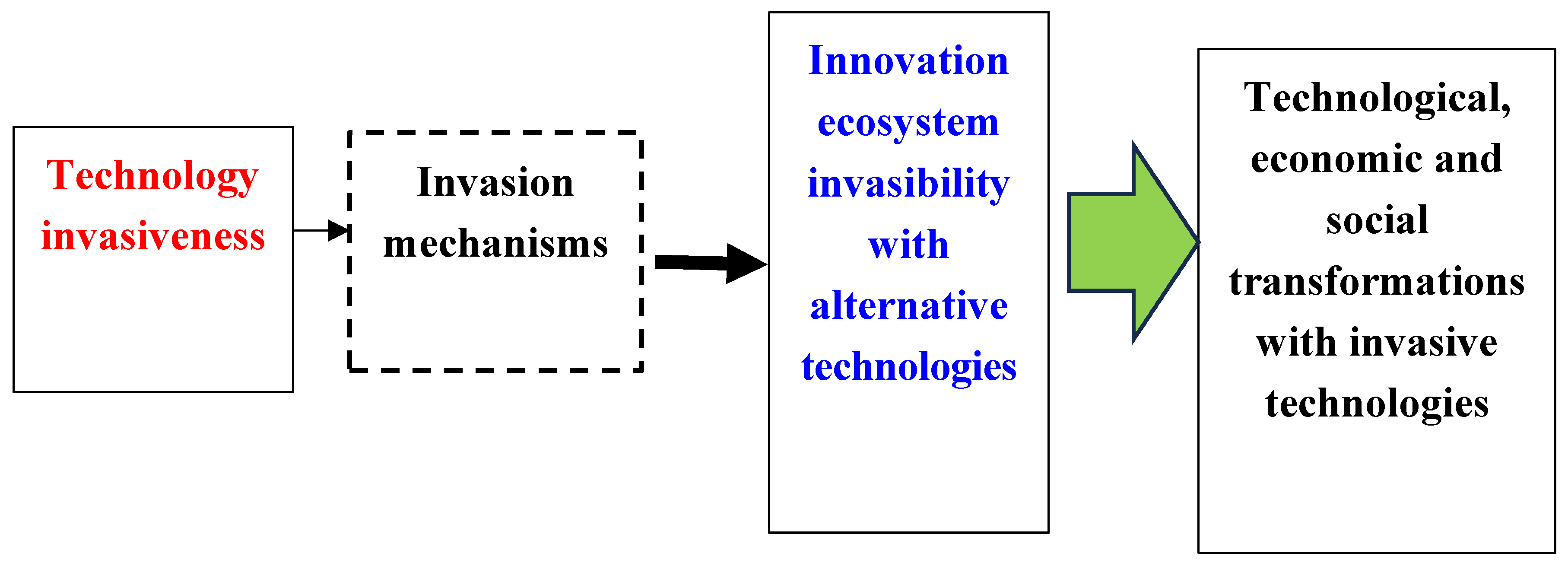
Figure 2.
Estimated relationships for temporal evolution of Transformers technology compared to overall domain of Large language models (Patents), 2016-2023 period. Dotted line indicates the dynamics of invasive technology; Continuous line indicates the dynamics of other alternative technologies predated.
Figure 2.
Estimated relationships for temporal evolution of Transformers technology compared to overall domain of Large language models (Patents), 2016-2023 period. Dotted line indicates the dynamics of invasive technology; Continuous line indicates the dynamics of other alternative technologies predated.
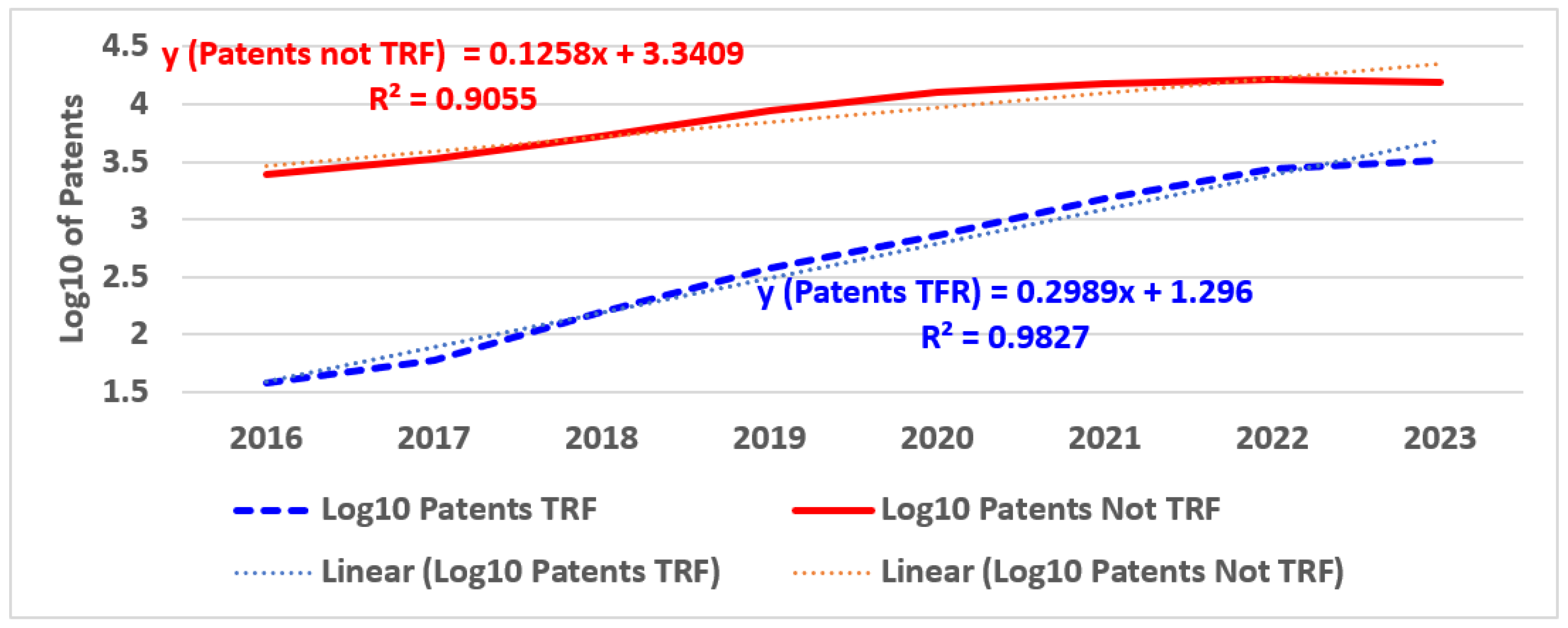
Figure 3.
Estimated relationships for temporal evolution of CNN technology compared to overall domain of Large language models (Patents), 1995-2023 period. Dotted line indicates the dynamics of invasive technology; Continuous line indicates the dynamics of other technologies.
Figure 3.
Estimated relationships for temporal evolution of CNN technology compared to overall domain of Large language models (Patents), 1995-2023 period. Dotted line indicates the dynamics of invasive technology; Continuous line indicates the dynamics of other technologies.
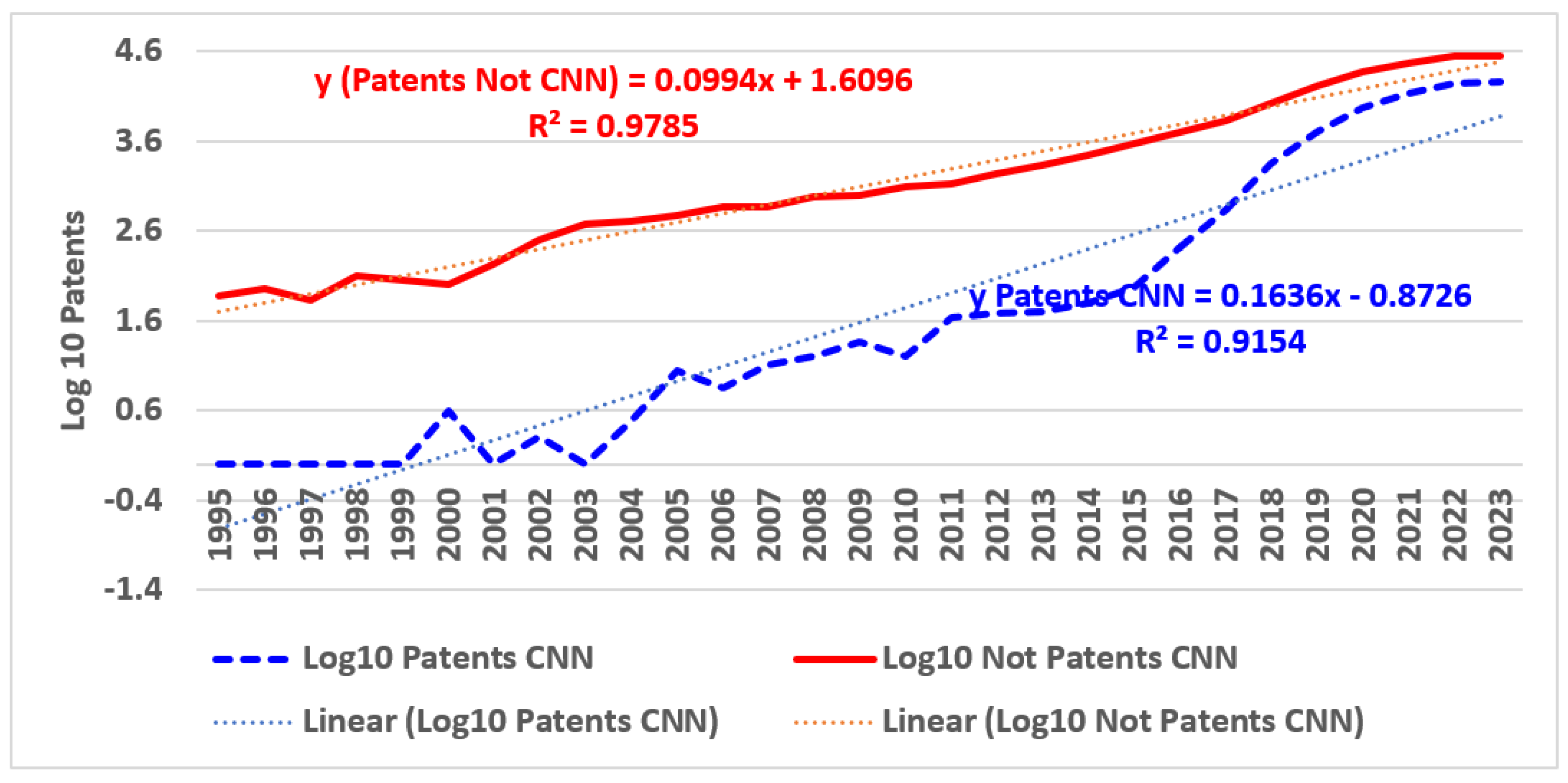
Figure 4.
Patterns of morphological change in domain of large language models generated by emerging technology of transformers (Patents). Large arrows indicate the direction of technological invasion.
Figure 4.
Patterns of morphological change in domain of large language models generated by emerging technology of transformers (Patents). Large arrows indicate the direction of technological invasion.

Figure 5.
Patterns of morphological change of CNN in domain of large language models generated by (Patents).
Figure 5.
Patterns of morphological change of CNN in domain of large language models generated by (Patents).
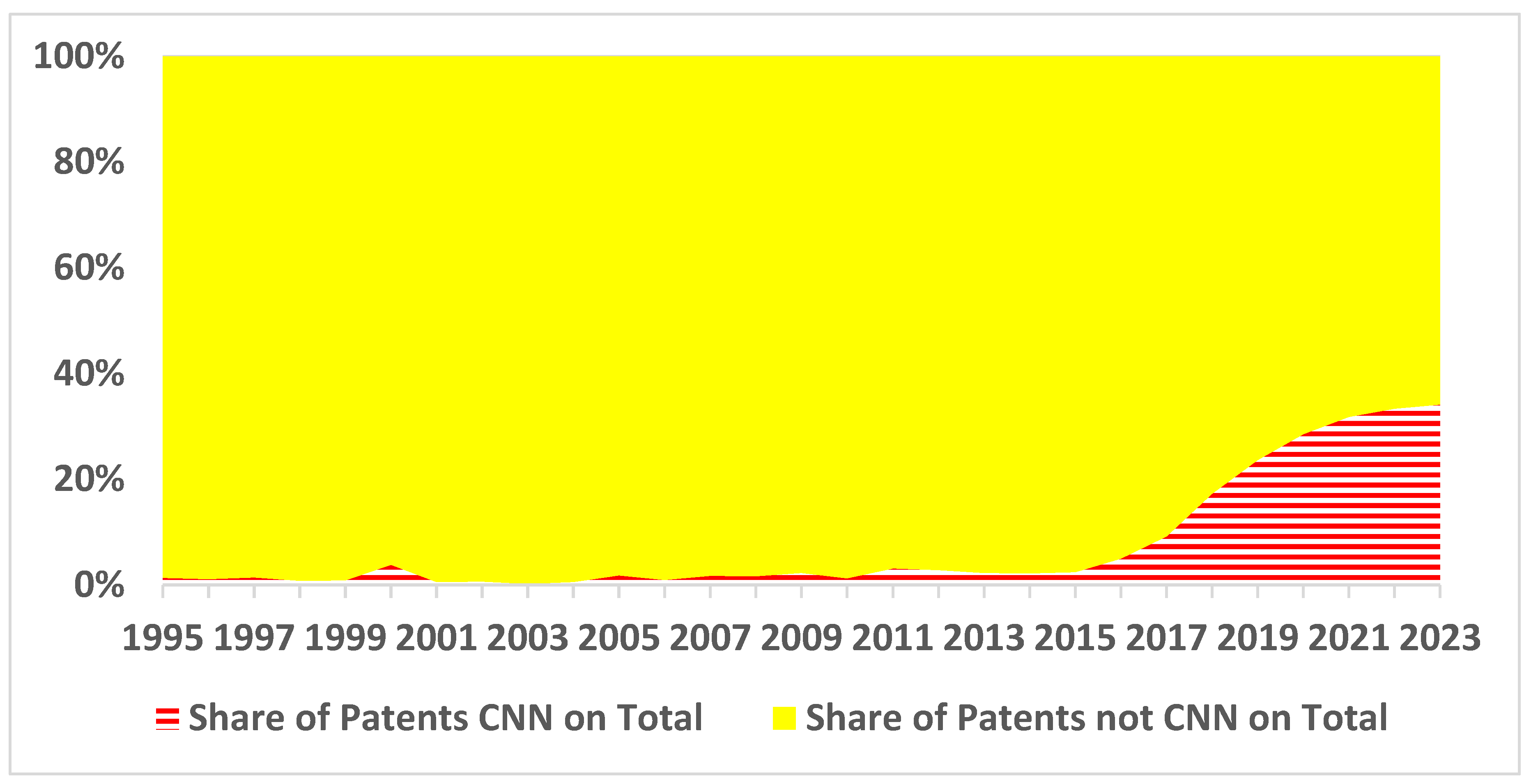
Table 1.
Parametric estimates of relationships based on patents.
| Dependent variable Publications | Constant α |
Coefficient β |
R2 | F | Period |
|---|---|---|---|---|---|
| Log10 Patents Transformers technology | 1.30*** |
0.30*** (0.016) |
0.98 (0.105) |
339.95*** | 2016-2023 |
| Log10 Patents not Transformers technology | 3.34*** | 0.13*** (0.017) |
0.91 (0.107) |
57.71*** | |
| Log10 Patents CNN technology | −0.87*** | 0.16*** (0.010) |
0.92 (0.431) |
292.05*** | 1995-2023 |
| Log10 Patents not CNN technology | 1.61*** | 0.10*** (0.003) |
0.98 (0.125) |
1227.66*** |
Note: *** p<0.001; Explanatory variable: time; period is from starting year of the patent to 2023 (last year available); In round parentheses the Standard Error. The F-test is based on the ratio of the variance explained by the model to the unexplained variance. R2 is the coefficient of determination.
Table 2.
Exponential rate of growth in large language models of invading and predated technologies.
| Transformers | Domain excluded Transformers | |
|---|---|---|
| Patents | Rate% | Rate % |
| r TRF = Exponential growth 2016-2023 | 55.82 | 23.02 |
| r’’ TRF = Exponential growth 2021-2023 | 25.81 | 0.76 |
| CNN | Domain excluded CNN | |
| Patents | Rate% | Rate % |
| r’ CNN = Exponential growth 1995-2023 | 33.84 | 36.11 |
Table 3.
Comparative analysis of invasive technologies.
| Generative Pretraining Transformers 2016-2023 |
Convolutional Neural Networks CNN 1995-2023 |
|
| Rate of Exponential growth (patents) | 55.82 | 23.02 |
Disclaimer/Publisher’s Note: The statements, opinions and data contained in all publications are solely those of the individual author(s) and contributor(s) and not of MDPI and/or the editor(s). MDPI and/or the editor(s) disclaim responsibility for any injury to people or property resulting from any ideas, methods, instructions or products referred to in the content. |
© 2024 by the authors. Licensee MDPI, Basel, Switzerland. This article is an open access article distributed under the terms and conditions of the Creative Commons Attribution (CC BY) license (http://creativecommons.org/licenses/by/4.0/).
Copyright: This open access article is published under a Creative Commons CC BY 4.0 license, which permit the free download, distribution, and reuse, provided that the author and preprint are cited in any reuse.


