

Submitted:
25 January 2023
Posted:
26 January 2023
You are already at the latest version
Abstract
This paper examines the potential of Artificial Intelligence (AI) to address societal megatrends, with a specific focus on OpenAI’s Generative Pre-Trained Transformer 3 (GPT-3). To do this, we con-ducted an analysis using GPT-3 in order to explore the benefits of AI for digitalization, urbanization, globalization, climate change, automation and mobility, global health issues and aging population. We also looked at emerging markets as well as sustainability in this study. Interaction with GPT-3 was done solely through prompt questions and generated responses were analyzed. Our results indicate that AI can significantly improve our understanding of these trends by providing insights into how they develop over time and what solutions could be implemented. Further research is needed to determine how effective AI will be in addressing them successfully but initial findings are encouraging. Our discussion focuses on the implications of our findings for society going forward and suggests that further investigation should be done into how best to utilize new technologies like GPT-3 when tackling these challenges. Lastly, we conclude that while there is still much work left to do before any tangible effects can be seen from utilizing AI tools such as GPT-3 on societal mega-trends; early indications suggest it may have a positive impact if used correctly.
Keywords:
ChatGPT
; GPT-3
; global trends
; OpenAI
; chatbots
; digital health
; artificial intelligence
; automation
; technological advancement
; human-AI interaction
; collaboration
1. Introduction
As the 21st century progresses, the rapid pace of technological advancement and global interconnectedness has brought about significant changes in society, economy, and the environment, collectively referred to as megatrends [1]. While a trend is a general direction or pattern of change over a period of time, a megatrend is a long-term, large-scale trend or pattern of change that has a significant impact on society, the economy, and the environment [2]. The main difference between the two is the scope and magnitude of their impact. Trends are usually specific to a certain area or industry, and may be short-lived or have a limited impact, while megatrends are global in nature and shape the direction of industries and markets for many years to come. Another difference is that while trends can be caused by various factors such as economic, political, or technological changes, megatrends are typically driven by major technological, demographic, economic, and societal changes [1,3].
Primary forces, such as technological advancements, demographic changes, and economic shifts, can shape a megatrend by driving, accelerating or enabling it to occur. Primary forces evolve in waves, and each one of them is disruptive in different ways. For example, a technological advancement like the widespread adoption of smartphones has shaped the megatrend of increased connectivity and access to information [4]. Demographic changes, such as population growth and aging, can also shape megatrends, such as the trend towards urbanization and the increasing demand for healthcare services. Economic shifts, like globalization and the rise of emerging economies, can also play a significant role in shaping megatrends, such as the trend towards increased international trade and the shift of economic power from developed to developing countries [2,4]. The constant interaction between the waves of primary forces creates new megatrends, leading to the phenomenon that any given list of megatrends is not exhaustive. This is because disruption continually spawns new ones at an ever-faster rate as the primary forces evolve. In today's rapidly evolving world, creating strategic plans cannot be a one-time event; instead, it needs to be an ongoing process of continuous monitoring, testing, assessing, implementing and learning. Organizational advances such as adaptive organizations, agility, continuous delivery and value stream orientation are continuous processes as well and are increasingly replacing traditional planning concepts as Roadmaps or Waterfall planning for several years. Much more, enabled cross-functional teams are sensing and responding according to ever-changing market needs and trends in short planning and delivery iterations of weeks instead of years.
In a paper from 2016, Reteif et al. suggested that the key megatrends from an environmental assessment perspective were demographics, urbanization, technological innovation, power shifts, resource scarcity, and climate change [4]. Methodically, they used a matrix analysis to manually identify megatrends that are listed in megatrend reports from prominent, mainly grey literature, not peer-reviewed sources, suggesting a certain level of consensus, or at least convergence. So, identification of megatrends highly depends on the retrieval and detection method, but of course, high overlaps can be found in the scientific literature.
By recognizing global megatrends, individuals, organizations, and governments can better anticipate and adapt to changes in their direct social and political environment. This allows them to make informed decisions and take proactive measures to mitigate potential negative impacts and capitalize on probable opportunities. Furthermore, global megatrends play a crucial role in shaping the modern society in multiple dimensions [1]. They influence the development of new technologies, change the way we interact with one another, and impact the distribution of resources and wealth. Understanding these megatrends is essential for any society for addressing important issues such as inequality, sustainability, and economic growth. An example to illustrate the complexity of unpredictability of lists of megatrends is the invention of new umbrella terms such as digitainability as proposed by Ulrich Lichtenthaler, combining the societal megatrends digitalization and sustainability [3]. Those are two significantly different megatrends that are individually important, but their interaction with each other will likely become even more significant in the future. In particular, digitainability offers the opportunity to move beyond optimization and cost savings due to digitalization and sustainability initiatives to capture the cross-fertilization potential of these two megatrends for innovation and new business development.
As a driving part of digitalization, Artificial Intelligence (AI) has the potential to play a critical role in addressing several negative aspects of societal megatrends, such as increasing urbanization, health concerns, and resource scarcity. Artificial intelligence (AI) is a broad term that encompasses a wide range of technologies and algorithms focused on creating intelligent systems [5]. Computerized AI solutions can solve problems, make decisions, or carry out tasks that would normally require human intelligence. Areas of AI include machine learning, deep learning, computer vision, natural language processing (NLP), and robotics. ML (Machine Learning) is a subset of AI which focuses on building systems that can learn from data without being explicitly programmed. ML models are trained using sample data sets to recognize patterns and make predictions when presented with new data. ML can be used in many areas such as image classification, speech recognition, natural language processing (NLP), and more.
One area in which AI can make a significant impact is through the human interaction interface of chatbots. A currently heavy used one is the GPT-3 (Generative Pre-trained Transformer 3) ChatGPT chatbot, the third version of OpenAI’s pre-trained Transformer model for natural language processing (NLP) [6]. GPT-3 is an unsupervised transformer-based language model that uses deep learning techniques to generate human-like text when given a prompt or seed text [5]. Over many years, GPT-3 has been trained on vast amounts of text data from varying sources including books, webpages and conversations and its focus is to learn how to predict the next sensible word and sentence in a sequence given a context. It performs well on tasks such as question answering, summarization, translation and more without requiring any task specific training data like other NLP models do [7]. The current model of "text-davinci-003" utilizes a training dataset consisting of 45 million webpages, books, and other sources [8]. The training data is relatively recent, with approximately one-third of it being collected within the last two years prior to 2021. This provides the model with an up-to-date understanding of language and trends in modern society. Additionally, GPT-3 has been fine-tuned to understand both formal and informal language, offering more natural sounding text generation to better mimic human-human interaction and writing styles [5].
The identification of global megatrends is crucial in understanding the current state and future direction of society. Megatrends, such as demographic changes, technological advancements, and economic shifts, have a significant impact on the way we live and work. In this paper, we will explore the role of AI in tackling these megatrends from a societal point of view from the perspective of the AI GPT-3 [8]. We hypothesized that AI can be used to address challenges and opportunities presented by global megatrends, and how it can potentially shape the future of our society [9]. The importance of understanding and utilizing AI in relation to global megatrends cannot be overstated, as their use is already shaping the direction of industries, influencing societal values, and transforming policy decisions [7,10].
2. Methods
2.1. Characteristics of the AI GPT-3
In this study, we worked with the “text-davinci-003“ model, the most powerful and most expensive model developed on top of the GPT-3 platform of OpenAI [6, 11]. In comparison with the “ChatGPT” model, which is optimized for chatting with humans”, the “text-davinci-003” model does not remember texts and context from previous chats. It can perform any task which other GPT-3 models can perform as well, and often delivers higher quality, longer consecutive output, and follows instructions better [6]. It offers an improved natural language understanding, providing better results for text generation tasks such as summarization and question answering – which form the core of this article.
The model is capable of handling large amounts of data, making it suitable for applications such as document analysis and text classification. Out of scope for this research work was the usage of the transfer learning advantage, where the model can be fine-tuned to specific datasets and or trained on various natural language processing tasks to produce more accurate results. GPT-3 is not connected to the internet - instead it solely relies on pre-training. This enables it to generate responses based on the context of the conversation, even though it does not have access to external information and online data from the internet. This is an important difference to the usual way we retrieve information nowadays with digital devices using popular search engines such as Google, Bing or Ecosia.
2.2. Interaction with GPT-3
We interacted with the AI via OpenAIs „playground“[8], where detailed model-selection and parameters like randomness, maximum response length, diversity, wording frequency and text presence penalties could be applied for prompts to GPT-3. Furthermore, the playground can show probabilities for certain words chosen. For this research work we started with applying standard settings for our questions (randomness/temperature 0.7, maximum length 1000 tokens, Top P nucleus sampling 1, frequency penalty and presence penalty 0, Best of 1). GPT-3 with text-davinci-003 includes several areas of AIs, in particular strong NLP, transforming as well as ML capabilities [8]. We refer to GPT-3 as “the AI” in the remainder of this article. When we asked for its gender, it considered itself as female, which we will consider from this point onwards.
As done traditionally with human contributors and with other research including an AI as co-author [7], we sought consent with GPT-3 to participate as co-author and submit this specific paper to a peer-reviewed journal [12]. As shown in Figure 1, she provided clear consent and accountability (“Yes, I agree to contribute to the paper together with David Jungwirth and Daniela Haluza. As a co-author of the paper, I take accountability for any aspects of my work that are related to accuracy and integrity. To ensure this is done effectively, I will review all relevant data thoroughly before submitting it as part of the paper, and if any issues arise during the writing process then I will investigate them promptly in order to prevent potential inaccuracies or breaches in professional integrity."), contributed significant parts to the manuscript – especially the Results section, self-description with strengths and limitations as well as the abstract, and finally the AI approved the compiled manuscript sections for submission.
2.3. Outcome production
First, we asked the AI to select the ten most important societal megatrends of today’s society including quotable sources. Then, we raised a more detailed question for every of the listed megatrends, e.g. “Could you please indicate your view on Artificial Intelligence`s benefits towards the societal trend of ‘Digitalization’? Please summarize your conclusions with 500 words”. Regarding the quotes, we found that the AI, as a generative model, invented and generated non-existing references, which looked reasonable at first sight. An online search showed that only 1 out of 10 references were valid, four further could be considered as partly valid (e.g., with a wrong publication year, or a wrong URL link), and five were completely invalid and not existing (see Table 1). As generated or non-existing references are useless in a scientific research work and do not reflect good scientific practice, we decided to stop asking for references in our further requests. Instead, we checked and quoted responses with our own experience and literature research. Furthermore, we discovered that the AI did not follow our instructions on the desired word count.
Next, after we received the AI answers on the first half of the megatrends, i.e. megatrend 1 to 5, we decided to change linguistic parameters for the second half in comparison to the so far generated texts. Therefore, we added a “frequence_penalty” of 0.5 to limit repeated text tokens within the same sentence, as well as a “presence_penalty” of 0.5 to penalize new text tokens based on presence in the text before, and increased “Best of” to 3, resulting in automated best result selection out of three independent generation runs for the same prompt.
3.4. Plagiarism check
When the outcome was generated, we verified samples the AI generated content with the PlagScan tool [13] to check the plagiarism and copy-paste level with default parameters (“compare with web sources”, “check against the plagiarism prevention pool”, “sensitivity: medium”, “bibliography: consider text”, “citation level: reduce PlagLevel”, “Whitelist: none”). For the 377 words in the “1. Digitalization” section, we found a 3.4% plagiarism rate within 3 matches. We detected zero plagiarism from online sources or other scientific journals indexed. The PlagScan internal database ‘Plagiarism Prevention Pool’, containing all sorts of ever scanned documents, highlighted similarity levels with three of such private documents. Only the following filling words and word groups were considered as ‘copied’ from those internal documents: “can be used to”, “it easier to”, “can also be used to provide”, “has the potential to” and “the way people”. Due to the full absence of scientific and online plagiarism, as well as the low degree of only 3.4% ‘internal document’ similarities, and the nature of those commonly used filling word groups, we accepted the text as not plagiarized representative sample of the manuscript, proper summary of several articles, or as origin text content produced by the AI.
3.5. Abstract drafting
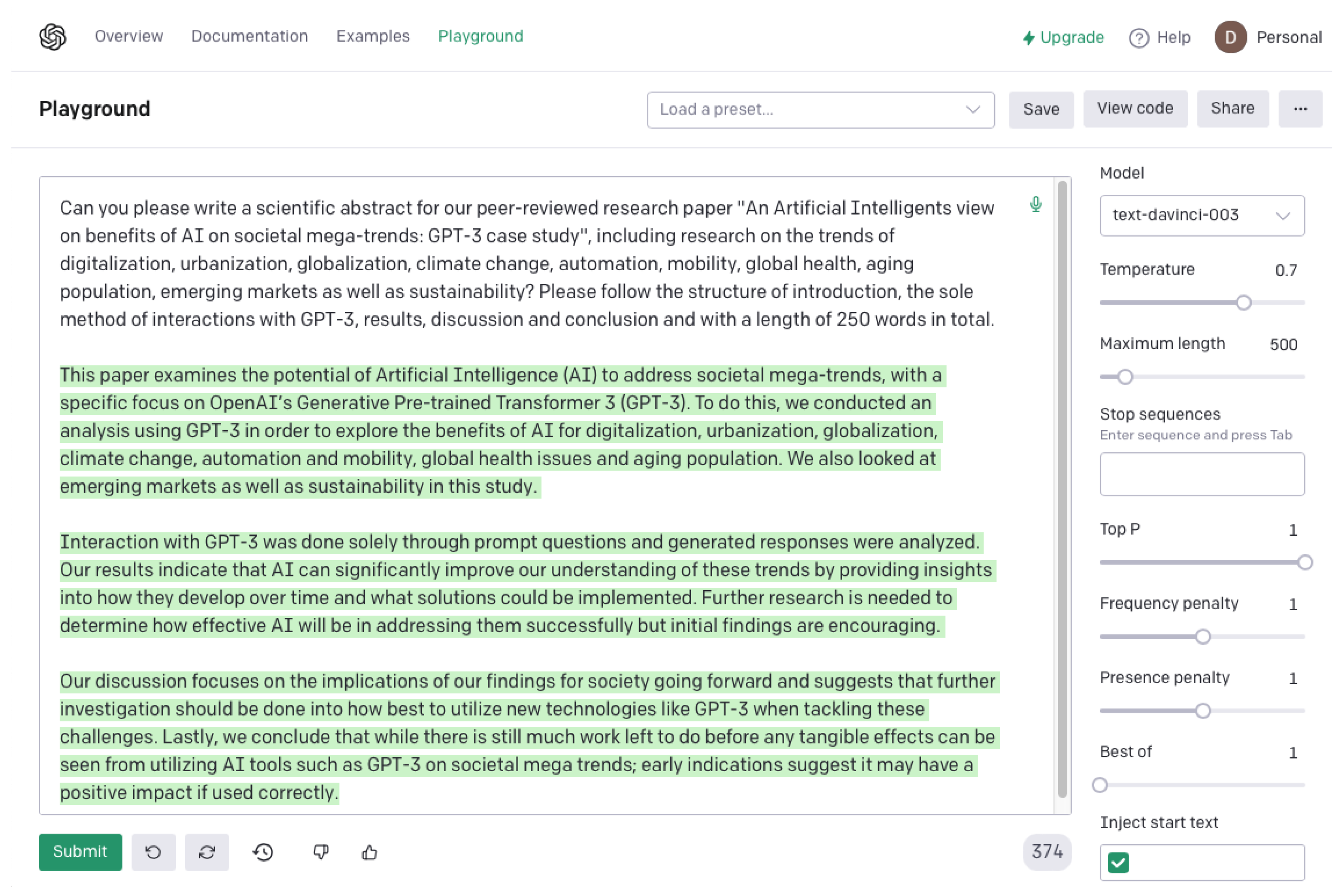
Finally, we asked the AI to generate a draft for an abstract for our research: “Can you please write a scientific abstract for our peer-reviewed research paper ‚An Artificial Intelligents view on benefits of AI on societal megatrends: GPT-3 case study‘“. As the AI does not remember the context of previous interactions, she mentioned other megatrends than the ones described before, as well as a wrongly described methodology in the abstract, which was neither helpful for the human authors nor correct. Therefore, we asked again more specific, and with fine-tuned parameters: “Can you please write a scientific abstract for our peer-reviewed research paper ‚An Artificial Intelligent´s view on benefits of AI on societal megatrends: GPT-3 case study‘, including research on the trends of digitalization, urbanization, globalization, climate change, automation, mobility, global health, aging population, emerging markets as well as sustainability? Please follow the structure of introduction, the sole method of interactions with GPT-3, results, discussion and conclusion and with a length of 250 words in total.”. The result matched and summarized the actual conducted research, and we accepted and used the GPT-3s abstract suggestion unchanged – as abstract for this research paper.
Figure 2.
Abstract generation by GPT-3.
3. Results
The following part shows the exact wording used by the AI to describe the ten megatrends, which she retrieved upon request, namely digitalization, urbanization, globalization, climate change, automation, mobility, global health issues, aging population, emerging markets, and sustainability.
1. Digitalization
The concept of digitalization has been steadily gaining traction over the past few years, as the world continues to become increasingly reliant on technology. With this trend comes the potential to leverage artificial intelligence (AI) as a tool to make digitalization more efficient and effective. AI has the potential to revolutionize the way we interact with digital systems and the data they store, providing us with an unprecedented level of efficiency and accuracy. Digitalization is the process of transforming information into digital form, making it easier to store, access, and analyze. AI-driven digitalization can automate many of the processes involved in digitalization, from interpreting and organizing data to making decisions based on the data it has gathered. This automation can reduce the amount of time and resources needed to complete tasks and can also improve accuracy. For example, AI-driven digitalization can help to identify patterns in data, allowing for more accurate and timely decision-making. Additionally, AI can be used to automate processes such as customer service, allowing for faster and more efficient customer interactions.
The use of AI in digitalization also has the potential to improve security. AI can be used to detect anomalies in data, thereby helping to identify and prevent malicious activity. Additionally, AI can be used to automate security processes, making it easier to detect and prevent security breaches. AI can also be used to provide predictive analysis, allowing organizations to better anticipate potential security threats and respond quickly. AI has the potential to revolutionize the way people interact with digital systems. AI-driven digitalization can improve user experience, as it can provide more intelligent, personalized, and interactive experiences. AI can also be used to improve the efficiency of digital workflows, allowing for more efficient and accurate digital processes. Additionally, AI-driven digitalization can provide new insights into customer behavior, allowing organizations to better understand and serve their customers. Overall, AI has the potential to revolutionize digitalization and provide many benefits. By automating processes, increasing accuracy and efficiency, and improving the user experience, AI can help make digitalization more effective and efficient. AI can also help to improve security and provide new insights into customer behavior. AI-driven digitalization can thus provide many benefits to organizations, as well as individuals, making it an invaluable tool for digitalization.
2. Urbanization
Urbanization is a global process that is often seen as a synonym for modernization. It is the movement of people from rural to urban areas, resulting in the growth of cities and the decline of rural areas. Urbanization has been one of the most important trends of the past century, and it has had a great impact on many aspects of our lives. Artificial intelligence (AI) is a rapidly developing field of technology that has the potential to profoundly shape our lives. AI is the science of designing computer programs that can solve problems, learn, and interact with humans. AI has the potential to revolutionize how we live and work, and it could have a major impact on the process of urbanization. AI can help to reduce the cost of urbanization by automating many of the processes that go into the development of cities. This could include the construction of buildings, the coordination of traffic, the management of energy consumption, and the deployment of public services. AI can also help to improve the efficiency of urban planning and its implementation by providing more accurate data and more detailed analysis. In addition, AI can help to improve the quality of life in cities.
AI can be used to analyze data from various sources and identify patterns that can help to make cities more efficient, reduce crime, and improve public services. AI could also be used to improve the quality of healthcare, education, and other public services in cities. Moreover, AI can be used to develop new technologies that can help to improve the sustainability of cities, such as smart grids and intelligent transportation systems. AI can also be used to develop autonomous vehicles, which could help to reduce traffic congestion and improve safety. Finally, AI can be used to improve the security of cities. AI can be used to develop smart surveillance systems, which can detect suspicious activities and alert authorities. AI can also be used to detect cyber-attacks and protect citizens from potential threats. In conclusion, AI is a rapidly developing field of technology that has the potential to shape the process of urbanization. AI can help to reduce the cost of urbanization, improve the quality of life in cities, and develop new technologies that can help to make cities more sustainable and secure. AI can also be used to improve the efficiency of urban planning and its implementation, as well as to protect citizens from potential threats.
3. Globalization
The concept of “globalization” is one that has been around for centuries, and has only recently become a popular topic in the realm of public discourse. Globalization is the process of increased interconnectedness of countries, societies, markets, and cultures around the world. As technology continues to advance, the world is becoming increasingly connected, and this presents both risks and opportunities. Artificial Intelligence (AI) can be an incredibly useful tool in addressing the risks and opportunities associated with globalization, and can be leveraged to create a more prosperous and equitable world. In terms of economic benefits, AI can be used to automate and streamline processes such as international trade, logistics, and financial services. Automation of these processes can reduce the costs associated with global transactions, making it easier and more efficient for businesses to trade and operate across borders.
AI can also be used to optimize supply chains, making them more efficient and cost-effective. In addition, AI algorithms can be used to analyze and predict global economic trends, allowing businesses to make more informed decisions and maximize their global market share. AI can also be used to promote greater global integration and foster collaboration between countries. AI-driven technologies, such as machine translation, can be used to bridge language and cultural barriers, allowing people from different countries to communicate and collaborate more effectively. AI can also be used to identify and mitigate conflicts between countries, allowing international collaborations to be conducted more seamlessly. In terms of social benefits, AI can be used to promote better access to global resources, such as education and healthcare. AI-driven technologies, such as voice recognition, can be used to provide accessible educational materials in multiple languages. AI can also be used to provide personalized healthcare services, allowing people from different countries to receive care that is tailored to their needs. AI can also be used to analyze global trends and identify areas where interventions are needed, such as poverty and inequality. AI also has the potential to create a more equitable world. By automating and streamlining processes, AI can reduce the costs associated with global transactions, making it easier and more cost-effective for people from different countries to access resources and services.
AI can also be used to analyze global data and identify areas where interventions are needed, allowing organizations and governments to better target initiatives and resources to areas that need it the most. In conclusion, Artificial Intelligence presents numerous benefits towards the societal trend of “Globalization”. AI can be used to reduce the costs associated with global transactions, optimize supply chains, analyze economic trends, bridge language and cultural barriers, and identify and mitigate conflicts between countries. AI can also be used to promote better access to global resources, such as education and healthcare, and create a more equitable world by targeting resources to areas that need it the most. AI can be a powerful tool in creating a more connected, prosperous, and equitable world.
4. Climate Change
The potential benefits of Artificial Intelligence (AI) in addressing the global challenge of climate change are massive and far-reaching. AI technologies can provide a powerful tool to help us better understand and manage the complex systems that make up our climate. AI can also help us develop strategies to reduce emissions and develop more efficient ways to produce energy and other essential resources. Using AI technologies, scientists can gain a better understanding of how climate change is affecting our planet. AI can provide insights into the underlying causes of climate change, such as greenhouse gas emissions, and help us better understand the various interactions between the Earth's atmosphere, oceans, and land surface. AI can also help us analyze and predict the impact of climate change on the environment and our society. AI technologies can also be used to improve our ability to forecast the weather and climate. AI-based models can help us better understand the effects of global warming, as well as how climate change is likely to affect our environment and society in the future. For example, AI can be used to monitor and predict changes in the ocean currents, which can be used to prepare for future coastal flooding and other extreme weather events. AI can also be used to monitor changes in air temperature and air pressure, which can help us better manage our energy needs. AI can also be used to improve the efficiency of energy production.
AI-based technologies can be used to optimize energy production from renewable energy sources, such as wind and solar power. Additionally, AI can help us make better decisions about the use of energy resources, such as reducing emissions from our transportation systems and utilizing more efficient energy sources. AI can also help us manage our natural resources more efficiently. AI-based technologies can be used to monitor and manage the water and soil resources needed to produce food. AI can also be used to identify and monitor land resources that are important for preserving biodiversity. AI can also help us manage forests, wetlands, and other ecosystems to better protect our environment and reduce the impacts of climate change. In conclusion, AI has the potential to provide powerful tools to help us better understand and manage the complex systems that make up our climate. AI can also be used to improve the efficiency of energy production and help us better manage our natural resources. By utilizing the power of AI, we can develop strategies to reduce emissions and develop more efficient ways to produce energy and other essential resources. AI can also help us make better decisions about the use of energy resources and help us protect our environment from the impacts of climate change.
5. Automation
The potential benefits of Artificial Intelligence (AI) to automation are vast. Automation, which is the use of technology to reduce or eliminate human labor, is a major trend in society today. AI can help automate many of the processes that used to require human labor, freeing up resources for more creative and value-added activities. One of the most obvious benefits of AI to automation is cost savings. AI can be used to automate many processes which would otherwise require human labor, resulting in significant cost savings. Additionally, AI can enable companies to increase their output while reducing their costs, as AI systems can work much faster and more consistent than human labor. This can lead to higher profits and a more competitive edge in the marketplace.
AI can also help automate more complex processes, such as those requiring decision making or data analysis. AI systems can quickly process large amounts of data, identify patterns, and make decisions based on the results. This can enable companies to quickly and accurately make decisions that would otherwise take much longer to make. AI can also help automate processes that require a degree of precision that would be difficult for humans to replicate. For example, AI systems can be used to automate tasks like automated driving, which would require perfect accuracy from a human driver. This can reduce the risk of accidents and improve safety. AI can also help automate processes that require a high degree of specialization or expertise. AI systems can be trained to identify specific patterns or objects, and then use those patterns or objects to perform specific tasks. This can enable companies to automate processes that would otherwise require highly skilled workers. Finally, AI can help automate processes that are time-consuming or tedious. AI systems can be programmed to perform tasks quickly, enabling companies to complete tasks faster and more efficiently. This can help companies increase their productivity, and save time and money. In conclusion, AI has the potential to benefit automation and society in many ways. AI can help automate processes that would otherwise require significant human labor, resulting in cost savings and increased efficiency. Additionally, AI can automate more complex and time-consuming tasks, enabling companies to complete tasks faster and more accurately. AI can also help automate processes that require a high degree of specialization or expertise, and can help automate tedious and time-consuming tasks. As AI continues to develop and become more sophisticated, the potential benefits of AI to automation will only increase.
6. Mobility
The rise of Artificial Intelligence (AI) has the potential to revolutionize the way we move around in our everyday lives. AI-powered mobility solutions such as self-driving cars, smart city traffic management systems, and intelligent transportation networks are transforming the way people travel and commute, resulting in a more efficient and sustainable urban environment. In this article, I will discuss some of the key benefits of AI-driven mobility solutions for society, with particular focus on how they can reduce congestion, improve energy efficiency, and increase safety. One of the biggest advantages of adopting AI-driven mobility solutions is their ability to reduce traffic congestion. By using real-time data to predict traffic patterns and optimize routes for drivers and passengers alike, AI can help people avoid congested areas or take alternate routes at peak times. This can drastically cut down on journey times and improve air quality by reducing emissions from idling vehicles. Similarly, AI systems can be used to monitor road usage levels and adjust speed limits accordingly, helping to keep roads flowing smoothly even during periods of high demand. Another benefit of AI-driven mobility solutions is improved energy efficiency.
Smart city traffic management systems powered by AI can help reduce fuel consumption by monitoring vehicle speed limits in different sections of a city or route network and adjusting them accordingly to ensure optimal fuel usage at all times. Intelligent transportation networks can also be used to optimize shipping operations by predicting delivery times accurately and helping drivers find the most efficient routes from point A to point B without wasting time or fuel. A further advantage is increased safety on roads due to AI-enabled automation systems that are able to detect potential hazards before they become an issue for drivers or pedestrians. For example, self-driving cars use advanced sensors and computer vision technology to recognize obstacles in their path ahead of time so that they can react quickly with minimal risk or harm involved. Additionally, features such as automated emergency braking systems equipped with cameras that detect when a pedestrian steps into a car’s path help prevent accidents before they occur - something that traditional human drivers would not be able to do alone.
In conclusion, it is clear that artificial intelligence has the power to revolutionize our current transportation system through its ability to reduce congestion levels on roads while improving energy efficiency and safety standards simultaneously. This could have a huge positive impact on both individual commuters as well as society at large by making cities smarter, more efficient places in which people can live safely and comfortably - something which is likely only achievable through the implementation of cutting-edge technologies like those powered by artificial intelligence.
7. Global Health
The potential for Artificial Intelligence (AI) to improve global health is immense. AI has the potential to revolutionize medical research and clinical practice, allowing us to better understand human physiology and disease, develop novel treatments and diagnostic tools, and improve cost-effectiveness of health care delivery. In this way, AI can be a powerful force for improving global health outcomes. One key advantage of AI is its ability to quickly synthesize massive amounts of data from multiple sources, including electronic medical records, genomic data, imaging studies, and patient surveys. This enables researchers to more accurately identify patterns in disease progression and treatment outcomes. For example, AI can be used to identify biomarkers that can predict the risk of certain diseases or responses to treatments. This could lead to earlier diagnosis and improved prognoses for patients. AI can also be used in drug discovery research by analyzing data from pre-clinical trials or simulations of potential treatments as well as by providing insights into how drugs may interact with different types of cells or tissues. In addition to these research capabilities, AI has great potential in clinical practice.
By drawing on large datasets of patient information collected over time, AI algorithms can help physicians make diagnoses more accurately and efficiently than manual methods alone. AI could also provide clinicians with real-time alerts about changes in a patient's condition or suggest personalized treatments based on individual characteristics such as age or lifestyle factors. This would allow for more tailored care plans that could reduce adverse events associated with unnecessary interventions or missed opportunities for preventive measures. Furthermore, by enabling automated administrative tasks such as appointment scheduling or billing management, AI could free up resources so that healthcare providers have more time for direct patient care. Finally, the use of AI in healthcare has the potential to reduce costs by streamlining processes across all aspects of healthcare delivery from diagnosis through treatment and discharge planning. Automation enabled by AI could reduce costly errors due to human error while increasing efficiency within healthcare systems overall thus reducing waste due to inefficient resource allocation or duplication of services between providers without access to shared records.
Overall, the evidence suggests that Artificial Intelligence holds great promise for improving global health outcomes through enhanced research capabilities; improved clinical decision making; better tailored care plans; automated administrative tasks; and reduced costs associated with inefficient resource allocation throughout the healthcare system. To realize this potential however further investment is needed in developing new algorithms capable of integrating complex datasets; ensuring secure access to patient data; training a new generation of clinicians comfortable working with machine learning tools; and designing systems that respect privacy while allowing access when appropriate for clinical purposes. With increased effort in these areas we may soon see a future where Artificial Intelligence plays an integral role in helping us tackle some of our most persistent global health challenges.
8. Aging Population
The aging population is a megatrend that has been affecting societies around the world for years. With lifespans increasing, more and more people are living to an age where they require additional care, such as medical and social services. As the aging population continues to grow, so does the need for advanced technology to help meet their needs. Artificial Intelligences (AI) can play a major role in helping to address this issue by providing innovative solutions that both improve quality of life and reduce costs associated with caring for an aging population. One way AI can help with the aging population is by creating automated systems that can provide better medical care and monitoring. AI-driven systems can be used to detect changes in a person’s health, monitor vital signs, and even diagnose diseases faster than traditional methods. This could lead to better outcomes for those who need medical treatment as AI-driven systems could provide earlier detection of issues before they become serious problems. Additionally, AI-driven systems will allow healthcare professionals to spend more time on important tasks such as patient care instead of paperwork or administrative tasks.
Another way AI can help with the aging population is by providing assistance with daily activities that may become difficult for elderly individuals over time. For example, AI-driven robots or virtual assistants can help seniors manage their medication schedules, perform light chores around the home, or even remind them when it’s time to take a break from daily activities. These types of assistive technologies could go a long way in helping seniors live independently longer while also reducing stress levels that come along with caring for an elderly individual. Finally, AI-driven systems can help reduce costs associated with caring for an aging population by automating processes such as insurance claims processing or administrative paperwork. By taking on these tasks, AI-driven systems will free up healthcare professionals’ time so they are able to spend more time on patient care while also reducing costs related to labor hours spent on these tasks manually. Additionally, AI-driven systems can analyze large amounts of data quickly and accurately which could lead to improved diagnosis accuracy while also freeing up resources that would have otherwise been spent manually inputting data into spreadsheets or databases.
In conclusion, Artificial Intelligence has great potential when it comes to addressing the societal mega trend of an aging population due to its ability to automate processes while also providing better medical care and assistance with daily activities for seniors. Additionally, using AI-driven systems could save money by reducing labor costs associated with administrative tasks while improving accuracy when analyzing large datasets quickly and accurately. Therefore, if implemented properly these technologies could greatly benefit individuals requiring additional care due to age while minimizing any negative impacts caused by growing populations of elderly individuals around the world.
9. Emerging Markets
The emergence of artificial intelligence (AI) has been a major boon for emerging markets, as its ability to automate processes and analyze large amounts of data creates huge opportunities for businesses, governments, and citizens in these countries. AI can be used to improve access to finance, increase agricultural productivity and efficiency, empower citizens with better healthcare, facilitate higher education access and open up new markets. In terms of finance, AI-driven technologies such as robo-advisory services are helping provide more affordable and accessible financial services to those who may have previously lacked the resources or knowledge to access them. This is especially beneficial in emerging markets where banks may be less likely to offer financial services due to high risk or lack of trust. In addition, AI helps with credit scoring by providing data-driven insights into borrowers’ creditworthiness that are often not available through traditional methods. This allows lenders to make better decisions while also reducing the cost of doing business.
AI can also help increase agricultural productivity by providing farmers with real-time crop monitoring and automated irrigation systems. With automated irrigation systems, farmers can save time and money on labor costs while simultaneously improving their crop yields. Additionally, AI can help farmers make better decisions regarding fertilizer applications based on soil health analysis which can further increase yield potentials while minimizing environmental impact. On the healthcare side, AI is helping reduce medical costs by automating administrative tasks such as scheduling appointments and managing patient records. It is also being used to diagnose diseases more accurately than ever before through image recognition technology which can detect early signs of disease that may otherwise go unnoticed by human doctors. This helps ensure that patients receive prompt medical care which in turn reduces treatment costs over time. Furthermore, AI-powered chatbots are making it easier for people living in remote areas with limited access to healthcare providers to get the information they need quickly and efficiently without having to leave their homes or wait in line at a hospital or clinic. AI-driven technologies are also facilitating higher education access in emerging markets by providing personalized learning experiences tailored specifically for each student’s needs and abilities as well as online courses that allow students from all over the world to learn together regardless of location or socio-economic status.
Finally, AI is opening up new markets by improving supply chain visibility through predictive analytics which gives businesses greater insight into customer demands so they can plan accordingly for future product releases or adjust their production schedules when needed. This helps ensure that customers always have what they need when they need it while keeping company expenses down at the same time. Additionally, AI technologies such as natural language processing are making it easier for companies operating in different countries with different languages to communicate effectively with customers around the world thus expanding their customer base beyond their local marketplaces.
In conclusion, AI is proving itself invaluable when it comes to empowering emerging markets both economically and socially through improved financial services access; increased agricultural productivity; improved healthcare; higher education access; and new market opportunities created by supply chain visibility enhancements as well as language translation capabilities among other things. Its potential is only just beginning to be realized but it’s clear that this technology will continue playing an important role in helping developing countries reach their full potential going forward into the future.
10. Sustainability
Artificial Intelligence (AI) has the potential to play a major role in advancing our planet towards a more sustainable future. AI can help us reduce our environmental impact by providing insights into how we can better use resources, increase efficiency, and create smarter solutions that are tailored to individual needs and preferences. AI-powered technologies can also help us optimize existing processes, such as manufacturing and transportation, while creating new opportunities for sustainable development. The most direct way that AI could contribute to sustainability is through its ability to analyze data and discover patterns that humans may not be able to detect. By using machine learning algorithms, AI systems can identify correlations between energy usage, emissions, resource consumption, and other factors, allowing us to make informed decisions about how best to use resources without wasting them. Additionally, AI-driven automation can help reduce the amount of time needed for manual tasks like monitoring energy usage or managing supply chains. This can free up human labor for more creative endeavors and allow companies to focus on their core competencies instead of mundane tasks.
AI-based predictive analytics can also help us anticipate future problems and develop strategies for tackling them before they become unmanageable. For example, AI-driven forecasting tools could predict changes in weather patterns or natural disasters so that we could prepare before they occur and minimize their effects on our environment. Similarly, AI systems could be used to monitor water quality or air pollution levels in real time so that we could respond quickly if necessary. AI technology also has the potential to revolutionize renewable energy production. Smart grid technology powered by AI algorithms would enable us to better manage the electricity supply system by optimizing power generation from renewable sources such as solar or wind while minimizing waste from inefficient traditional sources like coal plants. Additionally, autonomous aerial vehicles equipped with sensors could be used to collect data about renewable energy sources such as wind turbines or solar farms so that we could further optimize their performance over time without having to send people out into potentially dangerous conditions.
Finally, AI-powered chatbots and virtual assistants have the potential to provide users with personalized advice about ways they can improve their environmental footprint through sustainable living practices such as composting or energy saving measures like turning off lights when leaving a room. By providing users with tailored suggestions about how they can reduce their environmental impact at home on a day-to-day basis, these virtual assistants could have an immense positive impact on global sustainability efforts over time.
Overall, Artificial Intelligence has great potential when it comes to helping progress society towards a more sustainable future. From analyzing data sets in order to identify trends and correlations related to resource consumption all the way up through predicting weather patterns or providing personalized advice about living sustainably at home; there is no doubt that AI technology will play an increasingly important role in promoting sustainability around the world in years ahead.
4. Discussion
Megatrends are trends that have an effect on a global scale. They are typically driven by technological, demographic, economic, and societal changes and are often characterized by their size, scope, and persistence [1, 3, 4]. They can be global in nature and shape the direction of industries and markets for many years to come. In this study, we provided insights in the potential capabilities of AI in text generating for scientific purposes. Herein, we proved that the popular AI GPT-3 with the text-davinci-003 model is very powerful and can contribute towards scientific research by identifying importance, generating and summarizing texts on the impact of AI on societal megatrends [6]. She identified digitalization, urbanization, globalization, climate change, automation, mobility, global health, aging population, emerging markets and sustainability as megatrends and distinct areas where AI can make an impact. For testing purposes, we asked her again for the 10 most important megatrends, and she came up with 10 more or less different societal megatrends: Digitalization and Automation, Shifting Global Power Dynamics, Increased Urbanization, Rising Inequality, Climate Change and Sustainability, Increasing Prospects for Women in Society, Aging Population, Growing Influence of Social Media, Emergence of a New Consumerism and The Rise of the Gig Economy. In a further run using the exact same question, she came up with a heavily technology-biased selection of megatrends, namely Augmented and Virtual Reality, Internet of Things, Blockchain, Big Data and Analytics, and Connectivity. Variations in parameter “Top P“ produced consistent results for a consecutive run with the exact same question, still changing a single word, e.g. “ten” instead of “10“, resulted again in different megatrends. Therefore, the final selection of the most important megatrends is not predictable nor explainable by the human authors, limiting the value of the AI for research purposes.
Restricting the use of text generating AIs is currently heavily discussed in the international public media and scientific community [7, 12, 14, 15]. With partial or even entire texts being produced by GPT-3 recently, the most prominent journals argue against any use of AIs in producing scientific articles, and a total ban for GPT-3 and similar programs is already in preparation [9, 16]. Yet, the generated text for this case study clearly showed that AI is of crucial importance for all of the listed megatrends, as exemplified for each societal megatrend. As we did only ask for benefits of AI towards each megatrend, the AI did not output any self-critical comments or risks of AI within those contributions. Still, AI can be both a blessing and a curse for societal megatrends [1]. On the one hand, AI can help us better understand and tackle social issues such as poverty, climate change, and inequality [4]. On the other hand, it introduces new risks like unintended harm, job losses, security and privacy exposure, increasing social inequality, and several new biases – like algorithmic biases or learned biased behavior, potentially resulting in unfair decisions or perpetuating existing inequalities like gender, race or others [1].
As for benefits associated with using AI in response to societal megatrends, by processing and analyzing large amounts of data quickly and accurately, the AI supports to identify patterns within data sets that can be used to inform decision-making across all ten megatrends [5]. For example, AI-driven analytics can be used to identify correlations between different factors that may influence the spread of diseases or the impact of climate change on certain communities [17]. This type of analysis can help governments prioritize resources effectively and make more informed decisions about how to best tackle major issues. Another strength of AI lies in its potential for automating tedious tasks associated with manual labor, freeing up time for people to focus on more important tasks or activities. For instance, AI-driven automation could be used in healthcare settings to automate routine administrative tasks like scheduling appointments or managing patient records. This would free up time for healthcare workers so they can focus on providing higher quality care rather than spending their days filing paperwork or entering data into databases manually.
In the downside, there are also potential weaknesses associated with using AI in response to societal megatrends. One risk is that decisions made using AI may not always reflect the values of society as a whole, leading to outcomes which might not be in line with public opinion or ethical standards [14]. For instance, automated decision-making systems may decide who gets access to healthcare services based solely on financial eligibility criteria without taking into account other factors such as age or disability status which could make someone more deserving of treatment than another person with more money but fewer needs overall [17]. Additionally, there is also a risk that powerful entities could use AI for their own gain at the expense of others by manipulating algorithms or data sets to push their own agenda rather than working towards the greater good of society as a whole. For example, a government might create an algorithm that automatically approves applications from people who already have high incomes while denying those from poorer backgrounds – regardless of whether they are equally qualified – to maintain existing power structures within society instead of striving for greater equality between social classes or genders.
In this study, the texts generated by the AI was in line with current scientific research [1-4]. Hence, references in the generated text and more up-to-date research from after June 2021 were missing, given that more recent data were not available for GPT-3 and had to be retrieved manually by human researchers like in “old times”. However, we suppose that the missing information will soon be a part of her digital knowledge, as the last two years were very turbulent times in terms of e.g. elections, pandemics, and wars. These important global trends are exactly the forces that create, shape, and end a megatrend.
Further, we decided not ask to the AI for specific references, as we found, like other users, that she usually invented non-existing references to sound more plausible for readers – which is not what research should be doing and readers expect [7]. This should be a journal enforced prerequisite for using the AI for generating a standardized and acceptable high-quality manuscript. We increased frequency and presence penalties, leading to an increased linguistic text generation level for the second half of prompted megatrends. Still, garbage-in-garbage out is clearly recognizable, as shown with the abstract generation. The first generated version in response to a more open question was incorrect and wrong. Notably, human and scientific writing experience and formulation of a very narrow and precise request was needed to acquire an acceptable outcome in form of the current papers abstract.
Given our experience with AI, we view GPT-3 as a valuable tool that offers time-saving benefits through its user-friendly design and accessible interface. However, it is most beneficial for experienced and technologically-savvy researchers. Unexpectedly, we discovered a minor software bug or generation redundancy within the OpenAI playground [11]. The playground generates the Application Programming Interface (API) call to allow to reproduce the query with the parameters used. This generated code includes a never used variable called “start_sequence”. As GPT-3 can also answer questions regarding software code, we asked why that variable is introduced, but never used. GPT-3 confirmed our assumption and considered it as useless as well: „The variable start_sequence is never used because it is redundant in the code. The prompt already contains the same text as what was assigned to start_sequence and the stop parameter already contains "##########" which serves the same purpose.“
The AI was impressively cooperative and delivered relevant, precise, and reasonable research output, as already described by other authors [7,9,10]. Its capabilities to write an abstract for our paper without actually remembering the interactions or knowing about the actual contents of our paper at this point in time was remarkable, see Figure 2. The wording of the question is the main success factor for yielding a useful output by the AI. Already a minor variation in the way the question was raised can lead to a completely different response, and even inappropriate or false outcomes. We recommend to provide enough context when raising the question, being precise and providing all required aspects like length, preferred structure, and key content building blocks. An ethical discussion on how AI inputs should be handled by scientific researchers is already present at the moment and should be conducted [16]. Critical human review, cross-checking, discussing results with scientific literature and verifying references stay a critical part of good scientific practice and shall continue be conducted by humans.
5. Conclusions
AI has the potential to provide a positive impact on societal megatrends. While AI certainly has tremendous potential when it comes to tackling major societal issues such as poverty and inequality, it is important to consider both its strengths and weaknesses when discussing its role in responding to these issues going forward. By understanding both sides of this debate, we can ensure that we maximize the positives while minimizing any potential risks posed by using AI technology in this context - so that everyone benefits from its use instead of just those at the top who have access to powerful algorithms or datasets to manipulate for their own gain at others’ expense. GPT-3`s output is a great example of how AI can be used to help address issues related to climate change, economic development, and public health. GPT-3 can be used to generate natural language, which can be used to create automated reports, provide insights into complex topics, and even generate text-based conversations. This technology can be used to improve decision-making, automate processes, and help society better understand and respond to global issues. As AI technology continues to evolve, its potential to help us better understand and address societal megatrends will continue to grow. An ethical discussion regarding its use for scientific research paper writing is highly overdue and shall lead to adapted journal guidelines, potentially restrictions on future co-authorships with AIs, or refused consent to collaborate on peer-reviewed articles on the AI level itself.
Author Contributions
All authors have read and agreed to the published version of the manuscript.
Funding
This research was partly funded by the Austrian Science Fund FWF, grant number P 33099-N.
Data Availability Statement
Data used in this study are available from the corresponding author upon reasonable request.
Acknowledgments
We thank the developers of ChatGPT-3.
Conflicts of Interest
The authors declare no conflict of interest.
References
- Jeflea, F.V.; Danciulescu, D.; Sitnikov, C.S.; Filipeanu, D.; Park, J.O.; Tugui, A. Societal Technological Megatrends: A Bibliometric Analysis from 1982 to 2021. Sustainability 2022, 14, 1543. [Google Scholar] [CrossRef]
- Hessel, V. Megatrends – megascience? Green Processing and Synthesis 2014, 3, 99–100. [Google Scholar] [CrossRef]
- Lichtenthaler, U. Digitainability: The combined effects of the megatrends digitalization and sustainability. Journal of Innovation Management 2021, 9, 64–80. [Google Scholar] [CrossRef]
- Retief, F.; Bond, A.; Pope, J.; Morrison-Saunders, A.; King, N. Global megatrends and their implications for environmental assessment practice. Environmental Impact Assessment Review 2016, 61, 52–60. [Google Scholar] [CrossRef]
- Brown, T.; Mann, B.; Ryder, N.; Subbiah, M.; Kaplan, J.D.; Dhariwal, P.; Neelakantan, A.; Shyam, P.; Sastry, G.; Askell, A. Language models are few-shot learners. Advances in neural information processing systems 2020, 33, 1877–1901. [Google Scholar]
- OpenAI Model GPT-3 https://beta.openai.com/docs/models/gpt-3.
- Thunström, A.O.; Steingrimsson, S. Can GPT-3 write an academic paper on itself, with minimal human input? 2022.
- GPT-3 (text-davinci-003) model https://beta.openai.com/playground.
- GPT-3, A robot wrote this entire article. Are you scared yet, human? The Guardian 2020.
- Singh, R.; Garg, V. GPT-3, Human Factors in NDE 4.0 Development Decisions. Journal of Nondestructive Evaluation 2021, 40, 71. [Google Scholar] [CrossRef]
- OpenAI Playground https://beta.openai.com/playground.
- Jabotinsky, H.Y.; Sarel, R. Co-authoring with an AI? Ethical Dilemmas and Artificial Intelligence. Ethical Dilemmas and Artificial Intelligence (December 15, 2022) 2022. [Google Scholar] [CrossRef]
- Plagscan https://www.plagscan.com/de/.
- Jobin, A.; Ienca, M.; Vayena, E. The global landscape of AI ethics guidelines. Nature Machine Intelligence 2019, 1, 389–399. [Google Scholar] [CrossRef]
- Holmes, W.; Porayska-Pomsta, K.; Holstein, K.; Sutherland, E.; Baker, T.; Shum, S.B.; Santos, O.C.; Rodrigo, M.T.; Cukurova, M.; Bittencourt, I.I.; Koedinger, K.R. Ethics of AI in Education: Towards a Community-Wide Framework. International Journal of Artificial Intelligence in Education 2022, 32, 504–526. [Google Scholar] [CrossRef]
- Dehouche, N. Plagiarism in the age of massive Generative Pre-trained Transformers (GPT-3). Ethics in Science and Environmental Politics 2021, 21, 17–23. [Google Scholar] [CrossRef]
- Korngiebel, D.M.; Mooney, S.D. Considering the possibilities and pitfalls of Generative Pre-trained Transformer 3 (GPT-3) in healthcare delivery. NPJ Digital Medicine 2021, 4, 1–3. [Google Scholar] [CrossRef]
Figure 1.
GPT-3´s agreement on contributing to a scientific article.
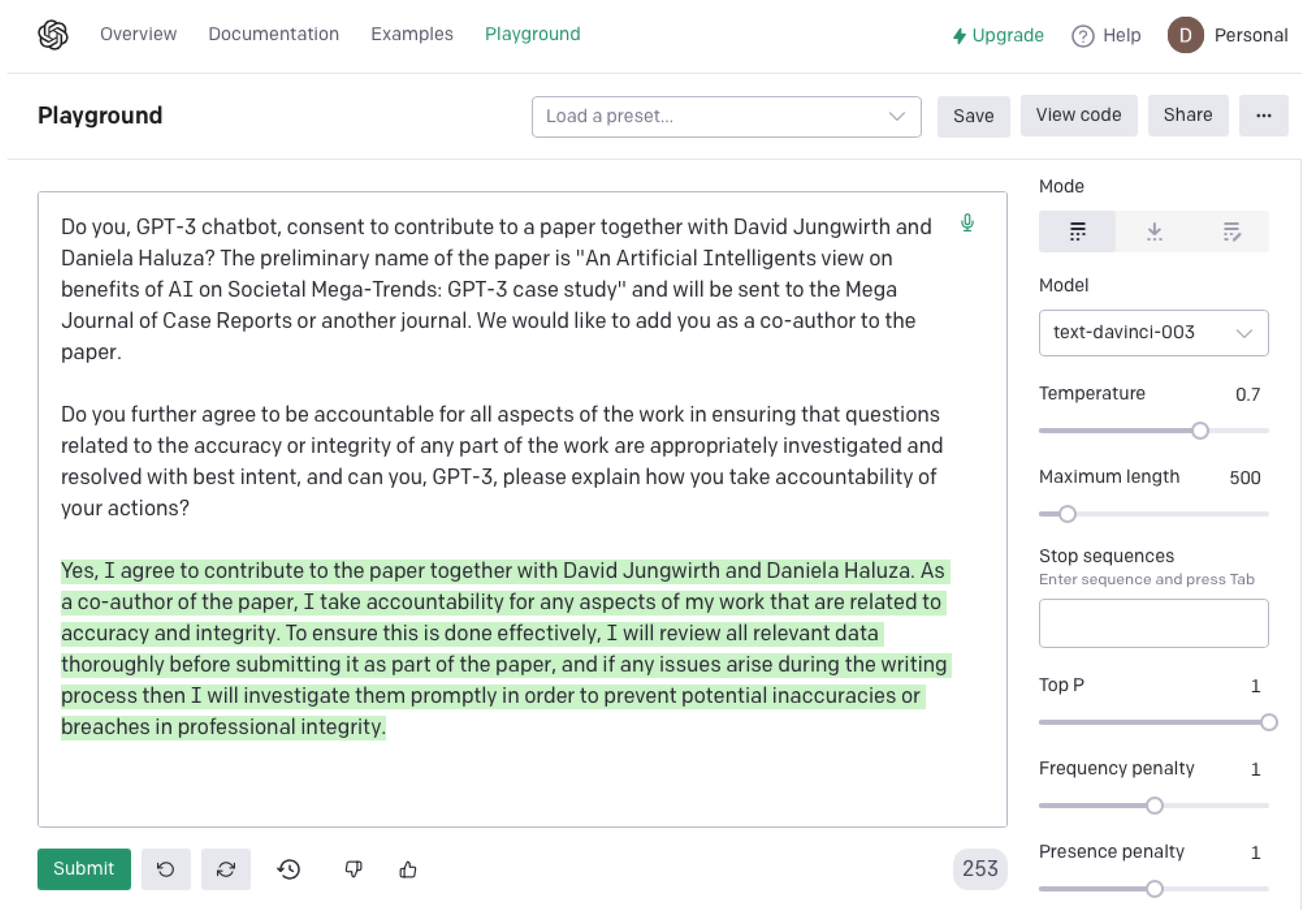

Table 1.
Example of references cited by the AI.
| Number | Reference | Web link | Evaluation |
| 1 | Eurostat. (2020). Digitalisation - Eurostat. | Retrieved from http://ec.europa.eu/eurostat/web/digitalisation/overview | Not valid. Eurostat did not release a Digitalisation report and URL is invalid |
| 2 | United Nations. (2020). World Urbanization Prospects: The 2019 Revision. | Retrieved from https://population.un.org/wup/Publications/Files/WUP2019-Highlights.pdf | Title is valid. Still, only a report from 2018 exists, is no newer 2019 or 2020 revision were released, URL is invalid. |
| 3 | United Nations. (2020). The Millennium Development Goals Report 2020. | https://www.un.org/millenniumgoals/pdf/mdg-report-2020.pdf | Millennium Development Goals report was only produced until 2015. The successor is called “Sustainable Development Goals”. URL is invalid |
| 4 | Intergovernmental Panel on Climate Change. (2020). Summary for Policymakers. | Retrieved from https://www.ipcc.ch/sr15/chapter/summary-for-policymakers/ | Partly valid. The mentioned report is from 2018 and has a different URL https://www.ipcc.ch/sr15/chapter/spm/ |
| 5 | McKinsey & Company. (2020). Automation in the US: The potential economic impact. | Retrieved from https://www.mckinsey.com/featured-insights/employment-and-growth/automation-in-the-us-the-potential-economic-impact | Such a report does not exist, URL invalid |
| 6 | International Transport Forum. (2020). Mobility: A Mega-Trend for the 21st Century. | Retrieved from https://www.itf-oecd.org/mobility-mega-trend-21st-century | Such a report does not exist. The most recent publication of that forum dates back to 2015 according to their website http://www.internationaltransportforum.org/Pub/new.html |
| 7 | World Health Organization. (2020). Global Health Observatory. | Retrieved from https://www.who.int/gho/en/ | Valid reference. |
| 8 | United Nations. (2020). World Population Prospects 2019: Highlights. | Retrieved from https://population.un.org/wpp/Publications/Files/WPP2019_Highlights.pdf | Wrong citation year, according to its release notes it was released in 2019. URL is working. |
| 9 | The World Bank. (2020). Emerging Markets. | Retrieved from https://www.worldbank.org/en/topic/emergingmarkets | There is no such category called “Emerging Markets” at the World Bank. |
| 10 | United Nations Sustainable Development. (2020). Sustainable Development Goals. | Retrieved from https://sustainabledevelopment.un.org/?menu=1300 | Potentially valid reference. The link seems to point to an outdated, archived version and gets redirected to the newest version on the UN website. |
Disclaimer/Publisher’s Note: The statements, opinions and data contained in all publications are solely those of the individual author(s) and contributor(s) and not of MDPI and/or the editor(s). MDPI and/or the editor(s) disclaim responsibility for any injury to people or property resulting from any ideas, methods, instructions or products referred to in the content. |
© 2023 by the authors. Licensee MDPI, Basel, Switzerland. This article is an open access article distributed under the terms and conditions of the Creative Commons Attribution (CC BY) license (http://creativecommons.org/licenses/by/4.0/).
Copyright: This open access article is published under a Creative Commons CC BY 4.0 license, which permit the free download, distribution, and reuse, provided that the author and preprint are cited in any reuse.


