
Submitted:
22 October 2024
Posted:
23 October 2024
You are already at the latest version
Abstract
Helium is a strategic rare gas resource related to national security and the development of high-tech industries, the high-quality development of helium industry chains has a great significance to improve the security of helium resource. This paper through literature and market research, summarizes the progress of helium resource endowmen, exploration and development, supply and demand pattern, trade market and industrial technology, equipment through literature and market research in the world, analyses the development situation of global helium resources industry chains. This study proposes the development status and challenges of China's helium industry and the corresponding development path of helium industry based on the upstream, midstream, downstream and downstream indicators. Most of the countries in the world have not started helium exploration or remain in low exploration level, but the exploration practice shows that global helium resource potential is considerable; helium exploration and development subjects become diversified in recent years, which may change the global helium supply and demand pattern; The helium reservoir forming theory and exploration and development technology are underdeveloped, and the helium extraction equipment is continuously improved; The global helium production capacity, supply and demand,trade pattern market would be profoundly changing. For a long time, the United States has had an absolute say in the global helium trade system, the contradiction between supply and demand would persist for a long time and significant price fluctuations. China's helium development challenges and opportunities coexist considering the global helium industry chain existing pattern and the new trend of development. There is an urgent need to build an independent and controllable , stable and resilient helium industrial chain, and provide helium resources guarantee for the development of high-tech industries.
Keywords:
helium
; exploration and development
; supply and demand pattern
; industrial chain
; high-quality development
1. Introduction
Helium is the noble gas element with the lowest known melting point (-272.2 ℃) and boiling point (-268.9 ℃) in nature. It has unique physical and chemical properties such as low density, low solubility, low viscosity, high thermal conductivity, strong permeability, strong chemical inertness, etc., and it is widely used in a variety of fields, such as liquid fuel rockets, helium-cooled nuclear reactors, manned deep submergence, medical imaging, semiconductors and helium hard drives, etc., and is an indispensable strategic rare gas resource for defense industry and high-tech industry. It is an important strategic rare gas resource indispensable to the defense industry and high-tech industry[1,2,3].The global helium industry chain is mainly divided into upstream resource exploration and development, midstream crude helium extraction and refining, helium liquefaction, storage and transportation, and downstream trade and application. The distribution of helium resources worldwide is extremely uneven, and the contradiction between supply and demand is prominent. China's demand for helium resources is growing strongly, but it is highly dependent on imports. Coupled with the impact of the US-China game and the Russia-Ukraine conflict, the security situation of China's helium resources is grim, and it will be difficult to realize full self-sufficiency in helium in a short period of time. There is an urgent need to formulate short-, medium- and long-term strategic planning for helium resource security at the national level, based on the basic needs of national security and economic and social development, focusing on both domestic and international markets, focusing on the construction of the helium whole industrial chain, and gradually realizing the goal of security and safety of helium resources in phases, so as to provide a safe, stable and resilient industrial chain and supply chain for the development of high-tech industries. The purpose of this paper is to analyze the problems and challenges facing the development of China's helium industry chain through a comprehensive overview of the progress of global helium exploration and development and the development of the helium industry chain, and to put forward a corresponding guarantee path for the high-quality development of the helium industry chain.
2. Global Helium Resource Endowment and Progress in Exploration and Development
Helium exploration has not been carried out in most countries around the world, or the overall level of exploration is low. However, the latest exploration practice shows that the global helium resource potential is large, and the distribution of proven and developed helium resources around the world is relatively centralized, mainly in the form of free trace components associated with oil and gas reservoirs or non-hydrocarbon gas reservoirs. According to the USGS data for 2024, the total global helium resources are about 484×108 m3, of which the helium resources of the United States, Qatar, Algeria, and Russia are 171×108 m3, 101×108 m3, 82×108 m3, and 68×108 m3, respectively, which altogether account for 87.19% of the total global helium resources; helium resources of Canada and China Canada and China have helium resources of 20×108 m3 and 11×108 m3 respectively, and other countries have helium resources of 31×108 m3 , accounting for 12.81% of the global helium resources. The total proven global helium reserves are about 121.1×10⁸ m3, of which the helium reserves in the United States, Algeria, and Russia are 85.52×10⁸ m3, 18×108 m3, and 17×108 m3 , respectively, accounting for 99.80% of the total global helium reserves; the helium reserves in Poland are about 0.24×10⁸ m3 accounting for 0.20% of the total global helium reserves; and there is no helium reserve statistics in other countries for the time being. There are no statistics on helium reserves in other countries. Qatar's helium resources mainly come from the purification and recovery of liquefied natural gas (LNG) tail gas (flash steam, BOG), which is a huge resource but no high-grade helium reserves[4](Figure 1, Table 1).
Recurring supply shortages in the international helium market, from a helium shortage of 1.0 in 2006 to a helium shortage of 4.0 in 2021, have resulted in helium being of high concern[7]. The total number of helium extraction plants in the world is currently more than 20. Currently, the total number of larger helium extraction plants in the world is more than 20, including 15 in the United States, 1 in Qatar, 2 in Algeria, 3 in Russia, 1 in Poland and 1 in Australia. Global helium exploration and development is becoming increasingly diversified, with a large number of helium companies emerging. Some companies with a background in oil and gas exploration or mining have begun to pay attention to and invest in helium exploration, and are actively laying out the development of the helium industry. More than 30 start-up companies are engaged in helium exploration in countries or regions such as the southwestern United States, the provinces of Saskatchewan and Alberta in Canada, Tanzania, Australia and South Africa, and there is a "helium boom", with Indonesia, South Korea, and Japan also active in the helium supply sector[3,8].
2.1. North America
Helium exploration and development in North America is mainly concentrated in the U.S. The U.S. is the earliest country to utilize helium mining, with production beginning in the early 20th century. At present, 70.9% of the world's proven helium reserves are located in the U.S., and 97% of the U.S. proven helium reserves are located in the Hugoton gas field, Panama, Panhandle West, Keyes, Riley Ridge and Cliffside. Of the six major gas fields[9]. Helium resources have been found in the northwestern U.S. state of Montana, the southwestern Four Corners region, the Chupadera Mesa region, and the Canadian provinces of Saskatchewan and Alberta, all of which have great potential for exploration and development, and are expected to become new helium production sites in North America. A number of companies, including North American Helium (NAH), Royal Helium, Imperial Helium, Global Helium and Avanti Energy, are already actively involved in helium exploration[3,10,11]. In November 2021, the Government of Saskatchewan, Canada, released its Helium Action Plan: From Exploration to Export, which further strengthens the province's nascent helium industry and aims to produce 10 percent of the world's helium by 2030, making Saskatchewan a global helium producer[12]. NAH has constructed two helium production facilities in the Cypress and Battle Creek fields in Saskatchewan, with a design annual helium production rate of approximately 167×104 m3 and a third helium production facility was successfully commissioned in August 2022 in Mankota, southwestern Saskatchewan[13]. Royal Helium currently has over 4000 km2 of helium prospectivity in southern Saskatchewan, with four exploration wells at 0.33%-0.64% helium (volume fraction, hereafter) implemented on the southwest Climax Block beginning in 2021, and the Company plans to Execution of multiple helium exploration wells[14]。Imperial Helium owns 246 km2of helium claims in Steveville, southeastern Alberta, Canada, with three exploration wells drilled at helium levels ranging from 0.43% to 0.51%. Global Helium completed a series of acquisitions in southern Saskatchewan, Canada, and Montana, USA. The landholdings cover an area of nearly 7000 km2with a measured helium content of 3.9% in Montana[15]. Avanti Energy has acquired approximately 303.5 km2 of mineral rights in Alberta and Montana, with several exploration wells in the Greater Knappen block, Rankin 01-17, WNG11-22 and WNG 10-21, showing helium levels above 1%[16]. NAH is currently constructing two new helium purification facilities in southwest Saskatchewan (Cadillac and Antelope Lake) , bringing its total production capacity of NAH to be approximately 210 MMcf/yr, representing approximately 7% of total North American helium supply [17].
2.2. Qatar and Algeria
Both Qatar and Algeria derive their helium from liquefied natural gas (LNG). Although Qatar's helium resources are second only to those of the United States, the helium content of the gas is only 0.04%, and relies on the increased helium enrichment of the BOG from the liquefaction of LNG hydrocarbons in order to reach commercial value. Qatari helium is primarily derived from LNG from North Field, the world's largest non-associated natural gas field[18], which is located offshore Iran in the northeast, known as the South Pars field, which also has helium exploration potential. The start-up of the Ras Laffan-1 project in Qatar, which began operations in 2005, and the Ras Laffan-2 project in Qatar, which began operations in 2013, has had a significant impact on the global helium supply, with a current combined production capacity of 6200×104m3/a[3].
Algeria's helium comes mainly from the Hassi R'Mel field, which accounts for 60% of Algeria's natural gas exports, and has a helium content of 0.09%-0.22%, with an average helium content of 0.19%, and a helium resource of about 45.6×10⁸m3. There are two helium plants, Arzew and Skikda, both with an annual production capacity of 1,700 × 104 m3, but neither is currently operating at full capacity (Nuttall WJ et al. There are two helium plants, Arzew and Skikda, both with an annual helium production capacity of1700×104 m3, but neither of them is currently operating at full capacity[19].
2.3. Russian
More than 170 helium-rich natural gas fields have been discovered in Russia, with helium reserves concentrated in the Kovykta, Chayanda, Sobin and Srednebotuobin fields[20]. According to the standards of the former Soviet Union, the total helium reserves in Russia (total A+B+C1+C2 levels) are187.6×108 m3 , much higher than the statistics of the US Geological Survey(17×108 m3), and are mainly located in the eastern part of Siberia and in the Far East, with an average helium content of 0.13% - 0.67%[21,22]. Russia's helium resources are underdeveloped at this stage, accounting for only 0.1%-0.2% of the total, with huge potential for exploration and development. Russia is also an early developer of helium, which is currently produced industrially at the Orenburg helium plant, with an annual production capacity of 500×104 m3, which will be reduced from 510×104 m3 to 450×104 m3 between 2017 and 2020, supported by two helium storage reservoirs in the Orenburg salt cavern and Kaliningrad.
2.4. Tanzania
Several helium-rich seedlings have been discovered in Tanzania, with natural gas in the Rukwa Basin in the south-west of the country containing between 2.5% and 4.2% helium, and hot springs in the Balangida and Eyasi Rift Basins in the east-central part of the country containing up to 10.5% helium[23]. Helium One is engaged in the integrated exploration, development, processing and marketing of helium in Tanzania, with 20 helium exploration licenses and 4512 km2 of tenements[24]. The Rukwa Basin is the most explored of the three rift valleys, with an expected (maximum) recoverable helium resource of approximately 39.08×10⁸ m3 , and two exploration wells (Tai 1 and Tai 2) have been drilled in the basin, which have confirmed significant helium resources[25,26,27]. In addition, Global Helium also holds helium prospecting areas in Tanzania where basic exploration has been completed. According to an April 5, 2022 report in The Citizen, a mainstream Tanzanian media outlet, Tanzania expects to begin producing helium in 2025[28].
2.5. China
In recent years, China's helium resource investigation and research work has resulted in a new round of "helium fever", with a number of national helium research projects initiated, and helium resource investigations and evaluations actively carried out by geological survey institutes, scientific research institutes, and oil and gas companies, resulting in a significant acceleration of resource discovery[29,30,31,32,33,34]. Since 2003, the Xi'an Geological Survey Center of the China Geological Survey of the Ministry of Natural Resources (MNR) has continuously carried out helium resource investigations in the Weihe Basin[1,35,36] and the Qaidam Basin[37,38,39], and put forward the understanding of "weak-source formation" for crustal helium [1]. Weak-source reservoir formation", summarized that "effective helium source rocks, efficient transport channels, and carrier gas reservoirs" are the basic conditions for helium reservoir formation[1,40,41], and studied helium aggregation by using rare gas tracer methods [42,43], which improved the theoretical research level of the mechanism of helium-rich natural gas formation in China, summarized the mineral search model of the Weihe Basin, explored the formation model to guide the direction of exploration, gravity-electricity method to detect the structure of the basin (high-efficiency transport channels), chemical exploration to circle helium-rich zones, magnetic method to identify the basal magnetic rocks (helium source rocks) , seismic survey to implement favorable trap, gas logging wells to demarcate helium-enriched sections, the helium survey technology and method, led the geological exploration unit to discover high-grade helium-enriched natural gas displays in the Fenwei Basin, and led the oil and gas enterprises to carry out helium commercial exploration[1,44].
China's helium resources are widely distributed, with many layers and obvious enrichment characteristics in zones and subzones. Some oil and gas reservoirs and non-hydrocarbon gas reservoirs have high helium content in their natural gas components, which has good resource potential. The large-scale stacked basins such as Sichuan, Ordos, Tarim, Qaidam, Fenwei and other intra-land rift basins in west-central China are the main helium resource-rich areas in China, and a number of helium-rich natural gas deposits have been discovered, which have broad exploration prospects and will be the main exploration areas for China to rapidly realize its production capacity. Several non-hydrocarbon-rich helium gas reservoirs have been discovered in the Songliao, Bohai Bay, and North Jiangsu basins around the eastern Tantanlu Fracture Zone, and although helium abundance is high, the scale is small and the resource potential is limited(Figure 2)[6]. In recent years, we have focused on evaluating the helium resource potential of the Weihe River Basin, estimating that the water-soluble helium resource at a depth of 4000 m is 21.30×10⁸ m3 , and we have identified three helium prospective areas, namely, Huazhou-Tongguan, Wugong-Xianyang, and Tuxian-Lantian, and we have set up China's first helium prospecting right in the Huazhou-Huayin area. Carried out a series of work around the Huazhou North area, further defined a favorable target zone, and deployed and implemented the first helium parameter well within the prospect, in addition, the first helium parameter well in Shanxi Province is also being drilled, which is expected to achieve a major breakthrough in helium resource exploration[1,44].
2.6. Other Countries and Areas
Countries and regions such as Poland, Australia, South Africa and India are actively promoting the construction of helium exploration and development projects. A total of 18 helium fields have been discovered in Poland, mainly located in the southern part of the Fore-Sudetic Monocline in the Zielona Góra-Rawicz-Odolanów region, with helium content of 0.22%-0.42%, nitrogen content of 30%-40%, and helium reserves of about 2400×104 m3 , and the predicted helium resource is 3468×104 m3. Poland was also one of the first countries to develop helium resources, producing helium in 1977 at the Odolanów helium extraction plant of the Polish Oil and Gas Company[45].
Helium currently commercially developed in Australia is mainly derived from LNG from the Bayu-Undan gas field in the Bonaparte Basin, commissioned in Darwin in 2010 by Linde Group member Bio Occidental (BOC), which has an annual helium production rate of approximately 400×104 m3. In addition, the Greater Sunrise (Bonaparte Basin), Ichthys (Browse Basin) and Goodwyn-North Rankin North West Shelf Venture (Northern Carnavon Basin) gas fields have a helium extraction The potential untapped value of the fields for helium extraction is higher than that of Australia's only commercial onshore helium extraction facility at Darwin. Total helium recovery from Australian LNG is estimated to be 16.7×10⁸m3[46,47].
South Africa is the largest economy in Africa and a potential market for helium. South Africa has abundant helium-bearing natural gas resources, mainly in the Free State and Northern Cape provinces. Currently, there are two major helium-bearing gas projects underway in South Africa, Renergen's Virginia project and Afrox's Tetra4 project. Virginia Gas project spans an area of 1870 km2 in the Free State Province of South Africa in the districts of Welkom, Virginia and Theunissen, with proven reserves of approximately 2831.7×104 m3 and helium content of 3%-4%. The first phase of the project is already in production with a design capacity of 1000 m3 per year and an expansion of the capacity is planned for 2026[48].
India has identified a number of helium-bearing natural gas fields in Rajasthan, Gujarat, Andhra Pradesh, etc., and exploration and development work is under way. India is also planning to set up its own Air Liquide Separation Plant (ALSP) in the coming years to increase its self-sufficiency in air separation products, including liquid helium. In addition, countries or regions such as Poland, Turkey, Egypt, Mongolia, Brazil, etc., are also carrying out or planning to carry out helium exploration and development activities, showing some potential and promise, and are likely to become new contributors to the global helium market in the future.
3. Global Helium Supply and Demand Patterns and Trade Markets
3.1. Global Helium Supply and Trends
Due to the global distribution of helium resources, the global supply of helium is also concentrated, with the main supplying countries being the United States, Qatar, Algeria, Russia, Poland, Australia, etc. North America is the absolute main supplying region, followed by Qatar. North America is the absolute main supply area, followed by Qatar, and the Asia-Pacific region has very low helium production. Between the end of the 20th century and the beginning of the 21st century, global annual helium production generally increased steadily, with an annual output of 0.85−1.75×10⁸ m3. 2012-2022 global annual helium production basically leveled off, with an overall annual output of about 1.6×10⁸ m3. Global helium production of 1.7×10⁸ m3 in 2023[4] (Figure 3). Until 2012, the U.S. helium supply was close to 80 percent of total global production. With the rapid depletion of the U.S. strategic helium reserve, the U.S. helium supply decreases from 1.33×10⁸ m3 to 0.75×10⁸ m3 from 2012 to 2022, a reduction of nearly 40 percent, and further decreases to 0.79×10⁸ m3 in 2023. Qatar has seen rapid growth in helium production in recent years, with production of 0.66×10⁸ m3 in 2023, supplying nearly 85% of the world's production alongside the US. As the second tier helium producing countries, Algeria and Russia account for about 10.59% of the global helium production, with Algeria producing 0.10×10⁸ m3 in 2023, accounting for 5.88% of the total global helium production. Russia has always had low production, with annual production basically stabilizing at around 0.03×10⁸ m3. In 2023, Russia's helium production rapidly increased to 0.08×10⁸ m3 , which accounted for 4.71% of the total global helium production[4], but with the intensification of the Russian-Ukrainian conflict, helium production has suffered a major blow. Poland is the only helium producer in Europe, but supply has been small, with helium production remaining at around 0.02×10⁸ m3 in recent years, and helium production of 0.03×10⁸ m3 in 2023, accounting for 1.76% of total global helium production, mainly supplying the European market[9].Annual helium production of approximately 0.01×10⁸ m3 from the Darwin LNG plant in Australia, representing 0.59 per cent of total global helium production, with multiple LNG export facilities under construction or proposed, and helium production of 0.01×10⁸ m3 in 2023, representing 0.59 per cent of total global helium production, mainly to satisfy the needs of Australia, New Zealand and the Asia-Pacific region[5]. In addition, Indonesia, Korea, and Japan are actively entering the helium supply sector[8].
In 2021-2023, plants such as Amour-1 and the Ikutsk Helium Extraction Plant in Russia have already been commissioned. According to statistics, from 2024 to 2030, Amour-2, Amour-3, Yalakta, Ras Laffan-3, Ras Laffan-4, Ras Laffan-5, the Algerian helium plant and the helium one in Tanzanian are planned to be put into operation in the world (Table 2), by which time the helium production capacity is expected to increase by 1.7×10⁸ m3, and the global supply of helium will reach 3.3×10⁸ m3. By then, the global helium supply pattern may be subject to major adjustments. Construction of Amour, which Gazprom began in 2015, was originally expected to be fully operational by the end of 2024. The plant is designed to produce approximately 0.6×10⁸ m3 of helium annually, and the helium produced will be primarily exported, and is expected to replace the United States as the world's number one supplier of helium by 2030, with 90% of the helium produced at Amour being exported to China over the next 30 years[49]. At the same time, Russia is building a large helium logistics center in Vladivostok, planning to build four more helium storage tanks, with a new helium reserve capacity of 24×108 m3[50] . In addition, Russia's Irkutsk Oil Company (INK) plans to extract helium from gas from the Yarakta oil and gas condensate field in Eastern Siberia, with a designed helium production capacity of 0.075×10⁸ m3 per year, and in 2025 it will extract helium from natural gas from the Markovsk field, with a designed annual production capacity of 0.045×10⁸ m3. Qatar's Ras Laffan-3 is initially scheduled to begin production in 2018, with an expected annual production capacity of 0.11×10⁸ m3 and a total annual production capacity of approximately 0.74×10⁸ m3 at full capacity, which would represent approximately 35% of global helium production[51]. The plant has not yet started production due to the outbreak. In addition to the Ras Laffan-3 plant, Qatar Energy also approved the North Field East (NFE) project[52], which will build a fourth new helium plant at Ras Laffan with a total investment of $28.7 billion, with plans to build four LNG production lines, which are expected to come on stream in 2025, and be designed to annual helium production of about 0.41×10⁸ m3[3]. The Qatar expansion project also includes the North Field South (NFS) project, which is planned to build two LNG production lines and is expected to come on stream in 2027, with an annual capacity of approximately 0.16×10⁸/a。
If the production capacity under construction in Russia and Qatar can be realized as scheduled, the global helium supply will present a three-part pattern of the U.S., Qatar and Russia, and the tight helium supply situation may be alleviated. Considering today's complex international environment, helium supply growth in Russia, Qatar, and others remains highly uncertain, and global helium supply relief still faces great challenges[6]. For example, Russia's Amour is at a standstill in terms of helium supply due to the indefinite closure of the Russian Amour due to a fire in October 2021 and an explosion in January 2022, overlaid on the Russian-Ukrainian conflict and the impact of Western sanctions. Two of the three helium plants in Qatar were closed for scheduled maintenance and the construction of a helium extraction unit was delayed due to the epidemic. The Russian-Ukrainian conflict led to gas shortages in Europe, and the closure of one of Algeria's two liquefied natural gas (LNG) plants, whose natural gas feedstock was sent to Europe via undersea pipelines, further exacerbated the global helium shortage[53].
3.2. Global Helium Applications and Demand
Since 2007, with the rapid development of high-tech industries and scientific research, helium applications have increased dramatically, especially in high-end manufacturing, low-temperature superconductivity and fourth-generation nuclear reactor cooling gas. The demand for helium has increased significantly from 2016-2023 in high-end manufacturing industries such as semiconductors, fiber optics, and welding of high-end materials. The global helium is most widely used in the field of cryogenic applications, accounting for 32%, such as nuclear magnetic resonance, cryogenic superconductivity, etc.; pressurization and blowing accounted for 18% of the field, mainly used in space shuttles, liquid fuel rockets and missiles, etc.; the field of atmosphere control is the fastest-growing area of demand, accounting for 18% of the field, mainly used in semiconductors, LCD panels, and other high-end manufacturing industry; high-end materials welding and testing accounted for 13%, 4%, and the field of breathing air accounted for 2% of the field, such as submarines, diving and so on[54]. Global demand for helium is growing at a rate of 5% per year, with the overall supply exceeding demand. Global helium demand in 2022 is 155 million cubic meters, North America is the top consumer of helium globally with 42%, followed by Asia Pacific with 32%, Europe with 20%, and the Middle East and Africa with a lower demand of only 5%. The healthcare industry in North America is the most important consumer of helium[55]. The Asia-Pacific region has the largest supply gap for helium resources, with China's helium consumption of 25.65 million cubic meters in 2023 accounting for the largest share of Asia's helium demand (about 42%), followed by South Korea (consumption of 13 million cubic meters) and Japan (consumption of 11 million cubic meters)[56].Further demand for helium in areas such as welding, magnetic resonance imaging (MRI), adjunctive treatment for many respiratory diseases (ARDS, COPD, etc.), and semiconductor manufacturing is driving the helium market by 2022[57]. With the rapid development of medical, 5G, semiconductor, aerospace, quantum computing and other high-tech fields, the global demand for helium is expected to continue to grow in the coming years, reaching 2.11×10⁸ m3 in 2025, with a further increase in the share of demand in the Asia-Pacific region, especially in countries such as China, Japan and India. Whereas, according to the forecasts of the relevant Russian organizations, the global demand for helium will reach 2.2−3.0×10⁸ m3 in 2030, and without exploration and development of new blocks, the helium production will drop to 1. 34×108 m3, and the gap between the supply and demand will be more than1.66×108 m3.
China's helium demand is growing strongly, and since 2017, China's helium imports have remained above 2000×104 m3 for a long time, with an average growth rate of 11%, and the market scale is gradually expanding. China's helium consumption was 2565×104 m3 in 2023, accounting for 13.7% of the global total helium production. Helium in China is mainly used in nuclear magnetic resonance (consumption of 9.209 million cubic meters, accounting for 35.9%), gas lift (consumption of 3.493 million cubic meters, accounting for 13.6%), semiconductors (consumption of 2.082 million cubic meters, accounting for 8.1%), white goods (consumption of 1.491 million cubic meters, accounting for 5.8%), automobile manufacturing (consumption of 80.1 million cubic meters, accounting for 3.1%) and so on[56]. In the long run, with the development of China's high-tech industry, it is expected that China's helium consumption will maintain a high level of growth in the "14th Five-Year Plan" period, and low-temperature superconductivity, aerospace, national defense and military, nuclear magnetic resonance medical care, semiconductors, fiber optics, photovoltaics, lithium batteries, low-temperature physics research, etc., will be the main areas of growth in demand. According to the average annual growth rate of 11%, the demand will reach more than 3000×104 m3 in 2025, and the global share may further increase[57].
3.3. Gobal Helium Market and Trade
Helium is a fast-growing and emerging industry, with the global helium market size reaching USD 5,030 million in 2023, at a compound annual growth rate (CAGR) of 12.9%, and is expected to reach USD 6.48 billion by 2027 [57,58]. Currently, the global helium trade is mainly controlled by large international corporations and national oil and gas oligarchs, monopolizing more than 75% of the entire helium trade market. The U.S. has an absolute say in the global helium trade system, not only in the global share of U.S. domestic helium resources and production, but also in the control of U.S. capital over the global helium supply chain, with U.S. capital holding more than half of the world's top 10 suppliers of high-purity industrial helium, and U.S. enterprises also accounting for half of the top 10 helium compressor producers. The United States has a long history of controlling the global helium trade, having monopolized global helium production and sales since the discovery of helium-rich natural gas in 1903, and in 1925 legislated a halt to the sale of helium to foreign countries and non-government organizations. During the U.S.-Soviet Cold War, the U.S. government purchased helium separated from oil and gas companies at a high price and injected helium into the Cliffside gas field as a strategic reserve. In the 1990s, as helium applications continued to expand and demand continued to increase, the U.S. government sold helium from its reserves to alleviate the supply constraints in the global helium market. As of 2021, the U.S. still has 0.86×10⁸ m3 of helium in reserve. As the global demand for helium continues to rise and the U.S. helium reserves and production decline dramatically, the global helium supply-demand conflict is becoming more and more pronounced, and helium prices are fluctuating dramatically. Qatar is currently the second largest producer of helium after the United States, but since Qatar's helium extraction equipment and technology mainly come from the United States, its sales are also controlled by the United States[59]. In addition, the international helium supply quota system, the existing helium trade mainly by Linde, Air Liquide, Air Products and Chemicals, Inc. and other international gas companies, through the long-term trade agreement to complete the quota allocation, in addition to Russia, the rest of the countries helium resources allocation of the right to speak basically by the U.S. capital control. In 2022, all suppliers, with the exception of AirChem, declared force majeure reductions in quotas for their customers (45-60% of contracted volumes)[53].
4. Global Helium Industry Theory, Technology and Equipment
The search for helium-rich natural gas deposits is an important basis for accelerating the development of the helium industry, but at present there is limited specialized research on the laws governing the formation and storage of helium-rich natural gas, and the exploration technology is not yet perfect. Industrially exploitable helium resources are mainly found in natural gas reservoirs with hydrocarbons, nitrogen and carbon dioxide as the main components, with hydrocarbon gas being the main component. Helium is of inorganic origin relative to hydrocarbon natural gas and its content in natural gas is low, with the elements uranium and thorium in the upper crust being the most important sources of 4He. At present, a lot of research results have been achieved in the identification of the genesis type of helium, geological fluid tracing and geochronology[60,61], but the research on its generation, release, transportation, preservation, and resource evaluation as an independent resource is relatively weak, and the existing technologies basically follow the hydrocarbon natural gas exploration technology methods, and the downhole exploration technologies such as the identification and evaluation methods of drilling gas logging (geochemical method) and logging identification and evaluation methods (geophysical method) are still in the exploratory and experimental stage. The downhole exploration techniques, such as the identification and evaluation methods of gas logging with drilling (geochemical methods) and logging identification and evaluation methods (geophysical methods), are still in the exploratory and experimental stage, which greatly restricts the study of the theory of helium reservoir formation and the exploration and development of helium resources. Helium is rarely explored independently as a separate mineral species due to its low abundance, and the addition of helium gas chromatography to conventional gas logging is the most feasible method for helium downhole identification with drilling. Nuclear magnetic resonance imaging (NMRI), thermal neutron imaging logging, and other methods may be indicative of helium identification in their principles, and have the prospect of carrying out research and application of related technologies.
Foreign helium separation, purification, liquefaction storage and other technical equipment is relatively mature, but basically in the hands of a few foreign companies such as Airchem, Air Liquide and Linde, the world's large helium plant investment and construction, quota allocation, key equipment manufacturing and certification are monopolized by them, and there is a restriction on the introduction of China[62]. Global industrial helium production is primarily derived from direct natural gas helium extraction and liquefied natural gas flash steam (LNG-BOG) helium extraction. Direct helium extraction from natural gas began in the United States in the 1920's. The industrial grade of helium is generally considered to be 0.1%, and most of the actual industrial utilization is around 0.3%. LNG-BOG helium extraction has a huge development potential, the He content of the feedstock gas used is around 0.04%, but the scale of the feedstock gas and extraction technology and equipment have high requirements. Natural gas separation is currently the only industrialized method of obtaining helium, including crude helium extraction and refining. The technical routes for natural gas separation are broadly categorized as deep-cooling and non-cryogenic. Deep cooling is the most widespread and cost-effective method of extracting helium from crude helium, and about 90% of helium is extracted by deep cooling. In recent years, the research and development of helium extraction at ambient temperature (multi-stage variable pressure adsorption, multi-stage membrane, membrane + multi-stage variable pressure adsorption) has also been successful, and is gradually being put into operation[62]. Refining and liquefaction of crude helium is necessary due to the large-scale transportation of helium and the need for gas purity for special applications, but variable pressure adsorption (VPAS) is not suitable for large-scale helium extraction due to its high power consumption and complexity of the process. The deep-cooling method is also the best solution for helium liquefaction and transportation, which uses cryoadsorption or cryo-condensation and freezing to achieve the removal of impurity gases from the crude helium at low pressures and temperatures, followed by liquefaction of the high-purity helium through a helium liquefier. Major helium-producing countries such as the United States, Qatar, Algeria, and Australia have applied relatively mature technologies and equipment for helium purification and liquefaction, but these technologies are mostly in the hands of large multinational corporations in Europe and the United States. For example, Air Liquide's helium recovery and liquefaction unit at the Qatar LNG plant provides an annual production of nearly 0.6 x 10⁸ m3 of helium, making Qatar the second largest supplier of helium. Linde's LNG plants in Darwin, Australia, and Skikda, Algeria, have helium recovery units with the lowest power consumption and highest recovery rates in the world.
China's natural gas crude helium extraction, crude helium refining, helium storage and transportation technologies have become more mature and can basically meet the needs of large-scale helium extraction projects. The natural gas produced in China is mainly purified and then directly piped for use, through the cryogenic method of helium need to liquefy a large amount of natural gas, high energy consumption and uneconomical, but for the existing liquefied natural gas plants to carry out comprehensive utilization of tail gas has a broad prospect. Since 2014, China's LNG-BOG helium extraction technology and capacity construction have developed rapidly, and will become an important force in China's helium strategic resource guarantee. The Institute of Physical and Chemical Technology of the Chinese Academy of Sciences has made breakthroughs in domestic large-scale low-temperature refrigeration technology, realizing the comprehensive enhancement of China's large-scale refrigeration system from the application basis, key equipments to the system integration technology and capability. Since 2020, relying on large-scale cryogenic refrigeration technology incubated in Beijing Zhongke Fuhai Cryogenic Technology Co., Ltd. has made milestone breakthroughs in the field of BOG helium extraction, successfully developed the first set of LNG-BOG cryogenic helium extraction device in China, and cooperated with a number of companies to build a number of LNG-BOG helium extraction production lines, and formed the independent key technologies and equipment for the production of high-purity helium and liquid helium[34].
5. Problems, Challenges and Pathways of Helium Industry Chain Development in China
5.1. Problems and Challenges
5.1.1. Upstream of the Helium Industry Chain
First, China's helium resource exploration started late and at a low level, and its resource base is unclear. The level of helium exploration in the early stage was low, and only some comprehensive surveys and researches were carried out; helium exploration in natural gas exploration has not been given due attention, and the method of resource evaluation has not yet been established; The helium content survey of existing natural gas fields is not systematic, and the helium resource evaluation in new areas lacks a data basis; helium-rich natural gas is found on the spot in localized areas, but fails to be carried out on the surface. Secondly, the series of achievements made by China in the process of helium-rich natural gas formation and the mode of formation urgently need to be verified and studied in depth by the necessary means, such as electric method, seismic and drilling, with a view to obtaining a breakthrough in the acquisition of helium resources. Thirdly, there is insufficient understanding of the uniqueness of helium enrichment and reservoir formation, the theory of reservoir formation is not perfect, and the exploration technology is lagging behind. Since helium reservoirs are rarely found and are often associated with natural gas, there are very few studies on the reservoir formation system that specifically focuses on helium generation, transportation, aggregation, and preservation, and there is an obvious lack of understanding of the special characteristics of helium reservoirs, so there is an urgent need to establish a systematic theory of shell-source helium reservoir formation; At present, the technical means of exploration for helium resources are basically blank, and it is necessary to explore targeted geophysical exploration methods, effective logging series and interpretation of logging models and drilling (logging), and gas reservoir testing processes.
5.1.2. Midstream of the Helium Industry Chain
In recent years, China's helium production capacity construction has been rapidly advancing, but the degree of independent guarantee is still insufficient. Helium extraction from natural gas in China began in the 1960s with the Weiyuan Helium Extraction Test I plant, designed to process 5×10⁴ m3 of natural gas per day, with an annual helium production capacity of about 2×10⁴ m3. In 2012, a natural gas helium extraction plant was re-completed in Dongxing field town, Rong County, Sichuan Province, with an annual helium production of about 5×10⁴ m3[63]. By 2014, China's annual helium production was 24×104 m3 , with an external dependence as high as 98.44%. After that, with the rapid development of China's LNG-BOG helium lifting technology and capacity construction, the annual output is increasing, reaching 130×104 m3 by 2021. In 2022, it reaches about 2 million cubic meters, and in 2023, it further rises to about 2.7 million cubic meters. The external dependence on is slightly decreasing, but still as high as 89.55% (Figure 4).
At present, Inner Mongolia Xing Sheng Natural Gas Co., Ltd. and other companies in the northern Ordos Basin have built an annual helium production capacity of 225×104 m3 which is still a huge gap compared to the consumption of 2565×104 m3 in 2023. According to preliminary statistics, the domestic natural gas helium extraction capacity under construction or to be built will reach 905×104 m3, of which, Chengdu Natural Gas Chemical General Factory in the Hetianhe gas field in the construction of helium production capacity of about 90×104 m3 , and a number of companies in the Ordos Basin periphery and the Sichuan Basin and so on in the construction of helium production capacity of 215×104 m3 (Table 3). In addition, state-owned oil and gas enterprises are promoting the 500×104 m3 cogeneration helium extraction project in northern Shaanxi, and the 100×104 m3 membrane+variable temperature adsorption helium extraction project in Dongsheng-Uttarakhand[34]. However, even if all the projects under construction and proposed to be constructed are realized as scheduled, domestic helium security is still facing constraints such as insufficient supply of feedstock gas and liquefaction costs.
In recent years, China's scientific research institutions, enterprises and universities at all levels have carried out a series of scientific and technological researches on key technologies and equipment for the helium industry chain. China's natural gas crude helium extraction, refining and helium storage and transportation technologies have become more mature, and domestically produced helium liquefiers and liquid helium storage tanks have been successfully developed, which can basically meet the needs of helium extraction projects on a large scale[56].
5.1.3. Downstream of the Helium Industry Chain
China's helium imports remain high, and import channels are relatively centralized. Since 2017, China's helium imports have remained above 2,000×104 m3for a long time, of which, in 2018, imports amounted to as high as 2311×104 m3, accounting for about 14.4% of global helium production. China's helium imports come from concentrated sources, mainly from Qatar, the United States and Australia, with a small amount from Russia. In 2023, China's helium imports totaled 2247×104 m3, of which 1684×104 m3, or 82%, was imported from Qatar, 194×104 m3, or 9%, was imported from the U.S., 171×104 m3, or 8%, was imported from Australia, and only 13×104 m3, or 1%, was imported from Russia. Compared to 2020, production, shipping and tariffs in the U.S. are significant constraints on China's helium imports, with imports from the U.S. showing a rapid downward trend and imports from Qatar increasing to make up for the shortfall in imports from the U.S. Although Qatar surpassed the United States to become China's top helium supplier after 2013 and accounted for an increasing proportion of China's total imports, the technology and equipment used for helium production in Qatar since has basically come from the United States and lacks autonomy.
China's helium imports are mainly in the hands of foreign companies. By the end of 2023, there were nearly 20 helium importers in China, China's helium imports mainly from the six major foreign-funded enterprises, with about 83.3% of the import share coming from foreign companies, including Linde, Air Liquide, and Airborne Chemicals, accounting for 21.4%, 20.3%, and 17.7%, respectively; and Iwatani Sangyo Co, Ltd, Taiyo Nippon Sanso Co, Ltd, and Wujiang Meisel, accounting for 13.8%, 6.0%, and 4.6%, respectively. Currently, the main Chinese companies engaged in the helium import business are Guanggang Gas Energy Company Limited (Guanggang Gas) and Shanghai Jiyang Science and Technology Development Company Limited (Shanghai Jiyang), accounting for 10.1% and 3.1%, respectively. At present, Tianjin Saineng Gas Products Co., Ltd, Tianjin Dongxiang Specialty Gases Co., Ltd, Guangdong Huate Gas Co., Ltd, and Beijing Zhongke Fuhai Cryogenics Co., Ltd. are all striving for the share of helium resources from the Amur plant in Russia, and by the end of 2023, helium resources purchased from Amur will be shipped to China through the land ports. In addition, global manufacturers of liquid helium tanks and helium liquefiers have long been restricting supply to China for reasons such as facilitating monopolization of the gas source and manufacturing capacity, and Guanggang Gas is only able to purchase 2-3 liquid helium tanks per year[56,62]. In March 2020, Guang Gang Gas completed the acquisition of the import share of approximately 238×104 m3/a of helium resources divested by Linde, becoming the largest Chinese helium supplier, thus breaking the monopoly of foreign capital and reducing the import risk due to geopolitical issues. The “Big 8” helium importers primarily utilize liquid helium storage tanks, which are transported to Chinese ports via freighters, and then transported to the terminals by distributors utilizing bunded trucks, liquid helium dewars, or helium bottled logistics. 2021 requirements for the transportation of hazardous chemicals are becoming increasingly stringent, and helium bottled logistics have been restricted in some areas. Influenced by the distribution of high-end manufacturing enterprises, the degree of population concentration and the level of economic development and other factors, among them, East China has a large number of nuclear magnetic equipment, semiconductors, fiber optics, LCD panels, automobiles and other high-end manufacturing enterprises, which is the most dominant region in China's helium consumption, with a helium consumption of 32% of China's total helium consumption; followed by North China, Northwest China, South China and Central China are the second tier of China's helium consumption, driven by the MRI, fiber optics, aerospace and other industries, helium consumption accounted for 15%, 15%, 13% and 11%, respectively; Southwest and Northeast China helium consumption is relatively small, mainly applied to gas lift and MRI supplement, helium consumption accounted for 8% and 6%, respectively[56].
China's pricing power in the helium market is extremely weak and market prices are influenced by external factors and supply and demand. Countries such as the United States have always controlled global market prices. In recent years, rapid changes in the international political landscape, the deterioration of regional security in the major helium exporting countries, and important political events and industrial policies in helium producing countries have had a significant impact on helium prices. In June 2017, the price of helium in the Chinese helium market rose sharply when the Qatar diplomatic break broke out and was blockaded by neighboring countries. Since 2019, China's helium market prices have surged again due to a 5% rise in tariffs on helium imports from the U.S. as a result of the escalation of competition and trade disputes between the U.S. and China. Helium prices in China have also been relatively high in recent years, fluctuating between 10 and 80 USD/m3, and as helium demand continues to increase, helium market prices will continue to rise. The prices of helium from different helium importing countries are also quite different, with the average import price from the US region being higher and more volatile, and the prices in Australia and Qatar being slightly lower and more stable[64].
5.1.4. Helium Industry Policy
China's helium industry has not yet received the attention it deserves, and the resource management model is still in the exploratory stage. The role of helium as a basic guarantee for the development of strategic emerging industries has not yet been highly valued by all sectors of society, and the law of helium enrichment has not yet been fully understood. Currently, there are two models for helium resource management: the Weiyuan model, in which helium is regarded as an associated resource of natural gas and is extracted and comprehensively utilized in the natural gas development process. In this model, China lacks policies and regulations similar to the U.S. Helium Act, and the rights and obligations of oil and gas companies and government departments in helium extraction and procurement are not clearly defined, making it difficult to impose effective constraints on oil and gas companies and provide policy incentives. The second is the Weihe model, in which helium is treated as an independent mineral species and social funds are guided to invest in the exploration, development and purification of helium resources in helium-rich natural gas and water-soluble gas, thus rapidly promoting the development of China's helium industry. The exploration and development of helium as a separate mineral is an effective solution to China's helium resource shortage in a short period of time, but China's first helium prospecting right has been established in Shaanxi Province only. Policies and regulations governing the allocation of helium as an independent mineral are unclear, and there is a risk of conflict with established oil and natural gas mineral rights, so it is necessary to continue to explore and improve how to scientifically and effectively promote the development and utilization of helium resources.
5.2. Reflections on Pathways
5.2.1. Carrying Out a National Survey on Helium
In accordance with the idea of “using the old and finding the new”, the helium national survey was carried out at three levels. First, to carry out helium content surveys of existing large and medium-sized natural gas fields in China (old area surveys and evaluations), to find out the helium content of natural gas in major basins, and to discover helium-rich natural gas deposits, which can be directly utilized for helium extraction and the rapid formation of production capacity; Secondly, we will carry out national helium resource potential evaluation and strategic area selection, obtain key evaluation parameters for different basins and zones, optimize the selection of prospective and favourable areas, predict the amount of resources, and lead the oil and gas enterprises to carry out gas-helium exploration in prospective areas for helium deposits; Thirdly, focusing on the Fenwei Basin, we will implement a helium resource exploration demonstration project, carry out independent exploration for helium in areas where mining rights are not available, and take into account new types of helium resources such as water-soluble gas and bauxite-type helium-rich natural gas, in order to expand the field of exploration and the types of resources. On the basis of comprehensively mapping out the resource base, according to the type and abundance of resources, we will put forward resource development and utilization plans and industrial layout plans; helium-rich natural gas fields can be utilized by directly extracting helium, while low helium-containing gas fields that do not have economic benefits will be effectively utilized by guiding the layout of LNG and the construction of helium extraction devices of BOG to promote the effective utilization of low helium-containing natural gas, so as to provide the helium industry chain with a basic guarantee for the resource base.
5.2.2. Implementation of the Helium Chain Strengthening and Replenishment Project
In order to actively build an independent and controllable helium industry chain, it is urgent to carry out the work of strengthening and replenishing the chain, to enhance China's helium safeguard capability, and to serve the development of China's helium-related high-tech industry. The first is to carry out basic theoretical research on key geological issues such as the theory of helium formation and mineralization patterns in large-scale superposition basins and rift basins, and to carry out research on the mechanism of helium formation in typical helium-rich natural gas fields, their transportation and enrichment patterns and preservation mechanisms, so as to clarify the main control factors for helium enrichment and formation of helium resources. The second is to develop technical methods for downhole helium identification and evaluation, focus on improving the identification accuracy of gas logging and recording, and form geophysical logging identification sequences and interpretation methods. Thirdly, we will increase investment in the research and development of natural gas helium extraction technology and equipment, accelerate the development and launch of modularized, miniaturized and highly efficient helium purification equipment, and focus on the technology of helium extraction from low helium-containing natural gas in order to increase the economic value of low abundance of associated helium resources. Fourthly, we will strengthen the research and development of key technologies and equipment for liquid helium storage, and in particular increase the development of liquid helium storage tanks for large-capacity, long-distance transportation to meet international standards.
5.2.3. Building a Diversified Supply System for Helium
Responding effectively to changes in the helium market, we will conduct multi-disciplinary cooperation and strategic research on helium resources in countries along the “Belt and Road”, such as Russia, Qatar and Tanzania, in order to expand the space for cooperation and supply channels, and to maintain the resilience and stability of China's helium supply chain. First, it is necessary to stabilize the Qatari helium supply channels and, on the basis of economic feasibility and technological accessibility, to explore with Qatari helium and oil and gas producers the commercialization of helium development and utilization strategic cooperation. Second, to strengthen strategic cooperation with the Russian helium industry, establish a long-term and stable supply relationship, and gradually reduce dependence on U.S.-funded companies for helium supply. Third, we will actively explore cooperation with other potential helium resource countries, such as Tanzania, to jointly promote exploration and development, technology research and development, etc., so as to form a new supply side of trade. In addition, we should actively cultivate domestic market players, encourage major oil and gas companies to “go out”, layout helium mining rights acquisition and cooperative development, increase support for domestic helium suppliers such as Guanggang Gas and Shanghai Jiyang, promote the expansion of their share of helium imports and participation in key technology research and development, and attract all kinds of related enterprises to participate in the helium Construction of helium industry chain.
5.2.4. Increasing Strategic Reserves of Helium Resources
China's helium production is seriously insufficient and there is a huge shortage of helium, and the price is greatly affected by international and domestic exploration and development, so the formulation of industrial policy needs to take into account national demand and market dynamics. On the one hand, China's helium supply bottom line and priority sequence will be clarified according to the changes in helium demand in various fields in the medium and long term, and the helium supply bottom line for safeguarding the needs of aerospace, national defense and military, as well as the basic livelihood of the people, will be dynamically updated; On the other hand, according to the cost of domestic extraction and international import, a national helium strategic reserve system should be established, a strategic plan for short-, medium-, and long-term helium reserves should be formed, a survey and evaluation of the underground space for helium reserves in land areas should be carried out, and pilot tests for helium reserves should be conducted, so as to improve the capacity and level of helium resource security, and the helium strategic reserve should be raised to a level equivalent to 120 days of net imports (700×104 m3) by 2030. In 2021-2030, with the successive commissioning of major helium extraction projects around the world, the global helium supply may change from the current relatively tight supply to a loose supply, which will be a strategic opportunity for China to build up helium reserves by acquiring imported resources.。
5.2.5. Introducing Policies Related to the Helium Industry
First, helium will be included in the strategic mineral species. Include helium as a strategic mineral species, include the helium industry in the catalog of strategic emerging industries, strengthen the placement of helium mining rights, encourage social capital to enter the field of helium exploration and development as well as the construction and operation of helium lifting facilities, carry out comprehensive recycling of natural gas resources with a certain helium resource abundance, and scientifically protect and rationally utilize helium resources. Secondly, helium resources should be deployed in a new round of strategic actions to find mineral breakthroughs, helium prospecting and mining rights should be increased, social capital should be encouraged to enter the field of helium exploration and development, natural gas resources with a certain helium resource abundance should be comprehensively recycled and utilized, and helium resources should be scientifically protected and rationally utilized. Thirdly, we will improve the mechanism for the statistical management of helium reserves and the dynamic supervision of the whole industry, accelerate the formulation of relevant indicators for the evaluation of helium resources, dynamically supervise the operation of helium resources in the supply chain, the consumption end and the storage depots, and propose timely regulation and control of the development of the helium industry chain in all its segments. Fourthly, improve supporting policies, cultivate market players, transfer helium out of China's hazardous chemicals catalog and regulatory system, and give financial and tax policy support or subsidies to helium-raising enterprises.
6. Conclusions
(i)Helium, as an emerging strategic resource, has not yet been explored in most countries around the world, or the overall level of exploration is low, but the latest exploration practices indicate that the global helium resource potential is high. Currently, helium resources utilized industrially around the world come mainly from the separation and extraction of helium-bearing natural gas deposits. In recent years, with the rapid development of the defense industry and high-tech fields, the global demand for helium resources is expected to grow at a rate of approximately 5% per year, with an overall oversupply and significant price fluctuations. For a long time, the U.S. has had absolute say in the global helium trade system, with four major advantages: possession of resources, control of capital, technological monopoly, and sales dominance. Recently, Qatar, Russia and other countries have accelerated the construction of large helium projects, triggering a wave of global “helium fever”, many companies to increase helium exploration and investment, extraction technology and storage equipment innovation investment, helium exploration and development of the main body is becoming increasingly diversified, the future supply pattern will become a U.S., Qatar, Russia and the three worlds.
(ii) China's helium resources are widely distributed and have good resource prospects, but the degree of exploration and development is extremely low and the resource base is unclear. In recent years, China's helium theoretical research has been deepening, and exploration, development and utilization technologies have been continuously innovated. At the same time, driven by the rapid development of high-tech industries, China's helium demand has increased significantly, but the lack of independent production capacity, the high degree of dependence on foreign countries, the import channels are more concentrated and are mainly mastered by foreign-funded enterprises, coupled with the impact of the U.S. and China game and the Russian-Ukrainian conflict and other unforeseen events, the helium price fluctuates dramatically, and the security of sustained and stable helium resources is facing a serious challenge, which has already attracted the attention of the relevant ministries and commissions of the state and has caused the major domestic Major oil companies, universities and research institutes have responded by actively investing in helium resource exploration, technology research and development, processing and utilization, and participation in international trade. Overall, China's helium industry is still in the initial stage of development, and the various links of the upstream, midstream and downstream industry chain are still facing many problems and challenges.
(iii) In the face of the existing pattern of the global helium industry chain and the new trend of development, the development of China's helium industry presents both challenges and opportunities. There is an urgent need to carry out a national helium resource survey and evaluation, map out the resource base, and put forward resource development and utilization programs and industrial layout planning according to resource type and abundance; implement the chain strengthening and chain mending project, increase the resource reserves and the cultivation of market players, build a diversified supply system, and create an independently controllable, stable and resilient helium industry chain supply chain; and introduce helium industry policies to provide escort for the high-quality development of the helium industry chain in China and to serve the development of China's high-tech industry. development of helium industry chain and serve the development of China's high-tech industry.
Author Contributions
Data curation, Z.Y.; Writing—original draft, Z.Y. and T.J.; Writing—review & editing, N.Y, Z.J., L.Y. and W.J. All authors have read and agreed to the published version of the manuscript.
Funding
Supported by Key Research and Development Program of Shaanxi Province (No. 2024GH-YBXM-04), the project of China Geological Survey (No. DD20221665;No. DD20230026;No. DD20230268), and Subjects of the National Key Research and Development Program of China (No. 2021YFC2901802).
Data Availability Statement
Data is contained within the article.
Conflicts of Interest
Authors Yuxuan Zhang, Yazhuo Niu, Junlin Zhou, Yuhong Li, Jianshe Wei were employed by the Xi′an Center of Geological Survey (Northwest China Center of Geoscience Innovation), China Geological Survey. The remaining authors declare that the research was conducted in the absence of any commercial or financial relationships that could be construed as a potential conflict of interest.
References
- Li, Y.; Zhou, J.; Zhang, W.; Han, W.; Wang, X.; Chen, G. Helium Accumulation Conditions and Resource Prospects in the Weihe Basin. Geological Publishing House: Beijing, 2018; p 1-289.
- Qin, S.; Li, J. What exactly is helium used for? Petroleum Knowledge 2021, (4), 44–45. [Google Scholar]
- Jia, L.; Ma, B.; Wang, H.; Yu, Y.; Xu, J.; Chen, J.; Xing, J. Global helium exploration and development progress and utilization status. Geology in China 2022, 49, 1427–1437. [Google Scholar]
- USGS, Mineral commodity summaries 2022. In U.S. Geological Survey: 2022.
- Zhang, N.; Hu, Z.; Li, Q. Global Supply And Demand Situation And The Recovery of Helium. Low Temperature and Specialty Gases 2010, 28, 1–6. [Google Scholar]
- Tang, J.; Zhang, Y.; Zhou, J.; Li, Y.; Niu, Y. Analysis of global helium industry chain and China's strategy. Geological Bulletin of China 2023, 42, 1–13. [Google Scholar]
- Xin, S. The global helium supply shortage is not solved. China Petrochemical Industry Observer 2022, (5), 22–23. [Google Scholar]
- Phil Kornbluth Helium start-up activity at unprecedented levels. https://www.gasworld.com/helium-start-up-activity-at-unprecedented-levels/2021048.article.
- Zhang, Y.; Lü, P.; Niu, Y.; Li, Y.; Zhou, J.; He, Z.; Wei, J. Preliminary Studyonthe Goloe gical Characteristics,Resource Ptentia and Production Capacity Patternof Gobal Hlium Rsource. Northwestern Geology 2022, 55, 11–32. [Google Scholar]
- Halford, D.T.; Karolytė, R.; Barry, P.H.; Whyte, C.J.; Darrah, T.H.; Cuzella, J.J.; Sonnenberg, S.A.; Ballentine, C.J. High helium reservoirs in the Four Corners area of the Colorado Plateau, USA. Chem Geol 2022, 596, 120790. [Google Scholar] [CrossRef]
- Broadhead, R.F. Helium in New Mexico; geologic distribution, resource demand, and exploration possibilities. New Mexico Geology 2005, 27, 93–101. [Google Scholar] [CrossRef]
- NAH Saskatchewan To Become A Major Helium Power. https://www.dailyoilbulletin.com/article/2022/10/3/saskatchewan-to-become-a-major-helium-power/.
- NAH North American Helium Successfully Brings Third Helium Facility into Production. https://nahelium.com/uploads/files/081722%20NAH%20Mankota%20Plant%20Start-up%20-%20FINAL.pdf.
- Royal Helium Saskatchewan helium play. https://royalheliumltd.com/projects/saskatchewan-helium-play/.
- Global Helium Global Helium Increases Saskatchewan Land Position and Adds Third Montana Property. https://globalhelium.com/global-helium-increases-saskatchewan-land-position-and-adds-third-montana-property/.
- Avanti Energy Avanti Helium Flows 20 million cubic feet/day with 1.0% Helium from WNG 10-21 Appraisal Well. https://avantihelium.com/news/avanti-helium-flows-20-million-cubic-feet-day-with-1-0-helium-from-wng-10-21-appraisal-well/ (2023-3-9).
- NAH, North American Helium Provides Operations and Business Update. In Business Wire: New York, 2024.
- Qatargas Ras Laffan Helium. https://www.qatargas.com/english/operations/ras-laffan-helium.
- Nuttall, W.J.; Clarke, R.H.; Glowacki, B.A. The Future of Helium as a Natural Resource. Routledge: London, 2012.
- Hooker, B. Helium in Russia. In: The Future of Helium as a Natural Resource. Routledge: 2012; p 88-100.
- Yakutseni, V.P. World helium resources and the perspectives of helium industry development. Neftegazovaya Geologiya. Teoriya I Praktika 2014, 9, 1–12. [Google Scholar] [CrossRef]
- Provornaya, I.V.; Filimonova, I.V.; Eder, L.V.; Nemov, V.Y.; Zemnukhova, E.A. Prospects for the global helium industry development. Energy Rep 2022, 8, 110–115. [Google Scholar] [CrossRef]
- Ballentine, C.J.; Barry, P.H.; Fontijn, K.; Hillegonds, D.; Bluett, J.J.; Abraham-James, T.H.; Danabalan, D.; Gluyas, J.; Brennwald, M.; Plüss, B.; Seneshen, D.; Lollar, B. In Continental rifting and 4He reserves, Goldschmidt, Paris, 2017; Paris, 2017.
- Helium One Rukwa. http://www.helium-one.com/rukwa/.
- Kilembe, E.A.; Rosendahl, B.R.; Ebinger, C.J.; Gupta, H.K.; Nyambok, I.O. Structure and stratigraphy of the Rukwa Rift. Tectonophysics 1992, 209, 143–158. [Google Scholar] [CrossRef]
- Morley, C.K.; Cunningham, S.M.; Harper, R.M.; Wescott, W.A. Geology and geophysics of the Rukwa Rift, East Africa. Tectonics 1992, 11, (1).
- Danabalan, D.; Gluyas, J.; Macpherson, C.; Abraham-James, T.; Bluett, J.; Barry, P.; Ballentine, C. The principles of helium exploration. Petrol Geosci 2022, 28, 1–13. [Google Scholar] [CrossRef]
- The Citizen Tanzania to start helium production in 2025. https://www.thecitizen.co.tz/tanzania/news/national/tanzania-to-start-helium-production-in-2025-3772132.
- Zhang, X.; Liu, J.; Li, R.; Weng, K. President situation and progress in the study of helium gas resources in China. Geological Bulletin of China 2018, 37, 476–486. [Google Scholar]
- Tao, X.; Li, J.; Zhao, L.; Li, L.; Zhu, W.; Xing, L.; Su, F.; Shan, X.; Zheng, H.; Zhang, L. Helium Resources and Discovery of First Supergiant Helium Reserve in China:Hetianhe Gas Field. Earth Science 2019, 44, 1024–1041. [Google Scholar]
- Chen, J.; Liu, K.; Dong, Q.; Wang, H.; Luo, B.; Dai, X. Research status of helium resources in natural gas and prospects of helium resources in China. Natural Gas Geoscience 2021, 32, 1436–1449. [Google Scholar]
- Liu, Q.; Wu, X.; Jia, H.; Ni, C.; Zhu, J.; Miao, J.; Zhu, D.; Meng, Q.; Peng, W.; Xu, H. Geochemical Characteristics of Helium in Natural Gas From the Daniudi Gas Field, Ordos Basin, Central China. Front Earth Sc-Switz 2022, 10.
- He, F.; Wang, F.; Wang, J.; Zou, Y.; An, C.; Zhou, X.; Ma, L.; Zhao, Y.; Zhang, J.; Liu, D.; Jiang, H. Helium distribution of Dongsheng gas field in Ordos Basin and discovery of a super large helium-rich gas field. Petroleum Geology & Experiment 2022, 44, 1–10. [Google Scholar]
- Li, Y.; Li, J.; Zhou, J.; Lv, P.; Zhang, Q.; Zhang, Y.; He, Z. Exploration and Development Status of Helium Resources and Its Implications for China. Northwestern Geology 20223, 55, 233–240. [Google Scholar]
- Lu, J.; Wei, X.; Li, Y.; Jiang, T. Preliminary study about genesis and pool formation conditions of rich-helium type natural gas. Northwestern Geology 2005, 38, 82–86. [Google Scholar]
- Han, W.; Li, Y.; Lu, J.; Ren, Z.; Xu, W.; Song, B. The factors responsible for the unusual content of helium-rich natural gas in the Weihe Basin, Shaanxi Province. Geological Bulletin of China 2014, 33, 1836–1841. [Google Scholar]
- Zhang, Y.; Li, Y.; Lu, J.; Li, Y.; Song, B.; Guo, W. The discovery and origin of helium-rich gas on the northern margin of ;the Qaidam Basin. Geological Bulletin of China 2016, 35, 364–371. [Google Scholar]
- Han, W.; Liu, W.; Li, Y.; Zhou, J.; Zhang, W.; Zhang, Y.; Chen, X.; Huang, B. Characteristics of rare gas isotopes and main controlling factors of radon enrichment in the northern margin of Qaidam Basin. Natural Gas Geoscience 2020, 31, 385–392. [Google Scholar]
- He, Z.; Yang, G.; Zhou, J.; Li, Y.; Zhang, W.; He, W.; Zheng, B.; Han, W.; Ma, S. Helium Enrichment Law and Predication of Prospective Areas of the North Qaidam Basin. Northwestern Geology 2022, 55, 45–60. [Google Scholar]
- Li, Y.; Zhang, W.; Wang, L.; Zhao, F.; Han, W.; Chen, G. Several issues in the accumulation of crust-derived helium and the accumulation model. Journal of Xi'an University of Science and Technology 2017, 37, 565–572. [Google Scholar]
- Li, Y.; Zhang, W.; Wang, L.; Zhao, F.; Han, W.; Chen, G. Henry's Law and accumulation of crust-derived helium:A case from Weihe Basin,China. Natural Gas Geoscience 2017, 28, 495–501. [Google Scholar]
- Zhang, W.; Li, Y.; Zhao, F.; Han, W.; Zhou, J.; Holland, G.; Zhou, Z. Quantifying the helium and hydrocarbon accumulation processes using noble gases in the North Qaidam Basin, China. Chem Geol 525, 368–379. [CrossRef]
- Zhang, W.; Li, Y.; Zhao, F.; Han, W.; Li, Y.; Wang, Y.; Holland, G.; Zhou, Z. Using noble gases to trace groundwater evolution and assess helium accumulation in Weihe Basin, central China. Geochim Cosmochim Ac 251, 229–246. [CrossRef]
- Li, Y.; Wang, X.; Han, W. Progress and Achievements of Helium Gas Resources Survey in Weihe Basin. Geological Survey of China 2015, 2, 1–6. [Google Scholar]
- Polish Geological Institute List of Helium fields in Poland as of 31.XII.2021. https://geoportal.pgi.gov.pl/surowce/energetyczne/hel/2021 (2022-8-26).
- Clarke, M.; Seddon, D.; Ambrose, G. Helium, will it be the next mineral to boom in Australia? In AusIMM - Australasian Institute of Mining and Metallurgy: Parkville, Victoria, 2014; Vol. 2014, pp 83-85.
- Boreham, C.J.; Edwards, D.S.; Poreda, R.J.; Darrah, T.H.; Zhu, R.; Grosjean, E.; Main, P.; Waltenberg, K.; Henson, P.A. Helium in the Australian liquefied natural gas economy. The APPEA Journal 2018, 58, 209. [Google Scholar] [CrossRef]
- Renergen Liquid Helium from Virginia Gas Project. https://www.renergen.co.za/liquid-helium-from-virginia-gas-project/.
- Edison Investment Research Global helium market update: Market shifting to oversupply by mid-2020s, 2021.
- Gazprom Information Directorate World’s biggest helium hub comes onstream. https://www.gazprom.com/press/news/2021/september/article536871/.
- Omid Shokri Kalehsar A Rising Role: Qatar and its Competition in the Global Helium Market. https://gulfif.org/a-rising-role-qatar-and-its-competition-in-the-global-helium-market/.
- Offshore Technology Qatar Petroleum makes FID on $28.7bn North Field East project. https://www.offshore-technology.com/news/qatar-petroleum-makes-fid-on-28-7bn-north-field-east-project/.
- Kramer, D. Helium is again in short supply. https://physicstoday.scitation.org/do/10.1063/PT.6.2.20220404a/full/ (2022-9-12).
- Thor Resources Inc. Uses of helium. https://www.thorres.com/helium-business-2.
- Centers for Medicare & Medicaid Services Historical. https://www.cms.gov/Research-Statistics-Data-and-Systems/Statistics-Trends-and-Reports/NationalHealthExpendData/NationalHealthAccountsHistorical (2022-9-12).
- Zhe, Z.; Qian, H.; Chunyan, W.; Yingming, L.; Siding, C. Status quo and Prospects of the Whole Helium Industry Chain in China. Petroleum and New Energy 2024, 36, 1–9. [Google Scholar]
- Future Market Insights, Inc. Helium Gas Market Outlook (2022-2032). Future Market Insights, Inc.: Newark, 2022; p 1-220.
- Skyquest Global Helium Market; SkyQuest Technology Group: Massachusetts, 2022, pp 1-157.
- Qin, S.; Li, J. Present situation and development trend of helium supply and demand in the world. Petroleum Knowledge 2021, (5), 44–45. [Google Scholar]
- Xu, Y.; Shen, P.; Tao, M.; Liu, W. Geochemistry of mantle-derived volatiles in natural gas in the eastern oil and gas region -- Ⅰ. A new type of helium resource: industrial accumulation of mantle-derived helium in sedimentary crust. Science in China(Series D) 1996a, (1), 1-8.
- Tao, M.; Xu, Y.; Han, W.; Gao, B.; Ma, J.; Wang, W. Active characteristics accumulative ef fects of mantle derived fluids in ea stern China. Geotectonica Et Metallogenia 2001, 25, 265–270. [Google Scholar]
- Zhang, Z.; Wang, C.; Wang, Q.; Wang, N.; Liu, Z. Barries and Development Directions of Helium Supply Chain in China. Petroleum and New Energy 2022, 34, 14–19. [Google Scholar]
- Li, J.; He, L.; Chai, L. Present situation and suggestion of helium extraction from natural gas. Chemical Engineering of Oil and Gas 2018, 47, 41–44. [Google Scholar]
- Zhang, Z.; Wang, C.; Wang, Q.; Xu, X. Development Prospects of China's Helium Market. Petroleum Planning & Engineering 2022, 34, 36–41. [Google Scholar]
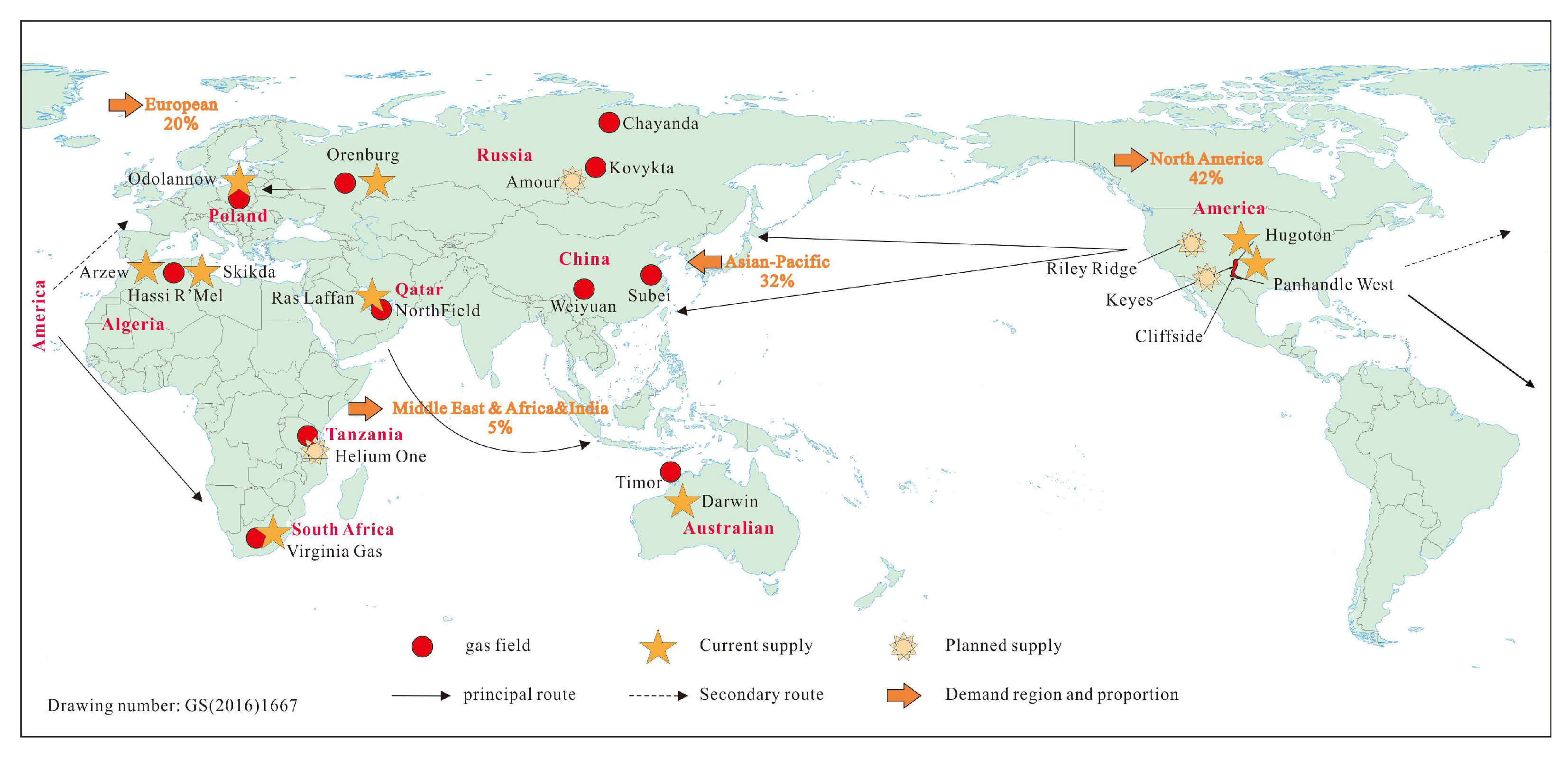
Figure 2.
Distribution map of helium display in China's petroliferous basins[6].
Figure 2.
Distribution map of helium display in China's petroliferous basins[6].
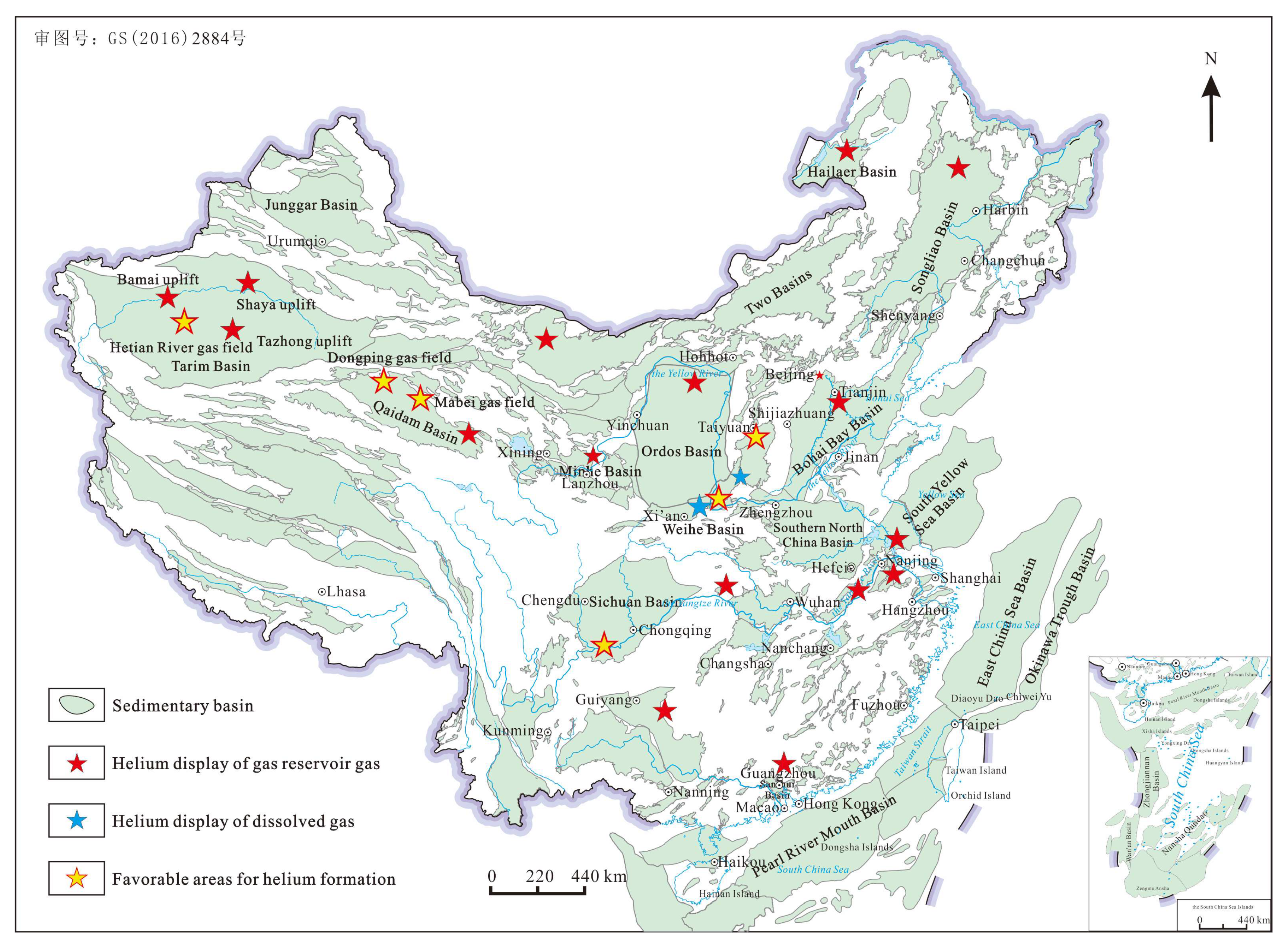
Figure 3.
Composition chart of global helium production in 2012-2023(Data from USGS, 2023).
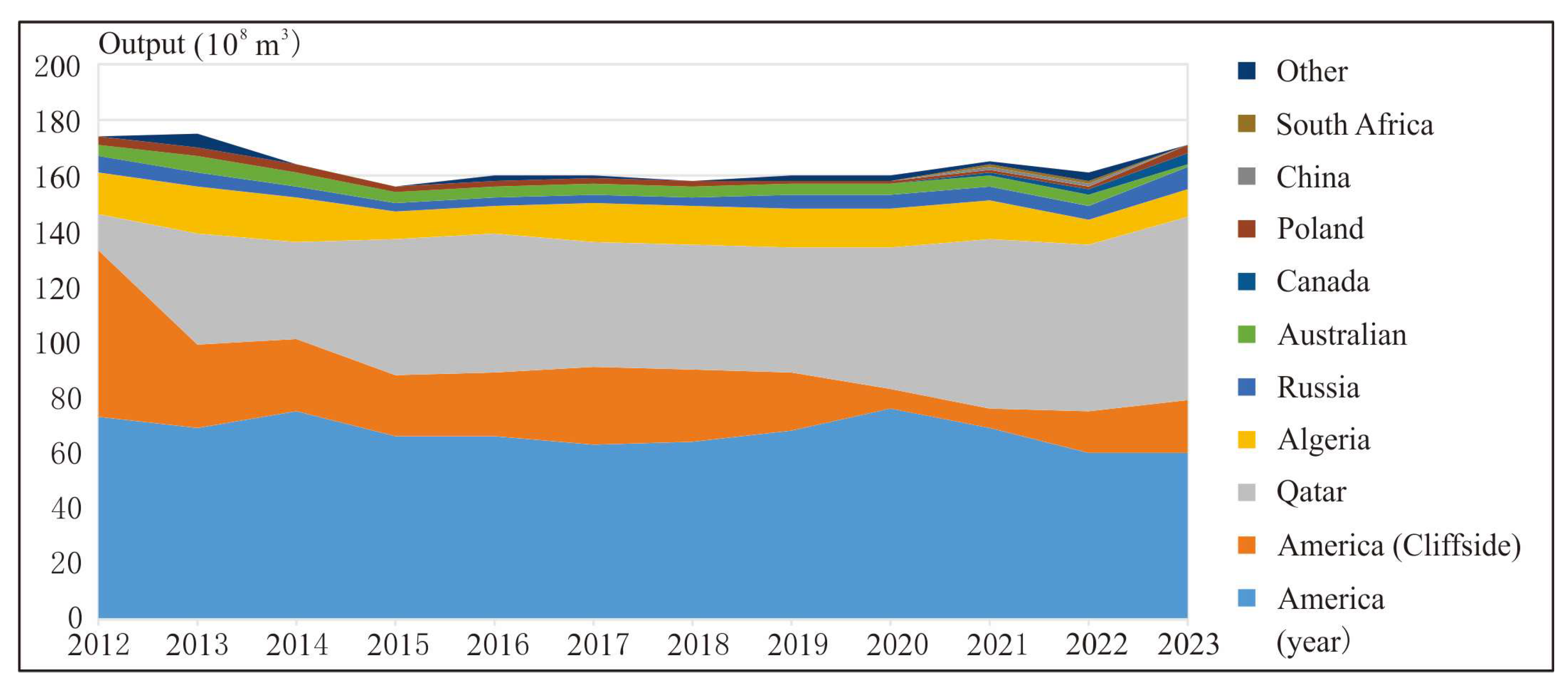
Figure 4.
Trend of helium production and import in China from 2014 to 2023.
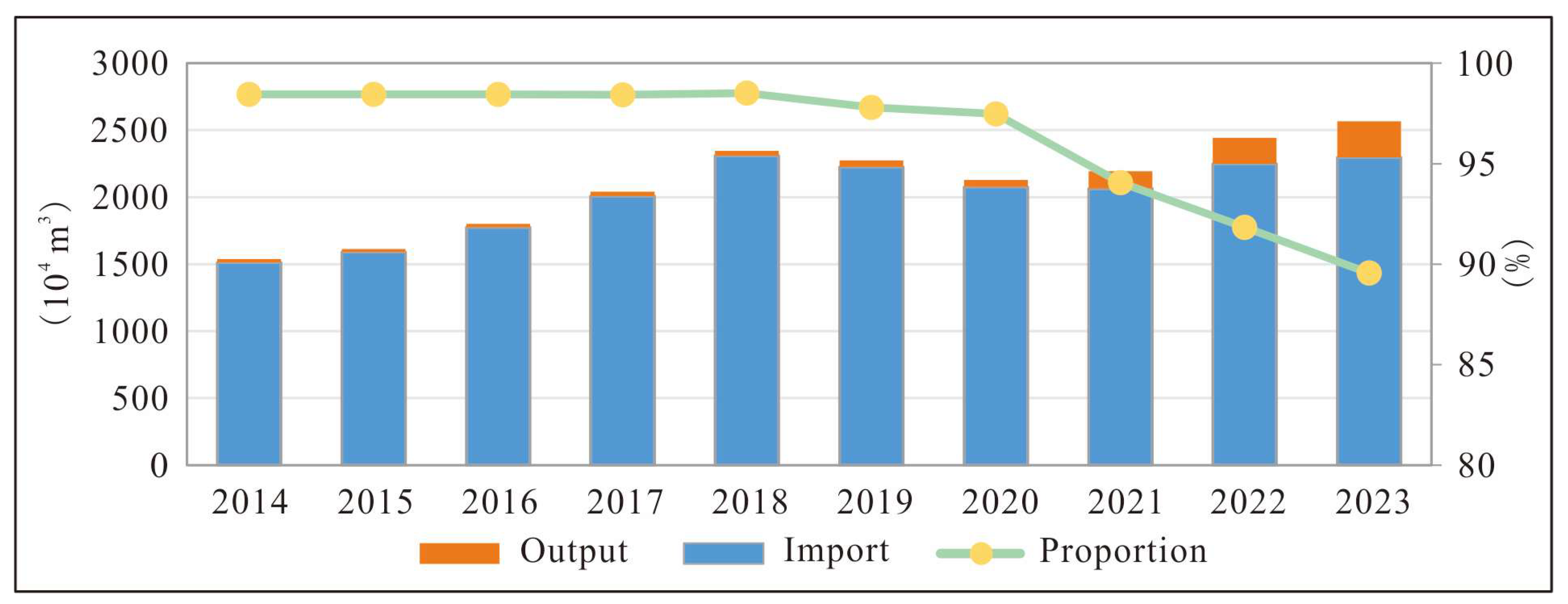

Table 1.
Statistics of s Global Helium Resource/Reserve and proportion[4].
Table 1.
Statistics of s Global Helium Resource/Reserve and proportion[4].
| States | resource | Reserves | ||
| (108 m3) | Global share(%) | (108 m3) | Global share(%) | |
| United States | 171 | 35.33 | 85.52 | 70.39 |
| Qatar | 101 | 20.87 | - | - |
| Algeria | 82 | 16.94 | 18 | 14.91 |
| Russia | 68 | 14.05 | 17 | 14.08 |
| Poland | - | 0.24 | 0.20 | |
| Canada | 20 | 4.13 | - | - |
| China | 11 | 2.27 | - | - |
| Other States | 31 | 6.4 | - | - |
| World total | 484 | 100.00 | 121.1 | 100.00 |
Table 2.
Statistics of some new helium extraction factories scheduled around the world.
| States | Owner or operator | Plant or gas field | Annual production capacity/104 m3 | Commissioning Time/year |
| Russian | Gazprom | Amour 1 | 2000 | 2023 |
| Russian | Gazprom | Amour 2 | 2000 | under planning |
| Russian | Gazprom | Amour 3 | 2000 | under planning |
| Russian | INK | Yarakta | 750 | 2021 |
| Russian | INK | Markovsk | 450 | planned for 2025 |
| Qatar | Qatar Energy | Ras Laffan -3 | 1200 | planned for 2025 |
| Qatar | Qatar Energy | North Field East | 3260 | planned for 2025 |
| Qatar | Qatar Energy | North Field South | 1600 | planned for 2027 |
| Tanzania | Helium One | Helium One | 2800 | planned for 2025 |
| Algeria | Sonatrach | Algerian helium extraction plant | 1000 | Project initiated |
Table 3.
Major BOG purification helium companies in China[6].
Table 3.
Major BOG purification helium companies in China[6].
| No. | basin | area | Annual helium extraction capacity (104 m3) |
state of affairs | Helium extraction method | |
|---|---|---|---|---|---|---|
| 1 | Ordos Basin | Hangjin Banner | 100 | productive | low-temperature deep-freezing | |
| 2 | Ordos Basin | Hangjin Banner | 40 | productive | low-temperature deep-freezing | |
| 3 | Ordos Basin | Yanchi | 15 | productive | low-temperature deep-freezing | |
| 4 | Ordos Basin | Yulin | 15 | productive | membrane process | |
| 5 | Ordos Basin | Qingyang | 15 | productive | membrane process | |
| 6 | Ordos Basin | Yanchi | 15 | productive | membrane process | |
| 7 | Ordos Basin | Ordos | 15 | productive | membrane process | |
| 8 | Ordos Basin | Ordos | 10 | productive | membrane process | |
| 9 | Ordos Basin | Yulin | 30 | construction | membrane process | |
| 10 | Sichuan basin | Chongqing | 15 | construction | membrane process | |
| 11 | Sichuan basin | Chongqing | 20 | construction | low-temperature deep-freezing | |
| 12 | Ordos Basin | Yan'an | 25 | construction | low-temperature deep-freezing | |
| 13 | Ordos Basin | Yan'an | 15 | construction | low-temperature deep-freezing | |
| 14 | Ordos Basin periphery | Ulanqab | 25 | construction | low-temperature deep-freezing | |
| 15 | Ordos Basin | Ordos | 55 | construction | low-temperature deep-freezing | |
| 16 | Ordos Basin | Ordos | 20 | construction | low-temperature deep-freezing | |
| 17 | Ordos Basin periphery | Baotou | 10 | construction | low-temperature deep-freezing | |
| the total | 440 | |||||
Disclaimer/Publisher’s Note: The statements, opinions and data contained in all publications are solely those of the individual author(s) and contributor(s) and not of MDPI and/or the editor(s). MDPI and/or the editor(s) disclaim responsibility for any injury to people or property resulting from any ideas, methods, instructions or products referred to in the content. |
© 2024 by the authors. Licensee MDPI, Basel, Switzerland. This article is an open access article distributed under the terms and conditions of the Creative Commons Attribution (CC BY) license (http://creativecommons.org/licenses/by/4.0/).
Copyright: This open access article is published under a Creative Commons CC BY 4.0 license, which permit the free download, distribution, and reuse, provided that the author and preprint are cited in any reuse.


