

Submitted:
22 October 2024
Posted:
23 October 2024
You are already at the latest version
Abstract
To mitigate the emissions of greenhouse gases from fossil fuels, biodiesel production has be-come more attention over the past decade, especially for the use of waste cooking oils and non-edible oils as starting feedstock. For the biodiesel production process, the suitability of a catalyst is a core function implemented in the transesterification reaction. heterogeneous cata-lysts were superior to homogeneous catalysts due to some advantages such as no saponification products formed, recyclability, and less equipment corrosion. Recent studies also revealed that heterogeneous solid base catalysts are widely used for the production of biodiesel. Further-more, the biomass-based ash derived from herbaceous & agricultural biomass is increasing rap-idly because of its environmental sustainability, high biodiesel yield and low catalyst cost. To search for the depth of green catalysts, this mini-review paper thus focused on the summary of various heterogeneous biomass-based potassium-rich catalysts for the sustainable production of biodiesel. Due to cocoa pod husk that’s rich in potassium-containing minerals, it was found that its derived ash may be the most commonly used solid base catalyst in the biodiesel production.
Keywords:
biodiesel production
; heterogeneous catalyst
; green catalyst
; biomass-derived catalyst
; potassium-rich ash
; cocoa pod husk
1. Introduction
With the increase of the population, the improvement of living-level and the requirements of the transportation, the upward increase in the demand for fossil fuels has become a long-term trend. However, using these non-renewable fuels has negative impacts on the environment and the human-being health. When fossil fuels are combusted or burned, they release large amounts of air pollutants [1], including carbon dioxide, sulfur oxides, nitrogen oxides, particulates and other compounds (e.g., methane, nitrous oxide) or traces of hazardous substances (e.g., heavy metals, dioxins). Some of them belong to greenhouse gases, thus causing global warming and climate change. In this regard, one of the solutions for mitigating the climate crisis or greenhouse effect is based on the use of renewable fuels from the environment-friendly sources like edible oils (or their spent cooking oils) and lignocellulosic alcohols. Over the past decades, diesel fuel from renewable resources for the production of biodiesel in replacements of petroleum-based chemicals has drawn attention in particular. According to the data on the global biodiesel consumption [2], the worldwide biodiesel consumption in 2023 amounted to 65.86 million metric tons. This figure was very different from only 2.2 million metric tons consumed in 2004. The consumption amounts were expected to increase further over the coming years by exceeding 75 million metric tons in 2030 (estimated). Although biodiesel exist some drawbacks (e.g., high production costs and the competition with the food), it has some features such as sustainability, biodegradability, low sulfur content, and low toxicity [3].
Biodiesel, a mixture of fatty acid alkyl esters (FAAEs), is commonly obtained by the chemical reaction of edible/ non-edible oils & fats and waste/recycled cooking oils (vegetable oils) with an alcohol (usually methanol). This reaction is called as transesterification (or alcoholysis) in the presence of an acid/base catalyst at moderate temperature. Figure 1 showed the transesterification reaction for producing biodiesel and glycerol (a by-product). Herein, the term “triglyceride” is used for edible/non-edible oils that are liquid state at normal temperatures. Generally, they are water-insoluble products of naturally occurring plants like peanut, sunflower, linseed and olive. A triglyceride is an ester product obtained from one molecule of glycerol and three molecules of fatty acids like palmitic acid (a saturated fatty acid with a 16-carbon chain by noting C16:0), oleic acid (a mono-unsaturated omega-9 fatty acid by calling C18:1) and linoleic acid (a di-unsaturated fatty acid with containing 2 double bonds at the ninth and 12th carbons, thus denoting C18:2). The most commonly used catalysts are alkaline by using potassium hydroxide (KOH) and sodium hydroxide (NaOH). Therefore, the combined amount of residual potassium and sodium in the 100% biodiesel fuels was limited to 5 mg/kg by two major specifications or standards (i.e., the ASTM D6751 in the USA and the EN 14214 in Europe) [4].
To date, different catalysts have been used to produce biodiesel. They may be alkaline, acid, or enzymatic catalysts [5,6,7,8]. Although enzymatic catalysts feature the non- formation of soaps and the easy refining of crude biodiesel, they have been limited to produce biodiesel commercially due to the high operation costs and long reaction time [9,10]. On the other hand, acid catalysts involved in the transesterification reaction often require longer reaction time and higher ratios of oil to alcohol. More seriously, these catalysts are very corrosive, causing the difficulty of managing them. In this regard, the commercial biodiesel production is mostly based on employing homogeneous alkaline catalysts such as KOH and NaOH. It was summarized that the alkali-catalyzed transesterification process has several advantages over other catalyzed ones, including lower operating temperature (< 80℃) at normal pressure and high biodiesel yields within short reaction times, indicating its effective performance as compared with acid-catalyzed transesterification. Despite significant features of homogeneous alkaline catalysts, it is difficult to be recovered and reused after the transesterification reaction, causing the necessary neutralization process by water washing in the refining and thus generating a large amount of wastewater to be treated [11,12]. In addition, these alkaline salts or their solutions must be careful for safe handling during the operation and storage due to their chemical properties and health hazards.
To overcome the drawbacks of homogeneous alkaline catalysts, many review papers on biodiesel production by using heterogeneous base catalysts have been published [12,13,14,15,16,17,18,19,20,21,22]. From the economic and environmental points of view, these solid base catalysts are also expensive and non-renewable. Therefore, there were several review papers of focusing on the reuse of biomass-based ash [23,24,25,26,27,28,29,30,31,32,33,34,35,36,37,38], which may be rich in silica (Si) and alkali & alkaline earth elements such as calcium (Ca). In the present work, we reviewed potassium-rich ash from herbaceous & agricultural biomass resources as a green catalyst for biodiesel production in the transesterification reaction. Their potassium-containing mineral may be the forms of oxides, carbonates, hydroxides, chloride, nitrates, sulfides, and phosphates, and their mixtures.
2. An Overview of Biodiesel Production Processes
As mentioned above, the core process for biodiesel production is based on transesterification reaction where the interchange of an R group of esters (i.e., triglycerides) with R group of alcohol (methyl group from methanol, or ethyl group from ethanol) under the catalysis by acid or base catalysts (seen in Figure 1), thus yielding a different alcohol (i.e., glycerol, as a by-product) and ester (i.e., fatty acid methyl ester, or biodiesel). Commercially, biodiesel production generally employed homogeneous alkaline catalysts (e.g., sodium hydroxide and potassium hydroxide) due to the high reaction efficiency under the mild conditions. However, the contents of free fatty acids and water in the starting feedstock should not be more than threshold values when using these alkaline catalysts. More noticeably, the neutralization process must be performed by water washing, which generates a large amount of wastewater. Figure 2 illustrated the schematic diagram of biodiesel production by using methanol as a strong nucleophile [29], which also includes several processes (except for transesterification) like pretreatment of feedstock, separation of biodiesel product mixture (e.g., decanting, or gravity settlement), water-washing of crude biodiesel, drying of wet biodiesel (for removal of residual water) by evaporation), and refining of crude glycerol (and recycling of methanol) by distillation process. In the separation process, the biodiesel mixture is first allowed to cool down at room temperature (from about 60-80℃) and settle in the settling tank. The polar fractions with heavier density at the bottom contain crude glycerol, unreacted methanol and remaining catalyst, settles, while the non-polar fractions with ester-rich phase (i.e., crude biodiesel) exist the upper layer.
Generally speaking, the first process in the biodiesel production system is to remove the free fatty acids (FFA) present in starting oils because it can render the production of biodiesel by the reaction of FFA with alkali, thus causing saponification and emulsification. These excessive soaps in the crude biodiesel products can reduce the yield of biodiesel and also make the separation processes (including glycerol separation and water washing) more complicated [39]. To avoid this undesirable problem, the pretreatment of feedstock oils is processed in two stages. The first stage is to lower the FFA contents to the desired level by the esterification with a strong acid (e.g. sulfuric acid). In the subsequent stage, the purified feedstock is reacted with a homogeneous/ heterogeneous catalyst to produce the FAME (i.e., biodiesel). Another core consideration in the biodiesel production is to adopt a proper catalyst. The most effective transesterification reaction may be via enzymatic catalysts, but this method is very expensive and slow as compared to those by acid or base catalysts. The commonly used homogeneous catalysts are based on the use of NaOH and KOH. They have led to higher FAME yields at shorter reaction time. However, homogeneous catalysts have some disadvantages, including soap formation, non-recyclability, non-renewability, non-easy for separation and equipment corrosion [40]. In this regard, the heterogeneous base catalysts produced from biomass-based ash have prevailed with their features, which include environmentally benign, catalyst reusability by easy separation, relatively low toxicity, elimination of wastewater treatment from water-washing step, and consequent reduction in production cost. These biomass-based catalysts can be derived from crop-, wood-, herb-, and animal-based residues or remainders, which have been reviewed by several researchers [23,24,25,26,27,28,29,30,31,32,33,34,35,36,37,38].
3. Overview of Solid Heterogeneous Catalysts for Biodiesel Production
As stated above, solid heterogeneous catalysts are promising candidates for producing biodiesel from vegetable/edible oils or waste cooking oils. Alkaline earth metal oxides (e.g., CaO, MgO) are commonly used in the biodiesel production due to their high reaction rates in comparison with those of acid catalysts. Other alkali forms, including supported alkali metals, supported alkaline earth metal oxides, alkali & alkaline earth composites, zeolites & modified zeolites, lanthanide-based, ion exchange resins, zirconia(Zr)-based oxides, and oxides of other transition metals (e.g., zinc), were also investigated in the literature [13,14,15,16,17,18,19,20,21,22,23]. Potassium oxide (KOH) was also used for alternative of CaO. However, the latter features lower solubility, higher reactivity (basicity), lower cost and easier handling in comparison with the former. Obviously, these base catalysts are less corrosive and can be performed in various reactors, resulting in low cost and more environment-friendly processes due to the catalyst recyclability and continuous production. Moreover, wastewater treatment costs can be reduced by using heterogeneous catalysts as compared to the biodiesel production process with homogeneous catalysts. In addition, such catalyst can tolerate those oils with higher FFA contents, thus eliminating the pretreatment (pre-esterification) stage (as seen in Figure 2).
Despite the advantages of solid heterogeneous base catalysts, producing efficient, environment-friendly and low-cost catalysts from renewable resources is essential in order to highlight the sustainability in the biodiesel production. Various cost-effective heterogeneous solid-base catalysts from a wide variety of biological and agricultural residues for sustainable biodiesel production have been investigated over the past decade [24,25,26,27,28,29,30,31,32,33,34,35,36,37,38]. Most of these biomass resources enrich in metallic base minerals such as potassium (P), silicon (Si), magnesium (Mg) and calcium (Ca) [28]. For example, some plat-based ash materials contain higher contents of P. They include banana peel ash, cocoa pod husk ash, coconut husk ash and palm bunch ash. The biomass-based ash with high Si contents often referred to rice-derived residues such as rice straw and rice husk. Another notable Ca-rich biomass should be associated with the outer shell of shellfish (e.g., oyster, clam, mussel) and chicken egg. It is mainly composed of calcite (one of carbon carbonate, CaCO3), which must be calcined at above 800℃ to produce calcium-rich catalyst (i.e., calcium oxide, CaO) [41,42].
4. Biomass Potassium-Rich Ash as a Green Catalyst for Biodiesel Production
It was reported that biomass or its ash is normally enriched in inorganic minerals by denoting oxides such as calcium oxide (CaO), potassium oxide (K2O), magnesium oxide (MgO), sodium oxide (Na2O), phosphorus pentoxide (P2O5), alumina (Al2O3), iron oxide (Fe2O3), silica (SiO2), sulfur trioxide (SO3), and titanium dioxide (TiO2) in comparison with coal ash [43,44,45,46]. On the other hand, high variability in biomass (or biomass ash) characteristics could limit its industrial valorization such as a green catalyst with solid heterogeneous form for biodiesel production [47]. These inorganic components could lead to tendency of slagging, fouling, and corrosion in the industrial boilers [48,49,50]. According to the classification by Vassilev et al. [43], these inorganic compositions can be classified into three groups:
- (1)
-
Ash elements with acidic feature and high melting pointsThey include Si, Al, Fe, Na and Ti. For example, melting point of silicon dioxide (SiO2) is about 1700°C.
- (2)
-
Ash elements with base feature and less volatiles at high temperatureThey can refer to Ca and Mg. In the case of calcium oxide, its melting point is as high as over 2,500°C.
- (3)
-
Ash elements with base feature and more volatiles at high temperatureThey can involve K, P and S. For instance, melting point of potassium oxide (K2O) is approximately 400°C.
It is well known that the mineral matters or inorganic species could be phosphates, carbonates, chlorides, silicates, hydroxides, fluorides, sulfates, nitrates, and other mineral classes [41]. Table 1 listed the data on melting temperature and boiling temperature of common potassium-containing salts, which were compiled from their safety data sheet (SDS). It showed that most of them may be decomposed, evaporated or vaporized at higher temperatures, thus decreasing the basicity and catalyst (i.e., biomass ash) performance. Li et al. studied the evaporation rate of potassium chloride in combustion of herbaceous biomass (corn stover) [51]. It was found that that most potassium-containing mineral exists as potassium chloride (its melting temperature at 772°C), which will be released at normal combustion temperatures (about 800°C) under the investigation of thermogravimetric analyzer (TGA).
Although Ca/biomass-based base catalysts have some advantages, they also involve the challenges such as high cost due to high temperature for calcination in the CaO preparation step, thus limiting its commercial biodiesel production. Under the considerations of caustic catalyst KOH and biomass-based podash (a potassium-rich ash derived from biomass like cocoa pod husk) for commercial biodiesel production, Table 2 summarized the mineral compositions of some herbaceous & agricultural biomass with higher potassium (K) content [43], including bamboo whole, bana grass, buffalo gourd grass, alfalfa straw, mint straw, almond hulls, almond shells, coffee husks, cotton husks, grape marc, olive residue, pepper residue, plum pits, soya husks, sunflower husks, walnut blows, walnut hulls & blows, and walnut shells. It also showed that herbaceous & agricultural biomass contains higher ash contents, thus having more ash-forming elements (K, Ca, Si) than most of forestry or woody biomass. Recently, biomass-derived heterogeneous potassium-rich catalysts have been a popular valorization research in the biodiesel production field due to its potentiality for cost reduction and environmental sustainability. These biomass-based potassium-rich ash precursors for biodiesel production catalysts include cocoa pod husk [52,53,54,55,56,57,58,59,60,61], kola nut pod husk [59,62], pumpkin pod husk [59], Annona squamosa L. peel [63], coconut husk [64], palm oil [65], orange peel [66], Sesamum indicum plant [67], Heteropanax fragrans (Kesseru) [68], radish (Raphanus sativus L.) leaf [69], tucumã peel (Astrocaryum aculeatum Meyer) [70], pineapple (Ananás comosus) leaf [71], Avocado peel [72], plantain fruit peel [73], Brassica nigra plant [74], Carica papaya stem [75], banana trunk [76], Musa acuminata peel [77], moringa leaf [78], palm kernel bunch [79], palm kernel shell husk [80], Musa balbisiana Colla peel [81], Karanja seed shell [82], sugarcane leaf [83] , walnut shell [84] , hazelnut shell [85] , Acai seed [86] , wheat bran [87] , ginger leaf [88], and banana peel [42,56]. The inorganic elements of these herbaceous & agricultural biomass and its ash were preliminarily determined by energy dispersive X-ray spectroscopy (EDS or EDX) or X-ray fluorescence (XRF). However, the more accurate data on these elements listed in Table 2 must be performed by inductively coupled plasma optical emission spectrometry (ICP-OES) orinductively coupled plasma with atomic emission. spectroscopy (ICP-AES).
5. Conclusions and Perspective
In conclusion, a comprehensive overview focusing on the use of potassium-rich solid catalysts from a wide range of herbaceous & agricultural biomass-based ashes is presented. The practical application of these catalysts in biodiesel synthesis have been studied to produce successfully the green fuels with high yield from various non-edible vegetable oils. We also summarized some advantages of heterogeneous catalysts in comparison with homogeneous catalysts. In addition, producing efficient, environment-friendly and low-cost solid base catalysts from renewable resources is essential in order to highlight the sustainability in the biodiesel production. Due to cocoa pod husk (CPH) that’s rich in potassium-containing minerals, it was found that its derived ash may be the most commonly used solid base catalyst in the biodiesel production. Further research should be also needed to test the transesterification reactivity of these CPH-derived catalysts after purification.
Furthermore, the future efforts will concentrate on the cost-down of potassium-rich biomass-based ash, especially for those with significant generation amounts around the world such as cocoa pod husk, palm kernel (its shell and empty bunch), coffee residues (spent coffee ground, coffee husk) and banana (its peel, leaf and trunk). Due to the high energy content of these biomass-based residues (dry basis), they are often reused as solid auxiliary fuels in the industrial boilers, thus producing large amounts of bottom ash for recycling. One of valorization routes is to improve their purities for enhancing the catalytic performance in the transesterification process. In this perspective, we are actively looking for green potassium-rich catalysts, particularly by biomass-derived husks, in the sustainable biodiesel production.
Author Contributions
Conceptualization, W.-T.T.; methodology, C.-H.T.; formal analysis, C.-H.T.; data curation, C.-H.T.; writing—original draft preparation, W.-T.T.; writing—review and editing, W.-T.T.; supervision, W.-T.T.
Funding
This research received no external funding.
Institutional Review Board Statement
Not applicable.
Informed Consent Statement
Not applicable.
Data Availability Statement
Data is contained within the article.
Conflicts of Interest
The authors declare no conflict of interest.
References
- Perera, F. Pollution from fossil-fuel combustion is the leading environmental threat to global pediatric health and equity: Solutions exist. Int. J. Environ. Res. Public Health 2018, 15, 16. [Google Scholar] [CrossRef] [PubMed]
- Statista. Biodiesel Consumption Worldwide from 2004 to 2023, with a Forecast until 2030. Available online: https://www.statista.com/statistics/1440983/worldwide-consumption-of-biodiesel/ (accessed on 18 October 2024).
- Rahman, M.A. Valorization of harmful algae E. compressa for biodiesel production in presence of chicken waste derived catalyst. Renew. Energy 2018, 129 (Part A), 132–140. [Google Scholar] [CrossRef]
- de Caland, L.B.; Silveira, E.L.C.; Tubino, M. Determination of sodium, potassium, calcium and magnesium cations in biodiesel by ion chromatography. Anal. Chim. Acta 2012, 718, 116–120. [Google Scholar] [CrossRef] [PubMed]
- Balat, M.; Balat, H. A critical review of bio-diesel as a vehicular fuel. Energy Convers. Manag. 2008, 49(10), 2727–2741. [Google Scholar] [CrossRef]
- Demirbas, A. Progress and recent trends in biodiesel fuels. Energy Convers. Manag. 2009, 50(1), 14–34. [Google Scholar] [CrossRef]
- Helwani, Z.; Othman, M.R.; Aziz, N.; Fernando, W.J.N.; Kim, J. Technologies for production of biodiesel focusing on green catalytic techniques: A review. Fuel Process. Technol. 2009, 90(12), 1502–1514. [Google Scholar] [CrossRef]
- Mandari, V.; Devarai, S.K. Biodiesel production using homogeneous, heterogeneous, and enzyme catalysts via transesterification and esterification reactions: A critical review. Bioenerg. Res. 2022, 15, 935–961. [Google Scholar] [CrossRef] [PubMed]
- Hama, S.; Kondo, A. Enzymatic biodiesel production: An overview of potential feedstocks and process development. Bioresour. Technol. 2013, 135, 386–395. [Google Scholar] [CrossRef] [PubMed]
- Christopher, L.P.; Kumar, H.; Zambare, V.P. Enzymatic biodiesel: Challenges and opportunities. Appl. Energy 2014, 119, 497–520. [Google Scholar] [CrossRef]
- Veljković, V.B.; Stamenković, O.S.; Tasić, M.B. The wastewater treatment in the biodiesel production with alkali-catalyzed transesterification. Renew Sustain Energy Rev. 2014, 32, 40–60. [Google Scholar] [CrossRef]
- Kosuru, S.M.Y.; Delhiwala, Y.; Koorla, P.B.; Mekala, M. A review on the biodiesel production: Selection of catalyst, pre-treatment, post treatment methods. Green Technol. Sustain. 2024, 2(1), 100061. [Google Scholar] [CrossRef]
- Atadashi, I.M.; Aroua, M.K.; Abdul Aziz, A.R.; Sulaiman, N.M.N. The effects of catalysts in biodiesel production: A review. J. Ind. Eng. Chem. 2013, 19(1), 14–26. [Google Scholar] [CrossRef]
- Ruhul, A.M.; Kalam, M.A.; Masjuki, H.H.; Rizwanul Fattah, I.M.; Reham, S.S.; Rashed, M.M. State of the art of biodiesel production processes- a review of the heterogeneous catalyst. RSC Adv., 2015, 5, 101023–101044. [Google Scholar] [CrossRef]
- de Lima, A.L.; Ronconi, C.M.; Mota, C.J.A. Heterogeneous basic catalysts for biodiesel production. Catal. Sci. Technol. 2016, 6, 2877–2891. [Google Scholar] [CrossRef]
- Mardhiah, H.H.; Ong, H.C.; Masjuki, H.H.; Lim, S.; Lee, H.V. A review on latest developments and future prospects of heterogeneous catalyst in biodiesel production from non-edible oils. Renew. Sustain. Energy Rev. 2017, 67, 1225–1236. [Google Scholar] [CrossRef]
- Marwaha, A.; Dhir, A.; Mahla, S.K.; Mohapatra, S.K. An overview of solid base heterogeneous catalysts for biodiesel production. Catal. Rev. 2018, 60(4), 594–628. [Google Scholar] [CrossRef]
- Jambhulkar, D.K.; Ugwekar, R.P.; Bhanvase, B.A.; Barai, D.P. (2020). A review on solid base heterogeneous catalysts: Preparation, characterization and applications. Chem. Eng. Commun. 2020, 209(4), 433–484.
- Rizwanul Fattah, I.M.; Ong, H.C.; Mahlia, T.M.I.; Mofijur, M.; Silitonga, A.S.; Rahman, S.M.A.; Ahmad, A. State of the art of catalysts for biodiesel production. Front. Energy Res. 2020, 8, 101. [Google Scholar]
- Jayakumar, M.; Karmegam, N.; Gundupalli, M.P.; Gebeyehu, K.B.; Asfaw, B.T.; Chang, S.W.; Ravindran, B.; Awasthi, M.K. Heterogeneous base catalysts: Synthesis and application for biodiesel production – A review. Bioresour. Technol. 2021, 331, 125054. [Google Scholar] [CrossRef]
- Narasimhan, M.; Chandrasekaran, M.; Govindasamy, S.; Aravamudhan, A. Heterogeneous nanocatalysts for sustainable biodiesel production: A review. J. Environ. Chem. Eng. 2021, 9, 104876. [Google Scholar] [CrossRef]
- Ameen, M.; Ahmad, M.; Zafar, M.; Munir, M.; Mujtaba, M.M.; Sultana, S.; Rozina, S.; El-Khatib, S.E.; Soudagar, M.E.M.; Kalam, M.A. Prospects of catalysis for process sustainability of eco-green biodiesel synthesis via transesterification: A state-of-the-art review. Sustainability 2022, 14, 7032. [Google Scholar] [CrossRef]
- Nurfitri, I.; Maniam, G.P.; Hindryawati, N.; Yusoff, M.M.; Ganesan, S. Potential of feedstock and catalysts from waste in biodiesel preparation: A review. Energy Convers. Manag. 2013, 74, 395–402. [Google Scholar] [CrossRef]
- Basumatary, S.; Nath, B.; Kalita, P. Application of agro-waste derived materials as heterogeneous base catalysts for biodiesel synthesis. J. Renew. Sustain. Energy, 2018, 10, 043105. [Google Scholar] [CrossRef]
- Marwaha, A.; Rosha, P.; Mohapatra, S.K.; Mahla, S.K.; Dhir, A. Waste materials as potential catalysts for biodiesel production: Current state and future scope. Fuel Process. Technol. 2018, 181, 175–186. [Google Scholar] [CrossRef]
- Tang, Z.E.; Lim, S.; Pang, Y.L.; Ong, H.C.; Lee, K.T. Synthesis of biomass as heterogeneous catalyst for application in biodiesel production: State of the art and fundamental review. Renew. Sustain. Energy Rev. 2018, 92, 235–253. [Google Scholar] [CrossRef]
- Chua, S.Y.; Periasamy, L.A.; Goh, C.M.H.; Tan, Y.H.; Mubarak, N.M.; Kansedo, J.; Khalid, M.; Walvekar, R.; Abdullah, E.C. Biodiesel synthesis using natural solid catalyst derived from biomass waste — A review. J. Ind. Eng. Chem. 2020, 81, 41–60. [Google Scholar] [CrossRef]
- Alagumalai, A.; Mahian, O.; Hollmann, F.; Zhang, W. Environmentally benign solid catalysts for sustainable biodiesel production: A critical review. Sci. Total Environ. 2021, 768, 144856. [Google Scholar] [CrossRef]
- Hamza, M.; Ayoub, M.; Shamsuddin, R.B.; Mukhtar, A.; Saqib, S.; Zahid, I.; Ameen, M.; Ullah, S.; Al-Sehemi, A.G.; Ibrahim, M. A review on the waste biomass derived catalysts for biodiesel production. Environ. Technol. Innov. 2021, 21, 101200. [Google Scholar] [CrossRef]
- Maroa, S.; Inambao, F. A review of sustainable biodiesel production using biomass derived heterogeneous catalysts. Eng. Life Sci. 2021, 21(12), 790–824. [Google Scholar] [CrossRef]
- Venkateswarlu, K. Ashes from organic waste as reagents in synthetic chemistry: A review. Environ. Chem. Lett. 2021, 19, 3887–3950. [Google Scholar] [CrossRef]
- Costa, A.A.F.d.; de Oliveira, A.d.N.; Esposito, R.; Len, C.; Luque, R.; Noronha, R.C.R.; Rocha Filho, G.N.d.; Nascimento, L.A.S.d. Glycerol and catalysis by waste/low-cost materials—A review. Catalysts 2022, 12, 570. [Google Scholar] [CrossRef]
- Nabgan, W.; Jalil, A.A.; Nabgan, B.; Jadhav, A.H.; Ikram, M.; Ul-Hamid, A.; Ali, M.W.; Hassan, N.S. Sustainable biodiesel generation through catalytic transesterification of waste sources: a literature review and bibliometric survey. RSC Adv. 2022, 12(3), 1604–1627. [Google Scholar] [CrossRef] [PubMed]
- Parida, S.; Singh, M.; Pradhan, S. Biomass wastes: A potential catalyst source for biodiesel production. Bioresour. Technol. Rep. 2022, 18, 101081. [Google Scholar] [CrossRef]
- Bekele, D.T. , Shibeshi, N.T.; Reshad, A.S. Heterogeneous catalysts from metallic oxides and lignocellulosic biomasses ash for the valorization of feedstocks into biodiesel: An Overview. Bioenerg. Res. 2023, 16, 1361–1379. [Google Scholar] [CrossRef]
- Ao, S.; Changmai, B.; Vanlalveni, C.; Chhandama, M.V.L.; Wheatley, A.E.H.; Rokhum, S.L. Biomass waste-derived catalysts for biodiesel production: Recent advances and key challenges. Renew. Energy 2024, 223, 120031. [Google Scholar] [CrossRef]
- Chutia, G.P.; Phukan, K. Biomass derived heterogeneous catalysts used for sustainable biodiesel production: A systematic review. Braz. J. Chem. Eng. 2024, 41, 23–48. [Google Scholar] [CrossRef]
- Sarangi, P.K.; Singh, A.K.; Ganachari, S.V.; Pengadeth, D.; Mohanakrishna, G.; Aminabhavi, T.M. Biobased heterogeneous renewable catalysts: Production technologies, innovations, biodiesel applications and circular bioeconomy. Environ. Res. 2024, 261, 119745. [Google Scholar] [CrossRef]
- Mansir, N.; Teo, S.H.; Rashid, U.; Taufiq-Yap, Y.H. Efficient waste Gallus domesticus shell derived calcium-based catalyst for biodiesel production. Fuel 2018, 211, 67–75. [Google Scholar] [CrossRef]
- Mazaheri, H.; Ong, H.C.; Amini, Z.; Masjuki, H.H.; Mofijur, M.; Su, C.H.; Anjum Badruddin, I.; Khan, T.M.Y. An overview of biodiesel production via calcium oxide based catalysts: Current state and perspective. Energies 2021, 14, 3950. [Google Scholar] [CrossRef]
- Wang, B.; Wang, B.; Shukla, S.K.; Wang, R. Enabling catalysts for biodiesel production via transesterification. Catalysts 2023, 13, 740. [Google Scholar] [CrossRef]
- Ezekannagha, C.B. , Onukwuli, O.D., Nwabueze, O.H.; Nnanwube, I.A. Heterogeneous base catalyst from hybrid banana-and-plantain peels in papaya seed oil (Carica papaya) methyl-ester synthesis. Chem. Afr. 2024, 7, 1935–1950. [Google Scholar] [CrossRef]
- Vassilev, S.V.; Baxter, D.; Andersen, L.K.; Vassileva, C.G. An overview of the chemical composition of biomass. Fuel 2010, 89, 913–933. [Google Scholar] [CrossRef]
- Vassilev, S.V.; Baxter, D.; Andersen, L.K.; Vassileva, C.G.; Morgan, T.J. An overview of the organic and inorganic phase composition of biomass. Fuel 2012, 94, 1–33. [Google Scholar] [CrossRef]
- Vassilev, S.V.; Vassileva, C.G.; Vassilev, V.S. Advantages and disadvantages of composition and properties of biomass in comparison with coal: An overview. Fuel 2015, 158, 330–350. [Google Scholar] [CrossRef]
- Cai, J.; He, Y.; Yu, X.; Banks, S.W.; Yang, Y.; Zhang, X.; Yu, Y.; Liu, R.; Bridgwater, A.V. Review of physicochemical properties and analytical characterization of lignocellulosic biomass. Renew Sustain Energy Rev. 2017, 76, 309–322. [Google Scholar] [CrossRef]
- Yan, J.; Oyedeji, O.; Leal, J.H.; Donohoe, B.S.; Semelsberger, T.A.; Li, C.; Hoover, A.N.; Webb, E.; Bose, E.A.; Zeng, Y.; Williams, C.L.; Schaller, K.D.; Sun, N. Ray, A.E.; Tanjore, D. Characterizing variability in lignocellulosic biomass: A review. ACS Sustain. Chem. Eng. 2020, 8, 8059–8085. [Google Scholar] [CrossRef]
- Zhu, Y.; Niu, Y.; Tan, H.; Wang, X. Short review on the origin and countermeasure of biomass slagging in grate furnace. Front. Environ. Res. 2014, 2, 7. [Google Scholar] [CrossRef]
- Wen, X.; Xu, Y.; Wang, J. Assessing slagging propensity of coal from their slagging indices. J. Energy Inst. 2018, 91, 646–654. [Google Scholar] [CrossRef]
- Lachman, J.; Balas, M.; Lisy, M.; Lisa, H.; Milcak, P.; Elbl, P. An overview of slagging and fouling indicators and their applicability to biomass fuels. Fuel Process. Technol. 2021, 217, 106804. [Google Scholar] [CrossRef]
- Li, X.; He, F.; Su, X.; Behrendt, F.; Gao, Z.; Wang, H. Evaporation rate of potassium chloride in combustion of herbaceous biomass and its calculation. Fuel 2019, 257, 116021. [Google Scholar] [CrossRef]
- Ofori-Boateng, C.; Lee, K.T. The potential of using cocoa pod husks as green solid base catalysts for the transesterification of soybean oil into biodiesel: Effects of biodiesel on engine performance. Chem. Eng. J. 2013, 220, 395–401. [Google Scholar] [CrossRef]
- Olugbenga, A.G.; Mohammed, A.; Ajakaye, O.N. Biodiesel production in Nigeria using cocoa pod ash as a catalyst base. Int. J. Sci. Eng. Investig. 2013, 2(15), 144–147. [Google Scholar]
- Betiku, E.; Etim, A.O.; Pereao, O.; Ojumu, T.V. Two-Step Conversion of Neem (Azadirachta indica) Seed oil into fatty methyl esters using a heterogeneous biomass-based catalyst: An example of cocoa pod husk. Energy Fuels 2017, 31, 6182–6193. [Google Scholar] [CrossRef]
- Odetoye, T.E.; Amusan, G.S. Cocoa pod ash as bio-based catalyst for biodiesel production from waste chicken fat. CIGR J. 2019, 21(4), 144–151. [Google Scholar]
- Odude, V.O.; Adesina, A.J.; Oyetunde, O.O.; Adeyemi, O.O.; Ishola, N.B.; Etim, A.; Betiku, E. Application of agricultural waste-based catalysts to transesterification of esterified palm kernel oil into biodiesel: A case of banana fruit peel versus cocoa pod husk. Waste Biomass Valor. 2019, 10, 877–888. [Google Scholar] [CrossRef]
- Olatundun, E.A.; Borokini, O.O.; Betiku, E. Cocoa pod husk-plantain peel blend as a novel green heterogeneous catalyst for renewable and sustainable honne oil biodiesel synthesis: A case of biowastes-to-wealth. Renew. Energy 2020, 166, 163–175. [Google Scholar] [CrossRef]
- Adepoju, T.F.; Eyibio, U.; Emberru, E.R.; Balogun, T.A. Optimization conversion of beef tallow blend with waste used vegetable oil for fatty acid ethyl ester (FAEE) synthesis in the presence of bio-base derived from Theobroma cacao pod husks. Case Stud. Chem. Environ. Eng. 2022, 6, 100–218. [Google Scholar] [CrossRef]
- Falowo, A.O.; Betiku, E. A novel heterogeneous catalyst synthesis from agrowastes mixture and application in transesterification of yellow oleander-rubber oil: Optimization by Taguchi approach. Fuel 2022, 312, 122–999. [Google Scholar] [CrossRef]
- Olatayo, O.A.; Sunday, O.D.; Olaluwoye, O.S. Production and characterization of biodiesel from castor seed oil using cocoa pod ash as catalyst. Chem. Eng. Technol. 2024, 47, 448–454. [Google Scholar] [CrossRef]
- Tarigan, J.B.; Perangin-angin, S.; Debora, S.; Manalu, D.; Sari, R.N.; Ginting, u.; Sitepu, E.K. Application of waste cocoa pod husks as a heterogeneous catalyst in homogenizer-intensified biodiesel production at room temperature. Case Stud. Chem. Environ. Eng. 2024, 10, 100966. [Google Scholar] [CrossRef]
- Betiku, E.; Okeleye, A.A.; Ishola, N.B.; Osunleke, A.S.; Ojumu, T.V. Development of a novel mesoporous biocatalyst derived from kola nut pod husk for conversion of kariya seed oil to methyl esters: A Case of synthesis, modeling and optimization studies. Catal. Lett. 2019, 149, 1772–1787. [Google Scholar] [CrossRef]
- Patil; U. P.; Patil, S.U. Enhanced biodiesel production from waste cooking oil using potash-enriched natural base catalyst. Sustain. Chem. Eng. 2024, 5, 352–366. [Google Scholar]
- Vadery, V.; Narayanan, B.N.; Ramakrishnan, R.M.; Cherikkallinmel, S.K.; Sugunan, S.; Narayanan, D.P.; Sasidharan,S. Room temperature production of Jatropha biodiesel over coconut husk ash. Energy 2014, 70, 588–594. [Google Scholar] [CrossRef]
- Okoye, P.U.; Wang, S.; Khanday, W.A.; Li, S.; Tang, T.; Zhang, L. Box-Behnken Optimization of the transesterification reaction of glycerol to glycerol carbonate on catalyst derived from calcined palm oil ash. Renew. Energy 2020, 146, 2676–2687. [Google Scholar] [CrossRef]
- Changmai, B.; Sudarsanam, P.; Rokhum, S.L. Biodiesel production using a renewable mesoporous solid catalyst. Ind. Crops Prod. 2020, 145, 111911. [Google Scholar] [CrossRef]
- Nath, B.; Kalita, P.; Das, B.; Basumatary, S. Highly efficient renewable heterogeneous base catalyst derived from waste Sesamum indicum plant for synthesis of biodiesel. Renew. Energy 2020, 151, 295–310. [Google Scholar] [CrossRef]
- Basumatary, S.; Nath, B.; Das, B.; Kalita, P.; Basumatary, B. Utilization of renewable and sustainable basic heterogeneous catalyst from Heteropanax fragrans (Kesseru) for effective synthesis of biodiesel from Jatropha curcas oil. Fuel 2020, 286, 119357. [Google Scholar] [CrossRef]
- Eldiehy, K.S.H.; Gohain, M.; Daimary, N.; Borah, D.; Mandal, M.; Deka, D. Radish (Raphanus sativus L.) leaves: A novel source for a highly efficient heterogeneous base catalyst for biodiesel production using waste soybean cooking oil and Scenedesmus obliquus oil. Renew. Energy 2022, 191, 888–901. [Google Scholar] [CrossRef]
- Mendonça, I.M.; Orlando, A.R.L. Paes, O.A.R.L.; Maia, P.J.S.; Souza, M.P.; Almeida, R.A.; Silva, C.C.; Duvoisin, S.; de Freitas, F.A. New heterogeneous catalyst for biodiesel production from waste tucumã peels (Astrocaryum aculeatum Meyer): Parameters optimization study. Renew. Energy 2019, 130, 103–110. [Google Scholar] [CrossRef]
- Barros, S.D.S.; Pessoa, W.A.G.; Sá, I.S.C.; Takeno, M.L.; Nobre, F.X.; Pinheiro, W.; Manzato, L.; Iglauer, S. Bioresource Technology pineapple (Ananás comosus) leaves ash as a solid base catalyst for biodiesel synthesis. Bioresour. Technol. 2020, 312, 123–569. [Google Scholar]
- Etim, A.O.; Musonge, P. Synthesis of a highly efficient mesoporous green catalyst from waste Avocado peels for biodiesel production from used cooking–baobab hybrid oil. Catalysts 2024, 14, 261. [Google Scholar] [CrossRef]
- Etim, A.O.; Betiku, E.; Ajala, S.O.; Olaniyi, P.J.; Ojumu, T.V. Potential of ripe plantain fruit peels as an ecofriendly catalyst for biodiesel synthesis: optimization by artificial neural network integrated with genetic algorithm. Sustainability 2018, 10, 707. [Google Scholar] [CrossRef]
- Nath, B.; Das, B.; Kalita, P.; Basumatary, S. Waste to value addition: Utilization of waste Brassica nigra plant derived novel green heterogeneous base catalyst for effective synthesis of biodiesel. J. Clean. Prod. 2019, 239, 118112. [Google Scholar] [CrossRef]
- Gohain, M.; Laskar, K.; Paul, A.K.; Daimary, N.; Maharana, M.; Goswami, I.K.; Hazarika, A.; Bora, U.; Deka, D. Carica papaya stem: A source of versatile heterogeneous catalyst for biodiesel production and C–C bond formation. Renew. Energy 2020, 147, 541–555. [Google Scholar] [CrossRef]
- Rajkumari, K.; Rokhum, L. A sustainable protocol for production of biodiesel by transesterification of soybean oil using banana trunk ash as a heterogeneous catalyst. Biomass Convers. Biorefin. 2020, 10, 839–848. [Google Scholar] [CrossRef]
- Pathak, G.; Das, D.; Rajkumari, K.; Rokhum, L. Exploiting waste: Towards a sustainable production of biodiesel using: Musa acuminata peel ash as a heterogeneous catalyst. Green Chem. 2018, 20, 2365–2373. [Google Scholar] [CrossRef]
- Aleman-Ramirez, J.L.; Moreira, J.; Torres-Arellano, S.; Longoria, A.; Okoye, P.U.; Sebastian, P.J. Preparation of a heterogeneous catalyst from moringa leaves as a sustainable precursor for biodiesel production. Fuel 2021, 284, 118–983. [Google Scholar] [CrossRef]
- Keke, M.; Rockson-Itiveh, D.E.; Ozioko, F.C.; Adepoju, T.F. Hetero-alkali catalyst for production of biodiesel from domesticated waste: (used waste oil). ABUAD Int. J. Nat. Appl. Sci. 2023, 3(2), 16–24. [Google Scholar] [CrossRef]
- Adepoju, T.F. Synthesis of biodiesel from Pig fat oil - Neem oil blend using the mixture of two agricultural wastes: palm kernel shell husk (PKSH) and fermented kola nut husk (FKNH). Ind. Crops Prod. 2020, 149, 112334. [Google Scholar] [CrossRef]
- Gohain, M.; Devi, A.; Deka, D. Musa balbisiana Colla peel as highly effective renewable heterogeneous base catalyst for biodiesel production. Ind. Crops Prod. 2017, 109, 8–18. [Google Scholar] [CrossRef]
- Prajapati, P.; Shrivastava, S.; Sharma, V.; Srivastava, P.; Shankhwar, V.; Sharma, A.; Srivastava, S.K.; Agarwal, D.D. Karanja seed shell ash: A sustainable green heterogeneous catalyst for biodiesel production. Results Eng. 2023, 18, 101063. [Google Scholar] [CrossRef]
- Arumugam, A.; Sankaranarayanan, P. Biodiesel production and parameter optimization: an approach to utilize residual ash from sugarcane leaf, a novel heterogeneous catalyst, from Calophylluminophyllum oil. Renew. Energy 2020, 153, 1272–1282. [Google Scholar] [CrossRef]
- Miladinovic, M.R.; Zduji, M.V.; Veljovi, D.N.; Krsti, J.B.; Bankovi, I.B.; Veljkovi, V.B.; Stamenkovi, O.S. Valorization of walnut shell ash as a catalyst for biodiesel production. Renew. Energy 2020, 147, 1033–1043. [Google Scholar] [CrossRef]
- Miladinovic, M.R.; Krstic, J.B.; Zdujic, M.V.; Veselinovic, L.M.; Veljovic, D.N.; Bankovic-Ilic, I.B.; Stamenkovic, O.S.; Veljkovic, V.B. Transesterification of used cooking oil catalyzed by hazelnut shell ash. Renew. Energy 2022, 183, 103–113. [Google Scholar] [CrossRef]
- Mares, E.K.L.; Gonçalves, M.A.; Da Luz, P.T.S.; Da Rocha Filho, G.N.; Zamian, J.R.; Da Conceiç, L.R.V. Acai seed ash as a novel basic heterogeneous catalyst for biodiesel synthesis: optimization of the biodiesel production process. Fuel 2021, 299, 120887. [Google Scholar] [CrossRef]
- Gouran, A.; Aghel, B.; Nasirmanesh, F. Biodiesel production from waste cooking oil using wheat bran ash as a sustainable biomass. Fuel 2021, 295, 120542. [Google Scholar] [CrossRef]
- John, M.; Abdullah, M.O.; Hua, T.Y.; Nolasco-Hip´olito, C. Techno-economical and energy analysis of sunflower oil biodiesel synthesis assisted with waste ginger leaves derived catalysts. Renew. Energy 2021, 168, 815–828. [Google Scholar] [CrossRef]
Figure 1.
Transesterification reaction.
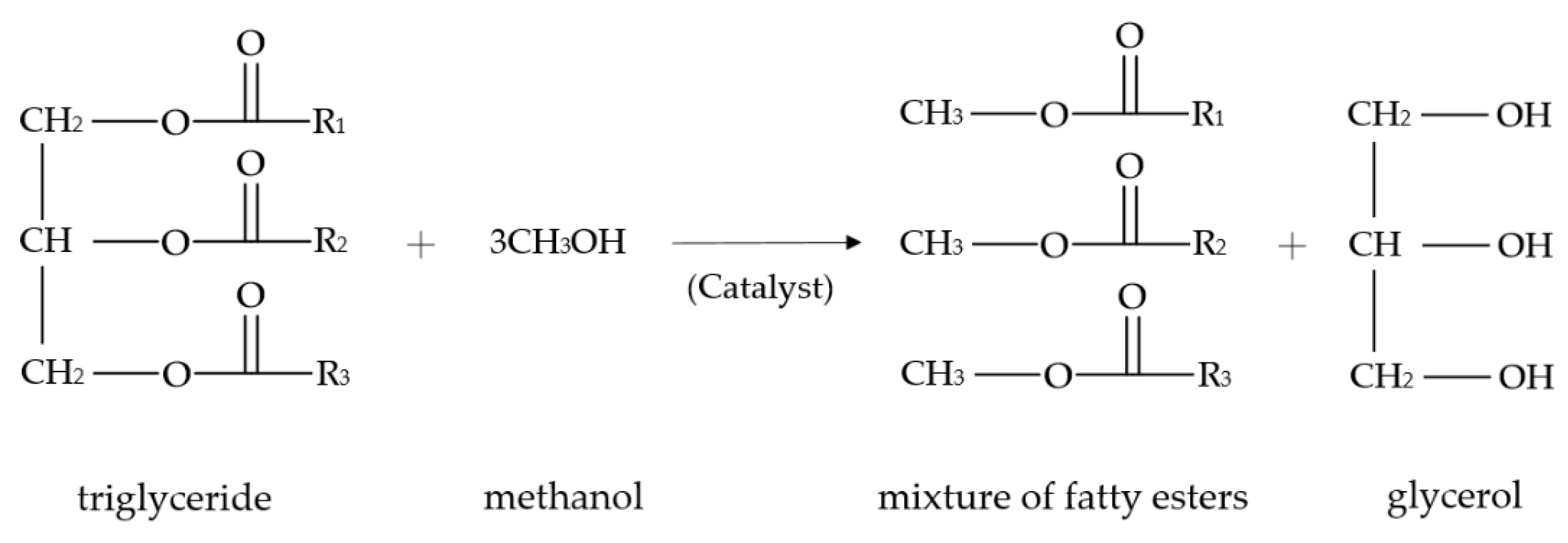
Figure 2.
Simplified process for biodiesel production.
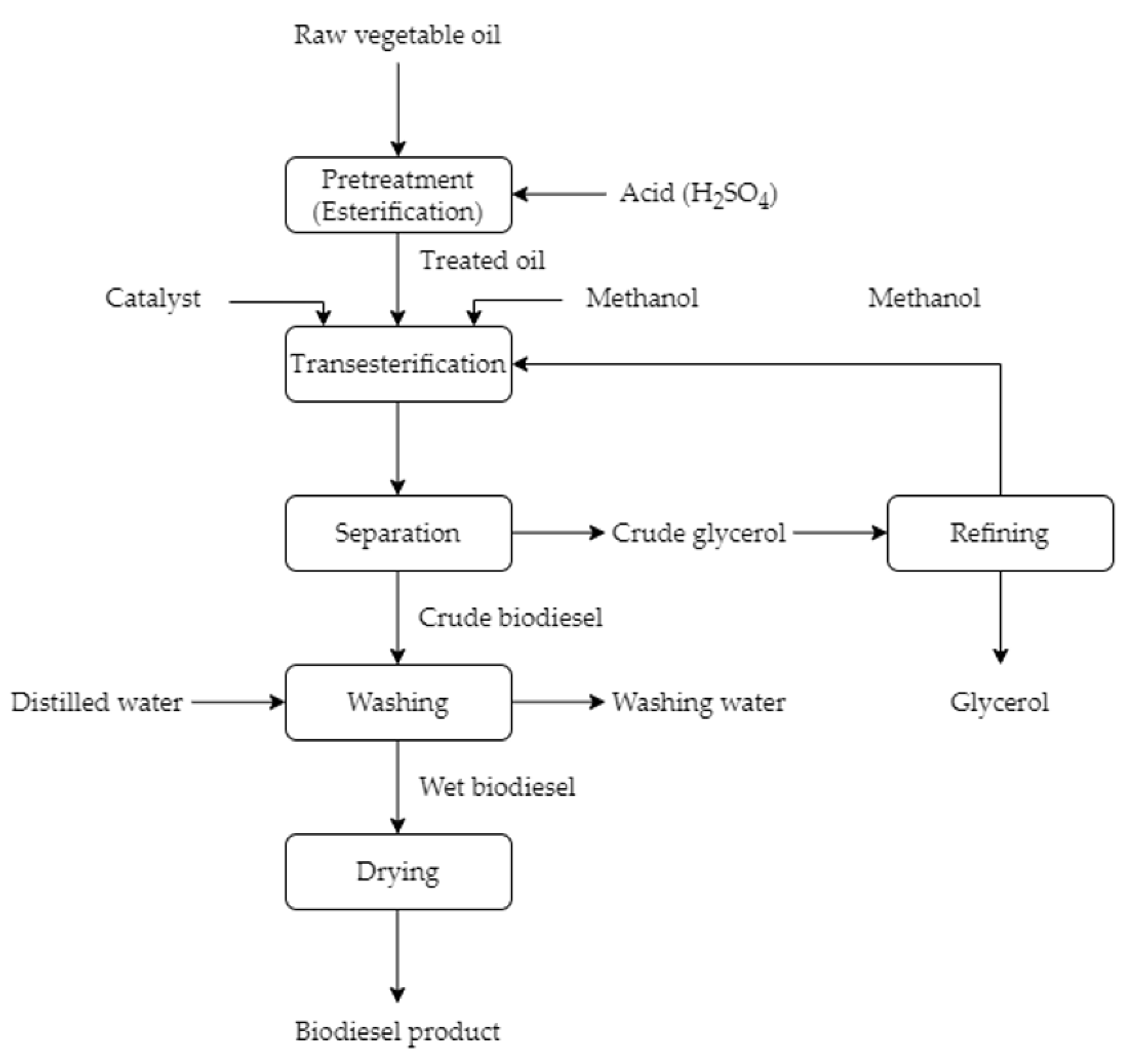

Table 1.
Melting temperature and boiling temperature of potassium-containing salts.
| K-containing salt | Melting temperature (°C) | Boiling temperature (°C) |
| Potassium bicarbonate, KHCO3 |
> 100 (decomposition) | NA |
|
Potassium carbonate, K2CO3 |
891 | NA |
|
Potassium chloride, KCl |
770 | 1,413 |
|
Potassium fluioride, KF |
846 | 1,505 |
|
Potassium hydroxide, KOH |
406 | 1320 |
|
Potassium nitrate, KNO3 |
334 | 400 (decomposition) |
|
Potassium oxide, K2O |
400 | NA |
|
Potassium phosphate, K3PO4 |
253 | 450 |
| Potassium silicate, K2SiO3 |
> 300 | NA |
|
Potassium sulfate, K2SO4 |
1,069 | 1,687 |
| Potassium Sulfide, K2S |
400 | NA |
1 Not applicable.
Table 2.
Chemical ash composition of herbaceous & agricultural biomass with higher potassium (K) content.1.
Table 2.
Chemical ash composition of herbaceous & agricultural biomass with higher potassium (K) content.1.
| Biomass type | Chemical ash composition (wt%) | Sum (wt%) | |||||||||
| SiO2 | CaO | K2O | P2O5 | Al2O3 | MgO | Fe2O3 | SO3 | Na2O | TiO2 | ||
| Bamboo whole | 9.92 | 4.46 | 53.38 | 20.33 | 0.67 | 6.57 | 0.67 | 3.68 | 0.31 | 0.01 | 100.00 |
| Bana grass | 38.59 | 4.09 | 49.08 | 3.14 | 0.92 | 1.96 | 0.73 | 0.97 | 0.44 | 0.08 | 100.00 |
| Buffalo gourd grass | 8.73 | 14.74 | 41.40 | 10.96 | 1.88 | 5.24 | 0.90 | 9.89 | 6.20 | 0.06 | 100.00 |
| Alfalfa straw | 7.87 | 24.87 | 38.14 | 10.38 | 0.10 | 14.10 | 0.41 | 2.62 | 1.49 | 0.02 | 100.00 |
| Mint straw | 23.49 | 17.63 | 32.01 | 5.77 | 5.57 | 6.90 | 2.82 | 3.50 | 1.98 | 0.33 | 100.00 |
| Almond hulls | 11.21 | 9.75 | 63.90 | 6.17 | 2.52 | 4.00 | 0.92 | 0.41 | 1.06 | 0.06 | 100.00 |
| Almond shells | 16.96 | 11.55 | 53.48 | 4.93 | 2.99 | 4.51 | 2.78 | 0.93 | 1.76 | 0.11 | 100.00 |
| Coffee husks | 14.65 | 13.05 | 52.45 | 4.94 | 7.07 | 4.32 | 2.06 | 0.53 | 0.66 | 0.27 | 100.00 |
| Cotton husks | 10.93 | 20.95 | 50.20 | 4.05 | 1.32 | 7.59 | 1.92 | 1.72 | 1.31 | 0.01 | 100.00 |
| Grape marc | 9.53 | 28.52 | 36.84 | 8.80 | 2.63 | 4.77 | 1.77 | 6.29 | 0.67 | 0.18 | 100.00 |
| Olive residue | 22.26 | 12.93 | 42.79 | 6.09 | 4.10 | 5.84 | 1.99 | 3.73 | 0.12 | 0.15 | 100.00 |
| Pepper residue | 15.39 | 10.02 | 35.32 | 11.19 | 8.39 | 4.55 | 3.38 | 10.61 | 1.05 | 0.10 | 100.00 |
| Plum pits | 3.64 | 14.86 | 45.51 | 20.40 | 0.11 | 11.79 | 0.69 | 2.51 | 0.47 | 0.02 | 100.00 |
| Soya husks | 2.01 | 25.26 | 36.00 | 5.79 | 8.74 | 8.38 | 2.95 | 4.37 | 6.26 | 0.24 | 100.00 |
| Sunflower husks | 23.66 | 15.31 | 28.53 | 7.13 | 8.75 | 7.33 | 4.27 | 4.07 | 0.80 | 0.15 | 100.00 |
| Walnut blows | 6.41 | 27.64 | 34.67 | 10.28 | 2.25 | 14.34 | 1.05 | 2.33 | 0.92 | 0.11 | 100.00 |
| Walnut hulls & blows | 8.29 | 20.03 | 39.65 | 7.52 | 2.92 | 16.21 | 1.37 | 2.71 | 1.19 | 0.11 | 100.00 |
| Walnut shells | 23.32 | 16.72 | 33.03 | 6.21 | 2.40 | 13.51 | 1.50 | 2.20 | 1.00 | 0.10 | 100.00 |
1 Source [44].
Disclaimer/Publisher’s Note: The statements, opinions and data contained in all publications are solely those of the individual author(s) and contributor(s) and not of MDPI and/or the editor(s). MDPI and/or the editor(s) disclaim responsibility for any injury to people or property resulting from any ideas, methods, instructions or products referred to in the content. |
© 2024 by the authors. Licensee MDPI, Basel, Switzerland. This article is an open access article distributed under the terms and conditions of the Creative Commons Attribution (CC BY) license (http://creativecommons.org/licenses/by/4.0/).
Copyright: This open access article is published under a Creative Commons CC BY 4.0 license, which permit the free download, distribution, and reuse, provided that the author and preprint are cited in any reuse.


