

Submitted:
16 October 2024
Posted:
17 October 2024
You are already at the latest version
Abstract
This study explored the adsorption of carboxylic acids, especially free fatty acids (FFA), present in biofuel (distilled fractions of bio-oil such as gasoline-like hydrocarbons, kerosene-like hydro-carbons and diesel-like hydrocarbons) using red mud-based adsorbents. The red mud was ther-mally activated (at 40 °C and 600 °C) and chemically activated with HCl (0.25M, 1M, and 2M). Analytical techniques were used to characterize the adsorbents' properties. At the same time, the study examined factors like feed type, adsorbents, FFA content, adsorbent percentage, activation temperature, acid solution concentration and contact time to assess adsorption efficiency. The characterization results indicated that chemical activation with 0.25M HCl significantly in-creased the surface area to 84.3290 m²/g, surpassing thermally activated samples (35.2450 m²/g at 400 °C). Adsorption experiments demonstrated that all chemically activated samples, with 5% adsorbent, adsorbed over 2000 mg FFA per gram of adsorbent, with CARM – 1M HCl achieving 100% removal of acids from gasoline-like hydrocarbons. Kinetic modeling showed that the pseudo-second-order model best represented the adsorption data, as evidenced by high R² values and close agreement between experimental and calculated qe values. Therefore, adsorption with chemically activated red mud efficiently deacidifies biofuels, providing a cost-effective and promising approach for their upgrading.
Keywords:
Adsorption
; Distilled fractions
; Bio-oil
; Carboxylic acids
; Oxygenated compounds
1. Introduction
In the current context, many emerging and developing economies' strategic energy and climate objectives focus on decarbonization through three main axes. The first is clean electrification, with a focus on expanding the share of electric vehicles and other forms of electrification supported by renewable energy sources. The second axis covers improvements in energy efficiency, emphasizing reducing CO2 emissions per unit of industrial production and per kilometer traveled in transport. The third axis highlights the transition to low- or zero-carbon fuels, such as biofuels and other renewable energies, promoting the progressive replacement of fossil fuels and accelerating the mitigation of greenhouse gas emissions [1].
In this context, pyrolysis, also known as thermal cracking, is one of the technologies capable of converting biomass, whether it is based on lignocellulose or triglycerides, into biofuels and other chemicals [2]. This process occurs at temperatures between 350 and 650 °C in the absence of oxygen and, in some cases, in the presence of a catalyst, characterizing catalytic cracking [2,3,4]. The liquid fraction resulting from pyrolysis is known as bio-oil. However, bio-oil's physical properties and chemical composition vary according to the type of biomass used [2]. Given this diversity, this study focuses on bio-oils and their distillate fractions derived from triacylglycerol-based biomass pyrolysis due to their unique characteristics and potential to produce biofuels.
Bio-oil is a complex mixture of oxygenated compounds (aldehydes, ketones, carboxylic acids) and hydrocarbons (linear paraffin, naphthenes, and olefins) [4,5,6,7], which correspond to the boiling point range of many petroleum products, including the following fuels: gasoline, kerosene (jet fuel), and diesel [6,7]. Generally, bio-oil is dark, varying between almost black, reddish brown, and dark green [8]. However, its direct use as a substitute for fossil fuels faces significant barriers due to low calorific value and high oxygen content, which result in instability, high corrosivity [3,9,10], and high acid value (82.03 mg KOH/g on average) due to the presence of carboxylic acids formed by the breakdown of triglycerides [2]. To be used as a fuel or in the production of value-added chemicals, bio-oil needs to be processed, refined or upgraded [3,9,10,11,12,13,14,15], aiming to improve its properties and meet established standards, especially about olefin content and acidity [2]. Although the complex composition of bio-oil presents significant challenges for consolidating such procedures [2,12], its refining/upgrading is feasible due to the development and application of specific separation technologies and processes [9].
Several studies have reviewed technologies for improving bio-oil, including catalytic cracking, hydrotreatment, esterification, and stabilizing its physical-chemical properties [16,17,18]. However, there is a gap in the use of separation techniques for the fractionation/extraction of bio-oil, such as supercritical fluid extraction, adsorption, membrane, electrosorption and ionic liquid extraction [9], as well as methods such as column chromatography, distillation and solvent extraction [9,10,19], which can provide efficient separation and contribute to the improvement of the quality of bio-oil and its distillate fractions [10].
Distillation has stood out as a separation process that generates fractions based on oxygenated compounds and hydrocarbons (which correspond to the boiling point range of gasoline, aviation kerosene and diesel) with significantly higher quality than crude bio-oil. These distilled fractions have lower water content, higher calorific value, and reduced oxygenated compounds [10]. This last aspect contributes to obtaining fractions with lower acidity than the original bio-oil [20,21]. This way, distillation results in biofuels with improved physical, chemical, and compositional properties [21,22].
However, even showing a significant improvement, the distilled fractions, therefore, the biofuels, still have a considerable content of oxygenated compounds, reflected in their acid values [21]. Thus, oxygenated compounds, especially carboxylic acids, in the form of free fatty acids (FFA), must be removed or reduced from the distilled fractions to avoid or reduce the abovementioned problems. In such a way, an upgrade aimed at deacidifying distilled fractions of bio-oil becomes of great importance.
As previously reported, separation techniques can provide efficient separation and contribute to upgrading bio-oil and its distillate fractions [9,10]. In such a way, adsorption is one of the separation techniques that have the potential to deacidify bio-oil and its distillate fractions [23,24,25,26,27,28]. Although it is possible to find studies on the upgrading of bio-oil through adsorption, which has targeted different adsorbates [9] such as water [9,29] and organic compounds [9,23,30,31], among others [9,27], the truth is that few studies, such as those carried out by Li et al. [32] and Church et al. [25] have realized the potential and possibility of such an application. In addition to the application of adsorption as a technique for separating carboxylic acids in bio-oils and their distillate fractions, it is important to highlight that it has been applied to deacidify petroleum fractions [33,34], fats [35] and vegetable oils [36] and other types of biofuels such as biodiesel [37], using different adsorbents such as commercial adsorbents (clay and activated alumina) [34], diatomaceous earth, activated carbon and silica [37], ion exchange resins [35,36], to name a few.
Li et al. [32] investigated the adsorptive capacity, selectivity and mechanism of three adsorbents (Cu-zeolite Y, silica gel and activated carbon) for the removal of nitrogen-containing compounds from bio-oils derived from microalgae pyrolysis. This study found that the adsorption capacity and selectivity are high for activated carbon for nitrogenous and acid compounds (hexadecanoic acid). Therefore, activated carbon is a promising adsorbent for removing nitrogenous and oxygenated compounds from microalgae bio-oil. Church et al. [25] have developed a new adsorption separation process to selectively remove molecules from real bio-oils using zeolitic molecular sieves and polymeric resins as adsorbents. The two adsorbents proved effective in reducing the carbonyl content and the number of carboxylic acids, which increases the stability of the bio-oil and protects the catalyst in subsequent processing steps. Therefore, these two studies demonstrate that adsorption efficiently removes oxygenated compounds, especially acids, from bio-oil.
In this context, the main objective of this study is to investigate the adsorption of oxygenated compounds, such as carboxylic acids, especially free fatty acids (FFA), present in distilled fractions of bio-oils (biofuels), using red mud-based adsorbents. The focus is on deacidifying biofuels classified as gasoline-like hydrocarbons, kerosene-like hydrocarbons and diesel-like hydrocarbons, applying adsorption as a separation method. The specific objectives include: (1) to evaluate the efficiency of deacidification by adsorption, considering variables such as type of feed, adsorbents, FFA content, adsorbent percentage, activation temperature, concentration of the chemical activation solution and contact time; and (2) to analyze the performance of activated red mud (thermally and chemically) as an adsorbent in the biofuel deacidification process.
2. Materials and Methods
2.1. Characterization of the Feedstock
The main objective of the present study is to investigate the adsorption of oxygenated compounds, more specifically, carboxylic acids in the form of free fatty acids present in different sections of distilled fractions of real bio-oils, using red mud-based adsorbents. Therefore, all distillate fractions employed in this study come from the fractional distillation of bio-oils produced from crude palm oil's catalytic thermal cracking, as described by Mancio et al. [21]. In addition, the content of free fatty acids present in the distilled bio-oil fractions was associated with the total acid number (NAT), which was determined according to the ASTM D974 standard method.
2.2. Preparation of the Adsorbent
Fresh red mud, a residue of the Bayer Process and supplied by HYDRO ALUNORTE S.A (Barcarena-Pará-Brazil), was the starting material to synthesize the following adsorbents evaluated in this study: (1) Thermally activated red mud at 400 °C; (2) Thermally activated red mud at 600 °C; (3) Chemically activated red mud with 0.25M HCl; (4) Chemically activated red mud with 1M HCl and (5) Chemically activated red mud with 2M HCl. Therefore, to synthesize five adsorbents, a red mud drying step was initially carried out at 110 °C for 24 h. Then, approximately 2 kg of dry red mud was subjected to a disaggregation step in a ball mill for 30 minutes. Subsequently, the dry and disaggregated red mud proceeded to thermal and chemical activation steps, as described in the subsections below.
2.2.1. Thermal Activation of Red Mud
About 750 g of dry and disaggregated red mud was subjected to thermal activation in an electric furnace at 400 °C for 4 h and a heating rate of 5 °C/min, obtaining the red mud at the end of this stage thermally activated at 400 °C. The same procedure was performed to obtain the thermally activated red mud at 600 °C.
2.2.2. Chemical Activation of Red Mud
For the chemical activation of red mud by hydrochloric acid (HCl), portions containing 50 g of dry red mud were separated. Each portion was mixed with a solution of HCl at concentrations of 0.25, 1 and 2M in a ratio of 1:20 (g of red mud/ml of HCl solution) in 2 L beakers. The mixtures (red mud + HCl solution) were subjected to constant stirring for 2 h, followed by a centrifugation step at 3000 rpm for 20 minutes in an electronic centrifuge (Brand: Sigma Laboratory Centrifuges; Model: 6-15H) with digital display. The supernatant was removed, and the remaining red mud was filtered with a vacuum pump and then washed with distilled water, repeating the process more than once. The remaining red mud was then dried in an oven at 105 °C for 12 h.
2.3. Characterization of Adsorbents
This study presents the detailed characterization of the adsorbents developed for removing oxygenated compounds in different sections of distilled fractions of real bio-oils. The characterization was carried out using a series of analytical techniques to determine the adsorbents' physical, chemical and thermal properties.
2.3.1. Scanning Electron Microscopy (SEM) - Energy Dispersive X-ray Analysis (EDX)
Scanning electron microscopy (SEM) was used to observe the surface morphology of the adsorbents at various magnification ranges. The morphology of the adsorbents was analyzed using a scanning electron microscope (Hitachi TM3000) coupled to an EDX spectrometer (Oxford Instruments SwiftED 3000), with a resolution of 30 nm, magnification from 15x to 30,000 and tungsten source. A small powder sample was mounted on a 10 mm diameter aluminum bracket using carbon tape and analyzed at 15 kV, 1750 mA, 30-second reading, and under controlled vacuum.
2.3.2. Fourier Transform Infrared Spectroscopy (FTIR)
Fourier-transform infrared spectroscopy (FTIR) was used to identify the functional groups present on the surface of the adsorbents. The absorption spectra in the infrared region of the adsorbents were obtained through a spectrometer (Shimadzu, Model: Prestige 21) in the region of 4000 to 400 cm-1. In order to perform the analysis, approximately 0.03 g of adsorbent was macerated with approximately 0.1 g of KBr (spectroscopic grade). After macerating and homogenizing, the adsorbent samples were compressed with the aid of pastilles. Then, the formed pellets were analyzed.
2.3.3. X-ray Diffusion
X-ray diffraction (XRD) was used to determine the crystal structure of the adsorbents. The X-ray diffractograms were obtained in the range of 2θ from 10° to 90°, with a step of 0.05° and a time per step of 4 s, using the PANalytical X'Pert PRO equipment. The instrument was equipped with a copper tube (Cu), Kα1= 1.54056 Å, voltage of 40 kV, current of 40 mA, incident and divergent slit of 1º, and programmable slit of 3 mm.
2.3.4. Surface and Textural Characterization
The specific surface area, pore volume and pore diameter of all adsorbents were determined with the aid of an equipment (Micromeritics, Model: ASAP 2420) for analysis of adsorption-desorption isotherms of a known volume of liquid nitrogen at a temperature of –196 °C, under conditions of equilibrium pressure. Before the analysis, a pre-treatment stage was carried out, in which approximately 0.3 g of sample was degassed at 150 °C under vacuum for 12 h. The specific surface area was determined by the BET technique (Brunauer-Emmett-Teller). The mean pore size distribution and total pore volume were determined by the BJH (Barrett-Joyner-Halenda) and t-plot methods, respectively.
2.3.5. Thermal Analysis
The thermal degradation of adsorbents was analyzed through Thermogravimetric Analysis (TGA) and Differential Thermal Analysis (DTA) using thermogravimetric equipment coupled with a simultaneous thermal analyzer, as detailed by Mota et al. [22]. The experiment was conducted in a vertical cylindrical furnace with a thermal microbalance and a Proportional-Integral-Derivative (PID) temperature control, allowing the measurement of sample weight as a function of temperature within the range of 20–1000 °C and heat flux between 5 and 200 °C/min. The samples, approximately 10 mg, were weighed using an analytical balance and placed in alumina crucibles. The temperature program was set between 30–1000 °C with a heat flux of 10 °C/min.
2.4. Experimental Procedure for the Adsorption of Carboxylic Acids
The experimental procedure of the deacidification process of distilled fractions of bio-oil by adsorption was carried out evaluating the following variables: (1) type of feed; (2) adsorbents; (3) content of free fatty acids in the diet; (4) adsorbent percentage; (5) activation temperature; (6) concentration of the chemical activation solution and (7) contact time, which are described in more detail in the sections below.
2.4.1. Effect of the Type of Feedstock
In order to evaluate the effect of the type of feedstock on the process of deacidification by adsorption, three different distillate fractions based on the cut-off temperature range (boiling point) of petroleum products and with similar TAN values were used, namely:
- gasoline-like hydrocarbons (cut-off temperature range: 90-160 °C; TAN = 1.56 mg KOH/g)
- kerosene-like hydrocarbons (cut-off temperature range: 160-245 °C; TAN=1.59 mg KOH/g)
- diesel-like hydrocarbons (cut-off temperature range: 245-340 °C; TAN = 1.55 mg KOH/g)
2.4.2. Effect of the Adsorbent
In order to evaluate the effect of the adsorbents on the adsorption deacidification process, five red mud-based adsorbents were synthesized, as described in Section 2.2.
2.4.3. Effect of Free Fatty Acid Content on Feedstock
In order to evaluate the effect of the content of free fatty acids, indicated by the value of TAN, present in the feed on the process of deacidification by adsorption, three distilled fractions were selected in the cut-off temperature range of 160-245 °C with different values of TAN, that is, different contents of free fatty acids, they are kerosene-like hydrocarbons 1 (TAN = 1.59 mg KOH/g), kerosene-like hydrocarbons 2 (TAN = 33.67 mg KOH/g) and kerosene-like hydrocarbons 3 (TAN = 84.40 mg KOH/g).
2.4.4. Effect of Adsorbent Amount
In order to evaluate the effect of the amount of adsorbent on the adsorption deacidification process, four percentages of adsorbents were tested: 0.5%, 1%, 1.5% and 2%, concerning the feedstock mass. The distillate fraction, corresponding to the cut-off temperature range between 90-160°C, equivalent to gasoline-like hydrocarbons with a TAN of 4 mg KOH/g, was used as feed for the experiment.
2.4.5. Effect of Activation Temperature
The red mud was subjected to a thermal activation process at two controlled temperatures, 400 °C and 600 °C, to evaluate the effect of the activation temperature on the efficiency in the deacidification of the distilled fractions. The activated material in each thermal condition was then used as an adsorbent in the deacidification process, being carefully analyzed for its ability to remove carboxylic acids from the distilled fractions, allowing a comparative evaluation of the performance of the adsorbents as a function of the activation temperature.
2.4.6. Effect of Acid Solution Concentration
The red mud was subjected to chemical activation using hydrochloric acid (HCl) solutions in three concentrations: 0.25 M, 1 M and 2 M. The objective was to investigate the effect of the concentration of the activating agent on the efficiency of the deacidification process of the distilled fractions. After activation, the material was washed, dried, and characterized before being applied as an adsorbent. The deacidification capacity of the fractions was evaluated comparatively for each HCl concentration. Then, it is possible to identify the influence of acid concentration on the adsorbent's performance.
2.4.7. Adsorption Kinetics
The kinetics of free fatty acid adsorption are represented by the relative amount of free fatty acids adsorbed over time. From the kinetic data, obtaining the contact time necessary to achieve the adsorption equilibrium of the free fatty acids is possible.
The kinetics of adsorption of free fatty acids present in distilled fractions with different total acid numbers (TAN) were carried out in agitated tanks as follows: in closed 250 mL Erlenmeyer flasks, the controlled and predetermined temperature containing around 10 g of feed (distilled fractions) was added the amount of adsorbent required and pre-established for each run of experiments. Then, the flasks were subjected to constant orbital agitation (160 rpm) on a shaker table at room temperature (27±0.5 °C) for 60 min. Subsequently, the vials were removed from the shaker table at predetermined times, and the contents were immediately filtered through the Whatman No. 1 filter paper. The liquid phase (filtrate) was analyzed, and the TAN was determined by titration according to the ASTM D974 standard method.
The adsorption deacidification efficiency and adsorption capacity of the adsorbents were evaluated using Eqs. 1 and 2, respectively.
where, η is the deacidification efficiency of fractions distilled by adsorption, and , e is the total acid number of the fraction distilled before and after adsorption, respectively, is the adsorption capacity at any time (t), i.e., the mass amount of free fatty acids adsorbed per gram of adsorbent at any time (t), is the mass of the distilled fraction used, is the adsorbent mass used in each run of the experiments and is the average molecular weight referring to the free fatty acids present in the distilled fractions.
In order to quantify the amount by mass of adsorbed fatty acids per gram of adsorbent used, it was considered that all distillate fractions used in the present work are constituted by the following mixture of fatty acids: capric acid, myristic acid, palmitic acid, stearic acid and oleic acid. This acid mixture was considered a function of the results obtained by GC-MS for several distillate fractions of bio-oil, as reported by Mancio et al. [21]. According to these results, these acids are the carboxylic acids present in all distillate fractions analyzed and in relatively large quantities compared to other acids.
2.5. Kinetic Modeling
This study applied pseudo-first-order and pseudo-second-order kinetic models to evaluate the kinetics of free fatty acid (FFA) adsorption in five red mud-based adsorbents. The linear kinetic equations used were as follows:
1. Pseudo-first order:
2. Pseudo-second order:
where and represent the amounts (mg/g) of free fatty acids adsorbed at equilibrium and at one time (min), respectively; () and ( are the first- and second-order adsorption rate constants, respectively. The kinetic constants were calculated for each model, and the linear correlation coefficients (R2) were compared to determining the best fit.
The pseudo-first-order model describes adsorption as a process controlled by the transfer of mass to the surface sites of the adsorbent, with a rapid initial rate that decreases to equilibrium [38]. The pseudo-second-order model, on the other hand, indicates that adsorption is controlled by chemical reactions at the active sites of the adsorbent and is applied when there are significant chemical interactions between the solute and the adsorbent [39]. The parameters and for the pseudo-first-order model were obtained from the versus (min) graph, while the parameters and for the pseudo-second-order model were derived from the graph of as a function of .
3. Results
3.1. Characterization of Adsorbents
3.3.1. Scanning Electron Microscopy (SEM) - Energy Dispersive X-ray Analysis (EDX)
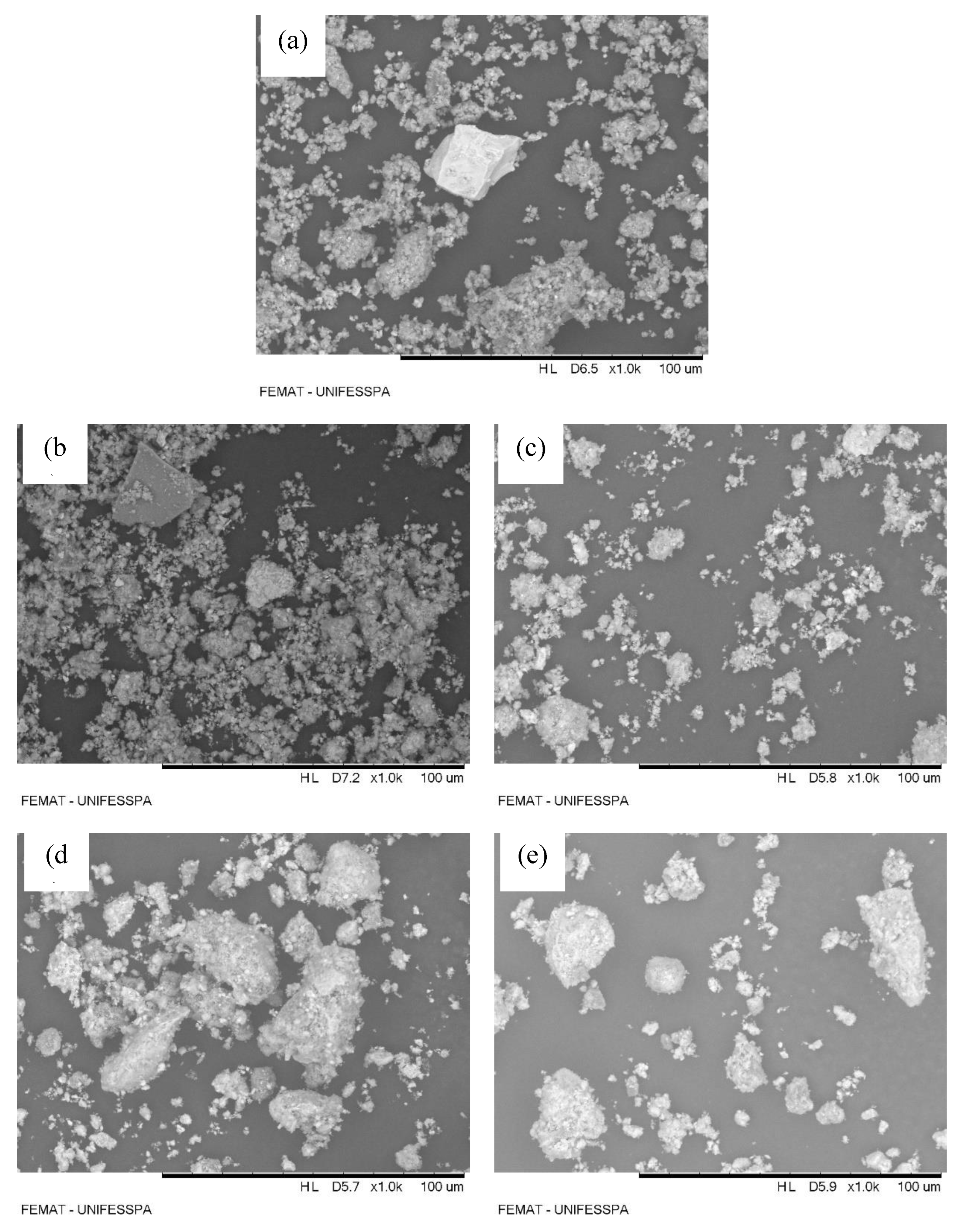
Figure 1 presents the micrographs obtained by Scanning Electron Microscopy (SEM) for the different samples of red mud-based adsorbents: Red Mud (without activation) (Figure 1(a)), TARM at 400 °C (Figure 1(b)), TARM at 600 °C (Figure 1(c)), CARM - 0.25M HCl (Figure 1(d)) and CARM - 2M HCl (Figure 1(e)). The analysis of these images reveals particle clusters in all samples, suggesting a heterogeneous particulate structure characteristic of red mud-based materials, as reported by Antunes et al. [40]. It is observed that, for the magnification used, both thermal and chemical activations did not result in visible morphological changes in the treated samples (Figures 1(b)-(e)), compared to the original red mud (Figure 19a)), corroborating the findings of Antunes et al. [40] for thermal activation. However, Figures 1(d) and 1(e), which show the HCl-activated samples, suggest features such as spherical particle formation and greater connectivity between the pores, consistent with the observations of Fang et al. [41]. According to Fang et al. [41], these modifications provide a larger specific surface area, with more reactive sites, which contributes to the improvement in the adsorption efficiency of the material.
3.3.2. Fourier Transform Infrared Spectroscopy (FTIR)
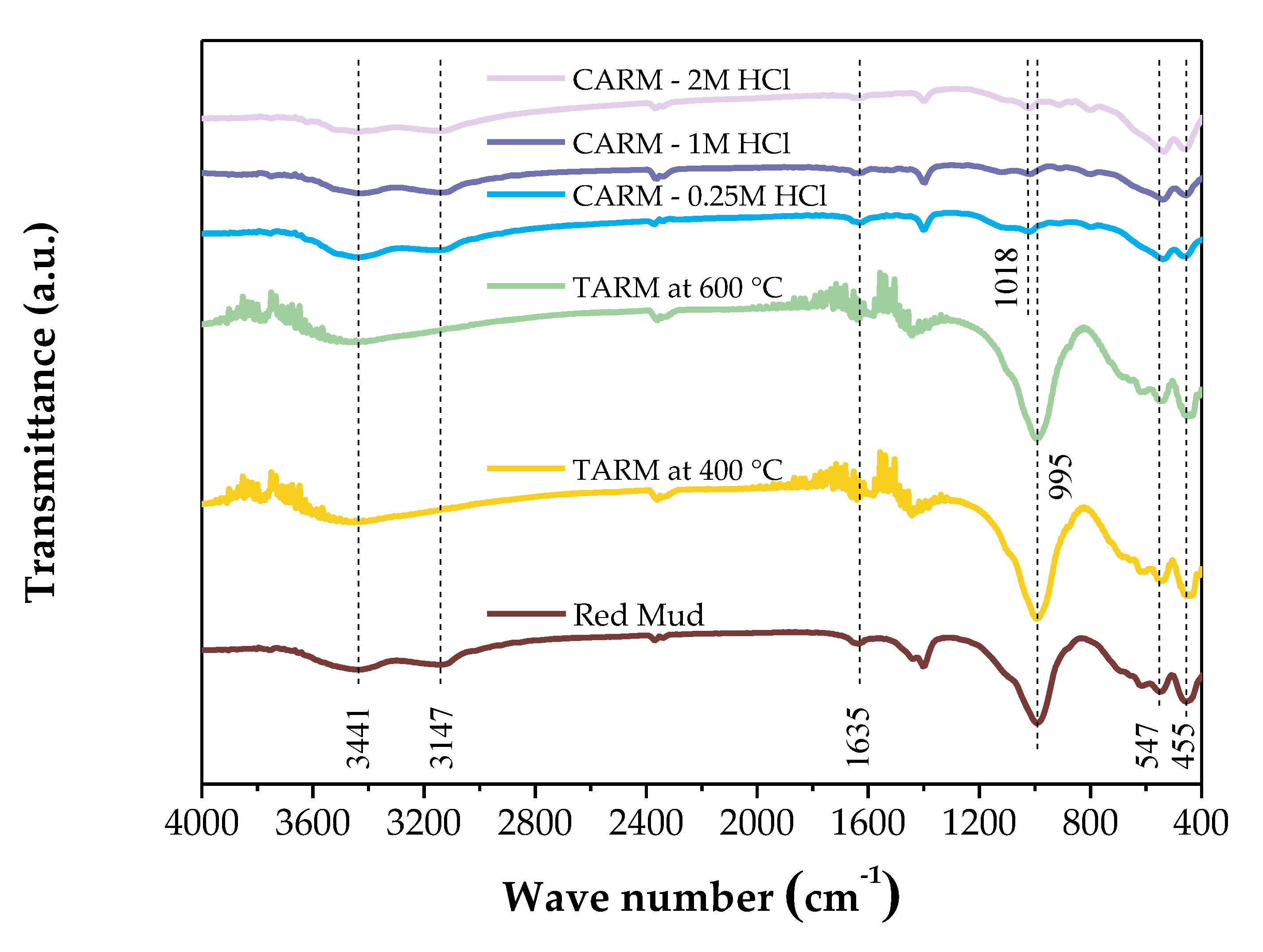
Figure 2 shows the FTIR spectra of red mud-based adsorbents (Red Mud, TARM at 400 °C, TARM at 600 °C, CARM - 0.25M HCl, CARM - 1M HCl and CARM - 2M HCl), revealing the presence of different metal oxides, such as Fe₂O₃, Al₂O₃, SiO₂, CaO, Na₂O and TiO₂. The detected peak around 3440 cm⁻¹ is attributed to the stretching vibrations of the hydroxyl groups in adsorbed water and the OH metal groups, present in all samples, in agreement with the results of Fang et al. [41]. Additionally, the band around 1630 cm⁻¹ confirms the presence of H₂O molecules bound to the alumine silicate structure in the non-activated red mud and its modified forms, reinforcing similar observations in the literature.
The FTIR spectra analysis shows that the red mud's thermal activation at 400 °C and 600 °C did not cause significant changes in the functional groups. The prominent bands, such as the 3440 cm⁻¹, corresponding to the vibrations of the hydroxyl groups, and the 995 cm⁻¹, associated with the Si(Al)-O vibrations, remained unchanged. These results suggest that mineral phases, such as sodalite and silica [42], did not undergo structural modifications with heat treatment. Therefore, under the conditions evaluated, the thermal activation did not substantially alter the chemical composition of the red mud, preserving the characteristics of the aluminosilicates and iron oxides of the original sample.
Figure 1.
SEM images of red mud-based adsorbents: (a) Red Mud, (b) TARM at 400 °C, (c) TARM at 600 °C, (d) CARM – 0.25M HCl and (e) CARM - 2M HCl.
Figure 1.
SEM images of red mud-based adsorbents: (a) Red Mud, (b) TARM at 400 °C, (c) TARM at 600 °C, (d) CARM – 0.25M HCl and (e) CARM - 2M HCl.
The main band at 995 cm⁻¹, corresponding to the Si(Al)-O stretch vibrations, characteristic of sodalite [42], shows a significant reduction after activation with HCl, indicating the partial dissolution of this aluminosilicate phase, as also observed by Fang et al. [41]. This decrease is accompanied by a new peak at 1018 cm⁻¹, attributed to dissolved silicates, suggesting the formation of new silica structures [43]. Small bands at 617 and 455 cm⁻¹ suggest that, despite the partial dissolution, there is still a residual preservation of the Si-O-Al bonds, pointing to the remaining presence of sodalite in the modified structure [44]. Finally, the relative increase in the band by 547 cm⁻¹ in HCl-activated materials indicates a greater contribution of Fe-O vibrations [41]. These results indicate that chemical activation with HCl alters adsorbents' chemical composition and pore structure, enhancing their functionality for adsorption applications. These results corroborate the data obtained by X-ray diffraction analysis, which indicates changes in the mineral and oxide phases after the chemical activation of the adsorbents.
Figure 2.
FTIR spectrum of red mud-based adsorbents.
3.3.3. X-ray Diffusion (XRD)
Figure 3 presents the X-ray diffractograms of the red mud-based adsorbent samples (Red Mud, TARM at 400 °C, TARM at 600 °C, CARM - 0.25M HCl, CARM - 1M HCl and CARM - 2M HCl), allowing a detailed analysis of the structural changes in the crystalline phases of the red mud after thermal and chemical activations. Red Mud has several crystalline phases, such as hematite (Fe₂O₃), Goethite FeO(OH), gibbsite (Al(OH)₃), quartz (SiO₂), calcite (CaCO₃) and sodalite Na7.88(Al6Si6O24)(CO3)0.93, consistent with the results obtained by Antunes et al. [40], Fang et al. [41] and Almeida et al. [45]. These compounds are indicated by characteristic peaks, such as those of hematite (PDF 01-079-0007) at 2θ = 33°, 35.7° and 54°, which are intense and dominant in the original red mud.
The thermal activation of the red mud at 400 °C and 600 °C (TARM at 400 °C and TARM at 600 °C, respectively) promoted the decomposition of some less stable phases, such as gibbsite (PDF 01-074-1775) and goethite (PDF 01-081-0464), as indicated by the disappearance of the peaks at 2θ = 18.3° and 2θ = 21.34°. These results suggest that thermal activation at these temperatures was sufficient to cause relaxation or interatomic distancing in the crystal structure of the gibbsite. On the other hand, the more stable phases, such as hematite (PDF 01-079-0007) and quartz (PDF 00-051-1377), remained unchanged, confirming these phases' high stability at elevated temperatures. The absence of significant new phases in X-ray diffractograms (XRD) after thermal activation suggests that, under the conditions studied (400 °C and 600 °C), the changes were limited to the loss of phases with low thermal stability. In contrast, the main mineral phases remained preserved. These results agree with those obtained by Antunes et al. [40].
The chemical activation of red mud with different concentrations of HCl (0.25 M, 1 M and 2 M), designated as CARM - 0.25M HCl, CARM - 1M HCl and CARM - 2M HCl, respectively, promoted significant changes in the crystalline phases, as evidenced by the X-ray diffractograms presented in Figure 3. The main alteration was the partial dissolution of unstable mineralogical phases in acid medium, such as sodalite (PDF 01-089-9098) and calcite (PDF 00-001-0837), indicated by the sharp reduction in the intensity of the peaks around 2θ = 13.89° and 2θ = 24.20°, which correspond to their structural vibrations. These changes were more pronounced in samples treated with higher concentrations of HCl (1 M and 2 M), suggesting that increasing acid concentration intensifies the removal of these phases. According to Almeida et al. [45], this behavior is attributed to the acid digestion process, which confirms the dissolution of these phases.
Figure 3.
XRD patterns of red mud-based adsorbents.
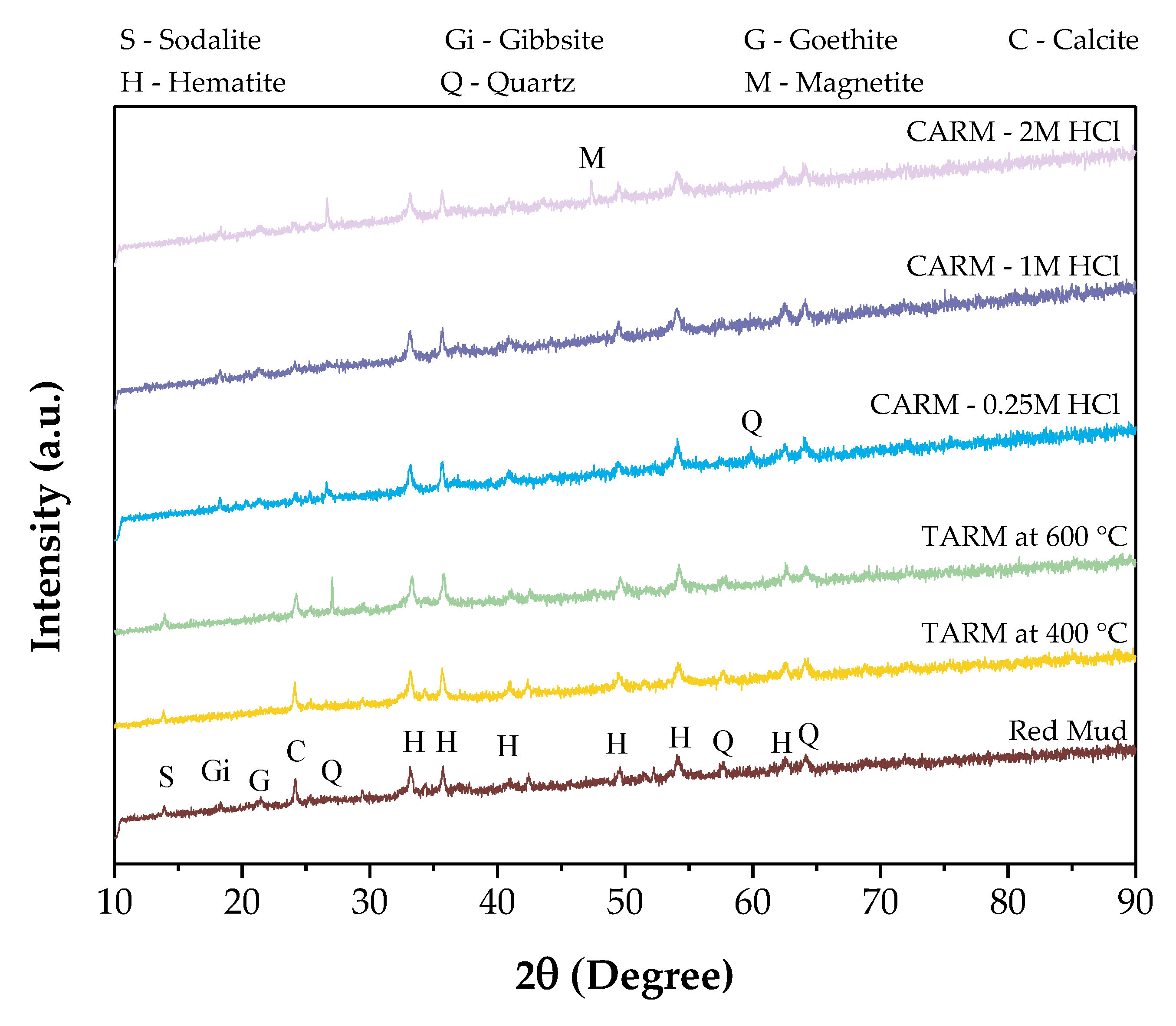
On the other hand, HCl treatment did not affect the hematite structure, as shown by the preservation of the characteristic peaks at 2θ = 33°, 35.7° and 54° in all activated samples. This result indicates that hematite resists acid attack and remains the dominant phase after chemical treatment. In addition, a slight increase in the intensity of the gibbsite peak was observed, which may be related to the partial dissolution of sodalite and subsequent formation of aluminum hydroxides, as suggested by Almeida et al. [45] and Kurtoğlu et al. [46].
Therefore, the results presented in Figure 3 suggest that chemical activation was more efficient in modifying the crystalline phases of the red mud for adsorption applications. This process increased the material's porosity, as confirmed in Section 3.3.4, which addresses the surface and textural characterization of adsorbents, making the red mud more suitable for use as an adsorbent.
3.3.4. Surface and Textural Characterization
The nitrogen adsorption and desorption isotherms and pore volume distribution curves in red mud plus five red mud-based adsorbents (Red Mud, TARM at 400 °C, TARM at 600 °C, CARM - 0.25M HCl, CARM - 1M HCl and CARM - 2M HCl) are shown in Figure 4. Figure 4(a) shows that all samples of red mud-based adsorbents presented type IV isotherms, according to the IUPAC classification, which is characteristic of mesoporous materials (20–500 Å). This type of isotherm corresponds to the complete formation of monolayers and the beginning of multilayer formation, with subsequent capillary condensation and hysteresis loops [47]. The interfacial geometry during desorption differs from adsorption due to pressure variations during meniscus evaporation and vapor saturation pressure. This difference results in distinct curves for desorption and adsorption [48]. In addition, the hysteresis loops observed for the original red mud and the activated red mud are of the H3 type, suggesting crevice-shaped pores, as occurs in materials with plate-like particle aggregates, as reported by Almeida et al. [45] and Thommes et al. [47].
According to Figure 4(a), in thermal activation (TARM at 400 °C and 600 °C), hysteresis loops reveal the presence of mesopores, although less markedly compared to chemically activated samples. In the chemically activated HCl samples (CARM - 0.25M HCl, CARM - 1M HCl and CARM - 2M HCl), the most prominent hysteresis loop was observed for the CARM - 0.25M HCl sample, indicating a higher amount of mesopores. This result is in line with what was reported by Fang et al. [41] for red mud activated with HCl, compared to the original red mud.
From Figure 4(b), it can be observed that all samples have pores in the mesopores range, with diameters ranging from 20 to 500 Å. The chemically activated samples with acid (CARM) and thermally activated (TARM) stand out for presenting a significant increase in the volume of mesopores compared to the original red mud (Red Mud). More specifically, the mesopores are densely distributed in the 20–90 Å range, reflecting on the mean pore diameter shown in Table 1. As highlighted by Suzuki [49], mesopores with diameters between 20–500 Å are crucial for the adsorption of larger molecules, such as organic acids, since the efficiency of the adsorbent is related to the correspondence between the size of the pores and the adsorbed molecules. These characteristics suggest an improvement in the adsorptive performance of red mud-based adsorbents subjected to activation, making them potentially more effective in capturing molecules such as fatty acids, the object of study in this work.
Figure 4.
(a) N2 adsorption-desorption isotherms of red mud-based adsorbents; (b) pore size distribution curves of red mud-based adsorbents.
Figure 4.
(a) N2 adsorption-desorption isotherms of red mud-based adsorbents; (b) pore size distribution curves of red mud-based adsorbents.
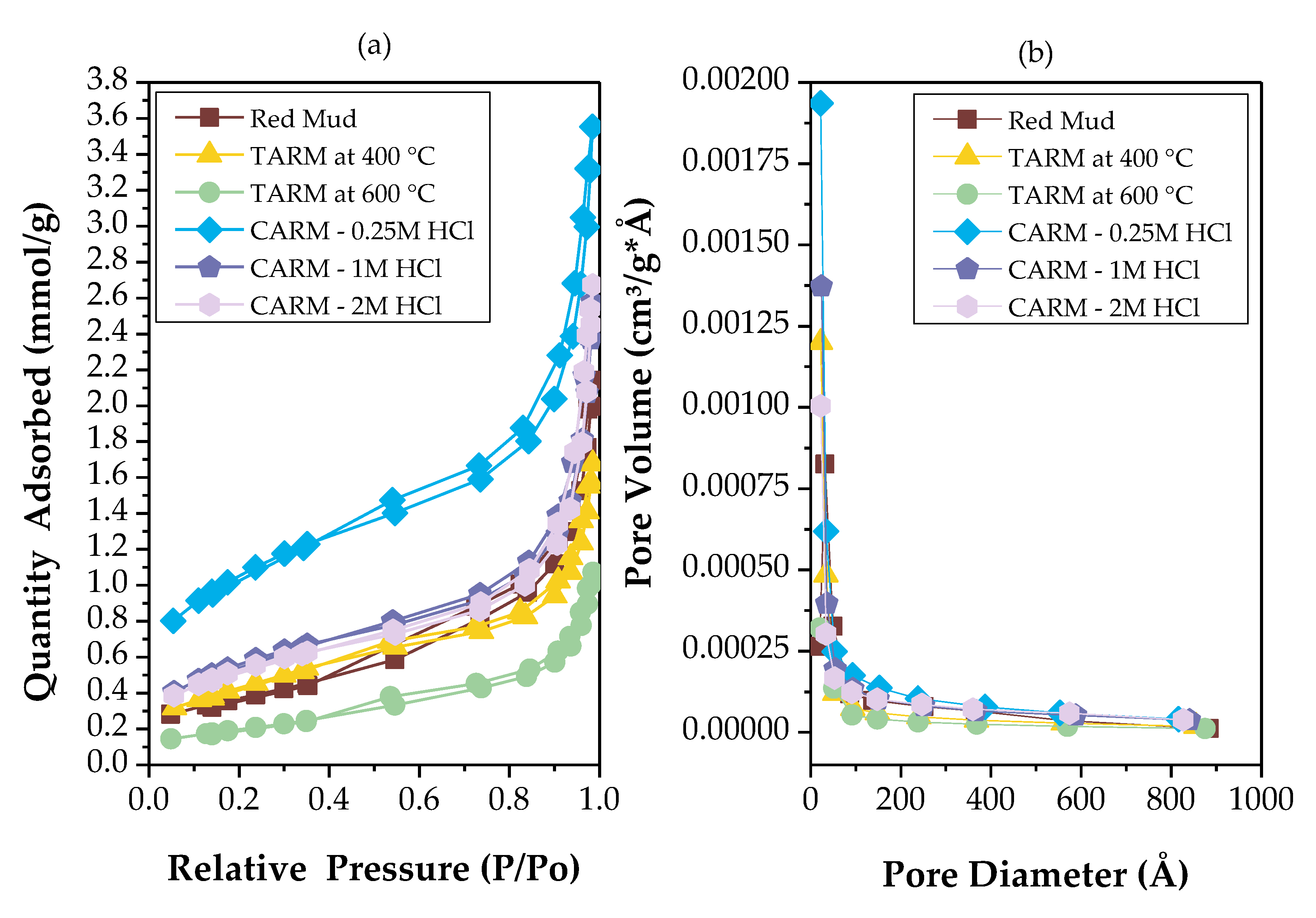
Table 1 presents the results of the textural analysis of the adsorbents used in the present study. The surface area of Red Mud, without any activation, is 29.7024 m²/g. Sushil and Batra [50] report that the BET area of red mud usually varies between 20 and 30 m²/g, confirming the consistency of the results with the literature. Table 1 also shows the evolution of the specific surface area with the increase in the activation temperature of the red mud. Activation at 400 °C results in an increase in specific surface area compared to Red Mud. However, activation at 600 °C reduces the surface area to a lower value than Red Mud. Liu et al. [51] observed that the thermal activation of red mud at various temperatures (100-1000 °C) reaches the highest surface area value at 400 °C, corroborating the results of this study.
The increase in the surface area of the red mud can be explained by the gradual release of water from the zeolitic structure present in the material. According to Garcia [52], this water contained in the pores of the zeolite begins to evaporate from 200 °C and continues to be released with the increase in temperature. Complete water elimination occurs at 400 °C, which maximizes surface area by releasing all pores from the zeolites. However, from temperatures above 400 °C, the growth of particles begins to occur, which reduces the surface area, justifying the decrease observed at 600 °C [52].

Table 1.
Textural properties of adsorbents.
| Specific area (BET) | Volume of mesopores (BJH desorption) |
Average pore diameter (BJH desorption) |
|
| m2/g | cm3/g | Å | |
| Red Mud | 29.7024 | 0.075554 | 78.099 |
| TARM at 400 °C | 35.2450 | 0.060928 | 58.565 |
| TARM at 600 °C | 16.0152 | 0.037911 | 68.464 |
| CARM - 0.25M HCl | 84.3290 | 0.120262 | 65.597 |
| CARM - 1M HCl | 45.9749 | 0.093173 | 79.569 |
| CARM - 2M HCl | 43.1754 | 0.096185 | 89.011 |
As for chemical activation, there was a significant increase in the specific area (BET) of the chemically activated sample with HCl at 0.25M (CARM – 0.25M), which reached the highest value (84.33 m²/g), which suggests that this concentration is efficient in removing mineral impurities and unclogging pores, as reported by Almeida et al. [45]. However, higher concentrations of HCl (1M and 2M) decrease surface area, showing that an excessively acidic activation can promote the collapse of the porous structure. In terms of mesopore volume, the CARM – 0.25M sample also stands out with the highest value (0.1203 cm³/g), reinforcing the efficiency of this concentration in creating mesopores.
From the analysis of the evolution of the specific surface area of the adsorbents concerning thermal and chemical activations, it was concluded that chemical activation with 0.25 M HCl was the most effective to improve this property in red mud. This treatment resulted in a surface area of 84.3290 m²/g, within the range of commercial adsorbents, such as polymeric adsorbents (80–700 m²/g). This result highlights the potential of red mud activated with 0.25M HCl, specifically CARM – 0.25M HCl, as a promising material for the adsorption of free fatty acids due to its optimized textural properties.
2.3.5. Thermal Analysis
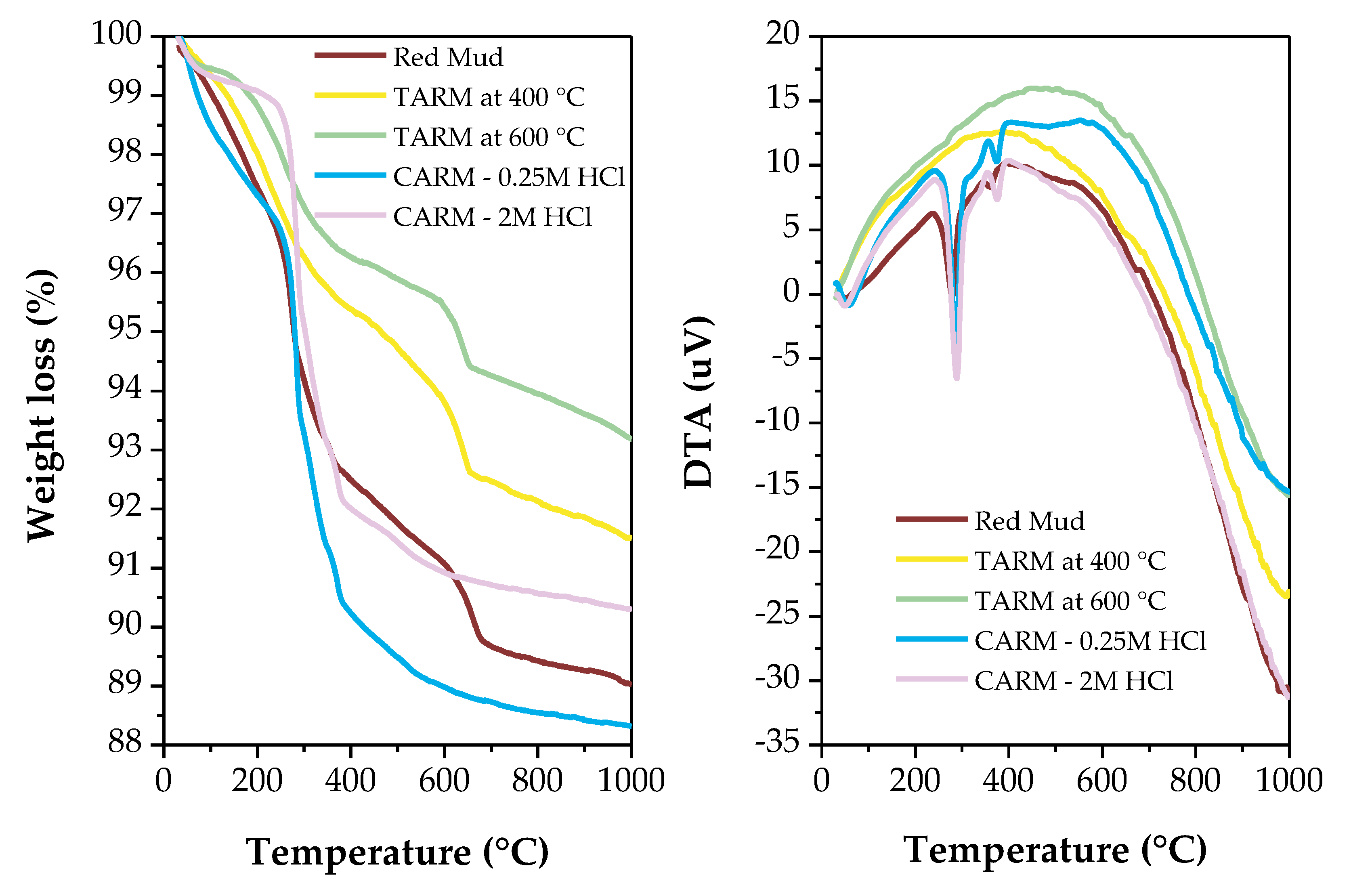
The thermogravimetric analysis (TGA) and differential thermal analysis (DTA) curves of the red mud sample and red mud-based adsorbents are illustrated in Figures 5(a) and 5(b), respectively. In Figure 5(a), the original red mud exhibited a mass loss of (7.5%) between 80 °C and 400 °C, with most of this loss related to the evaporation of chemically bound water. In comparison, the samples thermally activated at 400 °C and 600 °C showed a lower mass loss than the original red mud, of 4.5% and 3.5%, respectively, indicating greater thermal stability. The DTA analysis (Figure 5(b)) confirms this surface and crystalline water removal phenomenon, which shows the exothermic reaction in the range of 200 °C to 400 °C. Furthermore, due to physically adsorbed water, the mass loss between 80°C and 100°C was minimal, with approximately 1.0% of the total weight. Still analyzing the first stage of mass loss for the chemically activated samples, a similar behavior is observed with the original red mud, with mass losses equal to 8.0% and 10% for the CARM 0.25M HCl and CARM 2M HCl samples, respectively.
In the second stage of sample decomposition, corresponding to the range of 400°C and 600°C, a tendency for mass loss is observed on a larger scale for the chemically activated samples, with the lowest mass reached for the CARM 0.25M HCl sample, approximately 11% loss, and 9.0% for the CARM 2M HCl sample. In contrast, the thermally activated red mud samples maintained a lower mass loss, reaching 6.5% and 5% for the TARM samples at 400 °C and TARM at 600 °C.
In the third stage of sample decomposition, corresponding to the range of 600 °C and 1000 °C, mass loss trends were maintained, with one change, which corresponds to the change in gradient between the original red mud and the CARM 2M HCl, indicating that, when chemically activating the red mud, it becomes more vulnerable to thermal degradation, reaching approximately 12% mass loss for the CARM 0.25M HCl sample.
Figure 5.
Thermal analysis curves of red mud-based adsorbents.
3.2. Adsorption Kinetics and Kinetic Modeling
3.2.1. Thermally Activated Red Mud
Figure 6 shows the results of the adsorption kinetics experiments in thermally activated red mud at 400 °C (TARM at 400 °C) and 600 °C (TARM at 600 °C). Such experiments were performed for three initial concentrations of carboxylic acids in kerosene-like hydrocarbons, indicated by the following values of TAN: 1.59 mg KOH/g, 33.67 mg KOH/g and 84.40 mg KOH/g.
Figures 6(a) and 6(b) show the decrease in TAN over time with TARM at 400 °C and TARM at 600 °C, respectively. The reduction in TAN is similar for both adsorbents, except for the fraction with TAN = 33.67 mg KOH/g, where TARM at 400 °C showed a slightly more significant reduction, resulting in a lower final TAN.
Figure 6.
Adsorption kinetics of carboxylic acids on three kerosene-like hydrocarbons fractions using thermally activated red mud: (a) and (b) TAN values, using TARM at 400 °C and 600 °C, respectively; (c) and (d) percentage of carboxylic acids removed, using TARM at 400 °C and 600 °C, respectively; (e) and (f) adsorption capacity, using TARM at 400 °C and 600 °C, respectively.
Figure 6.
Adsorption kinetics of carboxylic acids on three kerosene-like hydrocarbons fractions using thermally activated red mud: (a) and (b) TAN values, using TARM at 400 °C and 600 °C, respectively; (c) and (d) percentage of carboxylic acids removed, using TARM at 400 °C and 600 °C, respectively; (e) and (f) adsorption capacity, using TARM at 400 °C and 600 °C, respectively.
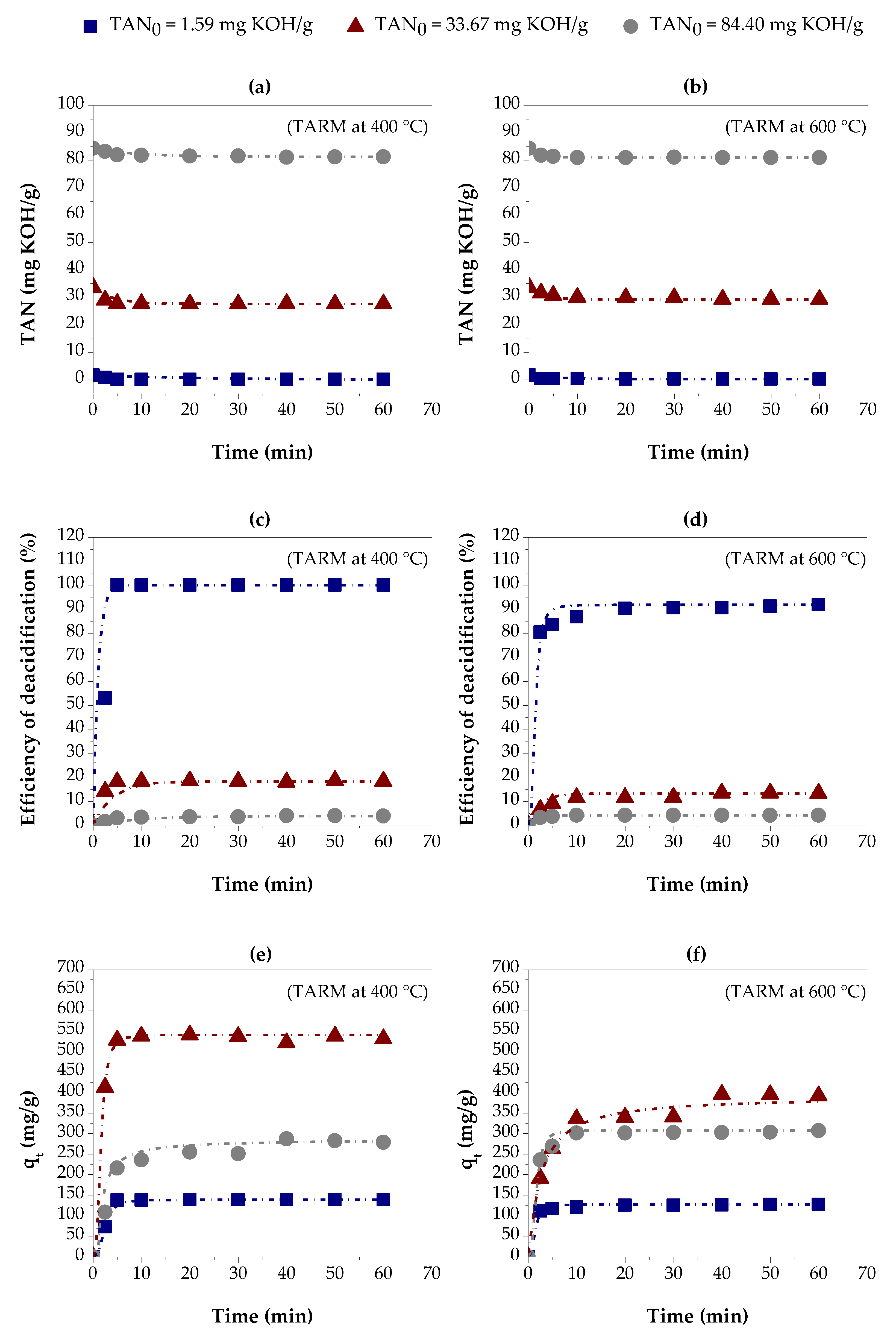
Figures 6(c) and 6(d) show the percentage of carboxylic acid removal over time using TARM at 400 °C and TARM at 600 °C, respectively. The removal efficiency is higher for the fraction with TAN = 1.59 mg KOH/g, achieving 100% removal in 20 minutes with TARM at 400 °C. For the fractions with TAN = 33.67 mg KOH/g and TAN = 84.40 mg KOH/g, the removal is significantly lower, not exceeding 20% and 5%, respectively, suggesting that higher initial concentrations hinder the adsorption process, especially for TARM at 600 °C.
Figures 6(e) and 6(f) illustrate the adsorption capacity for TARM at 400 °C and TARM at 600 °C, respectively. The results reveal that the time required to reach equilibrium, approximately 20 minutes, was similar in both cases, regardless of the TAN value of the kerosene-like hydrocarbon fractions. This result indicates that the thermal activation temperature did not significantly influence the time required to reach adsorbent saturation. In addition, the adsorption capacity at equilibrium was influenced by the initial concentration of carboxylic acids. The increase in TAN from 1.59 mg KOH/g to 33.67 mg KOH/g resulted in higher adsorption capacity for both adsorbents. However, a further increase to 84.40 mg KOH/g reduced the adsorption capacity, suggesting that higher initial concentrations negatively affect the adsorption process. Asheh et al. [53] suggest that higher concentrations of adsorbate increase driving force, facilitating mass transfer, a behavior also reported by Li et al. [24], Silva et al. [33], Jean Baptiste et al. [54] and López-Velandia et al. [55].
The experimental adsorption capacity with TARM at 400 °C was approximately 138 mg/g, 539 mg/g and 286 mg/g for the fractions with TAN = 1.59 mg KOH/g, 33.67 mg KOH/g and 84.40 mg KOH/g, respectively. The values of TARM at 600 °C were 127 mg/g, 395 mg/g and 307 mg/g, respectively. The adsorption capacity for the fractions with TAN = 1.59 mg KOH/g and 33.67 mg KOH/g was higher with TARM at 400 °C, indicating its better properties as an adsorbent, due to the larger surface area of this material, as described in Section 3.3.4.
Therefore, Figures 6(a)-6(f) reveal that the initial acid concentration and the activation temperature of the mud strongly influence carboxylic acid removal and adsorption capacity in thermally activated red mud. TARM at 400 °C has slightly higher performance than TARM at 600 °C, particularly for the fraction with TAN = 33.67 mg KOH/g, reinforcing the importance of optimizing the thermal activation of adsorbents to maximize acid removal efficiency.
The experimental results in Figures 6(e) and 6(f) were adjusted using linear regression for the pseudo-first-order and pseudo-second-order kinetic models, as described in Section 2.5. Figure 7 illustrates these adjustments for the activated red mud samples at 400 °C and 600 °C, comparing the kinetic behavior in different fractions of kerosene-like hydrocarbons with TAN values of 1.59, 33.67 and 84.40 mg KOH/g. In addition, Table 2 presents the parameters calculated for both kinetic models based on these adjustments, offering a more detailed view of the adequacy of each model to the experimental conditions.
The adjustments in Figure 7 reveal a clear contrast between the two models. The pseudo-first-order model (Figures 7(a) and 7(b)) presents an unsatisfactory correlation with the experimental data, especially for the fractions with TAN = 1.59 mg KOH/g and TAN = 33.67 mg KOH/g. The R2 values confirm this behavior in Table 2, which were consistently lower than 0.900 for all fractions and both thermal activation temperatures. These results indicate that the pseudo-first-order model is inadequate to describe the carboxylic acid adsorption process in kerosene-like hydrocarbon fractions. On the other hand, the pseudo-second-order model (Figures 7(c) and 7(d)) showed a significantly better performance, with R2 values higher than 0.900, reaching up to 0.9999, as shown in Table 2. These results suggest that the pseudo-second-order model provides a much more accurate representation of adsorption kinetics. The excellent agreement between the values of qe(exp) and qe(calc) observed in this model reinforces its adequacy, suggesting that chemisorptive interactions mainly govern the adsorption process [56,57].
Overall, the results indicate that the pseudo-second-order model best describes the adsorption kinetics for all kerosene-like hydrocarbon fractions, regardless of the TAN value or the adsorbent activation temperature. This result suggests that the adsorption mechanism is controlled by chemical interactions, being influenced by both the nature of the adsorbent (TARM) and the initial concentration of carboxylic acids (TAN). In addition, thermal activation at 400 °C proved to be more efficient in terms of the agreement of qe values, high R2 values and the higher initial adsorption rate (hi), which can be explained by the structural modification of the adsorbent, which increases accessibility to active sites.
Figure 7.
Evaluation of kinetics models for the adsorption of carboxylic acids on three kerosene-like hydrocarbons fractions using thermally activated red mud: (a) and (b) pseudo-first-order, using TARM at 400 °C and 600 °C, respectively; (c) and (d) pseudo-second-order, using TARM at 400 °C and 600 °C, respectively.
Figure 7.
Evaluation of kinetics models for the adsorption of carboxylic acids on three kerosene-like hydrocarbons fractions using thermally activated red mud: (a) and (b) pseudo-first-order, using TARM at 400 °C and 600 °C, respectively; (c) and (d) pseudo-second-order, using TARM at 400 °C and 600 °C, respectively.
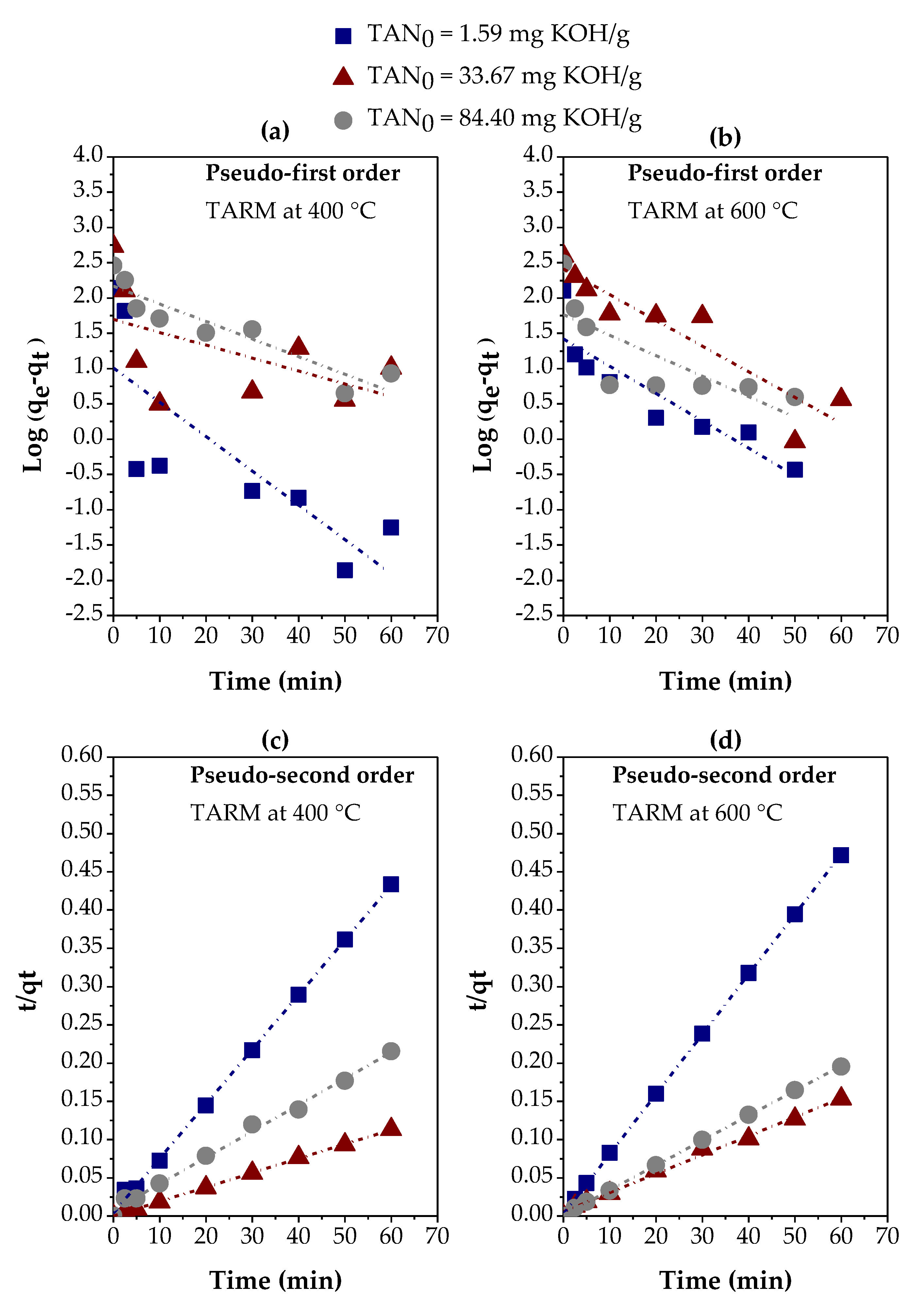
Table 2.
Kinetic parameters of pseudo-first and pseudo-second order models for the adsorption of carboxylic acids in three kerosene-like hydrocarbons fractions using thermally activated red mud.
Table 2.
Kinetic parameters of pseudo-first and pseudo-second order models for the adsorption of carboxylic acids in three kerosene-like hydrocarbons fractions using thermally activated red mud.
| Variables evaluated | Adsorption kinetic parameters | ||||
| Adsorbent: | TARM at 400 °C | ||||
| Initial concentrations (mg KOH/g) | Pseudo-first order | ||||
| qe (exp) (mg/g) |
K1 (min-1) |
qe (calc) (mg/g) |
R2 | ||
| 1.59 | 138.4875 | 0.1120 | 10.1962 | 0.58263 | |
| 33.67 | 539.9592 | 0.0420 | 49.6718 | 0.17397 | |
| 84.40 | 286.7990 | 0.0574 | 146.5784 | 0.83256 | |
| Initial concentrations (mg KOH/g) | Pseudo-second order | ||||
| qe (exp) (mg/g) | K2 (g/mg. min) |
qe (calc) (mg/g) | hi (mg/g. min) |
R2 | |
| 1.59 | 138.4875 | 0.0126 | 140.2525 | 246.9136 | 0.99885 |
| 33.67 | 539.9592 | 0.0157 | 531.9149 | 4434.4718 | 0.99953 |
| 84.40 | 286.7990 | 0.0015 | 290.6977 | 127.3885 | 0.99424 |
| Adsorbent: | TARM at 600 °C | ||||
| Initial concentrations (mg KOH/g) | Pseudo-first order | ||||
| qe (exp) (mg/g) | K1 (min-1) |
qe (calc) (mg/g) | R2 | ||
| 1.59 | 127.2400 | 0.0891 | 26.2894 | 0.79762 | |
| 33.67 | 395.1952 | 0.0839 | 257.9942 | 0.83183 | |
| 84.40 | 307.2286 | 0.0669 | 58.0524 | 0.53732 | |
| Initial concentrations (mg KOH/g) | Pseudo-second order | ||||
| qe (exp.) (mg/g) | K2 (g/mg. min) |
qe (calc.) (mg/g) |
hi (mg/g. min) |
R2 | |
| 1.59 | 127.2400 | 0.0214 | 127.7139 | 349.6503 | 0.99993 |
| 33.67 | 395.1952 | 0.0010 | 404.8583 | 168.9189 | 0.99344 |
| 84.40 | 307.2286 | 0.0070 | 307.6923 | 666.6667 | 0.99977 |
3.2.2. Chemically Activated Red Mud
Figure 8 presents the results of the adsorption kinetics of carboxylic acids in gasoline-like hydrocarbons fractions (TAN = 4 mg KOH/g), using chemically activated red mud with different concentrations of HCl (0.25M, 1M and 2M), resulting in three distinct adsorbents (CARM – 0.25M HCl, CARM – 1M HCl, and CARM – 2M HCl). These adsorbents were applied in different proportions (0.5%, 1.0%, 1.5% and 2%), allowing the analysis of the effect of both HCl concentration and the amount of adsorbent on acid removal efficiency.
Figures 8(a)-(c) illustrate the variation of TAN values over time in different adsorbent percentages. The reduction of TAN values varies significantly according to the concentration of the solution used in the chemical activation process of the red mud and the amount of adsorbent applied. This behavior reflects the efficiency of the deacidification process by adsorption, as shown in Figures 8(d)-(f). The lowest values of TAN obtained were 0.300, 0.000 and 0.73 when using 2% of CARM – 0.25M HCl, CARM – 1M HCl and CARM – 2M HCl, respectively, showing that the concentration of HCl directly influences the removal of acidity.
Figures 8(d)-(f) show the efficiency of carboxylic acid removal in percentage terms, varying according to the amount of adsorbent. The most effective condition was observed with 2.0% CARM – 1M HCl, reaching a removal of more than 90%, reaching up to 100% in some cases. For the fractions deacidified with CARM – 0.25M HCl and CARM – 1M HCl, the percentage removal increases significantly when the percentage of adsorbent increases from 0.5% to 2%. In the case of CARM–2M HCl, the increase is less significant between 0.5% and 1.5% but more pronounced when it reaches 2%. Overall, the highest removal performance is achieved with 2% adsorbent for the three chemically activated red mud conditions, reinforcing the importance of the amount of adsorbent in the deacidification process.
In Figures 8(d)-(f), the efficiency of carboxylic acid removal is expressed in percentage terms. It is observed that the removal is more efficient with the increase in the percentage of adsorbent, highlighting the condition of 2.0% for CARM – 1M HCl, which achieves a removal more significant than 90%. For the deacidified fractions with CARM – 0.25M HCl and CARM – 1M HCl, the percentage removal increases significantly as the adsorbent percentage increases from 0.5% to 2%, while for CARM – 2M HCl, this removal is almost equal when there was an increase from 0.5% to 1.5% and increasing a little more significantly to an increase from 1.5% to 2%. When the adsorbent percentage reaches 2.0%, all three adsorbents demonstrate the highest removal efficiency for the gasoline-like hydrocarbons fraction with TAN = 4 mg KOH/g, evidencing the importance of the amount of adsorbent in the efficiency of the deacidification process.
The adsorbent concentration influences the adsorption capacity, as shown in Figures 8(g)-(i). The analysis of Figures 8(g) and 8(h) revealed that the time required to reach equilibrium in CARM – 0.25M HCl and CARM – 1M HCl, respectively, was similar for the adsorbent loads of 1%, 1.5% and 2%, with an average of 20 minutes to reach equilibrium. However, for the 0.5% adsorbent concentration, an equilibrium time within 60 minutes was not observed, indicating a gradual increase in qt values and suggesting the need for a kinetic study with a longer time. For CARM – 2M HCl (Figure 8i), the time required to reach equilibrium was approximately 20 minutes for all adsorbent loads tested (0.5%, 1%, 1.5% and 2%).
Figures 8(g)-(i) also indicate that the investigated adsorbent loads influenced the adsorption capacity. It was observed that, when increasing the percentage of adsorbent, there was a reduction in the values of adsorption capacity at equilibrium. This result suggests that the percentage of adsorbent is a crucial factor in the adsorption mechanism. Li et al. [58] explain that, although more active sites are available with the increase in the percentage of adsorbent concerning the feedstock mass, the specific area (area per unit mass) is not changed. Therefore, the best adsorption capacity was achieved with 0.5% CARM – 2M HCl. Li et al. also reported a similar behavior concerning the effect of the adsorbent percentage on the adsorption process [58].
The experimental adsorption capacity of free fatty acids (FFA) in CARM – 0.25M HCl was approximately 2611 mg/g for 0.5% adsorbent, 1303 mg/g for 1% adsorbent, 1021 mg/g for 1.5% adsorbent and 767 mg/g for 2% adsorbent. In CARM – 1M HCl, the values were approximately 2483 mg/g for 0.5% adsorbent, 1415 mg/g for 1% adsorbent, 1018 mg/g for 1.5% adsorbent, and 828 mg/g for 2% adsorbent. For CARM – 2M HCl, the values observed were approximately 2605 mg/g for 0.5% adsorbent, 1298 mg/g for 1% adsorbent, 887 mg/g for 1.5% adsorbent, and 715 mg/g for 2% adsorbent. Therefore, the results presented in Figures 8(g)-(i) indicate that there is no significant difference between the values of adsorption capacity of FFA present in gasoline-like hydrocarbons fractions using CARM – 0.25M HCl, CARM – 1M HCl and CARM – 2M HCl as adsorbents. In addition, all the adsorption capacities obtained with the three chemically activated red mud types were higher than the values found for the red mud thermally activated at 400 and 600°C. This result indicates that the chemical activation of red mud was an efficient method to increase the adsorptive capacity of the material used as an adsorbent. The results of the textural analysis (Section 3.3.4) show that the surface area of chemically activated red sludge, particularly CARM – 0.25M, is higher than the surface area of thermally activated red sludge.
In general, although the percentage of 2% adsorbent has a lower adsorption capacity than the other conditions tested, this concentration provides the greatest efficiency in removing carboxylic acids. Thus, based on the results in Figure 8, using 2.0% CARM – 1M HCl stands out as the best option for effectively removing carboxylic acids from gasoline-like hydrocarbon fractions.
The experimental data presented in Figures 8(g)-(i) were fitted to the pseudo-first-order and pseudo-second-order kinetic models, as previously described in Section 2.5, using linear regression. Figures 9(a)-(c) illustrate the fit for the pseudo-first-order model, while Figures 9(d)-(f) correspond to the pseudo-second-order model, using different concentrations of chemically activated red mud (CARM – 0.25M HCl, CARM – 1M HCl, and CARM – 2M HCl). Table 3 summarizes the kinetic parameters calculated for both models, providing a clear comparison of the suitability of each model to the experimental conditions for the adsorption of carboxylic acids in gasoline-like hydrocarbon fractions.
Figure 8.
Adsorption kinetics of carboxylic acids in gasoline-like hydrocarbons fraction using different percentages of chemically activated red mud (CARM – 0.25M HCl, CARM – 1M HCl, and CARM – 2M HCl): (a), (b) and (c) TAN values; (d), (e) and (f) percentage of carboxylic acids removed; (g), (h) and (i) adsorption capacity.
Figure 8.
Adsorption kinetics of carboxylic acids in gasoline-like hydrocarbons fraction using different percentages of chemically activated red mud (CARM – 0.25M HCl, CARM – 1M HCl, and CARM – 2M HCl): (a), (b) and (c) TAN values; (d), (e) and (f) percentage of carboxylic acids removed; (g), (h) and (i) adsorption capacity.
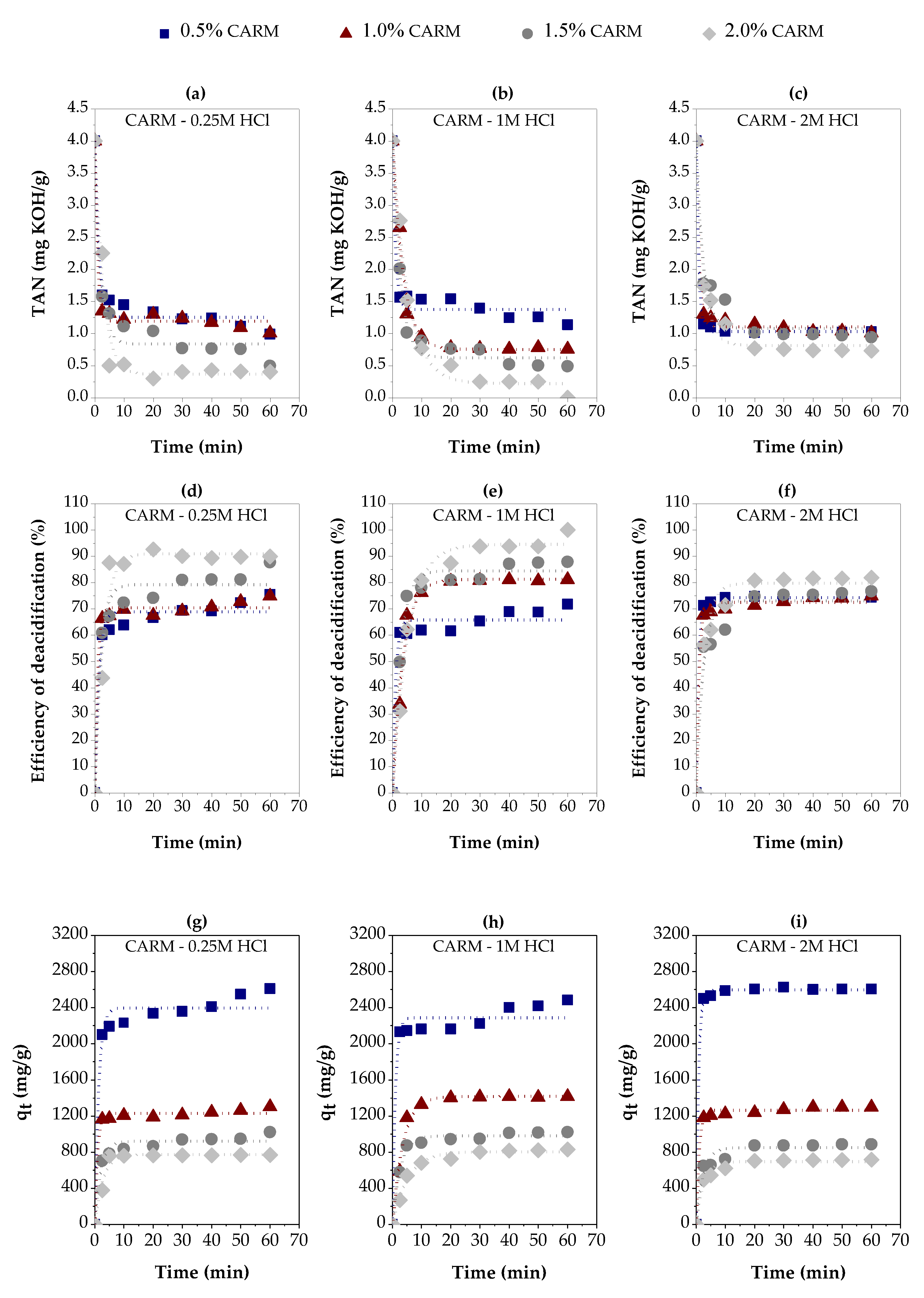
Figure 9.
Evaluation of kinetics models for the adsorption of carboxylic acids in gasoline-like hydrocarbons fraction using different percentages of chemically activated red mud: (a), (b) and (c) pseudo-first-order, using CARM – 0.25M , CARM – 1M, and CARM – 2M, respectively; (d), (e) and (f) pseudo-second-order, using CARM – 0.25M, CARM – 1M, and CARM – 2M, respectively.
Figure 9.
Evaluation of kinetics models for the adsorption of carboxylic acids in gasoline-like hydrocarbons fraction using different percentages of chemically activated red mud: (a), (b) and (c) pseudo-first-order, using CARM – 0.25M , CARM – 1M, and CARM – 2M, respectively; (d), (e) and (f) pseudo-second-order, using CARM – 0.25M, CARM – 1M, and CARM – 2M, respectively.
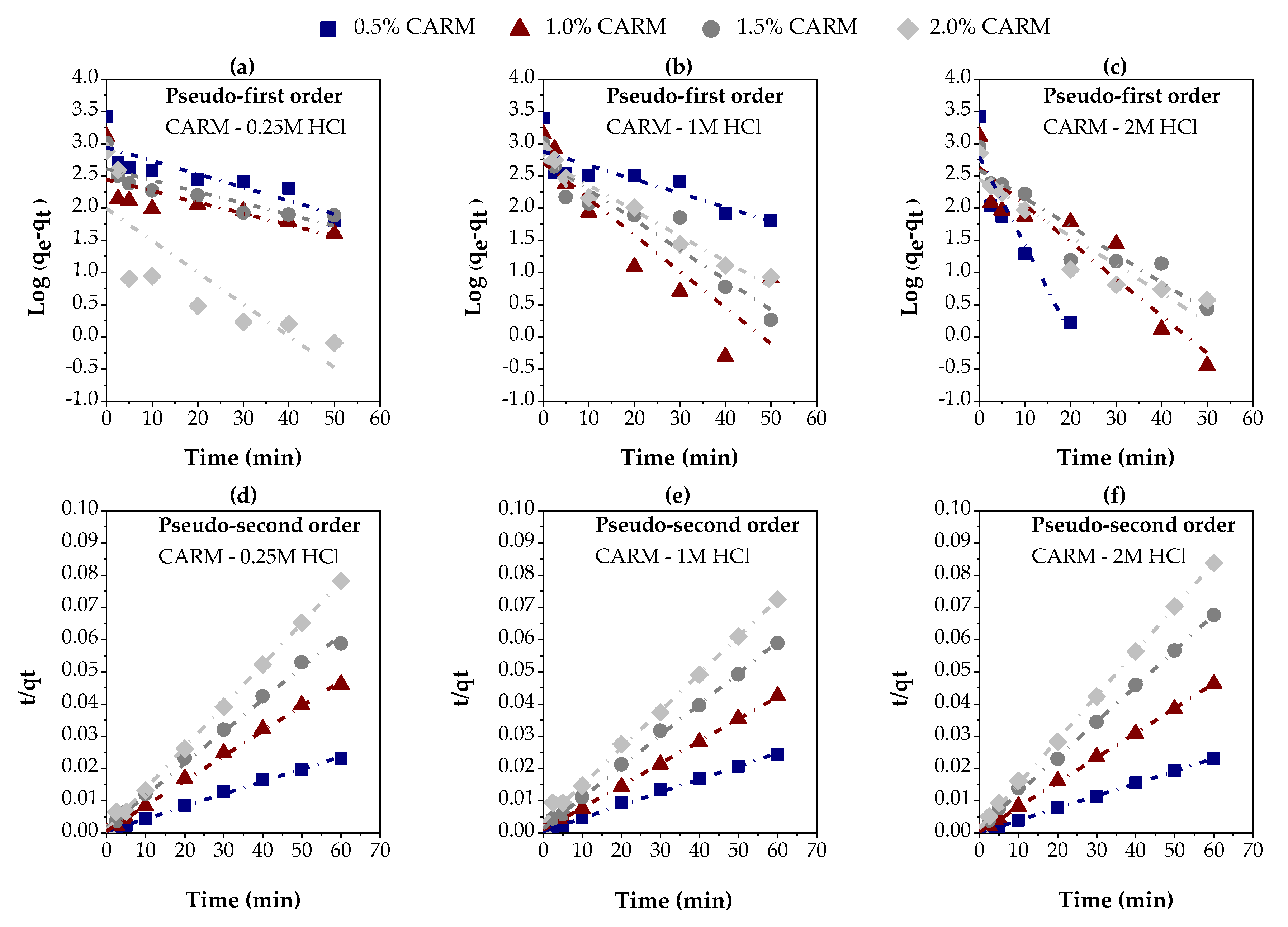
The adjustments presented in Figure 9 highlight a significant difference between the two kinetic models. The pseudo-first-order model (Figures 9(a)-(c)) showed an unsatisfactory correlation with the experimental data, especially for the samples treated with CARM – 0.25M HCl and CARM – 1M HCl. This behavior is confirmed by the R2 values, which were consistently lower than 0.900 for most adsorbent concentrations tested. These results indicate that the pseudo-first-order model is not adequate to describe the adsorption process of carboxylic acids in gasoline-like hydrocarbon fractions, possibly due to its inability to capture the complexity of the interactions between adsorbent and adsorbate. On the other hand, the pseudo-second-order model (Figures 9(d)-(f)) showed significantly better performance, with R2 values higher than 0.900, reaching up to 0.9999. These results suggest that the pseudo-second-order model provides a much more accurate representation of adsorption kinetics. The good agreement between the values of qe (exp) and qe(calc) observed in this model reinforces its adequacy, suggesting that the adsorption process is mainly governed by chemisorptive interactions [56,57], as frequently reported in the literature.
The initial adsorption rate (hi), presented in Table 4, is significantly higher for the lowest percentages of adsorbent (0.5 and 1.0%), regardless of the type of adsorbent used in this study. This result underscores the high efficiency of these adsorbents in the early stages of the process, with more than 76% of the experimental adsorption capacity being achieved in the first five minutes, as evidenced in Figures 8(g)-(i). This rapid initial adsorption is decisive, especially for industrial applications that demand fast and effective processes. The high adsorption rate in the early stages suggests that most of the active sites of the adsorbent are readily accessible, which contributes to the high efficiency of the process (Figures 8(g)-(i)).
The pseudo-second-order model demonstrates an excellent ability to describe the adsorption kinetics under the tested conditions, evidenced by the high values of R² and the excellent agreement between the experimental and calculated qe values. The CARM-1M HCl adsorbent proved to be exceptionally efficient, reaching the highest values of qe and hi, highlighting its efficacy in deacidifying gasoline-like hydrocarbon fractions. This performance can be explained by optimized chemical activation with 1M HCl, resulting in a more suitable structure for interactions with carboxylic acids. The greater accessibility to the active sites of this adsorbent makes it the most promising among those tested, as corroborated by the characterization results presented above.
Table 3.
Kinetic parameters of pseudo-first and pseudo-second order models for the adsorption of carboxylic acids in gasoline-like hydrocarbons fraction using different percentages of chemically activated red mud.
Table 3.
Kinetic parameters of pseudo-first and pseudo-second order models for the adsorption of carboxylic acids in gasoline-like hydrocarbons fraction using different percentages of chemically activated red mud.
| Variables evaluated | Adsorption kinetic parameters | ||||
| Adsorbent: | CARM – 0.25M | ||||
| Adsorbent percentage (%) | Pseudo-first order | ||||
| qe (exp) (mg/g) |
K1 (min-1) |
qe (calc) (mg/g) |
R2 | ||
| 0.5 | 2611.1537 | 0.0476 | 872.7905 | 0.68024 | |
| 1.0 | 1303.0062 | 0.0406 | 276.7897 | 0.45663 | |
| 1.5 | 1021.1287 | 0.0408 | 404.5573 | 0.70295 | |
| 2.0 | 767.3193 | 0.1136 | 97.2120 | 0.61839 | |
| Adsorbent percentage (%) | Pseudo-second order | ||||
| qe (exp) (mg/g) | K2 (g/mg. min) |
qe (calc) (mg/g) | hi (mg/g. min) |
R2 | |
| 0.5 | 2611.1537 | 0.0003 | 2585.3020 | 2094.1751 | 0.99645 |
| 1.0 | 1303.0062 | 0.0011 | 1286.8589 | 1770.1872 | 0.99836 |
| 1.5 | 1021.1287 | 0.0006 | 1002.4399 | 628.9308 | 0.99524 |
| 2.0 | 767.3193 | 0.0019 | 781.2500 | 1129.7150 | 0.99855 |
| Adsorbent: | CARM – 1M | ||||
| Adsorbent percentage (%) | Pseudo-first order | ||||
| qe (exp) (mg/g) | K1 (min-1) |
qe (calc) (mg/g) | R2 | ||
| 0.5 | 2483.3156 | 0.0500 | 757.7047 | 0.65831 | |
| 1.0 | 1415.9153 | 0.1296 | 506.9557 | 0.72991 | |
| 1.5 | 1018.8573 | 0.1074 | 564.1181 | 0.89368 | |
| 2.0 | 828.4279 | 0.0907 | 559.1135 | 0.96124 | |
| Adsorbent percentage (%) | Pseudo-second order | ||||
| qe (exp.) (mg/g) | K2 (g/mg. min) |
qe (calc.) (mg/g) |
hi (mg/g. min) |
R2 | |
| 0.5 | 2483.3156 | 0.0003 | 2471.4975 | 2069.6564 | 0.99649 |
| 1.0 | 1415.9153 | 0.0005 | 1452.2852 | 1137.7341 | 0.99758 |
| 1.5 | 1018.8573 | 0.0007 | 1035.9549 | 769.2308 | 0.99839 |
| 2.0 | 828.4279 | 0.0004 | 869.5652 | 298.5075 | 0.99502 |
| Adsorbent: | CARM – 2M | ||||
| Adsorbent percentage (%) | Pseudo-first order | ||||
| qe (exp) (mg/g) | K1 (min-1) |
qe (calc) (mg/g) | R2 | ||
| 0.5 | 2605.8142 | 0.3173 | 629.3178 | 0.8355 | |
| 1.0 | 1298.3432 | 0.1324 | 418.7936 | 0.86549 | |
| 1.5 | 887.1661 | 0.1007 | 390.1486 | 0.88176 | |
| 2.0 | 715.5132 | 0.1018 | 277.1214 | 0.85928 | |
| Adsorbent percentage (%) | Pseudo-second order | ||||
| qe (exp.) (mg/g) | K2 (g/mg. min) |
qe (calc.) (mg/g) |
hi (mg/g. min) |
R2 | |
| 0.5 | 2605.8142 | 0.0066 | 2609.7600 | 44778.3917 | 0.99997 |
| 1.0 | 1298.3432 | 0.00017 | 1305.3075 | 2854.8916 | 0.99973 |
| 1.5 | 887.1661 | 0.0009 | 900.9009 | 751.8797 | 0.99883 |
| 2.0 | 715.5132 | 0.0013 | 729.9270 | 714.2857 | 0.99935 |
3.2.3. Effect of the Type of Feed
Figure 10 illustrates the adsorption kinetics of carboxylic acids in various distillate fractions, including gasoline-like hydrocarbons, kerosene-like hydrocarbons, and diesel-like hydrocarbons, all of which have similar TAN values. The analysis is performed using chemically activated red mud (CARM – 1M HCl), allowing a direct comparison between the different fractions and highlighting the effectiveness of the adsorbent in varied hydrocarbon contexts.
Figure 10.
Adsorption kinetics of carboxylic acids in different distillate fractions using chemically activated red mud (CARM – 1M): (a) TAN values, (b) percentage of carboxylic acids removed, and (c) adsorption capacity.
Figure 10.
Adsorption kinetics of carboxylic acids in different distillate fractions using chemically activated red mud (CARM – 1M): (a) TAN values, (b) percentage of carboxylic acids removed, and (c) adsorption capacity.
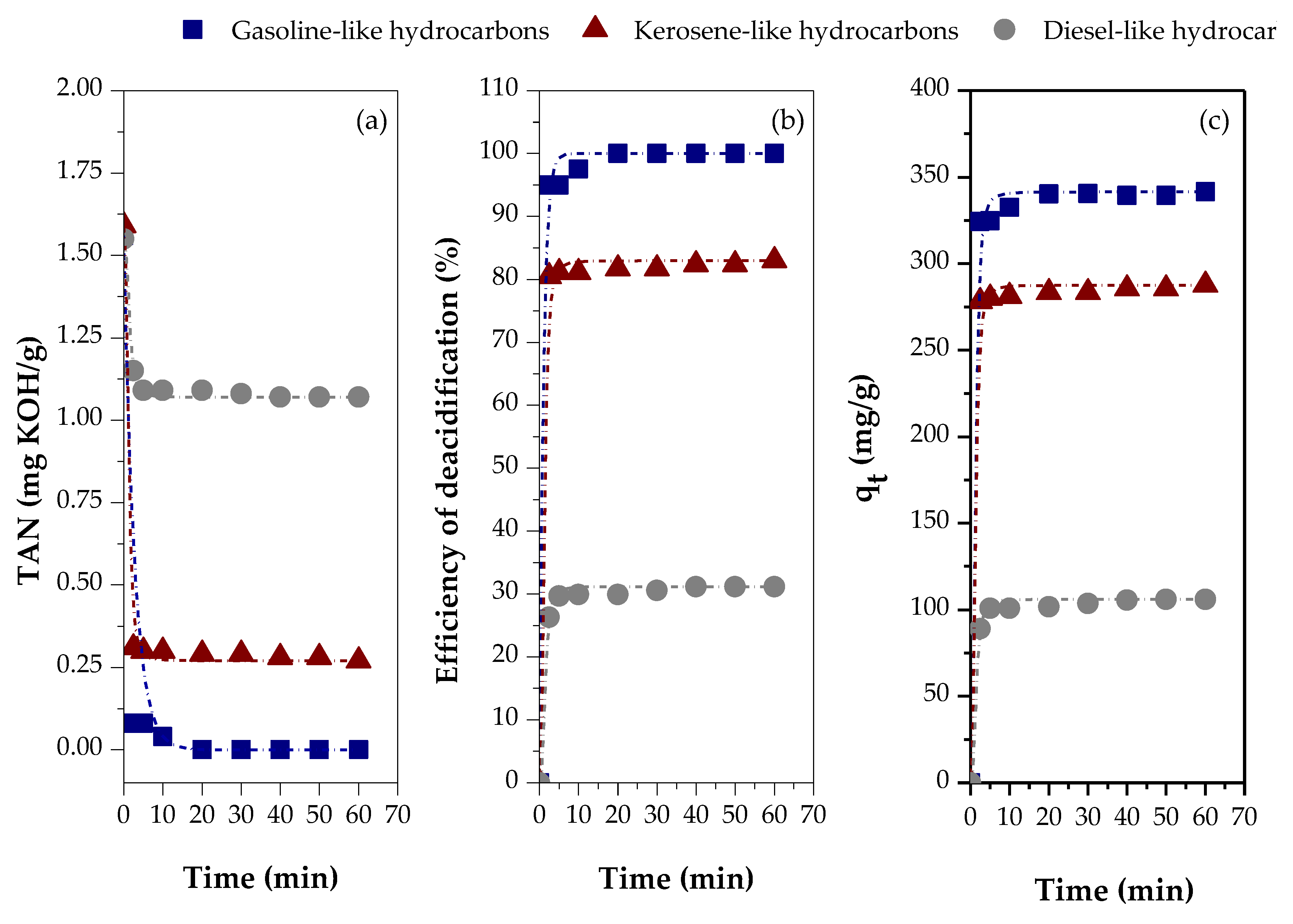
Figure 10(a) shows the TAN values of the different fractions distilled using CARM – 1M HCl as an adsorbent, demonstrating the significant influence of the fraction type on the NAN values. The lowest value of TAN, 0.00 mg KOH/g, was observed for the gasoline-like hydrocarbons fraction, followed by the kerosene-like hydrocarbons fraction with 0.27 mg KOH/g, and the diesel-like hydrocarbons fraction with 1.07 mg KOH/g. These results indicate that the differentiated composition of hydrocarbons and oxygenated compounds in each fraction directly affects acid removal efficiency. Figure 10(b) reinforces this behavior inversely, showing that the highest deacidification efficiency (100%) was achieved in the gasoline-like hydrocarbons fraction. In comparison, the kerosene-like and diesel-like hydrocarbon fractions showed efficiencies of 82.97% and 31.18%, respectively. Therefore, the results presented in Figures 10(a) and 10(b) show that CARM – 1M HCl tends to promote more efficient deacidification for the lighter fractions with smaller hydrocarbon chains, probably due to the lower molecular complexity and better accessibility to the active sites of the adsorbent.
From the chromatographic analysis performed for the distilled fractions of bio-oil reported in the work of Mancio et al. [21], it is known that the diesel-like hydrocarbons fraction has free fatty acids with a higher carbon chain than the kerosene-like hydrocarbons fraction. Therefore, the adsorption capacity of FFA is influenced by the fraction distilled type since each fraction is characterized by hydrocarbons and oxygenated compounds (mainly carboxylic acids) that increase in carbon chain size as the temperature range increases [59]. This behavior was observed by Silva et al. [33], in which these authors found that model samples of distillate petroleum fractions containing simpler and lighter carboxylic acids have higher adsorption capacities for commercial clay, resulting in higher mass transfer coefficient values. Poling et al. [60] report that diffusion tends to be slower for larger molecules. Therefore, the behavior observed in the present study follows what has been reported in the literature.
Figure 11 and Table 4 provide a clear view of the kinetic behavior of carboxylic acid adsorption in distillate fractions (gasoline-like, kerosene-like, and diesel-like hydrocarbons) using chemically activated red sludge (CARM - 1M HCl). Based on Table 4, it is evident that the pseudo-second-order model is the one that best describes the experimental data, as indicated by the high values of R², all above 0.998 for the three fractions. This result suggests a good agreement between the experimental values of qe(exp) and the calculated values qe(calc), reinforcing this kinetic model's adequacy in predicting adsorption.
Figure 11.
Evaluation of kinetics models for the adsorption of carboxylic acids in different distillate fractions using chemically activated red mud (CARM – 1M): (a) pseudo-first-order, and (b) pseudo-second-order.
Figure 11.
Evaluation of kinetics models for the adsorption of carboxylic acids in different distillate fractions using chemically activated red mud (CARM – 1M): (a) pseudo-first-order, and (b) pseudo-second-order.
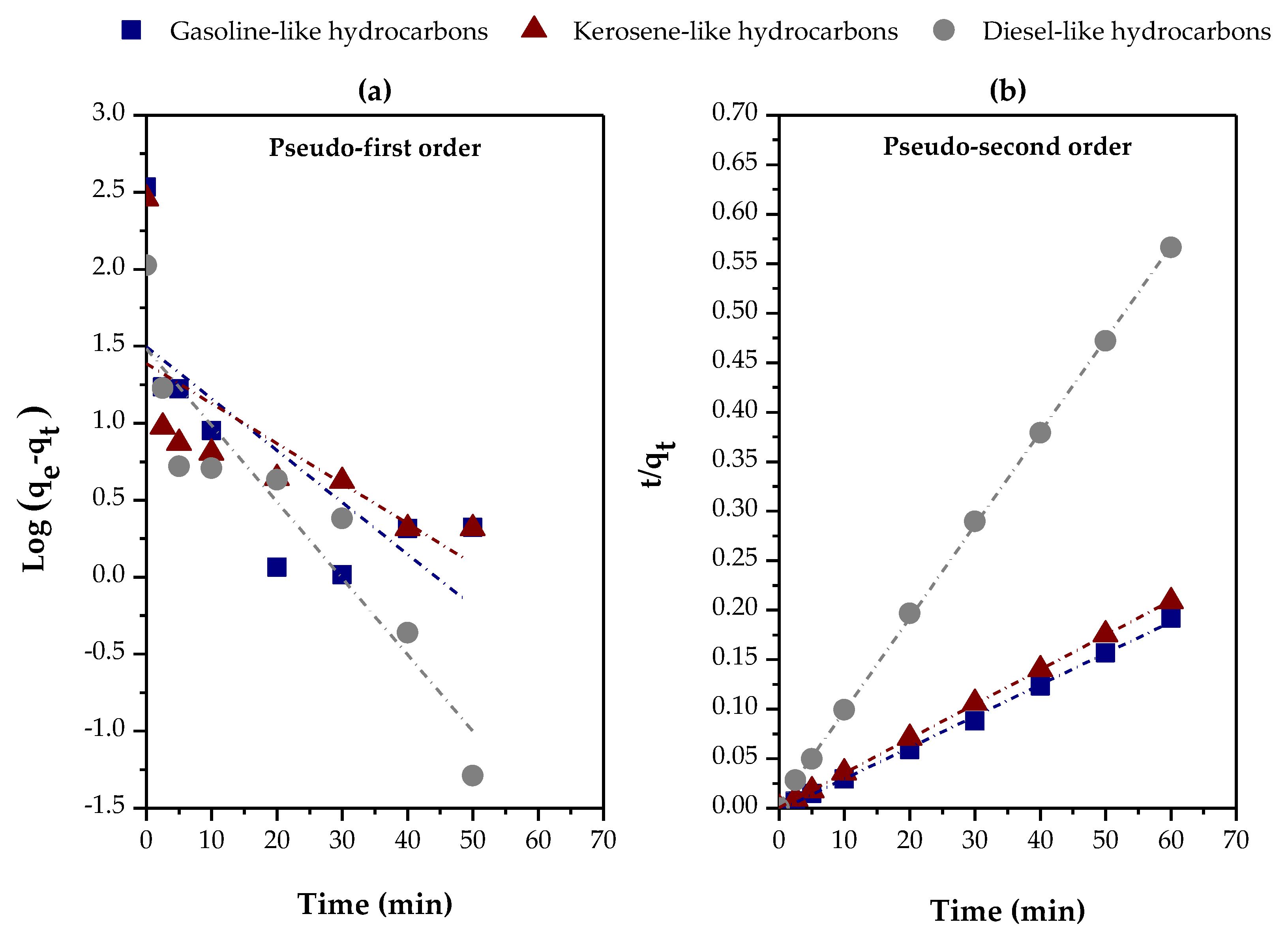
In terms of efficiency, the gasoline-like hydrocarbons fraction presented the highest hi value (initial adsorption rate), with 1806.7011 mg/g.min, while the diesel-like hydrocarbons fraction obtained the lowest, with 236.4066 mg/g.min, reflecting a lower initial adsorption capacity, possibly due to the greater molecular complexity of this fraction [21] and the lower accessibility of the adsorbent active sites [61]. In parallel, in the first 2.5 minutes, about 95%, 97% and 84% of the equilibrium adsorption capacity were achieved for gasoline-like, kerosene-like and diesel-like hydrocarbons, respectively, corroborating the initial adsorption rate values presented in Table 4.
Table 4.
Kinetic parameters of pseudo-first and pseudo-second-order models for the adsorption of carboxylic acids in different distillate fractions using chemically activated red mud (CARM – 1M).
Table 4.
Kinetic parameters of pseudo-first and pseudo-second-order models for the adsorption of carboxylic acids in different distillate fractions using chemically activated red mud (CARM – 1M).
| Variables evaluated | Adsorption kinetic parameters | ||||
| Distilled fraction | Pseudo-first order | ||||
| qe (exp) (mg/g) |
K1 (min-1) |
qe (calc) (mg/g) |
R2 | ||
| Gasoline-like hydrocarbons | 341.4678 | 0.0776 | 31.3574 | 0.47678 | |
| Kerosene-like hydrocarbons | 287.5675 | 0.1144 | 30.4103 | 0.84354 | |
| Diesel-like hydrocarbons | 105.9485 | 0.0598 | 24.3961 | 0.41922 | |
| Distilled fraction | Pseudo-second order | ||||
| qe (exp) (mg/g) |
K2 (g/mg. min) |
qe (calc) (mg/g) |
hi (mg/g. min) |
R2 | |
| Gasoline-like hydrocarbons | 341.4678 | 0.0047 | 315.4574 | 462.9630 | 0.99837 |
| Kerosene-like hydrocarbons | 287.5675 | 0.0219 | 287.3563 | 1806.7011 | 0.99994 |
| Diesel-like hydrocarbons | 105.9485 | 0.0208 | 106.4963 | 236.4066 | 0.99979 |
4. Conclusions
The results of the characterization of the six red mud-based adsorbents (Red Mud, TARM at 400 °C, TARM at 600 °C, CARM - 0.25M HCl, CARM - 1M HCl and CARM - 2M HCl) show that the activation method and its conditions have a significant impact on the specific surface area of the adsorbents. Thermal activation at 400 °C was the most effective to increase surface area compared to non-activated sludge, reaching 35.2450 m²/g. For chemical activation, the best condition was using a 0.25M HCl solution, resulting in an area of 84.3290 m²/g, surpassing thermal activation.
Comparing the best results between the activation methods, it was concluded that chemical activation was more efficient, with a BET area close to that of commercial adsorbents. This result underscores the effectiveness of chemical activation in improving the textural properties of red mud.
In the deacidification experiments by adsorption of fractions of gasoline-like hydrocarbons, the red mud chemically activated with HCl (0.25M, 1M and 2M) showed great potential, with qt higher than 2000 mg/g, for the lowest percentage of adsorbent (0.5%). Red mud is an abundant and low-cost industrial by-product, making it even more attractive as an adsorbent.
The pseudo-second-order kinetic model was the most appropriate to describe adsorption kinetics, showing high R² values and an excellent correspondence between experimental and calculated qe values. The high efficiency of CARM – 1M HCl, evidenced by both the high values of qe and hi, reinforces its capacity in deacidification processes of distilled fractions of bio-oil (biofuels), such as gasoline-like hydrocarbons, kerosene-like hydrocarbons and diesel-like hydrocarbons. Notably, the gasoline-like hydrocarbons fraction achieved the best results, achieving 100% carboxylic acid removal, proving the effectiveness of CARM–1M HCl as an adsorbent in such purification processes.
Therefore, adsorption as a method of deacidifying biofuels proved to be efficient, especially with chemically activated red mud, representing a promising alternative for upgrading biofuels, directly contributing to the catalytic thermal cracking process.
Author Contributions
The individual contributions of all the co-authors are provided as follows: N.T.M. contributed with supervision and conceptualization; K.M.B.C contributed with investigation; S.A.P.M contributed with investigation, writing—review and editing; L.E.P.B. contributed with methodology; and A.A.M.M contributed with conceptualization, Methodology, formal analysis. investigation. writing—original draft preparation. writing—review and editing. All authors have read and agreed to the published version of the manuscript.
Funding
This research received no external funding.
Data Availability Statement
We encourage all authors of articles published in MDPI journals to share their research data. In this section. please provide details regarding where data supporting reported results can be found. including links to publicly archived datasets analyzed or generated during the study. Where no new data were created. or where data is unavailable due to privacy or ethical restrictions. a statement is still required. Suggested Data Availability Statements are available in section "MDPI Research Data Policies" at https://www.mdpi.com/ethics.
Acknowledgments
This work was financially supported by the Brazilian governmental agencies (CAPES and Eletrobrás).
Conflicts of Interest
The authors declare no conflict of interest.
References
- 2023; 1. International Energy Agency (IEA) World Energy Outlook 2023; Paris, 2023.
- Stedile, T.; Ender, L.; Meier, H.F.; Simionatto, E.L.; Wiggers, V.R. Comparison between Physical Properties and Chemical Composition of Bio-Oils Derived from Lignocellulose and Triglyceride Sources. Renewable and Sustainable Energy Reviews 2015, 50, 92–108. [CrossRef]
- Wei, Y.; Lei, H.; Wang, L.; Zhu, L.; Zhang, X.; Liu, Y.; Chen, S.; Ahring, B. Liquid–Liquid Extraction of Biomass Pyrolysis Bio-Oil. Energy & Fuels 2014, 28, 1207–1212. [CrossRef]
- Naji, S.Z.; Tye, C.T.; Abd, A.A. State of the Art of Vegetable Oil Transformation into Biofuels Using Catalytic Cracking Technology: Recent Trends and Future Perspectives. Process Biochemistry 2021, 109, 148–168.
- Lima, D.G.; Soares, V.C.D.; Ribeiro, E.B.; Carvalho, D.A.; Cardoso, É.C. V; Rassi, F.C.; Mundim, K.C.; Rubim, J.C.; Suarez, P.A.Z. Diesel-like Fuel Obtained by Pyrolysis of Vegetable Oils. J Anal Appl Pyrolysis 2004, 71, 987–996. [CrossRef]
- Wang, S.; Guo, Z.; Cai, Q.; Guo, L. Catalytic Conversion of Carboxylic Acids in Bio-Oil for Liquid Hydrocarbons Production. Biomass Bioenergy 2012, 45, 138–143. [CrossRef]
- Yan, S.; DiMaggio, C.; Wang, H.; Mohan, S.; Kim, M.; Yang, L.; O. Salley, S.; Y. Simon Ng, K. Catalytic Conversion of Triglycerides to Liquid Biofuels Through Transesterification, Cracking, and Hydrotreatment Processes. Current Catalysis 2012, 1, 41–51.
- Bridgwater, A. V Review of Fast Pyrolysis of Biomass and Product Upgrading. Biomass Bioenergy 2012, 38, 68–94. [CrossRef]
- Chan, Y.H.; Loh, S.K.; Chin, B.L.F.; Yiin, C.L.; How, B.S.; Cheah, K.W.; Wong, M.K.; Loy, A.C.M.; Gwee, Y.L.; Lo, S.L.Y.; et al. Fractionation and Extraction of Bio-Oil for Production of Greener Fuel and Value-Added Chemicals: Recent Advances and Future Prospects. Chemical Engineering Journal 2020, 397, 125406. [CrossRef]
- Wang, S. High-Efficiency Separation of Bio-Oil. In Biomass Now - Sustainable Growth and Use; Matovic, M.D., Ed.; InTech, 2013; pp. 401–418.
- Huber, G.W.; Iborra, S.; Corma, A. Synthesis of Transportation Fuels from Biomass: Chemistry, Catalysts, and Engineering. Chem Rev 2006, 106, 4044–4098. [CrossRef]
- Zhang, L.; Liu, R.H.; Yin, R.Z.; Mei, Y.F. Upgrading of Bio-Oil from Biomass Fast Pyrolysis in China: A Review. Renewable & Sustainable Energy Reviews 2013, 24, 66–72. [CrossRef]
- Xiu, S.N.; Shahbazi, A. Bio-Oil Production and Upgrading Research: A Review. Renewable & Sustainable Energy Reviews 2012, 16, 4406–4414. [CrossRef]
- Shamsul, N.S.; Kamarudin, S.K.; Rahman, N.A. Conversion of Bio-Oil to Bio Gasoline via Pyrolysis and Hydrothermal: A Review. Renewable and Sustainable Energy Reviews 2017, 80, 538–549. [CrossRef]
- Baloch, H.A.; Nizamuddin, S.; Siddiqui, M.T.H.; Riaz, S.; Jatoi, A.S.; Dumbre, D.K.; Mubarak, N.M.; Srinivasan, M.P.; Griffin, G.J. Recent Advances in Production and Upgrading of Bio-Oil from Biomass: A Critical Overview. J Environ Chem Eng 2018, 6, 5101–5118. [CrossRef]
- Jacobson, K.; Maheria, K.C.; Dalai, A.K. Bio-Oil Valorization: A Review. Renewable & Sustainable Energy Reviews 2013, 23, 91–106. [CrossRef]
- Hu, X.; Gunawan, R.; Mourant, D.; Hasan, M.D.M.; Wu, L.; Song, Y.; Lievens, C.; Li, C.-Z. Upgrading of Bio-Oil via Acid-Catalyzed Reactions in Alcohols — A Mini Review. Fuel Processing Technology 2017, 155, 2–19. [CrossRef]
- Leng, L.; Li, H.; Yuan, X.; Zhou, W.; Huang, H. Bio-Oil Upgrading by Emulsification/Microemulsification: A Review. Energy 2018, 161, 214–232. [CrossRef]
- Gharib, J.; Pang, S.; Holland, D. Synthesis and Characterisation of Polyurethane Made from Pyrolysis Bio-Oil of Pine Wood. Eur Polym J 2020, 133. [CrossRef]
- Prado, C.M.R.; Antoniosi Filho, N.R. Production and Characterization of the Biofuels Obtained by Thermal Cracking and Thermal Catalytic Cracking of Vegetable Oils. J Anal Appl Pyrolysis 2009, 86, 338–347. [CrossRef]
- Mancio, A.A.; da Mota, S.A.P.; Ferreira, C.C.; Carvalho, T.U.S.; Neto, O.S.; Zamian, J.R.; Araújo, M.E.; Borges, L.E.P.; Machado, N.T. Separation and Characterization of Biofuels in the Jet Fuel and Diesel Fuel Ranges by Fractional Distillation of Organic Liquid Products. Fuel 2018. [CrossRef]
- Da Mota, S.A.P.; Mancio, A.A.; Lhamas, D.E.L.; de Abreu, D.H.; da Silva, M.S.; dos Santos, W.G.; de Castro, D.A.R.; de Oliveira, R.M.; Ara?jo, M.E.; Borges, L.E.P.; et al. Production of Green Diesel by Thermal Catalytic Cracking of Crude Palm Oil (Elaeis Guineensis Jacq) in a Pilot Plant. J Anal Appl Pyrolysis 2013. [CrossRef]
- Stanford, J.P.; Hall, P.H.; Rover, M.R.; Smith, R.G.; Brown, R.C. Separation of Sugars and Phenolics from the Heavy Fraction of Bio-Oil Using Polymeric Resin Adsorbents. Sep Purif Technol 2018, 194, 170–180. [CrossRef]
- Li, Y.; Shao, J.; Wang, X.; Yang, H.; Chen, Y.; Deng, Y.; Zhang, S.; Chen, H. Upgrading of Bio-Oil: Removal of the Fermentation Inhibitor (Furfural) from the Model Compounds of Bio-Oil Using Pyrolytic Char. Energy and Fuels 2013, 27, 5975–5981. [CrossRef]
- Church, A.L.; Hu, M.Z.; Lee, S.J.; Wang, H.; Liu, J. Selective Adsorption Removal of Carbonyl Molecular Foulants from Real Fast Pyrolysis Bio-Oils. Biomass Bioenergy 2020, 136, 105522. [CrossRef]
- Li, C.; Jiang, D.; Yang, X.; Babadi, A.A.; Wang, S.; Gong, X. Selective Adsorption of Carbonyl Compounds from Bio-Oil by Seaweed-Derived Carbon: A Theoretical Study. J Anal Appl Pyrolysis 2023, 173. [CrossRef]
- Zhang, M.; Shen, Q.; Wu, H. Adsorption Characteristics of Bio-Oil on Biochar in Bioslurry Fuels. Energy and Fuels 2017, 31, 9619–9626. [CrossRef]
- Yan, S.; Chen, H.; Zhu, H.; Lin, Z.; Wu, G.; Gao, W.; Zhang, H.; Hu, X.; Zhang, J.; Zhang, S.; et al. Enhanced Adsorption of Bio-Oil on Activated Biochar in Slurry Fuels and the Adsorption Selectivity. Fuel 2023, 338, 127224. [CrossRef]
- Widjaja, C.; Djojorahardjo, Y.; Kurniawan, A.; Soetaredjo, F.E. BIOREFINERY CONCEPT ON JACKFRUIT PEEL WASTE: BIO-OIL UPGRADING. 2018, 13.
- Sedai, B.; Zhou, J.L.; Fakhri, N.; Sayari, A.; Baker, R.T. Solid Phase Extraction of Bio-Oil Model Compounds and Lignin-Derived Bio-Oil Using Amine-Functionalized Mesoporous Silicas. ACS Sustain Chem Eng 2018, 6, 9716–9724. [CrossRef]
- Nam, H.; Choi, W.; Genuino, D.A.; Capareda, S.C. Development of Rice Straw Activated Carbon and Its Utilizations. J Environ Chem Eng 2018, 6, 5221–5229. [CrossRef]
- Li, F.; Katz, L.; Qiu, S. Adsorptive Selectivity and Mechanism of Three Different Adsorbents for Nitrogenous Compounds Removal from Microalgae Bio-Oil. Ind Eng Chem Res 2019, 58, 3959–3968. [CrossRef]
- Silva, J.P.; Costa, A.L.H.; Chiaro, S.S.X.; Delgado, B.E.P.C.; de Figueiredo, M.A.G.; Senna, L.F. Carboxylic Acid Removal from Model Petroleum Fractions by a Commercial Clay Adsorbent. Fuel Processing Technology 2013, 112, 57–63. [CrossRef]
- Silva, J.P.; Senna, L.F. de; Lago, D.C.B. do; Jr, P.F. da S.; Dias, E.G.; Figueiredo, M.A.G. de; Chiaro, S.S.X. Characterization of Commercial Ceramic Adsorbents and Its Application on Naphthenic Acids Removal of Petroleum Distillates. 2007, 10, 219–225.
- Wu, W.-L.; Tan, Z.-Q.; Wu, G.-J.; Yuan, L.; Zhu, W.-L.; Bao, Y.-L.; Pan, L.-Y.; Yang, Y.-J.; Zheng, J.-X. Deacidification of Crude Low-Calorie Cocoa Butter with Liquid–Liquid Extraction and Strong-Base Anion Exchange Resin. Sep Purif Technol 2013, 102, 163–172. [CrossRef]
- Deboni, T.M.; Batista, E.A.C.; Meirelles, A.J.A. Equilibrium, Kinetics, and Thermodynamics of Soybean Oil Deacidification Using a Strong Anion Exchange Resin. Ind Eng Chem Res 2015, 54, 11167–11179. [CrossRef]
- Manuale, D.L.; Torres, G.C.; Badano, J.M.; Vera, C.R.; Yori, J.C. Adjustment of the Biodiesel Free Fatty Acids Content by Means of Adsorption. Energy & Fuels 2013, 27, 6763–6772. [CrossRef]
- Lagergren, S. About the Theory of So-Called Adsorption of Soluble Substances. 1898.
- Ho, Y.-S.; McKay, G. Kinetic Models for the Sorption of Dye from Aqueous Solution by Wood. Process safety and environmental protection 1998, 76, 183–191.
- Antunes, M.L.P.; Conceição, F.T.; Navarro, G.R.B.; Fernandes, A.M.; Durrant, S.F. Use of Red Mud Activated at Different Temperatures as a Low Cost Adsorbent of Reactive Dye. Engenharia Sanitaria e Ambiental 2021, 26, 805–811. [CrossRef]
- Fang, H.; Liang, W.; Ma, L.; Ma, C. Properties and Characterization of Red Mud Modified by Hydrochloric, Sulfuric, and Nitric Acid for the Catalytic Oxidation of Toluene. J Environ Chem Eng 2023, 11. [CrossRef]
- Castaldi, P.; Silvetti, M.; Enzo, S.; Melis, P. Study of Sorption Processes and FT-IR Analysis of Arsenate Sorbed onto Red Muds (a Bauxite Ore Processing Waste). J Hazard Mater 2010, 175, 172–178. [CrossRef]
- Wang, P.; Liu, D.-Y. Physical and Chemical Properties of Sintering Red Mud and Bayer Red Mud and the Implications for Beneficial Utilization. Materials 2012, 5, 1800–1810. [CrossRef]
- Castaldi, P.; Silvetti, M.; Santona, L.; Enzo, S.; Melis, P. XRD, FTIR, and Thermal Analysis of Bauxite Ore-Processing Waste (Red Mud) Exchanged with Heavy Metals. Clays Clay Miner 2008, 56, 461–469, . [CrossRef]
- Almeida, A.C.M.; do Nascimento, R.A.; Amador, I.C.B.; Santos, T.C. de S.; Martelli, M.C.; de Faria, L.J.G.; Ribeiro, N.F. da P. Chemically Activated Red Mud: Assessing Structural Modifications and Optimizing Adsorption Properties for Hexavalent Chromium. Colloids Surf A Physicochem Eng Asp 2021, 628. [CrossRef]
- Kurtoğlu, S.F.; Soyer-Uzun, S.; Uzun, A. Tuning Structural Characteristics of Red Mud by Simple Treatments. Ceram Int 2016, 42, 17581–17593. [CrossRef]
- Thommes, M.; Kaneko, K.; Neimark, A. V.; Olivier, J.P.; Rodriguez-Reinoso, F.; Rouquerol, J.; Sing, K.S.W. Physisorption of Gases, with Special Reference to the Evaluation of Surface Area and Pore Size Distribution (IUPAC Technical Report). Pure and Applied Chemistry 2015, 87, 1051–1069. [CrossRef]
- Brunauer, E.; Journal, T. ) Reyerson and Cameron; UTC, 1937; Vol. 69.
- Suzuki, Motoyuki. Adsorption Engineering; Elsevier, 1989; ISBN 0444988025.
- Sushil, S.; Batra, V.S. Catalytic Applications of Red Mud, an Aluminium Industry Waste: A Review. Appl Catal B 2008, 81, 64–77.
- Liu, Q.; Xin, R.; Li, C.; Xu, C.; Yang, J. Application of Red Mud as a Basic Catalyst for Biodiesel Production. J Environ Sci (China) 2013, 25, 823–829. [CrossRef]
- Garcia, M.C.S. Modificação do resíduo de bauxita gerado no processo Bayer por tratamento térmico. Tese de Doutorado, Universidade de São Paulo, 2012.
- Al-Asheh, S.; Banat, F.; Abu-Aitah, L. Adsorption of Phenol Using Different Types of Activated Bentonites. Sep Purif Technol 2003, 33, 1–10. [CrossRef]
- Jean Baptiste, B.M.; Daniele, B.K.; Marie Charlène, E.; Larrissa Canuala, T.T.; Antoine, E.; Richard, K. Adsorption Mechanisms of Pigments and Free Fatty Acids in the Discoloration of Shea Butter and Palm Oil by an Acid-Activated Cameroonian Smectite. Sci Afr 2020, 9, e00498. [CrossRef]
- López-Velandia, C.; Moreno-Barbosa, J.; Sierra-Ramirez, R.; Giraldo, L.; Moreno-Piraján, J. Adsorption of Volatile Carboxylic Acids on Activated Carbon Synthesized from Watermelon Shells. Adsorption Science and Technology 2014, 32, 227–242. [CrossRef]
- Zhang, H.; Peng, B.; Liu, Q.; Wu, C.; Li, Z. Preparation of Porous Biochar from Heavy Bio-Oil for Adsorption of Methylene Blue in Wastewater. Fuel Processing Technology 2022, 238, 107485. [CrossRef]
- Rafiq, S.; Wongrod, S.; Vinitnantharat, S. Adsorption Kinetics of Cadmium and Lead by Biochars in Single- and Bisolute Brackish Water Systems. ACS Omega 2023, 8, 45262–45276. [CrossRef]
- Li, J.; Dong, X.; Liu, X.; Xu, X.; Duan, W.; Park, J.; Gao, L.; Lu, Y. Comparative Study on the Adsorption Characteristics of Heavy Metal Ions by Activated Carbon and Selected Natural Adsorbents. Sustainability (Switzerland) 2022, 14. [CrossRef]
- Machado, N.T.; Mota, A. de A.M. da; Santanna, J. da S.; Gama, V. de J.P. da; Zamian, J.R.; Borges, L.E.P.; Mota, S.A.P. da Catalytic Cracking of Palm Oil: Effect of Catalyst Reuse and Reaction Time of the Quality of Biofuels-like Fractions. Energies (Basel) 2023, 16. [CrossRef]
- Poling, B.E.; Prausnitz, J.M.; O’connell, J.P. The Properties of Gases and Liquids; Mcgraw-hill New York, 2001; Vol. 5.
- Shou, J.; Qiu, M. Adsorption Kinetics of Phenol in Aqueous Solution onto Activated Carbon from Wheat Straw Lignin. Desalination Water Treat 2016, 57, 3119–3124. [CrossRef]
Disclaimer/Publisher’s Note: The statements, opinions and data contained in all publications are solely those of the individual author(s) and contributor(s) and not of MDPI and/or the editor(s). MDPI and/or the editor(s) disclaim responsibility for any injury to people or property resulting from any ideas, methods, instructions or products referred to in the content. |
© 2024 by the authors. Licensee MDPI, Basel, Switzerland. This article is an open access article distributed under the terms and conditions of the Creative Commons Attribution (CC BY) license (http://creativecommons.org/licenses/by/4.0/).
Copyright: This open access article is published under a Creative Commons CC BY 4.0 license, which permit the free download, distribution, and reuse, provided that the author and preprint are cited in any reuse.


