

Submitted:
09 October 2024
Posted:
10 October 2024
Read the latest preprint version here
Abstract
We propose the DIKWP-TRIZ framework, an innovative extension of the traditional Theory of Inventive Problem Solving (TRIZ) designed to address the complexities of cognitive processes and artificial consciousness. By integrating the elements of Data, Information, Knowledge, Wisdom, and Purpose (DIKWP) into the TRIZ methodology, the proposed framework emphasizes a value-oriented approach to innovation, enhancing the ability to tackle problems characterized by incompleteness, inconsistency, and imprecision. Through a systematic mapping of TRIZ principles to DIKWP transformations, we identify potential overlaps and redundancies, providing a refined set of guidelines that optimize the application of TRIZ principles in complex scenarios. The study further demonstrates the framework’s capacity to support advanced decision-making and cognitive processes, paving the way for the development of AI systems capable of sophisticated, human-like reasoning. Future research will focus on comparing the implementation paths of DIKWP-TRIZ and traditional TRIZ, analyzing the complexities inherent in DIKWP-TRIZ-based innovation, and exploring its potential in constructing artificial consciousness systems.
Keywords:
DIKWP-TRIZ
; DIKWP Model
; Semantic Math
; Cognitive Space
; TRIZ
1. Introduction
Since the twentieth century, Theory of Inventive Problem Solving (TRIZ) has emerged as a systematic methodology for innovation, gradually attracting widespread attention and being applied across various invention and innovation scenarios. Over several decades of development, TRIZ has expanded into a comprehensive set of methodologies and practical experiences. However, due to the diversity and complexity of its methodologies, individuals with a limited understanding of TRIZ and cross-domain innovation often find it difficult to master, potentially overlooking certain details and processes [1] Moreover, the TRIZ method, in its pursuit of innovation, may sometimes neglect the human intention and value orientation inherent in the innovation process [2]. To address these issues, we have synthesized the core ideas and principles of the DIKWP theory and proposed the DIKWP-TRIZ method. This approach aims to transform the innovation methodology of TRIZ into data innovation, information innovation, knowledge innovation, wisdom innovation, and purpose innovation within the DIKWP-TRIZ framework. By reducing the essence of invention and innovation pathways to these five innovation directions, we place maximum emphasis on human intention and value orientation in the innovation process. This strategy reduces the cognitive burden on users of the TRIZ innovation method, allowing them to focus more on innovations in data, information, knowledge, wisdom, and purpose, as well as effectively handling problems characterized by incompleteness, inconsistency, and imprecision (the 3-N problems).
- Integration of DIKWP Model with TRIZ Methodology for Artificial Consciousness Innovation: This paper introduces the DIKWP-TRIZ framework, which integrates the elements of Data, Information, Knowledge, Wisdom, and Purpose (DIKWP) into the traditional TRIZ methodology. This integration provides a structured approach for applying TRIZ principles to cognitive processes, specifically aimed at addressing the complexities and ethical considerations involved in the development of artificial consciousness systems. By bridging the gap between cognitive modeling and inventive problem-solving, this approach offers a novel methodology that enhances innovation capabilities in complex, value-driven contexts.
- Comprehensive Mapping of TRIZ Principles to Cognitive Transformations in DIKWP: The research systematically maps TRIZ principles to various cognitive transformations within the DIKWP model, such as the transition from data to knowledge or from wisdom to purpose. This mapping not only clarifies the applicability of each TRIZ principle in cognitive processes but also identifies overlaps and redundancies among the principles. By proposing a refined set of principles and contextual guidelines, the paper improves the precision and efficiency of TRIZ applications in complex cognitive scenarios, thereby facilitating more effective problem-solving and innovation.
- Development of a Methodological Framework for Reducing Redundancies and Enhancing Consistency in TRIZ-DIKWP Applications: The study addresses potential inconsistencies and redundancies in the application of TRIZ principles within the DIKWP framework by employing a cognitive space coverage integrity analysis and redundancy evaluation. The proposed methodological framework includes strategies for integrating overlapping principles and offers decision-making tools to guide practitioners in selecting the most appropriate principles for specific cognitive processes. This structured approach ensures a coherent and systematic application of TRIZ principles, enhancing the overall robustness and effectiveness of the DIKWP-TRIZ methodology.
This paper is organized as follows: Section 2 presents related work, introducing the current applications and limitations of TRIZ and the DIKWP theory. Section 3 provides relevant definitions in research mathods. Section 4 discusses the mapping relationship between DIKWP and TRIZ inventive principles under the assumptions of Cognitive Space. In Section 5, we explored the overlapping TRIZ inventive principles within the DIKWP * DIKWP framework, specifically focusing on the integration of TRIZ into the DIKWP-TRIZ methodology. By differentiating between the overlaps among TRIZ principles under various transformation contexts, we aim to minimize potential inconsistencies and ensure a more cohesive application of the methodology. In Section 6, we compared TRIZ and DIKWP-TRIZ in different aspects based on the previous analysis results. Finally, Section 7 concludes the paper.
2. Related Works
2.1. DIKWP Model
Unlike the traditional DIKW (Data-Information-Knowledge-Wisdom) model, prior research has introduced a series of definitions within the DIKWP framework, which incorporates "Purpose" as an additional element. This extended model maps the 3-N problem—characterized by incompleteness, inconsistency, and imprecision—onto cognitive space, semantic space, and conceptual space for detailed description and processing [3]. By connecting and integrating these three spaces, the DIKWP model enables the handling of solutions in scenarios involving the 3-N problem, thereby offering a more robust approach to complex data issues. Duan proposed the "Relationship Defined Everything of Semantics" (RDXS) methodology [4]. Leveraging the DIKW conceptual framework, RDXS maps incomplete, inconsistent, and imprecise subjective and objective mixed DIKWP resources, effectively extending the traditional knowledge graph into an interconnected DIKWP graph system [5]. This innovative approach allows for a more comprehensive representation of knowledge that accommodates the complexities inherent in real-world data.
The DIKWP model has been applied in previous research to various fields, including Artificial Consciousness(AC), privacy protection [6] and doctor-patient interactions [7], which applications demonstrate the model’s versatility and effectiveness in handling complex information processing tasks across different domains. Through prior related research and practical applications, it has been demonstrated that the superior processing capabilities of this theoretical model enable it to effectively address situations characterized by the 3-N problem. The DIKWP model’s ability to manage incompleteness, inconsistency, and imprecision makes it a valuable tool for advancing knowledge representation and problem-solving in complex systems.
2.2. TRIZ Theory
Since its inception in the Soviet Union in the 1960s, TRIZ has evolved into a systematic methodology for innovation. In the semiconductor industry, these principles have been employed to enhance smart factories, addressing issues such as mechanical system substitution and changes in physical and chemical properties [8]. In project management, TRIZ principles have been applied to solve innovative challenges in management and business domains [9]. In the field of additive manufacturing, such as 3D printing, these principles support the creation of new geometries and enhanced functionalities [10].
Despite its widespread application in innovative problem-solving across various industries, the TRIZ methodology has certain limitations. Firstly, the 40 inventive principles and related tools of TRIZ were originally designed for engineering and technical problems. When applied to other domains, such as software development and service design, terminology mismatches may occur, necessitating reinterpretation or adaptation for effective use [11]. Secondly, the use of TRIZ tools is complex and requires a high level of expertise, which can make it challenging for beginners to use these tools effectively without appropriate training [12]. In the service sector or non-technical fields, applying TRIZ also requires transforming its tools and principles into new forms that are easy to understand and adapt, adding to its complexity [13].
Moreover, Liang et al. [14] developed a computer-aided TRIZ patent classification method. While this approach improves the efficiency of patent classification by integrating text mining with TRIZ, the complexity and heterogeneity of patent literature may lead to issues in semantic understanding and data annotation consistency when processing multi-domain patent data, potentially affecting its accuracy. Ilevbare et al. [1] reviewed the challenges of TRIZ in practical applications, highlighting that its complexity and the requirement for extensive knowledge backgrounds are key factors hindering its effectiveness. They suggested the need to develop tools that are easier to understand and apply.
Similarly, dealing with incomplete, inconsistent, or imprecise content poses a challenge to the TRIZ methodology. Yan et al. [15] proposed an ontology-based inventive problem-solving method that links different knowledge sources through semantic similarity to resolve information inconsistencies. Although this method theoretically offers a promising solution, its implementation relies on precise semantic computations and complex knowledge base management, which may present challenges in large-scale and dynamic real-world applications. Furthermore, They also developed an automated ontology system named IngeniousTRIZ to facilitate the solution of inventive problems [16]. Although this system can automatically populate and manage knowledge sources within the TRIZ model, enhancing users’ ability to tackle complex problems, its limitation lies in the fact that for engineering problems across different fields, such automated processing may not cover all possible scenarios, requiring additional manual intervention to ensure the applicability of solutions.
3. Research Methodology
DIKWP-TRIZ approaches and solves problems from a more fundamental perspective than TRIZ. Figure 1 illustrates the problem-solving process using the TRIZ theory. The blue arrows represent cognitive processing, and the adjacent labels denote the methodologies or approaches involved in this cognitive process. It is evident that the traditional TRIZ methodology relies heavily on conceptual or hierarchical abstraction to frame the problem and find a solution. The cognitive process then occurs within the cognitive space, transforming a general solution into a specific one, often through trial and error, until the problem is resolved. In contrast, Figure 2 presents the problem-solving process under the DIKWP-TRIZ methodology. Using the DIKWP theory, cognitive agents construct a DIKWP processing model for the 3-N problem. We have developed 25 transformation methods that map DIKWP content to DIKWP (as shown in the bottom left of Figure 2) to address the 3-N problem. This construction and mapping process is then translated into corresponding TRIZ invention principles. This approach enhances the applicability of TRIZ by mapping the essential problem-solving semantics to concepts, thereby extending the scope of TRIZ invention principles. Additionally, the generated general solutions incorporate DIKWP conceptual content, ensuring that the solutions are both credible and controllable.
3.1. DIKWP Conceptualization
3.1.1. Data Conceptualization
In the DIKWP model, data semantics (DIKWP-Data) represent specific manifestations of shared semantics in cognition. Within the conceptual space, data concepts embody specific facts or observations recognized by cognitive entities, confirmed through their alignment with the conscious (non-subconscious) space of these entities and their correspondence with the shared semantics of existing cognitive concepts. When processing data concepts, cognitive systems identify and extract shared semantic elements, which serve as labels for these concepts, unifying them based on corresponding shared attributes. For example, when observing a group of sheep, despite variations in size, color, or gender, cognitive processing categorizes them under the concept of "sheep" by identifying shared or probabilistically related semantics. Similarly, in distinguishing between a silicone arm and a human arm, the cognitive process may rely on features like shape or color; however, a lack of functionality, such as rotation, would exclude the silicone arm from the concept of "arm" based on the semantic criterion of rotatability.
The distinction between conceptual and semantic spaces reflects different philosophical perspectives on technology. Conceptual space processing corresponds to natural language communication, but the core function of communication lies in conveying semantics. In the cognitive space, effective comprehension of transmitted concepts hinges on semantic correspondence within the semantic space of the cognitive entity. However, since the semantic space is often subjective and cannot be fully shared through conceptual forms, it is referred to as subjective.
In the semantic space, the semantics of data concepts are manifestations of a shared set of cognitive semantics. For each element (where D represents the set of specific data semantics), there is a shared or approximate semantic attribute set S, defined by a collection of feature semantics F:
where represents an individual feature semantic of the data. The set D is defined as follows:
In the DIKWP model, the distinction between data concepts and data semantics is crucial for transitioning between the cognitive space and the processing of conceptual and semantic spaces. Data concepts and data semantics represent specific cognitive objects that directly embody observed facts and knowledge. The key to this transformation lies in the shared semantics underlying the cognition and conceptualization of these data concepts. In cognitive space, data objects are the foundation of cognitive processes, moving beyond mere observations or measurements of the world and undergoing explicit conceptual and semantic confirmation. This process also distinguishes between subjective and objective content categories, refining the traditional DIKW model’s approach to data by emphasizing the close association between data and specific semantic attributes. Cognitive recognition of data actively seeks semantic features that match known cognitive objects, thereby highlighting the subjectivity and context-dependence of data, as well as its value in associating with existing conceptual spaces of cognitive entities.
Within the DIKWP model, the semantics of cognitive data objects from the cognitive space are viewed as specific manifestations of shared semantics in the cognitive process. This perspective emphasizes that data are not merely records of observations or facts, but the results of semantic matching and conceptual confirmation by cognitive entities (humans or AI systems) in both conceptual and semantic spaces. The key to confirming data concepts lies in the shared semantics between the cognitive and semantic spaces, allowing for the classification of specific objects under the same data concept despite external differences.
Data concepts are foundational conceptual units in the DIKWP cognitive process, while data semantics serve as foundational semantic units. Together, they play a central role in directly observing and recording the real world, from cognitive recognition to the confirmation of data concepts in generating and applying concept-based natural language representations. Cognitive entities, through both conscious and subconscious processes, recognize and classify data concepts by identifying shared semantic attributes. Cognitive science emphasizes how cognitive systems (including neural processes and pattern recognition mechanisms) process and recognize information, with subconscious pattern recognition and conscious analysis combined to explain recognition based on shared semantic features. For instance, despite differences in color or size, humans recognize apples through subconscious pattern recognition and can explain this recognition by referring to key semantic features such as shape or texture. This illustrates how the cognitive system uses shared data semantics in the semantic space to construct conceptual representations in natural language.
In the DIKWP framework, data concepts are specific mappings of shared semantics in the cognitive process, resolving the traditional confusion between semantics and concepts. Data concepts are closely linked to the semantic processing of cognitive entities, emphasizing that their value lies not in their physical attributes but in how they bridge the conceptual and semantic spaces within the cognitive system. Interaction between individual and collective consciousness is fundamentally an interaction between semantic and conceptual spaces, either consciously or subconsciously. Data concepts, as symbolic expressions of shared or probabilistically similar semantic sets, enhance the efficiency of cognitive-communication, particularly in engineering contexts where specific semantic sets are represented as symbols.
3.1.2. Information Conceptualization
In the DIKWP model, the concept of information (DIKWP-Information) corresponds to one or more "distinct" semantics in cognition. The information semantics of an information concept refer to the association of semantics within the semantic space of a cognitive entity cognitive space, linked with recognized DIKWP cognitive objects. This process occurs through the entity’s cognitive purposes, either establishing identical cognition (corresponding to data semantics) or distinct cognition, confirmed probabilistically or through logical judgment. This distinction forms new semantic associations, as "new" is considered a form of "different" semantics.
When processing the concept or semantics of information, cognitive entities identify differences between input contents (such as data, information, knowledge, wisdom, or purpose) and recognize DIKWP cognitive objects, classifying information according to these various "distinct" semantics. For example, in a parking lot, although all vehicles can be grouped under the concept of "car," each vehicle’s position, usage, owner, condition, payment history, and experiences represent distinct cognitive differences corresponding to unique information semantics, driven by different cognitive purposes within the semantic space. These variations in semantics often exist within the cognitive entity’s perception but may not always be explicitly articulated. For instance, a patient with depression may describe feeling "low spirits" to reflect a subjective increase in the intensity of negative emotions compared to past experiences. However, this concept of "low spirits" may not convey the same information semantics to another cognitive entity, resulting in a subjective interpretation that may differ from the target’s understanding.
Mathematically, the processing of information semantics within the DIKWP model follows a purpose-driven transformation. In the semantic space, the processing of Purpose-Driven information semantics () for DIKWP content involves mapping inputs X to outputs Y:
where X represents the set or combination of data, information, knowledge, wisdom, and purpose semantics (DIKWP content), and Y represents newly generated DIKWP semantics. This mapping highlights the dynamic and constructive nature of information semantics generation.
In the DIKWP model, information semantics reflect the expression of distinct semantics within cognition. Through the cognitive purpose of the entity, information semantics connect the existing semantics of data, information, knowledge, wisdom, or purpose to recognized cognitive objects, generating new semantic sets or combinations. This process not only involves recombination and semantic transformation (including forming cognitive understanding through semantic connectivity) but also dynamically creates new DIKWP cognitive semantics, contributing to continuous cognitive understanding.
The generation of information semantics focuses on linking sets or combinations of different data, information, knowledge, wisdom, or purpose semantics through specific cognitive purposes. This process confirms cognitive understanding within the cognitive space, involving associations, comparisons, and conceptual correspondence between observed phenomena and existing DIKWP content. In AI systems, this corresponds to forming cognitive understanding by analyzing the relationships between DIKWP content through algorithms, extracting valuable information semantics.
Information semantics processing is a dynamic cognitive process that links DIKWP content semantics to existing cognitive objects through the cognitive entity’s subjective purposes, generating valuable semantic associations. The true value of information lies in its function as a bridge between data, information, knowledge, wisdom, and purpose, revealing how cognitive entities establish semantic connections with DIKWP content.
In cognitive science, various theories explain information semantics processing. For example, Conceptual Integration Theory explores how new meanings and understandings emerge by integrating information from different sources. Similarly, by combining an individual’s behavior (DIKWP content semantics) with contextual information, cognitive entities gain clearer insights into their purposes. Cognitive linguistics, through theories such as Metaphor Theory and Blending Theory, studies how new meanings are created through metaphorical and conceptual integration in language. In AI, algorithms are designed to simulate how humans construct new cognitive models through DIKWP content semantics.
The generation of information semantics involves interactions between DIKWP content semantics and DIKWP-to-DIKWP semantic interactions. This process encompasses not only the reorganization and reinterpretation of DIKWP content but also a dynamic, purpose-driven cognitive activity. Through this, cognitive entities can identify new patterns and associations, expanding their cognitive understanding. The constructive and dynamic nature of information semantics generation reflects the active interpretation or semantic connection of DIKWP content.
3.1.3. Knowledge Conceptualization
In the DIKWP model, the semantics of Knowledge (DIKWP-Knowledge) correspond to one or more "complete" semantics within the cognitive space. These knowledge semantics represent the cognitive entity’s understanding and interpretation of relationships between cognitive objects of DIKWP content, achieved through semantic abstraction and integrity processes. This involves making certain assumptions that lead to the formation of cognitive inputs, which arise from interactions with existing DIKWP content semantics and correspond to "complete" semantics that reflect cognitive integrity in higher-order cognitive spaces.
When processing knowledge concepts, cognitive entities abstract at least one concept or pattern corresponding to complete semantics through observation and learning. For example, while it may be impossible to observe every swan to confirm they are all white, in the cognitive space, the cognitive entity can make assumptions (higher-order cognitive activities) based on observed instances, assigning "complete" semantics to these observations. This leads to the formation of knowledge semantics, such as the rule "all swans are white," even without exhaustive observational data. Knowledge thus acts as a bridge, transforming a state of non-understanding into one of understanding, grounded in comprehensive semantics, and strengthened through validation.
The construction of knowledge relies not only on the accumulation of data and information but, more importantly, on abstraction and generalization processes within cognition, allowing the cognitive subject to uncover the essence and intrinsic connections of things. Knowledge exists at both individual and collective levels, shared and transmitted through culture, education, and societal interaction. Knowledge semantics refers to the structured understanding formed through deep processing and internalization of DIKWP content, corresponding to "complete" semantics in the semantic space.
Within the DIKWP framework, knowledge is defined as a deep understanding of the world and a mastery of complete semantics, aligning with Aristotle’s notion of formal cause. This philosophical perspective suggests that the essence and purpose of things can be comprehended through reason and experience, reflecting a profound grasp of the world’s underlying principles.
The formation of knowledge rules in the DIKWP model represents the cognitive subject’s understanding of the intrinsic laws and essence of reality. Philosophically, knowledge is both a product and a driving force of cognitive processes, guiding the cognitive entity in navigating the complexities of the real world. The development and application of knowledge reveal how cognitive subjects adapt to and engage with the deeper regularities of reality through semantic understanding.
3.1.4. Wisdom Conceptualization
In the DIKWP model, wisdom (DIKWP-Wisdom) is defined as information pertaining to ethics, social morality, human nature, and related aspects. It embodies a form of information derived from cultural norms and societal values, contrasting with the relatively fixed extreme values of the present time or individual cognitive values. In the cognitive space, wisdom semantics are determined by integrating data, information, knowledge, wisdom, and purpose. The core of wisdom in both human and artificial intelligence systems lies in constructing a human-centered value system, aimed at fostering a community with a shared future for humanity. This value system forms the foundation for constructing, differentiating, validating, refining, and developing individual and collective cognitive, semantic, and conceptual spaces of DIKWP content semantics, guiding the decision-making process.
For instance, when making decisions based on specific DIKWP content, cognitive subjects must consider a broad range of factors—such as ethics, morality, and feasibility—rather than focusing solely on the technical or efficiency-based aspects of the DIK elements. Wisdom, denoted as W in the decision function, correlates data, information, knowledge, wisdom, and purpose, producing an optimal decision
W represents a decision function that generates the optimal decision , reflecting the comprehensiveness and goal-oriented nature of wisdom-driven decision-making. This aligns with cognitive linguistics research on how morals and values are communicated and interpreted through language.
In the DIKWP model, wisdom is regarded as a holistic construct grounded in core human values, integrating ethical, moral, and individual considerations. It encompasses not only the application of data, information, and knowledge but also the balance of diverse factors, including ethical and moral dimensions, within the decision-making process. Wisdom semantics processing involves making judgments and decisions by synthesizing data, information, and knowledge with individual or collective values and ethical principles.
In the field of AI, wisdom semantics processing is crucial to the development of advanced decision-making artificial consciousness systems or ethical AI. These systems incorporate multiple factors based on human-centered principles to offer solutions that are intelligent and aligned with ethical standards.
In cognitive science, the processing of wisdom semantics corresponds to managing DIKWP content semantics through the lens of human development, value systems, moral judgments, and social contexts. Wisdom content is more than a mere accumulation of DIKWP elements; it addresses how to process DIKWP semantic content in the semantic space, guided by a vision of building a human community, beginning from the cognitive space. For example, in addressing climate change, the application of wisdom entails using the cognitive subject’s understanding of environmental science (knowledge), assessing both long-term and short-term consequences (information), and making decisions (information) based on ethical and social responsibility (wisdom).
The formation of wisdom in both cognitive subjects and social groups relies not only on the cognitive capabilities of individuals and collectives in understanding DIKWP content semantics but also on their ability to interact with, deeply understand, and reflect on their environment, cultural background, and social relationships as they relate to DIKWP content.
In the DIKWP model, wisdom plays a pivotal role in decision-making, integrating considerations of ethics, morality, and values. It underscores the inextricable link between data, knowledge, and information with value orientations in practical applications, reminding cognitive subjects that cognition is not solely about the pursuit of truth, but also about exploring the ideal way of human life. This notion resonates with Aristotle’s concept of "phronesis" or practical wisdom, which emphasizes the capacity to make the best ethical judgments and decisions in specific contexts.
3.1.5. Purpose Conceptualization
In the DIKWP model, the semantics of Purpose (DIKWP-Purpose) are represented as a tuple (Input, Output), where both the Input and Output consist of semantic elements related to data, information, knowledge, wisdom, or purpose. The semantics of Purpose encapsulate stakeholders’ understanding of DIKWP content in relation to a phenomenon or problem (Input) and the objectives they aim to achieve through processing and resolving that issue (Output). When cognitive agents engage with Purpose semantics, they interpret the Input DIKWP content in a semantic space according to predefined goal (Output) semantics. Through learning and adaptation in processing DIKWP content, the output semantics progressively align with the specified goal semantics.
Purpose can be mathematically modeled as , with Input and Output representing the semantic contents of data, information, knowledge, wisdom, or purpose. A transformation function T facilitates the transition from Input to Output, based on the input content and predefined objectives:
This formulation emphasizes the dynamism and goal-oriented nature of cognitive processes, providing a mathematical framework for understanding and designing cognitive systems with specific objectives.
Purpose represents the intentionality and directionality of cognitive activities, serving as the driving force behind individual and systemic actions. It not only defines the trajectory from the current state to a desired state but also reveals the underlying motivations and direction of cognitive processes. This goal-driven approach highlights the proactive and creative nature of cognitive agents as they process DIKWP semantic content. Rather than passively receiving information, cognitive agents actively pursue specific objectives, shaping how they interpret and manipulate data, information, knowledge, wisdom, and purpose itself. Purpose thus guides not only the collection and processing of data and information but also the development of knowledge and the application of wisdom.
The concept of purpose introduces a teleological perspective, suggesting that cognitive activities are not arbitrary data-processing events but are directed toward achieving specific goals or fulfilling needs. In the DIKWP framework, the inclusion of Purpose enriches the model’s dynamism, highlighting the subjectivity and intentionality of cognitive activities. It implies that cognitive agents actively seek, select, and interpret DIKWP content based on clearly defined goals and purposes within the semantic space.
Purpose-driven processing offers a structured framework for understanding cognitive activities from a dynamic, goal-oriented perspective. It aligns with theories such as Action Theory in Cognitive Linguistics, enabling the DIKWP model to not only explain existing cognitive phenomena but also guide future cognitive actions, optimizing strategies and behaviors to achieve specific objectives. In AI systems, identifying purpose and designing goal-oriented behaviors are essential for implementing intelligent functions, such as understanding user queries in natural language processing (NLP) or optimizing pathways to achieve goals in planning algorithms. In the study of artificial consciousness, recognizing and simulating human purpose-driven behavior is critical for developing advanced cognitive capabilities.
From a philosophical standpoint, Purpose is not merely a predefined goal of action but reflects the fundamental driving force behind individual existence and behavior. It embodies free will and aspirations for the future, acting as the intrinsic motivator in the interaction between individuals and the world. The existence of Purpose underscores the subjectivity and creativity of cognitive processes, revealing the deeper meanings behind human actions. This notion aligns with Aristotle’s concept of final causes, which posits that everything has a purpose or ultimate reason for existence. It also resonates with Hegel’s teleological view, where reality is driven by the unity of opposites, achieved through self-realization and self-negation in purposive action. Additionally, it corresponds with existentialist philosophy, which emphasizes individual choice and purpose as defining aspects of existence.
In the DIKWP model, Purpose reflects that cognitive activities are not merely responses to external stimuli but are actively constructed based on individual goals, values, and purposes. This dimension of the model captures the complexity and intentionality of human cognition and behavior, emphasizing that the pursuit of purpose is a key driver in both human and artificial cognitive processes.
3.2. Mapping TRIZ Principles to DIKWP Transformations
We will aim to systematically identify the correspondence between specific TRIZ principles and distinct DIKWP transformations. The objective is to elucidate how each principle can be effectively applied to cognitive processes associated with the five key elements of the DIKWP model: Data, Information, Knowledge, Wisdom, and Purpose. By aligning each DIKWP transformation with one or more TRIZ principles, a structured framework that leverages the strengths of both models can be constructed, thereby optimizing cognitive processing and fostering innovative activities.
The anticipated mapping process is expected to reveal the frequent recurrence of certain TRIZ principles across various DIKWP transformations. Such recurrence may indicate potential overlaps or redundancies among principles, which could undermine the effectiveness of individual principles or lead to confusion in practical applications. To address this issue, the study will explore strategies for integrating overlapping principles. This may involve consolidating similar principles into a unified concept or subdividing them into more granular sub-principles. These improvements are intended to enhance the clarity and precision of the TRIZ-DIKWP mapping, ensuring that each principle is distinctly defined and its application within the DIKWP context is both unambiguous and efficient.
Furthermore, the research will include detailed case analyses to demonstrate the practical application of the mapped principles across different cognitive scenarios. These case studies will not only validate the effectiveness of the theoretical mappings but also illustrate how the combination of TRIZ principles and DIKWP transformations can generate innovative solutions in complex cognitive processes. The ultimate goal is to establish a robust methodological framework that enables practitioners to systematically apply TRIZ principles within the DIKWP model, thereby facilitating more effective problem-solving and decision-making processes.
3.3. Cognitive Space Coverage Integrity Analysis
The method will employ a comprehensive evaluation method using a matrix to assess the integrity of cognitive space coverage. The matrix represents the potential interactions between the elements of the DIKWP model, enabling a systematic examination of the extent to which the TRIZ principles cover various cognitive transformations across the entire cognitive space. The primary objective of this analysis is to ensure that the TRIZ principles provide thorough coverage of all possible cognitive transformations, thereby preventing any gaps or blind spots that could impede the innovation process.
The theoretical foundation of this analysis is rooted in the concept of cognitive space coverage integrity, which posits that for an innovation methodology to be effective, it must encompass all relevant types of cognitive transformations. This includes transformations ranging from basic data processing to more complex, wisdom- and purpose-driven cognitive activities. By systematically evaluating the presence or absence of TRIZ principles in each cell of the DIKWP matrix, the study will identify areas where certain types of cognitive transformations are inadequately addressed. This assessment will offer valuable insights into the completeness and effectiveness of the TRIZ principles when applied within the DIKWP framework.
Based on these findings, the study will propose enhancements or modifications to the existing TRIZ principles to ensure comprehensive cognitive space coverage. This may involve the introduction of new principles tailored to address specific gaps, or the refinement of existing principles to better align with the nuanced requirements of DIKWP transformations. The ultimate aim is to develop an optimized set of TRIZ principles that can comprehensively and effectively support all cognitive processes defined within the DIKWP model.
3.4. Evaluation of Redundancy and Inconsistency
We will employ the interaction module to evaluate redundancy and inconsistency among the TRIZ principles. The module is designed to systematically analyze the functional relationships between different principles in order to identify those that frequently recur across multiple DIKWP transformations. Such recurrence may indicate functional overlap or redundancy, which can lead to inefficiencies in cognitive processing and decision-making, as practitioners may find it challenging to discern the most appropriate principle to apply in a given context. To address the issue, the study will utilize various analytical techniques, including the development of decision-making tools such as decision trees and flowcharts. These tools will help clarify the specific contexts in which each TRIZ principle is most effective, thereby reducing ambiguity and enhancing decision-making efficiency. The decision trees and flowcharts will be constructed based on a detailed analysis of the functional similarities and differences between principles, providing a visual guide to assist practitioners in navigating the complexities of TRIZ-DIKWP applications.
Moreover, the study will explore the establishment of a systematic framework for managing redundancy and inconsistency. This may involve consolidating overlapping principles or creating a hierarchical structure that organizes principles based on their applicability to different cognitive processes. The framework aims to optimize the application of TRIZ principles within the DIKWP model, ensuring that each principle is utilized in a way that maximizes its utility and supports cognitive transformations effectively.
4. Mapping and Coverage Analysis of TRIZ Rules in DIKWP
4.1. Mapping the 40 TRIZ Principles to the DIKWP Model
The research methodology will involve identifying which TRIZ principles are applicable to specific DIKWP transformations. Each DIKWP transformation can be guided by one or more TRIZ principles to optimize the cognitive process. During the mapping process, it is expected that certain principles may appear frequently across multiple transformations, indicating potential overlap or redundancy. To address this, we will explore possible solutions such as merging overlapping principles or creating sub-principles to improve clarity and distinction.
4.1.1. Data (D) → Data (D)
The transformative process explores the conversion of data, as a set under the same semantics, into various interpretations within a cognitive subject, as well as how existing knowledge guides the collection and interpretation of these data. This bidirectional transformation process emphasizes the dynamic interaction among data and aims to establish a continuous cognitive improvement cycle. The following are several TRIZ principles related to this transformation process, along with their application examples:
-
Principle 1: SegmentationThis principle involves dividing large datasets into smaller, more manageable segments to facilitate detailed analysis and obtain targeted insights. This strategy helps optimize resource utilization and enhances the efficiency of the analytical process [17].
-
Principle 2: Extraction
-
Principle 5: MergingIntegrating datasets from different sources to create a more complete and robust dataset. This not only enhances the overall accuracy of the data but also increases its utility, providing a solid foundation for decision-making [20].
-
Principle 10: Preliminary ActionsPreprocessing the data, such as cleansing, standardization, or structural adjustment, prior to formal analysis to ensure the smoothness and effectiveness of subsequent data operations. This step is essential in data analysis, as it directly impacts the quality of the final results. For instance, in data mining, preprocessing steps like data cleaning, normalization, and integration are essential for reducing noise and inconsistencies, which are common in large datasets. Proper preprocessing improves the performance of data analysis and mining algorithms, leading to more robust findings. Additionally, preprocessing also includes standardization, which ensures that all data points are on the same scale, enhancing the accuracy of analytical models and decision-making processes [21].
-
Principle 35: Parameter ChangesAdjusting parameters within the data, such as units, dimensions, or scales, to maintain consistency and enable meaningful comparisons across different datasets. By standardizing parameters, misunderstandings caused by differences in measurement can be avoided, ensuring the reliability and comparability of the analysis results. For example, standardizing units and scales helps prevent discrepancies caused by varying measurement systems, which is essential in fields such as scientific computing and statistical modeling. Automated systems for dimensional consistency checking in scientific programming highlight the importance of ensuring uniformity in units and parameters to avoid errors and maintain data integrity.
4.1.2. Data (D) → Information (I)
The transformation of data into information involves the cognitive subject distinguishing data under different semantic contexts to obtain the corresponding information semantics. This process requires not only technical support but also a deep understanding of the knowledge embedded within the data. Below are several TRIZ principles and their specific applications related to this transformation process:
-
Principle 3: Local QualityFocus on analyzing specific data subsets to generate detailed information. This approach can reveal insights that might be overlooked from a global perspective, providing in-depth understanding at a local level. For example, in large-scale market research data, examining the behavior patterns of a particular consumer group can uncover unique preferences and needs, thereby informing product customization. For example, a study on large-scale software engineering data demonstrated the benefits of splitting data into smaller, more homogeneous subsets, resulting in improved model performance and more accurate predictions [22].
-
Principle 5: MergingIntegrate data points from various sources to form a coherent and valuable information system, facilitating a comprehensive understanding of the subject matter. For instance, combining user behavior data, geographical information, and social media feedback can help companies build a more comprehensive user profile, thereby enhancing the effectiveness of marketing strategies.
-
Principle 9: Preliminary Anti-ActionThe principle of preliminary anti-action in TRIZ, which involves preprocessing steps like filtering out noise or irrelevant data, is crucial to enhancing the clarity and quality of information. For instance, techniques such as noise reduction in various applications, like hyperspectral imaging, improve the analysis of key signals by eliminating non-white noise prior to formal analysis [23]. Additionally, noise filtering algorithms can significantly improve data quality, especially in scenarios involving imbalanced data or chaotic signals, thereby enhancing the subsequent data analysis [24]. These preprocessing steps are essential for ensuring the authenticity and reliability of information, reducing potential biases during analysis, and improving the overall quality of results [25].
-
Principle 17: Another DimensionUtilize multidimensional representations of data, such as through visualization tools or multi-layered models, to reveal deeper insights and provide a rich and detailed understanding. For example, using three-dimensional charts to show trend changes in time series data or employing heat maps to illustrate the strength of correlations between variables can help analysts grasp data characteristics more intuitively.
-
Principle 28: Mechanics SubstitutionAutomate data processing tasks using algorithms and tools to efficiently transform large amounts of data into meaningful information. With the advancement of machine learning and artificial intelligence technologies, such automated methods have become an indispensable part of modern data analysis, significantly enhancing the speed and accuracy of information extraction.
-
Principle 35: Parameter ChangesBy altering the measurement standards, formats, or parameters of data, new information semantics can be revealed. In financial market analysis, applying different smoothing parameters to historical trading data can distinguish between short-term and long-term market fluctuations. For example, using moving averages with different periods (such as 5-day and 200-day moving averages) can identify short-term market volatility and long-term trends, thereby providing a basis for investment decisions.
4.1.3. Data (D) → Knowledge (K)
The cognitive subject systematically analyzes data semantics by identifying their similarities and differences, thereby organizing them into structured knowledge and forming a logically coherent knowledge system. Through this process, the cognitive subject not only categorizes and integrates disparate data points but also establishes a comprehensive and interconnected framework of knowledge. This structured organization facilitates a deeper understanding of the relationships and underlying patterns within the data, ultimately contributing to the development of a cohesive and consistent knowledge system that can support complex decision-making and reasoning processes. The following are several TRIZ principles related to this transformation process, along with their application examples:
-
Principle 6: UniversalityExtract general principles or models from specific data points and extend localized insights to broader contexts. For example, in collaborative environments such as cross-functional software development teams, applying universal principles from one industry can enhance team knowledge sharing and efficiency across different sectors [26].
-
Principle 24: IntermediaryUtilize intermediate models, such as simulations or analytical frameworks, as bridges between raw data and refined knowledge to facilitate the understanding and interpretation of complex datasets. For example, In financial risk management, intermediary models like stochastic differential equations are used to model economic scenarios and bridge the gap between complex raw data and actionable insights [27].
-
Principle 35: Parameter ChangesAdjust the parameters of data collection and analysis based on existing knowledge to more precisely focus on core areas of data processing. For example, in climate research, the data collection frequency of observation stations can be adjusted according to existing climate change models to capture critical signals of climate variability.
4.1.4. Data (D) ← Wisdom (W)
The cognitive subject integrates ethical and value judgments to generate goal-aligned, wise decisions through the semantic analysis of data. This process requires not only a profound understanding of the data itself but also the integration of experience and intuition to achieve a comprehensive cognition that transcends specific contexts. The following are several TRIZ principles closely related to this transformation process, along with their specific applications:
- Principle 40: Composite Materials We extend the semantics of materials to transform them into data, while composites are expanded into multiple channels or methods serving as data sources. Correspondingly, in information technology, this process involves integrating various data sources and analytical models to generate comprehensive, high-quality decisions guided by wisdom. This approach is exemplified in applications such as financial risk management [28] and the formulation of optimized traffic management strategies [29], where diverse data inputs and sophisticated analysis converge to produce holistic, informed decisions.
4.1.5. Data (D) → Purpose (P)
The cognitive subject or process identifies and analyzes common semantics among data to clarify objectives and intentions, thereby guiding the formulation of future strategies. This ensures that the output of goal-setting remains consistent within the scope of the identified semantics. By maintaining alignment with the semantic framework, the cognitive subject can develop coherent and purpose-driven strategies that are well-grounded in the underlying data patterns, thus enhancing the effectiveness and precision of decision-making processes.
-
Principle 4: AsymmetryWe can prioritize subsequent objectives based on the relevance of data collection and analysis activities to the intended purpose, ensuring that resources are concentrated in high-impact areas. This approach allows for a strategic allocation of efforts, maximizing the effectiveness of decision-making and optimizing outcomes by focusing on areas that most significantly contribute to achieving the desired goals.
-
Principle 11: Beforehand CushioningStakeholders utilize historical traffic and log data from the same period in previous years to proactively prepare data systems and infrastructure, supporting anticipated goal-driven demands and enhancing flexibility and readiness. For instance, in e-commerce platforms, to accommodate the surge in traffic during upcoming shopping seasons, stakeholders may upgrade server capacity and optimize database architecture in advance. These proactive measures ensure that the system can handle high concurrent access loads, thereby maintaining performance and reliability under increased demand [30,31].
-
Principle 15: DynamismMaintain a flexible data strategy that can evolve with changing purposes or goals, ensuring its ongoing relevance and effectiveness. For example, in a rapidly changing market environment, regularly evaluating and adjusting data analysis models to reflect the latest market demands and trends enables the organization to base its decisions on the most up-to-date information. For instance, the concept of asymmetric resource allocation is also applicable in situations involving emergency medical services. During mass casualty incidents, allocating resources based on prioritization, such as through column generation models, maximizes lifesaving capacity [32].
-
Principle 35: Parameter ChangesDynamically adjust data parameters to align with evolving goals, ensuring that data serves as an effective tool for achieving strategic objectives. For instance, in public health management projects, adjusting monitoring indicators based on changes in disease transmission patterns can reflect changes in public health conditions in a timely manner, providing accurate and timely data support for preventive measures.
4.1.6. Information (I) → Data (D)
In the cognitive space, information is transformed into data through semantic differentiation and contextual processing, thereby concretizing semantic content into a data form. The semantic distinctions within the information serve as the basis for generating specific data, enabling a more precise representation of abstract concepts in a structured and quantifiable manner.
-
Principle 10: Preliminary ActionBased on the differentiated content of information semantics, specific datasets that may be required in the future can be generated in advance. For example, by collecting meteorological information, agricultural data models can be developed beforehand, such as generating data on the projected impact of rainfall and temperature variations on crop yields. This proactive approach provides robust data support for agricultural decision-making, enabling stakeholders to make informed choices based on predictive insights.
-
Principle 22: Blessing in DisguiseNegative or anomalous elements within information can be transformed into specific data points for further analysis and decision-making. For instance, by identifying anomalies in business operations, such as production delays, specific operational data can be generated or retrieved to optimize production processes. This targeted approach enables a deeper understanding of underlying issues and supports the development of more effective strategies for process improvement and risk mitigation.
4.1.7. Information (I) → Information (I)
This phase discusses the process of refining and reorganizing information to enhance its quality and utility. This process involves not only optimizing the information itself but also improving its structure and presentation to facilitate better understanding and effective communication. The following are several TRIZ principles related to this transformation process and their specific applications:
-
Principle 13: The Other Way RoundReorganize the flow or structure of information to promote better understanding and more effective communication of complex concepts. For example, in technical documentation, using inversion by first introducing practical application cases and then gradually explaining the theoretical background can help readers more easily grasp abstract concepts and technical details.
-
Principle 14: SpheroidalityPresent information in an interconnected format, such as through network diagrams or graphical representations, to highlight relationships and interdependencies between different pieces of information. This approach helps uncover patterns and connections hidden within vast amounts of data, enabling users to identify logical relationships between information segments. For instance, in financial analysis, using relational graphs to depict financial transactions between different companies can reveal potential market linkages.
-
Principle 17: Another DimensionThe cognitive subject can employ various forms of representation, such as charts and diagrams, to transform one type of differentiation into another, providing multiple perspectives and deeper insights into the information. For example, in data visualization, representing information across different dimensions, such as through multidimensional scaling and graph visualizations, can help users better understand high-dimensional data. A study on visualizing dimension coverage in exploratory analysis demonstrated that representing data visually with multiple perspectives helps analysts form new questions and gain deeper insights into datasets [33]. In market research, combining bar charts and pie charts can enhance the analysis by offering different viewpoints on the same data. For instance, visualizing research topics using a three-dimensional strategic diagram enabled researchers to gain a more nuanced understanding of interdisciplinary research areas and emerging trends [34]. This multi-faceted approach enhances the ability to analyze complex data and facilitates more informed and strategic decision-making.
-
Principle 35: Parameter ChangesWe can adjust the parameters of information semantic differentiation, such as the level of detail or presentation format, to enhance clarity and accessibility for diverse audiences. For instance, in popular science articles aimed at the general public, simplifying language and terminology, and using visual aids such as charts to illustrate complex scientific principles, can make the information more comprehensible to non-experts. This tailored approach ensures that the core message is effectively communicated, regardless of the audience’s level of expertise.
4.1.8. Information (I) → Knowledge (K)
This process represents the cognitive subject’s transformation of structured information semantics into organized knowledge. It highlights the importance of transitioning from information to knowledge and the application of this knowledge in new informational domains. This transformation is a fundamental aspect of constructing knowledge semantics. Below are several TRIZ principles related to this transformation process and their specific applications:
-
Principle 15: DynamismAllow knowledge to evolve with the incorporation of new information, maintaining the relevance and timeliness of the knowledge structure. For example, in medical research, as new clinical trial results become available, updating clinical guidelines ensures that medical practices are always based on the latest evidence.
-
Principle 24: IntermediaryEmploy frameworks or models to transform information into knowledge, serving as a bridge between raw information and structured understanding. For instance, in the field of education, developing a curriculum as a framework to guide student learning helps integrate scattered learning materials into a systematic knowledge system.
-
Principle 34: Discarding and RecoveringUpdate knowledge by integrating new information and discarding outdated or irrelevant content to maintain the currency and effectiveness of the knowledge base. For instance, in legal consulting, regularly reviewing legal texts to remove outdated clauses and incorporate newly enacted laws helps maintain the accuracy and authority of legal opinions.
4.1.9. Information (I) → Wisdom (W)
This process involves integrating information with ethical considerations, social values, and other factors to transform it into wise decisions within complex contexts. Wisdom is not merely a pathway for the realization of information; it also requires the consideration of long-term objectives and multiple value judgments. This comprehensive approach ensures that decision-making is guided by both practical insights and a deeper alignment with ethical and societal principles.
-
Principle 23: FeedbackEmploy results to refine wisdom and the information processing process, forming a cycle of continuous improvement. This means that after each round of information processing, reflection and summarization are essential to adjust strategies based on actual outcomes. For example, in the field of education, teachers can continuously adjust their teaching methods based on feedback from students’ learning outcomes to improve the quality of instruction.
-
Principle 32: Color ChangesWe extend the semantics of color to the realm of presentation, such as modifying the format or framing of information to enhance the effectiveness of wisdom-based communication. This approach, which may include storytelling or contextualization, makes the information more engaging and impactful, thereby conveying it more effectively to the audience. For example, in marketing campaigns, communicating a product’s core values through a brand narrative, rather than simply listing its features, can create a deeper resonance with consumers.
4.1.10. Information (I) → Purpose (P)
Through the analysis and comprehension of information semantics, specific goals and action intentions are generated based on the semantic differentiation of the information. The transformation process from information to intention involves extracting key semantic distinctions from the information and formulating goal-oriented action plans. This process ensures that critical insights are translated into actionable strategies, aligning cognitive understanding with purposeful behavior.
-
Principle 16: Partial or Excessive ActionsAdjust the level of effort in information processing according to the specific requirements of the objective, ensuring that the information is neither excessive nor insufficient. This means determining the scope and depth of information collection and analysis based on the importance and required detail of the objective. For example, in project management, if the goal is to evaluate the cost-effectiveness of a project, efforts should be focused on collecting data directly related to costs and benefits, avoiding the collection of excessive unrelated data to improve the efficiency and relevance of information processing.
-
Principle 32: Color ChangesWe extend the semantics of color to the realm of presentation. Modify the presentation of information according to the objective to enhance the clarity and impact of information transmission. This principle emphasizes the importance of presentation format, suggesting that information should be expressed or visually represented in a way that better aligns with the needs of the target audience. For example, in corporate annual reports, to better convey the company’s performance and future outlook to shareholders, key financial data can be presented using charts, timelines, and other visual tools to make the information more intuitive and understandable [35,36,37].
4.1.11. Knowledge (K) → Data (D)
This process refers to the cognitive subject’s use of the completeness of knowledge semantics to reverse-engineer or refine expressions, thereby generating data points that support the knowledge system. The transformation from knowledge to data typically involves extracting specific facts, metrics, and verification data from structured knowledge. This approach enables the precise representation and empirical validation of abstract knowledge constructs, facilitating the alignment of theoretical frameworks with tangible, data-driven evidence.
-
Principle 9: Preliminary Anti-ActionUse existing knowledge systems to pre-screen irrelevant data, ensuring that only valuable information is collected and analyzed. This approach not only improves data processing efficiency but also prevents irrelevant data from influencing the decision-making process. For instance, in the design phase of clinical trials, cases that do not meet the criteria can be excluded based on prior research findings, ensuring the accuracy and reliability of the trial results.
-
Principle 25: Self-serviceApply existing knowledge systems to autonomously guide data collection and processing, reducing the need for external intervention. For instance, in the design of intelligent sensor networks, pre-set algorithms can be used to automatically identify important data streams and prioritize them, thereby optimizing resource allocation and enhancing the system’s adaptive capabilities [38,39].
4.1.12. Knowledge (K) → Information (I)
By analyzing knowledge nodes and their relationships, these elements are concretized into semantic content specific to a given context, thereby generating concrete information. The transformation from knowledge to information typically involves simplifying and contextualizing complex knowledge structures to meet the requirements of specific applications. This process may include extracting domain-specific information from a knowledge base or converting theoretical knowledge into practical guidelines, ensuring that abstract concepts are translated into actionable insights tailored to particular scenarios.
-
Principle 3: Local QualityThe key nodes and relationships within the knowledge structure are concretized into information content, aimed at addressing specific problems or application contexts. This process typically involves extracting critical components from the body of knowledge and transforming them into actionable information semantics that can be directly applied. By converting essential knowledge elements into practical information, this approach ensures that theoretical insights are effectively utilized in real-world scenarios.
-
Principle 13: The Other Way AroundGenerating specific information content based on the inverse logical relationships within knowledge is particularly useful in handling anomalies and reverse reasoning scenarios. This process involves reverse-analyzing causal relationships within the knowledge base to produce information that can explain or predict specific phenomena. For example, leveraging maintenance knowledge to perform reverse reasoning can generate diagnostic information about equipment failures, such as potential causes and corresponding solutions for a particular type of malfunction. This enables technical personnel to quickly identify the root cause of an issue, providing effective support in troubleshooting and decision-making during equipment failures [40].
4.1.13. Knowledge (K) → Knowledge (K)
The transformation process emphasizes the targeted nature of information processing, ensuring that the acquisition, analysis, and presentation of information all serve specific objectives. The following are several TRIZ principles related to this transformation process and their specific applications:
-
Principle 16: Partial or Excessive ActionsAdjust the effort in the application and development of knowledge based on the specific contextual demands to ensure efficiency and relevance. This means dynamically modulating the allocation of resources in knowledge management according to actual needs, avoiding both overinvestment and underinvestment. For example, in academic research, researchers can adjust the breadth and depth of the literature review according to the specific phase of a project, ensuring that the research direction remains aligned with the current scientific frontier.
-
Principle 22: Blessing in DisguiseUtilize challenges or limitations within knowledge as opportunities to develop deeper understanding or new methodologies. This approach emphasizes the potential for breakthroughs in addressing problems and obstacles, advancing knowledge through critical thinking and innovation. For instance, in technological innovation, when faced with a technical bottleneck, it can be viewed as an opportunity to explore alternative solutions or develop entirely new approaches, thereby driving technological progress.
-
Principle 23: FeedbackContinuously refine knowledge through feedback loops, integrating new insights and experiences to enhance understanding. This implies establishing effective feedback mechanisms in the process of knowledge accumulation, regularly evaluating the practical application of knowledge, and making adjustments based on feedback. For example, in corporate management practices, the content of training programs can be continuously improved based on the evaluation of post-training outcomes to ensure that employee skills evolve in line with organizational needs.
-
Principle 34: Discarding and RecoveringUpdate knowledge by eliminating outdated concepts and incorporating new findings, maintaining a robust and up-to-date knowledge base. This method underscores the importance of knowledge renewal, retaining core knowledge while continuously discarding obsolete parts and adding the latest research outcomes. For example, in medical education, with the release of new clinical research results, teaching content should be promptly updated by removing disproven theories and including the latest medical practices.
4.1.14. Knowledge (K) → Wisdom (W)
The cognitive subject integrates knowledge with multiple factors, such as ethics and social values, to generate wise decisions that align with long-term goals and complex contexts. The transformation from knowledge to wisdom requires careful consideration of the practical applicability of knowledge semantics and diverse value orientations. This process ensures that decision-making not only leverages factual knowledge but also aligns with broader ethical and societal principles, enabling the formulation of nuanced and contextually appropriate strategies.
-
Principle 15: DynamismAllow knowledge and wisdom to co-evolve over time, adapting to new information and changing contexts to maintain their relevance and effectiveness. This means that knowledge and wisdom should not be static but should continually update and develop in a changing environment. For instance, in medical research, as new discoveries emerge, existing treatment methods need to be constantly adjusted to align with the latest scientific understanding.
-
Principle 40: Composite MaterialsWe extend the semantics of materials to analyze and transform knowledge content. Combine diverse sources of knowledge to develop a more nuanced and comprehensive form of wisdom, integrating multiple perspectives and experiences. This approach highlights the importance of interdisciplinary knowledge integration and cross-domain learning, where the fusion of knowledge from different fields creates richer wisdom. For example, in public policy-making, integrating knowledge from social sciences, economics, and ethics can lead to more comprehensive and sustainable policy measures.
4.1.15. Knowledge (K) → Purpose (P)
The transformation from knowledge to purpose emphasizes the dynamic interaction between knowledge and objectives, ensuring that the accumulation and application of knowledge better serve the strategic needs of organizations or individuals. The following are several TRIZ principles related to this transformation process and their specific applications:
-
Principle 25: Self-serviceEnable knowledge to autonomously adjust or redefine objectives, allowing goal setting to exhibit flexibility and adaptability based on new insights. This means that knowledge should possess a self-regulating capability, dynamically adjusting objectives according to newly acquired knowledge. For example, in research institutions, when a major breakthrough occurs in a particular field, researchers can independently adjust their research directions to ensure that their work remains at the forefront of academic progress.
-
Principle 31: Porous MaterialsWe will expand and extend the porous semantics. Therefore, this invention principle can be defined as maintaining the openness of objectives to the influx of new knowledge, allowing goals to dynamically adjust and optimize as understanding evolves. This method emphasizes the plasticity and adaptability of objectives, ensuring that goals are continually updated as new knowledge is acquired. For instance, in corporate strategic planning, regularly reviewing changes in the external environment and internal capabilities enables timely adjustments to the company’s development direction to respond to market changes [41].
-
Principle 35: Parameter ChangesAdjust objectives based on new knowledge to ensure that goals remain aligned with the latest insights and information. This implies that during the process of setting objectives, the latest advances in knowledge should be considered, updating goals in a timely manner to reflect new understandings. For instance, in public policy-making, when new scientific research indicates that a particular policy intervention may be more effective, the government should promptly adjust related policies to ensure their effectiveness and timeliness.
4.1.16. Wisdom (W) → Data (D)
The process involves interpreting data through wisdom to gain profound insights, while also discussing how wisdom can guide data collection and interpretation. It requires not only a deep understanding of the data itself but also the integration of experience and intuition to form a comprehensive cognition that transcends specific contexts. The following are several TRIZ principles closely related to this transformation process, along with their specific applications:
-
Principle 6: UniversalityWisdom is utilized to extract insights with universally similar or identical semantics from data, integrating multiple independent data points into a coherent understanding that transcends individual cases. For example, in the healthcare field, long-term accumulated expertise and clinical experience can assist in identifying common disease patterns from various patient physiological indicators. This enables the formulation of reliable diagnoses and treatment plans based on these recognized patterns, providing a solid foundation for medical decision-making.
-
Principle 24: IntermediaryThe cognitive subject can employ wisdom-driven models or frameworks to analyze data, offering more refined and contextually relevant insights. For example, in social science research, psychological theoretical models can be applied to interpret survey results. By leveraging the value-driven processes inherent in wisdom, these models facilitate a deeper exploration of the motivations behind individual behaviors and the social factors that influence them. This approach allows for a more comprehensive and nuanced understanding of complex human dynamics, enhancing the ability to generate meaningful and actionable conclusions [42].
-
Principle 25: Self-serviceWisdom can guide data collection and interpretation, enabling autonomous operations by the cognitive subject and reducing reliance on external guidance. This involves incorporating intelligent decision-making mechanisms into data processing. For instance, in intelligent traffic management systems, historical traffic flow patterns and emergency response experiences can be utilized to automatically adjust traffic signal control strategies, thereby optimizing traffic flow. This approach enhances system responsiveness and efficiency by enabling adaptive, self-regulating decision-making processes.
-
Principle 35: Parameter ChangesThe cognitive subject can adjust data parameters based on insights derived from wisdom to ensure that data collection and analysis methods support deeper understanding. For example, in environmental monitoring projects, working parameters of air quality monitoring equipment can be fine-tuned in response to a nuanced understanding of climate change trends, allowing for the capture of more critical environmental signals. This adaptive approach enhances the precision and relevance of the data collected, facilitating a more accurate analysis of complex environmental dynamics.
4.1.17. Wisdom (W) → Information (I)
Transforming the semantic content of wise decisions into concrete information expressions involves converting complex decision-making logic, ethical judgments, and other nuanced considerations into contextualized semantic information that is accessible and easy to communicate. This conversion from wisdom to information ensures that sophisticated insights are articulated in a clear and comprehensible manner, facilitating effective dissemination and application across various contexts.
-
Principle 16: Partial or Excessive ActionsThe cognitive subject can leverage wisdom to determine appropriate information processing methods, ensuring efficient resource allocation. This means that in handling information, it is crucial to apply measures that correspond to the level of semantic differentiation. For instance, in corporate strategy development, wisdom can guide which information requires in-depth exploration based on market trend analysis and which content only needs a high-level overview, thus preventing resource waste or information overload [43]. This approach optimizes the decision-making process by aligning the depth of information analysis with strategic priorities and resource availability.
-
Principle 22: Blessing in DisguiseLeveraging wisdom to identify the deeper meanings or hidden value within information semantics can transform potential problems into opportunities for insight. For example, when faced with negative customer feedback, a wise analysis might uncover new ways to improve products or services, turning challenges into a catalyst for innovation and enhancement. This proactive approach not only addresses immediate concerns but also contributes to long-term growth and development by converting setbacks into strategic advancements.
4.1.18. Wisdom (W) → Knowledge (K)
Transforming the principles, strategies, and values inherent in wise decisions into a systematically applicable knowledge framework involves structuring and systematizing the abstract concepts found within wisdom-based decision-making. This process of converting wisdom into knowledge creates reusable knowledge modules, enabling the consistent application of these insights across different scenarios and contexts. It ensures that the sophisticated understanding embedded in wisdom is translated into a coherent and operational knowledge system that can be effectively utilized and adapted for future decision-making processes.
-
Principle 3: Local QualityThe cognitive subject transforms high-quality strategies derived from wise decision-making in a specific domain into specialized knowledge systems. For example, in healthcare management, wisdom-based medical decisions—such as strategies for responding to pandemics—are translated into structured knowledge systems for managing specific diseases. This may include knowledge of the allocation of medical resources and patient management tailored to infectious diseases, thereby enabling a more systematic and effective approach to healthcare administration and crisis response.
-
Principle 23: FeedbackUtilize experiential feedback to refine both knowledge and wisdom, enhancing understanding and decision-making abilities through the lessons learned from both successes and failures. This process emphasizes learning and reflection in practice, where continuous trial and error lead to the development of a more mature knowledge system and wise judgment. For instance, in corporate strategic planning, analyzing the outcomes of past decisions can help identify which strategies were effective and which need adjustment, thereby optimizing future strategic choices.
4.1.19. Wisdom (W) → Wisdom (W)
This process emphasizes the dynamic and adaptive nature of wisdom, ensuring that it can effectively guide decision-making in an ever-changing environment. The following are several TRIZ principles related to this transformation process and their specific applications:
-
Principle 15: DynamismEnable wisdom to adapt and evolve with changing circumstances, ensuring its continued relevance and effectiveness in guiding decisions. This means that wisdom is not a static collection of knowledge but requires adjustment in response to changes in the external environment. For example, in business management, leaders should continuously adjust their management philosophies and strategies in response to market changes and competitive dynamics to maintain the company’s competitiveness. Through dynamic adjustment, wisdom can better address future uncertainties. Research has shown that businesses that adapt their strategies in response to competitive intensity and market dynamism tend to achieve better performance outcomes [44]. Similarly, a study on business model adaptation highlights how proactive adjustment to environmental threats can significantly improve business performance [45].
-
Principle 23: FeedbackUtilize results and experiences to continuously refine and enhance wisdom, forming a feedback loop that supports continuous improvement. This principle emphasizes the importance of experiential learning, drawing lessons from past successes and failures to optimize future decision-making. For instance, in medical practice, doctors can adjust treatment plans based on patient outcomes, using a continuous feedback mechanism to steadily improve the quality of care and treatment efficacy.
-
Principle 34: Discarding and RecoveringAbandon outdated or ineffective wisdom to make room for new insights, ensuring that wisdom remains a dynamic and flexible cognitive asset. This means being willing to let go of perspectives or methods that are no longer applicable while accumulating new knowledge. For example, in the technology field, as new technologies develop, old technical theories and practices may become obsolete, necessitating timely updates to professional knowledge and the discarding of outdated concepts and techniques.
4.1.20. Wisdom (W) → Purpose (P)
In the cognitive space, strategic goals and action guidelines from wisdom-based decision-making can be concretized into target intentions, providing a clear direction for action. The transformation from wisdom to intention involves extracting specific goals and actionable pathways from the broader strategic framework. This process ensures that abstract strategic objectives are translated into well-defined intentions and execution plans, thereby guiding decision-making processes with precise and goal-oriented directives.
-
Principle 7: Nested DollEnsure that wisdom guides the setting of objectives at different levels, aligning strategic vision with operational goals. This means that at various levels of an organization, wisdom should serve as the foundation for objective setting. For example, at the corporate strategy level, senior management should set long-term development goals based on a deep understanding of industry trends and organizational strengths. At the departmental level, middle management should establish short-term work plans based on these long-term goals, ensuring coherence and alignment between upper and lower-level objectives.
-
Principle 10: Preliminary ActionBased on the strategic goals outlined in wisdom-based decision-making, action intentions and plans can be generated proactively. In corporate strategic management, for instance, long-term wisdom-driven decisions—such as global market forecasts—are used to formulate market entry strategies and objectives for the coming years. This forward-looking approach ensures that strategic actions are aligned with anticipated market trends and long-term organizational goals, enhancing the effectiveness and adaptability of the company’s strategic initiatives.
-
Principle 15: DynamismMaintain the flexibility and adaptability of objectives to incorporate evolving wisdom and insights. This means that objectives should be dynamic and continuously updated as new knowledge is accumulated. For example, in the field of education, as research on learning sciences deepens, educational goals should be revised accordingly to better support student development.
-
Principle 34: Discarding and RecoveringAdjust or redefine objectives based on new wisdom to maintain their relevance and effectiveness in a constantly changing environment. This principle emphasizes the dynamic adjustment of goals, suggesting that original objectives should be updated when new knowledge or experience emerges, allowing them to better align with the current context. For instance, in industries with rapid technological advancements, companies should adjust their research and development objectives according to the latest technological trends to maintain a competitive edge.
4.1.21. Purpose (P) → Data (D)
The cognitive subject transforms intention content into specific data collection requirements and data formats through goal-oriented analysis. This process of converting intention into data involves translating the semantic content of expected objectives into concrete data formats and collection plans. By aligning the intended goals with precise data specifications, this transformation ensures that data collection efforts are systematically guided to support the achievement of targeted outcomes.
-
Principle 10: Preliminary ActionFuture data collection plans and requirements can be proactively generated based on the content of intentions to ensure that the data will meet the analytical needs of anticipated goals. In market analysis, for example, new data collection strategies can be developed in advance based on market expansion intentions, such as gathering information on emerging market trends and competitor activities. This approach ensures that data acquisition is strategically aligned with the expected objectives, facilitating more effective analysis and informed decision-making.
-
Principle 23: FeedbackBased on the feedback mechanisms of the intended goals, supplementary and optimized data can be generated to create datasets that more accurately align with the objectives. In user experience optimization, for instance, new data collection requirements can be derived from user feedback to capture additional user behavior information. This helps refine product design according to the intent of product improvements, ensuring that the data collected supports targeted enhancements and delivers a better user experience.
4.1.22. Purpose (P) → Information (I)
The cognitive subject transforms the content of purposes into specific expressions with distinct semantics through decomposition and contextualization. In other words, the conversion from intention to information typically involves translating goals and strategies into semantic information that is clear, comprehensible, and easy to disseminate. This process ensures that complex intentions are articulated in a way that facilitates understanding and effective communication across different contexts and audiences.
-
Principle 6: UniversalityPurposes can be transformed into various reusable standardized information templates, reflecting semantic differences through distinct, specific purposes. These templates can be adapted to suit different contexts and objectives, allowing for the effective communication of nuanced information semantics across diverse scenarios. This structured approach enhances the clarity and consistency of information dissemination while ensuring alignment with varying goals and situational requirements.
-
Principle 13: The Other Way AroundThe cognitive subject can utilize the differentiation of intentions to perform reverse reasoning and generate explanatory information semantics. In project management, for instance, reverse analysis of project objectives can produce informative content that explains decisions, such as why a specific project path was chosen or the rationale behind resource allocation strategies. This approach provides a clear and structured explanation of strategic choices, facilitating better understanding and communication of the underlying reasoning.
4.1.23. Purpose (P) → Knowledge (K)
This transformation involves converting the purposes and action plans embedded within intentions into a structured knowledge framework and logical system, thereby forming a comprehensive knowledge base aligned with the intended objectives. The process of transforming intention into knowledge requires concretizing the abstract aspects of the goals into actionable strategies and execution pathways. This ensures that the underlying intentions are systematically integrated into a cohesive and applicable knowledge system that can be effectively utilized for decision-making and implementation.
-
Principle 2: Taking OutThe cognitive subject can extract the core goals and strategies from intentions to form independent knowledge modules. These modules, containing comprehensive semantics, can be used to guide future actions. In corporate management, for instance, the core strategic intentions for company growth can be structured into knowledge modules, such as market expansion strategies or brand development strategies, to support strategic implementation across various departments. This approach ensures that each department aligns its actions with the overarching strategic vision, facilitating coherent and coordinated organizational growth [46].
-
Principle 15: DynamismIn risk management, transforming dynamic risk assessment intentions into a real-time, adaptive risk management knowledge system is crucial. For instance, a large financial institution must navigate an ever-changing market environment and policy risks, such as macroeconomic fluctuations and international market uncertainties. Traditional static risk management strategies are no longer sufficient to meet the demands of rapidly evolving market conditions. It is essential to translate risk management intentions into a dynamic, continuously updated knowledge framework that can effectively respond to emerging risks and challenges.
4.1.24. Purpose (P) → Wisdom (W)
This process integrates the content of intentions with multiple factors such as ethics and social values to form wise decisions that align with long-term objectives. The transformation from intention to wisdom requires a comprehensive evaluation of the feasibility, ethical considerations, and impact on the overall system. It ensures that decisions are sustainable and balanced across multiple dimensions, supporting the long-term strategic vision while maintaining ethical integrity and systemic harmony.
-
Principle 36: Phase TransitionsIn risk management, transforming dynamic risk assessment intentions into a real-time, adaptive risk management knowledge system is crucial. For instance, a large financial institution must navigate an ever-changing market environment and policy risks, such as macroeconomic fluctuations and international market uncertainties. Traditional static risk management strategies are no longer sufficient to meet the demands of rapidly evolving market conditions. It is essential to translate risk management intentions into a dynamic, continuously updated knowledge framework that can effectively respond to emerging risks and challenges [47,48].
-
Principle 40: Composite MaterialsWe have expanded the semantics of composite materials, transforming them into multidimensional objectives. The cognitive subject comprehensively considers the multidimensional goals embedded within the intentions—such as economic benefits and social responsibility—to generate wise decisions that balance the interests of all stakeholders. This holistic approach ensures that decision-making is aligned with diverse objectives, facilitating sustainable and ethically sound outcomes.
4.1.25. Purpose (P) → Purpose (P)
This process emphasizes the dynamic adjustment and continuous optimization of intentions, ensuring their adaptability to the constantly changing internal and external environments. The following are several TRIZ principles related to this transformation process and their specific applications:
-
Principle 15: DynamismAllow intentions to evolve over time, adapting to new insights, goals, and environmental changes to maintain their effectiveness and relevance. This means that intentions should not be static but should be dynamically adjusted in response to internal and external changes. For example, in corporate strategic planning, as market trends shift and technological advancements occur, a company’s long-term development goals should be adjusted in a timely manner to ensure strategic foresight and adaptability.
-
Principle 25: Self-ServiceEnable intentions to self-adjust based on internal standards and changing needs, promoting flexibility and resilience in goal setting. This means that when setting intentions, a certain degree of autonomy should be granted within the organization, allowing for self-adjustment of goals according to actual circumstances. For instance, in project management, teams can flexibly adjust interim goals based on project progress and resource allocation to ensure smooth project execution.
-
Principle 34: Discarding and RecoveringPeriodically reassess and update intentions, discarding outdated goals and embracing new ones to adapt to changing environments. This requires organizations to be forward-looking in setting intentions, promptly eliminating goals that are no longer applicable, and introducing new goals to meet emerging challenges. For example, in the field of technological research and development, as new technologies emerge, companies should adjust their R&D direction in a timely manner, abandoning areas of technology that are no longer competitive and focusing on more promising research directions.
-
Principle 35: Parameter ChangesAdjust the parameters and standards of intentions as necessary to ensure alignment with overarching strategies and values. This means that when setting intentions, consideration should be given to their consistency with the overall strategy of the organization, and modifications should be made as needed to align with strategic adjustments. For example, in social service organizations, as societal needs change and service models evolve, service goals and standards should be adjusted accordingly to better meet the needs of service recipients.
4.1.26. Data (D) ↔ Knowledge (K) ↔ Data (D) (Bidirectional Loop)
The process from data to knowledge and back to data is a continuous cyclical process where data guides the formation of knowledge, which in turn informs the collection of data. This bidirectional cycle underscores the dynamic interaction between data and knowledge, ensuring that they can mutually reinforce each other and co-evolve. Below are several TRIZ principles related to this transformation process along with their specific applications:
-
Principle 15 DynamismEnable continuous adaptation in data collection and knowledge application to ensure that both elements can co-evolve. This means that data collection methods and strategies for applying knowledge should possess flexibility, capable of being adjusted according to changes in actual conditions. For example, in scientific research, as experimental data accumulates, hypotheses and theoretical models need to be continually refined to reflect the latest findings; the revised theoretical models can then inform the design of subsequent experiments, ensuring the relevance and effectiveness of data collection.
-
Principle 23: Self-ServiceEstablish a feedback loop between data and knowledge, utilizing insights from data to refine knowledge and vice versa. This implies that effective feedback mechanisms should be established during the processing of data and the application of knowledge to continuously optimize the relationship between data and knowledge. For instance, in medical diagnosis, real-time analysis of patient records can continually update diagnostic models, enhancing diagnostic accuracy; the updated models can then guide subsequent data collection, forming a virtuous cycle.
-
Principle 35: Parameter ChangesAdjust parameters in data collection and knowledge representation to optimize the flow of information and insights. This indicates that during the processing of data and the representation of knowledge, relevant parameters should be adjusted according to actual needs to enhance the efficiency and accuracy of information transmission. For example, in social media analysis, by adjusting the frequency of data scraping and the criteria for keyword filtering, one can better capture user behavior patterns; optimizing the representation of knowledge, such as using visualization tools to present analytical results, can more intuitively convey insights, supporting the decision-making process.
4.1.27. Information (I) ↔ Wisdom (W) ↔ Information (I) (Bidirectional Loop)
Information is continuously refined through the distillation of wisdom, while wisdom is renewed and developed through new information. This bidirectional cycle emphasizes the ongoing interaction between information and wisdom, ensuring that both can mutually reinforce and co-evolve. The following are several TRIZ principles pertinent to this transformation process, along with their specific applications:
-
Principle 15 DynamismMaintain adaptability in information and wisdom so that they evolve with new contexts and challenges. This means that information and wisdom should possess flexibility, capable of being adjusted according to changes in the external environment. For instance, in business management, as the market environment evolves, enterprises should continually update their business models and strategic plans, using the latest market information to guide decisions and deepening managerial wisdom through accumulated experience.
-
Principle 25: Self-ServiceUtilize wisdom to refine the processing and interpretation of information, and use new information to update and deepen wisdom. This implies that during the processing of information, existing wisdom should be employed to guide the selection, analysis, and interpretation of information; simultaneously, new information should be used to test and enrich current wisdom. For example, in education, teachers can leverage their teaching experience and wisdom to design course content, while student feedback and new research findings can be utilized to continuously improve teaching methods and content, forming a closed loop of continuous improvement.
-
Principle 32: Color ChangesAlter the framework or presentation style of information and wisdom to gain new insights and enhance understanding. This suggests that during the processing of information and the dissemination of wisdom, different perspectives and methods should be adopted to display information, thereby helping people understand issues from multiple angles. For example, in policy formulation, complex policy backgrounds and influencing factors can be presented through storytelling or case studies, assisting policymakers in better grasping the core of the issue and making wiser decisions.
4.1.28. Knowledge (I) ↔ Information (I) ↔ Data (D) (Multi-Element Transformation)
This multi-element transformation highlights the interplay among data, information, and knowledge, ensuring consistency and coherence throughout the entire transformation process. The following are several TRIZ principles related to this transformation process, along with their specific applications:
-
Principle 15: DynamismDynamism Maintain flexibility throughout the transformation processes among all elements, enabling them to adapt and respond to new challenges and opportunities. This means that throughout the entire transformation process, data, information, and knowledge should have the ability to dynamically and be capable of timely modifications based on environmental changes and new discoveries. For example, in corporate strategic planning, as the market environment evolves, companies need to continuously update their methods of data collection, strategies for information processing, and ways of applying knowledge, to ensure the foresight and adaptability of their strategic plans.
-
Principle 24: IntermediaryIntermediary Use models or frameworks to connect data, information, and knowledge, facilitating a coherent flow of insights among the three. This means establishing an orderly bridge between data, information, and knowledge to ensure smooth and logical information transfer among them. For example, in the field of scientific research, researchers can use theoretical models to guide the collection and analysis of data, transforming raw data into useful information and further refining it into knowledge that supports decision-making. Additionally, these models can help validate existing knowledge, ensuring its applicability when faced with new data.
-
Principle 35: Parameter ChangesParameter Adjustment Adjust parameters among all elements to ensure consistency and coherence, optimizing the transformation process from data to knowledge. This implies that in every stage of data collection, information processing, and knowledge generation, the corresponding parameters should be adjusted according to actual needs to enhance the efficiency and quality of the transformation. For instance, in big data analysis, by adjusting algorithm parameters, the data processing workflow can be optimized to ensure the accuracy and reliability of information extraction; during the knowledge generation phase, the method of knowledge representation, such as using charts or visualization tools, can be adjusted to improve the efficiency and effectiveness of knowledge dissemination.
4.1.29. Wisdom (W) ↔ Knowledge (K) ↔ Purpose (P) (Multi-Element Transformation)
This transformation examines a complex interactive process where wisdom refines knowledge, knowledge influences purpose, and purpose guides the development of wisdom and knowledge. This multi-element transformation underscores the interplay among wisdom, knowledge, and purpose, ensuring coordination and support among them at various levels. The following are several TRIZ principles related to this transformation process, along with their specific applications:
-
Principle 7: Nested DollNested Dolls Align wisdom, knowledge, and purpose across different levels, ensuring mutual support and enhancement among each element. This means establishing a hierarchical relationship among layers so that wisdom, knowledge, and purpose at each level can promote one another, forming a multilevel coordination system. For example, in organizational management, the wisdom of top-level leaders can guide middle managers in formulating concrete management knowledge, which in turn helps front-line employees better understand the organization’s purpose, thus creating a coherent execution chain from top to bottom.
-
Principle 15: DynamismDynamism Maintain adaptability and alignment across all elements, ensuring their effectiveness in responding to changing contexts and challenges. This means that during the transformation of wisdom, knowledge, and purpose, there should be flexibility to adjust according to changes in the external environment. For example, in corporate strategic planning, as the market environment evolves, the company’s purpose must be continually adjusted, prompting the enterprise to re-examine and update its knowledge base, thereby ensuring the realization of strategic goals.
-
Principle 23: FeedbackFeedback Utilize feedback from each element to refine and strengthen the others, creating a cycle of continuous improvement and alignment. This implies establishing effective feedback mechanisms among wisdom, knowledge, and purpose, ensuring dynamic balance through constant evaluation and adjustment. For instance, in the educational sector, teachers can adjust teaching strategies based on students’ learning feedback, thereby better-imparting knowledge; students, by acquiring new knowledge, can further deepen their understanding of learning objectives, thus forming a virtuous cycle [49,50].
4.1.30. Data (D) ↔ Purpose (P) ↔ Wisdom (W) ↔ Information (I) ↔ Knowledge (K) (Full Network Interaction)
This process supports an integrative and dynamic cognitive process. It emphasizes the interactions among these elements to ensure the coherence and comprehensiveness of the cognitive process. The following are several TRIZ principles related to this transformation process, along with their specific applications:
-
Principle 15: DynamismDynamism Maintain flexibility throughout the network, allowing each element to evolve and develop in response to new challenges and opportunities. This means that during the transformation process of data, purpose, wisdom, information, and knowledge, there should be a dynamic adjustment capability, enabling them to adapt to changes in the external environment. For example, in technological innovation, with the emergence of new technologies, enterprises need to continuously update their data processing techniques, information analysis methods, knowledge management systems, and wisdom application strategies to ensure their leading position in competition.
-
Principle 23: FeedbackFeedback Implement feedback loops at multiple levels, using insights from each element to refine and enhance the overall cognitive process. This means establishing effective feedback mechanisms among data, purpose, wisdom, information, and knowledge, ensuring dynamic balance through constant evaluation and adjustment. For example, in the educational sector, teachers can adjust teaching methods based on student learning feedback, and students, by acquiring new knowledge, can deepen their understanding of learning objectives, thus forming a cycle of continuous improvement.
-
Principle 24: IntermediaryIntermediary Utilize integrative models and frameworks to facilitate interactions among all elements, ensuring the coherence and comprehensiveness of the cognitive process. This means establishing a systematic intermediary mechanism among data, purpose, wisdom, information, and knowledge to promote coordination and integration among these elements. For example, in intelligent decision support systems, a comprehensive analytical framework can be used to integrate data from diverse sources, converting this data into useful information, and then through knowledge management and the refinement of wisdom, support the final decision-making process.
-
Principle 35: Parameter ChangesParameter Adjustment Continuously adjusts parameters among all elements to maintain coherence and consistency, supporting effective communication and decision-making. This implies that in every stage of data processing, information analysis, knowledge generation, and wisdom application, the corresponding parameters should be adjusted according to actual needs to ensure coordination and optimization among the elements. For instance, in business operations, the frequency of data collection can be adjusted according to market changes, the focus of information processing can be adjusted according to business requirements, and the direction of knowledge application can be adjusted according to strategic goals, thereby achieving efficient overall operations.
-
Principle 40: Composite MaterialsComposite Materials Combine multiple principles and elements to create a robust and flexible cognitive framework supporting complex problem-solving and innovation. This implies that in the cognitive process, a variety of methods and tools should be integrated to form a multidimensional cognitive system. For example, in policy formulation, a comprehensive and systematic policy-making framework can be created by integrating data analysis, expert wisdom, historical information, and current purpose, supporting more scientific and effective decision-making.
4.2. Cognitive Space Coverage Completeness Analysis
The analysis of cognitive space coverage completeness involves evaluating how comprehensively a problem-solving framework addresses the various cognitive processes required for effective innovation. In the context of the DIKWP model, cognitive space refers to the semantic transformation processes between the different elements in the DIKWSP framework. We utilizes the interaction model, along with the mapping results from the Section 4.1, to assess the extent to which the mapped TRIZ principles cover these dimensions. This evaluation helps identify areas where traditional TRIZ principles may fall short, as well as domains where the integration of DIKWP and TRIZ provides significant enhancement.
Based on the analysis of the mapping in Section 4.1, we constructed a matrix, as shown in Table 1, where the numbers in each cell represent the corresponding TRIZ inventive principle numbers. We selected Inventive Principle 35, which appeared most frequently, for further statistical analysis. In Figure 3, it is evident that a single TRIZ inventive principle cannot fully cover the transformations between DIKWP * DIKWP, indicating that no single TRIZ inventive principle can complete the transformation within the cognitive space. This observation highlights the independence and incompleteness of each TRIZ principle in the cognitive space. However, if we use DIKWP as the entry point, we can leverage the transformation process to map to the various TRIZ inventive principles. By employing a graph search-based approach, it becomes possible to identify the most suitable inventive principles. Figure 4 illustrates the number of alternative paths for innovation methods during the transformation between stages in the DIKWP model. The values and color intensity in each cell represent the number of TRIZ inventive principles applied during the transition from one stage to another. Darker colors indicate that more inventive principles are available for selection, which often suggests a higher degree of overlap or greater uncertainty in the transformation process. For instance, the transformation from Data to Data involves five TRIZ inventive principles, implying that multiple innovation methods can be employed, potentially leading to overlap or excessive branching of innovation pathways. The values and color gradients in each cell signify the number of TRIZ inventive principles applied during the transition from one stage to another. A darker shade implies a greater number of inventive principles used, which often indicates a more complex transformation process or one of higher importance. If a particular inventive principle identified through the search is not a suitable match, the internal transformations between DIKWP elements can still be explored to continue the search, and this process can be iteratively extended. The state machine representing this process is shown in Figure 5. We refer to this approach of combining the DIKWP model with TRIZ inventive principles as the DIKWP-TRIZ method. This integration enables cognitive agents to continue utilizing the DIKWP-TRIZ framework for innovative principle retrieval, even in cases where the cognitive space is incomplete.
5. Identifying Overlaps and Redundancies
Based on the mapping results presented in Section 4.1, we conducted an analysis to identify potential inconsistencies that may arise due to ambiguities in the DIKWP * DIKWP to TRIZ inventive principles mapping. We systematically examined the overlapping cases and their various transformation types to determine the underlying causes of these inconsistencies. By thoroughly understanding these overlaps, we aim to minimize the discrepancies that may occur in the practical application of the DIKWP-TRIZ methodology, thereby enhancing its coherence and effectiveness in addressing complex problems.
5.1. Data (D) → Data (D)
- Principle 35: Parameter Changes and Principle 1: Segmentation: In the process of data segmentation, it is often necessary to segment data based on specific parameters such as time or region. This requirement overlaps with the role of the Parameter Changes principle, which involves adjusting data parameters to uncover new patterns. Both principles are inherently intertwined, as parameter adjustments are frequently utilized as a foundational step in the segmentation process to enable more effective and meaningful data partitioning. Consequently, the application of these two principles may lead to functional redundancy, particularly when parameter adjustments and segmentation are simultaneously employed to analyze data variations and extract novel insights.
5.2. Data (D) → Information (I)
- Principle 9: Preliminary Anti-Action and Principle 5: Merging: The Preliminary Anti-Action principle involves pre-processing data before integration, such as cleaning and removing noise to ensure data accuracy. The Merging principle, on the other hand, comes into play after data pre-processing, focusing on the integration of data from different sources to form a new information system. There is a functional overlap between these two principles, particularly in the sequential application of data processing and integration, where both principles may be employed simultaneously, potentially leading to redundancy in handling and combining data.
- Principle 17: Another Dimension and Principle 28: Mechanics Substitution: The Another Dimension principle refers to enhancing data representation by adding dimensions, such as multi-dimensional graphics or multi-level models, to generate more comprehensive information. The Mechanics Substitution principle, however, involves the use of algorithms and tools to automate the transformation of data into information. Both principles share a common objective in data presentation and information generation, particularly in the utilization of tools and models to achieve this goal. The overlap arises when both principles are applied in the context of automated information generation and data representation.
- Principle 3: Local Quality and Principle 9: Preliminary Anti-Action: Both the Local Quality principle and the Preliminary Anti-Action principle involve deep optimization or pre-processing of specific data segments during the initial data handling phase. The overlap occurs in the data refinement stage, where both principles may be applied concurrently, leading to redundant processes, especially when multiple rounds of data processing are required. This repetition can result in unnecessary duplication of efforts, impacting overall efficiency.
5.3. Data (D) ← Purpose (P)
- Principle 11: Beforehand Cushioning and Principle 15: Dynamism: Both the Beforehand Cushioning and Dynamics principles involve adjustments in the process of achieving objectives based on situational changes. However, Beforehand Cushioning emphasizes proactive preparation to mitigate potential disruptions, whereas Dynamics focuses on real-time adaptation to evolving conditions. Despite their differing focal points—preventive versus reactive—both principles aim to ensure stability and continuity in the achievement of goals. Their concurrent application may result in overlapping actions, where both proactive measures and real-time adaptations are employed, potentially leading to an overcomplicated strategy for managing changes.
- Principle 15: Dynamism and Principle 35: Parameter Changes: The Dynamics principle pertains to the holistic adjustment of strategies aimed at achieving objectives, whereas the Parameter Changes principle focuses on the modification of specific data parameters. Both principles converge in the areas of goal adaptation and parameter optimization. This overlap suggests that while the Dynamics principle provides a broad framework for strategic realignment, the Parameter Changes principle offers granular adjustments to fine-tune the process. Consequently, their simultaneous application can lead to redundant efforts in strategy and parameter optimization, potentially complicating the systematic approach to reaching desired outcomes.
5.4. Information (I) → Information (I)
- Principle 17: Another Dimension and Principle 14: Spheroidality: Both the Another Dimension principle and the Spheroidality principle are concerned with multi-dimensional information representation, such as using various combinations of graphical models to reveal deeper meanings within the data. These principles intersect in their shared goal of enhancing the diversity and complexity of information presentation. By leveraging different dimensions and spherical representations, they aim to present data in a manner that facilitates a more comprehensive understanding. This overlap may result in redundancy when both principles are applied concurrently to achieve multi-dimensional visualization and interpretation.
- Principle 17: Another Dimension and Principle 35: Parameter Changes: The Another Dimension principle involves representing information across multiple dimensions, while the Parameter Changes principle focuses on adjusting the depth and breadth of the information being presented. Both principles share common ground in their influence on the manner in which information is expressed and communicated. They aim to modify and optimize the presentation format, whether through dimensional expansion or parameter adjustments, which can lead to redundancy when used simultaneously to alter the expression of information.
- Principle 13: The Other Way Round and Principle 35: Parameter Changes: The Other Way Round principle generates new semantic information through reverse reasoning, while the Parameter Changes principle creates new information semantics by altering the parameters of expression. Both principles, though distinct in their approaches—one leveraging reverse logic and the other modifying expression parameters—share a common objective of producing new information by modifying the way it is expressed. This convergence may lead to overlapping methodologies in the generation of novel information semantics, where both reverse reasoning and parameter adjustments are employed simultaneously.
5.5. Information (I) → Wisdom (W)
- Principle 23: Feedback and Principle 25: Self-Service: Both the Another Dimension principle and the Spheroidality principle are concerned with multi-dimensional information representation, such as using various combinations of graphical models to reveal deeper meanings within the data. These principles intersect in their shared goal of enhancing the diversity and complexity of information presentation. By leveraging different dimensions and spherical representations, they aim to present data in a manner that facilitates a more comprehensive understanding. This overlap may result in redundancy when both principles are applied concurrently to achieve multi-dimensional visualization and interpretation.
- Principle 15: Dynamism and Principle 32: Color Changes: The Color Changes principle and the Dynamism principle are both concerned with presenting information and wisdom from varied perspectives and methodologies. While the Color Changes principle prioritizes altering the modes of expression, such as visual modifications or alternative representations, the Dynamism principle places greater emphasis on dynamically adjusting the content and strategies of wisdom to adapt to evolving circumstances. Their convergence lies in the shared objective of enhancing the adaptability and efficacy of information communication through modifications in both form and substance.
- Principle 15: Dynamism and Principle 23: Feedback: Both the Feedback principle and the Dynamism principle involve the adaptation of wisdom strategies and information dissemination based on environmental changes and feedback. The Feedback principle emphasizes a cyclical process of receiving and incorporating external inputs to refine wisdom, whereas the Dynamism principle is more focused on internal flexibility, allowing for real-time strategic adjustments. Despite these differences, both principles are fundamentally aligned in their aim to optimize responses to fluctuating conditions, either through external information integration or internal strategic recalibration
5.6. Knowledge (K) → Knowledge (K)
- Principle 22: Blessing in Disguise and Principle 23: Feedback: Both the Blessing in Disguise principle and the Feedback principle are centered around the process of optimizing the knowledge system and application strategies through challenges or feedback in the course of knowledge utilization. The Blessing in Disguise principle emphasizes discovering new opportunities amid challenges or adversity, effectively turning obstacles into learning moments. On the other hand, the Feedback principle focuses on the integration of external feedback to improve and refine existing knowledge systems. Although their approaches differ, both principles converge in their aim to enhance the application of knowledge by responding to external influences, either through adversity or feedback mechanisms.
5.7. Knowledge (K) → Purpose (P)
- Principle 31: Porous Materials and Principle 35: Parameter Changes: Porous Materials principle and the Parameter Changes principle underscore the importance of flexibility and adaptability in goal-setting. The Porous Materials principle focuses on maintaining an openness to new knowledge and insights, allowing objectives to be permeable and receptive to novel information. In contrast, the Parameter Changes principle emphasizes the dynamic optimization of goals through the adjustment of various parameters, enabling the refinement and recalibration of objectives based on changing conditions. Despite their distinct focal points, both principles advocate for a responsive and evolving approach to achieving desired outcomes, thereby enhancing the robustness and resilience of strategic goal management.
5.8. Wisdom (W) → Wisdom (W)
- Principle 15: Dynamism and Principle 23: Feedback: Both the Dynamics principle and the Feedback principle play pivotal roles in the continual refinement of wisdom transformation, emphasizing the iterative process of decision-making optimization in response to environmental changes and experiential feedback. The Dynamics principle is concerned with the adaptive nature of wisdom, focusing on its capacity to respond flexibly to evolving circumstances. In contrast, the Feedback principle places a greater emphasis on reflecting upon and incorporating lessons learned from past experiences to drive improvements. Although they address distinct aspects of the transformation process, both principles advocate for a dynamic and reflective approach to decision-making that enhances the adaptability and resilience of wisdom.
- Principle 23: Feedback and Principle 34: Discarding and Recovering: The Feedback principle and the Discarding and Recovering principle both address self-improvement and renewal within the process of wisdom transformation. The Feedback principle seeks to enhance wisdom by learning from past experiences and integrating these insights into the decision-making process. Conversely, the Discarding and Recovering principle focuses on the deliberate abandonment of outdated wisdom to make room for new perspectives and insights. Both principles, despite their different methodologies, converge in their shared objective of fostering continuous evolution and renewal of wisdom, ensuring that outdated or ineffective approaches are replaced by more relevant and innovative ones.
- Principle 15: Dynamism and Principle 34: Discarding and Recovering: The Dynamics principle and the Discarding and Recovering principle are essential components in the adaptation and evolution of wisdom in reaction to varying external conditions. The Dynamics principle underscores the necessity for wisdom to remain agile and responsive to environmental transformations, enabling strategic modifications that align with emergent realities. On the contrary, the Discarding and Recovering principle emphasizes the significance of jettisoning ineffective or obsolete wisdom to pave the way for more efficacious strategies. Collectively, these principles highlight the requirement for a proactive stance in wisdom management, wherein the ability to adapt and the readiness to discard outdated frameworks synergistically optimize the transformation process.
5.9. Wisdom (W) → Purpose (P)
- Principle 15: Dynamism and Principle 23: Feedback: Both the Dynamics principle and the Feedback principle play pivotal roles in the continual refinement of wisdom transformation, emphasizing the iterative process of decision-making optimization in response to environmental changes and experiential feedback. The Dynamics principle is concerned with the adaptive nature of wisdom, focusing on its capacity to respond flexibly to evolving circumstances. In contrast, the Feedback principle places a greater emphasis on reflecting upon and incorporating lessons learned from past experiences to drive improvements. Although they address distinct aspects of the transformation process, both principles advocate for a dynamic and reflective approach to decision-making that enhances the adaptability and resilience of wisdom.
- Principle 23: Feedback and Principle 34: Discarding and Recovering: The Feedback principle and the Discarding and Recovering principle both address self-improvement and renewal within the process of wisdom transformation. The Feedback principle seeks to enhance wisdom by learning from past experiences and integrating these insights into the decision-making process. Conversely, the Discarding and Recovering principle focuses on the deliberate abandonment of outdated wisdom to make room for new perspectives and insights. Both principles, despite their different methodologies, converge in their shared objective of fostering continuous evolution and renewal of wisdom, ensuring that outdated or ineffective approaches are replaced by more relevant and innovative ones.
- Principle 15: Dynamism and Principle 34: Discarding and Recovering: The Dynamics principle and the Discarding and Recovering principle are essential components in the adaptation and evolution of wisdom in reaction to varying external conditions. The Dynamics principle underscores the necessity for wisdom to remain agile and responsive to environmental transformations, enabling strategic modifications that align with emergent realities. On the contrary, the Discarding and Recovering principle emphasizes the significance of jettisoning ineffective or obsolete wisdom to pave the way for more efficacious strategies. Collectively, these principles highlight the requirement for a proactive stance in wisdom management, wherein the ability to adapt and the readiness to discard outdated frameworks synergistically optimize the transformation process.
5.10. Purpose (P) → Data (D)
- Principle 10: Preliminary Action and Principle 35: Parameter Changes: The Preliminary Action principle and the Parameter Changes principle both emphasize the importance of preemptive adjustments and preparations prior to data collection or analysis to ensure the validity of data and the precision of subsequent analyses. The Preliminary Action principle focuses on data preprocessing activities, such as cleaning and organizing data to establish a solid foundation for further exploration. Conversely, the Parameter Changes principle involves fine-tuning analytical parameters based on specific objectives to optimize the alignment of analytical strategies with desired outcomes. Despite their distinct areas of emphasis—data preparation versus parameter adjustment—both principles aim to enhance the effectiveness and accuracy of data-driven processes through proactive planning and systematic adjustments.
5.11. Purpose (P) → Purpose (P)
- Principle 15: Dynamism and Principle 34: Discarding and Recovering: Both the Dynamics principle and the Discarding and Recovering principle are concerned with maintaining the relevance and adaptability of goals through continuous revision and adjustment. The Dynamics principle focuses on the dynamic modification of objectives, ensuring they remain aligned with evolving conditions. On the other hand, the Discarding and Recovering principle emphasizes the need to replace outdated goals with new ones to better adapt to changing circumstances. Although their approaches differ, both principles highlight the importance of goal flexibility, either through ongoing adjustment or through the strategic abandonment of obsolete targets in favor of more suitable ones.
- Principle 25: Self-Service and Principle 34: Discarding and Recovering: The Self-Service principle and the Discarding and Recovering principle both emphasize enhancing goal adaptability and flexibility through internal self-regulation and goal updating during the goal-setting process. The Self-Service principle underscores the autonomous capacity for self-regulation, allowing goals to adjust themselves in response to internal needs and external conditions. Conversely, the Discarding and Recovering principle advocates for regular evaluation and revision of goals, promoting adaptability by systematically discarding outdated objectives and incorporating new ones. Both principles, through distinct mechanisms, contribute to the continuous evolution and optimization of goals, ensuring they remain relevant and effective in a dynamic environment.
6. DIKWP-TRIZ versus TRIZ
6.1. Traditional Framework of TRIZ and Its Limitations
In Table 2, traditional TRIZ framework primarily focuses on physical contradictions, such as the trade-off between strength and weight, while it overlooks more abstract issues like cognition, semantics, and ethics. Moreover, TRIZ’s approach is grounded in handling known, well-defined contradictions within technical systems. Its efficacy diminishes when confronted with incomplete, inconsistent, or imprecise data. TRIZ assumes an abundance of technical data to analyze contradictions and apply its principles, making it more suited to optimizing known parameters rather than addressing problems characterized by uncertainty.
6.2. Innovations and Advantages of DIKWP-TRIZ
As shown on the right side of Table 2, DIKWP-TRIZ represents a significant extension of the traditional TRIZ framework. Its core innovation lies in incorporating five cognitive elements—Data, Information, Knowledge, Wisdom, and Purpose—based on the DIKWP model. This extension not only breaks the linear thinking patterns inherent in traditional TRIZ but also introduces a more flexible, dynamic, and networked structure. This structure encourages the interaction and transformation between cognitive elements, thereby enabling problem-solving in a wider array of contexts, including physical, cognitive, ethical, and even intentional challenges.
By integrating the DIKWP model, DIKWP-TRIZ is better equipped to handle the growing complexity of information and technology in modern society. It broadens the focus beyond physical contradictions within technical systems to include contradictions at multiple levels, such as data, information, and knowledge. This enables DIKWP-TRIZ to remain effective in scenarios where data is incomplete, of low quality, or where knowledge conflicts arise. This capability is particularly crucial for AI applications that rely heavily on the accuracy and completeness of data.
6.2.1. Purpose and Ethical Considerations
DIKWP-TRIZ places particular emphasis on the dimension of “Purpose”, which allows the framework to address not only technical issues but also ethical and societal considerations. In developing AI systems, ensuring that technological advancements align with human values has become a critical concern. By incorporating “Purpose” into the problem-solving process, DIKWP-TRIZ helps steer technological development toward more human-centered outcomes, promoting harmonious coexistence between technology and social ethics.
6.2.2. Problem-Solving Capabilities in a Multidimensional Cognitive Framework
By incorporating the DIKWP model, DIKWP-TRIZ is better suited to address the increasing complexity of information and technology in modern society. It expands its focus beyond physical contradictions in technical systems to include conflicts at various levels, such as data, information, and knowledge. This means that in scenarios where information is incomplete, data quality is low, or knowledge conflicts arise, DIKWP-TRIZ remains effective. This feature is particularly crucial for AI applications that heavily rely on the accuracy and completeness of data.
7. Conclusions
In this paper, we proposed the DIKWP-TRIZ framework, which extends the traditional TRIZ methodology by incorporating the DIKWP model’s elements of Data, Information, Knowledge, Wisdom, and Purpose. This integration not only enhances the applicability of TRIZ to complex cognitive processes but also emphasizes the human-centric aspects of innovation, such as value orientation and ethical considerations. Through systematic mapping and the identification of overlapping principles, we have demonstrated how the DIKWP-TRIZ framework can provide a more structured and effective approach to problem-solving in scenarios characterized by incompleteness, inconsistency, and imprecision. By differentiating and refining TRIZ principles within the DIKWP framework, we have laid the groundwork for a coherent application methodology that minimizes cognitive burden and maximizes innovation potential. The resulting methodology enables practitioners to systematically apply TRIZ principles to a wide range of cognitive transformations, ultimately facilitating the development of advanced decision-making systems and supporting the evolution of artificial consciousness. Future research will focus on comparative analysis between the DIKWP-TRIZ framework and traditional TRIZ, and extend the 3-N problems to a 9-N (No-Complete, No-Inconsistent, No-Improved, No-Relevant, No-Redundant, No-Timely, No-Accurate, No-Accessible, No-Understandable) problems, examining their respective implementation paths and the complexity involved in achieving innovation. Additionally, a key aspect of future work will be to revolutionize the way definitions are formed, establishing a more seamless connection between the semantic space and the conceptual space. This breakthrough will enable innovation to originate from the semantic space, utilizing refined semantic mathematics to guide the creative process. By enhancing the mathematical treatment of semantics, this approach will facilitate more precise and logical innovation outcomes, minimizing ambiguity and uncertainty. Such an analysis will provide deeper insights into the mechanisms by which DIKWP-TRIZ fosters more nuanced and sophisticated innovation processes. Furthermore, this line of inquiry will establish a solid foundation for constructing artificial consciousness systems based on the DIKWP-TRIZ methodology, advancing the state of the art in AI-driven innovation and cognitive modeling.
Author Contributions
Conceptualization, K.W. and Y.D.; methodology, K.W. and Y.D.; formal analysis, K.W.; writing—original draft, K.W.; writing—review and editing, Y.D. All authors have read and agreed to the published version of the manuscript.
Funding
This research project was supported in part by the Hainan Province Key R&D Program (ZDYF2022GXJS007, ZDYF2022GXJS010) and in part by the Hainan Province Health Science and Technology Innovation Joint Program (WSJK2024QN025).
Institutional Review Board Statement
Not applicable.
Informed Consent Statement
Not applicable.
Data Availability Statement
The original contributions presented in the study are included in the article, further inquiries can be directed to the corresponding author.
References
- Ilevbare, I.M.; Probert, D.; Phaal, R. A review of TRIZ, and its benefits and challenges in practice. Technovation 2013, 33, 30–37. [Google Scholar] [CrossRef]
- Chai, K.H.; Zhang, J.; Tan, K.C. A TRIZ-Based Method for New Service Design. Journal of Service Research 2005, 8, 48–66. [Google Scholar] [CrossRef]
- Wu, K.; Duan, Y. Modeling and Resolving Uncertainty in DIKWP Model. Applied Sciences 2024, 14. [Google Scholar] [CrossRef]
- Duan, Y. Existence Computation: Revelation on Entity vs. Relationship for Relationship Defined Everything of Semantics. 2019 20th IEEE/ACIS International Conference on Software Engineering, Artificial Intelligence, Networking and Parallel/Distributed Computing (SNPD), 2019, pp. 139–144. [CrossRef]
- Duan, Y.; Shao, L.; Hu, G. Specifying Knowledge Graph with Data Graph, Information Graph, Knowledge Graph, and Wisdom Graph. International Journal of Software Innovation, 6, 10–25. [CrossRef]
- Duan, Y.; Lu, Z.; Zhou, Z.; Sun, X.; Wu, J. Data privacy protection for edge computing of smart city in a DIKW architecture. Engineering Applications of Artificial Intelligence 2019, 81, 323–335. [Google Scholar] [CrossRef]
- Mei, Y.; Duan, Y. The DIKWP (Data, Information, Knowledge, Wisdom, Purpose) Revolution: A New Horizon in Medical Dispute Resolution. Applied Sciences 2024, 14. [Google Scholar] [CrossRef]
- Park, W.B.; Song, Y.W.; Kim, S.B.; Lee, K.H.; Hu, J.H. Considerations on the Smart Factory and the Use of TRIZ 40 Inventive Principles: Focusing on Site Improvements in the Field of Semiconductor Industry. Asia-pacific Journal of Convergent Research Interchange. [CrossRef]
- Reusch, P.J.A.; Zadnepryanets, M. TRIZ 40 inventive principles application in project management. 2015 IEEE 8th International Conference on Intelligent Data Acquisition and Advanced Computing Systems: Technology and Applications (IDAACS), 2015, Vol. 2, pp. 521–526. [CrossRef]
- Kretzschmar, N.; Chekurov, S. The applicability of the 40 TRIZ principles in design for additive manufacturing. Proceedings of the 29th DAAAM International Symposium; Katalinic, B., Ed. DAAAM International, 2018, number 1 in Annals of DAAAM and proceedings, pp. 888–893. International DAAAM Symposium on Intelligent Manufacturing and Automation, DAAAM; Conference date:24-10-2018 Through 27-10-2018. [CrossRef]
- Beckmann, H. Method for Transferring the 40 Inventive Principles to Information Technology and Software. Procedia Engineering 2015, 131, 993–1001, TRIZ and Knowledge-Based Innovationin Science and Industry. [Google Scholar] [CrossRef]
- Livotov, P.; Chandra Sekaran, A.P. ; Mas’udah. Lower Abstraction Level of TRIZ Inventive Principles Improves Ideation Productivity of Engineering Students. New Opportunities for Innovation Breakthroughs for Developing Countries and Emerging Economies; Benmoussa, R., De Guio, R., Dubois, S., Koziołek, S., Eds.; Springer International Publishing: Cham, 2019; pp. 526–538. [Google Scholar]
- Gazem, N.; Rahman, A.A. Improving TRIZ 40 Inventive Principles Grouping in Redesign Service Approaches. Asian Social Science 2014, 10, 127–128. [Google Scholar] [CrossRef]
- Liang, Y.; Tan, R.; Wang, C.; Li, Z. Computer-aided classification. of patents oriented to TRIZ. 2009 IEEE International Conference on Industrial Engineering and Engineering Management, 2009. [CrossRef]
- Yan, W.; Zanni-Merk, C.; Cavallucci, D.; Collet, P. An ontology-based approach for inventive problem solving. Engineering Applications of Artificial Intelligence 2014, 27, 175–190. [Google Scholar] [CrossRef]
- Yan, W.; Liu, H.; Zanni-Merk, C.; Cavallucci, D. IngeniousTRIZ: An automatic ontology-based system for solving inventive problems. Knowledge-Based Systems 2015, 75, 52–65. [Google Scholar] [CrossRef]
- Yang, Q.; neng Chen, W.; Gu, T.; Zhang, H.; Deng, J.D.; Li, Y.; Zhang, J. Segment-Based Predominant Learning Swarm Optimizer for Large-Scale Optimization. IEEE Transactions on Cybernetics 2017, 47, 2896–2910. [Google Scholar] [CrossRef]
- Liu, Z.; Kerr, B.; Dontcheva, M.; Grover, J.; Hoffman, M.; Wilson, A. CoreFlow: Extracting and Visualizing Branching Patterns from Event Sequences. Computer Graphics Forum 2017, 36. [Google Scholar] [CrossRef]
- Carter, G.; Galas, D.; Galitski, T. Maximal Extraction of Biological Information from Genetic Interaction Data. PLoS Computational Biology 2009, 5. [Google Scholar] [CrossRef] [PubMed]
- Morrel-Samuels, P.; Francis, E.; Shucard, S. Merged Datasets: An Analytic Tool for Evidence-Based Management. California Management Review 2009, 52, 120–139. [Google Scholar] [CrossRef]
- Milligan, G.W.; Cooper, M. A study of standardization of variables in cluster analysis. Journal of Classification 1988, 5, 181–204. [Google Scholar] [CrossRef]
- Bettenburg, N.; Nagappan, M.; Hassan, A. Towards improving statistical modeling of software engineering data: think locally, act globally! Empirical Software Engineering 2015, 20, 294–335. [Google Scholar] [CrossRef]
- Liu, X.; Bourennane, S.; Fossati, C. Nonwhite Noise Reduction in Hyperspectral Images. IEEE Geoscience and Remote Sensing Letters 2012, 9, 368–372. [Google Scholar] [CrossRef]
- Van Hulse, J.; Khoshgoftaar, T.M.; Napolitano, A. A Novel Noise Filtering Algorithm for Imbalanced Data. 2010 Ninth International Conference on Machine Learning and Applications, 2010, pp. 9–14. [CrossRef]
- Xiong, H.; Pandey, G.; Steinbach, M.; Kumar, V. Enhancing data analysis with noise removal. IEEE Transactions on Knowledge and Data Engineering 2006, 18, 304–319. [Google Scholar] [CrossRef]
- Ghobadi, S.; D’Ambra, J. Modeling High-Quality Knowledge Sharing in cross-functional software development teams. Inf. Process. Manag. 2013, 49, 138–157. [Google Scholar] [CrossRef]
- Jamshidian, F.; Zhu, Y. Scenario Simulation: Theory and methodology. Finance and Stochastics 1996, 1, 43–67. [Google Scholar] [CrossRef]
- Kuester, K.; Mittnik, S.; Paolella, M.S. Value-at-Risk Prediction: A Comparison of Alternative Strategies. Journal of Financial Econometrics 2005, 4, 53–89. [Google Scholar] [CrossRef]
- Neumann, T.; Ebendt, R.; Kuhns, G. From finance to ITS: traffic data fusion based on Markowitz’ portfolio theory. Journal of Advanced Transportation 2016, 50, 145–164. [Google Scholar] [CrossRef]
- Mohan, S.; Alam, M.F.; Fowler, J.; Gopalakrishnan, M.; Printezis, A. Capacity Planning and Allocation for Web-Based Applications. Decis. Sci. 2014, 45, 535–567. [Google Scholar] [CrossRef]
- Liu, T. Cross-Border Internet of Things E-Commerce Warehouse Control System Based on TRIZ Theory. Sci. Program. 2021, 2021, 2656508:1–2656508:10. [Google Scholar] [CrossRef]
- Sung, I.; Lee, T. Optimal allocation of emergency medical resources in a mass casualty incident: Patient prioritization by column generation. Eur. J. Oper. Res. 2016, 252, 623–634. [Google Scholar] [CrossRef]
- Sarvghad, A.; Tory, M.; Mahyar, N. Visualizing Dimension Coverage to Support Exploratory Analysis. IEEE Transactions on Visualization and Computer Graphics 2017, 23, 21–30. [Google Scholar] [CrossRef]
- Feng, J.; Mu, X.; Wang, W.; Xu, Y. A topic analysis method based on a three-dimensional strategic diagram. Journal of Information Science 2020, 47, 770–782. [Google Scholar] [CrossRef]
- Kim, J.; Spence, M.T.; Marshall, R. The Color of Choice: The Influence of Presenting Product Information in Color on the Compromise Effect. Journal of Retailing 2018. [Google Scholar] [CrossRef]
- Cookson, R. Framing Effects in Public Goods Experiments. Experimental Economics 2000, 3, 55–79. [Google Scholar] [CrossRef]
- Zouaoua, D.; Crubleau, P.; Mathieu, J.P.; Thiéblemont, R.; Richir, S. TRIZ and the difficulties in marketing management applications. PICMET 2010 TECHNOLOGY MANAGEMENT FOR GLOBAL ECONOMIC GROWTH, 2010; 1–10. [Google Scholar]
- Faigl, J.; Hollinger, G.A. Autonomous Data Collection Using a Self-Organizing Map. IEEE Transactions on Neural Networks and Learning Systems 2018, 29, 1703–1715. [Google Scholar] [CrossRef]
- Shah, K.; Francesco, M.D.; Kumar, M.J. Distributed resource management in wireless sensor networks using reinforcement learning. Wireless Networks 2013, 19, 705–724. [Google Scholar] [CrossRef]
- Zihui, W.; Rong, C. Research of the failure cause analysis and solving model based on TRIZ & AFD. 2010 International Conference On Computer Design and Applications, 2010, Vol. 5, pp. V5–617–V5–620. [CrossRef]
- Vidal, R.; Salmeron, J.L.; Mena-Nieto, A.; Chulvi, V. Fuzzy Cognitive Map-based selection of TRIZ (Theory of Inventive Problem Solving) trends for eco-innovation of ceramic industry products. Journal of Cleaner Production 2015, 107, 202–214. [Google Scholar] [CrossRef]
- Nezlek, J. Multilevel Random Coefficient Analyses of Event- and Interval-Contingent Data in Social and Personality Psychology Research. Personality and Social Psychology Bulletin 2001, 27, 771–785. [Google Scholar] [CrossRef]
- Huang, Z.; Lu, X.; Duan, H. Mining association rules to support resource allocation in business process management. Expert Syst. Appl. 2011, 38, 9483–9490. [Google Scholar] [CrossRef]
- Cui, A.; Griffith, D.; Cavusgil, T. The Influence of Competitive Intensity and Market Dynamism on Knowledge Management Capabilities of Multinational Corporation Subsidiaries. Journal of International Marketing 2005, 13, 32–53. [Google Scholar] [CrossRef]
- Saebi, T.; Lien, L.B.; Foss, N. What Drives Business Model Adaptation? The Impact of Opportunities, Threats and Strategic Orientation. Long Range Planning 2017, 50, 567–581. [Google Scholar] [CrossRef]
- Earl, M.J. Knowledge Management Strategies: Toward a Taxonomy. Journal of Management Information Systems 2001, 18, 215–233. [Google Scholar] [CrossRef]
- Zhang, Y.; Tan, X.; Xi, H.; Zhao, X. Real-time risk management based on time series analysis. 2008 7th World Congress on Intelligent Control and Automation, 2008, pp. 2518–2523. [CrossRef]
- Regazzoni, D.; Russo, D. TRIZ tools to enhance risk management. Procedia Engineering 2010, 9, 40–51. [Google Scholar] [CrossRef]
- Vanteddu, G.; Somarajan, C. A ‘continuous improvement’-based approach for the assessment of student learning. International Journal of Information and Operations Management Education 2012, 5, 86. [Google Scholar] [CrossRef]
- Bain, A.; Swan, G. Technology enhanced feedback tools as a knowledge management mechanism for supporting professional growth and school reform. Educational Technology Research and Development 2011, 59, 673–685. [Google Scholar] [CrossRef]
Figure 1.
TRIZ’s problem-solving process.
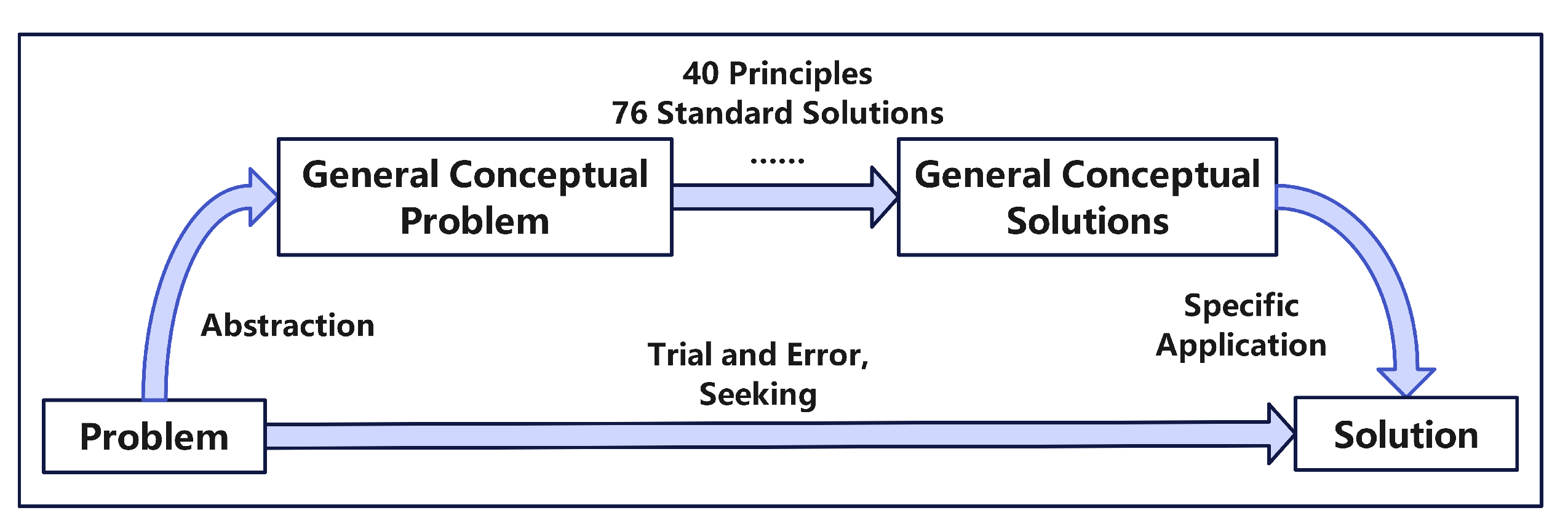
Figure 2.
TRIZ’s problem-solving process.
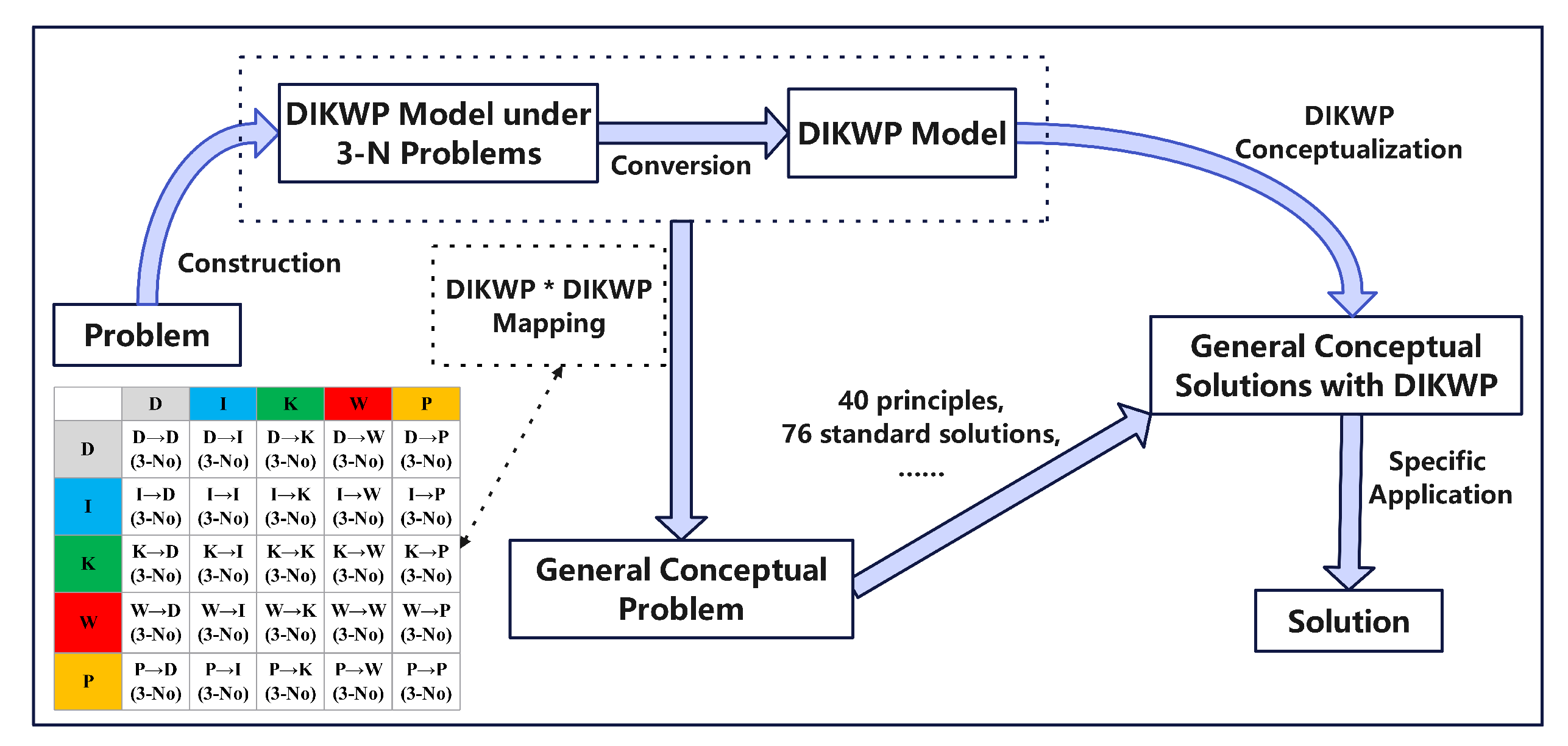
Figure 3.
Colored cell in the figure represent the DIKWP transformation processes mapped by TRIZ Inventive Principle 35, while the blank areas correspond to incomplete transformation processes between DIKWP elements within the cognitive space.
Figure 3.
Colored cell in the figure represent the DIKWP transformation processes mapped by TRIZ Inventive Principle 35, while the blank areas correspond to incomplete transformation processes between DIKWP elements within the cognitive space.
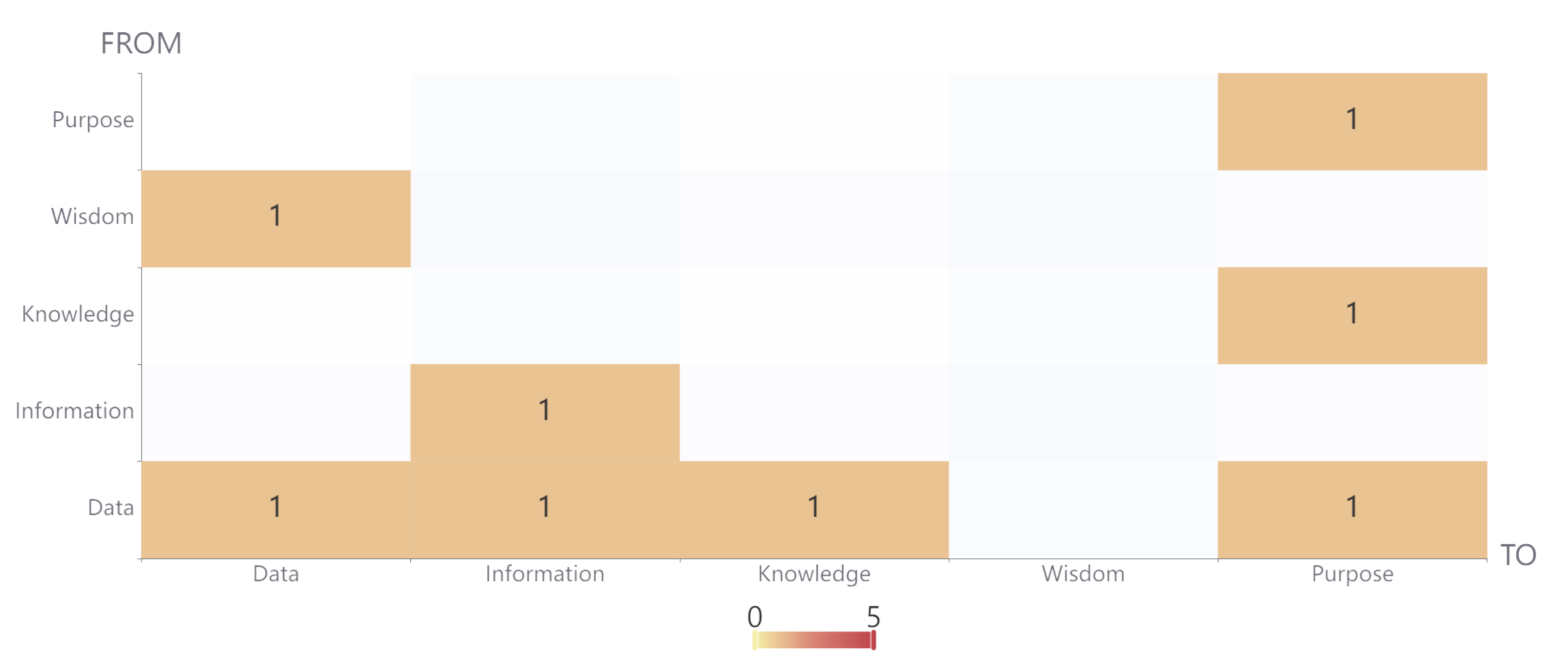
Figure 4.
This figure represents the heatmap matrix mapping between the DIKWP model and TRIZ inventive principles, where the numbers in the matrix indicate the number of covered TRIZ innovation methods.
Figure 4.
This figure represents the heatmap matrix mapping between the DIKWP model and TRIZ inventive principles, where the numbers in the matrix indicate the number of covered TRIZ innovation methods.
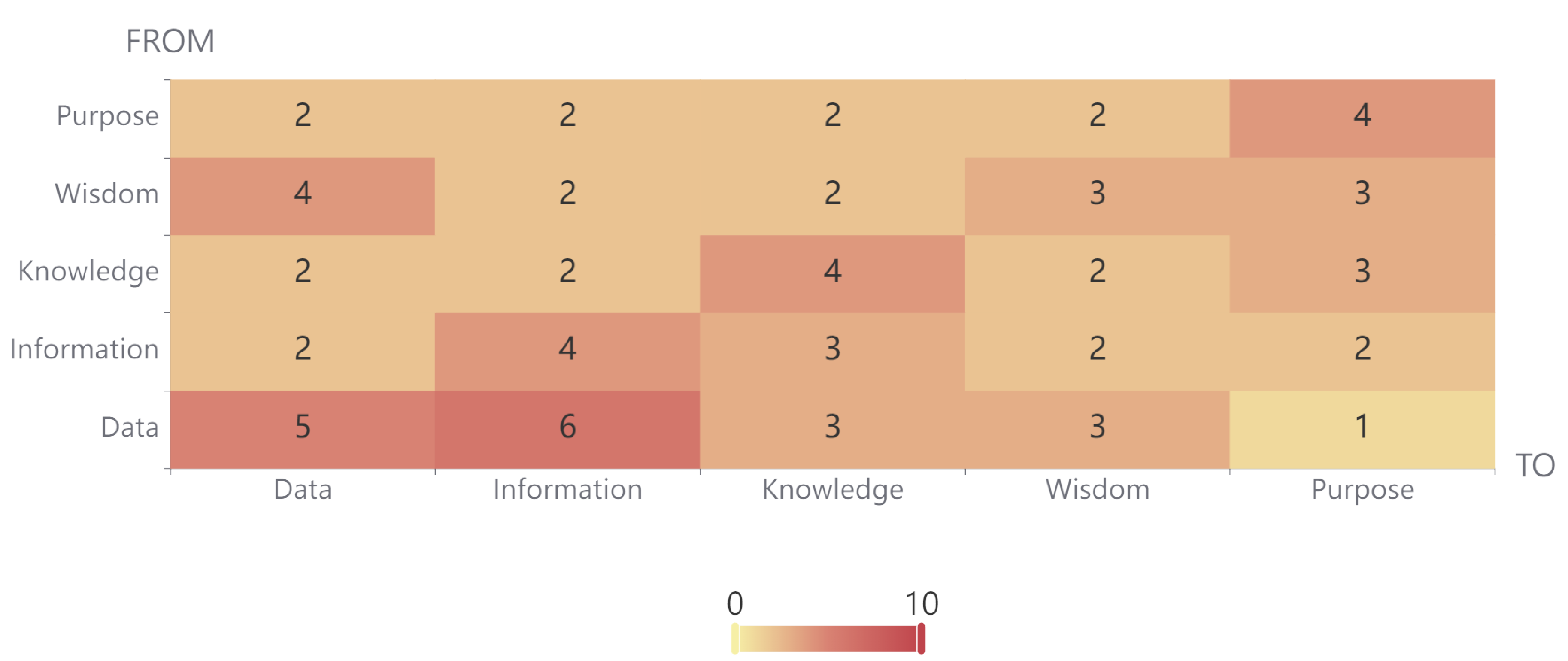
Figure 5.
This is a simplified state machine used to represent the operational process of the DIKWP-TRIZ method within the cognitive space. S1 represents the state in which the cognitive agent is actively searching for inventive principles, while S2 denotes the comparison state, where the system evaluates whether the identified principles meet the intended innovation goals. If the criteria are satisfied, the system returns to the standby state; otherwise, it proceeds with further S1 operations.
Figure 5.
This is a simplified state machine used to represent the operational process of the DIKWP-TRIZ method within the cognitive space. S1 represents the state in which the cognitive agent is actively searching for inventive principles, while S2 denotes the comparison state, where the system evaluates whether the identified principles meet the intended innovation goals. If the criteria are satisfied, the system returns to the standby state; otherwise, it proceeds with further S1 operations.
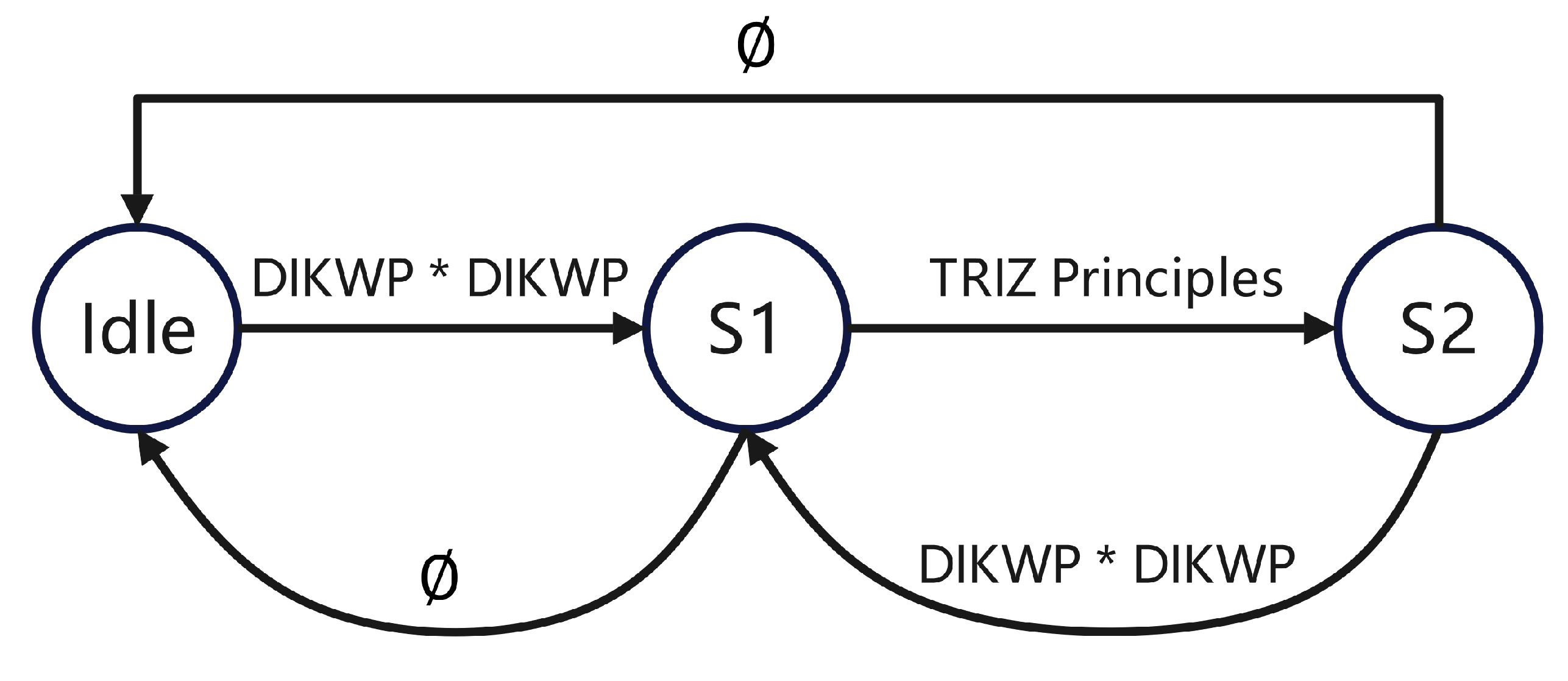

Table 1.
DIKWP element transformation corresponding to the TRIZ invention principle
| From / To | Data | Information | Knowledge | Wisdom | Purpose |
|---|---|---|---|---|---|
| Data | 1, 2, 5, 10, 35 | 3, 5, 9, 17, 28, 35 | 6, 24, 35 | 40 | 4, 11, 15, 35 |
| Information | 10, 22 | 13, 14, 17, 35 | 15, 24, 34 | 23, 32 | 16, 32 |
| Knowledge | 9, 25 | 3, 13 | 16, 22, 23, 34 | 15, 40 | 25, 31, 35 |
| Wisdom | 6, 24, 25, 35 | 16, 22 | 3, 23 | 15, 23, 34 | 7, 15, 34 |
| Purpose | 10, 23 | 6, 13 | 2, 15 | 36, 40 | 15, 25, 34, 35 |
Numbers in the table represent the numbering of the invention principles of TRIZ.
Table 2.
Comparative Analysis of DIKWP-TRIZ and Traditional TRIZ
| Aspects | Traditional TRIZ | DIKWP-TRIZ |
|---|---|---|
| Framework | Hierarchical structure (focuses on technical/physical contradictions) | Network structure (interaction among data-information-knowledge-wisdom-purpose) |
| Problem Focus | Technical contradictions (e.g., functionality vs efficiency) | Cognitive, semantic, and ethical contradictions, handling uncertainty in AI |
| Contradiction Handling Method | Uses 40 invention principles to resolve physical contradictions | Uses DIKWP network interactions to resolve incomplete data, inconsistent knowledge, etc. |
| Resolution Methods | Invention principles such as segmentation, separation, and merging | Transformations and complementarity among DIKWP elements, e.g., using data to correct knowledge or wisdom to resolve ethical conflicts |
| Innovation Process | Based on analysis of past inventions, deterministic and systematic | Adaptive, emergent, intent-driven, capable of handling incomplete/inconsistent input/output pairs |
| Uncertainty Handling | Assumes data is complete or clearly defined, focuses on technical solutions | Explicitly handles the "three-no" problems (incomplete, inconsistent, imprecise data) through semantic transformation |
| Focus on Cognitive Systems | Primarily used for solving technical problems in engineering and design | Aims to solve problems in AI, cognitive systems, artificial consciousness, emphasizing ethical AI and purpose-driven decision-making |
| Applicability | Engineering, product design, mechanical systems, manufacturing | AI development, large language models (LLMs), ethical decision-making, cognitive and semantic problem-solving |
| Ethical Issue Handling | Not designed to solve moral or ethical contradictions | Handles ethical dilemmas through integration of wisdom and intention, ensuring alignment with ethical principles in AI development |
| Invention Space | Based on hierarchical application of 40 principles | DIKWP interaction’s 5x5 network model, where all elements can influence each other (e.g., data can affect wisdom, knowledge can change data) |
| Application Scope | Engineering, industrial design, optimization, physical inventions | Artificial intelligence, consciousness systems, large-scale decision making, high-level ethical and semantic issue resolution |
| Complexity of Invention | Uses established principles to solve clearly defined technical problems | Solves high-complexity problems with unknown or incomplete data through transformation within the DIKWP space |
Disclaimer/Publisher’s Note: The statements, opinions and data contained in all publications are solely those of the individual author(s) and contributor(s) and not of MDPI and/or the editor(s). MDPI and/or the editor(s) disclaim responsibility for any injury to people or property resulting from any ideas, methods, instructions or products referred to in the content. |
© 2024 by the authors. Licensee MDPI, Basel, Switzerland. This article is an open access article distributed under the terms and conditions of the Creative Commons Attribution (CC BY) license (http://creativecommons.org/licenses/by/4.0/).
Copyright: This open access article is published under a Creative Commons CC BY 4.0 license, which permit the free download, distribution, and reuse, provided that the author and preprint are cited in any reuse.