

Submitted:
30 October 2025
Posted:
03 November 2025
You are already at the latest version
Abstract
In the era of rapid advancements in information technology and artificial intelligence, the concept of "hybrid wisdom" has emerged as a novel and increasingly vital approach to leveraging the synergy between human and machine intelligence. This paper provides a comprehensive conceptual analysis of hybrid wisdom, examining its multifaceted applications, concrete exemplars across diverse domains, and future prospects, while exploring its profound significance in industrial transformation, economic structures, societal evolution, and cybernetic studies. By synthesizing perspectives from cognitive science, systems theory, and artificial intelligence research, this work establishes hybrid wisdom as a foundational paradigm for twenty-first-century decision-making and governance systems. The paper further contextualizes hybrid wisdom within the frameworks of Industry 5.0 and Society 5.0, demonstrating how the integration of human and machine capabilities creates unprecedented opportunities for organizational excellence and social progress.
Keywords:
hybrid wisdom
; hybrid intelligence
; human wisdom
; machine wisdom
; collective intelligence
; data-information-knowledge-wisdom (DIKW) hierarchy
; neuro-symbolic ai
; industry 5.0
; society 5.0
; human-machine collaboration
; cybernetics
; artificial intelligence
; decision-making systems
; computational intelligence
Introduction
The contemporary landscape of organizational and societal challenges necessitates a fundamental reconceptualization of how knowledge and decision-making are structured. Human wisdom, enriched by experiential learning, logical reasoning, intuitive understanding, and conscious reflection, possesses distinctive capabilities rooted in subjective interpretation, contextual awareness, and moral-ethical grounding. Conversely, machine wisdom, leveraging hierarchical architectures that process data into information, knowledge, and eventually wisdom through computational methodologies, offers scalability, consistency, and the capacity to process vast information volumes at unprecedented speeds.
The integration of these two complementary forms of wisdom establishes the foundational substrate for developing novel governance paradigms and management framework [1]. These emerging paradigms manifest tangibly in Industry 5.0 and Society 5.0 paradigms [2], which represent conceptual and practical shifts toward human-centric yet technology-enabled systems. Rather than positioning humans and machines in competitive or hierarchical relationships, hybrid wisdom frameworks establish a symbiotic relationship that creates equilibrium and enhanced capability—transcending the limitations of exclusive reliance on either human judgment or machine computation alone [3,4,5,6,7,8].
This integration addresses critical gaps in both domains: human judgment, while contextually rich and ethically grounded, is susceptible to cognitive biases, limited by processing capacity, and constrained by temporal availability; machine computation, while rapid and exhaustive, often lacks contextual sensitivity, ethical reasoning, and adaptability to unprecedented scenarios [9,10]. The synthesis of these capabilities creates a higher-order intelligence system capable of meeting the demands of complex [11], rapidly evolving organizational and societal environments. It is also an element for post-AI and post-postmodernism era [12].
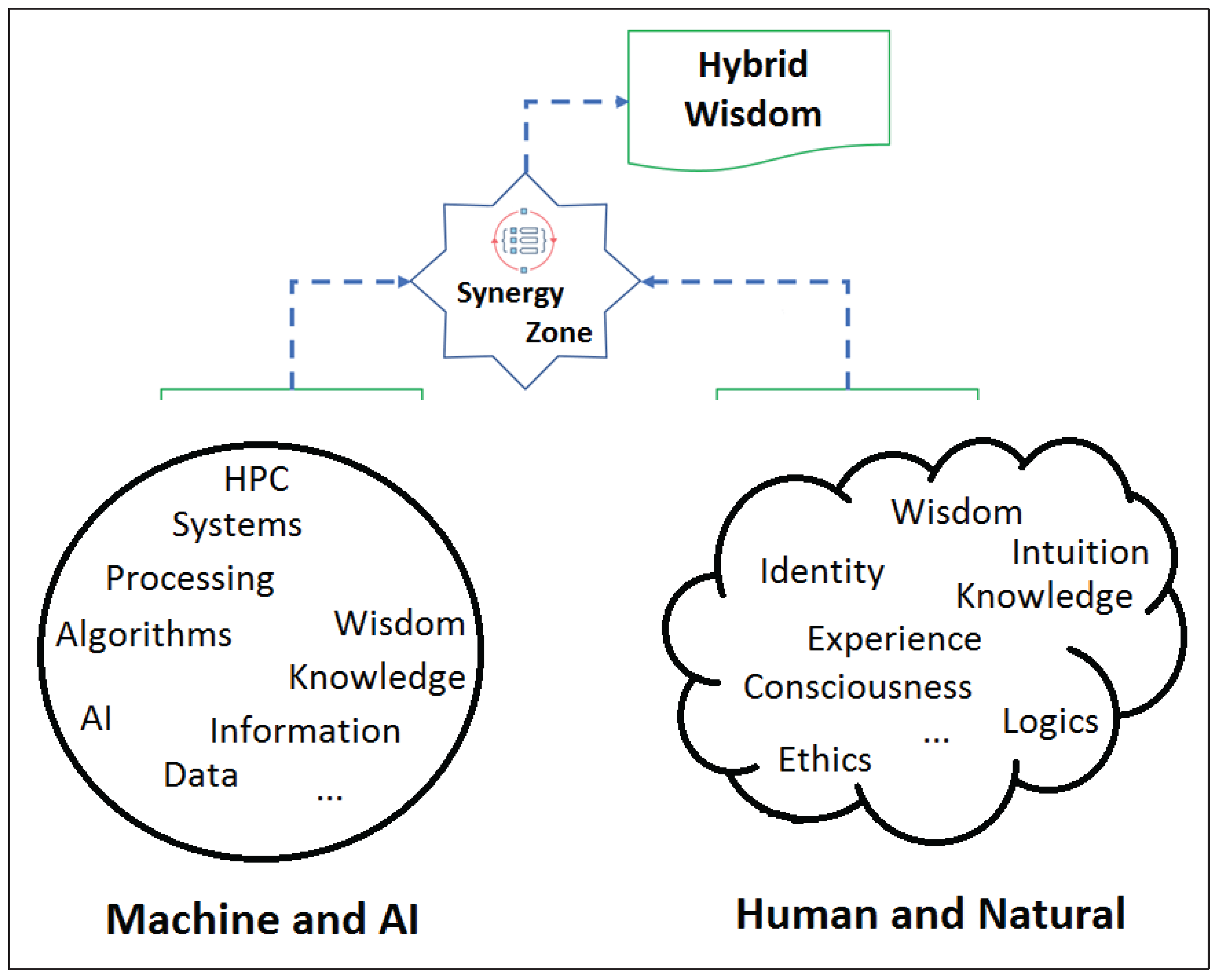
Figure 1.
Conceptual diagram of whole architecture for Hybrid Wisdom [13].
Figure 1.
Conceptual diagram of whole architecture for Hybrid Wisdom [13].
Definition and Conceptual Framework
Foundational Conceptualization
Hybrid wisdom represents an elevated and integrated level of human-machine intelligence and wisdom manifest in practical applications of computational artificial intelligence and human-centered systems design. This wisdom emerges not merely from the aggregation of human [14] and\or machine contributions [15,16], but rather from the synergistic and systematic combination that amplifies the distinctive advantages while mitigating the inherent limitations of each component [17,18,19].
Human wisdom encompasses multifaceted dimensions including experiential knowledge accumulated through lived experience, complex reasoning capabilities developed through education and reflection, creative insight emerging from intuitive processing, domain expertise refined through extended practice, conscious reflection and metacognition, and moral-ethical judgment grounded in value systems and social understanding. These elements constitute what might be termed the “qualitative dimension” of wisdom—characterized by contextual sensitivity, normative reasoning, and subjective interpretation.
Machine wisdom, by contrast, operates through distinct mechanisms: the processing and organization of raw data into structured information, the synthesis of information into generalized patterns and knowledge models, the application of logical inference and statistical reasoning to extract meaning, and the capacity for exhaustive analysis across domains impossible for human cognition. These constitute the “quantitative dimension” of wisdom—characterized by scalability, reproducibility, and objective mathematical grounding.
Hybrid wisdom, at its highest conceptualization, serves as a dynamic bridge between these two domains, enabling the integration of human qualitative understanding with machine quantitative capacity. Within the Data, Information, Knowledge, and Wisdom (DIKW) hierarchical model [20], hybrid wisdom occupies a meta-level position, not merely as a stage within the hierarchy but as a governance structure that orchestrates the transformation at all levels of the hierarchy. This framework recognizes that optimal decision-making in complex environments requires both the pattern recognition and optimization capabilities of machines [21] alongside the contextual sensitivity and ethical reasoning of humans [22].
Theoretical Foundations
The conceptual architecture of hybrid wisdom rests upon several theoretical pillars. First, systems theory provides the organizational framework, recognizing that complex systems require heterogeneous components with complementary capabilities to achieve comprehensive solutions. Second, information theory establishes the mathematical substrate through which data transformations occur. Third, cognitive science provides insights into the mechanisms of human reasoning, decision-making, and learning that inform how human capabilities can be most effectively integrated with machine systems [23,24].
Relationship with Cybernetics and Cognitive Sciences
Historical Contextualization
The intellectual lineage of hybrid wisdom extends into foundational work in cybernetics—the study of control and communication in complex systems, whether mechanical or biological. Norbert Wiener’s pioneering work established the principle that effective control of complex systems requires feedback mechanisms and adaptive responses that characterize both living organisms and sophisticated machines. Contemporary extensions of cybernetic theory recognize that the most sophisticated adaptive systems combine heterogeneous control mechanisms: the rapid, deterministic responses of mechanical systems with the contextual, learning-based responses of biological systems.
Contemporary Integration
Recent findings in the interdisciplinary convergence of cognitive science, systems cybernetics, and artificial intelligence research provide compelling evidence that in the coming decades, the systematic integration of human intelligence and artificial intelligence capabilities will catalyze the emergence of fundamentally new patterns of governance, public administration, organizational management, and knowledge creation. This synergy operates at multiple levels simultaneously: at the technological level, through advances in human-computer interface design and collaborative AI systems; at the organizational level, through the restructuring of workflows and decision processes; and at the societal level, through the transformation of institutions and social practices.
This integration manifests concretely at both technological and socio-organizational process levels in the form of Industry 5.0 and Society 5.0 frameworks. Industry 5.0 conceptualizes manufacturing and production as fundamentally human-centered yet technology-enabled systems where digital automation serves human creativity, judgment, and values. Society 5.0 extends this framework societally, envisioning social systems where artificial intelligence, big data, and digital technologies are seamlessly integrated to solve societal challenges while maintaining human agency, dignity, and social cohesion.
The prospect of systematic coordination and collaboration between human agents and intelligent computational systems—whether deployed in social domains, productive economic domains, or governance domains—has received intensifying attention from interdisciplinary research communities. This attention reflects recognition that neither purely human-directed systems nor fully automated systems adequately address the complexity, scale, and dynamism of contemporary challenges. Hybrid systems, by contrast, leverage the complementary strengths of both paradigms.
Concrete Examples and Applications
1. Integration of Human Wisdom in Complex Data Analysis
In contemporary data science and business intelligence applications, the integration of deep human interpretation with machine-driven data processing illustrates hybrid wisdom’s practical value. When organizations face massive datasets, machine learning algorithms can identify patterns, correlations, and anomalies with statistical precision impossible for human analysts to achieve. However, the interpretation of these patterns—determining their causal significance, contextual meaning, business relevance, and actionability—fundamentally requires human judgment.
Consider pharmaceutical research, where machine learning algorithms process massive genomic datasets to identify candidate proteins for drug development. Yet the determination of which candidate compounds merit investment, how they might interact with biological systems in unpredictable ways, and whether they address genuine therapeutic needs requires scientific wisdom grounded in biological theory, clinical experience, and regulatory understanding. The hybrid approach combines algorithmic pattern discovery with human expert interpretation, yielding research directions that neither approach alone could have generated.
Similarly, in financial markets, quantitative algorithms identify trading opportunities through pattern recognition in historical data, while human traders provide contextual interpretation regarding geopolitical events, regulatory changes, and market psychology that influence whether identified patterns remain valid. The hybrid system—combining algorithmic speed and exhaustiveness with human contextual judgment—consistently outperforms systems relying exclusively on either approach.
2. The Art and Science of Prompt Engineering
The emergence of large language models (LLMs) as general-purpose intelligence systems has created an entirely new domain exemplifying hybrid wisdom: prompt engineering. This discipline represents the art of translating human intention, domain expertise, and contextual understanding into precise specifications that guide machine generation of relevant, high-quality outputs.
Prompt engineering fundamentally requires a hybrid capability: the engineer must possess deep understanding of human language, the domain context requiring solution, the psychological and communicative framing that influences how problems are understood, and simultaneously must understand machine language models’ architecture, training dynamics, and failure modes. Expert prompt engineers combine rapid and creative understanding of user needs—developed through empathetic listening and contextual questioning—with swift, precise execution of those requirements through technically sophisticated machine instructions.
This creates a synergistic relationship: humans contribute interpretive depth, contextual sensitivity, and intention-to-specification translation; machines provide scalable solution generation, exhaustive exploration of solution spaces, and consistent output quality. The results—refined research hypotheses, creative problem solutions, educational content, and technical documentation—demonstrate capabilities that neither human nor machine could achieve independently. A human acting alone would face the cognitive load and time constraints of generating extensive, varied solutions; a machine acting alone would lack the contextual understanding to generate solutions addressing the human’s actual underlying needs.
3. Systematic Combination of Expert Human Opinions with AI Insights
Organizations increasingly employ methodologies that systematize the integration of expert human judgment with machine-generated insights. In strategic forecasting, for example, organizations combine structured expert elicitation—where domain experts provide probabilistic judgments about future events based on their experiential knowledge and contextual understanding—with machine-driven analysis of historical data, trend analysis, and scenario modeling.
This hybrid approach addresses the distinctive limitations of each component: expert judgment, while grounded in deep domain knowledge, exhibits well-documented cognitive biases including anchoring effects, availability heuristics, and overconfidence. Machine analysis, while providing objective statistical grounding, often misses unprecedented shifts or fails to account for qualitatively new conditions that lack historical precedent. The systematic integration—where machine analysis identifies potential biases in expert estimates and experts contextualize machine-generated forecasts within their understanding of domain-specific causal mechanisms—produces superior predictions to either approach alone.
Big data analysis in these integrated systems enables identification of correlations that individual human experts might overlook, while expert judgment identifies which correlations represent spurious associations versus causally meaningful relationships. The hybrid approach simultaneously amplifies the strengths of both domains while constructively addressing the limitations of each through the complementary contributions of the other.
4. Industrial Revolution Experiences and Historical Lessons
The history of industrial development provides instructive precedent for understanding hybrid intelligence systems. Each wave of mechanization—from water-powered mills through steam engines, electrical machinery, computerized automation, and now AI-driven systems—initially provoked fears of human displacement and unemployment. Yet the actual historical pattern demonstrates something more complex: mechanization fundamentally transformed the nature of human work rather than eliminating it.
The first industrial revolution, rather than creating mass unemployment, ultimately generated entirely new categories of human employment centered on machine operation, maintenance, calibration, and improvement. Humans and machines developed complementary relationships: machines handled repetitive, physically demanding, or dangerous tasks with consistency; humans handled tasks requiring judgment, creativity, and adaptability. This pattern recurred through successive technological waves.
Contemporary evidence suggests that AI and automation follow similar dynamics. Rather than wholesale elimination of human work, empirical studies demonstrate that AI-augmented human workers (and\or artists, knowledge workers or even managers\leaders) consistently outperform both unaugmented humans and autonomous AI systems [25,26,27,28,29]. A biologist equipped with AI assistance correctly identifies more pathologies than either an unaided biologists or an autonomous AI system [30]; a software developer using AI code generation tools produces higher-quality code than either a developer coding without assistance or a fully autonomous code-generation system. These findings suggest that the optimal organizational configuration involves systematic human-machine cooperation structured through hybrid intelligence frameworks.
The prospect of stable, productive employment and organizational effectiveness increasingly depends not on humans competing with machines or machines displacing humans, but rather on structuring work processes so that human judgment, creativity, and contextual understanding work synergistically with machine speed, precision, and exhaustiveness. Organizations successfully implementing such structures develop competitive advantages in innovation, quality, and adaptability compared to organizations relying exclusively on automation or traditional human-only approaches.
5. Emerging Technologies and Human Insight Intelligence
Recent technological developments underscore the practical imperative for hybrid intelligence frameworks. The emergence of “Human Insight Intelligence” technology—characterized by AI systems specifically designed to surface, organize, and present human experiential knowledge and intuitive judgments—represents explicit engineering for hybrid intelligence. These systems recognize that valuable organizational knowledge often resides in experienced practitioners’ intuitive understandings, mental models, and contextual interpretations that formal documentation fails to capture.
Human Insight Intelligence technologies employ conversational interfaces, contextual question-generation, and adaptive elicitation protocols to extract and systematize this tacit human knowledge. The systems then integrate this human-derived intelligence with machine-driven analysis, creating decision-support systems that combine human experiential grounding with machine analytical capability. Such systems demonstrate particular value in organizational contexts where precedent and deep contextual understanding crucially influence decision quality—strategic planning, crisis management, technology adoption, and innovation initiatives.
The Gartner Hype Cycle 2025 explicitly identifies human-centered AI and hybrid intelligence as emerging critical technologies precisely because empirical organizational experience demonstrates their value in addressing real business challenges. This recognition from industry analysis validates the theoretical significance of hybrid wisdom while evidencing practical organizational adoption.
The DIKW Hierarchical Model: Expanded Analysis
Foundational Architecture
The Data-Information-Knowledge-Wisdom (DIKW) hierarchy provides a conceptual framework for understanding progressive transformations in meaning-making and decision relevance. This model posits four hierarchically-related stages of transformation in how raw phenomena become actionable understanding:
Data represents the foundational level—raw, undifferentiated observations, measurements, or recordings of phenomena. Data consists of isolated facts without inherent meaning or relationship to broader contexts. A sensor recording temperature measurements generates data; a database storing transaction records contains data; survey responses represent data. At this level, information content is purely nominal—facts exist but lack organization or significance.
Information emerges when data becomes organized, processed, and structured in ways that establish relationships and context. Information represents data to which meaning has been assigned through categorization, arrangement, and interpretation. When temperature measurements are aggregated by region and time period, they become information about weather patterns; when transaction records are analyzed for purchasing trends, they become information about consumer behavior. Information provides context and relationship but does not yet imply causation or deeper understanding.
Knowledge represents the next transformational stage, involving interpretation and analysis grounded in expertise, experience, and intuitive understanding. Knowledge synthesizes information through frameworks developed from extended study, practice, and reflection. A meteorologist’s understanding of atmospheric systems that enables weather prediction represents knowledge—it integrates information about atmospheric measurements with theoretical understanding of physical processes. Knowledge incorporates explanation and causal understanding; it answers not merely “what is happening” but “why is it happening and what does it mean.”
Wisdom, at the apex of the hierarchy, represents the capacity for correct and purposeful decision-making within comprehensive, value-based contexts. Wisdom integrates knowledge with ethical judgment, contextual understanding of consequences, and reflective awareness of how decisions affect broader systems. Wisdom answers not merely “what should be done” but “what should be done in service of what values and with what consequences for which stakeholders.”
Hybrid Wisdom as Meta-Level Integration
Hybrid wisdom occupies a distinctive position relative to this hierarchy. Rather than existing purely as another level above wisdom, hybrid wisdom functions as a meta-level principle governing how the entire transformation process operates. Hybrid wisdom principles should guide how data is selected and collected (recognizing that data collection itself embodies values and contextual choices), how information is organized and presented, how knowledge is synthesized and represented, and ultimately how wisdom informs decision-making.
Concretely, hybrid wisdom in data collection recognizes that determining which phenomena merit measurement requires human judgment about significance and relevance—pure machine-driven data collection produces information overload without clear decision value. In information organization, hybrid wisdom ensures that machine-driven data processing serves human interpretive needs rather than forcing human cognition to conform to machine-convenient data structures. In knowledge synthesis, hybrid wisdom enables machine identification of patterns and correlations to be grounded by human expert judgment about theoretical significance and causal interpretation. In wisdom-guided decision-making, hybrid wisdom ensures that machine optimization serves human values and human wisdoms rather than either autonomous machine decision-making that lacks value-grounding or human decision-making that ignores relevant evidence and analytical capability.
The DIKW hierarchy therefore represents not a series of stages humans and machines independently traverse, but rather a cooperative process in which human contextual judgment and machine analytical capability interactively operate at each level, creating progressively richer understanding in service of effective decision-making.
Neuro-Symbolic AI: Combining Symbolic and Machine Learning
Theoretical Integration
Recent developments in artificial intelligence research have catalyzed the emergence of “Neuro-Symbolic AI” as a sophisticated approach to hybrid intelligence that addresses critical limitations in both traditional machine learning and symbolic AI systems. This paradigm represents explicit engineering of hybrid principles at the algorithmic level.
Traditional machine learning, particularly deep neural networks, excels at pattern recognition, generalization from training data, and performance optimization across vast parameter spaces. Neural approaches demonstrate remarkable success in perceptual tasks (image recognition, speech understanding) and complex pattern matching. However, neural systems often exhibit limited interpretability—practitioners struggle to explain specifically why a system made particular decisions. Neural systems also exhibit brittleness to out-of-distribution scenarios and require enormous quantities of training data to develop robust performance. Most critically for many applications, neural systems struggle with symbolic reasoning, logical inference, and the kind of explicit causal reasoning essential for many decision domains.
Symbolic AI, by contrast, excels at explicit logical reasoning, transparent inference chains, and handling novel situations through formal rules and causal models. Symbolic systems can explain their reasoning comprehensively and handle situations requiring formal logical manipulation. However, symbolic systems require extensive hand-engineering of rules and knowledge representations—a process termed the “knowledge engineering bottleneck.” Symbolic systems struggle with perceptual tasks, adaptation to changing environments, and the kind of probabilistic reasoning under uncertainty essential in real-world applications.
Neuro-Symbolic AI attempts to integrate these complementary capabilities: combining neural networks’ pattern learning strength and adaptability with symbolic reasoning’s logical transparency and explicit causal modeling. Such systems employ neural components for perception, pattern recognition, and feature learning, while employing symbolic components for reasoning, explanation, and handling of logical constraints. The integration addresses critical gaps in each approach: neural components ground symbolic reasoning in empirical pattern recognition while symbolic components provide the logical structure and interpretability that neural systems lack.
Practical Implementation and Implications
Implementations of Neuro-Symbolic AI demonstrate marked improvements across multiple dimensions. Systems combining neural and symbolic components typically achieve higher accuracy than purely neural approaches on problems requiring both perceptual capability and explicit reasoning. The symbolic components enable explicit representation and verification of constraints and rules, reducing errors and bias compared to purely learned neural systems. The interpretability improves dramatically—practitioners can trace system reasoning through both learned pattern recognition (interpreted through saliency analysis and attention mechanisms) and explicit symbolic reasoning chains. Security and robustness improve as well; adversarial perturbations that fool purely neural systems often fail against hybrid systems because the symbolic component can explicitly verify logical constraints that the adversarial examples violate.
Perhaps most significantly, Neuro-Symbolic AI systems achieve substantially better generalization to novel situations. When facing scenarios beyond their training distribution, symbolic components can apply explicit causal reasoning while neural components handle novel pattern recognition. This generalization capability has profound implications: it suggests that hybrid systems can operate effectively in genuinely uncertain, novel environments rather than merely within the distributions represented in training data.
Advantages, Challenges, and Future Trajectories of Hybrid Wisdom
Multifaceted Advantages
The practical implementation of hybrid wisdom frameworks across organizational, industrial, and societal contexts has generated empirical evidence of substantial advantages across multiple dimensions:
Higher Accuracy and Reliability emerges as hybrid systems access both the statistical rigor and exhaustive analytical capability of machines alongside the contextual judgment and intuitive reasoning of humans. When facing novel or ambiguous situations, human judgment can identify when machine recommendations may be unreliable; when facing massive information volumes, machine processing identifies patterns humans might miss. The combination produces more reliable assessments than either alone.
Enhanced Interpretability represents a significant advantage for regulated domains and safety-critical applications. Hybrid systems can provide explicit explanation for recommendations—both through machine-generated logical chains and human expert contextualization. This transparency builds organizational and regulatory confidence compared to “black box” systems whose reasoning cannot be explained. Stakeholder confidence and legitimate authority increase when decision-makers can understand and verify system reasoning.
High Flexibility and Adaptability characterizes hybrid systems confronting changing environments and novel challenges. Machines handle consistency and optimization within established parameters; humans recognize when environments have fundamentally changed and parameters require revision. An adaptive hybrid system continuously incorporates human feedback about whether machine recommendations remain appropriate or require recalibration. This flexibility enabled organizations implementing hybrid intelligence to respond more effectively to unprecedented challenges—the COVID-19 pandemic, supply chain disruptions, and rapidly evolving competitive landscapes.
Greater Resilience against both technical failures and strategic adversarial challenges characterizes hybrid systems. When machine systems fail or produce anomalous recommendations, human oversight identifies the problem; when human judgment proves inadequate, machine systems provide alternative perspectives. Adversarial attacks targeting machine systems often fail when symbolic reasoning components verify that logically invalid or ethically problematic recommendations have been generated. Organizational resilience increases substantially when no single point of failure—neither human error nor machine malfunction—can unilaterally compromise system performance.
Improved Decision Quality in complex, ambiguous domains where stakes are high has been empirically demonstrated across healthcare, finance, strategic planning, and crisis management domains. Decision-making that integrates machine-derived insights with human expert judgment consistently outperforms either humans or machines acting independently. This improvement has been quantified in numerous domains: hybrid diagnostic systems in medicine achieve higher accuracy than either physicians or AI systems alone; hybrid forecasting systems produce superior predictions compared to either statistical models or pure expert judgment.
Magnitude of Enhancement across organizational performance, economic productivity, and innovation capacity can be substantial—often described as “orders of magnitude” improvements in specific domains. Organizations systematically implementing hybrid intelligence frameworks report not merely incremental improvements but fundamental transformations in organizational capability, from 2-3x improvements in diagnostic accuracy in medical domains to similar magnitudes of improvement in manufacturing quality, research productivity, and strategic decision-making effectiveness.
Enhanced Organizational Confidence in confronting artificial intelligence technologies emerges when organizations transition from viewing AI as a threatening displacement technology to recognizing it as a tool amplifying human capability. This psychological shift has organizational culture implications: employees understand their expertise as complementary to machine capability rather than competitors with it; organizational leadership approaches AI deployment as capability enhancement rather than cost reduction; society experiences AI advancement as empowering human potential rather than threatening human employment.
Substantive Challenges and Implementation Obstacles
Despite apparent advantages, implementing hybrid wisdom frameworks confronts significant challenges requiring deliberate organizational attention:
Integration Complexity represents perhaps the most fundamental technical challenge. Designing systems where human and machine components function synergistically requires sophisticated engineering addressing data formats, interface design, workflow integration, and decision-making protocols. The technical complexity often exceeds that of purely machine systems or traditional human-only processes. Integration failures can result in hybrid systems that are more unreliable than either component alone—humans and machines working at cross-purposes, contradicting one another, or duplicating effort.
Development Costs for hybrid systems typically exceed those of either human-only or fully automated approaches. Infrastructure costs include building the technological systems facilitating human-machine collaboration; training costs include developing human expertise in working effectively with AI systems; and ongoing maintenance costs exceed those of purely human systems because technological components require continuous updating as AI systems and interfaces evolve. These costs limit hybrid wisdom implementation to organizations with substantial resources and create economic barriers to broader adoption.
Ethical Standards and Governance requirements become more complex in hybrid systems where responsibility for decisions and outcomes becomes ambiguous. When a human makes a decision, human responsibility is clear; when a machine makes a decision, machine responsibility (or more accurately, the responsibility of the organization operating the machine) is defined. When hybrid systems make decisions through integrated human-machine processes, determining responsibility for errors becomes genuinely ambiguous. Did the decision fail because of human judgment error, machine analytical failure, or failure of the integration process itself? Legal and ethical frameworks for hybrid systems remain underdeveloped, creating regulatory and liability uncertainty.
Security Requirements multiply in hybrid systems compared to either humans or machines alone. Purely human organizations face social engineering and interpersonal security challenges; purely machine systems face cybersecurity challenges. Hybrid organizations confront both simultaneously plus the additional security challenge of the integration points. Sophisticated adversaries targeting hybrid systems can exploit either human vulnerabilities or machine vulnerabilities; the hybrid attack surface is substantially larger than either component alone.
Workforce Transition and Organizational Change Management requires careful attention. Organizations implementing hybrid wisdom frameworks fundamentally transform job descriptions, required skills, and organizational relationships. Incumbent employees may experience implementation as threatening; newer employees must be trained in hybrid work practices from the outset. The organizational change management challenges of transitioning from traditional hierarchies to integrated human-machine teams can prove substantial and require executive commitment extending beyond initial implementation.
Future Trajectories and Emerging Opportunities
Looking forward, several developments appear likely to shape hybrid wisdom’s evolution and organizational implementation:
Advancement in Human-Computer Interface Design will reduce integration complexity and enhance the intuitiveness of human-machine collaboration. As interfaces become more natural, conversational, and context-aware, the cognitive load on humans collaborating with machines will decrease. This interface improvement will expand hybrid wisdom’s applicability to less technically sophisticated domains and smaller organizations.
Development of Standardized Frameworks and Best Practices for hybrid system design, implementation, and governance will accelerate adoption by providing clear implementation pathways. Industry consortia, professional associations, and academic institutions are beginning to establish such standards; as these mature, adoption barriers will lower.
Ethical and Legal Framework Development will provide clarity regarding responsibility, accountability, and acceptable risk levels in hybrid systems. As these frameworks emerge through combination of regulatory development, professional standard-setting, and organizational practice, the legal and ethical uncertainties currently inhibiting hybrid implementation will diminish.
Organizational Culture Evolution toward recognition of AI as capability-amplifying rather than employment-threatening will facilitate workforce adoption. As organizations accumulate successful experiences with hybrid systems and communicate these experiences internally and externally, cultural perceptions will shift—already visible in leading organizations implementing hybrid intelligence successfully.
Expansion Across Domains will accelerate from early-adopter domains (healthcare, finance, advanced manufacturing) to broader sectors. Educational systems implementing hybrid learning (combining personalized AI tutoring with expert human instruction), governmental agencies implementing hybrid intelligence for policy analysis and service delivery, and social organizations leveraging hybrid systems for community benefit will progressively expand hybrid wisdom’s reach and validate its value across societal sectors.
Conclusion
Hybrid wisdom, arising from the deliberate mixing, coordination, convergence, systematic combination, and integration of human wisdom and machine wisdom across multiple organizational and technological forms, provides a transformative model for maximizing the distinctive capabilities of both human and technological domains while simultaneously mitigating the characteristic limitations of each. Rather than viewing human intelligence and artificial intelligence as competitors locked in zero-sum competition for dominance, hybrid wisdom conceptualizes them as fundamentally complementary capabilities whose integration produces higher-order intelligence and capability than either could achieve independently.
The evidence—both theoretical from cognitive science and cybernetics, and empirical from organizational implementation—demonstrates that the trend toward Industry 5.0 and Society 5.0, fundamentally predicated upon structured human-machine interaction and cooperation, will progressively transform organizational structures, economic processes, and social systems. Hybrid wisdom will function as a pivotal conceptual and practical framework enabling this transformation. Rather than future society characterized by either human obsolescence beneath dominant machines or technological stagnation from human reluctance to engage with powerful tools, hybrid wisdom enables trajectories where advancing technology amplifies expanding human potential while preserving human agency, values, and dignity.
The expansion of technologies and systems based on human-machine synergy has opened unprecedented new horizons in cognitive sciences’ understanding of intelligence itself, in the development of intelligent industries capable of addressing contemporary economic and environmental challenges, in decision-making systems of sufficient sophistication to handle genuine complexity without sacrificing explainability or ethical grounding, and in the creation of innovative human society where technological capability serves human flourishing rather than undermining it.
The organizations, communities, and societies that most successfully navigate the coming decades will likely be those that embrace hybrid wisdom as a foundational principle—structuring their systems, practices, and cultures around the deliberate integration of human expertise, judgment, and values with machine capability, speed, and analytical exhaustiveness. This integration represents not a temporary expedient during technological transition but rather the emergent optimal architecture for complex problem-solving in an era where neither human nor machine capability alone proves sufficient for the challenges and opportunities confronting us.
References
- Besharatim, M.R.; Izadi, M. DD-KARB: data-driven compliance to quality by rule based benchmarking. J. Big Data 2022, 9, 103. [Google Scholar] [CrossRef]
- Ferreira, C.M.; Serpa, S. Society 5.0 and social development. Manag. Organ. Stud. 2018, 5, 26–31. [Google Scholar] [CrossRef]
- Jafari, N.; Besharati, M.R.; Hourali, M. SELM: Software Engineering of Machine Learning Models. In New Trends in Intelligent Software Methodologies, Tools and Techniques; IOS Press: Amsterdam, The Netherlands, 2021; pp. 48–54. [Google Scholar]
- BourBour, S.; Besharati, M.R. Wise and Complex Enterprise Architecture for FMIS. Preprints 2025, 2025091272. [Google Scholar] [CrossRef]
- Schoenegger, P.; Tuminauskaite, I.; Park, P.S.; Bastos, R.V.S.; Tetlock, P.E. Wisdom of the silicon crowd: LLM ensemble prediction capabilities rival human crowd accuracy. Sci. Adv. 2024, 10, eadp1528. [Google Scholar] [CrossRef]
- Mestre, A. Towards a Hybrid Intelligence Paradigm: Systematic Integration of Human and Artificial Capabilities. In International Conference on Research Challenges in Information Science; Springer Nature: Cham, Switzerland, 2024; pp. 149–156. [Google Scholar]
- Dellermann, D.; Ebel, P.; Söllner, M.; Leimeister, J.M. Hybrid intelligence. Bus. Inf. Syst. Eng. 2019, 61, 637–643. [Google Scholar] [CrossRef]
- Zhang, W.; Feng, L.; Liu, J.; Mao, J.; Qiao, L.; Ruan, F. The World of Dual-Brain; Springer: Cham, Switzerland, 2022. [Google Scholar]
- Agrawal, A.; Gans, J.S.; Goldfarb, A. Exploring the impact of artificial intelligence: Prediction versus judgment. Inf. Econ. Policy 2019, 47, 1–6. [Google Scholar] [CrossRef]
- Noor, A.K. Potential of cognitive computing and cognitive systems. Open Eng. 2015, 5, 75–88. [Google Scholar] [CrossRef]
- Besharati, M.R.; Izadi, M. Langar: An Approach to Evaluate Reo Programming Language. arXiv 2021, arXiv:2103.04648. [Google Scholar] [CrossRef]
- Ameli, S.R., Quranic Strategies and Artificial Intelligence Innovations: Strengthening or Weakening Humanity, The Long View, Quarterly Magazine, Volume 7, Issue 2, 2025.
- Besharati, M.R.; Izadi, M. Semantics Based Compliance Solving. Ph.D. Thesis, Sharif University of Technology, Tehran, Iran, 2024. [Google Scholar]
- Mahini, M. AI-Driven Crypto Trading & Insights. Available online: https://wisdomise.com/en, 2025.
- Sabour, S.; Frosst, N.; Hinton, G.E. Dynamic routing between capsules. Adv. Neural Inf. Process. Syst. 2017, 30, 3859–3869. [Google Scholar]
- Younesi, A.; Ansari, M.; Fazli, M.; Ejlali, A.; Shafique, M.; Henkel, J. A comprehensive survey of convolutions in deep learning: Applications, challenges, and future trends. IEEE Access 2024, 12, 41180–41218. [Google Scholar] [CrossRef]
- Jarrahi, M.H.; Lutz, C.; Newlands, G. Artificial intelligence, human intelligence and hybrid intelligence based on mutual augmentation. Big Data Soc. 2022, 9, 20539517221142824. [Google Scholar] [CrossRef]
- Passerini, A.; Gema, A.; Minervini, P.; Sayin, B.; Tentori, K. Fostering effective hybrid human-LLM reasoning and decision making. Front. Artif. Intell. 2025, 7, 1464690. [Google Scholar] [CrossRef] [PubMed]
- Mogaji, R.I.; Motadegbe, A.O. The Synergy of Minds and Machines: Rethinking the AI-HI Relationship through Dialectical Reconstruction. Àgídìgbo ABUAD J. Humanit. 2025, 13, 265–280. [Google Scholar] [CrossRef]
- Wu, J.; Mei, X.; Mao, R.; He, K.; Cambria, E. TAKECare: A temporal-hierarchical framework with knowledge fusion for personalized clinical predictive modeling. Inf. Fusion 2025, 126, 103620. [Google Scholar] [CrossRef]
- Deng, Z.; Ma, W.; Han, Q.-L.; Zhou, W.; Zhu, X.; Wen, S.; Xiang, Y. Exploring DeepSeek: A Survey on Advances, Applications, Challenges and Future Directions. IEEE/CAA J. Autom. Sin. 2025, 12, 872–893. [Google Scholar] [CrossRef]
- Heruka.Ai. Ai. Heruka.Ai—Ethics & Sovereignty For Ai Cognitive Computing; Heruka.Ai: Luxembourg, 2025. [Google Scholar]
- Spence, E.H. Wisdom in the Age of Intelligent Machines. Springer: Cham, Switzerland, 2025.
- Jeste, D.V.; Graham, S.A.; Nguyen, T.T.; Depp, C.A.; Lee, E.E.; Kim, H.-C. Beyond artificial intelligence: exploring artificial wisdom. Int. Psychogeriatr. 2020, 32, 993–1001. [Google Scholar] [CrossRef] [PubMed]
- Ströbel, P.B.; Maier, F.K. Re-Experiencing History: A Platform for the Re-Enactment of Historical Events with Multimodal Large Language Models; University of Zurich: Zurich, Switzerland, 2025; pp. 510–511. [Google Scholar]
- Ströbel, P.B.; Guo, Z.; Karagöz, Ü.; Willi, E.M.; Maier, F.K. Bringing Rome to life: evaluating historical image generation. In Proceedings of the CEUR Workshop Proceedings, Djerba, Tunisia, 15–18 October 2024; pp. 113–126, CEUR-WS. [Google Scholar]
- Peterson, B.; Liang, W. AI-Augmented Autonomous Research: Enhancing Novel Idea Generation through Real-World Data Integration. (2025).
- Mischie, I. PoV hybrid storytelling in virtual reality and its axiological implications (Case study: The AI Comrade). Cinematogr. Art Doc. 2017, 20, 40–48. [Google Scholar]
- Kharrazi, S.K. The future of governance must not only be digital, but also fair, compassionate, and productive. https://www.isna.ir/news/1403112417938/, 2025.
- Besharati, M.R.; Mohammad, I.; Alireza, T.; Nafiseh, J. A Hypothesis on the Etiology of Polar T3 Syndrome and Related Polar Syndromes: The Role of Atmospheric/Oceanic Iodine in Human Hormonal Cycles in Polar Regions. 2025. [CrossRef]
Disclaimer/Publisher’s Note: The statements, opinions and data contained in all publications are solely those of the individual author(s) and contributor(s) and not of MDPI and/or the editor(s). MDPI and/or the editor(s) disclaim responsibility for any injury to people or property resulting from any ideas, methods, instructions or products referred to in the content. |
© 2025 by the authors. Licensee MDPI, Basel, Switzerland. This article is an open access article distributed under the terms and conditions of the Creative Commons Attribution (CC BY) license (http://creativecommons.org/licenses/by/4.0/).
Copyright: This open access article is published under a Creative Commons CC BY 4.0 license, which permit the free download, distribution, and reuse, provided that the author and preprint are cited in any reuse.


