

Submitted:
09 October 2024
Posted:
10 October 2024
You are already at the latest version
Abstract
The present study is reviewing leachate models useful for proactive and rehab actions to safeguard surface and subsurface soft water which become even more scarce. Integrated management plans of water basins are of crucial importance since intensively cultivated areas are adding huge quantities of fertilizers affecting surface water basins and groundwater. Aquifers progressively are being nitrified on account of the nitrogen-based fertilizers’ surplus, rendering water for human consumption not potable. Well-tested solute leaching models standalone or part of a model package provide rapid site-specific estimates of the leaching potential of chemical agents, mostly nitrates, below root zone of crops and the impact of leaching towards groundwater. Most of the models examined were process-based or conceptual approach. Nonetheless, empirical prediction models, though rather simplistic and therefore not preferrable, demonstrate certain advantages such as extensive calibration database information requirements, which in many cases is unavailable not to mention stochastic approach and the involving of Artificial Intelligence (AI). Models were categorized according to the porous medium and agents to be monitored. Integrated packages of nutrients’ models are irreplaceable element for extensive catchment to monitor the terrestrial nitrogen balanced cycle and to contribute to the policy making as regards the soft water management.
Keywords:
Nitrates pollution
; leachates model
; nitrification
; GES
1. Introduction
Surface and ground water quality management is an issue of high priority in the EU. Nowadays, the scarcity of soft water of high quality is a great concern for the human wellbeing and the future economy. Nitrates Directive 91/676/EEC introduced actions for preventing nitrates pollution of water bodies (surface & groundwater) for agricultural purposes, laying emphasis on promoting good farming practices [1]. The Water Directive (98/83/EC), followed up by EU Directive 2015/1787 with the amended Annexes II & III introduced water quality intended for human consumption including water monitoring on regular basis, quality standards, organoleptic and microbiological quality) [2-3].
Nonetheless, an integral statutory water management policy was lacking at that certain period. That gap was bridged in 2000 by setting in the Water Framework Directive (WFD), which brought in the front stage new concepts of environmental approaches with the ‘Good ecological status’ (abbr. GES) and the concept of integrated management at the spatial unity of ‘River Basin’ [4]. WFD incorporates mechanisms to prioritize standards as minimum level of chemical quality, regarding the detection of hazardous chemical agents. Within the well-predefined national river basin network, specific protection zones were to be designated in which more strict objectives should be applied on local basis if required. WFD incorporates a dynamic list of priority substances in EU region which outline the major risks and concurrently set all necessary cost-effective measures to abate all anthropogenic impacts and sustain the good water status of both surface and groundwater [4].
As complementary legislation to the afore-mentioned WFD, Directive 2008/105/EC introduced Environmental Quality Standards (abbr. EQS), in water policy field [5]. The Decision No 2455/2001/EC prioritizes thirty-three (33) chemical substances in soft waters [6]. Directive 2013/39/EU amended the WFD and EQS requirements and adopted an updated, enlarged list of priority substances on published Annexes [7]. Parameter monitoring and sampling is undertaken all year round.
European water quality legislation is based on United Nation’s Integrated Methodological Framework and is expected the deeper involvement of stakeholders in the implementation properly established river basin management plans towards water sustainability pathways. The former entails the issuing of Integrated Water Management Plans on local and regional basis.
Innovative ideas for the utilization of water resources are promoted through funded European programs as a priority area (Horizon 2020, Interreg etc.), based on legislation revision upon reuse of treated wastewater (industrial and domestic) for a variety of purposes e.g. irrigation, peri-urban green and agriculture watering, water use for industrial needs etc. [8-9].
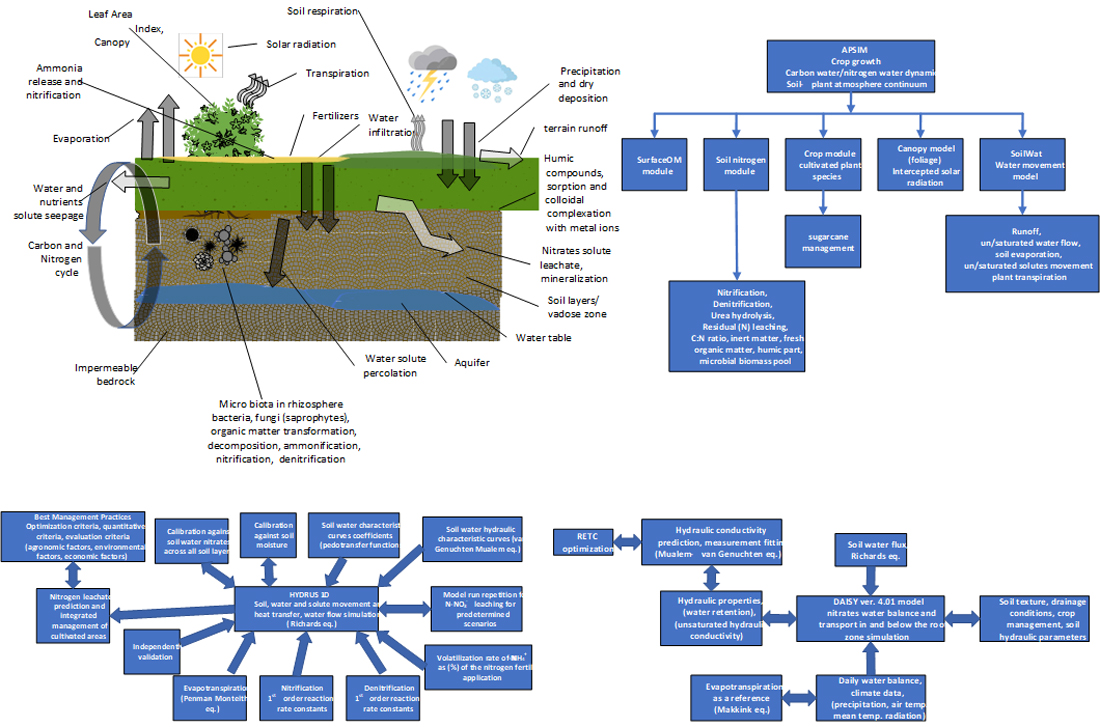
In EU countries, numerous agricultural activities are running, many of which are breeding farms i.e. cattle farming, piggeries, poultries etc. and certain administrative regions are covered with cultivated plots, mostly energy crops (i.e. sunflowers, sugar beets), cereals (i.e. wheat, maize, barley, oats), cotton, potatoes and hydroponic green houses. All the afore given crops are irrigated by river waterbodies, pumping station abstracting water from local aquifers and water collection basins, via carefully engineered complicated irrigation network. Top soil fertilization, threatens soft water quality from increased salinity and nitrates pollution. Furthermore, agents rich in nitrogen (N), via their fate in the soil and inevitable propagation in rock beds causes ion mobility, mineralization etc. Aquifers’ quality change since e.g. new nitrogen pool enters the nitrogen cycle of the local ecosystem (Figure 1), unbalancing water-soil-nutrients equilibrium. Yet, humic part of the soil, microbiota, favors the formation of nitrous oxides a strong Greenhouse Gases (GHG) with a great impact of the climate change worldwide.
Water/pollute flow through porous media demonstrate a high complexity embodied via mathematical simulation models. Complexity increase explainability to the detriment of processing difficulties to be encountered. Ontologies describe in full detail, well-defined interrelated phenomena, suitably bound in conceptual structures over fluids through porous media which are applied in artificial intelligence and affect new infiltration model generation [10].
Nutrients’ leachate prediction models are estimating not only the residual nitrate part applied on the cropland but also all potential seeping losses of nitrate pool into varied soil profile layers, combined with local weather characteristics and farming practices. Artificial Intelligence (AΙ) and machine learning models are gaining an even higher importance [11] as an alternate reliable method for handling complicated nonlinear hydrological modeling with good countrywide scale predictions. In numerous cases, lack of sufficient and proper data, necessary to attain hydrological model calibration, combined with many parameters input for demanding, profound modelling, increase drastically the processing burden and undermine prediction accuracy and reliability. Obstacles are overcome by using models based on AI and machine learning techniques presented in many publications which reveal the future trends regarding surface and ground water quality decision making [12-15].
The scope of this paper was to conduct a systematic review of leachate models useful for proactive and rehab actions to safeguard surface and subsurface soft water which become even more scarce. Well-tested solute leaching models standalone or as a part of an integral modelling package provide rapid site-specific estimates the leaching potential of chemical agents, mostly nitrates, below root zone of crops and the impact of leaching towards groundwater. Most of the models examined were process-based or conceptual approach. Nonetheless, empirical prediction models, though rather simplistic and therefore not preferable, demonstrate certain advantages since they do not require extensive calibration database information which in many cases is unavailable not to mention stochastic approach and the involving of AI.
2. Methodology
In order to isolate the suitable models adopted and agent’s fate methodology, publications derived from Science Direct®, Web of Science™ and Google Scholar huge scientific data bases. Specific keywords, i.e. ‘model’, ‘nutrients’ fate’, ‘porous medium’, ‘infiltration’, ‘percolation’, ‘nitrogen leachate’ were tested, combined or stand alone, to track down and compile the proper material which it was carefully scrutinized to extract the relevant cited content.
All findings were classified according to the emphasis drawn by the authors of the paper regarding the field of interest, though it was more or less expected a cognitive overlapping. For instance, model packages widely used, predict nutrients fate, and soil-water, soil-air balance and thereof types of crops to be planted in the near future, as well as quantitative approach of the suitable fertilize use. A basic classification was made among nutrients, ion metals and other chemical agents’ leaching process. The porous medium which stands as a hindrance to the pollutant flow justifies new reasons for further categorization. Temporal and spatial scale information, soil use along with climatic data are of great importance for any assessment. All model packages incorporate significant components which are to be calibrated by timeseries data and previous relative research, so as more reliable results to be obtained. Components could be classified as physically based or conceptually distributed models, theoretical or mechanistic (i.e. process-based or conceptual), empirical, hybrid, machine learning etc. In many model-packages prediction applied entails certain different dominant approaches governing each component. As regards the solute, simulating models predict either groundwater flow or solute transport, boundary transition zones which employ numerical models with specific conditions e.g. where salt intrusion in aquifers is to be monitored. Further categories are established based on the final prediction technique employed viz finite difference against finite element techniques [16].
3. Materials and Methods
The majority of the models applied are mechanistic models (process based), which describe satisfactorily dynamic processes and exploit accurate data used for model initialization. Mechanistic models are categorized as progressive conversion models where particles size remains unchanged during the leaching process without any penetration resistance to fluids/agents, shrinking core model with constant particle size, shrinking core model with shrinking particle size etc. [17].
The way of approach for each case selected, determine conceptual, empirical, physically based, hybrid models, steady (snapshot like pictured) or dynamic (ongoing) simulation models. Another significant categorization depends on the extent of area appliance i.e. pasture, cultivated plot, river catchment/basin, estuarine, coastal waters, aquifers, regional, countrywide etc. and dimensional fate 1-D, 2-D, spatial analysis employed e.g. distributed of lumped and huge heap of data collected and tested from data bases or models with minimum data requirements [18-19]. Groundwater modeling, when numerical models are employed, entails certain approaches e.g. finite difference [20], finite volume [21], finite element and element-free [22] methods.
Chemical agents e.g. herbicides, complex ions, organic pollutants concentration, saline and fate, runoff, drainage, infiltration, percolation, seepage phenomena etc. determine water quality deterioration, monitoring network, for integrated strategy and remedial actions. In complex soil layers, anion retention capacity varies and surely soil nitrates flux does not correspond directly to the water soil infiltration flux and it is rather a function of the organic matter content. However, major categories located and analyzed in published papers of modelling are given below:
3.1. Process-based or conceptual models
Process based model employ diagrams and interlinks among parallel processing and flowcharts of mass transfer in between different zones (entities) to facilitate complex physical and biochemical interactions of soil, crops and water bodies [18]. Soil particles redox potential, electrical conductivity etc. are ions transfer diffusion phenomena and leaching controllers [17].
Organic chemical screening is done using leaching models, which account for the mobility of the chemicals in the soil. Despite not being able to forecast concentrations, they are still straightforward and only need information that can be found in reports from soil surveys and scientific publications. They can also be readily coupled with GIS to produce an effective evaluation tool for the control of non-point sources in agricultural watersheds [23-24].
Simple models with semi-empirical process descriptions of the lumped conceptual type which utilize time series of averaged accumulated water e.g. on catchment level within predefined blocks [25] are presented next, such as: ANSWERS [26], for watersheds where sub-catchment are divided into hydraulically-interconnected elements (grids), a model structure approach known as ‘fully distributed’ that demands heaps of data and requires high computational burden, CREAMS [27-28] field scale model for chemical runoff and soil erosion, GLEAMS ([29-30], developed to assess agricultural chemicals effects on water quality, SWRRB [31], a modified CREAMS, AGNPS [32] and AquiMod [33]. In such models there has been a flux between segregated water body blocks following physical principles i.e. surface flow, groundwater recharge, infiltration, percolation, subsurface flow, water table recharge etc. [25].
Conceptually, leaching encompasses both the top layer of soil and the area beneath a plant's roots depicting the soil-ground water system. It could be considered that a soluble part of pesticide mass is instantly mobilized at the surface causing surface water infiltration into the rhizosphere.
In pastries, soil type contributes to 12% when referring to (N) leaching and a smaller contribution to (N2) fixation. Still, soil profile and type remain the most significant factors involved in % (N) loss [34]. The agro-ecosystem model, EcoMod with followed up versions was developed as biophysical, pastoral simulation model [35]. Plants’ growth rate and carbon flux on the soil were simulated. Model modules regarding water and nutrients’ presence, incorporate calculations for water and solute circulation, nutrients’ fate, leaching, adsorption, ammonium nitrification, gaseous (N2) losses, other geochemical phenomena i.e. gradual immobilization, mineralization etc. Fertilization and irrigation practices are included as well. Climate conditions were based upon data selected by means of stochastically created 99-year series climate documents by employing a modified version [36] of a daily climate model and incorporating data derived from the ‘Stochastic Climate Library’. By utilizing EcoMod, better regional management is applied via the feeding animal type for pastry to be selected i.e. cattle or sheep and the adequate use of nitrogen-based fertilizers to be applied, for optimal results over sustaining the adequate pasture, without all negative leaching affects caused by nitrates pollution over the catchment of the zone of experimental interest (New Zealand). Nitrogen leaching appeared to be more intense during winter time. Furthermore, the application of nitrogen-based fertilizers, though increased quantities of monthly nitrogen leaching and fate, still did not alter the pattern of % nitrogen loss i.e. the cyclic pattern of nitrogen fixation [34].
A biogeochemical model, based on DeNitrification-DeComposition processing (DNDC) was developed by [37-38] for simulating dynamics of both carbon and nitrogen forms in soils for agro-ecosystems. DNDC simulates crop yield, carbon sequestration in soil and nitrogen leaching when irrigated. Furthermore, it estimates greenhouse gas (GHG) emissions from terrestrial ecosystems and carbon sequestration [39-40]. A basic component of the model simulates crop growth and decomposition by processing data of soil conditions i.e. moisture, redox potential, temperature etc. and another component covers carbon and nitrogen transformation though aerobic nitrification, anoxic denitrification even anaerobic fermentation by means of biotic micro-population in soil. Besides, biogeochemical interactions are taken into consideration and nitrogen final releases in atmosphere or even leaching in deeper soil sequestration after hydrological processing, by means of nitrogen adsorption phenomena, plants’ uptake in rhizosphere, microbial assimilation, nitrification/denitrification etc. [41-42]. Zhang et al., (2021) [43] applied DNDC biogeochemical model, to quantify denitrification-decomposition bioprocessing, as a mechanism, a part of overall nitrogen management of Greenhouse vegetable fields (see Table 1).
The DayCent model [44] simulated nitrogen cycle in soils for various ecosystems (e.g., cropland and forest). It simulates N2O emissions and mineral nitrogen leaching under different types of landscape exploiting a variety of meteorological data, soil properties, irrigation practices, crops particularities. More specifically, nitrogen leaching presents remarkable spatial ana temporal variations, known as hot spots and hot moments (HSHM). Nitrogen leaching and loss within HSHM, could be easily tracked and managed by means of applying the proper model to achieve suitable fertilizing management, local climate factors, soil profile properties and the local topography [45].
TETIS [46-47] is a process-based, hydrological, conceptual, distributed model, that simulates aquifers’ recharge and soil-nitrogen leaching enabling the study of the long-term groundwater quantified response to nitrogen leaching. It incorporates precipitations data from meteorological time series, different irrigation and fertilization practices and potential evapotranspiration. The latter is obtained by means of Hargreaves-Samani equation use [48].
The nitrogen cycle is dependent on fertilization and atmospheric deposition. Corine land uses, maps and ‘Pedotransfer’ functions were involved [47], [49]. They were employed in combination with functions exploiting raw soil data upgraded into useful information tools via predictive functions of certain soil properties. 50 years meteorological data were combined with irrigation and fertilizing practices as well as the digital elevation model from the Geographical Survey of the site of interest. All selected data were the input of TETIS model. Finally, the quantification and sensitivity of nitrogen recharge and nitrogen leaching corresponding to a variety of weather conditions were estimated on certain temporal bases in Valencian region (location in Spain) [50].
STICS, a one-dimensional, daily-step, soil–crop, dynamic model [51-52]. It simulates the quantities of daily drained water, (N) leaching in soil-water phases, (N) plant uptake and fixation, (N) fluxes and dynamic interrelation between hybrid tested crops and soil type under various climatic parameters e.g. air temperature, rainfall density, solar radiation, ‘Penman’ evapotranspiration, C:N ratio, pH, calcium carbonate equivalent action etc., which finally affects crops’ biomass production [53]. Pedoclimatic characteristics (i.e. soil water content, nitrogen abundance in soil, bulk density, soil infiltration rate) and soil exploitation practices are used as initial inputs for the running of the simulation. Nitrate is transferred by convection mixing phenomena. A calibration stage is mandatory before the appliance of new cultivar parameters.
Grain legume-based cropping systems require a comprehensive reevaluation, by taking advantage of bioprocesses e.g. symbiotic biota for fixation and mitigation of leaching (N), nitrogen cycle cropping systems reengineering, by adopting crop succession, improved concepts as regards nitrogen-based fertilizers appliance, irrigation practices and techniques. The solute transfer between subsoil profiles is conformed with tipping bucket concept i.e. downwards mitigation after surpassing soil’s profile water capacity and the prevention of aquifers’ nitrates pollution, focusing on soil-nitrogen balance to avoid (N) leaching, in accordance with Direct. 91/676/EC concerning agricultural activities [53].
Model of standard version 9.2 of STICS [54], is a soil-crop model which computes changes in biomass and yield in soil organic carbon (carbon flux), predicts nitrate leaching, soil water and nitrogen fate etc. by interpreting certain dependent variables and parameters e.g. weather conditions, cropping practices, [52], plant growth, carbon as (CO2) and nitrogen fluxes [55] and solar radiation.
The latest version of STICS in based on monitoring the changes of carbon pool as expressed by the Gross Primary Productivity (GPP), dependent on autotrophic respiration, Net Primary Productivity (NPP) via plants’ growth on a predefined time basis and finally the complex component of Ecosystem Respiration (RECO) which is comprised from autotrophic plant biomass, plant nitrogen, heterotrophic residual mineralization of the organic matter and Net Ecosystem Exchange (NEE), which equals the summation of GPP and RECO. NEE represents the balance between carbon fixation via photosynthesis and respiration, that releases it to environment. Carbon flux variations are being recorded and underwent comparisons upon crops rotation [55].
AqYield model [56-57] is a simple dynamic model which requires only a few inputs (e.g. soil properties, daily climate features, dates of sowing, harvest, irrigation, tillage irrigation and soil tillage depth for crop management). The model estimates sufficiently well drainage, water flows for several crops, major nitrogen flows in the soil, plant (N) uptake and mineralization. It estimates soil-water content dynamics, water drainage and evapotranspiration. It is tested and evaluated for the precision of the predictions accomplished. Although fairly simply, it is considered to be accurate in terms of (N) leachate prediction in corps rotation as much as other more sophisticated similar models e.g. STICS. AqYield predicts satisfactorily (N) flows (fate) in the soil–plant system, including mineralization, plant uptake and mitigation on daily basis. Cultivated crops, climatic data and soil characteristics have a great gravity in shaping the final predictions.
Great bibliographical research was conducted by Baveye, (2023) [58] to emphasize the steps required for a model development to predict soil carbon dynamics, interrelated to nitrogen cycle, mostly derived from fertilizers. According to his argument, current ecosystem-scale models are introducing limitations when applied to ecosystems due to lack of the proper interdisciplinarity and “bottom-up” approach, making use of microscale soil processes. Furthermore, interesting for stipulating empirical models, applicable at large spatial scales is still valuable when upscaling efforts is the case. Thus, modelists should stay focused on micro-scale of soil microorganisms at first and progressively should try to move up regarding the spatial scale, incorporating characteristics of the region of interest. Already kwon or future empirical model are providing valuable services for the final upscaling target.
Topsoil Carbon undergoes various transformations mainly as Dissolved Organic Carbon (DOC) and Particulate Organic Carbon (POC). The latter has a vivid role in numerous flocculation and adsorption phenomena affecting soil physicochemical properties. DOC represents the soluble organic part and holds a crucial role in soil transformation via micro-organisms’ uptake availability, the high soil mobility/leaching, biochemical transformation by means of metal ion/organic chemical binding and toxicity phenomena through biosorption. [59], developed and introduced a modified TRIPLEX-DOC model focused on leaching, sorption, DOC and biodegradation phenomena [60] to simulate DOC dynamics in monsoon forest ecosystems since it does not incorporate itself a component simulating responses of DOC concentrations and fluxes to the atmospheric N deposition. By means of TRIPLEX-DOC model improvements, a more profound biogeochemical modelling was incorporated to predict more accurately DOC fluxes in forest ecosystems in the monsoon regions which differentiate them in terms of vegetation and NPP. Furthermore, the modified model predicts more accurately regional carbon cycle in seasonal patterns and assess more safely soil DOC fluxes in local ecosystems.
Nitrate leaching occurs in croplands where synthetic and animal biowaste-nitrogen based fertilizers are applied, which affect vulnerable aquifers (e.g. karsts) from nitrates’ pollution. Soil and Water Assessment Tool (SWAT), [61] developed by the US-Department of Agriculture (USDA) and Agricultural Research Service (ARS), is widely exploited to simulate the hydrological cycle, plant growth, chemical leaching in numerous watersheds and cultivated soils. SWAT(CATCH) is a distributed, semi-empirical [62], physically based, hydrologic model (DPBHM), which incorporates the Variable Storage Coefficient (VSC) method. The latter is a kinematic wave method which means that streamflow equation is simplified by assuming that the friction slope is approximately equal to the slope of the e.g. watershed channel. The proper use of SWAT simulation corrects initial assessment of certain indices e.g. Dendritic Connectivity Index (DCI) a measure of longitudinal connectivity, of aquatic ecosystem status which outlines that temporal resolution of river water routing (time steps) plays a dominant role to the final assessments. It is noteworthy that time steps are dependent on actual watershed size and configuration [63]. SWAT employs the Vegetative Filter Strip MODel (VFSMOD) which is an empirical model [64] that calculates sediment reduction. It simulates crop yields and nitrate leaching under a variety of nutrient and irrigation management practices, as a well-tested prediction tool to improve management practices upon safeguarding a high groundwater quality towards agricultural sustainability. SWAT is combined easily with Sequential Uncertainty Fitting (SUFI-2), Uncertainty Procedures (SWAT-CUP 2012) and the Nash–Sutcliffe model efficiency (NSE) validation test [65].
SWAT is being modified by coupling with shuffled frog leaping algorithms and a farm-level economic model and cost estimator (FEM). The model outcome (MOSFLA), demonstrates powerful convergence and optimization ability [66].
SWAT tool predicts and quantifies nitrate leaching pathways and prevent ground water nitrate pollution which threatens drinking water resources and unbalances ecosystems. Nitrate pollution assessment change fertilizing practices, alter the crops and prioritize new sustainable agricultural methodologies and management practices in agribusiness. The crucial nitrate pollution drivers are the type of the soil, climate variability, crops irrigation and fertilization practices over cropland [65].
The coupled SWAT (version 2012/Rev664) and MODFLOW model [67-69] performs better when complex surface-groundwater interactions analysis and explicit modeling of the groundwater system and surface water is the case [65], in comparison with field-scale cropping system models such as Decision Support System for Agrotechnology Transfer (DSSAT) [70], HYDRUS 1-D [71-72], Root Zone Water Quality Model (RZWQM) [73-74] and Leaching Estimation and Chemistry Model LEACHM [75]. All the aforementioned cannot accept as a complementary component a hydrologic model so as to drive to better predictions.
Modified croplands and watershed SWAT model coupled with the groundwater model and stream–aquifer interaction hydrologic MODFLOW compose the improved SWATMOD model [76], which demonstrate simulation capability of surface water, stream-aquifer interactions and groundwater [16].
HYDRUS-1D model was employed and calibrated before use against nitrates concentration in soil-water across all soil layers and the measured soil moisture. It validated independently and finally started to simulate N-NO3 leaching under certain conditions: e.g. controlled fertilization rate within prearranged irrigation depth or vice versa i.e. regulated irrigation depth combined with a steady fertilization rate. Concurrently, were assumed different shifts in water table depth. Experimental site-specific soil physical and hydraulic properties were selected as well as data from an automated meteorological station i.e. net radiation (Rn), barometric pressure (BP), temp. (T), wind speed (W), rel. humidity (RH) and precipitation at 60 min intervals [72]. It is commonly employed in landfills hydrological evaluation [77].
The Penman-Monteith equation was utilized in conjunction with the meteo data obtained to determine the reference evapotranspiration [72]. HYDRUS-1D employs Richards’ equation [78] to simulate the unsaturated water flow [79]. Mass balance of nitrification - first-order reaction rate constants - and denitrification along with N-NH4+ volatilization rate was taken into consideration. Soil-water characteristics curve was depicted by using van Genuchten-Mualem equation [80] and pedotransfer function model [49,72] coefficients and parameters related to the hydraulic transport and transformation (see Figure 2). Solute transport in heterogeneous waste rocks could be simulated by HYDRUS-1D since it supports multiple porosity components [81].
Dynamic leaching flux and soil water storage including dissolved CO2 and N2O conc. can be simulated with good results by implementing HYDRUS-3D finite element model [82-83]. It entails domain, finite element mesh, defined boundary conditions and the input of topsoil vertical layers based on Digital Elevation Model (DEM) surface and topsoil thickness information. It estimates soil and bedrocks hydraulic properties incl. CO2 and N2O storage along with their leaching flow rate. Appliance of HYDRUS-3D over topsoil reveals the critical influencing, leaching factors (i.e. temperature, fertilizing, precipitations), of diluted CO2 and N2O (the latter a strong GHG) in water and thus promotes the deeper understanding of nitrogen cycle mechanism on terrestrial ecosystems [83].
Efforts were made to estimate (N) leaching quantification of irrigated maize by testing different fertilizers, regulating, through pumping and irrigation, the water table and adopting improved irrigation management practices. During these efforts, conventional fertilization practices were tested as a reference scenario and a field experimental trial was conducted for consecutive years. Subsoil zones were identified in which the leaching fluctuates within a hydrologic year [72].
Land use investigation combined with climate change was analyzed by implementing a global vegetation model (LPJ-GUESS) [84]. Trade-off between crops yield and nitrogen soil leaching were drawn in certain scenarios of an increase in wheat and maize yield for various regions. Integrated assessment model MESSAGE was employed simulating fertilizing appliance, making use of drivers such as (Representative Concentration Pathways 8.5) [85]. Distribution of nitrogen application rate information was derived by using (LPJ-GUESS) model after being fed with data selected from the Common Agricultural Policy Regionalized Impact (CAPRI) model at a terrain grid level up to 1km2. Climate and land use changes projection, assess nitrogen leaching, CO2 mitigation and crops yield [86].
A new approach of monitoring nitrates leaching of land fertilization is obtained by the NIT-DRAIN model [87]. It simulates nitrates conc. at a subsurface drainage network's outflow. It is a drainage discharge simulation model instead of monitoring/observation model. Water and soluble nitrates are transferring through the soil profile which is separated into three successive, interconnected, subsurface stratifications, segregated by drain and mid-drain layers. Thus, there is a distinguishable water-nitrates fast transfer, throughout the macro-porous upper layer, located above the pipe network. Low and residual nitrate transfers are accomplished through the lower conceptual soil stratifications. Nitrogen load to the ground is divided into two discrete phases. Firstly, the seasonal applied nitrogen quantity which entails all predicted nitrogen transformations at the cropland scale and secondly, the remaining off seasonal nitrogen pool which undergoes extended leaching phenomena when the winter season starts. Both prediction data are required. Model also requires updated variable input at the commencement of a new hydrological cycle. It involves seven nitrates leaching and water flow parameters and employs two different transfer functions as long as nitrogen fate lasts. Model calibration based on Generalized Reduced Gradient (GRG), non-linear regression algorithm and the hierarchical scheme for validation, by making use of the split-sample test [88].
GOSSYM a mass balance mechanistic two-dimensional (2D) gridded soil model that simulates water, carbon and nitrogen interactions in soil, plant root zone and crop response to climate variables and water irrigation. It incorporates many routines as components such as daily weather information, soil profile characteristics and parameters, plant growth data etc. Modification is presented by coupling 2DSOIL mechanistic 2D finite element soil process model. The latter, simulates underground processes i.e. mineralization, of organic matter immobilization, nitrification and denitrification, [89]. GOSSYM is also to be used coupled with COMAX expert system developed ad hoc. The inference engine incorporated is very useful for cultivation practices, model results interpretation and irrigation and fertilizing regulation [18, 90]. GOSSYM-COMAX is widely validated by being tested under different environmental conditions and crop practices.
The new climate regime over certain regions in Europe incurs even more extreme rainfall incidents with catastrophic ecological results. The abstraction of the humic topsoil tends to be a severe negative outcome. Therefore, is of crucial importance the use of integrated biogeochemical-ecosystem models and the estimation of intra-/inter-annual gross primary productivity (GPP) variations e.g. (Biome-BGC) [91-93] to monitor ecosystems response against extreme events. Interactions of ten hydrological and ecological processes were taken into consideration, incl. runoff, canopy evaporation, soil-water storage, soil evaporation/respiration, transpiration, Net Primary Productivity (NPP), net ecosystem exchange, nitrogen mineralization and leaching. Once more, nitrogen propagation incurs nitrate pollution and is considered to be of high priority concern when the Good Environmental Status ‘GES’ or even the Good Ecological Status is to be assessed. The model focuses on carbon (C) and nitrogen (N) fluxes on a preset time scale (i.e. daily, monthly, annual). The model parameterization is achieved by making use of site characteristics data (e.g., soil texture/relief/depth, terrain elevation), meteorological data (e.g. precipitation, humidity, temperature, etc.) and eco-parameters (e.g. canopy growth and expansion, photosynthetic rate, carbon to nitrogen ratio of leafage, lignin fraction of the dead wood) [94].
As regards the part of the daily soil-water balance, the one-dimensional soil-plant-atmosphere DAISY, Danish model simulation (version 4.01) [95] was employed to cover the water and N balance in agro-ecosystems for crop cultivation [96]. The model comprises three main modules, i.e. a bioclimate, a vegetation, and a soil component. Soil-water retention and transport were simulated by employing DAISY model and Using the Makkink equation, evapotranspiration was determined from the daily global radiation and mean temperature [97]. Variables for nitrate leaching i.e. nitrates percolation entail crop classification into groups according to (N) uptake performance, residual (N), contribution to leachate and (N) mineralization i.e. transformation into inorganic form (NH4+) [98].
Nitrate leaching predictions and nitrogen conc. in monitoring sites in Denmark, incl. various parameters i.e. soil type, climatic data, crop consequence, nitrogen fertilizers appliance rate, soil winter capping etc., were conducted making use of multivariable experiments. A linear regression was applied to identify and assess the influence gravity of a leaching year (hydrological year). A certain number of sites was selected and DAISY model (ver. 4.01) [95], (Figure 3) was implemented to simulate water percolation and balance at the depth of the rhizosphere. DAISY model is employed for quantitative description of water flow into unsaturated soil zone and makes use of certain soil quality characteristics i.e. water retention, unsaturated hydraulic conductivity which earlier were fitted to Mualem-van Genuchten equations [80, 99] and RETC optimization computer programming code [100]. In the specific case DAISY model simulates the water balance regarding different soil-crop productions. The model incorporates Richard’s equation [78] to calculate soil water flux. Different soil sites and differentiated climatic data deduce new estimated values of nitrates leaching, therefore proper cropping strategies should be followed for soil nutrients balancing [101].
‘MIKE SHE’ is a complex model package which describes distributed and physically-based water/solute flow in catchment areas. It incorporates snowmelt process along with evapotranspiration and gives numerical solutions for overland (2D), unsaturated flow (1D), channel flow (1D) and saturated flow (3D). The combination of ‘Daisy’ and ‘MIKE SHE’ models enable water and nitrates simulation transport and overland flow on a catchment level, excluding intense rainfall events i.e. Hortonian incident [102].
Strict cropland’s, nitrogen-based fertilization regulations in (kg N ha-1), in Europe, compel farmers to resort to alternative cultivating options i.e. catch crops, to regulate post harvesting nitrogen conc. of soil-rhizosphere nutrients balance. Some cultivations were tested over time e.g. winter rye, spring barley, fodder radish, to achieve lower nitrogen leaching results. Simulation of the cultivation change, during winter and spring, by using the biophysical Agricultural Production Systems sIMulator (APSIM), simulation model [103] (Figure 4), is parameterized over mineralization of catch crops. Nitrate leaching was based on weighed percolation drainage within periods of interest. APSIM comprises certain modules i.e. SurfaceOM, SoilN, SoilWat, Canopy model and Cultivar plant type. Each one of the modules simulates different fields of interest e.g. water movement, N and C soil dynamic, plants’ solar radiation competition etc. The SoilWat is a module of APSIM. It has been developed as a cascading water balance model in which, on a daily basis, water balance is estimated by simulating runoff, saturated/unsaturated water flow, solute ground and underground movement interrelated with saturated/unsaturated flow, plant transpiration and soil evaporation. Soil Nitrogen module simulates nitrification, denitrification, urea hydrolysis and nitrogen mineralization [104]. Nitrogen originated mainly by manure appliance over cropland and inorganic based fertilizers [105].
APSIM’s appliance entity (i.e. plant-rhizosphere-soil-atmosphere), functions on daily time frame [103]. The prediction assures reliable crop management strategies, all year long, for the sake of a balanced ecosystem, minimizing all negative environmental impacts, as regards crop yield, water, nitrogen and carbon mitigation dynamics [105]. Moreover, this model has been developed for sugarcane simulations, tested and confirmed at the paddock scale. since it incorporates modules for specific crops [106-107]. Thus, it simulates management practices, water uptake and growth of sugarcane [104].
Intermediate percolation calculations conducted by using the model EVACROP v.3.0, updated of EVACROP v.1.5 [108-109]. Nitrogen leaching affects water quality and soil acidification. A bio-geophysical, process-based, multi-component ecosystem model (CoupModel) [110] was employed to estimate carbon and nitrogen fluxes, water and heat balance in eco-terrestrial cycle. It facilitates the assessment of the local ecosystem (N) balance e.g. manure appliance over tillage serving as biofertilizer. Nitrogen transformation includes (N) plant uptake and mineralization. It runs on a daily time frame and on a minimal squared meter unit grid. Model running requires certain parameters i.e. weather (precipitation) data, solar radiation, temperature, relative humidity, wind speed, precipitation and dry deposition as regards (N) information.
Carbon and nitrogen storage incorporates abiotic/inorganic i.e. ammonium and nitrates in soil and biotic part e.g. plant tissues and external characteristics such as leaf area and solar radiation expose which regulate carbon assimilation. The model regards the soil part as a series of constituent, interrelated layers, where water, heat, nitrogen and carbon interact in a dynamic way. Darcy’s law and the generalized Richards (1931) equations [100] for unsaturated conditions are governing soil water flux.
Soil evaporation phenomena were calculated by using the Penman-Monteith equation [111]. Outflows of the ground water table determined by a linear empirical drainage function. Soluble Organic Matter (SOM), (N) mineralization, plant’s water uptake is dependent on moisture and soil temperature. Other dissolved forms of (C) and (N) comprise nutrients’ pool in the roots. Microbial biomass of the seeded roots (Mycorrhiza), regulates stoichiometry of C/N ration and Carbon Use Efficiency (CUE). Any changes in the nitrifying biomass of a specific soil layer, affects eminently the soil nitrification flux and therefore the nitrification rate and the soil-water-ammonium conc., since Dissolved Organic Nitrogen (DON) and ammonium (N-NH4) are in chemical equilibrium in both soil-water and soil-solid phase [112].
The Nitrogen Loss and Environmental Assessment Package (NLEAP) is a powerful mechanistic model that provides rapid site-specific estimates of N-NO3 leaching potential below root zone of crops and the impact of nitrate leaching into groundwater [113]. Under various combinations of soil profile characteristics, weather data, and farming practices, the afore given model is used to estimate the residual nitrates and potential nitrate leaching losses from cropland soils into subsurface layers [114]. It runs in three temporal modes i.e. annual, monthly and event-by-event for certain water-Nitrogen cases and potential leaching.
The updated and improved NLEAP-GIS, (version 4.2), coupled with Geographic Information System (GIS) spatial soil database, as a complementary component, increases the capability of assessing (N) losses towards risky landscape and combination of different cropping systems and evaluates more accurately management practices over nitrogen transform and mitigation [115-116].
Updated version model includes infiltration and transport of nitrates and soil water; carbon and nitrogen terrestrial cycle, soil-surface and soil-profile propagation and transformations, water, nitrate/ammonium surface runoff, nitrate leaching from the root zone and ammonium uptake from the seeded plants, denitrification losses and ammonia volatilization. Each individual process is prescribed by detailed algorithms and equations [116].
Model inputs such as daily meteorological data, incl. maximum and minimum temperatures, daily rainfall, relative humidity and evaporation are prerequisite to run various scenarios enriched with soil profile information and fertilizing events. During winter wheat and summer maize season, specific (N) application rate is recommended, so as to be achievable, concurrently, higher (N) use efficiency and grain yield resulting in lower groundwater nitrate pollution risk. Nitrate leaching indicates the presence of nitrogen pool which might affect local aquifers identifying regional soil profile characteristics. Model’s outcome is being validating by using older measured nitrate leaching reports. Results in many cases are comparable with other models’ outcome e.g. DNDC model [117] on regional scale [118] (see Table 1).
The large-scale and spatial variation simulation in nitrate leaching in the region of experimental interest (location in China), the rate of fertilizer N application was positively correlated with rainfall density, however, it was negatively correlated with N use efficiency [119].
Climate change and interrelation of anthropogenic pressure to waterbodies’ catchments/basins are of great importance. Therefore, evaluation and simulation of Water Resources Management Scenarios for adopted, resilient plans over coastal agricultural watersheds were conducted. It was achieved by the implementation of an Integrated Modelling System (IMS) that was set up to cope with the complexity of croplands in vicinity with estuarine in the Med zone [120]. IMS incorporates certain components of reservoir operation (UTHRL) [121-122] surface hydrology (UTHBAL), named as (R-UTHBAL) built in R statistical language [123], groundwater hydrology (MODFLOW) [67], crop growth/nitrate leaching (REPIC) which is a coupled Environmental Policy Integrated Climate (EPIC) [124-125] model with R-ArcGIS bridge application (ESRI), nitrate pollution flow, multi-species, transport model for simulation of dispersion, advection and chemical reactions of contaminants in groundwater systems) (MT3DMS) [126] and the prediction model for seawater intrusion cases (SEAWAT) [127].
When it comes to groundwater dynamics, aquifer interactions with the stream system, surface-water and nutrient fluxes at the watershed outlet, and water and nutrient leaching from the surface to the aquifer, the Integrated Surface and Subsurface Model (ISSM) [128] produces good prediction results. It consists of the in-stream water quality model (QUAL2E), the groundwater models MODFLOW and MT3DMS, and the hydrological model SWAT.
PATRICAL is a conceptual large-scale (area grid 1×1 km2) temporal and spatial distribution model, addressing water quality and balance with remarkable time projection prediction. It enables an overall aspect of nitrate pollution in extensive regions and facilitates countermeasures for aquifers and wetland recovery to meet EU WFD requirements. It entails calibration, validation and future scenarios. When ground water bodies are the case, it incorporates tens of lumped models [129-130]. Many other models and components of minor importance and more information is figuring in Table 1.
3.2. Empirical Models Or Statistical Models
There have been cases where conventional models are considered to be inefficient when the case is soils with cracks and high heterogeneity in terms of soil texture, particles shape and orientation, burrows etc. Thus, diffusion coefficient is difficult to be adopted for extensive tortuosity. In such cases many experimental data are needed or suitable empirical correlations to be employed [17].
Nonetheless, empirical models are lacking satisfactory results when extrapolation is needed in the future. Despite this is still a useful tool in the decision making in farming or grazing [18]. The NLES5 model [98] is partially modified of an earlier NLES4 model version [131] since it has almost the same structure and share partially datasets for calibration. It considered to be an empirical prediction model of quantifying nitrate leaching on annual basis, considering the interest zone as the root zone i.e. 1 meter depth. The model accounts for incurred effects of added nitrogen (N), under certain crop sequences, seasonal crop cover, top soil types, and local weather conditions. Soil (N) leaching and mitigation prediction, caused by fertilizing over croplands, improved integrated water basin management and promoted the good quality preservation of surface water and aquifers as the main goals of model development.
Quick Plant RZWQM2 sub-model, is a simplified empirical plant module, developed to simulate the water and nitrate fate for the crops, therefore to compute on daily basis, water and nitrogen uptake of the cultivated soil (see also 4.2 below). Meteorological data collection is essential to the final outcome. It incorporates Green-Ampt infiltration equation, Richards' equation [78] for water redistribution and a plethora of submodules such as: Quick Plant, soil water and heat transfer, N balance, generic plant growth, evapotranspiration (PET), soil equilibrium chemistry, pesticide and finally management module. Soil water retention curves are acquired by using the modified Brooks-Corey equation.
Empirical prediction models demonstrate certain advantages since they do not require extensive calibration database information which in many cases is unavailable [132]. Any future strategy must address the critical issue of relatively accurate nitrate leaching prediction across common cropping systems, soil types, and climate conditions in specific geographic areas, as well as the impact of seasonal vegetation characteristics on nitrate leaching, which is dependent on (N) fertilization practices. A carefully defined exponential function was fitted to the selected data. Function incorporated parameters that were estimated by non-linear regression analysis. The prompted leaching curve yields the marginal nitrate leaching rate which corresponds to the recommended applicable (N) rate.
For the prediction of soil bulk density after tillage an empirical equation used in Water Erosion Prediction Project (WEPP) model. The equation is based on the (EPIC) model [124,133]. Vegetative Filter Strip MODel (VFSMOD) as a coupled component of the SWAT model (see also 3.1) is also an empirical model that calculates sediment reduction [64].
3.3 Deterministic Models
The deterministic models are classified into static - time is not considered as a variable – and dynamic model [18]. A further subclassification is lumped or distributed models [134]. DRAINMOD is a deterministic hydrological model employed for agricultural subsurface drainage for nutrient transport, groundwater salinity problems. Variants of the model are applied for nitrogen subsoil fate DRAINMOD-NII, salinity penetration in soil cropping DRAINMOD-S and phosphorus concentration prediction and dynamic DRAINMOD-P [16, 19,135-138]. The model is well tested over river basin in Belgium for nitrates pollution prediction [139].
MIKE-11 is a 1-D hydrodynamic model in rivers, which simulates dynamic water movement in channels and rivers. It has been applied as water quality model in England and India. It employs time series of depth, pollutants and flow data along with water quality parameters [140].
Artificial Neural Network (ANN) science field combines bidirectional long short-term memory (BiLSTM) and adaptive neurofuzzy inference system (ANFIS) to predict water quality in different groundwater by employing single exponential smoothing (SES) as a preprocessing method to adjust the weight of the dataset input, (categorized as training and testing data) [141]. The internal operations of a neural network are deterministic, not stochastic, after training is finished.
3.4 Stochastic models
When data is presented using stochastic modeling, specific degrees of randomness or unpredictability are taken into account when predicting results. Using random variables, it predicts the likelihood of different outcomes under various scenarios.
SIMCAT it considered to be a model based on deterministic, stochastic, and Monte Carlo approach. It is used for the prediction of various biochemical indices and ions’ leachate i.e. BOD, DO, and Cl-, NH4+ NO3- [19,142].
Monte Carlo as a specific branch of stochastic modelling, is a broad class of computational techniques that rely on periodic random sampling to obtain numerical results. It uses randomness to solve problems that might be deterministic in principle [143].
Vadose zone flow and transport model (VADOFT) is a 1-D finite-element prediction code applied on chemical transport, flow/fate in the unsaturated zone. It employs parameters such as pressure, water content, and hydraulic conductivity to solve the flow equations. The code when equipped with Monte Carlo pre- and post-processor enables the run of multi-parameter scenarios several hundred times, and provide stochastic (probabilistic) outputs [144].
3.5 Artificial Intelligence and Machine Learning models
Artificial Intelligence (AI) is getting involved, the latest years, with forecasting groundwater quality modelling methods e.g. Artificial Neural Network (ANN), Evolutionary Algorithm (EA) etc. Given its capacity to handle enormous volumes of data, it offers an alternate method for handling complicated nonlinear hydrological modeling [145-146]. The proper water quality parameter selection is from every aspect crucial in order to attain the suitable AI models training. In every strategy actual, in situ, datasets are to be directly compared with those of AI method testing [147]. AI is advantageous over non-AI models by reducing the time spent for data sampling and AI proneness to rapid nonlinearity identification patterns as regards input and output data [12].
AI models combined with metaheuristic optimization techniques demonstrate higher reliability in terms of capturing the nonlinearity of water quality parameters [147]. General categorizations of AI methodology for soft water quality estimation include artificial neural network (ANN) modelling, fuzzy logic (FL) based models, support vector machines (SVM) models, machine learning (ML) and hybrid models.
A Machine Learning (ML) model utilizes potentially either deterministic or stochastic methods upon different sectors to obtain the proper results via prediction methodology. ML models such as Adaptive Neuro-Fuzzy Inference System (ANFIS), Deep Learning (DL) [148], evolutionary computing (EC), ensemble learning (EN), hybrid-modeling (HM) or even support vector machine (SVM), support vector regression (SVR), were introduced and developed for the water quality parameters prediction and thus groundwater quality classification for irrigation purposes [11-12,147-150]. ML models improve rapidly ground water level forecasting which is regarded as critical for any water management planning [13].
ANN exploits relationship between input and output datasets [147], is produced via neuronsis a computational model that excels at content addressable memory, machine learning, pattern recognition and optimization [151-152]. ANN uses several algorithms inter back-propagation neural network (BPNN), Levenberg-Marquardt back-propagation (LMBP) [12-13], Feed forward neural networks (FFNN) subcategorized into single layer perceptron (SLP) and Multi- layer perceptron (MLP) [147]. They are preferrable to predict spatial distribution parameters in aquifer remediation [12]. ANN modelling was applied in numerous cases over various regions e.g. in India, [153-154], for groundwater quality prediction. Deep Neural Network (DNN) within ANN modelling enables accurate estimate of nitrates and heavy metals i.e. cadmium, and chromium [155].
Because of their quicker optimization and capability for generalization, EA and SVM demonstrate higher predictive performance comparable with ANN and ANFIS [156-157], albeit limited studies were completed regarding groundwater quality forecast so as to enhance confidence about the proper effectiveness for complex hydrogeological systems simulation. A major drawback is considered to be the long training time (see Table 2). Nonetheless, in the near future, ANN methodology shall be improved and ANFIS technique, which combines ANN and fuzzy inference systems advantages shall play a major role. Furthermore, ANNs, types e.g. back-propagation neural network (BPNN), Levenberg-Marquardt back-propagation (LMBP) and multilayer perceptron (MLP) algorithms are the most preferrable in AI groundwater modelling due to their accuracy [12]. ML models in many cases are analyzing landfill leachate quantity/quality. Thus, e.g. hybrid Artificial Intelligence Model (AIM) based on grey wolf metaheuristic optimization algorithm and two stage extreme learning machine (ELM-GWO) is adopted to predict landfill leachate quality parameters in Iran. Other single-stage AIMs to be mentioned (MARS, MLPANN, ELM etc.), two-stage AIMs (MLPANN-GWO and ELMGWO etc.) [14].
FL based models make use of adaptive neuro fuzzy inference systems (ANFIS) which is an integration of fuzzy inference system (FIS) and adaptive neural networks. Hanoon et al., (2021) [147] and Haggerty et al., (2023) [148], presented analytical tables of AI models and adopted learning methods to support groundwater quality forecast. Ensemble fuzzy models combine fuzzy logic methods with ensemble learning for better performance outcome. They have been applied exclusively to improving DRASTIC method performance [148,158].
Recurrent Neural Networks (RNNs), integrated with geographic information system (GIS) technology enables scientists to predict accurately groundwater quality indices and cope with health risk management [159].
3.6 Physics-Based Models
Physics- based models are mostly one-dimensional leaching models i.e. RZWQM [160-161], WAVE [162-164] and DAISY [165] which simulate root zone processing. Numerous models are hybrid i.e. process- and physics-based model e.g. MODFLOW/MODFLOW-MT3D (see 3.1).
Daisy simulated crop production and nitrogen and water balance in the root zone [102]. It includes modules and soil-water dynamic based on Richards’ equation [78]. It incorporates nitrogen transformation i.e. mineralization/immobilization, nitrification and denitrification and agricultural management practices.
Numerous RZWQM components were developed to improve simulation accuracy regarding crop root zone. Therefore, RZWQM contains a soil water and a heat transfer module [166-167], a generic plant growth module [168], a nitrogen balance module [169], a soil equilibrium chemistry module [170], an evapotranspiration (PET) module [171], a management module [172] and a pesticide module [173].
The modeling system MIKE SHE describes the distribution of solutes and water flow in a catchment using physical principles. This entails the numerical solutions of the coupled partial differential equations for the processes of evapotranspiration and snowmelt for overland (2-D), channel (1-D), unsaturated (1-D), and saturated (3-D) flow. A full modeling system for simulating the movement of water and nitrate within a watershed can be created by integrating Daisy with MIKE SHE [102].
Phosphorus (P) is an important nutrient and though less abundant in surface water compared to nitrogen, still within a constant proportion N:P, e.g. 14.7:1 in the sea column [174]. Ratio unbalancing brings about eutrophication phenomena in aquatic ecosystems [175]. Therefore, the study of phosphorus fate mechanisms and selective infiltration routes in terrestrial and aquatic ecosystems is of high priority. Pferdmenges et al., (2020) [176], introduced a comprehensive review of phosphorus-soil interaction models, classified into multiple categories, inter alia, temporal and spatial scale, surface /subsurface transport, matrix/macropore transport, mobile/immobile transition in dual porosity models.
4. Metal Ions Leaching and Solute Transport
4.1 Soil Medium
Geochemical PHREEQC code [177] performs sufficient numerical simulations incorporating mixing transport models both in aqueous and gaseous phase, taking into account geochemical reactions, such as precipitation, dissolution, complexation phenomena involving metal oxides and microbial activity. The reactive transport model is incorporating reaction kinetics for chemical processes including ion-association and specific ion interaction theory for solute activities calculations [176]. In a publication was employed to calculate Saturation Indices (SI) [178]. The simulation code was subsidized by predicting/estimating tools of model parameters such as Parameter ESTimation (PEST) software [179]. Sorption phenomena simulated by employing two-layer model introduced by [180]. Organic matter sorption was modeled by implementing WHAM model an acronym of Windermere Humic Aqueous Model, [181] which is based upon humic acids behavior according to Lewis’ theory for electron donators. Mine tailings and heavy metal leaching e.g. Pb, were encountered by activating reclamation measurements to mitigate negative leaching effects. Mining slurry combined with manure leads to metal sorption reducing any leaching processing. A new biogeochemical model was developed taking into account certain phenomena i.e. kinetically-controlled dissolution/precipitation, adsorption, water gas exchanges, surface complexation reactions, microbial respiration and growth, dissolution and precipitation. The amended model predicts more accurately Pb reactivity and soil tailings [182].
Heavily contaminated soil (brownfield) by Potentially Toxic Elements (PTE)s are a permanent threat to the local ecology via toxicity and bioaccumulation. Leaching, and runoffs phenomena are putting in peril the human wellbeing. Threats are getting even bigger considering pH change of the soil cap. Therefore, chemically burdened sites have to be under constant monitoring in terms of heavy metals quantification and ion mobility checking indices, to assure that surface watersheds and aquifers are not threatened. It is acknowledged the lack of detailed knowledge of minerals which exert control over toxic element leaching. Thus, is of great importance the investigation of soil mineralogy in PTEs release and leaching prediction [183]. The geochemical modeling program PHREEQC (version 3.1) was deployed to calculate Saturation Indices (SI), which indicate whether a specific mineral is likely to dissolve or precipitate in groundwater, in a case study in Pakistan of monitoring groundwater area suffering from Arsenic contamination [178]. Geochemical simulations were conducted making use of PHREEQC software [177], MINTEQ’s two thermodynamic databases [184] and Lawrence Livermore National Laboratory (LLNL).
Sampling investigation conducted from a brownfield site served for fertilizers production. Jarosite rich in Pb, hematite, and gypsum were the most abundant mineralogical phases/stratifications, with zinc sulfate, kintoreite and anglesite. Pb and Zn phases were identified as the dominant ones [183]. pH-dependent leaching tests were applied incl. HNO3 and NaOH as the pH control agents in combination with geochemical models. Testing target was the reveal of leaching mechanisms and contaminants solubility in a pH ranged from 1 up to 12. All information gained advances scientific knowledge and facilitates future remediation strategies and promotes integrated sustainable management and strategy design over brownfields [183].
Barren piles of mining undergo biooxidation giving rise to metal sulfides oxidation and finally acidification phenomena which motivate ions mobility, well kwon in scientific community as Acid Mine Drainage (AMD). AMD leachates’ mitigation exert great pressure to bedrocks, surface waters and local aquifers since metal ions’ active plume put in risk the overall ecological quality of the region in vicinity to the mines.
Bio geochemical AMD processing could be regulated by applying in coal mine tailings controlled oxidative agents i.e. ozone and hydrogen peroxide, so as biooxidation to be accelerated many times as much and therefore to mitigate, in relative short term, mobilization/leaching problems by achieving the extinction of AMD processing causative sources. Selected agents demonstrate high oxidation potential and no harmful residues are to be formed when they undergo decomposition during treatment [185]. Subsurface propagation of the oxidative agents employed and the active plume formed were monitored by using well set up mathematical models [186].
A conservation equation was used in a porous medium, performing variable saturation along with convection i.e. diffusion and dispersion coefficients of liquid gas phases. Brinkman equations were adopted for porous medium flow. Finite element simulations were achieved by using COMSOL Multiphysics® for the final solution. The permeability was determined using the well tested Kozeny–Carman model [187] and the dispersion by coupling Richards’ equation [100] and van Genuchten [80] retention model. Propagation models applied in the subsurface of coal mine tailing piles are based on the kinetic rate estimated of the agents’ consumption and bacterial activity acting as catalyst. Abiotic pyrite oxidation is correlated with the surrounding redox potential (Eh) [188].
Hydrogen (H2) is a versatile and carbon–neutral energy fuel produced by various methods, inter alia, electrolysis, gasification, Steam Methane Reforming (SMR), etc. and very promising for future energy demand cover. Nonetheless, certain conventional storage barriers render geo-storage alternative as an attractive option since it assures high storage capacity, comparably low-cost investment & exploitation viability, enhanced safety, high energy storage density etc. Salt underground caverns, which serve as natural reservoirs, seem to be a fine selection incorporating many significant advantages. Suitable geo formations of such kind are located worldwide facilitating safer energy storage planning.
Li et al., (2020b) [189] introduced an upwards dissolution rate model, simulating H2 geo-storage in salt caverns. It entails finite volume and structural dynamic elastic mesh methodology via C++ programming. Furthermore, Wang et al., (2021) [190] developed a new prediction and optimization leaching parameter model of Solution Mining Under Gas (SMUG). Certain parameters i.e. nitrogen volume gas-brine interface depth, leaching rate, water and nitrogen injection pressure and leaching rate possess crucial role for the final accurate prediction outcome.
AbuAisha et al. (2019), [191] modelled H2 migration to surrounding rock domain my applying Darcian percolation and Fickian diffusion concepts. The model coupled thermodynamic and hydraulic driven transport mechanisms and drew the conclusion that van Genuchten’s model parameters were overestimated and H2 mass loss towards rocky formations was proved to be insignificant given certain pre assumptions [192].
4.2 Modified Soil Medium
PHREEQC computer code program [193], simulates leaching curves of experimental modified soil columns (see also 4.1). Sewage sludge amended to experimental calcareous soil The same soil specimen tested was enriched with injected heavy metals and nanoparticles of ZnO and MgO and zeolite functioning as absorbents. Simulation program inputs comprise four modules i.e. SOLUTION, EQUILIBRIUM PHASES, EXCHANGE, and SURFACE The columns of the enriched soil incubated for 7 days and leaching experiments that lasted 18 days were conducted by employing two fixed leaching solutions made of CaCl2 and diethylenetriaminepentaacetic acid (DTPA) in predefined conc. PHREEQC simulation program employs organic surface complexes. Heavy metals’ Log Ks extracted from SHM and NICADONNAN databases [181]. Modified soil columns responses were studied against leaching solution and more specifically the leaching tailing of cadmium (Cd), nickel (Ni), copper (Cu) and zinc (Zn). SOLUTION module received combinations of mixed CaCl2 and DTPA solution of determined conc. equilibrated with solid phases received from MINTEQ. The latter is a software program which simulates heavy metal transfer on account of the preprepared mixture solutions and solid phase interaction. Heavy metal propagation was simulated by means of absorption/complexation of MgO, ZnO, and zeolite serving all as reactive sites. Ion exchange sites simulated by the EXCHANGE module and heavy metal transport by TRANSPORT component. Monitoring cell (individual grid) and leaching time were properly defined for the running simulation [194].
As a result, PHREEQC displayed a respectable capacity to simulate the leaching of heavy metals through modified soil columns well prepared to undergo lab scale testing, though in earlier years [195] there have been experimental mismatches against PHREEQC predictions. Input data extracted from data bases are referring to pure solid phases which is not our case in the conducted experiments. Therefore, mismatches are to great extent justified since leaching rate by simulation was highly dependent on the Saturation Index (SI) and the solid phase type. Use of different soil type entails deeper study of surface reactions and ion binding.
In bibliography, PHREEQC code simulates the experimental results from heavy metals leachates derived from various waste forms and sewage sludge [196-198]. It is suggested that the cation exchange reaction is the predominant mechanism of Cd transport in the soil profile. PHREEQC predicts well heavy metal simulation Pb leaching in modified soil taking into consideration ion exchange mechanisms and surface complexation reactions [199].
Electric Power Research Institute (EPRI), an independent non-profit energy research, development, and deployment organization adopted MINTEQ approach model to develop FASTCHEM geochemical hydrodynamic solute transport model for modelling coal ash leachate dispersion and advection. It demonstrates useful appliances over heavily polluted soils by fly ash dispersion derived from fossil fuel powerplants operation [200].
RZWQM2 (1-D) point scale model was tested over cultivated soils and soils enriched with slurry mostly sandy and sandy loam quantities. In all cases studied, predictions were made for soil mineralization, ammonia gas and N2O emissions and nitrates leaching regarding each individual soil type testing. The scope of the experimental effort was to set up integrated strategies over nitrogen gases abatement derived from livestock farming activities and the prevention of nitrates leaching phenomena on the ground [74].
The application of agri-residuals over cultivated soil and slopping farms is a common practice to assure higher crop yield, to minimize erosion phenomena and to increase water soil infiltration and retention along with the improved evaporation characteristics. Wheat straw mulching or rapeseed-oil residue improves rainfall infiltration outcome. Experiments conducted by employing classic Horton, Kostiakov and Philip infiltration models combined with evaporation models by Rose and Gardner denoted that water retention results regarding mixed soils with agri-additives were significantly improved. Effective water-retention techniques may be developed based on how the direct straw integration types correspond to soil infiltration and evaporation. Experimental research demonstrates that mixed straw mulching improves soil water response by increasing infiltration, improving sediment yield and by incurring runoff reduction. The former is especially helpful for implementing an integrated ecological management over agricultural regions, arid/semi-arid with limited water resources, like China [201-202].
4.3 Cement Leaching Medium
Zielina et al., (2022) [203] proposed a mathematical model to predict heavy metal leaching through fresh mortar lined porous cement (Portland cement, PC). Leaching is taking place into water at dynamic conditions, taking into account sorption phenomena apart from the already applied in literature i.e. dissolution, diffusive and advective transport. The safe prediction of heavy metals concentration at the ends of drinking water supply pipeline sections will meet all necessary actions for the suitable rehabilitation by cementation in accordance with the European active legislation [204], conc. water quality intended for human consumption [203].
(PC)s basic constituents are oxides, mainly CaO, SiO2, Al2O3, Fe2O3 etc. Certain heavy metals i.e. Cr, As, Cd, Pb are inevitably part of the final cement production, derived from various sources, which potentially affect negatively, when accumulated, due to their high toxicity to the human health and ecosystems. (PC) underwent coupling during hydration and leaching tailing kinetics of the four above given metals and metalloids were tested over different (PC) specimens [205]. Earlier research conducted of iron leaching from steel or cast-iron model, dependent on physicochemical parameters [206], and copper leaching via hydrodynamic processes incl. the presence of biofilm [207].
Heavy metal kinetics equation is based on Elovich empirical equation. It was selected and tested, slightly modified, since it can reflect adsorption and desorption processes of heterogeneous chemical reactions. Constants of the equation reflect the diffusion rate of heavy metals from solid to liquid and the rapidness of the diffusion rate. Furthermore, the selected Freundlich dynamic equation simulates adsorption and desorption kinetics of ions and heavy metals in soil, and deduces correlation coefficient of adsorption process. Last Finally, the 2nd order kinetics equation was also preferrable over others of the same kind since it describes satisfactorily the reaction rate and ions concentration in equilibrium state and the parabolic equation expression depicts the ion release process, controlled by multiple diffusion mechanisms [205].
4.4 Landfill Capping Layers
Numerical modeling techniques predict efficiently leachate generation [208] especially determining parameters of leachate collection, drainage systems etc. [209]. Hydraulic Evaluation of Landfill Performance (HELP) [210] is a deterministic, widely used, quasi-two-dimensional hydrologic model. It combines (1-D) soil physical and hydrological processes, both in saturated and unsaturated vertical flow and towards lateral direction (i.e. lateral drainage). Model run requirements are certain data to be collected i.e. saturated hydraulic conductivity, soil water retention characteristics, actual meteorological data, solar radiation, leaf area index, evapotranspiration, surface runoff and the interflow [211]. The model simulates water vertical flow through up to four types of landfill layers [77].
Other models evaluating hydrologically landfills are UNSAT-H [212], HYDRUS-1D [213], Finite Element subsurface FLOW system program (FEFLOW) [214]. It also incorporates evaporation, infiltration, runoffs and lateral drainage [215]. Input data for the model running are climatic (i.e. temperature, wet precipitation, solar radiation), soil characteristics (i.e. porosity, hydraulic conductivity, field capacity, wilting point), layers arrangement (i.e. surface snowmelt, surface runoff, interception or rainfall by vegetation, evaporation), vegetation. The model comprise surface (i.e. snowmelt, rainfall, interception of rainfall by vegetation, surface runoff, evaporation) and subsurface processing (i.e. soil-water evaporation, vertical drainage, plant transpiration, lateral drainage, liner leakage) [77]. The soil profile was divided into smaller profiles in order to facilitate computation.
Leachate prediction of landfill capping soil profile can be achieved by employing Robust Integrated Artificial Intelligence combined with the use of (GreyWolf) Metaheuristic Optimization Algorithm and the support of Extreme Learning Machine [14], (see also 3.5) for predicting landfill leachate quality (COD and BOD5) and groundwater quality (turbidity and EC) at the Saravan landfill, in Rasht region, Iran.
Models and countries that were implemented in the past, according to the relative literature are presented in Table 3.
'Fertigation' is the technique of supplying dissolved fertiliser to crops through an irrigation system. When combined with an efficient irrigation system both nutrients and water can be manipulated and managed to obtain the maximum possible yield of marketable production from a given quantity of these inputs.
5. Discussion
Great research conducted the last years, focused on proactive and rehab actions to safeguard surface and subsurface soft water quality and its uses. Med river types are suffering, all year round, due to climate change (prolong drought periods, rare sudden cataclysmic rainfalls) from low waterflows and moderate to low water quality level from bio-physicochemical criteria standpoint. Intensively cultivated areas are adding huge quantities of fertilizers, mostly biowaste from breeding farms which gives rise to nutrients conc. in surface water basins and watercourses. Aquifers progressively are being nitrified on account of the nitrogen-based fertilizers’ surplus, applied on the topsoil that turn into soluble nitrates and end up to the underlying water table. Apart from nitrates limitation conc. where water is intended for human consumption, pumping up and use for irrigation purposes incur unbalance to the humic part of the topsoil and affects negatively corps yield due to increased salinity.
The alternative use of soil additives enhances crop yield, mitigates nitrate pollution, facilitates remediation methods, improve anion exchange, soil water retention and soil texture characteristics. Soil additives have their own mechanisms i.e. promote fertilizers release in a controlled way to meet metabolic needs of plants [283-284], natural derived or artificially manufactured adsorbents/absorbents, e.g. biochars, zeolites peat, hydrogels etc. [285-286]. There have been literature reports over decision support tools e.g. Multi-criteria Decision Analysis (MCDA) to have been employed in order to couple LCA with nitrate infiltration models nitrates soil management [237,287].
Therefore, well tested nitrate leaching models standalone or as a part of an integral modelling package provide rapid site-specific estimates of N-NO3 leaching potential below root zone of crops and the impact of nitrate leaching into groundwater. Models developed within sophisticated integrated model packaging are estimating not only the residual nitrate part but also all potential nitrate pool and leaching losses from small plots up to immense catchments of great acreage. They take into consideration cropland soils into subsoil layers, under different combinations of meteorological data, soil profile properties and farming practices.
Strict cropland’s, nitrogen-based fertilization regulations in (kg N ha-1), in Europe, compel farmers to resort to alternative cultivating options and lie emphasis on cultivation models’ prediction that change bio-fertilizing practices and support the terrestrial nitrogen balanced cycle. (GIS) component offer spatial soil database and increases predictability in demanding terrains which demonstrate individual soil characteristics.
Mechanistic models, to a great extent, are employed in scientific literature to predict quantity and quality of waste rock drainage and the incurred environmental risk. Nonetheless they demonstrate great uncertainty due to apparent heterogeneity (e.g. texture, hydraulic, geochemical etc.) the waste deposits which entails a large number of scale-dependent parameters to support the model equations. To address such cases combined deterministic and stochastic modeling approach is considered to be crucial to deal with layers’ heterogeneity [80].
Many researchers promote the development of nested catchment models, since regional applied scale models are inevitably dependent to smaller scale models such as those that provide valuable data to boundary conditions. Furthermore, Intergrated hydrologic models, i.e. models that eliminate boundaries definition between surface and subsurface, are rarely applied on regional scale due to evident computational cost which affects negatively the model calibration and incurs high predictive uncertainty. Moreover, estimation of baseflow and each water budget component usually requires additional post-processing steps [245].
Considering the effectiveness of ANN applications and AI offspring are marginal advantageous in predicting hydrochemical and hydrogeological parameters, and most specifically, extensively applied to groundwater modelling and prediction. ANN water prediction tools, could minimize water quality monitoring stations and propose alternative ways to estimate groundwater level not relying upon geoelectric characteristics [141]. Machine Learning models make use of water quality indices for the final water quality assessment [150].
Μeta-research algorithms e.g. Latent Dirichlet Allocation (LDA) are employed lately to scrutinize relevant literature topics and boost quantitative analysis in nutrients water soil transport processes. Thus, are valuable towards a better identification of the trends and to fill knowledge gaps [251].
6. Conclusions
Nitrogen leachate prediction models yield satisfactory results as a multi-component tool that co-processes data acquired from site characteristics (e.g., soil texture and depth, terrain elevation, meteorological data (e.g. precipitation, temperature, etc.) in long time series. Microbial communities of the soil and eco-physiological parameters (e.g. canopy light level, maximum photosynthetic activity) are taking into deeper consideration even more, as critical paths to nutrients uptake in the seeded plants’ root zone which regulate nitrogen surplus to be leached to deeper soil substrates. Soil water simulation modelling are valuable tools for addressing soil nitrogen pollution and contributing soil nutrient decision strategies as regards crop and fertigation management e.g. APSIM in Australia. Nitrate – water simulation models in soil profiles require a great number of input data some of which with high accuracy, measured at the field scale, a situation not always feasible. Thus, dynamic approach model systems were developed to overcome complex processes resulting from numerous interactions.
The vast majority of the models examined were process-based or conceptual models. Nonetheless, empirical prediction models, though rather simplistic and therefore not preferable, demonstrate certain advantages since they do not require extensive calibration database information which in many cases is unavailable. Artificial Intelligence and machine learning techniques extent even more prediction capability offering a great potential of accurate water quality prediction without time series use acquired from a long period measurement and databases. Hybrid structural chemical agents’ prediction models facilitate researchers to encompass even more profound sophisticated tools regarding climatic change scenarios, greenhouse gases in atmosphere, combined with soil surface temperature and proceed to climatic analyses, synthetic weather predictions and support more accurately crop assessment yields, counter measures decision making against extreme weather conditions, secure crop yield and deeper understanding of crop physiology.
Intense anthropogenic pressure and climate change with prolonged dry spells, incur saline wedge penetration phenomena to the coastal low water table resulting in water quality devaluation and soft water consumption limitation. Coastline water management involves Integrated Modelling Systems which are coupling successfully surface and groundwater hydrology, reservoir operation, agronomic/crop planning, and nitrates leaching to address aquifer’s nitrates transport and seawater intrusion and resilient adaptation plans.
Stochastic modeling is widely used as a fundamental approach tool to embed uncertainty in long-term model-based decisions. Therefore, such a methodology should operate like a regulator against policy and decision makers who should take into serious consideration stochastic models results.
Author Contributions
Writing—original draft preparation SG; writing—review and editing, SG, CS and DS, Visualization SG, Methodology SG, CS and DS, Investigation SG, supervision, DS.
Funding
This research received no external funding.
Data Availability Statement
No new data were created.
Acknowledgments
This work has been partly supported by the University of Piraeus Research Center.
Conflicts of Interest
The authors declare no conflicts of interest.
References
- Directive 91/676/EEC, concerning the protection of waters against pollution caused by nitrates from agricultural sources. https://eur-lex.europa.eu/legal-content/EN/TXT/PDF/?uri=CELEX:01991L0676-20081211, (accessed ). 5 April.
- Directive 2015/1787/EU, amending Annexes II and III to Council Directive 98/83/EC on the quality of water intended for human consumption. https://eur-lex.europa.eu/legal-content/EN/TXT/PDF/?uri=CELEX:32015L1787, (accessed ). 5 April.
- UN, LEAP platform, regarding ΕU Council Directive 98/83/EC on the quality of water intended for human consumption. https://leap.unep.org/countries/eu/national-legislation/council-directive-9883ec-quality-water-intended-human-consumption (accessed ). 7 April.
- Directive 2000/60/EC, establishing a framework for Community action in the field of water policy. Official Journal of the European Communities L327, 1-72. https://eur-lex.europa.eu/legal-content/en/ALL/?uri=CELEX%3A32000L0060 (accessed ). 5 April.
- Directive 2008/105/EC, on environmental quality standards in the field of water policy, amending and subsequently repealing Council Directives 82/176/EEC, 83/513/EEC, 84/156/EEC, 84/491/EEC, 86/280/EEC and amending Directive 2000/60/EC of the European Parliament and of the Council. https://eur-lex.europa.eu/legal-content/EN/TXT/PDF/?uri=CELEX:32008L0105, (accessed ). 5 April.
- Decision No 2455/2001/EC, official website of the European Parliament & the Council of , establishing the list of priority substances in the field of water policy and amending Directive 2000/60/EC, available on https://eur-lex.europa.eu/legal-content/EN/TXT/PDF/?uri=CELEX:32001D2455, (accessed 5 April 2024). 20 November.
- Directive 2013/39/EU, amending Directives 2000/60/EC and 2008/105/EC as regards priority substances in the field of water policy. https://eur-lex.europa.eu/legal-content/EN/TXT/PDF/?uri=CELEX:32013L0039, (accessed ). 5 April.
- Regulation (EU) 2020/741 on minimum requirements for water reuse, official journal available on https://eur-lex.europa.eu/legal-content/EN/TXT/PDF/?uri=CELEX:32020R0741&from=EN, (accessed ). 7 April.
- Interreg EU, ‘New guidelines for water reuse’, official website, available on https://www.interregeurope.eu/policy-learning-platform/news/new-guidelines-for-water-reuse, (accessed ). 7 April.
- Giakoumatos, S.D.V. , Gkionakis, A.K.T. Development of an Ontology-Based Knowledge Network by Interconnecting Soil/Water Concepts/Properties, Derived from Standards Methods and Published Scientific References Outlining Infiltration/Percolation Process of Contaminated Water. J Geosci Environment Protection 2021, 9, 25–52. [Google Scholar] [CrossRef]
- Boo, K.B.W.; El-Shafie, A.; Othman, F.; Khan, M.M.H.; Birima, A.H.; Ahmed, A.N. Groundwater level forecasting with machine learning models: A review. Water Res 2024, 252, 121249. [Google Scholar] [CrossRef]
- Nordin, C.; Farahin, N.; Mohd, N.S.; Koting, S.; Ismail, Z.; Sherif, M.; El-Shafie, A. Groundwater Quality Forecasting Modelling Using Artificial Intelligence: A Review. Groundwater for Sustainable Development 2021, 14, 100643. [Google Scholar] [CrossRef]
- Tao, H.; Hameed, M.M.; Marhoon, H.A.; Zounemat-Kermani, M.; Heddam,S. ; Kim S.; Sulaiman, S.O.; Tan, M.L.; Saadi, Z.; Mehr, A.D.; Allawi, M.F.; Abba, S.I.; Zain, J.M.; Falah, M.W.; Jamei, M.; Bokde, N.D.; Bayatvarkeshi, M.; Al-Mukhtar, M.; Bhagat, S.K.; Tiyasha, T.; Khedher, K.M.; Al-Ansari, N.; Shahid, S.; Yaseen, Z.M. Groundwater level prediction using machine learning models: A comprehensive review. Neurocomputing 2022, 489, 271–308. [Google Scholar] [CrossRef]
- Alizamir, M.; Kazemi, Z.; Kermani, M.; Kim, S.; Heddam, S.; Kisi, O.; Chung, I.-M. Investigating Landfill Leachate and Groundwater Quality Prediction Using a Robust Integrated Artificial Intelligence Model: Grey Wolf Metaheuristic Optimization Algorithm and Extreme Learning Machine. Water 2023, 15, 2453. [Google Scholar] [CrossRef]
- Yang, S.; Luo, D.; Tan, J.; Li, S.; Song, X.; Xiong, R.; Wang, J.; Ma, C.; Xiong, H. Spatial Mapping and Prediction of Groundwater Quality Using Ensemble Learning Models and SHapley Additive exPlanations with Spatial Uncertainty Analysis. Water 2024, 16, 2375. [Google Scholar] [CrossRef]
- Singh, A. ; Groundwater Resources Management through the Applications of Simulation Modeling: A Review. Science of The Total Environment 2014, 499, 414–23. [Google Scholar] [CrossRef]
- Faraji, F.; Alizadeh, A.; Rashchi, F.; Mostoufi, N. Kinetics of leaching: a review. Reviews in Chemical Engineering 2022, 38, 113–148. [Google Scholar] [CrossRef]
- Ahuja, L.R.; Ma, L.; Howell, A.T. Agricultural system models in field research and technology transfer, Lewis Publishers, CRC press, US, 2002.
- Tsakiris, G.; Alexakis, D. , Water quality models: An overview., European Water- E.W. Publications 2012, 37, 33-46. https://www.ewra.net/ew/pdf/EW_2012_37_04. 7 April.
- Omar, P.J.; Gaur, S.; Dwivedi, S.B.; et al. Groundwater modelling using an analytic element method and finite difference method: An insight into Lower Ganga river basin. J Earth Syst Sci. 2019, 128, 195. [Google Scholar] [CrossRef]
- Jamin, P.; Cochand, M.; Dagenais, S. , et al. Direct measurement of groundwater flux in aquifers within the discontinuous permafrost zone: an application of the finite volume point dilution method near Umiujaq (Nunavik, Canada). Hydrogeol J, 2020, 28, 869–885. [Google Scholar] [CrossRef]
- Pathania, T.; Bottacin-Busolin, A.; Rastogi, A.K.; et al. Simulation of Groundwater Flow in an Unconfined Sloping Aquifer Using the Element-Free Galerkin Method. Water Resour Manage 2019, 33, 2827–2845. [Google Scholar] [CrossRef]
- Khan, M.A.; Liang, T. Mapping pesticide contamination potential. Environ Manage 1989, 13, 233–242. [Google Scholar] [CrossRef]
- Beltman, W.H.J.; Boesten, J.J.T.I.; van der Zee, S.E.A.T.M. Analytical modeling of pesticide transport from the soil surface to a drinking water well. J. Hydrol. 1995, 169, 209–228. [Google Scholar] [CrossRef]
- Barker, L.J.; Blauhut, V.; Bloomfield, J.P.; Cammalleri, C.; Engeland, K.; Everard, N.; Facer-Childs, K. , et al. Processes and Estimation Methods for Streamflow and Groundwater. In Hydrological Drought (2nd Edition), edited by Lena M. Tallaksen and Henny A.J. van Lanen, 2024. pp. xxiii–xxv. Elsevier, 2024. [Google Scholar] [CrossRef]
- Beasley, D.B.; Huggins, L.F.; Monke, E.J. ; ANWERS: a model for watershed planning. Trans. ASAE 1980, 23(4), 938–944. [Google Scholar] [CrossRef]
- Knisel, W.G. CREAMS: A Field Scale Model for Chemicals, Runoff, and Erosion from Agricultural Management Systems. USDA Conservation Research Report, ttps://www.tucson.ars.ag.gov/unit/publications/PDFfiles/312.pdf (accessed 7 April 2024) 1980, 26, 36–64. [Google Scholar]
- Knisel, W.G.; Williams, J.R. ; Hydrology component of CREAMS and GLEAMS models. In: Singh, V.P. (Eds.). Computer Models of Watershed Hydrology, 1995. [Google Scholar]
- Leonard, R.; Knisel, W.; Still, D. GLEAMS: Groundwater loading effects of agricultural management systems. Trans. ASAE 1987, 30, 1403–1418. [Google Scholar] [CrossRef]
- Martens, B.; Miralles, D.G.; Lievens, H.; van der Schalie, R.; de Jeu, R.A.M.; Fernández-Prieto, D.; Beck, H.E.; Dorigo, W.A.; Verhoest. N.E.C. GLEAM v3: Satellite-Based Land Evaporation and Root-Zone Soil Moisture. Geosci Model Dev. 2017, 10, 1903–1925. [Google Scholar] [CrossRef]
- Arnold, J.G. , Williams, J.R., 1987. Validation of SWRRB—Simulator for Water Resources in Rural Basins. Journal of Water Resources Planning and Management 113, (2), 243–56. [CrossRef]
- Young, R.A.; Onstad, C.A.; Bosch, D.D.; Anderson, W. P. AGNPS: A Nonpoint-Source Pollution Model for Evaluating Agricultural Watersheds. J Soil Water Conserv 1989, 44, 2–168. [Google Scholar]
- Mackay, J.D.; Jackson, C.R.; Wang, L. A Lumped Conceptual Model to Simulate Groundwater Level Time-Series. Environ Modell Softw 2014, 61, 229–45. [Google Scholar] [CrossRef]
- Bryant, J.R.; Snow, V.O.; Cichota, R.; Jolly, B.H. The effect of situational variability in climate and soil, choice of animal type and N fertilisation level on nitrogen leaching from pastoral farming systems around Lake Taupo, New Zealand. Agr Syst 2011, 104, 271–280. [Google Scholar] [CrossRef]
- Johnson, I.R.; Chapman, D.F.; Snow, V.O.; Eckard, R.J.; Parsons, A.J.; Lambert, M.G.; Cullen, B.R. DairyMod and EcoMod: biophysical pasture simulation models for Australia and New Zealand. Aust J Exp Agr 2008, 48, 621–631. [Google Scholar] [CrossRef]
- Verburg, K.; Bond, W.J.; Srikanthan, R.; Frost, A.J. Predicting the impact of climatic variability on deep drainage under dryland agriculture. In: Zerger, A., Argent, R.M. (Eds.), MODSIM 2005 International Congress on Modelling and Simulation. Modelling and Simulation Society of Australia and New Zealand, 2005; pp.1716–1722. https://www.mssanz.org.au/modsim05/papers/verburg.pdf, (accessed 7 April 2024).
- Li, C.; Frolking, S.; Frolking, T.A. A model of nitrous oxide evolution from soil driven by rainfall events: 1. Model structure and sensitivity. J. Geophys. Res. 97, 9759–9776. [CrossRef]
- Li, C.; Frolking, S.; Frolking, T.A. A model of nitrous oxide evolution from soil driven by rainfall events: 2. Model applications. J. Geophys. Res. 97, 9777–9783. [CrossRef]
- Giltrap, D.L.; Li, C.; Saggar, S. DNDC: a process-based model of greenhouse gas fluxes from agricultural soils. Agric. Ecosyst. Environ. 2010, 136, 292–300. [Google Scholar] [CrossRef]
- Gilhespy, S.L.; Anthony, S.; Cardenas, L.; Chadwick, D.; del Prado, A.; Li, C.S.; Misselbrook, T.; Rees, R.M.; Salas, W.; Sanz-Cobena, A.; Smith, P.; Tilston, E.L.; Topp, C.F.E.; Vetter, S.; Yeluripati, J.B. First 20 years of DNDC (DeNitrification DeComposition): model evolution. Ecol. Modell. 2014, 292, 51–62. [Google Scholar] [CrossRef]
- Li, C.; Farahbakhshazad, N.; Jaynes, D.B.; Dinnes, D.L.; Salas, W.; McLaughlin, D. Modeling nitrate leaching with a biogeochemical model modified based on observations in a row-crop field in Iowa. Ecol. Modell. 2006, 196, 116–130. [Google Scholar] [CrossRef]
- Deng, J.; Zhu, B.; Zhou, Z.; Zheng, X.; Li, C.; Wang, T.; Tang, J. Modeling nitrogen loadings from agricultural soils in southwest China with modified DNDC. J. Geophys. Res. Biogeosci. 2011, 116 (G2). [CrossRef]
- Zhang, J.; Li, H.; Deng, J.; Wang, L. Assessing impacts of nitrogen management on nitrous oxide emissions and nitrate leaching from greenhouse vegetable systems using a biogeochemical model. Geoderma. 2021, 382, 114701. [Google Scholar] [CrossRef]
- Del Grosso, S.J.; Parton, W.J.; Keough, C.A.; Reyes-Fox, M. Special features of the DayCent modeling package and Additional Procedures for Parameterization, Calibration, Validation, and applications. In Chapter 5, Methods of introducing system models into agricultural research. Vol II. Advances in Agricultural Systems. Ahuja, L., Ma, L. (Eds.), Modeling Series 2, Madison, Wisconsin, USA, 2011. pp. 155-176. [CrossRef]
- Zhou, Z.; Liao, K.; Zhu, Q.; Lai, X.; Yang, J.; Huang, J. Determining the hot spots and hot moments of soil N2O emissions and mineral N leaching in a mixed landscape under subtropical monsoon climatic conditions. Geoderma 2022, 420 115896. [CrossRef]
- Francés, F.; Vélez, J.I.; Vélez, J.J. , Split-parameter structure for the automatic calibration of distributed hydrological models. J. Hydrol. 2007, 332, 226–240. [Google Scholar] [CrossRef]
- Puertes, C.; Bautista, I.; Lidón, A.; Francés, F. Best management practices scenario analysis to reduce agricultural nitrogen loads and sediment yield to the semiarid Mar Menor coastal lagoon (Spain). Agric. Syst. 2021, 188, 103029. [Google Scholar] [CrossRef]
- Hargreaves, G.H.; Samani, Z.A. Reference crop evapotranspiration from ambient air temperature. Am. Soc. Agric. Eng. 1985, 85, 12. [Google Scholar] [CrossRef]
- Schaap, M.G.; Leij, F.J.; van Genuchten, M.T. Rosetta: A computer program for estimating soil hydraulic parameters with hierarchical pedotransfer function. J. Hydrol. 2001, 251, 163–176. [Google Scholar] [CrossRef]
- Pool, S.; Francés, F.; et al. Impact of a transformation from flood to drip irrigation on groundwater recharge and nitrogen leaching under variable climatic conditions. Sci Total Environ 2022, 825, 153805. [Google Scholar] [CrossRef] [PubMed]
- Brisson, N.; Mary, B.; Ripoche, D.; Jeuffroy, M.H.; Ruget, F.; Nicoullaud, B.; Gate, P.; Devienne-Barret, F.; Antonioletti, R.; Durr, C.; Richard, G.; Beaudoin, N.; Recous, S.; Tayot, X.; Plenet, D.; Cellier, P.; Machet, J.M.; Meynard, J.M.; Delecolle, R. STICS: a generic model for the simulation of crops and their water and nitrogen balances. I. Theory and parameterization applied to wheat and corn. Agronomie 1998, 18, (5-6), 311–346. [CrossRef]
- Brisson, N.; Launay, M.; Mary, B.; Beaudoin, N. Conceptual Basis, Formalizations and Parameterization of the STICS Crop Model. Ed. Quae, France, 2009, pp. 297 available on file:///C:/Users/Administrator/Downloads/extrait_conceptual-basis-formalisations-and-paramet%20(1).pdf.
- Plaza-Bonilla, D.; Nolot, J-M. ; Raffaillac, D.; Justes, E. Cover Crops Mitigate Nitrate Leaching in Cropping Systems Including Grain Legumes: Field Evidence and Model Simulations. Agr. Ecosyst. Environ. 2015, 212, 1–12. [Google Scholar] [CrossRef]
- Beaudoin, N.; Lecharpentier, P.; Ripoche, D.; Strullu, L.; Mary, B.; Leonard, J.; et al. (Eds.) , STICS Soil-Crop Model. Conceptual Framework, Equations and Uses. Versailles, éditions Quæ, 516 p., France, 2022. Available on file:///C:/Users/Administrator/Downloads/9782759236794%20(1).pdf.
- Delandmeter, et al. A comprehensive analysis of CO2 exchanges in agro-ecosystems based on a generic soil-crop model-derived methodology. Agr. Forest. Meteorol. 2023, 340, 109621. [Google Scholar] [CrossRef]
- Constantin, J.; Willaume, M.; Murgue, C.; Lacroix, B.; Therond, O. The soil-crop models STICS and AqYield predict yield and soil water content for irrigated crops equally well with limited data. Agric. For. Meteorol. 2015, 206, 55–68. [Google Scholar] [CrossRef]
- Tribouillois, H.; Constantin, J.; Guillon, B.; Willaume, M.; Aubrion, G.; Fontaine, A.; Hauprich, P.; Kerveillant, P.; Laurent, F.; Therond, O. AqYield-N: A simple model to predict nitrogen leaching from crop fields. Agr. Forest. Meteorol. 2020, 84, 107890. [Google Scholar] [CrossRef]
- Baveye, P.C. Ecosystem-scale modelling of soil carbon dynamics: Time for a radical shift of perspective? Soil Biol. Biochem. 2023, 184, 109112. [Google Scholar] [CrossRef]
- Shi, S.; Yang, M.; Hou, Y.; Peng, C.; Wu, H.; Zhu, Q.; Liang, Q.; Xie, J.; Wang, M. Simulating soil water and soil nitrate contents, crop biomass and N acquired, allowing water drainage and nitrate leaching fluxes to be modelled with confidence. Sci. Total Environ. 2019, 697, 134054. [Google Scholar] [CrossRef]
- Wu, H.; Peng, C.; Moore, T.R.; Hua, D.; Li, C.; Zhu, Q.; Peichl, M.; Arain, M.A.; Guo, Z. Modeling dissolved organic carbon in temperate forest soils: TRIPLEX-DOC model development and validation. Geosci. Model Dev. 2014, 7, 867–881. [Google Scholar] [CrossRef]
- Arnold, J.G.; Srinivasan, R.; Muttiah, R.S.; Williams, J.R. Large area hydrologic modeling and assessment Part I: model Development. JAWRA J. Am. Water Resour. Assoc. 1998, 34, 73–89. [Google Scholar] [CrossRef]
- Hollis, J.M. and Brown, C.D. (1996). A catchment scale model for pesticides in surface waters. In: A.A.M. del Re, E. Capri, S.P. Evans, and M. Trevisan (Eds.) The Environmental Fate of Xenobiotics, Proceedings of the X Symposium Pesticide Chemistry, Castelnuovo Fogliani, Piacenza, Italia, La Goliardica Pavese, Pavia, Italy, September 30 - October 2 1996, pp. 371- 379.
- Qiu, H.; Qi, J.; Lee, S.; Moglen, G.E.; McCarty, G.W.; Chen, M.; Zhang, X. Effects of temporal resolution of river routing on hydrologic modeling and aquatic ecosystem health assessment with the SWAT model. Environ. Modell. Softw. 2021, 146, 105232. [Google Scholar] [CrossRef]
- Muñoz-Carpena, R.; Parsons, J.E.; Gilliam, J.W. Modeling hydrology and sediment transport in vegetative filter strips. J. Hydrol. 1999, 214(1), 111–129. [Google Scholar] [CrossRef]
- Rath, S.; Zamora-Re, M.; Graham, W.; Dukes, M.; Kaplan, D. Quantifying nitrate leaching to groundwater from a corn-peanut rotation under a variety of irrigation and nutrient management practices in the Suwannee River Basin, Florida. Agr. Water Manage. 2021, 246, 106634. [Google Scholar] [CrossRef]
- Liu, G.; Chen, L.; Wei, G.; Shen, Z. New framework for optimizing best management practices at multiple scales. J. Hydrol. 2019, 578, 124133. [Google Scholar] [CrossRef]
- Harbaugh, A.W.; Banta, E.R.; Hill, M.C.; McDonald, M.G. MODFLOW-2000, The U.S. Geological Survey Modular Ground-Water Model - User Guide to Modularization Concepts and the Ground-Water Flow Process, Report 2000-92, USGS Numbered Series. 2000. http://pubs.er.usgs.gov/publication/ofr200092, (access 7 April 2024).
- Aliyari, F.; Bailey, T.R.; Tasdighi, A.; Dozier, A.; Arabi, M.; Zeiler, K. Coupled SWAT-MODFLOW model for large-scale mixed agro-urban river basins. Environ. Model. Softw. 2019, 115, 200–210. [Google Scholar] [CrossRef]
- Wei, X.; Bailey, T.R.; Records, M.R.; Wible, C.T.; Arabi, M. Comprehensive simulation of nitrate transport in coupled surface-subsurface hydrologic systems using the linked SWAT-MODFLOW-RT3Dmodel. Environ. Model. Softw. 2019, 122, 104242. [Google Scholar] [CrossRef]
- Jones, J.W.; Hoogenboom, G.; Porter, C.H.; Boote, K.J.; Batchelor, W.D.; Hunt, L.; Wilkens, P.W.; Singh, U.; Gijsman, A.J.; Ritchie, J.T. The DSSAT cropping system model. Eur. J. Agron. 2003, 1, 235–265. [Google Scholar] [CrossRef]
- Šimůnek, J.; van Genuchten, M.T.; Ŝejna, M. Development and applications of the HYDRUS and STANMOD software packages and related codes. Vadose Zone J. 2008, 7, 587–600. [Google Scholar] [CrossRef]
- Hou, L.; Fan, X.; Qi, Z.; Wan, L.; Hu, K. Simulation of water drainage and nitrate leaching at an irrigated maize (Zea mays L. ) oasis cropland with a shallow groundwater table, Agr. Ecosyst. Environ. 2023, 355, 108573. [Google Scholar] [CrossRef]
- USDA-ARS, Root zone water quality model version 1.0. Technical Documentation. GPSR Technical Report No. 2. USDA-ARS Great Plains Systems Research Unit. Ft. Collins, CO 1992.
- do-Rosário-Cameira, M. , Li, R., Fangueiro, DIntegrated modelling to assess N pollution swapping in slurry amended soils. Sci. Total Environ. 2020, 713, 136596. [Google Scholar] [CrossRef]
- Hutson, J.; Wagenet, R. LEACHM (Leaching Estimation and Chemistry Model): A Process-Based Model of Water and Solute Movement, Transformations, Plant Uptake and Chemical Reactions in the Unsaturated Zone, Version 3.0, Department of Soil, Crop and Atmospheric Sciences, Cornell University, Ithaca, NY, 1992.
- Sophocleous, M.A.; Koelliker, J.K.; Govindaraju, R.S.; Birdie, T.; Ramireddygari, S.R.; Perkins, S.P. Integrated numerical modeling for basin-wide water management: the case of the Rattlesnake Creek basin in south-central Kansas. J. Hydrol. 1999, 214(1–4), 179–196. [CrossRef]
- Podlasek, A. Modeling Leachate Generation: Practical Scenarios for Municipal Solid Waste Landfills in Poland. Environ. Sci. Pollut. R. 2023, 30, 13256–69. [Google Scholar] [CrossRef] [PubMed]
- Richards, L.A. Capillary conduction of liquids through porous mediums. J. Appl. Phys. 1931, 1, 318–333. [Google Scholar] [CrossRef]
- Šimůnek, J.; Sejna, M.; Saito, H.; Sakai, M.; van Genuchten, M.T. The HYDRUS-1D software package for simulating the movement of water, heat, and multiple solutes in variably saturated media, version 4.17, HYDRUS Software Series 3. USA: Dpt. of Environ. Sciences. University of California Riverside, Ca. USA, 2013.
- van Genuchten, M.T. A closed-form equation for predicting the hydraulic conductivity of unsaturated soils. Soil Sci. Soc. Am. J., 1980, 44, 892–898. [Google Scholar] [CrossRef]
- Muniruzzaman, M.; Pedretti, D. Mechanistic models supporting uncertainty quantification of water quality predictions in heterogeneous mining waste rocks: a review. Stoch Environ. Res. Risk Assess. 2021, 35, 985–1001. [Google Scholar] [CrossRef]
- Šimůnek, J.; van Genuchten, M.T.; Šejna, M. The HYDRUS software package for simulating two-and three-dimensional movement of water, heat, and multiple solutes in variably-saturated media. Tech-man version 2.0, 1, 260, 2012.
- Liu, F.; Zhu, Q.; Wang, Y.; Lai, X.; Liao, K. ; Guo, CStorages and leaching losses of soil water dissolved CO2 and N2O on typical land use hillslopes in southeastern hilly area of China. Sci. Total Environ. 2023a 886, 163780. [CrossRef]
- Smith, B.; Prentice, I.C.; Sykes, M.T. Representation of vegetation dynamics in the modelling of terrestrial ecosystems: comparing two contrasting approaches within European climate space. Glob. Ecol. Biogeogr. 2001, 10, 621–637. [Google Scholar] [CrossRef]
- Riahi, K.; Rao, S.; Krey, V.; et al. RCP 8.5—A scenario of comparatively high greenhouse gas emissions. Climatic Change, 2011, 109, 33. [Google Scholar] [CrossRef]
- Blanke, J.H.; Olin, S.; Stürck, J.; Sahlin, U.; Lindeskog, M.; Helming, J.; Lehsten, V. Assessing the impact of changes in land-use intensity and climate on simulated trade-offs between crop yield and nitrogen leaching. Agr. Ecosyst. Environ. 2017, 239, 385–398. [Google Scholar] [CrossRef]
- Chelil, S.; Henine, H.; Chaumont, C.; Tournebize, J. NIT-DRAIN model to simulate nitrate concentrations and leaching in a tile-drained agricultural field, Agr. Water Manage. 2022, 271, 107798. [Google Scholar] [CrossRef]
- Klemeŝ, V. Operational testing of hydrological simulation models. Hydrol. Sci. J. 1986, 31, 13–24. [Google Scholar] [CrossRef]
- Beegum, S.; Timlin, D.; Reddy, K.R.; et al. Improving the cotton simulation model, GOSSYM, for soil, photosynthesis, and transpiration processes. Sci. Rep. 2023, 13, 7314. [Google Scholar] [CrossRef] [PubMed]
- Mc Kinion, J.M.; Baker, D.N.; Whisler, F.D.; Lambert, J.R. Application of the GOSSYM/COMAX system to cotton crop management. Agr. Syst. [CrossRef]
- Running, S.W.; Hunt, E.R.J. Generalization of a forest ecosystem process model for other biomes, BIOME-BGC, and an application for global-scale-models. In: Scaling Processes Between Leaf and the Globe. Ehleringer, J., Field, C. Eds.; Academic Press, San Diego, CA, USA, 1993; pp. 141–157,. [CrossRef]
- White, M.A.; Thornton, P.E.; Running, S.W.; Nemani, R.R. Parameterization and sensitivity analysis of the BIOME-BGC terrestrial ecosystem model: net primary production controls. Earth Interact. 2000, 4, 1–85. [Google Scholar] [CrossRef]
- Chiesi, M.; Maselli, F.; Moriondo, M.; Fibbi, L.; Bindi, M.; Running, S.W. Application of BIOME-BGC to Simulate Mediterranean Forest Processes. Ecol. Model. 2007, 206, 179–190. [Google Scholar] [CrossRef]
- Ye, J.S.; Reynolds, J.F.; Maestre, F.T.; Li, F.M. Hydrological and ecological responses of ecosystems to extreme precipitation regimes: A test of empirical-based hypotheses with an ecosystem model. Perspectives in Plant Ecology, Evolution and Systematics 2016, 22, 36–46. [Google Scholar] [CrossRef]
- Hansen, S.; Abrahamsen, P.; Petersen, C.T.; Styczen, M. Daisy: model use, calibration, and validation. T. ASABE 2012b 55, 1317–1335. [CrossRef]
- Abrahamsen, P.; Hansen, S. Daisy: an open soil-crop-atmosphere system model. Environ. Model. Softw. 2000, 15, 313–330. [Google Scholar] [CrossRef]
- De Bruin, H.A.R. From Penman to Makkink, In Hooghart, C. (Eds.), Evaporation and Weather, Proceedings and Information. Comm. Hydrological Research TNO, The Hague. 1987, pp. 5-30.
- Børgesen, C.D.; Pullens, J.W.M.; Zhao, J.; Blicher-Mathiesen, G.; Sørensen, P.; Olesen, J.E. NLES5 – An empirical model for estimating nitrate leaching from the root zone of agricultural land. Eur. J. Agron. 2022, 134, 126465. [Google Scholar] [CrossRef]
- Mualem, Y. , 1976. A new model for predicting the hydraulic conductivity of unsaturated porous media. Water Resour. Res. 12, 513–522. [CrossRef]
- van Genuchten, M.T.; Leij, F.J.; Yates, S.R. In: The RETC Code for Quantifying the Hydraulic Functions of Unsaturated Soils. Agency, EPA/600/2-91/065, USDA, Agricultural Research Service. Riverside, California 1991, 9250, 1. [Google Scholar]
- Wolf, K.A.; Pullens, J.W.M.; Børgesen, C.D. Optimized number of suction cups required to predict annual nitrate leaching under varying conditions in Denmark. J. Environ. Manage. 2023, 328, 116964. [Google Scholar] [CrossRef]
- Refsgaard, J.C.; Thorsen, M.; Jensen, J.B.; Kleeschulte, S.; Hansen, S. Large Scale Modelling of Groundwater Contamination from Nitrate Leaching. J. Hydrol. 1999, 221(3–4), 117–40s. [CrossRef]
- Holzworth, D.P.; et al. APSIM – evolution towards a new generation of agricultural systems simulation. Environ. Model. Softw., 2014, 62, 327–350. [Google Scholar] [CrossRef]
- Reading, L.P.; Bajracharya, K.; ·Wang, J. Simulating deep drainage and nitrate leaching on a regional scale: implications for groundwater management in an intensively irrigated area. Irrigation Sci. 2019, 37, 561–581. [Google Scholar] [CrossRef]
- Vogeler, I.; Hansen, E.M.; Thomsen, I.K. The effect of catch crops in spring barley on nitrate leaching and their fertilizer replacement value. Agr. Ecosyst. Environ. 2023, 343, 108282. [Google Scholar] [CrossRef]
- Thorburn, P.J.; Biggs, J.S.; Attard, S.J.; Kemei, J. Environmental impacts of irrigated sugarcane production: nitrogen lost through runoff and leaching. Agric Ecosyst Environ., 2011, 144, 1–12. [Google Scholar] [CrossRef]
- Meier, E.; Thorburn, P. Long term sugarcane crop residue retention offers limited potential to reduce nitrogen fertilizer rates in Australian wet tropical environments. Front Plant Sci. 2017, 7. [Google Scholar] [CrossRef]
- Hansen, E.M.; Eriksen, J.; Søegaard, K.; Kristensen, K. Effects of grazing strategy on limiting nitrate leaching in grazed grass-clover pastures on coarse sandy soil. Soil Use Manage. 2012a 28, 478–487. [CrossRef]
- Vogeler, I.; Hansen, E.M.; Nielsen, S.; Labouriau, R.; Cichota, R.; Olesen, J.E.; Thomsen, I. K. Nitrate leaching from suction cup data: influence of method of drainage calculation and concentration interpolation. J. Environ. Qual. 2020, 49, 440–449. [Google Scholar] [CrossRef]
- Jansson, P.E. CoupModel: model use, calibration, and validation. Trans. ASABE 2012, 55, 1337–1346. [Google Scholar] [CrossRef]
- Monteith, J.L. Evaporation and environment. Symp. Soc. Exp. Biol. 1965, 19, 205–224. [Google Scholar] [PubMed]
- Rappe-George, M.O.; Hansson, L.J.; Ring, E. , Jansson, P. E.; Gärdenäs, A.I. Nitrogen leaching following clear-cutting and soil scarification at a Scots pine site – A modelling study of a fertilization experiment. Forest Ecology and Management, 2017, 385, 281–294. [Google Scholar] [CrossRef]
- Shaffer, M.J.; Halvorson, A.D.; Pierce, F.J. Nitrate leaching and economic analysis package (NLEAP): model description and application. In Managing Nitrogen for Groundwater Quality and Farm Profitability, Follett, R.F., Keeney, D.R., Cruse, R.M. Eds., Soil Sci. Soc. Am., Madison, WI, 1991, pp. 285–322. [CrossRef]
- Delgado, J.A.; Shaffer, M.; Brodahl, M.K. New NLEAP for shallow and deep-rooted rotations. J. Soil Water Conserv 1998 53 (4), 338–340.
- De Paz, J.M.; Delgado, J.A.; Ramos, C.; Shaffer, M.J.; Barbarick, K.K. Use of a new GIS nitrogen index assessment tool for evaluation of nitrate leaching across a Mediterranean region. J. Hydrol. 2009, 365, 183–194. [Google Scholar] [CrossRef]
- Shaffer, M.J.; Delgado, J.A.; Gross, C.; Follett, R.F.; Gagliardi, P. Simulation processes for the nitrogen loss and environmental assessment package. In Advances in Nitrogen Management for Water Quality; Delgado, J.A., Follett, R.F. Eds.; SWCS, Ankeny, IA, USA, 2010; pp. 362–373.
- Qiu, J.; Li, H.; Wang, L.; Tang, H.; Li, C.; Van Ranst, E. GIS-model based estimation of nitrogen leaching from croplands of China. Nutr. Cycl. Agroecosyst. 2011, 90, 243–252. [Google Scholar] [CrossRef]
- Li, H.; Wang, L.; Qiu, J.; Li, C.; Gao, M.; Gao, C. Calibration of DNDC model for nitrate leaching from an intensively cultivated region of Northern China. Geoderma. 2014. 223–225, 108–118. [CrossRef]
- Li, Z.; Wen, X.; Hu, C.; Li, X.; Li, S.; Zhang, X.; Hu, B. Regional simulation of nitrate leaching potential from winter wheat-summer maize rotation croplands on the North China Plain using the NLEAP-GIS model. Agr. Ecosyst. Environ. 2020a 294, 106861. [CrossRef]
- Lyra, A.; Loukas, A.; Sidiropoulos, P.; Voudouris, K.; Mylopoulos, N. Integrated Modeling of Agronomic and Water Resources Management Scenarios in a Degraded Coastal Watershed (Almyros Basin, Magnesia, Greece). Water, 1086. [Google Scholar] [CrossRef]
- Loukas, A.; Mylopoulos, N.; Vasiliades, L. A modeling system for the evaluation of Water Resources Management Strategies in Thessaly, Greece. Water Resour. Manage. 2007, 21, 1673–1702. [Google Scholar] [CrossRef]
- Tzabiras, J.; Vasiliades, L.; Sidiropoulos, P.; Loukas, A.; Mylopoulos, N. Evaluation of Water Resources Management Strategies to Overturn Climate Change Impacts on Lake Karla Watershed. Water Resour. Manag. 2016, 30, 5819–44. [Google Scholar] [CrossRef]
- Vasiliades, L.; Mastraftsis, I. A Monthly Water Balance Model for Assessing Streamflow Uncertainty in Hydrologic Studies. In 7th International Electronic Conference on Water Sciences, 15–30 March 2023, 25, 39. [Google Scholar] [CrossRef]
- Williams, J.R.; Renard, K.G.; Dyke, P.T. EPIC: a new method for assessing erosion’s effect on soil productivity. J. Soil Water Conserv. 1983, 38, 381–383. [Google Scholar]
- Sharpley, A.N.; Williams, J.R. EPIC, Erosion/Productivity Impact Calculator: 1. Model Documentation (Technical Bulletin No. 1768). USDA, Agricultural Research Service, Springfield, Va., USA, 1990, pp. 235. https://agrilife.org/epicapex/files/2015/05/EpicModelDocumentation.pdf, (access 7 April 2024).
- Zheng, C. , Wang, P.P. MT3DMS:A Modular Three-Dimensional Multi-Species Transport Model for Simulation of Advection, Dispersion and Chemical Reactions of Contaminants in Groundwater Systems, Documentation and User’s Guide, Report Contract Report SERDP-99-1, U.S.Army Engineer Research and Development Center, Vicksburg, MS. 1999. https://hdl.handle.net/11681/4734.
- Guo, W.; Langevin, C.D. User’s guide to SEAWAT: a computer program for simulation of three-dimensional variable-density ground-water flow, Report 06-A7, 2002. http://pubs.er.usgs.gov/publication/twri06A7, (access 7 April 2024).
- Galbiati, L.; Bouraoui, F.; Elorza, F.J.; Bidoglio, G. Modeling Diffuse Pollution Loading into a Mediterranean Lagoon: Development and Application of an Integrated Surface–Subsurface Model Tool. Ecol. Model. 2006, 193(1–2), 4–18. [CrossRef]
- Pérez-Martín, M.Á. Understanding Nutrient Loads from Catchment and Eutrophication in a Salt Lagoon: The Mar Menor Case. Water, 2023, 15, 3569. [Google Scholar] [CrossRef]
- Pérez-Martín, M.Á.; Arora, M.; Monreal, E.T. Defining the maximum nitrogen surplus in water management plans to recover nitrate polluted aquifers in Spain, J. Environ. Manage. 2024, 356, 120770. [Google Scholar] [CrossRef]
- Kristensen, K.; Waagepetersen, J.; Børgesen, C.D.; Vinther, F.P.; Grant, R.; Blicher-Mathiesen, G. Reestimation and further development in the model N-LES - N-LES3 to N-LES4: Aarhus Universitet. DJF, Plant Science 2008, 139. https://pure.au.dk/portal/en/publications/reestimation-and-further-development-in-the-model-n-les-n-lessub3-2, (access 7 April 2024).
- Yin, X.; et al. Performance of process-based models for simulation of grain N in crop rotations across Europe. Agric. Syst. 2017, 154, 63–77. [Google Scholar] [CrossRef]
- Hanson, J.D.; Ahuja, L.R.; Shaffer, M.D.; Rojas, K.W.; DeCoursey, D.G.; Farahani, H.; Johnson, K. RZWQM: Simulating the effects of management on water quality and crop production, Agr. Syst. 1998, 57(2), 161–195. [Google Scholar] [CrossRef]
- Vo, N.D.; Nguyen, Q.B.; Le, C.H.; Doan, T.D.; Le, V.H.; Gourbesville, P. Comparing Model Effectiveness on Simulating Catchment Hydrological Regime. In Advances in Hydroinformatics, Gourbesville, P., Cunge, J., Caignaert, G., Eds.; Springer Water. Springer, Singapore, 2018. [CrossRef]
- Skaggs, R.W.; Fausey, N. R.; Nolte, B.H. Water management evaluation for north central Ohio. T. ASAE 1981, 24(4), 922–928. [Google Scholar] [CrossRef]
- Skaggs, R.W.; Youssef, M.; Chescheir, G.M. DRAINMOD: model use, calibration, and validation. Trans. ASABE 2012, 55, 1509–1522. [Google Scholar] [CrossRef]
- Ale, S.; Gowda, P.H.; Mulla, D.J.; Moriasi, D.N.; Youssef, M.A. Comparison of the performances of DRAINMOD-NII and ADAPT models in simulating nitrate losses from subsurface drainage systems. Agric. Water Manag. 2013, 129, 21–30. [Google Scholar] [CrossRef]
- Askar, M. DRAINMOD-P: A Model for Simulating Phosphorus Dynamics and Transport in Artificially Drained Agricultural Lands. North Carolina State University, Raleigh, North Carolina, USA, 2019.
- El-Sadek, A. Upscaling field scale hydrology and water quality modelling to catchment scale. Water Resour. Manag. 2007, 21, 149–169. [Google Scholar] [CrossRef]
- Kazmi, A.A.; Hansen, I.S. Numerical models in water quality management: a case study for the Yamuna river (India). Water Sci. Technol. [CrossRef]
- Al-Adhaileh, M.H.; Aldhyani, T.H.H.; Alsaade, F.W.; Al-Yaari, M.; Albaggar, A.A. Groundwater Quality: The Application of Artificial Intelligence, Journal of Environmental and Public Health 2022, 8425798, 14. 8425798. [CrossRef]
- Ejigu, M. Overview of water quality modeling. Cogent Engineering 2021, 8(1). [CrossRef]
- Miller, S.A.; Landis, A.E.; Theis, T.L. Use of Monte Carlo Analysis to Characterize Nitrogen Fluxes in Agroecosystems. Environ. Sci. Technol. 2006, 40, 2324–2332. [Google Scholar] [CrossRef]
- Cohen, S.Z.; et al. Offsite transport of pesticides in water: Mathematical models of pesticide leaching and runoff. Pure Appl. Chem. 1995, 67, 2109–2148. [Google Scholar] [CrossRef]
- Shekofteh, H.; Afyuni, M.; Hajabbasi, M.A.; Iversen, B.V.; Nezamabadi-pour, H.; Abassi, F.; Sheikholeslam, F. Nitrate leaching from a potato field using adaptive network-based fuzzy inference system. J. Hydroinform. 2013, 15, 503–515. [Google Scholar] [CrossRef]
- Remesan, R.; Mathew, J. Machine Learning and Artificial Intelligence-Based Approaches. In Hydrological Data Driven Modelling. Earth Systems Data and Models, vol 1. Springer, Cham. 2015. [CrossRef]
- Hanoon, M.S.; Ahmed, A.N.; Fai, C.M.; et al. Application of Artificial Intelligence Models for modeling Water Quality in Groundwater: Comprehensive Review, Evaluation and Future Trends. Water Air Soil Poll. 2021, 232, 411. [Google Scholar] [CrossRef]
- Haggerty, R.; Sun, J.; Yu, H.; Li, Y. Application of machine learning in groundwater quality modeling -A comprehensive review, Water Res. 2023, 233, 119745. 233. [CrossRef]
- Ibrahim, H.; Yaseen, Z.M.; Scholz, M.; Ali, M.; Gad, M.; Elsayed, S.; Khadr, M.; et al. Evaluation and Prediction of Groundwater Quality for Irrigation Using an Integrated Water Quality Indices, Machine Learning Models and GIS Approaches: A Representative Case Study. Water 2023, 15, 694. [Google Scholar] [CrossRef]
- El-Magd, A.; Ahmed, Sh.; Ismael, I.S.; El-Sabri, M.A.S.; Abdo, M.S.; Farhat, H.I. Integrated Machine Learning–Based Model and WQI for Groundwater Quality Assessment: ML, Geospatial, and Hydro-Index Approaches. Environ. Sci. Pollut. R. 2023, 30, 53862–53875. [Google Scholar] [CrossRef]
- Jain, A.K.; Mao, J.; Mohiuddin, K.M. Artificial neural networks: a tutorial. Computer 1996, 29(3), 31–44. [Google Scholar] [CrossRef]
- Besaw, L.E.; Rizzo, D.M. Counterpropagation neural network for stochastic conditional simulation: an application with Berea Sandstone. In Seventh IEEE International Conference on Data Mining Workshops (ICDMW New York, 2007.
- Wagh, V.M.; Panaskar, D.B.; Muley, A.A. Estimation of nitrate concentration in groundwater of Kadava River basin-Nashik District, Maharashtra, India by using artificial neural network model. Model. Earth Syst. Environ. 2017, 3, 36. [Google Scholar] [CrossRef]
- Sunayana, K.K.; Dube, O.; Sharma, R. Use of neural networks and spatial interpolation to predict groundwater quality. Environ. Dev. Sustain. 2020, 22, 2801–2816. [Google Scholar] [CrossRef]
- Zaqoot, H.A.; Hamada, M.; Miqdad, S. A comparative study of Ann for predicting nitrate concentration in groundwater Wells in the southern area of Gaza strip. Applied Artificial Intelligence. [CrossRef]
- Fallah-Mehdipour, E.; Bozorg Haddad, O.; Marino, M.A. Real-time operation of reservoir system by genetic programming. Water Resour. Manage. 2012, 26(14), 4091–4103. [Google Scholar] [CrossRef]
- Isazadeh, M.; Biazar, S.M.; Ashrafzadeh, A. Support vector machines and feedforward neural networks for spatial modeling of groundwater qualitative parameters. Environ. Earth Sci. 2017, 76(17), 610. [Google Scholar] [CrossRef]
- Yang, A.; Zhou, Y.; Tang, M.A. Classifier Ensemble Method for Fuzzy Classifiers. In Fuzzy Systems and Knowledge Discovery. FSKD Lecture Notes in Computer Science, Wang, L., Jiao, L., Shi, G., Li, X., Liu, J. Eds. Springer: Berlin, Heidelberg. 2006; 4223, pp. 784–793. [CrossRef]
- Gad, M.; Gaagai, A.; Agrama, A.A.; Walaa, F.M.; et al. Comprehensive evaluation and prediction of groundwater quality and risk indices using quantitative approaches, multivariate analysis, and machine learning models: An exploratory study, Heliyon 2024, 10, e36606. 10. [CrossRef]
- DeCoursey, D.G.; Ahuja, L.R.; Hanson, J.; Shaffer, M.; Nash, R.; Rojas, K.W.; Hebson, C.; Hodges, T.; Ma, Q.; Johnsen, K.E.; Ghidey, F. 1992. Root zone water quality model, Version 1.0, Technical Documentation. United States Department of Agriculture, Agricultural Research Service, Great Plains Systems Research Unit, Fort Collins, Colorado, USA.
- Ma, L.; Ahuja, L.R.; Ascough, J.C.; Shaffer, M.J.; Rojas, K.W.; Malone, R.W.; Cameira, M.R. Integrating System Modeling with Field Research in Agriculture: Applications of the Root Zone Water Quality Model (RZWQM), In Advances in Agronomy. Eds.; Academic Press, 2001, 71, 233–292. [Google Scholar] [CrossRef]
- Vereecken, H.; Vanclooster, M.; Swerts, M.; Diels, J. Simulating nitrogen behaviour in soil cropped with winter wheat. Fert. Res. 1991, 27, 233–243. [Google Scholar] [CrossRef]
- Vanclooster, M.; Viaene, P.; Diels, J. 1994. WAVE—a mathematical model for simulating agrochemicals in the soil and vadose environment. Reference and user’s manual (release 2.0). Institute for Land and Water Management, Katholieke Universiteit Leuven, Belgium.
- Vanclooster, M.; Viaene, P.; Diels, J.; Feyen, J. A deterministic validation procedure applied to the integrated soil crop model. Ecol. Model. [CrossRef]
- Hansen, S.; Jensen, H.E.; Nielsen, N.E.; Svendsen, H. Simulation of nitrogen dynamics and biomass production in winter wheat using the Danish simulation model Daisy. Fert. Res. 1991, 27, 245–259. [Google Scholar] [CrossRef]
- Ahuja, L.R. , Johnsen, K.E.; Rojas, K.W. Water and chemical transport in soil matrix and macropores. In The Root Zone Water Quality Model, Ahuja, L.R., Rojas, K.W., Hanson, J.D., Shaffer, M.J., Ma, L. Eds., Highlands Ranch, Colo.: Water Resources Publications, 2000; pp. 13–50. [Google Scholar]
- Flerchinger, G.N.; Aiken, R.M.; Rojas, K.W.; Ahuja, L.R.; Johnsen, K.E.; Alonso, C.V. Soil heat transport, soil freezing, and snowpack conditions. In The Root Zone Water Quality Model, Ahuja, L.R., Rojas, K.W., Hanson, J.D., Shaffer, M.J., Ma, L., Eds. Highlands Ranch, Colo.: Water Resources Publications, 2000; pp.281-314.
- Hanson, J.D. , Generic crop production model for the Root Zone Water Quality Model. In The Root Zone Water Quality Model, Ahuja, L.R., Rojas, K.W., Hanson, J.D., Shaffer, M.J., Ma, L. Eds. Highlands Ranch, Colo.: Water Resources Publications, 2000; pp. 81-118.
- Shaffer, M.J.; Rojas, K.W.; DeCoursey, D.G.; Hebson, C.S. Nutrient chemistry processes: OMNI. In The Root Zone Water Quality Model, Ahuja, L.R., Rojas, K.W., Hanson, J.D., Shaffer, M.J., Ma, L., Eds. Highlands Ranch, Colo.: Water Resources Publications. 2000a; pp. 119-144.
- Shaffer, M.J.; Rojas, K.W.; DeCoursey, D.G. The equilibrium soil chemistry process: SOLCHEM. In The Root Zone Water Quality Model, Ahuja, L.R., Rojas, K.W., Hanson, J.D., Shaffer, M.J., Ma, L., Eds. Highlands Ranch, Colo.: Water Resources Publications. 2000b; pp. 145-161.
- Farahani, H.J.; DeCoursey, D.G. , Evaporation and transpiration processes in the soil-residue-canopy system. In The Root Zone Water Quality Model, Ahuja, L.R., Rojas, K.W., Hanson, J.D., Shaffer, M.J., Ma, L. Eds. Highlands Ranch, Colo.: Water Resources Publications, 2000; pp. 51-80.
- Rojas, K.W.; Ahuja, L.R. Management practices. In The Root Zone Water Quality Model, Ahuja, L.R., Rojas, K.W., Hanson, J.D., Shaffer, M.J., Ma, L., Eds. Highlands Ranch, Colo.: Water Resources Publications 2002; pp. 45-280.
- Wauchope, R.D.; Rojas, K.W.; Ahuja, L.R.; Ma, Q.L.; Malone, R.W.; Ma. L. Documenting the pesticide processes module of the ARS RZWQM agroecosystem model. Pest Mgmt. Sci. 2004, 60, 222–239. [Google Scholar] [CrossRef]
- Levinton, J. Marine Biology, 5th edition, Oxford University Press, ch. 11, 2018.
- Eby, G.N. Principals of Environmental Geochemistry, Thomson-Brooks/Cole, Australia, ch.9, 2004.
- Pferdmenges, J.; Breuer, L.; Julich, S.; Kraft, P. Review of soil phosphorus routines in ecosystem models. Environ. Modell. Softw. 2020, 126, 104639. [Google Scholar] [CrossRef]
- Parkhurst, D.L.; Appelo, C.A.J. 2013. Description of input and examples for PHREEQC version 3: a computer program for speciation, batch-reaction, one-dimensional transport, and inverse geochemical calculations. U.S. Geol. Surv. Tech. Methods, B. 6, Chapter A43. [CrossRef]
- Ullah, Ζ. , et al. Integrated approach to hydrogeochemical appraisal of groundwater quality concerning arsenic contamination and its suitability analysis for drinking purposes using water quality index. Scientific Reports. Nature 2023, 13, 20455. [Google Scholar] [CrossRef]
- Doherty, J. Calibration and Uncertainty Analysis for Complex Environmental Models. Eds.; Watermark Numerical Computing, Brisbane, Australia, 2015. https://s3.amazonaws.com/docs.pesthomepage.org/documents/pest_book_toc.pdf, (access 7 April 2024).
- Dzombak, D.A.; Morel, F.M.M. Surface Complexation Modeling: Hydrous Ferric Oxide. Wiley, New York, 1991. Available on https://www.wiley.com/en-us/Surface+Complexation+Modeling%3A+Hydrous+Ferric+Oxide-p-9780471637318, (access 7 April 2024).
- Tipping, E.; Hurley, M.A. A unifying model of cation binding by humic substances. Geochim. Cosmochim. Ac. 1992, 56, 3627–3641. [Google Scholar] [CrossRef]
- Mertz, S.; Le Forestier, L.; Bataillard, P.; Devau, N. Leaching of trace metals (Pb) from contaminated tailings amended with iron oxides and manure: New insight from a modelling approach. Chem. Geol. 2021, 579, 120356. [Google Scholar] [CrossRef]
- Liu, Y.; Molinari, S.; Dalconi, M.C.; Valentini, L.; Ricci, G.; Carrer, C.; Ferrari, G.; Artioli, G. The leaching behaviors of lead, zinc, and sulfate in pyrite ash contaminated soil: mineralogical assessments and environmental implications. J. Environ. Chem. Eng, 1096. [Google Scholar] [CrossRef]
- Gustafsson, J.P. Vis. MINTEQ 3. 1 Use Guide, Dep. L., Water Recources, Stock. Swed. 2011, 1, 73. [Google Scholar]
- Gomes, T.; Angioletto, E.; Quadri, M.B.; Cargnin, M.; de Souza, M.H. , Acceleration of acid mine drainage generation with ozone and hydrogen peroxide: Kinetic leach column test and oxidant propagation modeling. Min. Eng. 2022, 175, 107282. [Google Scholar] [CrossRef]
- Gomes, T.; Angioletto, E.; Quadri, M.B.; Cardoso, W.A. Ozone propagation in sterile waste piles from uranium mining: Modeling and experimental validation. Transport Porous Med, 2019, 127, 157–170. [Google Scholar] [CrossRef]
- Carman, P.C. Fluid flow through granular beds. Chem. Eng. Res. Des. 1997, 75, S32–S48. [Google Scholar] [CrossRef]
- Williamson, M.A.; Rimstidt, J.D. The kinetics and electrochemical rate determining step of aqueous pyrite oxidation. Geochim. Cosmochim. Ac. 1994, 58, 5443–5454. [Google Scholar] [CrossRef]
- Li, J.; Shi, X.; Zhang, S. Construction modeling and parameter optimization of multistep horizontal energy storage salt caverns. Energy 2020b 203, 117840. [CrossRef]
- Wang, J.; An, G.; Shan, B.; Wang, W.; Jia, J.; Wang, T.; Zheng, X. Parameter Optimization of Solution Mining under Nitrogen for the Construction of a Gas Storage Salt Cavern. J. Nat. Gas Sci. Eng. 2021, 91, 103954. [Google Scholar] [CrossRef]
- AbuAisha, M.; Rouabhi, A. On the validity of the uniform thermodynamic state approach for underground caverns during fast and slow cycling. Int. J. Heat Mass Tran. 2019, 142. [Google Scholar] [CrossRef]
- Tackie-Otoo, B.N.; Haq, M.B. A comprehensive review on geo-storage of H2 in salt caverns: Prospect and research advances. Fuel, 2024, 356, 129609. [Google Scholar] [CrossRef]
- Parkhurst, D.L.; Appelo, C.A.J. User’s Guide to PHREEQC (Version 2): A Computer Program for Speciation, Batch-Reaction, One-Dimensional Transport, and Inverse Geochemical Calculations. Report. Water-Resources Investigations Report. [CrossRef]
- Feizi, M.; Jalali, M. Leaching of Cd, Cu, Ni and Zn in a sewage sludge-amended soil in presence of geo- and nano-materials. J. Clean. Prod. 2021, 297, 126506. [Google Scholar] [CrossRef]
- Brown, S.L.; Henry, C.L.; Chaney, R.; Compton, H.; DeVolder, P.S. Using municipal biosolids in combination with other residuals to restore metal contaminated mining areas. Plant Soil 2003, 249, 203–215. [Google Scholar] [CrossRef]
- Wang, L.; Chen, Q.; Jamro, I.A.; Li, R.; Li, Y.; Li, S.; Luan, J. Geochemical modeling and assessment of leaching from carbonated municipal solid waste incinerator (MSWI) fly ash. Environ. Sci. Pollut. R. 2016, 23, 12107–12119. [Google Scholar] [CrossRef]
- van der Sloot, H.A. , Kosson, D.S., Van Zomeren, A., 2017. Leaching, geochemical modelling and field verification of a municipal solid waste and a predominantly non-degradable waste landfill. Waste Manag. 63, 74-95. [CrossRef]
- Yin, K.; Chan, W.P.; Dou, X.; Lisak, G.; Chang, V.W.C. Co-complexation effects during incineration bottom ash leaching via comparison of measurements and geochemical modeling. J. Clean. Prod. 2018, 189, 155–168. [Google Scholar] [CrossRef]
- Hanna, K.; Lassabatere, L.; Bechet, B. Zinc and lead transfer in a contaminated roadside soil: experimental study and modeling. J. Hazard. Mater. 2009, 161, 1499–1505. [Google Scholar] [CrossRef]
- Chandler, A.J.; Eighmy, T.T.; Hjelmar, O.; Kosson, D.S.; Sawell, S.E.; Vehlow, J.; van der Sloot, H.A.; Vehlow, J. Studies in environmental science, 67 (chapter 15-Leaching modelling), Municipal Solid Waste Incineration Residues, the international ash working group (IAWG), Eds.; 1st ed., Elsevier, The Netherlands. 1997; Volume 67, pp. 607-636. [CrossRef]
- Cao, J.; Liu, C.; Zhang, W.; Guo, Y. Effect of integrating straw into agricultural soils on soil infiltration and evaporation. Water Sci. Technol. 2012, 65(12), 2213–2218. [Google Scholar] [CrossRef]
- Xing, X.; Li, Y.; Ma, X. Effects on Infiltration and Evaporation When Adding Rapeseed-Oil Residue or Wheat Straw to a Loam Soil. Water 2017, 9, 700. [Google Scholar] [CrossRef]
- Zielina, M.; Bielski, A.; Młyńska, A. Leaching of chromium and lead from the cement mortar lining into the flowing drinking water shortly after pipeline rehabilitation. J. Clean. Prod. 2022, 362, 132512. [Google Scholar] [CrossRef]
- Directive (EU) 2020/2184 on the quality of water intended for human consumption. https://eur-lex.europa.eu/legal-content/EN/TXT/PDF/?uri=CELEX:32020L2184, (access 5 April 2024).
- Wang, C.; Chen, S.; Yang, F.; Wang, A. Study on properties of representative ordinary Portland cement: Heavy metal risk assessment, leaching release kinetics and hydration coupling mechanism. Constr. Build. Mater. 2023, 385, 131507. [Google Scholar] [CrossRef]
- Lin, X.; Xu, Q.; Li, Y.; Zhao, B.; Li, L.; Qiang, Z. Dec. Modeling iron release from cast iron pipes in an urban water distribution system caused by source water switch. J. Environ. Sci.-China 2021, 110, 73–83. [Google Scholar] [CrossRef] [PubMed]
- Pizarro, G.; Vargas, I.T.; Pastén, P.A.; Calle, G.R. Modeling MIC copper release from drinking water pipes. Bioelectrochemistry 2014, 97, 23–33. [Google Scholar] [CrossRef] [PubMed]
- Grugnaletti, M.; Pantini, S.; Verginelli, I.; Lombardi, F. An easy-to-use tool for the evaluation of leachate production at landfill sites. Waste Manage. 2016, 55, 204–219. [Google Scholar] [CrossRef]
- Min, J-E. ; Kim, M.; Kim, JY.; Park, I-S.; Park, J-W. Leachate modeling for a municipal solid waste landfill for upper expansion. KSCE J. Civil Eng. 2010, 14, 473–480. [Google Scholar] [CrossRef]
- Schroeder, P.R.; Aziz, N.; Lloyd, C.; Zappi, P. The Hydrologic Evaluation of Landfill Performance (HELP) model: User’s guide for version 3; EPA/600/R-94/168a; US-EPA, Office of Research and Development, Ci, Ohio, USA, 1994.
- Beck-Broichsitter, S.; Gerke, H.H.; Horn, R. Assessment of leachate production from a municipal solid-waste landfill through waterbalance modeling. Geosciences 2018, 8, 372. [Google Scholar] [CrossRef]
- Fayer, M.J. UNSAT-H Version 3.0: Unsaturated Soil Water and Heat Flow Model: theory, user manual, and examples. Rep 13249. Battelle Pacific Northwest Laboratory, Hanford, Washington, USA, 2000. https://www.pnnl.gov/main/publications/external/technical_reports/PNNL-13249.pdf, (access 7 April 2024).
- Šimůnek, J.; van Genuchten, M.T.; Šejna, M. The HYDRUS-1D software package for simulating the one-dimensional movement of water, heat, and multiple solutes in variably-saturated media. Dpt. of Environ. Sciences, University of California Riverside, Riverside, Ca, USA, 2005. https://www.ars.usda.gov/arsuserfiles/20360500/pdf_pubs/P2119.pdf, (access 7 April 2024). 7 April.
- Diersch, H.J.G. FEFLOW, Finite Element Subsurface Flow and Transport Simulation System Reference Manual; DHI-WASY Ltd.: Berlin, Germany, 2002. [Google Scholar] [CrossRef]
- Mesania, F.A. Jennings, A. A hydraulic barrier design teaching module based on HELP 3.04 and HELP model for Windows v2. 05. Environ. Modell. Softw. 1998, 13, 1–24. [Google Scholar] [CrossRef]
- Gowda, P.; Mulla, D.; Desmond, E.; Ward, A.; Moriasi, D. ADAPT: Model use, calibration and validation. Transactions of the ASABE Soil Water & Science 2012, 55, 1345–1352, https://experts.umn.edu/en/publications/adapt-model-use-calibration-and-validation, (access 7 April 2024). [Google Scholar]
- Rijtema, P.E.; Kroes, G.J. Some results of nitrogen simulations with the model ANIMO. Fert. Res. 1991, 27, 189–198. [Google Scholar] [CrossRef]
- Groenendijk, P.; Kroes, J.G. Modelling the Nitrogen and Phosphorus Leaching to Groundwater and Surface Water with ANIMO 3.5 (No. 144). Winand Staring Centre, Wageningen, 1999. https://edepot.wur.nl/363774, (access ). 7 April.
- Matinzadeh, M.M.; Koupai, J.A.; Sadeghi-Lari, A.; Nozari, H.; Shayannejad, M. Development of an Innovative Integrated Model for the Simulation of Nitrogen Dynamics in Farmlands with Drainage Systems Using the System Dynamics Approach. Ecol. Modell. 2017, 347, 11–28. [Google Scholar] [CrossRef]
- Yuan, Y.; Bingner, R.L.; Theurer, E.D.; Rebich, R.A.; Moore, P.A. Phosphorus component in AnnAGNPS. Trans. ASAE 2005, 48, 2145–2154. [Google Scholar] [CrossRef]
- Pease, L.M.; Oduor, P.; Padmanabhan, G. Estimating sediment, nitrogen, and phosphorous loads from the Pipestem Creek watershed, North Dakota, using AnnAGNPS. Comput. Geosci. 2010, 36, 282–291. [Google Scholar] [CrossRef]
- Bouraoui, F.; Dillaha, T.A. ANSWERS-2000: runoff and sediment transport model. J. Environ. Eng. ASCE 1996, 122, 493–502. [Google Scholar] [CrossRef]
- Bouraoui, F.; Dillaha, T.A. Answers-2000: non-point-source nutrient planning model. J. Environ. Eng. ASCE 2000, 126, 1045–1055. [Google Scholar] [CrossRef]
- Jones, C.A.; Cole, C.V.; Sharpley, A.N.; Williams, J.R. A simplified soil and plant phosphorus model: I. Documentation. Soil Sci. Soc. Am. J. 1984, 48, 800–805. [Google Scholar] [CrossRef]
- Bhandari, A.B.; Nelson, N.O.; Sweeney, D.W.; Baffaut, C.; Lory, J.A.; Senaviratne, A.; Pierzynski, G.M.; Janssen, K.A.; Barnes, P.L. Calibration of the APEX model to simulate management practice effects on runoff, sediment, and phosphorus loss. J. Environ. Qual. 2016, 1332–1340. [Google Scholar] [CrossRef]
- Ford, W.I.; King, K.W.; Williams, M.R.; Confesor, R.B. Modified APEX model for simulating macropore phosphorus contributions to tile drains. J. Environ. Qual. 2017, 46, 1413–1423. [Google Scholar] [CrossRef]
- Yang, Z.P.; Lu, W.X.; Long, Y.Q.; Li, P. Application and comparison of two prediction models for groundwater levels: a case study in Western Jilin Province, China. J. Arid Environ. 2009, 73(4–5), 487–492. [CrossRef]
- Koo, B.K.; Dunn, S.M.; Ferrier, R.C. A spatially-distributed conceptual model for reactive transport of phosphorus from diffuse sources: an object-oriented approach. Complex. Integr. Resour. Manag. 2004. 970.
- Koo, B.K.; Dunn, S.M.; Ferrier, R.C. A distributed continuous simulation model to identify critical source areas of phosphorus at the catchment scale: model description. Hydrol. Earth Syst. Sci. Discuss. 2005, 1359–1404. [Google Scholar] [CrossRef]
- Parton, W.J.; Scurlock, J.M.O.; Ojima, D.S.; Gilmanov, T.G.; Scholes, R.J.; Schimel, D.S.; Kirchner, T.; Menaut, J.C; Seastedt, T.; Garcia Moya, E.; Kamnalrut, A.; Kinyamario, J.I. Observations and modeling of biomass and soil organic matter dynamics for the grassland biome worldwide. Glob. Biogeochem. Cycles 1993, 7, 785–809. [Google Scholar] [CrossRef]
- Li, C. The DNDC Model. In Evaluation of Soil Organic Matter Models Powlson, D.S., Smith, P., Smith, J.U. Eds.; NATO ASI Series, Springer, Berlin, Heidelberg, 1996, Volume 38, pp. 263-267. Springer, Berlin, Heidelberg. [CrossRef]
- Smith, W.; Grant, B.; Qi, Z.; He, W.; Van der Zaag, A.; Drury, C.F.; Helmers, M. Development of the DNDC model to improve soil hydrology and incorporate mechanistic tile drainage: A comparative analysis with RZWQM2. Environ. Modell. Softw. 2020, 123, 104577. [Google Scholar] [CrossRef]
- Nobre, R.C.M.; Rotunno Filho, O.C.; Mansur, W.J.; Nobre, M.M.M.; Cosenza, C.A.N. Groundwater vulnerability and risk mapping using GIS, modeling and a fuzzy logic tool. J. Contam. Hydrol. 2007, 94, 277–292. [Google Scholar] [CrossRef] [PubMed]
- Maqsoom, A.; Aslam, B.; Khalil, U.; Ghorbanzadeh, O.; Ashraf, H.; Faisal Tufail, R.; Farooq, D.; Blaschke, T. A GIS-Based DRASTIC Model and an Adjusted DRASTIC Model (DRASTICA) for Groundwater Susceptibility Assessment along the China–Pakistan Economic Corridor (CPEC) Route. ISPRS Int. J. Geo-Inf. 2020, 9 (5). [CrossRef]
- Boonstra, J.; de Ridder, N.A. , Numerical modelling of groundwater basins. ILRI Publication 29, Wageningen; The Netherlands, 1990.
- Peña-Haro, S.; Llopis-Albert, C.; Pulido-Velazquez, M.; Pulido-Velazquez, D. Fertilizer standards for controlling groundwater nitrate pollution from agriculture: El Salobral-Los Llanos case study, Spain. J. Hydrol 2010, 392(3–4), 174–187. [CrossRef]
- Xin, J.; Wang, Y.; Shen, Z.; Liu, Y.; Wang, H.; Zheng, X. Critical Review of Measures and Decision Support Tools for Groundwater Nitrate Management: A Surface-to-Groundwater Profile Perspective. J. Hydrol. 2021, 598: 126386. [CrossRef]
- Lyra, A.; Loukas, A.; Sidiropoulos, P.; Tziatzios, G.; Mylopoulos. N. An Integrated Modeling System for the Evaluation of Water Resources in Coastal Agricultural Watersheds: Application in Almyros Basin, Thessaly, Greece. Water 2021, 13, 268. [Google Scholar] [CrossRef]
- Rudra, R.P.; Negi, S.C.; Gupta, N. Modelling Approaches for Subsurface Drainage Water Quality Management. Water Qual. Res. J. 2005, 40, 71–81. [Google Scholar] [CrossRef]
- Fu, B.; Merritt, W.S.; Croke, B.F.W.; Weber, T.R.; Jakeman, A.J. A review of catchment-scale water quality and erosion models and a synthesis of future prospects. Environ. Modell. Softw. 2019, 114, 75–97. [Google Scholar] [CrossRef]
- Acock, B.; Reddy, V.R.; Whisler, F.D.; Baker, D.N.; Hodges, H.F.; Boote, K.J. The soybean crop simulator GLYCIM, Model Documentation, PB, 851163/AS, US Dpt. Of Agriculture, Washington DC., available from NTIS, Springfield, VA, 1985.
- Diaz-Ramirez, J.; Martin, J.I.; William, H.M. ; Modelling phosphorus export from humid subtropical agricultural fields: a case study using the HSPF model in the Mississippi alluvial plain. J. Earth Sci. Climatic Change 2013, 4, 1–14. [Google Scholar] [CrossRef]
- Huang, J.; Gao, J. , Yan, R. A Phosphorus Dynamic model for lowland Polder systems (PDP). Ecol. Eng. 2016, 88, 242–255. [Google Scholar] [CrossRef]
- Brunner, P.; Simmons, C.T. HydroGeoSphere: a fully integrated, physically based hydrological model. Ground Water 2012, 50, 170–176. [Google Scholar] [CrossRef]
- Delottier, H.; Therrien, R.; Young, N.L.; Paradis, D. A Hybrid Approach for Integrated Surface and Subsurface Hydrologic Simulation of Baseflow with Iterative Ensemble Smoother. J. Hydrol. 1274. [Google Scholar] [CrossRef]
- Hansen, A.L.; Donnelly, C.; Refsgaard, J.C.; Karlsson, I.B. Simulation of nitrate reduction in groundwater - an upscaling approach from small catchments to the Baltic Sea basin. Adv. Water Resour. 2018, 111, 58–69. [Google Scholar] [CrossRef]
- Lindström, G.; Pers, C.; Rosberg, J.; Strömqvist, J.; Arheimer, B. Development and testing of the HYPE (Hydrological Predictions for the Environment) water quality model for different spatial scales. Hydrol. Res 2010, 41(3-4), 295–319. [CrossRef]
- Larsson, M.H.; Persson, K.; Ulen, B.; Lindsjo, A.; Jarvis, N.J. A dual porosity model to quantify phosphorus losses from macroporous soils. Ecol. Model. 2007, 205, 123–134. [Google Scholar] [CrossRef]
- Post, D.; Jones, J.; Grant, G. An improved methodology for predicting the daily hydrologic response of ungauged catchments. Environ. Model. Softw. 1998, 13(3–4), 395–403. https, 7 April 2604. [Google Scholar]
- Croke, B.F.; Andrews, F.; Jakeman, A.J.; Cuddy, S.M.; Luddy, A. Software and data news: IHACRES Classic Plus: a redesign of the IHACRES rainfall-runoff model. Environ Model Softw. 2006, 21, 426–427. [Google Scholar] [CrossRef]
- Elsayed, A.; Rixon, S.; Zeuner, C.; Levison, J.; Binns, A. Goel, P. , Text mining-aided meta-research on nutrient dynamics in surface water and groundwater: Popular topics and perceived gaps, J. Hydrol. 2023, Part B, 130338. [Google Scholar] [CrossRef]
- Jackson-Blake, L.A. , Wade, A.J.; Futter, M.N.; Butterfield, D.; Couture, R.-M.; Cox, B.A.; Crossman, J.; Ekholm, P.; Halliday, S.J.; Jin, L.; Lawrence, D.S.L.; Lepisto, A.; Lin, Y.; Rankinen, K.; Whitehead, P.G. The INtegrated CAtchment model of phosphorus dynamics (INCA-P): description and demonstration of new model structure and equations. Environ. Modell. Softw. 2016, 83, 356–386. [Google Scholar] [CrossRef]
- Viney, N.R.; Sivapalan, M.; Deeley, D. A conceptual model of nutrient mobilisation and transport applicable at large catchment scales. J.Hydrol. [CrossRef]
- De Roo, A.; Wesseling, C.; Van Deursen, W. Physically based river basin modelling within a GIS: the LISFLOOD model. Hydrol Process 2000, 14(11–12), 1981–1992 . https://publications.jrc.ec.europa.eu/repository/handle/JRC16897, (access April 2024).
- McGechan, M.B.; Jarvis, N.J.; Hooda, P.S.; Vinten, A.J.A. Parameterization of the MACRO model to represent leaching of colloidally attached inorganic phosphorus following slurry spreading. Soil Use Manag. 2002, 18, 61–67. [Google Scholar] [CrossRef]
- Tediosi, A.; Whelan, M.J.; Rushton, K.R.; Gandolfi, C. Predicting rapid herbicide leaching to surface waters from an artificially drained headwater catchment using a one dimensional two-domain model coupled with a simple groundwater model, J. Contam. Hydrol. 2013, 145, 67–81. [Google Scholar] [CrossRef] [PubMed]
- Cosby, B.J.; Ferrier, R.C.; Jenkins, A.; Wright, R.F. Modelling the effects of acid deposition: refinements, adjustments and inclusion of nitrogen dynamics in the MAGIC model. Hydrol. Earth Syst. Sci. 2001, 5(3), 499–517. [Google Scholar] [CrossRef]
- Allison, J.D.; Brown, D.S.; Novo-Gradac, K.J. MINTEQA2/PRODEFA2, A Geochemical Assessment Model for Environmental Systems: Version 3.0 User’s Manual. Environmental Research Laboratory, US EPA, Athens, GA, 1990.
- Chen, C.; He, W.; Zhou, H.; Xue, Y.R.; Zhu, M.D. A comparative study among machine learning and numerical models for simulating groundwater dynamics in the Heihe River Basin, northwestern China. Sci. Rep. 2020, 10. [Google Scholar] [CrossRef]
- Neteler, M.; Mitasova, H. Open-Source GIS: A GRASS GIS approach. The Kluwer International Series in Engineering and Computer Science. 2nd ed. Boston, Dordrecht: Kluwer Academic Publishers; 2005, pp. 424. https://www.giscenter.ir/Content/File/Input/Document/Output_Attachment_CMS_Books-14010805-17.29.46.pdf, (access ). 7 April.
- Kunkel, R.; Wendland, F. The GROWA98 model for water balance analysis in large river basins—the river Elbe case study. J. Hydrol. 2002, 259, 152–62. [Google Scholar] [CrossRef]
- Shaffer, M.J.; Larson, W.E. (Eds.) ; NTRM: a soil-crop simulation model for nitrogen, tillage, and crop-residue management. USDA-ARS Conservation Research Report 34-l. National Technical Information Service, Springfield, VA, 1987.
- Seligman, N.G.; van Keulen, H. PAPRAN: A Simulation Model of Annual Pasture Production Limited by Rainfall and Nitrogen. In Frissel, M.J. and Van Veen, J.A., Eds., Simulation of Nitrogen Behaviour of Soil-Plant Systems, Pudoc, Wageningen, 1981, 192-220.
- Branger, F.; Tournebize, J.; Carluer, N.; Kao, C.; Braud, I.; Vauclin, M. A simplified modelling approach for pesticide transport in a tile-drained field: The PESTDRAIN model. Agric. Water Manag. 2009, 96, 415–428. [Google Scholar] [CrossRef]
- Parkhurst, D.L.; Wissmeier, L. PhreeqcRM: A reaction module for transport simulators based on the geochemical model PHREEQC. Adv. Water Resour. 2015, 83, 176–189. [Google Scholar] [CrossRef]
- Schoumans, O.F.; Van der Salm, C.; Groenendijk, P. PLEASE: a simple model to determine P losses by leaching. Soil Use Manag. 2013, 29, 138–146. [Google Scholar] [CrossRef]
- Carsel, R.F.; Smith, C.N.; Mulkey, L.A.; Dean, J.D.; Jowise, P.P. Users’ manual for the Pesticide Root Zone Model (PRZM): release 1. EPA Report 600/3-84-109. EPA, Athens, GA, 1984.
- Ma, L.; Ahuja, L.R.; Nolan, B.T.; Malone, R.W.; Trout, T.J.; Qi, Z. Root Zone Water Quality Model (RZWQM2): Model Use, Calibration, and Validation. Trans. ASABE 2012, 55, 1425–1446. [Google Scholar] [CrossRef]
- Cannavo, P.; Recous, S.; Parnaudeau, V.; Reau, R. Modeling N Dynamics to Assess Environmental Impacts of Cropped Soils. In: Advances in Agronomy, Publisher: Academic Press, 2008, 97, 131–74. [Google Scholar] [CrossRef]
- Oosterbaan, RJ. SAHYSMOD (version 1.7a): description of principles, user manual and case studies. The Netherlands: International Institute for Land Reclamation and Improvement, Wageningen; 2005. p. 140.
- Querner, E.P. Description of a regional groundwater flow model SIMGRO and some applications. Agric. Water Manag. 1988, 14(1-4), 209–18. [CrossRef]
- Enders, A.; Vianna, M.; Gaiser, T.; Krauss, G.; Webber, H.; Srivastava, A.K.; Seidel, S.J.; Tewes, A.; Rezaei, E.E. ; Ewert. F. SIMPLACE—a Versatile Modelling and Simulation Framework for Sustainable Crops and Agroecosystems. In Silico Plants 5, no. 1: diad006, Eds.; Amy Marshall-Colon. 2023. [CrossRef]
- Johnsson, H.; Bergstrom, L.; Jansson, P.E. Simulated nitrogen dynamics and losses in a layered agricultural soil. Agric. Ecosyst. Environ. 1987, 18, 333–356. [Google Scholar] [CrossRef]
- Perkins, E.H.; Kharaka, E.K.; Gunter, W.D.; DeBraal, J.D. Geochemical Modelling of Water-Rock interactions using SOLMINEQ.88. In Chemical modelling of aqueous systems II. D.L. Melchior and Bassett D.L., Eds.; Publisher: ACS, Washington, DC. USA, 1990. [Google Scholar]
- Batchelor, B.; Wu, K. Effects of equilibrium chemistry on leaching of contaminants from solidified/stabilized wastes. In Chemistry and microstructure of solidified waste forms. R.D. Spence. Eds.; Publisher: Lewis Publications, Boca Raton, FL, USA, 1993. [Google Scholar]
- Babajimopoulos, C.; Panoras, A.; Georgoussis, H.; Arampatzis, G.; Hatzigiannakis, E.; Papamichail, D. Contribution to irrigation from shallow water table under field conditions. Agric. Water Manag. 2007, 92, 205–210. [Google Scholar] [CrossRef]
- Steenhuis, T.S.; Bodnar, M.; Geohring, L.D.; Aburime, S.A.; Wallach, R. A simple model for predicting solute concentration in agricultural tile lines shortly after application. Hydrol. Earth Syst. Sci. 1997, 1, 823–833. [Google Scholar] [CrossRef]
- Ranjith, S.; Anand, V.; Shivapur, P.; Shiva, K.; Chandrashekarayya, G.; Hiremath, D. Water Quality Model for Streams: A Review. J. Environ. Prot. 2019, 10, 1612–1648. [Google Scholar] [CrossRef]
- Quinn, P.F; Anthony, S.; Lord, E. Basin scale nitrate modelling using a minimum information requirement approach. In Water Quality: Processes and Policy, Trudgill S. Walling D, Webb B Eds.; Publisher: Wiley: Chichester; 1999, 101–117. [CrossRef]
- Quinn, P.F.; Beven, K.J. Spatial and temporal predictions of soil moisture dynamics, runoff, variable source areas and evapotranspiration for plynlimon, mid-wales. Hydrol. Process. 1993, 7, 425–448. [Google Scholar] [CrossRef]
- Shultz, C.D.; Gates, T.K.; Bailey, R.T. Evaluating best management practices to lower selenium and nitrate in groundwater and streams in an irrigated river valley using a calibrated fate and reactive transport model. J. Hydrol. 2018, 566, 299–312. [Google Scholar] [CrossRef]
- Laflen, J.M.; Lane, L.J.; Foster, G.R. WEPP—a next generation of erosion prediction technology. J. S.W.C. 1991, 46, 34–38. [Google Scholar]
- Irfan, S.A.; Razali, R.; KuShaari, K.; Mansor, N.; Azeem, B.; Ford Versypt, A.N. A review of mathematical modeling and simulation of controlled-release fertilizers. J. Control. Release 2018, 271, 45–54. [Google Scholar] [CrossRef] [PubMed]
- Tian, X.; Li, C.; Zhang, M.; Li, T.; Lu, Y.; Liu, L. Controlled release urea improved crop yields and mitigated nitrate leaching under cotton-garlic intercropping system in a 4-year field trial. Soil Till. Res. 2018, 175, 158–167. [Google Scholar] [CrossRef]
- Martin Del Campo, M.A.; Esteller, M.V.; Morell, I.; Expósito, J.L.; Bandenay, G.L.; Díaz-Delgado, C. , A lysimeter study under field conditions of nitrogen and phosphorus leaching in a turf grass crop amended with peat and hydrogel. Sci. Total Environ. 2019, 648, 530–541. [Google Scholar] [CrossRef] [PubMed]
- Borchard, N.; Schirrmann, M.; Cayuela, M.L.; Kammann, C.; Wrage-Mönnig, N.; Estavillo, J.M.; Fuertes-Mendizábal, T.; Sigua, G.; Spokas, K.; Ippolito, J.A.; Novak, J. Biochar, soil and land-use interactions that reduce nitrate leaching and N2O emissions: a meta-analysis. Sci. Total Environ. 2019, 651, 2354–2364. [Google Scholar] [CrossRef]
- Dotoli, M.; Epicoco, N.; Falagario, M. Multi-criteria decision-making techniques for the management of public procurement tenders: a case study. Appl. Soft. Comput. 2020, 88, 106064. [Google Scholar] [CrossRef]
Figure 1.
Water, Carbon/Nitrogen, ambient pathways.
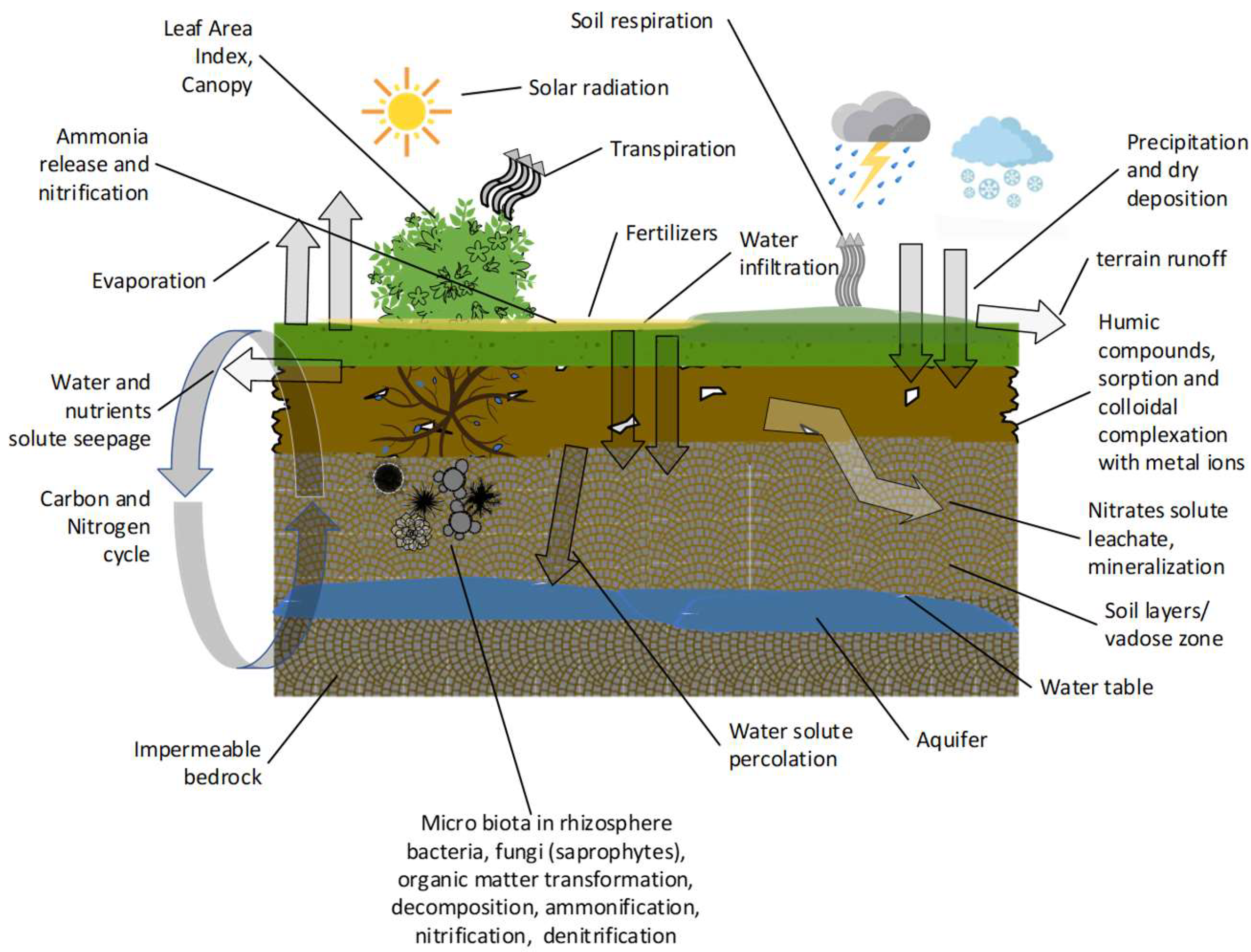
Figure 2.
Schematic best soil management practice by using HYDRUS 1-D soil water soluble simulation adopted.
Figure 2.
Schematic best soil management practice by using HYDRUS 1-D soil water soluble simulation adopted.
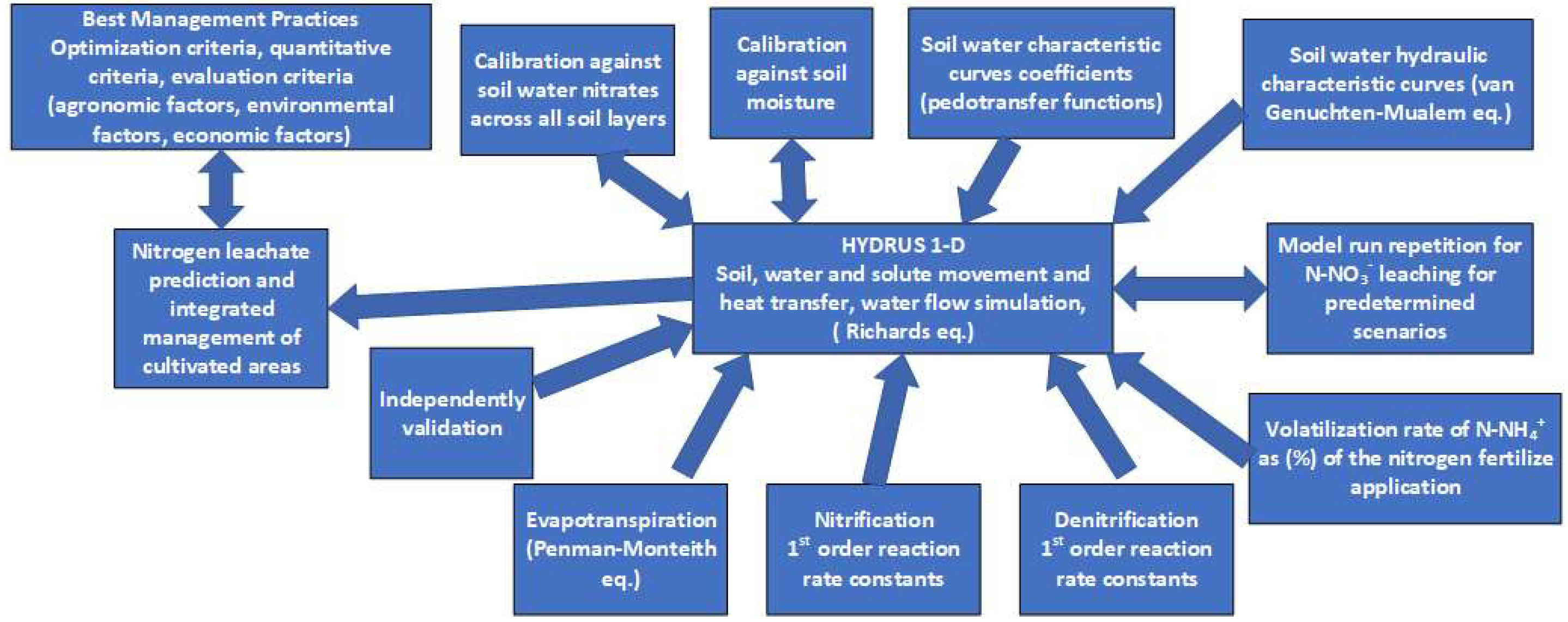
Figure 3.
Operational modules of DAISY a nitrogen-water balance and transport model in croplands.
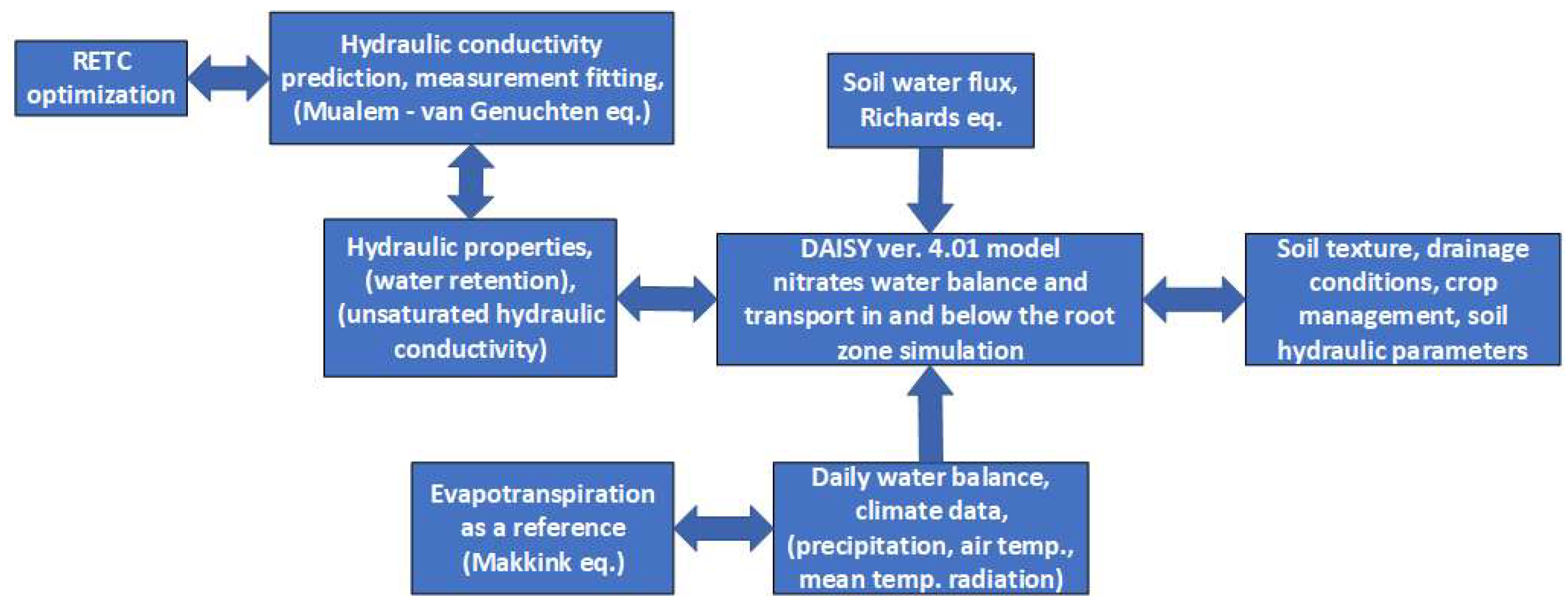
Figure 4.
Operational modules of APSIM crop growth model.
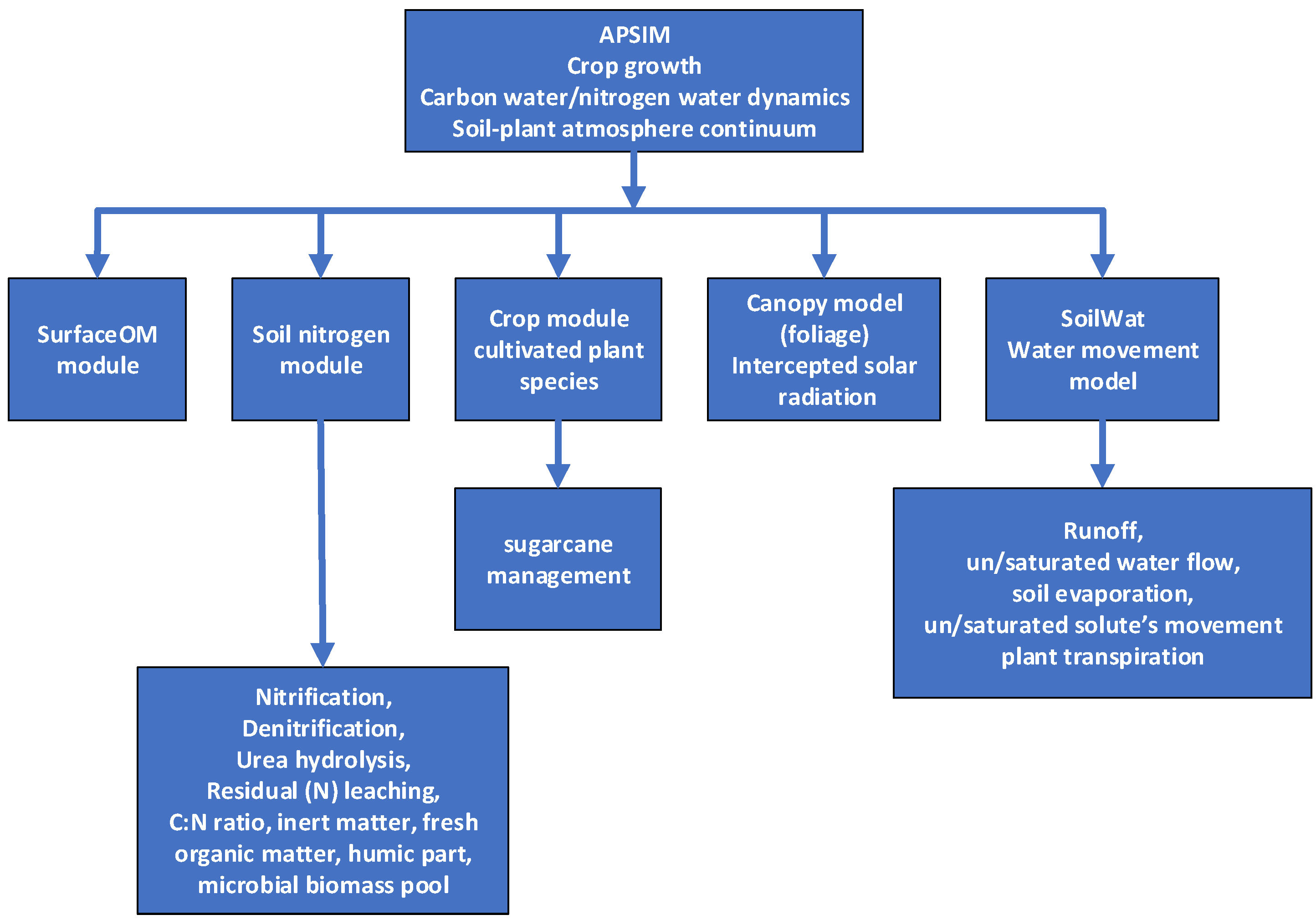

Table 1.
Water solute leachate models as prediction tools for surface and subsurface soft water and crop change management (not all mentioned on the corpus of the text)
Table 1.
Water solute leachate models as prediction tools for surface and subsurface soft water and crop change management (not all mentioned on the corpus of the text)
| Model or platform/type | Pressure drivers/ Application | Porous medium | Data collection/input | Reference |
|---|---|---|---|---|
| ADAPT (extension of GLEAMS with DRAINMOD hydrological component) | Agricultural subsurface drainage for nutrient transport/ Macrospore flow transfer | [137,176,216] | ||
| AGNPS/ non-point source model, (lumped conceptual type) | Non-point pollution simulation resulting from agricultural activities | Watersheds | [32,102] | |
| ANFIS | Groundwater quality for irrigation using, prediction of irrigation water quality index (IWQI), soluble sodium percentage (SSP), sodium adsorption ratio (SAR), potential salinity (PS), Kelley index (KI) and residual sodium carbonate index (RSC) | Sandstone aquifer | On-site water sampling collection | [149] |
| ANIMO /mechanistic model | Nutrient leaching prediction and surface, ground water quality prediction, agri-environmental indicators testing, nitrogen transformation and leaching | Root zone | [176,217-219] | |
| ANN combined with SES-BiLSTM and SES-ANFIS models, (LMBP) and (MLP) algorithms, ANN combined with fuzzy logic | Water table depletion, saltwater intrusion wedge/ Water quality prediction in different groundwater, groundwater level prediction | Groundwater | On-site water sampling collection, preprocessing (SES) method for weight of the dataset and models’ output adjustment | [12-13,141,148] |
| AnnAGNPS | Phosphorus and nitrogen transport | Watersheds | [220-221] | |
| ANSWERS /lumped conceptual type | /Watershed, nutrient planning | [102] | ||
| ANSWERS2000 (incl. Green and Ampt infiltration model) | /Catchment scale, Surface runoff and sediment transport model, sediment loss | Water, soil | it uses 30-s time steps during runoff and switches to daily time steps between runoff events | [222-223] |
| APEX /single porosity approach | Sediment, and phosphorus loss/ phosphorus contributions to tile drains, management practice effects simulation on runoff, sediment, and phosphorus loss | Macropore soil, forestry | [224-226] | |
| APSIM various versions, biophysical, unsaturated zone model, incorp. modules for simulating specific crops, (use of Rosetta and PAWCER model) | Nitrate dynamics leaching in irrigated croplands/Crop yield and N uptake, nitrate leaching control, simulate impacts of environmental and agricultural management factors on deep drainage and nitrate leaching, controlling deep drainage and nitrate leaching | Crop field, paddock scale | SurfaceOM, SoilN, SoilWat, Canopy, Crop modules, soil properties data for particle size analysis, irrigation scheduling, annual rainfall, soil moisture content and chemical properties, runoff, soil evaporation, saturated hydraulic conductivity, water flow and content parameters, fraction of inert carbon, C:N ratio, organic matter content, air and dry water content, soil texture, drained upper limit | [103-104] |
| AquiMod/ Lumped Conceptual Model | /Groundwater level prediction tool | Groundwater level time-series | [33] | |
| AqYield/AqYield-N, Nitrogen oriented variant | Nitrogen leaching/ field scale, management for mitigating environmental nitrogen losses/ crop model N leaching | Crop soil | Soil properties, daily climate features, sowing & harvest dates, irrigation, soil tillage depth | [56-57] |
| Biome-BGC, biogeochemical ecosystem model | Soil carbon and nitrogen fluxes/ soil water storage, net primary productivity, transpiration, soil respiration, nitrogen mineralization and leaching prediction, net ecosystem exchange, key indicators for ecosystem quality status | Global scale model | Soil texture, depth, elevation, meteorological data (i.e. wet precipitation, temperature), local physiological parameters (e.g, canopy, limitation of light penetration, maximum photosynthetic rates, leaf carbon to nitrogen ratios, dead wood lignin proportion). | [91-92,94] |
| BRANN / type of ANN | /prediction of groundwater levels | Ground water model | [12,16,227] | |
| CALF | Herbicides/ Herbicides dynamic estimator | [144] | ||
| CAMEL | Diffuse sources transport of reactive phosphorus/ Phosphorus identification at critical source areas | Catchment scale | [28-29] | |
| CENTURY/process-based monthly time step model, DeyCent is the daily time step counterpart | crop development | Soil carbon (C) and Nitrogen (N) dynamics | Soil Organic Matter (SOM) and litter pools with different (C:N) ratios and decay rates | [86,230] |
| CERES-Maize | crop growth simulation | Crop soil | Weather data, solar radiation, soil texture, bulk density, growth parameters | [18] |
| CoupModel/ bio-geophysical, process-based, multi-component ecosystem model | Fertilizing optimization in croplands/ C, N dynamic cycles of terrestrial ecosystems | Agricultural soil | Soil organic matter, vegetation biomass, soil, weather and N deposition data | [110] |
| CREAMS | Field-scale Chemicals Runoff, and erosion model | [27] | ||
| CROPGRO-Soybean | crop growth simulation | Crop soil | Weather data, solar radiation, soil texture, bulk density, growth parameters | [18] |
| DAISY ver. 4.01 | Nitrogen leaching / Cropping strategies affected nitrate leaching, agri-environmental indicators evaluation, precise fertilization | Agricultural soil | Soil hydraulic properties, climate data, soil texture, crop management | [95,101,128] |
| DayCent /mechanistic model, multi-layer soil division, a daily version of CENTURY | Nitrogen cycle in soils for various ecosystems | Cropland and forest soil | Soil and topographic properties/hillslopes, spatial distribution of land-use types, daily meteorological data, plant parameters nutrient amendments | [44-45] |
| DNDC | Nitrate leaching in crop field, aquifers nitrification/ Modeling nitrate leaching in crop field, carbon sequestration and nitrogen denitrification estimation | Crop field soil | Coupled with a biogeochemical model, crop yields datasets | [37-38,40,43,117-118,231-232] |
| DRAINMOD /deterministic hydrological model | Agricultural subsurface drainage for nutrient transport, groundwater salinity problems/ groundwater flow under shallow water table conditions, control the rising water table, transformation of nitrogen in a stream | Field scale, cultivated soil, soil profiles | [16,135-136,219] | |
| DRAINMOD-NII | nitrogen cycle to predict nitrogen dynamics | Shallow water table soils | Decomposition rate and C/N ratio, kinetics rates constants, N diffusion coefficient in the gaseous phase | [136-137,219] |
| DRAINMOD-P | Agricultural drainage for phosphorus transport/ phosphorus cycle to predict phosphorus dynamics | Artificial, agricultural, forest soil | [138,176] | |
| DRASTIC/ Adjusted DRASTIC Model (DRASTICA) | Groundwater vulnerability/ Soil solute leaching factors control on regional scale and prediction, land use management | Groundwater at a regional scale | GIS based, depth to groundwater, soil properties, topography | [15,104,233-234] |
| DSSAT (crop growth module) | Crop production simulation over time and space for different purposes | Cropland soil | Soil, crop, weather, and management input data | [70,161] |
| ECM | Nutrients’ load to surface water, total (N,P) / Prediction of phosphorus and nitrogen total amount delivered to surface water | national environmental databases/ geoclimatic region typology | [19]) | |
| EcoMod (agro ecosystem model) | Nutrients’ fate, leaching, adsorption, ammonium nitrification, gaseous (N2) losses / quantify the pastoral ecosystem responses to variability in climate and soil, choice of animal type for pasture, irrigation and fertilizer application | Pastoral soil ecosystem | Stochastically created 99-year climate files (Stochastic Climate Library), pasture growth date, animal’s physiology including production, water and nutrient dynamics in soils, calculations for light interception and photosynthesis. | [34-35] |
| EPIC | Soil erosion/ Erosion and Productivity Calculator, erosion’s effect on soil productivity and assessment | Agricultural soil | [124-125] | |
| EVACROP 1.5, uptd ver. EVACROP 3.0 percolation model | Nitrate leaching in crop field, aquifers nitrification/ Cultivation yield, optimization with catch crops | Crop field soil | Grain equivalent factors | [108-109] |
| FASTCHEM, geochemical hydrodynamic solute transport code based on MINTEQ approach | Fossil power plants pressure on soils/ Flying ash leaching attenuation on soils | Soil - flying ash interaction | [200] | |
| FEFLOW /Finite Element Subsurface Flow and Transport Simulation System | Predicts leachate flow and transport, landfill hydraulic stability prediction | Landfill capping | Saturated hydraulic conductivity, soil water retention characteristics, actual meteorological data, solar radiation, leaf area index, evapotranspiration, surface runoff and the interflow | [211,214] |
| FRAME (coupled unsaturated flow model SIWARE and a groundwater simulation model SGMP) | irrigation water management model | Groundwater basins | [16,235] | |
| GEPIC/spatially distributed | simulated crop-soil nitrogen dynamics, calculates the optimal fertilizer allocation, groundwater quality standards compliance | Cultivated land/regional scale | [236-238] | |
| GLEAMS (inc. hydrol. erosion, & pesticide component)/lumped conceptual | Agricultural subsurface drainage, nutrient transport, fate of agricultural chemicals/ water quality evaluation, prediction, model, agricultural, management, through the plant root zone | Field-size area soil | [29-30,239] | |
| GLYCIM | Soybean crop simulation model | [89,241] | ||
| GOSSYM/ mechanistic two-dimensional (2D) gridded soil model, incorporates many routines as components, coupled with expert system GOSSYM-COMAX, GOSSYM-2DSOIL | Soil nitrogen pollution, herbicides/ Cotton crop growth and yield, COMAX an inference incorporated engine for cultivation practices, fertilizing regulation, water, carbon and nitrogen interactions in soil, plant root zone and crop response to climate variables and water irrigation | Cultivated soil | Daily weather information, crop maturity, soil condition, plant growth data | [18,89-90] |
| HELP /deterministic model, statistical-empirical, simulates water vertical flow through landfill layers | Landfill’s leachate assessment generation, hydrologic evaluation/ Predicts leachate generation in landfills | Landfill capping and subsoil layers | Climatic (evapotranspiration, temperature, wet precipitation and solar radiation), soil type, vegetation, capping design and arrangement of layers | [77,210-211] |
| HSPF/ solute hydrological simulation / catchment-scale water quality model | Modelling phosphorus transport/field scale runoff model | Humid subtropical agricultural fields, alluvial plain | [240,242-243] | |
| HAIM with ELM GWO algorithm | Landfill leachate to the ground/ Landfill sites monitoring | Landfill sites | Leachate series quality data | [14] |
| HGS / Integrated modeling platform process based (incl. Richards eq.), (finite element, fully integrated numerical model) | Solute transport, hydrological model/ Solute/pollutant transport, simulates coupled (3-D) variably-saturated subsurface flow and (2-D) surface water flow, snow accumulation, snowmelt, and evapotranspiration | Agricultural soil, forests, catchments, regional scale model | Used with EauDyssée, surface-water mass balance module provides inputs to the coupled with (HGS) | [244-245] |
| HYDRUS-1D/process based, HYDRUS-3D/finite element model | Solute infiltration, dynamic leaching flux and soil water storage including dissolved CO2 and N2O conc. nitrogen leaching/ Landfills leachate fate, water, heat and solute transport model, hydrological evaluation, | Variably-saturated porous media e.g. landfill capping | Calibration before use, evaporation, plant transpiration, meteorological variables, irrigation, soil nitrification and denitrification, soil hydraulic characteristics, pedotransfer functions | [71-72,77,79,82-83,213] |
| HYPE (Semi-distributed hydrological model)/E-HYPE | Nitrate losses/ drainage and water quality processes, introduce Hydrologic Response Units to segregate the control area | Croplands/various | [246-247] | |
| ICECREAM (inc. Richards eq.)/ ICECREAM-DB, plot scaled model | Simulation of P transport, water discharge and erosion/ Quantify phosphorus losses | Soil profile, dual porosity, macroporous soils | [176,248] | |
| IHACRES/ IHACRES Classic Plus | Rainfall/runoff/ simulating surface hydrologic processes using spatially varying data | Catchments | [249-250] | |
| IMS | Coastal waterbodies salinization/ Integrated coastal waterbodies management applied on basins | Croplands, coastal watersheds, river basins, coastline aquifers (east Med region) | Inc. components (UTHBAL), (UTHRL), (MODFLOW), (REPIC), (SEAWAT) | [120] |
| INCA (Integrated Catchment model), process-based semi-distributed dynamic model/ INCA-N nitrogen oriented/ INCA-P phosphorous oriented/mixed model | Phosphorus/nitrogen leaching/ Phosphorus dynamics | Catchment scale | [251-252] | |
| ISSM, (comprises SWAT, MODFLOW and MT3DMS and QUAL2E). | Water and nutrients leaching prediction from surface to the aquifer, groundwater dynamics, aquifer interactions with the stream system, surface water and nutrient fluxes | Watershed soil | [128] | |
| ITS, groundwater model | Prediction of groundwater levels | Ground water model | [16,227] | |
| LASCAM /conceptual model | Nutrients’ leaching/ nutrient mobilization and transport estimation | [240,253] | ||
| LEACH/LEACHM/LEACHC/LEACHP/LEACHW | Water and Solute Movement/ A Process-Based Model of Water and Solute Movement, Transformations, Plant Uptake and Chemical Reactions | Soil unsaturated Zone | [75,144] | |
| Leaching release kinetics (modified Elovich curve, Freundlich dynamic eq., parabolic eq., 2nd order eq.) | Heavy metal leaching/ Leaching prediction | Portland cement | [205] | |
| LISFLOOD/physically based model | Rainfall/runoff/ Modelling within a GIS | River basin | [255] | |
| LPJ-GUESS / LPJ-GUESS LSM | Land use investigation combined with climate change | Vegetation soil | Data derived from Common Agricultural Policy Regionalized Impact (CAPRI) model at a terrain grid level up to 1km2 | [84] |
| MACRO /1-D mathematical model, (two-domain process GSmodel i.e. micro and macropores) | Pollutant transport, phosphorus leaching, herbicide leaching/ Chemical agents transport estimation, water flow and solute transport, it considers macropores as pathways when non-equilibrium flow, represents lateral flows to drains using sink terms | Cropland and forest soil (silt, loam soil), macroporous soil | Soil water content and soil temperature, air temperature and rainfall, herbicide losses measurements | [255-256] |
| MAGIC / lumped-parameter analytical model of intermediate complexity, predicting long-term effects of acidic deposition on soil and surface water chemistry | Surface water model of intermediate complexity, predicting long-term effects of acidic deposition on soil and surface water chemistry | Soil/soil water catchment | [257] | |
| Mathematical Numerical model using Darcian percolation and two-phase Fickian diffusion | Prediction of H2 Transport in salt cavern | Saturated rock salt | Thermodynamics, transport mechanisms | [191] |
| MESSAGE/fertilizing appliance simulation | Integrated assessment model, trade-off between crops yield and nitrogen for various regions | Crop soil | Wheat and maize yield | [85] |
| MIKE SHE /(coupled with DAISY), 3D physics-based model/ finite difference, coupled with MIKE-11 | Nitrates leaching groundwater contamination/ Non-point nitrate contamination, due to agricultural activities. It simulates overland and channel flow along with solute transport in the unsaturated zone. | Catchment scale | [102,251] | |
| MIKE-11/1-D hydrodynamic model | DO, BOD, NO3-, NH4+, coliforms, P/ Water quality parameters estimation model | [19] | ||
| MINTEQA2 (geochemical thermodynamic equilibrium model/database) EPA-USA | Equilibrium model for dilute heterogeneous aqueous systems | [200,258] | ||
| Model inc. Richards eq., van Genuchten parameter expressions, traverse isotropy for sendimentary rocks | Barren ore leachates/ Propagation model of oxidative agents, accelerated AMD and leachate tailing prediction | Coal mining waste | Soil water saturation | [185-186] |
| MODFLOW/combined with SWAN (SWATMOD) | Ground-Water Flow | Ground-water | [16,67,69, 259] | |
| MODFLOW-GRASS, finite difference groundwater flow model coupled with GIS module GRASS | Large scale groundwater flow | [260-261] | ||
| MONERIS/ Semi-empirical, conceptual model/semi static | Total (N,P), heavy metals and some priority substance/ Support environmental studies/ Freshwater Ecology and Inland Fisheries | River systems | data for run-off water quality and GIS | [19] |
| MOSFLA/modified, coupled to SWAT | / Farm soil management tool | Farm soil | Shuffled frog leaping algorithms, a farm-level economic model, cost estimator (FEM) | [66,237] |
| MT3DMS/ modular 3-D transport model | Groundwater contaminant leaching/ nitrate pollution/ Nitrate pollution/ aquifer’s nitrates transport | Groundwater Systems | SEAWAT and MT3DMS employ similar boundary conditions | [120,126] |
| NIT-DRAIN conceptual nitrate model | Agricultural subsurface drainage for nutrient transport/ applied in agricultural subsurface drainage | croplands | Subsurface drainage discharge measurement and water quality parameters at the catchment outlet | [87] |
| NLEAP /mechanistic model, coupled with GIS data NLEAP-GIS, (version 4.2)/ with ANN, genetic algorithms utilization | Nitrate soil leaching, Nitrogen losses to the environment especially in combined cropping landscape/ (N) losses assessment below root zone of crops, applied over risky landscape and cropping system combinations, economic analysis, use of criteria, useful of management practices over soil nitrogen transform and mitigation | Risky landscape and cropping lands | [113,115-116,119] | |
| NLES5/NLES4 /Empirical model, exponential function | Nitrate leaching in soils/ Estimation of nitrogen input to cultivated soil and crop sequence planning, Estimation of nitrogen input to cultivated soil and crop sequence planning /nitrate leaching from the root zone of agricultural land | Cultivated soil | Nitrogen leaching calibration datasets, winter vegetation, soil content | [98,131]) |
| NTRM | Soil nitrogen pollution | Weather data, soil properties, management, and crop characteristics, daily biomass and leafage extended area | [262] | |
| Numerical model, 3-D evolution of a horizontal cavern | Safe H2 geo-storage/ multi-step leaching | Composite structural mesh | Brine concentration | [189] |
| PAPRAN/ Nitrogen dynamic of Soil-Plant Systems | Simulation model of annual pasture production limited by rainfall and nitrogen | Pasture model | [263] | |
| PATRICAL/ a distributed model | Anthropogenic eutrophication countrywide/ Nitrate conc. estimation in aquifers and surface water after nitrogen appliance on crop soil. | Agricultural fields | Hydrological and water quality data derived from surface water and groundwater monitoring network | [129-130] |
| PELMO | Pesticides leaching/ Pesticide assessment prediction model/worst case leaching scenarios | [144] | ||
| PESTDRAIN | Pesticide soil drainage/ Dynamic of the pesticide leaching from drained soil profiles | Croplands, soil profile | [87,264] | |
| PHREEQC / PHREEQCRM | Heavy metal leaching, mineral is likely to dissolve or precipitate in groundwater/ Heavy metal leaching simulation in contaminated soils treated with sewage sludge in the presence of various adsorbents, estimate Saturation Index | Sewage, sludge-amended soil, geo- & nano-materials, zeolite, pyrite ash contaminated soils | Solution equilibrium phases, exchange inputs, use of VMINTEQ, NICADONAN, and SHM databases, thermodynamic database MINTEQ | [178,183,193-194,265] |
| PLASM /digital groundwater model | Groundwater pressure/ simulates the seasonal behavior of groundwater basins, planning and management | Groundwater basins | [16] | |
| PLEASE /conceptual, plot scale model | Phosphorus losses estimation | Soil profile/agriculture | [266] | |
| PLMP/ PDP single porosity models (incorporates four modules) land use partitioning | Phosphorus leaching/ Phosphorus Dynamic model transport, (precipitation, infiltration, evaporation and runoff) | Lowland polder soils/ paddy/dry lands | Daily reference evapotranspiration, crop factors | [176,243] |
| PRZM/ PRZM3 | Pesticide Root Zone transport/fate/ Pesticide and nitrogen fate in the crop root and unsaturated soil zones prediction model | Unsaturated soil zones | [144,267] | |
| QUAL2K (1-D steady state model)/advanced version of the QUAL2E | Phosphorus and nitrates simulation/ suitable for modelling pollutants in freshwater interacting with sediment | flow data and hydraulic terms, initial conditions, reaction rate coefficients, local climatological data for heat balance computations, biological and chemical reactions rate parameters | [19] | |
| REPIC (coupled EPIC model and R-ArcGIS) | Agronomic/nitrate leaching model/ crop growth/nitrates leaching model | Soil profile/ cultivated soil | [238] | |
| RNN (type) | [159] | |||
| RT3D | Contaminant transport model | [69,251] | ||
| RZWQM, (release. 2007, RZWQM2) simplified empirical plant module | Nitrate, phosphorus leachate prediction, aquifers nitrification estimator, developed to simulate the water and nitrate fate for the crops | Cultivated soil, Root Zone, sandy, sandy-loam | Crop empirical model parameterization, meteorological data, soil water content, bulk density, hydraulic conductivity, soil atmosphere N2O quantified exchange, pesticide conc., seepage, drainage, annual soil organic N mineralization, canopy, soil heat flux, biomass, plant information | [74,161,166-173,268-269] |
| SAHYSMOD (Spatial-Agro-HYdro-Salinity MODel) | Land reclamation/ evaluate factors affecting operation and design of bio-drainage system, management scenarios, salt and water balance analysis | Waterlogged areas | Coupled salinity model SaltMod and groundwater model SGMP/calibration/validation | [16,270] |
| SEAWAT simulation of 3-D variable density /generic MODFLOW/MT3DMS-based computer program | Aquifer salinization/ ground-water quality monitoring, sea water intrusion | Coastal soil profile | Time-series of crop yields, groundwater table observations, and observed concentrations of nitrates and chlorides, SEAWAT and MT3DMS employ similar boundary conditions | [120,127,238] |
| SGMP/ finite difference method | /Groundwater model | [16,235] | ||
| SIMCAT (stochastic, deterministic, Monte Carlo analysis technique) | High values DO, BOD, NO3-, Cl-, NH4+, | [19] | ||
| SIMGRO (physically-based model) | Simulates water flow in saturated/ unsaturated zone and in surface water | Regional hydrological model | [16,271] | |
| SMILE/ SIMPLACE | simulation for sustainable crops and agroecosystems | Crop soil | [272] | |
| SimplyP/conceptual | Phosphorus leaching/ Dynamic water quality estimation | [252] | ||
| SMDR, physically-based | surface water simulation, fully distributed and non-calibrated numerical model | [251] | ||
| SOILN | Nitrogen dynamics and losses in agricultural soil, surface, subsurface soft water quality / Simulated nitrogen dynamics | Layered agricultural soil | [105,273] | |
| SOLMINEQ/SOLMINEQ88 (USGS), geochemical model, water rock interaction | /Chemical modelling of aqueous systems | [274] | ||
| SOLTEQ/ MT3DMS | Stabilized waste leaching/ Leaching on solidified/stabilized wastes | [275] | ||
| STICS/conceptual, generic | Subsurface drainage modeling, nitrogen and CO2 flux, changes of carbon pool/ Soil-crop dynamic model, crop growth and crop N uptake management | Crop soil | Soil water, nitrogen balance, climatic and agronomic input data, weather conditions, cropping practices | [51-57] |
| SVM to support Water Quality Index (WQI) | Degradation of groundwater quality for Irrigation purposes/ Groundwater quality for irrigation using, prediction of irrigation water quality index (IWQI), soluble sodium percentage (SSP), sodium adsorption ratio (SAR), potential salinity (PS), Kelley index (KI) and residual sodium carbonate index (RSC) | Sandstone aquifer | On-site water sampling collection, model training, model validation | [149-150] |
| SUTRA (finite element simulation model) | Water table prevention from salinity, saturated/ unsaturated fluid density dependent groundwater flow, used as machine learning models approximation | Waterlogging areas, groundwater flow | [11,16] | |
| SWAP / process based | Solute leaching, soil transport/ Water, solute and heat transport, plant growth simulation | Plot scale, agricultural soil, forest | high frequency and high-resolution measured data/ GIS data | [16,176] |
| SWAT /(Semi-distributed hydrological model), coupled with MODFLOW, incorp. empirical Vegetative Filter Strip MODel (VFSMOD)/SWAT+ | Nitrate losses, agricultural chemical leaching/ drainage and water quality processes, prioritize new sustainable agricultural methodologies and management practices in agribusiness, fertigation. | Croplands, watersheds soils | Subbasins division and digital elevation model (DEM) data, soil profile moisture distribution, climate, soils, and land use, surface runoff lag coefficient, point source inputs, pesticides half-life, Complex model incorporates weather generators which downscales monthly climate data to daily data required, | [61,63,65,67,240] |
| SWATMOD (modified SWAT and MODFLOW components) | /Surface water simulation, stream aquifer and groundwater interactions | Cropland and watershed soil | Spatially varying parameters, algorithms to facilitate the heterogeneity of karst aquifers stream–aquifer interaction | [16,76] |
| SWBACROS | Irrigated water saving/ Shallow groundwater contribution to the water needs of a maize crop | Cultivated soil | [16,276] | |
| SWIM /single porosity model | surface transport of dissolved and particulate P/ Water quality and quantity simulation, impact of land use, management practices against climate change | Mixed land use | [104,176] | |
| SWRRB | Watershed, Rural Basins, decision support tool | Daily weather data, basin division | [31,144] | |
| TAM-MO-DEL/conceptual | Soil solute leaching/ Water solute dynamic assessment, leaching from drained soil profiles | Croplands | [277] | |
| TETIS/process based | Nitrogen leaching/hydrological model, nitrogen cycle including atmospheric deposition | Cultivated /irrigated soil | Corine land uses, maps and Pedotransfer functions, meteo data base, FAO org. crop coefficients | [46-47,50] |
| TOMCAT /Monte Carlo analysis approach /SLIMCAT | High values DO, NH4+, BOD/ Water quality prediction against contaminants i.e. Ammonium (NH4), and indices i.e. Dissolved Oxygen (DO), and Biochemical Oxygen Demand (BOD) | Landfills and others | [19,278] | |
| TOPCAT/TOPCAT NP | Total N & P simulation in river water bodies | Input of hydrologically effective rainfall, use of moisture stores | [19,279] | |
| TOPMODEL/topography-based model | Spatial and temporal predictions of soil moisture dynamics, variable source areas, runoff and evapotranspiration | [280] | ||
| TRIPLEX-DOC and modified TRIPLEX-DOC/process-based model | Simulates DOC dynamics/ DOC (Dissolved Organic Carbon), POC (Particulate Organic Carbon) transformation prediction | Monsoon forest ecosystems, temperate forest soils | Soil organic carbon conc., total nitrogen concentration, plant species composition, clay content, pH, soil Fe and Al conc., daily climate information (i.e., max/min temperature, wet precipitation), soluble C from fresh litter and root exudates | [59-60] |
| UNSAT-H | Unsaturated Soil Water and Heat Flow Model | [212] | ||
| UZF-RT3D | Nitrates pollution/ Evaluate the performance of best management practice of cultivated land, attenuate nitrates attenuation | Cultivated land | [237,281] | |
| VADOFT is a 1-D finite-element prediction code | Pesticides fate/ Predicts chemical agents’ fate in soil | It employs parameters pressure, water content, and hydraulic conductivity | [144] | |
| VARLEACH | Modified CALF model | [144] | ||
| Wang et al., 2021 Mathematical model | Safe H2 geo-storage (Solution Mining Under Gas)/ prediction and optimization leaching parameters, temperature, pressure | Rock salt, salt caverns | water injection pressure, nitrogen volume, nitrogen injection pressure, and gas-brine interface depth | [190] |
| WAVE | Soil nitrogen dynamic/ Simulating nitrogen behaviour | Cropped soil with winter wheat | [162] | |
| WEPP a field-scale model) | Soil erosion/ Erosion prediction | [240,268,282] | ||
| WHAM | Mine tailings and heavy metal leaching | Mining slurry | [181] |
ADAPT (Agricultural Drainage and Pesticide Transport); AGNPS (AGricultural Non-Point Source); ANFIS (Adaptive Neuro-Fuzzy Inference System); ANIMO (Agricultural NItrogen MOdel); ANN (Artificial Neural Network); LMBP (Levenberg-Marquardt back-propagation); MLP (Multi-Layer Perceptron); SES-BiLSTM (Single Exponential Smoothing Bidirectional Long Short Term Memory); SES-ANFIS (Single Exponential Smoothing Adaptive Neurofuzzy Inference System); AnnAGNPS (Annual Agriculture Non-Point Source); ANSWERS (Area Nonpoint Source Watershed Environment Response Simulation); APEX (Agricultural Policy Environmental eXtender); APSIM (Agricultural Production Systems sIMulator); Biome-BGC (BioGeochemical Cycles); BRANN (Bayesian Regulation Artificial Neural Network); CALF (CAL Flow); CAMEL (Chemicals from Agricultural Management and Erosion Losses); COMAX (CrOp MAnagement eXpert); CoupModel (Coupled heat and mass transfer Model); CREAMS (Chemicals, Runoff, and Erosion from Agricultural Management Systems); DAISY (Danish Simulation Model); DayCent (Daily Cent); DNDC DeNitrification-DeComposition); DRAINMOD (DRAINage MODel); DRAINMOD-NII (see DRAINMOD Nitrogen); DRAINMOD-P (see DRAINMOD Phosphorus); DRASTIC (Depth to water, net Recharge, Aquifer media, Soil media, Topography, Impact of the vadose zone, and hydraulic Conductivity); DRASTICA (see DRASTIC Adjusted); DSSAT (Decision Support System for Agrotechnology Transfer); ECM (Export Coefficient Model); ELM GWO (Gray Wolf Optimization-Extreme Learning Machine); EPIC (Environmental Policy Integrated Climate); EVACROP (EVAporation CROP; FEFLOW (Finite Element subsurface FLOW system); SIWARE (SImulation of Water management in the Arabic Republic of Egypt); GEPIC (GIS-based EPIC); GLEAMS (Groundwater Loading Effects of Agricultural Management Systems); GLYCIM (soybean model); GOSSYM (GOSSYpiuM); GRASS (Geographic Resources Analysis Support System); HAIM (Hybrid artificial intelligence model); HELP (Hydraulic Evaluation of Landfill Performance); HSPF (Hydrological Simulation Program-Fortran); HGS (HydroGeoSphere); HYPE (Hydrological Predictions for the Environment); IHACRES (Identification of unit Hydrograph and Component flows from Rainfall, Evapotranspiration and Streamflow); IMS (Integrated Modelling System); INCA (INtegrated CAtchment model; ISSM (Integrated Surface and Subsurface Model); ITS (Integrated Time Series); LASCAM (LArge Scale Catchment Model); LEACH (Leaching Evaluation of Agricultural Chemicals); LISFLOOD (Two-Dimensional Hydrodynamic Model specifically designed to simulate floodplain inundation); LPJ-GUESS (Lund–Potsdam–Jena General Ecosystem Simulator); LPJ-GUESS/LSM (see LPJ-GUESS Land Surface Model); MACRO (MACRO scale model); MAGIC (Model of Acidification of Groundwater in Catchments); SHE (Système Hydrologique Européen); MINTEQA2 (Metal Speciation Equilibrium For Surface And Ground Water); MODFLOW (Modular Ground-Water Model); MONERIS (MOdelling Nutrient Emissions in RIver Systems); MOSFLA (Modified shuffled frog leaping algorithms); MT3DMS (Mass Transport 3-Dimensional Multi-Species); NIT-DRAIN (NITrate DRAINage); NLEAP (Nitrogen Loss and Environmental Assessment Package); NLES (Nitrate LEaching Simulation); NTRM (Nitrogen-Tillage-Residue-Management); PAPRAN (A simulation model of annual pasture production limited by rainfall and nitrogen); PATRICAL (Precipitation Input in Network Sections Integrated with Water Quality); PELMO (Pesticide Leaching Model); PESTDRAIN (PESticide transport in a Tile-DRAINed field); PHREEQC (PH (pH), RE (redox), EQ (equilibrium), C (program written in Q)); PHREEQCRM (see PHREEQC Reaction Module); PLEASE (Phosphorus LEAching from Soils to the Environment); PLMP (Pesticide Leaching Model Phosphorus); PDP (Phosphorus Dynamic model for lowland Polder systems); PRZM (Pesticide Root Zone Model); QUAL2K (A Modeling Framework for Simulating River and Stream Water Quality); REPIC (R-Gis and Environmental Policy Integrated Climate); RNN (Recurrent Neural Networks); RT3D (Reactive Transport 3D); RZWQM (Root Zone Water Quality Model); SAHYSMOD (Spatial Agro-Hydro-Salinity Model); SEAWAT (SEA WATer intrusion model); SGMP (Soil and Groundwater Management Plan); SIMCAT (SIMulation of CATchments); SIMGRO (SIMulation of GROundwater and surface water levels); SIMPLACE (Scientific Impact assessment and Modelling PLatform for Advanced Crop and Ecosystem management); SimplyP (Simply Phosphorus); SMDR (Soil Moisture Distribution and Routing); SMILE (Scientific Model Integrating pipeline Engine); SOILN (SOIL Nitrogen); SOLMINEQ (SOLution MINeral Equilibrium); STICS (Simulateur mulTIdiscipli-naire pour les Cultures Standard); SVM (Support Vector Machine); SUTRA (Saturated-Unsaturated Transport); SWAP (Soil Water Atmosphere Plant model); SWAT (Soil and Water Assessment Tool); SWATMOD (Soil and Water Assessment Tool MODified); SWBACROS (Simulation of the Water BAlance of a CROpped Soil); SWIM (Soil and Water Integrated Model); SWRRB (Simulator for Water Resources in Rural Basins); TOPMODEL (TOPographic MODEL); TRIPLEX-DOC (TRIPLEX-Dissolved Organic Carbon); UNSAT-H (Unsaturated Soil Water and Heat Flow Model); UZF-RT3D; VADOFT (VADOse zone Flow and Transport model); WAVE (Water and Agrochemicals in the soil, crop and Vadose Environment); WEPP (Water Erosion Prediction Project); WHAM (Windermere Humic Aqueous Model).
Table 2.
Models and countries that were applied according to the relative literature
| Model/Countries | Australia | Bangladesh | Belgium | Canada | China | Denmark | Egypt | England | Finland | France | Germany | Greece | India | Iran | Italy | Japan | New Zealand | Nicaragua | Pakistan | Poland | Portugal | Saudi Arabia | Spain | Sweden | Taiwan | Tunisia | USA |
|---|---|---|---|---|---|---|---|---|---|---|---|---|---|---|---|---|---|---|---|---|---|---|---|---|---|---|---|
| ANFIS | √ | ||||||||||||||||||||||||||
| ANN | √ | √ | √ | √ | |||||||||||||||||||||||
| ANN-AGNPS | √ | ||||||||||||||||||||||||||
| APSIM | √ | ||||||||||||||||||||||||||
| Aq-Yield | √ | ||||||||||||||||||||||||||
| BIOME-BGC | √ | ||||||||||||||||||||||||||
| BRANN | √ | ||||||||||||||||||||||||||
| COUP MODEL | √ | ||||||||||||||||||||||||||
| DAISY | √ | √ | |||||||||||||||||||||||||
| DAYCENT | √ | √ | |||||||||||||||||||||||||
| DNDC | √ | ||||||||||||||||||||||||||
| DRAINMOD-NII | √ | ||||||||||||||||||||||||||
| DRAINMOD-P | √ | ||||||||||||||||||||||||||
| DRASTIC/DRASTICA | √ | √ | |||||||||||||||||||||||||
| ECOMOD | √ | √ | |||||||||||||||||||||||||
| EVACROP | √ | ||||||||||||||||||||||||||
| FEFLOW | √ | ||||||||||||||||||||||||||
| FRAME | √ | ||||||||||||||||||||||||||
| HAIM | √ | ||||||||||||||||||||||||||
| HELP | √ | √ | √ | ||||||||||||||||||||||||
| HGS | √ | ||||||||||||||||||||||||||
| HSPF | √ | ||||||||||||||||||||||||||
| HYDRUS | √ | ||||||||||||||||||||||||||
| ICECREAM | √ | √ | |||||||||||||||||||||||||
| IMS | |||||||||||||||||||||||||||
| ISSM | √ | ||||||||||||||||||||||||||
| ITS | √ | ||||||||||||||||||||||||||
| MACRO | √ | √ | |||||||||||||||||||||||||
| MAGIC | √ | ||||||||||||||||||||||||||
| MIKE SHE | √ | ||||||||||||||||||||||||||
| MODFLOW | √ | √ | √ | √ | √ | √ | √ | ||||||||||||||||||||
| NIT-DRAIN | √ | ||||||||||||||||||||||||||
| NLEAP/GIS | √ | √ | |||||||||||||||||||||||||
| NLES5 | √ | ||||||||||||||||||||||||||
| PATRICAL | √ | ||||||||||||||||||||||||||
| PDP | √ | ||||||||||||||||||||||||||
| PHREEQC/PREEQCRM | √ | ||||||||||||||||||||||||||
| PLASM | √ | ||||||||||||||||||||||||||
| PLMP | √ | ||||||||||||||||||||||||||
| RZWQM/RZWQM2 | √ | √ | |||||||||||||||||||||||||
| SAHYSMOD | √ | ||||||||||||||||||||||||||
| SEAWAT | |||||||||||||||||||||||||||
| SGMP | √ | ||||||||||||||||||||||||||
| STICS | √ | ||||||||||||||||||||||||||
| SVM | √ | ||||||||||||||||||||||||||
| SWAP | √ | ||||||||||||||||||||||||||
| SWAT | √ | ||||||||||||||||||||||||||
| SWATMOD | √ | ||||||||||||||||||||||||||
| TRIPLEX-DOC | √ | ||||||||||||||||||||||||||
| TETIS | √ |
Table 3.
Model advantages and drawbacks according to the relative literature
| Model or platform/type | Advantages | Drawbacks |
|---|---|---|
| ADAPT | DRAINMOD-NII and ADAPT demonstrate the same performance as regards soil water N leachate | |
| ANFIS | Combines ANN and fuzzy inference systems advantages | Long training time consumption |
| ANIMO | SWAP combined with ANIMO results in a more realistic simulation of P transport. | |
| ANN | AI reduces the time needed for data sampling and enhance identification ability of the nonlinear patterns of input and output is more reliable compared to the other classical statistical methods, demonstrates High accuracy in groundwater level management. Deep learning or unsupervised algorithms are more accurate. ANN models are the most popular algorithm on account of their high accuracy, easiness of implementation, and input parameters flexibility. | |
| ANSWERS2000 | Simulate surface transport of both dissolved and particulate Phosphorus | |
| APSIM | Validated extensively, specific simulation module development for sugarcane | |
| AquiMod | Unconfined aquifers/ run quickly and efficiently to simulate groundwater levels for contrasting aquifer types | |
| AqYield/AqYield-N | Simplicity, few inputs, sufficient estimation/ equal accuracy to STICS, Prediction with limited data, no pests or diseases consideration, Yield and soil water content for irrigated crops equally well prediction, Microbial transformations of N and C | |
| Biome-BGC | Numerous studies worldwide across variant biome types, validated in Tibet | |
| BRANN | Effective to improve model network generalization by controlling and penalizing large weights of model parameters/ | |
| CAMEL | Lack of published validation with field data until 2020 | |
| CENTURY | Wide appliance range of agroforestry and land-use systems e.g. tropical and temperate forests, grasslands, croplands, and agroforestry systems, highly adaptable | Requires many input parameters, difficult to measure or estimate with precision, input parameters and assumptions high sensitivity, which introduce uncertainties into the results |
| CoupModel | Runs on daily time step | |
| DAISY | Validated on national scale in Denmark | |
| DayCent | Enabled to simulate sorbed and labile soil P, tested for satisfactory simulation in mixed landscape and hilly/mountainous areas | Computationally intensive, not easy to apply on large-scale spatial and temporal domains, problems with nitrogen dynamic cycle in arid and semi-arid soil, daily time step |
| DNDC | Wide range of agronomic and environmental indicators in various agro-environmental conditions | |
| DRAINMOD | Too many input parameters and measurements with high accuracy at the field-scale, restriction appliance on artificial drained lands | |
| DRAINMOD-NII | Great number of input parameters, high accuracy measurements at the field-scale | |
| DRASTIC/ DRASTICA | Fuzzy logic methods with ensemble learning yield better performance. | |
| DSSAT | DSSAT module v.4.0 was linked to RZWQM2 for better crop production/incorporate N fixation module | |
| EcoMod | Suitable for grazing ecosystems, pastures in Australia and in New Zealand. | |
| EPIC | CREAMS, GLEAMS and EPIC were the base for SWAT model/intensive data requirements | |
| EVACROP 1.5/3.0 | Developed for Danish climatic conditions, predicts minelarization from catch crop residues | |
| GLEAMS | More effective with ANN and linked with DRAINMOD | |
| GOSSYM/GOSSYM-COMAX/GOSSYM-2DSOIL | Modified GOSSYM gives better net photosynthesis predictions, and soil simulation/transpiration process improvement, GOSSYM-COMAX is widely validated | |
| HELP | Aging landfill waste and compression were not recognized, they affect negatively the leachate prediction (underestimation of the leachate generation), limitations of vegetation type with certain leaf area index for evapotranspiration estimation | |
| HSPF | Highly published catchment models include Hydrologic Simulation Program | |
| HAIM/ELM GWO | Different landfill sites applicability, robust alternative to MARS, MLPANN, ELM, and MLPANN-GWO in terms of leachate quality and groundwater quality applications | |
| HYDRUS-1D/3D | Most commonly employed in landfills multiple solutes in variably-saturated porous media | |
| INCA/INCA-N / INCA-P | Terrestrial and aquatic | |
| ISSM | Relies on open-source models SWAT and MODFLOW demonstrate application flexibility | |
| ITS | BPANN models are superior to the ITS in forecasting the groundwater levels | |
| LASCAM | Unable to distinguish between planting in the recharge areas of each sub-catchment against planting in the discharge zones | |
| LPJ-GUESS | Global vegetation model for nitrogen leaching | |
| MACRO 1-D | MACRO explicitly considers macropores as pathways for rapid non-equilibrium flow, represents lateral flows to drains using sink terms, describes sufficiently pesticide transfers complexity and interacting processes | |
| MAGIC | Catchment soils with rapid equilibration soil cation time | |
| MESSAGE | Make use of drivers such as (Representative Concentration Pathways 8.5), soil leaching in certain scenarios | |
| MIKE SHE /+ DAISY | Processes apart from evapotranspiration the snowmelt | |
| MINTEQA2 | Limitations with equilibrium constants for certain temperature values and within certain range of ionic strength. Lack of published validation with field data until 2020 | |
| MODFLOW / + SWAN (SWATMOD) | Inferior accuracy in terms of ground water level prediction, easy accessibility, user-friendliness and versatility/ MODFLOW coupled with RT3D | |
| MONERIS | Priority substances simulation | |
| MOSFLA/+ SWAT | More powerful convergence and optimization ability, four times better management outcome | |
| MT3DMS | Grid cells, on a monthly step | |
| NIT-DRAIN | Ability to simulate correctly both flux and nitrate concentrations | |
| NLEAP/NLEAP-GIS/ +ANN | Widely applied and validated in the US, Europe, South America, Canada, when coupled with GIS increases (N) losses assessing capability in risky landscape with combined cropping systems and evaluates more accurately management practices over nitrogen transform and mitigation | |
| PATRICAL | River basin scenarios flexibility and time projection | |
| PESTDRAIN | Adopted as NIT-DRAIN and TAMMODEL, conceptual soil reservoir technique | |
| PHREEQC / PHREEQCRM | Geochemical reaction & transport model, great ability to simulate heavy metal leaching in contaminated soils and calculate Saturation Indices (SI) | |
| PLMP/PDP | Developed to simulate P dynamic in paddy fields. Simulates only dissolved P and particulate P. Unable to simulate transport of particulate P in surface water and dissolved P in runoff from dry and paddy lands. Overcome problem by PDP with USLE and INCA-P | |
| PRZM/ PRZM3 | Intensive data requirements | |
| QUAL2K | Simulates up to 16 water quality determinants/algal simulation capability (e.g. Chlorophyll-a) /not stochastic | Not dynamic (time invariant) |
| REPIC | Integrated to IMS/REPIC, overcome problems of variants of EPIC model/module of Reservoir Simulation-Optimization Module, calculate on annual basis yields of various crops and different irrigation and fertilization scenarios | |
| RNN | RNN integrated with GIS enables scientists to predict accurately groundwater quality indices and cope with health risk management | |
| RT3D | SWAT-MODFLOW-RT3D coupling | |
| RZWQM/RZWQM2 | Requires terrain data such as plant heights, rooting depths of randomly selected plants in crop stages, empirical model parameterization for the crop, successfully used in Mediterranean agro-ecosystems for a long period with extended publication reference | |
| SAHYSMOD | Long-term effect evaluation of alternative management groundwater scenarios | |
| SEAWAT | Calibrated model in various areas in Greece, with high final accuracy, coupled with MODFLOW for saline intrusion zones | Hydraulic conductivity sensitivity may be biased for seawater intrusion cases of coastal aquifers |
| SIMCAT | Time invariant | |
| SIMGRO | The coupling of model is difficult if the flow resistance across the boundaries of subdomains is small | |
| SOILN | Module to APSIM to improve N, C dynamics | |
| SOLTEQ MT3DMS | Incorporates cement chemistry | |
| STICS | Widely calibrated | Daily time step stimulation, prediction with limited data, no pests or diseases consideration |
| SVM | Integrated ML model (via SVM supervised algorithm) and WQI improves understanding of water quality assessment | |
| SWAP | SWAP reported with the best performance compared with MACRO and CropSyst in terms of simulated soil water contents, using detailed | |
| SWAT + MODFLOW | ΜODFLOW performs better when coupled with SWAT over complex surface-groundwater interactions analysis, easily coupled with NSE | Simplistic simulation of groundwater for SWAT |
| SWIM | Lack of published validation with field data until 2020, suitable when coupled APSIM–SWIM to simulate shrink/swell soils hydraulic conductivity on runoff rates | |
| SWRRB | Return flow travel times can be calculated from soil hydraulic properties | |
| TAMMODEL | Reservoir based approach model | |
| TETIS | Implemented in watersheds of all sizes | |
| TOMCAT+Monte Carlo | Easy to merge TOMCAT and SLIMCAT into a single library | Time invariant |
| TOPCAT/TOPCAT NP | Not to be used for a topographic distribution function | |
| TOPMODEL | Not to be used for a topographic distribution function | |
| TRIPLEX-DOC and modified | Good ability to simulate the dynamics of soil water fluxes in forest soils | |
| UNSAT-H | Most commonly employed in landfills hydrological evaluation | |
| VADOFT | The code when equipped with Monte Carlo enables the run of multi-parameter scenarios several hundred times and provide stochastic (probabilistic) outputs. | |
| WEPP | Widely used, applied in a variety of geographic regions, capable of modeling complex hydrologic processes | Requires a significant amount of input detailed soil and topographic data not always available when applied, computationally intensive, therefore time-consuming simulation, primarily focused on water erosion processes |
Disclaimer/Publisher’s Note: The statements, opinions and data contained in all publications are solely those of the individual author(s) and contributor(s) and not of MDPI and/or the editor(s). MDPI and/or the editor(s) disclaim responsibility for any injury to people or property resulting from any ideas, methods, instructions or products referred to in the content. |
© 2024 by the authors. Licensee MDPI, Basel, Switzerland. This article is an open access article distributed under the terms and conditions of the Creative Commons Attribution (CC BY) license (http://creativecommons.org/licenses/by/4.0/).
Copyright: This open access article is published under a Creative Commons CC BY 4.0 license, which permit the free download, distribution, and reuse, provided that the author and preprint are cited in any reuse.